Tag: no-latest

  • Dear Abby | Politics form wedge between mother and daughter

    DEAR ABBY: After the last presidential election, my daughter, “Cindy,” whom I love with all my heart, turned against me. Cindy started rebelling when she was a teenager. Our relationship was rocky for some time, but I never stopped loving her. Once she matured, our relationship became much better, so I was shocked when she turned on me in such a vicious way.

    She began making up stories about how I had abused her as a child — absolute lies. She also began sending me nasty text messages, calling me names because of my political beliefs and telling me she no longer wants a relationship with me. I don’t care what her political beliefs are. I would never be so cruel to her. It has been a year and a half since we have had any contact. I have tried writing her letters, which I assume she is throwing in the garbage without reading. I can’t call her because she blocked my number, and she has also blocked me on all social media. I need advice about how to move forward.

    — GOOD MOM IN THE SOUTH

    DEAR GOOD MOM: Cindy needs some time to cool off, so the best you can do now is give that to her. Stop writing to her, and do not ask anyone to contact her on your behalf. Also, please think twice before repeating to friends and family what you’ve told me. If Cindy learns that you’ve been describing yourself as a perfect mother and her as a hateful ingrate, you may never hear from her again. Take this time to work on yourself. Even if you did everything right as a mom, you didn’t learn how to connect with a child whose values are different from yours. A licensed therapist may be able to help you with that and may even shed some light on Cindy’s reasons for cutting ties with you. You may not agree with her reasons, but trust that they are important to her.

    ** ** **

    DEAR ABBY: My aunt and uncle, who are both in their mid-to-late 50s, live with my grandmother, who is in her early 80s. They are hoarders and have taken over half of my grandmother’s house. They came to live with her for the summer eight years ago and constantly cause strife for my father. They take things without permission and are now babysitting my cousin’s daughter almost every day. My aunt is easily offended and deflects any criticism, while my dad avoids confrontation at any cost. Should I do something, or is it not my place to get involved?

    — LOOKING ON IN WISCONSIN

    DEAR LOOKING ON: Nowhere in your letter did you mention that your father has any serious objections to what’s going on with his mother and these relatives. Before involving yourself by trying to run interference for him, ask him if there is anything he wants you to do. Because he is averse to confrontation, he may prefer you stay out of it. However, if you are concerned about your cousin’s daughter being looked after in a home that has been taken over by hoarders, you should discuss it with your cousin.

  • Horoscopes: Thursday, June 11, 2026

    ARIES (March 21-April 19). The project you have on deck will bring out the best in you, requiring you to be organized, forward-thinking and resourceful. You’ll have fun with it too, as long as you pace yourself well.

    TAURUS (April 20-May 20). You’ll create change the easy way. You’ll focus less on “stopping” and more on “replacing.” Instead of wrestling an old pattern to the ground every hour, you move to a different environment and engage with different people and challenges.

    GEMINI (May 21-June 21). Move forward with great enthusiasm and the bold assumption that your wishes will be granted. The reason for this? Because the sheer energy of your excitement could be enough to charge the situation in your favor. So why not?

    CANCER (June 22-July 22). You’re operating at a level that’s taken years to get to and managing quite a workload. Remember there was a time you wouldn’t have been able to do even a fraction of this. Give yourself credit for how far you’ve come.

    LEO (July 23-Aug. 22). An exchange will extend far beyond vocabulary. People reveal themselves through timing, pauses, tone, omissions, repetition and word choice. You get the hidden layers of expression. You’ll key into motives, fears, desires and the emotional realities unfolding around you.

    VIRGO (Aug. 23-Sept. 22). Emotional intelligence changes the atmosphere of a room. One thoughtful response can interrupt conflict, reduce defensiveness and make space for honesty. You consistently create a pleasant tone in interactions to mutual benefit.

    LIBRA (Sept. 23-Oct. 23). Things have not wrapped up neatly, and that’s OK. Life’s story is unfolding in a messy and nonlinear way. And though you may feel disorganized or unpredictable, it’s a time to lean into that chaos because resisting will only deplete you.

    SCORPIO (Oct. 24-Nov. 21). While every feeling is information, not every feeling deserves immediate action. To notice emotional reactions without becoming controlled by them takes skill. Today you’ll pause to make room for discernment, restraint, compassion and good choices.

    SAGITTARIUS (Nov. 22-Dec. 21). You have wondered at times if true love is even real, and that is because love transcends comprehension. Today love is flattered by your quaint, and useless, analysis. Today love defies rational explanation. Today love continues to confound.

    CAPRICORN (Dec. 22-Jan. 19). Different generations will find common ground in the more universal truths. You’re also very open to learning about the nuances of style, topics of relevance and various worldviews that others are living inside. This makes it easier to relate to people of various ages.

    AQUARIUS (Jan. 20-Feb. 18). You don’t always need more motivation. Sometimes you need fewer obstacles between yourself and action. That’s why everything you put into preparing your workspace will matter today. Small improvements in organization create big gains in productivity.

    PISCES (Feb. 19-March 20). Things are often funny because they are true. Today, a well-timed observation will interrupt the tension. Laughter creates breathing room. In fact, laughter is, by definition, physical proof of that breathing room exists.

    TODAY’S BIRTHDAY (June 11). It’s your Year of Weight Bearing Victory when lifting builds physical muscles, problem-solving builds intelligence, and necessity builds creativity. You conjure fuel from pure imagination. You constantly and specifically envision the dream, and life serves it up. More highlights: Things that come to you indirectly include love, power and the funding for one of your wilder projects. Scorpio and Capricorn adore you. Your lucky numbers are: 10, 1, 14, 33 and 21.

  • U.S. military says it’s striking ‘multiple targets’ in Iran in second day of renewed fire

    DUBAI, United Arab Emirates — The U.S. military said Wednesday it began another round of strikes against Iran, after President Donald Trump warned that Tehran would “pay the price” for stalled negotiations. The escalating attacks threatened to derail efforts toend the war.

    U.S. Central Command said in a social media post that the military was striking “multiple targets in Iran,” attacks that were “in response to Iran’s unwarranted and continued aggression.”

    The second day of American strikes came hours after Bahrain, Kuwait and Jordan — all of which host U.S. troops — came under Iranian fire. It was the third time this week that back-and-forth strikes have tested a two-month ceasefire. They also came a day after the U.S. struck Iran following the crash of an Army helicopter near the Strait of Hormuz that Trump blamed on the Islamic Republic.

    Trump has urged Iran to sign a deal to end the war and suggested earlier this week that an agreement could be reached in a matter of days.

    Iranian media reported that explosions were heard in Bandar Abbas, Sirik and Minab in the south of the country.

    Iran has proved resilient despite weeks of heavy bombing. It is betting that its ability to effectively close the Strait of Hormuz — a crucial passageway for oil and natural gas — gives it a strong bargaining chip.

    Iran’s United Nations envoy said the U.S. should refrain from threats of force if it wants a deal.

    “Iran has never negotiated under threats and pressure and will never submit to pressure or question,” Ambassador Amir Saeid Iravani told the U.N. Security Council on Wednesday.

    Still, both countries seem to be looking for a way to end the conflict — if they can manage to sell it as a win at home.

    Israeli Prime Minister Benjamin Netanyahu appears intent on pursuing goals that make compromise harder: the collapse of Iran’s theocratic government, the elimination of its nuclear program, and the destruction of the Iranian-allied Hezbollah militant group in Lebanon. On Monday, Iran and Israel targeted each other.

    Trump says U.S. is sneaking oil past the Strait of Hormuz

    Since the U.S. and Israel started the war with Feb. 28 attacks on Iran, the conflict has shaken the global economy, driven up energy prices worldwide, and made food and other basics more expensive.

    The international benchmark for crude oil traded above $93 a barrel on Wednesday, up more than 25% since the start of the war.

    Trump said Wednesday the U.S. military has since last month undertaken a “secret mission” to sneak oil shipments past Iran’s forces in the Strait of Hormuz. He said ships were slipping through at night, aided by the destruction of Iranian radar equipment.

    Trump said as a result more than 100 million barrels of oil have evaded Iran’s chokehold on the strait. There was no immediate confirmation of that figure, which roughly equals five days of oil shipments through the waterway before the war began.

    The military’s role was not immediately clear. Capt. Tim Hawkins, a Central Command spokesman, said U.S. forces “communicate and coordinate” with commercial ships in the area, but gave no details on military support being offered.

    U.S. and Iranian strikes shake the Mideast

    Earlier Wednesday, the U.S. military said an American aircraft fired “precision munitions” into the engine room of the Palau-flagged vessel M/T Settebello as it attempted to breach the naval blockade with a shipment of Iranian oil. It was the eighth merchant vessel disabled by U.S. forces in waters off Iran.

    India’s foreign ministry said three Indian sailors were missing after the Settebello was struck, while 21 others were rescued. Its statement did not mention the U.S. military or the blockade.

    Hawkins of U.S. Central Command said American forces warned the crew before firing on the ship.

    The U.S. military said strikes earlier Wednesday targeted “air defense, ground control stations, and surveillance radar sites.”

    Iran said U.S. strikes hit two water reservoirs in the southern city of Sirik, temporarily cutting off water to thousands of people. U.S. Central Command had no immediate comment.

    Tehran later claimed attacks in Kuwait, Bahrain, and Jordan.

    Jordan said it shot down five incoming missiles, which Iran said targeted an air base hosting American military aircraft.

    Bahrain and Kuwait said they intercepted incoming fire.

    Iranian Foreign Minister Abbas Araghchi condemned the American attacks as a violation of Iranian sovereignty. Foreign Ministry spokesperson Esmail Baghaei said in televised comments that, following the new attacks, Iran would review its stance on negotiations to end the war.

    Efforts to mediate a deal continued. Following consultations with the U.S., a delegation from Qatar arrived in Tehran for talks on Wednesday, according to an official with knowledge of the visit who requested anonymity due to the sensitivity of the talks.

    The exchanges of fire came a day after a U.S. Army attack helicopter crashed near the Strait of Hormuz. The helicopter collided with an Iranian drone, according to a U.S. official speaking on condition of anonymity to discuss an ongoing investigation. It wasn’t clear whether the collision was intentional.

    A drone boat rescued the helicopter’s two crew. Trump said they were uninjured.

    Big disagreements stand in the way of a quick peace deal

    Wary of high gas prices in the run-up to congressional elections in November, Trump seems to be looking for a quick win. But he is also making demands that will be tough for Iran to swallow.

    The U.S. wants to see Iran give up its stockpile of highly enriched uranium. While Iran insists its nuclear program is peaceful, that uranium is a short technical step from weapons-grade levels.

    Iran is refusing to give up the uranium and demanding relief from sanctions. It also wants the release of frozen assets even before a final agreement is in place, something Trump rejected.

    It’s not clear how those differences can be bridged. In a Truth Social post Wednesday, Trump said Iran was taking “too long to negotiate a deal” and ”now they will have to pay the price!!!”

    Iran has insisted that any deal to end the war must also end fighting between its ally Hezbollah and Israel. Israel has instead intensified its military campaign against the Lebanon-based militant group.

    An airstrike on a village east of Tyre killed at least six people, Lebanon’s state-run National News Agency reported. It said two others were killed by an Israeli drone strike on a car in the southern city of Sidon.

  • A new wave of anti-immigrant violence hits U.K. as riots convulse Belfast

    BELFAST — Masked men set houses, vehicles, and a city bus ablaze in Belfast on Tuesday night, torching neighborhoods across the city after a graphic video of an alleged knife attack by a Sudanese asylum seeker went viral, igniting the latest anti-immigration violence to convulse the United Kingdom.

    Ignoring pleas for calm from politicians and clergy, rioters rampaged through heavily immigrant neighborhoods in Belfast, the capital of Northern Ireland, in some cases going door-to-door and causing some families to flee under police protection.

    Men in balaclavas and hoods shouted “foreigners out,” witnesses said. One family with children had to be escorted from a burning house, according to the BBC, and a family of Ukrainian refugees fled through their back door as the front door burned.

    Attackers set cars alight in an eastern Belfast neighborhood, stopping in one case after a neighbor told them the vehicle was owned by “locals.” A member of Parliament from the Belfast area described the actions as a “race-based pogrom.”

    The riots spread from Belfast to towns across Northern Ireland and reached into Scotland and England by nightfall. A heavy police presence remained Wednesday morning as officials braced for unrest to continue. Officials said some 200 backup officers from other parts of the U.K. were due to arrive Thursday.

    The Rev. Brian Anderson of the East Belfast Methodist Mission, who was at the scene overnight, said that many of the rioters were “young men out of control” but that the attacks seemed to be directed by a smaller number of older men.

    Anderson’s congregation of native-born and immigrant parishioners was terrified, he said Wednesday morning amid the burned-out cars and broken glass along Lendrick Street. Many parents kept their children home from school, he said.

    Anderson condemned the violence but said underlying social tensions must be addressed.

    “I do believe this community does want to welcome immigrants, but they also want to have their housing issues and their employment issues dealt with,” he said.

    The transit agency suspended services in parts of Belfast, after rioters pushed burning trash bins into a public bus. The Police Service of Northern Ireland said it received 13 reports of criminal damage and at least five of arson, some of which were treated as hate crimes.

    The unrest was the most serious to grip the United Kingdom in nearly a year and placed fresh strain on a government already battered by a running national argument over race, immigration, and police conduct that has been building since last summer.

    The immediate trigger this time was a knife attack late Monday in north Belfast, in which a man in his 40s suffered significant injuries to his eyes and slash wounds to his face and back. Bystanders, including one man wielding a hurling stick, intervened to stop the attack and were credited with saving the victim’s life.

    Word spread rapidly on social media that the attacker was a foreign-born asylum seeker.

    The suspect, a Sudanese national, was charged Tuesday with attempted murder.

    During an appearance at Belfast Magistrates’ Court by video link Wednesday, he was identified as Hadi Alodid, 30, and was denied bail.

    The victim’s family put out a statement Wednesday condemning the riots. “We want to make it absolutely clear that overnight unrest is not welcome, and peaceful protest is the only way forward,” the statement said. “We have many migrants who make a deeply valuable contribution to our country, including in our healthcare system and hospitality sector and we depend on them to make our country work. We do not want this terrible tragedy to be used to divide people or fuel hostility.”

    Northern Ireland’s chief constable, Jon Boutcher, confirmed Tuesday that the suspect was living in the United Kingdom on a five-year visa granted in September 2023. Boutcher said the man was believed to have traveled to Paris from Sudan and then to Dublin before claiming asylum in Belfast.

    “There is no trace of this suspect on any of our national security databases, and he was not known to the Police Service of Northern Ireland,” Boutcher said. Police said the attack was not being treated as terrorism.

    Though Ireland and France are both members of the European Union, Ireland is not part of Europe’s visa-free travel zone. It was not clear how he had traveled between the two nations.

    The Republic of Ireland and the United Kingdom are part of a common travel union, and movement between them is unregulated. Anti-immigration activists have accused Ireland of being an easy entry point for asylum seekers and other migrants into Britain.

    Jim Allister, a member of Parliament from the Traditional Unionist Voice party said he believed unfettered access had made Northern Ireland “an open house” and blamed Prime Minister Keir Starmer’s Labour Party for not doing more to stem migration.

    “We have a man probably fighting for his life because he is a victim of the open borders that this government has permitted,” Allister said in a BBC interview.

    Tensions over immigration long predate Starmer’s government, which took office in 2024 after 14 years of Conservative Party rule.

    Video of the attack spread on social media Tuesday, and some right-wing leaders called for mass protests.

    The English anti-immigrant activist Tommy Robinson called the knife attack “yet another invader attack on our people.”

    Elon Musk, the South Africa-born American billionaire, reposted Robinson’s call for nationwide protests on X, writing: “Only by protesting REPEATEDLY and LOUDLY will there be any change!!”

    The leaders of Northern Ireland’s five main political parties issued a joint statement condemning the stabbing and urging calm, saying that “there is no place in our society for this kind of brutality.”

    First Minister Michelle O’Neill wrote on social media that groups of masked men burning families out of their homes amounted to “nothing less than disgusting cowardice.” O’Neill said there were “dangerous attempts to exploit” the attack to target innocent people simply trying to live, work and raise their families in Belfast.

    Starmer called the knife attack “horrific” and “sickening.” His office said “it is time for calm,” and urged that police be given “time and space to investigate appropriately.” Starmer and other senior politicians urged the public not to share the graphic video circulating online or to spread disinformation.

    The Belfast riots, with some of the unrest concentrated in traditionally unionist parts of the city, are the latest upheaval in a prolonged crisis over race and immigration in Britain. Last June, Northern Ireland endured two weeks of anti-immigration rioting triggered by an alleged sexual assault in the town of Ballymena, which drove much of the town’s Roma population to flee.

    More recently, violent protests erupted in May after Vickrum Digwa, 23, a Sikh man was convicted of murdering Henry Nowak, 18, university student stabbed in Southampton in December 2025.

    Police body-camera footage showed Nowak, who had been handcuffed, pleading with responding officers who did not recognize that he was seriously injured, saying: “I can’t breathe” and “I’ve been stabbed.” An officer told him: “I don’t think you have, mate.”

    Nowak died at the scene. Critics said officers treated Digwa, who claimed Nowak had attacked him “racially,” with more deference than the victim. The footage fueled claims that British police were institutionally biased against white Britons, claims that prosecutors and ministers have rejected.

  • Bill Gates testifies about his ties to Epstein, calls meetings a ‘grave error in judgment’

    WASHINGTON — Bill Gates said Wednesday that he made a “grave error in judgment” by meeting with Jeffrey Epstein but denied any wrongdoing as the Microsoft cofounder faced hours of questioning from lawmakers about his relationship with the disgraced financier.

    In an opening statement provided to the Associated Press, Gates said he “should never have met with Epstein in the first place,” but that he “never witnessed nor had any indication that Epstein was engaged in ongoing criminal conduct.”

    The tech billionaire became the latest powerful figure linked to Epstein to testify before the House Oversight Committee in a closed-door deposition. The committee chairman, Republican Rep. James Comer, formally requested that Gates testify after he appeared multiple times in a trove of documents released by the Justice Department as part of its Epstein probe.

    As Gates arrived at the Capitol, he noted that his appearance was voluntary and said he hoped his testimony would help lawmakers “find justice for the victims.” Gates did not take questions from reporters at the conclusion of the interview late Wednesday afternoon.

    Gates, who chairs the Gates Foundation, has not been accused in connection with Epstein’s crimes and has repeatedly denied any knowledge of Epstein’s abuse of girls. He has said the two met only to discuss philanthropy and previously described the relationship as “a huge mistake.”

    Most Democratic members who participated in Wednesday’s questioning described Gates as cooperative. They said some of the most useful information he provided involved other influential people in Epstein’s orbit. Lawmakers also said they pressed Gates on why he continued interacting with Epstein after he pleaded guilty in 2008 to soliciting prostitution from a minor.

    Gates was aware that Epstein had been convicted of “a horrific crime and continued to interact with him to seek money for his foundation,” said Rep. Robert Garcia, the top-ranking Democrat on the committee, who described Gates’ actions as “a horrific judgment call.”

    Before the interview began, Comer told reporters that the committee’s effort was “about trying to figure out how the government failed.”

    Lawmakers scrutinize Gates’ relationship with Epstein

    Gates said he was introduced to Epstein through people involved in his professional and philanthropic work and was drawn in by Epstein’s claims that he could help raise billions of dollars for global health initiatives.

    Their relationship began in 2011, three years after Epstein’s guilty plea in Florida, according to the Justice Department files. Gates said he cut ties in 2014 after concluding Epstein could not deliver on those promises.

    Included in the files are calendar entries for meetings between Gates and Epstein, email correspondence between the two about philanthropic projects and photos of Gates at events that Epstein also attended.

    Gates added that he never went to Epstein’s island or his other infamous properties.

    “I have never victimized anyone. While he may have sought to foster a personal relationship, I was never interested in that and never reciprocated,” Gates said.

    Lawmakers offered differing accounts of the interview as they exited the room throughout the day.

    GOP Rep. Tim Burchett described the questioning as “intense,” while Democratic Rep. Raja Krishnamoorthi said Gates was “combative” and “not terribly forthcoming or candid.” Garcia, by contrast, said that while Gates pushed back on some inquiries, “he’s answering the questions.”

    Democratic Rep. Melanie Stansbury said Gates acknowledged maintaining contact with Epstein because he believed the “narrow relationship” was “an acceptable means to access wealthy donors.”

    The Gates Foundation said in February that a small number of employees had met with Epstein based on his “claims that he could mobilize significant philanthropic resources” for global health. They never created a charitable fund together, and the foundation made no payments to Epstein.

    Both Gates and his ex-wife, Melinda French Gates, have said his association with Epstein created tension in their marriage.

    Broader Epstein investigation continues

    Epstein was federally indicted in July 2019 on charges of sex trafficking of minors and conspiracy to commit sex trafficking of minors. The Justice Department alleged that Epstein formed a vast network of girls, some as young as 14, for him to sexually abuse between 2002 and 2005. He died by suicide in a New York jail cell in 2019 while awaiting trial.

    The files released by the Justice Department read like a who’s who of powerful men across tech, finance, politics, and other industries. All have denied involvement in Epstein’s crimes, but some maintained or formed friendships with him even after his history of sexual abuse came to light.

    At another closed-door deposition in February, former President Bill Clinton faced more than six hours of questioning from lawmakers about his association with Epstein more than two decades ago. Epstein visited the White House several times during Clinton’s presidency, and Clinton flew occasionally on Epstein’s private jet.

    The former Democratic president said he saw no signs of Epstein’s sexual abuse and stopped associating with him long before Epstein’s 2008 guilty plea. Clinton has not been accused of any wrongdoing in connection with Epstein.

    Democrats on the House committee have pushed for testimony from President Donald Trump, a Republican who had his own relationship with Epstein. Republicans have said they have not come across any evidence that Trump did anything wrong during his well-documented friendship with Epstein.

    Comer said Wednesday that he’s planning to ask attorney Alan Dershowitz to appear and that he’s been in communication with the Justice Department about acting Attorney General Todd Blanche coming in for questioning as well.

  • Pope honors Barcelona’s Sagrada Familia as masterpiece of stone, color, and light on Gaudí centenary

    BARCELONA, Spain — Pope Leo XIV celebrated the Sagrada Familia Basilica as a masterpiece of “stones, colors, and light,” as he marked the centenary of the death of its architect, Antoni Gaudí, with a Mass on Wednesday to inaugurate its final soaring sandcastle spire.

    Leo called Gaudí’s unfinished temple, one of the world’s most visited monuments, a “sign of unity and harmony for all of Spain,” an ongoing building project like the lifelong journey all Christians make to find God.

    “We are all the living stones of this edifice,” Leo said from the altar of the basilica, with Spanish King Felipe VI and Queen Letizia sitting to his side and a hundreds-strong choir filling the basilica with song.

    The service marked the highlight of Leo’s weeklong visit to Spain, the first by a pope in 15 years to the once staunchly Catholic European country that, like many others, has experienced secularizing trends.

    The trip, though, has underscored how the country of 50 million people, which experienced a religious crisis after its 20th century dictatorship ended, still has plenty of faithful Catholics who have turned out in droves to welcome the American pope.

    An estimated 120,000 people lined the streets around Sagrada Familia for the event, with streets closed to traffic and a heavy police presence, given the attendance of the royal couple and Prime Minister Pedro Sánchez. The crowds remained after Mass to watch as Leo inaugurated the basilica’s final Tower of Jesus Christ that has made it the world’s tallest church.

    Speaking in Catalan and Spanish, Leo blessed the tower and its illuminated ceramic cross from outside the basilica, surrounded by bishops craning their mitre-capped heads to look up. An angelic boy’s choir sang as a spectacular light show lit up the basilica’s stained glass windows from the inside and fireworks shot off its facade.

    Honoring Catalonia’s Christian traditions

    Earlier Wednesday, Leo celebrated a more ancient sacred monument, traveling to Montserrat, a mountain complex outside the city that is dear to many Catalans. The complex, which includes an 11th-century Benedictine abbey and a 16th-century basilica, is revered for its Black Madonna statue and is home to a boys choir that has existed since the 13th century and is Europe’s oldest.

    Thousands of faithful arrived early at the monastery, with groups of nuns and schoolchildren singing and waving signs and photographs of the pope outside the basilica. Bells rang out over the spire-like rock formations that top Montserrat and the valley below as Leo arrived in a golf cart.

    In recent years, the Montserrat abbey has faced numerous accusations from survivors of clergy sexual abuse and was included in the Spanish ombudsman’s 800-page report on the crisis in 2023. The report found 15 victims and three alleged perpetrators linked to the abbey.

    “It’s very painful because there are members of the church who committed errors,” said the Rev. Cesario Escarda, a Toledo priest, as he waited for Leo at the abbey. “What the pope wants to do is shine a light on the truth and ask forgiveness and bring in the victims and listen to them and accompany them.”

    The Bible carved in stone

    The highlight of Leo’s visit, though, was his Mass at Sagrada Familia to commemorate the 100th anniversary of the death of its famed Catalan designer, Gaudí, who died at age 73, three days after he was hit by a tram.

    A century after construction began during the pontificate of Leo’s namesake, Pope Leo XIII, the basilica has become one of the world’s most visited but unfinished monuments, annually drawing upward of 5 million visitors a year.

    Commemorating Gaudí’s death, Leo said he wanted to give thanks to all the supporters, artists, and workers who “cooperated in the construction of an architectural masterpiece, which is also an eloquent catechesis made of stones, colors, and light.”

    Gaudí, who is on the path to possible sainthood, spent four decades designing and building the temple as the summary of the Christian faith carved in stone. The most important stories of Jesus’ life, the Nativity and Passion, are etched into the basilica’s east and west facades. A third facade facing south, the Glory, will serve as the basilica’s main entrance when finished.

    The temple is an architectural and geometrical masterpiece inside and out, an art nouveau celebration in form and symbol of Christianity and God’s creation through stone and light.

    “Much more than a monument, the Basilica of the Sagrada Familia remains a work in progress today, reminding us that the Christian life is always a journey, because it is a project that God is carrying out,” Leo said in his homily.

    A total of 18 sandcastle spires rise up from the top and pierce Barcelona’s skyline: 12 to symbolize Christ’s 12 apostles, four for each of the four Evangelists who recorded Christ’s life in the Gospels, one topped with a star over the apse honoring the Virgin Mary and, tallest among them, the Tower of Jesus Christ.

    When the final Christ tower was finished last year at a height of 564 feet, it made Sagrada Familia the world’s tallest church.

    “The entire structure of the Sagrada Familia is striking,” said Laura Rincón, who was on hand outside along with two friends for the Mass, after she finished work in a nearby shop. She said that she was sure the pope would be impressed by the church she marvels at every time she passes by.

    “If you look at it just for its architecture, it is amazing,” she said. “Inside, its columns make you feel like you are inside a forest.”

    An interior that looks like a forest

    The cross-shaped interior, with the altar at the apse, is an homage to light and nature. Treelike columns soar to the sky, colored by constantly changing light filtered through stained glass windows like the sun poking through leaves in a forest.

    “Nature is my teacher,” Gaudí once said. “Everything comes from the great book of nature, always open that we must read.”

    The colors of the window glass have meaning: The blues and greens of the eastern portal windows, where the facade depicts Christ’s birth, look more joyful and are most brilliant when the sun rises and light passes through. The coarser shades of red and orange, illuminated by the setting sun on the western portals, color the side of the basilica that depicts Christ’s Passion. Behind the altar and above the cross are yellows and gold that glimmer in the noonday sun.

    Historian Mònica Santín, who leads tours of the basilica, said that in designing Sagrada Familia, Gaudí was guided by two books: the Gospels and nature.

    “The way he lets in the natural light is also an invitation to the Christian mystery,” she said, citing the three facades depicting Christ’s birth, death, and glory.

    “And when you enter inside, it is all light,” Santín said. “What is that the symbol of? We can’t see God, but we perceive his light all around us. I think that is how you can read this message, and it is fascinating.”


  • Texas Tech defends playing QB Brendan Sorsby amid gambling addiction, says ‘it’s not murder’

    HOUSTON — Sports leadership at Texas Tech on Wednesday defended their plans to play quarterback Brendan Sorsby next season while he treats his gambling addiction, insisting they are not trying to “engineer his eligibility” through the courts and dismissing widespread criticism that includes the president of the NCAA.

    Speaking to the Houston Touchdown Club, coach Joey McGuire acknowledged the “rage” surrounding the situation, with athletic directors across college football saying that the NCAA ban on players who gamble should remain sacrosanct and a court order won this week by Sorsby crossed a line that should never be crossed.

    “For some reason, as a society, we’ve been OK with other things that happen and allowing players to play, and this has been the one thing that has united people, that they were against,” McGuire said. “It’s crazy because it’s not murder, it’s not beating somebody — so there’s a lot of things that we’re working through. None of this is OK.”

    Athletic director Kirby Hocutt also released a statement to “offer a few facts that seem to be getting lost in the noise” and noting the school is not part of Sorsby’s lawsuit against the NCAA.

    “A young man in treatment for a clinically diagnosed addiction exercised his legal right to seek a remedy in court and a judge agreed with him,” Hocutt said. “Our role has been to support his recover, not to engineer his eligibility.”

    Under the court order, Sorsby will be suspended for the first two games of the season. The NCAA plans to appeal the ruling, with President Charlie Baker telling reporters in Las Vegas that the case illustrated “a new low” in college sports.

    McGuire likened Sorsby recovering from his addiction to fellow Texas Tech quarterback Will Hammond’s recovery from knee surgery.

    “He’s recovering,” McGuire said. “I’ve sat down with this young man multiple times and the things that he is going through and what he’s been through, it’s serious.”

    “And I have a number of people in my family that were addicted to different stuff and so I’ve seen what addiction does to people,” he said. ”And so, us even saying to the point before we get to the legal part, that he could be ready in Week 3 against Houston is still a stretch because guess what, he’s still recovering.”

    McGuire added that Sorsby was “back in the building” after spending some time away from the facilities while he was dealing with his issues.

  • David Briscoe, AP journalist who chronicled Philippines’ democratic revolution, dies at 82

    David Briscoe, a journalist for the Associated Press who chronicled the collapse of dictatorship and the rebirth of democracy during a dramatic period of upheaval in the Philippines, has died, his family said. He was 82.

    Mr. Briscoe died Sunday at an assisted living facility in Kapolei, Hawaii, said his wife, Leonor Briscoe. He was diagnosed in April with amyloidosis, a disorder in which protein buildup can lead to organ damage.

    In a career spanning decades and continents, Mr. Briscoe brought a reporter’s curiosity to his native Utah, to Washington and to Hawaii. But it was his perch in Manila that put him at the center of his biggest story.

    Taking the helm as bureau chief in 1980, Mr. Briscoe charted the waning years of Ferdinand Marcos’ authoritarian regime and the turmoil unleashed by the assassination of opposition leader Benigno Aquino Jr. He and his staff fanned out across the country in chartered planes, rented jeeps, and, at least once, a horse-drawn cart. They covered a relentless stretch of investigations, hearings and a presidential campaign so improbable it seemed scripted, with a reluctant widow thrust by tragedy to the forefront of a democratic movement.

    That thrilling conclusion, with Corazon Aquino ascending to the presidency and Marcos dramatically driven into exile, would stay with Mr. Briscoe forever. He recalled searing images “of nuns kneeling in front of military tanks” and “soldiers and civilians crying in each other’s arms.”

    “I expect to witness or cover no greater event in my life,” he wrote in AP World, an in-house magazine, in 1986, recounting his coverage of the upheaval.

    A love affair with the Philippines

    David Chesley Briscoe was born July 30, 1943, in Salt Lake City, Utah, to a union steward father and a homemaker mother who raised her two sons in the Church of Jesus Christ of Latter-day Saints. He grew interested in journalism at the University of Utah, writing for the student paper and eventually getting hired at the Deseret News, where editors handed him obituary assignments and pieces on standout local students.

    After two years there, Mr. Briscoe signed up for the Peace Corps and was assigned to Paracale, and then Naga City, in the Philippines, where he taught English. For a young man who had scarcely left Utah in his youth, every corner seemed to be a revelation, of water buffalo shimmering from mud baths and children running down dirt roads.

    He was smitten with his new home. When his Peace Corps tour ended, Mr. Briscoe bristled at the idea of leaving. He found work at a local newspaper, and while staffing an event in which Marcos was to speak, he met the former Leonor Aureus, editor of a rival paper. The two were soon walking down an aisle they lined with copies of The Naga Times and the Bicol Mail.

    A dramatic revolution unfolds

    Mr. Briscoe was hired by the AP in Manila in 1970, covering a deadly earthquake that rocked the capital, an assassination attempt on Pope Paul VI and the hijacking of a plane. By the next year, though, AP said he’d have to spend some time working in the U.S. He returned to Salt Lake, hoping fate might someday bring him back to the Philippines.

    In his hometown, he found ties with his faith were fraying. His wife says he was disciplined by the church after discussing its exclusion of Black men from its priesthood in a class he taught. Mr. Briscoe opposed the ban. The church later lifted the restriction.

    He also found himself at odds with the church over a three-part series he wrote with a colleague, Bill Beecham, examining its intricate web of business interests and tithing by its members that the reporters estimated brought in more than $1 billion a year. No Utah newspaper dared to run the stories, the pair said.

    Mr. Briscoe spent nine years in Salt Lake before his bosses dangled a chance to return to Manila as bureau chief. He rushed to phone his wife with the news.

    “Noree, are you sitting down?” she remembered him asking.

    From Washington back to the Pacific

    After his six-year stint running the AP’s office in the Philippines, Mr. Briscoe moved in 1986 to Washington, where he focused on international affairs. He was bureau chief in Honolulu from 2001 until retiring in 2009.

    There, dressed in aloha shirts and bathed in a tropical sun, Mr. Briscoe could again call a Pacific island home. He spoke of being “halfway back.”

    To his final days, he cherished his time in the Philippines. As the end neared, his family gathered around him and prayed. He grabbed his wife’s hand, told her he loved her, and asked her to let him go.

    The family plans to hire a boat and scatter Mr. Briscoe’s ashes in the waters of the Pacific, hoping the currents take his remains back to his adopted home.

    “The land that David learned to love,” his wife said, “and where he met the love of his life.”

  • Carson Hocevar accused of ‘creating a lot of enemies’ in NASCAR after 9-car crash at Michigan

    Carson Hocevar sat on the Michigan International Speedway pit wall with a blank look and calmly waited as Bubba Wallace laid into him with an animated lecture.

    As Wallace did nearly all the talking, Hocevar nodded and offered a few smiles. The one-sided conversation ended with Hocevar patting Wallace on the shoulder — defusing the tension while offering little remorse.

    The third-year Cup Series driver, whose aggression has earned him the nickname of “The Hurricane” in rubbing the NASCAR establishment the wrong way, left a trail of wreckage in his wake Sunday at Michigan.

    With a fifth place in the No. 77 Chevrolet, the Portage, Mich., native earned his best career Cup finish at his home-state track. He also triggered a nine-car crash on a midrace restart by bumping John Hunter Nemechek as the cars ahead of him were slowing down.

    “I was like, ‘Man, I didn’t mean to do that,’” Hocevar said. “I obviously feel bad that I wrecked them and everything, but my intention wasn’t to wreck anybody, really. So next time I’ll know what to do a little differently.”

    Many of his peers believe the Spire Motorsports driver should be doing everything differently.

    “Well, you can count on Hocevar to always do dumb [stuff],” Nemechek radioed his team. Josh Berry jokingly referred to Hocevar as “The Intimidator,” the moniker of seven-time champion Dale Earnhardt.

    “I hope at some point [Hocevar] figures it out, but I know I’m not going to show anything to him for a long time,” said Austin Dillon, who finished 36th after his No. 3 Chevy was trashed in the wreck.

    In their pit-wall discussion, Wallace told Hocevar he was jealous of his speed.

    “He’s one of the fastest in the field, and that’s his natural ability,” Wallace said. “I’ve got to give respect to it. But at the same time, Kevin Harvick told me four or five years ago, ‘Stop hitting [stuff], and your finishes will show.’ And that’s what I simply tried to tell [Hocevar], man. He’s going for every move, every second. Not worth it.

    “He’s creating a lot of enemies. I just told him, ’You’re fast. A lot of us are jealous of what you’re able to do. But we’re beating you because we can put a race together better than you.”

    An unfazed Hocevar essentially shrugged when asked about Wallace’s criticism.

    “I get his point and everything,” he said. “I’m just racing really hard, and there were times where I tried to make a move and get two spots when I probably should have just got one, and it cost me.”

    The 23-year-old upstart did show some acquiescence toward the end of the race when he waved by the faster cars of Wallace, Erik Jones and Kyle Larson.

    But there’s an incentive to stick to his hard-charging ways.

    It’s a NASCAR rite of passage for the old guard to scold young stars who threaten their results, and it’s been effective in blunting their progress. Three years ago, Ross Chastain dramatically tailed off after being targeted for scorn from several veterans who tangled with him.

    If he shows restraint, Hocevar might lose his grip on a top-16 spot in the Chase (he is ranked seventh with 11 races left in the regular season). Yet his recalcitrance also runs the risk of costly retribution.

    Amazon Prime analyst Dale Earnhardt Jr. believes Hocevar should stay the course for his own good — and for NASCAR, which thrives on colorful personalities and rivalries.

    “I don’t want him to really change what he’s doing,” Earnhardt said of Hocevar on the postrace show. “As a fan and as a broadcaster, what he did today made this race unique. If he cleans it up, I’m not sure I’m going to like what I’m going to see. I kind of like the drama that he brings. He’s got a hat to wear, and he wears it well. He doesn’t seem interested in changing, and I don’t want him to change.”

    Hamlin ponders future

    With his second consecutive victory and third this season, Denny Hamlin now trails Tyler Reddick by only 51 points, chopping 78 points off the margin in the past three seasons. Team owner Joe Gibbs is still hoping Hamlin will reconsider his decision to retire from full-time driving after the 2027 season.

    Hamlin left the door slightly open (“I told (Gibbs) just check with me in six months”) but said he wants to go out on top before his skills diminish.

    “I feel as though there’s three things that happen,” Hamlin said. “You lose your eyesight. You lose your reaction. And your body hurts. The body hurts are there during the week. I’m not recovering as quick. But the other two things are still sharp. So I want to go out like this.”

    In-Season Challenge

    Sunday at Pocono Raceway will set the field for the second year of the In-Season Challenge. The top 32 drivers in the points standings will complete for $1 million in a bracket-style tournament contested over five races (Sonoma Raceway, Chicagoland Speedway, Atlanta Motor Speedway, North Wilkesboro Speedway, Indianapolis Motor Speedway).

    Connor Zilisch is unlikely to be eligible. The Trackhouse Racing rookie is ranked 34th in the standings (two spots behind Alex Bowman, who missed four races) after becoming the sixth driver in NASCAR history with three consecutive last-place finishes.

  • Democrats make a huge bet on Platner in Maine, which could decide the Senate

    Democrats make a huge bet on Platner in Maine, which could decide the Senate

    Graham Platner’s primary victory in Maine sends Democrats barreling into one of this year’s most important Senate contests with a rush of insurgent energy but gnawing uncertainty about the withering Republican scrutiny to come.

    His decisive victory offered a vivid display of the deep Democratic desire for a new generation of leaders, suggesting that many primary voters in Maine embraced his populist economic message and working-class appeal.

    Yet in nominating Platner, Democrats are making an enormous bet in their quest to regain control of the Senate, staking their chances in a crucial race on an untested and scandal-plagued oysterman.

    Maine is a linchpin of both parties’ midterm strategies. With Republicans holding 53 seats in the Senate, Democrats will have to defend all the seats they hold and flip four more to win control in November. For months, party leaders have believed their most likely path ran through North Carolina, Ohio, Alaska, and especially Maine — the only state of the four that voted against President Donald Trump in 2024.

    But Platner’s controversy-filled ascent to the Democratic nomination has complicated those plans, leaving some strategists worried that the party may need to win in deep-red Iowa or Texas to offset a loss in Maine.

    Supporters of Graham Platner celebrate in Blue Hill, Maine, after he won the Democratic nomination for the Senate on Tuesday night.Sophie Park

    Even with many Maine liberals excited about his candidacy, the road ahead for Platner remains difficult.

    He is facing Sen. Susan Collins, a powerful moderate Republican legislator with a three-decade record of winning over the female voters, who make up a majority of the Maine electorate.

    He must pivot from being a left-wing insurgent — Sen. Bernie Sanders (Ind., Vt.) has been one of his fiercest champions — to winning over general-election voters in Maine.

    And he must dispel the concerns of the nearly 30% of primary voters who, according to incomplete results Tuesday night, cast ballots for other Democratic candidates.

    Those efforts began with his victory speech Tuesday night.

    “If you believe as I do that we can change our politics and change our country, then you must also believe that people can change,” he told supporters in rural Blue Hill, where he was born. “Every day, I wake up and I try to be a little better and a little bit kinder than I was the day before.”

    Collins, who is widely seen as the most vulnerable Republican incumbent, faces her own considerable challenges. She must outrun the difficult national political environment for Republicans, with Trump’s approval ratings sagging amid an unpopular war with Iran that has driven up gas prices and inflation. And she must convince voters eager for generational change and new leadership that she remains fit for a sixth term at age 73.

    Platner sought to remind voters of those liabilities in his victory speech, lacing into Collins with scathing attacks intended to tie her to the Trump administration.

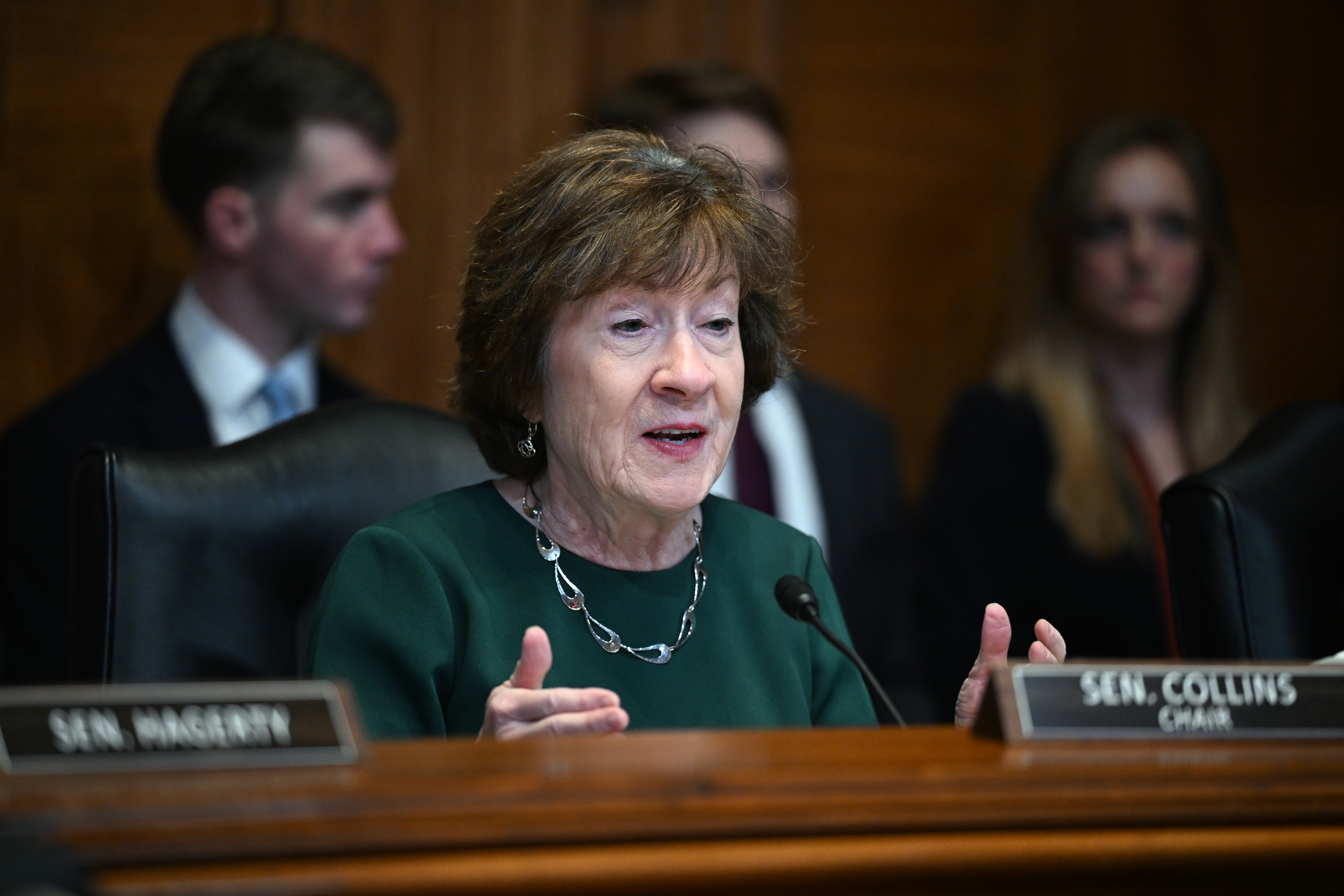
    Sen. Susan Collins (R., Maine) has a long history of winning tough elections, but she must persuade voters eager for generational change that she remains fit for a sixth term at age 73.Kenny Holston

    “The truth is, Susan Collins doesn’t serve us,” he said. “She serves Donald Trump.”

    For their part, Republicans have already signaled that they plan a flood of advertising focused on Platner’s character, with the party’s main super political action committee lashing him as “untrustworthy, unhinged and unfit for Maine.”

    On Tuesday evening, the Republican Senate campaign arm released a digital ad contrasting the two candidates, accompanied by a news release featuring eight bullet points highlighting Platner’s controversial past conduct and statements.

    “Susan Collins doesn’t have a Nazi tattoo,” a narrator states in the ad, a reference to a tattoo Platner had that was widely recognized as an SS symbol. (He later had it covered up.)

    Collins’ moderate image poses an additional obstacle for Platner, Republican strategists say, because she presents as an acceptable alternative for voters who dislike Trump but are unsure about Platner.

    “If Susan Collins were Ted Cruz, this would be a different conversation, but Susan Collins is the most moderate member of the Senate,” said Brad Todd, a veteran Republican strategist. “Susan Collins is the best cross-party-appeal candidate Republicans have fielded anywhere in the last 10 years.”

    But progressive leaders quickly heralded Platner’s victory as more evidence that voters across the ideological spectrum wanted the opposite of Collins: a populist fighter who will challenge the political establishment.

    “This shows that the candidate’s stance on the genocide in Gaza, on opposing foreign wars, and on taking on the billionaire and donor class matters far more than imperfections in their own personal life,” said Rep. Ro Khanna (D., Calif.), who has emerged as one of Platner’s most vocal supporters. “The country and Democratic Party are looking for candidates who are willing to challenge the broken status quo.”

    But while many Democrats like the idea of a combative working-class candidate, they’re worried that Platner’s baggage will be fodder for Republican ad makers for weeks and months to come.

    Platner has been dogged by controversies including the tattoo, his yearslong trail of inflammatory online posts and revelations of explicit text messages he sent to women while he was married.

    In recent days, some Democratic elected officials have voiced their worries about the latest allegations against Platner, which included reporting from the New York Times that several women he dated said that he had engaged in unsettling and, in at least one case, physically threatening behavior.

    From the campaign trail to private meetings with senators, Platner has repeatedly promised that there is no more damaging information to come out about him.

    Some moderate Democrats are voicing their skepticism.

    As voters cast their ballots Tuesday, Rep. Josh Gottheimer, a moderate Democrat from New Jersey, called on Platner to exit the race so Democrats could replace him with a stronger candidate before the fall.

    “Ultimately, it may be just clear that he can’t win,” Gottheimer said. “And if you believe we have to win, which most Democrats do, then I think the writing’s on the wall already.” He added, “What’s already come out, there’s plenty to disqualify him.”

    In a gauzy video released by his campaign Tuesday, Platner sat with his wife in waders, shucked oysters and encouraged his supporters to cast ballots in the primary.

    He added an assessment of the past few weeks that could also sum up the months to come.

    “This whole thing as you can probably tell: brutal,” he said.

    This article originally appeared in The New York Times.