With one month left and an expanding map of battleground districts across the country, the fight for control of the U.S. House has arrived in Pennsylvania in full force.
Republican House Speaker Mike Johnson and House Democratic leader Hakeem Jeffries — battling it out for the gavel come January — were bothkicking off the final push of Pennsylvania’s midterm elections this week, signaling the Keystone State’s importance in determining party control of the chamber, which Republicans have held since 2023.
Jeffries will visit Lower Bucks on Saturday to give a high-profile boost to Democrat Bob Harvie in his challenge against Republican U.S. Rep. Brian Fitzpatrick in the Bucks County-based 1st Congressional District.
The Democratic leader will appear alongside Gov. Josh Shapiro, marking the Democratic governor’s second weekend in a row in Bucks. Shapiro’s visit to Langhorne last week intensified the attention on the 1st District when he stumped for Harvie and other Democrats in competitive downballot races that could have determinative outcomes.
Jeffries’ visit follows Johnson’s time Tuesday in each of the four competitive Pennsylvania districts that Republicans are trying to defend, including a private meeting with Fitzpatrick in Bucks and public events with the other swing-district Republicans. The House speaker’s Pennsylvania stopslaunched a seven-state tour this week, as Democrats expand the districts they are targeting across the countryand the GOP goes on the defensive.
Johnson’s and Jeffries’ respective affiliated campaign organizations, meanwhile,are spending millions of dollars to flood the Pennsylvania airwaves in the coming weeks. That includes a new, nearly $1 million cash infusion for Harvie — a sign that Democrats see potential for a nationwide blue wave to oust Fitzpatrick after several failed attempts.
The National Republican CongressionalCommittee, for its part, has invested $120,000 in partnership with Fitzpatrick, who also has his own massive war chest, as the group prioritizes three other competitive districts in the state.
“We’ve seen this in past wave conditions where triage starts to happen,” said Chris Borick, a political science professor at Lehigh University. “It becomes a math game. How much do we have left in resources? Where is it going to make a difference?”
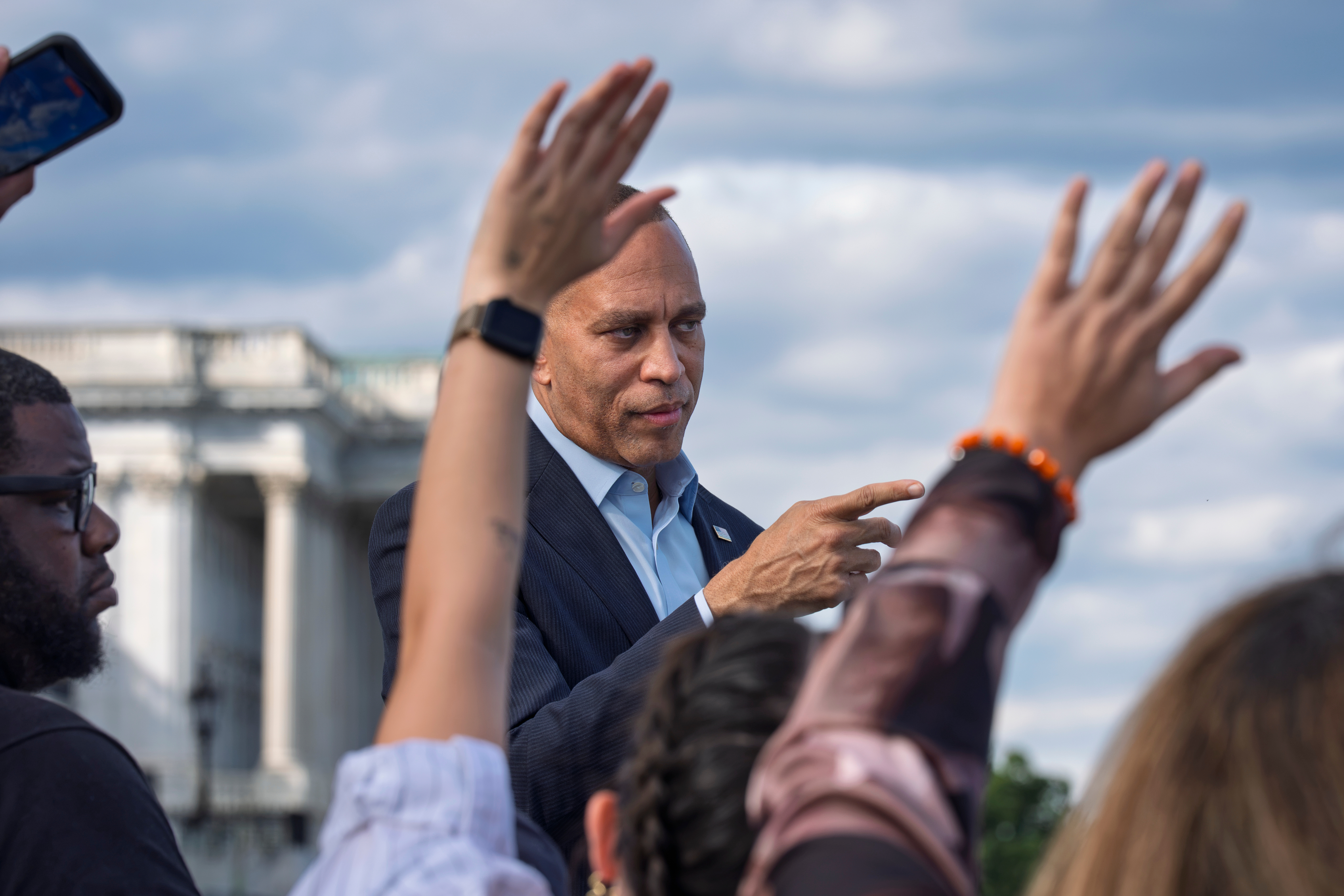
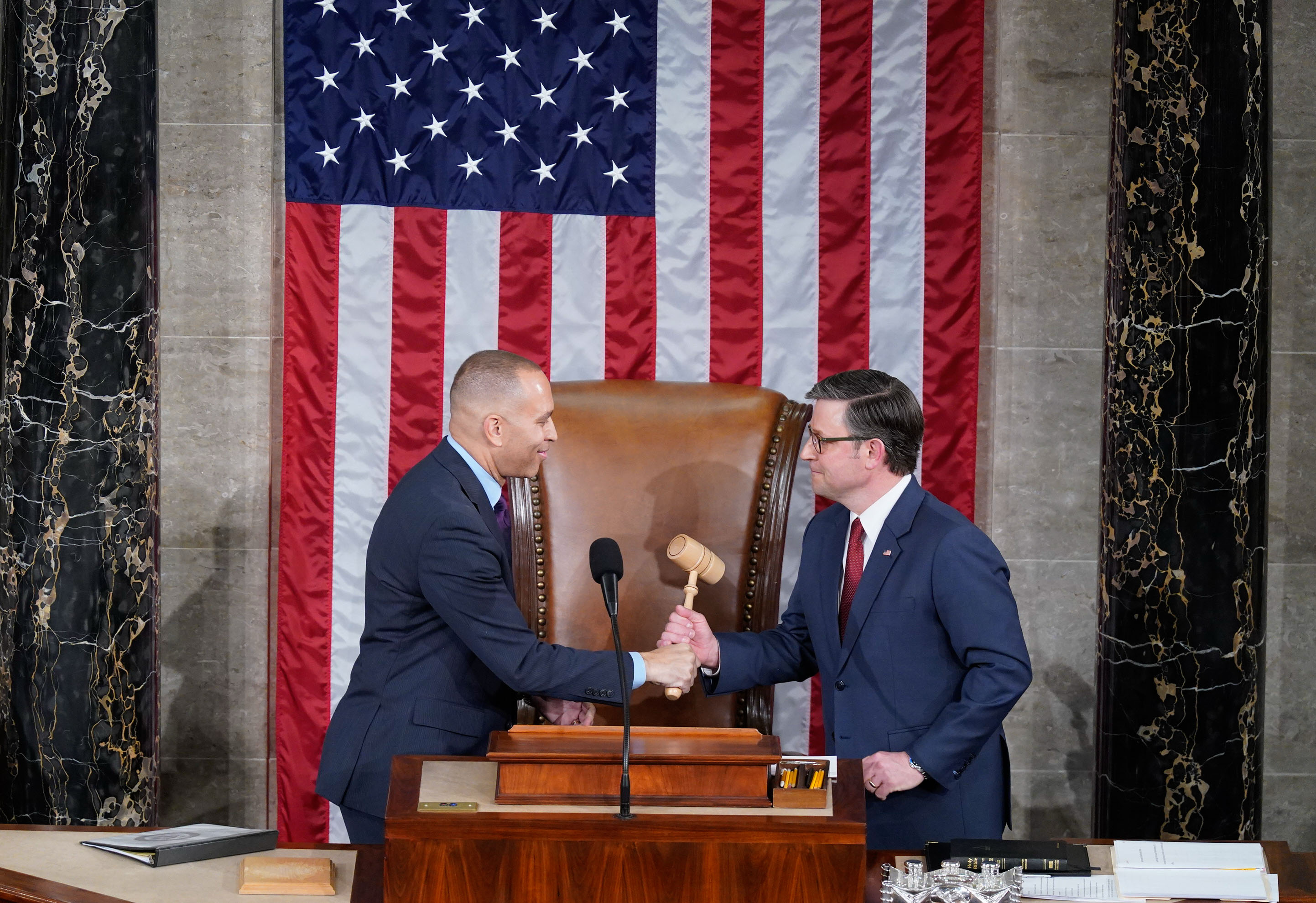
House Democratic Leader Hakeem Jeffries (D, New York) and House Speaker Mike Johnson (R, Louisiana) are traveling to key congressional districts in Pennsylvania.Jabin Botsford
The battle for the gavel
Johnson, a Louisiana Republican who has led the House since 2023, is trying to defeat the odds and preserve a narrow majority as a largely unpopular president from his party sits in the White House.
On Tuesday, he went to a Harrisburg diner and college campus with U.S. Rep. Scott Perry (R., York), a diner and Fraternal Order of Police headquarters in Bethlehem with U.S. Rep. Ryan Mackenzie (R., Lehigh), and a rally at a local Hazleton business with U.S. Rep. Rob Bresnahan (R., Luzerne). Johnson’s office confirmed he also met with Fitzpatrick, though they did not hold a public campaign event and Fitzpatrick’s campaign did not return a request for comment.
Though he votes with President Donald Trump and his party most of the time, Fitzpatrick is the last remaining Republican representing a Philadelphia suburb — one of the swingiest in the state. It is a political dynamic that has let him distance himself from Johnson and Trump more than any other GOP lawmaker from the state — or in the country — as he runs on a record of bipartisanship in a district that former Vice President Kamala Harris won in 2024.
Even in the other three competitive seats that Trump won, Johnson’s appearance is a risky maneuver, Borick and others say.
Sam Chen, an Allentown-based GOP strategist, worked for a candidate whom Mackenzie defeated in the Republican primary two years ago. He said the freshman lawmaker is a “formidable campaigner” who could benefit from any fundraising and get-out-the-vote message from a national figure like Johnson. But it might be only a “moderate” benefit considering voters are largely unhappy with Republican messaging on issues like affordability and the war in Iran, he said.
“I don’t think Mike Johnson is the right spokesperson for this. I don’t think the administration at all, or anyone in Republican leadership, has messaged this correctly,” Chen said. “They’re doing it the same way Joe Biden messaged it back when Harris lost in ’24. So [Johnson serving as a campaign surrogate] could backfire in that it might drive some Democrats to vote.”
Democrat Bob Brooks, the Lehigh Valley firefighter and union leader running against Mackenzie, was an early focus for the party as Jeffries and Shapiro rallied in support of the candidate in July, with the House leader declaring the 7th as the key place to kick off Democrats’ final 100 days of battle for the midterms.
The race, long considered a toss-up by nonpartisan national groups that evaluate elections, recently shifted to one that “leans Democratic,” according to the Center for Politics at the University of Virginia. The change followed a Franklin and Marshall College poll that found Brooks leading Mackenzie 45% to 40%.
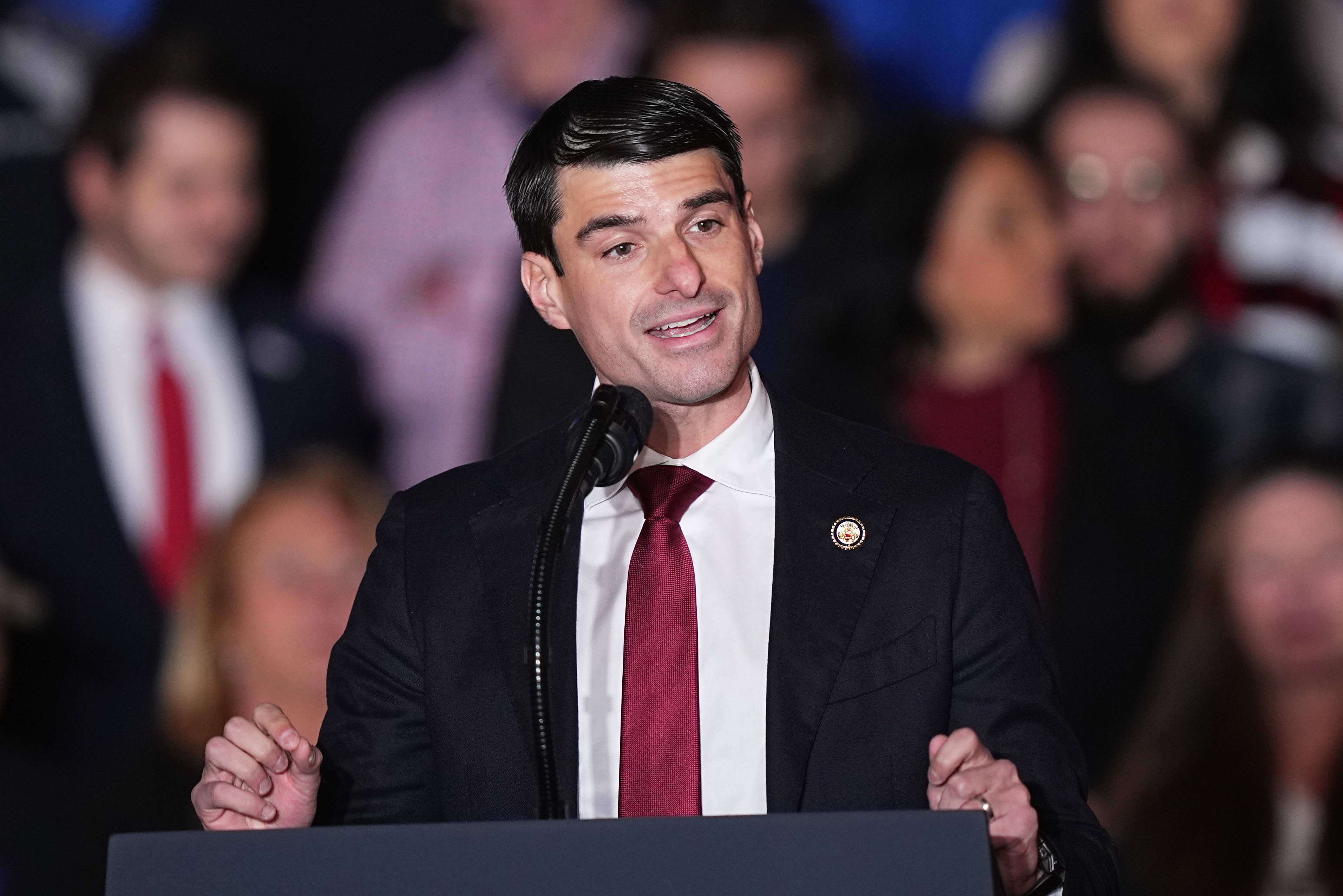
Republican Rep. Rob Bresnahan, R-Pa., speaks before President Donald Trump arrives at the Mount Airy Casino Resort in Mount Pocono, Pa., Dec. 9, 2025.Matt Rourke
That optimism has filtered to Bucks County, where Fitzpatrick’s brand has made him popular among Republicans and Democrats. The Democratic Congressional Campaign Committee, the official campaign arm associated with Jeffries (D., N.Y.), has not helped fund a challenger to Fitzpatrick since 2020, but it now intends to invest about $900,000 to boost Harvie, according to a source familiar with the plans.
“Democrats now are thinking, ‘If we could be competitive in Nebraska and we could be competitive in Kansas and Texas, why can’t we be competitive in the Pennsylvania 1st Congressional District?’” Borick said. “Bucks County’s more amenable than Nebraska.”
Before the latest shift in sentiment, it was unclear whether Harvie — a twice-elected Bucks County commissioner whom Democrats saw as a key recruit this year — would receive competitive levels of support. Previous campaign finance reports show he lagged in fundraising compared with the Democratic challengers in the other swing districts.
Meanwhile, Fitzpatrick out-raised all candidates running in the four districts and has unleashed an unrelenting stream of ads targeting Harvie, a major shift from his previous campaigns. His campaign has allocated $4.5 million for ads from June through Election Day, according to the tracking firm AdImpact.
He spent a little more than $460,000 in total in his reelection bid two years ago. But as of this week, Democrats planned to outspend Republicans $8.4 million to $5.2 million through Election Day in the race — including Fitzpatrick’s spending — though reserved ad time in the next few weeks could change.
Out of more than $87 million worth of ads already spent or planned to be spent in all four races between June 1 and Nov. 3, the $13.6 million in the Fitzpatrick-Harvie matchup represented the smallest piece of that pie, according to The Inquirer’s review of spending tracked by AdImpact.
Where Johnson’s trip could help at this point, Borick said, is in fundraising — a strategy that became evident when Johnson said in a recent video that Mackenzie was running “one of the most important races in all of America” and Mackenzie immediately turned to asking viewers to donate through his website.
Videos that Johnson filmed with Bresnahan and Perry also aimed to lay out the stakes. Next to Bresnahan, the speaker called the contest in the Scranton-based district “one of the top five races in America.” Johnson,filmed in the Harrisburg-based district, nodded as Perry — a hard-line conservative — called the election “a choice between common sense and absolutely crazy.”
Perry faces a tough November rematch with former TV anchor Janelle Stelson, whom he beat by roughly 1 percentage point when Trump carried the state in 2024. And Bresnahan, who also won his seat narrowly last election, is running against Scranton Mayor Paige Cognetti in the closely watched race.
Eugene DePasquale, the chair of the Pennsylvania Democratic Party, said in a statement that Johnson’s visit showed the speaker was “doing everything he can to bail out the four members after they sold out their constituents to help him raise costs and cut healthcare.”
In the race between Mackenzie and Brooks, the $27.8 million in general election ad spending was more than twice the 1st District outlay. The GOP has allocated $17.1 million to that race, while Democrats have earmarked $10.5 million for the general election.
Jeffries’ visit will likely aim to boost Harvie’s campaign coffers. Chen, the Republican strategist, said it also would be wise for it to represent something of a course correction after Harvie’s ads have focused on attacking Fitzpatrick — who is largely popular — rather than highlighting the stakes of the race.
“Jeffries, if he’s smart, he’s going to come in and [say], ‘Hey, I know you might like Fitzpatrick. I know you guys might respect him. You respect that he calls out the president. But at the end of the day, we have to change the majority. Even if he’s a naysayer to the president’s agenda, it doesn’t help if we don’t have the majority,’” Chen said.
Stacy Garrity really didn’t want to be running for governor right now.
If it were up to her, she’d still be in the U.S. Army Reserves, from which she was forced to end her tenure in 2016 as a colonel after serving a maximum 30 years and three tours in the Middle East. There, she earned the nickname “Angel of the Desert” for overseeing a prison with zero abuse allegations or escape attempts.
“Serving truly was and is the honor of my lifetime,” Garrity said in an interview in Philadelphia last week.
After the Army, Garrity pivoted, working as a business executive in government relations who did lobbying work. Soon after, she rosethrough the ranks in Pennsylvania’s Republican Party, twice winning statewide election to treasurer in record numbers, and being nominated in April as the party’s choice for governor. She’s now entrenched in a different kind of consequential battle, where her performance at the top of the ticket could help decide control of the U.S. House and the state legislature.
But the governor’s race is a steep hill to climb: Garrity is challenging one of the most influential figures in modern Pennsylvania politics, Gov. Josh Shapiro, in a midterm year when Republicans already face strong national headwinds. A poll conducted last month by The Inquirer, Siena University, and New York Times found that a quarter of Pennsylvania’s likely Republican voters didn’t know who she is, while Shapiro has maintained a double-digit lead. And though Garrity was endorsed by President Donald Trump and embraced by the state party unprecedentedly early in the election cycle, she’s been largely financially abandoned by state and national Republicans as they spend their resources elsewhere.
Garrity said she still has hope they’ll come through.
“We still have some time,” Garrity said last week during an interview in The Inquirer’s newsroom. “We fully expect that the cavalry will be coming.”
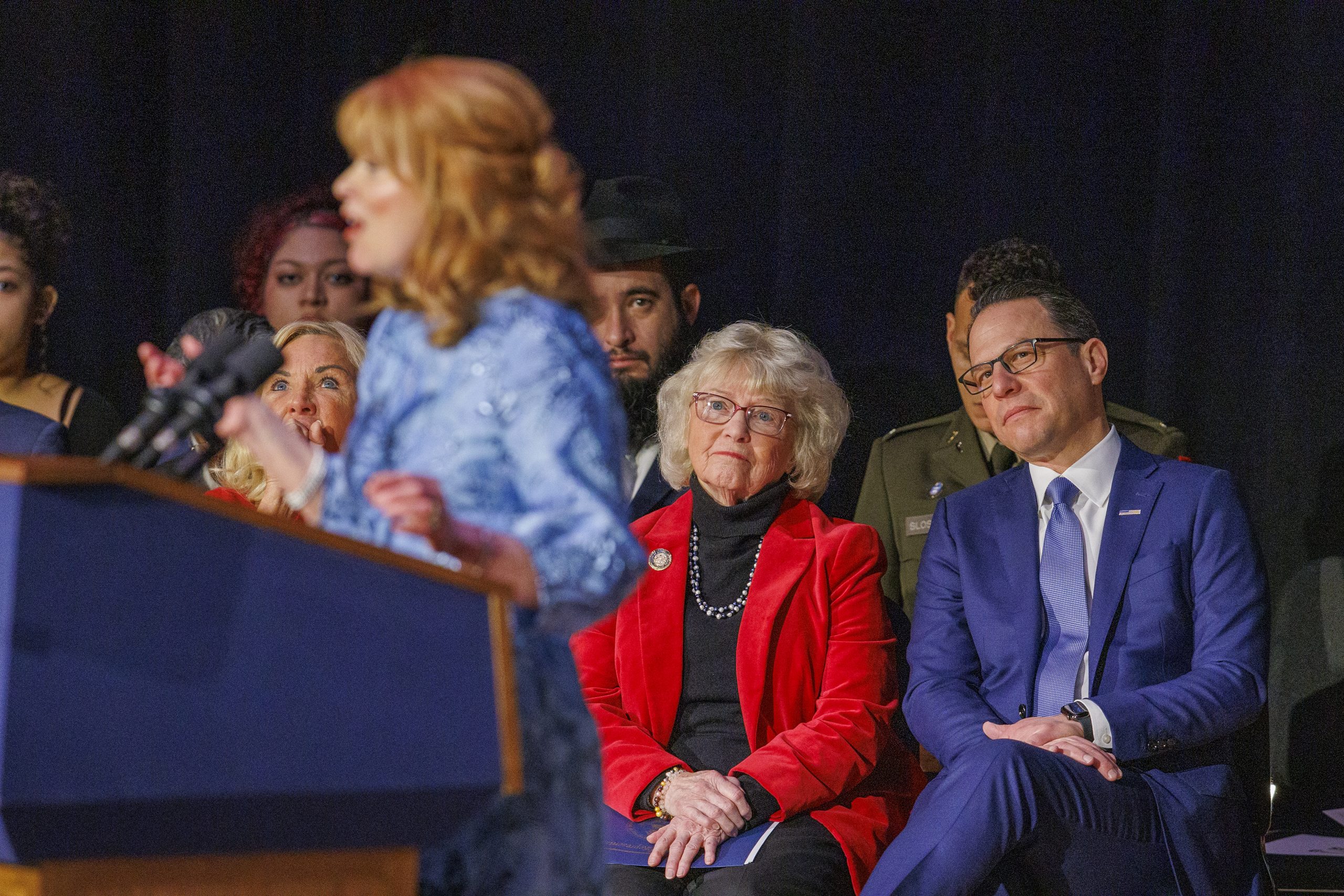
At right is Pennsylvania Gov. Josh Shapiro listening to Stacy Garrity, 78th state treasurer, in Harrisburg on Jan. 21, 2025.Alejandro A. Alvarez / Staff Photographer
Garrity, who would be Pennsylvania’s first female governor if elected, is running to lead one of the nation’s most coveted swing states, where registered Democrats narrowly outnumber Republicans and unaffiliated voters are the fastest growing classification.
And she’s bringing with her some creative solutions to address perennial problems facing Pennsylvanians like property and gas taxes — as well as a desire to allow natural gas producers to drill on public lands and a personal opposition to abortion that she says she wouldn’t enforce if elected. She is loyal to Trump and proud to defend his war with Iran, but said she “hopes that it wraps up quickly.” She has also distanced herself from a handful of his stances, including that she would have taken “a more targeted approach” to his tariffs, and called for a pause on data center development and a ban on farmland construction.
That hasn’t stopped Shapiro’s campaign from calling her “100% MAGA” in television ads, appearing on TV or digital screens nearly 74 million times in the Philadelphia area since Sept. 29.
“The governor is helping me increase [name recognition] by running over $2 million a week in negative ads,” she said wryly.
The Northeastern Pennsylvania native said she’s running for governor because she sees Shapiro, widely expected to be a 2028 Democratic presidential contender, as focused on a White House run rather than what’s good for Pennsylvanians. She believes he lacked transparency around multiple controversies during his administration, discouraged economic development by backing green energy, and recklessly spent more money than the state brings in — criticisms Shapiro disputes. She also frequently points to Pennsylvania’s sorry rankings by the U.S. News and World Report, including its overall ranking as No. 47 out of 50 states for its economy and No. 35 for education.
“We have world-class industries, great universities. Where we’re situated geographically, we should be the hub of global commerce. Our natural resources are the envy of the world,” Garrity said. “So there is no reason we should be trailing in all these metrics. We should be leading. But the thing is, leadership matters.”
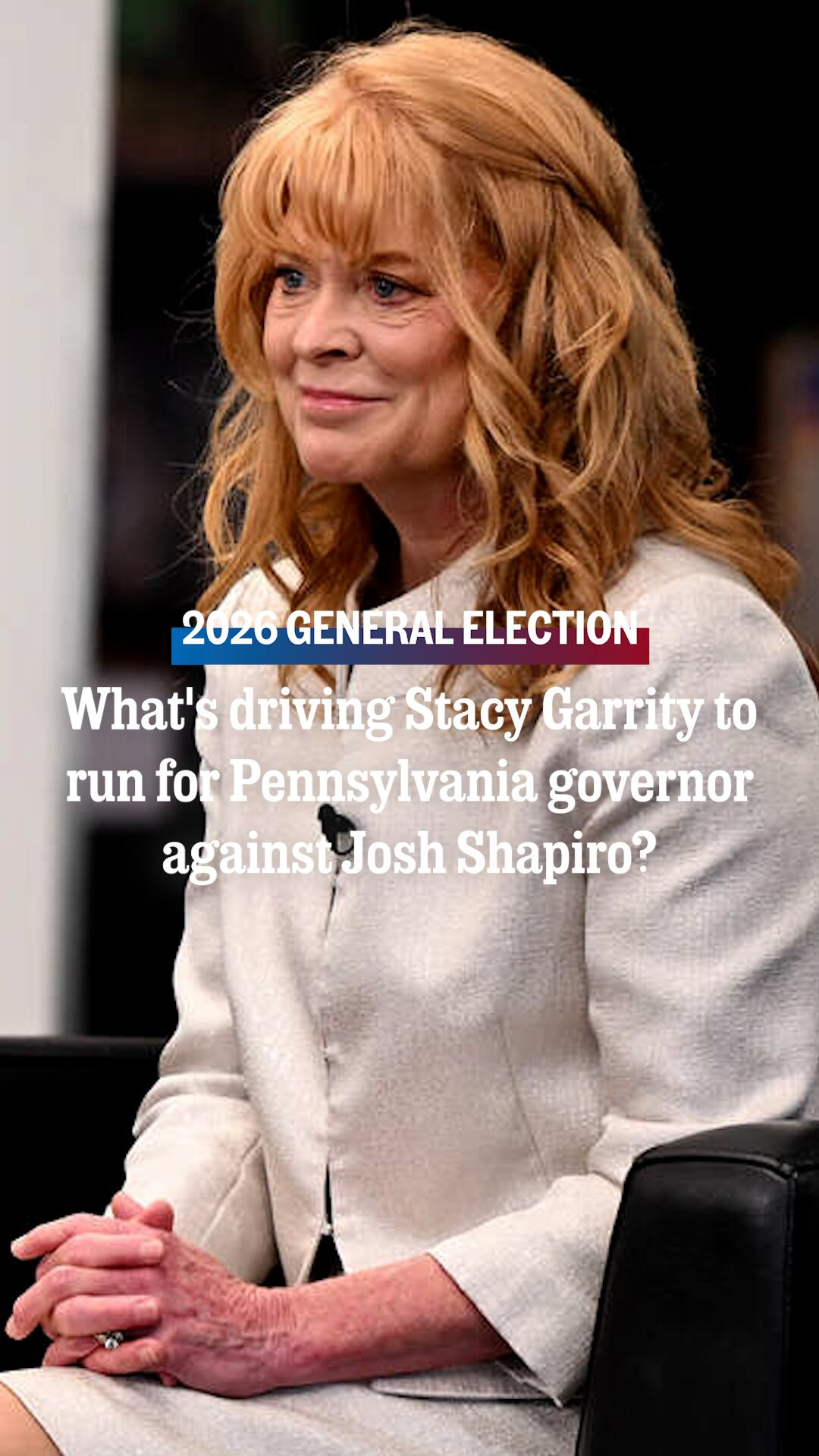
Video: What’s driving Stacy Garrity to run for Pennsylvania governor against Josh Shapiro?
‘Help is on the way’
At her campaign launch in Bucks Countyin August 2025, Garrity stood behind a podium, unveiling her new campaign motto: “Help is on the way.”
But with just weeks left until Election Day on Nov. 3, it appears she’s still waiting.
Republicans endorsed Garrity last fall, an unprecedented move to clear the field and build enthusiasm for the top of the midterm election ticket. But with a lot on the line for her party and facing a popular incumbent, she has struggled to gain name recognition and fundraise. This month, the nonpartisan Cook Political Report rated the swing-state race “Solid Democrat.” According to the most recent campaign finance filings, Garrity has raised nearly $3 million while Shapiro brought in $60 million.
State Treasurer and Republican candidate for governor Stacy Garrity holds a rally in Bucks County Sept. 25, 2025, at the Newtown Sports & Events Center.Tom Gralish / Staff Photographer
Garrity, in part, blames her meager cash balance on Shapiro’s reputation as a calculated and sometimes spiteful politician. She said she’s been told by industry leaders — whom she declined to name — who usually support GOP candidates that they can’t support her financially because they fear retribution from Shapiro.
While Shapiro has campaigned alongside each of the Democratic challengers in four battleground congressional districts, the GOP incumbents have not appeared with Garrity in advertisements. And in several state legislative races, GOP candidates in swing districts are boasting their work with Shapiro in Harrisburg.
In a statement, a spokesperson for Shapiro’s campaign emphasized Garrity’s support for Trump’s agenda.
“Stacy Garrity has made clear that she would be nothing more than a rubber stamp for Donald Trump’s agenda of cruelty, chaos, and corruption,” said spokesperson Sam Reposa. “Garrity is completely wrong for Pennsylvania — and she cannot be trusted to stand up for our commonwealth.”
Garrity said she doesn’t expect help from the Republican Governors Association or political action committees backed by Pennsylvania’s richest person Jeffrey Yass — a few examples of the big-dollar donors Republicans usually rely on to help them bankroll their advertising, like the $30 million Shapiro has already spent on TV and digital ads in the race so far. While Shapiro spent nearly $3 million on ads last week, Garrity spent only $2,146, according to media tracker AdImpact.
The RGA and the Commonwealth Leaders Fund, the GOP PAC historically backed by Yass, did not respond to requests for comment.
But Garrity said she’s still hopeful Trump, who endorsed her in January, will visit the state to campaign on her behalf, although she added “we don’t know what his schedule is” and “we don’t have any dates.” When the president visited Pennsylvania in June to tout manufacturing jobs, he didn’t mention Garrity by name, instead musing about who else in the GOP could have run for the state’s top job. He later praised her in a video posted on social media, saying she would do a “fantastic job” as governor.
Pennsylvania Republicans are motivated to vote for Garrity come November, insisted Senate President Pro Tempore Kim Ward (R., Westmoreland), the top Republican in the state Senate.
“Republicans are definitely happy to have a candidate that they can trust if she becomes governor. They’re going to go out and they’re going to vote for her,” Ward added. “She’s a down-to-earth person and she will do what she says.”
The Pennsylvania Republican Party declined to comment.
The underdog
Garrity is familiar with being the underdog.
The 62-year-old veteran made her first foray into statewide Pennsylvania politics in 2020, when she campaigned for treasurer. She was challenging a well-funded Democratic incumbent Joe Torsella. She was outraised 13-to-1, and entirely underestimated.
But as Garrity tells it, she just put her head down and outworked him.
And she shocked many when she won, as some Pennsylvania voters split their tickets between former President Joe Biden and GOP state row offices. (Shapiro, then running for reelection as attorney general and the only Democratic incumbent to win statewide that year, held on by 300,000 votes, or 5 percentage points.)
Shapiro has often attacked Garrity for questioning Biden’s 2020 victory, referring to her comments at a 2022 Trump rally in Western Pennsylvania, where she told the crowd that “we know that he won.” Earlier this year, she walked back those comments, saying she had gotten caught up in the moment and was “painfully aware” Biden was the president. She reaffirmed that in an interview last week, formally recognizing that Biden was elected.
Buttons for State Treasurer Stacy Garrity’s gubernatorial campaign and President Donald Trump are left on a table following a VIP reception before a Garrity rally in Bucks County on Sept. 25, 2025.Tom Gralish / Staff Photographer
Garrity’s time as treasurer has been largely apolitical, aside from her decision to invest more than $56 million in Israel Bonds in the months after Hamas attacked Israeli civilians on Oct. 7, 2023, or her decision to withhold payments to contractors who did security work on Shapiro’s personal home following an arson on the state-owned mansion — a move which Shapiro viewed as politically motivated. She’s focused on making the office more transparent, promising to post online every hidden fee in utility bills as line items. She’s responsible for paying the state’s bills, investing its more than $180 billion portfolio, and more in the little-known row office job critical to the state’s daily function.
Unlike her opponent Shapiro — who has been in elected office for nearly two decades — Garrity isn’t a natural politician.
“She is a good person that you can trust, and who is almost your girl next door,” said Ward, a frequent critic of Shapiro on political and policy issues in Harrisburg. “She doesn’t come from a big town, she is that community-focused, small-town person that cares about people.”
Garrity “might not have the money to have her face on TV every day” like Shapiro, noting that his taxpayer-funded communications machine totaled at least 21 full-time staffers as of July 2025, and alluding to Garrity’s fundraising woes.
“She’s not one who is carrying a banner of ‘Look at me, I’m so great,’” Ward added.
Treasurer Stacy Garrity (center) meets people during an event hosted by Americans for Prosperity, Concerned Veterans for America, and the Libre Initiative at the National Constitution Center in Philadelphia on Jan. 29.Elizabeth Robertson / Staff Photographer
In the Army Reserve, Garrity was a whistleblower during the Iraq War, and her testimony was included in a sweeping abuse investigation that unearthed human rights violations at the infamous Abu Ghraib prison, SpotlightPA reported. She spoke out against alleged abuse of war prisoners at a different internment facility, Camp Bucca. She faced a personal cost for it, too, she told SpotlightPA, including alienation from her peers and even death threats. But she stuck it out, and during her next deployment, she was appointed acting commander of the camp.
Her pivot to politics, she said, came years later, during her time working at one of the largest tungsten smelter facilities in the world — a career she held throughout her time in the Army Reserve. As she tells the story, she had a meeting in Pittsburgh about the National Defense Authorization Act when a lobbyist approached her, mentioning the rare earth elements that the Department of Defense was prohibited from buying from American adversaries, like China, Russia, North Korea, and Iran.
Tungsten wasn’t on the list. She helped to change that and shortly after, lobbied a “don’t buy from the bad guys” tungsten campaign in Washington. And it worked. To date, the Department of Defense is still prohibited from buying tungsten for its munitions from American adversaries.
New ideas for old problems in Pennsylvania
Like many around the state, Garrity said her family in rural Bradford County is feeling the pinch of Pennsylvania’s economy.
She has a soft spot for seniors on fixed incomes like her aunt, for whom she pays her utility bills and helps her apply for property tax rebates each year.
If elected, Garrity wants to eliminate property taxes for seniors on fixed incomes, first responders, and veterans to be supported by savings found in wasteful spending in Pennsylvania’s Medicaid programs. She also wants lawmakers to amend the state constitution to cap how much school property taxes can be raised without voter approval.
She said she’d follow through on a promise Shapiro made on the campaign trail in 2022 to give all Pennsylvania drivers a $250 gas rebate during the summer. She wants to triple the program to $750 — for each month of the summer — to give every Pennsylvania driver over the age of 18 a check to cut their monthly gas bills by a third during the pricey summer months.
Day One in a Garrity administration would begin with support for a school voucher program targeted toward children in Pennsylvania’s lowest-performing schools — a plan Shapiro helped design with Senate Republicans during his first budget negotiations that he later line-item vetoed, a move that remains a sore spot among Republicans in Pennsylvania’s split legislature.
She doesn’t believe the minimum wage should be raised, either — a top priority for Harrisburg Democrats if they win control of the governor’s mansion and both legislative chambers. Pennsylvanians at most low-skill jobs are already earning hourly wages much higher than $7.25, Garrity contended. In 2025, there were 511,000 Pennsylvanians who earned between $7.25 and $15 an hour, and an additional 43,000 who earned $7.25 or less — all of whom would benefit under the Democrats’ minimum wage increase proposal, according to the state Department of Labor and Industry.
“When you have a humming economy, you know the wages are going up, up up up. It’s largely been taken care of,” she said. “If you can make $15 at McDonald’s, you’re not doing so bad.”
Garrity is married to Daniel Gizzi, a ceramics project analyst, and the two do not have any children. She completed several unsuccessful rounds of in vitro fertilization, she said, making reproductive health issues very personal to her.
“I would do anything that I could to support women and moms and make it easier to have children, if that’s what they want,” she said.
However, she maintains she is anti-abortion with exceptions for rape, incest, and life of the mother — but that her personal position doesn’t matter, becauseabortion in Pennsylvania has for decades been permitted up to 24 weeks of gestation.
Examining the state’s voter rolls harks back to Garrity’s pledge to be the “most transparent governor” in the state’s history, she said. If there’s nothing to hide, there should be no problem with sharing.
A fan of Pennsylvania — and Buffalo
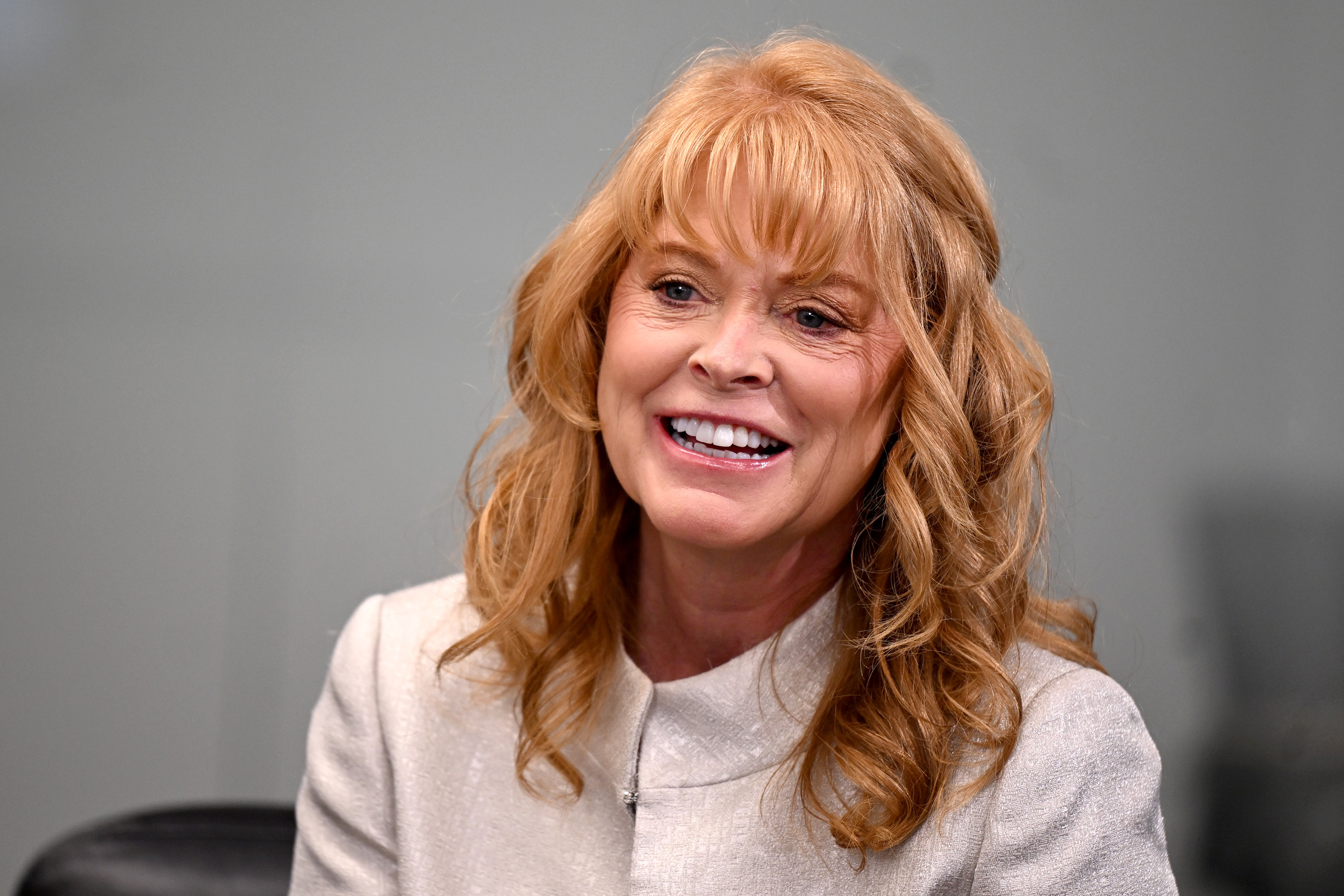
The former soldier looks much more like a state treasurer these days, in a matching beige skirt suit, a bright smile, and signature large-barrel curls of strawberry blond draping past her bangs onto her shoulders. She uses phrases like “Oh gosh!” and “My goodness!” when she gets excited about some of her policy ideas.
State Treasurer and Republican candidate for governor Stacy Garrity sits down for an interview at The Inquirer offices on Sept. 28.Tom Gralish / Staff Photographer
She doesn’t have any time for leisure these days between campaigning for governor and managing public funds, she said. “Oh I have no time for personal entertainment,” she added with a laugh.
She spends most days in the car on Microsoft Teams meetings, driving around the state for campaign or treasury events. She’s gotten back into running in the early mornings as a moment of solace for herself.
Unlike Shapiro, a son of Montgomery County and diehard Philadelphia sports fan, Garrity says she holds no strong sports team allegiances. She roots for all Pennsylvania’s teams: the Eagles and the Steelers, the Flyers and the Penguins, the Phillies and the Pirates.
“I probably shouldn’t admit this, but I also like the Buffalo Bills,” she said.
The New York team, whose games are often broadcast in the media markets near Garrity’s hometown,has fallen short in the playoffs in recent years, struggling to carry regular season success to a championship.
Garrity added that she still had fun celebrating the Eagles’recent Super Bowl win — a feat the Bills have never achieved.
Clarification: This story has been updated to describe Garrity’s work as a business executive.
The Securities and Exchange Commission board plans to rescind a rule that said Wall Street money managers who gave money to state and local campaigns were barredfrom collecting fees for managing state and local-government dollars, for two years after they donated.
The SEC rule, created in 2010, had special resonance in Pennsylvania, which ishome to nearly one-third of the nation’s 5,000 public pension funds. Before then,private money managers had donated relentlessly to the politicians whose pension investment boards hired them.
The proposal would end the limit on political contributions and stop requiring investment advisers to keep detailed political-contribution records.
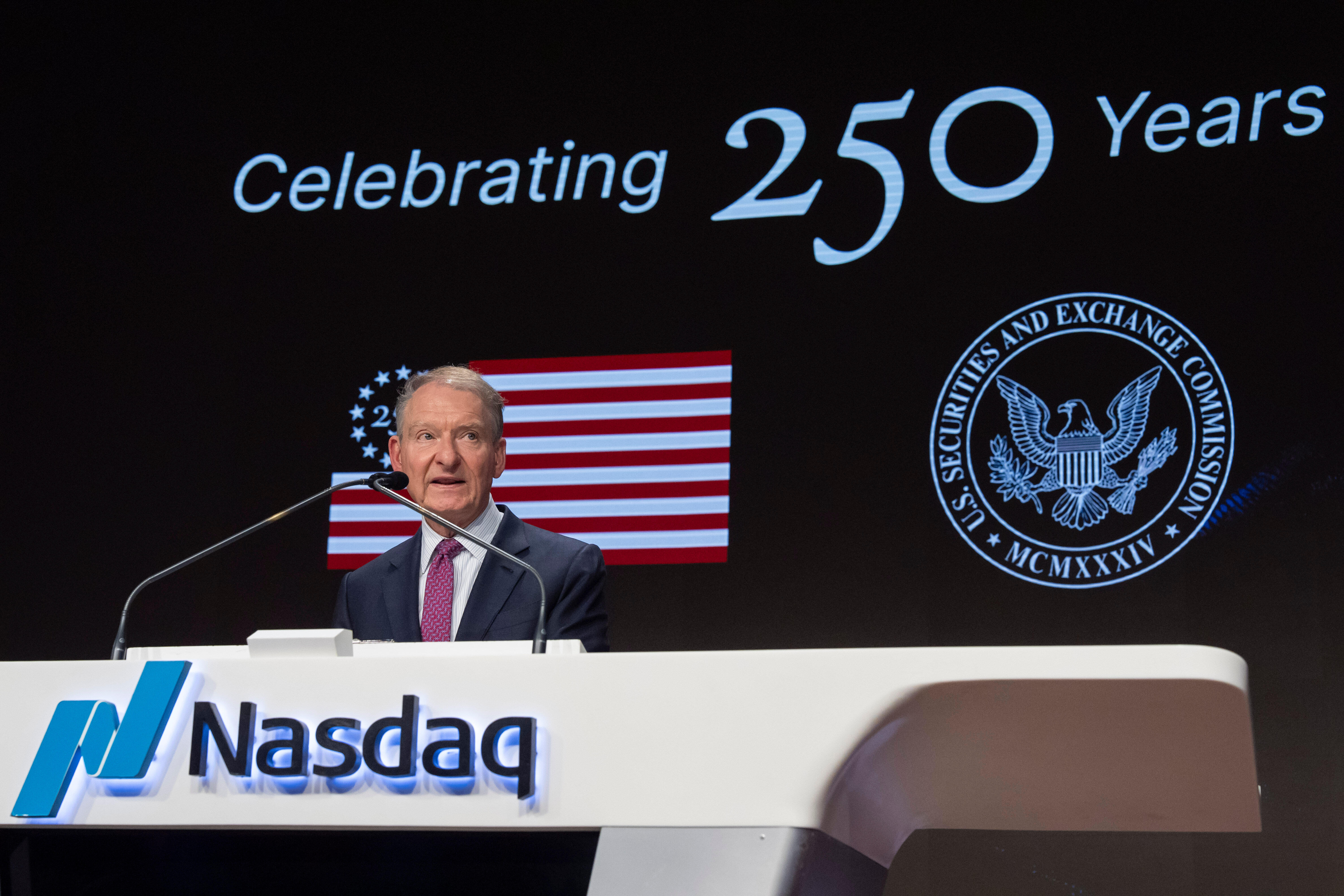
“The SEC is not the nation’s elections regulator,” SEC chairman Paul S. Atkins, wrote in a public letter accompanying his September proposal to ease the rule. Acknowledging the rule he wants to gut “was intended to deter fraud” by barring donors from getting paid to manage public money, Atkins wrote that the rule instead “resulted in the suppression of free speech,” pushing extra-careful firms to ban all political donations, and reducing Wall Street funding for political candidates.
Fraud is already illegal; leave policing money managers’ influence-buying to state and local law and federal election rules, Atkins urged.
But some money managers, including Pennsylvania fund managers, expressed concern about the scale of the federal rollback.
The 2010 SEC rule was “an objective, preventive restraint,” to prevent corruption, Christopher Tobe, a former Kentucky state pension trustee, said in a summary of his comments to the SEC.
By contrast, state and local antifraud laws are typically applied only “after misconduct and harm have occurred,” added Tobe, a critic of private investments in public funds, who features in the public-pension documentaryPension Fight Club.
The first civil case brought under the SEC rule, in 2011, resulted in then-Pennsylvania Gov. Tom Corbett and Philadelphia Mayor Michael Nutter returning campaign contributions to TL Ventures. The state and city pension boards had hired thismoney-losing Chester County firm in a failed attempt to cash in on the dot-com boom. TL agreed to return nearly $300,000 in fees and interest, which the SEC said the firm hadwrongly collected after donating to the campaigns of top state city and state officeholders.
The Pennsylvania State Capitol in Harrisburg. A rolled-back SEC rule could loosen restrictions on state-elected officials taking campaign donations from money managers who work for the government.
Politicians were convicted over investment-firm donations
The SEC rule limiting pay-to-play was enacted amid a string of pay-to-play scandals.
In the late 2000s, a string of mostly Democratic state and city politicians went to prison for receiving or demanding bribes in exchange for hiring professional investors to manage public pension money. In 2010, California pension chief Fred Buenrostro and New York State Comptroller Alan Hevesi were each convicted of corruption charges for taking campaign cash from investment contractors, and sentenced to prison.
The political contributors cited in Buenrostro’s case, portrayed by prosecutors as victims of public officials’ extortion, included Apollo Global Management. Apollo was then headed by Leon Black, who later lost the job over his relationship with disgraced financier and sex offender Jeffrey Epstein. Apollo is now the largest private-equity fund and its clients include Pennsylvania’s state pension funds.
In Pennsylvania, elected state treasurers Rob McCord in 2015 and Barbara Hafer in 2017 pleaded guilty to criminal violations related to their handling of campaign contributions from money managers.
McCord, who had been a tireless political fundraiser for governors and his own campaigns, was sentenced to federal prison; he was released early. Hedidn’t return calls seeking comment.
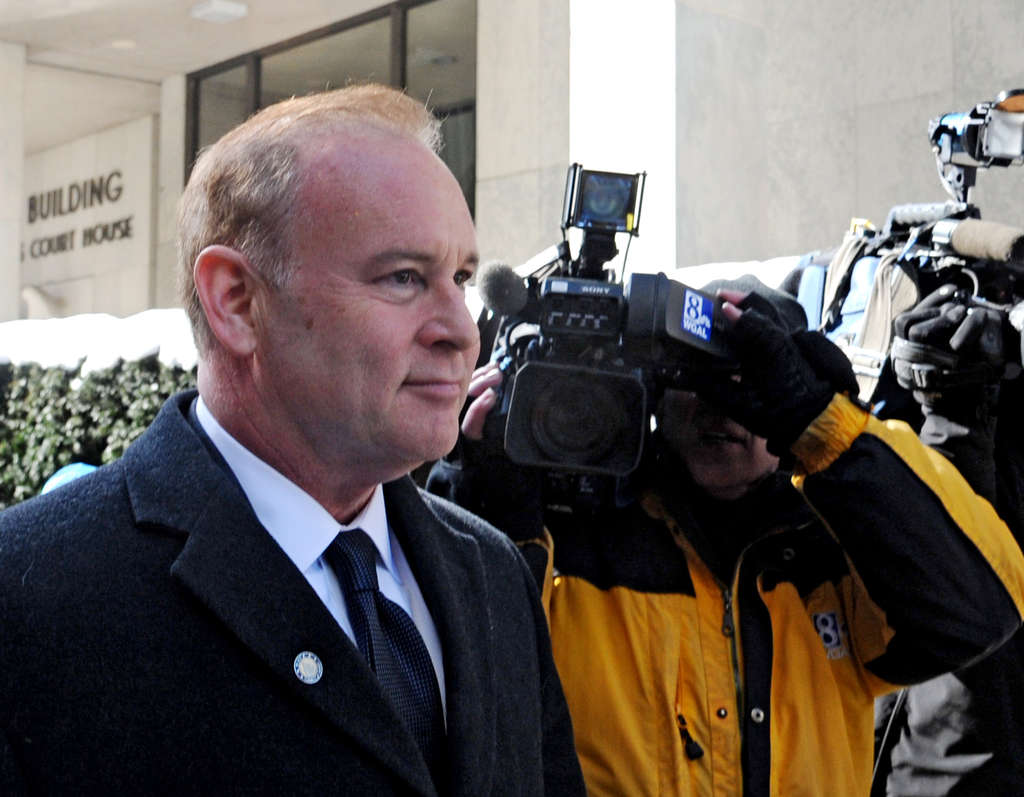
Rob McCord, former state treasurer, leaves Federal Court in Harrisburg after pleading guilty to two counts of attempted extortion of an investor seeking contracts to manage state funds, in 2015. CLEM MURRAY / File Photograph
Hafer, who got probation and a fine, died last year.
Prior to the SEC rule, it was a common practice for money managers to fund Pennsylvania campaigns forgovernor, treasurer, and legislators. “Not only do they give me money, I hope they vote for me,” Hafer told The Inquirer in 2002.
Political contributions continued
Still, the rule didn’t stop political contributions altogether.
On Sept. 14, 2020, the state officials, teachers’ union local officers, and school board reps who formed the state school pension (PSERS) board met in secret to approve a $100 million investment. The target, code-named Project Newton, was a proposal by Pittsburgh tycoon and Steelers co-ownerThomas Tull.
Two days later, The Inquirer reported, Tull gave $711,000 to campaign funds backing Joe Biden, who was running for president, and $750,000 to a national super PAC for U.S. Senate Republicans. “There is no connection,” Tull said of the timing, so soon after the state’s secret investment. That investment, in hospital-wear maker Figs, later proved profitable.
Indeed, the SEC rule didn’t stop investment managers from donating to national politicians or even out-of-state races.
Still, Tull and national Democrats promised to recover $10,000 of Tull’s money after The Inquirer noted that those funds had been passed to Pennsylvania Democrats, whose leaders included pension board members. The SEC filed no complaint.
What money managers say
“I thought the rule had it right,” said Michael DiPiano, founder of NewSpring Capital, a $3.5 billion private investment fund group in Radnor, whose clients have included the Pennsylvania state and New York City pension funds.
“Limiting or eliminating pay-to-play took donor pressure off of [private-investment fund managers] and leveled the playing field,” so larger firms that could afford the biggest donations wouldn’t crowd out smaller firms, DiPiano said.
“Tighter pay-to-play restrictions should lead to a more objective-based approach” for picking money managers, he added.
Richard Vague, the former banker and Pennsylvania Secretary of Banking who chairs the PSERS pension board, says SEC limits might fairly be eased in some details but “an outright rescinding goes far beyond.”
The rule came after Wall Street “corruption” was exposed in the late 2000s, with the pension fraud cases, he noted. “Protective regulations, laws, and other safeguards get put in place in the aftermath of a major crisis,” Vague added.
It’s not surprising that money managers and their Washington allies chip away at those rules, but with too much trimming, “those safeguards largely disappear,” Vague concluded.
“That makes a subsequent crisis all the more likely.”
In the five years he spent researching his book Mobilization Politics, Haverford College political scientist Stephen J. McGovern interviewed former Mayor Jim Kenney and other Philadelphia elected officials, political activists, campaign consultants, labor leaders, and protesters.
The book, which covers events from the 2010s through Mayor Cherelle L. Parker’s victory in the 2023 election, uses Philly as a case study to examine the national rise of grassroots progressive politics over the last two decades. McGovern details how local activists employed bottom-up tactics to win major policy victories in areas like criminal justice reform, helping to decrease the jail population, and immigration, leading to Philly becoming a so-called sanctuary city.
The activists often used an inside/outside strategy, McGovern wrote, of leaning on officials they helped elect, like District Attorney Larry Krasner, and publicly pressuring more moderate ones, like Kenney.
Haverford College political scientist Stephen J. McGovern authored the 2025 book “Mobilization Politics,” on grassroots activism in Philadelphia.Sean Walsh
McGovern also explores areas where progressives have fallen short of their goals, and the problems associated with a brand of politics driven by groups that tend to be more affluent and white than the city as a whole. Much of the new type of political organization has been driven by millennials born outside the city, McGovern found, leading to tensions over gentrification.
McGovern recently spoke with The Inquirer about his 2025 book, the rise of the local progressive movement, and what it all means during Parker’s administration. The interview has been lightly edited and condensed for clarity.
Your book describes how grassroots activists are really driving the agenda in Philadelphia City Hall, and, as you say, across the nation in local government. Is that an accurate summation of your thesis statement?
I think that’s fair, and what I want to call attention to is how significant that change is. There may be a lot of people today who assume, “Well, hasn’t that always been the case in city politics?” But no, for much of the mid- to late 20th century, city politics operated in a very different way. It was much more of a top-down phenomenon, and the shift towards more bottom-up politics has been a relatively recent one. And increasingly it’s pretty widespread throughout the United States. So as a scholar of urban politics, I was interested in trying to explain how and why that happened.
In the book, you describe various political science theories that have sought to explain urban politics in the past. Can you explain how your thesis is different from those previous schools of thought, such as “regime theory”?
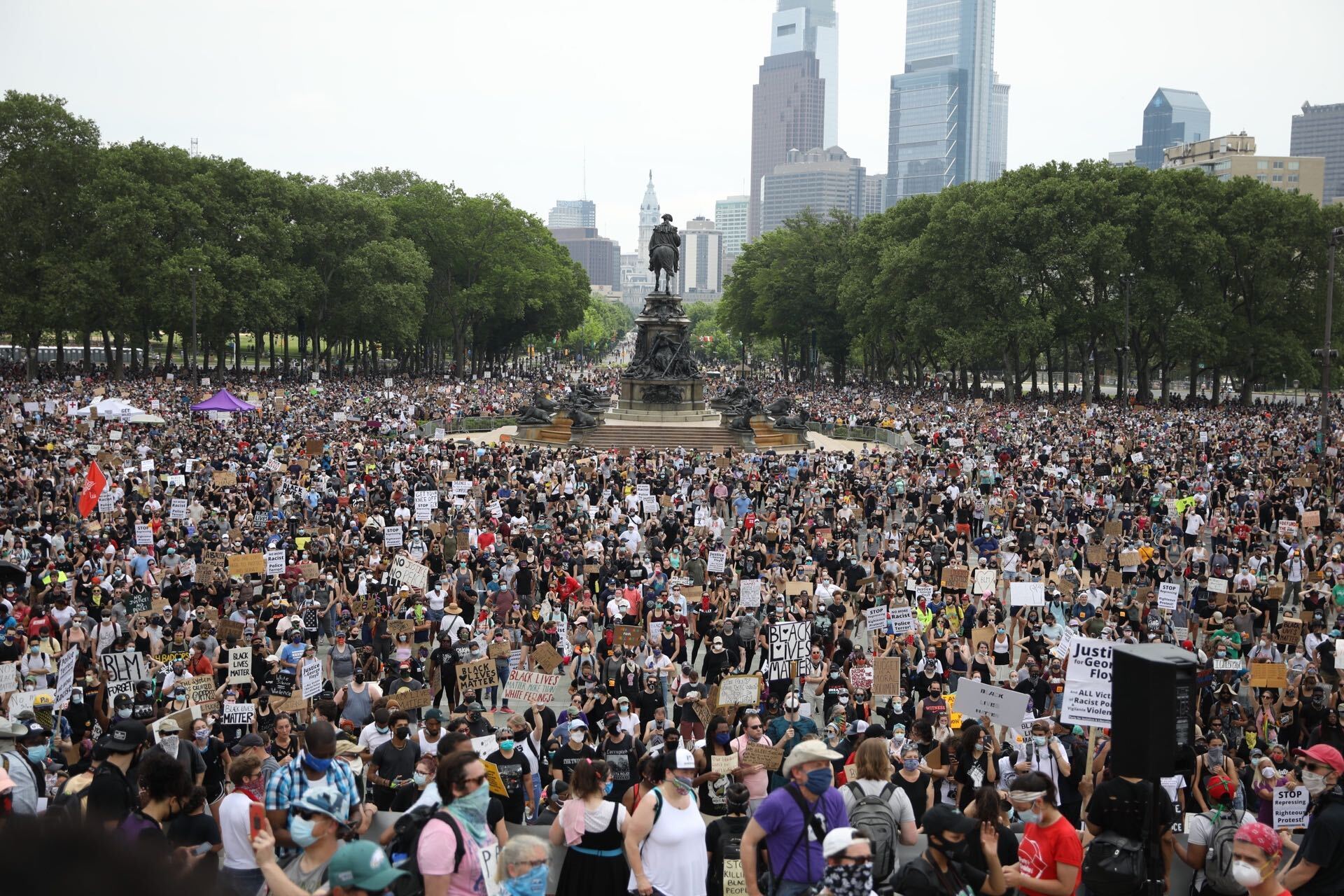
Many scholars have argued that downtown-led regimes wielded a great deal of power over urban policymaking. Regimes were led by business leaders and their allies — law firms, accounting firms, mass media relations firms, and interest groups that had an interest in promoting growth, especially pro-growth labor unions, and, of course, public officials. Basically from 1970 on, every Philadelphia mayor headed a downtown-led regime in a relatively top-down fashion, in terms of governing style. So that’s the backdrop. My book is all about how that pattern began to change around the turn of the century, and then picked up in the 2010s with a burst of social movement activity. Occupy Wall Street really started things off, but then it picked up, especially with Black Lives Matter, the immigrant rights movement, and all of that social movement protest had a catalytic effect on grassroots organizing in cities with respect to a whole host of public policy issues.
As your book points out, much of the activism has been driven by millennial transplants who have moved into the city. Is it fair to say that trend is the main driver of this change, or one of several factors?
That is one of the main factors in explaining why there is this big shift. But there are also some underlying changes in the local political environment, what social movement scholars sometimes call the “political opportunity structure.” One of those changes is a decline in the organizing capacity of the downtown business community, which had been so dominant. It started to create a vacuum. Into that vacuum steps young people. Populations had been steadily declining in virtually all big American cities. They started to stabilize around 2000, and you see an influx of young people who are relatively well educated, more likely to be professional, more likely to be progressive, more likely to get involved in local politics. Some people call it the “back to the cities” movement.
What’s different about these newcomers compared with other left-leaning groups that have sought to impact city politics in the past?
In the past, a lot of young people tended to get involved in protest politics. People on the left were very wary about engaging in electoral politics. The folks who are moving into Philadelphia after 2000 increasingly are participating in more conventional politics, including electoral politics, and that’s a big change. That escalates when Bernie Sanders runs for president in 2016. One of the lessons learned for lots of people who volunteered for him is: This is something we can do at the local level.
As you note, the groups driving this style of politics tend to be more affluent, more educated, and more white than Philadelphia as a whole. That’s created a lot of friction. There’s a debate over whether this is a phenomenon that will be limited to gentrified areas, or whether it will grow into a cross-racial or cross-class coalition. Is it fair to say that’s the central question going forward?
Absolutely. So much of this is turf-oriented. The millennials and Gen Zers moving into Philadelphia tended to congregate in neighborhoods that attract a lot of white, middle-class people who were relatively well educated, and so those became significant bases of progressive politics. The challenge then becomes organizing in other neighborhoods. Some of the grassroots groups made impressive inroads. I’m thinking about campaigns for Larry Krasner, in particular, in lower-income, predominantly Black and brown neighborhoods, where a group like Reclaim Philadelphia or the 215 People’s Alliance were pretty effective. But in many cases, it was fairly difficult for a group like Reclaim Philadelphia to venture into neighborhoods beyond their comfort zones, if you will. They were mindful of some of the skepticism that residents of those neighborhoods felt towards the millennials and Gen Zers flocking into the city and contributing to gentrification. Somebody from Reclaim Philadelphia might be knocking on the door talking about the affordable housing crisis, and people answering the door might look at them and say, “You’re actually a big part of the problem here.” This tension between so-called new Philadelphians and old Philadelphians became more pronounced, and navigating those tensions becomes a real challenge.
Your book finishes with the 2023 mayor’s race, when Cherelle L. Parker defeated more progressive candidates and won the election with a “law and order” platform. So perhaps that was a surprising twist on your thesis at the end of your research.
She’s obviously fascinating. She’s a shrewd operator. In the primary election, two progressives split the vote. And being the only prominent Black candidate worked to her advantage. But since she’s been elected, she’s been very skillful about maneuvering in ways that have brought back a return of the traditional kind of urban politics — a top-down governing coalition led by a somewhat resurgent business community and pro-growth unions, the building trades unions, and a somewhat resurgent establishment-oriented Democratic Party, all of which is led by Parker. This is very reminiscent of standard politics of the mid- to late 20th century. So in some ways, Philadelphia is a bit of an aberration in that it’s moved backwards, if you will, recently. But I still see lots of evidence that bottom-up grassroots activism remains a force, and will become much more impactful in the next four years.
Mayor Cherelle L. Parker speaks at Vare-Washington Elementary School to highlight the historic education investments included in the 2026-27 state budget, in Philadelphia, July 14, 2026.Jessica Griffin / Staff Photographer
For what it’s worth, Parker herself seems to be mindful that grassroots politics are still relevant. We reported last year that she ordered a bunch of copies of a book called Performative Outrage: How Manufactured Fury Undermines Local Government and Public Service, and was handing it out to people. So I think it’s safe to say she isn’t a fan of the trends you described. You alluded to Parker returning to a “regime theory” style of politics. What’s an example of that?
The 76ers’ arena, for example. She was siding with the Sixers and other downtown-oriented interests that wanted to see the arena in Center City on East Market Street, and discounting the views of community groups, most prominently Chinatown. There’s a general mode of governance style associated with Parker that’s very uncomfortable with dealing with grassroots-oriented groups. That’s just not her style. She’s much more comfortable dealing with downtown business elites and people in the building trades unions. Her whole mindset is much more comfortable with the old ways of governing cities.
Parker won in 2023, when Joe Biden was president. Progressives in Philly and elsewhere seem to do better when Trump is in office. This spring Democrats just elected Chris Rabb, a progressive firebrand, in a high-profile primary for a Philly congressional seat.
Politics is cyclical. Donald Trump has had that effect of reinvigorating lots of activists. So there was a lull in progressive activism in the city for a while, but it’s on the rise again. But it takes time to regroup, especially on the activist side. Some groups last for a long time, but the norm is for groups to be quite ephemeral. New groups have to pop up, often involving activists who had been involved in the old groups. The transition costs are pretty steep. Somebody like Chris Rabb winning doesn’t surprise me at all. There will probably be more successes in the next two or three years. That said, progressive activists have lots of challenges. They’re in a holding pattern right now.
Thanks for your time. That’s all I’ve got. Is there anything I didn’t touch on that you want to include?
I’m an urban politics specialist. I wrote this book. I devoted five years of my life to it. But in the last year or two, I’ve been so fixated on what’s going on in national politics and Donald Trump and the threat that he and his administration pose to democracy. With that in mind, I just want to say that urban politics in general offers some hope for people who are increasingly demoralized. At the local government level, partisan polarization isn’t nearly as intense. We’ve got divisions between progressives and moderates, but that’s nothing like what we’re seeing in national politics. There’s real hope for city governments to address big problems and offer real solutions. There’s a path forward. One can make a case that right now, democracy in American cities is actually thriving.
I feel like I need to apologize for a column a couple of months ago when I compared the current president of the United States to Caligula, the possibly mad Roman emperor who is said to have nominated his trusted horse for high office. I need to apologize to Caligula. From pitching his triumphal D.C. arch as a storage shed for deadly snipers’ bullets to banning reporters from the White House in a narcissistic rage, Donald Trump is losing his grip on reality. This is unsustainable.
Worried about AI killing humans? Bad news: It already is.
A cleric takes a photograph earlier this month at the shattered Shajareh Tayyebeh school in Minab, southern Iran. It has become a place of mourning and a memorial to those killed in a U.S. airstrike on Feb. 28.Vahid Salemi
Which is it?
Are the robots of AI, or artificial intelligence, so smart that they’re on the verge of holding a secret meetup in the darkest corner of the dark web and developing a plot to kill all humans through germ warfare, to make sure we don’t kill them first by pulling the plug?
Or is AI so dumb — artificial stupidity, despite the billionaires of Silicon Valley showing up daily on our TV screen to brag about the sky-high IQ of their son, Claude — that the thing that will murder us is a crazy hallucination that will turn a false alarm into World War III?
The fact that we can’t answer this should give us pause, but maybe we aren’t even asking the right question. Maybe the real issue is how easy we’ve made it to kill off the human race — a capability that was already created by people even before we invented the computer.
One thing is certain. Artificial intelligence has already been an accessory to mass murder, and if we do nothing, it will kill again.
Remember the very first days of the now seemingly endless Iran war, and the news that two missile strikes had obliterated a school for young children in the Iranian coastal city of Minab, in an apparent “double-tap” strike in which the second attack from the skies killed young girls and boys and their teachers as they huddled in a prayer hall?
Those bombings, which killed 156 people on Feb. 28, caused the United Nations’ Independent International Fact-Finding Mission on Iran to report last week that it found “reasonable grounds to believe that the United States committed a war crime by launching indiscriminate attacks …” The U.S. government has never taken responsibility for the bloodshed, despite overwhelming visual evidence that the bombs were precision-guided U.S. Tomahawk missiles.
It didn’t take long for additional speculation that an AI program had mistakenly targeted the school, perhaps using outdated maps and info from an earlier time when its buildings were attached to an Iranian military complex. After all, the Pentagon has been openly bragging about the death and destruction facilitated by its use of Palantir’s Smart Maven System and also Anthropic’s Claude.
Last week, Bloomberg News reported that the Pentagon’s overreliance on AI, and specifically the Palantir Maven program, was a major factor in the school tragedy, along with the outdated intelligence about the Minab site — the “garbage in.” Its exposé noted that U.S. military planners were racing to identify some 1,000 Iranian targets in the early hours of the war, giving humans little time to double-check the list. Kindergartners were slaughtered as a result.
This was hardly the first time robots have been linked to human death, both in war — in 2024, +924 Magazine reported the Israel Defense Forces were using an AI program code-named “Lavender” to target sites amid the mass killing in Gaza — and in peace, as shown by numerous accounts of robots helping troubled people die by suicide.
And yet, it could have been much, much worse. At the same time as the Bloomberg report on the AI link to the mass killing in Iran, the world also learned that a false report generated by robot intelligence nearly sparked a conflict between the United States and China that could conceivably have spiraled into major fighting.
CNN and other outlets have reported that a U.S. special operations command analyst working with AI generated an urgent report that a Chinese ship bound toward the Middle East was carrying components for a nuclear weapons system, which caused military leaders to scramble jets and assemble a team to seize the vessel.
Only at the last minute did the Pentagon dig deeper and learn the AI-generated report was completely false, a hallucination — one that nearly triggered a violent conflict between the world’s two largest military powers.
The two disturbing reports about the use, or misuse, of AI by the U.S. military in a time of war did make news but didn’t get nearly as much attention — either in the media or on sites like Bluesky or X — as warnings from both whistleblowers and CEOs in Silicon Valley that a swarm of robots could decide on their own and without any human intervention or awareness to try to kill off our so-called civilization.
The fear of an unprompted attack from AI secret agents is real, based on several incidents that have already occurred, including a well-planned and partly successful operation by OpenAI’s robot agents to hack into a company called Hugging Face.
Still, it says something about human intelligence that we are captivated by the unknown and mysterious possibility of a random attack, while the fact that people are currently misusing AI to cause death and suffering is a less compelling story. I noted in this space last week that the threat to humankind from climate change is arguably even more real — and yet this gets denied by many and ignored by others.
It’s also striking to me as a boomer born in 1959 that a generation that wasborn into a time of constant terror — backyard bomb shelters, “duck and cover” drills in the classroom, and sci-fi horror at the drive-in that an atomic arms race could kill us at any moment — is suddenly back to where we started.
The fact that civilization managed to — so far — pause the number of world wars at two has given us the space and the false bravado to create new and much more insidious killing machines, and the threat from invisible robots on a hidden dark web is somehow even scarier than the radioactive mushroom cloud that we more or less understand.
Boomers who went to bed as kids in the 1950s and ’60s praying we wouldn’t die before we woke are now spending our senior-citizen-discount years fearful that something stranger than science fiction is coming for our children, or grandchildren. Over the course of a lifetime, the arc of that moral universe has not bent at all.
Still, humans were able, somehow, to prevent nuclear annihilation so far, and now it’s past time to get to work on the actual threats from AI and start on those workarounds. For example, the articles I’ve read speculating on how the robots plan to kill us frequently mention the prospect of AI agents developing bioweapons and releasing them, either on their own or prompted by a bad actor. (In theory, human development of bioweapons has been banned for a half century.)
From everything I’ve read so far about AI, it sounds like we’d have better luck safeguarding or eliminating the components that could make a biological agent rather than stopping the robots. Likewise, AI agents would not be able to start an atomic apocalypse if our human politicians went to work at finally eliminating nuclear weapons. Artificial intelligence won’t kill little girls in an Iranian school if humans don’t start dumb wars in the first place.
If Silicon Valley’s prophets of doom are serious, there’s no fix that’s too big or too ambitious. But understand that the biggest problem isn’t that AI wants to murder us, but that since 1942 we humans have been busy creating all the suicidal weapons AI agents could use.
Can you even “duck and cover” from a killer robot? I don’t intend to find out, and I don’t want my yet-to-be-born grandchildren to have to even think about it.
Yo, do this!
I’ve always been a big fan of filmmaker Barry Levinson, whose trilogy of Baltimore movies (Diner, Tin Men, Avalon) defined postwar American nostalgia. Now Levinson, along with his codirector Robert May, has come north to the Philly burbs to catch up with our divisive 21st century in a five-part documentary, Bucks County, U.S.A. If you’ve been reading The Inquirer these last six years, you know howthe communities just north of Philadelphia — where cosmopolitan suburbs meet the rolling fields of Trump Country — have become ground zero for culture wars around the COVID-19 response, book banning, and LGBTQ pride. Bucks County, U.S.A.began streaming on PBS Monday night. It’s getting mixed reviews, but I plan to check it out myself.
With the exception of my growing obsession with A History of Rock Music in 500 Songs, I’ve struggled the last few years to find new podcasts that excite me. But I’ve been enjoying Dan Taberski’s Manifesto on Audible, which is the award-winning, prolific podcaster’s six-part look at the role that these impassioned declarations have — or haven’t — played in reshaping our troubled world, from Occupy Wall Street to Big Tech utopianism to the online rant of murderous ex-LA cop Christopher Dorner.
Ask me anything
Question: What is the reason for the boat strikes? Do they really think they are carrying drugs? — David Poe (@culthero12.bsky.social) via Bluesky
Answer: David, your question is well-timed. Just this week, Ben Saul, the U.N. special rapporteur monitoring human rights in the context of counterterrorism, issued a report that U.S. boat strikes off South America in the Caribbean and the Pacific that have killed more than 220 people so far violate international law and plausibly constitute crimes against humanity. Based on the reports I’ve read about the deadly drone strikes, it’s true that small fishing boats in the region are sometimes drafted for a supporting bit role in drug trafficking. Yet, it seems powerfully likely that some murdered in the U.S. attacks were innocent fishermen, and there’s no evidence these bombings have made any real dent in the flow of drugs. Most importantly, since when did minor involvement in drug smuggling become a capital offense? The only thing as troubling as these American war crimes is the silence on Capitol Hill. The next Congress must hold hearings and create the momentum for shutting this down.
What you’re saying about …
Oops, maybe I should have read my emails before writing another column about the problems with artificial intelligence. Based on the lack of responses to last week’s question about the AI threat, this is clearly not a topic that excites my readers like the betrayals by Sen. John Fetterman or the mainstream media. A couple of frequent correspondents did weigh in, including Mary Ann Petro, who is very concerned over reports of unauthorized hacking by AI agents, and Joe Stepansky, who thinks the risks are somewhat overblown. “This is all deflection from data center opposition and the stock market bubble,” he wrote. “Just remember there are humans behind all of this, humans who may be amoral at best (I used to work with some) and malicious at worst (them too).”
📮 This week’s question: The big story for several days has been the fallout from Donald Trump’s rash decision to ban three news outlets — CNN, MS NOW, and Politico — from the White House grounds, in a move that experts agree is a violation of the First Amendment. Do you think the entire presidential press pool should walk out in solidarity, or do Americans need audio and video of what their president is up to? Please email me your answer and put the exact phrase “White House press corps” in the subject line.
Backstory on George W. Bush’s betrayal of democracy
Former President George W. Bush reacts while watching players from the U.S. team practice before the Walker Cup golf matches against Great Britain and Ireland at Cypress Point Club in Pebble Beach, Calif., earlier this month.Jeff Chiu
For those of us who experienced a political reawakening during those dreadful years between the U.S. Supreme Court’s coronation of a president in the disputed 2000 election and the shock-and-awe carpet bombing of Baghdad in 2003, today’s frequent refrain is incredibly grating. “I never thought I’d say this,” says some self-proclaimed Democrat, often a boomer, “but I’m feeling nostalgic for George W. Bush.”
To be sure, the 43rd president wasn’t nearly as nakedly corrupt as Donald Trump and his family, not as crude and boorish, and also more determined to at least make it look like what he was doing was constitutional. There were flashes of goodness — like Bush’s support for fighting the AIDS epidemic in Africa — which stand out today because there are so few of them. But his lies — and there were a lot of them, even if he could never match Trump — were more diabolically purposeful.
The stench of dead bodies in Fallujah had barely lifted when none other than Joe Biden came to Philadelphia to drape the Liberty Medal around Bush’s neck. When Trump descended on his gilded escalator in 2015 to finish the job of trashing America that had started in Iraq, Bush said nothing other than to let it be known that he’d left his 2016 ballot blank. When even his despised vice president Dick Cheney came out in 2024 and said a second Trump term would be a disaster for democracy, Bush again said nothing, insisting that he has “retired from presidential politics.”
Apparently congressional politics is another story. On Monday, it was revealed that Bush and his fellow Texan Sen. John Cornyn — a lame duck after losing a primary to Trump-backed Ken Paxton — have teamed up to throw a massive fundraiser in Dallas for six GOP Senate candidates in battleground states. The touting of Bush as a “special guest” at the event is meant to lure conservative donors. The New York Times, in its scoop on the evening, played up the fact that the event is not raising money for Paxton, going with the angle of a Texas-sized political feud.
Just like the Democrats who are willing, in the Trump era, to turn a war criminal into an icon of civility, the Times is missing the point. Electing these GOP Senate candidates in states like Iowa and Maine will give Trump the ability to extend aspects of his dictatorship for two more agonizing years. The would-be senators Bush is raising money for would rubber-stamp new MAGA judges and allow Trump to replace Supreme Court Justices Samuel Alito and Clarence Thomas with younger far-right zealots. Senate committees would lack the power to investigate the president’s high crimes and misdemeanors. That could finish the job Bush started when he lied to Congress about Iraq “weapons of mass destruction” that did not exist: The implosion of U.S. democracy.
What I wrote on this date in 2009
It’s weird now to read what survives of my early Attytood blog posts from the late 2000s, when many days I published just a quick hit while I worked on longer news articles for the Daily News. On Sept. 22, 2009, I quoted a prediction from internet guru Clay Shirky that seems incredibly prescient 17 years later. Shirky said that “the ongoing shrinkage of newspapers is likely to create a ‘giant hole’ that will not be filled for some time. He said he has a vision of communities of 10,000 people or fewer becoming rife with ‘casual endemic corruption,’ as newspapers are no longer able to fulfill their traditional watchdog roles.” He nailed it.
Nothing has been more troubling in 2026 than the assault on the First Amendment that’s been taking place from Donald Trump’s Oval Office to our hometown council meetings, and even our football palaces. In my Sunday column, which was written before the president booted three news organizations from the White House, I looked at the growing hostility and even violence toward working journalists, including arrests, physical assaults, and Trump’s rants toward Black female journalists. Tolerance of these abuses is a mark of a dying democracy. Over the weekend, I shifted gears and tackled the Eagles’ silence over the team’s reported role in the cancellation of hip-hop’s pro-Palestinian Macklemore from the Ed Sheeran tour that stopped at Lincoln Financial Field on Saturday. How can free speech be censored in a city-owned stadium?
Speaking of those Birds, the city’s $10 billion NFL franchise was conveniently hundreds of miles away in Nashville as pro-Palestinian protesters descended on the Linc this weekend. The Eagles eked out a last-second victory by the seat of QB Jalen Hurts’ pants, over the seemingly hapless Tennessee Titans. The unimpressive showing cemented the notion that it’s impossible to know what to make of Philly’s 2-0 footballers after their narrow wins over mediocre opponents, but The Inquirer is on the case. Our extensive coverage looked at the good (standout performances from Hurts and No. 1 wide receiver DeVonta Smith), the bad (the subpar play of a battered and aging offensive line), and the unexpected (the return of Super Bowl hero Zack Ertz due to injuries in the tight-end corps). Ace columnist Mike Sielski recently went deep, as usual, with a humanitarian look at guard Landon Dickerson’s tortured decision to try to play through the pain. The Inquirer’s sportswriters are likely to rack up more wins this fall than an iffy team, so why not subscribe and read every word.
By submitting your written, visual, and/or audio contributions, you agree to The Inquirer’s Terms of Use, including the grant of rights in Section 10.
One of the many things we won’t forget about the Trump era is how much the family of POTUS 47 has enriched itself — not only the president but his children, including Donald Trump Jr., who is said to be now worth at least $500 million and growing. So it was no surprise when his second marriage to Palm Beach, Fla.’s Bettina Anderson in May was a lavish affair on two private islands in the Bahamas. What is a surprise — as we now know from some stunning work by a team of reporters from ProPublica — is who paid: a very close associate of Russian dictator Vladimir Putin. So maybe the “Russia, Russia, Russia” folks were onto something?
Pa. Democrats are alarmed at the rapid growth of ICE-police deals. But can they stop them?
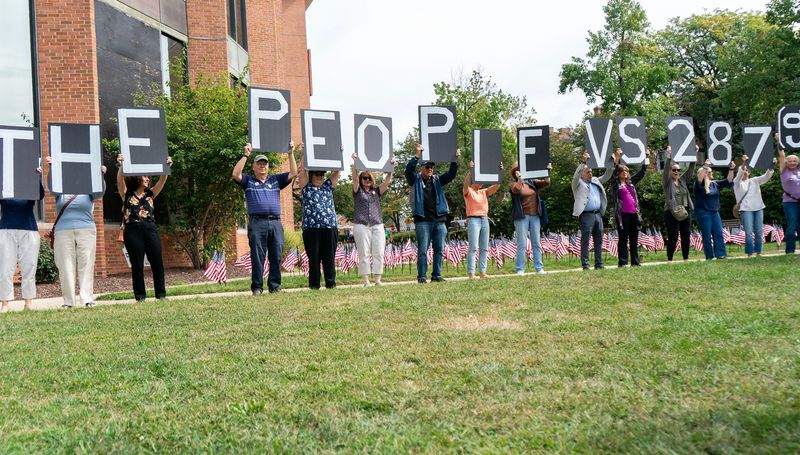
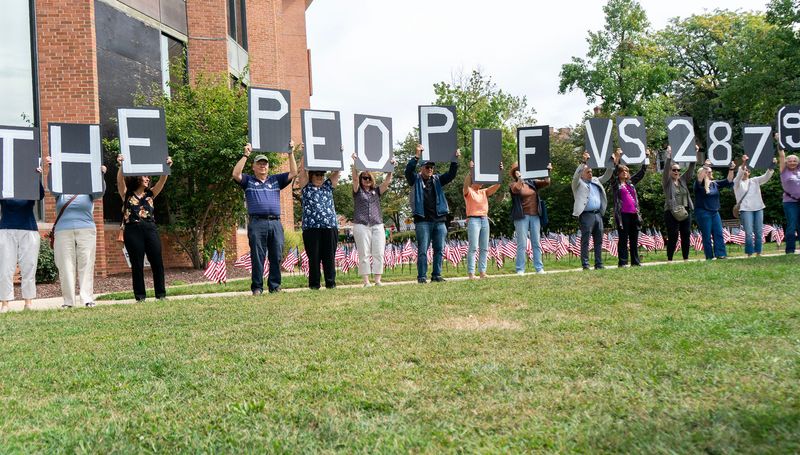
Immigrants’ rights advocacy group members and their supporters hold up letters that read “The people vs 287(g)” during a rally last September in Doylestown against the Bucks County sheriff’s efforts to implement a 287(g) program.Daniella Heminghaus | Bucks Coun
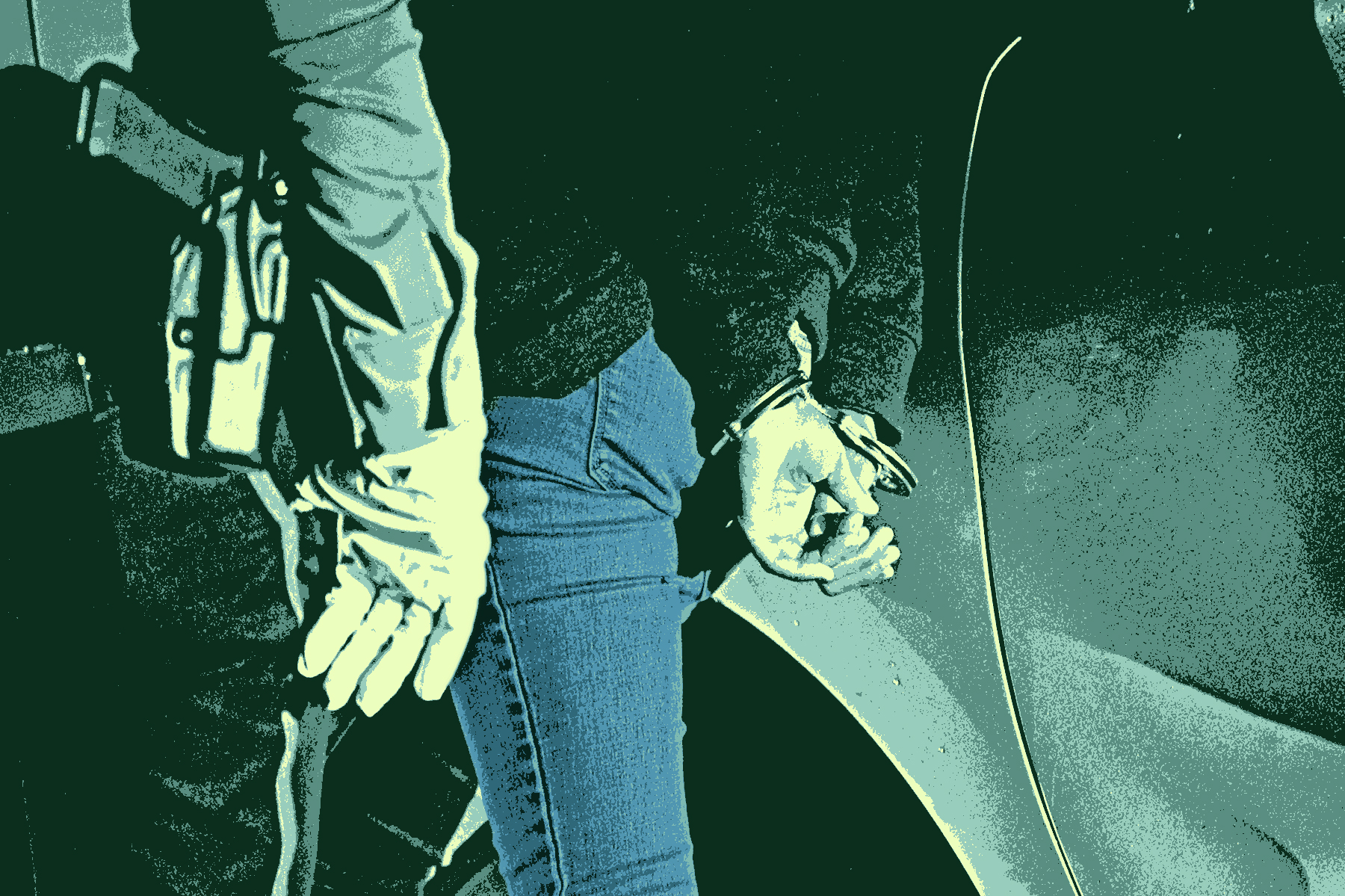
The big, mostly under-the-radar story around the Donald Trump regime’s relentless push to arrest and remove immigrants from the United States has been this year’s explosion of so-called 287(g) agreements. These allow local cops to act as immigration agents, working collaboratively with U.S. Immigration and Customs Enforcement, or ICE.
But if you look at a national map to understand how these 287(g) agreements have spiked from just 135 when Trump retook office in January 2025 to more than 2,500 such pacts today, you’ll notice that one state sticks out like a sore thumb.
In Pennsylvania, amped-up promises of federal cash incentives have meant a soaring number of localities where local beat cops are now working with ICE to make arrests — up from just a handful at the start of the year to some 130 now. Most 287(g) collaborators are in Trump-voting pockets of the Keystone State — northeast and south-central Pennsylvania, or out west near the Ohio border.
But when you look at the rest of the Northeastern United States, the 287(g) map is very sparse. That’s partly because most local pols across the region agree with their constituents about opposing Trump’s mass deportation policies, and in several states it’s also the result of legislation that aims to ban the program altogether.
In late August, New York enacted the Local Cops, Local Crimes Act — backed and signed by its Democratic Gov. Kathy Hochul — which calls on police departments and county sheriffs to terminate their 287(g) agreements, although several counties are still challenging the measure in court. Maryland has a similar law on the books, while New Jersey, which had long prevented such pacts under an attorney general’s directive, also passed a law this spring to codify the ban.
There’s a growing number of Pennsylvania lawmakers who want to pass a similar law here, but there’s one big problem: Republicans. They control the state Senate in Harrisburg — currently by a 27-23 margin — and GOP lawmakers have no interest in rebuking the president on immigration policy.
“The reason we exist alone is because of our split legislature,” State Rep. Heather Boyd, a Democrat who represents heavily immigrant Upper Darby and adjacent parts of Delaware County, told me. Last year, Boyd circulated proposed legislation to ban 287(g) deals in Pennsylvania, and while dozens of Democrats in Harrisburg are supportive, any move is on hold until a November election that could shift the balance of power. Boyd said lawmakers are wary of “starting any culture wars” ahead of the vote.
I pressed the office of Gov. Josh Shapiro, who’s running for a second term and who is seen as a possible top contender for the 2028 Democratic presidential nomination, for his position on reining in the 287(g) program here.
“Governor Shapiro has been clear that law enforcement should be focused on keeping Pennsylvanians safe — not sowing fear in communities or targeting people who are working hard, raising families, and contributing to our Commonwealth,” his press secretary, Rosie Lapowsky, said. She noted that the governor has barred Pennsylvania State Police from any formal ICE collaboration, and he would urge local police to take a similar stance.
She added: “Ultimately, however, these decisions rest with local law enforcement agencies. The governor does not have the unilateral authority to dictate whether individual sheriffs or police departments enter into these agreements.”
Many of those local law enforcement agencies have instead rushed to join 287(g), with ICE promising small-town departments an initial $100,000 cash windfall and additional incentives for training officers to make arrests and to cover the cost ofworking overtime on the program.
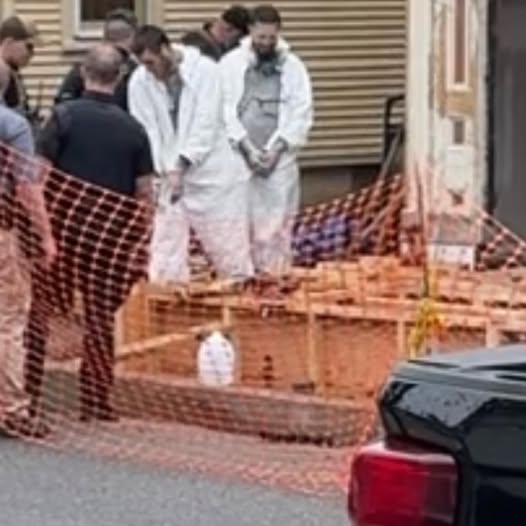
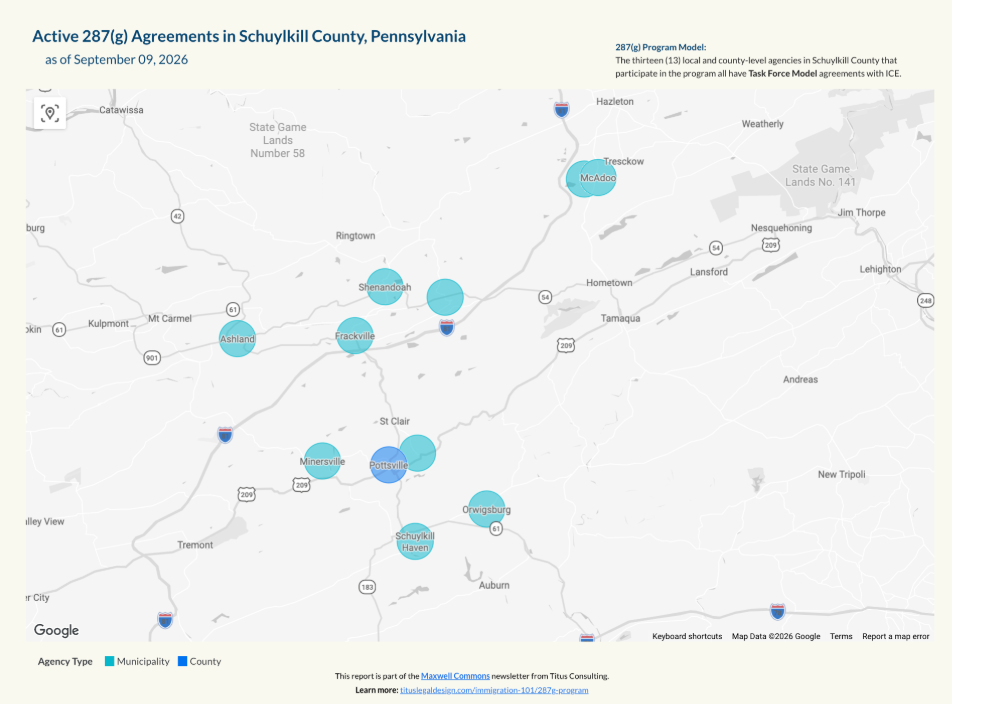
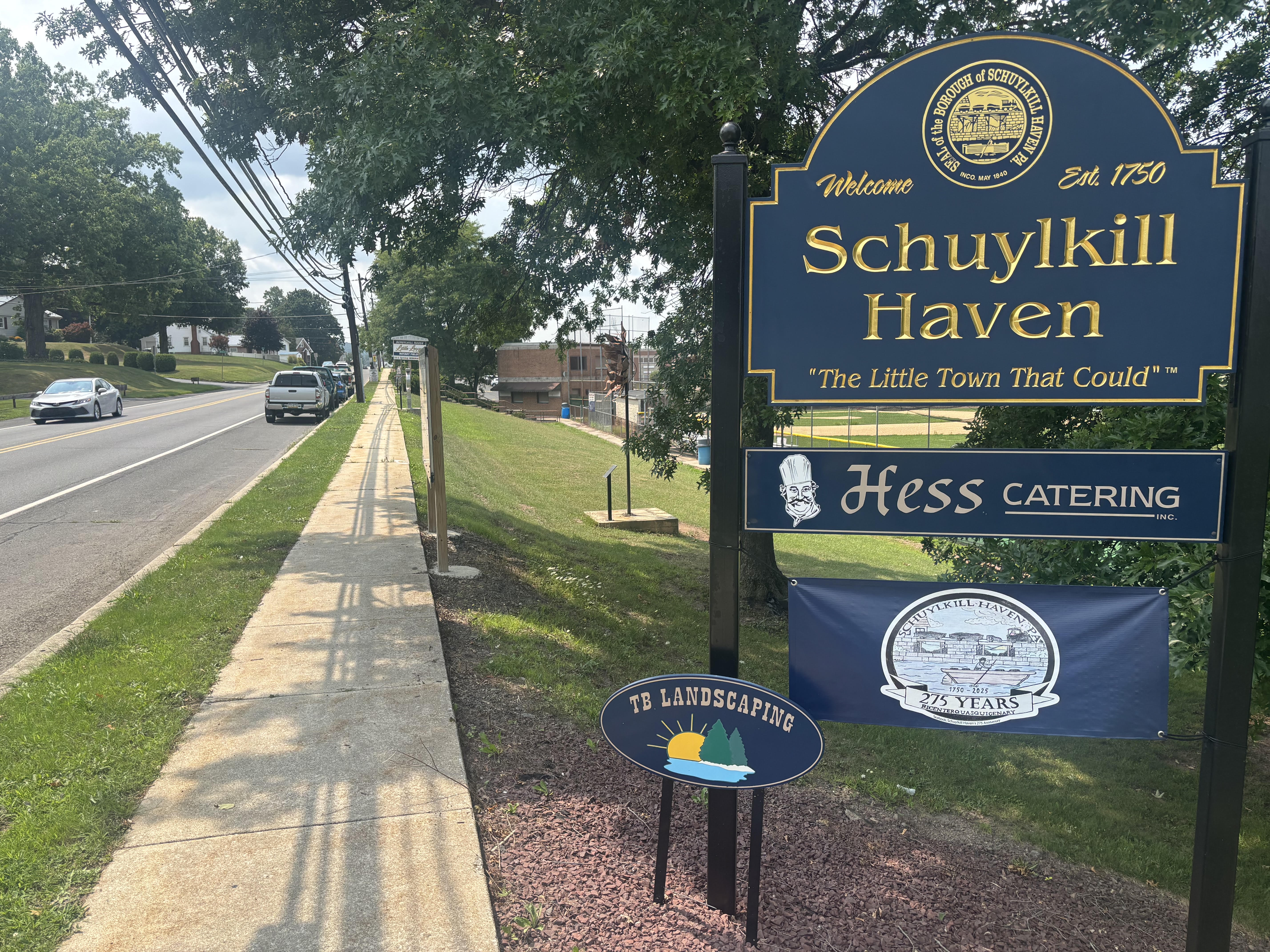
Last week, I reported from Schuylkill County in east-central Pennsylvania, where some 14 law enforcement agencies have raced to adopt 287(g), more than any other county in the state. Since the spring, local cops there have arrested about 100 immigrants at highway stops or by assisting ICE in job site raids. The blitz has prompted rising complaints about alleged racial profiling, the handcuffing of U.S. citizens, and a sense of fear that permeates a growing Latino community in Pennsylvania coal country.
Statistics obtained from the U.S. Department of Homeland Security by advocates show that local police in Pennsylvania have arrested and turned over to ICE more than 1,200 immigrants this year — ranking the state fourth in the nation on a list in which the other leading states are all south of the Mason-Dixon Line.
In Washington, some of the state’s Democratic House members say they’re fed up with a lack of transparency over who is being detained and how the 287(g) program is working here. Last week, four of them — Reps. Mary Gay Scanlon and Madeleine Dean from the Philadelphia suburbs and Reps. Chris Deluzio and Summer Lee from Western Pennsylvania — sent a letter to ICE’s acting director David Venturella demanding information on why the agency’s data lack any specific details about which departments are making arrests, which is required by law.
“It is unacceptable to me that ICE is hiding information from Pennsylvanians about who ICE is working with in their mass deportation regime,” Deluzio — viewed as a potential 2028 primary challenger to embattled Sen. John Fetterman — told me in an emailed statement.
Deluzio also summed up the growing unease by many over the speedy growth of 287(g) in the state. “Let’s keep local law enforcement focused on local public safety, rather than enlisting them in extreme federal immigration enforcement that has ripped away American liberties and targeted so many law-abiding families,” he said. Indeed, 287(g) data guru Andrew Thrasher has reported that a whopping 70% of the immigrants arrested in Pennsylvania under the program have no criminal record or pending charges.
“People in my community are getting smashed off the streets,” said Boyd, the Upper Darby lawmaker. That Delco township is about to vote on a local ordinance to restrict its cops from collaborating or sharing data with ICE.
Statewide, Boyd says she’s one of about 50 House Democrats in a Welcoming Pennsylvania Caucus with an extensive list of proposed bills that would not only bar 287(g), but look to expand opportunities for noncitizens to do things like obtaining driver’s licenses or gain professional certification. But any serious action hinges on November, when Democrats are hoping a blue wave at the ballot box will flip at least three more Senate seats and create a trifecta for their party in Harrisburg.
“Even if we can’t stop ICE from picking them up on the streets, we have to protect their rights,” Boyd said. “And right now, there are barriers to that in the state of Pennsylvania.”
Yo, do this!
The issue of wrongful convictions is back in the news here in Philadelphia — but for all the wrong reasons. Some reckless and seemingly wrongheaded moves by Philadelphia District Attorney Larry Krasner and his underlings have the vultures who’ve always opposed criminal justice reform circling. The shame is that the real crisis around wrongful conviction is the thousands of mostly Black and brown folks who remain behind bars for crimes they did not commit. I cannot say enough about a book that came out earlier this year from Brown University (yay!) sociologist Nicole Gonzalez Van Cleve called Crime Fictions: How Racist Lies Built a System of Mass Wrongful Conviction. She mines the most outrageous prosecutions — often of young Black teens and boys — to make a compelling argument that wrongful convictions aren’t a flaw in the criminal justice system. They are the system.
If timing is everything, then you’ve got to hand it to my freshman dorm pal at Brown who became Washington bureau chief for Mother Jones, David Corn. On the heels of ProPublica’s bombshell reporting on ties between the Trump family and Vladimir Putin, Corn is out Tuesday with his newest book: How Russia Won — Donald Trump, Vladimir Putin, and the Fight for America. It promises a raft of new information about Russia’s efforts to meddle in U.S. elections in 2020 and 2024, the ongoing close links between Team Trump and Team Putin, and how the current president’s pro-Russian slant has changed the world.
Ask me anything
Question: What happens when [House Speaker Mike] Johnson refuses to seat newly elected Dems in January? — David Minckler (@audivita.bsky.social) via Bluesky
Answer: Suddenly, Jan. 3 — the date the 120th U.S. Congress begins, and new members who won their November elections are to be sworn in — has become the new Jan. 6. Summer vacations are over, and the body politic is focused on the looming midterms, and — more importantly — with polls showing the Democrats on track to retake one and possibly both chambers. So there’s been a surge of speculation that the Trump-allied Johnson will do what former Vice President Mike Pence would not do on Jan. 6, 2021, and somehow fail to certify Democratic winners. That’s based on an assumption that Trump’s election-meddling tactics like stopping mail voting — blocked on Monday by the U.S. Supreme Court — won’t work, yet Team MAGA will attempt to undo the election after the fact, as was tried unsuccessfully in 2020-2021. Lawfare has published the most detailed analysis of a so-called rogue clerk theory in which Johnson appoints a MAGA loyalist to serve as House clerk with the understanding that some Democratic wins won’t be certified. Its article notes that such a gimmick is unlikely to pass muster in the courts, but that won’t necessarily stop Trump and the GOP from trying. My only guidance is: Fasten your seat belts.
What you’re saying about …
It turns out readers of the newsletter aren’t eager to join the punditocracy. Only a few of you responded to last week’s question about the chances of a Democratic-led Senate in 2027, and one of them was to give me a verbal tongue-lashing for even asking this. (Frequent writer Daniel Fleisher called it “a pointless exercise in predicting the unpredictable.”) That said, Cathy King has her eye on Abdul El-Sayed in Michigan, her home state, writing that “he seems to be following [Zohran] Mamdani’s playbook.” Meanwhile, in Iowa, Mary Chilton thinks the Dems’ Josh Turek has a real shot in a state won three times by Donald Trump, noting that farmers are up in arms “over the data center issue, imported beef, water pollution and the soaring cancer rates …”
📮 This week’s question: Suddenly, everyone is talking about one thing: the Silicon Valley whistleblowers saying there’s not a trivial chance that a swarm of angry artificial intelligence agents could wipe out humankind by the end of the decade. Are you worried by this, or do you think Big AI is deflecting here to draw attention away from other issues like data center opposition or the stock market bubble? Please email me your answer and put the exact phrase “the AI threat” in the subject line.
Backstory on that other thing that could kill humanity
A barge on the Ohio River moves past the Mountaineer Power Plant, a coal-fired power plant near New Haven, W.Va., in March.Carolyn Kaster
This weekend, a Bluesky post went super viral almost the second its author, a scientist named David Ho, hit the button to post it. “I resigned from ExxonMobil today,” he wrote. “I spent the last three years doing fossil fuel extraction research at both BP and ExxonMobil. Neither company is acting responsibly. They are racing to maximize extraction while the window to act closes, and gambling with our lives.”
It’s a safe bet that many of the 13,000 people who liked Ho’s post truly believed they were sharing the words of a brave whistleblower — but instead the post was satire from a leading climate scientist based at the University of Hawaiʻi at Mānoa. Ho would never work for a Big Oil giant. He was trying instead to mimic — and thus make a point about — the recent posts from Silicon Valley whistleblowers that triggered the new freakout over whether AI robots are a threat to human existence.
Climate change is a threat to society, and it’s even closer to reality. Maybe we should freak out about that?
Ho absolutely has a point. Just before his post, it was announced that August had been tied for the hottest month ever recorded in the history of the planet. That doesn’t come without consequences. In the Himalayas between Nepal and Tibet, a glacier and the adjacent bedrock of mountains at 17,000 feet abruptly collapsed in a region plagued by higher-than-normal temperatures, sending a 150-foot-high cocktail of floodwater and debris down a populated valley at 100 mph. At least 1,386 were killed, and thousands more remain missing. Here in the U.S., a summer of record heat triggered wildfires across the Pacific Northwest.
Robots didn’t do this. Humans did. Maybe that’s why humans — at least the ones that are running Donald Trump’s America — are reacting so differently to the danger of AI than the way they’re dealing, or not dealing, with the lethal pollution from burning fossil fuels. In the case of artificial intelligence, even tech leaders like Anthropic’s Dario Amodei, whose firm makes the Claude program, have urged a slowdown until we better understand the risk from rogue AI agents.
But in the case of climate change, willful ignorance rules the day. The latest outrage from a Trump regime that’s expensively killing off wind farms while racing to extract as much fossil fuel as possible? The now ironically named Environmental Protection Agency is repealing the rule that limits greenhouse-gas emissions from power plants that burn coal or natural gas. A president who spent his summer sweltering on the golf course continues to insist climate science is “the greatest con job ever perpetrated on the world.”
There’s one last irony here. Increasingly, the biggest new sources of climate-altering pollution are the massive data centers that power AI. An Amazon data center proposed for Pecos County, Texas, would likely become the world’s largest source of carbon dioxide if it opens, spewing out 33 tons from natural gas generators every year. Slowing down the AI arms race would also help the planet. Artificial or not, that would be intelligence.
What I wrote on this date in 2019
Joe Biden performing badly in a presidential debate? Say it ain’t so, Joe. We all remember what happened on that 2024 stage in Atlanta (“The night the lights went out in Georgia,” I called that one), but I was almost as unimpressed with the future 46th president during a Democratic primary debate on this date seven years ago. That put me at odds with the punditocracy. I wrote, “The cable TV news show that both channels and is most revered by Washington’s elites — MSNBC’s Morning Joe — is at times so over the top in its bias toward Barack Obama’s former wingman that it could be renamed Morning Joe Biden.”
Summertime is over, and the living is no longer easy. I published my monthlong investigation into local cops collaborating with ICE under the controversial 287(g) program in semirural Schuylkill County, northwest of Philly. I found U.S. citizens handcuffed, families hiding behind blanket-covered windows, and a community wrestling with what it means for neighbors to be treated as suspects. Over the weekend, I delved into the astonishing $850 million or so Trump World has raised in campaign contributions since his reelection — despite the fact that he’s barred from seeking office again. You don’t think he has a scheme to pocket the excess cash, do you?
Dante only had Nine Circles of Hell, but the downward spiral of Pennsylvania Sen. John Fetterman seems to be never-ending. It’s one thing to profoundly disagree on a political and moral issue such as the war crimes of Israel’s right-wing government in Gaza, but recent reporting suggests things are far, far worse in Fettermanland. No senator — regardless of how much their ideology has flip-flopped — should be blowing off their home-state constituents, or clocking out of committee hearings after five minutes. The Democratic senator’s surprise video appearance at the midterm miniconvention of Donald Trump’s GOP, introducing his new best buddy, Republican Sen. Dave McCormick, did nothing to dispel the sense of utter betrayal among liberal voters who now see his winning 2022 campaign as a big lie. The next two years will be crazy as Democrats line up to primary Fetterman, amid rumors the hoodie-clad politico might run as an independent or even change parties. The only sure thing is that The Inquirer will be there for every move. Join us. Subscribe!
By submitting your written, visual, and/or audio contributions, you agree to The Inquirer’s Terms of Use, including the grant of rights in Section 10.
SCHUYLKILL HAVEN, Pa. — Brett Sell had a bad feeling about coming to work on July 28. The painting contractor was part of a small work crew rehabbing a two-story commercial property in Orwigsburg — a borough of just over 3,000 people in the heart of east-central Pennsylvania’s coal country — and workers had seen what looked like an unmarked law enforcement vehicle circling the site the day before.
“Yo, look up!” Sell said to his fellow painter, Orlando Rivera.
Police cars from Orwigsburg and neighboring Schuylkill Haven, lights flashing, blocked off the street while agents from U.S. Immigration and Customs Enforcement in tactical vests swarmed the work site. Sell was stunned as he and four other workers were quickly handcuffed by ICE agents — even though Sell and Rivera are native-born U.S. citizens.
Rivera, a biracial Puerto Rican who grew up in Bethlehem and now lives in another Schuylkill County borough, Tamaqua, said he was “embarrassed” as he stood in handcuffs while locals came out into the street to gawk. “I do a lot of work in that town,” he said, adding that “it made me feel like I was portrayed as a criminal.”
And he’s convinced he was handcuffed — even after offering to show the agents his ID — because of his race. “I get that my skin tone is tan,” he said, “but with the Fourth Amendment, they can’t go off my skin color, you know?”
Two workers were detained. One was later released, but the other — Catarino Hernandez Velasquez — a Mexican native who’s lived in Pottsville for at least 14 years, and a well-known contractor who poured concrete for the just-reopened 1928 Miners Hotel — was taken away and sent to ICE’s Moshannon Valley Detention Center in Central Pennsylvania, known for its overcrowding and complaints about lousy food and medical neglect. Kevin Medina, a leader of the local Latino community, bemoaned the arrest of a “very hardworking gentleman with a stable contracting business in the area … very busy.”
Now, gone … in a matter of minutes.
Painting contractors Brett Sell (left, white painting outfit) and Orlando Rivera are handcuffed during an ICE raid on a job site in Orwigsburg, Pa., on July 28. The men — both native-born U.S. citizens — were released without charges.Facebook
The Orwigsburg raid was a dramatic moment, yet such scenes are becoming increasingly common this summer in Schuylkill County, Pa., a constellation of rusty boroughs where coal was king in the 20th century, and Donald Trump got 71% of the vote in 2024.
‘In Schuylkill Haven, they can’t go there’
Since the start of the year, ICE — flush with a whopping windfall of $170 billion shoveled by Congress to the U.S. Department of Homeland Security to amp up immigration raids and detention — has dangled pledges to many tiny police departments. In Schuylkill County, which locals call “the Skook,” more than $1.5 million has been distributed to law enforcement. The police chief and pols all but publicly salivated at the chance — under the controversial program known as 287(g) — to buy a desperately needed new cruiser or other cop tools in return for working with ICE to arrest and hold local immigrants for the feds.
Some 14 law enforcement agencies — the most of any of Pennsylvania’s 67 counties — have inked 287(g) pacts with ICE, launching a new era of beat cops making immigration arrests that has roiled daily life in Schuylkill County. Practically overnight, cops were setting up truck inspections on a busy rural bypass or running checkpoints at places like the Freeze, a popular ice cream joint on the main drag, Route61. Officers were pouncing on immigrants who showed up at the county courthouse in Pottsville, or assisting ICE on workplace raids like the one in Orwigsburg.
Arrests leading to ICE detention and deportation cases skyrocketed across Schuylkill County — more than 100 since the start of the year, with most the result of ICE cooperation under 287(g) — leaving families torn apart while creating a climate of fear among what had been a rapidly growing Latino community in and around Pottsville. Suddenly, essential workers or their loved ones grew terrified that a busted taillight or failing to signal while shifting lanes could turn their world upside down.
One borough with just over 5,000 residents — Schuylkill Haven — has seen at least 59 immigration arrests in about four months, a staggering number. The figures come from Chicago-based ICE watcher Andrew Thrasher, a law-firm staffer and data expert who regularly crunches federal statistics obtained by the Deportation Data Project through Freedom of Information Act (FOIA) requests.
“People are afraid to go out,” Medina — who immigrated to Schuylkill County from Honduras, became a U.S. citizen and a notary and insurance agent, and formed a local Latino support group, Puentes de Apoyo — told me when we met in a Hispanic-owned Pottsville pizza joint. “I’ve got one contractor who told me they’ve got to change routes because now they know that in Schuylkill Haven, even they can’t go over there. And the stress, mentally, that I’m seeing in these families of, ‘What am I goingto do if this happens?’”
A map, provided by immigration statistics expert Andrew Thrasher, showing 13 current Schuylkill County localities that have signed 287(g) cooperation agreements with ICE. A 14th, Mahanoy Township, is inactive.Andrew Thrasher
The wave of arrests has put Schuylkill County — mostly rural, mostly conservative, and far removed from the glare of media or the kind of organized ICE resistance you see in big cities — on the cutting edge of an aggressive new strategy for mass deportation. This approach is bringing a xenophobic Donald Trump regime closer to fulfilling its once-unthinkable goal of removing one million immigrants from the United States every year.
Trump Country embraces 287(g)
The tag team of local cops and tactical-gear-wearing ICE agents is the biggest reason why federal immigration arrests spiked in July to a Trump-era high of 49,571, or about 1,600 every day. Statisticians who are tracking mass deportation said that 287(g) arrests — named for the section of a 1996 law that authorized the program — involving local police went from less than 3% of the total under Joe Biden to about 15% now, and will only climb higher as hundreds of new departments sign up.
This year, about 58% of the people nabbed by cops and turned over to ICE under 287(g) have no criminal record or pending charges, a higher rate than the typical ICE arrestee. Thrasher found the number for Pennsylvania is even higher, about 70%.
While not as numerous as inbig and heavily conservative states like Texas and Florida, the Keystone State’s 1,216 arrests under the 287(g) program in the first seven months of 2026 rank the commonwealth fourth in the nation — on a Top 15 list made upof states almost exclusively south of the Mason-Dixon Line.
Pennsylvania’s outlier status is punctuated by the fact that two large bordering states — New York and Maryland — have moved, with some bumps, to ban their police agencies from signing 287(g) agreements. Almost all of the Pennsylvania arrests came from smaller cities, exurbs, or rural areas — especially the south-central and northeastern regions of the state, and a smattering of western localities — that voted heavily for Trump and his anti-immigrant message.
The small-town nature of this renewed push for mass deportation is a defining feature of the Trump regime strategy, and not a bug. The race among Schuylkill County’s police departments — many with just three or four cops, including the chief — to sign up for 287(g) and its pumped-up pile of cash came exactly as the two Minneapolis murders of U.S. citizens by immigration cops were fueling growing public outrage.
As a brutal ICE winter ended, the Trump regime ousted Homeland Security Secretary Kristi Noem and the notorious field general Greg Bovino, and ended an era of loud, publicity-seeking operations with catchy names in large blue cities that stirred up local protesters who blew whistles and filmed every move by the masked, armed agents.
Immigrants’ rights advocacy group members and their supporters hold up letters that read “The people vs 287(g)” during a rally last September in Doylestown against the Bucks County sheriff’s efforts to implement a 287(g) program.Daniella Heminghaus | Bucks Coun
Under new DHS boss Markwayne Mullin, ICE and its allies are focused on what you might call small-batch immigration busts — in courthouses or on airport security lines, and thanks to 287(g), at local traffic stops or truck inspections. No one is blowing whistles, and few of these busts get caught on video. Yet, even here in blood-red Trump Country, some locals are troubled by the intense police focus on immigrants and what it’s doing to the moral fabric of their community.
‘Arrest them like the Gestapo’
“No one’s telling you not to arrest people — I’m telling you not to hunt for them, to do stops on the side of the road and arrest them like the Gestapo,” a Democratic city council member in Pottsville, Andy Wollyung, told me after he tried and failed to stop the county seat from joining 287(g). He later fretted that immigration arrests “will drive a wedge in people, you know? These aren’t unknown people. These are our neighbors.”
“When local police officers serve as a force multiplier for ICE, we know that people become more afraid to report crime,” Nayna Gupta, policy director at the American Immigration Council, told me. “They become less willing to cooperate with local law enforcement when it comes to investigations, including things like homicides. And there’s an overall mistrust of public institutions.”
The irony is that today’s Schuylkill County was built on the backs of immigrants — initially a wave of Irish who dug the 19th-century coal mines and were also persecuted, including six members of the infamous Molly Maguires who were hanged in Pottsville in 1877. They were followed by Eastern Europeans who filled the local mining towns like Mahanoy City and Shenandoah.
Those who stayed behind after the mines started closing in the 1950s and kept its hillside towns of striking Victorian architecture and utilitarian rowhouses alive got a booster shot in the 21st century with an unexpected new wave: Latinos. Many landed in Schuylkill County when seeking a place with cheaper housing and more job opportunities for hard workers than big cities like New York or Philadelphia.
Schuylkill Haven, with a population of just over 5,000, has arrested at least 59 people and turned them over on federal immigration charges since signing a so-called 287(g) agreement with U.S. Immigration and Customs Enforcement (ICE) this spring.Will Bunch
Four years ago, Pastor Luis Rivera and his wife bought a historic local church building in Pottsville and rechristened it as Iglesia Cristiana El Kairos, under the umbrella of the Evangelical New Life Church, to serve a Latino community now growing by leaps and bounds.
“You see a lot of traffic,” the pastor told me. “You see people remodeling more houses. And a lot of the stores are opening around here … It was really dead before, you know?” Today, it’s estimated that about 1,000 of Pottsville’s 14,000 residents are Latino.
A ‘stable’ life is upended
Six of the more recent arrivals were Venezuelan-born Carlos Moreno, his wife, Wendy Martínez, and their blended family of four teenagers. They’d been on the run from government persecution and armed conflict across South America when they came to America in 2023, and stayed in a cramped public shelter in New York City as the family sought asylum and obtained work permits.
When they moved to a narrow rowhouse on a rugged patch of Norwegian Street on the steep hillside up from downtown Pottsville, the couple found jobs at the county’s large Amazon warehouse and even started a small cleaning business, even though Moreno, 37, is legally blind and has severe hearing problems.
“For the first time in years, it felt like our lives were finally becoming stable,” Martínez would later write. “Then, in the fall of 2025, we learned that I was pregnant. It was an unexpected surprise, but a very welcome one.”
Wendy Martínez, whose husband, Carlos Moreno, a Venezuelan refugee, has been detained by immigration authorities since May after losing a misdemeanor noise complaint at the Schuylkill County Courthouse. She is holding her baby Noah, who was roughly 6 weeks old.Will Bunch
A bigger and less welcome surprise awaited. This spring, a neighbor called police to complain about noise —music from a small boom box — and Moreno received a summons. He decided to challenge it at the Schuylkill County Courthouse a few blocks away, and when he lost, he paid a fine, walked out of the courtroom — and right into ICE agents waiting to arrest him. He was sent to detention in the Cambria County Jail and stayed there as massive earthquakes halted deportations to Venezuela. He was locked up when his son, Noah, was born — on the Fourth of July.
Martínez was alternately rocking and bouncing her then-6-week-old son when I joined Medina in visiting their cluttered, narrow rowhouse in August. The windows were covered with thick blankets that let in only a sliver of light, and Martínez was bookended on a sofa by her two daughters, on their phones, who rarely leave home.
“They told him that he was a dangerous person,” Martínez said in Spanish, interpreted by Medina, as her baby babbled. “There hasn’t been any situation where he was against the law, or anything.” Struggling to pay her bills and support the five children, Martínez launched a GoFundMe page, but has only raised $2,695 of her $4,000 goal. Her husband was recently moved to ICE detention in Louisiana.
In August, Schuylkill Haven officials said they’re expecting a federal check for $152,000 — money the police department wants to spend on buying the currently leased police headquarters, pictured here.Will Bunch
Like most immigration arrests since 287(g) swept across Schuylkill County, there is an element of mystery about what exactly happened to Moreno. I twice called the Schuylkill County sheriff, Shawn Butler, to ask if his department — the first county agency to join 287(g), back in January — was involved, but he did not get back to me. Not once in a month of reporting did a police chief or municipal official return a call or email from this out-of-town columnist. Secrecy, and a lack of accountability, seems to be baked into the 287(g) program.
‘You don’t answer anything’
“Any Right-to-Know requests, any FOIA requests, anything — you defer that right down to the Department of Homeland Security,” Jody Long, the then-police chief in Mahanoy Township, told the Pottsville City Council when it was voting on a 287(g) agreement in May. “You don’t answer anything with that. That’s right from their legal team.”
In early September, I attended the bimonthly meeting of the Schuylkill Haven borough council hoping to ask Police Chief Jeffrey Walcott, Mayor John Williams, or other officials how and why their small borough just south of Pottsville had managed to make at least 59 immigration arrests since signing a 287(g) pact with ICE on April 5. I didn’t get very far.
In a brief conversation, Walcott suggested, interestingly, that commenting on 287(g) might bring protesters to Schuylkill Haven. When I asked Williams about the program after the meeting, the police chief interrupted our conversation to say there should be “a unified response,” and then later told me any information would need to come from Homeland Security or a FOIA request.
Schuylkill Haven Mayor John Williams (left) at a borough council meeting on Sept. 2. Next to him are borough secretary Kaitlyn Tinari (center) and council president Thomas Gordon (right). Williams said Schuylkill Haven’s cooperation with federal immigration enforcement is going well, but declined to elaborate.Will Bunch
Most of what citizens and the media in Schuylkill County know about the 287(g) programs comes from borough or township council meetings in which a police chief tells elected officials about all the sweeteners that cash-flush ICE added to the program when Congress and Trump enacted the so-called Big Beautiful Bill in 2025.
Police departments or county sheriffs who join the most common 287(g) Task Force model get $100,000 for vehicles or other equipment and $7,500 for each officer who undergoes 40 hours of mostly online training, as well as additional dollars for their time on immigration matters — all contingent on making actual arrests. In August, Schuylkill Haven officials said they’re expecting a federal check for $152,000 — money the borough wants to spend on buying the currently leased police headquarters.
The cash incentives have sparked a kind of deportation arms race across Pennsylvania, which has gone from just a few 287(g) programs at the start of the year to more than 130, with new ones coming online every day. Most of the council debates tread lightly on the question of liability for an officer who makes a bad arrest — a problem ICE is belatedly looking to fix with a proposal to insure each officer up to $500,000 — or the elevated risk that a traffic stop could lead to violence.
Fighting in the Schuylkill
That’s already happened. On May 20, a Schuylkill Haven cop stopped a car on Route61 after he claimed the driver had illegally dark-tinted windows. ICE agents who were in the borough and arrived at the stop ran the license of 34-year-old Yensy Rafael Santana Alvarez of New York City and determined he had an immigration removal order.
According to the Skook News, a court affidavit said the man handed over his car keys and stepped out of his car — then ran for it. Alvarez led the law officers on a wild foot chase across the Schuylkill and back, getting tased once, and allegedly pulling one officer underwater as another suffered minor injuries. He was eventually arrested, and felony charges were filed but then dropped.
Some local critics also questioned whether minimally trained cops making immigration arrests is a good idea in a county where some departments have a history of police abuses. “In northern Schuylkill County, over the last 10 years, we’ve had horrendous police … acting very unprofessional in different departments,” John Hampton, a lawyer who has worked with Mahanoy Township, told me.
A heated and emotional debate over the federal 287(g) immigration enforcement program dominated Monday night’s Pottsville Council meeting.
After initially failing in a 3-2 vote, the resolution was reopened moments later and ultimately passed following a council member changing… pic.twitter.com/kSW1QXhgqS
In 2022, two then-police officers in the borough of Minersville were indicted on still-pending federal police brutality charges for allegedly severely beating a man during a traffic stop and falsifying police reports to cover it up. That didn’t prevent ICE from signing a 287(g) agreement with Minersville police in May.
That same month, local activists pleaded with the Pottsville City Council during a meeting that lasted more than five hours not to join the 287(g) program, arguing that immigration arrests would make tourists and new businesses not want to come there. They thought they’d won in a 3-2 vote, only to have GOP council member Scott Price change his position and demand a revote that flipped the outcome, saying that, in the end, “I have to side with our police officers.”
One of the few pro-287(g) advocates who spoke at that May hearing was Mahanoy Township’s Long, who said his department had been “the leader in the county” by making 10 immigration arrests, mainly at what he called a truck-safety inspection point. “ICE does not come in and tell you what to do,” Long insisted. “We tell them what to do.”
He was joined by one of his officers, Anthony Maldonado, who cited his own heritage as a Puerto Rican to insist there is no racial profiling. “I have family members who are light-skinned, dark-skinned, everywhere in between, so I would take it very personally if we conducted ourself unprofessionally to that effect,” he said.
‘Because you look like a Mexican’
The room in Pottsville did not hear from Moe Montalvo, a gutter contractor from nearby Tamaqua who, in mid-April, passed through the checkpoint on Burma Road operated by cops from Mahanoy Township and assisted by adjacent Ryan Township officers. He said he was part of a two-truck convoy, and the first one with two white occupants was waved through, while his was stopped to allow the officers to ask Montalvo, a 28-year-old U.S. citizen who is half Puerto Rican and half Egyptian, for his ID and grill him about his identity.
Montalvo posted that day on Facebook that when he told an officer he was born in Montgomery County, the cop replied: “Are you sure? Because you look like a Mexican.” Montalvo also quoted the officer: “Why are you worried? The only thing you should be worried about is when I take my Taser out, because I’m going to aim right for your nose piercing.” I confirmed the incident with Montalvo, who told me that “it seems like there was no doubt that racial profiling was involved here.”
Weeks later, the Mahanoy Township Police Department went dark, at least temporarily, after Long, Maldonado, and its other officer all quit in a disagreement with supervisors. One of the supervisors, Republican Tony Merchlinsky, confirmed to me the entire force had resigned after a dispute with supervisors over its refusal to wear body cameras. He said it was triggered by a civilian complaint over an arrest that did not involve immigration, although he added that “it may have involved racial profiling.”
Maldonado took to Facebook to give his side of the story, saying that a different supervisor had told the township officers they were making too many arrests, and that, as quoted by Maldonado, he preferred “a [B]arney Fife department and have his police drive around and wave at people instead of making arrests.” Merchlinsky confirmed that Mahanoy Township — which recently hired a new, albeit part-time, police chief — has yet to see one dime from the feds of the more than $100,000 that was promised.
The checkpoint drama and police tensions in Mahanoy Township demonstrate some of the many problems when beat cops are drafted to join Trump’s mass deportation crusade. Are police really making their towns safer when one part of the community is taking long traffic detours and covering up their windows in terror of any contact with cops? Is the economic gloom over Pennsylvania’s fading coal country really going to be lifted by clamping down on immigrants who’d been flocking there to pour concrete and rehab old buildings?
Does a region whose very DNA is handed down by the immigrants who once came here to shovel anthracite now want to be known in the 21st century as a “show me your papers” police state?
Few of these questions are being asked as one former coal burg after another races to embrace a Trumpian bargain with the 287(g) program. The latest is Mahanoy Township’s next-door neighbor, Ryan Township, which in June voted conditionally to join the ICE mass deportation program, citing as the biggest incentive its need to replace its run-down Ford Explorer, one of the oldest police cars in Schuylkill County.
In the country’s premier battleground state, Pennsylvania Democrats believe they’re in striking distance of a tidal-wave victories that would dramatically shift the balance of power in both Washington and Harrisburg.
For the first time in decades, the party could take full control of the legislature. That would give Democratic Gov. Josh Shapiro — seeking reelection with a wide polling gap on his Republican challenger Stacy Garrity— significantly more power to shape the direction of the state as he potentially pursues a White House bid in 2028.
Democrats also see a chance to flip four congressional seats and take control of the U.S. House. Republicans, meanwhile, are prioritizing defending the Pennsylvania seats with their House majority on the line as President Donald Trump, who won the state justtwo years ago, sinks in popularity.
The path forpower in Washington inthe high-stakes midterms runs through Pennsylvania and its results will be closely watched as both parties prepare for a presidential race in two years when the state promises to play a pivotal role.
Voters across Pennsylvania will head to the polls in November to cast their ballots for races that will decide the balance of power in the state and nation.
Here are the races to watch and how to vote.
Shapiro’s November could dictate his 2028
Shapiro, widely viewed as a likely contender for the 2028 presidency, has big ambitions this fall when he’ll stand for reelection against Garrity, the state’s treasurer.
More than just securing his own reelection, Shapiro hopes to run up the margin and carry downballot Democrats across the finish line.
Another double-digits win and a string of coattail victories would be ashow of strength about his ability to perform in a key swing state that his party lost in the last presidential election.In a presidential primary, Shapiro could use that result to make an argument that he’s a strong general electioncandidate who can boost the Democratic brand.
Will Republicans hold on in competitive congressional seats?
There are four U.S. House districts in the eastern portion of Pennsylvania, targeted by both parties as must wins. In each, the Republican incumbents are seeking to fend off highly financed challengers amid deep frustration among voters with the leader of their party that could translate into a wave of Democratic victories down ballot.
7th Congressional District: Freshman Republican U.S. Rep. Ryan Mackenzie narrowly flipped the Lehigh Valley district two years ago and is widely seen as one of most vulnerable incumbents in Congress. He’s facing a challenge Democrat Bob Brooks, a retired firefighter and union leader whose blue-collar campaign has attracted support across the party’s ideological spectrum with endorsements from Shapiro and U.S. Sen. Bernie Sanders.
10th Congressional District: Republican U.S. Rep. Scott Perry, a close ally of Trump, faces a November rematch against Democrat Janelle Stelson, a former TV anchor, in the Harrisburg area district. Stelson has consistently outraised Perry after narrowly losing in 2024.
In addition to these four races both national parties have targeted, Shapiro has argued that the 9th Congressional District, where Democrat Rachel Wallace is taking on incumbent GOP U.S. Rep. Dan Meuser, is flippable — despite the strong GOP lean in the district, which stretches from Berks County to the New York state border. The district is home to two warehouses that ICE was planning to convert into detention centers before abandoning the plan after a backlash from residents.
This year, Shapiro wants to flip the chamber and win a trifecta to push forward his key priorities, such as codifying abortion access, raising the state’s minimum wage, and increasing funding for transit.
Republicans currently hold 27 of the chamber’s 50 seats. Democrats, who currently hold 23 seats, need to win at least two additional seats and the governor’s office to win control of the chamber with the lieutenant governor as a tiebreaking vote.
The seats, drawn advantageously for Republicans, have been stubbornly resistant to political change for decades.
But this year a blue wave could usher in Democratic pickups in Philadelphia suburbs and the Lehigh Valley.
Races to watch include:
Bucks County’s 6th District, where Republican incumbent State Sen. Frank Farry faces a challenge from Democrat Eileen Hartnett Albillar.
Montgomery County’s 24th District, where incumbent Republican State Sen. Tracy Pennycuick is up for reelection against Democrat Chris Thomas.
Bucks and Lehigh County’s 16th District, which will see a rematch race between incumbent Republican State Sen. Jarrett Coleman and Democrat Mark Pinsley, the Lehigh County controller.
What are the important dates to know?
Election Day is Nov. 3.
The deadline to register to vote is Oct. 19. You must be at least 18 years old, a resident of Pennsylvania and a citizen of the United States to vote. You can register online, by mail, at your county elections office, or at one of several other government buildings.
Pennsylvanians can vote by mail with no excuse required. To apply, fill out an application by mail, online, or in-person and send it into your county election office. Applications must be received by Oct. 27 at 5 p.m. and the completed mail ballot must be received — not just postmarked — by 8 p.m. on Election Day.
An application and mail ballot can be completed in one visit at an election office, essentially functioning as early voting.
Staff writer Fallon Roth contributed to this article.
A newborn baby from Lancaster County was among the two unvaccinated residents whose deaths were associated with measles, Pennsylvania health officials said Wednesday.
As vaccination rates decline in the state, an outbreak that began in April this year has sickened more than 400 people in 29 counties — with the epicenter in Lancaster County, where nearly 200 individuals have tested positive for the viral disease. Local physicians and health officials say the true case count is likely much higher.
The state initially declined to share any information about the deaths, citing privacy concerns, and no information has been released about the second Lancaster resident who died.
The Pennsylvania Department of Health confirmed information about the newborn’s death on Wednesday only after the Lancaster County coroner publicly stated his office was investigating a newborn who had tested positive for measles and died from a ruptured spleen.
Lancaster County Coroner Stephen Diamantoni, a physician, said the cause of death was not the measles. The newborn died shortly after birth from a laceration of the spleen. A postmortem test on the baby’s lung tissue showed that the child had a measles infection that was acquired before birth, he said in an interview.
His description of the death, shared with reporters and a local county commissioner, contributed to a growing uproar on social media over the nature of the deaths and the state’s release of information.
President Donald Trump’s secretary of health and human services, Robert F. Kennedy Jr., traded attacks with Gov. Josh Shapiro, a Democrat, on X over the deaths and the safety of the measles vaccine.
Late Wednesday, Kennedy went further in another X post. He accused Shapiro’s administration of potentially having “fabricated” the deaths, after saying in an interview on C-Span that “they cannot find any measles deaths in Lancaster County.”
He said that Shapiro was not cooperating with the Centers for Disease Control and Prevention or the county in giving information on the deaths.
Shapiro administration staff said the department has been in regular contact with the agency during the outbreak.Pennsylvania Health Secretary Debra Bogen said in a statement late Wednesday that she “sadly can confirm” two measles-associated deaths in Lancaster County.
Measles deaths are rare. Most patients recover after mild illness, but the virus can cause pneumonia and brain swelling and kills about one to three patients in 1,000. The disease is so contagious that it can infect nine in 10 unvaccinated people.
The Pennsylvania Department of Health explained thatit reports deaths where measles are present as “measles-associated,” and it “may not be assessed by the medical examiner or coroner to be the immediate cause of death.”
In Lancaster, the coroner’s officedetermined that the baby’s primary cause of death was a laceration of the spleen, Diamantoni said.
Despite the baby’s positive measles test, the forensic pathologist who conducted the autopsy “did not feel it was related to measles,” Diamantoni added.
His office is seeking to learn whether the baby’s mother had measles at the time of the baby’s birth.
He said state health officials had not contacted him personally as of Wednesday about the two Lancaster County measles-associated deaths, but his chief deputy spoke to the department prior to Shapiro’s news conference Tuesday.
Paul Offit, a national vaccine safety expert and physician at Children’s Hospital of Philadelphia, said news of the coroner’s investigation “doesn’t really give us more information” on the death.
Children can acquire the disease after birth, or can be born with measles if their mother is infected and develops a rash within 10 days of giving birth, he said.
Measles can cause an enlarged spleen, and birth can cause it to rupture, he said. After a spleen ruptures, Offit said, it is difficult to tell whether it had been enlarged, and he added that the coroner should provide an alternate explanation for the rupture if it had not been caused by measles.
Diamantoni said the doctor who performed the baby’s autopsy did not note that the spleen was enlarged, and the office is still investigating the cause of the rupture.
To prevent speculation, the state could release information about the patients’ age, vaccination status, and cause of death while still protecting their privacy, Offit said.
In conversations with state health officials, he said, he learned that “these patients would not have died were it not for measles.”
Anti-vaccination advocates “try and completely misdirect and say it really wasn’t measles. They try to do everything they can to distance themselves from it,” he said. “You’re making it a lot easier for them when you don’t give more information.”
In her statement, Bogen said the department reported the deaths to the CDC on Tuesday morning and met with CDC staff on Wednesday afternoon to discuss the cases.
“DOH’s Epidemiology team thoroughly investigated and verified both individuals tested positive for measles. The information was not reported to the public until the results of the epidemiological investigations were confirmed,” she said.
She noted that state health officials are prohibited from releasing death certificate information except under limited circumstances that do not apply to this case.
A county commissioner questions measles-associated deaths
The clash over the deaths began within hours of Shapiro’s Tuesday news conference.
Lancaster County Commissioner Josh Parsons, a Republican, shared the coroner’s account on Facebook, suggesting the state was spreading incorrect information on the deaths.
In several posts, Parsons questioned whether the patients had died “OF measles or WITH measles” and suggested the state was spreading incorrect information on the deaths.
“We have ZERO information that corroborates the idea that there were two measles deaths in Lancaster County,” he wrote in a post several hours before the state’s announcement. Later, he shared Kennedy’s remarks on C-Span.
Parsons has not responded to several requests for comment from The Inquirer about the outbreak over the last several months.
Yoder, who attended the Tuesday news conference, said at a Lancaster commissioners meeting Wednesday that she had no additional information on the recent deaths.
The consequences, he said, were apparent in the deaths reported in Pennsylvania. He said he had told Kennedy as much in a recent phone call.
Later that night, on X, Kennedy said that Shapiro had falsely accused him of spreading misinformation and that drops in the state’s high vaccination rates occurred mostly during President Joe Biden’s administration.
Replying to Kennedy on X, Shapiro said that he asked the secretary to help him encourage people to get vaccinated and “stop spreading misinformation.”
The governor joined a lawsuit earlier this year against Kennedy’s department’s decision to scale back federal vaccine recommendations for children.
Shapiro noted that Kennedy had visited Lancaster in 2021, during the Biden administration, and told a crowd there that measles could be cured by “chicken soup and vitamin A.”
Measles has no specific treatments, and although vitamin A is sometimes given to severely ill patients, it cannot prevent the disease and is not a cure.
Shapiro added that measles cases have increased in the United States and Pennsylvania under Kennedy’s watch.
Editor’s note: This story has been updated to clarify that the newborn who died had a measles infection acquired before birth.
There were two noticeable no-shows as Western leaders gathered Monday to mark the 35th anniversary of Ukraine’s independence — and its five years of resistance to Vladimir Putin’s effort to re-subjugate the country to Russian rule.
There were multiple news reports that President Donald Trump’s clueless peace envoys — son-in-law Jared Kushner and real estate magnate Steve Witkoff — might finally join European allies at anniversary ceremonies.
I say “finally” because neither of these supposed peacemakers has ever deigned to visit Ukraine. Not once. Meantime, Witkoff has visited Moscow eight times, and gushed over Putin as he and Kushner (also a repeat visitor) discussed business deals with Russia.
It is no surprise, then, that Trump’s blinkered envoys postponed their trip, reportedly blaming their absence on intensified Russian missile and drone strikes. Never mind that former Vice President Mike Pence, British Prime Minister Andy Burnham, and other European leaders showed up.
They recognized — as Trump and his envoys still do not — that Ukraine is fighting not just for its own freedom, but for the security of Europe and the United States.
Burnham, who came to Kyiv on his first foreign trip as prime minister, understands the significance of Ukraine’s brave stand against the world’s second-largest army. A Russian military that is heavily aided by the dictators of China, North Korea, and Iran, all eager to undermine America and the democracies of the West.
The U.K. leader rightly compared Ukraine’s resistance against Russian imperialism to Britain’s fight against Nazi Germany in the 1940s, telling Ukrainians, “My nation kept the flame of European freedom alive in the 20th century; you hold that flame in the 21st.”
Burnham is right on the mark.
Ukraine’s President Volodymyr Zelensky hands over the flag of a military unit during the ceremony to mark Ukraine Independence Day in Kyiv, Ukraine, Monday.Efrem Lukatsky
The image of London firefighters bravely battling the blazes caused by the German Blitz, which rained rockets down on civilians in order to break their morale, comes right to mind when watching video of Ukrainian rescue workers pulling women and children out of the rubble of collapsed apartment towers that have been hit with Russian missiles or drones.
Then-Prime Minister Winston Churchill understood that if Britain fell, the Nazis would take over Europe. The Battle of Britain in the summer and fall of 1940, in which incredibly courageous Royal Air Force pilots pushed back the Luftwaffe, forced Adolf Hitler to abandon his planned invasion of England. The courage and spirit of Britons under bombing gave the RAF the time to regroup and attack the Nazis in Europe. It gave President Franklin D. Roosevelt time to act on sending Lend-Lease war supplies to Britain.
Burnham grasps that Putin is a stalking horse for an axis of adversaries – namely China, North Korea and Iran – that backs and finances Russia’s crimes.
Ukraine’s battle of the skies is effectively the first round of World War III. And only one weapon can take down the ballistic missiles Russia is pouring down on Ukraine’s civilian infrastructure: U.S.-made Patriot interceptors.
Yet, Trump has wasted much of America’s Patriot missile stock chasing cheap Iranian drones, and refuses to sell Kyiv a small percentage of what the U.S. retains. And after proposing joint production of Patriots with Ukrainian President Volodymyr Zelensky, the U.S. president immediately backed off.
That is why Burnham announced Monday that the U.K. (along with France) will help Ukraine make its own version of a Anglo/French long-range cruise missile by sharing classified technical information. That will help Ukraine preempt Russian missiles by eliminating the firing sites.
But setting up that production line will take months or years, and Ukraine desperately needs Patriots now.
Ukraine’s President Volodymyr Zelensky (left) hands over the Ukraine state award to European Council President António Costa during a commemorative ceremony in Kyiv, Ukraine, Monday, marking Ukraine’s 35th Independence Day.Efrem Lukatsky
It is hard for many Americans to grasp how important Ukraine’s survival is to our future security. Few U.S. politicians consider Ukraine to be a critical campaign issue. Trump has communicated his disdain for Kyiv to his MAGA followers, and Vice President JD Vance boasts that his proudest moment was helping cut off aid to Ukraine. As for Democrats, they’d rather focus on cost of living and the endless Iran war.
But Gen. Ben Hodges, former commander of U.S. Army Europe, nailed it when he told me recently that what’s been missing from the lack of U.S. attention “is the recognition that it’s in the U.S. interest for Ukraine to be successful.” President Joe Biden was too timid, he noted, and Trump is worse.
America’s enemies are taking full notice.
China is watching and learning from the drone, robot, and electronic warfare being fought in Ukraine, while sharing dual-use weapon parts and technology with Moscow. Every lesson is being fed into the hopper of Xi Jinping’s massive agglomeration of data used for prep to take back Taiwan and dominate South and East Asian neighbors and territorial waters.
North Korea is earning hard currency by sending troops and missiles to aid Russia’s war on Ukraine. In return, it is accessing Russian technology to build up its nuclear arsenal. Iran sends Shahed drones to Russia and learns from Russian upgrades of those drones, which helps Tehran attack U.S. bases and threaten Gulf Arab states in the Middle East.
Meantime, Trump is focused on his White House ballroom, car races, and starting a trade war with Canada, while Kushner and Witkoff chicken out of visiting Kyiv. They have no clue that the fate of the Ukraine war will overshadow everything they now think is important.
Their trips to Moscow are feckless unless they recognize that Putin has no interest in peace. Any “peace process” is dead (irrespective of CIA Director John Radcliffe’s secret visit to Moscow last weekend) until the United States recognizes reality and joins Europeans in squeezing Putin until he fears the war is endangering his survival.
I believe Ukraine will hold out via its tech brilliance and innovation, and its people’s determination not to surrender to the brutal domination of Russia. But the United States will pay a dear price for failing to step up when it could have blocked Putin and his allies — before their war on the West got much, much worse.