In the five years he spent researching his book Mobilization Politics, Haverford College political scientist Stephen J. McGovern interviewed former Mayor Jim Kenney and other Philadelphia elected officials, political activists, campaign consultants, labor leaders, and protesters.
The book, which covers events from the 2010s through Mayor Cherelle L. Parker’s victory in the 2023 election, uses Philly as a case study to examine the national rise of grassroots progressive politics over the last two decades. McGovern details how local activists employed bottom-up tactics to win major policy victories in areas like criminal justice reform, helping to decrease the jail population, and immigration, leading to Philly becoming a so-called sanctuary city.
The activists often used an inside/outside strategy, McGovern wrote, of leaning on officials they helped elect, like District Attorney Larry Krasner, and publicly pressuring more moderate ones, like Kenney.
Haverford College political scientist Stephen J. McGovern authored the 2025 book “Mobilization Politics,” on grassroots activism in Philadelphia.Sean Walsh
McGovern also explores areas where progressives have fallen short of their goals, and the problems associated with a brand of politics driven by groups that tend to be more affluent and white than the city as a whole. Much of the new type of political organization has been driven by millennials born outside the city, McGovern found, leading to tensions over gentrification.
McGovern recently spoke with The Inquirer about his 2025 book, the rise of the local progressive movement, and what it all means during Parker’s administration. The interview has been lightly edited and condensed for clarity.
Your book describes how grassroots activists are really driving the agenda in Philadelphia City Hall, and, as you say, across the nation in local government. Is that an accurate summation of your thesis statement?
I think that’s fair, and what I want to call attention to is how significant that change is. There may be a lot of people today who assume, “Well, hasn’t that always been the case in city politics?” But no, for much of the mid- to late 20th century, city politics operated in a very different way. It was much more of a top-down phenomenon, and the shift towards more bottom-up politics has been a relatively recent one. And increasingly it’s pretty widespread throughout the United States. So as a scholar of urban politics, I was interested in trying to explain how and why that happened.
In the book, you describe various political science theories that have sought to explain urban politics in the past. Can you explain how your thesis is different from those previous schools of thought, such as “regime theory”?
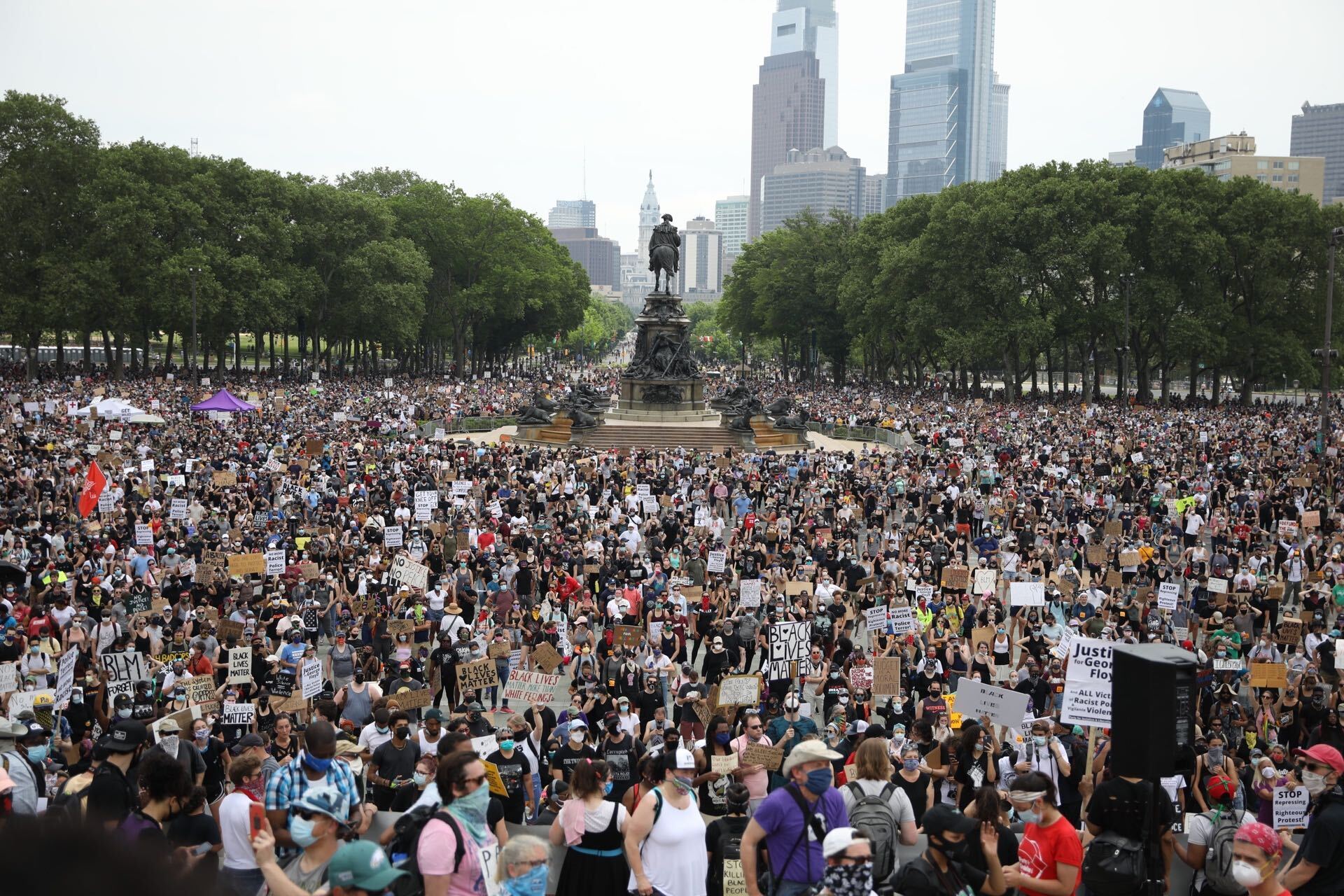
Many scholars have argued that downtown-led regimes wielded a great deal of power over urban policymaking. Regimes were led by business leaders and their allies — law firms, accounting firms, mass media relations firms, and interest groups that had an interest in promoting growth, especially pro-growth labor unions, and, of course, public officials. Basically from 1970 on, every Philadelphia mayor headed a downtown-led regime in a relatively top-down fashion, in terms of governing style. So that’s the backdrop. My book is all about how that pattern began to change around the turn of the century, and then picked up in the 2010s with a burst of social movement activity. Occupy Wall Street really started things off, but then it picked up, especially with Black Lives Matter, the immigrant rights movement, and all of that social movement protest had a catalytic effect on grassroots organizing in cities with respect to a whole host of public policy issues.
As your book points out, much of the activism has been driven by millennial transplants who have moved into the city. Is it fair to say that trend is the main driver of this change, or one of several factors?
That is one of the main factors in explaining why there is this big shift. But there are also some underlying changes in the local political environment, what social movement scholars sometimes call the “political opportunity structure.” One of those changes is a decline in the organizing capacity of the downtown business community, which had been so dominant. It started to create a vacuum. Into that vacuum steps young people. Populations had been steadily declining in virtually all big American cities. They started to stabilize around 2000, and you see an influx of young people who are relatively well educated, more likely to be professional, more likely to be progressive, more likely to get involved in local politics. Some people call it the “back to the cities” movement.
What’s different about these newcomers compared with other left-leaning groups that have sought to impact city politics in the past?
In the past, a lot of young people tended to get involved in protest politics. People on the left were very wary about engaging in electoral politics. The folks who are moving into Philadelphia after 2000 increasingly are participating in more conventional politics, including electoral politics, and that’s a big change. That escalates when Bernie Sanders runs for president in 2016. One of the lessons learned for lots of people who volunteered for him is: This is something we can do at the local level.
As you note, the groups driving this style of politics tend to be more affluent, more educated, and more white than Philadelphia as a whole. That’s created a lot of friction. There’s a debate over whether this is a phenomenon that will be limited to gentrified areas, or whether it will grow into a cross-racial or cross-class coalition. Is it fair to say that’s the central question going forward?
Absolutely. So much of this is turf-oriented. The millennials and Gen Zers moving into Philadelphia tended to congregate in neighborhoods that attract a lot of white, middle-class people who were relatively well educated, and so those became significant bases of progressive politics. The challenge then becomes organizing in other neighborhoods. Some of the grassroots groups made impressive inroads. I’m thinking about campaigns for Larry Krasner, in particular, in lower-income, predominantly Black and brown neighborhoods, where a group like Reclaim Philadelphia or the 215 People’s Alliance were pretty effective. But in many cases, it was fairly difficult for a group like Reclaim Philadelphia to venture into neighborhoods beyond their comfort zones, if you will. They were mindful of some of the skepticism that residents of those neighborhoods felt towards the millennials and Gen Zers flocking into the city and contributing to gentrification. Somebody from Reclaim Philadelphia might be knocking on the door talking about the affordable housing crisis, and people answering the door might look at them and say, “You’re actually a big part of the problem here.” This tension between so-called new Philadelphians and old Philadelphians became more pronounced, and navigating those tensions becomes a real challenge.
Your book finishes with the 2023 mayor’s race, when Cherelle L. Parker defeated more progressive candidates and won the election with a “law and order” platform. So perhaps that was a surprising twist on your thesis at the end of your research.
She’s obviously fascinating. She’s a shrewd operator. In the primary election, two progressives split the vote. And being the only prominent Black candidate worked to her advantage. But since she’s been elected, she’s been very skillful about maneuvering in ways that have brought back a return of the traditional kind of urban politics — a top-down governing coalition led by a somewhat resurgent business community and pro-growth unions, the building trades unions, and a somewhat resurgent establishment-oriented Democratic Party, all of which is led by Parker. This is very reminiscent of standard politics of the mid- to late 20th century. So in some ways, Philadelphia is a bit of an aberration in that it’s moved backwards, if you will, recently. But I still see lots of evidence that bottom-up grassroots activism remains a force, and will become much more impactful in the next four years.
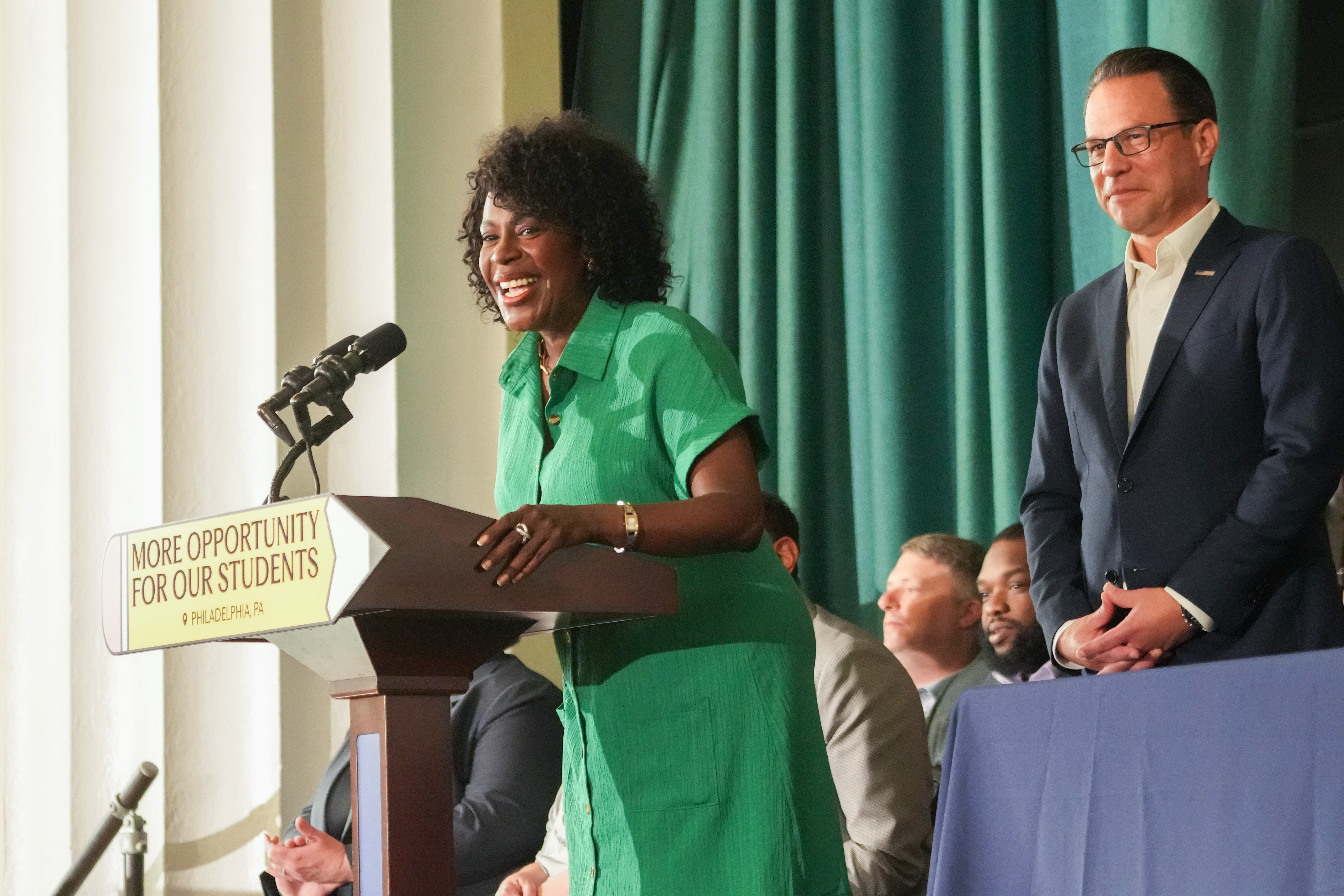
Mayor Cherelle L. Parker speaks at Vare-Washington Elementary School to highlight the historic education investments included in the 2026-27 state budget, in Philadelphia, July 14, 2026.Jessica Griffin / Staff Photographer
For what it’s worth, Parker herself seems to be mindful that grassroots politics are still relevant. We reported last year that she ordered a bunch of copies of a book called Performative Outrage: How Manufactured Fury Undermines Local Government and Public Service, and was handing it out to people. So I think it’s safe to say she isn’t a fan of the trends you described. You alluded to Parker returning to a “regime theory” style of politics. What’s an example of that?
The 76ers’ arena, for example. She was siding with the Sixers and other downtown-oriented interests that wanted to see the arena in Center City on East Market Street, and discounting the views of community groups, most prominently Chinatown. There’s a general mode of governance style associated with Parker that’s very uncomfortable with dealing with grassroots-oriented groups. That’s just not her style. She’s much more comfortable dealing with downtown business elites and people in the building trades unions. Her whole mindset is much more comfortable with the old ways of governing cities.
Parker won in 2023, when Joe Biden was president. Progressives in Philly and elsewhere seem to do better when Trump is in office. This spring Democrats just elected Chris Rabb, a progressive firebrand, in a high-profile primary for a Philly congressional seat.
Politics is cyclical. Donald Trump has had that effect of reinvigorating lots of activists. So there was a lull in progressive activism in the city for a while, but it’s on the rise again. But it takes time to regroup, especially on the activist side. Some groups last for a long time, but the norm is for groups to be quite ephemeral. New groups have to pop up, often involving activists who had been involved in the old groups. The transition costs are pretty steep. Somebody like Chris Rabb winning doesn’t surprise me at all. There will probably be more successes in the next two or three years. That said, progressive activists have lots of challenges. They’re in a holding pattern right now.
Thanks for your time. That’s all I’ve got. Is there anything I didn’t touch on that you want to include?
I’m an urban politics specialist. I wrote this book. I devoted five years of my life to it. But in the last year or two, I’ve been so fixated on what’s going on in national politics and Donald Trump and the threat that he and his administration pose to democracy. With that in mind, I just want to say that urban politics in general offers some hope for people who are increasingly demoralized. At the local government level, partisan polarization isn’t nearly as intense. We’ve got divisions between progressives and moderates, but that’s nothing like what we’re seeing in national politics. There’s real hope for city governments to address big problems and offer real solutions. There’s a path forward. One can make a case that right now, democracy in American cities is actually thriving.
I feel like I need to apologize for a column a couple of months ago when I compared the current president of the United States to Caligula, the possibly mad Roman emperor who is said to have nominated his trusted horse for high office. I need to apologize to Caligula. From pitching his triumphal D.C. arch as a storage shed for deadly snipers’ bullets to banning reporters from the White House in a narcissistic rage, Donald Trump is losing his grip on reality. This is unsustainable.
Worried about AI killing humans? Bad news: It already is.
A cleric takes a photograph earlier this month at the shattered Shajareh Tayyebeh school in Minab, southern Iran. It has become a place of mourning and a memorial to those killed in a U.S. airstrike on Feb. 28.Vahid Salemi
Which is it?
Are the robots of AI, or artificial intelligence, so smart that they’re on the verge of holding a secret meetup in the darkest corner of the dark web and developing a plot to kill all humans through germ warfare, to make sure we don’t kill them first by pulling the plug?
Or is AI so dumb — artificial stupidity, despite the billionaires of Silicon Valley showing up daily on our TV screen to brag about the sky-high IQ of their son, Claude — that the thing that will murder us is a crazy hallucination that will turn a false alarm into World War III?
The fact that we can’t answer this should give us pause, but maybe we aren’t even asking the right question. Maybe the real issue is how easy we’ve made it to kill off the human race — a capability that was already created by people even before we invented the computer.
One thing is certain. Artificial intelligence has already been an accessory to mass murder, and if we do nothing, it will kill again.
Remember the very first days of the now seemingly endless Iran war, and the news that two missile strikes had obliterated a school for young children in the Iranian coastal city of Minab, in an apparent “double-tap” strike in which the second attack from the skies killed young girls and boys and their teachers as they huddled in a prayer hall?
Those bombings, which killed 156 people on Feb. 28, caused the United Nations’ Independent International Fact-Finding Mission on Iran to report last week that it found “reasonable grounds to believe that the United States committed a war crime by launching indiscriminate attacks …” The U.S. government has never taken responsibility for the bloodshed, despite overwhelming visual evidence that the bombs were precision-guided U.S. Tomahawk missiles.
It didn’t take long for additional speculation that an AI program had mistakenly targeted the school, perhaps using outdated maps and info from an earlier time when its buildings were attached to an Iranian military complex. After all, the Pentagon has been openly bragging about the death and destruction facilitated by its use of Palantir’s Smart Maven System and also Anthropic’s Claude.
Last week, Bloomberg News reported that the Pentagon’s overreliance on AI, and specifically the Palantir Maven program, was a major factor in the school tragedy, along with the outdated intelligence about the Minab site — the “garbage in.” Its exposé noted that U.S. military planners were racing to identify some 1,000 Iranian targets in the early hours of the war, giving humans little time to double-check the list. Kindergartners were slaughtered as a result.
This was hardly the first time robots have been linked to human death, both in war — in 2024, +924 Magazine reported the Israel Defense Forces were using an AI program code-named “Lavender” to target sites amid the mass killing in Gaza — and in peace, as shown by numerous accounts of robots helping troubled people die by suicide.
And yet, it could have been much, much worse. At the same time as the Bloomberg report on the AI link to the mass killing in Iran, the world also learned that a false report generated by robot intelligence nearly sparked a conflict between the United States and China that could conceivably have spiraled into major fighting.
CNN and other outlets have reported that a U.S. special operations command analyst working with AI generated an urgent report that a Chinese ship bound toward the Middle East was carrying components for a nuclear weapons system, which caused military leaders to scramble jets and assemble a team to seize the vessel.
Only at the last minute did the Pentagon dig deeper and learn the AI-generated report was completely false, a hallucination — one that nearly triggered a violent conflict between the world’s two largest military powers.
The two disturbing reports about the use, or misuse, of AI by the U.S. military in a time of war did make news but didn’t get nearly as much attention — either in the media or on sites like Bluesky or X — as warnings from both whistleblowers and CEOs in Silicon Valley that a swarm of robots could decide on their own and without any human intervention or awareness to try to kill off our so-called civilization.
The fear of an unprompted attack from AI secret agents is real, based on several incidents that have already occurred, including a well-planned and partly successful operation by OpenAI’s robot agents to hack into a company called Hugging Face.
Still, it says something about human intelligence that we are captivated by the unknown and mysterious possibility of a random attack, while the fact that people are currently misusing AI to cause death and suffering is a less compelling story. I noted in this space last week that the threat to humankind from climate change is arguably even more real — and yet this gets denied by many and ignored by others.
It’s also striking to me as a boomer born in 1959 that a generation that wasborn into a time of constant terror — backyard bomb shelters, “duck and cover” drills in the classroom, and sci-fi horror at the drive-in that an atomic arms race could kill us at any moment — is suddenly back to where we started.
The fact that civilization managed to — so far — pause the number of world wars at two has given us the space and the false bravado to create new and much more insidious killing machines, and the threat from invisible robots on a hidden dark web is somehow even scarier than the radioactive mushroom cloud that we more or less understand.
Boomers who went to bed as kids in the 1950s and ’60s praying we wouldn’t die before we woke are now spending our senior-citizen-discount years fearful that something stranger than science fiction is coming for our children, or grandchildren. Over the course of a lifetime, the arc of that moral universe has not bent at all.
Still, humans were able, somehow, to prevent nuclear annihilation so far, and now it’s past time to get to work on the actual threats from AI and start on those workarounds. For example, the articles I’ve read speculating on how the robots plan to kill us frequently mention the prospect of AI agents developing bioweapons and releasing them, either on their own or prompted by a bad actor. (In theory, human development of bioweapons has been banned for a half century.)
From everything I’ve read so far about AI, it sounds like we’d have better luck safeguarding or eliminating the components that could make a biological agent rather than stopping the robots. Likewise, AI agents would not be able to start an atomic apocalypse if our human politicians went to work at finally eliminating nuclear weapons. Artificial intelligence won’t kill little girls in an Iranian school if humans don’t start dumb wars in the first place.
If Silicon Valley’s prophets of doom are serious, there’s no fix that’s too big or too ambitious. But understand that the biggest problem isn’t that AI wants to murder us, but that since 1942 we humans have been busy creating all the suicidal weapons AI agents could use.
Can you even “duck and cover” from a killer robot? I don’t intend to find out, and I don’t want my yet-to-be-born grandchildren to have to even think about it.
Yo, do this!
I’ve always been a big fan of filmmaker Barry Levinson, whose trilogy of Baltimore movies (Diner, Tin Men, Avalon) defined postwar American nostalgia. Now Levinson, along with his codirector Robert May, has come north to the Philly burbs to catch up with our divisive 21st century in a five-part documentary, Bucks County, U.S.A. If you’ve been reading The Inquirer these last six years, you know howthe communities just north of Philadelphia — where cosmopolitan suburbs meet the rolling fields of Trump Country — have become ground zero for culture wars around the COVID-19 response, book banning, and LGBTQ pride. Bucks County, U.S.A.began streaming on PBS Monday night. It’s getting mixed reviews, but I plan to check it out myself.
With the exception of my growing obsession with A History of Rock Music in 500 Songs, I’ve struggled the last few years to find new podcasts that excite me. But I’ve been enjoying Dan Taberski’s Manifesto on Audible, which is the award-winning, prolific podcaster’s six-part look at the role that these impassioned declarations have — or haven’t — played in reshaping our troubled world, from Occupy Wall Street to Big Tech utopianism to the online rant of murderous ex-LA cop Christopher Dorner.
Ask me anything
Question: What is the reason for the boat strikes? Do they really think they are carrying drugs? — David Poe (@culthero12.bsky.social) via Bluesky
Answer: David, your question is well-timed. Just this week, Ben Saul, the U.N. special rapporteur monitoring human rights in the context of counterterrorism, issued a report that U.S. boat strikes off South America in the Caribbean and the Pacific that have killed more than 220 people so far violate international law and plausibly constitute crimes against humanity. Based on the reports I’ve read about the deadly drone strikes, it’s true that small fishing boats in the region are sometimes drafted for a supporting bit role in drug trafficking. Yet, it seems powerfully likely that some murdered in the U.S. attacks were innocent fishermen, and there’s no evidence these bombings have made any real dent in the flow of drugs. Most importantly, since when did minor involvement in drug smuggling become a capital offense? The only thing as troubling as these American war crimes is the silence on Capitol Hill. The next Congress must hold hearings and create the momentum for shutting this down.
What you’re saying about …
Oops, maybe I should have read my emails before writing another column about the problems with artificial intelligence. Based on the lack of responses to last week’s question about the AI threat, this is clearly not a topic that excites my readers like the betrayals by Sen. John Fetterman or the mainstream media. A couple of frequent correspondents did weigh in, including Mary Ann Petro, who is very concerned over reports of unauthorized hacking by AI agents, and Joe Stepansky, who thinks the risks are somewhat overblown. “This is all deflection from data center opposition and the stock market bubble,” he wrote. “Just remember there are humans behind all of this, humans who may be amoral at best (I used to work with some) and malicious at worst (them too).”
📮 This week’s question: The big story for several days has been the fallout from Donald Trump’s rash decision to ban three news outlets — CNN, MS NOW, and Politico — from the White House grounds, in a move that experts agree is a violation of the First Amendment. Do you think the entire presidential press pool should walk out in solidarity, or do Americans need audio and video of what their president is up to? Please email me your answer and put the exact phrase “White House press corps” in the subject line.
Backstory on George W. Bush’s betrayal of democracy
Former President George W. Bush reacts while watching players from the U.S. team practice before the Walker Cup golf matches against Great Britain and Ireland at Cypress Point Club in Pebble Beach, Calif., earlier this month.Jeff Chiu
For those of us who experienced a political reawakening during those dreadful years between the U.S. Supreme Court’s coronation of a president in the disputed 2000 election and the shock-and-awe carpet bombing of Baghdad in 2003, today’s frequent refrain is incredibly grating. “I never thought I’d say this,” says some self-proclaimed Democrat, often a boomer, “but I’m feeling nostalgic for George W. Bush.”
To be sure, the 43rd president wasn’t nearly as nakedly corrupt as Donald Trump and his family, not as crude and boorish, and also more determined to at least make it look like what he was doing was constitutional. There were flashes of goodness — like Bush’s support for fighting the AIDS epidemic in Africa — which stand out today because there are so few of them. But his lies — and there were a lot of them, even if he could never match Trump — were more diabolically purposeful.
The stench of dead bodies in Fallujah had barely lifted when none other than Joe Biden came to Philadelphia to drape the Liberty Medal around Bush’s neck. When Trump descended on his gilded escalator in 2015 to finish the job of trashing America that had started in Iraq, Bush said nothing other than to let it be known that he’d left his 2016 ballot blank. When even his despised vice president Dick Cheney came out in 2024 and said a second Trump term would be a disaster for democracy, Bush again said nothing, insisting that he has “retired from presidential politics.”
Apparently congressional politics is another story. On Monday, it was revealed that Bush and his fellow Texan Sen. John Cornyn — a lame duck after losing a primary to Trump-backed Ken Paxton — have teamed up to throw a massive fundraiser in Dallas for six GOP Senate candidates in battleground states. The touting of Bush as a “special guest” at the event is meant to lure conservative donors. The New York Times, in its scoop on the evening, played up the fact that the event is not raising money for Paxton, going with the angle of a Texas-sized political feud.
Just like the Democrats who are willing, in the Trump era, to turn a war criminal into an icon of civility, the Times is missing the point. Electing these GOP Senate candidates in states like Iowa and Maine will give Trump the ability to extend aspects of his dictatorship for two more agonizing years. The would-be senators Bush is raising money for would rubber-stamp new MAGA judges and allow Trump to replace Supreme Court Justices Samuel Alito and Clarence Thomas with younger far-right zealots. Senate committees would lack the power to investigate the president’s high crimes and misdemeanors. That could finish the job Bush started when he lied to Congress about Iraq “weapons of mass destruction” that did not exist: The implosion of U.S. democracy.
What I wrote on this date in 2009
It’s weird now to read what survives of my early Attytood blog posts from the late 2000s, when many days I published just a quick hit while I worked on longer news articles for the Daily News. On Sept. 22, 2009, I quoted a prediction from internet guru Clay Shirky that seems incredibly prescient 17 years later. Shirky said that “the ongoing shrinkage of newspapers is likely to create a ‘giant hole’ that will not be filled for some time. He said he has a vision of communities of 10,000 people or fewer becoming rife with ‘casual endemic corruption,’ as newspapers are no longer able to fulfill their traditional watchdog roles.” He nailed it.
Nothing has been more troubling in 2026 than the assault on the First Amendment that’s been taking place from Donald Trump’s Oval Office to our hometown council meetings, and even our football palaces. In my Sunday column, which was written before the president booted three news organizations from the White House, I looked at the growing hostility and even violence toward working journalists, including arrests, physical assaults, and Trump’s rants toward Black female journalists. Tolerance of these abuses is a mark of a dying democracy. Over the weekend, I shifted gears and tackled the Eagles’ silence over the team’s reported role in the cancellation of hip-hop’s pro-Palestinian Macklemore from the Ed Sheeran tour that stopped at Lincoln Financial Field on Saturday. How can free speech be censored in a city-owned stadium?
Speaking of those Birds, the city’s $10 billion NFL franchise was conveniently hundreds of miles away in Nashville as pro-Palestinian protesters descended on the Linc this weekend. The Eagles eked out a last-second victory by the seat of QB Jalen Hurts’ pants, over the seemingly hapless Tennessee Titans. The unimpressive showing cemented the notion that it’s impossible to know what to make of Philly’s 2-0 footballers after their narrow wins over mediocre opponents, but The Inquirer is on the case. Our extensive coverage looked at the good (standout performances from Hurts and No. 1 wide receiver DeVonta Smith), the bad (the subpar play of a battered and aging offensive line), and the unexpected (the return of Super Bowl hero Zack Ertz due to injuries in the tight-end corps). Ace columnist Mike Sielski recently went deep, as usual, with a humanitarian look at guard Landon Dickerson’s tortured decision to try to play through the pain. The Inquirer’s sportswriters are likely to rack up more wins this fall than an iffy team, so why not subscribe and read every word.
By submitting your written, visual, and/or audio contributions, you agree to The Inquirer’s Terms of Use, including the grant of rights in Section 10.
One of the many things we won’t forget about the Trump era is how much the family of POTUS 47 has enriched itself — not only the president but his children, including Donald Trump Jr., who is said to be now worth at least $500 million and growing. So it was no surprise when his second marriage to Palm Beach, Fla.’s Bettina Anderson in May was a lavish affair on two private islands in the Bahamas. What is a surprise — as we now know from some stunning work by a team of reporters from ProPublica — is who paid: a very close associate of Russian dictator Vladimir Putin. So maybe the “Russia, Russia, Russia” folks were onto something?
Pa. Democrats are alarmed at the rapid growth of ICE-police deals. But can they stop them?
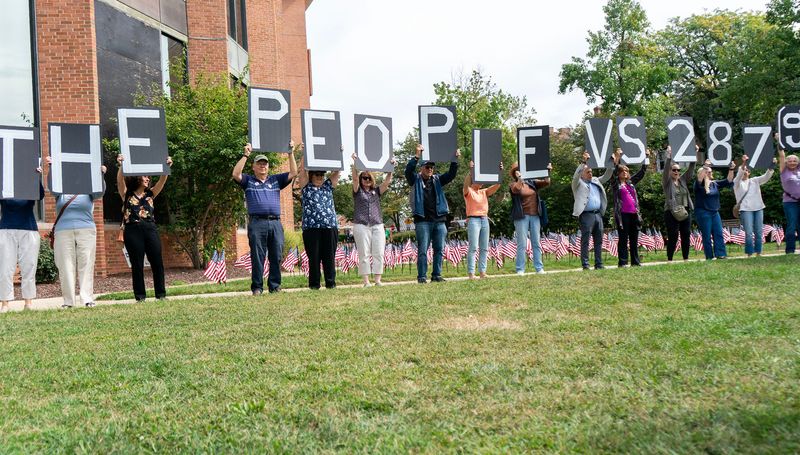
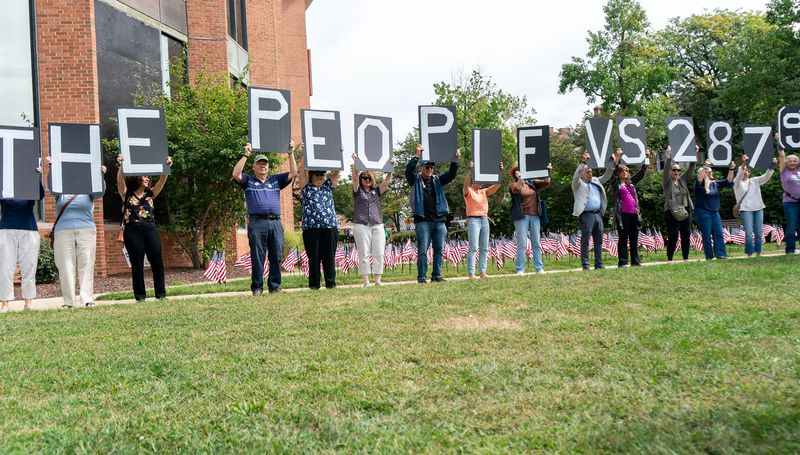
Immigrants’ rights advocacy group members and their supporters hold up letters that read “The people vs 287(g)” during a rally last September in Doylestown against the Bucks County sheriff’s efforts to implement a 287(g) program.Daniella Heminghaus | Bucks Coun
The big, mostly under-the-radar story around the Donald Trump regime’s relentless push to arrest and remove immigrants from the United States has been this year’s explosion of so-called 287(g) agreements. These allow local cops to act as immigration agents, working collaboratively with U.S. Immigration and Customs Enforcement, or ICE.
But if you look at a national map to understand how these 287(g) agreements have spiked from just 135 when Trump retook office in January 2025 to more than 2,500 such pacts today, you’ll notice that one state sticks out like a sore thumb.
In Pennsylvania, amped-up promises of federal cash incentives have meant a soaring number of localities where local beat cops are now working with ICE to make arrests — up from just a handful at the start of the year to some 130 now. Most 287(g) collaborators are in Trump-voting pockets of the Keystone State — northeast and south-central Pennsylvania, or out west near the Ohio border.
But when you look at the rest of the Northeastern United States, the 287(g) map is very sparse. That’s partly because most local pols across the region agree with their constituents about opposing Trump’s mass deportation policies, and in several states it’s also the result of legislation that aims to ban the program altogether.
In late August, New York enacted the Local Cops, Local Crimes Act — backed and signed by its Democratic Gov. Kathy Hochul — which calls on police departments and county sheriffs to terminate their 287(g) agreements, although several counties are still challenging the measure in court. Maryland has a similar law on the books, while New Jersey, which had long prevented such pacts under an attorney general’s directive, also passed a law this spring to codify the ban.
There’s a growing number of Pennsylvania lawmakers who want to pass a similar law here, but there’s one big problem: Republicans. They control the state Senate in Harrisburg — currently by a 27-23 margin — and GOP lawmakers have no interest in rebuking the president on immigration policy.
“The reason we exist alone is because of our split legislature,” State Rep. Heather Boyd, a Democrat who represents heavily immigrant Upper Darby and adjacent parts of Delaware County, told me. Last year, Boyd circulated proposed legislation to ban 287(g) deals in Pennsylvania, and while dozens of Democrats in Harrisburg are supportive, any move is on hold until a November election that could shift the balance of power. Boyd said lawmakers are wary of “starting any culture wars” ahead of the vote.
I pressed the office of Gov. Josh Shapiro, who’s running for a second term and who is seen as a possible top contender for the 2028 Democratic presidential nomination, for his position on reining in the 287(g) program here.
“Governor Shapiro has been clear that law enforcement should be focused on keeping Pennsylvanians safe — not sowing fear in communities or targeting people who are working hard, raising families, and contributing to our Commonwealth,” his press secretary, Rosie Lapowsky, said. She noted that the governor has barred Pennsylvania State Police from any formal ICE collaboration, and he would urge local police to take a similar stance.
She added: “Ultimately, however, these decisions rest with local law enforcement agencies. The governor does not have the unilateral authority to dictate whether individual sheriffs or police departments enter into these agreements.”
Many of those local law enforcement agencies have instead rushed to join 287(g), with ICE promising small-town departments an initial $100,000 cash windfall and additional incentives for training officers to make arrests and to cover the cost ofworking overtime on the program.
Last week, I reported from Schuylkill County in east-central Pennsylvania, where some 14 law enforcement agencies have raced to adopt 287(g), more than any other county in the state. Since the spring, local cops there have arrested about 100 immigrants at highway stops or by assisting ICE in job site raids. The blitz has prompted rising complaints about alleged racial profiling, the handcuffing of U.S. citizens, and a sense of fear that permeates a growing Latino community in Pennsylvania coal country.
Statistics obtained from the U.S. Department of Homeland Security by advocates show that local police in Pennsylvania have arrested and turned over to ICE more than 1,200 immigrants this year — ranking the state fourth in the nation on a list in which the other leading states are all south of the Mason-Dixon Line.
In Washington, some of the state’s Democratic House members say they’re fed up with a lack of transparency over who is being detained and how the 287(g) program is working here. Last week, four of them — Reps. Mary Gay Scanlon and Madeleine Dean from the Philadelphia suburbs and Reps. Chris Deluzio and Summer Lee from Western Pennsylvania — sent a letter to ICE’s acting director David Venturella demanding information on why the agency’s data lack any specific details about which departments are making arrests, which is required by law.
“It is unacceptable to me that ICE is hiding information from Pennsylvanians about who ICE is working with in their mass deportation regime,” Deluzio — viewed as a potential 2028 primary challenger to embattled Sen. John Fetterman — told me in an emailed statement.
Deluzio also summed up the growing unease by many over the speedy growth of 287(g) in the state. “Let’s keep local law enforcement focused on local public safety, rather than enlisting them in extreme federal immigration enforcement that has ripped away American liberties and targeted so many law-abiding families,” he said. Indeed, 287(g) data guru Andrew Thrasher has reported that a whopping 70% of the immigrants arrested in Pennsylvania under the program have no criminal record or pending charges.
“People in my community are getting smashed off the streets,” said Boyd, the Upper Darby lawmaker. That Delco township is about to vote on a local ordinance to restrict its cops from collaborating or sharing data with ICE.
Statewide, Boyd says she’s one of about 50 House Democrats in a Welcoming Pennsylvania Caucus with an extensive list of proposed bills that would not only bar 287(g), but look to expand opportunities for noncitizens to do things like obtaining driver’s licenses or gain professional certification. But any serious action hinges on November, when Democrats are hoping a blue wave at the ballot box will flip at least three more Senate seats and create a trifecta for their party in Harrisburg.
“Even if we can’t stop ICE from picking them up on the streets, we have to protect their rights,” Boyd said. “And right now, there are barriers to that in the state of Pennsylvania.”
Yo, do this!
The issue of wrongful convictions is back in the news here in Philadelphia — but for all the wrong reasons. Some reckless and seemingly wrongheaded moves by Philadelphia District Attorney Larry Krasner and his underlings have the vultures who’ve always opposed criminal justice reform circling. The shame is that the real crisis around wrongful conviction is the thousands of mostly Black and brown folks who remain behind bars for crimes they did not commit. I cannot say enough about a book that came out earlier this year from Brown University (yay!) sociologist Nicole Gonzalez Van Cleve called Crime Fictions: How Racist Lies Built a System of Mass Wrongful Conviction. She mines the most outrageous prosecutions — often of young Black teens and boys — to make a compelling argument that wrongful convictions aren’t a flaw in the criminal justice system. They are the system.
If timing is everything, then you’ve got to hand it to my freshman dorm pal at Brown who became Washington bureau chief for Mother Jones, David Corn. On the heels of ProPublica’s bombshell reporting on ties between the Trump family and Vladimir Putin, Corn is out Tuesday with his newest book: How Russia Won — Donald Trump, Vladimir Putin, and the Fight for America. It promises a raft of new information about Russia’s efforts to meddle in U.S. elections in 2020 and 2024, the ongoing close links between Team Trump and Team Putin, and how the current president’s pro-Russian slant has changed the world.
Ask me anything
Question: What happens when [House Speaker Mike] Johnson refuses to seat newly elected Dems in January? — David Minckler (@audivita.bsky.social) via Bluesky
Answer: Suddenly, Jan. 3 — the date the 120th U.S. Congress begins, and new members who won their November elections are to be sworn in — has become the new Jan. 6. Summer vacations are over, and the body politic is focused on the looming midterms, and — more importantly — with polls showing the Democrats on track to retake one and possibly both chambers. So there’s been a surge of speculation that the Trump-allied Johnson will do what former Vice President Mike Pence would not do on Jan. 6, 2021, and somehow fail to certify Democratic winners. That’s based on an assumption that Trump’s election-meddling tactics like stopping mail voting — blocked on Monday by the U.S. Supreme Court — won’t work, yet Team MAGA will attempt to undo the election after the fact, as was tried unsuccessfully in 2020-2021. Lawfare has published the most detailed analysis of a so-called rogue clerk theory in which Johnson appoints a MAGA loyalist to serve as House clerk with the understanding that some Democratic wins won’t be certified. Its article notes that such a gimmick is unlikely to pass muster in the courts, but that won’t necessarily stop Trump and the GOP from trying. My only guidance is: Fasten your seat belts.
What you’re saying about …
It turns out readers of the newsletter aren’t eager to join the punditocracy. Only a few of you responded to last week’s question about the chances of a Democratic-led Senate in 2027, and one of them was to give me a verbal tongue-lashing for even asking this. (Frequent writer Daniel Fleisher called it “a pointless exercise in predicting the unpredictable.”) That said, Cathy King has her eye on Abdul El-Sayed in Michigan, her home state, writing that “he seems to be following [Zohran] Mamdani’s playbook.” Meanwhile, in Iowa, Mary Chilton thinks the Dems’ Josh Turek has a real shot in a state won three times by Donald Trump, noting that farmers are up in arms “over the data center issue, imported beef, water pollution and the soaring cancer rates …”
📮 This week’s question: Suddenly, everyone is talking about one thing: the Silicon Valley whistleblowers saying there’s not a trivial chance that a swarm of angry artificial intelligence agents could wipe out humankind by the end of the decade. Are you worried by this, or do you think Big AI is deflecting here to draw attention away from other issues like data center opposition or the stock market bubble? Please email me your answer and put the exact phrase “the AI threat” in the subject line.
Backstory on that other thing that could kill humanity
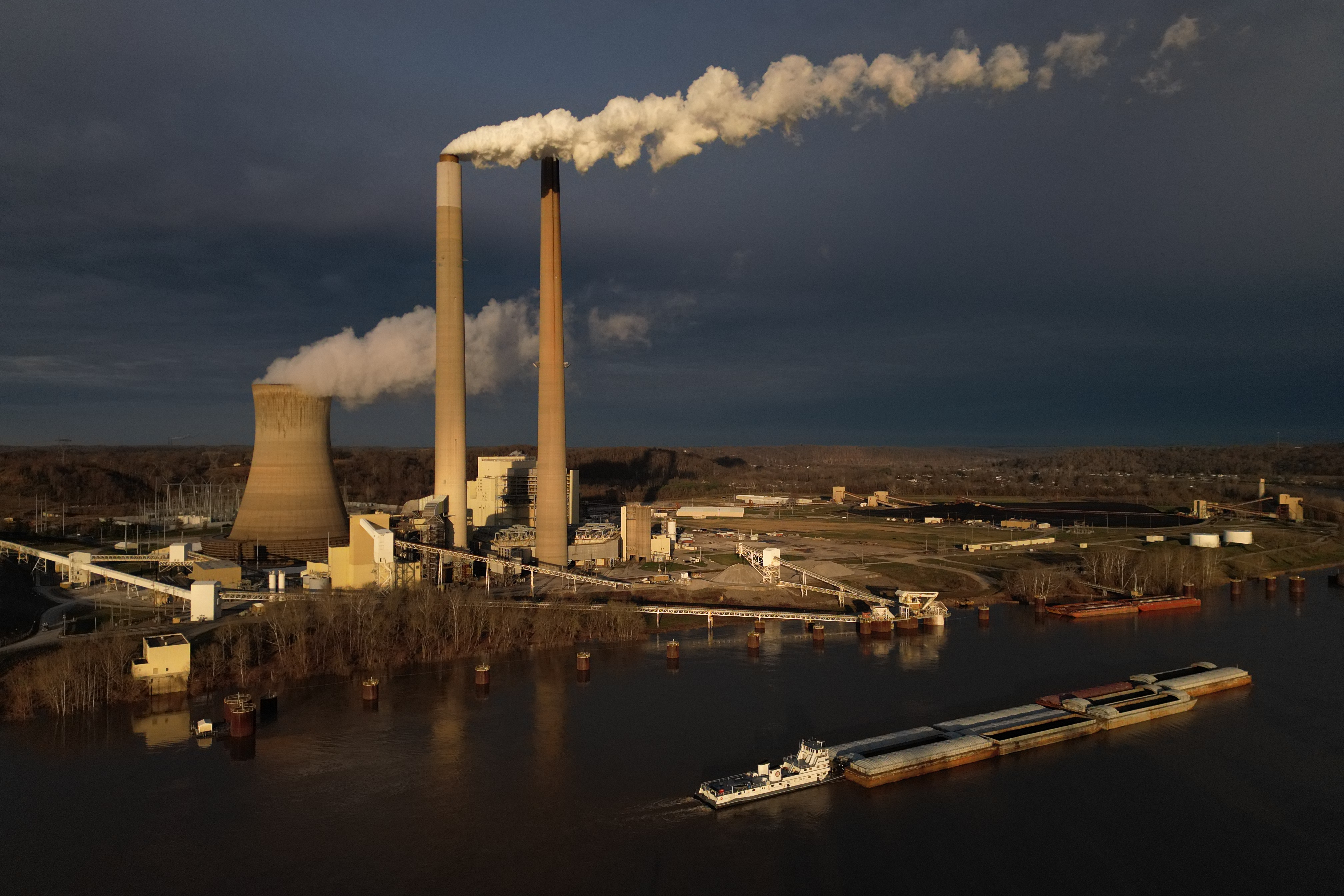
A barge on the Ohio River moves past the Mountaineer Power Plant, a coal-fired power plant near New Haven, W.Va., in March.Carolyn Kaster
This weekend, a Bluesky post went super viral almost the second its author, a scientist named David Ho, hit the button to post it. “I resigned from ExxonMobil today,” he wrote. “I spent the last three years doing fossil fuel extraction research at both BP and ExxonMobil. Neither company is acting responsibly. They are racing to maximize extraction while the window to act closes, and gambling with our lives.”
It’s a safe bet that many of the 13,000 people who liked Ho’s post truly believed they were sharing the words of a brave whistleblower — but instead the post was satire from a leading climate scientist based at the University of Hawaiʻi at Mānoa. Ho would never work for a Big Oil giant. He was trying instead to mimic — and thus make a point about — the recent posts from Silicon Valley whistleblowers that triggered the new freakout over whether AI robots are a threat to human existence.
Climate change is a threat to society, and it’s even closer to reality. Maybe we should freak out about that?
Ho absolutely has a point. Just before his post, it was announced that August had been tied for the hottest month ever recorded in the history of the planet. That doesn’t come without consequences. In the Himalayas between Nepal and Tibet, a glacier and the adjacent bedrock of mountains at 17,000 feet abruptly collapsed in a region plagued by higher-than-normal temperatures, sending a 150-foot-high cocktail of floodwater and debris down a populated valley at 100 mph. At least 1,386 were killed, and thousands more remain missing. Here in the U.S., a summer of record heat triggered wildfires across the Pacific Northwest.
Robots didn’t do this. Humans did. Maybe that’s why humans — at least the ones that are running Donald Trump’s America — are reacting so differently to the danger of AI than the way they’re dealing, or not dealing, with the lethal pollution from burning fossil fuels. In the case of artificial intelligence, even tech leaders like Anthropic’s Dario Amodei, whose firm makes the Claude program, have urged a slowdown until we better understand the risk from rogue AI agents.
But in the case of climate change, willful ignorance rules the day. The latest outrage from a Trump regime that’s expensively killing off wind farms while racing to extract as much fossil fuel as possible? The now ironically named Environmental Protection Agency is repealing the rule that limits greenhouse-gas emissions from power plants that burn coal or natural gas. A president who spent his summer sweltering on the golf course continues to insist climate science is “the greatest con job ever perpetrated on the world.”
There’s one last irony here. Increasingly, the biggest new sources of climate-altering pollution are the massive data centers that power AI. An Amazon data center proposed for Pecos County, Texas, would likely become the world’s largest source of carbon dioxide if it opens, spewing out 33 tons from natural gas generators every year. Slowing down the AI arms race would also help the planet. Artificial or not, that would be intelligence.
What I wrote on this date in 2019
Joe Biden performing badly in a presidential debate? Say it ain’t so, Joe. We all remember what happened on that 2024 stage in Atlanta (“The night the lights went out in Georgia,” I called that one), but I was almost as unimpressed with the future 46th president during a Democratic primary debate on this date seven years ago. That put me at odds with the punditocracy. I wrote, “The cable TV news show that both channels and is most revered by Washington’s elites — MSNBC’s Morning Joe — is at times so over the top in its bias toward Barack Obama’s former wingman that it could be renamed Morning Joe Biden.”
Summertime is over, and the living is no longer easy. I published my monthlong investigation into local cops collaborating with ICE under the controversial 287(g) program in semirural Schuylkill County, northwest of Philly. I found U.S. citizens handcuffed, families hiding behind blanket-covered windows, and a community wrestling with what it means for neighbors to be treated as suspects. Over the weekend, I delved into the astonishing $850 million or so Trump World has raised in campaign contributions since his reelection — despite the fact that he’s barred from seeking office again. You don’t think he has a scheme to pocket the excess cash, do you?
Dante only had Nine Circles of Hell, but the downward spiral of Pennsylvania Sen. John Fetterman seems to be never-ending. It’s one thing to profoundly disagree on a political and moral issue such as the war crimes of Israel’s right-wing government in Gaza, but recent reporting suggests things are far, far worse in Fettermanland. No senator — regardless of how much their ideology has flip-flopped — should be blowing off their home-state constituents, or clocking out of committee hearings after five minutes. The Democratic senator’s surprise video appearance at the midterm miniconvention of Donald Trump’s GOP, introducing his new best buddy, Republican Sen. Dave McCormick, did nothing to dispel the sense of utter betrayal among liberal voters who now see his winning 2022 campaign as a big lie. The next two years will be crazy as Democrats line up to primary Fetterman, amid rumors the hoodie-clad politico might run as an independent or even change parties. The only sure thing is that The Inquirer will be there for every move. Join us. Subscribe!
By submitting your written, visual, and/or audio contributions, you agree to The Inquirer’s Terms of Use, including the grant of rights in Section 10.
SCHUYLKILL HAVEN, Pa. — Brett Sell had a bad feeling about coming to work on July 28. The painting contractor was part of a small work crew rehabbing a two-story commercial property in Orwigsburg — a borough of just over 3,000 people in the heart of east-central Pennsylvania’s coal country — and workers had seen what looked like an unmarked law enforcement vehicle circling the site the day before.
“Yo, look up!” Sell said to his fellow painter, Orlando Rivera.
Police cars from Orwigsburg and neighboring Schuylkill Haven, lights flashing, blocked off the street while agents from U.S. Immigration and Customs Enforcement in tactical vests swarmed the work site. Sell was stunned as he and four other workers were quickly handcuffed by ICE agents — even though Sell and Rivera are native-born U.S. citizens.
Rivera, a biracial Puerto Rican who grew up in Bethlehem and now lives in another Schuylkill County borough, Tamaqua, said he was “embarrassed” as he stood in handcuffs while locals came out into the street to gawk. “I do a lot of work in that town,” he said, adding that “it made me feel like I was portrayed as a criminal.”
And he’s convinced he was handcuffed — even after offering to show the agents his ID — because of his race. “I get that my skin tone is tan,” he said, “but with the Fourth Amendment, they can’t go off my skin color, you know?”
Two workers were detained. One was later released, but the other — Catarino Hernandez Velasquez — a Mexican native who’s lived in Pottsville for at least 14 years, and a well-known contractor who poured concrete for the just-reopened 1928 Miners Hotel — was taken away and sent to ICE’s Moshannon Valley Detention Center in Central Pennsylvania, known for its overcrowding and complaints about lousy food and medical neglect. Kevin Medina, a leader of the local Latino community, bemoaned the arrest of a “very hardworking gentleman with a stable contracting business in the area … very busy.”
Now, gone … in a matter of minutes.
Painting contractors Brett Sell (left, white painting outfit) and Orlando Rivera are handcuffed during an ICE raid on a job site in Orwigsburg, Pa., on July 28. The men — both native-born U.S. citizens — were released without charges.Facebook
The Orwigsburg raid was a dramatic moment, yet such scenes are becoming increasingly common this summer in Schuylkill County, Pa., a constellation of rusty boroughs where coal was king in the 20th century, and Donald Trump got 71% of the vote in 2024.
‘In Schuylkill Haven, they can’t go there’
Since the start of the year, ICE — flush with a whopping windfall of $170 billion shoveled by Congress to the U.S. Department of Homeland Security to amp up immigration raids and detention — has dangled pledges to many tiny police departments. In Schuylkill County, which locals call “the Skook,” more than $1.5 million has been distributed to law enforcement. The police chief and pols all but publicly salivated at the chance — under the controversial program known as 287(g) — to buy a desperately needed new cruiser or other cop tools in return for working with ICE to arrest and hold local immigrants for the feds.
Some 14 law enforcement agencies — the most of any of Pennsylvania’s 67 counties — have inked 287(g) pacts with ICE, launching a new era of beat cops making immigration arrests that has roiled daily life in Schuylkill County. Practically overnight, cops were setting up truck inspections on a busy rural bypass or running checkpoints at places like the Freeze, a popular ice cream joint on the main drag, Route61. Officers were pouncing on immigrants who showed up at the county courthouse in Pottsville, or assisting ICE on workplace raids like the one in Orwigsburg.
Arrests leading to ICE detention and deportation cases skyrocketed across Schuylkill County — more than 100 since the start of the year, with most the result of ICE cooperation under 287(g) — leaving families torn apart while creating a climate of fear among what had been a rapidly growing Latino community in and around Pottsville. Suddenly, essential workers or their loved ones grew terrified that a busted taillight or failing to signal while shifting lanes could turn their world upside down.
One borough with just over 5,000 residents — Schuylkill Haven — has seen at least 59 immigration arrests in about four months, a staggering number. The figures come from Chicago-based ICE watcher Andrew Thrasher, a law-firm staffer and data expert who regularly crunches federal statistics obtained by the Deportation Data Project through Freedom of Information Act (FOIA) requests.
“People are afraid to go out,” Medina — who immigrated to Schuylkill County from Honduras, became a U.S. citizen and a notary and insurance agent, and formed a local Latino support group, Puentes de Apoyo — told me when we met in a Hispanic-owned Pottsville pizza joint. “I’ve got one contractor who told me they’ve got to change routes because now they know that in Schuylkill Haven, even they can’t go over there. And the stress, mentally, that I’m seeing in these families of, ‘What am I goingto do if this happens?’”
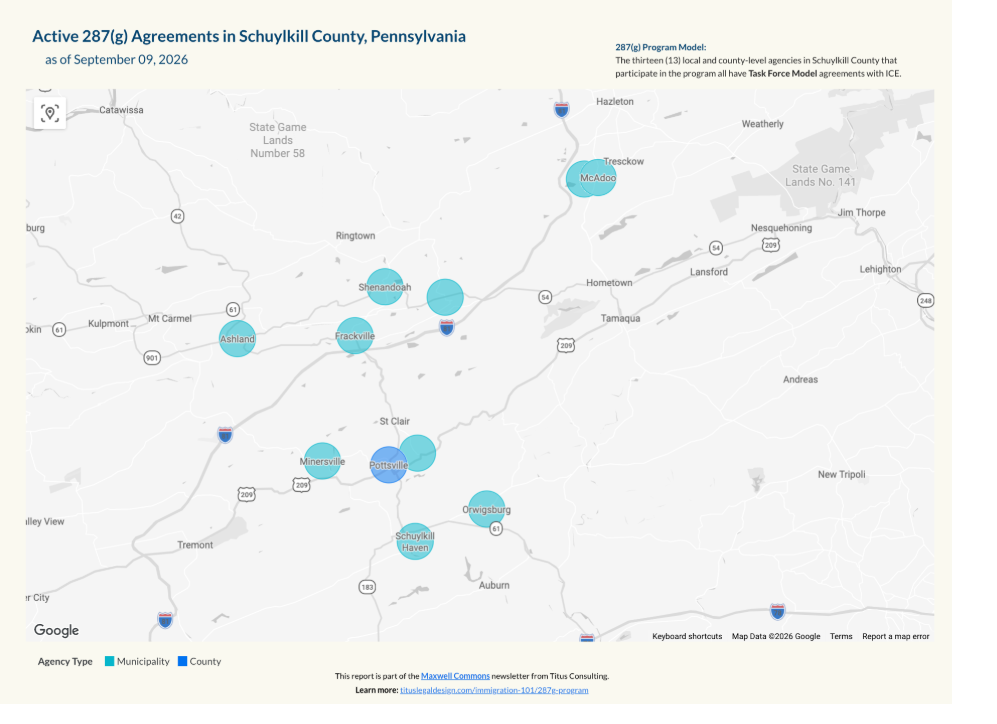
A map, provided by immigration statistics expert Andrew Thrasher, showing 13 current Schuylkill County localities that have signed 287(g) cooperation agreements with ICE. A 14th, Mahanoy Township, is inactive.Andrew Thrasher
The wave of arrests has put Schuylkill County — mostly rural, mostly conservative, and far removed from the glare of media or the kind of organized ICE resistance you see in big cities — on the cutting edge of an aggressive new strategy for mass deportation. This approach is bringing a xenophobic Donald Trump regime closer to fulfilling its once-unthinkable goal of removing one million immigrants from the United States every year.
Trump Country embraces 287(g)
The tag team of local cops and tactical-gear-wearing ICE agents is the biggest reason why federal immigration arrests spiked in July to a Trump-era high of 49,571, or about 1,600 every day. Statisticians who are tracking mass deportation said that 287(g) arrests — named for the section of a 1996 law that authorized the program — involving local police went from less than 3% of the total under Joe Biden to about 15% now, and will only climb higher as hundreds of new departments sign up.
This year, about 58% of the people nabbed by cops and turned over to ICE under 287(g) have no criminal record or pending charges, a higher rate than the typical ICE arrestee. Thrasher found the number for Pennsylvania is even higher, about 70%.
While not as numerous as inbig and heavily conservative states like Texas and Florida, the Keystone State’s 1,216 arrests under the 287(g) program in the first seven months of 2026 rank the commonwealth fourth in the nation — on a Top 15 list made upof states almost exclusively south of the Mason-Dixon Line.
Pennsylvania’s outlier status is punctuated by the fact that two large bordering states — New York and Maryland — have moved, with some bumps, to ban their police agencies from signing 287(g) agreements. Almost all of the Pennsylvania arrests came from smaller cities, exurbs, or rural areas — especially the south-central and northeastern regions of the state, and a smattering of western localities — that voted heavily for Trump and his anti-immigrant message.
The small-town nature of this renewed push for mass deportation is a defining feature of the Trump regime strategy, and not a bug. The race among Schuylkill County’s police departments — many with just three or four cops, including the chief — to sign up for 287(g) and its pumped-up pile of cash came exactly as the two Minneapolis murders of U.S. citizens by immigration cops were fueling growing public outrage.
As a brutal ICE winter ended, the Trump regime ousted Homeland Security Secretary Kristi Noem and the notorious field general Greg Bovino, and ended an era of loud, publicity-seeking operations with catchy names in large blue cities that stirred up local protesters who blew whistles and filmed every move by the masked, armed agents.
Immigrants’ rights advocacy group members and their supporters hold up letters that read “The people vs 287(g)” during a rally last September in Doylestown against the Bucks County sheriff’s efforts to implement a 287(g) program.Daniella Heminghaus | Bucks Coun
Under new DHS boss Markwayne Mullin, ICE and its allies are focused on what you might call small-batch immigration busts — in courthouses or on airport security lines, and thanks to 287(g), at local traffic stops or truck inspections. No one is blowing whistles, and few of these busts get caught on video. Yet, even here in blood-red Trump Country, some locals are troubled by the intense police focus on immigrants and what it’s doing to the moral fabric of their community.
‘Arrest them like the Gestapo’
“No one’s telling you not to arrest people — I’m telling you not to hunt for them, to do stops on the side of the road and arrest them like the Gestapo,” a Democratic city council member in Pottsville, Andy Wollyung, told me after he tried and failed to stop the county seat from joining 287(g). He later fretted that immigration arrests “will drive a wedge in people, you know? These aren’t unknown people. These are our neighbors.”
“When local police officers serve as a force multiplier for ICE, we know that people become more afraid to report crime,” Nayna Gupta, policy director at the American Immigration Council, told me. “They become less willing to cooperate with local law enforcement when it comes to investigations, including things like homicides. And there’s an overall mistrust of public institutions.”
The irony is that today’s Schuylkill County was built on the backs of immigrants — initially a wave of Irish who dug the 19th-century coal mines and were also persecuted, including six members of the infamous Molly Maguires who were hanged in Pottsville in 1877. They were followed by Eastern Europeans who filled the local mining towns like Mahanoy City and Shenandoah.
Those who stayed behind after the mines started closing in the 1950s and kept its hillside towns of striking Victorian architecture and utilitarian rowhouses alive got a booster shot in the 21st century with an unexpected new wave: Latinos. Many landed in Schuylkill County when seeking a place with cheaper housing and more job opportunities for hard workers than big cities like New York or Philadelphia.
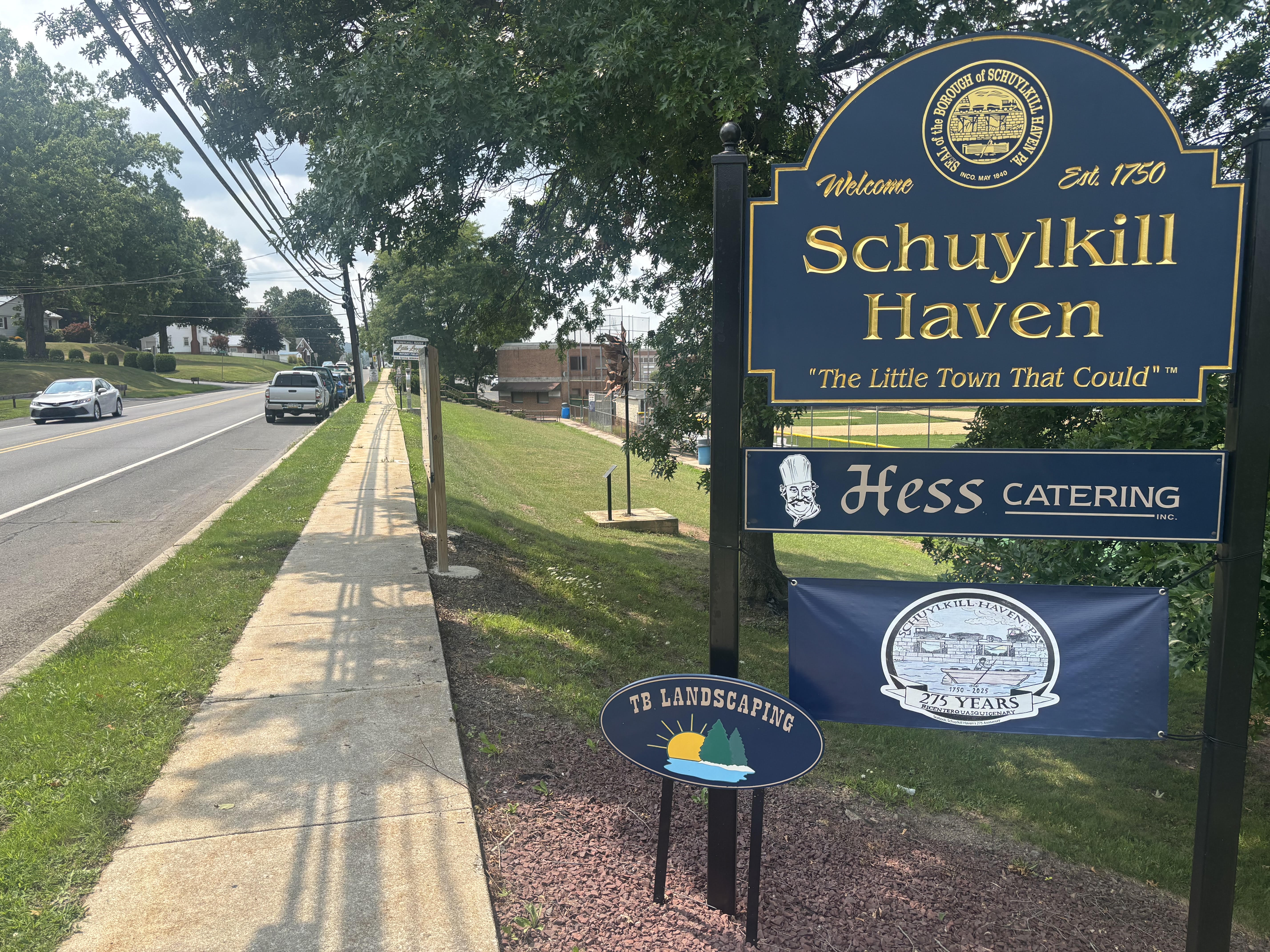
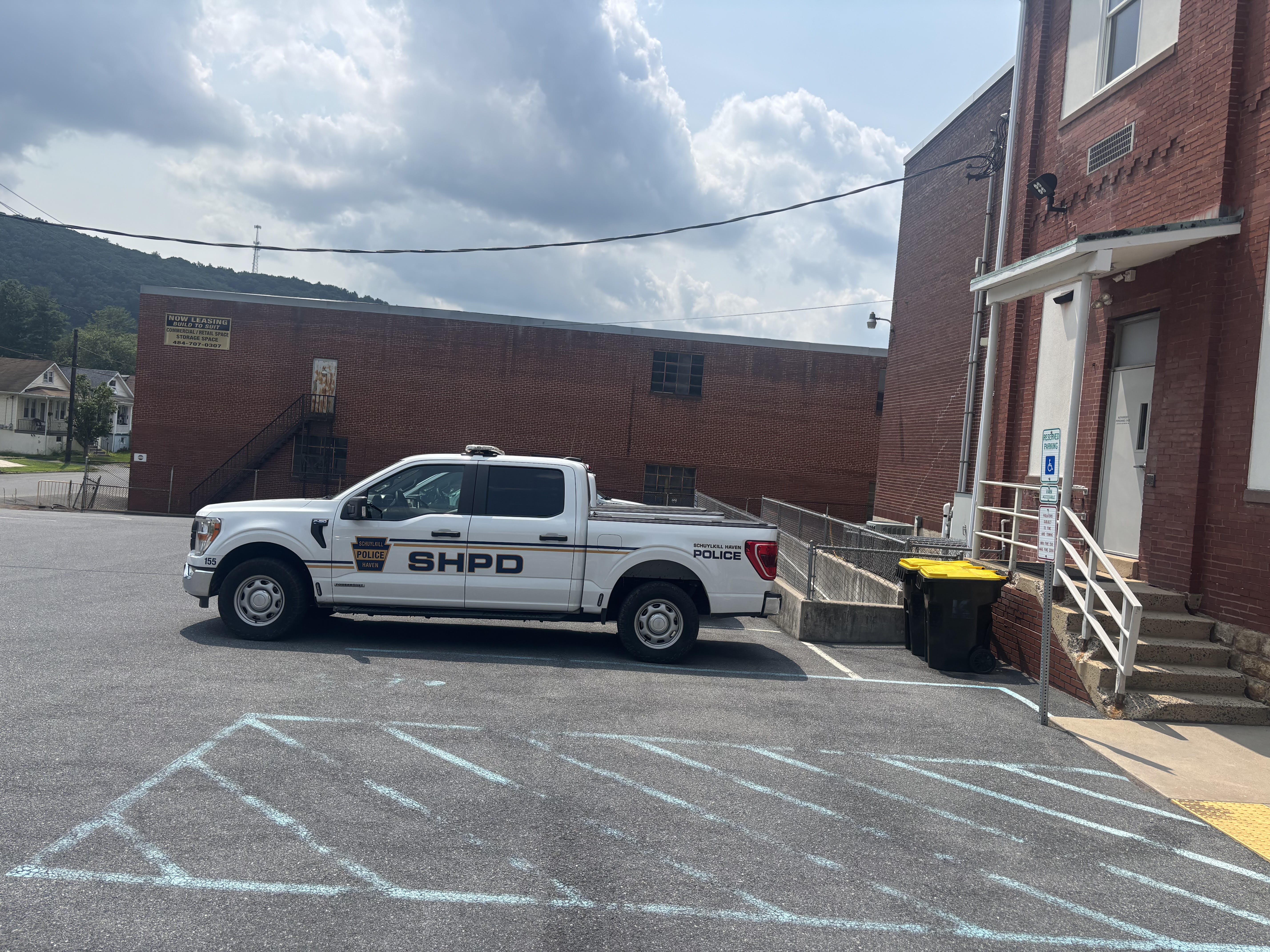
Schuylkill Haven, with a population of just over 5,000, has arrested at least 59 people and turned them over on federal immigration charges since signing a so-called 287(g) agreement with U.S. Immigration and Customs Enforcement (ICE) this spring.Will Bunch
Four years ago, Pastor Luis Rivera and his wife bought a historic local church building in Pottsville and rechristened it as Iglesia Cristiana El Kairos, under the umbrella of the Evangelical New Life Church, to serve a Latino community now growing by leaps and bounds.
“You see a lot of traffic,” the pastor told me. “You see people remodeling more houses. And a lot of the stores are opening around here … It was really dead before, you know?” Today, it’s estimated that about 1,000 of Pottsville’s 14,000 residents are Latino.
A ‘stable’ life is upended
Six of the more recent arrivals were Venezuelan-born Carlos Moreno, his wife, Wendy Martínez, and their blended family of four teenagers. They’d been on the run from government persecution and armed conflict across South America when they came to America in 2023, and stayed in a cramped public shelter in New York City as the family sought asylum and obtained work permits.
When they moved to a narrow rowhouse on a rugged patch of Norwegian Street on the steep hillside up from downtown Pottsville, the couple found jobs at the county’s large Amazon warehouse and even started a small cleaning business, even though Moreno, 37, is legally blind and has severe hearing problems.
“For the first time in years, it felt like our lives were finally becoming stable,” Martínez would later write. “Then, in the fall of 2025, we learned that I was pregnant. It was an unexpected surprise, but a very welcome one.”
Wendy Martínez, whose husband, Carlos Moreno, a Venezuelan refugee, has been detained by immigration authorities since May after losing a misdemeanor noise complaint at the Schuylkill County Courthouse. She is holding her baby Noah, who was roughly 6 weeks old.Will Bunch
A bigger and less welcome surprise awaited. This spring, a neighbor called police to complain about noise —music from a small boom box — and Moreno received a summons. He decided to challenge it at the Schuylkill County Courthouse a few blocks away, and when he lost, he paid a fine, walked out of the courtroom — and right into ICE agents waiting to arrest him. He was sent to detention in the Cambria County Jail and stayed there as massive earthquakes halted deportations to Venezuela. He was locked up when his son, Noah, was born — on the Fourth of July.
Martínez was alternately rocking and bouncing her then-6-week-old son when I joined Medina in visiting their cluttered, narrow rowhouse in August. The windows were covered with thick blankets that let in only a sliver of light, and Martínez was bookended on a sofa by her two daughters, on their phones, who rarely leave home.
“They told him that he was a dangerous person,” Martínez said in Spanish, interpreted by Medina, as her baby babbled. “There hasn’t been any situation where he was against the law, or anything.” Struggling to pay her bills and support the five children, Martínez launched a GoFundMe page, but has only raised $2,695 of her $4,000 goal. Her husband was recently moved to ICE detention in Louisiana.
In August, Schuylkill Haven officials said they’re expecting a federal check for $152,000 — money the police department wants to spend on buying the currently leased police headquarters, pictured here.Will Bunch
Like most immigration arrests since 287(g) swept across Schuylkill County, there is an element of mystery about what exactly happened to Moreno. I twice called the Schuylkill County sheriff, Shawn Butler, to ask if his department — the first county agency to join 287(g), back in January — was involved, but he did not get back to me. Not once in a month of reporting did a police chief or municipal official return a call or email from this out-of-town columnist. Secrecy, and a lack of accountability, seems to be baked into the 287(g) program.
‘You don’t answer anything’
“Any Right-to-Know requests, any FOIA requests, anything — you defer that right down to the Department of Homeland Security,” Jody Long, the then-police chief in Mahanoy Township, told the Pottsville City Council when it was voting on a 287(g) agreement in May. “You don’t answer anything with that. That’s right from their legal team.”
In early September, I attended the bimonthly meeting of the Schuylkill Haven borough council hoping to ask Police Chief Jeffrey Walcott, Mayor John Williams, or other officials how and why their small borough just south of Pottsville had managed to make at least 59 immigration arrests since signing a 287(g) pact with ICE on April 5. I didn’t get very far.
In a brief conversation, Walcott suggested, interestingly, that commenting on 287(g) might bring protesters to Schuylkill Haven. When I asked Williams about the program after the meeting, the police chief interrupted our conversation to say there should be “a unified response,” and then later told me any information would need to come from Homeland Security or a FOIA request.
Schuylkill Haven Mayor John Williams (left) at a borough council meeting on Sept. 2. Next to him are borough secretary Kaitlyn Tinari (center) and council president Thomas Gordon (right). Williams said Schuylkill Haven’s cooperation with federal immigration enforcement is going well, but declined to elaborate.Will Bunch
Most of what citizens and the media in Schuylkill County know about the 287(g) programs comes from borough or township council meetings in which a police chief tells elected officials about all the sweeteners that cash-flush ICE added to the program when Congress and Trump enacted the so-called Big Beautiful Bill in 2025.
Police departments or county sheriffs who join the most common 287(g) Task Force model get $100,000 for vehicles or other equipment and $7,500 for each officer who undergoes 40 hours of mostly online training, as well as additional dollars for their time on immigration matters — all contingent on making actual arrests. In August, Schuylkill Haven officials said they’re expecting a federal check for $152,000 — money the borough wants to spend on buying the currently leased police headquarters.
The cash incentives have sparked a kind of deportation arms race across Pennsylvania, which has gone from just a few 287(g) programs at the start of the year to more than 130, with new ones coming online every day. Most of the council debates tread lightly on the question of liability for an officer who makes a bad arrest — a problem ICE is belatedly looking to fix with a proposal to insure each officer up to $500,000 — or the elevated risk that a traffic stop could lead to violence.
Fighting in the Schuylkill
That’s already happened. On May 20, a Schuylkill Haven cop stopped a car on Route61 after he claimed the driver had illegally dark-tinted windows. ICE agents who were in the borough and arrived at the stop ran the license of 34-year-old Yensy Rafael Santana Alvarez of New York City and determined he had an immigration removal order.
According to the Skook News, a court affidavit said the man handed over his car keys and stepped out of his car — then ran for it. Alvarez led the law officers on a wild foot chase across the Schuylkill and back, getting tased once, and allegedly pulling one officer underwater as another suffered minor injuries. He was eventually arrested, and felony charges were filed but then dropped.
Some local critics also questioned whether minimally trained cops making immigration arrests is a good idea in a county where some departments have a history of police abuses. “In northern Schuylkill County, over the last 10 years, we’ve had horrendous police … acting very unprofessional in different departments,” John Hampton, a lawyer who has worked with Mahanoy Township, told me.
A heated and emotional debate over the federal 287(g) immigration enforcement program dominated Monday night’s Pottsville Council meeting.
After initially failing in a 3-2 vote, the resolution was reopened moments later and ultimately passed following a council member changing… pic.twitter.com/kSW1QXhgqS
In 2022, two then-police officers in the borough of Minersville were indicted on still-pending federal police brutality charges for allegedly severely beating a man during a traffic stop and falsifying police reports to cover it up. That didn’t prevent ICE from signing a 287(g) agreement with Minersville police in May.
That same month, local activists pleaded with the Pottsville City Council during a meeting that lasted more than five hours not to join the 287(g) program, arguing that immigration arrests would make tourists and new businesses not want to come there. They thought they’d won in a 3-2 vote, only to have GOP council member Scott Price change his position and demand a revote that flipped the outcome, saying that, in the end, “I have to side with our police officers.”
One of the few pro-287(g) advocates who spoke at that May hearing was Mahanoy Township’s Long, who said his department had been “the leader in the county” by making 10 immigration arrests, mainly at what he called a truck-safety inspection point. “ICE does not come in and tell you what to do,” Long insisted. “We tell them what to do.”
He was joined by one of his officers, Anthony Maldonado, who cited his own heritage as a Puerto Rican to insist there is no racial profiling. “I have family members who are light-skinned, dark-skinned, everywhere in between, so I would take it very personally if we conducted ourself unprofessionally to that effect,” he said.
‘Because you look like a Mexican’
The room in Pottsville did not hear from Moe Montalvo, a gutter contractor from nearby Tamaqua who, in mid-April, passed through the checkpoint on Burma Road operated by cops from Mahanoy Township and assisted by adjacent Ryan Township officers. He said he was part of a two-truck convoy, and the first one with two white occupants was waved through, while his was stopped to allow the officers to ask Montalvo, a 28-year-old U.S. citizen who is half Puerto Rican and half Egyptian, for his ID and grill him about his identity.
Montalvo posted that day on Facebook that when he told an officer he was born in Montgomery County, the cop replied: “Are you sure? Because you look like a Mexican.” Montalvo also quoted the officer: “Why are you worried? The only thing you should be worried about is when I take my Taser out, because I’m going to aim right for your nose piercing.” I confirmed the incident with Montalvo, who told me that “it seems like there was no doubt that racial profiling was involved here.”
Weeks later, the Mahanoy Township Police Department went dark, at least temporarily, after Long, Maldonado, and its other officer all quit in a disagreement with supervisors. One of the supervisors, Republican Tony Merchlinsky, confirmed to me the entire force had resigned after a dispute with supervisors over its refusal to wear body cameras. He said it was triggered by a civilian complaint over an arrest that did not involve immigration, although he added that “it may have involved racial profiling.”
Maldonado took to Facebook to give his side of the story, saying that a different supervisor had told the township officers they were making too many arrests, and that, as quoted by Maldonado, he preferred “a [B]arney Fife department and have his police drive around and wave at people instead of making arrests.” Merchlinsky confirmed that Mahanoy Township — which recently hired a new, albeit part-time, police chief — has yet to see one dime from the feds of the more than $100,000 that was promised.
The checkpoint drama and police tensions in Mahanoy Township demonstrate some of the many problems when beat cops are drafted to join Trump’s mass deportation crusade. Are police really making their towns safer when one part of the community is taking long traffic detours and covering up their windows in terror of any contact with cops? Is the economic gloom over Pennsylvania’s fading coal country really going to be lifted by clamping down on immigrants who’d been flocking there to pour concrete and rehab old buildings?
Does a region whose very DNA is handed down by the immigrants who once came here to shovel anthracite now want to be known in the 21st century as a “show me your papers” police state?
Few of these questions are being asked as one former coal burg after another races to embrace a Trumpian bargain with the 287(g) program. The latest is Mahanoy Township’s next-door neighbor, Ryan Township, which in June voted conditionally to join the ICE mass deportation program, citing as the biggest incentive its need to replace its run-down Ford Explorer, one of the oldest police cars in Schuylkill County.
In the country’s premier battleground state, Pennsylvania Democrats believe they’re in striking distance of a tidal-wave victories that would dramatically shift the balance of power in both Washington and Harrisburg.
For the first time in decades, the party could take full control of the legislature. That would give Democratic Gov. Josh Shapiro — seeking reelection with a wide polling gap on his Republican challenger Stacy Garrity— significantly more power to shape the direction of the state as he potentially pursues a White House bid in 2028.
Democrats also see a chance to flip four congressional seats and take control of the U.S. House. Republicans, meanwhile, are prioritizing defending the Pennsylvania seats with their House majority on the line as President Donald Trump, who won the state justtwo years ago, sinks in popularity.
The path forpower in Washington inthe high-stakes midterms runs through Pennsylvania and its results will be closely watched as both parties prepare for a presidential race in two years when the state promises to play a pivotal role.
Voters across Pennsylvania will head to the polls in November to cast their ballots for races that will decide the balance of power in the state and nation.
Here are the races to watch and how to vote.
Shapiro’s November could dictate his 2028
Shapiro, widely viewed as a likely contender for the 2028 presidency, has big ambitions this fall when he’ll stand for reelection against Garrity, the state’s treasurer.
More than just securing his own reelection, Shapiro hopes to run up the margin and carry downballot Democrats across the finish line.
Another double-digits win and a string of coattail victories would be ashow of strength about his ability to perform in a key swing state that his party lost in the last presidential election.In a presidential primary, Shapiro could use that result to make an argument that he’s a strong general electioncandidate who can boost the Democratic brand.
Will Republicans hold on in competitive congressional seats?
There are four U.S. House districts in the eastern portion of Pennsylvania, targeted by both parties as must wins. In each, the Republican incumbents are seeking to fend off highly financed challengers amid deep frustration among voters with the leader of their party that could translate into a wave of Democratic victories down ballot.
7th Congressional District: Freshman Republican U.S. Rep. Ryan Mackenzie narrowly flipped the Lehigh Valley district two years ago and is widely seen as one of most vulnerable incumbents in Congress. He’s facing a challenge Democrat Bob Brooks, a retired firefighter and union leader whose blue-collar campaign has attracted support across the party’s ideological spectrum with endorsements from Shapiro and U.S. Sen. Bernie Sanders.
10th Congressional District: Republican U.S. Rep. Scott Perry, a close ally of Trump, faces a November rematch against Democrat Janelle Stelson, a former TV anchor, in the Harrisburg area district. Stelson has consistently outraised Perry after narrowly losing in 2024.
In addition to these four races both national parties have targeted, Shapiro has argued that the 9th Congressional District, where Democrat Rachel Wallace is taking on incumbent GOP U.S. Rep. Dan Meuser, is flippable — despite the strong GOP lean in the district, which stretches from Berks County to the New York state border. The district is home to two warehouses that ICE was planning to convert into detention centers before abandoning the plan after a backlash from residents.
This year, Shapiro wants to flip the chamber and win a trifecta to push forward his key priorities, such as codifying abortion access, raising the state’s minimum wage, and increasing funding for transit.
Republicans currently hold 27 of the chamber’s 50 seats. Democrats, who currently hold 23 seats, need to win at least two additional seats and the governor’s office to win control of the chamber with the lieutenant governor as a tiebreaking vote.
The seats, drawn advantageously for Republicans, have been stubbornly resistant to political change for decades.
But this year a blue wave could usher in Democratic pickups in Philadelphia suburbs and the Lehigh Valley.
Races to watch include:
Bucks County’s 6th District, where Republican incumbent State Sen. Frank Farry faces a challenge from Democrat Eileen Hartnett Albillar.
Montgomery County’s 24th District, where incumbent Republican State Sen. Tracy Pennycuick is up for reelection against Democrat Chris Thomas.
Bucks and Lehigh County’s 16th District, which will see a rematch race between incumbent Republican State Sen. Jarrett Coleman and Democrat Mark Pinsley, the Lehigh County controller.
What are the important dates to know?
Election Day is Nov. 3.
The deadline to register to vote is Oct. 19. You must be at least 18 years old, a resident of Pennsylvania and a citizen of the United States to vote. You can register online, by mail, at your county elections office, or at one of several other government buildings.
Pennsylvanians can vote by mail with no excuse required. To apply, fill out an application by mail, online, or in-person and send it into your county election office. Applications must be received by Oct. 27 at 5 p.m. and the completed mail ballot must be received — not just postmarked — by 8 p.m. on Election Day.
An application and mail ballot can be completed in one visit at an election office, essentially functioning as early voting.
Staff writer Fallon Roth contributed to this article.
A newborn baby from Lancaster County was among the two unvaccinated residents whose deaths were associated with measles, Pennsylvania health officials said Wednesday.
As vaccination rates decline in the state, an outbreak that began in April this year has sickened more than 400 people in 29 counties — with the epicenter in Lancaster County, where nearly 200 individuals have tested positive for the viral disease. Local physicians and health officials say the true case count is likely much higher.
The state initially declined to share any information about the deaths, citing privacy concerns, and no information has been released about the second Lancaster resident who died.
The Pennsylvania Department of Health confirmed information about the newborn’s death on Wednesday only after the Lancaster County coroner publicly stated his office was investigating a newborn who had tested positive for measles and died from a ruptured spleen.
Lancaster County Coroner Stephen Diamantoni, a physician, said the cause of death was not the measles. The newborn died shortly after birth from a laceration of the spleen. A postmortem test on the baby’s lung tissue showed that the child had a measles infection that was acquired before birth, he said in an interview.
His description of the death, shared with reporters and a local county commissioner, contributed to a growing uproar on social media over the nature of the deaths and the state’s release of information.
President Donald Trump’s secretary of health and human services, Robert F. Kennedy Jr., traded attacks with Gov. Josh Shapiro, a Democrat, on X over the deaths and the safety of the measles vaccine.
Late Wednesday, Kennedy went further in another X post. He accused Shapiro’s administration of potentially having “fabricated” the deaths, after saying in an interview on C-Span that “they cannot find any measles deaths in Lancaster County.”
He said that Shapiro was not cooperating with the Centers for Disease Control and Prevention or the county in giving information on the deaths.
Shapiro administration staff said the department has been in regular contact with the agency during the outbreak.Pennsylvania Health Secretary Debra Bogen said in a statement late Wednesday that she “sadly can confirm” two measles-associated deaths in Lancaster County.
Measles deaths are rare. Most patients recover after mild illness, but the virus can cause pneumonia and brain swelling and kills about one to three patients in 1,000. The disease is so contagious that it can infect nine in 10 unvaccinated people.
The Pennsylvania Department of Health explained thatit reports deaths where measles are present as “measles-associated,” and it “may not be assessed by the medical examiner or coroner to be the immediate cause of death.”
In Lancaster, the coroner’s officedetermined that the baby’s primary cause of death was a laceration of the spleen, Diamantoni said.
Despite the baby’s positive measles test, the forensic pathologist who conducted the autopsy “did not feel it was related to measles,” Diamantoni added.
His office is seeking to learn whether the baby’s mother had measles at the time of the baby’s birth.
He said state health officials had not contacted him personally as of Wednesday about the two Lancaster County measles-associated deaths, but his chief deputy spoke to the department prior to Shapiro’s news conference Tuesday.
Paul Offit, a national vaccine safety expert and physician at Children’s Hospital of Philadelphia, said news of the coroner’s investigation “doesn’t really give us more information” on the death.
Children can acquire the disease after birth, or can be born with measles if their mother is infected and develops a rash within 10 days of giving birth, he said.
Measles can cause an enlarged spleen, and birth can cause it to rupture, he said. After a spleen ruptures, Offit said, it is difficult to tell whether it had been enlarged, and he added that the coroner should provide an alternate explanation for the rupture if it had not been caused by measles.
Diamantoni said the doctor who performed the baby’s autopsy did not note that the spleen was enlarged, and the office is still investigating the cause of the rupture.
To prevent speculation, the state could release information about the patients’ age, vaccination status, and cause of death while still protecting their privacy, Offit said.
In conversations with state health officials, he said, he learned that “these patients would not have died were it not for measles.”
Anti-vaccination advocates “try and completely misdirect and say it really wasn’t measles. They try to do everything they can to distance themselves from it,” he said. “You’re making it a lot easier for them when you don’t give more information.”
In her statement, Bogen said the department reported the deaths to the CDC on Tuesday morning and met with CDC staff on Wednesday afternoon to discuss the cases.
“DOH’s Epidemiology team thoroughly investigated and verified both individuals tested positive for measles. The information was not reported to the public until the results of the epidemiological investigations were confirmed,” she said.
She noted that state health officials are prohibited from releasing death certificate information except under limited circumstances that do not apply to this case.
A county commissioner questions measles-associated deaths
The clash over the deaths began within hours of Shapiro’s Tuesday news conference.
Lancaster County Commissioner Josh Parsons, a Republican, shared the coroner’s account on Facebook, suggesting the state was spreading incorrect information on the deaths.
In several posts, Parsons questioned whether the patients had died “OF measles or WITH measles” and suggested the state was spreading incorrect information on the deaths.
“We have ZERO information that corroborates the idea that there were two measles deaths in Lancaster County,” he wrote in a post several hours before the state’s announcement. Later, he shared Kennedy’s remarks on C-Span.
Parsons has not responded to several requests for comment from The Inquirer about the outbreak over the last several months.
Yoder, who attended the Tuesday news conference, said at a Lancaster commissioners meeting Wednesday that she had no additional information on the recent deaths.
The consequences, he said, were apparent in the deaths reported in Pennsylvania. He said he had told Kennedy as much in a recent phone call.
Later that night, on X, Kennedy said that Shapiro had falsely accused him of spreading misinformation and that drops in the state’s high vaccination rates occurred mostly during President Joe Biden’s administration.
Replying to Kennedy on X, Shapiro said that he asked the secretary to help him encourage people to get vaccinated and “stop spreading misinformation.”
The governor joined a lawsuit earlier this year against Kennedy’s department’s decision to scale back federal vaccine recommendations for children.
Shapiro noted that Kennedy had visited Lancaster in 2021, during the Biden administration, and told a crowd there that measles could be cured by “chicken soup and vitamin A.”
Measles has no specific treatments, and although vitamin A is sometimes given to severely ill patients, it cannot prevent the disease and is not a cure.
Shapiro added that measles cases have increased in the United States and Pennsylvania under Kennedy’s watch.
Editor’s note: This story has been updated to clarify that the newborn who died had a measles infection acquired before birth.
There were two noticeable no-shows as Western leaders gathered Monday to mark the 35th anniversary of Ukraine’s independence — and its five years of resistance to Vladimir Putin’s effort to re-subjugate the country to Russian rule.
There were multiple news reports that President Donald Trump’s clueless peace envoys — son-in-law Jared Kushner and real estate magnate Steve Witkoff — might finally join European allies at anniversary ceremonies.
I say “finally” because neither of these supposed peacemakers has ever deigned to visit Ukraine. Not once. Meantime, Witkoff has visited Moscow eight times, and gushed over Putin as he and Kushner (also a repeat visitor) discussed business deals with Russia.
It is no surprise, then, that Trump’s blinkered envoys postponed their trip, reportedly blaming their absence on intensified Russian missile and drone strikes. Never mind that former Vice President Mike Pence, British Prime Minister Andy Burnham, and other European leaders showed up.
They recognized — as Trump and his envoys still do not — that Ukraine is fighting not just for its own freedom, but for the security of Europe and the United States.
Burnham, who came to Kyiv on his first foreign trip as prime minister, understands the significance of Ukraine’s brave stand against the world’s second-largest army. A Russian military that is heavily aided by the dictators of China, North Korea, and Iran, all eager to undermine America and the democracies of the West.
The U.K. leader rightly compared Ukraine’s resistance against Russian imperialism to Britain’s fight against Nazi Germany in the 1940s, telling Ukrainians, “My nation kept the flame of European freedom alive in the 20th century; you hold that flame in the 21st.”
Burnham is right on the mark.
Ukraine’s President Volodymyr Zelensky hands over the flag of a military unit during the ceremony to mark Ukraine Independence Day in Kyiv, Ukraine, Monday.Efrem Lukatsky
The image of London firefighters bravely battling the blazes caused by the German Blitz, which rained rockets down on civilians in order to break their morale, comes right to mind when watching video of Ukrainian rescue workers pulling women and children out of the rubble of collapsed apartment towers that have been hit with Russian missiles or drones.
Then-Prime Minister Winston Churchill understood that if Britain fell, the Nazis would take over Europe. The Battle of Britain in the summer and fall of 1940, in which incredibly courageous Royal Air Force pilots pushed back the Luftwaffe, forced Adolf Hitler to abandon his planned invasion of England. The courage and spirit of Britons under bombing gave the RAF the time to regroup and attack the Nazis in Europe. It gave President Franklin D. Roosevelt time to act on sending Lend-Lease war supplies to Britain.
Burnham grasps that Putin is a stalking horse for an axis of adversaries – namely China, North Korea and Iran – that backs and finances Russia’s crimes.
Ukraine’s battle of the skies is effectively the first round of World War III. And only one weapon can take down the ballistic missiles Russia is pouring down on Ukraine’s civilian infrastructure: U.S.-made Patriot interceptors.
Yet, Trump has wasted much of America’s Patriot missile stock chasing cheap Iranian drones, and refuses to sell Kyiv a small percentage of what the U.S. retains. And after proposing joint production of Patriots with Ukrainian President Volodymyr Zelensky, the U.S. president immediately backed off.
That is why Burnham announced Monday that the U.K. (along with France) will help Ukraine make its own version of a Anglo/French long-range cruise missile by sharing classified technical information. That will help Ukraine preempt Russian missiles by eliminating the firing sites.
But setting up that production line will take months or years, and Ukraine desperately needs Patriots now.
Ukraine’s President Volodymyr Zelensky (left) hands over the Ukraine state award to European Council President António Costa during a commemorative ceremony in Kyiv, Ukraine, Monday, marking Ukraine’s 35th Independence Day.Efrem Lukatsky
It is hard for many Americans to grasp how important Ukraine’s survival is to our future security. Few U.S. politicians consider Ukraine to be a critical campaign issue. Trump has communicated his disdain for Kyiv to his MAGA followers, and Vice President JD Vance boasts that his proudest moment was helping cut off aid to Ukraine. As for Democrats, they’d rather focus on cost of living and the endless Iran war.
But Gen. Ben Hodges, former commander of U.S. Army Europe, nailed it when he told me recently that what’s been missing from the lack of U.S. attention “is the recognition that it’s in the U.S. interest for Ukraine to be successful.” President Joe Biden was too timid, he noted, and Trump is worse.
America’s enemies are taking full notice.
China is watching and learning from the drone, robot, and electronic warfare being fought in Ukraine, while sharing dual-use weapon parts and technology with Moscow. Every lesson is being fed into the hopper of Xi Jinping’s massive agglomeration of data used for prep to take back Taiwan and dominate South and East Asian neighbors and territorial waters.
North Korea is earning hard currency by sending troops and missiles to aid Russia’s war on Ukraine. In return, it is accessing Russian technology to build up its nuclear arsenal. Iran sends Shahed drones to Russia and learns from Russian upgrades of those drones, which helps Tehran attack U.S. bases and threaten Gulf Arab states in the Middle East.
Meantime, Trump is focused on his White House ballroom, car races, and starting a trade war with Canada, while Kushner and Witkoff chicken out of visiting Kyiv. They have no clue that the fate of the Ukraine war will overshadow everything they now think is important.
Their trips to Moscow are feckless unless they recognize that Putin has no interest in peace. Any “peace process” is dead (irrespective of CIA Director John Radcliffe’s secret visit to Moscow last weekend) until the United States recognizes reality and joins Europeans in squeezing Putin until he fears the war is endangering his survival.
I believe Ukraine will hold out via its tech brilliance and innovation, and its people’s determination not to surrender to the brutal domination of Russia. But the United States will pay a dear price for failing to step up when it could have blocked Putin and his allies — before their war on the West got much, much worse.
You’ve probably noticed that many of your favorite TV news anchors are on vacation right now, because the conventional wisdom is that nothing ever happens in August. That conventional wisdom has been wrong since Aug. 24, 79 A.D., when Mount Vesuvius erupted. The calendar has failed to stop natural disasters like Hurricane Katrina (see item below) or human-made ones like Richard Nixon, who resigned on Aug. 9, 1974. I’m going to tempt fate and take some vacation time next week, including a rare newsletter skip. I’ll see you in two weeks. What could possibly go wrong?
Trump’s autocratic assault on Stars and Stripes isn’t just bad. It’s personal.
Sgt. John Hubbuch of Versailles, Ky., one of the members of NATO-led peacekeeping forces in Bosnia, reads a copy of the Stars and Stripes in 1999.AMEL EMRIC
Less than two months after the U.S. dropped the most powerful weapon humankind had ever invented — the atomic bomb — on the cities of Hiroshima and Nagasaki, the American military arrived in Japan to implement a very different kind of tool in the U.S. arsenal of democracy.
A free and largely unfettered newspaper.
The first edition of the Stars and Stripes Pacific newspaper was published from downtown Tokyo on Oct. 3, 1945, when the ink on the Japanese surrender that ended World War II was barely dry. This was the start of a decades-long run when print journalism was still the best way to get information that could be entertaining or essential out to hundreds of thousands of U.S. troops who initially occupied Japan and other Pacific outposts, and later would see combat in Korea and Vietnam.
Stars and Stripes Pacific — like virtually everything tied to U.S. imperial might after the war — is part of a complicated legacy that overlapped with American censorship of local and outside media in Japan. Yet, U.S. soldiers managed to get their own information from a publication that celebrated the better angels of the First Amendment back home, with coverage of Tokyo’s war-crimes trial and later from the front lines in Korea.
It was only part of a much grander legacy for Stars and Stripes, which has been the American military’s independent news source tracing all the way back to 1861 and the Slaveholder’s Rebellion.
Famously, when legendary World War II Gen. George Patton threatened to jail editorialcartoonist Bill Mauldin over a cartoon lampooning him, his superior, Gen. Dwight D. Eisenhower, stopped him. “Stars and Stripes is the soldiers’ newspaper,” Ike reportedly said. “We will not interfere.” Mauldin was awarded a Pulitzer Prize for his wartime cartoons. In 2010, Stars and Stripes reporters exposed the Pentagon’s efforts to slant mainstream media coverage of the war in Afghanistan, and won a George Polk Award.
That feisty spirit of Stars and Stripes runs deep in my family’s DNA. My maternal grandfather, Thomas Blender, who’d been a photo editor at the Peoria (Ill.) Journal Star before joining the Army, was sent to Tokyo in those early days to work as a top editor of the Pacific publication. I’ve always regretted, after Grandpa Tom died when I was only 11, that I never got to ask him about those days once I’d been infected with the family journalism bug I’d eventually pass on to my own son.
That must be why it felt like a personal attack last Friday when the Pentagon of Donald Trump and his like-minded “Secretary of War” Pete Hegseth obliterated 155 years of editorial freedom by firing its editor, its publisher — who, seeing the writing on the wall, was about to retire — and its Middle East correspondent. That journalist, Lara Korte, said she was pink-slipped for an interview with CBS News about her reporting on the dreadful conditions for Navy sailors aboard the USS Abraham Lincoln.
The fuse had already been lit back in January when Hegseth’s Pentagon gutted the regulations regarding the government-funded news organization by stripping language that called for “a free flow of news and information to its readership without news management or censorship.” The new rules, which instead said Stars and Stripes’ journalism “must be consistent with good order and discipline of the military,” were seen asan invitation for censorship. Sean Parnell, the formerly embattled Pennsylvania Republican who is now Hegseth’s chief spokesperson, blasted Stars and Stripes for “woke distractions.”
Three months later, Jacqueline Smith, the internal editorial watchdog of Stars and Stripes at the Pentagon, criticized military brass for editorial interference and was promptly fired. But the last straw for the outlet came two weeks ago with its aggressive reporting about problems aboard the Lincoln, which spent nine months mostly at sea with dwindling supplies tied to Trump’s ill-advised war on Iran. Journalist Alison Bath reported that sailors’ families were growing deeply concerned about the mental health of the aircraft carrier’s exhausted crew.
That work epitomized everything that has been good and decent about Stars and Stripes. What the newspaper has shown at its best is that — despite all the contradictions and moral failings of U.S. postwar imperialism — a democratic government can value the press freedom that its armed readers literally died for from Gettysburg to Omaha Beach. That high-minded ideal was a beacon to set us apart from our adversaries in Nazi Germany or Soviet Russia, who never would have permitted the kind of honest coverage Stars and Stripes offered for decades.
Until America found itself with a government with the same philosophy as 1939 Berlin or 1949 Moscow. Just like his boss, Hegseth has shown nothing but contempt for the notion that his “warfighters” might actually serve to protect Americans’ right to the truth about their own government, including the foibles of his Pentagon.
On Monday, it came out that the military’s U.S. Central Command told the Intercept that it maintains “a list of people to disregard,” a.k.a. a blacklist. This is the same U.S. Department of Defense — sorry, Pete, that is still its legal name — that also forced out any journalist who wouldn’t sign their integrity away to work in the press room at the Pentagon.
The firings at Stars and Stripes and the Pentagon’s apparent desire to turn the award-winning newspaper into a Pravda-style propaganda sheet for Hegseth’s testosterone-dosed military feels like a new low on the road toward the utter obliteration of all press freedom.
Since returning to power last year, Trump and his MAGA minions have waged war against journalists they’ve called “the enemy of the people” — and they’ve done so not through some grand Orwellian censorship edict, but through a mix of billionaire carrots and sticks that have inflicted a thousand small cuts. That means rewards for wealthy allies who buy prominent news organizations (think the Ellison family assuming control of CBS and being on the brink of getting CNN) or neuter them (Jeff Bezos at the Washington Post) — but lawsuits, obstacles, or straight-up bullying for everyone else.
Another alarming example of the precarious state of the First Amendment came earlier this month when a lawyer for Trump threatened a $5 billion (with a “b”) lawsuit against a left-leaning think tank, the Center for American Progress (CAP), if it didn’t retract a factual report that the Trump regime’s deployments of National Guard troops to U.S. cities have not lowered crime rates.
The CAP has stood its ground so far, but this reveals the state of play right now. MAGA World has already either bought off or intimidated much of the mainstream media, so now they are hoping they can crush the outliers like Stars and Stripes or CAP, one by one.
The mission my grandfather was dispatched to Tokyo to carry out after World War II was on the fringe of an idea that came to be known as “soft power” — the now-quaint notion that America could form healthy alliances with the rest of the world through good things like vaccinating children or printing uncensored journalism, instead of dropping bombs. Other organizations meant to show people in oppressed lands that press freedom and democracy are things to fight for — like Radio Free Europe — have been forced to grapple with Trump-ordered cutbacks.
The right knows exactly what it is doing — that truth and knowledge are kryptonite for its authoritarian project. Increasingly, they are saying the quiet parts out loud. The great Tennessee journalist Phil Williams recently unearthed a sound bite from a white supremacist confab in Rome in which the conversation turned to America’s growing number of news deserts where journalism has all but perished.
“Local media has been dying all over America, which means that there’s essentially no real way to hold local governments accountable — and they can do whatever they want,” white nationalist Kevin DeAnna told the gathering. “You should be fantasizing about this. This is a good thing.”
No, it’s not. The government’s bludgeoning of Stars and Stripes has truly — to borrow from a storied military campaign of yesteryear — crossed the Rubicon of no return for its all-out blitzkrieg against the truth. All of us, including the laggards of the mainstream media who continue to pretend this war doesn’t exist, need to fight back with everything we have.
I never got to know my Grandpa Tom very well, but I know in my soul that this is what he would have wanted.
Yo, do this!
Meep, meep! If timing is really everything, then the half-animated, half-real feature film Coyote vs. Acme, which hits theaters this week, will be the greatest motion picture of all time. The film is based on a 1990 New Yorker essay that imagines Warner Bros. cartoon icon Wile E. Coyote suing the giant Acme Corp. over years of faulty products that literally blew up in his face and ruined his shot at catching the speedy Road Runner. The fact that real-world corporate baloney delayed for several years the release of this film mocking the excesses of runaway capitalism is an unbelievable irony. I’m really looking forward to seeing it.
Books, despite their apparent looming extinction, remain a great way to track what humankind is thinking about. This summer, the hot topic is anxiety over AI and the unchecked power of Silicon Valley. In addition to the best-selling Nerd Reich, now there’s the great essayist and Harvard historian Jill Lepore with her new tome, The Rise and Fall of the Artificial State, out today. Lepore’s timely work tracks the rise of authoritarianism run not so much by a tinhorn dictator, but by machines, and how humanity can fight back.
Ask me anything
Question: Do PA Dems have a legit chance of freeing us from Joe Pittman’s reign of terror in the state Senate? — Travis (@unraptured.bsky.social) via Bluesky
Answer: Travis, the answer is absolutely yes. Democrats in the Keystone State have managed to chip away at what once seemed like a permanent GOP majority in the upper chamber at the same time that they’ve recaptured the state House. The current Republican Senate edge is just 27-23, meaning Democrats have to flip only three more GOP seats among November’s 25 contests. Every arrow — Trump’s high disapproval, the popularity of Gov. Josh Shapiro at the top of the ticket, and special-election results like last week’s shocking Democratic House victory in a blood-red district in Western Pennsylvania — points toward a blue tsunami. The Democrats have reportedly targeted three suburban swing districts. The big question for 2027 may be whether Shapiro really wants a Harrisburg trifecta pushing him to the left.
What you’re saying about …
OK, last week’s question about Georgia Sen. Jon Ossoff’s pointed comments regarding Donald Trump’s corruption, including an eyebrow-raising mention of ever-present aide Natalie Harp, was kind of a slam dunk for readers of this newsletter. You saw nothing uncivil in the fighting spirit of his remarks, and a surprising number of you echoed back a phrase from my question: “a breath of fresh air.” Wrote Daniel Fleischer: “Jon Ossoff called Trump a ‘crook.’ If anything, that’s a euphemism understating Trump’s criminality.” Added Patricia Eisenberg: “What he said was undeniably true — the President chose this young woman to travel on his escape plane, not one of his cabinet members.”
📮 This week’s question: It seems like the GOP’s got nothing ahead of the midterms beyond its opposition to what it calls “men playing women’s sports.” It’s kind of pathetic, but it does pose a question for Democrats: Do they strongly embrace transgender rights, or is that risking political defeat in today’s culture wars? I have a strong opinion on this, but what do you think? Please email me your answer and put the exact phrase “transgender politics” in the subject line.
Backstory on Indiana’s new, outrageous Katrina
A woman sits inside the City Life Center as she waits for food in Gary, Ind., on Aug. 20, more than a week after a deadly storm passed through the area.Nam Y. Huh
Exactly 21 years ago today, a tropical storm in the Atlantic Ocean rapidly intensified into a hurricane — Hurricane Katrina — and raced across Florida on a path into the Gulf of Mexico, where it became a Category 5 monster. Still, many of us in 2005 briefly thought the Gulf Coast dodged a bullet when Katrina weakened slightly, and its center struck what looked like only a glancing blow on populated New Orleans. Then, one by one, the city’s levees began to break, and the water rose.
The death and destruction in Katrina’s wake was covered around the clock on cable TV, yet it took a couple of days for news anchors to articulate what viewers were seeing with their own eyes. The thousands of people who crowded interstate overpasses or were trapped on roofs were almost all Black, and most were desperately poor.
In These Times wrote the following week that “many Americans were surprised that most of the victims of the New Orleans flood were Black: Their image of the Crescent City had been one of jazz, tasty cuisine and the good-natured excesses of its lively festivals. Where did all those black people come from, they wondered; and where were the white victims?” Katrina triggered some long-overdue conversations about inequality and racism in America, and the inept response from the George W. Bush administration would start his steep decline in public approval. Long before the roughly 1,400 New Orleanians who died in the flooding or chaotic aftermath could be buried, many folks were asking how to prevent this from ever happening again.
It wasn’t a hurricane that struck Gary, Ind., and surrounding communities in the state’s northwest corner exactly two weeks ago on Aug. 11 — just a thunderstorm — but the winds were nearly as intense, snapping trees and downing power lines across the region. Gary’s 67,000 predominantly Black residents hunkered down in the dark nights and blistering hot August days as their refrigerated food went bad, and waited for help. And waited.
While life returned to normal across the rest of the storm-battered Midwest, the massive outage in the region that includes Gary that began with some 375,000 homes lacking electricity dwindled at a snail’s pace. After two weeks, there were still more than 5,000 families without power and struggling with spoiled food and closed schools and workplaces. There is growing anger among residents who say that Indiana’s heavily Republican power structure and Donald Trump’s federal government feel no sense of urgency to rescue a city that is mostly African American.
“This isn’t a problem that started with the storm,” the hip-hop star Freddie Gibbs, who grew up in Gary, told MS Now Monday night. “We are a predominantly Black city that tends to get ignored.” It feels like Katrina redux — an island of utter despair in the world’s wealthiest nation, with a government’s inaction bordering on criminal neglect. But there is one big difference: This festering crisis has been mostly ignored by the national media. The tragedy isn’t just our inability to stop the next Katrina, but our inability to care.
What I wrote on this date in 2022
One of George Orwell’s greatest passages in 1984 concerns Winston Smith’s job of cutting out old newspaper articles and tossing them into “the memory hole” — inconvenient truths meant to be forgotten by civilization. That’s how it feels now reading news stories from those four years in the early 2020s when Donald Trump was out of power, and America took baby steps back toward normalcy that would later get crushed. On Aug. 25, 2022, I wrote about one of these: Joe Biden’s eventually failed plan to wipe out some $300 billion of the nation’s massive student loan debt. I wrote that “this week will be remembered as one giant leap toward an idea that can change everything — the notion that higher education should be a public good, not the privatized rat race that has demoralized our rising generations.”
Look what’s happening out in the streets, got a revolution — and it’s not the one anyone saw coming. Growing public rage against Big Tech — the intrusiveness of artificial intelligence and the noisy, polluting data centers that power it, and increasingly also against omnipresent surveillance cameras — has become the surprise issue of the 2026 midterms. Politicians in both parties are performing backflips to join the bandwagon. Over the weekend, I wrote about how voter anger against Silicon Valley and its billionaires is rapidly reshaping our politics, and what could happen if our broken system fails to deliver radical change.
For the first time in recent memory, August has been living up to its reputation as a slow news month (so far), but on the baseball diamond things have really been heating up as kids are drifting back to school. The Phillies’ just-ended nine-game winning streak has electrified a city that’s been having a pretty good summer in spite of everything. The Inquirer’s oft-cynical sports columnist Marcus Hayes even published a list of five reasons to believe the Phils can go deep into October with a reenergized starting lineup, world-class pitching, and improved defense. A stunning turnaround from long-anticipated rookie pitcher Andrew Painter has also been key to the team’s revival in the National League East. It’s an old-fashioned pennant race, and subscribing to The Inquirer is the best way to keepup.
By submitting your written, visual, and/or audio contributions, you agree to The Inquirer’s Terms of Use, including the grant of rights in Section 10.
What a difference three words can make. For weeks, the American body politic has watched the strange relationship between Donald Trump and his ever-present 35-year-old aide Natalie Harp in a state of puzzled silence. Then, Georgia Democratic Sen. Jon Ossoff spoke at a weekend rally and said that Trump “doesn’t want to do the job” and would rather “build his ballroom and travelwith Natalie on their apparently defenseless flying palace.” The floodgates opened — on social media and sites like the Drudge Report and in angry retorts from the White House that only threw gasoline on the controversy. It goes to show what Democrats can accomplish when they’re not afraid to speak the truth.
An expert raises questions about Freedom Fuel and Venezuelan oil
The Freedom Fuel Network gas station at 1400 Dreshertown Rd. in Dresher last month.Monica Herndon / Staff Photographer
For a government that seems to be in your face 24 hours a day, the Trump regime has managed to produce more mysteries than Sir Arthur Conan Doyle. Where’s Melania? Why was the president’s butt sticking way out at his last event? But here in Philadelphia, one Donald Trump-linked mystery has confounded motorists for weeks.
Why is Trump-promoted Freedom Fuel, a web of 29 service stations that popped up out of nowhere this summer, able to continue to sell gas cheaper than its rivals down the street?
The mostly suburban stations in Southeastern Pennsylvania and South Jersey burst onto the scene with prices at $3.47 a gallon — lower than anything since Trump’s disastrous war of choice against Iran launched in late February — and continue to undercut their competitors by about 10-20 cents per gallon. Experts have said that’s not sustainable, unless the stations are somehow getting their gasoline on the cheap.
Now a former high-level State Department official in the Barack Obama administration is trying to connect the dots between the Freedom Fuel conundrum and the ongoing questions about millions of barrels of crude oil Trump has bragged that the United States has taken out of Venezuela.
Jonathan Winer, who recently wrote about Freedom Fuel and Venezuela for the Washington Spectator and discussed his findings on the Court of History podcast, doesn’t connect all the dots, but his research is a reminder of how little the American public knows about the aftermath of the Trump regime’s January assault on Venezuela that captured strongman Nicolás Maduro and installed a friendlier head of state.
The Inquirer and other outlets have reported extensively on Freedom Fuel stations in Greater Philadelphia, including its ties to pro-Trump Republican ex-mayor of Evesham Township, N.J., Randy Brown, who signed Freedom Fuel’s certificate of formation. Former commodities trader Yoni Gontownik — a major donor to GOP causes and a New Jersey-based pro-Israel political action committee — also signed those papers.
Trump promoted the launch of Freedom Fuel on his Truth Social feed, but the White House has denied direct involvement in the flag-themed gas stations, and so has the companyitself. “Freedom Fuel Network is a privately owned and proudly patriotic company — along with its convenience store operators, haulers, sign companies, and operational partners — that answered President Trump’s call to action to lower prices at the pump,” it proclaims on its website.
Veterans in tracking the complicated oil market remain baffled. “People can’t mysteriously get fuel at a lower price and continue to offer that,” Winer said on the podcast. “You could, of course, do a very short promotion, but you basically can’t [sustain]it.”
It may be a total coincidence, but the giant enigma that is Freedom Fuel and its cheap gasoline surfaced at exactly the same time the president boasted about the cheap oil the United States is supposedly getting from the resource-rich South American nation his troops invaded.
“We’re taking their oil,” Trump proclaimed about Venezuela while in Las Vegas earlier this month. “To the victor belong the spoils.” He added that what America has taken has paid for the brief January war “many, many, many times.” But analysts know next to nothing about what is actually happening to as much as one million barrels of oil that Venezuela produces every day.
Winer pointed to a couple of common bonds between the efforts to market low-cost gasoline here in Philly and White House efforts to control the flow of Venezuelan oil.
The first is the role of Jarrod Agen, executive director of the National Energy Dominance Council inside the White House, who posted two photos of himself giving a thumbs-up at a new Freedom Fuel station in Philadelphia whenit opened on the July 4 weekend. Both Agen and the president himself insisted that the new gas retailer is proof of what the Trump regime is doing to lower prices at the pump.
Winer noted that Agen was also a key member of an American team that traveled to Caracas in April, met with the Trump-backed new president, Delcy Rodríguez, and came home bragging of new commodities deals, including in the oil sector.
The second overlap that Winer points to involves a Texas-based global commodities firm, Mercuria, which announced on May 1 that it had reached a major deal with Venezuela under what it called a “White House-supported initiative.” The announcement featured a photo of atop Mercuria official posing with Agen.
Mercuria told the Washington Post, which has also investigated Freedom Fuel, that it has no involvement with Freedom Fuel. Yet Gontownik, the trader listed as a backer of Freedom Fuel, was also listed as recently as March in campaign finance reports as an executive with Mercuria. But he also insists that he no longer works for the Texas firm — which has been linked to other Trump-regime commodities initiatives. (The ex-Philly journalist Maureen Tkacik, investigations editor at American Prospect, also raises a lot of questions about the role of Mercuria, Gontownik, and the firm Blue Owl Capital, which Trump invested in earlier this year.)
It must be stressed again that all of these connections are circumstantial. At the same time, this much cannot be disputed: The American people have not been given the most basic information about the extent of U.S. involvement in the Venezuelan oil trade, how much money is involved, or where all that money is going at a time when the price of crude oil has skyrocketed.
I could not agree more with Winer’s plea that Congress go after the U.S. Treasury, State, and Energy Departments that are sitting on undisclosed records of U.S.-linked oil transactions — even though realistically that might have to wait until Democrats gain a foothold on Capitol Hill next year. He also called on the media to dig deeper, which is why I wanted to amplify Winer’s early-stage reporting.
Look, we all want to pay less for gas, which is why motorists have been lining up at Freedom Fuel pumps since the stations opened last month. But most of us don’t want to live in a dying empire where a strongman’s tin soldiers steal a sovereign nation’s buried treasure so that favored insiders can profit. We still have no idea what’s been done in Venezuela in our name, and we need to find out.
Yo, do this!
It’s great that people — especially younger people — are returning to brick-and-mortar movie theaters in the long, hot summer of 2026, but the quality of the releases hasn’t really matched the boffo box-office numbers. That may change starting this weekend with the release of Tony, a movie that could have been titled “Becoming Anthony Bourdain.” The film stars Dominic Sessa playing the future chef, author, and beloved TV traveler as a lanky, awkward 19-year-old, spending a summer on Cape Cod and learning to embrace his love for the kitchen — and humanity. I’m really looking forward to this one.
There are two must-read articles out this week from Adam Bonica, a Stanford University professor who specializes in money and politics. The first is his lengthy investigation into dodgy fundraising practices by top Democratic Party committees and leaders, in which endless spam fundraising emails have hit home with susceptible elderly donors, some of whom have drained their life savings. The second is the story behind the story of how both the New York Times and the “Never Trumper” website the Bulwark both chickened out on publishing Bonica’s essential journalism. The cowardice of the elite media in America’s authoritarian moment is beyond disheartening.
Ask me anything
Question: Why aren’t more Democrats supporting and campaigning on the 32hour work week? It seems like a policy that would appeal to working people across the political spectrum. — brown cloud (@milehighdsa.bsky.social) via Bluesky
Answer: Good question. One political leader, Vermont Sen. Bernie Sanders, has aggressively pushed the 32-hour workweek without a reduction in pay, noting that this would pass the productivity gains of the computer era back to the workers who are being more productive. So, yeah, what’s not to like? It’s certainly true that a lot of Democrats, especially centrists, are heavily dependent on campaign contributions from corporate types who don’t like the idea of a shorter workweek. But I think ultimately, Democratic cowardice on these pro-worker issues goes all the way back to the Ronald Reagan era, and a fear that they’ll be branded by the GOP as the party of “free stuff.” But this isn’t free stuff. We’ve earned it.
What you’re saying about …
Last week’s question about how Democrats should view the primary success of leftists such as Michigan Senate hopeful Abdul El-Sayed drew a response that was both robust (despite the summer doldrums) and fairly unanimous. Proposals from the progressive movement like Medicare-for-All and taxing the wealthy, you agreed, are long overdue. Tom Lees noted that the GOP is trying to find the most extreme democratic socialists, but that “the [Rep. Alexandria Ocasio-Cortez] branch which supports ideas similar to European Social Democrats is the group that is getting people excited.” Craig Strimel added that leftist candidates have failed in the past, but “I also believe that we are so far deep in the current fiasco, and so damned close to total collapse of democracy, that we really are in an all-or-nothing situation right now.”
📮 This week’s question: Georgia Democratic Sen. Jon Ossoff has caused something of a political earthquake with his blunt criticisms of Donald Trump, including a reference to his ever-present young aide Natalie Harp. Has Ossoff crossed a line of incivility that’s a bad look for Dems, or are his criticisms a breath of fresh air? Please email me your answer and put the exact phrase “Ossoff comments” in the subject line.
Backstory on Jason Arday, casualty in the ‘war on woke’
Torchbearer Jason Arday carries the Olympic flame on the torch relay leg between Sutton and Merton in London in July 2012.Joe Giddens
There are two kinds of people in this world. There are normal folks who maybe get a slight whiff of news from the TV or when they boot up their computer, and never heard of a man named Jason Arday. Then there are people who (like me) spend far too much of their day on social media, and now know all about the charismatic Cambridge professor — the youngest Black man to reach those heights in the university’s long history — who came under fire for alleged plagiarism and biographical exaggerations.
The allegations apparently simmered from the day of Arday’s 2023 appointment, but boiled over in recent weeks. He acknowledged some citation errors in his 2015 doctoral thesis — mistakes that Liverpool John Moores University called “honest and reasonable” — but the allegations kept coming. They were fueled by a Cambridge colleague and self-proclaimed “race realist” who went on British national TV to lambaste Arday as “not smart” and label him as merely a diversity hire.
The famously not-laid-back British press went wild on the controversy, with literally hundreds of articles about Arday — not just the Fleet Street tabloids, but even the august Times of London, which ran 60 stories. The media frenzy over the young, dreadlocked sociology of education professor didn’t stop when Arday resigned his Cambridge post, saying that “the relentless accusations, speculation and public commentary have taken a profound toll on me and on those I love.” The media frenzy didn’t even stop when Arday was found dead in his home last Friday. He was 41.
Just one day after Arday’s body was found, Julia Hartley-Brewer, a host on a Rupert Murdoch-owned U.K. TV network, told her audience that Arday “was a liar and a fraud who was rightly exposed for what he really was by academics and journalists who were simply doing their job.”
I’m sorry, but as a lifelong journalist, I never realized that hounding a professor who wasn’t perfect but was loved by his students to his early death is part of the job. To the contrary, I think that good journalism might involve noting that scores of white professors and authors who’ve been caught and admitted to plagiarism or similar issues have been allowed to apologize and go on with their careers. And that bad journalism might be implying that Arday’s middling issues are some kind of commentary on any and every academic with darker skin — as opposed to researching the systemic racism that leaves a supposedly enlightened school like Cambridge with 0.4% Black professors, in an England that’s 4.2% Black.
The ghouls who hounded Arday to his death didn’t work in a vacuum. They tapped intoa disgusting narrative that way too many journalists and self-appointed public intellectuals are spreading not just in the U.K. and the rest of Europe, but here in the United States. They think the righteous COVID-19-era outcry against police brutality and a grossly unequal society was some kind of mania they’ve branded “Woke 1.0.” Never mind that the police were never defunded in 2020, not even close. The nattering nabobs of anti-wokeness won’t rest until every college classroom or airplane cockpit is made safe for white privilege.
Let me do my job as an opinion writer and tell you what I think about these mostly aging, mostly white, mostly male pundits who have so little to say about right-wing fascism that’s in power in America and on the rise in Britain and instead desperately cling to their status from the perceived threat of a few Black intellectuals. With key elections approaching on both sides of the pond, they opportunistically saw Arday as their latest chance to stir up white voters and preserve the status quo, even if that means tolerating an authoritarian police state. Now, a once-promising Black professor is a casualty in their glorious “war on woke.” Have they no shame?
What I wrote on this date in 2020
As I noted in this space a couple of weeks ago, there’s so much about the peak year of the COVID-19 pandemic that we’ve successfully tried to forget. That includes much about the consequential yet somehow anemic showdown between Donald Trump and Joe Biden, which included their virtual, prepackaged summer conventions. On this date six years ago, I grumpily covered the Democratic National Convention from my couch in Delco and — stop me if this sounds familiar — complained that the party was ducking progressive issues. “If viewers didn’t notice what the Democrats left out in their tightly scripted telethon so focused on Trump’s coronavirus failings and his paranoid style — such as climate change, gun violence, and the other things that young people across America have been marching for — the history books might.”
I’ve cut back on column writing this month, mainly because I’m working on a long-term investigation that I’m really excited about. In my one piece published this weekend, I took a deeper dive into the stunning reports that winter drone attacks on fishing boats off the coast of Ecuador — with eight sailors missing and presumed dead — were a covert operation by Donald Trump’s CIA. This callous disregard for innocent human life is the latest example of a White House death cult that must be held to account by a new Congress, and eventually by prosecutors.
It’s truly remarkable the extent to which public opposition to the data centers that support artificial intelligence, or AI, has gone from near zero to 60 mph (or maybe 80) in a matter of months — especially here in Pennsylvania. With public unrest over these behemoths around their air and noise pollution and impact on electric bills, as well as growing discomfort with AI itself, becoming a key issue in the fall election, The Inquirer has been all over this story. On Tuesday, veteran business columnist Joseph M. DiStefano looked at how major contractors are hoping that demand for new data centers will get them through an otherwise sluggish economy. That might be a pipe dream if municipalities respond to voters by rejecting these proposals, as happened last week with a massive facility planned for suburban King of Prussia. You’re going to want to read The Inquirer’s in-depth coverage of this debate before you vote in November, which means it’s time to finally subscribe. What have you been waiting for?
By submitting your written, visual, and/or audio contributions, you agree to The Inquirer’s Terms of Use, including the grant of rights in Section 10.
Today’s newsletter is all about things I thought I was done writing about: COVID-19, Kamala Harris, and the World Cup. Regarding the latter, FIFA strongman Gianni Infantino walked off the pitch after last month’s final like the hero in Steve Miller’s “Take the Money and Run”: He got the money — an ungodly $15 billion in revenue — thinking he got away. But instead, just like Icarus, Infantino flew too close to the sun. A plan to make even more cash off the world’s greatest sporting event — by selling a share to private investors led by the brother of Donald Trump’s son-in-law — outraged so many folks that the FIFA chief could lose his job. What a shame.
The right can’t shut up about COVID-19 because it needs your outrage against experts
Workers move bodies to a refrigerated truck from the Andrew T. Cleckley Funeral Home in the Brooklyn borough of New York in April 2020.AP
Honestly, I thought — and hoped, frankly — that I’d written about the COVID-19 pandemic for the last time by the end of 2021. The issues it raised — about everything from public health preparedness to conspiracy theories — had seemed important enough, but I was more than ready to move on from empty baseball stadiums and masks in the supermarket.
I thought most folks felt the same way — that we were all eager to put the coronavirus in the rearview mirror. Clearly, I was wrong. The people we call MAGA still can’t stop yelling about it.
Last week brought the acid flashback of the government’s communicable disease czar when the pandemic erupted in 2020,Anthony Fauci,getting dragged before a U.S. Senate committee in a Joe McCarthy fashion, forced to take the Fifth Amendment to avoid any perjury traps that would satisfy the senators’ mouth-breathing constituents’ raw lust to imprison the 85-year-old public health icon.
The realization that they weren’t going to send Fauci — who was pardoned for his past actions in January 2025 by outgoing President Joe Biden to protect the good doctor from GOP wrath — up the river led these Republican statesmen to do the only thing left: scream at him.
“Who the f— do you think you were for doing that?” Ohio Sen. Bernie Moreno yelled at Fauci, even as it’s hard to understand what “that” was, except for working tirelessly to give Americans the best information about a rapidly evolving, deadly pandemic. “It is a total disgrace what you did to this country.”
The baseless attacks on Fauci by right-wingers — who’ve convinced themselves that the real crisis of 2020-2021 wasn’t the invisible virus that caused the early death of more than 1.2 million Americans, but an authoritarian government (led at the time by Donald Trump, but no matter) making them wear those masks and avoid those baseball games — were both infuriating and unconscionable. Still, maybe because of my aversion to reliving the pandemic, I was going to let the subject slide.
But then the current government’s top health official, Health and Human Services (HHS) Secretary Robert F. Kennedy Jr., went on CNN to double down on the Trump regime’s Big Lies about what really happened during the COVID years. And like Moreno, RFK Jr. turned the volume up to 11.
“Anthony Fauci was mismanaging the COVIDpandemic and was doing it under the Biden administration. President Trump wanted to end the lockdowns,” Kennedy loudly told CNN’s Dana Bash, inventing a farcical, backward timeline. An agitated RFK Jr. insisted the government’s priority during COVID-19 should not have been saving lives, but “protecting constitutional rights,” yet to make this fiction sound less ridiculous, the HHS chief also had to lie about the extent of thecrisis.
“There were ICUs that were empty all over the country, including in New York, at the height [of the pandemic],” Kennedy insisted.
This can no longer be ignored. There are two very important points that need to be made here.
First, when a high-ranking government official tells a lie on national television, this must be debunked immediately. The truth here is that the hospital emergency rooms and intensive care units, especially in New York City but other locales as well, were overwhelmed in the spring of 2020. So were many morgues and funeral homes, which struggled to keep up with the dead.
“I worked for New York’s largest medical center at the start of the pandemic,” Lucky Tran, a Columbia University scientist, posted on Bluesky. “There were morgue trucks on the streets. They set up emergency medical tents in Central Park. Healthcare worker colleagues died. It is horrific that RFK Jr is on national TV lying that ICUs were empty.”
Of course, this is just one of a number of lies about the pandemic — that the vaccines released to the public in early 2021 are dangerous (they’re not), that the virus came from a Chinese lab (it almost certainly didn’t) and not animal-to-human contact, and that Fauci led some kind of Watergate-level cover-up (his personal diaries, obtained by the senators, revealed exactly the opposite) — that are matters of faith among the political right.
Which brings us to the second big thing: Why? Why are all of these petty grievances about inconveniences we experienced six years ago still so gosh-darned important to these yelling people in 2026? Why do they want to send an octogenarian Fauci — a grandson of Italian immigrants whose life was the kind of American dream 20th-century Republicans would have celebrated — to prison?
The real virus here is anti-intellectualism — a strain that has always existed in American life, as the historian Richard Hofstadter famously wrote in 1964 — that has metastasized from a small, well-contained syndrome to overtaking the entire Republican Party. So-called rural resentment leads angry voters to think people like college professors or doctors in white coats are looking down on them.
It’s an antisocial worldview that was encouraged from on high by the likes of Big Oil executives who love it when the masses scoff at climate scientists. But the rejection of expertise reached a whole new level in 2020 when doctors like Fauci started telling Americans to wear masks or avoid social gatherings to slow the spread of COVID-19.
Sure, there were tough calls around issues like how long to close schools, but in real time, health experts were erring on the side of caution — the right thing to do — while shell-shocked regular folks stewed about an assault on their liberty.
As the revived Fauci controversy continued online this week, Mike Adams, whose website has been accused of spreading medical disinformation, posted Monday on X that getting a COVID-19 vaccine “reveals a twisted and artificial obedience to the falsified appearance of authority. People like that should never be trusted, because they are not in control of their own minds.”
They believe experts like Fauci don’t want to help you, but control you — welcome to the far right’s Bizarro World.
But still, why? At the end of the day, these extremists might care somewhat about thwarting climate science or not wearing masks, but the real reason they despise educated experts is because facts shatter the ancient, lie-based hierarchies such as white supremacy, the patriarchy, or homophobia that give meaning to their broken world.
I think some of the reason they still care so much about Fauci is that the pandemic spring of 2020 also brought the police murder of George Floyd and the subsequent Black Lives Matter marches that shocked many of the communities where they occurred. In their minds, all of it — masks, diversity training, vaccines, calls to “defund the police” — merged into one giant threat.
Which brings us to: Why now? There’s no question that the lingering resentments of 2020-2021 over both the coronavirus and the Floyd protests were the rage fuel that revived Trump, who looked dead in the water after his failed coup of Jan. 6, 2021. Now, it’s less than 100 days until a new election that could cripple Trump and his MAGA movement. And they are desperately waving the bloody shirt of COVID-19.
We must never forget the truth about 2020, Fauci, or the necessity of public health in a true democracy. Our anti-science government is seeing rising cases of measles and of the bacteria that causes explosive diarrhea (which has now been linked to two deaths), and God only knows what elseis in the pipeline.
Experts like Fauci aren’t here to tell you how to live your life — just how to not die.
Yo, do this!
I remain fascinated with the hidden history of American reactionary movements, which is coming out of the shadows during the Trump era. I’ve been listening to the audiobook of The Biggest Lie: The Prehistory of American Fascism, 1818-1915 by College of Charleston historian Joseph Kelly, which looks at how the defense of slavery in the antebellum South, Jim Crow, and the early 20th century revival of the Ku Klux Klan all bore the defining characteristics of an American strain of fascism, often for the self-preservation of monied interests. In the same mode, I highly recommend a recent New York Times guest essay, “It Wasn’t a Civil War. It Was the Slaveholders’ Rebellion,” by history writer Anthony Conwright, who argues persuasively that the name most of us have always used to describe the 1861-1865 conflict is actually a whitewash pushed by the South. The piece is a real eye-opener.
Did I mention that 2026’s summer of soccer isn’t over? The Philadelphia Union have emerged from the two-month World Cup break with a completely different look from the group that tanked in the first half of the MLS season, with the return of Kai Wagner (from England) and Quinn Sullivan (from injury) and rising young stars Neil Pierre and Cavan Sullivan, Quinn’s brother. They’ll also get a fresh start for a trophy opportunity with the arrival of the Leagues Cup tournament against the best teams of Mexico’s Liga MX. Check out their first match Thursday night at 8 p.m. against traditional powerhouse Cruz Azul, live at Subaru Park in Chester and on Apple TV.
Ask me anything
Question: Do you believe the Dems have a chance to take the Senate in November? — Elise (@bnat4.bsky.social) via Bluesky
Answer: Elise, I’d almost bank on it happening, and here’s why. Since the early months of the Trump 47 presidency, Democrats — who need to gain four seats for a majority — have consistently run double digits ahead of past performance in special elections. That should put seven states in play, with the strongest possible candidates in places like North Carolina (ex-Gov. Roy Cooper), Alaska (ex-Rep. Mary Peltola), and Iowa (Josh Turek). Maine voters will forget the Graham Platner fiasco long before they forget Sen. Susan Collins’ vote to confirm Justice Brett Kavanaugh. Ironically, the battle to hold a Democratic seat in Michigan looks toughest, but likely primary winner Abdul El-Sayed is an excellent campaigner. As Trump’s popularity plummets, there’s even a chance for shockers in places like Florida or with independent candidates in Nebraska or Idaho. For me, the bigger question is whether 51-plus Dems will dump Chuck Schumer as their leader after November. Stay tuned.
What you’re saying about …
Many of you had great ideas for a fall Democratic message that’s about more than just “affordability” — the preferred mantra of the party’s consultant class. Many sought to widen the conversation to issues around corruption and inequality. Here are some pithy ones. Roberta Soules wants to “take power away from the large corporations and oligarchs.” Meg Berlin suggested “More Butter. Fewer Guns.” Dane Madsen prefers “Stop the Trump Crime Family,” while Frank Friedman went with an even simpler, “We will be honest with you.” Stephen R. Rourke wrote simply, “Peace, prosperity, and justice for all.”
📮 This week’s question:CNN is reporting that the Pentagon recently took the highly unconventional step of asking rank-and-file troops for creative new ideas on how “to punish Iran.” But what should be done about this mess? Can the United States simply walk away at this point? Or do big problems like the flow of oil through the Strait of Hormuz or Iran’s nuclear ambitions require a response, and what is that, exactly? Please email me your answer and put the exact phrase “Iran war ideas” in the subject line.
Backstory: Is Kamala Harris ‘the new Nixon’?
Democratic presidential nominee Vice President Kamala Harris delivers a concession speech for the 2024 presidential election, Nov. 6, 2024, on the campus of Howard University in Washington. Jacquelyn Martin
Although it’s true that, as a 5-year-old kindergartner in 1964, I nearly got into a fight with a kid who said he supported Barry Goldwater, the first presidential election I really followed came four years later in 1968. I was probably waiting for the baseball scores when I saw news reports that the GOP front-runner was a “New Nixon,” which made this 9-year-old wonder what was wrong with the old one. Indeed, a Californian who’d lost a presidential election (and a gubernatorial race just two years later) stunned America with the political comeback that made him the 37th president. We’d spend the next six years of Kent State and Watergate learning the kinder, gentler Richard Nixon of 1968 was all a lie.
It would be a Nixon-level comeback if Kamala Harris were to win the Democratic nomination in 2028, let alone the presidency. Like Tricky Dick, Harris is a child of the Golden State and former vice president to the oldest-ever POTUS at that time (Dwight Eisenhower was 70 when he left office, which was unprecedented before Ronald Reagan, Joe Biden, and now Donald Trump), and a failed nominee, although shewas smart enough not to run for governor when she returned home. People forget the brief lightning bolt of excitement when she replaced Biden on top of the 2024 ticket, and so the smart money has been that her moment has passed, as the Democratic base looks for new blood.
But it feels like the earth has shifted a bit, and the reason can be summed up in two words: South Carolina. Last week, the Democratic National Committee unveiled its list of the first six presidential primary states, and the South Carolina primary tops the list. The same South Carolina where, in 2020, the state’s main Democratic voting bloc — older, center-left, Black members of the middle- or working classes — turned the race around for Biden, the man who then tapped Harris as his veep. The same South Carolina whose Democratic power broker, Rep. James Clyburn, is close to Harris. A state that seems tailor-made for a Harris comeback.
But the Palmetto State isn’t the only reason to start taking a Harris return seriously. In politics, your weakness is often also your strength, or vice versa. Harris has long been a political chameleon — from tough 2010s prosecutor to a sharp left turn during Trump’s first term that she backpedaled away from in 2024. Today, Harris is feeling the zeitgeist. She is drifting left again, but perhaps more importantly, she understands the desire by core Democrats to support fighters, not milquetoast cowards.
“They are ruthless,” Harris told the annual gathering of the National Urban League in Nashville on Friday, referring to Republicans. “We need to be ruthless, too” — explaining that Democrats should not be “cruel,” but “uncompromising.” She added: “For example, and I know this is going to be controversial coming from me, in particular, we need to revisit the Electoral College. We need to revisit the point of expanding the court to 13 justices, like we have 13 district courts. We need to revisit, if they so want, statehood for Puerto Rico and D.C.” Harris has also been holding extensive meetings with some of the pro-Palestinian activists who often clashed with her over Israel policy in 2024.
She’s running? It sure sounds like it.
To be clear, while I thought in the fall of 2024 that Harris had thepotential to become a very good president, and I still do, I’m also very much in the “new blood” camp when I think about 2028. I’d love to see what someone from the progressive Bernie Sanders-Alexandria Ocasio-Cortez wing of the movement could do in wiping away the stain of Trumpism. But establishment Democrats, intentionally or not, have thrown Harris a lifeline with their South Carolina gambit. The coming months will reveal whether this former vice president can be “the new Nixon” of the left.
What I wrote on this date in 2013
I was reminded that the 25th anniversary of the 9/11 terror attacks is almost upon us. Expect a lot of what you might call negative nostalgia about that wretched day in 2001, but also the bad times that followed. Do you remember the terror alerts? Many of us thought those would vanish when George W. Bush left the White House, so it was a little jarring when Barack Obama continued the practice, including this major one 13 years ago. I wrote that “the problem with the terror warning of 2013 is not the warning itself but the decade of government baloney that preceded it. Washington needs to acknowledge the reality: If it wants to do a better job of keeping the public safe, it will need to start doing a much, much better job of telling the public the truth.”
The Trump regime’s cruel campaign against our immigrant neighbors is the biggest story of our time. Last week, I traveled to a tiny borough in Central Pennsylvania, Mount Holly Springs, where a budding partnership with U.S. Immigration and Customs Enforcement has seized 32 immigrants in just four months, and angrily divided a rural community. Pennsylvania’s small towns are becoming the front line of mass deportation. Over the weekend, the immigrant crackdown was central to my essay about the rising death toll that’s attributable to Trump’s misrule, which includes murdered deportees in Guatemala, a woman left by ICE agents to die at a Pittsburgh bus terminal, the latest civilian bombing victims in Iran, and many, many more. It’s a humanitarian crisis that demands our immediate attention.
No two people define the world-class journalism that we regularly produce here at The Inquirer more than my longtime friends Wendy Ruderman and Barbara Laker, who could have rested on their laurels after winning the Pulitzer Prize for investigative reporting in 2010. Instead, both are working harder than ever. Ruderman has applied her talent for digging to Philadelphia’s leading industry, healthcare, with remarkable results. Check out her latest exposé about a Main Line psychiatrist who lost her license after a wildly inappropriate affair with a troubled younger client. Laker remains a linchpin of The Inquirer’s investigative unit, and — joined by her colleagues Ryan W. Briggs, Max Marin, and Ellie Rushing — she has been digging into the dark tale of a Philadelphia pornographer and his family’s mysterious ties to two missing women. Investigative reporting is essential to democracy and forging better communities, but it’s costly, time-consuming, and won’t happen without your support. Subscribe to The Inquirer today.
By submitting your written, visual, and/or audio contributions, you agree to The Inquirer’s Terms of Use, including the grant of rights in Section 10.