WASHINGTON — I arrived in Washington, D.C., on Wednesday and headed straight to the Reflecting Pool on the National Mall to see for myself what it looked like.
At first glance, it appeared as if sand had been tossed into the newly renovated water basin located between the Lincoln Memorial and the Washington Monument. But my eyes were mistaken. “The sand” was actually the underlying surface showing through as the coating at the bottom started peeling off.
As I bent down to get a closer look, I made a point to keep my hands close to my body. I knew better than to touch so much as a drop of that water,since people have allegedly been arrested for vandalism after touching the floating detritus.
President Donald Trump blames “radical lunatics” for defacing his latest renovation project. “This isn’t random mischief — it’s targeted sabotage by anti-American crackpots who despise a strong, proud, and beautiful country. They cannot build; they can only destroy. They cannot celebrate our heritage; they can only deface it,” readsa statement released by the White House.
I walked around the pool’s entire perimeter. I didn’t notice any stench, not even a whiff. But the reports are true, and Trump’s $14 million no-bid boondoggle to renovate the Reflecting Pool in advance of the nation’s 250th anniversary has faced one stumbling block after another.
Depending on the angle of the sun and where you’re standing, the combination of the newly added dark paint that’s already chipping away and the algae blooms gives the illusion that the pool is a beautiful aquamarine color. I didn’t expect that.
But it’s not what the president ordered.
Nor is it what the American people want or need right now. We want the war with Iran to be over, but Trump is more concerned with putting a Mar-a-Lago-esque stamp on the nation’s capital. He has barely acknowledged that Americans are most concerned about how to pay for gas, food, and healthcare insurance premiums.
The Lincoln Memorial Reflecting Pool was fine the way it was. Trump should have followed President Joe Biden’s lead and just left it alone. Same thing with the White House East Wing that Trump ordered torn down for a $600 million ballroom project. Same thing with the Kennedy Center for the Performing Arts before Trump made himself chair and slapped his name on the living memorial built to honor the late President John F. Kennedy.
Trump’s gonna trump, though.
Back in April, he announced plans to install an industrial-grade surface on the Reflecting Pool. He originally wanted it to be turquoise, but took the contractor’s advice and went with a darker color that he calls “American Flag Blue.” In typical Trump fashion, he claimed it would only take a week to rehab and cost about $1.5 million, only for the project to take months to complete and the cost to balloon to $14 million.
Workers refilled the pool on June 9. The water quickly turned green, which the U.S. Department of the Interior blamed on “residual algae from the supply lines.” It has since been treated with hydrogen peroxide and ozone nanobubbles. And the blue material coating the bottom has started coming off.
The century-old Reflecting Pool has had issues for years. But it’s still a beautiful thing to behold.
Civil rights activists famously flanked it while listening to the Rev. Dr. Martin Luther King Jr. deliver his famous “I Have a Dream” speech in 1963. Same thing when Marian Anderson performed on the steps of the Lincoln Memorial in 1939, after the Daughters of the American Revolution refused to let the African American contralto sing intheir concert hall because of her race.
Under Trump, the Reflecting Pool has become a Rorschach testof where we are right now as a nation. Some only see its beauty, while for others, the bumbling rehab symbolizes yet another Trump failure.
“I came to see for myself. I wanted to see what all the hoopla was about,” said Cedric Jackson, an Atlanta resident whom I spotted taking photos. “It’s not as green as I thought it was going to be. So they’ve obviously been doing some kind of work.”
But then he added, “I think this is probably something that could have been avoided.”
I couldn’t agree more. Like so much damage and harm the Trump administration has inflicted during this second term, it didn’t have to be this way.
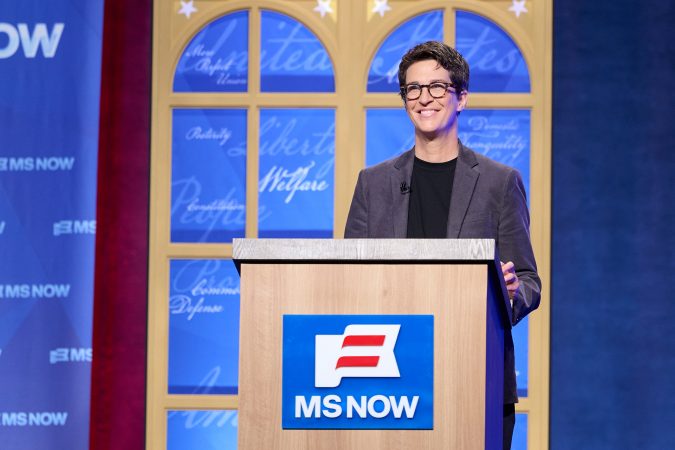
Rachel Maddow’s brief turn as a Philadelphian began with her bicycle being stolen on the first day of a new job.
“I got to work at 9 a.m. and I got out for lunch before noon, because I didn’t have anything to do,” Maddow said. “My bike was already gone.”
MS NOW’s top star was in Center City on Thursday night to interview constitutional legal expert Sherrilyn Ifill live in front of nearly 2,000 people at the Academy of Music.
But prior to the event, she reminisced about her brief time in Philly in the early 1990s, shortlyafter she came out as gay during her freshman year of college at Stanford University.
“It didn’t go well at home, so it was a bit of a scramble in terms of like paying for college, figuring out what I was going to do, where I was going to live,” Maddow said. “And I got an internship at a think tank at Penn.”
Maddow lived in West Philadelphia and basically ate nothing but Ethiopian food for a few months, though she can’t remember the name of the street: “It was in the 40s and it was one of the tree-named streets.”
In college she was an AIDS activist and focused on healthcare policy, so landing at the University of Pennsylvania’s Leonard Davis Institute of Health Economics seemed liked an ideal fit.
Maddow said her job was to answer the phone. But the internship didn’t last long.
“I was not an additive,” Maddow said. “I don’t think I was an asset to the organization.”
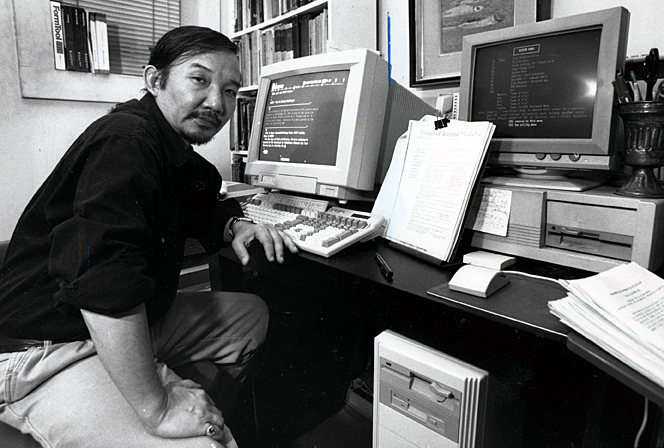
Kiyoshi Kuromiya seen here in 1992, was a gay civil rights activist who helped establish ACT UP Philly. GEORGE REYNOLDS / Staff Photographer, file
Maddow’s activism began when she was still in high school, when she began working at a hospice for people who were dying during the AIDS epidemic.
Still, those few months living in Philadelphia influenced Maddow’s developing political voice. She idolized ACT UP Philly, an activist organization fighting for people with HIV/AIDS, and thinks that gay civil rights activist Kiyoshi Kuromiya is the city’s most overlooked hero for the work he did helping connect people with hard-to-find information about the virus and treatment.
“He saved millions of lives,” Maddow said. “The city needs to build a statue for Kiyoshi Kuromiya.”
Maddow has returned to Philly a number of times over the years, and every time she does, it makes her feel like she’s 19 again. Things have changed — seeing Indego bicycles to rent on street corners after hers was stolen is pretty jarring — but though her time living here was brief, she didn’t hesitate saying, “Philly was really formative for me.”
“The thing I loved about Philly at the time, and that I kind of fell in love with, even before I really knew what to do with it, was the really sparky, edgy, impolite activist spirit,” Maddow said. “I think I’m just a middle-class polite kid who doesn’t like to offend anybody, and Philly kind of shook me out of that a little bit, and made me aspire to edgier things.”
More live events and a new app coming from MS NOW
Nearly 2,000 people attended Thursday night’s event at the Academy of Music. MS NOW
A strong Philly current ran through MS NOW’s event Thursday night, which highlighted the messy history of the American experiment leading up to the country’s 250th anniversary next week.
“My mother’s best friend of 70 years lives here,” Psaki said.
Thursday’s event was part of a larger strategy of engagement at the network after breaking away from NBC and becoming part of Versant, hence the name change from MSNBC to MS NOW. Ratings are up, but the cord-cutting trend is undeniable, so MS NOW is attempting to secure a digital future while it remains a popular TV destination.
The network has now hosted three large fan events since 2024 and another is planned for Sept. 26 ahead of the midterm elections, though further details have not been announced. Attendees in Philly on Thursday night received a free, one-year subscription to MS NOW’s membership product that is set to launch soon. It will act as a streaming platform and online community for the network’s progressive fans and provide access to its biggest stars.
“We’re always looking for ways to connect with our MS NOW community, to meet more viewers where they are, and to engage them in new ways,” said Lauren Peikoff, the network’s executive producer of live events.
Cecil Parker, a Philadelphia musician, said the state of affairs in Washington compelled him to attend Thursday’s event.
“Urgency. That’s the all-encompassing word,” Parker said, who often tunes into MS NOW to get their take on the news. “They have their opinions, but it’s based on the facts. So I dig that.”
Some audience members traveled from as far as Arizona and California to have a chance to hear Maddow and her MS NOW colleagues in person.
Tony Clyburn and his wife, Lisa, drove more than 10 hours from West Columbia, S.C., to take part. A radio host back home, Clyburn said it was inspiring being in a room with people from different walks of life who want what’s best for their neighbors and their country.
“These gatherings are good because they’re as close to a town hall as we can get,” Clyburn said.
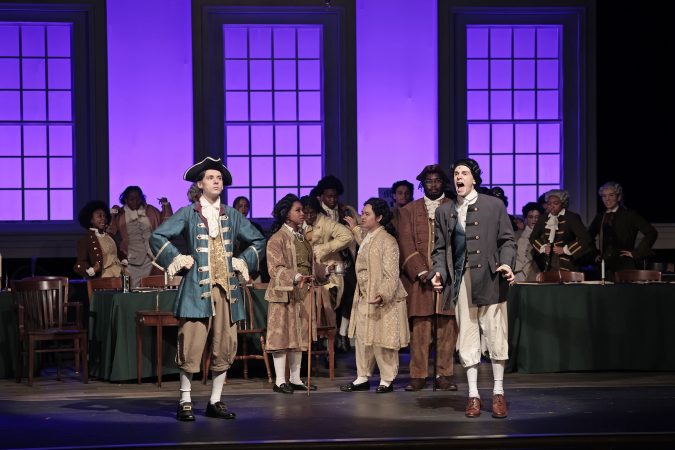
In tricorn hats and tail coats, their locs, microbraids, and wavy tresses gathered into 18th-century low ponytails, 27 Philadelphia-area high school students transformed into America’s Founding Fathers on Wednesday evening at the Philadelphia High School for Creative and Performing Arts.
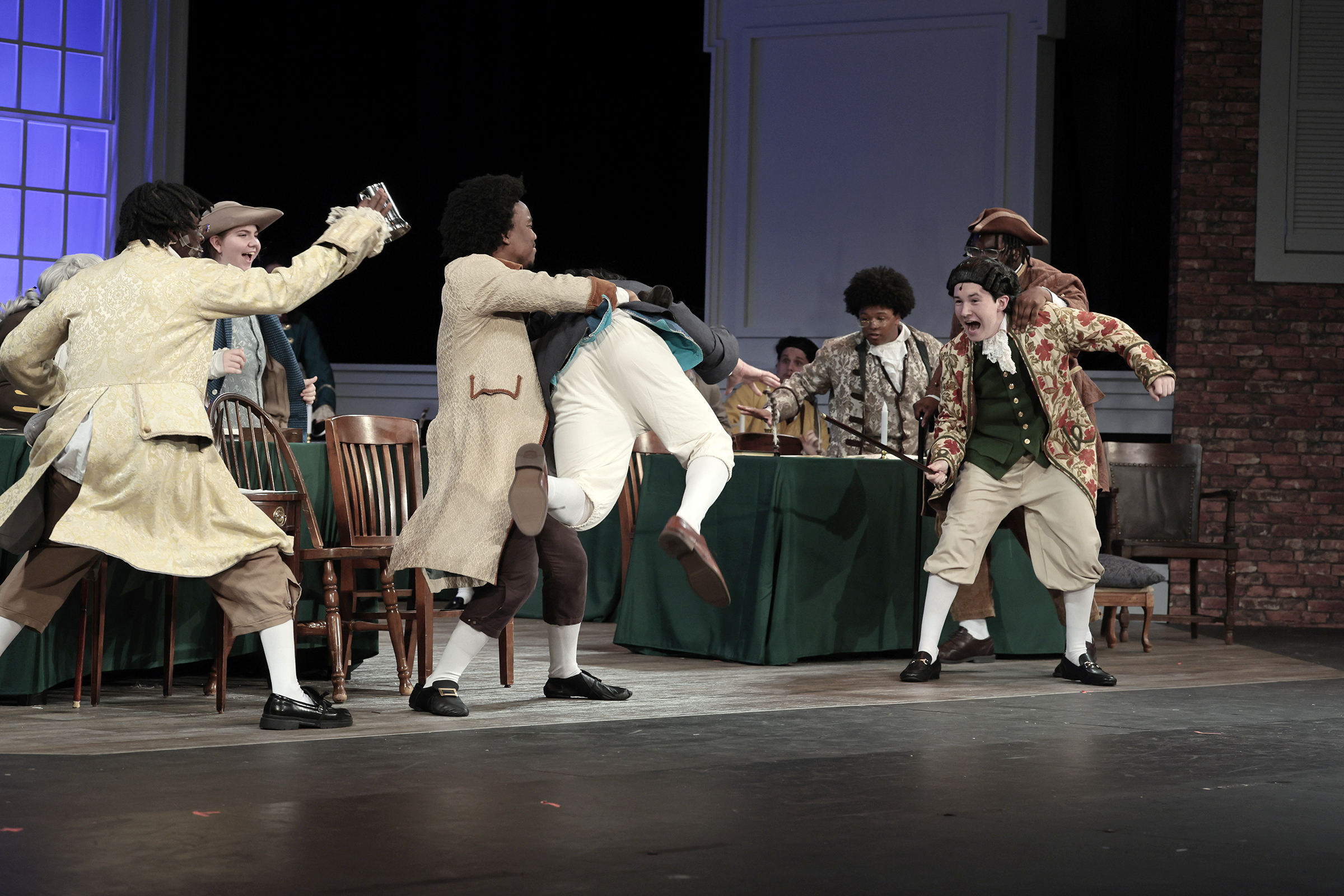
The young thespians debated and deliberated the benefits of forming a sovereign nation. Their well-practiced Southern accents and New England inflections echoed in the full auditorium.
In 2½ hours, Massachusetts congressman John Adams (played by Jackson Preisser), Ben Franklin (Jayden Duvene), and Thomas Jefferson (Maxwell Henderson) made the case for liberty, overcoming the petty aristocratic concerns of Pennsylvania delegate John Dickinson (Greg Rist).
Former Mayor Ed Rendell meets cast members (L-R) Abigail Adams (played by Chloe Chau), John Dickinson (played by Greg Rist) and Ben Franklin (played by Jayden Duvene) during opening night of 1776: The Musical at the Philadelphia High School for Creative and Performing Arts on Wednesday, June 24, 2026.Elizabeth Robertson / Staff Photographer
On a set that looked remarkably like Independence Hall, the students staged the Tony Award-winning 1969 Broadway musical1776 and argued for and against liberty with witty songs and sophisticated dialogue.
The reenactment of the signing of the Declaration of Independence was everything Ed Rendell, the elder statesman and the brain behind the production, wanted it to be.
“It’s been my dream for quite some time to see this production happen,” Rendell said to The Inquirer, his voice a raspy whisper, worn and weary from Parkinson’s disease. Sitting in his wheelchair at the red, white, and blue step and repeat, Rendell smiled as CAPA’s lobby was turned into a dining room for dignitaries hours before the play began.
“In honor of America’s 250th birthday, we wanted to use 1776 to teach high school students the sacrifices and compromises it took to form this great nation,” he said.
Rendell’s love for 1776 is rooted to the night in 1969 when he watched the colonial drama unfold on Broadway, starring William Daniels as John Adams, Ken Howard as Thomas Jefferson, and Howard da Silva as Benjamin Franklin. Daniels, Howard, and da Silva starred in the 1971 Oscar-nominated film of the same name.
“I loved it,” Rendell said, whose favorite ballads from the play are Franklin, Adams, and Jefferson’s quirky performance of “The Egg,” in which the forefathers humorously choose the bald eagle as America’s national bird. (That didn’t really happen during the Second Continental Congress, but it’s a nice touch.)
Another of Rendell’s favorite songs is “Is Anybody There?,” a melancholy number during which Adams asks himself if his dedication to the cause of independence is worth it.
“It struck the right chord, giving all the facts about how we came to our freedom, our independence,” Rendell said. “When I became mayor, I went back and studied it and began to think of it as an important civics lesson. There were so many things I didn’t even know.”
A former president, a mayor, a speaker walk into a play
The 1776 opening night saw the attendance of a who’s who in Philadelphia politics, business, and civics.
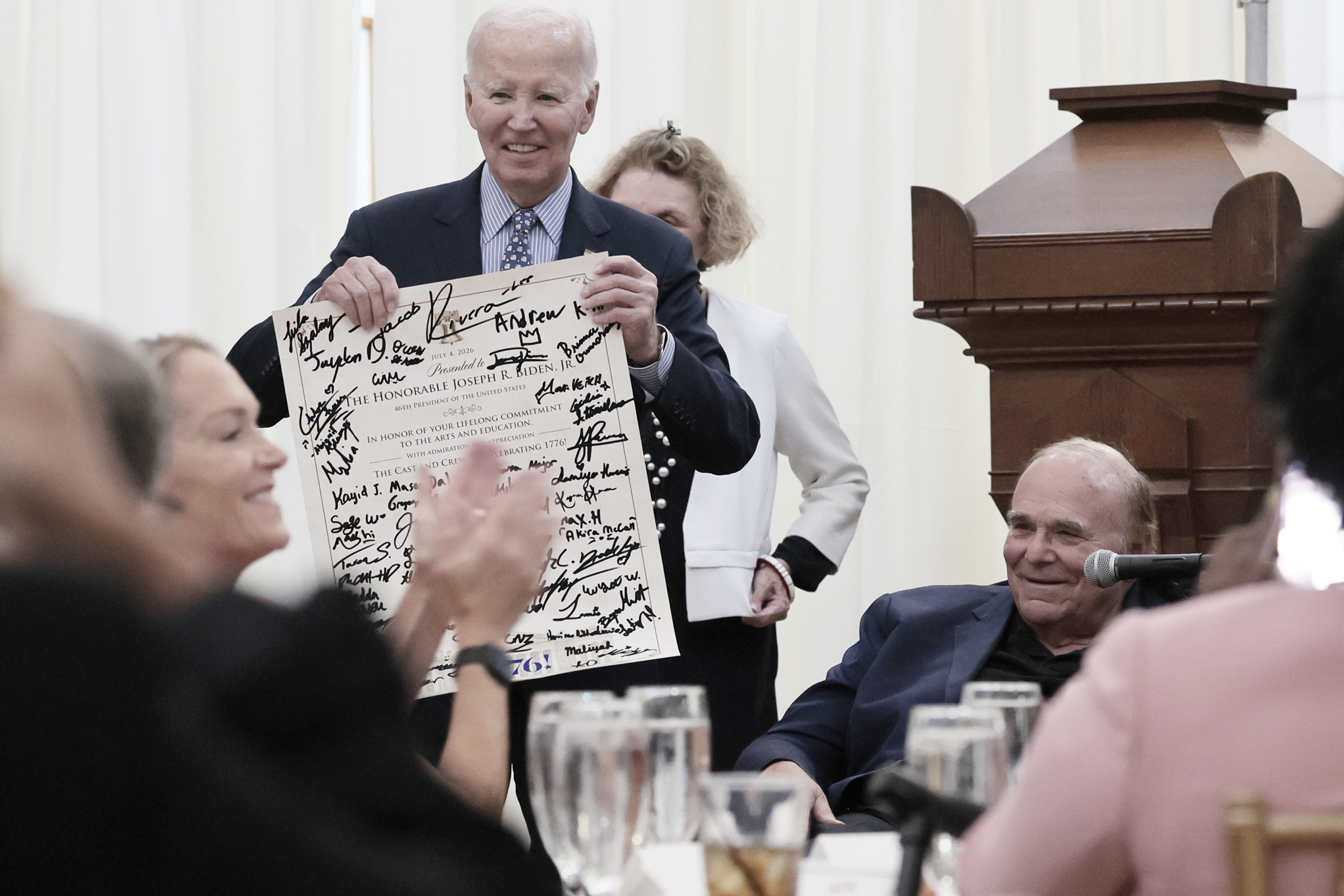
Former President Joe Biden was in the house on the opening night of Rendell’s theatrical milestone. After he was presented with a copy of the declaration signed by the cast, the former president delivered a nine-minute speech about the importance of teaching American history in present-day America, although he did not mention President Donald Trump by name.
“What I can tell you is that from the moment the Founding Fathers signed the Declaration of Independence, we have been in a consistent battle for the soul of the nation,” Biden said as guests prepared to dig into barbecued chicken, brisket, and ribs, Rendell’s favorite.
Former President Joe Biden displays a signed poster from the cast as former Mayor Ed Rendell looks on during the opening night celebration of 1776: The Musical at the Philadelphia High School for Creative and Performing Arts on Wednesday, June 24, 2026.Elizabeth Robertson / Staff Photographer
“Even when there is darkness,” Biden said, “we’ve summoned our angels and crawled back from the brink. We are trying to do that now.”
Mayor Cherelle L. Parker, Pennsylvania House Speaker Joanna McClinton (D., Philadelphia), and State Rep. Joe Ciresi (D., Montgomery) were also in attendance. Philadelphia School Superintendent Tony B. Watlington Sr.; Temple University president John Fry; and David L. Cohen, the former senior executive vice president to Comcast and U.S. ambassador to Canada, were on hand, too.
“When Mr. Rendell calls, people come out,” said Adrian R. King, a partner at Philadelphia-based law firm Ballard Spahr and a former Rendell staffer.
Their attendance reflected their respect for Rendell, a former governor of Pennsylvania and mayor of Philadelphia who, in his political heyday in the 1990s, led the efforts to reimagine South Broad Street as the now-bustling Avenue of the Arts. CAPA’s 1997 opening was a part of that plan.
John Adams (played by Jackson Preisser, middle) and John Dickinson (played by Greg Rist, right) are seperated during a scene from the opening night of 1776: The Musical at the Philadelphia High School for Creative and Performing Arts on Wednesday, June 24, 2026.Elizabeth Robertson / Staff Photographer
Rendell’s baby
Rendell has dreamed of this production for years. He began working on it in earnest last year, bringing on veteran Philadelphia arts administrator Karen Corbin to executive produce. Phillip Sean Brown, director of theater at Bryn Mawr’s Shipley School, was roped in to direct.
“The governor had very specific ideas of what he wanted,” Brown said. “He wanted to show the history of our country, show the drama of the birth of a nation, and have the students learn everything they could about the craft of theater.”
The first order of business was securing the rights to the late composer Sherman Edwards’ script and music. That will cost about $45,000 by the end of the run, Corbin said.
Casting began in February and auditions began in March. Forty actors from eight area high schools were picked for the multicultural, gender-fluid rotating cast, giving the revival of the 57-year-old production Hamilton vibes.
In addition, Brown said, more than 30 students were hired as musicians and production crew.
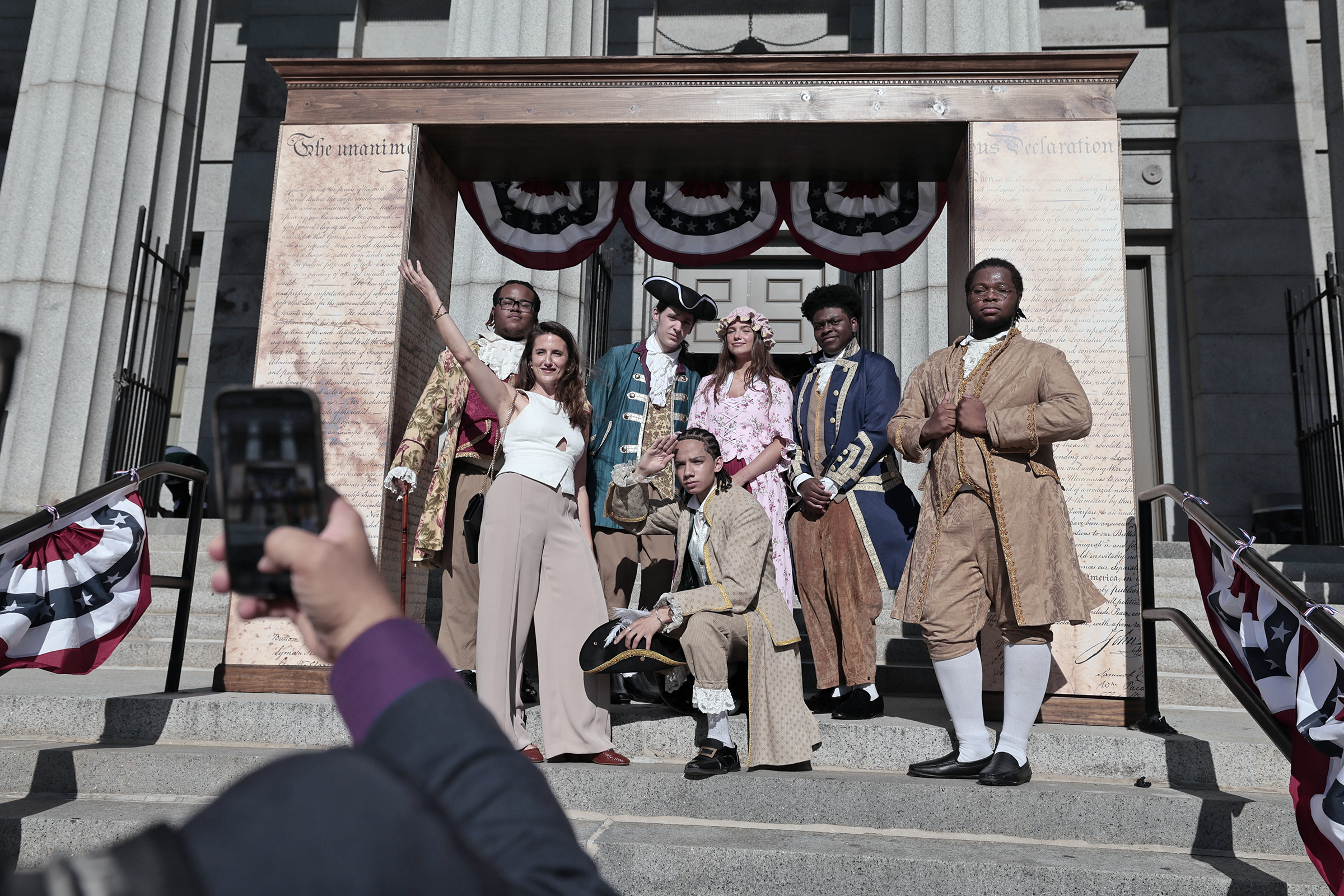
Cast members posed with guests before opening night of 1776: The Musical at the Philadelphia High School for Creative and Performing Arts on Wednesday, June 24, 2026.Elizabeth Robertson / Staff Photographer
“They worked with professionals in theater lighting, costume, sound, and props,” Brown said.
Students were paid $150 a week during rehearsal weeks, and will make $300 a week through the eight-week performance. The entire production cost $850,000 including a $150,000 grant from the state.
There will be 50 shows through Aug. 15 at CAPA. Actors will also perform vignettes of the musical throughout Philadelphia’s historic district, including Carpenters Hall.
‘All good things take compromise’
Students’ exposure to the arts and history has been priceless.
“This experience represents striving forward — as an actor with my cast,“ said Mason Daly, a CAPA graduating senior whose biting Southern accent for South Carolina congressman and segregationist Edward Rutledge was chilling.
Daly’s role as Rutledge is particularly eye-opening. 1776 tells us that Jefferson’s original draft of the declaration included a clause abolishing slavery in America. Rutledge, however, would support America only if that part of the declaration were struck.
Jefferson laments to Franklin, saying, “Mark me, Franklin … if we give in on this issue, posterity will never forgive us.” But he does give in.
“Playing him, I learned to value the nuances of the perspectives of even those we disagree with,” Daly said.
“It’s about his personal compromises to get to the yea vote that allowed independence to go forward. That dialogue, that discussion, that back-and-forth between him and the various colonial representatives is the basis of our democracy and government.”
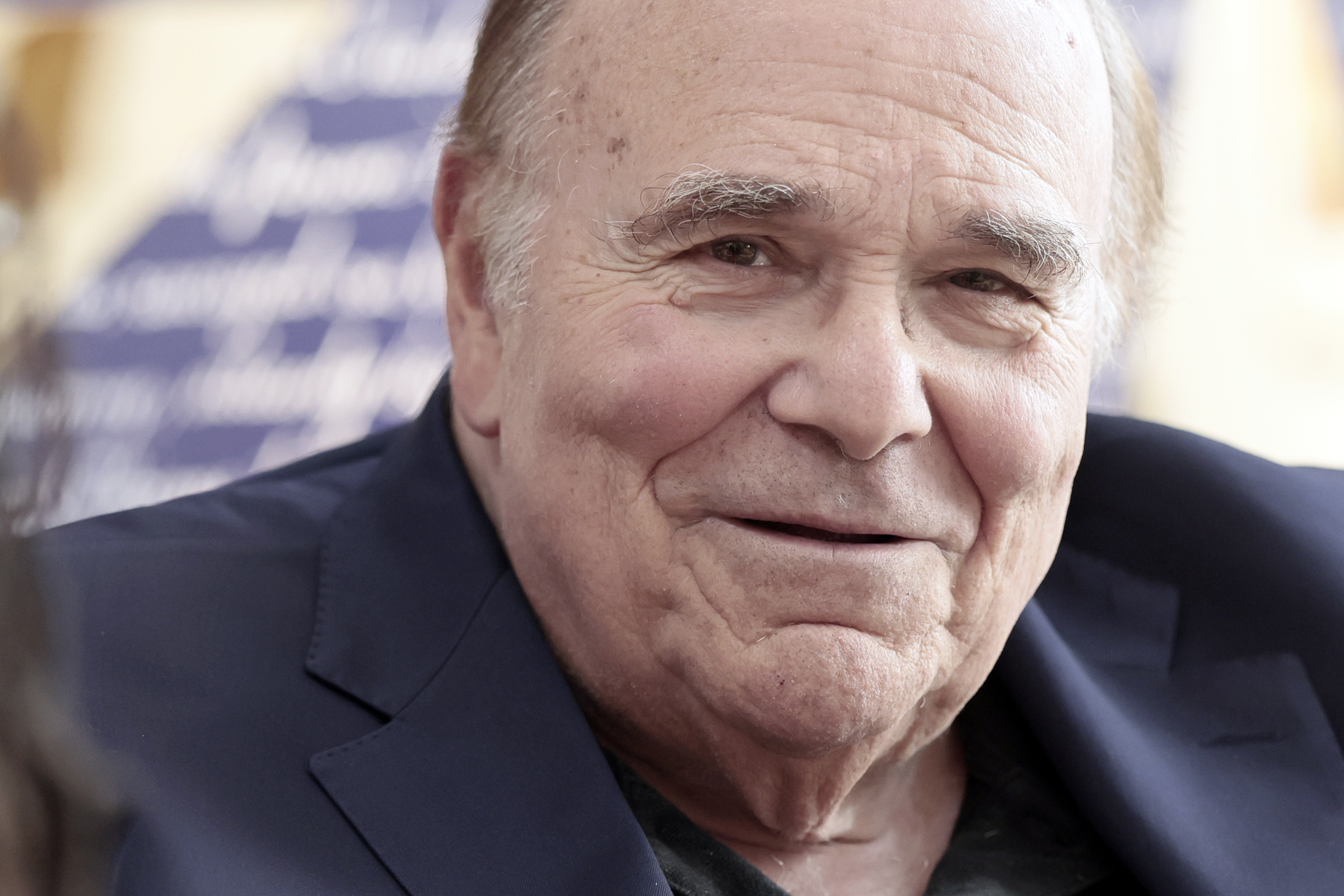
Former Mayor Ed Rendell during opening night of 1776: The Musical at the Philadelphia High School for Creative and Performing Arts on Wednesday, June 24, 2026.Elizabeth Robertson / Staff Photographer
The actors’ parents bubbled with excitement.
“My child is really being taken seriously as an actor in this production,” said Justina Barrett, chief learning and engagement officer at the Historical Society of Pennsylvania, and mother to Sage Wentz, who played Col. Thomas McKean of Delaware. “This whole play is about the messy business of making the United States. It was hard. These guys weren’t nice. It wasn’t pretty. In many ways, we are divided then as we are now.”
Although difficult, this idea of forming a new nation through compromise is what Rendell hopes is the ultimate lesson for all involved.
“We can’t get anything done without compromise,” Rendell said. “We have to get back to a government that is working toward the good of the government. The Civil Rights Act took compromise. Women’s rights took compromise. All good things take compromise.”
“1776″ will be performed at CAPA, 901 S. Broad St., through Aug. 15. Tickets start at $11. For more information, go to the Celebrating 1776! website.
WASHINGTON — Antonio Pozos, a Philadelphia lawyer nominated by President Donald Trump to become a federal judge in the Eastern District of Pennsylvania, told a Senate panel on Wednesday that former President Joe Biden won the most Electoral College votes in 2020 — though he declined to say whether Biden won the popular vote or if the Capitol was “attacked” two months later.
In a confirmation hearing alongside three other judicial nominees, Pozos said Biden was certified as the president in 2020 and that he’d seen videos from Jan. 6, 2021 in which it “appeared that there was violence and trespass.”
“It’s profoundly troubling and I abhor violence,” said Pozos, a partner at Faegre Drinker Biddle & Reath and a lecturer at the University of Pennsylvania’s Carey Law School.
But in the back-and-forth with U.S. Sen. Richard Blumenthal (D., Conn.), Pozos said he would “hesitate to characterize what occurred at the Capitol” when the senator asked directly if the building was “attacked” during the certification of votes.
“You hesitate to tell the truth here,” Blumenthal responded before shifting to the next nominee.
The line of questioning has become many Democrats’ main litmus test for those nominated by Trump for lifetime judicial appointments.
For years, the president has insisted without evidence that widespread voter fraud led to his defeat in 2020, despite Biden winning the popular vote by more than 7 million votes that year on top of his Electoral College win.
Trump’s history of spreading misinformation about elections has fueled fears that he’ll do it again during November’s midterm elections — as he did after the California primary just last week — and that his judicial appointees will undermine a system of checks and balances.
When all of the nominees facing the Senate Judiciary Committee on Wednesday echoed each other in only saying Biden won the Electoral College, Blumenthal accused them of having “a new script, a new pre-negotiated effort to thread the needle [and] avoid the question.”
“You are protecting the lie by failing to acknowledge the truth,” Blumenthal said. “If you’re unwilling to show us you’re independent of the president at this early stage of your service, you disqualify yourself as judicial nominees.”
At least one Democrat who has signaled he doesn’t believe Pozos should be disqualified is U.S. Sen. John Fetterman.
The Pennsylvania Democrat decided against blocking his nomination during a traditional process that gives senators the opportunity to approve or reject a federal judicial nominee in their state.
It was the first time any Democrat declined to use that courtesy — in a process known as a “blue slip” — since Trump’s second term began in January 2025.
Two other Democratic senators, Elissa Slotkin and Gary Peters, of Michigan, however, followed Fetterman in returning a blue slip for a separate nominee in their state before Wednesday’s hearing. They said their decision was in part because of the nominee’s assurances to them that Biden won in 2020, that there was an attack on the Capitol, and that Trump cannot run for a third term.
Pozos also acknowledged during the hearing that Trump could not constitutionally win another term, which is something the president himself has declined to say.
Fetterman, from the 2020 election through Trump’s second election in 2024, frequentlyand forcefully rejected Trump’s claims of election fraud in Pennsylvania. His office did not provide a comment in response to questions from The Inquirer about why he allowed Pozos’ nomination to advance. The senator has also not said whether he will vote to confirm Pozos when the Republican-controlled Senate decides on the appointment.
But Fetterman’s move so far in the process was the latest in a series of high-profile moments in which he sided with Trump and the Republican Party while infuriating parts of his own base.
Demand Justice, a Washington, D.C.-based organization that is critical of Trump’s nominees because of their statements on the 2020 election, joined in the criticism of Fetterman and promised to launch a six-figure ad campaign against him because of the blue slip.
“John Fetterman just cleared the path for a Trump lifetime judicial nominee,” one of the digital ads states alongside an image of Trump and Fetterman with hearts around them.
“Our message to Senate Democrats is clear: greenlight Trump’s puppet judges, and we will call you out. No exceptions,” it continued.
That threat elicited bipartisan criticism at the beginning of the hearing Wednesday.
U.S. Sen. Katie Britt, an Alabama Republican speaking on behalf of committee chair U.S. Sen. Chuck Grassley, called Demand Justice a “progressive dark money group” that “sought to undermine the blue slip practice and sew further division in our country.”
U.S. Sen. Dick Durbin of Illinois, the top Democrat on the committee, also said the group was wrong to target senators who work toward agreement across party lines.
Each of the committee leaders commended Fetterman, Slotkin, and Peters for their decision — with Durbin praising them for “working in good faith with the White House.”
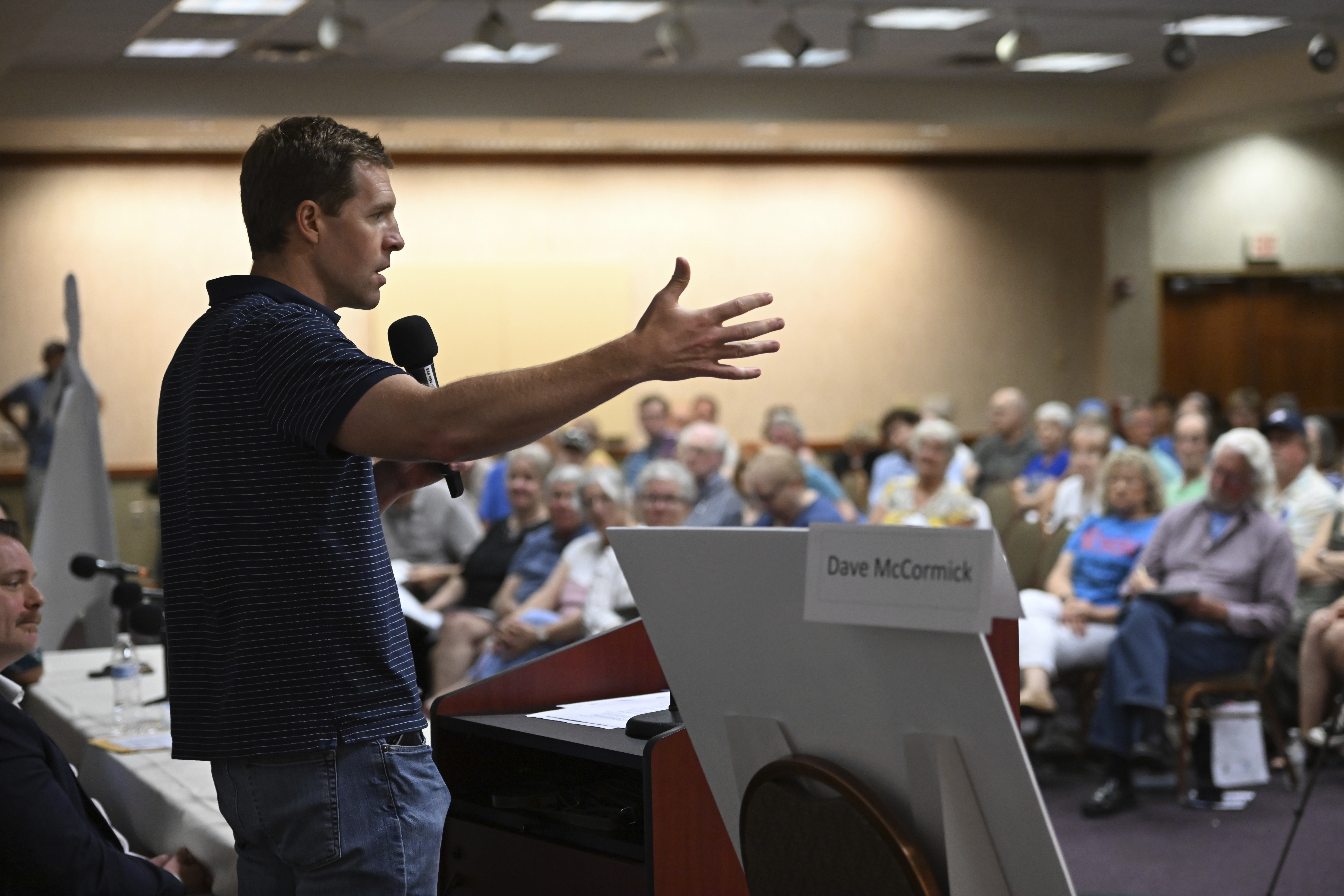
U.S. Sen. Dave McCormick (R., Pa.) also thanked Fetterman and said Pozos was nominated because of a recommendation from a commission that the pair of Pennsylvania senators put together to vet judicial nominees.
“Tony’s a successful attorney, a strong Pennsylvanian, a decorated public servant, and he’s eminently qualified for this role,” McCormick said during the hearing.
Pozos, 44, is a graduate of Harvard College and the University of Michigan Law School who worked as federal prosecutor before becoming a partner at Faegre Drinker in 2018.
As a trial attorney in the Criminal Fraud Section of the Department of Justice, he focused on corporate and individual healthcare fraud cases. McCormick said he had a “formidable track record of rooting out fraud, prosecuting those who abuse taxpayer dollars, and protecting Americans from predatory healthcare systems.”
In a questionnaire published by the Senate Judiciary Committee, Pozos also listed active memberships in the Federalist Society — the legal organization that has sought to appoint conservative judges across the country — as well as the Union League of Philadelphia and the Merion Cricket Club.
In addition to the election-focusedinquiries, Pozos also faced questions about applying the False Claims Act — which penalizes individuals and companies from defrauding the government — and the controversial Section 230 of the Communications Decency Act that protects online platforms from liability for what their users post.
U.S. Sen. John Kennedy (R. La.) grew frustrated when he believed Pozos was not fully answering his question about whether, under Section 230, Facebook should be protected and if it should have the ability to decide what users see. Pozos, like other judicial nominees who say they cannot weigh in specifically on the types of cases they may have to rule on, began answering when Kennedy said he had “no idea what you’re talking about.”
“You’re better off just answering the question, you really are,” Kennedy said.
Asked by the Democratic chair about the importance of diversity — which Trump has widely sought to diminish — Pozos said he has mentored young lawyers “from a wide range of backgrounds” and that it was important to “get all pockets of talent wherever they may be in our country and welcome them into the legal profession.”
Pressed by Durbin if diversity is important in filling positions in the legal system, Pozos said, “If we are true to seeking out excellence wherever it may be, that question will be moot.”
The euphoria at Chris Rabb’s election night party last month hadn’t even started to wane before the democratic socialist and his supporters — dancing and hugging after capturing a rarely open Philadelphia seat in Congress — spoke of setting their sights even higher.
Taking on the city’s Democratic establishment to defeat a pair of more centrist candidates in the heated 3rd Congressional District race was a momentous win on its own. But the reckoning, they promised, wouldn’t be confined to Philadelphia’s borders.
“It’s going to change not just our city, but our entire commonwealth,” Rabb said in an interview amid the celebration at a Germantown banquet hall.
It was a sentiment echoed that night by key figures in Rabb’s coalition — from the head of the Working Families Party to Pittsburgh’s U.S. Rep. Summer Lee, the only other democratic socialist representing a part of Pennsylvania.
With the 2026 Pennsylvania Democratic primary in the rearview mirror, that conversation has broadly and quickly turned to the next biggest prize in the state: the U.S. Senate seat held by Democrat John Fetterman.
The senator has not said whether he will run for a second six-year term in 2028. But in an unusual situation for an high-profile elected official, a robust intraparty competition to replace him is expected to start either way in the next year as Fetterman increasingly sides with Republicans and as polls show that his support among Democratic voters has nose-dived.
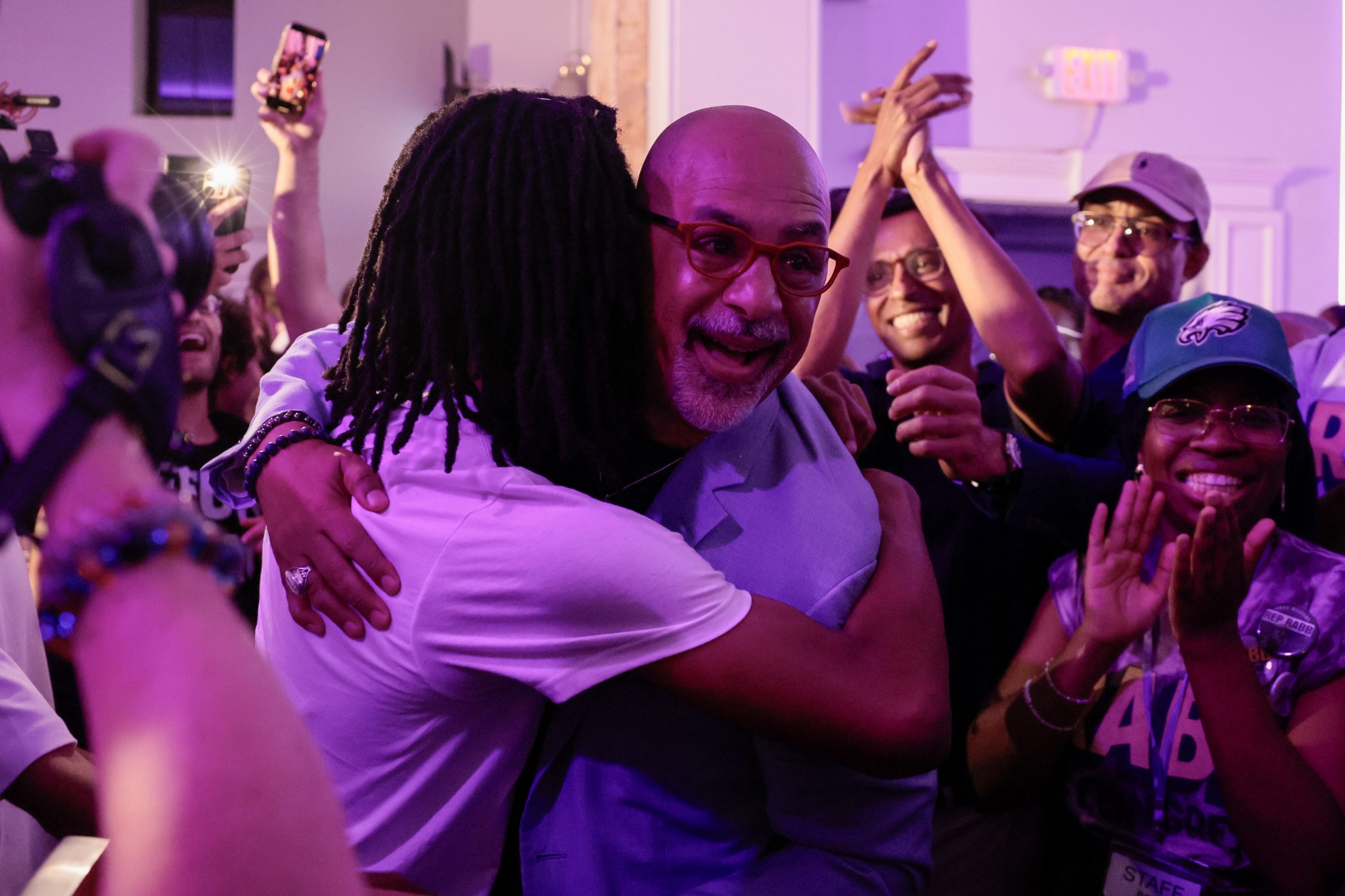
State Rep. Chris Rabb is hugged by his son, Issa Rabb, during his primary election night event at Victorian Banquet Hall on May 19.Elizabeth Robertson / Staff Photographer
Some Democrats who watched Rabb emerge from a competitive race, notching one of the left’s biggest wins yet in Pennsylvania, see an opportunity — one that extends the energy and momentum to boost a well-organized, progressive, anti-establishment candidate in the Senate primary.
Other strategists and activists say that’s a tall task, particularly in a swing state that rarely strays from electing more centrist politicians statewide.
“Anytime you have success, it breeds enthusiasm, which translates into more volunteers, into more money — everything you need to run a campaign,” said Mike Mikus, a Pittsburgh-based Democratic strategist. “But every election cycle is different. Every campaign’s different. The quality of candidates are different. And anybody who says that any one race signifies a permanent change within a party is mistaken.”
‘A huge impact on the political landscape of Pennsylvania’
In his campaign to succeed U.S. Rep. Dwight Evans, Rabb, a five-term state lawmaker, won 44% of the vote. He was up against State Sen. Sharif Street, who had the backing of the city Democratic apparatus, and physician Ala Stanford, a political newcomer endorsed by Evans.
That progressive infrastructure — the coming together of different groups to knock doors, make calls to voters, and unleash a significant independent advertising campaign in a way that rivaled the official Democratic Party organization — is likely the most important way that the left can use the experience of Rabb’s campaign to replicate its success elsewhere, strategists said.
It’s a template that could have “a huge impact on the political landscape of Pennsylvania,” said Rotimi Adeoye, a Philadelphia-based Democratic strategist who worked in the office of former U.S. Sen. Bob Casey.
In a district packed with Democratic voters, Rabb’s ability to turn out progressive voters should draw the attention of anyone looking to win the state’s Democratic Senate primary in 2028, Adeoye said.
“If a Democrat running statewide can learn from some of these organizational groups to build a strong, relational and community-based organizing campaign in Philadelphia and the surrounding suburbs in Montgomery County, Bucks County — they’re going to have a really big chance of winning,” Adeoye said.
In a sign that those efforts could coalesce around a Senate candidate, one of the groups that helped usher Rabb to victory remains the only major Democratic entity in the state to have publicly started laying the groundwork for a challenge to Fetterman.
The Working Families Party, which backed Fetterman in the 2022 general election after originally endorsing State Rep. Malcolm Kenyatta in the primary, said in November it would organize an effort to oust him. A “Primary Fetterman” website launched in January is equipped with a “Fetterman sell-out tracker” — highlighting his votes for Trump’s cabinet nominees and opposition to war powers resolutions that would rein in his military strikes, for example — and instructions for donors on how to request a refund from his campaign.
The website remains the extent of the group’s efforts so far to rally public support and back a new candidate, though its work is expected to pick up after this year’s midterm elections. For now, the party is looking forward to bringing new members who worked to elect Rabb into its fold.
“Our goal is always to keep building on the work we do each cycle and the success we have each cycle,” said Nick Gavio, the Working Families Party’s Mid-Atlantic communications director.
One PA, another statewide group in that progressive coalition, has not yet had internal discussions about the Senate race but it supports the Working Families Party’s position as a member of its steering committee, executive director Steve Paul said. He said more than 150 members of One PA mobilized for Rabb by talking to thousands of voters.
Winning a high-profile congressional race only helps add to that organizational infrastructure, making them “sharper for the next thing,” Paul said.
“I think it shifts what’s possible, politically — what people can envision,” he said.
Potential progressive roadblocks
Mikus said progressives have increasingly surpassed “more establishment Democrats” in their ability to run strong campaigns, including in his area of Western Pennsylvania where candidates like Lee have emerged in the last decade.
Democratic primary voters are also more progressive than they were 10 years ago, he said. But campaigning on a far-left — or a far-right — platform doesn’t often equate to success on a statewide level in Pennsylvania, a swing state where successful candidates tend to walk a “fine line” that appeals to both swing voters and a message that excites their partisan base, Mikus said.
“You’ve seen this time after time in presidential elections here in Pennsylvania,” Mikus said. “Hillary Clinton versus Bernie Sanders. Joe Biden versus Bernie Sanders. The vast majority of voters in Pennsylvania will go with the more mainstream Democrat.”
J.J. Balaban, a Philadelphia-based Democratic strategist and ad maker, said the party runs the risk of “drawing too big of a conclusion” based on a single election — particularly one like Rabb’s where candidates only needed to appeal to Democrats.
“Democrats really need to think hard about what it will take to win statewide in a purple state, which Pennsylvania clearly is,” Balaban said. “What it will take to win a general election in Pennsylvania is very, very different than what it will take to win in literally the most Democratic congressional district in the country.”
After recent years of tough losses — including the ousting of Casey by now-U.S. Sen. Dave McCormick, a Republican — Democratic voters will likely have a “tremendous thirst for candidates who have a credible case to make that they can win the general election,” Balaban said.
Fetterman, whose office did not comment for this story, has insisted that Pennsylvania’s purple state status means he should appeal to both sides of the aisle and not demonize the other side.
“Look at the people that are winning the primaries in our party right now, and look at their views on Israel,” Fetterman said at an American Jewish Committee conference in Washington this week.
On stage with McCormick and the head of the Jewish advocacy organization, Fetterman painted Graham Platner, the expected Democratic nominee for a U.S. Senate seat in Maine, as a “Nazi sympathizer” and connected him to Rabb.
“People also in our state, too. Rabb, he won, and he ran on being a very, very anti-Israel guy,” Fetterman said. “It’s actually a virtue [in the modern Democratic Party] … It’s heartbreaking for me. And if it isolates me, then so be it.”
Who might run?
Of the Democrats widely considered to be eyeing a campaign to replace Fetterman, the public jockeying has so far been limited to criticisms of the incumbent.
Former U.S. Rep. Conor Lamb, a moderate who represented a suburban Pittsburgh district before Fetterman beat him in the 2022 Senate primary, has frequently lambasted him.
Conor Lamb speaks to the crowd at a town hall-style event organized by progressive groups at Central Penn College on June 22, 2025, in Enola, Pa. Marc Levy
And U.S. Rep. Chris Deluzio, who succeeded Lamb and leaned into progressive economic populism, has taken a less direct tack while noting the differences between himself and Fetterman over issues like Trump’s military interventions abroad. Deluzio has occasionally reposted others’ criticisms on social media — including one from Gavio, the Working Families Party spokesperson, last week that called Fetterman’s reversal on eliminating the filibuster “a new low” and “an indescribably massive backtrack from everything he ran on.”
None of the three have ruled out running.
Boyle is expected to weigh a Senate campaign vs. staying in the House to take a rare opportunity to lead the powerful budget committee if Democrats win the majority in November. Lamb, who’s remained highly active in Pennsylvania politics, said in an interview that he’s hoping to serve again and would run for office if he feels he “can be of service to the state.” Deluzio, who is also heavily involved in helping Democratic candidates across the state, said he’s focused on his reelection this year and that “we’ll see what 2028 holds.”
“I am not at all interested in seeing us lose this Senate election, and I certainly have gotten a lot of encouragement to look at 2028,” Deluzio said.
Progressives have also mentioned Lee, the Rabb ally who’s been a vocal member of the leftist wing on Capitol Hill while taking leadership roles in areas like securing the release of the Jeffrey Epstein files.
U.S. Reps. Summer Lee and Chris Deluzio, both Pittsburgh-area Democrats, speak outside the Moshannon Valley Processing Center in Clearfield County on May 28 after getting a tour of the facility, the largest detention center for undocumented immigrants in the Northeast.Sam Janesch / Staff
With potential candidates still several months away from making their decisions, it’s unclear who might try to take up the progressive mantle if Lee does not run, strategists say.
The field could also grow considerably. Other potential candidates could jump in, including the three other current Pennsylvania Democrats in Congress or former lawmakers like Susan Wild, who lost a swing congressional district in the Lehigh Valley in 2024. Wild said she’s “not ruling out” a run but she’s more interested in thinking about good female candidates in general since no woman has ever won a Pennsylvania U.S. Senate seat.
On the prospects of a battle between different factions of the party, Lamb said he believed Democrats had broadly learned a lesson — from Fetterman’s election in 2022, where he ran on being a reliable Democratic vote in the Senate — that was beyond ideological policy tests.
“Fetterman taught Democrats in Pennsylvania that you have to have a character test. Anybody can run around the state promising you these further left solutions, and that they’re going to be a thumb in the eye of the establishment, and they’re going to channel all your anger and dissatisfaction. And then that person can turn on you on a dime,” Lamb said. “The fact is that we have to evaluate our candidates based on whether they have integrity and they’re going to keep their word and, honestly, whether they have the work ethic to be a senator day in, day out.”
The import of budget figures, particularly those large values contained within the federal budget, has become something to which we are numb, or worse, indifferent.
A $1.5 trillion request for the U.S. Department of Defense, when all government expenditures total just over $7.5 trillion, is a large number and gets the attention of Congress. But the public is systematically desensitized to expenditures in the billions, and millions barely get noticed.
This is not new; it just seems worse. “A billion here, a billion there, and pretty soon you’re talking real money” is a wry observation widelyattributed to the late U.S. Sen. Everett Dirksen in the 1960s.
An interesting thought experiment is to imagine what alternative investments could be made in place of some currently controversial choices, since budgets are not unlimited.
An arch may enhance the architecture of Washington, D.C. A ballroom might be desired to entertain dignitaries. And a weaponization fund, assuming Donald Trump does not permanently drop this proposal, and it is not ultimately deemed illegal, may serve certain matters of justice. But these expenditures should not be thought of in absolutes.
They need to be weighed against other choices that could be made. What other investments cannot be made with these dollars if they are used for these three expenditures?
At a time when the nation’s families are facing a housing crisis, and when low-income families are pressed by rising prices for the most basic necessities of life, we find it useful to consider how proposed expenditures for one initiative, if reprioritized, could positively impact our housing condition and efforts to lift people out of poverty.
Think about these three large expenditures: the Triumphal Arch, the White House ballroom, and the anti-weaponization fund. What could the funds for these three items alternatively do to enhance housing affordability or reduce poverty?
According to official federal reports of a measure called the aggregate income deficit, $1.776 billion distributed to each poor family in Alabama would bring their incomes above the poverty line. Alternatively, $1.776 billion could raise all Mississippians out of poverty, leaving almost $400 million.
In other words, the federal government pays landlords $14,400 per year on behalf of each supported renter household.
That $1.776 billion could pay rent to landlords for an additional 25,000 families each year for five years. Those families would not have to decide between clothes for their children, medication, food, transportation, or housing for five years into the future.
What about $400 million for a White House ballroom? Those dollars could support almost 28,000 additional renters this year.
Alternatively, that $400 million deployed in the state of Alaska could bring every low-income Alaskan out of poverty for three years, North Dakota for 11 years, or Delaware for nearly two years.
In Philadelphia, there is a $10,000 grant for first-time homebuyers. Recipients will be able to live in a home they own, providing shelter and stability for their families and an opportunity to accumulate wealth for themselves and future generations. That $400 million could help 40,000 Philadelphia families become first-time homeowners. In place of the arch, $100 million would support 10,000 more families.
Given that budgets are finite, a decision to spend money on one thing represents a choice about what you value, and importantly, those items on which you cannot invest. Sen. Dirksen would probably be shocked at some of the decisions currently being made by some of our elected officials. All of us should be.
Ira Goldstein is a member of the National Housing Crisis Task Force and a lecturer at the University of Pennsylvania in the urban studies program. Gregory D. Squires is a research professor and professor emeritus of sociology at George Washington University and a member of the advisory committee to the Philadelphia Home Appraisal Equity Program.
Chester Mayor Stefan Roots came up withan idea as he waited to testify Wednesday during a Pennsylvania legislative committee hearing on a proposed gas export terminal.
“I’m introducing a new initiative,” he said, “WMO — we’ve moved on .… This dangerous facility does not belong in a densely populated urban area like Chester. I’m calling on this committee to do the right thing: Protect some of the most vulnerable people in this commonwealth and say no to an LNG terminal in this region.”
Roots spoke in response to a yearslong plan by Penn LNG to build a liquefied natural gas (LNG) export terminal in Chester or nearby in southeastern Pennsylvania along the Delaware River. The terminal would tap in to an existing pipeline to carry gas from the Marcellus and Utica formations to a site on the river. There, it would be compressed into liquid gas for export and capitalize on soaring global demand for LNG after Russian’s invasion of Ukraine.
The hearing, held by the Pennsylvania House Environmental & Natural Resource Protection Committee, was stacked with opponents of the plan, saying it would create pollution and be highly dangerous to surrounding communities. Democratic State Rep. Greg Vitale, the committee chair from Delaware County, said proponents, including Franc James, CEO of Penn LNG, and union leaders were invited but declined.
Penn LNG has not specified a location but has said it plans to develop a new plant to export 1 billion cubic feet per day of gas from the Marcellus Shale to Europe.
At previous hearings held by Republican State Rep. Martina White, chair of the Philadelphia LNG Export Task Force, proponents spoke of the economic change the facility would bring, including jobs.
Vitale said he convened Wednesday’s hearing because he feared the project would “proceed under the radar without sufficient public scrutiny.”
Indeed, the mood Wednesday was strikingly different from past hearings as opponents told legislators an LNG facility would pose serious health, safety, and environmental justice issues.
In 2024, former President Joe Biden put a pause on LNG export approvals in 2024 to further study the issue. This year President Donald Trump has made reviving fossil fuel energy projects a priority.
Reuters reported in June that James, the Penn LNG CEO, had met with officials at the White House over the project.
Penn LNG wants to export 7.2 million tons a year of LNG from a site near Philadelphia to markets in Europe and Asia and is considering several locations other than Chester, such as in Trainer, Marcus Hook, and Eddystone, the news service reported.
What are the issues regarding an LNG facility?
Opponents believe such a facility would pose a major threat if there is an explosion or fire in an area already densely populated with people and polluting industrial sites. They noted that Delaware County’s Crozer-Chester Medical Center and Springfield Hospital were closed this year amid a bankruptcy auction.
If there is a catastrophic explosion, they said, the nearest hospital would be 30 minutes away.
Tracy Carluccio, an advocate with the nonprofit Delaware Riverkeeper Network, said the area is too densely populated for the facility, emphasizing that a major concern is the lack of a sufficient safety buffer, which the federal government advises for LNG terminals.
She noted that similar facilities in the South are situated in areas with thousands of acres of buffer. She said a new site in the area would likely be around 100 acres.
“There is no location within the Delaware River watershed, including the bay all the way down to the ocean, for any LNG facility to be located,” Carluccio said.
Lauren Minsky, a visiting professor of health studies at Haverford College, said an LNG facility would exacerbate existing public health issues in the region.
She said southeastern Delaware County has already been given a grade of “F” for particle pollution and a grade of “D” for ozone levels by the American Lung Association.
She cited 2025 research by Johns Hopkins Universityshowing that high levels of volatile organic compounds have been measured in communities near the fence lines of LNG facilities. She also said there are elevated cancer rates in adults living in the area’s riverfront communities, citing the People’s Cancer Incidence Screening Tool, which calculates average annual cancer incidence rates in Pennsylvania.
“If we value the health of our families, our friends and neighbors, and throughout the commonwealth, we need to build a different future, one in which we can all thrive,” she said.
Already industrialized
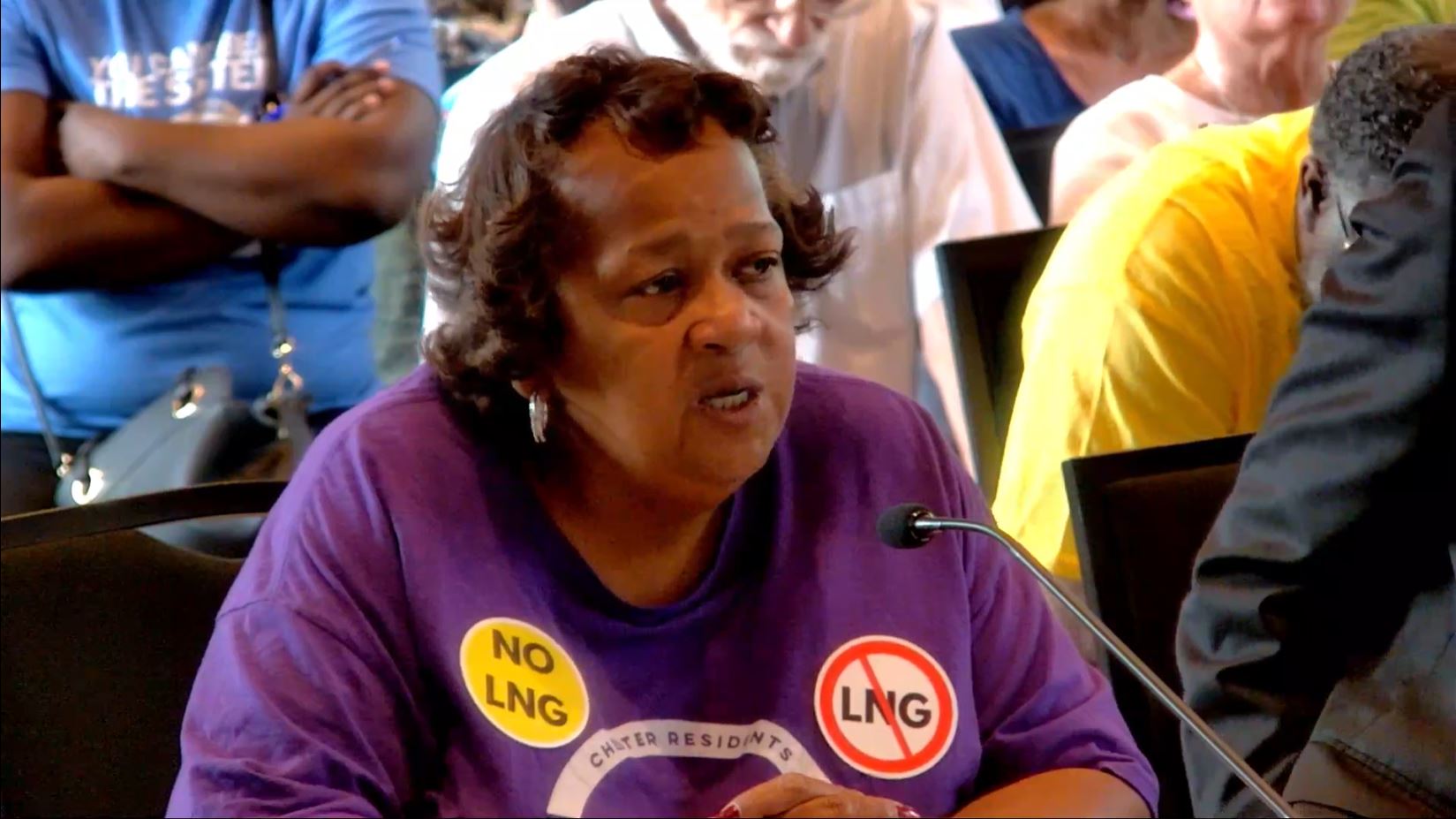
Zulene Mayfield, an activist with Chester Residents Concerned for Quality Living, said older residents she knows have suffered heart conditions and cancers that she links to living in an already heavily industrialized area.
Mayfield is a longtime opponent of the Delaware Valley Resource Recovery Facility owned by Reworld, formerly Covanta. The facility burns trash and converts it to energy.
She said Chester, rimmed by heavy industry, lacks many things other communities take for granted, such as primary-care physicians or entertainment for children.
“We are being told that we have to accept other industries” that no other communities want, Mayfield said.
“I’m sitting here right now trying to contain my rage,” she said. “The jobs are temporary, but death is forever.”