The Office of the Director of National Intelligence has shrunk more than is publicly known in recent weeks, losing about 200 personnel to firings and reassignments since June 1, according to data the Trump administration shared with Congress this week.
The cuts are the latest to hit ODNI, which was created to oversee and coordinate all U.S. spy agencies but has been targeted by President Donald Trump and many Republicans in Congress. They, and some former U.S. intelligence officials, say it has expanded far beyond what lawmakers intended when it was created two decades ago. The ODNI had about 2,000 employees at the start of Trump’s second term. It is now little more than half that size, according to congressional aides.
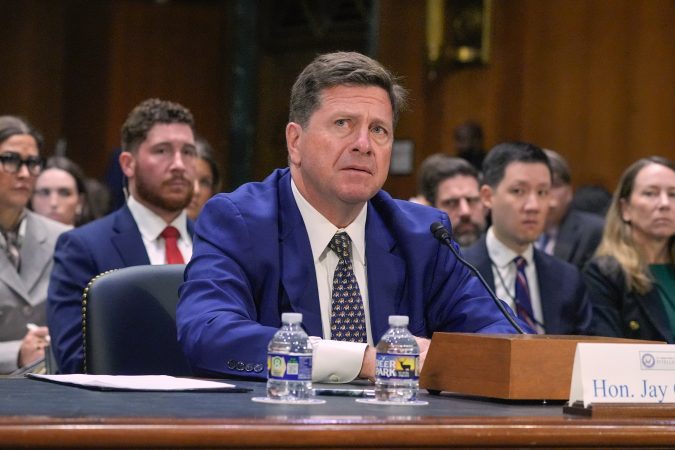
The staffing reductions mean that Trump’s nominee for intelligence czar, Jay Clayton, if confirmed by the Senate as expected, while inherit a shrunken organization that has experienced steady upheaval over the last 18 months.
The president in early June tapped federal mortgage regulator Bill Pulte, a political ally with no prior national security experience, to be acting director of national intelligence. Trump said at the time that he wanted Pulte to “start the process” of eliminating some workers.
Trump has often maintained a hostile posture toward professional intelligence personnel and their agencies, claiming they tried to undermine him in his first term, particularly with the compiling of reports on Russia’s interference in the 2016 presidential election to aid his campaign. The president has dismissed intelligence analysis on a range of issues, from North Korea’s nuclear policy to Iran’s likely reaction to the attacks the U.S. and Israel launched in February.
Neither Pulte nor the White House has publicly detailed what cuts they have made recently at ODNI, which houses the National Counterterrorism Center and was established to fix U.S. intelligence agencies’ failure to share threat information prior to the September 2001 terrorist attacks.
The latest personnel cuts were confirmed by a congressional staff member and another person familiar with the matter. They spoke on the condition of anonymity to discuss nonpublic information.
ODNI did not respond to requests for comment.
The cuts include some firings, as well as a larger number of intelligence officers who were ordered back to their home agencies, the person familiar with the matter said. Much of ODNI’s workforce consists of personnel detailed from the CIA and other intelligence organizations.
The counterterrorism center has not been affected significantly, officials have said. But there has been a whole-scale hollowing out of the National Intelligence Council, a prestigious analytic body that conducts intelligence community-wide assessments on key topics such as COVID-19’s origins and foreign interference in U.S. elections.
The Washington Post previously reported that about 20 intelligence council personnel have been removed or have chosen to leave, including senior officers who oversaw the production of analysis on Russia, China, and Europe. The top official who oversaw the council was placed on administrative leave.
Neither Clayton nor the Trump administration has articulated a vision of what ODNI should look like or focus on “other than it should be smaller,” said Julia Curlee, who served as a director for intelligence programs in Trump’s White House until last year and recently resigned from the CIA after 20 years as an analyst. “It seems like DNI was just a fat target to punish the ‘deep state.’”
“Morale is pretty terrible, as you would imagine,” Curlee said.
It is unclear how many of the 200 personnel were let go under Pulte, who became acting director of national intelligence on June 19, and how many were let go under his predecessor, Tulsi Gabbard, who left the administration after her husband became ill.
The Trump administration and its allies in Congress have not publicly acknowledged the extent to which ODNI has been shrunk.
“U.S. National Intelligence is operating more efficiently and effectively than ever before, and today, we started a third round of reducing redundant, or noncritical, personnel,” Pulte posted on X on July 10, without revealing details.
Senate Intelligence Committee Chairman Tom Cotton (R., Ark.) said shortly after Pulte took over that the acting DNI had told him that “a small handful of front-office personnel” were leaving. “Around 45 or 50 career officers” were returning to their home agencies, Cotton said. Cotton’s office did not respond to requests for comment.
The precise size of the workforce at ODNI and other U.S. intelligence agencies is classified. By the time Gabbard departed in mid-June, the workforce had shrunk from about 2,000 in January 2025 to about 1,300.
Clayton was mauled in his Senate Intelligence Committee confirmation hearing by Democrats who decried what they said was his failure to unequivocally state that Joe Biden won the 2020 presidential election, which Trump denies. The Republican-led committee approved his nomination Tuesday on a 9-8 vote, and a full Senate vote is expected next week.
A partner at one of the city’s largest law firms who once worked as a federal prosecutor was confirmed Thursday by the U.S. Senate to become the Philadelphia region’s newest federal judge.
Antonio Pozos’ nomination to join the region’s U.S. District Court was approved by a vote of 49-44. There was no discussion as the Senate voted to approve his nomination, which earns him a lifetime seat on the bench.
Pozos, 44, most recently a partner at Faegre Drinker Biddle & Reath, is the first person appointed to the region’s district court since President Donald Trump began his second term last year. During his first term, Trump had five judges confirmed to the region’s federal bench.
Pozos will fill a vacancy created by last year’s retirement of U.S. District Judge Mitchell Goldberg, giving the court 22 district judges and eight senior judges.
District court judges oversee a variety of criminal and civil cases each year, and typically issue the first rulings on legal questions that can sometimes reach the U.S. Supreme Court.
Although some of Trump’s recent nominations to judicial posts across the country have been controversial — including his decision to nominate his former personal lawyer, Emil Bove, to the Philadelphia-based U.S. Court of Appeals for the Third Circuit — Pozos’ candidacy received some bipartisan support.
Shortly after his nomination was announced, Pennsylvania’s Democratic senator, John Fetterman — who, under Senate rules, had the ability to block Pozos’ candidacy from advancing — decided to allow the process to move forward, the first time any Democrat had done so for a district court nominee during Trump’s second term.
Fetterman also voted Thursday to confirm Pozos.
During a confirmation hearing last month, U.S. Sen. Dave McCormick (R., Pa.) called Pozos a “successful attorney, a strong Pennsylvanian, a decorated public servant, and he’s eminently qualified for this role.”
Pozos was criticized by some Democratic senators during the hearing for hesitating to use the word attacked when describing the riot at the U.S. Capitol on Jan. 6, 2021. He instead said it “appeared that there was violence and trespass” that day, and called the events “profoundly troubling.”
Pozos lives in Bryn Mawr and is a graduate of Harvard College and the University of Michigan Law School, according to a questionnaire he submitted to the Senate Judiciary Committee.
Before he became a partner at his firm in 2018, the questionnaire said, he spent three years as a prosecutor in the Justice Department’s criminal fraud section in Washington, where he often worked on cases involving healthcare fraud. He previously worked as an associate in a Washington-based firm and clerked for U.S. District Judge Anthony J. Trenga in Virginia.
In Philadelphia, Pozos has served as a lecturer at the University of Pennsylvania’s Carey Law School and is on the board of Drexel University’s Kline School of Law.
With Pozos’ confirmation to the bench, Trump has now appointed six of the Philadelphia region’s district judges, who handle cases that arise from the city, its suburbs, and counties in and around Reading and Allentown. Former Presidents Joe Biden and Barack Obama each appointed seven judges to the bench, and two were appointed by George W. Bush.
Trump has had a more outsize impact on the region’s appellate court, where he has appointed six of the court’s 14 members across his two terms.
The U.S. Department of Homeland Security has formally reversed its plans to establish two ICE detention centers in Pennsylvania that were intended to hold up to 9,000 immigrants, Gov. Josh Shapiro said Wednesday.
The decision, which comes amid opposition from the state and from local communities, marks the end of efforts to convert warehouses in Berks and Schuylkill Counties, as the Trump administration works to offload some sites that were intended to support its mass-deportation agenda.
Shapiro, a first-term Democrat seeking reelection this year, told DHS officials in February he would “aggressively pursue every option to prevent these facilities from opening,” and his administration later denied permits to update local water and sewage systems to handle thousands of additional people.
On Wednesday, Shapiro praised the federal decision and credited his administration’s work to block the facilities.
“From the beginning, I’ve been clear that these warehouses should not be used as ICE detention centers because they are not suitable for people and converting them to detention centers would have posed serious risks to the health, safety, and infrastructure of the surrounding communities,” he said.
Gov. Josh Shapiro on July 21.Tom Gralish / Staff Photographer
ICE confirmed its plans to withdraw its permit requests in a filing Wednesday to the Pennsylvania Environmental Hearing Board, as well as in a July 13 letter from DHS Assistant Director James Ingalsbe.
News emerged earlier this year that U.S. Immigration and Customs Enforcement planned to spend more than $38 billion to buy warehouses and retrofit them as detention centers that would hold tens of thousands of immigrants. Those two dozen properties, including the two in Pennsylvania, would be located across the country, with some holding as many as 10,000 detainees.
In Pennsylvania, the Berks County project would have held 1,500 detainees, while the Schuylkill County one would have held 7,500.
An expanded ability to confine immigrants was central to Trump’s plan to deport as many as 1 million people a year. The additional space was necessary to help ICE respond to White House demands for greater numbers of arrests.
As of July 11, ICE held 65,765 people in detention, up from 60,311 in April, but below the record high of 70,766 set in January, according to Syracuse University professor Austin Kocher, who studies immigration data.
During Trump’s first year in office, the government fell short of his million-deportation goal, removing 622,000 people through mid-December, fewer than the 778,000 deportations carried out in President Joe Biden’s final fiscal year, according to the American Immigration Council in Washington.
While some around the country saw the conversion of empty warehouses as a chance for new jobs, others were opposed over humanitarian concerns, the impact on water and sewerage use, and the potential loss of tax revenue.
Earlier this summer, it appeared likely that the plans in Pennsylvania were being discarded.
The New York Times reported in June that ICE planned to offload its two properties in Pennsylvania and a third in New Jersey, which were purchased for more than $336 million. Those were among seven warehouses across the nation that would be sold or handed off to other federal agencies, according to the Times.
The same month, U.S. Sen. John Fetterman (D., Pa.) said that detention-warehouse plans would not go forward in Tremont and Upper Bern Townships andthat Homeland Security Secretary Markwayne Mullin had “recognized the negative impacts these facilities would have in Pennsylvania.”
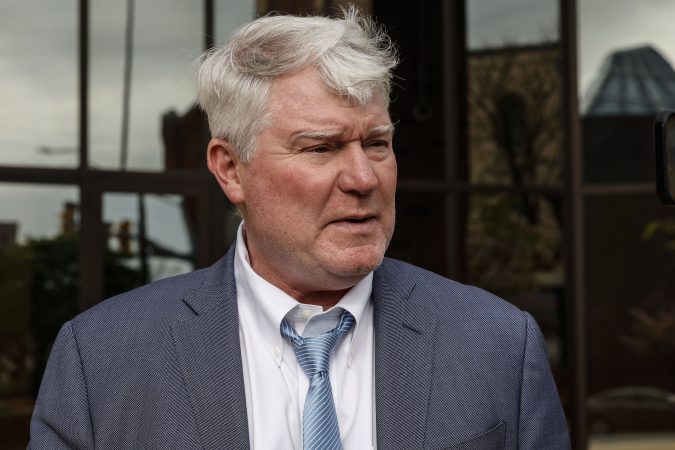
Convicted former Philadelphia labor leader John J. Dougherty has taken a variety of steps to try to cut his six-year prison term short, including by taking the witness stand this spring to tell a federal judge about the unique health challenges faced by his wife.
But one other avenue he pursued last year — an appeal to the White House for mercy — apparently hit a dead end.
President Donald Trump earlier this month denied Dougherty’s request for a commutation, according to the Office of the Pardon Attorney’s website, meaning Trump — at least for now — will not use his broad powers of clemency to clear the way for Dougherty’s early release.
Dougherty — who, nicknamed Johnny Doc, was once a singular power broker in the city’s Democratic Party — was one of about 5,600 people whose commutation applications were denied on July 10, according to the pardon attorney’s site. A commutation keeps a defendant’s conviction intact but ends or reduces their sentence.
Trump, a Republican, also denied about 300 applications for a pardon, a broader form of relief that is added to the record of the case and reverses any restrictions stemming from a conviction, such as limitations on voting or seeking public office. The New York Times first reported on the wave of denials this week.
Presidents have broad authority to issue pardons and commutations in federal cases, and Trump has shown a willingness to grant them to political allies during his second term in office.
One of his first actions after being sworn in again last year was to issue pardons to nearly every person charged with participating in the riot at the U.S. Capitol on Jan. 6, 2021. Trump has also bestowed clemency on political figures convicted of corruption and those he maintains were “persecuted” by the Justice Department under former President Joe Biden.
Dougherty’s attorney, George Bochetto, said Tuesday that he was not involved in the effort to petition for a commutation and did not know about it. It was not immediately clear if Dougherty submitted an application himself or if he had another associate help with its preparation.
The pardon attorney’s website made basic information about Dougherty’s application available through its case search system, showing Dougherty’s name and his Bureau of Prisons register number and saying his application was filed last year.
Bochetto has been overseeing a different relief effort: Dougherty’s attempt to have a judge grant him compassionate release.
In court documents and in testimony before U.S. District Judge Jeffrey L. Schmehl, Dougherty has been saying for months that his wife, Cecilia — who has long suffered from a debilitating brain injury — has seen her condition worsen while he has been imprisoned. Dougherty has asked to serve the rest of his sentence on house arrest in order to oversee her care, saying if he is not allowed to do so, his wife will likely die.
Schmehl denied that request earlier this year, but has been reconsidering after Bochetto appealed.
If the summer of 2026 came with an Official Cliché™, it would have to be “glass half empty, half full.” Things could be better. Things could be worse. It’s people — many of whom are quite wonderful — doing our best in a world run by institutions that are rotten to the core. You’ll find no greater example than the World Cup that wrapped up Sunday with a well-deserved trophy for Spain. Will we remember the gross commercialism and rank corruption perpetuated by FIFA and its political twin, Donald Trump? Or the many remarkable moments on the pitch, and the joyous sense of internationalism in the stands and beyond? How do we get to a place where elite greed is crushed while mere mortals like us thrive?
U.S politics becomes a farcical unreality show. How worried should we be?
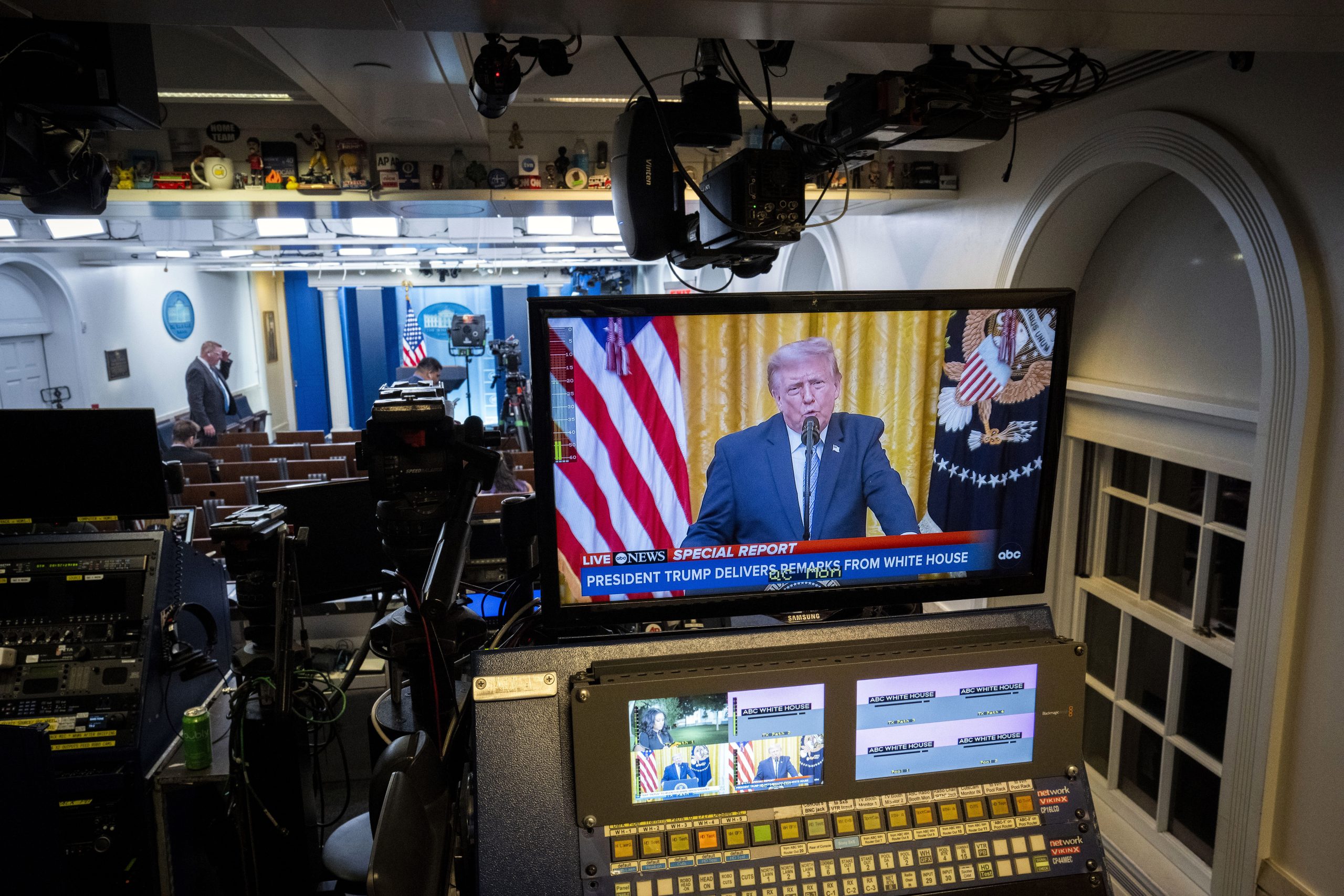
Video monitors in the White House briefing room in Washington carry a live feed of President Donald Trump as he addresses the nation on July, 16.DOUG MILLS
If you live inor near a big city and use mass transit to get around, you know this experience. You hop on a subway or a bus, focused only on getting from point A to point B, but there’s a man just a few feet away who demands your attention. He is talking loudly, repeating the same gibberish phrase over and over, seemingly arguing with someone until you realize he’s not even holding a phone. It’s just him. You feel a mix of emotions — sorry for the guy because clearly he’s going through something, yet mainly praying he will just stop yelling and give you some peace.
Trump commandeered 26 minutes of invaluable TV prime time (CBS and MS Now ran all or most of it; NBC, ABC, and even CNN declined) for a speech that arguably may be remembered as one of the most consequential ever delivered from the White House — but only for the Big Lie constructed on a foundation of half-truths.
Despite days of hype, which was sensibly ignored by most folks who know better after a decade of Trump’s political dishonesty, there was zero new evidence that China or any other foreign power consequentially interfered in the 2020 presidential election Trump lost fairly and squarely to Joe Biden. POTUS instead offered gross exaggerations around old reports that would have made the late red-baiter Joe McCarthy blush, with bizarre allegations about the CIA and other intel agencies while he was in charge of them in 2020.
There was a huge problem, however, with the president’s scare tactics: No one was scared. It’s not just that many among the 61% or so of Americans who disapprove of Trump’s job performance had expected the Thursday night monologue would include even worse lies or fabrications, or stronger threats — instead of a leader who was not just incoherent but weak.
But even the Republican politicians and right-wing opinion makers who were a main target of the White House address looked the other way in the immediate aftermath. We were all the mortified passengers on the same subway car, hoping the noise would just end.
Fox News host Sean Hannity, Trump’s longtime friend, was on the air when the speech ended and fairly quickly changed the topic, so eager to avoid the stench. Even worse, the president’s favorite show, Fox & Friends, which aired early the next morning, did not mention the address once in the three hours it was on.
I’ve lived through the 1980 men’s hockey gold medal and Watergate, the Iraq War and the legalization of gay marriage — so I know how it feels to be proud to be an American, and to be furious with our government. But I’ve never felt the sense of utter embarrassment that was the national mood at 9:30 p.m. last Thursday. The president gave a prime-time address that was complete fiction. Who will ever again take the United States seriously on a world stage?
But there was also a dangerous flip side to America’s week of magical thinking. In delivering a speech about election integrity problems that don’t exist, there was also a pack of wild dogs that did not bark Thursday night. For one thing, Trump barely mentioned his unilateral decision to resume and escalate the war in Iran, even as three more U.S. troops would be dead by week’s end, and everyday Americans once again felt the pain of gas prices over $4 a gallon.
But Trump and his GOP allies were determined to ignore, deflect, or flat-out lie about the crisis that was literally right in their faces: the smoke from northern wildfires, mostly in rural, remote Canada, that shrouded huge swaths of the Midwest and Northeast in thick, wood-smelling smoke and led to orders for people to remain indoors.
Wildfires may be as old as the trees, but there’s only one reason why smoke from Canada has caused two major health emergencies in the United States since 2023, and that reason is climate change. Consistently warmer summers — even more extreme in northern Canada than elsewhere — have led to drought conditions that fuel these blazes. “The best way to solve it is to just stop burning fossil fuels,“ Jonathan Overpeck, a climate scientist and dean at the University of Michigan, told the CBC.
But suffocating smoke from the northlands is a jolly big problem, which nobody can deny. And so a president who’s been utterly skewered by South Park decided to rap, “Blame Canada.” The world’s climate-denier-in-chief was shocked, shocked,that “the United States is being unnecessarily invaded by filthy, polluted, and unhealthy air, the quality of which is dangerous, and totally unacceptable!”
Filmmaker Jim Pattiz called this — wait for it — America’s “latest global embarrassment.” He wrote, “The whole planet is watching an American president shake his fist at the sky and order a sovereign country to get its clouds under control.”
There’s two ways to look at all of this. For now, Trump’s lame efforts to frame the looming midterm election as rigged are coming off as sad and pathetic, a lot more Charlie Chaplin in The Great Dictator than an actual führer. He lacks both evidence and judges who will rule in his favor, while his political base is shrinking every day.
For now, Trump will not be ignored, like Glenn Close flipping the lamp switch on and off in Fatal Attraction. Neither the mortification of Thursday’s speech nor the death of three soldiers in his Iran war of choice could keep the president from bullying his way onto the main stage at Sunday’s World Cup final in New Jersey, ignoring the boos to shoehorn his way into Spain’s victory photos as if he had assisted on the winning goal.
Can a world superpower die from embarrassment? We are finding out in real time.
Yo, do this!
Blame — or thank — the Major League Baseball schedulers who seem determined to stop the Phillies from playing on Friday nights, but the baseball blackout forced me to go on Netflix and realize it has added an awesome documentary that came out in 2019 but is needed now more than ever: Raise Hell: The Life and Times of Molly Ivins. The film shows how the outspoken and relentlessly funny Texas journalist rebelled as a student in the 1960s against the hypocrisies of her privileged upbringing and never looked back until she was taken from us, way too young, in 2007. Every up-and-coming young journalist needs to watch this and discover a role model for life.
After that commercial that ran incessantly during the World Cup, the lyrical phrase “What the world needs now …” has been stuck in my head for weeks. Well, what the world needs now, with rising authoritarianism and ruthless capitalism, isn’t only love, sweet love, but also courage. What remarkable timing for Julia Angwin and Ami Fields-Meyer’s new book, On Courage: How to Be a Dissident in an Age of Fear. The authors tell the story of more than 100 dissidents all over the globe, from Hong Kong to Venezuela, to learn how everyday folks can find the gumption to resist oppression. It’s a must-read for Donald Trump’s America, and it is next on my list.
Ask me anything
Question: Why is [Donald Trump] being allowed to randomly declare tariffs on Canada again if the Supreme Court said that it was illegal? Do we have to have the same argument over and over again? — Stephanie King (@stephstephking.bsky.social) via Bluesky
Answer: Apparently we do. Section 338 of the 1930 Trade Act — known, notoriously, to history geeks as the Smoot-Hawley Act that only exacerbated the Great Depression — gives the president fairly broad powers to impose retaliatory tariffs if his administration concludes that a foreign country is discriminating against U.S. products. Thanks to the international trade war that Trump himself initiated, the president is now claiming Canada is punishing American autos, alcohol, and dairy products. It feels like the proposed 50% levy on many Canadian products is less about sound economics and more about a) answering GOP calls to blame Canada for the wildfires that are actually the result of climate change, and b) trying to change the subject from a disastrous week. They don’t take effect for 30 days, plenty of time for the next TACO (Trump Always Chickens Out) Tuesday.
What you’re saying about …
Last week’s question about how to respond to Trump’s Big Lie about election fraud that we all knew was coming in Thursday’s speech was probably, in hindsight, too wonky to generate much response. Those who did write agreed that a heavy burden falls on the news media to do everything to debunk — or, as longtime reader Rosalind Holtzman put it, “pre-bunk” — the president’s many falsehoods. She added: “Americans have the attention span of mayflies and need review and repetition. Revisit the events of the 2020 elections and how Trump’s claims all failed in court.” I couldn’t agree more.
📮 This week’s question: Optimists are already starting to ponder a world where Donald Trump is no longer president. But where would a Democratic successor even start to undo the damage caused by the many destructive policies of the Trump regime? What should be the Day One measures to start rebuilding U.S. democracy? Please email me your answer and put the exact phrase “Dems Day One agenda” in the subject line.
Backstory on Trump’s campaign cash and ‘explosive diarrhea’
Federal health officials have linked a large cyclosporiasis outbreak to shredded lettuce served at Taco Bell. Is lettuce from grocery stores and restaurants OK to eat?NICOLE BENGIVENO
Before last week, most Americans had never heard of Taylor Farms, a California-based produce firm, and, for a company that supplies lettuce to large U.S. restaurant chains, anonymity was arguably good for business. There are no two words in the English language that can raise awareness of a brand — and destroy it — faster than “explosive diarrhea.” That’s the most alarming symptom from a foodborne illness linked to the parasite cyclospora that’s laid low thousands of Americans in multiple states. Since the early days of the outbreak, suspicion has focused on Taylor Farms after Taco Bell stores stopped using the iceberg lettuce it procures from the company. But the Food and Drug Administration (FDA) probe into the cause has so far been a mess — much of that the result of steep cuts to food safety by the Trump regime. But there are also ethical concerns.
Follow the money.
Regular folks might not have heard of Taylor Farms, but the world’s largest salad processor has made itself known in the corridors of the Trump regime since March 2025. That was right around the time the FDA surprised industry observers by postponing its Food Traceability Rule — drafted under the Biden administration to better track and remove contaminated products — for 30 months. Just six days after the industry-friendly move, Trump’s main political action committee, MAGA Inc., received a whopping $1 million donation from Taylor Farms.
What’s more, money buys access in Trump World. The Daily Beast has reported that last Thursday — despite the company’s nationwide lettuce recall — Taylor Farms executives met with White House and FDA officials and complained about the way the government has been investigating the outbreak. That meeting was followed by a bizarre weekend in which the FDA initially announced that testing of Taylor Farms produce from central Mexico had tested positive for cyclospora, then told the company one day later the result had been a “false positive.” The chaos means ongoing confusion about why so many Americans are getting sick, and whether it’s safe to eat lettuce. And that raises troubling questions about whether political cash has compromised food safety.
This was hardly the first time donations to Trump’s massive empire of political wealth — money raised for a man who is constitutionally barred from running for the presidency again — have overlapped with key policy decisions. For example, the New York Times reported this spring that tobacco company Reynolds American donated $5 million to MAGA Inc. just one week before an industry-friendly FDA ruling on e-cigarettes.
MAGA Inc. — just one of several ways billionaires and corporations can funnel money to Trump World, along with projects like his presidential library — had more than $400 million in the bank at the end of June, an astronomical sum. Its donors have included not only a who’s who of American industry, but also crypto dudes — whose industry has been largely deregulated under Trump — and wealthy pardon seekers. Some of those dollars will go to GOP candidates in November’s midterms, but what happens to most of this cash is a mystery. Trump may be leaving office on Jan. 20, 2029, but we’ll still be following the money for years to come.
What I wrote on this date in 2019
Trump’s second term has been so dangerous for democracy that we tend to forget the horrors of his first four years in the White House. On this date seven years ago, I joined a lot of other folks in shock and dismay over the raw racism of the 45th president’s campaign-style rally in South Carolina, where a diatribe against Rep. Ilhan Omar, a Somali refugee who became a U.S. citizen and represents a Minnesota district, sparked a frenzied chant: “Send her back!” I wrote about the tween girl in the crowd directly behind Trump, who looked around and joined the adults. “In front of national TV cameras, with the 45th president of the United States as maestro, we are witnessing the exact moment that the raging rabble of a Donald Trump rally has taught a child how to hate.”
No columns from me this past week as I spent time with family up and down the Eastern Seaboard, but my Inquirer colleagues have been hard at work. It turns out that the Philadelphia metro area has been ground zero for the latest bizarre business scheme that’s hopelessly intertwined with the Trump regime: a pop-up scheme of at least 25 gas stations rebranded as Trump-aligned Freedom Fuel that — at least for a week or two — were selling gasoline at much lower prices than their nearby rivals. The Inquirer has been all over this weird local story with national implications, and with more questions than answers. Where does this cheap gas come from? Who’s really behind the Freedom Fuel stations? On Tuesday, The Inquirer’s Ximena Conde and Rob Tornoe started to unravel the somewhat dubious past (surprise, surprise) of some of the folks connected to the gas stations, and how suddenly prices at Freedom Fuel aren’t as cheap as they used to be. I suspect the final chapters of this saga are going to be a doozy. The only way to stay on top of local news and support the in-depth journalism we do here is to become an Inquirer subscriber. Join us. It’s a gas.
By submitting your written, visual, and/or audio contributions, you agree to The Inquirer’s Terms of Use, including the grant of rights in Section 10.
MIAMI — The Trump administration is reviving a rule that could deny green cards to immigrants who use public benefits that could include food stamps, Medicaid, and housing vouchers.
The policy, known as “public charge,” appeared on Thursday in the Federal Register. It will be formally published on July 20 and take effect Sept. 18. Under the policy, applicants for green cards have to show they wouldn’t be burdens to the country or “public charges.”
The policy was first implemented in February 2020 as one of President Donald Trump’s moves to limit legal immigration during his first administration, but it was reversed after Democratic President Joe Biden came to power.
Its return comes when the Republican administration is implementing a hard-line policy to curb both illegal and legal immigration, and when the cost of healthcare and food is rising.
The federal government “is reaffirming the requirement of self-reliance, protecting public resources and ending policies that encouraged dependency on the backs of hard-working American taxpayers,” U.S. Citizenship and Immigration Services said in a post published on its X account.
“Under President Trump, USCIS is restoring the basic principle that immigrants must be able to support themselves,” the post said.
While the administration’s crackdown on immigration has an increased focus on deportations and immigration enforcement in cities across the country and at borders and entry points, it has also taken actions that target legal immigrants and mixed-status families, in which the parents are foreign nationals with U.S.-born children.
The rule expands disqualification options
Federal law already requires those seeking permanent residency or legal status to demonstrate that they will not become a public charge. The Trump administration’s rule, however, broadens the grounds for disqualification.
The new rule does not describe or specify by name the benefits and programs that could be considered a public charge. Instead, it says that officers who would implement the policy will make “individualized, fact-specific public charge inadmissible determinations, based on a totality of the alien’s circumstances.”
It says that, “using good judgment and discretion, officers will more accurately assess an alien’s likelihood at any time of becoming a public charge.”
The Trump administration first promoted the rule in 2018 as a way to ensure that only those who were self-sufficient came to the U.S. Immigrant rights advocates criticized it, saying it amounted to a “wealth test.” Public health experts said it would lead to worse health outcomes.
Manatt Health, a group that provides advice to state and federal governments, estimated the policy would have deterred as many as 26 million people from seeking healthcare, food, housing, or other aid through programs for which they qualified under federal law. About half were U.S. citizens, mostly children or adults living in a mixed-status family, according to the group.
Experts also noted that most people who receive benefits from the government are already legal residents.
A 2020 study from the Migration Policy Institute said that while the “chilling effects” may be vast, the number of immigrants who could be deemed ineligible for legal permanent residence based on use of one of the public benefits under the rule was small.
The institute estimated that no more than 167,000 people — less than 1% of the 22.1 million noncitizens residing in the United States at that time — could be determined ineligible for a green card based on their current use of a listed benefit.
There were 22.8 million noncitizens living in the U.S. in 2023, according to the Census Bureau.
Critics say the rule creates fear in the community
Nongovernmental organizations said the policy generated confusion and fear and caused many immigrants and their U.S.-born relatives to decide not to apply for benefits and services to which they were entitled.
Immigrant advocates condemned the government’s decision to revive the “public charge” rule and expressed concern.
“This regulation is a direct assault on immigrant families, and a threat to our country’s health and economic security,” said Adriana Cadena, executive director at the Protecting Immigrant Families Coalition. “The Trump administration is basing immigration decisions on bias and politics, regardless of the resulting harm.”
Sarah Krieger, senior policy counsel at the National Immigration Law Center, said the rule would make immigrants afraid to go to the doctor, buy food at the grocery store and file taxes.
“With this new rule, they are sowing fear and chaos to ultimately reshape America into a country where only the few who are white and ultra-wealthy are welcome,” Krieger said. “The rule is not just deeply harmful, it also violates the law.”
A former Bucks County man who voted twice for President Donald Trump in the 2020 election was sentenced Wednesday to six months of house arrest and three years of probation.
Matthew Laiss was found guilty by a jury earlier this year of casting two ballots in the 2020 election: first by mail in Pennsylvania, where he had once lived in Ottsville, and then again in person in Florida, where he was living at the time.
Laiss, 32, said in court Wednesday that his actions were “stupid” and a mistake. And his lawyer said that Laiss never meant for both votes to actually count — that he had wrongfully assumed election officials would identify he had voted twice and only count one of his ballots.
“In hindsight, it wasn’t good judgment,” Laiss said.
Prosecutors, however, said they did not believe that, in part because they said Laiss misled FBI agents about his actions when he was confronted years later. And Assistant U.S. Attorney Mark Dubnoff said Laiss had shown a “striking” lack of remorse for what he did, repeatedly saying it was the result of his age or mental health at the time, as opposed to realizing he had committed a crime.
“Mr. Laiss has not accepted ownership of what he did,” Dubnoff said.
U.S. District Judge Joseph F. Leeson Jr. said Laiss’ crimes were serious and had affected “all citizens of this country.”
But he declined to send Laiss to prison, noting that Laiss had already lost his job as an insurance salesman as a result of the case, and that he would have the felony conviction on his record for the rest of his life.
The U.S. Attorney’s Office charged Laiss last year with crimes including voter fraud and voting more than once in a federal election.
Prosecutors said records showed that Laiss had filled out and returned a mail-in Pennsylvania ballot in October 2020. And less than a week later, they said, he went to a polling place in Florida and voted again.
Laiss later said in court documents that he voted twice for Trump. And as his case progressed toward trial, he sought to claim that his actions were covered by pardons Trump extended to people who tried to help him overturn the results of the 2020 election, which Joe Biden won.
Prosecutors announced Laiss’ case alongside the indictment of a Philadelphia woman, Miya Pack, who was separately charged with voting twice in the 2020 election. She pleaded guilty last month and is awaiting sentencing.
Still, attorneys said cases involving people casting multiple ballots were relatively rare in eastern Pennsylvania. Laiss’ lawyer said the only other comparable case in the region that unfolded in recent years was that of Philip C. Pulley, a Philadelphia landlord who voted in the city, Montgomery County, and Florida in 2020 and 2022. He was also sentenced to probation.
Trump has nonetheless made frequently questionable or false statements about the prevalence of voter fraud, particularly in instances where his opponents or Democrats have won. Election officials and experts generally agree that voter fraud has not historically occurred at widespread rates or in ways that could lead to incorrect outcomes.
A journalistic mentor of mine back in the 1980s told me that Harry Truman, pressed for a comment on the passing of a political enemy, finally said, “It’s a damn shame when anybody dies.” Of course, like most perfect quotes, HST probably never actually said this, yet I find occasion to think of these words often. On Saturday night, South Carolina GOP Sen. Lindsey Graham — whose moral compass went haywire in the 2010s when a brief moment of truth–telling about Donald Trump melted into embarrassing capitulation — died suddenly from heart problems. He was just 71. It’s a damn shame.
Dems need to give up on fake blue-collar campaigns like Platner’s
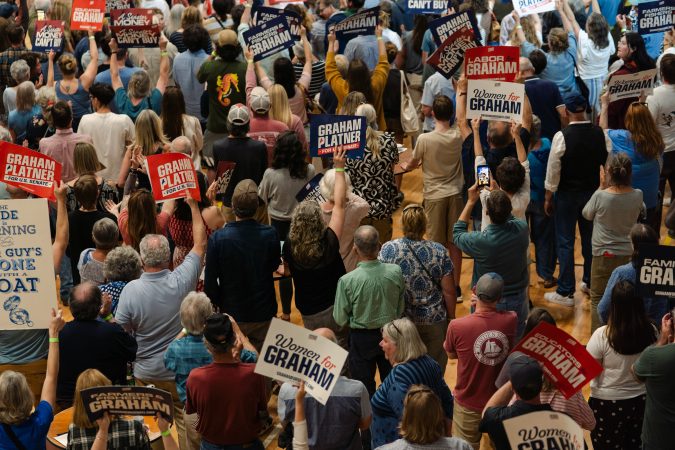
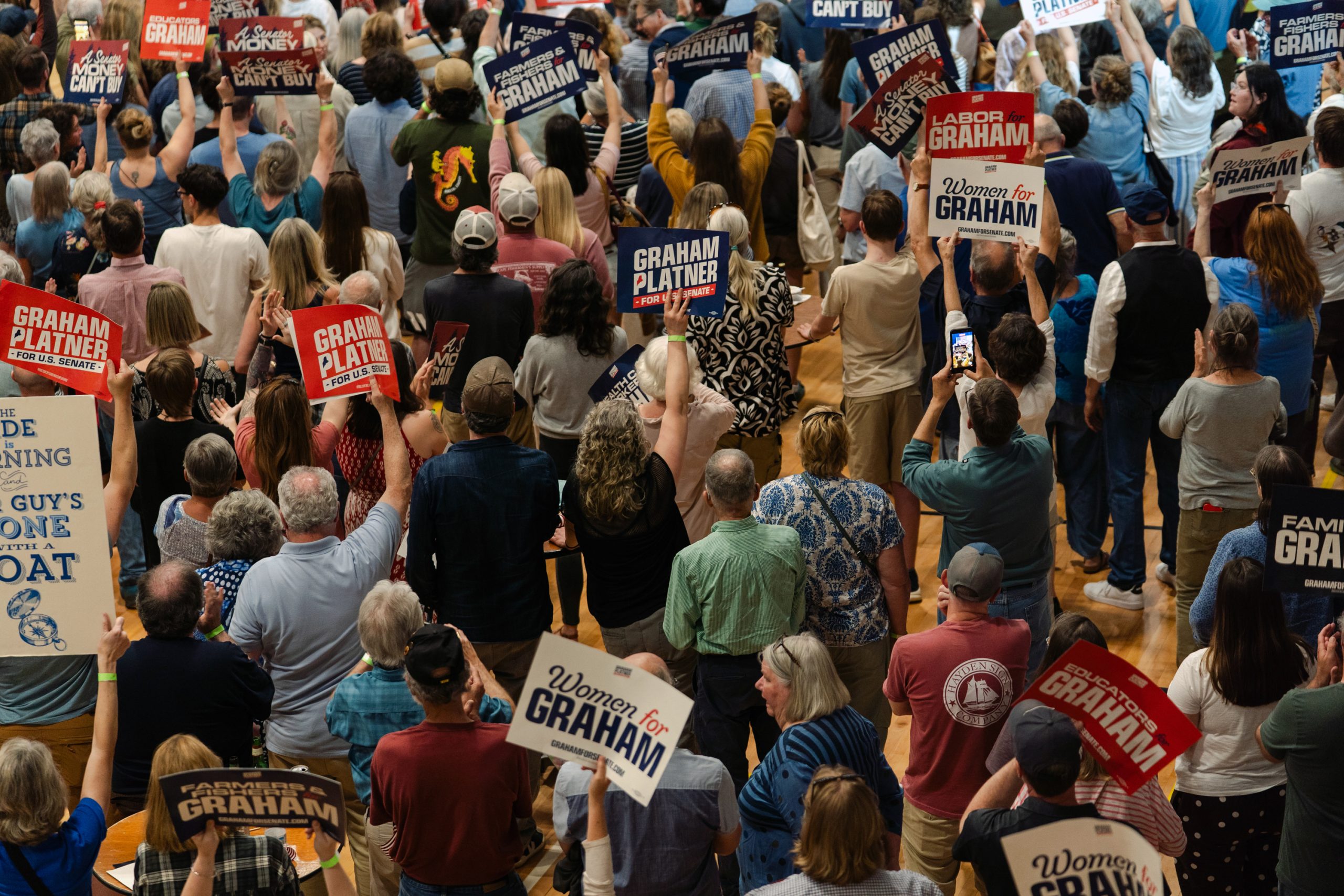
Supporters cheer for Graham Platner in Blue Hill, Maine, after he won the Democratic Senate primary on June 9. Platner’s bid for the Senate inspired progressive Democrats. But the campaign, which he suspended July 8, was messy, disorganized and ultimately doomed by a steady drip of scandal. SOPHIE PARK
Graham Platner, the failed Maine Democratic Senate candidate, was introduced to most of us outside of the Pine Tree State less as a human being than as a fully formed narrative.
The ruggedredhead with angry eyes was an ex-Marine from the Iraq and Afghanistan wars who became an oyster farmer and then a political outsider with all the right words for an electorate that’s mad as hell and isn’t going to take it anymore.
We now know that Platner’s origin story — compelling, but larded with omissions and sprinkled with lies — belonged on the fiction shelf. But even after the Democrats’ scandal-scarred June primary winner accepted the inevitable and ended his candidacy on Friday, he lives on as an avatar upon which everyone with a stake in a badly broken Democratic party can project their distrust and rage toward others — folks who ought to be their allies in an all-out war against fascism.
Days later, the Platner discourse is almost as toxic as the candidate himself. People who voice their opinions, even in 280 characters on social media, get called everything from sexist Bernie-bro rape apologists to Quislings who want big corporations to keep running the Democrats into the ground, and all the rest in between. Don’t even mention Israel. In fact, don’t @ me after this is posted.
Having said all that, there is a conversation that must be had by the Democrats, and probably a wider circle. And the disappearance of Platner himself from the picture makes that easier, because I think we can all stipulate that as a human being he was clearly not worthy to be a U.S. senator, even in the Senate’s current morally diminished state.
There is another Graham Platner somewhere on Earth 2 who also suffered PTSD and developed a drinking problem fighting in pointless wars, and who also got a Nazi tattoo and posted wretched stuff on Reddit, but turned his life around in a glorious redemption song. But that’s not the Platner we got on here on Earth 1. Instead of an apology, he was weirdly defensive about his past, because — we now know — he was hiding stuff that was even worse than that.
Although Platner has denied the most serious charge of a sexual assault, there should be zero tolerance in the Democratic Party for the type of sexual misconduct that’s been confirmed, let alone what’s been additionally alleged. That’s not just the only proper moral stance, but it sets Dems apart from a twisted GOP that nominated Trump three times. Platner’s disappearance is a blessing to everyone.
But even with that matter resolved, we still haven’t answered the bigger question that I posed the only other time I wrote about Platner back in the spring: Why did a majority of Maine Democrats — roughly 150,000 voters — ignore the party establishment to back this guy?
But first Democrats — and just about everyone, frankly — need to do a better job understanding not just the “why” of Platner supporters, but the “who.” Baked into the Platner myth was this notion that in running a gruff-sounding ex-Marine and oyster farmer, Democrats had found a key to regaining the long-lost white working class.
Two huge problems with this. First — and this will sound familiar here in Pennsylvania where shorts-and-hoodie-wearing Sen. John Fetterman grew up upper middle class before donning a blue collar — Platner comes from a fairly privileged background. He’s the son of a lawyer and upscale restaurant owner and grandson of a famous architect; he started high school at the super-elite Hotchkiss School.
Which brings us to the crux of the problem: the notion that Platner’s pre-implosion success was his ability to win back working-class voters in an overwhelmingly white state. Polls exposed this all as a lie. A late June survey from the New York Times/Portland Press Herald/Siena showed Platner losing white, non-college educated voters by a whopping 21% to the GOP incumbent Sen. Susan Collins. So what gave him a shot at winning? A massive 37% edge among college degree holders.
Look, we all know that it’s been the obsessive mantra of the political pundit class that Democrats will never fully win back America without restoring the working-class coalition that elected Franklin Roosevelt four times during the New Deal era. I hate to be a contrarian here, but what if that’s not true?
A society that over a half-century has once again made higher education an elite sport and now has a right-wing media and demagogues like Trump to heighten working-class grievances and blame the wrong people has created voters who — at least for now (hold this thought) — arguably aren’t worth chasing after.
The frayed alliance of progressives and liberals who comprise the core of the Democratic base do some dumb stuff — opposing new units that could lower housing costs, or “nice white parents” leading to de facto school segregation — that should stop.
An America that’s not inclusive and that isn’t fair when it comes to gross income inequality, not to mention who gets to see a doctor or send their kid to college, isn’t a cause worth fighting for. And there’s already a healthy number of working-class people — not the majority, not yet — who would agree with this.
Platner was a bad guy but he appealed to voters who wanted good things. Let’s not bemoan the fact that his movement was based on educated people. Let’s build on that. Instead of lowering our values to win elections, let’s play the long game to lift more people up to a better place.
It’s way past time for college-educated progressives and our allies to stop apologizing for the things we believe in. The current push to find a candidate who can replace Platner and fight for all the right stuff — without the personal baggage of their predecessor — is a great place to start. Maybe it’s even time to revive the old cliché: As Maine goes, so goes the nation.
Yo, do this!
Tuesday is the folk-music legend Woody Guthrie’s 114th birthday. I use the present tense because it very much feels like the singer who influenced living icons from Bob Dylan to Bruce Springsteen is still with us. Now, a friend, the pioneering rock journalist Greg Mitchell, has directed a new documentary about the musician, his political activism in the mid-20th century, and his lasting influence: Woody Guthrie and the Ghost of Tom Joad. It’s now streaming on PBS.org and will also be popping up on PBS stations this summer. You can — and should! — stream it here.
Monday night I read a remarkable piece of journalism that I feel compelled to share. Last week, a lot of America was talking about a photo from July 4 that showed a young Black woman on a D.C. Metro train surrounded by masked members of the white supremacist Patriot Front. There was so much commentary about what this woman must be feeling and thinking, and almost all of it — as shown by some remarkable reporting by former Inquirer journalist Ellie Silverman, writing for NOTUS — was wrong. The truth is heartbreaking.
Ask me anything
Question: Why do we not know what’s going on with (ailing Kentucky Sen. Mitch) McConnell? What is the Republican endgame? What’s the benefit to prolonging the process of determining a replacement? What is that process (seems to be in dispute)?
Answer: We know a little more now than we did when I addressed this issue last week. His staff on Sunday released a brief statement and what is being called a “proof of life photo” — with that morning’s Washington Post sports page visible in the shot — seeking to explain McConnell’s month-long hospitalization and hoped-for return to the Senate. There were, of course, immediate conspiracy theories that the photo was artificial intelligence, but there’s no compelling evidence of that. The biggest mystery is, why doesn’t the 84-year-old McConnell just quit, with only about six months left until he leaves office in January? Kentucky has changed its Senate replacement law a couple of times, mainly because GOP lawmakers don’t want Democratic Gov. Andy Beshear making the pick. The new law requires a special election, but there probably will not be one if McConnell stays in office through Aug. 3. Republicans seem desperate to avoid the special election, and I’m not sure why, since McConnell surely isn’t helping advance the Trump agenda from his hospital bed.
What you’re saying about…
You really didn’t think I could go a whole newsletter without mentioning soccer, did you? Last week’s question about Trump’s FIFA intervention and the reversal of the American Folarin Balogun’s red-card suspension drew a unanimous response: The president was wrong to get involved, and he seemed to create a negative vibe around the U.S. team before it got blown out of the World Cup by Belgium, 4-1. “To me, it appeared to be the wrong call, but the ref called it.” wrote ex-soccer mom Suzanne Urban Ryan. “We had to live with it. Trump getting involved was just really poor judgement based on his need to win a game that he is not even a player.” Added Jordan Lang: “I’m sure his corrupted meddling negatively affected the psychology of the U.S players.” Yup.
📮 This week’s question: Trump plans to address the nation in prime time Thursday with ginned-up information about his bogus and debunked claim that the 2020 election was stolen from him. He is laying the groundwork for November, and election interference on a scale to rival the Jim Crow South. How can Congress, the courts, the media, and everyday citizens respond to this dire threat before it spirals out of control? Please email me your answer and put the exact phrase “Trump election meddling” in the subject line.
Backstory on why ICE is killing immigrants, again
A vehicle with a damaged window is transported away from the scene of a shooting involving U.S. Immigration and Customs Enforcement, Monday in Biddeford, Maine. Robert F. Bukaty
The fight against police brutality against African Americans in the late 2010s found its rallying cry when New York City police choked and killed a street peddler named Eric Garner, whose last words were. “I can’t breathe!” Now, Monday’s latest fatal shooting by U.S. Immigration and Customs Enforcement agents that shattered the morning calm of Biddeford, Maine has produced a new mantra. As 26-year-old Joan Sebastian Guerrero lay dying on the pavement — shot in the head, then dragged from his car and handcuffed — a bystander heard him say in anguish: “I tried to stop.”
Moments earlier, the man, reported to be a Colombian national with a U.S. work permit, had left his home, possibly with his daughter, in a white Kia sedan, which was hemmed in by ICE agents in their vehicles. Although the Department of Homeland Security changed the wording of its statements over the course of the day, it ultimately reported that an ICE agent shot Guerrero because the driver attempted to flee and the officer was “fearing for public safety.” But ICE and DHS, whose officers have now shot and killed at least 11 people since Donald Trump returned to office, have repeatedly seen their versions unravel as more video and witnesses emerged. The two most recent attacks — Monday’s assault on Guerrero and last week’s Houston shooting of 52-year-old Mexican national Lorenzo Salgado Araujo — happened on working-class residential streets without clear videos of the shootings, and with ICE agents not wearing body cams.
Still, a pattern is starting to emerge as DHS and its new leader, the former Oklahoma senator Markwayne Mullin, put a flood of new, barely trained ICE recruits on the streets in attempt to make mass arrests of immigrants without the same level of hoopla and backlash that happened in cities like Minneapolis and Chicago under Mullin’s predecessor, Kristi Noem. In both the Houston and Biddeford shootings, ICE began the morning in what it claimed was a targeted operation seeking a specific immigrant with a removal order, only to try to arrest and ultimately kill men, in Salgado and Guerrero, who were not the supposed targets.
It’s quickly becoming clear that ICE’s new strategy is a recipe for disaster. Both Salgado and Guerrero, according to what we know from witness accounts, didn’t seem to know what exactly to do when their vehicles were surrounded by unmarked vans and yelling men. In both cases, ICE agents interpreted the predictable panic and chaos as aggression, and made a split-second decision to end a human life forever. It increasingly looks as if the federal agents — facing an impossibly ambitious goal from the Trump regime of arresting and deporting 1 million people a year — insist they have a name on a sheet of paper, when in reality they are racially profiling brown-skinned men driving to blue-collar jobs.
Like so many projects of our current government, the new ICE scheme is not only inhumane but also dumb and counterproductive. Mullin’s apparent new strategy was to meet the high arrest quotas sought by Trump and his immigration guru Stephen Miller without generating the kind of public protest and backlash that all but drove DHS out of Minnesota this winter. It’s not working. Even before Guerrero’s name was released, angry demonstrators took to the streets in Biddeford and stormed the office of the state’s GOP Sen. Susan Collins, who recently voted for a $70 billion cash infusion for immigration raids.
The tactics may have changed slightly, but the repulsive devaluation of human life has not. Mass deportation is a failure — strategically, politically, and morally.
What I wrote on this date in 2019
Some days my past writings read like Nostradamus, but more often than not they reveal how fleeting our political moments can be. On this date seven years ago, this columnist joined a lot of progressive voters in swooning over the early-stage presidential ambitions of Massachusetts Democratic Sen. Elizabeth Warren, who had just spoken at the left-wing convention Netroots Nation here in Philadelphia. “With her slam-dunk performance Saturday,” I wrote, “Elizabeth Warren became president … of the American progressive movement, anyway.” But Sen. Bernie Sanders had other ideas about that, and then Joe Biden and South Carolina voters came along with different ideas about Warren, Sanders, and control of the Democratic Party. Read the rest: “Netroots Nation was the day Elizabeth Warren became president of the American left.”
Recommended Inquirer reading
It was a full week for me, and for American outrage. First, I tackled the Houston ICE killing of 52-year-old Mexican national Lorenzo Salgado Araujo and the return of ambitious immigration raids to American cities. I noted that the new ICE strategy aimed to ramp up arrests without generating public outcry, and I urged readers not to go to sleep on mass deportation. Over the weekend, I wrote about the similarities between the Trump regime and the disastrous ancient reign of the Roman emperor Caligula. I detailed how Trump’s growing paranoia that he will be assassinated in office is causing new bloodshed in the Persian Gulf and inspiring fresh efforts to quash civil liberties here at home.
Kenesaw Mountain Landis must be spinning in his grave. He was the former federal judge who tried Chicago’s notorious “Black Sox” for throwing the 1919 World Series at the behest of New York gamblers, then became baseball commissioner to clean up the national pastime. For decades, Major League Baseball shunned even the slightest whiff of gambling connections that might taint the sport — but times have changed. My Inquirer colleague David Gambacorta — one of the best investigative reporters in the business — last week broke a remarkable story about how the lucrative betting site FanDuel egged on a local addicted gambler to keep playing until he lost some $1.5 million. Plot twist: FanDuel’s effort includedhaving Phillies slugger Bryce Harper send a personalized video to please the local bettor. It’s disturbing that a) Harper, with a 13-year $330 million contract, also feels the need to peddle $899 videos on Cameo and b) he has a relationship with people at a gambling website. But FanDuel is now “the official sports betting partner” of MLB — an appalling relationship that only encourages morally dubious behavior like the Harper video. The rank corruption of modern American society, including sports, is why we need investigative reporters like Gambacorta. You can read the next installments in this saga, and support his work, when you subscribe to The Inquirer.
By submitting your written, visual, and/or audio contributions, you agree to The Inquirer’s Terms of Use, including the grant of rights in Section 10.
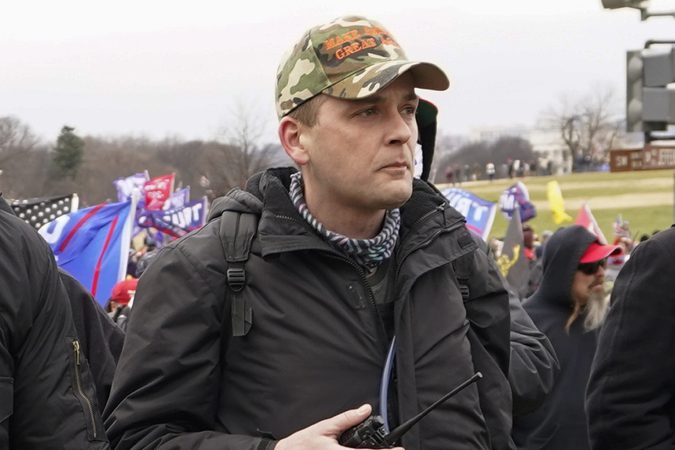
A federal judge has officially dismissed the seditious conspiracy case against former Philadelphia Proud Boys leader Zach Rehl, putting an end to a landmark prosecution that had at one point served as a leading example of the Justice Department’s effort to seek criminal consequences for people who attacked the U.S. Capitol on Jan. 6, 2021.
U.S. District Judge Timothy Kelly wrote in a memorandum Friday night that he effectively had no other choice but to dismiss the case against Rehl and his three codefendants, Proud Boys Ethan Nordean, Joseph Biggs, and Dominic Pezzola.
An appeals court earlier this year had already granted a Justice Department request to vacate the men’s convictions because prosecutors said they no longer believed in them, Kelly said.
And in 2025, President Donald Trump — the intended beneficiary of the Jan. 6 melee — also signed an executive order that prohibited prosecutors from continuing to pursue any cases against Jan. 6 defendants in court.
Against that backdrop, Kelly wrote, he had “no grounds” to rule that the case against Rehl and his codefendants remain open, and he granted the government’s request to dismiss all charges.
“President Trump’s views about the prosecution of those who attacked the U.S. Capitol on January 6 — whether those views are based on fact or fiction — are well known, as is his intention to extend clemency to them through the Executive Order,” Kelly wrote. “The Government’s request to dismiss this case is consistent with that general approach.”
Rehl celebrated the ruling on social media, writing: “Finally, it’s ALL OVER! January 6th can now be a thing of the past for me!”
Kelly’s ruling serves as the latest example of how Trump has consistently sought to rewrite the history of what occurred at the Capitol more than five years ago — and how he has attempted to use the levers of power since he returned to the White House last year to effectively undo any consequences for those who participated in it.
Rehl, of Port Richmond, was one of the most prominent figures from the attack. A jury in 2023 concluded that he and his codefendants had spearheaded a plan to try to block Congress’ certification of Joe Biden’s win in the 2020 presidential election by riling up a mob that went on to violently storm the Capitol.
The verdict served as one of the most significant examples of a sprawling Justice Department investigation. Prosecutors charged more than 1,500 people in connection with the attack, some of whom faced only misdemeanor trespassing offenses while others were accused of serious felonies, including assaulting police officers.
Rehl, his codefendants, and several other leaders of the Proud Boys and Oath Keepers were convicted of the rarely used sedition charge and cast as ringleaders. And when Rehl was sentenced to 15 years behind bars, prosecutors at the time said a lengthy sentence was warranted because he had “threatened the bedrock principles of our country.”
But in the years after the attack, Trump consistently downplayed the gravity of what happened that day, and he said the Justice Department’s investigation into it was politically motivated and corrupt.
Then, last year, just hours after he was sworn back into office to begin his second term, Trump issued blanket pardons to nearly everyone who was charged in connection with the riot. He also ordered the Justice Department to to drop and dismiss hundreds of other cases that were still pending.
Rehl was one of the few defendants who received a commutation instead of a pardon, meaning his prison sentence was cut short but his conviction remained intact.
But Kelly’s decision last week — made at the urging of Trump’s Justice Department — has now wiped out Rehl’s conviction as well, effectively clearing him of all criminal culpability from the episode.
Kelly — who was appointed by Trump during his first term — did not shy away from describing Jan. 6 in stark terms, writing in his memorandum that it was “a perilous event,” and an “attack” on people, police officers, Congress, and the peaceful transfer of power.
“Moving forward,” the judge wrote, “if this Nation’s experiment in self-government is to last another 250 years, the American people — no matter their partisan preferences — will have to act together to preserve, protect and defend that miracle through our constitutional framework.”
What amazes me about the fact that America turns 250 on Saturday is that I’ve been alive now for 27% of U.S. history. When I was 17 and watched the Bicentennial parade of tall ships down the Hudson River from my dad’s conveniently located Manhattan skyscraper office on July 4, 1976, I thought I was celebrating ancient history. I was wrong. In a big, diverse world, the United States remains a young adult among nations. Like most young adults, we have a lot of issues.
Trump thinks anything besides stealing the election is ‘a big yawn’
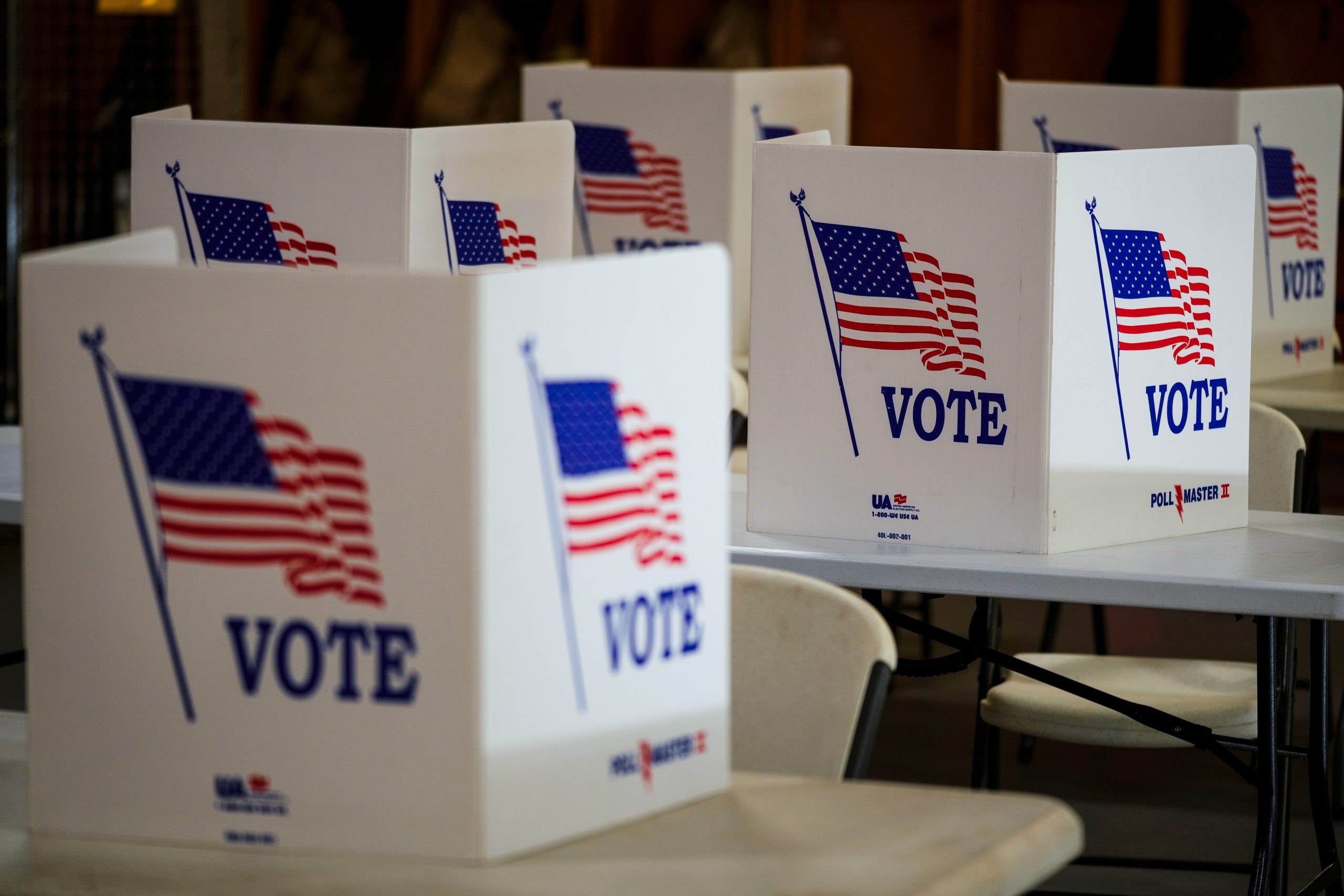
Voting booths are set up at a polling place in Newtown in 2024.Matt Rourke
Donald Trump gets a lot of flak, and deservedly so, for telling so many lies. On Monday, he held an Oval Office press availability, and much of what he said — false claims that other nations don’t have birthright citizenship or mail-in voting — was flat-out untrue.
But nothing is scarier than when the 47th president speaks the truth about what’s really on his mind. Because the only thing that’s in Trump’s brain right now is stealing the November midterm election by changing the rules in his favor … or worse. If Trump’s vocal cords were not so weak and diminished, he’d have been screaming the quiet part out loud.
“Here’s what I would like to say,” Trump said of the still-unsigned housing bill, which passed in the House by a 396-13 vote. “It’s a yawn. Some people say it’s wonderful. To me, compared to the SAVE America Act, just about everything is a big yawn.”
In quainter times, Trump’s disrespect for the housing bill — a grab bag of measures all geared toward encouraging contractors to build more units, which would lower both purchase prices and rents — might be the political gaffe of the year. Currently, only 29% of Americans think it’s a good time to buy a house, and nearly two-thirds are more likely to vote for a Congress member who helped lower prices. Republicans who voted for the bill are desperate for a win.
Trump doesn’t care. He’s forgotten his “forgotten Americans” who think the rent is too damn high, not to mention the GOP members of Congress who’ve followed him off the cliff. But that’s not even close to the most alarming thing about Trump’s Oval Office moment of truth.
The president says the only thing he cares about — even with his conflict in Iran becoming another “forever war,” and with the economy down the toilet for everyone who’s not a tech trillionaire — is a bill that critics say would be a disaster for free and fair U.S. elections. One report found that some 12 million people who fairly and successfully voted in the 2020 presidential election don’t have the documentation — such as a birth certificate or passport — that the bill requires.
We don’t know how such a massive drop in turnout would change the election results, or whether a weakened Trump can pressure theGOP to find a way to pass a bill with zero Democratic support. But we do know this: The president’s maneuvers are not even the worst thing Trump has done this month on the steal-this-election front. Not by a long shot.
The Trump regime has been signaling for months that it sees the U.S. intelligence community — spy agencies like the CIA — not as a tool for finding out what comes next in the Persian Gulf, or if or when China is invading Taiwan, or when Vladimir Putin’s Russian empire will fall. No, Trump wants secret agents who can creatively invent theories of foreign-born election fraud that would demand a strongman response.
We saw this coming back in January, when the regime dispatched Trump 47’s first director of national intelligence, Tulsi Gabbard, to Fulton County, Ga., to oversee an FBI raid of voting materials from the 2020 election that Trump, with no evidence, continues to dispute. That link made it clear the regime is looking to create links to foreign actors.
When Gabbard left the administration this spring, Trump named a temporary replacement who can serve through the November election: Bill Pulte, who also continues to lead the Federal Housing Finance Agency. Pulte lacks a key prerequisite for his new job — any experience in intelligence whatsoever — but has the only quality that matters to Trump: undying loyalty. Pulte’s main focus in the housing job has been combing through the mortgage records of the president’s political enemies, looking for undotted i’s and uncrossed t’s that could be used to manufacture criminal charges from nothing.
In just a few days at intelligence, Pulte has not disappointed his boss. He showed up Monday and immediately began firing current staffers, with a rumored list of hundreds. The steep reduction in eyeballs on the world’s trouble spots is disturbing, but what’s even more alarming is the one person Pulte has hired.
The newsletter SpyTalk described Pulte’s new chief of staff, Christina Norton, as “a party-loving MAGA activist with no background in national security issues but who last year boasted of running ‘the largest election integrity operation the Republican Party has ever seen’ …”
The pairing of Pulte and Norton is an alarm bell that the national intelligence team under Trump will have one job: investigating fantastical “foreign election plots” that will be cited to justify radical measures like sending troops to polling places, seizing voting machines, or worse.
SpyTalk noted that Norton, in her active Instagram feed, “talks about supervising more than 200,000 Republican poll watchers ‘standing guard’ at polling booths and vote-counting stations across the country” during her 2024 stint at the Republican National Committee.
Yet, intelligence is just one of many tools in the federal government that the obsessive Trump is working to activate ahead of a November election that polls suggest will be a “blue wave” for Democrats hoping to retake Capitol Hill. Trump has issued several executive orders seeking to assert federal control over voting, which has been a state and local function throughout 250 years of American history.
That effort suffered a bit of a setback Monday, when the U.S. Supreme Court ruled that states can continue to count mail-in ballots that are postmarked before Election Day but arrive after the polls have closed. But that will not stop the Trump regime from politicizing the U.S. Postal Service ahead of November.
Last week, Postmaster General David Steiner told Congress that USPS plans not to deliver mail-in ballots in states that don’t turn their voter rolls over to the Trump regime, a demand many governors have resisted so far. “President Trump does not believe that elections he loses are valid,” Democratic Michigan Sen. Elisa Slotkin said after the hearing. “It’s all part of his authoritarian playbook.”
This all feels very familiar. In the lame-duck days after Trump’s 2020 election loss to Joe Biden, the 45th president — instead of packing up to return to Mar-a-Lago — got busy putting in a new team at the Pentagon, ordering the U.S. Department of Justice to probe alleged voter fraud, challenging vote count certifications in court, and urging state lawmakers to seat rival slates of electors. Most pundits laughed this off, but I wrote a column — “So, is President Trump staging a coup, or what?” — that ran on Nov. 10, 2020, nearly two months before the actual attempted coup on Jan. 6, 2021.
Now Trump is not only staging another coup, but he is yelling about it, in your face. There is nothing he won’t try over the next five months to prevent a Democratic Congress from investigating how he and his family have made billions of dollars off the American presidency.
When Trump says anything that’s not election meddling is a “big yawn,” this should be our wake-up call. The time for a full-court press — lawsuits, public hearings, and investigative journalism — can’t wait until after the election. The new putsch has already begun.
Yo, do this!
If you didn’t think I raced to download the new audiobook of Zayd Ayers Dohrn’s tale of growing up in the radical Weather Underground in the 1970s and ’80s — Dangerous, Dirty, Violent, and Young: A Fugitive Family in the Revolutionary Underground — then you must be new around these parts. Dohrn had already used his unique access to his parents — Bernardine Dohrn and Bill Ayers, revolutionary royalty — and their friends to tell a history of that era’s far left in 2022’s award-winning podcast, Mother Country Radicals. His new book aims to go deeper into the psychology of what it was like to be raised as a toddler on the run from the FBI, or whether bombings and bank robberies can change the world. That’s a question — also explored in this viral essay — with new resonance in the Trump era.
A few weeks ago, I suggested that folks see the new movie The Sheep Detectives. The film is already streaming on Amazon Prime (which produced it), and Sunday’s rare night off for the World Cup offered the excuse to finally watch. I can now highly recommend it. The movie — with an adapted script by the acclaimed showrunner of HBO’s Chernobyl, Craig Mazin — manages to merge police procedural cliches with moving thoughts about prejudice, existentialism, and what it means to belong to a flock. Even a flock of talking sheep.
Ask me anything
Question: Is Markwayne [Mullin, the Homeland Security secretary and former Oklahoma senator] the least qualified cabinet level official in American history? — Richard McGovern (@richardmcgovern.bsky.social) via Bluesky
Answer: Good question from Richard, a fellow long-suffering Philadelphia Union fan. Not because I know the answer, when there are rivals for the title like Donald Trump’s war-losing “Secretary of War” Pete Hegseth, to name just one. But Mullin is now behind a move so outlandish that it showed me I haven’t lost my capacity for shock after all. This weekend, Trump nominated a previously unknown former Oklahoma state trooper named Lance Schroyer to run U.S. Immigration and Customs Enforcement, a powerful agency with 22,000 agents and a budget of around $30 billion a year. It turns out that just recently, Schroyer was heading a security detail for Mullin in Washington, D.C., and has become a close enough friend that he is an occasional dinner guest. Yes, he hired his bodyguard to run the equivalent of a large corporation. Stay tuned for all of this to unravel.
What you’re saying about …
I guess we’re not as close as we thought, as very few of you were eager to share your July Fourth plans with me or discuss what America’s 250th birthday means at such a dark moment. The ones who did reply are looking forward to spending time with family and friends, but all that patriotic jazz, not so much. “Probably, we will have our usual picnic and take the grandkids to see the local fireworks, but I have no intention to watch any special programming or parades, etc.” Marianne Zollers wrote. “It will just make me sad. Such a different feeling compared with the Bicentennial which was such a joyous and happy occasion for my entire family.”
📮 This week’s question: One of the big stories of 2026 that’s finally getting a lot of attention is the success of more progressive Democrats, including democratic socialists, in key primary races against party moderates. Is this a good thing, lifting up candidates who’ll fight against Trump and for the working class? Or do you worry Republicans will capitalize against their opponents with more left-wing views? Please email me your answer and put the exact phrase “2026 progressive Democrats” in the subject line.
Backstory on crossing the World Cup off my bucket list
The Ivory Coast team celebrates their win in the middle of the field against Curaçao with a score of 2-0 for the FIFA World Cup at the Lincoln Financial Field in Philadelphia on Thursday.Tyger Williams / Staff Photographer
I can’t say exactly when, but at some point during my first-ever in-person World Cup match between Côte d’Ivoire and Curaçao, watching from the thin air of the top deck of the temporarily renamed Philadelphia Stadium, it struck me: My decades-long dream of being there for the world’s greatest sporting event was not like what I’d imagined.
And yet, in some weird, quasi-religious acid test kind of way, it was even better.
I’ve been to countless sporting events going back to 1968, but never one where the vibe was basically: So happy to be here. I’ve certainly never been to a game where the PA announcer uttered something before the match about giving a big hand to both teams — and the sold-out crowd obliged. Fans would have burned down Section 220, Row 27, where I was sitting, if this had happened during an Eagles-Cowboys game. During a tense match with a place in the Round of 32 on the line, the gathering repeatedly did the wave and threw their vocal cords more behind the halftime singalong of the Bruce Channel 1961 oldie “Hey! Baby” than either of the two decisive goals by Côte d’Ivoire’s Les Éléphants.
Up in nosebleed country, many of the fans repped soccer jerseys, but they were for club teams like Liverpool or Christian Pulisic’s USA No. 10, joined by me in my Philadelphia Union T-shirt. We were Philly’s soccer aficionados, desperate to be a part of maybe the only time in our lives the World Cup would take place in the City of Brotherly Love. A match pitting the smallest nation to ever qualify for the FIFA tourney (Curaçao, population 158,000) and an African underdog was pretty much the only way to crash the party without a bank loan. (Full disclosure: I paid about $280 apiece for two seats on StubHub — much like buying a stock, it could have been more or less, depending on how one timed it.)
No, this wasn’t much like the Eagles games played here, where excitement merges with pins and needles of anxiety. On a picture-perfect late afternoon in June, bookended by the Philadelphia skyline and a lazy Delaware River, it felt more like a rock concert. It wouldn’t have seemed out of place if folks had started batting a beachball around at this soccer Woodstock. There was a mind-meld of the faithful, who saw FIFA and its commercialization as the devil, with the loudest boos for the TV-ad-laden “hydration breaks,” but with — I swear to God — a loud roar for the announcement of the attendance: 68,324. In a city where a 1976 Bicentennial match of some of the world’s best players took place in a mostly empty stadium, soccer is indisputably here to stay.
Fans walked out of Philadelphia Stadium beaming less over the final score and more about the instant karma of the afternoon. After years of tavern taunts and ridicule from sports-talk radio, localsoccer die-hards lived long enough to see America’s founding city become the world’s co-capital of the sport that, for its true believers, passes all understanding. It was all too beautiful. If I can somehow make it to Spain or Portugal or Morocco in 2030 (because, hey, I need a new bucket list now), I will be sure to wear some flowers in my hair. Soccer time will be a love-in there.
What I wrote on this date in 2019
I’ve been writing about the topic of journalism reform since the mid-2000s, or around the time it became clear to me and a lot of other folks that newsrooms needed to change or die. My fear, circa 2006 or so, was that we’d start seeing entire communities without newspapers or the accountability journalism that flows from that — which is exactly what happened in Youngstown, Ohio, when its paper closed seven years ago. I wrote: “The loss of the Youngstown Vindicator every morning doesn’t mean that the region’s 200,000 people will no longer be getting information. It just increases the likelihood they’ll be getting bad information — intentionally manipulated, and sometimes out-and-out fakery.”
Only one column this week, as I took a well-deserved day off to attend the World Cup. In that piece, I looked at the sorry state of justice in America on the eve of its 250th birthday, with an emphasis on the outrageous sentences — ranging from 30 to 100 years — handed down to left-wing anti-ICE protesters convicted of rioting in North Texas. The U.S. Department of Justice that pushed these virtual life sentences is also pardoning the right-wing rioters of Jan. 6, 2021, as well as billionaire fraudsters who donate money to MAGA players and causes. They’ve made a mockery of liberty and justice for all.
Let’s be honest: People — not to mention sheep (see above) — can’t get enough of a murder mystery, especially a real-life true crime. It’s been a while since a crime saga has riveted Philadelphia readers as much asthe stench of possible foul play that is growing at a home on West Chew Avenue in the city’s Olney section that police have branded a crime scene as they search for clues in the disappearance of two local women. Since the case broke open last week, nearly a dozen Inquirer reporters have produced riveting articles about the discovery of drugs, chemicals, and “a significant amount of blood” at the Horsch family residence, profiles of the two missing women — Amy McHale and Blair Tonzelli — and interviews with neighbors who talked about living next door to “a house from a scary movie.” The backstory here is that — whatever you may have heard about AI — it still takes a lot of human shoe-leather to get to the bottom of a story like this. Subscribing to The Inquirer is a twofer: You get to hurdle the paywall to read compelling journalism and feel good about being a supporter.
By submitting your written, visual, and/or audio contributions, you agree to The Inquirer’s Terms of Use, including the grant of rights in Section 10.