Tag: Drexel University

  • Black Americans are reviving an ancient Nigerian apprenticeship model to build wealth

    Black Americans are reviving an ancient Nigerian apprenticeship model to build wealth

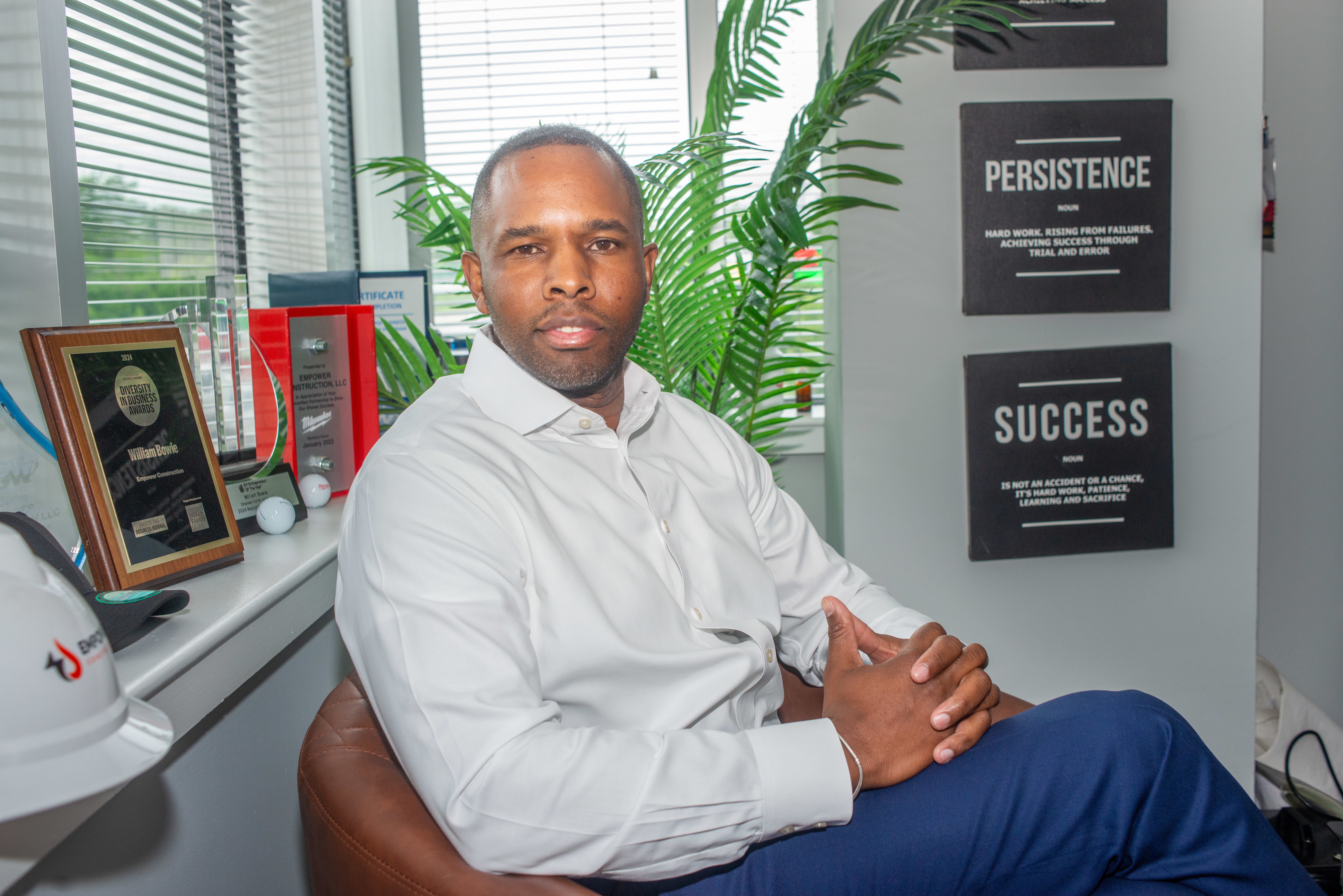
    Growing up, William Bowie measured poverty in cups of water warmed in the microwave for his morning baths at a sink. He lived in the Richard Allen public housing project in the Poplar section of North Philadelphia, raised with his brother by a single mother. Even as a high schooler, he was eager to improve his life’s circumstances, but lacked just about everything he needed to do so except a willingness to work hard.

    Three decades later, Bowie is president and CEO of his own nine-figure construction company, a journey that he largely attributes to a Philadelphia-based trade community apprenticeship system, similar to the “Nwa Boy” model that has been practiced in West Africa for centuries.

    “I kind of challenged myself,” said Bowie, who’s 42, referring to his mindset when he was embarking on his career. “Why can’t I be the best? And why can’t I open that door for others?”

    Bowie’s path is hardly an isolated success story. It is one node in a growing, informal network — from union apprenticeships in Philadelphia to a training cohort in Oakland, Calif. — of programs borrowing the Nwa Boy model’s core promise: a credentialed path from labor to ownership, built on relationships and trust rather than credit scores or venture capital.

    As race-conscious funding efforts designed to level the playing field for African Americans are dismantled, that promise is drawing new attention from investors, workforce officials, and Black entrepreneurs looking for an alternative route to generational wealth.

    The Nwa Boy system, which has its roots in the communities of the Igbo people in southeastern Nigeria, works this way: An established craftsman or business owner — known as the “Oga,” or master — takes on the training of a young person — known as the “Nwa Boy” (pronounced: nwah), or apprentice — often straight out of secondary school.

    The apprentice lives and works closely with the Oga for as long as eight years, learning the nuances, logistics, and administration of their chosen craft.

    When the apprenticeship ends, the Oga provides the graduate with a “settlement,” or capital — which often includes giving them money or business space — to launch their own independent businesses. The apprentice then continues the cycle.

    The Harvard Business Review has called the Nwa Boy system “a Nigerian model for stakeholder capitalism” in which community, workers, and shared prosperity take precedence over individual shareholder return.

    In 1970, at the conclusion of three years of civil war, the Igbo people used the Nwa Boy system to build a multibillion-dollar economy from the ground up. That’s when the Nigerian government seized control of the nation’s financial institutions and gave the equivalent of only about 20 British pounds (or roughly $400 in today’s money) to every Igbo adult, regardless of how much they had in their bank accounts before the conflict.

    Today, at a moment when Black Americans are witnessing the erosion of affirmative action and DEI programs through court rulings and presidential executive orders, Bowie and others believe the Nwa Boy system may provide an answer to the question of what happens when the system meant to fix a problem becomes the next thing that needs fixing.
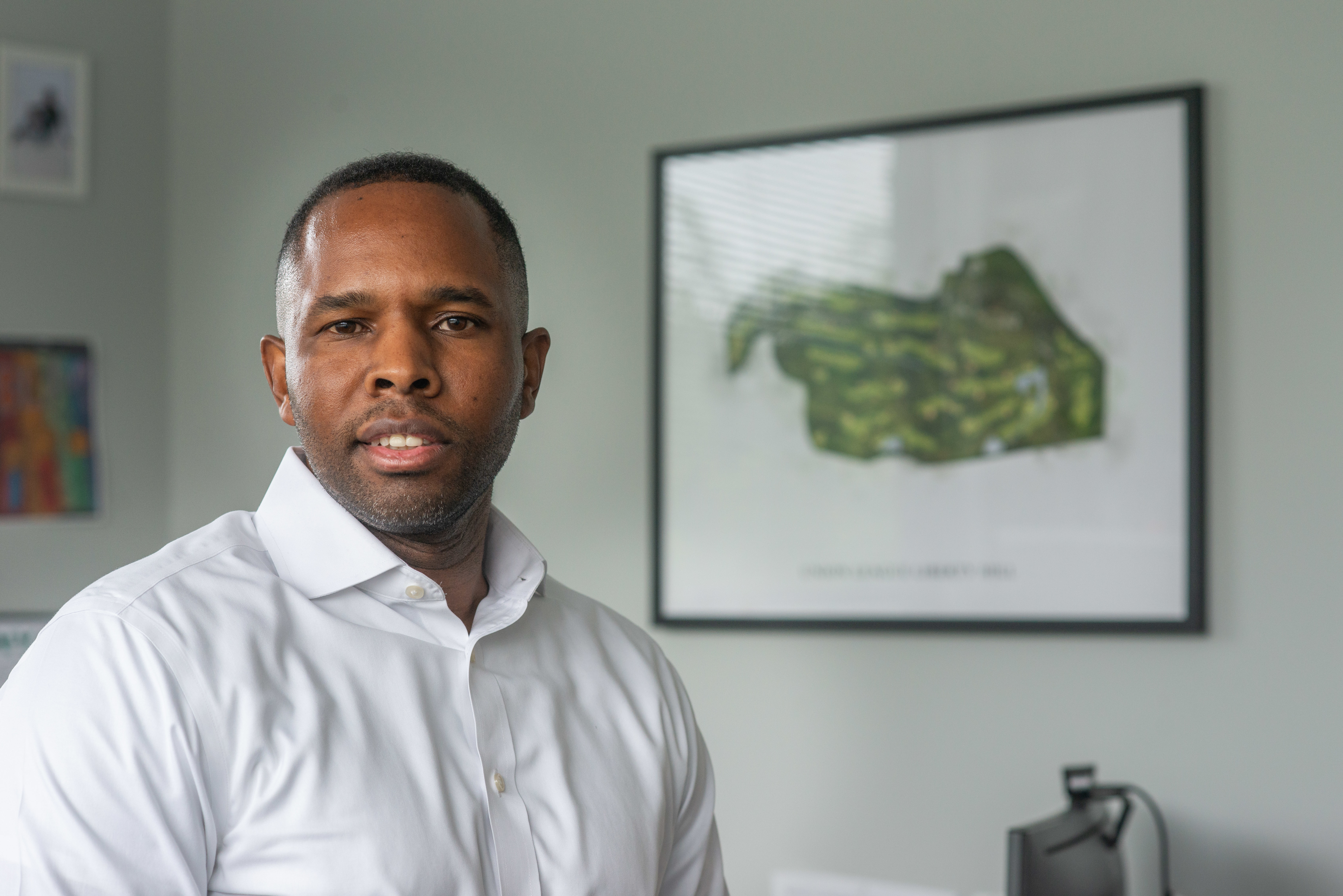
    As he was embarking on his career in construction, North Philadelphia native William Bowie said he asked himself, “Why can’t I be the best? And why can’t I open that door for others?”William Thomas Cain / For The Inquirer

    The blueprint

    While Bowie’s blueprint moves from employment to ownership, it did not happen in a vacuum.

    After finishing his first year at Drexel University, Bowie faced a dilemma — he had no way to pay a $6,500 bill to enroll for his sophomore year.

    “I tested into a magnet school,” Bowie said. “Academics wasn’t a problem. I was thriving in that environment. It’s just that financially I couldn’t afford it after the first year.”

    Bowie was not deterred.

    “I looked for a different path,” he said. “I tried to make money to get back into my second year in college.”

    In Nigeria, young men had been solving the same problem for generations — not with legislation, but with a handshake that meant more than a contract between an Oga and their apprentice. The pact is simple: The master teaches. The apprentice serves.

    In North Philadelphia, though, the syndicate of trust had little that resembled the stalls of Lagos’ Alaba International Market. It had Frank Murray.

    Murray, a member of the International Brotherhood of Electrical Workers (IBEW) and a family friend of Bowie’s mother, Margaret, encountered a young man desperate for an opportunity. He told Bowie, “This is where the money is at.”

    In the Nwa Boy system, the Oga does not simply teach a trade — he transfers his reputation, his customer network, and at the end of the apprenticeship cycle, his start-up capital. The system does not run on contracts, but on trust enforced by community witnesses.

    Murray gave Bowie the same thing — a pathway — and Bowie walked through it. Bowie joined IBEW at 19 years old.

    He completed a four-year U.S. Department of Labor-certified apprenticeship in three and a half years, earned $75,000 in his first year, and rose to become the youngest area manager overseeing about $300 million in business.

    Bowie says IBEW gave him what the Nwa Boy system has always understood, and American institutions have always struggled to replicate — a means to succeed that required no college degree, no venture capital pitch, and no generational wealth.

    ‘Financial gravity’

    Bowie’s playbook from two decades ago is what many American venture builders and investors are now being forced to consider as the formula for prosperity is being recalibrated. They must confront the brutal reality that even seven-figure salaries are no guarantee for wealth creation.

    “A paycheck — even a seven-figure one — is just a stay of execution. It doesn’t detach you from financial gravity,” Brandon Jones, founder and CEO of Gravy Capital, said during a virtual panel in April hosted by Visible Hands VC.

    When Bowie applied for capital to launch his company, Empower Construction, he felt the earth tugging at his dreams. Even though he had two decades of industry experience and managed a $300 million book of business, the banks still said no.

    What finally opened the door was not a stronger application, but a different messenger.

    One of Bowie’s mentors, Daniel K. Fitzpatrick, an executive at Citizens Bank, made a single phone call to his colleagues. A line of credit came through. To Bowie, it was the equivalent of receiving an Oga’s settlement.

    Saantis Fenmu Davis, a Philadelphia-based financial literacy educator and founder of Geb Cultural Exchange, said the problem starts earlier than the bank. He said it’s essential that Black Americans are taught how to be producers and investors, and not just consumers. “While higher spending and status-signaling often masquerade as affluence, they represent a fundamental mirage of social capital, which may or may not translate to equity or wealth,” he said.
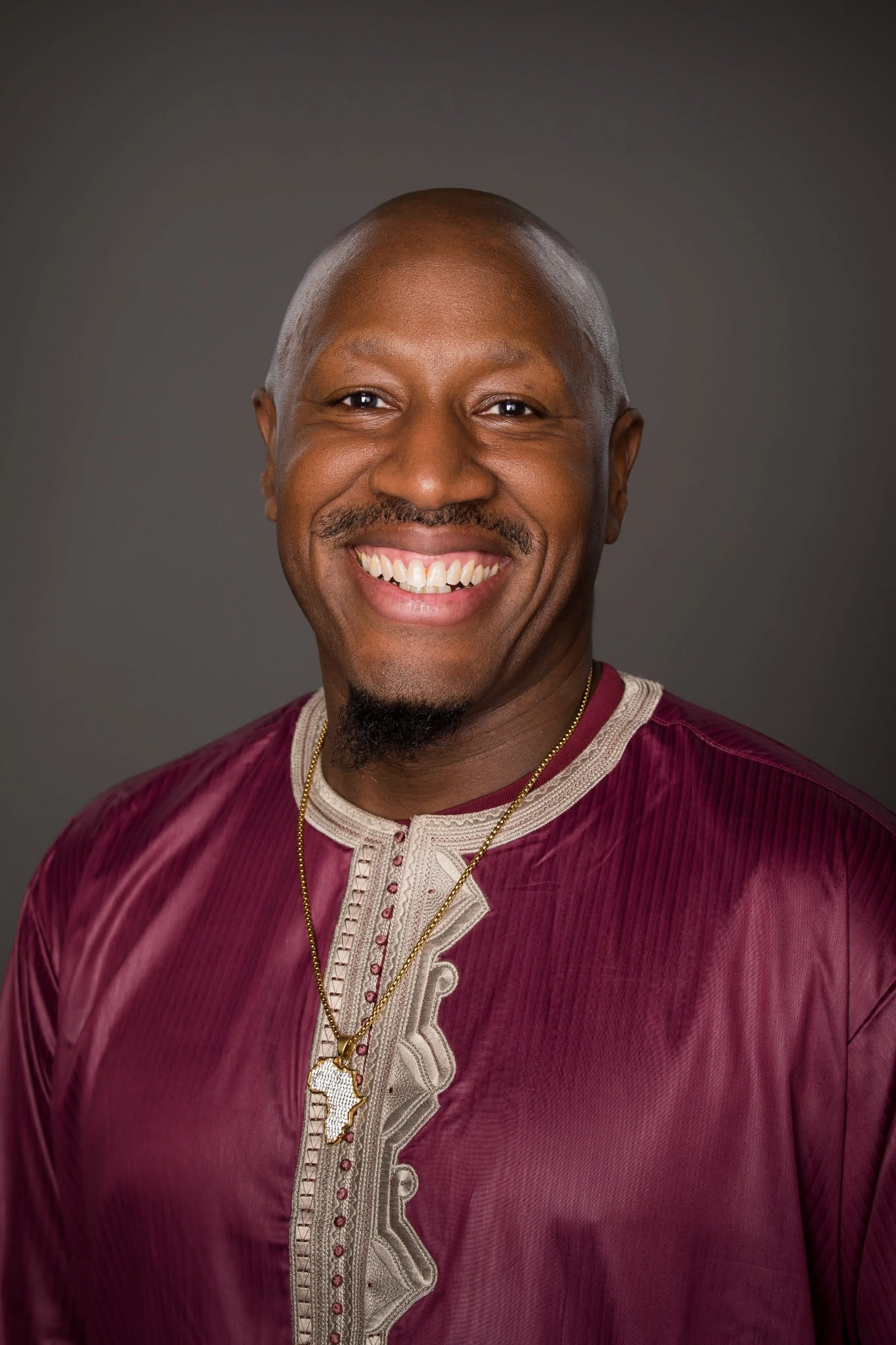
    Saantis Fenmu Davis, a Philadelphia-based financial literacy educator and founder of Geb Cultural Exchange, says consumerism is a “fundamental mirage of social capital.”Courtesy of Saantis Fenmu Davis

    Murray did not teach Bowie to consume. He taught him to produce.

    Patrick Clancy, president and CEO of the city’s workforce development program, Philadelphia Works, is trying to replicate what Murray did across its programs. Philadelphia Works manages roughly $11 million in apprenticeship funding across skilled trades and emerging sectors including IT, healthcare, and education.

    Murray was Bowie’s Philadelphia Works, but the path is not without its shadows.

    For every successful apprenticeship program or Nwa Boy story told, there is a possibility of exploitation.

    In the Nwa Boy framework in Lagos, Nigeria, some apprentices have reported exploitation at the hands of their masters.

    Naboth Nwaikwu spent 20 grueling years navigating three successive apprenticeships before finally being settled. He was an orphan. His first master did not settle him because his aunt and uncle instructed him not to. The same thing happened the second time.

    It wasn’t until his third attempt, under the apprenticeship of a friend, that he got his settlement, all of which could not account for the years lost.

    Nwaikwu now sells construction accessories for a living at Lagos’ Alaba International Market, and makes enough profit to take apprentices of his own if he wanted to, but told me he refuses to do so because “There is a thin line between unpaid apprenticeship and indentured service. I do not want to be the one to cross it.”

    Uyi Samuel Oni, a corporate attorney licensed in Nigeria and trained at the University of Pennsylvania’s Carey Law School, said the covenant must become a contract before it can successfully cross continents. “The Nwa Boy system must avoid negative historical connotations linked to terms such as master,” Oni said.

    Uyi Samuel Oni, a corporate attorney licensed in Nigeria and trained at the University of Pennsylvania’s Carey Law School, says the Nwa Boy covenant must become a legally binding contract before it can successfully be used in America.Courtesy of Uyi Samuel Oni

    A legally compliant American adaptation, he said, must be a win-win for both parties — not merely vocational or community service, but a binding agreement that protects the apprentice’s right to the capital payout that makes ownership possible.

    In Oakland, a program called Built Here has emerged as a 21st-century proxy for the Nwa Boy system.

    Onye Ahanotu, a former Harvard engineering research fellow and founding member of Built Here, uses training cohorts to mirror the communal trade apprenticeships of southeastern Nigeria. “We meet every week,” Ahanotu said.

    The frequency is intentional. In the Nwa Boy system, the covenant is not a one-time transaction — it is a continuous relationship between master and apprentice, reinforced week by week, skill by skill, until the apprentice is ready to stand alone.

    Clancy, of Philadelphia Works, understands that frequency. But he said the barriers that push apprentices out are not about ambition. They are about logistics. Most apprentices who do not complete the program fall off because of logistics — literacy gaps, a lack of childcare, transportation difficulties, and rigid drug-testing requirements.

    The apprenticeship demands sacrifice.

    Bowie was 19 years old and the only African American male in a trade that was overwhelmingly white and male. The culture shock was real. His determination was not given. It was chosen every single day.

    Bowie narrated his apprenticeship years as a period of determination and exposure to wealth — not suffering. Once he entered IBEW, his obstacles became opportunities.

    Clancy said Philadelphia Works offers pathways into the building trades and is open to second-chance applicants. Prior convictions are not automatic disqualifiers. The door is open. Most people do not know it is there.

    At the Philadelphia Navy Yard, Hanwha builds ships. The company needs welders. It cannot find them.
    Patrick Clancy, president and CEO of Philadelphia Works, the city’s workforce development program, which offers pathways into the building trades and is open to second-chance applicants.Courtesy of Patrick Clancy

    Not because the welders do not exist. Not because the work is not there. Not because the wages are not competitive — apprenticeship wages in the building trades start at $25 per hour and can exceed $100,000 annually with overtime. The positions have gone unfilled for three years, Bowie said, because nobody told the kids in North Philadelphia, West Philadelphia, and Germantown that the door is open.

    Bowie knows this the way he knows everything about the trades — from the inside. He gives talks online. He goes into Philadelphia schools. And while he may not have known about the Nwa Boy system when he was an apprentice, he regularly references its principles today.

    He stands in front of teenagers the same age he was when the system ran out of road for him and tells them what Murray told him: This is where the money is at.

    “In Philadelphia, there’s a shipbuilding company at the Navy Yard,” Bowie said. “They need welders. They can’t find them. And you’re telling me that in the city of Philadelphia, in the communities that we come from, that we can’t find welders?” He paused. “The parents don’t know. The kids don’t know. Nobody’s telling them.”

    Clancy is trying to change that. Philadelphia Works is actively pursuing apprenticeship funding for Hanwha’s shipyard — planned cohorts of 20 to 30 apprentices at a time. The infrastructure, funding, and jobs exist. What is missing is the same thing that was missing when Bowie was standing at the edge — someone to point at the door.

    Murray pointed. One phone call — and a kid from the Richard Allen Homes became a $100 million CEO. Philadelphia has not yet produced its Frank Murrays at scale.

    Bowie is working on it. One conversation — and one handshake — at a time.

    Ibe Imo is a Philadelphia-based investigative journalist whose reporting examines technology, power, capital, and the systems that determine who builds wealth and who pays for it. He is a recent graduate of the master of journalism program at Harvard University.

  • How Philly’s new Broad Street planters will turn what could be a grand urban avenue into a highway

    How Philly’s new Broad Street planters will turn what could be a grand urban avenue into a highway

    Broad Street is one of Philadelphia’s great ceremonial boulevards.

    A defining urban design element in William Penn’s pathbreaking 1682 plan for Philadelphia, Broad Street intersects with Market at Penn Square, creating the armature for the colonial city that gives Philadelphia its je ne sais quoi — its unique sense of place. For out of this intersection sprang our majestic City Hall, anchoring the four original quadrants of Penn’s city, each coalescing around one of Penn’s great public squares.

    South Broad Street is a place where the city comes together. Think of the great swell of civic ecstasy that suffused the street on either of the occasions in recent years when it hosted the Eagles’ Super Bowl victory celebrations. And then there is the perennial only-in-Philadelphia Mummers Day Parade, which animates the street on New Year’s Day as glittering costumes and the strains of string bands bounce and reverberate among the canyons of South Broad.

    Still, the street struggles to invite people to linger, stroll, dine, and shop along its sidewalks on a daily basis, never matching the urban vibrancy of the great streets of the world like Fifth Avenue in Manhattan or Oxford Street in London. And it’s not for lack of trying.

    The Avenue of the Arts was created to do just this during the Rendell administration. In defining an area for the performing arts, the street soon saw the arrival of the Kimmel Center, the Wilma Theatre, and other arts-based performance spaces. And yet, the street continued to flounder as a welcoming urban place.

    Now, to be sure, South Broad has a lot going for it. One need only stand at the intersection of Broad and Walnut, surrounded by handsome towering buildings with majestic light fixtures along the sidewalk, and you have a sense of what the street was — and what it could be. The street certainly needs some TLC, but not radical surgery.

    Which makes the recent “improvements” on the block of South Broad in front of the Kimmel Center all the more perplexing.

    For there, officials have unveiled a beta test for a new Avenue of the Arts streetscape project smack in the middle of South Broad Street that includes an egregious four-foot-high continuous planter with trees on top of it. All intended to increase the attractiveness of the street and thereby encourage a livelier street life.

    But therein lies the rub.

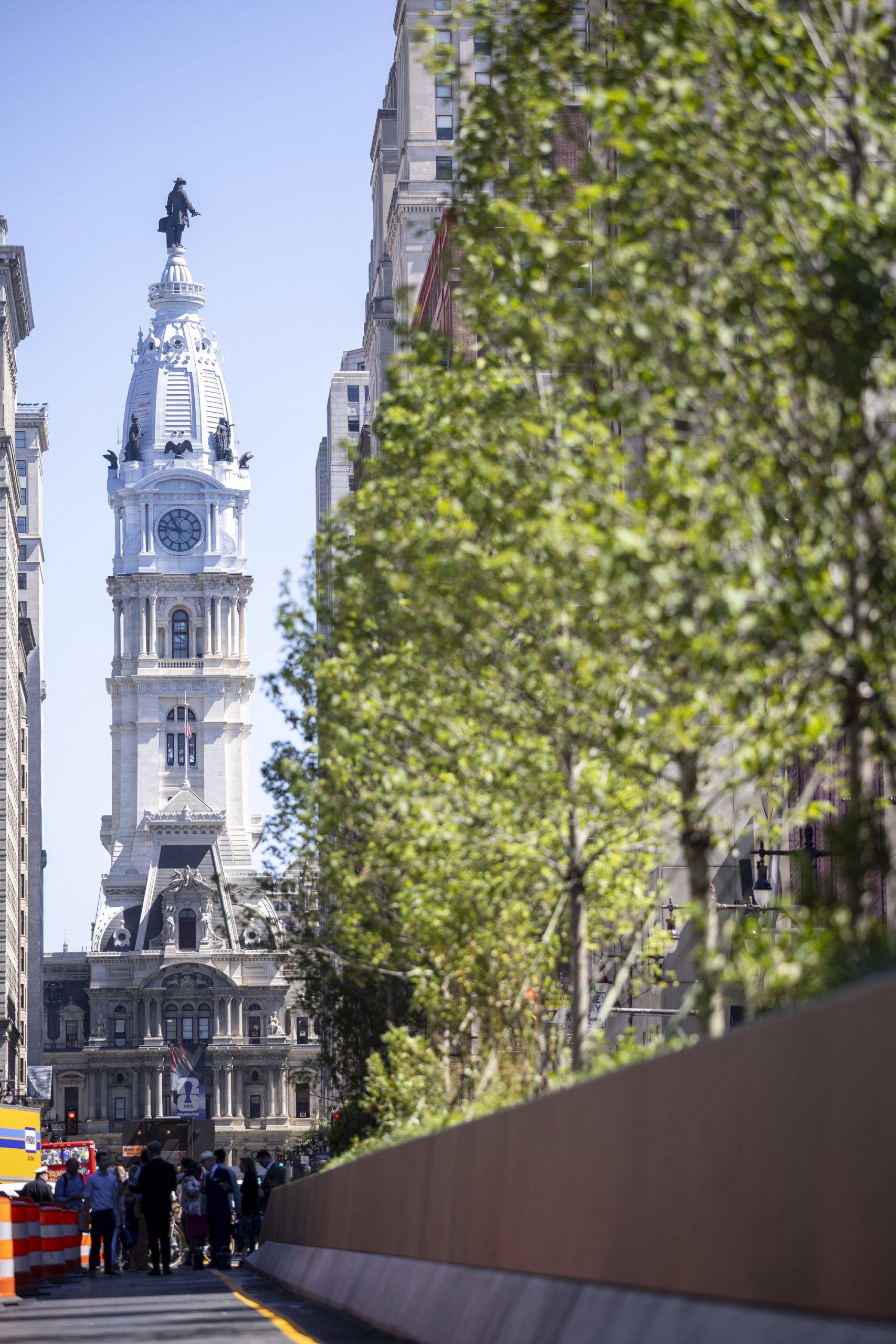
    In creating this continuous concrete highway divider-cum-planter in the center of the street, the project actually has a chilling effect on South Broad. Not only do the planter and the trees destroy the primacy of the view of City Hall tower along the street, but it reinforces the nature of Broad Street as a highway, and makes it impossible to see the other side of the street while either walking or driving. And forget about parades and festivals.

    The planters and trees destroy the primacy of the view of City Hall Tower along the street, write Alan Greenberger and Harris M. Steinberg.Tyger Williams / Staff Photographer

    We are told this is to be replicated on the street from City Hall to Washington Avenue to the tune of $150 million, or $15 million per block. Who thought this was a good idea?

    And, as if to add insult to injury, the project proposes outsized planters along the sidewalks that will further isolate the two sides of the street, crowd out whatever street life exists, and create, along with the tall planter in the center of the street, a series of cattle chutes for 10 blocks.

    Welcome to Broad Street Narrows.

    This can’t stand. The project must not be replicated along the length of the Avenue of the Arts. There are ways to integrate plantings into great streets, such as along Michigan Avenue in Chicago, but they are low in scale, do not include trees in the center of the street, and do not destroy the sensation of the street as a whole.

    And the proposed planters have got to go, as well. One could think of planting shade trees along the sidewalk offering respite from the sun and inviting people to sit along the street and have a bite to eat. The subway concourse below South Broad is extremely wide and could undoubtedly accommodate the tree roots below grade.

    The goal of increasing street life is crucial. To do so, it would be better to widen the sidewalks to allow for cafes and strolling. Street life needs foot traffic, and foot traffic is generated by people living, working, and shopping in the area, along with attending performances.

    Guests at a June ceremony to unveil one of the redesigned medians water the greenery in its planter just outside the Kimmel Center.Tyger Williams / Staff Photographer

    How is it that a street lined with hotels, residences, and offices has only one place for outdoor dining — at Arthaus? Broad Street wants bustling sidewalks, but landscaping and hardscape improvements alone will not increase street life. We learned this the hard way on the ill-fated Chestnut Street Transitway of the 1970s, and the planter fiasco should serve as a cautionary tale for the current design process for Market East.

    We must not fall prey to the false choice that in order to maximize urban vibrancy, we must sink millions of dollars solely into landscaping and other surface improvements.

    South Broad can be the best it can be with some thoughtful planning and a little gentle nurturing — it doesn’t need a Jersey barrier running down the middle of the street.

    Alan Greenberger served as deputy mayor for economic development and director of commerce under Mayor Michael A. Nutter, and chaired the Philadelphia City Planning Commission. Most recently, he served as vice president of real estate and facilities at Drexel University. He is a fellow of the American Institute of Architects. Harris M. Steinberg served as the founding executive director of PennPraxis at the School of Design at the University of Pennsylvania. He led the planning process for the Central Delaware Waterfront, which is currently guiding the development of the riverfront. Most recently, he served as the founding executive director of the Lindy Institute for Urban Innovation at Drexel University. He is a fellow of the American Institute of Architects.
  • Thora Jacobson, award-winning former chief executive officer at the Fleisher Art Memorial, has died at 77

    Thora Jacobson, award-winning former chief executive officer at the Fleisher Art Memorial, has died at 77

    Thora Jacobson, 77, of Philadelphia, award-winning former chief executive officer at the Fleisher Art Memorial, former executive director at the Philadelphia Art Alliance, former director of design review for Mural Arts Philadelphia, former chief operating officer for Philagrafika, former chair of the Philadelphia Art Commission, onetime adjunct instructor at Drexel University, independent curator, artist, mentor, Mummers Parade judge, and much more, died suddenly Sunday, Aug. 2, at her home. The exact cause of her death has not been determined.

    Born and reared in Ridley Park, Delaware County, Ms. Jacobson became interested in art education, administration, and conservation at Trinity Washington College in Washington in the 1960s. She settled in South Philadelphia after college in the 1970s and spent the next 50 years organizing, promoting, and inspiring local artists and art organizations.

    “Philadelphia richly deserves to be known as a place that honors its own,” she told The Inquirer in 2006.

    She joined Fleisher in 1972, rose to CEO in 1983, and left in 2006 to work over the next two decades at Philagrafika, Mural Arts Philadelphia, the Philadelphia Art Alliance, and elsewhere. During her 34 years at Fleisher, she developed its Center for Works on Paper, the Community Partnerships in the Arts program, and the Challenge series juried competition.

    She also oversaw three capital campaigns and told The Inquirer that her priority was “seeing connections and possibilities between and among artists, institutions, and their constituencies.” A colleague said on Facebook: “To many of us she was Fleisher.”

    She prepared Philagrafika to host the city’s first international festival of printmaking in 2010, consulted with artists on major projects at Mural Arts, and organized popular national juried exhibitions at the Art Alliance. “Her love and commitment to the arts knew no bounds,” Jane Golden, executive director of Mural Arts Philadelphia, said in a tribute. “Thora’s imprint was profound.”

    John Ittmann, former curator at the Philadelphia Museum of Art, told The Inquirer in 2006: “Thora is a real firecracker. She has a wonderful type of energy that is really infectious.”

    Ms. Jacobson was also chair of the Philadelphia Art Commission for a decade, interim director of operations for the Asian Arts Initiative, vice president of the Philadelphia Volunteer Lawyers for the Arts, trustee of the National Guild of Community Arts Education, member of the American Swedish Historical Museum, and, most recently, a visual arts management consultant.

    Ms. Jacobson and fellow curator Warren Angle admire an exhibition at the Fleisher Art Memorial in 2002. April Saul / Staff Photographer

    “Thora was kind and clear,” colleagues at Social Impact Studios said on Facebook, “but firm as she pushed us to keep tweaking things until they were as strong as they could be.”

    She was an adjunct instructor at Drexel University from 2010 to 2014 and led research projects at Drexel and the University of Pennsylvania on social impacts of art in Philadelphia neighborhoods. Her first job out of college was coordinator of the student center at the Art Museum.

    She curated and juried shows, and wrote forwards and essays for art books and catalogs. She drew in her spare time and judged the Mummers Parade for years.

    She was featured in The Inquirer and Daily News, and appeared in the 1992 TV art documentary Monuments in Love. In 2006, she earned the Visionary Woman Award from Moore College of Art and Design, and was honored for lifetime achievement by Tri-State Artists Equity.

    Ms. Jacobson, standing between Jim Straw, to the left, and Ralph Wellington to her right, earned the Visionary Woman Award from Moore College of Art & Design in 2006.Gary Horn Photography

    “She’s really respected throughout the arts community in Philadelphia,” Happy Fernandez, then president of Moore, said in 2006. Anne d’Harnoncourt, then director of the Art Museum, said Ms. Jacobson’s “impact has been enormous.”

    William Valerio, director and CEO of the Woodmere museum, said: “Thora was a towering figure in the arts of Philadelphia, a builder of institutions whose accomplishments are lasting.”

    Thora Elizabeth Jacobson was born Feb. 19, 1949, in Ridley Park. She was the youngest of three children; her father died when she was 3. She played field hockey in high school, was fascinated by words and language, and graduated from the old Holy Child Academy in Sharon Hill.

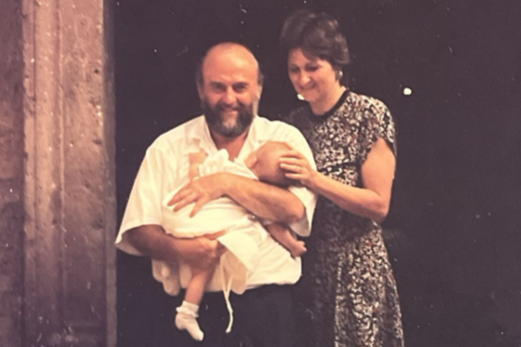
    She met her husband, Antonio Sorgini, when he was taking classes at Fleisher, and they married in 1980 and had a son, Antongiulio. Her husband died in May.

    Ms. Jacobson, her husband, Antonio Sorgini, and their son, Antongiulio, lived in South Philadelphia.Courtesy of the family

    Ms. Jacobson was a talented seamstress and baker. She did humorous impersonations, collected art, and enjoyed working with young people.

    Friends noted her “many kindnesses” and “decades-long advocacy for artists and the cultural community” in online tributes. Woodmere’s Valerio said: “She was both a strong voice and a warm friend to many.”

    Her son said: “She had a sharp wit and relished cheerful banter among friends and colleagues. Above all, she took the work of mentorship very seriously.”

    In addition to her son, Ms. Jacobson is survived by a sister and other relatives. A brother died earlier.

    Friends noted Ms. Jacobson’s “many kindnesses” and “decades-long advocacy for artists and the cultural community.”Courtesy of the family

    A celebration of her life is to be held later.

    Donations in her name may be made to the Fleisher Art Memorial, 719 Catharine St., Philadelphia, Pa. 19147; and Mural Arts Philadelphia, 1727-29 Mount Vernon St., Philadelphia, Pa. 19130.

    Ms. Jacobson was a talented seamstress and baker.
    Mark Garvin, / Philadelphia Museum of Art
  • Philadelphia has seen nearly two dozen cyclosporiasis cases this year

    Philadelphia has seen nearly two dozen cyclosporiasis cases this year

    Federal officials this week assured Americans they can safely eat fresh produce, saying they’ve issued new safety guidelines for producers and pulled all lettuce associated with an outbreak of cyclosporiasis from the market.

    The intestinal parasite Cyclospora cayetanensis, which causes “explosive” diarrhea, had contaminated lettuce sold in 15 states, including Pennsylvania.

    Philadelphia health officials said Monday that the city has confirmed 22 cases of the gastrointestinal illness in 2026. Reported cases have been higher elsewhere in the state.

    Statewide, officials had recorded 214 confirmed cyclosporiasis cases as of Tuesday and an additional six probable cases. Pennsylvania confirmed 40 cases of cyclosporiasis in 2025 and 87 in 2024, officials said.

    Federal health officials have confirmed more than 13,000 cases across 47 states this spring and summer.

    The CDC has linked more than 6,000 cases of cyclosporiasis, 278 hospitalizations, and two deaths to iceberg lettuce sold by Taylor Farms. (Taylor Farms had also recalled jalapenos separately linked to a salmonella outbreak in 26 states. The jalapenos were not sold in Pennsylvania.)

    Pennsylvania has reported far fewer cyclosporiasis cases than states like Michigan and Ohio, where thousands have been sickened. Still, because confirmed cases have increased in Pennsylvania in recent weeks, it’s too soon to predict case counts for the year, said Akhil Vaidya, a distinguished professor in the Department of Microbiology and Immunology at Drexel University College of Medicine.

    “Generally, it is between May and August that you see Cyclospora. We don’t know how it will go for the rest of the year,” he said. “I hope we dodged a bullet.”

    Cyclospora was only discovered by scientists in the mid-1990s, and more research on the parasite remains needed, Vaidya said. Most research is conducted outside the U.S., where cyclosporiasis is more common, and the parasite cannot be grown in a lab, which often makes it difficult to track the source of foodborne outbreaks, he said.

    State and federal health officials must carefully monitor when and where illnesses emerge to understand why so many cases have been reported this year, Vaidya said.

    State health officials urged Pennsylvanians to take these steps to protect themselves from cyclosporiasis: washing their hands with soap and water before and after handling raw fruits and vegetables; rinsing produce under hot water, scrubbing firm produce like melons with a clean brush; cutting away damaged parts of produce; and refrigerating cut, peeled, or cooked fruits and vegetables as soon as possible.

    Cyclospora is not necessarily killed by rinsing alone, so the FDA advises cooking produce to 158 degrees to remove the parasite.

  • Intensifying summers are putting the Philly suburbs’ aging infrastructure to the test: ‘We get a 100-year storm every year’

    Intensifying summers are putting the Philly suburbs’ aging infrastructure to the test: ‘We get a 100-year storm every year’

    Tori Bauver was sitting at home on July 11 when the sky outside of the Wyndon Apartments in Wynnewood began to darken. Bauver watched the clouds roll in, then the rain come, blowing “literally sideways” outside her window. She remembers leaning in to see the darkening landscape and noticing that rain had begun to penetrate her windows. Then the “outside went stark white” and water started pooling on her windowsills.

    “I was like, ‘Oh, my God. This is gonna flood. This apartment’s gonna flood,’” she said.

    The light fixture above Bauver’s bed filled with water, then poured over the edges. The ceilings began to leak, then one by one, they collapsed. The building’s roof ripped off, and Bauver had a clear, and unsettling, view of the sky from her living room.

    Bauver, now a resident of West Chester, where she and her partner moved after breaking the lease on her Wynnewood apartment, had been living in the Wyndon Apartments for two years when the July microburst storm tore through Lower Merion, destroying her home and more than $5,000 of her and her partner’s belongings. She was one of dozens of suburban residents who emerged from the storm with damaged property and a devastated home.

    As the Philadelphia region sees hotter and more humid summers, flash flooding, extreme precipitation, and life-threatening storms have become a more common feature of daily life. Weather events marked by downed trees, dangerous flash floods, waterlogged roadways, and eroded bridges are, more and more, forcing suburban residents and cash-strapped local governments to pour millions into repair and resilience projects, all while large swaths of the region’s infrastructure are built to withstand weather patterns of a bygone era, one in which storms like July’s microburst happened once in a decade, rather than multiple times a summer.

    As the region’s weather patterns intensify, officials and climate experts say the municipal mosaic of Philadelphia’s suburbs faces unique challenges when it comes to planning for a future marked by climate change.

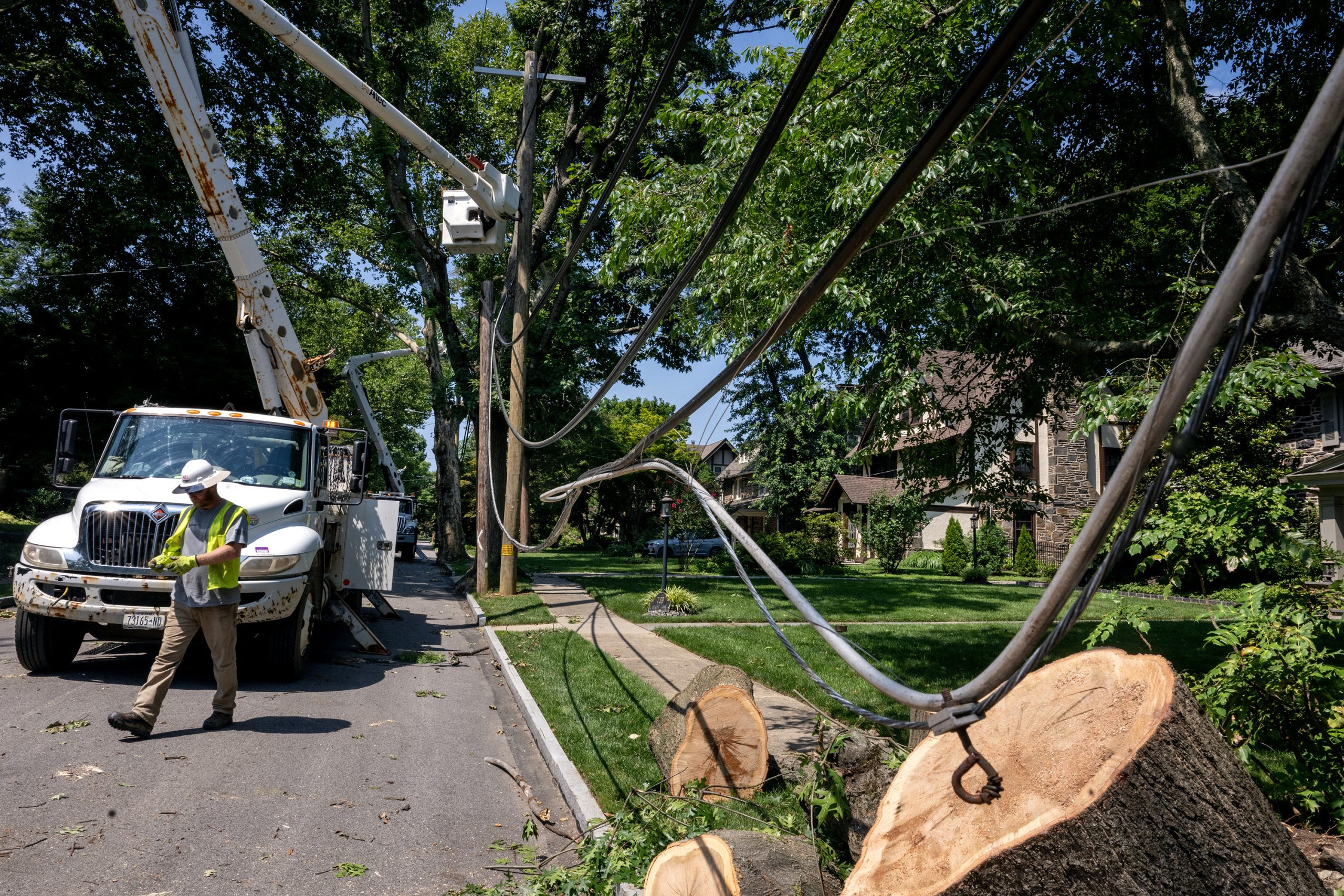
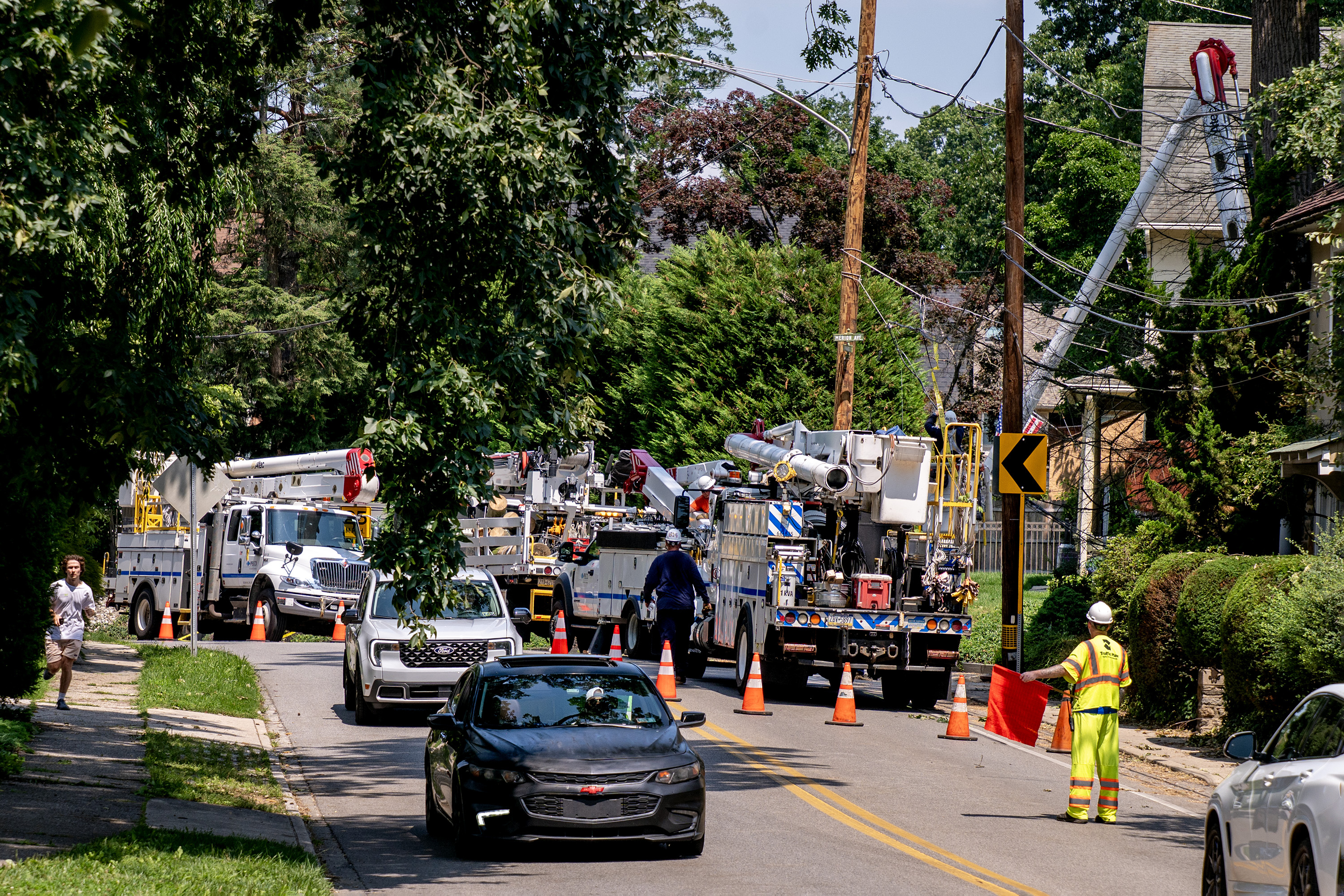
    Utility workers restore power in Merion Station on July 13 after a microburst storm ripped through parts of Philadelphia and Montgomery County.Tom Gralish / Staff Photographer

    The Philadelphia region’s changing weather

    The average July temperature in Philadelphia has risen 4.4 degrees since 1940. In the 1900s, Philadelphia averaged four days per year with temperatures above 95 degrees, according to a 2024 EPA report. This summer, Philly has seen six days with high temperatures above 95 degrees, according to the National Weather Service. By the end of the 21st century, that number could climb to more than 50 days per year.

    Hotter weather means more precipitation, and more frequent and intense rain events. For every 1.8 degrees the air temperature increases, the amount of water the atmosphere can hold increases by 7%.

    “The infrastructure we have now is not always built to a standard to accommodate the extreme weather we’re seeing now,” said Chris Linn, manager of the Office of Resilience and Environment at the Delaware Valley Regional Planning Commission.

    As Ray Courtney, a Lower Merion commissioner and chair of the township’s sustainability committee, said, “We get a 100-year storm every year.”

    Cars in a flooded parking lot at the Ferry Avenue PATCO station in Camden on July 6. Philadelphia and its suburbs have been hit with numerous flash floods this summer, as an increasingly hot and humid atmosphere gives way to more extreme weather.Tom Gralish / Staff Photographer

    Flooding as ‘the biggest and most common hazard’

    The impacts of intense storms are multitudinous and cascading, and the topography of Philadelphia’s suburbs can make it particularly difficult to find effective solutions.

    Linn said flooding is “the biggest and most common hazard that communities face,” and it presents the most “consistent and pervasive” issues for municipal leaders.

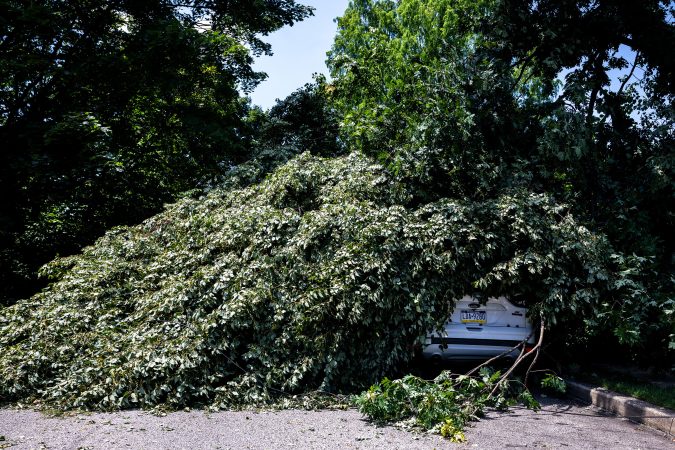
    Intense precipitation and flash floods, which have been a constant this summer, can disrupt transit, turn roads into rivers, and endanger residents’ lives. High winds and saturated soil frequently bring down trees, damaging homes and cars and knocking out overhead power lines. Disruptions to power can be particularly dangerous when residents are left without fans or air-conditioning during hot summers.

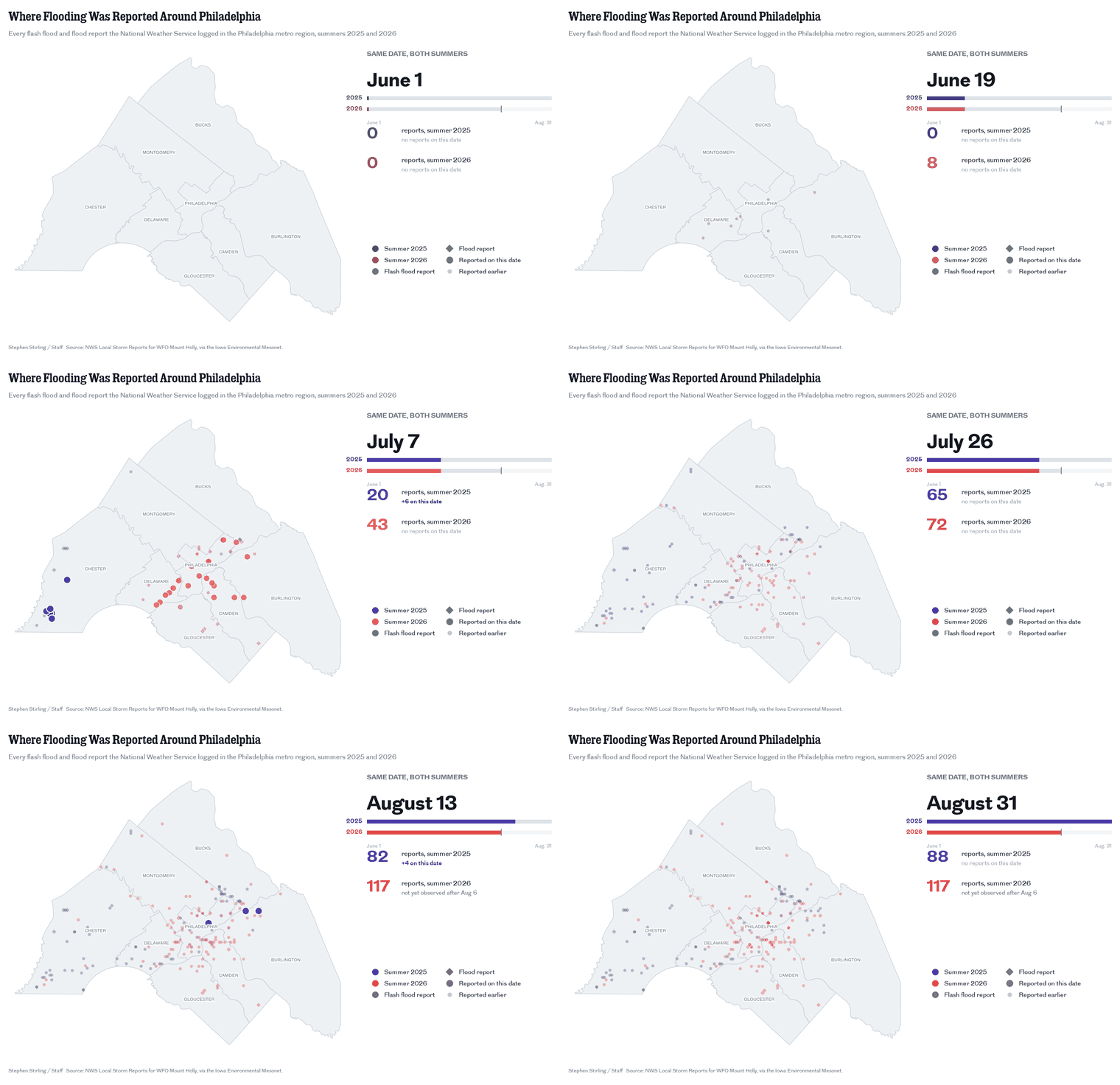
    Flooding has been reported more than 200 times in the Philadelphia region over the last two summers.Stephen Stirling

    “I see roads flooding consistently, trees coming down, power going out, and then our local government spending resources every time one of these storms happens. It’s overtime costs and tree costs, and then also all the private citizens having to spend costs cleaning up trees and other debris,” Courtney said.

    “These unlikely, freak events are really the ones that break us,” said Matthijs Bouw, architect and professor at the University of Pennsylvania’s Stuart Weitzman School of Design.

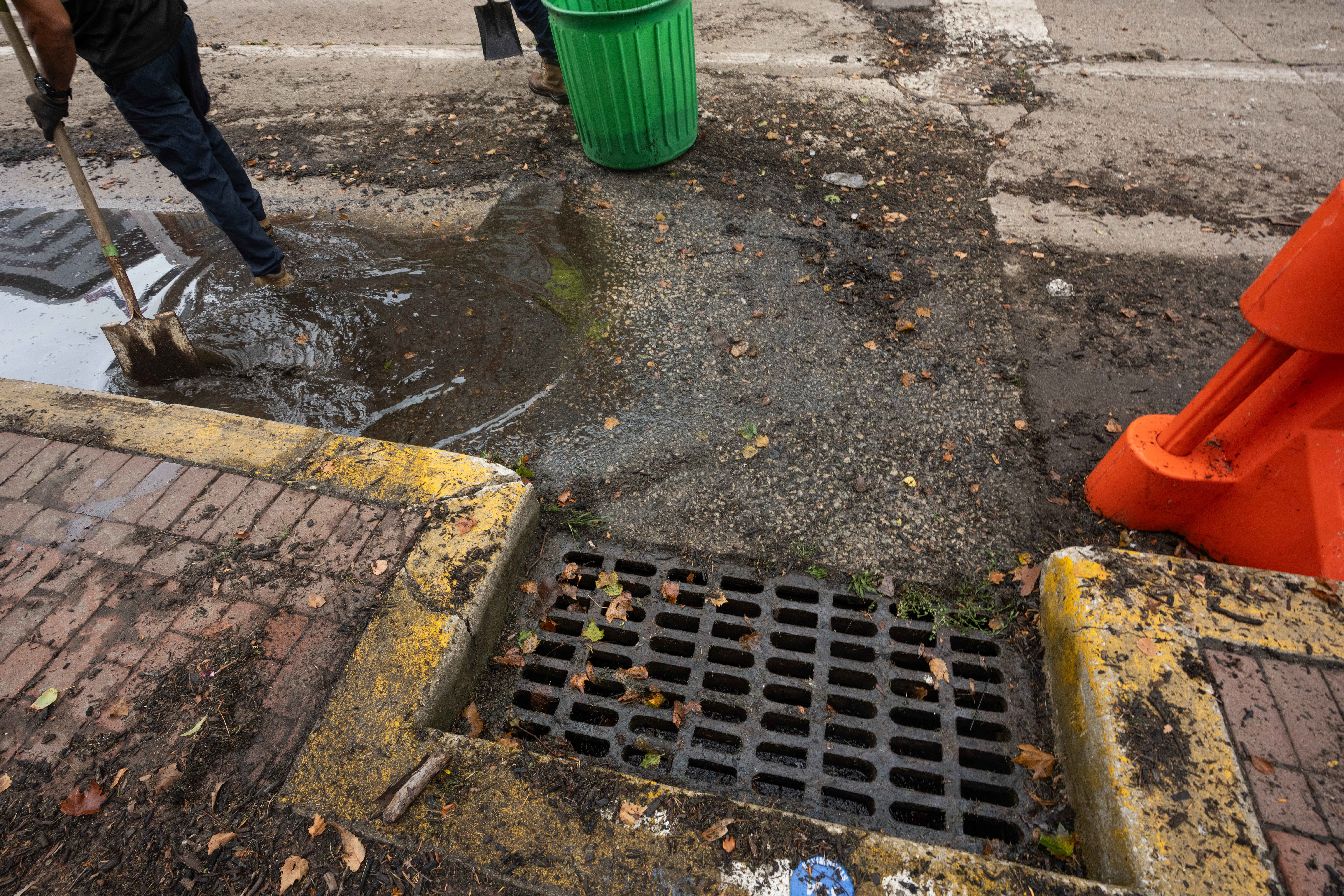
    A key tool for managing extreme weather is stormwater systems, or the collection of drains, basins, ditches, and pipes that collect rainwater and snowmelt and move it from developed areas into local waterways. Stormwater systems are critical in moving water off impervious, or impenetrable, surfaces, like the parking lots, paved roads, and shopping centers often found in the suburbs.

    The more developed a suburb is, the more runoff a storm will produce, increasing flooding risks, said Franco Montalto, professor of civil, architectural, and environmental engineering at Drexel University.
    Yet many municipalities are contending with aging stormwater systems that require costly repairs. Lower Merion’s 2018 Comprehensive Stormwater Management Plan listed aging pipes, undersized infrastructure, operational costs, and increasing flooding as challenges for the township. Many of Philadelphia’s suburban communities are composed of buildings that predate a 1978 state law requiring counties and local governments to plan with stormwater management in mind.

    Some communities are more vulnerable to climate impacts than others, with density, land cover, wealth, and the state of repair of existing infrastructure as factors. A 2021 climate change vulnerability analysis by Montgomery County found denser, water-proximate communities like Norristown and Pottstown to have some of the highest risk of increased stresses due to climate change. Greener, more rural parts of the county like New Hanover and Marlborough Townships presented lower risks.

    The aftermath and clean up of flooding in Camden on July 6. Stormwater systems are a critical tool for local governments to manage flooding. Jessica Griffin / Staff Photographer

    How can communities mitigate impacts?

    Experts described a range of interventions for managing climate impacts, from constructing rain gardens to rewriting zoning ordinances.

    Maintaining a healthy tree canopy and building rain gardens can help rainwater permeate into the ground. Larger infrastructure efforts like stream restoration projects and floodplain maintenance can help stabilize the built environment.

    However, Linn said, these interventions “don’t necessarily address more severe or catastrophic flooding in terms of mitigating those impacts.”

    Long-term climate resilience, experts said, relies on making land-use and zoning decisions that preserve floodplains and natural drainage patterns and ensure stormwater systems can manage our new, rainy reality.

    Montalto is interested communities that have become “safe to flood,” or that have created parks, parking lots, road medians, and other open spaces that trap water during floods, then properly drain it, keeping it away from buildings and roads. A basketball court built below a park, for example, can fill with water during a storm and slowly drain, mitigating runoff (one was recently installed in New York City). Copenhagen’s Cloudburst Management Plan, adopted in 2012 after a major storm, is a blueprint of sorts in Montalto’s mind.

    However, bringing “safe to flood” infrastructure to Philly’s suburbs may be a far-out goal.

    In the vast suburbs, the collection of boroughs, townships, and county lines makes unified action difficult, and forces officials to think along municipal, not watershed, lines. On the Main Line alone, rainfall and snowmelt drain into a collection of dozens of creeks and streams that do not start or stop where a municipal boundary is drawn, making it difficult to take coordinated and effective action when it comes to flood mitigation along certain waterways.

    Finding the funding to repair and replace stormwater infrastructure, too, can be taxing, as local governments stare down costly projects, even with the availability of state and federal grants. Political will factors in, with municipalities differing in their desire and ability to use taxpayer dollars to tackle climate issues.

    Philly’s suburbs, like the city, are also often old, dense, and built out, making it hard to retrofit them to be more climate-sensitive.

    “So many of our communities are built out and have been built out for a long time, so the vulnerabilities and the challenges are built in to the community,” Linn said.

    Utility workers restore power along Wynnewood Avenue in Merion Station on July 13.Tom Gralish / Staff Photographer

    Solving ‘complex issues’ in Montgomery County

    Despite the challenges, progress is being made, said Montgomery County Commissioner Jamila Winder.

    Montgomery County in 2025 led a flood mitigation planning study for the 362-square-mile Perkiomen Creek Watershed, which stretches across Montgomery, Bucks, Berks, and Lehigh Counties. The study identified flood-prone areas, evaluated mitigation tactics, and worked to build a framework for long-term resilience. The county is currently in the process of carrying out a floodplain restoration project along the Wissahickon Creek in Whitemarsh Township. Both projects came to fruition after Hurricane Ida tore through the region, bringing record floods and killing multiple people.

    The county has repaired 30 structurally deficient bridges since 2017 and has repaved dozens of miles of road. County workers also removed 200 dangerous trees earlier this year, resulting in a significant drop in emergency phone calls about tree damage, Winder said.

    Lower Merion in 2021 hired its first full-time sustainability manager and in 2023 completed its first sustainability plan. Radnor Township has adopted a comprehensive climate plan, and Haverford Township has set out to achieve 100% zero-carbon renewable power by 2035.

    The Pennsylvania Department of Environmental Protection in January announced more than $17 million in funding for environmental projects across the state, including stream restoration and stormwater management.

    Winder said, “We’re seeing that when we work across federal, state, county, and local leadership, that we can come together to solve some of these complex issues.”

    This suburban content is produced with support from the Leslie Miller and Richard Worley Foundation and The Lenfest Institute for Journalism. Editorial content is created independently of the project donors. Gifts to support The Inquirer’s high-impact journalism can be made at inquirer.com/donate. A list of Lenfest Institute donors can be found at lenfestinstitute.org/supporters.

  • New Trump-promoted Freedom Fuel station pops up in Philly. Another could be shut down.

    New Trump-promoted Freedom Fuel station pops up in Philly. Another could be shut down.

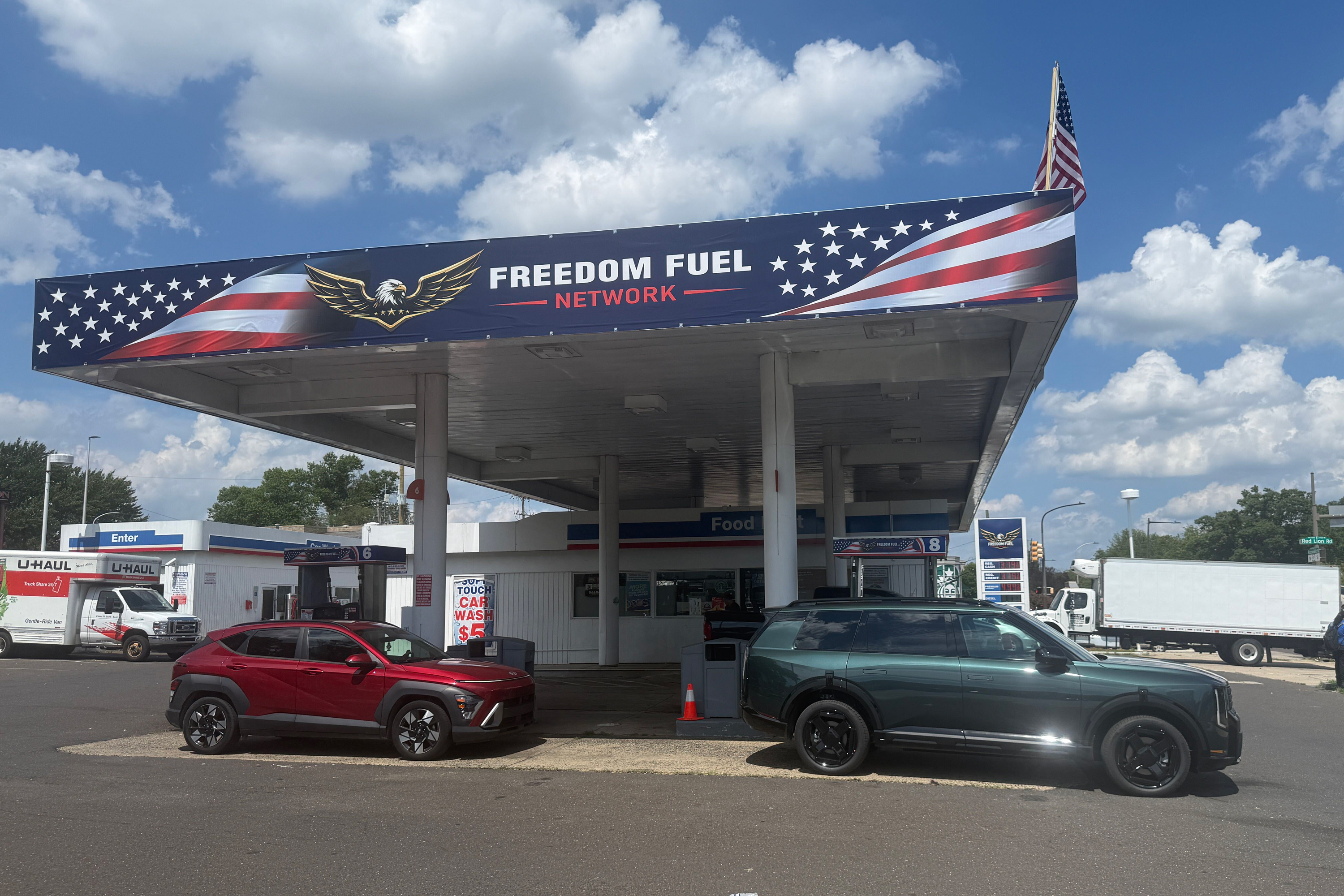
    Philadelphia drivers looking to save a few bucks at the pump streamed into the city’s newest Freedom Fuel station Friday afternoon, even while the station’s deep discounts remain a mystery.

    The station, located in Bustleton on Roosevelt Boulevard, is one of four new Freedom Fuel locations added this week. The other three are in New Jersey, including one all the way up in Morris County.

    The gas network, which was promoted by both the White House and President Donald Trump last month, is now up to 29 stations across the Philadelphia region, stretching east to the Jersey Shore.

    (function(){function e(){window.addEventListener(`message`,function(e){if(e.data[`datawrapper-height`]!==void 0){var t=document.querySelectorAll(`iframe`);for(var n in e.data[`datawrapper-height`])for(var r=0,i;i=t[r];r++)if(i.contentWindow===e.source){var a=e.data[`datawrapper-height`][n]+`px`;i.style.height=a}}})}e()})();

    Nearly all the pumps were full at Philly’s newest Freedom Fuel spot Friday afternoon, with the station selling a gallon of regular gas for $3.79 a gallon. That’s nearly 35 cents a gallon less than a Wawa just up Roosevelt Boulevard, where a gallon of regular gas went for $4.13 on Friday.

    A nearby Lukoil was a bit closer to Freedom Fuel’s prices, offering a gallon of regular gas for $3.99.

    An enduring mystery remains how Freedom Fuel has been able to consistently offer lower prices than nearby competitors.

    Experts told The Inquirer Freedom Fuel was likely suffering losses for selling fuel at such a low price, especially since many of the company’s stations don’t have robust convenience stores or car washes to create revenue.

    “It becomes unsustainable,” Eliezer Fich, a finance professor at Drexel University’s LeBow College of Business, told The Inquirer last month. “Unless prices go down. But if they do, they go down for everybody.”

    According to public records, the newest Freedom Fuel station is owned by Celik Plaza II l.l.c., which had previously run it under a “Red Lion Fuel” banner. Engin Celik, who is listed as a principal with the company, according to documents reviewed by The Inquirer, did not respond to a request for comment.

    Philly Freedom Fuel station faces closure after failing inspection

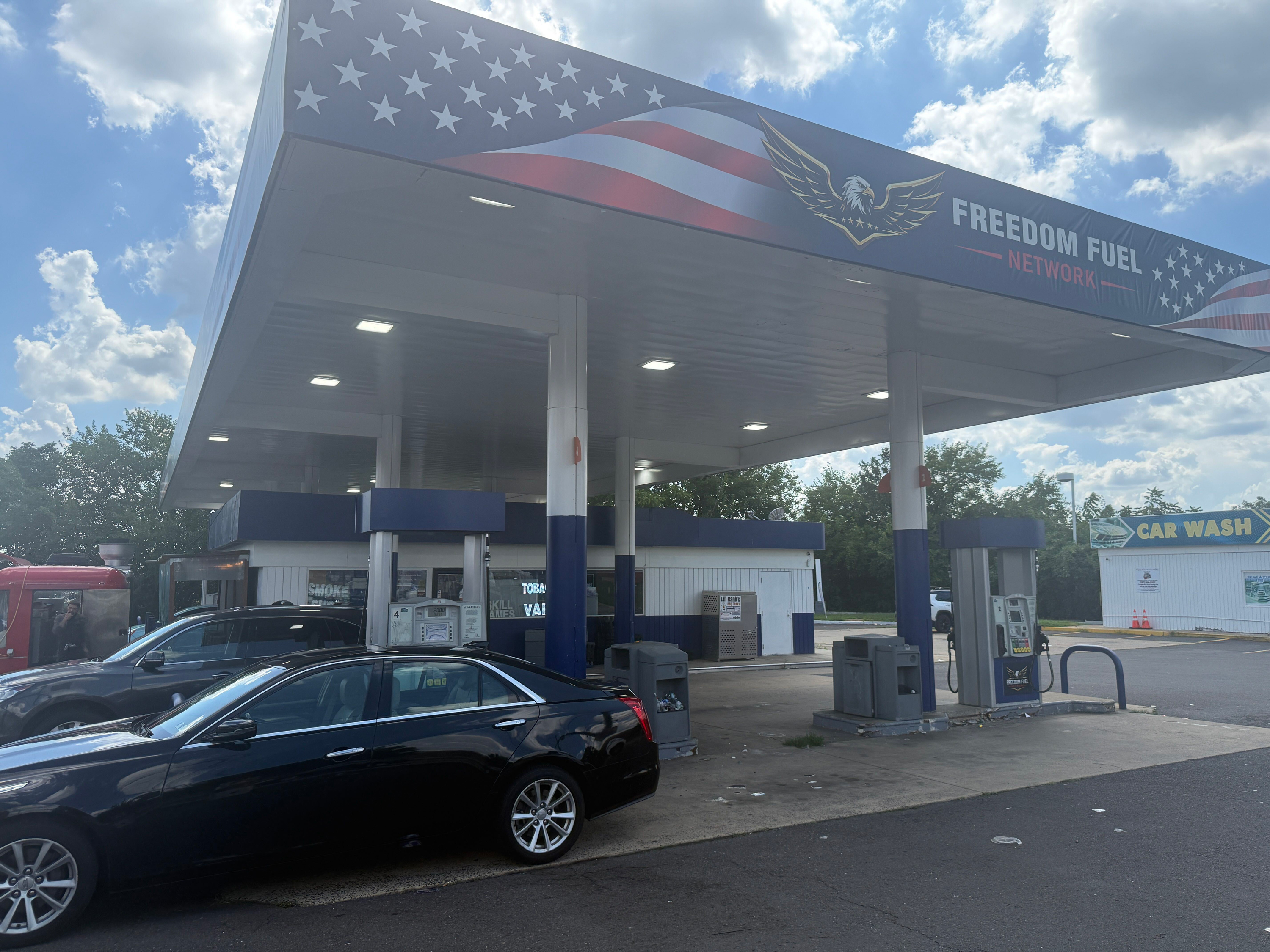
    The Freedom Fuel station on Bustleton Ave. in Philadelphia. Dana Munro / staff

    While Freedom Fuel is adding locations, it could soon lose one in Philadelphia.

    The station on Bustleton Avenue, one of at least six locations linked to Cherry Hill developer Shamikh Kazmi and his brother Syed Kazmi, has an expired fuel dispensing license and failed an inspection last week, according to city records.

    If unresolved, the station could be forced to close by Sept. 4, according to a city spokesperson.

    The Kazmi brothers, who have been embroiled in at least two lawsuits related to previous gas station ventures, could not be reached for comment.

    Freedom Fuel owners remain quiet

    Ravens special teams coach Randy Brown signed Freedom Fuel’s formation papers. Terrance Williams

    While Freedom Fuel’s launch was proudly promoted last month by Trump, the company’s owners have remained quiet about the enterprise and how they’re able to maintain low fuel prices.

    A White House spokesperson previously told The Inquirer Freedom Fuel is a private company receiving no government subsidies and not accessing fuel at a lower cost.

    “Freedom Fuel Network is a privately owned and proudly patriotic company — along with its convenience store operators, haulers, sign companies, and operational partners — that answered President Trump’s call to action to lower prices at the pump,” the company said in a statement on its website.

    Baltimore Ravens assistant coach Randy Brown, the former mayor of Evesham Township, N.J., and a self-proclaimed “proud Trump supporter,” signed Freedom Fuel’s certificate of formation in Delaware on June 23. Brown has declined to comment on the enterprise.

    Former commodities trader Yoni Gontownik also signed the certificate of formation, and has not responded to requests to comment. Gontownik and his wife, Bellen, have hosted Republican fundraisers through NORPAC, a New Jersey-based political action committee supporting pro-Israel lawmakers in both parties.

    Staff writer Ryan W. Briggs contributed to this article.

  • Inside the scramble to save Philadelphia’s only free sexual assault exam center

    Inside the scramble to save Philadelphia’s only free sexual assault exam center

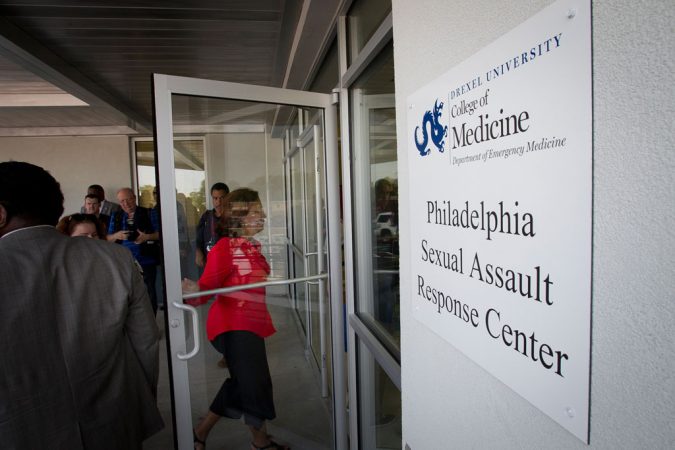
    Philadelphia’s only free sexual assault exam center was so strapped for funding last spring that Drexel University, its former operator, started drafting a closure announcement.

    The school was facing financial strain of its own, and state funding to rape crisis nonprofits was tied up amid a prolonged budget impasse in Harrisburg. Emergency funding from the city was tangled in City Hall’s lengthy contracting process.

    At the time, there was no plan for who would run the Philadelphia Sexual Assault Response Center (PSARC), where roughly 300 rape survivors a year go for the sexual assault exams used to collect forensic evidence that are commonly known as “rape kits,” which often play a key role in prosecuting assaults.

    Fast-forward to this month, when Mayor Cherelle L. Parker’s administration announced the city’s public health department will assume all control of PSARC. Officials presented the news as the culmination of a careful, collaborative handoff, and one city staffer framed the transition in a news release as “seamless.”

    But hundreds of emails obtained by The Inquirer through a right-to-know request and a review of public records tell a far messier story. The emails show that for more than a year the fate of PSARC lurched from one near-miss to the next and that a failed bid process forced the city to take over the center’s operations when no one else would.

    Taken together, the records offer a granular view of how a critical piece of the city’s safety net for sexual assault survivors nearly broke. And they portray a chaotic process in which the city for months sought to transfer control of the center from Drexel to the nonprofit WOAR Philadelphia Center Against Sexual Violence, even as WOAR faced its own budgetary implosion.

    Over the course of the last year, the exam center never shut its doors to patients. But it came close on several occasions, a collapse that would have had ripple effects in hospital emergency rooms across the region that typically route sexual assault patients to the center.

    If PSARC suspended operations, hospitals would have to find specially trained staff — of which there are few — to perform the exams.

    “Philadelphia emergency rooms were not ready for that,” said Lila Slovak, director of the Philadelphia office of the Women’s Law Project, who spent months warning city officials that PSARC was in danger. “They did not know that [the center] was at risk of closing. It was not on anybody’s radar.”

    Crystal Yates-Gale, the city’s deputy managing director for health and human services, said in a statement that the final outcome — the city running the center — is ultimately what is best for sexual assault survivors.

    “We are proud to have secured the continuity of vital services for victims of crime in a dignified, victim-centered, culturally-competent atmosphere in Philadelphia,” she said.

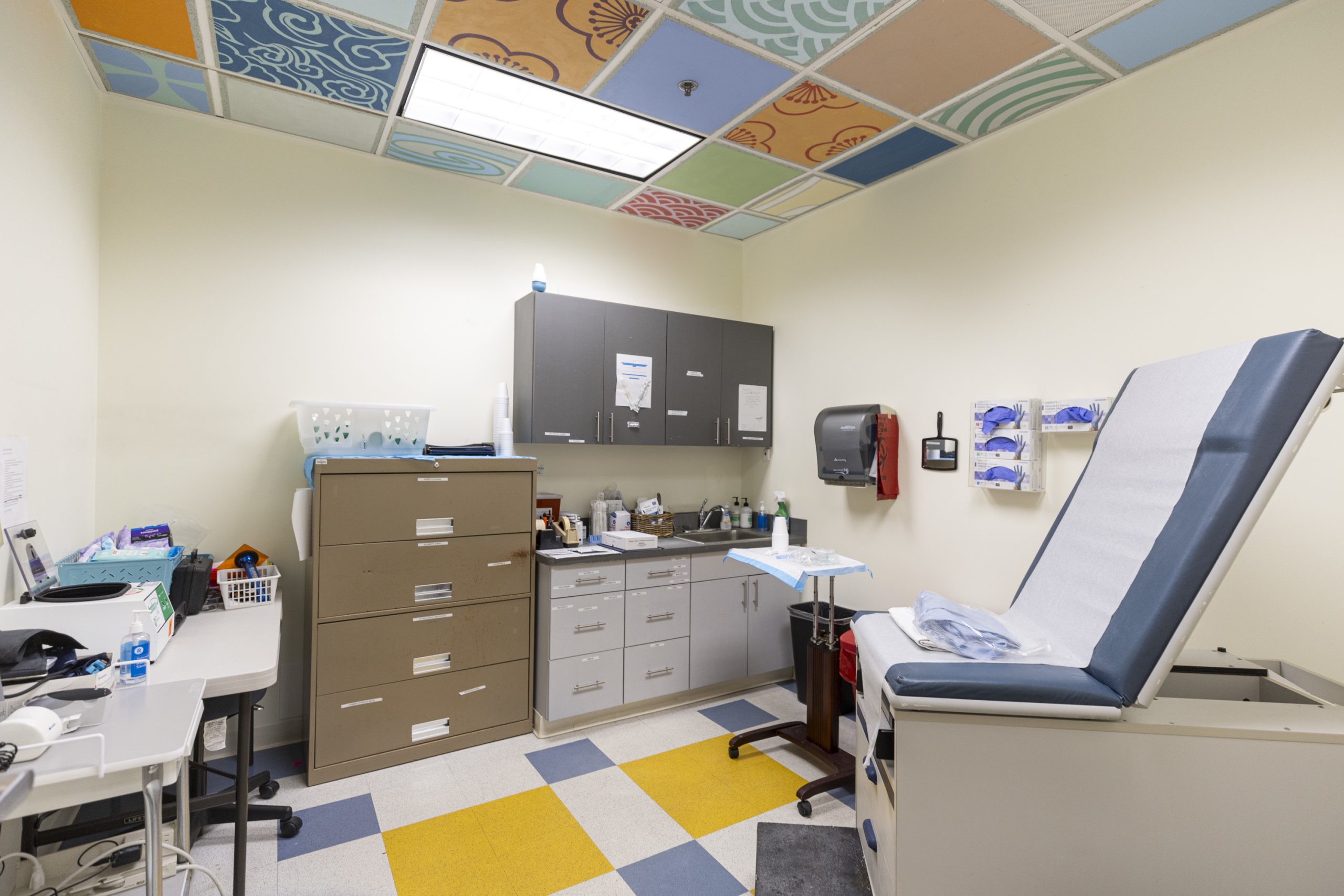
    The exam room at the Philadelphia Sexual Assault Response Center, in Philadelphia, Pa., on Friday Dec. 6, 2024.Tyger Williams / Staff Photographer

    LaQuisha Anthony, WOAR’s executive director, said in a statement that the organization was hamstrung by last year’s monthslong state budget impasse that froze much of its funding.

    She said WOAR was transparent with the city about its financial position.

    “Like most Commonwealth-funded providers, we planned on the assumption that funding would resume,” Anthony said. “The impasse instead ran 135 days. By the time it ended, we had drawn down our reserves.”

    A lifeline center on a shoestring budget

    PSARC, located at 300 E. Hunting Park Ave. in North Philadelphia, has two full-time staff members and a network of about 15 contracted nurses trained to perform sexual assault forensic exams, provided free under Pennsylvania law. The procedures are intended to gather physical evidence, such as DNA left behind by an assailant, and to document injuries that may aid investigators in a future criminal investigation.

    Many hospitals lack the specialized staff required to perform sexual assault forensic exams, so they refer patients to PSARC or work with PSARC to have a trained nurse dispatched to the hospital.

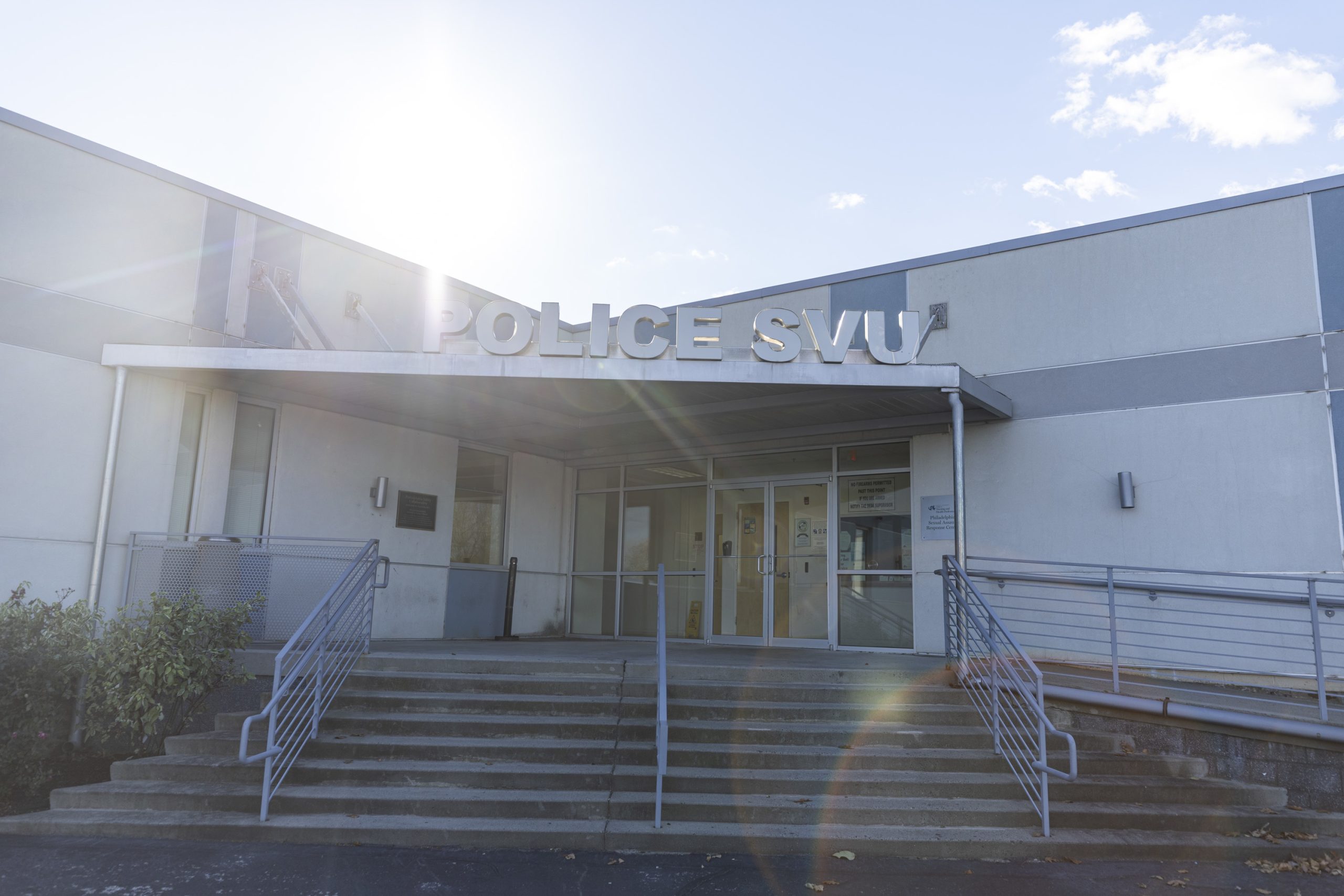
    The center is located next to the Philadelphia Police Special Victims Unit, but patients are not required to report the assault to law enforcement in order to have the free exam performed.

    The Police SVU where the Philadelphia Sexual Assault Response Center, in Philadelphia, Pa., on Friday Dec. 6, 2024.Tyger Williams / Staff Photographer

    Founded in 2011 and initially operated by the now-shuttered Hahnemann University Hospital, PSARC has been run since 2019 by Drexel University’s College of Nursing and Health Professions. For most of that time, the operation ran on a shoestring budget.

    Until last year, PSARC received no dedicated city funding. The state reimbursed Drexel about $1,000 for each patient treated, with Drexel absorbing substantial losses, according to records. The exam reimbursements can take months to flow from the state.

    Brian Keech, then Drexel’s senior vice president for government relations, shared a financial analysis with city officials last year that laid out an annual shortfall averaging more than $175,000.

    As Drexel cut staff and benefits across the university last year amid declining enrollment and a $63 million annual operating loss, its leaders told the Parker administration that the school could no longer manage PSARC on its own.

    In a series of emails last spring, Keech pressed the city for a funding commitment for the center and warned that, without one, the university would have to tell hospitals to stop referring patients for sexual assault exams.

    “We’ve begun to prepare the closure announcement,” Keech wrote in a May 20, 2025, email to Adam Geer, the city’s chief public safety director. “Obviously we’re hopeful we can avoid this scenario, but we do have to adequately prepare area hospitals that they will have to begin providing sexual assault services come July 1 if PSARC closes.”

    By early June, the city had found the money.

    The scramble to save PSARC

    Yates-Gale, the city’s deputy managing director, said in a June 2025 email to Drexel officials that the administration had identified $250,000 in emergency funding to keep the center running.

    The plan was for WOAR — the nonprofit formerly known as Women Organized Against Rape — to operate PSARC. The city would support its efforts by routing those funds to WOAR through an existing health department contract.

    Through the summer of 2025, the money was tangled in the city’s often lengthy contracting process.

    Meanwhile, WOAR was itself under severe financial strain amid the state budget impasse that left community organizations across Pennsylvania unfunded. WOAR’s leaders told city officials that they could not make payroll without the check from the city.

    PSARC was left in limbo. The handoff deadline from Drexel to WOAR was moved from Aug. 1 to Sept. 1, with Drexel agreeing to cover an extra month of payroll to bridge the gap. Then, on Aug. 28 — three days before the already delayed transfer — WOAR’s board chair, Joanne Strauss, wrote in an email to city officials that the organization “will not be acquiring” PSARC.

    She provided no reason other than saying the organization was “further evaluating the proposed transaction.”

    City officials were alarmed. Within an hour, the city’s victim advocate, Adara Combs, emailed Drexel officials to say she was “deeply troubled” by the sudden shift.

    Two weeks later, WOAR appeared ready to operate the center again. The group’s board of directors voted unanimously to approve the acquisition, and money from the city began flowing to WOAR to operate the rape exam center — more than $80,000 in total.

    Then the plan fell apart again.

    In early October, WOAR announced it would lay off staff and cut programs due to its funding crisis.

    Anthony, of WOAR, said in a statement the board’s approval of the acquisition of the sexual assault center came as the nonprofit thought the state budget impasse would come to an end and was “contingent on conditions related to funding and our ability to responsibly take control of PSARC.”

    “It became clear that those conditions were not resolved,” she said.

    Drexel continued to pay to operate the rape crisis center, and WOAR wired the university the city funding it had received. Drexel operated PSARC, with an additional $167,000 in help from the city, until June 30.

    The 15th Street entrance to Drexel University College of Nursing and Health Professions Feb. 19, 2020. The college has the largest bachelor program in the three-state region.TOM GRALISH / Staff Photographer

    The back-and-forth saga highlighted a central question: Why did the city seek to transfer a critical service to WOAR despite the nonprofit’s existing financial problems?

    Slovak, of the Women’s Law Project, said it made sense that WOAR stepped up to take over the center’s operations, given its mission to treat and prevent sexual violence. It is common in other cities for rape crisis centers to manage forensic exam facilities.

    But overseeing hundreds of sexual assault exams each year, she said, would have been a major expansion of WOAR’s scope because it “is about more than just providing emotional support or accompaniment for survivors.”

    Yates-Gale said WOAR was a natural choice to assume operations of the center. The group had an existing contract with the city and its mission aligned with that of PSARC.

    “Drexel agreed to continue operations until another suitable alternative organization could be identified,” she said, “and the entirety of the funds for the program were transferred back to them.”

    Britt Faulstick, a Drexel University spokesperson, said the school “worked closely with city leadership to ensure a smooth transition.”

    Another failed effort to find an operator

    The city’s $250,000 in emergency funding bought PSARC time. But the same question remained: Who would run it long-term, and where would they find the money?

    This spring, Parker’s budget proposal, which was approved by City Council in June, included $300,000 for the center. The city put the operation out for bid, seeking an outside organization like another hospital or nonprofit to run it.

    City officials met on April 13 with potential operators, including representatives from area hospitals that depend on the center, such as Temple University, the University of Pennsylvania, and Jefferson Einstein Philadelphia. Several expressed concerns about PSARC’s finances.

    According to a public recording of the meeting, multiple attendees suggested that $300,000 a year in city funding would not be enough to cover PSARC’s operations and salaries for medical staff who must be available 24-7.

    The exam room and desk space when patients are in at the Philadelphia Sexual Assault Response Center, in Philadelphia, Pa., on Friday Dec. 6, 2024.Tyger Williams / Staff Photographer

    “This has never been something that’s been profitable, so it’s always needed another source of funds to keep it stable,” one hospital representative said. “It’s the money, right, to keep it open and to be able to run this as a service for the city and keep it maintained so you’re not back in this ‘we don’t have it’ in six months.”

    Combs, the city’s victim advocate, told potential bidders that they were welcome to “reimagine” how PSARC operates and propose new funding streams.

    But hospital representatives remained skeptical and pressed the city to find a different solution, citing a moral urgency.

    “It would be a tremendous tragedy if we lost the resources of PSARC in the city,” said a representative from Jefferson Einstein Philadelphia Hospital.

    “I think we all agree,” said Azucena Ugarte, director of the Philadelphia Office of Domestic Violence Strategies. “That’s why we’re doing this.”

    But following the meeting, no one bid.

    The city takes over

    With no outside bid to operate Philadelphia’s only free rape exam center, the options in front of city officials were either to let it close or to take control themselves.

    The city chose the latter. Parker administration officials framed it as a lasting solution.

    Faulstick, of Drexel, said the school will continue to train nurses in sexual assault examination to help ensure the care is available. He said PSARC is “positioned for continued growth and long-term sustainability.”

    Others have questions about the stabilization plan.

    City Councilmember Nina Ahmad, who represents the city at-large and held a hearing earlier this year about PSARC funding, said that the $300,000 annual allocation to the center is likely inadequate and that she will push for more dollars in future city budgets.

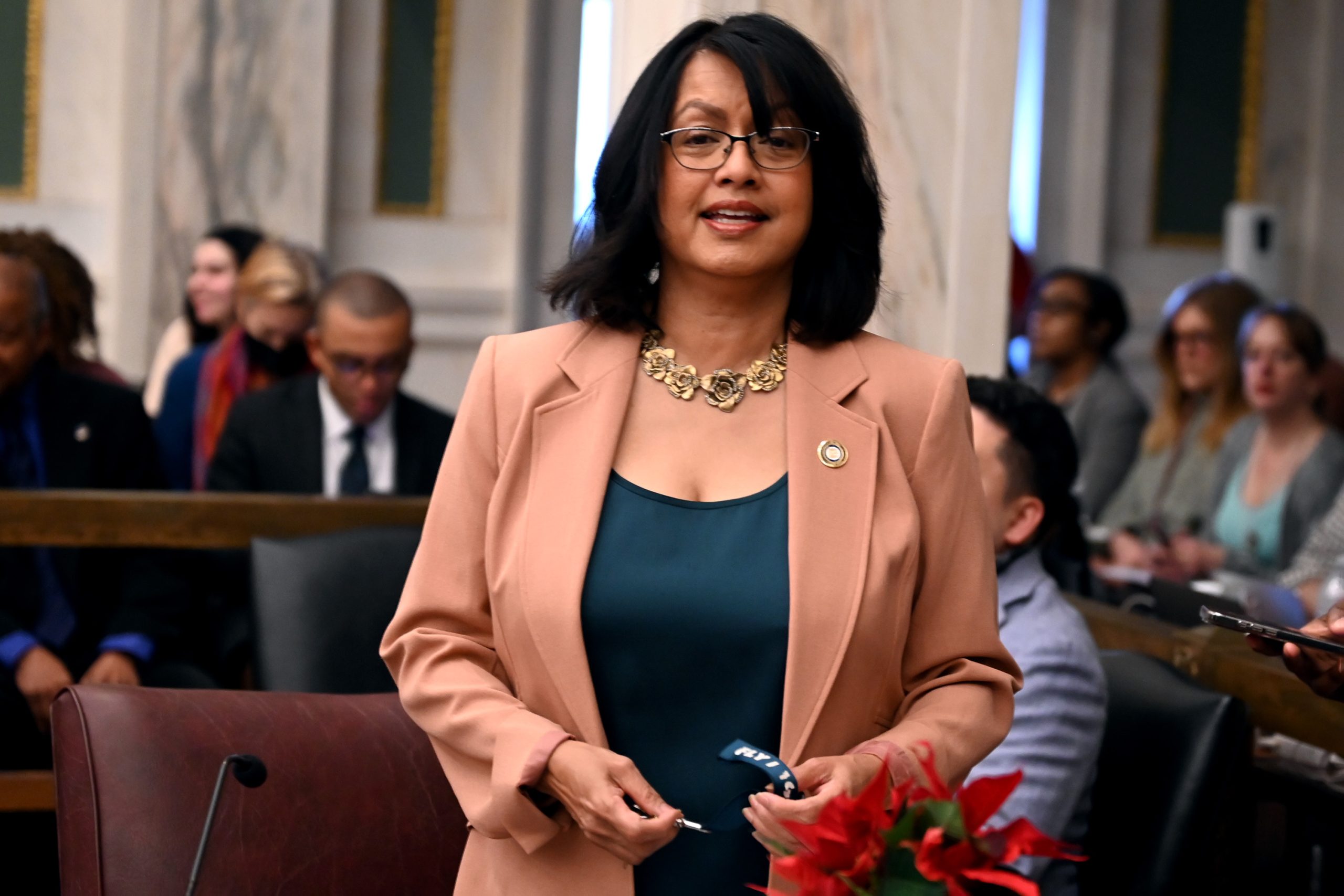
    Councilmember Nina Ahmad in chambers as City Council meets Dec. 11, 2025.Tom Gralish / Staff Photographer

    Ahmad also said she expected more buy-in from hospitals, noting they would have been saddled with the responsibility of providing sexual assault exams if PSARC had shuttered.

    “I am not surprised,” she said in an interview, “but I’m still disgusted that we have not come together on this. … This is evidence being collected, [and] this is how we prevent future rapes.”

    Slovak said ensuring PSARC’s financial survival will take more than a change in management. It will require cooperation, including from hospitals, the city, and the state, to work together “so that survivors aren’t sacrificed in the budget gamesmanship.”

    Still, she said, the city “can really be this positive, central, coordinating force.”

    “And I do feel confident at this point,” Slovak added, that the center “is going to move in a good direction from here.”

  • Doctor killed in Southwest Philly was driving for DoorDash to support wife’s medical career, family says

    Doctor killed in Southwest Philly was driving for DoorDash to support wife’s medical career, family says

    For Minara Rahman and her husband, a move to Philadelphia was supposed to be a fresh start.

    She and Md Mahfuzul Haque met while attending medical school in their native Bangladesh in 2000, married soon after, and remained nearly inseparable for 21 years, most of them spent in Canada.

    Their love story came to a tragic conclusion early this month when Haque, a 43-year-old doctor who was driving for DoorDash to support Rahman’s optometry career, was shot and killed during a robbery outside a Southwest Philadelphia home.

    It was one of at least three shootings involving delivery drivers in the city this summer.

    Last week, prosecutors charged 15-year-old Zakah Johnson with murder, robbery, and related crimes in connection with the killing, and police are looking for two other people they believe are involved.

    “I still can’t believe it,” said Rahman, 43. “I’m crying, I’m mourning, I’m in grief, but I’m still not believing he’s not with me.”

    Philadelphia had only recently become home for Rahman, Haque, and their 14-year-old son.

    In 2023, the family moved from Vancouver, where much of Haque’s extended family lives, as Rahman began her studies at Drexel University’s optometry school, she said.

    She and Haque had both been practicing physicians in Bangladesh and worked in the healthcare industry in Canada, where they moved in 2011 after receiving skilled immigration visas.

    In Philadelphia, Rahman saw the opportunity to get an American medical license and earn enough to support her family.

    Haque, she said, sacrificed his own professional ambitions to support that move, doing odd jobs and driving for DoorDash to earn money while she completed school.

    Rahman graduated from Drexel last year and began practical training while the family worked to extend their U.S. visas. Part of her work involved conducting eye exams for police and security guards, she said.

    “It was me who wanted to do something more, and he always supported me,” Rahman said of her husband. “Without him, it would have been impossible.”

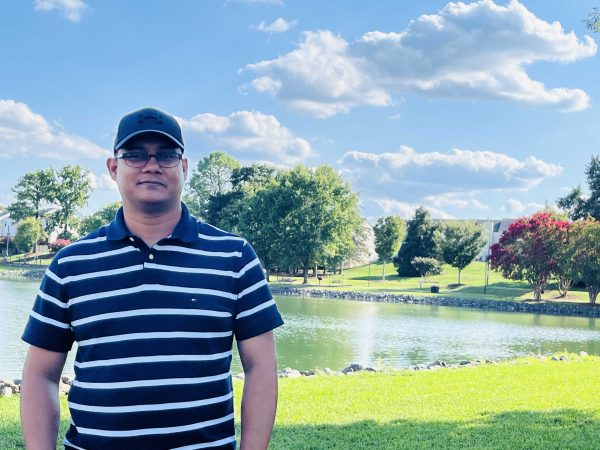
    A photo of Md Mahfuzul Haque.Minara Rahman

    Though Rahman worried that Philadelphia could be dangerous, she said, she and Haque believed that life in the United States would offer their family safety and security.

    She no longer thinks so.

    Just days after Haque’s killing, police made an arrest in a separate homicide case involving a food delivery driver. They accused a 14-year-old Queen Village teen of luring the man, Anshul Kuncha, to an abandoned North Philadelphia rowhouse, where he was found dead with a gunshot wound to the head.

    And on Tuesday, police said, a 31-year-old delivery driver was shot in the hand after getting into an argument with two women in Northern Liberties. He was placed in stable condition at a nearby hospital.

    Since the July 7 shooting of Haque, Rahman has been in touch with police seeking to gather more information about her husband’s killing.

    Officers responded to the 1000 block of South Ithan Street in the city’s Kingsessing neighborhood around 9:30 that evening to find Haque on the ground with a gunshot wound to the head.

    His car was still running, investigators said, and a bag of delivery food was found nearby. They soon identified three suspects, masked men wearing dark clothing.

    Johnson, of East Mount Airy, was charged with murder in Haque’s killing last Friday while he was in custody in connection with an unrelated crime. He is being held in prison without bail.

    The teen is expected to appear in court for a preliminary hearing on Aug. 10.

    Rahman said she was struck by the fact that the gunman who police say took her husband’s life is so young — just a year older than her own son.

    “I can’t imagine any boy like my son’s age treating anybody else like that,” she said. “I have no idea what they were thinking — what was their motive, and how did they get that firearm that easily?”

    Haque was buried in Vancouver, where Rahman and her son moved to be near his extended family, and she has abandoned her pursuit of a medical career in the United States.

    In an interview, she spoke sorrowfully of plans abandoned: a family trip to Florida, an Atlantic City wedding anniversary celebration set for the last week of July.

    And each day, Rahman said, she struggles with nagging worry that by moving her family to Philadelphia for her career, she was somehow responsible for her husband’s death.

    The only thing she wants now is justice.

    “We both did counseling for tons of patients,” Rahman said, recalling the years of challenging medical work caring for people at their worst moments.

    “Now I’m in that situation,” she said. “I can’t take it anymore, and I need help.”

  • Like rival Wawa, Delco’s Swiss Farms plans to add gas pumps under its latest owner

    Like rival Wawa, Delco’s Swiss Farms plans to add gas pumps under its latest owner

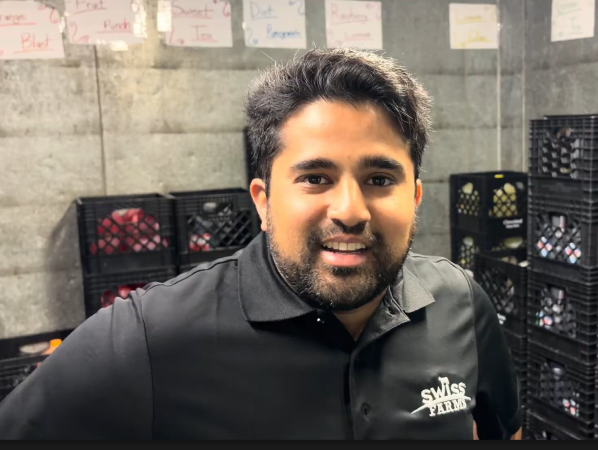
    The new owner of Swiss Farm Stores, a Delco fixture selling dairy, groceries, and convenience goods almost as long as cross-county rival Wawa, is planning new stores with gas pumps in Delaware, Philadelphia, Montgomery, and Bucks Counties.

    “We were neck and neck with Wawa, then they went into gas in 1996, and it revolutionized their business,” said Arsh Pola, a Drexel University graduate and gas station and convenience store operator, who bought the chain in stages after starting talks in 2022.

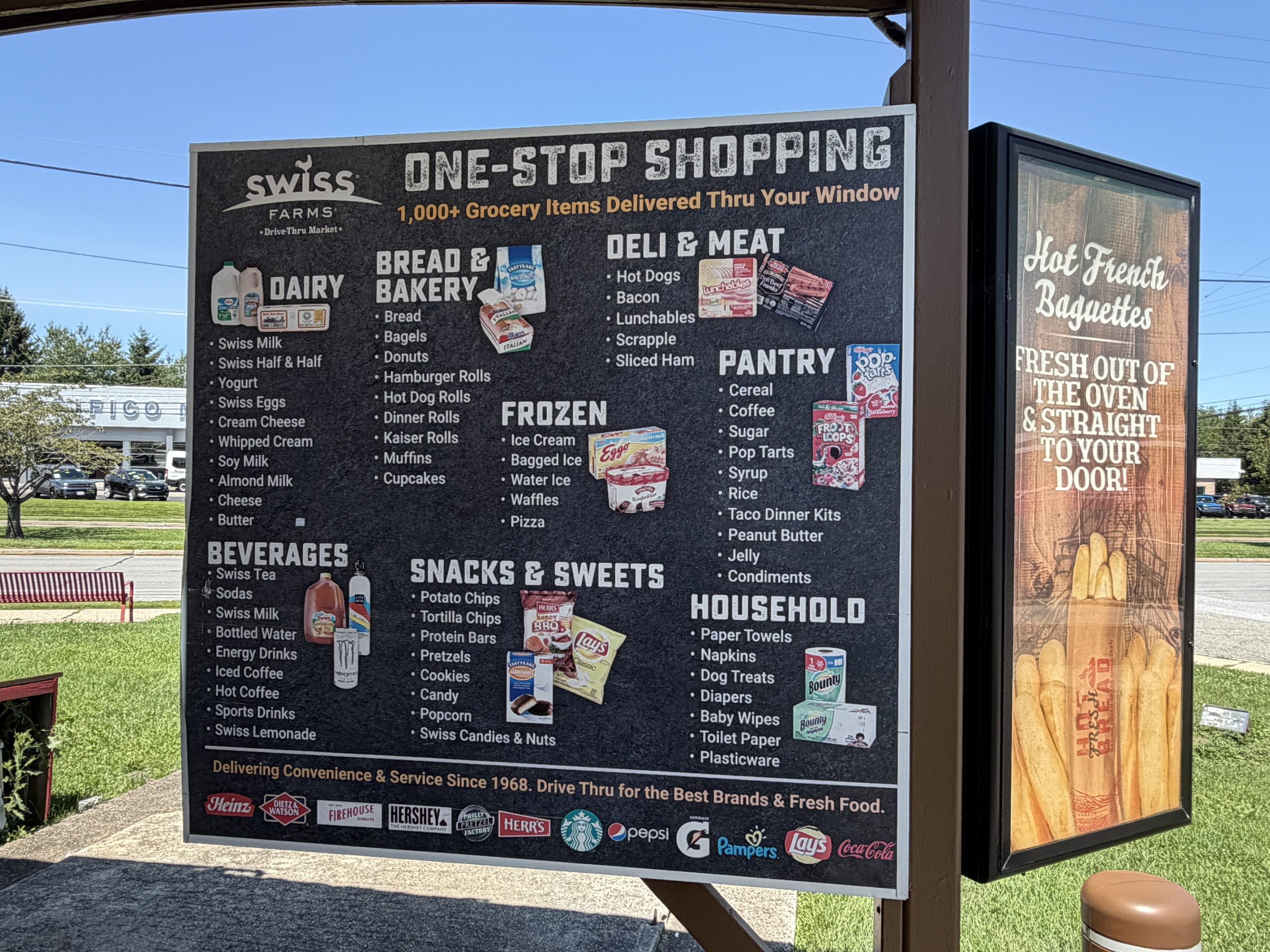
    “It’s a beautiful business,” Pola said. Serving through drive-up windows from posted menus of hot and cold foods and pantry items, “we have a different customer from other stores: mom. We are serving local families milk and the things that built a cult following. We will add more of the right things.”

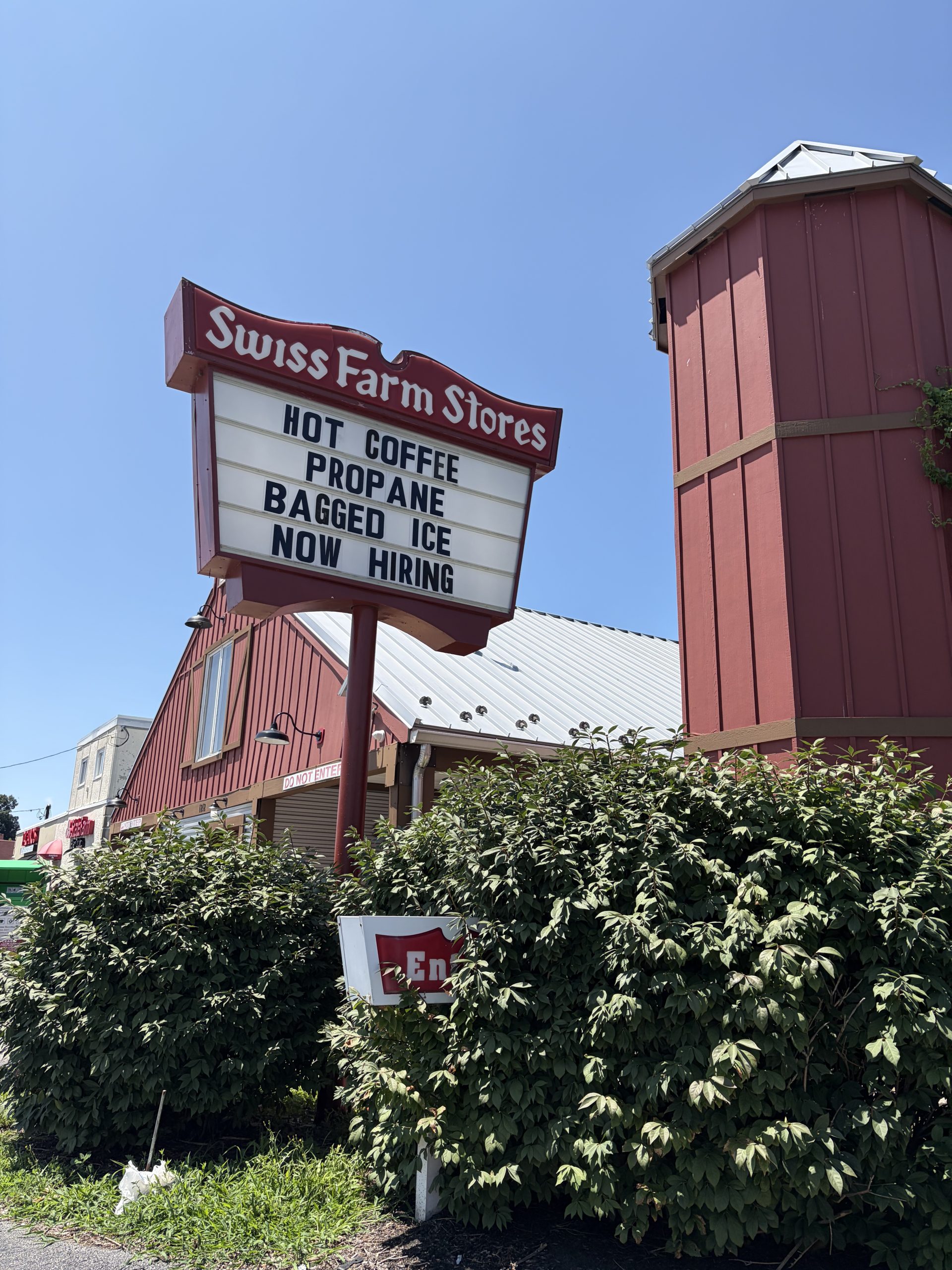
    Side entrance at Swiss Farm Stores’ Drexel Hill, location.Joseph DiStefano

    Pola’s vision to update Swiss Farm, which started in 1968, is fuel and an expanded menu.

    Adding gas to a drive-up chain might not be a long jump for Pola, who owns gas stations, stores, and apartments in Philadelphia and Montgomery County.

    The North Penn High School alumnus jokes that his retail focus in a family of professionals — engineer, pharmacist, dentist — makes him “a black sheep” but also tracks with his Gujarati immigrant grandfather, a teacher who saved his pay to buy a New England convenience store.

    Pola began negotiating to buy Swiss Farm franchises in 2022, two years after Florida-based Farm Stores bought the company from Radnor-based MVP Capital and other investors.

    Earlier owners tried and failed to grow Swiss Farms beyond Delaware County. When Pola realized the Delco-area franchises were the only stores still open, he bought one after another, starting in 2024, and then the parent company. He was financed by regional banks that also backed his gas station deals. The purchase closed June 30.

    His plans rely on execution by Swiss Farm veterans, topped by Chris Gray, who worked 25 years at the company and rose to CEO before MVP let him go. Pola, now CEO, brought Gray back as chief operating officer.

    Pola agreed to detail his plans for Swiss Farms to The Inquirer in interviews at the Broomall and Drexel Hill stores.

    How did you get into retail?

    When I was studying finance at Drexel [graduated 2019], I had the dream of working at Goldman Sachs. I became the youngest co-op at Goldman Sachs. And they quickly told me, ‘You get along really well with the clients.’

    I started buying gas stations while I was still a student. I took Warren Buffett’s advice: ‘Buy something with a moat around it.’ Gas stations have a very strong customer cash flow that’s recession-proof.

    I started with a former Liberty, up at Ridge and Manatawna. I wanted my own brand on the store. I called it Posh [with a crown over the P]. I ended up doing Marathons and Lukoils. I still have a few stations in Philadelphia and Montgomery County.

    How could you afford to buy Swiss Farms?

    Each gas station required a million-dollar investment. So I wanted to do a portfolio deal [buy several at once]. Everything was financed from the banks that knew me. They do 20-year mortgages.

    Farm Stores’ goal was: ‘Let’s franchise!’ Wawa doesn’t franchise. Raising Cane’s CEO Todd Graves talks about this: You can’t control the quality of a franchise when you don’t own it.

    I told Farm Stores, ‘You guys are 1,500 miles away. Let me buy it all.’

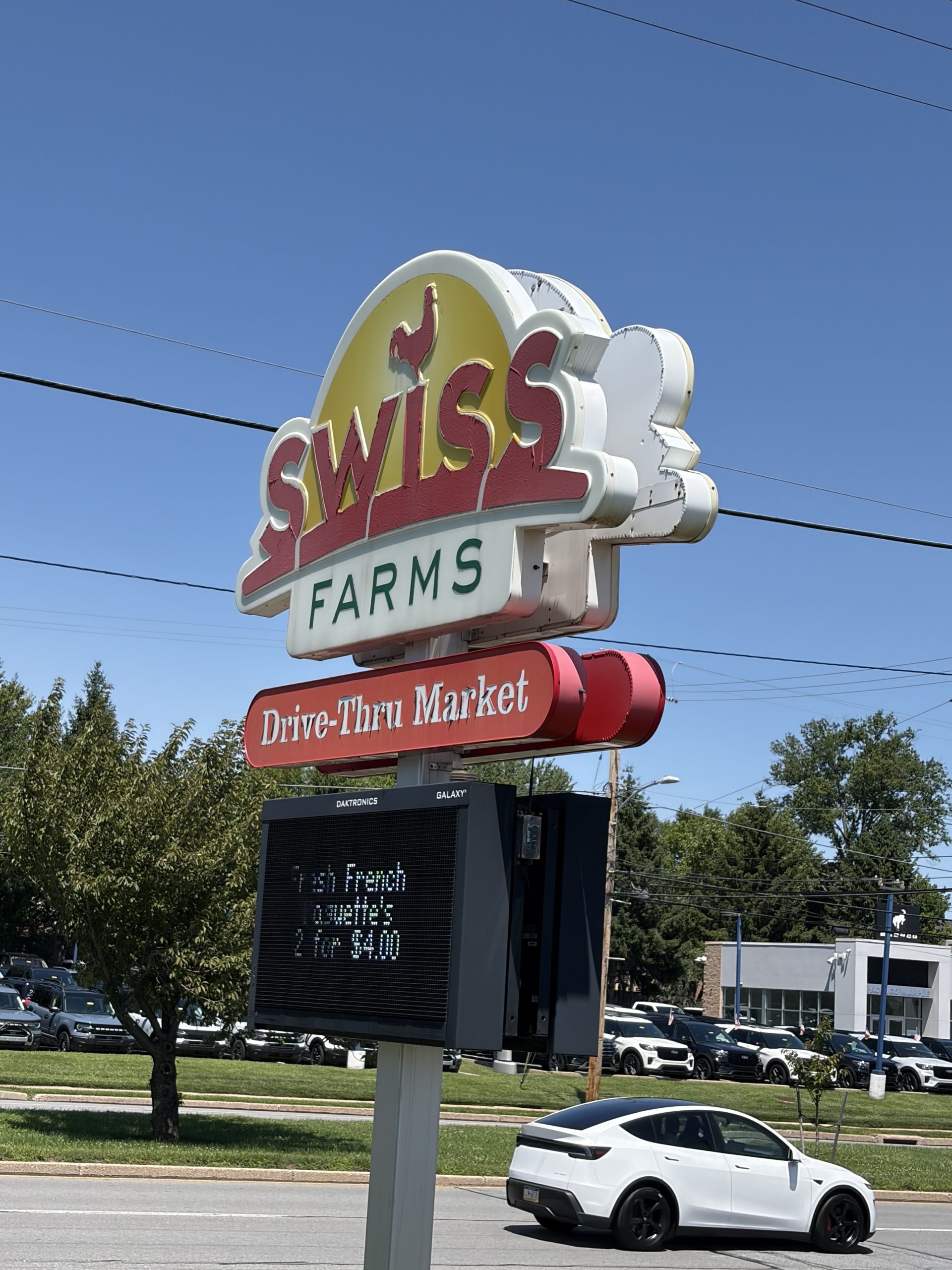
    Sign at Swiss Farms’ Broomall, Delaware County store.Joseph DiStefano
    What are the first few things you will add or take away?

    The stores need a facelift. We won’t take away the silos, but [we’ll give them] a fresh look.

    And the stores need more employees. In-N-Out doubled their payroll, and sales went up three or four times over.

    We always had employees in these black shirts. Now we’ve added six new colors, make it fun for the staff.

    We just did an event with [former Eagle] Brian Dawkins. Everyone on his staff knew Swiss Farms and loves us.

    How can you compete with large chains like Wawa and 7-Eleven that can purchase gas and food in bulk at lower costs?

    I’m already in the gasoline business. I buy on the open market every day. I buy from the same [fuel suppliers] that sell to BJ’s and Sunoco. We are going to price gas the most aggressively we can.

    Some costs you can cut. Swiss Farms had a consultant negotiating what were supposed to be the best trash rates. We cut that.

    Swiss Farm Stores drive-up menu, July 2027Joseph N. DiStefa
    Kathy Strimmel, who runs the Drexel Hill store, says she’s a longtime customer, who’s now been working there for a year. Is it hard to find people to work your stores?

    It’s difficult to find quality talent. People don’t all have the same drive, or loyalty. We start at $10 to $12 an hour.

    Your milk costs maybe a dollar more a gallon than the store down the street, why?

    It’s good milk! People don’t say, ‘Can I get a gallon of whole milk?’ They say, ‘Can I get Swiss Vitamin D?’ And we share the cost for getting it into your car.

    We do have the best prices on our iced teas. I don’t know why, but Delaware County has a reputation as the best iced-tea market in the country.

    How many new stores are you planning?

    Twenty-five in the next five years. We will find locations here in Delaware County, and we will enter Philadelphia, Montgomery County, and Bucks County. After that, we will grow organically, state by state, where it makes sense.

    I respect Wawa. [Wawa CEO] Chris Gheysens said, ‘It took 60 years for us to get into six states; it’ll take six years to get into the rest.’”

    Wawa has closed several of its Philadelphia stores. How can Swiss Farms make the city work if Wawa can’t?

    You have to choose locations very wisely. I have gas stations in Philadelphia. I know how to do that.

  • Tower Health is laying off 160 workers at Pottstown Hospital while expanding emergency department, behavioral health

    Tower Health is laying off 160 workers at Pottstown Hospital while expanding emergency department, behavioral health

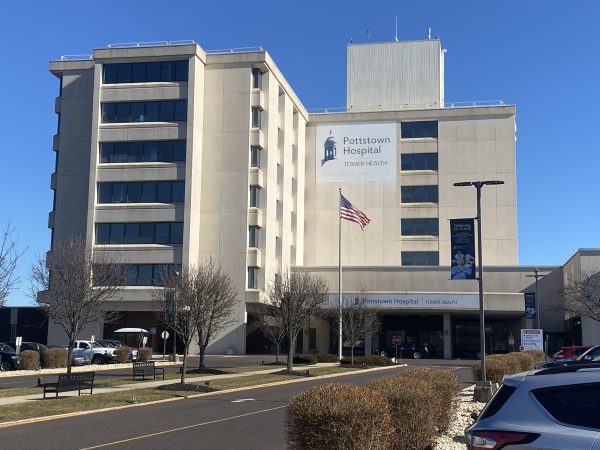
    Tower Health is eliminating 160 jobs at Pottstown Hospital as part of an effort to bring staffing at the Montgomery County facility in line with lower patient volumes, the Berks County nonprofit announced Tuesday. The cuts amount to 22% of the workforce at Pottstown.

    In addition to the job reductions — which are more than the 131 positions cut last year at Pottstown — Tower also plans “a multimillion-dollar investment” to expand the emergency department, enhance inpatient and outpatient behavioral health services, and update portions of the hospital, Tower said.

    “These changes are designed to strengthen the hospital’s ability to serve local residents for generations to come by preserving access to the services patients need most, investing in the areas of greatest community need, and ensuring Pottstown Hospital remains a strong, sustainable community hospital for the future,” Tower said in a statement.

    To expand behavioral health, Tower will convert some underused general-purpose hospital beds to inpatient behavioral health beds. The behavioral health total will rise to 52 from 28, an 86% increase. Pottstown has 213 licensed beds.

    Tower did not provide a timeline for the changes but said it plans to hire 38 people to staff the expanded emergency department and behavioral health unit, which will have a separate entrance for the sake of patients’ privacy when they seek mental health services.

    Another change at Pottstown involves the lease of an unspecified amount of space to Community Health & Dental Care, a federal health clinic that was formed in 2008 with funding from Pottstown Area Health and Wellness Foundation.

    Unlike the restructuring Tower announced last fall at Pottstown, which included the closures of the combined intensive care/critical care unit, the Pottstown location of the McGlinn Cancer Institute, and the hospital’s endoscopy center, this round is not eliminating any services, Tower said.

    In the nine months that ended March 31, Pottstown has 5,104 inpatients, down 9.7% from the same period the year before. Most of that decline came in the first three months of this year, after Tower’s service cuts, according to data shared with bondholders.

    After last year’s layoffs, which included about 60 registered nurses represented by Pennsylvania Association of Staff Nurses & Allied Professionals, Pottstown employed about 700 people. Overall, Tower employs more than 10,000.

    The union said it still has 200 Pottstown nurses in its ranks. “We have been in touch with hospital management to better understand the context for and impact of the proposed layoffs and to push hard for solutions that protect both patient care and the dedicated nurses who serve the Pottstown community,” a union spokesperson said.

    Tower’s anchor is Reading Hospital in West Reading, Pa. In additional to Pottstown, it owns Phoenixville Hospital, plus St. Christopher’s Hospital for Children in North Philadelphia in a 50-50 joint venture with Drexel University. Tower previously owned Brandywine, Jennersville, and Chestnut Hill Hospitals.
    It closed Brandywine and Jennersville and sold Chestnut Hill to a group led by Temple University Health System.

    Tower recently announced that Jefferson Health, Nemours Children’s Health, and Temple University Health System are working on forming an alliance to support St. Chris clinically. Last week, Tower said that it had formed a clinical affiliation to expand advanced care in its markets.