Corey Regensburg’s working with a shiny chrome La Marzocco — the Cadillac of professional espresso machines. It purrs and whooshes as he pulls a double shot of espresso and sets it up for a latte tutorial. It’s well past Ox’s normal business hours, the sunset peers through the shop’s large windows and pulled-down shades.
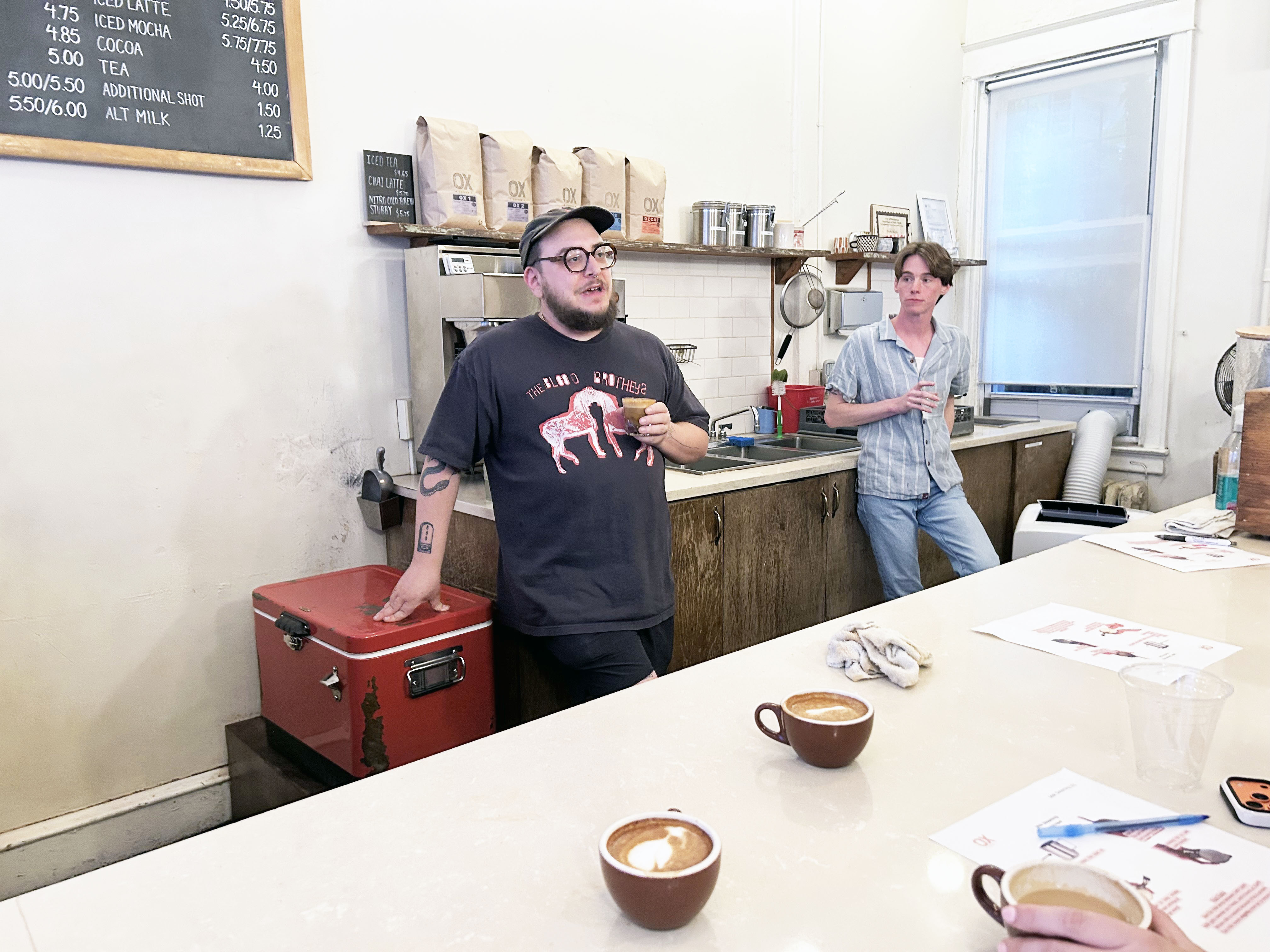
Regensburg, one of the shop’s consultants, steams milk in a frothing pitcher and demonstrates his latte pour for a crowd of four people huddled around the quartz countertop at Ox Coffee in Queen Village.
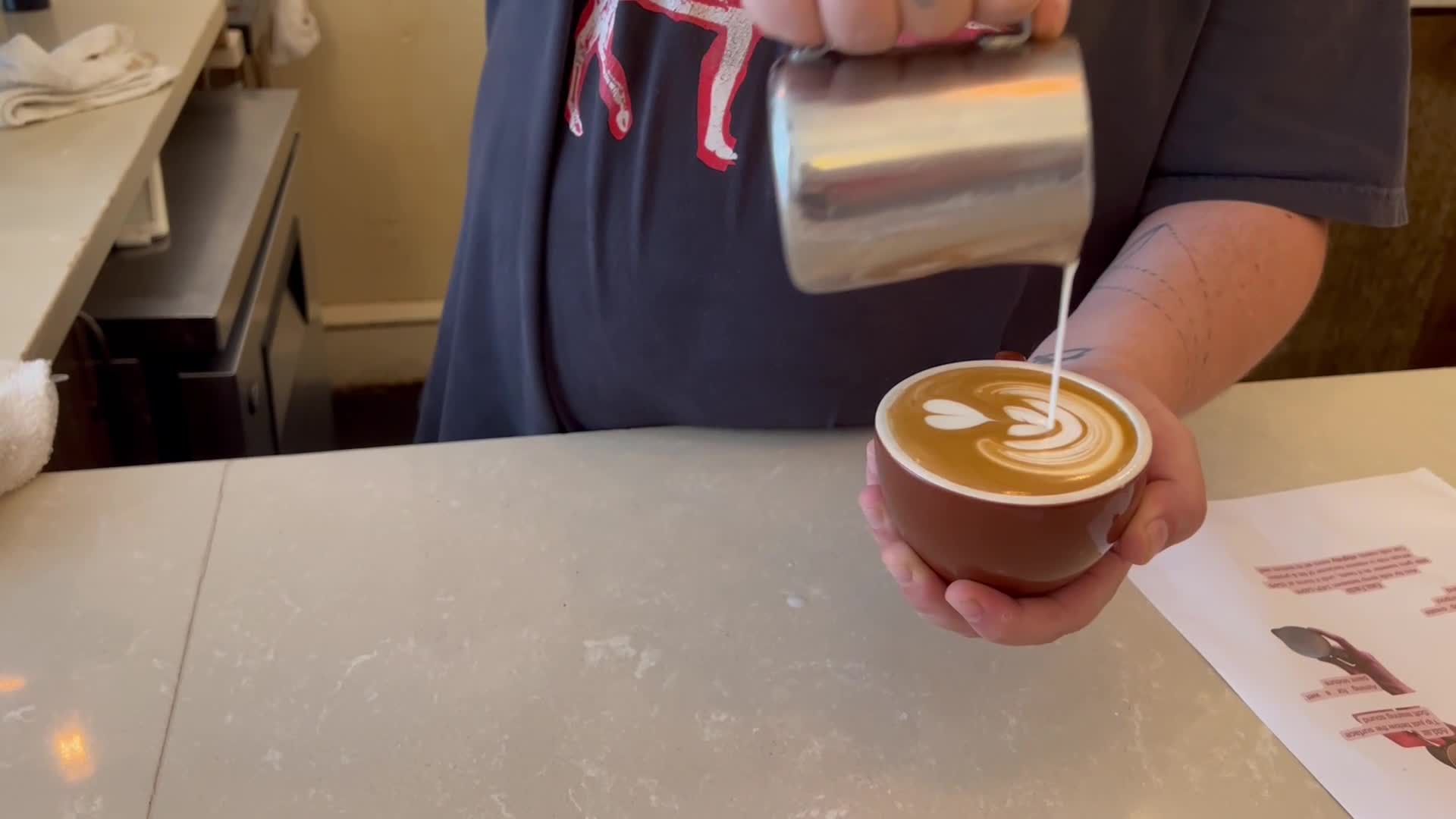
“Pencil thin,” he narrates as the milk streams into the base of the mug, sinking under the espresso’s golden layer of crema. Then, “push, push, glide,” he instructs. The result is a tulip design, finished with two dainty hearts.
The spectators at Ox aren’t new employees — they’re at-home enthusiasts, including a father-daughter duo who took the class to perfect their kitchenside almond milk lattes.
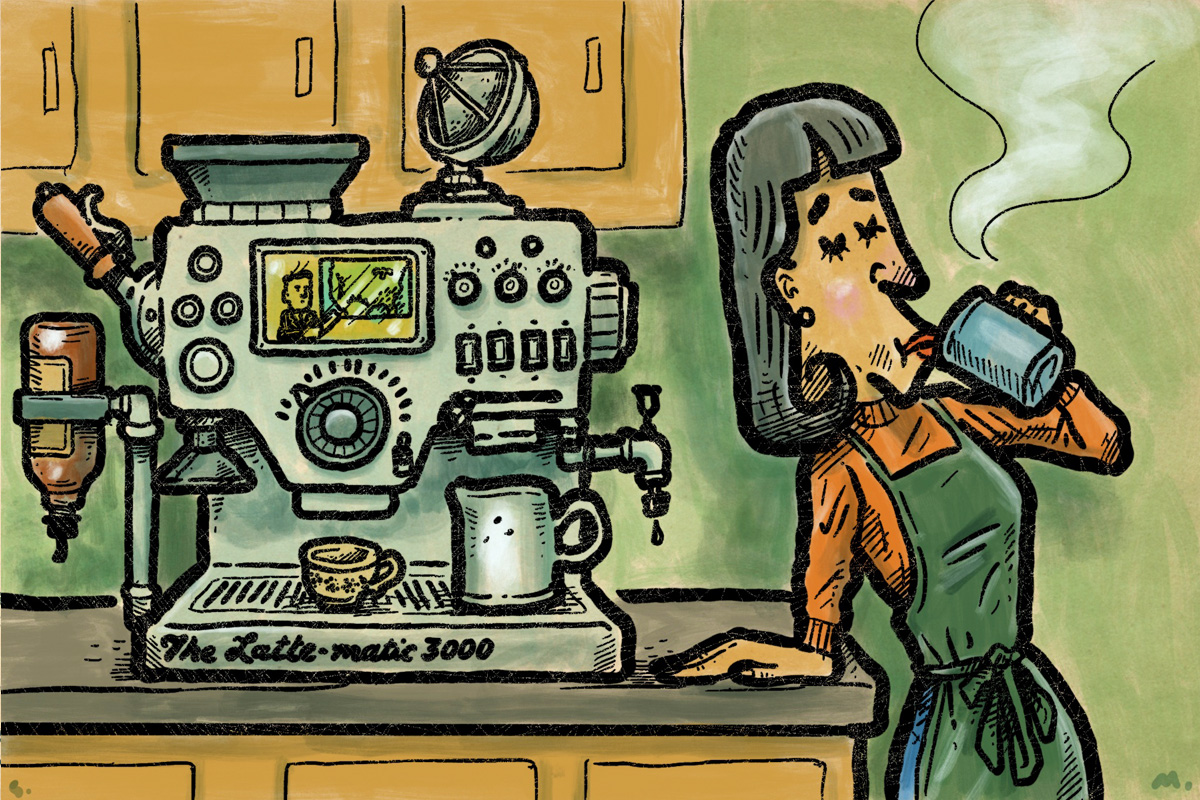
Americans are buying all types of coffee makers and brewing at home more, according to the National Coffee Association, with ownership of countertop espresso machines growing by 50% in 2025 and still on the rise in 2026. Breville Kitchen Group, especially, has seen a surge in sales among amateur espresso makers, with a range of high-end automatic and semi-automatic machines.
“COVID triggered a rise in at-home espresso,” Regensburg said. “Breville boomed like 10 times, and everyone else — from Panasonic to Ninja — hopped on.”
Industry experts say the global espresso and coffee machine market is rapidly expanding, driven by a “prosumer” movement: enthusiasts at home who crave high-end gear to make cafe-style drinks.
Now, coffee shops are leaning into the phenomenon, offering lessons to hobbyists to help master the craft.It illustrates a larger trend across the food service industry: teaching as a way to diversify revenue, build relationships with customers, and fulfill patrons’ desire to peek behind the curtain.
Across Philly, you’ll find Mighty Bread teaching croissant classes, Jezabel’s hosting empanada-making courses, the Bread Room with pizza lessons, Bloomsday with wine 101 sessions, and plenty more.
“It’s really exciting because it adds something to the dynamic besides going to eat or drink, which is wonderful but one-dimensional,” Jonathan Deutsch, director of Drexel University’s Food Lab, said.
Corey Regensburg and Leo Dowd lead a Latte Art 101 class at Ox Coffee.Emily Bloch
Leo Dowd runs Ox’s coffee class program. He says the shop has hosted about 10 classes so far on topics including espresso 101 and latte art for beginners. The classes allow everyday customers to get behind the bar and learn from the pros.
“The rise of remote and hybrid work has played a big role [in coffee classes], along with DIY culture on social media,” Cody Wood, a barista trainer at Crema Coffee in Nashville, said. Crema runs a host of classes inside a training lab at its downtown location. “Overall, it seems more people are tackling home projects, baking bread, learning to cook, trying new experiences on their own, and learning to make the best coffee at home.”
At Ox, the students take turns behind the La Marzocco — a powerhouse compared to any home espresso machine. They sheepishly tinker with the steam valve under Regensburg’s tutelage, practicing with water before moving onto whole milk.
As the milk steams, he calls out cues for students to look out for, like the sound of paper tearing and the appearance of white paint. Dowd picks out a Sonny Stitt record and puts it on in the background.
Video: Ox Coffee consultant demonstrates pouring milk in a Latte Art 101 class
Coffee shops giving away tricks of the trade — including recipes — hasn’t hurt sales, either. If anything, the rise of the at-home barista has helped them.
“Zahav’s hummus recipe is published everywhere, for instance, and it doesn’t mean that you are going to necessarily make it,” Deutsch said. “Coffee’s different because on one hand, it’s really easy to make if you know what you’re doing. But on the other hand, to do espresso drinks really beautifully, you need the right equipment. And there’s awesome home equipment like the Breville, but it’s still not the same as going to a coffee shop and having a really properly pulled, professionally done espresso.”
Wood at Crema in Nashville says the same people who take their coffee classes are also coming back to try new roasts and to talk shop.
Cody Wood demonstrates a pour at Crema in Nashville. Wood, a barista trainer, also leads Crema’s public education program.Courtesy of Crema
“My hope is that we continue to see better coffee brewed and shared in both cafes and homes,” he said. “Coffee has always been a communal experience. Everyone I know who loves making coffee loves sharing it with others.”
Coffee classes nationwide average around $100 per session. Ox’s classes cost between $95-$135 depending on the intricacy.
“That’s a lot of cups of coffee you would have to sell to get that kind of revenue,” Deutsch said.
Deutsch said this approach is wise since during regular business hours, coffee sales rely on convenience and speed.
“If you’re standing in line at 7 a.m., it’s not really a great time to ask about the sustainability of the beans and provenance and all this kind of stuff you might be curious about as a coffee nerd,” he said. “The whole idea of building a relationship with guests on a more substantive level makes sense. Also, if you go out, you’re going to spend a hundred bucks easily on a few drinks and some music. Why not educate yourself and do something entertaining that will stay with you?”
Gloria Sullivan tired and reviewed 100 Philly coffee shops for her followers. Today, she creates her own signature drinks at home. She’s shown here trying an Ice Drip Coffee with half and half and an Iced Earl Gray Tea at Vault + Vine in Philadelphia, Friday, September 1, 2023.Jessica Griffin / Staff Photographer
On social media, TikTok feeds are flooded with content creators attempting to create (or recreate) their favorite lattes and little treats at home.
Philly-based creator Gloria Sullivan — aka @_gloyoyo_ — often documents her morning coffee ritual for her more than 700,000 followers. She alternates between her Breville Bambino, a moka pot, and other methods when making her coffee.
“In the beginning, a lot of coffee creators framed their videos as ‘stop buying coffee out, make this at home instead’ and now it feels more focused on creativity, finding fun ways to make drinks at home exciting,” Sullivan said. “Making coffee is as much of a hobby as knitting or reading or baking, coupled with the fact that a lot of people want to start making content online and there’s not a super high barrier to entry for making coffee at home.”
By the end of class at Ox, half empty mugs and rags are scattered across the bar. The level of proficiency after an hour and a half varies, but every guest has managed to get their milk to skate on top of their mug of espresso.
The amateur work isn’t close to Regensburg’s tulip, but he remains encouraging.
“I know that latte art is sexy and fun and it looks good on Instagram,” he said. “But this — milk texture — is what matters. Latte art got big because it’s indicative of good milk texture.”
Dowd anticipates Ox’s coffee class schedule will ramp up this fall and winter as locals look for indoor activities.
Currently, Ox appears to be the only Philly shop offering courses. But Deutsch wouldn’t be surprised if that changes soon enough.
“I think it’s a really good idea,” he said. “The positives outweigh the risks of teaching people your secrets. I really think that’s more a mythology than a reality that’s born out.”
Officials from Drexel University and the Academy of Natural Sciences were scheduled to meet Friday to continue discussing a path forward — with a potential split of the two organizations hovering over talks as one possibility.
“That’s certainly a [potential] outcome,” said one source familiar with the situation who requested anonymity because they weren’t authorized to speak on the matter.
But there likely also will be “reconciliation attempts,” the source said. “We either abide by the terms that we have been talking about or don’t.” If both sides abide by the terms, they said, “then everything continues peacefully.”
The Academy and Drexel announced an affiliation in 2011, merging aspects of their operations but keeping separate boards. The Inquirer reported in April that Drexel told the Academy to either fully merge with the university or it would move to disaffiliate, and the two have been negotiating a new affiliation agreement.
Neither the Academy nor Drexel returned calls early Friday evening seeking comment on whether the meeting had ended and its outcome.
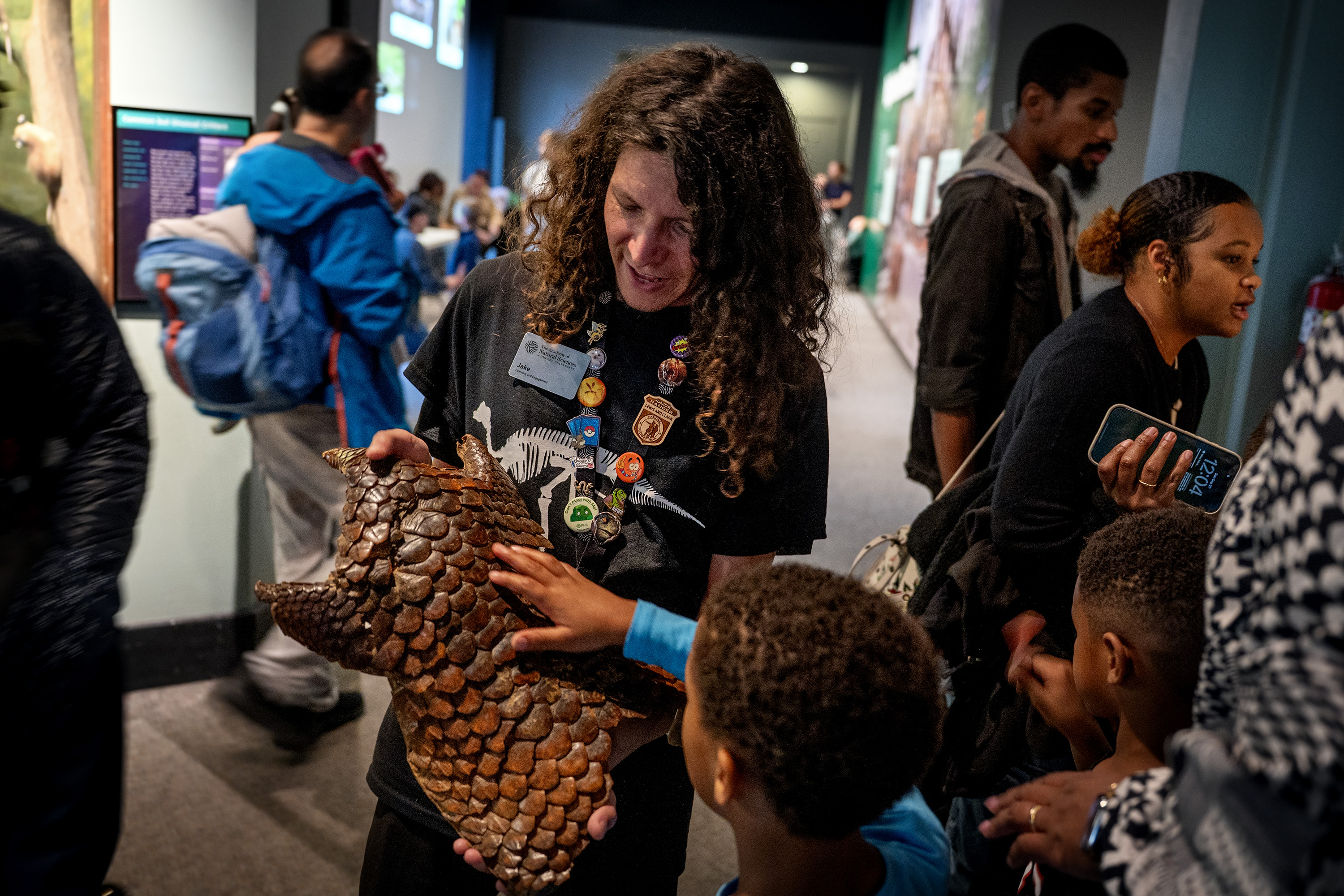
Science educator Jake Cook lets visitors feel the skin of a pangolin — a scaly anteater — at the Academy of Natural Sciences of Drexel University on Sunday.Tom Gralish / Staff Photographer
Drexel and the Academy disclosed plans in September to close the Academy museum, move the 19 million specimens in the collection, and eventually sell the building at 19th Street and the Benjamin Franklin Parkway.
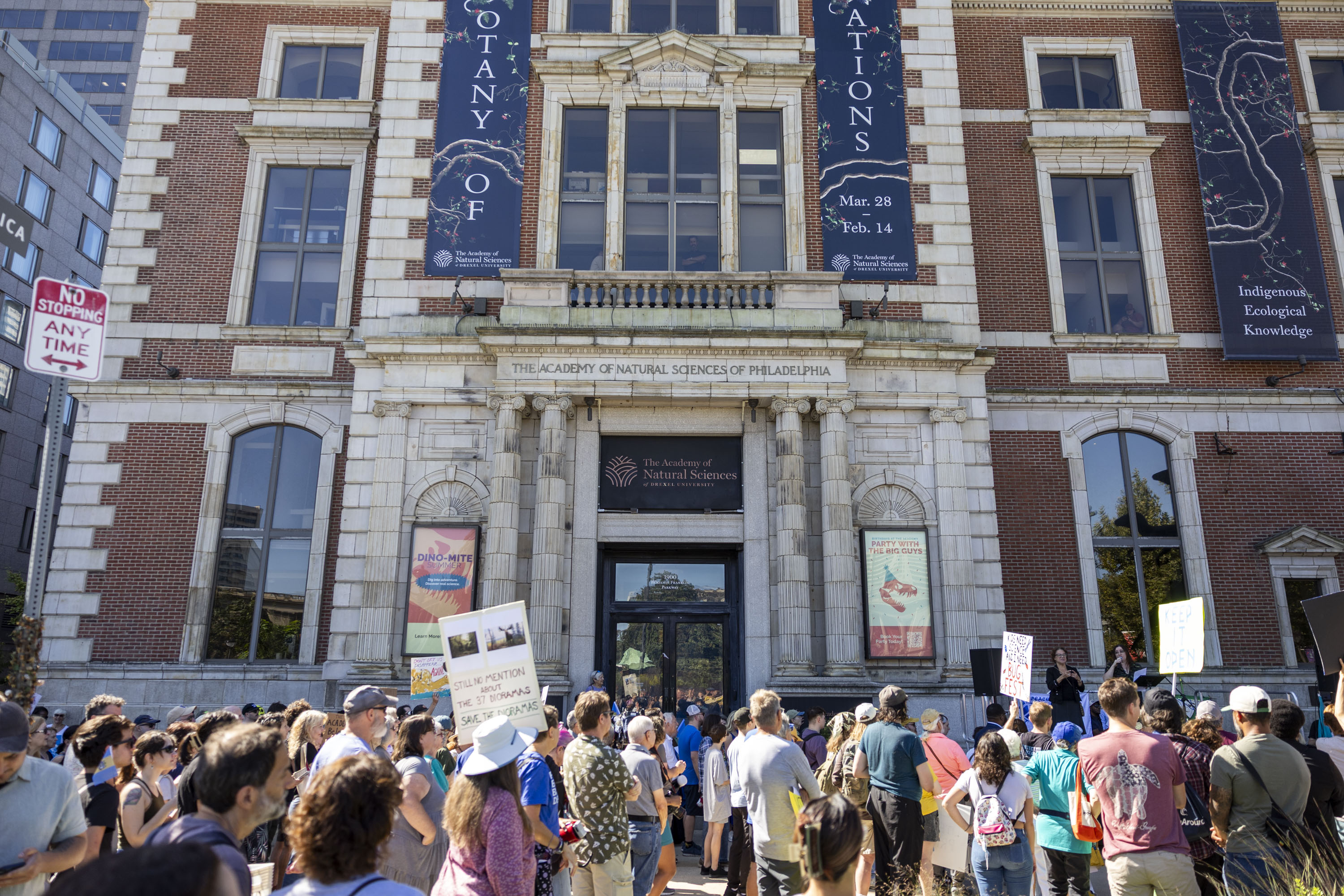
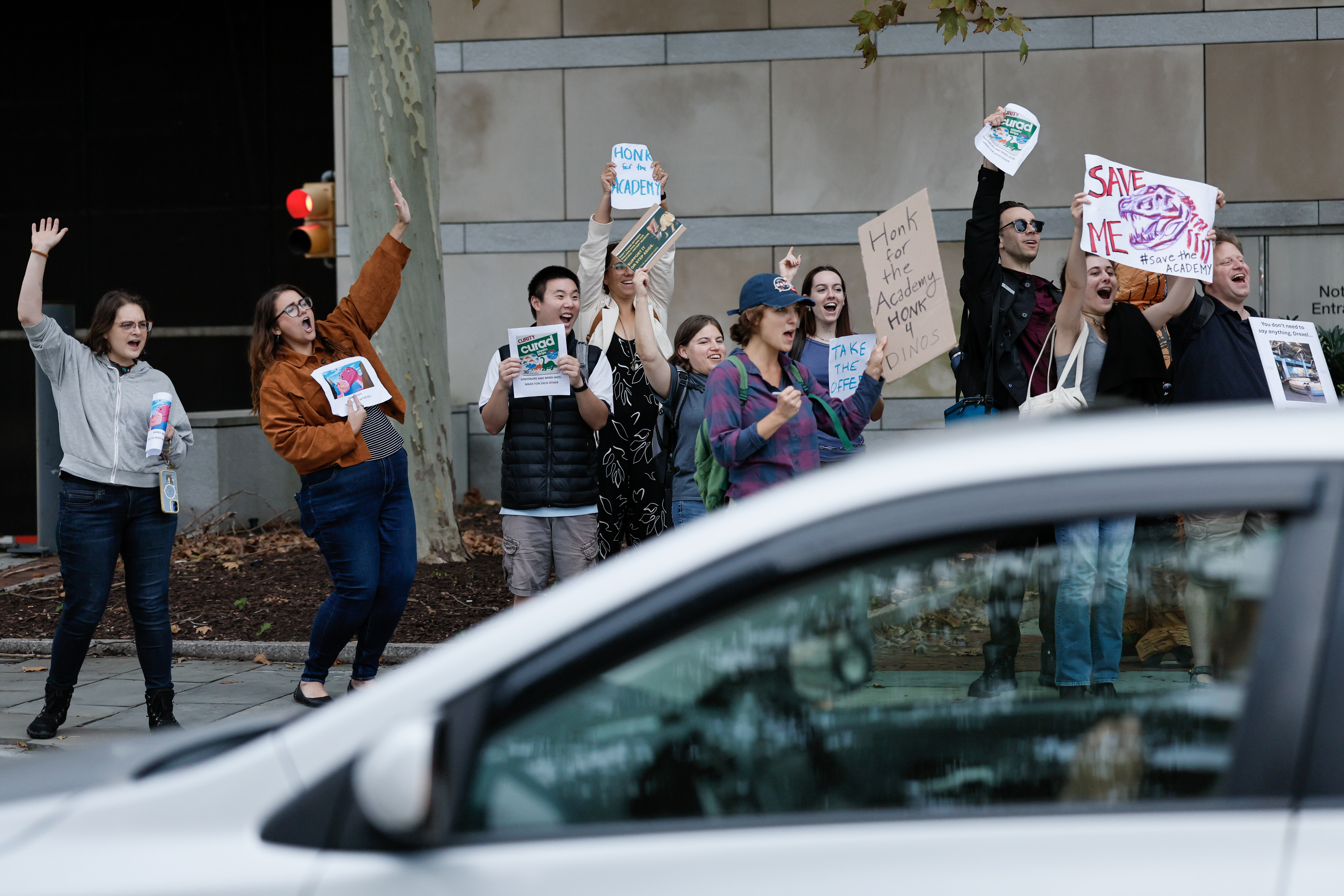
A group of protesters earlier this week gathered at the same time as a Drexel board meeting and called on the university to disaffiliate and give the Academy a chance to negotiate what’s best for it.
Drexel spokesperson Niki Gianakaris said earlier this week that the university had offered the Academy a path to disaffiliation.
“We have been, and remain, open to that possibility,” she said. “We continue to engage in good-faith discussions with the Academy about its future.”
Her comments came days after the William Penn Foundation made public its offer to underwrite operating costs for at least a year and keep the museum’s doors open while a permanent solution can be worked on.
William Penn said the goal was to “provide time to test the interest of other funders and supporters who have not been engaged so far,” and the Academy leadership said it was open to the reprieve.
The Academy, founded in 1812, has operated a museum since 1828, and its announced closure has generated street protests, more than 100,000 petition signatures, editorials, and the scheduling of City Council hearings for next week.
The museum was shuttered to the public at the end of the day last Sunday, following large numbers of visitors in recent weeks but prior years of declining attendance. In the 2025 fiscal year, it brought in 126,000 visitors — down from 2014 when it welcomed 208,000 science fans to its “dioramas, dinosaurs, butterflies, live animals, and the renovated Children’s Nature Discovery Center, Outside In,” according to the Academy’s tax return from that year.
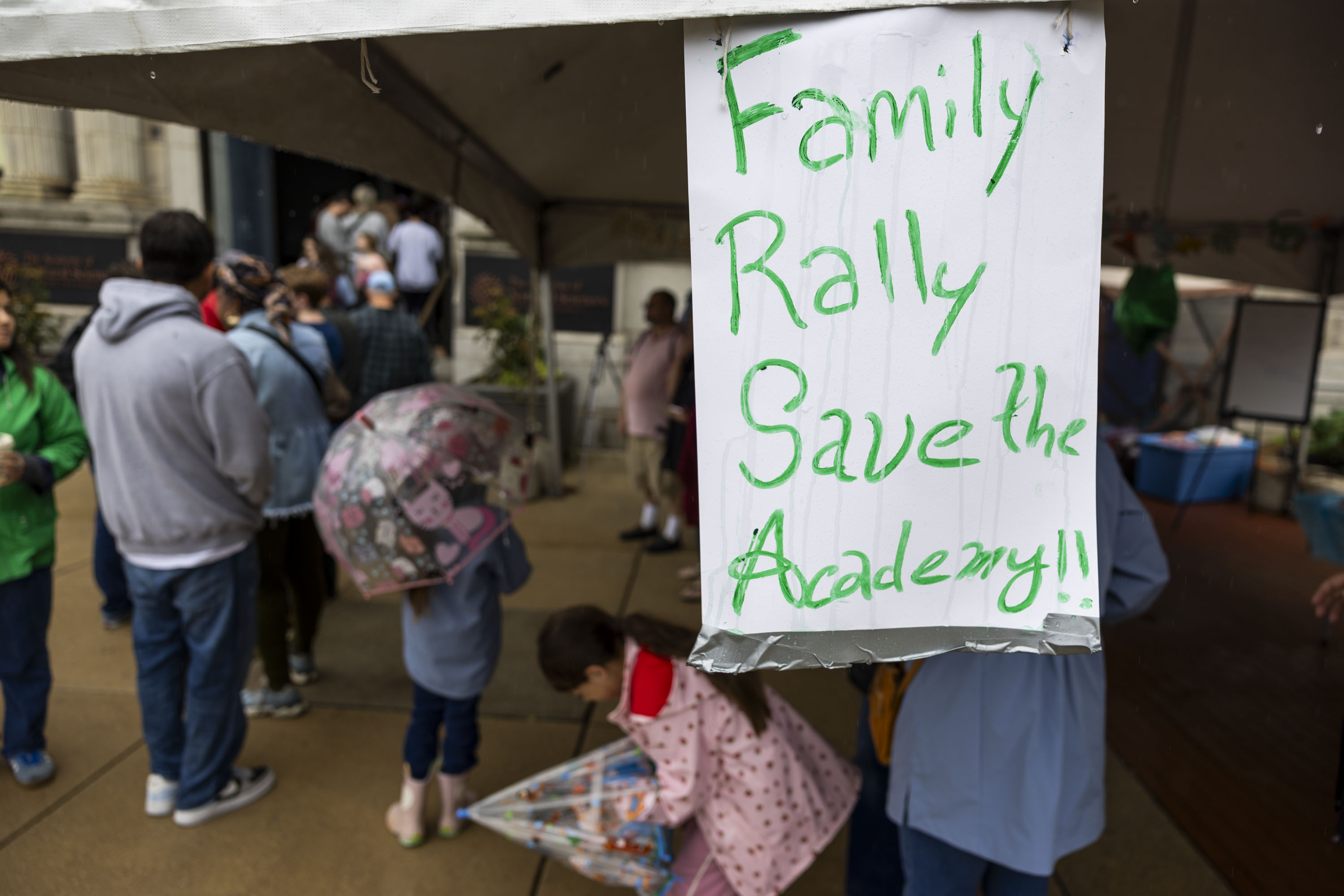
The “Save the Academy” coalition gather outside of the National Constitution Center on Tuesday in an effort to keep the Academy of Natural Sciences museum open.Elizabeth Robertson / Staff Photographer
Since the beginning of the Drexel-Academy affiliation a decade and a half ago, “our goal has always been to improve the financial position of that museum and the Academy of Natural Sciences as a whole, the research and the collections,” said a Drexel source familiar with the matter who was not authorized to speak publicly about it. “That was written into the original affiliation, and as we moved forward in time we hit snags and different things we never quite achieved that financial resilience then. And then COVID hit and that became even more challenging for the museum.”
Drexel said that it had not received a formal proposal from William Penn but that it would be open to talking with the foundation about the matter.
Gianakaris did not comment Friday on whether talks had been held or scheduled.
“What William Penn has put forward is not enough,” said the first source, who had noted that a split was a possible outcome. “That wouldn’t do it.”
Gianakaris said Drexel’s focus is on “safeguarding the Academy’s collections and research enterprise” while developing a “long-term model” that allows the public to engage with its collections.
Drexel’s board of trustees earlier this week discussed the matter during a two-day meeting that was scheduled months ago. The meeting, the second held since Antonio Merlo became Drexel’s president July 1, 2025, was for the board to “focus on the university’s long-term future, strategic priorities and governance effectiveness,” Gianakaris said.
St. Christopher’s Hospital for Children named Claire Alminde permanent president on Thursday, following a period of leadership turmoil at the North Philadelphia safety-net institution.
Alminde, who will continue to serve as chief nursing officer, had taken over in January from another acting president.
“Claire brings a unique combination of frontline clinical experience and hospital leadership, along with firsthand knowledge of what it takes to operate a hospital like St. Chris that plays such a vital role in Philadelphia and beyond,” St. Chris said in an email.
One of Alminde’s tasks will be to work with leaders at Nemours Children’s Health, Jefferson Health, and Temple Health to build an alliance announced in July to secure the future of St. Chris, which struggles financially because most of its patients have low-paying Medicaid insurance.
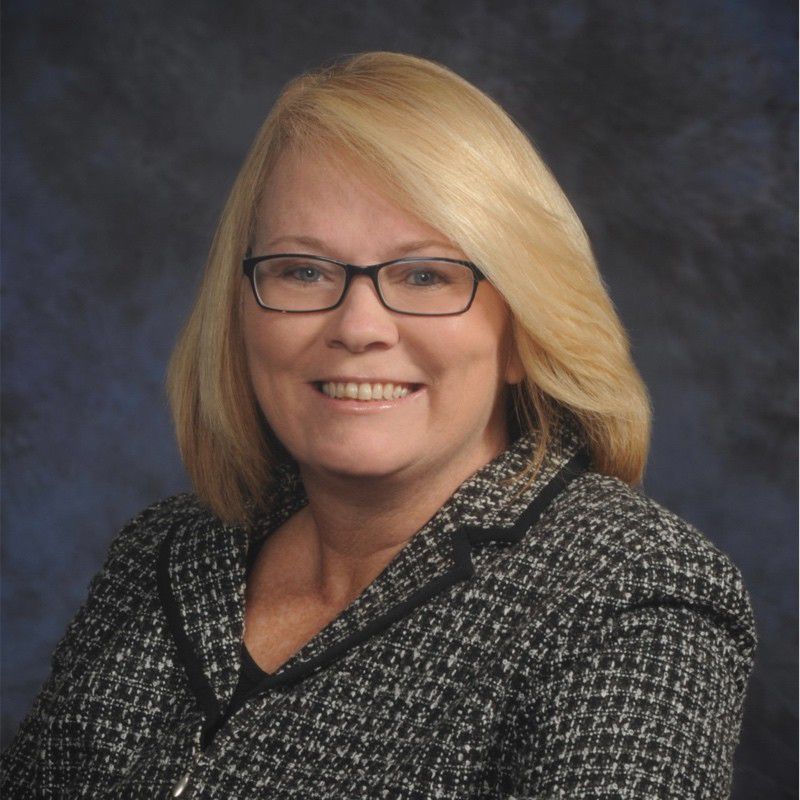
St. Chris’ chief nursing officer, Claire Alminde, has been named president of the North Philadelphia safety-net provider.St. Christopher's Hospital for Children
Alminde was the third interim or acting executive appointed to the top management position at the nonprofit hospital since February 2024 and its fourth leader since 2020.
Drexel University and Tower Health have owned St. Chris in a 50-50 joint venture since 2019. Tower oversees day-to-day operations.
“After several years of leadership changes, this appointment gives St. Christopher’s strong, permanent leadership from someone who knows our hospital, our people and the community we serve incredibly well,” Tower CEO Michael Stern said in a message to employees. “Claire understands what makes St. Chris such a special place and what it will take to move us forward.”
The safety-net provider received a $76 million revenue boost from its inclusion for the first time in a program that taxes Philadelphia hospitals and uses the money to increase the government’s Medicaid funding for facilities that disproportionately care for low-income patients.
Fleece fragments in a washer flow into a wastewater treatment plant. A plastic bag blows into a stream. A water bottle washes down a storm drain.
All can end up in the region’s waterways as microplastics smaller than a grain of rice and find their way into drinking water and the stomachs of animals and fish.
This kind ofmicroplastic pollution was detected in 22 stream and river segments across the Delaware River watershed, according to a new survey of waterways by the nonprofit advocacy group PennEnvironment Research and Policy Center.
Researchers analyzed water samples from sites along the Delaware River and its tributaries across Pennsylvania, New Jersey, Delaware, and New York.
The research was conducted in partnership with the nonprofit Environment New Jersey Research and Policy Center. Scientists with the Academy of Natural Sciences at Drexel University helped analyze the results, which were released Wednesday during a news conference at Fairmount Water Works.
Contamination was found in the Delaware and Lehigh Rivers and the Schuylkill. It was found in Neshaminy Creek in Bucks County, Brandywine Creek in Chester County, and Cooper River in Camden County. And it was found along the Christina River in Delaware.
Drexel’s lab analysis confirmed microscopic plastic at every sampled site, highlighting what the researchers say is a widespread environmental threat.
“We can look at a waterway, and it might be free of litter, it might be free of visible plastic pollution, but that doesn’t necessarily mean it’s clean,” said Faran Savitz, an advocate for PennEnvironment. “The big takeaway is that we should be concerned. The depth, the breadth of this plastic pollution is staggering.”
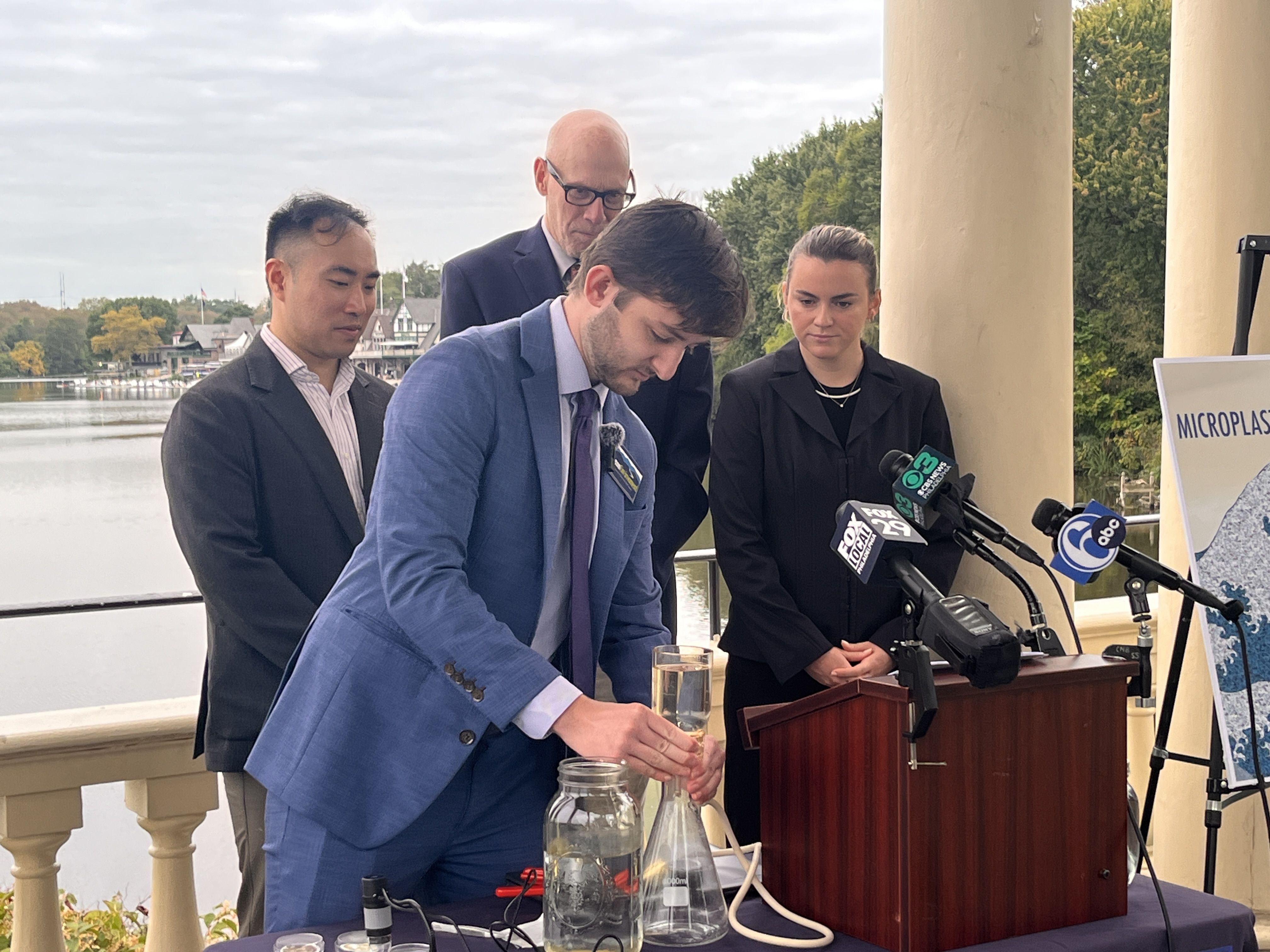
Faran Savitz with PennEnvironment demonstrates water testing. In the background from right are: Lizzy Mulvenna, with Environment New Jersey Research & Policy Center; David Velinsky, senior scientist, Academy of Natural Sciences; and Derek Ho, microplastics researcher, University of Pennsylvania.Frank Kummer
Where do microfibers come from?
Waterways in and around Philadelphia emerged as significant focal points in the survey results.
Samples drawn from the Delaware River in Philadelphia tested positive for multiple categories of microplastics including microfibers, microfragments, and microfilm, as did other waterways. Microbeads, often found in cosmetic products, were also found in the Christina River.
Microplastics are defined as fragments of less than 5 mm in length.
The synthetic microfibers came primarily from clothing and textiles. Rigid microfragments from items such as fishing line were found in 82% of locations. And flexible microfilm from bags and packaging appeared in 77%.
(function(){function e(){window.addEventListener(`message`,function(e){if(e.data[`datawrapper-height`]!==void 0){var t=document.querySelectorAll(`iframe`);for(var n in e.data[`datawrapper-height`])for(var r=0,i;i=t[r];r++)if(i.contentWindow===e.source){var a=e.data[`datawrapper-height`][n]+`px`;i.style.height=a}}})}e()})();
Microplastics have been found in humans
Researchers explained that laundering synthetic garments releases millions of microfibers that wastewater treatment facilities are unable to completely filter out before they are discharged into local streams.
However, because plastic does not biodegrade but continuously fractures into tiny fragments, filters capture only a portion of plastic entering a waterway.
Savitz said PennEnvironment’s study did not release the concentrations of microplastics because it did not want to compare one waterwayor state against another.
The findings carry ecological and public health implications, as microplastics can block digestive tracts in wildlife and absorb toxic chemicals like PCBs and PFAS that bioaccumulate up the food chain, the report stated.
On average, humans ingest approximately 5 grams of plastic weekly, which is roughly equivalent to the weight of a credit card. Microplastics have been found in human blood, lung tissue, and organs, the researchers said.
Plastics are also routinely found in wildlife, including sea turtles, birds, and whales. About 60% of all seabirds have ingested plastic, with that number rising.
The environmental advocates are urging state and local leaders to enact policies such as producer responsibility for plastic packaging, bans on single-use foam and plastic bags, strict limits on pre-production plastic pellets, and enhanced drinking water filtration systems.
Microbeads once used in personal care products were phased out under President Barack Obama in 2015. But many of those products still linger on household shelves.
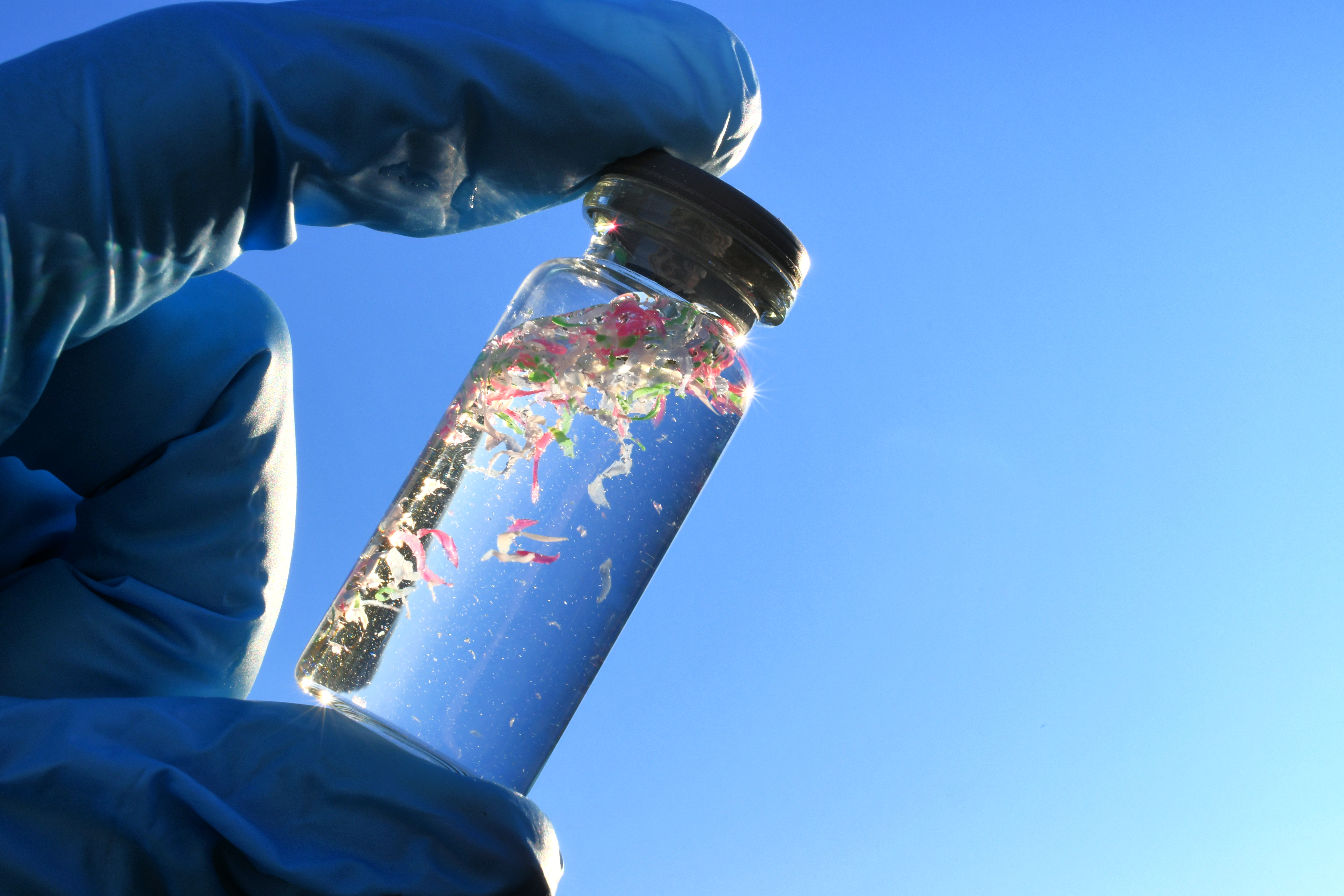
File: A glass vial containing water and microplastic pollutionGetty Images
Philadelphia’s drinking water
Philadelphians get their drinking water from the Delaware River and the Schuylkill. Most microplastics are filtered out at the Philadelphia Water Department’s wastewater treatment plants, but some particlesstill get through.
In 2025, PWD removed 4.6 tons of plastic litter from the Delaware and the Schuylkill, alongside an estimated 1,000 tons of plastic extracted through sewer maintenance, the researchers stated.
PWD said in an online report that it is “unclear whether microplastics pose a danger to human health,” noting that the risk could depend on the level of exposure, the type of plastic, and the size of the particles.
But it noted that research suggests some are harmful to fish and animals and can build up in the organs or bloodstream over time.
“PWD is always investigating advanced treatment technologies that may eliminate microplastics and other impurities,” the report stated.
David Velinsky, a senior scientist at the Academy of Natural Sciences of Drexel University, said, “plastics and microplastics are everywhere, from our clothing to the ubiquitous water bottle.”
When plastics and microplastics are not properly disposed of or recycled, he said, they break down into ever smaller pieces.
They “can travel great distances through both the air and in the water,” Velinsky noted.
A plea for ‘producer responsibility’
To combat pervasive plastics, advocates are urging federal and state lawmakers to enact targeted reforms, including the federal Plastic Pellet Free Waters Act currently before Congress, and state-level producer responsibility legislation for plastic packaging.
Savitz emphasized that shifting financial and operational burdens back onto manufacturers is critical to curbing waste at its source.
At least seven states have passed producer responsibility laws, though not all are in effect, according to the Product Stewardship Institute. Those states include Washington, Oregon, California, Colorado, Minnesota, Maryland, and Maine.
“If we can shift the burden back onto companies that create this waste in the first place,” Savitz said, “we can actually reduce the waste, encourage recycling, and make these broader, more systemic changes.”
Even after a massive wave of love and a crescendo of protests over the weekend, the Academy of Natural Sciences of Drexel University museum won’t be getting an immediate reprieve.
Philadelphia’s beloved gateway to the natural world will remain shuttered after Drexel University released a statement Monday in response to an offer from the William Penn Foundation to temporarily underwrite operating costs and keep the doors open.
Drexel’s statement neither accepts nor rejects William Penn’s offer. Rather, it suggests that the university is open to talking.
Drexel says that while it appreciates the William Penn Foundation’s “public suggestion that it assist in temporarily keeping the Academy’s museum open,” they have “not received a formal proposal with a defined level of financial support.”
With that in mind, Drexel linked the William Penn offer with keeping both the museum and collections in the current building and what it says is a substantial amount of money that would be needed to bring the building at 19th Street and the Benjamin Franklin Parkway up to snuff.
Drexel said Monday that it looked forward to “continuing to explore the possibility of Foundation support — alongside the considerable commitment Drexel has already made to preserving the research and education missions of the Academy — as we consider the substantial financial and operational challenges, including significant deferred maintenance needs associated with keeping the Academy of Natural Sciences’ collections at their current location.”
“We believe that we are all working toward the same goal, which is to ensure that the treasures of the Academy remain accessible here in Philadelphia over the long-term,” said William Penn executive director Shawn McCaney in a statement Monday. “There are many considerations to determine the best path forward, and our offer of support is intended to help keep the museum open while a plan is developed.”
No meetings between Drexel and the Foundation were scheduled, a Drexel spokesperson said.
“Drexel intends to continue conversations with the William Penn Foundation to better understand and evaluate its offer,” said a Drexel source familiar with the matter who was not authorized to speak publicly about it.
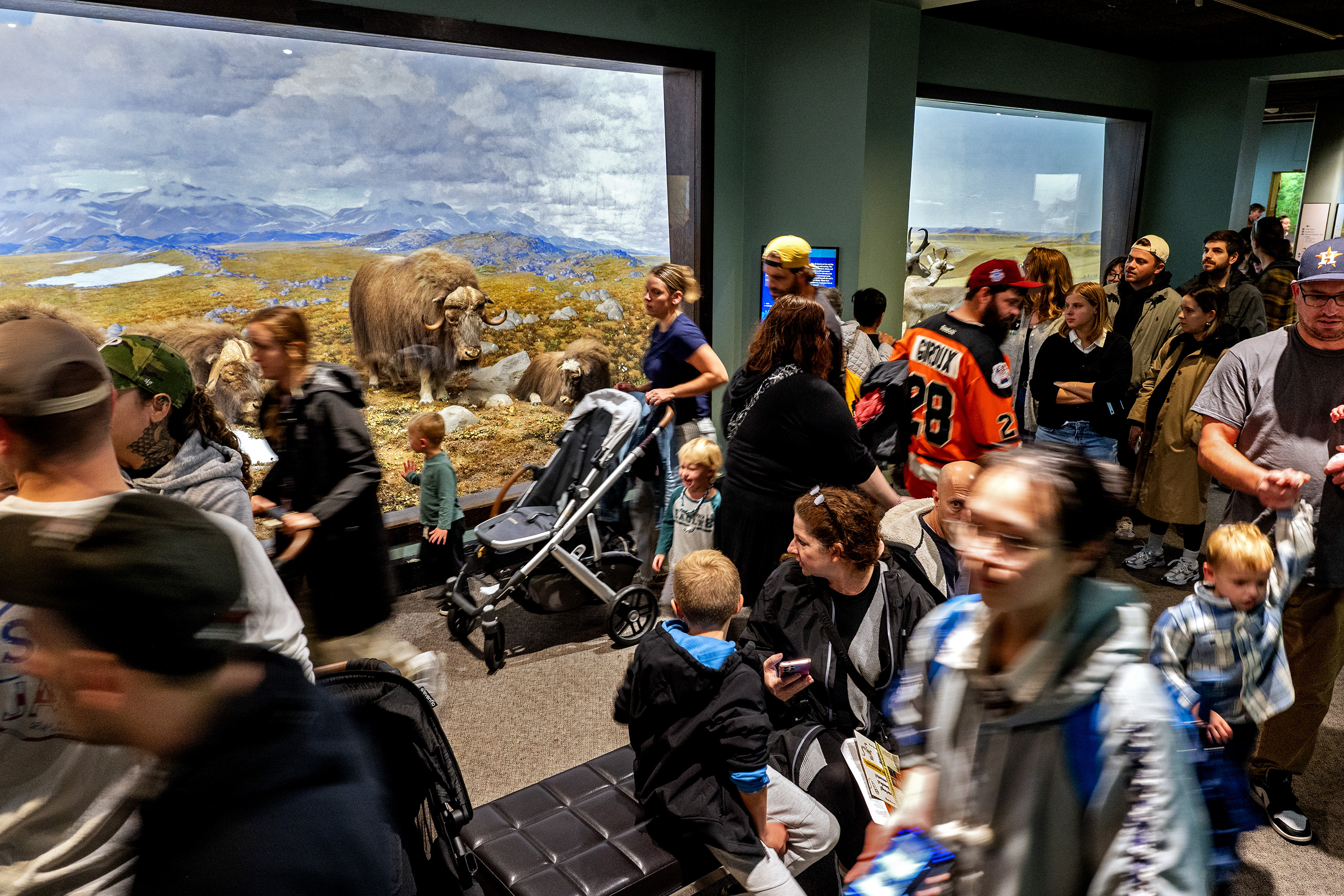
Visitors at the dioramas in the Academy of Natural Sciences of Drexel University on Sunday, the last day the museum was open to the public.Tom Gralish / Staff Photographer
The nearly two-century-old natural history museum closed to the public at 5 p.m. Sunday, and while the Academy‘s research and collections remain operational, leaders have said they intend to sell the building and move the collections at some point to an as-yet undetermined location. A public-facing museum experience of some kind is being envisioned elsewhere, but no details are set.
Academy board chairperson Suzanne Biemiller on Monday did not immediately offer a comment.
Citing a challenging financial picture and attendance trends, the Drexel and Academy boards on Sept. 1 abruptly announced the museum’s closure in 30 days without first coming forward with a public appeal for funds to help keep it open. Public demonstrations attracted hundreds at first, and in recent days online petitions topped 100,000 signatures.
With the closure date fast approaching, William Penn last week extended a hand, offering to cover the cost of the operating subsidy Drexel has been providing to keep the museum open for at least another year, “so that the full range of options for the future of the museum could be properly explored, and to provide time to test the interest of other funders and supporters who have not been engaged so far,” said McCaney in a statement.
One of the North American dioramas at the Academy of Natural Sciences of Drexel University just before the museum closed on Sunday.Tom Gralish / Staff Photographer
The William Penn offer was intended to help float the Academy’s museum operations while due diligence was done on answering a number of questions about the Academy’s viability. Among them are determining the costs of addressing deferred maintenance in the building and gauging the level of philanthropic support that could be counted on to fund the museum on an ongoing basis.
Biemiller said last week that the Academy was supportive of the idea.
A Drexel spokesperson said that the Academy board and leadership team undertook an “extensive planning process” throughout much of 2024 and 2025 to identify a path toward long-term financial stability. The effort included an assessment of the Academy’s business model and explored options for a more sustainable financial and operational model, including the level of ongoing support required from Drexel.
Although the university did not publicly reject the William Penn money last week, it said that “no proposal has been presented that would provide a permanent, sustainable path forward for the Academy’s museum.”
Pressure intensified over the past few days, with politicians and activists asking why, if the hurdle was financial, Drexel would turn down such an offer.
“We urge Drexel and the Academy to jointly agree to accept the William Penn Foundation’s gracious offer and keep the Academy of Natural Sciences open for the public to continue to enjoy,” wrote City Councilmembers Nina Ahmad and Jeffery Young Jr. in a statement Saturday.
“Anything else is a clear abdication of their public duty, and a demonstration of their contempt for this priceless cultural resource.”
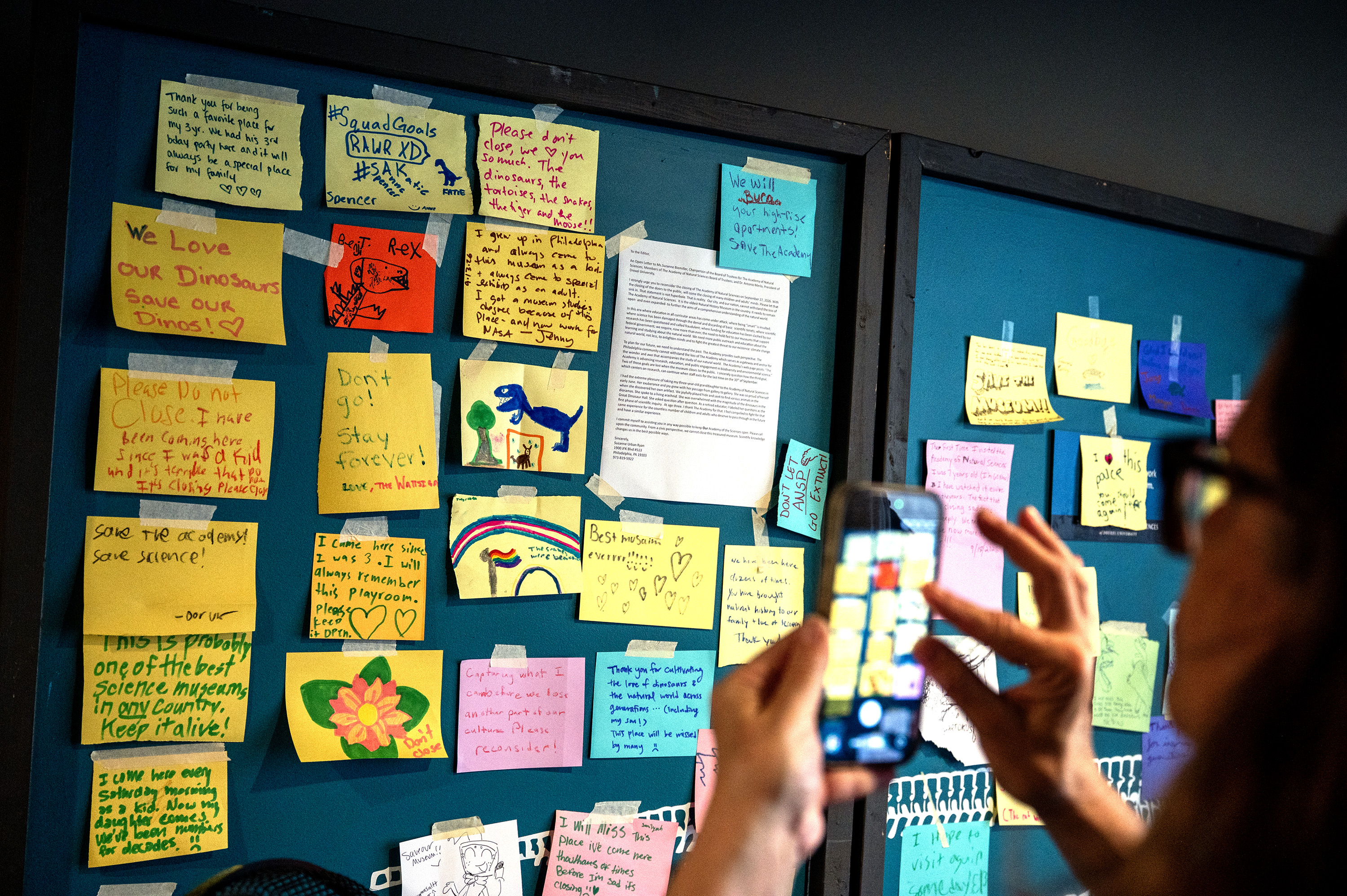
Visitors left love notes inside the Academy of Natural Sciences of Drexel University Sunday.Tom Gralish / Staff Photographer
Drexel says it has contributed $49 million toward the Academy’s budget since the two formed an affiliation announced in 2011. Yet, the institute has still struggled.
“If somebody came in today and said, ‘here’s all the money you need to do all of the deferred maintenance, to do what needs to be done to the building to make sure that you can care for all of the collections and all of the research,’ and it’s feasible to do it there from an economic perspective, which would be wonderful, then I think we would be very open to it,” said the Drexel source. “But we probably still would have to keep the museum closed for a bit, just to be realistic because what needs to be done may not necessarily be able to be done while the museum’s open.”
In the weeks since the impending closure was announced, attendance has soared, and revenue along with it. Estimated ticket revenue for September 2026 alone nearly matched the total ticket revenue for all of 2025, a Drexel spokesperson said.
The Drexel and the Academy boards are in the process of renegotiating their affiliation agreement, brokered in part by David L. Cohen — the onetime Comcast executive and U.S. ambassador to Canada — at the behest of Gov. Josh Shapiro and Mayor Cherelle L. Parker.
“That agreement includes a process for evaluating the future of the collections and the museum,” said Monday’s statement from Drexel. “Until that agreement is fully executed and approved by both boards, we do not intend to alter the plans that the Academy’s board and Drexel have agreed to.”
The Greater Philadelphia Cultural Alliance on Monday lauded the William Penn Foundation’s “generous offer” and said it deserved consideration, but added that responding to one crisis won’t be enough.
“Philadelphia must make a stronger, sustained commitment to the cultural institutions that are fundamental to our civic life,” said the GPCA statement.
A new zoning bill by City Councilmember Jeffery Young Jr. would restrict the redevelopment potential of the Academy of Natural Sciences museum after Drexel University this month announced plans to shutter the centuries-old institution.
Young, whose 5th District includes the museum property on the Benjamin Franklin Parkway, introduced the ordinance at Thursday’s Council session.
It would limit the allowed uses of the property and others around it to specific categories, including hospitals, government uses, libraries and cultural exhibits, and “community-supported” farms.
Under Young’s legislation, residential and commercial uses would not be allowed. The property is currently zoned to allow multifamily residential development, unlike the other museums on the Parkway.
Young said his legislation would simply change the museum’s zoning to reflect what has long been on the site.
“It’s always been a cultural and civic use, so [my bill] would match the land use with the actual zoning to allow only cultural and civic type uses,” Young said. “But it wouldn’t prevent the academy from closing.”
Councilmember Jeffery Young Jr. Elizabeth Robertson / Staff Photographer
Drexel did not immediately offer comment on Young’s legislation.
If the bill passes, it will make it much harder to convert the building to other uses. The owner would need to secure a variance from the Philadelphia Zoning Board of Adjustment, an often lengthy and costly process with no guarantee of success.
During that process, any prospective developer would also be required to meet with community groups in advance of a zoning board hearing.
Young said the purpose of his bill is to allow “the community some input on a site that has been a cultural use for centuries.”
Instead of changing the property’s zoning to match those of neighboring museums and libraries, Young has proposed adding the restrictions to what is known as a zoning overlay — a kind of hyperlocal patch of the code — that covers his district and allows him to precisely describe what he wants to restrict and allow.
Young said he is also considering changing the underlying zoning to match that of the Philadelphia Museum of Art, the Barnes Foundation, and other cultural institutions on the Parkway.
“We are looking to do that, but the issue is that the planning commission doesn’t work for me and so they’re not on my time,” Young said. “Ultimately, we had to do what we could do from our office’s standpoint.”
To become law, the bill would need to be approved first in the Committee on Rules and then by the full Council before heading to Mayor Cherelle L. Parker’s desk.
If Young pushes forward, the bill is likely to pass in Council thanks to a practice known as councilmanic prerogative, in which the rest of Council defaults to the wishes of the member whose district includes a property when it comes to land-use decisions.
Young, whose district includes parts of Center City and much of North Philadelphia, has abandoned zoning legislation that stirred controversy in the past, such as a housing ban around the former Hahnemann University Hospital campus.
But the closure of the Academy of Natural Sciences is unpopular, and the new legislation is likely to have broad support from Council members.
If enacted, the bill would take effect immediately.
A surprise closure
Founded in 1812, the Academy of Natural Sciences is the oldest institution of its kind in the nation, and its museum, which opened in 1828, is the country’s oldest natural history research museum. It houses 19 million biological specimens, including bones, carcasses, and plants.
Drexel announced earlier this month that it was closing the museum effective Sept. 27, citing a decrease in attendance since the COVID-19 pandemic and the university’s financial woes. The decision caused an immediate uproar, including a protest on the Parkway attended by hundreds. Young vowed to “protect and preserve” the building.
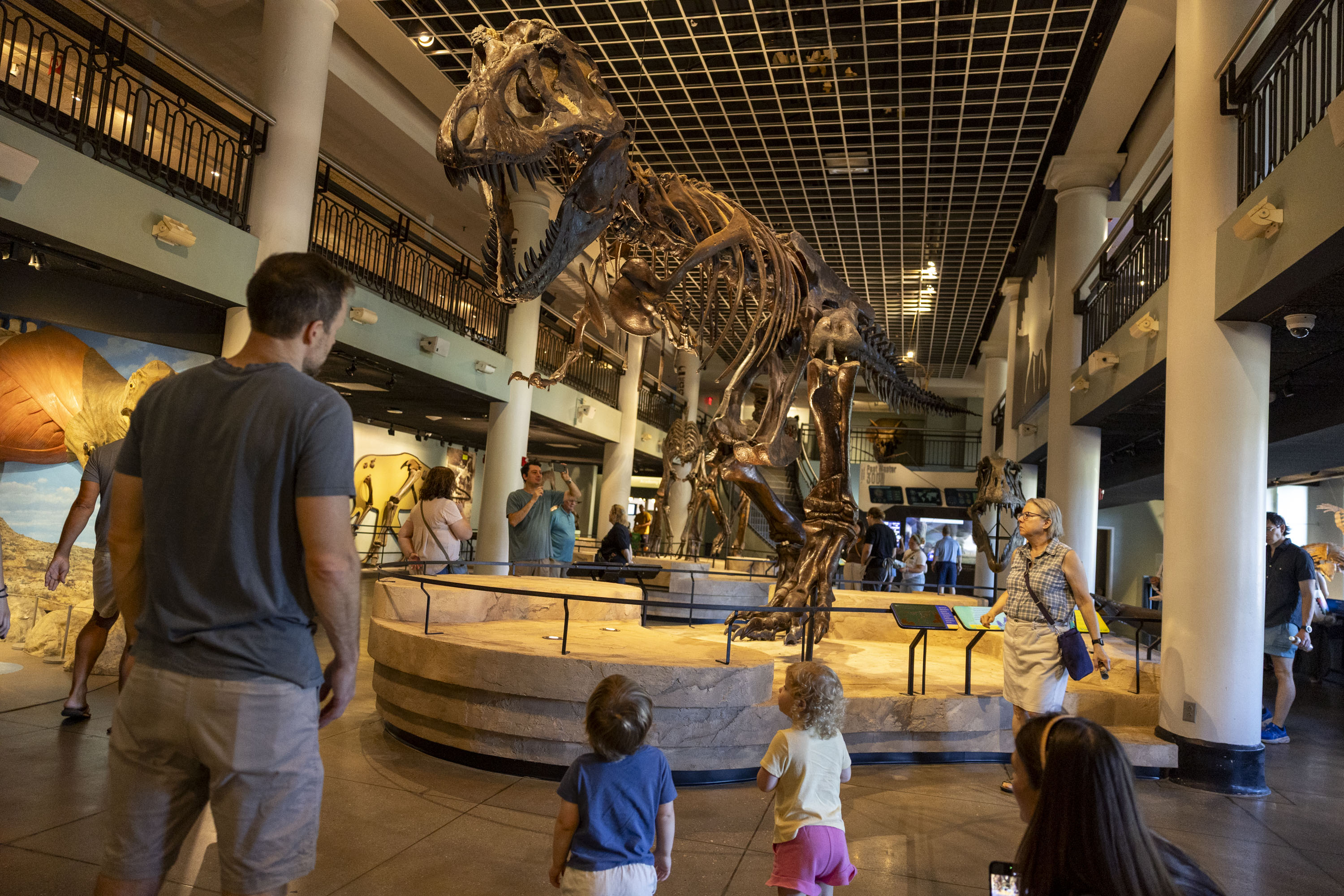
Matt LeBlanc, of Manayunk, and his wife, Alyssa, show their children, Miles and Clara, the Dinosaur Exhibit at the Academy of Natural Sciences of Drexel University earlier this month.Tyger Williams / Staff Photographer
Leaders of Drexel and the academy have said that the “collections and their use to advance scientific knowledge will be the focus of our work for the near future” and that no final decision had been made on the building’s future.
A source told The Inquirer the university’s ultimate aim is to relocate the collection and sell the building.
After the announcement, Deputy Mayor Patricia Wellenbach, a top official in Parker’s administration, was named the academy’s temporary leader, serving as senior adviser while on loan from the city.
Young and other members of Council have been attending rallies against the closure.
“This academy has been there for over 200 years. It’s dedicated to civic and cultural education, to science,” Young said in a speech during Thursday’s meeting. “If we take that away, how will our kids learn?”
Correction: An earlier version of the story inaccurately attributed plans to sell the museum building and relocate the academy’s collection.
The visitor arrived at a neonatal intensive care unit at the Children’s Hospital of Philadelphia in University City last Friday morning.
Then they visited a family lounge. An atrium. A cafeteria.
At each stop, the person, now known to be infected with measles, potentially exposed others to the highly contagious disease that is particularly risky for young children, city health officials announced this week.
Hospitals have spent years preparing for such incidents, no longer a theoretical concern as Pennsylvania now deals with the nation’s largest measles outbreak this year, which has already sickened more than 760, experts in infectious disease prevention say.
And across the state in Allegheny County, the University of Pittsburgh Medical Center Children’s Hospital has reported several possible measles exposures this summer.
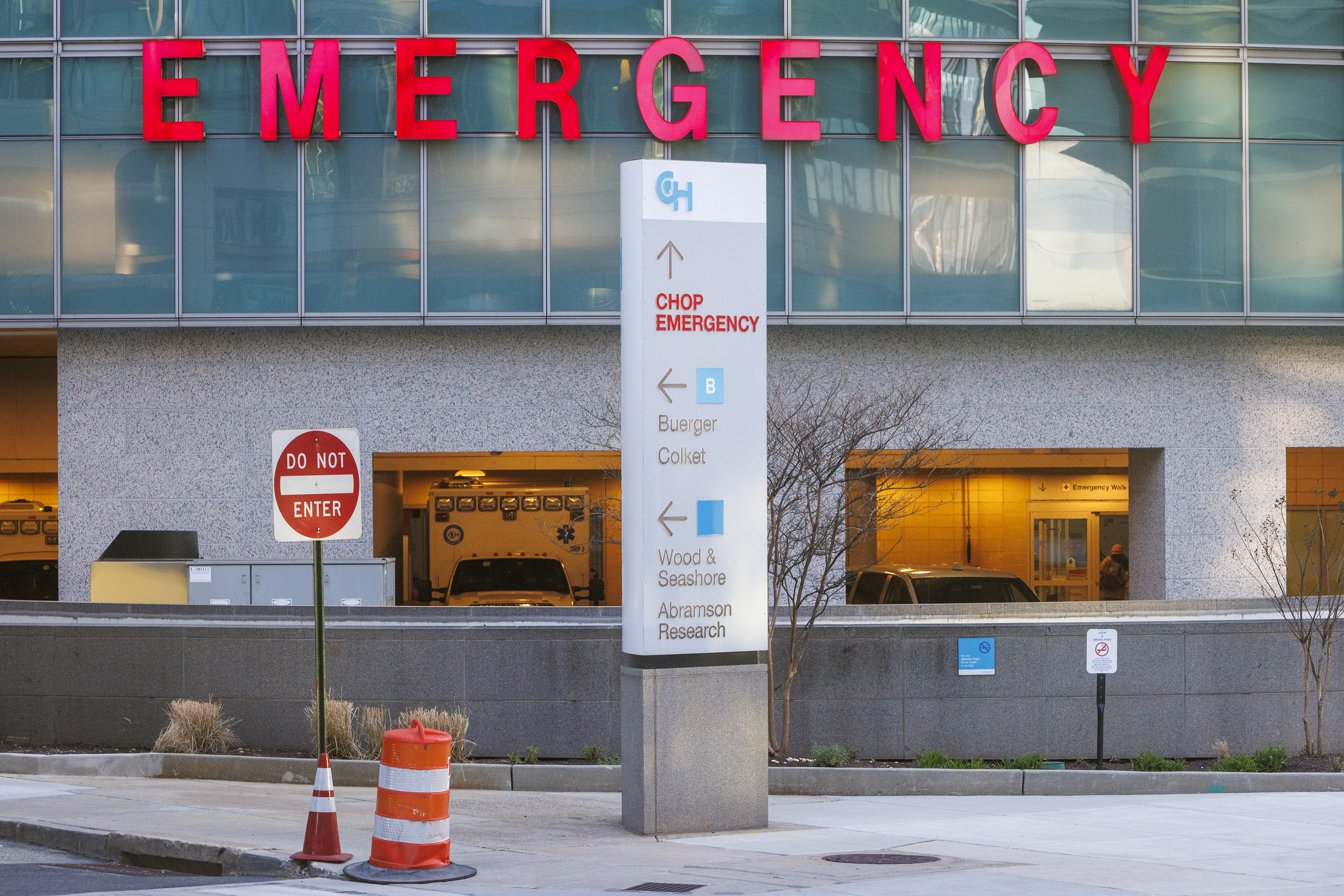
Health officials did not specify how many babies and others were potentially exposed at CHOP in announcing the exposure late Thursday. Philadelphia health officials have issued only general details on the infected person’s visit, along with guidelines for anyone potentially exposed to the virus over the course of several hours on Sept. 11 at the hospital at 3401 Civic Center Blvd.
The hospital is working with NICU families to ensure its patients are protected, Julia Sammons, vice president and associate chief medical officer of CHOP’s Office of Preparedness, Prevention and Response, wrote in an email.
The hospital took “immediate action” after being notified of the exposure to identify babies who might have been exposed and offer preventive treatments to protect them from the virus, Sammons said. Exposed patients have also been placed in isolation and doctors are monitoring them for symptoms.
The hospital is also working with staff and patients outside the NICU to ensure they understand the situation, Sammons said, and partnering with the state and city health departments “on contact tracing, timely testing, and safe quarantining practices for all the areas served by the CHOP enterprise.”
Infectious disease experts say hospitals around the country have been monitoring an explosion of measles cases in the last several years.
Pennsylvania as of Friday had seen 767 cases of measles in 2026, with 93 reported in the last week. One in five people with reported cases has been hospitalized.
“Measles has been up and coming. It’s definitely on the radar of hospitals,” said Ericka Kalp, who directs Drexel University’s infection prevention and control academic programs. “Your risk has increased when you have multiple measles cases within your vicinity.”
Every year, hospitals work on an infection control risk assessment, monitoring rising diseases around the country and internationally, and developing plans on how to treat sickened patients.
That could include triaging patients with respiratory illnesses and isolating those with suspected cases in special rooms, said Kalp, who was not involved in the response at CHOP.
Screening visitors to a hospital is tricky, she said.
“We can ask visitors and the public not to visit if you’re sick, and visitors need to take it upon themselves to not go to the facility if they’ve been around a particular exposure,” she said.
But some may not know they are ill: A person can be contagious for four days before measles’ telltale rash appears.
Sammons said that CHOP screens visitors daily for signs or symptoms of illness at the hospital’s welcome desks, and signs remind visitors that no one with symptoms should be admitted to the NICU. She did not say whether the NICU visitor who exposed others on Friday was symptomatic.
“We have been in constant communication with families in our NICU to discuss guidance to keep them safe,” she said. “As the measles outbreak continues to evolve, we continue to review and update our screening processes to reduce the risk of exposure to our patients and families.”
The virus can linger in the air for up to two hours and infect nine in 10 unvaccinated people exposed to it.
Pregnant women, babies under six months, and some immunocompromised people are among the groups who cannot be vaccinated. Their protection depends on nearly everyone else in a community being vaccinated to prevent the disease from spreading.
But more parents have opted against vaccinating children for religious or philosophical reasons in recent years, The Inquirer has found, leaving hundreds of area schools and communities vulnerable to the spread of the virus.
“When you see fewer people are becoming vaccinated and they have less immunity, it opens up a portal of spread,” Kalp said. “We’ve always trained for this type of thing.”
Sammons said CHOP has stepped up public health education for families and is offering early MMR vaccines for eligible children amid the outbreak, as state health officials have recommended. The hospital is also improving its measles screening capabilities and “developing contingency plans for more widespread community transmission in our area,” she said.
“The best way to control measles outbreaks remains vaccination with the measles, mumps, and rubella vaccine, which is safe and highly effective in preventing measles,” she said, noting the hospital’s long-running Vaccine Education Center, aimed at debunking misinformation about the safety of vaccines.
(function(){function e(){window.addEventListener(`message`,function(e){if(e.data[`datawrapper-height`]!==void 0){var t=document.querySelectorAll(`iframe`);for(var n in e.data[`datawrapper-height`])for(var r=0,i;i=t[r];r++)if(i.contentWindow===e.source){var a=e.data[`datawrapper-height`][n]+`px`;i.style.height=a}}})}e()})();
Treating those exposed
CHOP is offering post-exposure treatments “in the form of antibodies” to infants who may have been exposed to the virus, Sammons said.
Doctors can administer immunoglobulin, a treatment made from the plasma of adult donors, that helps boost a baby’s antibodies to infectious diseases like measles, said Sarah Long, a Drexel pediatrics professor and a physician specializing in infectious disease at the Bristol-Myers Squibb Children’s Hospital in New Brunswick, N.J.
In an outbreak, she said, hospitals can consider limiting visitors to prevent exposures, especially for a virus like measles, which is particularly dangerous for young children and kills about 1 to 3 for every 1,000 infected.
But responding to measles cases or exposures can require hospitals to expend extensive resources.
“It’s an enormous number of meetings, manpower, education about IDing cases early, and sequestering as soon as a patient comes in with a fever,” she said. “It’s an enormous amount of money, gowning, gloving, and masks.”
Now she’s worried again about vulnerable children. Nearly one-third of Pennsylvania’s cases this year have been reported in children under the age of 18, and two of the measles-associated deaths involved infants.
“It makes me just angry, angry, angry. There are so many catastrophes in children’s healthcare that are not preventable,” she said. “To have catastrophes that are preventable is just unconscionable.”
The Bensalem Township School District has selected longtime district administrator Victoria Velazquez as its next superintendent, after its previous superintendent resigned this spring amid a budget shortfall.
Velazquez, who has worked for the district for 12 years, is expected to be appointed superintendent at a school board meeting Sept. 23, the Bucks County Intermediate Unit said in a statement Friday.
“I am deeply honored and grateful for the opportunity to continue serving the Bensalem Township School District as district superintendent,” Velazquez said in a statement.
Noting that her daughter graduated from Bensalem, Velazquez said, “It is my home, and it is a community I care deeply about and am incredibly proud to serve.”
Velazquez was selected to lead the 6,400-student district after a search led by the Bucks County Intermediate Unit that drew 27 applicants from five states, according to the intermediate unit.
Deborah King, the Bensalem school board president, said in a statement that she had watched Velazquez “lead with humility, diligence, integrity, and a genuine love for Bensalem.”
“She knows this community, she believes in this community, and she understands that our students must remain at the heart of every decision we make,” King said.
Velazquez has worked in Bensalem as assistant to the superintendent for K-12 administration, director of elementary curriculum and instruction/federal programs, and supervisor of data and assessment/federal programs.
As interim superintendent, Velazquez worked with the board on organizational systems and fiscal stewardship “during a consequential period for the district,” the intermediate unit said in the statement.
Before coming to Bensalem, Velazquez worked as a principal in the School District of Philadelphia and the Norristown Area School District. She received bachelor’s and master’s degrees from Temple University, a principal certification from Drexel University, and a doctorate in educational leadership, management, and policy and superintendent certification from Seton Hall University.
If approved on Sept. 23, Velazquez will be sworn in as superintendent on Oct. 1 at Bensalem High School, the intermediate unit said.
It’s been an extraordinary summer celebrating America’s 250th, but before we shift our focus from the events of 1776, we would direct the minds of our fellow Pennsylvanians to an earlier period — to the founding of the commonwealth, and to William Penn’s forward-thinking advocacy for religious and political freedom and his belief in democratic self-government. These ideas were central to his political philosophy and plans for the early government of Pennsylvania. They also found their way into the democratic experiment we steward today.
Although Philadelphia played an important role in setting the stage for a stunning world event — the birth of American democracy — the city was more than just a geographically convenient location for the nation’s founders to gather.
By the time of the revolution, Pennsylvania had become an important intellectual and economic center of the colonies, and the unique political culture and form of government established at its founding helped inform and inspire the development of American democracy, later embodied in the U.S. Constitution and Bill of Rights.
As Pennsylvanians, we are the inheritors of this impressive and innovative political heritage, a legacy that should be an important point of civic pride and inspiration for local patriotism.
Think about this: A decade after Penn arrived in America and began the work of establishing a refuge for religious dissenters, colonial Massachusetts accused nearly 200 individuals of witchcraft and executed 19 people. Massachusetts had a state religion until 1833; Pennsylvania never had a state religion.
After the end of the short-lived Maryland Toleration Act, Pennsylvania became the only colony where the Catholic Church enjoyed ongoing, legally secure protection.
Visitors look at historic artifacts as part of the Jewish America 250 celebration at Congregation Mikveh Israel in Center City in July.Monica Herndon / Staff Photographer
And, of course, Pennsylvania is also home to the “Synagogue of the American Revolution,” Congregation Mikveh Israel, one of the oldest synagogues in the nation, dating to 1740.
As historian Nicolas P. Miller observed, the success of colonial Pennsylvania was linked in the minds of many onlookers to the freedoms, particularly religious liberty, that its inhabitants enjoyed.
To remind Pennsylvanians of our special birthright of religious tolerance, farsighted political liberties, and a long tradition of self-government that predate the nation, Poor Richards Charitable Trust, the William Penn Foundation, the Connelly Foundation, and the Syde Hurdus Foundation — in partnership with Drexel University’s Lenfest Center for Cultural Partnerships and the National Constitution Center — are presenting a new exhibit: “Pennsylvania’s Founding: How a City and a Colony Shaped America’s Civic DNA.”
For the first time, this exhibit will bring together original versions of several of the most important artifacts that helped define the civic and political character of early Pennsylvania, and tell the story of how the founding of the commonwealth helped inspire American democracy.
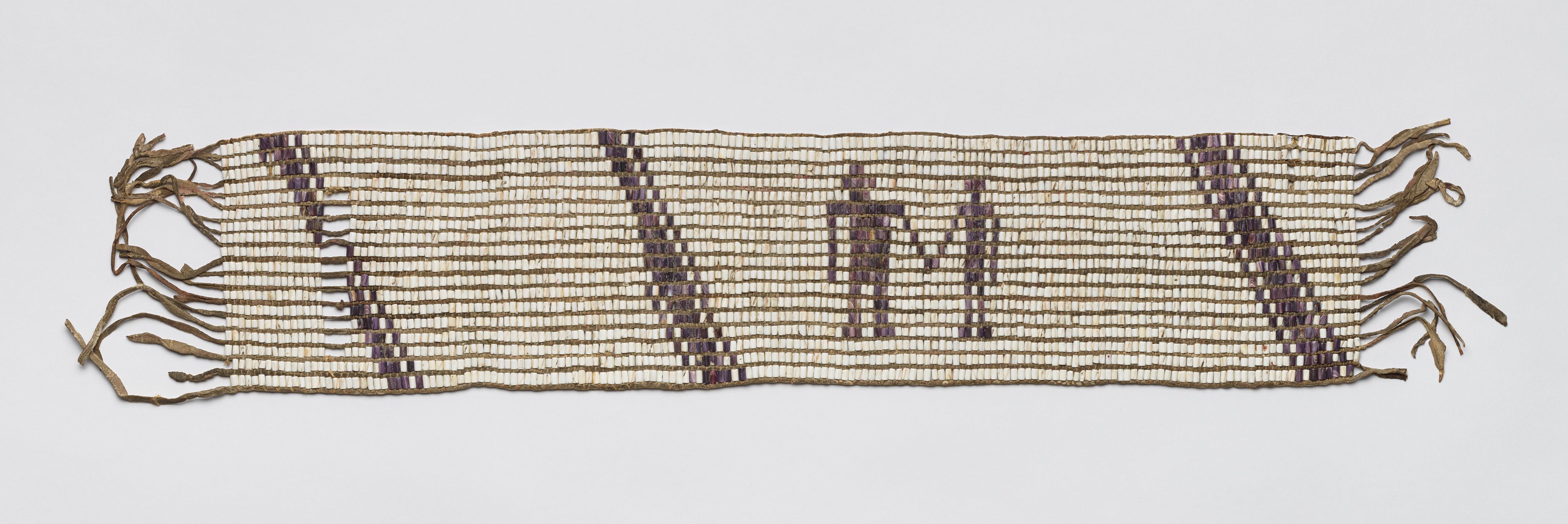
Wampum belt, 1682, likely made by Lenape female artisans in the Delaware Valley. Atwater Kent Collection, From the Historical Society of Pennsylvania Collection
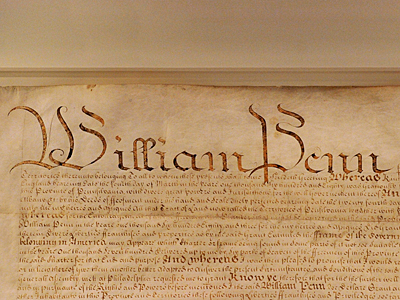
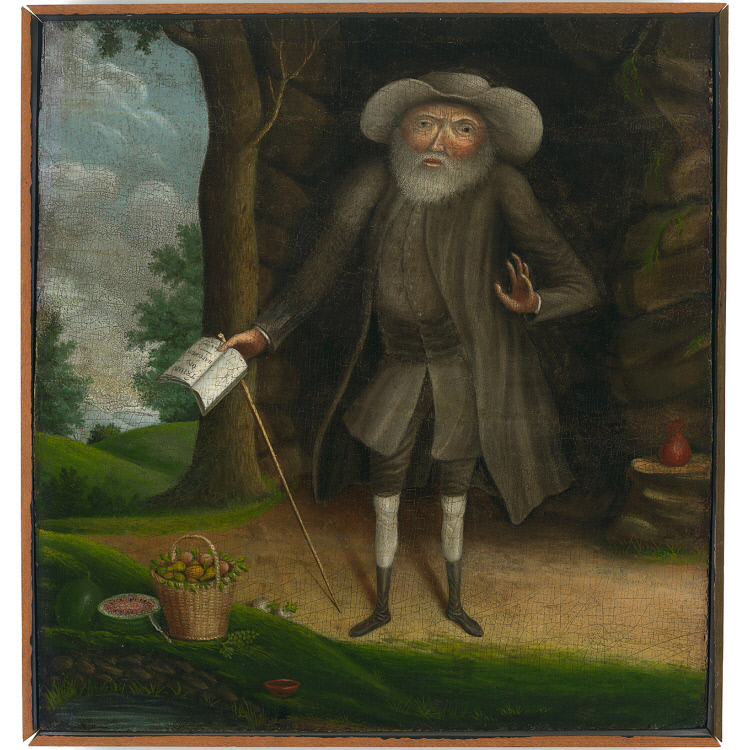
They include the 1681 Pennsylvania Charter, signed by King Charles II, establishing the colony and granting Penn authority to govern; Penn’s 1701 Charter of Privileges, a framework of government for Pennsylvania until 1776, establishing religious freedom and other liberties and protections; a Lenape wampum belt given to Penn, associated with the 1682 Treaty of Shackamaxon, symbolizing a hoped-for moment of peace and cooperation; the 1696 Quaker Protest Against Slavery, one of the earliest in the Americas, and materials connected to early abolitionist Benjamin Lay; and other artifacts that clearly document Penn’s and Pennsylvania’s key contributions to the establishment of American democracy.
Painting of abolitionist Benjamin Lay by William Williams at National Portrait Gallery of the Smithsonian Institution.National Portrait Gallery of the Smithsonian Institution.
The exhibit will be on view to the public, free of charge, at the National Constitution Center from Sept. 30 through Jan. 3, 2027. Learn more here.
So this fall, let’s continue the Semiquincentennial celebration. We encourage all Pennsylvanians to make a special pilgrimage to the National Constitution Center to see, understand, and remember our political heritage that is ours alone — a world-changing and invaluable inheritance of tolerance that we should continue to aspire to today.
Tom Riley is the president of the Connelly Foundation. David Seltzer is a trustee of Poor Richards Charitable Trust. Shawn McCaney is the executive director of the William Penn Foundation.
Vigilante Jack Reacher's shadowy dealings spilled out across Philadelphia for the Reacher’s fourth season, which is now available in full on Amazon Prime. Starring actor Alan Ritchson as the hulking retired Army investigator, the series was spotted filming around town in 2025.
Based on Lee Child's 2009 novel Gone Tomorrow, the fourth season of Reacher has its titular character facing off against he CIA, federal agents, and international mercenaries following a woman's suicide. And while much of the on-screen action appears to have been filmed elsewhere — namely Toronto, which looks a lot like Philly, but with space — the City of Brotherly Love does show up quite a bit.
Here, we've rounded up all the Philly spots we could identify in season four. Check out the map below for where Reacher and his cohorts went in the city.
story continues after advertisement
Loading…
Seen in episode 1
City Hall
Michael Bryant / Staff Photographer
Reacher's fourth season immediately sets the scene with a shot of the William Penn statue atop City Hall as a nightscape of Center City shines in the background.
Seen in episode 1
Uptown Beer Garden
Erin Blewett / For The Inquirer
We catch our first glimpse of our hero, Jack Reacher (Alan Ritchson), as he exits Uptown Beer Garden, walking out of the establishment silently with a beer in hand.
Seen in episode 1
LOVE Park
Michael Bryant / Staff Photographer
Reacher speaks for the first time this season, ordering a "wiz wit" from a nondescript food truck in Love Park.
Seen in episode 1
Avenue of the Arts
Jessica Griffin / Staff Photographer
Here, Reacher strolls down the sidewalk on the west side of Broad Street, chomping on his cheesesteak. Canonically, it is just after 2 a.m., and the street is deserted as he descends into the Walnut-Locust entrance of the B line, which runs along Broad Street.
Seen in episode 1
Walnut-Locust Station
Alejandro A. Alvarez / Staff Photographer
As he enjoys his cheesesteak, Jack Reacher (Alan Ritchson) heads down into the Broad Street Line at this Center City station. Several interior shots of the station are shown, including one in which a rat munches on a hot dog.
Seen in episode 1
Benjamin Franklin Bridge
Thomas Hengge / Staff Photographer
Philly is shown off in all its nocturnal glory in episodes one, and seven with a low-light shot of Center City from the Ben Franklin Bridge. Episode five features a skyline shot from the bridge, showing the One Water Street Apartments building.
Seen in episode 1
Benjamin Franklin Parkway
Tom Gralish / Staff Photographer
For the first time in the season's first episode, the sun rises on Philadelphia. And it does so in this stunning aerial shot showcasing many of the Ben Franklin Parkway's gems — Logan Circle, the Philadelphia Museum of Art, the works.
Seen in episode 1
Parkway Central Library
Tom Gralish / Staff Photographer
We get a great glimpse of the exterior of the Parkway Central Library before heading inside, where Jack Reacher (Alan Ritchson) and Jacob Merrick (Christopher Rodriguez-Marquette) do research on Congressman John Sampson (Marc Blucas), a North Carolina representative who is launching a presidential bid.
Seen in episode 1
Parc
Courtesy of HughE Dillon
Parc briefly plays host to Reacher, Lila Hoth (Agnez Mo), and Jacob Merrick (Christopher Rodriguez-Marquette) as the trio settles in at an outdoor table to evade police.
Seen in episode 3
Walt Whitman Bridge
Tom Gralish / Staff Photographer
Reacher and his cohorts travel back into Philly via this bridge after escaping Washington, D.C. In the background, the old Southwark Generating Station is clearly visible.
Seen in episode 3
Schuylkill Expressway
Tom Gralish / Staff Photographer
As Reacher and his crew traverse Philly at night, the action leads to a shot of the west end of Center City near 30th Street Station from the Schuylkill Expressway.
Seen in episode 3
Schuylkill Expressway
Monica Herndon / Staff Photographer
Here, we get another nightscape shot of Philly's skyline, again from I-76 near 30th Street Station looking east. In the foreground, Locust on the Park is lit up green and is featured prominently.
Seen in episode 4
Benjamin Franklin Parkway
Monica Herndon / Staff Photographer
The Philly skline is again featured in a sprawling shot from the Parkway. In the lower left, the Parkway House is visible.
Seen in episode 4
City Branch tunnel
Ed Hille / Staff Photographer
Fresh off a victory over some goons following a battle in the subway, Reacher makes his way back above ground here as he evades police.
Seen in episode 5
Philadelphia’s Magic Gardens
Margo Reed / Staff Photographer
While on the run from the police, Reacher and Tamara take refuge here, only narrowly avoiding capture in the Gardens' maze-like interior.
Seen in episode 5
The Rail Park
Yong Kim / Staff Photographer
Reacher and Tamara continue to evade capture, cutting through the Rail Park before dangling from its side to hide.
Seen in episode 6
12th and Market Streets
Alejandro A. Alvarez / Staff Photographer
Reacher and Tamara's mugshots appear on a screen at the corner of 12th and Market, which they see after passing by the Hard Rock Cafe.
Seen in episode 6
Italian Market
Alejandro A. Alvarez / Staff Photographer
Yet another Philly skyline shot, but this time from South Philly. If you look closely, you can see St. Paul Parish, as well as the seating area for the Di Bruno Bros. 9th Street Bottle Shop.
Seen in episode 7
56th and Market Streets
Kate McCann / Staff Photographer
This skyline shot looks east along the Market-Frankford El line, with one of Steve Powers' "A Love Letter For You" murals clearly visible.
Seen in episode 7
Highmark Mann Center for the Performing Arts
Jessica Griffin / Staff Photographer
The Mann becomes a plot point as a potential demonstration site for a toxin being sold on the dark web thanks to an orchestral concert of movie scores.
Seen in episode 8
Schuylkill Expressway
Tamara, Reacher, and Jacob travel along I-76 in South Philly, with a clear view of Kindy's Christmas Factory Outlet in the background. Reacher and his cohorts continue their journey on I-76, getting off at exit 349 and crossing over Packer Avenue. If you squint, you can just make out the Chickie's & Pete's sign in the background.
Seen in episode 8
Philadelphia Museum of Art
Tom Gralish / Staff Photographer
We get another aerial shot of the Parkway zooming into City Hall, but this time the camera travels over the roof of the Philadelphia Museum of Art. The building's bronze winged horses and griffins are the stars of the shot.
Seen in episode 8
45th and Market Streets
The season closes out on, you guessed it, an aerial shot of Center City. This one looks east from West Philadelphia as Reacher rides the subway to parts unknown, Drexel University's Vidas Field barely visible to the left.
story continues after advertisement
That was every location we could spot in this season of Reacher. Explore the map of all locations featured. Tap onHover overa pin to learn more.
Staff Contributors
Design and Development: Garland Fordice and Sam Morris