CAIRO — U.S. President Donald Trump threatened to bomb Oman because he is unhappy the country is close to a deal with Iran to manage ship traffic through the Strait of Hormuz, two regional officials said Tuesday, a day after Trump leveled the threat.
The officials said the Trump administration has told Oman it is opposed to parts of the yet-to-be-announced deal, including the joint Iranian and Omani management of the exit route out of the passage that’s critical to global supplies of oil and natural gas. The officials were briefed on the U.S. position and how the administration views Oman’s position.
Meanwhile, a projectile hit a ship as it sailed out of the strait, according to the British military’s maritime monitoring agency, and an Iranian official said the waterway would not reopen until the United States meets Iran’s conditions.
U.S. believes Oman has not been tough enough with Iran
The U.S. believes Oman has not been tough enough in its negotiations with Iran and is unhappy with Oman’s agreement to collect voluntary fees from vessels, even if the charges are related to security and maritime environmental protection, according to the officials, who spoke on condition of anonymity because they were not authorized to talk to journalists.
Trump on Monday threatened to bomb Oman as it works with Iran on a deal to open the strait and pave the way for the U.S. and Iran to resume negotiations to end the war.
He posted a map on social media Tuesday depicting the strait as a U.S. territory. The president first mentioned the idea in an offhand comment last week. On Monday, he told reporters in the Oval Office, “I like the idea of declaring it a territory,” without providing details.
The White House on Tuesday referred to Trump’s remarks in the Oval Office and declined to comment further about Oman.
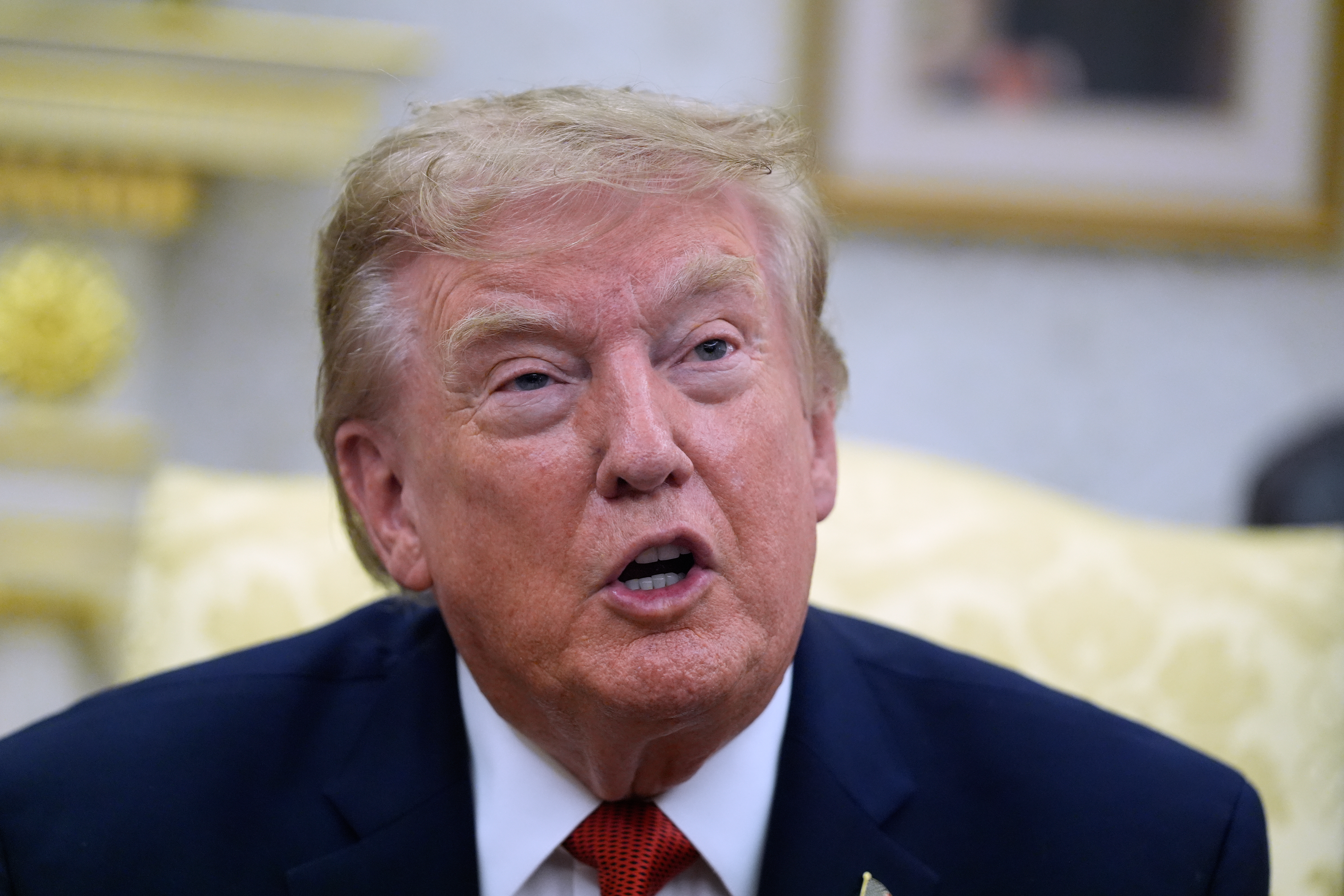
President Donald Trump speaks in the Oval Office of the White House on Monday, Aug. 17. Manuel Balce Ceneta
Iran refers to Trump’s ‘delusion’ about the strait
Iranian Deputy Foreign Minister Kazem Gharibabadi appeared to respond to Trump’s post on social media depicting the strait as American territory.
“Just as Trump correctly wrote the name of the eternal Persian Gulf, his delusion regarding the Strait of Hormuz will soon either be corrected, or we will correct this deluded man’s delusions for him,” Gharibabadi wrote on X.
Trump’s comment on Monday was not the first time he has threatened Oman. In May, he told reporters during a Cabinet meeting that Oman “will behave just like everybody else, or we will have to blow them up.”
Iran reiterated Tuesday that Tehran plans to maintain its grip on shipping traffic until Washington meets its conditions.
“Until the United States fulfills its commitments under the agreement, including lifting the blockade, releasing frozen assets, lifting oil sanctions, ending threats and military operations on all fronts, and implementing the other conditions to which it committed, the Strait of Hormuz will not reopen,” said Mohammad Bagher Qalibaf, Iran’s parliamentary speaker and negotiator in previous talks with the U.S.
The Egyptian Foreign Ministry said Tuesday that the Iranian-Omani deal could pave the way for Washington and Tehran to return to negotiations for a “comprehensive and permanent deal that addresses all concerns and enhances regional security and stability.”
The statement came after a meeting between Egyptian Foreign Minister Badr Abdelatty and Omani counterpart Badr al-Busaidi. But it did not address Trump’s latest threat against Oman.
President insists strait is open as more attacks are reported
Trump said Tuesday the U.S. has no planned talks with Iran but insisted the strait is “open and operating,” despite limited traffic, the reported boat strike and the end on Monday of the 60-day negotiating period between the countries.
Trump wrote on social media that a U.S. blockade of the strait remains “in full force and effect,” adding that all water mines have been removed.
As the talks between Iran and Oman continue, more attacks were reported in the region.
An unidentified projectile hit a ship early Tuesday in the strait off the coast of Oman, damaging the engine room and causing a casualty, according to the U.K. Maritime Trade Operations center.
The monitoring agency did not release any details about the ship or its cargo, and it was unclear whether the crew member was killed or wounded. The agency said the Omani Coast Guard was assisting other crew members and that authorities were investigating.
And Yemen’s Iran-backed Houthi rebels claimed they fired drones at an oil refinery in neighboring Saudi Arabia, the latest attack that threatened to reignite Yemen’s civil war and open another front in the Middle East.
The attack targeted a facility run by Saudi Aramco, Saudi Arabia’s state-owned oil company, according to a report by the Houthi-run SABA news agency. There were no immediate reports of damage or comment from Saudi Arabia.
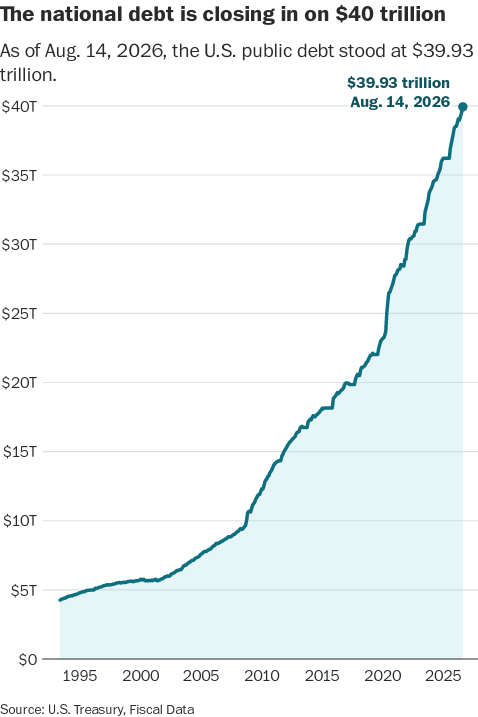
The U.S. national debt is likely to surpass $40 trillion this week, months earlier than forecasters previously expected, in part because of billions of dollars in lost revenue from President Donald Trump’s invalidated tariffs.
The lost revenue has forced the U.S. Treasury Department to borrow more rapidly to cover the nation’s bills: Six months ago, the nonpartisan Congressional Budget Office projected that total borrowing would top out at $39.4 trillion this fiscal year. But on Monday, Treasury reported that the debt stood at $39.9 trillion and counting.
The faster accumulation of debt means the next deadline for raising the legal limit on borrowing is also likely to arrive ahead of schedule. Just last year, Congress set the debt limit at $41.1 trillion. Budget analysts now say borrowing could hit that threshold by early next year, forcing lawmakers either to suspend it or raise it again to avoid the risk of an economy-shaking default.
Trump is already focused on the debt limit, which has repeatedly plunged Washington into a dangerous game of legislative chicken. Late last month, the president urged the Senate to address “the ever looming Debt Ceiling disaster” before leaving town for its August recess.
Senate leaders did not comply, but Majority Leader John Thune (R-South Dakota) told reporters at the time that “we’ll have to be dealing with it.” He added: “$40 trillion in debt — seems to me that should get our attention.”
For the past quarter-century, the national debt has grown under both parties, through the tax cuts of the George W. Bush era, the wars in Iraq and Afghanistan, the Great Recession, the 2017 Trump tax cuts and the nearly $2 trillion Biden administration initiative to prop up the economy during the coronavirus pandemic. Trump pledged during his first campaign in 2016 to eliminate the debt within eight years; instead, it has doubled since he first took office.
This year, the gap between spending and revenue was already expected to approach $2 trillion, the CBO reported in February. Days later, the U.S. Supreme Court struck down Trump’s “Liberation Day” tariffs, cutting federal revenue by an estimated $250 billion. The Treasury has also increased borrowing lately to build up its cash reserves.
Military spending tied to the conflict with Iran could add more to the debt in the months ahead, according to the Bipartisan Policy Center, a nonpartisan Washington think tank that tracks federal spending.
“Our current fiscal trajectory is plainly unsustainable, and that’s the best-case scenario,” BPC president and CEO Margaret Spellings said in a statement. “AI disruption, a recession, global war, or any number of other events could quickly push us over the edge from a challenge into a full-blown crisis. Even in the rosiest scenarios, we’re speeding toward a cliff and refusing to turn the wheel.”
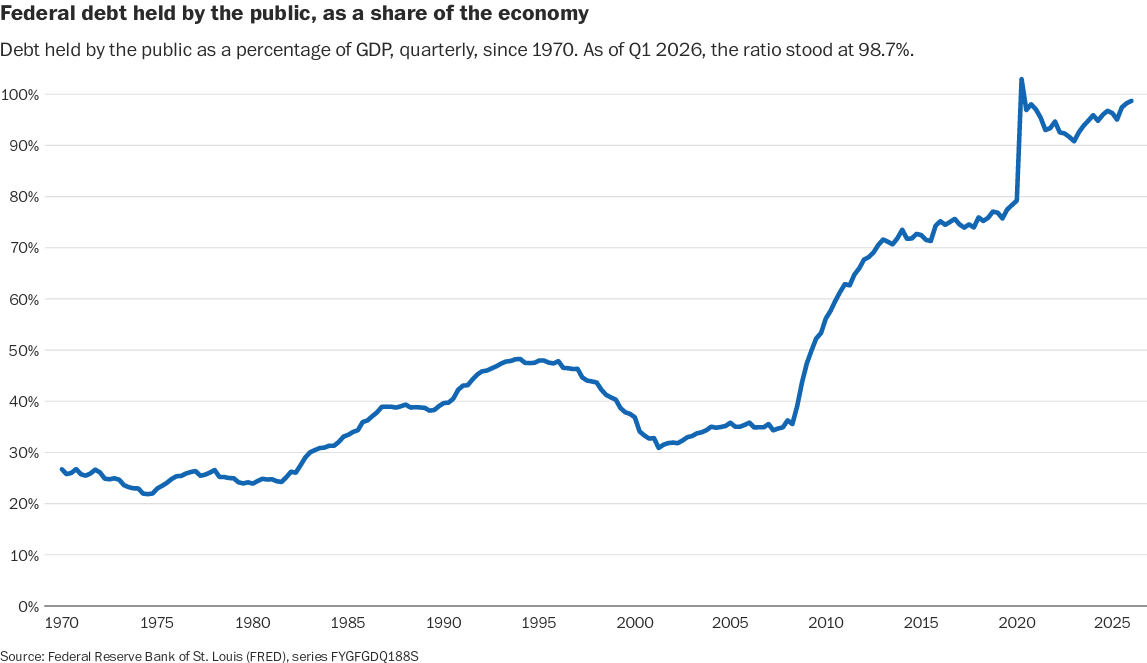
In an email, White House spokesman Kush Desai said that “the Trump administration remains focused on slashing waste, fraud, and abuse across the federal government while accelerating economic growth, policies that will get America’s debt-to-GDP ratio trending in the right direction.”
So far, Washington lawmakers have raised or suspended the debt limit every time it has been reached, but often after dramatic, deadline-pushing partisan battles. Even these near misses have rattled markets and carried a price: Standard & Poor’s, Fitch and Moody’s have each downgraded the credit rating of U.S. government debt since 2011, moves tied at least partly to debt ceiling brinkmanship.
Congress last raised the debt limit in quieter fashion, adding $5 trillion to the debt ceiling as part of the One Big Beautiful Bill Act, the Republicans’ marquee tax and spending law. Measures to raise the debt ceiling often include spending cuts aimed at reducing the annual budget deficit. But the One Big Beautiful Bill Act, which Trump signed in July 2025, did the opposite: That law added $4.7 trillion to projected deficits over the next decade, according to CBO estimates.
According to preliminary projections by the BPC, Washington is on track to next hit the debt limit between late winter and midsummer 2027. Based on the latest borrowing figures, the center’s estimate is “trending toward the earlier end” of that range, Shai Akabas, the center’s vice president of economic policy, said in a statement.
Hitting the debt ceiling would not by itself trigger a default. Once the borrowing limit is reached, Treasury can pay bills by drawing on its cash reserves and using stopgap accounting maneuvers known as “extraordinary measures,” which typically buy another six to nine months, according to the BPC. Only after that runs out does the government reach what’s known as the X-date, when the Treasury risks running out of cash and defaulting on its obligations.
If Republicans lose one or both chambers of Congress in the Nov. 3 midterm elections, they could attempt to raise the debt limit in the lame-duck period during November and December — before the new Congress is seated in January. Otherwise, they could be forced to make policy concessions to Democrats that Republicans — and the White House — would prefer not to make.
But raising the debt ceiling could prove challenging even under total GOP control. Especially in the House, where the GOP holds a slim majority, party leaders would be forced to win over their fiscal hawks, who have previously revolted when a debt ceiling increase was not accompanied by an agreement to cut spending.
“You have to raise the debt limit just the same way that you have to pay your credit card bill,” said Marc Goldwein, senior policy director for the Committee for a Responsible Federal Budget, a nonpartisan group focused on deficit reduction. It reflects spending choices you’ve already made, he said. “But if you keep getting credit card bills that are more than you can afford, it’s probably a good time to reassess how much you’re spending, or to get a second job, right?”
As with many credit cards, interest is itself becoming a bigger part of the problem. Last week, the U.S. government sold 30-year bonds at 5.216 percent, the highest rate in a quarter-century, Bloomberg News reported. Treasury rates ripple into mortgage rates, corporate debt and other borrowing.
Annual interest payments on the debt are projected to top $1 trillion this year, according to CBO — about the size of the Pentagon budget. They now consume about 19 percent of federal revenue, according to the Peter G. Peterson Foundation, a nonpartisan group that tracks the debt and advocates for fiscal discipline, and are projected to climb to 26 percent by 2036.
“Interest costs are paying for your past, not paying for your future,” said Peterson Foundation chief executive Michael Peterson, and unfairly burden future generations.
“It’s immoral to, year after year, trillion after trillion, just keep borrowing the money, not paying your bills for immediate consumption and deferring not only the principal balance but the interest costs onto our kids and grandkids,” he said.
Peterson pointed to Social Security as a preview of what happens when Washington puts off big problems: Unless Congress acts, the program’s trust fund is projected to become insolvent in 2032, triggering an automatic 22 percent cut in benefits.
“Can a democracy that’s run by all of us collectively make tough decisions to sacrifice in the short term for long-term benefit?” Peterson said. “The political system hasn’t risen to this challenge in recent decades.”
Theodoric Meyer and Jarrell Dillard contributed to this report.
Once again, Head Start — a program beloved by millions of families and with overwhelming public support — is being threatened by the Trump administration.
I was a Head Start teacher, administrator, and coach for nearly 15 years, and can attest to the transformative power of the program. I saw children thrive thanks to Head Start’s visionary emphasis on the whole child by providing a high-quality education, welcoming classrooms, healthy nutrition, and dental and health screenings. Through home visiting, regular parent communication, and frequent parent participation in the classroom, I saw families become stronger and more resilient.
Research has shown, time and again, that Head Start increases high school, college, and postsecondary graduation rates, leads to higher self-esteem for participants, and has a positive effect on future generations, as examined through parents’ practices exhibited decades later.
Which is why I am astounded by the methodical steps to dismantle a program that is the gold standard when it comes to early childhood programs. Back in 2023, the Heritage Foundation made exaggerated claims of fraud and abuse in its call to eliminate Head Start in the now-infamous Project 2025 plan for the second Trump administration.
A year later, word leaked that President Donald Trump was planning to use the biased Heritage Foundation report to zero out federal funding for Head Start. Widespread public outcry and political pressure thwarted that plan.
Undeterred, the Heritage Foundation developed a new strategy to kill off Head Start through death by a thousand cuts: If Head Start can’t be eliminated outright, deregulate it until it’s a skeleton of itself. Trump’s Department of Health and Human Services is proposing changes to Head Start that will do just that.
In May, Health and Human Services put out a proposal to retract wage increases for Head Start teachers. This move would exacerbate the already significant challenges in recruiting and retaining the standard high-caliber staff, resulting in fewer slots and lower enrollment.
Recently, Health and Human Services announced another proposed change to Head Start that would lower staff qualifications while raising the teacher-student ratios. The latest proposal would also eliminate some of the structures that keep lines of communication open between parents and providers, like parent-teacher conferences. And a new English-only mandate in instruction, written materials, and family communications would isolate parents and children who are dual-language learners.
Once again, people-power can successfully defend Head Start. Contact Sens. John Fetterman and Dave McCormick and your representative and tell them to pressure the Trump administration to withdraw these proposed changes.
Members of the public — like you — are able to voice your opinion, life experiences, academic research, or general passion for Head Start in response to the proposed changes. You can submit public comments on the Health and Human Services website — comments Health and Human Services must read and report on before finalizing anything.
Head Start sets up society as we know it for success. We must defend against this tactic of death by a thousand cuts and make sure future generations are able to reap the rewards of this tried-and-true program.
Zaina Cahill is the early childhood education policy director at Children First.
WASHINGTON — The Supreme Court on Monday again rebuffed President Donald Trump’s push to throw out a jury’s $5 million finding that he sexually abused the writer E. Jean Carroll at a New York City department store in the mid-1990s and later defamed her.
The Republican president’s lawyers had asked the justices to reconsider their refusal to hear his appeal. The court denied Trump’s petition along with several others.
It’s unusual — although not unheard of — for the court to grant such requests. Trump paid the judgment shortly after the court declined to take up his appeal in June.
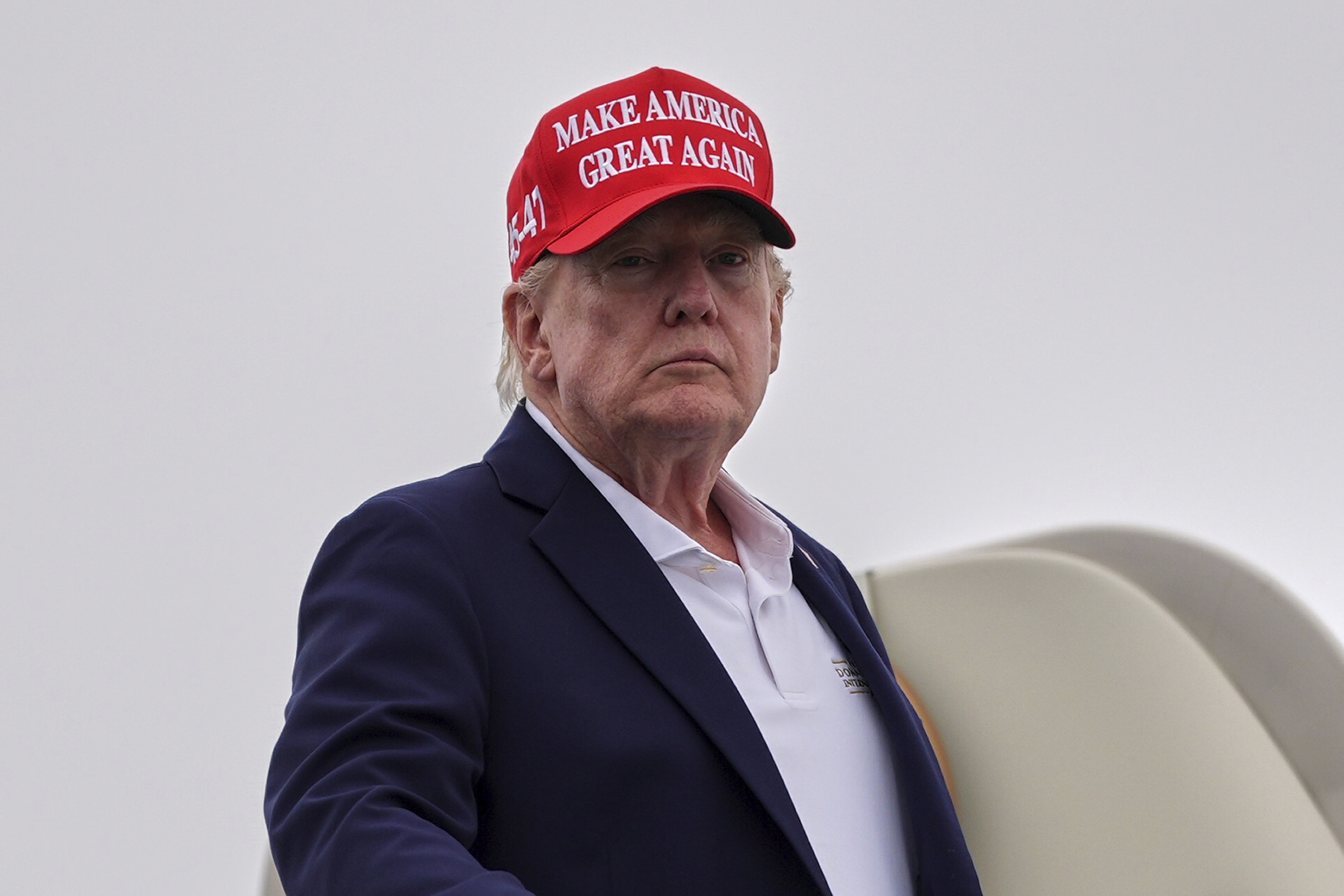
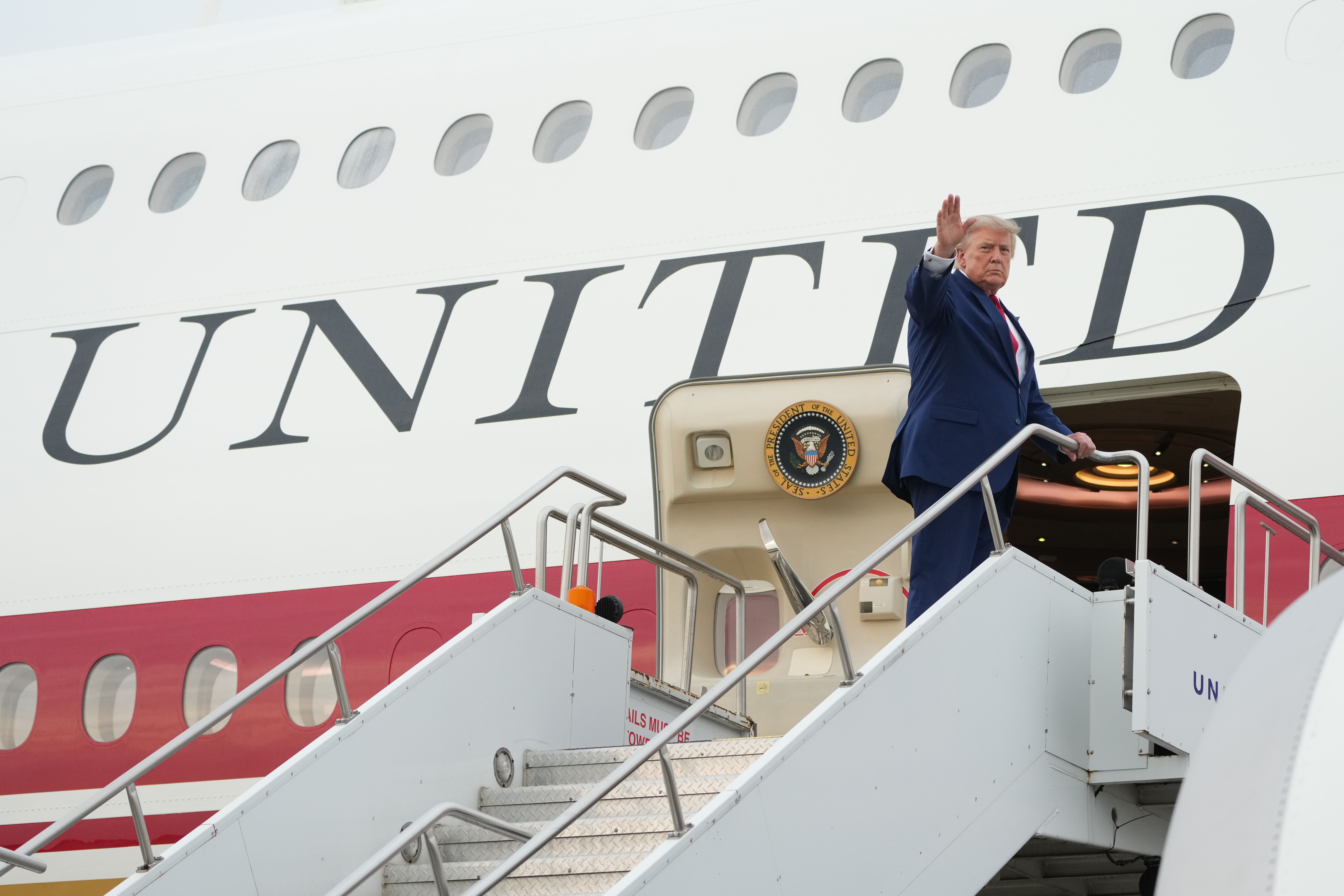
President Donald Trump boards Air Force One on Sunday, Aug. 16, 2026, in Morristown, N.J. Julia Demaree Nikhinson
Trump and the Justice Department are also asking the high court to toss out a second Carroll verdict totaling $83 million. They argue he’s immune from being sued over comments he made about her in 2019, when he was president. The court has not yet acted on that appeal.
Carroll is a longtime advice columnist and former TV talk show host. She testified at a 2023 trial that Trump turned a friendly 1990s encounter into a violent attack in the dressing room at Bergdorf Goodman, a luxury retailer across the street from Trump Tower in Manhattan. The jury found Trump liable for defaming Carroll when he denied her allegation in 2022.
Trump has denied any wrongdoing.
The Associated Press does not identify people who say they have been sexually assaulted unless they come forward publicly, as Carroll has done.
Seated behind his desk in the Oval Office earlier this month, President Donald Trump spoke directly to the camera in front of him. He turned to his right and looked up at the Pennsylvania Republican who, as he had indicated just a few weeks earlier, might very well lose her race for governor this fall.
“I think you can win,” he said this time, extending his hand to Stacy Garrity. It was a change in tune for Trump, who last month at an event in Pennsylvania said Garrity’s opponent, Democratic Gov. Josh Shapiro, was “expected to” and might win.
The president’s confidence in Garrity — and whether his support will extend beyond a handshake and a 17-second video with her at the White House — has become a critical question in the final stretch of the Pennsylvania governor’s race.
Down in the polls and lagging behind Shapiro’s unprecedented fundraising, Garrity has cultivated the president’s support and the potential boost, both financially and in Republican enthusiasm, that could come with it.
It is a risky strategy for a swing-state candidate whose party holds the White House, and particularly as polls show Trump becoming increasingly unpopular. Shapiro and his allies have enthusiastically promoted instances when Garrity, the twice-elected state treasurer, has leaned into Trump’s agenda and brand of politics.
But with less than three months before Election Day, it is not clear to what extent Trump or other key national Republicans will pitch in on her campaign.
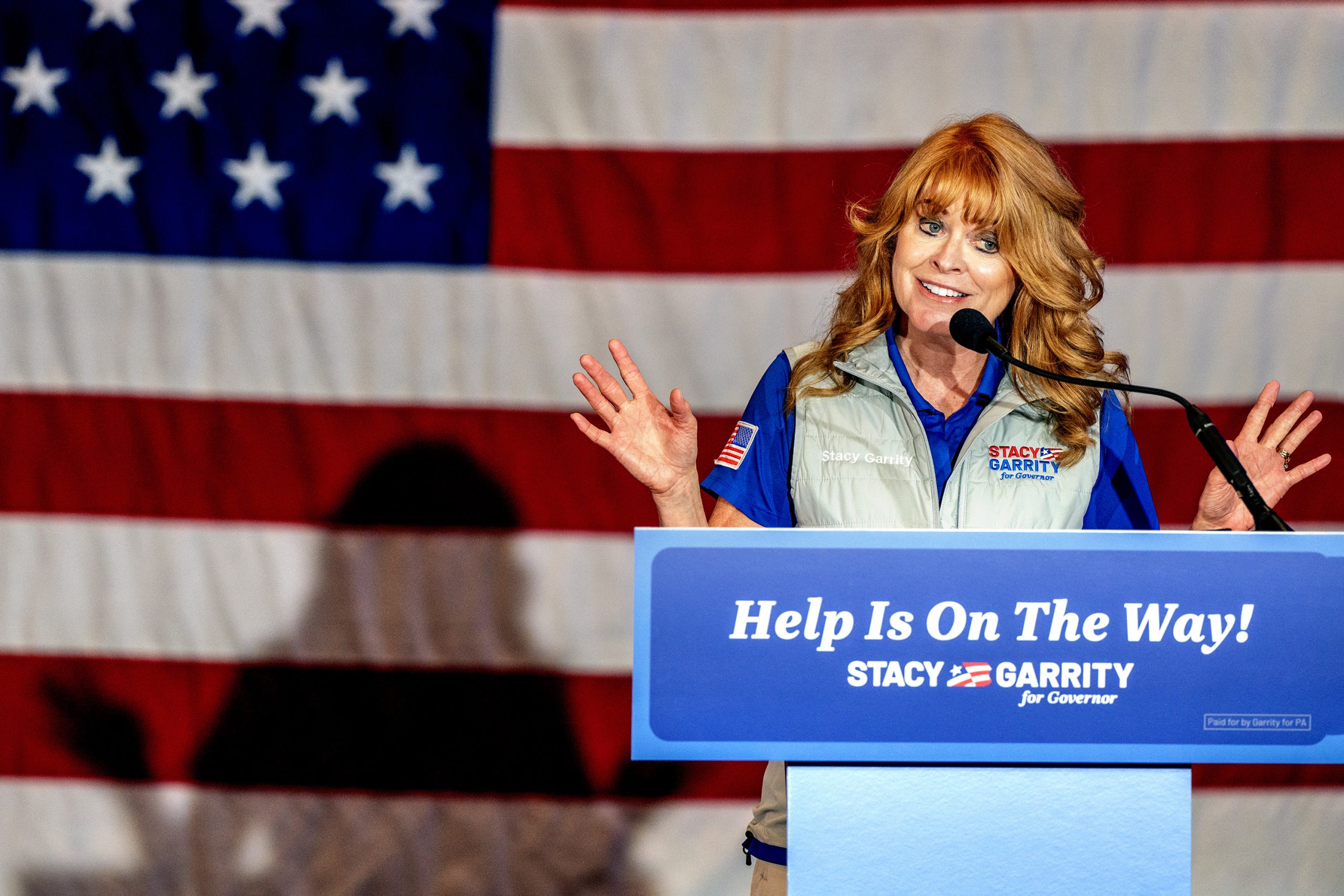
State Treasurer and Republican candidate for governor Stacy Garrity holds a rally in Bucks County at the Newtown Sports & Events Center in this 2025 photo. Tom Gralish / Staff Photographer
Trump has not yet stumped in any significant way for Garrity in Pennsylvania, a swing state where he was a near-constant presence during his winning 2024 campaign. And he has not lent his vast political resources — including a Trump-aligned super PAC flush with $400 million — to Garrity or other Republican candidates as his party faces tough campaigns across the country in the midterm elections that will determine control of Congress.
Several gubernatorial races around the country are consideredcompetitive, a reality that also pits Garrity against GOP nominees who polling suggests have better shots of success. The same circumstances have doomed the most recent other Trump-endorsed Pennsylvania Republican nominees for governor — former State Sen. Scott Wagner in 2018 and State Sen. Doug Mastriano in 2022 — who never ended up with national support and lost by double digits.
Campaigns typically heat up after Labor Day, and there is still time for Garrity’s national allies to converge to boost her. But observers say the political reality is also evident.
“The president kind of looks toward two things,” said Samuel Chen, an Allentown-based Republican strategist who is not affiliated with Garrity andwho previously worked for Tom Corbett, Pennsylvania’s most recent GOP governor.
“One is loyalty to him. Garrity has been loyal, but has not necessarily been as vocal as some others have. The other side of it is he likes winners. He wants to endorse people who win,” Chen said. “Everyone in Trump’s orbit knows that Garrity has a very uphill climb.”
Not supporting ‘lost causes’?
The level of involvement from groups like the Republican Governors Association has been a key indicator of whether the party believes its nominee has a chance at winning recent gubernatorial elections in Pennsylvania.
The RGA is made up of GOP governors who collectively support one another’s agendas and campaigns. Democratic governors have a similar alliance.
In 2010 — the last time a Republican won the governor’s mansion in Harrisburg — the group was the largest donor to then-Attorney General Corbett’s gubernatorialcampaign, giving him $6 million starting in August of that year. Four years later and helmed by then-New Jersey Gov. Chris Christie, the RGA was once again Corbett’s biggest donor. It donated more than $5.8 million as Corbett became the first sitting Pennsylvania governor in decades to lose a reelection bid. Christie, preparing to run for president in 2016, stumped with Corbett multiple times.
The picture was starkly different in 2018 and 2022, when Republican voters nominated two candidates closely associated with Trump. Neither Wagner’s campaign against Democratic Gov. Tom Wolf nor Mastriano’s campaign against Shapiro ever became highly competitive — and the RGA and other national groups decided to sit out.
“We’re watching Pennsylvania very closely,” Arizona Gov. Doug Ducey, then the chair of the RGA, said in September 2022. He added that the group would not support “lost causes” or “landslides.”
The RGA would spend nothing in the state that year, even with Mastriano and former Trump lawyer Jenna Ellis pleading for assistance. Shapiro went on to trounce Mastriano by nearly 15 percentage points.
This year, RGA chair and Montana Gov. Greg Gianforte has not publicly weighed in on Garrity’s chances since issuing a brief, generic statement congratulating her after her unchallenged primary in May.
And the competitive landscape Republicans are facing across the country may mean Pennsylvania’s GOP nominee once again gets the short end of the stick. The RGA did not respond to requests for comment.
Even with Pennsylvania’s status as a preeminent swing state that went for Trump two years ago, there are nearly a dozen more competitive gubernatorial races across the country this fall, according to the Cook Political Report, a nonpartisan group that provides election analysis.
Georgia, Iowa, Nevada, Ohio, and Wisconsin — some of which voted overwhelmingly for Trump just two years ago — are all considered toss-ups. Four other states with Democratic governors — Oregon, Arizona, Michigan, and Kansas — are also considered more competitive than Pennsylvania, which is ranked as “solid Democratic,” according to Cook, despite Republicans like Garrity and Trump having won statewide two years ago.
The RGA, according to its most recent filing with the Federal Election Commission, had less than $1.7 million in its RGA Right Direction super PAC after spending about $16 million so far in the current election cycle.
Its recent spending has focused on Iowa, where Democrats are attempting to capture the governor’s office for the first time in two decades, and Kansas, where the RGA launched an ad this month.
“There’s always competition for limited resources,” Charlie Gerow, a longtime Harrisburg-based Republican strategist who also ran for governor in 2022, said of the intraparty competition for donors. “There’s only so much campaign funding to go around as everybody’s trying to get a piece of it.”
In July, Shapiro’s campaign announced he had raised $50 million since January 2025. The next financial filing deadline for statewide candidates is in September, but as of the last reporting cycle, he had outraised Garrity 10-1.
President Donald Trump brings U.S. Rep. Ryan Mackenzie (right) to the stage as he holds an event in Mackenzie’s Lehigh Valley district at Mack Trucks in Macungie Tuesday, June 23, 2026.Tom Gralish / Staff Photographer
But Matthew Beynon, a spokesperson for Garrity’s campaign, said she “does not expect, nor does she need, to go dollar-for-dollar with Josh Shapiro.” Instead, he said, she “just needs the resources to prosecute her case against Josh Shapiro … and she is on pace to be able to do so.”
Garrity looks forward to “continued support” from the RGA, he said.
Other national attention on Pennsylvania
After Mastriano’s disastrous performance in 2022, Republicans coalesced around Garrity — whose 3.5 million votes in 2024 were the most ever for a statewide candidate in Pennsylvania — as their best shot at defeating Shapiro.
But in the year since she received the party’s endorsement, Garrity has barely moved the needle. A Quinnipiac University poll in July found Shapiro leading Garrity 53% to 40% among registered Pennsylvania voters. Trump saw even lower scores: Just 39% of those polled approved of the president’s job performance.
A poll from a Republican-leaning firm promoted by Garrity showed her down, 50% to 43%.
Across Pennsylvania, she has also competed for attention and resources as her party prioritizes other major election battles this fall.
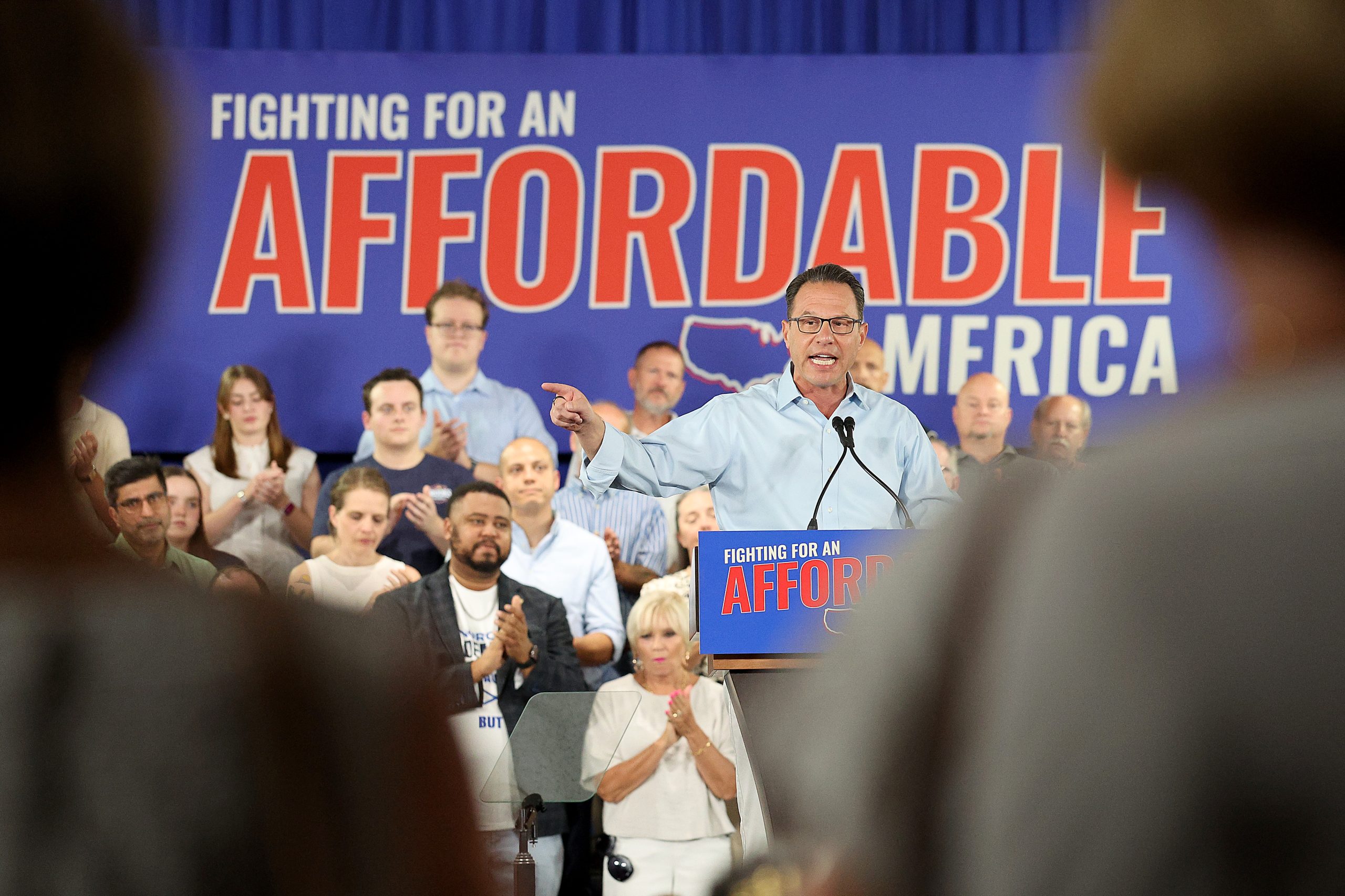
Pennsylvania Gov. Josh Shapiro addresses the audience during a rally for Democratic congressional candidate Bob Brooks at the United Steelworkers Union Hall in Bethlehem, Pa. on Sunday, July 26, 2026.David Maialetti / Staff Photographer
On the other side of the aisle, Pennsylvania’s top elected Republican — U.S. Sen. Dave McCormick — has endorsed Garrity but has not appeared to join in her public campaign efforts so far. A Trump ally and former hedge fund leader, McCormick has raised millions since his election in 2024, and political action committees associated with him have donated to other PACs working to elect Pennsylvania Republicans in Congress.
McCormick has hosted events and campaigned for Garrity, and he “will keep doing everything he can to help her win,” said Mike DeVanney, a spokesperson for the senator.
“He believes she demonstrates the kind of leadership we need and the kind that President Trump and many others have recognized as one that can move our commonwealth forward,” DeVanney said.
Gerow said McCormick undoubtedly could help Garrity down the stretch.
“He’s a prolific fundraiser. He has the connections, and he has the personality to raise large amounts of money. And he can be very, very helpful with the Garrity campaign if he weighs in with full weight,” Gerow said.
Garrity’s campaign said McCormick has been an “incredible supporter,” including with his earlyendorsement and connections to supporters.
Shapiro has also cultivated across-the-aisle relationships with some Pennsylvania Republicans who would be expected to promote Garrity.
In an April interview with Punchbowl News, U.S. Rep. Brian Fitzpatrick, a Bucks County Republican running for reelection in the nationally watched 1st Congressional District, said he thought Shapiro would win his reelection contest and should run for president, adding: “I think Josh is very, very smart.”
And during his 2022 run, Shapiro collected endorsements from other prominent Republicans, including Jim Schultz, a former Trump White House lawyer, and former Republican U.S. Rep. Charlie Dent.
The final stretch
Though the November election is less than three months away, that is still plenty of time in politics. Most ad spending does not start until September, and ground game efforts — door knocking, phone banking, and get-out-the-vote campaigns — get underway in the fall.
Winning Pennsylvania is a priority for Trump in the midterms, and Garrity’s campaign said she is “grateful” for his continued support.
On the state level, James Markley, a spokesperson for the Pennsylvania GOP, said the party is “fully invested” in helping Garrity beat Shapiro. Those efforts include training “thousands” of volunteers and working on education programs around early voting and casting mail-in ballots.
“The more Pennsylvania voters learn about Stacy Garrity, the more they love her,” he said in a statement. “The more Pennsylvania voters learn about Josh Shapiro, they realize he has no record to stand on.”
Gerow said Garrity’s challenge, with limited funds compared with Shapiro, is whether she has enough money to get her message out.
“The major concern for her immediately is to be able to tell her story,” Gerow said. “She doesn’t have the resources to tell that story effectively right now, and she has a great story.”
Buttons for State Treasurer Stacy Garrity and President Trump are left on a table following a VIP reception before a Garrity rally in Bucks County Thursday, Sept. 25, 2025. Tom Gralish / Staff Photographer
Throughout her campaign, Garrity has hammered Shapiro on several issues she said reveal his lack of transparency as a public official. She has held roundtable discussions blasting Shapiro for his early embrace of data centers, a position he has since distanced himself from after calling for new guidelines for their development. Her campaign released a video series online that questions his handling of criminal investigations. And she has repeatedly insisted that Shapiro, who is widely rumored to be running for president in 2028, is “more interested in Pennsylvania Avenue than helping Pennsylvania families.”
Samantha Reposa, a spokesperson for Shapiro’s campaign, disputed Garrity’s framing and emphasized that she has stood in lockstep with Trump on most of his positions.
“Garrity is now running to be nothing more than a rubber stamp for Trump and his agenda that’s hurting Pennsylvania families — and we will continue to hold her accountable,” Reposa said.
Given Garrity’s fundraising deficit, Chen said, he would advise her to focus on meeting individual people in the community, if he were running her campaign.
“Forget the GOP dinners. Start going to fairs. Start going to places that Republicans don’t show up. Start retail politics, and start introducing yourself to the state outside of Donald Trump, outside of modern Republicanism,” he said. “Tell the state what you’ve done for them and what you would do differently [as governor].”
Staff writer Joe Yerardi contributed to this article.
The jokes about Donald Trump’s secret escape from Turkey last month via an airport catering truck are still flooding the internet. Typical mockery included AI-generated images of the president hunched inside the truck gorging himself on bags of McDonald’s fries, while making his furtive getaway.
The jests about Trump’s transfer from Air Force One to a smaller plane via the truck — after Israeli intelligence warned a dubious CIA of a possible shoulder-fired missile attack by Iranians — may be funny. But Trump’s clandestine feint, even if it was more Maxwell Smart than James Bond, should be taken seriously.
It serves as a chilling metaphor for why Trump’s misbegotten Iran war has gone so wrong.
“If you’re hiding in a catering truck when you control the most powerful military in the world, you aren’t winning,” posted Ron Filipkowski, editor-in-chief of the progressive MeidasTouch Network, who wasn’t above making fun of Trump before nailing the bitter truth.
It is mind-boggling that an American president, who flies in one of the most highly protected planes in the world, had to be smuggled onto a different aircraft because the U.S. military couldn’t guarantee his safety. It’s all the more astonishing since the old Air Force One, on which POTUS was originally departing Ankara, had a defensive system designed to defeat such heat-seeking missiles (which Trump’s preferred luxury plane gifted to him by Qatar still doesn’t).
You may recall that it was ragged, barefoot Afghans who drove the then-mighty Soviet military out of Afghanistan in the 1980s by using shoulder-fired missiles — known as MANPADS — to take down powerful Russian attack helicopters. That’s called asymmetrical warfare, in which the weaker party uses unconventional means to offset the conventional might of the opponent.
Ukraine is waging a complex version of asymmetrical war against Moscow, having pioneered a staggering array of drones that can destroy tanks, ships, air defenses, and military infrastructure deep inside Russia.
Yet, Trump refuses to grasp how radically the nature of warfare has changed, enabling weaker countries to hold off stronger ones using robots, long-range air drones, and sea drones — or even updated shoulder-fired missiles.
Trump and his secretary of defense, Pete Hegseth, seem to envision war either as a throwback to World War II, or through the blurred lens of the U.S. kidnapping of Venezuelan President Nicolás Maduro. Either you crush the enemy with massive air power, ships, and male troops brimming with testosterone, or you do a quick, one-off beheading of the enemy, bringing them under your heel.
Neither model applies to the war on Iran.
Trump’s original goal was supposedly to halt Iran’s nuclear program. In the 12-day Israel-U.S. war on Tehran in June 2025, Iran’s nuclear sites were hit heavily. After that, the U.S. could have tracked any rebuilding of those sites by satellite and taken necessary action while negotiating a nuclear deal. The Strait of Hormuz, then wide open to global shipping, was not an issue.
Instead, the president abandoned promising nuclear negotiations to join a cockamamie regime change scheme proposed by Israeli Prime Minister Benjamin Netanyahu in February. Jerusalem assassinated Iran’s grand ayatollah and planned to swiftly replace him with a former Iranian president who had constantly called for the destruction of Israel.
I once had the stamina-draining opportunity to listen up close in a small room as said former leader, Mahmoud Ahmadinejad, ranted for two hours. I can tell you that anyone who knew anything about Iran, or who listened to advisers who did, knew this plan was deeply delusional.
Catering trucks are parked at Air Force One on the tarmac as the motorcade carrying U.S. President Donald Trump arrives to depart following the NATO summit at Ankara International Airport in Ankara, Turkey, on July 8.Alex Brandon
Trump was clearly suffering from Maduro Derangement Syndrome, mistaking Iran for Venezuela. As Gen. Dan Caine, chairman of the Joint Chiefs of Staff, warned at the time, a prolonged Iran war risked swallowing the bulk of America’s long-range missile arsenal. Indeed, these weapons, which cost millions of dollars each, were wasted chasing cheap Iranian drones.
Most dangerously, Russia, China, and North Korea have now seen that Trump’s manly U.S. Army is woefully unprepared for the wars of the future. His staggering request to Congress for a $1.5 trillion budget, an increase of 42% over the past year, doesn’t even include tens of billions in additional funding that he wants for the endless Iran war.
Yet, that budget is clogged with massive funding of legacy items and vanity projects unsuited for future warfare but protected by members of Congress, defense companies, and Trump cronies who benefit from the projects.
Prime among them is the 15-ship, Trump-class nuclear-powered battleship program, costing $275 billion over a 30-year span. Not only is Trump’s extravagance not needed by the Navy, but his “golden fleet” will be easy targets for the constantly evolving armada of unmanned anti-ship drones.
You might think the painful Iran experience would have awakened Trump to the urgent need to prepare the army for drone warfare. He and his showman secretary of war talk a big game, but neither he nor the Pentagon has yet grasped the lessons of the Iran — or Ukraine — wars.
Trump still rejects Kyiv’s offer to share drones and technology and to jointly produce the scarce Patriot interceptors. Private U.S. companies simply can’t gear up fast enough to meet the immediate need. Private U.S. investors are rushing to Ukraine to check out their innovations, but the Pentagon’s budget is still stuck in the past.
The U.S. military knows about its continued vulnerability to drones, and how essential they are to modern warfare — and understands the value of pairing with Ukraine, the world’s leader in the technology. “You can’t get training like this in the United States,” NATO’s top military leader, Air Force Gen. Alexus Grynkewich, told the Journal.
Even as he absconded in a food cart, Trump was still declaring victory in Iran, and claiming Wednesday that he has “total control over the Strait of Hormuz.” Wrong. Iran now controls that vital waterway via drone and missile attacks.
Trump’s current “strategy” is to wait Iran out while blockading its ships, or those loading up at Iranian ports, from exiting Hormuz. Never mind the cost to the global economy or to U.S. military readiness or to American consumers at the pump.
POTUS has few options. Lacking munitions, the U.S. can’t launch a ground war against Tehran (thank goodness). And renewed bombing will only cause Iran to bomb energy production sites in Arab Gulf states, which will drive oil prices to new heights.
What a president with a coherent mind and any rational strategy would do is squeeze the Pentagon to reorient U.S. military production. That, however, would involve a new defense secretary and a full-court press to reorient spending toward the future. Most of all, it would require making the most of all the hard-won drone wisdom Ukraine is so willing to share.
For that, the U.S. would need a very different person than the man in the White House. It would also require a Congress willing to challenge the president if he refused.
And so, pending midterm elections, I believe that all the food cart jokes ricocheting around the world convey the sad reality. My favorite was one that asked, “What was the name of the operation that lured Trump into the catering truck?” The answer: “Operation Orange Chicken.”
That’s a good punch line, but here’s the grim reality: Trump is unwilling to face the truth of his failures and incapable of devising a strategy that will keep Americans safe.
Editor’s note: This story was updated to include information from an interview conducted with Michael van der Veen and William Brennan after the story was published. van der Veen, Brennan, and their attorney, George Bochetto, did not responded to multiple interview requests in the days leading up to publication.
A newly formed local group sued the Gayborhood’s Bar X this month, alleging it is a public nuisance. The group wants to shutter the decade-old business, whose clientele is largely Black.
The lawsuit asks a Philadelphia Common Pleas Court judge to order the Camac Street bar to cease operations. It arrives at a time of increased police presence on the nightlife strip and heightened tension between the city’s Black LGBTQ+ community and police.
Bar X has “repeatedly generated excessive noise, disorderly conduct, disturbances, violence, public intoxication” and requires a constant police presence, the complaint says. It also claimed neighbors have observed “public displays of drunkenness and sexual activity” outside the bar.
The city failed by maintaining the establishment’s business license, the suit says, urging a judge to revoke it.
Behind the lawsuit is Michael van der Veen, a 62-year-old high-profile Center City lawyer whose office is in the building across from Bar X on Camac Street.
The bar has been using the office’s parking spot for years, van der Veen said, despite repeated requests to remain off the lawyer’s private property.
But things escalated in July when, according to van der Veen, he was assaulted while leaving his office around 9 p.m. at night.
“When I got jumped from behind and got coldcocked, I was done,” he said.
Days later, veteran criminal defense lawyer William Brennan incorporated Save Our Neighborhood for Tomorrow Inc., the group that filed the lawsuit against “the dive bar of the Gayborhood,” as Bar X pitches itself.
“This changed when passive-aggressive behavior became assaultive-aggressive behavior,” Brennan said. “It can’t be tolerated.”
Save Our Neighborhood for Tomorrow does not appear to have a website or social media presence.
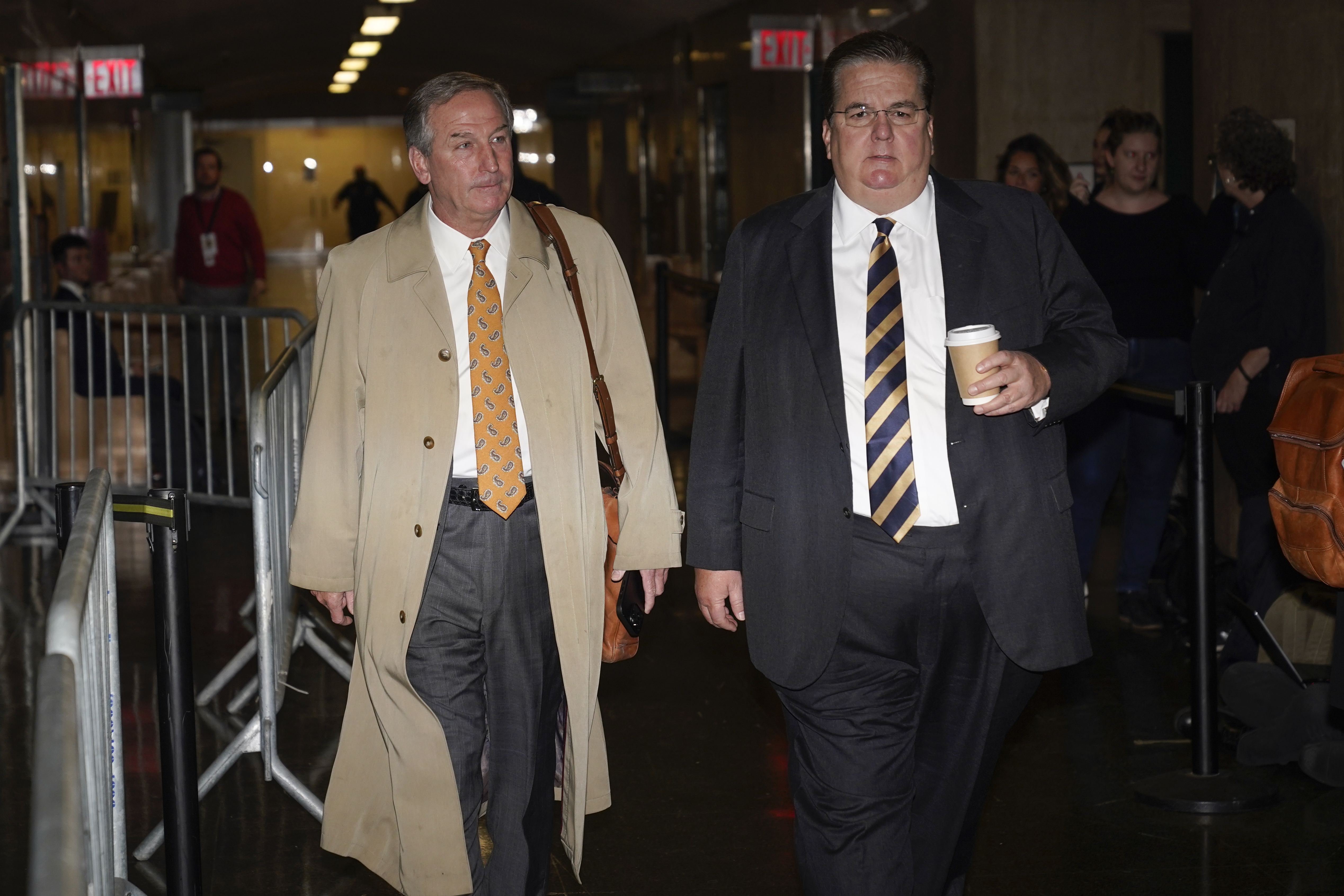
Defense attorneys Michael van der Veen, left, and William Brennan arrive to criminal court in New York in 2022 for Trump’s tax fraud case. Seth Wenig
George Bochetto, the attorney who filed the lawsuit on behalf of the newly formed group, did not respond to repeated requests for an interview. Bochetto is also representing a different group of Pine Street and Spruce Street residents who won an injunction to pause safety upgrades to bike lanes.
The lawsuit against Bar X names owner Tony Tsang, business entities associated with the bar, the city, and the commissioner of the Philadelphia Department of Licenses and Inspections, Bridget Collins-Greenwald. The city did not respond to requests for comment.
Tsang disputed the allegations of public drunkenness and sexual activity and said the bar is a longtime fixture of the block.
“You don’t like it, you like it quieter, how come you don’t move out of the city?” Tsang, 59, said in a recent interview at the bar. “One block, three bars, how come they’re only complaining about us?”
A ‘very homey’ gay bar
Bar X sits between Locust and Spruce on Camac, a narrow, 200-year-old street that is home to two other gay bars, Tavern on Camac and UBar. It is also around the corner from the bar 254, which replaced Tabu. Those three bars are all owned by the Tavern Group.
Tsang said the majority of his clientele is Black and suggested that the lawsuit had more to do with his identity and that of his patrons than the noise or disturbance allegations.
“To me, it’s the color. I’m Asian. My English isn’t too good. They want to play a game with me,” Tsang said.
Tsang opened his bar in 2016, naming it Bar X so it would be easy for people to remember. The bar’s exterior features a rainbow mural of tropical leaves; inside Tsang hung Ikea posters of Audrey Hepburn and James Dean. He said he stocks the bar himself, buying whatever club soda is on sale at the supermarket.
The bar has a large dance floor and a DJ booth that abuts the alley.
Joseph Ward, a part-time bartender at Bar X who also runs its social media and marketing, said the bar stands out because it’s “very homey,” with Taco Tuesdays and twice-weekly karaoke. (There’s also a male revue every Thursday night.)
Bar X owner Tony Tsang said he stocks the bar himself with whatever club soda is on sale at the supermarket.Elizabeth Robertson / Staff Photographer
“You [can] just chill and not have to worry about the hustle and bustle of a nightclub,” Ward, 36, said. He said the bar is one of the last minority-owned clubs in the Gayborhood and hosts a largely nonwhite crowd.
The lawsuit cites negative Google reviews from people purporting to be Bar X customers, including accounts of stolen phones and allegations that a bartender gave patrons drinks containing sedatives.
The remedy to the situation, the suit says, is for the city to shut down the bar.
Ward said that rumors of drugged drinks at the bar had gained traction online earlier this year, but that staff had not been able to verify any crimes, despite reaching out to those making the accusations. In response, the bar ordered covers for customers’ drinks.
“We take pride in it being a safe place in the Gayborhood,” Ward said, “so we obviously want to keep it that way.”
A new police deployment
Bar X’s block has seen an increase in crime incidents this year, according to Philadelphia Police Department public data.
The lawsuit claims that since last summer there have been nearly 70 crime incidents at the property, including “multiple reports of a person with weapons, assaults, robbery, and disorderly conduct.”
<iframe title="Crime Incidents On Bar X's Block" aria-label="Column Chart" id="datawrapper-chart-LCiYX" src="https://datawrapper.dwcdn.net/LCiYX/1/" scrolling="no" frameborder="0" style="width: 0; min-width: 100% !important; border: none;" height="477" data-external="1"></iframe><script type="text/javascript">(function(){function e(){window.addEventListener(`message`,function(e){if(e.data[`datawrapper-height`]!==void 0){var t=document.querySelectorAll(`iframe`);for(var n in e.data[`datawrapper-height`])for(var r=0,i;i=t[r];r++)if(i.contentWindow===e.source){var a=e.data[`datawrapper-height`][n]+`px`;i.style.height=a}}})}e()})();</script>
In April, the Washington Square West Civic Association hosted a meeting with residents, city officials, and Tsang in an attempt to address neighborhood complaints. Councilmember Mark Squilla, who represents the area and attended the meeting, estimated that more than 40 people attended.
In response, the city experimented with one-off street cleanings of Camac to address litter, Squilla said. Police also began clearing the street of people on weekend nights after 2 a.m., when the bar closes.
“We’ll continue to work on compliance and whatever else is needed there,” Squilla said.
A Philadelphia Police Department spokesperson confirmed there is currently a “bar/nightclub” deployment in the bar’s general area. The department has used similar deployments throughout the city for decades to respond to community concerns and public safety needs, Sgt. Eric Gripp said in a statement.
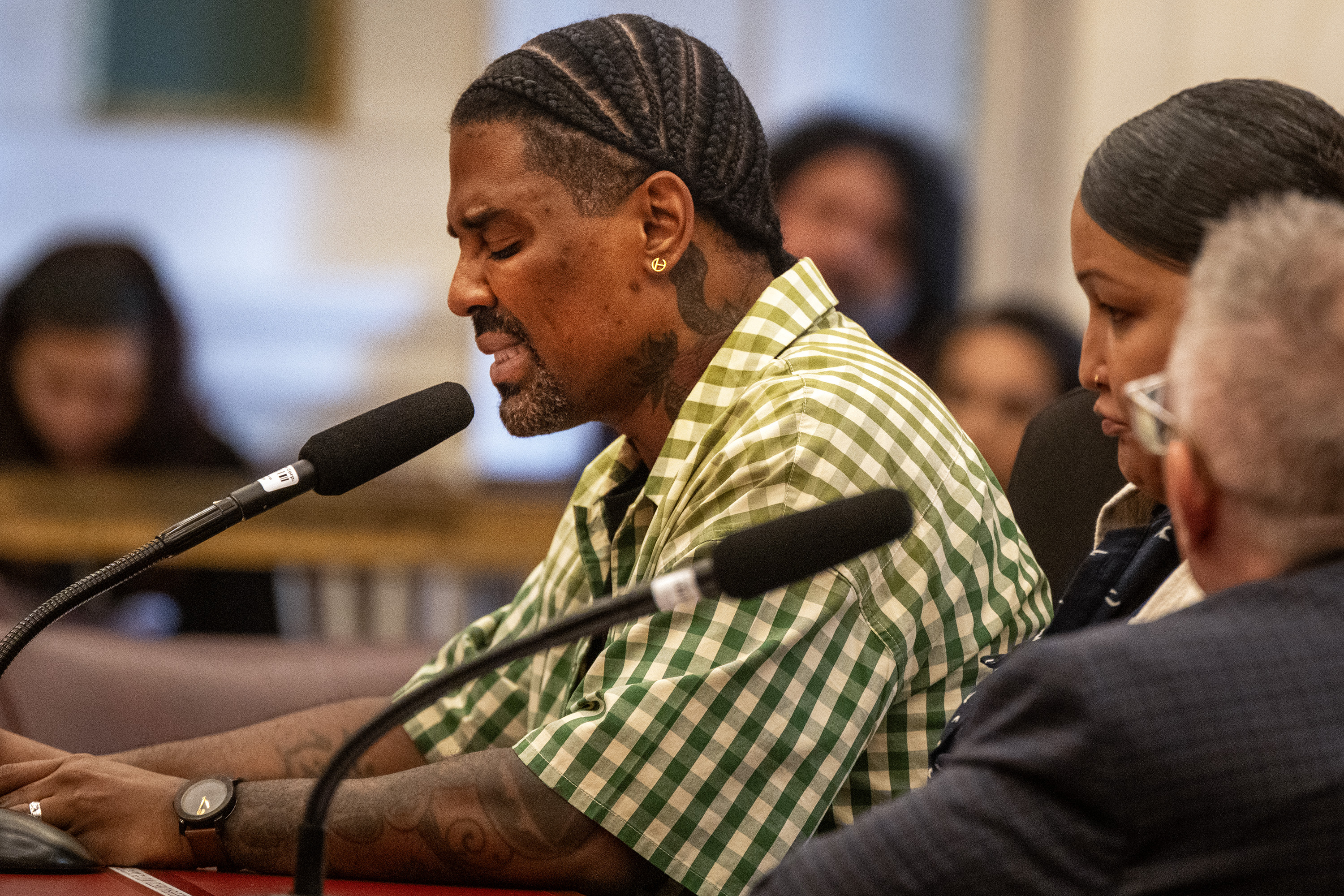
Jacen Bowman, president of Philly Black Pride, testified earlier this month at a City Council Committee on Legislative Oversight hearing into the Philadelphia Police tactics used during Pride celebrations in June.Tom Gralish / Staff Photographer
“Black and brown LGBTQ+ people are watched differently. We are approached differently. We are policed differently,” Jacen Bowman of Philly Black Pride said at the hearing. “Too often we are made to feel like visitors in a neighborhood that is promoted as the heart of Philadelphia’s LGBTQ+ community.”
Iemad Saifo, the 65-year-old owner of Zena’s American Mediterranean Cuisine in Collingswood, has been released after spending two weeks in ICE detention at Delaney Hall in Newark, N.J.
Saifo emigrated to the United States from Syria in 2002 on a business visa and later sought asylum after the outbreak of the Syrian civil war. He was detained during a routine ICE check-in July 31.
Saifo is the primary caregiver for his 12-year-old son, who has autism. The elder Saifo also has spasmodic dysphonia, a rare condition that makes it difficult for him to speak, as well as chronic kidney disease.
Dozens of Collingswood-area community members wrote letters and signed a petition urging the court to keep him in South Jersey with his family.
As President Donald Trump pushes his mass deportation agenda, routine check-ins have become increasingly risky for immigrants. Immigration advocates say many of those who have been arrested at ICE check-ins were simply following government protocols.
Last week, New Jersey Attorney General Jennifer Davenport announced her office was investigating Delaney Hall after multiple detainees died there during the last year, raising concerns about the facility’s conditions and medical negligence. The privately operated detention center under contract with ICE has been the scene of fierce protests and political fights between the Trump administration and Democrats since its May 2025 reopening.
U.S. Immigration and Customs Enforcement said in a statement that Iemad Saifo was arrested both because he does not havepermanent status and because of a 2018 case in which he was indicted and found guilty of witness tampering and sentenced to five years’ probation.
“Under President Trump and Secretary Mullin, ICE is targeting the worst of the worst,” a Department of Homeland Security spokesperson wrote. “Nearly 70% of ICE arrests are of illegal aliens charged or convicted of a crime in the U.S.”
One of Saifo’s attorneys, Fiona Powell, credited the 150 notarized letters from community members testifying to his character with helping secure his release.
“This was an outpouring of community support like I’ve never seen before,” she said.
Those letters were authored last weekend during an event that friends, family, and community organizers hosted at his restaurant.
Many in South Jersey know Iemad Saifo from his restaurant, which opened in 2011, and from the nearly 10 years he previously spent working at a local 7-Eleven, said his 27-year-old daughter, Zena Saifo, for whom the restaurant is named.
Zena Saifo said she, her mother, and one of her brothers were granted asylum after the war began. Her father never heard back from the Department of Homeland Security on his asylumapplication, she said,so he later applied for permanent residency through his younger son, who was born in the United States.
“He’s always willing to help people, to give,” Zena Saifo said of her father.“People are really enraged and disgusted by what’s happening and doing everything they can to support him.”
Zena Saifo is still reeling from the day of his detention, she said, when she, her brother, and lawyers arrived at the Mount Laurel ICE office for the check-in around 7:30 a.m. and were made to wait until past noon. The Saifos’lawyer notified Zena her father would be detained. She tearfully pleaded with the ICE officer to let her say goodbye to him but was denied, she said.
“‘Was this the last time I saw my father?’” Zena Saifo recalled wondering in the moment. “It was just really, really devastating.”
In the period since Iemad Saifo’s detention, two of his sons,ages 24 and 26, have taken over the restaurant. His wife has stayed at home and taken care of the youngest. He turned 12 last weekend without his father present.
Zena Saifo said her father’s two requests of her in his absence were to water the family fig tree and to host a big celebration for her brother’s birthday.
On Friday morning, the family was en route to pay the $7,500 bond and pick Iemad Saifo up from Delaney Hall, Powell said.
The 2018 charge was brought up during the bond review, she said, but “in the end the judge was able to see that he’s an older man with a family who needs him and strong community ties and that he deserves to be home with his family.”
Going forward, Iemad Saifo’s legal team will do all it can to secure permanent residency for him. In the interim, Powell said, immigrants are always at risk of detention regardless of their circumstances. The Trump administration has issued 46,000 orders of removal or voluntary deportation since the start of last year in Pennsylvania, New Jersey, and Delaware, more than in the entirety of former President Joe Biden’s term. In New Jersey’s courts, orders of removal or voluntary departure rose 47% just between May and June, from 2,348 to 3,446.
However, to legally detain Iemad Saifo again, the government would need to show something about his situation has changed.
“It could take potentially months or years more in order to get him permanent status here, but we will continue doing everything we can to keep him here,” Powell said.
In this week’s Shackamaxon, the race for City Council kicks off, SEPTA police officers step in front of the cameras, and a Big Tech reckoning comes for the Ambitious Abingtonian.
Councilmember Jeffery “Jay” Young Jr. during the Barber’s Hall community legacy celebration on Aug. 1.Yong Kim / Staff Photographer
Contrarian challenge
In political circles, the legislative lineage of Philadelphia’s 5th Council District is one of the city’s most esteemed and iconic. The first person to represent the residents of the 5th in City Council was Raymond Pace Alexander, the civil rights leader who was later appointed as the first African American judge on the Court of Common Pleas. The seat has also been held by Cecil B. Moore, Ethel Allen, and John Street. Few other districts can boast such an impressive list of luminaries.
Today, its occupant is someone very different, Council’s quarrelsome contrarian, Jeffery “Jay” Young Jr.
Of course, there’s nothing wrong with “good trouble” or sticking out from the crowd. Moore himself was famously pugnacious, with the former Marine once quoted as saying that “The imported Gandhi philosophy of nonviolence that still exists in the South will not be accepted in Philadelphia, where we believe in self-help and self-defense.” Allen was also a maverick, styling herself as a “B.F.R. — a Black, female Republican, an entity as rare as a Black elephant and just as smart.”
Moore and Allen, however, were quarrelsome on behalf of the people they represented, and contrarians at a time when Black Philadelphians were mostly excluded from the halls of power.
Moore successfully desegregated Girard College, paving the way for Young himself to attend decades later.
Young, however, starts fights that help nobody. Worse, no one seems to understand why he’s fighting in the first place.
From delaying repairs at the Cecil B. Moore Library to blocking popular housing proposals, Young’s actions frequently bring him in conflict, rather than concert, with the community he was elected to represent.
It is unsurprising, then, to see that he’s already attracted a declared challenger for his seat, months before election season kicks off in earnest.
Jalon Alexander has a big advantage over the opponents Young (almost) faced in the past: He’s managed to successfully get onto the ballot before, during the 2023 City Council at-large election.
While he brings his own ideas to the table, Alexander is also clearly running in opposition to Young’s choices. The cybersecurity attorney grew up in Strawberry Mansion, and still lives there, but is running a campaign built to find support across the district’s geographic and political spectrum.
Kellan White, at this point a potential candidate, presents another strong alternative. White managed Rebecca Rhynhart’s 2023 mayoral campaign, which was successful across much of the 5th District. He has a deep knowledge of city politics and policy, and a Rolodex of contacts that any political journalist would be jealous of. Unlike Young, both Alexander and White are willing to answer the phone to talk to reporters, community leaders, and their constituents.
At this point, even if a dozen candidates run against him and split the opposition vote, Young may still face an uphill battle.
When I’ve criticized other Council members, I always get calls or emails from constituents who defend their choices. In nearly three years writing about Young, not a single person has offered a defense.
A SEPTA Route 38 bus at 15th and Market Streets in May.Alejandro A. Alvarez / Staff Photographer
Spotlight on SEPTA
A few readers have asked me about film crews they’ve seen following SEPTA police around stations and transit vehicles recently. Media Relations Director Andrew Busch confirmed that the A&E Network is filming a docuseries, which will be broadcast next year.
Personally, I’m looking forward to watching it. SEPTA’s roughly 250-strong police force is charged with patrolling more than 285 train and trolley stations, and nearly 3,000 vehicles. They are also in the midst of substantial declines in serious crime, which occurred alongside a crackdown on fare evasion and a surge in enforcement for quality-of-life issues. That’s a story worth showing.
Less worthwhile would be a series focused on Kensington and the city’s drug epidemic. That’s a real part of SEPTA’s policing duties, but is often exploitative when told by outsiders.
Gov. Josh Shapiro announces a $20 billion investment by Amazon in Pennsylvania data centers in Salem and Falls Townships in 2025.
Data-driven
Ever since the creation of the first computer, there have been concerns about its role in the future. It doesn’t help matters that many tech CEOs, like OpenAI’s Sam Altman, regularly express a kind of contemptuous attitude toward humanity and human needs. At one point, Altman said that artificial intelligence would “lead to the end of the world.” How inspiring!
This has put public officials in a tough position over their support of data centers.
For generations, states and cities have competed to attract investment. But these days, cash is flowing into an industry opposed by 74% of voters. Seeing an opportunity, challengers from across the political spectrum are using data centers in their political attack ads, while incumbents are scrambling to explain themselves.
Gov. Josh Shapiro, the Ambitious Abingtonian, exemplifies this conundrum. He was an early advocate for embracing data centers, but with polls tightening for his reelection efforts, he’s been forced to adapt.
Of course, there’s a certain opportunism to state Treasurer Stacy Garrity’s embrace of the techlash.
Her own party has been quite supportive of data centers. President Donald Trump has called them “tremendous.” Pennsylvania state Senate Majority Leader Joe Pittman has long advocated for the centers, which represent a particular opportunity for his own community, which has, in his words, “a long and storied history when it comes to the production of electricity.” U.S. Sen. Dave McCormick, the highest-ranking Republican in Pennsylvania, is married to Meta executive Dina Powell McCormick. Meta is one of the four companies investing a total of $1.5 trillion in new data centers.
Pennsylvania Senate Republicans declined to pursue Shapiro’s proposed “GRID” initiative, which would have required the centers to produce their own electricity, conform to environmental standards, and make community benefits agreements in exchange for permitting assistance.
Many of the current pitchfork-wielding politicos may themselves be forced to pivot when in office. Voters may hate data centers, but they also hate tax increases and service cuts.
Loudoun County, Va., which is known as data center alley, has averted both. Local authorities have cut property tax rates by nearly 30% over the last decade, and the centers pay roughly half of the county’s property tax revenue. Given the increasing share of Pennsylvania’s budget that is paid through the extractive gambling industry, the need to invest more in schools and transportation, and the continuing structural deficit, it is no surprise politicians initially saw the AI boom as an opportunity.
Now, state leaders will have to pick their poison.
If they pursue data centers, they’ll face voter backlash. If they continue to embrace gambling, they’ll contribute to the impoverishment of their own constituents. If they stop investing in education or allow transit agencies to fail, they’ll weaken the commonwealth’s economy going forward. If they raise taxes, they’ll take the blame for that, too.
While the data center surge may seem sudden to many, it is also a response to demand. Both businesses and individuals are increasingly using AI in daily life.
Ironically, many social media posts about data centers include AI-generated text and images. It is a bit like if the Women’s Christian Temperance Union had fundraised with a booze cruise.
Pennsylvania will not change its immunization guidelines in response to President Donald Trump’s executive order this week calling for states to reduce the number of recommended childhood vaccinations and separate a combination shot protecting against measles, mumps, and rubella (MMR).
Gov. Josh Shapiro, a Democrat, said his administration will “continue to give Pennsylvanians clear public health guidance based on science and facts.”
“President Donald Trump and [Health and Human Services Secretary Robert F. Kennedy, Jr.] are screwing around with the childhood vaccine schedule — ignoring decades of science, sowing chaos and confusion, and spreading dangerous misinformation that put kids and families at risk,” Shapiro said.
States set vaccination mandates for schoolchildren, not the federal government.
And it gives Kennedy, a longtime anti-vaccine activist, 90 days to present Trump with a plan for a number of vaccine policy changes. Changes could include splitting the MMR vaccine into separate shots for each disease. There are currently no individual vaccines for measles, mumps, or rubella licensed in the United States.
“Splitting up combination immunizations, like the MMR vaccine, creates unnecessary hurdles for parents, needlessly extends the window of risk for our youngest residents, and doesn’t follow the results of the many studies that went into developing the previous vaccine schedules,” Pennsylvania Secretary of Health Debra Bogen said in a statement.
White House spokesperson Kush Desai did not comment directly on Pennsylvania officials’ decision to keep its original vaccine recommendations.
He said in a statement that Trump has pledged to reduce the vaccines recommended for all children, and the “administration is committed to delivering with Gold Standard Science and every lever of executive authority.”
“The countless parents whose questions and concerns about America’s vaccine schedule have been ignored if not mocked finally have a true champion in President Trump,” he said.
Vaccine politics under Trump
The new executive order is not binding, experts say, and states are free to ignore it.
Several states, including Pennsylvania, have already balked at Trump’s repeated attempts to upend longstanding childhood vaccination schedules.
And last year, when the Trump administration did not approve COVID-19 vaccinations for certain groups, Pennsylvania changed state policy to allow pharmacists to dispense vaccines based on recommendations from a number of professional medical organizations, including the American Academy of Pediatrics and the American Academy of Family Physicians.
Previously, pharmacists were asked to dispense vaccinations based solely on recommendations from a Centers for Disease Control and Prevention committee. Kennedy fired the entire committee and replaced them with hand-picked appointees last year, some of whom included vaccination skeptics. That action is also the subject of a court battle.
“The way to handle this is to ignore it,” said Paul Offit, the director of the Vaccine Education Center at the Children’s Hospital of Philadelphia and a prominent Kennedy critic.
“It’s not science based, it doesn’t make vaccines safer or more effective,” he said. “All it does is put children in harm’s way.”
He noted that despite longstanding concerns by anti-vaccination activists that children receive too many vaccinations, breaking up combination vaccinations like MMR would result in children getting more shots. “Kids would need six shots instead of two,” he said.
Logistics uncertain
Changing the kinds of vaccines available in the United States would take years, said Ana Santos Rutschman, a professor specializing in health law at Villanova University.
Trump could ask the Food and Drug Administration to approve separate measles, mumps, and rubella vaccinations, which would require extensive clinical trials and a long approval process, she said. And vaccine manufacturers may not attempt to develop new shots if Republicans lose control of the White House in 2028, she added.
“Right now, it’s unlikely anyone will reshift their operations,” she said. “It’s feasible — it’s just expensive, and the payoff is very small.”
The FDA could revoke licensing for the current combination MMR vaccines, but that would likely invite court challenges, Santos Rutschman added.
In the short term, she’s concerned that Trump’s repeated attempts to change longstanding vaccine policy will only confuse parents and providers who have relied on consistent recommendations from the federal government.
“Suddenly, you have our top regulators saying there’s a reason to hop to a different set of products. This is inherently confusing,” she said.