Philadelphia drivers looking to save a few bucks at the pump streamed into the city’s newest Freedom Fuel station Friday afternoon, even while the station’s deep discounts remain a mystery.
The station, located in Bustleton on Roosevelt Boulevard, is one of four new Freedom Fuel locations added this week. The other three are in New Jersey, including one all the way up in Morris County.
The gas network, which was promoted by both the White House and President Donald Trump last month, is now up to 29 stations across the Philadelphia region, stretching east to the Jersey Shore.
(function(){function e(){window.addEventListener(`message`,function(e){if(e.data[`datawrapper-height`]!==void 0){var t=document.querySelectorAll(`iframe`);for(var n in e.data[`datawrapper-height`])for(var r=0,i;i=t[r];r++)if(i.contentWindow===e.source){var a=e.data[`datawrapper-height`][n]+`px`;i.style.height=a}}})}e()})();
Nearly all the pumps were full at Philly’s newest Freedom Fuel spot Friday afternoon, with the station selling a gallon of regular gas for $3.79 a gallon. That’s nearly 35 cents a gallon less than a Wawa just up Roosevelt Boulevard, where a gallon of regular gas went for $4.13 on Friday.
A nearby Lukoil was a bit closer to Freedom Fuel’s prices, offering a gallon of regular gas for $3.99.
An enduring mystery remains how Freedom Fuel has been able to consistently offer lower prices than nearby competitors.
Experts told The Inquirer Freedom Fuel was likely suffering losses for selling fuel at such a low price, especially since many of the company’s stations don’t have robust convenience stores or car washes to create revenue.
“It becomes unsustainable,” Eliezer Fich, a finance professor at Drexel University’s LeBow College of Business, told The Inquirer last month. “Unless prices go down. But if they do, they go down for everybody.”
According to public records, the newest Freedom Fuel station is owned by Celik Plaza II l.l.c., which had previously run it under a “Red Lion Fuel” banner. Engin Celik, who is listed as a principal with the company, according to documents reviewed by The Inquirer, did not respond to a request for comment.
Philly Freedom Fuel station faces closure after failing inspection
The Freedom Fuel station on Bustleton Ave. in Philadelphia. Dana Munro / staff
While Freedom Fuel is adding locations, it could soon lose one in Philadelphia.
The station on Bustleton Avenue, one of at least six locations linked to Cherry Hill developer Shamikh Kazmi and his brother Syed Kazmi, has an expired fuel dispensing license and failed an inspection last week, according to city records.
If unresolved, the station could be forced to close by Sept. 4, according to a city spokesperson.
Ravens special teams coach Randy Brown signed Freedom Fuel’s formation papers. Terrance Williams
While Freedom Fuel’s launch was proudly promoted last month by Trump, the company’s owners have remained quiet about the enterprise and how they’re able to maintain low fuel prices.
A White House spokesperson previously told The Inquirer Freedom Fuel is a private company receiving no government subsidies and not accessing fuel at a lower cost.
“Freedom Fuel Network is a privately owned and proudly patriotic company — along with its convenience store operators, haulers, sign companies, and operational partners — that answered President Trump’s call to action to lower prices at the pump,” the company said in a statement on its website.
Baltimore Ravens assistant coach Randy Brown, the former mayor of Evesham Township, N.J., and a self-proclaimed “proud Trump supporter,” signed Freedom Fuel’s certificate of formation in Delaware on June 23. Brown has declined to comment on the enterprise.
Former commodities trader Yoni Gontownik also signed the certificate of formation, and has not responded to requests to comment. Gontownik and his wife, Bellen, have hosted Republican fundraisers through NORPAC, a New Jersey-based political action committee supporting pro-Israel lawmakers in both parties.
Staff writer Ryan W. Briggs contributed to this article.
Joseph LaForte was once the charismatic head of Par Funding, a Philadelphia-based lending firm that collapsed in spectacular fashion as prosecutors said he misled investors to the tune of $400 million and resorted to brutish loan shark tactics to collect on unpaid debts.
Now, despite the fact that LaForte pleaded guilty to racketeering and wire fraud charges, a website has been set up to lobby President Donald Trump to free him from a 15½-year prison sentence — part of a campaign that describes LaForte’s prosecution as a “witch hunt.”
“Stand Up for What’s Right, Free Joe LaForte,” says a scrolling banner on the website, FreeJoeLaForte.com. The site’s homepage also prominently features several images of Trump and says the goal is to “fight for [LaForte’s] presidential pardon through activism and exposing the truth.”
Websites dedicated to overturning convictions are not unusual. But the existence of the LaForte campaign comes as Trump, in his second term, has shown a willingness to grant clemency to political allies or people he believes have been unfairly prosecuted — including those convicted of fraud. And well-connected lobbyists and lawyers have reportedly started charging defendants eye-watering sums for promises of presidential relief.
LaForte does not have an official clemency application pending with the Office of the Pardon Attorney, according to that agency’s website. But the LaForte website is clear about its intent to lobby Trump for freedom.
How the campaign came together — and whether LaForte has a role in it — is something of a mystery.
LaForte’s lawyer in his criminal case, Joseph Corazzo, said he didn’t know of the site until he was contacted by The Inquirer and said he’s had no role in any potential efforts to seek clemency from Trump for LaForte.
LaForte, meanwhile, is incarcerated at a federal prison in Fort Dix, N.J., and is not scheduled to be released until 2035.
Unidentified creators
The LaForte website, FreeJoeLaForte.com, does not say who owns or runs it. And phone messages and emails left through its contact pages in recent weeks went unanswered.
One of the calls was directed to a number associated with John Sirmans, of Fanwood, N.J. And Sirmans’ name is listed as an author on dozens of PDFs that were published on the LaForte site.
It is not clear how or if Sirmans and LaForte know each other, and Sirmans did not respond to requests for comment.
PDFs on the site list another author as “Lisa Mac.” LaForte’s wife, Lisa McElhone, was sentenced to one day in federal custody for her role in the Par Funding scandal, and the Justice Department said LaForte sometimes used the alias “Joe Mack” while working at Par Funding.
Attempts to reach McElhone — including by visiting Lacquer Lounge, the nail salon she owns in Old City — were unsuccessful.
Meanwhile, a petition on change.org — which urges people to visit FreeJoeLaForte.com — is even more forceful its views on LaForte’s case, calling his imprisonment “unlawful” and saying he is “an innocent man targeted by a weaponized justice system that bends to partisan agendas.”
But the creator of the petition, which has 40 verified signatures, is listed only as “Truth Seeker,” and attempts to reach that person through change.org were unsuccessful.
Extensive coverage
One of the more prominent sections on LaForte’s website, meanwhile, is a list of more than a dozen news articles written by Milton Allimadi, a New York-based journalist who runs an outlet called Black Star News.
On LaForte’s site, Allimadi’s stories are labeled as being part of a series “dedicated to exposing the truth and corruption involved in the wrongful persecution of Joseph LaForte.”
Allimadi said via email that he did now know who started FreeJoeLaForte.com or how the Black Star News articles ended up being highlighted there.
He said he learned of LaForte’s case after speaking with the father of an inmate housed alongside LaForte. He declined to identify the person.
Allimadi said he wrote about LaForte for Black Star News because the Par Funding founder’s story had “many interesting angles.” He said he’s never spoken to anyone associated with FreeJoeLaForte.com and was not paid by anyone connected to the site for writing or publishing his articles.
Still, he said, he didn’t mind having his work promoted by LaForte’s site because that had already led to what he said was a modest but noticeable uptick in traffic and donations to Black Star News.
“Our site’s major support comes from readers who donate … and some of his supporters who read and like the articles also definitely contributed, because there was a little spike,” Allimadi said.
Another case that Allimadi covered extensively in recent months led to a sizable legal judgment against him.
Last month, a jury in Michigan awarded more than $12 million to a doctor who said Allimadi and Black Star News targeted him with a “relentless, vindictive, and malicious online smear campaign” centering on allegations of domestic abuse and sexual assault of his ex-wife.
Allimadi said his journalism was solid, and he is trying to get the verdict thrown out.
As for LaForte, Allimadi said his coverage included references to LaForte’s history of criminal convictions, and he said it was “clear from [LaForte’s] background that he’s no saint.”
But Allimadi said he also explored angles that hadn’t received much attention as Par Funding collapsed, including by raising questions about the conduct of the Securities and Exchange Commission and the court-appointed receiver in the case, which each contributed significantly to LaForte’s downfall.
“I can see why [LaForte’s supporters] would want to post such articles on their site,” he said.
Newsroom researcher Ryan W. Briggs contributed to this article.
U.S. Rep. Brian Fitzpatrick (R., Bucks) led a bipartisan group of lawmakers in a letter asking Homeland Security Secretary Markwayne Mullin to extend and expand temporary protected status (TPS) for Ukraine ahead of its expiration this fall.
The government status allows immigrants to live and work in the United States if conditions are unsafe in their home countries. For Ukraine, which has been in a war waged by Russia for nearly five years, TPS is set to expire on Oct. 19.
“More than 250,000 Ukrainians have sought safety in the United States after fleeing Russia’s brutal full-scale invasion,” lawmakers wrote in the letter, dated Aug. 4. “These individuals have become valued members of our communities, contributing to our economy, workforce, and tax base while complying with U.S. laws and rebuilding their lives in temporary safety.”
U.S. Rep. Brendan Boyle (D., Philadelphia) was also among the 27 lawmakers to sign onto the letter, but only three other Republicans joined Fitzpatrick’s effort.
President Donald Trump’s administration let TPS expire for Haiti and Syria late last month and has promised to deport individuals who lose their legal status, and Ukrainians who fled the war and live and work in the United States under TPS could face a similar fate this fall if the designation expires.
In a statement to The Inquirer on Thursday, Casey-Lee Waldron, a spokesperson for Fitzpatrick — who is a cochair of the Congressional Ukraine Caucus and was stationed in the country as an FBI agent in 2015 — said the lawmaker “urges the Secretary to act without delay.”
“Putin’s brutal unprovoked war continues to destroy communities, endanger innocent lives, and make any safe return impossible for Ukrainian families,” Waldron said.
On Haiti, Syria, and next month’s expiration for El Salvador, Fitzpatrick’s position appears to be more nuanced.
Waldron said that Fitzpatrick believes “upholding the rule of law and acting with compassion are not competing obligations,” and that temporary protected status for the three countries should be independently evaluated.
“And where the standard established by Congress continues to be met and a safe return remains impossible, those protections should remain in place,” Waldron said.
Last year, the Bucks County Republican, without naming the president, slammed Trump’s criticism of Ukrainian President Volodymyr Zelensky. Fitzpatrick also visited the country and met with Zelensky and soldiers on the front lines, and signed a missile to Russian President Vladimir Putin.
His support for Ukraine continued this week with the letter to Mullin, which argues that Ukraine continues to meet the statutory benchmarks for qualifying for a TPS designation. In addition to extending the Oct. 19 deadline, lawmakers are also calling on the DHS secretary to redesignate temporary protected status for Ukraine, meaning it would reset the country’s eligibility cutoff date, allowing more immigrants to apply for the protection.
“Without both an extension and redesignation, many Ukrainians lawfully residing in the United States could be forced to return to a country where their lives and safety remain at serious risk,” lawmakers wrote.
Iryna Mazur, an immigration attorney and honorary consul of Ukraine in Philadelphia, said it would be economically beneficial to the U.S. to extend and expand TPS for Ukrainians and emphasized the importance of the humanitarian efforts at the core of the law.
She said that maintaining a united front among political parties on support for Ukraine is key.
“I don’t think there would be anybody in their good mind with a good sense of justice in their heads who would say it’s a wrong thing to do right now under the circumstances,” Mazur said.
“This is a very active phase of war, and it just would be inhumane not to extend this particular temporary measure.”
Staff writer Jeff Gammage contributed to this article.
South Dakota is a prairie state that voted more than 63% for Donald Trump in 2024, so it’s not the first place you’d look to find a wave of discontent over GOP rule. But deep under the state’s expansive corn and soybean fields grow the invasive roots of political rage.
There’s the trade war that’s dried up demand for farmers’ crops while driving up the costs of essential items like fertilizer. Disdain for Trump has slashed the flow of Canadian tourists who once flocked to Mount Rushmore. There’s the same high gas and supermarket prices as in the other 49 states. And farmers who had liked the president’s border policies are now scared of losing workers to immigration raids.
Doug Sombke, president of the South Dakota Farmers Union, recently told the Canadian magazine Maclean’s that some Dakotans now “see we got sold a bill of goods … They were told grocery prices were going to come down. Trump keeps leading them on, saying, ‘There’s gonna be some pain.’ I don’t think anybody was ready for this much pain, this soon.”
In this brutal climate, one South Dakotan who probably should be bracing for pain is the mostly pro-Trump GOP Sen. Mike Rounds, a former governor seeking reelection to the Senate in November. And on Tuesday, Democrats hoping to oust Rounds from Capitol Hill got the big news that a lot of them were hoping for.
That’s right. In what may be the most counterintuitive political strategy in U.S. political history, liberal anti-Trump activists in politically red states west of the Mississippi have been pleading for obscure, long-shot Democratic candidates to abandon their races — so that spunky independent candidates can challenge the GOP one-on-one instead.
When ex-state trooper and longtime Democratic activist Julian Beaudion told South Dakotans that, feeling pressure, he’s quitting the race, it cleared the path for independent Brian Bengs to consolidate the anti-incumbent vote in November. Polls suggest that the retired U.S. Air Force lawyer and college professor who was briefly a Democrat is already within striking distance of an upset.
And he’s not alone. Democrats are also not running a Senate candidate in Nebraska — where a well-funded and well-known independent, labor leader Dan Osborn, is running again — or in Idaho, where Todd Achilles, a one-time Democratic lawmaker who left the party, is on the ballot. In Montana, an independent Senate hopeful is also hoping that a Democrat will drop out, but unsuccessfully so far.
Casual political observers probably know that Democrats (and two allied independents) — currently in the Senate minority by a 47-53 count — are hoping Trump’s unpopularity will help their candidates run the table in five to six key contested states from Maine to Texas. But much less attention has been paid to this stealth backup plan — the notion that a few prairie populists can end the GOP majority.
What’s truly remarkable about this scheme is that a growing number of Democratic strategists are making a tacit, not to mention uncomfortable, acknowledgment: In the American heartland, their party’s brand is in the toilet.
That’s why a number of political activists believe the only way in these blood-red states to make the most out of rising voter anger against Republicans over high gas prices and Trump’s badly botched war with Iran is to offer voters an alternative without a “D” next to their name.
Steve Hildebrand, a Sioux Falls-based political consultant who was a high-ranking official in Barack Obama’s 2008 campaign, is one of the Democrats who thinks that — despite voter unrest against the GOP — an independent has the best chance in South Dakota.
“I think our party has gravitated too far away from fighting for hard-working Americans — you know, blue-collar workers, union workers,” Hildebrand told me this week. “You know, we’ve been fairly pathetic about a unified party message, and frankly, we’ve been pathetic about beating back on Donald Trump.”
Still, most of the political agenda of the western independents is larded with a modern brand of prairie populism that feels like a first cousin to the left-wing progressivism of Democrats — like Michigan’s Abdul El-Sayed — who’ve been scoring 2026 victories in blue states. They are strongly against billionaire influence in politics while advocatingfor healthcare reform and progressive ideas about making life more affordable.
“Getting money out of politics to the maximum extent possible would be the single biggest accomplishment I think of my career and of Congress,” Bengs told Independent Voter News. “And I’d also like to get healthcare affordable, so people don’t have to worry about, ‘Don’t call the ambulance, because I can’t afford that.’”
So why not run as a Democrat, when so many of his proposals overlap? Bengs did join the Democratic Party to challenge South Dakota’s other GOP senator, Majority Leader John Thune, in 2022, and after losing by 27 percentage points, he said he’ll never do that again.
He said at county fairs and parades he met voters who liked his ideas, but told him, “I’ll never vote for a Democrat.” “Sometimes there was an expletive in there. The takeaway was that the letter was more important than what I was saying.”
“Democrats are simply not competitive in at least 20 states, maybe more.” Larry Sabato, the University of Virginia political scientist and veteran analyst, told me. He said independent races can be a way to win in these red states, but the candidate needs to break with the Democrats on some issues and show themselves as a true outsider.
Sabato said Republican dominance of prairie and mountain states can end up with “voters getting fed up with the ruling party, and desiring a switch so badly that they’ll hold their nose and defect. I suppose it is easier to vote for an independent.”
Except that clearing the political field to create the desired one-on-one race between a Republican and such an independent upstart is proving to be not so easy.
Experts like Sabato say the strongest independent Senate candidate might be Montana’s Seth Bodnar, a former University of Montana president and Army veteran. But the Democrat who’s on the ballot in Big Sky Country, Alani Bankhead, told Politico last week that she would abandon the race only “if a lightning bolt from God struck me” — an unlikely event even in this summer of wild weather. Polls suggest the Republican, Kurt Alme, would easily win a three-way race against both Bodnar and Bankhead.
The process in South Dakota was just as messy. The Democrat, Beaudion, also had been insistent he would not withdraw before Tuesday’s deadline, when he alleged that he and his family faced “intimidating threats to drop out of the race,” and gave no indication he would support Bengs’ campaign.
The best chance for knocking off a GOP incumbent remains Nebraska. Osborn, who rose to prominence as the union leader of a high-profile strike against the food giant Kellogg’s, got nearly 47% of the vote against Sen. Deb Fischer in 2024 when Trump was on the ballot. In 2026, he’s poised to capitalize on the president’s fading approval as he challenges another incumbent, Sen. Pete Ricketts.
“If you believe that billionaires, like Elon Musk, George Soros, or Pete Ricketts, should not be allowed to buy anything they want, including private islands for sex trafficking, and our elections, and our votes, then send them a message in cash and vote for me,” Osborn told a recent town hall. The most current poll, conducted in May by Tavern Associates, showed Osborn winning by 5 percentage points.
Still, it’s an uphill climb for many of these prairie independents. Incumbents like Rounds, Ricketts, and Idaho’s 83-year-old Sen. James Risch enter their races with an unshakeable base of MAGA Trump supporters, and they’ll have millions of dollars for ad campaigns that will surely portray their opponents as liberal Democratic wolves in sheep’s clothing.
There are also a ton of questions about what will happen if any of them win in November. Would they join the two current independents, Vermont Sen. Bernie Sanders and Maine Sen. Angus King, in caucusing with the Democrats? (Osborn has explicitly said he will not.) Whom would they support for majority leader, with a likely challenge to the current top Democrat Chuck Schumer? Would they vote mostly with Democrats, or take contrary, libertarian stands on issues like gun control, in line with voters back home?
The biggest question for Democrats, however, might be the long-term one: How will yanking so many candidates in 2026 help the professed goal of rebuilding a Democratic Party that some day will be viable in all 50 states? That will have to wait until the political derecho of disgust with both parties blows past.
“There’s just a lot of different stripes out there right now, and I don’t think that’s a bad thing,” Hildebrand said. “I think the Democratic Party and the Republican Party both have terrible brands. I think you know that it’s their own fault. It’s not the fault of voters.”
U.S. Sen. John Fetterman, in perhaps the most in-depth and toughest interview he has faced in recent memory, defended his unwavering support for Israel and his harsh criticisms of fellow Democrats when pressed by Jon Stewart in a podcast episode released Wednesday.
The liberal comedian and political commentator repeatedly accused Fetterman (D., Pa.) of “caricaturing” the left wing of his party and the debate around Israel’s handling of the war in Gaza.
“Jewish community and Israel are not the same thing, brother man. They’re not — that is not the same thing,” Stewart, who is Jewish, said at one point as Fetterman described his full-throated support for the war as being because of “the Jewish community.”
Asked repeatedly about the United States’ moral obligations about backing the Israeli strikes that have led to the deaths of tens of thousands of Palestinian civilians, Fetterman stood firm.
He said — as he often has since the Oct. 7, 2023, attack by Hamas that sparked the conflict — that it was necessary to go after Hamas leaders. The killing of civilians was “terrible” and “collateral” damage but not a genocide, Fetterman said.
Stewart continued to press — questioning why Fetterman was standing so firmly behind a foreign ally that was “dehumanizing” and slowly killing another population.
“I don’t understand how you have no criticisms over their actions, over their increasingly messianic, ultra-right-wing government that seems to think relentless war is, like, that you can bomb people out of resistance,” Stewart said.
Many other elected Democrats have distanced themselves from the Israeli government and criticized its tactics. Fetterman has acknowledged his position has hurt him politically. In the interview with Stewart, he echoed previous comments — which have also become evident in public polls — that he has lost the support of his former Democratic base as his and his party’s stances diverged.
“I’m aware that if I happen to disagree with the party line, there’s a price to pay,” Fetterman said. “There’s a lot of stories of how I’ve become increasingly more unpopular with Democrats in my state. And I’m aware of it. But these were all very specific choices. … I would rather have people know what I happen to believe.”
Stewart asked Fetterman several times about how he has voiced those disagreements.
He said the senator has focused far more on arguing with his own party in a way that has further hurt its brand. And he has broken from the party’s ranks as Democrats try to use even an inkling of leverage that could impact Republicans’ agenda as the GOP controls both Congress and the White House, Stewart said. He pointed to issues like immigration enforcement reforms, which Democrats tried to enact by holding out support for a spending bill earlier this year. Fetterman said he supported the reforms but would not go along with letting part of the government shut down as a strategic move.
Mark Twain Prize recipient Jon Stewart is introduced at the start of the 23rd annual Mark Twain Prize for American Humor at the Kennedy Center for the Performing Arts, in Washington, April 24, 2022. (AP Photo/Kevin Wolf, File)Kevin Wolf
Stewart also pressed Fetterman on how his approach to President Donald Trump has softened as he has ramped up his criticism of his own party.
“You called President Donald Trump a jagoff in 2016,” Stewart said, prompting Fetterman to say that he put the phrase on shirts and sold them.
“You put it on a shirt. And now you’ve been very complimentary to him. And if your concern with Graham Platner is you didn’t think he was very nice to women, you’re ignoring an awful lot of evidence for the current president about his relationship with women,” Stewart said, referencing Fetterman’s attacks on the Maine Democrat who dropped out after facing allegations of sexual assault. “So my point is, there seems like there’s a way to go about this that embraces, as you said, the 90% of things that you agree with, and try and utilize that energy to reform a party that has a worse public image than herpes in terms of getting things done. This feels like it’s playing into the hands of Republican caricatures.”
Fetterman pushed back, saying he was trying to stop “extreme” elements of his party in a way that would lead to better success in battleground elections — like in Pennsylvania — after Democratic losses in 2024.
“We keep losing, and now we keep returning back to some of the extreme things,” Fetterman said. “That’s not a caricature. That is a fair assessment of where we are with these kind of things.”
Stewart, noting that Vice President Kamala Harris was not the most progressive Democratic option in 2024, rejected the idea that the party lost because of far-left views. In an extended conversation about capitalism and socialism, he also encouraged Fetterman to embrace new ideas presented by democratic socialist candidates who Fetterman, like many Republicans, refers to as communists.
Fetterman, who frequently appears on Fox News but has not appeared on more liberal programs like Stewart’s Daily Show, described himself as a longtime fan of Stewart and said he believed the interview was “very fair.”
At the end of the podcast, after Fetterman left, Stewart said he “wasn’t sure what to think” and was “weirdly thrown off right now.”
“I feel like we all just got out of one of those movies. Do you know those movies where it’s like … there was a weirdly traumatizing scene in the movie,” Stewart said. “And now we’re all just, like, ‘Do you guys, um, do you want to go get something? I guess I’m just going to go get a slice and maybe go home.’”
Federal and state officials including Mehmet Oz, head of the Centers for Medicare and Medicaid Services, and Pennsylvania Attorney General David Sunday were in Philadelphia on Tuesday to highlight efforts to combat the persistent problem of Medicaid billing fraud in home care.
During a news conference in Center City, officials outlined Pennsylvania cases involving a personal-care assistant who billed Medicaid 1,000 times for more than 24 hours of work in a single day, another who billed for helping his father in South Philadelphia while being arrested in Chester, and an agency that billed Medicaid $225,000 for services provided by an aide who was dead.
Federal and state prosecutors used the occasion to announce charges against 18 people and one agency in mostly unrelated cases for defrauding Pennsylvania’s Medicaid program of $4 million by billing for home-care services they did not provide. The alleged fraud occurred roughly over the last five years.
The alleged fraud in these cases filed over the last two weeks is tiny compared with the size of the program. Pennsylvania spent $8.1 billion on home-care services last year, up from $2.3 billion in 2020, when the program expanded and thousands more people started getting paid to provide home care.
“Used properly by honest citizens, the program allows those with physical ailments to be cared for by those they trust the most,” said Colin McDonald, of the Justice Department’s National Fraud Enforcement Division. “But infiltrated by greedy and deceitful opportunists, this program becomes a money tree, a gravy train for criminal fraudsters.”
Colin McDonald, Assistant Attorney General, Department of Justice National Fraud Enforcement Division, speaks as federal and state law enforcement officials announce healthcare fraud charges, Tuesday, August 4, 2026 in Philadelphia.Joe Lamberti / For The Inquirer
The U.S. Department of Justice shared details on six new cases. The Pennsylvania attorney general recently filed five new cases.
The biggest case involved $1.5 million in billings from a personal-care assistant registered with 13 agencies who more than 1,000 times charged Medicaid for more than 24 hours in a single day, Sunday said. On one occasion, the aide billed for 126 hours in a single day, Sunday said.
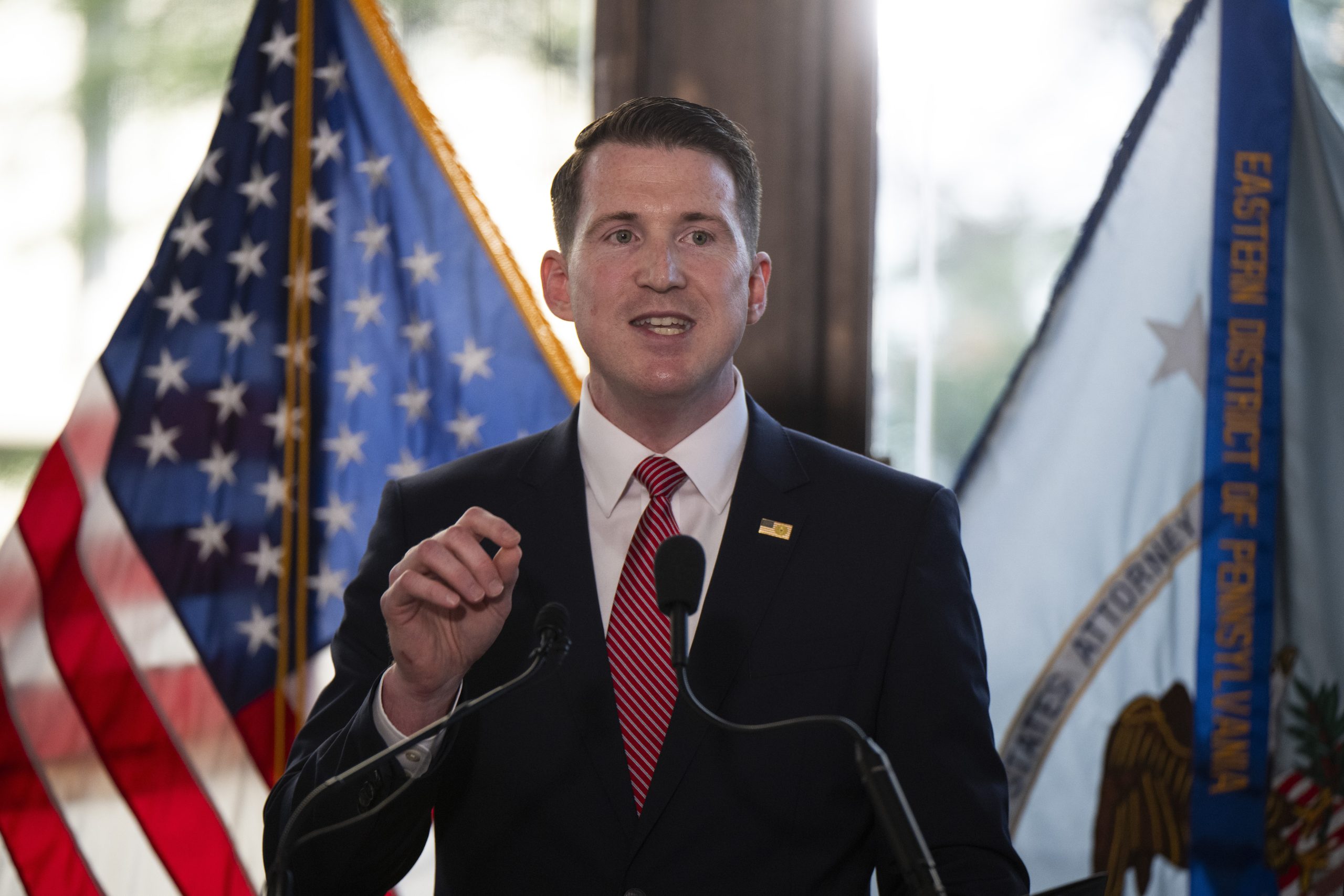
Federal prosecutors charged Benevolent Home Health Care with billing 600 times in 13 months for a personal-care aide who was dead. That case originated during the arrest of the husband of one of its owners on drug-trafficking charges, said David Metcalf, U.S. attorney for the Eastern District of Pennsylvania.
As the man was being arrested, he told agents from the Drug Enforcement Agency that he had to clock out of his shift as a home-care aide, even though he was not providing services. When asked about it, according to Metcalf, he said: “Everybody is doing this. If that’s a problem, you’d have to arrest the whole city,”
Attorneys for Khaleelah Williams and Saleemah Davis, Benevolent’s owners, said they had no comment.
In other cases, defendants billed for providing services while they were in prison, working at one of Philadelphia’s sports stadiums, or vacationing in Saudi Arabia, Jamaica, or Colombia
This story has been updated to correct the name of the agency Mehmet Oz heads.
Clad in a royal blue, two-piece suit, Pennsylvania Treasurer Stacy Garrity stood next to a seated President Donald Trump in the Oval Office on Tuesday, in a video message posted to his social media platform, Truth Social.
“Pennsylvania is very lucky because you have somebody running for governor who’s going to do a fantastic job,” Trump said to the camera, while shaking Garrity’s hand. “She really is a spectacular person. And I just want to wish you luck. I think you’re going to win.”
The White House appearance signaled a closer public alliance between Trump and Garrity, and the latest chapter in her campaign challenging Gov. Josh Shapiro as she seeks to draw Trump’s loyal fan base to the polls in November.
Trump, who endorsed Garrity in January, followed the video message by posting a photo with Garrity, writing: “Stacy is running to be the next Governor of the GREAT Commonwealth of Pennsylvania. She has my Complete and Total Endorsement. She will do a fantastic job!”
Garrity’s campaign said in a statement that she was visiting the White House alongside the Penn State wrestling team, which was being honored for its 2026 national championship.
The Oval Office meeting represented a repair of sorts between Garrity and Trump after he has displayed little enthusiasm toward her campaign in recent months.
It was my Great Honor to welcome Highly Respected and very popular Pennsylvania State Treasurer, Stacy Garrity, into the Oval Office. Stacy is running to be the next Governor of the GREAT Commonwealth of Pennsylvania. She has my Complete and Total Endorsement. She will do a… pic.twitter.com/1vROsLLTlM
— Commentary Donald J. Trump Truth Social Posts On X (@TrumpTruthOnX) August 4, 2026
Garrity entered the race against Shapiro, the Democratic incumbent, last summer as Republicans — disappointed with their 2022 performance — sought to consolidate support early around one strong candidate. When Trump endorsed Garrity, he called a “true America First Patriot” who “WILL NOT LET YOU DOWN!”
In March, Garrity hosted a fundraising dinner at Trump’s Mar-a-Lago Club in Florida, where, beneath a wrought-iron doorway at his private golf club, the president said “she should win.”
But when Trump visited Pennsylvania in June and Garrity introduced him onstage, he seemed to forget her altogether.
During a speech meant to focus on manufacturing in Macungie, Trump spent over an hour talking about weight-loss drugs, immigration, firearms, the role of transgender athletes in women’s sports, and the UFC fight recently held on the White House lawn. But Garrity never received a mention, and Trump instead celebrated U.S. Rep. Dan Meuser, a Pennsylvania Republican who considered a run for governor before ultimately opting against it. Trump even name-checked Shapiro.
Three months out from Election Day, Garrity has struggled to gain traction among voters. A Quinnipiac University survey of 895 registered Pennsylvania voters in July found 53% would vote for Shapiro, while 40% said they would vote for Garrity.
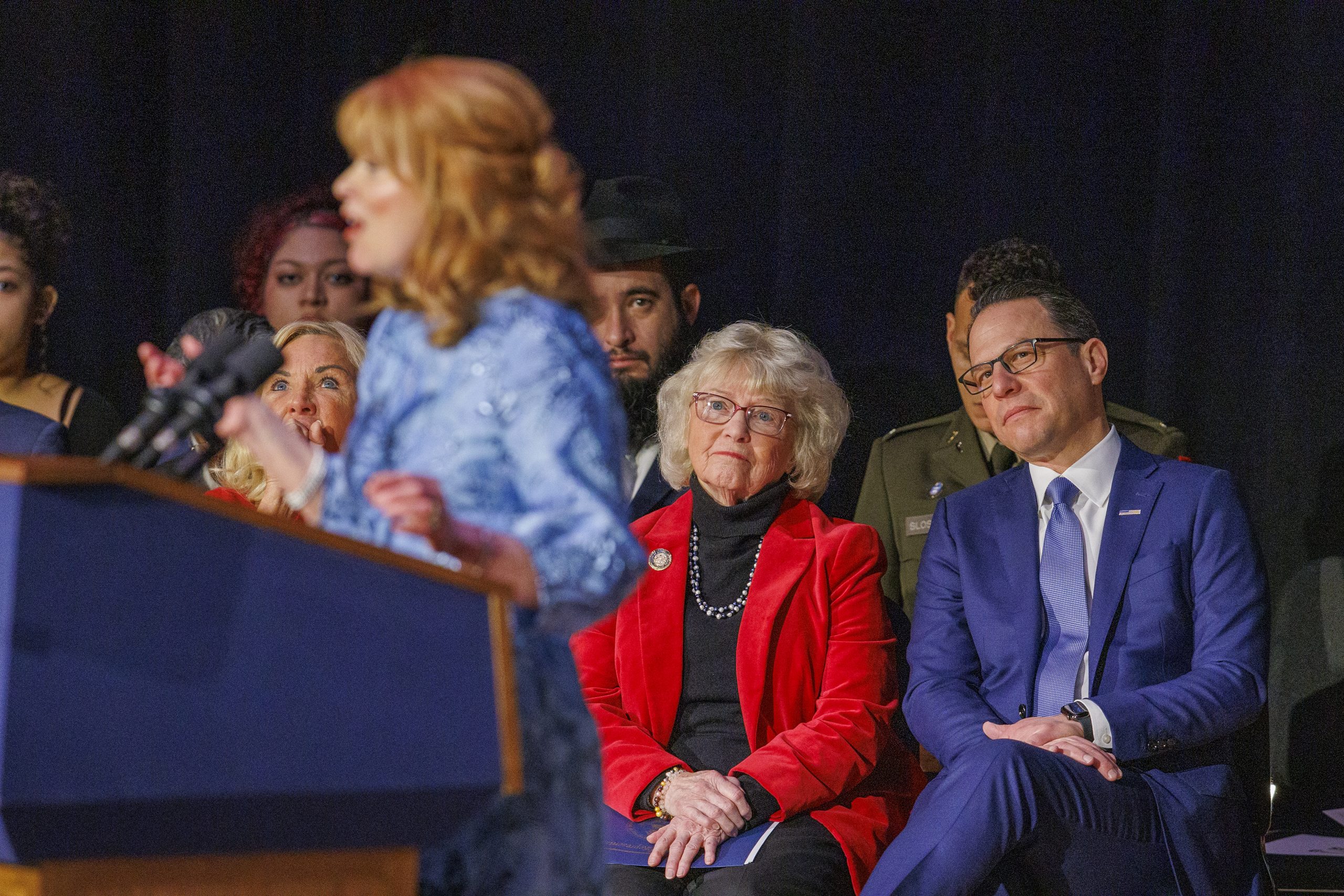
At right is Pennsylvania Governor Josh Shapiro listening to Stacy Garrity, 78th State Treasurer, Forum Auditorium in Harrisburg, Pa., Tuesday, Jan. 21, 2025.Alejandro A. Alvarez / Staff Photographer
Trump’s latest show of support for Garrity comes as Shapiro — who is rumored to be eyeing a run for the White House in 2028 — has set his sights beyond the governor’s office, lending his time and spending his money to support Democrats up and down the ballot, in an attempt to flip the Pennsylvania state Senate and four swing districts in Congress.
Last month, in another stop in Pennsylvania, Trump attempted to lend more support to Garrity during Republican U.S. Sen. Dave McCormick’s Defense and Innovation Summit.
“I hear things about Stacy, and I’m hearing some poll numbers that are very good,” he said.
Regarding her opponent, however, Trump had stronger words.
“This guy Shapiro is totally overrated. … He doesn’t have what it takes,” Trump said.
President Donald Trump visits Mack Trucks in Macungie in the Lehigh Valley Tuesday, June 23, 2026.Tom Gralish / Staff Photographer
In Pennsylvania, Trump remains deeply underwater in popularity. The Quinnipiac survey found only 39% of Pennsylvania voters would give him a positive job approval. Elsewhere in the country, Trump has remained Republicans’ most effective energizer to the polls — though some are concerned about GOP successwithout his name on the ballot in November.
Pennsylvania Democrats on Tuesday seized on Garrity’s appearance with the president.
“Stacy Garrity always sprints to any chance she gets to pledge her 100% loyalty to Donald Trump and his disastrous agenda,” Ava Pitruzzello, a spokesperson for the Pennsylvania Democratic Party, said in a statement.
Last week, Shapiro’s campaign launched a new ad calling Garrity “100% MAGA.” Garrity’s campaign, in a statement, called the ad “a dishonest, lying attack.”
The family of an immigrant from El Salvador who died in ICE custody in New Jersey on Tuesday outlined a list of demands for state and federal officials that they said would bring justice after his death.
Edwin Jeovanny López Cornejo, 41, whose family said he had been living in the U.S. for two decades, died in ICE custody on Saturday after having a medical episode at Delaney Hall in Newark. The privately run ICE facility has been the subject of complaints of poor conditions, ongoing protests, and the site of clashes between federal officials and elected Democrats.
“On the same day, we were both dead, the only difference was his heart stopped beating,” his 12-year-old daughter Ashley López said at a news conference held outside the Reformed Church of Highland Park on Tuesday streamed by Cosecha New Jersey, an immigrant-rights group. “I am going to grow up without a father. They did not even let me see him one last time before he died.”
“We had so many plans, we will never do them, because they are heartless monsters,” she added.
López Cornejo’s family members have accused ICE of neglecting to provide proper medical care to him, an accusation the federal agency denies. His mother María Cornejo questioned whether ICE gave her son his medicine for high blood pressure, diabetes, and seizures. He was detained in Plainfield in North Jersey on June 18.
ICE said Monday evening that López Cornejo’s cause of death was pending further medical review, but Sen. Andy Kim shared later that night that he died of a heart attack and cardiac arrest. Kim said López Cornejo already had a habeas corpus case calling for his release due to his medical issues.
(function(){function e(){window.addEventListener(`message`,function(e){if(e.data[`datawrapper-height`]!==void 0){var t=document.querySelectorAll(`iframe`);for(var n in e.data[`datawrapper-height`])for(var r=0,i;i=t[r];r++)if(i.contentWindow===e.source){var a=e.data[`datawrapper-height`][n]+`px`;i.style.height=a}}})}e()})();
While speaking at the news conference, Danilo López, the brother of López Cornejo, called for an independent investigation of the incident by New Jersey Attorney General Jennifer Davenport, a release of his brother’s medical records by the facility’s owner GEO Group and ICE, the closure of the detention center and the release of all those detained. He also asked Gov. Mikie Sherrill to open an investigation into health protocols at the center.
“I know that there’s nothing that will bring my brother back but if we feel our pain now maybe we can avoid other deaths,” Danilo López said in Spanish.
Davenport’s office said Tuesday it “can neither confirm or deny an investigation at this time.”
Sherrill has called for the shuttering of Delaney Hall amid a broader battle over President Donald Trump’s immigration crackdown. Her administration is in various court fights with Trump’s administration, including one attempting to gain access to Delaney Hall for a full state health inspection.
Activists have repeatedly called for Delaney Hall to shut its doors but the Trump administration has made clear it’s not closing the facility anytime soon as it holds a crucial role in the president’s mass deportation operation.
U.S. Rep. Analilia Mejia, a progressive Democrat who represents a North Jersey district, said at the news conference that she’s spoken to people inside Delaney Hall during oversight visits who say they’re being denied their medication and proper medical care.
A spokesperson for U.S. Rep. Bonnie Watson Coleman, a Central Jersey Democrat, said her office gets calls from families saying their loved ones aren’t receiving their medication and are getting moldy food inside the facility.
Trump officials and allies have denied there are issues inside Delaney Hall, including U.S. Rep. Jeff Van Drew, a South Jersey Republican who, prior to this incident, visited the facility and called it clean and “well-run” with “medical care, recreation, and other basic services.”
ICE said it provides “comprehensive medical care” to people in the facility, including 24 hour emergency care.
“While in custody, Lopez-Cornejo received proper medical care and was seen by medical professionals,” the federal agency said in a statement.
Danilo López said that his brother had told him over the phone that he had to fill out a form to just get Tylenol at Delaney Hall and it could be days before he received it.
María Cornejo accused ICE of lying about giving her son proper medical attention.
“I just want justice for my son and for my granddaughter who is going to grow without a father,” she said in Spanish.
Danilo López said Tuesday he didn’t know why his brother was detained because he had a valid work permit, but ICE said López Cornejo was arrested by the U.S. Border Patrol “for illegally entering the United States without inspection” in August 2006 and was sent back to El Salvador that October before returning without permission.
López Cornejo’s daughter, Ashley, said Tuesday that “no one is illegal on stolen land,” a common refrain from immigrant rights activists.
Her mother, who was not named, called the incident the result of a systemic failure.
“From the bottom of my heart I feel the system failed Edwin,” she said in Spanish. “Failed my daughter, failed me as a mom, and failed all those other kids who are suffering like my daughter is.”
Today’s newsletter is all about things I thought I was done writing about: COVID-19, Kamala Harris, and the World Cup. Regarding the latter, FIFA strongman Gianni Infantino walked off the pitch after last month’s final like the hero in Steve Miller’s “Take the Money and Run”: He got the money — an ungodly $15 billion in revenue — thinking he got away. But instead, just like Icarus, Infantino flew too close to the sun. A plan to make even more cash off the world’s greatest sporting event — by selling a share to private investors led by the brother of Donald Trump’s son-in-law — outraged so many folks that the FIFA chief could lose his job. What a shame.
The right can’t shut up about COVID-19 because it needs your outrage against experts
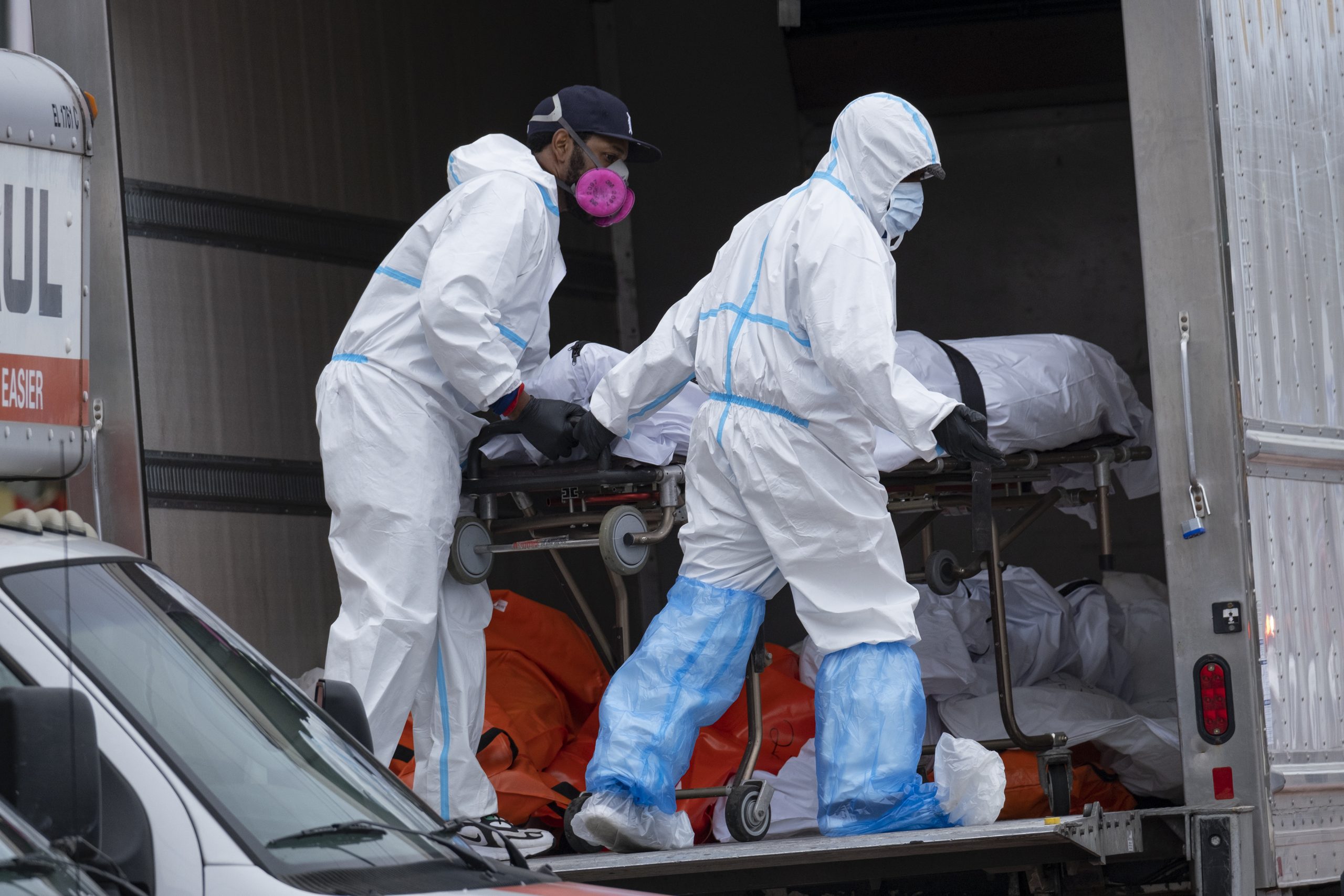
Workers move bodies to a refrigerated truck from the Andrew T. Cleckley Funeral Home in the Brooklyn borough of New York in April 2020.AP
Honestly, I thought — and hoped, frankly — that I’d written about the COVID-19 pandemic for the last time by the end of 2021. The issues it raised — about everything from public health preparedness to conspiracy theories — had seemed important enough, but I was more than ready to move on from empty baseball stadiums and masks in the supermarket.
I thought most folks felt the same way — that we were all eager to put the coronavirus in the rearview mirror. Clearly, I was wrong. The people we call MAGA still can’t stop yelling about it.
Last week brought the acid flashback of the government’s communicable disease czar when the pandemic erupted in 2020,Anthony Fauci,getting dragged before a U.S. Senate committee in a Joe McCarthy fashion, forced to take the Fifth Amendment to avoid any perjury traps that would satisfy the senators’ mouth-breathing constituents’ raw lust to imprison the 85-year-old public health icon.
The realization that they weren’t going to send Fauci — who was pardoned for his past actions in January 2025 by outgoing President Joe Biden to protect the good doctor from GOP wrath — up the river led these Republican statesmen to do the only thing left: scream at him.
“Who the f— do you think you were for doing that?” Ohio Sen. Bernie Moreno yelled at Fauci, even as it’s hard to understand what “that” was, except for working tirelessly to give Americans the best information about a rapidly evolving, deadly pandemic. “It is a total disgrace what you did to this country.”
The baseless attacks on Fauci by right-wingers — who’ve convinced themselves that the real crisis of 2020-2021 wasn’t the invisible virus that caused the early death of more than 1.2 million Americans, but an authoritarian government (led at the time by Donald Trump, but no matter) making them wear those masks and avoid those baseball games — were both infuriating and unconscionable. Still, maybe because of my aversion to reliving the pandemic, I was going to let the subject slide.
But then the current government’s top health official, Health and Human Services (HHS) Secretary Robert F. Kennedy Jr., went on CNN to double down on the Trump regime’s Big Lies about what really happened during the COVID years. And like Moreno, RFK Jr. turned the volume up to 11.
“Anthony Fauci was mismanaging the COVIDpandemic and was doing it under the Biden administration. President Trump wanted to end the lockdowns,” Kennedy loudly told CNN’s Dana Bash, inventing a farcical, backward timeline. An agitated RFK Jr. insisted the government’s priority during COVID-19 should not have been saving lives, but “protecting constitutional rights,” yet to make this fiction sound less ridiculous, the HHS chief also had to lie about the extent of thecrisis.
“There were ICUs that were empty all over the country, including in New York, at the height [of the pandemic],” Kennedy insisted.
This can no longer be ignored. There are two very important points that need to be made here.
First, when a high-ranking government official tells a lie on national television, this must be debunked immediately. The truth here is that the hospital emergency rooms and intensive care units, especially in New York City but other locales as well, were overwhelmed in the spring of 2020. So were many morgues and funeral homes, which struggled to keep up with the dead.
“I worked for New York’s largest medical center at the start of the pandemic,” Lucky Tran, a Columbia University scientist, posted on Bluesky. “There were morgue trucks on the streets. They set up emergency medical tents in Central Park. Healthcare worker colleagues died. It is horrific that RFK Jr is on national TV lying that ICUs were empty.”
Of course, this is just one of a number of lies about the pandemic — that the vaccines released to the public in early 2021 are dangerous (they’re not), that the virus came from a Chinese lab (it almost certainly didn’t) and not animal-to-human contact, and that Fauci led some kind of Watergate-level cover-up (his personal diaries, obtained by the senators, revealed exactly the opposite) — that are matters of faith among the political right.
Which brings us to the second big thing: Why? Why are all of these petty grievances about inconveniences we experienced six years ago still so gosh-darned important to these yelling people in 2026? Why do they want to send an octogenarian Fauci — a grandson of Italian immigrants whose life was the kind of American dream 20th-century Republicans would have celebrated — to prison?
The real virus here is anti-intellectualism — a strain that has always existed in American life, as the historian Richard Hofstadter famously wrote in 1964 — that has metastasized from a small, well-contained syndrome to overtaking the entire Republican Party. So-called rural resentment leads angry voters to think people like college professors or doctors in white coats are looking down on them.
It’s an antisocial worldview that was encouraged from on high by the likes of Big Oil executives who love it when the masses scoff at climate scientists. But the rejection of expertise reached a whole new level in 2020 when doctors like Fauci started telling Americans to wear masks or avoid social gatherings to slow the spread of COVID-19.
Sure, there were tough calls around issues like how long to close schools, but in real time, health experts were erring on the side of caution — the right thing to do — while shell-shocked regular folks stewed about an assault on their liberty.
As the revived Fauci controversy continued online this week, Mike Adams, whose website has been accused of spreading medical disinformation, posted Monday on X that getting a COVID-19 vaccine “reveals a twisted and artificial obedience to the falsified appearance of authority. People like that should never be trusted, because they are not in control of their own minds.”
They believe experts like Fauci don’t want to help you, but control you — welcome to the far right’s Bizarro World.
But still, why? At the end of the day, these extremists might care somewhat about thwarting climate science or not wearing masks, but the real reason they despise educated experts is because facts shatter the ancient, lie-based hierarchies such as white supremacy, the patriarchy, or homophobia that give meaning to their broken world.
I think some of the reason they still care so much about Fauci is that the pandemic spring of 2020 also brought the police murder of George Floyd and the subsequent Black Lives Matter marches that shocked many of the communities where they occurred. In their minds, all of it — masks, diversity training, vaccines, calls to “defund the police” — merged into one giant threat.
Which brings us to: Why now? There’s no question that the lingering resentments of 2020-2021 over both the coronavirus and the Floyd protests were the rage fuel that revived Trump, who looked dead in the water after his failed coup of Jan. 6, 2021. Now, it’s less than 100 days until a new election that could cripple Trump and his MAGA movement. And they are desperately waving the bloody shirt of COVID-19.
We must never forget the truth about 2020, Fauci, or the necessity of public health in a true democracy. Our anti-science government is seeing rising cases of measles and of the bacteria that causes explosive diarrhea (which has now been linked to two deaths), and God only knows what elseis in the pipeline.
Experts like Fauci aren’t here to tell you how to live your life — just how to not die.
Yo, do this!
I remain fascinated with the hidden history of American reactionary movements, which is coming out of the shadows during the Trump era. I’ve been listening to the audiobook of The Biggest Lie: The Prehistory of American Fascism, 1818-1915 by College of Charleston historian Joseph Kelly, which looks at how the defense of slavery in the antebellum South, Jim Crow, and the early 20th century revival of the Ku Klux Klan all bore the defining characteristics of an American strain of fascism, often for the self-preservation of monied interests. In the same mode, I highly recommend a recent New York Times guest essay, “It Wasn’t a Civil War. It Was the Slaveholders’ Rebellion,” by history writer Anthony Conwright, who argues persuasively that the name most of us have always used to describe the 1861-1865 conflict is actually a whitewash pushed by the South. The piece is a real eye-opener.
Did I mention that 2026’s summer of soccer isn’t over? The Philadelphia Union have emerged from the two-month World Cup break with a completely different look from the group that tanked in the first half of the MLS season, with the return of Kai Wagner (from England) and Quinn Sullivan (from injury) and rising young stars Neil Pierre and Cavan Sullivan, Quinn’s brother. They’ll also get a fresh start for a trophy opportunity with the arrival of the Leagues Cup tournament against the best teams of Mexico’s Liga MX. Check out their first match Thursday night at 8 p.m. against traditional powerhouse Cruz Azul, live at Subaru Park in Chester and on Apple TV.
Ask me anything
Question: Do you believe the Dems have a chance to take the Senate in November? — Elise (@bnat4.bsky.social) via Bluesky
Answer: Elise, I’d almost bank on it happening, and here’s why. Since the early months of the Trump 47 presidency, Democrats — who need to gain four seats for a majority — have consistently run double digits ahead of past performance in special elections. That should put seven states in play, with the strongest possible candidates in places like North Carolina (ex-Gov. Roy Cooper), Alaska (ex-Rep. Mary Peltola), and Iowa (Josh Turek). Maine voters will forget the Graham Platner fiasco long before they forget Sen. Susan Collins’ vote to confirm Justice Brett Kavanaugh. Ironically, the battle to hold a Democratic seat in Michigan looks toughest, but likely primary winner Abdul El-Sayed is an excellent campaigner. As Trump’s popularity plummets, there’s even a chance for shockers in places like Florida or with independent candidates in Nebraska or Idaho. For me, the bigger question is whether 51-plus Dems will dump Chuck Schumer as their leader after November. Stay tuned.
What you’re saying about …
Many of you had great ideas for a fall Democratic message that’s about more than just “affordability” — the preferred mantra of the party’s consultant class. Many sought to widen the conversation to issues around corruption and inequality. Here are some pithy ones. Roberta Soules wants to “take power away from the large corporations and oligarchs.” Meg Berlin suggested “More Butter. Fewer Guns.” Dane Madsen prefers “Stop the Trump Crime Family,” while Frank Friedman went with an even simpler, “We will be honest with you.” Stephen R. Rourke wrote simply, “Peace, prosperity, and justice for all.”
📮 This week’s question:CNN is reporting that the Pentagon recently took the highly unconventional step of asking rank-and-file troops for creative new ideas on how “to punish Iran.” But what should be done about this mess? Can the United States simply walk away at this point? Or do big problems like the flow of oil through the Strait of Hormuz or Iran’s nuclear ambitions require a response, and what is that, exactly? Please email me your answer and put the exact phrase “Iran war ideas” in the subject line.
Backstory: Is Kamala Harris ‘the new Nixon’?
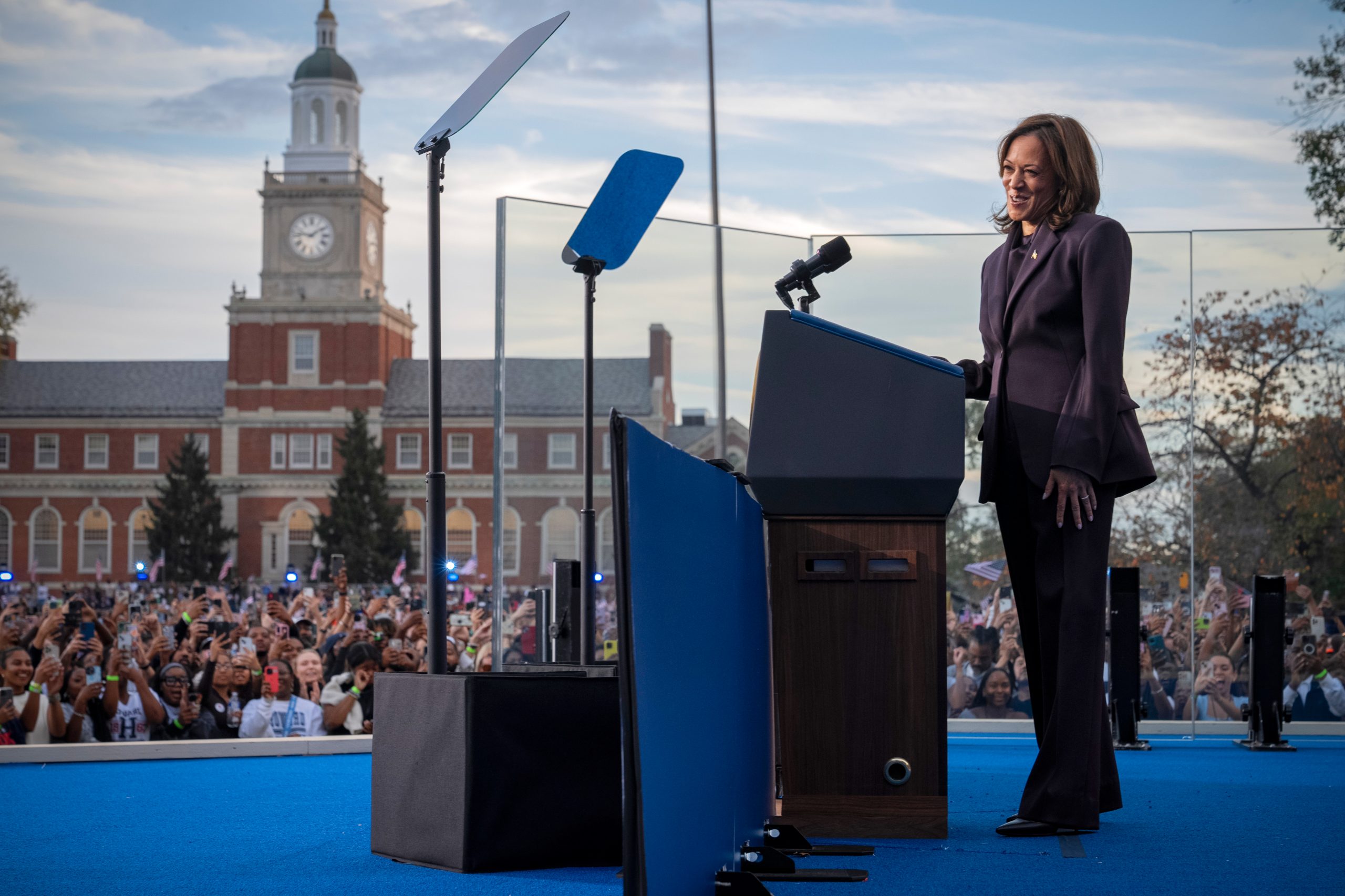
Democratic presidential nominee Vice President Kamala Harris delivers a concession speech for the 2024 presidential election, Nov. 6, 2024, on the campus of Howard University in Washington. Jacquelyn Martin
Although it’s true that, as a 5-year-old kindergartner in 1964, I nearly got into a fight with a kid who said he supported Barry Goldwater, the first presidential election I really followed came four years later in 1968. I was probably waiting for the baseball scores when I saw news reports that the GOP front-runner was a “New Nixon,” which made this 9-year-old wonder what was wrong with the old one. Indeed, a Californian who’d lost a presidential election (and a gubernatorial race just two years later) stunned America with the political comeback that made him the 37th president. We’d spend the next six years of Kent State and Watergate learning the kinder, gentler Richard Nixon of 1968 was all a lie.
It would be a Nixon-level comeback if Kamala Harris were to win the Democratic nomination in 2028, let alone the presidency. Like Tricky Dick, Harris is a child of the Golden State and former vice president to the oldest-ever POTUS at that time (Dwight Eisenhower was 70 when he left office, which was unprecedented before Ronald Reagan, Joe Biden, and now Donald Trump), and a failed nominee, although shewas smart enough not to run for governor when she returned home. People forget the brief lightning bolt of excitement when she replaced Biden on top of the 2024 ticket, and so the smart money has been that her moment has passed, as the Democratic base looks for new blood.
But it feels like the earth has shifted a bit, and the reason can be summed up in two words: South Carolina. Last week, the Democratic National Committee unveiled its list of the first six presidential primary states, and the South Carolina primary tops the list. The same South Carolina where, in 2020, the state’s main Democratic voting bloc — older, center-left, Black members of the middle- or working classes — turned the race around for Biden, the man who then tapped Harris as his veep. The same South Carolina whose Democratic power broker, Rep. James Clyburn, is close to Harris. A state that seems tailor-made for a Harris comeback.
But the Palmetto State isn’t the only reason to start taking a Harris return seriously. In politics, your weakness is often also your strength, or vice versa. Harris has long been a political chameleon — from tough 2010s prosecutor to a sharp left turn during Trump’s first term that she backpedaled away from in 2024. Today, Harris is feeling the zeitgeist. She is drifting left again, but perhaps more importantly, she understands the desire by core Democrats to support fighters, not milquetoast cowards.
“They are ruthless,” Harris told the annual gathering of the National Urban League in Nashville on Friday, referring to Republicans. “We need to be ruthless, too” — explaining that Democrats should not be “cruel,” but “uncompromising.” She added: “For example, and I know this is going to be controversial coming from me, in particular, we need to revisit the Electoral College. We need to revisit the point of expanding the court to 13 justices, like we have 13 district courts. We need to revisit, if they so want, statehood for Puerto Rico and D.C.” Harris has also been holding extensive meetings with some of the pro-Palestinian activists who often clashed with her over Israel policy in 2024.
She’s running? It sure sounds like it.
To be clear, while I thought in the fall of 2024 that Harris had thepotential to become a very good president, and I still do, I’m also very much in the “new blood” camp when I think about 2028. I’d love to see what someone from the progressive Bernie Sanders-Alexandria Ocasio-Cortez wing of the movement could do in wiping away the stain of Trumpism. But establishment Democrats, intentionally or not, have thrown Harris a lifeline with their South Carolina gambit. The coming months will reveal whether this former vice president can be “the new Nixon” of the left.
What I wrote on this date in 2013
I was reminded that the 25th anniversary of the 9/11 terror attacks is almost upon us. Expect a lot of what you might call negative nostalgia about that wretched day in 2001, but also the bad times that followed. Do you remember the terror alerts? Many of us thought those would vanish when George W. Bush left the White House, so it was a little jarring when Barack Obama continued the practice, including this major one 13 years ago. I wrote that “the problem with the terror warning of 2013 is not the warning itself but the decade of government baloney that preceded it. Washington needs to acknowledge the reality: If it wants to do a better job of keeping the public safe, it will need to start doing a much, much better job of telling the public the truth.”
The Trump regime’s cruel campaign against our immigrant neighbors is the biggest story of our time. Last week, I traveled to a tiny borough in Central Pennsylvania, Mount Holly Springs, where a budding partnership with U.S. Immigration and Customs Enforcement has seized 32 immigrants in just four months, and angrily divided a rural community. Pennsylvania’s small towns are becoming the front line of mass deportation. Over the weekend, the immigrant crackdown was central to my essay about the rising death toll that’s attributable to Trump’s misrule, which includes murdered deportees in Guatemala, a woman left by ICE agents to die at a Pittsburgh bus terminal, the latest civilian bombing victims in Iran, and many, many more. It’s a humanitarian crisis that demands our immediate attention.
No two people define the world-class journalism that we regularly produce here at The Inquirer more than my longtime friends Wendy Ruderman and Barbara Laker, who could have rested on their laurels after winning the Pulitzer Prize for investigative reporting in 2010. Instead, both are working harder than ever. Ruderman has applied her talent for digging to Philadelphia’s leading industry, healthcare, with remarkable results. Check out her latest exposé about a Main Line psychiatrist who lost her license after a wildly inappropriate affair with a troubled younger client. Laker remains a linchpin of The Inquirer’s investigative unit, and — joined by her colleagues Ryan W. Briggs, Max Marin, and Ellie Rushing — she has been digging into the dark tale of a Philadelphia pornographer and his family’s mysterious ties to two missing women. Investigative reporting is essential to democracy and forging better communities, but it’s costly, time-consuming, and won’t happen without your support. Subscribe to The Inquirer today.
By submitting your written, visual, and/or audio contributions, you agree to The Inquirer’s Terms of Use, including the grant of rights in Section 10.
WASHINGTON — In a Pennsylvania election where a few thousand votes could make all the difference, the last-minute entrance of a Green Party candidate with a background in Republican politics has sparked the second allegation of election meddling in three months and complicated one of the nation’s most competitive U.S. House races this fall.
But the emergence of a third-party candidate has alarmed both Democrats — who have long claimed that Green Party candidates pull votes from their nominees — and the Green Party of Pennsylvania, which said it does not know the person now representing its platform in one of the state’s highest-profile races.
“It sounds a lot like somebody’s just fooling around and trying to use the Green Party name, which is a well-known thing that happens in many states,” said Tim Runkle, cochair of the state party.
Andrew Tupone, 37, of Northampton County, filed his nomination papers with the state last week ahead of a Monday deadline for third-party candidates. He was the only candidate to file to represent the Green Party in a Pennsylvania race for Congress.
Unlike the Green Party’s endorsed candidate for governor — Tony Dastra of Lancaster County — Tupone does not have a long association with the party or its left-leaning policies. In 2021, he was the Republican nominee for a Northampton County magisterial court seat. Voter registration records show he changed his party affiliation from Republican to Democrat in February, and then from Democrat to Green in April.
In an interview, Tupone rejected accusations that he remained affiliated with the Republican Party or that he was asked to run in a way that would draw votes away from the Democratic nominee. He described a leftward shift in his political views after voting for President Donald Trump in 2020, though he said he could not recall whom he voted for in the 2024 presidential race between Trump and Democratic Vice President Kamala Harris.
“A lot of people are disillusioned with both parties,” Tupone said. “They’re sick of all the stuff that’s going on.”
Tupone also said he did not pay anyone to help gather signatures for his nominating papers, which he turned in with upward of 9,000 signatures — more than twice as many as required. Runkle said Green Party members encountered paid canvassers for Tupone who declined to say who was funding the effort.
According to a copy of the nominating papers obtained by The Inquirer, only one of the 22 individuals who gathered signatures is from Pennsylvania. The rest are from all over the country. Multiple have worked for Republican campaigns, according to public records.
Colin McEvers, who gathered signatures for Tupone in Lehigh County, is a Republican candidate for the Maryland General Assembly who is also listed as the contact for the Maryland White Republican Council. Others — including individuals from Illinois and Michigan — have been paid to canvas for GOP campaigns, according to Federal Election Commission records.
Tupone said he had no knowledge of anyone paying his canvassers.
“I went around and I gave a lot of my nominating papers to friends to give to other people, and I sent it to them as well,” Tupone said. “And as I went around, I recruited people and asked them.”
While the signatures appear to be based in the district — which stretches from the cities of Allentown, Bethlehem, and Easton into the more Republican-leaning Poconos — the other candidates have until Aug. 10 to challenge their legitimacy.
Such challenges are common, and the Brooks campaign is reviewing its options to decide whether to bring a challenge, according to a source familiar with the campaign’s thinking.
‘No one’s paying me to run’
Jenna Kauffman, Brooks’ campaign manager, in a statement described the situation as a GOP-initiated and “desperate scheme to meddle in this race.”
She connected it to a last-minute $1.7 million advertising campaign against Brooks in the May primary that appeared to be run by Democrats but was actually funded by a Republican political organization.
The spending, by a political action committee called Lead Left, was aimed at boosting another Democrat who observers considered to have a worse shot at beating Mackenzie in the November election. But the effort was anonymous, and records that became public only after Brooks won show that it was funded by the Conservative Americans PAC.
The effort to prevent Brooks from emerging from the Democratic primary came as he coalesced support from across the ideological spectrum with high-profile endorsements ranging from moderate Democratic Gov. Josh Shapiro to U.S. Sen. Bernie Sanders (Ind., Vt.), a democratic socialist.
“Voters deserve to know who is paying for this effort and whether Ryan Mackenzie and his Republican backers are involved,” Kauffman said, painting Tupone’s candidacy as a continuation of the move in the primary.
Mackenzie’s campaign did not address that comment when asked about it Monday.
Tupone said that the inference was “just false,” and that he instead likes the values of the Green Party, which he said included supporting the environment, social justice, and “stopping the corruption and also the genocide in Gaza.”
“No one’s paying me to run. No one’s asked me to run for this office. I’m running on my own, hopefully with a lot of hope from everyone who wants to volunteer,” Tupone said. “I’m not associated with the Republican Party anymore. I’m not a candidate for them.”
For years, Democrats have voiced concerns about the Green Party and other third-party candidates “spoiling” elections, from Jill Stein in the 2016 presidential race that first put Trump in power to the 2024 U.S. Senate race in Pennsylvania, when Democratic U.S. Sen. Bob Casey lost to Republican Dave McCormick by about 15,000 votes. In that 2024 election, a Green Party candidate won about 66,000 votes, a Libertarian candidate won almost 90,000, and a Constitution Party candidate won more than 23,000.
In the 7th District in 2024, Mackenzie defeated incumbent Democrat Susan Wild by 4,062 votes out of more than 403,000 cast. That was the narrowest margin out of any of the state’s 17 districts, making it a key tossup district this year.
That margin is also significantly different from the one Shapiro potentially faces during his reelection campaign this year as he maintains a sizable lead over Republican Stacy Garrity, and as a Green candidate officially filed to run on Monday. Shapiro defeated Republican Doug Mastriano in 2022 by almost 793,000 votes; the Green Party candidate won just over 24,000 votes.
Runkle said that nobody solicited the Green Party’s endorsement in a Pennsylvania congressional race this year, and that a conversation he had with Tupone left “a lot of questions.”
He said the party is concerned about its reputation and about being targeted in ways that do not lift up its platform, which focuses on environmental protections and liberal positions on healthcare. But he also pushed back on concerns that the party should be considered a spoiler.
“I do solidly believe that the Green Party policies and the values we represent has a solid bloc of voters,” Runkle said. “If people think that’s spoiling the race, then they should try harder to speak to the issues that we speak to.”