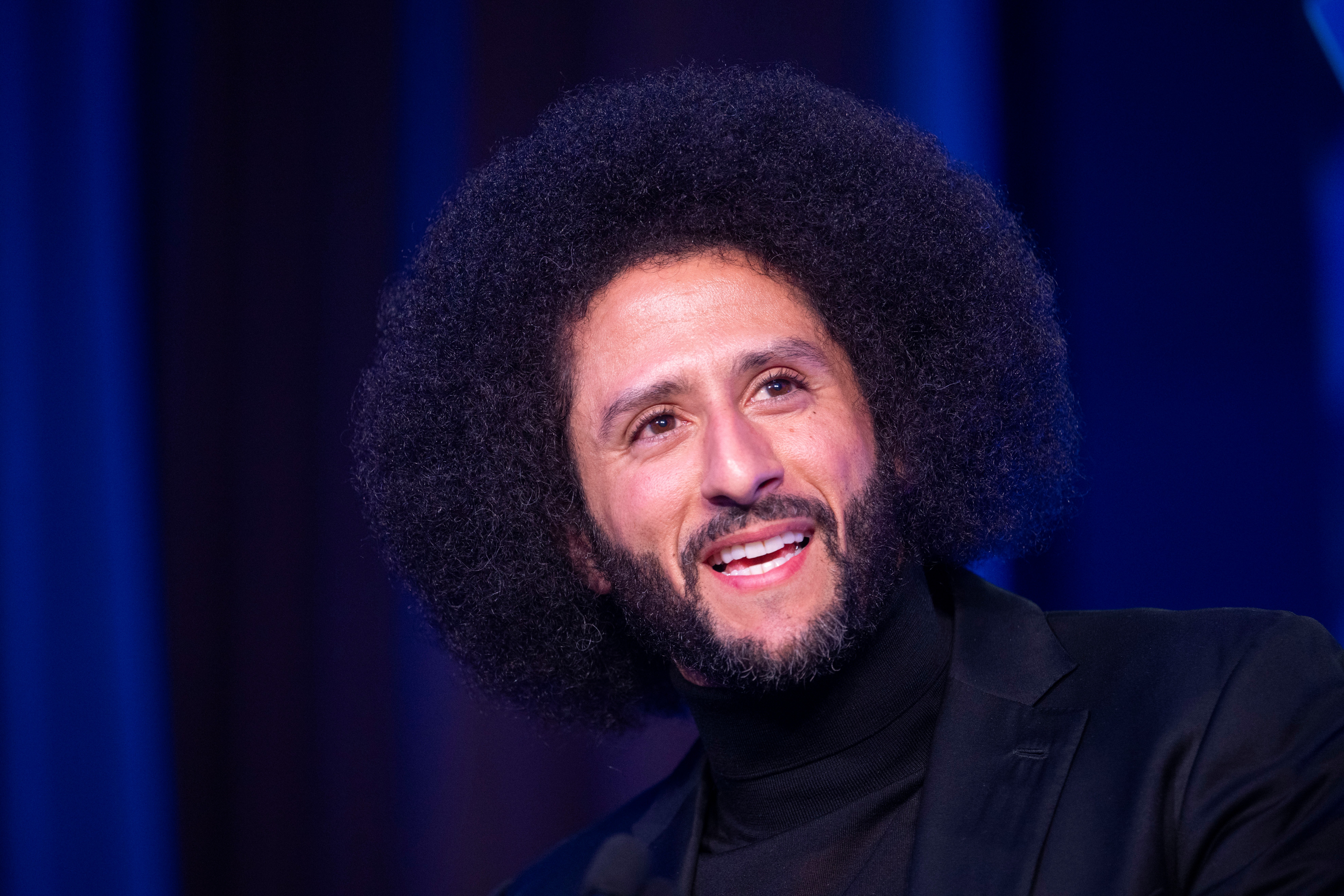
It’s been said that a social movement can start with the smallest gestures. Ten years ago this month, a simple act by Colin Kaepernick sparked a movement. He chose to protest the playing of the national anthem by sitting and later kneeling, breaking with the norm of showing respect and pride by standing. On Aug. 26, 2016, during a preseason game, Kaepernick was photographed sitting on the bench as the anthem was being played. When questioned by reporters, Kaepernick explained:
“I am not going to stand up to show pride in a flag for a country that oppresses Black people and people of color … To me, this is bigger than football, and it would be selfish on my part to look the other way. There are bodies in the street and people getting paid leave and getting away with murder.”
Numerous professional athletes joined in his protest and spoke out to call attention to the history of anti-Blackness in the United States. African Americans were inspired to continue organizing and protesting — specifically around a series of high-profile killings of Black people, including Trayvon Martin in 2012, Michael Brown in 2014, and Freddie Gray in 2015.
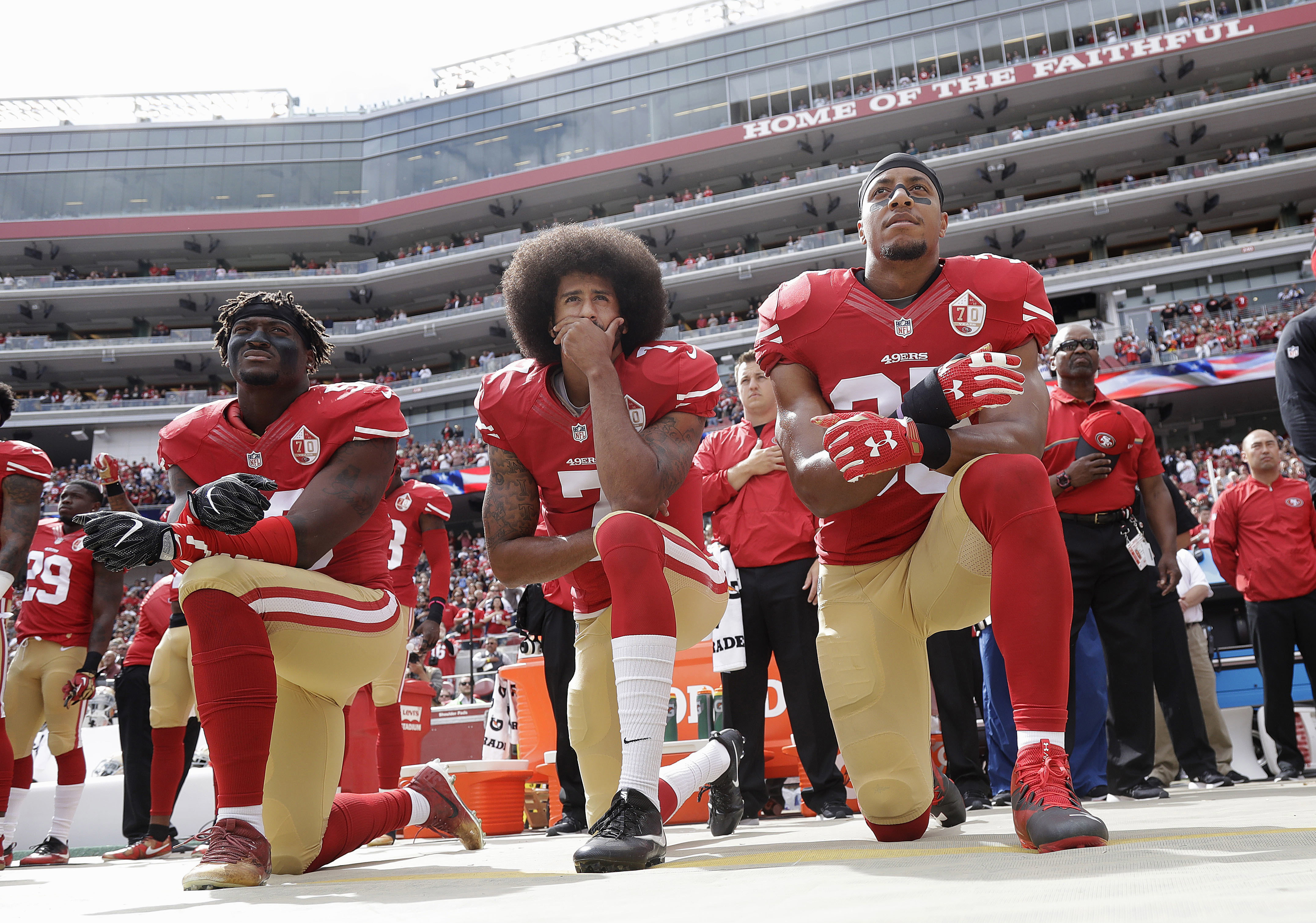
In this Oct. 2, 2016, file photo, (from left) San Francisco 49ers outside linebacker Eli Harold, quarterback Colin Kaepernick, and safety Eric Reid kneel during the national anthem before an NFL football game against the Dallas Cowboys in Santa Clara, Calif.Marcio Jose Sanchez
However, a poll conducted during that season labeled him the most disliked player in the NFL. Kaepernick became an easy target of political conservatives, including Donald Trump, who said, “Wouldn’t you love to see one of these NFL owners — when somebody disrespects our flag — to say, ‘Get that son of a bitch off the field right now, out, he’s fired.’”
It shouldn’t be lost on anyone that Kaepernick’s protest began in August. Among many activists, August is referred to as “Black August” — a nod to numerous historical milestones in our community, from the arrival of the first enslaved Africans in America in August 1619, to the March on Washington in August 1963, to the assassinations of members of the Black Panthers in California prisons in August of 1970 and 1971.
One social justice group describes the month as being “a celebration of freedom fighters past and present.” It is also meant to honor the lives and sacrifices of Black political prisoners and martyrs of the Black Freedom Struggle while calling attention to the plight of African Americans, particularly those in prisons — a recognition that Black people remain incarcerated at disproportionately high rates. The efforts of these freedom fighters are a modern rendering of the Black radical tradition.
The same is true for many Black athletes whose protests came at a cost to their careers and livelihoods.
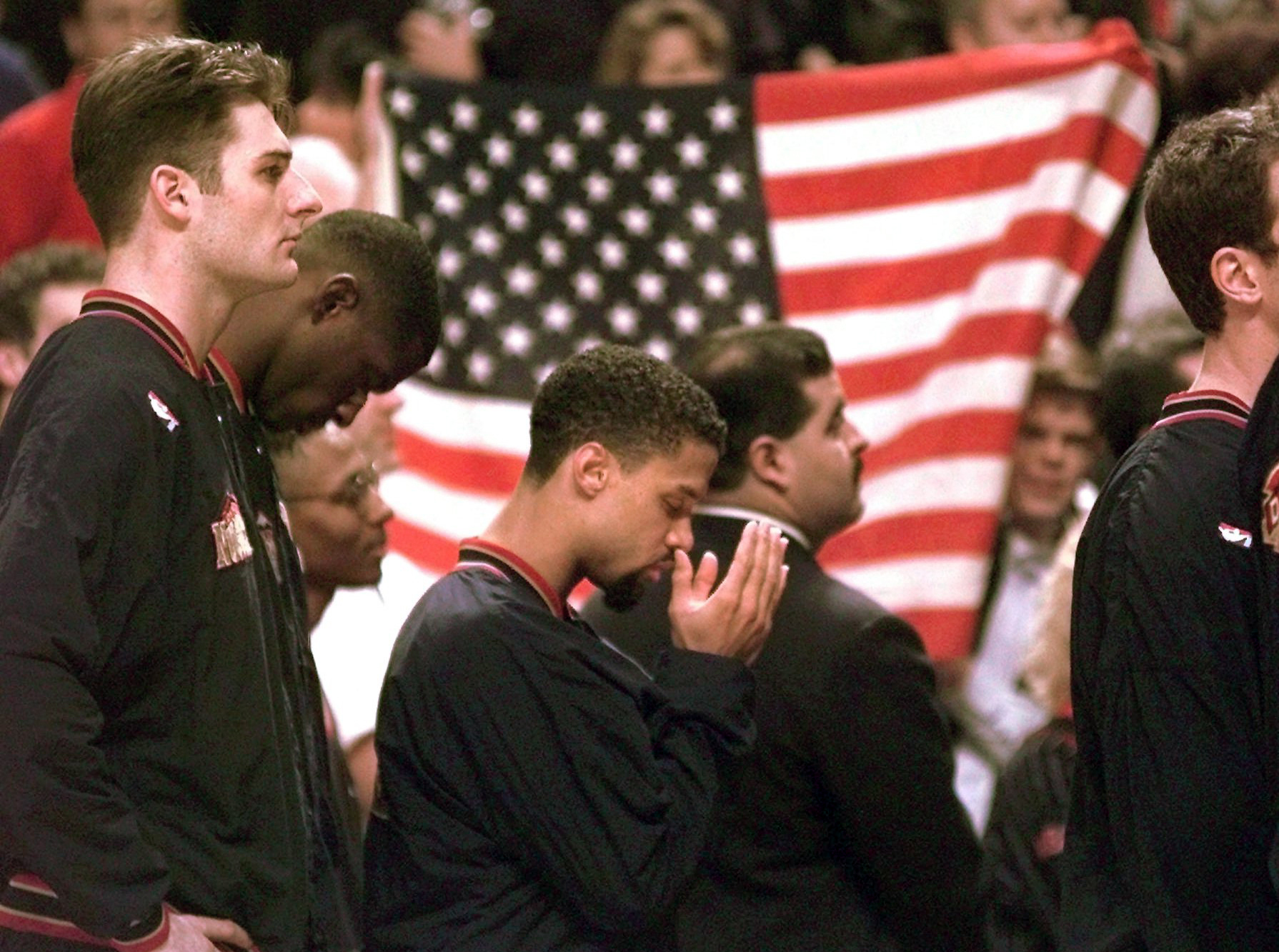
Mahmoud Abdul-Rauf was suspended for one game during the 1995-96 season for refusing to stand during the national anthem. Former NBA commissioner David Stern was the one who made the call.AP FILE
Folks like Mahmoud Abdul-Rauf, whose NBA career was cut short for protesting the anthem.
Or Muhammad Ali, who lost his prime earning years and was stripped of his heavyweight title when he refused to fight in the Vietnam War.
Or Paul Robeson, whose career and freedom were derailed not only for naming anti-Black racism, but for organizing against it — and Jackie Robinson, of all people, played a role in discrediting him.
Kaepernick experienced a version of all of the above, too — months after he started his protest, he opted out of his contract, became a free agent, and was not signed by another NFL team. He later alleged in a lawsuit that the league’s owners colluded to keep him out of the game; that suit was settled in 2019.
That is the role of the freedom fighter: to advocate on behalf of oppressed people everywhere in ways that disrupt the status quo. Their advocacy marks the line of demarcation between those who fight for freedom no matter the cost, or work to continue the legacy of global oppression and exploitation.
Colin Kaepernick made that already divided line even more stark.
Inarguably, Kaepernick’s legacy is that he inspired others, athletes included, to find their voice in advocating for social justice.
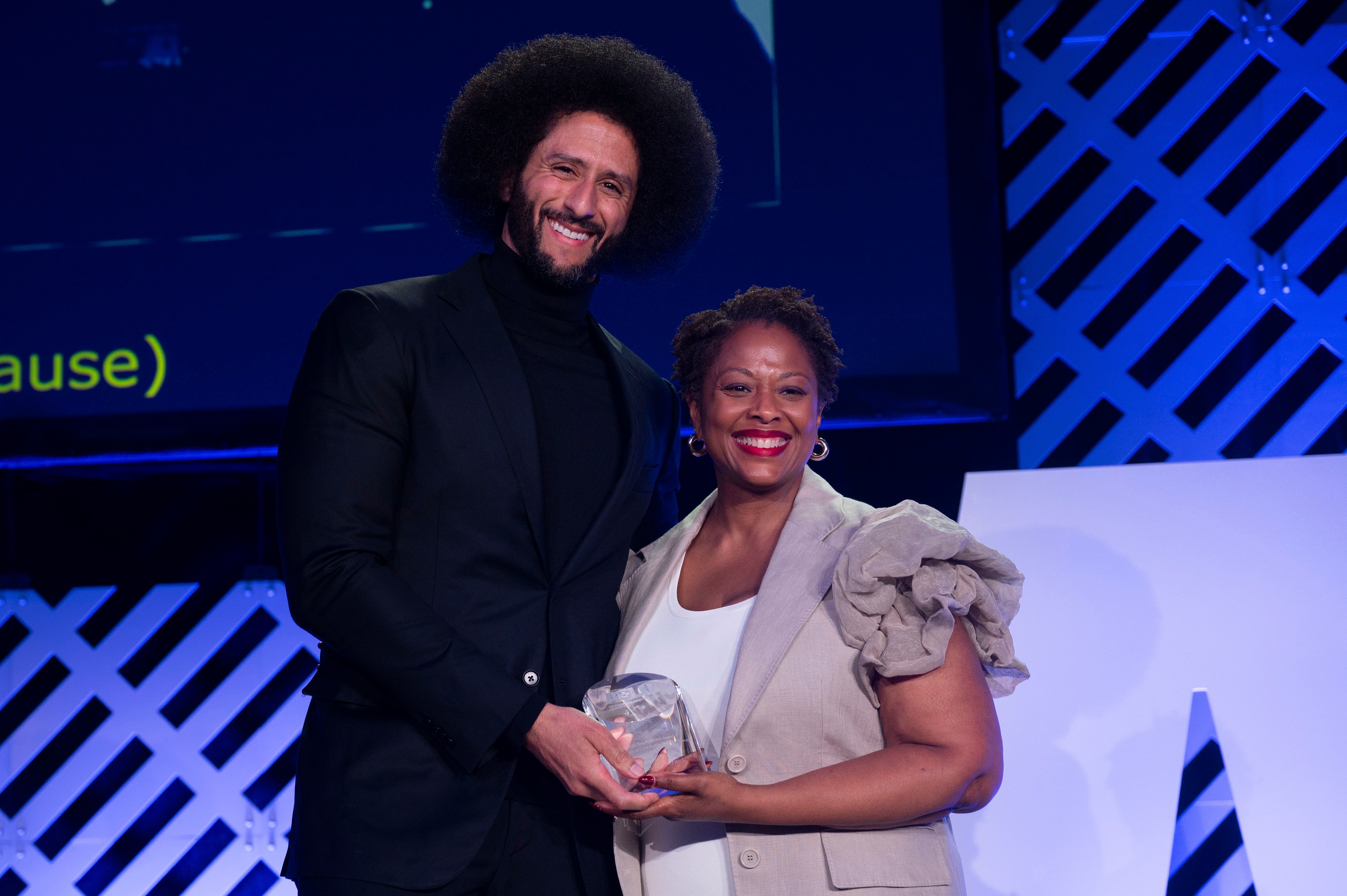
Colin Kaepernick is presented with the American Civil Liberties Union’s Ralph Ellison Award for Defenders of Civil Rights and Civil Liberties in the Arts, Business, Science, and Sports by Deborah Archer at the ACLU’s 2026 Biennial Leadership Conference on July 24 in Washington.Kevin Wolf
Kaepernick, who now works as a civil rights activist, joined the aforementioned athletes as part of what sports writer Howard Bryant calls “the heritage”: the tradition of Black athletes using their public visibility and star power to speak out against racial injustice, even at professional and personal cost.
These athletes throughout history have made their positions clear. Whether we’re talking about Black lives in America, lives in Palestine, Congo, Sudan, Haiti, or Cuba, you’re either working on the side of empowering or exploiting. Kaepernick made clear where he stood 10 years ago.
To sufficiently honor his costly protest — and the protests of so many others — during Black August, we must ask ourselves if we can say the same.
Rann Miller is an educator and freelance writer based in Southern New Jersey. His “Urban Education Mixtape” blog supports urban educators and parents of children attending urban schools. urbanedmixtape.com@UrbanEdDJ
Gov. Josh Shapiro made a declaration in the early days of his administration: Pennsylvania is open for business.
The move would ultimately include promises to slash bureaucratic red tape, cut permit wait times, and offer a new direct line to Shapiro’s office for major corporations hoping to set up shop in Pennsylvania.
Pennsylvania would “move at the speed of business” and “get stuff done,” the new mottos used by his administration, he said. He’s campaigning for reelection in November on the same catchphrases, and boasting major successes like the 12-day repair of I-95 in 2023 that traditionally would have taken months to reopen as an example of how he can think outside the box to solve problems.
What’s more: He sees delivering for residents — showing them government can actually solve problems — as the future of the nationalDemocratic Party, while it searches for an effective message and messenger heading into the 2028 presidential primary, which he is widely expected to enter.
It was with this same spirit last summer that Shapiro announced the largest single private sector investment in Pennsylvania history: Amazon committed $20 billion in Pennsylvania that included two data center campuses in Luzerne and Bucks Counties. Pennsylvania scored the project because of its promise to fast-track permitting and use tax breaks for the massive developments.
“Pennsylvania’s gonna be better off. I think America’s gonna be better off, because we’re going to win the battle of AI supremacy and it’s going to be done right here in the commonwealth of Pennsylvania,” Shapiro said in an interview on CNBC’s Squawk Box on the day he announced the deal.
Gov. Josh Shapiro announces a $20 billion investment by Amazon in Pennsylvania data centers in Salem Township and Falls Township on June 9, 2025.Commonwealth Media Services
But in a year’s time, the politics — and public opinion on both sides of the aisle — have dramatically shifted on data center development. Shapiro’s early welcome of data centers has created an opening for criticism from his gubernatorial opponent and members of his own party.
Yet efforts to cut red tape have proven to be slow and overblown: Only six data centers are actually under construction in Pennsylvania since the announcement, and 10 have received at least one state-level permit approval, according to Shapiro’s office. Still, Shapiro’s popularity is being evaluated by some voters and anti-data center activists on a perception that he moved too quickly and sacrificed the state’s safety in favor of Big Tech.
“I am all about legislators and decision makers getting s— done. This version of it is reckless and it’s irresponsible and it’s not actually serving our people,” said Carrie Santoro, the executive director of progressive advocacy groupPennsylvania Stands Up who has been holding town hall meetings in communities around the state on data centers.
“Governor Shapiro intends to use all the tools available to him to stop the dozens of speculative data center projects that do not meet community needs and Pennsylvania should expect to hear more from him on that in the coming weeks,” said Shapiro’s press secretary, Rosie Lapowsky.
Now Shapiro, who otherwise maintains vast popularity ratings in the state, faces a vulnerability on one of voters’ top priorities as he heads into November, and a particularly sensitive concern among Democrats as he potentially vies for the party’s nomination in two years.
Many states, including Pennsylvania, had already begun welcoming the major projects, and some hyperscale developers plan to spend billions of dollars to build them. Pennsylvania’s General Assembly first approved a sales tax exemption for data center developments in 2021, when Shapiro’s predecessor, Democratic Gov. Tom Wolf, was still in office.
Shapiro, for his part, initially embraced data centers as an economic opportunity for Pennsylvania, bringing union jobs for construction workers to build out the physical infrastructure for the computers running AI software. He also wanted to position Pennsylvania to inherit the most benefit from providing space for AI to operate, leading not only other states but also other countries in the race to advance new technology. He and U.S. Sen. Dave McCormick (R., Pa.) appeared together as early embracers of the technology and the massive buildings needed to power it, speaking together during McCormick’s first AI summit in Pittsburgh last summer.
Sen. Dave McCormick shakes hands with Gov. Josh Shapiro at a panel discussing state investment and infrastructure at the Pennsylvania Energy and Innovation Summit at Carnegie Mellon University in Pittsburgh on July 15, 2025.Kaiden J. Yu / Staff Photographer
But as communities began to push back against the rapid proliferation of data center proposals, in part to protect their water and energy resources, Shapiro adjusted.
Shapiro, like many elected officials, has changed his positions and rhetoric on the unpopular developments. He announced his Governor’s Responsible Infrastructure Standards (GRID) as a way to incentivize developers to follow transparency and environmental requirements in order to receive tax breaks. And when the General Assembly failed to approve his GRID standards or any substantial data center restrictions, Shapiro said he’d act on his own, though it’s still unclear what that will entail.
“You want to build a data center there? You’ve got to bring your own power; you’ve got to pay for your own power. You’ve got to be transparent with the local community — tell them who the hyperscaler is, tell them what’s going to go on there. You’ve got to have a local benefits agreement to help that community. You’ve got to protect the water sources that are used to cool off those facilities,” he said in a June interview with GZERO.
The Democratic governor has been lauded nationally for challenging PJM Interconnection, which is the electric grid operator for Pennsylvania and 12 other states over its efforts to raise prices on ratepayers. He capped the price Pennsylvania consumers could pay through 2029, as residents fear rate hikes due to the data center boom.
But Shapiro’s plan on data centers is too little, too late, Santoro said.
“I saw the GRID proposal as him moving on this issue, and the thing that I am concerned about is he didn’t move enough to keep up with how much voters have moved on this issue,” she said.
Some of those voters would agree. A Quinnipiac University poll of Pennsylvania voters, conducted in early June, found just 24% of those surveyed — and 40% of Democrats — approved of “the way Gov. Josh Shapiro is handling data centers in Pennsylvania.” It’s a stark contrast to Shapiro’s overall approval numbers, in which he’s maintained above 50% approvals — record-high favorability ratings for a first-term Pennsylvania governor.
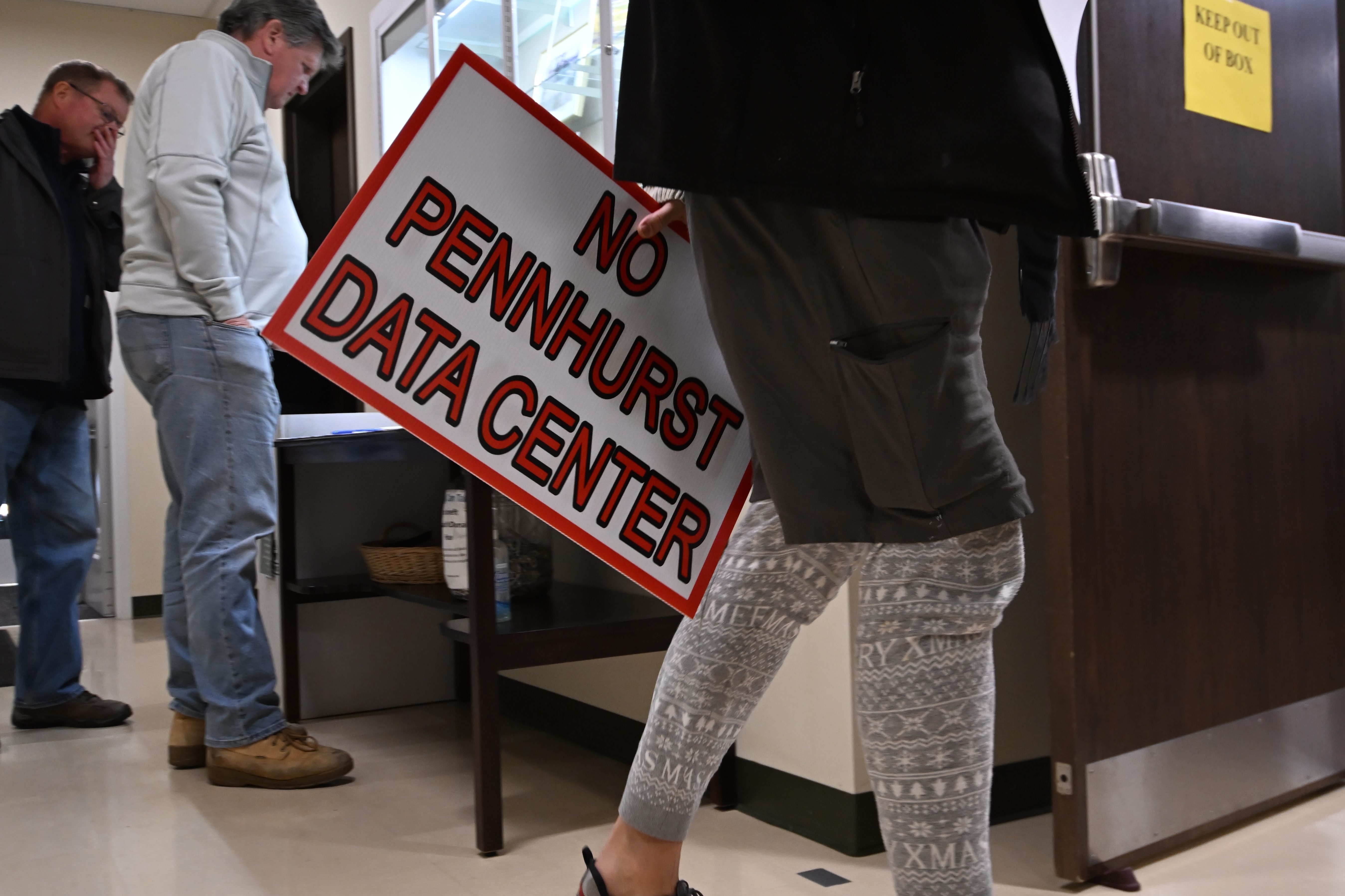
People sign in and head into an East Vincent Township supervisors meeting where an agenda item involved a data center proposal at the former Pennhurst state hospital grounds on Dec. 17, 2025, in Spring City, Pa. Marc Levy
Joanna Tenney, 36, of East Vincent in Chester County, held a sign at a June rally in the state Capitol that read: “Shapiro: Amazon’s bootlicker.” A registered Democrat, she voted for him in 2022, and believes he should be held accountable for supporting data center development in Pennsylvania that led to the fast-tracking of a now-stalled 125-acre data center project near where she lives.
She’s so fed up with Shapiro’s approach to data centers that she said will be writing in the name of her state senator, Sen. Katie Muth (D., Chester), who has been on the front lines of advocating for many state environmental issues, for governor on her November ballot. Tenney said she and a few other anti-data center advocates plan to run a write-in campaign for Muth.
“We’ve elected somebody that we thought was going to make the right choices by us, and we don’t really see that happening,” Tenney said.
Muth, who took office in 2018, said she would not be supporting Shapiro or “any elected official who puts the interests of Big Tech ahead of the health, safety, and future of Pennsylvania communities.”
If Shapiro changes his stance on data centers, she would support him, Muth said. She is the prime sponsor of a bipartisan bill to place a three-year moratorium on hyperscale data center development.
“Get right on the issue, Right your wrongs. If you can’t be on the side of science and people, my support is MIA,” she added.
Emily VanFleet, 26, lives in Archbald in Northeastern Pennsylvania, where six data center projects are underway comprising more than 50 buildings that, when completed, will cover 14% of the town. VanFleet, who is an unaffiliated voter, said she also supported Shapiro in 2022. But because of his public support for speeding up data center development in Pennsylvania, she is “certainly not going to vote for him this upcoming election,” she said. She isn’t sure she’s going to vote at all.
“I want Shapiro to stop being a coward,” VanFleet said in June. “I have emailed him, I have called him, I have reached out to him so many times. I have not heard back, not once. I see his videos all over social media that he has an open-door policy, but I have yet to see it.”
(In May, Shapiro’s administration announced that one of the unpopular Archbald developments, Project Gravity, was removed from a fast-track permitting program for failing to properly engage with the community.)
But negative attitudes toward Shapiro’s position on data centers may be limited statewide and his position is unlikely to dramatically knock down his high popularity or reelection odds: The June Quinnipiac poll found 56% of those surveyed approve of the way he is handling his job as governor overall, and recent polling shows Shapiro ahead 53% to 40% against his Republican challenger, state Treasurer Stacy Garrity.
The data center pitfall
Shapiro’s political opponents — both immediate and prospective — are also seizing on the issue.
Garrity, of Athens in Northeastern Pennsylvania, has also led a statewide listening tour on the topic. In June, she convened one of those sessions in Hatfield with a group of commissioners, zoning planners and emergency responders to talk about how they have been impacted by data centers. She blasted Shapiro for his role in attracting Amazon and said his proposed new requirements amount to a “flip flop.”
“Josh Shapiro has failed on this topic. He was the biggest cheerleader for data center development in Pennsylvania, until he wasn’t,” Garrity said at the June 24 meeting.
Pennsylvania Treasurer Stacy Garrity participates in the podcast “Ruthless” during an event hosted by Americans for Prosperity, Concerned Veterans for America, and the Libre Initiative at the National Constitution Center in Philadelphia on Jan. 29. Elizabeth Robertson / Staff Photographer
Garrity has her own mixed record on data centers.
At the time of the Amazon announcement, Garrity called the investment “great news” that would bring “historic investment” and “create thousands of jobs.” And her current position remains unclear. She has said she opposes a statewide moratorium but wants “a pause” on development instead.
Like Republicans running in districts that supported Trump in 2024 but oppose data centers, she appears to be attempting to find a pro-business and pro-regulation path.
“We want to make sure data centers are an addition to the grid, not a contraction. If there’s infrastructure that needs to be added to the grid, rate payers shouldn’t be paying for it,” she said. “I’m not opposed to data centers, but we have to do them the right way, and we haven’t done it. It’s because of a lack of leadership from the government.”
Garrity’s “long record of supporting completely unregulated data center development makes it clear that she just can’t be trusted,” said Manuel Bonder, a spokesperson for Shapiro’s campaign.
Local government leaders said at Garrity’s campaign roundtable in June that there has been lack of guidance around issues, especially around power demand, water use, infrastructure, environmental impacts, and community compatibility.
Kathie Doyle, a Republican on the Richland Township Board of Supervisors, said confusion around data centers have “set off a firestorm” in her community. Earlier this year, warnings of a supposed proposal for a data center in the Bucks County township circulated on social media, but turned out to be a “business park” with two buildings.
“Our residents don’t understand that we just cannot say no,” she said. Municipalities in Pennsylvania cannot outright ban data center development.
Santoro said Shapiro’s inconsistency is a liability that could sway some voters away from casting their ballot for him.
“Certainly he is giving her an ‘in’ by staying on the wrong side of this,” she said.
And it’s not just Republicans seizing on Shapiro’s position. The early reputation Shapiro earned as a champion of data centers may become a point of attack among other Democratic contenders for the presidency in 2028, too. In a veiled jab at Shapiro in June, Illinois Gov. JB Pritzker, knocked Pennsylvania on a businesspodcast for allowing Constellation Energy to restart Three Mile Island nuclear plant just to power Microsoft’s data centers.
“My guess is that’s going to be a reasonably unpopular thing to have done,” Pritzker said, without noting Shapiro by name on the Prof G Markets podcast.
Vulnerability for down-ballot Democrats
With a $50 million campaign war chest and high approval ratings, Shapiro is widely favored to win reelection this year. But his record on data centers could prove a liability for those he’s hoping to pull along, some advocates, like Santoro, say.
Shapiro has been staking much of his national political clout on his ability to flip four House districts in Pennsylvania for Democratic control of the U.S. House, drawing voters to the polls with his name at the top of the ticket. He’s also aiming to flip Pennsylvania’s Senate into Democratic control for the first time since 1993, giving him a Democratic trifecta in Harrisburg, as the state’s split legislature has blocked many of Democrats’ priorities from becoming law.
Santoro predicted that could be in jeopardy “if he does not change course.”
“Shapiro’s leadership on data centers will be the thing that costs us the first Democratic trifecta in 31 years, and I think that while he will likely win reelection with this wildly unpopular position on data centers, other elected officials and candidates will not,” she said.
Other Democratic candidates aware of data centers’ deep unpopularity are differentiating themselves on the issue, despite remaining otherwise aligned with Shapiro. Scranton Mayor Paige Cognetti, who is running in Pennsylvania’s 8th Congressional District, released a new ad last month putting data center developers on notice.
“Big Tech needs to pay their own way, not hide behind [nondisclosure agreements]. No tax breaks. Don’t raise our electric bills. Don’t poison our water. And hire local union labor,” she said, in the ad spot. “You can’t meet that? Then get out.”
Cognetti’s stance isn’t vastly different from Shapiro’s — both want to end blanket tax breaks — but her rhetoric is much stronger, and she’s putting the issue at the forefront of her campaign.
Democrats insist Republicans, including those running at the state level, don’t have the moral high ground on data centers after failing to pass through several measures that would have enacted stricter controls for their approval.
Sam Silverman, a former congressional aide and founder of Silverman Strategy Group, a strategic communications firm focused on technology and politics, said Shapiro’s approach to data centers — proposing a plan rather than enacting a moratorium — presents a risk that could either pay off and become the model for other states, or fail to fully address all future concerns and is unpopular.
“Shapiro is going out in front by proposing a bargain now. If the standards protect ratepayers, produce visible benefits, and hold bad actors accountable, Pennsylvania could have a model others can follow,” he said. “But because he is putting forward the deal now, he will be judged on whether it delivers.”
Taking a risk involves trust, though. Shapiro can afford to make a big swing at one of the hottest issues in politics because voters put so much faith in him, Silverman said.
“Most politicians do not have the amount of trust and political capital to take a risk, either,” Silverman said.
Whether the governor is triumphant will come down to what standards go into effect and whether bad actors are held accountable, he said, “and whether Pennsylvanians believe those standards are working.”
People throughout the Philadelphia region, hampered by cuts to federal food aid and soaring prices, are “facing a dangerous double whammy causing a skyrocketing hunger crisis,” said Joel Berg, a national hunger fighter, speaking in Northeast Philadelphia on Tuesday.
Berg, CEO of the New York-based nonprofit Hunger Free America, was visiting Feast of Justice, one of the largest food pantries in the city with “probably the most diverse food pantry clientele in the nation,” he said. That is proof, according to Berg, that food insecurity can affect anyone, from any background.
Feast of Justice, he added, “is the food affordability issue in the flesh.”
Especially critical of the One Big Beautiful Bill Act, signed into law by President Donald Trump on July 4, 2025, Berg noted that it included more than $1.1 trillion in cuts to Medicaid and the Supplemental Nutrition Assistance Program (SNAP).
Roughly 4 million Americans are expected to lose SNAP benefits in 2026 under the law. Many of them do not meet work or age requirements newly added to the anti-hunger program. The reductions in SNAP and Medicaid benefits helped pay for tax cuts ordered by Trump.
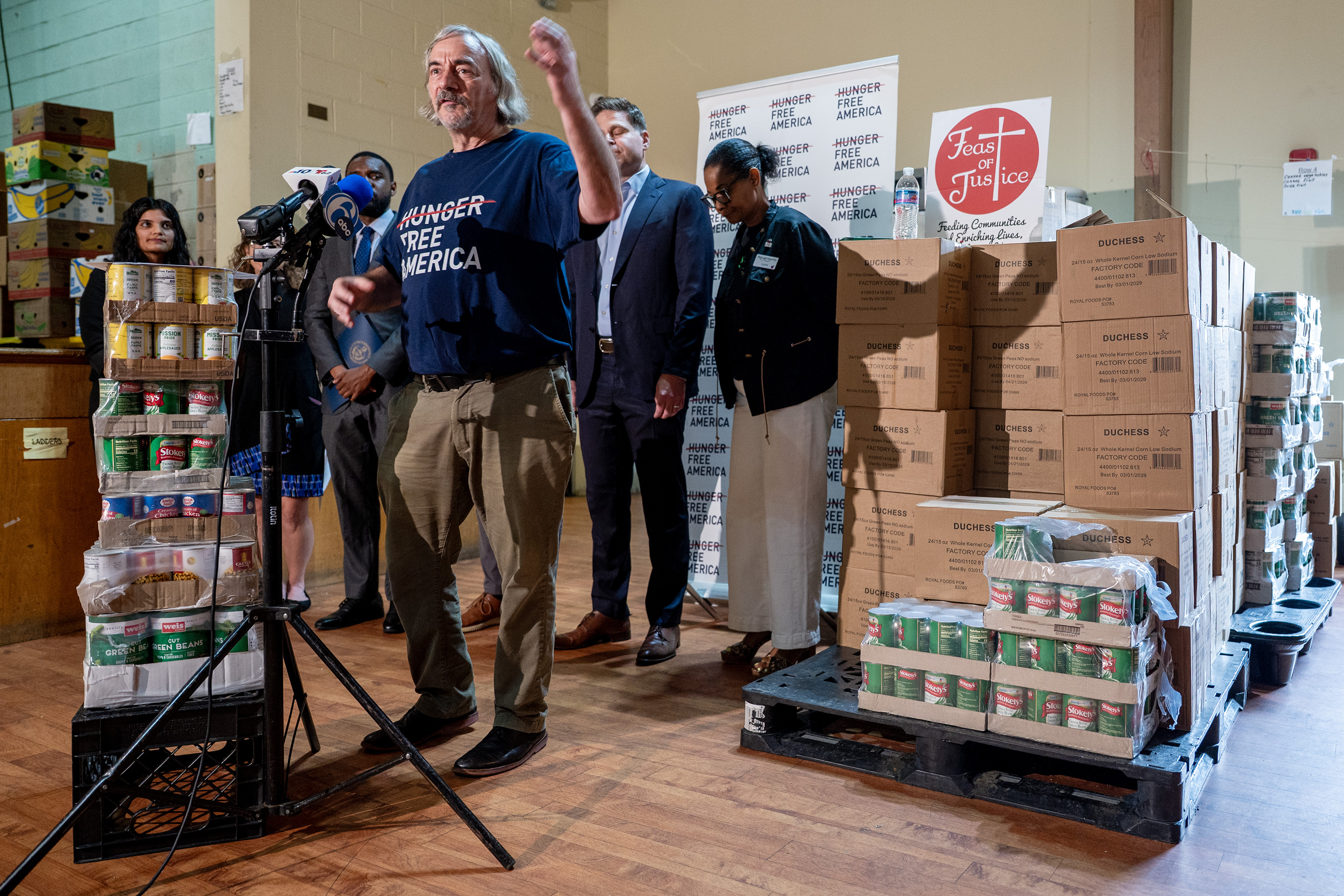
Alahallak Abdelmenim and his children Asil (left), 6, and Hasan (right), 8, load groceries into their shopping cart at the Feast of Justice Food Pantry Tuesday, Aug. 11, 2026.Tom Gralish / Staff Photographer
In Pennsylvania, around 144,000 SNAP recipients could see benefits cut this year — an estimated 45,000 in Philadelphia and 12,000 in its collar counties, according to Pennsylvania Department of Human Services estimates. In New Jersey, around 50,000 individuals could lose SNAP benefits, New Jersey Department of Human Services figures show.
It’s not “rocket science,” said Berg, who used a pallet of canned beans and apple sauce as a lectern as he addressed a small crowd at the pantry. “When there’s a drought and you take away water, the drought’s going to get worse. When there’s a hunger crisis, and you take away food, the hunger crisis is going to get worse, especially after you throw in inflation,” he added.
In response, Trump spokesperson Anna Kelly said Tuesday that Trump is “strengthening” SNAP to sustain it into the future. Changes to SNAP “crack down on waste, fraud, and abuse,” she said. Kelly added that Trump is “uplifting every American’s financial situation by passing the largest tax cut in history — which every congressional Democrat opposed — and bringing historic numbers of jobs and investments into our country.”
Pastor Tricia Neale, executive director of Feast of Justice, said Tuesday that since the enactment of the One Big Beautiful Bill Act, an additional 1,850 families in Northeast Philadelphia have turned to the pantry for help. Overall within the last five years, she said, the number of households the pantry supports has grown from 2,750 to 6,425, a more than 200% increase.
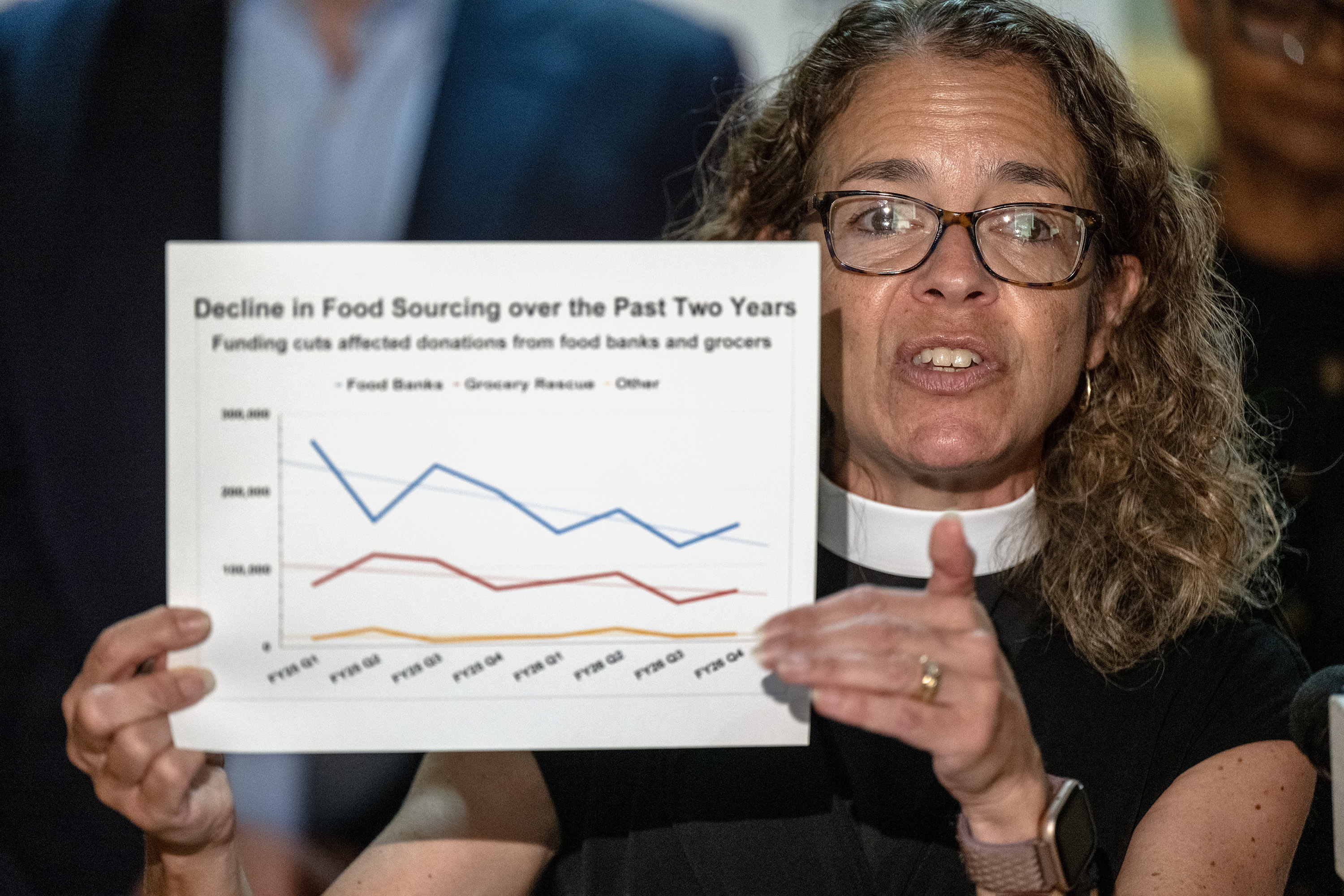
Pastor Tricia Neale, executive director at Feast of Justice, displays a chart showing the decline in food sourcing as she speaks at a press conference at the food pantry Tuesday, Aug. 11, 2026. Tom Gralish / Staff Photographer
The pantry has been forced to absorb a 35% decline in donated food it receives, in part because of cuts to federal and state food programs that have been so vital, she added.
Even with diminished supplies, Feast of Justice is an essential institution, according to Angie Bryant, 55, of Tacony, a client. Formerly a phlebotomist who can no longer work, Bryant said she recently lost her SNAP benefits because new age restrictions exclude her participation.
“In the body, hunger is hurtful,” she said. “Without this place, I don’t know how I could make it.”
Food banks such as Philabundance and Share Food Program do their best to provide Feast of Justice whatever food they can, Neale emphasized.
Volunteer Daniel Khan (center) restocks the shelves as clients load groceries into their shopping carts at the Feast of Justice Food Pantry Tuesday, Aug. 11, 2026. Tom Gralish / Staff Photographer
If SNAP is the safety net, “we’re the safety net of the safety net,” said Loree Jones Brown, CEO of Philabundance, who joined Berg and Neale at Feast of Justice on Tuesday. “But we can’t make up for the cuts.”
She added that “this is a crucial time for food banks, legislators, and community organizations to stand together for our neighbors and against hunger.”
That Feast of Justice does its best to beat back hunger is widely appreciated in the community, said client Anthony Morales, 27, of Mayfair. Laid off from a warehouse job, he said he is responsible for feeding his 7-year-old daughter and his partner, and he needs the pantry’s support.
“When you fall,” he said, “this place lifts you up. You have a lot of fear and anxiety without enough food. It can give you hope and confidence that tomorrow could be better.”
Do rich guys have to ruin everything? Apparently so. There came a time about 15 years ago when my soccer obsession got to the point where I felt I needed to pick an English Premier League team to root for, in addition to the U.S. national teams and the Union. Long story, but I went with Liverpool, in a city many consider the Philadelphia of the U.K., and it’s been a good ride, including a couple of trophies. On Monday, it was reported Amazon gazillionaire Jeff Bezos is buying 30% of the team. I’m officially out. Go, Leeds!
When did Trump’s ballroom become a national security fortress? We need answers.
Construction continues on a helipad and the White House ballroom on the South Lawn of the White House on Aug. 5.Tierney L. Cross
Donald Trump’s originally stated 2025 scheme to demolish the East Wing of the White House to make way for an oversized ballroom to hold state dinners and whatnot was bad enough: an unneeded, unwanted, gilded, and presumably tacky callback to Louis XVI, a massive monument to a modern let-them-eat-cake regime.
A year later, the project is better describedasan alleged ballroom — another bait-and-switch scam by America’s first grifter president. The fact that the public really doesn’t know how much this project actually costs — estimates have soared from the initial lowball of $300 million to now at least $600 million, but possibly more — or how much of that will be dumped on U.S. taxpayers is just the beginning of the problem.
Nearly 10 months after the president shocked Washington, D.C., and the rest of America by taking a wrecking ball to the history-packed East Wing, Trump has all but stopped talking about a black-tie party venue and instead rebranded the project as essential to national security.
When the D.C. federal appeals court on Friday ordered the White House, which never got congressional approval for either the demolition or the ballroom addition, to halt aboveground construction, Trump took to Truth Social and described the ruling as akin to treason.
“The Military and Secret Service are viewing this horrendous, politically motivated, and unlawful ruling as a National Security threat to our Nation in that the entire Complex is being built for the protection of our Country and, additionally, all future Presidents,” Trump posted, using language that’s probably never previously in human history been used to describe a “ballroom.”
Trump didn’t say in his post anything about crystal chandeliers, or great acoustics, or things you might expect in a world-class ballroom. Instead, he said the facility will have bomb shelters, a state-of-the-art hospital, top-secret military facilities, protective missile-resistant steel, columns, roofs, and beams, drone-proof ceilings and roofs, military-grade venting, and bullet-, ballistic-, and blast-proof glass.
It sounds like somebody is expecting a last tango in Washington.
Trump’s post was alarming — shocking, really — but in case anyone missed the point, or doesn’t know how to read, he also posted some AI-created renderings, which again did not depict waltzing diplomats, but instead showed a rooftop “DronePort” that was packed to thegills with ominous-looking military drones, manned by troops and also with armored vehicles that somehow drove up there. The vibe was Darth Vader’s Death Star, except with “military-grade venting” this time around.
There are two very different ways to look at all of this, and let’s start with the more benign one. Ever since the beginning of his second crack at the presidency, Trump — when he’s not pursuing his main projects of making billions of dollars, punishing his enemies, and staying out of prison — has been obsessed with placing his personalist stamp on Washington. Maybe that’s for his legacy, or maybe he just wants a Mar-a-Lago-by-the-Potomac to comfort his octogenarian mind.
Trump might not be able to crash weddings as he does at his Palm Beach, Fla., estate, but his ballroom idea would be close enough. Although he’s also sought and received donations for the project from the usual suspects of friendly billionaires and favor-seeking corporations, Trump also wants both additional dollars and — more importantly, in light of the appeals court ruling — a stamp of approval from Congress. That’s been a thwarted agenda item for GOP leaders on Capitol Hill for months.
But if Trump can’t sway Congress, he hopes to win over a U.S. Supreme Court where he has appointed three of the nine members. The White House knows that both Congress and the high court tend to fall in line whenever national security is invoked, while there is no constitutional right to foxtrot. So maybe all the military bluster is just political posturing for Trump’s latest real estate development.
But as the project enters its second year, it seems to have morphed into something a lot more disturbing than that. The pictures, descriptions, and accounts of Trump’s game here are sounding a lot more like the impregnable mountain lair of a Bond villain.
This is a man who fomented an attempted coup the first time he was asked to leave 1600 Pennsylvania Avenue, and who saw how South Korea’s corrupt right-wing president was ousted after a massive throng of protesters overwhelmed key government buildings. Wasn’t it Chekhov who said you don’t put drones up on the roof unless you intend to deploy them by the third act? The two most likely scenarios for actually using Trump’s bunker — Civil War II, or World War III — are less than optimal.
This national security bunker isn’t the only thing that’s worrisome as Trump looks to the second half of what’s supposed to be his final term. As noted in this space recently, Trump has also extended the presence of National Guard troops in Washington through Jan. 20, 2029, which coincidentally is the scheduled last day of his term.
Since their arrival last year, the Guard troops — many from units in pro-Trump red states, and costing U.S. taxpayers at least $1.4 billion and possibly more — have often been spotted hanging around, or picking up trash as a kind of busywork. But residents and some advocates like Scott Michelman, legal director of the American Civil Liberties Union of the District of Columbia, are already complaining Trump is “treating [D.C.] like a police state.”
It raises the same questions as the alleged “ballroom.” The president is entitled to state-of-the-art security, and while the public doesn’t need to know all of the operational details, American taxpayers also can’t be expected to fork over hundreds of millions of dollars for these projects without truly knowing what they are for.
Democrats on Capitol Hill need to start demanding answers. On Monday, there was an encouraging report by the New Republic’s Greg Sargent that the opposition party is working to demand communications from the Justice and Interior Departments to explain why several people were wrongly criminally charged with vandalism at the Lincoln Memorial Reflecting Pool when the actual damage was a botched repainting contract.
Congress can, and should, also flex its muscles over this ballroom fiasco — first by denying any public money for the project, and then by launching a similar investigation into the hasty demolition, the political fundraising, and the sketchy purposes for the project. Someone owes America the truth, and it’s not going to come from the current regime without a fight.
Whatever happens, the woman or man who hopefully succeeds Trump and sends those guard troops back to their own private Idaho in January 2029 is also going to have a giant mess in their backyard. But it’s better to have the ruins from a botched, halted construction project than from the Battle of Armageddon.
Yo, do this!
The California journalist Gil Durán has been paying attention to the political craziness coming out of Silicon Valley years before anyone else was, and now comes the big payoff in the form of a book that is not only incredibly timely but has the best title of the year: The Nerd Reich: Silicon Valley Fascism and the War on Democracy. Durán explores the strange beliefs of Elon Musk, Peter Thiel, Marc Andreessen, and their friends, their obsession with building their own private “networked cities,” and their unlikely alliance with Donald Trump. I’ve been waiting on this one for a while.
August is always a great month for books. While Durán drills down on the high-tech enemies of liberty, the great writer Dave Zirin has a new tome about one of democracy’s heroes, the late historian Howard Zinn, his former mentor. Public intellectuals are still arguing about the merits of Zinn’s 1980 masterwork, A People’s History of the United States, but nobody disputes his influence on the national conversation. Zinn rejected American exceptionalism, but also spotlighted everyday heroes like labor leaders or civil rights activists who expanded our freedoms over two centuries. I’m looking forward to reading The People’s Historian: The Outsized Life of Howard Zinn.
Ask me anything
Question: Data centers are the flashpoint but the root problem is the unregulated AI that is sweeping up every keystroke and every written document then repackaging it as if original thought. How do we get a federal government mired in 2020 to begin legislating on AI? — Suzi (@wanderponder.bsky.social) via Bluesky
Answer: Great question, Suzi, and I think we all know the main reason why the body politic — and I’m talking about both Democrats and Republicans — have been so painfully slow to respond to voters’ widespread anxiety not only about noisy, polluting, resource-wasting data centers, but also to artificial intelligence itself. The reason is money. Silicon Valley AI developers have raised an unbelievable $220 million to spend on November’s election, and — while there are some disagreements within Big Tech about policy — most of the cash will go to the politicians least likely to regulatean industry badly in need of it. Cognitive computing is not only stealing our intellectual property, as you noted, but also our jobs, as well as our children’s ability to learn.The good news is that public backlash against AI is so strong that even a quarter-billion dollars may not be able to stop the movement. But it’s way past time to get money out of politics.
What you’re saying about …
I should have guessed that newsletter readers don’t have much more of a clue than Donald Trump about what to do about the giant mess in the Persian Gulf. I did get one thoughtful response from an emailer with a “cbluff” handle (Reminder: Please sign your real name to these responses) who said the Trump regime needs to send skilled negotiators — and be realistic. “I believe the U.S. will have to cede the Strait of Hormuz, allow Iran and Oman to collect protection money, remove sanctions and pay them so we can declare victory and leave,” they wrote. It’s hard to disagree. Once again, the United States has lost a war.
📮 This week’s question: Since the Democratic Senate primary win by Michigan’s Abdul El-Sayed last week, the mainstream media has been obsessed with the question of whether this year’s progressive surge, including candidates (although not El-Sayed) tied to the Democratic Socialists of America, is hurting the Democrats. What do you think? Are leftists bringing needed energy to a moribund party, or are they too out there to defeat the GOP in November? Please email me your answer and put the exact phrase “Democrats and the left” in the subject line.
Backstory on the day Trump left his press corps for dead
Catering trucks are parked at Air Force One on the tarmac as the motorcade carrying President Donald Trump arrives to depart following the NATO summit, at Ankara International Airport in Ankara, Turkey, on July 8.Alex Brandon
It was appalling enough back in late July when we watched a room full of some of America’s highest-profile journalists break bread with Donald Trump at the rescheduled White House Correspondents’ Association dinner in Washington, where the president got up and hurled crude insults at several of the media members. Many of us were disgusted that some of the nation’s most respected journalists would platform a man who has repeatedly called a free press “the enemies of the people.” But the White House press corps was in the dark about an even more disturbing plot twist.
Just 16 days earlier, Trump had left some of those journalists for dead — at least potentially — as human decoys who might be blown from the skies in a feared Iranian plot.
The stunning story came out late Monday night as I was writing this newsletter, with a scoop by the Washington Post, matched shortly, with some additional details, by the New York Times. The articles revealed a modern-day Air Force One kind of thriller that essentially involved a shell game with three different aircraft. It was triggered by what officials deemed was a credible Iranian assassination threat against the president when he traveled to a NATO summit in Ankara, Turkey — just over 700 miles from the border with the U.S. enemy.
This launched a series of events, beginning with a plan to abandon Trump’s new, $400 million gift-from-Qatar iteration of Air Force One for an older version that actually has more advanced defensive capacities. Trump was filmed boarding the replacement Air Force One, followed by the White House press corps and some traveling aides for the departure from Ankara to a U.S. air base in Great Britain. What those passengers could not have imagined was that Trump had somehow been spirited out “via a catering container that had been lifted to the opposite side of the plane,” and switched to a C-32A military plane for the flight to the U.K.
Then they kept the unwitting journalists and aides on the ground for a couple of hours before it was revealed POTUS was safely in Britain and the Iranians had been thwarted and … haha, of course that’s not what really happened. No, the press corps took off as human decoys — the latest sitting ducks in an idiotic war that never should have been launched in the first place. Thankfully, no one was hurt … this time. Journalists wondered why they’d been ordered to keep the airplane’s window blinds closed, which inspired this now ironic exchange between Trump and some journalists when they reunited for the flight from Britain back to the U.S.
Trump lied that he didn’t know of any specific plot against Air Force One, and then added: “I’m No. 1on their list, before you. But if I go, you go. Right?”
Apparently not.
Even as I write this in the middle of the night just hours after the Post and Times scoops, the internet is already flooded with memes depicting Trump crammed into one of those airport serving carts, or pigging out on the adjacent airline food. It’s funny to see that your president isn’t Harrison Ford punching out the terrorists, but, in reality, slinking away in a food truck, leaving other Americans in the line of fire, right?
No, it’s not funny at all. This whole episode is a grand metaphor for a careless president who smashes up things before retreating into his money or whatever keeps him going — not thinking twice about the fate of human beings in a squalid ICE detention camp or an Iranian girls’ school. Or bantering with the gaggle of journalists whom he abandoned after drawing a big target on their backs. The first media question at the next Oval Office event ought to be, “Why did you treat me like cannon fodder?” But I wouldn’t bet on that happening.
What I wrote on this date in 2016
It’s almost funny now, in a dark-comedy kind of way, to look back on the fateful summer of 2016 and remember what it felt like to be stubbornly convinced that something, anything, was bound to happen to stop the obvious insanity of a Donald Trump presidency. It seems so incredibly naive now to read what I believed exactly one decade ago, when I actually thought the success of a diverse and incredibly talented U.S. Olympics team in Brazil would expose the Big Lie of Trump’s racism. I wrote, “The exclamation point is the remarkable women’s gymnastics team led by individual gold medalist Simone Biles — so dominant you will easily forget they also celebrate the kind of diversity that is America’s best feature, not the bug that’s described by the bitter and the disaffected back home.”
The fight for America’s future is waged on many fronts, and I’m trying to keep up. Last week, I wrote about a fascinating political development that’s been largely flying under the radar screen: a movement out west to knock off GOP incumbents by creating one-on-one contests with feisty, populist independents. That means long-shot Democrats need to drop out — which has happened in Nebraska, Idaho, and South Dakota, but not in Montana. It’s both a bold plan to end the Republican majority on Capitol Hill and a sad commentary on the failed Democratic Party brand in the American heartland. This weekend, I wrote about the Trump regime’s latest assault on higher education — denying loans for students who major in fields linked to lower-income jobs — and the increasingly bleak future of a liberal arts education. I wondered why Democrats won’t fight harder to end runaway careerism and preserve college campuses as bastions of critical thinking.
This August feels like the calm before the storm in Philadelphia sports. Some of that is the excitement over the Eagles finally beingback in training camp and looking to regain that Super Bowl mojo as 76ers fans try to process, if that’s the right term, a once-in-a-lifetime offseason rebuilding project. But much of it is angst over the Phillies, who are clinging by their fingernails to a playoff spot despite adding the National League’s batting champ to a lineup that already includes home run king Kyle Schwarber, future Hall of Famer Bryce Harper, and one of baseball’s best pitching rotations. None of that matters when the Phillies don’t have a relief pitcher who can carry a lead past the 7th or 8th inning. The Inquirer’s ace sports columnists like David Murphy and Marcus Hayes have all asked the same question: Can this team be saved? The answers are just over the paywall, and you can leap over it just like Saquon Barkley at the first-down marker; all you need to do is subscribe to The Inquirer.
By submitting your written, visual, and/or audio contributions, you agree to The Inquirer’s Terms of Use, including the grant of rights in Section 10.
I oppose its current leadership and its policies in Gaza and the West Bank. But I support its right to exist as a Jewish state. And I reject the idea that Zionism is inherently racist or malevolent.
That’s why it’s important for me to hear from people who see Israel differently than I do. I need them to question, provoke, and challenge me. That’s how I learn.
And that’s also why I’m worried about the settlement Haverford College announced last week, pledging to protect Jewish students from antisemitic speech. In a statement, Haverford president Wendy Raymond declared that the college would not tolerate “discrimination, harassment, and bias” against “students who identify as Jewish” or “those who support Zionism.”
So does that mean you won’t be able to say “Zionism is racism” or “Israel is an apartheid state”? The lawyer representing Jewish students who sued the school — and who said she was “very pleased” with the settlement — seemed to think so.
“It’s a new form of antisemitism, saying, ‘Oh, no, I don’t hate Jews, I just hate Zionists,’” she said. “For a Jew to hear that was incredibly painful.”
I’m sure that it was. I’m Jewish, and anti-Zionist rhetoric is hard for me to hear, as well.
But that’s why I should hear it. Zionism is probably the most contested question on our campuses right now. Unless everyone can address it, freely and openly, we’ll never get a good purchase on it.
Wendy Raymond, president of Haverford College, pledged that the college would not tolerate “discrimination, harassment, and bias” against “those who support Zionism.”Jose Luis Magana
Ditto for Columbia, where I went to college 40 years ago. Back then, you could argue about anything. But now Zionism, too, is effectively off the table.
That’s because the university adopted the International Holocaust Remembrance Alliance’s definition of antisemitism. According to the IHRA, “claiming the existence of a State of Israel is a racist endeavor” and “drawing comparisons of contemporary Israel policy to that of the Nazis” are antisemitic.
But a competing standard, the Jerusalem Declaration on Antisemitism, argues that “criticizing or opposing Zionism as a form of nationalism” or offering “evidence-based criticism of Israel as a state” are not, on their face, antisemitic. Haverfordʼs settlement seems to lean entirely on the first definition and ignores the second, which has not been adopted by the college or most other institutions, but was endorsed by Bucknell University’s faculty last year.
Under the IHRA definition, would a student or professor who said Israel was committing genocide in Gaza — like the Nazis did in Europe — face punishment at Columbia? I don’t think Israel’s action in Gaza constitutes genocide, but I know other historians do. And again, I need to hear from them.
In their 2024 lawsuit against Haverford, Jewish students complained that a professor called supporters of Israel “racist genocidaires.” I can understand why they felt “pain and harm” about these kinds of comments, as Raymond acknowledged at the time.
But you can censor anything — literally, anything — on those grounds. During the 2016 presidential campaign, students at Emory University said they were harmed by campus chalk messages backing Donald Trump. “Supporting him, repeating his catchphrases [is] an implicit attack on the Muslim, Latinx, Black, and other communities at Emory and across the country,” protesters declared. “This is not political expression; it is hate speech.”
And in 2021, Harvard biology professor Carole Hooven caused an outcry when she told Fox News that gender could take any number of forms, but sex is binary: male or female. After a colleague denounced Hooven’s “transphobic and hateful” comments on Twitter (now X), she became a campus pariah. Her mental health plummeted, and she resigned.
Like Zionism, the biology of sex is a hugely contested and complicated matter. And we won’t be able to learn more about it if we inhibit discussion of it.
How many people celebrating the new restrictions on anti-Zionist speech at Haverford would be OK with prohibiting claims that sex is binary? Likewise, would any of the critics who pushed out Hooven rest easily if critics of Israel were silenced, too?
We all want to have our own say, of course. But when we feel pained or harmed by someone else’s political expression, we call it hate speech. And we try to blot it out.
To be clear, nobody should be subject to threats of physical violence. Whatever you think of Zionists on campus, you can’t say you’re going to assault or murder them. That’s against the law, and our colleges should be vigilant in enforcing it.
But at Haverford, it would now appear, you can’t say anything negative about Zionism. Period. If you don’t think Israel should exist, you’re an antisemite. And you need to keep your big mouth shut.
I know some people on campus have been “deeply hurt” by anti-Israel rhetoric, as Raymond said in her statement last week. But once that becomes the barometer for what the rest of us can say, we won’t be able to speak — or listen — across our differences. Isn’t that why we gather at universities in the first place: to learn from each other?
Either you believe in free expression for everyone, or you don’t believe in it at all. Period.
Jonathan Zimmerman teaches history and education at the University of Pennsylvania. He is the author of “Schooling Citizens: How Education Can Save Democracy,” which will be published next spring by the American Philosophical Society Press.
Over the past few weeks, President Donald Trump has made it clear that he will not take Supreme Court decisions as the final word on some of his most cherished priorities.
The president has introduced new tariffs, renewed efforts to fire Federal Reserve governor Lisa Cook, and issued new executive orders to limit birthright citizenship. While experts said the moves do not signal outright defiance of the high court, they nonetheless push the limits of the rulings that Trump lost earlier this summer.
“Without question, President Trump is challenging the bounds of the court’s opinions,” particularly regarding Cook’s firing and birthright citizenship, said Richard Lazarus, a law professor at Harvard University.
The high court’s opinion affirming that nearly everyone born in the United States is a citizen does not allow Trump to create exceptions like some set out in his recent executive orders, Lazarus said. Those orders say children are ineligible for birthright citizenship if born to “alien enemies,” foreign terrorists, foreign lobbyists, or people who fraudulently request tourist visas in order to give birth in the U.S.
In signing the orders, Trump referred to the Supreme Court decision on birthright citizenship, saying, “We’re ending it a different way.”
The Trump administration has always followed court orders, said White House spokesperson Lauren Bis. “All actions taken by the president since the recent Supreme Court rulings are consistent with the holdings and analysis set forth by the court,” she said.
As for Cook, the justices ruled that she deserved notice and a chance to respond before being fired, and Trump’s latest move seeks to provide that. The White House sent a letter to Cook last week renewing the threat to fire her, giving her 21 days to respond, and directing her to submit any response to the White House by Aug. 26.
“The Supreme Court’s ruling on the Cook case required notice and an opportunity for a hearing in considering whether the president should take certain adverse employment actions,” Bis added. “The president’s notice sent to Fed. Governor Cook offers exactly that within the precise structure enunciated by the Court.”
Still, Trump’s underlying rationale for dismissing Cook — that she engaged in mortgage fraud — remains unproved, and she has not been charged. While the renewed push to fire her does not “repudiate” the Supreme Court’s opinion, Lazarus said, it “certainly confronts it by challenging its limits.”
Trump is not the first president to look for ways around adverse Supreme Court rulings. Most recently, when President Joe Biden’s plan to forgive student loan debt was struck down by the Supreme Court, Biden within hours announced a separate plan to forgive the debt.
Two decades earlier, President George W. Bush wrestled with the court over procedures for detainees seeking freedom from the military prison at Guantánamo Bay, Cuba.
But such instances appear to be historical exceptions rather than the rule, said David Super, a professor at Georgetown Law.
“Most presidents treated Supreme Court rulings as dispositive of the issues involved rather than as technical documents to be evaded,” Super said.
That includes an earlier version of Trump. During his first term, the president was more willing to accept losses at the Supreme Court and move on, Super said. He cited rulings against Trump’s efforts to end the Deferred Action for Childhood Arrivals (DACA) program and to add a question on citizenship status to the 2020 Census.
“The second-term President Trump appears to have much less regard for the other branches of the federal government than the first-term one did,” Super said.
Similarly, the Trump administration last month imposed new tariffs on U.S. imports from 60 economies under an authority different from the one the Supreme Court rejected in February. The new duties, imposed under Section 301 of the Trade Act of 1974, purport to penalize countries that fail to curb imports produced by forced labor.
That does not directly go against the Supreme Court’s decision. But critics call the forced-labor rationale a pretext for reimposing the sweeping tariffs struck down by the court, and small businesses have sued to block them for that reason.
Some experts say Trump, far from challenging the Supreme Court, is working within the bounds of the justices’ rulings.
“The court ruled against Trump in these three big cases, and all of them sort of left openings to do something else — and in all three cases he did something else,” said Josh Blackman, a law professor at South Texas College of Law at Houston.
“Trump is more aggressive because he views rulings as political,” Blackman added. “He’s willing to push back, especially with conservative judges, three of whom he appointed.”
Still, Trump has added to the sense that he is challenging the court by using heated rhetoric against it.
After the court overturned his tariff regime in February, the president called the conservative justices who ruled against him “fools and lapdogs.” Last week, when Trump introduced his new birthright measure, he called the court’s decision “a bad decision, very unfair decision,” saying the “country suffers because of it.”
President Barack Obama criticized the court in his 2010 State of the Union address, though he did so in a more genteel manner. “With all due deference to the separation of powers,” Obama said in criticizing the Citizens United decision (which lifted limits on independent political expenditures by corporations and unions), the court has “reversed a century of law that I believe will open the floodgates for special interests.”
The Trump administration has also had a tense relationship with the federal judiciary more broadly.
A Washington Post analysis last year found that Trump and his appointees were accused of flouting the courts in more than a third of the 160-plus lawsuits against the administration in which a judge had issued a substantive ruling. The administration has also sparred with the judiciary over Trump’s picks to lead federal prosecutor’s offices.
But Mike Fragoso, a former chief counsel to Sen. Mitch McConnell (R., Ky.), said Trump’s responses to the Supreme Court’s most recent decisions do not appear out of the norm.
Instead, particularly with regard to the new birthright order, Trump appears to be adopting the longtime conservative view that a Supreme Court decision binds the president only to the specific case at issue, not necessarily to its broader reasoning, he said.
Fragoso, now an attorney at Torridon Law, pointed to President Abraham Lincoln’s rejection of the Supreme Court’s logic in its infamous 1857 decision Dred Scott v. Sandford, which held that African Americans were not citizens.
“On birthright, it’s a question testing the limits of what the Supreme Court said” while not being inconsistent with the opinion, Fragoso said, adding that Trump’s actions could be described as “Lincolnian.”
This could be a win-win situation for both the students and the Keystone State.
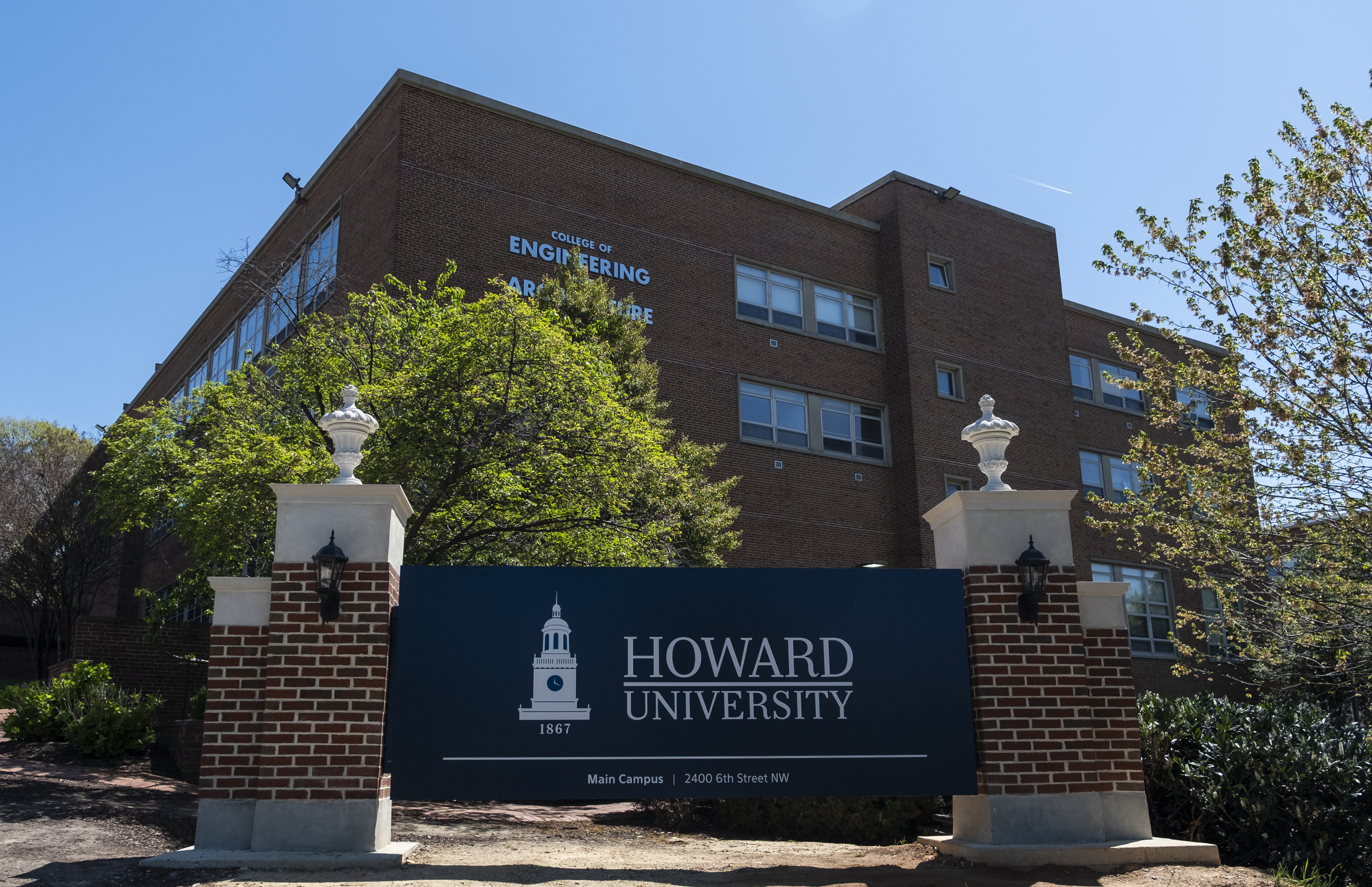
Everyone who knows me recognizes how much I love Howard, which is my alma mater. To call the four years I spent on the campus in Washington, D.C., life-changing would be an understatement. It was the former leader of HU’s journalism department, Lawrence Kaggwa, who set me on my career path, informing me that I was going to work in the newspaper industry.
The first-time college students — some in tears — responded by posting videos on social media about their plight. They were hard to watch. Some went viral and even made the national news.
School officials defended what happened, saying payment notices had been going out since March about deadlines and enrollment requirements. Some students said they didn’t get them, or else received a notification on the same day their bill was due.
Nikiyah Clark told ABC News, “I was so scared because Howard University is my dream school, like, my grandma went there.” She hopped on a bus from Fairport Harbor, Ohio, to D.C. to advocate for herself in person. It paid off, because she has been reinstated into Howard’s first-year class.
But now Clark faces perhaps an even bigger hurdle: paying for tuition. Tuition plus room and board is $66,000, according to Howard’s website.
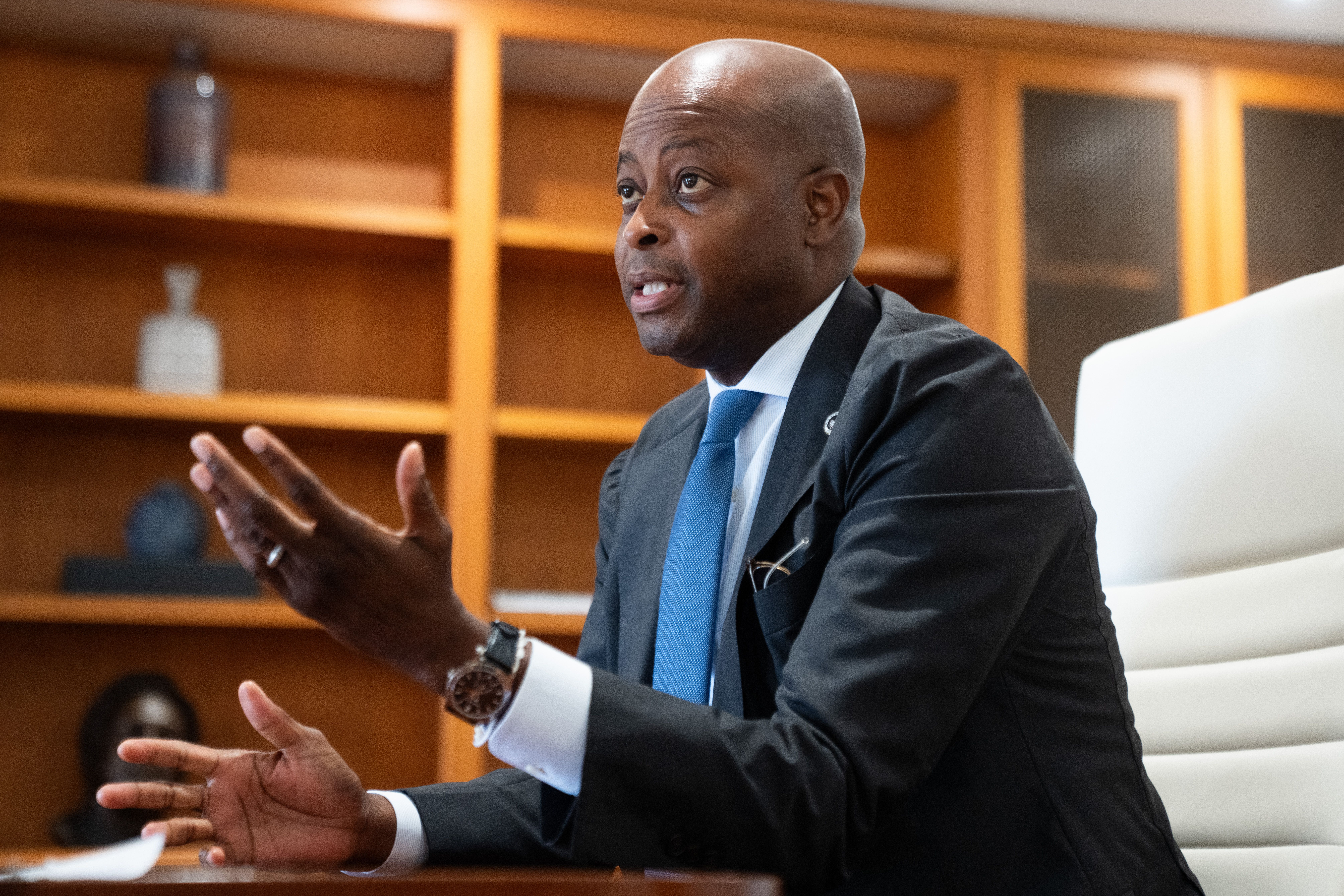
HU’s interim president, Wayne A.I. Frederick, called for an internal investigation into what went wrong, but it’s going to take a lot more than that to heal the damage to the school’s reputation.
“If another school in the city said that things had to be paid at a certain point, I think people would do that,” he told the Washington Post. “Nobody would make a fuss about the fact that somebody was suggesting a bill be paid on time.”
Howard University interim president Wayne A. I. Frederick sits for an interview July 29.Allison Robbert
And the fact is, HU needs the money. Trump administration officials ended a series of annual payments meant to support the construction of the university’s new hospital. That move resulted in a cut to the historically Black college or university’s (HBCU) annual federal appropriation for the current fiscal year of about $64 million, or more than 20%. The Chronicle of Higher Education reported on Thursday that HU has offered buyouts to 600 employees.
Still, that’s no excuse for how the first-time college students were treated. We expect more of institutions like Howard, which was founded in 1867 to educate newly emancipated Black Americans.
“HBCUs are known for being nurturing and family environments,” said Marybeth Gasman, who runs the Rutgers Center for Minority Serving Institutions. “That’s why this comes off as being kind of shocking to parents and students and some alumni, and some people in the HBCU community and beyond.”
As I pointed out earlier, expediting admissions here could be a real win-win both for the students unenrolled from Howard and Pennsylvania’s state colleges and universities. Incoming freshmen could further their educations, and state institutions — which have struggled with diversifying their student bodies and declining enrollments — can take a step toward changing those narratives.
No matter what President Donald Trump would have you believe, diversity matters.
“In higher education, we do a better job as teachers and as researchers when we work in a diverse environment,” David Oppenheimer, a leading scholar on issues of discrimination and equality, told InsideHigherEd.com earlier this year.
Oppenheimer, who is the author of The Diversity Principle, added: “Students learn more. In a science lab, scientists make more significant discoveries when the scientists working in the lab are diverse. It’s a real thing. It’s not just a psychological argument.”
Following all of the public outcry, Howard has readmitted more than 200 of the freshmen who had been dropped, but it’s unclear what all of the other students will do.
Shapiro should recognize that there’s a real opportunity here — and that Pennsylvania should take advantage of it.
I’ll never forget how deeply the wildfires in Australia during the 2019-2020 “Black Summer” affected my son, Nick. Scientists estimate that nearly three billion more-than-human relatives (also known as animals) were killed or displaced. Incomprehensible devastation.
The 2019-2020 Australian bushfire season, known as the “Black Summer,” had catastrophic environmental impacts — with more than 59 million acres burned, three billion animals killed or displaced, and smoke impacting weather conditions on other continents. In the photo, fire burns near Bumbalong, south of the Australian capital of Canberra, in February 2020. Rick Rycroft
We ordered T-shirts to support the recovery effort. The image was an outline of Australia, one edge consumed by flames, its interior filled with the country’s beloved wildlife.
Nick and I had no firsthand experience with wildfires, living in this area, but for many people, fire season is an inescapable reality that evokes fear and demands respect and attention.
I learned about wildfires while living in Montana. I moved there for graduate school, where many classmates studied fire science. I stared at the constant helicopters flying over Hellgate Canyon, where I lived, on their way to do aerial water drops into burning areas.
An aircraft dumps water on the edge of the Elmo Fire burning on the western shore of Flathead Lake, Mont., in August 2022.Hunter D'Antuono / AP
I remember the smell. The thick air. Wondering what the inside of my lungs looked like.
Fire was simply part of everyday conversation. People knew the weather, fuel conditions, evacuation routes, and the difference between a prescribed burn and a wildfire. I realized how privileged I had been never to need that knowledge.
Last year, I had the honor to sit in a circle in Lubrecht Experimental Forest with an elder of the Confederated Salish and Kootenai Tribe, from the Flathead Reservation, who told my class about his tribe’s traditional fire practices. He explained that prevention is the key, something Indigenous peoples have known since time immemorial.
Sadly, Indigenous fire management was a casualty of colonialism. Their knowledge was forced underground, and generations of fire stewardship were interrupted just as landscapes became increasingly vulnerable to catastrophic fire.
It is well known in climate science that those who do the least damage to Mother Earth suffer the effects of climate change the most. The scientific consensus is clear that climate change is lengthening fire seasons and increasing the conditions that produce larger and more severe wildfires. The threat is real, and it is reaching places that once believed themselves safely outside fire country.
Which is why the recent political response to the Canadian wildfires is so baffling. Rather than asking how two neighboring countries can confront a shared ecological crisis, President Donald Trump threatened to impose tariffs on Canada over wildfire smoke. As if punishment were an effective response to an ecological crisis.
Not only is this an abominably foolish threat, but it created a scapegoat in a time of great fear.
Ontario’s premier, Doug Ford, responded to the president’s threats by saying that those who share Trump’s opinion that Canada has been “willfully negligent … have a very short memory.”
I remember sitting in school on 9/11 and hearing that first responders from Canada were headed to New York City. Many diverted international flights landed in Atlantic Canada, while the small town of Gander welcomed nearly 7,000 stranded passengers — almost doubling the town’s population. Newfoundlanders welcomed passengers with open arms, rooms, and cupboards.
And while conducting research in Nova Scotia last fall, I learned about the Halifax Explosion of 1917, which killed almost 2,000 people and injured approximately 9,000. Boston was the first to respond, and Nova Scotia has been sending a Christmas tree to Boston as a token of thanks since 1971.
Learning about all of this propelled me to seek out more examples of cooperation between our northern and southern borders. Read enough of these stories, and nationalism masquerading as patriotism begins to dissolve.
We must seek out what unites us as North Americans and acknowledge our shared history, good and bad, to move through an ever-worsening climate crisis that will require all of us to work together if we wish our future generations to survive.
Maybe all you can do now is buy a T-shirt, like Nick and I did in 2019. Maybe you can start that conversation. Maybe you can volunteer. No act is too small. Make no mistake — you have a dog in this fight. When your neighbor is in trouble, regardless of the effect on you, pitch in.
Nick understood this instinctively. He didn’t know fire science. He simply saw suffering and wanted to help. In an age of climate change, that childlike impulse — to care before we condemn — may be exactly what survival requires.
Natural disasters don’t recognize borders. Neither should our compassion.
Meredith Elizalde is Nick’s mom. A former Philadelphia high school teacher, she is currently a graduate student at the University of Montana.
Philadelphia drivers looking to save a few bucks at the pump streamed into the city’s newest Freedom Fuel station Friday afternoon, even while the station’s deep discounts remain a mystery.
The station, located in Bustleton on Roosevelt Boulevard, is one of four new Freedom Fuel locations added this week. The other three are in New Jersey, including one all the way up in Morris County.
The gas network, which was promoted by both the White House and President Donald Trump last month, is now up to 29 stations across the Philadelphia region, stretching east to the Jersey Shore.
(function(){function e(){window.addEventListener(`message`,function(e){if(e.data[`datawrapper-height`]!==void 0){var t=document.querySelectorAll(`iframe`);for(var n in e.data[`datawrapper-height`])for(var r=0,i;i=t[r];r++)if(i.contentWindow===e.source){var a=e.data[`datawrapper-height`][n]+`px`;i.style.height=a}}})}e()})();
Nearly all the pumps were full at Philly’s newest Freedom Fuel spot Friday afternoon, with the station selling a gallon of regular gas for $3.79 a gallon. That’s nearly 35 cents a gallon less than a Wawa just up Roosevelt Boulevard, where a gallon of regular gas went for $4.13 on Friday.
A nearby Lukoil was a bit closer to Freedom Fuel’s prices, offering a gallon of regular gas for $3.99.
An enduring mystery remains how Freedom Fuel has been able to consistently offer lower prices than nearby competitors.
Experts told The Inquirer Freedom Fuel was likely suffering losses for selling fuel at such a low price, especially since many of the company’s stations don’t have robust convenience stores or car washes to create revenue.
“It becomes unsustainable,” Eliezer Fich, a finance professor at Drexel University’s LeBow College of Business, told The Inquirer last month. “Unless prices go down. But if they do, they go down for everybody.”
According to public records, the newest Freedom Fuel station is owned by Celik Plaza II l.l.c., which had previously run it under a “Red Lion Fuel” banner. Engin Celik, who is listed as a principal with the company, according to documents reviewed by The Inquirer, did not respond to a request for comment.
Philly Freedom Fuel station faces closure after failing inspection
The Freedom Fuel station on Bustleton Ave. in Philadelphia. Dana Munro / staff
While Freedom Fuel is adding locations, it could soon lose one in Philadelphia.
The station on Bustleton Avenue, one of at least six locations linked to Cherry Hill developer Shamikh Kazmi and his brother Syed Kazmi, has an expired fuel dispensing license and failed an inspection last week, according to city records.
If unresolved, the station could be forced to close by Sept. 4, according to a city spokesperson.
Ravens special teams coach Randy Brown signed Freedom Fuel’s formation papers. Terrance Williams
While Freedom Fuel’s launch was proudly promoted last month by Trump, the company’s owners have remained quiet about the enterprise and how they’re able to maintain low fuel prices.
A White House spokesperson previously told The Inquirer Freedom Fuel is a private company receiving no government subsidies and not accessing fuel at a lower cost.
“Freedom Fuel Network is a privately owned and proudly patriotic company — along with its convenience store operators, haulers, sign companies, and operational partners — that answered President Trump’s call to action to lower prices at the pump,” the company said in a statement on its website.
Baltimore Ravens assistant coach Randy Brown, the former mayor of Evesham Township, N.J., and a self-proclaimed “proud Trump supporter,” signed Freedom Fuel’s certificate of formation in Delaware on June 23. Brown has declined to comment on the enterprise.
Former commodities trader Yoni Gontownik also signed the certificate of formation, and has not responded to requests to comment. Gontownik and his wife, Bellen, have hosted Republican fundraisers through NORPAC, a New Jersey-based political action committee supporting pro-Israel lawmakers in both parties.
Staff writer Ryan W. Briggs contributed to this article.
Joseph LaForte was once the charismatic head of Par Funding, a Philadelphia-based lending firm that collapsed in spectacular fashion as prosecutors said he misled investors to the tune of $400 million and resorted to brutish loan shark tactics to collect on unpaid debts.
Now, despite the fact that LaForte pleaded guilty to racketeering and wire fraud charges, a website has been set up to lobby President Donald Trump to free him from a 15½-year prison sentence — part of a campaign that describes LaForte’s prosecution as a “witch hunt.”
“Stand Up for What’s Right, Free Joe LaForte,” says a scrolling banner on the website, FreeJoeLaForte.com. The site’s homepage also prominently features several images of Trump and says the goal is to “fight for [LaForte’s] presidential pardon through activism and exposing the truth.”
Websites dedicated to overturning convictions are not unusual. But the existence of the LaForte campaign comes as Trump, in his second term, has shown a willingness to grant clemency to political allies or people he believes have been unfairly prosecuted — including those convicted of fraud. And well-connected lobbyists and lawyers have reportedly started charging defendants eye-watering sums for promises of presidential relief.
LaForte does not have an official clemency application pending with the Office of the Pardon Attorney, according to that agency’s website. But the LaForte website is clear about its intent to lobby Trump for freedom.
How the campaign came together — and whether LaForte has a role in it — is something of a mystery.
LaForte’s lawyer in his criminal case, Joseph Corazzo, said he didn’t know of the site until he was contacted by The Inquirer and said he’s had no role in any potential efforts to seek clemency from Trump for LaForte.
LaForte, meanwhile, is incarcerated at a federal prison in Fort Dix, N.J., and is not scheduled to be released until 2035.
Unidentified creators
The LaForte website, FreeJoeLaForte.com, does not say who owns or runs it. And phone messages and emails left through its contact pages in recent weeks went unanswered.
One of the calls was directed to a number associated with John Sirmans, of Fanwood, N.J. And Sirmans’ name is listed as an author on dozens of PDFs that were published on the LaForte site.
It is not clear how or if Sirmans and LaForte know each other, and Sirmans did not respond to requests for comment.
PDFs on the site list another author as “Lisa Mac.” LaForte’s wife, Lisa McElhone, was sentenced to one day in federal custody for her role in the Par Funding scandal, and the Justice Department said LaForte sometimes used the alias “Joe Mack” while working at Par Funding.
Attempts to reach McElhone — including by visiting Lacquer Lounge, the nail salon she owns in Old City — were unsuccessful.
Meanwhile, a petition on change.org — which urges people to visit FreeJoeLaForte.com — is even more forceful its views on LaForte’s case, calling his imprisonment “unlawful” and saying he is “an innocent man targeted by a weaponized justice system that bends to partisan agendas.”
But the creator of the petition, which has 40 verified signatures, is listed only as “Truth Seeker,” and attempts to reach that person through change.org were unsuccessful.
Extensive coverage
One of the more prominent sections on LaForte’s website, meanwhile, is a list of more than a dozen news articles written by Milton Allimadi, a New York-based journalist who runs an outlet called Black Star News.
On LaForte’s site, Allimadi’s stories are labeled as being part of a series “dedicated to exposing the truth and corruption involved in the wrongful persecution of Joseph LaForte.”
Allimadi said via email that he did now know who started FreeJoeLaForte.com or how the Black Star News articles ended up being highlighted there.
He said he learned of LaForte’s case after speaking with the father of an inmate housed alongside LaForte. He declined to identify the person.
Allimadi said he wrote about LaForte for Black Star News because the Par Funding founder’s story had “many interesting angles.” He said he’s never spoken to anyone associated with FreeJoeLaForte.com and was not paid by anyone connected to the site for writing or publishing his articles.
Still, he said, he didn’t mind having his work promoted by LaForte’s site because that had already led to what he said was a modest but noticeable uptick in traffic and donations to Black Star News.
“Our site’s major support comes from readers who donate … and some of his supporters who read and like the articles also definitely contributed, because there was a little spike,” Allimadi said.
Another case that Allimadi covered extensively in recent months led to a sizable legal judgment against him.
Last month, a jury in Michigan awarded more than $12 million to a doctor who said Allimadi and Black Star News targeted him with a “relentless, vindictive, and malicious online smear campaign” centering on allegations of domestic abuse and sexual assault of his ex-wife.
Allimadi said his journalism was solid, and he is trying to get the verdict thrown out.
As for LaForte, Allimadi said his coverage included references to LaForte’s history of criminal convictions, and he said it was “clear from [LaForte’s] background that he’s no saint.”
But Allimadi said he also explored angles that hadn’t received much attention as Par Funding collapsed, including by raising questions about the conduct of the Securities and Exchange Commission and the court-appointed receiver in the case, which each contributed significantly to LaForte’s downfall.
“I can see why [LaForte’s supporters] would want to post such articles on their site,” he said.
Newsroom researcher Ryan W. Briggs contributed to this article.