Tag: Cherelle L. Parker

  • Councilmember Curtis Jones Jr. is running for reelection. Some Democrats are questioning whether he should.

    Councilmember Curtis Jones Jr. is running for reelection. Some Democrats are questioning whether he should.

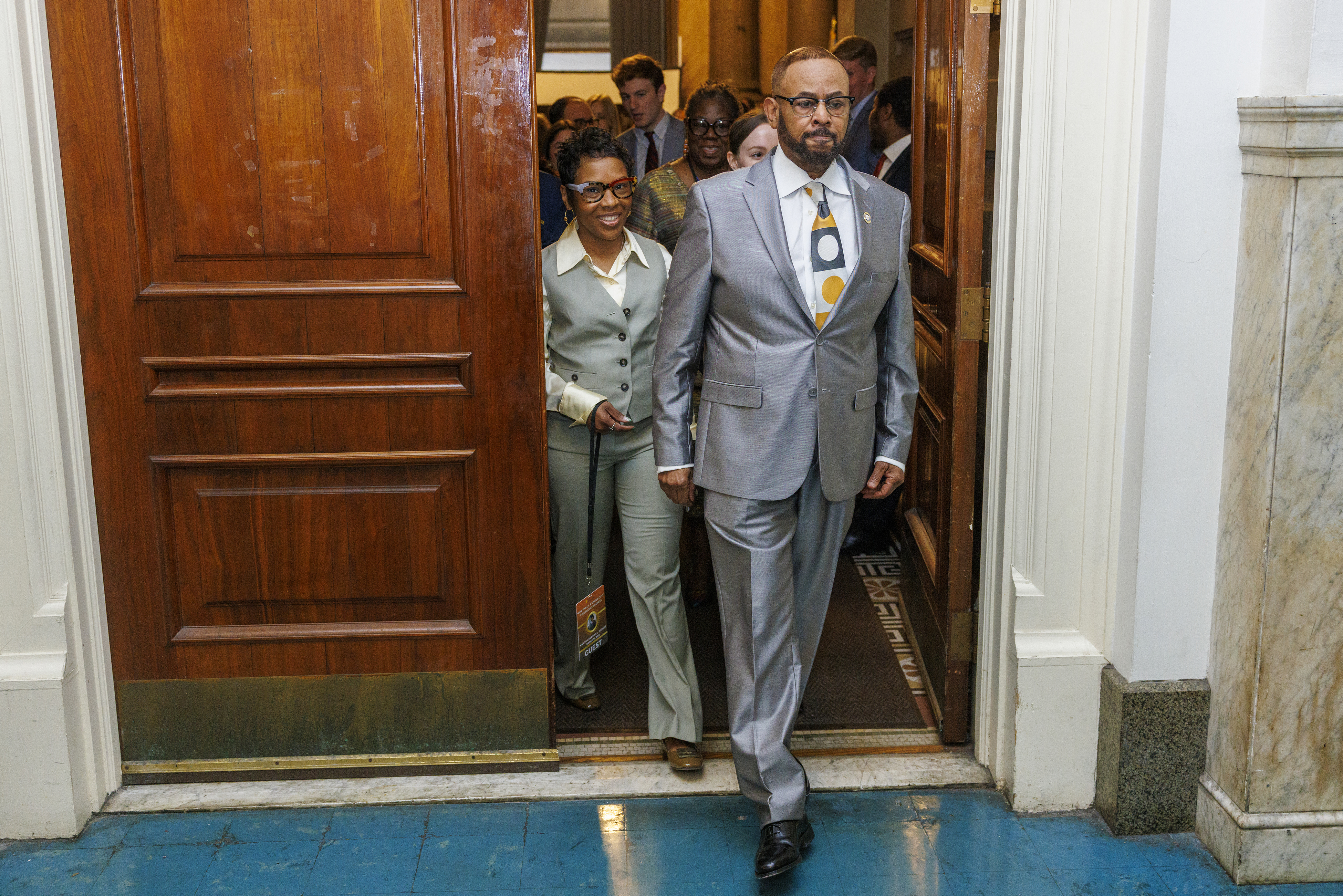
    City Councilmember Curtis Jones Jr. held a campaign fundraiser featuring Mayor Cherelle L. Parker at the Cobbs Creek Golf Course on Thursday night, a show of strength as he gears up to seek a sixth term in next year’s municipal election.

    But that hasn’t stopped a whisper campaign among Philly’s political class about whether he’ll actually appear on the Democratic primary ballot next spring, with as many as four potential candidates said to be eyeing his seat representing parts of West and Northwest Philadelphia.

    People close to Jones have recently encouraged him to reconsider seeking a new term and to clear the way for State Rep. Morgan Cephas to run to represent Council’s 4th District, according to a person with knowledge of the discussions who spoke on the condition of anonymity to discuss private conversations.

    Other possible candidates include criminal justice reform advocate Celeste Trusty, ex-Service Employees International Union staffer Leigh Owens, and developer Ryan Spak.

    The intrigue over Jones’ political future follows an Inquirer report in June that Jones and his wife, City Representative Jazelle Jones, who is a top official in the Parker administration, stand to reap up to $752,000 in payouts from the controversial Deferred Retirement Option Plan, or DROP.

    Jones, who makes $165,000 per year, told The Inquirer in June that he may need the extra money from DROP to pay for medical bills in retirement because he is suffering from glaucoma, an incurable disease that Jones said has already caused him to lose 40% of his vision.
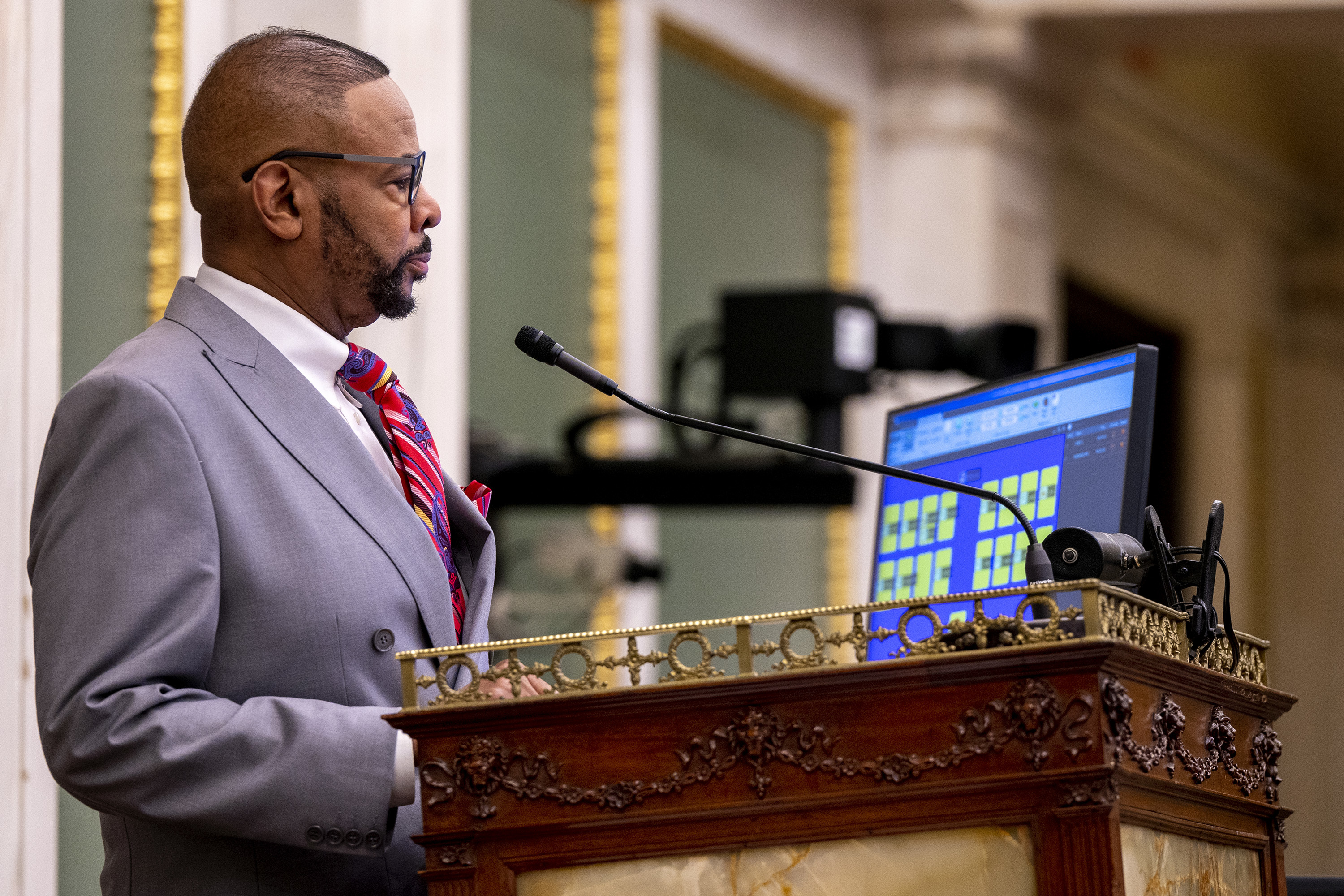
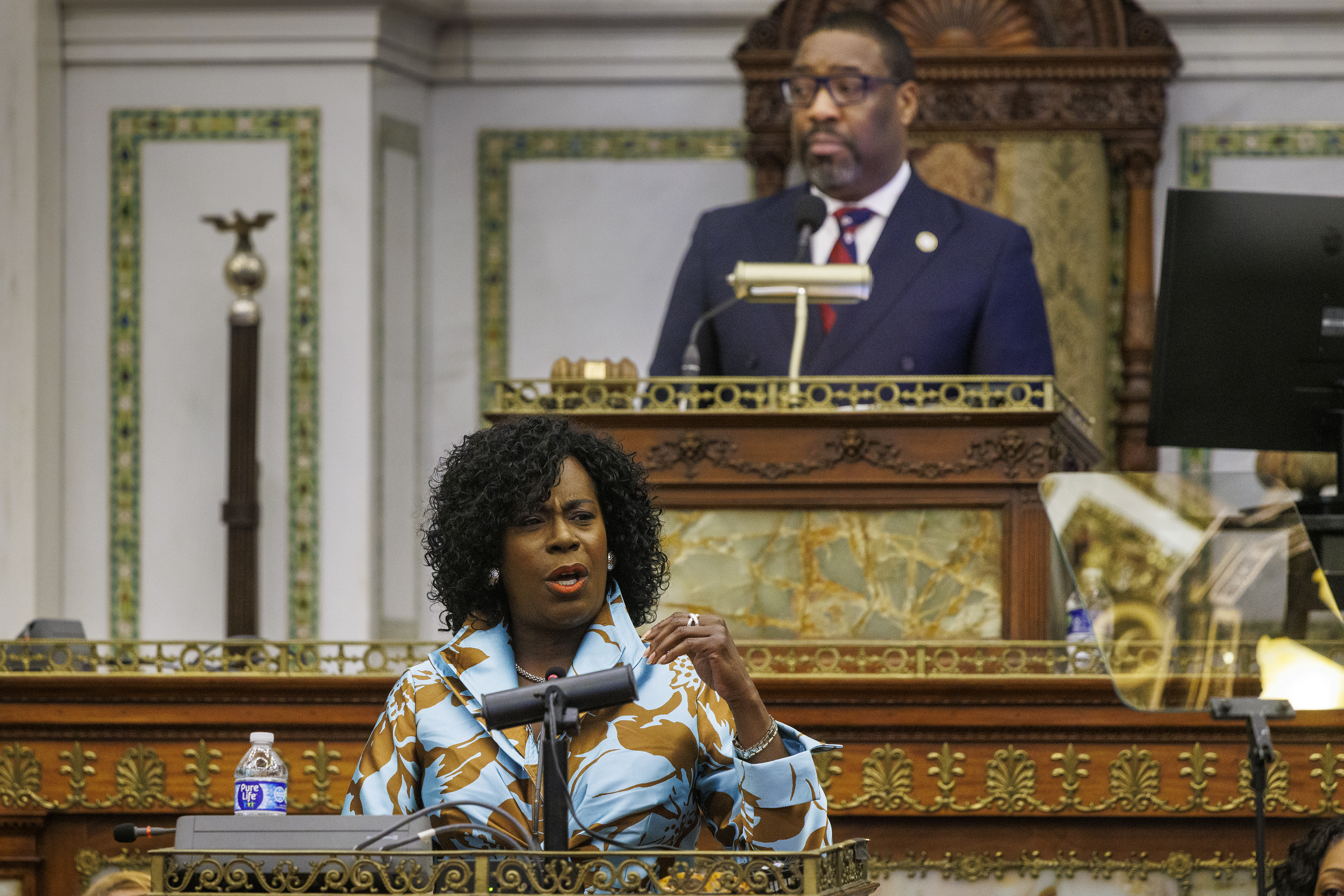
    Councilmember Curtis Jones Jr. stands in for former Council President Darrell Clarke after he stepped away briefly during a Council meeting on Sept. 14, 2023.Tom Gralish / Staff Photographer

    State Sen. Vincent Hughes, a West Philadelphia Democrat who said he has been friends with Jones for 44 years, said he will support Jones no matter what he decides, adding that “no election is automatic.” But Hughes also said he has encouraged Jones to consider his health when deciding how to proceed.

    “I think the councilman has earned the opportunity to try to make an accurate determination as to what he wants to do for his future,” Hughes said in an interview Monday. “I have encouraged him to think about the personal side of this, the physical challenges.”

    Hughes said he would like to see Cephas eventually succeed Jones in the 4th District. But if Jones decides that he can serve another term, Hughes said he will back his reelection.

    “He’s been serving with this challenge, and he’s been serving well,” Hughes said.

    Jones said Thursday that he intends to run for reelection and serve a full term.

    ScreenshotSean Walsh

    DROP allows city workers to “double-dip” by accumulating four years of pension payments, which is usually paid out in a lump sum upon their retirement, while they are still working and receiving their regular paychecks.

    The Joneses’ enrollment in DROP is legal, but his use of the program resurrects a scandal from the early 2010s that ended the political careers of several prominent figures in City Hall.

    Elected officials, who were not initially envisioned as being eligible for the program, took advantage of it by briefly retiring at the end of their terms, collecting lucrative DROP payouts, and then getting rehired at the beginning of their new terms.

    As a junior Council member, Jones in 2010 voted for a bill banning future elected officials from enrolling in DROP. But the bill “grandfathered” in current elected officials at the time, he said, and Jones is now poised to become the first lawmaker to use the program in years.

    Jones enrolled in DROP in August 2024, meaning his mandatory retirement date would be in August 2028, during the first year of the next Council term. He would be eligible to collect a $432,000 payout then, and upon retirement he will begin collecting his regular city pension payments.

    But Jones in June said he plans to retire just before the start of the next Council term in January 2028, take a slightly reduced DROP payout, and then serve his entire next four-year term, if he is reelected. He has held the seat since 2008.

    The person familiar with the discussions about Jones’ future said 4th District voters are unhappy about his enrollment in DROP and that speculation about his potential successor is becoming a “self-fulfilling prophecy.”

    “This is a district that reads the newspaper and works to stay informed,” the person said. “And they don’t like what they’ve been reading and hearing.”

    In June, Jones said he has had four eye surgeries and that he enrolled in DROP to ensure he can afford the healthcare he needs in retirement, “so that if I was blind, I wouldn’t have been without resources.”

    He added that, due to his health challenges, he is grateful he was not elected Council president. He ran for the leadership post in 2023, losing to Kenyatta Johnson, a South Philadelphia Democrat.

    “I am functional. My staff kind of helps to keep that good,” Jones said. ”I am thankful to God that I did not get elected [Council] president. Do you know how much reading they do? I could have not kept up with all of the numbers and stuff like that, so I know my limitations.”

    Jazelle Jones, who has served in multiple mayoral administrations, enrolled in DROP in 2020 and was originally set to retire in 2024. Parker, however, has pushed through a series of exceptions to personnel rules allowing her to continue serving and collect a more lucrative DROP benefit of about $320,000. Those approvals were processed months after the fact, city records show, and the administration has not yet explained the gaps in paperwork.

    Curtis Jones, 69, has also said he hopes that Cephas, 42, a West Philadelphia Democrat, will succeed him when he retires after his next four-year term, meaning she would run in the 2031 municipal election cycle.
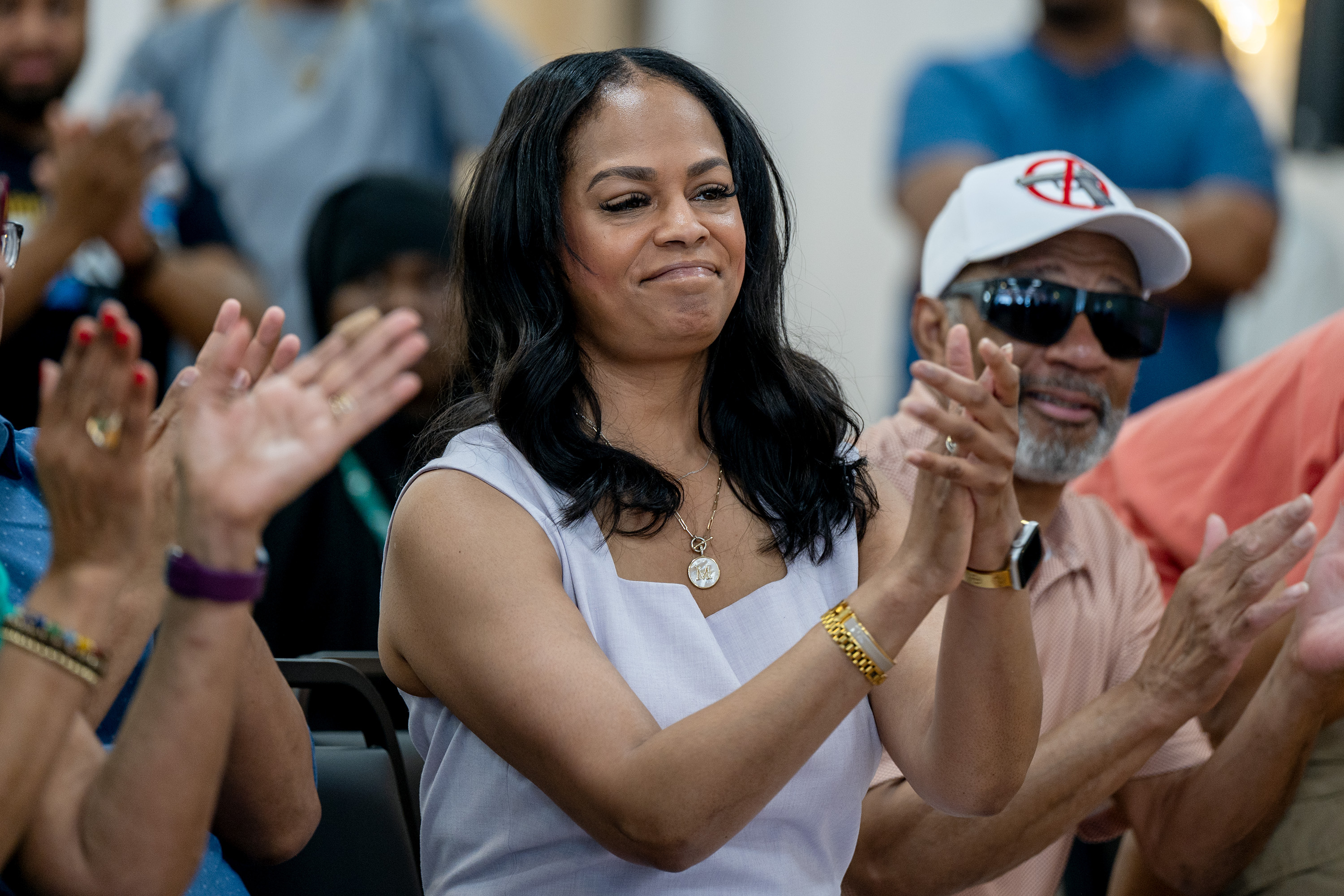
    State Rep. Morgan Cephas attends a get-out-the-vote rally for State Sen. Sharif Street at the Church of Christian Compassion in West Philadelphia on May 18, 2026, on the day before the Democratic primary election for the 3rd Congressional District. Cephas was a candidate for the same seat, but withdrew early in the race.

    Philadelphia politicians sometimes retire in the middle of their terms, triggering a special election in which Democratic ward leaders, and not primary voters, choose the party’s nominee, who usually ends up winning the seat thanks to Philly’s deep-blue electorate. That can sometimes allow outgoing politicians to handpick their successors.

    But Jones has said he would not retire in the middle of his next term, and he instead plans to endorse Cephas to run in a Democratic primary in 2031.

    Amid the heightened scrutiny over his retirement plans, some allies of Jones and Cephas, who both got their start in the West Philadelphia-based political organization previously led by former U.S. Rep. Chaka Fattah, are encouraging him to speed up the transition. That could prevent a worst-case scenario for Cephas: if Jones lost to another challenger in next year’s Democratic primary while Cephas sat out the race in deference to Jones.

    Cephas, the chair of the Philadelphia delegation to the state House, ran for Congress earlier this year in a high-profile contest but dropped out of the race two months before Election Day.

    She declined to comment through a spokesperson.

    Several other potential candidates are considering running for Jones’ seat, setting up what could grow into a crowded primary.

    Spak — an affordable housing developer based in West Philadelphia who has in recent years been critical of some Council members’ more restrictive housing policies — is rumored to be considering a campaign. He declined to comment.
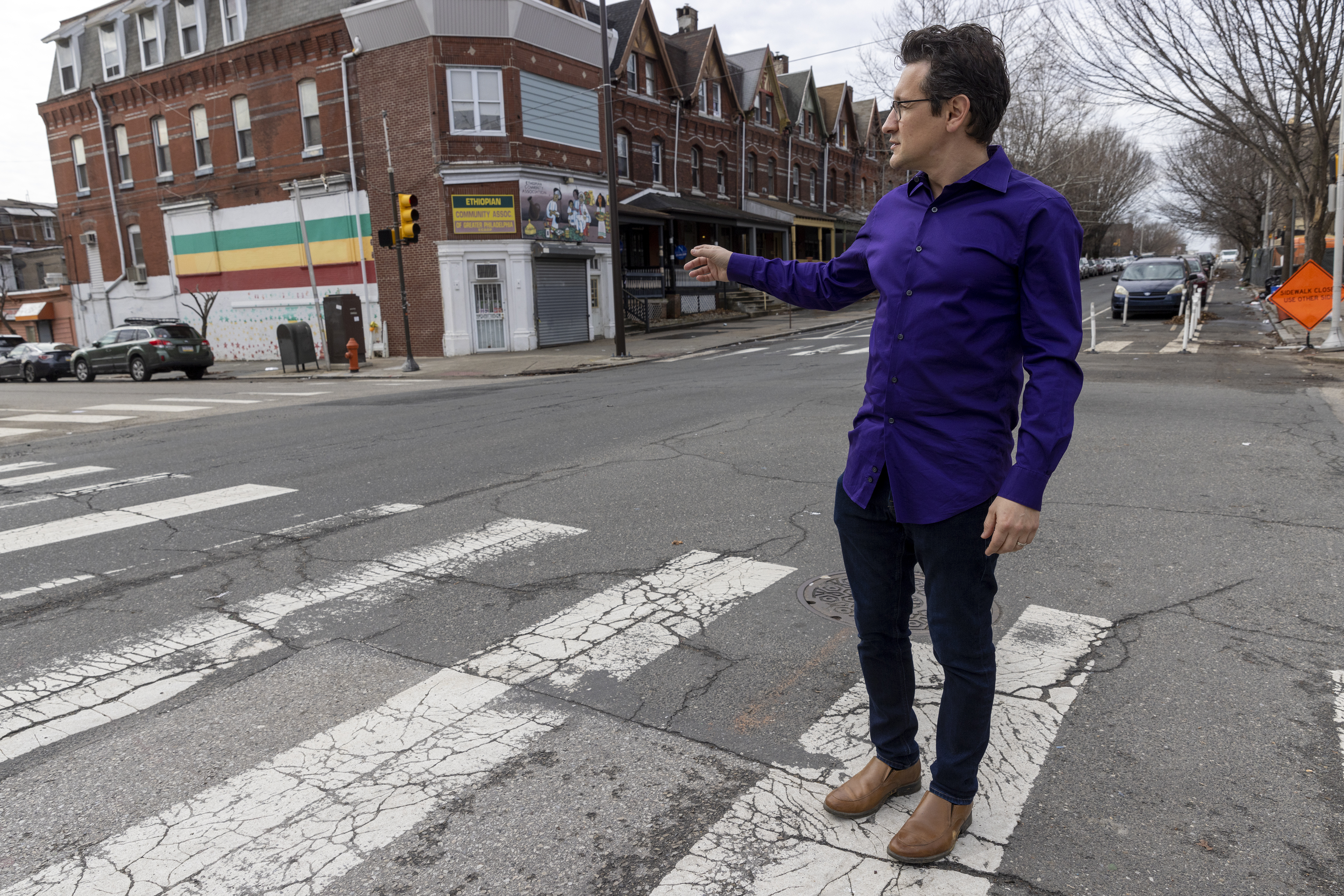
    In this 2022 file photo, Ryan Spak is photographed at 44th and Chestnut Street near the Ethiopian Community Association. Spak’s work has included collaborating with West Philly residential and commercial property owners on rehab projects.ALEJANDRO A. ALVAREZ / Staff Photographer

    In addition, the city’s progressive organizations are eyeing the district as a potential opportunity to grow their influence on Council. Candidates aligned with the left are already lining up to run against incumbents in at least two other districts.

    Three sources close to that effort, who requested anonymity because they were not authorized to discuss the plans publicly, said Trusty and Owens, both criminal justice reform advocates, are considering getting in the 4th District race.

    Trusty is the ex-secretary of the Pennsylvania Board of Pardons and has also worked with the national organization FAMM, formerly known as Families Against Mandatory Minimums. She declined to comment.
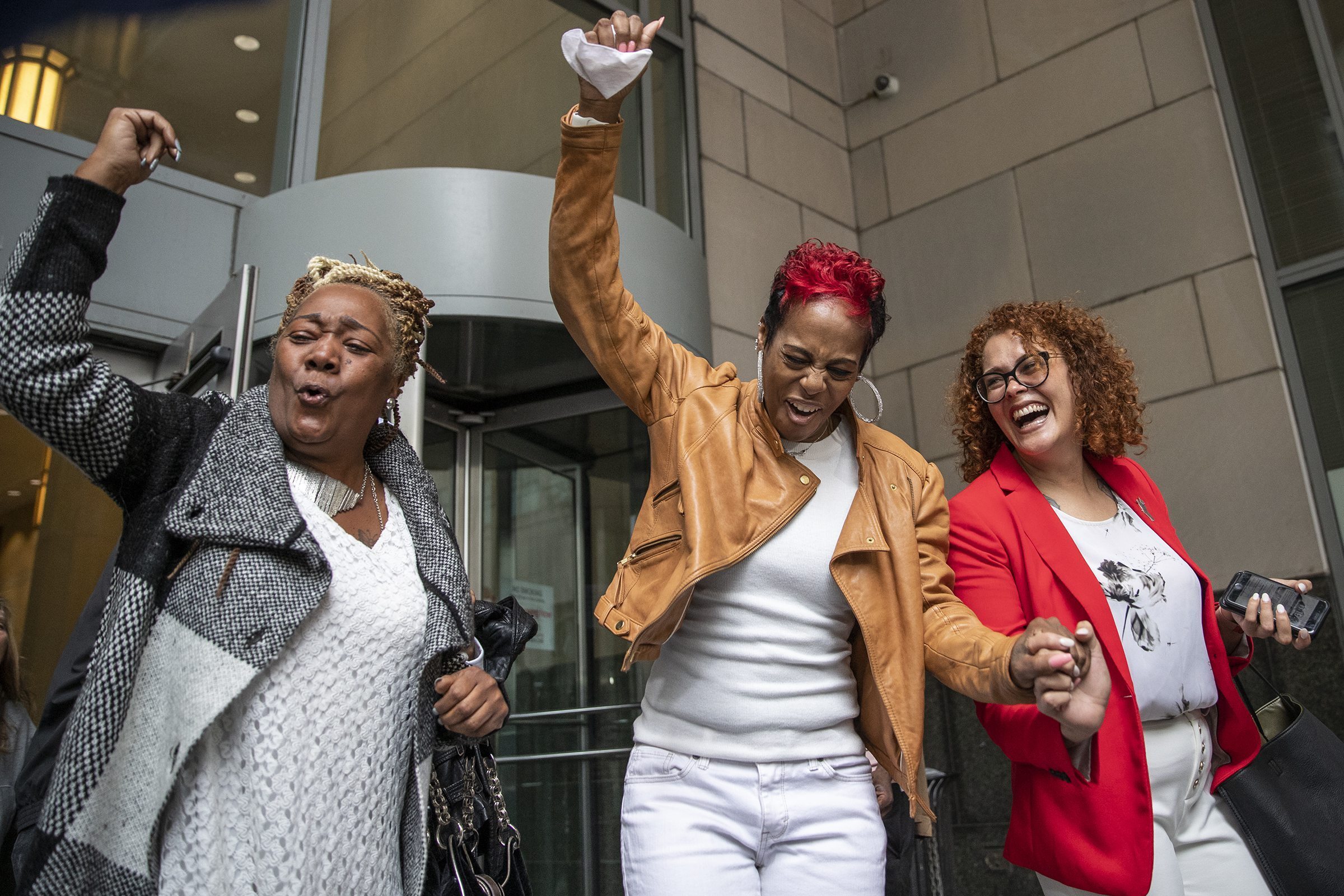
    Celeste Trusty, of FAMM, is at right in this 2019 file photo. She is celebrating with Ketra Veasy (center), sister of Willie Veasy, who had been imprisoned for 27 years for murder and was exonerated.HEATHER KHALIFA / Staff Photographer

    Owens, a former staffer at SEIU who was also a political aide to progressive ex-Councilmember Helen Gym, is now the education and advocacy director at the Pennsylvania Prison Society. He said in an interview that he has been considering running for Jones’ seat for about two years.

    He said he is a native of the district, and sees an opportunity for new voices on Council to advocate for stronger public education and more affordable housing.

    Owens, 46, said the revelations around Jones’ use of DROP made clear that it’s “time for the old guard to step down.”

    “When I see what he’s doing with this DROP money and people using politics as a tool to line their pockets and stifle progress, it’s upsetting,” Owens said. “It’s time for people that really have the lived experience and who are doing this for the right reasons to get these seats. That’s the only way the city is going to be better: if our leaders care about the people and not their own interest.”

    Staff researcher Ryan W. Briggs contributed to this article.
    Correction: A previous version of this article incorrectly listed a candidate considering running for the 4th District seat. The potential candidates are Curtis Jones Jr., Morgan Cephas, Ryan Spak, Celeste Trusty, and Leigh Owens.
  • A political scientist studied the rise of grassroots activism in local government. Philly was his case study.

    A political scientist studied the rise of grassroots activism in local government. Philly was his case study.

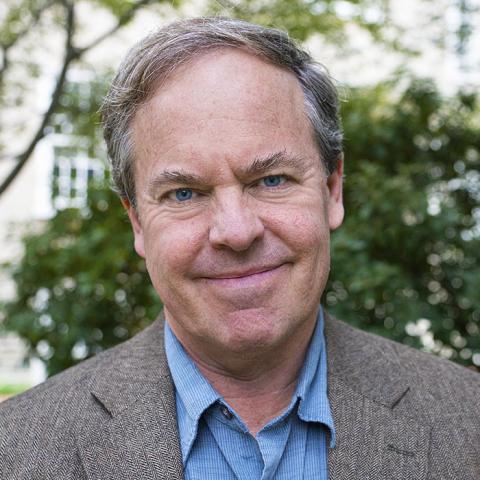
    In the five years he spent researching his book Mobilization Politics, Haverford College political scientist Stephen J. McGovern interviewed former Mayor Jim Kenney and other Philadelphia elected officials, political activists, campaign consultants, labor leaders, and protesters.

    The book, which covers events from the 2010s through Mayor Cherelle L. Parker’s victory in the 2023 election, uses Philly as a case study to examine the national rise of grassroots progressive politics over the last two decades. McGovern details how local activists employed bottom-up tactics to win major policy victories in areas like criminal justice reform, helping to decrease the jail population, and immigration, leading to Philly becoming a so-called sanctuary city.

    The activists often used an inside/outside strategy, McGovern wrote, of leaning on officials they helped elect, like District Attorney Larry Krasner, and publicly pressuring more moderate ones, like Kenney.

    Haverford College political scientist Stephen J. McGovern authored the 2025 book “Mobilization Politics,” on grassroots activism in Philadelphia.Sean Walsh

    McGovern also explores areas where progressives have fallen short of their goals, and the problems associated with a brand of politics driven by groups that tend to be more affluent and white than the city as a whole. Much of the new type of political organization has been driven by millennials born outside the city, McGovern found, leading to tensions over gentrification.

    McGovern recently spoke with The Inquirer about his 2025 book, the rise of the local progressive movement, and what it all means during Parker’s administration. The interview has been lightly edited and condensed for clarity.

    Your book describes how grassroots activists are really driving the agenda in Philadelphia City Hall, and, as you say, across the nation in local government. Is that an accurate summation of your thesis statement?

    I think that’s fair, and what I want to call attention to is how significant that change is. There may be a lot of people today who assume, “Well, hasn’t that always been the case in city politics?” But no, for much of the mid- to late 20th century, city politics operated in a very different way. It was much more of a top-down phenomenon, and the shift towards more bottom-up politics has been a relatively recent one. And increasingly it’s pretty widespread throughout the United States. So as a scholar of urban politics, I was interested in trying to explain how and why that happened.

    In the book, you describe various political science theories that have sought to explain urban politics in the past. Can you explain how your thesis is different from those previous schools of thought, such as “regime theory”?

    Many scholars have argued that downtown-led regimes wielded a great deal of power over urban policymaking. Regimes were led by business leaders and their allies — law firms, accounting firms, mass media relations firms, and interest groups that had an interest in promoting growth, especially pro-growth labor unions, and, of course, public officials. Basically from 1970 on, every Philadelphia mayor headed a downtown-led regime in a relatively top-down fashion, in terms of governing style. So that’s the backdrop. My book is all about how that pattern began to change around the turn of the century, and then picked up in the 2010s with a burst of social movement activity. Occupy Wall Street really started things off, but then it picked up, especially with Black Lives Matter, the immigrant rights movement, and all of that social movement protest had a catalytic effect on grassroots organizing in cities with respect to a whole host of public policy issues.

    As your book points out, much of the activism has been driven by millennial transplants who have moved into the city. Is it fair to say that trend is the main driver of this change, or one of several factors?

    That is one of the main factors in explaining why there is this big shift. But there are also some underlying changes in the local political environment, what social movement scholars sometimes call the “political opportunity structure.” One of those changes is a decline in the organizing capacity of the downtown business community, which had been so dominant. It started to create a vacuum. Into that vacuum steps young people. Populations had been steadily declining in virtually all big American cities. They started to stabilize around 2000, and you see an influx of young people who are relatively well educated, more likely to be professional, more likely to be progressive, more likely to get involved in local politics. Some people call it the “back to the cities” movement.

    What’s different about these newcomers compared with other left-leaning groups that have sought to impact city politics in the past?

    In the past, a lot of young people tended to get involved in protest politics. People on the left were very wary about engaging in electoral politics. The folks who are moving into Philadelphia after 2000 increasingly are participating in more conventional politics, including electoral politics, and that’s a big change. That escalates when Bernie Sanders runs for president in 2016. One of the lessons learned for lots of people who volunteered for him is: This is something we can do at the local level.

    As you note, the groups driving this style of politics tend to be more affluent, more educated, and more white than Philadelphia as a whole. That’s created a lot of friction. There’s a debate over whether this is a phenomenon that will be limited to gentrified areas, or whether it will grow into a cross-racial or cross-class coalition. Is it fair to say that’s the central question going forward?

    Absolutely. So much of this is turf-oriented. The millennials and Gen Zers moving into Philadelphia tended to congregate in neighborhoods that attract a lot of white, middle-class people who were relatively well educated, and so those became significant bases of progressive politics. The challenge then becomes organizing in other neighborhoods. Some of the grassroots groups made impressive inroads. I’m thinking about campaigns for Larry Krasner, in particular, in lower-income, predominantly Black and brown neighborhoods, where a group like Reclaim Philadelphia or the 215 People’s Alliance were pretty effective. But in many cases, it was fairly difficult for a group like Reclaim Philadelphia to venture into neighborhoods beyond their comfort zones, if you will. They were mindful of some of the skepticism that residents of those neighborhoods felt towards the millennials and Gen Zers flocking into the city and contributing to gentrification. Somebody from Reclaim Philadelphia might be knocking on the door talking about the affordable housing crisis, and people answering the door might look at them and say, “You’re actually a big part of the problem here.” This tension between so-called new Philadelphians and old Philadelphians became more pronounced, and navigating those tensions becomes a real challenge.

    Your book finishes with the 2023 mayor’s race, when Cherelle L. Parker defeated more progressive candidates and won the election with a “law and order” platform. So perhaps that was a surprising twist on your thesis at the end of your research.

    She’s obviously fascinating. She’s a shrewd operator. In the primary election, two progressives split the vote. And being the only prominent Black candidate worked to her advantage. But since she’s been elected, she’s been very skillful about maneuvering in ways that have brought back a return of the traditional kind of urban politics — a top-down governing coalition led by a somewhat resurgent business community and pro-growth unions, the building trades unions, and a somewhat resurgent establishment-oriented Democratic Party, all of which is led by Parker. This is very reminiscent of standard politics of the mid- to late 20th century. So in some ways, Philadelphia is a bit of an aberration in that it’s moved backwards, if you will, recently. But I still see lots of evidence that bottom-up grassroots activism remains a force, and will become much more impactful in the next four years.

    Mayor Cherelle L. Parker speaks at Vare-Washington Elementary School to highlight the historic education investments included in the 2026-27 state budget, in Philadelphia, July 14, 2026.Jessica Griffin / Staff Photographer
    For what it’s worth, Parker herself seems to be mindful that grassroots politics are still relevant. We reported last year that she ordered a bunch of copies of a book called Performative Outrage: How Manufactured Fury Undermines Local Government and Public Service, and was handing it out to people. So I think it’s safe to say she isn’t a fan of the trends you described. You alluded to Parker returning to a “regime theory” style of politics. What’s an example of that?

    The 76ers’ arena, for example. She was siding with the Sixers and other downtown-oriented interests that wanted to see the arena in Center City on East Market Street, and discounting the views of community groups, most prominently Chinatown. There’s a general mode of governance style associated with Parker that’s very uncomfortable with dealing with grassroots-oriented groups. That’s just not her style. She’s much more comfortable dealing with downtown business elites and people in the building trades unions. Her whole mindset is much more comfortable with the old ways of governing cities.

    Parker won in 2023, when Joe Biden was president. Progressives in Philly and elsewhere seem to do better when Trump is in office. This spring Democrats just elected Chris Rabb, a progressive firebrand, in a high-profile primary for a Philly congressional seat.

    Politics is cyclical. Donald Trump has had that effect of reinvigorating lots of activists. So there was a lull in progressive activism in the city for a while, but it’s on the rise again. But it takes time to regroup, especially on the activist side. Some groups last for a long time, but the norm is for groups to be quite ephemeral. New groups have to pop up, often involving activists who had been involved in the old groups. The transition costs are pretty steep. Somebody like Chris Rabb winning doesn’t surprise me at all. There will probably be more successes in the next two or three years. That said, progressive activists have lots of challenges. They’re in a holding pattern right now.

    Thanks for your time. That’s all I’ve got. Is there anything I didn’t touch on that you want to include?

    I’m an urban politics specialist. I wrote this book. I devoted five years of my life to it. But in the last year or two, I’ve been so fixated on what’s going on in national politics and Donald Trump and the threat that he and his administration pose to democracy. With that in mind, I just want to say that urban politics in general offers some hope for people who are increasingly demoralized. At the local government level, partisan polarization isn’t nearly as intense. We’ve got divisions between progressives and moderates, but that’s nothing like what we’re seeing in national politics. There’s real hope for city governments to address big problems and offer real solutions. There’s a path forward. One can make a case that right now, democracy in American cities is actually thriving.

  • Drexel wants to sell the Academy of Natural Sciences museum. A Council bill could restrict its redevelopment.

    Drexel wants to sell the Academy of Natural Sciences museum. A Council bill could restrict its redevelopment.

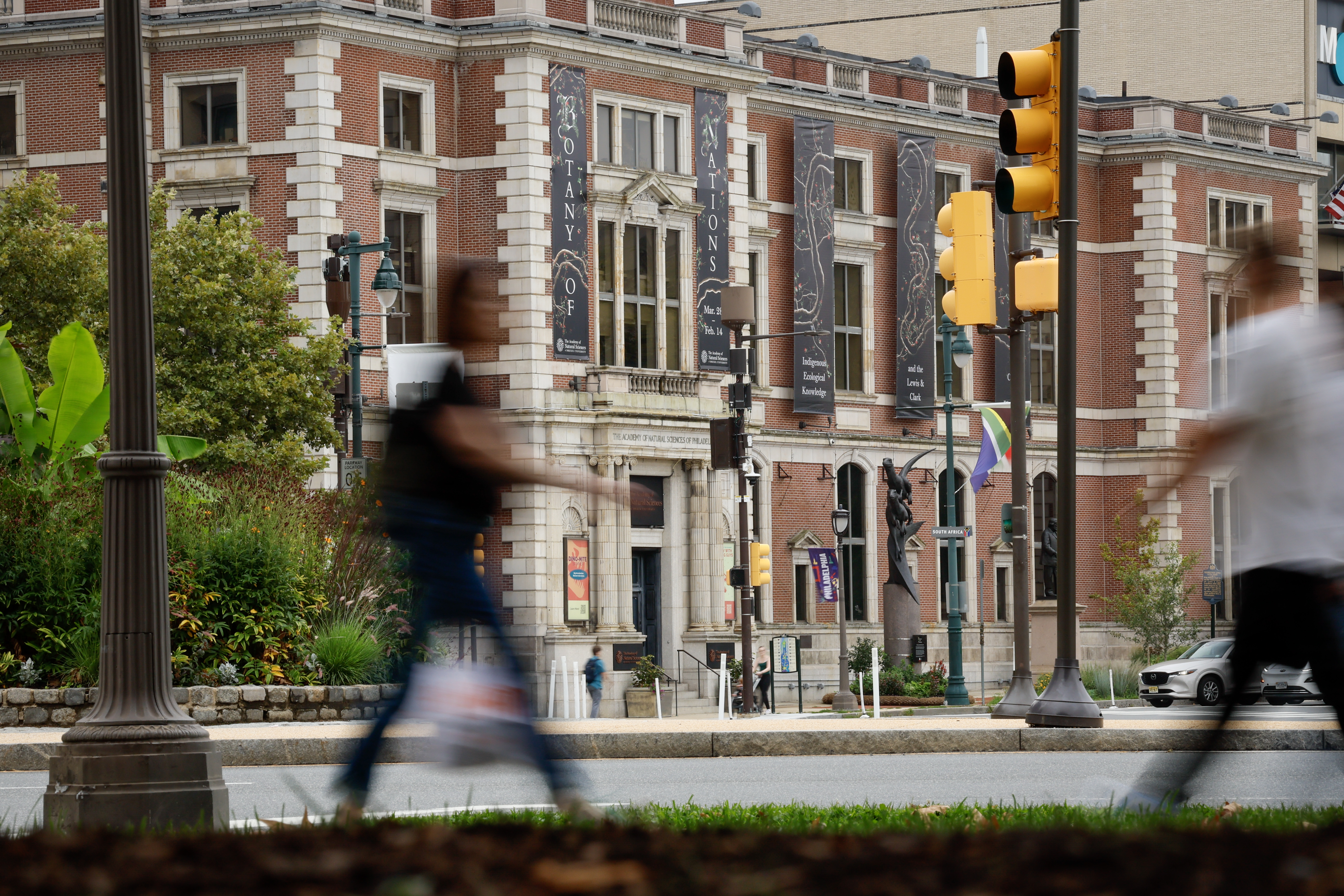
    A new zoning bill by City Councilmember Jeffery Young Jr. would restrict the redevelopment potential of the Academy of Natural Sciences museum after Drexel University this month announced plans to shutter the centuries-old institution.

    Young, whose 5th District includes the museum property on the Benjamin Franklin Parkway, introduced the ordinance at Thursday’s Council session.

    It would limit the allowed uses of the property and others around it to specific categories, including hospitals, government uses, libraries and cultural exhibits, and “community-supported” farms.

    Under Young’s legislation, residential and commercial uses would not be allowed. The property is currently zoned to allow multifamily residential development, unlike the other museums on the Parkway.

    Young said his legislation would simply change the museum’s zoning to reflect what has long been on the site.

    “It’s always been a cultural and civic use, so [my bill] would match the land use with the actual zoning to allow only cultural and civic type uses,” Young said. “But it wouldn’t prevent the academy from closing.”

    Councilmember Jeffery Young Jr. Elizabeth Robertson / Staff Photographer

    Drexel did not immediately offer comment on Young’s legislation.

    If the bill passes, it will make it much harder to convert the building to other uses. The owner would need to secure a variance from the Philadelphia Zoning Board of Adjustment, an often lengthy and costly process with no guarantee of success.

    During that process, any prospective developer would also be required to meet with community groups in advance of a zoning board hearing.

    Young said the purpose of his bill is to allow “the community some input on a site that has been a cultural use for centuries.”

    Instead of changing the property’s zoning to match those of neighboring museums and libraries, Young has proposed adding the restrictions to what is known as a zoning overlay — a kind of hyperlocal patch of the code — that covers his district and allows him to precisely describe what he wants to restrict and allow.

    Young said he is also considering changing the underlying zoning to match that of the Philadelphia Museum of Art, the Barnes Foundation, and other cultural institutions on the Parkway.

    “We are looking to do that, but the issue is that the planning commission doesn’t work for me and so they’re not on my time,” Young said. “Ultimately, we had to do what we could do from our office’s standpoint.”

    To become law, the bill would need to be approved first in the Committee on Rules and then by the full Council before heading to Mayor Cherelle L. Parker’s desk.

    If Young pushes forward, the bill is likely to pass in Council thanks to a practice known as councilmanic prerogative, in which the rest of Council defaults to the wishes of the member whose district includes a property when it comes to land-use decisions.

    Young, whose district includes parts of Center City and much of North Philadelphia, has abandoned zoning legislation that stirred controversy in the past, such as a housing ban around the former Hahnemann University Hospital campus.

    But the closure of the Academy of Natural Sciences is unpopular, and the new legislation is likely to have broad support from Council members.

    If enacted, the bill would take effect immediately.

    A surprise closure

    Founded in 1812, the Academy of Natural Sciences is the oldest institution of its kind in the nation, and its museum, which opened in 1828, is the country’s oldest natural history research museum. It houses 19 million biological specimens, including bones, carcasses, and plants.

    Drexel announced earlier this month that it was closing the museum effective Sept. 27, citing a decrease in attendance since the COVID-19 pandemic and the university’s financial woes. The decision caused an immediate uproar, including a protest on the Parkway attended by hundreds. Young vowed to “protect and preserve” the building.

    Matt LeBlanc, of Manayunk, and his wife, Alyssa, show their children, Miles and Clara, the Dinosaur Exhibit at the Academy of Natural Sciences of Drexel University earlier this month.Tyger Williams / Staff Photographer

    Leaders of Drexel and the academy have said that the “collections and their use to advance scientific knowledge will be the focus of our work for the near future” and that no final decision had been made on the building’s future.

    A source told The Inquirer the university’s ultimate aim is to relocate the collection and sell the building.

    After the announcement, Deputy Mayor Patricia Wellenbach, a top official in Parker’s administration, was named the academy’s temporary leader, serving as senior adviser while on loan from the city.

    Young and other members of Council have been attending rallies against the closure.

    “This academy has been there for over 200 years. It’s dedicated to civic and cultural education, to science,” Young said in a speech during Thursday’s meeting. “If we take that away, how will our kids learn?”

    Correction: An earlier version of the story inaccurately attributed plans to sell the museum building and relocate the academy’s collection.

  • Mayor Parker wants Council to back a tax break for redeveloping derelict buildings. Council says it’s waiting on her.

    Mayor Parker wants Council to back a tax break for redeveloping derelict buildings. Council says it’s waiting on her.

    Last November, Mayor Cherelle L. Parker announced with great fanfare that Philadelphia could create a property tax break to spur the conversion of derelict buildings, such as empty Center City office towers and vacant school facilities, into apartments.

    She had worked with legislators in Harrisburg to change state law to allow Philadelphia to pursue the legislation, which would create a 20-year property tax abatement for conversions of “deteriorated” properties.

    But 10 months later, no such legislation has been introduced in City Council, and Parker on Wednesday called on city lawmakers to consider her 20-year abatement idea for distressed properties.

    “We have an affordability crisis here in the city of Philadelphia,” Parker told reporters Wednesday. “What if we marry that challenge with these persistently vacant buildings that have gone underutilized, and we put them to their best and their highest use to incentivize affordable housing?”

    Parker’s administration, however, has not yet transmitted a draft of the bill to Council, which is typically the first step for lawmakers to consider legislation championed by the mayor.

    “Tell them, ‘Send the bill over,’” Council President Kenyatta Johnson told reporters Thursday. “We haven’t seen any piece of legislation regarding 20-year tax abatement at this particular point in time.”

    Asked about the delay, Tiffany W. Thurman, Parker’s chief of staff, said Thursday that city agencies “are collaborating to ensure the proposed legislation is legally sound and can withstand constitutional scrutiny.” She added that Parker “remains firmly committed to presenting City Council with a bill that incentivizes the development of affordable and workforce housing on vacant, publicly owned land.”

    On Thursday, several members of Council questioned the lack of specifics from the mayor’s office, and others were less than enthused about the idea of approving a new tax break when the Philadelphia School District is facing a funding crisis.

    “I continue to appreciate an effort to make sure that we have access to affordable housing in the city of Philadelphia,” Councilmember Nicolas O’Rourke said. “At the same time, I am very much so laser-focused and desirous of the city getting the revenue that it needs.”

    A controversial policy

    Property tax abatements have long been controversial in Philadelphia, with opponents contending that they starve the city and school district of needed revenue while favoring real estate developers.

    Philadelphia’s 10-year abatement program, which was established in the 1990s, previously exempted owners from paying real estate tax on all new construction or improvements on any type of property for 10 years.

    That program was long hailed as key to the city’s turnaround in the early 2000s. But concerns about its impact on neighborhood inequality and school funding grew over time, and Council in 2019 roughly halved the value of the tax break for new construction.

    Parker argues that the idea behind her legislation is different: She wants to see a far more narrowly targeted bill that would only help developers who seek to redevelop large, derelict buildings.

    “We’re talking about … persistently vacant school buildings that have been vacant from three up to 30 years,” Parker said Wednesday.

    The mayor also noted that the development environment has worsened dramatically since Council cut the 10-year tax abatement’s power, with soaring interest rates and construction material inflation as factors that weigh heavily on complex and large-scale projects.

    Still, many Council members are skeptical of tackling a potentially controversial measure that is seen to favor developers ahead of next year’s municipal elections, when all 17 city lawmakers will be on the ballot.

    “I’d like to get more information on exactly what the plan is because the tax abatements are, as you know, hugely unpopular,” said Councilmember Cindy Bass, who represents parts of North and Northwest Philadelphia.

    Bass said that while the abatement has spurred needed growth, she would need to see any expansion of it balanced with the needs of lower-income Philadelphians who are struggling with rising costs and property taxes.

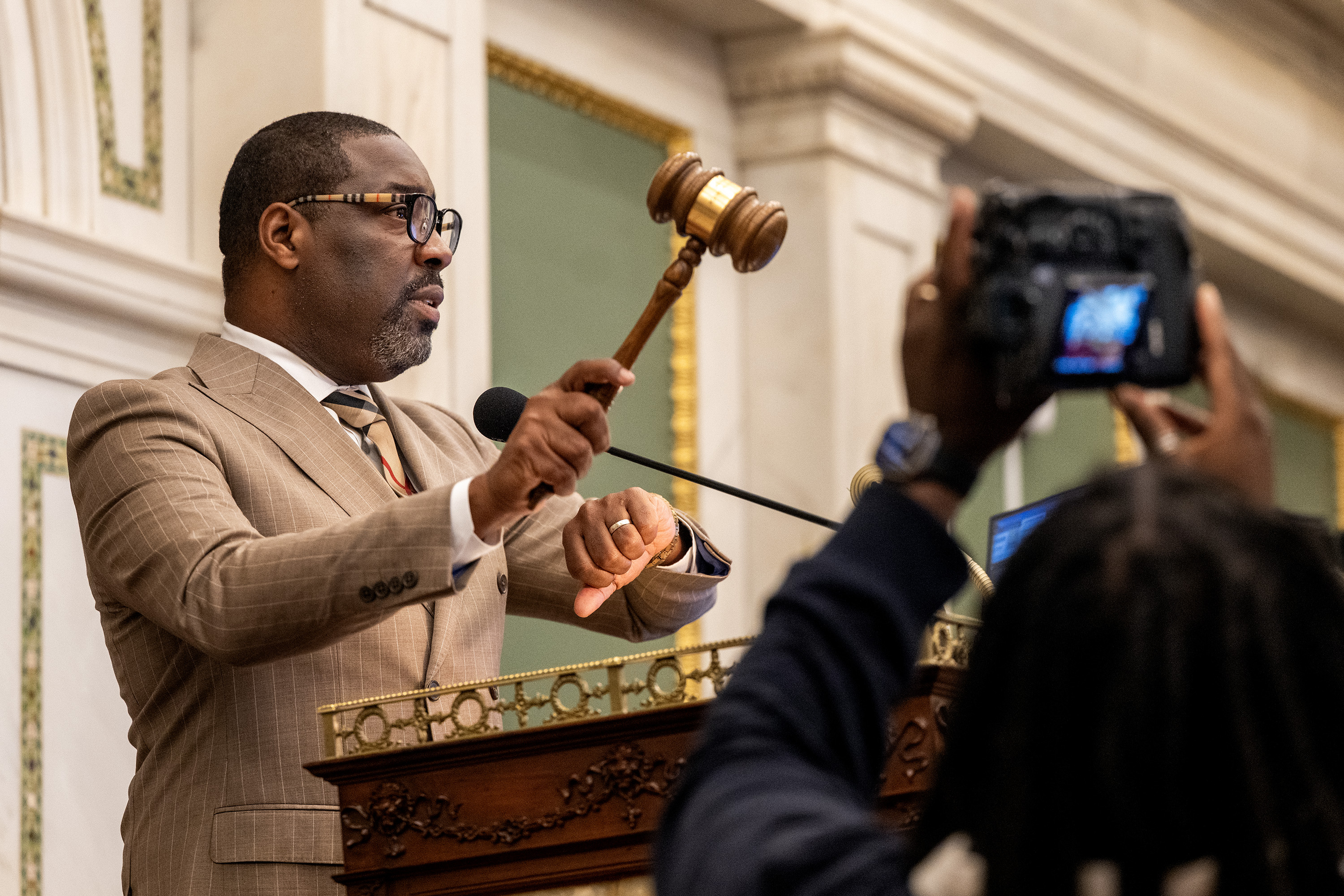
    President Kenyatta Johnson checks his watch and gavels City Council into session on Sept. 17, as the body returns for start of its fall session.Tom Gralish / Staff Photographer

    And Johnson on Thursday reiterated his comments from earlier this year that he would like to see the newly authorized 20-year abatement include a provision that requires an affordable housing component of the projects it enables.

    “Any type of legislation like that should really focus on making sure that we’re providing a level of affordability, also senior housing,” he said. “Obviously, the devil’s always in the details.”

    But it is not clear that state law would allow Philadelphia to mandate affordability in an abatement bill, and Parker cautioned against doing anything that would exceed the city’s authority.

    “We have to make sure that whatever we are proffering, that it is directly connected to what has been enabled,” Parker said. “It has to pass legal muster for no one to question the constitutionality of what it is that we’re doing.”

    Persistently vacant schools

    A 20-year abatement would apply to empty office buildings in Center City and long-vacant industrial buildings. But Parker and administration officials have focused their pitch on revitalizing empty public schools.

    “We need to pass it because it’s going to be extremely beneficial for challenging properties,” John Mondlak, chief of staff of the Philadelphia Department of Planning and Development, said Wednesday. “You think about schools in 10 years, 20 years — they are very difficult to reposition.”

    That pitch, however, runs up against another policy issue festering between Parker and Council.

    Councilmember Isaiah Thomas said some of the hesitation to take up the abatement legislation is due to Council’s dissatisfaction with the Philadelphia School District’s facilities plan, which the school board adopted last spring and calls for the closure of 17 school buildings and the renovation of 169 others.

    Thomas and other Council members vigorously protested the plan and are still pressing for the board to reconsider it.

    “That’s our priority,” Thomas said Thursday. “I don’t want to have a conversation about schools that are vacant until we have a conversation about schools that are occupied.”

  • A GOP backer of Mayor Parker resigned from three city boards as he weighs ‘civic engagement’ opportunities

    A GOP backer of Mayor Parker resigned from three city boards as he weighs ‘civic engagement’ opportunities

    Private equity investor Gregory L. Segall, a Philadelphia Republican who was a key backer of Mayor Cherelle L. Parker’s 2023 campaign, has resigned from three city boards as he weighs other “civic engagement” opportunities, according to a copy of one of his resignation letters obtained by The Inquirer.

    Parker, a Democrat, appointed Segall to the Philadelphia Gas Works board, the Philadelphia Tax Reform Commission, and the Mayor’s Business Roundtables. Segall resigned from all three effective Aug. 31. He also served as a vice chair of Parker’s transition committee when she was taking office.

    “While I am stepping away from this role, I remain committed to civic engagement and intend to explore other ways to continue the journey I have been privileged to pursue over the last several years,” Segall, the chairman and CEO of Versa Capital, wrote in his letter resigning from the Mayor’s Business Roundtables, an advisory group convened by Parker.

    Segall’s moves come as candidates are gearing up to run in next year’s municipal elections, when Parker and all 17 City Council members are up for reelection.

    Candidates in the primary election have until early spring to decide whether they are running.

    Claudia Vargas, a journalist who formerly worked for NBC10 and The Inquirer, reported this week that Segall was considering running for Council.

    When contacted by The Inquirer, Segall, who lives in Chestnut Hill, said Wednesday he is “not running” for Council.

    “People have suggested multiple forms of public service, including Council, and I have no plans or commitments at this time,” Segall, 63, said in an interview.

    Segall said he continues to “strongly support Mayor Parker, and my highest and best hope is that my public service will be in aid of her continued success.”

    Parker on Wednesday declined to comment on the report of Segall exploring a run for office.

    From 2022 through 2025, Segall and his wife donated $37,300 to Parker’s campaign, according to campaign finance records. He also gave $150,000 to a super PAC backing her 2023 run, and $6,200 to her transition committee, the records show.

    Segall introduced Parker last year when she gave a high-profile speech at the Union League, where he is a member.

    “The 2023 election took place at a time of crisis in the city, and getting the right leader was never more critical,” Segall said. “So the reason for my commitment to her was quite simple: Before I’m a Republican, I’m a Philadelphian.”

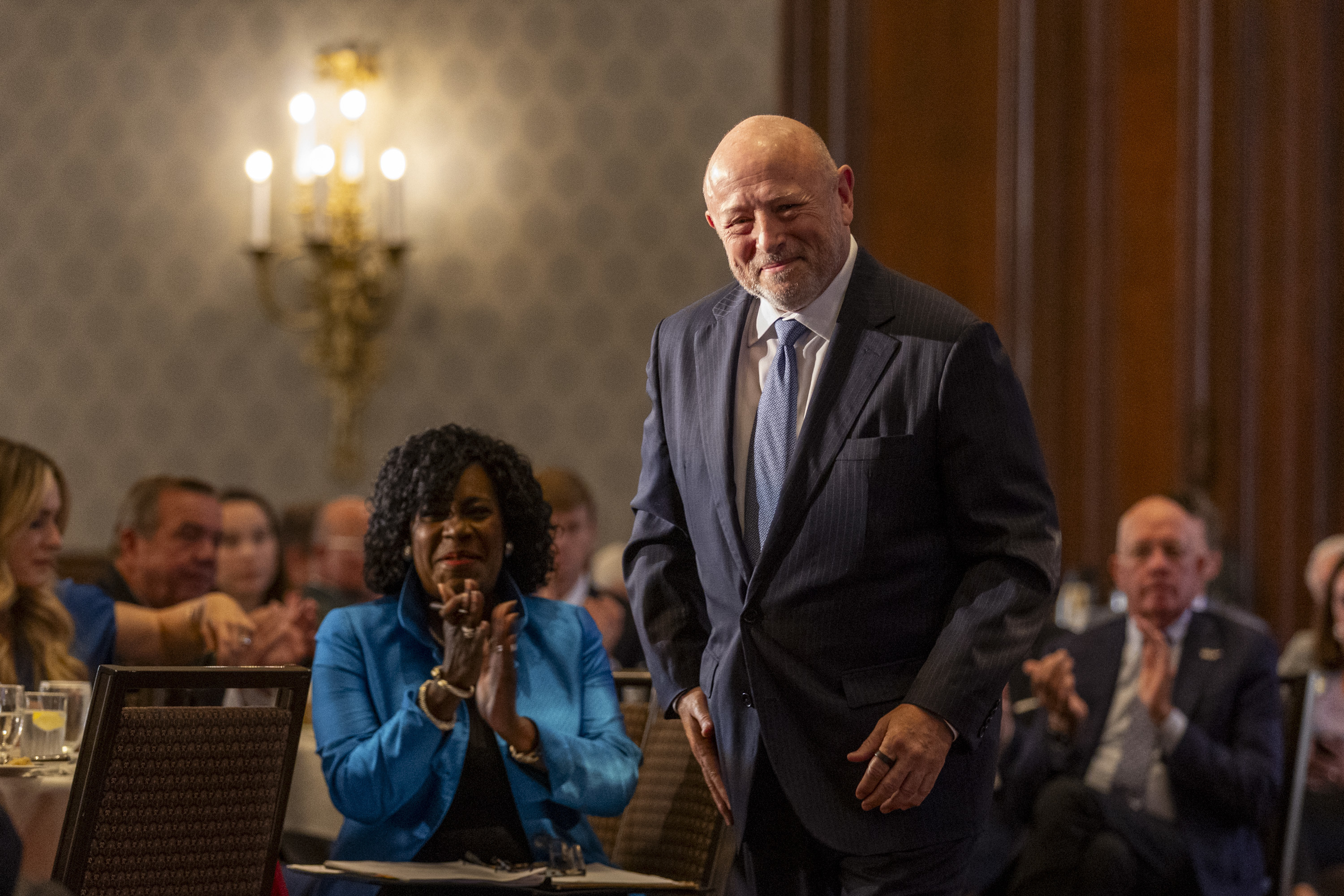
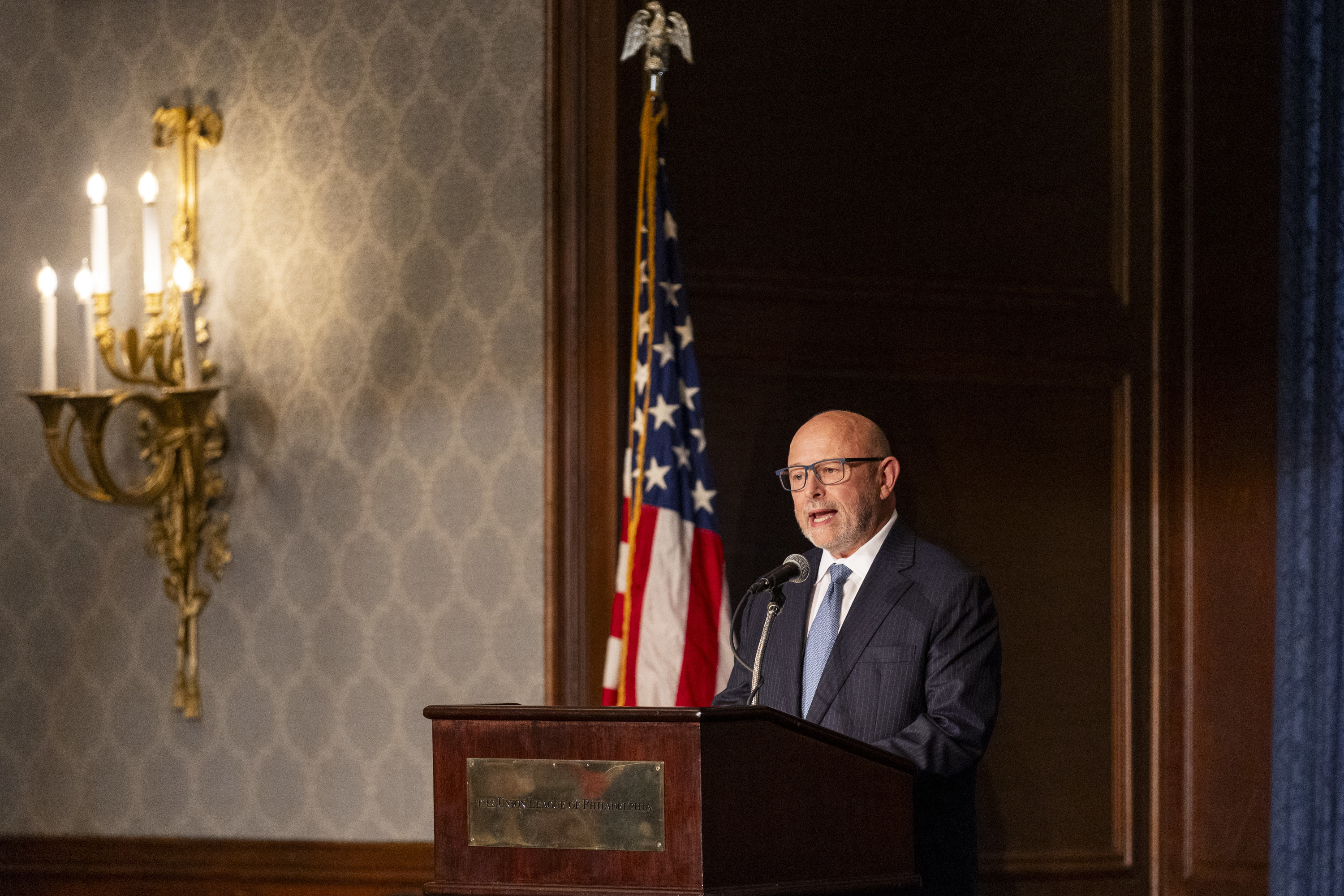
    Gregory Segall, Chairman and CEO of Versa and Supporter of Mayor Parker, speaks at the Union League of Philadelphia Presidential Luncheon in Philadelphia, Pa., on Thursday, September 18, 2025.Tyger Williams / Staff Photographer

    Citing Republican Party sources, Vargas reported that Segall was considering running for one of the two at-large seats on Council that are elected citywide and are set aside by the Home Rule Charter for minority-party or independent candidates.

    Republicans held those seats for about seven decades until Councilmembers Kendra Brooks and Nicolas O’Rourke won them over the last two election cycles as members of the progressive Working Families Party.

    Brooks is considering challenging Parker in next year’s mayoral election, sources previously told The Inquirer, which would require her to resign from her Council seat.

    The Philly GOP has been strategizing ways to recapture the seats, and a run by Segall, a wealthy businessman who could potentially help fund his own campaign, could be a major opportunity for the party.

    Segall donated $2,500 to the Republican City Committee last October.

    GOP chair Vince Fenerty said he has met Segall and thinks he is a “nice and honorable man.”

    “We’re a party that welcomes any potential candidate, and the decision to endorse would be up to our ward leaders,” Fenerty said in an interview Thursday.

    Brian O’Neill, who represents the 10th District in Northeast Philadelphia, is currently the only Republican on Council. Democrats hold the remaining 14 seats.

  • Philadelphia’s food-safety rules aren’t new. Why does it seem like restaurant inspections have intensified lately?

    Philadelphia’s food-safety rules aren’t new. Why does it seem like restaurant inspections have intensified lately?

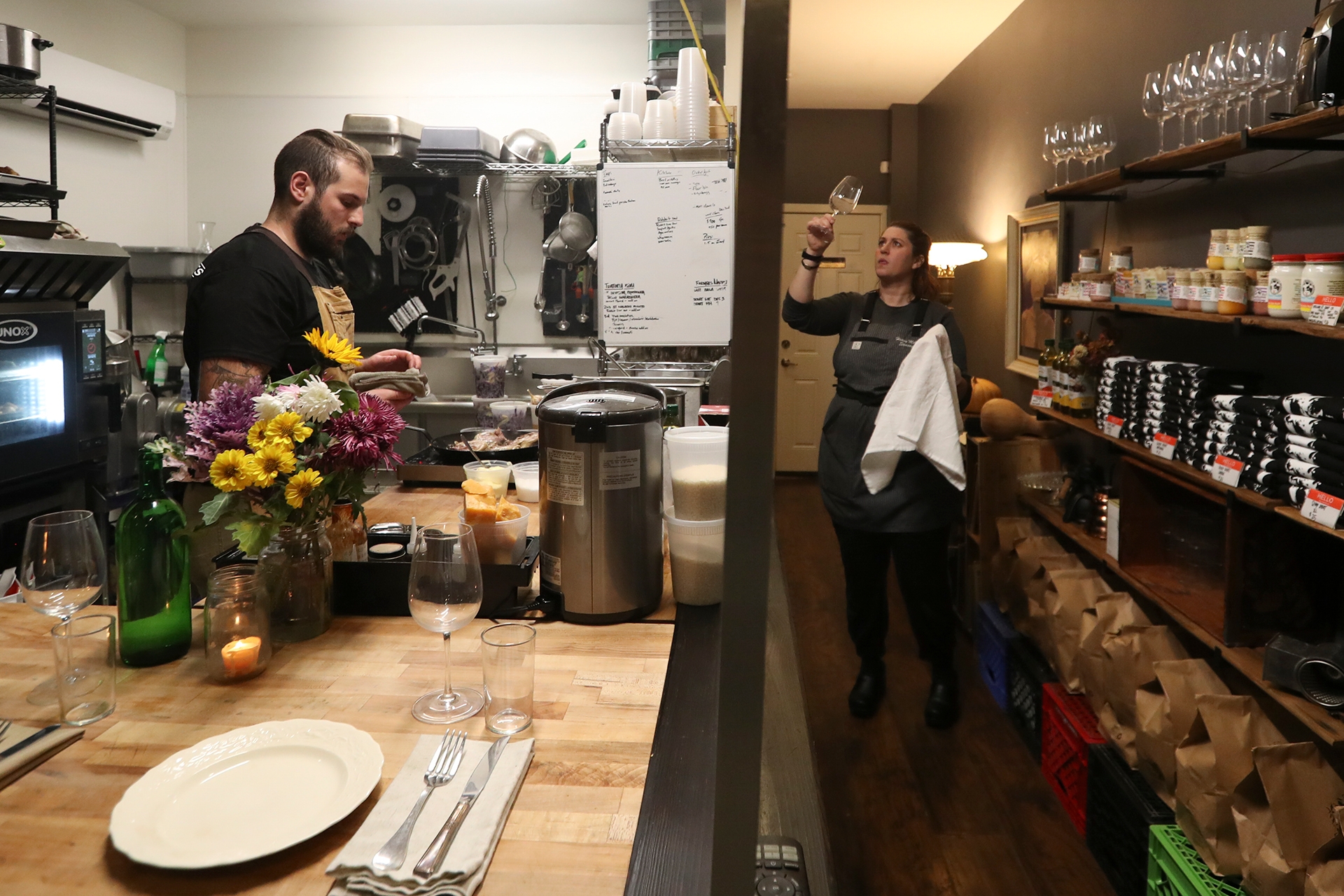
    For the last eight years, Fridays at Stargazy on East Passyunk Avenue meant fish and chips, a weekly tribute to chef-owner Sam Jacobson’s East London roots.

    That ended last month, when a city health inspection forced the English pie and mash shop to discontinue the special.

    Stargazy had been cited twice in 2024 for operating its electric double countertop fryer without proper mechanical ventilation. But on Aug. 14, the Philadelphia Department of Public Health went further, citing the fryers as “unapproved” equipment and requiring Jacobson to submit plans for review before they could be used again. Translation: He’d need to install ventilation for his fryer if he wanted to continue slinging fish and chips.

    The Friday fish and chips from Stargazy in 2021.Jenn Ladd / Staff

    For restaurant owners, the consequences of an inspection can extend beyond whatever corrective action the city requires. Reports of closures, cease-operations orders, or serious violations — especially at popular restaurants — spread on social media, where the conversation often turns to claims that enforcement is unfair or not uniformly applied.

    The health department disputes that contention, saying that there is no crackdown.

    It’s in the process of rolling out a new Food Safety Inspection Guide, but while the format of the guide has been streamlined, the department said the underlying rules have not changed.

    Inspections as a snapshot

    Last month at Heavy Metal Sausage Co. in South Philadelphia, a health inspector ordered owners Patrick Alfiero and Melissa Pellegrino to remove the shop’s eight indoor seats and stop preparing food in the basement. Inspectors determined that neither activity was consistent with the establishment’s plan review, approved in 2022.

    The order halted Heavy Metal’s prix-fixe trattoria dinners, which Pellegrino said accounted for more than half of the business’ revenue. The shop has remained open for daytime takeout.

    Heavy Metal had passed previous inspections, including one four months earlier, and its owners told The Inquirer the operation had not changed between the two visits.

    Heavy Metal Sausage Co. owners Patrick Alfiero and Melissa Pellegrino preparing for a dinner in 2022.Yong Kim / Staff Photographer

    Health officials interviewed this month said the differing outcomes illustrate a basic principle of the inspection system: Each inspection reflects only a snapshot of what an inspector observes.

    During the April inspection, the department said, the inspector did not observe indoor dining or food preparation in the basement. On Aug. 21, both were taking place and could be cited.

    More broadly, officials said, the absence of a citation during an earlier inspection should not be interpreted as approval of a practice.

    Stargazy had been previously cited

    At Stargazy, the record is different. The fryer had been cited before.

    Jacobson was in England when the sanitarian — as the inspectors are known — arrived at Stargazy on the afternoon of Friday, Aug. 14. It was the same sanitarian who had cited the fryer during two inspections in 2024.

    Owner Sam Jacobson cooking at Stargazy on Sept. 18, 2026. Aidan T. Gallo / Staff Photographer

    “I did look back at sales reports for the day of the April 5, 2024, inspection and we had a good fish day — so the fryer was definitely on and in plain sight,” Jacobson said.

    Jacobson acknowledges that the inspector told him in 2024 that the fryers were “not approved.” That point is noted on the reports. But Jacobson said he did not understand that to mean he had to stop using them.

    The Health Department gave a different account to The Inquirer this month. Officials said Jacobson was verbally instructed in 2024 not to use the fryers because they lacked mechanical ventilation.

    When the sanitarian found the same fryer still in use at its next inspection more than two years later, the department said, Jacobson was told to install mechanical ventilation, which would require a plan review — a lengthy process. This time, Jacobson removed the fryer in response. (Historically, the health department does not levy fines, preferring that businesses correct violations.)

    Jacobson said Stargazy had never undergone a plan review when he opened in 2015 after taking over an existing bakery. He said a city employee advised him at the time to treat the opening as a change of ownership, and the restaurant passed its preopening inspection.

    “We never did any alterations or construction before opening,” Jacobson said. “I simply took over the lease of an existing bakery, gave it a lick of paint and some other cosmetic touches, and opened up.”

    Besides the fryer, he said the restaurant’s only substantive changes were moving the counter in 2019 to create more room in the dining room and installing a customer hand sink during the pandemic at the city’s direction.

    City says rules have not changed

    Health officials say the city’s underlying standards, based on the Philadelphia Food Code, have not changed recently. The department’s current inspection report guidelines date to 2019, while the code itself dates to 2008.

    Sanitarians have not received new instructions to interpret the code differently, the department said. The department said it has committed significant resources to uniformity training, intended to ensure that every inspector reviews the same conditions in the same way in all food businesses.

    Supervisors and managers also review inspection reports, and sanitarians are not supposed to exercise individual discretion in deciding whether a condition violates the food code.

    The new Food Safety Inspection Guide supports the department’s position that the underlying food-safety requirements are not new.

    Deputy Health Commissioner Dawn Kiesewetter said the guide has been under development for six or seven months with the Mayor’s Office of Policy Planning and Delivery, the Commerce Department, and business and community groups. It grew out of Mayor Cherelle L. Parker’s PHL Open for Business initiative, launched in April 2024 to simplify city permitting, licensing, and other requirements for businesses.

    Food businesses were an early focus. When Open for Business was announced, city officials said food businesses averaged nearly 24 government approval steps to open and operate. The administration subsequently developed multilingual food-safety materials and other guidance for operators.

    The Health Department said the inspection guide is still undergoing final review before being posted to the city’s website and formally announced, although copies have already circulated among industry and community partners.

    The city aims to inspect every food establishment once a year but does not always meet that target, the department acknowledged. About 60 Health Department employees are authorized to inspect Philadelphia’s 10,427 food establishments, according to the department. Reinspections follow violations, while complaint inspections and investigations of possible foodborne illness take place as needed.

    Staffing and complaint volume have remained relatively steady in recent years, officials said, while the number of food businesses remains below its pre-pandemic level.

    When a repeat problem is ‘new’

    Stargazy’s fryer was cited as a “new violation” in 2026, two years after its first citation. The department’s terminology on inspection reports can sometimes label a recurring violation as new. Health officials said that designation is automatically applied when more than a year has passed since the earlier violation.

    Jacobson said it would not make financial sense for him to install the ventilation needed to resume frying. A permanent hood would require construction, he said, while a freestanding ventless system could cost more than $20,000.

    Stargazy owner Sam Jacobson adding blackberry and fig sauce to his wild mushroom burrata toast, a substitution for his fish fry.Aidan T. Gallo / Staff Photographer

    Since removing the fryer, he is considering longer hours and fish-and-chips pop-ups elsewhere to replace some of the lost sales. On Fridays, he has been offering specials that do not require a fryer, including wild mushroom burrata toast.

    The city says one purpose of the new guide is to reduce the likelihood of surprises during an inspection.

    “The more they understand what they need to do, the more likely they’ll pass,” the Health Department said in a statement. “Our number one goal is to ensure that food businesses can stay open safely.”

  • These 10 Philly blocks will be the first to get $100,000 upgrades through Mayor Parker’s housing initiative

    Mayor Cherelle L. Parker’s administration on Wednesday announced the first 10 residential blocks that will each receive $100,000 in beautification upgrades as part of the city’s Curbside Appeal program.

    The program is part of Parker’s Housing Opportunities Made Easy, or H.O.M.E., initiative, which seeks to build or preserve 30,000 units of housing in the city.

    “Every Philadelphian deserves to live on a block they can be proud of,” Parker said in a statement, adding that the program “gives neighbors the resources to come together, improve their surroundings, and strengthen the sense of community that makes our city special.”

    The first 10 blocks set to receive services under the program, including debris removal, tree trimming, lawn restoration, and sidewalk repairs, are:

    • 1300 block of South Ruby Street
    • 1700 block of St. Paul Street
    • 1800 block of Hart Lane
    • 2200 block of South Sixth Street
    • 2500 block of North Marston Street
    • 3000 block of Titan Street 
    • 3200 block of North Howard Street
    • 5000 block of Newhall Street
    • First block of Hobart Street
    • First block of Wiota Street

    In May and June, residents were encouraged to nominate blocks for the program through their Neighborhood Advisory Committees or Neighborhood Community Action Centers, the so-called mini-City Halls Parker has established throughout the city to make services more accessible.

    The next round of nominations for the program will take place in the spring.

    “By partnering directly with neighbors, we’re helping transform blocks in ways that reflect the priorities of the people who live there while building stronger, more connected communities,” Jessie Lawrence, the city’s director of planning and development, said in a statement.

    Council approved the H.O.M.E. initiative, which is funded primarily through $800 million in city bonds, in June 2025. Lawmakers then clashed with the administration last fall over income thresholds for some of the housing programs it funds, with Council successfully pushing through changes that prioritize poorer residents.

    The city issued the first $400 million in H.O.M.E. bonds earlier this year, and is scheduled to issue the next tranche in 2027.

  • Philly City Councilmember Kendra Brooks is considering running for mayor, sources say

    Philly City Councilmember Kendra Brooks is considering running for mayor, sources say

    Kendra Brooks, a progressive who made history as the first third-party candidate to win a seat on Philadelphia City Council in 100 years, is considering challenging Mayor Cherelle L. Parker in the spring Democratic primary election, according to two sources familiar with her thinking.

    The sources, who were not authorized to speak about the matter publicly and did so on the condition of anonymity, said Brooks is mulling a campaign but has not yet made a decision. She declined to comment Friday.

    To run in the Democratic mayoral primary, Brooks would have to resign from her seat on Council. Under state law, she could remain a member of the Working Families Party or switch her party registration to Democrat..

    A bid for the mayor’s office would pit Brooks, the de facto leader of the city’s Working Families Party and democratic socialist faction, against Parker, a centrist who has long been aligned with the city’s Democratic Party establishment.

    Brooks, a longtime organizer from North Philadelphia and the minority leader on Council, got her start in politics as a public education advocate and has served on Council since 2020. Her most high-profile legislation this year was a package of bills that placed new restrictions on federal immigration enforcement in the city, and drew legal challenges from the Trump administration.

    She has been critical of Parker, especially with regard to the mayor’s strategy of largely sidestepping criticism of President Donald Trump’s administration. Brooks has said that officials who do not outwardly oppose the president’s mass deportation campaign are engaging in “complicity disguised as strategic silence,” and she accused the mayor of “caving” to Trump when the administration last year quietly abandoned race- and gender-conscious contracting goals.

    “People want to see leaders fighting for something,” Brooks said at the time, “and right now we don’t see our city fighting for anything.”

    Aren Platt, the executive director of the mayor’s political campaign arm, declined to comment.

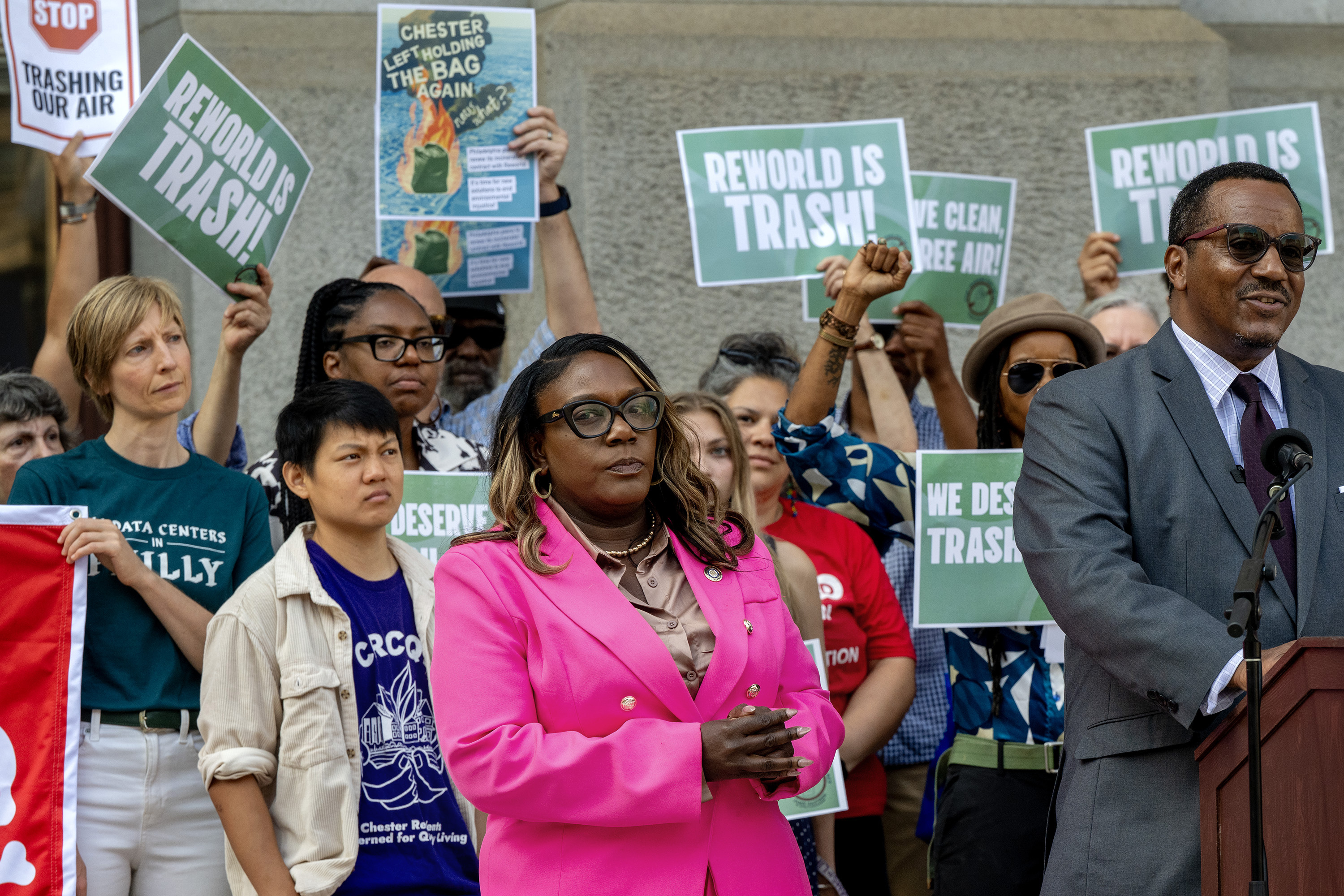
    City Councilmember Kendra Brooks joins Chester Mayor Stefan Roots (right) and protesters at a rally outside City Hall Sept. 17, 2026.Tom Gralish / Staff Photographer

    Brooks’ supporters see the mayor as potentially vulnerable as progressives have ascended nationally and notched wins over more traditional Democrats. That includes Mayor Zohran Mamdani’s victory last year in New York City and Abdul El-Sayed’s win in the Michigan Democratic primary for U.S. Senate.

    Closer to home, the left is emboldened by State Rep. Chris Rabb, who was backed by Brooks’ coalition and in May won the Democratic primary for a seat in Congress representing about half of Philadelphia. He toppled two centrist Democrats who were each supported by party leaders, big donors, and politically powerful labor unions.

    Despite the energy on the left, no progressive has officially launched a run for mayor ahead of the May primary election. Shania Bennett, the mayor’s former director of youth engagement, who has never run for office before, said this month that she will challenge Parker. Bennett said recently that she had not yet hired a campaign team or developed a policy platform.

    Any challenger to Parker faces significant hurdles. No Philadelphia mayor has lost reelection in modern history, and Parker would be backed by the city’s Democratic Party, which can now spend unlimited amounts of money in coordination with its chosen candidates under a new board of ethics policy.

    Parker will also be supported by the deep-pocketed building trades unions that boosted her in the crowded open mayoral primary in 2023.

    “We’re going to put all the resources, both financial resources and people resources, to bear to make sure that Mayor Parker has a second term,” said Ryan Boyer, the head of the Philadelphia Building and Construction Trades Council. “I want to be clear and vociferous that the Philadelphia Building Trades … are fully and completely behind Cherelle Parker.”

    In this March 2025 file photo, City Councilmember Kendra Brooks, left, listens to Mayor Cherelle L. Parker deliver her annual budget address.Alejandro A. Alvarez / Staff Photographer

    Parker is likely to see support from a super PAC bankrolled by city developers, and she also has her own massive war chest. Her campaign had $1.4 million in the bank as of May, according to the most recent campaign finance paperwork available. Brooks had $17,000 on hand as of her last report in January.

    But Brooks, who has won citywide election twice to represent the city as an at-large member of Council, could be a formidable opponent. She is one of the most prominent left-wing politicians in the city, and she is well-known in national progressive circles.

    The Working Families Party’s chapter in Pennsylvania recently commissioned a poll that showed Brooks as broadly popular with the city’s Democratic primary electorate but with much lower name recognition than Parker, according to polling documents obtained by The Inquirer.

    According to the survey of 900 respondents, 35% said they had a favorable view of Brooks, with just 4% saying they had an unfavorable view. Nearly 40% of respondents said they did not know who Brooks was.

    Nearly all of the respondents knew of Parker. Forty-eight percent said they had a favorable view of the mayor, and 40% said they had an unfavorable view. Those findings are similar to a June Suffolk University/Philadelphia Inquirer poll.

    Nick Gavio, a spokesperson for the Working Families Party, said in a statement that the organization often conducts polling on public opinion in the city and that the survey was “one test among a battery of others that we conducted in Philadelphia ahead of the 2027 elections.”

    “We are pleased that the Working Families Party and Minority Leader Brooks are so popular,” he said, “which we believe reflects our focus on the issues that matter to the working people of this city.”

    City Councilmember Kendra Brooks talks with Dominique Howell (right) in chambers as City Council returns for its fall session Thursday, Sept. 17, 2026. Howell is a long-time constituent and was there with the non-profit Liberty Resources, part of the Philadelphia Coalition for Affordable Communities.Tom Gralish / Staff Photographer

    Several other leftist politicians in the city have been rumored to be considering running for mayor against Parker, but none have said publicly that they intend to launch a campaign.

    One is District Attorney Larry Krasner, the third-term prosecutor who is one of the most prominent progressive district attorneys in the country. Krasner has been increasingly critical of Parker, and in June said that he would not rule out the possibility of running against her.

    But the district attorney has recently faced significant scrutiny related to his handling of a complex post-conviction case. Last week, U.S. District Judge Paul S. Diamond said that Krasner may have committed federal crimes and that he had referred the matter to the Department of Justice for investigation.

    Krasner has denied wrongdoing.

    Correction: A previous version of this article incorrectly stated the steps Brooks would have to take to run in the Democratic mayoral primary. She could remain a registered member of the Working Families Party or switch her party registration.
  • DA Larry Krasner faces an uncertain political future as Democrats weigh what could come next

    DA Larry Krasner faces an uncertain political future as Democrats weigh what could come next

    After a federal judge said last week that Philadelphia District Attorney Larry Krasner may have committed federal crimes, questions quickly emerged about the prosecutor’s political future.

    Krasner, an outspoken Democrat and one of the nation’s most well-known progressive prosecutors, has recently entertained entreaties to run for higher office, including a possible bid for Philadelphia mayor next year.

    But in the week since U.S. District Judge Paul S. Diamond said he had referred Krasner and a top supervisor to the Department of Justice for investigation, Krasner has largely stayed quiet, and few elected Democrats have publicly come to his defense.

    Behind the scenes, many insiders asked: Could this episode damage Krasner too much for him to mount a campaign for another office?

    In a statement Tuesday, Krasner said he had already told another progressive considering a bid for mayor that he would defer to her.

    “I’m a big believer in Councilmember Kendra Brooks,” Krasner said, referring to the City Council member who The Inquirer reported is considering a run for mayor. “Prior to these accusations, I told her that if she runs for mayor, I will not consider running.”

    And he framed the legal conclusions by Diamond — a federal jurist appointed by former Republican President George W. Bush — as merely “accusations,” citing others who have been targeted for investigation by the Department of Justice under President Donald Trump.

    He referenced the New York attorney general, a former FBI director, and a DOJ employee who was charged after throwing a sandwich at a federal agent and has since become a symbol of resistance to Trump’s administration.

    “Ask Letitia James, James Comey, the ‘sandwich man’ or the guy who took peeling paint from the reflecting pool what they have to say about accusations,” Krasner said. “Or ask dozens of innocent people whose exonerations this DA’s office supported what they say about accusations.”

    Krasner’s statement Tuesday was one of the first public comments he has made regarding the case since Diamond’s criminal referral, aside from a brief statement last week saying that he disagrees with Diamond’s conclusions and could not comment further because the matter is pending in court.

    The uncertainty around Krasner also has some city Democrats contemplating a dramatic outcome: Could criminal charges or judicial discipline sweep Krasner from office before the end of his term in 2030?

    And if that happened, who would replace him as the city’s chief law enforcement officer?

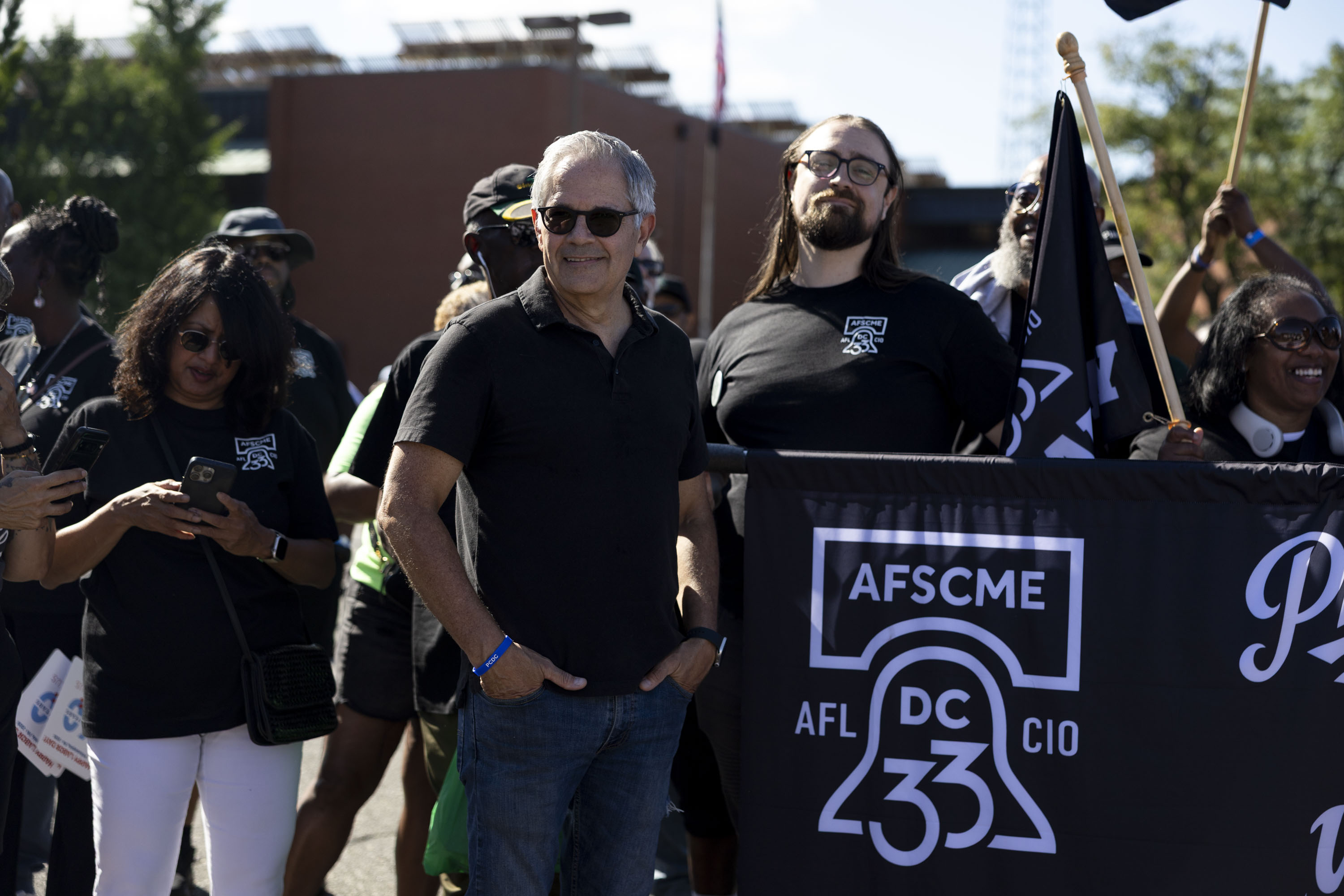
    District Attorney Larry Krasner standing with District Council 33, for the 39th Annual Tri-State Labor Day Parade on Sept. 7.Tyger Williams / Staff Photographer

    At least two elected Democrats have spoken to ward leaders about filling the district attorney’s role if Krasner were to be forced from office, according to sources familiar with the conversations who were not authorized to speak about them publicly.

    But some of Krasner’s allies say this is all much ado about nothing. They maintain that Diamond’s legal conclusions and the referral of the matter to the Department of Justice were politically motivated and that Krasner will weather it, as he has past tribulations.

    “They’re trying to do something that they’ve been trying to do for years, which is go after Krasner’s head,” said Sergio Cea, political director of the progressive group Reclaim Philadelphia, which has supported Krasner since his first run for office in 2017. “What they’re trying to do is roll back the gains that Philly voters pushed forward.”

    Silence from elected officials

    Krasner has always been something of a political outsider. He has never been endorsed by the city’s Democratic Party and has been critical of its leadership.

    Despite that, he maintained support among progressives and a significant contingent of Black elected officials last year when he prevailed over former Municipal Court Judge Patrick Dugan and skated to a third term in office.

    City Councilmember Nicolas O’Rourke, a member of the progressive Working Families Party and a longtime supporter of the district attorney, said in a statement Tuesday that he has confidence in Krasner’s ability to lead his office.

    “There’s no question,” he said. “DA Krasner can and should be doing the work that Philadelphians have tasked him with through their votes.”

    Aside from O’Rourke, most of the city’s top officials have declined requests for comment about Krasner’s recent legal jeopardy, including some of his ardent supporters.

    Some say that Krasner has not asked them to weigh in, and that they are hesitant to take a position on a complex legal issue. Others say they do not want to distract from a midterm election that is just six weeks away.

    Jack Inacker, a Democratic strategist based in Philadelphia, said he was not surprised that few elected Democrats have spoken on Krasner’s behalf.

    In recent months, Krasner called on former U.S. Rep. Bob Brady, the chair of the Democratic City Committee, to resign, and publicly confronted Ryan Boyer, the head of the politically powerful Philadelphia Building and Construction Trades Council, over campaign contributions.

    “You’ve got these major dustups all the time, it seems now,” Inacker said. “Krasner being so antagonistic to everyone doesn’t get him allies.”

    Inacker also said the courtroom allegations are “esoteric in nature,” making it challenging for elected officials to stake a position.

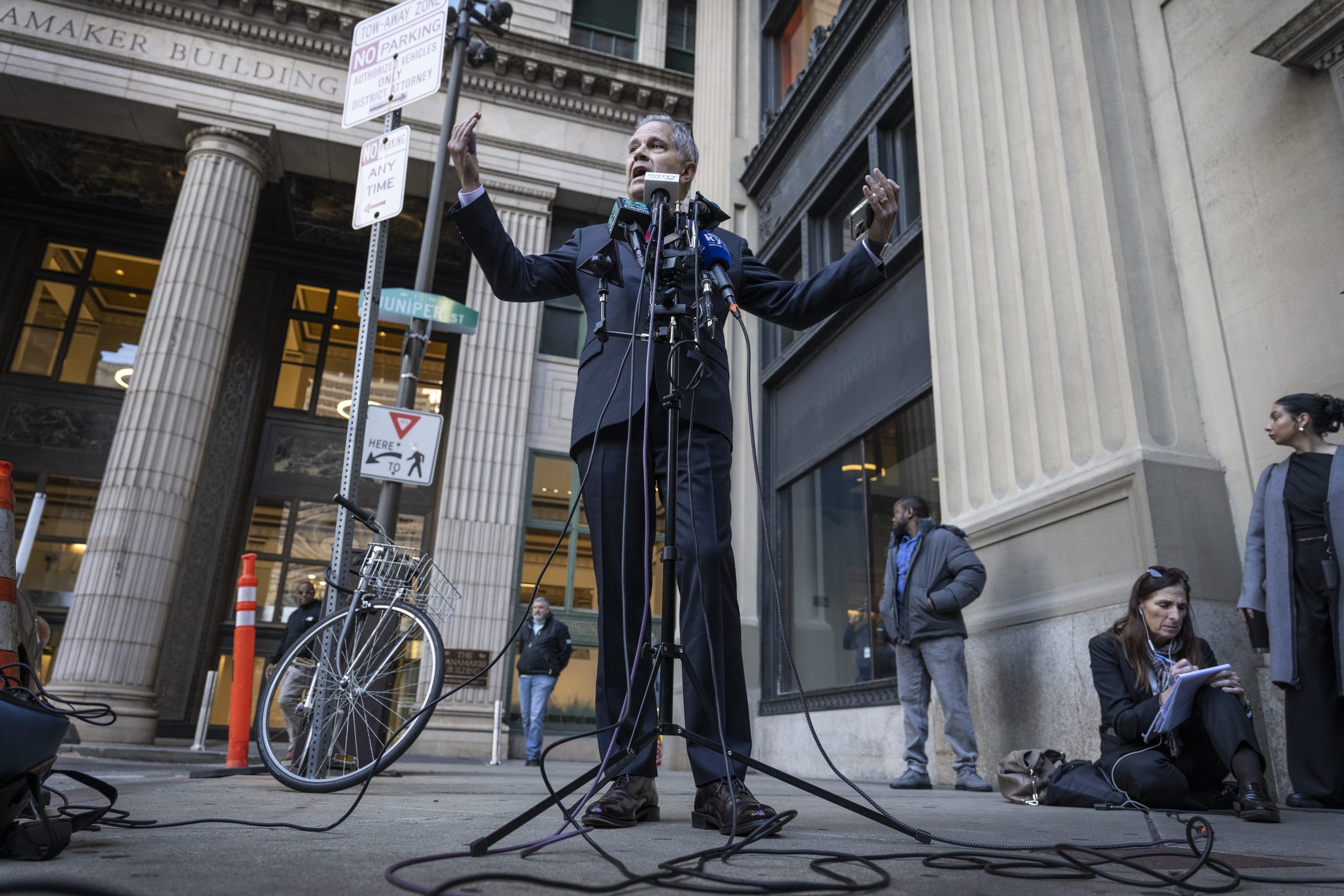
    Newly reelected District Attorney Larry Krasner speaks to reporters during a news conference outside the District Attorney’s Office on Nov. 5, 2025.

    The case before the federal judge centers on Dennis Johnson, who has sought for more than a decade to have his 2009 murder conviction overturned. In 2022, a former assistant district attorney working for Krasner filed paperwork to support Johnson’s bid.

    But four supervisors in Krasner’s office later testified that they found errors in that 2022 brief, and that Krasner was involved in conversations about attempting to mislead the court to cast the former prosecutor as rogue.

    Krasner has denied wrongdoing.

    Brian Hart, a Democrat who has been critical of Krasner and served as a media adviser to Dugan’s campaign, said this episode is more fraught for Krasner than his 2022 impeachment.

    “The allegations aren’t coming from just Republicans,” said Hart, a public relations strategist. “They’re coming from testimony within his own office.”

    The mayor’s race question

    Some activists on the left wing of the city’s Democratic Party have said they feel emboldened to mount a serious challenge against Parker, who will be up for reelection next year. They cite recent wins by progressives both in the city and nationally.

    And eight months out from the May primary election, several prospective candidates, including Brooks, are mulling whether to launch a campaign.

    After earlier this year casting doubt on speculation that he could run for mayor, Krasner seemed open to the possibility in June.

    When asked then whether he might consider a future campaign for mayor — or even U.S. Senate — Krasner responded: “Do I have a plan to run for these offices today? No. But … it would be foolish for me to completely rule out those possibilities.”

    Philadelphia District Attorney Larry Krasner, seen here with Mayor Cherelle Parker at a news conference at Dilworth Park on Dec. 16, 2024.Alejandro A. Alvarez / Staff Photographer

    Larry Ceisler, a public affairs executive based in Philadelphia, said a federal criminal investigation of Krasner could pose a logistical problem if it was conducted while he was running for mayor.

    But politically speaking, Ceisler said, it might not be an impediment. An investigation by the Department of Justice under Trump — an entity many Democrats distrust — could rally progressive support.

    “I think he would probably run with it as a badge of honor,” he said.

    Ceisler pointed to former Mayor John F. Street, who in 2003 was locked in a tight race for reelection when police found an FBI bug in his office. Street blamed Republican President George W. Bush’s administration, and he went on to win the election a few weeks later.

    “When these things happen, everybody puts on their respective jerseys, so the Krasner people are going to say, ‘It’s political,’” Ceisler said. “I think to the Krasner constituency, especially if he wants to run for mayor, or do something else, I don’t think this fazes them.”

    Weighing a post-Krasner future

    It is unclear where any potential criminal investigation or disciplinary probe of Krasner and his office might lead, and legal experts have said that a hypothetical investigation would likely take months.

    But some Philadelphia Democrats are already contemplating what would happen if Krasner cannot finish the term that he began this year and that ends in 2030, with some quietly discussing contingency plans to fill the office.

    Under state law, in the event of a vacancy, the city’s Common Pleas Court judges vote by secret ballot to appoint a new district attorney. The appointed interim district attorney would serve until the next general election. Those elections take place in even-numbered years.

    The last time the process played out was in 2017, when the Board of Judges selected former city prosecutor Kelley Hodge to lead the office as interim district attorney. She replaced former District Attorney Seth Williams, who resigned shortly before pleading guilty to federal corruption charges in a case also overseen by Diamond.

    During the three-week gap between when Williams resigned and Hodge was appointed, the district attorney’s office was led by Williams’ first assistant district attorney, Kathleen Martin.

    Krasner does not have a first assistant district attorney. Robert Listenbee, who formerly held the role, retired in January, and the legally required position remains unfilled.

    Staff writers Chris Palmer and Ellie Rushing contributed to this article.
  • Jefferson CEO will chair Philadelphia region’s chamber of commerce

    Jefferson CEO will chair Philadelphia region’s chamber of commerce

    The CEO of Jefferson Health and Thomas Jefferson University will be the local chamber of commerce’s next chair, and he’s focused on a feeling of safety in the city.

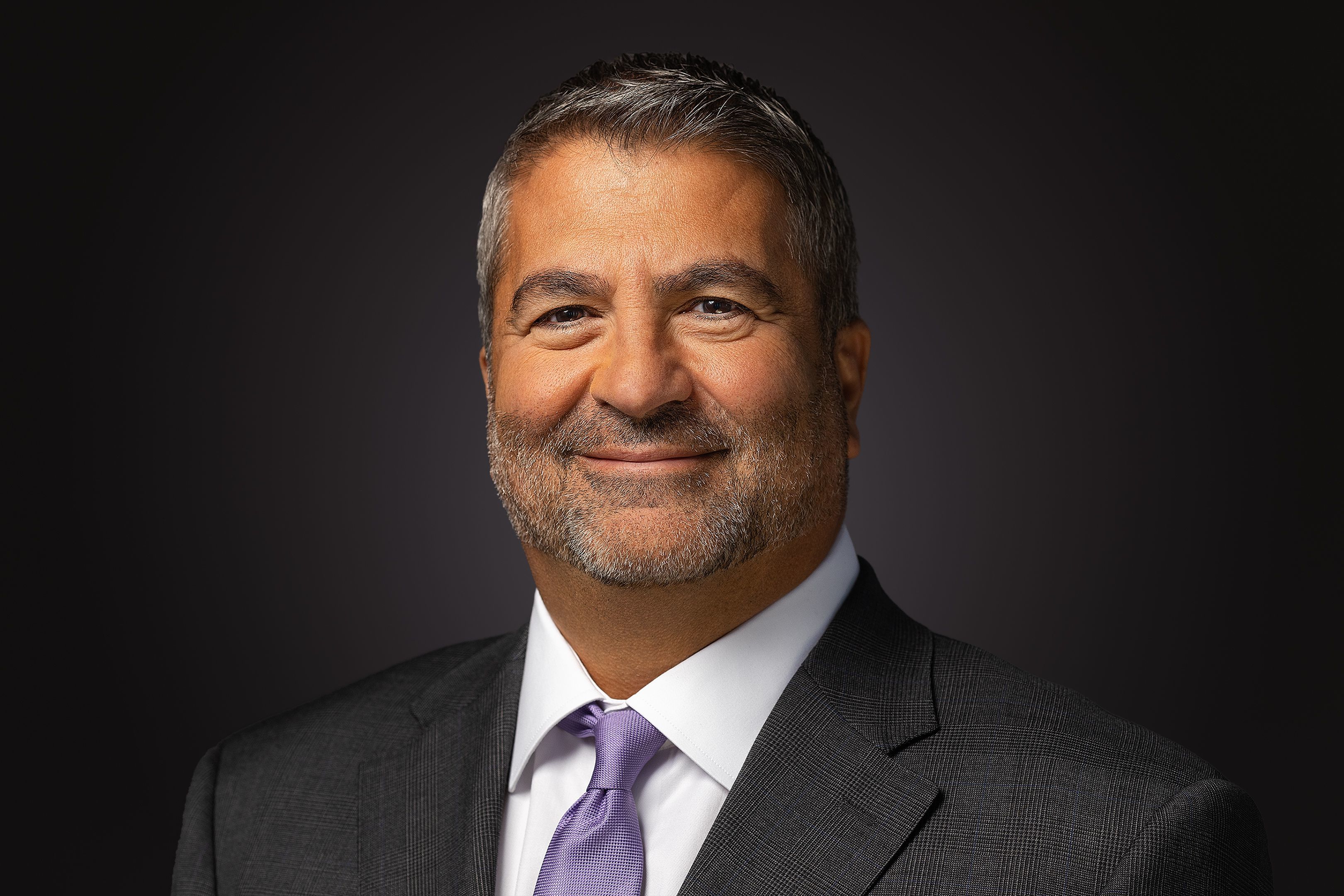
    Joseph G. Cacchione, Jefferson’s CEO since 2022, will chair the Chamber of Commerce for Greater Philadelphia’s board of directors beginning Oct. 15, the chamber announced Tuesday.

    The new role comes just a year after Cacchione said Jefferson could move its headquarters out of the city. But now he says that’s no longer on the table, crediting Mayor Cherelle L. Parker and the city’s police chief for making “great strides in improving safety.”

    “We’re here. We’re Jefferson. We’ve been in Center City for 200 years. We’re not moving,” he said in an interview Tuesday.

    Joseph G. Cacchione will begin his role as board chair at the chamber on Oct. 15.Thomas Jefferson University

    Cacchione says some of the region’s remaining challenges can be tackled through partnerships between business and government.

    “For me it’s about never standing back and watching but to actually roll your sleeves up and get in there and mix it up,” he said.

    Jefferson teamed up with the city police department and SEPTA transit police in one such partnership in June, launching a public safety hub in partnership in Market East.

    “East Market Street particularly has had challenges over the years,” he said Tuesday. “We saw an opportunity to have more visible police presence.”

    But recently, he said, the area has felt safer and more vibrant. He pointed to the pop-up businesses that opened along that corridor this year, as well as the pop-up plaza outside Reading Terminal Market.

    “We continue to need to work on that quality of life,” he said. “It’s not just East Market Street. It’s the entire city that we want to be safer.”

    More good jobs for the region

    Cacchione’s priorities also include supporting small and medium-sized businesses, continuing regional job growth, and improving access to healthcare.

    The chamber’s board of directors includes CEOs, presidents, and other leaders of area institutions such as CHOP, Aramark, Temple University, Comcast, Girl Scouts of Eastern Pennsylvania, and the Philadelphia Eagles.

    Its recent efforts include a new regional partnership to create good jobs in business software, biomedical engineering, and production, and specialized manufacturing, where business leaders see potential to grow. Jefferson Health and Thomas Jefferson University are early partners in the group.

    “We are at an inflection point for our region, and we have to make decisions to lean in so that we can continue to grow,” Chamber CEO Chellie Cameron said Tuesday. “I’m talking about attracting new businesses and growing existing businesses, creating jobs — not just any job, but opportunity jobs and pathways to those jobs.”

    Cacchione, as the leader of a very large employer in Center City, “gets it,” Cameron said, adding that he’s not just invested in the city, but the region as a whole.

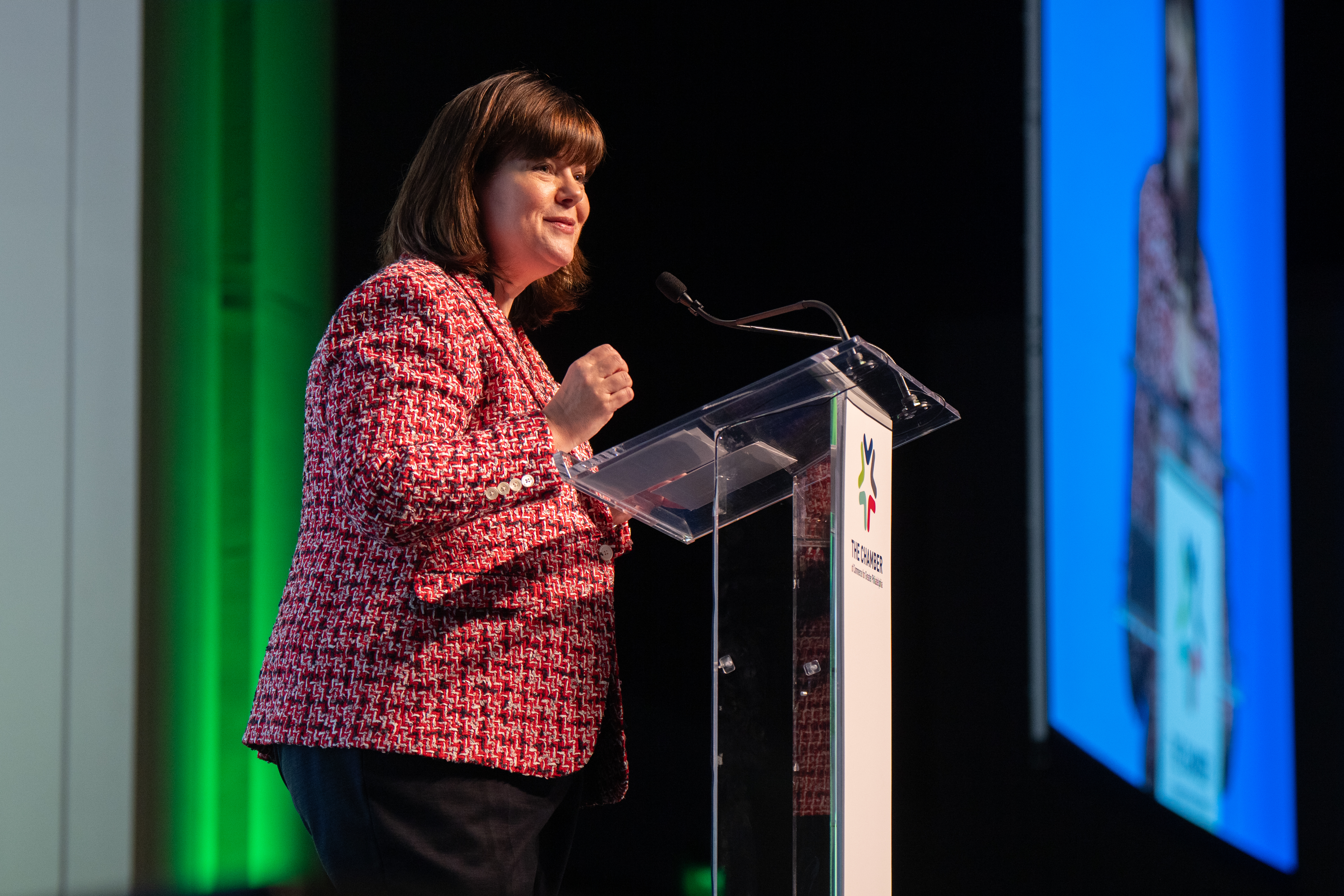
    Chellie Cameron, CEO of the Chamber of Commerce for Greater Philadelphia, at a chamber event in 2025.Jessica Griffin / Staff Photographer

    Cacchione added that AI will “change how we do business,” calling it an “enabler of business.” The chamber could help train workforces that don’t have experience with AI, he said.

    Jefferson employees have been adopting AI tools to improve efficiency. Nurses use it for note-taking, he said. By 2028, Jefferson aims to save over 10 million hours of clinician’s time by using AI — creating more time for “face-to-face” interaction with patients, Cacchione said.

    The hoped-for result, he said: “Our doctors are spending more time with patients and less time in front of a computer.”