Tag: Cherelle L. Parker

  • Officer killed, another injured in West Philly shooting; suspect ID’ed as water department employee

    Officer killed, another injured in West Philly shooting; suspect ID’ed as water department employee

    A Philadelphia police officer was killed and another was critically wounded after authorities said a man ambushed them with a shotgun early Saturday outside his West Philadelphia home. The suspect, who continued to shoot at responding officers before being arrested, is a city employee.

    Shane Seiber, a 40-year-old father of two, died from several gunshot wounds, and his colleague, a 33-year-old man with nine years on the force, is fighting for his life, Police Commissioner Kevin Bethel said.

    Bethel said Seiber, a 10-year veteran of the department, was struck three times and died at Penn Presbyterian Medical Center shortly after 9 a.m. His colleague, who was shot 12 times, remained hospitalized at Penn Presbyterian in stable condition but was “not out of the woods yet,” the commissioner said.
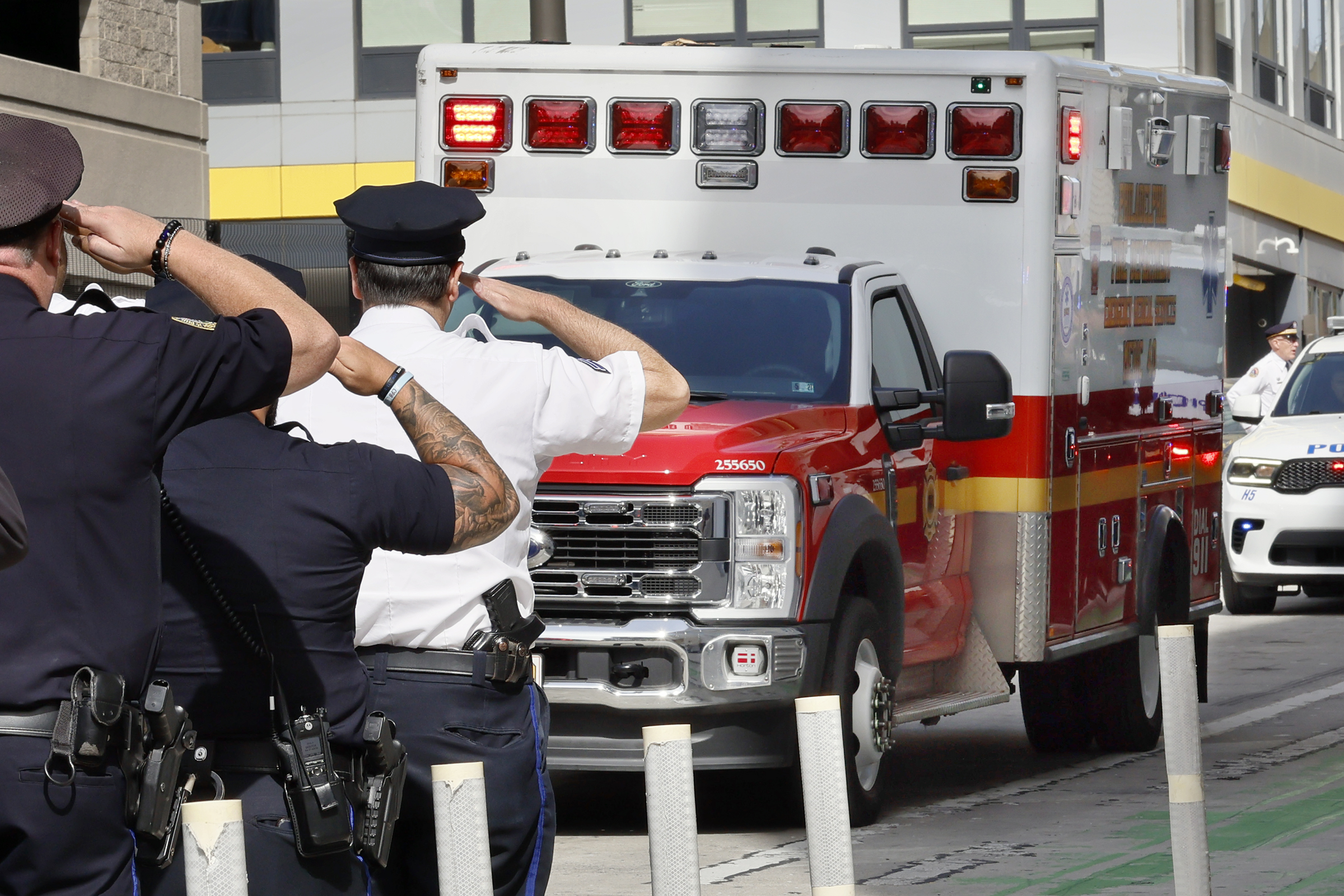
    Philadelphia police salute as the medic unit carrying the body of the slain police officer pulls up to the medical examiners office in Philadelphia on Saturday. Two police officers were shot overnight, and one died.Elizabeth Robertson / Staff Photographer

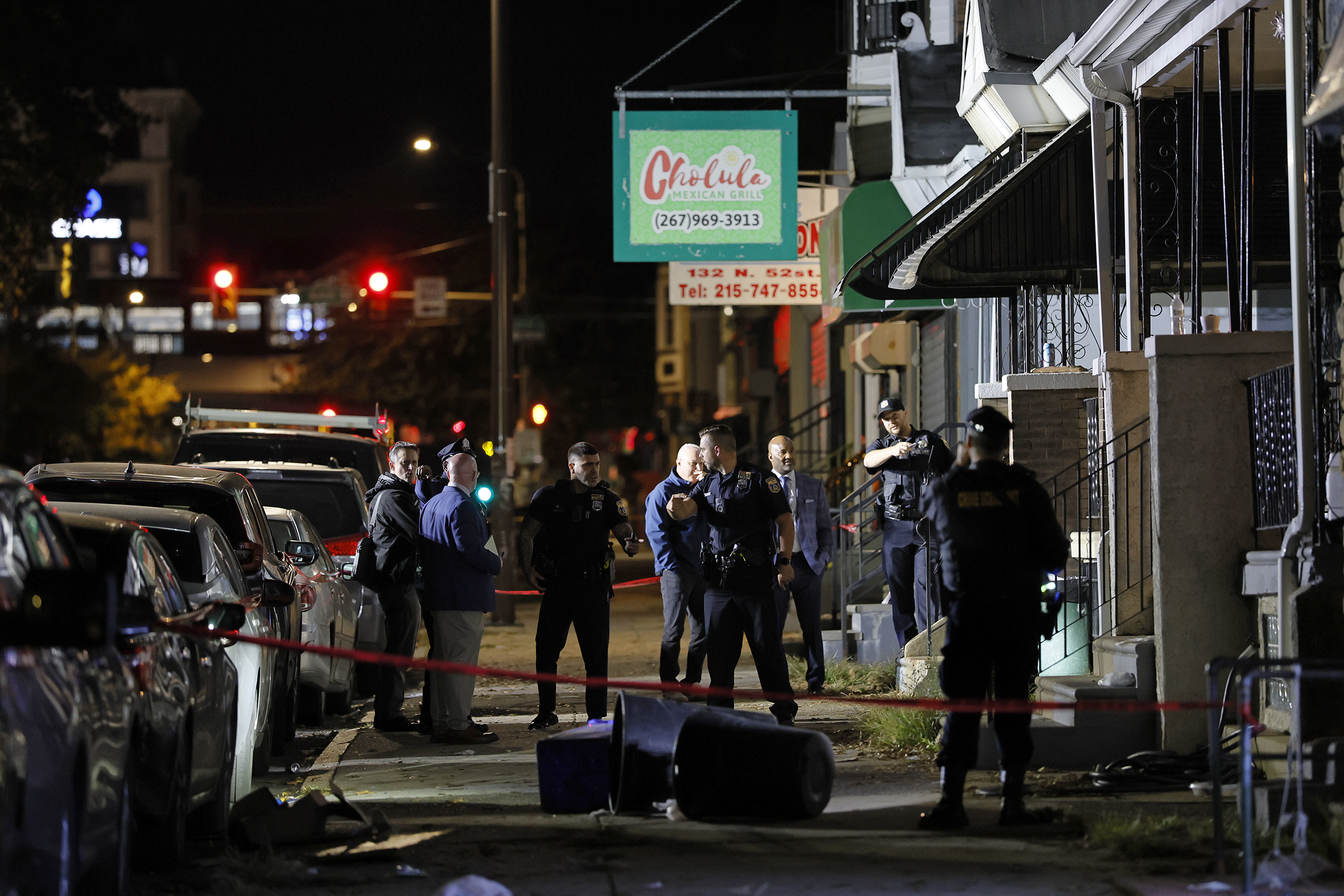
    The officers responded to the 100 block of North 52nd Street shortly after midnight Saturday following reports of a man with a gun on his porch. As the officers approached the house, a man later identified as Eric Lewis began shooting at them, striking each officer multiple times, Bethel said.

    In the moments after shooting the officers, the gunman took one of their weapons, Bethel said. And when additional officers rushed in, he fired at them, though no one else was struck, Bethel said.

    The SWAT team responded and secured the area, and the gunman was later located in a tree, armed with the shotgun, a handgun, and the stolen police Glock, Bethel said. He was taken into custody.

    Philadelphia District Attorney Larry Krasner said at a news conference Saturday afternoon that Lewis shot at nine other officers. Krasner called the shooting a “brutal, senseless, horrific killing.”

    Lewis faces charges of murder, attempted murder, disarming a law enforcement officer, and related crimes, Krasner said. He will appear in court for a preliminary arraignment in the coming days and will be held in jail without bail, the district attorney said. It was not immediately clear if Lewis had an attorney.
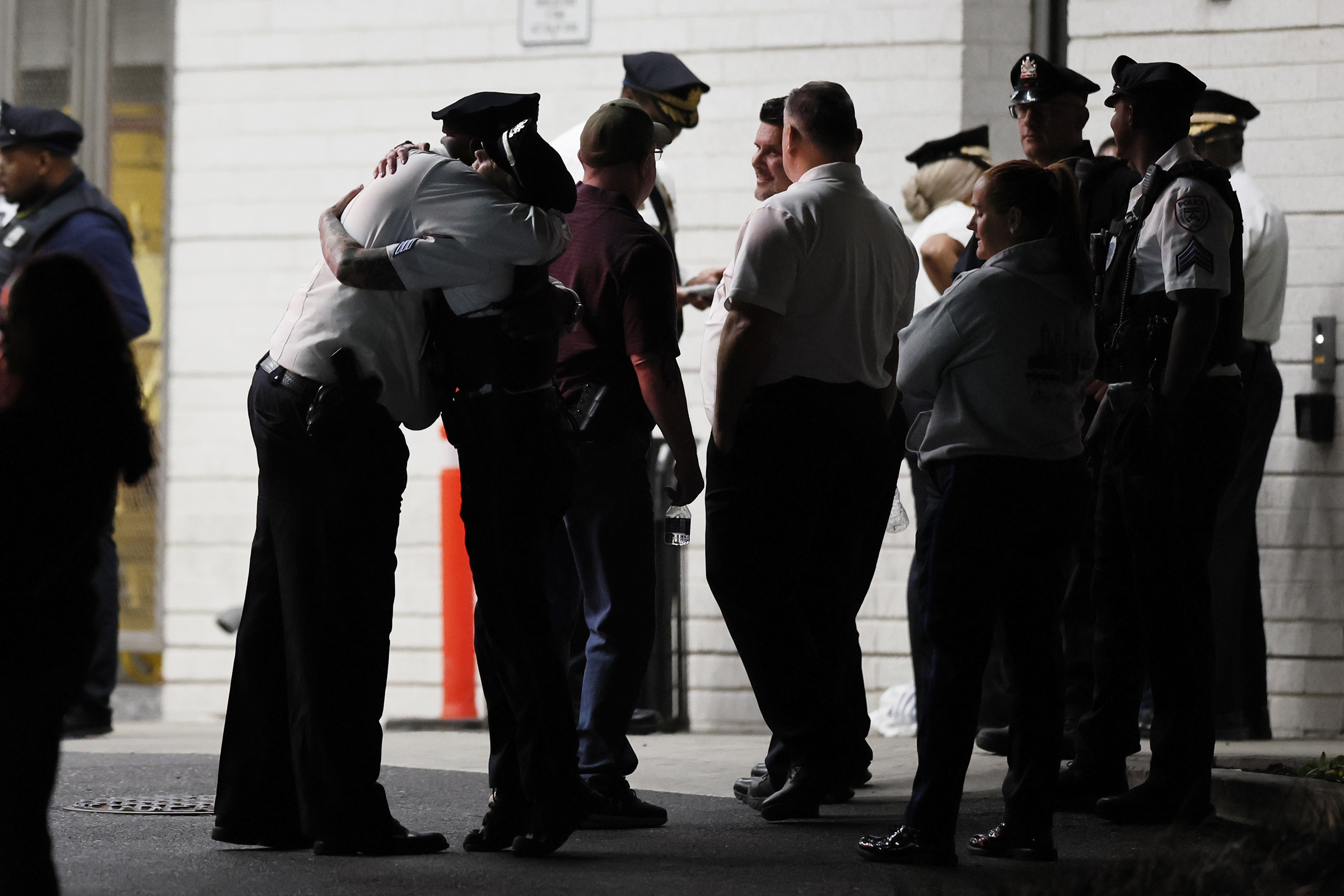
    Philadelphia police hug each other outside of Penn Presbyterian Medical Center in Philadelphia on Saturday. Two Philadelphia police officers were shot and seriously wounded overnight.Elizabeth Robertson / Staff Photographer

    A community in mourning

    Dozens of members of the police department and city leadership gathered outside Penn Presbyterian Medical Center on Saturday morning and into the afternoon, mourning and comforting one another under brisk, blue skies. Standing alongside Mayor Cherelle L. Parker, Bethel appeared shaken as he asked for the city’s prayers and announced the death of one of his officers.

    Seiber, he said, was a married father of a 7-year-old son and a 3-year-old daughter. His wife and other loved ones were at his side before he died.

    “He fought valiantly, but he lost his life today,” Bethel said.

    “I continue to ask the community to keep him and his family in their prayers,” he said. “This will be a period of mourning for us, but we will stand tall as a department. We can get through this together.”

    Gov. Josh Shapiro said on X he had ordered flags be lowered to half-staff in Seiber’s honor.

    “Our law enforcement officers are the very best of us,” he said. “They put their lives on the line every day … not knowing if they will return home. We owe them our deepest gratitude.”

    Parker said Seiber sacrificed his life to “protect and serve our city,” calling his decision to become a police officer “noble and courageous.”
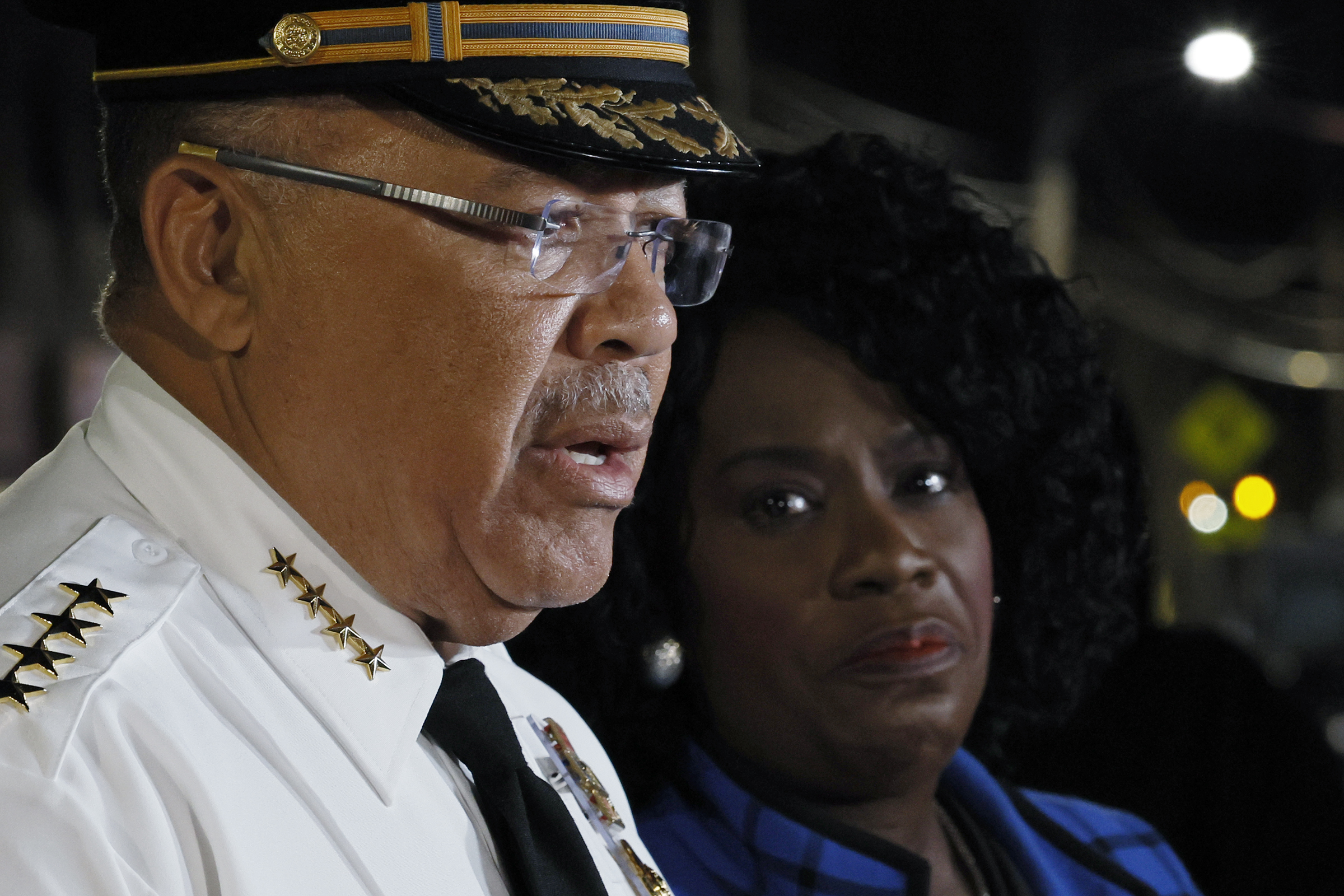
    Philadelphia Police Commissioner Kevin Bethel and Mayor Cherelle L. Parker speak during an emotional press conference in front of Penn Presbyterian Medical Center in Philadelphia on Saturday. Two Philadelphia police officers were shot and seriously wounded overnight.Elizabeth Robertson / Staff Photographer

    “A wife is now without her husband [and] two babies are without their father,” she said. “Family, friends, and colleagues … are feeling a deep-rooted sense of loss that words are … inadequate to explain.”

    The mayor vowed to work to prevent such a tragedy from happening again, saying her administration will seek to expand “involuntary commitment laws” to cover severe mental health crises and substance use disorders that could “interfere with Philadelphia’s ability to keep itself safe.”

    It was not immediately clear if the alleged shooter had exhibited signs of mental illness or substance use, and Krasner declined to answer when asked about that.

    Lewis has a criminal history dating back more than a decade, court records show. Krasner said he had no felony convictions that would have prevented him from owning a firearm.

    In 2012, he was charged with theft and receiving stolen property. He was later convicted and sentenced to two years’ probation. Common Pleas Court Judge Sean Kennedy also ordered Lewis to undergo substance abuse treatment.

    He was arrested again the following year and charged with carrying firearms in public and simple assault, both misdemeanors. He was convicted in 2015 and was sentenced to five years’ probation. A judge ordered Lewis to receive a drug and alcohol assessment and a mental health evaluation.

    Toward the end of his supervision, in 2018, he was convicted of disorderly conduct for fighting and was sentenced to a year’s probation, as well as an additional three years of court supervision in the firearms case.

    Lewis, 35, is a trades helper for the city water department. City payroll records show that Lewis has worked for the department since 2024 and is paid $47,746 annually.

    District Council 33 of the American Federation of State, County and Municipal Employees, which represents city workers, said in a statement Saturday that the crimes Lewis is charged with do not represent the union’s standards.

    “District Council 33 does not condone violence in any form, under any circumstances,” union president Greg Boulware said. “This act of violence is not reflective of our values, our mission, or the conduct we expect from our members.”

    ‘This is a nice block’

    City Councilmember Jamie Gauthier, who represents West Philadelphia, called the shooting “incredibly tragic” at the afternoon news conference and underscored the need for more mental health services.

    “I don’t know what in particular was going on with the suspect, but I think we all can agree that this is not normal or acceptable behavior,” she said. “Just a tragedy all around for our city.”

    Anaya Brewer, 23, said she has lived her entire life on the block of North 52nd Street and had never seen a police presence like this.

    Brewer said she was awakened by the sound of gunshots.

    “There was shouting and yelling,” she said.

    Another resident, Leannett Hill, said she had not heard the shooting and was stunned to see a video of her block on the news.

    “This is a nice block,” said Hill, who has lived in the neighborhood since 2024. “Pretty much everyone gets along on this block.”

    Her daughter, Camilla Vanessa Stephenson, was fatally shot in 2011, and Hill said she empathized with the officers’ families.

    “It’s a hurtful feeling, knowing your family members are shot and might die,” Hill said.

    Staff writer Anna Orso contributed to this article.
    Correction: This story has been updated to correctly reflect Lewis’ history of convictions.
  • Council President Kenyatta Johnson is holding up a bill aimed at providing tax relief for Philly’s small businesses

    Council President Kenyatta Johnson is holding up a bill aimed at providing tax relief for Philly’s small businesses

    It has been almost a year since a bill aimed at providing relief to Philadelphia small businesses affected by the recent elimination of a popular tax break first came before City Council.

    A majority of Council supports the proposal, which was introduced by Councilmember Mike Driscoll.

    And yet, for months, the bill has languished in Council’s Finance Committee. The holdup, according to Driscoll, is Council President Kenyatta Johnson.

    “The Council president wasn’t interested in moving any bills that could risk revenue generation, and he’s concentrating on working with the revenue department on ways to increase revenue,” Driscoll said in an interview Wednesday, when he was hoping the measure would be called up in committee.

    Driscoll’s bill would exempt sole proprietors and single-member limited liability corporations from paying the city’s business income and receipts tax, or BIRT.

    He introduced the measure in November 2025 in response to Mayor Cherelle L. Parker earlier that year persuading Council to get rid of a tax break that excluded firms’ first $100,000 in revenue from taxation under the BIRT, effectively eliminating the tax for firms that make less than that, including many gig economy workers and mom-and-pop businesses.

    Parker said she supported the intention of the tax break, but moved to end it after Zoll Medical Corp., a Massachusetts-based company that did business in Philly, sued the city, claiming the policy was illegal under the Pennsylvania Constitution. Parker said she was acting on advice from the law department, which determined the city would likely lose a court battle over the issue, and Council members grudgingly eliminated it in June 2025.

    Driscoll’s bill aims to provide a legal workaround that would help many of the firms affected by the elimination of the tax break while passing constitutional muster.

    In a statement, Johnson declined to explain why the bill was not brought up in committee and said he supports small businesses.

    “All of us on City Council understand the challenges they are facing,” Johnson said. “Council is reviewing all tax relief proposals as part of a larger conversation regarding the Fiscal Year 2028 operating budget, revenues, and fiscal priorities.”

    The mayor’s office declined to comment.

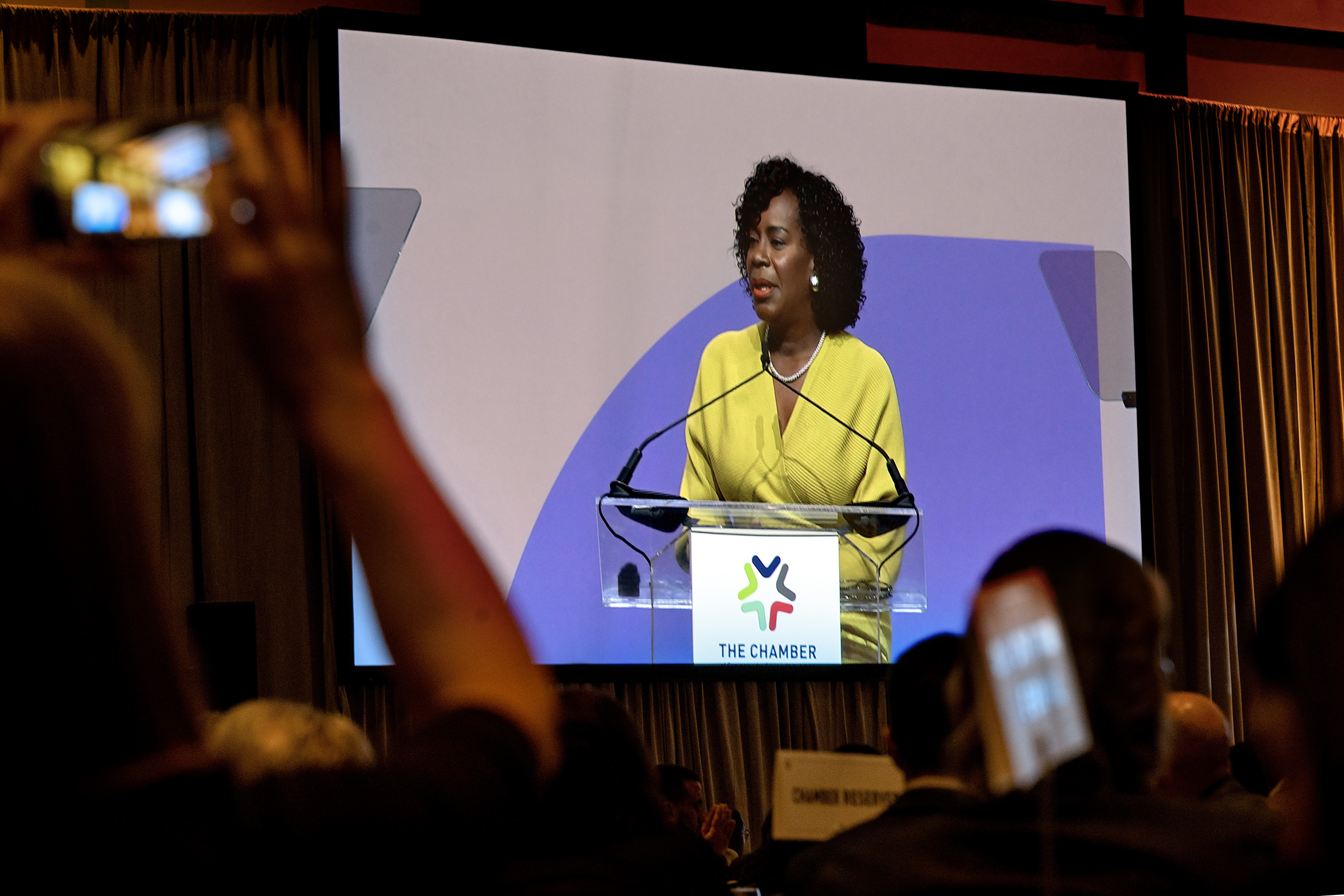
    Attendees record Mayor Cherelle L. Parker on big screen as she delivers her keynote address at the Chamber of Commerce for Greater Philadelphia’s Annual Mayoral Luncheon Wednesday, Feb. 11, 2026.Tom Gralish / Staff Photographer

    When she moved to eliminate the $100,000 BIRT exclusion, Parker also proposed a bill that would gradually reduce BIRT rates over 13 years, and Council approved the tax cuts in June 2025. While the tax cut measure will eventually lead to a dramatic reduction in BIRT bills for all firms in the city, small businesses are being hit hard by the end of the tax break in the meantime.

    “Sending a message to small business that we’re not here to help right now, I think, is the wrong message,” said Driscoll, who represents parts of Northeast Philadelphia.

    The bill is currently pending in the Committee on Finance, which is chaired by Majority Leader Katherine Gilmore Richardson.

    Gilmore Richardson, who has previously said she supports the proposal, declined to comment.

    The BIRT, which is Philly’s third-largest local tax and brought in about $779 million last fiscal year, consists of two tax rates. Firms must pay 5.71% of their net income, or profits, made in Philadelphia, as well as 0.141% of their gross receipts, or total income, according to the city’s website.

    The elimination of the $100,000 exemption has subjected tens of thousands of small businesses to the BIRT for the first time in years. It was projected to generate about $30 million in increased revenue for the city per year, and Parker and Council in 2025 allocated $38.5 million for programs aimed at helping small firms navigate the burden of getting in compliance with the tax.

    The city’s law department concluded Pennsylvania courts would likely rule that the old tax break violated the state constitution’s uniformity clause because it exempted from taxation $100,000 in income from all companies, producing different effective tax rates for firms depending on how much they made.

    Driscoll’s bill, which the administration has said would cost the city about $29.5 million per year, is aimed at finding a legal way to exempt many of the small businesses most affected by the elimination of the tax break. His measure aims to sidestep uniformity concerns by shielding entire classes of firms that include many of the small businesses that previously benefited from the $100,000 exemption from having to pay the tax at all.

    But the legislation also risks incentivizing more well-off business taxpayers, such as real estate investors, to dodge the tax by restructuring into the types of companies it would exempt from the BIRT. The bill, for instance, could allow investors to organize their companies as single-member LLCs while still requiring small stores with multiple owners to pay the tax.

    “The Department of Revenue anticipates businesses may change their business structure specifically to take advantage of the exemption, which will increase potential revenue losses,” the administration wrote in a fiscal analysis of the bill.

    Johnson has previously supported efforts to lower the business tax, and his opposition to Driscoll’s bill came as a surprise — not least to Jigar Mehta, a Bucks County-based management consultant who championed the idea for Driscoll’s legislation.

    Mehta said Wednesday that Johnson’s staff had helped draft the legislation.

    “They literally helped us put this bill together, his office,” said Mehta, who added that he was told at the time that Johnson supported it. “If you’re for exempting this group, why now all of a sudden are you saying we need this revenue? That’s what’s shocking.”

  • New Philly police crime lab could open next year as Council committee approves $40M to fund it

    New Philly police crime lab could open next year as Council committee approves $40M to fund it

    The Philadelphia Police Department’s new state-of-the-art forensics lab could be operational as early as next year, the culmination of a yearslong planning effort aimed at modernizing how the force solves crimes.

    City Treasurer Jacqueline Dunn told a City Council committee on Wednesday that construction began at the University City site in December 2025 and will extend through April.

    Dunn explained that timeline during a meeting of Council’s Finance Committee, which unanimously approved a request by Mayor Cherelle L. Parker’s administration to authorize the city to issue $40 million in bonds to finance the project. That measure will fund the build-out, construction, and equipment at the lab site, and it is expected to be approved by the full Council as soon as this week.

    City officials, police brass, and members of Council have for years described the existing police crime lab in North Philadelphia — where the force processes guns, drugs, DNA, and other evidence — as undersized and outdated.

    “This is something the public has been asking us for to really modernize the police operation,” said Councilmember Katherine Gilmore Richardson, the Democratic majority leader and the chair of the Finance Committee. “We’re glad that this day is finally here, and that we were able to to work out all the details to make it to this moment.”

    Council member at-large Katherine Gilmore Richardson speaking at the City Council’s first session of the year in Philadelphia, Pa., on Thursday, Jan. 22, 2026.Tyger Williams / Staff Photographer

    The proposed $40 million bond issuance would come in addition to $50 million that had already been secured and set aside in previous annual budgets to pay for the project. A Parker administration spokesperson confirmed that construction of the lab is expected to cost about $90 million total.

    City financial records show the Parker administration anticipates to pay about $11.4 million a year in rent once the lab is operational.

    The final phase of the construction of the site at 4101 Market St. follows a five-year process that began under former Mayor Jim Kenney.

    During an unprecedented spike in gun violence in 2021, Kenney, police officials, and District Attorney Larry Krasner all advocated for the city to spend millions on a new crime lab, saying it would allow police to process evidence at faster rates and solve more crimes. Krasner long argued that his office could secure more convictions if police were able to build stronger cases based on physical evidence.

    But getting to the point of construction on a new lab was a process beset by delays. Kenney’s administration had not selected a location by the time he left office in early 2024. After Parker was sworn in, her administration spent months evaluating potential sites amid lobbying efforts by other local and state elected officials who wanted the lab in their districts.

    Ultimately, Parker’s administration chose the 4100 block of Market Street, a burgeoning life sciences district where lab space already existed.

    In 2025, Parker hailed the selection as “a giant step forward in forensics technology and crime-solving ability for our police department.”

    On Wednesday, Councilmember Curtis Jones Jr., who chairs Council’s Committee on Public Safety and has been among the body’s chief advocates for the new lab, acknowledged it has been a long process.

    He said the small size of the existing lab meant “some of the processing of ballistics and other essential tools for justice are delayed.”

    “This has been a long, winding, but an essential part of the criminal justice process,” he said.

  • New Medicaid rules could disqualify thousands of Philadelphians. City officials are trying to stem the problem.

    New Medicaid rules could disqualify thousands of Philadelphians. City officials are trying to stem the problem.

    Philadelphia city agencies have launched a multipronged planning and outreach effort to ensure tens of thousands of city residents don’t lose healthcare access as changes to Medicaid take effect now and in the coming months, according to top officials in Mayor Cherelle L. Parker’s administration.

    First Deputy Managing Director Crystal Yates-Gale, who oversees much of the city’s health and human services programming, said in an interview that the city is reaching out to thousands of vulnerable people under the new eligibility rules.

    The city’s effort, dubbed the One Philly Medicaid Access program, includes a public outreach campaign and plans to assist Medicaid enrollees in maintaining their coverage amid new hurdles, including meeting work requirements.

    Yates-Gale said her biggest concern is that residents who are still eligible for Medicaid could lose coverage if they are unaware of new administrative requirements.

    “The thing that keeps me up most at night is having someone fall through the cracks,” she said.

    What triggered the new Medicaid eligibility rules?

    The changes to Medicaid were set in motion last year under the sweeping One Big Beautiful Bill Act, which was championed by President Donald Trump as a cost-saving measure. The state Department of Human Services estimates that more than 70,000 Philadelphia residents could lose Medicaid coverage.

    Some of the changes to eligibility took effect last week. Several groups of legal immigrants, including people who were granted asylum and those who are temporary humanitarian parolees, can no longer be covered by Medicaid. Legal permanent residents, including green-card holders, will maintain coverage.

    City officials could not estimate exactly how many residents fall into those categories. Pennsylvania state officials say there are 150,000 noncitizen immigrants with legal status who are covered by Medicaid.

    Additional changes take effect on Jan. 1 and target Medicaid enrollees who became covered when the program was expanded under the Affordable Care Act. Yates-Gale said the new requirements could potentially impact tens of thousands of Philadelphia residents, including many who may not know that they are covered by Medicaid.

    What are the new rules to maintain Medicaid coverage?

    Under the new rules, people who are covered by Medicaid under expansion and previously had to renew annually will now need to do so every six months.

    In addition, people age 19 to 64 who qualify for Medicaid under expansion must submit proof that they worked, volunteered, or went to school for at least 80 hours every month. Exemptions exist for people who can prove they are too “medically frail” to work.

    Despite Medicaid being a joint federal-state program, city officials said ensuring residents know about the changes to their health insurance is a key priority.

    “If you don’t know that you have to submit your proof of work, if you don’t know now that you have to reenroll every six months instead of once a year, then you won’t do it, and then you’ll be left without coverage,” Yates-Gale said. “And you may not know until a visit to the doctor, or God forbid, an emergency happens.”

    Loss of coverage is likely to happen on a rolling basis rather than all at once on Jan. 1, Yates-Gale said. That’s because Medicaid enrollees are due to reenroll at different points in the year.

    What is the Parker administration doing to ensure residents retain their Medicaid coverage?

    To plan for next year, Yates-Gale said the Parker administration has convened several “working groups” that are focused on helping eligible people remain covered, identifying people who qualify for work requirement exemptions, and assessing how the city’s social services could be affected.

    Some officials said they are concerned not only about individuals losing coverage, but also about the strain that an increase of uninsured residents could place on the city. The municipal government operates eight health centers that thousands of people, many of them in households with low incomes, rely on for primary care.

    City Councilmember Nina Ahmad, a Democrat who represents the city at-large, introduced legislation last week to hold hearings on how the Parker administration is conducting outreach to Medicaid enrollees and what impact a mass loss of coverage could have on the city.

    In an interview, Ahmad called on the city’s major hospital systems to “chip in” and conduct additional outreach to affected groups and ensure Medicaid-covered patients know how they can receive care, even if they become uninsured.

    “The pain is going to be felt by our constituents here in the city,” she said. “This is the time for the city, including our civic leaders in the city, to mobilize on this.”

  • To boost outdoor dining, Philly has created two government-approved streetery prototypes

    To boost outdoor dining, Philly has created two government-approved streetery prototypes

    More than three years after a crackdown on streeteries, the City of Philadelphia is preparing to expand outdoor dining options for local restaurants.

    The city has installed two prototypes for streeteries — aka outdoor dining structures that are permitted to take over parking spaces — in LOVE Park to solicit feedback from the public.

    The prototypes, which are designed in accordance with an executive order from Mayor Cherelle L. Parker, are on raised platforms and include built-ins for greenery, according to renderings on the city’s website.

    Both will be on display in the parking lane near 1501 John F. Kennedy Blvd. through at least Thanksgiving. People are encouraged to submit feedback by Nov. 23 about the prototypes’ safety, design, layout, and ability to blend in with surroundings. QR codes placed on tables inside each structure have links for submissions.

    Once the public’s feedback is evaluated, the prototype designs will be available for restaurant operators to download for free on the City of Philadelphia’s website, according to a news release.

    Using the city-approved streetery designs is not required. Philly restaurants are still allowed to design their own streeteries and submit them for city approval, the release said.

    Using either prototype will not result in new streeteries receiving automatic approvals from the city since other factors, such as locations and site conditions, are also taken into account, a spokesperson for the Department of Commerce confirmed with The Inquirer.

    Pumpkin BYOB closed in 2024 after paying $50,000 to remove its streetery for street paving, a cost owners Ian Moroney and Hillary Bor said was tough to bear.Tyger Williams / Staff Photographer

    “We heard from restaurants that this [program] would be beneficial, and we listened,” the release said. “Outdoor dining is an important part of Philadelphia’s restaurant scene and neighborhood commercial corridors. By developing standard designs and making them available at no cost, the City aims to make the process easier for restaurants while creating outdoor dining spaces that are safe, accessible and welcoming for everyone.”

    Under the Mayor Jim Kenney administration, the city rolled back outdoor dining regulations during the COVID-19 pandemic. At its peak, 860 Philly establishments had streeteries.

    Then, in January 2023, the city created a new permitting process for streeteries that requires architectural renderings, approvals from both the Streets Department and the Department of Licenses and Inspections, and a $1,750 annual licensing fee.

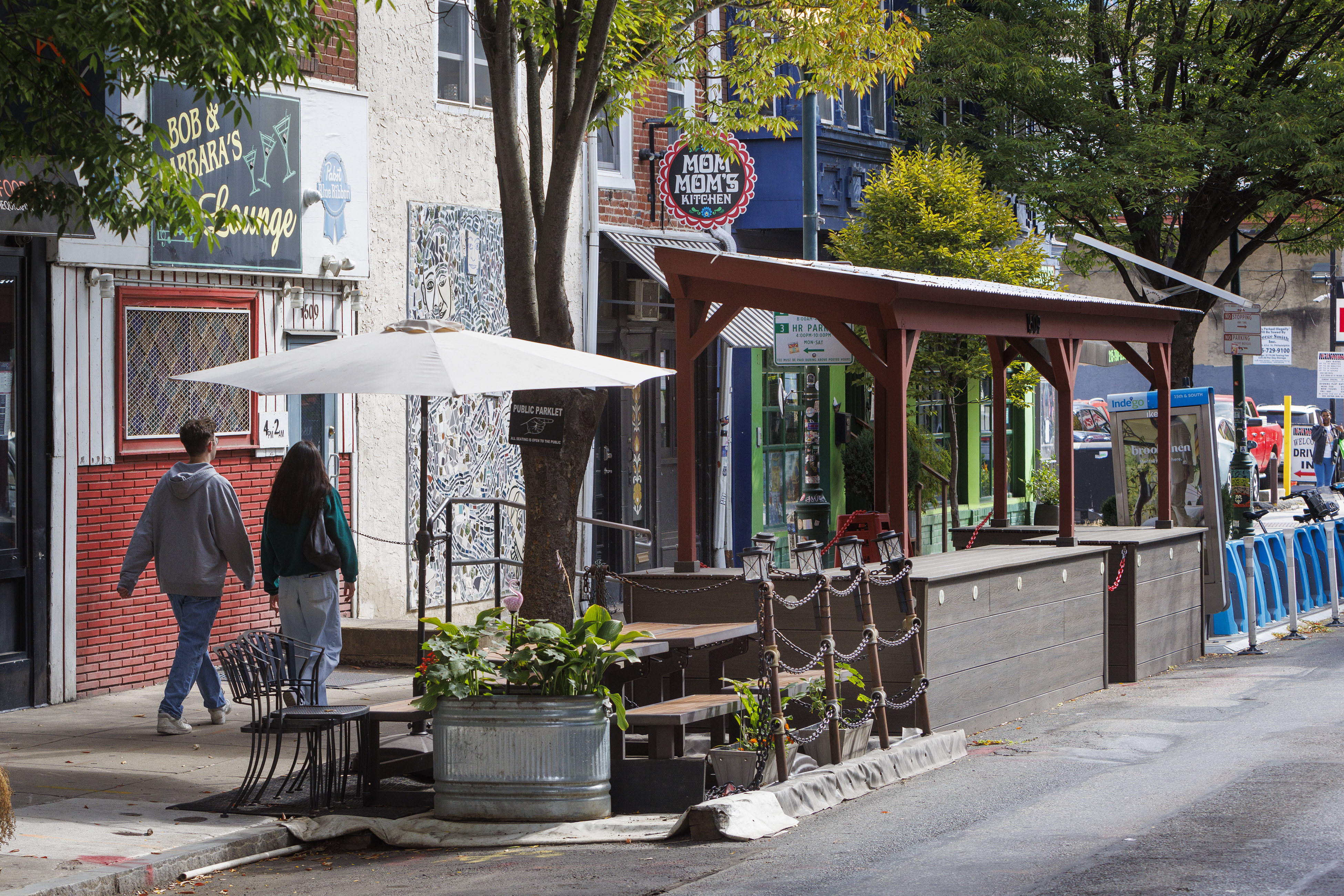
    Dive bar Bob and Barbara’s 1509 streetery was removed in 2024. The bar was required to take it down for street paving.Alejandro A. Alvarez / Staff Photographer

    At the time, the requirements forced many restaurants to spend thousands of dollars dismantling their streeteries. Many told The Inquirer they had no plans to reapply.

    There are just 33 active streetery licenses in Philly as of October, according to L&I’s business license dashboard, up from 28 in November.

    “The current outdoor dining licensing process in Philadelphia is characterized by complexity and high cost, which pose significant barriers for businesses seeking to utilize outdoor dining opportunities,” Controller Christy Brady wrote in an August 2024 report that called for the city to simplify the streetery application process and lower licensing fees.

    The report found that the cost of licensing on top of insurance premiums, hiring an architect, construction, and potential last-minute teardowns prohibited restaurants from applying.

  • Ex-Philly fire department supervisor took bribes to approve $139,000 in bogus overtime, feds say

    Ex-Philly fire department supervisor took bribes to approve $139,000 in bogus overtime, feds say

    Federal prosecutors this week charged a former Philadelphia Fire Department supervisor with bribery in connection with what investigators described as a brazen overtime abuse scheme that involved her accepting cash from a colleague in exchange for approving fraudulent time sheets.

    Marian Farris, 55, a former supervisor in the department’s payroll unit, faces one felony count of bribery and related theft charges. She was charged Tuesday by information, a process that is typically used when a defendant intends to plead guilty.

    Attorneys for Farris, who resigned from the department in March 2025, did not immediately respond to a request for comment on the charges.

    According to charging papers filed in the U.S. District Court of the Eastern District of Pennsylvania, Farris accepted multiple payments from a fire department employee that totaled more than $9,000 between 2023 and 2024. In exchange for those payments, prosecutors allege Farris made more than 300 fraudulent entries in the city’s payroll system amounting to more than $139,000 in payments to the employee.

    Some of the overtime claims, according to prosecutors, were logistically impossible. Prosecutors wrote that Farris on 16 occasions credited the employee — identified only as “J.M.” in charging papers — with working 22 to 24 hours of overtime in a single 24-hour period. On other occasions, prosecutors wrote, the employee was credited with working overtime while she was vacationing in Bermuda, Cancun, and Las Vegas.

    The Inquirer previously reported that Farris was under federal criminal investigation and that she was at the center of two tangled investigations into alleged misconduct at the fire department.

    The city’s Office of the Inspector General led one investigation into the overtime abuse and found that Farris conspired with former paramedic Jacqulyn Murphy to defraud the city by abusing the system.

    In a separate probe, the city retained a law firm to examine multiple sexual harassment allegations lodged by Murphy and other women against Anthony Hudgins, a former deputy commissioner and the department’s No. 2 in charge. According to court records, several women, including Murphy, told city investigators that Hudgins made sexual advances, including unwanted hugging and inappropriate comments.

    Hudgins claimed that the harassment reports were orchestrated by Murphy only after he discovered the overtime fraud. In January, Hudgins sued the city and the women saying that he was defamed and subjected to a “bad faith” investigation that resulted in a demotion and a $75,000 pay cut.

    Inspector General Alexander DeSantis had previously declined to publicly release the results of his investigation, citing an ongoing criminal investigation.

    But Hudgins’ attorneys included the report in court filings related to his lawsuit, and the OIG investigation appears to confirm Hudgins’ timeline. The report stated that Hudgins had already conducted an overtime review before a November 2024 discrimination complaint was filed against him.

    Those findings also align with a June 2025 report authored by attorneys at Campbell Durrant, the outside law firm that the city retained to investigate the sexual harassment claims. Hudgins’ attorneys included portions of that report in a recent court filing.

    In the report, investigators reviewed some of the allegations brought by Murphy and her wife, who was also a paramedic in the Philadelphia Fire Department. The women told investigators that Hudgins had openly discussed his desire to engage in sexual activities with other women.

    However, the conclusion of the report described the allegations brought by Murphy and her wife as “unsubstantiated” and lacking corroboration. It said that the “connection between the harassment complaints and the overtime investigation raises serious concerns about motive and credibility.”

    The report said that the primary concerns regarding Hudgins were that he “has a habit of hugging employees and enforcing policies that are sometimes unpopular.” The investigators recommended that Hudgins receive a formal warning and be required to undergo harassment training.

    A spokesperson for the city declined to release the full report on Friday, saying the city generally does not release reports of investigations into allegations of sexual harassment, and that the reports are only disseminated to the subjects of an investigation.

    In the fall of 2025, shortly after Campbell Durrant completed its report, Hudgins was demoted from his role as a deputy commissioner to deputy fire chief, and he was reassigned to the Incident Safety Office.

    Farris has not yet been scheduled to appear in court.

    Staff writer Abraham Gutman contributed to this article.

  • Mayor Parker — and her mixed record — reaches 1,000 days in office | Shackamaxon

    Mayor Parker — and her mixed record — reaches 1,000 days in office | Shackamaxon

    This week’s column covers the ongoing Washington West Historical District saga, a 1,000 mayoral days, a City Council member who should retire, and an NFL coach who is a secret urban planning enthusiast.

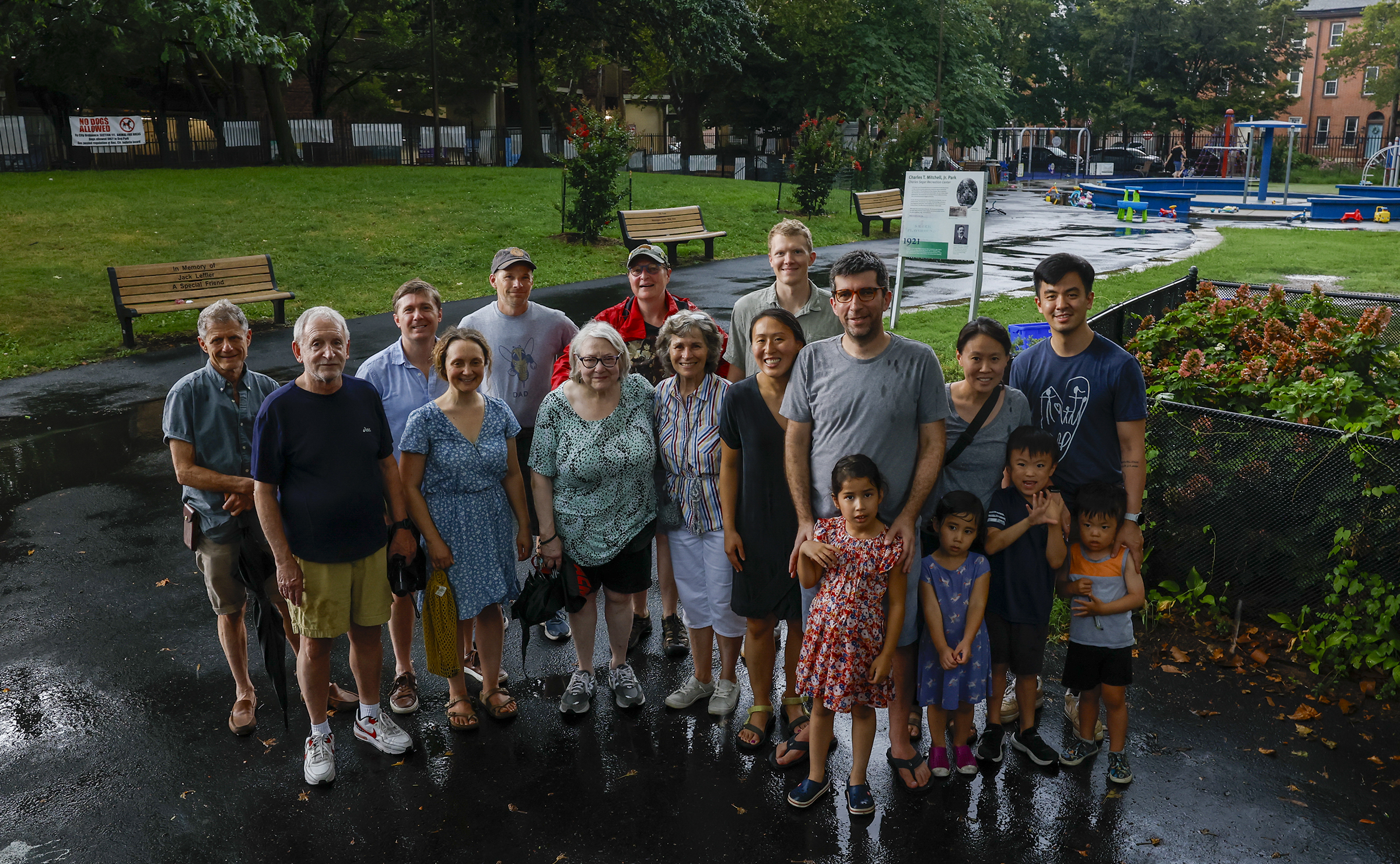
    Members of the Philadelphians for Rational Preservation gather at Seger Park in the Washington Square West neighborhood in July 2025. The group opposes the Washington Square West Historic District designation.Yong Kim / Staff Photographer

    People vs. preservation

    In a City Hall courtroom, lawyers for the city and the preservation alliance sought to defend the designation of the Washington West Historic District against a coalition of homeowners who have claimed the decision has cost them time and money. The outcome could have significant ramifications for such districts across Philadelphia.

    Dan Auerbach, a lawyer for the homeowners, says the district was created without sufficient evidence, and that a historic commissioner’s participation in drafting the document represents a conflict of interest. Attorneys Leonard Reuter and Paul Toner, who represented the defendants, took a different approach.

    When Common Pleas Court Judge Christopher Hall repeatedly asked for evidence, beyond the nomination itself, for the district’s historic significance, Toner replied, “I don’t need to.” The commission’s decision to approve is apparently all that’s required. They also argued that historic designation does not impose significant costs on homeowners.

    Hall seemed to take a skeptical view of these claims. As Auerbach pointed out, most pages of that document simply inventory the existing properties. Often, newly designated homes have no specific justification at all, or just a few words.

    Personally, I also find the dismissal of the real costs imposed on homeowners to be unconvincing. According to evidence supplied by Philadelphians for Rational Preservation, the group that formed in opposition to the district, homeowners who have been added to the district are already seeing adverse impacts. Door and window replacements now require permits, for example, and homeowners must spend considerably more to acquire historically accurate versions. This costs real time and real money.

    If Hall sticks with his initial ruling, which overturned the district designation, it could have serious consequences for the city’s preservation law.

    It may be that this district is simply too large and too broad. The period of significance covers nearly the entire history of Philadelphia, and many of the newly designated buildings are frankly unremarkable. While the city and the preservation alliance may feel the urge to appeal the matter to the Commonwealth Court, my suggestion is that they don’t.

    While I am skeptical of this particular nomination, I do think historic districts have a role to play in our city. Many of them are popular with residents, or have existed for so long that most homeowners were aware of the restrictions before purchasing.

    In the case of Washington West, however, the commission may simply have been too ambitious. The geographic range is just too large, the period of significance too extensive, and the residents themselves too strongly opposed.

    Mayor Cherelle L. Parker at a news conference in September.Jessica Griffin / Staff Photographer

    Mayoral milestone

    Mayor Cherelle L. Parker celebrated her 1,000th day in office earlier this week at McPherson Square Library in Kensington, which is set to receive a $21.7 million renovation. Parker has made investing in Kensington a priority in her administration, although some of her priorities have been contested.

    She’s added police patrols to the neighborhood, sought to dismantle the drug market, and increased cleaning and greening efforts. She’s also come under fire from harm reduction advocates for eliminating funding for the nonprofit Prevention Point and city efforts to rein in a network of services built to alleviate the struggles of addiction, which some residents have blamed for the drug market’s continuing presence in their community.

    In many ways, Kensington is a microcosm of Parker’s tenure.

    Her administration has made genuine progress. Violent crime is at historic lows, with decreases in the city’s most dangerous neighborhoods driving the decline. Surveys suggest residents believe the city has gotten cleaner under her leadership. Yet discontent, some legitimate and some not, continues. Parker’s approval rating sits at 44%, a number that is likely high enough for reelection next year, but isn’t strong enough to give her the political capital she needs to take on and win fights with City Council.

    The biggest factors in whether residents approve or disapprove of the mayor seem to be their age and race. Among Philadelphians of color and those older than 45, Parker is popular. For those under 45 and white voters, she’s not.

    It is easy to say this divide is based on style. As Parker herself has said, she’s unapologetic about who she is and where she came from. To residents who may be fans of New York’s Zohran Mamdani, Parker may seem old-fashioned and unexciting. Of course, Mamdani also has a municipal budget of $126 billion at his disposal, while Parker makes do with just $7 billion.

    But a lot of it has to do with substance. Small-business owners have lost a crucial tax exemption; her vaunted ability to work across the aisle has not resulted in sustainable transit funding or enabled the school district to avoid closing 17 schools; and Parker has shied away from the ambitious civic reformer causes embraced by predecessors like Michael Nutter.

    If the mayor intends to reach 2,000 days in office without becoming yet another tired and unpopular chief executive, she’ll have to step up her game.

    Councilmember Curtis Jones Jr. in chambers as City Council meets in December.Tom Gralish / Staff Photographer

    Jonesing to stay

    Fourth District Councilmember Curtis Jones Jr. has had a long and often laudatory career in public service. But it is now time for it to end.

    My Inquirer colleagues have reported that even some of Jones’ closest friends and allies are urging him to consider retiring for real, rather than simply exploiting the city’s notorious Deferred Retirement Option Plan (DROP) program. Jones has only himself and his own statements to blame for his newly precarious position.

    It isn’t just that Jones and his wife are taking hundreds of thousands worth of taxpayer money while avoiding retirement; he also asked to delay a critical infrastructure project for his own political benefit.

    Jones cited his ongoing health issues as justification to The Inquirer, saying he needed the money to pay for treatment. I certainly sympathize with anyone struggling to maintain their health. However, Jones represents a city where the median household income is just over $60,000. At 69 years old, he is also eligible for Medicare.

    Retirement would also give Jones a chance to relax and focus on staying healthy. For his sake and ours, he should listen to his friends.

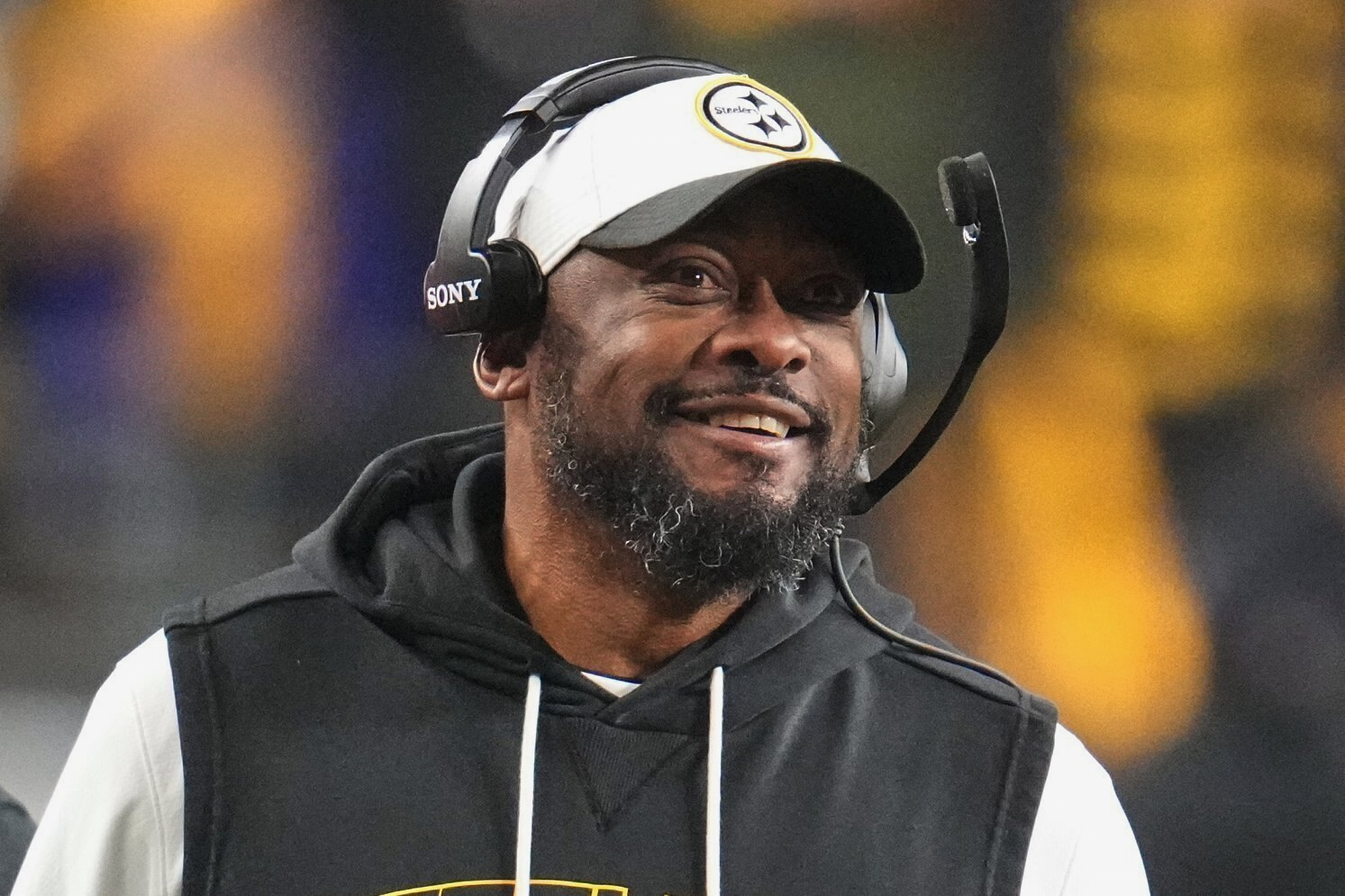
    Pittsburgh Steelers head coach Mike Tomlin stands on the sidelines during the second half of an NFL football game against the Baltimore Ravens in Pittsburgh in January.Gene J. Puskar

    Tomlintown

    When you write frequently about transit and housing, you tend to hear from the small cadre of people who are extraordinarily enthusiastic about these issues. This week, I found out about a surprising member of their ranks: former Pittsburgh Steelers head coach Mike Tomlin.

    Famous for his uncanny resemblance to actor Omar Epps and being the second Black NFL coach to win a Super Bowl, Tomlin used the game Minecraft to build his own fantasy city — a project that took place over a dozen years. He’s now giving the public a tour of his work.

    Tomlin said he wanted densely populated buildings because of his interest in architecture, and went as far as creating interiors for each of his creations. His work is remarkably cognizant of genuine urban questions like lighting and viewsheds.

    Like many gamers, he said his habit helped him “detach from the realities and the pressures of life.” We all need a way to unplug sometimes, but Tomlin’s impressive urban planning side project may have turned him into an unlikely urbanist hero.

  • Philly is one of the first cities in the country to formally support boycotting Starbucks | Council roundup

    Philly is one of the first cities in the country to formally support boycotting Starbucks | Council roundup

    Just in time for pumpkin spice latte season, Philadelphia City Council members are giving up Starbucks — and they want you to do the same.

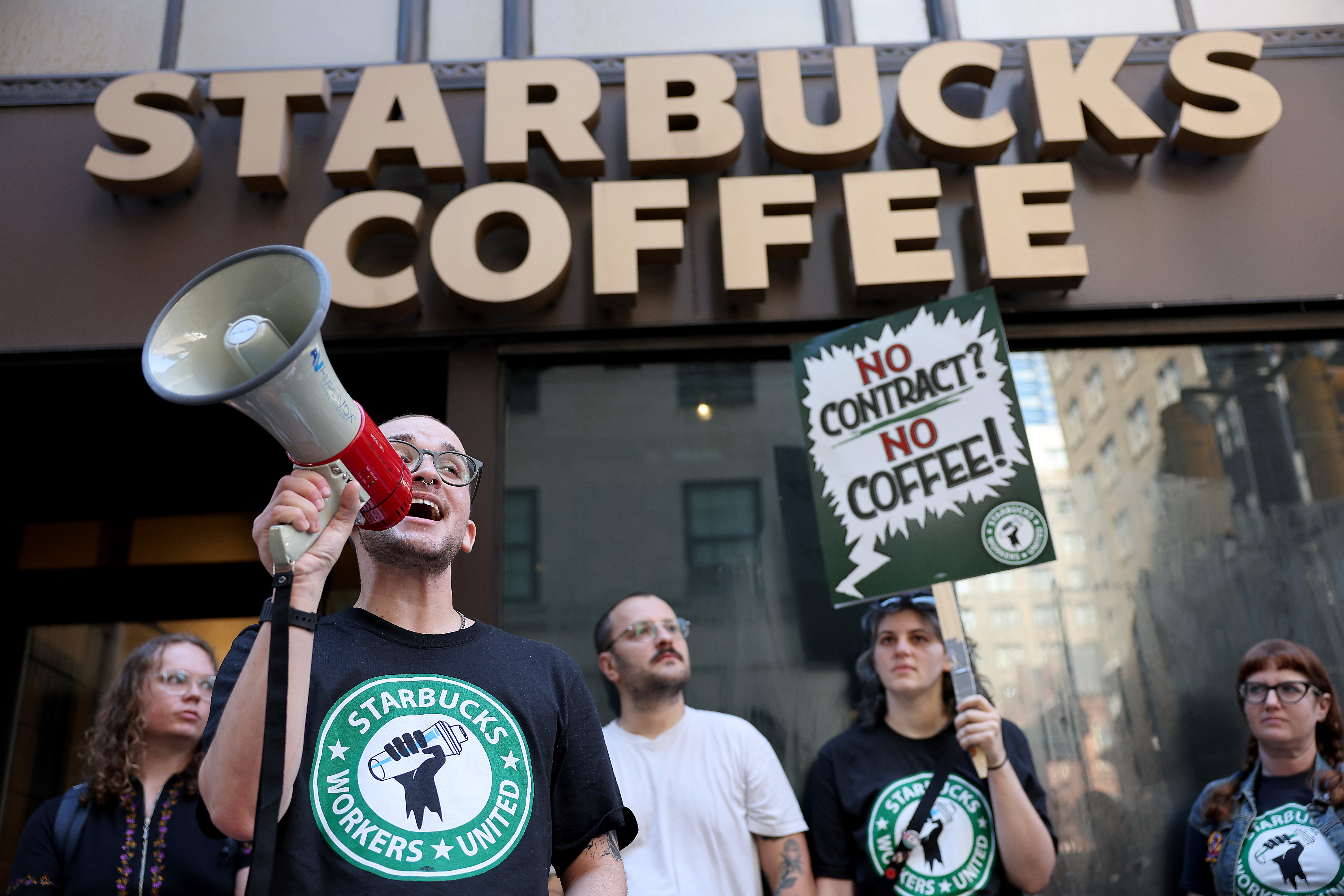
    Council voted unanimously on Thursday to make Philadelphia one of the first cities in the country to explicitly endorse a nationwide boycott of Starbucks amid a unionization drive, and to pledge not to use city funds at the coffee chain until it reaches a contract agreement with its workers.

    Also during Council’s session on Thursday: Councilmember Jamie Gauthier introduced controversial legislation to approve a contract with a trash incinerator that she doesn’t support. We’ll explain.

    What was this week’s highlight?

    Council puts Starbucks on ice: The expression of solidarity with Starbucks workers is a ceremonial resolution that does not carry the weight of law and does not require approval from Mayor Cherelle L. Parker.

    Still, Council’s vote was a formal endorsement of the boycott orchestrated by Starbucks Workers United and targeting the world’s largest coffee chain, which is already reducing its footprint in the city. Starbucks closed six Philadelphia locations last year, and two additional branches — one at 2201 South St. in Southwest Center City and the other at 1018 N. Second St. in Northern Liberties — closed on Sunday.

    The only other city to formally support the unionization effort is St. Louis, where last week the city’s board of aldermen approved a resolution to “express solidarity with Starbucks Workers United as they call for a boycott of Starbucks.”

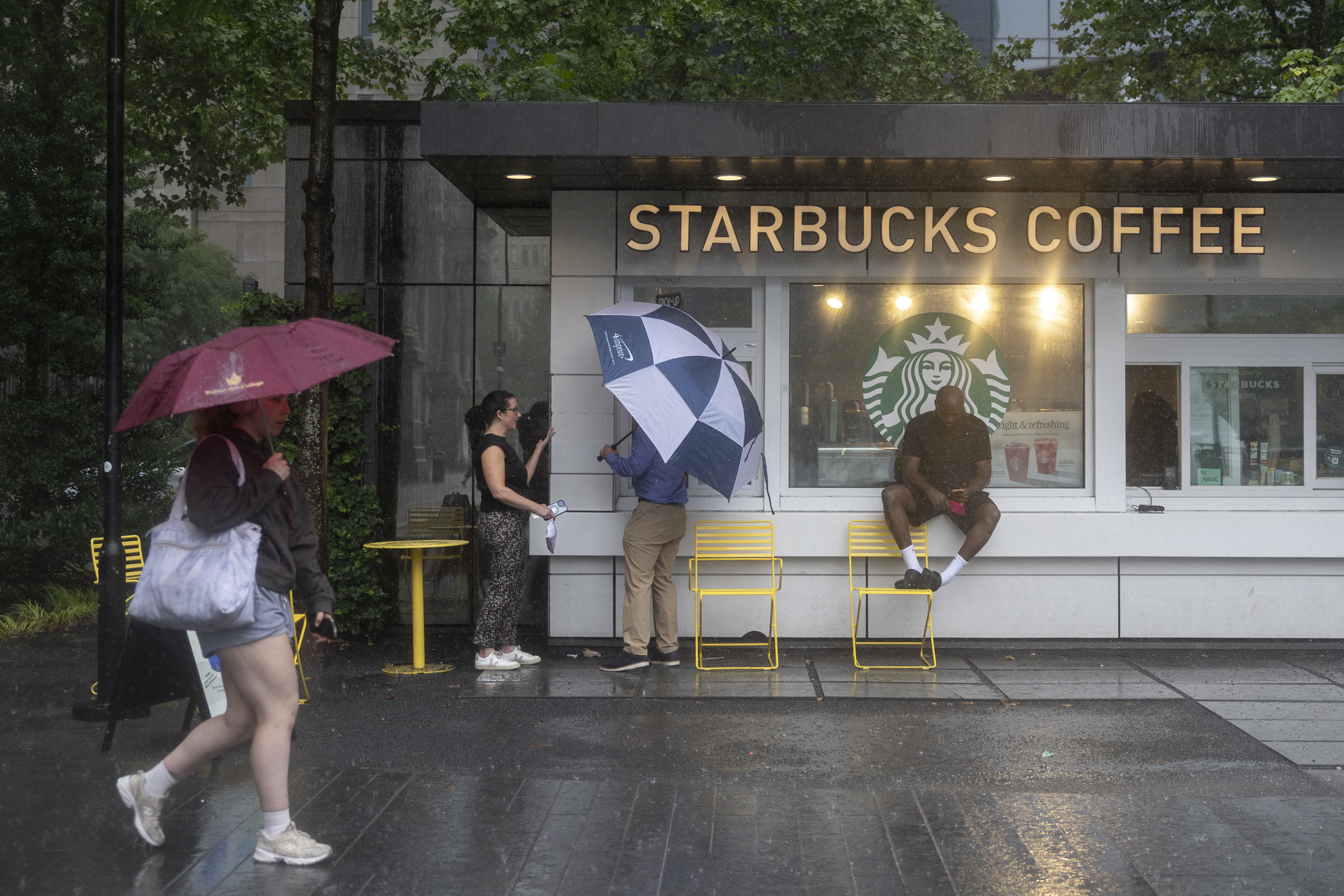
    People staying dry at the Starbucks Coffee at Dilworth Park near City Hall in Philadelphia, Pa., on Thursday, July 9, 2026.Tyger Williams / Staff Photographer

    Over the last five years, baristas have unionized at hundreds of individual Starbucks locations, but the company has not agreed to a nationwide contract that the union has sought. The union in August called for a nationwide boycott to last until an agreement is reached.

    Councilmember Nicolas O’Rourke, a member of the progressive Working Families Party who represents the city at-large, authored the legislation and said its passage is “another affirmation of Philadelphia being a union town.”

    “I am always interested in making sure that businesses in the city of Philadelphia and people are thriving,” O’Rourke said. “But my first priority is always to make sure that workers and workers’ conditions are right and that they are respected.”

    Council is controlled by a supermajority of Democrats, and the body is largely supportive of organized labor.

    Council President Kenyatta Johnson said he backs the Starbucks boycott, even though he is generally not a big coffee drinker.

    “Unfortunately, they do have a vegan breakfast sandwich,” said Johnson, who follows a plant-based diet. “But I won’t be having those any time soon.”

    A spokesperson for Starbucks said in a statement Thursday that the company is “committed to engaging in productive bargaining.”

    What else happened today?

    Introducing legislation she doesn’t support: Thursday’s meeting featured another twist in the long-running debate over a Chester trash incinerator and how Philadelphia gets rids of its garbage. Gauthier, a progressive Democrat who has advocated for the city to stop burning its trash, introduced legislation that would allow the city to continue doing so.

    Here’s why: The Parker administration is looking to renew its long-held contract with Reworld, the Chester waste-to-energy facility where the city ships about one-third of its trash to be burned. (The rest of the trash is sent to landfills.)

    In order to renew the multiyear contract, Council must approve authorizing legislation. Gauthier, who previously floated a bill to ban the city from incinerating trash but did not garner enough support to pass it, is asking her fellow lawmakers to vote against the contract renewal.

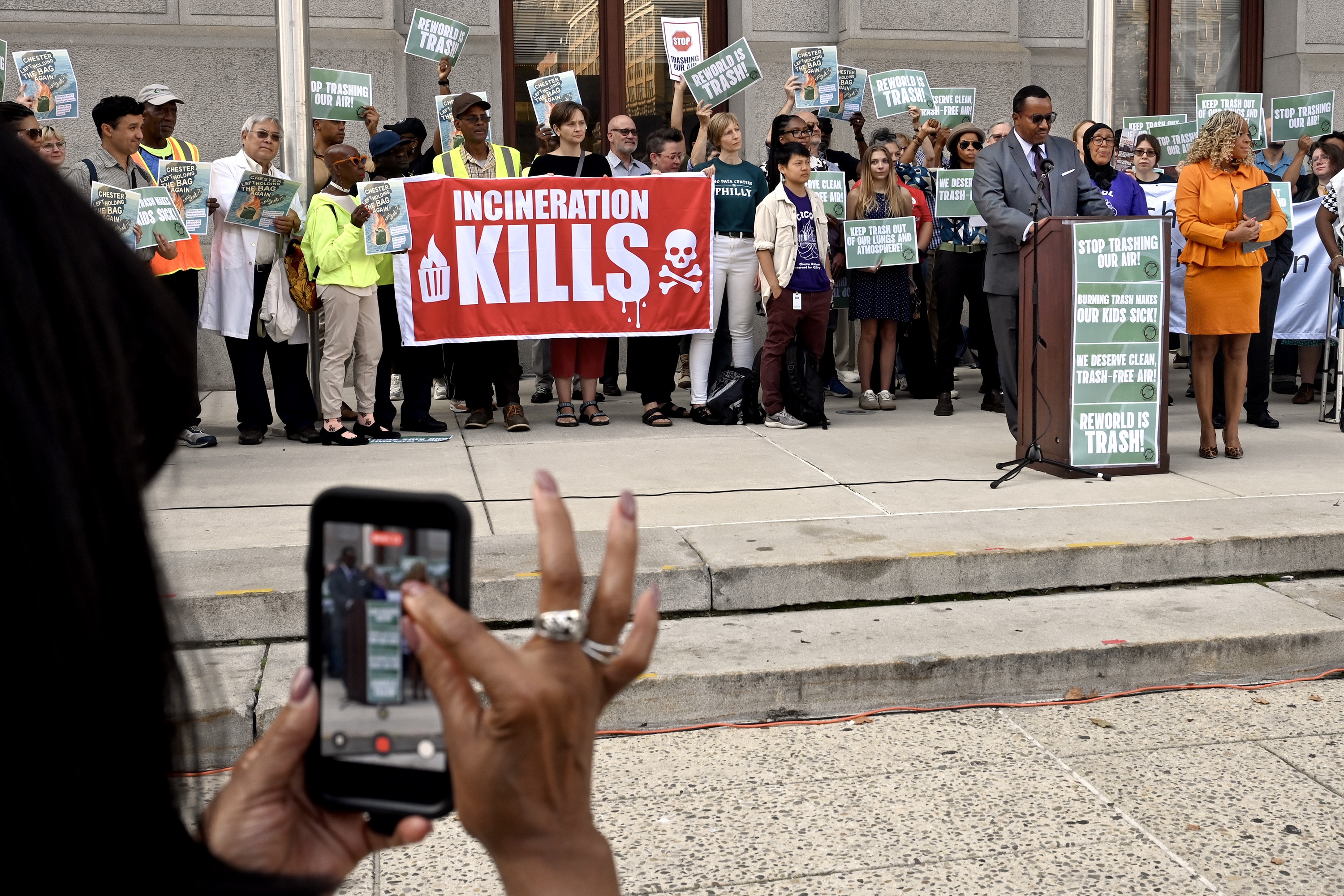
    Chester Mayor Stefan Roots (at lectern) is joined by Philadelphia City Councilmember Jamie Gauthier (right) at a rally outside City Hall early Thursday morning Sept. 17, 2026.Tom Gralish / Staff Photographer

    Although it may seem like a reversal of her position, Gauthier introducing the legislation herself — even when she does not support it — will allow her to have some say when a committee holds a hearing on the legislation. She hopes to amend it to strike Reworld from the deal so that the city processes all trash and recycling through landfills.

    “It gives me and my coalition an opportunity to be at the table on something that we fought really hard on for more than a year now,” she said in an interview. “We’ve been working really hard to make sure that we’re protecting the health of folks in Chester and in Philadelphia, and protecting our environment.”

    Johnson will decide which committee will hear the bill. He said Thursday that he is still reviewing the legislation.

    Mamdani-fication: Create a Philly Medicaid Supplement Program. Expand access to programs that provide transit subsidies to low-income Philadelphians. Use city money to buy properties with expiring federal affordable housing subsidies.

    These were some of the recommendations included in the Affordable Philly Now report, which was recently released by the Cost of Living Task Force.

    O’Rourke, who convened the task force, held a committee hearing Wednesday examining the report’s findings, and he was not shy about noting that it was partly inspired by another progressive a few miles up I-95.

    “You cannot deny the profound impact that … Mayor Zohran Mamdani has had,” O’Rourke said, praising the New Yorker for “mixing moonshot municipal goals with sewer socialism” and working to build a “protective hedge” of social safety net programs.

    Nicolas O’Rourke, Philadelphia City Council member, during the mayor’s budget address on March 12.Alejandro A. Alvarez / Staff Photographer

    Wednesday’s hearing was a meeting of the Committee on Global Opportunities and the Creative/Innovative Economy, which O’Rourke chairs. As a freshman and a member of a minority party, O’Rourke does not have a high-profile committee leadership post like some of the more senior Democratic lawmakers on Council. His committee was previously led by former GOP Councilmember David Oh and does not naturally align with O’Rourke’s progressive politics.

    O’Rourke said at the committee hearing Wednesday — the first time he chaired a Council hearing — that he was shifting the panel’s work.

    “The prior version of this committee revolved around corporate investment fitting into global value chains and making Philadelphia an international destination,” O’Rourke said. “In my reflection on the meaning of the committee, I have spent more time focusing on a part of the committee’s mandate that actually seems more in its merit — that is, to consider all matters related to making Philadelphia a world-class city. … And in some seasons, world-class cities show themselves by being bold in providing a protective hedge for its people.”

    Quote of the week

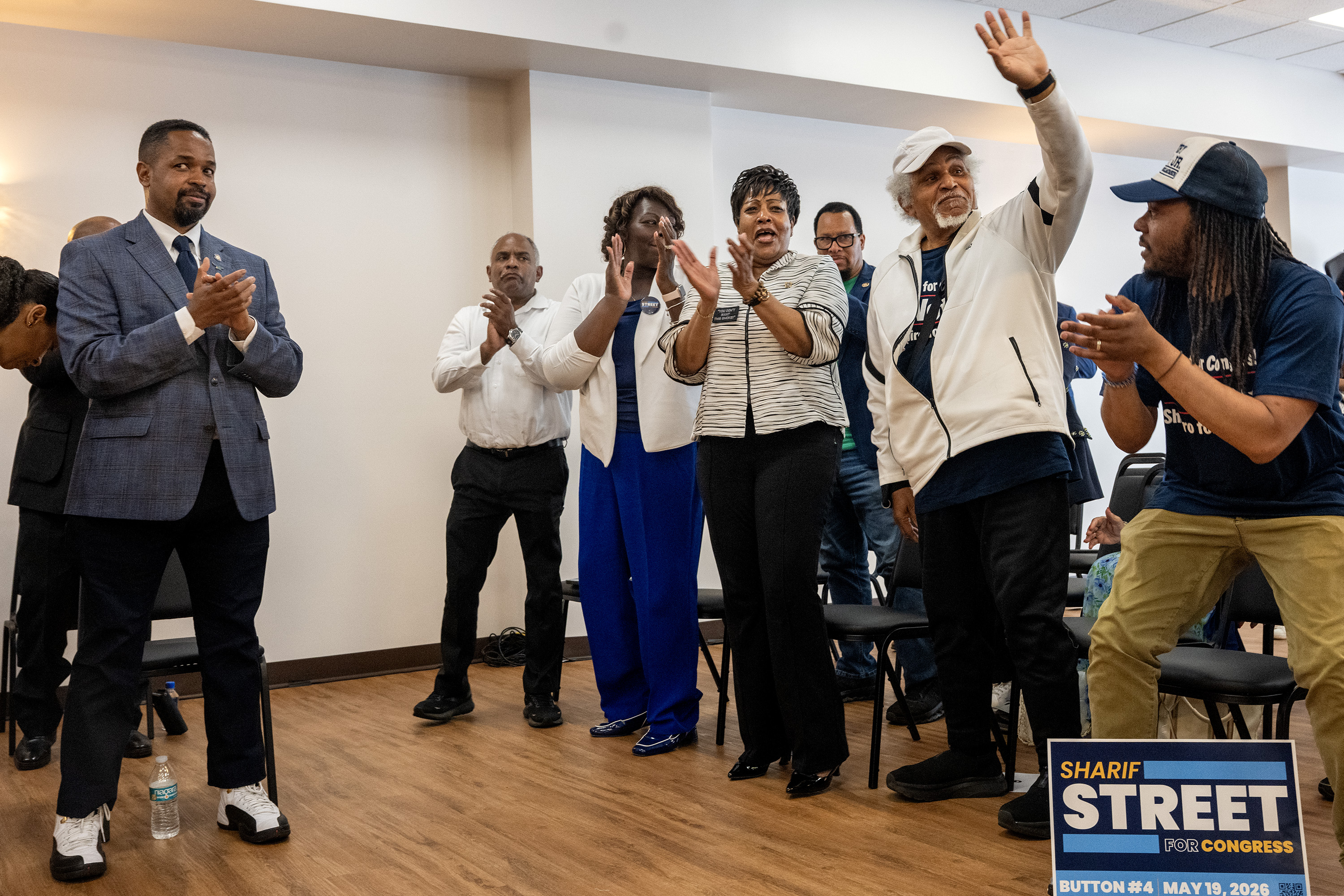
    Former Mayor John F. Street (right) is acknowledged by supporters of his son, State Sen. Sharif Street (left), in West Philadelphia Monday, May 18, 2026.Tom Gralish / Staff Photographer

    That was former Mayor John F. Street, the erstwhile City Council president, who returned to his old workplace Thursday to speak during public comment. He was testifying in support of a resolution to honor Philadelphia Police Lt. Greg Brown, who was, among other assignments, a member of Street’s security detail and is now retiring.

    Street said Brown was one of the few people he never got to humiliate, because Brown “always got it right.”

    “I never had a chance to put him on any list,” Street said.

  • Mayor Parker marked her 1,000th day in office with a ground-breaking at Kensington’s McPherson Square library

    Mayor Parker marked her 1,000th day in office with a ground-breaking at Kensington’s McPherson Square library

    Mayor Cherelle L. Parker marked her 1,000th day in office by breaking ground on a $21.7 million improvement to the McPherson Square library, a symbol of the Kensington opioid crisis, to send the message that her administration’s “commitment to this community is firm.”

    “The Kensington that I’m standing in today — this is not the Kensington that I walked in January of 2024. Quality of life is improving here,” Parker said at a news conference on Monday.

    Although she did not focus on Kensington while campaigning for mayor in 2023, Parker has, since taking office, embraced the challenge of addressing gun violence and substance abuse in the neighborhood, which has made international headlines, and eradicating what is often referred to as the largest open-air drug market on the East Coast. She rode the El to an event at a Kensington middle school to mark her first 100 days in office.

    The McPherson Square park and library became a highly visible marker of the crisis in the mid-2010s. People in addiction were a constant presence in the six-acre park, near Kensington Avenue and Orleans Street. Library staff learned how to administer Narcan, which reverses overdoses.

    Philadelphia Mayor Cherelle L. Parker exits the Allegheny station before walking along Kensington Avenue on April 11, 2024. Parker took the El to attend an event marking her 100th day in office in the Kensington neighborhood in Philadelphia.Heather Khalifa / Staff Photographer

    Parker ran on a tough-on-crime platform, and her approach to Kensington has featured a mix of police-focused tactics and novel strategies aimed at getting people off the streets and into recovery.

    She cut city funding for syringe exchange services in her first budget, and her election effectively ended the city’s efforts to open a supervised drug consumption site, a priority of former Mayor Jim Kenney. The police department has doubled the number of officers who patrol the area, First Deputy Police Commissioner John Stanford said Monday.

    Parker has also launched a Neighborhood Wellness Court program, which is designed to encourage alleged offenders to choose addiction services and avoid criminal proceedings, and she has launched the Riverview Wellness Village, a 20-acre recovery house in Northeast Philadelphia where more than 200 people live.

    “People are beginning to see that we are at least trying to make a difference, and we are not acting as if we don’t see what’s happening,” Parker said. “We’re looking it straight in the eye and trying to figure out a way to make sure that we are solving a problem.”

    Since Parker took office, the Kensington-based 24th Police District has seen a 48% decrease in violent crime, a 63% decrease in shootings, and a 47% decrease in homicides, Stanford said Monday.

    After peaking in the wake of the onset of the COVID-19 pandemic, rates of violent crime and homicide have fallen across the country. This year, homicides in Philadelphia are on pace for a 60-year low.

    People using drugs are still a common sight in Kensington, and crime rates in the neighborhood remain higher than the city as a whole, a reality Parker readily acknowledges. And her approach has drawn criticism from some harm reduction advocates and public health experts, who contend that heavy-handed policing can be counterproductive to saving the lives of people in addiction.

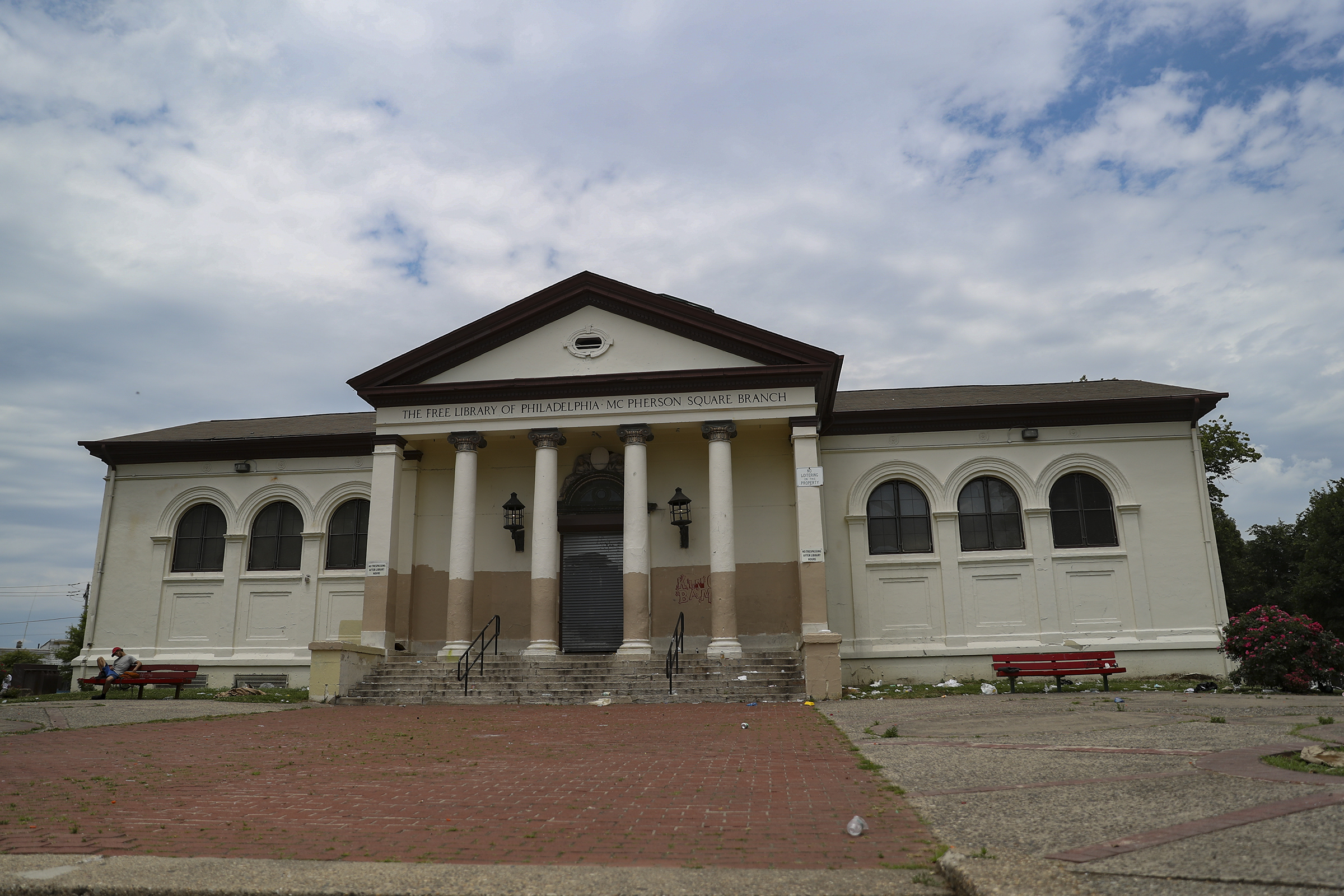
    But few doubt Parker’s commitment to cleaning up the neighborhood, and the prospect of a revitalization of the dilapidated library, which was built in 1917 with a copper dome and classical columns, could be a potent symbol.

    The renovation of the McPherson Square library is being funded through Rebuild, the parks and recreation center renovation program championed by Kenney and supported by Parker when she was on Council. Rebuild is one of three programs Kenney proposed while pitching the city’s tax on sweetened beverages, which was approved in 2016 and is more commonly known as the soda tax.

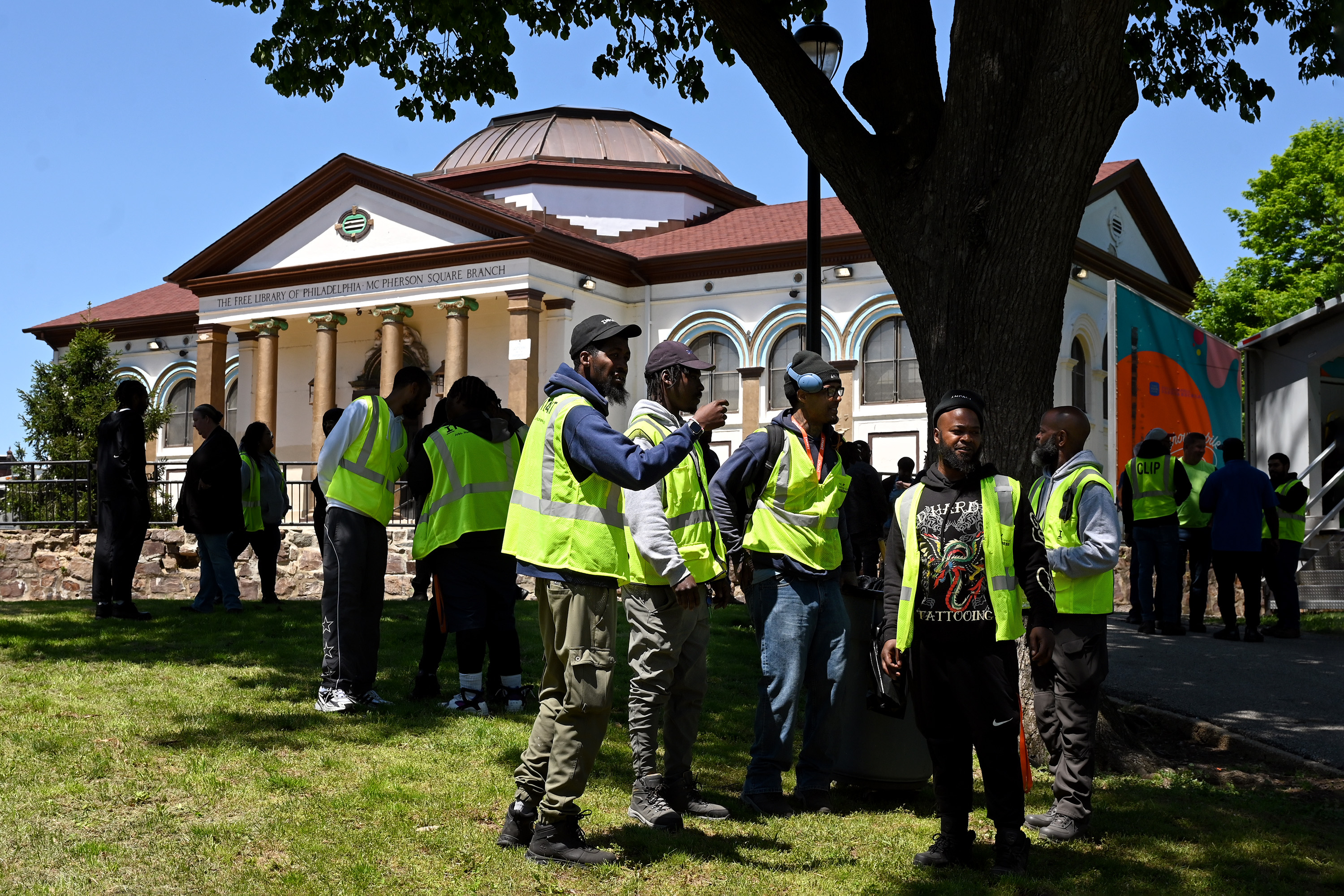
    Workers set out to clean after the Office of Clean and Green Initiatives kicked off the summer edition of the One Philly, United City Citywide Cleaning Program in McPherson Park on May 4.Tom Gralish / Staff Photographer

    The first phase of the library renovation, which included a new roof and a restored dome, was completed in 2025. Parker on Monday broke ground on the second phase, a “full-gut renovation” with “new HVAC, plumbing, electrical, fire alarm, and security systems” and many other improvements, according to the Philadelphia Capital Program Office.

    The project will take two years. In the meantime, the Free Library of Philadelphia will set up a temporary location on Allegheny Avenue, said Kelly Richards, the library’s president and director.

    City Councilmember Quetcy Lozada, whose 7th District includes much of Kensington, said she spoke to Parker about addressing the long-neglected neighborhood’s challenges in 2023, and recalled being “skeptical” that Parker would follow through on her promises as mayor.

    “She made a commitment on that day that if she were to become the mayor of this city, that she would make Kensington and this community a priority,” Lozada said at the new ground-breaking, “and she has stood by that commitment and that promise.”

    Staff writer Anna Orso contributed to this article.
  • Philly DEI panel endorses Parker’s contracting overhaul as Black business owners warn of consequences

    Philly DEI panel endorses Parker’s contracting overhaul as Black business owners warn of consequences

    Nearly a year after Mayor Cherelle L. Parker announced that Philadelphia would move away from using its long-held diversity goals in awarding public contracts, a City Council committee on Monday formally recommended that the city codify the change.

    However, several corporate leaders who advised the special committee’s work testified during a hearing that the shift away from race- and gender-conscious contracting would set the city back.

    Craig T. Williams, founder of the construction firm Pride Enterprises, said the city’s move to provide contracting advantages to businesses certified as “small and local” — instead of to businesses owned by women, minorities, and people who are disabled — will make it harder for Black-owned firms like his to grow.

    “While the new terminology is intended to retain support for diverse businesses, it also removes the intentional mechanisms that once created predictable access for them,” Williams said. “The shift in terminology will likely result in an increase in opportunities for non-diverse firms, widening the disparity gap.”

    And Michael Brown, CEO of The 360 Group, a consulting firm, said “minority businesses across Philadelphia are witnessing a catastrophic erosion of margins, pushing foundational enterprises to the brinks of collapse.”

    He cited data showing that the state government awards only a small portion of its contracts to Black- and Hispanic-owned businesses.

    “Philadelphia is slowly sleepwalking down the same exact destructive path,” he said.

    Council’s Special Committee on City and Private Sector Diversity, Equity and Inclusion Policies, which is led by business community leaders, was convened in 2024 by Council President Kenyatta Johnson. The group was charged with drafting recommendations to strengthen the city’s DEI policies and address barriers faced by women, people of color, and people with disabilities who own businesses.

    In the midst of the committee’s work, Parker’s administration last year quietly eliminated the city’s goal of awarding 35% of its government contracts to those businesses.

    The city also stopped assigning participation “ranges” to publicly funded projects, meaning contractors are no longer given benchmarks for the amount of dollars that should go to subcontractors and suppliers owned by people of color, women, and people who are disabled.

    Mayor Cherelle L. Parker speaks at Vare-Washington Elementary School in Philadelphia, on July 14.Jessica Griffin / Staff Photographer

    The change came amid a broader dismantling of affirmative action-style programs at the federal level led by President Donald Trump’s administration. Parker said a new national legal precedent made the city’s practices vulnerable to court challenges, so the administration will now aim to give preference to businesses that are certified as small and local.

    On Monday, Council’s committee agreed. Its report recommends the city move to a more legally defensible, race-neutral framework like the one Parker’s administration is already building. The committee also recommended that the city adopt more aggressive preferences to give those businesses clear advantages when they’re bidding for city dollars.

    Still, members of the committee said Monday that they have concerns about implementation.

    Michelle Flamer, a former longtime attorney for the city, said she is worried that the city will stop collecting demographic data on businesses that bid for contracts.

    “We’re in a time period in this country of great distress, of really unbridled racist behavior, but this will not last forever, and we have to continue to collect this data so we will be prepared for a new day,” she said. “But if we don’t have it, we won’t be able to hold anyone accountable.”

    And Harold T. Epps, the city’s former commerce director who co-chaired the committee, said he’s concerned that providing advantages to small businesses — which are defined as those which bring in less than $47 million over a three-year period — effectively puts a cap on how a business can grow.

    “It seems the city has fallen into the same old trap of predetermining how large a business that has any elements of diversity can be,” he said.

    Nadir Jones, the director of the city’s Office of Business Impact and Economic Advancement, said the Parker administration is exploring implementing a “middle market” program for companies that “graduate” out of the small-business classification.

    But, Jones said, “we’re not there yet.”