“This year has tested our community in ways none of us anticipated,” Scriven said in a resignation letter released by the district. “I have come to believe that the district is best served by a fresh start under new leadership, and that stepping aside now is the right and necessary step to allow Cheltenham to move forward.”
The resignation is effective immediately.
“The board has accepted Dr. Scriven’s resignation, and we thank him for his dedicated service to Cheltenham public schools,” school board president Leah Mulhearn said in a statement. She said Cheltenham’s director of business services, Joshua Sweigard, would serve as acting superintendent, pending a vote by the board at its next meeting Tuesday.
After canceling last year’s football season in October amid hazing allegations, the Montgomery County district announced in January that an investigation it commissioned had concluded that a “student-on-student” assault occurred on Sept. 3, witnessed by nearly 20 students.
The district failed to uncover that an earlier assault had occurred in August, Montgomery County prosecutors said. A grand jury report characterized the district’s investigation as flawed from the beginning, saying employees were dismissive when the 15-year-old victim’s mother reported on Sept. 7 that he’d been assaulted, and had wrongly taken the team’s head coach, Terence Tolbert, at his word that he didn’t instruct the boy not to tell his parents.
The employees included Tolbert. who was among the coaches charged with endangering the welfare of a child and conspiracy, “in every step” of their investigation, according to the report.
Scriven responded in a statement last week, saying that Tolbert wasn’t involved in planning the investigation. The superintendent said that “every report brought to the district’s attention was addressed based on the information available at the time.”
He didn’t respond to a number of questions about other failures alleged by the grand jury, including that employees were confused about mandatory reporting requirements, and that five football coaches lacked state-required clearances for completing training on reporting child abuse.
Football parents have also expressed frustration with the district’s response to the assaults, which also led to the cancellation of the upcoming season. Some told the Inquirer this week they urged Cheltenham not to hire Tolbert due to alleged bullying during his tenure as Abington’s coach.
In May, the school board had expressed its support for Scriven, sending a community message that acknowledged “concerns around safety and student conduct” that had challenged the district.
“Five years ago, the board invested in Dr. Scriven and his vision for the district. We continue to support him and his vision. He is a strong strategic thinker,” the board said in the May statement.
“Serving this district has been one of the greatest privileges of my life,” Scriven said in his resignation letter Thursday. He said he was “deeply proud of the work we accomplished together, and I remain hopeful for Cheltenham’s continued success.”
Editor’s note: This story has been updated to correct the year that Brian Scriven graduated from Cheltenham High School. He graduated in 1983.
Cheltenham Superintendent Brian Scriven resigned Thursday, a little more than a week after prosecutors charged four football coaches and six players in connection with violent assaults against a player last season in a high school locker room.
The superintendent’s resignation, effective immediately, came amid community outcry over the district’s handling of the August and September 2025 incidents, which prosecutors say both involved students attacking a 15-year-old and using a broomstick to poke at his buttocks.
Yet the district did not uncover that there had been two assaults, and administrators appeared to downplay a report from the 15-year-old’s mother, according to the Montgomery County grand jury that recommended the charges. It described a “level of incompetence” in the district that “put every young man on the football team at risk.”
Some parents who have been battling the district to take student safety more seriously said Scriven and his administration did not fail only in overseeing the football program.
“I see a complete lack of urgency,” said one mother who has been among a group of parents pressing the district since October to address violent incidents at Cheltenham Elementary School. The mother, who spoke on the condition of anonymity out of fear of retaliation for her child, said administrators still have not answered questions about how students are disciplined and how others are supported after assaults.
Another Cheltenham Elementary parent, Shanyl Jones, said her daughter, an incoming second grader, twice experienced sexual touching and comments in school. In kindergarten, a boy repeatedly touched her against her will, conduct that escalated to him grabbing her vagina, Jones said.
The boy also made sexually explicit comments to her daughter, Jones said. She reported the conduct and filed a Title IX sexual harassment case; the school moved the boy to a different classroom, she said.
After a separate boy made sexual comments to Jones’ daughter in first grade, the principal called Jones and apologized, though the boy was not moved to a different classroom, Jones said.
News of the football charges “just tore me up on what my daughter’s future would be in the school system,” Jones said. “It gave me no assurance they’re going to be able to reconcile what’s happening now.”
Scriven said in his resignation letter Thursday that “this year has tested our community in ways none of us anticipated.”
“I have come to believe that the district is best served by a fresh start under new leadership, and that stepping aside now is the right and necessary step to allow Cheltenham to move forward,” he said.
The district has not commented on how else it plans to respond to the explosive grand jury report released last week, which described the response of several employees at the high school — identified only as Employees #1, #2, and #3 — as minimizing an assault reported by the 15-year-old’s mother, and trusting the word of the head coach, Terence Tolbert, that he had not instructed the student not to tell his parents what happened.
The district did not respond to questions this week about its hiring of Tolbert — who was among the four coaches charged — including whether it had sought references from Abington, which cut ties with him after one year as its head football coach. Some parents of football players told The Inquirer they had “pleaded” with Cheltenham administrators not to hire Tolbert, whom they accused of allowing bullying during his tenure at Abington Senior High School.
Nor did the district respond to questions about whether it would take action against any employees, including those described in the grand jury report.
The Cheltenham High School vice principal whom the mother said she had reported allegations to, Mark Hoff, was named vice principal at Wyncote Elementary last month.
The grand jury report “details very troubling questions about the management and operation of the district’s athletic programs, including the football program,” school board president Leah Mulhearn said in a statement this week. “Our highest priority is the safety and welfare of the children we serve.”
Mulhearn, who did not address questions about Cheltenham Elementary in the statement, said the board was “focused on conducting a comprehensive review of the grand jury’s findings, including our policies and practices related to athletics, as the first step in implementing measures to ensure that no such conduct ever occurs again at our schools.”
The district has said a Title IX investigation into the allegations will soon be finished, with possible discipline for students. Two 18-year-old players charged as adults — the other four were charged as juveniles — have already graduated.
Community members are closely watching the school board’s next steps. Sharif El-Mekki, a nationally known Philadelphia-based educator who runs the Center for Black Educator Development and previously led Mastery Shoemaker Charter School, called on the school board in a letter to apologize to the victimized student and commission an independent investigation into the district administration’s conduct.
“Every student in Cheltenham, every teacher, every parent, and every young leader in Montgomery County is being taught something right now by how the district is responding,” El-Mekki said.
‘Environment of ongoing chaos’
Cheltenham Elementary parents said they raised concerns to administrators last October, after they heard from their children that a student touched another student’s penis sexually in class, over his clothes, in view of classmates.
Some initially did not believe it. “We would have been told about it,” said one mother, who also spoke on the condition of anonymity out of fear of retaliation against her child.
Parents began talking to one another to confirm what happened. Other parents and students told them the same child had been involved in previous sexual incidents, two mothers said.
A group of parents sent an email on Oct. 3 to ShaVon Savage, then the district’s assistant superintendent, saying they had recently learned that a student “touched another child sexually during class time” and that the child had been involved in “multiple sexual incidents over the past few years.” They asked to be notified about instances of physical or sexual assault.
In the email, shared with The Inquirer, they also asked for additional supervision and counseling for students with behavioral challenges and described an “environment of ongoing chaos” at the school, which last year served a larger number of students with emotional support needs than the district’s other three elementary schools.
Savage wrote back 10 days later, saying she needed more details “to conduct a full and thorough investigation,” according to an email shared with The Inquirer. She also said that when a situation poses a “threat to a particular school community,” the district would communicate with parents, but could not share details about particular children due to federal privacy laws.
Savage met with some parents in early November and said she would visit the school — though parents were unsure whether she did, the mothers said.
Their concerns escalated when on Dec. 5, a Friday, the school’s principal, Stephanie Junod, was assaulted by a student, according to the mothers.
That night, Scriven, the superintendent, sent an email to school parents, informing them that “while Ms. Junod was attempting to de-escalate a situation with a high-needs student, she was struck in the head by their thermos.” Scriven said the principal was “expected to make a full recovery.” Junod could not be reached for comment.
Scriven said central office staff would be at the school the following Monday “to begin implementing additional measures to strengthen safety and provide more comprehensive support for students who require additional behavioral interventions.”
Brian Scriven has resigned as superintendent of the Cheltenham School District.Courtesy of Cheltenham School District
The mothers were angry that the district had not already been providing that support. Around the same time as Junod’s injury, they said, there was an assault on a student, and “at least two” against staff members, one of the mothers said.
Parents had a meeting scheduled with Savage for Dec. 15, but administrators pushed it to January, one of the mothers said.
Scriven met with parents on Jan. 8 and apologized for not treating their concerns urgently enough, according to the mother, who said Scriven also assured parents that “the football situation had been handled.”
“Obviously, that was a lie,” she said.
Scriven met with them again on Feb. 25 and said changes would be made, including putting a behavioral specialist at the school four days a week, according to the mother.
Scriven did not mention that Junod would be resigning, the mother said — a decision announced shortly after the meeting.
‘Slow to respond’
Problems at the school continued.
On March 26, parents said, a student assaulted five staff members — including punching one in the face — in view of other children. Police came to the school.
The district did not immediately notify parents. But Scriven sent an email to the school community the next day, reporting that “an emotional support student had an episode during which he eloped from the building and engaged in physical altercations with a number of staff as they were trying to de-escalate” the situation.
“While I cannot share individual student consequences or placements, I can assure you that this situation is being addressed with the highest level of seriousness and urgency,” Scriven said in the email.
In an email the next day demanding a meeting with administrators, one parent wrote: “The frustration among parents has reached a boiling point.”
“Information is simply not being shared, and critical questions regarding the safety and education of our children are being ignored,” the parent said in the email, which one of the mothers shared with The Inquirer.
Scriven responded to the parents on April 14.
“I understand the urgency of your concerns and sincerely apologize for the delay in providing a comprehensive response,” Scriven said, in an email the mother shared with The Inquirer.
Scriven said the school’s new principal, Shareese Nelson, had needed time to settle into the job, but “we are prepared to move forward in a more formal and collaborative manner.” He invited families to the school for an April 29 community meeting.
The meeting was “highly emotional,” one of the mothers said, with parents sharing their children’s experiences. After the meeting, Scriven told a 6abc reporter: “I was slow to respond. I do have to own that, and rectify that immediately.”
Shanyl Jones recalled that administrators seemed “completely unprepared” during the meeting to address parents’ safety concerns.
In a message to the community May 6, the school board acknowledged “concerns around safety and student conduct have presented challenges that we continue to navigate.”
The board said it took “all concerns that are raised with us as a board” seriously and was paying attention to how they were addressed.
It also stood by Scriven, a former Baltimore County Public Schools administrator who was named Cheltenham’s superintendent in 2021.
“Five years ago, the board invested in Dr. Scriven and his vision for the district,” the board said, calling the superintendent a “strong strategic thinker.”
“We continue to support him and his vision,” it said.
On Thursday, Mulhearn said in a statement that the board thanked Scriven “for his dedicated service to Cheltenham public schools.” She said the board had selected Joshua Sweigard, Cheltenham’s director of business services, as acting superintendent.
While the district in May released an action plan for Cheltenham Elementary, including a safety audit, staff training, and monthly reports on school incidents, the mothers said it still has not clearly explained how it handles student assaults, and how kids who are victimized or witness them are supported.
Until it does, “beginning from kindergarten up, we are not going to see this change in any meaningful way,” one of the mothers said. “This is not a one-off event.”
The questions that cut to the heart of the horrible hazing incidents within Cheltenham High School’s football program are the same questions that everyone always asks in these situations: Where were the adults? Who allowed this behavior to happen? How did the chop-busting and rites of passage that have long been intrinsic to sports escalate to the point that four coaches, including former head coach Terence Tolbert, and six players have been indicted for two alleged assaults that took place in the team’s locker room?
Even a glance at the details is enough to turn your stomach. Players — as many as 19 of them — allegedly held down a 15-year-old sophomore member of the team, stepped on his chest and groin with their cleats-clad feet, and tried to poke a broomstick into his butt. The coaches traded inculpating texts about it, according to Montgomery County District Attorney Kevin Steele. The Cheltenham School District canceled the football team’s season last year and again this year. Parents, many of whom reportedly had warned the district against hiring Tolbert in the first place, are angry. And everyone, inside the program and out, is left wondering how in the hell we got here.
A less egregious incident, in the Central Bucks High School West football program in 2014, is instructive here. In that situation, a preseason initiation ritual progressed each year from giving players haircuts — sometimes in the shape of male or female genitalia — to licking mayonnaise off teammates’ nipples and groins to simulating sex with a stuffed toy pig to playing “Slap/Lick/Fondle,” a game that ended with underclassmen touching other players’ private parts.
The Central Bucks School District canceled West’s football season and removed its head coach, but what matters most is that the district acted before the hazing reached the same severity as what allegedly happened at Cheltenham. You’d think such an episode would have been a warning siren for coaches and athletic administrators throughout the region. But after a while, the siren goes silent or the people who need to hear it most go deaf, and vigilance wanes, and the pattern repeats itself.
It is easy and of course correct to lament that youth and high school sports too often have taken on an outsized and inappropriate importance for too many coaches and parents and athletes. But one of sports’ greatest benefits to young people is that it gives them a stake in something bigger than themselves, a stake in something that matters to them, and they learn to develop and modify actions and habits to preserve sports’ place in their lives.
Amid the C.B. West hazing story, for instance, Phil DiGiacomo, who was a star running back on two of the school’s state-championship teams in the late 1990s, told me that, when he played, the Bucks’ success served as an effective deterrent against bad behavior. Yes, Mike Pettine, the program’s legendary head coach, and his staff ruled with a measure of iron-fist discipline that likely wouldn’t fly today, and even those old-school coaching techniques and West’s on-field dominance didn’t prevent every instance of player misconduct. Still, DiGiacomo said, the athletes themselves knew that, just by suiting up for West, they were continuing a special tradition, and they stood to lose a chance to call themselves champions if they did something stupid or malicious. So most of them didn’t.
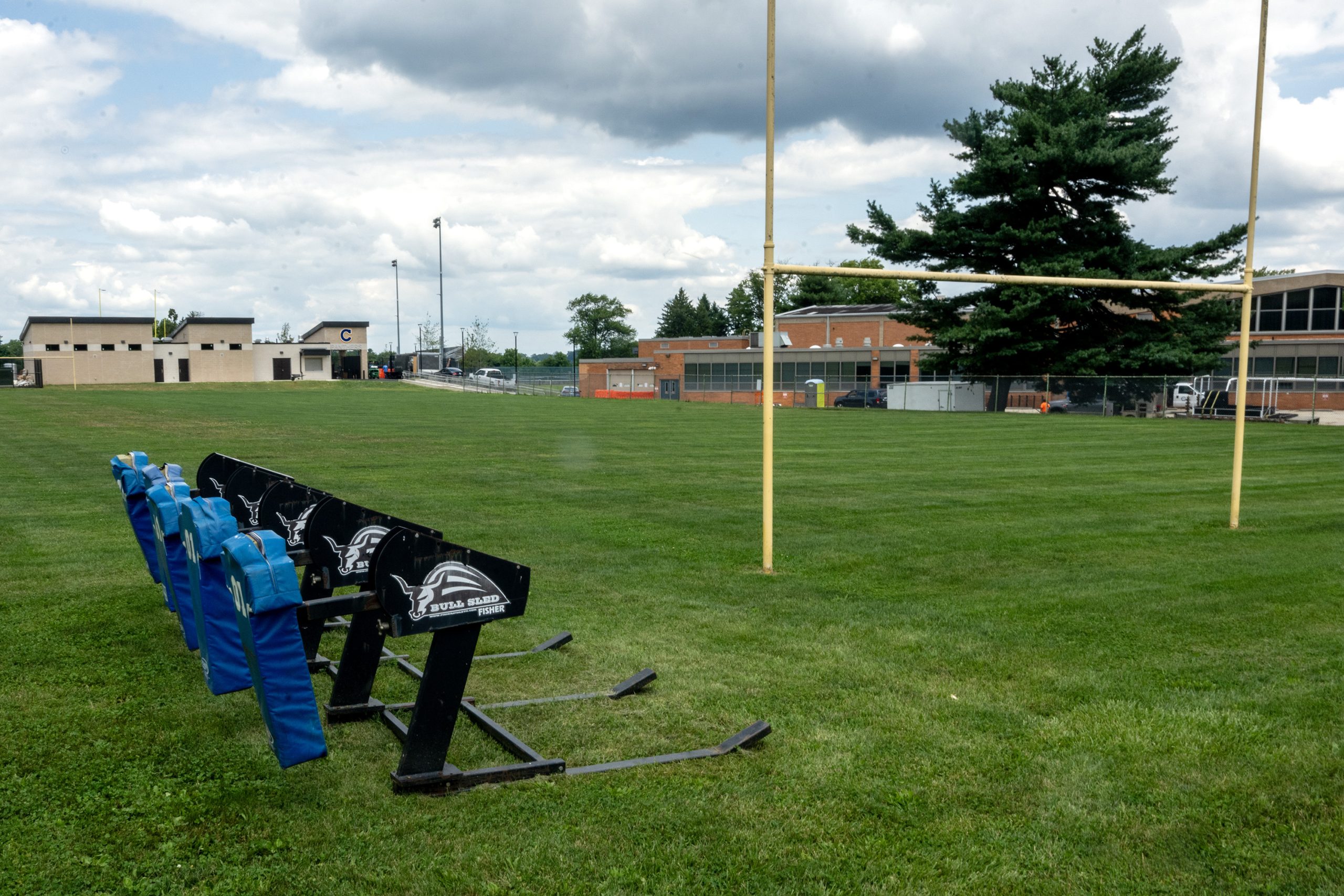
Cheltenham’s practice field photographed on July 29. The program hasn’t had a winning season since 2022.Tom Gralish / Staff Photographer
“When we were there, there was no hazing,” DiGiacomo said. “It’s kind of funny because if anyone ever got picked on, it got straightened out by an older guy real quick, mostly because we feared Pettine — that, and we were too damn tired to do anything else.”
A high school team doesn’t have to win 59 straight games and three consecutive state titles, as those West teams did, to be a point of pride for its players. It just has to provide them a rewarding experience, and they — and their coaches — have to feel that they have something to lose if it doesn’t. That element appears to have been missing entirely from the Cheltenham football program in recent years. In fact, it seems not to have been even a consideration for the school’s administration.
In his previous stint as a head coach, for Abington in 2023, Tolbert had won just one game. The school district decided not to renew him as coach, and sources have told The Inquirer that Tolbert’s toleration of a toxic atmosphere within and around the Abington program, including bullying by players and the use of slurs by coaches, were the driving forces behind his departure.
Cheltenham’s leadership either was unaware of these red flags or was willing to look past them, and for what? The program hasn’t had a winning season since 2022, but come on. Was Tolbert thought to be such a great coach that only he could restore the program to respectability? What qualities did he have that the people who hired him considered so essential? It’s obvious now that he and his assistants weren’t capable of doing the one thing any adult working in a school should put first: Keeping students safe.
The courage to take the right steps
The most infuriating aspect of stories such as this is the excuse that coaches can’t be held responsible for all their players’ mistakes. That’s true as far as it goes, but there are steps coaches can take to establish the right kind of culture, to model good behavior, to let the athletes in their care know what will be tolerated and what won’t.
One longtime area football coach told me Wednesday morning that he was fortunate to have two assistant coaches who were special-education teachers, who spent a lot of time around kids who had been the objects of ridicule. These coaches brought students from the school’s autism-support classes to be managers and statisticians and scorekeepers, and they let everyone know: These kids are part of this program. These kids are accepted members of this team. Treat them with respect.
Those are the kinds of gestures that seem small but can make a major difference, that mitigate the risks that coaches have accepted for decades. Coaching high school sports is a damn hard job, and it’s difficult because, at its best, it requires a measure of moral courage: To say no, to explain why, to stand by that decision. In this Cheltenham ugliness, we see once again what happens when that strength is lacking. The necessary guardrails fall away, if they were ever installed at all, and only after the damage comes to light does it become clear that a school and its students have been saddled with coaches and educators who aren’t willing to do the right thing or, worse, don’t even know what the right thing is.
As they prepared a list of charges in connection with a pair of hazing incidents involving Cheltenham High School’s football team, the members of a Montgomery County grand jury closely scrutinized the figures and institutions that often place vulnerable young people in positions where they can be victimized in the first place.
There were the players themselves — as many as 19 of them took part in one of the assaults — who, on two separate occasions last summer, the grand jury found, beat a 15-year-old teammate and attempted to insert a broomstick into his anus.
There were the coaches, whom the jurors said allowed a hazing culture to flourish, discouraged the victim from reporting his injuries, and engaged in a cover-up that was remarkable both for its clumsy execution and brazen audacity.
Finally, there were school administrators, who, despite conducting three separate inquiries, were so inept that they were still unclear about how many times the student was attacked, and took no steps to exclude the head football coach (who would eventually be charged with leading the cover-up) from taking part in their investigations.
“This level of incompetence didn’t just fail one child,” the jury wrote. “It put every young man on the football team at risk.”
Notably, though, the jury found, the victim may not have been helped by another factor: the law itself.
In Pennsylvania and practically every other state, the so-called mandatory reporting guidelines — rules that require teachers, coaches, school administrators, and others who work with youths to inform the authorities of suspected harm — do not include hazing in their definition of what constitutes child abuse.
As horrifically illustrated by the case in Cheltenham — and so many other high-profile hazing incidents involving adolescents — this must change.
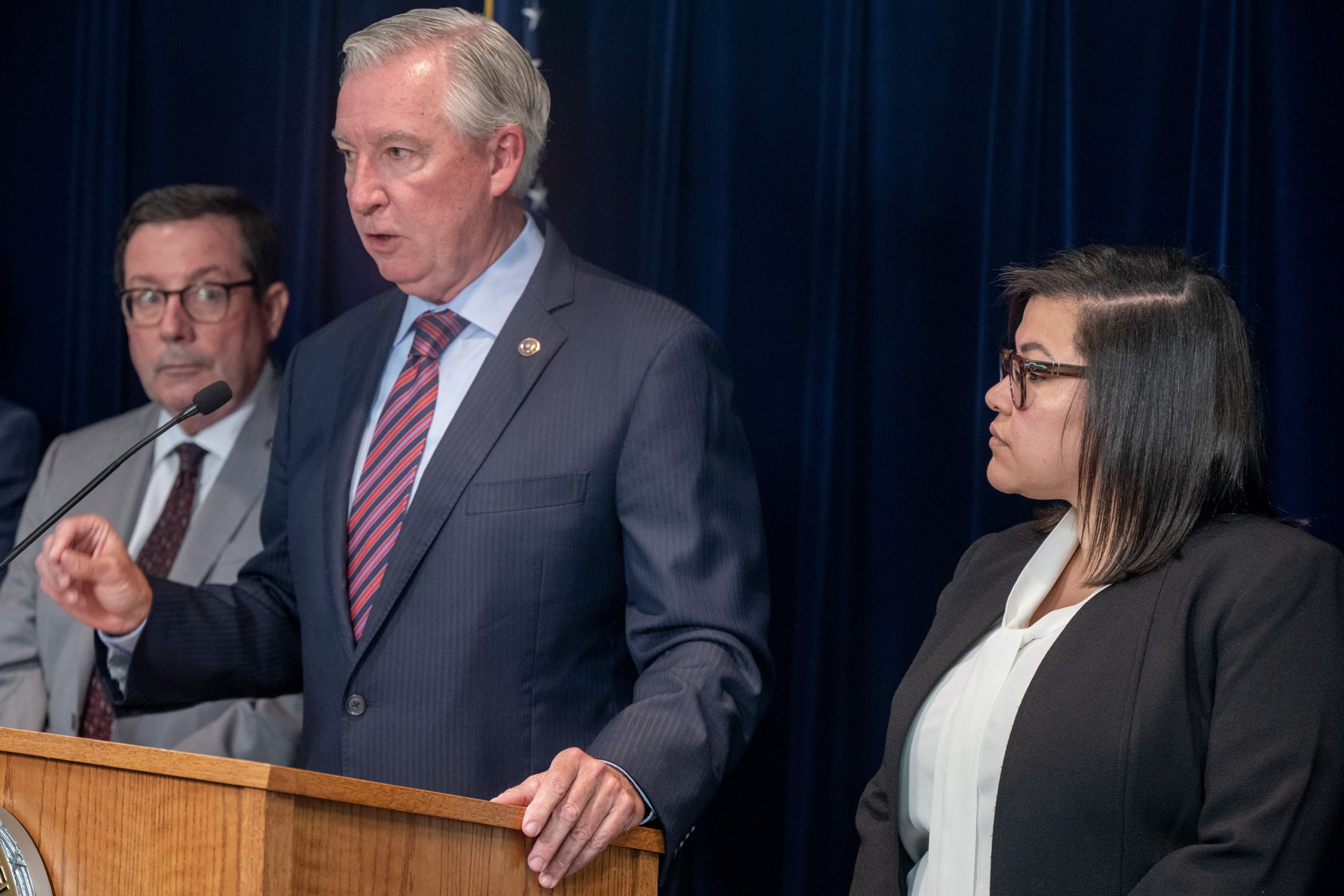
Montgomery County District Attorney Kevin Steele addresses reporters at a July 29 news conference to announce multiple charges in connection with a pair of hazing incidents at Cheltenham High School.Tom Gralish / Staff Photographer
As the grand jury noted, allegations of child abuse generally must be reported when the accused are adults or “certain juveniles” — such as caregivers, family members, and those living in the same household — or when the accusation involves crimes such as rape, sexual assault, or indecent exposure.
“Hazing should be considered a form of reportable child abuse to protect children,” the grand jury wrote. “If hazing was a reportable offense, the Cheltenham High School administration would not have had the opportunity to mishandle the juvenile victim’s disclosure and the ensuing investigation as poorly as they did.”
The failures at Cheltenham High School come less than a decade after legislators in Harrisburg enacted a sweeping overhaul of the commonwealth’s anti-hazing laws. That change was largely prompted by the alcohol-related fraternity hazing death of Timothy J. Piazza, a 19-year-old sophomore at Penn State, in 2017.
Despite the adoption of new laws, the cycle of hazing persists.
Set against the painful legacy of Piazza’s death in University Park, hazing continues to be a problem at Penn State. In May, administrators suspended a chapter of the Lambda Chi Alpha fraternity; it is the ninth Greek organization currently serving a suspension for hazing violations on the university’s flagship campus.
While some of the most high-profile hazing cases involve colleges and universities, researchers say that the seeds of mistreatment are often planted in high school — or earlier. (A 17-year-old Cheltenham student, who witnessed last summer’s locker room attacks, told the Montgomery County grand jurors that he had seen that kind of child-on-child violence on other teams “multiple times”; he’s been playing since he was 5.)
According to one study, 47% of college students said they experienced hazing before they ever set foot on a college campus. “There’s a bit of a normalization that happens when they’re already experiencing — and perhaps expecting — that type of behavior, if they’ve already gone through that in high school,” Meredith Stewart, of the advocacy group Stop Hazing, said in an interview with members of this board.
To end the grim experience and bleak expectations of adolescents being harmed in sports teams, youth clubs, and other organizations, lawmakers should craft legislation to reclassify hazing as a form of reportable child abuse.
Unless Harrisburg takes action to close this perilous gap in the state’s anti-hazing protections, the cycle of violence will keep churning — and more of Pennsylvania’s young people will continue to be placed at risk.
Cheltenham High School varsity football families repeatedly warned district officials about allegations that former head coach Terence Tolbert allowed bullying to fester in his previous coaching position at Abington Senior High School, parents say.
Tolbert, along with three other Cheltenham coaches, was charged last week with endangering the welfare of a child and conspiracy after a 15-year-old player was allegedly assaulted in the football team’s locker room by teammates twice last year. Six players were also charged. The assaults have led to the cancellation of two football seasons.
Both the district and a Montgomery County grand jury found that inadequate supervision played a role in the assaults. The district also found coaching staff displayed “a failure to prioritize student safety.”
Tolbert and the other coaches are no longer with the district. Tolbert has declined to comment on the matter, and he and his lawyer did not respond to requests for comment on this story.
‘We protested and pleaded’
In the two months leading up to Tolbert’s hiring in June 2025, Cheltenham football families urged district officials to reconsider Tolbert’s hiring in numerous private conversations and public meetings, parents said in interviews this week.
“We protested and pleaded,” said Naim Ferguson, father of Cheltenham quarterback Kendall Jackson during Cheltenham’s last season. “We didn’t think the people they were putting in place were adequate to handle the kids.”
Parents went to the principal, Benjamin Hammond, and vice principal Samuel Sheridan, who is also the athletic director,emails between the officials and football parents show.
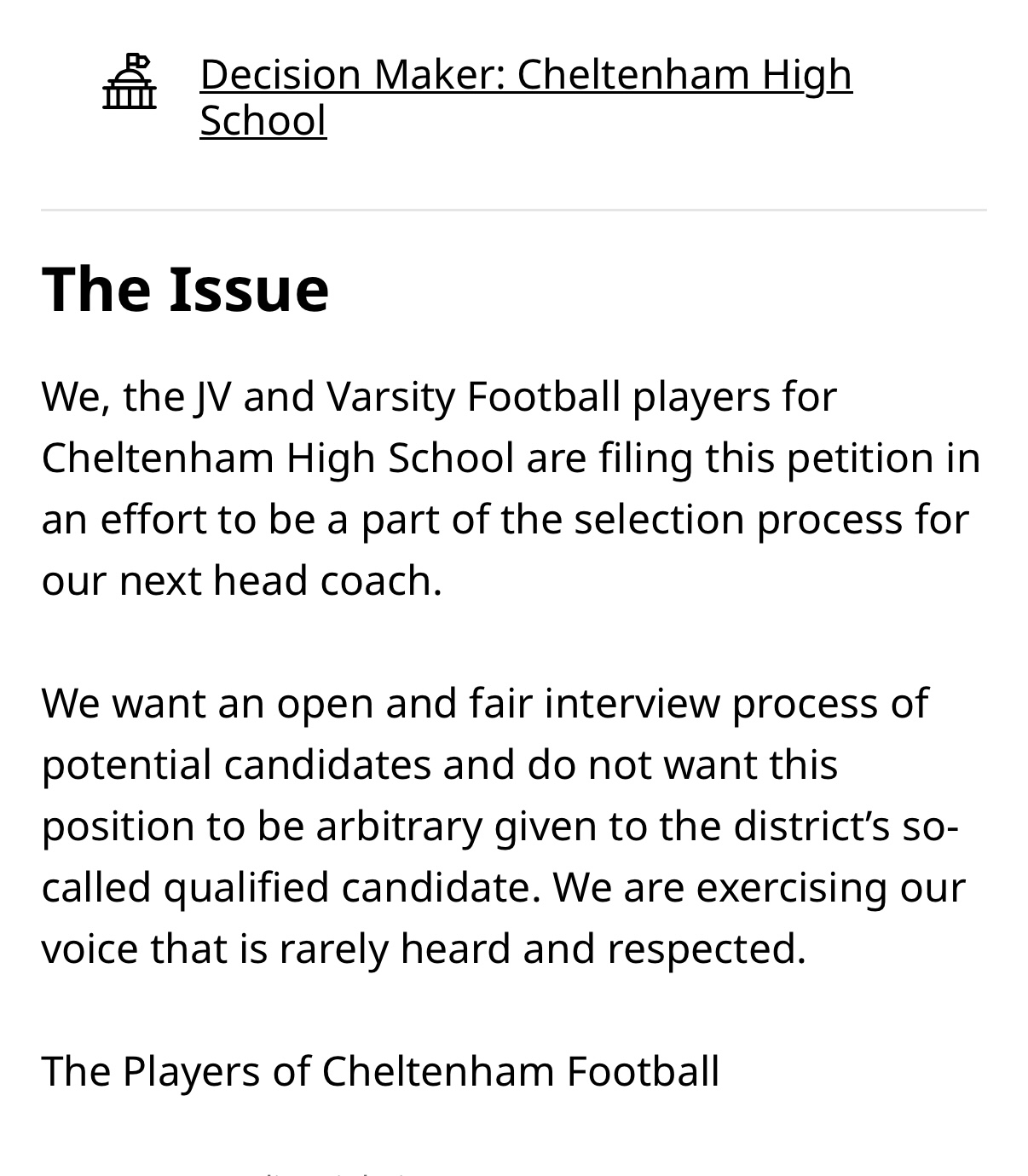
A then-junior on the varsity team started a petition against hiring Tolbert.
“We … do not want this position to be arbitrary given to the district’s so-called qualified candidate,” the petition reads.
A petition started by a Cheltenham varsity football player against the hiring of Terence Tolbert as head coach.Change.org
Taryn Knox, then the vice president of the football parent board, shared her concerns about Tolbert’s hiring process and his record at Abington at school board meetings and in meetings between administrators and football parents until the district formally made Tolbert the coach in June.
At a May board meeting, Knox said Tolbert had been “let go” from Abington, calling him “not appropriate or qualified” for the head coach job.
She was not the only parent who spoke out at that meeting.
“We asked for our children to have a solid leadership,” said Dana Burnley, whose son was on the team. Burnley said that her son had interest from seven Division I schools but that the coaching switch had disrupted the recruitment process.
Burnley’s husband, Ralph, a volunteer coach,was among those charged alongside Tolbert last week and faces the same charges of endangering the welfare of a child and conspiracy. Ralph Burnley has not responded to calls seeking comment.
Multiple upperclassmen also met with Hammond and Sheridan in April to voice their concerns,according to a list that Knox emailed to the principal. Included in the list of concerned players were at least two who were charged last week in connection with the assaults.
“Every plea that we tried was ignored,” Knox said — including one at an April 22 meeting with parents where Knox asked Tolbert to voluntarily resign to reopen the hiring process. Hammond rushed to take the microphone from Tolbert before he could respond, she said.
Cheltenham did not answer any questions this week about parent concerns ahead of Tolbert’s hiring.
Tolbert applied for the open Cheltenham position after a brief stint at Abington that he had left an offensive coordinator role at Cheltenham to pursue. The 2023 move to Abington was a promotion to head coach, but his tenure there was short-lived.
The Abington team won only one game that season, and Tolbert’s employment expired. Abington has acknowledged that the district opted not to renew the one-season appointment but declined to give further details.
Parents from both schools said they believed it was a failure to address bullying and a toxic team culturethat led to his departure.
“There were kids being bullied in the locker room, the language, cussing out coaches,” Knox said this week.
After charges against Tolbert went public last week, an Abington parent shared with The Inquirer the text of a 2023 email he said was sent to Abington officials outlining similar allegations he had heard at the time, including that Tolbert failed to intervene in persistent bullying on the team and crude language from other coaches.
Before a Sept. 8, 2023, game, a coach used the f-slur to refer to the opposing team in a pep talk in front of Tolbert, who did not intervene, the email alleges. The complaint also describes instances when Tolbert failed to break up fights or react appropriately when he saw bullying, including a player who verbally berated a teammate with disabilities.
“It wasn’t a secret,” said the Abington parent, who requested anonymity for fear of retaliation against his child, who still attends the school. “Many parents knew why he was removed. I’m shocked that he was able to get another job.”
Union contract gave Tolbert leg up for coach
Knox and Ferguson said the district hired Tolbert without an interview.
“The [same] buildup that happened here, happened at Abington,” Knox said. “It just didn’t lead to an assault.”
Before Tolbert’s hiring, Cheltenham parents were already upset about former coach Troy Gore’s removal during an important recruitment period, Knox and Ferguson said, because it left players who anticipated scholarships from Division I schools without an advocate.
“These are students who are trying to achieve higher education while also playing a sport that they love, and for some of them, this is their only option,” Knox said at the May 2025 school board meeting.
But when parents questioned what they viewed as an abbreviated hiring process for Gore’s replacement, administrators pointed to a clause in the teachers union contract that gives qualified staff first pick of coaching jobs ahead of external candidates, Knox and Ferguson said.
Tolbert briefly taught business at Cheltenham until he resigned in October 2023, board documents show. He then took a job at Abington as a long-term substitute for business education in addition to coaching.
Cheltenham rehired Tolbert as a business teacher before announcing his 2025 appointment as head coach.
‘Be accountable’
Knox returned for the June 2025 board meeting and said she had been promised a call from the superintendent after the May meeting, but did not receive one.
“Be accountable,” Knox said at the June meeting. “If you say you’re going to follow up, please follow up.”
Superintendent Brian Scriven replied that there was a meeting planned with football players.
“I did say I was going to call you. I opted not to. I will own that,” the superintendent said, adding that Knox had his number and could call him.
The board officially appointed Tolbert as coach at the meeting.
Knox’s son did not trust Tolbert as a teacher or a coach, she said.
“He had been a part of the team for two years prior to that and didn’t have the relationship with the boys,” Knox said.
‘The administration failed these kids’
The administration erred again, Ferguson said, by not suspending students who were involved in the locker room assault recorded on video.
Nearly 20 members of the team witnessed the locker room assault, according to the district’s investigation, and the video was widely circulated. Ferguson said his son and most of the team did not witness the attack.
Jackson always stayed on the field after practice running extra drills, his dad said, and Ferguson would bring his younger son to hang out on the grounds while they waited for him to finish.
By January, the superintendent had publicly acknowledged the district was aware of “several” perpetrators.
But the lack of disciplinary action left the entire team in limbo all year — isolating Jackson from teachers and other students, who were not sure which players were involved, Ferguson said: “People can’t fathom the fact that he’s the starting quarterback and he didn’t know about it.”
Now Jackson, who broke the school’s sophomore quarterback passing record in 2024, is struggling to find a transfer school.
“The administration failed these kids,” Ferguson said.
Knox transferred her son to a Philadelphia school before the incidents. He is set to play football at East Stroudsburg University, a Division II school.
“Thank God I pulled him out,” Knox said. “Every school said, ‘We know you came from Cheltenham; we’re glad you transferred.’”
Staff writer Maddie Hanna contributed to this article.
This suburban content is produced with support from the Leslie Miller and Richard Worley Foundation and The Lenfest Institute for Journalism. Editorial content is created independently of the project donors. Gifts to support The Inquirer’s high-impact journalism can be made at inquirer.com/donate. A list of Lenfest Institute donors can be found at lenfestinstitute.org/supporters.
But I wasn’t surprised. And you shouldn’t be, either.
Put simply, hazing is as American as apple pie. When an incident like this happens, everybody expresses shock and dismay. Legal charges are filed, coaches are fired, and games are canceled. And then we go back to hazing again.
Most Americans probably associate hazing with college and — especially — with fraternities. But in a 2009 survey of over 11,000 university students, 47% reported they had experienced hazing in high school. All told, an estimated 1.5 million high school students are hazed each year.
That means it’s people you know, in the communities where you live.
In 2004, a grand jury reported that three Long Island football players attending a summer camp in Wayne County, Pa., had inserted pine cones and golf balls into teammates’ anuses. The assaults were part of a long history of hazing at the camp, where coaches “displayed a lack of common sense and accountability,” the report said.
At a July 29 news conference, Montgomery County District Attorney Kevin Steele announces multiple charges in connection with two assaults in the Cheltenham High School locker room that injured a 15-year-old football player.Tom Gralish / Staff Photographer
In 2014, Central Bucks West High School in Doylestown acknowledged that rookie football players had been forced to grab other players’ genitals. They were also led into the shower with towels over their heads, which the players called “waterboarding.”
In 2015, seven football players at Sayreville High School in Middlesex County, N.J., were charged with grabbing teammates’ buttocks and digitally penetrating one of them.
In 2016, prosecutors said football players at Conestoga High School in Berwyn had penetrated a freshman player with a broomstick as part of a hazing ritual called “No Gay Thursdays.” And in 2022, football players at Wall Township High School in Monmouth County, N.J., were caught on video holding a student’s legs apart and, yes, assaulting him with a broomstick.
Are we seeing a pattern here? Most high school hazing involves verbal — not physical — abuse. But the most violent episodes happen on sports teams, which also have the highest rate of hazing.
And they’re also the most likely to generate criminal charges. In Cheltenham, six players have been charged in connection with the assaults on their teammate. And four coaches face charges of endangering the welfare of a child and conspiracy for allegedly trying to cover up the incident.
The football practice field and stadium at Cheltenham High School.Tom Gralish / Staff Photographer
Ditto for our educational efforts. When reports of hazing surface, school officials pledge to conduct anti-hazing training for coaches and students. And they release statements declaring that hazing will not be tolerated, in any form.
But their message is falling on deaf ears. So it’s time to change the messenger to someone whom kids will really hear: the hazers themselves. If you haze somebody, you should be required to speak to other students about it.
It’s happened before. After a Virginia Commonwealth University student died of alcohol poisoning in a fraternity initiation in 2021, six students who pleaded guilty to hazing him agreed to travel to universities around the country to discuss the tragedy and the role they had played in it.
We could — and should — demand the same thing from high school hazers. Plea agreements in hazing episodes often require guilty parties to perform community service. What could be a better service than speaking at student assemblies and other public events about the problem of hazing?
In the Cheltenham incident, two 18-year-old football players were charged as adults — one with assault and conspiracy, the other with false swearing for being untruthful to police. The four other players were under 18 and were charged as juveniles.
I don’t know what penalties they should receive. But here’s what I do know: The rest of the school would discover a lot more about hazing if the six students were required to speak about it. And maybe, just maybe, we could start to shift the culture around this destructive behavior.
When hazing is reported at a high school, local officials condemn the incident and inevitably declare that “this is not who we are.” In fact, it’s exactly who we are. We haze. So let’s hear from the people who do it, about why they haze and what they have learned. We can all learn something from them.
Jonathan Zimmerman teaches history and education at the University of Pennsylvania. He is the author of “Schooling Citizens: How Education Can Save Democracy,” which will be published next spring by the American Philosophical Society Press.
The Cheltenham School District’s “level of incompetence didn’t just fail one child — it put every young man on the football team at risk,” the Montgomery County grand jury that recommended the charges against four coaches and six players said in a report released Wednesday.
The August and September 2025 assaults threw the football program into turmoil, with the district canceling last year’s season in October and announcing this spring that the forthcoming fall season would also be scrapped. While district officials shared little about what happened in the locker room, videos were widely circulated within the school community depicting one of the attacks, the grand jury found.
Yet the district did not punish any players; a Title IX investigation that could result in discipline is still underway. The two players charged as adults, Isaiah Simpson and Josiah Peeler, both graduated from Cheltenham High School this year, district officials said. While the district parted ways with all of its football coaches, at least one charged this week had been hired by another local school: Neumann Goretti tapped Benjamin Johnson as head football coach in January, but on Wednesday the school announced he no longer had the job.
When the mother of the 15-year-old who was attacked reported to the high school administration that her son had been jumped by hisPanther football teammates in the locker room last September, injuring his genitals, an employee who texted two other employees about the allegation said the student had “a chip on his shoulder” from not making the varsity team, the grand jury report said.
District employees took the team’s then-head coach, Terence Tolbert, at his word and included him in “every step” of their investigation, according to the report. Tolbert, whose lawyer did not return a request for comment Thursday, was charged Wednesday with endangering the welfare of a child and conspiracy.
The football practice field and stadium at Cheltenham High School in Wyncote, Montgomery County, Wednesday, July 29, 2026.Tom Gralish / Staff Photographer
Employees were also confused about their requirements to report child abuse allegations to law enforcement, the report said.
Cheltenham Superintendent Brian Scriven said in a statement Wednesday that “every report brought to the district’s attention was addressed based on the information available at the time.” He also noted that “individuals did not cooperate with the investigative process.”
On Thursday, Scriven addressed some additional questions about the district’s response. “At no point in time was Coach Tolbert involved in planning or executing any investigation,” he said in a written response to questions.
He also said the Montgomery County District Attorney’s Office had directed the district to pause its Title IX investigation into the allegations while it was investigating.
Now that charges are filed, the Title IX investigation “has resumed and will be concluded promptly,” Scriven said, withpossible “school-based” discipline.
‘Backed her off coming to the building’
In addition to issuing findings supporting criminal charges, the grand jury released a separate report focused on the school district that included recommendations for new legal requirements for schools to report hazing allegations to law enforcement.
The report described the actions of three employees at the high school, identified only as Employee #1, Employee #2, and Employee #3.
The mother of the student who was attacked told The Inquirer earlier this month that she had texted Mark Hoff, then the assistant vice principal at the high school, on Sept. 7 after learning that her son had been jumped in the locker room. Hoff was named vice principal at Wyncote Elementary School in the district on July 20. Hoff could not be reached for comment Thursday.
The high school’s principal, Benjamin Hammond, referred a reporter to the district’s spokesperson Thursday.
The person identified as Employee #1 in the grand jury report, who texted two other employees about the student having a “chip on his shoulder,” also suggested in the text exchange that the administration was trying to keep the mother from the school.
“I THINK I backed her off coming to the building in the AM,” Employee #1 texted, according to the report.
Employee #2 called Tolbert that same day, and texted the other two employees that the coach denied that anyone told the student not to tell his mom.
“At this point in the conversation, all three employees vouched for Tolbert’s credibility,” the report said.
Employee #2 began his investigation by interviewing Tolbert, who said he did not know anything, according to the report.
He also spoke to other coaches and took them at their word because he “thought that they would be forthcoming, mature adults and do the right thing and not lie to him,” the report said.
Scriven did not address a question Thursday about employees’ response to the mother. But he said they appropriately went to Tolbert to ask “what he knew of the situation.”
“At the time, there was no reason to believe Coach Tolbert was being untruthful,” he said.
Tolbert had previously served as head coach of the varsity team at Abington Senior High School for the 2023-2024 season. An Abington spokesperson said on Thursday that the district had opted not to renew his appointment after one year.
Insufficient supervision
The grand jury also found fault with Cheltenham’s supervision of the football program.
While there was an office for coaches in the football locker room, “they rarely used it,” the report said. (Tolbert had become the head coach in June 2025; coaches had used the office the season before, according to the grand jury.)
Employee #2 testified to the grand jury that he did not do anything to ensure that football players were supervised, the report said.
The grand jury also found that “at least” five paid Cheltenhamfootball coaches were not up to date on Act 126 clearances. The Pennsylvania law requires schools to provide employees who have direct contact with children with at least three hours of child abuse recognition and reporting training, every five years.
In releasing findings from its investigation in January, the district acknowledged “insufficient student supervision in the locker room by the coaching staff” and “a failure to prioritize student safety by the coaching staff” and volunteers.
Montgomery County District Attorney Kevin Steele announces at press conference Wednesday, July 29, 2026 multiple charges in connection with two assaults in Cheltenham Township High School locker room that injured a 15-year-old player and led to the cancellation of the 2026-2027 football season.Tom Gralish / Staff Photographer
Circulating video footage
There were two videos taken of the Aug. 15 assault, prosecutors said. The grand jury findings characterized the footage — which it said depicted a student moving a broomstick toward the bottom of the student’s shorts while at least one player chanted “broomstick him” — as circulating widely within the school community.
One witness told the grand jury there was a TikTok video “going around where two boys were making fun of the juvenile victim with a Meek Mill video playing in the background.”
The victim testified that he believed many people had seen a video, because “random people” approached him about it in the cafeteria and hallway. Another student, who was not on the football team, told the grand jury she had been shown a video at school of the victim being kicked by multiple people.
While the district had been aware only of an incident on Sept. 3, questioning of one of the players by the grand jury in January led to the discovery that the video footage depicted an Aug. 15 assault.
Players told the grand jury that an administrator, identified only as “Administrator #2″ in the grand jury findings, met with the team after the Sept. 3 incident.
One player reported that “days” later, the administrator “addressed the team about ‘stuff’ and warned the players if there’s ‘another one,’ the season would be canceled,” according to the grand jury findings.
Another told the grand jury that the administrator met with the team while coaches were present, and told players not to fight with one another and that there would be consequences “if anything else occurred.”
That player said neither the coaches nor the administrator “encouraged anyone with information about the incident to come forward,” according to the grand jury findings.
‘Consistent confusion’ about reporting requirements
Prosecutors said the district contacted Cheltenham police after an anonymous Sept. 18 tip through the state’s Safe2Say hotline. The mother previously told The Inquirer that the tip was how she learned a broomstick was involved.
The grand jury report said district employees were unclear on their requirements as mandatory reporters.
“There was consistent confusion about what type of assault allegation would prompt an immediate report to ChildLine and the police,” the report said. It said the unidentified Employee #3 displayed “especially concerning judgment” by concluding that coaches never told the student not to tell his parents “simply because a coach said it never happened.”
Mandatory reporting laws currently do not require that allegations of hazing, committed by a child on another child, be reported as suspected child abuse — unless sexual assault is alleged, the grand jury report said.
Acts of hazing that “fall short of a completed sexual assault, touching or exposure, such as the threatened sexual assault in this case,” do not meet the mandatory reporting threshold, the report said.
It recommended that hazing be incorporated into mandatory reporting requirements. If it had been, the report said, “the Cheltenham High School administration would not have had the opportunity to mishandle the juvenile victim’s disclosure and the ensuing investigation as poorly as they did.”
In his statement Wednesday, Scriven said the district would welcome additions to the mandatory reporting laws. But he said hazing would not necessarily be immediately identifiable to school staff, noting that the law defines the offense as “for the purpose of initiating, admitting or affiliating a minor or student into or with an organization.”
Scriven did not address questions Thursday about employees’ understanding of reporting requirements.
Asked why the district did not contact police after the mother’s Sept. 7 report of an assault, Scriven said Thursday that it was “not reported as a sexual assault.”
“A ChildLine report was properly made when the district learned that a reportable offense may have been committed,” Scriven said.
In testimony, the player who was attacked described being stomped in the head and groin with cleats during the September assault, and being “tucked up” on the floor as teammates tried to poke him in his butt with a broomstick, according to the grand jury findings.
“He said that he feared for his life and did not want to go back to school or play football for the team anymore,” the findings said.
Staff writers Jess Rohan and Vinny Vella contributed to this article.
Unlike Philadelphia — a city, county, and school district all in one — the collar counties are a mesh of townships, boroughs, and informal neighborhoods.
That geographical maze, along with the centuries-long evolution of the U.S. Postal Service, means some suburbanites are not even sure what town they live in.
He is from Abington Township and, like many Abingtonians, he has been living a lie.
Where is Bradley Cooper from?
Cooper grew up not in Jenkintown, but a mile away in the unincorporated Abington community of Rydal, in a house his parents bought before he was born, property records show.
In the 1980s, he attended Rydal Elementary, where he played a mime, according to a playbill shared on social media.
The Oscar-nominated actor later enrolled at Germantown Academy, a private school in Whitemarsh Township whose reunions he still attends.
Cooper is known to call nearby Jenkintown his hometown from time to time — maybe because the borough is more well-known, and because that is what his childhood mailing address was. His reps did not return a request for comment this week.
Some Abingtonians don’t know where they live
But unlike people who grew up in the tiny enclave, Cooper could not have attended Jenkintown School District or participated in its National Geographic-famous Color Day.
“As someone who grew up in Jenkintown and loved cute boys and is about the same age as Bradley Cooper, I can tell you he is not from the Borough of Jenkintown,” writer Lauren McCutcheon said.
Many Abingtonians think they live in J-town, borough manager George Locke has said — so much so that his staff starts resident service calls by asking for an address. Otherwise they could spend 45 minutes on the phone, Locke said, before realizing the caller is in Abington.
Residents of unofficial neighborhoods like Glenside, or towns that span counties like Telford, may be more aware of their official designation. Some Glensiders attend school in Cheltenham, while others attend Abington School District.
For people without a kid in public school, an invisible municipal boundary may not matter much day to day. But it matters for local elections and during tax season.
Nye Stevens, a longtime Postal Service expert for the U.S. Government Accountability Office and the Congressional Research Service, said mailing addresses can also affect people’s insurance rates, which are often based on zip code instead of municipality.
And a zip code across two towns is nothing, Stevens added — some people get their mail from another state.
Bob O’Brien of Wyncote used to think his practice, Relief Counseling & Art Therapy, was located in Jenkintown — until the tax bill from Abington arrived.
“It was confusing,” O’Brien said — especially since there is a Jenkintown post office in the same building.
“How it got this way, I’m not sure,” he added.
The demands of mail delivery
U.S. post offices began primarily as a pickup service in cities until the agency introduced home delivery in the late 1800s.
Then cars expanded the suburbs, townships shifted, and assigned post office locations grew increasingly messy.
“As townships grow, post offices seem farther away,” a New York Times headline about South Jersey observed in 1997.
The U.S. has also closed tens of thousands of post offices in the last several decades, Stevens said, which may mean losing a mailing city that reflects where people actually live.
A map shows the city limits of Waterloo, Iowa, in yellow, while a blue line shows the boundaries of the “Waterloo” zip code.U.S. Census Bureau
Around 1990, some in Congress tried to fix the issue with a bill requiring the Postal Service make zip codes match municipal boundaries if towns request it.
But such a change would “absolutely ruin the postal system,” Stevens said. “You can’t have a post office for every little borough.”
The bill failed, and years later, the Postal Service was routinely rejecting zip code change requests, Stevens wrote in a 2006 Congressional Research Service report.
“Some communities that lack delivery post offices complain that the need to use mailing addresses of adjacent areas robs them of a community identity,” he noted in the report.
But at the end of the day, “zip codes are basically a delivery system. They’re not a neighborhood recognition system,” Stevens said this week.
As for Bradley Cooper, the confusion around his addresses in the Philly suburbs has not ended.
He supposedlyowns an estate in New Hope. But he really lives in Solebury Township.
This suburban content is produced with support from the Leslie Miller and Richard Worley Foundation and The Lenfest Institute for Journalism. Editorial content is created independently of the project donors. Gifts to support The Inquirer’s high-impact journalism can be made at inquirer.com/donate. A list of Lenfest Institute donors can be found at lenfestinstitute.org/supporters.
Four Cheltenham High School football coaches and six players have been charged in connection with two assaults in the school’s locker room that injured a 15-year-old player and led to the cancellation of two football seasons, Montgomery County prosecutors said Wednesday.
In two violent assaults, District Attorney Kevin Steele said, multiple football players attacked a sophomore on the team, stomped on his chest and groin while wearing cleats, and used a broomstick to poke at his buttocks.
“The assaults on this victim were not typical goofing around by teammates, or horseplay, as some of the coaches in this case called it,” Steele said at a news conference Wednesday. “They were crimes.”
After the attacks, which took place last August and September, Steele said, coaches tried to cover them up.
Head coach Terence Tolbert, 55; associate head coach Darian McFadden, 42; assistant coach Benjamin Johnson III, 45; and volunteer coach Ralph Burnley, 60, have been charged with endangering the welfare of a child and conspiracy. The coaches are no longer with the district.
Two football players, Isaiah Simpson, and Josiah Peeler, both 18, have been charged as adults — Simpson with conspiracy to commit aggravated assault, simple assault, reckless endangerment, and related crimes for his role in the September assault, and Peeler with false swearing for being untruthful to police. The two were 18, Steele said, when the crimes they are charged with took place.
The four other players have been charged as juveniles, and were not identified by prosecutors or named in court records. Two of them face charges of conspiracy to commit aggravated assault and related crimes, because authorities say they took part in the attacks. The other two players are charged with false swearing.
Tolbert, McFadden, Johnson, and Peeler were released on $5,000 unsecured bail. The two other adults had not been arraigned as of Wednesday afternoon. Only two of the defendants, Johnson and Peeler, had attorneys listed in court records.
Johnson’s attorney, Richard J. Fuschino, said his client “has been humiliated by what occurred and absolutely had nothing to do with it.”
“I do believe there is a cover-up, and I absolutely do not believe Benjamin Johnson had anything to do with it,” he said. “In fact, quite the opposite: He went out of the way to cooperate with every investigator.”
Peeler’s attorney, Jessica Mann, did not respond to a request for comment. Attempts to reach the other defendants were not successful Wednesday.
Cheltenham Superintendent Brian Scriven said Wednesday that the district appreciated prosecutors’ work on the case and the filing of criminal charges. “While no legal outcome can erase the harm that was experienced,” he said, “we appreciate that after nearly a year, charges have been announced and those responsible are being held accountable through the criminal justice system.”
Prosecutors say coaches wanted incident ‘kept quiet’
Steele said the charges followed a grand jury investigation in which witnesses described two violent assaults.
The coaches are criminally liable for the assaults, Steele said, because, while they were not present, they learned of the September incident and encouraged the victim not to tell his parents.
Montgomery County District Attorney Kevin Steele at a press conference Wednesday.Tom Gralish / Staff Photographer
Privately, the coaches sent incriminating text messages to one another, Steele said, expressing concern that the incident “has to be handled and kept quiet.”
McFadden, the former assistant coach, wrote “if this gets out we are [expletive]. They will cancel the whole season,” according to the grand jury presentment.
The assaults occurred Aug. 15, after a preseason practice, and Sept. 3, Steele said. He said video footage of the August incident showed several students restraining the victim, while another student poked at his legs and buttocks with a broomstick.
Players are laughing and yelling in the video, and “at least one player is chanting, ‘broomstick him,’” Steele said.
A football player who witnessed the assault, but is not charged in the case, told the grand jury that the use of a broomstick was an apparent reference to a TikTok video featuring a Meek Mill song with the lyrics “broomstick all in his butt, tell him take that,” according to the grand jury presentment.
Steele said there was no evidence that it constituted sexual assault.
Players didn’t take the incidents seriously
Several football players who testified before the grand jury characterized the behavior as “horseplay” and said they did not take it that seriously. Others said the victim had a difficult relationship with his teammates and was viewed by them as “someone who did not follow the rules during practices.”
The Sept. 3 assault, witnesses said, happened after the teen took a pair of shoulder pads from another player’s locker after misplacing his own, an infraction for which the entire team had to do extra conditioning as punishment.
Steele said that investigators did not have a video of the Sept. 3 assault but that multiple players, including Simpson and two of the juvenile defendants, kicked and stomped the victim.
The teen reported told investigators that his teammates were “trying to poke him in the butt with the broomstick,” and that they made contact with his buttocks, Steele said. He said the assault broke up when school buses arrived, and teammates left to board them.
Burnley, one of the coaches, drove the victim home after the attack, and the teen broke down in tears, telling the assistant coach he had been jumped by teammates, the district attorney said.
Burnley then texted coaches in a group chat and called Tolbert, Steele said. McFadden and Tolbert called the teen and “told him not to tell his mother about the incident because they would handle it,” Steele said.
He said the coaches were deliberate and calculating in their decision not to report the assault.
‘Serious concerns about the response’
The incident came to light four days later, when the teen’s mother said he told her he had been jumped by teammates and had pain in his genitals. She said she took her son to an urgent care center and texted the high school’s assistant principal, who called her later that day.
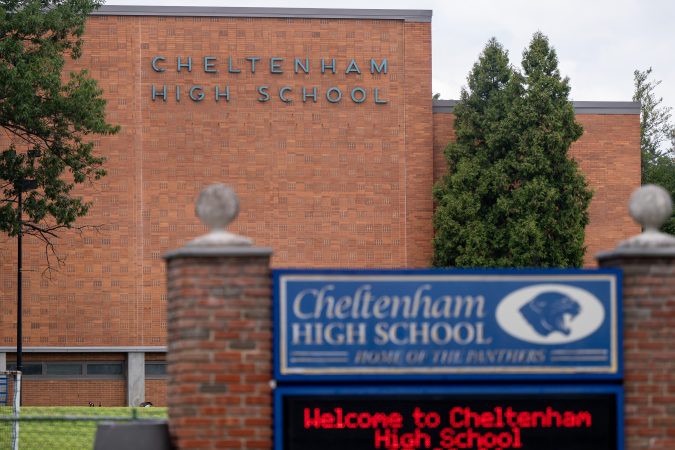
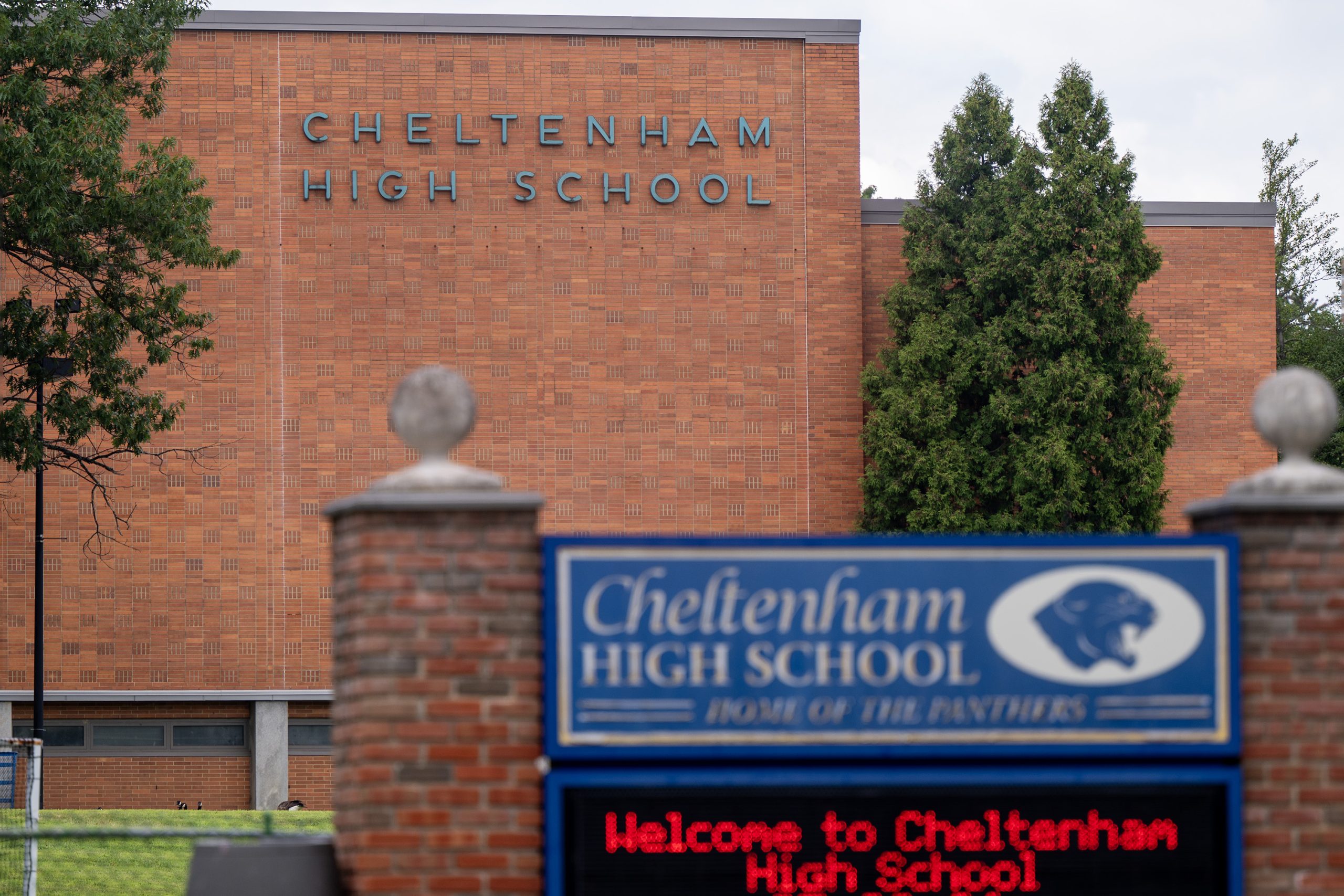
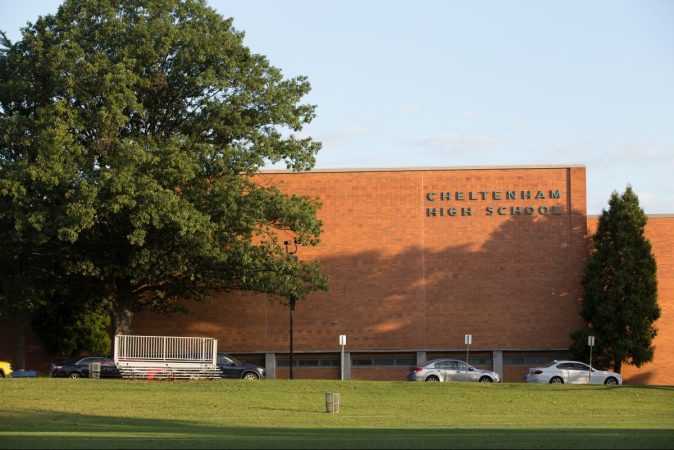
A front view of Cheltenham High School in Wyncote.Tom Gralish / Staff Photographer
The teen did not tell his mom that his teammates used a broomstick in the attack. He was embarrassed and reluctant to share that detail, the mother said in an interview with The Inquirer in which she spoke on the condition of anonymity to protect the identity of her son.
She said her son told her that his teammates had tried “to mess with his manhood.”
She learned about the broomstick later in September, when Cheltenham Township police called to tell her that someone had called Pennsylvania’s Safe2Say hotline to anonymously report that students had used a broomstick during the attack, according to the teen’s lawyers, Alan Yatvin and Gabrielle Turley.
Sometime in October, the district obtained a video that had been circulating in the community and depicted an assault of the student with a broomstick, the lawyers said.
Investigators initially believed that footage was from the Sept. 3 assault. It was discovered during grand jury testimony in January that the assault was from August, prosecutors said. The teen, who said he was not shown the video until this spring, also identified it as being from August, revealing for the first time that he had been assaulted more than once, according to the lawyers.
“Our client and his family are grateful to the Montgomery County District Attorney’s Office, law enforcement investigators, and the grand jury for their careful and thorough work in bringing these deeply troubling events to light and pursuing charges,” Yatvin said in a statement Wednesday. He added that the grand jury investigation “also raises serious concerns about the response by some within the Cheltenham High School community.”
The district faulted inadequate supervision in the locker room, “a failure to prioritize student safety” by coaches and volunteers, and “a toxic and negative culture” within the football program.
District officials have said a Title IX investigation, required by law when sexual assault or harassment is alleged, is ongoing.
Scriven, the superintendent, said in a statement Wednesday that “every report brought to the district’s attention was addressed based on the information available at the time.” He noted that law enforcement and the grand jury had the power to issue search warrants and compel testimony, which “brought information to light.”
In April, the district approved separation agreements with Tolbert and McFadden. Officials say none of the coaches from last season is still affiliated with the district.
The victim, who switched to virtual school after being harassed by peers after the attacks, has continued to struggle, according to his mother. She said he avoids going outside because he fears being taunted about what happened.
During Wednesday’s news conference, Steele criticized the school district and said it had failed the victim.
In its report, the grand jurors noted that they — not the school district’s Title IX investigator — discovered that two separate assaults had taken place.
“I believe the Cheltenham School District has taken the position that they don’t want police in their schools or school resource officers, and so it’s on them to address these issues,” Steele said. “So the grand jury took care of what the school did not.”
Montgomery County District Attorney Kevin Steele arrives at a press conference Wednesday to announce multiple charges in connection with two assaults in a Cheltenham High School locker room.Tom Gralish / Staff Photographer
In addition to recommending criminal charges against the players and coaches involved in the case, the grand jury filed a separate report calling for a change in state law that would require teachers and coaches to report incidents of hazing as a form of child abuse.
“While the school district claims to ‘protect and prioritize safety and well being,’ their actions in this case say otherwise,” the grand jury report said. “The administration carried out three school-led investigations that were so flawed they failed to even identify that two separate instances of hazing occurred in the locker room.”
News researcher Ryan W. Briggs contributed to this article.
Thanks for reading the third edition of this newsletter. It’s been incredibly helpful to hear your thoughts so far. Please keep sharing your insights with us via this survey so we can shape this resource to be the most helpful it can be!
A Cheltenham mother has spokenexclusively to The Inquirer about the alleged assaults her son experienced last year in theCheltenham High School footballlocker room. In one instance, nearly 20 students watched as the boy’s teammates attempted to sexually assault him, his lawyers said.
No students have been disciplined even after the school district determined that an assault had taken place and been recorded on video by witnesses, while the affected teenager “can’t escape” continued harassment throughout the local community, his mother said.
The school’s previous and upcoming football seasons were both canceled amid the ongoing investigation by the Montgomery County District Attorney’s Office.
Meanwhile, the teen’s family is still awaiting accountability.
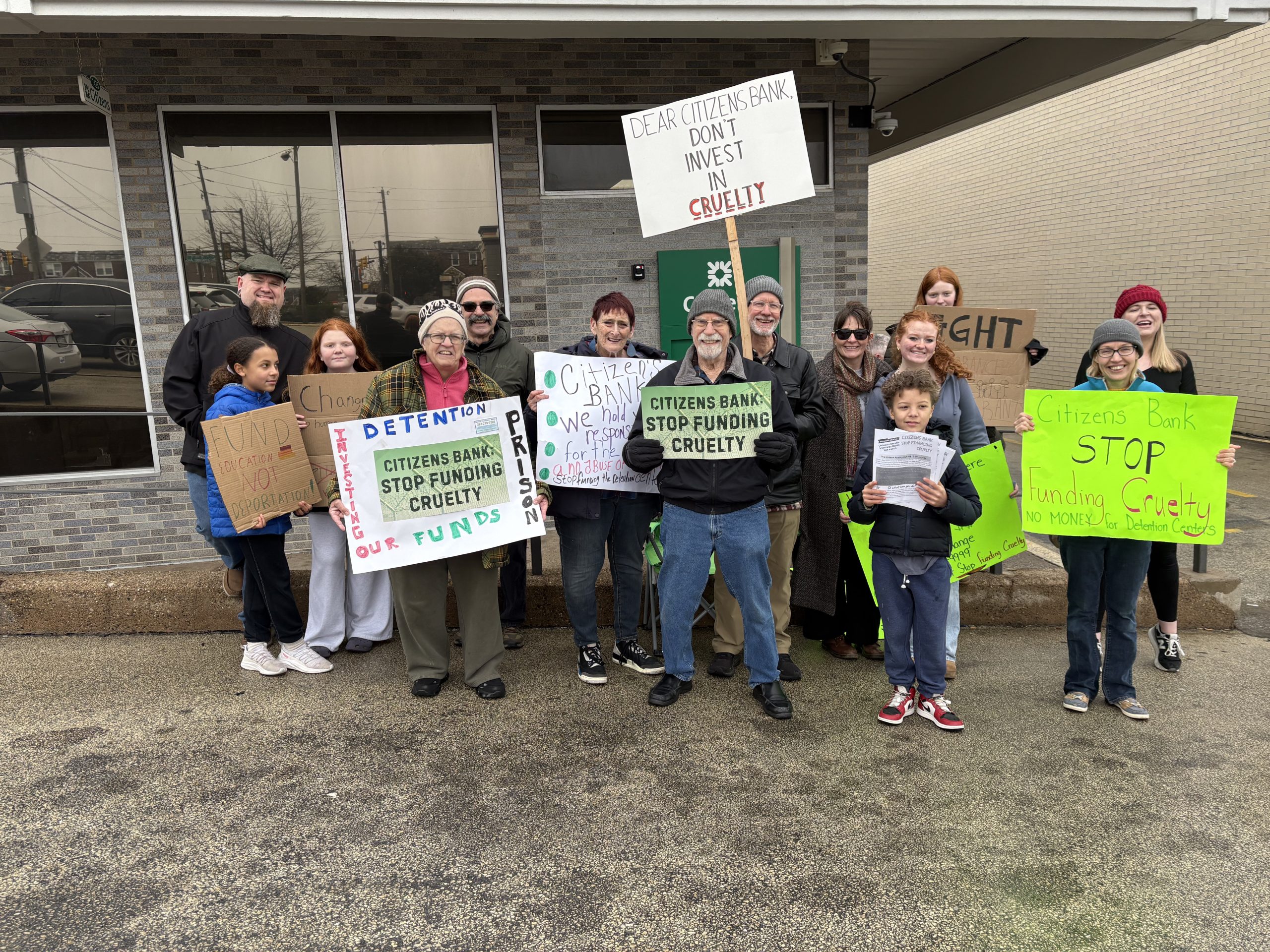
Cheltenham Township is closing its last two accounts with Citizens Bank over the bank’s financing of companies that run detention facilities, despite the bank’s announcement it would no longer do so.
The accounts hold about $9 million cumulatively, which township officials are planning to divert to Santander Bank. The move comes after months of lobbying by local residents.
Friends of Fox Chase Farm, a volunteer group that supports the 112-acre expanse that straddles Abington Township and Philadelphia, has disbanded after more than 30 years.
Ramah Day Camp, a Jewish summer program in Cheltenham, will also shutter soon, ending its 30-year run.
Abington, Jenkintown, and Cheltenham are among the Montgomery County locales that will be scrutinized by law enforcement in the coming weeks in an effort to combat aggressive drivers.
A 27-year-old Nigerian man who laundered money as part of a “sextortion” plot that led a 20-year-old Abington native to kill himself has been sentenced to five years in federal prison.
Jenkintown man Seok Joon Lee, 54, has been charged with impersonating a federal officer after allegedly pretending to be an FBI agent at a Philadelphia grocery store, where he carried a loaded gun and attempted to conduct a security check of the supermarket.
The community is mourning the deaths of esteemed clothing designer and professor of fashion Emil DeJohn, 88, who was a congregant of St. Luke the Evangelist Church in Glenside, and Ida Schmertz, 91, a former Jenkintonian who became a pioneering women’s activist, presidential appointee, and the first female senior vice president at American Express. They each died in recent weeks.
Inquirer contributor Paul Jablow takes a good look at a three-story, six-bedroom Queen Anne Victorian home up for sale in the Wyncote Historic District.
🏫 Schools briefing
Meet Brea D’Angelo, the former Sixers reporter who is now leading Jenkintown School District as its new superintendent.
Also in the Cheltenham School District, a new vice principal starts at Wyncote Elementary on Aug. 1. Plus, Glenside Elementary has named an interim principal and Cheltenham Elementary has named a new principal, both pending school board approval.
Construction is underway on Abington High School’s forthcoming Ash Carter Courtyard, a tribute to the late 1972 alumnus who served as U.S. Secretary of Defense from 2015 to 2017, the Main Line Times reports.
🍽️ On our plate
We’re in prime farmers market season, and Jenkintown has a robust one: Think handmade stuffed cookies, local fruits and veggies, and individually wrapped pound cakes, The Inquirer’s Hira Qureshi reports.
👻 Summerween Character Event: Enjoy spooky-themed drink specials, check out your favorite scary characters in their summer garb, and get a reading from a medium (if you dare). ⏰ Saturday, Aug. 1, 11 a.m.-1 p.m. 💵 Pay as you go 📍 Pot Heads Coffee House, Jenkintown
🕺 The Concert: A Tribute to ABBA: The touring production from Sweden, featuring original band members from the iconic pop group, will perform renditions of ABBA’s ‘70s and ‘80s hits to Montgomery County. ⏰ Tuesday, Aug. 4, 8 p.m. 💵 $52.53-$75.74 📍 Keswick Theatre, Glenside
Built in 1935 in Jenkintown Manor, this charming four-bed, three-bath home features original hardwood floors, a bay window in the dining area, and a wood-burning fireplace. There is a front porch as well as a back patio.
By submitting your written, visual, and/or audio contributions, you agree to The Inquirer’s Terms of Use, including the grant of rights in Section 10.
This suburban content is produced with support from the Leslie Miller and Richard Worley Foundation and The Lenfest Institute for Journalism. Editorial content is created independently of the project donors. Gifts to support The Inquirer’s high-impact journalism can be made at inquirer.com/donate. A list of Lenfest Institute donors can be found at lenfestinstitute.org/supporters.