New Jersey has fined the developers of a data center in Vineland more than $1 million for violating clean-air laws.
State officials say DataOne, a French company that is building the Cumberland County facility, installed and operated 62 large natural-gas power generators without the required DEP permits.
“This enforcement action — by far the largest ever taken against a data center in New Jersey and possibly one of the largest such actions in the nation — sends a clear message that these facilities will not be constructed or operated with impunity in this state,” New Jersey DEP Commissioner Ed Potosnak said in a statement.
During a site inspection July 29, state DEP officials saw the generators, which had not been there during a December visit, according to the enforcement document. Operating such machines — which emit carbon dioxide, nitrogen oxides, carbon monoxide, and other pollutants — without the required permits violates the New Jersey Air Pollution Control Act.
The state’s announcement comes weeks after an investigation by Floodlight and the Guardian, in which the news outlets used thermal drone footage to show the Vineland data center was operating at least 45 of its generators without permits.
DataOne spokesperson Naomi Race said company executives “disagree with the temporary generator determination” but will apply for the needed permits. Race did not respond when asked whether the company planned to pay the fine.
DataOne may request a hearing on the matter within 20 calendar days, according to the state’s enforcement document.
The Vineland data center is shown during an earlier stage of construction. It sits on a former industrial park.Courtesy of DataOne
As for the facility’s permanent power source, the company is “transitioning to low-emission, quiet fuel cells,” for which they “have the necessary approvals in place,” according to Race. Fuel cells generate energy through an electrochemical reaction rather than combustion, pistons, or rotating machinery.
The Vineland facility is on South Lincoln Avenue, off State Route 55, on the site of a former industrial park. The property was sold to DataOne in a private transaction, the details of which Charles-Antoine Beyney, DataOne’s founder and chief executive officer, previously declined to disclose.
He also has not disclosed a price, saying only that the project would be privately funded. Beyney said he turned down a nearly $6.2 million loan from the city due to community pushback.
Some Vineland residents have voiced concerns about the environmental, financial, and quality-of-life impacts of having a data center in their neighborhood. Opponents also took issue with the fact that DataOne did not seek their input until the facility was already under construction.
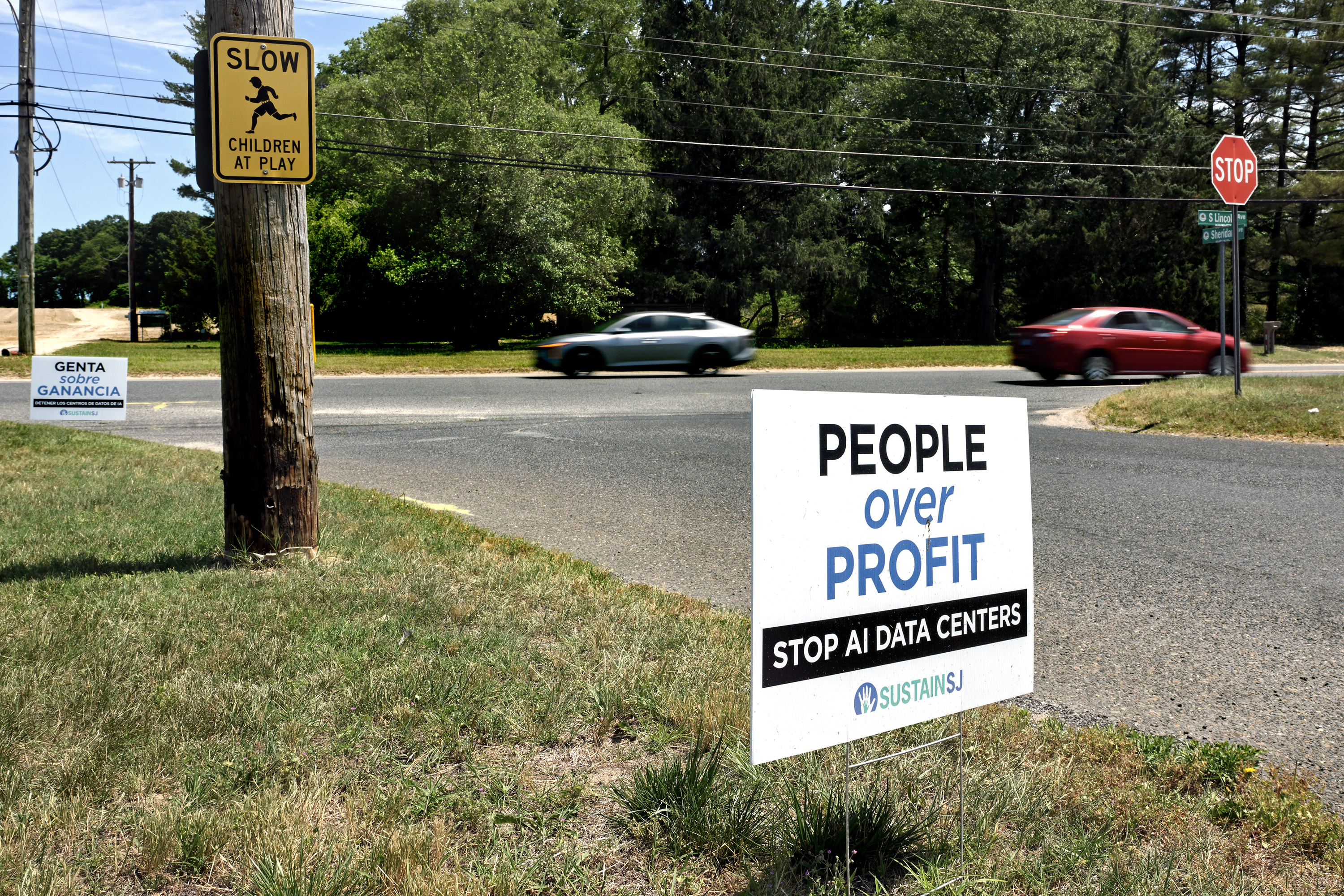
Some Vineland residents have put up signs like this one opposing the AI data center under construction nearby. Tom Gralish / Staff Photographer
At a contentious town hall in January, Beyney tried to assuage these concerns, telling residents they had nothing to worry about because his center would use “breakthrough” technology.
“Most of the data centers that are being built today suck, big time,” Beyney said at the meeting. “No freaking way am I am going to do what the entire industry is doing … just killing our communities and killing our lungs to make money.”
The Vineland facility has been under construction for more than a year. In January, DataOne executives said they expected the project to be complete by November.
Amid the global boom in data center demand, several hyperscale facilities have been proposed in the Philadelphia region, from King of Prussia to Limerick. But few have been approved and begun construction.
The Vineland site is one of them. Once fully operational, it could be the region’s first hyperscale AI data center.
The only other local facility nearing completion is Amazon’s 2 million-square-foot data center campus in Falls Township, Bucks County. As of last month, Amazon was awaiting a decision from the Pennsylvania DEP on permit applications for hundreds of proposed backup natural gas generators.
Pennsylvania Gov. Josh Shapiro shifted his stance on data centers last month and instituted new restrictions, which included the removal of Amazon from the state’s fast-track permitting process.
I feel like I need to apologize for a column a couple of months ago when I compared the current president of the United States to Caligula, the possibly mad Roman emperor who is said to have nominated his trusted horse for high office. I need to apologize to Caligula. From pitching his triumphal D.C. arch as a storage shed for deadly snipers’ bullets to banning reporters from the White House in a narcissistic rage, Donald Trump is losing his grip on reality. This is unsustainable.
Worried about AI killing humans? Bad news: It already is.
A cleric takes a photograph earlier this month at the shattered Shajareh Tayyebeh school in Minab, southern Iran. It has become a place of mourning and a memorial to those killed in a U.S. airstrike on Feb. 28.Vahid Salemi
Which is it?
Are the robots of AI, or artificial intelligence, so smart that they’re on the verge of holding a secret meetup in the darkest corner of the dark web and developing a plot to kill all humans through germ warfare, to make sure we don’t kill them first by pulling the plug?
Or is AI so dumb — artificial stupidity, despite the billionaires of Silicon Valley showing up daily on our TV screen to brag about the sky-high IQ of their son, Claude — that the thing that will murder us is a crazy hallucination that will turn a false alarm into World War III?
The fact that we can’t answer this should give us pause, but maybe we aren’t even asking the right question. Maybe the real issue is how easy we’ve made it to kill off the human race — a capability that was already created by people even before we invented the computer.
One thing is certain. Artificial intelligence has already been an accessory to mass murder, and if we do nothing, it will kill again.
Remember the very first days of the now seemingly endless Iran war, and the news that two missile strikes had obliterated a school for young children in the Iranian coastal city of Minab, in an apparent “double-tap” strike in which the second attack from the skies killed young girls and boys and their teachers as they huddled in a prayer hall?
Those bombings, which killed 156 people on Feb. 28, caused the United Nations’ Independent International Fact-Finding Mission on Iran to report last week that it found “reasonable grounds to believe that the United States committed a war crime by launching indiscriminate attacks …” The U.S. government has never taken responsibility for the bloodshed, despite overwhelming visual evidence that the bombs were precision-guided U.S. Tomahawk missiles.
It didn’t take long for additional speculation that an AI program had mistakenly targeted the school, perhaps using outdated maps and info from an earlier time when its buildings were attached to an Iranian military complex. After all, the Pentagon has been openly bragging about the death and destruction facilitated by its use of Palantir’s Smart Maven System and also Anthropic’s Claude.
Last week, Bloomberg News reported that the Pentagon’s overreliance on AI, and specifically the Palantir Maven program, was a major factor in the school tragedy, along with the outdated intelligence about the Minab site — the “garbage in.” Its exposé noted that U.S. military planners were racing to identify some 1,000 Iranian targets in the early hours of the war, giving humans little time to double-check the list. Kindergartners were slaughtered as a result.
This was hardly the first time robots have been linked to human death, both in war — in 2024, +924 Magazine reported the Israel Defense Forces were using an AI program code-named “Lavender” to target sites amid the mass killing in Gaza — and in peace, as shown by numerous accounts of robots helping troubled people die by suicide.
And yet, it could have been much, much worse. At the same time as the Bloomberg report on the AI link to the mass killing in Iran, the world also learned that a false report generated by robot intelligence nearly sparked a conflict between the United States and China that could conceivably have spiraled into major fighting.
CNN and other outlets have reported that a U.S. special operations command analyst working with AI generated an urgent report that a Chinese ship bound toward the Middle East was carrying components for a nuclear weapons system, which caused military leaders to scramble jets and assemble a team to seize the vessel.
Only at the last minute did the Pentagon dig deeper and learn the AI-generated report was completely false, a hallucination — one that nearly triggered a violent conflict between the world’s two largest military powers.
The two disturbing reports about the use, or misuse, of AI by the U.S. military in a time of war did make news but didn’t get nearly as much attention — either in the media or on sites like Bluesky or X — as warnings from both whistleblowers and CEOs in Silicon Valley that a swarm of robots could decide on their own and without any human intervention or awareness to try to kill off our so-called civilization.
The fear of an unprompted attack from AI secret agents is real, based on several incidents that have already occurred, including a well-planned and partly successful operation by OpenAI’s robot agents to hack into a company called Hugging Face.
Still, it says something about human intelligence that we are captivated by the unknown and mysterious possibility of a random attack, while the fact that people are currently misusing AI to cause death and suffering is a less compelling story. I noted in this space last week that the threat to humankind from climate change is arguably even more real — and yet this gets denied by many and ignored by others.
It’s also striking to me as a boomer born in 1959 that a generation that wasborn into a time of constant terror — backyard bomb shelters, “duck and cover” drills in the classroom, and sci-fi horror at the drive-in that an atomic arms race could kill us at any moment — is suddenly back to where we started.
The fact that civilization managed to — so far — pause the number of world wars at two has given us the space and the false bravado to create new and much more insidious killing machines, and the threat from invisible robots on a hidden dark web is somehow even scarier than the radioactive mushroom cloud that we more or less understand.
Boomers who went to bed as kids in the 1950s and ’60s praying we wouldn’t die before we woke are now spending our senior-citizen-discount years fearful that something stranger than science fiction is coming for our children, or grandchildren. Over the course of a lifetime, the arc of that moral universe has not bent at all.
Still, humans were able, somehow, to prevent nuclear annihilation so far, and now it’s past time to get to work on the actual threats from AI and start on those workarounds. For example, the articles I’ve read speculating on how the robots plan to kill us frequently mention the prospect of AI agents developing bioweapons and releasing them, either on their own or prompted by a bad actor. (In theory, human development of bioweapons has been banned for a half century.)
From everything I’ve read so far about AI, it sounds like we’d have better luck safeguarding or eliminating the components that could make a biological agent rather than stopping the robots. Likewise, AI agents would not be able to start an atomic apocalypse if our human politicians went to work at finally eliminating nuclear weapons. Artificial intelligence won’t kill little girls in an Iranian school if humans don’t start dumb wars in the first place.
If Silicon Valley’s prophets of doom are serious, there’s no fix that’s too big or too ambitious. But understand that the biggest problem isn’t that AI wants to murder us, but that since 1942 we humans have been busy creating all the suicidal weapons AI agents could use.
Can you even “duck and cover” from a killer robot? I don’t intend to find out, and I don’t want my yet-to-be-born grandchildren to have to even think about it.
Yo, do this!
I’ve always been a big fan of filmmaker Barry Levinson, whose trilogy of Baltimore movies (Diner, Tin Men, Avalon) defined postwar American nostalgia. Now Levinson, along with his codirector Robert May, has come north to the Philly burbs to catch up with our divisive 21st century in a five-part documentary, Bucks County, U.S.A. If you’ve been reading The Inquirer these last six years, you know howthe communities just north of Philadelphia — where cosmopolitan suburbs meet the rolling fields of Trump Country — have become ground zero for culture wars around the COVID-19 response, book banning, and LGBTQ pride. Bucks County, U.S.A.began streaming on PBS Monday night. It’s getting mixed reviews, but I plan to check it out myself.
With the exception of my growing obsession with A History of Rock Music in 500 Songs, I’ve struggled the last few years to find new podcasts that excite me. But I’ve been enjoying Dan Taberski’s Manifesto on Audible, which is the award-winning, prolific podcaster’s six-part look at the role that these impassioned declarations have — or haven’t — played in reshaping our troubled world, from Occupy Wall Street to Big Tech utopianism to the online rant of murderous ex-LA cop Christopher Dorner.
Ask me anything
Question: What is the reason for the boat strikes? Do they really think they are carrying drugs? — David Poe (@culthero12.bsky.social) via Bluesky
Answer: David, your question is well-timed. Just this week, Ben Saul, the U.N. special rapporteur monitoring human rights in the context of counterterrorism, issued a report that U.S. boat strikes off South America in the Caribbean and the Pacific that have killed more than 220 people so far violate international law and plausibly constitute crimes against humanity. Based on the reports I’ve read about the deadly drone strikes, it’s true that small fishing boats in the region are sometimes drafted for a supporting bit role in drug trafficking. Yet, it seems powerfully likely that some murdered in the U.S. attacks were innocent fishermen, and there’s no evidence these bombings have made any real dent in the flow of drugs. Most importantly, since when did minor involvement in drug smuggling become a capital offense? The only thing as troubling as these American war crimes is the silence on Capitol Hill. The next Congress must hold hearings and create the momentum for shutting this down.
What you’re saying about …
Oops, maybe I should have read my emails before writing another column about the problems with artificial intelligence. Based on the lack of responses to last week’s question about the AI threat, this is clearly not a topic that excites my readers like the betrayals by Sen. John Fetterman or the mainstream media. A couple of frequent correspondents did weigh in, including Mary Ann Petro, who is very concerned over reports of unauthorized hacking by AI agents, and Joe Stepansky, who thinks the risks are somewhat overblown. “This is all deflection from data center opposition and the stock market bubble,” he wrote. “Just remember there are humans behind all of this, humans who may be amoral at best (I used to work with some) and malicious at worst (them too).”
📮 This week’s question: The big story for several days has been the fallout from Donald Trump’s rash decision to ban three news outlets — CNN, MS NOW, and Politico — from the White House grounds, in a move that experts agree is a violation of the First Amendment. Do you think the entire presidential press pool should walk out in solidarity, or do Americans need audio and video of what their president is up to? Please email me your answer and put the exact phrase “White House press corps” in the subject line.
Backstory on George W. Bush’s betrayal of democracy
Former President George W. Bush reacts while watching players from the U.S. team practice before the Walker Cup golf matches against Great Britain and Ireland at Cypress Point Club in Pebble Beach, Calif., earlier this month.Jeff Chiu
For those of us who experienced a political reawakening during those dreadful years between the U.S. Supreme Court’s coronation of a president in the disputed 2000 election and the shock-and-awe carpet bombing of Baghdad in 2003, today’s frequent refrain is incredibly grating. “I never thought I’d say this,” says some self-proclaimed Democrat, often a boomer, “but I’m feeling nostalgic for George W. Bush.”
To be sure, the 43rd president wasn’t nearly as nakedly corrupt as Donald Trump and his family, not as crude and boorish, and also more determined to at least make it look like what he was doing was constitutional. There were flashes of goodness — like Bush’s support for fighting the AIDS epidemic in Africa — which stand out today because there are so few of them. But his lies — and there were a lot of them, even if he could never match Trump — were more diabolically purposeful.
The stench of dead bodies in Fallujah had barely lifted when none other than Joe Biden came to Philadelphia to drape the Liberty Medal around Bush’s neck. When Trump descended on his gilded escalator in 2015 to finish the job of trashing America that had started in Iraq, Bush said nothing other than to let it be known that he’d left his 2016 ballot blank. When even his despised vice president Dick Cheney came out in 2024 and said a second Trump term would be a disaster for democracy, Bush again said nothing, insisting that he has “retired from presidential politics.”
Apparently congressional politics is another story. On Monday, it was revealed that Bush and his fellow Texan Sen. John Cornyn — a lame duck after losing a primary to Trump-backed Ken Paxton — have teamed up to throw a massive fundraiser in Dallas for six GOP Senate candidates in battleground states. The touting of Bush as a “special guest” at the event is meant to lure conservative donors. The New York Times, in its scoop on the evening, played up the fact that the event is not raising money for Paxton, going with the angle of a Texas-sized political feud.
Just like the Democrats who are willing, in the Trump era, to turn a war criminal into an icon of civility, the Times is missing the point. Electing these GOP Senate candidates in states like Iowa and Maine will give Trump the ability to extend aspects of his dictatorship for two more agonizing years. The would-be senators Bush is raising money for would rubber-stamp new MAGA judges and allow Trump to replace Supreme Court Justices Samuel Alito and Clarence Thomas with younger far-right zealots. Senate committees would lack the power to investigate the president’s high crimes and misdemeanors. That could finish the job Bush started when he lied to Congress about Iraq “weapons of mass destruction” that did not exist: The implosion of U.S. democracy.
What I wrote on this date in 2009
It’s weird now to read what survives of my early Attytood blog posts from the late 2000s, when many days I published just a quick hit while I worked on longer news articles for the Daily News. On Sept. 22, 2009, I quoted a prediction from internet guru Clay Shirky that seems incredibly prescient 17 years later. Shirky said that “the ongoing shrinkage of newspapers is likely to create a ‘giant hole’ that will not be filled for some time. He said he has a vision of communities of 10,000 people or fewer becoming rife with ‘casual endemic corruption,’ as newspapers are no longer able to fulfill their traditional watchdog roles.” He nailed it.
Nothing has been more troubling in 2026 than the assault on the First Amendment that’s been taking place from Donald Trump’s Oval Office to our hometown council meetings, and even our football palaces. In my Sunday column, which was written before the president booted three news organizations from the White House, I looked at the growing hostility and even violence toward working journalists, including arrests, physical assaults, and Trump’s rants toward Black female journalists. Tolerance of these abuses is a mark of a dying democracy. Over the weekend, I shifted gears and tackled the Eagles’ silence over the team’s reported role in the cancellation of hip-hop’s pro-Palestinian Macklemore from the Ed Sheeran tour that stopped at Lincoln Financial Field on Saturday. How can free speech be censored in a city-owned stadium?
Speaking of those Birds, the city’s $10 billion NFL franchise was conveniently hundreds of miles away in Nashville as pro-Palestinian protesters descended on the Linc this weekend. The Eagles eked out a last-second victory by the seat of QB Jalen Hurts’ pants, over the seemingly hapless Tennessee Titans. The unimpressive showing cemented the notion that it’s impossible to know what to make of Philly’s 2-0 footballers after their narrow wins over mediocre opponents, but The Inquirer is on the case. Our extensive coverage looked at the good (standout performances from Hurts and No. 1 wide receiver DeVonta Smith), the bad (the subpar play of a battered and aging offensive line), and the unexpected (the return of Super Bowl hero Zack Ertz due to injuries in the tight-end corps). Ace columnist Mike Sielski recently went deep, as usual, with a humanitarian look at guard Landon Dickerson’s tortured decision to try to play through the pain. The Inquirer’s sportswriters are likely to rack up more wins this fall than an iffy team, so why not subscribe and read every word.
By submitting your written, visual, and/or audio contributions, you agree to The Inquirer’s Terms of Use, including the grant of rights in Section 10.
More than a year and a half into President Donald Trump’s second term, U.S. Rep. Brian Fitzpatrick has voted against the White House and the GOP more than any other House Republican.
Yet, he has still voted with the president and his party nearly 70%and 77%of the time, respectively, during this congressional term, according to a new Inquirer analysis.
Fitzpatrick’s nuanced voting record has become a focal point of Democrats’ campaign against the five-term GOP incumbent from purple Bucks County this fall.
HisDemocratic challenger, Bob Harvie, argues that Fitzpatrick has been a “rubber stamp” for Trump’s policies and the GOP establishment when it matters most. Meanwhile, Fitzpatrick continues to tout his moderate, bipartisan brand that has proved successful in elections past.
Both of those assertions will be tested in front of voters this November as Fitzpatrick defends his swing district seat in a heated race in the 1st Congressional District, which includes all of Bucks County and a sliver of Montgomery County. Trump narrowly lost the district in 2024, despite winning Bucks County.
Fitzpatrick is voting with the president and his party less frequently during the current Congress, which began last year, than he did during the two years of Trump’s first term, when the GOP also held the majority, The Inquirer found in a comprehensive analysis of the Bucks County lawmaker’s 5,064 roll-call votes since he joined Congress nearly a decade ago.
(function () {window.addEventListener(‘message’, function (e) { var message = e.data; var els = document.querySelectorAll(‘iframe[src*=”‘ + message.id + ‘”]’); els.forEach(function(el) { el.style.height = message.height + ‘px’; }); }, false); })();
The data underscore how Fitzpatrick, the last remaining GOP U.S. representative in the Philadelphia suburbs, is able to simultaneously straddle party lines and talk about his disdain for the two-party system while also serving as a key vote in the Republican conference— a cocktail of qualities that has made him difficult to unseat in years past.
This year, Democrats are hoping that a focus on affordability issues amid a national environment that has become increasingly unfavorable to Republicans will be what it takes to unseat Fitzpatrick.
U.S. Rep. Brian Fitzpatrick (R-Pa.) makes remarks in support the grand opening of the new headquarters and expanded financial stability center for United Way Thursday, Sept. 10, 2026 at United Way of Bucks County Headquarters in Levittown.William Thomas Cain / For The Inquirer
When Fitzpatrick does — and doesn’t — back Trump
Trump and the Bucks County Republican have had their fair share of tense moments, including the president threatening the lawmaker in May for voting against him.
Fitzpatrick has continued tovote against the president recently, including on a war powers resolution torestrict Trump’s military actions in Iran.
“[Fitzpatrick’s] bosses are his constituents back home,” Heather Roberts, a spokesperson for the Fitzpatrick campaign, said in a statement. “Political party retaliation has zero impact on his decision-making.”
Since January 2025, Fitzpatrick has voted with the Trump administration’s 133 stated positions on congressional votes 93 times, according to the analysis.
(function () {window.addEventListener(‘message’, function (e) { var message = e.data; var els = document.querySelectorAll(‘iframe[src*=”‘ + message.id + ‘”]’); els.forEach(function(el) { el.style.height = message.height + ‘px’; }); }, false); })();
Fitzpatrick voted with Trump on several high-profile GOP bills, including the SAVE Act, a controversial overhaul of voting laws, and the Laken Riley Act, legislation also supported by some Democrats that requires federal authorities to detain undocumented immigrants arrested for theft-related crimes, issues that Roberts maintained 1st District voters of both parties support.
Fitzpatrick’s votes have also aligned with the White House on other legislation related to immigration, law enforcement, energy, and renaming the Gulf of Mexico the “Gulf of America.”
At the same time, no other House Republican has been less loyal to the president in this time frame. That includes every GOP member from Pennsylvania, many of whom are staunch supporters of Trump. Republicans like U.S. Reps. Ryan Mackenzie, Rob Bresnahan, and Scott Perry, who are defending their seats in contentious swing-district races, vote with Trump more than 90% of the time.
Both Mackenzie and Bresnahan spoke at Trump’s Republican midterm convention in Dallas this month, but Fitzpatrick — the only GOP member of Congress from Pennsylvania not endorsed by Trump — did not attend.
(function(){function e(){window.addEventListener(`message`,function(e){if(e.data[`datawrapper-height`]!==void 0){var t=document.querySelectorAll(`iframe`);for(var n in e.data[`datawrapper-height`])for(var r=0,i;i=t[r];r++)if(i.contentWindow===e.source){var a=e.data[`datawrapper-height`][n]+`px`;i.style.height=a}}})}e()})();
The final bill had enough GOP support — 218 members voted yes — to pass without Fitzpatrick’s vote.
Harvie, Fitzpatrick’s Democratic challenger, contended that Fitzpatrick “has mastered the art of the meaningless gesture and breaks with Trump only when he gives him a hall pass.”
“[Voters] want somebody who’s going to go there and fight for them,” Harvie said. “And, you know, people’s lives aren’t better than they were 10 years ago. And Brian Fitzpatrick and Donald Trump are the big reasons why.”
Roberts said Harvie’s criticism is “absurd” and has been “debunked many times over and in every single election cycle.” She also criticized Harvie’s voting record and said he has not exercised similar levels of independence during his time as Bucks County commissioner and Falls Township supervisor.
Back in Trump’s first term in office, Fitzpatrick sided with the White House on 59% of votes — 81% of the time in 2017-18, but dropping to almost 42% in the following two years, after Democrats gained control of the U.S. House in the 2018 midterms.
Fitzpatrick voted with his party roughly 60% of the time during both the 117th and 118th Congresses, when Biden was in office and the GOP had the majority for the latter two years of his term.
The lawmaker played a key role in getting Biden’s signature bipartisan infrastructure law passed, drawing sharp attacks from fellow Republicans when he was one of 13 GOP members to support it in the House.
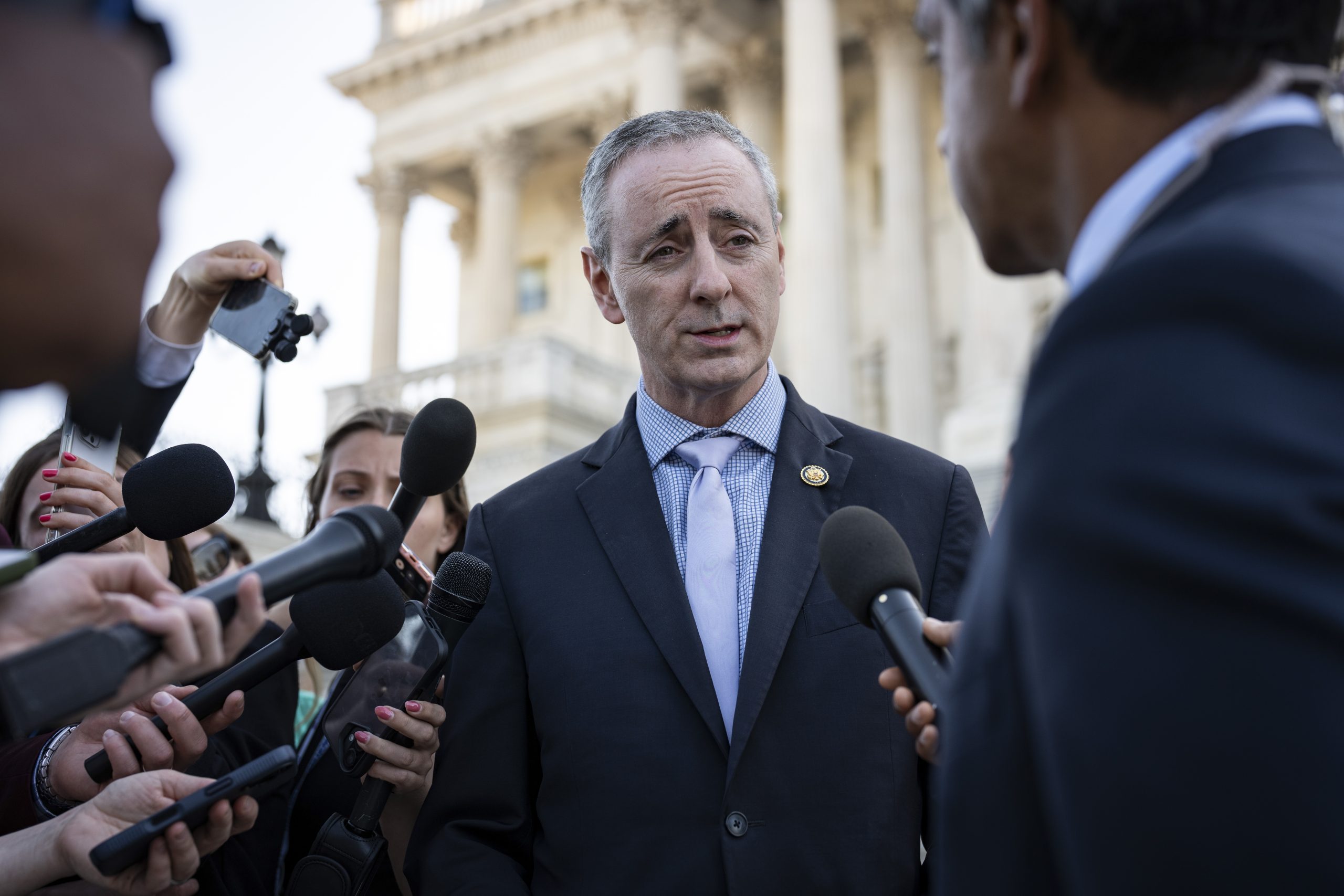
Rep. Brian Fitzpatrick (R-Pa.) speaks to reporters after the House passed an Iran war powers resolution on Capitol Hill in Washington, on Wednesday, June 3, 2026. Haiyun Jiang
What about the GOP?
Fitzpatrick’s alignment with the House Republican Conference has fluctuated depending on which party is in power.
During this Congress, when the GOP holds a narrowmajority in the U.S. House, Fitzpatrick has voted with his party 77% of the time, meaning he has split from Republicans 107 times on 472 party unity votes, defined by CQ Roll Call as instances when a majority of voting Republicans oppose a majority of voting Democrats.
That figure is the highest of his career, the analysis shows, though still far below the median of Republicans. It was a similar story during Fitzpatrick’s first term during the 115th Congress in 2017-18, when Trump was in office and Republicans had the House.
By contrast, Fitzpatrick was the least loyal to his party during the 116th Congress in 2019-20 — at 55% — when Trump was still in office, but the GOP did not have the gavel.
A congressional lawmaker’s votes are dependent on which bills make it to the floor. Currently, that is up to House Speaker Mike Johnson, a Louisiana Republican, whom Fitzpatrick has criticized for his reluctance to bring some bipartisan bills for a vote if Trump opposes them.
Fitzpatrick has introduced 249 bills as lead sponsor, and just under half — 123 — have a bipartisan group of cosponsors.
“The numbers and percentages will change from year to year based entirely on what votes are put on the House Floor,” Roberts said in her statement. “The best measure of independence is how often, and on which issues, does one vote against their own political party, regardless of who the President is and regardless of who the Speaker is.”
(function(){function e(){window.addEventListener(`message`,function(e){if(e.data[`datawrapper-height`]!==void 0){var t=document.querySelectorAll(`iframe`);for(var n in e.data[`datawrapper-height`])for(var r=0,i;i=t[r];r++)if(i.contentWindow===e.source){var a=e.data[`datawrapper-height`][n]+`px`;i.style.height=a}}})}e()})();
Jim Worthington, a major GOP donor in Bucks and owner of the Newtown Athletic Club, said Fitzpatrick’s record is representative of the purple county, home to a plethora of split-ticket voters, and shows that he is able to go against power structures in Washington.
“When you have someone who’s willing to stand up to the power of the majority and take a stand, that’s the type of guy you want,” Worthington said. “It’s pretty lonely when there’s 216 other people in your party voting for something, and you’re voting no. It takes guts, and that’s what he’s doing.”
Over the course of his time in Congress, Fitzpatrick has defected from his fellow House Republicans on votes related to economic and public finance issues, but has agreed with his caucus most on legislation connected to international affairs.
Of the 10 closest votes in which Fitzpatrick diverged from the GOP this year, three were decisive votes that blocked GOP amendments to bills.
Two others were votes in which he supported Democratic motions that fell just short of passing.
Fitzpatrick also joined Democrats in voting against fiveGOP amendments to bills thatpassed by one vote.
US Rep Brian Fitzpatrick speaks during the Garden of Reflection remembrance ceremonies Friday, Sept. 11, 2026 at Garden of Reflection in Yardley, Pennsylvania. The Garden of Reflection is Pennsylvania’s official state memorial honoring all 2,973 victims of the September 11 terrorist attacks, with a special tribute to 18 local residents from Bucks County, Pennsylvania.William Thomas Cain / For The Inquirer
What does this mean for the midterms?
At the U.S. Capitol on Wednesday, Fitzpatrick stood alongside members of the bipartisan Problem Solvers Caucus that he cochairs, condemning the redistricting wars both parties have engaged in and unveiling legislation to prevent a similar situation in the future.
He said in an interview that both Trump and Democrats were “wrong” to kick-start a gerrymandering spree.
“There are so many forces pulling us away from the center, when most Americans are in the center,” he said.
Fitzpatrick has been working to run on that centrist message back at home — even as he wages an aggressive ad campaign against Harvie.
But will his brand and well-fundraised campaign help him in a disadvantageous national political environment for Republicans this year?
Brittany Crampsie, a Democratic consultant in Pennsylvania, said 1st District voters should consider whether they, too, agree with Trump a majority of the time, noting that Fitzpatrick creates an “illusion” that he is independent from the president or his party.
“[Fitzpatrick] doesn’t have enough to celebrate, and voters don’t want to see him pat himself on the back for only supporting this administration 75% of the time,” Crampsie said.
She said that Fitzpatrick’s voting record will not help him survive a blue wave this time around because the issues facing the country, such as the cost of living, are too dire amid what she calls a “change election.” Crampsie said Harvie should continue to focus his campaign on both Fitzpatrick’s record and kitchen-table issues.
“Making a campaign all about opposition to Trump, we’ve seen, is not successful,” Crampsie said. “Voters want a new vision. They want a new platform. They want new ideas, and that’s what Bob Harvie is offering.”
Worthington, the GOP donor, predicted that Fitzpatrick will once again be victorious this year, noting the lawmaker’s massive coalition of labor support,which would typically go to a Democratic candidate, and voters’ desire for a moderate candidate.
“He’s a free, independent thinker. At the end of the day, he tries to do what’s right for everybody, for the majority of people,” Worthington said.
“That’s the problem — there’s too many extremes. You’re either one side or the other. It shouldn’t be like that.”
Staff writer Sam Janesch contributed to this article.
It’s hard to lure downtown diners to Bucks County, and Roberto Carollo knows it.
Carollo’s wood-fired pizzeria inside Doylestown’s Main Street Marketplace, Spuntino, has a loyal, longstanding following, so much so that when the Washington Post analyzed 7.5 million nationwide Yelp reviews in 2023, it determined Spuntino to have the highest-rated Neapolitan pie in Pennsylvania.
“We’ve had a lot of love from the people that matter to us, but I still feel like the suburbs are a really tough place to get attention,” Carollo said. “We’ve been here 12 years, but even Doylestown residents are still finding out about us.”
Roberto Carollo makes the Carbonara pizza at Spuntino on Monday, Aug. 31, 2026 in Doylestown, Pa.Monica Herndon / Staff Photographer
But Spuntino’s puffy, leopard-spotted pies are worth a trek from wherever you may be. Thin, chewy, and judiciously loaded, the pizzas are best eaten then and there, at one of the several tables Spuntino claims inside the market. (Takeout — and leftovers — are perfectly satisfying, too.)
Carollo opened Spuntino in Doylestown in 2014 with his brother Salvatore. (They also had a Northern Liberties location from 2015 to 2023. Carollo is now Spuntino’s sole owner.) The brothers are fourth-generation pizza makers, dating back to their Sicilian great-grandfather’s bakery days. They had grown up working in their father’s Philly-area neighborhood pizzerias — “your big 16-inch pies, hoagies, sandwiches,” Carollo said — but they hadn’t made Neapolitan pies before, and they had no experience with wood-fired ovens.
“We kind of just were going in on a prayer,” Carollo said. They had their work cut out for them with this exacting style of pizza. At Spuntino, a 250-gram ball of 48- to 72-hour fermented dough is stretched into a millimeters-thin 11-inch round, then covered with sauce, cheese, and toppings before being pitched into afiery 900-degree oven, where it cooks in about 90 seconds. The pizzaiolo needs to have an eagle eye. “Five or six seconds too long, and the pizza’s burned,” Carollo said.
Roberto Carollo pulls a Ronzio pizza from the oven at Spuntino on Monday, Aug. 31, 2026 in Doylestown, Pa.Monica Herndon / Staff Photographer
Evidently, his prayers were heard: Inquirer critic Craig LaBan named Spuntino among the suburbs’ best pizzas in 2017. Carollo said his chops have only gotten sharper since. “[The pizza] is so much better, and I think that’s natural, that’s normal. Anybody who has any profession — a major athlete — when they start at 18, they’re not as good, hopefully, as they are when they’re 25.”
It’s hard to choose among the 23-pie menu, but Carollo always recommends setting a baseline with a Regina, with milled San Marzano tomatoes, Lioni buffalo mozzarella, fresh basil, and salty pecorino Romano. My family scarfed one of those down, but our favorites were the Ronzio — with the same tomatoes and mozzarella, plus thin-sliced soppressata, shaved garlic, Sicilian oregano, mild Calabrian chilies, and a drizzle of honey — and the Carbonara, a white pie with pancetta, caramelized onions, fresh mozz, pecorino, and an egg yolk that’s finished with black pepper and olive oil.
The Carbonara and Ronzio pizzas at Spuntino on Monday, Aug. 31, 2026 in Doylestown, Pa.Monica Herndon / Staff Photographer
We’ll be back for what Carollo considers his most underrated pizza — the Tonno, a red pie with Sicilian tuna and red onion — plus another spin through his fellow vendors in the family-friendly Main Street Marketplace, including Hops/Scotch and the Department of Note stationary store and boutique. Carollo makes a very good point, and Spuntino is proof: “There are a lot of places out in the suburbs that are making such amazing pizza.”
Spuntino, 22 S. Main St., Doylestown, 215-340-7660, spuntinowoodfiredpizzeria.com
The Bensalem Township School District has selected longtime district administrator Victoria Velazquez as its next superintendent, after its previous superintendent resigned this spring amid a budget shortfall.
Velazquez, who has worked for the district for 12 years, is expected to be appointed superintendent at a school board meeting Sept. 23, the Bucks County Intermediate Unit said in a statement Friday.
“I am deeply honored and grateful for the opportunity to continue serving the Bensalem Township School District as district superintendent,” Velazquez said in a statement.
Noting that her daughter graduated from Bensalem, Velazquez said, “It is my home, and it is a community I care deeply about and am incredibly proud to serve.”
Velazquez was selected to lead the 6,400-student district after a search led by the Bucks County Intermediate Unit that drew 27 applicants from five states, according to the intermediate unit.
Deborah King, the Bensalem school board president, said in a statement that she had watched Velazquez “lead with humility, diligence, integrity, and a genuine love for Bensalem.”
“She knows this community, she believes in this community, and she understands that our students must remain at the heart of every decision we make,” King said.
Velazquez has worked in Bensalem as assistant to the superintendent for K-12 administration, director of elementary curriculum and instruction/federal programs, and supervisor of data and assessment/federal programs.
As interim superintendent, Velazquez worked with the board on organizational systems and fiscal stewardship “during a consequential period for the district,” the intermediate unit said in the statement.
Before coming to Bensalem, Velazquez worked as a principal in the School District of Philadelphia and the Norristown Area School District. She received bachelor’s and master’s degrees from Temple University, a principal certification from Drexel University, and a doctorate in educational leadership, management, and policy and superintendent certification from Seton Hall University.
If approved on Sept. 23, Velazquez will be sworn in as superintendent on Oct. 1 at Bensalem High School, the intermediate unit said.
Standing on his back porch and looking past a meadow of native wildflowers, Nate Reuther says his tiny home feels much farther away from the road than it seems.
That was exactly the point.
Reuther, a garden designer and wildlife enthusiast, has a 1.3-acre property in Doylestown, with a cottage and a tiny home. He moved into the tiny house two years ago and started renting out the main cottage as an Airbnb.
The view of the tiny house from a sculpture garden on Reuther’s property.William Thomas Cain / For The Inquirer
“I’ve always loved this place,” Reuther said. “After my divorce, I wanted to share the property and create some new memories here.”
Reuther, a New Jersey native, and his former wife were living in Dublin before they found the site in 2017. A two-bedroom, 1,200-square-foot Cape Cod, painted purple, sits near a main road and close to several historic sites in Doylestown. Nestled between a stone farmhouse and another Cape Cod, the house was in disrepair when they found it.
“When we saw this place, we didn’t have a lot of money,” he said. “We were into the tiny house idea.”
For the last eight years, Reuther has spent his spare time gutting most of the rooms, drywalling, and painting. He replaced the roof and added a new HVAC system. Upstairs, he created a bedroom with a vaulted ceiling and a cozy plant nook. He took great care to update all the lighting.
The outside of the Cape Cod house, which Reuther renovated and around which he built a garden.William Thomas Cain / For The InquirerThe nook at the top of the stairs in the renovated two-bedroom Cape Cod.William Thomas Cain / For The InquirerThe living room of the Cape Cod, which Reuther lives in during the winter and rents as an Airbnb for part of the year.William Thomas Cain / For The InquirerThe kitchen of the renovated house.William Thomas Cain / For The Inquirer
Reuther, who runs his business, Five Senses Garden Design, from the property, also focused on the garden.
“All of the garden was built” by Reuther, he said. “There was nothing here.”
Under a large pin oak tree sits a metal picnic table. A rustic door found at a salvage yard adorns the well-stocked chicken coup.
“My mom was a big gardener as was my grandmother who lived across the street,” he said. “We always had a big meal at lunch. They would sit and talk about the plants.”
The garden behind the house, including a trellis, hydrangeas, and winding tree.William Thomas Cain / For The InquirerA seating area in the garden.William Thomas Cain / For The Inquirer
Reuther, who graduated from Longwood Gardens’ Professional Horticulture program, ripped out an existing deck and centered the garden on a large fantail willow tree. He wanted to protect the roots so he made a pea gravel patio with a flagstone walkway.
For privacy from the neighbor, he added a Brazilian teak trellis and laced it with native honeysuckle vine. He added several white Annabelle hydrangea bushes and clustered them throughout the garden.
“I love the simplicity of the white and green flowers. The repetition pulls you along,” he said.
The tiny house, which Reuther added to the property and lives in for much of the year.William Thomas Cain / For The Inquirer
After talking to his neighbors and following the township’s regulations, he turned the main cottage into an Airbnb for use during the summer. He still lives in the purple house during the winter months.
On a windy February day, he drove to a Camping World store in Manassas, Va., and chose his tiny home, a 13-by-6-foot tractor trailer. It came fully equipped with a washer and dryer combo, full bathroom, tall windows, and plenty of storage. He had done so much work on the Cape Cod that he wanted to buy something complete.
The kitchen was outfitted with a farmhouse sink, a three-burner stove, and natural wood tones. “The kitchen is what sold it for me,” Reuther said. “I love how the kitchen dips down.”
A door found in a salvage yard is the entrance to the chicken coop.William Thomas Cain / For The InquirerAn assortment of pots sits by the chicken coop. Reuther says he always has plans in the works for the large property’s outdoor space.William Thomas Cain / For The Inquirer
The view from the porch embraces a meadow filled with milkweed and goldenrod, a sculpture garden, and a newly planted border.
“There are always plans,” he said. “I’m creating a mixed shrub border here. I put three birch trees in.”
He added, “It’s away from the road. It’s very peaceful.”
Is your house a Haven? Nominate your home by email (and send some digital photographs) at properties@inquirer.com.
Neshaminy Mall, a 58-year-old Bucks County institution, will not see another holiday season, according to Bensalem Township Mayor Joe DiGirolamo, who said the complex will close by the end of October.
“It’s very bittersweet,” DiGirolamo said, “but the mall has been going downhill for the last few years.”
The 1-million-square-foot center has struggled with rising store vacancies and fewer customers, becoming fodder for TikTokers mourning their teenage stomping grounds.
Neshaminy Mall in Bensalem, Pa., on Monday, July 22, 2024.Monica Herndon / Staff Photographer
Like in Exton, Neshaminy’s Boscov’s will remain open, DiGirolamo said, as will the AMC Movie Theater and Barnes & Noble bookstore.
A handful of other mall tenants must close up shop by the end of October, DiGirolamo said. In November, township officials plan to remove the mall’s dioramas, which depict key moments in U.S. history that took place in the Delaware Valley, as well as a bronze Native American statue, for preservation.
Historical dioramas in the Neshaminy Mall, as seen in 2024, will be preserved when the mall closes.Monica Herndon / Staff Photographer
The mayor said the property’s owners,Lakewood, N.J.-based Paramount Realty, want to knock down the mall and build something new in its place, though the company had not applied for a demolition permit or submitted redevelopment plans as of Tuesday. Such plans would require approval by township council.
The exterior of the old Macy’s at the Neshaminy Mall, as seen in 2024.Monica Herndon / Staff Photographer
A few have been transformed, or are in the process. In Media, Delaware County, the 1-million-square-foot Granite Run Mall was demolished in 2016 and replaced by a mixed-use town center with apartment buildings, new retail, and medical offices.
At the Neshaminy Mall site, near U.S. Route 1 and the Pennsylvania Turnpike, DiGirolamo said he’s “hopeful they are going to rebuild it in a way that most malls are rebuilt,” in the town-center style with housing and outdoor walkways.
As for the indoor mall’s final days, the mayor said he expects them to be quiet, with some tenants vacating before their leases expire.
DiGirolamo, a lifelong resident of Bensalem, said he remembers when the mall opened in 1968. It was a “regional mall,” he said, that attracted out-of-town visitors.
A faux storefront covered the old Macy’s at the Neshaminy Mall in 2024.Monica Herndon / Staff Photographer
A Philadelphia Daily News article about Neshaminy Mall’s opening called the $25-million complex “America’s most modern shopping center,” with the largest branches of Sears Roebuck & Co. and Strawbridge & Clothier at the time.
A few years later, the Oxford Valley Mall opened in nearby Langhorne. Oxford Valley, which is being partially redeveloped with apartments, will be Bucks County’s only enclosed mall once Neshaminy closes.
Philadelphia talent was on full display at the 2026 Emmy Awards in Los Angeles on Monday night, but only one of the nominated actors, crew members, or shows took home trophies.
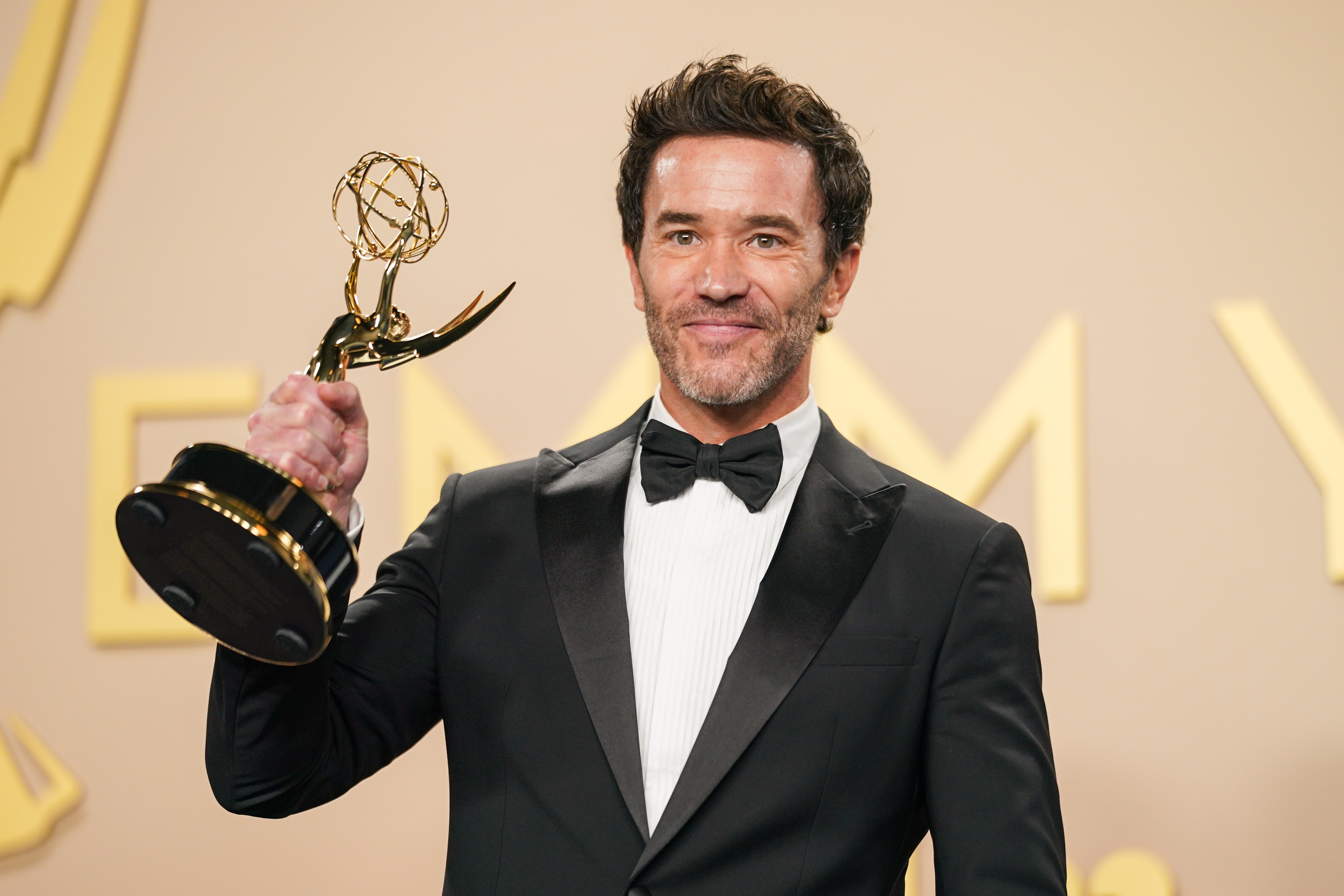
The big, surprise exception was Tom Pelphrey, a Rutgers University alum from Howell Township, N.J., who won for outstanding supporting actor in a drama series for his performance as Robbie Prendergrast on Season 1 of the Delco-set HBO crime thriller Task.
“I thank God for my life and my sobriety. I thank my family and my friends for all your love and support all these years, from Emmys to, you know, black box theaters and everything in between,” said Pelphrey in his acceptance speech before thanking Task creators including directors Jeremiah Zagar (son of South Philly mosaicist Isaiah Zagar) and Salli Richardson-Whitfield, and fellow cast members Mark Ruffalo, Emilia Jones, and Raúl Castillo.
Ruffalo was nominated for outstanding lead actor in a drama for his role as Tom Brandis but lost to Noah Wyle of The Pitt. The Pittsburgh-set emergency room drama received a whopping 25 nominations and took home seven Emmys, including outstanding drama series; Pelphrey beat out three supporting actor nominees from The Pitt for his win.
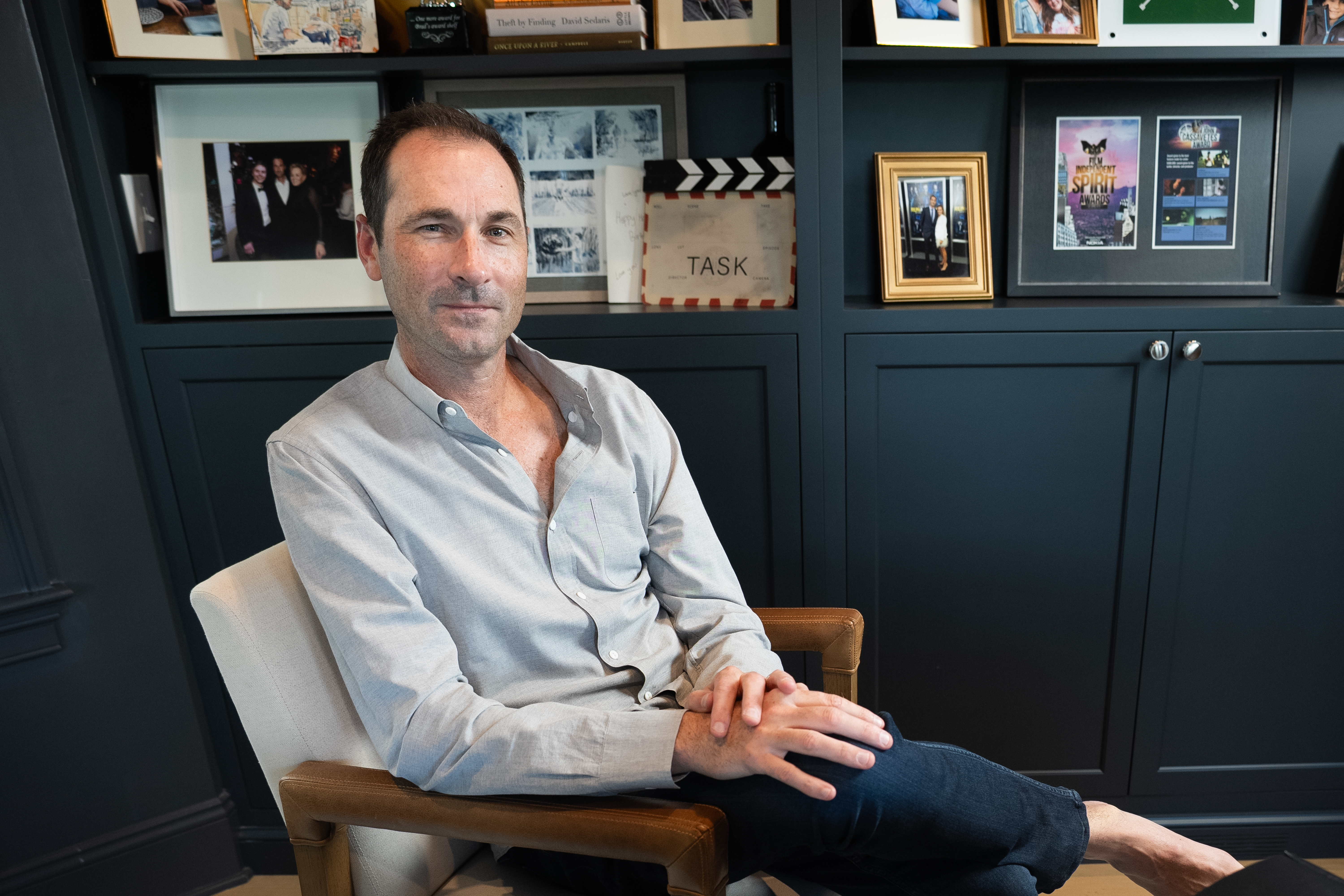
Brad Ingelsby, writer/executive producer of “Task” and “Mare of Easttown,” in his office in Berwyn on July 17, 2025. Jessica Griffin / Staff Photographer
“Thank you to Brad Ingelsby for this incredible role and this opportunity and your friendship. You are an amazing human being. I’m so proud to be your friend,” Pelphrey continued onstage as the camera showed a beaming Ingelsby, the Berwyn-based showrunner. Ingelsby is the writer/executive producer behind Task, which is currently shooting its second season in the Philadelphia area, and the Emmy-winning Mare of Easttown.
In Task, Pelphrey played a heartfelt but troubled trash collector who begins stealing from drug houses in Philadelphia’s collar counties run by a local motorcycle gang that killed his brother. Starring alongside two-time Emmy winner Ruffalo, Pelphrey was a complicated foil to Ruffalo’s priest-turned-FBI agent who hunted him down. The recognition marks Pelphrey’s first Emmy win after he was previously nominated for outstanding guest actor in a drama in 2022 for his role in Ozark.
“Brad is desperately insistent upon each individual’s humanity, so every character he writes is justified, in some sense, with a reason why they’re doing everything that they do — and that’s incredible, because usually that stuff gets sacrificed for plot,” Pelphrey told The Inquirer in a 2025 interview.
Tom Pelphrey accepts the Emmy for Outstanding Supporting Actor in a Drama Series for “Task” at the Television Academy’s 78th Emmy Awards telecast at the Peacock Theater at L.A. LIVE on Monday, Sept. 14, 2026 in Los Angeles. (Photo by Danny Moloshok/Invision for the Television Academy/AP Content Services)AP Photo/Danny Moloshok
Task received six Emmy nods, including outstanding writing for a drama (recognizing Ingelsby’s heart-wrenching finale), directing, picture editing, and cinematography. The dystopian Apple TV+ show Pluribus won for outstanding writing and picture editing, while the directing trophy went to the British spy show Slow Horses and cinematography went to Spider-Noir.
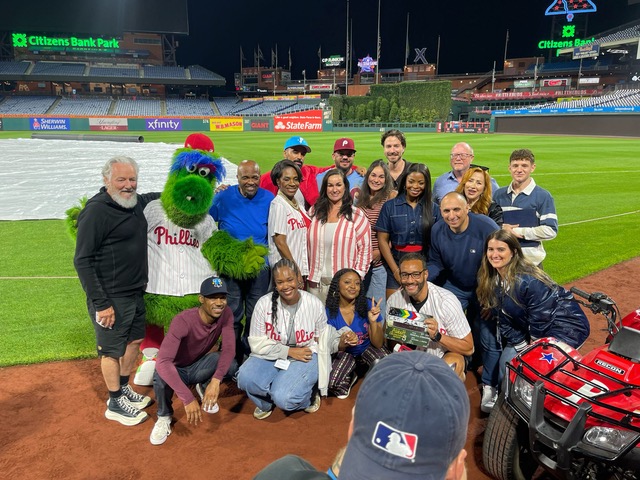
“Abbott Elementary” cast and crew pose with the Phanatic and Phillies player Kyle Schwarber at Citizens Bank Park on Aug. 28, 2025.Vaughn C. Page Jr.
However, the horror-tinged newcomer Widow’s Bay swept nearly all the comedy categories, dominating the stage with a record-breaking 14 wins. Abbott Elementary actors Tyler James Williams and Janelle James were up for outstanding supporting acting in their respective categories but both lost to Widow’s Bay.
Previous two-timeEmmy-winner Brunson was briefly in the spotlight when Emmys host and Law & Order: Special Victims Unit star Mariska Hargitay asked celebrity attendees about their first jobs.
“Oh, I was a student dance schoolteacher,” Brunson answered. Fellow West Philly-raised star Colman Domingo, who was nominated for outstanding guest actor in a drama for Euphoria and outstanding supporting actor in a comedy for Tina Fey’s The Four Seasons, also joined in. His first job, he said, was working the fries station at McDonald’s. (Domingo lost the former category to The Pitt and the latter to Widow’s Bay.)
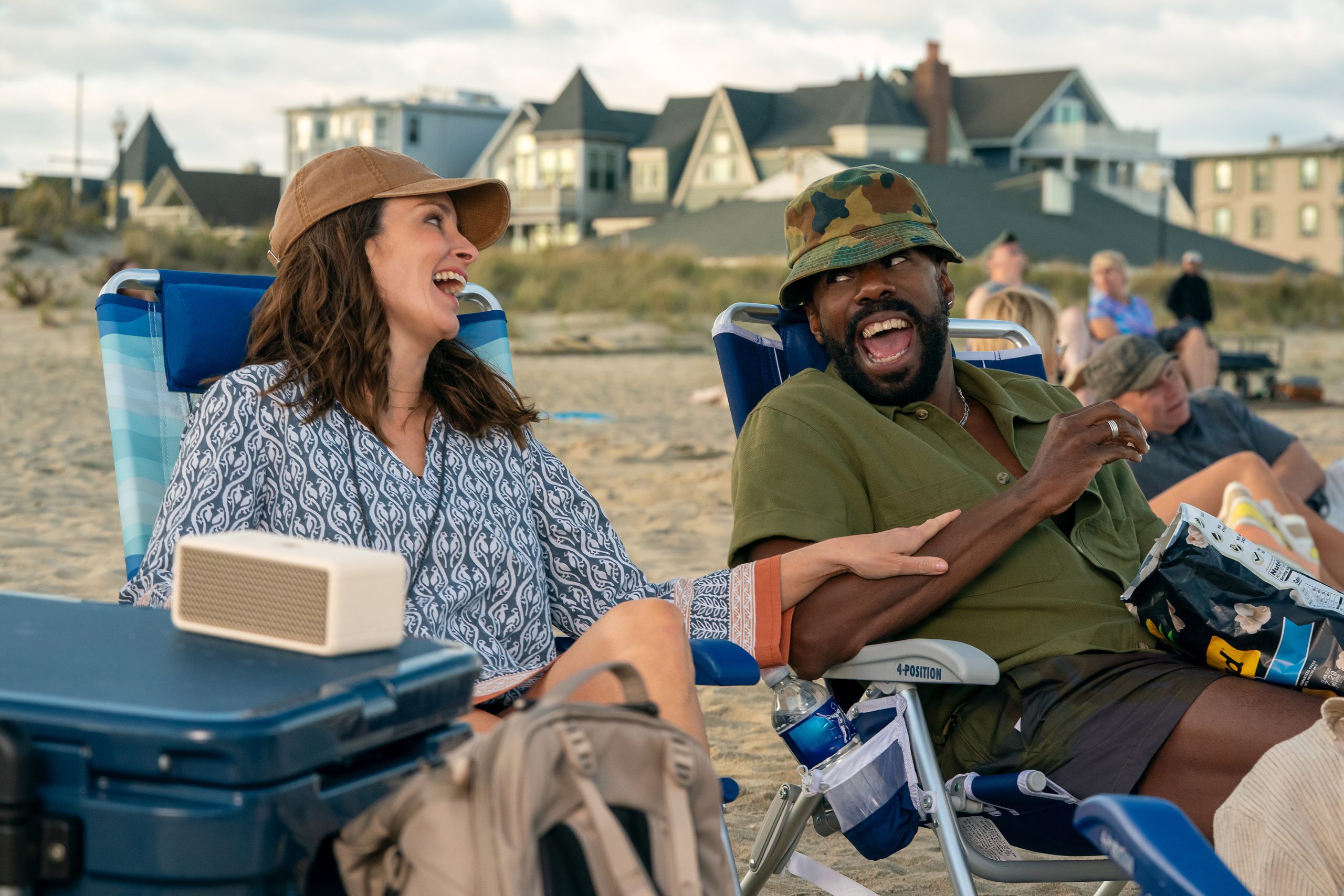
Tina Fey as Kate and Colman Domingo as Danny in Season 2 of the Netflix comedy series “The Four Seasons.”Emily V. Aragones/Netflix
To celebrate the 30-year anniversary of Buffy the Vampire Slayer, Villanova-raised actor and Malvern Prep alum David Boreanaz joined star Sarah Michelle Gellar for a reunion moment onstage. The son of famous 6abc weatherman Dave Roberts, Boreanaz played the vampire with a soul Angel and later received his own spinoff show. (He’s also a diehard Philly sports fan.)
“You know, Sarah, I always thought that Buffy and Angel would end up together,” Boreanaz said as the pair reflected on the groundbreaking show. “Well, I guess we won’t find out,” Gellar replied in a pointed critique of the recent cancellation of the Buffy reboot that had been in the works.
Actor David Boreanaz, wearing a Randall Cunningham jersey, and his son, Jaden, in a Saquon Barkley jersey, at Super Bowl 59 in New Orleans.Courtesy of David Boreanaz
Ahead of the 78th Primetime Emmy Awards ceremony, the Academy of Television Arts & Sciences hosted the Creative Arts Emmys in two events honoring artists behind the scenes in technical categories. Winners from those ceremonies included South Philly comedian Rob Mac — the showrunner behind It’s Always Sunny in Philadelphia — whose FX show Welcome to Wrexhamwon for outstanding sound mixing for a reality program. (It was also nominated for outstanding picture editing and outstanding unstructured reality program.)
Bucks County pop star Sabrina Carpenter also won during the Creative Arts Emmys earlier this month for performing in and executive producing the 50th anniversary special of The Muppet Show, which earned a gold statue for outstanding variety special (prerecorded) — putting her halfway to EGOT status.
Another Philadelphia-connected nominee was Tires, the Shane Gillis-led Netflix comedy recognized for outstanding sound mixing for a half-hour comedy or drama; the trophy went to Widow’s Bay.
At Monday night’s ceremony, one more Pennsylvania celebrity made a cameo: Superstar singer Taylor Swift, who grew up in Reading was not in attendance, but appeared in a prerecorded skit with Hargitay spoofing Law & Order along with Swift’s cat, named for Hargitay’s character, Olivia Benson.
An Upper Bucks man who shot at a DoorDash driver last year, irate that his cheesesteaks were late, was sentenced to four to 10 years in state prison Tuesday.
Keilan McKeever, 33, pleaded guilty earlier this year to aggravated assault and related crimes, in exchange for prosecutors dropping an attempted murder charge for the 9mm bullet he fired at Khalik Lewis in March 2025.
The gunshot struck the back windshield of Lewis’ Honda Civic, shattering it. Later, the then-19-year-old found the bullet stuck in the hood of his sweatshirt.
Judge Steven Corr, in handing down the sentence, said he had been prepared to send McKeever, of Richlandtown, to prison for even longer, citing the “disgusting” nature of the case.
But McKeever’s statement of contrition in court, including his detailed efforts to better himself while behind bars, moved Corr to exercise some leniency.
Still, Corr was adamant that McKeever’s actions were unreasonable. It was only pure luck, he said, that Lewis was not killed, and that no one else was injured as McKeever opened fire on a residential street.
“We have a young man out trying to make money, providing a service to you,” Corr said. “The way you treated him, I don’t know what causes someone to fire a shot at someone like that.”
Video of the incident recorded from a neighbor’s security camera, played in court, showed Lewis pulling up to McKeever’s home on Cherry Street. Almost immediately, McKeever begins shouting and threatening Lewis.
At one point, McKeever is heard saying “I’ll shoot you right now” and “see this” before a gunshot rings out.
Pennsylvania State Police troopers who investigated the case wrote in court filings that McKeever initially lied to them, denying he shot anyone and saying, instead, that the noise heard by his neighbors was a car backfiring.
Lewis, in an interview after Tuesday’s hearing, said McKeever came out of his house holding a loaded handgun. He was combative, Lewis said, and would not listen to him explain that his order was not late, as McKeever believed it was.
McKeever followed Lewis as he walked back to his car, and stood behind him as he attempted to pull away. When Lewis did finally pull out of the driveway, he heard a bang and saw his windshield shatter.
Lewis said he had no idea a bullet caused the damage.
“Literally, my life was just inches away from ending,” Lewis said. “I still suffer from it: Loud noises trigger me, it’s hard to sleep at night.”
He gave up driving for DoorDash, a side gig he had hoped would help pay for college and car repairs, right after the shooting.
And Tuesday’s sentence did little to calm his fears.
“I feel it could have been a much heavier sentence,” he said. “I feel like the judge could have seen it a little more from my point of view, instead of seeing the work he’s doing in jail. Everyone does that.”
McKeever’s attorney, Riley Downs, told Corr during the proceeding that his client struggles with mental health issues, including anxiety and depression, that are debilitating when left untreated. At the time of the shooting, McKeever had not been taking his prescribed medication, Downs said, having lost his health insurance after being fired from his last job months earlier.
His treatment, however, resumed after his arrest, along with therapy that McKeever said has helped him see what he did was wrong.
“I know I have a lot of issues. I know I have some things I want to work,” McKeever said. “It’s just hard on the outside to find help.”
McKeever apologized to Lewis and his family, saying he never intended to hurt him, only to scare him.
“I failed myself and everyone else,” he said. “I hope you can forgive me for your sake, so you can forget and move on with your life.”
About two to three times a week, Ryan Richter will sit in front of reporters in the bowels of Subaru Park. His hair will be neatly combed to the side, his hands folded in front of him, with his shirt buttoned to the very top.
The Union’s interim head coach will calmly discuss the game ahead, or the game just played, answering questions as anyone else in his position would. But every now and then, those watching from his hometown of Southampton, Bucks County, have to laugh.
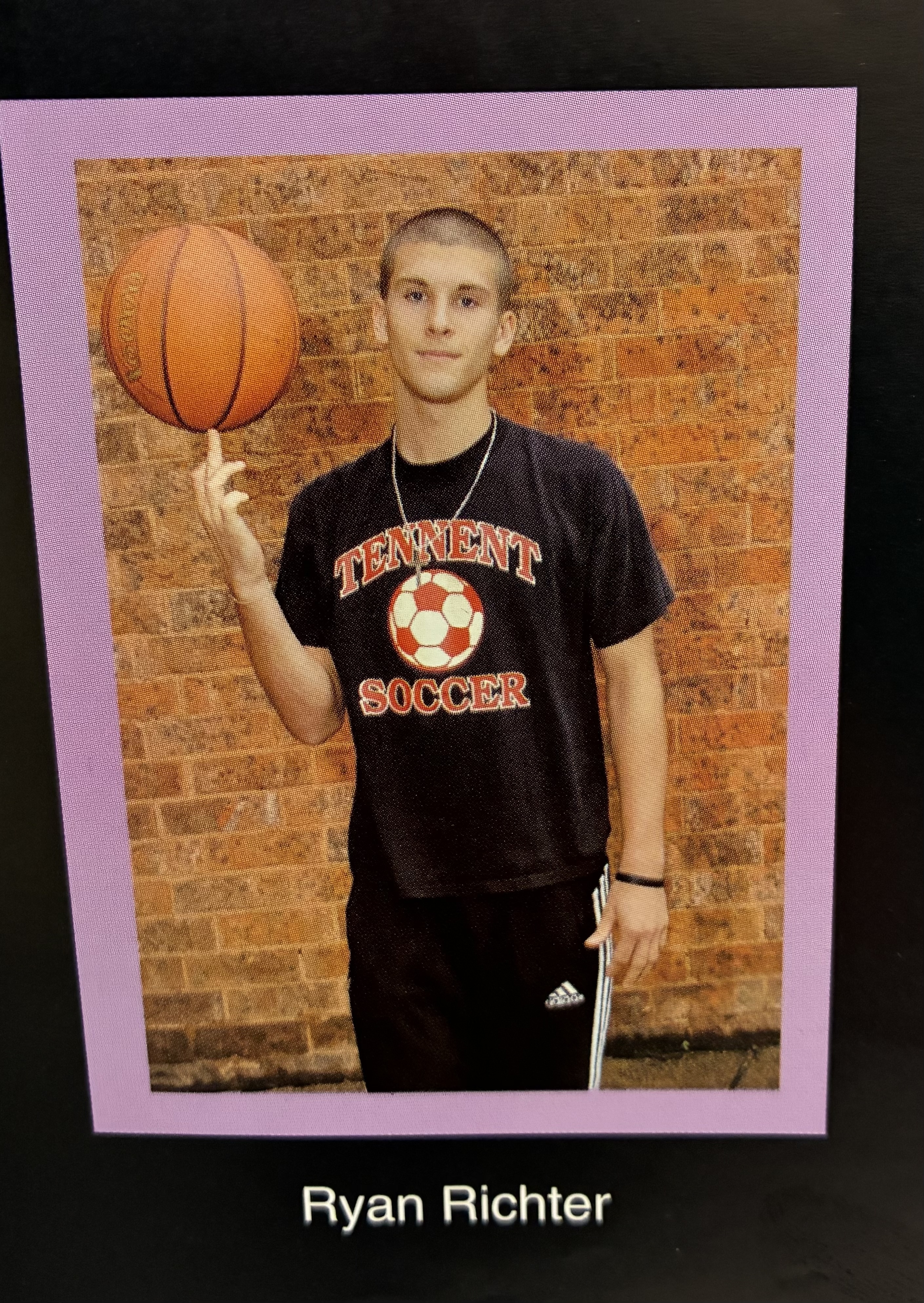
In some ways, this version of Richter is just like he was as a kid: driven, focused, thoroughly prepared. But aesthetically, it is completely different. Richter, a three-sport athlete at William Tennent High School, was captivated by NBA culture growing up, particularly Allen Iverson.
He’d wear a headband during basketball games. He pierced both ears. He’d drive around Bucks County in a white Kia, with an enlarged Jumpman logo on its hood, and Sixers jerseys covering its seats.
À la Shaquille O’Neal, Richter would give himself nicknames: “Shaq Daddy,” “Shaq-Daddy-Licious,” “Ric-Daddy-Docious.” Those monikers are long gone, but that side of Richter isn’t.
Ryan Richter was a three-sport athlete at William Tennent High School, who parlayed his talents into a pro soccer career and now an interim role as the Union’s head coach. Courtesy / William Tennent H.S.
“It’s like, I’m still listening to Get Rich or Die Tryin’ when I’m driving into work,” Richter said. “You know?”
His high school basketball coach, Glenn Dolton, called this a “paradox.” Beneath the panache was a teenager who was confident, but not cocky. Hard-working, but also light-hearted, with a self-deprecating sense of humor.
Treating pro soccer as a profession wasn’t a main goal. Richter was always immersed in the sport — his dad played at The College of New Jersey, back when it was known as Trenton State, and his grandfather played for a team in Warminster — but he also played basketball and football through high school.
The Sixers were Richter’s favorite team, and Iverson his favorite player. Richter was in the building for Game 5 of the 2001 Eastern Conference semifinals, when The Answer dropped 52 points, and returned for the Eastern Conference finals against the Milwaukee Bucks.
Before he was the Union’s interim head coach, Ryan Richter was the Atlantic 10 Player of the Year at La Salle University.Courtesy / La Salle Athletics
A La Salle graduate, Richter was drafted by his hometown MLS team in 2011, began coaching for them in 2018, and has gradually worked his way up since.
Now, the 37-year-old is at the helm, leading the Union from the worst record in the league to playoff contention. At the time of this report, the club hasn’t lost a league game under his watch. Players say the energy in the locker room has changed for the better.
The soccer world might be surprised. But Southampton isn’t.
“He knows what it takes to get the job done, and he does not like to lose,” his childhood best friend, Mike Pio Jr., said. “And, I mean, that’s pretty evident with how they’ve been doing so far.”
Some people hate losing more than they love winning. Richter says he’s the opposite, and has been that way since he was a child.
He was competitive not just on the field, but in everyday life. If he was playing a game of Connect Four, he’d want to crush the opposition. He and his friends would hang out at the local youth center to jump into hotly contested pickup hoops games.
Once, the teenagers joined an adult bowling league. They were the youngest members by about 20 years, but that didn’t quash Richter’s spirit.
“The competitiveness was also there,” Pio said. “I think everybody else in that league was probably old enough to be our fathers.”
A formative moment came in his freshman year of high school. Richter tried out for the junior varsity basketball and soccer squads, and failed to make either team. He got to work, and by sophomore year, made varsity in both sports.
Ryan Richter (center) didn’t make the varsity team his freshman year at William Tennent. The next season, he made varsity in both soccer and basketball. Courtesy / William Tennent H.S.
But he never forgot the feeling of being passed over — or the names of the students who passed him.
“He still reminds me of that occasionally,” Dolton said, “that I should have brought him up. Which, looking back on it, I’m like, ‘Yeah, you may have a good point there.’”
Coaches loved Richter, because he’d push his teammates as hard as he’d push himself. If a fellow athlete wasn’t hustling enough, he’d pull him aside or ask a higher-up to step in.
Pio’s father, Mike Pio Sr., experienced this firsthand when he worked as an assistant soccer coach at Tennent.
Video: Union interim manager Ryan Richter not satisfied with landing in a playoff spot
“He expected his teammates to basically bleed the way he bled,” Pio Sr. said. “Even during practice, he would call people out.”
Teenagers didn’t always love being challenged, but Richter had an affability which allowed him to break through. He was athletically gifted on the field, but didn’t take himself too seriously or act like he was better than anyone else.
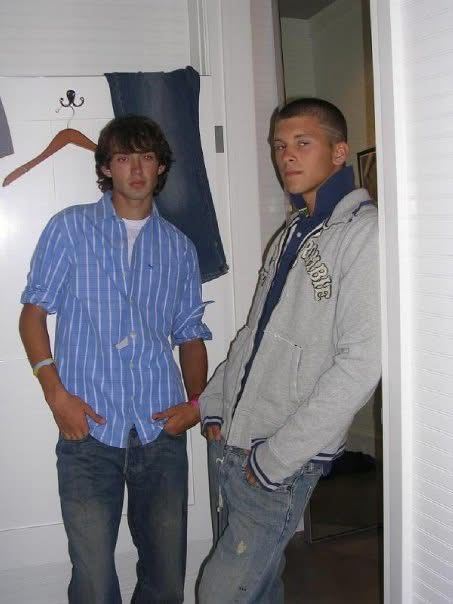
The hood-sized ode to Michael Jordan was evidence of this. So was a photo that Richter took with Pio Jr. when they were in high school. The two friends were at the Willow Grove Park Mall, in an Abercrombie and Fitch dressing room.
Before he was the Union’s interim manager, Ryan Richter (right) was a three-sport athlete at William Tennent High School, with an affinity for NBA culture and swag.Courtesy / Mike Pio
Images of models adorned the walls, and Richter and Pio Jr. wondered how easy that work must be.
So, they tried it themselves, posing for a photograph that still hangs beneath a magnet on Pio Sr.’s refrigerator door.
“It was like they were posing for GQ magazine,” Pio Sr. said. “Hilarious.”
The teenager would set up silly challenges, like singing the national anthem before a basketball game, despite the fact that he was not musically inclined. And physical challenges, like improving his vertical so he could dunk in a game.
Richter stood at 6-foot, but had smaller hands, which made it difficult to palm the ball. But he was determined. In a game against Abington, he finally got the moment he’d been waiting for.
“He threw one down, and it was like the place exploded,” Dolton recalled. “It was like the greatest thing that ever happened. It was really funny.”
Union interim manager Ryan Richter starred on William Tennent’s varsity basketball team.Courtesy / William Tennent H.S.
Richter was recruited by several nearby soccer programs: Temple, Delaware, and Iona. But he ultimately chose La Salle because of its coaching staff.
Head coach Pat Farrell’s rules were rigorous, but aligned with Richter’s already sky-high expectations. He noted that Farrell pushed him, personally too.
“It was just the things that he emphasized,” Richter said. “About taking responsibility, about being a man and taking care of your school stuff, and staying out of trouble.
“He’s not a guy of so many words, but he was just a father figure for everybody.”
Before he was the Union’s interim head coach, Ryan Richter was the Atlantic 10 Offensive Player of the Year at La Salle University.Courtesy / La Salle Athletics
Richter upped his work ethic to a new level in college. The striker showed up to practice an hour-and-a-half or two hours early. He’d train with the Ocean City Nor’easters, a USL League Two team, to stay in shape during the offseason.
When he returned in the fall, he’d be ready for more. And by 2011, he was en route to a professional career.
“He would say, ‘Do you want to do some extra [shooting], or do you want to do some skill work,’ like ball work and things like that,” Farrell said. “And we could never say no.”
Richter’s playing career with the Union was brief — only making an appearance in two international friendlies and 10 reserve league matches — but his time as a coach there has spanned nearly nine years.
After playing professionally for seven years, Richter was hired by the Union in 2018 to work at their academy, serving in various development roles.
In 2022, he was promoted to assistant coach of the Union, under then-head coach Jim Curtin, and in 2025, was named head coach of the Philadelphia Union II.
Ryan Richter has held several roles within the Union, including former head coach of the club’s developmental team, Union II. Jonathan Tannenwald / Staff
When Bradley Carnell was fired in late May, after a league-worst record of 1-10-4, and replaced with Richter, many current players were already familiar with him.
The Southampton native had coached Cavan Sullivan since he was 8. Outside back Frankie Westfield had never played for Richter, but knew him through regular games of teqball and basketball with his teammates at the Academy.
Centerback Neil Pierre started his season on a six-month loan to a team in Denmark. When he returned in July, he wasn’t sure what he’d find.
He’d heard from teammates that the locker room was “losing its head.” But with Richter already having an established relationship with multiple players, it helped make Pierre’s immersion back into the squad smooth.
“We were going through a tough time,” Pierre said. “I guess it wouldn’t be the same upbeat attitude. People wouldn’t be as into the culture. Kind of lost that ‘Philly’ mindset. And I think when [Richter] came back, he just brought it back.”
Ryan Richter (left) greets Union midfielder Quinn Sullivan during a recent match.Elizabeth Robertson / Staff Photographer
Richter’s Bucks County tendencies are never too far. He has been known to challenge other coaches on the basketball court. He is still a massive Sixers fan, and gleefully shared the news of LeBron James coming to Philadelphia after a Union practice in July.
But perhaps the biggest way his upbringing shines through is in his approach to younger players. Sullivan is only 16, but a teenage phenom who is bound for Manchester City when he turns 18.
In an Aug. 19 match between the Union and Inter Miami, Sullivan defended his brother, Quinn, after defender Ian Fray stepped over him and pushed his head down.
Cavan ran over, and got in a scuffle that instantly became the story of the game. He received a red card (later rescinded).
Got to protect your own brother.
Cavan Sullivan and Yannick Bright were given red cards.
Cavan Sullivan and Richter talked about the incident two days later. The head coach told him that he did nothing wrong, but to remember that he draws scrutiny like nobody else on the roster.
And that if he does act up, it’ll become international news.
“I always try to keep in mind of where some of the younger guys are at, and remember what I was like,” Richter said. “When I was 16, I was driving around with a Jordan logo on my car, and who knows what kind of trouble I was getting in.
“That’s why I think Cavan is such an amazing kid; because of the pressure that he has to deal with, and the spotlight that’s always on him. Could you deal with that when you were 16?”
Richter, seen here with Union teen midfielder Cavan Sullivan, says he tries to remember himself at a young age in order to keep his players, many of whom are still in their teens, focused on the team’s mission.Yong Kim / Staff Photographer
Learning soccer on the fly
Richter’s friends did not grow up diehard soccer fans. Like most Philadelphians, they are all-in on the Eagles and the Phillies; maybe some basketball and hockey, too.
His new role has served as a teaching moment for everyone. Last month, a group of Southampton natives went to Subaru Park for a game against Atlanta United. They were stunned by what they saw: Union goals in 96th and 97th minute, en route to a 3-2 comeback win.
“They’re like, ‘Soccer is amazing!’” Richter said. “It’s like, ‘This is a one-in-a-thousand game that you guys saw tonight.’”
Nevertheless, the head coach’s buddies have since tuned into to every press conference and every match, home or away. They’ve been filling his group chat with lots of “DOOP” and other words of encouragement.
Ryan Richter says his approach is solely game by game and isn’t taking too much stock in the success the Union have had since he took over as interim manager. Isaiah Vazquez / For The Inquirer
They’re also provided some friendly, albeit superstitious, advice.
“One of our buddies just texted this morning,” Pio Jr. said “He goes, ‘I changed my mind. I don’t think they should remove the interim tag, because you’re doing way too good with it.’”
Richter’s friends have ninemore games to learn; maybe more, if the Union make the playoffs. But regardless of how this season ends, his community will continue to be proud of him.
A local kid, who once patrolled Bucks County, is now patrolling the sidelines of Subaru Park — and doing a good job, at that. The headband and earrings may be gone, and so is the White Kia.
But somewhere, beneath his outward professionalism, is that same Iverson-loving teenager; better known not as Ryan Richter, but as a “licious” or a “docious.”