Bucks County Democrat Bob Harvie is asking TV stationsin the Philadelphia area to stop airing advertisements from U.S. Rep. Brian Fitzpatrick, calling them misleading to viewers.
In letters sent Thursday, an attorney for theDemocrat’s campaign highlighted two attack ads from Fitzpatrick’s campaign related to Harvie’s time as a county commissioner.
He said the ads relied on dubious reporting from a source who has personal connections to Fitzpatrick, the incumbent Republican who has represented the 1st Congressional District for five terms. Harvie is challenging Fitzpatrick for the Bucks County-based seat, one of four in the state that both parties are targeting ahead of November.
In one of the ads, for example, Fitzpatrick’s campaign cited a headline from Patch.com, the hyperlocal news organization, that said “Bob Harvie was the lone vote to abolish local police funding on the Board of Commissioners.”
Harvie opposed a roughly $43,000 purchase of “civil unrest protective equipment” for the Bucks County Sheriff’s Office in a 2024 vote, attorney Timothy Ford said in the letter, but voted to approve every other law enforcement spending request, including about $31,000 for a sheriff’s deputy vehicle and about $44,000 for a police interceptor utility vehicle.
The legal action comes after revelations from Politico that the author of multiple Patch articles Fitzpatrick is using in his campaign ads is Dave Sommers, who received occasional payments from Fitzpatrick’s campaign over the years, though not in the most recent financial reporting cycle.
“Sommers’ claim that Mr. Harvie voted to ‘abolish local police funding’ is a deliberately false characterization of the official and public record of the Bucks County Commissioners’ Meeting,” Ford wrote.
Harvie’s campaign asked the TV stations to scrutinize any future advertisements that refer to Sommers’ work.
“These advertisements rely on reporting from a highly uncredible and biased source with a penchant for publishing out-of-context, false statements that mislead voters and damage Mr. Harvie’s reputation in the community,” Ford wrote.
Sommers had previously been charged with stealing an election sign for a previous Fitzpatrick primary challenger and attended the lawmaker’s June wedding, Politico reported.
Representatives for the Fitzpatrick campaign did not respond to The Inquirer.
Several public polls put Harvie and Fitzpatrick in a tight race, but the Cook Political Report, a nonpartisan group that provides election analysis, indicates the seat will likely remain in Republican control.
This summer, Harvie’s campaign sent a cease-and-desist letter to Fitzpatrick and his campaign for what it said were defamatory allegations that falsely suggest Harvie was the subject of an FBI investigation. A PAC supporting Fitzpatrick that used similar language in its social media posts, news releases, and video content also received a cease-and-desist order and was slapped with a lawsuit.
The practice of sending these kinds of letters is common for campaigns, and some go ignored.
In another ad Harvie’s campaign complained about in the letter, Fitzpatrick referenced a Patch headline that said “Bob Harvie Voted to Give Himself a Significant Taxpayer-Funded Pay Raise.”
As chair of the Bucks County Board of Commissioners, Harvie approved an annual 1% increase in salaries beginning in 2024 for commissioners and several other local offices. State law requires commissioners to set salaries prior to a forthcoming election year for most county-level roles, including their own.
“There was nothing ‘significant’ or unusual about the pay raise that Mr. Harvie and his fellow Commissioners approved,” Ford wrote. He added that the raises were approved across party lines, including support from the Republican commissioner.
The average interest rate for the popular, fixed-rate 30-year mortgage shot up to 7.28% this week, the highest it’s been since November 2023.
Elevated mortgage rates and high home prices are making homebuyers cautious about entering the market in the Philly area and beyond.
“They’re not jumping in with two feet,” said Patrick Lopez, a Philadelphia-based mortgage banker at Quaint Oak Mortgage.
At the same time, some people need to move. They’re driven by personal factors such as job relocations, growing households, and plans for the future.
Mortgage ratesare unlikely to slide back down to pandemic-era levels of 3% or lower. And waiting for rates to drop significantly is often a losing game, Lopez said.
While interest rates fluctuate, home prices overall have historically moved in one direction: up.
“What I tell people is if you can afford it and you can buy, the least expensive the property is going to be 99% of the time was yesterday or today, because prices keep trending higher,” Lopez said.
When aspiring homebuyers tell him they are waiting for interest rates to drop into the 5% range, for example, he asks, “Do you also understand how many other people are waiting for that?”
A significant drop in rates would likely flood the market with buyers, increasing competition for properties.
Here’s what real estate pros are telling buyers now.
Don’t assume your rate
Individual mortgage rates depend on a bunch of factors, including credit scores and participation in homebuyer assistance programs.
“The good news is that people have more power over interest rates than they think they do,” said Matt Schulz, chief consumer finance analyst at LendingTree, an online loan marketplace.
Taking steps to get a lower rate, he said, “can make a really unaffordable situation a little less so.”
“People would be surprised how much difference there can be,” Schulz said. And even a slight difference in the interest rate can mean tens of thousands of dollars in savings over the life of a mortgage.
Buyers with higher credit scores get lower mortgage rates, so improving those scores can help a lot.
“There’s very little in life that’s more expensive than having crummy credit, and that’s especially true when you’re buying a home,” Schulz said.
Jeffrey Ruben, the Bryn Mawr-based president of WSFS Home Lending, said that “first and foremost,” homebuyers should make credit card payments on time. They also need to control their credit card debt, so they’re not carrying over large balances from month to month.
They should cap how much they spend on a card to maximize how much credit they have available at any given time. Keeping total outstanding charges under 30% of the card limit gives people better credit scores, Ruben said.
Do your homework
Before buyers start looking at homes, they should sit down with a professional to determine how much they’re comfortable spending up front and monthly, said Peter Buchsbaum, manager of the mortgage brokerage Good Cents Financial, which is based in Bucks County anddoes most of its business in Philadelphia.
“Start the process earlier than you want to,” he said. “And it should begin with the financial piece.”
Schulz said homebuyers should factor in elevated mortgage rates when they calculate “what they can afford and what sort of homes they should be looking at and whether they should be in the market, period.”
An increase in mortgage rate from 6.5% to 7% on a $300,000 home in Philadelphia would mean a monthly payment that grows by about $130, Buchsbaum said.
“If that’s stopping me from buying a house, I probably shouldn’t be shopping for houses,” he said.
Buyers should also look into assistance programs they may qualify for.
Households should go into home buying with a plan for making their down payment, which can include saving more of their own money or getting grants or loans from governments, lenders, and nonprofits.
“The down payment is a challenge for many buyers,” Ruben said. “There’s no question about that.”
But buyers who can make bigger down payments get lower mortgage rates.
Be flexible, if possible
Rates can vary by location, so buyers with more flexibility in where they live can get lower rates.
Rates also vary by property type. Condos and duplexes come with higher interest rates than single-family homes, Lopez said.
Be prepared to compromise
With mortgage rates elevated, buyers should also keep in mind that a home they purchase now might not be their forever home, Schulz said. They may need to dial back their expectations and their budget in order to purchase.
First-time buyers, especially, can get on the first rung of the market ladder and start building home equity with the understanding that they can buy another home later that checks all their boxes.
“Tough times require compromise sometimes,” Schulz said.
The rate doesn’t tell the whole story
Homebuyers shouldn’t jump on a low interest rate without question.
Recently, a homebuyer asked Buchsbaum whether he could match an interest rate of 6.5% for a mortgage the buyer saw online. But in the fine print, the buyer would have had to pay discount points, or up-front fees to a lender, to buy down the rate to that level.
The buyer didn’t know about that caveat.
Buyers can get mortgage rates down fairly low if they pay enough points, Buchsbaum said, but “the juice isn’t worth the squeeze” in many cases. Buyers have to weigh whether they’ll stay in their home long enough that savings will make up for the up-front expense.
You don’t have to be stuck with one rate
Buyers who purchase homes now and get an elevated mortgage rate can pay to refinance their mortgage later if rates drop.
Also, more borrowers now are opting for adjustable-rate mortgages (ARMs) to get into homes, according to the Mortgage Bankers Association. These loans come with lower initial interest rates than fixed-rate loans. After a period of time, rates adjust up or down based on the market.
Ruben said seven-year ARMs for 30-year periods are currently popular among WSFS’s mortgage borrowers. The interest rate stays the same for seven years and can adjust twice a year after that.
There’s a reason borrowers get a better initial rate: “They are assuming the risk of potentially higher rates in the future,” Ruben said.
But Ruben said WSFS is hopeful that rates will drop over the next several years to pre-pandemic norms. Rates in the high-4% to low-5% range for 30-year fixed-rate loans weren’t uncommon, he said.
“It’s a really unfortunate situation because home buying was already really unaffordable for an awful lot of people,” Schulz said.
WSFS tells mortgage borrowers “there are things they can control and there’s things that they can’t,” Ruben said. They can change their financial standing to some extent, but they can’t change broader market forces.
Buyers have to be realistic about their financial situations and the rates they’re likely to get, he said.
When Amber Ayrer bought her Vineland home 25 years ago, she envisioned growing old there, enjoying lazy afternoons with the windows open and a view of farmland from her front door.
After her adult daughter, Ally, suffered a traumatic brain injury, Amber made the rancher accessible, installing a ramp that aides use to push Ally’s wheelchair outside for her daily walks.
The place had all the makings of a forever home, Amber Ayrer said — until a massive AI data center moved in across the street.
Now, the 71-year-old looks out her front windows at the hulking DataOne facility, a windowless compound surrounded by walls and metal fences.
In recent months, Ayrer said, the 2.4-million-square-foot complex has emitted a near-constant hum. She struggles to sleep, she said, and has suffered from headaches. She turns the TV on to mask the sound.
Residents who live farther away have also complained about the noise, including in a recent lawsuit that was thrown out due to procedural issues. In the suit, residents said the Cumberland County Department of Health measured the hum as higher than 50 decibels a mile away in the middle of the night. A sound higher than 50 decibels is equal to a running refrigerator and is 10 times louder than a typical suburban area at night.
Ayrer, who was not involved in the lawsuit, said she doesn’t want to move, even as she sees neighbors sell their homes to the data center developers.
“In order to get another home, I’d have to get one built” to be accessible, Ayrer said, standing in her entryway. She shrugged, adding, “I need to be here for my daughter.”
The noise had quieted, she noted, since around Sept. 22. That’s when the New Jersey DEP ordered the data center to pay a $1 million fine for running 62 gas generators without the required permits. She isn’t sure why the hum stopped, or whether it was related to the fine.
By late Wednesday, the sound had returned, she said, and she worried it would be even louder when the center is fully operational.
The Ayrers are some of the first Philly-area residents to live in the shadow of a massive AI data center. Only a handful of homeowners live within eyesight of DataOne’s South Lincoln Avenue complex in Vineland.
They used to have more neighbors. But since 2025, DataOne Vineland and LJR Real Estate — which is registered to the address of Northeast Precast, a local company that has partnered with DataOne — have purchased at least five surrounding homes for a combined $3 million, according to online property records.
DataOne and Northeast Precast did not respond to requests for comment about the acquisitions. Several former Vineland residents who sold their homes to these companies could not be reached or declined to comment.
Asked about residents’ concerns, DataOne spokesperson Naomi Rice shared a previous statement, which said in part that the facility was “transitioning to low-emission, quiet fuel cells.” These generate energy through an electrochemical reaction rather than combustion, pistons, or rotating machinery.
Nebius Group, which is operating the center’s internal AI infrastructure, says the fuel cells from Bloom Energy — a company expanding locally — and enhanced sound mitigation will make for a quieter environment than what residents experienced during construction, according to spokesperson Ava Iuliucci.
Charles-Antoine Beyney, DataOne’s founder and chief executive officer, previously said the Vineland center would use “breakthrough” technology to reduce its environmental impact. He said the complex would be a good neighbor, promising a vertical farm — which uses technology to grow crops indoors — to help feed Vineland residents in need.
“Most of the data centers that are being built today suck, big time,” Beyney said in January.
“No freaking way am I going to do what the entire industry is doing … just killing our communities and killing our lungs to make money.”
What it looks like near a South Jersey data center
The Vineland DataOne center, as seen in June, could be finished by the end of the year, developers have said. Tom Gralish / Staff Photographer
The dark exterior of DataOne abuts busy South Lincoln Avenue, towering above homes and farms on the outskirts of Vineland City. In spots, rows of crops extend to the data center’s walls.
On a recent day, the data center appeared abuzz with activity, although residents said it was relatively quiet, as cars and yellow school buses drove in and out of its gated-off parking lot. Giant “no trespassing” signs are prominently displayed.
While the front portion of the data center appeared complete, cranes farther back reached into the sky.
Meanwhile, several large homes across from the entrance — purchased by the data center developers and associates — appeared abandoned, with recycling cans askew in the driveways, indoor and outdoor lights on in the middle of the day, and swing sets sitting empty in the backyards. No one answered the doors.
At another home, a woman shook her head, saying she’d lived there forever and would never speak publicly about the development across the street.
DataOne, a French company that manages advanced data centers, is the owner, operator, and builder of the Vineland data center. Its client, Nebius Group, an Amsterdam-based AI-infrastructure company, operates the center’s internal technology, which fuels Microsoft’s AI tools.
As demand for these facilities has surged, so has the controversy surrounding them. Across the country, proposed complexes have received fierce pushback from nearby residents concerned about environmental, noise, quality-of-life, and property-value impacts.
Several of these facilities have been proposed in the Philadelphia region, from King of Prussia to Limerick. But few plans have been approved.
DataOne Vineland could become the region’s first hyperscale AI data center. The developers have said the complex is partially operational, and they expect it to be complete by the end of the year.
Construction continued on the DataOne center as seen from a nearby home in June.Tom Gralish / Staff Photographer
Theresa Lewis, who has owned her home for 47 years, said living by the data center has gotten worse in recent months.
Stepping outside and seeing the building, “I think of a prison, and I’m the prisoner with the noise,” said Lewis, 74, who compares the sound to a tractor trailer idling outside her home all day and night.
“You get up in the morning and you’re in a foul mood,” Lewis said.
Both she and Ayrer said they have called the Cumberland County Department of Health to report excessive noise in the middle of the night, but doing so comes at a cost. They said they then have to get up, get dressed, turn the lights on, and wait for an official to come take a decibel reading, making for another sleepless night.
Data centers are being built in different communities
The view outside the Keystone Trade Center in Falls Township. Amazon is building a data center inside the private complex.Erin McCarthy/Staff
The scene in Vineland is vastly different from the one outside Amazon’s 2-million-square-foot data center campus in Falls Township, Bucks County, the Philadelphia region’s other facility nearing completion.
That data center sits deep inside the Keystone Trade Center, an industrial hub surrounded by water, with no homes in sight. On a recent day, tractor trailers whizzed by Keystone’s main entrance. Only the transmission wires overhead hinted at what may be inside the private property.
In Vineland, Lewis said she wishes she and her neighbors had a chance to push back against the data center before it was built. Residents were first asked to provide input about the project at a contentious town hall in January, more than a year after the project was approved by city council and months after construction started.
“I don’t want to move — and who is going to pay what the house is worth with that right there?” Lewis said, motioning to the data center across the street. “But I wake up angry.”
She added: “I can’t imagine living next to this for the rest of my life.”
Editor’s Note: This story has been updated to reflect that the noise from the data center returned Wednesday, according to Ayrer.
Gov. Josh Shapiro’s hope for a Democratic state Senate likely hinges on the Philadelphia suburbs, where three swing districts could give his party the majority in the chamber for the first time in 33 years.
Democrats in the Keystone State have zeroed in on the GOP-held seats in the 6th District in Bucks County, the 16th in Bucks and Lehigh, and the 24th in Montgomery and Berks Counties as three of the districts they’re hoping to flip to create a Democratic trifecta in Harrisburg with a possible blue wave in November.
The competitive races in Bucks and Montgomery Countiesare unfolding ahead of this November’s midterm elections when Pennsylvania will also be in the spotlight for Shapiro’s reelection bid and four congressional contests that could determine party control of the U.S. House.
Like most Democrats across the country, Eileen Hartnett Albillar in the 6th District, Mark Pinsley in the 16th District, and Chris Thomas in the 24th are centering their pitch to voters around affordability as Pennsylvanians’ signal their overwhelming disapproval of President Donald Trump’s handling of economic issues and gas prices.
“Individual candidates matter, campaigns matter … but I do think it’s pretty clear that all these elections, to one extent or another, wind up being a referendum on President Donald Trump, and I think that puts Democrats in a very strong position,” said State Sen. Santarsiero, the chair of Bucks County’s Democratic Party. Santarsiero is also running for reelection this year.
Republicans currently hold 27 seats in the 50-member state Senate.Democrats would need to flip at least two seats and hold the governor’s office to take control with the lieutenant governor’s tie-breaking vote.
A Democratic trifecta in Harrisburg — if the party maintains its House majority and flips the Senate — would allow Shapiro in a second term to usher through a minimum wage increase and more transportation funding among other priorities that have been blocked by the GOP Senate.
But Democratic candidates will have to win over independent and even some Republican voters to prevail in the swing districts against GOP incumbent State Sens. Frank Farry in the 6th, Jarrett Coleman in the 16th, and Tracy Pennycuick in the 24th. The GOP has a registration advantage in all three districts, according to state data.
Farry, Coleman, and Pennycuick did not respond to requests for an interview, but the state party projected confidence about their ability to hold their seats.
“Maintaining the majority in the Senate is a top priority for Republicans in Pennsylvania,” said James Markley, executive director of the PA GOP.
He also praised Farry, Pennycuick, and Coleman for their work to lower costs and improve the state’s education system.
“When it comes to majorities in the State House or the State Senate, every seat matters,” he said.
Here’s what to watch.
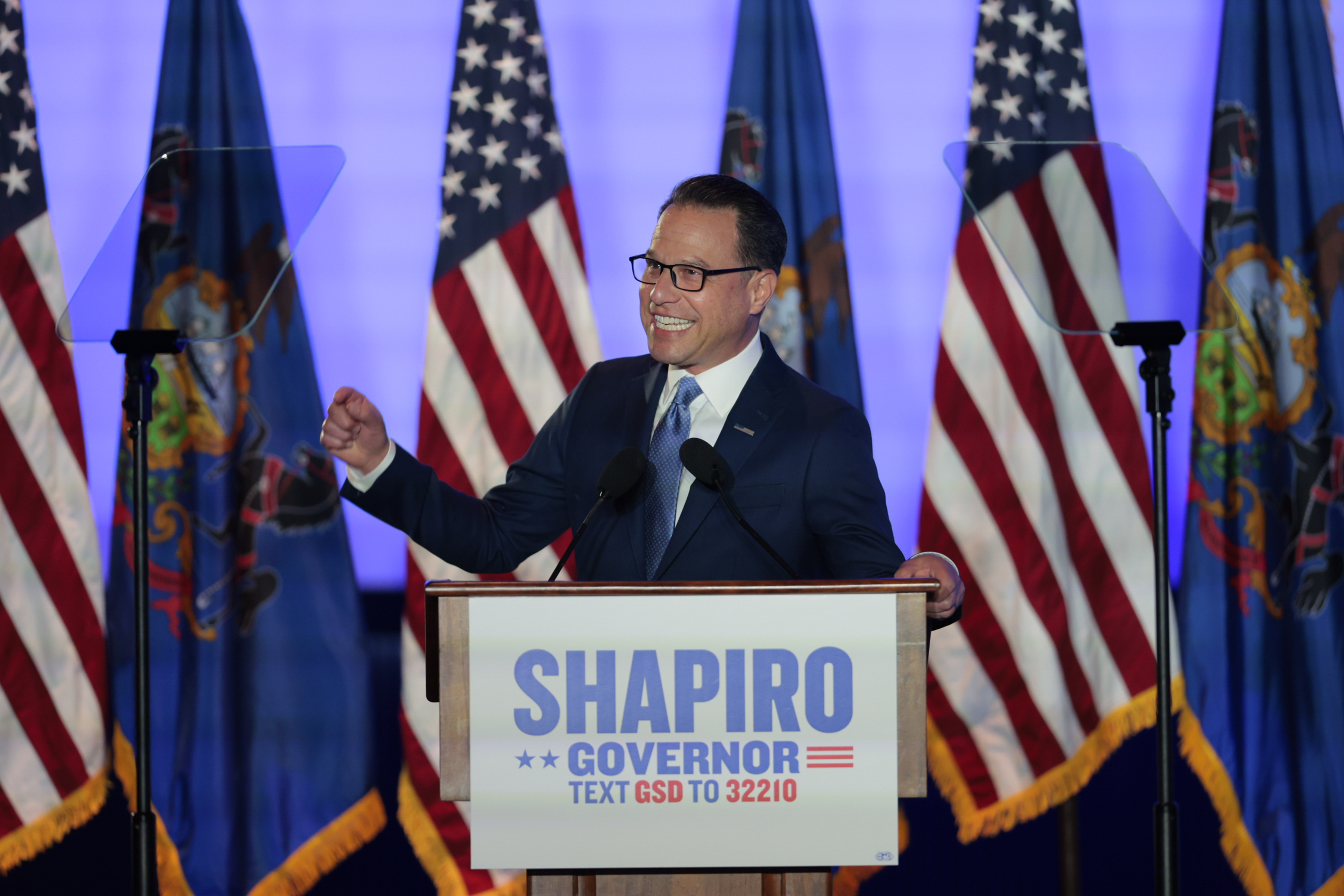
Gov. Josh Shapiro addresses supporters at a primary night part in Warminster on Tuesday, May 19, 2026Steven M. Falk / For The Inquirer
‘You don’t take for granted anything in Bucks County’
Bucks County’s importance ahead of November has been clear for months.
In Warminster last May, Shapiro held a primary night party at a former space centrifuge where he promotedhis reelection campaign and a slew of downballot candidates. There, Hartnett Albillar, who is also the county’s clerk of courts and a social worker by trade, declared: “The path to flipping the Senate runs right through Bucks County.”
As she continues knocking on doors and courting voters in the 6th District, which includes most of the middle of the county, that reality could not be more obvious. But, Hartnett Albillar said, despite Shapiro’s support (he has endorsed all three candidates) and a blue wave in the forecast, she’s not thinking of her election as a shoo-in.
“We know that you don’t take for granted anything in Bucks County,” she said in an interview last month.
That’s because the suburb is notorious for split-ticket voting, she said.
“Democrats have won here in other races, but I believe you have to make your case to voters individually,” Hartnett Albillar said, adding that voters in her district don’t look at party labels.
It’s a dynamic that has, for example, allowed GOP U.S. Rep. Brian Fitzpatrick to maintain his congressional seat even in years Democrats do well — like in 2022 when Shapiro won the county by nearly 20 points.
Pinsley is trying to make that argument in the Upper Bucks County portion of the 16th where voters are less familiar with the Lehigh County controller and where Republicans have a roughly 22,000 voter registration advantage — the largest gap of the three districts.
Eileen Hartnett Albillar (center) is challenging State Sen. Frank Farry in Bucks County’s 6th District.Hartnett Albillar Campaign
This race is also a rematch for Pinsley after he lost by 8 points against Coleman in 2022.
But the Democrat was given another chanceby votersthis year after he succeeded in a heated primary without the Bucks County Democratic Committee’s backing.
Now that he has the party’s support, he says it’s helped him reach a whole new circle of people for his events, including “Pastries with Pinsley,” a regularmeet-and-greet at various coffeehouses in the district, but especially in Bucks. This weekend, he’s headed to the So Fresh So Green Cafe in Perkasie.
“60% of the vote is in Lehigh County, and 40% of the vote is from Bucks County,” Pinsley said in an interview last month. “We need Bucks. We need Bucks to win. You’re not going to win in just Lehigh.”
Across county lines into Montgomery County — Shapiro’s home county, which has a reputation for being deep blue — also lies another swing district that Democrats are investing in as Thomas, a volunteer firefighter and community organizer, hopes to bring Pennycuick’s tenure in the state Senate to a close.
Until now, the 24th District, a hodge-podge of suburban and rural communities in Montco and Berks County that Thomas calls “all-encompassing of Pennsylvania” has “always been just out of reach in terms of how the district was drawn.”
But this year, with a combination of voters’ frustrations and Shapiro on the ballot, Thomas believes “a lot of the stars are aligning.”
“There’s a slim path to the majority without this district,” he said.
But Republicans won’t be giving up these suburban swing districts so easily.
Michael Straw, a spokesperson for the Pennsylvania Senate Republican Campaign Committee, said the GOP is “ready to compete for every vote in Bucks County.”
Straw said in a statement that candidates will highlight the bipartisan bills that lawmakers have introduced and have since been signed into law, including Farry’s legislation to reduce cost barriers for breast cancer screenings and Coleman’s bill to address school safety and increase parental transparency.
“We are making these legislative accomplishments known to voters across the political spectrum,” Straw said.
Both parties are betting on affordability
Heading into November, both Democrats and Republicans are trying to make the case to voters in these key swing districts that they are the party of affordability.
Straw said that Republicans view these elections as an opportunity to emphasize affordability and fiscal responsibility to put “an important check on the Democrats overspending.”
“Senate Republicans have helped to prevent wasteful spending, stop the Democrats’ electricity tax that would have cost Pennsylvanians more, and have supported reducing taxes on working families,” Straw said. “PA Senate Republicans have made affordability the priority while Democrats have repeatedly stood in the way.”
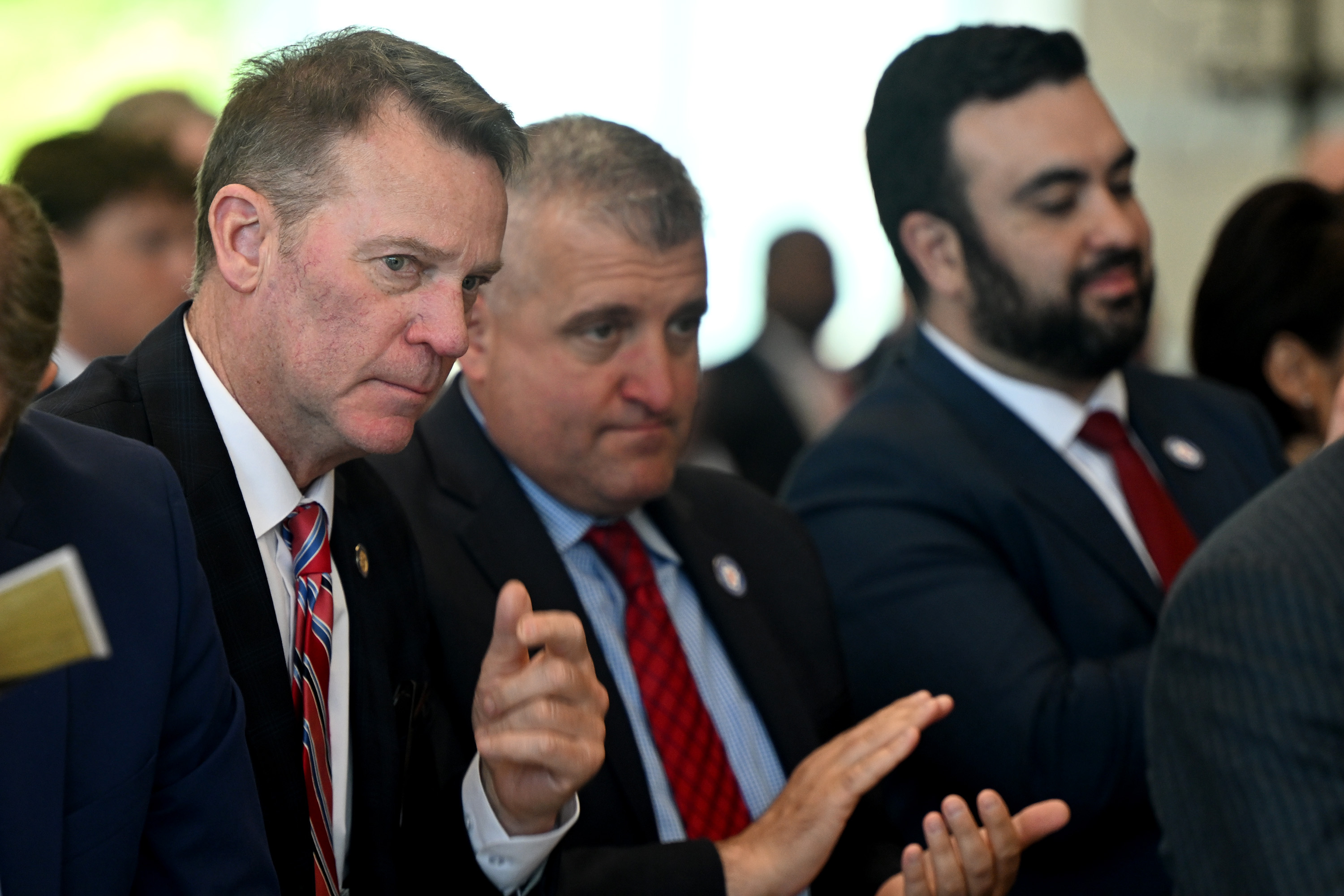
Bucks County GOP State Sen. Frank Farry (center) during a ceremonial meeting of the Pennsylvania Senate at the National Constitution Center May 5, 2026.Tom Gralish / Staff Photographer
And for Democrats, that means addressing voter frustrations that have trickled down from federal policies.
Trump — who has urged voters to think of him as being on ballot — is getting worsening marks on the economy from Pennsylvania voters. The president’s own voters in 2024 are also dissatisfied with his handling of gas prices, polling shows.
“They’re not happy about the Iran war. They’re not happy about the cost of gas. There are other costs that are going up, and many of them do blame the president, and all of these races have been federalized in many ways,” Pinsley said.
In response to the rising costs of living, affordability has taken up most of the oxygen in Democrats’ messaging as the party shifts away from issues that have been prevalent in previous campaigns, such as abortion.
With a focus on prices, the three swing district candidates have not had to switch up their stump speech even when chatting with Republican or independent voters that they’ll need to win over to be successful in November.
Hartnett Albillar said that all voters are simply looking for a “functional” and competent government.
Other key issues popping up in these races include funding for SEPTA and data centers; the latter of which has sparked contentious ads, including one by Hartnett Albillar’s campaign in the 6th District that provoked Farry’s campaign to file a cease-and-desist.
“I’ve heard many times that folks are not looking at whether there’s a ‘D’ or an ‘R’ next to the name,” she said. “They’re looking at the person who will be able to bring change and bring fresh ideas because the current system is not working for us. Costs are way too high, and they want someone who’s going to do the work.”
Police in Bucks County are asking for the public’s help in identifying the perpetrator who vandalized a golf course with swastikas and an antisemitic slur near a Jewish school.
The Yardley Borough Police Department on Monday said the vandalism occurred between Friday at 8 p.m. and Saturday at 7 a.m.
“During this time, portions of the golf course greens were intentionally damaged with racial slurs and swastika symbols carved into the turf,” police said.
“This type of behavior is not only a criminal act, but it is also hateful, offensive, and has no place in our community. The Yardley Borough Police Department is committed to thoroughly investigating this incident and holding those responsible accountable,” the police said.
Anyone with information about what happened can contact the Yardley police at 215-493-2782 and ask for Officer Alex P. Bires at Ext. 411.
“Despicable behavior!” Yardley Councilmember David Appelbaum wrote on Facebook as he shared the Yardley police post about the vandalism.
The incident happened near the Abrams Hebrew Academy.
Rabbi Ira Budow said police came to the school on Monday to review surveillance video, but the school’s cameras had not recorded the perpetrator.
Budow said he has been director for 46 years and the school has never experienced antisemitism from the Yardley community.
Nonetheless, Budow said, the academy has spent $150,000 a year on beefed-up security since the Oct. 7, 2023, Hamas attack on Israel that sparked the brutal conflict in Gaza.
John Shapcott, director of golf and club operations at the Yardley Country Club, on Wednesday said members were told in a notice about the vandalism.
“Two swastikas were scratched into the 10th green, and a racial slur was written in the greenside bunker on the 4th hole,” the country club told members.
The club immediately contacted police, notified Abrams Hebrew Academy, and promptly repaired the damage, the statement to members said.
“Yardley Country Club unequivocally condemns hate speech, fascism, antisemitism, and all forms of hateful conduct. Such acts are reprehensible, have no place at the Club or in our community, and will not be tolerated. The Club will continue to cooperate fully with local authorities as they investigate the incident and work to prevent similar acts,” the statement said.
Adrienne King, president of the NAACP Bucks County Branch 2253B, said in an emailed statement Tuesday night that her organization “was deeply disturbed to learn of the racist and antisemitic vandalism discovered at the Yardley Country Club. Swastikas and racial slurs are not simply acts of vandalism. They carry a painful history and send a message of hate and intimidation that can impact an entire community.”
King said the incident was “especially troubling given other recent incidents here in Bucks County. Just last week, our Branch spoke out following alleged threats containing racist and anti-Muslim language directed toward a historically Black church in our county.”
She added: “We cannot become numb to expressions of hate simply because there is so much happening around us. Each time they occur, we have a responsibility to name them, condemn them and stand with the communities affected.”
The Pennsylvania Human Relations Commission said it was offering its “unwavering support” to Abrams Hebrew Academy.
The commission “is also grateful to the Yardley Borough Police for their swift action to investigate this incident as a potential hate crime and their request for community assistance are encouraging steps toward accountability. We urge anyone with information to come forward, as public cooperation is critical to identifying those responsible and ensuring justice is served.”
The American Jewish Committee Philadelphia/Southern N.J. said in a statement on Wednesday that the antisemitic vandalism was “deeply disturbing and unacceptable.”
The organization continued: “As the Jewish community prepares to mark the third anniversary of the October 7 terrorist attacks, many Jews are already grappling with an increasingly hostile environment and are feeling especially vulnerable and concerned for their safety.”
The committee added: “This is a moment for people of good conscience to stand together in rejecting hate in all its forms. We all have a responsibility to ensure that our communities remain safe, welcoming, and inclusive.”
Fleece fragments in a washer flow into a wastewater treatment plant. A plastic bag blows into a stream. A water bottle washes down a storm drain.
All can end up in the region’s waterways as microplastics smaller than a grain of rice and find their way into drinking water and the stomachs of animals and fish.
This kind ofmicroplastic pollution was detected in 22 stream and river segments across the Delaware River watershed, according to a new survey of waterways by the nonprofit advocacy group PennEnvironment Research and Policy Center.
Researchers analyzed water samples from sites along the Delaware River and its tributaries across Pennsylvania, New Jersey, Delaware, and New York.
The research was conducted in partnership with the nonprofit Environment New Jersey Research and Policy Center. Scientists with the Academy of Natural Sciences at Drexel University helped analyze the results, which were released Wednesday during a news conference at Fairmount Water Works.
Contamination was found in the Delaware and Lehigh Rivers and the Schuylkill. It was found in Neshaminy Creek in Bucks County, Brandywine Creek in Chester County, and Cooper River in Camden County. And it was found along the Christina River in Delaware.
Drexel’s lab analysis confirmed microscopic plastic at every sampled site, highlighting what the researchers say is a widespread environmental threat.
“We can look at a waterway, and it might be free of litter, it might be free of visible plastic pollution, but that doesn’t necessarily mean it’s clean,” said Faran Savitz, an advocate for PennEnvironment. “The big takeaway is that we should be concerned. The depth, the breadth of this plastic pollution is staggering.”
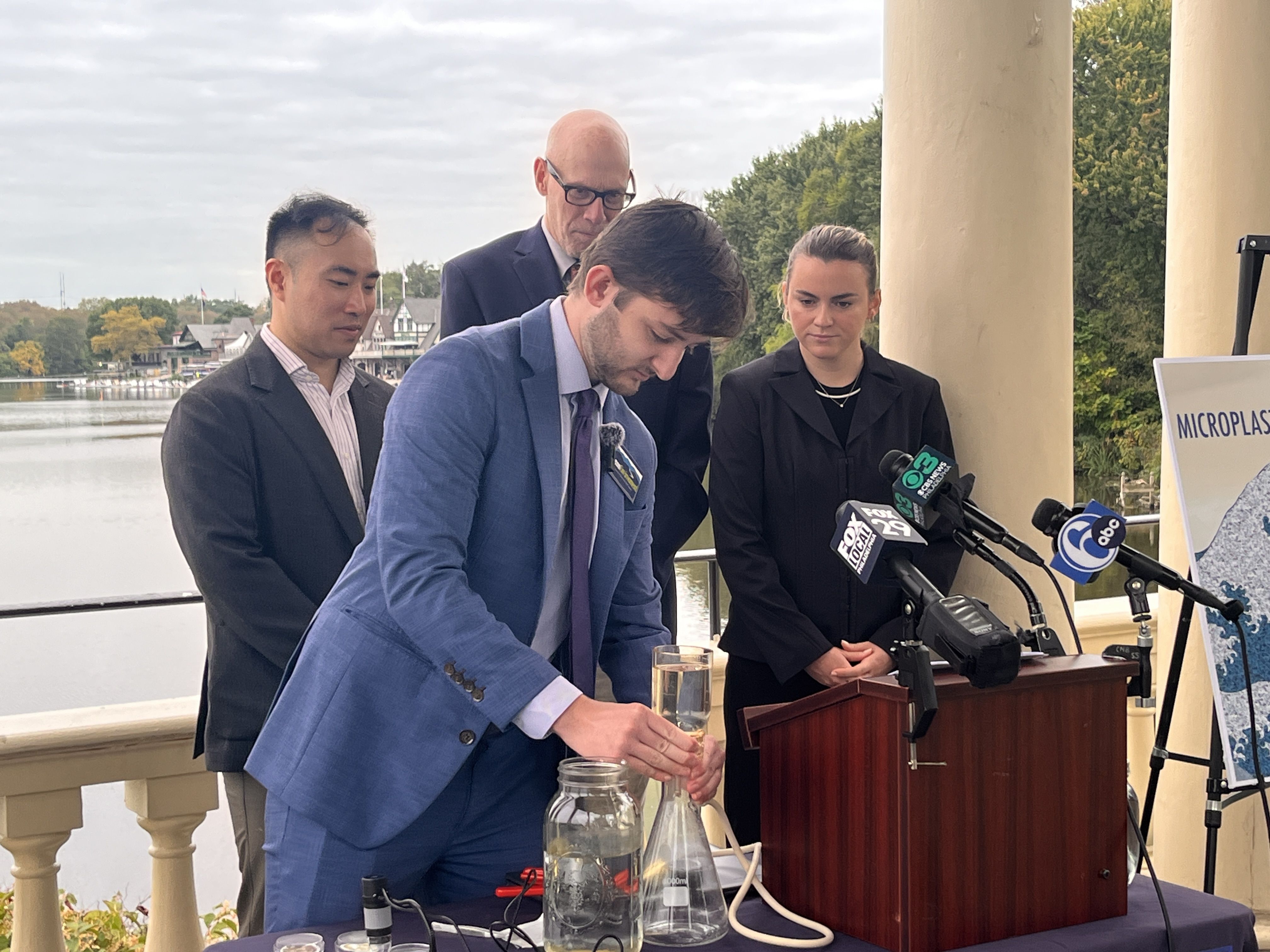
Faran Savitz with PennEnvironment demonstrates water testing. In the background from right are: Lizzy Mulvenna, with Environment New Jersey Research & Policy Center; David Velinsky, senior scientist, Academy of Natural Sciences; and Derek Ho, microplastics researcher, University of Pennsylvania.Frank Kummer
Where do microfibers come from?
Waterways in and around Philadelphia emerged as significant focal points in the survey results.
Samples drawn from the Delaware River in Philadelphia tested positive for multiple categories of microplastics including microfibers, microfragments, and microfilm, as did other waterways. Microbeads, often found in cosmetic products, were also found in the Christina River.
Microplastics are defined as fragments of less than 5 mm in length.
The synthetic microfibers came primarily from clothing and textiles. Rigid microfragments from items such as fishing line were found in 82% of locations. And flexible microfilm from bags and packaging appeared in 77%.
(function(){function e(){window.addEventListener(`message`,function(e){if(e.data[`datawrapper-height`]!==void 0){var t=document.querySelectorAll(`iframe`);for(var n in e.data[`datawrapper-height`])for(var r=0,i;i=t[r];r++)if(i.contentWindow===e.source){var a=e.data[`datawrapper-height`][n]+`px`;i.style.height=a}}})}e()})();
Microplastics have been found in humans
Researchers explained that laundering synthetic garments releases millions of microfibers that wastewater treatment facilities are unable to completely filter out before they are discharged into local streams.
However, because plastic does not biodegrade but continuously fractures into tiny fragments, filters capture only a portion of plastic entering a waterway.
Savitz said PennEnvironment’s study did not release the concentrations of microplastics because it did not want to compare one waterwayor state against another.
The findings carry ecological and public health implications, as microplastics can block digestive tracts in wildlife and absorb toxic chemicals like PCBs and PFAS that bioaccumulate up the food chain, the report stated.
On average, humans ingest approximately 5 grams of plastic weekly, which is roughly equivalent to the weight of a credit card. Microplastics have been found in human blood, lung tissue, and organs, the researchers said.
Plastics are also routinely found in wildlife, including sea turtles, birds, and whales. About 60% of all seabirds have ingested plastic, with that number rising.
The environmental advocates are urging state and local leaders to enact policies such as producer responsibility for plastic packaging, bans on single-use foam and plastic bags, strict limits on pre-production plastic pellets, and enhanced drinking water filtration systems.
Microbeads once used in personal care products were phased out under President Barack Obama in 2015. But many of those products still linger on household shelves.
File: A glass vial containing water and microplastic pollutionGetty Images
Philadelphia’s drinking water
Philadelphians get their drinking water from the Delaware River and the Schuylkill. Most microplastics are filtered out at the Philadelphia Water Department’s wastewater treatment plants, but some particlesstill get through.
In 2025, PWD removed 4.6 tons of plastic litter from the Delaware and the Schuylkill, alongside an estimated 1,000 tons of plastic extracted through sewer maintenance, the researchers stated.
PWD said in an online report that it is “unclear whether microplastics pose a danger to human health,” noting that the risk could depend on the level of exposure, the type of plastic, and the size of the particles.
But it noted that research suggests some are harmful to fish and animals and can build up in the organs or bloodstream over time.
“PWD is always investigating advanced treatment technologies that may eliminate microplastics and other impurities,” the report stated.
David Velinsky, a senior scientist at the Academy of Natural Sciences of Drexel University, said, “plastics and microplastics are everywhere, from our clothing to the ubiquitous water bottle.”
When plastics and microplastics are not properly disposed of or recycled, he said, they break down into ever smaller pieces.
They “can travel great distances through both the air and in the water,” Velinsky noted.
A plea for ‘producer responsibility’
To combat pervasive plastics, advocates are urging federal and state lawmakers to enact targeted reforms, including the federal Plastic Pellet Free Waters Act currently before Congress, and state-level producer responsibility legislation for plastic packaging.
Savitz emphasized that shifting financial and operational burdens back onto manufacturers is critical to curbing waste at its source.
At least seven states have passed producer responsibility laws, though not all are in effect, according to the Product Stewardship Institute. Those states include Washington, Oregon, California, Colorado, Minnesota, Maryland, and Maine.
“If we can shift the burden back onto companies that create this waste in the first place,” Savitz said, “we can actually reduce the waste, encourage recycling, and make these broader, more systemic changes.”
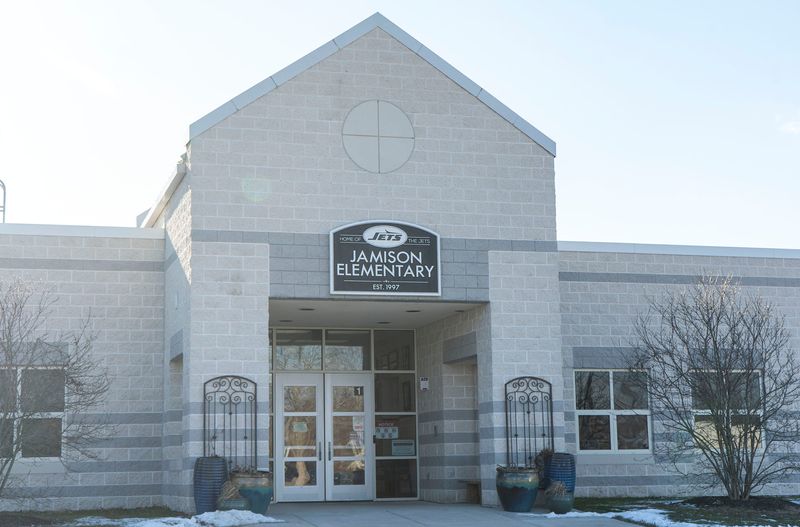
The parents of a nonverbal autistic 10-year-old who was among the students the Central Bucks School District has said were abused in an elementary school classroom in 2024 have filed a lawsuit against the district and nearly a dozen former and current employees.
James Pepper, a former school board member, and his wife, Lisa Pepper, say their son’s “horrific abuses” at Jamison Elementary School amounted to a “calculated pattern of debasement” that district and school leadership failed to report as part of a “concerted cover-up.”
The bulk of the 92-page complaint, filed Tuesday in federal court in Philadelphia, outlines events that began in fall 2024, when a special education aide reported the abuse. Her allegations rocked Pennsylvania’s third-largest district, spurring an investigation by a disability rights watchdog, a public outcry, and a series of terminations that included the district’s superintendent.
Now, the Peppers are suing Central Bucks, as well as former Superintendent Steven Yanni, former Jamison principal David Heineman, other former district administrators, the special education teacher and educational assistant accused of misconduct, and teachers union representatives.
The district continued to endanger the child after learning about the abuse, and the alleged “cover-up” was motivated by James Pepper’s position as a board member and history of advocacy, the suit says.
“This case involves an extraordinary betrayal of a child who depended entirely on the adults around him for his safety, education, and care,” M. Stewart Ryan, the attorney representing the parents, said in a statement.
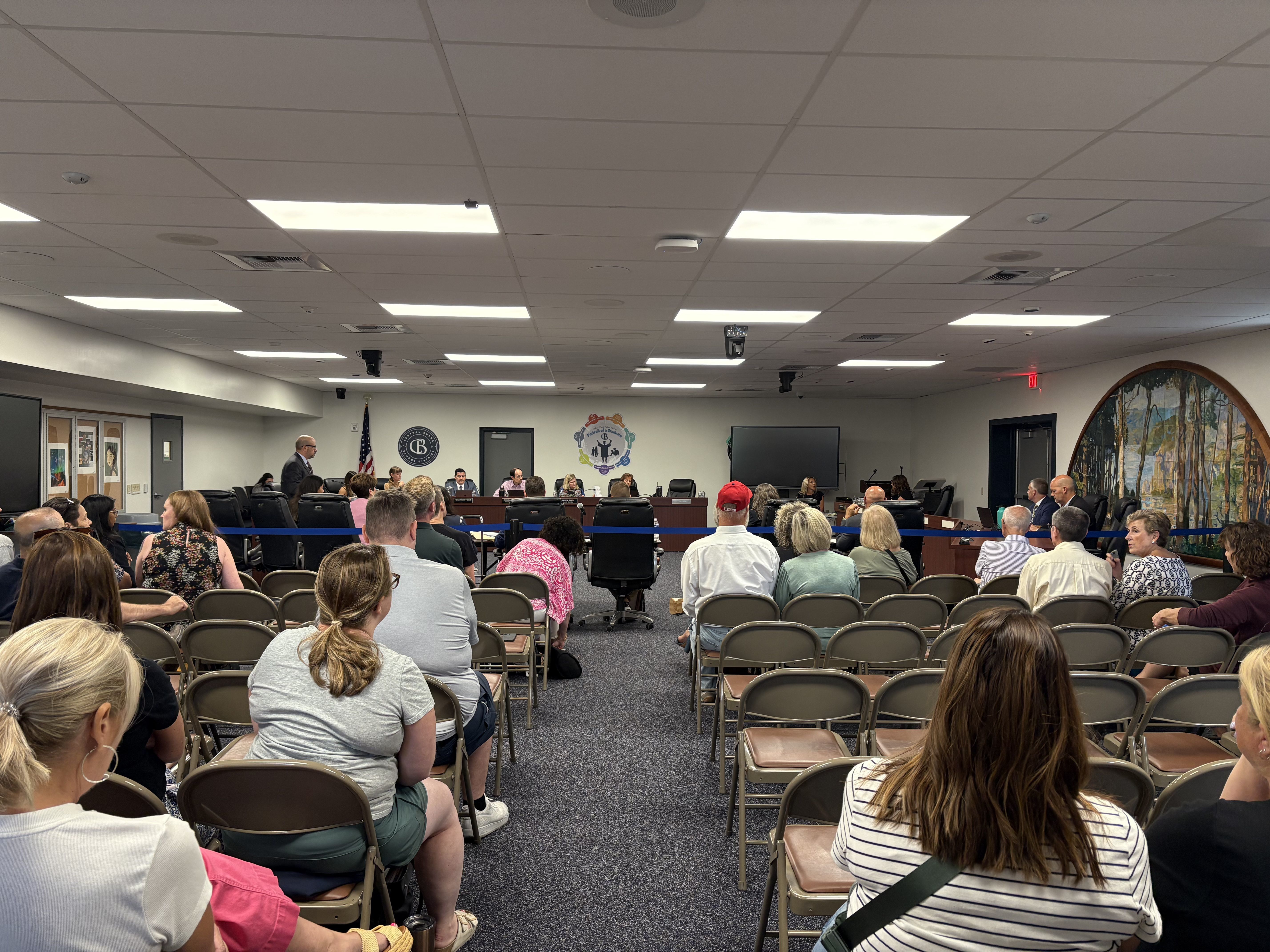
Central Bucks spokesperson Michael Petitti said in a statement that the district “has acknowledged what occurred” in that classroom.
Petitti said the district “took the actions within its power” to discipline employees, including firing Yanni, Heineman, and the former special education director, Alyssa Wright. It also “fully litigated” terminations of the teacher and educational assistant, Petitti said, and “implemented significant changes at Jamison Elementary School to make sure that nothing like this ever happens again.”
“The district understands that none of these actions can change what happened,” Petitti said.
The allegations
District officials learned about the allegations in November 2024 from Alyssa Kline, who was assigned as the one-on-one aide for the Peppers’ child.
Kline said special education teacher Gabrielle McDaniel and educational assistant Rachel Aussprung had improperly restrained and punished the Peppers’ child, among other forms of abuse.
The abuse included “nearly 3,000 illegal restraints … water restriction, corporal punishment, forced exposure to nudity and sexual self-stimulation, screaming, mocking, belittling, and concealment of a head injury in a series of events that were intended to, and indeed did, dehumanize” the boy, the lawsuit says.
The nonverbal child could not share his experience in school, and his parents were not initially informed of the accusations, the suit says. The district reassigned Kline days after she made the allegations, telling the Peppers the reason for the change was a “personal conflict” between the aide and classroom staff, according to the complaint.
The Peppers learned about the allegations of abuse only in December, when Kline reached out to share what she had reported with the parents, the suit says.But in an official letter that month, the district said its investigation found “no evidence of abuse.”
Members of the public watch the joint termination hearing of Central Bucks Superintendent Steven Yanni and Jamison Elementary School Principal David Heineman in August 2025.Fallon Roth / Staff
School board members initially stood by district officials, who noted police had not found any abuse. But that changed in April 2025, when a report from the watchdog group Disability Rights Pennsylvania found that the teacher and assistant had illegally restrained students, creating a “reasonable likelihood of bodily injury” and likely interfering with their breathing, among other abusive behaviors.
It also faulted Yanni and other administrators for failing to adequately investigate the allegations, and accused Yanni of withholding information from police.
Yanni, now the CEO of Northwood Charter School in Philadelphia, did not respond to a request for comment.
A lawyer for Heineman did not return a request for comment. Neither did a lawyer for McDaniel and Aussprung, who have sued the district since their terminations. Wright, whose lawyer did not return a request for comment, has also sued the district, saying she was scapegoated.
The Peppers’ lawsuit says district and teachers union officials, whom Kline also informed, failed to report the abuse.
Cara Alderfer, the union president, declined to comment Tuesday.
The ‘cover-up’
The Peppers’ lawsuit alleges a sprawling cover-up that started the moment Kline made the allegations.
The accused teacher and assistant were not removed from the classroom, and the district recommended thatMcDaniel or Aussprung take the Peppers’ child to therapy sessionsafter Kline was reassigned, according to the complaint.
The district did not turn over an email outlining Kline’s allegations to Disability Rights Pennsylvania, the suit says.
Yanni and other officials “were actively engaged in a conspiracy to bury the reports of child abuse they had received,” the complaint says.
The complaint blames a few factors as motivatingthe alleged “cover-up.”
And the district was motivated to retaliate against Pepper — then the only Republican on the board — for stances he had previously taken against the district, the suit says.
The actions of the school district and its employees deprived the Peppers’ son of “safety, liberty, and bodily integrity,” the complaint says.
“It is devastating to learn that our son was treated this way by the very people we trusted to care for and protect him,” the Pepper family said in a statement. “Our son and entire family have been changed forever. This can never happen again to another child.”
Jeff Scott, 72, formerly of Hilltown, Bucks County, longtime award-winning TV and video scriptwriter, director, and producer, former columnist and editor at the Quakertown Free Press, and green-thumb gardener, died Saturday, Sept. 19, of pulmonary fibrosis at Hunterdon Medical Center in Flemington, N.J.
Born in Philadelphia, reared in Hilltown, and a graduate of Pennridge High School, Mr. Scott turned his lifelong interest in sports, affable collegiality, and writing, reporting, and editing skills into an award-winning career as a TV and print journalist that spanned more than four decades.
For 32 years, from 1983 to 2015, Mr. Scott wrote scripts, directed talent, and produced shows for TV, film, video, radio, and DVDs. He worked for Major League Baseball Productions through Phoenix Communications from 1988 to 2015 and wrote more than 1,000 TV show scripts for ABC, NBC, ESPN, Fox, and other networks, including 176 episodes of ESPN’s Major League Baseball Magazine and 450 consecutive episodes of the popular This Week in Baseball.
His dramatic scripts detailed many memorable baseball seasons, went behind the scenes with championship teams, and shared stories about star players on and off the field. They were narrated by iconic announcers such as Mel Allen, Curt Gowdy, Bob Costas, and Harry Kalas, featured thousands of players, coaches, and managers, and earned 16 New York Emmy Awards.
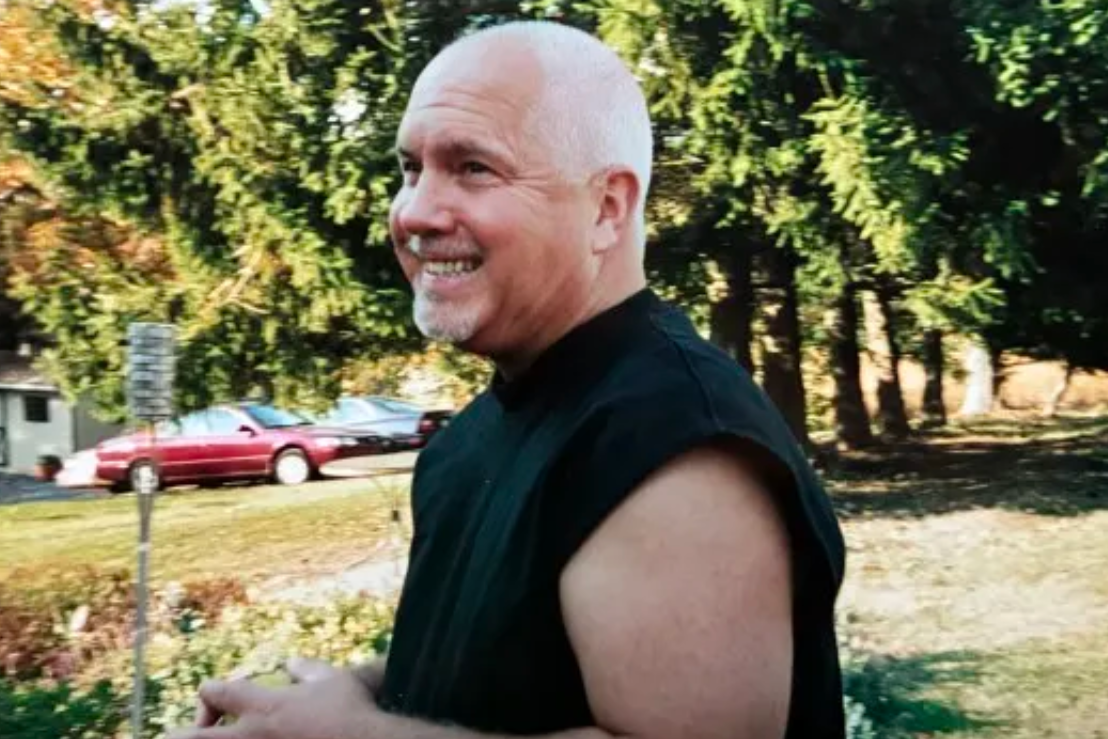
Mr. Scott earned 16 New York Emmys.Courtesy of the family
Former colleagues at MLB Communications posted a video tribute to Mr. Scott on X and noted his “indelible impact” on This Week in Baseball. Buzz Brainard, a former narrator for This Week in Baseball, said on Facebook: “Honored to bring his words to life every season for 11 years.”
Earlier, from 1983 to 1988 at the old Halcyon Days Productions, Mr. Scott wrote scripts for the weekly This is the USFL for ABC and other shows about John Madden, Mike Schmidt, and other sports and entertainment notables. Sports reporter Jayson Stark said on X: “You may not know the name, Jeff Scott. But you should.”
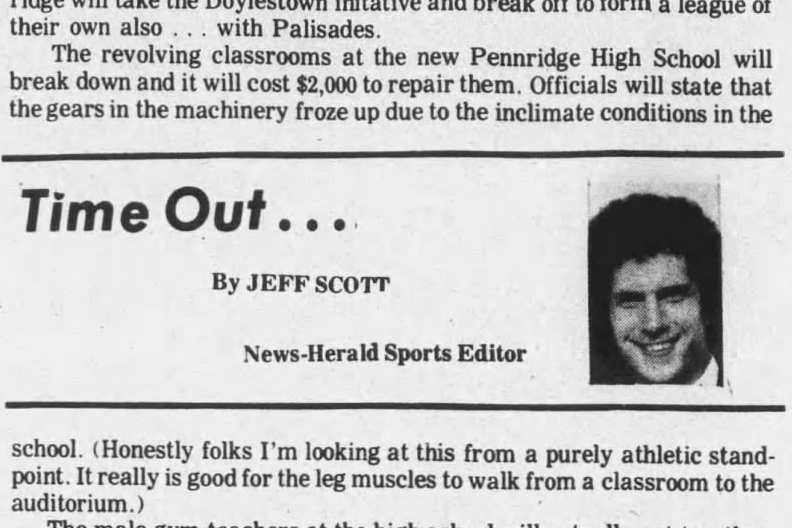
In print, Mr. Scott was a columnist and weekend magazine editor for the Free Press in the early 1980s. In the 1970s, he was sports editor and a features writer for the Perkasie News-Herald, and a part-time sports reporter for the Doylestown Intelligencer.
At the Free Press, he won awards and covered all kinds of local stories, including his publisher’s triple-bypass heart surgery. At the News-Herald, he wrote a sports column called “Time Out” and a news feature called “Know Your Community.”
To know Mr. Scott, a friend said, “was to like him.”Courtesy of the family
In 1976, he opened a News-Herald sports story with: “Some would call it luck. Some might call it breaks. And some might even consider the fact that somebody upstairs is carrying the fate of the Pennridge football team this year. We prefer to call it pure, unadulterated hustle.”
A former Pennridge baseball player said in a tribute: “It always was a big deal when he came to our games.” A former colleague at the Free Press said: “He made me feel important, and he made sure I knew that he was my friend.”
Other former colleagues praised Mr. Scott’s “sense of humor,” “warmth and kindness,” and “quick wit that never waned” in online tributes. “To know Jeff was to like him,” longtime friend and colleague Jim Burger said. “To know him well, which I had the good fortune to do, was to love him.”
Jeffrey Llewellyn Scott was born Nov. 18, 1953. He played street hockey in Hilltown and baseball at Pennridge, and attended what is now West Chester University.
Mr. Scott wrote a sports column in Perkasie in the 1970s.Newspapers.com
After college, he drove a truck, worked as a disc jockey, and traveled across the country. He married and divorced Lorrie Greenly and Amber Hudson.
He met Lenore Homeward on vacation in Tobago, and they married in 1991 and lived in Manhattan and Pittstown, N.J. He created seven flower beds on their property and tended many flower pots. “It was like a full-time job,” his wife said.
Mr. Scott enjoyed music and followed the Phillies, Eagles, 76ers, and Flyers. “He was a homebody,” his wife said.
His niece Shanice said: “My uncle Jeff had a big heart and meant the world to me.” A longtime friend said: “The world will be a less warm and kind place without him in it.”
Mr. Scott enjoyed time with his family.Courtesy of the family
His wife said: “He was loyal, funny, humble, and compassionate. He had the ability to see the better in people. He was friends with everybody.”
In addition to his wife and niece, Mr. Scott is survived by a sister, Kathleen, and other relatives. Three brothers and one sister died earlier.
Private celebrations of his life are to be held later.
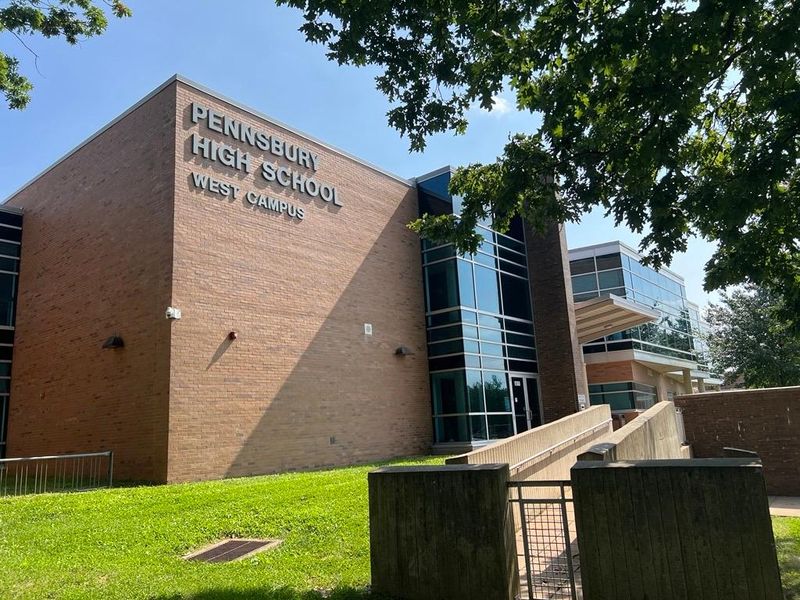
A conservative Christian legal group is asking the U.S. Department of Education to investigate the Pennsbury School District, after a mother and father said the district violated their rights by hiding their child’s use of a different name and pronouns for nearly three school years.
After parents confronted the Bucks County district last year, it agreed to use the student’s given name at graduation, but did not change its policy to require that parents be notified of a student’s name change, according to the complaint filed last week by the Orlando-based Liberty Counsel.
“Parents have the right to know when their child is struggling with an issue, and are the first line of defense for their child,” said Richard Mast, a staff attorney with Liberty Counsel, which has brought cases favoring religious liberty and opposing LGBTQ+ rights.
A Pennsbury spokesperson declined to comment Monday. The K-12 district enrolls about 9,400 students from Yardley Borough, Lower Makefield Township, Falls Township, and Tullytown Borough.
The complaint comes as President Donald Trump’s administration has escalated pressure on school districts over policies protecting transgender students. The U.S. Department of Justice earlier this month sued the Kansas City, Kan., school district, alleging it violated parents’ rights by facilitating “gender transitions” for students without informing their parents.
The Education Department also this month opened an investigation into a Massachusetts school district for using a male name and pronouns for a student without parents’ knowledge.
Conservative legal groups are also taking aim at schools: The Chester County Intermediate Unit this month rescinded a policy that barred staff from disclosing a student’s transgender status to parents without the student’s permission after receiving a letter from the Alliance Defending Freedom and the Harrisburg-based Independence Law Center, the groups said Monday. A spokesperson for the intermediate unit said it recommended the policy’s repeal “as part of its ongoing review of board policies and in recognition of the evolving legal landscape regarding transgender students.”
“There is absolutely a targeted attempt by the administration, and those aligned, to try to erase trans students from our schools and elsewhere from our culture,” said Kristina Moon, a senior attorney with the Education Law Center, a Philadelphia-based group that advocates for LGBTQ+ students. The Education Department earlier this year opened an investigation into the Great Valley School District in Chester County for a policy allowing transgender girls to participate in girls’ sports teams.
Students “need to feel safe and be able to be themselves in school,” Moon said, adding that she worries schools are getting a “very harmful message … that if you care about trans students having a sense of belonging, then you too will be targeted by the Trump administration.”
Name changes and ‘a right to privacy’
The complaint filed Sept. 21 by Liberty Counsel against Pennsbury alleges that the mother and father did not learn until the end of their child’s junior year that Pennsbury High School staff had been calling the student by a male name and pronouns since ninth grade. The complaint does not identify the student, who has since graduated, or the parents.
The district used a “false male name” and pronouns for the student in both personal interactions and electronic information systems, according to the complaint.
In one handwritten note included in the complaint, a coach wrote to the student in October 2025: “My son! My boy! It’s finally senior night! … Your high school years may not have always been like you dreamt it would be, but it’s okay! … I could not be more grateful and honored to be your coach/mom.”
While the student’s mother had heard other students referring to her child by the name during sophomore year, the student brushed it off, saying, “‘It’s just a silly name,’” Mast said in an interview Monday. The mother “didn’t pry further,” Mast said.
But when the student brought home a memory book during junior year, the mother saw a male name was used for her child, Mast said. She then went back and reviewed other memory books and saw they also used the name.
Had the parents known sooner, “they would have helped the child get the counseling she needed to be comfortable with her natal sex,” said Mast, who said the parents’ relationship with their child has suffered. “No girl should be made to feel like she is born in the wrong body.”
On Nov. 17, the parents demanded that Pennsbury use their child’s given name and female pronouns, according to the complaint. After a Dec. 1 meeting, the district said it would do so going forward, the complaint said.
But it did not fulfill all of the parents’ requests, leading Liberty Counsel to issue a demand letter on March 6, according to the complaint.
The district agreed to use the student’s given name at graduation and on the student’s diploma, but said it could not control what appeared in the memory books, because those were issued by a booster club, the complaint said.
And it has not updated its policy related to transgender students, according to the complaint. The parents had asked the district to require principals to communicate with parents before a student could be called by a different name.
The district’s policy says it will accept a student’s asserted gender identity, and “all persons, including students, have a right to privacy. This includes the right to keep private one’s transgender status or gender expansive presentation at school.”
The policy also includes a section about “parental consent” that says that if a parent or student requests a name change without proof the name has been changed legally, “the parent/guardian and student will be provided” with a form. That did not happen in this case, according to the Liberty Counsel complaint.
Pennsbury is ‘not unique’
Pennsbury’s policy is “not unique” among Philadelphia-area districts, said Jeffrey Sultanik, a solicitor for numerous districts in the region.
Lower Merion’s policy, for instance, says “school personnel should not disclose information about a (transgender or gender diverse) student’s gender identity and expression to others, including the student’s parents/guardians and/or other school personnel, unless legally required to do so or unless the student has authorized such disclosure.”
The Pennsbury complaint “may dictate what other school districts end up doing,” depending on how the Education Department responds, Sultanik said.
The complaint alleges violations of the Family Educational Rights and Privacy Act, a federal law protecting the privacy of student educational records.
The law “prohibits a federally funded school district from maintaining a policy that denies or effectively prevents a parent from inspecting and reviewing a minor child’s education records,” according to the complaint, which also alleges violations of the Protection of Pupil Rights Amendment — a federal law governing surveys administered to students on sensitive topics — and Title IX.
Moon, of the Education Law Center, said “there is currently no law that schools have to notify parents about students sharing to their counselor, or a trusted teacher, that they identity as transgender.”
In cases Moon is familiar with, she said, school counselors ask students if they have told their parents about their gender identity.
“I really don’t think in the vast majority of cases, this is anything like teachers trying to avoid, or counseling students to avoid, conversations with their families,” Moon said.
Bucks County Republican State Sen. Frank Farry’s campaign this week demanded his Democratic challenger take down an advertisement attacking Farry for his position on data centers and air an apology instead, calling the commercial “defamatory” and “demonstrably false.”
Shohin H. Vance, an attorney representing Farry’s campaign, called for Democrat Eileen Hartnett Albillar to remove the ad and issue a 30-second retraction advertisement, according to an eight-page letter sent Wednesday and reviewed by The Inquirer.
Harnett Albillar’s ad calls Farry a “data senator” and says he is “the data center industry’s number one fan.” The ad also accuses the Republican lawmaker of voting for data center tax breaks in Harrisburg and notes that Farry’s law firm represents NorthPoint, a real estate company which redeveloped the Keystone Trade Center in Falls Township — the soon to be home of an Amazon data center.
“The Advertisement, which accuses my client of abusing his public office for his own pecuniary interest, is not only misleading — it is demonstrably false,” Vance wrote in the letter.
The dispute signifies how AI data centers have become a politically toxic issue as candidates from both parties distance themselves from supporting their development.
Farry’s 6th State Senate District is one of a handful of competitive seats being targeted by Pennsylvania Democrats in hopes of flipping the state Senate and delivering a Democratic trifecta in Harrisburg.
Hartnett Albillar’s campaign said Fridayit has no plans to stop running the ad.
“His temper tantrum won’t silence this campaign or stop Eileen from fighting to make Bucks County more affordable,” campaign manager Leigh Stafford said in a statement.
The Farry campaign, in the letter, rejected the notion that Farry or any clients at his law firm — including NorthPoint — benefitted or profited from Farry’s vote in 2021 to support Act 25. The legislation allows computer data center equipment to be exempt from Pennsylvania’s sales and use tax if it’s being used or sold to a certified data center by a valid owner, operator, or tenant.
“The vote did not, and could not, benefit the client, and none of it put a dollar in Senator Farry’s pocket,” Vance wrote.
Farry was serving in the state House at the time and did not raise a conflict of interest on the floor. When asked about this, he said in a statement: “I didn’t raise a conflict on the House floor in 2021 BECAUSE I DO NOT REPRESENT DATA CENTERS.”
The campaign emphasized in its letter that Farry’s law firm, Begley, Carlin & Mandio, has not represented a data center operator in at least 20 years.
“To be sure, the Keystone Trade Center is now also the site of a data center, and its developer, NorthPoint, is a client of Begley Carlin. But NorthPoint is not a data center, and the fact that it leases a portion of its 1,800-acre site to a data center operator does not make it one,” Vance wrote.Begley Carlin has represented NorthPoint since July 2020.
Farry has been with Begley Carlin since 2011, but he said in a statement that he has “not done much work at all” for the firm “as my time is filled with being a State Senator, our local volunteer fire chief, a dad to two young kids, and a husband who among other things recently supported my wife through a two year battle with breast cancer.”
Adam C. Bonin, an attorney representing Hartnett Albillar’s campaign, wrote in a response to Vance Friday that: “We will neither cease nor desist from engaging in this truthful, accurate speech.”
Bonin highlighted NorthPoint’s close proximity to the Bucks County data center project, including mentions of the company in Falls Township press releases and in news articles. Bonin also argued that the 2021 state House bill, which Farry supported “made this an attractive deal for NorthPoint and Amazon to make. Without them, perhaps Amazon would have stayed out of Bucks County altogether.”
“While Senator Farry might not like seeing the truth displayed in such an unflattering way, the advertisement’s statements are amply supported by Farry’s legislative record, his law firm’s own website, official Falls Township records and copious news reporting,” Bonin wrote.
This is not the first legal dustup to happen in a Bucks County race this election cycle. Last month, Democrat Bob Harvie, a county commissioner challenging GOP U.S. Rep. Brian Fitzpatrick in the 1st Congressional District, filed a defamation lawsuit against a super PAC supporting the Republican. The suit argued that the PAC falsely claimed Harvie was under FBI investigation.