Philadelphia talent was on full display at the 2026 Emmy Awards in Los Angeles on Monday night, but only one of the nominated actors, crew members, or shows took home trophies.
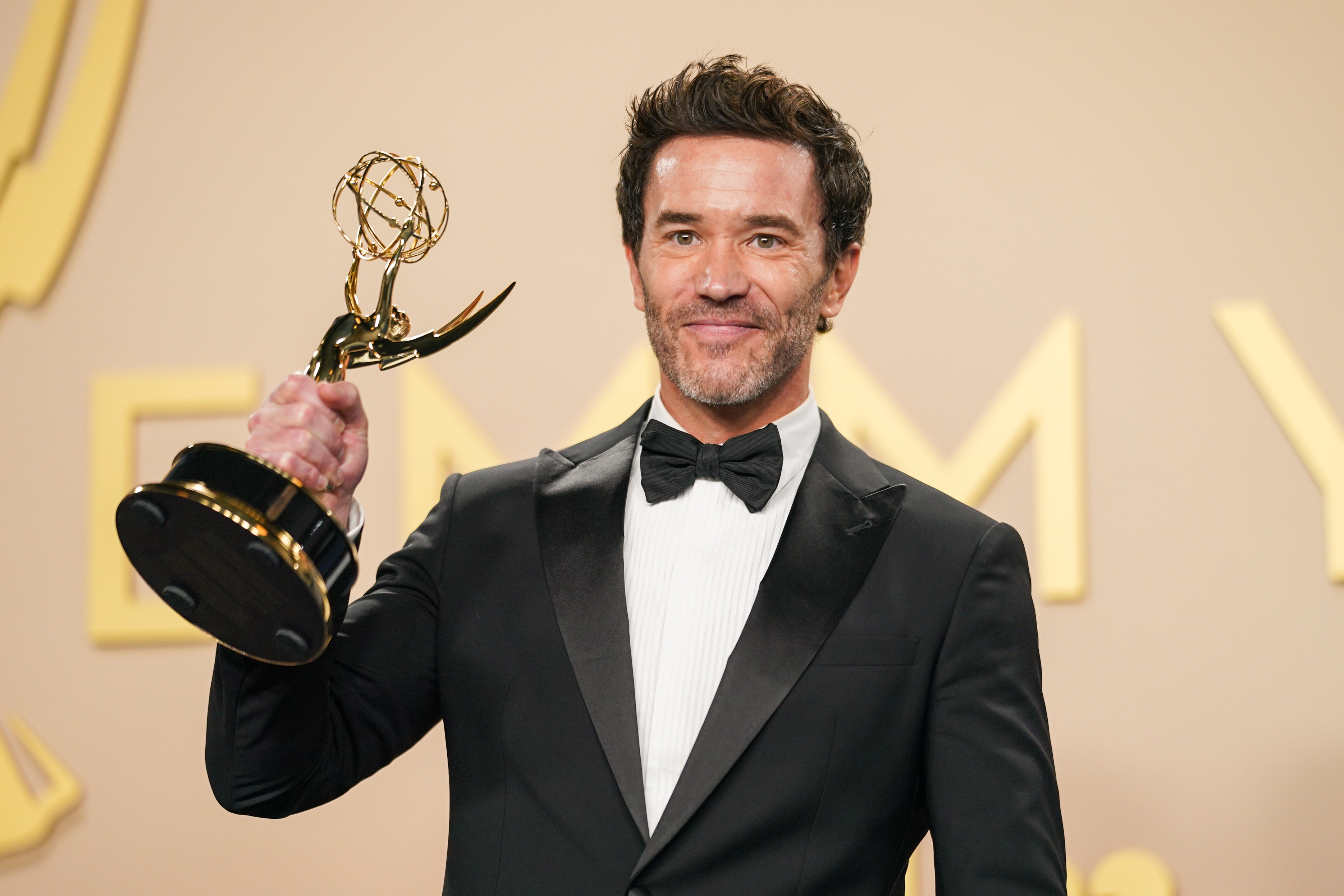
The big, surprise exception was Tom Pelphrey, a Rutgers University alum from Howell Township, N.J., who won for outstanding supporting actor in a drama series for his performance as Robbie Prendergrast on Season 1 of the Delco-set HBO crime thriller Task.
“I thank God for my life and my sobriety. I thank my family and my friends for all your love and support all these years, from Emmys to, you know, black box theaters and everything in between,” said Pelphrey in his acceptance speech before thanking Task creators including directors Jeremiah Zagar (son of South Philly mosaicist Isaiah Zagar) and Salli Richardson-Whitfield, and fellow cast members Mark Ruffalo, Emilia Jones, and Raúl Castillo.
Ruffalo was nominated for outstanding lead actor in a drama for his role as Tom Brandis but lost to Noah Wyle of The Pitt. The Pittsburgh-set emergency room drama received a whopping 25 nominations and took home seven Emmys, including outstanding drama series; Pelphrey beat out three supporting actor nominees from The Pitt for his win.
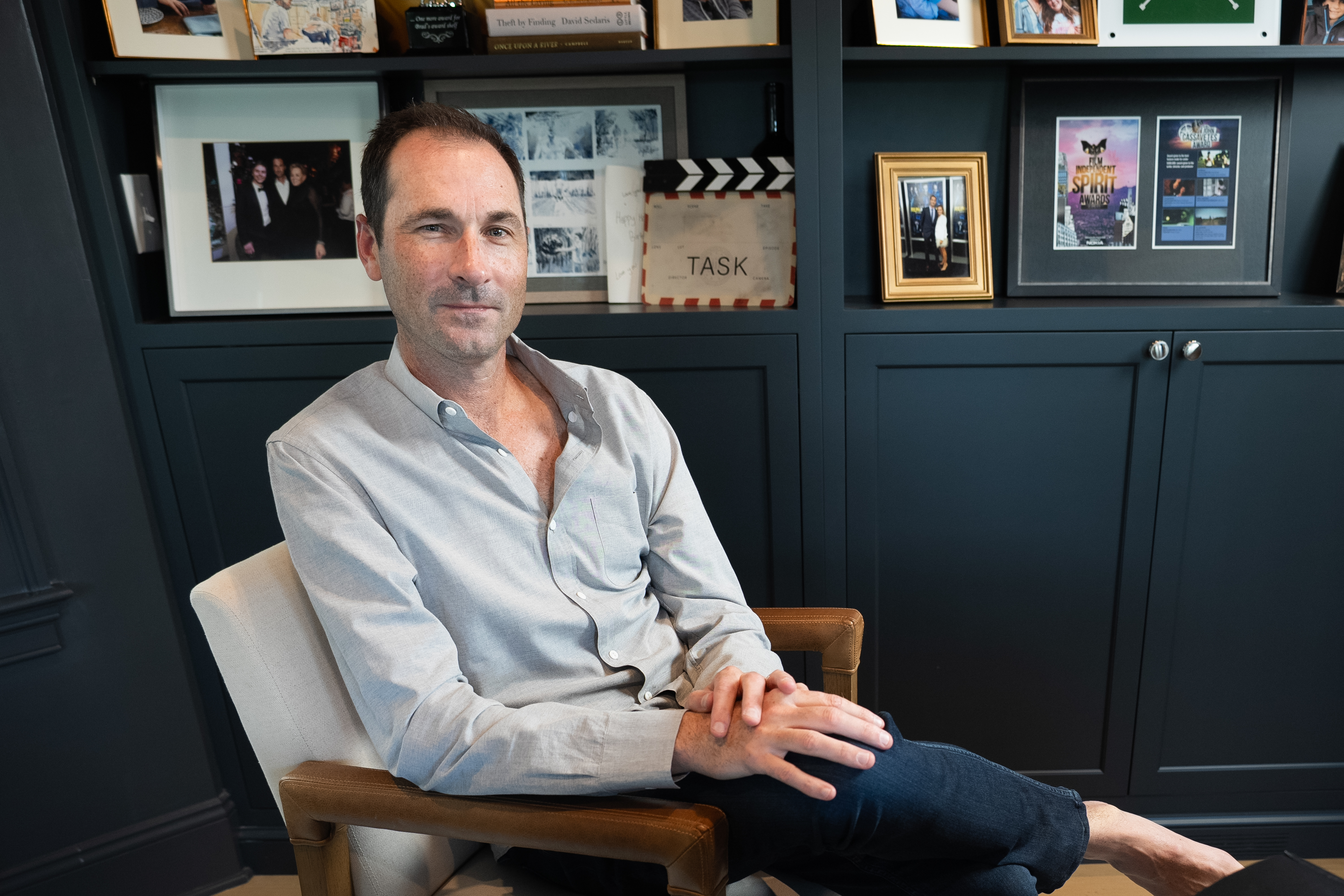
Brad Ingelsby, writer/executive producer of “Task” and “Mare of Easttown,” in his office in Berwyn on July 17, 2025. Jessica Griffin / Staff Photographer
“Thank you to Brad Ingelsby for this incredible role and this opportunity and your friendship. You are an amazing human being. I’m so proud to be your friend,” Pelphrey continued onstage as the camera showed a beaming Ingelsby, the Berwyn-based showrunner. Ingelsby is the writer/executive producer behind Task, which is currently shooting its second season in the Philadelphia area, and the Emmy-winning Mare of Easttown.
In Task, Pelphrey played a heartfelt but troubled trash collector who begins stealing from drug houses in Philadelphia’s collar counties run by a local motorcycle gang that killed his brother. Starring alongside two-time Emmy winner Ruffalo, Pelphrey was a complicated foil to Ruffalo’s priest-turned-FBI agent who hunted him down. The recognition marks Pelphrey’s first Emmy win after he was previously nominated for outstanding guest actor in a drama in 2022 for his role in Ozark.
“Brad is desperately insistent upon each individual’s humanity, so every character he writes is justified, in some sense, with a reason why they’re doing everything that they do — and that’s incredible, because usually that stuff gets sacrificed for plot,” Pelphrey told The Inquirer in a 2025 interview.
Tom Pelphrey accepts the Emmy for Outstanding Supporting Actor in a Drama Series for “Task” at the Television Academy’s 78th Emmy Awards telecast at the Peacock Theater at L.A. LIVE on Monday, Sept. 14, 2026 in Los Angeles. (Photo by Danny Moloshok/Invision for the Television Academy/AP Content Services)AP Photo/Danny Moloshok
Task received six Emmy nods, including outstanding writing for a drama (recognizing Ingelsby’s heart-wrenching finale), directing, picture editing, and cinematography. The dystopian Apple TV+ show Pluribus won for outstanding writing and picture editing, while the directing trophy went to the British spy show Slow Horses and cinematography went to Spider-Noir.
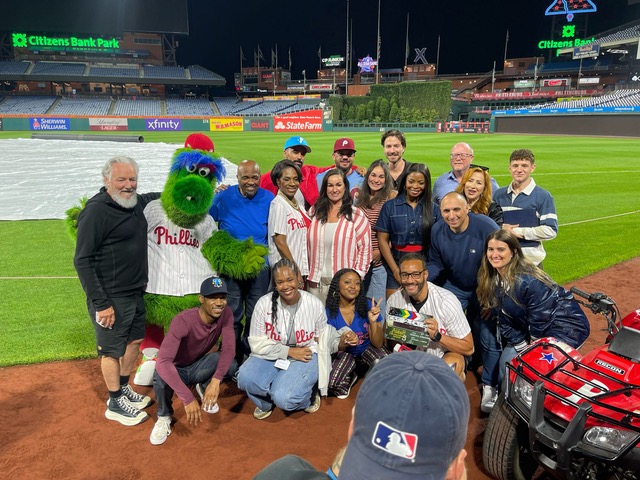
“Abbott Elementary” cast and crew pose with the Phanatic and Phillies player Kyle Schwarber at Citizens Bank Park on Aug. 28, 2025.Vaughn C. Page Jr.
However, the horror-tinged newcomer Widow’s Bay swept nearly all the comedy categories, dominating the stage with a record-breaking 14 wins. Abbott Elementary actors Tyler James Williams and Janelle James were up for outstanding supporting acting in their respective categories but both lost to Widow’s Bay.
Previous two-timeEmmy-winner Brunson was briefly in the spotlight when Emmys host and Law & Order: Special Victims Unit star Mariska Hargitay asked celebrity attendees about their first jobs.
“Oh, I was a student dance schoolteacher,” Brunson answered. Fellow West Philly-raised star Colman Domingo, who was nominated for outstanding guest actor in a drama for Euphoria and outstanding supporting actor in a comedy for Tina Fey’s The Four Seasons, also joined in. His first job, he said, was working the fries station at McDonald’s. (Domingo lost the former category to The Pitt and the latter to Widow’s Bay.)
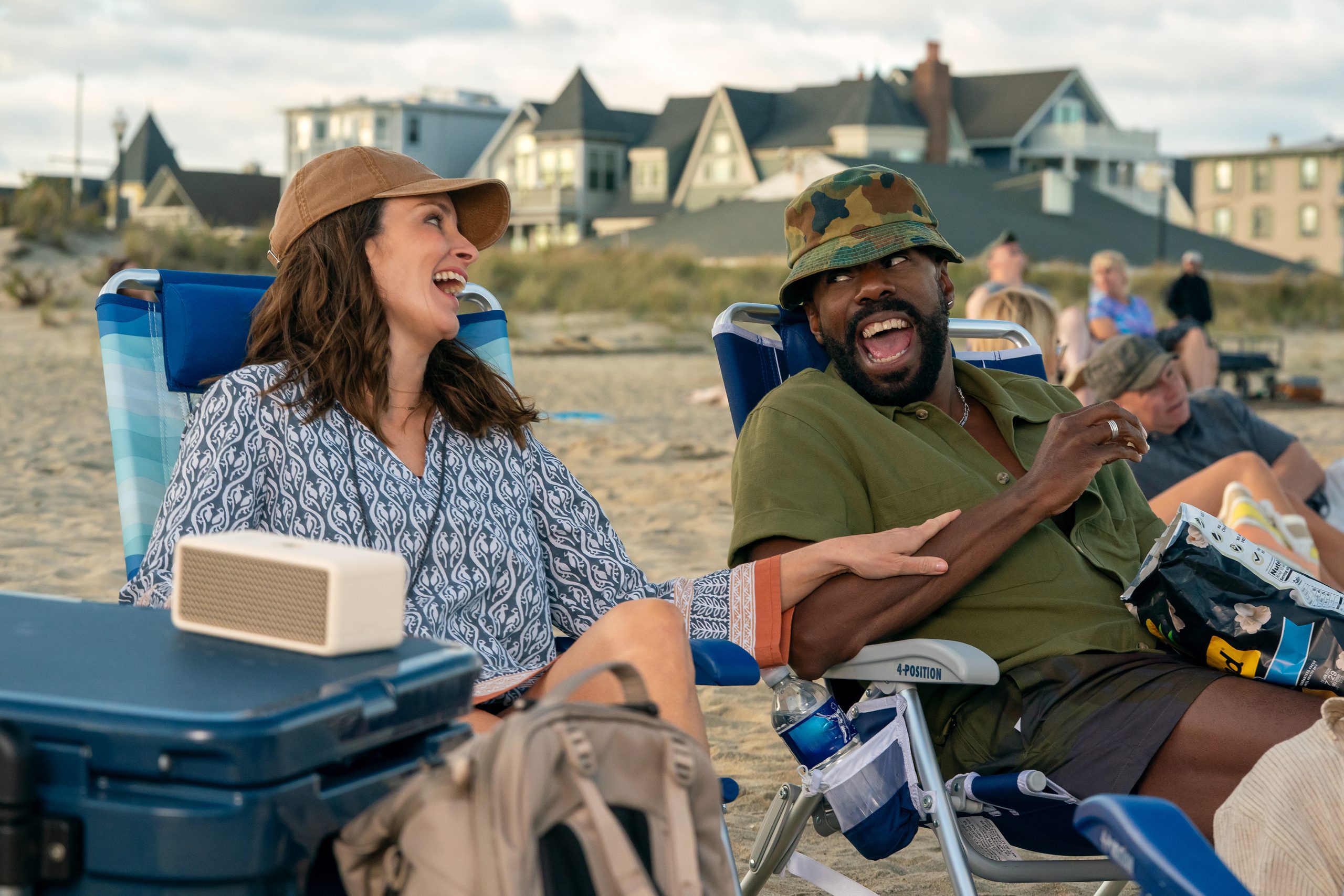
Tina Fey as Kate and Colman Domingo as Danny in Season 2 of the Netflix comedy series “The Four Seasons.”
To celebrate the 30-year anniversary of Buffy the Vampire Slayer, Villanova-raised actor and Malvern Prep alum David Boreanaz joined star Sarah Michelle Gellar for a reunion moment onstage. The son of famous 6abc weatherman Dave Roberts, Boreanaz played the vampire with a soul Angel and later received his own spinoff show. (He’s also a diehard Philly sports fan.)
“You know, Sarah, I always thought that Buffy and Angel would end up together,” Boreanaz said as the pair reflected on the groundbreaking show. “Well, I guess we won’t find out,” Gellar replied in a pointed critique of the recent cancellation of the Buffy reboot that had been in the works.
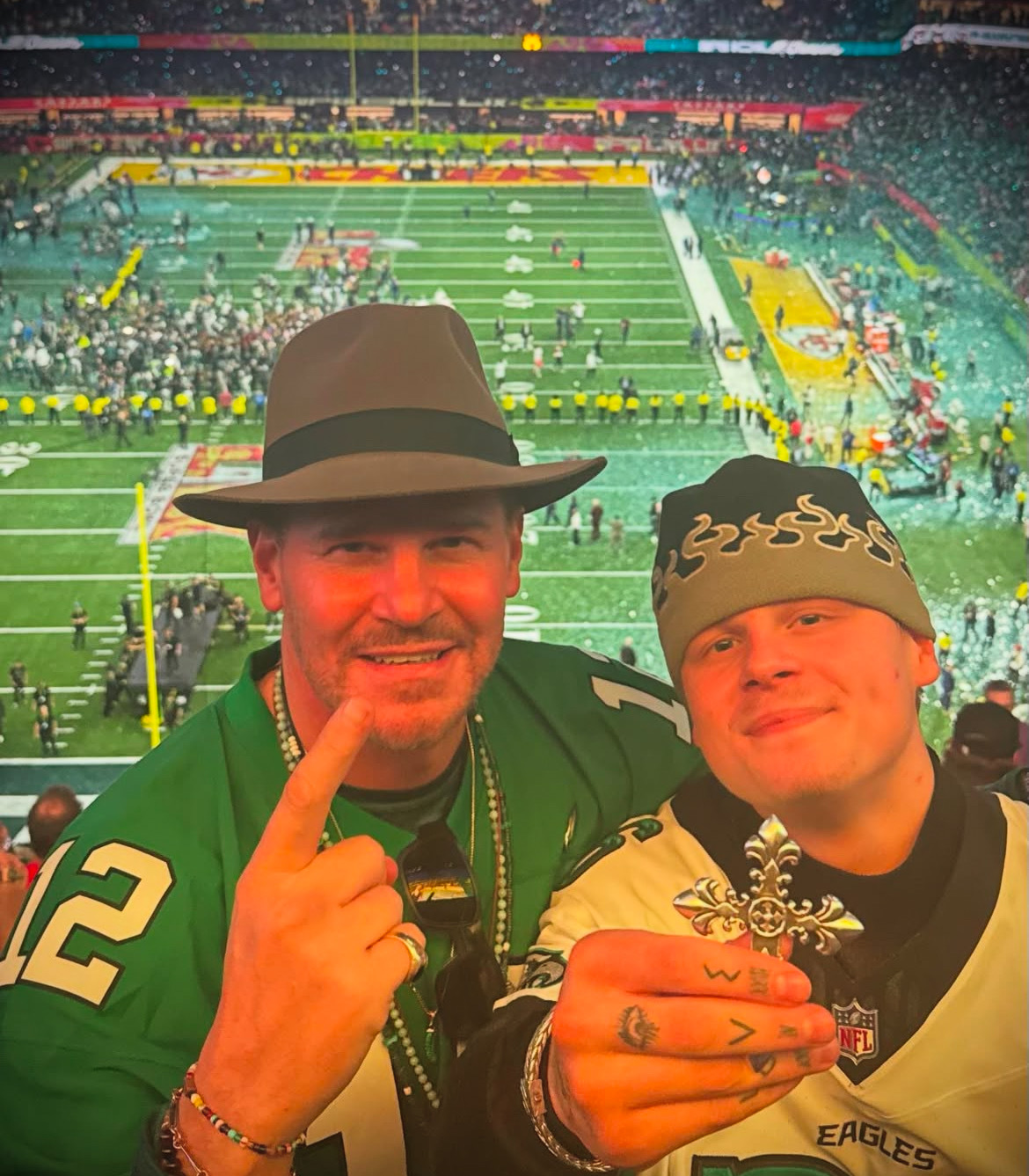
Actor David Boreanaz, wearing a Randall Cunningham jersey, and his son, Jaden, in a Saquon Barkley jersey, at Super Bowl 59 in New Orleans.Courtesy of David Boreanaz
Ahead of the 78th Primetime Emmy Awards ceremony, the Academy of Television Arts & Sciences hosted the Creative Arts Emmys in two events honoring artists behind the scenes in technical categories. Winners from those ceremonies included South Philly comedian Rob Mac — the showrunner behind It’s Always Sunny in Philadelphia — whose FX show Welcome to Wrexhamwon for outstanding sound mixing for a reality program. (It was also nominated for outstanding picture editing and outstanding unstructured reality program.)
Bucks County pop star Sabrina Carpenter also won during the Creative Arts Emmys earlier this month for performing in and executive producing the 50th anniversary special of The Muppet Show, which earned a gold statue for outstanding variety special (prerecorded) — putting her halfway to EGOT status.
Another Philadelphia-connected nominee was Tires, the Shane Gillis-led Netflix comedy recognized for outstanding sound mixing for a half-hour comedy or drama; the trophy went to Widow’s Bay.
At Monday night’s ceremony, one more Pennsylvania celebrity made a cameo: Superstar singer Taylor Swift, who grew up in Reading was not in attendance, but appeared in a prerecorded skit with Hargitay spoofing Law & Order along with Swift’s cat, named for Hargitay’s character, Olivia Benson.
An Upper Bucks man who shot at a DoorDash driver last year, irate that his cheesesteaks were late, was sentenced to four to 10 years in state prison Tuesday.
Keilan McKeever, 33, pleaded guilty earlier this year to aggravated assault and related crimes, in exchange for prosecutors dropping an attempted murder charge for the 9mm bullet he fired at Khalik Lewis in March 2025.
The gunshot struck the back windshield of Lewis’ Honda Civic, shattering it. Later, the then-19-year-old found the bullet stuck in the hood of his sweatshirt.
Judge Steven Corr, in handing down the sentence, said he had been prepared to send McKeever, of Richlandtown, to prison for even longer, citing the “disgusting” nature of the case.
But McKeever’s statement of contrition in court, including his detailed efforts to better himself while behind bars, moved Corr to exercise some leniency.
Still, Corr was adamant that McKeever’s actions were unreasonable. It was only pure luck, he said, that Lewis was not killed, and that no one else was injured as McKeever opened fire on a residential street.
“We have a young man out trying to make money, providing a service to you,” Corr said. “The way you treated him, I don’t know what causes someone to fire a shot at someone like that.”
Video of the incident recorded from a neighbor’s security camera, played in court, showed Lewis pulling up to McKeever’s home on Cherry Street. Almost immediately, McKeever begins shouting and threatening Lewis.
At one point, McKeever is heard saying “I’ll shoot you right now” and “see this” before a gunshot rings out.
Pennsylvania State Police troopers who investigated the case wrote in court filings that McKeever initially lied to them, denying he shot anyone and saying, instead, that the noise heard by his neighbors was a car backfiring.
Lewis, in an interview after Tuesday’s hearing, said McKeever came out of his house holding a loaded handgun. He was combative, Lewis said, and would not listen to him explain that his order was not late, as McKeever believed it was.
McKeever followed Lewis as he walked back to his car, and stood behind him as he attempted to pull away. When Lewis did finally pull out of the driveway, he heard a bang and saw his windshield shatter.
Lewis said he had no idea a bullet caused the damage.
“Literally, my life was just inches away from ending,” Lewis said. “I still suffer from it: Loud noises trigger me, it’s hard to sleep at night.”
He gave up driving for DoorDash, a side gig he had hoped would help pay for college and car repairs, right after the shooting.
And Tuesday’s sentence did little to calm his fears.
“I feel it could have been a much heavier sentence,” he said. “I feel like the judge could have seen it a little more from my point of view, instead of seeing the work he’s doing in jail. Everyone does that.”
McKeever’s attorney, Riley Downs, told Corr during the proceeding that his client struggles with mental health issues, including anxiety and depression, that are debilitating when left untreated. At the time of the shooting, McKeever had not been taking his prescribed medication, Downs said, having lost his health insurance after being fired from his last job months earlier.
His treatment, however, resumed after his arrest, along with therapy that McKeever said has helped him see what he did was wrong.
“I know I have a lot of issues. I know I have some things I want to work,” McKeever said. “It’s just hard on the outside to find help.”
McKeever apologized to Lewis and his family, saying he never intended to hurt him, only to scare him.
“I failed myself and everyone else,” he said. “I hope you can forgive me for your sake, so you can forget and move on with your life.”
About two to three times a week, Ryan Richter will sit in front of reporters in the bowels of Subaru Park. His hair will be neatly combed to the side, his hands folded in front of him, with his shirt buttoned to the very top.
The Union’s interim head coach will calmly discuss the game ahead, or the game just played, answering questions as anyone else in his position would. But every now and then, those watching from his hometown of Southampton, Bucks County, have to laugh.
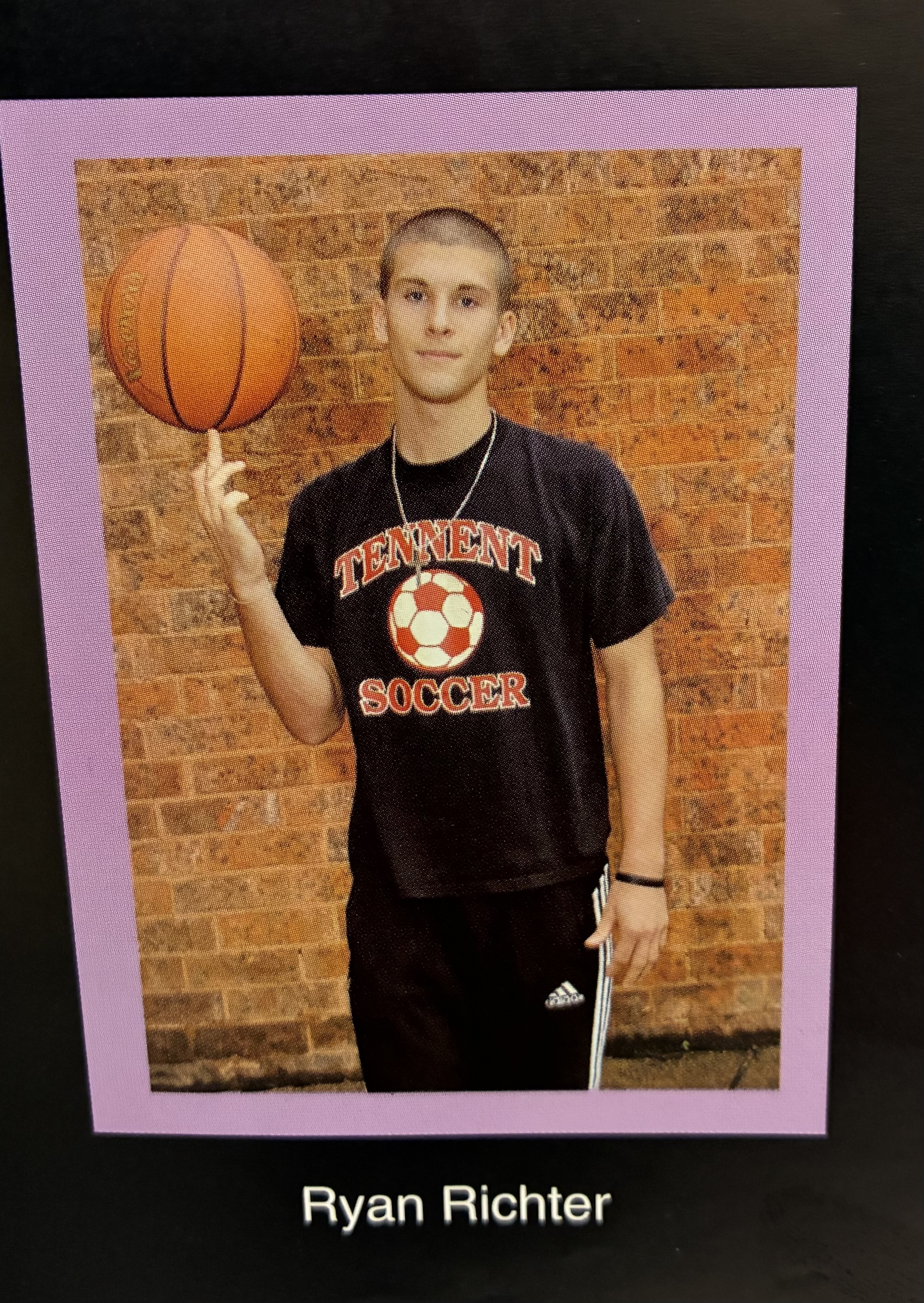
In some ways, this version of Richter is just like he was as a kid: driven, focused, thoroughly prepared. But aesthetically, it is completely different. Richter, a three-sport athlete at William Tennent High School, was captivated by NBA culture growing up, particularly Allen Iverson.
He’d wear a headband during basketball games. He pierced both ears. He’d drive around Bucks County in a white Kia, with an enlarged Jumpman logo on its hood, and Sixers jerseys covering its seats.
À la Shaquille O’Neal, Richter would give himself nicknames: “Shaq Daddy,” “Shaq-Daddy-Licious,” “Ric-Daddy-Docious.” Those monikers are long gone, but that side of Richter isn’t.
Ryan Richter was a three-sport athlete at William Tennent High School, who parlayed his talents into a pro soccer career and now an interim role as the Union’s head coach. Courtesy / William Tennent H.S.
“It’s like, I’m still listening to Get Rich or Die Tryin’ when I’m driving into work,” Richter said. “You know?”
His high school basketball coach, Glenn Dolton, called this a “paradox.” Beneath the panache was a teenager who was confident, but not cocky. Hard-working, but also light-hearted, with a self-deprecating sense of humor.
Treating pro soccer as a profession wasn’t a main goal. Richter was always immersed in the sport — his dad played at The College of New Jersey, back when it was known as Trenton State, and his grandfather played for a team in Warminster — but he also played basketball and football through high school.
The Sixers were Richter’s favorite team, and Iverson his favorite player. Richter was in the building for Game 5 of the 2001 Eastern Conference semifinals, when The Answer dropped 52 points, and returned for the Eastern Conference finals against the Milwaukee Bucks.
Before he was the Union’s interim head coach, Ryan Richter was the Atlantic 10 Player of the Year at La Salle University.Courtesy / La Salle Athletics
A La Salle graduate, Richter was drafted by his hometown MLS team in 2011, began coaching for them in 2018, and has gradually worked his way up since.
Now, the 37-year-old is at the helm, leading the Union from the worst record in the league to playoff contention. At the time of this report, the club hasn’t lost a league game under his watch. Players say the energy in the locker room has changed for the better.
The soccer world might be surprised. But Southampton isn’t.
“He knows what it takes to get the job done, and he does not like to lose,” his childhood best friend, Mike Pio Jr., said. “And, I mean, that’s pretty evident with how they’ve been doing so far.”
Some people hate losing more than they love winning. Richter says he’s the opposite, and has been that way since he was a child.
He was competitive not just on the field, but in everyday life. If he was playing a game of Connect Four, he’d want to crush the opposition. He and his friends would hang out at the local youth center to jump into hotly contested pickup hoops games.
Once, the teenagers joined an adult bowling league. They were the youngest members by about 20 years, but that didn’t quash Richter’s spirit.
“The competitiveness was also there,” Pio said. “I think everybody else in that league was probably old enough to be our fathers.”
A formative moment came in his freshman year of high school. Richter tried out for the junior varsity basketball and soccer squads, and failed to make either team. He got to work, and by sophomore year, made varsity in both sports.
Ryan Richter (center) didn’t make the varsity team his freshman year at William Tennent. The next season, he made varsity in both soccer and basketball. Courtesy / William Tennent H.S.
But he never forgot the feeling of being passed over — or the names of the students who passed him.
“He still reminds me of that occasionally,” Dolton said, “that I should have brought him up. Which, looking back on it, I’m like, ‘Yeah, you may have a good point there.’”
Coaches loved Richter, because he’d push his teammates as hard as he’d push himself. If a fellow athlete wasn’t hustling enough, he’d pull him aside or ask a higher-up to step in.
Pio’s father, Mike Pio Sr., experienced this firsthand when he worked as an assistant soccer coach at Tennent.
Video: Union interim manager Ryan Richter not satisfied with landing in a playoff spot
“He expected his teammates to basically bleed the way he bled,” Pio Sr. said. “Even during practice, he would call people out.”
Teenagers didn’t always love being challenged, but Richter had an affability which allowed him to break through. He was athletically gifted on the field, but didn’t take himself too seriously or act like he was better than anyone else.
The hood-sized ode to Michael Jordan was evidence of this. So was a photo that Richter took with Pio Jr. when they were in high school. The two friends were at the Willow Grove Park Mall, in an Abercrombie and Fitch dressing room.
Before he was the Union’s interim manager, Ryan Richter (right) was a three-sport athlete at William Tennent High School, with an affinity for NBA culture and swag.Courtesy / Mike Pio
Images of models adorned the walls, and Richter and Pio Jr. wondered how easy that work must be.
So, they tried it themselves, posing for a photograph that still hangs beneath a magnet on Pio Sr.’s refrigerator door.
“It was like they were posing for GQ magazine,” Pio Sr. said. “Hilarious.”
The teenager would set up silly challenges, like singing the national anthem before a basketball game, despite the fact that he was not musically inclined. And physical challenges, like improving his vertical so he could dunk in a game.
Richter stood at 6-foot, but had smaller hands, which made it difficult to palm the ball. But he was determined. In a game against Abington, he finally got the moment he’d been waiting for.
“He threw one down, and it was like the place exploded,” Dolton recalled. “It was like the greatest thing that ever happened. It was really funny.”
Union interim manager Ryan Richter starred on William Tennent’s varsity basketball team.Courtesy / William Tennent H.S.
Richter was recruited by several nearby soccer programs: Temple, Delaware, and Iona. But he ultimately chose La Salle because of its coaching staff.
Head coach Pat Farrell’s rules were rigorous, but aligned with Richter’s already sky-high expectations. He noted that Farrell pushed him, personally too.
“It was just the things that he emphasized,” Richter said. “About taking responsibility, about being a man and taking care of your school stuff, and staying out of trouble.
“He’s not a guy of so many words, but he was just a father figure for everybody.”
Before he was the Union’s interim head coach, Ryan Richter was the Atlantic 10 Offensive Player of the Year at La Salle University.Courtesy / La Salle Athletics
Richter upped his work ethic to a new level in college. The striker showed up to practice an hour-and-a-half or two hours early. He’d train with the Ocean City Nor’easters, a USL League Two team, to stay in shape during the offseason.
When he returned in the fall, he’d be ready for more. And by 2011, he was en route to a professional career.
“He would say, ‘Do you want to do some extra [shooting], or do you want to do some skill work,’ like ball work and things like that,” Farrell said. “And we could never say no.”
Richter’s playing career with the Union was brief — only making an appearance in two international friendlies and 10 reserve league matches — but his time as a coach there has spanned nearly nine years.
After playing professionally for seven years, Richter was hired by the Union in 2018 to work at their academy, serving in various development roles.
In 2022, he was promoted to assistant coach of the Union, under then-head coach Jim Curtin, and in 2025, was named head coach of the Philadelphia Union II.
Ryan Richter has held several roles within the Union, including former head coach of the club’s developmental team, Union II. Jonathan Tannenwald / Staff
When Bradley Carnell was fired in late May, after a league-worst record of 1-10-4, and replaced with Richter, many current players were already familiar with him.
The Southampton native had coached Cavan Sullivan since he was 8. Outside back Frankie Westfield had never played for Richter, but knew him through regular games of teqball and basketball with his teammates at the Academy.
Centerback Neil Pierre started his season on a six-month loan to a team in Denmark. When he returned in July, he wasn’t sure what he’d find.
He’d heard from teammates that the locker room was “losing its head.” But with Richter already having an established relationship with multiple players, it helped make Pierre’s immersion back into the squad smooth.
“We were going through a tough time,” Pierre said. “I guess it wouldn’t be the same upbeat attitude. People wouldn’t be as into the culture. Kind of lost that ‘Philly’ mindset. And I think when [Richter] came back, he just brought it back.”
Ryan Richter (left) greets Union midfielder Quinn Sullivan during a recent match.Elizabeth Robertson / Staff Photographer
Richter’s Bucks County tendencies are never too far. He has been known to challenge other coaches on the basketball court. He is still a massive Sixers fan, and gleefully shared the news of LeBron James coming to Philadelphia after a Union practice in July.
But perhaps the biggest way his upbringing shines through is in his approach to younger players. Sullivan is only 16, but a teenage phenom who is bound for Manchester City when he turns 18.
In an Aug. 19 match between the Union and Inter Miami, Sullivan defended his brother, Quinn, after defender Ian Fray stepped over him and pushed his head down.
Cavan ran over, and got in a scuffle that instantly became the story of the game. He received a red card (later rescinded).
Got to protect your own brother.
Cavan Sullivan and Yannick Bright were given red cards.
Cavan Sullivan and Richter talked about the incident two days later. The head coach told him that he did nothing wrong, but to remember that he draws scrutiny like nobody else on the roster.
And that if he does act up, it’ll become international news.
“I always try to keep in mind of where some of the younger guys are at, and remember what I was like,” Richter said. “When I was 16, I was driving around with a Jordan logo on my car, and who knows what kind of trouble I was getting in.
“That’s why I think Cavan is such an amazing kid; because of the pressure that he has to deal with, and the spotlight that’s always on him. Could you deal with that when you were 16?”
Richter, seen here with Union teen midfielder Cavan Sullivan, says he tries to remember himself at a young age in order to keep his players, many of whom are still in their teens, focused on the team’s mission.Yong Kim / Staff Photographer
Learning soccer on the fly
Richter’s friends did not grow up diehard soccer fans. Like most Philadelphians, they are all-in on the Eagles and the Phillies; maybe some basketball and hockey, too.
His new role has served as a teaching moment for everyone. Last month, a group of Southampton natives went to Subaru Park for a game against Atlanta United. They were stunned by what they saw: Union goals in 96th and 97th minute, en route to a 3-2 comeback win.
“They’re like, ‘Soccer is amazing!’” Richter said. “It’s like, ‘This is a one-in-a-thousand game that you guys saw tonight.’”
Nevertheless, the head coach’s buddies have since tuned into to every press conference and every match, home or away. They’ve been filling his group chat with lots of “DOOP” and other words of encouragement.
Ryan Richter says his approach is solely game by game and isn’t taking too much stock in the success the Union have had since he took over as interim manager.
They’re also provided some friendly, albeit superstitious, advice.
“One of our buddies just texted this morning,” Pio Jr. said “He goes, ‘I changed my mind. I don’t think they should remove the interim tag, because you’re doing way too good with it.’”
Richter’s friends have ninemore games to learn; maybe more, if the Union make the playoffs. But regardless of how this season ends, his community will continue to be proud of him.
A local kid, who once patrolled Bucks County, is now patrolling the sidelines of Subaru Park — and doing a good job, at that. The headband and earrings may be gone, and so is the White Kia.
But somewhere, beneath his outward professionalism, is that same Iverson-loving teenager; better known not as Ryan Richter, but as a “licious” or a “docious.”
In the weeks after the Sept. 11, 2001, terror attacks, I went to New York to report on a story about Johanna Sigmund, a young woman from Wyndmoor who perished after one of the hijacked planes rammed the north tower.
Over the course of my career, I’ve spent more time than anyone would want writing pieces about people whose lives were cut short prematurely. One of the most memorable was Johanna, whose story and positive spirit remain seared into my soul.
Johanna’s parents invited me, a stranger, into their home at their worst hour. They took the time to tell me about their only daughter, and shared photograph after photograph after photograph — Johanna smiling after she ran the New York City Marathon, Johanna posing with her girlfriends at a wedding, and so on.
One image stood out.
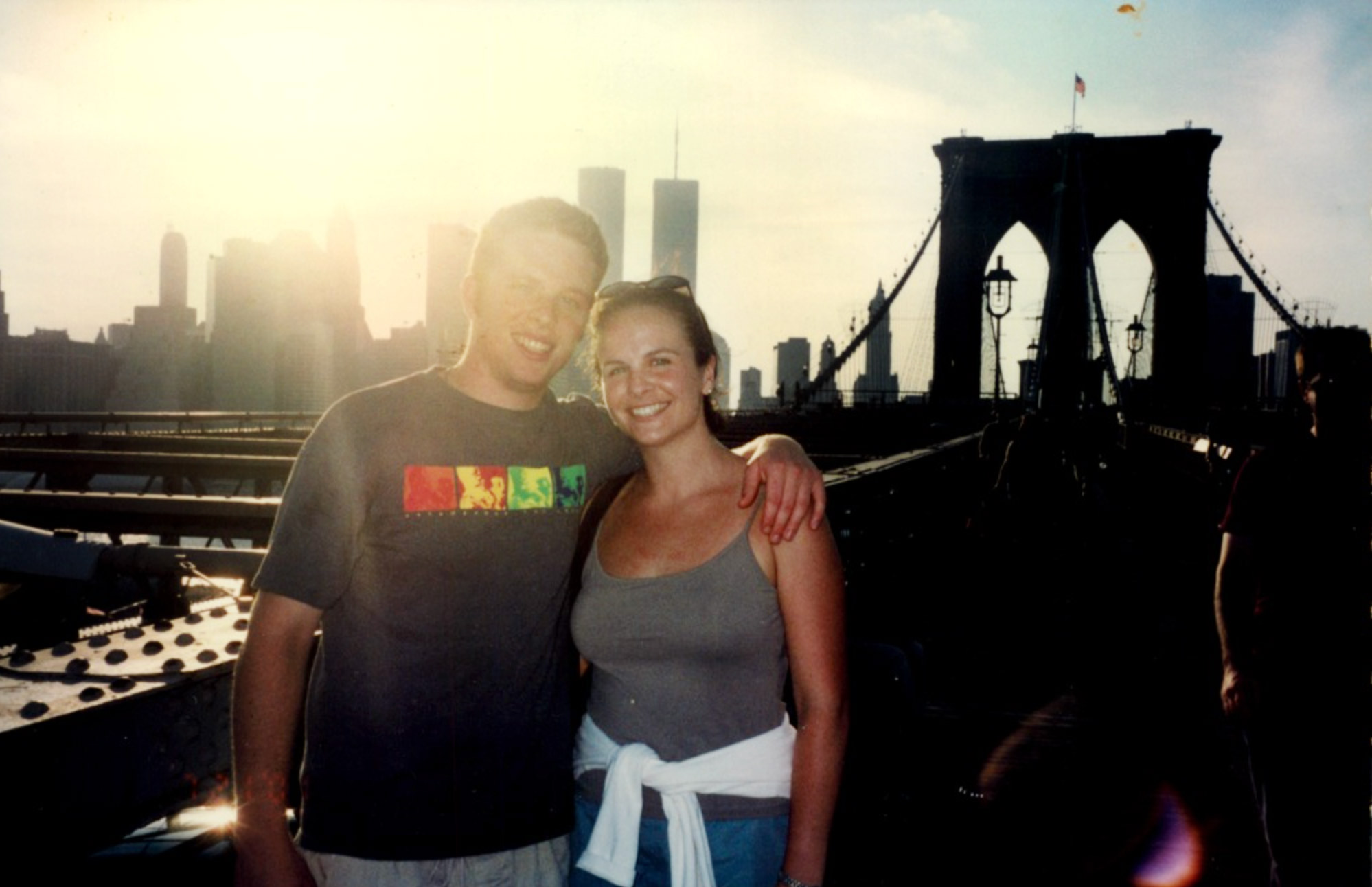
It was a photo of Johanna, 25, and her brother, John, 23, smiling while standing arm in arm at the foot of the Brooklyn Bridge. The photo was taken two months before the terror attacks. In the background loomed the twin towers.
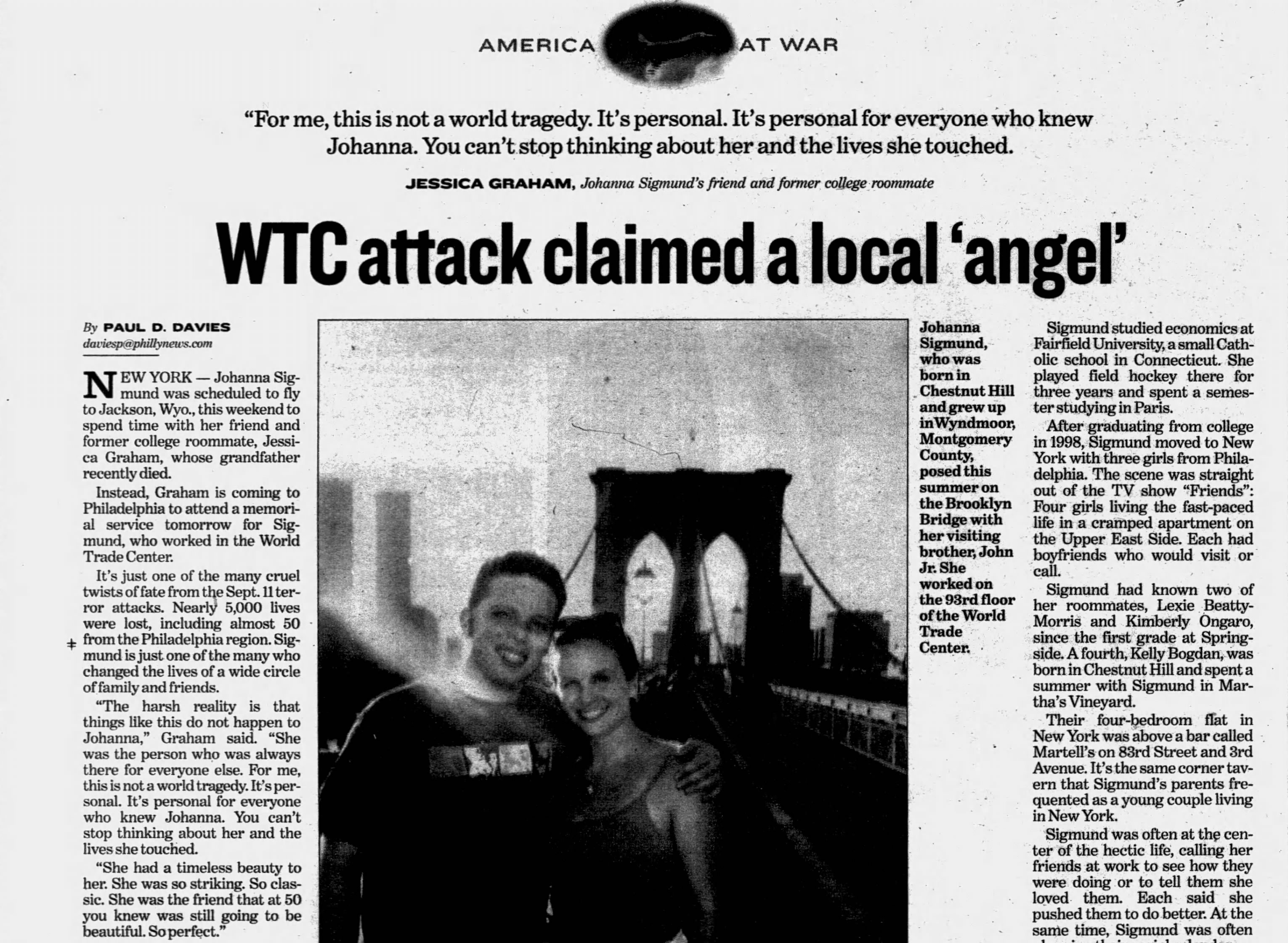
An article by Paul Davies about Johanna Sigmund in the Oct. 19, 2001, edition of the Daily News.Staff
Johanna’s story has stuck with me for a quarter century, but her life is emblematic of the promise and potential of so many others who were lost. At least 40 people with ties to Philadelphia and its western suburbs were killed in the attacks, including 18 from Bucks County, 11 from Montgomery County, five in Chester County, eight from Delaware County, and three from Philadelphia. It may be impossible for any of us to fathom how many other lives were forever impacted by the horrors of that day.
I wondered how Johanna’s family and friends had fared over the years.
So much has been lost in the 25 years since 9/11. Johanna would have turned 50 on the first day of summer — the longest day of sunlight. Her elegant beauty remains frozen in time, and — all these years later — her life remains a catalyst for good.
A scholarship fund set up in her name continues to help students attend St. Malachy School in North Philadelphia, as well as another at her alma mater, Springside Chestnut Hill Academy.
Johanna packed a lot into her brief time here. She was the captain of the field hockey, lacrosse, and squash teams in high school. She studied economics and played field hockey at Fairfield University, and spent a semester in Paris before moving to New York in 1998 with three friends from Philadelphia.
When I met with Johanna’s roommates a few weeks after the attack, they shared stories of her love of cooking, dancing, and listening to U2, often replaying the song “Stuck in a Moment You Can’t Get Out Of” that begins, “I’m not afraid of anything in this world.”
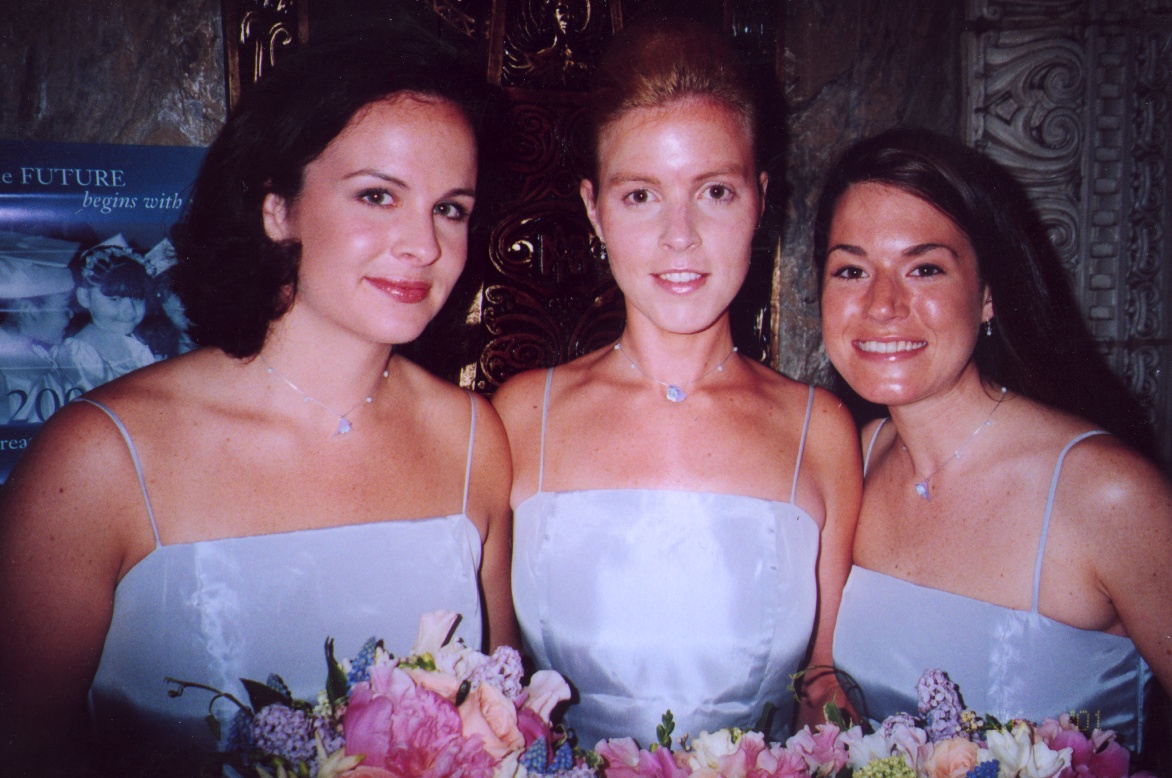
From left: Johanna Sigmund, Rory McDevitt, and Kim Ongaro were all bridesmaids at the wedding of their friend, Lexie Beatty, in May 2001. Sigmund was one of the victims in the 9/11 attacks.h
Johanna cared for others. She distributed pizza and McDonald’s to the homeless people in her neighborhood. She helped a woman who was thrown from a taxi get to a hospital. Johanna spent the night by her side and returned home in the morning with blood on her clothes.
Kimberly Ongaro, a roommate and friend from Springside, called her “an angel.”
The toughest interview in the weeks after the attack was with Johanna’s boyfriend, Joe Bonavita. They had dated for several years and had discussed marriage.
Their final weekend together was a whirlwind. They went to the Yankees game Friday night and drove to the U.S. Military Academy in West Point, N.Y., on Saturday, met up with friends, attended the Army football game, and walked through the cemetery for soldiers, which included Gen. George Armstrong Custer.
On Sunday, Johanna competed in a 5K race down Broadway before continuing on as part of her training for the Philadelphia Marathon. She and Joe shared dinner that night.
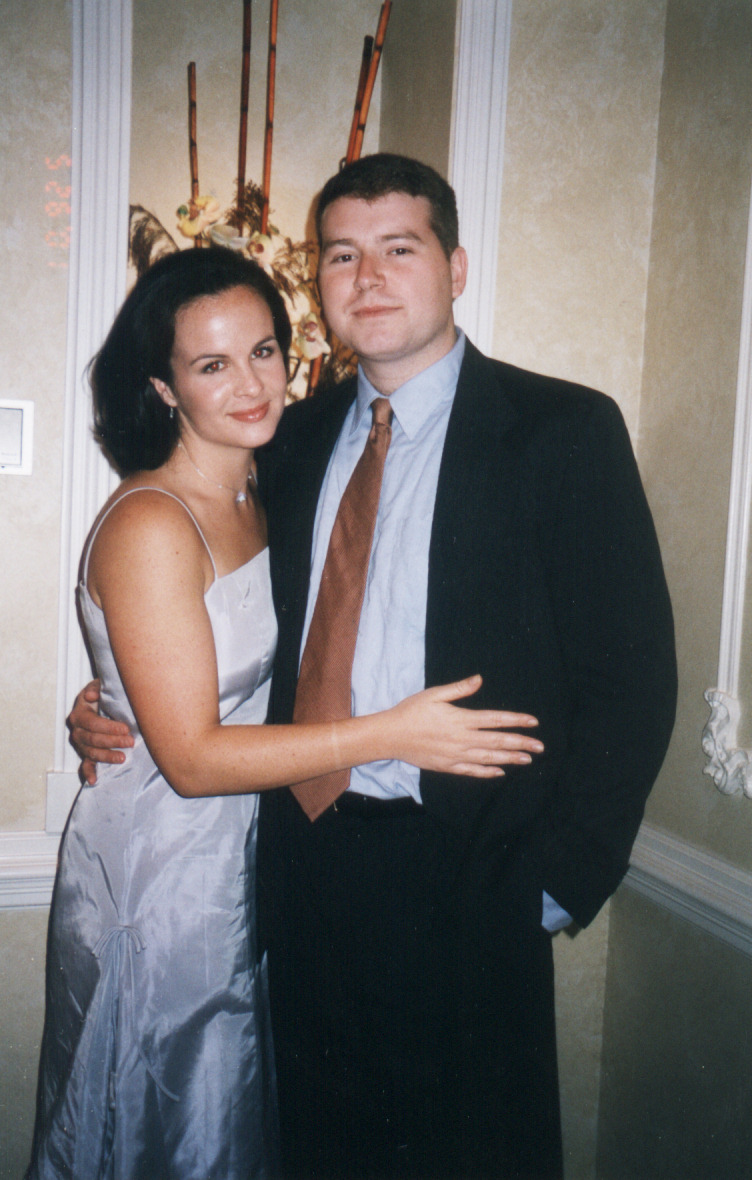
Johanna Sigmund and her boyfriend, Joe Bonavita, at the wedding of her friend Lexie Beatty Morris.
Johanna did not feel well on Monday, but went to work. When she was still under the weather on Tuesday — Sept. 11 — Joe urged her to stay home.
But she went into the office at an investment firm on the 93rd floor of the north tower.
Joe worked near the Trade Center. As he exited the subway, he saw the first plane smash into the north tower.
A life upended
I located her brother, John, and emailed him. He responded a few minutes later and graciously agreed to speak. When we connected after 25 years, it almost felt like old friends catching up.
John told me how 9/11 upended his life.
He had planned to move to New York after college, but lost interest after the attack. He visited ground zero to commemorate the first anniversary. President George W. Bush greeted families, including John’s aunt, who offered veiled advice regarding the plans to invade Iraq. “I hope you are making a prayerful decision,” she told the president.
Bush was taken aback, but continued shaking hands before circling back to tell John’s aunt that he prayed every day.
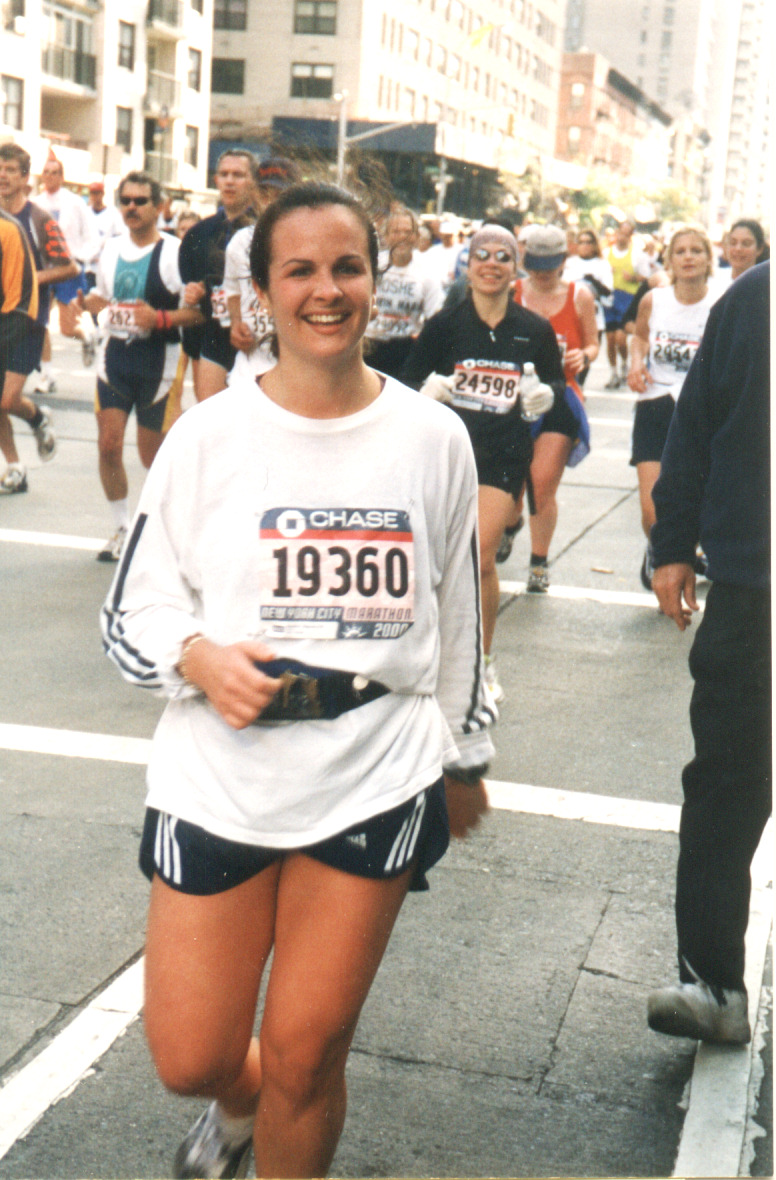
A photograph of Johanna Sigmund running in the New York City Marathon in November 2000.
After college, John, a Spanish speaker, spent a year with AmeriCorps teaching literacy to second graders in Kensington. After he explained to one class’s teacher why he wanted to take off for the anniversary of 9/11, she had her students write notes of support. John was struck by how many kids shared stories of loved ones they had lost to violence.
“Everyone has their 9/11,” he said.
Along the way, we all pay a price. Some more than others. But how one responds is a lesson for all as we navigate these trying times 25 years after 9/11.
John said he wonders how his life would have been different if not for Sept. 11. After a year teaching in Philadelphia, he moved to Texas, in part to get away. He earned a master’s degree in art education at the University of Texas in Austin before going on to teach at Say Sí, an after-school arts program in San Antonio.
John’s attempt to get away brought him back to New York. One of his students won an art award that included a trip for the student and teacher to Carnegie Hall. The artwork was displayed at the Winter Garden located near ground zero in May 2010.
“My heart sank,” John said. “I didn’t want to go anywhere near ground zero.”
Even then, nearly a decade after the towers fell, ground zero remained little more than a giant pit with the Freedom Tower slowly rising alongside it. In a macabre daily scene, tourists jammed the sidewalks, gawking and posing for pictures in front of what John could only see as a mass grave, while street hustlers sold photos of the hijacked planes crashing into the towers.
John tried to maintain his composure as he made his way through the gauntlet to the Winter Garden, but a man stepped in front of him and tried to sell him a fiery photo from the attack.
John snapped. He grabbed the stack of photos from the man, threw them in the air, and cussed him out. The two got into a tussle. After the fracas, John tried to gather himself by channeling his sister’s unflappable spirit.
John Sigmund (center) holds a picture of his sister, Johanna, as he and his family run down Kelly Drive toward the finish line of the Philadelphia Marathon in November 2001.d
“Johanna, help me,” he said to himself while overlooking ground zero. “I need to get it together.”
‘Beyond coincidence’
John calmed down and carried on. After the event, he met friends at a nearby bar. John was telling them about the run-in with the street hustler when he suddenly saw Johanna’s old boyfriend, Joe Bonavita, across the bar.
Joe had moved to New Orleans but, in a twist of fate, was in town for a 9/11 event. The two were not close but quickly bonded. John viewed the reunion as his sister’s handiwork.
“Some things are beyond coincidence,” he said.
Eventually, John did move to New York. The city helped him better find himself. After years of worrying about disappointing his parents or adding to their suffering, John told them he was gay. His parents, who have a deep Catholic faith, were supportive.
Twelve years ago, John returned to Philadelphia and fell in love with the city, and especially Fairmount Park.
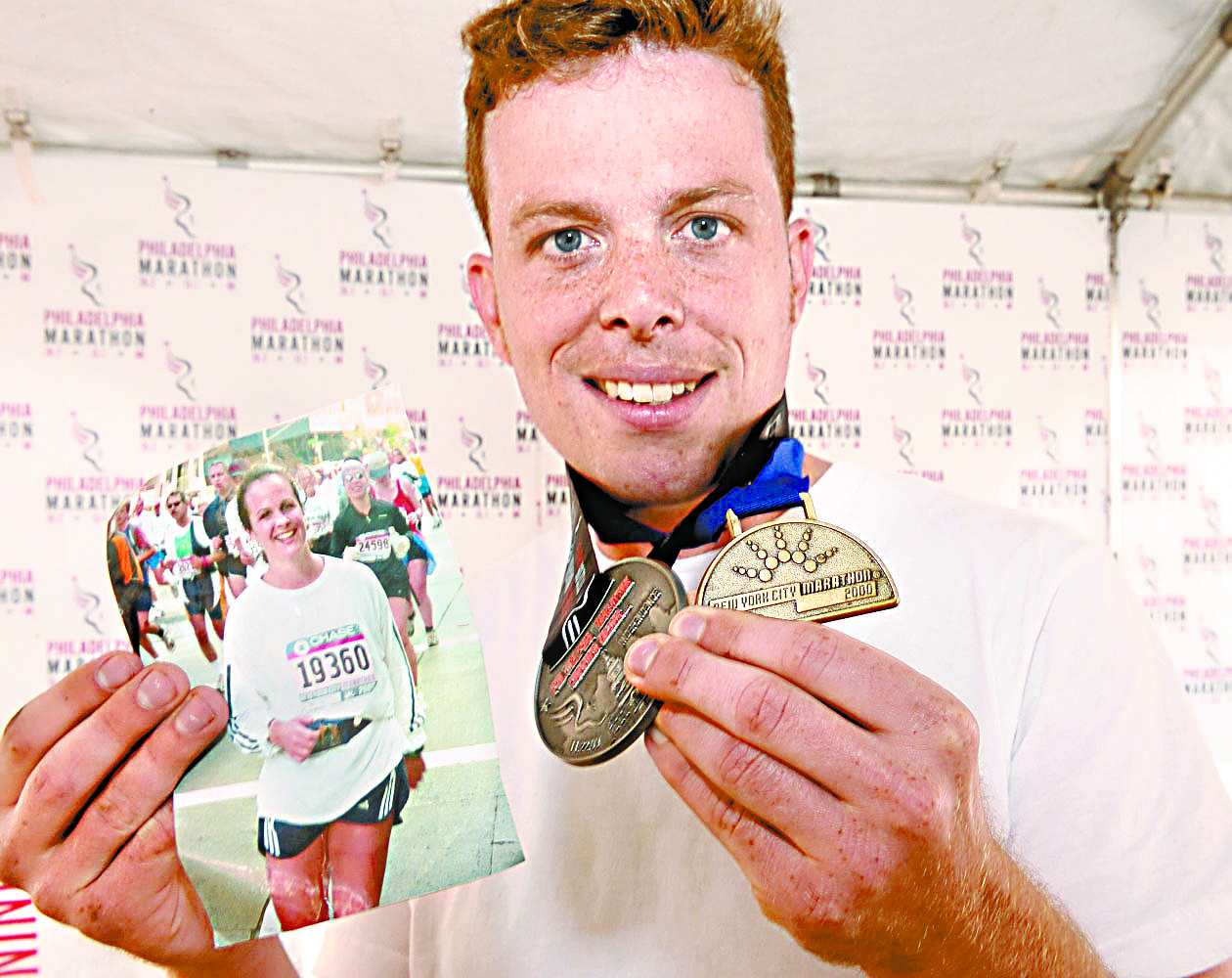
After running the Philadelphia Marathon in November 2001, John Sigmund holds a photo of his sister, Johanna, and wears two medals around his neck — one he earned after finishing the race and another his sister won after completing the New York City Marathon in November 2000.Courtesy of Tony Webb / Office of the City Representative
But tragedy struck again in September. Three days after the 20th anniversary of 9/11, his father died.
For John, September remains the cruelest month. But he credits a strong support network of cousins and friends for helping him navigate life’s challenges — and added that Johanna always feels close by.
“I have a thing with the wind,” John said. “When I think about her, the wind will kick up.”
After losing his sister and father in September, John and his partner, Jaime, decided to add some positivity to the month. They got married last Sept. 26 and are planning an anniversary party in a couple of weeks.
Democrat Bob Harvie released his first general election TV ad Thursday morning, calling for a moratorium on artificial intelligence data center development and attacking U.S. Rep. Brian Fitzpatrick (R., Bucks) for his stance on the issue.
“I don’t want any more data centers. I want a moratorium. Big tech owns enough; they shouldn’t own our congressman, too,” Harvie says in the 30-second ad.
The ad marks the first timethe congressional candidate and Bucks County commissioner has called for a moratorium and signifies a shift in his position.
Previously, in an interview with The Inquirer last week and on his website, Harvie had calledonly for strict regulations on development. To focus his first major television ad on the topic shows how the projects are becoming a top issue for voters in Bucks County’s swingy 1st Congressional District amid a national backlash against data centers.
In Bucks County, both Harvie and Fitzpatrick have to grapple with the development of an Amazon data center in Falls Township, which is nearing completion.
Harvie, who lives just miles from the project, voted in December 2020 to approve acounty tax break for NorthPoint Development, the property owner of the Falls Township site.
Last year, Harvie celebrated Amazon’s investment in the data center and Fitzpatrick called it “one of the most transformative investments Bucks County has seen in decades.” More recently, they both supported Shapiro’s executive order.
In Harvie’s television ad, images of Elon Musk and Mark Zuckerberg flash on the screen. “Big tech is taking over our lives,” the candidate says in the ad. “And they want more. Grabbing our land, water, electricity, and sticking us with the bill.”
Heather Roberts, a spokesperson for Fitzpatrick’scampaign, said in a statement that the Bucks County Republican has always been supportive of “uniform federal regulations” and “100% control by local residents who could be impacted.”
She also pointed tohis cosponsorship of two bills aimed at regulating the effects of data centers: the Ratepayer Protection Act and the Data Center Transparency Act.
“Bob Harvie literally created this problem in our community — and he is now well aware of the massive albatross that this is around his neck. Hence, his latest lie in this ad,” Roberts said.
In an interview about data centers last week, Harvie did not call for a moratorium on the projects, but rather for strict regulations — as is also reflected on his campaign website. He also touted tasking the county planning commission with developing guidelines for municipalities facing potential data center proposals.
When asked last week why he had not called for a moratorium, Harvie said: “I think there’s probably areas in the country where data centers can make sense, where the energy grid can handle it, where there’s limits to it on the impact it could have on other people who might live in the area.”
“But I do think certainly we need to have a lot of cause for concern about how rapidly this is happening and making sure we can put some kind of handle on it,” he added.
He also echoed residents’ environmental concerns related to data centers and said that the developments need the increased oversight outlined in Shapiro’s executive order and that projects should not continue if the local community opposes.
Nine days later, Harvie said Thursday in another interview with The Inquirer that the decision for a moratorium did not come “out of left field for me” but was the product of many conversations amid what he says is a “complete failure of leadership” by Trump and Republicans, including Fitzpatrick, on the issue.
Of his 2020 vote to give NorthPoint a tax break, he said there was not an indication that the property was going to be used for data centers, but rather for e-commerce distribution.
He said that he is not set on one particular time frame for the moratorium but that “setting up guardrails” is most important, and he hopes a Democratic-controlled Congress would further hold hearings on imposing a moratorium.
“As we’ve seen more and more of what’s going on around the country with data centers just trying to gobble up space and build, build, build without any regulation, I’ve come to the point now where we have to do something to slow down this genie getting out of the bottle,” Harvie said.
In what might have been unheard of just two years ago, the Democrat in Bucks County’s key congressionalrace does not mention abortion or reproductive rights by name on hiscampaign website.
Instead, Bob Harvie, the county commissioner challenging U.S. Rep. Brian Fitzpatrick (R., Bucks) in the crucial 1st Congressional District race, largely highlights affordability issues, like tax cuts for the middle class and raising the minimum wage, on his list of 12 priorities.
It’s not that Harvie is suddenly against abortion — he has been vocal about his support forreproductive rights — but it exemplifies a broader shift in how Democrats are fine-tuning their message for must-win races in the county this fall.
Once a top-line issue for Democratic candidates in Bucks — one of theswingiest counties in Pennsylvania — discussion of abortion and reproductive rights has faded into the background in local political campaigns in favor of issues related to the economy and the cost of living.
“People [are]feeling that right now they’re living in an America that’s not fair for them,” Harvie said.
The issue has also been so far been absent from Fitzpatrick’s campaign and his website. The Republican currently holds a moderate view on abortion, though he has previously voted for restrictions.
For Harvie, discussions surrounding access to affordable healthcare — which is his No. 1 listed campaign priority — includes abortion. All of these issues reflect a broader struggle, he argued.
“They’re losing their rights, they’re losing their power over their own futures, they’re losing the American dream, all of that is combined,” Harvie said.
It’sa noticeable shift from Fitzpatrick’s last challenger Ashley Ehasz’s strategy in 2022 and 2024 whenabortion and reproductive rights served as the focal point in both of her campaigns, which followed thebacklash to the U.S. Supreme Court’s decision to strike down Roe v. Wade in 2022.
“Folks are pretty pragmatic when it comes to the politics here, and if something isn’t working, we’re not going to just keep doing it over and over again,” said Kierstyn Zolfo, co-leader of the progressive group Indivisible Bucks County, which supported Ehasz and is now backing Harvie.
Pennsylvania voters’ overwhelming disapproval of President Donald Trump and his handling of economic-related issues, as highlighted in a recent Inquirer/New York Times/Siena University poll, offers Democrats an opportunity as they target key state Senate seats in addition to the congressional contest.
“The point is to move the needle with the voters,” Zolfo said.
Kierstyn Zolfo, from Indivisible Bucks County, holds a sign that reads “Bob + Diane = Leadership for All of Bucks,” during a rally outside of the Middletown Township Police Department and Administrative Offices in Langhorne on Oct. 5, 2023. Harvie was running for county commissioner.Monica Herndon / Staff Photographer
How abortion became a ‘dormant’ issue in the midterms
The League of Women Voters of Pennsylvania has thousands of volunteers and members talking to voters across the state ahead of the midterm elections.
And leaders of the nonpartisan organization are hearing very little about reproductive rights. Instead, they’re getting feedback on crucial cost-of-living issues and concerns about democracy.
Abortion has become a “dormant” issue, said Amy Widestrom, executive director of the League of Women Voters of Pennsylvania.
“Nobody’s coming to us saying I need talking points on reproductive health in Pennsylvania,” Widestrom said.
The shift reflects a national trend, with ads related to abortion drastically receding amid Democrats’ focus on bread-and-butter issues, NOTUS reported.
The midterms are mainly about serving as a “referendum” on Trump’s economic agenda and foreign policy, said State Sen. Steve Santarsiero, chair of the Bucks County Democrats, though reproductive rights “must always be a central plank” of the party and its candidates, noting that majority of the country support a woman’s right to choose.
“Affordability is really the key issue, so you would expect candidates to talk about that, and then you know they’re obviously going to talk about other issues as well, and abortion rights would be one of those,” said Santarsiero, who is also up for reelection this year.
In The Inquirer/New York Times/Siena poll, Pennsylvania’s likely voters in November’s gubernatorial election between Shapiro and Republican challenger Stacy Garrity indicated that the economy and the cost of living were the two most important issues.
Abortion was ranked fourth.
Democrat Eileen Hartnett Albillar, a social worker and the county’s clerk of courts who is running to unseat state Sen. Frank Farry in the 6th state Senate district, said she doesn’t see abortion and the economy as “competing issues,” though conversations with voters have primarily focused on making ends meet. People, she said, will engage in discussion over protecting abortion rights and related topics if she raises the issue.
“They want to protect reproductive freedom,” Hartnett Albillar said. “But you know, the cost of living is just so incredibly crushing for so many people. Just because they’re quiet about it, doesn’t mean it’s not important.”
Reproductive rights took center stage in the 2022 election after several GOP-led states enacted restrictions on abortion following the Supreme Court’s decision to overturn Roe v. Wade.
In Pennsylvania, the issue helped motivate voters to turn out for Democrats Josh Shapiro and John Fetterman in the contests for governor and Senate. But as the procedure remains protected in the state under Shapiro, the topic has faded from focus.
Lehigh County Controller Mark Pinsley, a Democrat who is challenging GOP State Sen. Jarrett Coleman in the 16th district straddling Bucks and Lehigh Counties, still believes reproductive rights can motivate voters. But while he thinkshis party doesn’t talk about abortion enough, he acknowledged the dynamic is different now than it was then.
“I think you could win on that issue by itself,” Pinsley said. “I don’t think that’s true in the moment.”
Brianna Twofoot, vice president of organizing, elections and campaigns at Planned Parenthood Votes, said abortion and reproductive rights still matter to voters even if it’s not taking center stage this year.
“We’re not asking for anyone to make abortion or reproductive healthcare the number one issue, but we do think that voters want to hear about it,”Twofoot said. “And we do think that elected officials should be standing publicly on the issue.”
But any discussion of abortion will come amid what’s shaping up to be an apparent rebrand of the topic, folded into conversations about access to basic needs.
Signe Espinoza, executive director at Planned Parenthood Pennsylvania Advocates, said it’s key to look at reproductive rights through the lens of affordability, especially if health centers are defunded or closed.
“If Planned Parenthood doors close, where are you going to get your healthcare?” said Espinoza, whose organization is planning some days-of-action in Bucks. “It’s going to become more expensive. Everything’s going up.”
Bucks County Commissioner Bob Harvie hosts a veterans roundtable in May at Middletown Township Building in Langhorne.
How is the issue playing out in Harvie vs. Fitzpatrick?
Past elections in the Bucks County swing district have shown the abortion argument does not work against Fitzpatrick, who has been known to survive blue wave after blue wave.
Harvie, a twice-elected county commissioner backed by groups like Reproductive Freedom For All and Planned Parenthood Action Fund, said voters in the district already know where he and Fitzpatrick stand on abortion. The Democrat criticized Fitzpatrick and the Republican Party for supporting “pretty extreme restrictions on abortion.”
“I think that’s the reason why you’re not hearing it very much because everybody knows the positions and knows who’s on what side,” Harvie said.
Heather Roberts, a spokesperson for Fitzpatrick, said the Bucks County Republican has long supported “full reproductive freedom” for the first five to six months of pregnancy, as is outlined by Pennsylvania law.
“We also note that the Congressman’s position is the position held by the overwhelming majority of PA-1 residents,” Roberts said.
His campaign also noted Fitzpatrick’s backing of legislation in recent years that aimed to protect the right to cross state lines for an abortion as well as bills that protect access to contraception and in vitro fertilization and support of pregnant workers and women’s rights.
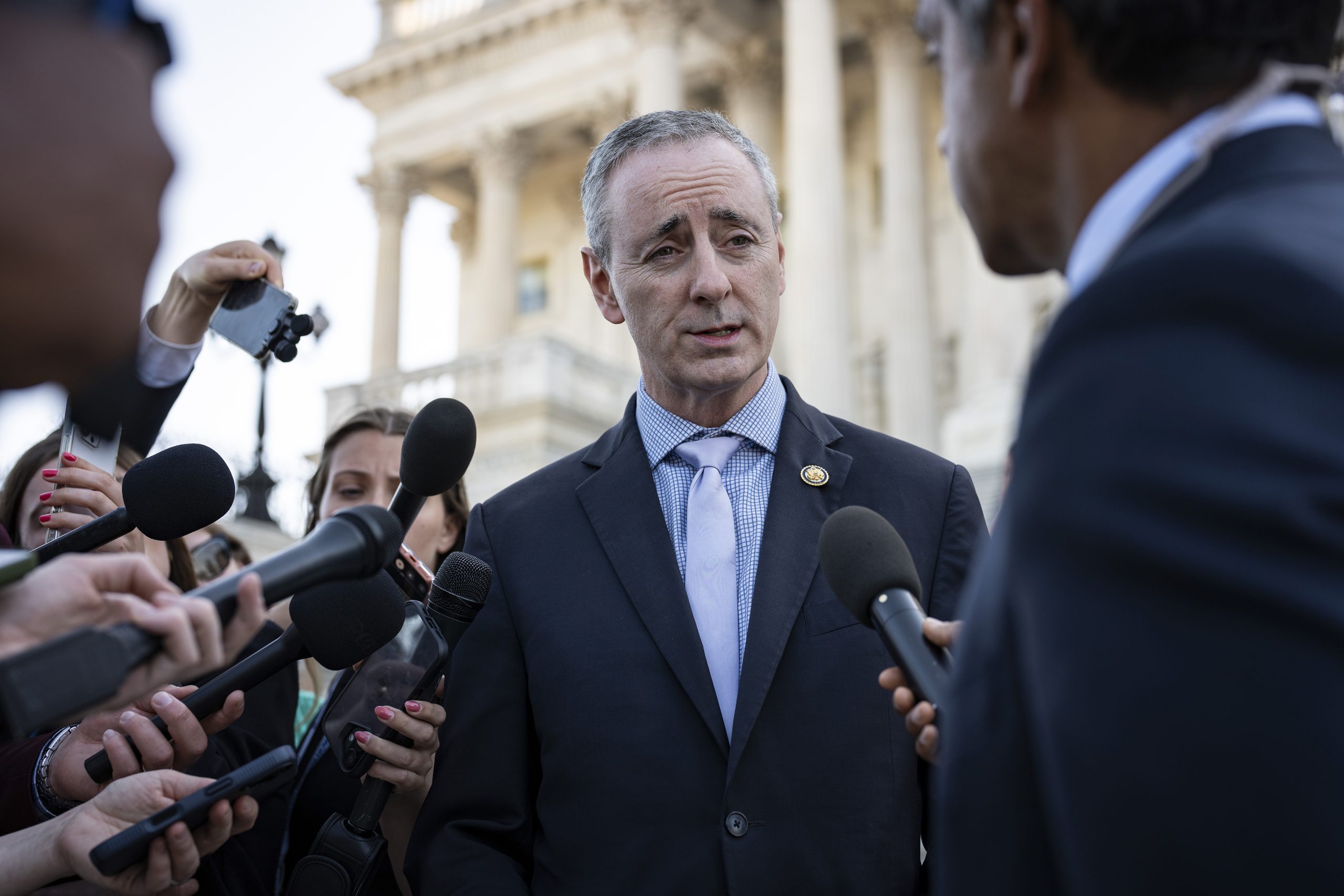
Rep. Brian Fitzpatrick (R., Pa.) speaks to reporters on June 3 on Capitol Hill after the House passed an Iran war powers resolution.
But he has also voted for abortion restrictions, including a 20-week abortion ban in 2017 and twice against the Women’s Health Protection Act, which would have codified protections to access abortion into law.
The issue is absent from Fitzpatrick’s campaign website, which does not reference abortion in sections about healthcare or empowering women.
Widestrom, the executive director of Pennsylvania’s League of Women Voters, said Fitzpatrick has found a way to “neutralize” issues related to his position on abortion by continuing to win races where his opponents wage such arguments and refraining from touting a “hardcore pro-life” agenda.
“By not staking a claim, by not talking about it, it loses saliency in voters’ minds,” Widestrom said.
Dylan Drake Williams knew the girl he had befriended on Snapchat was 15. But that didn’t stop him, federal prosecutors said Friday, from asking her how badly she wanted to be kidnapped, and whether she would be his “sex slave.”
And Williams, an airman stationed at Dover Air Force Base, eventually followed through, according to court filings. He drove to the girl’s Falls Township home Aug. 20, instructed her to leave her phone behind and delete some of the incriminating text messages, and took her to his home, where, the girl told police, he raped her.
Williams, 27, has been charged in U.S. District Court in Delaware with coercion and enticement, transportation with intent to engage in criminal sexual activity, and travel with intent to engage in illicit sexual conduct. Prosecutors in Bucks County have filed a parallel case, in which he faces similar charges, including unlawful contact with a minor and corruption of minors.
He also faces a third, separate investigation in Kent County, Delaware, where he is charged with rape.
Williams will remain in federal custody ahead of a detention hearing later this month, according to court records. Neither his federal attorney, Conor Wilson, nor the attorney representing him in Bucks County, Ellis Klein, returned calls for comment.
The girl told police she began messaging Williams in April, according to the affidavit of probable cause for his arrest. He knew she was underage, she said, but asked her to send him explicit photos of herself, which he returned in kind.
Eventually, Williams arranged to meet the girl in Bucks County, and drove to a basketball court not far from her home, the affidavit said. There, Williams coerced the girl to perform a sex act in his car.
Afterward, the two continued to exchange sexually charged messages. In early August, Williams asked the girl if he could see her again, telling her he wanted “to take ownership” of her and was planning to drive to her home to pick her up in the middle of the night.
As they planned the meeting, the girl, fearful, asked Williams if he was going to kill her, but he reassured her, telling her he genuinely liked her, and that she “was brave for doing this.”
Before dawn on Aug. 20, the girl left her home through her bedroom window and walked to Williams’ nearby car. Per his instructions, she had left her cell phone behind.
Her parents, finding her phone and reading some of the text messages the two had exchanged, called Falls Township Police. Detectives there were able to identify Williams through his Snapchat account, and find that he was enlisted at the Dover base.
Meanwhile, Williams drove the girl more than 100 miles back to Delaware, where he hid her in the basement apartment he was renting. The girl later told police he forced her to have sex, ignoring her complaints that she was in pain.
When police arrived at the base, Williams admitted that the girl was at his home, and that he had sex with her.
He said he knew that getting caught would ruin his life, and said he preferred the death penalty, because he “was too much of a coward to take his life,” the affidavit said.
In the country’s premier battleground state, Pennsylvania Democrats believe they’re in striking distance of a tidal-wave victories that would dramatically shift the balance of power in both Washington and Harrisburg.
For the first time in decades, the party could take full control of the legislature. That would give Democratic Gov. Josh Shapiro — seeking reelection with a wide polling gap on his Republican challenger Stacy Garrity— significantly more power to shape the direction of the state as he potentially pursues a White House bid in 2028.
Democrats also see a chance to flip four congressional seats and take control of the U.S. House. Republicans, meanwhile, are prioritizing defending the Pennsylvania seats with their House majority on the line as President Donald Trump, who won the state justtwo years ago, sinks in popularity.
The path forpower in Washington inthe high-stakes midterms runs through Pennsylvania and its results will be closely watched as both parties prepare for a presidential race in two years when the state promises to play a pivotal role.
Voters across Pennsylvania will head to the polls in November to cast their ballots for races that will decide the balance of power in the state and nation.
Here are the races to watch and how to vote.
Shapiro’s November could dictate his 2028
Shapiro, widely viewed as a likely contender for the 2028 presidency, has big ambitions this fall when he’ll stand for reelection against Garrity, the state’s treasurer.
More than just securing his own reelection, Shapiro hopes to run up the margin and carry downballot Democrats across the finish line.
Another double-digits win and a string of coattail victories would be ashow of strength about his ability to perform in a key swing state that his party lost in the last presidential election.In a presidential primary, Shapiro could use that result to make an argument that he’s a strong general electioncandidate who can boost the Democratic brand.
Will Republicans hold on in competitive congressional seats?
There are four U.S. House districts in the eastern portion of Pennsylvania, targeted by both parties as must wins. In each, the Republican incumbents are seeking to fend off highly financed challengers amid deep frustration among voters with the leader of their party that could translate into a wave of Democratic victories down ballot.
7th Congressional District: Freshman Republican U.S. Rep. Ryan Mackenzie narrowly flipped the Lehigh Valley district two years ago and is widely seen as one of most vulnerable incumbents in Congress. He’s facing a challenge Democrat Bob Brooks, a retired firefighter and union leader whose blue-collar campaign has attracted support across the party’s ideological spectrum with endorsements from Shapiro and U.S. Sen. Bernie Sanders.
10th Congressional District: Republican U.S. Rep. Scott Perry, a close ally of Trump, faces a November rematch against Democrat Janelle Stelson, a former TV anchor, in the Harrisburg area district. Stelson has consistently outraised Perry after narrowly losing in 2024.
In addition to these four races both national parties have targeted, Shapiro has argued that the 9th Congressional District, where Democrat Rachel Wallace is taking on incumbent GOP U.S. Rep. Dan Meuser, is flippable — despite the strong GOP lean in the district, which stretches from Berks County to the New York state border. The district is home to two warehouses that ICE was planning to convert into detention centers before abandoning the plan after a backlash from residents.
This year, Shapiro wants to flip the chamber and win a trifecta to push forward his key priorities, such as codifying abortion access, raising the state’s minimum wage, and increasing funding for transit.
Republicans currently hold 27 of the chamber’s 50 seats. Democrats, who currently hold 23 seats, need to win at least two additional seats and the governor’s office to win control of the chamber with the lieutenant governor as a tiebreaking vote.
The seats, drawn advantageously for Republicans, have been stubbornly resistant to political change for decades.
But this year a blue wave could usher in Democratic pickups in Philadelphia suburbs and the Lehigh Valley.
Races to watch include:
Bucks County’s 6th District, where Republican incumbent State Sen. Frank Farry faces a challenge from Democrat Eileen Hartnett Albillar.
Montgomery County’s 24th District, where incumbent Republican State Sen. Tracy Pennycuick is up for reelection against Democrat Chris Thomas.
Bucks and Lehigh County’s 16th District, which will see a rematch race between incumbent Republican State Sen. Jarrett Coleman and Democrat Mark Pinsley, the Lehigh County controller.
What are the important dates to know?
Election Day is Nov. 3.
The deadline to register to vote is Oct. 19. You must be at least 18 years old, a resident of Pennsylvania and a citizen of the United States to vote. You can register online, by mail, at your county elections office, or at one of several other government buildings.
Pennsylvanians can vote by mail with no excuse required. To apply, fill out an application by mail, online, or in-person and send it into your county election office. Applications must be received by Oct. 27 at 5 p.m. and the completed mail ballot must be received — not just postmarked — by 8 p.m. on Election Day.
An application and mail ballot can be completed in one visit at an election office, essentially functioning as early voting.
Staff writer Fallon Roth contributed to this article.
Exton-based Bentley Systems International, the software company with the highest market capitalization in the Philadelphia area, has opened a Center City office as its new base for 150 engineers and other tech and business staff, replacing two smaller outposts in the city.
Bentley customers use what’s now its Cesium Ion mapping platform to show sites and buildings in complex detail on office computers and hand-held devices.
A Penn State grad, who also earned a master’s and taught programming and architecture at the University of Pennsylvania, Cozzi says he sees Philadelphia as a “magical place” for tech companies.
“When I was CEO raising capital on the West Coast, some of the investors told me the best tech entrepreneurs want to move to the [San Francisco] Bay area. I said no, we can build a great tech company in Philadelphia,” he said.
Philadelphia was an early computing industry center. ENIAC, the pioneering system built at Penn to help plan World War II artillery attacks, and other early Philly-built computing systems relied on the vacuum tubes mass-produced for radio manufacturers in Philadelphia and Camden.
But by the 1970s, the industry committed to far more efficient silicon-based microprocessors developed in California’s “Silicon Valley.” Investor-rich cities such as Boston, Seattle, and Austin also became important computer hardware and software centers. Few large tech companies are now based in the Philadelphia region.
Cozzi says Philadelphia’s affordability is now an asset.
“We have reasonable cost of living and fantastic schools, graduates who want to stay here, great restaurants and quality of life, it’s an awesome place for the tech community,” he said, as he prepared to welcome Mayor Cherelle L. Parker, State Rep. Jordan Harris (D., Phila.), and 200 other guests to the new space for a grand opening celebration Thursday evening.
Cozzi said neither the city or state provided incentives for the new office.
Invited guests at Thursday’s event include Bentley clients from Center City-based Pennoni Engineering; Ansys, the Pittsburgh-based owner of AGI, and Earthbrain, a Japanese construction equipment and computing joint venture, which uses Philadelphia as a U.S. base.
Bentley went public in its 2020 IPO at $22 a share. The stock peaked in the low $60s the next year and ran almost as high last summer. It has lately tradedaround $35 a share.
It employs more than 5,000 at offices in 42 countries. The company is worth nearly $11 billion on the Nasdaq stock exchange. That compares to around $6 billion for Newtown, Bucks County-based software-outsourcing provider EPAM, $2 billion for King of Prussia tax-accounting software maker Vertex Inc., and $200 million for Blue Bell legacy hardware and software provider Unisys.
Bentley’s 10th-floor space in the Curtis Center includes a public-meeting area to host events.
The building was built in 1910 for Curtis Publishing and its mass market magazines, led by the Saturday Evening Post and Ladies’ Home Journal. Curtis moved its press operations to Delaware County in 1949 and shut both Philadelphia offices and Delco operations by the time of its 1969 bankruptcy.
The Curtis building’s owner, Keystone Development + Investment, has in recent years added apartments, biotech labs, and other specialized units to help fill the block-long complex.
Bucks County District Attorney Joe Khan filed a lawsuit Wednesday against the owners of a Buckingham Township vape shop, seeking to close the business, which he said sold potent THC products, as well as tobacco and kratom, to minors.
Khan announced the suit, filed in the Bucks County Court of Common Pleas, outside of Zaza Cigar & Vape after what he described as months of investigating complaints about the business from parents in the Central Bucks School District.
“This store is selling marijuana cigarettes under the guise that they’re selling products that are legal and perfectly safe for people to own and to use, but that’s not the truth,” Khan said. “Thanks to the work of our detectives, we have uncovered the fact that this is a store that is really running an illicit drug operation under the cover and guise of a legitimate business operation.”
In the suit, Khan said the business was the only one of the county’s 580 licensed tobacco shops that sold tobacco to undercover minors 100% of the time during routine enforcement checks.
During at least five documented sales this year, he said, clerks at the store did not even do “the bare minimum to comply with Pennsylvania state law,” and, in one instance, sold kratom, which was listed as a Schedule 1 drug last week by the federal government, to a minor.
Khan is seeking an emergency court order to close the store, located in a shopping center on Durham Road, and said he has launched a parallel, criminal investigation into its owners and their business practices.
The lawsuit did not name the owners of the business, and no one answered the phone at the store on Wednesday. Court records did not list a lawyer for the business.
“This is a store that does not care in the slightest about the welfare of our children, but we do, and that’s why we’re here to stand up for them,” Khan said.
Court records show Zaza Cigar & Vape was fined twice this year for selling tobacco to minors. Khan said the vape store viewed these fines as “simply the cost of doing business.”
The larger concern, he said, is the access the business is providing to THC products.
The items are legal to sell through a provision in the 2018 U.S. Farm Bill, which legalized hemp products that contain a minuscule amount of Delta-9 tetrahydrocannabinol (THC), the psychoactive compound in marijuana.
But Khan said the products sold at Zaza Vape & Cigar contained an illegal, more potent amount of Delta-9 and were offered for purchase by minors.
A 2025 Inquirer investigation found samples of these products purchased from different stores in the Philadelphia region exceeded the 0.3% Delta-9 THC potency level cited in the Farm Bill, making them illegal to sell in Pennsylvania.
Those items contained Delta-9 THC at levels 200% to more than 2,400% over the federal limit. Six samples, strengthened by other hemp-derived THC variants, were as potent as most dispensary-grade marijuana.
“We are not going to wait to take action,” Khan said. “That’s why we went to court today to put a stop to this behavior, so that the kids who go to Central Bucks East, the kids who go to Buckingham Elementary, which is less than a mile away from where I stand, are not going to be exploited by a business like that.”
Khan’s lawsuit is the latest example of his application of the civil-enforcement powers afforded to his office in pursuing cases that present ongoing harm to the public.
Earlier this year, he filed suit against the company that operates Roblox, an online video game, for what he described as lax security features that allow child predators to contact underage players.