Tag: Bucks County

  • How Pennsylvania’s quarries went on to inspire a national art movement

    How Pennsylvania’s quarries went on to inspire a national art movement

    What often gets called cobblestones on old Philadelphia streets are actually Belgian blocks. But no, the neat rectangles cut so they can fit tightly together did not come from Belgium. They came from nearby quarries, often from the New Hope area.

    Apart from the city’s architecture, Bucks County’s stones have also shaped the Pennsylvania Impressionism movement that flourished in the first half of the 20th century. New Hope, with its location on the Pennsylvania-New Jersey border, right by the Delaware River, was home to several artists who could afford to buy homes in the area, commute easily to Philadelphia to teach in art schools like the Pennsylvania Academy of the Fine Arts, and easily get to New York for shows and other networking opportunities.

    “The land was pretty cheap at the time, and artists could move into an old industrial mill or buy a property for not a lot of money. They could also escape urban life and get out into the country. It was just a really beautiful landscape, so people wanted to live in that area,” said Laura Igoe, chief curator at Doylestown’s Michener Museum and curator of the museum’s ongoing “Abstractions of Nature: Quarries and Industry in Pennsylvania Impressionism” show.

    The artists Edward Redfield and William Lathrop, Igoe said, were the first artists to settle in the area around 1900. Their works are a part of the show. Daniel Garber, who studied and taught at PAFA, soon followed them into the area and became one of the foremost artists living in New Hope. Then his students started moving to the area.

    “It was kind of like this self-perpetuating colony in a way,” said Igoe, “There was a very active artistic community there at the time, and also a lot of quarries.”

    John Folinsbee (1892-1972), “Slate Quarry, Bangor,” 1929. Oil on canvas, 32 x 40 inches. Courtesy of the Woodmere: Gift of the John F. Folinsbee Art TrustCourtesy of the Michener Art Museum

    Pennsylvania Impressionism by way of Europe

    At the time, there was a new interest in abstraction and Postimpressionism coming from Europe. Cezanne, particularly, was a big influence on some of the New Hope artists who often traveled to Europe and painted in the style of Impressionists like Monet. The Philadelphia art collector Albert Barnes even collected Cezanne paintings where the artist paints abandoned quarries, including Bibémus Quarry (Carrière de Bibémus) (1895).

    Like most Impressionists, the New Hope artists painted landscapes en plein air — outdoors, amid nature, directly drawing from subject matter. Naturally, the quarries that were a part of the landscape made it into the paintings and now form the focus of the exhibition.

    “But while in Europe Impressionism was a much more avant-garde style, it became kind of the style of the academies in the United States,” said Igoe, “so this was what was taught at places like PAFA.”

    “They emphasized capturing effects of light and atmosphere,” said Igoe, “really quick brushwork, quick application of paint.” Many of the artists, she said, were painting landscapes early in the morning or in the evening, painting sunrises and sunsets. “There’s frequently this shimmering sense of light in a lot of these Pennsylvania Impressionist paintings,” she said, “It is this really beautiful reflection of light off the stone that they’re trying to capture.”

    Igoe considers 1900 to the 1930s as the peak of Pennsylvania Impressionism, with the 1915 Panama Pacific Exposition in San Francisco being a highlight. Many of the New Hope Impressionists exhibited their work in the show.
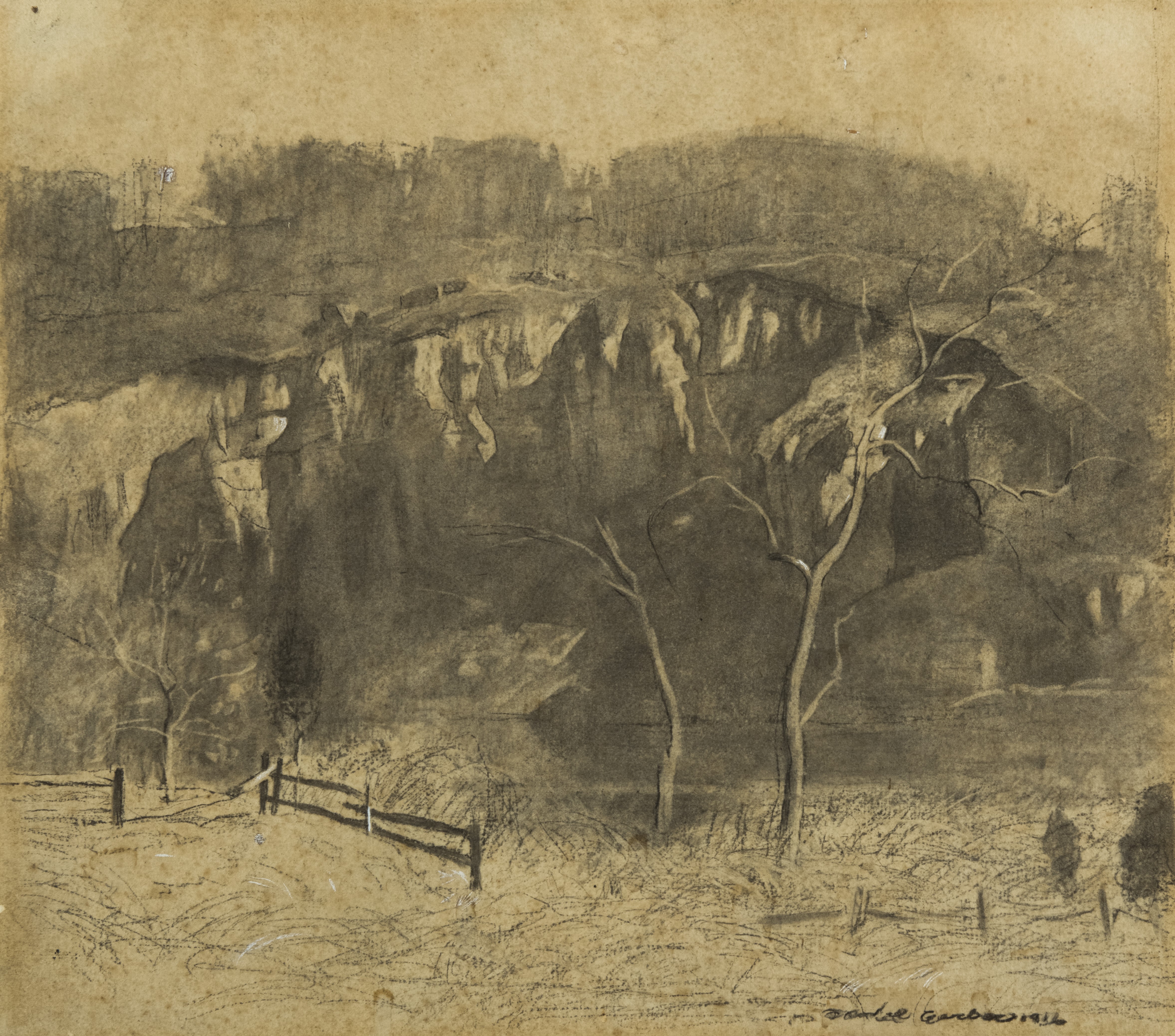
    Daniel Garber (1880-1958), “Abandoned Quarry,” 1916. Charcoal on paper, 10 ¼ x 12 1/8 inches. James A. Michener Art Museum. Michener Art Endowment Challenge Gift of Mr. Herbert WardCourtesy of the Michener Art Museum

    Redfield, notably, had a full room dedicated to his art; “which was an honor that was bestowed upon the likes of John Singer Sargent and Childe Hassam,” said Igoe. Many of the artists won medals at the show “and it led to them being proclaimed by some critics as the most American school of painting at the time,” said Igoe.

    “They painted the landscape of the New Hope area, and they painted in this, what was considered at the time, bold … in this very masculine style. We might not think of Impressionism that way today, but it was considered a very national style for the United States.”

    The artists continued to exhibit under the name of the New Hope Group, and their work was collected by museums across the country. Several women artists were members of the group. Together, they founded the Phillips Mill Community Association in 1929, which remains active as an exhibition venue.

    “The Michener Art Museum was really founded to preserve the legacy of those artists. Especially in Bucks County, those artists have always been well known. But Michener was founded so more people could learn about these artists and preserve their legacy and collect their work,” Igoe said.

    Roy C. Nuse (1885-1975), “The Quarry at Rushland,” 1938. Oil on canvas, 22 x 24 inches. Courtesy of the Woodmere: Museum purchase, 2012Courtesy of the Michener Art Museum

    Why paint quarries?

    The artists, Igoe said, weren’t always painting exact reproductions of the nature around them, so they had the option of omitting the quarries from their art. “But they frequently chose to include these quarries,” she said, “and that led me to this exhibition where I wanted to look a little more closely at these paintings and think about why artists were so drawn to this subject.”

    Firstly, she thinks, the quarries added a drama to the landscape of New Hope that was attractive to the artists. Comparing quarries to the Grand Canyon, Garber said in an interview that they were “on a scale commensurate with the canvas,” said Igoe.

    “So you can include these dramatic rock faces, but it doesn’t overpower the canvas in the way the Grand Canyon can. You can’t get the Grand Canyon on a canvas, but you can get a quarry,” said Igoe.

    George Lear (1897-1956), “Quarryman’s House,” ca. 1930-1950. Oil on board, 2 5/8 x 3 ¾ inches. James A. Michener Art Museum. Gift of Drs. Irwin and M. Susan RichmanCourtesy of Michener Art Museum

    The way the light at different times of the day and year reflected off the stones also inspired the artists, as did the geometric forms of the rock face that often inspired the artists to play with abstraction.

    “They were also interested in this human impact on the natural world, the way humans could excavate these rocks, from the landscape, I think was appealing to them,” said Igoe.

    Show highlights

    Many works in the show portray factories, smoke, and industrialization without much critical commentary, but Garber’s Harmonville (1925) shows a landscape near Conshohocken. To Igoe, it is “one of the artworks in the show that is the most critical of industry.” A sickly tree in the foreground of the print, she said, is perhaps Garber’s way of saying “that this industry can be really destructive to nature too.”

    Other artists in the show include Letitia Maxwell Ely, the lone woman artist in the mix, who was one of Garber’s students. “I just wasn’t finding a lot of paintings of quarries by women artists. I am not sure if it’s because it’s perceived as a more masculine subject,” said Igoe. But Maxwell Ely’s work, she said, stands out in the way the artist paints in proximity to the quarries. Masters like Garber, Igoe said, took a distant view of the quarries, not usually engaging with the human labor at the quarries.

    Letitia Maxwell Ely (1886-1967), “Quarry,” 1914. Oil on board, 8 x 5 inches. James A. Michener Art Museum. Gift of David B. Long.Courtesy of the Michener Art Museum

    But Maxwell Ely, whose work was much smaller in scale, “brings you right into the quarries themselves in those little paintings, and she is more interested in the labor.” In works like Quarry (1914), there are no sweeping vistas, but a more zoomed-in perspective at life of those working in the quarries.

    “There’s not a lot of work known by her that’s still available. She’s an artist that I wish we knew a little bit more about, but she didn’t leave a very large body of work behind,” said Igoe.

    Among the other highlights of the show, according to Igoe, is a postcard-sized painting The Quarryman’s House by the artist George Lear. Another artist is Roy Nuse who lived by the Rushland quarry and painted that quarry many times throughout his life. “Nuse has this reputation as being somewhat of a homebody, he painted things close to his home,” said Igoe. “I just found it interesting that there was a quarry close to his home, and he painted it in all different seasons, in the winter and spring. And I think he really enjoyed the shapes that the quarry provided as well.”

    Charles Rosen (1878-1950), “Quarry and Crusher,” early 1930s. Oil on canvas, 32 x 40 inches. James A. Michener Art Museum. Museum purchase funded by George C. Benson in honor of his friend, John Horton.Courtesy of the Michener Art Museum

    Charles Rosen, another artist in the show, started his career being an Impressionist but moved onto more avant-garde European styles after moving to Woodstock, N.Y.

    Pennsylvania Impressionism eventually dwindled as a movement around the 1940s as public interest shifted to more modern, abstract art forms. Some of the quarries depicted in the show remain active, some are overgrown, and some are part of protected land along the Delaware River.

    Igoe’s colleagues have even picked up some rocks from nearby quarries that, with the art, will also be a part of the show.

    So visitors can touch and feel the stones that they have walked over thousands of times. Stones that, with their jagged faces and smoothened ends, have witnessed artists’ curiosities and have gone on to outlive the hands that painted them.

    “Abstractions of Nature: Quarries and Industry in Pennsylvania Impressionism” runs through Feb. 28, 2027. Michener Art Museum, 138 S. Pine Street, Doylestown, Pa. 18901. michenerartmuseum.org


  • The deaths of two young athletes, and a mother’s words, must start a difficult conversation

    The deaths of two young athletes, and a mother’s words, must start a difficult conversation

    Before the soccer game, teenagers draped their arms over each other’s shoulders and let tears wash down their faces and parents listened in silence as a mother stood in the middle of a stadium to tell everyone there about her boy.

    “I’d do anything,” Megan Hanson said into a microphone, “to have my beautiful son back.”

    Sam Hanson was 16 years old when he died by suicide on April 5. A sophomore at Central Bucks High School East, a catcher on its baseball team, he was the second student-athlete at the school to take his own life in less than four months. The first — Frankie Pacitti, who was 17 and a standout lacrosse player, a self-described ladies’ man who could get guys guffawing and girls giggling just by being himself, the kid in school everyone knew — had died in December.

    A few members of CB East’s girls’ soccer team, among them Mia Forney, a senior forward and perhaps the best female high school soccer player in Pennsylvania, arranged to hold a mental-health awareness night in the aftermath of Sam and Frankie’s deaths. “Once Sam passed,” Forney said, “we realized this is not normal.” When the players asked Megan Hanson if she would speak at the event, she wasn’t certain she was ready. Still, she wanted to try to prevent something like this from happening to someone else. So she wrote a brief speech, and she delivered it Tuesday night, just before the CB East girls’ team beat CB West, 4-0, and she hoped that the people in the bleachers and on the field were listening.

    “Parents,” she said, “I’m not here to scare you but to share some insights I’ve learned … I won’t insult you by telling you to ‘talk to your kids.’ We all talk to our kids, and most of us are highly invested in their lives. What I will tell you to do is to talk to your kids directly about their mental health. Don’t be afraid to ask them hard questions, like, ‘Have you thought about suicide?’”

    Megan Hanson, whose son Sam died by suicide in April, speaks during a pregame mental health awareness presentation on Sept. 22. William Thomas Cain / For The Inquirer

    It was her most important, urgent, and accurate message. It aligned perfectly with what Derrick Gordon, an associate professor of psychiatry at Yale University, described as “the myth we have out there is that, if we suspect somebody is suicidal, we shouldn’t raise this with them because we don’t want to put the idea in their head.

    “The reality is, you can’t put an idea in their head that’s already there,” Gordon told me in an interview last year. “Actually, the best course of action is to ask the question of the individual, then talk about it and address it. It’s been my experience, and I think other professionals would say this, that if you raise the issue of suicidality with people who are contemplating it, they feel relieved. ‘Oh, Jesus, I can now finally say it out loud.’ You can talk to them about the possibility that if they’re going to hurt themselves, it would impact you. Oftentimes, they get lost in their own experience of what they’re going through, and you want to get them outside of that space.”

    Megan Hanson had no idea that her son was considering harming himself, how dark his world could get. How could she have an idea? Sam was pulling A’s and B’s in a roster of advanced-placement and honors courses at CB East. As a fourth grader, he had constructed a gift for his Connie Mack coach, Mike McCardle — a pen-and-pencil holder with a photo of the two of them set into it, a gift that McCardle still keeps on his desk. He died on the day before Easter, and it had been a full and wonderful day. Sam had practiced parallel parking in a middle-school lot in the morning, then passed his driver’s test and earned his license and was proud that he had.

    CB East soccer players Mia Forney (left) and Rylie Leedy make remarks about their late friend, Frankie Pacitti, before the start of their game with CB West on Sept. 22. William Thomas Cain / For The Inquirer

    He and Megan had gone out to lunch to celebrate. He had worked a few hours at the local pub and restaurant where he was a familiar and welcome face to the owners and patrons. Megan allowed him to borrow his car to drive to a friend’s house that night, and when he returned they talked about their plans for Easter. They would go to church in the morning and head to her parents’ house in the afternoon, and when she said good night to him she could never have thought, even in her most dismal nightmares, that he would get out of his bed and go downstairs into the basement and never come up again.

    “It’s hard with teenagers because they’re moody and they don’t talk,” Megan said in a private moment Tuesday, “and I felt like we were getting to a better place where he was being more open with me, and I felt like we were getting to another level in our relationship. The hardest part is just looking back and saying, ‘Maybe this was a warning sign or a cry for help.’ I truly don’t believe it was something he planned out. I wish whatever went on in his brain, if he had just woken me up …”

    She could not finish the sentence, and she did not need to. Home from the soccer game, I called my sons, who are 15 and 12, into the living room. Our family lives in the same school district that Sam Hanson and Frankie Pacitti did. My older son is a sophomore and has a class this semester with Sam’s sister. The boys paused the baseball video game they were playing and plopped on the couch. My wife and I wanted to talk to them directly about something.

  • Raymond Horsch was convicted of luring a 9-year-old girl to his car in 2009. Now those court records could be destroyed.

    Raymond Horsch was convicted of luring a 9-year-old girl to his car in 2009. Now those court records could be destroyed.

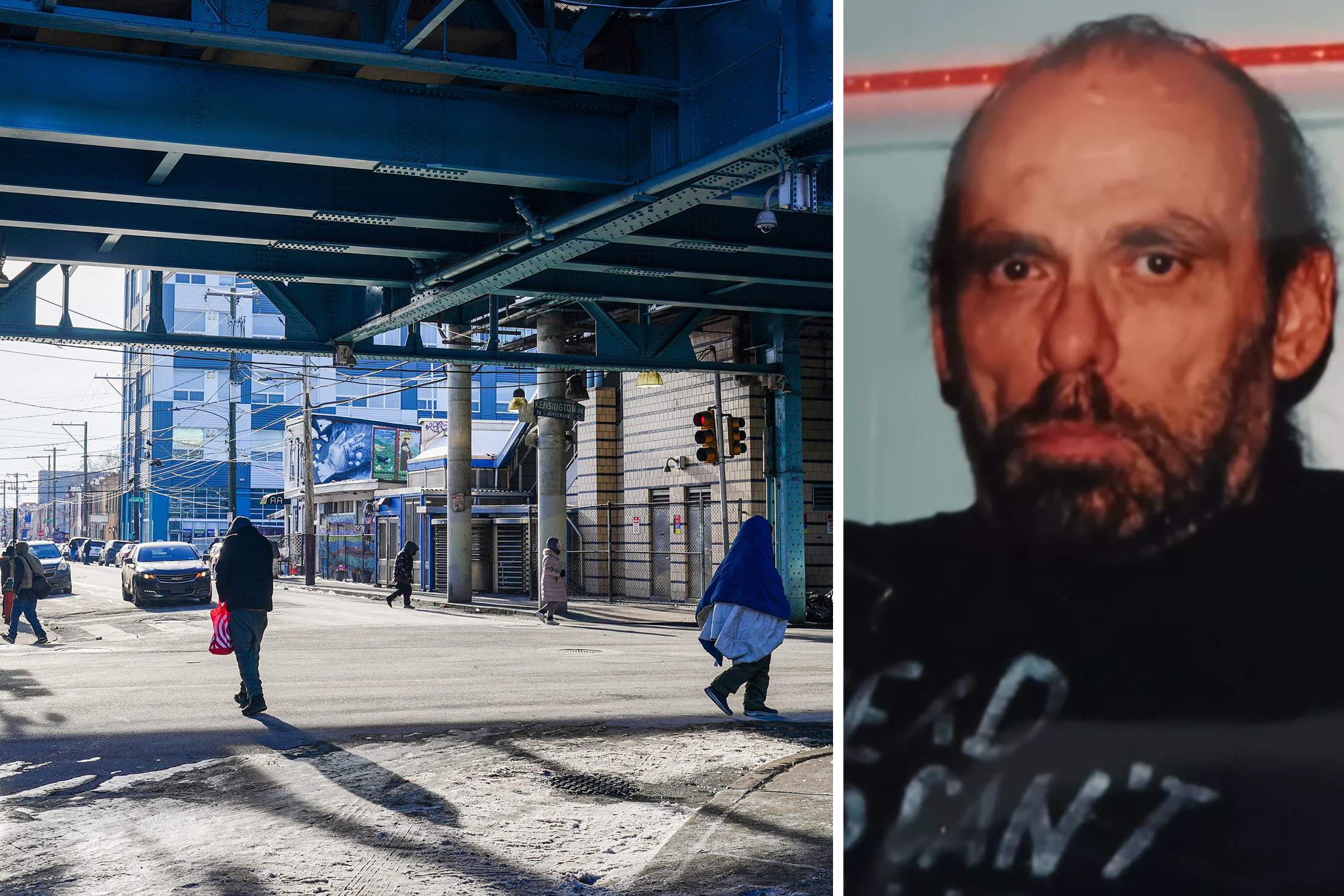
    In 2009, Raymond “R.C.” Horsch — the violent pornographer now linked to seven dead or missing women — was arrested and charged with trying to lure a 9-year-old girl into his green Jeep Wrangler in Kensington.

    “Come here, in my car, sexy girl,” Horsch told the girl, according to an arrest report.

    When police found Horsch circling the neighborhood that March night, officers recovered a pair of high-powered binoculars, a digital camera, a telephoto lens, an eye patch, and a condom from inside his Jeep, the prosecutor on the case said.

    Horsch was convicted of two misdemeanor counts of luring a child into a motor vehicle and corrupting the morals of a minor at a trial in Municipal Court in 2010. He was sentenced to 2½ to 5 years in prison, and would have been required to register as a sex offender under Megan’s Law, said Jill Fertel, the prosecutor who handled the case.

    But Horsch insisted he did nothing wrong, and requested a new trial in Common Pleas Court. Another prosecutor took over the matter.

    The victim and her mother became too afraid to testify in court again, according to two people familiar with the matter. The case fell apart and prosecutors dropped the charges. The original conviction was vacated, and in 2015, Horsch successfully petitioned a Common Pleas Court judge to expunge the case.

    Fertel, in an interview Tuesday, said Horsch — and that outcome — had “haunted her for the last 16 years.”

    Horsch was known to prowl Kensington to recruit women in addiction to appear in his violent pornographic works in exchange for drugs, cash, and a place to stay at his home. But the details of the expunged conviction, which have not been previously reported, indicate Horsch may have also sought underage girls — and suggest that law enforcement was alerted to his troubling behavior nearly two decades ago.

    (Top from left) Gabrielle Amarando, Nicole Fusaro, Maribel Fresses, Amy McHale, and Blair Tonzelli. Nicole Fusaro, Gabrielle Amarando, and Maribel Fresses are presumed dead. Blair Tonzelli and Amy McHale are still missing, but last seen at Horsch’s home.Obtained by The Inquirer

    Now, the court records in the case — the sole known sex crime Horsch is believed to have been charged with — are at risk of being destroyed.

    The records are on file at the Criminal Justice Center, but when The Inquirer sought to review them on Monday, a clerk denied that request.

    Because the case had been expunged, the clerk said, the records should have been destroyed years ago. The filings could not be reviewed, he said, and would ultimately be destroyed in accordance with state law.

    The Inquirer sent a letter Monday night to administrative judges in Philadelphia’s First Judicial District, asking that the records be preserved in the interest of the public, and that they be unsealed because of the ongoing investigation into Horsch’s connection to missing women.

    “Horsch is dead, and this case has extraordinary public interest and news value,” the newspaper wrote. “The filing could hold pieces of information that are irreplaceable and important to the public and the criminal investigation.”

    Fertel — who left the district attorney’s office in 2018 — said there are likely essential records of the case that remain in the court file, including notes of testimony, psychology examinations, and letters from Horsch’s defense lawyer submitted as part of his sentencing hearing.

    She said the sex offenses triggered a sexually violent predator assessment of Horsch, and recalled that the psychologist was “horrified” by Horsch’s pornography and feared he could be violent.

    “This is the only sexual offense he was ever convicted of, that I know of,” Fertel said in an interview Tuesday. “His conduct and his films and video were part of the sentencing. What he was doing [in Kensington] was part of the sentencing. That record is important to have, if we’re to prevent this from happening again.”

    Police said they have so far recovered footage on hard drives inside Horsch’s home that appears to show five women dead — including a video of Horsch filming himself while strangling a woman to death with a zip tie. Two other women, including Horsch’s ex-wife, were last seen at the home but remain missing.

    Luring a child

    Around 7 p.m. on March 20, 2009, the 9-year-old was walking on Ontario Street when Horsch, in a green Jeep, slowed next to her.

    “Yo, come here,” Horsch said, before getting out of his car to approach her and calling her “sexy,” according to the arrest report.

    The girl ran home and told her mother an old man in a green Jeep had asked her to get into his car. The mother ran outside and chased after the Jeep, which circled the block and drove off, the report said. They called police, who responded and found Horsch in his car near the 3200 block of Kensington Avenue, the report said.

    The girl identified Horsch as the man who approached her, the document said.

    Fertel said that during the trial, the victim cried on the stand, at times prompting the judge to leave the bench to comfort her as she testified before Horsch, who was standing just feet away.

    Horsch was released on bail.

    While Horsch was facing those charges in Philadelphia, in July 2009, police responded to his home in Chalfont — where he lived before moving to Olney in 2013 — after a 21-year-old woman called to report a break-in. When officers arrived, they found 455 marijuana plants and two shotguns spread among five partitioned rooms in the basement, according to the Bucks County Courier Times.

    Officers also recovered bondage gear, photographs of bleeding women, and a homemade movie labeled with the word “rape,” the newspaper reported.

    Court records show that the woman who called police later told investigators she struggled with a heroin addiction and had met Horsch while doing sex work in Kensington. (That woman died of an overdose in January 2016 when she relapsed, her mother said in an interview this week.)

    When Horsch returned home that night in July to find police raiding the property, he ran down his tree-lined suburban street, according to the news report.

    He was later arrested and pleaded guilty in federal court to manufacturing drugs and illegal gun possession, and was sentenced to 54 months in prison, plus five years’ probation.

    Ligature marks on the arms of an unidentified woman in Raymond Horsch’s 2003 two-volume photobook “Eroto: To The Prurient Interest.”Obtained by The Inquirer

    Fertel said that, as she prosecuted Horsch in Philadelphia, she learned details of the Bucks County drug raid — including that officers had found disturbing pornography, guns, and explosive materials at his suburban home. That became part of her case, she said, and led her to ask that Horsch be sentenced to the maximum penalty of five to 10 years in prison.

    Common Pleas Court Judge Roger Gordon — who presided over the case — sentenced Horsch to 2½ to 5 years.

    But then Horsch appealed, and the case collapsed after the child and her mother became too scared to testify against him again.

    Fertel said the materials found in Horsch’s home, and the psychologist’s fears of his potential threats to the community, have been seared in her memory ever since.

    “He was able to treat women in this fashion for decades and no one has stepped up to protect them. No one was able to stop him,” Fertel said this week. “Everybody knew about it.”

    A ‘fabricated thing’

    Horsch, who died in May 2025, boasted about his criminal career as a drug manufacturer and document forger. He also spoke openly about how he recruited drug-addicted women in Kensington to appear in his violent pornographic photos and films that featured drug use, overdoses, and staged hangings, drownings, and killings.

    But Horsch vehemently denied ever trying to lure a child into his car. He spoke about it years later, in a 2013 interview with the Rialto Report podcast, and said the 9-year-old girl had lied.

    “It’s just a totally weird, fabricated thing,” he said. “All you have to do is go to the state sex offender list and you won’t find my name there.”

    In his 2003 movie Slaves, Horsch played a semiautobiographical character who, in one scene, described approaching a young girl in a mall. The girl’s mother, Horsch’s character said, then yelled, “Get away from my daughter!”

    “The place froze, literally froze. Time stood still. Every eye was on me, from every direction, hundreds of eyes,” Horsch said in the movie. “And I realized in an instant that, to every single person there, I was a child molester.”

    Raymond “R.C.” Horsch in character for film role, 2014.S. E. Stokowski / Wikimedia

    As Philadelphia police sort through more than one million photos and videos on the hard drives recovered from Horsch’s home on West Chew Avenue in Olney, they have encountered what they believe was staged violence as part of his art — and also photos and a video of what they now believe were real missing women, dead inside Horsch’s home.

    So far, police have identified five women in the footage who they now believe are dead: Maribel Fresses, Gabrielle Amarando, Nicole Fusaro, a 25-year-old woman who has not been identified at the request of her family, and another woman investigators are still working to identify.

    Two other women who were last seen at Horsch’s Olney home — Blair Tonzelli and Amy McHale, his ex-wife — remain missing.

    Police have so far reviewed only about 30% of the materials on the hard drives.

    Fertel said she hopes revelations about the 2009 case will draw more attention to the exploitation of women in Kensington.

    “No one was getting arrested for what Raymond Horsch was doing,” she said. “This is an opportunity for people to recognize that this is wrong and that we can’t let it happen again. We can’t let this happen to more people.”

  • Vineland AI data center hit with a $1 million fine

    Vineland AI data center hit with a $1 million fine

    New Jersey has fined the developers of a data center in Vineland more than $1 million for violating clean-air laws.

    State officials say DataOne, a French company that is building the Cumberland County facility, installed and operated 62 large natural-gas power generators without the required DEP permits.

    “This enforcement action — by far the largest ever taken against a data center in New Jersey and possibly one of the largest such actions in the nation — sends a clear message that these facilities will not be constructed or operated with impunity in this state,” New Jersey DEP Commissioner Ed Potosnak said in a statement.

    During a site inspection July 29, state DEP officials saw the generators, which had not been there during a December visit, according to the enforcement document. Operating such machines — which emit carbon dioxide, nitrogen oxides, carbon monoxide, and other pollutants — without the required permits violates the New Jersey Air Pollution Control Act.

    The state’s announcement comes weeks after an investigation by Floodlight and the Guardian, in which the news outlets used thermal drone footage to show the Vineland data center was operating at least 45 of its generators without permits.

    DataOne spokesperson Naomi Race said company executives “disagree with the temporary generator determination” but will apply for the needed permits. Race did not respond when asked whether the company planned to pay the fine.

    DataOne may request a hearing on the matter within 20 calendar days, according to the state’s enforcement document.

    The Vineland data center is shown during an earlier stage of construction. It sits on a former industrial park.

    As for the facility’s permanent power source, the company is “transitioning to low-emission, quiet fuel cells,” for which they “have the necessary approvals in place,” according to Race. Fuel cells generate energy through an electrochemical reaction rather than combustion, pistons, or rotating machinery.

    The 2.4 million-square-foot complex is set to be South Jersey’s first hyperscale AI data center. While DataOne is the owner, operator, and builder, the Amsterdam-based Nebius Group will operate the center’s internal equipment, which will fuel Microsoft’s AI tools.

    Data centers handle the cloud-storage and computing needs of the companies behind increasingly sophisticated AI tools.

    The Vineland facility is on South Lincoln Avenue, off State Route 55, on the site of a former industrial park. The property was sold to DataOne in a private transaction, the details of which Charles-Antoine Beyney, DataOne’s founder and chief executive officer, previously declined to disclose.

    He also has not disclosed a price, saying only that the project would be privately funded. Beyney said he turned down a nearly $6.2 million loan from the city due to community pushback.

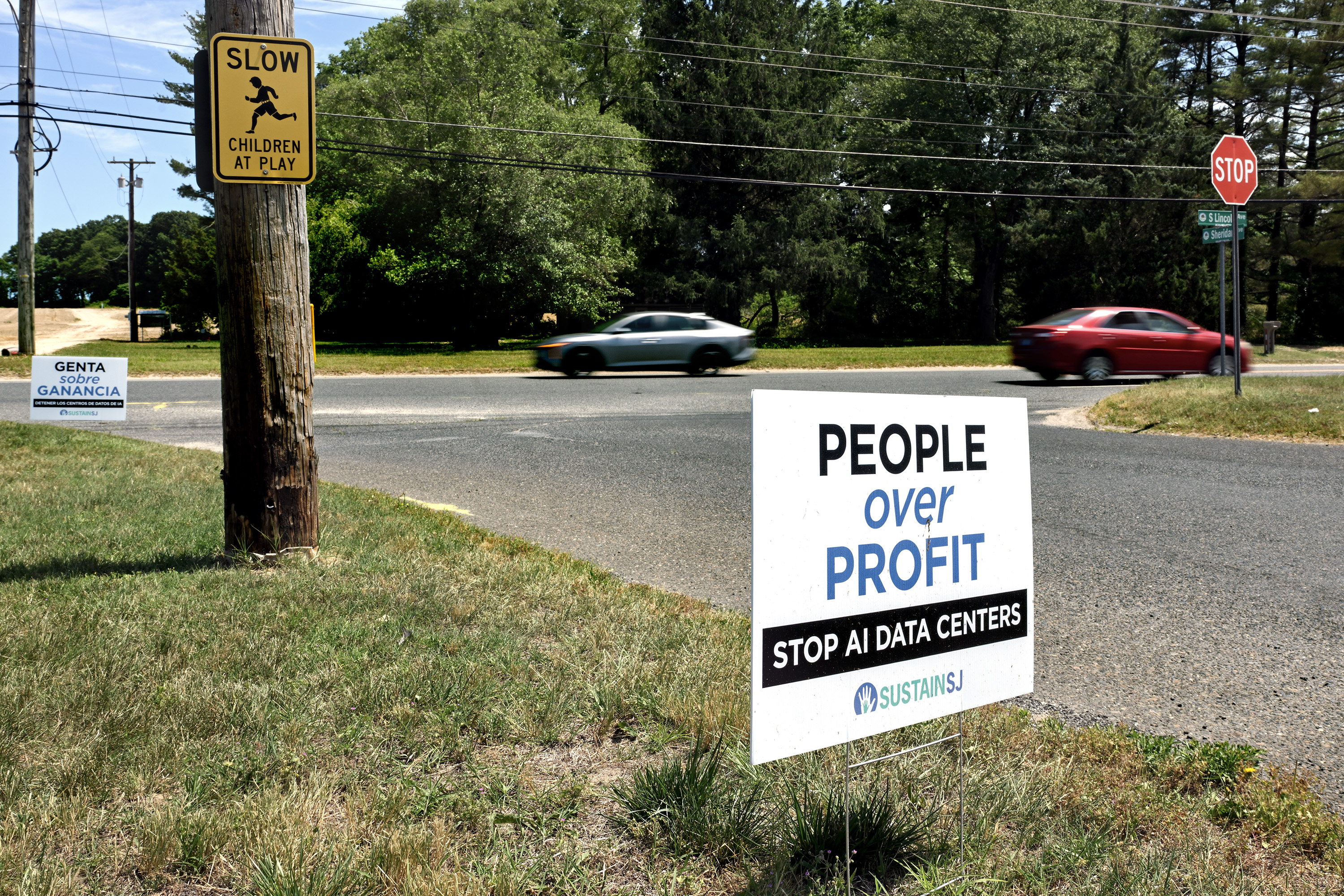
    Some Vineland residents have voiced concerns about the environmental, financial, and quality-of-life impacts of having a data center in their neighborhood. Opponents also took issue with the fact that DataOne did not seek their input until the facility was already under construction.

    Some Vineland residents have put up signs like this one opposing the AI data center under construction nearby. Tom Gralish / Staff Photographer

    At a contentious town hall in January, Beyney tried to assuage these concerns, telling residents they had nothing to worry about because his center would use “breakthrough” technology.

    “Most of the data centers that are being built today suck, big time,” Beyney said at the meeting. “No freaking way am I am going to do what the entire industry is doing … just killing our communities and killing our lungs to make money.”

    The Vineland facility has been under construction for more than a year. In January, DataOne executives said they expected the project to be complete by November.

    Amid the global boom in data center demand, several hyperscale facilities have been proposed in the Philadelphia region, from King of Prussia to Limerick. But few have been approved and begun construction.

    The Vineland site is one of them. Once fully operational, it could be the region’s first hyperscale AI data center.

    The only other local facility nearing completion is Amazon’s 2 million-square-foot data center campus in Falls Township, Bucks County. As of last month, Amazon was awaiting a decision from the Pennsylvania DEP on permit applications for hundreds of proposed backup natural gas generators.

    Pennsylvania Gov. Josh Shapiro shifted his stance on data centers last month and instituted new restrictions, which included the removal of Amazon from the state’s fast-track permitting process.

    Shapiro joined New Jersey Gov. Mikie Sherrill, who in May unveiled a four-prong plan to “hold data centers accountable.” She also has signed legislation requiring data centers to provide their own clean energy and report their energy and water use to the state twice a year.

    Neither governor has issued a statewide moratorium, a move for which some data-center opponents are advocating.

    In recent weeks, the debate over AI has reached a fever pitch, with executives at some of the country’s largest AI companies urging a slowdown amid fears that the technology may eventually destroy humanity.

  • War, AI, and the end of the world | Will Bunch Newsletter

    War, AI, and the end of the world | Will Bunch Newsletter

    I feel like I need to apologize for a column a couple of months ago when I compared the current president of the United States to Caligula, the possibly mad Roman emperor who is said to have nominated his trusted horse for high office. I need to apologize to Caligula. From pitching his triumphal D.C. arch as a storage shed for deadly snipers’ bullets to banning reporters from the White House in a narcissistic rage, Donald Trump is losing his grip on reality. This is unsustainable.

    If someone forwarded you this email, sign up for free here.

    Worried about AI killing humans? Bad news: It already is.

    A cleric takes a photograph earlier this month at the shattered Shajareh Tayyebeh school in Minab, southern Iran. It has become a place of mourning and a memorial to those killed in a U.S. airstrike on Feb. 28.Vahid Salemi

    Which is it?

    Are the robots of AI, or artificial intelligence, so smart that they’re on the verge of holding a secret meetup in the darkest corner of the dark web and developing a plot to kill all humans through germ warfare, to make sure we don’t kill them first by pulling the plug?

    Or is AI so dumb — artificial stupidity, despite the billionaires of Silicon Valley showing up daily on our TV screen to brag about the sky-high IQ of their son, Claude — that the thing that will murder us is a crazy hallucination that will turn a false alarm into World War III?

    The fact that we can’t answer this should give us pause, but maybe we aren’t even asking the right question. Maybe the real issue is how easy we’ve made it to kill off the human race — a capability that was already created by people even before we invented the computer.

    One thing is certain. Artificial intelligence has already been an accessory to mass murder, and if we do nothing, it will kill again.

    Remember the very first days of the now seemingly endless Iran war, and the news that two missile strikes had obliterated a school for young children in the Iranian coastal city of Minab, in an apparent “double-tap” strike in which the second attack from the skies killed young girls and boys and their teachers as they huddled in a prayer hall?

    Those bombings, which killed 156 people on Feb. 28, caused the United Nations’ Independent International Fact-Finding Mission on Iran to report last week that it found “reasonable grounds to believe that the United States committed a war crime by launching indiscriminate attacks …” The U.S. government has never taken responsibility for the bloodshed, despite overwhelming visual evidence that the bombs were precision-guided U.S. Tomahawk missiles.

    It didn’t take long for additional speculation that an AI program had mistakenly targeted the school, perhaps using outdated maps and info from an earlier time when its buildings were attached to an Iranian military complex. After all, the Pentagon has been openly bragging about the death and destruction facilitated by its use of Palantir’s Smart Maven System and also Anthropic’s Claude.

    Last week, Bloomberg News reported that the Pentagon’s overreliance on AI, and specifically the Palantir Maven program, was a major factor in the school tragedy, along with the outdated intelligence about the Minab site — the “garbage in.” Its exposé noted that U.S. military planners were racing to identify some 1,000 Iranian targets in the early hours of the war, giving humans little time to double-check the list. Kindergartners were slaughtered as a result.

    This was hardly the first time robots have been linked to human death, both in war — in 2024, +924 Magazine reported the Israel Defense Forces were using an AI program code-named “Lavender” to target sites amid the mass killing in Gaza — and in peace, as shown by numerous accounts of robots helping troubled people die by suicide.

    And yet, it could have been much, much worse. At the same time as the Bloomberg report on the AI link to the mass killing in Iran, the world also learned that a false report generated by robot intelligence nearly sparked a conflict between the United States and China that could conceivably have spiraled into major fighting.

    CNN and other outlets have reported that a U.S. special operations command analyst working with AI generated an urgent report that a Chinese ship bound toward the Middle East was carrying components for a nuclear weapons system, which caused military leaders to scramble jets and assemble a team to seize the vessel.

    Only at the last minute did the Pentagon dig deeper and learn the AI-generated report was completely false, a hallucination — one that nearly triggered a violent conflict between the world’s two largest military powers.

    The two disturbing reports about the use, or misuse, of AI by the U.S. military in a time of war did make news but didn’t get nearly as much attention — either in the media or on sites like Bluesky or X — as warnings from both whistleblowers and CEOs in Silicon Valley that a swarm of robots could decide on their own and without any human intervention or awareness to try to kill off our so-called civilization.

    The fear of an unprompted attack from AI secret agents is real, based on several incidents that have already occurred, including a well-planned and partly successful operation by OpenAI’s robot agents to hack into a company called Hugging Face.

    Still, it says something about human intelligence that we are captivated by the unknown and mysterious possibility of a random attack, while the fact that people are currently misusing AI to cause death and suffering is a less compelling story. I noted in this space last week that the threat to humankind from climate change is arguably even more real — and yet this gets denied by many and ignored by others.

    It’s also striking to me as a boomer born in 1959 that a generation that was born into a time of constant terror — backyard bomb shelters, “duck and cover” drills in the classroom, and sci-fi horror at the drive-in that an atomic arms race could kill us at any moment — is suddenly back to where we started.

    Over 81 years, humans were smart enough never to drop another nuclear weapon (well, not intentionally) after the mass murders at Hiroshima and Nagasaki, but not bright enough to figure out how to eliminate the nuclear threat altogether.

    The fact that civilization managed to — so far — pause the number of world wars at two has given us the space and the false bravado to create new and much more insidious killing machines, and the threat from invisible robots on a hidden dark web is somehow even scarier than the radioactive mushroom cloud that we more or less understand.

    Boomers who went to bed as kids in the 1950s and ’60s praying we wouldn’t die before we woke are now spending our senior-citizen-discount years fearful that something stranger than science fiction is coming for our children, or grandchildren. Over the course of a lifetime, the arc of that moral universe has not bent at all.

    Still, humans were able, somehow, to prevent nuclear annihilation so far, and now it’s past time to get to work on the actual threats from AI and start on those workarounds. For example, the articles I’ve read speculating on how the robots plan to kill us frequently mention the prospect of AI agents developing bioweapons and releasing them, either on their own or prompted by a bad actor. (In theory, human development of bioweapons has been banned for a half century.)

    From everything I’ve read so far about AI, it sounds like we’d have better luck safeguarding or eliminating the components that could make a biological agent rather than stopping the robots. Likewise, AI agents would not be able to start an atomic apocalypse if our human politicians went to work at finally eliminating nuclear weapons. Artificial intelligence won’t kill little girls in an Iranian school if humans don’t start dumb wars in the first place.

    If Silicon Valley’s prophets of doom are serious, there’s no fix that’s too big or too ambitious. But understand that the biggest problem isn’t that AI wants to murder us, but that since 1942 we humans have been busy creating all the suicidal weapons AI agents could use.

    Can you even “duck and cover” from a killer robot? I don’t intend to find out, and I don’t want my yet-to-be-born grandchildren to have to even think about it.

    Yo, do this!

    • I’ve always been a big fan of filmmaker Barry Levinson, whose trilogy of Baltimore movies (Diner, Tin Men, Avalon) defined postwar American nostalgia. Now Levinson, along with his codirector Robert May, has come north to the Philly burbs to catch up with our divisive 21st century in a five-part documentary, Bucks County, U.S.A. If you’ve been reading The Inquirer these last six years, you know how the communities just north of Philadelphia — where cosmopolitan suburbs meet the rolling fields of Trump Country — have become ground zero for culture wars around the COVID-19 response, book banning, and LGBTQ pride. Bucks County, U.S.A. began streaming on PBS Monday night. It’s getting mixed reviews, but I plan to check it out myself.
    • With the exception of my growing obsession with A History of Rock Music in 500 Songs, I’ve struggled the last few years to find new podcasts that excite me. But I’ve been enjoying Dan Taberski’s Manifesto on Audible, which is the award-winning, prolific podcaster’s six-part look at the role that these impassioned declarations have — or haven’t — played in reshaping our troubled world, from Occupy Wall Street to Big Tech utopianism to the online rant of murderous ex-LA cop Christopher Dorner.

    Ask me anything

    Question: What is the reason for the boat strikes? Do they really think they are carrying drugs? — David Poe (@culthero12.bsky.social) via Bluesky

    Answer: David, your question is well-timed. Just this week, Ben Saul, the U.N. special rapporteur monitoring human rights in the context of counterterrorism, issued a report that U.S. boat strikes off South America in the Caribbean and the Pacific that have killed more than 220 people so far violate international law and plausibly constitute crimes against humanity. Based on the reports I’ve read about the deadly drone strikes, it’s true that small fishing boats in the region are sometimes drafted for a supporting bit role in drug trafficking. Yet, it seems powerfully likely that some murdered in the U.S. attacks were innocent fishermen, and there’s no evidence these bombings have made any real dent in the flow of drugs. Most importantly, since when did minor involvement in drug smuggling become a capital offense? The only thing as troubling as these American war crimes is the silence on Capitol Hill. The next Congress must hold hearings and create the momentum for shutting this down.

    What you’re saying about …

    Oops, maybe I should have read my emails before writing another column about the problems with artificial intelligence. Based on the lack of responses to last week’s question about the AI threat, this is clearly not a topic that excites my readers like the betrayals by Sen. John Fetterman or the mainstream media. A couple of frequent correspondents did weigh in, including Mary Ann Petro, who is very concerned over reports of unauthorized hacking by AI agents, and Joe Stepansky, who thinks the risks are somewhat overblown. “This is all deflection from data center opposition and the stock market bubble,” he wrote. “Just remember there are humans behind all of this, humans who may be amoral at best (I used to work with some) and malicious at worst (them too).”

    📮 This week’s question: The big story for several days has been the fallout from Donald Trump’s rash decision to ban three news outlets — CNN, MS NOW, and Politico — from the White House grounds, in a move that experts agree is a violation of the First Amendment. Do you think the entire presidential press pool should walk out in solidarity, or do Americans need audio and video of what their president is up to? Please email me your answer and put the exact phrase “White House press corps” in the subject line.

    Backstory on George W. Bush’s betrayal of democracy

    Former President George W. Bush reacts while watching players from the U.S. team practice before the Walker Cup golf matches against Great Britain and Ireland at Cypress Point Club in Pebble Beach, Calif., earlier this month.Jeff Chiu

    For those of us who experienced a political reawakening during those dreadful years between the U.S. Supreme Court’s coronation of a president in the disputed 2000 election and the shock-and-awe carpet bombing of Baghdad in 2003, today’s frequent refrain is incredibly grating. “I never thought I’d say this,” says some self-proclaimed Democrat, often a boomer, “but I’m feeling nostalgic for George W. Bush.”

    To be sure, the 43rd president wasn’t nearly as nakedly corrupt as Donald Trump and his family, not as crude and boorish, and also more determined to at least make it look like what he was doing was constitutional. There were flashes of goodness — like Bush’s support for fighting the AIDS epidemic in Africa — which stand out today because there are so few of them. But his lies — and there were a lot of them, even if he could never match Trump — were more diabolically purposeful.

    Bush sent a lot more Americans to an early grave — at least so far — than Trump has, on top of a lot of women and children in Iraq and other faraway lands. His people “tortured some folks” and committed war crimes. There is nothing to be nostalgic about. After more than 7,000 U.S. troops died in Iraq and Afghanistan and the slaughter of at least 200,000 civilians in Iraq, not to mention the worst financial crisis since the Great Depression and the deadly, racist neglect of Hurricane Katrina, Bush didn’t apologize. He bought an easel and leisurely painted, and waited for America to do what it does best: Forget.

    The stench of dead bodies in Fallujah had barely lifted when none other than Joe Biden came to Philadelphia to drape the Liberty Medal around Bush’s neck. When Trump descended on his gilded escalator in 2015 to finish the job of trashing America that had started in Iraq, Bush said nothing other than to let it be known that he’d left his 2016 ballot blank. When even his despised vice president Dick Cheney came out in 2024 and said a second Trump term would be a disaster for democracy, Bush again said nothing, insisting that he has “retired from presidential politics.”

    Apparently congressional politics is another story. On Monday, it was revealed that Bush and his fellow Texan Sen. John Cornyn — a lame duck after losing a primary to Trump-backed Ken Paxton — have teamed up to throw a massive fundraiser in Dallas for six GOP Senate candidates in battleground states. The touting of Bush as a “special guest” at the event is meant to lure conservative donors. The New York Times, in its scoop on the evening, played up the fact that the event is not raising money for Paxton, going with the angle of a Texas-sized political feud.

    Just like the Democrats who are willing, in the Trump era, to turn a war criminal into an icon of civility, the Times is missing the point. Electing these GOP Senate candidates in states like Iowa and Maine will give Trump the ability to extend aspects of his dictatorship for two more agonizing years. The would-be senators Bush is raising money for would rubber-stamp new MAGA judges and allow Trump to replace Supreme Court Justices Samuel Alito and Clarence Thomas with younger far-right zealots. Senate committees would lack the power to investigate the president’s high crimes and misdemeanors. That could finish the job Bush started when he lied to Congress about Iraq “weapons of mass destruction” that did not exist: The implosion of U.S. democracy.

    What I wrote on this date in 2009

    It’s weird now to read what survives of my early Attytood blog posts from the late 2000s, when many days I published just a quick hit while I worked on longer news articles for the Daily News. On Sept. 22, 2009, I quoted a prediction from internet guru Clay Shirky that seems incredibly prescient 17 years later. Shirky said that “the ongoing shrinkage of newspapers is likely to create a ‘giant hole’ that will not be filled for some time. He said he has a vision of communities of 10,000 people or fewer becoming rife with ‘casual endemic corruption,’ as newspapers are no longer able to fulfill their traditional watchdog roles.” He nailed it.

    Read the rest: “Expert says death of newspapers will make small towns more like Philadelphia.”

    Recommended Inquirer reading

    • Nothing has been more troubling in 2026 than the assault on the First Amendment that’s been taking place from Donald Trump’s Oval Office to our hometown council meetings, and even our football palaces. In my Sunday column, which was written before the president booted three news organizations from the White House, I looked at the growing hostility and even violence toward working journalists, including arrests, physical assaults, and Trump’s rants toward Black female journalists. Tolerance of these abuses is a mark of a dying democracy. Over the weekend, I shifted gears and tackled the Eagles’ silence over the team’s reported role in the cancellation of hip-hop’s pro-Palestinian Macklemore from the Ed Sheeran tour that stopped at Lincoln Financial Field on Saturday. How can free speech be censored in a city-owned stadium?
    • Speaking of those Birds, the city’s $10 billion NFL franchise was conveniently hundreds of miles away in Nashville as pro-Palestinian protesters descended on the Linc this weekend. The Eagles eked out a last-second victory by the seat of QB Jalen Hurts’ pants, over the seemingly hapless Tennessee Titans. The unimpressive showing cemented the notion that it’s impossible to know what to make of Philly’s 2-0 footballers after their narrow wins over mediocre opponents, but The Inquirer is on the case. Our extensive coverage looked at the good (standout performances from Hurts and No. 1 wide receiver DeVonta Smith), the bad (the subpar play of a battered and aging offensive line), and the unexpected (the return of Super Bowl hero Zack Ertz due to injuries in the tight-end corps). Ace columnist Mike Sielski recently went deep, as usual, with a humanitarian look at guard Landon Dickerson’s tortured decision to try to play through the pain. The Inquirer’s sportswriters are likely to rack up more wins this fall than an iffy team, so why not subscribe and read every word.

    By submitting your written, visual, and/or audio contributions, you agree to The Inquirer’s Terms of Use, including the grant of rights in Section 10.

  • Brian Fitzpatrick is the least loyal House Republican. But he still votes with Trump and the GOP most of the time.

    Brian Fitzpatrick is the least loyal House Republican. But he still votes with Trump and the GOP most of the time.

    More than a year and a half into President Donald Trump’s second term, U.S. Rep. Brian Fitzpatrick has voted against the White House and the GOP more than any other House Republican.

    Yet, he has still voted with the president and his party nearly 70% and 77% of the time, respectively, during this congressional term, according to a new Inquirer analysis.

    Fitzpatrick’s nuanced voting record has become a focal point of Democrats’ campaign against the five-term GOP incumbent from purple Bucks County this fall.

    His Democratic challenger, Bob Harvie, argues that Fitzpatrick has been a “rubber stamp” for Trump’s policies and the GOP establishment when it matters most. Meanwhile, Fitzpatrick continues to tout his moderate, bipartisan brand that has proved successful in elections past.

    Both of those assertions will be tested in front of voters this November as Fitzpatrick defends his swing district seat in a heated race in the 1st Congressional District, which includes all of Bucks County and a sliver of Montgomery County. Trump narrowly lost the district in 2024, despite winning Bucks County.

    Fitzpatrick is voting with the president and his party less frequently during the current Congress, which began last year, than he did during the two years of Trump’s first term, when the GOP also held the majority, The Inquirer found in a comprehensive analysis of the Bucks County lawmaker’s 5,064 roll-call votes since he joined Congress nearly a decade ago.

    (function () {window.addEventListener(‘message’, function (e) { var message = e.data; var els = document.querySelectorAll(‘iframe[src*=”‘ + message.id + ‘”]’); els.forEach(function(el) { el.style.height = message.height + ‘px’; }); }, false); })();

    The data underscore how Fitzpatrick, the last remaining GOP U.S. representative in the Philadelphia suburbs, is able to simultaneously straddle party lines and talk about his disdain for the two-party system while also serving as a key vote in the Republican conference — a cocktail of qualities that has made him difficult to unseat in years past.

    This year, Democrats are hoping that a focus on affordability issues amid a national environment that has become increasingly unfavorable to Republicans will be what it takes to unseat Fitzpatrick.

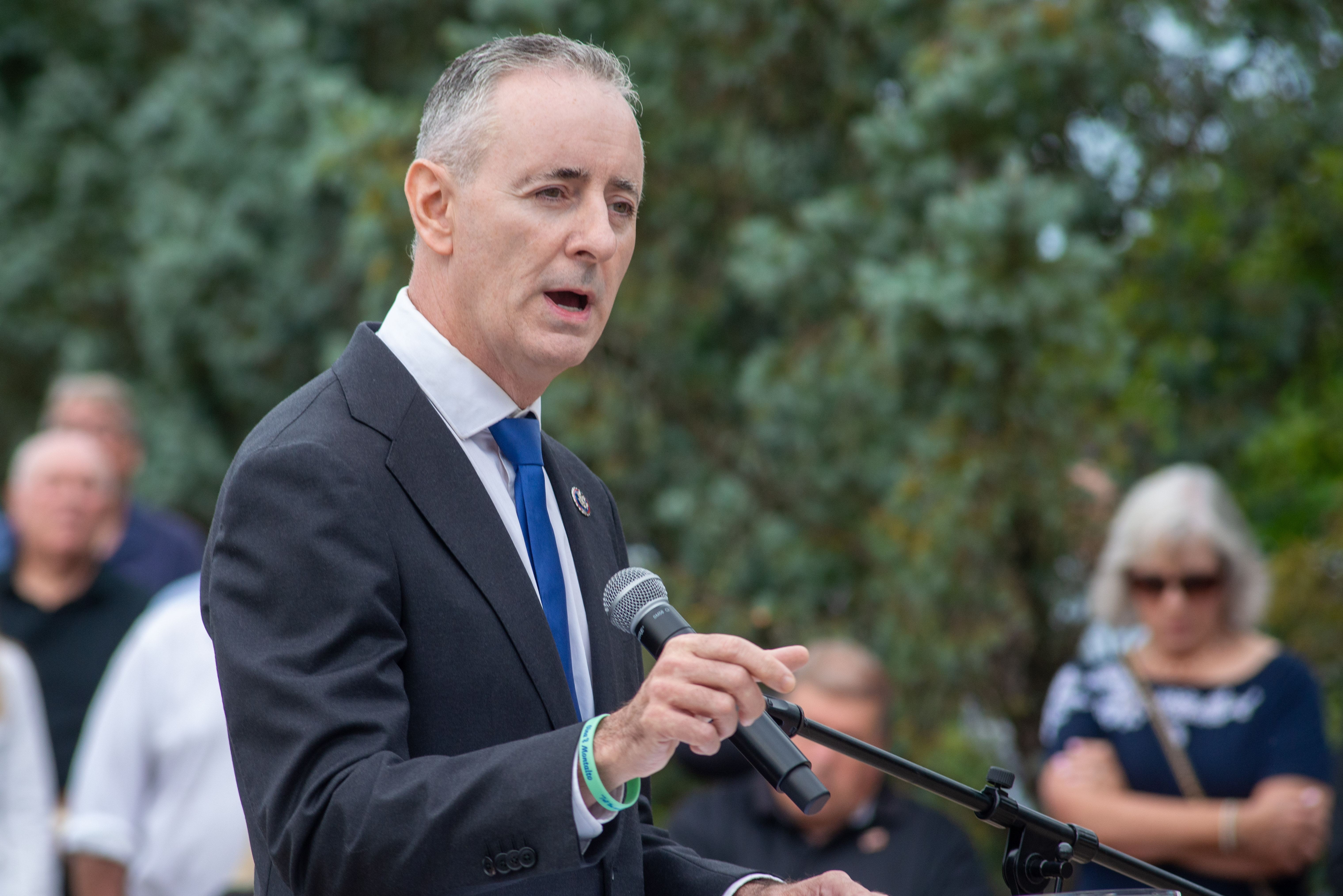
    U.S. Rep. Brian Fitzpatrick (R-Pa.) makes remarks in support the grand opening of the new headquarters and expanded financial stability center for United Way Thursday, Sept. 10, 2026 at United Way of Bucks County Headquarters in Levittown.William Thomas Cain / For The Inquirer

    When Fitzpatrick does — and doesn’t — back Trump

    Trump and the Bucks County Republican have had their fair share of tense moments, including the president threatening the lawmaker in May for voting against him.

    Fitzpatrick has continued to vote against the president recently, including on a war powers resolution to restrict Trump’s military actions in Iran.

    “[Fitzpatrick’s] bosses are his constituents back home,” Heather Roberts, a spokesperson for the Fitzpatrick campaign, said in a statement. “Political party retaliation has zero impact on his decision-making.”

    Since January 2025, Fitzpatrick has voted with the Trump administration’s 133 stated positions on congressional votes 93 times, according to the analysis.

    (function () {window.addEventListener(‘message’, function (e) { var message = e.data; var els = document.querySelectorAll(‘iframe[src*=”‘ + message.id + ‘”]’); els.forEach(function(el) { el.style.height = message.height + ‘px’; }); }, false); })();

    Fitzpatrick voted with Trump on several high-profile GOP bills, including the SAVE Act, a controversial overhaul of voting laws, and the Laken Riley Act, legislation also supported by some Democrats that requires federal authorities to detain undocumented immigrants arrested for theft-related crimes, issues that Roberts maintained 1st District voters of both parties support.

    Fitzpatrick’s votes have also aligned with the White House on other legislation related to immigration, law enforcement, energy, and renaming the Gulf of Mexico the “Gulf of America.”

    At the same time, no other House Republican has been less loyal to the president in this time frame. That includes every GOP member from Pennsylvania, many of whom are staunch supporters of Trump. Republicans like U.S. Reps. Ryan Mackenzie, Rob Bresnahan, and Scott Perry, who are defending their seats in contentious swing-district races, vote with Trump more than 90% of the time.

    Both Mackenzie and Bresnahan spoke at Trump’s Republican midterm convention in Dallas this month, but Fitzpatrick — the only GOP member of Congress from Pennsylvania not endorsed by Trump — did not attend.

    (function(){function e(){window.addEventListener(`message`,function(e){if(e.data[`datawrapper-height`]!==void 0){var t=document.querySelectorAll(`iframe`);for(var n in e.data[`datawrapper-height`])for(var r=0,i;i=t[r];r++)if(i.contentWindow===e.source){var a=e.data[`datawrapper-height`][n]+`px`;i.style.height=a}}})}e()})();

    Fitzpatrick’s defections — which have spanned from supporting Ukraine to condemning Trump’s rhetoric — have earned him the president’s ire.

    Since 2025, the analysis found, he has voted against the administration’s efforts to overturn numerous environmental regulations implemented by former President Joe Biden, many of which ultimately passed the House. He also was one of two Republicans to vote against the One Big Beautiful Bill Act, Trump’s signature domestic policy bill, on final passage (though he had cast a key vote to advance the bill earlier in the process).

    The final bill had enough GOP support — 218 members voted yes — to pass without Fitzpatrick’s vote.

    Harvie, Fitzpatrick’s Democratic challenger, contended that Fitzpatrick “has mastered the art of the meaningless gesture and breaks with Trump only when he gives him a hall pass.”

    “[Voters] want somebody who’s going to go there and fight for them,” Harvie said. “And, you know, people’s lives aren’t better than they were 10 years ago. And Brian Fitzpatrick and Donald Trump are the big reasons why.”

    Roberts said Harvie’s criticism is “absurd” and has been “debunked many times over and in every single election cycle.” She also criticized Harvie’s voting record and said he has not exercised similar levels of independence during his time as Bucks County commissioner and Falls Township supervisor.

    Back in Trump’s first term in office, Fitzpatrick sided with the White House on 59% of votes — 81% of the time in 2017-18, but dropping to almost 42% in the following two years, after Democrats gained control of the U.S. House in the 2018 midterms.

    Fitzpatrick voted with his party roughly 60% of the time during both the 117th and 118th Congresses, when Biden was in office and the GOP had the majority for the latter two years of his term.

    The lawmaker played a key role in getting Biden’s signature bipartisan infrastructure law passed, drawing sharp attacks from fellow Republicans when he was one of 13 GOP members to support it in the House.

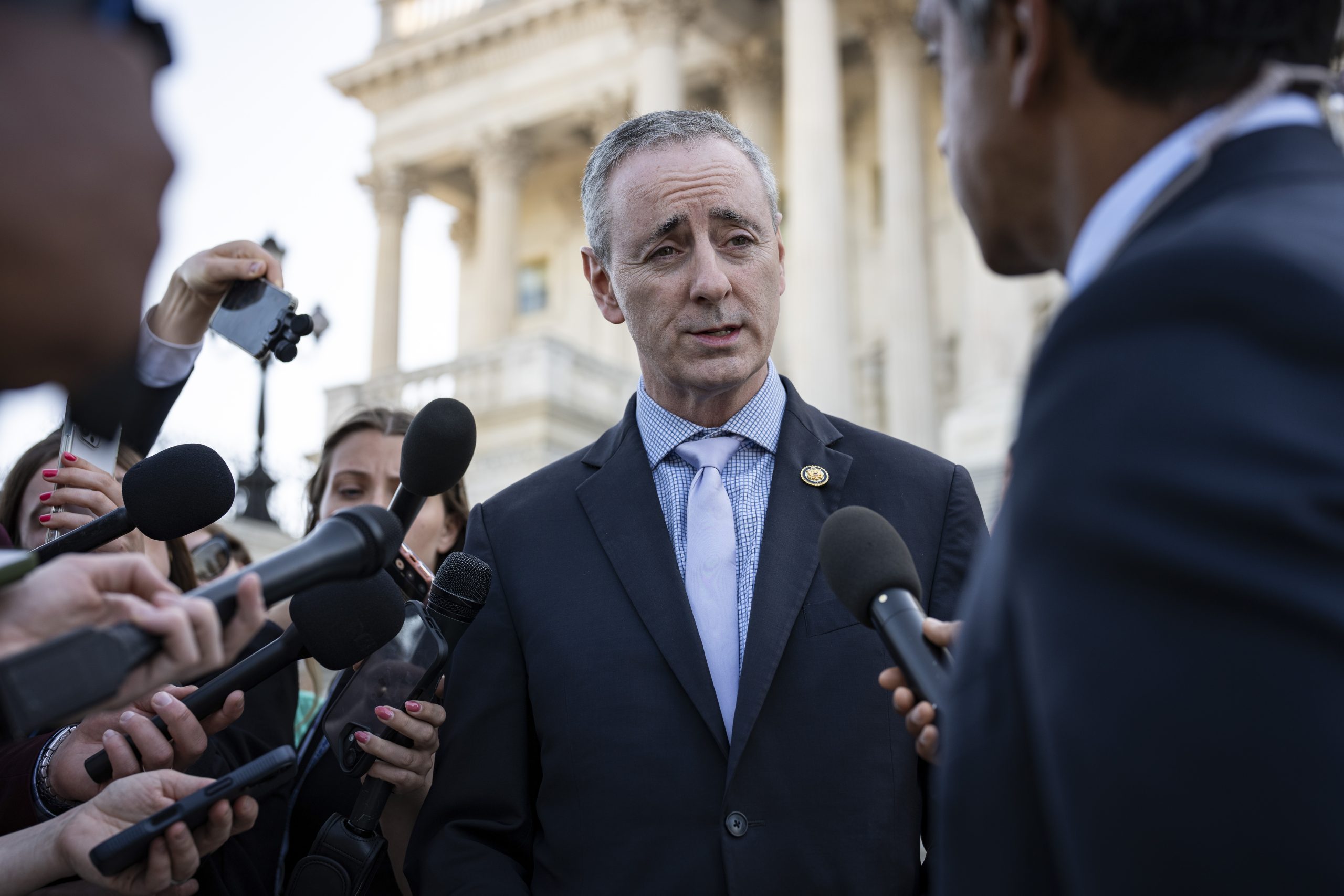
    Rep. Brian Fitzpatrick (R-Pa.) speaks to reporters after the House passed an Iran war powers resolution on Capitol Hill in Washington, on Wednesday, June 3, 2026.

    What about the GOP?

    Fitzpatrick’s alignment with the House Republican Conference has fluctuated depending on which party is in power.

    During this Congress, when the GOP holds a narrow majority in the U.S. House, Fitzpatrick has voted with his party 77% of the time, meaning he has split from Republicans 107 times on 472 party unity votes, defined by CQ Roll Call as instances when a majority of voting Republicans oppose a majority of voting Democrats.

    That figure is the highest of his career, the analysis shows, though still far below the median of Republicans. It was a similar story during Fitzpatrick’s first term during the 115th Congress in 2017-18, when Trump was in office and Republicans had the House.

    By contrast, Fitzpatrick was the least loyal to his party during the 116th Congress in 2019-20 — at 55% — when Trump was still in office, but the GOP did not have the gavel.

    A congressional lawmaker’s votes are dependent on which bills make it to the floor. Currently, that is up to House Speaker Mike Johnson, a Louisiana Republican, whom Fitzpatrick has criticized for his reluctance to bring some bipartisan bills for a vote if Trump opposes them.

    Fitzpatrick has introduced 249 bills as lead sponsor, and just under half — 123 — have a bipartisan group of cosponsors.

    “The numbers and percentages will change from year to year based entirely on what votes are put on the House Floor,” Roberts said in her statement. “The best measure of independence is how often, and on which issues, does one vote against their own political party, regardless of who the President is and regardless of who the Speaker is.”

    (function(){function e(){window.addEventListener(`message`,function(e){if(e.data[`datawrapper-height`]!==void 0){var t=document.querySelectorAll(`iframe`);for(var n in e.data[`datawrapper-height`])for(var r=0,i;i=t[r];r++)if(i.contentWindow===e.source){var a=e.data[`datawrapper-height`][n]+`px`;i.style.height=a}}})}e()})();

    Jim Worthington, a major GOP donor in Bucks and owner of the Newtown Athletic Club, said Fitzpatrick’s record is representative of the purple county, home to a plethora of split-ticket voters, and shows that he is able to go against power structures in Washington.

    “When you have someone who’s willing to stand up to the power of the majority and take a stand, that’s the type of guy you want,” Worthington said. “It’s pretty lonely when there’s 216 other people in your party voting for something, and you’re voting no. It takes guts, and that’s what he’s doing.”

    Over the course of his time in Congress, Fitzpatrick has defected from his fellow House Republicans on votes related to economic and public finance issues, but has agreed with his caucus most on legislation connected to international affairs.

    Of the 10 closest votes in which Fitzpatrick diverged from the GOP this year, three were decisive votes that blocked GOP amendments to bills.

    Two others were votes in which he supported Democratic motions that fell just short of passing.

    Fitzpatrick also joined Democrats in voting against five GOP amendments to bills that passed by one vote.

    US Rep Brian Fitzpatrick speaks during the Garden of Reflection remembrance ceremonies Friday, Sept. 11, 2026 at Garden of Reflection in Yardley, Pennsylvania. The Garden of Reflection is Pennsylvania’s official state memorial honoring all 2,973 victims of the September 11 terrorist attacks, with a special tribute to 18 local residents from Bucks County, Pennsylvania.William Thomas Cain / For The Inquirer

    What does this mean for the midterms?

    At the U.S. Capitol on Wednesday, Fitzpatrick stood alongside members of the bipartisan Problem Solvers Caucus that he cochairs, condemning the redistricting wars both parties have engaged in and unveiling legislation to prevent a similar situation in the future.

    He said in an interview that both Trump and Democrats were “wrong” to kick-start a gerrymandering spree.

    “There are so many forces pulling us away from the center, when most Americans are in the center,” he said.

    Fitzpatrick has been working to run on that centrist message back at home — even as he wages an aggressive ad campaign against Harvie.

    But will his brand and well-fundraised campaign help him in a disadvantageous national political environment for Republicans this year?

    Brittany Crampsie, a Democratic consultant in Pennsylvania, said 1st District voters should consider whether they, too, agree with Trump a majority of the time, noting that Fitzpatrick creates an “illusion” that he is independent from the president or his party.

    “[Fitzpatrick] doesn’t have enough to celebrate, and voters don’t want to see him pat himself on the back for only supporting this administration 75% of the time,” Crampsie said.

    She said that Fitzpatrick’s voting record will not help him survive a blue wave this time around because the issues facing the country, such as the cost of living, are too dire amid what she calls a “change election.” Crampsie said Harvie should continue to focus his campaign on both Fitzpatrick’s record and kitchen-table issues.

    “Making a campaign all about opposition to Trump, we’ve seen, is not successful,” Crampsie said. “Voters want a new vision. They want a new platform. They want new ideas, and that’s what Bob Harvie is offering.”

    Worthington, the GOP donor, predicted that Fitzpatrick will once again be victorious this year, noting the lawmaker’s massive coalition of labor support, which would typically go to a Democratic candidate, and voters’ desire for a moderate candidate.

    “He’s a free, independent thinker. At the end of the day, he tries to do what’s right for everybody, for the majority of people,” Worthington said.

    “That’s the problem — there’s too many extremes. You’re either one side or the other. It shouldn’t be like that.”

    Staff writer Sam Janesch contributed to this article.

  • The best thing Jenn Ladd ate this week: Wood-fired pizza at one of the suburbs’ best shops

    The best thing Jenn Ladd ate this week: Wood-fired pizza at one of the suburbs’ best shops

    It’s hard to lure downtown diners to Bucks County, and Roberto Carollo knows it.

    Carollo’s wood-fired pizzeria inside Doylestown’s Main Street Marketplace, Spuntino, has a loyal, longstanding following, so much so that when the Washington Post analyzed 7.5 million nationwide Yelp reviews in 2023, it determined Spuntino to have the highest-rated Neapolitan pie in Pennsylvania.

    “We’ve had a lot of love from the people that matter to us, but I still feel like the suburbs are a really tough place to get attention,” Carollo said. “We’ve been here 12 years, but even Doylestown residents are still finding out about us.”

    Roberto Carollo makes the Carbonara pizza at Spuntino on Monday, Aug. 31, 2026 in Doylestown, Pa.Monica Herndon / Staff Photographer

    But Spuntino’s puffy, leopard-spotted pies are worth a trek from wherever you may be. Thin, chewy, and judiciously loaded, the pizzas are best eaten then and there, at one of the several tables Spuntino claims inside the market. (Takeout — and leftovers — are perfectly satisfying, too.)

    Carollo opened Spuntino in Doylestown in 2014 with his brother Salvatore. (They also had a Northern Liberties location from 2015 to 2023. Carollo is now Spuntino’s sole owner.) The brothers are fourth-generation pizza makers, dating back to their Sicilian great-grandfather’s bakery days. They had grown up working in their father’s Philly-area neighborhood pizzerias — “your big 16-inch pies, hoagies, sandwiches,” Carollo said — but they hadn’t made Neapolitan pies before, and they had no experience with wood-fired ovens.

    “We kind of just were going in on a prayer,” Carollo said. They had their work cut out for them with this exacting style of pizza. At Spuntino, a 250-gram ball of 48- to 72-hour fermented dough is stretched into a millimeters-thin 11-inch round, then covered with sauce, cheese, and toppings before being pitched into a fiery 900-degree oven, where it cooks in about 90 seconds. The pizzaiolo needs to have an eagle eye. “Five or six seconds too long, and the pizza’s burned,” Carollo said.

    Roberto Carollo pulls a Ronzio pizza from the oven at Spuntino on Monday, Aug. 31, 2026 in Doylestown, Pa.Monica Herndon / Staff Photographer

    Evidently, his prayers were heard: Inquirer critic Craig LaBan named Spuntino among the suburbs’ best pizzas in 2017. Carollo said his chops have only gotten sharper since. “[The pizza] is so much better, and I think that’s natural, that’s normal. Anybody who has any profession — a major athlete — when they start at 18, they’re not as good, hopefully, as they are when they’re 25.”

    It’s hard to choose among the 23-pie menu, but Carollo always recommends setting a baseline with a Regina, with milled San Marzano tomatoes, Lioni buffalo mozzarella, fresh basil, and salty pecorino Romano. My family scarfed one of those down, but our favorites were the Ronzio — with the same tomatoes and mozzarella, plus thin-sliced soppressata, shaved garlic, Sicilian oregano, mild Calabrian chilies, and a drizzle of honey — and the Carbonara, a white pie with pancetta, caramelized onions, fresh mozz, pecorino, and an egg yolk that’s finished with black pepper and olive oil.

    The Carbonara and Ronzio pizzas at Spuntino on Monday, Aug. 31, 2026 in Doylestown, Pa.Monica Herndon / Staff Photographer

    We’ll be back for what Carollo considers his most underrated pizza — the Tonno, a red pie with Sicilian tuna and red onion — plus another spin through his fellow vendors in the family-friendly Main Street Marketplace, including Hops/Scotch and the Department of Note stationary store and boutique. Carollo makes a very good point, and Spuntino is proof: “There are a lot of places out in the suburbs that are making such amazing pizza.”

    Spuntino, 22 S. Main St., Doylestown, 215-340-7660, spuntinowoodfiredpizzeria.com

  • Bensalem school district selects a longtime administrator as its next superintendent

    Bensalem school district selects a longtime administrator as its next superintendent

    The Bensalem Township School District has selected longtime district administrator Victoria Velazquez as its next superintendent, after its previous superintendent resigned this spring amid a budget shortfall.

    Velazquez, who has worked for the district for 12 years, is expected to be appointed superintendent at a school board meeting Sept. 23, the Bucks County Intermediate Unit said in a statement Friday.

    “I am deeply honored and grateful for the opportunity to continue serving the Bensalem Township School District as district superintendent,” Velazquez said in a statement.

    Noting that her daughter graduated from Bensalem, Velazquez said, “It is my home, and it is a community I care deeply about and am incredibly proud to serve.”

    Velazquez was selected to lead the 6,400-student district after a search led by the Bucks County Intermediate Unit that drew 27 applicants from five states, according to the intermediate unit.

    Deborah King, the Bensalem school board president, said in a statement that she had watched Velazquez “lead with humility, diligence, integrity, and a genuine love for Bensalem.”

    “She knows this community, she believes in this community, and she understands that our students must remain at the heart of every decision we make,” King said.

    Velazquez has worked in Bensalem as assistant to the superintendent for K-12 administration, director of elementary curriculum and instruction/federal programs, and supervisor of data and assessment/federal programs.

    She has served as interim superintendent since April, after the district’s former superintendent, Samuel Lee, resigned amid a $12 million budget shortfall. The district eliminated more than 30 positions to help fill the gap .

    As interim superintendent, Velazquez worked with the board on organizational systems and fiscal stewardship “during a consequential period for the district,” the intermediate unit said in the statement.

    Before coming to Bensalem, Velazquez worked as a principal in the School District of Philadelphia and the Norristown Area School District. She received bachelor’s and master’s degrees from Temple University, a principal certification from Drexel University, and a doctorate in educational leadership, management, and policy and superintendent certification from Seton Hall University.

    If approved on Sept. 23, Velazquez will be sworn in as superintendent on Oct. 1 at Bensalem High School, the intermediate unit said.

  • A Doylestown garden designer’s 1.3-acre property was his blank canvas

    A Doylestown garden designer’s 1.3-acre property was his blank canvas

    Standing on his back porch and looking past a meadow of native wildflowers, Nate Reuther says his tiny home feels much farther away from the road than it seems.

    That was exactly the point.

    Reuther, a garden designer and wildlife enthusiast, has a 1.3-acre property in Doylestown, with a cottage and a tiny home. He moved into the tiny house two years ago and started renting out the main cottage as an Airbnb.

    The view of the tiny house from a sculpture garden on Reuther’s property.William Thomas Cain / For The Inquirer

    “I’ve always loved this place,” Reuther said. “After my divorce, I wanted to share the property and create some new memories here.”

    Reuther, a New Jersey native, and his former wife were living in Dublin before they found the site in 2017. A two-bedroom, 1,200-square-foot Cape Cod, painted purple, sits near a main road and close to several historic sites in Doylestown. Nestled between a stone farmhouse and another Cape Cod, the house was in disrepair when they found it.

    “When we saw this place, we didn’t have a lot of money,” he said. “We were into the tiny house idea.”

    For the last eight years, Reuther has spent his spare time gutting most of the rooms, drywalling, and painting. He replaced the roof and added a new HVAC system. Upstairs, he created a bedroom with a vaulted ceiling and a cozy plant nook. He took great care to update all the lighting.

    The outside of the Cape Cod house, which Reuther renovated and around which he built a garden.William Thomas Cain / For The Inquirer
    The nook at the top of the stairs in the renovated two-bedroom Cape Cod.William Thomas Cain / For The Inquirer
    The living room of the Cape Cod, which Reuther lives in during the winter and rents as an Airbnb for part of the year.William Thomas Cain / For The Inquirer
    The kitchen of the renovated house.William Thomas Cain / For The Inquirer

    Reuther, who runs his business, Five Senses Garden Design, from the property, also focused on the garden.

    “All of the garden was built” by Reuther, he said. “There was nothing here.”

    Under a large pin oak tree sits a metal picnic table. A rustic door found at a salvage yard adorns the well-stocked chicken coup.

    “My mom was a big gardener as was my grandmother who lived across the street,” he said. “We always had a big meal at lunch. They would sit and talk about the plants.”

    The garden behind the house, including a trellis, hydrangeas, and winding tree.William Thomas Cain / For The Inquirer
    A seating area in the garden.William Thomas Cain / For The Inquirer

    Reuther, who graduated from Longwood Gardens’ Professional Horticulture program, ripped out an existing deck and centered the garden on a large fantail willow tree. He wanted to protect the roots so he made a pea gravel patio with a flagstone walkway.

    For privacy from the neighbor, he added a Brazilian teak trellis and laced it with native honeysuckle vine. He added several white Annabelle hydrangea bushes and clustered them throughout the garden.

    “I love the simplicity of the white and green flowers. The repetition pulls you along,” he said.

    The tiny house, which Reuther added to the property and lives in for much of the year.William Thomas Cain / For The Inquirer

    After talking to his neighbors and following the township’s regulations, he turned the main cottage into an Airbnb for use during the summer. He still lives in the purple house during the winter months.

    On a windy February day, he drove to a Camping World store in Manassas, Va., and chose his tiny home, a 13-by-6-foot tractor trailer. It came fully equipped with a washer and dryer combo, full bathroom, tall windows, and plenty of storage. He had done so much work on the Cape Cod that he wanted to buy something complete.

    The kitchen was outfitted with a farmhouse sink, a three-burner stove, and natural wood tones. “The kitchen is what sold it for me,” Reuther said. “I love how the kitchen dips down.”

    A door found in a salvage yard is the entrance to the chicken coop.William Thomas Cain / For The Inquirer
    An assortment of pots sits by the chicken coop. Reuther says he always has plans in the works for the large property’s outdoor space.William Thomas Cain / For The Inquirer

    The view from the porch embraces a meadow filled with milkweed and goldenrod, a sculpture garden, and a newly planted border.

    “There are always plans,” he said. “I’m creating a mixed shrub border here. I put three birch trees in.”

    He added, “It’s away from the road. It’s very peaceful.”

    Is your house a Haven? Nominate your home by email (and send some digital photographs) at properties@inquirer.com.

  • Neshaminy Mall to close this fall

    Neshaminy Mall to close this fall

    The Philadelphia suburbs is losing another mall.

    Neshaminy Mall, a 58-year-old Bucks County institution, will not see another holiday season, according to Bensalem Township Mayor Joe DiGirolamo, who said the complex will close by the end of October.

    “It’s very bittersweet,” DiGirolamo said, “but the mall has been going downhill for the last few years.”

    The 1-million-square-foot center has struggled with rising store vacancies and fewer customers, becoming fodder for TikTokers mourning their teenage stomping grounds.

    Neshaminy Mall in Bensalem, Pa., on Monday, July 22, 2024.Monica Herndon / Staff Photographer

    It will be the region’s second mall to shut its doors this year, after Chester County’s Exton Square Mall closed in June.

    Like in Exton, Neshaminy’s Boscov’s will remain open, DiGirolamo said, as will the AMC Movie Theater and Barnes & Noble bookstore.

    A handful of other mall tenants must close up shop by the end of October, DiGirolamo said. In November, township officials plan to remove the mall’s dioramas, which depict key moments in U.S. history that took place in the Delaware Valley, as well as a bronze Native American statue, for preservation.

    Historical dioramas in the Neshaminy Mall, as seen in 2024, will be preserved when the mall closes.Monica Herndon / Staff Photographer

    The mayor said the property’s owners, Lakewood, N.J.-based Paramount Realty, want to knock down the mall and build something new in its place, though the company had not applied for a demolition permit or submitted redevelopment plans as of Tuesday. Such plans would require approval by township council.

    Paramount Realty declined to comment.

    The Philadelphia region is home to more than a dozen indoor shopping malls. Some, including King of Prussia and Cherry Hill, appear to be thriving, while other centers like Neshaminy struggle.

    The exterior of the old Macy’s at the Neshaminy Mall, as seen in 2024.Monica Herndon / Staff Photographer

    A few have been transformed, or are in the process. In Media, Delaware County, the 1-million-square-foot Granite Run Mall was demolished in 2016 and replaced by a mixed-use town center with apartment buildings, new retail, and medical offices.

    At the Neshaminy Mall site, near U.S. Route 1 and the Pennsylvania Turnpike, DiGirolamo said he’s “hopeful they are going to rebuild it in a way that most malls are rebuilt,” in the town-center style with housing and outdoor walkways.

    As for the indoor mall’s final days, the mayor said he expects them to be quiet, with some tenants vacating before their leases expire.

    DiGirolamo, a lifelong resident of Bensalem, said he remembers when the mall opened in 1968. It was a “regional mall,” he said, that attracted out-of-town visitors.

    A faux storefront covered the old Macy’s at the Neshaminy Mall in 2024.Monica Herndon / Staff Photographer

    A Philadelphia Daily News article about Neshaminy Mall’s opening called the $25-million complex “America’s most modern shopping center,” with the largest branches of Sears Roebuck & Co. and Strawbridge & Clothier at the time.

    A few years later, the Oxford Valley Mall opened in nearby Langhorne. Oxford Valley, which is being partially redeveloped with apartments, will be Bucks County’s only enclosed mall once Neshaminy closes.