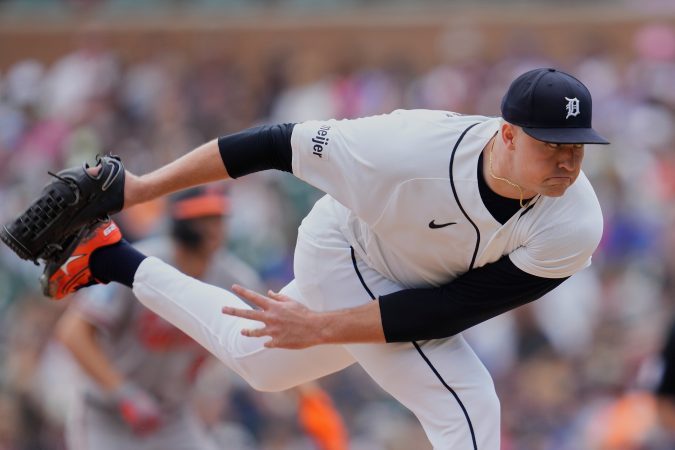
Nobody wants to admit it, but the Dodgers deserve Tarik Skubal. They landed him the old fashioned way. They drafted, developed, traded, and signed their way to a circumstance where they could trade a highly valued outfield prospect for three months of service that will only pad their odds of completing a three-peat that they were favored to accomplish anyway.
That’s what you should focus on. The dignity of the deal. Not the Dodgers’ myriad other competitive advantages. The endless payroll. The creative accounting. The market size, location, and glitz. None of them matter as much as the fundamentals. The Dodgers are simply better at identifying and nurturing talent than any other organization. To focus on anything else is to give your own organization a pass.
They had four outfielders ranked among the 40 best prospects in the game, for crying out loud. Three of them were at double A already. Their big league outfield already includes young breakout star Andy Pages in center field and Kyle Tucker in right. Not only do they have high-end prospects that other teams want, they can afford to trade some of them. In fact, they almost have to trade some of them.
From 2021 through 2026, the Dodgers had 22 players appear on at least one of the major national Top 100 lists. The Phillies had eight during the same time span. Only two teams in the majors had fewer than the Phillies. Only three teams in the majors had more than the Dodgers.
General managers and scouting directors tend to roll their eyes any time they end up on the wrong side of the Top 100 math. These lists don’t come close to providing an expert-level understanding of a team’s farm system. They are prone to politics and groupthink and statistics without context. All of which is true. But you can’t argue with the market.
The centerpiece of the Skubal trade is a good example of the Dodgers’ skill in this prospect thing. It’s also a good example of why it isn’t too early to expect more out of Dave Dombrowski’s farm system.
Let’s start at the beginning …
February 2020 — Dodgers acquire Mookie Betts for two top-50 prospects, neither of whom is Gavin Lux, who enters the season as a consensus top-five prospect.
January 2022 — Dodgers sign Dominican outfielder Josue De Paula for $400,000 in international bonus money.
March 2022 — Dodgers enter season with six Top 100 prospects, including Michael Busch. Dodgers initially drafted Busch at No. 31 in 2019, four picks after the Cubs took college pitcher Ryan Jensen.
January 2023 — Dodgers sign Venezuelan outfielder Eduardo Quintero for $297,500 in international bonus money.
January 2024 — Dodgers trade Busch to Cubs for Zyhir Hope in what was basically a prospect-for-prospect deal.
January 2025 — Dodgers trade Lux to Reds for outfielder Mike Sirota and a competitive balance pick, which they use on outfielder Charles Davalan.
January 2026 — Hope, Sirota, Quintero and De Paula all enter season as Top 100 prospects. Davalan is ranked as the No. 7 prospect in the Dodgers organization and a potential 2027 Top 100 prospect.
That’s a tidy snapshot of what makes the Dodgers the Dodgers. It isn’t just drafting and development. It’s knowing when to trade your own guys. It’s knowing who to trade for. It’s knowing how to spend international money. Look, a lot of those 22 Top 100 prospects have yet to turn into stars. Josiah Gray, Bobby Miller, Gavin Stone, and Keibert Ruiz are some of the names. But all it takes is one Pages or (potentially) Dalton Rushing to turn into a homegrown star.
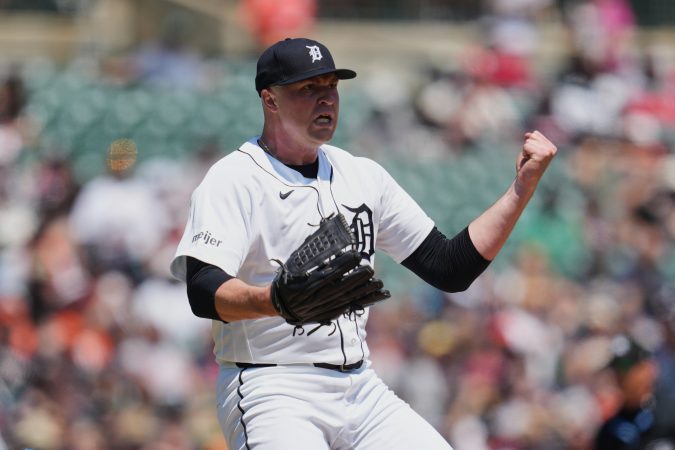
The Dodgers landed Tarik Skubal the old fashioned way.Paul Sancya
With one day to go before the MLB trade deadline, Phillies fans again are looking to a highly variable and often prohibitively expensive market to remedy roster holes that will never truly be solved without an adequate farm system. Imagine plugging someone like Pages into the lineup. Imagine if Andrew Painter had Justin Wrobleski’s pitching line. More often than not, trade deadlines are won and lost long before they arrive. The losers are the desperate teams. The winners are the ones who can outbid anybody but do not need to unless a game-changing deal comes around.
The Dodgers just struck such a deal. In adding Skubal, the two-time defending AL Cy Young winner, they have blunted the one competitive advantage the Phillies might have in a series. Even if Shohei Ohtani is unable to return to the mound this season, L.A. will still be able to go toe-to-toe in the first two games of a series.
Skubal vs. Cristopher Sánchez in Game 1.
Yoshinobu Yamamoto vs. Zack Wheeler in Game 2.
Beyond that, the Dodgers could have some combination of Wrobleski, former AL Cy Young winner Blake Snell, and 2025 postseason standout Tyler Glasnow, the latter two of whom are expected to rejoin the rotation off the IL in the near future. Plus, whatever they can get out of Ohtani, another former Cy Young winner.
The Dodgers’ big league depth is overwhelming. Their payroll has a lot to do with that. But a big payroll is no match for elite-level decision-making. Right now, that’s the Dodgers’ greatest competitive advantage.
Tracy Chapman’s “Fast Car,” a ballad about a dead-end life, made the Billboard Hot 100 twice, nearly 40 years apart. As a doctor, I’m not surprised. “Fast Car” is about someone trying desperately to move up in life even as obstacles mount — bleak job, insufficient finances, family obligations, and increasing isolation. The song endures because it validates the experience of millions of Americans.
I hear versions of “Fast Car” every time I set foot in the hospital as a general internist. My patients tell me stories about how, no matter how hard they work, the path to a better future slips farther away. It inevitably comes up as the reason they feel sick. My patients even have a name for their condition: they feel stuck.
The more I listened, the more I realized this wasn’t just an individual problem. We’ve reached our 250th anniversary as a stuck country.
I’ve been documenting what our research group has come to call “stuckness” for a decade. It’s more than poverty, loneliness, or a lack of opportunity. Stuckness emerges when real barriers in our jobs, finances, relationships, health, neighborhoods, and politics coalesce to keep people from having a real shot at success and happiness. It is a feeling and a reality that reinforce each other, robbing us of hope, generating chronic stress, and making it harder to move forward.
As one young man, stuck with dwindling job prospects, mounting debt, and few close relationships, said: “I’m not hopeful. I may not make it past the age of 35 if things continue this way.”
My patients are right to identify stuckness as the biggest threat to their health. Yet, our country hasn’t found effective ways to fix it. Part of the issue is that when people tell us they are stuck, we believe it can be solved by self-help books, a positive attitude, or the latest wellness fad.
The bigger issue is that we haven’t really understood the problem.
My colleagues and I at the research nonprofit Opportunity for Health decided to change that. In a recent survey, we asked working-age adults across America whether they felt stuck. We found that more than one in five respondents — representing about 40 million adults — strongly felt stuck. Nearly half of the people taking our survey felt at least somewhat stuck. Stuckness was most common among lower-income Americans, but one out of 10 of the richest or most educated Americans felt stuck, too.
Respondents got stuck because of job or financial challenges, worsening conditions in their neighborhood, social isolation or fraying relationships, or because of a sudden illness or disability. Once any one of these challenges set in, others quickly piled on.
A health problem leads to lost work, creating financial strain that weakens relationships, and the resulting hopelessness and stress further damage health. That cycle helps explain why people who felt strongly stuck were five times more likely to report being in poor health than those who didn’t feel stuck at all.
While our survey covers only a single year — no one had bothered to ask about it before — other data show that stuckness has grown over time.
That tracks with what I hear from my patients. The likelihood that low-income Americans can move up the economic ladder has fallen since at least the 1980s. So has the share of Americans who are able to leave neighborhoods that aren’t working for them in search of new opportunities.
Using economic survey data, the fraction of working-age Americans facing multiple challenges — whether unemployment, a work-limiting disability, low household income, social isolation, or being moored in place — rose from 14% in the late 1980s to 24% today, writes Atheendar S. Venkataramani.Lynne Sladky
Based on my calculations using economic survey data, the fraction of working-age Americans facing multiple challenges — whether unemployment, a work-limiting disability, low household income, social isolation, or being moored in place — rose from 14% in the late 1980s to 24% today.
Stuckness also shows up more often in our culture. In the more than three decades bookending the appearances of “Fast Car” on the Billboard Hot 100, the share of songs mentioning feeling stuck rose from one out of every 100 to one out of every 20 — and that doesn’t include Chapman’s hit or other songs by Bruce Springsteen or Garth Brooks that describe stuckness without using the term.
It is not a coincidence that the rise in stuckness coincides with our flatlining life expectancy. We are getting sicker despite the trillions of dollars we throw at healthcare. My patients wouldn’t find that surprising: they aren’t asking for more medicines or tests. They just want to get unstuck.
Because stuckness arises from a cascade of factors, solutions must do two things: prevent people from falling into those slumps and help them escape when they do.
That means ensuring that work once again provides a pathway to security through fair wages, ample opportunities to develop new skills, and ensuring that new technologies like AI expand rather than replace human potential.
It means investing in communities that have been left behind, building up local economic capacity and infrastructure so that every corner of America has the basic tools for people to thrive.
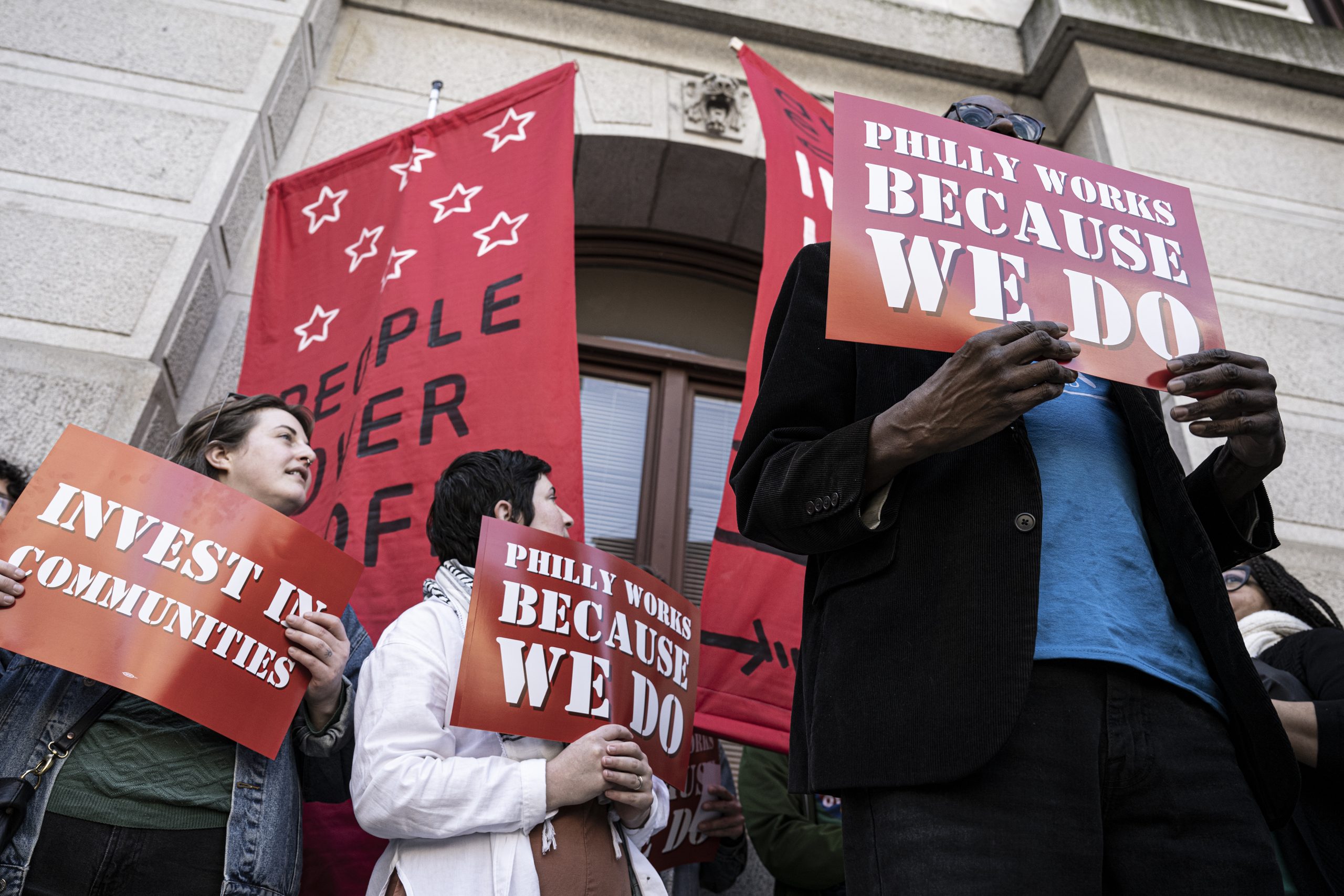
Because stuckness arises from a cascade of factors, solutions must include investing in communities that have been left behind and building up local economic capacity and infrastructure, writes Atheendar S. Venkataramani.Jose F. Moreno / Staff Photographer
It means making healthcare, childcare, paid family leave, and other basic supports reliable foundations that keep temporary setbacks from becoming permanent ones.
Finally, we shouldn’t ignore growing concerns about affordability or the economy. We shouldn’t make it harder for people to access safety net programs like Medicaid and the Supplemental Nutrition Assistance Program (SNAP), as the administration is now doing, because they can help our neighbors escape stuckness.
And we shouldn’t make it harder for people to weigh in at the ballot box to seek the wider changes that will improve their lives on how to get their communities unstuck.
The solutions to stuckness will vary across regions. We will need to argue productively, try, fail, and try again to get it right. One of the most shocking findings from my team’s research is that stuckness touches us all: even richer Americans are less healthy when people in their communities get stuck. There’s a reason for that. When millions get stuck, we collectively become less productive, angrier, and more divided.
Now that our country has turned 250, we face a critical choice. We can keep pouring resources into treating the consequences of stuckness or we can confront its causes.
My patients already understand this distinction. They know that what makes them sick is not simply a disease. It is the growing feeling that no matter how hard they try, their future remains limited and bleak. If we want a healthier America, we need to build a country where effort once again leads somewhere.
Atheendar S. Venkataramani is a physician and professor of medical ethics and health policy at the University of Pennsylvania. He is the founding director of Opportunity for Health and is a senior fellow at the Penn Leonard Davis Institute of Health Economics.
WEST SACRAMENTO, Calif. — The Los Angeles Dodgers have acquired the biggest prize on the trade deadline market, getting two-time reigning AL Cy Young Award winner Tarik Skubal from the Detroit Tigers on Saturday night.
Skubal got the news during the Tigers’ 8-6 win over the Athletics and was emotional after the game as he prepared to leave the team that drafted him in 2018 and developed him into a star to join the two-time defending World Series champions.
“I’m excited to be a Dodger,” he said. ”I’m excited to get down there and meet all those guys and chase three championships in a row. That’s hard to do, so I’m so excited to a part of that. But it’s a lot of different emotions. Definitely kind of a roller coaster a little bit.”
Skubal is the latest star to join the high-priced roster for the Dodgers that already has big-name players like Shohei Ohtani, Yoshinobu Yamamoto and Mookie Betts. If everyone is healthy, he could be part of a rotation with Ohtani, reigning World Series MVP Yamamoto, fellow two-time Cy Young Award winner Blake Snell and Tyler Glasnow. The Dodgers lead the majors with a 3.36 ERA from their starting pitchers and now add Skubal to the mix.
The Dodgers are in first place in the NL West and were already the favorites to become the first team to three-peat since the New York Yankees from 1998-2000 before adding Skubal. They began the season with a $323.3 million opening-day payroll for their 40-man roster and a $163.7 million tax for a $487.1 million total. They will pay Skubal about $9.5 million for the remainder of the season.
ESPN first reported the deal and said the Tigers would receive three minor league prospects in right-handers River Ryan and Brady Smith and outfielder Zyhir Hope.
Skubal is eligible for free agency after the World Series. He has a $32 million salary, a record total in arbitration, after the team offered $19 million, and is expected to sign a massive contract in the offseason.
The 29-year-old lefty said in July that it was his preference to finish the season with the Tigers and to compete for a World Series championship, which has eluded the franchise since 1984. Skubal took the loss in the decisive Game 5 of the division series against Cleveland in 2024 and then got a no-decision in a 15-inning loss to Seattle in Game 5 of the division series last year.
He said it was “very tough” to leave the Tigers having fallen short of the goal of winning a title.
“Ever since that ’24 Game 5, the failure that I experienced on the mound, I’ve used that as fuel to try and bring a World Series to the city of Detroit. I truly did,” he said. “That whole offseason I’ve never been more motivated and then go in and we lose Game 5 again. That failure kind of sparks some more motivation, just to dig deeper and see how good you can truly be. The goal was always to win a World Series for the city, for the organization that took a chance on me. It’s tough. I love all those guys in there. They’re some of my best friends.”
Detroit planned to contend again this season, bolstering the Skubal-led rotation by giving two-time All-Star pitcher Framber Valdez a $115 million, three-year contract in free agency and retaining three-time All-Star infielder Gleyber Torres with a $22 million deal.
The Tigers, though, got off to a rough start and are currently 2½ games out of the last wild-card spot in the American League.
“It’s crazy. Going into the season, this isn’t what I planned on doing,” Skubal said. “But circumstances change, situations change, and I’m very appreciative of everything the Tigers have done for me.”
They bounced back in June and most of July to get into playoff contention with Skubal leading a rotation and three All-Stars in the lineup: rookie infielder and Delco native Kevin McGonigle, catcher Dillon Dingler and outfielder Riley Greene.
With a chance to possibly persuade management to keep Skubal by improving its playoff positioning, Detroit lost ground by dropping four of its last five games at home, including Skubal’s last start that was made even more memorable by a late-inning collapse.
The Tigers led Baltimore 7-0 after six innings Wednesday and lost 10-9 in 12 innings. Skubal started the game, recorded his 1,000th career strikeout and was cheered at every opportunity by a crowd of 34,406.
“I’ve watched this guy rise to the top of the sport,” manager A.J. Hinch said. “He’s carried us a lot. I’ll forever be grateful that our paths crossed and the things that he did for this organization and for a couple of playoff teams. His presence, his work ethic, his example, his dominance. There’s so much to go through, it’s hard to capture in one quote or kind of one setting. But I’m very grateful that I was able to manage him for the time that I did.”
Skubal is 7-5 this season with a 2.79 ERA and 116 strikeouts in 96⅔ innings. He is 61-42 with a 3.04 ERA over seven seasons, all in Detroit. In two postseasons, Skubal is 2-1 with a 2.04 ERA in six starts.
Skubal had a minimally invasive surgery on May 6 to remove a loose body from his pitching elbow and returned to pitch on June 13.
“The way the surgery went is exactly how it was supposed to go,” he said in July.
Philadelphia restaurants Hiroki, La Calaca Feliz, and the Lodge by Two Robbers have announced their departures in the last week.
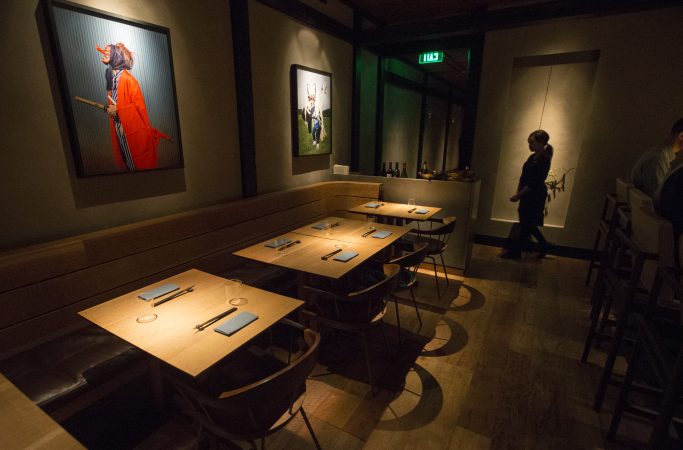
The latest announcement was Hiroki, sushi chef Hiroki Fujiyama’s serene omakase room behind Wm. Mulherin’s Sons in Fishtown, which posted Friday that Aug. 8 would be its last service.
In an interview with The Inquirer, David Grasso, a principal in owner Method Co., called the closing “a strategic repositioning rather than a retreat from fine dining” and added that the decision was driven by a desire to stay ahead of customer preferences and culinary trends, not by problems with the restaurant or a broader pullback from fine dining. Method is planning to open a new concept — so far undetermined — in the space on Lee Street next year.
Method also has several new fine-dining concepts planned for other markets. Fujiyama, former head sushi chef at Morimoto, remains involved with Method, including a Detroit project called Hiroki-San, Grasso said.
La Calaca Feliz’s last day at 2321 Fairmount Ave. in Fairmount was Saturday. Owner Brian Sirhal, who opened the Mexican cantina 15 years ago with fellow Garces alumnus Tim Spinner, said its lease expired. Sirhal owns Cantina Feliz in Ambler, while Spinner’s holdings are Taqueria Amor and Riptide Tavern, side by side in Manayunk.
The Lodge by Two Robbers Spirits Co. is the second tasting room/restaurant concept from the Philadelphia-based hard seltzer-turned-vodka soda maker.Jenn Ladd / Staff
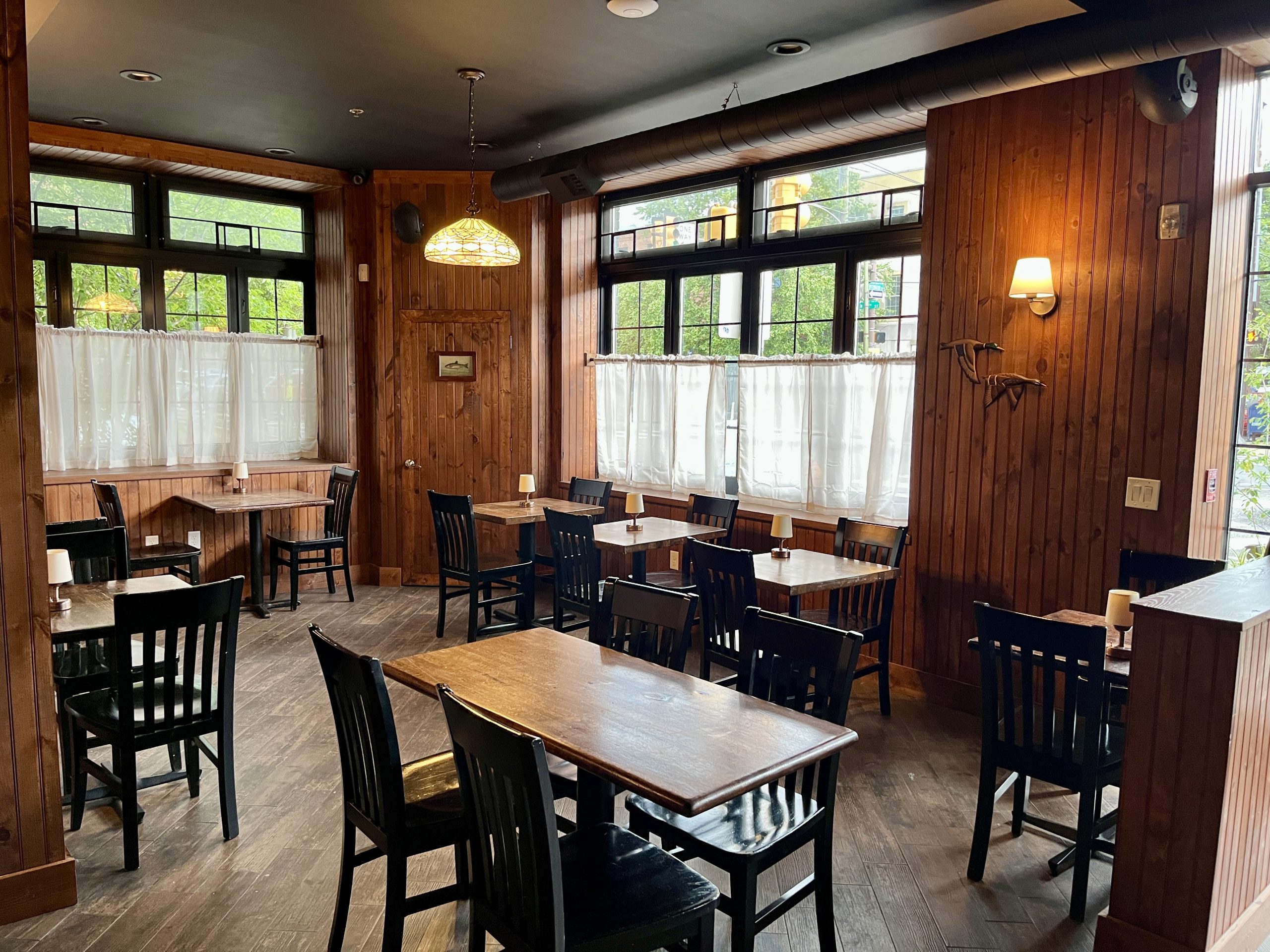
The Lodge, the Bella Vista offshoot of Fishtown’s Two Robbers at 11th and Fitzwater Streets, announced on social media Thursday that its last call would be Aug. 9 after barely a year. The post said it would operate as a pop-up and private-event space “for a period of time.” Vivek Nayar, who founded Two Robbers as a hard-seltzer business with his twin brother, Vikram, said they decided to focus on scaling their wholesale beverage line and running their Fishtown location.
These closings do not necessarily point to an industry in retreat. More often, such changes reflect the constant reshuffling of a business in which closures and openings tend to move in tandem. Many of these addresses already have suitors or redevelopment plans, and there is never a shortage of projects in the pipeline.
Latin mainstay Mixto in Washington Square West closed July 12 after 24 years. Lori Penrose, owner of the former South Philadelphia sports bar Toll Man Joe’s, purchased the property at 1141 Pine St. She hopes it will open in late August.
Besides falafel, Goldie is known for tehina shakes.TIM TAI / Staff Photographer
Four Center City Federal Donuts & Chicken locations and three Goldie falafel eateries are bowing out, as founders Michael Solomonov and Steve Cook announced July 14. In the city, only the FedNuts shop at Seventh Street and Fairmount Avenue remains, as well as the Goldie at 1911 Sansom St.
Pita Pocket Eatery in Cheltenham Village wrapped a 15-year run on July 23.
The Langhorne Hotel, a landmark bar and restaurant in Langhorne Borough, closed July 18 after 54 years under the Asta family. New owners Joe and Megan Kontz told the Bucks County Courier Times that they plan to spruce it up, change the name to honor the town’s original name (Four Lanes End), and open late this year.
A series of chain restaurants have shut down recently, including the Perkins in Drexel Hill, the Cracker Barrel in Downingtown, the Miller’s Ale House in Springfield, Delaware County, and the Brio Italian Grille locations in Marlton and Cherry Hill.
Good morning. Showers are expected throughout the day.
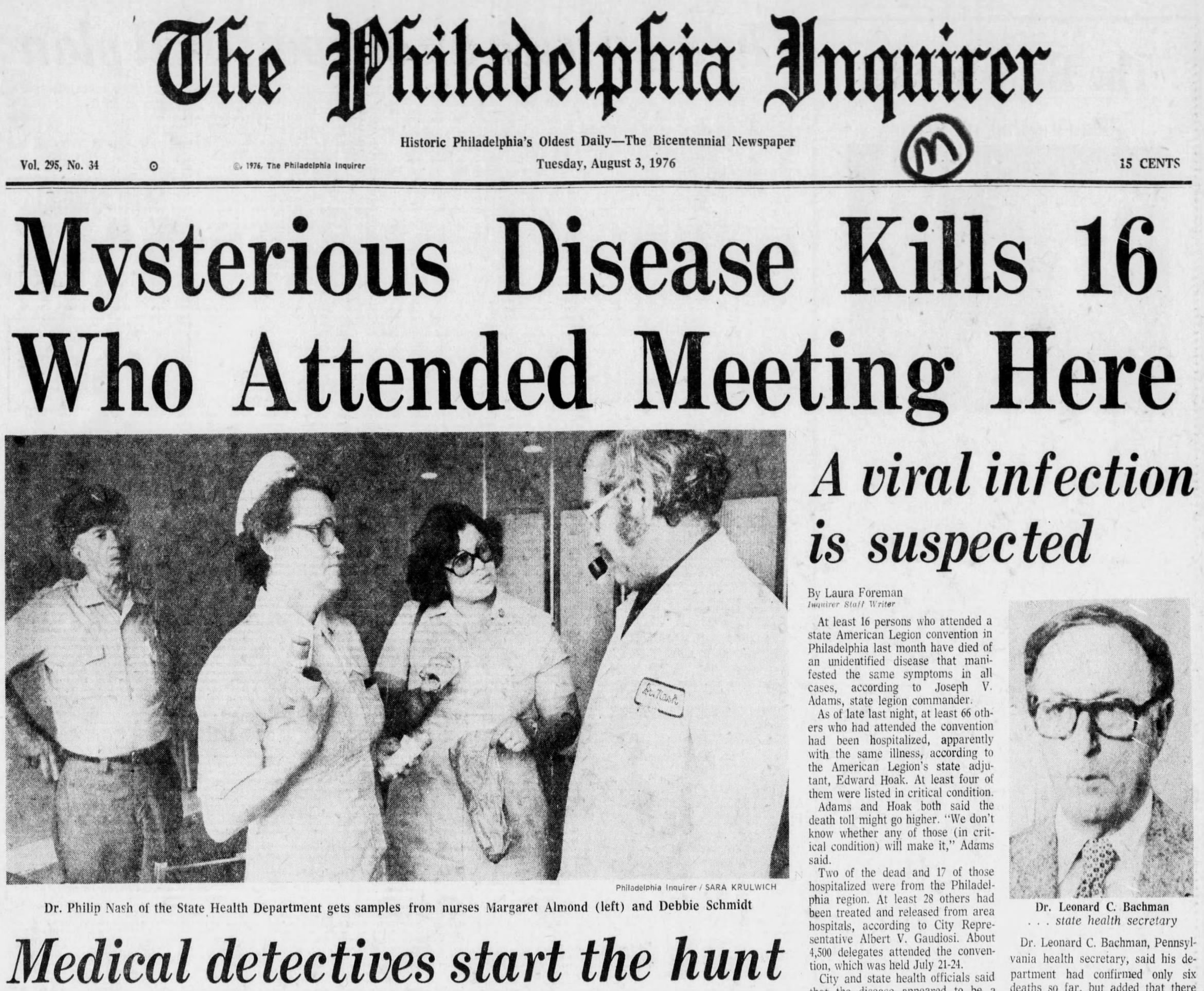
Fifty years ago, a deadly disease at a Philly convention stumped health officials. We go back in time to explore the infamous outbreak, and how it got its name here.
But first, our main Sunday read is about a pornographer’s obsession and criminal past blurring fact and fiction in the mystery surrounding missing women.
Note: This article covers sensitive topics, including drug use and violence against women.
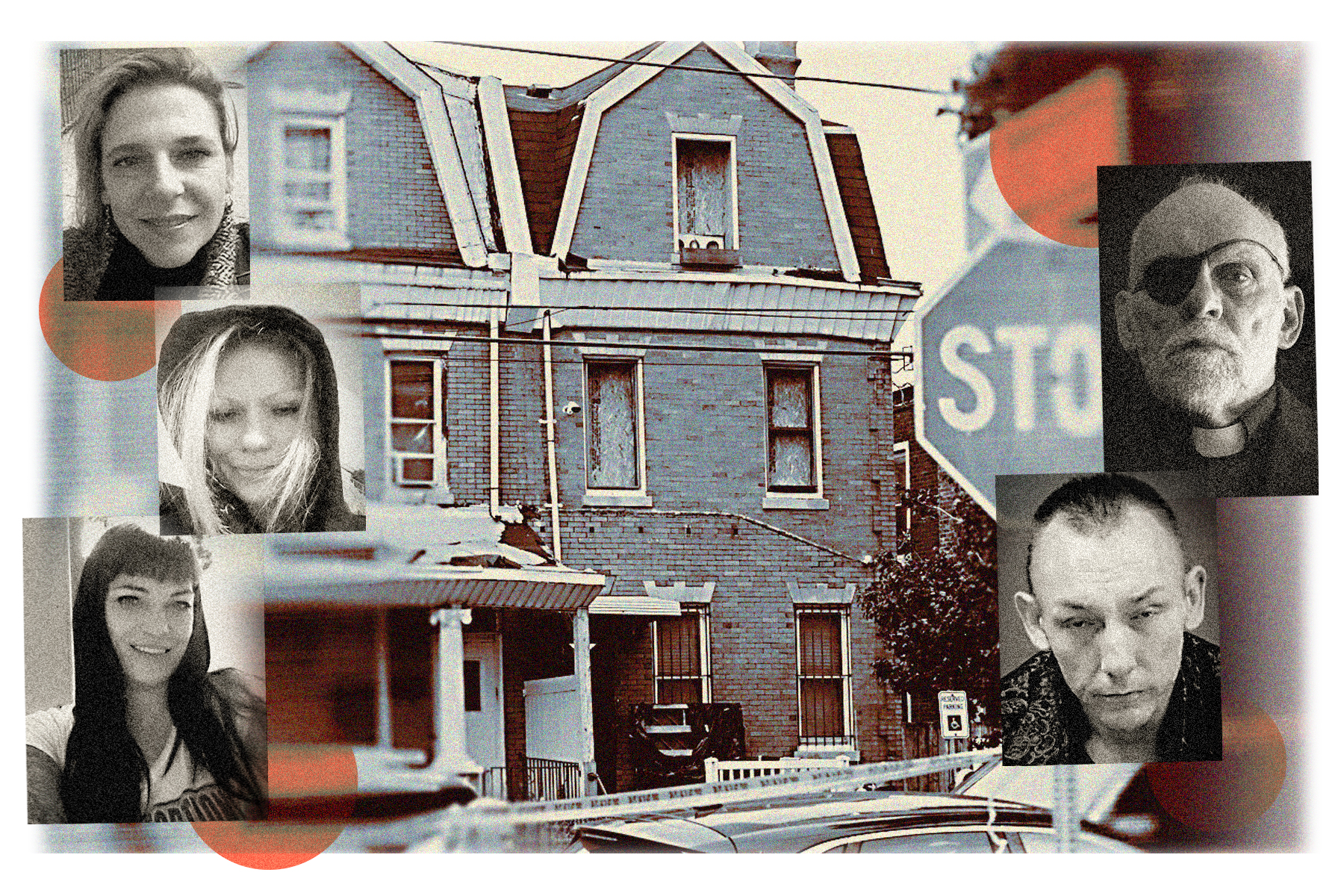
In June, a three-story brick twin on a quiet residential street in Olney became the center of a sprawling investigation into the disappearance of at least two women.
The property, owned by Raymond “R.C.” Horsch, has been scoured by hazmat teams and excavation crews looking for clues. Still, key questions remain, and other developments have raised concern about the fates of the missing women.
An Inquirer review of court records and other documents traces the people and events connected to the home, along with dozens of interviews.
In July 1976, thousands of American Legion members gathered at Philadelphia’s Bellevue-Stratford Hotel for a convention.
Weeks later, dozens would die and others turned gravely ill.
For months, officials couldn’t identify the cause. Fear, paranoia, and frustration spread here and nationwide. Inquirer readers at the time thought everything from pigeon droppings to contaminated ice could have been responsible.
Today, we now know the culprit as Legionnaires’ disease. Caused by Legionella pneumophila bacteria, it has more recently reemerged in a Manhattan outbreak that has claimed at least seven lives.
Police are searching for a man who fired a gun inside a Walmart store in Delaware County, wounding an employee.
Resident physicians at Temple and Jefferson hospitals have ratified their first contracts with their health systems after voting to unionize last year.
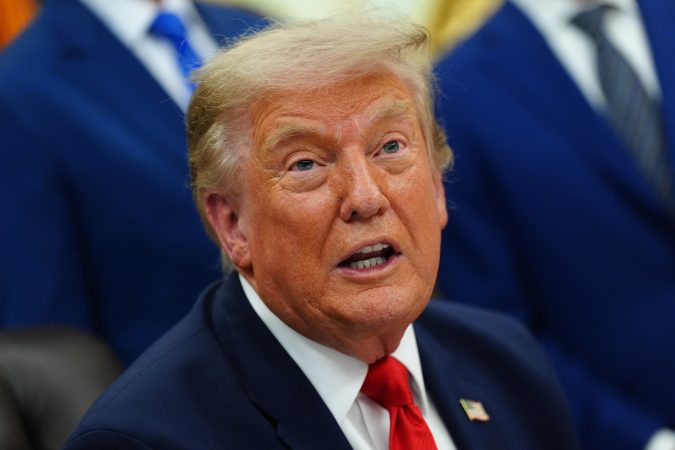
President Donald Trump denied New Jersey’s request for federal disaster aid. Sen. Andy Kim said he’s concerned about the possible politics behind the decision.
The fate of an assistant Delco fire chief accused of hurling racist threats at a woman during a tense confrontation in 2024 is now in the hands of a judge.
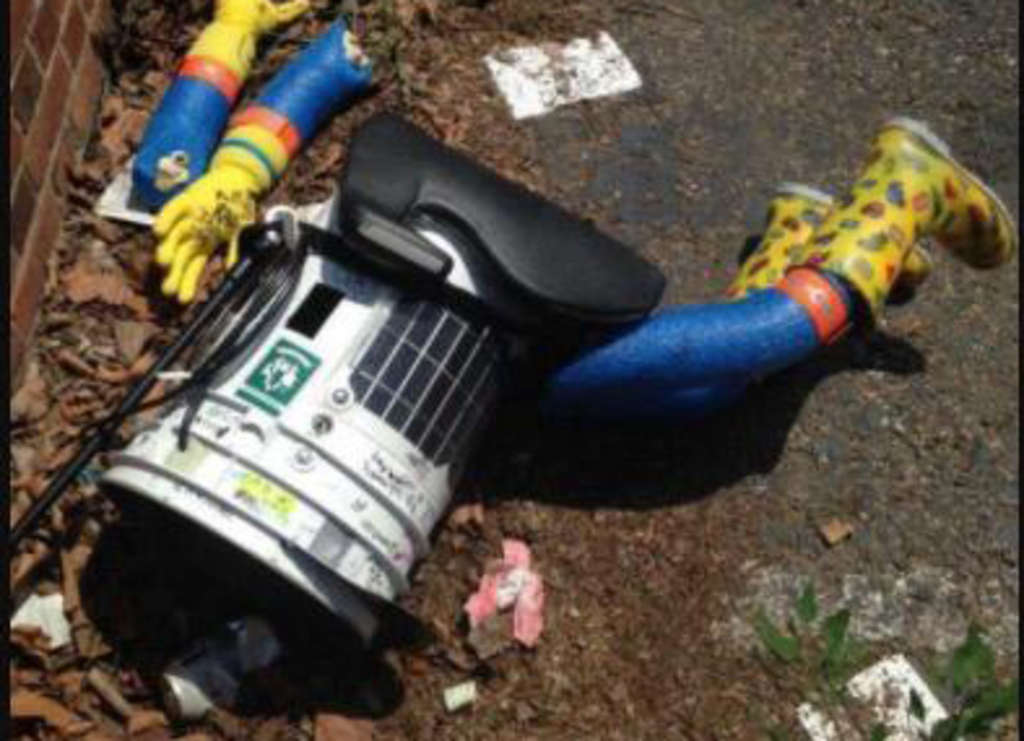
🎤 Here’s Tommy Rowan with a look back at the saga of hitchBOT’s decapitation.
To try and better understand human-robot relationships, Canadian researchers in the mid-2010s birthed a child-size figure with robotlike qualities and sent him out into the word.
He was carried across the Northeast by the kindness of strangers who were kept up to date through social media posts. Nicknamed hitchBOT, the oddity developed quite a following, moving through the Netherlands, Germany, and Canada.
When he hit the United States, he safely crossed through the northeastern part of the country over a two-week span.
Cheers to Timah Jay, who correctly guessed Saturday’s answer: Quakertown. A local Quaker school closed with little warning after four decades in Bucks County. Parents say they’re still waiting for thousands in tuition refunds.
Photo of the day
A pedestrian is about to cross a bike lane in Philadelphia while a cyclist passes through.Aidan T. Gallo / Staff Photographer
🎶 In memory of French electronic DJ and producer Kavinsky, today’s song goes like this: “I’m giving you a night call to tell you how I feel.”
One more musical thing: Oscar-winning Irish singer Glen Hansard also died last week. He loved coming to Philly, where he worked on an album for a year and shoveled snow for the first time.
👋🏽 Have a great Sunday.
By submitting your written, visual, and/or audio contributions, you agree to The Inquirer’s Terms of Use, including the grant of rights in Section 10.
A casual observer might believe Donald Trump when he says he doesn’t care about the coming midterm elections. Based on the historical record, the president’s basement-dwelling approval rating alone should dismay Republicans on Capitol Hill, and yet he is taking none of the usual steps to shore up his party’s prospects.
But Trump’s midterm strategy, like his broader political philosophy, is one of subtraction, not addition. Rather than persuade Americans to vote for his fellow Republicans, he prefers to stop people from voting against them. In terms of the effort to suppress rather than win votes, his campaign looks downright frenetic.
A key chokepoint of this block-the-vote strategy is the mail, controlled as it is by the federal government. Despite taking advantage of the convenience himself as recently as last spring, Trump has been menacing mailed ballots since his botched COVID-19 response helped dramatically boost remote voting. He continued to do so Monday, when his administration petitioned the Supreme Court to let the U.S. Postal Service assume the novel duty of not delivering mail, namely ballots that tend to favor Democrats.
At issue is his executive order directing the U.S. Department of Homeland Security to compile lists of citizens eligible to vote in each state, to be used by postal officials to interfere with the election. The Justice Department has demanded voter data from all the states under the order, leading to continuing legal disputes with many of them. Ruling on a lawsuit by Pennsylvania, New Jersey, and 20 other states in June, a federal court in Massachusetts blocked the order; recently, an appellate court agreed. As U.S. District Judge Indira Talwani noted persuasively, “the Constitution does not grant the president any specific powers over elections.”
Administration lawyers nevertheless filed an emergency appeal with the Supreme Court, and who can blame them for trying? The high court’s conservative majority has rescued Trump from accountability for the plot against the 2020 election, taken a jackhammer to the political independence of agencies such as the Postal Service, and enabled states to eliminate districts that are mostly made up of people of color, which tend to lean Democratic.
Last month, however, the court surprised many observers by narrowly upholding laws in Mississippi and many other states allowing ballots postmarked by Election Day to be counted even if they are delivered subsequently. Should a majority of the justices make another relatively rare decision to side with the Constitution over the president in the latest mail-in ballot case, the administration has other antidemocratic endeavors in the works.
Even if the Postal Service is prevented from actively targeting ballots, underfunding and consolidation of services could slow their postmarking and delivery to the point of ineligibility. Officials in California believe the agency’s glacial processing may have contributed to the disenfranchisement of nearly 150,000 voters in last spring’s primary election.
Trump has also been browbeating Republican senators for months over legislation known as the SAVE America Act, which would require a passport or birth certificate to vote — documents that tens of millions of Americans don’t have at hand. Trump has held up reauthorization of intelligence authorities, refused to sign bipartisan housing legislation, and demanded that the Senate kill the filibuster and cancel its August recess to pass the bill. Majority Leader John Thune’s consistent answer has been that Senate Republicans don’t — ironically enough — have the votes.
The administration can likely be counted on to resort to more jackbooted tactics as the election approaches. Trump has suggested he would be willing to send federal troops and agents to the polls to intimidate voters in violation of federal law. His record of using federal forces against Democratic-leaning states and cities is already extensive.
Even the successful completion of a free and fair election won’t necessarily be the end of Trump’s efforts to undermine it, as we learned when he tried to reverse a result at the expense of millions of voters in Pennsylvania and other battleground states six years ago. In his recent primetime address, the president was still harping on his 2020 loss — which his new national intelligence director just refused to acknowledge — while laying the groundwork for future interference.
These tactics failed then, however, and robust public participation and vigilance can ensure that they do so again. The administration’s conspiracy against the election shows Trump still fears the will of the people. He should.
Elected officials in Tredyffrin Township are moving ahead on turning an eyesore property into a park featuring tennis and pickleball, fulfilling a campaign promise of the chairperson’s. But some residents are worried the costs have soared too high.
What started as a project this year rehabbing the dilapidated Chase Road Park for roughly $725,000 in its first year, with more funding to come in later years, instead grew to $1.7 million this fiscal year. All said and done, it is likely to exceed $2 million, officials have said.
The jump in cost came with sticker shock for some residents, who have worried the township is sinking too much money into the park, and is doing so without sufficient public involvement.
“In my opinion, they should go back to the drawing board, because this whole thing is a way greater cost and scope than had ever been contemplated,” said Mike Heaberg, a resident who previously served as a board member.
Township officials argue it’s an investment for community amenities that flush reserves can cover.
“[The] $1.7 million to get a full five-acre park with all the courts and bathrooms and a big barn, … it’s not a bad deal if you think objectively about what we’re doing there,” said board chairperson David Miller.
The land
Located in Chesterbrook, Chase Road Park had a former life as a private swim club, with tennis courts and a popular parking lot basketball hoop that drew a crowd after hours. Almost a decade ago, its owner sold the park to a developer, who wanted to reimagine the five-acre parcel into housing. That wasn’t a popular plan, however, and the township rejected the request to change the zoning.
Miller said the community was “overwhelmingly supportive” of the decision; he recalls meetings about the prospect being standing room only, with a majority in favor of the board’s decision.
The township’s eminent domain is still in the courts, where it could play out for years. The final price tag could be higher than that initial down payment, depending on a judge’s ruling.
The plan
Early into acquiring the property, the township discussed turning it into a long-requested racquet sports center, for which it was already outfitted. The park’s future surfaced at a series of Parks and Recreation board meetings in 2025 and 2026, and some tweaks were made along the way.
Under the current project plan, the park will offer four tennis courts, six pickleball courts, a bathroom building, and a storage barn. There will be a pavilion and a grassy area for community use.
Further down the line — and currently tabled while the board mulls it over — will be a basketball court, most likely a half court. The board is also considering adding a path and bridge to connect this park with nearby Wilson Park. Those would come with additional costs.
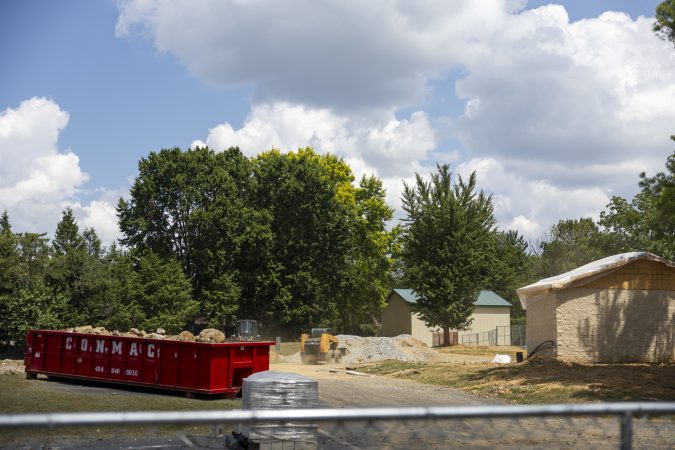
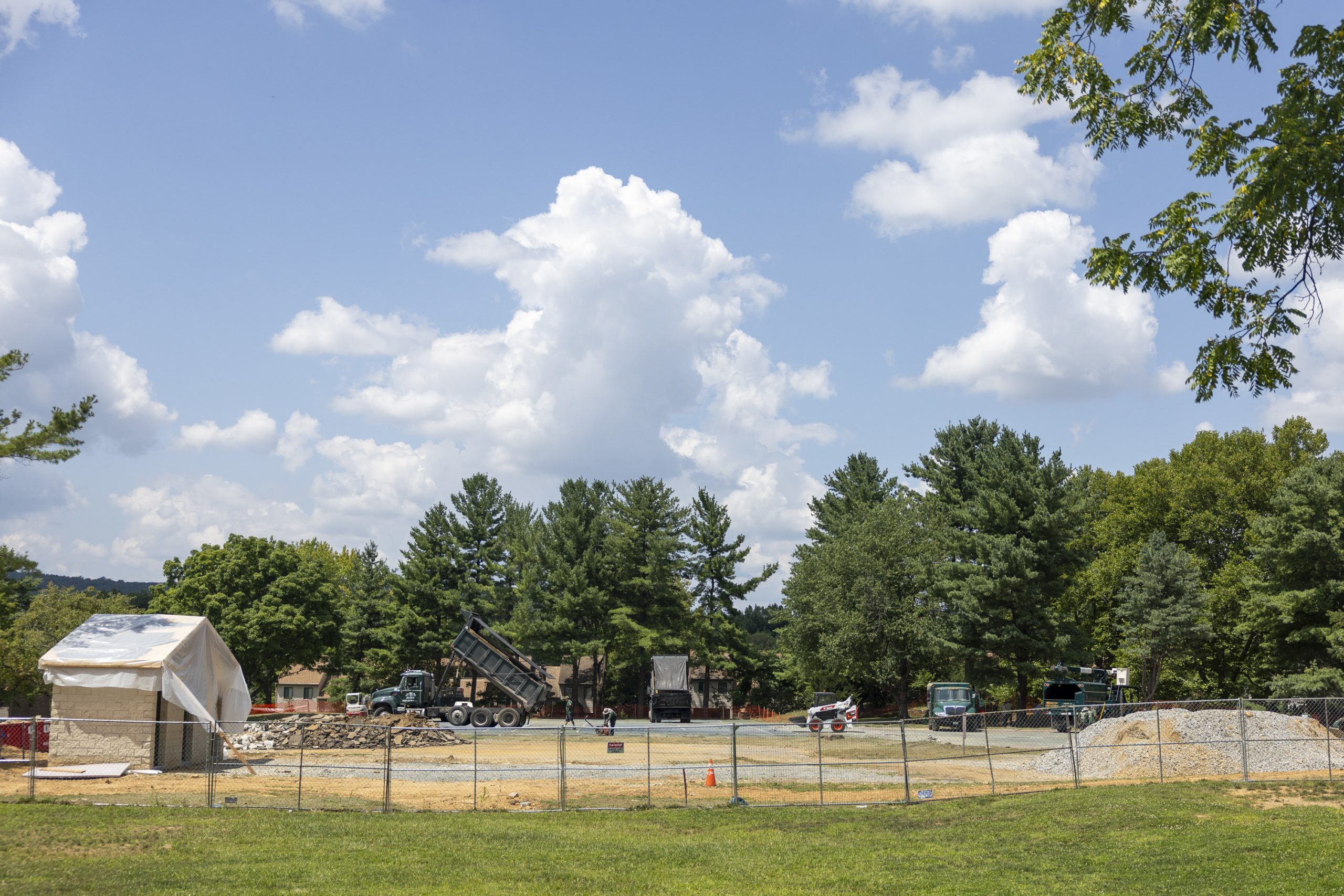
Construction site at Chase Road Park in Tredyffrin Township. The park has been sitting vacant and deteriorating for roughly a decade in Chesterbrook, Pa., on Friday, July 31, 2026.Tyger Williams / Staff Photographer
Township staff found that it was more cost effective to do a bulk of the work in one year, Miller said, so they decided to speed up the process, hence that initial jump.
Then, at their May meeting, the board added a late agenda item to green light spending about $1.7 million to fix up the park — including the courts, fencing, the parking lot, constructing the barn and restroom facilities, a pavilion, and other “miscellaneous” work.
In total, the township estimates it will spend at least $2.3 million on the park, including the initial $625,000 to take it by eminent domain, and the upgrades.
That increase boiled down to a variety of reasons, Miller said. The condition of the courts was “not what we expected,” and they needed to be completely redone. The township decided to install a better fence, with sound-dampening material to snuff out the bouncing of pickleballs, which needed to be installed deeper into the ground than the previous posts. The bathroom building was “vandalized pretty heavily,” so they decided to knock it down and start over. Plus, “prices are higher” for materials like asphalt, he said.
“There’s a bunch of things like that that get it to creep,” he said.
Miller said the park will be paid for out of the regular operating budget; whatever doesn’t come out of normal tax revenue will come out of the general fund, which sits at about $18 million, he said.
The concerns
Heaberg, the former supervisor, told the board his “jaw was hanging open” when saw them approve the budget change for more than $1.7 million with no discussion.
“It blows my mind, really,” he said.
Speaking to the board in July, resident Carol Clarke didn’t “know how you can, in a meeting, go past the budget by more than a million dollars.”
“I think you owe it to the taxpayers to acknowledge what you’re doing, and maybe the taxpayers might have said, ‘Whoa, is this an appropriate use of our funds? Could we be doing something else?’” she told them. “I support the park, but maybe it would have been an idea of, ‘Well, let’s get the funding in place, etc., and then we can add on to the park.’ … There’s good things that are being done, but is that a wise use of our funds?”
Plus, the township’s use of the COSTARS, a program that allows local governments to purchase supplies and services through state-managed contracts, seemed problematic to resident Ray Clarke, who argued the project should have been competitively bid, citing the township’s charter.
“All projects must be competitively bid, with exception of a few things into which this does not fall,” he told the board, noting that “all the sudden” a list was given by the same contractor who worked on nearby Wilson Farm Park, which was renovated in 2025 and 2026.
“Which may well be the lowest cost — who knows, we have no idea,” he said.
Miller disputed that reading, saying the township was within its rights to use the COSTARS program rather than request bids.
The pushback from residents has led to some charged moments in recent months.
Board member Carlotta Johnston-Pugh said she understood “the public is having a hissy fit because they don’t feel like they were involved. I understand that.”
“Because yes, if a million dollars or a $1.2 or $2 million is coming out of a general fund or a piggy bank, yes, everybody in this township should have a say in it. What do you want us to do? Do you want us to stop the project completely, go back to the drawing board?” she said. “… I’m getting a headache. I’m actually getting a headache.”
The park on Chase Road in Tredyffrin Township will offer tennis and pickleball courts, plus a bathroom building, pavilion and grassy recreation space. Construction is underway in Chesterbrook, Pa., on Friday, July 31, 2026.Tyger Williams / Staff Photographer
The flip side
The project isn’t without its supporters, however, arguing the board had been clear about the timeline and the scope.
“We went through 10 years of a derelict property in our neighborhood and we are grateful” the work isn’t being phased in, like previous plans discussed, said Joanna Fisher, of the Chesterbrook Civic Association.
Tim Connor, who lives near the park, said the alternative was dozens of townhouses, which would have been a negative for the community.
“Yes, it’s an investment right now, but long-term, those 50 townhouses would have had so many kids in the schools. It was a long-term loser. I think [this is a] better alternative,” he said.
And for Miller, the park has been a personal goal: He campaigned on it. The township is working with Miller, separately, for naming rights of the park which he’d purchase for $625,000 — the initial cost to purchase the land. (It would not be named for Miller himself, he said.)
Miller abstained from an initial vote in June OK’ing the township to draw up an agreement with the solicitor for naming rights. Miller said if someone else wanted to donate, he’d drop his bid, but he had the “capacity and willingness, and it’s important to me.”
“When I ran this time, I said I was going to get this park built. I got over 8,000 votes,” he said later. “It seemed like something I should do since I told people I’d get it done.”
This suburban content is produced with support from the Leslie Miller and Richard Worley Foundation and The Lenfest Institute for Journalism. Editorial content is created independently of the project donors. Gifts to support The Inquirer’s high-impact journalism can be made at inquirer.com/donate. A list of Lenfest Institute donors can be found at lenfestinstitute.org/supporters.
In 1866, the realist painter Thomas Eakins was in Paris studying at the École des Beaux-Arts. While there, he wrote to Emily Sartain, a family friend and artist who, from 1886 to 1920, would go on to become principal of what is now the Moore College of Art.
“I am proud to be a Philadelphian. … I feel 6 ft and 6 inches high whenever I only say I am an American,” he boasted.
It took some years before Philadelphia accepted and loved the artist back.
In 1870, Eakins returned to Philadelphia, where he began a career painting subjects of modern life in a straightforward manner without pretense or flourish. Establishing a studio at his family home on Mount Vernon Street, he hoped to find artistic success in Philadelphia.
But his first paintings received mixed reviews and found no buyers.
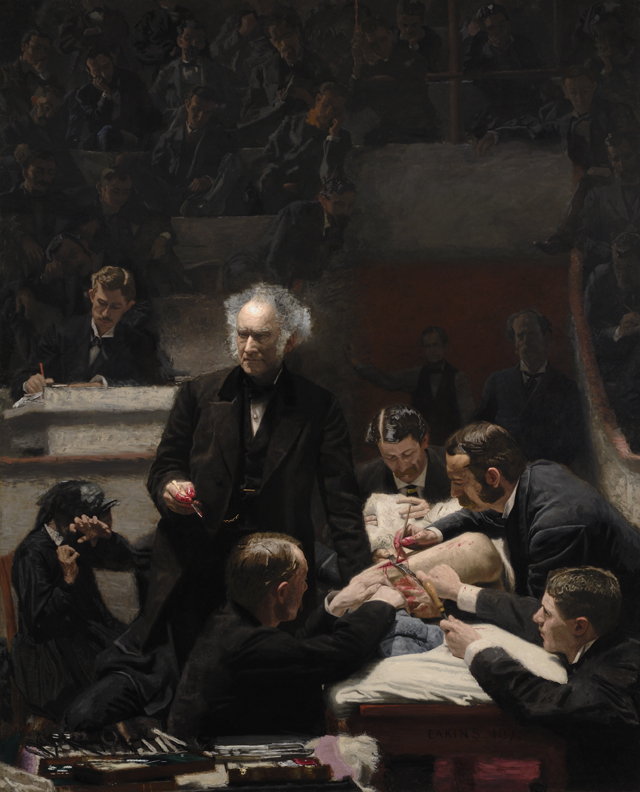
Thomas Eakins, “Portrait of Dr. Samuel D. Gross (The Gross Clinic),” 1875. Oil on canvas, 96 x 78 ½ in. Courtesy of the Pennsylvania Academy of the Fine Arts, Philadelphia. Gift of the Alumni Association to Jefferson Medical College in 1878 and purchased by the Pennsylvania Academy of the Fine Arts and the Philadelphia Museum of Art in 2007 with the generous support of more than 3,400 donors.Courtesy of the Pennsylvania Academy of the Fine Arts
‘The Gross Clinic’
In 1875, at age 30, Eakins began work on Portrait of Dr. Samuel D. Gross(The Gross Clinic), a noncommissioned oil painting of the eminent surgeon-teacher in clinical instruction at Jefferson Medical College, where Gross was chair of surgery from 1856 to 1882.
Drawing the nude model was a central aspect of academic art training, and students were required to attend lectures on anatomy and study animal and human cadavers in dissection labs. To better his scientific realism, Eakins attended surgical demonstrations and anatomy lectures at Jefferson, and often observed surgical demonstrations by Gross.
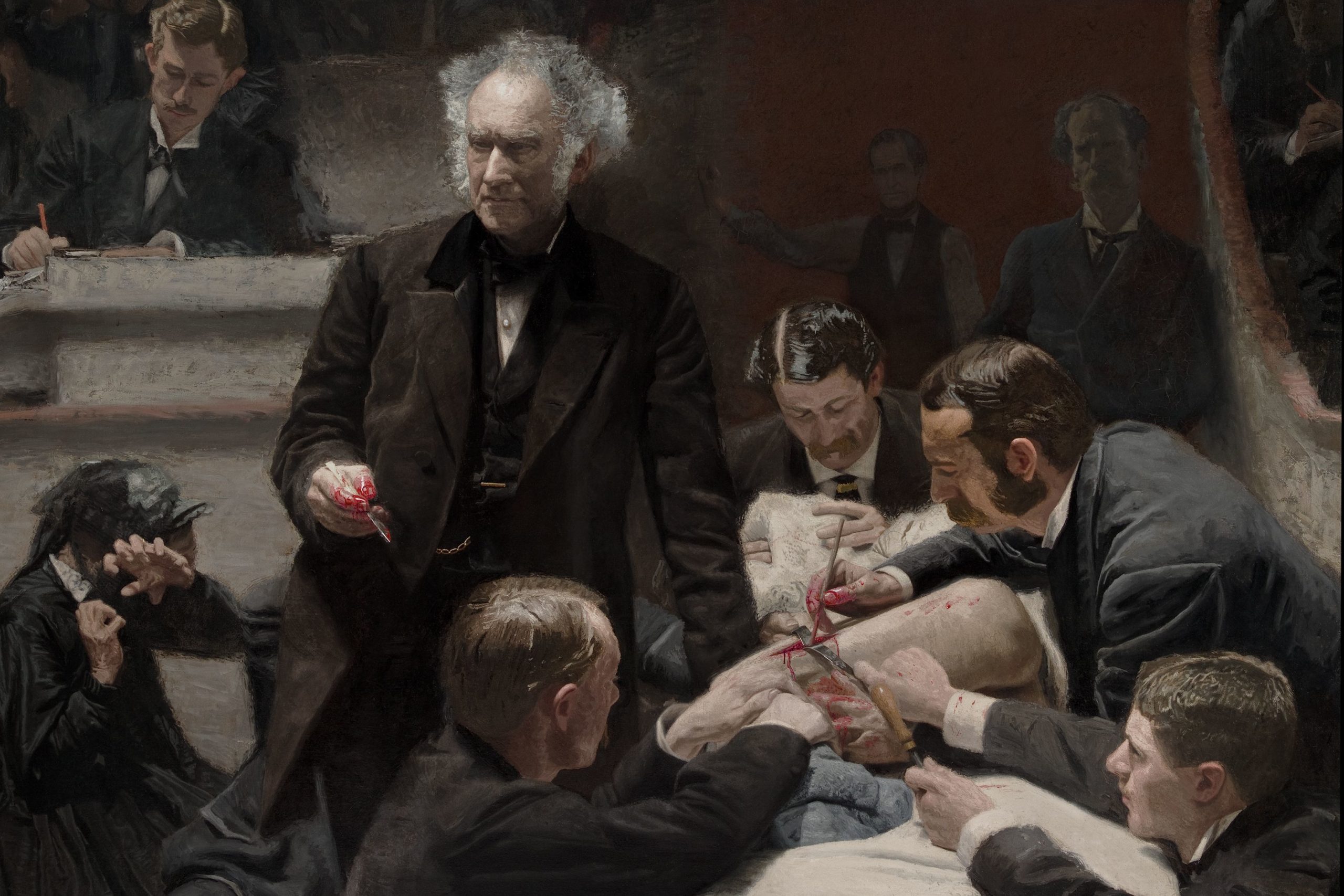
Detail from “The Gross Clinic” by Thomas Eakins. The painting was a gift of the alumni association to Jefferson Medical College in 1878 and purchased by the Pennsylvania Academy of the Fine Arts and the Philadelphia Museum of Art in 2007 with the support of more than 3,600 donors.Courtesy the Philadelphia Museum of Art and the Pennsylvania Academy of the Fine Arts
The Gross Clinic, the 8-by-6.5-foot large oil on canvas, shows Gross and his assistants operating in their street clothes worn with long coats. The surgical tools and bandages lie unprotected on a table in the lower foreground. (Germ theory of disease was yet to become an influential factor on medical practice in the United States.)
For this first clinic portrait, Eakins uses dramatic lighting that reflects off Gross’ forehead and his extended right hand. He holds a believably bloody scalpel, emphasizing how successful surgery requires intellect and manual dexterity.
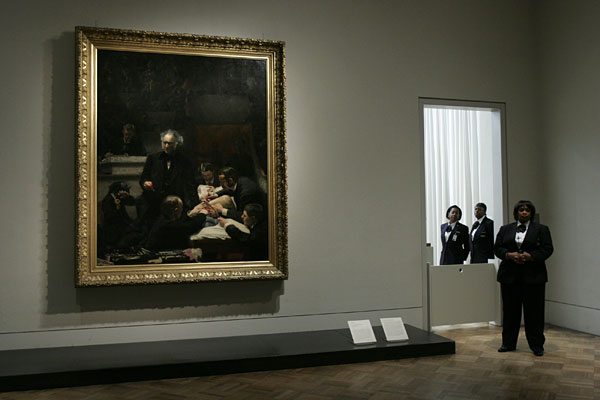
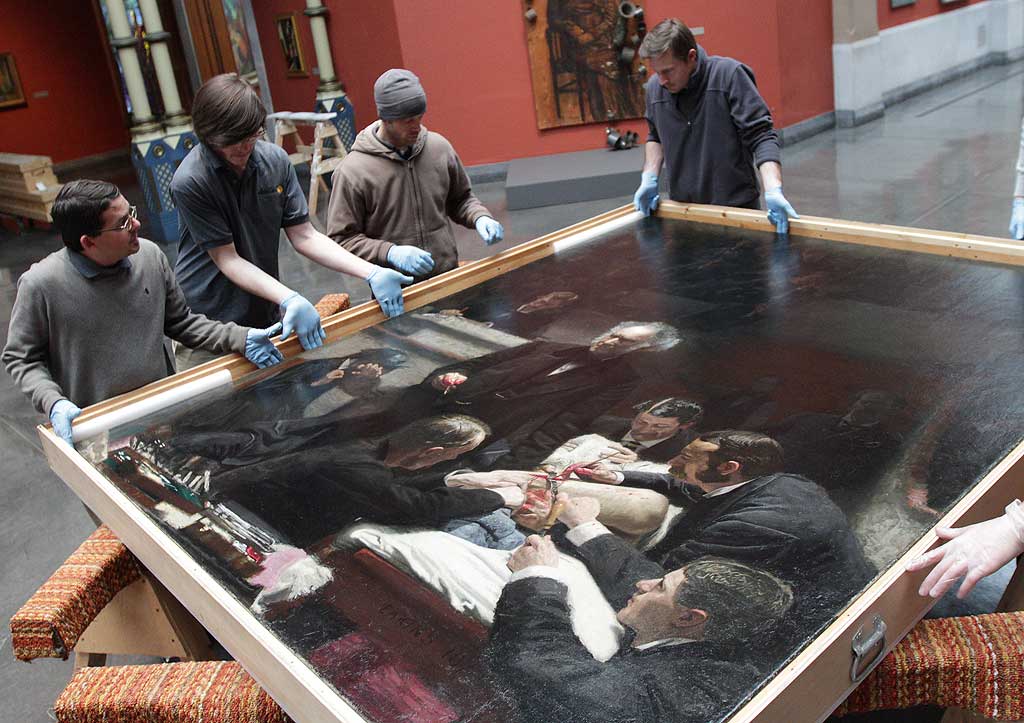
Art handlers from PAFA and Atelier Art Services Inc. place “The Gross Clinic” in a packing crate in 2014. The painting was being moved for display at the Philadelphia Museum of Art. ( David Maialetti / Staff Photographer )
The patient is a minor; the seated woman recoiling in horror is his mother. A chloroform-soaked cloth sedates the child .
In this stopped-action moment, Gross is the commanding figure of the surgical amphitheater. While his assistants hold a retractor to keep the patient’s left thigh incision open, Gross calmly explains to his audience of students the modern practice of removing a piece of diseased bone caused by osteomyelitis.
The moment celebrates stoic men performing surgery. Gross is a heroic savior giving renewed life to a patient who didn’t have to endure a brutal amputation and will retain use of both legs.
Much of the amphitheater is cast in darkness, but a self-portrait of Eakins sits by a railing to imply authenticity of direct observation. He holds a pen or brush like Gross’ scalpel, suggesting that art making is akin to surgery.
The artwork, Eakins believed, was “very far better than anything I have ever done,” as he wrote in an 1875 letter to Earl Shinn, a Philadelphia friend who had also studied at the Ecole in Paris.
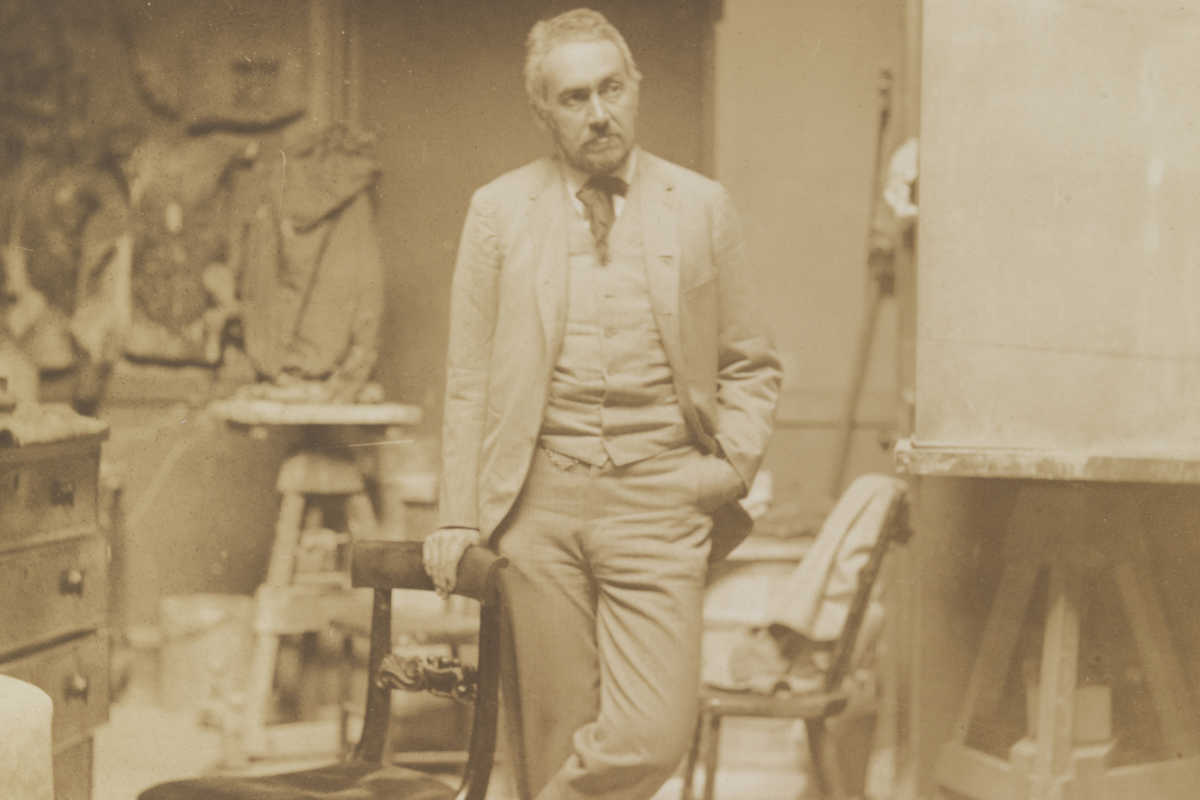
Thomas Eakins in a Chestnut Street studio, 1891-92.Photo taken by Samuel Murray.
Eakins had hoped the portrait of Gross would be seen at the large international art exhibition in Memorial Hall during the 1876 Centennial Exposition in Philadelphia, and help establish his reputation.
It was rejected by the art jury, but was displayed as part of a medical exhibit in the U.S. Army Post Hospital. When the painting was exhibited later at the second annual exhibition of the Society of American Artists in New York, a New York Daily Tribune critic wrote: “It is a picture that even strong men find it difficult to look at long, if they can look at it at all.”
Given the long-term relationship of Gross with Jefferson Medical College, the artist hoped the institution would acquire the painting for its art collection. It was only in 1878 that the Alumni Association of Jefferson Medical College purchased the portrait for $200 (approximately $6,660 in today’s dollars) and presented it to the school where it remained for 129 years.
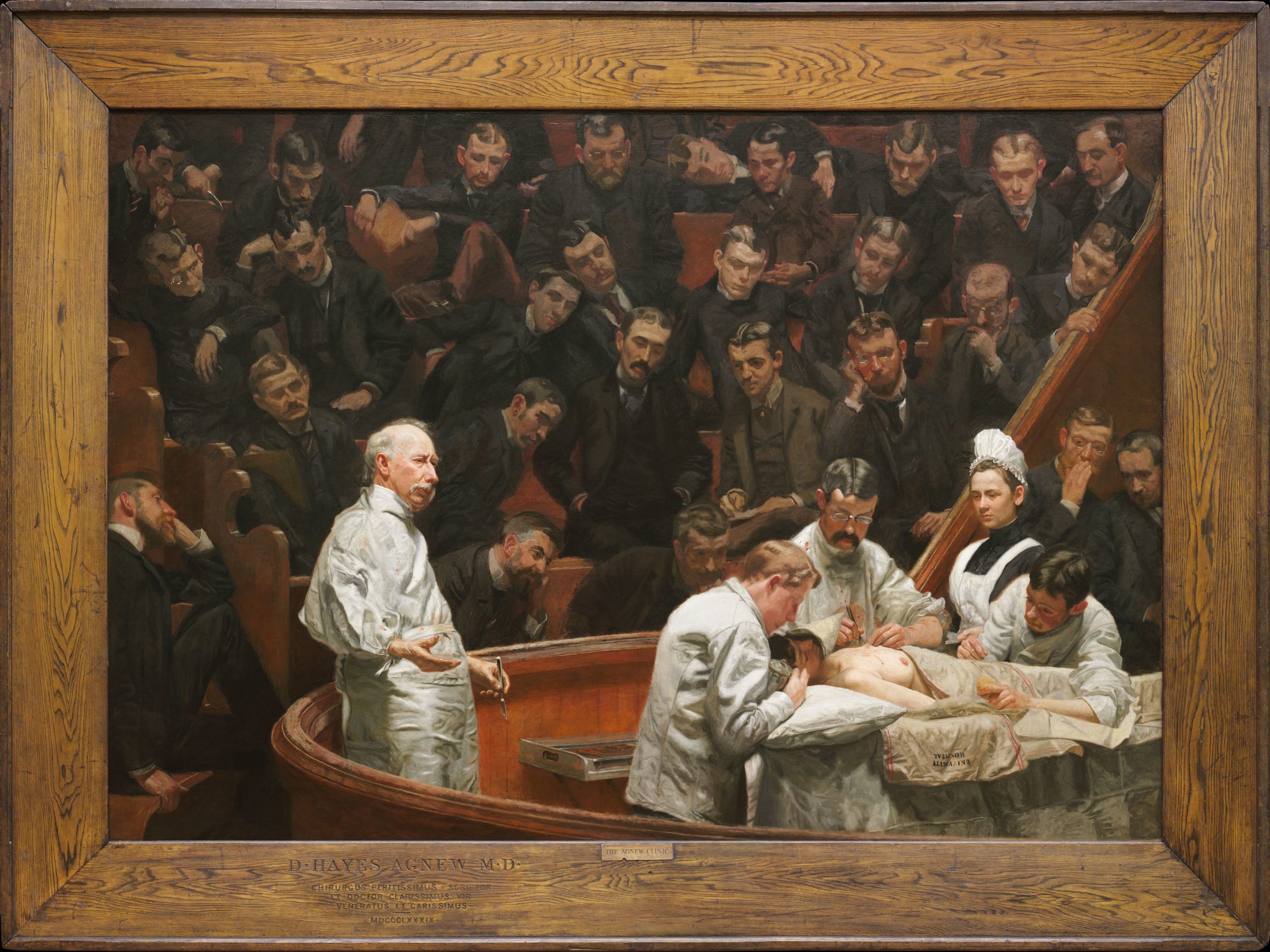
“The Agnew Clinic” (1889) by Thomas Eakins. On long-term loan to the Philadelphia Museum of Art.Courtesy of the University of Pennsylvania Art Collection
‘The Agnew Clinic’
Fourteen years later, in 1889, Eakins painted The Agnew Clinic.
By then, he had taught at PAFA, which admitted women; a rarity in its time. Eakins believed all serious art students, regardless of gender, must work from the life model and learn anatomy.
“I see no impropriety in looking at the most beautiful of nature’s work, the naked figure,” he said. His emphasis on nude life drawing and anatomical study was unsettling to Victorian propriety and his teaching methods eventually proved controversial.
The last straw came in early 1886 when Eakins was giving an anatomy lecture during which he removed a loincloth from a male model in the presence of female students. As requested by the administration, the artist, who was the academy’s director, submitted his resignation, stating: “Was ever so much smoke for so little fire?”
This was upsetting for him. In the summer of 1887, to overcome depression, Eakins made “a little trip to the West,” as he then wrote his friend and former student John Laurie Wallace, to experience “camp cure” at a ranch in the Dakota Territories.
Back in Philadelphia, Eakins received a major boost when in February 1889, he was commissioned by a group of aspiring doctors from the University of Pennsylvania School of Medicine, the nation’s oldest, to paint their retiring teacher, David Hayes Agnew, a colleague of Gross. They offered the artist $750 (approximately $27,148 in today’s dollars).
Eakins began work on The Agnew Clinic, his second clinic portrait.
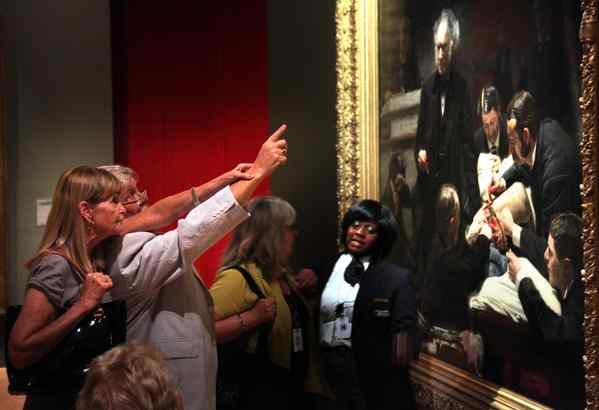
Visitors look at Thomas Eakins’ “The Gross Clinic” in the newly redone American gallery at the Philadelphia Museum of Art in 2014.
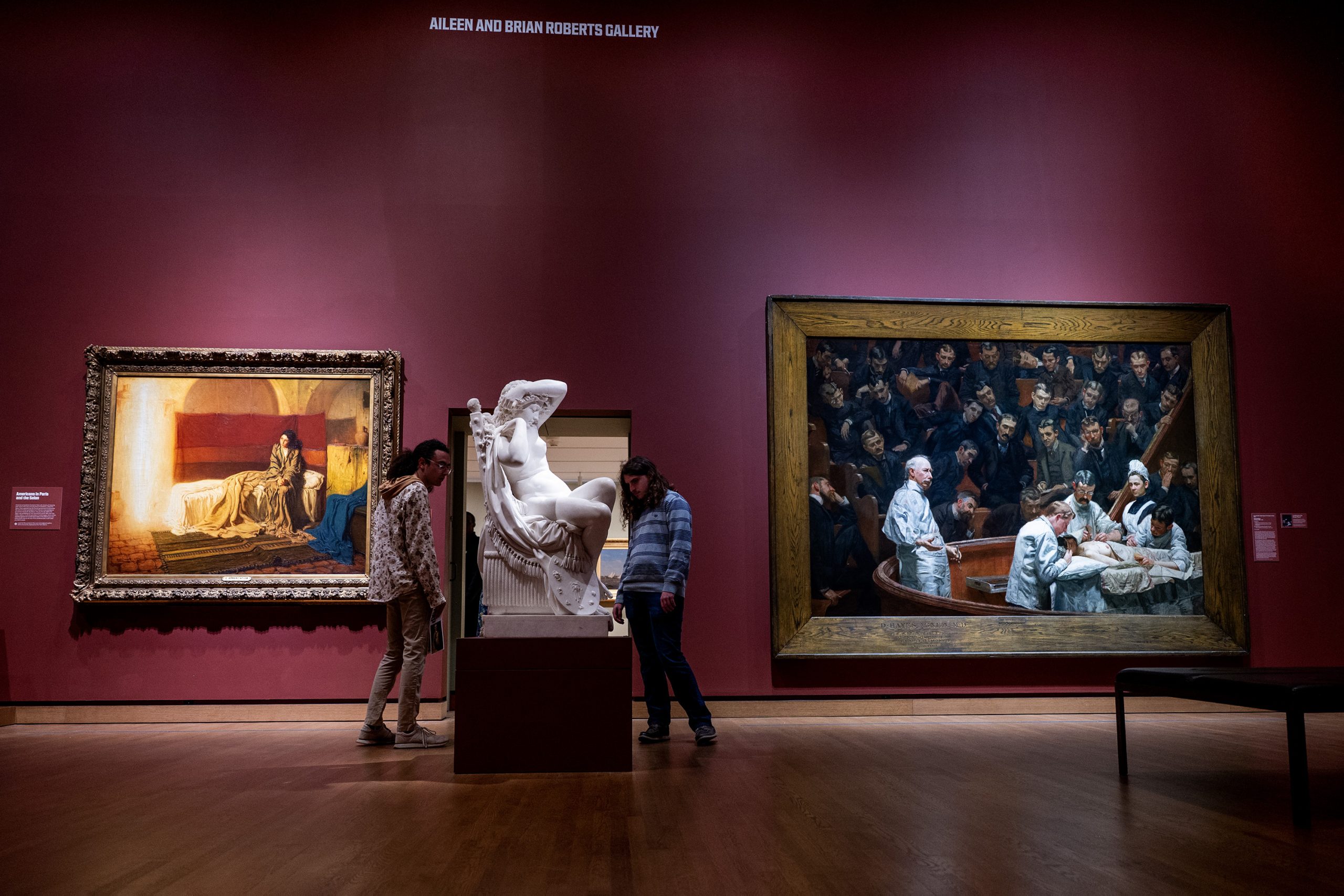
Even larger, at 6 feet by 11 feet, the painting reveals some newly instituted aseptic practices. Surgeon Agnew and his team wear white gowns; sterilized instruments are placed in a covered tray. The operation has a nurse at the patient’s side, but no gloves or masks are seen being used.
Because the canvas was too large for his easel, Eakins worked on the lower sections sitting on the floor, spending long days and nights (and occasionally falling asleep) on the studio floor. The work was completed in three months.
With less dramatic lighting and looser brushstrokes than The Gross Clinic, Eakins shows Agnew in his pedagogical role operating with assistant physicians, a nurse from the HUP Training School, and more easily visible class members who are observing the surgery.
Eakins places Agnew isolated at the left, lecturing. The patient, who has had a mastectomy, is having her incision sewn as a male assistant leans over her lower body. On the far right, the artist, who in this work was painted by his wife, Susan Macdowell Eakins, observes the nude woman sedated with an ether cone.
Deemed “not cheerful for ladies to look at,” the painting is a most provocative choice of surgery for Agnew, who wasn’t a breast cancer specialist but an authority on gunshot wounds.
The Agnew Clinic was given by the medical class of 1889 to their school.
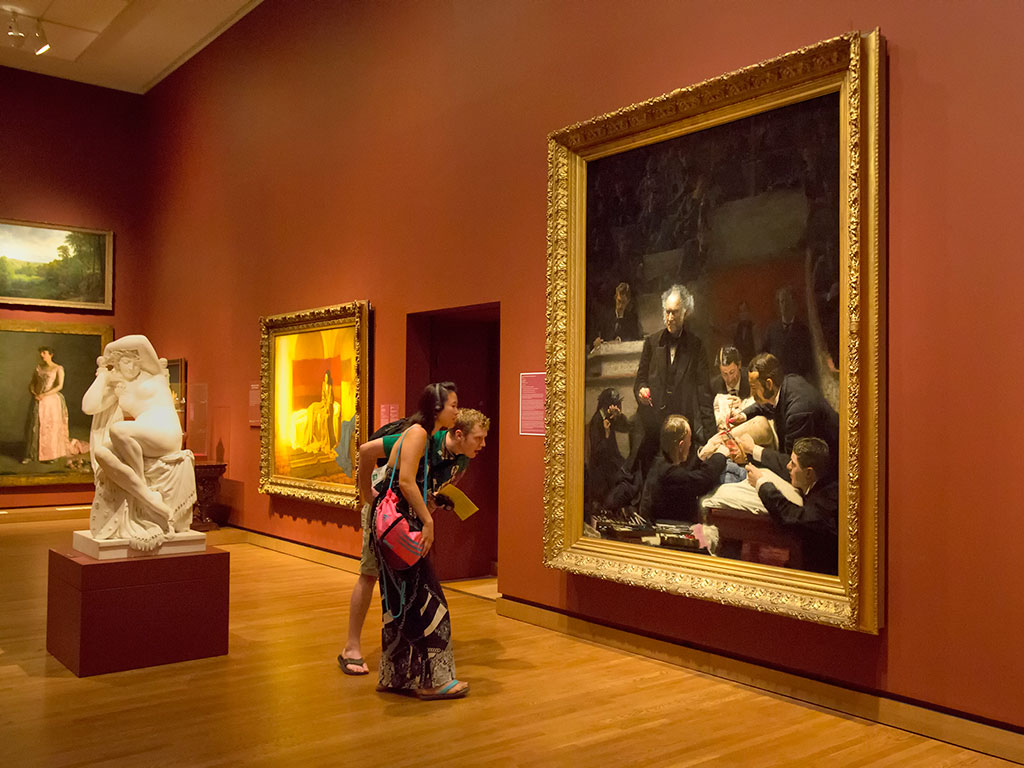
Marble sculpture “La Première Pose (center, 1873-1876) by Howard Roberts; and paintings “The Annunciation” (left, 1898) by Henry Ossawa Tanner and “Portrait of Dr. Hayes Agnew (The Agnew Clinic)” (right, 1889) by Thomas Eakins.in the “A Nation of Artists” show at the Philadelphia Museum Monday, May 4, 2026, in the newly renovated American galleries which were closed for several years.Tom Gralish / Staff Photographer
Side by side
Eakins is a distinguished presence in “A Nation of Artists,” the exhibition of 1,000-plus artworks organized by the Pennsylvania Academy of the Fine Arts and the Philadelphia Museum of Art to mark the 250th anniversary of the founding of the United States.
The Gross Clinic at PAFA and The Agnew Clinic at the PMA are part of this expansive dual-venue survey of American artworks; each is a tour de force.
The two medical portraits reveal the painter’s respect for the art of surgery, underscoring Philadelphia’s vital role in medicine and its preeminent medical schools. Anesthesia, which was newly introduced in the 19th century, is used in both operations.
Both paintings were not well received and regarded as disturbing and unsightly. But both of those large clinical portraits were exhibited together at the 1893 World’s Columbian Exposition in Chicago.
A Philadelphia Public Ledger writer complained that the “surroundings and accessories are scarcely in good taste for a public exhibition.” Another critic dismissed “the clinical horrors” as “ghastly symphonies in gore and bitumen” and mused: “To have hung the pictures at all was questionable judgment.”
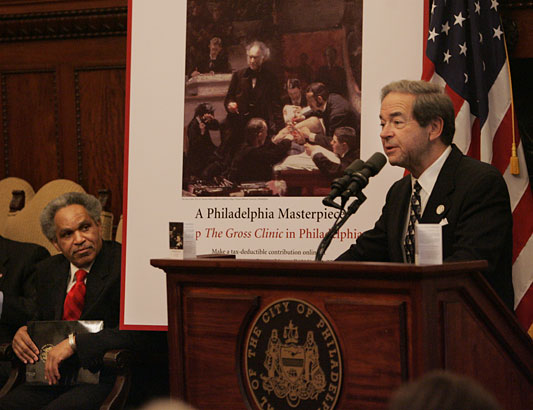
In this photo from 2007, Herbert Riband, vice chairman of the board at the Pennsylvania Academy of the Fine Arts, speaks at City Hall as Mayor John Street listens during the announcement that the Philadelphia Museum of Art and PAFA are to acquire “The Gross Clinic.” Michael Bryant / Inquirer Staff Photographer)
Afterlives
In November 2007, Jefferson Medical College agreed to sell The Gross Clinic for the stunning sum of $68 million offered by Alice L. Walton, Walmart heiress and founder of the Crystal Bridges Museum of American Art in Bentonville, Ark.
It set off a maelstrom resulting in a spirited fundraising campaign that successfully matched her price in a few weeks, keeping the masterpiece in Philadelphia. With a few thousand donations, PAFA and the Art Museum jointly acquired the canvas.
The two institutions collaboratively share the painting on a five-year cycle; it will be at PAFA until 2031.
On opening day of an exhibition at the Art Museum’s Perelman Building, visitors gather around Thomas Eakins’ “The Gross Clinic.” Photo from 2010.LAURENCE KESTERSON / Staff Photographer
Unlike The Gross Clinic, Eakins was asked to paint the portrait of Agnew, creating his second clinic image and the largest canvas of his career. It was completed for presentation at the graduation ceremony that took place at the Academy of Music on May 1, 1889. Its original wood frame has a Latin inscription believed to have been carved by Eakins honoring Agnew as “the most experienced surgeon, the clearest writer and teacher.”
Since 2000, the canvas has been on loan from the university to the PMA.
While recent research has shed light on his pattern of sexual harassment, including allegations that he sexually molested his niece, Eakins continues to be appreciated as an individualist and one of America’s greatest painters. He maintained: “My life is all in my work.”
“A Nation of Artists” runs through July 5, 2027, at the Philadelphia Museum of Art (2600 Benjamin Franklin Parkway, Philadelphia, 215-763-8100 or philamuseum.org) and through Sept. 5, 2027, at the Pennsylvania Academy of the Fine Arts (118-128 N. Broad St., Philadelphia, 215-972-7600 or pafa.org). Note: Exhibit admission is separate at each venue, though discounts are available to view both.
Psychiatry’s leading guide to diagnosing mental health conditions is due for a major update — and a University of Pennsylvania psychiatrist is heading the effort.
Called the Diagnostic and Statistical Manual of Mental Disorders, the DSM was first published in 1952 and has historically been updated every 10 to 20 years.
The American Psychiatric Association released the last major update, the DSM-5, in 2013. (A text revision came out in 2022.) There is currently no estimated date of publication for the next edition, given the scale of the project.
Maria Oquendo, who chairs Penn’s department of psychiatry, was tapped to lead the strategic committee for the sixth edition. That will entail developing a road map for the future of the DSM, based on more than a decade of advances in research and patient care.
“I am very honored and also very daunted,” Oquendo said.
The group has proposed creating a “living DSM,” changing the manual’s name, and making diagnoses more “person-centered.”
There are subcommittees focused on the socio-economic, cultural, and environmental determinants of health, the biological factors behind mental health conditions, symptoms spanning multiple conditions, and functioning and quality of life.
Past DSM updates have similarly introduced sweeping changes — including changing how autism is diagnosed and adding “prolonged grief disorder” as a condition.
The manual is commonly used by mental health professionals, researchers, insurance companies, and the legal system.
The committee wants to make sure a small change doesn’t cause drastic ripple effects for the public, such as disqualifying people from insurance coverage or altering “the standard for deeming someone not criminally responsible,” Oquendo said.
“If it has a big impact, then the rationale has to be extremely robust,” she emphasized.
The Inquirer spoke with Oquendo about what changes could be coming in the next edition of the DSM in a conversation lightly edited for length and clarity.
Maria Oquendo, who chairs Penn’s department of psychiatry, was tapped to lead the strategic committee for the next edition of the DSM.Courtesy of Penn Medicine
What is the DSM?
The DSM is a clinical manual intended to help clinicians make diagnoses.
It provides not only a list of all of the diagnoses but also descriptions that include some background information like family history. Importantly, it makes sure that when I, as a clinician, am talking about obsessive compulsive disorder, the person who’s listening to me knows exactly what I’m talking about.
The reach of this book is quite global, and in many places such as Western countries, it’s used as the primary diagnostic tool.
What changes are you hoping to make with the new edition?
There are people who refer to the DSM as the Bible. It’s not the Bible. At best, it’s a dictionary. And what we want to do is increase focus on contextual factors that are important for making a diagnosis. Ideally a person-centered explanation is about not only what the disorder is, but what’s contributing to it. We know that socio-economic, cultural, and environmental factors are super important for mental health.
If you’re assessing someone, knowing about that can be really helpful to understanding that person and where they are coming from.
As an example, if somebody comes from a culture like my culture (Puerto Rico), where people have very strong connections with the deceased, sometimes they experience the deceased person’s presence or hear them talk, especially at night. That could be construed to be hallucinations, and yet in the context of not only my culture but many cultures, that would be completely normative.
What other changes are being considered?
We are very focused on making sure that functioning and quality of life get the attention that they deserve. There are some people who have lots and lots of symptoms, and they’re happy as a clam. The amount of distress that a person feels can vary quite significantly, and it’s very relevant in terms of not only diagnosis but treatment planning. What are the best interventions to help that person get better?
We also have a section on biomarkers and biological factors. That’s really important because, to date, the DSM has been kind of agnostic about what the contributors to mental disorders are. But we know that there are biological contributors, and we also know that the environment is extremely important, and it’s the interaction of those two things that is critical in terms of whether an individual manifests a mental disorder or not.
What do you mean by biological factors?
I don’t necessarily only mean things like genetics and predisposition. Experiences like trauma can change our biology. We know that the stress response system in the brain can change very dramatically after trauma. That’s another biological contributor to a mental disorder that is not innate.
Another proposed change is to encourage broader diagnoses. Can you elaborate on that?
Historically, the DSM has encouraged precise diagnosis to the extent that it’s possible. But we think that in most first encounters, it’s very common not to be sure what the diagnosis is. You may know that a person has a mood disorder of some type, but you may not be sure if they really have bipolar disorder or major depression, as an example. Sometimes it takes time for that to become clarified. You need to get collateral information from loved ones to confirm what’s happening in the environment, or it may take time because you just need the symptoms to evolve.
We’ve looked at data from insurers, and found that people are using more general diagnoses. What we want to do is provide a platform so that people can start from that, and as they get to know the patient better, refine their diagnosis with more data and more information.
What about the proposal to change the DSM’s name?
It’s called the Diagnostic and Statistical Manual because, when it was first developed, the goal was to be able to develop estimates of the frequency of diagnosis, so public services could be planned. But now that’s not what it’s used for at all. We actually are planning to change the name to Diagnostic and Scientific Manual because we want to strongly communicate that this is based on science.
How could this next update make the manual a “living DSM”?
The American Psychiatric Association really wants to make sure that this next DSM can stay as up to date as possible. The idea is that there would be a book version, but also an electronic version that would be updated on a periodic basis.
One of the things that’s really tricky about that is that you want to keep things current — we don’t have to wait 13 years for things to be updated. But if you change things too much, you drive people in the field crazy.
Fifty years ago this Aug. 11, my brother Harold Rosenthal was late for a plane out of Istanbul bound for Jerusalem. He was always late — school, appointments, parties, or late finishing dinner at Horn & Hardart’s, the only restaurant working-class families patronized in Philly then.
While my younger brother Norman and I agonized on the sidewalk, Harold would take bites of food in between whatever book he was reading, a passion cultivated when he was a student at Central High in the early 1960s.
On this August day his tardiness put him near the back of the line at the gate for El Al Airlines. At the time, Harold was working as a senior aide to Republican New York Sen. Jacob K. Javits. He was heading to Israel as part of an assignment for the Senate Foreign Relations Committee, which had sent him on a tour of American embassies in the Mediterranean, ending with a seminar at Jerusalem’s Van Leer Institute.
Fifty years on, I’m certain Harold’s improbable rise was built in Philadelphia.
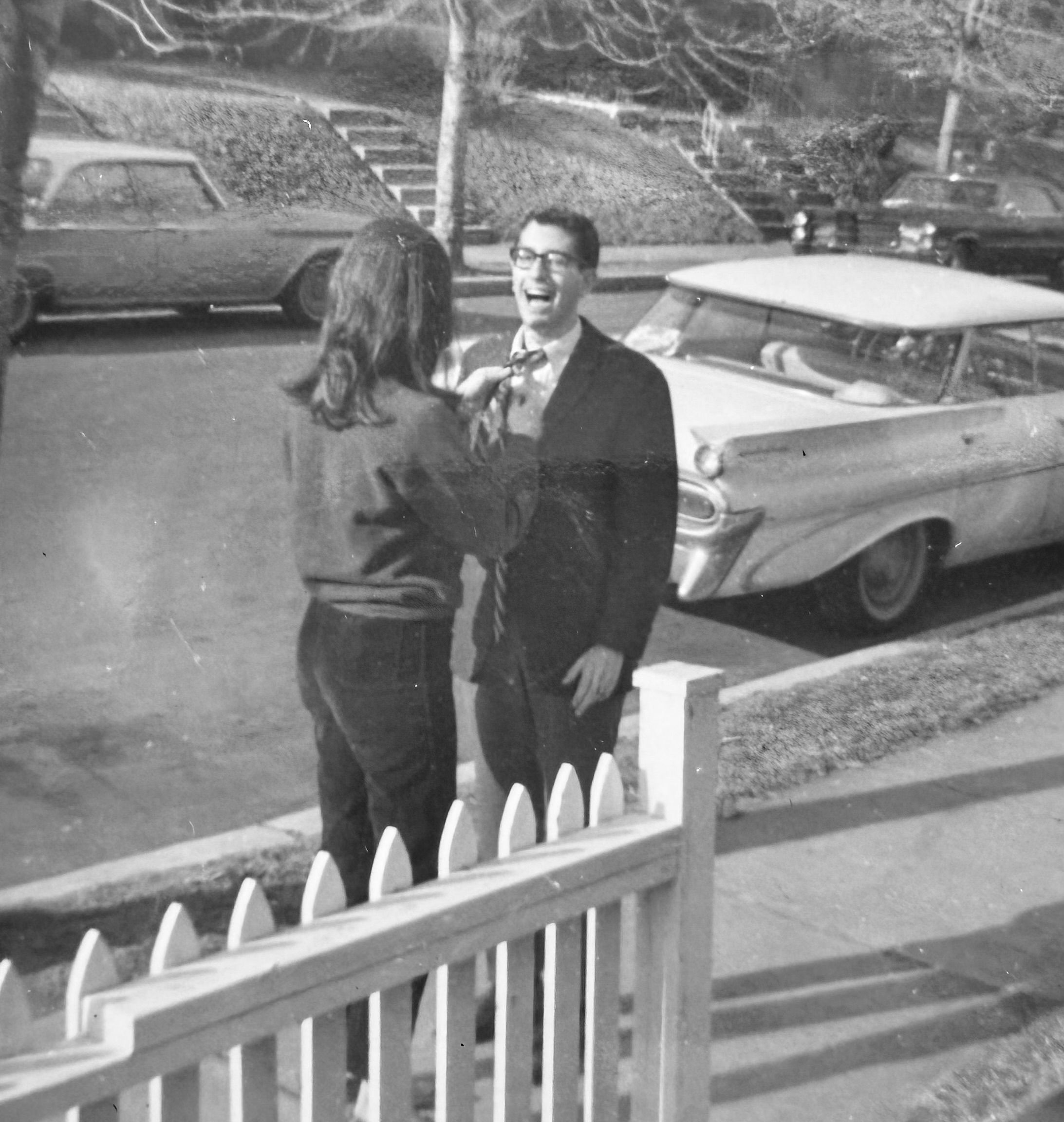
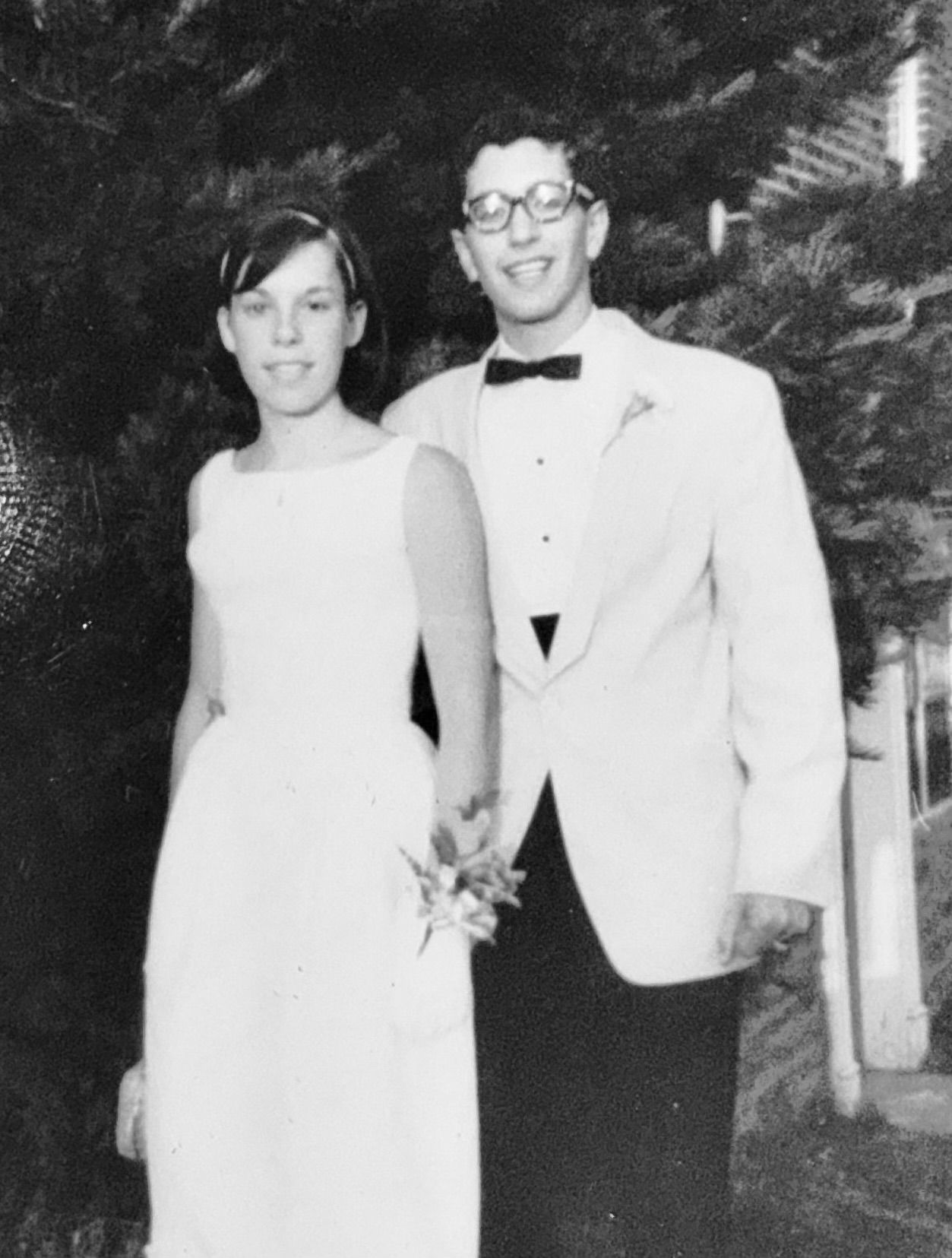
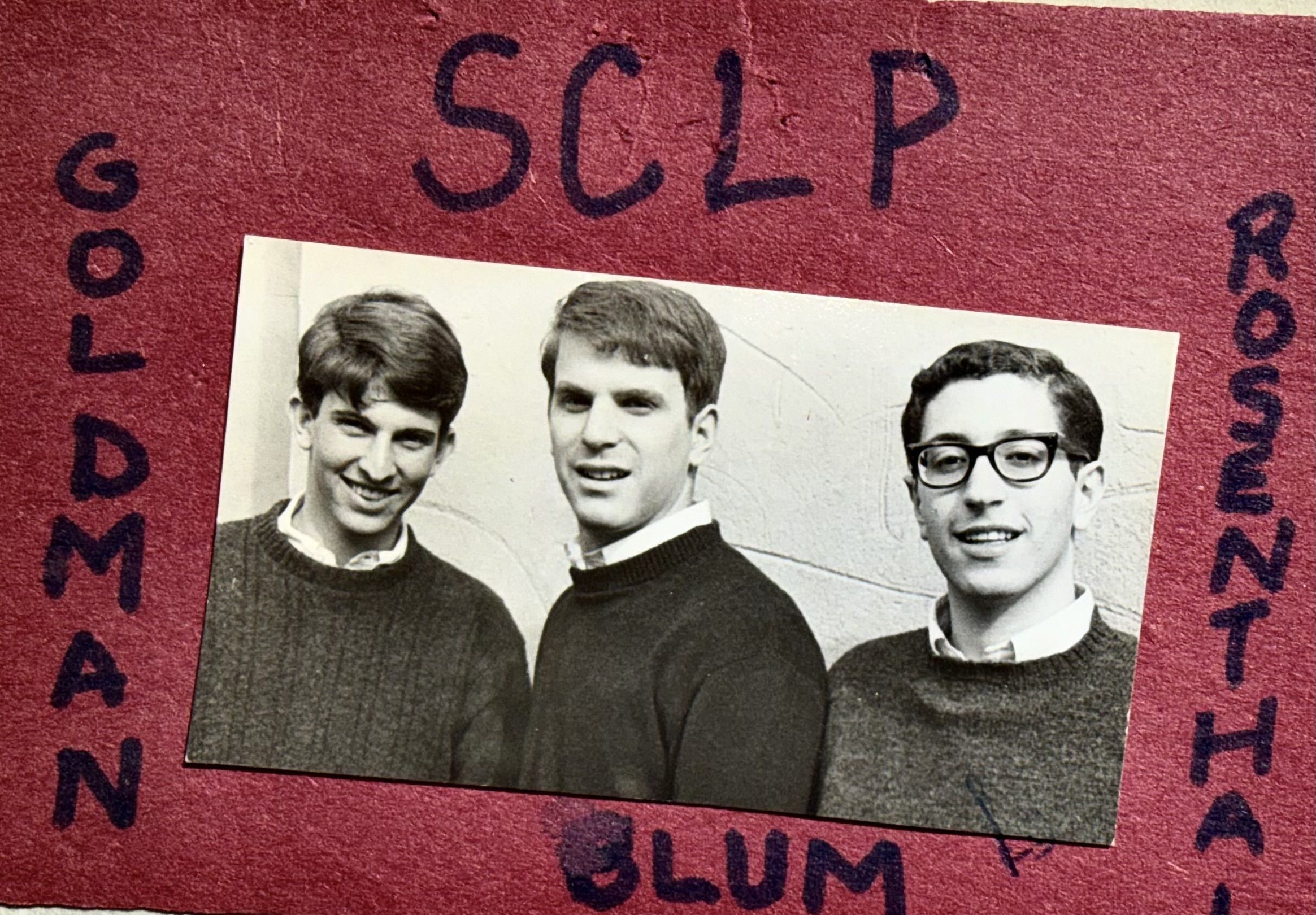
Harold Rosenthal, on Tulpehocken Street in West Oak Lane, in 1966.Courtesy of Mark RosenthalHarold Rosenthal ready for his senior prom at Central High School, May 1965.Courtesy of Mark Rosenthal
We grew up in a rowhouse on Tulpehocken Street in West Oak Lane, the kind of block where everyone knew everyone and you learned early which streets were yours to walk down and which weren’t.
Our parents worked hard but nearly lost that house to foreclosure twice. No kids had cars back then, which was fine. You walked to Pennypacker Elementary and then, to get to Wagner Junior High, Central High, and Temple University, you learned the buses, trolleys, and subways.
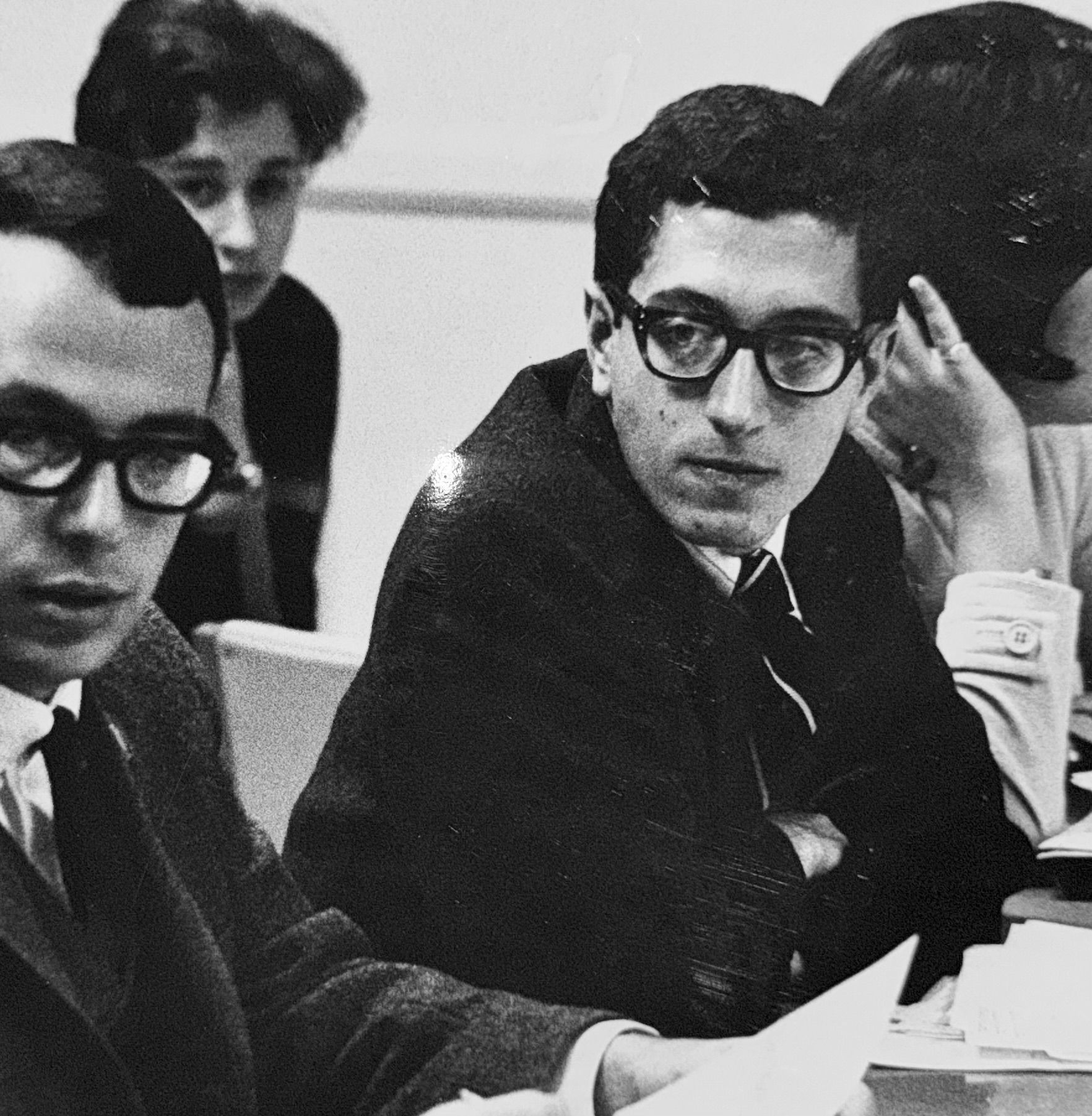
Harold Rosenthal (right) running for student council at Temple University in 1966.Courtesy of Mark Rosenthal
Out of this modest life, Harold built a career in a world that seemed unknowable to the rest of us — all on his own. We didn’t have a word yet for “nepo baby” because no one we knew had money or connections. But Harold was audacious about wanting more. That audacity carried him to a scholarship in France, then Cambridge University in England, and finally Harvard.
I was awed by his fearlessness. At Cambridge, seated at the back of a church for an Advent Carol service, he watched choristers slip through a side door and, deciding his seat wasn’t good enough, followed them. His friends — the ones who’d never dare follow — watched an hour later as he processed down the aisle in white robes, candle flame dancing, past Prince Charles, biting back a laugh.
That was Harold in full: certain that any door marked not for you was the one worth opening.
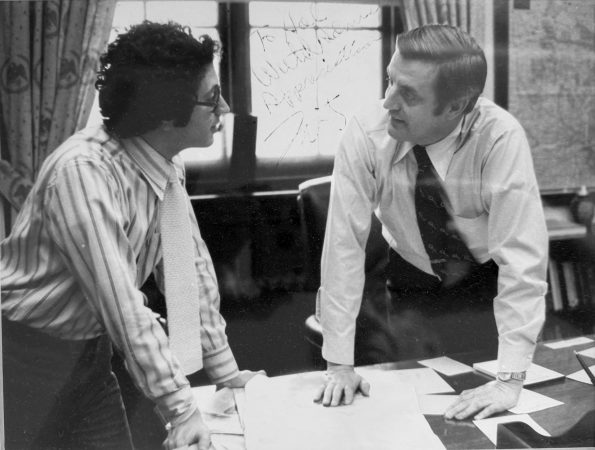
After Harvard, his climb was stunning. Legislative assistant to New York Rep. Hugh Carey, then for Sen. Walter Mondale of Minnesota, a stint at the Rockefeller Brothers Fund, and finally a senior adviser to Javits.
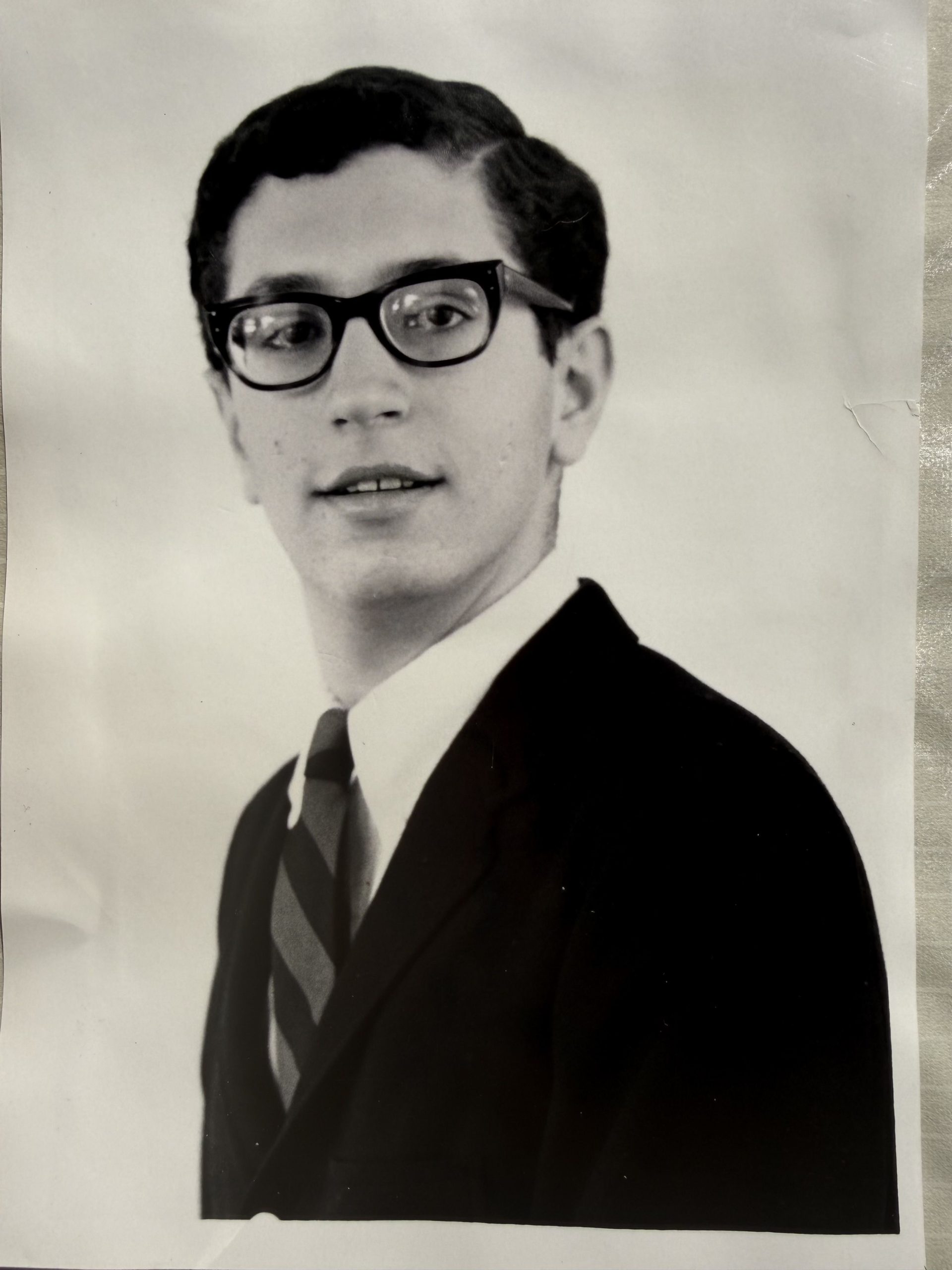
Harold Rosenthal at a Harvard seminar in November 1972.Courtesy of Mark RosenthalHarold Rosenthal’s official portrait for the Senate Foreign Relations Committee, 1976.Courtesy of Mark Rosenthal
Sen. Mondale had already told him that if Jimmy Carter won the White House in November, there’d be a staff position for Harold in the West Wing or as part of an undersecretary’s desk at the State Department. A public school kid from a Philly rowhouse, one election away from the top of the government.
That August I took a position as a teaching assistant at the University of the Pacific in California, more hiding from adulthood than pursuing a doctorate. Our younger brother, Norman, was already on his way to an influential career as an endocrinologist.
Harold Rosenthal (center) during a State Department visit to South Africa, 1974.Courtesy of Mark Rosenthal
If my future was uncertain, Harold was rewarding my overworked parents with the gift of an insider’s view of his rise. He always shared his itinerary, printed on Senate stationery, with my mother, who tracked this Mediterranean tour almost hourly. He was only passing through Istanbul.
I was at a going-away dinner near Penn when I called home and heard the fear in my mother’s voice — something about an attack on an El Al flight. There was no cable news then, no way to know. I quickly said my goodbyes and drove to Roxborough.
I opened the door to find my mother collapsed on the floor and my father — who’d flown with the Flying Tigers in China during World War II, and who’d lost his own cousin on D-Day — slamming his head against the wall. A stranger from the State Department had called and quickly said, “We regret to inform you that your son is dead. Someone will contact you soon.” That’s all.
It took time to bring Harold’s body home. Turkish law required an autopsy first, and a friend of Harold’s quietly warned me it would leave him unrecognizable. Waiting for Harold, my father consoled himself with the fact he’d be able to see his son one last time. In the back of a limo to Roosevelt Cemetery, Norman and I had to tell our father the casket would be closed — one of the hardest sentences I’ve ever spoken.
Sens. Mondale and Javits both eulogized Harold at the funeral on Broad Street. Weeks later, after a memorial at the Capitol, I sat with my parents outside, silently, in the brutal heat and viscous humidity waiting for a valet to find their car, which had been misplaced. Watching people coming and going up and down the marble steps, I realized this world wouldn’t stop for Harold. It doesn’t pause for anyone. It was already looking for his replacement.
Years later, because of a new thing called the “internet,” we were handed a second wound. Just a year after the attack, a Christian-supremacist cult leader had fabricated a grotesque “Rosenthal Interview,” inventing a confession in which Harold revealed how Jews secretly run the government. So witless — it was dated a year after Harold died. It was too absurd to survive anywhere but in fringe pamphlets — that is, until the internet gave it a permanence no pamphlet ever could.
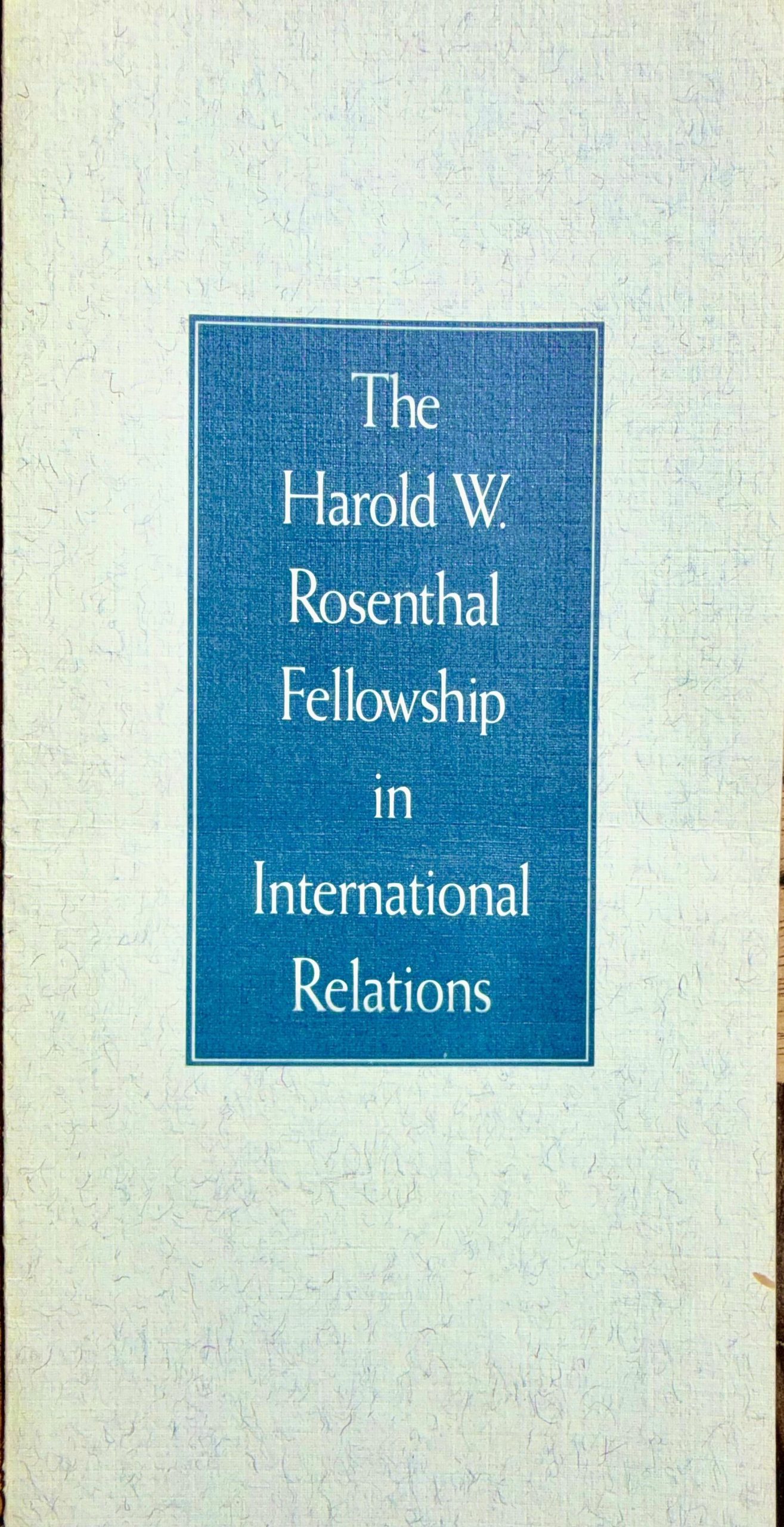
What outlasted the hoax is the Harold Wallace Rosenthal Fellowship in International Relations, founded by his friends in 1977. Fifty years and over 300 fellows later, it’s still helping ordinary students from ordinary families into congressional offices and embassies — through the same door Harold forced open with nothing but nerve.
The fellowship started by Harold Rosenthal’s friends on Capitol Hill is still going strong, placing graduate students into offices from the Senate to the Pentagon.Courtesy of Mark Rosenthal
The night Harold’s shiva ended, sitting in my parents’ now quiet apartment, I demanded of myself to learn something from Harold’s death. Two things happened. First, I admitted the only thing I actually cared about was movies, not academics, and after my doctorate was done, I packed my car, which had been Harold’s car, and drove to Los Angeles to figure out a way into the movie business.
Second, I swore never to hear news the same way again. We measure disasters in body counts — just two, just eight — a statistic filed away and forgotten by people with their own lives to return to. I promised myself I’d stop, every time, and imagine the families behind each number.
In floods in Texas. In Gaza. In Kyiv. The dead are aggregated. Grief is always singular. Every one of those numbers is somebody’s brother, somebody’s family.
Mine was Harold.
Mark David Rosenthal is a writer and producer of film and television. He is a member of the Motion Picture Academy of Arts and Sciences and the Writers Guild of America, West. He was nominated for an Emmy for the 2016 miniseries, “Roots,” and his WGA credits include “Mona Lisa Smile,” Tim Burton’s “Planet of the Apes,” and “The Jewel of the Nile,” among many others.