Blog

  • Body of missing Philly swimmer found in New Jersey, officials say

    A body believed to be a swimmer who went missing in the Delaware River was found by police after it washed ashore in Palmyra, Burlington County, Monday.

    Carlos Gil-Reyes, a 31-year old Philadelphia barber, was identified by friends after diving into the Delaware River in the city’s Torresdale section early Friday. He never resurfaced.

    New Jersey State Police said the body they found matched the description of Gil-Reyes. The case remains under investigation.

    Gil-Reyes was among about 20 people who gathered at the Delaware River in boats off Pleasant Hill Park in Philadelphia’s Torresdale section around 1 a.m. Friday, according to police.

    At some point, Gil-Reyes jumped into the water with another person, but wasn’t able to get back to the boat.

    “He swam out of the boat with my other friend and the last word he told my friend, ‘Hey, I can’t no more, I love you,’” Argeni Infante Reyes, a friend of Gil-Reyes, told reporters. “That breaks my heart because the last word he said is, ‘I can’t swim anymore and I love you.’”

  • Progressive challenger overtakes Spencer Pratt in race for LA mayor

    Progressive challenger overtakes Spencer Pratt in race for LA mayor

    Nithya Raman, a progressive member of the Los Angeles City Council, pulled ahead of reality TV star Spencer Pratt in the Los Angeles mayoral primary Sunday, as a surge in the vote count signaled a potential shift in the race for second place.

    Five days after the election deadline, it remained officially undetermined who will face Mayor Karen Bass, the incumbent, in the November contest to decide who will lead the nation’s second most populous city. The primary race has yet to be called by the Associated Press, which estimates that about 80% of the vote has been counted.

    But late returns have trended heavily in favor of the liberals who make up an overwhelming majority of the city’s electorate.

    Bass, 72, a former Democratic member of Congress who has already advanced to the November runoff, remained in the lead with 34.68% of the vote, according to the updated tally released by the Los Angeles County Registrar-Recorder/County Clerk’s office.

    Raman, 44, who has steadily gained ground as the count has progressed, had 27.12%, enough to overtake Pratt by a little more than 3,000 votes. He had been running in second place since election night.

    A resident of Pacific Palisades who lost his home in the fire and channeled the fury of his neighbors, Pratt, 42, a Republican, dropped to third place with 26.69% of the vote.

    A Los Angeles mayoral candidate can win outright by receiving a majority of votes in the primary. Otherwise, the top two finishers regardless of party advance to the general election. But Los Angeles residents vote by mail in large numbers, and ballot counting is a slow process, with leads often shifting as the tally drags on for days or even weeks. Mail-in ballots with an Election Day postmark are accepted by county election officials through Tuesday.

    On Sunday, Raman said in a statement that “we are encouraged by the latest vote count and remain grateful to the thousands of Angelenos who have powered this campaign.”

    Pratt did not immediately respond to a request for comment.

    Alex Stack, a campaign spokesperson for Bass, signaled the likely points of contention between the two if Raman ultimately takes the second slot on the ballot. Though her support has been eroded by the wildfires and general voter angst in the city, Bass has largely maintained the support of the center-left establishment in the city while Raman has been backed by a younger and more progressive base.

    “We look forward to winning a contest against an opponent who allows encampments near schools and fights against hiring more cops,” Stack said in a statement, “yet is MIA on saving Hollywood jobs and fighting back when ICE invades LA.”

    This article originally appeared in the New York Times.

  • European leaders voice ‘urgent need’ to bolster Ukraine’s defenses against ballistic missiles

    LONDON — The leaders of the U.K., Ukraine, France, and Germany discussed the “urgent need” to ramp up production of weapons to combat Russia’s powerful hypersonic Oreshnik ballistic missiles in a meeting in London on Sunday.

    British Prime Minister Keir Starmer hosted Ukrainian leader Volodymyr Zelensky, French President Emmanuel Macron, and German Chancellor Friedrich Merz at 10 Downing Street.

    In a statement released by Starmer’s office following their evening meeting, the leaders condemned Russia’s “large-scale missile and drone attacks — including the repeated use of the Oreshnik missiles — on Ukrainian cities with a tragic toll on civilians.” They also condemned Russia’s “irresponsible and dangerous Russian drone incursions” into NATO territory, including last month’s in Romania.

    Russia has stepped up its aerial campaign against Ukraine recently, most notably with the launch of the Oreshnik missiles.

    “The leaders underlined the urgent need to scale up the production of interceptors and co-develop anti-ballistic missile and deep strike capabilities,” the leaders said.

    No details, financial or otherwise, on how this would be done were provided.

    Ukraine’s shortage of air defense systems, in part because of the depletion of U.S. stocks during the Iran war, has left civilians especially vulnerable to ballistic missiles, even as Kyiv’s defenses stop most of Moscow’s drones and its forces have made advances elsewhere on the battlefield.

    The worry for Ukrainians is that the Iran war, which has been in abeyance for weeks, may now reignite after Iran launched missiles on Sunday at Israel in the first such bombardment since a fragile ceasefire took effect in early April, complicating mediation efforts for a deal to end the war.

    Following their meeting in London, the European leaders called on Russian President Vladimir Putin to agree to “an immediate and complete ceasefire” with the current line of contact as a starting point for any negotiations.

    The U.K., France, and Germany, the so-called E3 group of European nations, have been prominent backers of Ukraine following Russia’s full-scale invasion in February 2022. The U.K. and France lead the “coalition of the willing” initiative to provide security guarantees for Ukraine as part of a peace process.

    The meeting comes in the wake of a Russian drone strike that killed three people waiting at a bus stop in southeastern Ukraine. A separate drone strike damaged a storage center for spent nuclear fuel in the Kyiv region, just 9 miles from the Chernobyl nuclear power plant, Ukraine’s General Staff said. The attack sparked a fire that was extinguished within an hour. Radiation remains within safe levels, officials said.

    The International Atomic Energy Agency chief Rafael Grossi said the incident was “deeply concerning” due to the large amounts of nuclear material held at the facility. He said in a statement that the agency would visit the site of the attack soon.

    The Russian attacks follow a large-scale Ukrainian drone attack on Saturday that targeted Saint Petersburg, Russia’s second-largest city, underscoring Kyiv’s growing ability to hit deep inside Russia.

    With the front line barely moving as swarms of drones hinder advances, both sides have sought an edge by launching long-range strikes.

  • Trump allies wanted to ‘delete’ this consumer watchdog. Now it’s a political weapon.

    Trump allies wanted to ‘delete’ this consumer watchdog. Now it’s a political weapon.

    The Trump administration came to Washington last year seeking to shutter the Consumer Financial Protection Bureau, the watchdog agency that had survived industry anger, Republican opposition, and years of legal challenges.

    A year in, a much smaller bureau is still standing and has been remade to advance the president’s political goals.

    The bureau has begun to probe a class of smaller, mostly nonprofit lenders that Russell Vought, the acting director of the bureau, has characterized as unduly “woke.”

    On Friday, the bureau issued guidance that could make it harder for immigrants in the country illegally to obtain mortgages and credit cards. Meanwhile, the bureau’s public website invites consumers to complain if they have been refused service — or “de-banked” — for political or religious reasons, reflecting a priority of the administration and its allies in the conservative movement and the crypto industry.

    The moves represent a reorientation of an agency that had previously focused on aggressively policing larger financial institutions on behalf of ordinary consumers. Republicans and much of the financial services industry had long accused the bureau of its own brand of politicization under Democratic leadership, charging that it targeted industries and practices liberals hated.

    The Trump administration says it is correcting overreach during the Biden administration. They say the CFPB, under former director Rohit Chopra, bullied businesses and individuals it viewed as political enemies, pursued questionable legal theories, and imposed costs that ultimately fell on ordinary Americans.

    “We are fixing that, bringing the agency back to operating within statute and away from breaking the law, and making cases right to help small businesses and Americans who were victims of this thuggery,” a spokesperson for Vought said in a statement.

    Critics say the result is a bureau that has gone easy on the powerful while training its firepower on smaller targets.

    “Their first attempt was to kill the agency,” said Aaron Klein, a senior fellow at the Brookings Institution, a centrist think tank. But courts blocked the administration’s attempts to lay off almost all of its staff. Now, Klein and other critics say, Vought has found a different use for the agency.

    “Rather than hold themselves to a higher standard, they seem to be committing the same political persecutions they allege happened to them,” said Klein, who served in the Obama Treasury Department.

    The pivot is visible in the bureau’s recent scrutiny of community lenders — smaller banks and firms that operate in low-income rural and urban communities that are typically underserved by large Wall Street banks. In late April, the bureau’s chief legal officer, Mark Paoletta, sent questionnaires to at least four such lenders, according to people familiar with the probe. One of the questionnaires, reviewed by the Washington Post, demanded a broad swath of financial records, compliance documents, and business details.

    The bureau has legal authority to send such requests for market-monitoring purposes, but the lenders are typically far too small to be subject to CFPB supervision, falling beneath a $10 billion asset threshold.

    Among those targeted was Self-Help Ventures Fund, an arm of a Durham, N.C., lender with roughly $5 billion in assets. Self-Help, which traces its origins to a $77 bake sale in the early 1980s, is affiliated with the Center for Responsible Lending, a consumer advocacy group that has been a vocal opponent of the administration’s efforts to dismantle the CFPB.

    Self-Help and CRL declined to comment for this article. The bureau’s interest in Self-Help has not been previously reported.

    Vought — who simultaneously runs the CFPB and the White House budget office — has made no secret that he holds negative views of the community lenders in question. At a House Budget Committee hearing in April, he said they “continue to be pushing an ideology that is very harmful.”

    The Trump administration has repeatedly sought to eliminate or drastically cut a federal program that funds and certifies community lenders. Bipartisan congressional majorities have rejected those efforts, but Vought has nevertheless withheld hundreds of millions of dollars Congress directed toward the program.

    When asked about the community lenders probe, administration officials sought to minimize the review, saying it represents only a tiny fraction of the bureau’s overall work, and declined to discuss any of the individual targets. A spokesperson for Vought attacked the lenders, saying they had directed money to LGBTQ health clinics, a transgender-themed fashion show, and a group that, she said, had threatened violence against federal immigration officials.

    The scrutiny of smaller community lenders contrasts with what the bureau has done, or stopped doing, elsewhere. Since taking office, the administration has dropped litigation and unwound settlements against some of the largest financial institutions in the country. In some cases, it halted checks that were set to go out to consumers. In other cases, it permanently gave up the right to reopen the claims against some companies in the future.

    In one such case, the watchdog dropped a lawsuit, filed in the waning days of the Biden administration, against the operator of the Zelle payment-transfer network and three of its owner banks — Wells Fargo, Bank of America, and JPMorgan Chase — over allegations that customers lost nearly $1 billion to fraud on the platform.

    The banks called the suit politically motivated, arguing the CFPB was stretching existing law to hold them responsible for payments customers had authorized themselves.

    The Consumer Bankers Association, which represents large retail banks, said it is encouraged by the bureau’s new direction, praising its focus on “identifiable victims, measurable harm, and clear legal standards” over what it called novel legal theories.

    Even if the community lenders currently under investigation had engaged in misconduct, the scale of the wrongdoing would look like a rounding error in comparison with potential misconduct by the largest financial institutions that are currently getting a pass, said Mike Pierce, who worked at the CFPB from 2011 to 2018 and is now the executive director of Protect Borrowers, a nonprofit advocacy group.

    “Some of the biggest corporate bad actors in America have gotten a pass from this agency,” Pierce said. “And now it’s focused on little guys that are doing things the Trump administration finds politically unpalatable.”

    Sen. Elizabeth Warren of Massachusetts, who conceived of the bureau, called the bureau’s pivot a betrayal of Trump’s own promises. “Donald Trump promised to lower costs ‘on day one,’” she said in a statement. “Instead, he’s co-opting the financial cop on the beat to rip away billions in relief for Americans scammed by giant banks and corporations and execute his extreme agenda.”

    Solveig Singleton, a policy analyst at the Cato Institute, a libertarian think tank, said the administration appeared to have discovered that the bureau could be “retargeted against its political opponents,” with broad discretion that makes it easy to frame such targeting as legitimate “policy spin.”

    She also warned that cutting staff could backfire because career employees facing performance pressure might well gravitate toward investigating smaller, easier targets that lack the resources to fight back.

    The longer-term solution, she said, requires Congress to curb the bureau’s unchecked discretion and ensure greater accountability over federal programs.

  • Why are birthrates down? You might be looking at the answer

    Why are birthrates down? You might be looking at the answer

    The enduring mystery of the fertility decline has a new culprit: the smartphone.

    Experts have long wondered if phones played a role in the birthrate decline — which began in 2007, the same year that Apple introduced the iPhone — but until now there had not been hard evidence to prove it.

    Two new papers, one published Monday and the other in May, are the first academic endeavors that test whether the smartphone was a cause.

    They are the most recent efforts to explain the sweeping fertility rate decline in the United States and other countries over the past 20 years. Researchers have already looked at contraception use, abortion rates, rising levels of female education, and even the popular television show 16 and Pregnant.

    Proving phones caused the decline is a tricky endeavor. There were a number of major events in those years, including the Great Recession, and isolating smartphone use is difficult.

    The gold standard for scientific evidence is known as random assignment. It compares outcomes for people randomly chosen to receive a treatment (like getting a smartphone) with people who are not.

    But that is not possible when it comes to ferreting out reasons for declining fertility.

    So researchers sought out data about smartphones that introduced randomness.

    Caitlin Myers, an economist at Middlebury College, and Ezekiel Hooper, her student, used the spotty early rollout of the iPhone as a way to isolate the effects of the phone on fertility. The first iPhone was released in June 2007, they wrote, and was available only on the AT&T network until February 2011. The study compared fertility rates in U.S. counties that had near-universal AT&T coverage with counties that had little or none.

    Their paper, published in the National Bureau of Economic Research, found that the iPhone caused as much as half of the fertility decline between 2007 and 2011. The most pronounced effects were among young people aged 15 to 24.

    What happened in the counties with iPhones? One theory, Myers said, is that young people began to socialize more on their phones and less in person, and consequently were less likely to have sex and become pregnant.

    Myers said iPhones may also have made pornography more accessible, which led young people to substitute it for sex, or young people may have used them to obtain better information on avoiding pregnancy, including contraception and abortion.

    Researchers not involved in the study said the results were persuasive.

    Phillip B. Levine, an economist at Wellesley College, said he was “a little jealous” of the Middlebury data, which he said provided a real insight into a potential driver of a major social change.

    He said some variation in the AT&T data could throw off the final finding. For example, the company may have set up in counties that were wealthier, or more densely populated, introducing a pattern “that’s not likely to be random anymore,” he said.

    He said Myers tried to account for those variations, and that her findings made sense.

    But, he cautioned: “You shouldn’t take the result so literally and say: Oh, it’s the iPhone’s fault. It’s an example of the kinds of social influences that have led to the decline in birth rate.”

    Dropping birthrates, once a feature of rich societies, are now a near-global phenomenon. The sweep of the decline has researchers looking for common drivers. The authors of the second study also decided to look at smartphones.

    “Countries with very different healthcare systems, welfare regimes, abortion laws, religious traditions, recessions and demographic trends all saw similar breaks in the same window,” wrote the authors, Hernan Moscoso Boedo, an economics professor at the University of Cincinnati, and Nathan Hudson, a doctoral student.

    “Whatever caused it was something global — something that arrived in roughly the same form in all of these places at roughly the same time,” they wrote.

    They analyzed World Bank data measuring smartphone penetration and teenage fertility rates in 128 countries. In countries as varied as Iran, Costa Rica, Guatemala, Chile, Mexico, and Turkey, they found that teenage fertility declines accelerated once smartphones became a mass phenomenon.

    They tested their technology theory in the United States using data on wired broadband and 4G high-speed mobile networks. They looked at where access was better and worse and found a substantial effect: that fertility rates for teenagers declined fastest in counties with more high-speed access.

    Theodore Joyce, an economist at Baruch College, said he was skeptical of both studies. Teenage births have been falling since the 1990s, he said, long before smartphone technology came on the scene. Myers’ paper, he said, examined a short period before smartphones had fully penetrated.

    The hypothesis, he said, could be correct but “remains speculative.”

    This article originally appeared in the New York Times.

  • DA Larry Krasner publicly criticized Mayor Cherelle Parker as he flirts with running for her office

    DA Larry Krasner publicly criticized Mayor Cherelle Parker as he flirts with running for her office

    District Attorney Larry Krasner said Monday that, in the more than two years since Mayor Cherelle L. Parker was sworn in, he has only met with her three times.

    And despite his visit to her City Hall office on Monday in what Krasner described as “the spirit of hopeful collaboration,” that number did not grow to four.

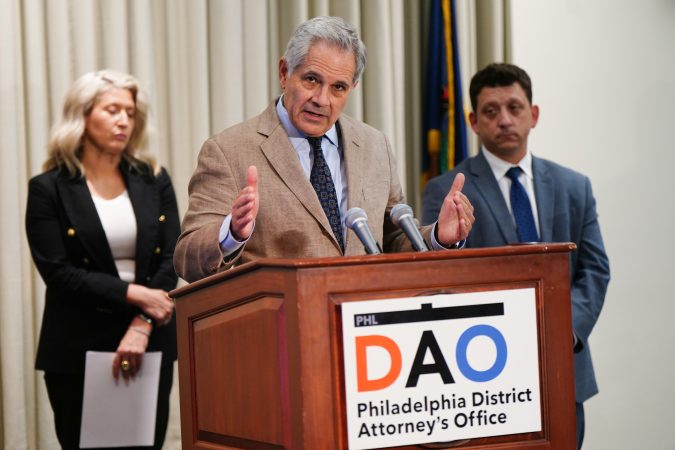
    The district attorney, along with a phalanx of staff and television cameras, walked across the street from his downtown office to the mayor’s suite on the second floor of City Hall, armed with a letter lamenting his budget as inadequate. In it, Krasner wrote that he needs an additional $5.6 million from the city to bolster shootings investigations, domestic violence prosecutions, and victim services.

    Asked why he was delivering a letter to Parker in person, Krasner said: “There is nothing new and nothing inappropriate about civil rights leaders, activists, and politicians getting the word out.”

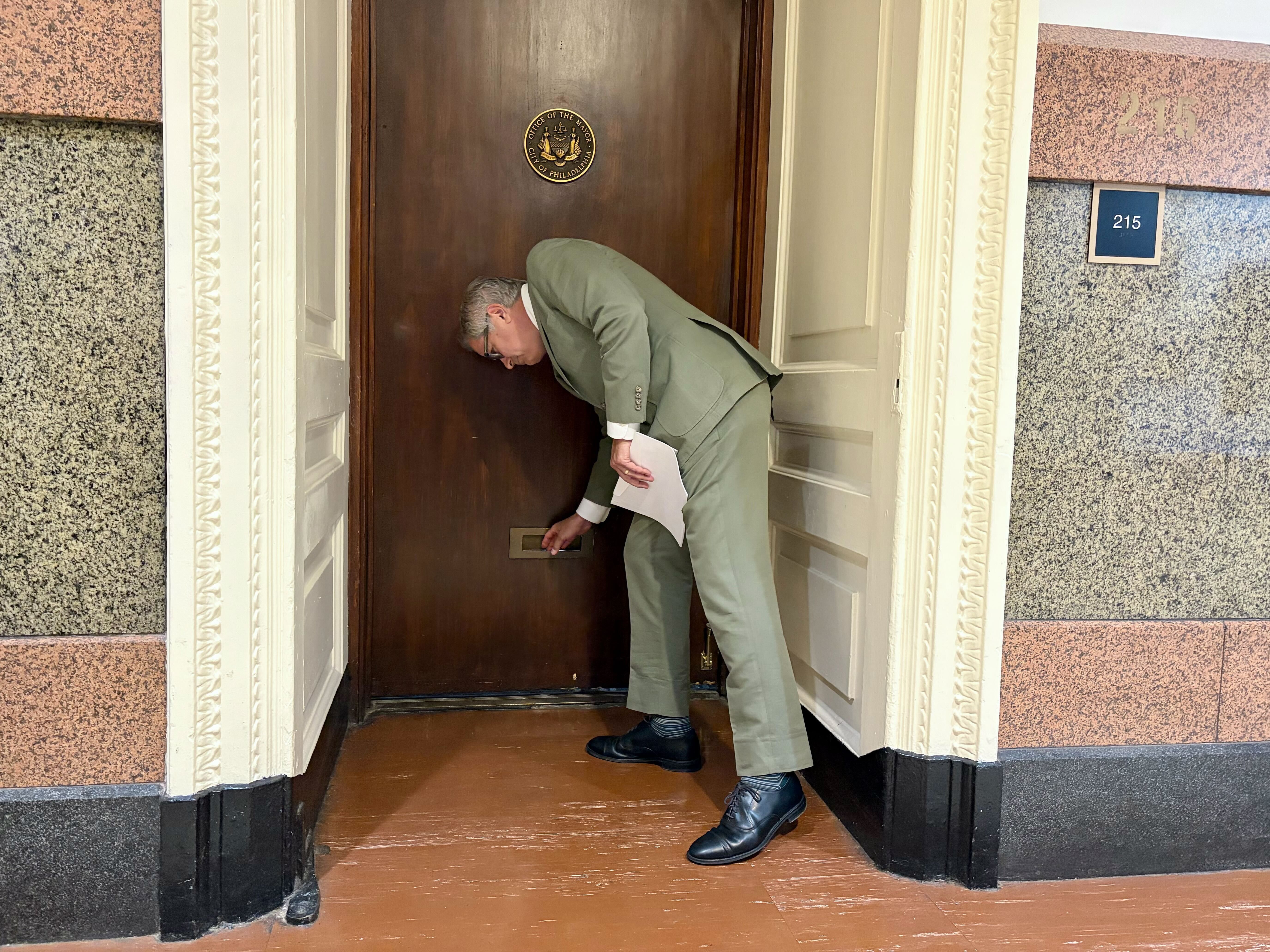
    The mayor did not open her door. Krasner pushed his letter through a mail slot.

    District Attorney Larry Krasner delivers a letter to Mayor Cherelle L. Parker’s office after hosting a news conference to ask the mayor to consider allocating millions more dollars to his office this year.Anna Orso

    The public plea came just days after City Council gave the green light to a city budget for the fiscal year that begins on July 1, including a record-high $62.4 million allocation to the District Attorney’s Office, which is about $3 million more than it received last year.

    Krasner, who called a news conference at the district attorney’s office before his trip to City Hall, said his office needs additional funding to “prevent potential layoffs,” but he did not specify the number of jobs on the line. The city budget will be up for a final vote in Council on Thursday, and it is unlikely to substantially change before then.

    In response to a request for comment, a spokesperson for the mayor shared data showing that the District Attorney’s Office budget has increased by 55% over the last five years.

    Krasner’s televised appeal to Parker on Monday came as rumors swirl that the third-term progressive may run for mayor next year when Parker, a centrist Democrat, is up for reelection. He has also been floated by political observers as a potential candidate for U.S. Senate to run for the seat currently held by Sen. John Fetterman, a Democrat who has angered many in the party and will be up for reelection in 2028.

    Krasner, who is the city’s most prominent progressive and who won reelection to be the city’s top prosecutor last year, said he is not plotting another run for office.

    But he has done little to suppress the speculation. He recently got into a spat with labor leader Ryan N. Boyer, one of Parker’s closest political allies, and he publicly called on former U.S. Rep. Bob Brady, the longtime chair of the city’s Democratic Party, to step aside.

    And on Monday, Krasner, who was reelected to a third term in November, wouldn’t commit to serving out his entire four-year term. (Philadelphia’s Home Rule Charter requires that city officeholders resign to run for higher office.)

    “Am I running for these offices today? No. Do I have a plan to run for these offices today? No,” Krasner said. “But if you’re asking me to say that I would never, under any circumstance, no matter what was going on locally or nationally, consider some other office, it would be foolish for me to completely rule out those possibilities.”

    He is one of several people who progressive leaders in the city may look to next year to challenge Parker, who is backed by much of the city’s Democratic establishment and organized labor. She has been criticized by some on the left for her law enforcement-driven initiatives to address the Kensington drug market and her cautious approach to President Donald Trump.

    The mayor’s race became even more attractive to Philadelphia’s left-wing faction of the Democratic Party last month after State Rep. Chris Rabb, a democratic socialist, won the party’s nomination for an open seat in Congress.

    Mayor Cherelle L. Parker is flanked by Police Commissioner Kevin Bethel and District Attorney Larry Krasner (left) on July 22, 2024.Alejandro A. Alvarez / Staff Photographer

    Krasner’s public criticism of Parker this week is also notable because he and the mayor have, despite not meeting regularly, attempted to maintain a veneer of civility.

    While Parker ran for office on a tough-on-crime message that could be seen as in tension with the district attorney’s progressive platform, she has not directly criticized Krasner. She also campaigned on a promise of close collaboration with other governmental entities after conflict between Krasner and former Mayor Jim Kenney spilled into public view on several occasions.

    Krasner on Monday insisted that his trip across the street to Parker’s office was not intended to inflame hostilities. He cited his letter, which began with thanking the mayor for her “leadership, vision, and goals.”

    The letter ended with Krasner saying that the city’s leaders should “truly model the peace and unity we hope to see within our communities.”

    He added: “We can achieve more together!”

    Staff writer Ellie Rushing contributed to this article.

  • Republican senators warn surveillance program may lapse after Trump intel pick backlash

    WASHINGTON — Republicans are warning the White House that a critical surveillance authority is likely to lapse this week amid bipartisan backlash over President Donald Trump’s pick to lead the nation’s intelligence community.

    Sen. Tom Cotton, the chairperson of the Senate Intelligence Committee, and Sen. Chuck Grassley, chairperson of the Senate Judiciary Committee, sounded the alarm over the weekend after a failed procedural vote to extend the program.

    The senators in a letter urged Secretary of State Marco Rubio to prepare “for a potential significant gap in foreign intelligence collection” if the authority expires. Section 702 of the Foreign Intelligence Surveillance Act, set to lapse June 12, allows agencies including the CIA, National Security Agency, and FBI to collect communications from foreign targets overseas without a warrant.

    “We have a deadline ahead of us. We need Democrat votes,” Senate Majority Leader John Thune said Monday.

    Efforts to secure a long-term extension of the program already faced hurdles because of bipartisan concerns that the program can incidentally collect Americans’ communications. Privacy advocates and some lawmakers have been pushing to create a new warrant requirement before those communications can be searched.

    Senate leaders from both parties appeared to be nearing agreement on a long-term extension. But the effort collapsed after Trump selected federal housing finance regulator Bill Pulte to serve as acting director of national intelligence.

    “Why the president would throw this live hand grenade of Bill Pulte in 10 days before this is due to expire, I’m not sure,” Sen. Mark Warner, the top Democrat on the Senate Intelligence Committee, said on ABC’s This Week.

    Pulte pick upends bipartisan deal

    Early Friday morning, after senators spent the night debating separate immigration legislation, seven Republicans joined nearly all Democrats in blocking a long-term extension of the surveillance authority.

    Democrats and several Republicans registered their opposition to Trump’s selection of Pulte, arguing the federal housing finance regulator lacks the experience needed to oversee the nation’s 18 intelligence agencies.

    “The naming of Pulte to that position, although the timing arguably wasn’t the best, I still don’t think it ought to derail something that’s this important,” Thune said Friday.

    Thune has expressed concern over Pulte’s pick, saying the nation’s top intelligence post should not be “weaponized” and that the job should be filled by “professionals.” Cotton, who rarely strays from supporting Trump and is a leading advocate for the surveillance authority, declined to endorse Pulte, saying only that he had “no observations on the matter.”

    “He’s not qualified for the long-term position,” Republican Sen. James Lankford, another member of the Intelligence Committee, told Fox News Sunday. “That’s been clear on this. He has no national security background.”

    Both Republican and Democratic senators skeptical of Pulte pointed to his record at the Federal Housing Finance Agency. In the role, he’s been linked with criminal referrals over allegations of mortgage fraud by public officials Trump sought to punish, including New York Attorney General Letitia James, a Democrat; Sen. Adam Schiff (D., Calif.); and Lisa Cook, a board member of the Federal Reserve.

    Republicans will need to garner some Democratic support to pass any extension of the surveillance authority in the Senate, and likely the House as well. But a breakthrough appears difficult so long as Pulte remains in the position, which Trump said last week would only be temporary.

    “Clearly to get to good-faith negotiations the effort to elevate Bill Pulte as the acting director of national intelligence should be reversed. Immediately,” House Democratic Leader Hakeem Jeffries said.

    A key surveillance tool

    The current reauthorization debate is hardly the first time that lawmakers have grappled with the fate of the surveillance program, particularly after a flurry of revelations about government misuse of the vast trove of intelligence it collects.

    The topic in recent years has scrambled predictable partisan alliances, with Democratic critics of the Trump administration uniting with skeptics of government power on the right in voicing concerns about Section 702’s renewal.

    In 2024, for instance, those divisions nearly caused the program to lapse. The Senate barely missed its midnight deadline that year before approving by a 60-34 margin legislation to reauthorize Section 702 that was subsequently signed by then-President Joe Biden.

    A spokesperson at the Justice Department did not immediately return messages seeking comment Monday about the national security concerns that would be created if the program lapses. The Office of the Director of National Intelligence referred inquiries to the White House, which did not immediately respond to a request for comment.

    “America faces real threats from foreign adversaries, terrorists, cyber actors, and hostile intelligence services,” Defense Secretary Pete Hegseth said on social media Sunday. “Section 702 remains one of our nation’s most effective tools for identifying and disrupting those threats before they reach our shores.”

    Cotton and Grassley said they believed Democratic leaders would not support another short-term extension of the surveillance authority and urged Rubio to prepare contingency plans. They said Trump should consider an executive order to prevent a disruption in intelligence collection.

    Cotton and Warner had said they were close on a bipartisan deal on a long-term extension and could still move quickly should a change occur before Friday. Still, the bill would likely need to go through the House — and the two chambers so far have disagreed on a separate issue regarding central banking digital currency.

    Republicans leaders are already warning of the consequences if Congress fails to act.

    “If it goes dark, then it would be a calamitous situation for the country,” House Speaker Mike Johnson said.

  • Trump’s $100,000 fee on H-1B visas for highly skilled workers is struck down

    Trump’s $100,000 fee on H-1B visas for highly skilled workers is struck down

    A federal judge threw out the Trump administration’s $100,000 fee on H-1B visas for highly skilled workers Monday, which had been challenged by California Attorney General Rob Bonta with 19 other states.

    In the ruling, U.S. District Judge Leo T. Sorokin of Massachusetts declared President Donald Trump’s fee unlawful and said it basically amounted to an illegal tax, essentially agreeing with the states that the $100,000 fee usurps Congress’ constitutional authority to set immigration policy and raise revenue, according to the decision.

    The fee narrowed a major pathway for legal immigration that is used by Silicon Valley tech companies, as well as hospitals and universities. The U.S. Chamber of Commerce also had challenged the fees in a separate lawsuit, but the court sided with the Trump administration late last year.

    Before Trump’s decree, H-1B visa applications fees rarely exceeded $5,000 a worker in total, excluding lawyers’ expenses. Universities and nonprofits paid a lower fee than private employers.

    The Trump administration is expected to appeal the ruling.

    “President Trump has clear legal authority to restrict entry of any class of aliens he determines is not in America’s best interests, and that is exactly what he did,” said Taylor Rogers, a White House spokesperson. “The H-1B program has been abused for decades, and President Trump finally took action to fix it.”

  • Former Union manager and Philly-area native Jim Curtin to become coach of MLS’s Austin FC

    Former Union manager and Philly-area native Jim Curtin to become coach of MLS’s Austin FC

    After parting ways with the Union in 2024, Jim Curtin has a new head coaching job.

    Austin FC announced Monday afternoon that it hired Curtin, a Bishop McDevitt and Villanova product who led the Union for 11 seasons.

    Curtin, an Oreland native, will start his new job with the Verde after the 2026 Major League Soccer season, which concludes in December.

    “I am incredibly honored to be named the head coach of Austin FC,” Curtin said in a statement. “This is a moment I will never forget, and I’m grateful to [club owner] Anthony Precourt, [club president] Andy Loughnane, and the club’s ownership group for the trust placed in me.

    “From our very first conversation, they shared a vision for Austin FC that is bold, ambitious, and built for the long term. Their belief in what this club can become is contagious, and I’m proud to help bring that vision to life.”

    Austin is one of seven MLS franchises that fired its coach before the league went on hiatus for this summer’s FIFA World Cup. The club fired sporting director Rodolfo Borrell and head coach Nico Estévez on May 18 after starting 3-6-5 (14 points) in league play. Austin then lost its final game before the World Cup.

    The Union became the seventh team to part ways with a coach when they announced the dismissal of Bradley Carnell alongside sporting director Ernst Tanner in May. The Union still are searching for Carnell’s replacement.

    Curtin said in Austin’s release that he had “several other opportunities, both within MLS and abroad, but none of them excited me the way [Austin] did.”

    Curtin took over the Union in 2014 and led the club to a 141-162-90 record over more than a decade on the touchline. The Union made the playoffs seven times under Curtin, winning the Supporters’ Shield in 2020 and reaching the MLS Cup finals in 2022.

    Jim Curtin (center) was manager for the Union’s only MLS Cup final appearance in 2022. Jose F. Moreno / Staff Photographer

    Curtin was named the MLS Coach of the Year in 2020 and 2022.

    After missing the playoffs for the first time in six seasons, the Union parted ways with Curtin at the end of the 2024 regular season. The club hired Carnell to replace Curtin in January 2025.

    Curtin’s first season in charge in Austin will be the 2027 “sprint” season, a 14-game slate that will facilitate MLS’s move to a summer-to-spring league calendar. He will take over for interim coach Davy Arnaud, who will lead Austin through the remainder of the 2026 season.

    MLS matches will resume July 16, and the Union’s first game back will be at home against the New York Red Bulls on July 22 (7:30 p.m., Apple TV).

  • China reasserts itself, to contain North Korea’s tilt toward Russia

    China’s top leader, Xi Jinping, arrived in North Korea on Monday and delivered what analysts said was a subtle reminder to the country’s newly emboldened dictator, Kim Jong Un, that China is his most important benefactor, economic partner, and bulwark against the United States.

    According to an official summary of the leaders’ talks released by Chinese state media, Xi called for “close strategic communication” with Kim and for strengthening exchanges “at all levels and in all fields.” He said he was willing to deepen relations with Kim in “the new era,” a phrase Xi has used to project China’s growing strength on the world stage.

    In many ways, Xi’s two-day trip to Pyongyang, North Korea’s capital, is an effort to balance influence from Russia, which signed a mutual defense pact with North Korea two years ago. That deal has helped revive North Korea’s economy, by allowing Kim to trade weapons and troops with Russia for badly needed oil, food, and weapons technology, and given him a stronger hand in talks with Xi.

    Xi was received by Kim and his wife, Ri Sol Ju, when he landed in Pyongyang, his first trip there in seven years. His motorcade was greeted by a military honor guard and throngs of citizens waving both national flags, with children dancing and clutching bright balloons. North Korea gave Xi a similar welcome the last time he visited Pyongyang.

    At a meeting at the Kumsusan Guest House, Xi pledged to cooperate with Kim in trade, agriculture, science, tourism, and healthcare.

    North Korea had not released a statement about the meeting by late Monday. Kim was expected to press Xi for more economic support and possibly a greater acceptance of North Korea’s nuclear weapons program.

    China’s summary made no mention of the nuclear program, instead stressing that the two countries should “jointly safeguard regional peace and development.”

    China’s long held position is that it opposes a nuclear North Korean state, largely over concerns about driving U.S. allies like South Korea to seek nuclear weapons. Statements about working toward ending the program used to be standard for the two sides during diplomatic engagements, but they have been omitted since last September, when Kim visited Beijing to attend a military parade.

    “China’s approach to North Korea has shifted markedly over the past seven years, from the role of a mediator for North Korea—U. S. denuclearization talks to that of a strong strategic partner in countering the United States,” said Hong Min, an expert on North Korea at the Korea Institute for National Unification, a research institute based in Seoul, South Korea.

    The change may reflect China’s desire to placate North Korea. But it could also suggest that the Chinese government believes that a nuclear-armed North Korea would provide leverage over the United States and South Korea, analysts said.

    Xi evoked the two countries’ history fighting the United States together in the Korean War, reminding Kim that their “traditional friendship” had been “forged in blood.”

    “The overall message that Beijing wants to project through this summit is the unity and the unbreakable bonds between the two countries,” said William Yang, a senior analyst for the International Crisis Group.

    In a letter published Monday in North Korea’s main state-run newspaper, Rodong Sinmun, Xi declared that relations between China and North Korea were at a “new historical starting point.”

    He called on the two countries to “oppose hegemonism and power politics,” an oblique reference to the United States. In a veiled swipe at Japan, with whom China has been in a monthslong feud, Xi wrote that they should also oppose “any scheme or action aimed at reviving militarism and undermining regional security and stability.”

    As with Russia and Iran, Xi has cast North Korea as a close partner in a new world order free of what China sees as U.S. dominance and meddling.

    Kim has said North Korea should boost trade with China to further stimulate its economy and generate hard currency. Yet all its top exports — coal, iron ore, fish, and textiles — remain prohibited under United Nations sanctions, creating a huge trade deficit with China that has threatened to drain its foreign currency reserves.

    Xi’s offers on trade and tourism could change that, but it is not clear whether it is possible to do so without violating U.N. sanctions.

    Both China and Russia have grown increasingly reluctant to enforce those sanctions in recent years, as tensions with the United States have worsened. In a joint statement issued last month, Xi and President Vladimir Putin of Russia declared their opposition to “the use of diplomatic isolation, economic sanctions, force, and pressure” against North Korea.

    Such backing has emboldened Kim to hold on to his nuclear arsenal and insist on being​ treated as a nuclear-armed state. In the days preceding Xi’s arrival, he visited a missile factory and a newly operational weapons-grade uranium enrichment facility, vowing to “beef up our state’s nuclear forces at an exponential rate.”

    This article originally appeared in the New York Times.