There is good news for anyone without a steel bladder visiting the Benjamin Franklin Parkway this summer.
On Tuesday, the city opened four new “hospitality hub” restrooms along the Parkway to welcome and accommodate the many visitors expected in Philadelphia over the next two months. The restrooms come through a partnership among Philadelphia Parks and Recreation, the nonprofit Parkway Council, and Tork, a hygiene and cleaning products company.
“As we prepare to welcome residents and visitors to some of our city’s best public spaces this summer, our goal is simple: make it easy for people to enjoy Philadelphia,” said Katie Burns Kays, director of business and event development for Philadelphia Parks and Recreation, at a news conference.
“Hospitality hubs are designed to provide the services people need when spending time in our parks and public spaces, whether that’s access to restrooms, handwashing, hydration stations, seating, visitor information, or simply a comfortable place to take a break,” she said.
Each of the restroom trailers has four genderless stalls and an adjacent port-a-potty for individuals who cannot make it up the restroom steps. Each stall has a sink, soap, paper towels, and “air care” to keep it smelling fresh, according to Amy Bellcourt, a spokesperson for Essity, the parent company of Tork.
People fill the street during the Philly Pride Festival on the Ben Franklin Parkway on Sunday, June 7, 2026 in Philadelphia. Future events will have more bathroom options. Monica Herndon / Staff Photographer
The restrooms are open from 10 a.m. to 8 p.m. each day, and are staffed by an attendant who will clean the stalls at least once an hour, Burns Kays said. The locations of the four hospitality hubs are: LOVE Park, Logan Square, Eakins Oval, and by Lloyd Hall Recreation Center on Boathouse Row.
The restrooms are just part of the full hospitality hub experience. Each also includes an adjacent visitor center for information, seating, and stations for water refills, Burns Kays said.
The restrooms will be in place through the end of July, but the rest of the hospitality hubs will be removed after July 19 once the city’s major summer events are over, Burns Kays said.
The lack of permanent public restrooms along the Parkway is one of the major pieces of feedback the city has received about events there, she said, and can dissuade people from attending public events. It is possible the city will make the restrooms a permanent fixture in the future, she said.
Previously, the city installed a handful of public restrooms through its Philly Phlush pilot initiated by former Mayor JimKenney‘s administration, but the restrooms were slow to roll out and it is unclear if the city will continue to fund them once the pilot ends.
WASHINGTON — The former chief investigations counsel for the House Oversight Committee has been helping to prepare Bill Gates, the billionaire co-founder of Microsoft, to testify privately in the panel’s Jeffrey Epstein investigation today, according to two people affiliated with the Gates Foundation who are familiar with the arrangement.
Rep. James Comer of Kentucky, the Republican chair of the committee, formally requested in March that Gates appear before the committee for a transcribed interview. His request came after files released by the Justice Department showed that Gates met with Epstein, the convicted sex offender, multiple times and that his closest advisers were in frequent contact with the disgraced financier until 2019, the year of his death in prison.
In preparing for the deposition, Gates has turned to Jake Greenberg, who until December was spearheading the oversight panel’s Epstein inquiry in his role as the committee’s top investigative official. The people who disclosed his involvement insisted on anonymity to discuss Greenberg’s previously undisclosed function.
The arrangement, while not uncommon, raised eyebrows among government ethics experts who said it could create questionable optics for the deposition in a high-profile investigation.
A spokesperson for Gates Ventures did not respond to multiple requests for comment about Greenberg’s role advising Gates. Greenberg also did not respond to multiple requests for comment.
Gates’ close relationship with Epstein has roiled his foundation, which has authorized an outside review of its ties to Epstein. Gates apologized to foundation staff members in an all-hands meeting this year for his associations with Epstein.
House Democrats say they want to grill Gates behind closed doors today about the nature of his relationship with Epstein.
“We need accountability for those in power and answers for survivors,” said Rep. Yassamin Ansari (D., Ariz.). “No one — regardless of power, political party, or wealth — is above justice.”
Rep. Suhas Subramanyam (D., Va.), said in an interview that he wanted to know what Gates “knew of Epstein’s crimes, and the nature and extent of their relationship.” He added, “Epstein was known for befriending and even blackmailing rich and powerful men, and I want to know if Gates was one of them.”
Gates has sought out powerful inside players to help him weather the scrutiny. He hired John Moran, a former lawyer for the Justice Department, who helped him secure an agreement with the committee for him to appear off camera, the Wall Street Journal reported.
A spokesperson said the committee was not filming voluntary transcribed interviews for witnesses who agreed to come in quickly. The committee released filmed interviews with other witnesses whom it had subpoenaed, including Bill and Hillary Clinton and Les Wexner.
Government watchdog experts said it was not unusual for a former top committee official to be hired by a person under scrutiny by the panel and that it would not necessarily violate ethics rules — as long as Greenberg was not dealing directly with the committee he had previously worked for.
Former members of Congress and top aides have a one-year “cooling-off” period after leaving those jobs, during which they are barred from lobbying or communicating directly with lawmakers or committees. Greenberg would not be allowed, for instance, to negotiate with the oversight panel about the terms of Gates’ appearance. But there is no rule prohibiting him from privately sharing with a client what he knows about how the committee operates, or his knowledge of how it is approaching a particular investigation.
Still, the ethics experts said it could give the appearance of an unseemly revolving door.
Donald Sherman, the chief counsel for Citizens for Responsibility and Ethics in Washington, a nonpartisan government watchdog group, said Greenberg’s role could potentially raise questions, including whether he had been a part of any discussions when he was still working for the committee about potentially inviting Gates to testify.
“Certainly someone with Bill Gates’ money can afford to hire the people who he believes are going to set him up for navigating the congressional oversight process — and it is a unique process,” Sherman said.
But, he added, “optics matters a great deal in congressional investigation. Certainly it raises questions that the public and the minority might ask about whether the investigation is independent or arm’s length, separate and apart from whether he is technically complying with the rules.”
Dylan Hedtler-Gaudette, the interim vice president of policy and government affairs at the Project on Government Oversight, also said the arrangement raised concerns.
“Hearings are supposed to be serious attempts at fact-finding,” he said. “You would want a process that is free of any sort of conflicts of interest or influence peddling. There’s a lot of using the position you used to have, the leverage and the juice you bring, using that to benefit whoever you’re working for and tilt the playing field.”
Until December, Greenberg served as general counsel and chief investigations counsel for the House Oversight Committee. In that role, he led the investigation into former President Joe Biden’s mental acuity, taking the lead in the transcribed depositions of top Biden administration officials like Annie Tomasini and Karine Jean-Pierre, the former White House press secretary.
Greenberg was working on the committee last year when it deposed William Barr, the former attorney general, in the Epstein investigation.
After leaving Capitol Hill, Greenberg joined the law firm DLA Piper.
The firm now highlights his expertise in congressional oversight with glowing accolades from Comer on its website.
“Jake Greenberg proved to be one of Washington’s most capable oversight investigators,” Comer says in a testimonial prominently displayed.
DLA Piper did not respond to a request for comment. A spokesperson for the committee, Jessica Collins, said the committee had not worked with Greenberg in any capacity since he left and that the panel has worked only with Moran regarding Gates’ appearance.
Greenberg is not expected to be with Gates at the deposition Wednesday, according to a person familiar with the proceedings who insisted on anonymity to discuss them in advance.
Gates is not the only witness to turn to a former staff member for the committee before his appearance before Congress. When the Clintons were fighting the subpoenas in the Epstein investigation, they brought on Ashley Callen, a co-chair of the congressional investigations practice at Jenner & Block, to deal with GOP members of the Oversight Committee. Callen had previously worked as general counsel for Speaker Mike Johnson and other top Republicans. She also had worked as a deputy staff director on the House Oversight Committee under Comer.
But Callen had never worked on the Epstein issue, and her departure from Capitol Hill exceeded any cooling-off period, so she was able to interact directly with the committee in her official role as a lawyer for the Clintons. She also appeared at the April deposition of Ted Waitt, the co-founder of Gateway computers who for years dated Ghislaine Maxwell and was called to testify before the committee, acting as his counsel.
City Councilmember Cindy Bass on Monday night was facing a challenge in her bid to be reelected as the Democratic leader of Mount Airy’s 22nd Ward. Her opponent, Octavius Price, had the backing of a well-organized group of progressive activists, many of whom were newly elected as committeepeople in last month’s Democratic primary election.
As the incumbent, Bass chaired the meeting to determine her own fate as ward leader, and she held a voice vote to determine whether she or Price had more support among the committeepeople assembled at the Germantown Seventh-day Adventist Church.
A video of the meeting obtained by The Inquirer appears to show a narrowly divided room, with many people saying, “Aye,” in support of bothBass and Price. Attendees cried out for a roll call, in which the committeepeople’s votes would be counted one by one, clarifying which candidate had more support.
But Bass immediately announced herself the winner, rejected all motions from committeepeople objecting to the vote, and quickly adjourned the meeting, the video shows.
Bass, a centrist Democrat, narrowly won reelection to her fourth term on Council in 2023 and has clashed with left-leaning activists in her Northwest Philadelphia-based 8th District. A progressive takeover of Bass’ own ward could hinder her reelection chances in next year’s Council election.
She is now facing accusations that she skirted the party’s procedures for ward reorganization meetings by declaring herself the victor while denying requests for a roll-call vote.
Democratic City Committee Chair Bob Brady said Monday night that wards can use voice votes for leadership elections, especially when the results are “overwhelming,” such as when an incumbent is running unopposed. But if a committeeperson calls for a roll-call vote to ensure greater accuracy, he said, the request must be honored.
“You can do a voice vote,“ Brady said in an interview. ”If they do a voice vote and somebody calls for a roll call, you gotta do a roll call.”
On Monday night, Bass, who has been ward leader since 2018, maintained she had the votes to win another four-year term. But she did not respond to a request for comment on why she ignored requests for a roll call.
“We had the votes,” she said in an interview. “No matter what I did, some of these people are not going to be happy.”
Ward leaders and committeepeople are the frontline workers of the local party, charged with getting out the vote for Democratic candidates running for everything from Municipal Court to president.
Fights over control of the city’s 69 Democratic ward leader positions have for years provided flash points in the long-running battles pitting the party establishment against anti-corruption reformers and, more recently, the local progressive movement.
State Rep. Chris Rabb, a Northwest Philly Democrat whose victory in last month’s primary election for the 3rd Congressional District marked a landmark victory for progressives, on Tuesday linked Bass’ reelection bid to his broader criticisms of the Democratic City Committee.
“If she ‘wins’ this battle, the Philly Dem Party will lose the war,” Rabb posted on X. “Either it refashions itself around equity, accountability & transparency OR it just withers away election cycle by election cycle while Dem voters statewide suffer because … as Philly goes, so goes PA.”
Brady, who is expected to be reelected to an 11th term as party chair next week, declined to comment on the result of the 22nd Ward election, but said he expects it will be challenged. Challenges are heard by the party’s contest committee, which is made up of other ward leaders. If Price formally objects, the committee would likely hear the challenge Saturday, Brady said.
“[Price] would have to notify us that he’s contesting the election, and then we’ll hear from both sides,” Brady said.
The committee, he said, could declare a winner if members determine the results are clear, or call for a rerun of the election.
Price, a fiber optic engineer, called Bass’ handling of the election “unjust” and said he plans to file a challenge.
“I initially ran to be a committeeperson because I believe in democracy and I believe in transparency and fairness,” Price said in a statement following the vote.“This was an example of moral decay and emboldened cruelty and corruption that has made so many people disillusioned with participating in politics.”
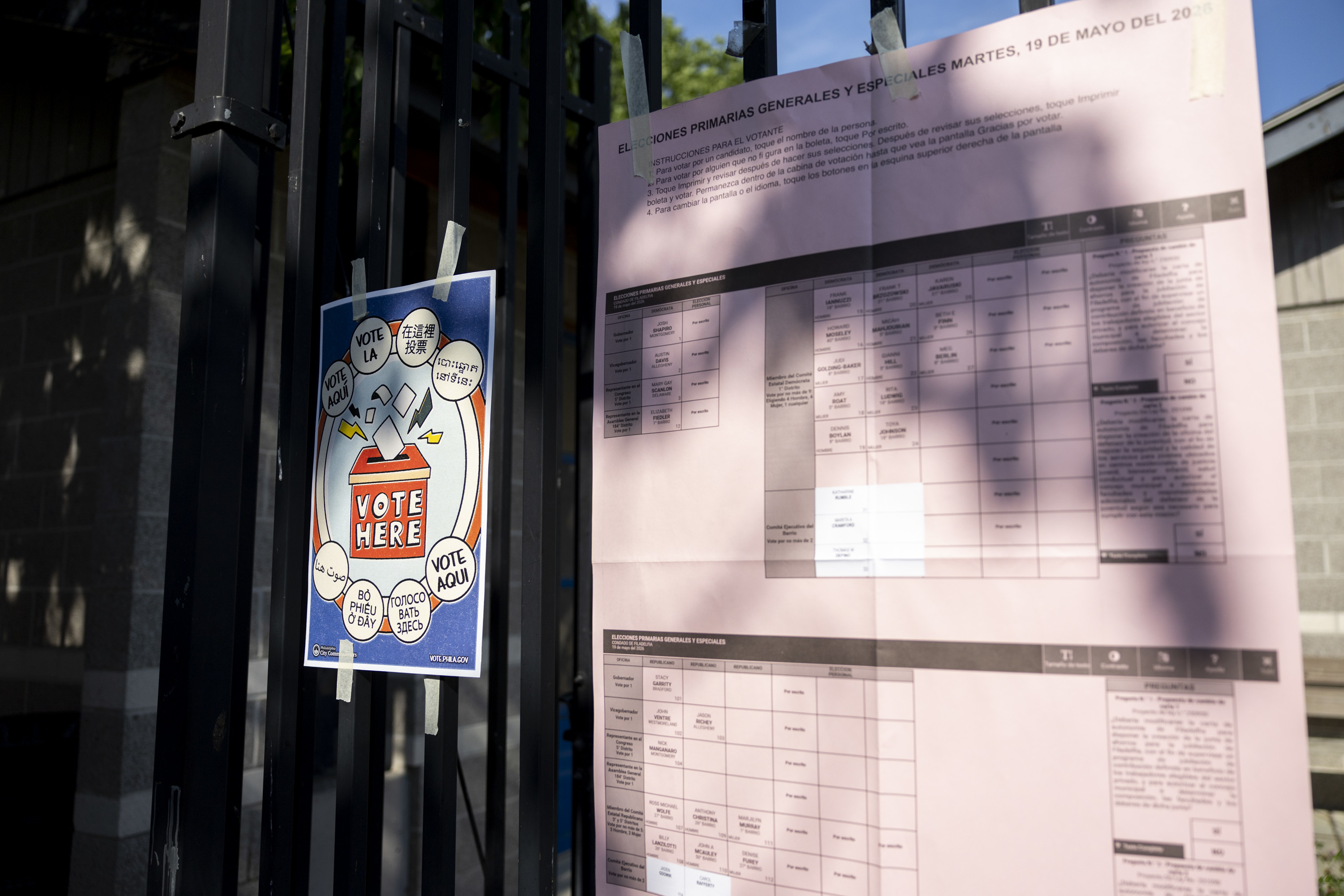
A “vote here” sign outside the polls at Marconi Plaza in South Philadelphia, Pa., on Tuesday., May 19, 2026.Tyger Williams / Staff Photographer
Another point of contention on Monday was the number of people in the room, which could become a key factor in a contest committee review of the election results because it changes the number of votes needed for a majority.
Price, whose supporters whipped votes ahead of the meeting, said that by his count at least 26 committeepeople were planning to vote against Bass and for a candidate who, like him, supports “open wards,” which allow committeepeople to vote on political endorsements rather than letting the ward leader decide unilaterally for the entire jurisdiction.
Price said his supporters counted 48 committeepeople present on Monday evening, meaning he should have had the votes sufficient for a victory.
But a sign-in sheet at the meeting told a different story.
The sheet, a photo of which was obtained by The Inquirer, listed 55 committeepeople and appeared to include a tally of their allegiances before the election was even held. Price said ward organizers who appeared to be working with Bass circulated the sheet at the beginning of the meeting. The paper showed 29 for Bass and 26 for “other.”
“Her sheet has a total of 55 people who voted, but we know for a fact that’s not the case,” he said.
Former Councilmember Derek S. Green, a 22nd Ward committeeperson who ran against Bass for ward leader in 2018, flirted with running for the post again this year. But he did not end up throwing his hat in the ring, resulting in a one-on-one showdown between Bass and Price.
Green, who was present Monday night, declined to comment on the election results.
After Price was nominated during the meeting, Bass launched into the voice vote.
“All in favor of Octavius Price, signify by saying, ‘Aye,” Bass said. “All in favor of Cindy Bass, signify by saying, ‘Aye.’”
In the video recording of the meeting, many people can be heard supporting each of the candidates. Even before Bass announced the winner, a participant can be heard saying, “roll call.”
Bass then said, “In the call of the chair, the ayes have it for Cindy Bass.” The room immediately erupted with objections.
“No, no, no — you’ve got to have a roll call,” one person said. Others shouted: “Roll call!”
“There will be no motions accepted on the floor,” Bass said over the commotion. “We’re going to have to adjourn the meeting. There is no point of order. So the motion has been made — that concludes — there is no additional business for the ward tonight. Thank you for coming.”
The tensions did not end there.
After the election, participants in the meeting clashed outside the church as a man and a woman holding the sign-in sheet refused to let other committeepeople record their attendance on the form, a separate video reviewed by The Inquirer shows.
“Y’all got to get back. Better get back,” the man told a crowd pleading to sign the forms. “Shut up!”
As the man walked away, one person can be heard turning to Green, who was caught in the middle of the fracas.
“Derek, we just wanted to get our sign-in [on] the sheet. He took it from us,” the man said.
“I know. That’s why I came,” Green responded. “It’s not right. It’s not right.”
When Bucks County-raised pop star Pink began the Tony Awards on Sunday evening, she started somewhere she would be comfortable on stage — in the air.
Suspended from the rafters, she joked about feeling underqualified to host the awards ceremony because she’s never appeared on Broadway. But actor Neil Patrick Harris assured her that she would excel as her entertaining, acrobatic self: “Listen you’re Pink, you’re singular, you’re the best.”
Then she went on to belt “Lady Marmalade” with some of Broadway’s best performers and fit right in.
The night of revelry at Radio City Music Hall celebrated the biggest theater shows with major winners including Death of a Salesman, Schmigadoon!, Ragtime, The Lost Boys, and Liberation. The latter won for best play, recognizing playwright Bess Wohl, who became the fourth woman in Tony history to win that award. (Philly audiences will get a chance to see the show this fall when Liberation runs at Philadelphia Theatre Company in October)
The biggest local highlight was director Bill Rauch, who calls New York home now but spent part of his childhood in Haddonfield, where he participated in productions at Haddonfield Memorial High School. Rauch and his codirector, Zhailon Levingston, won the Tony Award for best direction of a musical for Cats: The Jellicle Ball, a revival of Andrew Lloyd Webber’s 1982 feline musical, set in New York’s queer ballroom scene.
“Ballroom is about audacity and disruption, in the words of Junior LaBeija, it do take nerve,” said Levingston when the pair accepted the award.
“Finally, ballroom is about chosen family,” said Rauch, getting emotional. “We chose each other, my husband, Christopher Liam Moore, 42 years ago, and you and our kids, Liam and Xava, are at the heart of anything I do that has any value in this world.”
Rauch, who leads New York’s Perelman Performing Arts Center, previously directed the Tony Award-winning production All the Way, about Lyndon B. Johnson during the civil rights era. That production received Tony Awards for best play and best lead actor in a play (spotlighting Bryan Cranston), in 2014.
Rauch credits his high school teacher and mentor Jack Shaw with inspiring him to pursue theater.
“I did six shows directed by Jack Shaw, and they really changed my life,” Rauch told 6abc. “I learned by example what a great director could be, and it made me want to become a director.”
On Sunday night, Shaw hosted a Tony Awards watch party at his home in Voorhees, where he and a group of about 15 of Rauch’s old theater classmates jumped and screamed as they saw him accept the award. The revered drama teacher is still close with dozens of his former students, who reunite often to celebrate Shaw’s milestone birthdays and have created a scholarship at Haddonfield Memorial High School to fund drama students in Shaw’s honor.
One of Shaw’s favorite memories of Rauch was during a production of Shakespeare’s Twelfth Night, when the teenager powered through his Malvolio monologue while in the middle of an allergic reaction.
“The poor guy literally ended up on the floor of the stage, going through a long speech [as] his neck and back cramped up,” said Shaw. “Unbelievably, he kept going — the ultimate ‘show must go on’ spirit. He delivered the speech from his knees, still in character, and the audience had no idea …[then] we took him offstage and put him in an ambulance.”
A proud teacher, Shaw was “choked up” seeing Rauch receive the Tony recognition and praised his former student’s “remarkable need to bring theater to lots of people.”
“Theater and the drama club was a place where anybody could come and be accepted. To my way of thinking, that’s my most happy part, and Bill, as a director, has had the same kind of philosophy,” Shaw said.
Cats: The Jellicle Ball was nominated for nine awards and took home three, including best choreography and best costume design of a musical, which went to Qween Jean (who also designed costumes for Liberation). Qween Jean made history becoming the first transgender person to win a Tony Award.
WASHINGTON — Mismanagement at a massive Immigration and Customs Enforcement facility in Texas created unsafe conditions that contributed to detainee deaths and suffering even as millions of wasted tax dollars enriched contractors, according to a federal report released Tuesday.
The Government Accountability Office report documents serious problems at Camp East Montana, a sprawling tent facility at Fort Bliss in El Paso where three detainees have died in little more than six months. Evidence in one of those deaths, of a 55-year-old Cuban migrant who died in January after being held down by guards, was “missing or destroyed,” the report found.
ICE rushed to open the camp in August before construction was complete and failed to conduct required oversight to ensure detainees were held in sanitary conditions and receiving adequate medical care, according to the report.
The Department of Homeland Security noted that ICE has replaced the contractor running the facility. “This new contractor will allow Camp East Montana to continue abiding by the highest detention standards with the ability to provide more medical care on-site,” said DHS spokesperson Lauren Bis.
The GAO’s findings echo past reporting by the Associated Press and other news outlets about dangerous conditions at Camp East Montana, which quickly became the nation’s largest immigration detention facility.
But the government report also details previously undisclosed incidents, including that a detainee escaped in October due to what ICE called the contractor’s oversight failure. In January, a security guard lost a loaded firearm inside the facility that was never recovered.
The contractor failed to administer skin tests to screen detainees for tuberculosis, relying on a questionnaire instead, the report said. The inadequate screening allowed a detainee with tuberculosis to be housed with the general population, which later suffered an outbreak.
GAO is an independent, nonpartisan agency in Congress that investigates how federal funds are spent and evaluates whether programs and policies are operating effectively. The office opened its review into Camp East Montana at the request of Democrats in the House and Senate.
Sen. Dick Durbin of Illinois called the report’s findings “damning.”
“We now know even more details of how dangerous and irresponsible the Trump administration’s mass deportation campaign truly is,” said Durbin, the ranking Democrat on the Senate Judiciary Committee, adding that “those detained are experiencing conditions that shock the conscience.”
A rush to build led to an inexperienced contractor
Facing pressure to increase its detention capacity, the Trump administration routed the contract to build Camp East Montana through the Army to speed construction after ICE twice failed to successfully award one. That resulted in selecting a small, little-known contractor, Acquisition Logistics, for the $1.3 billion deal despite it having no prior experience operating detention facilities and facing what ICE called a “significant learning curve.”
The Army — and later ICE after the camp was transferred to the agency — wasted millions of dollars paying for services it did not need because the contract did not account for fluctuations in the detainee population, the report said.
The Army blew up to $11.5 million paying for guards, medical services, transportation, and meals in the weeks before the camp held detainees. The agencies wasted millions more because it was contracted to pay the cost of meals for the camp’s maximum population of 5,000, even when the number of detainees there dropped to around 1,600, the report said.
The facility did not meet ICE detention standards or the contract’s requirements in several ways when it opened, in part because it had not been inspected as required by ICE policy, the report said. The camp lacked security cameras on the perimeter and had other surveillance blind spots that raised the risk of sexual assaults or escapes.
The camp could not accommodate detainees using wheelchairs and had no showers compliant with the Americans with Disabilities Act, resulting in the disabled being held in medical care rooms.
The recreation area wasn’t available for several days, and after one yard was opened, it wasn’t enough space to provide required time for detainees. The law library, space to meet with attorneys, and a visitation area did not open for weeks, resulting in detainees being deprived of legal resources and contact with family and friends, the report found.
The problems persisted as ICE began transporting more detainees there from across the country, the GAO found. While it was built to house up to 5,000 immigrants for short-term stays, its population has averaged about half of that from October until April, according to ICE’s most recent data.
Missing evidence and other problems
Detainees held at the facility didn’t receive comprehensive health assessments, which meant that those with chronic conditions received substandard care, the report said.
The contractor cleaned the dormitories weekly rather than daily as required, resulting in unsanitary conditions. Some guards offered detainees cookies if they would clean their own rooms. Acquisition Logistics didn’t reply to messages seeking comment.
The GAO report says investigations into the January death of Geraldo Lunas Campos were undermined after “evidence associated with the incident was missing or destroyed.” It did not elaborate. Campos died after he was restrained by guards and an outside autopsy report ruled the death a homicide due to asphyxia. The contractor at the facility did not provide use-of-force and death reports to ICE as required, according to the new report.
An investigation by ICE’s Office of Professional Responsibility into the death is on hold pending a criminal investigation by the FBI.
On Jan. 14, Nicaraguan detainee Victor Manuel Diaz, 36, died of suicide after staff put him in a medical holding room instead of a suicide-resistant cell and left him unattended for intervals longer than 15 minutes, the report said. Staff could not see into the room because the contractor had failed to install vision panels that had been requested months earlier, it found.
“These are huge discrepancies in their failure to prevent suicides,” said Diaz family attorney Randall Kallinen, noting that the report strengthens a potential wrongful death claim he’s considering. “They are part of an entire laundry list of problems at Camp East Montana.”
Brothers Allen Joseph and Anser Bhatti own Liberty Scoops ice cream and Coffee Tea & Co., both in Old City.
They concede that the past 18 months of construction for improvements to Market Street were often tough on business, especially the coffee shop, because of fencing that had to be erected.
Now, with the $16 million renovation of Market Street complete, and the fencing gone, Joseph said it was worth it.
“It looks much better now,” Joseph said.
Philadelphia officials unveiled the new look Tuesday in time for the nation’s 250th anniversary. The transformation permanently narrowed vehicular traffic, added bike lanes, and built a new public plaza.
“As you can see, walking around the neighborhood is greatly improved,” said Job Itzkowitz, executive director of the Old City District, a business improvement organization.
Itzkowitz noted more open space for pedestrians, shorter distances to cross the street, and new street trees and planters, among other improvements.
“Residents, visitors, and business owners alike have already felt the impact as the fences started to come down over the last few months,” he said.
Officials launched the overhaul in December 2024 to rebuild the corridor from Second to Sixth Streets and transform the historic stretch into a more inviting place to walk, bike, and dine.
The work was to timed for the Semiquincentennial, which marks the 250th anniversary of the signing of the Declaration of Independence. Several other nearby landmarks have also been spruced up, such as Elfreth’s Alley, which recently unveiled a new pocket park, and the long-shuttered First Bank of the United States, set to reopen to the public on July 1 after a $27 million renovation.
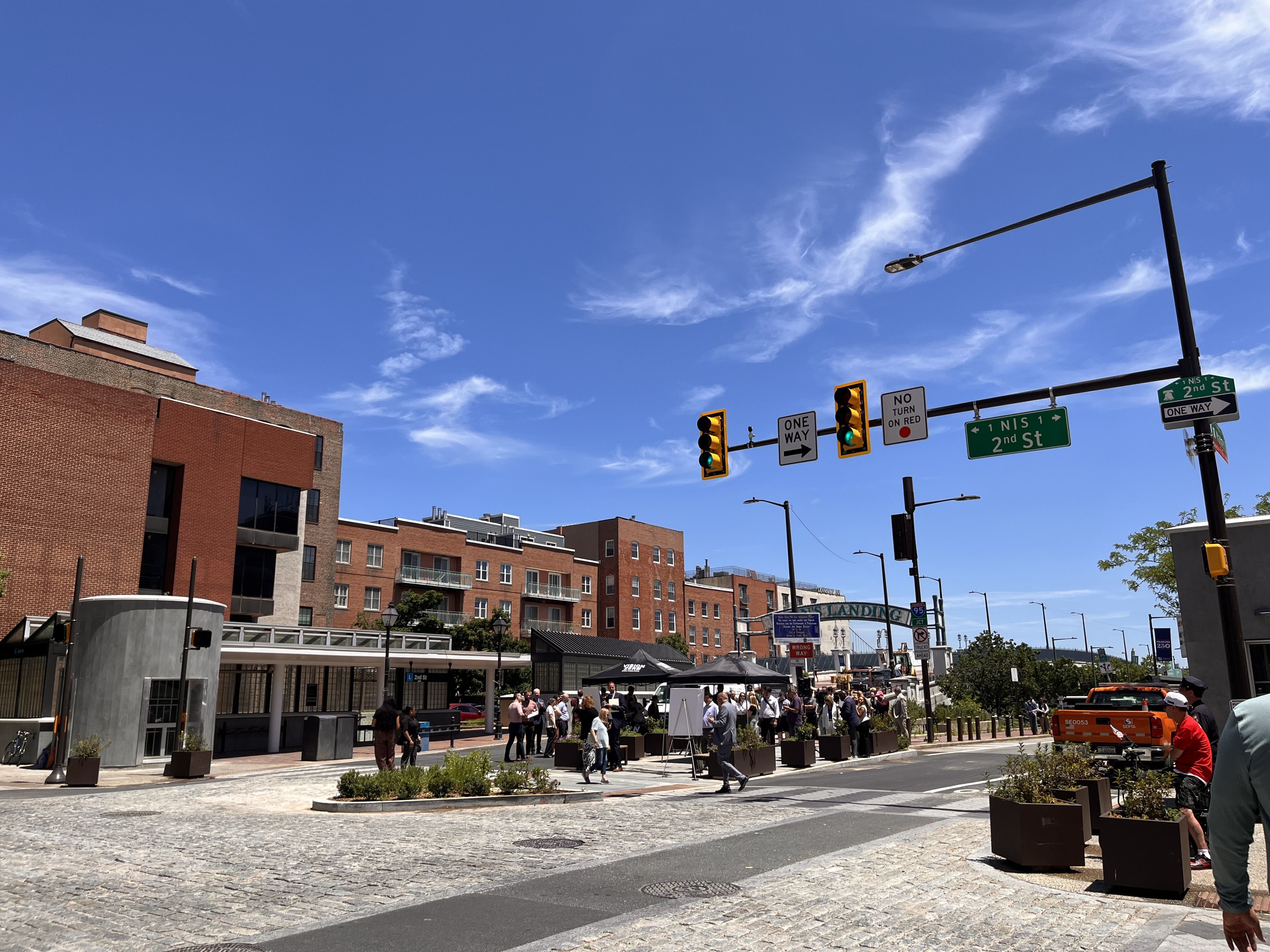
Philadelphia city officials celebrated the completion of a $16 million renovation of Market Street, from Sixth to Second Streets. Improvements include wider sidewalks, protected bike lanes, Belgian block streetscape, and new plantings.Frank Kummer
What’s new?
As part of Market Street’s “road diet,” vehicles have been reduced to one lane in each direction, clearing way for protected bike lanes and adding dedicated left turn lanes at key intersections.
Among other improvements:
A new curbless plaza at Second and Market Streets at the base of the ramp to Penn’s Landing, allowing easier access for pedestrians.
Concrete bump outs at bus stops were lengthened to make boarding easier. The raised bike lanes were installed between parking lanes and sidewalks.
Wider sidewalks.
Belgian block streetscaping.
44 new street trees and 68 shrubs.
55 bike racks.
SEPTA also improved the look of the headhouses for the Market-Frankford Line subway at Second Street.
Officials say the transformation will reduce traffic-related injuries and deaths and better serve tourists, walkers, cyclists, transit users,and motorists.
Also taking a lead was the nonprofit Independence Historical Trust, as part of a larger plan to create better ways for tourists to navigate on foot through Independence National Historical Park, Old City, and other historic or local neighborhoods.
“The new plaza rocks,” said Mayor Cherelle L. Parker.
Parker said the just-completed project fits in with broader efforts to extend improvements on Market Street from City Hall to the Delaware River.
Bill Marrazzo, chair of the nonprofit Independence Historical Trust, called completion of the Market Street project key, given its location in Old City and near Independence National Historical Park.
“No other American city has as many cultural assets per capita as we do here in the city of Philadelphia,” Marrazzo said, “and a very high percentage of those are organized here within this one square mile of history.”
“These improvements are truly transformational,” noted Mike Carroll, the city’s deputy managing director for transportation and infrastructure.
WASHINGTON — Vice President JD Vance is pressing federal prosecutors to investigate Minnesota Gov. Tim Walz and state Attorney General Keith Ellison over allegations they failed to stop widespread social services fraud, amplifying concerns the White House will use a new Justice Department division to target political rivals.
Vance, who has been tapped to lead the Trump administration’s anti-fraud efforts as he seeks to raise his political profile as a potential 2028 presidential candidate, cited in a letter to the Justice Department a report from the Republican-led House Oversight Committee that alleges Walz and Ellison were aware of pervasive abuse of government programs for years and let it flourish.
The Justice Department didn’t immediately respond to questions Tuesday about whether it would open an investigation. It was unclear what, if any, potential violations of federal law could support a probe into the Democratic Minnesota officials, who have defended their efforts to combat fraud and have characterized a separate Justice Department investigation involving state leaders as politically motivated.
Minnesota has long been under a microscope for staggering amounts of fraud in programs for children and other social services, with dozens of defendants charged under the administrations of President Joe Biden, a Democrat, and President Donald Trump, a Republican. Vance’s referral for an investigation into state leaders, however, marks an escalation in the Trump administration’s stated “war on fraud” that officials have said would not be political or partisan.
Vance is seeking an investigation by a new Justice Department division that has drawn intense scrutiny over the potential for political influence given its close relationship with Trump’s White House. The White House announced the division’s formation in January and initially said its leader would answer directly to the president instead of the typical Justice Department command.
Walz spokesperson Teddy Tschann derided the House committee as “nothing more than a joke” that continues to “rehash COVID-era fraud.”
“Governor Walz is glad to see fraudsters are going to prison,” Tschann said in an email. “If the committee is concerned about corruption, they should investigate why President Trump continues to let fraudsters out of prison.” Trump has granted clemency to numerous defendants convicted of financial crimes, including a man sentenced to 50 years in prison for orchestrating a more than $200 million Medicare fraud scheme.
Ellison called the allegations unfounded and dismissed Vance’s referral as “a political stunt from an administration that uses the machinery of government to target its perceived opponents while extending leniency to those aligned with its interests.”
“It is deeply troubling to see official powers and public resources diverted away from serving the people and instead aimed at pursuing political adversaries,” Ellison said in a statement. “That is not what government is for, and it diminishes public trust in our institutions.”
The House committee alleges that “fraud warnings were elevated to the most senior levels of the Minnesota state government” and payments continued “long after credible signs of fraud emerged.” In his referral, Vance wrote that officials in Minnesota or anywhere else in the country “must be held accountable” if they facilitated fraud, prevented officials from stopping it, or retaliated against whistleblowers who tried to report it.
“Minnesota state officials are not above the law,” Vance wrote in a post on X.
The Trump administration has clashed repeatedly with Minnesota officials not only about fraud but also the massive federal immigration crackdown that swept across the Minneapolis-St. Paul area and other communities and led to widespread protests.
The Justice Department in January served grand jury subpoenas to Minnesota officials as part of an investigation into whether they obstructed or impeded federal law enforcement through public statements they made. The status of that investigation is unclear.
The Trump administration has touted the creation of the National Fraud Enforcement Division as a crucial step in its efforts to prevent the misuse of taxpayer dollars. The division’s leader, Assistant Attorney General Colin McDonald, is a veteran prosecutor who has vowed to pursue cases “without fear or favor.”
Critics, however, have questioned the administration’s motives behind the new division given that fraud was already prosecuted by the agency’s Criminal Division, which last year announced the largest coordinated takedown of healthcare fraud schemes in Justice Department history.
Sales of previously occupied U.S. homes accelerated last month to their fastest pace since December, a sharp turnaround in demand after a lackluster start to the spring homebuying season.
Existing home sales rose 3.2% in May from the previous month to a seasonally adjusted annual rate of 4.17 million units, the National Association of Realtors said Tuesday. Sales also rose 3.2% compared with May last year.
Home sales increased from a year earlier in the Midwest, South, and West, but fell in the Northeast, NAR said.
The latest sales figure topped the roughly 4.07 million pace economists were expecting, according to FactSet.
Home sales have been mostly hovering close to a 4-million annual pace going back to 2023, far short of the historic norm that is closer to 5.2-million.
Sales rose last month even as mortgage rates have continued to mostly trend higher this spring, although they remain below where they were a year ago.
Home prices continued to rise nationally last month. The U.S. median sales price increased 1.3% in May from a year earlier to $429,300, an all-time high for any May on data going back to 1999, NAR said. Home prices have risen on an annual basis for 35 months in a row.
Even so, home price growth is now lagging income growth in many areas. That, plus mortgage rates holding below where they were this time last year, is helping to improve affordability, giving the housing market momentum, said Lawrence Yun, NAR’s chief economist.
“I cannot definitively say if home sales are truly coming out of the slump, because we know that there’s still uncertainty related to the oil prices or how the mortgage rates will move,” Yun said, adding that he expects home sales will emerge from their multiyear slump if the average rate on a 30-year mortgage drops back closer to 6%.
The U.S. housing market has been in a slump since 2022, when mortgage rates began to climb from pandemic-era lows. Sales of previously occupied U.S. homes were essentially flat last year, stuck at a 30-year low. They have remained sluggish so far this year. They were flat in April after declining from a year earlier through the first three months of this year.
Years of soaring home prices, especially in the early part of this decade when rock-bottom mortgage rates fueled a buying frenzy, have left many would-be homebuyers frozen out of the market. And a chronic shortage of homes for sale nationally, due partly to years of below-average new home construction, has helped prop up home prices even in a multiyear sales slump.
Homes purchased last month likely went under contract in March and April, when the average rate on a 30-year mortgage ranged from 6% — close to its lowest level in three and a half years — to 6.46%, according to mortgage buyer Freddie Mac. The average rate was at 6.48% last week, down from 6.85% a year earlier.
While the average rate has remained below where it was a year ago, it has been mostly trending higher since the war with Iran began, disrupting the passage of tankers ferrying crude oil from the Persian Gulf to customers worldwide and driving oil prices sharply higher. Expectations of high oil prices as the war continues have pushed up the long-term bond yields that lenders use as a guide to pricing home loans, causing mortgage rates to climb.
“If not for the war-related spike in inflation, the average 30-year fixed mortgage rate could well be in the mid-to-upper 5’s,” said Ted Rossman, principal analyst at Bankrate.
Despite the uncertainty over mortgage rates, first-time buyers accounted for 35% of home purchases last month, the highest share going back to June 2020, Yun said. Historically, they made up 40% of home sales.
Those who can afford to buy at current rates are likely benefiting from buyer-friendly trends in many markets. In May, median list prices were down 2.4% from a year earlier, the steepest drop on data going back to 2017, according to Realtor.com.
They also have more homes on the market to choose from, although home inventory levels remain well below historical norms.
There were 1.55 million unsold homes at the end of May, up 3.3% from April and up 0.6% from May last year, NAR said. That’s still short of the roughly 2 million homes for sale that was typical before the COVID-19 pandemic.
May’s month-end inventory translates to a 4.5-month supply at the current sales pace. Traditionally, a 5- to 6-month supply is considered a balanced market between buyers and sellers.
WASHINGTON — Social Security‘s retirement trust fund is projected to face a funding shortfall in 2032, a year earlier than last year’s projections, according to an annual report released Tuesday, while Medicare‘s hospital insurance trust fund will be unable to pay full benefits in 2033, which is unchanged from last year’s estimate.
Rising healthcare costs and government spending have contributed to a projected depletion date that is less than 10 years from now.
The looming challenge for the programs is a partial funding gap, not a collapse. Even after trust fund depletion, the system will continue issuing benefits, albeit at reduced amounts.
Last year, Medicare’s hospital insurance trust fund go-broke date was pushed to 2033 from 2036, according to the report from the programs’ trustees.
Meanwhile, Social Security’s combined trust funds — which cover old age and disability recipients — will be unable to pay full benefits beginning in 2034, unchanged from the 2025 report. After that, incoming revenue would cover about 83% of scheduled benefits.
Social Security Commissioner Frank Bisignano said the Trump administration is “committed to protecting and strengthening Social Security” and “eliminating waste, fraud, abuse and ensuring program integrity.”
The report states that the new funding shortfall is mainly the result of lower projected birth rates, reduced immigration, and reduced trust fund revenue due to the costs of Republicans’ massive tax and spending bill that was signed into law by President Donald Trump last summer.
Nancy Altman, president of the Social Security Works advocacy group, said the latest report takes “Donald Trump’s second term policies into account: A tax bill that largely benefited the wealthy, economy-wrecking tariffs, a needless war with Iran, and hostility to immigrants. All of these have reduced the amount of money going into Social Security, weakening the system’s finances.”
The trustees, who include the treasury secretary, labor secretary, health and human services secretary, and the Social Security commissioner, say the latest findings show the urgency of needed changes to the programs, which have faced dire financial projections for decades. But making changes to the programs has long been politically unpopular, and lawmakers have repeatedly kicked Social Security and Medicare’s troubling math to the next generation.
AARP’s CEO Myechia Minter-Jordan said in a statement that the latest numbers “should be a wake-up call. Congress needs to act.”
“Americans have worked hard and paid into Social Security their entire lives, and they deserve to count on it when they retire,” she said. “No family should see any cuts to what they’ve earned in Social Security. ”
About 70.1 million people are enrolled in Medicare, the federal government’s health insurance that covers those 65 and older, as well as people with severe disabilities or illnesses.
Social Security benefits were last reformed roughly 40 years ago, when the federal government raised the eligibility age for the program from 65 to 67. The eligibility age of 65 has never changed for Medicare.
City officials and residents of the Callowhill neighborhood on Monday night discussed design options for a park atop the Chinatown Stitch, a planned cap over part of the Vine Street Expressway.
The Philadelphia Office of Transportation and Infrastructure Systems is thinking about the day the project is complete, with preliminary exploration of a possible improvement district in the area to finance operations and maintenance.
“We’ve come to the conclusion that there’s not really a city department or even nonprofit entity that’s ideally placed to take over that maintenance responsibility,” said Christopher Puchalsky, director of policy and strategic initiatives at OTIS.
The meeting of the Callowhill Neighborhood Association was held at the Folk-Arts Cultural Treasures Charter School.
The original grant was $159 million, but the city already had spent $8.4 million on preliminary engineering and design work. The rest was rescinded.
Using either a Neighborhood Improvement District or a Business Improvement District would give the neighborhood control over the maintenance of the park and its planned connection to the Rail Park along the Reading viaduct, Puchalsky said.
City money would be subject to a yearly appropriation, and the Stitch would be “not just competing against all the other parks that need to be maintained,” he said. “The Chinatown Stitch would be competing against firefighters and social workers and pothole crews and go down the list.”
People expressed strong support throughout several rounds of community engagement for keeping a completed project safe, clean, and in good repair, Puchalsky said.
He presented three possible annual maintenance and security budgets for a hypothetical improvement district: $1.3 million; $2.2 million; and $3.8 million. A budget would depend on the size of the district and the level of services involved.
The largest budget could likely finance 24-7 security, robust maintenance, and some social service programs, while the smallest budget would provide much less.
Improvement district assessments range from 1% to 7% in Philadelphia, which would be on top of property taxes. Based on rough back-of-the-envelope math, Puchalsky said, the owner of a $500,000 property would pay $140 a year on top of a $7,000 property tax bill at the lowest end of the range and $300 yearly at the highest end.
He stressed that there is no formal proposal for an improvement district or firm estimate for assessments.
“It is a goal to try to get some kind of a neighborhood consensus about what you would like to do,” Puchalsky said. “I’m not hearing anyone jumping up and down, either angrily or cheeringly” — just reasonable questions.