Blog

  • The NBA Finals have been close. Still, Knicks are in command and need 1 win over Spurs for the title.

    SAN ANTONIO, Texas — The final moments in each of the first four games between the New York Knicks and San Antonio Spurs in these NBA Finals had much in common, including that the outcome was still undecided with a minute left every time.

    Game 1, Knicks led by four with 58 seconds to go. Game 2, Knicks won by one when Victor Wembanyama’s game-winning try just missed. Game 3, Spurs won by four. Game 4, Knicks won by one again after OG Anunoby got a miracle tip-in.

    There hasn’t been a finals like this, with a margin of four points or less in the final minute of each of the first four games, since 1973. New York won that series. The Knicks haven’t been champions since.

    That could change Saturday. New York — leading the series 3-1 — can close out the Spurs in San Antonio when the finals resume with Game 5 (8:30 p.m., 6abc).

    “You have to be present,” Knicks coach Mike Brown said Friday. “You can’t think about the outcome. It’s about the process, the next play, the next play, the next play.”

    The series could easily be tied right now, after San Antonio wasted a 29-point lead in Game 4 in what became the biggest collapse in NBA Finals history.

    The Spurs led 81-52 in the third quarter on Wednesday night and got outscored 55-25 the rest of the way, missing 29 of their final 35 shots and losing on Anunoby’s tip-in with 1.2 seconds remaining. Taylor Swift was among the many who celebrated long after the final horn, and now the Spurs have to find a way to somehow regroup from absolute agony.

    “There’s conviction in strength and confidence,” Spurs coach Mitch Johnson said. “That’s what it is. There’s no trick. There’s no avoiding what’s happened. There’s no avoiding all four games have been winnable games. There’s no avoiding we’re down 3-1. There’s not avoiding ways that we could be better. There’s nobody that’s going to be harder on ourselves and accountable to ourselves than the people in the locker room and each other.”

    Entering Game 4, teams with leads of 29 or more points in a game were:

    • 249-0 this season.
    • 288-2 over the last 30 postseasons.
    • 4,088-13 over the last 30 seasons, counting regular season and playoff games.

    That means the Spurs — who have had double-digit leads in all four games — had about a 99.7% chance of winning Game 4, tying the series and coming home with all the momentum. They’re on the brink of elimination instead.

    “We still have that belief that we have a chance to win,” said Spurs guard De’Aaron Fox, who has heard tons of criticism since Wednesday for his decision to try a layup instead of running down the clock when he had the ball and San Antonio leading by one in the final moments. “But we’re taking this one game at a time. We’re not looking at it as we need to win three games. We need to win tomorrow and then we give ourselves a chance to play another game.”

    It will not be easy. When the Knicks have had a closeout opportunity this season, they’ve left no doubt.

    New York is 3-0 in closeout games in these playoffs, winning them by the almost comical average of 39.3 points per game. The Knicks led by 61 points before winning 140-89 to close out Atlanta in Round 1, led by 44 points before winning 144-114 to close out the 76ers in Round 2, then led by 45 points before winning 130-93 to close out Cleveland in the Eastern Conference finals.

    All that happened on the road, too. And thousands of Knicks fans are expected in San Antonio on Saturday night, all ready to see New York end that long title drought.

    “One possession at a time, one play at a time, one quarter at a time,” Knicks guard Jalen Brunson said. “You’re thinking about the now, how you can be better the next possession, how can you turn the page, positive or negative. Regardless of what’s going on, our mindset and approach has to stay the same. I think we’ve done a very good job of that. It’s something that has grown over the season. It’s really important, especially obviously now.”

  • A Chester County cop made an illegal recording of the school board he served on. He lost both jobs.

    A Chester County cop made an illegal recording of the school board he served on. He lost both jobs.

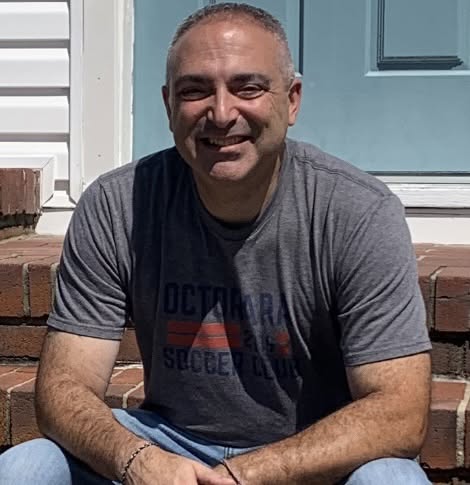
    For nearly 30 years, Anthony Falgiatore Sr. served his community in Chester County in two roles: as an East Whiteland Township police sergeant and a member of the Octorara Area Board of School Directors.

    But Falgiatore lost both of those positions, resigning after Pennsylvania State Police charged him in January with illegally recording a closed executive session of the school board, a felony offense.

    Last month, Falgiatore, 57, of Atglen, enrolled in an advanced rehabilitative disposition program for first-time offenders that will see his charges dismissed and expunged upon completion.

    In a statement, Falgiatore’s attorney, Vince DiFabio, said neither he nor his client wished to comment on the case.

    Members of the school board that served with Falgiatore before he resigned after a decade said they were frustrated that someone who swore to uphold the law would violate it so blatantly.

    Brian Fox, who served as the board’s president when the 32-minute recording was made, said Falgiatore’s actions were a “betrayal of trust.”

    “The thing that made it egregious was his role as a police officer,” Fox said in an interview. “These meetings are closed for a reason. We vote publicly, but we need to meet beforehand to discuss sensitive topics like personnel and legal matters.”

    Fox said the April 17, 2023, executive session Falgiatore recorded was one in which they discussed a federal civil-rights lawsuit filed by John Ryan Miller, a local activist. Falgiatore, according to Fox, argued that the Octorara Area School District should not be paying the legal expenses for board members named in the lawsuit.

    Anthony Falgiatore Sr. (center, in blue shirt), seen here in January 2020 with other board members, served on the Octorara Area School Board from 2015 until his resignation last year.Handout

    Miller filed the suit against nearly 80 public officials in the county, including all of the Octorara Area school board except Falgiatore, asserting that his constitutional rights were violated when he was barred from speaking at a public meeting in 2022 and later arrested for trespassing when trying to speak at another meeting.

    U.S. District Judge Karen S. Marston dismissed Miller’s suit in March 2024, court records show, saying he had failed to demonstrate that his First Amendment rights were violated by the school board.

    A week after he recorded the meeting, Falgiatore wrote in a post on his public Facebook page that he opposed paying legal bills related to Miller’s lawsuit because it “is a private legal matter against the balance of the board members and other district staff in their private person capacity.”

    “I am the only board member not named in the lawsuit because I honored my oath of office to protect and defend the US Constitution and the Pa State Constitution and persons rights,” he wrote. “The board denied a citizen the right to speak for 3 minutes during the public comments portion of a board meeting because the citizen would not follow a policy that requires a speaker to identify who they are.”

    He said the board’s policy “does not supersede the constitution” and said the issue was one he was fighting on behalf of the constituents who elected him.

    It was unclear how much Miller’s lawsuit cost the school board.

    Falgiatore was elected to the Octorara Area school board in 2015, and served on it until his resignation in March 2025, days after state police began investigating the recording.

    In a letter sent to the board, Falgiatore said he was resigning “so as not to be a distraction to the business of the board.”

    Falgiatore’s career with East Whiteland Township police started in 1997, according to an article published in the West Chester Daily Local.

    East Whiteland Township Police Chief G. Christian Yeager confirmed to a reporter that Falgiatore is no longer employed by the department but declined to comment further.

    What motivated Falgiatore to make the illegal recording of the Octorara Area school board’s executive session remained unclear.

    Investigators wrote in the affidavit of probable cause for Falgiatore’s arrest that an East Whiteland Township lieutenant discovered the audio file on his department-issued cell phone in March 2025. Falgiatore had named the file “OSB private meeting.”

    Investigators did not say what prompted the East Whiteland lieutenant to search Falgiatore’s phone.

    State police troopers played the recording for school board members, including Fox, who confirmed that it was made without their knowledge, the affidavit said.

    Investigators also found Falgiatore exchanged texts with someone in December 2024, months after making the illegal recording.

    The person, whom police did not name in court filings, instructed Falgliatore to make another recording like he did with the “Curtis blowup,” an apparent reference to the April 2024 executive session, which included then-Octorara Area School District business manager Jeff Curtis, the affidavit said.

    (In an interview with state police, Curtis listened to the recording and said he recognized it as being a meeting at which he had “blown up” at Falgliatore, according to the affidavit.)

    Two months after making the recording, in an interview with the Lancaster Patriot, a conservative news website, Falgiatore said he was the victim of a harassment campaign because of his support of Miller. He told the site that someone had sent anonymous, threatening letters to his home and began contacting the East Whiteland Township police after he “spoke up on behalf of Miller.”

    Falgiatore and Miller were also interviewed together on an October 2023 episode of Lancaster Patriot’s podcast that discussed Miller’s lawsuit against the district.

    Despite his stated support, Falgliatore said he was not part of the lawsuit — he was not named as a plaintiff — and was supporting Miller because he believed his rights were violated.

  • Former Philly SWAT officer who pepper sprayed protesters on I-676 will serve one year of probation

    Former Philly SWAT officer who pepper sprayed protesters on I-676 will serve one year of probation

    A former Philadelphia police officer who pepper sprayed several people on I-676 during the 2020 protests over George Floyd’s murder has pleaded no contest to assault and related crimes, ending a legal saga that captured national attention.

    Richard P. Nicoletti, 41, will serve one year of probation in exchange for accepting punishment — but not admitting guilt — in the case.

    In addition to assault, prosecutors had accused Nicoletti of reckless endangerment, official oppression, and possessing an instrument of a crime.

    The former SWAT officer was one of two Philadelphia police officers charged with crimes for their conduct during that summer’s protest over racial justice and police brutality.

    Nicoletti had served 12 years with the police department before he was fired over the incident in 2020. Then-Police Commissioner Danielle Outlaw said she was “disgusted” by his conduct and then-Mayor Jim Kenney described his actions as unacceptable.

    The Philadelphia District Attorney’s Office first sought to hold Nicoletti accountable in 2021, when prosecutors said his decision to pepper spray several protesters in the face amounted to a crime.

    A city judge dismissed the criminal case against him, saying Nicoletti had been authorized by his commanders to clear protesters from the highway, but a different judge soon reinstated the charges.

    The case then went before a jury in 2023 and ended in a mistrial.

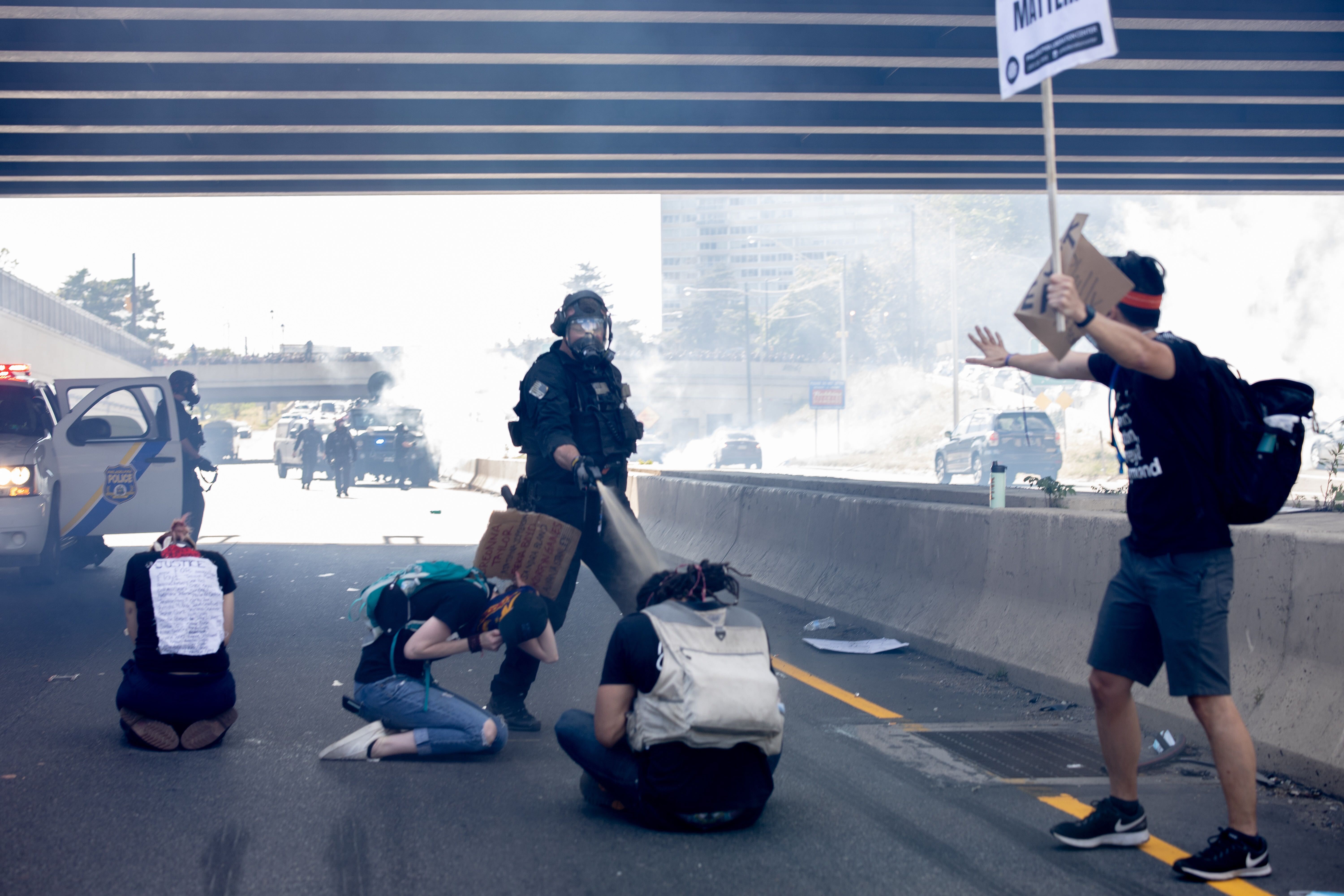
    Philadelphia SWAT officer Richard P. Nicoletti shown pepper spraying three kneeling protesters on I-676 on June 1. Nicoletti is now being charged with simple assault, reckless endangerment, official oppression, and possession of an instrument of crime.Courtesy Wolfgang Schwan

    Prosecutors continued to press the case.

    Nicoletti’s lawyers argued that a subsequent trial should be held outside of Philadelphia, where they suggested too many jurors had already formed opinions about the widely publicized demonstrations, which ended with police using tear gas against protesters on the Vine Street Expressway.

    Common Pleas Court Judge Roxanne E. Covington agreed that the case should be moved to another jurisdiction.

    Court records show that the case was later moved to Veterans Court, a system designed for people who have served in the military and who have been charged with generally low-level offenses. The court emphasizes treatment and services and is designed to rehabilitate, rather than incarcerate defendants.

    Nicoletti served in the Army and was deployed several times to Iraq and Afghanistan, according to a fundraiser circulated to raise money for his defense.

    In March, court records show, Nicoletti pleaded no contest to all 10 charges he faced in a proceeding overseen by Municipal Court Judge David C. Shuter.

    A spokesperson for the district attorney’s office did not respond to multiple requests for comment on the case and its diversion to Veterans Court.

    Nicoletti’s defense attorney, Charles Gibbs, did not immediately return a request for comment Friday.

  • SpaceX IPO extends Elon Musk’s influence across more than just AI

    SpaceX IPO extends Elon Musk’s influence across more than just AI

    Elon Musk controls reusable rockets that are the backbone of the U.S. space program. His constellation of satellites in space represents a pillar of U.S. defense. And he has struck deals with leading artificial intelligence companies to fuel the AI revolution.

    Now the public sale of SpaceX’s shares will not only dramatically increase Musk’s wealth, making him the world’s first trillionaire, but it will expand his reach into pivotal sectors of the global economy.

    All the while, it sets up Musk’s rocket company to dominate the cosmos as entities across the globe vie for control of space.

    “U.S. space power is built on the back of SpaceX. Period. Full stop. What does that mean?” asked Clayton Swope, deputy director of the Aerospace Security Project and senior fellow at the Center for Strategic and International Studies. “It means SpaceX has incredible leverage over the government right now.”

    The IPO is the largest in history, raising $75 billion to fuel the company’s ambitions. But SpaceX also has a recent track record of losing billions of dollars, including $13 billion since the beginning of 2023.

    In IPO documents, SpaceX has laid out an ambitious plan to become an essential hub of the artificial-intelligence age. Despite building its reputation on space launches and its satellite internet service, Starlink, SpaceX sees the vast majority of its market opportunity — all but $2 trillion of an estimated $28.5 trillion — in artificial intelligence.

    That opportunity rests on major, even far-fetched, bets. A constellation of millions of satellites for space-based data centers will power AI from orbit, and the company will vastly expand its Starlink internet service. Starshield, SpaceX’s secure satellite network for government, will be used for defense and national security applications.

    The diversity of SpaceX’s business, which spans AI, social media, and internet connectivity, will likely make it a clearinghouse of lucrative data, allowing it to improve on various capabilities and outpace rivals.

    Its plans are ambitious. Musk has upended global industries — making electric cars mainstream, bringing internet access to remote areas with thousands of satellites, and reviving the Space program. With SpaceX’s IPO, Musk turns his boundary-breaking approach to space, combining capabilities his firm has honed over decades.

    Musk mused recently, in an interview with SpaceX employees posted on X, about a core facet of the company’s mission. “How do you decide what progress a civilization has made?” Musk asked. So far, humanity is harnessing a tiny amount of Earth’s power and a minuscule proportion of the sun’s, he added, marking gaps SpaceX hopes to fill.

    The company’s plans however, are raising concerns among some in the space and tech sectors about the level of power SpaceX has amassed — which may give him tremendous sway over the U.S. space program.

    That power takes several forms.

    “The cost is the big one for me,” Swope said. “Where is the best value proposition? Is it with the company that holds all the cards?”

    By taking SpaceX public, Musk has realized an ambition that began more than two decades ago when he took the earnings from the sale of PayPal and seeded them into two companies: Tesla, which debuted on the stock market in 2010 and went on to become the world’s most valuable automaker, and SpaceX, where the entrepreneur pioneered reusable rockets and made space exploration into a private enterprise.

    The space company debuted on the Nasdaq composite index on Friday, under the ticker symbol SPCX. Its IPO shares were priced Thursday at $135 each. SpaceX opened Friday at $150 a share, then rose to around $168, before finishing the day just below $161.

    SpaceX’s significant losses have not muted its hype. The company has attracted an unusual level of interest from retail buyers, who have jockeyed for a stake in the next potential Musk moonshot.

    To some, SpaceX’s business case is underscored by the high level of importance the U.S. government ascribes to it.

    “This is the United States space program,” said Ross Gerber, a SpaceX investor who has emerged as a Musk critic in recent years. “We’ve outsourced from NASA to SpaceX.”

    In IPO documents, SpaceX describes how its satellites have been deputized for potential defense purposes.

    “What this really is about is about national security and expanding our … footprint in space in a way that no other country could,” Gerber added.

    This interdependent relationship provides upsides for the company, Gerber said, but “there is a risk inherent,” in the country’s level of dependency.

    Analysts expect significant buy-in for SpaceX’s ideas when it takes to the public markets.

    “Musk has always been very good at selling the future to investors, so I am not surprised by the excitement built into the valuation expectations for the IPO,” said David Meier, senior investment analyst at the Motley Fool. Meier noted, however, that SpaceX’s IPO pricing and valuation “looks very aggressive relative to the financial performance it has put up and expects to put up in the near future.”

    Still, SpaceX may not shatter all of the lofty expectations built into its IPO.

    Nick Smith, a senior analyst at research firm and IPO stock index Renaissance Capital, said IPOs of large companies have a mixed track record. For every winner like Meta, Smith said that there are also losers including Rivian.

    The electric vehicle company went public in 2021 with a market value of about $100 billion as its stock shot up on its first trading day. Today Rivian is worth about $20 billion.

    Smith noted that SpaceX’s investment bankers have sketched out a path to booming revenue, including from two deals with AI rivals Anthropic and Google to rent out data-center capacity from SpaceX’s xAI business and plans to deploy a more capable but much delayed rocket. If SpaceX’s annual revenue climbs well above $100 billion in a few years from about $19 billion last year, “I think the valuation is OK if you believe it can do that,” Smith said.

    Smith also said that Musk inspires a magical faith in his capabilities to make the impossible happen. This “Musk effect,” Smith said, makes his companies’ value become “divorced” from typical calculations of what companies should be worth.

    Swope, the senior fellow at the Center for Strategic and International Studies, said he is hopeful SpaceX won’t outgrow the entities it has served in the past.

    “The government’s mission and U.S. space power are so dependent on this company,” Swope said. “No one wants to see the period where it could be weakened.”

    Still, he wondered of the IPO, “How will it change the company?”

    The Associated Press contributed to this article.

  • David Hockney, 88, renowned artist who captured fleeting moments in vivid color

    David Hockney, an English painter, photographer, stage designer, printmaker, and draftsman who long made Southern California his muse and his home, and the fleeting beauty of life’s smallest moments the grand theme of his shape-shifting art, died June 11 at his home in London. He was 88.

    His publicist Erica Bolton confirmed the death in a statement.

    Mr. Hockney’s art, which earned him international renown and a colossal fortune, encompassed paintings of azure swimming pools and the artist’s gay friends; kaleidoscopic portraits collaged together from dozens of cocktail-napkin-size Polaroids; room-size installations using computer-controlled theatrical light fixtures; and, in later years, garish landscapes “drawn” with fingers on an iPad.

    Throughout these stylistic reinventions, over a career that seemed at times to memorialize the unmemorable, there was one constant: impermanence. “I loved the idea of painting this thing that lasts for two seconds,” Mr. Hockney once said, reflecting on The Splash, one of a series of paintings of water displaced by a recreational diver who is nowhere to be seen. “It takes me two weeks to paint this event that lasts for two seconds.”

    In 2018, at Christie’s auction house in Manhattan, his Portrait of an Artist (Pool With Two Figures) sold for $90.3 million, a world record price for a living artist, topping the previous record of $58.4 million reached by American Jeff Koons in 2013 for his stainless steel sculpture Balloon Dog (Orange).

    Mr. Hockney, a working-class lad from what was at the time England’s grimy industrial north, became a top pupil at London’s Royal College of Art. In 1963, his first solo exhibition sold out at a trendy London gallery. He soon traveled to California, long the center of his hedonistic fantasies fueled by muscle magazines.

    Like his pop-artist friend Andy Warhol — whom he vaguely resembled with his peroxide-blond hair — he was strongly influenced by technological advances in color photography, color ads in magazines, and early color TV. He deconstructed traditional ideas of perspective, proportion, and color balance with his often vivid pinks, blues, greens, yellows, and purples.

    Man in Shower in Beverly Hills (1964) indulged his fascination not only with the male figure but also with water in motion. A Bigger Splash (1967), perhaps his best-known painting, captured the broken surface of a pool, the diving board protruding from the foreground. Today the work hangs in the prestigious Tate Britain museum when it is not on tour.

    Beverly Hills Housewife (1967), depicting philanthropist and art collector Betty Freeman standing on her patio, fetched $7.9 million at a Christie’s auction in New York in 2009. Mr. Hockney’s previous highest price, in 2006, had been $5.4 million for The Splash, painted in 1966.

    “What David did was reinvent the way we saw the world,” Lindy Dufferin, the widow of one of his early patrons, told British Vogue in 2017. “Up until then a splash had passed without us noticing; the pool and the people around it would interest us, not the splash. So, as is typical of David, he made a deep philosophical point — that everything is ephemeral and passing — in a humorous way.”

    Mr. Hockney’s artistic restlessness led him to remake himself and his work over the years, with portraiture and still lifes from the decorous to the vibrant, such as his 16-foot-long May Blossom on the Roman Road (2009) with its foliage and swarming insects. Some of his later and best-selling works were landscapes depicting the American West and the forests of his native Yorkshire.

    Woldgate Woods (2006) sold at Sotheby’s in New York in 2016 for a record auction price of $11.7 million. In 2017, his composite painting 15 Canvas Study of the Grand Canyon (1998), with its deep, earthy sunset colors, sold at Sotheby’s in London for $7.88 million. As his age and celebrity grew, so did his prices. In May 2018, at a Sotheby’s auction in New York, his 1990 work Pacific Coast Highway and Santa Monica went under the hammer for $28.5 million — more than twice the estimate and a record for a Hockney.

    His prevailing fascination was with taking the mundane — household objects such as ashtrays and lamp shapes and passing moments like a shower — and emancipating them from the workaday as commentaries on what and how we see.

    “He is one of only a handful of 20th-century British artists who added anything to the image bank of the world’s imagination,” Guardian art critic Jonathan Jones wrote in 2004. “He was British art’s first pop star. But this was not because he made easy images. His paintings unequivocally praised gay sex — for example, Two Men in a Shower (1963). They were so innocent they disarmed everyone.”

    Visionary or lightweight?

    David Hockney was born in Bradford on July 9, 1937, the fourth of five children of what he called eccentric, “radical working class” parents.

    His mother, who was deeply religious and devoutly vegetarian, encouraged her son’s doodling as long as he didn’t do it on the wallpaper. His father, he told the Guardian, “was constantly writing to Stalin — every week. He used to tell us how important these letters were. We didn’t think so. We didn’t think Stalin would be waiting for them.”

    A conscientious objector during World War II, the elder Hockney became a social pariah, losing his job as an accounting clerk.

    Bradford, Mr. Hockney recalled, was perpetually cold and overcast, and made drearier still by wartime rationing in the 1940s and postwar deprivation in the ’50s. He escaped through movies and became enchanted with the concept of sun-dappled California.

    “I knew even as a child that it was sunny in Los Angeles because even though Laurel and Hardy wore overcoats, they cast long shadows,” he once told the New York Times. “There were no long shadows in Bradford. I noticed that. I thought, ‘Boy, it must be very sunny there.’ ”

    Mr. Hockney displayed a precocious talent for cartooning and poster-making and won second place in a national newspaper competition to design an advertisement for a watch. He entered the Bradford College of Art at 16 on a scholarship and graduated in 1957. Also a registered conscientious objector, he worked as a hospital orderly to complete two-year national service.

    From 1959 to 1962, he studied at the Royal College of Art, where his works earned the school’s gold medal. The next year, art dealer John Kasmin gave him his debut solo exhibition, “Pictures With People In.”

    At the college, Mr. Hockney also met the Ohio-born artist R.B. Kitaj. Incorporating Kitaj’s literary leanings, he used fragments of poems and quotations from Walt Whitman in his work. Paintings such as We Two Boys Clinging Together (1961) were among his earliest artistic nods to his homosexuality.

    A chain-smoking playboy, the artist became a hero to some in the LGBTQ community for being openly, indulgently gay at a time when homosexuality was still criminalized in England. Jack Hazan’s 1973 semidocumentary film A Bigger Splash shows Mr. Hockney reeling after the trauma of a breakup. Mr. Hockney was also the subject of Randall Wright’s well-received 2014 documentary Hockney.

    After his initial success in London, Mr. Hockney made his first trip to New York, where one friend introduced him to the city’s museums and galleries and another took him to its gay hot spots. Mr. Hockney soon embarked for California, beckoned by magazine images of beaches, suntanned pecs, and six-pack abs.

    He set up a studio in Hollywood Hills, teaching at several universities in the state, while also maintaining a home in the posh London district of Kensington as well as a seaside house in Bridlington, East Yorkshire.

    In 1975, Mr. Hockney began designing stage sets for theater, ballet, and opera, starting with a noted production of Stravinsky’s opera The Rake’s Progress at the Glyndebourne Festival in East Sussex, England.

    Over the decades, Mr. Hockney was viewed alternately with admiration and skepticism, as a visionary who played with convention and as a lightweight drawn to the frivolous.

    Commenting on a major Hockney retrospective in 2017 at Tate Britain, the British art writer Michael Glover observed in the Independent: “Is Hockney really deserving of this ridiculous amount of attention on the grounds of merit alone? Certainly not. He can be wonderful — some of those early prints were wonderful. He can be awful — as he so often was in the 1980s, when he played at being Picasso or doggedly painted his dogs. He can also be no better than pretty good. Many of his portraits look tossed off.”

    But Chris Stephens, formerly lead curator of modern British art at Tate Britain and co-curator of the Hockney retrospective, called him “brilliant at capturing people’s psychological aspect, their psychological demeanor.”

    One of Mr. Hockney’s best-received works was a time-lapse installation titled Snails Space with Vari-Lites, “Painting as Performance,” created in 1995-1996 and donated to the Smithsonian American Art Museum in Washington in 2003 by philanthropist Nan Tucker McEvoy, who chaired the museum’s governing board.

    The work features a nine-minute light show in which high-intensity, computerized spotlights cast a rainbow of colors from ever-changing angles upon a 3D landscape that is more stage set than painting. Describing the Snails Space exhibition, the museum declared it “both a summary of Hockney’s career and a poignant example of his belief that art should ‘overcome the sterility of despair.’ ”

    From 2004 to 2013, Mr. Hockney decamped for Yorkshire, looking for new inspiration in the trees and the turning of the seasons — and also because of what he considered puritanical antismoking ordinances in America.

    His return led to the financial windfall of Woldgate Woods. But it also brought tragedy, including a stroke in 2012 and the death the next year at his home studio of a 23-year-old assistant who drank drain cleaner after taking cocaine and ecstasy pills. The death was declared “a result of misadventure” and no charges were brought against Mr. Hockney, who was away at the time and later returned to Los Angeles.

    In 2018, Mr. Hockney, at age 81, achieved a longtime ambition that earned him no money and cost him a lot of time. His first stained-glass window, designed on his iPad and titled The Queen’s Window, was unveiled in London’s historic Westminster Abbey to commemorate Queen Elizabeth II’s reign.

    In sharp contrast to the Abbey’s traditional staid, religious-themed stained-glass windows, Mr. Hockney used his distinctive color palette of yellow, red, blue, pink, orange, and green to reflect the queen’s love of the countryside. He visibly held back tears as the window was revealed. The Barley Studio of York, England, using centuries-old techniques, painstakingly created the window in pieces in coordination with Mr. Hockney and his iPad creation.

    In 2019 Mr. Hockney began working in Normandy, producing ink drawings and paintings including A Year in Normandie, a massive panoramic iPad painting inspired by the nearby Bayeux Tapestry and his fascination with Chinese scrolls. He relocated to London in 2023.

    The director of Tate Britain, Alex Farquharson, said in a social media post that the gallery would work to realize two major projects Mr. Hockney was preparing for 2027: an exhibition featuring seven decades of his work and a multimedia installation at the Tate Modern showcasing his designs for opera sets.

    Survivors include his longtime partner, Jean-Pierre “JP” Gonçalves de Lima; and two brothers.

    Stephens, the former curator at Tate Britain and also a Hockney biographer, told the Times of London in 2017 that Mr. Hockney was happiest basking in the libertine joys of California. “He says, ‘Well I only have to go out for three things: the doctor, the dentist, and the marijuana supply.’ Which is not true, actually, because the guy who washes his car brings that round.”

  • TED Democracy Philadelphia asks ‘How do you make democracy better?’

    TED Democracy Philadelphia asks ‘How do you make democracy better?’

    Storytellers and innovators from across the globe are in Philadelphia, America’s birthplace, to discuss the ongoing experiment of American democracy.

    “TED Democracy Philadelphia: Founding Futures,” a full-day of new TED talks exploring the health and future of modern democracy in honor of America’s 250th anniversary, and hosted in the Kimmel Center’s Marian Anderson Hall, features over 30 speakers Saturday, including eight from Philadelphia.

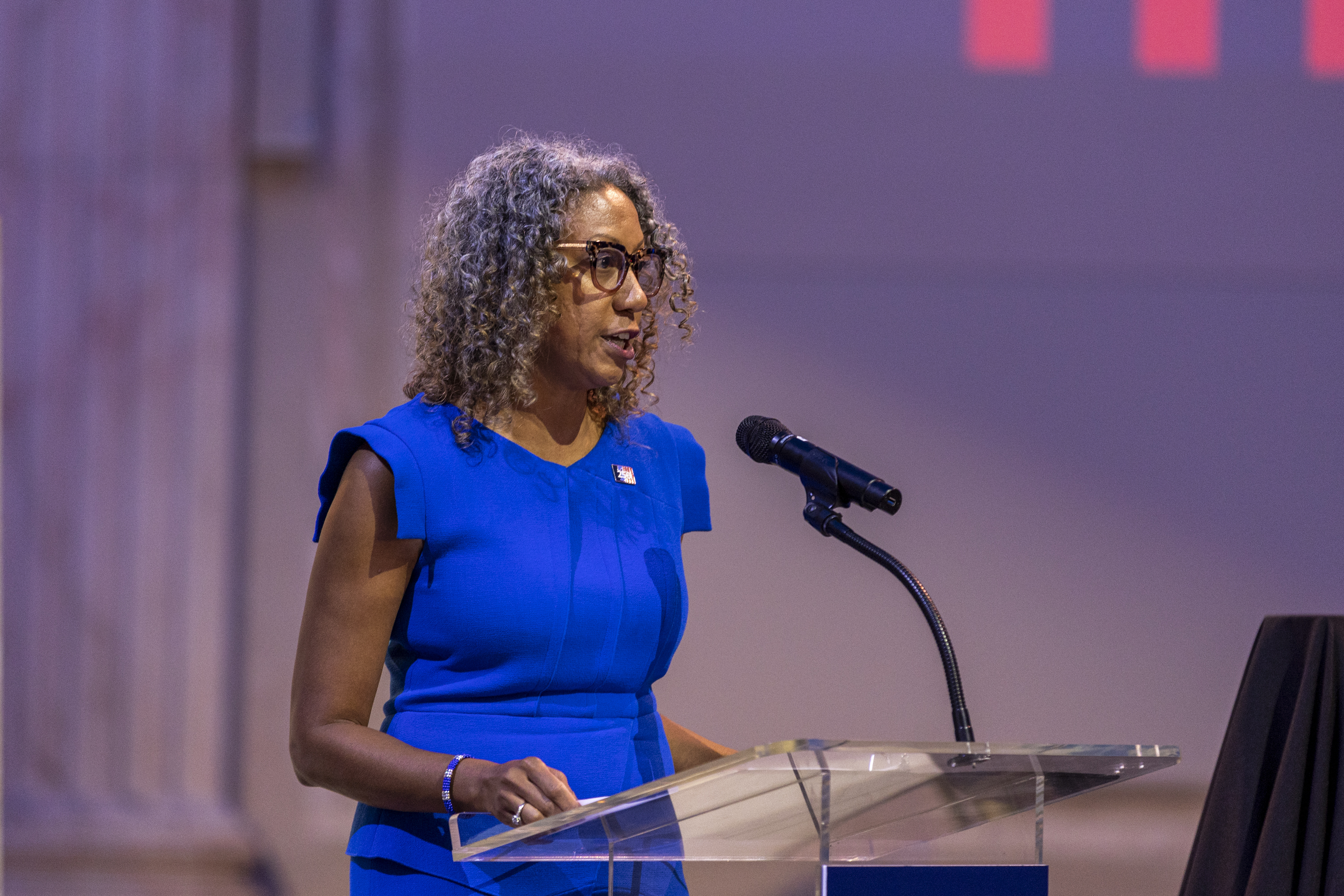
    Angela Val, president and CEO of Visit Philadelphia, speaking during the announcement of Ted Democracy at the Franklin Institute in 2024.Tyger Williams / Staff Photographer

    The event, organized by Visit Philadelphia, includes 18-minute TED Talks from voices shaping Philadelphia and the world, including futurist and co-author of Citizens: Why the Key to Fixing Everything is All of Us, Jon Alexander; best-selling novelist and Pulitzer Prize finalist, Xochitl Gonzalez, and Allentown native, writer, and commentator, Sally Kohn.

    “We have so many things going on in Philadelphia on the 250th anniversary of our country,” said Angela Val, president and CEO of Visit Philadelphia. “What we felt was still needed was a discussion about democracy in America’s birthplace. Philadelphia is where democracy was born, and its future is being written. We’re still a city of thought leaders.”

    Local leaders — including Anuj Gupta, head of the Welcoming Center, a nonprofit finding pathways for immigrants and Jasmine E. Sessoms, president of the 1968 Collective, dedicated to increasing civic engagement among Black women — will also offer three-minute Philly Flash Talks on topics like, race, economic equity, media literacy.

    “What it means to participate in a democracy, what it means if we were to lose it,” said Val. “How it affects our everyday lives and influences our media and pop culture. It’s an opportunity to engage, question and reimagine the kind of democracy we want to build together for the next 250 years.”

    Governor Josh Shapiro at the announcement of Ted Democracy in 2024.Tyger Williams / Staff Photographer

    Laura Beyer, head of TED’s partnerships program, said there is no better place to stage a global conversation about the future of democracy than Philadelphia.

    “With TED Democracy, we are surfacing the next generation of ideas to ensure our democratic systems remain resilient,” she said.

    Three years in the making — and the culmination of a TED speaker series in Philadelphia last year — the event also features small group discovery sessions, a “Public Square,” featuring local food, books, and crafts, and a “PEW Spotlight Stage,” with live performances and interviews. Partnering with the American Library Association, the event will be livestreamed at more than 65 libraries across the country.

    Gonzalez, a staff writer at the Atlantic, who recently published her third novel, Last Night in Brooklyn, said she will discuss social class, a topic she is exploring for a memoir.

    “So few people think about the matter of social class or income inequality as having anything to do with democracy, but it very much does,” she said. “It’s exciting to get to have the opportunity to talk about something that, generally speaking, people don’t really like to talk about.

    Philly is a perfect spot for the talks, she said.

    “This country really started as a bunch of ideas,” she said. “It feels like a very cool and appropriate way to celebrate this country in this moment by sharing ideas, and asking, ‘How do you make democracy better?’”

  • Phillies put Adolis García on 60-day IL with shoulder tear, call up OF Gabriel Rincones Jr.

    Phillies put Adolis García on 60-day IL with shoulder tear, call up OF Gabriel Rincones Jr.

    MILWAUKEE — Adolis García clutched his right shoulder, and the Phillies’ plan in right field took an unexpected turn.

    García went on the 60-day injured list Friday with a torn latissimus dorsi muscle near his right shoulder, the Phillies announced Friday. Righty-hitting outfielder Derek Hill, acquired Thursday in a trade with the Chicago White Sox, will take García’s spot on the roster.

    But the Phillies also called up outfield prospect Gabriel Rincones Jr. from triple-A Lehigh Valley. And with García sidelined for a minimum of two months, likely longer, they intend to use the 25-year-old in a right-field platoon with Hill.

    “Kind of those two trying to fill one [position],” interim manager Don Mattingly told reporters before the Phillies opened a three-game series with the Brewers. “I mean, that’s our original thought.”

    Rincones has power from the left side but is batting only .215 and slugging .291 with one homer in 22 games after missing the season’s first six weeks with inflammation in his knees. Reserve outfielder Steward Berroa went on the paternity list, creating a spot on the active roster for Rincones, who was in the lineup against Brewers ace Jacob Misiorowski.

    The Phillies were already seeking more offense from the outfield. Even accounting for a breakout season from Brandon Marsh, their outfielders combined to hit .240 with a .669 OPS, 24th at the position among 30 teams entering play Friday night.

    García, a superb defender in right field, was injured late in Wednesday night’s game when he uncorked a typically strong throw to home plate. He grabbed his right arm, motioned for the trainers, and left the game.

    Outfielder Gabriel Rincones Jr. entered Friday with just 55 plate appearances this season after missing the season’s first six weeks with knee inflammation.Yong Kim / Staff Photographer

    The Phillies initially diagnosed García with a “pulled muscle in the right shoulder area” and sent him Thursday for further testing, which revealed the tear.

    García is receiving another medical opinion before it’s determined whether he will have surgery. Regardless, it seems likely he won’t play again this season.

    “It sounds like a good possibility,” Mattingly said. “It obviously is not good. Put him on the 60[-day IL] right away. Yeah, it doesn’t look good.”

    García homered in three of his last seven games but has struggled at the plate overall. The Phillies took a one-year, $10 million flier that he could recapture the right-handed power stroke that made him an All-Star in 2023. But among 158 qualified hitters, he ranked 153rd in average (.195), tied for 151st in on-base percentage (.270), and 149th in OPS (.599).

    “It’s tough,” president of baseball operations Dave Dombrowski said. “We felt good about the strides he was making. He worked very hard. Tough news for him.”

    García’s lack of production contributed to the Phillies’ struggles against left-handed pitching. Rincones, a left-handed hitter, isn’t likely to help in that area. He batted .107 with a .323 OPS in triple A last season against lefties, but he also had an .873 OPS against righties.

    Hill, 30, is expected to be the other half of a timeshare in right field. He batted .213 with a .659 OPS in 90 plate appearances for the White Sox but had a .789 OPS against lefties, including a homer off Jesús Luzardo last Friday night.

    “A guy that gives us all three outfield spots, gives us speed off the bench, he gives us a guy against left-handed pitching,” Mattingly said. “Kind of fits our club perfectly.”

    Even if García hadn’t injured his shoulder, the Phillies might have been inching closer to giving Rincones a look anyway in a right-field platoon, especially considering the difficulty in making a substantive trade before the Aug. 3 deadline.

    Now, the path is even clearer for Rincones to get an opportunity.

    “I’m just trying to keep everything even-keeled and tell myself it’s still the same game,” Rincones said. “But, yeah, I’ve had a smile on my face all day. It kind of hit me [Thursday] a little bit, but I don’t think it’s fully set in yet.”

    Extra bases

    To open a spot for Hill on the 40-man roster, the Phillies designated reliever Jackson Rutledge for assignment. Rutledge had a 7.20 ERA in five triple-A appearances after being claimed off waivers last month from the Washington Nationals. … Aaron Nola (3-4, 5.86 ERA) is scheduled to start at 7:10 p.m. Saturday against Brewers lefty Shane Drohan (3-1, 3.11).

  • More Philadelphians would get assistance to pay rising water bills under a plan passed by City Council

    More Philadelphians would get assistance to pay rising water bills under a plan passed by City Council

    More Philadelphians struggling to pay their water bills would be able to apply for help under new legislation from City Council.

    Others would see higher water bills to pay for the plan.

    The unanimously approved legislation, introduced by District 3 Councilmember Jamie Gauthier, expands who is eligible for the Philadelphia Water Department’s tiered assistance program. The program gives people a fixed, income-based monthly payment, offers debt forgiveness for some past-due water bills, and protects residents from having their water shut off.

    “Without running water, our constituents can’t wash their hands, clean dishes, or prepare food,” Gauthier said during a Council meeting Thursday. “It’s unsafe, unsanitary, and unacceptable.”

    Currently, people earning up to 150% of the federal poverty line qualify for the program. Under the new rules, households earning up to 200% of the poverty line would qualify, Gauthier’s office said. This means a single person earning $31,920 would be eligible; so would a family of four earning up to $66,000, per federal data.

    Households earning up to 300% of the federal poverty limit would qualify for structured payment plans, rather than having to pay off the past-due amount all at once, Gauthier’s office said.

    Another provision protects people from receiving surprise bills from the water department as a result of past errors in calculating water usage. Gauthier said one of her constituents had gotten an $8,000 water bill after having an old water meter replaced in her new home.

    “For too long, this city has made residents pay for faults in government infrastructure,” Gauthier said.

    The legislation comes after a 9.4% water rate increase last September and with a 5.5% rate increase set to take effect this year, Gauthier’s office said. The average bill is currently $89.42 per month.

    “At the same time, nearly half of renter households are cost-burdened, spending more than they can afford on housing,” the Council member’s office said in a news release.

    About 42,000 households used the tiered assistance program in 2024, Gauthier’s office said, and thousands more would be eligible with the new law.

    City Revenue Commissioner Kathleen McColgan estimated that 70,000 households may use the tiered assistance program next year. On average, each household would save $63 per month.

    To pay for these subsidies, however, increased costs would have to be passed on to everyone else who lives in the city, McColgan said.

    “This is because the anticipated revenue loss to the Water Fund would need to be restored,” McColgan said during a June 2 meeting of City Council’s Transportation and Public Utilities Committee. “Any expansion of the TAP [tiered assistance program] population would further reduce the non-TAP population, increasing cost‐recovery pressures and amplifying rate impacts.”

    McColgan said residents are already paying $2.10 per month to subsidize others. She estimated that this would rise to above $5 per month under the new law.

    McColgan estimated that the water department would need to recoup between $22.1 million and $127.6 million over the next five years, mostly because of the 200% eligibility rate.

    “We recognize this is a large range, but this range reflects the anticipated number of new TAP enrollees to be between 4,000 and 40,000,” McColgan said.

    The legislation goes to Mayor Cherelle L. Parker, who can sign the two bills into law, veto them, or let them become law without her signature. If she were to veto, Council could override it with a two-thirds vote. Parker’s office did not respond to a request for comment Friday.

  • Pennsylvania is working to fill a spot in Trump’s ‘Great American State Fair’ as other Democratic-led states boycott

    Pennsylvania is set to have a presence at an upcoming two-week “Great American State Fair” on the National Mall, one of the signature 250th anniversary events hosted by President Donald Trump celebrating America’s founding.

    What that presence will look like for Pennsylvania — the state where the nation’s independence was declared — is still up in the air.

    All 50 states and six U.S. territories are expected to be represented with booths showcasing aspects of their culture and history. Some blue states, however, are opting out of sending their own staff to participate, citing a partisan tilt to the event and the cost to participate.

    Pennsylvania, a quintessential swing state led by Democratic Gov. Josh Shapiro, is still preparing to participate in an exhibit, according to a person familiar with the planning. But state officials have struggled to find a Pennsylvania business that wants to associate with the Trump-affiliated event.

    The Great American State Fair has hit numerous roadblocks in its planning in recent weeks. More than half of the acts announced to perform at a Semiquincentennial concert series withdrew shortly after its announcement over concerns the nation’s birthday planners were politically motivated. Trump then replaced the concert series with a political rally, which he will headline on June 24 and he billed as “A Rally to end all Rallies!” in a Truth Social post.

    Freedom 250, the nonprofit organization behind the 16-day event kicking off June 24, has deemed it a “first-of-its-kind world’s fair” while some Democratic officials have railed against it as a waste of taxpayer money.

    Unlike other states, Pennsylvania’s state government did not commit to sponsoring a booth. But Shapiro’s office has been trying to connect Freedom 250 with organizations and companies that could represent the state, according to federal and state sources familiar with the planning.

    It was not clear what type of Keystone State company or group would fill the gap.

    Freedom 250 was still finalizing plans with several states’ tourism boards, cultural and heritage groups, and other organizations as of Friday — less than two weeks before Trump was scheduled to headline the fair’s “kick-off celebration.”

    The event is set to include remarks by Trump and members of his cabinet, fighter jet flyovers, and a performance of “God Bless the USA” by Lee Greenwood, a staple of Trump’s major campaign events over the years. Each day of the fair from June 25 through July 10 will have a theme — including “land & prosperity,” “military & veterans appreciation day,” “faith, values and inspiration” and “MAHA Monday.”

    At least a half-dozen states have opted not to participate, according to NOTUS and other news outlets.

    “He invited all the states to participate and wants to charge us. Charge us to go down and put something on his exhibit, whatever he’s creating for Freedom 250. It’s just ridiculous,” Democratic Gov. Maura Healey, of Massachusetts, said in a Boston Public Radio interview earlier this month.

    Shapiro — a Democrat who’s also frequently challenged Trump and is widely considered a potential contender in the 2028 race to succeed him — has not similarly criticized the fair. The governor has been involved in other 250-focused events in Pennsylvania, such as the Commonwealth Concert Series that includes concerts in five cities across the state.

    Pennsylvania Gov. Josh Shapiro speaks during a Visit PA pep rally Tuesday, March 31, 2026, ahead of the nation’s 250th anniversary and other major events in the state. Jose F. Moreno / Staff Photographer

    Freedom 250 has pushed back against the idea that the fair and other anniversary celebrations are partisan.

    “The idea that a president’s presence at America’s 250th birthday is somehow a political act is not a serious argument — and frankly, it is not serious journalism to treat it as one,” Freedom 250 spokesperson Rachel Reisner said. “No one suggested the Biden-Harris administration would have kept the president away from this moment, nor should they have. We proudly welcome President Trump, who has shown genuine enthusiasm for celebrating America and its patriotic traditions, just as we would have welcomed any sitting president. Freedom 250 looks forward to celebrating America together and hosting once-in-a-generation events.”

    The organization has announced several pieces of the program, including “classic state fair” elements like livestock competitions and interactive experiences with companies such as John Deere and Northrop Grumman, the aerospace and defense company.

    It has not detailed the focus of each state’s designated section on the mall.

    An instructional pamphlet directed to state officials explains that every state and territory can “tell its own story” by “presenting a pavilion that reflects their history, culture, and contributions to the nation.” It does not include pricing, though a source familiar with the planning said states or organizations are only responsible for covering the cost to fill the space.

    Some states are sponsoring their exhibits directly through their state agriculture or tourism departments. For example, Arizona and Colorado are planning interactive experiences that highlight their states’ scenic outdoors, and New York’s “I Love NY” tourism campaign will showcase the state’s vacation areas, according to USA Today.

    The Freedom 250 pamphlet suggests other ways states can celebrate the Semiquincentennial — through flags and signage, or “projection experiences” to light up buildings like a state Capitol. It recommends governors issue official proclamations to recognize the moment, as well as foster civic and educational opportunities like student art contests and field trips.

    “The true power of this anniversary will not come from Washington alone,” Freedom 250 CEO Keith Krach wrote to state and local officials in the document. “It will come from you.”

  • U.S. plan is said to pull a third of fighter jets it provides NATO for Europe

    U.S. plan is said to pull a third of fighter jets it provides NATO for Europe

    BERLIN — The United States plans to significantly reduce the aircraft and warships that it makes available for NATO operations in Europe, according to two senior European officials, accelerating America’s effort to scale down the protection it has offered to European allies for eight decades.

    The decision would limit NATO’s ability to launch long-range strikes and conduct surveillance. It was communicated to allies in early June in a written document, parts of which were reviewed by the New York Times. The European officials, who were briefed on the decision, spoke on condition of anonymity to speak more freely about sensitive military plans.

    The planned drawdowns include:

    — Reducing the number of F-16 and F-15E fighter jets from roughly 150 to 100

    — Reducing maritime reconnaissance aircraft from 26 to 15 and cutting all eight aerial refueling tanker jets previously available to Europe

    — Reallocating a missile-launching submarine and an aircraft carrier, along with several warships and scores of jets that join the carrier’s missions

    — Reallocating one of two groups of bombers previously assigned for Europe’s defense

    The Pentagon declined to comment on the specific numbers in the document, and referred to a statement by its European Command last week that spoke in general terms of its intention to reduce its commitments in Europe.

    These details, some of which were first reported in the German news outlet Die Welt, provide the clearest picture yet of the extent to which the Trump administration intends to reduce its commitment to NATO, a military alliance created in the aftermath of World War II. NATO’s purpose was mainly to protect U.S. allies in Europe from external threats such as the Soviet Union, and its European members still see it as essential to their ability to deter Russia.

    The Pentagon has not yet publicly revealed the timeline for the drawdown but U.S. officials have indicated it will take effect very soon — far earlier than European counterparts had been preparing for. The abrupt cutoff of U.S. forces would affect NATO’s ability to, for example, monitor Russian submarine traffic or launch long-range Tomahawk missiles deep into Russian territory.

    Though Europeans have similar missile-launching capabilities, experts say that the missiles act as a bigger deterrent to Russia when wielded by the United States, since Europeans may be warier of deploying them.

    “While each of these cuts can be managed individually, together they represent a significant posture change and pose challenges to European deterrence readiness across the spectrum,” said Giuseppe Spatafora, of the European Union Institute for Security Studies, a Paris-based think tank.

    President Donald Trump has complained for years about the burden that the United States shoulders in its contribution to NATO. He has repeatedly called on Europe to do far more to defend itself without U.S. support, and threatened to leave the alliance altogether. But his administration had only followed through with one-off announcements about relatively small withdrawals from individual countries — until the June document detailing the sweeping reductions to American support for NATO as a whole.

    The cuts will be mitigated by the fact that U.S. troops in Europe will still constitute one of the largest NATO forces on the continent. The drawdown’s effects will also be softened by the fact that European leaders, seeing a need to rely less on U.S. support, were already in the process of rearming their countries.

    But Britain’s defense secretary quit Thursday, accusing the government of spending too little on its military. And Europe is struggling to coordinate its rearmament; on Tuesday, Germany confirmed its withdrawal from a project to build a new fighter jet with France and Spain.

    For some Europeans, the specific number of U.S. assets assigned in Europe is less important than the question of whether Trump is prepared to deploy any of them in combat.

    Anton Hofreiter, a German lawmaker, said: “NATO’s main problem is that, as long as Trump is president, there is no longer any faith that the U.S. would come to the Europeans’ aid in the event of an emergency.”

    The drawdown comes at a particularly tense moment for Europe. In late May, a Russian drone hit an apartment block in Romania, the first such strike in a major urban area in NATO territory. Combined with other Russian drone intrusions into NATO airspace, it raised European fears that Russia might expand its aggression beyond its invasion of Ukraine.

    Ed Arnold, of the Royal United Services Institute, a security think tank in London, said that while the drawdown could be worse, “it will have the effect of focusing minds.”

    The details of the drawdown were communicated privately as top U.S. defense officials spoke publicly about their intention to reallocate forces to defend American interests in the Indo-Pacific region.

    The head of the Pentagon’s European Command, Gen. Alexus G. Grynkewich, said in early June: “There has been an unhealthy codependence in the NATO Force Model on U.S. forces.”

    The general, who is NATO’s top military commander, added: “President Trump, Secretary Hegseth, and others have been clear that this needs to change, and it will change. The potential reality of simultaneous conflict in multiple theaters demands it.”

    This article originally appeared in the New York Times.