Blog

  • Algae forms in the Reflecting Pool. It’s ‘residual,’ Trump officials say.

    Algae forms in the Reflecting Pool. It’s ‘residual,’ Trump officials say.

    When renovations of the Reflecting Pool were completed last week, President Donald Trump praised its “beautiful, clean water.” Under his predecessors, Trump said, the pool was “Terrible. Disgusting … garbage ridden.”

    Now, days after the pool was refilled, clumps of green algae have been spotted throughout the water. Noticed on two separate visits to the Reflecting Pool this week, the algae coated several areas of the bottom of the pool, including the east and west ends, close to the World War II Memorial and the Lincoln Memorial, and floated on the surface.

    An algae spot near the World War II Memorial grew significantly bigger between a rainy Wednesday afternoon and Thursday, which was hot and muggy.

    News photographers also captured images of buckets of Induclor, a chlorine compound used to control bacteria, algae, slime, and fungi in bodies of water.

    Trump officials have an explanation: “What you are seeing is residual algae from the supply lines which have been sitting dormant for eight weeks while construction has been taking place. It’s part of the normal startup process,” Katie Martin, an Interior Department spokesperson, said in a statement.

    “We are removing the algae, and the nanobubblers will maintain the pool and keep it algae free. President Donald J. Trump is an expert builder who has fixed the Reflecting Pool for good unlike the failed and extremely costly attempt by Obama and Biden.”

    Trump on Thursday touted his changes to Washington, including his resurfacing of the Reflecting Pool’s basin.

    “It always leaked because it was done in stone,” the president told reporters in the Oval Office. “Now it’s done properly. It’s not going to leak at all.”

    When asked about the algae, White House spokesperson Taylor Rogers replied in a statement: “President Trump used his expertise to deliver exquisite upgrades to the Lincoln Memorial Reflecting Pool that Americans will enjoy for years to come. The public supports these long-overdue improvements to our nation’s capital, and hit pieces like this are exactly why trust in the media is at an all-time low.”

    Algae has been a consistent problem for the pool, and quickly reappeared after a $34 million renovation that was completed in 2012.

    The plantlike aquatic organisms thrive on sunlight and heat, abundant in D.C.’s summer months. They are controlled through proper water filtration and chlorination, algaecide, and nanobubbles, tiny bubbles of oxygen that effectively cut off the algae’s food supply.

    Trump has touted his rapid renovation of the reflecting pool as a playbook for how he wants to make over Washington: move quickly to launch and complete construction projects, even if it requires bulldozing through regulations and red tape.

    Trump announced his plans to resurface the pool on April 23, saying the project would take about a week and cost less than $2 million. The project ultimately took six weeks and cost more than $14 million, drawing a lawsuit from historic preservationists who said Trump had flouted requirements for public comment and other necessary steps. Democrats also have pressed the White House on why the administration has issued no-bid contracts and rushed work on the reflecting pool and the president’s other construction projects.

    “While it is important that we maintain our national landmarks as they age, the scale, cost, and permanence of these projects has revealed troubling patterns of waste, fraud, and abuse across these episodes,” Sen. Richard Blumenthal (D, Conn.), the top Democrat on the Senate’s permanent subcommittee for investigations, wrote in a letter Tuesday to Park Service leaders. The letter was shared with the Washington Post.

    Trump has repeatedly defended his changes to the century-old pool as necessary, calling its water “filthy” and “disgusting,” and claiming that he has fixed the site’s repeated problems, such as persistent leaking.

    “I’m looking at the Washington Monument and this thing is terrible. The water is dirty, there’s cartons of stuff in it, and everything is just so horrible,” the president said at the White House last month. “It’s a much better job. This will last for at least 50 years and you’ll never have a leak.”

    White House officials this week echoed the president, saying that even critics should concede that Trump’s changes were for the better.

    One official mocked the pool’s smell before Trump’s changes.

    “I don’t think anyone can argue” with Trump’s renovations, the official said. The official declined to comment on the reappearance of algae.

    The “American Flag Blue” paint — another of the president’s choices for the renovation — has maintained the pool’s mirrorlike reflective qualities. But up close, the dark color is a high-contrast backdrop for bird droppings, which could also be observed this week, along with the families of ducks that had returned to the water.


  • Judge rules Trump can stage UFC fights on the White House’s South Lawn this weekend

    WASHINGTON — A federal judge ruled on Friday that the White House is allowed to stage a UFC show this weekend in an elaborate ring already built on the South Lawn to celebrate the nation’s 250th anniversary — on President Donald Trump’s 80th birthday.

    U.S. District Judge Amit Mehta rejected a legal advocacy group’s request to block organizers from using the White House lawn as the venue for Sunday’s planned UFC mixed martial arts event.

    Mehta concluded that the plaintiffs likely don’t have legal standing to challenge the event and have failed to prove that they would suffer irreparable harm by the event going forward as planned. The judge also cited the plaintiffs’ “unreasonable delay” in suing to challenge an event that’s been in the works for months.

    “In the context of an emergency application — and coupled with the fact that the UFC fight date was long ago known — it is fair to say Plaintiffs unreasonably delayed bringing suit, undercutting their claims of irreparable harm,” Mehta wrote.

    Attorneys from the nonprofit Public Integrity Project sued to challenge Trump’s UFC Freedom 250 event on behalf of an activist and a Vietnam War veteran. The two plaintiffs also asked the court to block organizers from building anything for the event on White House grounds, including a 92-foot-tall, 600-ton steel structure called the Claw.

    The plaintiffs’ alleged “aesthetic harms,” the judge noted, are temporary since the Claw will be disassembled starting Monday morning and staging equipment at the Lincoln Memorial must be removed before then. “The President’s musings about permanency of the Claw does not move the dial in the face of a White House official’s clear representation,” the judge wrote.

    The White House called the lawsuit a baseless attempt to prevent Trump from hosting an event that’s no different from many others routinely hosted at public forums in the nation’s capital.

    Trump’s administration can’t issue permits for sporting events on the South Lawn or at the Lincoln Memorial, where UFC fighters planned to hold a news conference in front of fans on Friday, according to plaintiffs’ attorneys. They noted that the event is a privately organized, for-profit business venture, with VIP packages costing millions of dollars.

    “The President’s administration is granting the UFC an extraordinary business opportunity it may not lawfully grant, and in exchange the UFC is throwing an event at which its leadership, fighters, advertisers, and various celebrities will all pay tribute to the President on his birthday,” plaintiffs’ attorneys wrote.

    Public Integrity Project attorney Brendan Ballou said the plaintiffs were disappointed in the judge’s decision but respect it and intend to “keep bringing cases to raise the cost of corruption in America.”

    “This isn’t a case about a sporting event, it’s about corruption, as a handful of people and companies stand to profit from our public monuments,” Ballou said in a statement.

    The National Park Service and the Interior Department are named as defendants in the lawsuit.

    In 2019, during his first term in office, Trump became the first sitting president to attend a UFC show. Trump, a Republican, is a friend of UFC president and CEO Dana White.

    Mehta was nominated to the bench by President Barack Obama, a Democrat. Mehta has presided over other Trump-related cases, including civil litigation accusing Trump of inciting a mob of his supporters to attack the U.S. Capitol on Jan. 6, 2021, after he lost the 2020 presidential election to Joe Biden, a Democrat.

  • For the first time in several years, it was a little easier to get into Penn

    For the first time in several years, it was a little easier to get into Penn

    The University of Pennsylvania admitted 5.8% of applicants for the fall, making it a highly selective college.

    But it’s not as selective as it was last year, when it accepted 4.9% of applicants, or the year before that, when it accepted 5.4%.

    Whitney Soule, admissions dean, said the school received fewer applications for the fall 2026 class after years of increasing applications. Applications at the Ivy League university were down 15.5% from last year.

    Soule declined to speculate on the reasons or discuss whether applications from international students or other groups were down. International student enrollments are down nationally amid immigration policies under President Donald Trump’s administration. U.S. universities saw a 20% decline in international students this past spring compared to the year before, Time reported last month.

    Soule said 12.5% of the incoming class are foreign students, down from 13.7% last year.

    Soule released the numbers during the university’s board of trustees meeting Friday.

    Soule said Penn received 61,264 applications, down 72,544 last year.

    The school admitted 3,575 students, including 19 off the wait list, she said.

    Of those admitted, 2,435, or 68.1%, have committed to attending Penn, Soule said. That was similar to last year.

    Pennsylvania residents account for 15% of the class, and 167 are from Philadelphia.

    The incoming class is the first since Penn began requiring standardized test scores again. The requirement was paused during the pandemic. Soule said applicants’ middle 50% SAT scores were 1440 to 1550.

    “It’s an exciting group of students,” Soule said. “They are coming from all over the world and throughout the United States, and they’re ambitious and curious.”

    At Friday’s meeting, the board also agreed to designate former president Liz Magill as president emerita, a prestigious title granted to former leaders. Magill led the university from July 2022 until December 2023, when she resigned amid a bipartisan backlash over her congressional committee testimony regarding the school’s response to antisemitism complaints.

  • Bleachers’ Jack Antonoff had a life-altering event at a Wawa when he was 16. He can’t wait to play the song it inspired during his Philly show.

    Bleachers’ Jack Antonoff had a life-altering event at a Wawa when he was 16. He can’t wait to play the song it inspired during his Philly show.

    Back in 2000, when New Jersey musician and superstar producer-to-be Jack Antonoff played a show in Philadelphia with his teenage band Outline, the group stopped at a Wawa to fill Antonoff’s parents’ van with gas.

    As fate would have it, the song playing at the gas pump was “Just Don’t Want to Be Lonely,” the 1974 recording by Philly soul group Blue Magic, co-written by Bobby Eli, guitarist in Sigma Sound Studios house band MFSB.

    That Wawa pull up is immortalized in “The Van,” a song on Everyone for Ten Minutes, the new album by Antonoff’s band Bleachers, which will bring its “Bleachers Forever” tour to the TD Pavilion at the Highmark Mann in Fairmount Park on Saturday night.

    Speaking via Zoom from New York the night after a tour date in Montreal this week, Antonoff said, in retrospect, he realized that “Just Don’t Want to Be Lonely” crystalized a theme that’s run through his life and work.

    “At the time, I wasn’t articulating it to myself,” said the songwriter, whose client list as a producer starts with Taylor Swift and includes Lorde, Kendrick Lamar, Sabrina Carpenter, St. Vincent, Lana Del Rey, and Doja Cat.

    (He’s been named producer of the year three times and has won 14 Grammys in total.)

    “But now that I look back on it, the idea of leaving [on tour], and the Blue Magic song, and we’re all sitting there and no one knows how to pump gas because we’re from Jersey: what ties us all together is not wanting to be lonely.

    “It’s a funny way to encapsulate what it is to choose the life I’ve chosen. But one thread between all of us is — whether it’s with each other in the van or with our audience — it’s a group of people with a fear of loneliness.”

    “The Van” is a celebration of the camaraderie of playing music together and belongs to an autobiographical album about how “a kid in the shadows” like Antonoff, who grew up in Bergen County in North Jersey, found his people.

    The song and the album are also a celebration of Antonoff’s marriage to actor Margaret Qualley, whom he married in 2023 on Long Beach Island, where the couple chiefly resides.

    Of course, Antonoff is Jersey proud.

    On Everyone, he sings about LBI as a place with restorative qualities. “Maybe that’s why my mom stays down at the Shore most of the time,” he sings. “We’re always meeting her there to breathe … it’s nice to get a break from that cynical beat.”

    Every year, Bleachers headlines the Shadow of the City festival at the Stone Pony in Asbury Park. This year’s Memorial Day weekend edition was rained out, so the band played a free show inside the Pony, with the full performance now posted on YouTube.

    Shadow of the City — which along with Bleachers and a TBA lineup also features “The World Famous SoTC Dunk Tank” — has been rescheduled for Aug. 28.

    “Music, to me, is very location based,” said Antonoff. “I’ve always felt like I’ve spent my life going around the world just to show people what it feels like to be where I’m from.”

    Qualley, The Substance and Blue Moon star whose upcoming starring roles include Ridley Scott’s sci-fi thriller The Dog Star and Rachel Morrison’s romantic drama Love of Your Life, is ever present on Everyone.

    She’s on Antonoff’s mind in “Dirty Wedding Dress,” “She’s From Before,” and “You and Forever,” where she plays with her dog while waiting for her husband to come home in the video.

    Antonoff’s first meeting with Qualley on the rooftop of New York’s Electric Lady Studios — which Del Rey sang about in “Margaret” — is evoked in the last verse of “The Van.” The two realizing that, like Blue Magic, they “just don’t want to be lonely.”

    In March, in advance of Everyone’s release, Antonoff did a solo Bleachers Free at Noon gig at World Stage and performed “The Van” in the city that inspired it.

    Since he wrote that song, Antonoff said, he’s been waiting for “the day I get to play it in Philly. Trust me, I am jumping out of my skin to do that.”

    He put in many years in indie bands before becoming collaborator of choice for the world’s biggest pop stars. In the ’00s, he released five albums with his band Steel Train, before joining Fun. with Nate Ruess, and breaking big with “We Are Young,” a duet between Ruess and Janelle Monáe.

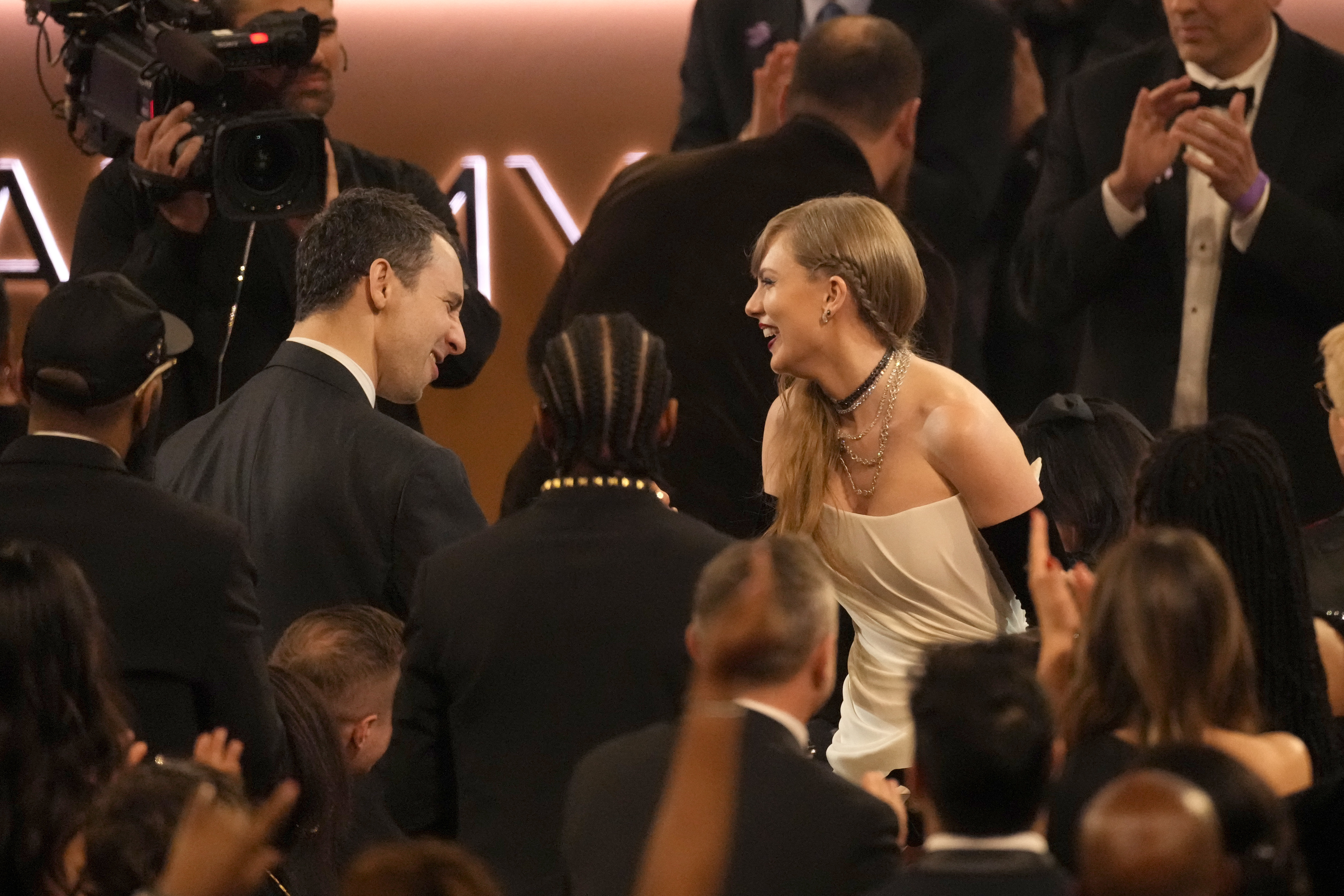
    Jack Antonoff and Taylor Swift react as Swift wins the award for best pop vocal album for “Midnights” during the 66th annual Grammy Awards on Feb. 4, 2024, in Los Angeles. (AP Photo/Chris Pizzello)Chris Pizzello

    The next year, he teamed with Swift to cowrite and coproduce “Sweeter Than Fiction,” from the soundtrack of One Chance: The Incredible True Story of Paul Potts.

    Then, in 2014, Fun. split up and Antonoff formed Bleachers, and worked with Swift on four songs on her album 1989, which many consider to be her best. Swift, who was inducted into the Songwriters Hall of Fame in New York this week, “was about the first one who said ‘we’re not going to hire a big-name producer.’”

    “It’s like that joke about the SAG card,” Antonoff said, referring to the Screen Actors Guild. “You can only get one if you’re in a SAG production, and you can only get in a SAG production if you have a SAG card.”

    “Music can be that way,” he said, “I always had clear, deep feelings about what I was doing with the work I was making. But it was very hard to break in because you needed some big cosign.”

    Now, of course, Antonoff is the big-name producer. “I’ve been very fortunate,” he said.

    Bleachers play the TD Pavilion at the Highmark Mann Center on Saturday. Back of window: Zem Audu. Second row in window: Sean Hutchinson, Michael Riddleberger. First row: Mikey Freedom Hart, Jack Antonoff, Evan SmithAlex Lockett

    But there’s also been online backlash. Google him and the first question asked is “Why don’t we like Jack Antonoff?”

    The AI answer blames him for “dulling the edges” of his collaborators because “his signature sound has become repetitive or overly minimalist” with “atmospheric echoes” and “lingering synths.”

    “I Knew It, I Knew You,” Swift’s new Toy Story 5 single that Antonoff co-wrote, seems intent on countering that criticism. On it, Antonoff plays guitars, percussion, drums, banjo, mandolin, harmonica, celesta, and Mellotron.

    Everyone is full of joy, but also copes with loss.

    “I Can’t Believe You’re Gone” is about living with the grief over Antonoff’s younger sister, Sarah, who died from brain cancer at age 14.

    “My whole career has been revisiting that through a different lens,” he told Pitchfork in 2021. In “I Can’t Believe You’re Gone,” he sings, “these hope-filled lies, these unearned traditions / If you repeat them enough, you can live with someone you’re missing.”

    “It’s about loss,” Antonoff said of the song. “It’s kind of a choose-your-own-ending when it comes to grief.”

    A handful of shows into the Bleachers tour, Antonoff said he’s been confronted with something he tends to forget when he’s off the road for too long. “Whenever I start a tour, there’s this completely life-affirming reminder that I have no ability to pace myself and every show is just like the last night on earth.”

    “Every night has to be pushed to the brink of everything. So I’m pushing the band to the brink, myself, the audience … You wake up the next day and you feel like you’ve been hit by a truck. And you should. Fried and happy. It’s kinda my favorite feeling in the world.”

    He has one more thing to add: “I cannot f— wait to get to Philly. That’s a place that has always had our back.”

    Bleachers Forever with Hovvdy at the TD Pavilion at the Highmark Mann, 5201 Parkside Ave., at 8 p.m. Saturday. highmarkmann.org.

  • Lights! Camera! Cage match! The White House lawn’s Octagon is ready for Trump’s 80th birthday bash

    WASHINGTON — It looks from afar more UFO than UFC.

    Maybe it’s the kind of contraption that has carried space aliens to the White House to force a meeting with America’s leader.

    But come closer and you’ll see the contours of the eight-sided cage, 30 feet in diameter and shaped, with careful precision, like the MMA league’s signature Octagon.

    That is, a STOP! sign flipped on its edge, with wire-mesh sides and padded corners fitted with different sponsors’ logos: Morgan & Morgan, Bud Light, Dodge Ram, Corona Extra, and Polymarket, which identifies itself as the world’s largest prediction market.

    Overhead looms the Claw, a four-sided mass that arcs more than 90 feet into the air and features lights, speakers, thick snakes of wiring, and four large screens so fans not seated right next to the Octagon can follow the cage fighting below.

    Think more of the four-sided, metal grabby thing that tries to grasp stuffed animals at a video arcade rather than what house cats have — hence the extraterrestrial vibes.

    And surrounding all that are risers filled with gray folding chairs forming a temporary arena expected to seat 4,000-plus people for the seven UFC fights being staged on Sunday to celebrate the 80th birthday of President Donald Trump and the 250th anniversary of the Declaration of Independence’s signing.

    “Quite attractive to a lot of people”

    For non-UFC fans, all of this might be disorienting under any circumstances. But the temporary arena is covering nearly the entirety of the White House’s South Lawn, where Marine One usually lands to ferry the president to out-of-town trips and gobs of kids scramble in the grass during the Easter Egg Roll every spring.

    More than $60 million and tens of thousands of hours of labor have been poured into building the arena, according to a court filing from the National Park Service, which oversees the South Lawn and contested a lawsuit meant to block the event. Federal Judge Ahmet P. Mehta on Friday declined to block it, ruling it could go forward.

    The White House says the UFC is covering the costs, though the filing states that seven agencies — including the Department of Homeland Security and the Federal Aviation Administration — have “allocated significant resources and manpower.”

    Fighters, their entourages, and assorted support staffers are expected to take over the driveway and part of the West Wing when they’re not fighting. But they’ll enter the arena via curtained-off walkways with access to the Octagon.

    They, as well as ordinary attendees of Sunday’s spectacle, will have picturesque views of the White House’s Executive Residence and its storied Truman Balcony on one side and the Washington Monument towering in the distance on the other. All of it will be accentuated by swirling spotlights, and perhaps even sweat and blood pouring off the fighters pummeling each other.

    A packed pre-event schedule included a news conference at the Lincoln Memorial with UFC chief Dana White and the fighters on Friday night.

    The schedule also includes a ceremonial weigh-in for combatants on Saturday at the Ellipse, a park near the White House, where organizers expect 120,000-plus visitors to watch Sunday night’s proceedings on large screens after winning free tickets in a lottery.

    Stunt athlete Travis Pastrana is also set to do a potentially death-defying backflip on a dirt bike on the White House lawn as part of the preshow extravaganza.

    Trump has called the Octagon and its Claw “quite attractive to a lot of people.” He’s even suggested that maybe the temporary structure could become permanent, like the Eiffel Tower, which he notes was originally built as part of the 1889 World’s Fair but then was never taken down.

    Only the president knows how serious that suggestion really is.

    The fights will go on rain or shine — despite a lack of covering

    Work on the arena began May 20 and has continued for weeks. During a walk-through for reporters on Thursday, construction noises — particularly sanding and hammering — could be heard. Giant cranes were carrying materials around overhead, though that was for the $400 million ballroom that Trump is building nearby, not the UFC fight.

    The remaining grassy lawn around the arena, on the other sides of the White House, has been fitted with supplemental spotlights. But the grass that normally grows between the White House and the start of the risers for the arena is now gone, with nothing but dusty dirt that will need to be resodded when this is all over — unless the president really does decide to leave the arena up permanently.

    There’s also a large Freedom 250 logo standing between the White House and the arena. Nearby, crews removed the tables and yellow patio umbrellas from Trump’s refurbished Rose Garden and were power-washing that space, as well as the colonnade to the Oval Office, in preparation for the fights.

    Secretary of State Marco Rubio signed a cooperation agreement with UFC that will see both institutions provide fight training and health and diet regimens, while promoting teamwork and leadership among youth around the world.

    “We are so polarized,” Rubio said. “There are only a handful of things that bring people together in one place at one time, united by their interest in one thing. We need more of those.”

    Later Thursday, crews began testing the sound system, unleashing a deep rumbling — and sometimes unsettling bass notes — throughout the West Wing. During a subsequent Oval Office event, the music from the lawn was loud enough that the 1970s hit “Boys Are Back in Town” rollicked in the background as Trump spoke.

    Sunday’s event starts at 8 p.m. ET. As darkness falls, crews will illuminate the Claw in red, white, and blue, and the mass of lights will offer projections that make it seem as though the entire structure has been enveloped in a twirling stars and stripes pattern.

    The weather forecast calls for hot and muggy conditions with thunderstorms possible. The underside of the Claw’s tower features an overhead cover that should keep the fighters reasonably dry should it rain — and Trump is also likely to watch from a protected, covered area.

    But everyone else would almost certainly get wet.

    White has vowed that even heavy lightning — when the Claw might make a conspicuous target for bolts — wouldn’t stop the show.

    “I don’t care if it snows,” White said.

  • Sen. Cory Booker said police departments should follow Camden County’s lead in using ‘cutting edge’ tech

    Sen. Cory Booker said police departments should follow Camden County’s lead in using ‘cutting edge’ tech

    U.S. Sen. Cory Booker stood Friday in the basement of the Camden County Police Department headquarters in downtown Camden, surrounded by floor-to-ceiling video screens displaying a lifelike training scenario: a distraught man teetering near the edge of a bridge, threatening to jump.

    A young officer stepped forward and addressed the digital figure: “Just step back from the edge,” the officer said, “and come talk to me.”

    The immersive simulation is part of a system the department uses to train officers to respond to volatile encounters without resorting to force — one piece of a growing suite of technology it has embraced over the last decade. Department officials credit those tools, along with broader policing reforms and community-engagement efforts, with helping reduce crime in a city once regarded as among the nation’s most dangerous.

    Today, Camden’s homicide total sits at a four-decade low, while robberies, sexual assaults, and other violent crimes have also declined, according to police data.

    Booker toured the department Friday to see those tools firsthand as he promotes federal legislation designed to help other law enforcement agencies adopt similar technology.

    The proposal, known as the Violent Incident Clearance and Technological Investigative Methods Act, or VICTIM Act, would establish a Department of Justice grant program to help police departments increase staffing, purchase investigative technology, and train personnel to use it. Booker, a New Jersey Democrat, reintroduced the bipartisan legislation in March 2025 alongside Sen. John Kennedy, a Louisiana Republican.

    The measure comes as violent crime has fallen sharply in many cities across the country in recent years, a trend Booker said lawmakers should sustain through continued investment.

    “What they’re doing here is so innovative and cutting edge,” Booker said after the tour, pointing to Camden as an example for other departments to follow.

    Inside the Camden County Police Department’s Real Time Tactical Operations Intelligence Center, analysts monitor live camera feeds, 911 calls, and data streams from license plate readers and other sources. The center provides officers with real-time information during emergencies, helps investigators track suspects, and identifies crime patterns throughout the city, said Chief Gabriel Rodriguez.

    The intelligence center works in tandem with the department’s drone unit.

    U.S. Sen. Cory Booker, joined by city officials, watches a drone demonstration atop the Camden County Police Department on June 12, 2026.Jose F. Moreno / Staff Photographer

    Rodriguez said those tools, combined with training programs such as the simulation Booker observed Friday, have helped drive crime to new lows.

    The city recorded 12 homicides in 2025, down from 17 the previous year and the fewest since 1985, according to department data. Violent crime also fell 6% last year, while robberies declined 12% and sexual assaults dropped 32%.

    Camden has spent more than a decade reshaping its approach to policing, adding new technologies and investigative tools as funding became available. Booker said departments across the country cannot afford to stop investing in technology as criminal investigations become increasingly reliant on digital tools and real-time information.

    “Technology is moving rapidly,” he said. “We’ve got to stay ahead of the curve, and that’s going to take constant investment.”

    Several local officials joined Booker on the tour, including Camden Mayor Victor Carstarphen and Camden County Commissioner Director Louis Cappelli Jr., who highlighted the city’s crime reductions and broader public-safety gains as they walked through police headquarters.

    Even so, police who have adopted technologies such as automated license plate readers and large-scale camera networks have drawn scrutiny from civil-liberties groups nationwide. And on Friday, Rodriguez acknowledged that some residents are skeptical of the department’s use of technology.

    But he said many have also come to view it as a benefit, pointing to faster emergency response times and the department’s efforts to address quality-of-life concerns such as illegal dumping.

    Some residents, Rodriguez said, are even curious enough to tour the facility themselves.

    “A lot of communities often feel like they have too much of the policing they don’t want and not the policing that they need,” Booker added. “Standing here in Camden, where we’re finding ways … to make tremendous progress … the key for me is making sure that we can continue to get better and better as a state.

    “Overall,” he said, “crime is going down in New Jersey. But we want to continue that momentum and not just see crime rates go down, but community strength and community partnerships go up.”

  • EU agrees to launch membership talks with Ukraine next week even as war with Russia drags on

    BRUSSELS — European Union nations agreed on Friday to open membership talks with Ukraine next week, officially launching the process for the war-torn country to eventually join the world’s biggest trading bloc.

    At a meeting in Brussels, ambassadors from the 27 EU nations decided to officially open negotiations with Ukraine as well as with Moldova, which Russia has also tried to drag back into its orbit, on Monday in Luxembourg.

    Ukraine sees EU membership as an important “security guarantee” for a stable future once war with Russia ends.

    Its best guarantee would be NATO membership, but the Trump administration insists that cannot happen. Others oppose it joining while fighting continues. Russia is strongly against it, and has cited moves toward NATO membership as a reason for launching its full-scale invasion in 2022, though it has not objected to EU membership for Kyiv.

    Countries hoping to join the EU must complete negotiations in 35 policy areas, or chapters, ranging from agriculture to trade, a process which can take years.

    An intergovernmental conference will be held on Monday to open key chapters — grouped together as “clusters” — concerning the values and principles on which the bloc was founded.

    “This is a recognition of the determination, courage, and hard work shown by both countries in advancing reforms, even in the face of immense challenges,” EU Council President António Costa and Commission President Ursula von der Leyen said in a statement.

    They described the move as “a strategic choice” that strengthens “peace, security, and prosperity across our continent.” It’s also a “signal that the EU’s offer of peace, stability, and opportunity is unmatchable,” they said.

    Ukraine officially applied for EU accession less than a week after Russia invaded in February 2022. The EU commission has praised the country for reforms it has been able to push through in wartime, although deep concerns about corruption and justice standards remain.

    Last month, German Chancellor Friedrich Merz urged his EU partners to consider offering “associate membership” to Ukraine and breathe new life into talks aimed at ending more than four years of war with Russia.

    Other countries — France and the Netherlands among them — have suggested workarounds to bring Ukraine into the fold more quickly but without the rights of full membership.

    It all comes as the EU weighs whether to try to launch its own negotiations with Russian President Vladimir Putin, with U.S.-mediated talks bogged down while America’s attention focuses on the Iran war.

    Under Merz’s proposals, Ukraine would take part in EU meetings, but without voting rights, and would also have nonvoting “associate members” of the bloc’s powerful executive branch, the European Commission, and the European Parliament.

    All 27 EU members must agree before each policy chapter can be opened, and then again for it to be closed. Hungary, notably, has blocked the opening of negotiations, but the arrival of a new government in Budapest has softened that stance.

  • Tortorella’s confidence unshaken as Golden Knights face elimination game in Stanley Cup Final

    RALEIGH, N.C. — John Tortorella has never worried about how his Vegas Golden Knights handle tough situations in pushing to the Stanley Cup Final.

    That won’t change now, with the Golden Knights facing their first elimination game and dealing with an injury to center William Karlsson.

    The Golden Knights lost 4-2 to the Carolina Hurricanes in Thursday’s Game 5, moving the Hurricanes within a victory of claiming the Stanley Cup. The series shifts to Las Vegas for Sunday’s Game 6 (8 p.m., 6abc), with the Golden Knights aiming to force a Game 7 back here Wednesday.

    “They’ve been through it all,” Tortorella said in a Zoom news conference Friday morning. ”They know what’s at stake here. We need to win one game. They’ll be ready to play.”

    Vegas — featuring numerous holdovers from the team that raised the Cup in 2023 — had only gained momentum since the abrupt firing of coach Bruce Cassidy in late March to hire Tortorella, who coached the Flyers for nearly three seasons.

    The Golden Knights won seven of eight to close the regular season. They faced 2-2 playoff series in Round 1 against Utah and Round 2 against Anaheim, and won Games 5 and 6 to close out each. They swept the Presidents’ Trophy-winning Colorado Avalanche. And they held a 2-1 lead on Carolina after a double-overtime victory in Game 3.

    But the Hurricanes have gradually begun to turn the series.

    Since trailing 4-0 entering the third period of Game 3, the Hurricanes have doubled up the Golden Knights (13-6) while finding a spark with Brandon Bussi taking over in net. In Game 5, the Hurricanes got two more power-play goals from a unit that had sputtered through the Eastern Conference playoffs while also reversing Vegas’ second-period dominance.

    Vegas had compounding mistakes like getting a kill only for Brayden McNabb to immediately go to the box for cross-checking Jackson Blake in the second period. Or there was Mark Stone’s high stick on Jalen Chatfield in the third, leaving Chatfield bleeding from a cut above his right eye for a double-minor penalty.

    Carolina’s Andrei Svechnikov scored after both, coming amid a postseason of questions as to when he and fellow topliner Sebastian Aho would get rolling.

    “Anytime you give the other team’s best players the opportunity to be on the ice on the power play and feel good about themselves … you stack that up and it definitely can be challenging and tire guys out,” center Nic Dowd said afterward.

    Svechnikov’s scores pushed the Hurricanes to 6 of 16 (37.5%) on the power play this series, coming after they were at 12.5% (7 of 56) in a 12-1 push through the Eastern Conference playoffs.

    “One of the areas that we’ve lost a little bit is special teams, a couple of power-play goals last night,” Tortorella said Friday. “Like I said after the game, I thought at times we were killing, we had some good times as far as moving, being aggressive with our penalty kill, and are doing the job. Other times, not so good.”

    Then there’s Karlsson, who missed nearly six months with a lower-body injury before returning for his playoff debut to start the Anaheim series. He had three goals and six assists through 14 playoff games to elevate the Golden Knights, including goals in Games 1 and 4 against Carolina.

    But Karlsson appeared to injure his left arm or shoulder after getting knocked into the boards by Hurricanes defenseman Sean Walker midway through the second. He got medical attention on the bench briefly, skated off, and never returned.

    Tortorella said Thursday that Karlsson was “not going to be with us, probably” and Vegas needed a collective effort to replace him. He offered no additional details Friday morning.

    Still, he has defiantly promised the series would “be back here” for a Game 7.

    “We know what we have to do to beat this team,” McNabb said Thursday night. ”It’s a matter of going home and winning one game. That’s all it is, and hopefully we’re back here for Game 7.”

  • unCovering the Birds: Minicamp Recap

    unCovering the Birds: Minicamp Recap

    There was closure. There were opportunities to set records straight and start fresh. There was a chance for the Eagles to take the new philosophies and personnel acquired during the offseason, and give it all a test run on the field. What did the team find out about itself? How well prepared are the Eagles to hit the ground running in training camp once they return from their offseason hiatus later in the summer? The Philadelphia Inquirer’s Jeff McLane and Jeff Neiburg watched this week’s mandatory minicamp practices at Eagles headquarters, and analyze what they saw.

    00:00 Biggest impressions of new offensive coordinator Sean Mannion’s scheme

    09:25 Now that A.J. Brown is gone, how did the wide receiver corps look?

    14:44 Jalen Hurts addresses leadership, offseason ESPN report

    23:18 How good could the Eagles’ defense be?

    27:57 Riq Woolen, Jalen Carter, and the EDGE rotation

    unCovering the Birds is a production of The Philadelphia Inquirer and KYW Newsradio Original Podcasts. Look for new episodes throughout the offseason.

  • Blocking Trump’s Fund, Judge Presses for Guarantee It Won’t Move Forward

    ALEXANDRIA, Va. — A federal judge Friday barred the Trump administration until further notice from setting up a $1.8 billion fund to compensate people claiming to have been unfairly prosecuted by the government, saying that her order was needed because of mixed messages about the scheme from President Donald Trump.

    The ruling by the judge, Leonie M. Brinkema, was the strongest effort to date by anyone in government to hold the administration to its word that the proposal to create the fund had actually been set aside. While Todd Blanche, the acting attorney general, told Congress last week that the fund would not move forward, Trump has been much more circumspect, insisting that he still loves the idea and believes that people who suffered in court at the hands of the government should get financial compensation.

    Brinkema seized on the president’s statements during a hearing in U.S. District Court in Alexandria, Va., suggesting they left open the possibility that the fund could be brought back to life despite Blanche’s promises and assertions made in court papers that the fund was no longer moving forward.

    “We just don’t have the absolute certainty that this fund won’t rear its head in another form,” she said.

    Brinkema did, however, give the administration a way out. She said she would consider rescinding her order if, within a week, the Justice Department sent her a declaration, filed under penalty of perjury, that the fund was dead once and for all. She told Andrew Block, a department lawyer who appeared in court for the government, that the declaration needed to be signed by Blanche and Scott Bessent, the Treasury secretary.

    Brinkema’s ruling extended a temporary pause on the fund that she had put in place at the end of May. And it came two days after a federal judge in Washington, Richard J. Leon, refused to issue his own order putting the fund on hold.

    Leon took the Justice Department at its word that the plan had been shelved, but still warned the administration not to play games with him by pretending it was dead, if it was not.

    “Don’t play possum with this court,” he said.

    The fund has created a political headache for the White House almost from the moment it was first announced May 18 — in no small measure because of concerns that it could be used to funnel taxpayer money to hundreds of rioters prosecuted for storming the Capitol on Jan. 6, 2021.

    Brinkema underscored those concerns by reading aloud a passage about payments being made to the rioters that appeared in a brief criticizing the fund that was submitted to her last week by Sens. Cory Booker (D., N.J.) and Bill Cassidy (R., La.).

    “A scheme deliberately designed to recast insurrectionists — including those who perpetrated violence against law enforcement officers — as victims and legitimate prosecutions as persecution does not merely rewrite history,” the judge read from the bench. “It creates incentives for similar conduct in the future, with the explicit encouragement of the officials responsible for administering justice.”

    The lawyers who challenged the administration in front of Brinkema celebrated her order, saying it would keep the fund in check, despite “the administration’s shifting explanations” about its future.

    “The court recognized the serious legal concerns raised by the Trump-Vance administration’s attempt to create a secretive, taxpayer-funded compensation program operating outside the constitutional safeguards that govern public spending,” said Skye Perryman, the president and CEO of Democracy Forward.

    The nonprofit group brought the case on behalf of five clients — among them, a former federal prosecutor fired after working on Jan. 6-related cases — who asserted that they had been wronged by the Trump administration and would be prevented from filing claims with the fund because it was designed to compensate people alleging harm by Democratic administrations.

    The fund emerged from an extraordinarily unusual ploy to settle a $10 billion lawsuit that Trump had filed against the IRS, a federal agency that he technically controls. The suit accused the IRS of not doing enough to stop a contractor from leaking his tax information to the New York Times in 2019.

    As part of the same deal, the IRS and the Justice Department gave the president an even more remarkable and personal benefit, granting him, his family, and businesses broad protections from tax investigations.

    Brinkema made clear Friday that her order applied only to the compensation fund, not to the tax provision. She noted that the entire settlement deal — including both the fund and the IRS protections — was being scrutinized as a potential act of fraud by the federal judge in Miami, Kathleen M. Williams, who oversaw the original lawsuit.

    Shortly after being assigned the IRS suit, Williams, an Obama appointee, had questioned whether it presented an actual conflict that she could consider, given that Trump was effectively on both sides of the matter. When she closed the case, she noted that there was no “settlement of record,” but shortly after, the Justice Department released its agreement dismissing the suit.

    Williams effectively reopened the case last month after 35 former federal judges urged her to examine whether Trump’s legal team and the Justice Department had colluded to reach the deal in a way that avoided any scrutiny or oversight.

    As part of her inquiry, Williams has given Trump’s personal lawyers until the end of Friday to tell her in writing whether the dismissal of the suit was “premised on deception” and whether it should be formally reopened because she was the “victim of a fraud.”

    This article originally appeared in the New York Times.