Protecting the public is government’s most fundamental duty. But when new threats to safety emerge and evolve, that duty demands more than awareness — it demands action that keeps pace with reality.
Today’s children are growing up exposed to constant streams of content that can be disturbing, harmful, and frightening. It shapes how they see themselves and their peers in ways no previous generation has had to navigate. That is the reality we face — and it demands urgency and action.
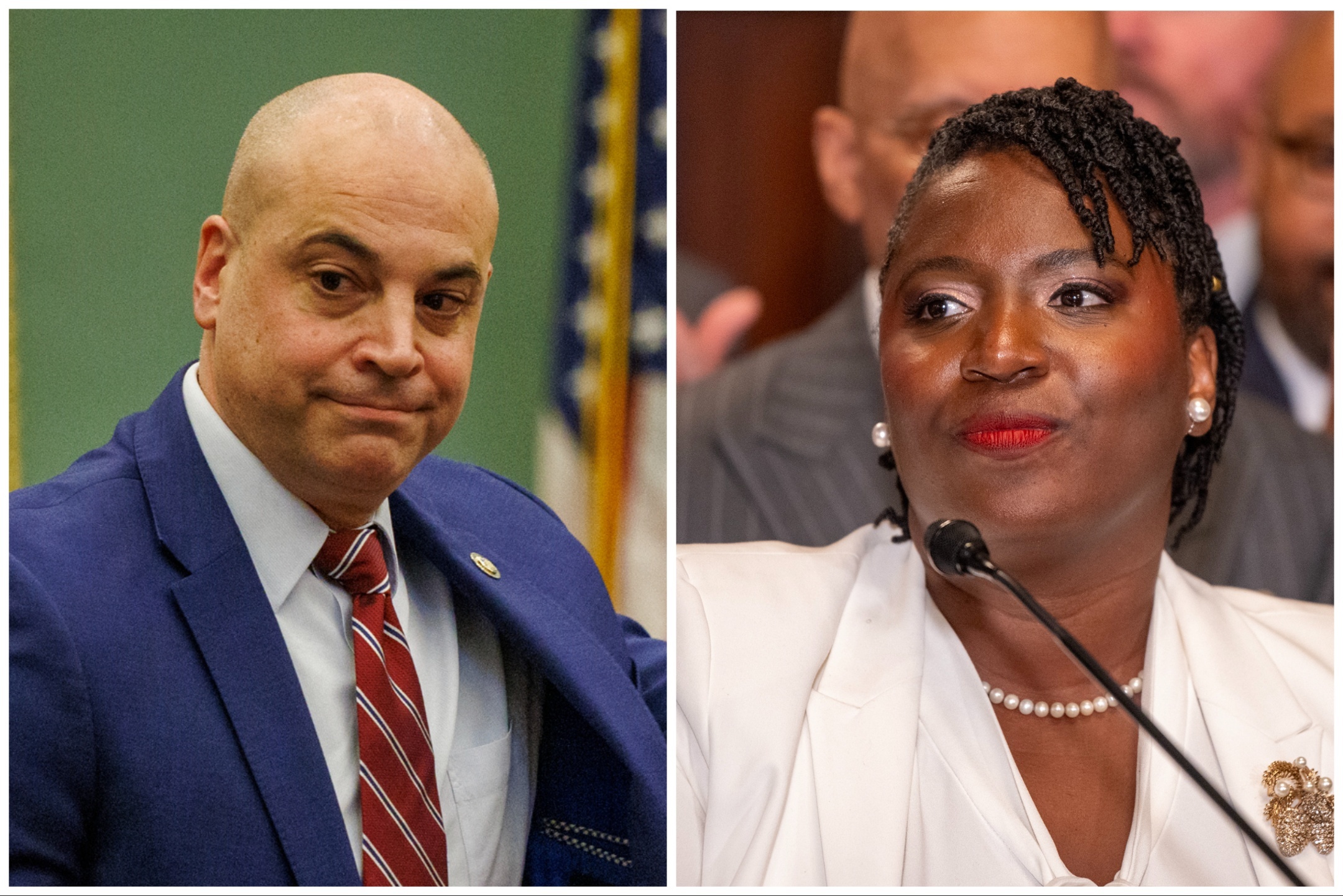
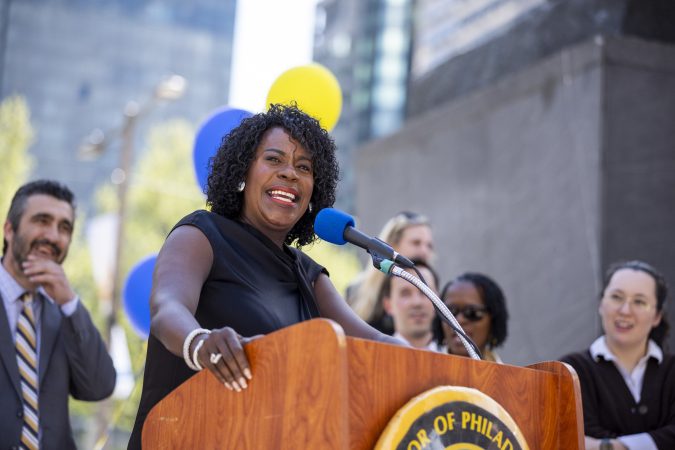
Today’s children are growing up exposed to constant streams of content that can be disturbing, harmful and frightening, write Joanna McClinton and Dave Sunday.Seth Wenig
Last month, we served as panelists at an event in Montgomery County concerning the growing issue of AI-generated sexually explicit deepfakes in our schools. This discussion stressed the harmful, long-lasting impact that sexualized content can have on victims, but also what we should be doing to better protect our children and to prevent this new form of exploitation.
First, let’s level set. Explicit deepfakes are not a joke, or “kids being kids.” They are serious and illegal invasions of privacy that can leave a victim feeling traumatized, angry, alienated, depressed, embarrassed, shameful, and violated. They need to be taken seriously, and they need to stop.
To set the tone for the event, two courageous students shared their victim impact statements with the audience of parents, advocates, law enforcement officials, and others. Their testimony was simultaneously heart-wrenching and infuriating.
Heart-wrenching because of the cycle of trauma a teenager must endure after having their privacy violated by a classmate. Trauma that does not stop when the school bell rings at the end of the day, but follows our children home. Infuriating because of the ease with which a child can create hypersexualized content of another child.
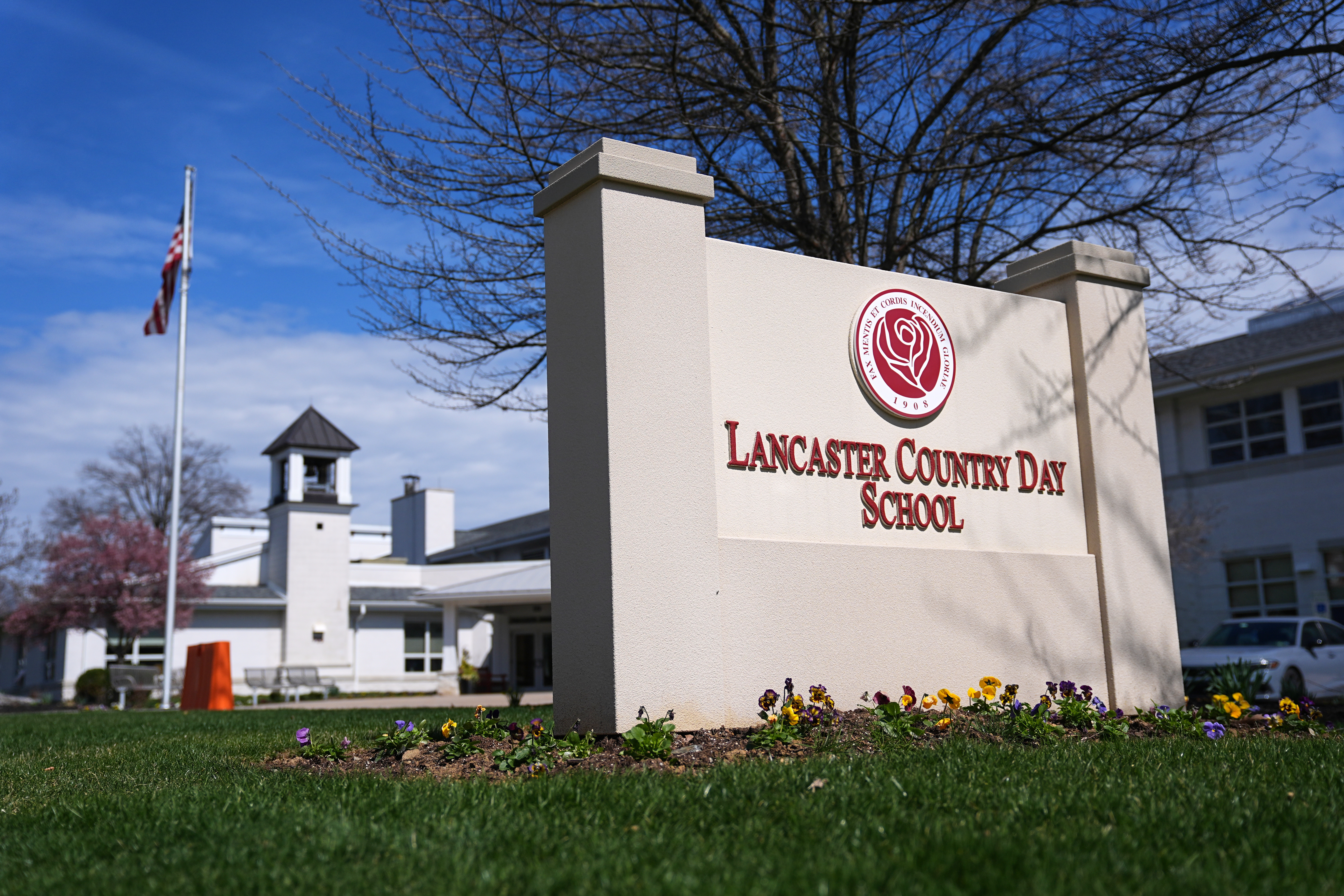
Earlier this year, two 16-year-old boys in Lancaster County used artificial intelligence to create hundreds of nude images of female classmates at Lancaster Country Day School.Matt Rourke
Deepfake sexualized images in schools is not an issue unique to Pennsylvania, with prominent cases emerging in states from California to Louisiana to Massachusetts, but it is one that the two of us — Joanna McClinton, as a lawmaker, and Dave Sunday, as the state’s chief law enforcement officer — are heavily invested in and are committed to defeating.
In Pennsylvania, we’ve implemented new laws to respond to the growing danger some apps are enabling in our schools and elsewhere.
In 2019, Pennsylvania was a leader in making sextortion — a crime where a perpetrator coerces a victim to comply with demands for sexual acts, images, or videos — a third-degree felony, punishable by up to seven years in prison, if the victim is under 18, or the perpetrator has shown a pattern of engaging in sexual extortion.
In 2024 and 2025, Pennsylvania enacted new laws making it a crime to harass someone by distributing a deepfake nude or sex act image of them without their consent (the offense is more serious if the victim is a minor), or to create a forged digital likeness, a computer-generated image, video, or audio recording of a person, with the intent to defraud or injure someone.
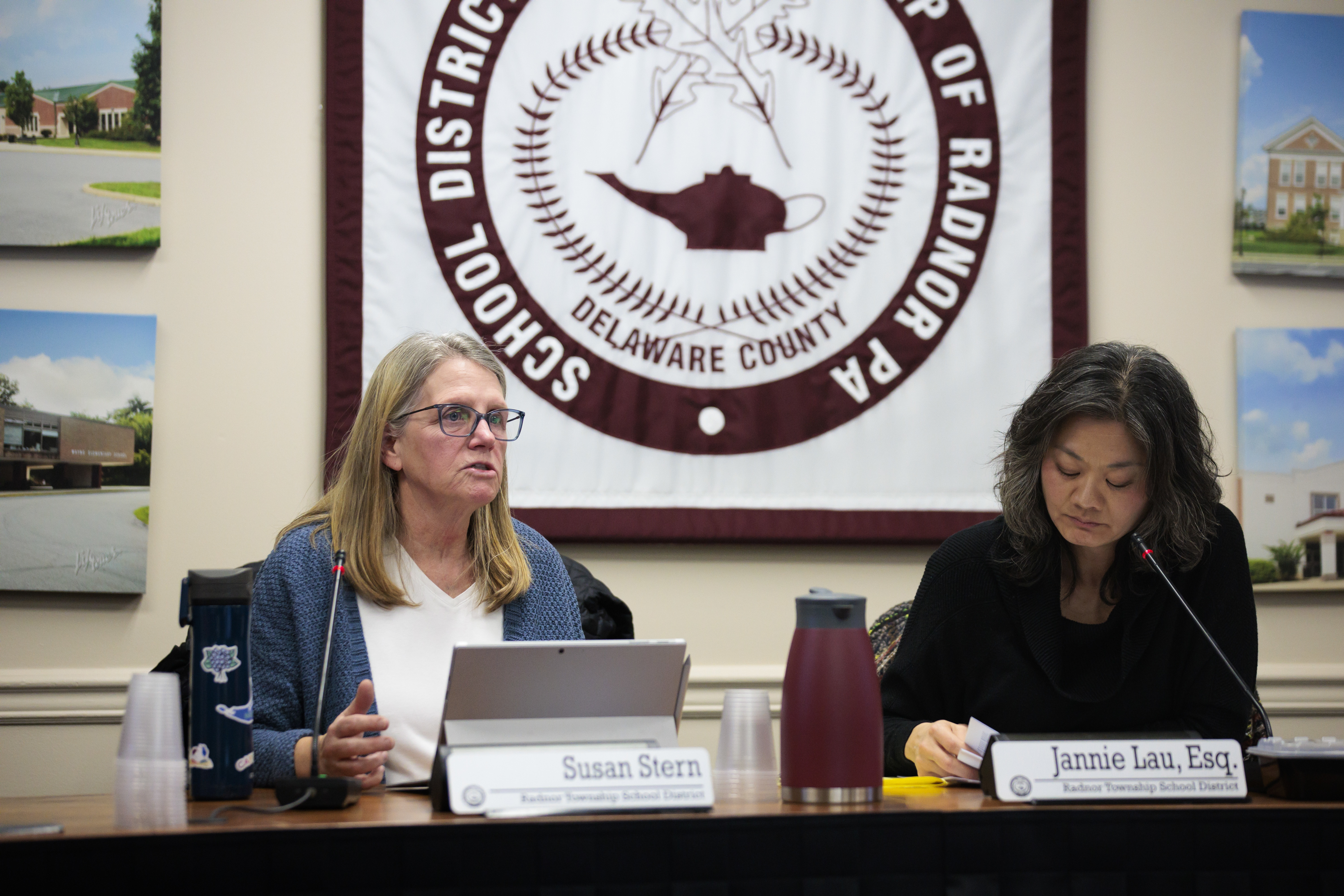
In April, the Radnor school board explicitly banned the use of artificial intelligence to create sexualized images of another person, after a student made deepfakes of female classmates.Monica Herndon / Staff Photographer
Finally, we learned from recent incidents in Lancaster and Delaware Counties that acting fast is critical to limiting the number of victims, stopping the circulation of deepfake child pornography, and maximizing law enforcement’s ability to investigate.
To speed up the process, an additional measure is pending in the state Senate to require mandated reporters, like teachers, school officials, and healthcare professionals, to report suspected child sexual abuse materials or AI child sexual abuse materials to ChildLine, which will immediately alert law enforcement.
A measure is pending in the state Senate to require mandated reporters, like teachers, school officials, and health care professionals to report suspected child sexual abuse materials or AI child sexual abuse materials to ChildLine, write Joanna McClinton and Dave Sunday.Andrey Rudakov
We are also having ongoing conversations directly with students about social media and artificial intelligence, and how these tools make them feel in their day-to-day lives. Those perspectives matter, and they should inform how we approach this issue moving forward.
We can be part of the solution through our offices and in Harrisburg, but it is just as important to hear directly from students in our hometowns and across the commonwealth.
We also recognize that social media is not going away. This is not about banning platforms or telling kids to shut down their accounts, but about ensuring they understand and are aware of the very real dangers that can exist within them, and equipping families and schools to navigate them safely.
While updating the law is an important step in keeping our kids safe, the real solution requires parents, educators, law enforcement, and even tech companies to act and to know what to do.
Students need to know and feel comfortable telling an adult that a sexualized image has been sent to them.
Parents and caregivers need to talk with their children to both understand what they are doing online and what apps they are using, and to reassure them that if they see something inappropriate, they should tell you or another trusted adult.
Schools need to take incidents seriously, alert law enforcement immediately, and, most importantly, support the victims.
Law enforcement needs to treat these cases seriously. They are crimes being perpetrated against children, and they are occurring in communities around the state. If your community hasn’t been impacted yet, it will soon.
Technology today is transformative, and it is evolving at a faster and faster pace. When we were growing up, we didn’t have these powerful tools to contend with. But now that they are here, they need to be used responsibly.
The stories from our brave students should be a call to action for each of us — from elected officials to law enforcement to parents and school leaders — to do everything we can to prevent the use of apps that allow children to create hypersexualized content of their classmates.
We can’t allow hypersexualized content to become mainstream; we need to hold people accountable, from the students generating the deepfakes to the app developers who make the sexualized content possible.
Joanna McClinton is the speaker of the Pennsylvania House of Representatives. Dave Sunday is Pennsylvania’s attorney general.
McDonald’s golden arches. The Nike swoop. Apple’s apple.
Take a look around you right now. Even if you’re sitting alone in your home, you can probably spot logos for businesses in every corner.
The best logos serve as a visual shorthand for a company. They are simple and bold, recognizable and enduring.
But even the most well-established logos sometimes get refreshed to signal a brand’s evolving mission or products.
story continues after advertisement
The Philadelphia area is home to some classic business logos that have evolved over time. Can you choose the current logo for these popular local companies?
Question 1 of 6
CorrectIncorrect. XX% of other readers got this question right.
0% voted
0% voted
0% voted
0% voted
Wawa takes its name from the Native American word meaning "wild goose.” The goose has remained a part of the convenience store’s logo since 1974 when a Villanova University student and part-time worker at a Delaware County Wawa won a design contest.
Question 2 of 6
CorrectIncorrect. XX% of other readers got this question right.
0% voted
0% voted
0% voted
0% voted
Acme, which began in South Philadelphia as a neighborhood grocery store, started with a retro cursive logo. As the store expanded into a regional chain and was later acquired by Albertson’s, the logo evolved to feature bold red typography.
story continues after advertisement
Question 3 of 6
CorrectIncorrect. XX% of other readers got this question right.
CorrectIncorrect. XX% of other readers got this question right.
0% voted
0% voted
0% voted
0% voted
Tastykake cofounder Herbert Morris, formerly an egg salesman, designed the company’s first logo. No one knows why he chose to use two letter Ks, but the spelling stuck.
Question 5 of 6
CorrectIncorrect. XX% of other readers got this question right.
0% voted
0% voted
0% voted
0% voted
Beginning in the 1920s, Pep Boys’ logo featured caricatures of the three owners: Manny, Moe, and Jack. It included a fat cigar dangling from the corner of Manny’s mouth, an homage to co-owner and devout smoker Emanuel (Manny) Rosenfeld. But in 1990, as smoking fell out of favor, the company nixed the cigar to promote healthier lifestyles for consumers and employees.
story continues after advertisement
Question 6 of 6
CorrectIncorrect. XX% of other readers got this question right.
0% voted
0% voted
0% voted
0% voted
In 2022, The Inquirer redesigned its nameplate with a new font called Philadelphia Inquirer Clarendon — based on a Clarendon slab font seen in The Inquirer from the 1860s to the 1920s. The change included tweaking the official logo so the “d” in Philadelphia once again tipped to the left — The Inquirer’s style for more than 100 years until a brief change in 2019.
story continues after advertisement
Your Results
You have skipped .
You scored XX out of 6.
The average reader scored XX out of 6
Yikes! You need to brush up on your Philly-area businesses. Read inquirer.com/business to learn more about companies in our region.
You know something about Philly-area businesses, but read inquirer.com/business to take your knowledge to the next level.
Nice! You really know your Philly-area businesses. Keep reading inquirer.com/business to learn even more about companies in our region.
Staff Contributors
Design and development: Garland Fordice
Reporting: Erica Palan
Editing: Lizzy McLellan Ravitch
Copy Editing: Scott Sturgis
Subscribe to The Philadelphia Inquirer
Our reporting is directly supported by reader subscriptions. If you want more journalism like this story, please subscribe today.
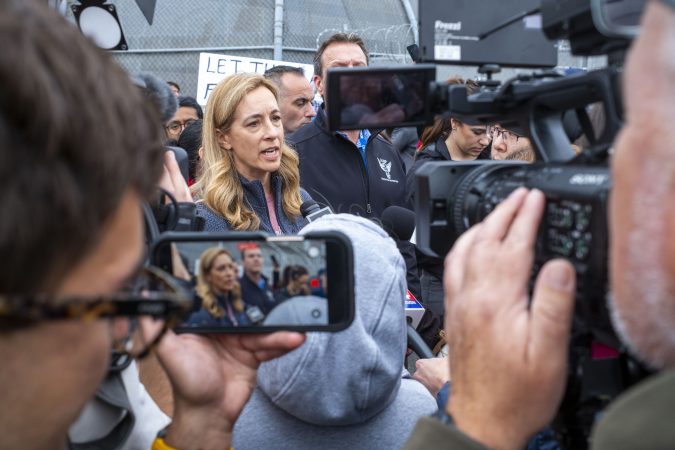
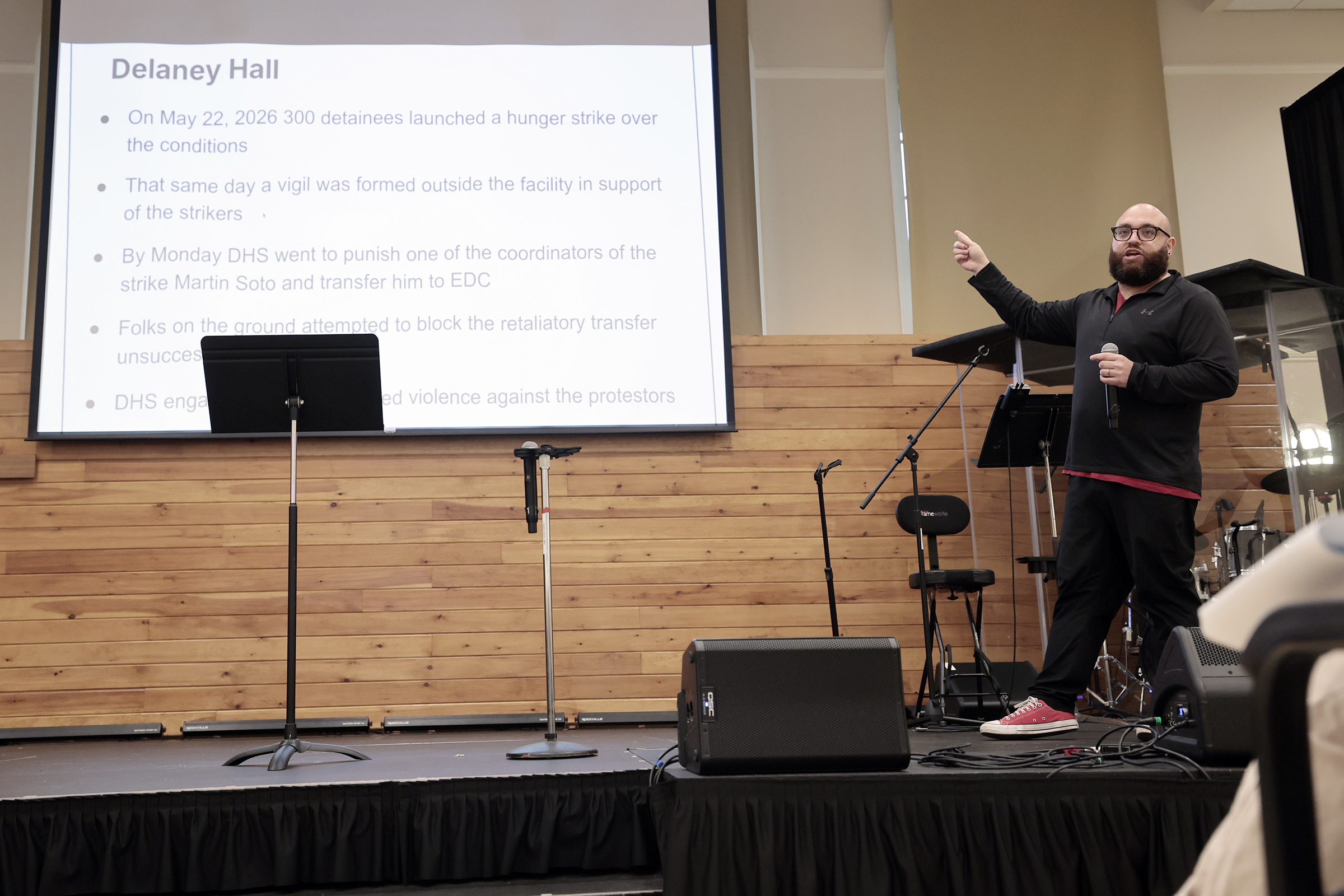
Josue Barreiro stood in front of a crowd of 200 people seated inside a church last week in Haddonfield. He was there to speak about his experience as one of 61 protesters arrested in one night outside Delaney Hall after Gov. Mikie Sherrill had sent over state police.
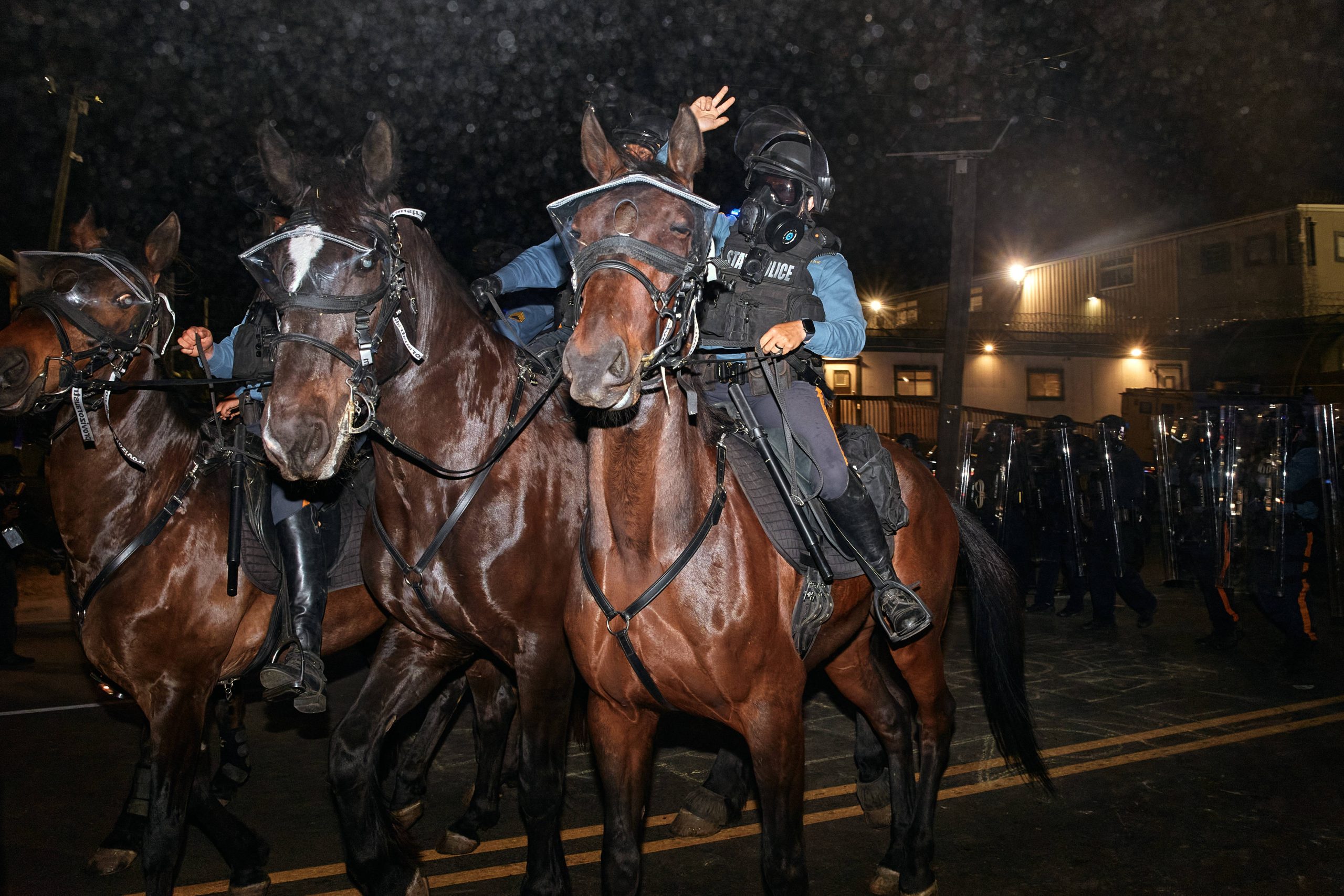
He told the crowd, gathered for a meeting of the South Jersey progressive group Cooper River Indivisible, that the governor made it seem like she was sending state troopers to protect demonstrators from federal immigration officers. Instead, he said, they brutalized protesters on horseback in riot gear. He showed a video of state police knocking him to the ground.
“All accounts say the state police were considerably more violent than the federal government was,” Barreiro, a Bridgeton resident and activist with Los Tequios, told receptive audience members who made sounds of disgust.
Josue Barreiro speaks about the protests outside Delaney Hall during the Cooper River Indivisible general meeting at the Haddonfield United Methodist Church on June 9.Elizabeth Robertson / Staff Photographer
Sherrill, a former member of Congresswhose double-digit victory last year was seen as a rebuke of President Donald Trump, has been in her most high-profile political bind yet as she juggles her opposition to the ICE detention center while facing widespread criticism for her handling of protests outside it.
The first-term governor campaigned as a fighter against Trump and Immigration and Customs Enforcement. She highlighted her experience as a Navy helicopter pilot and said she was trained “that in a crisis, you run toward the fight.” But to South Jersey progressives who worked hard to campaign for her, Sherrill’s decision to respond to tensions between protesters and ICE with a designated protest zone policed by state officers represented a betrayal. The governor called the decision “absolutely necessary to protect public safety and avoid escalation from ICE.” But the state police’s show of force, video of which replayed across national news and social media channels for days, “kind of resembled what ICE was doing in the first place,” said Newark Mayor Ras Baraka, one of Sherrill’s primary opponents, who was arrested outside the facility last year.
“This was not the kind and quality of leadership we were voting for, or hoping to see,” said Michele Messer, 52, a leader of Cooper River Indivisible, one of the groups that campaigned for Sherrill.
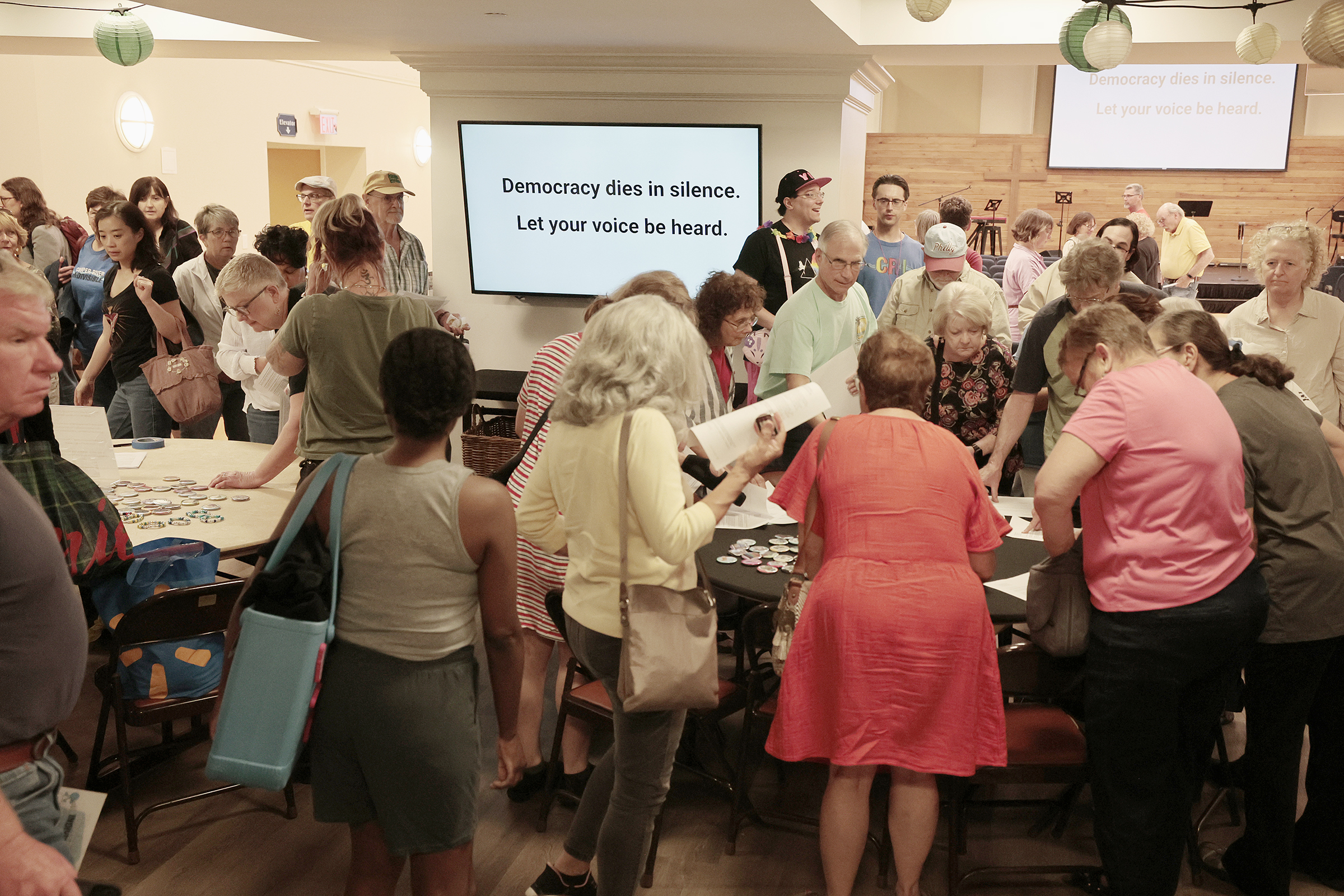
People sign up to volunteer after the Cooper River Indivisible general meeting at the Haddonfield United Methodist Church.Elizabeth Robertson / Staff Photographer
Sherrill said she was trying to “lower the temperature” to prevent Newark from becoming another Minneapolis when she announced her plans to send state troopers to Delaney Hall. She later disagreed with a comparison between state police and federal immigration officers in Minneapolis during a tense interview on WNYC’s Ask Governor Sherrill, noting that state police didn’t kill anyone.
“I don’t think they have the same concern for human life in many cases that I do, and that our police forces in New Jersey share,” she said.
Activists said she should have known that sending in police and corralling people into a free speech zone can escalate already fraught demonstrations.
“I mean, there’s precedent, there’s history. We’ve all read about how these things go, and yet that was the choice she made,” said Messer, a Haddon Township resident who has protested at Delaney Hall.
Patricia Campos-Medina, a former campaign adviser to Sherrill, said the governor’s handling of Delaney Hall — and how she manages “the fallout of her decisions” — has been an early test of her leadership.
“It’s her first real test [of] how she manages the duties of being the highest public safety officer of the state leading New Jersey, and then still protecting the immigrant community who lives here,” said Campos-Medina, an ally of the governor who works with the labor movement.
Sherrill has built her national profile on fighting the Trump administration, and those who have become the most frustrated with her share that mission. How she navigates this moment could determine whether she can keep that base focused on fighting the president, instead of her.
Mounted New Jersey State Police troopers move toward protesters outside the Delaney Hall detention center on May 29 during a protest against the transfer of detainees and federal immigration policies.AP Photo/Andres Kudacki
‘I’m not proud to have voted for her’
Sherrill has called for the closure of Delaney Hall and her administration announced multiple measures to support the fight against the detention center since the late May backlash against her began.
Activists from across the staterallied in Trenton on June 1 and delivered a letter to Sherrill calling on her to “honor our First Amendment rights, cease police brutality and to enable the closure of Delaney Hall.”
“As the grassroots who campaigned for you, we also expect ongoing communication with your administration to navigate this perilous time in New Jersey,” the letter continued, signed by about 40 organizations statewide, including Cooper River Indivisible and several other South Jersey groups.
The next day, New Jersey Attorney General Jennifer Davenport, Sherrill’s appointee, filed a lawsuit against GEO Group — the private company that runs Delaney Hall — to give the state health department full access to the facility over reports of “inhumane and unsanitary conditions.”
Two days later, Sherrill and the state legislature announced an infusion of $20 million to assist with immigration defense and launched a rapid legal defense effort amid concerns about due process.
Marie Henselder-Kimmel, 65, a Cherry Hill resident who leads the South Jersey group NJ Voters Want More Say, said the reports of bad conditions in the facility are not new, so she doesn’t understand why the administration did not take legal action months earlier.
“I foresee that we’re going to have to keep pressuring to get them to keep doing those more bold things,” she said.
Henselder-Kimmel said she feels “torn” about Sherrill’s decision to send state police because she agrees ICE would have escalated otherwise. But she said it seemed like Sherrill may have sent the police in without understanding what they were going to do.
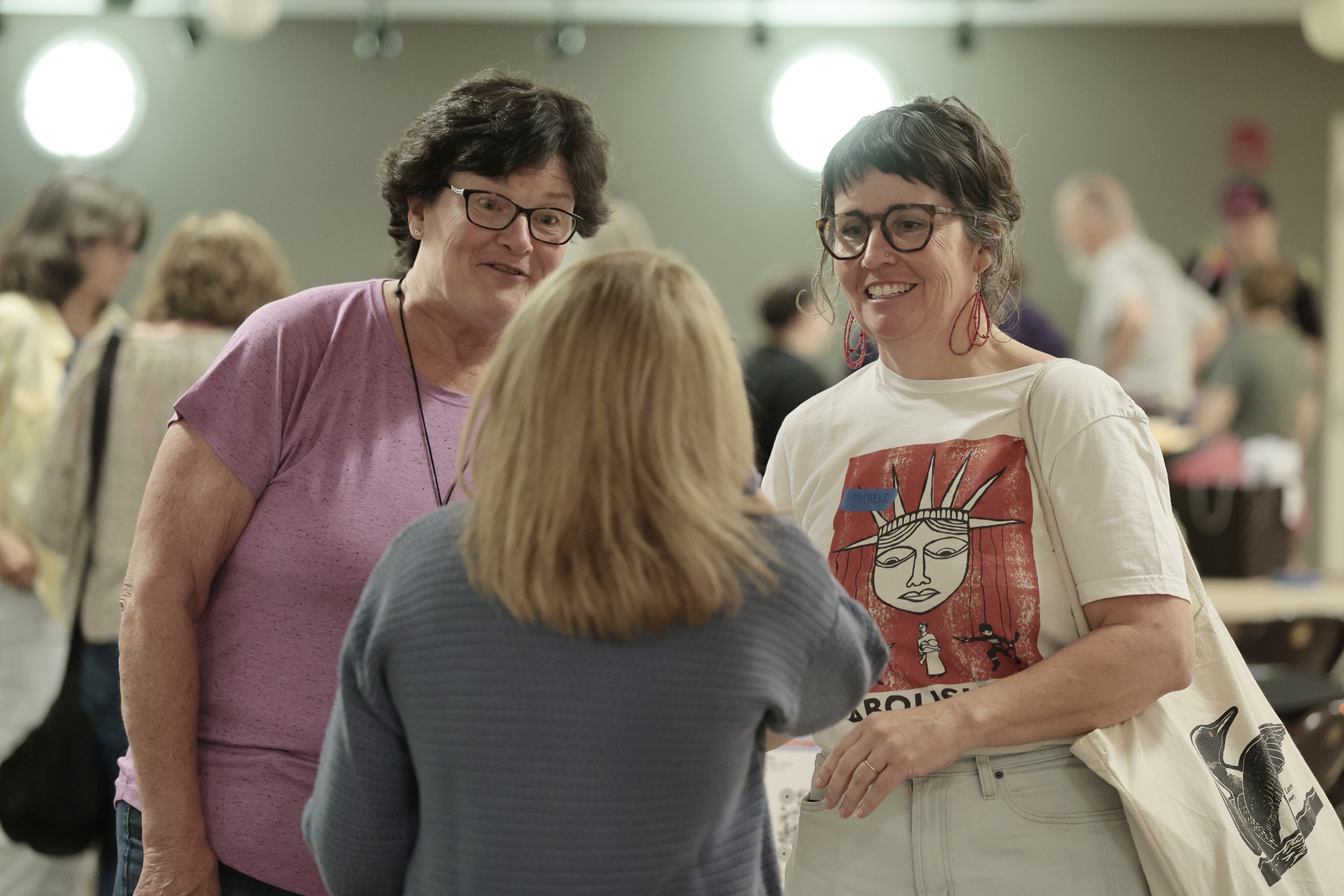
Marie Henselder-Kimmel (left) and Michele Messer (right) talk with Vikki Toomer (back to camera) after the Cooper River Indivisible general meeting at the Haddonfield United Methodist Church.Elizabeth Robertson / Staff Photographer
Cristian Moreno-Rodriguez, who works as the executive director of El Pueblo Unido of Atlantic City, an organization that supports Latino immigrants, said Sherrill’s handling of the protests has fully broken the trust with his community.
Sherrill’s campaign made a particular effort to target Latino voters. She did particularly well in New Jersey’s largest Hispanic-majority cities, which moved an average of 18 points toward the Democrat after rightward shifts in 2024.
“We’re not going to forgive her for what she’s done,” said Moreno-Rodriguez, who worked for One Giant Leap, asuper PAC that supported Sherrill and raised about $9 million by the end of 2025.
Sherrill was not Moreno-Rodriguez’s first choice in the primary, but she was a better choice for his community than Republican Jack Ciattarelli, he said. Still, he said he was expecting better from the Democrat.
“I don’t regret voting for Mikie Sherrill because she was better than Jack Ciattarelli, but I’m not proud to have voted for her,” he said.
Gov. Mikie Sherrill poses for a selfie at a Latinos for Mikie event at the Rancho Mateo restaurant in Elizabeth, N.J., last May.Aristide Economopoulos
Activists have been demanding Sherrill meet with detainees, but she says she has not been allowed in except for one “closely controlled and limited tour” on June 8, in which she was not allowed to speak with those being held there.
Several members of Congress, who are authorized to conduct oversight visits, have visited the detention center, including Sen. Andy Kim, a South Jersey Democrat who made headlines for getting pepper-sprayed while trying to de-escalate tensions between federal immigration officers and protesters. Kim faced criticism from some activists for what they viewed as trying to negotiate with ICE, but others have praised him for being on the ground in a way they have not seen from Sherrill.
Sen. Andy Kim stands between federal agents and demonstrators in an attempt to prevent a clash outside the Delaney Hall migrant detention center in Newark on May 25.DAKOTA SANTIAGO
Sherrill and activists alike have said that the demonstrators have been largely peaceful. But U.S. Rep. Jeff Van Drew, a Cape May County Republican, accused the protests of being “more like anarchy” and called on Sherrill to bring state police back.
State Sen. Michael Testa, a Cumberland County Republican, praised Sherrill’s “decision to cooperate with federal authorities” and “restore order” by bringing state police in, and added fuel to the fire by thanking her for “supporting President Trump and the brave men and women of ICE.”
‘The buck stops with her’
Activists have expressed frustration that the narrative has strayed from the conditions inside Delaney Hall to the fight outside it — a point Sherrill has echoed.
But after state police clashed with protesters, Sherrill focused her criticism on what she described as “aggressive and dangerous” disruptors and defended the officers.
Her remarks further infuriated activists who accused her of echoing the state police’s narrative, which they say does not align with what they experienced on the ground or saw online.
When a radio caller confronted Sherrill on WNYC over state police brutalizing nonviolent protesters, the governor said “if there were incidents like that, the attorney general will be looking into that.”
Vikki Toomer, a Cooper River Indivisible leader who has protested outside Delaney Hall, said that listening to Sherrill’s news conferences have given her “that same visceral reaction” she gets from listening to Trump.
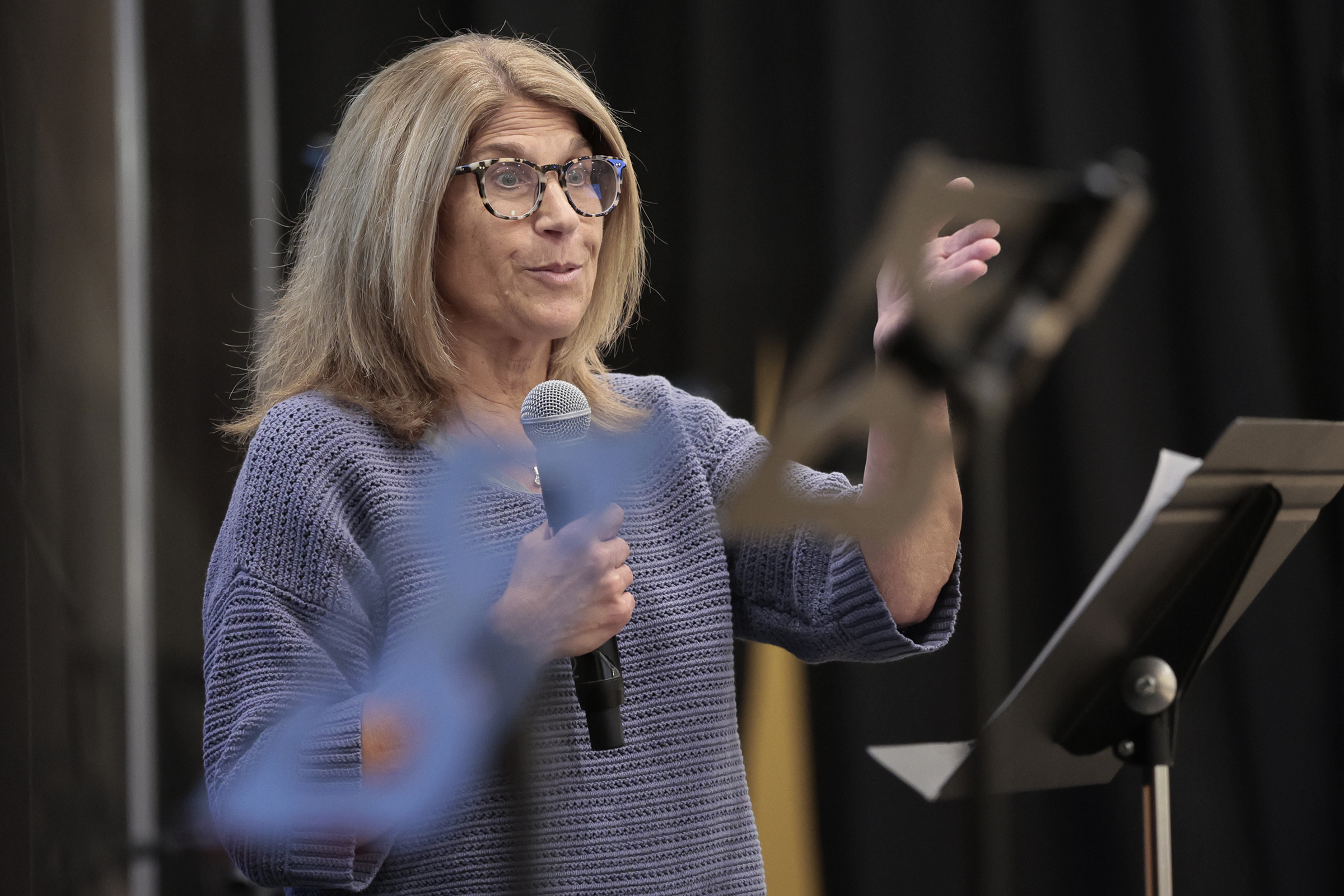
Vikki Toomer speaks during the Cooper River Indivisible general meeting at the Haddonfield United Methodist Church.Elizabeth Robertson / Staff Photographer
“I don’t know if they were feeding her lies, or that’s the narrative she was trying to spin … all I know is what she was saying was not true, and she was not taking the time to listen,” Toomer said.
Toomer said she believes the governor knows her plan did not go well but also “has not come out publicly and said, ‘Oops, I made a mistake.’”
When asked on the radio whether she believes her administration has suffered a loss of trust, Sherrill said sending state police “was really not done focusing on politics, and I certainly hope not.”
“This was focused on making a really hard decision in a situation that nobody wanted,” she said.
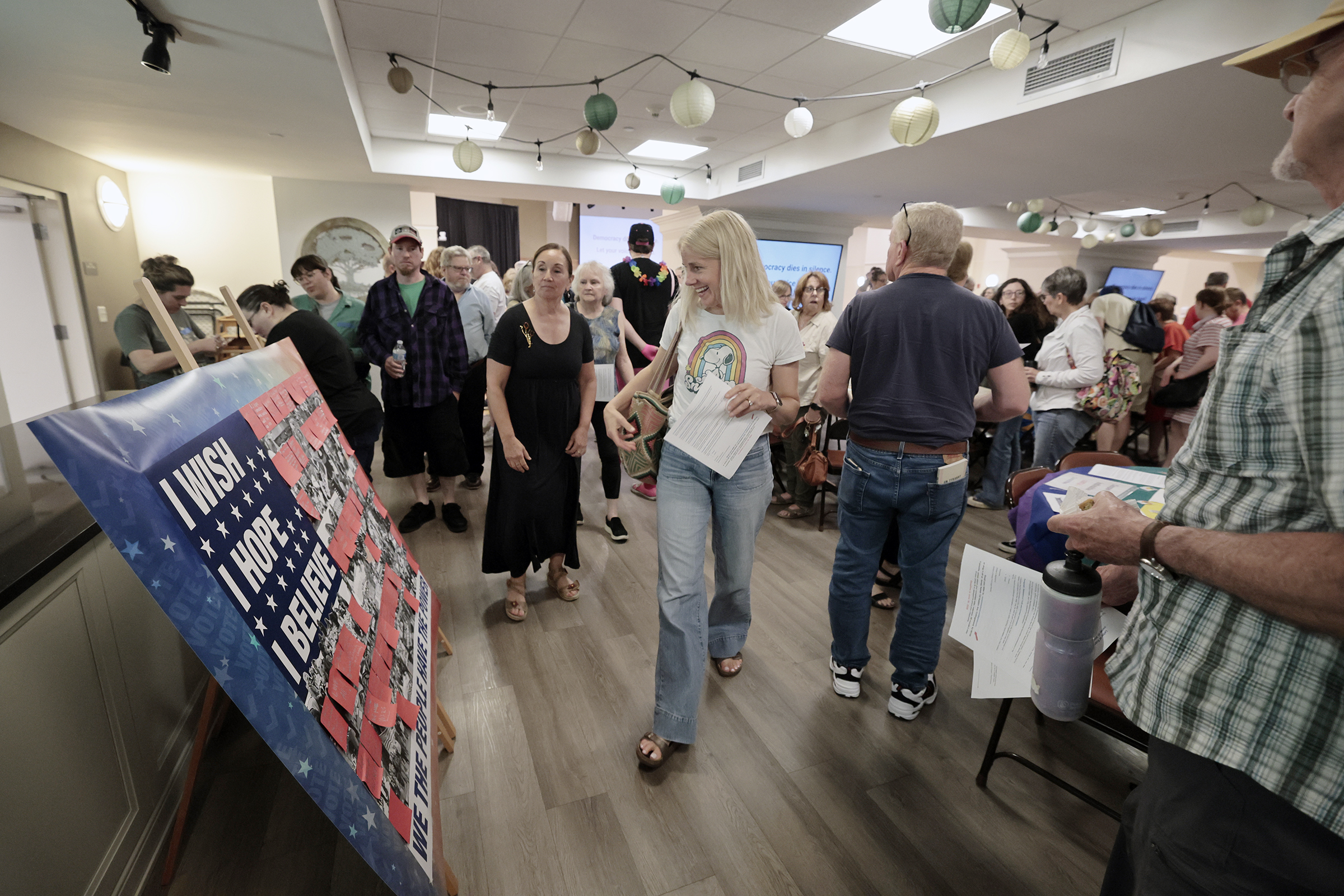
Folks leave messages on a collage (left) during and after the Cooper River Indivisible general meeting at the Haddonfield United Methodist Church on June 9. The poster will be part of an exhibit at Perkins Center for the Arts.Elizabeth Robertson / Staff Photographer
Linda Greenwood, 74, a Voorhees resident who belongs to Cooper River Indivisible and campaigned for Sherrill, believes the governor has good intentions but does not think she has been unfairly blamed.
“She’s the governor,” Greenwood said. “The buck stops with her. She brought the state police in. She has to take responsibility for what happened there, and I think she will.”
Lawrence Garrity, 29, was the lead volunteer for long shifts at Sherrill’s Cumberland County campaign office between overnight shifts at Wawa last year. The Rowan student said he feels “salty” he worked so hard to elect her and it feels like she is not on their side.
“It doesn’t feel like she’s not on our side either. It’s like she’s sitting in the middle … people are genuinely in danger, and you’re trying to, like, half-ass fight it,” he said.
Garrity said he had to go to urgent care after state police unleashed tear gas and pepper balls on protesters.
“Somebody said they’re gonna make T-shirts that said ‘I voted for Mikie Sherrill and all I got was tear-gassed,’” he said.
Through much of Mayor Cherelle L. Parker’s first two years in office, most political insiders in Philadelphia assumed she would cruise to reelection.
After all, no mayor in the last eight decades in the deep-blue city has lost a bid for a second term. And Parker is backed by the city’s long-powerful Democratic establishment, contributing to the foregone conclusion that their allied mayor would win again.
Even some of Parker’s staunchest critics on the left admitted privately that they were resigned to her serving eight years in office.
Then last month, conventional wisdom started to crack.
State Rep. Chris Rabb — a democratic socialist and an anti-establishment firebrand — won a tightly contested battle for an open seat in Congress, prevailing over Parker’s endorsed candidate and even carrying the 50th Ward in Northwest Philadelphia, where Parker is ward leader.
Now some of the activists who lead the city’s largest left-leaning organizations think that race showed that Philadelphians are ready to pick a progressive over the Democratic establishment. And they are looking at next year’s mayor’s race again, asking the question: Is Parker vulnerable?
“We would love to have a progressive challenger in this race,” said Sergio Cea, political director of the progressive group Reclaim Philadelphia. “The establishment was really defeated on all fronts this election cycle.”
In a little more than 10 months, Parker, a centrist Democrat and the city’s first female mayor, will be up for reelection. She has not officially announced a campaign — doing so would trigger strict fundraising rules and limits — but all signs indicate she intends to run again, including an already huge campaign war chest.
Any challenger to Parker would be considered a significant underdog. The mayor has the power of incumbency, and can point to progress on her 2023 campaign promises to make the city safer and cleaner, not the least of which is a historically low homicide rate. Thousands of residents are getting their trash picked up twice a week, and polls consistently show that more Philadelphians say they think that the city is heading in the right direction now than when Parker took office.
She even seemed to recover politically after one of her lowest moments: the eight-day municipal worker strike last year that left so much garbage piling up that it became colloquially known as “the trash strike.” Parker, through her signature unyielding negotiating style, muscled her way to an agreement with the union.
Today, she is supported by most of the city’s elected officials and powerful organized labor groups. Ryan N. Boyer, the head of a coalition of deep-pocketed building trades unions, said recently that any challenger to Parker would face “annihilation.”
“This is Philadelphia, there are always people who want to run for mayor. But mayoral elections are decided on whether people think their city is moving in the right direction,” said Aren Platt, executive director of People for Parker, the mayor’s political campaign arm. “Mayor Parker has been underestimated her entire career, and she has a habit of proving people wrong.”
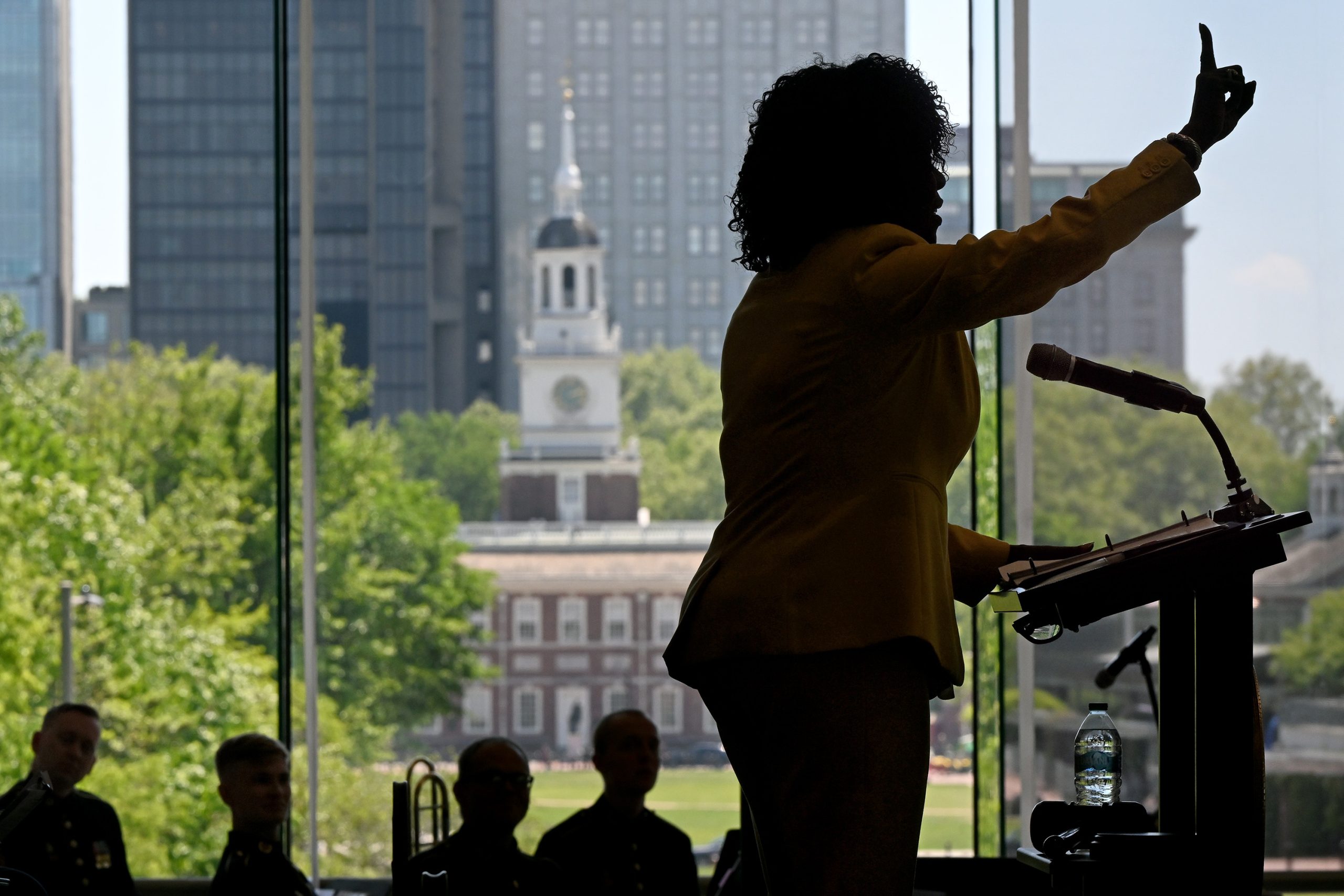
Mayor Cherelle L. Parker raises a finger with her call-and-response “One Philly, A United City” mantra ending her speech during a ceremonial meeting of the Pennsylvania Senate at the National Constitution Center across the mall from Independence Hall on May 5.Tom Gralish / Staff Photographer
However, some on the left see a coalescence of forces that could bolster their chances: national frustration with the Democratic establishment that has manifested in leftist wins, a widespread anti-incumbent sentiment, and liberal rage toward President Donald Trump, whom Parker has largely avoided maligning publicly.
“If you just have the right candidates that are able to speak to the dissatisfaction of Democratic voters in Philadelphia,” Cea said, “I do think [Parker] is in trouble.”
But the biggest question for Philadelphia progressives in the approaching mayoral race remains: Who could be their candidate?
The potential challengers
Jack Inacker, a Democratic strategist based in Philadelphia, said there are few, if any, challengers to Parker who could pull off a win in 2027.
“The progressive infrastructure now has built up in a way where, if you squint really hard, you can see a path to a progressive challenger,” Inacker said. “The problem is that [Parker] is one big mistake away from being beatable, but she’s not beatable yet. And people know that.”
Candidates have plenty of time to decide. Paperwork to get on the ballot likely would not be due until March.
Perhaps the most talked-about potential challenger so far isDistrict Attorney Larry Krasner, the city’s most prominent progressive. He has not ruled out a run for mayor, and he has recently publicly criticized Parker and some of her closest allies.
Last week, he invited media to walk along with him while he hand-delivered a letter to the mayor’s suite in City Hall to express dissatisfaction with his office’s budget. Parker called the move “stunting.”
Platt, in a thinly veiled shot at Krasner, said in a statement that “what we’ve seen recently is too many politicians focused on generating headlines rather than solving problems: manufacturing controversy, looking for someone else to blame, and confusing political theater with leadership.”
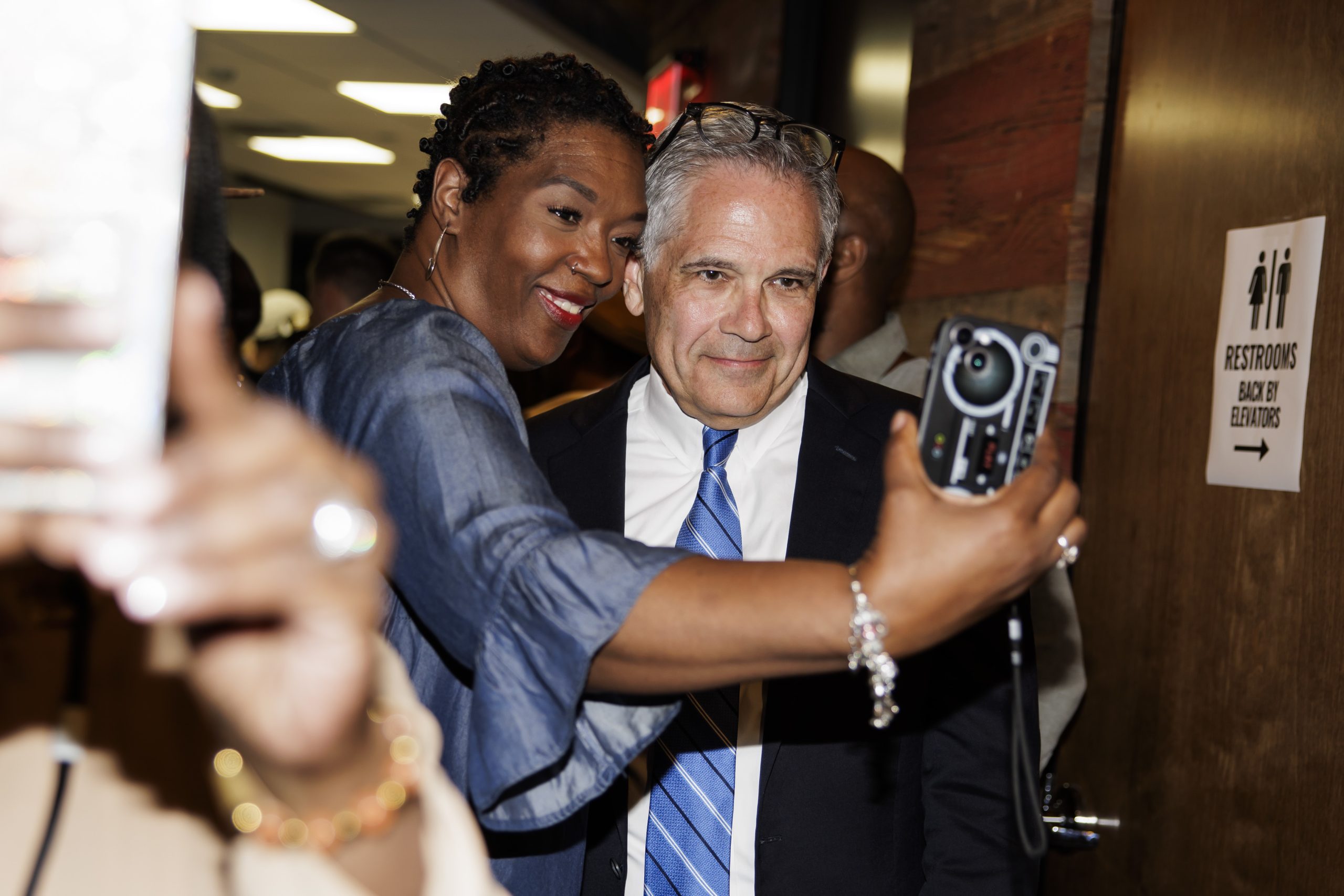
District Attorney Larry Krasner greets supporters during his election night party at the Pipeline Philly coworking space on May 20, 2025, in Philadelphia. Krasner defeated challenger Patrick Dugan both in the Democratic primary and in the general election.Monica Herndon / Staff Photographer
Krasner has won citywide election three times, twice winning reelection in landslide fashion. He is one of the nation’s most well-known progressive prosecutors and one of the city’s most polarizing figures. His base of support includes the city’s left, as well as a large swath of Black voters and elected officials.
But it was Parker’s political family — the vaunted Northwest Coalition of the some of the city’s most storied Black politicians — that was key to Krasner’s political ascent. Challenging Parker could be seen as a betrayal by some in the voter-rich northwest corner of the city, and his base there could fracture.
Krasner has also in the past struggled to keep up with his opponents in fundraising. Any challenger to Parker would likely need to bring in well over a million dollars, a sum of money that Krasner has never raised before.
Several other elected officials are seen as potential challengers to Parker, including several sitting members of City Council.
Councilmember Isaiah Thomas, who represents the city at-large, has long been rumored to have ambitions for higher office. He has been elected citywide twice, and recentlywas among the most vocal opponents of the Philadelphia School District’s controversial plan to close 17 schools.
And he has allies both on the left and in the city’s business community, the latter of which has been frustrated with a Parker administration policy shift that increased the tax burden on small businesses.
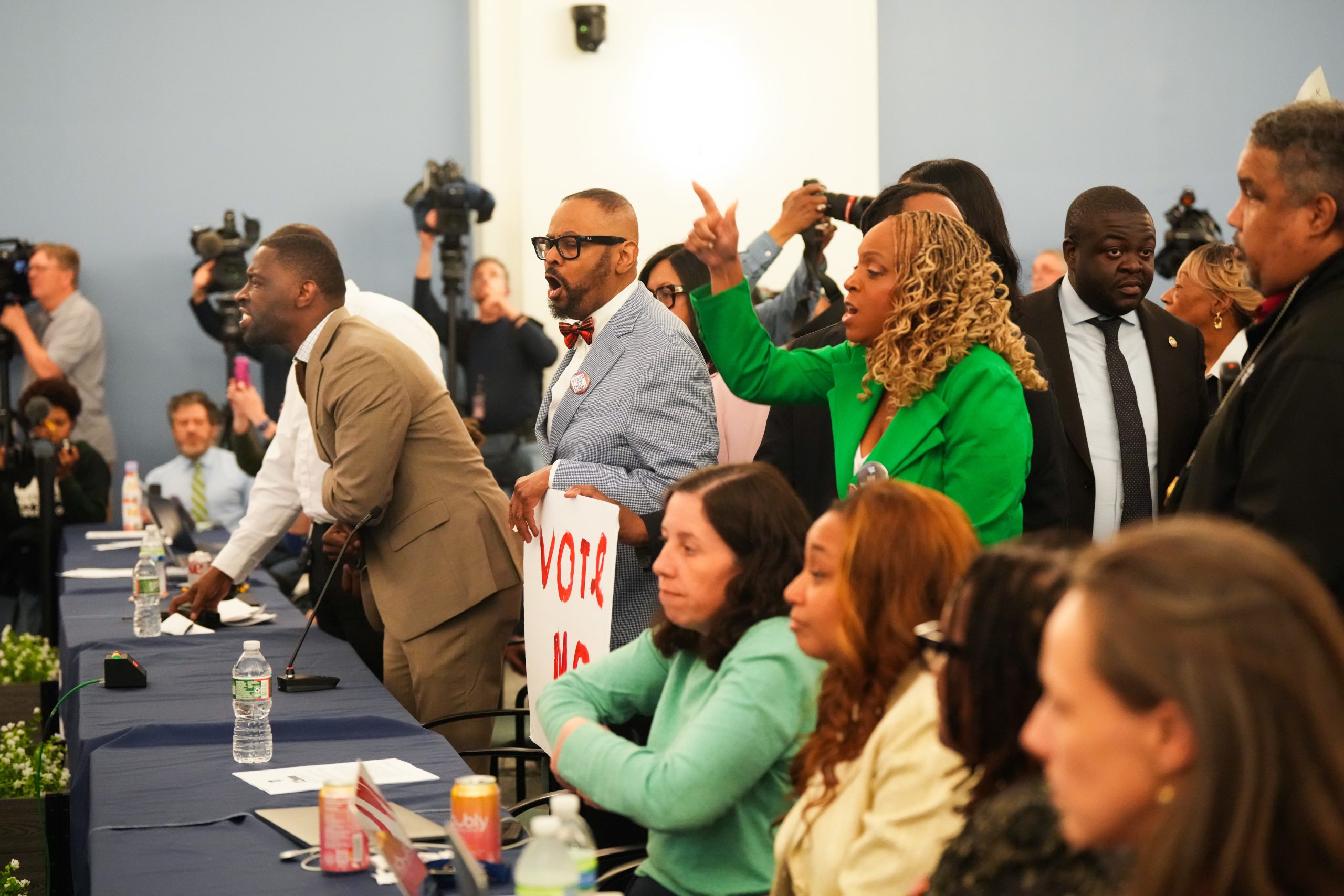
Councilmembers Isaiah Thomas (from left), Curtis Jones Jr., and Jamie Gauthier protest at an April school board meeting as the board prepared to vote on the facilities plan.Jessica Griffin / Staff Photographer
Thomas said last week that he is focused on his job in City Council.
“That job right now is hard enough, looking at the affordability crisis, the crisis around public education, and other issues that we’re facing,” he said.
There’s also two-term Councilmember Jamie Gauthier, who represents parts of West Philadelphia and has positioned herself as one of Council’s chief critics of the Parker administration. She said earlier this year that running for mayor “could be interesting one day,” but that she would not run if she did not see a clear path to victory.
She said in a statement that her focus is “finishing what we started on City Council, especially building affordable housing.”
Gauthier added: “But it’s clear Philadelphians are hungry for leaders who will put working families above big business.”
And there is Councilmember Kendra Brooks, the de facto leader of the city’s left-leaning coalition and a member of the progressive Working Families Party. Brooks, who represents the city at-large, has twice campaigned and won citywide.
A political adviser to Brooks said she is focused on her work in City Hall and running for reelection to Council, as well as “building Black progressive political power through the WFP.”
What do progressive gains mean for the 2027 mayor’s race?
Parker’s camp sees strength in her numbers.
In March, the mayor’s political arm commissioned a poll that found that 60% of respondents approve of the job Parker is doing as mayor, while 33% disapprove. Her approval rating was even higher among Black voters, older voters, and residents of Northwest Philadelphia — one of the highest-turnout areas of the city.
Mayor Cherelle L. Parker (right) hugs Rachel O’Neal, executive of the Friends Childcare Center, at the unveiling of a new playful learning hub at Sisters Cities Park on Thursday.Jessica Griffin / Staff Photographer
Cornell Belcher, one of the top Democratic pollsters in the nation, has conducted polling for Parker dating back to her mayoral campaign. He said that a key indicator of voter attitude toward an incumbent mayor is the number of residents who think the city is heading in the right direction.
The results this spring, he noted, were “dramatically different” from when Parker was first campaigning for the office. In April 2023, Belcher measured that 66% of Democratic primary voters in the city were dissatisfied with the direction of Philadelphia.
Today, he said, 62% are satisfied.
Still, other polls have shown potential warning signs for Parker.
In three polls that were conducted this spring in the 3rd Congressional District and obtained by The Inquirer, an average of 48% of Democratic primary voters said they had a favorable view of Parker and 41% had an unfavorable view. The polls, which measured voter attitudes in roughly half the city, were conducted by three different firms, and they were commissioned by different campaigns and organizations.
Approval and favorability ratings are not apples-to-apples. An approval rating is often considered a more reliable data point for an incumbent executive, because it measures attitudes about job performance, not reputation.
Belcher, who founded his polling firm 25 years ago and polled for former President Barack Obama, said he would not draw conclusions from polls of a congressional district that includes only half the city and was taken in a different election year. And he questioned other pollsters’ methodology in Philadelphia, a city that is tricky to survey.
“A city like Philadelphia, with all its different racial and ethnic groups, getting that right is hard,” Belcher said. “The more diverse an area is, the more work you have to put into getting it right.”
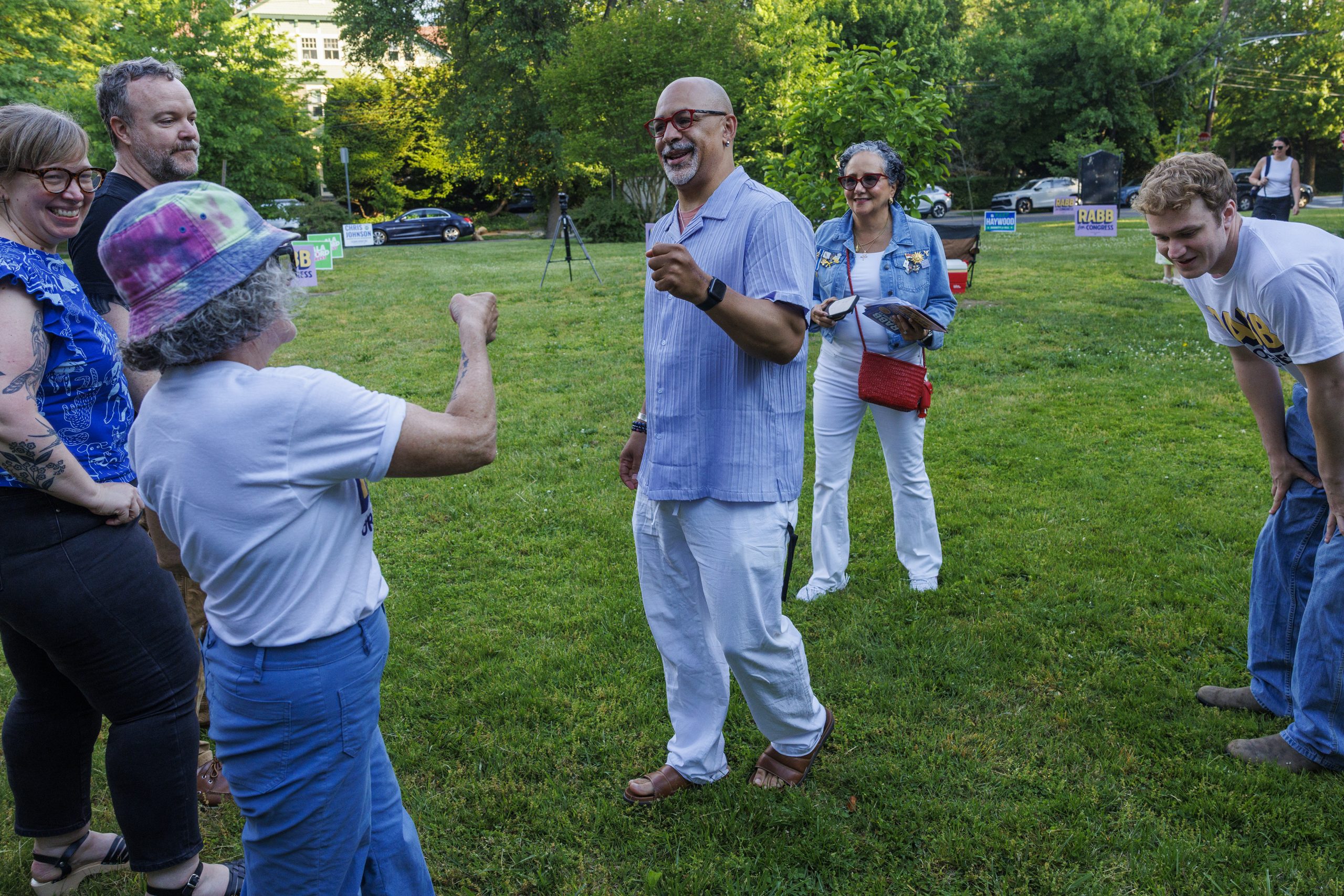
Chris Rabb greets supporters on election day. He is arriving to his polling place to vote, Grace Epiphany Episcopal Church, on May 19.Alejandro A. Alvarez / Staff Photographer
The results of last month’s congressional race energized progressives, in part because Rabb performed well in parts of the city that Parker carried when she won the crowded open Democratic mayoral primary in 2023. An Inquirer analysis found that more than a quarter of Rabb’s votes came from divisions that voted for Parker in 2023.
Rabb won his Democratic primary in a race that included three front-runners. But mayoral reelection battles in Philadelphia have historically been head-to-head, meaning the winner will look to reach 50% of the vote, a more challenging proposition for an ideological candidate.
“The mayor is organized, and her coalition across Philadelphia is strong,” Platt said. “They may not be active on Reddit, but they’re there, and they believe in what she’s doing because they can see the results in their neighborhoods.”
Haverford College students have publicly advocated for the school to consider removing U.S. Commerce Secretary and mega donor Howard Lutnick’s name from the library.
Behind the scenes, an older group has been pushing, too.
About a dozenvocalHaverford alumni have come out in strident disagreement with president Wendy Raymond’s decision in April not to take stepstoward considering the removal of Lutnick’s name.
Several in the group have called for Raymond’s resignation, while at least one said he had withheld his donation. Some were critical of Lutnick even before Department of Justice documents released earlier this year showed he had contact with sex offender Jeffrey Epstein as recently as 2018, long after Epstein pleaded guilty to obtaining a minor for prostitution and soliciting a prostitute.
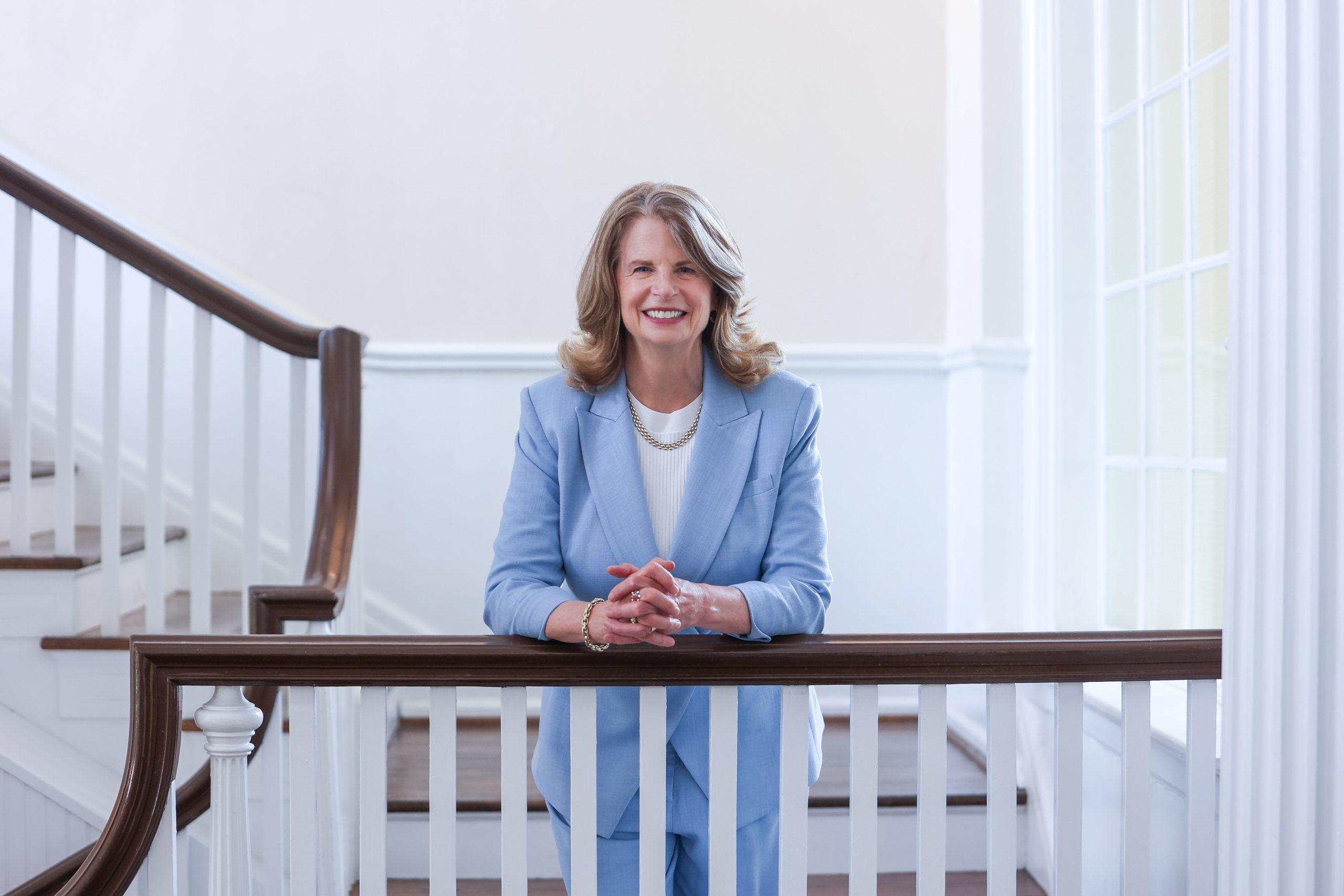
Haverford College president Wendy Raymond has led the college for seven years and previously announced she would step down next June.Courtesy of Haverford College
But Raymond stood by and explained her decision during a Zoom call last week with former board members, and the current board chair said Lutnick himself feels that he is being targeted in a witch hunt, according to accounts of the meeting.
Among the concerned alumni is Norm Pearlstine, a 1963 graduate who served on Haverford’s board of managers from 1986 to 1989 and is a former editor of the Wall Street Journal, Forbes Magazine, the Los Angeles Times, and Time Inc. and former chief content officer at Bloomberg.
“I am appalled,” Pearlstine wrote to Raymond on May 3, days after she announced she would not initiate a committee to consider removing Lutnick’s name from the library. “You should resign immediately so Haverford‘s board can replace you with a leader who puts principle ahead of principal.”
Another alumnus wrote that he would not advise his grandchildren to attend Haverford.
“I cannot imagine that my granddaughters or grandsons would want to enter the Lutnick library or the Lutnick cafe or for that matter, any other building on campus with his name on it,” wrote Joseph Schulze, a 1963 graduate and retired Michigan school superintendent who grew up in the Philadelphia area.
Adi Ignatius, a 1981 graduate and journalist who is editor at large of the Harvard Business Review, said he donated to Haverford every year until 2025, when he withheld his money because of the Lutnick matter.
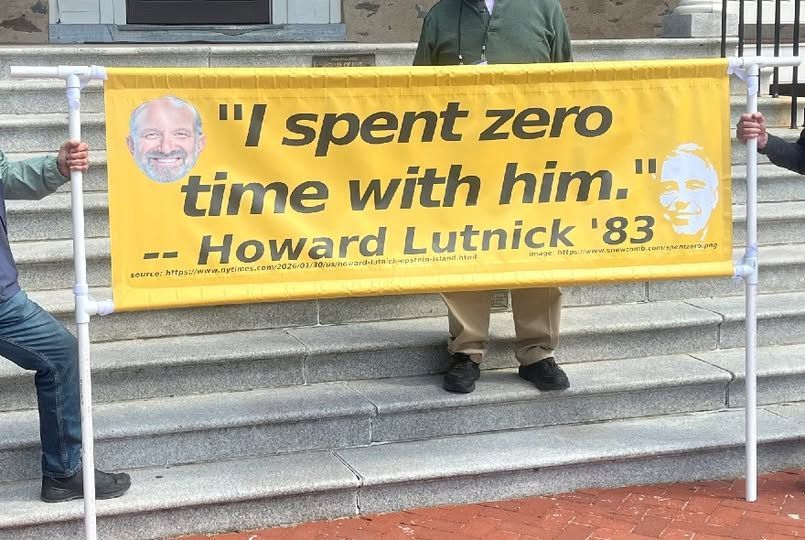
Haverford College alumni from 1971 hold a banner on campus about Howard Lutnick during alumni weekend.Courtesy of Chuck Durante
Haverford in a statement said many community members who oppose removing Lutnick’s name have also written to the college or told Raymond they are againstthe creation of a review committee that was requested through a student resolution this spring.
“President Raymond felt it was in the best interest of the college to reject the resolution because she did not believe this matter met the threshold necessary to constitute a committee given the college’s established standards and the information available to us at that moment,” the statement said.
But, the college said, “the matter is not closed.” Haverford is continuing to monitor “publicly available information” and “community sentiment” on the issue and Raymond or her successor could choose to initiate a committee, the college said.
Haverford not ready to make an ‘indictment’
Raymond, in the June 11 Zoom call with former board members, said she regarded creating a committee close to an “indictment” and did not think the threshold had been met, according to an email account of the meeting by Pearlstine obtained by The Inquirer. Some concerns about Lutnick are political, she said, and she is not willing to consider politics in her decision-making about a renaming committee, according to accounts of the meeting.
Students and alumni have pointed out that Lutnick had previously said he had not been in a room with Epstein, whom he found “disgusting,” since 2005, yet he testified to Congress earlier this year that he had visited Epstein’s private island with his family in 2012 and exchanged emails with him in 2018.
ButRaymond, who has led the college for seven years and previously announced she would step down next June, said in Tuesday’s meeting that she did notthink Lutnick’s lying about when he last had contact with Epstein was enough of a trigger.
Some alumni, supporting Raymond’s decision, have noted there is no evidence Lutnick participated in Epstein’s crimes or improprieties.
“I understand that students might feel strongly in support of wanting to change the name, but I don’t believe there’s a basis to do so,” said Robert Swift, a Philadelphia lawyer and former board member who was on the call Tuesday. “I have serious differences with Howard politically, but that’s not relevant either.”
Swift, 79, a 1968 Haverford graduate who served on the board for 12 years, said Lutnick, a former chair of the college’s board of managers, was generous and served the board well.
“His heart was in the right place,” Swift said.
Some were calling for Lutnick’s removal even before the Epstein connection because they did not like his politics, said one alumnus who asked not to be named because of the sensitivity of the matter.
“I don’t think it’s fair to remove someone’s name from a building simply because you don’t like their politics,” the alumnus said.
George Parker, a 1960 alumnus and a professor of finance at Stanford’s Graduate School of Business, said Haverford should rely on its Quaker roots, which requires governing by consensus.
“We do not have consensus,” Parker, a Quaker originally from the Philadelphia area, said of the Lutnick matter, “and where we do not have consensus, I do not think we should take action.”
Lutnick’s relationship with Haverford
Haverford has been in contact with Lutnick. Michael B. Kim, chair of Haverford’s board of managers and a private equity firm leader in Korea, said during the Zoom call that Lutnick communicated he is especially hurt that his alma mater is taking part in what he feels is a witch hunt, according to meeting accounts.
Michael B. Kim, chair of Haverford College’s board of managers.Courtesy of Haverford College
The board agrees with Raymond’s decision, he said.
Lutnick’s relationship with the highly selective, small liberal arts college on the Main Line goes back decades. He lost his mother to cancer when he was in high school and then his father one week into his freshman year. Haverford’s president at the time waived his costs and he graduated in 1983 with an economics degree.
Former chairman of financial firmCantor Fitzgerald, he served on Haverford’s board for 21 years, the last three as chair, until 2015. His name was put on the library after a then-record $25 million donation he and his wife made in 2014. Lutnick has given the school $65 million and is one of its biggest donors.
His Epstein ties gained scrutiny earlier this year. A Commerce Department spokesperson told the Associated Press that Lutnick had had “limited interactions” with Epstein, with his wife in attendance, and had not been accused of “wrongdoing.”
A request to the Commerce Department’s press office to speak with Lutnick got no response.
Under Haverford’s gift policy, the school can rename a building if “the continued use of the name may be deemed detrimental to the college, or if circumstances change regarding the reason for the naming.”
Schulze, the former school superintendent, said he thinks that threshold has been met and a full discussion is needed.
“Somebody else should take over if [Raymond’s] not ready to do that,” he said.
Rob Riordan, a 1964 graduate and Trenton native who lives in Cambridge, Mass., said he was upset Raymond did not honor a request from an overwhelming majority of students at a plenary meeting who requested a committee be formed
“To me, that felt like a violation,” said Riordan, 84, an educator who helped start charter schools in the San Diego area.
Several alumni pointed out that nearby Bryn Mawr and Swarthmore Colleges have removed names of controversial figures from buildings in recent years.
Pearlstine, who was on the Tuesday call, first wrote to Raymond and Kim in July 2025, urging that Lutnick’s name be removed. His concerns are not political, he said, but rather about behavior that conflicts with Haverford’s values.
“Howard Lutnick is a powerful Trump administration cabinet officer who proudly helps the most lawless President in our country’s history implement policies that trample upon human rights, due process, rule of law, and respect for the independence and integrity of institutions of higher learning,” he wrote.
It was not always that way. Ignatius, 67, who lives in Stonington, Conn., said he recalled interviewing Lutnick on stage at Haverford in 2015 and the good will in the audience toward him. Lutnick, who lost his brother andmany of his company’s employees in 9/11, talked about the aftermath and how the company helped care for victims.
“His trajectory since then has been similar to Rudy Giuliani’s,” Ignatius wrote to Raymond and Kim last August. “He has squandered the goodwill he built up after 9/11 and become a partisan troll, espousing values that are inconsistent with — and offensive to — the ideals that Haverford stands for.”
Just across from Boathouse Row, at the intersection of Kelly and Sedgley Drives, there is a statue of President Abraham Lincoln. At the base of the statue is a famous quote from his second presidential inauguration speech: “With malice toward none with charity for all … Let us finish the work we are in.”
On the opposite side: “I do order and declare that all persons held as slaves within the states in rebellion are and henceforth shall be free.”
As the center of America’s stage during this Semiquincentennial year, and a center of the world stage during this month of FIFA World Cup matches, we Philadelphians call on our national government to live up to our democratic principles and apply fair treatment to immigrants and descendants of immigrants, just as Lincoln called for bold actions on behalf of those who were once enslaved.
Ina Asher, Merion Station
Blame game
Opinions critical of Philly schools’ “success” when 33% of students are proficient in reading, and 25% in math, are misguided. When I was codirector of the Laboratory for Student Success at Temple University, I was actually surprised to find that years of research in student success shows that school-related factors like teacher quality, curriculum, leadership, climate, and resources account for as much as 40% of student achievement. Factors beyond the schools have a much greater impact on individual student success. These include family income, stability, parent education, access to healthcare, neighborhood safety, exposure to stress, and trauma. What we are witnessing is simply a result of living in a country with the greatest economic inequality of any developed nation on the planet. The answers are there — but those in power seem to prefer to blame the victims.
John Kovach,Wallingford
Catholicism is growing
Recently, I read about what sociologists call homophily: the tendency to develop friendships with those from similar backgrounds, identities, or socioeconomic classes. For young professionals in the city like myself, we’re often pulled into circles with peers from similar places of work or study.
Perhaps one reason people are returning to the pews is that it shakes up these circles, bringing us hand-in-hand with those from places we’re unfamiliar with — and maybe there’s something exciting about that. Where else besides church might you find an older North Philly couple breaking bread with young Thomas Jefferson University students coming from a Center City high-rise?
A recent article in The Inquirer raised the question of why people are turning to Catholicism. We may never know all of the reasons why, but I hope it comes with a community built across diversity.
Maxwell Marshall, Philadelphia
Join the conversation: Send letters to letters@inquirer.com. Limit length to 150 words and include home address and day and evening phone number. Letters run in The Inquirer six days a week on the editorial pages and online.
ARIES (March 21-April 19). You’re comfortable making choices that might seem unusual to other people because being true to yourself matters more to you than fitting in. Other people’s opinions change, and people drift in and out of your life, but you’re the one who has to live with yourself every day.
TAURUS (April 20-May 20). Talking with the people you love will feel especially enjoyable. You reply quickly because you care. Like a pro, you keep conversations light, comfortable and positive and avoid topics that could create tension.
GEMINI (May 21-June 21). Your timing is good even when it seems like it’s not. Delays protect you while fortunate coincidences speed everything else along. Go forward in full belief that everything is occurring in perfect synchronicity, and you will stop chasing and start attracting.
CANCER (June 22-July 22). It seems efficient to hand off the mundane work to someone else while you follow your whim, but that would only slow down your productivity and block your creativity. The daily tasks move your imagination. Your genius is hands-on.
LEO (July 23-Aug. 22). So many items live in your brain, waiting to be born into writing. When you get them down on paper, they start to take on a life of their own. Through writing you will not only get clear, but you will also learn yourself.
VIRGO (Aug. 23-Sept. 22). You’re especially persuasive right now. Today shows you reading people with great accuracy, working rooms and leading situations toward the outcome you want. You never push because you don’t have to. Charm and emotional intelligence do the work for you.
LIBRA (Sept. 23-Oct. 23). You hit a wall between you and where you want to go. But keep looking into it, pushing on it and believing there may be something more here. Seek the hidden door. Curiosity opens social, financial and creative passageways.
SCORPIO (Oct. 24-Nov. 21). You’ll find yourself in a caregiving role. It is not possible to give care in one universal way because everyone’s needs are different. Also, a person’s needs can change by the day or the hour. Read the small signals and anticipate problems.
SAGITTARIUS (Nov. 22-Dec. 21). Is the insect a pest, or is the insect another magnificent earthling? You could go either way, or both ways at once. You appreciate all, but if your territory is invaded, your perception and reactions change.
CAPRICORN (Dec. 22-Jan. 19). There is information you’re willing to work for — to make it your business to know, your quest to discover. Then there’s the simple and inconvenient truth that’s right in the middle of the path, needing only to be faced.
AQUARIUS (Jan. 20-Feb. 18). You’ll tap those puzzle-solving skills today. You may try the same solution repeatedly, just to verify the results. But if it doesn’t work after a few tries, you do it differently until you find what clicks.
PISCES (Feb. 19-March 20). You’re aware of what’s going on, and you think you ought to react, though you may not be sure quite when or how. The takeaway isn’t clear. Let feelings settle. You have time on this one.
TODAY’S BIRTHDAY (June 15). It’s your Year of the Threshold Test, in which the seeker must prove sincerity before entering the sacred realms. Sometimes you’ll be the one pursuing with persistence, and sometimes you’ll be the gatekeeper. Both scenarios bring powerful and lasting transformation. More highlights: A talent turns commercially viable. Applause and money for your confident performances. All the love you need. Capricorn and Aries adore you. Your lucky numbers are: 7, 20, 3, 14 and 41.
DEAR ABBY: My father passed away and left me a large sum of money. One of the first things I did was pay off my husband’s debts totaling over $140,000. I also paid off my vehicle. I also paid $600,000 in cash for the home we live in.
For Christmas, I want to give each of my three adult children $10,000 from me and their grandfather. My husband (of one year) asked if I was planning on giving his two adult children the same. I replied no, which was not well received.
His children never even met my father. Am I wrong here? I don’t feel his adult children are entitled to my inheritance. My husband commented that my father (who married my mother and adopted me at 3 years old) gave me the same amount as each of my brothers and sister. Well, Abby, that man was my father for 57 years. I do not feel it’s the same as his adult children, whom I didn’t raise.
I have met his son only a handful of times, and I have been more than generous to his daughter and our 2-year-old granddaughter. If I’m wrong, I will admit it and make amends. This is causing great stress on our relationship, and he refuses to go to marriage counseling with me. What do you think?
— NOT THE SAME IN THE EAST
DEAR NOT THE SAME: I agree with you that the situation is not the same. Your husband’s children are not entitled to a share of your inheritance. Because your husband refuses to see a marriage counselor with you does not mean you shouldn’t go, which is what I am urging you to do in order to find clarity and learn how to move forward from this extremely awkward situation.
** ** **
DEAR ABBY: I’m a senior in high school, and I have had a certain friend since sixth grade. I’m a Democrat; she’s a Republican. Until lately, we’ve been able to put our differences aside, but recently, we’ve had a few clashes because of our political differences.
Given how bad things are today and how much worse they might get, I struggle to ignore these issues. I’ve also noticed a few people say they dislike me because they think I believe the same way as her. I don’t want to end our friendship over something like this, but I don’t see how it can continue much longer. Please help me make the right decision.
— MORALLY TORN FRIEND
DEAR FRIEND: There’s an old saying that politics and religion are not appropriate topics for polite conversation. Now you know why. There are two ways to resolve this. You can sit down with your friend and agree to disagree. Then promise you will avoid discussing politics from now on. The other option is to thank each other for a friendship that was great while it lasted. Then let each other go.
** ** **
DEAR READERS: Were you between 16 and 25 years old when you had a baby? A group of healthcare specialists who work with young parents and their children want young families to receive the best possible healthcare support and treatment. They need to hear about your experiences when you went to get healthcare for yourself or your children. Your experiences will be used to help improve the system. Please go to this site to share your experience: tinyurl.com/mr3rwj9f.
It took 96 years, but the most sacred version of the beautiful game came to Philadelphia.
Both the city and the match met the moment.
Extra public transportation, hydration stations, and modest traffic framed an evening of graceful and powerful football, the kind every other nation reveres except ours.
Amid the spectacle of team jerseys, flags, and team benches covered by vibrant roofs identifying the sides in national colors, the grass was the star. The stadium’s normal turf is a ragged Bermuda thatched with 5% plastic to withstand the cleated NFL rhinoceroses who usually play there. For the World Cup, it was transformed into a flawless pitch, golf-course quality ryegrass and bluegrass, the sort of surface you on which could imagine Jason Kelce lying on his back and making snow angels.
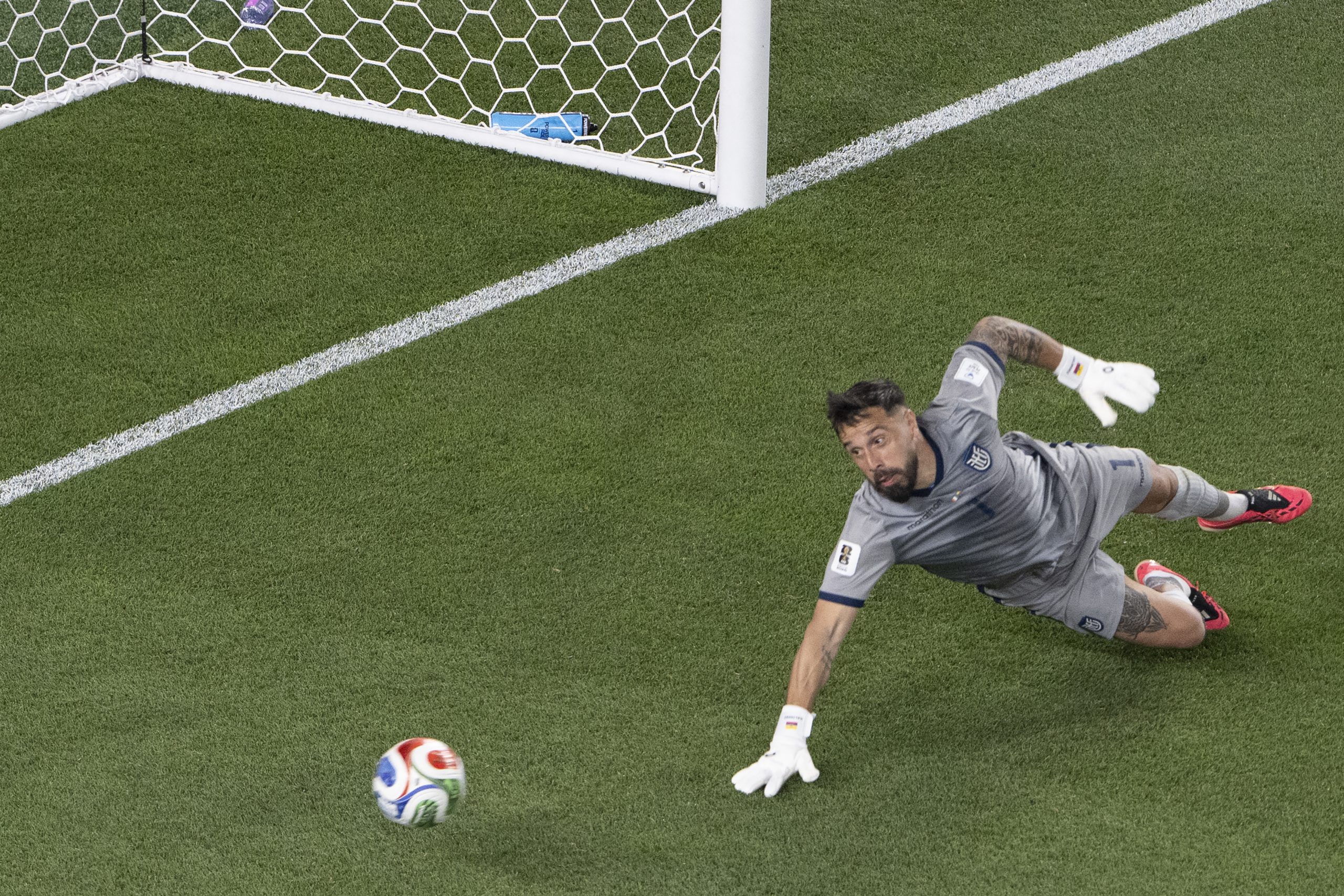
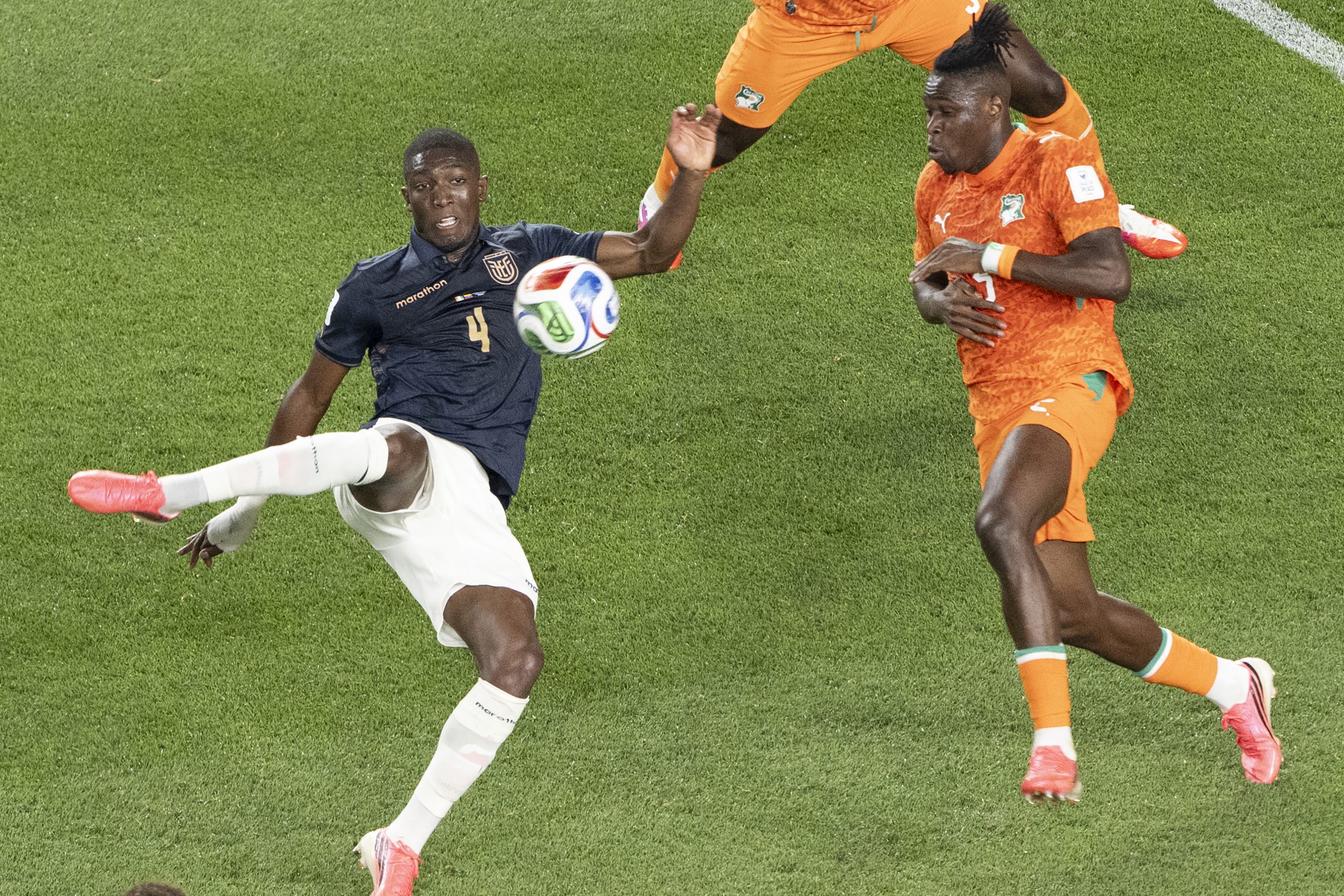
Ecuador goalkeeper Hernán Galíndez watches as the ball crosses the goal line on a shot by Ivory Coast’s Amad Diallo late in the second half of Sunday’s game.Jose F. Moreno / Staff Photographer
Viewed through an international lens, even a soccer game this insignificant still was the most significant sporting event in the history of the city. A town that has seen two World Series titles and a Stanley Cup won within its borders has never hosted anything that riveted folks on six of the continents.
What comes close? Maybe Rocky Marciano, when he knocked out Jersey Joe Walcott in 1952, and won the heavyweight championship. Maybe not.
More moments will come, since the group-stage match between Ivory Coast and Ecuador is just the first of five such games. On July 4, Philadelphia will host an elimination game in the Round of 16, and then that will become the most significant sporting event in the history of the city.
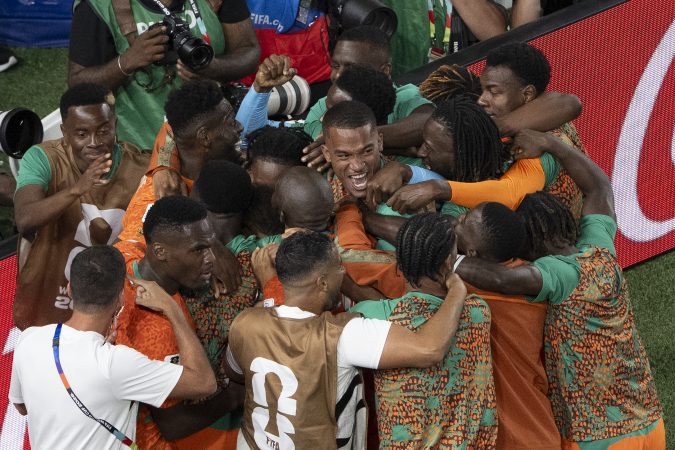
The difference was deserving of the night’s significance. At the top of the box, Amad Diallo, who plays for Manchester United, redirected a simple cross from Wilfried Singo with his left foot in the 90th and final minute of regular play. Given eight minutes of stoppage time, Ecuador could not break through.
Three crucial points to Les Elephants, following the 1-0 final.
After three days of pre-tournament watch parties and fan fests (the Cup began in Mexico City on Thursday), Philly’s hot, sticky, 90-degree moment finally arrived.
The city, four weeks removed from the PGA Championship at Aronimink and four weeks from hosting the Major League Baseball All-Star Game at Citizens Bank Park, finally seemed to grasp the magnitude of the world’s biggest single-sport sporting event landing at its doorstep.
The catalyst: How about the 4-1 thunderbolt win the United States laid on Paraguay in Los Angeles on Friday night.
Ecuador hit the crossbar twice in a first half and nearly scored on a blast from Flamengo’s Gonzalo Plata just before the water break in the second half. Ivory Coast hit the crossbar six minutes into the second half. All of those shots drew gasps, but gasps of different timbre; either delight denied or disaster averted, because the gasps were almost completely Ecuadorian.
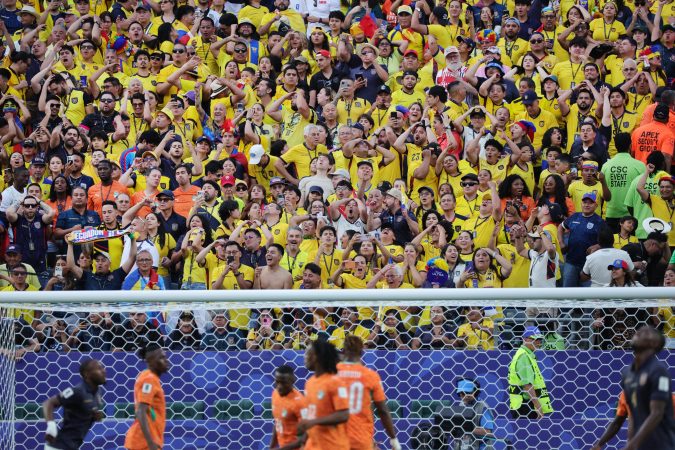
Ecuador is nearly 3,000 miles from Philadelphia, but, for two hours, the stadium served as an Ecuadorian colony, its fans wearing yellow, accounting for 90% of the 68,247 fans in the seats. If they’d issued 60,000 pairs of goggles, they’d have had 60,000 Minions.
you can totally trust the little green guy leading you into a cave full of monsters 😉 Trey Parker is the voice of Goomi in Minions & Monsters. Only in theaters July 1. pic.twitter.com/je5rfPaxAQ
Little wonder. About half of the approximately 850,000 people in the United States who claim a connection with Ecuador live in either New York or New Jersey. Most estimates of Ivorians in the U.S. don’t even reach 10,000.
After the 5 p.m. SEPTA Broad Street Line express was taken out of service at Race-Vine because a door wouldn’t close, the 5:15 local train was inundated with Ecuador enthusiasts when it hit the City Hall stop.
The cars were full to bursting by the time they hit Walnut-Locust, yellow jerseys shoulder to shoulder and chest to chest, men and women alike. As the train pulled out a song arose, full throat and deafening in the hot, cramped subway car:
“¡Vamos, vamos ecuatorianos, esta noche tenemos que ganar!”
Or:
“Let’s go, let’s go, Ecuadorians, tonight we have to win!”
As the throng exited up the stairs of NRG Station, their hearts and voices swelled again. The song rang out again and again during the match.
Unfortunately, the Ecuadorians were not singing on the subway ride home.
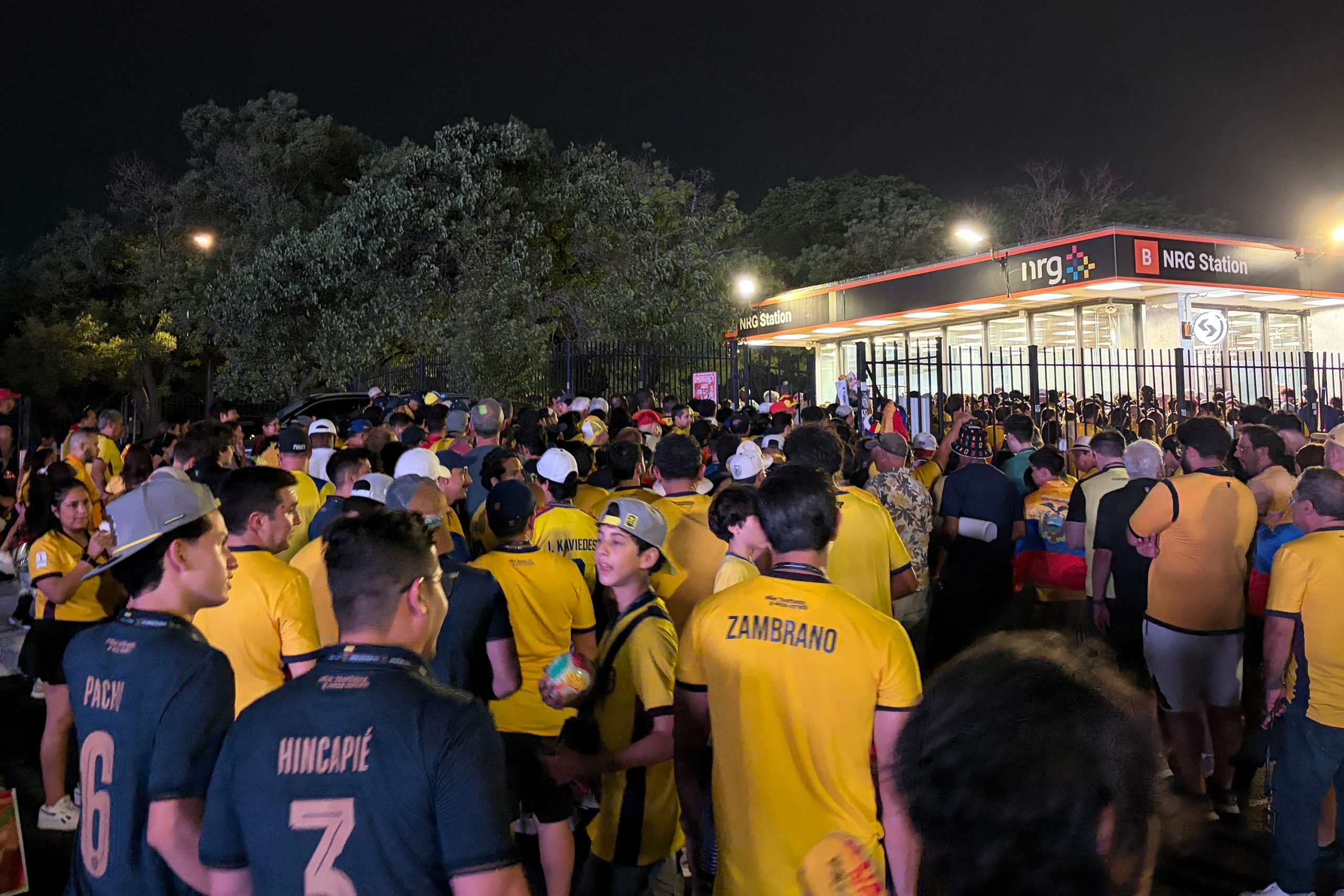
Fans wait outside SEPTA’s NRG Station near the stadium following Ivory Coast’s victory over Ecuador Sunday night.Michelle Myers
Only the Olympics does a better job than FIFA capitalizing on nationalistic spectacle, and Sunday night was no exception. The stunning FIFA World Cup 2026 emblem tapestry laid on the ground covered the midfield circle. Replicas of the flags of Ecuador and the Ivory Coast took up most of the rest of the pitch in front of the goals, crescents cut in the extra fabric to frame the FIFA logo tapestry at midfield. The teams stood on their respective sides of the circle, facing the south stands, as the anthems played.
The match occurred where the Eagles play, at Lincoln Financial Field, which must be referred to as Philadelphia Stadium during World Cup games. FIFA has a strict policy that prohibits references to sponsors who don’t give FIFA money.
That said, Sunday’s affair was nothing like an Eagles game. It was far more elegant.
When Ivory Coast dawdled, La Tri — a nickname for Ecuador’s fans, who wear the tricolor yellow, blue, and red of the flag — booed and whistled. It was not unlike the response of Eagles fans whenever the Cowboys score.
Fans of the American version of football might balk at the contention that soccer is a bigger deal, and lovers of the Olympics might contend that the ever-shifting collection of summer and competitions matters more. They are wrong.
Ivory Coast’s Wilfried Singo, right, defends against Ecuador’s Jean Michaël Seri during the second half of a FIFA World Cup Group E match on Sunday.Jose F. Moreno / Staff Photographer
The World Cup is a different animal than the Olympic Games, concentrated and egalitarian. You don’t have to own a horse or skis to prepare to compete in the World Cup, just a ball.
The only thing in America that reflects a World Cup is an NFL season. Consider the first 17 games, the regular season, the group stage. Consider the playoffs the knockout Round of 16.
The NFL season in its entirety and intensity is the one comparison that might allow most Americans to understand the depth of investment and emotion other nations harbor for soccer.
And, when you factor in the fact that virtually every man, woman, and child in many of these countries have played the sport, then you can better comprehend why soccer is, for so many people on earth, as much religion as it is diversion, and how sacred evenings like Sunday can be for anyone connected with the Ivory Coast or Ecuador.
The folks who organized it all understood the gravity of the moment.
Meg Kane, CEO of Philadelphia Soccer 2026, had measures of both delight and relief in her voice as she sat in the stadium parking lot Sunday night.
“It’s been an exciting four days,“ she began, noting that there were 36 more to go. “I think everything we hoped this would be has been borne out.”
The delight was easy to source: She had just seen a really good soccer game in a grand stadium with two excellent teams, snuck in just minutes before a thunderstorm, with little or no complication.
The relief was probably based on the reception most of the millions of residents had given these unusual visitors.
“People in Philadelphia are excited to be hosting something like this,” Kane said. “Philadelphians love when people choose to spend their time here.“
The best news: Philadelphia gets to do this five more times.
After years of anticipation, ticketing woes, and infrastructure blunders, the world’s most beautiful game has landed in the City of Brotherly Love.
And soccer fans are feeling it.
The 68,274 attendees erupted when the West African nation broke the deadlocked game in the last seconds of regulation, leaving Ecuadorians stunned and distraught. Some covered their faces in disbelief.
“They fought, but we won,” Ivory Coast supporter Glenn Feidanga said.
Feidanga was the only person dancing in his section after spending the two halves surrounded by Ecuadorian fans. The momentary rivalry eventually gave way to high-fives and kudos.
“Everything is good,” he said.
While the Ecuadorian and Ivorian communities in the Philly-area are small — less than 15,500 residents claim Ecuadorian ancestry, and the number of Ivorians is difficult to estimate because the Census Bureau doesn’t tabulate them — their fans had no dearth of fervor or conviction.
Anything for your team
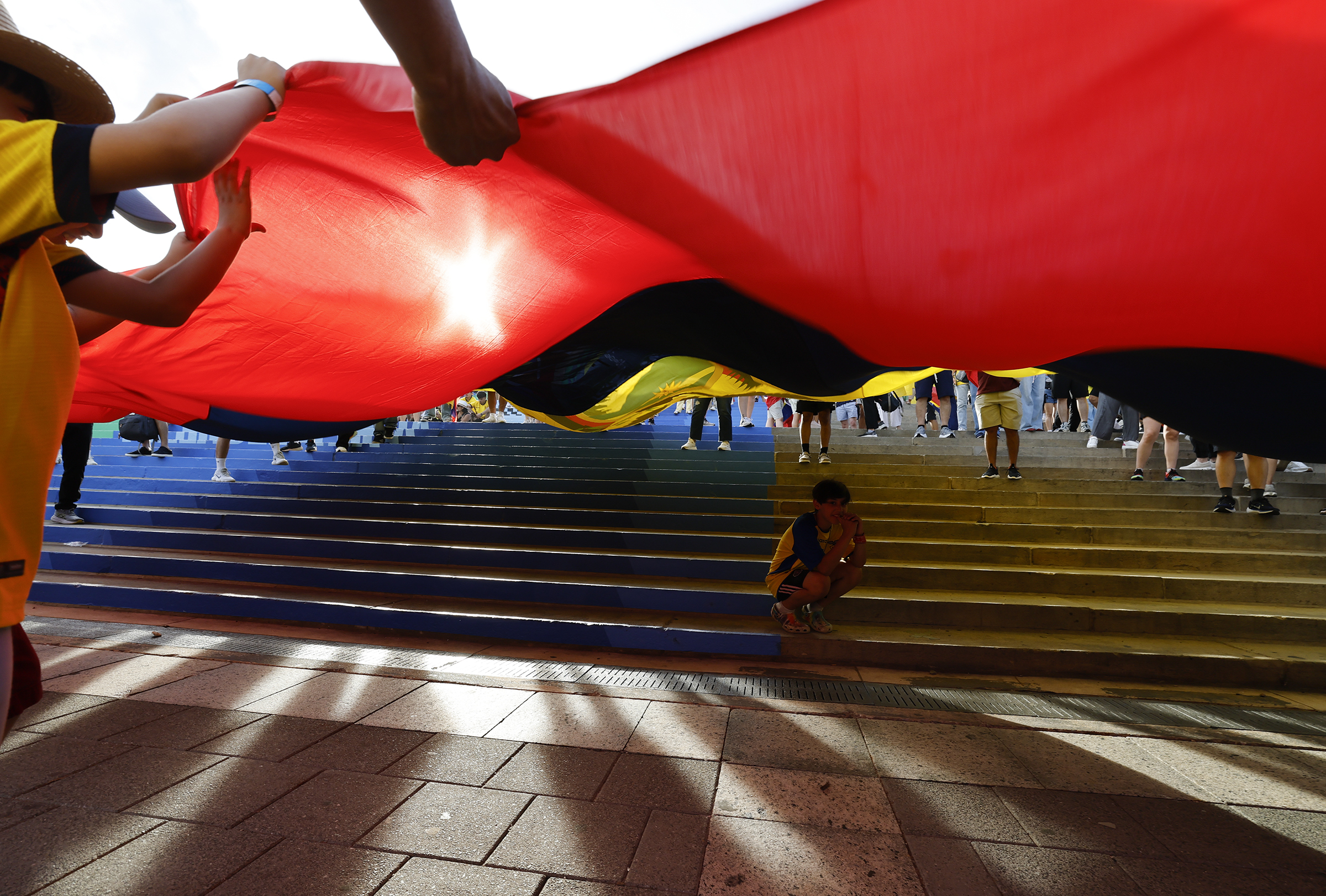
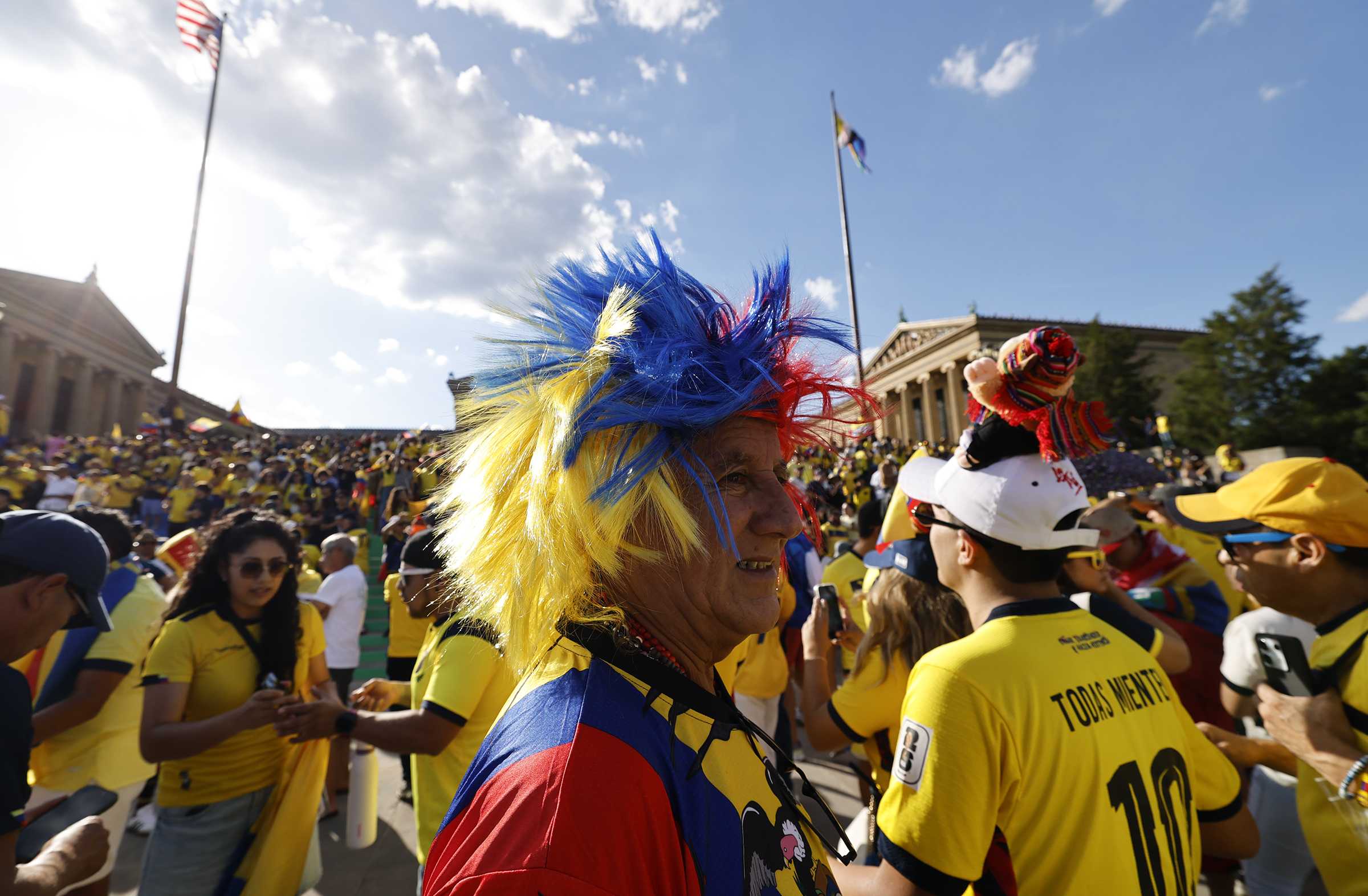
In the days and hours leading up to kickoff, celebrations have spilled into streets and SEPTA stations across the city — and supporters have been undeterred by oppressive heat and threats of severe weather. On Saturday, a wave of yellow, red, and blue flooded the steps of the Philadelphia Museum of Art, as thousands of Ecuadorian fans rallied and basked in their pride.
The Broad Street Line Sunday afternoon was inundated with Ecuador fans. Teeming train cars were full of yellow jerseys standing shoulder to shoulder, men and women alike. As the train pulled in, a song arose; full throat and deafening in the hot, cramped subway car.
“Let’s go, let’s go Ecuadorians, tonight we have to win!“
As the throng made its way out of the NRG Station, the fans’ hearts and voices swelled again.
A young Ecuadorian soccer fan sits under the Ecuadorian flag during a flag waving event at the Philadelphia Museum of Art steps along the Benjamin Franklin Parkway, ahead of Ecuador’s first round World Cup match against the Ivory Coast on Saturday, June 13, 2026.Yong Kim / Staff Photographer
Pacho Flores would go to any length for “La tri,” the nickname for the Ecuadorian national team. He had traveled from New York City and had paid $650 a ticket for his family of eight to see his team play in Philadelphia.
“It’s the most beautiful thing in the world,” Flores, a 62-year-old Ecuadorian native, said. “We have to follow the team to every game. It’s a blessing to have them play so close.”
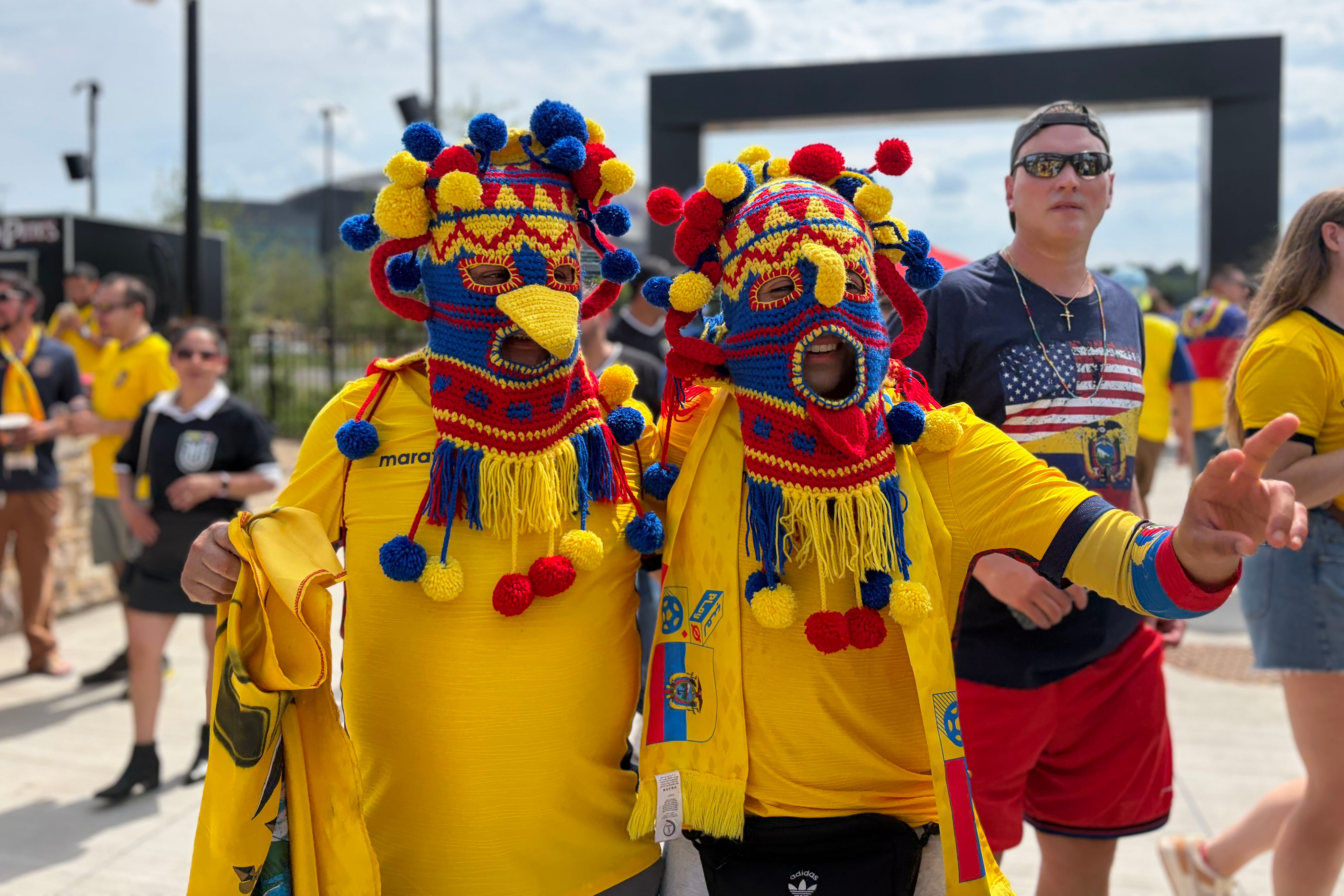
Pacho Flores (left) and his son, Alex, dance wearing thickly knit Diablo Uma masks ahead of Ecuador’s World Cup match against Ivory Coast in Philadelphia Sunday, June 14, 2026.Michelle Myers /
Despite the 90-degree day, Flores and his son, Alex, wore thickly knit masks of Diablo Huma — an Indigenous protective sacred figure from the highlands of Ecuador — to represent his native town of Cañar.
“It’s not that hot inside the mask,” Alex said, wiping sweat from his brow, “and it’s worth it because we have to win.”
“Either way, we will still love the team,” his father added.
Ecuadorian soccer fan Demetrio Govrea watches fans during a flag waving event at the Philadelphia Museum of Art steps along the Benjamin Franklin Parkway, ahead of their first round World Cup match against the Ivory Coast on Saturday, June 13, 2026.Yong Kim / Staff Photographer
The family won’t have too much time to idle: They head back to New York City on Monday morning to pack for La tri’s match in Kansas City on Saturday against Curaçao.
Ivory Coast fans Justin Bambara, Samska Lejah, and Couby Ouedraogo flew from Niger to New Jersey, then drove two hours to Philadelphia, and were confident in their team’s chances.
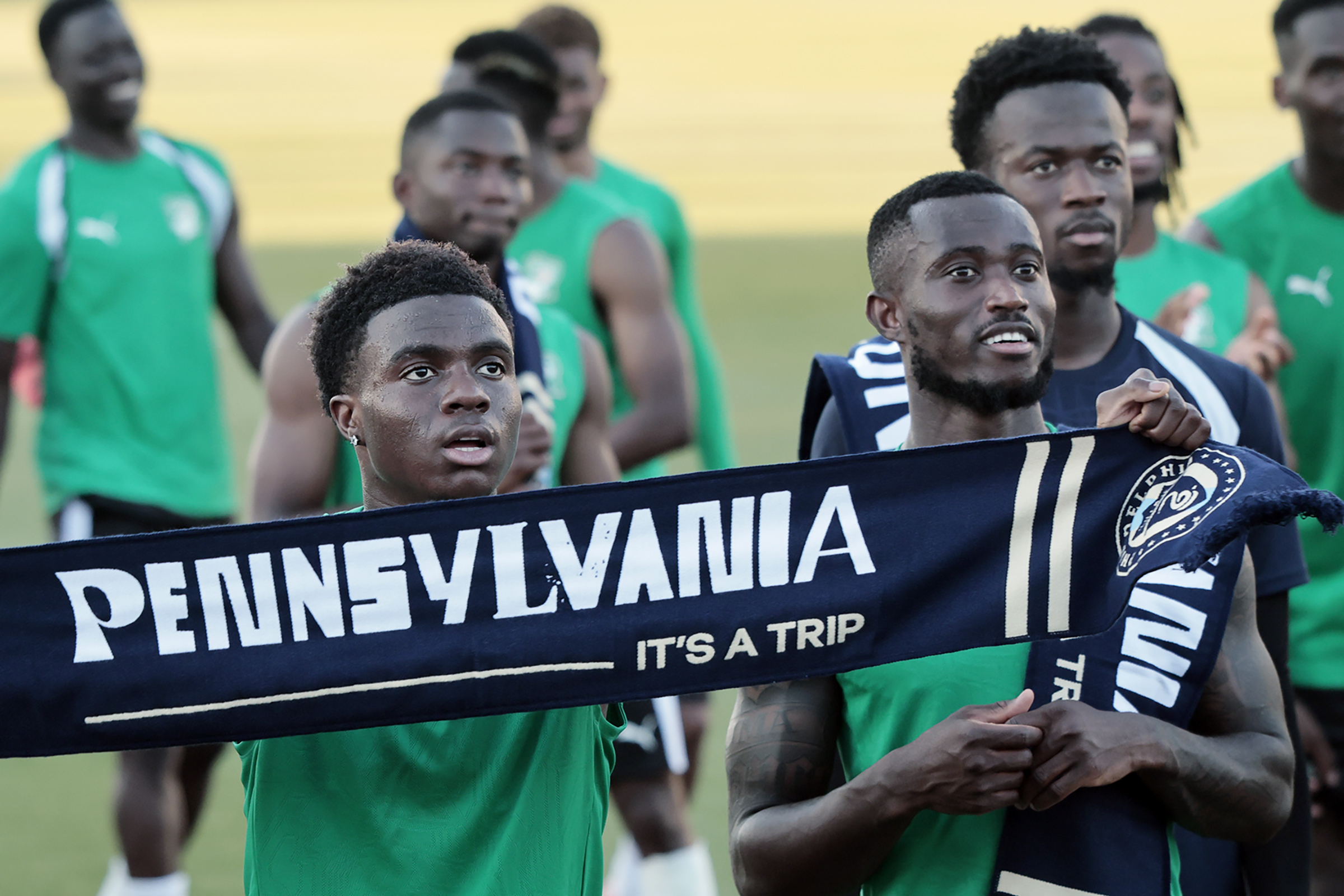
Members of the Ivory Coast national football team react while watching the Sixers Stixers drum line perform following their practice at Subaru Park in Chester on Friday, June 12, 2026 Elizabeth Robertson / Staff Photographer
“The yellows,” Bambara, 49, said, referring to the Ecuadorian fans’ jerseys, “need their support; we don’t need that, we are going to win.”
“We will invite them to beers once they lose,” Lejah, 55, said.
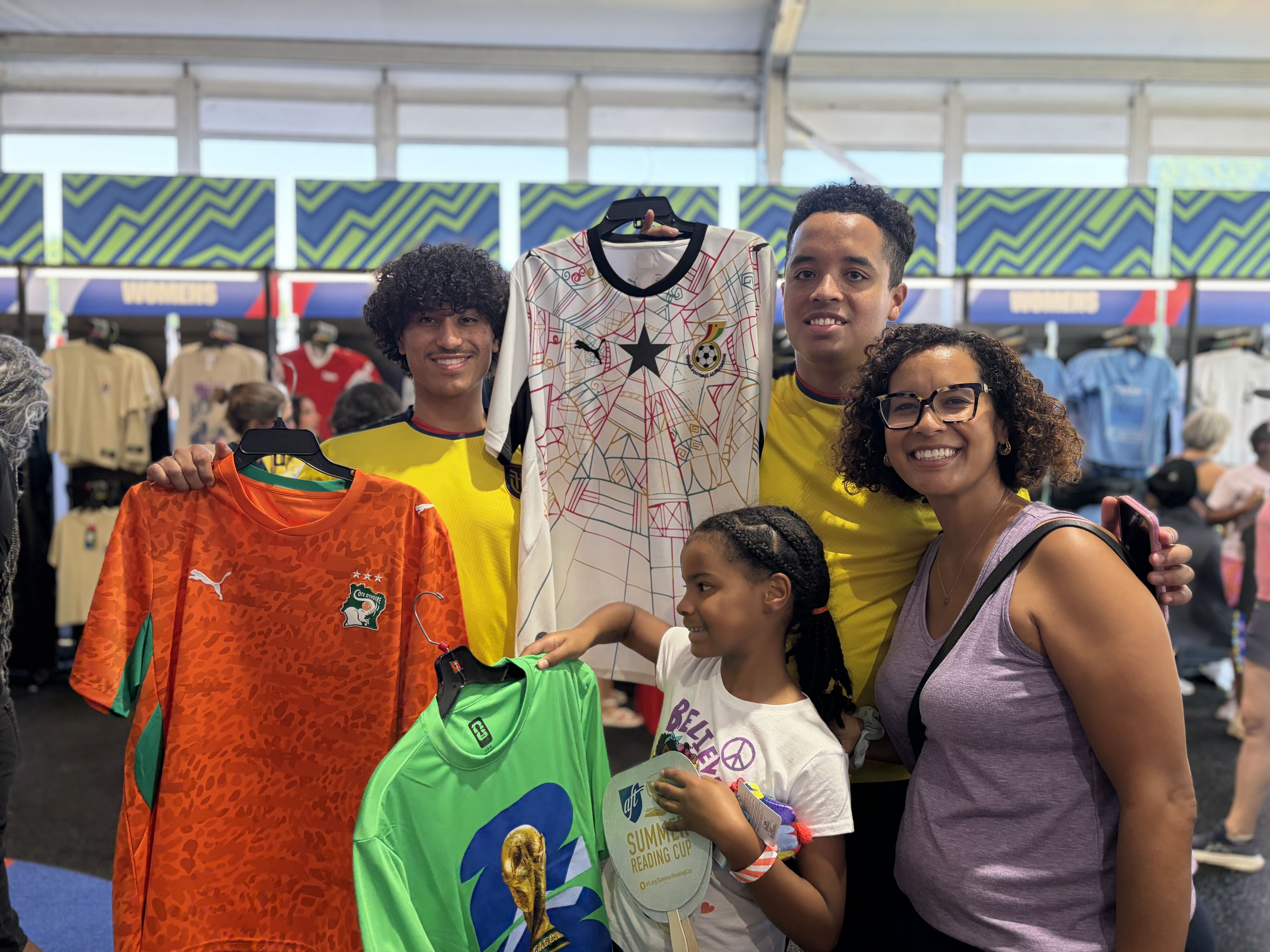
In the middle of it all, there seemed to be a marriage being put to test. Aurora Brown of Jacksonville, Fla., was attending FIFA Fan Festival with her family Saturday and said she is cheering for her home country, Ecuador. Her husband, Jamaal Brown, who had to stay back in Jacksonville, recently found out through a DNA test that he has Ivorian connections and is rooting for Ivory Coast.
Aurora Brown and the family pick out a soccer jersey for dad at FIFA Fan Fest in Philly. Dad Jamaal had to stay back home in Jacksonville, where he will be rooting for the Ivory Coast. But Aurora is sticking with Ecuador.Michelle Myers
“If they weren’t playing against Ecuador, the whole family would be Ivory Coast fans,” Aurora said.
“Ivory Coast is going to win and I will celebrate with some drinks,” Jamaal said over the phone.
“We are winners.”
Ticketing woes continue
This is the most expensive World Cup ever, and astronomical ticket costs and “dynamic pricing” have been a big gripe for many soccer fans.
Jayden Quezada, 17, and his parents spent $4,350 on Saturday to get three tickets to the next-day game through TickPick, a resale website. The trio traveled from Bensalem to Philadelphia hoping for an Ecuadorian victory. By the time they arrived at the stadium Sunday, the tickets were yet to be transferred to their FIFA app.
They were turned away at the door.
“They have been the biggest fans since before I was born and they don’t get to go back often because of work,” Quezada said of his parents who were trying to reach TickPick representatives on the phone. “We are probably going to try to get a refund but missing the game would be really sad because we were looking forward to feeling the Ecuadorian pride.”
Like the Quezadas, more than 50 people waited for help with their failed tickets, including Monica Rojas and Jose Avil who bought a pair of tickets and parking on StubHub for $2,000, only to learn their purchase had been refunded.
“I don’t know what we are going to do,” Avil said. “It feels defeating — now all we have is the tickets and the desire to watch them.”
Fans wait outside SEPTA’s NRG Station near the stadium following Ivory Coast’s victory over Ecuador Sunday night.Michelle Myers
Fan festivities
Meanwhile, watch parties were underway from Spring Garden to South Streets.
Ecuadorian singer Johann Vera commanded center stage at FIFA Fan Festival, roaring “¿Listos?”— “Ready?” — to a sea of yellow jerseys dotted by Ivory Coast orange.
“I thought there were more Ivorians in Philadelphia but I guess not,” said Swann Nemin, a Temple University student from Ivory Coast, visiting Fan Festival with her two Ivorian friends, Ornella Kouame and Naïke M. Their friend, Phoebe Mattes, who they joke is “Ivorian by preference,” joined too.
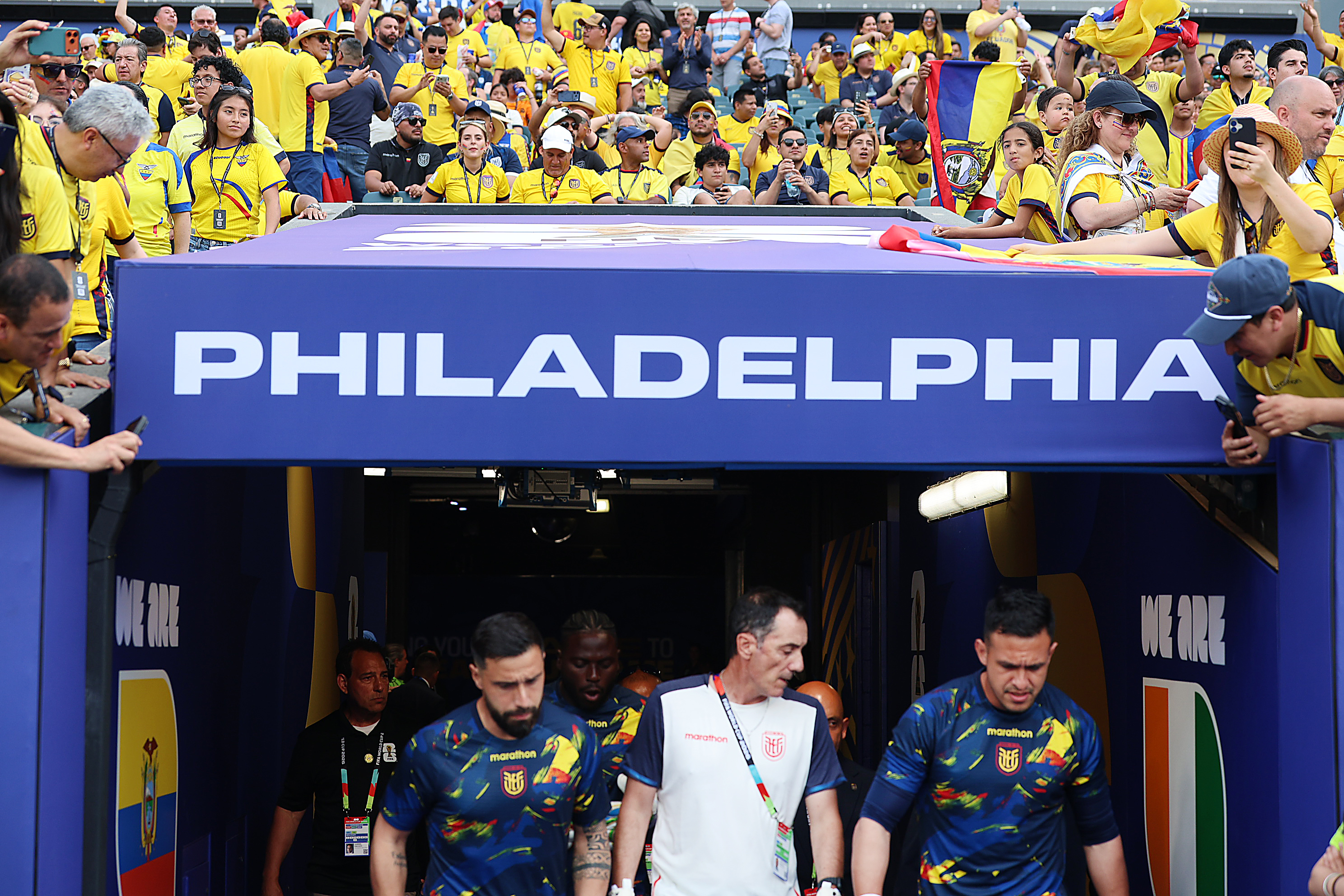
Ecuador takes the field for warm-ups before facing Ivory Coast in the World Cup Group E soccer match in Philadelphia on Sunday, June 14, 2026.David Maialetti / Staff Photographer
The World Cup brought the friends together who were looking forward to dancing and celebrating with people from all over the world.
“I feel like it’s not only people from Ecuador but also people from South America that are cheering for Ecuador, in the same way that people from all over Africa are repping Côte d’Ivoire,” Nemin said.
Aleyda Alvarado, a Fishtown resident originally from Mexico, admitted that she isn’t the biggest soccer fan, but the World Cup always gets her and her friends to come out and celebrate.
“Everyone is here from different countries, but during the World Cup, we’re all just fans,” Alvarado said before kick-off. “That’s how soccer bring people together, and what makes me love it.”
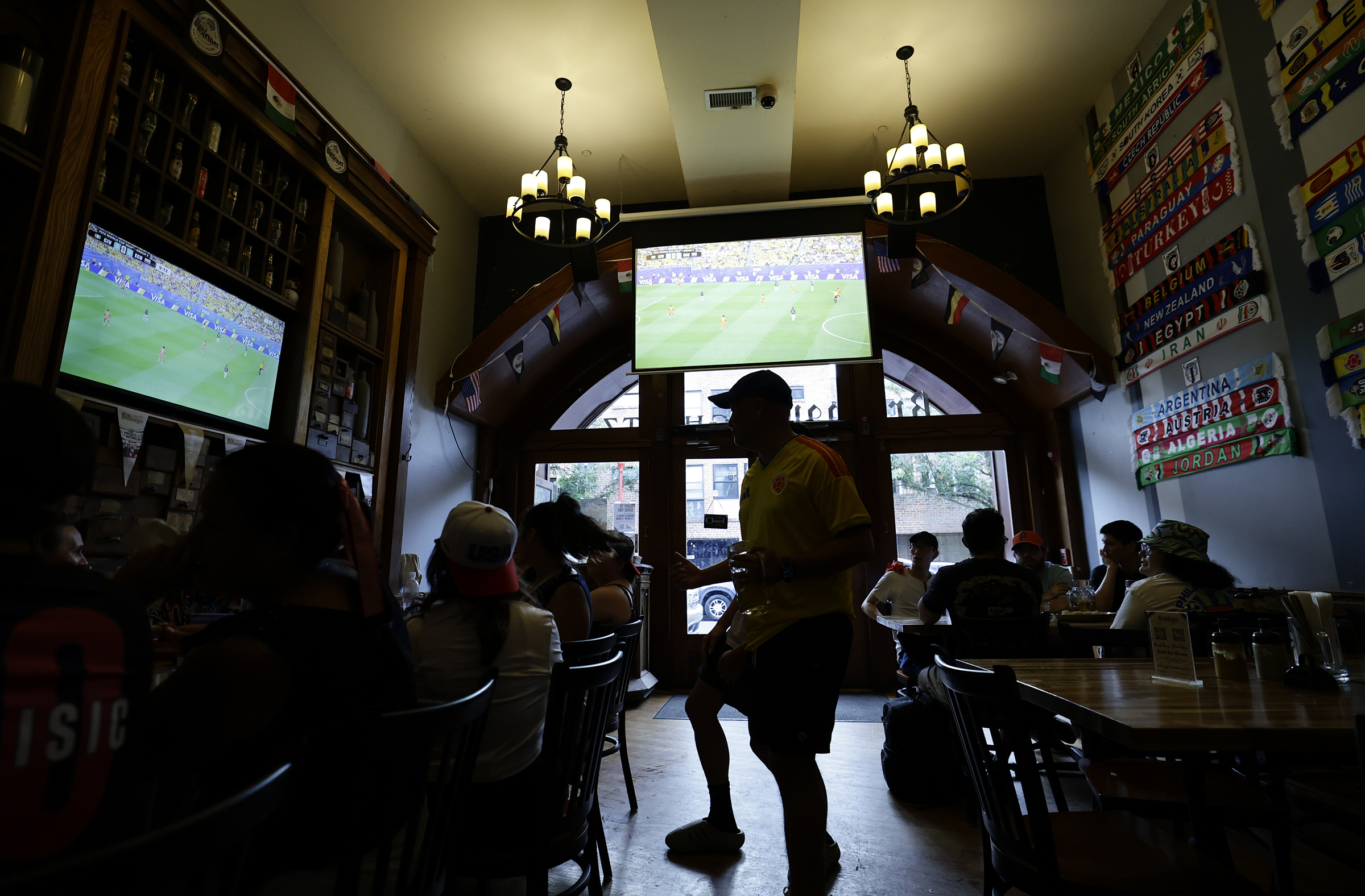
At the dozens of tables across Brauhaus Schmitz, the German beer hall in South Philly, beer steins were dangerously close to empty. The Caddick family eagerly watched TV screens around the bar and rang cowbells as their team, Ecuador, closed in on the net.
Soccer fans watch Ecuador take on the Ivory Coast during a World Cup soccer watch party at Brauhaus Schmitz on Sunday, June 14, 2026.Yong Kim / Staff Photographer
Karina Caddick, 56, of Horsham, was born in Ecuador, just outside Guayaquil, a port city and the country’s largest metropolis. She moved as a baby, but her family made sure to instill in her the importance of and love for soccer.
To watch her native country’s team compete on her home country’s soil is quite special, she said.
“It’s unbelievable that we’re able to watch [the game] here,” Caddick said. “To be in Philadelphia and see all the yellow shirts, it’s incredible.”
But not everyone gets the hype. Outside Brauhaus, a man was overheard asking, “Why does everyone like soccer so much?” For those with connections to one of the participating countries, the answer is obvious.
“Soccer is everything to Ecuador,” Caddick said. “It is the main sport. It’s their spirit. It’s what calls them.”