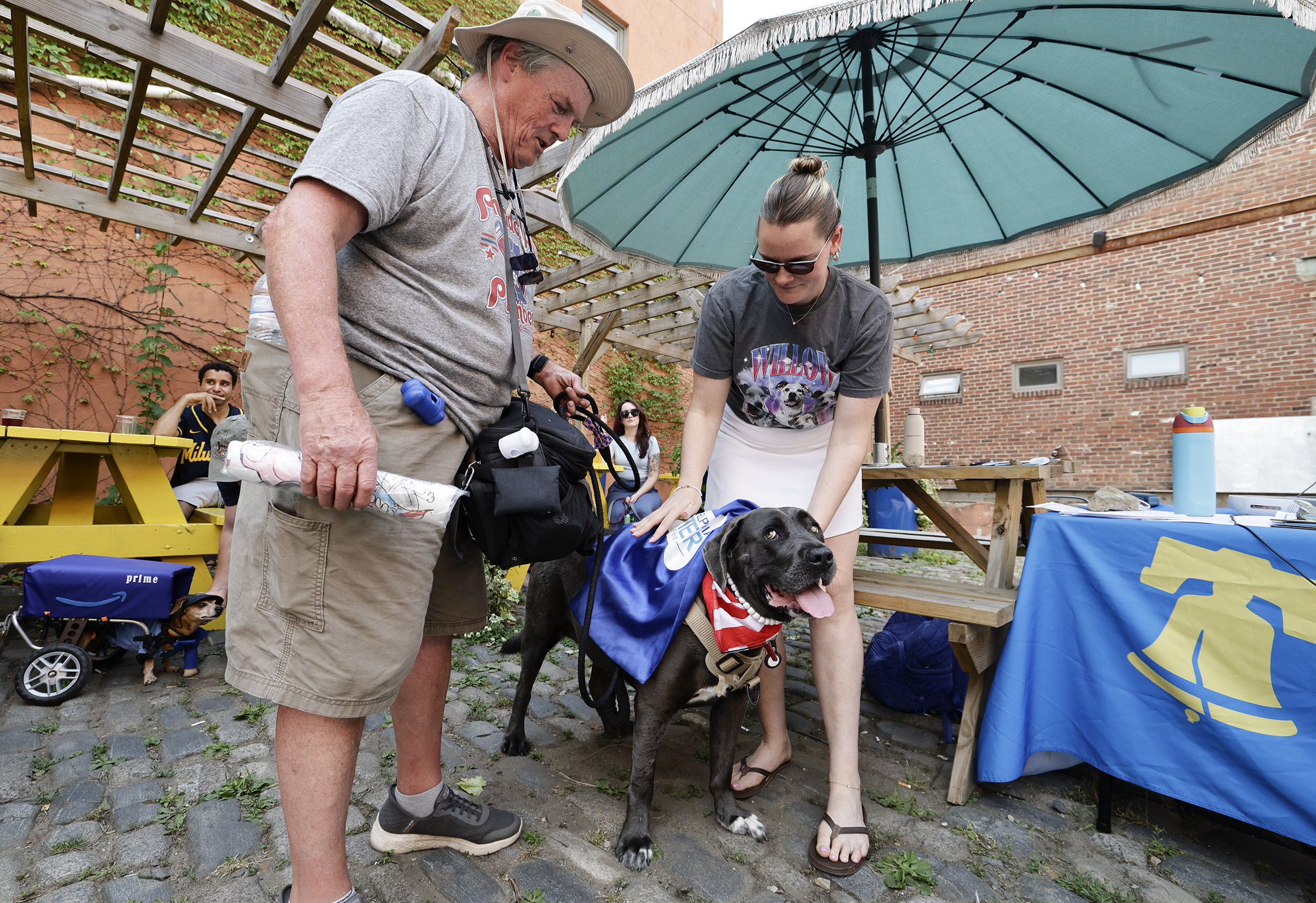
On Sunday afternoon, 14 Philly dogs gathered at Philadelphia Brewing Co. in East Kensington to compete for one coveted position: spokesdog for the Philadelphia Water Department.
The contestants and their humans arrived at 2 p.m., and proceeded to mingle with other attendees, answer trivia questions, pose for a caricature artist, and munch on snacks — hoagies for the humans and dog treats for the pups.
At 3:30 p.m. on the dot, the dogs perked up as two hosts took center stage to begin the competition.
For over 10 years, the Philadelphia Water Department and Partnership for the Delaware Estuary have hosted a competition where local dogs compete to serve as spokesdog, a designation that involves attending events to spread awareness of dog waste pollution.
The annual event was created to complete a U.S. Environmental Protection Agency regulatory requirement for municipal-level outreach on dog-based pollution by the water department.
Rich Levering holds his dog, Banjo, before the Philadelphia Water Department and Partnership for the Delaware Estuary held a competition Sunday to find a spokesdog for 2026 to raise awareness about poo-llution.Yong Kim / Staff Photographer
People don’t realize the impact of dog waste, said Kate Layton, communications manager for Partnership for the Delaware Estuary. “Dog waste is not a fertilizer; it’s not the same as manure. If dog owners are educated, they will be more mindful about picking it up and putting in the trash.”
“A mascot can rally around [the city] and folks pay attention to the issue,” said Ben Bristol, community initiative specialist at Philadelphia Water Department. “Dog waste pollution is not a charismatic topic. But when people think about and notice it, they might actually do something different.”
Eager to win the coveted position, humans walked their dogs up to the hosts and introduced their tail-wagging contestants who showcased fun tricks, while the humans answered a few questions.
When Gracie Girl, an 8-year-old cane corso, walked up, the hosts asked her human Joe Kenny what her superpower would be.
“She picks winners — she was there for all three Phillies games and they were all three wins,” Kenny said.
For the final assessment, Gracie met with the judges standing nearby. She leaned in for cuddles and embraced the judges’ pets. “She was super calm and chill, and I also appreciated the owner talking about how Gracie goes to all around Philly trails,” said Sally Ehlers, a science and engagement specialist at Partnership for the Delaware Estuary.
Gracie Girl receives a cape from Elizabeth Manner (left) as owner Joe Kenny looks on at the Philadelphia Brewing Company after Gracie Girl was chosen the spokesdog for 2026.Yong Kim / Staff Photographer
Gracie Girl and her owner eventually landed the gold medal at the end of competition.
“I had no doubt — that’s my girl,” said Kenny. The Mayfair resident heard about the competition on his usual walk on the Schuylkill River Trail with Gracie. “When she goes out, people stop and take pictures of her — that’s just the way she is. Everyone always tells me how congenial she is and she gets me outside everyday.”
It was a tough competition, Kenny said, but the dogs were getting along and eager to take a position to represent the importance of dog waste pollution.
“It’s not about winning, right Gracie?” he asked the winning pup resting on the ground sporting the spokedog sash. “Although, that don’t hurt either.”
In a Rock Hill, S.C., restaurant last Wednesday night, during a recruiting road trip to the Nike 100 Camp, Ashley Howard locked his eyes on a television above the bar, enthralled by the most dramatic comeback in NBA Finals history, his mind recalling a more modest rally from nine years earlier.
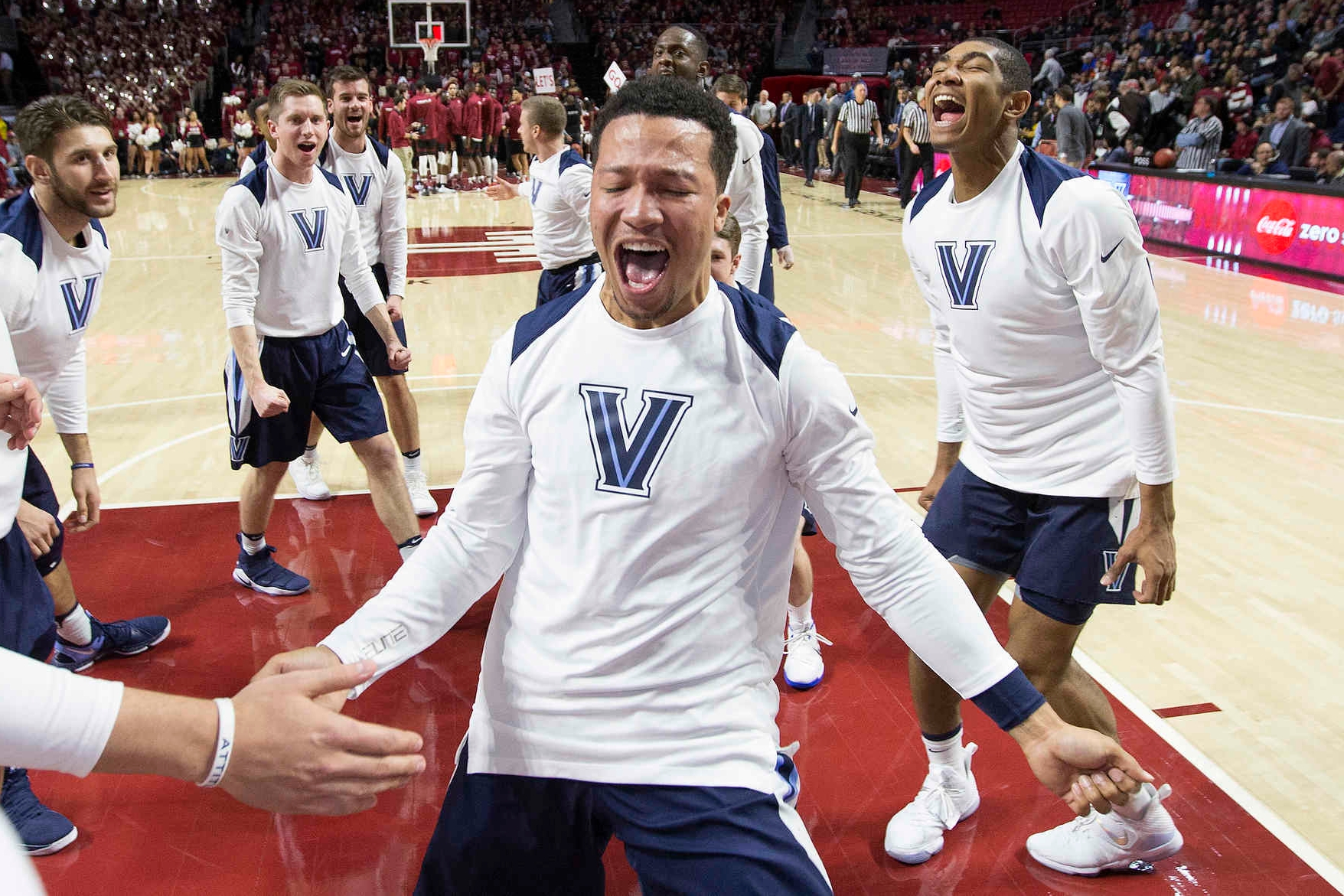
Jalen Brunson, Josh Hart, Mikal Bridges, and the New York Knicks kept chopping into that 29-point San Antonio Spurs lead. Madison Square Garden kept getting louder. And as Game 4 slowly shifted from a series-tying rout to the surest sign that three former Villanova stars would soon bring about the end of a 53-year championship drought, Howard remembered a college basketball game from January 2017, from the season between ’Nova’s ‘16 and ‘18 national championships.
An assistant under Jay Wright then, an assistant under Kevin Willard now, Howard reminisced with the friend sitting next to him — former Villanova head coach Kyle Neptune, now an assistant with the Charlotte Hornets — about a 61-59 Wildcats victory over Virginia. Villanova had trailed that day by 12 points with less than 10 minutes to go, an imposing deficit given how Tony Bennett’s Cavaliers teams could slow a game to a crawl. But Hart and Brunson had pulled ‘Nova back from the brink, and Donte DiVincenzo had tipped in an off-target Hart layup at the buzzer, and Howard saw the residue of that win in OG Anunoby’s soaring-eagle tip-in and the Knicks’ 107-106 stunner in Game 4. In Brunson’s 45-point masterpiece Saturday night in the clinching Game 5. In the title run of a team that was smarter, tougher, and tighter than every other in the NBA playoffs.
“After winning the first national championship, every game these guys played together in ‘17 was the biggest game for whoever they played,” Howard said in a phone interview. “They have everything to lose, and their opponent doesn’t. There’s a different type of mental toughness and mental fortitude you have to have to not only play under that pressure but answer the call in those moments.
“Now they’re all back together, and it’s almost like déjà vu where that Villanova connection is back. The other pieces are different. The coaches are different. But when you look at that Knicks team, you say, ‘Yo, those dudes are playing Villanova basketball.’ It’s really all about how they play hard. They compete for the entire game. They never, never quit. They play unselfishly, and you can tell that they love each other. That just makes my chest stick out as wide as all outside.”
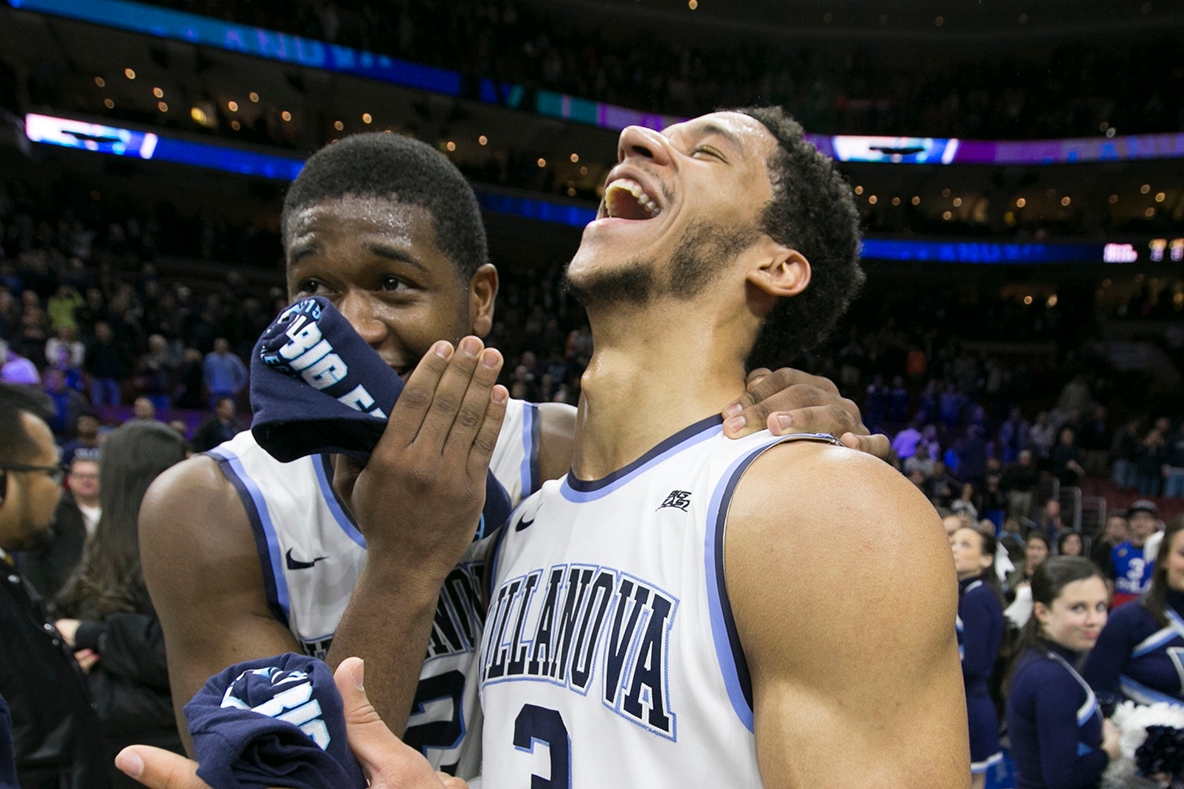
Josh Hart (right) won the 2016 national title with the Wildcats.Charles Fox / Staff Photographer
Howard was at the nexus of the origin of the ‘Nova Knicks, and the irony of his role in that story is that he, with such deep Philadelphia hoops roots, had left town when he made his first connections with Brunson, Hart, and Bridges. A standout guard at Monsignor Bonner and Drexel, he was climbing the college coaching ladder — first four years at La Salle, then four back at Drexel — when in 2013 he accepted the chance to assist Chris Mack at Xavier. It was a more highly regarded mid-major, a better shot to jump to a bigger program, and in that one year he spent in Cincinnati, Howard recruited that trio before reuniting with them again at Villanova.
In Hart, Howard saw a relentless and tenacious guard who pulled down as many as 25 rebounds in games at Sidwell Friends in Washington and for his AAU club, Team Takeover. He also met a low-maintenance kid who, when Howard coaxed him to Xavier for an on-campus, didn’t need a fancy dinner at an exclusive restaurant. No, when Howard offered to buy him lunch, Hart instead was desperate for a sack of double-cheese sliders from White Castle. “Shows what a freak of nature he is,” Howard said.
Bridges’ and Brunson’s recruitments were more personal for Howard, starting at Xavier and continuing after he joined Wright’s staff at ’Nova. Howard was friendly with Bridges’ cousin Bernard Tyler, who forwarded him a video of the kid’s highlights from Great Valley High School and Team Final, one clip after another of Bridges cutting to the basket and creating shots within Great Valley’s motion offense, with an enticing text: This is the next one. Make sure you get this dude. And Howard could only chuckle when Mack called him one day after attending a high school holiday tournament in Chicago and asked him, Hey, Ash, do you know Rick Brunson? His kid is really good.
“Reached out to Rick,” Howard said. “We caught up, and I jumped on Jalen from that point on.”
There’s a chicken-or-egg aspect to the greatness that Wright’s program achieved during that stretch in the mid-2010s and to the qualities that Brunson, Bridges, and Hart developed there and still carry with them. Would these players, because of their inherent strengths, have thrived in other programs? Or did they need to learn under Wright and his staff and his culture? A dash of both, of course, and the conditions and choices that led to their flourishing at Villanova — and to those two national championships — aren’t likely to be duplicated in college basketball’s current era of status seeking and coin chasing.
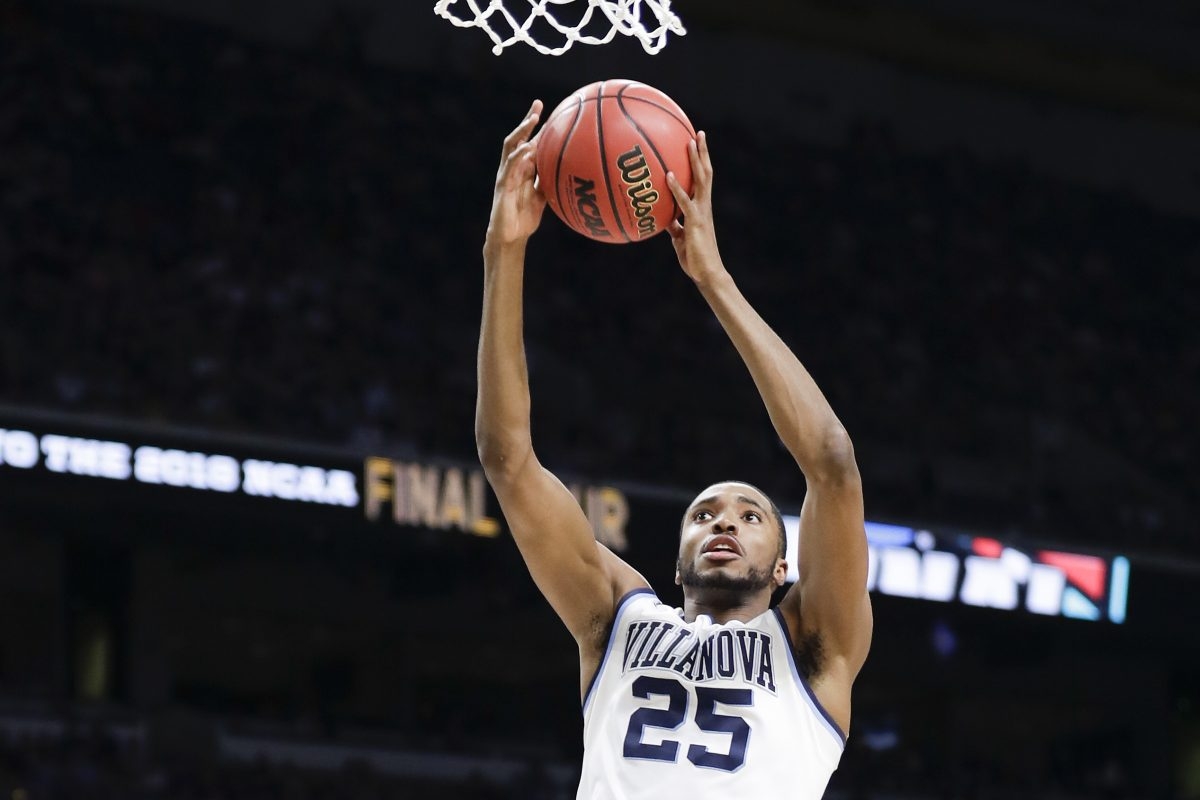
Mikal Bridges was on both the 2016 and 2018 Villanova championship teams.Yong Kim / Staff Photographer
Bridges went to Wright and Howard and suggested that he redshirt as a freshman, that he sit out an entire season for the sake of his growth as a player and person. Hart started just three games over his freshman and sophomore seasons, could have transferred out of frustration and a search for more playing time, and didn’t. Brunson as a freshman took a secondary role alongside Ryan Arcidiacono, then ran the Wildcats’ show for two years before entering the NBA draft. Good luck being so patient in developing players and building a program now.
“It was a period of time where you could build off your failure and mistakes and learn from them collectively,” Howard said. “You could develop young people over a course of time and nurture and appreciate the process. … All these guys in their own way trusted us and allowed us to push them to limits. Parts of their experience at Villanova, man, it was tough, but they allowed us to make them uncomfortable.”
It was the perfect preparation for these playoffs, for these NBA Finals, for a remarkable run capped when Brunson took control of Game 5, when the sub-6-foot guard with the impeccable footwork, with the endless array of head fakes and midrange shots, with the glorious old man’s game was once again the coolest customer on the court.
“You could see the Spurs getting tight,” Howard said, “and you could see Jalen saying, ‘Yo, get me the ball. I’m gonna make these plays.’ Me being around J, it’s like, ‘Here he comes. It’s on.’ When the stakes get high, that dude is coming.”
It had been 53 years, long enough for any franchise and its fans to wait for that kind of ride, and all it took was something Ashley Howard and everyone at Villanova had seen a million times before. All it took was Jalen Brunson, Josh Hart, and Mikal Bridges doing what they’ve always done.
MILWAUKEE — In the midst of it all, as Bernie Brewer barreled down his slide and another sold-out crowd roared, Cristopher Sánchez bowed his head.
It turns out the Phillies’ ace is fallible after all.
Who knew?
One out from escaping the fourth inning here Sunday, two days after Brewers rival Jacob Misiorowski pitched the best game in baseball this season, Sánchez gave up a backbreaking three-run homer to .113-hitting Blake Perkins on a slider, his third-best pitch.
That’s one way to beat Sánchez. Here’s another: Start a left-hander against the Phillies, held to three hits by Kyle Harrison and four overall in a rubber-game 4-0 loss to the powerhouse Brewers.
“Everything was off today, especially my energy,” Sánchez said through a team interpreter. “I’d say it wasn’t as it usually is. But not to use it as an excuse.”
Hmm. That’s odd. It was one of those measuring-stick series — for the Phillies against a National League heavyweight, and for Sánchez in the middle rounds of what’s shaping up as a Cy Young Award fight with Misiorowski, who submitted a one-hit, 15-strikeout shutout Friday night.
Why, then, the low energy?
“I didn’t have the best sleep last night,” Sánchez said. “I think it’s only that. But no excuses again.”
OK, so the Cy Young race won’t be decided in June. But after permitting a total of five runs and one homer in 59⅔ innings over his previous eight starts, Sánchez gave up four runs and two homers against the Brewers, hiking his ERA from 1.54 to 1.82.
(Misiorowski leads the majors with a 1.34 mark.)
“A little bit uncharacteristic,” interim manager Don Mattingly said. “Just velo was down a touch, and with that, it gives [the hitter] a little more time up there. Other than that, you take the homer away, just a breaking ball there, even when it doesn’t look like he has his best stuff, he’s still hanging in there.”
Oh, about that breaking pitch. Sánchez has baseball’s best changeup and a bowling-ball sinker. But Rafael Marchán called for a slider in a 1-0 count to Perkins. Marchán, who left the game in the eighth inning and was going through concussion protocol, was catching Sánchez for only the third time this season.
Philadelphia Phillies outfielder Derek Hill (49) and Edmundo Sosa, right, field a double hit by Milwaukee Brewers’ Blake Perkins during the sixth inning of a baseball game Sunday, June 14, 2026, in Milwaukee. (AP Photo/Kayla Wolf)Kayla Wolf / AP
“I felt good with calling that pitch at that moment,” Sánchez said. “It just stayed in the middle. I hung it. But at the moment that we called it, I felt good with it.”
Said Mattingly: “I never question what pitch he’s throwing or picking. They’re all good. It’s just a ball that he kind of left up. He tried almost like a get-me-over-breaking-ball, and the guy hit it.”
The Phillies didn’t do much hitting against the Brewers’ top starters. Misiorowski and Harrison bookended the series by allowing a total of four hits in 15 scoreless innings.
Harrison became the latest left-handed pitcher to mute the Phillies’ bats. Three of their seven shutouts this season have come against left-handed starters.
Trea Turner, in particular, continued to struggle. The star shortstop went 1-for-13 with six strikeouts in the series — 3-for-26 with 10 strikeouts overall on the road trip.
For the season, he’s batting .219 with a .599 OPS.
“Definitely frustrated,” Turner said. “It feels like I’m just missing every pitch I could possibly miss no matter what I try, approach-wise, physically, mentally. It feels like it’s just not getting the job done.
“I feel like the last two or three weeks I’ve been getting pitched really well, and then this series, finally I felt like I got some pitches to hit in the middle of the zone and just fouled them all off. So, that’s what I’m most frustrated with.”
Philadelphia Phillies designated hitter Kyle Schwarber pops out with a broken bat during the eighth inning of a baseball game against the Milwaukee Brewers, Sunday, June 14, 2026, in Milwaukee. (AP Photo/Kayla Wolf)Kayla Wolf / AP
Would it help if the Phillies dropped Turner from the No. 2 spot in the order to relieve some pressure?
“I haven’t really thought about moving him at all,” Mattingly said. “I don’t really know what the answer to moving him down is. Somebody’s going to have to hit there. Not sure who that would be right now.”
Onward, then. The Phillies are 38-33, 29-14 under Mattingly, but only 3-9 against the Brewers, Dodgers, and Braves, the cream of the NL crop.
As measuring sticks go, the Phillies surely must have learned something from three days in Milwaukee?
“I don’t think we played our best,” Turner said. “To come out with a win, I think, is kind of a positive outlook at it. I think we all think we could’ve played a lot better in all three games, but that’s what happens if you don’t show up against these good teams. They beat you.”
LONG POND, Pa. — Almost 20 years ago, when NASCAR driver Michael McDowell was coming through the racing ranks as a young driver, he first encountered Pocono Raceway as part of the ARCA Series.
The race, which he won by passing Jeremy Clements with about a half-mile left in the 2½-mile track, helped grow McDowell’s recognition as a young driver and made him an early fan favorite when, a year later in 2008, he returned to the track as part of NASCAR’s Cup Series.
“For whatever reason — as the new guy, no one really knows who you are — but here I had sort of like a following, and I had fans, and it was my first experience having real fans, because I remember walking out for qualifying, you walk that fence line as you’re going out to the grid, and I must have stopped for like 15 or 20 minutes signing autographs,” McDowell told The Inquirer in his car hauler at Pocono on Saturday. “I was like, ‘Oh, this is cool.’
“Most of the time people don’t know who you are that first year, especially because I was really a newcomer, and [one] that nobody saw — I didn’t run the [formerly named] Xfinity series or truck series. I’ve always had a really solid fan base here, which is really interesting, because other than that ARCA win, I don’t know what would have caused that. … Pocono is one of the best ones for me, as far as fan interaction.”
Every year since 1974, NASCAR has descended on the “Tricky Triangle” tucked away in the Pocono Mountains, and though it’s no longer a biannual racetrack, fans still come in droves.
Denny Hamlin, who won the pole for the Great American Getaway 400 race during qualifying on Saturday, won his third consecutive race and eighth overall at Pocono, extending his record at the track during Sunday’s Cup Series race.
NASCAR’s Cup series Denny Hamlin comes in the pit row during qualifications on add Pocono Raceway, Saturday, June 13, 2026Steven M. Falk / For The Inquirer
For the fourth straight year, Pocono Raceway was sold out, with a record-setting 115,000 people coming through the racetrack across the three-day weekend, Gov. Josh Shapiro said Sunday. Drivers, fans, and the sport’s leadership executives laud the “family atmosphere” of the track and its grounds, which features more than 1,000 acres of land. It’s part of the reason why Pocono has been voted No. 1 by NASCAR fans for three years running, according to USA Today.
“We want everybody to feel like family, want everybody to feel welcome. We want nobody to go hungry. We want everybody to have a good time,” Pocono CEO Nick Igdalsky told The Inquirer recently. “We know people are spending hard-earned money to come here. This may be their only vacation or trip of the year.”
Added Hamlin after his win Sunday: “When I see my career highlights [on my social media algorithm] … there’s so many Pocono memories, like it’s replaying Pocono wins, or when I put somebody in the wall for a win, or something like that. It’s always been part of my highlight reel, and like it’d be so cool to, [in] my last year, whenever that is, I guess next year, win [at Pocono] my first year and win it my last year, that would be pretty cool.”
‘It’s a party’
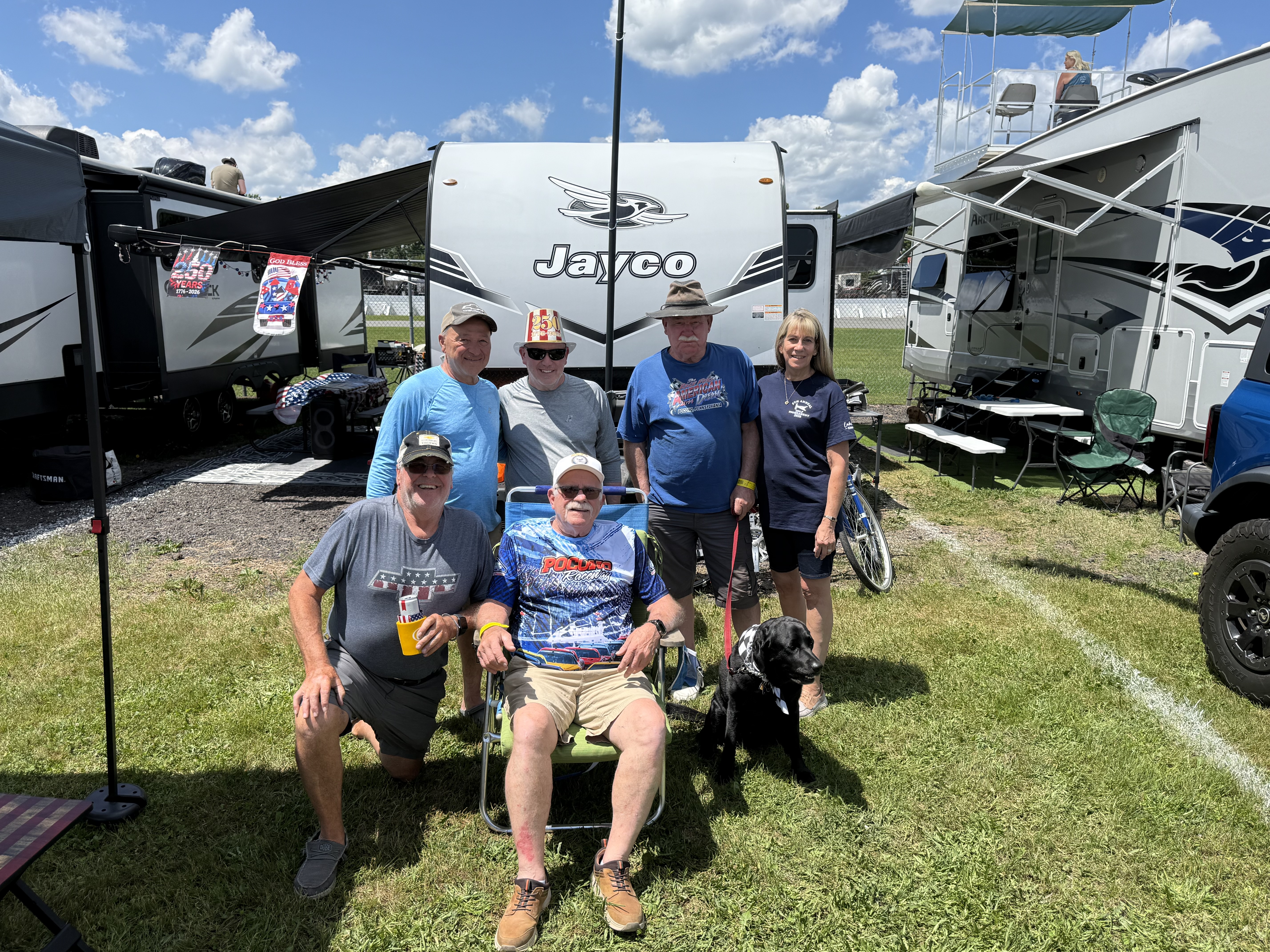
Pete Lanzilotta, a man affectionately known around the racetrack as “Pocono Pete,” has made the trip to Long Pond annually since 1999. For the last 25 years, excluding the fan-less 2020 Pocono races due to the COVID-19 pandemic, Pocono Pete and his group of friends have camped out on the track’s infield.
They each have a specific role they play during the trip — from entertainment to food to a communication director — and they’ve returned to the same camping spot, located between turns 2 and 3 on the track.
Pocono Pete (center, sitting down) with his friends and camping neighbors at Pocono Raceway on Saturday.Devin Jackson
“It’s a party,” Lanzilotta said. “It’s the cars, it’s the racing. These are true NASCAR fans. People that do [camping like] this are dedicated … you ask somebody [on the] infield about one of the cars, and this or that, they’re going to know everything, especially about their favorite drivers, favorite teams.
“Nobody leaves here Sunday, because they’re drinking. Everybody leaves Monday. That’s always been a rule.”
Pocono Pete, in the early 2000s, would make the trip from Long Island. He now lives in North Carolina, and flew up this weekend to meet his friend, Scott. The pair have traveled to other racetracks, like Martinsville Speedway in Virginia, Darlington (S.C.) Raceway, Dover (Del.) Motor Speedway, and others — but at Pocono, “it’s very rare to see everybody doesn’t get along.”
“As much as we don’t know these people all year long, you become part of their family for that weekend, one big family for the weekend. They share food around here,” said Mike, the group of friends’ entertainment director who did not wish to share his last name.
Added Pocono Pete: “We’ve always had so much fun here. We look forward to it every year. Every year gets bigger and better, and we all believe that [Pocono Raceway president] Ben May and the whole team are doing a great job.”
Fans watch NASCAR’s O’Reilly Auto Parts series at Pocono Raceway on Saturday.Steven M. Falk / For The Inquirer
‘Lifelong memories’
Part of Pocono’s charm may be rooted in its motto, which Igdalsky says they treat like a mission statement. It includes words like “exciting experiences,” “lifelong memories,” and, perhaps most notably, “beautiful and sustainable.” And it’s for the whole family.
Since fans were welcomed back post-pandemic, the racetrack has expanded to add 1,000 camping spots, which puts the total at about 3,400. It’s also added grandstands on the infield, and amenities like a dog park and a playground for kids.
All of that comes with access to NASCAR drivers that “you wouldn’t be able to do at other places.”
“[We] highly encourage families to try Pocono for the first time with the kids free program — two adults can bring 6 to 8 kids for under 100 bucks,” said Igdalsky. “You’re not going to find that in any professional sports venue in the country. … [You have] the experiences you have at Pocono with the kids’ zones, with the autograph sessions, with being able to get on the track and sign the track and walk the track.”
And although it’s about 100 miles away from the city, you might just get an authentic Philly fan experience.
NASCAR CEO Steve O’Donnell has some personal experience there. Early in his career, when he worked in marketing for the sport in the late 1990s, he handed out hats to the winning drivers in victory lane.
O’Donnell, a New Jersey native, remembers one year in particular where fans at Pocono Raceway took exception to Jeff Gordon winning yet another race at the track. Gordon won at least one of the two yearly races from 1996-98.
“I remember there was maybe two or three floors above you. A couple die-hard fans, who maybe weren’t Jeff Gordon fans at the time, poured beer down on Jeff, wanting to see a new winner. But it just shows the passion of the fans. They were into it,” O’Donnell recalled. “It was probably the hardest victory lane I ever worked, just because it was packed, just the passion of the fans. Everyone wanted to be in there and be near the car, so I just love the track … It’s one big family atmosphere at the racetrack with people just having a ton of fun with a lot of different things you can do.”
For drivers like McDowell, who has five kids with his wife, Jami, the racetrack’s amenities, the nearby water parks and the lodging location relative to the racetrack creates a “fun experience” for his family.
“Early on in my career, I drove the motorhome to a lot of the races with my wife and I, and our son at the time, and we kind of went from track to track, and this was always a great place to come up to, and we’d make a trip out of it, and go sightseeing or hiking or fishing, and kind of make the trek around this area,” said McDowell, who finished 17th on Sunday. “ … [We have] lot of great memories here and it’s just a super nice area, lots to do, whether it’s water parks or just getting out of the South heat is always nice.”
MIAMI — Four Black Democrats running for Congress in the same South Florida district met last week for a highly unusual discussion. Should three of them drop out and rally around a consensus Black candidate in the Democratic primary against Rep. Debbie Wasserman Schultz?
Wasserman Schultz, who is white, had announced a few weeks earlier that she would run in the safely Democratic 20th Congressional District in Broward County, after Republican state lawmakers redrew Florida’s congressional map and eliminated her seat.
But the 20th District is historically Black and has elected a Black representative for decades. The Black Democrats running felt affronted by Wasserman Schultz’s decision to enter the race, especially with a spate of Republican gerrymanders across the South this spring almost certain to reduce Black representation in the House.
The race to redistrict before the midterm elections has forced Democratic candidates in Republican-led states to make rushed decisions about where to run based on cold electoral math, as the number of winnable districts has shrunk. In Florida — a state that sends 28 representatives to Congress, and where 43% of voters cast ballots in 2024 for Kamala Harris — the Republican-drawn map cut the number of Democratic-leaning seats from eight to four.
Nowhere in the state has Democrats’ dilemma been more evident than in South Florida. Before Friday’s candidate-qualifying deadline, Wasserman Schultz’s announcement turned Democrat against Democrat.
The 20th District includes most of Broward County’s African American and Caribbean American communities. So the four Black Democrats huddled last Monday, thinking that, if they consolidated behind one of them, he or she might have a chance of defeating Wasserman Schultz, an 11-term incumbent and a former chair of the Democratic National Committee who has far out-raised them all.
In the end, though, they could not agree on who among them should remain in the race.
“Everybody thinks that they can be the one who will win,” said Dale V.C. Holness, a former Broward County mayor.
Holness and three others — Luther Campbell, known as Uncle Luke, from the hip-hop group 2 Live Crew; Elijah Manley, a teacher and political activist; and former Rep. Sheila Cherfilus-McCormick — all qualified to run. They remained in the race knowing that they would likely split the Black vote, improving Wasserman Schultz’s odds of winning.
Under the new map, only one majority-Black district will remain in Florida: the 24th, which is based in Miami-Dade County and safely Democratic. The incumbent, Rep. Frederica Wilson, announced her retirement last month.
The 20th District, with its plurality of Black voters, can still elect a Black representative, the Florida Legislative Black Caucus noted in a statement last month that called Wasserman Schultz’s decision “disheartening.”
“This district was established to remedy decades of racial exclusion and to ensure that Black communities have the opportunity to elect leaders who truly reflect their experiences and needs,” the statement said.
The discomfort has stretched to Washington. When asked this month about the landscape in the 20th District, Rep. Hakeem Jeffries (D., N.Y.), the minority leader, who typically endorses incumbents, said he had not “made a decision” in the race.
“Everybody has a right to run where they see fit,” he said, praising Wasserman Schultz’s “strong record of accomplishment.” He added, however, that the country was experiencing “an unprecedented Jim Crow-like assault on Black political representation.”
The Supreme Court issued a decision in April weakening a key provision of the landmark 1965 Voting Rights Act, finding that Louisiana lawmakers had unconstitutionally relied on race when they created a majority-Black district. The decision set off a rush to redraw maps in Southern states.
Last week, the House Democratic Caucus, led by Jeffries, appointed Wasserman Schultz to the House Foreign Affairs Committee. In a statement, Wasserman Schultz thanked her colleagues for “this vote of confidence.” She has blamed President Donald Trump, Gov. Ron DeSantis, and their fellow Republicans in the Florida Legislature for eliminating four Democratic-leaning districts. Two are in Broward County — hers and that of Rep. Jared Moskowitz — while two more are in the Tampa and Orlando areas.
Voting and civil rights groups have challenged the map in court, saying it violates a state ban on partisan gerrymandering. A judge declined to temporarily block the map from taking effect, so it will stand for this year’s elections.
“I’m just as angry” as other Democrats, Wasserman Schultz said in an interview last month. “DeSantis and Trump have intentionally dismantled Broward County’s power.”
She added that, over her 34-year political career, she had represented nine of the 14 cities in the district.
“I know the people, and the people know me,” she said. “It was critical that we not start over with a beginner and ensure that someone like me with the seniority and clout represents this community.”
Moskowitz is running in the new 25th District, along coastal Miami-Dade, Broward, and Palm Beach counties. It leans Republican but is considered competitive. He lamented the gerrymandering “race to the bottom” that he said will lead to more partisanship and gridlock.
“If you think Congress is dysfunctional now, just wait for us to prove you wrong,” he said.
The other two Democrats whose districts were eliminated, Rep. Kathy Castor of Tampa and Rep. Darren Soto of Orlando, are also running, but in seats that Trump won by 10 percentage points and nearly 18 points in 2024.
Castor, who is in her 10th term, said she was undeterred, in part because of her expectation of an anti-Trump wave this year. She pointed to some of the president’s seemingly tone-deaf statements, such as “I love the inflation,” which he said last week in the Oval Office.
“I see a big change election for the GOP in power in Congress,” she said.
With Democrats having to defend three formerly safe seats, it seems less likely that they will have many resources to try to flip other seats that they had hoped to keep competitive. Florida Republicans have outpaced Democrats in voter registration and fundraising for years.
“Democrats are running on empty in Florida,” Maureen O’Toole, a spokesperson for the National Republican Congressional Committee, said in a statement.
Holness, Manley, and Cherfilus-McCormick said that Wasserman Schultz should have run in the new, Republican-leaning 22nd District, which includes her home. She might have given the GOP a real race there, they said.
“The fact that she’s abandoning her district and coming into our district, it doesn’t give people any faith that she will stand and she will fight,” Cherfilus-McCormick said.
Cherfilus-McCormick resigned from office in April before a House panel was scheduled to consider expelling her. She has been indicted on criminal charges of embezzling $5 million in federal disaster aid and using it for her campaign. She has denied the accusation and pleaded not guilty.
Manley said Wasserman Schultz represents the establishment at a time when Democratic voters are frustrated with the status quo.
“To have somebody running here and try to divide and conquer the district is going to hurt the party in irreparable ways,” he said. “People may stay home in November. People may leave the party.”
BUTLER, Mo. — A plane carrying a pilot and 11 passengers planning to spend a sunny afternoon skydiving crashed Sunday in Missouri, killing all aboard, authorities said.
The Missouri State Highway Patrol said in a statement that troopers were at the crash site, assisting the Butler Police Department and Bates County Sheriff’s Office. The crash occurred near the Butler Memorial Airport. The small town of Butler has a population of around 4,300 people and is roughly 65 miles south of Kansas City.
Missouri Highway Patrol Sgt. Justin Ewing said the plane was taking people up to skydive. Emergency responders got a call that a plane was down and engulfed in flames around 11:30 a.m. Sunday, he said.
“It landed in a field adjacent to the airport, but I think they’re shutting down the roadway just as a precaution,” Ewing said.
A heap of blue and silver mangled metal lay in the grass near the airport with a massive line-up of emergency vehicles on the street beside it.
Teams from the National Transportation Safety Board and Federal Aviation Administration were en route to the crash site Sunday afternoon to investigate, according to the Missouri State Patrol.
The private plane was operated by Skydive Kansas City, said Dennis Jacobs, the acting airport manager and Bates County Emergency Management Agency director.
“It had just taken off and made a left turn” before the crash, Jacobs said. “In my opinion I think it was losing power, and he was trying to make it over to the highway and land, and he stalled and went down nose first and caught fire.”
Emergency responders were able to put out the fire shortly after the crash, Jacobs said, calling the scene “brutal.”
First responders have checked the area under the flight path and did not find anyone who might have tried to jump out before the crash, Jacobs said.
The Pacific Aerospace 750XL that crashed is a single engine turboprop plane model that’s popular for skydiving but is also used for cargo, aerial surveying, and medical evacuation flights. The aircraft can carry as many as 17 skydivers and is capable of taking off and landing on short runways. The plane that crashed Saturday was manufactured in 2010, according to FAA records.
The small airport serves around 30 aircraft, all privately owned, including crop dusting companies and skydive operators, Ewing said.
Skydiving companies operate in the region eight or nine months a year, with the season usually starting in late March or early April and lasting into October or November. Someone answering the phone at Skydive Kansas City declined to speak to a reporter from the Associated Press.
It’s not yet known what factors may have contributed to the crash or caused it, Ewing said, and those details will be part of the investigation carried out by NTSB officials.
Aviation safety expert Jeff Guzzetti said that poor maintenance has been a factor in a number of previous skydiving plane crashes because these companies are not held to a high standard under FAA rules. Guzzetti said skydiving companies are governed by the same rules any private plane owner has to follow and not the more stringent rules that charter flight operators and airlines adhere to.
“There’s been a whole history of skydiving accidents for inadequate maintenance and deficient safety culture,” said Guzzetti, who used to be a crash investigator for both the NTSB and FAA.
President Donald Trump endorsed Rep. Mike Collins (R., Ga.) early Sunday ahead of Tuesday’s runoff in Georgia’s GOP Senate primary, wading into a race that could determine control of the chamber this fall.
“Mike is strongly supported by the most Highly Respected MAGA Patriots in Georgia and beyond,” Trump wrote on his Truth Social platform, touting his alignment with Collins on a number of policies. “He is a WARRIOR and WINNER!“
Collins, a second-term congressman and former trucking company executive, is facing Derek Dooley, a former football coach backed by Georgia Gov. Brian Kemp (R), in the closely watched race. Collins captured more than 40% of the vote in the GOP primary, powered by support from across the state, to Dooley’s 30%, fueled by Atlanta and its suburbs.
The winner of the runoff will face Sen. Jon Ossoff (D., Ga.), a 39-year-old first-term senator who has amassed a large campaign war chest as he seeks reelection.
Republicans are eying Georgia as perhaps their best opportunity to pick up a Senate seat this fall, while Democrats are mobilizing to defend Ossoff as they try to flip control of the chamber. The GOP holds 53 of the Senate’s 100 seats, but Democrats hope Trump’s poor polling and voters’ resistance to some Republican policies will boost their party.
Trump’s involvement could help determine Tuesday’s runoff while injecting even more national significance into this fall’s general election. Ossoff has dismissed both Collins and Dooley as “Trump puppets.”
Collins, who has led Dooley in fundraising, argues that his experience as a trucking executive helps him connect with voters. He is also the son of former representative Mac Collins (R., Ga.), who served a dozen years in the House of Representatives.
Collins has faced criticism for his provocative social media posts, including some that promoted the conspiracy theory that President Joe Biden ordered the 2024 assassination attempt against then-candidate Trump in Butler, Pa.
Dooley has also portrayed Collins as scandal-plagued because he faces an ethics investigation over allegations that his then-chief of staff misused taxpayer money to pay a friend. In January, the House Ethics Committee said it was reviewing a complaint detailing the alleged abuse of funds, which Collins’ office has denied.
Kemp, the state’s popular governor, argues that Republicans should not nominate a controversial candidate, saying that approach has cost the party in the past. Herschel Walker, a former football star who faced Sen. Raphael Warnock (D., Ga.) in the 2022 Senate election, struggled to overcome scandals and lost that race by nearly three percentage points.
Trump’s endorsement of Collins follows his intervention in other Senate races, including his decision last month to endorse Texas Attorney General Ken Paxton against incumbent Sen. John Cornyn. Some GOP leaders had urged Trump to either sit out the race or support Cornyn to avoid a divisive nominee and a costly general election fight.
On Sunday, Trump criticized Dooley, a former state high school football star who received a law degree from the University of Georgia, where his father was the football coach for decades. Dooley has also served as the head coach at Louisiana Tech University and the University of Tennessee, and he has held other jobs at prominent college and pro football programs.
“I don’t know Derek Dooley, and neither does anyone else,” Trump wrote.
The populist Swiss People’s Party, which has the most seats in parliament, has stirred up and fostered anti-migration sentiment over the years, notably about an influx of workers from the neighboring European Union.
Some have dubbed the proposal a “Swiss Brexit” because it could jeopardize Switzerland’s deep ties to the European Union, anchored by deals that foster economic growth, cultural ties, and cross-border travel, among other things. Switzerland is not one of the EU’s 27 member states, but it is all but surrounded by four of them
Recent polling from the gfs.bern agency suggested that it could be a close contest.
Preliminary results shared by the federal government showed that nearly 55% of voters rejected the proposal, with nationwide turnout almost 59%. Results were still pending from many of Switzerland’s 26 cantons.
Party says Swiss way of life strained by growing population
The number of people living in Switzerland has soared by nearly one-quarter over the last generation, and foreigners today make up nearly one-third of the population.
Critics say the boom in migration has brought foreign labor and skills to sectors such as healthcare, finance, pharmaceuticals, and technology.
The right-wing party put forward the “sustainability initiative” measure, saying Swiss infrastructure, housing, social programs, natural resources, and way of life have been strained by the spike in demographic growth.
The federal government, Parliament and EconomieSuisse, a major business association, oppose the idea.
In Geneva, Switzerland’s second-largest city and a hub of U.N. institutions and humanitarian groups, early results showed about two-thirds of voters in the region opposed the measure.
Maria Lalu, a former diplomatic mission worker from the Philippines who arrived in Switzerland in the early 1980s, said she supported the proposal. “I have nothing against immigration. I also am a stranger,” she said after casting her vote, adding that she wants immigration to be more orderly.
Schoolteacher Natascha Robert said she voted against the bid, expressing concern that approval could hurt Switzerland’s relationship with the EU. She also said Switzerland’s growing diversity is an asset.
“I think people always have something to bring us,” she said outside a polling station in the central Paquis neighborhood, emphasizing that she was born in Switzerland to two Swiss parents. “Does that mean that we have more foreigners, I feel less Swiss? Really, not.”
International migration is a controversial issue across Europe
Swiss democracy gives voters a direct say in policymaking through referendums typically held four times a year. Most ballots are cast through the mail, and in-person voting ended at noon local time on Sunday.
A “yes” vote would require the Swiss government to take action to cap the population by 2050.
If the population reaches 9.5 million before then, the government would be forced to restrict asylum, family reunification, and residency permits, and may have to scrap Switzerland’s EU deal on the free movement of people.
The Organization for Economic Cooperation and Development has reported that Switzerland had a foreign-born population of 32% as of 2024, behind only Luxembourg and Australia among the group’s 38 member countries.
International migration has long been a sensitive issue in Europe, as nations grapple with an aging population and increasing anti-foreigner sentiment. While that sentiment in other European countries centers on migrants from the developing world, most foreigners in Switzerland are Europeans.
Since Switzerland and the EU eased restrictions on citizens living and working across their borders in 2002, the Swiss population has grown by 23%, to 9.1 million as of the end of last year. Economic output has also increased, up 24% over the same period, government data show.
Swiss voters have repeatedly tackled the immigration issue over the last half-century. Only one such referendum — “Against mass immigration” in 2014 — narrowly passed, after campaigners stoked fears about overpopulation and rising numbers of Muslims in the country.
While many countries have limits on immigration, none has ever voted to limit its population, Swiss experts say.
PARIS — The last time the leaders of the world’s richest countries gathered in Évian-les-Bains, France, in June 2003, the United States had just invaded Iraq over the strident objections of France and Germany. President George W. Bush got chilly handshakes, but he and the other leaders worked to maintain the veneer of like-minded countries uniting to confront the perils of an unruly world.
Twenty-three years later, as leaders gather in the same town amid another American war in the Middle East, the veneer has been stripped away.
When President Donald Trump arrives Monday afternoon in Évian, an Alpine spa town on the southern shore of Lake Geneva, he will be greeted by European leaders who no longer view the United States as a partner on key issues such as climate change and security. In some cases, they view the United States as a threat, after Trump’s destabilizing attacks on Iran that have roiled the world economy, his deepening disdain for NATO, and his threats to take over Greenland.
“From the beginning of Trump’s second term, up until Greenland, the rule of thumb for America’s allies was, ‘Let’s bite our tongue and be nice to Trump,’” said Charles A. Kupchan, a professor of international relations at Georgetown University. “Greenland and Iran are a double whammy, where allies now say, ‘We’ll work with Trump where possible, but we have to say no when necessary.’”
However rancorous the split over the Iraq War in 2003, Kupchan said that it did not fracture the foundations of NATO or of other multilateral institutions like the Group of 7. “That’s not where we are now,” he said, adding, “There isn’t a consensus within the G7 about what to do.”
That does not mean the leaders will not seek to find some common ground. Wars are rumbling on in Ukraine and Iran. Global energy supplies are being disrupted by Iran’s closure of the Strait of Hormuz. Worries about how artificial intelligence will upend the labor force are prompting calls for government regulation.
But the split does mean that France’s goals for the meeting are necessarily less ambitious than at previous such gatherings. For the host, President Emmanuel Macron, the biggest challenge will be personal: persuading Trump not to bail out early, as he has from previous G7 summits.
Macron made progress on that score by inviting Trump to dine with him at Versailles, the opulent palace of France’s kings, on Wednesday, after the meeting ends. The dinner will celebrate the 250th anniversary of American independence, which, French officials noted, was enshrined in a treaty signed at Versailles in 1783. Macron had pushed back the start of the G7 to accommodate Trump, so he could attend an evening of cage fights at the White House on Sunday, his 80th birthday.
Jeremy Shapiro, a director at the European Council on Foreign Relations, a research group with offices in Berlin and London, said, “The recipe for this summit, as with every summit involving Trump, is not to have a blowup, and to suggest that everything is OK, which none of them believe anymore.”
Trump’s mercurial style has long made these meetings unpredictable. He cut short his attendance at two G7 gatherings hosted by Canada, in 2018 and 2025. But Shapiro said the rupture between the United States and its allies had become more profound after the start of the Iran war, which Trump began without consulting Europe’s leaders, and especially after his threats to take over Greenland.
On the security issue that most concerns Europe’s leaders, Ukraine, Trump shows little interest in reengaging in a peace negotiation. On Iran, the issue that has most preoccupied Trump, the G7 leaders have refused to join the war effort, drawing bitter rebukes from the American president.
Part of the problem for Europe’s leaders is that Trump’s vitriol toward Europe has made it harder to support the United States. The president has become so unpopular with Europeans that even onetime political allies, like Prime Minister Giorgia Meloni of Italy, are distancing themselves from him.
“Trump has made everything so toxic,” Shapiro said. “The leaders in Europe are saying, ‘It is so hard to help the U.S. because he has been so nasty to them.’”
Yet the leaders of the G7 diverge on how far to pull away from the United States, differences that reflect history and geography. Germany and Japan are situated closer to threatening neighbors — Russia and China — than is Canada. Analysts said that allowed the Canadian prime minister, Mark Carney, to speak more freely than his German and Japanese counterparts about a definitive split from Washington.
France has historically charted a more independent course toward the United States than Britain has. Macron began calling for Europe to pursue “strategic autonomy” in Trump’s first term. Until recently, Britain’s prime minister, Keir Starmer, had emphasized the need to stay in sync with Washington on key security issues.
But that is changing, too. London refused to allow American warplanes to use British air bases for offensive operations in Iran, though it does let U.S. planes take off for what it describes as “defensive” ones. Some Britons were inflamed when Vice President JD Vance waded into domestic issues, like the stabbing of Henry Nowak, an 18-year-old college student, which he blamed on the “politics of self-hatred and the mass invasion of migrants.”
“Trump is practicing foreign politics, not foreign policy,” said Ben Judah, who advised David Lammy when he was Britain’s foreign secretary and is now a visiting fellow at Chatham House, a London think tank. “On a political level, it is very clear that the United Kingdom has an America problem.”
Macron has scheduled topical lunches and dinners for the leaders and invited guests, including President Volodymyr Zelensky of Ukraine and President Abdel Fattah el-Sissi of Egypt. But French officials cannot predict what role Trump will play.
The French also want to focus on economic imbalances between China and the West. Trump, who has just returned from a meeting with President Xi Jinping in Beijing, would be well placed to lead a discussion on that issue. But French officials said they were not certain what to make of Trump’s China policy.
According to Shapiro, “What they’d like to do is to get the U.S. in a room and hash out some issues.” Instead, he added, half in jest, “Six of them will excuse themselves and go to the bathroom.”
Then, he said, “They’ll have those conversations.”
In 2019, Kash Patel, then a White House aide, objected to how news outlets portrayed his role in President Donald Trump’s dealings with Ukraine. “It’s time that I began fighting back,” Patel said at the time. He sued Politico, the New York Times, and CNN.
In 2023, Patel, then a roving pro-Trump commentator, took offense at the work of a blogger who had bashed his record and called him a “chud,” a derogatory term progressives use to describe MAGA followers. He sued the blogger, Jim Stewartson, for $10 million in damages.
And in April, Patel, now the director of the FBI, seethed over an article in the Atlantic that reported alarm among some colleagues over his “erratic” behavior and alleged heavy drinking. He soon sued the publication, demanding $250 million in damages.
Patel has yet to reach a settlement or a favorable jury verdict in the cases. Each of the news organizations he has sued has defended its journalism and said it was protected by the First Amendment.
But the strategy is a familiar one. Trump, the man who appointed Patel to lead the FBI, has long turned to the courts when faced with unfavorable press coverage. And perhaps no one in his two administrations has followed his lead as closely as Patel, who has filed at least six defamation lawsuits against news media companies and commentators in nearly seven years.
In some of the cases, Patel filed strongly worded complaints only to allow them to languish in the ups and downs of civil litigation — a trajectory that some legal experts said raised questions about his objectives.
“The goals here,” said Sonja R. West, a professor at the University of Georgia School of Law, “appear to be to muddy the narrative, run up opponents’ legal bills, and send a message to journalists that if you cover us critically, it’s going to cost you a lot of time and money.”
Jesse R. Binnall, a lawyer in Virginia who represents Patel, said in an email, “Director Patel pursues these cases to win them — and anyone who thinks he would tolerate anything less than aggressive, expeditious accountability simply doesn’t know the man.” He added that the number of defamation lawsuits filed by Patel is a “direct reflection of the volume of lies published” about him.
The suits constitute another front on which news organizations have been forced to spend time and money to defend their work in the Trump era. Others include steady public criticism from top officials, including Trump; limitations on access to the White House and the Pentagon; leak investigations that ensnare national security reporters; and investigations by the Federal Communications Commission.
Exact numbers on public officials who file defamation claims are hard to come by, said Michael Norwick, a lawyer at the Media Law Resource Center, a group that assists news organizations. Even so, Norwick, who has worked at the center for 15 years, said, “I don’t remember this being a thing, and now it’s a thing.”
RonNell Andersen Jones, a professor at the University of Utah S.J. Quinney College of Law, said via email that there were examples of defamation suits from officials who had completed their time in public service, but that she was unaware of cases predating Trump in which officials had wielded “law enforcement or other executive-leverage power that they can couple with the pressure of the suit.”
Andersen Jones said the suits against news media companies had forced her to remove a line she had used in lectures for her entire career, which had said top government officials, including the president, do not sue for libel.
An FBI spokesperson said that even government officials should have recourse to address what they deemed to be malicious lies in the news media.
Patel and Binnall face an uphill battle in court. To recover damages in a defamation suit against a news organization, a public official like Patel would have to prove not only that the journalists had published a damaging falsehood, but also that they had done so knowingly or with reckless disregard of the truth — a legal standard known as actual malice.
When Patel sued the Times in 2019 over its coverage of Trump’s dealings with Ukraine, his complaint contained about 750 words of biography. He called himself a “brilliant attorney, trusted adviser, staunch proponent and defender of the rule of law”; and he demanded nearly $45 million in damages, along with “prejudgment interest” and “postjudgment interest” at 6% per year.
After all that buildup, Patel failed to serve court papers to the Times and later dropped the case.
A similar situation unfolded after Patel sued Politico for what he argued were “malicious efforts” to destroy his career through its coverage of Trump’s interactions with Ukraine. Politico moved to dismiss the case after Patel did not serve the company with court documents for more than a year, leading to a “reasonable presumption that he had abandoned his claims,” according to a court filing.
Patel dropped that suit but filed a new one, which is still active. (His suits against the Times, Politico, and CNN were filed by his previous counsel, not by Binnall’s firm.)
And Patel drew a rebuke from a federal judge in Nevada for failing to pursue his case against Stewartson, the blogger, for more than a year, a gap that Binnall, in an email to the Times, attributed to a careful and deliberate legal strategy. The litigation is ongoing.
In his public statements, Patel is prone to sweeping condemnations of news organizations. Traces of that language surface in his lawsuits. His complaint against CNN, for instance, included claims of a “brutal attack on Kash’s reputation” and a “continuation of past smear campaigns to discredit Kash.”
It also said CNN had defamed Patel by reporting that he “worked to discredit” special counsel Robert Mueller’s investigation into Russian interference in the 2016 presidential election — an odd claim from a man who would go on to characterize that investigation in a book as a “taxpayer-funded hit job from a group of government gangsters.” He abandoned his claims related to the matter during an appeals court hearing.
In affirming the dismissal of Patel’s 2020 suit against CNN, a Virginia appeals court found that his claims were “conclusory and not binding” and fell short of actual malice. It also awarded CNN $150 in damages. The network declined to comment on whether Patel had paid.
The Supreme Court declared in 1964 that public debate may feature “vehement, caustic, and sometimes unpleasantly sharp attacks” on government officials, as Patel is now learning.
In April, a federal judge in Texas dismissed a lawsuit filed by Patel against Frank Figliuzzi, a retired FBI official and TV commentator who had knocked Patel’s work habits last year on the MS NOW program Morning Joe, saying the FBI director was “far more” visible at nightclubs than at the agency’s headquarters. The judge dismissed the suit on the grounds that Figliuzzi’s remark amounted to “rhetorical hyperbole that cannot constitute defamation.”
In an email, Binnall said, “Although we agree that Mr. Figliuzzi is not a serious person, the notion that the more you exaggerate a lie, the more legally protected you become, is not a coherent reading of the law.” Patel is appealing the ruling.
Stewartson, the blogger, also stood by the insults that he had slung at Patel on social media. “I thought it was hysterical that he put that in there,” Stewartson said in an interview, referring to Patel’s references to being called a “chud.” “Because how do you prove he’s not a chud?”