Blog

  • Former Senate leader Mitch McConnell is in the hospital, but little more information is known

    WASHINGTON — Republican Sen. Mitch McConnell was admitted to a hospital Sunday, his spokesperson said, but there was no immediate information about why he was there or his prognosis.

    McConnell, 84, was the longest serving Senate leader in history before stepping aside from that role while finishing his final term, which ends in January.

    “Senator McConnell was admitted to the hospital this morning. He is receiving excellent care,” spokesperson David Popp said in a statement without elaboration. It was not immediately clear whether the Kentucky lawmaker was in Washington, his home state, or elsewhere.

    McConnell’s health has been a subject of scrutiny for years.

    He fell and sprained his wrist while walking out of a GOP luncheon in December 2024. He was hospitalized with a concussion in March 2023 and missed several weeks of work after falling in a Washington hotel. After he returned, he twice froze up during news conferences that summer, staring vacantly ahead before colleagues and staff came to his assistance.

    McConnell had polio in his early childhood and he has long acknowledged some difficulty as an adult in walking and climbing stairs. In addition to his 2023 fall, he also tripped and fell in 2019 at his home in Kentucky. He had surgery for a fractured shoulder.

    McConnell was first elected to the Senate in 1984 and was the Republican leader from 2007 until last year, serving as both majority and minority leader during that period.

    He remains active in the Senate, showing up for work when the chamber is in session, and recently chairing public hearings and grilling officials from his perch as the chairperson for the Senate Appropriations subcommittee on defense. He has intermittently used a wheelchair to navigate the Capitol and routinely has his security detail, as a former congressional leader, at his side.

  • Australia’s upset of Turkey blows the USMNT’s group open

    VANCOUVER, British Columbia — Nestory Irankunda and Connor Metcalfe scored and Australia spoiled Turkey’s return to the World Cup for the first time in 24 years with a 2-0 victory on Saturday night.

    Goalkeeper Patrick Beach made eight saves for the Socceroos in their group opener as FIFA President Gianni Infantino looked on. Australia was playing in its sixth straight World Cup and seventh overall.

    Turkey reached the semifinals of the 2002 World Cup but then missed five straight tournaments before qualifying this year by beating Kosovo in a playoff.

    Irankunda broke through for the Socceroos in the 27th minute with a low shot while pursued by three defenders. It came less than a minute after the first-half hydration break.

    Irankunda celebrated by punching the corner flag in a tribute to Australian soccer legend Tim Cahill. The 20-year-old who plays for Watford is the Socceroo’s youngest-ever goal scorer at a World Cup.

    Minutes later Beach stopped Abdulkerim Bardakcı’s blast from distance. Beach started in goal for the Socceroos rather than experienced counterpart Matthew Ryan in a surprise decision from coach Tony Popovic.

    Irankunda said the Socceroos took issue with comments Turkey captain Hakan Calhanoglu made a day before the match, proclaiming that his side had “more qualities and a more talented team.”

    “Yeah, it was extra motivation,” Irankunda said. “Obviously we don’t like people to talk bad about us because we’re a great team. People underestimate us.”

    Kenan Yildiz, a 21-year-old who plays for Juventus, was not in the starting lineup but subbed in for Turkey at half-time.

    Turkey had a dangerous free kick in the 57th minute, but Arda Güler’s attempt was saved by Beach. Güler, a talented 21-year-old attacking midfielder who plays for Real Madrid, was not yet born the last time Turkey played in the World Cup.

    Connor Metcalfe capitalized on Ismail Yüksek’s turnover in the 75th minute to double the Socceroos’ lead. The Socceroos fell to France in the opener in Qatar but then beat Tunisia and Denmark in their group before getting knocked out by eventual champion Argentina in the round of 16.

    Turkey maintained 72% of possession during the match and outshot the Socceroos 30-9, but couldn’t manage to score.

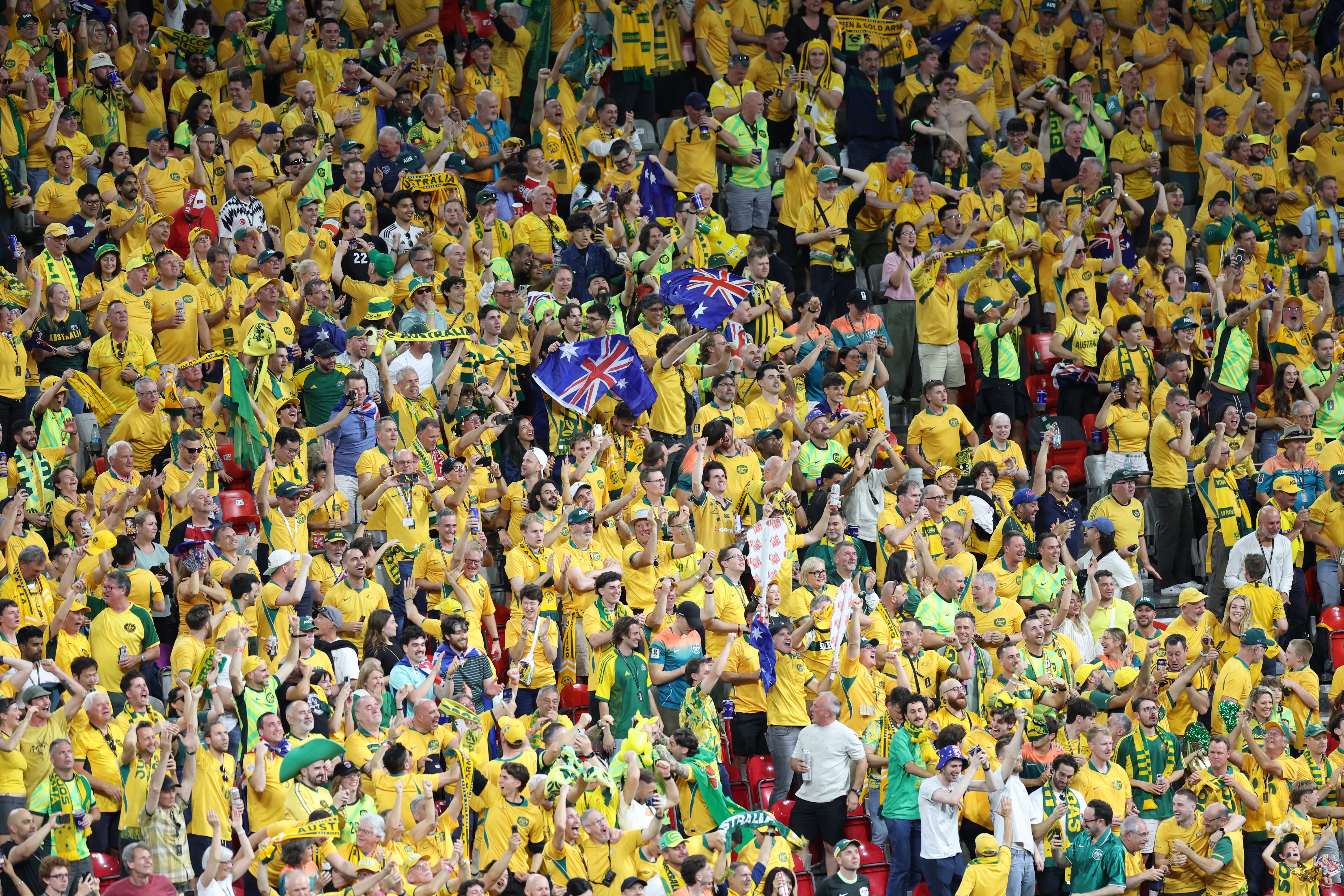
    Australian fans celebrate their team’s opening goal during the World Cup Group D soccer match against Turkey, in Vancouver, British Columbia, Saturday, June 13, 2026. (AP Photo/Emma Peterson)Emma Peterson

    “I respect Australia very much. I was expecting that they would play in this way,” said Turkey coach Vincenzo Montella, who took the team to the quarterfinals of the European championships in 2024. “This is football. As for the critics, nobody has underestimated Australia, actually.”

    It is the third World Cup appearance for the Turks, who reached the tournament for the first time in 1954.

    The teams are in Group D with the United States and Paraguay. The Americans downed Paraguay 4-1 in their group opener on Friday in Los Angeles.

    The U.S. is atop its group on goal difference over Australia, ahead of the teams’ matchup in Seattle (3 p.m., Fox29, Telemundo 62). The game was already widely-anticipated by U.S. fans, and now is even more so.

  • Britain detains sanctioned oil tanker believed to be linked to Russia’s shadow fleet

    LONDON — Armed British forces boarded and detained a sanctioned tanker Sunday that is suspected of being part of the Russian “shadow fleet,” shipping oil in violation of international sanctions over Moscow’s war on Ukraine, British Prime Minister Keir Starmer said Sunday.

    Royal Marine commandos rappelled from helicopters onto the vessel, the Smyrtos, in the English Channel, in what the country’s Defense Ministry called “the first U.K.-led operation of its kind.”

    The vessel will be held and monitored off the south coast of England for investigation, according to the Defense Ministry. The operation was carried out “in close coordination” with French authorities, who have previously intercepted a number of vessels linked to the shadow fleet.

    “This operation delivers yet another blow to Russia and reminds those fueling Putin’s war in Ukraine that they cannot hide,” Starmer said.

    Russia is believed to be using a fleet of hundreds of ships to evade sanctions over its war against Ukraine.

    Sailing under a Cameroon flag, the Smyrtos left the Russian Baltic port of Ust-Luga on June 5 destined for Port Said, Egypt, according to the MarineTraffic website.

    U.K. authorities said that such operations were “directly bearing down on the resources sustaining Russia’s aggression in Ukraine and reducing its capacity to threaten security across Europe and beyond.”

    Ukraine President Voldymyr Zelensky thanked Starmer and the British people for their “principled resolve.”

    “It was Russia’s hubris, fueled by high oil and gas revenues, that paved the way for this war, and every decision by partners that deprives Russia of money also limits the war itself,” Zelensky said on X.

    “Europe urgently needs to take legislative steps to enable not only the detention of tankers and restrictions on oil shipments, but also the confiscation of the oil they carry.”

  • Palestinian death toll in Gaza tops 73,000 as Israel launches strikes despite ceasefire

    DEIR AL-BALAH, Gaza Strip — The Palestinian death toll from the Israel-Hamas war has surpassed 73,000, Gaza’s Health Ministry said Sunday, as Israeli military operations continued despite a stalled and fragile ceasefire in place since October.

    Israel says it is targeting Hamas and other militants who pose a threat, and responding to ceasefire violations, including occasional attacks.

    Nearly 1,000 people have been killed in Gaza since the start of the ceasefire, according to the health ministry. Five Israeli soldiers have been killed since the truce.

    The number of deaths since the beginning of the war is now 73,001, according to the health ministry’s tally. Over 173,200 people have been wounded since the start of the war on Oct. 7, 2023, following the Hamas-led attack into Israel. That attack killed some 1,200 people and took 251 others hostage.

    The health ministry, part of the Hamas-led government, is staffed by medical professionals and maintains detailed records viewed as generally reliable by United Nations agencies and independent experts. It does not distinguish between civilians and militants but says women and children make up around half of all fatalities.

    Israel says it tries to avoid harming civilians and blames their deaths on Hamas because the militants operate in densely populated areas.

    Stalled ceasefire

    The U.S.-brokered ceasefire deal reached in October ended full-scale military operations and led to the return of all the remaining hostages. But other elements of the deal have stalled as Hamas has refused to disarm and Israeli troops have advanced in Gaza, rather than withdrawn. Both sides accuse the other of violating the agreement but say it is still in effect.

    Progress on all other issues — including reconstruction, Israeli troop withdrawals, and the establishment of a new Palestinian government — is being held up by the deadlock over disarming Hamas, the top diplomat overseeing the U.S.-brokered ceasefire in Gaza, Nickolay Mladenov, has said.

    The war displaced most of the Palestinian population of over 2 million, left large parts of the territory in rubble and created widespread shortages of food, medicine, and other basic supplies as the border crossings with Gaza — all but one controlled by Israel — slammed shut.

    At least eight more Palestinians killed in the weekend

    An Israeli strike on Sunday afternoon in northern Gaza’s Jabaliya refugee camp killed at least four people and wounded others, according to health officials at the Shifa hospital, where the casualties were taken. An Israeli military official, who spoke anonymously in line with military guidelines, said the military “struck terrorists” in the area, without elaborating.

    A 13-year-old boy was among five Palestinians killed in Gaza on Saturday night and into the early hours of Sunday, according to Palestinian health officials. In response to the Saturday night strike that killed two of the five, the Israeli military claimed that it was striking Hamas militants.

  • Elon Musk egged on a race riot, then became a trillionaire. What are we even doing?

    The images coming out of Belfast — the city in Northern Ireland made famous by decades of ethnic violence that came to be known simply as “the Troubles” — were horrific enough. The sight of cars and homes ablaze and hordes of masked, young men roaming the city streets brought back painful memories for old-timers.

    “I lost my teenage years to the Troubles,” a shell-shocked 71-year-old, Paul Sharkey, told the New York Times, after watching a flaming van crash near his home on the outskirts of Belfast. “I thought moving out here I had got away from them — from the bombs and bullets, all the rest of it …”

    Remarkably, no one seems to have been killed in a couple of nights of riots that targeted Belfast’s Black and brown immigrant communities after a Sudanese migrant was charged with a stabbing — captured on video — that left a white man in a coma. But terror was felt across Northern Ireland’s largest city, as volunteers raced to rescue families from burning homes, immigrant addresses were posted online, and workers were afraid to go to work after a nurse was attacked.

    And yet, there was something about this anti-immigrant pogrom in Belfast that was just as appalling as the pictures of burning streets and fleeing children. Their biggest cheerleader was not some street thug in a balaclava, but the richest person in the history of Planet Earth, urging the rioters on from some posh hideaway on the other side of the Atlantic.

    Tuesday morning, as news of the stabbing attack spread across the United Kingdom, Elon Musk took to X — the influential social media site that was called Twitter when he bought it in 2022 for $44 billion — to amplify a post by U.K. far-right extremist leader Tommy Robinson. It called for white people “to hit the streets” that night and protest what Robinson called “yet another invader attack on our people.”

    “Only by protesting REPEATEDLY and LOUDLY will there be any change!!” wrote the U.S.-based, South African-born electric-car-and-spacecraft mogul, just hours before the sadly familiar loudness of repeated explosions rocked Belfast.

    Musk’s tweet was hardly a one-off. In a flurry of X posts attacking immigration, he told his 240 million followers that British Prime Minister Keir Starmer “hates white people,” while sharing an image of the Black suspect that simply said, “Millions must go.” When his diatribes started provoking a backlash, he wrote, “Murderous migrants beheading innocent people in their hometown is what’s making people angry, not ‘social media’!”

    The nonprofit tech watchdog Center for Countering Digital Hate found that Musk’s posts about Belfast and racial politics in the U.K. were viewed an astonishing 64 million times. The center noted that the amplified posts from Robinson — banned from the pre-Musk Twitter for hate speech, but restored in 2023 — drew responses calling for lynching and other forms of violence. Musk has also been using X to promote a fringe, far-right anti-immigrant party called Restore Britain, an offshoot of the Nigel Farage-led Reform UK.

    It’s kind of bizarre that this then-billionaire not-too-busy-to-hate found the time for this, in a week where he had one job: to make sure the long-awaited stock offering of one of his major business ventures, SpaceX, launched on Friday without blowing up like some of its rockets.

    Unfortunately for the star-crossed Musk, investors’ shock and revulsion over the entrepreneur’s vile posts caused …

    OK, if you follow the news, you know that the unfinished sentence above was a little bit of cynical misdirection. Wall Street, from the biggest investment banks to starstruck small-time day traders, could not wait to throw their cash at SpaceX and its founder. They acted as if Musk the anti-immigrant hatemonger and Musk the tech visionary were two different human beings, even as they also ignored the fantastical malarkey of SpaceX’s dream to build data centers in outer space.

    By the end of a tumultuous week, the tulip-mania demand for SpaceX stock — with the market valuing the money-losing company at a gobsmacking $2.1 trillion — made the already world’s richest person wealthier in a way that defies comprehension. The man who wanted to burn everything down on Tuesday became the planet’s first trillionaire on Friday.

    Even as the globe — excepting that island of basketball joy in Gotham City — watches a decadent Donald Trump turn 80 by tarnishing the White House with a tacky ad-draped display of barbaric blood sport that would have embarrassed Caligula’s Rome, Elon Musk is truly the ultimate story of our modern empire’s decline and fall.

    The problem is which Musk story to tell. Each narrative is more shocking than the next.

    The saga I’ve started to recount here, about a man whose wealth is now greater than the yearly gross domestic product of all but the 21 richest nations, who uses that power to urge poor white people to firebomb and assault their Black and brown neighbors, isn’t even the worst thing Musk has done. Not by a long shot.

    The prequel to Belfast came just over a year ago, when Musk — after spending some $288 million, an all-time U.S. election record yet the equivalent of sofa-cushion change for a future trillionaire, to put a dictatorship-minded Trump back in the White House — was handed an all-access pass to our federal government for what was dubbed the Department of Government Efficiency, or DOGE.

    Musk and his young DOGE dudes took a chain saw — as Musk boasted by brandishing a real one — to any program that advanced world peace or the plight of its most underprivileged. In particular, the utter destruction of the U.S. Agency for International Development (USAID), which Musk bragged about tossing into a proverbial wood chipper, has been blamed by a number of experts for an unthinkable hundreds of thousands of deaths across Africa, Asia, and elsewhere from disease or hunger, with children as most of the victims.

    Remember when we were outraged that our leaders said they could shoot one person in the middle of Fifth Avenue? How quaint.

    And yet, there’s another Musk storyline on top of the obvious question of, why are so many people betting their money on literally the world’s greatest purveyor of hate speech, and the alleged architect of a born-in-the-USA genocide? That question is, why are we collectively throwing all this money at Musk at all?

    The 1990s Wharton School graduate started with some good ideas — an early stake in PayPal that gave him the funds to launch SpaceX and take over early EV leader Tesla. But his revenue stream is increasingly from the crony capitalism of government contracts, not the free market — as Chinese EV makers have been cleaning Tesla’s clock. And it’s almost lazy, yet true, to describe SpaceX’s business model as pie-in-the-sky science fiction.

    The openly racist tycoon isn’t even a good businessman, and yet he has failed upward to $1.1 trillion. I think there’s one question about Musk that towers over all the others.

    What are we even doing here?

    It’s easy to look at Musk as an amalgamation of the many, many things that are wrong with the world right now. He is a poster child for the policies that have enabled an Epstein class of billionaires with more dollars than we have the ability to count, even as thousands starve and his fellow Americans can’t pay the rent. He has so many scandals that some of them — his data center polluting a predominantly Black neighborhood in Memphis, or the DOGE cuts that could have slowed the spread of Ebola, or stopped the arrival of the screwworm striking Texas cattle — couldn’t even fit into this longer-than-typical column.

    Musk’s destructive abuse of his massive X platform has given him the power to manipulate the struggling masses into attacking each other — instead of the small circle of people hoarding the world’s wealth, led by Musk himself. When buying Twitter wasn’t enough for his obscene ambitions, he decided to buy the White House.

    When I wrote about Musk for the very first time two years ago, I reached for the obvious cliché and called him a Bond movie villain, but that was far too generous. He has devolved into one of the most problematic entrepreneurs in human history; Henry Ford behind the wheel of a Cybertruck.

    It’s past time to look inside ourselves and ask one more question: Now that Musk has shown us who he really is, why do we continue to support him? Why do millions of investors pay so much for the magic beans of Tesla and now SpaceX to endorse the lead spreader of racist ideology — putting aside the fact that his stock bubble will burst any day now?

    Why do so many leading politicians across the United States and the U.K. — liberals as well as conservatives — and supposedly socially conscious corporations, among others, still use X to convey information, when its owner uses it to promote views that really aren’t any different from David Duke or the Ku Klux Klan?

    That’s also a question for myself. In November 2024, when Trump was reelected with Musk’s support, I moved about 98% of my social media posting over to Bluesky. But I didn’t close my X account, which still had 80,000 followers, because I wanted to keep posting my columns there so a few more folks might read them.

    Today, I will make one last post on X — a link to this column, in the vain hope that the platform’s proprietor might see it, and that other folks will join me in quitting. Tonight, sometime before I sit down to watch Les Éléphants stomp Ecuador, I will delete my account for good.

    You should, too.

    We’ve all helped to create this monster, and we all can do our small part to slay the dragon. There are hopeful signs, led by the thousands who came out this weekend in Belfast and elsewhere in the U.K. to protest Musk-fueled hate. If we don’t act quickly and nonviolently to undo the massive policy failure of the world’s first trillionaire, the raging fires of Belfast are going to look like child’s play.

  • Don Mattingly, who also platooned as a young hitter, believes rookie Justin Crawford can improve against lefties

    Don Mattingly, who also platooned as a young hitter, believes rookie Justin Crawford can improve against lefties

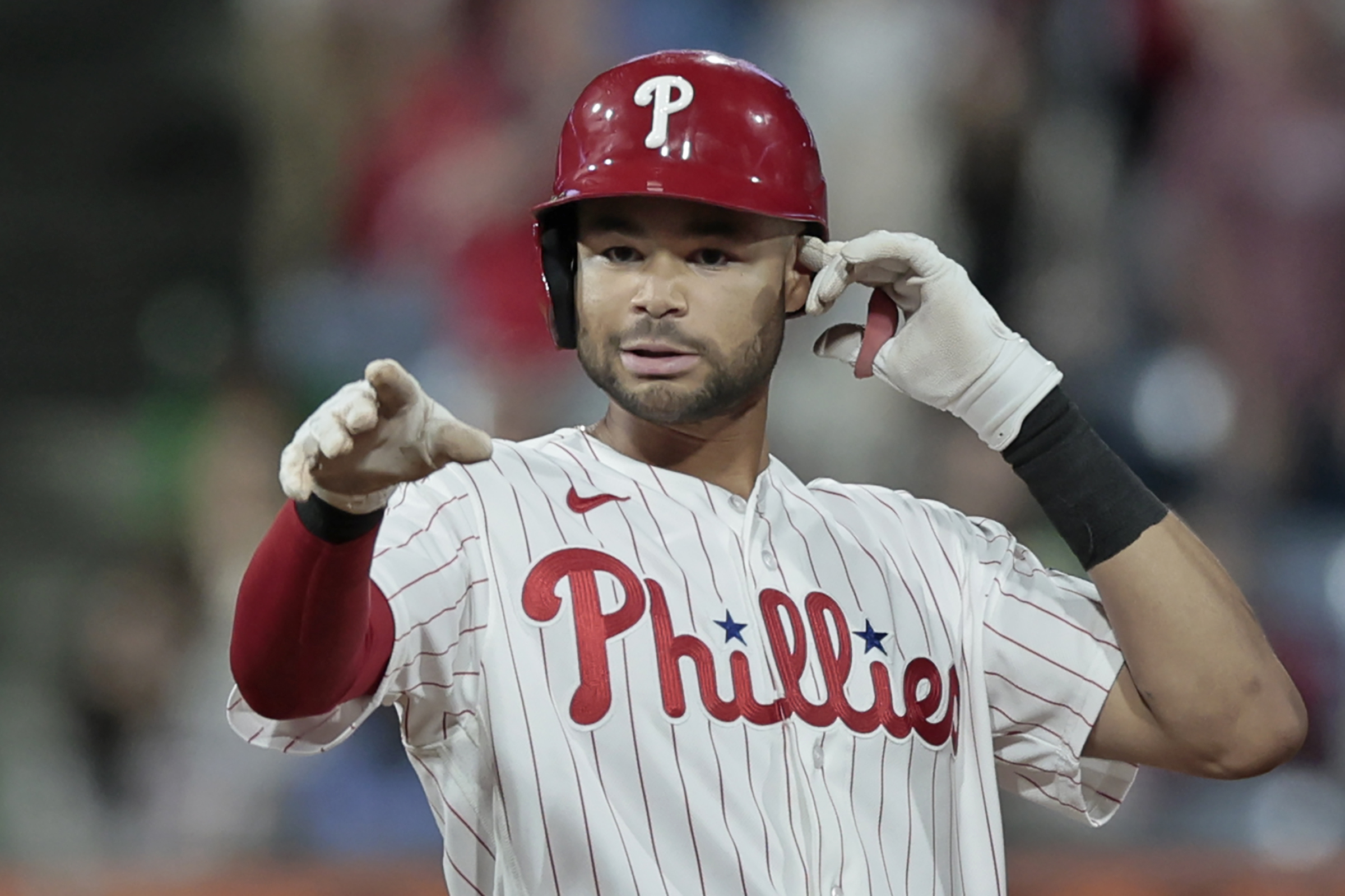
    MILWAUKEE — Justin Crawford has started once against a non-opener lefty since Don Mattingly began managing the Phillies, so let’s not call it anything other than what it is.

    “We’re pretty much platooning him,” Mattingly said.

    That wasn’t the plan when the season opened, except that Crawford, a left-handed hitter, is 4-for-28 (.143) with three walks and no extra-base hits against lefties. And so, the Phillies changed their plan for the 22-year-old rookie center fielder.

    But in relegating Crawford from an everyday role, a familiar chicken-or-egg question has resurfaced. What comes first for a young left-handed hitter: Producing against left-handed pitchers or facing them?

    The Phillies went through this with Brandon Marsh after trading for him at the deadline in 2022. Kyle Schwarber dealt with it early in his career with the Cubs. Mattingly even sat against lefties as a rookie with the Yankees in 1983 before becoming Donnie Baseball.

    For them, and other left-handed hitters who eventually solve lefties, it’s a rite of passage. For many others, it becomes a more permanent condition, especially if they don’t eventually get more at-bats against lefties.

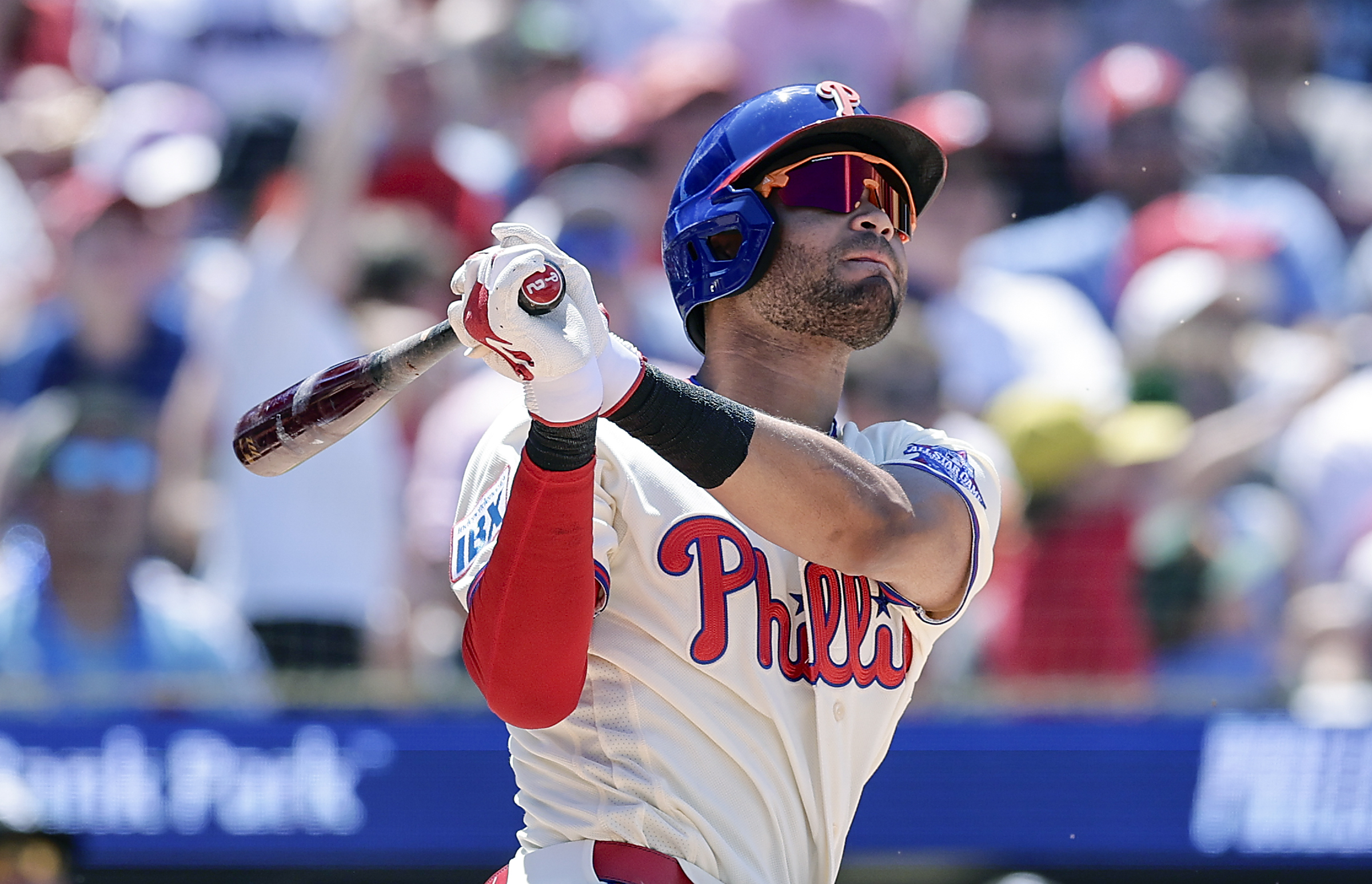
    Phillies center fielder Justin Crawford bats the Chicago White Sox on Sunday.Yong Kim / Staff Photographer

    And Mattingly, as much as anyone, is aware of the two edges of that particular sword.

    “I kind of rely on my own history because when I first came up, I platooned, and it wasn’t a terrible thing for me,” he said. “I probably would’ve struggled with the lefties. [Crawford]’s a guy that I think is going to hit lefties. But the amount of lefties we see, we don’t see a ton. So, it’s days where he can step back and keep working on his swing.”

    Besides, it’s not like Crawford is exactly teeing off on righties. He went 15-for-44 (.341) with four doubles, one triple, and an .885 OPS in his first 14 games. The league adjusted to him, and Crawford hasn’t adjusted back, going 29-for-150 (.193) with a .528 OPS in his last 50 games.

    Crawford was a polarizing prospect due to his extreme tendency to hit ground balls. Sure enough, among 253 hitters with at least 150 plate appearances, he has the second-highest ground-ball rate (59.6%).

    “There’s been ups and there’s been downs, but we knew that was going to happen with him,” president of baseball operations Dave Dombrowski said. “He has somewhat of an unusual swing. We knew that all along. Kind of sprays the ball all over the place. He’s working through it.

    “He started off a little bit quickly, but lately it’s been a little bit more of a struggle. But he keeps working, and we think he’ll work his way through it.”

    Justin Crawford reacts after he’s called out following an ABS challenge last month.Monica Herndon / Staff Photographer

    Maybe. For now, though, it will have to happen against primarily right-handed starting pitchers.

    “When you’re on that side of the platoon, you’re getting between 450 and 500 at-bats, so you’re playing regular,” Mattingly said. “I don’t think it’s something that sets him back. It will set him back a little bit from my standpoint of dealing with lefties.

    “But this is more about him having success, giving him the best chance, and then let him grow into the lefties.”

    Not out of left field

    Edmundo Sosa remains a work-in-progress left fielder. But making only his seventh start of the season there Saturday night, he made a diving catch — and replaced a sizable divot — in the fifth inning.

    “I’d say like, in general, he’s an infielder who we’re kind of getting more and more time out there in left, and he hasn’t hurt us, right?” Mattingly said. “He’s caught everything he should have caught. He’s made some nice plays. He throws the ball where he’s supposed to throw it. So, he’s been solid for us.”

    Sosa started again in left field against another lefty, the Brewers’ Kyle Harrison, in Sunday’s series finale here. In the outfield alignment against lefties, the Phillies prefer moving Marsh to right field and using newly acquired Derek Hill in center.

    (Marsh plays left field, with Crawford in center against righties. Gabriel Rincones Jr., recalled from triple A on Friday, will take over in right field for injured Adolis García.)

    The Phillies are expected to explore trading for a righty-hitting outfielder before the Aug. 3 deadline, especially after losing García to a torn lat muscle near his right shoulder. The Phillies are lining up additional medical opinions before García elects season-ending surgery.

    “It’s an important one for him and his career,” Mattingly said. “So, everybody wants to get it right and not have to rush into anything right now.”

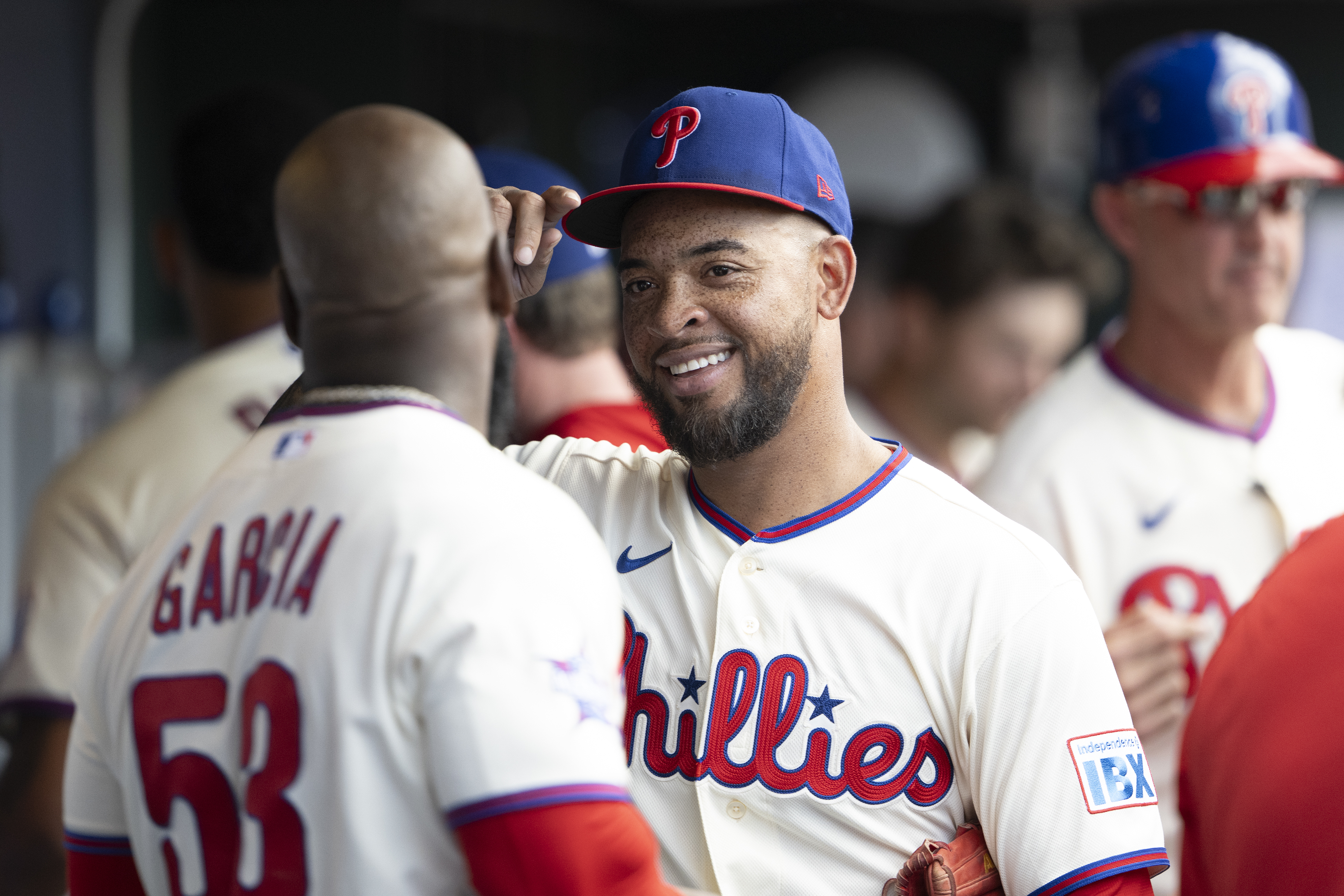
    Phillies outfielder Adolis Garcia and teammate Edmundo Sosa celebrate in the dugout against the Washington Nationals earlier this season.Jose F. Moreno / Staff Photographer

    Extra bases

    Mattingly said the Phillies may consider using a day off Friday to separate Andrew Painter and Aaron Nola in the rotation to avoid taxing the bullpen on back-to-back days. … The Phillies return home Monday night to face the Marlins. Zack Wheeler (5-1, 2.22 ERA) is scheduled to start at 6:40 p.m. against right-hander Ryan Gusto (0-1, 6.00).

  • Trump administration reignites its feud with Anthropic over latest AI models

    Trump administration reignites its feud with Anthropic over latest AI models

    WASHINGTON — The feud between Anthropic and the Trump administration escalated again Saturday after the government took the unusual step a day earlier of demanding that the artificial intelligence company cut off foreign access to its latest models, as top officials suggested the dispute was unlikely to resolve quickly.

    Late on Friday, Anthropic disclosed in a blog post that it had disabled access for all customers to its most advanced AI systems, known as Fable 5 and Mythos 5, after receiving a directive from the administration to suspend access to any foreign national. The move shocked former U.S. officials and cybersecurity experts, many of whom questioned the validity of the action and noted that it diverged from the hands-off approach to policing the booming AI industry that President Donald Trump had endorsed earlier this month.

    Anthropic said the directive did not explain the national security concerns that prompted it. But the company added that the government had said that it became aware of a method to “jailbreak,” or bypass, security restrictions on Fable 5 intended to limit a customer’s ability to abuse the product for hacking or other potential harms. Anthropic countered that the fears about the jailbreak method were overblown.

    The announcement inflamed tensions between the Trump administration and Anthropic, which earlier this month confidentially filed for an initial public offering following a funding round valuing it at nearly $1 trillion. The two sides have sparred for months over how Anthropic’s AI systems could be used in military and intelligence settings, culminating with the Pentagon labeling the company a supply-chain risk.

    On Saturday, top Trump administration officials and allies of Trump’s stepped up their attacks on Anthropic.

    “Three months ago, @DeptofWar kicked @AnthropicAI out of our building — forever,” Defense Secretary Pete Hegseth said on the social platform X. “Every passing day proves why that was the right move.”

    David Sacks, a venture capitalist who until recently worked in the administration as an AI czar, accused Anthropic in a lengthy social media post Saturday of being reckless with the release of its latest model, dubbed Fable 5.

    Sacks, who said he had spoken to many people inside and outside the administration about the directive, said the administration had asked Dario Amodei, Anthropic’s CEO, to fix the jailbreak issue after a “highly credible trusted partner” of Anthropic’s and the government’s came forward with research.

    “Dario refused,” Sacks said.

    A person briefed on Amodei’s conversations disputed the account, saying that Anthropic was happy to discuss the concerns.

    Sacks did not name the “trusted partner” he referred to in his post. But multiple technology firms, including Amazon, spoke with the White House about the security issues, according to people familiar with the matter. Several of the people said a message from Amazon’s CEO, Andy Jassy, detailing security issues was the most influential, raising concerns about the capabilities of the new Anthropic model.

    But several of these officials said a separate document from Amazon explaining the security concerns with Anthropic’s model was misleading. The concerning capabilities that the document highlighted with Anthropic’s model are also present in OpenAI’s top model, 5.5.

    An Amazon spokesperson declined to comment on the exact nature of its discussions with the White House. “It’s not uncommon for governments to seek our counsel on potential security risks,” the spokesperson said. “When they occur, we don’t share the details of these discussions.”

    Administration officials called Anthropic officials at 1:15 p.m. Friday and gave them 90 minutes to pull their most advanced models down, citing an undefined national security concern, according to people briefed on the discussions. Anthropic officials asked for more information and worked to learn what the precise concern was, since the Commerce Department’s review and testing of Fable did not reveal significant concerns.

    Then, at 5:21 p.m., Anthropic was notified that the Trump administration was imposing export controls that effectively forced the company to pull down its model, which consumers had just begun to have access to.

    Discussions about resolving the dispute are continuing. Howard Lutnick, the commerce secretary, spoke to Anthropic officials Friday, and was set to have another session with senior company officials Saturday evening, according to people briefed on the discussions and plans.

    Some experts said the Trump administration was either misunderstanding or deliberately misconstruing what transpired. Katie Moussouris, the CEO of Luta Security, said on social media that she had seen the research paper that prompted the administration’s actions.

    “It’s not a jailbreak,” she said, but rather a defensive maneuver designed to limit the misuse of a model. “If national defense is the goal, this is an own goal.”

    Earlier this month, the Trump administration issued an executive order that asked technology companies to voluntarily let the government review their new models before releasing them to the public. But it did not give the government an official role in approving their release.

    The order had been delayed after a fierce debate in which AI companies — and some sympathetic government officials — had pushed back against the government interfering in model deployment. The dispute came on the heels of Anthropic’s very limited release of Mythos, an AI model so good at discovering and weaponizing new cybersecurity vulnerabilities that it sparked widespread concerns about its potential to wreak havoc.

    The new restrictions on Anthropic have raised questions about the implications for other AI models that may have similar capabilities. Former officials and technology experts said the administration did not appear to have thought through the longer-term ramifications of such a move.

    But the measure could be limited to Anthropic, which received a fusillade of attacks from the administration in recent months.

    In February, amid the Pentagon’s clash with Anthropic, Trump called the company a “radical left, woke company” and “Leftwing nut jobs” working to dictate how the government wins and fights wars.

    “I am directing EVERY Federal Agency in the United States Government to IMMEDIATELY CEASE all use of Anthropic’s technology,” the president wrote on social media. “We don’t need it, we don’t want it, and will not do business with them again!”

    Some administration officials have in recent weeks been looking for an off-ramp in the dispute, U.S. officials say. White House and intelligence officials have pushed forward a classified contract between Anthropic and the National Security Agency, which would allow the spy agency to use the company’s technology for a variety of purposes, including intelligence analysis and detecting new computer vulnerabilities.

    Officials at the NSA, which is responsible for digital eavesdropping and government cybersecurity, were not involved in Friday’s decision, according to people familiar with the matter.

    Many U.S. officials said the new technology Anthropic had developed was too important to national security to allow the dispute with the Pentagon to block cooperation. But inside the top ranks of the Pentagon, officials remain upset with the company, insisting that the firm sign on to the same contractual provisions that other AI companies have embraced.

    In a June 12 letter viewed by the New York Times, Lutnick told Amodei that a special license would be required for the company to distribute its Mythos and Fable 5 models “to all destinations worldwide,” as well as to share them with non-U.S. citizens.

    “Failure to comply will result in prompt criminal and civil penalties, as provided for by law,” Lutnick wrote.

    The government has controlled AI models before, but past restrictions were more targeted. A measure introduced early last year by the Biden administration placed restrictions on companies’ ability to export the so-called weights for specific AI models — the proprietary numerical values that tell the model how much importance to place on different pieces of data.

    The measure taken by the Trump administration goes far beyond that, by barring Anthropic from sharing the model with any foreign country or any foreign national without first obtaining a license.

    The restrictions on the involvement of foreign nationals, even those with green cards, could be particularly chilling in an industry that relies on foreign talent. In the past, government officials have often reserved that type of restriction for the most sensitive technologies, like weapons systems.

    Chris McGuire, a former Biden administration technology official who is now a senior fellow at the Council on Foreign Relations, said that the administration’s current policy is that AI chips can be exported to China, but Canadian green card holders in the United States cannot access leading U.S. models.

    “That’s absurd,” he added.

    This article originally appeared in the New York Times.
  • Putin, Zelensky speak with Trump by phone as drone strikes kill 2 in Russia

    Russian President Vladimir Putin and Ukrainian President Volodymyr Zelensky each spoke by phone with U.S. President Donald Trump on Sunday, as Trump marked his 80th birthday and the war in Ukraine remained a flashpoint ahead of this week’s G7 summit.

    Putin’s call with Trump lasted just under an hour, according to Russian presidential aide Yuri Ushakov, who briefed reporters afterward.

    On Ukraine, Ushakov said Trump emphasized the need to end hostilities and stated his readiness to influence European allies and Kyiv toward that goal, including at the upcoming G7 summit.

    Trump also said that recent strikes on civilian targets in Russia complicate a settlement — though the White House has not confirmed that, nor commented on the call — and said that ending the war quickly could open the door to “a truly new quality of U.S.-Russian relations,” Ushakov quoted him as saying.

    Putin, for his part, argued that attacks on Russian civilian infrastructure by Kyiv would not change Ukraine’s position on the battlefield, and said that if Zelensky wants a meeting with him, “let him come to Moscow,” according to Ushakov.

    U.S. envoy Steve Witkoff and Trump’s son-in-law Jared Kushner are expected to travel to Russia soon, Ushakov said.

    The leaders also discussed Iran, where Trump said a U.S. agreement with Tehran was close and that he hoped the results of the talks could be made public Sunday, Ushakov said.

    Zelensky said in a statement on Telegram Sunday that he had a “wonderful conversation” with Trump.

    Beyond congratulating Trump on his birthday, the Ukrainian president said he thanked the U.S. president for supporting Ukraine.

    He said they discussed “what could help bring peace closer now,” without providing details. Zelensky also informed Trump about how Ukraine’s position along the eastern front line has improved and strengthened.

    “We agreed to discuss more during our meeting at the G7 summit,” he said.

    The calls came as Trump prepared to mark his birthday with a UFC fight on the White House lawn Sunday evening, an event without precedent in American history. Once it concludes, Trumpwas set to fly overnight to France for the G7 summit, where Ukraine is expected to be a major topic of discussion Tuesday and Zelensky is due to join the gathering.

    Russia’s war in Ukraine has long frustrated Trump, who as a candidate claimed he could end the conflict within 24 hours of taking office. He has since stopped making such claims and tends to pivot away from the topic when pressed. He has also grown increasingly vexed by the war between Israel and Iran, which has driven up gas prices, rattled financial markets, and stoked concerns about inflation.

    The diplomatic exchanges came against the backdrop of continued fighting. Ukrainian drone attacks killed one person and wounded nine others overnight in a residential building in the regional capital of Russia’s Oryol region, Gov. Andrei Klychkov said Sunday. Another drone attack killed one person Sunday in Russia’s Bryansk region, local authorities said.

    A separate drone strike hit fuel storage facilities in Russia’s Yaroslavl region, around 440 miles from the Ukrainian border, sparking fires. Zelensky said the strike had hit “an oil facility that was important for the reserve of the aggressor state.”

    Ukraine has stepped up attacks on Russian oil and gas infrastructure in recent months, arguing the sector funds Moscow’s invasion.

  • Deal is reached to end Iran war and Trump orders stop to US naval blockade

    ISLAMABAD — The United States and Iran have reached an initial agreement to end their war and open the Strait of Hormuz, offering relief to the Gulf region and global economy more than three months since fighting began.

    Details of the deal were not immediately released and Iran signaled implementation would not start until the signing, which key mediator Pakistan said would occur Friday in Switzerland. It was expected to extend the tenuous ceasefire reached in April so that negotiators can try to resolve thorny issues such as Iran’s nuclear program and related sanctions.

    There was no immediate word from Israel, which together with the U.S. started the war on Feb. 28 but has expressed skepticism about the negotiations.

    But even as it became clear the parties still have days to influence what lies ahead, the announcements had an air of relief.

    “Congratulations to all!” U.S. President Donald Trump wrote on social media, adding: “I hereby fully authorize the toll free opening of the Strait of Hormuz, and, simultaneously herewith, authorize the immediate removal of the United States Naval blockade,” imposed in retaliation for Iran’s grip on the crucial waterway.

    He soon hedged, however, saying the strait wouldn’t open until Friday’s signing. The U.S. previously said it would ease its blockade of Iranian ports as the strait reopens, and would agree to relax sanctions to allow Iran to sell more of its oil and strengthen its battered economy.

    Iran’s deputy foreign minister, Kazem Gharibabadi, confirmed the agreement on state television but said Iran would not start implementing it until it was signed on Friday. He said the deal followed talks with Qatar, another mediator.

    Qatari mediators later left Tehran following 17 hours of negotiations, said an official briefed on the developments who spoke on condition of anonymity due to sensitivity of the talks. Separate preparatory meetings with each side will take place in Doha this week, the official said.

    After months of fighting, a ‘critical step’ is taken to end the war

    “This represents a critical step towards the peaceful settlement of the conflict,” the spokesperson for the United Nations secretary-general said of the deal and framework for further negotiations.

    Pakistan first announced the deal after a day in which Israel, sidelined from the negotiations, attacked Beirut’s southern suburbs while pursuing the Iranian-backed Hezbollah. Iran’s deputy foreign minister hinted at the tensions that caused, saying “our armed forces were fully prepared to give a decisive response to Israel’s actions.”

    Pakistani Prime Minister Shehbaz Sharif said “both sides have declared the immediate and permanent termination of military operations on all fronts, including in Lebanon,” adding that mediators this week will facilitate meetings to “lay the foundation for the technical talks.”

    There was no immediate comment from Israel, which had criticized the emerging deal. Iran wanted a ceasefire deal to include Lebanon, where Israel has pushed its invasion deeper than at any point in over a quarter-century.

    Iranian state TV later cited the secretariat of the Supreme National Security Council saying the war on all fronts “will end immediately and permanently beginning tonight” — but that the U.S. blockade “will be terminated immediately and in full.”

    It was not clear who from Iran would sign the deal on Friday. U.S. Vice President JD Vance told Fox News the White House was still figuring out who would attend: “I certainly plan to be there, but it’s possible the president himself could be there.”

    The deal came under criticism even in the final hours

    Broader negotiations on outstanding issues like Iran’s nuclear program would continue over the next 60 days, two senior Pakistani officials said earlier Sunday, speaking on condition of anonymity because they were not authorized to discuss the matter publicly. If the sides fail to reach a resolution within that time, the timeline could be extended.

    The deal likely returns the region to a status that existed before the war, but with thousands of people dead and Iran wielding a new source of negotiating pressure with its ability to influence shipping in the strait. The waterway is crucial to significant shipments of oil, natural gas and related products like fertilizer, and its effective closure rocked the global economy.

    Even with a deal, it will take months for oil and gas supplies to flow freely enough for the world’s needs to be met because shipping and insurance companies want to be confident the agreement will last, energy experts said.

    Of the stated targets by the U.S. and Israel when they launched the war on Feb. 28 with strikes that killed Iran’s supreme leader, Ayatollah Ali Khamenei, Tehran still has a missile program, support for armed proxies in the region like Hezbollah and a stockpile of highly enriched uranium for its nuclear program.

    Khamenei’s son is now supreme leader, though he has not been seen in the public since the war began. His approval was needed for Iran to sign off on the deal.

    There was apparent friction inside Iran in the hours before the announcement, as the government warned that division at home over the deal weakens its negotiating position. Iranian President Masoud Pezeshkian called it a “disgrace” when someone stands before parliament and calls anyone who negotiates a traitor.

    The emerging deal had been sharply criticized by critics in Trump’s own Republican Party. Some said it did not improve on the terms of the 2015 Iran nuclear deal that Trump withdrew the U.S. from during his first term and still describes as “bad.”

    The central question of Iran’s nuclear program remains

    After the war began, Iran attacked Israel and several Arab Gulf nations with missiles and drones. A ceasefire was reached on April 7. Ten days later, the U.S. military imposed its blockade. A historic face-to-face meeting between Vice President JD Vance and Iranian parliament speaker Mohammad Bagher Qalibaf ended without success.

    Throughout negotiations, Trump alternatively threatened to destroy Iranian infrastructure, even its civilization, and praised the relationship with Iran as “more professional” as his administration sought an exit from the war with midterm U.S. elections coming later this year.

    Iran’s government, with its own tensions around hard-liners as it scrambled to replace several top officials killed in the war, repeatedly expressed wariness of negotiations after rounds of talks last year and early this year ended with U.S. and Israeli attacks.

    Tehran has emphasized that it wanted a deal to focus on ending the war, with discussions put off until later on its nuclear program — the issue at the center of it all.

    Iran has 440.9 kilograms (972 pounds) of uranium that is enriched up to 60% purity, a short, technical step from weapons-grade levels of 90%, according to the International Atomic Energy Agency.

    Iran has long maintained its nuclear program is peaceful and has not publicly committed to giving up the enriched uranium, which is believed to be buried under three nuclear sites that were badly damaged by U.S. strikes last year.

    At times, the U.S. had sought the removal of the enriched uranium from Iran as part of a deal. Russia has offered to take it. At other times, Trump said he wanted the uranium destroyed.

  • Sports betting was once widely outlawed. Now it’s promoted at the White House.

    Sports betting was once widely outlawed. Now it’s promoted at the White House.

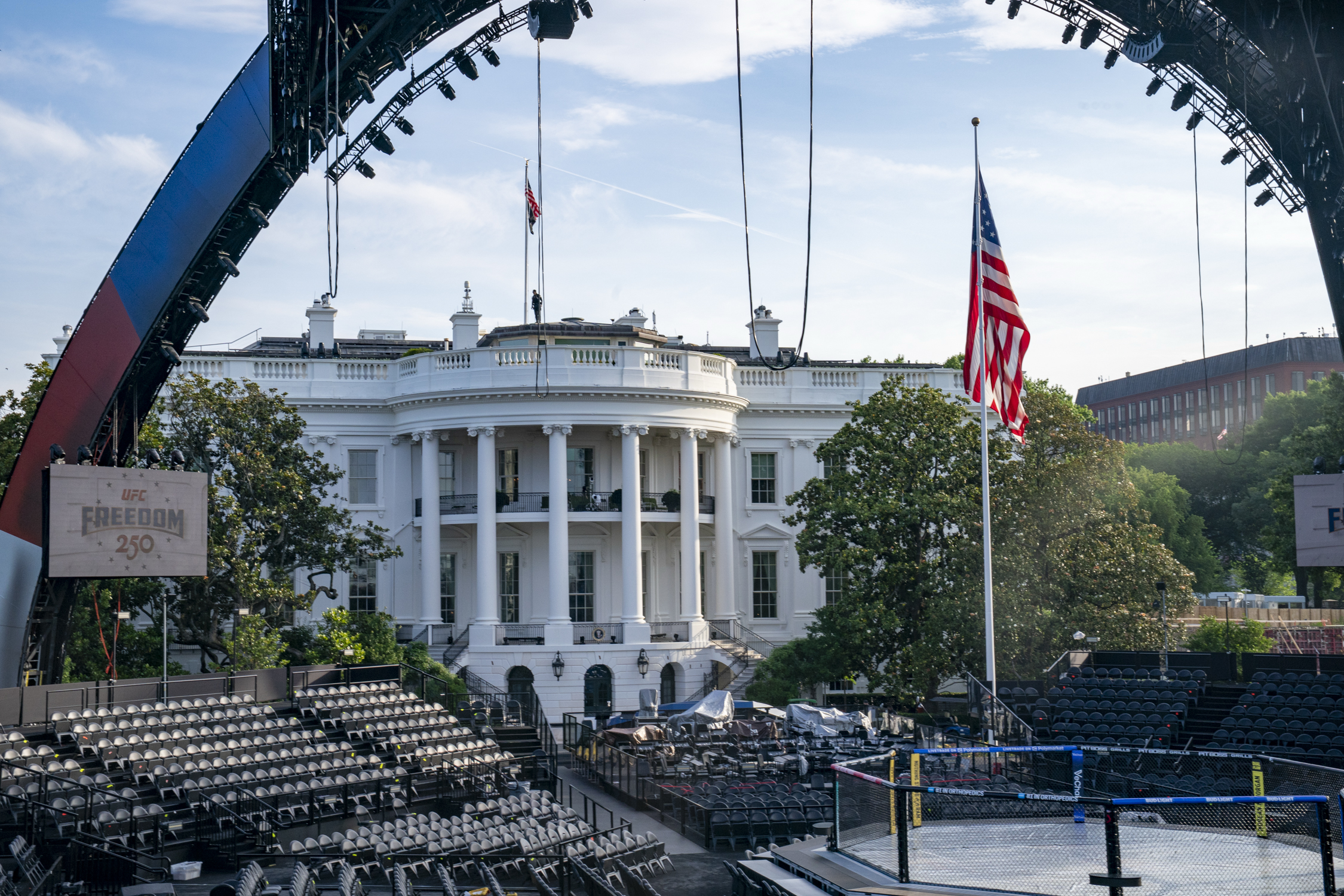
    The walls of the eight-sided cage where fighters will pummel each other Sunday on the South Lawn of the White House were plastered with logos for Polymarket, the prediction market where traders had staked millions on the fights.

    Across sportsbooks, fans are placing bets on whether President Donald Trump will receive a birthday cake at the event, whether first lady Melania Trump will appear at his side, or whether the now-80-year-old president will fall asleep during a bout.

    Less than a decade ago, wagering on a sporting event was a crime in all but a handful of states. On Sunday, the mat of the octagon Trump ordered placed on White House grounds advertised for Stake, a Caribbean-based online casino and sportsbook.

    Welcome to UFC Freedom 250 — and to the latest improbable milestone in the transformation of betting from a shadowy, mostly illegal pastime into a mainstream force in American sports, culture, and politics.

    The event marks a triumph for an industry that has grown into a multibillion-dollar juggernaut in eight years — and is now expanding beyond sports through prediction markets such as Polymarket, which allow users to wager on everything from Ultimate Fighting Championship fights to election contests and more. But the industry’s embrace by the White House comes as lawmakers and regulators face the consequences of an explosion in legal gambling, including addiction and mounting consumer debt.

    “Right now it’s certainly in its heyday,” said Bradley Tusk, a political strategist who helped FanDuel navigate gambling laws more than a decade ago and is now advising prediction markets.

    Trump, a former Atlantic City casino owner, has emerged as a natural ally for the sports betting and prediction market industries. He purchased $35,000 to $50,000 of stock in DraftKings earlier this year, according to his financial disclosure filings, and his social media company, Truth Social, also has said it is working with Crypto.com to launch its own prediction market, Truth Predict. Crypto.com’s logo appeared on the steps to the UFC cage, and it was a primary sponsor of the Sunday fights.

    In April, Trump said that he was “never much in favor” of prediction markets but later told reporters, “A lot of other countries are doing it, and when the other countries do it, we get left out in the cold if we don’t do it.”

    “I know people that are in the prediction market business, and they’re pretty happy with it,” he added. Trump’s son Donald Trump Jr. has invested in Polymarket through his venture capital firm, and he has advised both Polymarket and Kalshi.

    Trump “sort of embodies the casino capitalism of the late 20th and early 21st century,” said Jonathan D. Cohen, who leads gambling policy at the American Institute for Boys and Men. “It makes too much sense that his family would have personal investments in the prediction markets and support the rise of gambling on everything, and place a UFC fight on the White House lawn.”

    The White House said in a statement that the Trump family’s investments do not pose a conflict of interest, promising that the UFC fights would be “one of the greatest and most historic sports events in history.”

    “President Trump only acts in the best interests of the American public — which is why they overwhelmingly reelected him to this office, despite years of lies and false accusations against him and his businesses,” White House spokesperson Davis Ingle said. “President Trump’s assets are in a trust managed by his children.”

    UFC and Stake did not respond to requests for comment. Polymarket said in a statement that it was “proud to sponsor” the White House fight.

    The White House fights were not expected to generate an unusual volume of betting for UFC matches, said Chris Grove, partner emeritus at Eilers & Krejcik Gaming, a research firm focused on the global gambling industry. He anticipated that the total volume of wagers and trades would be measured in the tens of millions, rather than the hundreds of millions — far smaller than for major sports betting events such as the Super Bowl or FIFA World Cup.

    But the event’s role as a billboard for the betting industry has attracted criticism.

    “It’s an abomination that we have these sports betting markets sponsoring something that’s happening on the lawn of the chief executive officer of the United States,” said Joel Griffith, a senior fellow at Advancing American Freedom, a conservative think tank founded by former Vice President Mike Pence. “It shows that there’s a lot of money to be made in this business. Unfortunately, [sports betting] is harming Americans.”

    Griffith also said he’s “deeply troubled” by the potential conflicts of interest posed by the president’s investments in betting markets and in UFC while hosting an event that advertises both businesses.

    Congress advanced bipartisan legislation in 1992 that outlawed sports betting in every state except Nevada, highlighting how politically unpopular it once was to support the practice. Oregon, Delaware, and Montana had limited carve-outs.

    But since the Supreme Court struck down that law in 2018, 39 states have legalized sports betting, and bettors have wagered more than $650 billion, according to estimates from Legal Sports Report. The decision enabled the rise of companies such as FanDuel and DraftKings, which allowed people to bet on games directly from their cellphones.

    Internet searches for help with gambling addiction, such as “am I addicted to gambling,” have cumulatively increased 23% nationally since the 2018 Supreme Court decision, according to 2025 research from the University of California at San Diego Qualcomm Institute and School of Medicine.

    The rise of prediction markets such as Kalshi and Polymarket also has provided a new avenue for people to bet. Combined monthly global trading volume on the platforms has risen from less than $5 billion in September 2025 to about $24 billion in April 2026, according to Pew Research Center’s analysis of data from the Block, a digital assets media and information firm.

    The administration proposed new regulations for prediction markets Wednesday that are aimed at allowing most wagering, while restricting bets that are particularly vulnerable to manipulation and those that aren’t in the public interest, such as bets related to terrorism, assassination, or war.

    Multiple lawmakers have proposed bills that would regulate prediction markets. One from Sens. Adam Schiff (D., Calif.) and John Curtis (R., Utah) would bar prediction markets from offering sports betting, which they argue circumvents state gaming laws and legalizes sports betting nationwide.

    The administration’s proposed rule is “a backdoor for legalized sports gambling,” Schiff said in a statement, adding, “the sight of profiteering and gambling on the White House lawn in celebration of [Trump’s] birthday is problematic enough, we must ensure it is not compounded by insider trading and other conflicts of interest.”

    Other proposals would regulate the markets and ban elected officials from trading on them, or ban betting on sensitive events such as war, terrorism, and elections as well as sports.

    Lawmakers in Congress also are trying to rein in their own access to prediction markets, raising concerns about conflicts of interest and insider trading. The Senate passed a resolution in April prohibiting senators and staff from using prediction markets, and Rep. Bryan Steil (R., Wisc.) is working on legislation to ban current and former members and candidates from betting on political events.

    But such legislation faces an uncertain future as long as Trump is in the White House and holds veto power.

    “There’s lots of concern from both sides of the aisle about prediction markets, but there’s also this gnawing sense that the White House will block any attempt to rein them in,” said Cohen, who also wrote Losing Big: America’s Reckless Bet on Sports Gambling. “It’s going to get bigger before it gets smaller.”