Blog

  • Australia is up next in the USMNT’s World Cup run. Here’s how we think this one will shake out.

    With the United States exhibiting one of its best opening performances in the history of the men’s World Cup, expectations are high for the team’s second Group D match against Australia on Friday (3 p.m., Fox29).

    Reports indicate that the U.S. men’s soccer team, which thumped Paraguay, 4-1, in its opener last Saturday, expects a physical affair against the Australians, who surprised many in their 2-0 upset of Group D favorites Turkey in its opener in Vancouver.

    This game is a rematch of an uber-physical game last October that broke out into a few skirmishes and in which the Aussies attempted to bully the U.S.

    The final score: United States 2, Australia 1.

    Now, the pair are running it back. A win is another step closer to the U.S. winning the group or at least assuring a place in the knockout rounds. However, the Australians know that they could leapfrog the U.S. with a win and put themselves in the driver’s seat to win the group with a game remaining against Paraguay.

    U.S. midfielder Sebastian Berhalter said earlier this week that head coach Mauricio Pochettino has the group in a “We’re American, we don’t take s—” mentality, which served the team pretty well against Paraguay.

    How will it look against the Aussies?

    Our group covering the World Cup and embedded with the U.S. camp in Irvine, Calif., weighed in and offered predictions.

    Jonathan Tannenwald

    I said this in my report from the U.S. camp on Tuesday, and I meant it: As great as the opening win over Paraguay was, it was just one game. I expect Australia to be a very different opponent, tighter defensively and more physical. Though the Socceroos’ win over Turkey was an upset, it was no fluke. It took just one game for Nestory Irankunda to justify the hype as a breakout star this summer.

    It also was a physical contest when these teams met last October in a friendly in suburban Denver, one the U.S. came from behind to win 2-1.

    No doubt both teams will be even more up for it this time, with first place in Group D at stake. So what will make the difference?

    Christian Pulisic has been dealing with an injury but is expected to be available for the game against Australia. Jonathan Tannenwald

    I’ll be romantic for a moment and say the atmosphere in Seattle is worth at least one goal for the U.S. If you’re new to soccer or only watch European games, you’re in for something you might not have seen from the sport in this country.

    For over half a century, Seattle has been one of the best soccer cities in this country. It will be electric for this game, which has been a bucket-list item for fans ever since it was first announced in February 2024 that the U.S. would play its second group game there.

    World Cups are about players and tactics, but they’re also about emotions. This will be a moment for that.

    Prediction: United States 2, Australia 1.

    Kerith Gabriel

    The beauty of this one is that, like Paraguay, the core group of this U.S. men’s national team was on the field when they beat the Australians in that October friendly. Haji Wright scored twice. Chris Richards was there. So was Weston McKennie. Even Christian Pulisic, before he suffered a minor hamstring injury and left midway through the first half.

    The point is, having that match so close to the World Cup feels serendipitous. Australia is big, strong, and has goal scorers, but I’d give the edge to the U.S. for more creativity and skill, specifically up top.

    They’ll need to keep an eye on Connor Metcalfe, the Socceroos’ crafty center midfielder who plays for St. Pauli FC in Germany’s Bundesliga. Metcalfe’s vision was a catalyst behind many of Australia’s chances and he scored his nation’s crucial second goal against Turkey.

    Come out flat, and the Aussies will make it a game. Come out as the U.S. did in the opener, creating one opportunity after another in the final third, and I don’t see a world in which the U.S. isn’t celebrating a win in front of a sold-out Seattle crowd.

    Prediction: United States 3, Australia 1.

    Matt Breen

    I was talking to someone last Thursday when I told them I thought the U.S. was still a World Cup away from making noise. And then I watched them play like that on Friday night. I was in awe as the U.S. dominated Paraguay, playing like no American team I’d ever seen. It was beautiful. To me, it was the best performance in the history of American soccer. It felt like a hot take, but then people who have seen more than me all seemed to agree.

    What we watched in the opener wasn’t a mirage. It was a byproduct of a U.S. system that is investing in youth development, a legitimate domestic league, and a team full of players who play for top-flight clubs led by a wizard-like manager. You’ll hear a lot about 2002 before Friday but remember that the 2002 team started just five players in the upset of Portugal who didn’t play in MLS. On Friday, the U.S. lineup included just two MLS players. The talent is just so much deeper, and it showed against Paraguay. This was different.

    Friday felt like the start of a magical summer. The ride will continue against Australia, who won’t be able to beat the U.S. playing the way it did against Turkey. The Socceroos upset Turkey despite being outshot, 30-9. They parked the bus, and it worked. It won’t against the U.S., which are far more creative up front than Turkey. The U.S. will not be shut out if it takes 30 shots on Friday afternoon.

    Christian Pulisic looked like a man on a mission in his 45 minutes, and he seems on track to play Friday, Tyler Adams was excellent in the midfield, Malik Tillman made some fantastic passes, and the flight attendant who refused to let Folarin Balogun’s pregnant mother leave New York years ago might be responsible for a summer to remember. The U.S. no longer feels like they’re a “World Cup away.” Enjoy the ride.

    Prediction: United States 3, Australia 1

    Owen Hewitt

    The U.S. outperformed my optimistic prediction for its opener with a 4-1 thrashing of Paraguay on Friday. It was a dream start for the American side, but as Jonathan Tannenwald wrote on Tuesday, the win only matters if the U.S. can follow it up with two more quality performances in group play.

    Can the U.S. contend with a fierce Australian side that surprised the rest of Group D with a 2-0 win over Turkey? It should be able to, though that task will get more complicated if Pulisic, nursing his hamstring, isn’t fully healthy.

    The USMNT will need to be vigilant when defending counter attacks, as Australia was brilliant on breaks in its opening match.

    Pulisic or not, one of the States’ plethora of talented attackers will break through the fierce Australian low block that stymied Turkey, and the defense will hold up in transition to put the Americans atop Group D.

    Prediction: United States 1, Australia 0

    Rob Tornoe

    OK, I’ll be the party pooper.

    The U.S. is bound for a bit of a letdown after their high-flying victory against Paraguay. One question I have is the health of Pulisic, who was pulled at halftime after being kicked in the calf. As Tannenwald reported, Pulisic is expected to be healthy for their matchup with Australia but trained mostly on his own Wednesday.

    There’s also history to contend with. In 2002, the U.S. pulled off a major upset by defeating Portugal, but followed it up with a tie against South Korea in a hard-fought game they were lucky not to lose.

    Australia is coming off a 2-0 upset victory of Turkey, and Irankunda could present some real challenges for America’s defense. The Socceroos also played the U.S. tough in a physical friendly back in October, which the Americans ultimately won, 2-1.

    Thankfully, the atmosphere in Seattle will be terrific, and that will count for something. The U.S. will remain in first place in Group D following the game, but it won’t be because of a victory.

    Prediction: United States 1, Australia 1.

  • Clouds of black smoke rise over Moscow after Ukrainian drones hit an oil refinery

    Ukraine hit a major Moscow oil refinery for a second time in a week and disrupted commercial flights at the city’s airports in one of its biggest drone attacks since Russia’s all-out invasion of its neighbor more than four years ago, Russian officials said Thursday.

    The attack came hours after Ukrainian President Volodymyr Zelenskyy said he had held “an important coordination call” with the presidents of the United States and France, and had won key pledges of further support from the G7 summit this week.

    Zelenskyy was expected in Brussels later Thursday for talks with NATO and European Union leaders, including discussions about the possible building of a continental system to protect against ballistic missiles. Russia has relentlessly struck Ukraine with those types of missiles, which air defenses struggle to counter.

    Ukraine has repeatedly targeted Russia’s oil facilities, aiming to cut Moscow’s revenue for the war and make Russians feel the consequences of the invasion. Some areas have reported fuel shortages.

    Ukrainian Foreign Minister Andrii Sybiha said on X: “One of the most popular questions asked by Muscovites this morning is ‘What is going on?’ I can answer. Your country started a war of aggression against ours. For years, it has been killing our people. Now that you know what’s going on, ask Putin when he is planning to end it.”

    Huge fires rage at Moscow refinery near Kremlin

    Images and video released by the Russian media showed massive fires raging at the Moscow Oil Refinery, located about 15 kilometers (9 miles) from the Kremlin. Thick black clouds of smoke rose over the city.

    The refinery is one of Russia’s biggest, according to its official website, and produces more than a third of the Moscow region’s fuel. It was last attacked by Ukrainian drones on Tuesday, catching fire, but officials said the blaze was swiftly put out.

    Flights from four Moscow airports were temporarily halted, transport and aviation authorities said.

    In the Moscow region, which surrounds but does not include the capital city, a drone hit a residential building in the town of Zhukovsky, and the building was being evacuated, according to Gov. Andrei Vorobyov.

    Buildings elsewhere in the region were damaged by drone debris and 16 people, including two children, were wounded, according to Vorobyov.

    Ukrainian drone attack embarrasses Putin again

    The Russian Defense Ministry said that its air defenses overnight shot down 555 Ukrainian drones over multiple regions, with almost 200 intercepted as they were approaching the Russian capital.

    That was roughly double the number of drones that Russia launched at Ukraine overnight, according to the Ukrainian air force.

    The attack was the latest embarrassment for Russian President Vladimir Putin, after a Ukrainian drone attack on his hometown of St. Petersburg earlier this month just as he held a showcase economic forum in the city with foreign VIP visitors.

    Putin on Thursday was in Kazan, some 700 kilometers (430 miles) east of Moscow, hosting leaders of the Association of Southeast Asian Nations as Russia seeks to bolster business and other ties with the nations of the regional bloc.

    Zelenskyy said the attack on Moscow was part of Ukraine’s efforts to force Putin to the negotiating table. The Ukrainian president has accepted an unconditional ceasefire demanded by Trump but Putin has refused, and U.S.-led peace efforts have petered out.

    “If Putin does not want to end this war and wants to continue it, we will not sit quietly — we will respond,” he added in a voice message to a group chat with journalists.

    Ukraine disrupts Russian supply lines with drones

    As well as pledges of more diplomatic and military help at the G7 summit, Ukraine recently has gained momentum on the battlefield against Russia’s bigger army thanks to its high-tech drones, Western officials and analysts say.

    Longer-range drone strikes are choking Russian supply lines in occupied regions of Ukraine, in addition to disrupting Russian oil production.

    Macron said the G7 summit was “very important for Ukraine” because its supporters — crucially including the United States — vowed to help it, although the French president provided no details. The U.S. under Trump has cut back assistance to Ukraine, leaving the Europeans as the biggest suppliers of military and financial aid. Trump and Zelenskyy have had an at times strained relationship.

    “America is with us on Ukraine, that is very important,” Macron told reporters as he and Trump left the Palace of Versailles near Paris.

  • Pete Hegseth lashes out at NATO allies and announces a review of U.S. forces in Europe

    BRUSSELS — U.S. Defense Secretary Pete Hegseth lashed out at NATO allies on Thursday, announcing a six-month Pentagon review of American forces in Europe whose outcome will depend on how fast the Europeans take responsibility for their own security.

    “This will be a real review. It will be designed to ensure that NATO is moving fast and irreversibly toward Europe leading, stepping up to take primary responsibility for the defense of Europe,” he told his NATO counterparts in Brussels.

    Hegseth lambasted European allies for failing to provide U.S. forces access to bases in Europe to launch attacks on Iran, calling it “shameful.”

    “These allies, they put America’s sons and daughters, our sons and daughters, at risk by denying them the predictable access, basing and overflight that never should have been in question at all,” he said.

    Taking the microphone at the top of the meeting, Hegseth also railed against migration and gender equality policies in Europe, in remarks reminiscent to those of Vice President JD Vance in February last year that angered many Europeans.

    “Instead of tanks and fighters and air defenses, the focus has been on gender equity and climate change and defense austerity. Europe’s borders flew wide open, welfare states expanded, defense budgets cratered. Along with Europe’s belief in itself and its civilization,” Hegseth said.

    Hegseth’s comments largely mischaracterized European policies today. On defense, European allies and Canada have launched an unprecedented effort to boost defense spending and expand their armed forces. NATO Secretary-General Mark Rutte noted on Thursday that they spent $90 billion more on defense last year, a 20% increase over 2024. And while Europe accepted large numbers of migrants and asylum seekers more than a decade ago, most countries have tightened their borders since.

    The Trump administration now wants a reboot of the 32-nation organization to turn it into a “NATO 3.0” capable of deterring any threat, Hegseth said.

    Hegseth’s remarks came a few weeks after the United States told its allies that it would no longer supply certain warships and aircraft if one of them comes under attack. European allies and Canada are trying to work out how to plug the gaps.

    NATO’s supreme allied commander, an American, is working on backup plans to defend Europe after the U.S. signaled on June 3 that it would no longer supply an aircraft carrier and support ships, aerial refueling planes and dozens of fighter jets, among other military assets, in a crisis.

    The Trump administration insists that it needs to be able to plan for two simultaneous conflicts and wants more military resources at hand should a conflict break out with China in the Indo-Pacific region.

    Under NATO’s collective security guarantee – Article 5 of its founding treaty – the 32 allies pledge that an attack on one of them will be considered an attack on all. It does not oblige them to provide military support, although many likely would.

    In essence, the United States is scaling back how it might help should an ally trigger Article 5. The U.S. has by far NATO’s biggest armed forces. It does not intend to withdraw its nuclear weapons in Europe, which are key to NATO’s deterrence.

    To underscore that point, NATO’s Nuclear Planning Group issued its first statement in 19 years after it had assembled at Thursday’s meeting.

    In the statement, it “recalled that the strategic nuclear forces of the Alliance remain the supreme guarantee of Allied security and underpin NATO’s extended deterrence architecture.”

    The ministers “agreed to continue enhancing NATO’s nuclear deterrence mission by modernizing NATO’s nuclear capabilities, strengthening its nuclear planning capacity, and adapting to achieve its security interests.”

  • What do Iran and the US stand to gain from their deal? Here’s what to know

    CAIRO — The interim deal reached by the United States and Iran to end their war will reopen the Strait of Hormuz and bring the two adversaries back to the negotiating table over Tehran’s nuclear program, according to details released by both countries. It will also give Iran an immediate benefit, allowing it to sell its oil freely again.

    Besides the new oil revenue for Iran, the two sides are more or less back where they were 3½ months ago — before Israel and the U.S. launched their war, which has left thousands dead across the region, triggered a global energy crisis and shaken the American economy.

    Iran and the U.S. will enter a 60-day period of negotiations, and hanging over them will be the question of whether U.S. President Donald Trump can wrest a better deal than the 2015 nuclear accord he scuttled eight years ago.

    Here’s what to know based on details released by U.S. officials and Iranian state media:

    The interim deal would get the oil flowing again

    Trump signed a physical copy of the deal Wednesday while dining with French President Emmanuel Macron at the Palace of Versailles.

    In Tehran, President Masoud Pezeshkian signed the document, according to the state-run IRNA news agency, which posted an image of him holding up the deal with his signature and Trump’s.

    Under the agreement, the Strait of Hormuz will reopen, and the U.S. will lift its blockade of Iranian ports — both of which should push gas prices down. Passage through the waterway will be toll-free for 60 days, and the deal doesn’t preclude fees after that, according to U.S. officials who spoke on the condition of anonymity to read details of the draft, which has not yet been officially released by Washington.

    Iran’s closure of the strait, through which around a fifth of the world’s traded oil supplies passed before the war, proved perhaps its strongest weapon. It drove up global fuel prices, made food and other products like fertilizer more expensive, and helped push U.S. inflation to 4% ahead of this fall’s midterm congressional elections.

    With the deal in place, the Islamic Republic has survived the most serious attempt ever by Israel and the United States to topple its government, despite the thundering opening volleys of the war that killed Iran’s supreme leader and other top officials.

    Iran will be able to sell oil freely

    The deal immediately waives, but doesn’t eliminate, sanctions that Trump imposed on Iran’s oil exports, allowing it once again to sell its crude on the world market and restoring a revenue stream worth billions.

    Last year, Iran earned an estimated $45 billion from oil sales. But it had only one major buyer, China, and had to ship its crude through a shadow fleet of tankers to elude sanctions, eating into its profits. Under the blockade since April, its exports have nearly ground to a halt.

    With the waiver, Iran will likely be able to find more customers and sell its oil for higher prices.

    Iran got promises for the future

    The draft agreement calls for Iran’s highly enriched uranium to be “downblended” — or diluted — under the supervision of the International Atomic Energy Agency. The two sides will work out the details during their negotiations as well as generally discuss Iran’s enrichment program, which it says it has a right to continue.

    Iran developed the material in response to Trump’s scuttling of Tehran’s 2015 nuclear accord with world powers that prevented it from enriching uranium to high levels. He criticized the deal for giving Iran a huge windfall. But the interim deal outlines even more lucrative incentives if Iran reaches a new nuclear agreement.

    One is the eventual lifting of all international sanctions, which would seem to go further than the 2015 accord. That agreement lifted sanctions related to Iran’s nuclear program but kept others in place over what the U.S. alleged were Tehran’s support for terrorism and rights abuses.

    The interim pact also promises a $300 billion fund for postwar reconstruction. It’s not clear where that money will come from — but Trump said the U.S. would not contribute.

    To give a sense of the extraordinary scale of the fund, the World Bank estimates that Syria, after 13 years of civil war, needs $215 billion for reconstruction; the Gaza Strip, largely flattened in two years of war between Israel and Hamas, needs $53 billion.

    The deal also promises to unfreeze billions of dollars worth of Iranian assets held abroad under a procedure the two sides will work out, according to the text provided by U.S. officials.

    Iran’s missiles and support for proxies don’t seem to be on the table

    The Trump administration said its war aims were to “obliterate” Iran’s missile arsenal, “sever its support” for armed proxies in the region, “annihilate its navy,” and ensure it never acquires a nuclear weapon.

    The seven weeks of U.S.-Israeli bombardment are believed to have heavily damaged Iran’s missile arsenal and production facilities as well as other parts of its military. How heavily isn’t known, though, and Iran continued to fire on Israel as recently as last week. Meanwhile, Iran’s ties with its militant proxies — Hezbollah in Lebanon, the Houthis in Yemen and Shiite militias in Iraq — appear as strong as ever.

    Neither the missile arsenal nor Iran’s support for its allies appears to be on the table in the upcoming negotiations.

    War in Lebanon could threaten the deal

    The deal calls for an end to the war in Lebanon, where Israel has been fighting Hezbollah.

    However, Israel and Hezbollah aren’t parties to the agreement. Iran insists Israel must withdraw from the large swath of southern Lebanon it is occupying, but the interim deal doesn’t explicitly require that and only ensures Lebanon’s “territorial integrity.”

    Israel has vowed to keep troops in Lebanon, while Hezbollah says it is committed to resisting Israel “until full withdrawal is achieved.” Fighting between the two could derail the deal unless the U.S. and Iran can rein in their respective allies.

    US-Israeli ties have been strained

    Israel was squeezed out of the negotiations with Iran, and Israelis from across the political spectrum have called the deal a disaster, directing their fury at Prime Minister Benjamin Netanyahu.

    Tensions between Trump and Netanyahu, meanwhile, have occasionally spilled into the open, including when the American president described the Israeli leader as “crazy.”

    At the G7 summit in France this week, Trump said that Netanyahu “has to be more responsible with respect to Lebanon.”

    Netanyahu is left in a precarious situation ahead of national elections later this year. His relationship with Trump may require downscaling a military campaign in Lebanon that is broadly popular in Israel.

    Much depends on the final agreement

    The 2015 agreement negotiated by the Obama administration severely limited Iran’s nuclear program for 15 years. During that period, Iran could only enrich uranium to a low level, far below what’s needed for a weapon. It could only stockpile 300 kilograms (660 pounds) of the material and had to sharply reduce its centrifuges carrying out enrichment. It was also put under stricter inspections by the IAEA.

    One main criticism was the 15-year time limit, after which opponents said Iran would be able to quickly ramp up its ability to produce a bomb. Iran insists its nuclear program is for peaceful purposes.

    A key question now will be whether the U.S. can win stricter limits for a longer term.

  • Delaney Hall’s current crisis builds on decades of N.J. immigration detention

    On May 22, detainees inside Delaney Hall in Newark, the largest immigrant detention center in the Northeast, operated by the private corporation GEO Group, announced a labor and hunger strike in response to months of abuse, unattended complaints over detention conditions, and unmet medical, legal, and personal needs. Detainees detailed these conditions in a series of public letters, as family and community members protested and advocated for freeing their loved ones.

    Their protests were met with violence. Some detainees were pepper sprayed, brutalized, and transferred, while masked ICE agents assaulted protesters outside of Delaney. New Jersey state police later arrived on horseback, tear gassing the crowds and sending community members to the hospital.

    Complaints had been ongoing since Delaney Hall was reopened as a detention facility in May 2025, but the origin of these abuses actually began four decades earlier ago in 1993, in Elizabeth, a small city less than 10 miles away, with the opening of New Jersey’s first privately run detention facility, the Elizabeth Detention Center (EDC).

    The history of EDC helps us understand that the battles over Delaney Hall are the outgrowth of detention privatization, its intersection with mass incarceration, and bipartisan political support for detention that has rarely faltered. It also demonstrates the consistency with which detained people have resisted their detention. Far from the southern border, New Jersey has long been a central node in the detention and deportation machine—and in the fight to end it.

    New Jersey was home to the Ellis Island Immigration Station, which opened in 1892. Before the Immigration Act of 1924, Ellis Island served mostly as a gateway and immigrant processing center, but from the 1930s and until its closure in 1954, it operated as a dedicated detention facility, leading a Supreme Court Justice to refer to it as an “island prison.”

    Detention became more central to U.S. immigration policy in the 1980s and 1990s. In 1980, for example, the United States detained thousands of Cuban refugees who came during the Mariel boatlift. Private corporations, which governments had begun to turn to for running their prisons, expanded into new markets of immigrant detention. Today, more than 90% of detention centers are run by for-profit corporations.

    The presumed “need” for expanding detention bed spaces surfaced after the first bombing of the World Trade Center in February 1993. The Immigration and Naturalization Service (INS), the predecessor to today’s immigration agencies, issued a request for proposals for a detention center, ideally located near the three major airports in the New York City area. Because the WTC plotters were foreign-born, politicians used national security as an excuse for wide-ranging changes to the immigration system.

    Esmor Correctional Services, a for-profit company which operated halfway houses and welfare hotels, submitted the winning bid to turn a warehouse in Elizabeth into a NYC-area detention center housing up to 300 detainees. Almost immediately after its opening in 1994, people detained there began complaining of inhumane treatment and conditions.

    By 1995, the awful conditions and frequent abuse became public knowledge when detainees organized a hunger strike described in numerous articles in the Bergen Record by journalist Elizabeth Llorente. As Hawa Jama, a Somalian asylum seeker and the lead plaintiff in a lawsuit against Esmor, described in a deposition, “I complained personally to every INS person, every Esmor official… I come to this country to save my life, to ask [for] asylum. And they put me in jail, hell. I can describe hell… Esmor was hell.”

    On June 18, 1995, the detainees staged a riot inside the facility. The media attention spurred by the hunger strike and the uprising caused INS to terminate its contract with Esmor. In its place, INS contracted Corrections Corporation of America (rebranded as CoreCivic in 2016), which has run it ever since.

    Detention space increased in 1996 when President Bill Clinton signed two laws affecting immigrants in the United States. The Illegal Immigration Reform and Immigrant Responsibility Act (IIRIRA) and Antiterrorism and Effective Death Penalty Act (AEDPA) delegalized lawful permanent residents who had committed certain crimes, widened what counted as an “aggravated felony,” and made more immigrants deportable and detainable, mandatorily, and indefinitely. This merged with the increasingly harsh penalties for drug crimes, which affected immigrants. The 1996 laws also targeted asylum-seekers as subject to potential removal, creating an artificial need for more detention space, and revoked the discretion of immigration authorities to release certain noncitizens from detention.

    In the 1990s and early 2000s, EDC was just one piece in the larger infrastructure of detention in New Jersey. Bergen, Essex and Hudson counties had also begun to hold immigration detainees in their jails against payment from the federal government. Delaney Hall, which first opened in 2000 as a halfway house for people with substance abuse issues convicted of low-level offenses, also began to hold immigrants for profit. As Essex County Executive Joseph D. Vincenzo said to the Star Ledger in 2008, “This is a home run for us. We have to find a way to bring in new revenue, and this is the way to do it.”

    ICE detention in New Jersey peaked in 2009, then declined until 2015, and increased again after President Donald Trump issued a January 2017 executive order that greatly expanded who would be detainable under the law. In New Jersey alone, ICE arrests more than doubled in 2017 as a direct consequence of the administration’s decision to prioritize the detention of migrants and asylum seekers with no criminal convictions. Because 2017 bail reform had reduced the number of people held in New Jersey’s jails awaiting trial, ICE detention became an even more attractive source of revenue for local county jails.

    Activists and advocates working across the New York/New Jersey border had been fighting against immigration detention since the 1990s. Coalition members organized protests, advocated with communities, and pressured public officials to end ICE detention in New Jersey. Fearing that detention would become a death sentence during the early months of Covid-19, detained people in every facility in the state went on a hunger strike, bringing renewed attention to the campaign of ending detention.

    Made By History sponsors. FOR USE ON MADE BY HISTORY STORIES ONLY.Inquirer Staff

    In 2021, the political tide turned as county and state democrats came out publicly against ICE detention. Within the course of a year, the county jails depopulated their ICE detainees and Governor Phil Murphy signed a law (AB 5207) that banned the creation or renewal of detention contracts with ICE.

    ICE detention was nearly eradicated in New Jersey. The EDC was the only facility still in operation. Under the new anti-detention law, when its contract came up for renewal, it, too, would close. Instead, CoreCivic sued New Jersey in a U.S. District Court, claiming the state law was unconstitutional. GEO Group soon filed suit as well. CoreCivic and GEO Group were joined by the Department of Justice under President Joe Biden, who saw New Jersey as essential to immigration enforcement.

    The District Court’s 2023 decision striking down New Jersey’s anti-detention law was appealed by the New Jersey Attorney General’s office before the U.S. Court of Appeals for the Third Circuit. The federal appeals court upheld the 2023 ruling and thereby created the possibility for Delaney Hall to reopen on May 1, 2025, and to become the largest immigrant detention facility in the Northeast today.

    The lawsuit shows a key tension that continues to play out. While immigration is managed by the federal government, the detention system that EDC and Delaney Hall are a part of, has been forged by bipartisan support at the county and state levels and motivated by economic interests. The overlapping “war on crime” and “war on drugs” caused mass incarceration and immigration detention to become intertwined. Trump has built on this foundation, not created an entirely new system.

    Understanding the current situation at Delaney Hall requires this historical context. More than 30 years ago, the EDC proved to federal and state leaders that privatized immigration detention could “work” in New Jersey, as long as the mistreatment and abuse of detained people could be kept out of the spotlight. But history also shows us that when detained community members resist through complaints, lawsuits, hunger strikes and, even, an uprising, their voices and experiences reveal the system’s underbelly and inspire systemic change. We hope that history will teach future generations that such efforts are worthwhile.

    Ulla Berg is a migration scholar at Rutgers University and co-editor of the book, Elizabeth Detention Center: A Social History of Immigration Detention in New Jersey and the United States (Rutgers University Press, 2026).

    Mary Rizzo is a historian at Rutgers University-Newark, and the co-author of a chapter in Elizabeth Detention Center.

    Made by History takes readers beyond the headlines with articles written and edited by professional historians. Opinions expressed do not necessarily reflect the views of The Inquirer.

  • Riding two horses | Editorial Cartoon

    John Cole spent 18 years as editorial cartoonist for The (Scranton) Times-Tribune, and now draws for various statesnewsroom.com sites.

  • Driver charged with hitting ICE agent in Ocean County, N.J., after confusion over his identity

    Federal prosecutors have charged a man in connection with a van striking an immigration officer this week while agents in New Jersey sought to make a traffic stop.

    The suspect, Eduardo Cruz Garcia, had refused to roll down his window when he was pulled over by Immigration and Customs Enforcement agents Monday morning and then drove away, striking an ICE agent standing next to the van, according to a criminal complaint filed Tuesday in U.S. District Court in New Jersey.

    The agent was injured when he was briefly “wedged” between the van and an ICE vehicle, the complaint said. The court documents included images of the agent’s scraped shin and bruised thigh.

    The Department of Homeland Security said that the agent had fired his weapon.

    Cruz Garcia, 39, was struck in the back of his right arm, according to Benjamin West, his lawyer. West said that federal prosecutors had told him the agent fired three shots.

    Cruz Garcia was arrested a day later, and charged with assaulting and injuring a federal officer. Federal officials said he was from Mexico and in the United States illegally.

    Robert Frazer, the U.S. attorney in New Jersey, said that Cruz Garcia had “weaponized his vehicle” against the federal agent.

    “Law enforcement must be able to carry out their duties without fear of obstruction or even worse, assault,” Frazer said in a statement Wednesday.

    The incident initially led to confusion about the driver’s identity.

    While Cruz García was at large, the Homeland Security Department released a statement saying that the agents had been “conducting a targeted vehicle stop” in order to arrest a different person, a Peruvian immigrant named Friedrich Castillo Ormeño.

    But Castillo Ormeño, 30, was not in the United States: He had self-deported to Peru with his girlfriend and 1-year-old daughter in March, he told The New York Times in an interview.

    “My aunt who lives in the United States told me my name was all over the news in connection with an attempted homicide in New Jersey, and I told her, like, how? I’ve been here for three months now,” he said in a phone interview from Peru, in Spanish. “They were saying I had run over the ICE agent.”

    Castillo Ormeño said he had entered the United States illegally in July 2022 along with his girlfriend, filed an asylum application and moved to New Jersey, where he found a job in a restaurant. He and his girlfriend had a baby. The family had decided to fly back to Peru on March 2, after an immigration judge ordered him to leave the country.

    He said that they had received $5,200 from the Homeland Security Department about a month after returning to Peru, as a reward for self-deportation. Castillo Ormeño, who also spoke to Noticias Telemundo, shared pictures of his plane ticket and of the family on the flight to Lima, the capital of Peru, with the Times.

    On Wednesday, the Homeland Security Department said that federal agents had shown up at Castillo Ormeño’s last known address in Manahawkin, a community in Ocean County along the Jersey Shore, where they saw someone “who looked similar to the target get into a van that departed the residence.”

    Federal officials did not reply to questions as to why agents were seeking to arrest someone whom the Homeland Security Department had given a monetary award for voluntarily leaving the United States.

    Castillo Ormeño said he was familiar with the driver of the van, Cruz Garcia, and that he was a cousin of his former housemate in New Jersey.

    Surveillance footage from a restaurant reviewed by the Times shows that the agents had stopped the van near a busy intersection, not far from where Castillo Ormeño had lived.

    The criminal complaint said that agents wearing vests identifying them as ICE agents surrounded the van and attempted to speak to Cruz Garcia and another person in the van’s passenger seat. The agents told them to lower their windows, but the men did not comply, the complaint said.

    As the van rolled forward, video footage shows it appearing to swipe an ICE agent standing by the driver’s side door. The complaint included still images from body camera footage that show the side of the white van appearing to make contact with the agent.

    The Homeland Security Department said in a statement that the driver’s actions had resulted “in the officer discharging his weapon.” The gunfire appeared to shatter the van’s rear window as it drove away, according to local police scanner traffic reviewed by the Times.

    Experts said that firing at a moving vehicle is a risky form of lethal force that can lead to stray gunfire or cause vehicles to lose control, threatening bystanders.

    Marc E. Brown, a use-of-force expert and former instructor at the Federal Law Enforcement Training Centers, said that shooting and potentially killing a driver could leave “2,000 pounds of metal, basically uncontrolled.”

    “I’ve never seen an agency train to shoot at a moving vehicle,” he said. “I’m not saying it isn’t out there, but it’s not something general for most officers in basic marksmanship.”

    A Homeland Security Department memo from 2023 on the agency’s use-of-force policies generally prohibits officers firing at a moving vehicle solely to disable the vehicle or “to prevent the escape of a fleeing subject.”

    They are allowed to use deadly force if the officer “has a reasonable belief” that the target “poses an imminent threat of death or serious bodily injury” to the officer or another person, according to the memo.

    The agency’s policies and the training of officers came under scrutiny this year after the fatal shooting of Renee Good in Minneapolis, which prompted questions about whether an ICE officer had been in danger as Good drove her vehicle forward.

    This article originally appeared in The New York Times.

  • 🥑 $18 avocado toast, $16 omelets, $13 hot dogs | Down the Shore

    🥑 $18 avocado toast, $16 omelets, $13 hot dogs | Down the Shore

    One Friday afternoon recently, I was in Wildwood on deadline for a story. Famished, with three dollar bills in my pocket, I went over to the Snow White restaurant on the boardwalk and asked for french fries. Alas, it was cash-only, and $3 was not going to get me french fries. But I was offered their $1 hotdog, complete with mustard and sauerkraut. It is a nostalgia-fueled menu item, they said, befitting a family-owned joint that opened in the 1940s. I left a $2 tip.

    So look, it’s possible to eat cheap at the Jersey Shore.

    It’s also possible to go a little nuts. Rory Tees, a faithful reader, urged me to go to the new Lighthouse Kitchen and Cafe on Pacific Avenue in Wildwood, where he said he’d ordered a $16 omelet and then was charged a la carte for home fries and toast, making the total for two people close to $60. But that seems to have been an opening week glitch because when I went, my $16 Greek omelet included potatoes (thin discs that looked like potato chips but were soft inside) and toast. The menu does say the omelets come with toast and home fries. The cup of coffee, which the server explained came from hand-harvested and hand-roasted beans sourced from the owner’s mother’s farm in Chiapas, Mexico, was $4 — and I’d argue worth every penny. They refilled my cup for free. There are cheaper spots in Wildwood, but it was a delicious meal and a classy (bougie?) treat right there on resurgent Pacific Avenue. I wish them well.

    Anyway, I let Rory know he might be entitled to a refund on his a la carte potatoes and toast, but there is still some truth to his experience in Wildwood and elsewhere down the Shore. “I hate that the Wildwoods are becoming unaffordable with the influx of new money,” Rory wrote.

    My colleague Michaelle Bond writes this week that starter homes in these 10 Jersey Shore towns average $1 million and up: Avalon, Stone Harbor, Strathmere, Cape May Point, and five of Long Beach Island’s six towns: Harvey Cedars, Barnegat Light, Long Beach Township, Surf City, and Beach Haven.

    Meanwhile, I leveled up and had a hot dog in Margate for $13 this week, albeit one topped with mustard, relish, peppers, onions, pickle, celery salt, and tomato. It’s at the new Dock’s Dogs, run by Hillary Bor, the former owner of Philly’s acclaimed but now-closed Pumpkin BYOB. Bor is now a year-round Shore resident and she and her boyfriend, Tim Nedzwecky, have brought a casual sunset vibe to the bay, complete with music jams on Wednesdays and a spectacular view. There’s a crab cake version of a hot dog ($22), and non-dog chicken and egg salad options. Look for my story on the Bor’s new Shore venture.

    📮 Are you a $1 or $13 hot dog person? Any hidden gems or other ways to eat cheaply at the Jersey Shore? Send tips here, and I’ll include some responses in a future newsletter. Have ideas or news tips about the Shore or this newsletter? Send them to me here.

    🌤️ Weekend looks mostly lovely, with a bit of a cooling trend.

    — Amy S. Rosenberg (Follow me @amysrosenberg or on Instagram at @amysrosenberg. 📧 Email me here.)

    If someone forwarded you this email, sign up for free here.

    Shore talk

    🦪 Dylan Dreyer and Al Roker of NBC’s Today Show were visiting Atlantic City this week for a feature set to air , June 23, in the third hour, including a visit to Dock’s Oyster House. They also wound up at Lucy the Elephant.

    💔 Cape May’s Sincere Rhea, a former track and field hurdler standout, is still in the thick of the drama on Peacock’s Love Island USA. His mother has thoughts.

    📱 Neighbors are upset about a proposed 125-foot cell tower in the 3300 block of Bay Avenue in Ocean City.

    🚧 Bart Blatstein has big plans for A.C.’s Garden Pier, portions of which he has leveled.

    🇭🇹 Les Grenadiers, the World Cup team from Haiti that is based in Atlantic City, are looking for the big upset against Brazil in Philadelphia on Friday.

    🪼 Researchers are cautioning about clinging jellyfish at the Shore.

    What to eat/What to do

    🏈 June 24 begins the Kelce takeover in Sea Isle in service of the Eagles Autism Foundation.

    🎤 Meek Mill is performing Saturday at Boardwalk Hall.

    🙌🏿 The African American Heritage Museum of Southern New Jersey has a full Juneteenth lineup of speakers, tributes, music, food, vendors, and story telling. Ubunto the Community is hosting a Juneteenth cookout in Oscar McClinton Park in the inlet in Atlantic City.

    👣 The Barefoot Country Music festival comes to Wildwood this weekend. Headliners include Post Malone, Miranda Lambert, Shaboozey, Eric Church, and Kelsea Ballerini.

    🏖️ Caesars’ new oceanfront Beach Club is opening on Friday.

    🛝 Beach Haven’s new all-inclusive playground at Nelson Avenue Park is open.

    Shore snapshot

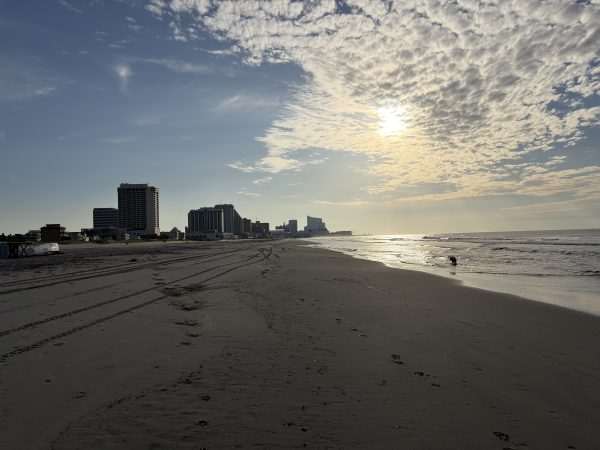
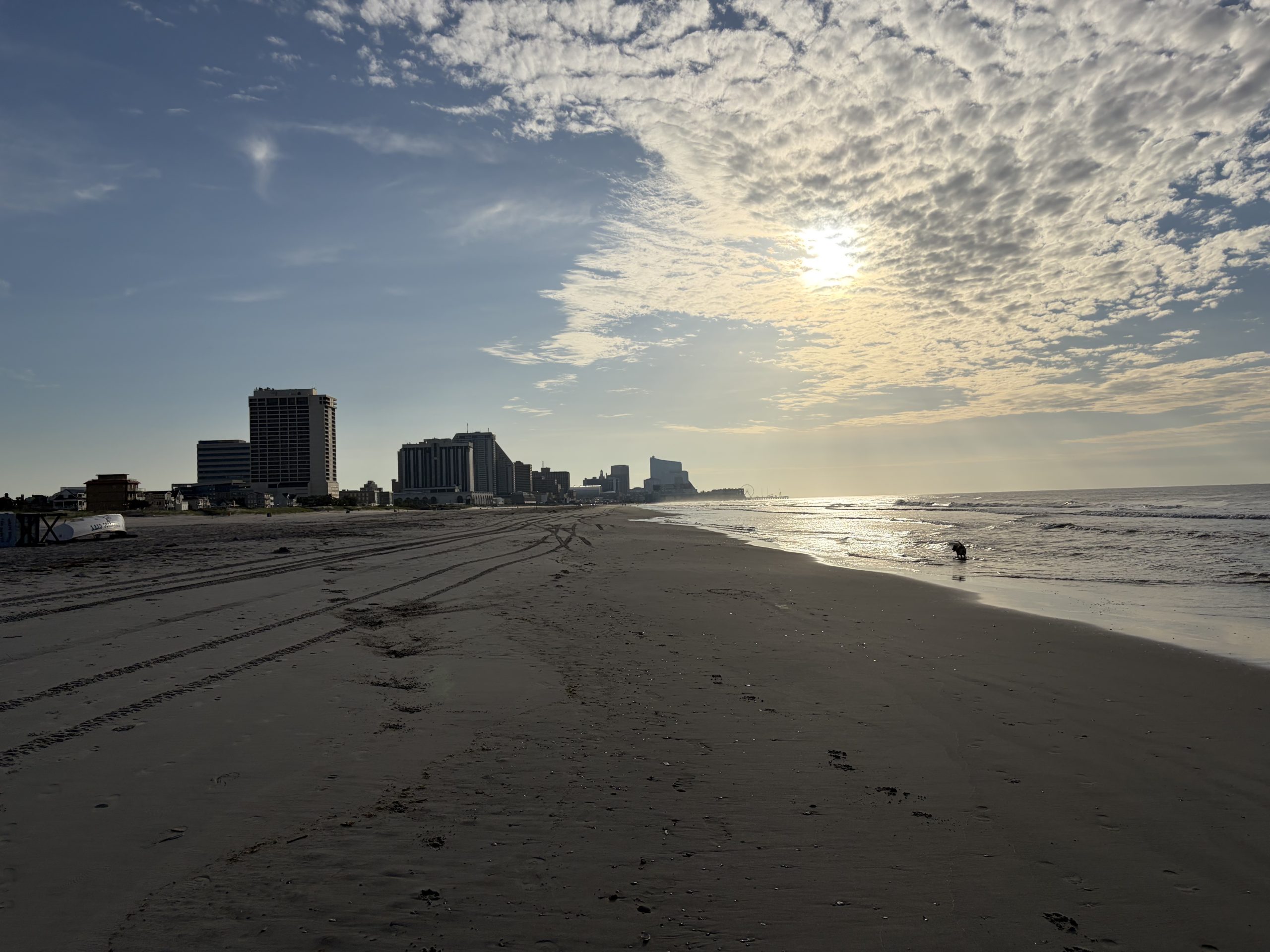
    An early-morning dog walk in Atlantic City on June 12, 26.Amy S. Rosenberg/Staff

    🧠 Trivia time

    Two New Jersey beaches made an Island.com list of the nine cleanest beaches in America. One was Point Pleasant Beach in Ocean County. The other was a beach from Cape May County.

    Was it:

    A. Stone Harbor

    B. Wildwood Crest

    C. Cape May

    D. Avalon

    If you think you know the answer, click on this story to find out.

    Ask Down the Shore

    We asked our Shore Line group chat whether it’s OK to reserve spots early on the beach by setting up chairs and a canopy. The results are in! (Join our chat here.)

    The majority of people responding were fine with it, while 15% wanted to see some consideration on how much space was taken up. But 30% of you thought it was a breach of etiquette.

    Here’s a sampling:

    Yes, good for them for motivating early in the day!

    I hate when people do that. And 9 times out of 10 when they do it, they are obnoxiously large reservations. Putting up multiple beach cabanas, etc.

    It depends on how long they’ve been gone. If they don’t show up for an hour, you could just fold their stuff up in a nice little pile. I’d be okay with that.

    No problem with that at all. But those people can’t get upset if another group sets up close to them in their absence.

    Have your own thought on this topic? Other etiquette questions you’d like us to tackle? Let us know here.

    Your Shore memory

    Ernie Russom, of Highland Park, Pa., and Wildwood Crest, texted us this memory:

    Around 1991 or 1992, we would bring our now soon-to-be 38-year-old son to the beach at the end of our street in Wildwood Crest. The beach was expansive. Nearly as wide as they are today. We wanted a way for him to know where we were on the beach. I sectioned and used a 12-foot pvc pipe as a flag pole. Back then, we were the only flag flying in our immediate area. Our flag was for his safety.

    Today, our 12-foot pole is dwarfed by the 15-to-20-foot telescoping aluminum flag poles. The large number of flags flying resemble tailgating outside of a college football game. We now have a telescoping pole with a unique flag of the day. Our flag is a marker that tells us how far up or down beach the ocean currents have taken us while we are enjoying the surf. It also is the maker of today’s “home base” at the beach.

    Send us your Shore memory! In 200 words, tell us how the Shore taps into something deep for you, and we will publish them in this space during the summer.

    By submitting your written, visual, and/or audio contributions, you agree to The Inquirer’s Terms of Use, including the grant of rights in Section 10.

  • 🍴 Find your new favorite restaurant | Inquirer South Jersey

    🍴 Find your new favorite restaurant | Inquirer South Jersey

    Good morning, South Jersey. Take an umbrella to work: Strong thunderstorms are possible today.

    There are so many quality restaurants in the region that we made a quiz to help narrow down your options.

    And a new internship program provides hands-on job training for students with disabilities to build careers in hospitals.

    Plus, Mount Holly canceled its Fourth of July celebration, and more news of the day.

    — Taylor Allen (southjersey@inquirer.com)

    If someone forwarded you this email, sign up for free here.

    Your new favorite restaurant

    Take our quiz and find your new favorite restaurant from The 76

    Back in October, The Inquirer released its annual list of the most essential restaurants in the Philly area, dubbed The 76.

    The South Jersey representation includes:

    • Dolsan Korean BBQ in Mount Laurel
    • Radin’s Delicatessen in Cherry Hill
    • Corinne’s Place* in Camden
    • Karachi Kafe in Voorhees
    • June BYOB in Collingswood
    • Le Beirut in Collingswood
    • Oda Mediterranean Grill in Collingswood

    *Note: This soul food spot also ended up on our list for the region’s most iconic dishes for its classic fried chicken.

    Which one best matches your cravings?

    Let our quiz help you decide your next date night or evening out with friends.

    🥂 In related news: Several new South Jersey restaurants opened this spring. Enjoy eating your way across the region.

    A new kind of internship

    The inaugural class of Project SEARCH, a nine-month internship program that provides career training to students with intellectual and developmental disabilities, graduated this week.

    Through the program that is a collaboration between Virtua Health and the Burlington County Special Services School District, the six students who made up the graduating class completed 10-week rotations in multiple hospital departments over the school year.

    The participants gathered hands-on experience working in multiple departments such as cardiology, physical therapy, food services, and patient transport.

    “I have built real skills, gained so much confidence, and discovered what I am truly capable of achieving,” Alyssa Eiring said in her commencement speech at the graduation ceremony in Westhampton.

    Multiple students have already landed a job.

    Reporter Wendy Ruderman has the story.

    What to know today

    • Mount Holly canceled its Independence Day celebration, citing safety concerns.
    • The New Jersey Attorney General’s Office released a 560-page report covering disciplinary actions against law enforcement, including the firing of a Burlington County corrections officer.
    • Rowan University will close a health center for abused children, Rowan-Virtua Child Abuse Research Education and Service Institute (CARES) in Vineland because of Gov. Mikie Sherrill’s proposed budget plan. Another CARES office in Stratford will remain open.
    • Food insecurity in the Philly region, including South Jersey, has increased after a federal law altered the Supplemental Nutrition Assistance Program and reduced its benefits under President Donald Trump’s Big Beautiful Bill Act.
    • Some New Jersey lawmakers are looking for pathways to incentivize farmers to produce more hazelnuts, according to New Jersey Monitor.
    • NBC10 reports that Jersey Mike’s is now America’s favorite fast food chain, dethroning Chick-fil-A, based on a recent survey.

    🗓️ The best things to do this week

    ⚽ World Cup Outdoor Watch Party: Cheer on Team USA against Team Australia. Evesham Township is partnering with The Promenade at Sagemore Shopping Center and LaScala’s Fire restaurant for the festivities. Food and drinks will be available for purchase. ⏰ Friday, June 19, begins at 3 p.m. 💵 Pay-as-you go 📍500 NJ-73, Marlton

    🎤 Peabody’s Wayback Machine Summer Concert: Indulge your nostalgia with Peabody’s Wayback Machine, the throwback band that specializes in 1980s music. It’s the first of Gloucester County’s concert series this season. ⏰ June 20, 7-8:30 p.m. 💵 Free📍 James G. Atkinson Park, 138 Bethel Mill Rd., Sewell

    🗓️ Camden’s Junteenth Festival: Celebrate with this large festival full of art, culture, and celebration. The featured events include live music, live art demonstrations, and more. ⏰ Sunday, June 21, noon-8 p.m. .💵 Pay-as-you go 📍Farnham Park, 1648 Baird Blvd., Camden

    See more event listings here.

    🧠 Trivia time

    Which TV show had its characters vacation in Jersey?

    A) The Four Seasons

    B) Euphoria

    C) Severance

    D) House of the Dragon

    Think you know? Check your answer.

    What we’re…

    🛣️ Avoiding: Highway closures on I-295 and Route 42.

    🥄 Craving: Water ice cakes.

    🦟 Noting: Mosquito spraying in Camden County today.

    🏡 On the market

    A four-bedroom home with an open-floor plan

    Tucked away on a peaceful street, this four-bedroom home in Sewell provides a lot of privacy. Built in 2023, the home has modern amenities. The updated kitchen leads into a dining area and a spacious living room. The home includes 2.5 bathrooms and a finished basement with ample space for a home office or a media room. Both the front and back porches allow for outdoor seating for entertaining guests.

    See more photos of the property here.

    Price: $470,000 | Size: 2,273 SF | Acreage: 0.25

    That is all I have for you this morning. Thank you for spending it with The Inquirer.

    By submitting your written, visual, and/or audio contributions, you agree to The Inquirer’s Terms of Use, including the grant of rights in Section 10.

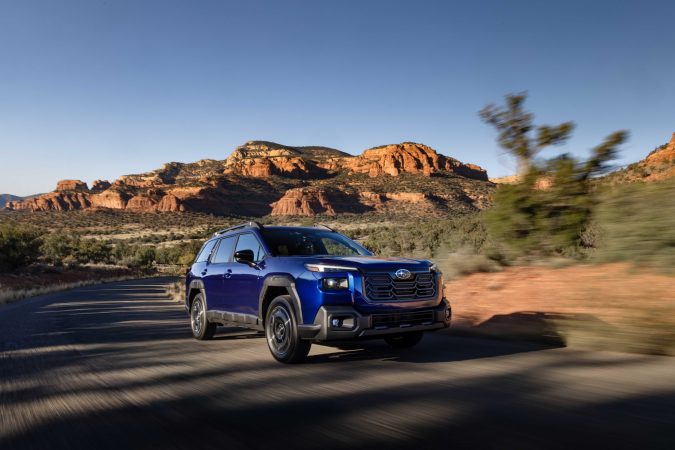
  • 2026 Subaru Outback: New look, but the best remains

    2026 Subaru Outback: New look, but the best remains

    2026 Subaru Outback Touring XT vs. Toyota Crown Signia Limited: New ways to get around.

    This week: Subaru Outback

    Price: $49,445 as tested

    What others are saying: “Highs: Spacious rear seat and cargo area, decent off-road capability, friendly dashboard controls. Lows: Base engine provides unhurried acceleration, handling is not engaging, no longer looks like a wagon,” says Car and Driver.

    What Subaru is saying: “Love never looked so good.”

    Reality: Most of the best features are kept, but then so are most of the not-so-best.

    What’s new: It’s a whole new redesign for the Outback. Beyond the new face up front, it gets a boxier profile and flatter roof for more passenger and cargo space.

    The Outback and brother Forester tend to bring a feeling of trustworthiness to every drive, somewhere in the putt-putt engine, just-right handling, and interior design. Will the redesign upset that balance?

    Competition: In addition to the Crown Signia, competitors include an eclectic mix of crossovers: Chevrolet Blazer, Honda Passport, Jeep Grand Cherokee, Nissan Murano, Mazda CX-70, and Volkswagen Atlas.

    Up to speed: The Outback as tested features a turbocharged version of the 2.4-liter Boxer four-cylinder engine, making 260 horses. It gets the vehicle to 60 mph in 6.2 seconds, according to Car and Driver. The standard 2.5-liter four-cylinder creates 180 horsepower and gets there in 8.8 seconds, Car and Driver estimates.

    A morning in the 20s was accompanied by some occasional hesitation — from the Subaru, not just Mr. Driver’s Seat — when pulling out and while in motion.

    Shiftless: The Outback continues to transfer the power to the road with a continuously variable transmission. There’s no real excitement, but it just adds to the feeling of trustworthy canine companion somehow.

    The shifter is the old-fashioned handle style. Paddle controls on the steering wheel and a manual mode offer the illusion of control.

    On the road: The Outback visited the Sturgis household during frigid temperatures and an unusual midwinter snowpack. I wasn’t driving through the snow, which would have been a very Subaru-worthy test indeed. Unfortunately, I faced icy roads only when it got dark, so I never had the chance to put it to a real test. Still, the SUV did just fine, hugging the curves and making me confident that it would follow my steering inputs quickly.

    I never found any drive modes and didn’t really miss them, but there is a snow mode.

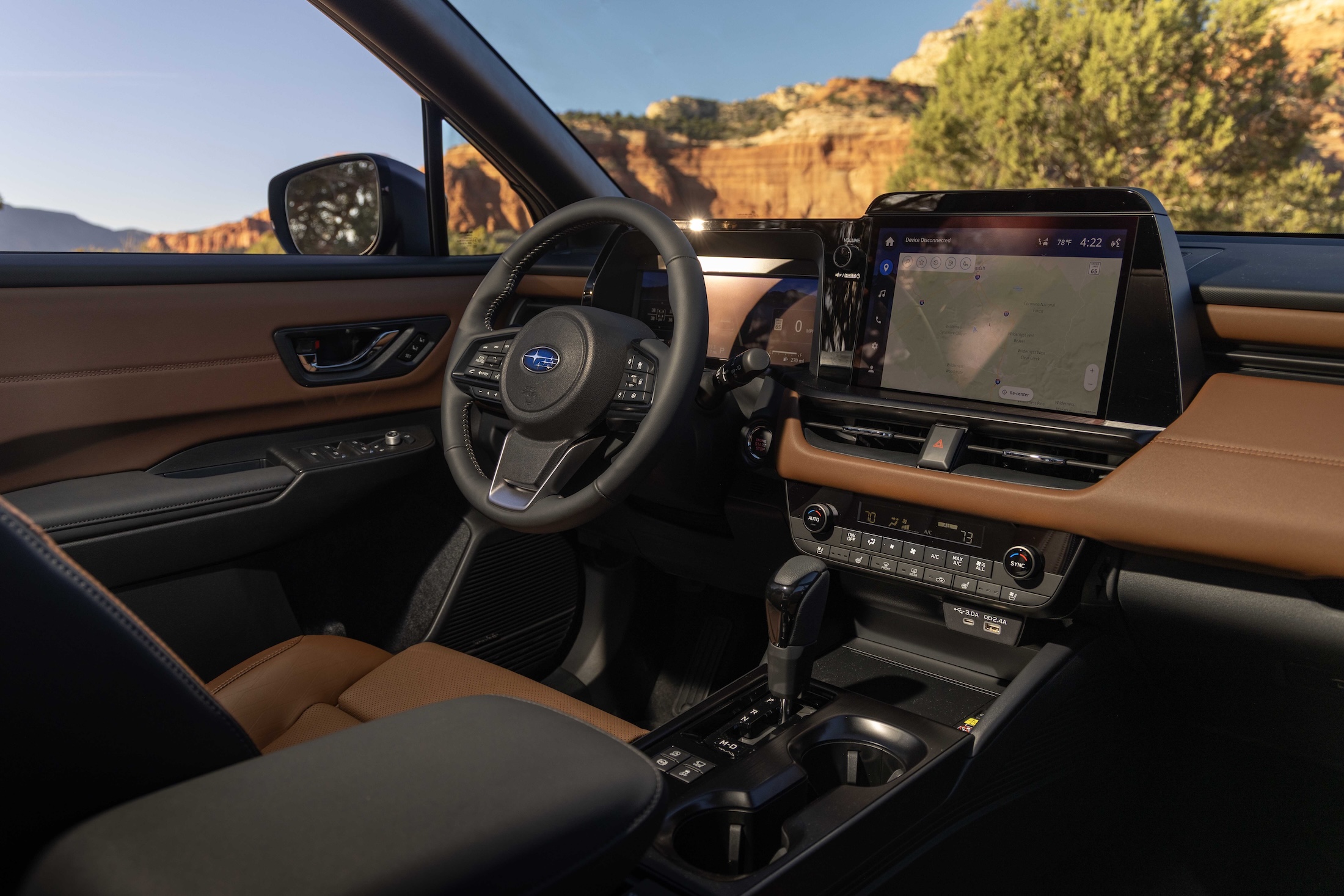
    The interior of the 2026 Subaru Outback keeps its classy look and does away with the vertical center pod.Subaru

    Driver’s Seat: The interior is all new as well, although it’s not radically different from Outbacks of yore.

    The seats in the Outback were quite comfortable and roomy — and luxurious. The adjustments are handled on the door, not my favorite setup.

    The Outback handles the cold with some real bun burners for seat heaters. I could hardly keep it set to 2, while the Lovely Mrs. Passenger Seat relished 3.

    Friends and stuff: Rear seat passengers should be pleased with their accommodations. There’s tons of legroom, foot room, and headroom. The seat is almost as supple and inviting as the front.

    Cargo space is 34.6 or 80.5 cubic feet, depending on the seat origami.

    Play some tunes: Subaru literature advertises a 12.1-inch infotainment screen, but it sure looks larger than that. It’s also attractive and easy to operate, with a dial for volume and button icons that are easily visible and get you around the functions. And it’s also not the vertical screen of yore.

    Sound from the Subaru Multimedia system is OK, about a B+, maaaaybe an A-. It seemed to miss a lot of the parts of songs I know to look for.

    Keeping warm and cool: Dials control the temperature and buttons handle everything else. There’s a display that tells you what’s going on without taking over the main screen.

    Again, those seat heaters. Wow.

    Fuel economy: I averaged about 19 mpg on side roads until I took it out on the highways and got close to 21. Subarus can be thirsty, and this Outback is less station wagon and more SUV than ever.

    I didn’t have it out too much, though, so there may be some more room for improvement.

    Where it’s built: Gunma, Japan

    How it’s built: The Outback gets a 3 out of 5 for reliability from Consumer Reports.

    In the end: My love for the Outback has grown over the years, especially the Wilderness model. This one offers much the same experience. The turbo adds a lot of fun, but also drinks a lot of fuel.

    Next week: See how the Crown Signia Hybrid compares.