Jalen Hurts has been preparing for this situation.
On Tuesday, the Eagles offense entered its second week of training camp without DeVonta Smith and Makai Lemon, two of the top (if not the top) receivers on the team. Both pass catchers have missed time with hamstring injuries. While their exact timelines for return are unclear, their ailments are not considered long-term concerns.
Such is life in the NFL, as Hurts knows. In 2023, for example, he lacked top receiver A.J. Brown for the wild-card blowout loss to the Tampa Bay Buccaneers.
Smith had 148 receiving yards in that game. No other receiver had more than 32.
Building chemistry with everyreceiver, not just the top targets, is critical for a quarterback’s success in the passing game during a long, unpredictable season, according to Hurts. The injuries to Smith and Lemon are reminders of that reality.
That process of building chemistry doesn’t start during the offseason program, take a break in late June, then pick back up with training camp. Hurts spent time with his receivers, including the tight ends, over the summer for workouts and off-the-field bonding in Orlando, Fla.
“I put an onus on the time that we spend in the summertime, and that’s always been a very important thing to me,” Hurts said Tuesday. “So the time that we’ve been able to take advantage of in that time and carry that on to where we are now, and the game happens, injuries happen, and so in all, it’s about how you respond, who steps up, and who’s able to fill that void.”
A variety of receivers are attempting to fill that void, including newcomers Dontayvion Wicks, Hollywood Brown, and Elijah Moore. But perhaps none of the active roster contenders among the receivers corps are more unheralded than Darius Cooper, the 2025 undrafted free agent out of Tarleton State.
Cooper, 24, made the initial 53-man roster out of training camp last year, but his role on the team wasn’t prominent. Nick Sirianni labeled him one of the “dirty work guys” of the Eagles offense last season, primarily responsible for blocking.
He had just 11 targets in 2025, resulting in nine receptions for 92 yards. But with Smith and Lemon absent, Cooper’s targets have exploded in training camp. He had his best day on Monday, when he hauled in several impressive catches that ran the gamut of the route tree.
How good can Cooper be in Year 2?
“I think he’s pretty good already, and I think he’s going to continue to grow,” Hurts said. “I can’t make you a promise and say that he’s going to be X, Y, Z. Just think he’s going to continue to develop into the player he’s shown he is, and he has very strong hands. He’s always been really good at the deep ball from his time back in small-college Texas ball.
“He’s got a hunger and he’s got a diligence about himself. And I think those are great competitive qualities, competitive traits that you can have.”
Hurts also lauded Cooper’s physicality and his “really big catch radius.” Both traits allow him to make contested catches, a skill set he has displayed through two weeks of camp.
“I just think I’m excited to see him grow, continue to grow, and grow with him,” Hurts said.
But Smith and Lemon aren’t out of sight, let alone out of mind, as Sean Mannion irons out the offense. Both receivers have been present on the sideline during camp, often listening to the play calls through a headset during team drills.
The offense is new, but Smith is a seasoned, proven veteran who has missed time during training camp before. Lemon, the first-rounder out of USC, is not. Hurts has been impressed with how the rookie has handled his acclimation to the NFL despite being sidelined.
He noted that Lincoln Riley, his former coach at Oklahoma and Lemon’s coach at USC, told him that the rookie receiver brings an intensity to his preparation.
Hurts can sense that intensity, too, even though he isn’t suited up on the field.
“The way he’s been engaging himself and doing the things that Smitty’s doing, and being right there in the huddle,” Hurts said. “He may not be getting these reps, but am I in the huddle? Am I feeling it? Am I getting that same vibe and that same energy as if I am playing and I do have my pads on? So I just think it’s all in the preparation.”
The Eagles will have to wait until Lemon recovers from his injury for that preparation to pay off.
Hurts, while grateful for the increased reps with his other receivers, was hopeful that he wouldn’t have to wait much longer.
“Hopefully, we can get that ball rolling here soon, get everybody healthy, and see who all we have,” Hurts said.
Collin Gillespie wasn’t supposed to be in Philadelphia on Monday night.
The Phoenix Suns point guard’s flight out of his hometown got canceled. With a suddenly clear schedule, Gillespie, who starred at Archbishop Wood and Villanova, looked to make a surprise appearance at the Danny Rumph Classic.
He did not disappoint.
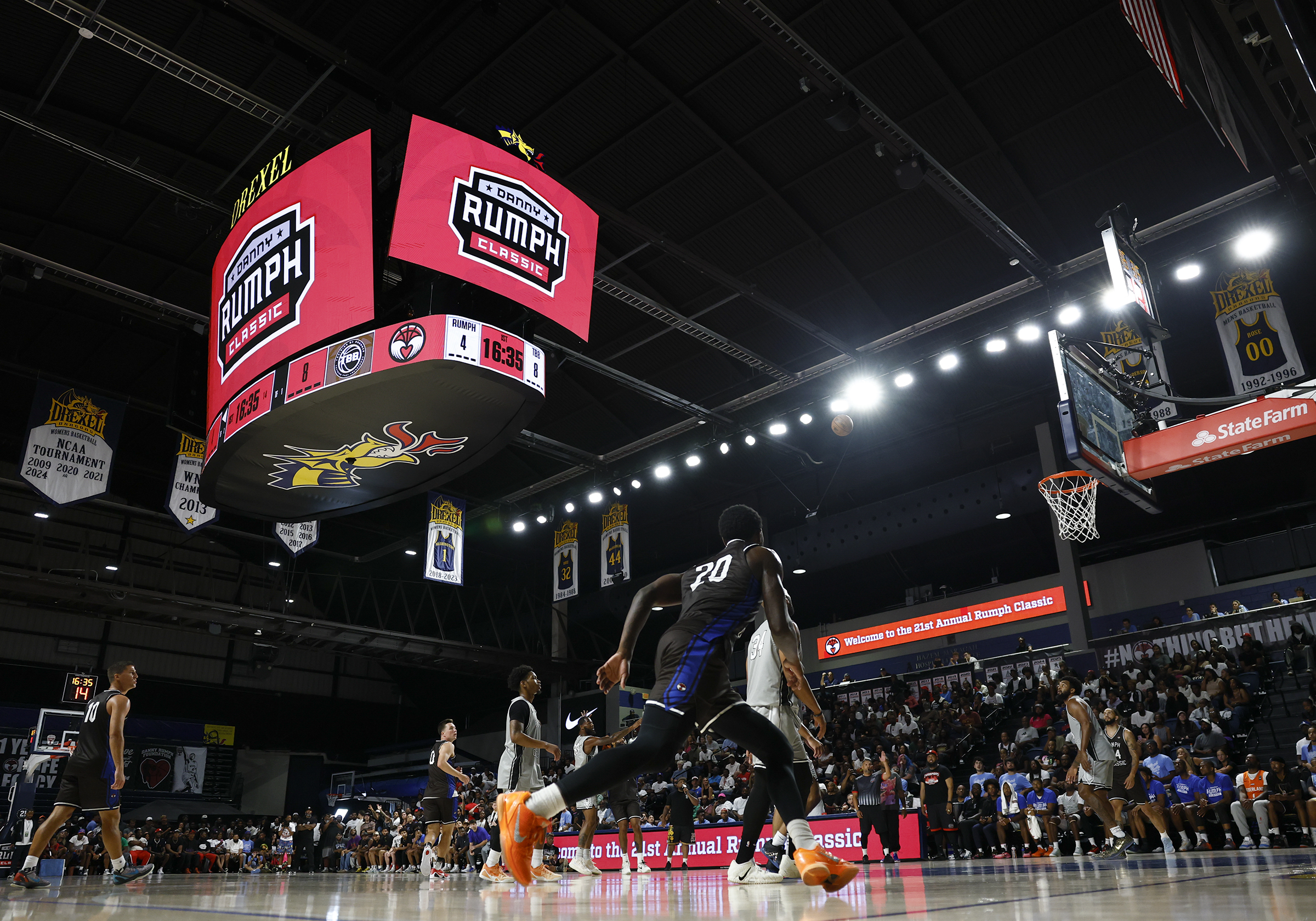
Gillespie’s 19 points and six assists helped catapult Team Training By Brunner (TBB) over Team Rumph Center, 103-101, in the men’s final. Fans packed into Drexel’s Daskalakis Athletic Center were treated to a closely contested matchup. TBB led for the majority of the game, but the Rumph Center trailed closely behind until the final whistle.
Ultimately, it was the heroics of Gillespie and Tyrese Martin, who made nine appearances with the 76ers last season, that allowed TBB to come out on top. Martin, who was named the game’s most valuable player, finished with 33 points and 14 rebounds.
“I’m here for the people,” Martin said. “That’s what the offseason, the summer’s for. Put on a show for the people at home. So that’s all I’m doing down here, and it was fun to do.”
Added Gillespie: “It’s always a great environment. Great experience playing here for [something] bigger than basketball.”
The namesake for the classic is Danny Rumph, a Philadelphia native who died in 2005 from hypertrophic cardiomyopathy — a condition that makes it harder for the heart to pump blood. Rumph went into sudden cardiac arrest while playing pickup basketball at the Mallery Recreation Center in Germantown. He was 21.
Team TBB’s Collin Gillespie goes for a layup against Team Rumph during the Rumph Classic men’s final.Yong Kim / Staff Photographer
If Mallery — now renamed the Rumph-Mallery Recreation Center — had a defibrillator on site, Rumph’s life may have been saved. To honor his life, the Daniel E. Rumph II Foundation has provided every Boys & Girls Club and recreation center in Philadelphia with a defibrillator. It also provides regular HCM screenings and CPR training to members of the community. The foundation’s biggest fundraiser is the annual Classic, a five-day pro-am basketball tournament.
Monday night, which boasted two youth exhibition games alongside the men’s final, was a sellout. The event brought in a crowd made up of mostly families. There also were a few notable names present.
Rapper Meek Mill and social media star Nasir “Gillie Da King” Fard sat courtside. At halftime of the men’s final, both spent time taking photos with fans. Meanwhile, La Salle forward Anthony Finkley and Villanova guard Tyler Perkins were in attendance. Newly acquired Sixer Jaylen Brown made a surprise appearance on Friday.
Early in Monday’s final, it looked like it would be smooth sailing for Gillespie and company, but there was a shark in the water: Rumph Center point guard Josh Sharkey.
The Archbishop Carroll graduate willed Rumph Center back into the game after trailing by as many as 12 points in the opening minutes. With under seven minutes to go in the first half, Sharkey drilled a step-back three-pointer and was fouled. The ensuing free throw cut TBB’s lead to three.
As the Jaws theme song — a nod to his last name — blared through the DAC, the crowd cheered loudly for Sharkey, a Philadelphia native.
“This is an amazing environment,” said Sharkey, who finished with 22 points. “I don’t get to do this often. I don’t get to play in front of the city. So any chance that I get, I like to put on a show. I’ve been seeing these people since I was like 8, 9, 10 years old. This is a special event. It’s for a good cause, celebrating Danny Rumph, and it’s kind of like a basketball family reunion.”
Team TBB takes on Team Rumph during the Rumph Classic men’s final at the Daskalakis Athletic Center.Yong Kim / Staff Photographer
Along with leading Rumph Center in scoring, the 5-foot-10 Sharkey made it his mission to face guard Gillespie.
“Me and Colin been playing against each other since we was little kids,” Sharkey said. “Man, it’s always a fun battle. I got nothing but love and respect for him, and it’s vice versa. It’s always fun to compete against him. And obviously, he’s a high-level pro, so it’s good to challenge myself and try to compete with him out here.”
Trying to shake Rumph Center’s swarming defense, Gillespie took a couple of hard falls. He also suffered a small cut on his left cheek.
“It was super intense,” Gillespie said. “I almost got hurt a couple times, so that wasn’t in the plans. But it got close, and those guys are competitive. They play hard, and it was fun.”
Former Providence forward and Philadelphia native Clifton Moore was clutch for TBB. He scored all eight of his points in the second half, and blocked a shot in the game’s closing minutes.
“I know we’re going to stick it out because we’re talented,” Moore said. “We’re a good group of guys. We’re hungry, and it felt good, man. Felt [good] to get one in my hometown.
Next Bright Stars
Before the men’s final, Monday acted as a showcase for the next generation of Philadelphia hoopers.
Local girls’ and boys’ high school players highlighted two 20-minute games. Along with its health-related work and advocacy, the Rumph Foundation has made it its mission to invest in the area’s youth. Last week, the foundation held an event that was centered around using basketball to bridge the gap between generations.
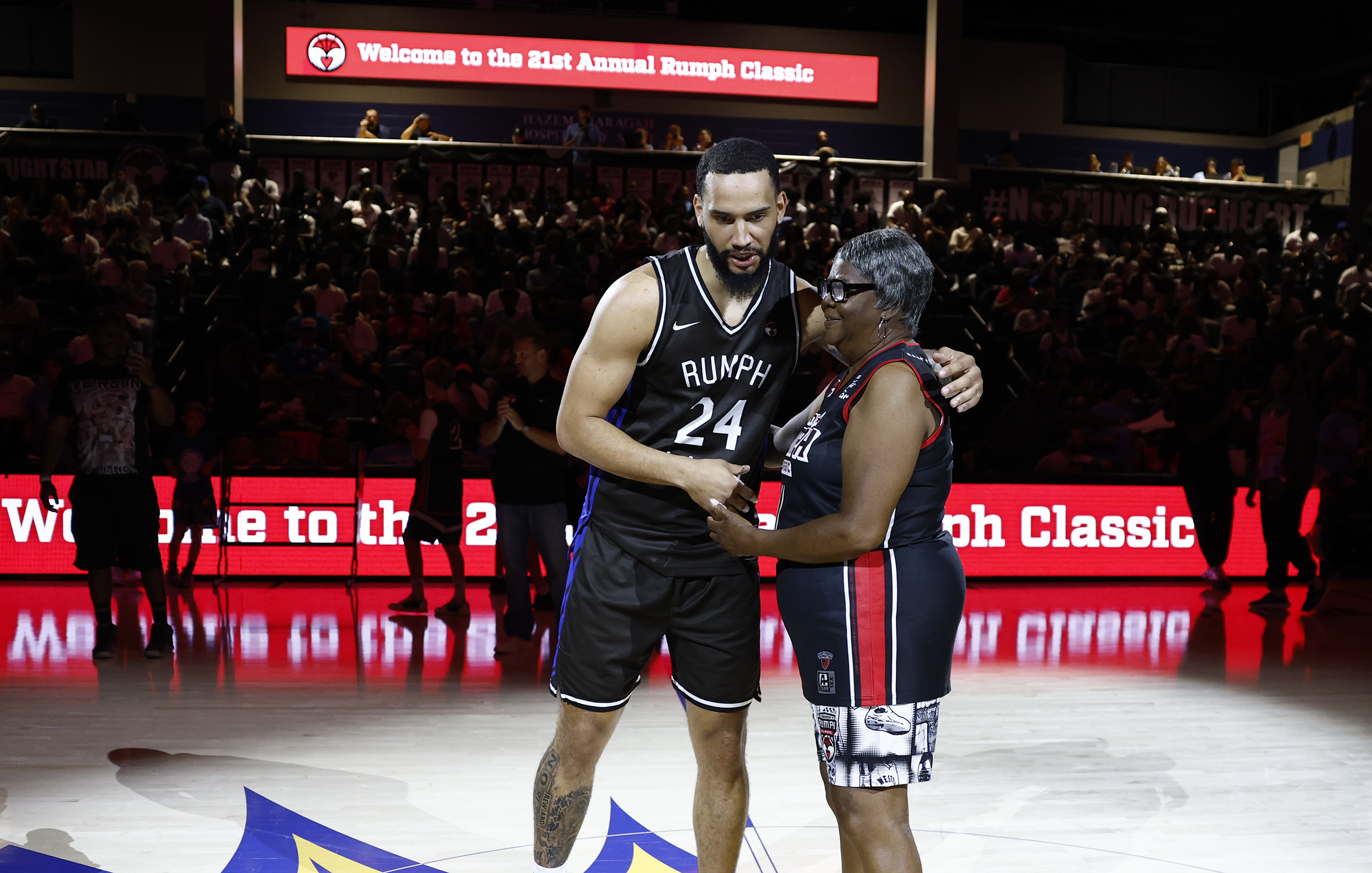
Viola Owens (right) meets with Team TBB member Tyrese Martin before the Rumph Classic men’s final.Yong Kim / Staff Photographer
Monday’s youth exhibitions acted as an extension of that goal.
“Danny Rumph, it’s a legendary league,” Rocky Johnson, a rising junior at Imhotep Charter, said. “It means a lot to me because I was the little kid in the crowd watching the Danny Rumph. Now I’m playing, and it’s surreal to me.”
Trump’s administration is hoping that months of bombing have pushed Iran’s economy to a breaking point that will force its leadership to cave to demands to end its nuclear program and fully reopen the Strait of Hormuz to oil and natural gas tankers.
The Republican president on Monday said that since Iran is seeking compensation as part of any peace talks, he now intends to demand the same for the U.S. side. It’s part of a larger pivot this weekend by Trump to argue that Iran is now on the cusp of financially collapsing, even though it has already endured decades of financial sanctions, which are often a longer-term strategy rather than an immediate tool of warfare that can halt a conflict.
The shift comes as U.S. stockpiles of key weapons have dwindled and as stop-start talks seem again to have stalled. But Trump insists the pressure can lead to a breakthrough.
“Yeah, they can make trouble, but they’re broke,” Trump told reporters. “They have no money. You know, Iran is broke, totally broke. And, they’re not paying their soldiers. They have inflation of 300%.”
Inflation is running high in Iran, although Trump’s estimates were higher than what administration officials have been citing to reporters. But the prospect of a longer war also carries inflation risks for other nations, including the U.S., where the war and higher gasoline prices are unpopular.
Crude oil prices climbed on Monday as investors interpreted Trump’s comments as a sign that fewer ships would be traversing the Strait of Hormuz, continuing to limit global supplies of gasoline, jet fuel, natural gas, and other forms of energy. The Iran war largely closed the waterway involved in shipping roughly 20% of global oil supplies before the conflict — and attempts to reopen the strait have been short-lived as it has become a source of leverage for the Iranians in negotiations.
Iran does not appear to be publicly intimidated by the prospect of more financial sanctions.
“Whenever Washington proves itself incapable of pursuing diplomacy, it retreats into sanctions; and whenever those sanctions fail to produce results, it simply increases the dose,” said Esmail Baghaei, spokesperson for Iran’s Foreign Ministry, on social media. “The real risk is that American politicians, clinging to this bad habit, will instead strangle their own remaining chances of a less humiliating exit from a crisis of their own making.”
The White House has called this Operation Economic Fury
The president didn’t say what additional financial pressure would be applied, but the administration has since April 16 been engaged in what it calls Operation Economic Fury against Iran. Treasury Secretary Scott Bessent called this component the “financial equivalent” of a bombing campaign as the countries that buy oil from Iran or bank with it could be sanctioned.
But one problem with this pivot is that the sanctions are unable to bite as quickly as the impact of the largely shuttered strait, said Richard Nephew, a senior research scholar at Columbia University who helped direct Iran sanctions strategy in the Obama administration.
Nephew stressed that the value of sanctions as a tool is limited because Trump has not articulated clear strategic goals for the war, at times stressing that it can’t have a nuclear weapon, then emphasizing the strait and then talking about ballistic missiles. Instead, Trump has engaged in a massive series of aerial assaults and a level of destruction that has not produced the quick end that he initially promised.
“Economic pressure is a possible element in his strategy, but he’s yet to explain the purpose,” Nephew said. “Trump has systematically weakened his own hand through his inadequate use of force, inarticulate elucidation of an objective, and vacillation on negotiations.”
Still, the sanctions and the ongoing U.S. naval blockade of Iranian ports give the U.S. economic and financial leverage, said Juan Zarate, a deputy national security adviser in the George W. Bush administration. Zarate said the U.S. sanctions threatening third-party countries doing business with Iran also have an impact. But these things take time, he noted.
“The ultimate question will be how far the United States is willing to go to constrict Iran’s oil trade and threaten third countries with severe sanctions — and whether it has the patience to test whether the economic pain will change the regime’s behavior,” Zarate said.
Past presidents used sanctions. Trump has said they didn’t go far enough
Trump’s latest pivot to economic issues with Iran is something of a flip-flop. Trump has long derided past presidents who used sanctions to limit Iran’s economic ability to pay for its military and nuclear development. In a speech last week in Las Vegas, he defended the bombing, missiles, and drone attacks that began on Feb. 28 by indicating that the sanctions from previous administrations that date back to November 1979 had failed.
“It’s been 47 years, but really, it’s been 50 years because they’ve been saying 47 for three years, it’s been 50 years,” Trump said. “And no other president has done what you should have done a long time ago, because Iran cannot have a nuclear weapon, can’t have it.”
The Iranian economy has suffered gravely because of the war, with the International Monetary Fund estimating the overall economy shrinks by 5.4% and the Iranian government recently reporting an annual inflation rate of 88.6%. The U.S. Treasury Department said average loadings of Iranian oil have decreased from 1.8 million barrels per day before the war to less than 500,000 barrels per day over the past month.
The U.S. economy — the world’s largest — has continued to grow, but inflation is elevated and borrowing costs have risen in ways that have hurt Trump’s popularity and led to disapproval of the Iran war.
A senior U.S. official, insisting on anonymity to discuss strategy, said the U.S. military has set back Iran’s ability to produce, sell, and ship oil and other energy resources. The administration sees the naval blockade of the strait and sanctions as effective and views Trump as having additional options that can be cranked harder in the weeks and months ahead.
Trump is essentially arguing that U.S. voters are better able to tolerate any economic inconveniences than Iranians, who have been in a state of economic hardship for years.
“It’s not just what the military can do — we’ve got the most powerful economy in the world as well,” Defense Secretary Pete Hegseth said Monday in a joint appearance with Bessent. ”And when you’ve got a motivated treasury secretary who can pull a lot of levers because he knows how to do it, you can put a lot of pressure on adversaries.”
The 56-year-old was arrested in 2022 and accused of using his position for years to lure girls, often targeting victims who had run away, been arrested, or struggled with addiction.
The women’s lawsuit accused the city of “reckless disregard for the safety of the public” by allowing a “morally corrupt sexual predator” to remain on the force and victimize at least 48 women and girls,despite years of sustained complaints of misconduct against him starting shortly after he joined the department in 1995.
The department even began the process to terminate Heron in 2008, the complaint says, following sustained allegations that included “associating with known criminals,” “little to no regard for his position as a police officer,” and having been detained by police officers for soliciting a sex worker in Kensington.
But Heron maintained his badge and went on to assault the two girls, among other victims.
“Instead of just firing him, they were moving him around different districts,” said Joshua Van Naarden of VSCP Law, the firm representing the two plaintiffs.
Heron eventually resigned in 2019 following an internal affairs investigation into an allegation that a uniformed Heron was caught by a CVS surveillance camera attempting to steal a phone charger.
Heron assaulted one of the two women in 2016 when she was 9 years old. He held her captive in his bedroom, took 22 illicit photographs while she was unconscious, and sexually assaulted her, according to the complaint.
The former officer sent her a Facebook message in 2021, when the victim was 15, and solicited photos from her as well as sex for money, the suit says.
And when the teen accused him of acting inappropriately, Heron threatened to have her arrested.
Heron assaulted the second women in 2016 while on duty. He picked her up from Temple University Hospital’s emergency department when she was 11 years old,after responding to a report that she had run away from home.
After she was discharged from the hospital to Heron while he was on duty, with instructions to take her home, Heron gave her a laced drink and took photos of the unconscious child.
Two days later, Heron picked up the 11-year-old from her house and again took illicit photographs of her.
Both women were involved in Heron’s prosecution, the complaint says, and he pleaded guilty to counts resulting from his crimes against them.
The woman who was victimized as an 11-year-old did not know about the abuse, which took place while she was unconscious, until law enforcement found photos of her on Heron’s devices, Van Naarden said.
“There are tons of other victims out there that may not even be aware that they were victimized by him,” Van Naarden said.
The city deserves credit for settling the lawsuit, which was filed in December 2024, relatively quickly to prevent the women from having to relive their trauma through depositions, testimony, and court hearings, the attorney said.
The lawsuit was settled in April and the city paid $1.3 million on July 31 to the woman Heron assaulted when she was 9 and $1 million to the woman assaulted when she was 11, a spokesperson for the city’s law department said. There were no other conditions as part of the agreement.
The city declined to comment further on the settlement or on the ongoing lawsuit.
A second lawsuit from an alleged victim of Heron was filed in April in the Philadelphia court and tells of similarly harrowing abuse.
The victim was a 16-year-old mother of a newborn when she met Heron in a courthouse in 2014, the suit says.
“She was, by every measure, among the most vulnerable individuals Defendant Heron could have encountered in his capacity as a uniformed Philadelphia Police Officer,” the complaint says.
Heron groomed her, the suit says, and starting in 2015 assaulted at least once a month for a period of four years, often drugging her “to prevent her from accurately recounting or reporting what had been done to her.” The assault included rape, according to the complaint.
The lawsuit says Heron threatened the girl to secure her silence.
“He repeatedly reminded her of his status as a police officer and his ability to weaponize that status against her, her child, and her incarcerated family member,” the lawsuit says.
Ashley Garland, an Anapol Weiss attorney representing the unnamed victim, said her client deserves the same accountability as the two victims who received payment.
“We are continuing to pursue justice on her behalf,” Garland said in a statement, “and we hope the city changes how it handles officers with sustained misconduct records, preventing them from harming the residents they are supposed to protect and serve.”
KYIV, Ukraine — Russia attacked Ukrainian cities with missiles, drones, and glide bombs Tuesday, killing at least 10 civilians, officials said, as President Volodymyr Zelensky said Moscow is getting new military help from North Korea for its more than 4-year-old invasion.
Zelensky said Russian forces used ballistic missiles supplied by North Korea in an overnight attack on the southeastern city of Zaporizhzhia, where a company said seven workers at its steel plant were killed and 21 injured.
Three more people, including a 15-year-old boy, were killed by Russian drones and artillery in the central Dnipropetrovsk region, authorities said.
In addition to the ballistic missiles, North Korea is preparing to deploy more of its troops to Russia, Zelensky said late Monday.
Russian President Vladimir Putin and North Korean leader Kim Jong Un signed a strategic partnership agreement in 2024, pledging mutual aid if either country faces aggression.
Kim has sent thousands of troops and huge supplies of weapons to support Putin’s full-scale invasion of Ukraine. Some experts say the engagement with Moscow is helping improve North Korea’s military capabilities, and Zelensky said the battlefield experience would help Pyongyang menace other countries in its region.
Ukraine says Russia is poised to escalate the war
Ukraine says Russia is scaling up its production of ballistic missiles, aiming to exploit Kyiv’s critical shortage of Patriot air defense interceptors that can stop them, and claims Moscow is preparing to recruit more troops for a new push on the front line that stretches 775 miles along eastern and southern Ukraine.
“Every step Russia takes — increasing ballistic missile production, bringing in North Korean equipment, preparing for mobilization — all of this shows that Moscow is preparing not for peace, but for escalation,” Zelensky said on social media.
In an unusual step, Ukraine’s air force didn’t say in its daily report how many missiles Russia launched overnight. It was not clear whether the omission was deliberate, and Kyiv officials made no immediate comment.
U.S.-led diplomatic efforts to stop the war have fizzled as Washington grew frustrated with the lack of progress and its attention turned to the Iran war.
In an indication that Putin is determined to press on with the invasion, Russia’s highest court on Monday ordered that Yabloko, the only political party opposing the war, be excluded from the ballot in the Sept. 18-20 parliamentary election.
“The Kremlin will not enter serious negotiations or make meaningful compromises on its demands as long as Putin believes that he has a viable military path to achieving his full objectives,” the Institute for the Study of War, a Washington-based think tank, said in an analysis Monday.
“Ukraine’s Patriot shortages offer Russia an opportunity to cause very serious damage to Ukraine over the coming winter and will therefore contribute to delaying meaningful negotiations and protracting the war,” it said.
Russia hits the grounds of a Kyiv children’s hospital
Russian forces also struck parts of the Ukrainian capital, Kyiv, overnight, according to officials. One strike hit the grounds of a children’s hospital, leaving two craters and shattering windows, the State Emergency Service said. Children and medical workers were in bomb shelters and nobody was hurt, it added.
At another location in Kyiv, a Russian strike started a fire in a warehouse that spread across about nearly 13,000 square feet, according to emergency officials.
The Russian Defense Ministry said its forces overnight struck “military industrial facilities and transport and logistics centers” in Kyiv and Zaporizhzhia with “ground-based precision weapons.”
It said in a statement that it hit civilian storage facilities housing drones in Kyiv and a metallurgical plant in Zaporizhzhia.
Metinvest, a major Ukrainian mining and metals company with operations in Zaporizhzhia, said seven of its steel plant employees died as staff tried to reach shelters after a warning of an incoming ballistic missile.
The company, which employs tens of thousands of people, said in a statement that the attack damaged its blast furnace and other equipment and forced the plant to shut down.
Russia targeted Kyiv and Zaporizhzhia with Zircon anti-ship missiles and Iskander ballistic missiles, while launching 120 long-range strike drones across the country, Ukraine’s air force said.
Russia’s biggest e-commerce company hit again
Meanwhile, the Russian Defense Ministry said its air defenses overnight intercepted nearly 400 Ukrainian drones over 14 regions and Crimea, the peninsula that Moscow illegally annexed from Kyiv in 2014.
Russia’s biggest online retailer, Wildberries, said its logistical facilities in the Voronezh region near the Ukrainian border came under attack and caught fire. It added that the fire was extinguished and goods stored there were “largely undamaged.”
Ukraine has repeatedly struck Wildberries warehouses and Russian oil facilities in what it says is a strategy to compel Putin to negotiate an end to the invasion.
Ukraine’s General Staff said its forces struck an oil refinery in the city of Orsk in Russia’s Orenburg region near the border with Kazakhstan, about 930 miles from Ukraine, causing a fire.
The refinery, with an annual processing capacity of about 44 million barrels of crude oil, produces gasoline, diesel, and aviation fuel, among other products. The extent of the damage was being assessed, the military said.
Meanwhile, Romania’s Ministry of National Defense said its navy destroyed two drones drifting in the Black Sea about 90 nautical miles from the port of Constanta.
The Gerbera-type drones were neutralized by divers using controlled detonations, and some pieces were recovered, the ministry said, adding that Ukraine said the drones were not theirs.
U.N. says over 16,000 civilians are being held by Russia
“Widespread and systematic torture and ill-treatment” of both Ukrainian civilian detainees and prisoners of war by Russia are continuing, including sexual violence, said Claudia Fuentes Julio, the U.N. assistant secretary-general for human rights.
She spoke at an informal meeting of the U.N. Security Council on Monday to spotlight the plight of civilians and soldiers taken following the Russia invasion.
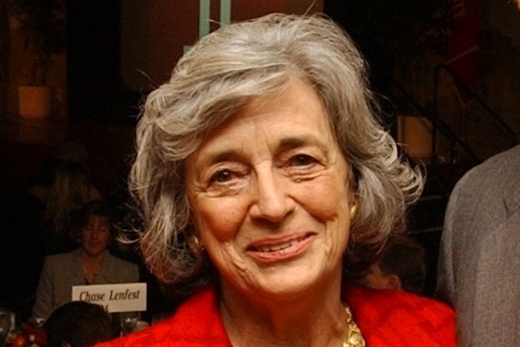
Janet Klein, 96, of Rydal, Montgomery County, former member of the Philadelphia Historical Commission, historic program director for the Fairmount Park Commission, regional project coordinator for the National Trust for Historic Preservation, chair of the Pennsylvania Historical and Museum Commission, volunteer, and philanthropist, died Tuesday, Aug. 4, of age-associated decline at her home.
Born in Philadelphia, Mrs. Klein earned degrees at Philadelphia High School for Girls and the University of Pennsylvania. She and her husband, Lewis, traveled the world after they married in 1952, and she told The Inquirer in 1973 that she became interested in local historic preservation after returning from abroad in 1964.
“I felt something was lacking here,” she said. “There was no pride nor a thorough knowledge of what we really have in Philadelphia to share with visitors.”
So she joined the Philadelphia Museum of Art’s tour guide program, rose to chair of guides for the Fairmount Park house tours, and conducted hundreds of tours for thousands of visitors to the eight historic houses in the park. “The guides,” she said in 1973, “can’t help but sense that somehow they have passed on to the visitors the continuing life of historic Philadelphia.”
Eventually, Mrs. Klein became historic program director for the Fairmount Park Commission, was appointed to the Philadelphia Historical Commission by then-Mayor Wilson Goode in the 1980s, and served as chair of the Pennsylvania Historical and Museum Commission from 1997 to 2003. Friends called her “formidable” and compared her to the Energizer Bunny.
Keen to spark public interest in historic sites, Mrs. Klein forged partnerships between site officials and schools, community groups, businesses, and the media. In 1997, she oversaw filmmakers as they shot scenes for the movie Beloved at the Landis Valley Museum in Manheim Township.
She appeared often in The Inquirer and said in 1989: “We often find that people who live just around the corner from a house museum don’t know it existed.”
At Fairmount Park, she redefined the commission’s operating procedures and enlisted students as volunteers at its public mansions. At the city historical commission, she led walking tours of Old City and helped determine the historic designation of the old Lit Bros. building, the Boyd Theatre, the Dilworth house, and other significant structures.
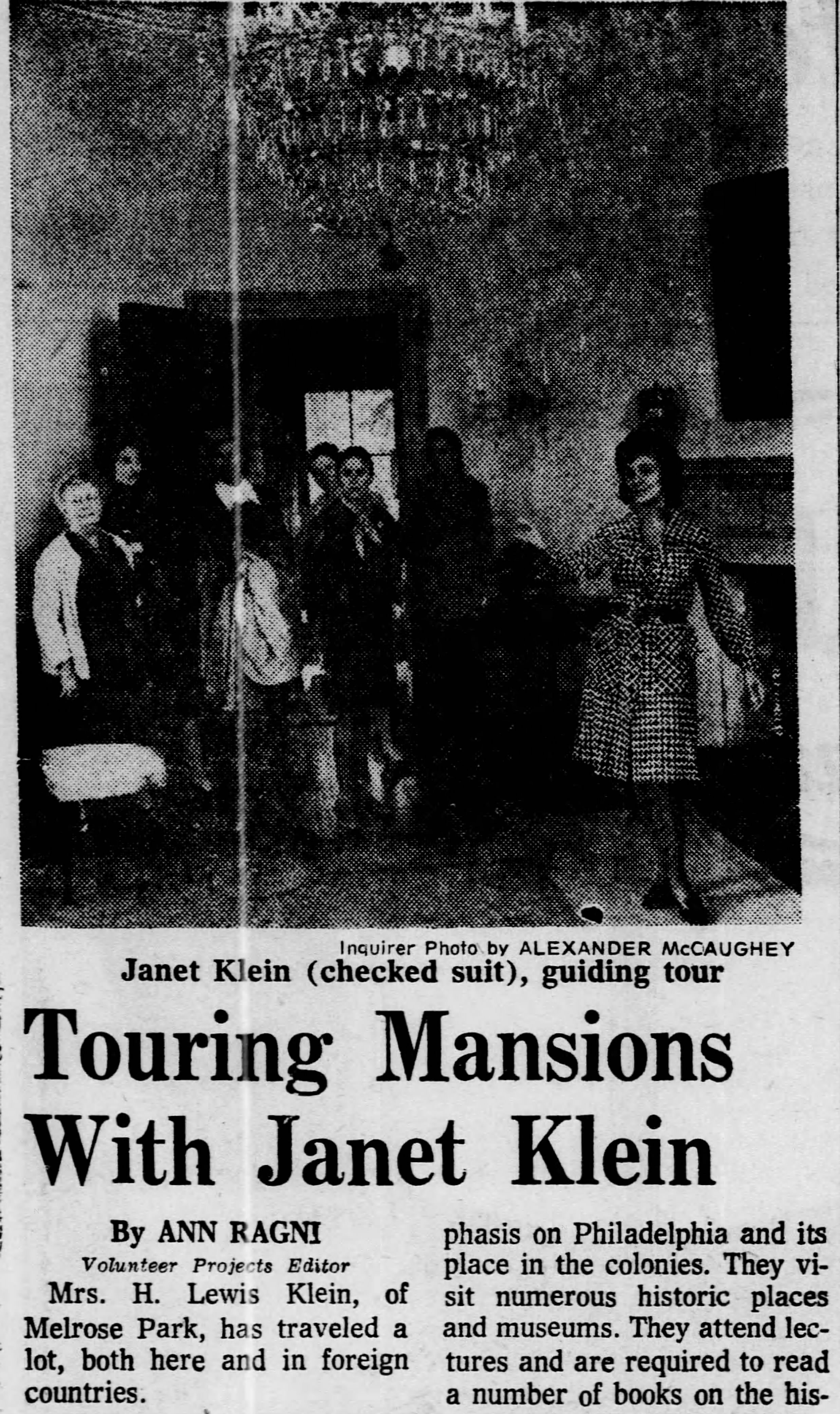
This story and photo of Mrs. Klein (right) was published in The Inquirer in 1973.Newspapers.com
With the state historical and museum commission, she erected historical markers across the state, helped designate the Art Museum as a Commonwealth Treasure in 2002, and directed the commission’s public relations, tourist promotions, and preservation efforts.
“History doesn’t have to be dead,” she said in 1998. “Historical markers represent the people and their interests. They are a way for young people to learn about their heritage and gain a personal respect for the past.”
She also led the Comprehensive Historic Assistance Program for the National Trust for Historic Preservation in the 1980s, helped create the Liberty Trail near Independence Hall, and directed the restoration of the first historic home in the Lukens National Historic District of Coatesville.
She served on the board of visitors at Temple University’s Ambler campus and Klein College of Media and Communications, on the collections committee at the Union League, and as a guide at the Winterthur Museum in Delaware. She was active with the Pennsylvania Department of Conservation and Natural Resources, the Museum Council of Philadelphia, and other groups.
This story and photo of Mrs. Klein appeared in The Inquirer in 1998.Temple University
She was honored for her service by the Women’s Center of Montgomery County in 1999 and by the Preservation Alliance for Greater Philadelphia in 2001, and was named a Distinguished Daughter of Pennsylvania in 2000. In 2018, she earned an award for service and philanthropy from Coatesville’s National Iron and Steel Heritage Museum.
As philanthropists, Mrs. Klein and her husband supported what became, named after them, the Klein College at Temple, the National Association of Television Program Executives, the Police Athletic League, the American Heart Association, and other organizations dedicated to education, healthcare, youth development, and social service. They created the Janet and Lew Klein Making A Difference Award for the Pennsylvania Association of Broadcasters and donated his professional papers to Temple.
“She was an inspirational community leader,” said David Boardman, dean of Temple’s Klein College, “who inspired others through her generosity, her brilliance, and her warmth.”
Janet Surman was born March 3, 1930. She grew up in Oak Lane and earned a bachelor’s degree at Penn.
Mrs. Klein (left) appeared with others in 2007 to celebrate a historical marker at the corner of 9th and Christian Streets.Alejandro A. Alvarez / Staff Photographer
She met Lewis Klein in college, and they married in 1952. They had a son, Stephen, and a daughter, Ellen, and lived in Melrose Park and Rydal. Her husband, a pioneering TV broadcaster and cofounder of Gateway Communications, died in 2019.
Mrs. Klein and her husband traveled the world for decades and attended dozens of galas and fundraising events. She enjoyed gardening, was an avid reader, and liked to play Scrabble.
In 1993, Inquirer columnist Clark DeLeon called her “a wonderful, funny, vivacious lady.” Temple’s Boardman said: “She was truly one of the best human beings I’ve ever had the privilege to know.”
In addition to her children, Mrs. Klein is survived by a granddaughter, two great-grandchildren, and other relatives.
Half a year into fatherhood, Edwin Jeovanny López Cornejo found the sight of his daughter, Ashley, revitalizing after a long day at work.
It was 2014. López Cornejo, an immigrant from El Salvador, had been working at a packaging company in South Plainfield, N.J., for about seven years. He came to the United States in 2007, filed an asylum claim, and received employee authorization from the federal government after being deported the year prior, according to court documents.
As he would often do in the years that followed, he took to Facebook to express his gratitude to God and his love for his daughter.
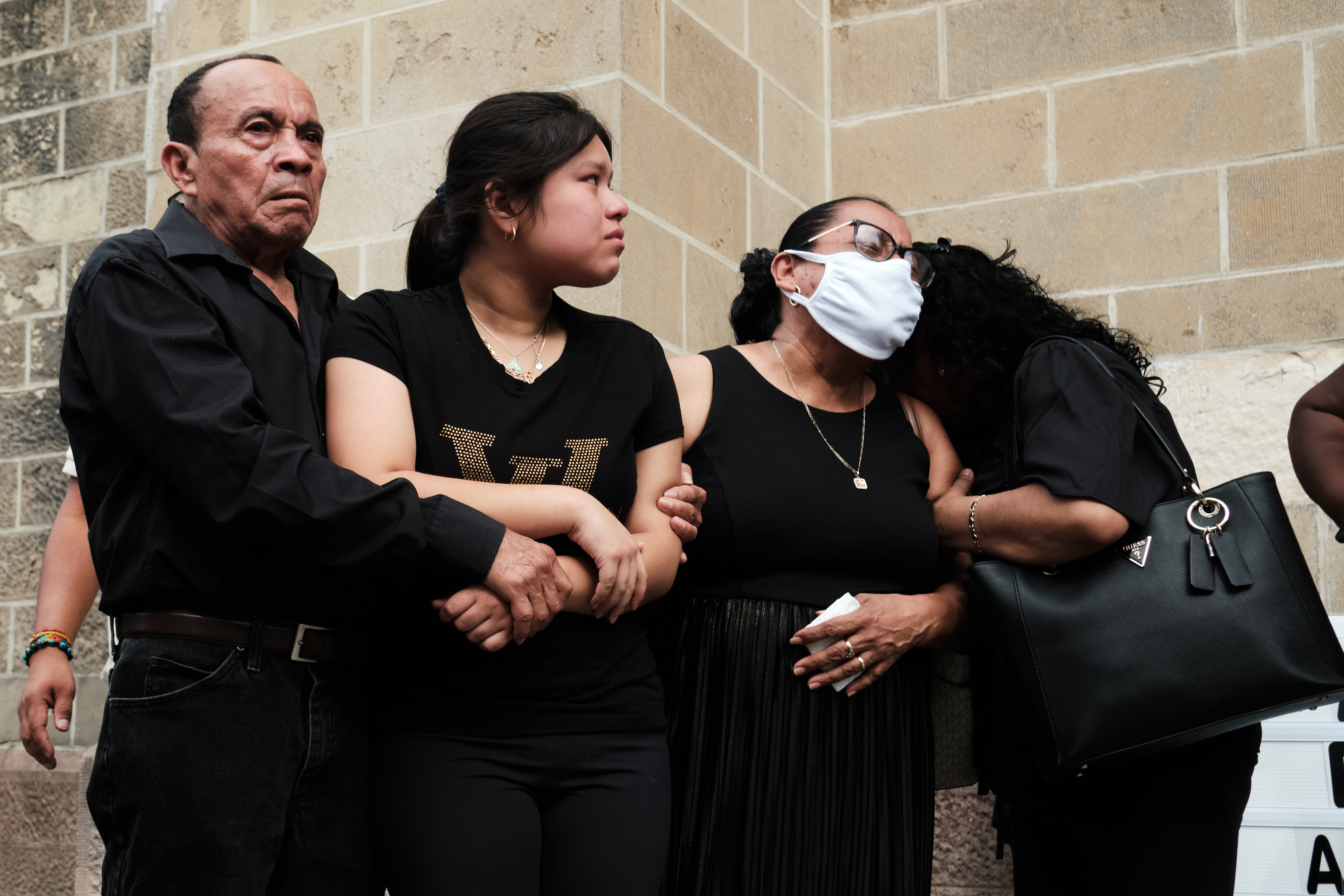
This past Friday, Ashley Lopéz, now 12, wore all black. She stood between her paternalgrandparents as they held each other and wept at her father’s wake at Crescent Avenue Presbyterian Church in Plainfield.
López Cornejo had died in ICE custody just under a week earlier at the age of 39 after experiencing what the federal agency called a medical emergency at Delaney Hall, an ICE detention center in Newark run by the private company GEO Group.
Ashley has barely been speaking. Or eating. And she does not want to be around people, María Cornejo, her paternal grandmother, told The Inquirer in an interview on Monday, speaking in Spanish.
Letters of support submitted to the court after his June arrest, remarks from his family, and more than a decade of public Facebook posts written in Spanish paint the picture of a father who deeply loved his daughter.
Twelve years ago, Lopéz Cornejo and his then-girlfriend were expecting twins, but the boy died in the fifth month of pregnancy, Cornejo said.
“She is the only child he had. You should have seen him when she was born. That man was the most joyful man with his daughter in his arms,” Cornejo said. “It was his first time being a father, and he wouldn’t even sleep so he could watch her sleep and make sure she was OK.”
López Cornejo was unable to see his daughter at Delaney Hall. He had been there for about six weeks.
Delaney Hall has been the site of high-profile political clashes representing the national conflict between Trump’s supporters and immigrant rights advocates. The detention center serves a critical role for the president’s mass deportation agenda, and complaints of poor and unsanitary conditions have sparked continuous protests, uproar from Democratic lawmakers, and a reported hunger strike inside, which the Trump administration denied happened.
In December, a 41-year-old Haitian national named Jean Wilson Brutus died one day after entering Delaney Hall, and U.S. Rep. Rob Menendez (D., N.J.) recently said another person died at the hospital after a potential seizure at the facility earlier this summer. Nationally,at least 23 fatalities in ICE custody have been reported this year as the rate has increased during Trump’s second term.
López Cornejo’s asylum claim was still pending — 19 years after he filed it — when ICE agents arrested him, according to a habeas corpus petition challenging his detention.
An undated photo of Edwin López Cornejo and his daughter, Ashley, in a pool.Courtesy family of Edwin López Cornejo
Around 9 a.m. June 18, López Cornejo headed out to pick up his car from a towing company, where it had been taken for being parked for too long, his mother recounted Monday. She urged him to take a taxi and avoid walking, given a heightened fear of running into ICE in the community.
She said goodbye, unaware it would be the last time she would hug her son.
Lopéz Cornejo ended up walking because roads were closed.
Masked agentsstopped him and asked for his ID. When he produced his Salvadorian identification, they put him in an unmarked vehicle with two other people who had already been detained, his lawyer Ingrid Echeverria recounted in the habeas corpus petition.
Cornejo said her son called her from inside Delaney Hall that evening. The first question he asked was about Ashley.
According to his family and court documents, he took medicine for diabetes, epilepsy, and high blood pressure. Interruption of his strict medication schedule carries the risk of breakthrough seizures and associated harm, according to the petition. That July 24 court document did not accuse ICE of denying him his medication but expressed concern over potential medical risks if he was transferred to another facility, as the agency at one point planned.
On. Aug. 1, Cornejo got a call from University Hospital in Newark. The person on the phone told her that her son’s heart was not beating by the timehe arrived, after he collapsed at Delaney Hall. ICE has not released an official cause of death, but U.S. Sen. Andy Kim (D., N.J.) said it was a heart attack and cardiac arrest. Days after his death, Kim and fellow New Jersey Democratic U.S. Sen. Cory Booker put forward legislation that would require the shuttering of Delaney Hall.
New Jersey Attorney General Jennifer Davenport said last week that her office was launching a civil rights investigation into Delaney Hall, citing reports of “alarming conditions” and recent deaths.
Sen. Andy Kim (D., N.J.) stands between federal agents and demonstrators in an attempt to prevent a clash outside the Delaney Hall migrant detention center in Newark, N.J., on May 25.DAKOTA SANTIAGO
In response to López Cornejo’s death, ICE put out a statement saying that everyone in ICE detention gets proper, around-the-clock medical care, and that López Cornejo “was seen by medical professionals.”
His family doesn’t buy it. They blame ICE for detaining him and accuse the agency of failing to provide him proper medical care. Danilo López, his brother, said at a news conference that his brother told him over the phone that he had to fill out a form to just get Tylenol at Delaney Hall and it could be days before he received it, a claim ICE did not directly address when asked.
“He lived a normal life and worked normally while taking his medicine and with a proper diet, working more than eight hours a day, and had no problem,” Cornejo said in the interview.
Just days after her father died, Ashley López said at a news conference: “On the same day, we were both dead. The only difference was his heart stopped beating. I am going to grow up without a father.”
Family members of Edwin López Cornejo including (from left) his mother Maria Cornejo, daughter, Ashley, and his former wife, attend a news conference on Tuesday, Aug. 4, 2026, in Highland Park, N.J. Yuki Iwamura
‘The true love of my life’
On his daughter’s first birthday, López Cornejo wrote on Facebook that Ashley gave him “one more reason to live.”
“I want to tell you that when I learned you were going to be born it felt like it would be forever before I had you in my arms,” he wrote. “I will never forget the first day that I changed you and gave you a feeding bottle. Wow my girl, those moments I will never forget and now you are turning one. Wow how the time passes.”
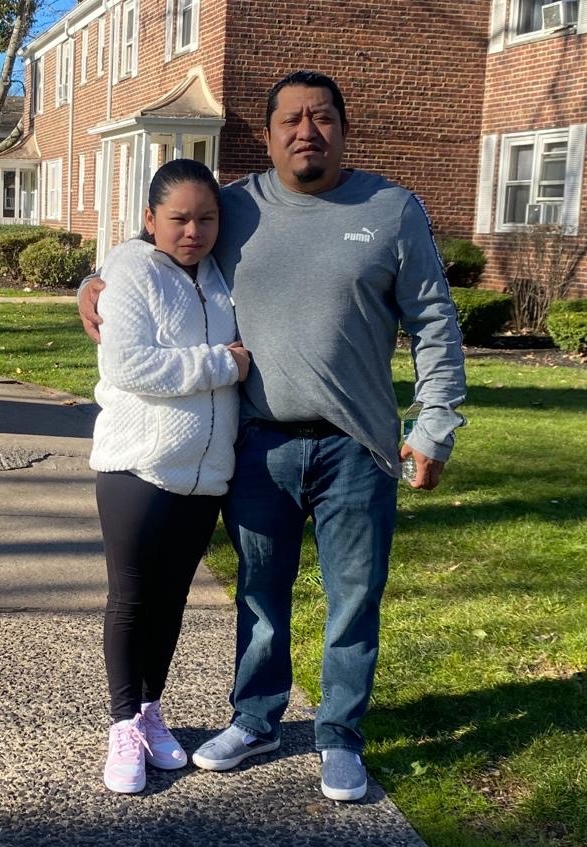
An undated photo of Edwin López Cornejo with his daughter, Ashley.Courtesy family of Edwin López Cornejo
On her third birthday, he called her “the true love of my life,” and said she motivated him to be strong and keep moving forward.
“I would be willing to give my life for yours,” he wrote.
On his own birthday, he often thanked God for another year of life. And as a birthday wish, he asked for another year to see his daughter grow.
Ashley, a U.S. citizen, was born in New Jersey, according to the petition, which includes her birth certificate and public school records to support his lawyer’s argument that López Cornejo has community ties. The documents show she receiveda certificate of achievement for math at 9 years old “for demonstrating fluency of division” in less than six seconds. And shortly after she turned 10, she was crowned “Art Leader of the Week.”
Ashley lived with her dad half the week, but he picked her up from school every day, and she would run into his arms to greet him, Cornejo said. He took pride in her success in school.
“He would tell her, ‘I want you to be a doctor so you can cure me one day,’” she said.
Family members of Edwin López Cornejo arrive at an Aug. 4 news conference in Highland Park, N.J.AP Photo/Yuki Iwamura
A hard worker
López Cornejostarted working in construction just three weeks before his detention after the warehouse he worked at changed locations, his mother said.
Court documents show he worked at UpperClass Warehouse in South Plainfield from March 2021 until this May, and he previously worked multiple restaurant jobs in New Jersey. He paid taxes to the state of New Jersey and the federal government.
Jesse Fischbein, vice president of finance at Just Packaging, where López Cornejo worked from 2007 to 2015, said in a letter of support attached to the petition filed with the court last month that he “truly was a company-first employee, who didn’t believe that the workday was simply 7 AM to 3:30 PM.”
“He was punctual, always pitching in to help other employees when his tasks were completed, and always asked management if there was more to be done,” Fischbein wrote.
People detained inside Delaney Hall stand at windows in Newark, N.J., as demonstrators gather outside on May 28, 2026. The protests were fueled by reports of detainees staging a hunger strike over the conditions of their confinement.TODD HEISLER
ButFischbein said there was one thing López Cornejo would always be better at than his job: being a father.
“From what I know about him outside of work — he is a father, and that is the job he excels at more than any function he performs for my company,” Fischbein said.
A coworker-turned-friend, Juan Zavala, said in another letter of support that López Cornejo had “earned the respect of everyone around him” through kindness, compassion, respect, and honesty.
“He is a loving, responsible, and caring parent who is deeply involved with his daughter’s life and always puts her well-being first. It is very clear that his family means everything to him,” Zavala wrote.
One of the ways López Cornejo expressed himself to his loved ones was by sharing links to music on Facebook. He dedicated love songs to his daughter and others, he shared reflections during the pandemic with a Christian worship song, and he said the music video for “Pose”by Daddy Yankee — the singer known for the hit song “Gasolina” — inspired him to learn to dance reggaeton.
López Cornejo and Ashley dreamed about dancing together at her quinceañera, a celebration for her 15th birthday.
“He just wanted to dance the waltz with his little girl, and they so looked forward to that party,” Cornejo said, crying. “Now my little girl won’t have her dad.”
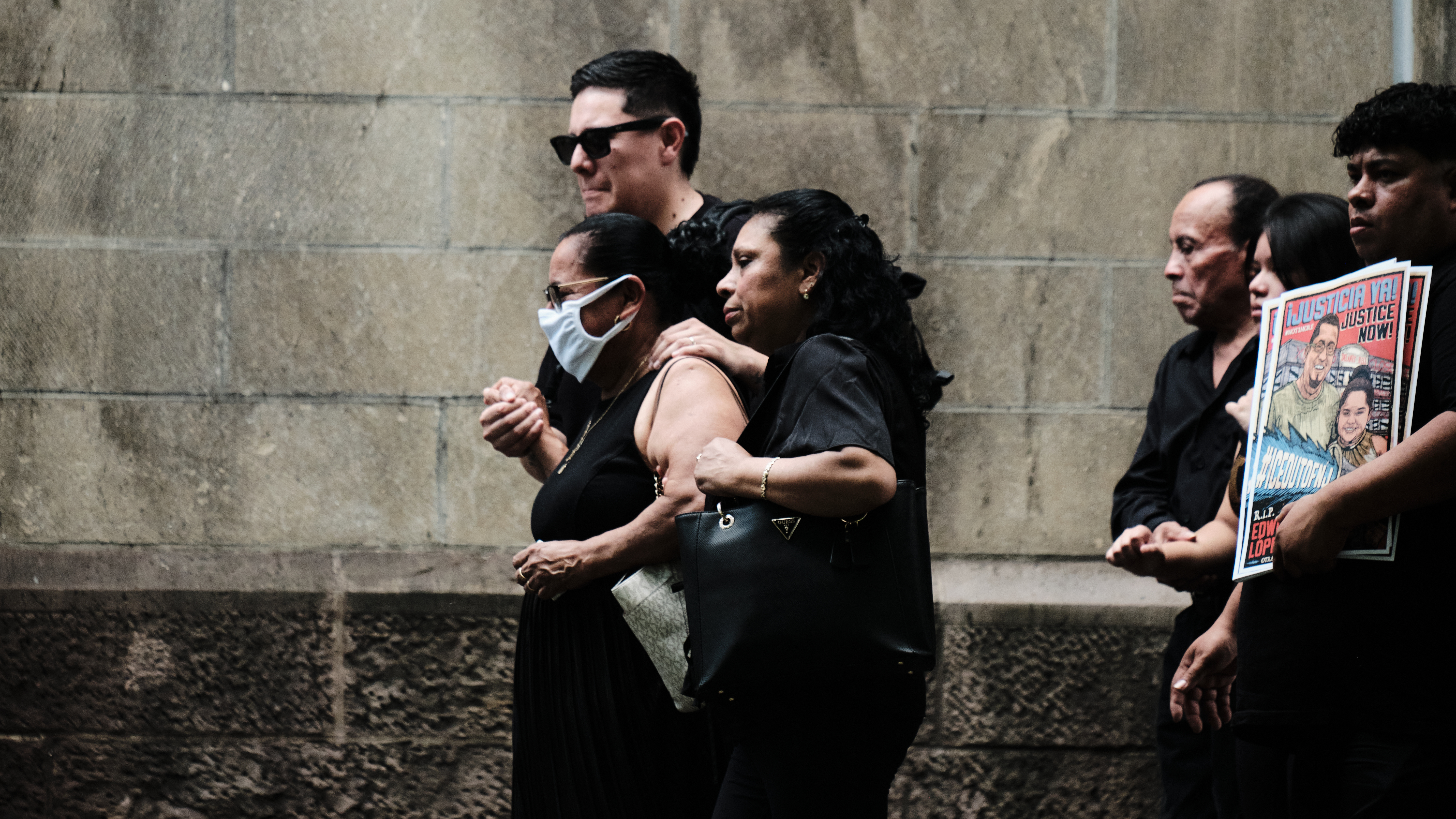
Family members walk to the church side entrance during the wake of Edwin López Cornejo, after his death in ICE custody in New Jersey on Aug. 7 in Plainfield N.J.Max Blease / For The Inquirer
‘Profoundly difficult consequences’
In the July 24 petition, his lawyer called on ICE to explain why he was detained, and consider either his immediate release or a hearing in front of an immigration judge.
His lawyer said that he was served with documents in English he could not read, and that hedid nothave a criminal record and always showed up for his court dates.
His friends and family described him in similar terms in letters of support submitted to the court last month.
Kelvin E. Urquilla Flores, who met López Corneja at Just Packaging nearly 20 years ago, described him as “a peace-loving, law-abiding individual” who is “an asset to this country and to his community.”
Edgar Fabián Guaman, who said he had known López Cornejo for almost two decades, said that his family friend did not present a risk to the community — but instead improves the well-being of those around him.
“I respectfully express that a possible separation of Mr. López Cornejo from his family unit would have profoundly difficult consequences for his daughter and his mother, who depend on his presence, support, and emotional stability,” Guaman wrote.
An undated photo of Edwin López Cornejo and his daughter, Ashley.Courtesy family of Edwin López Cornejo
Through his Facebook posts, López Cornejo shared a deep appreciation for his parents. In May 2016, he thanked God for giving him “an exemplary mother,”whom he also described as a “second mother” to his own daughter.
“Maybe I’m not the perfect son, but I try to behave at your level, mother,”he wrote. “I know you gave me the greatest gift, life, and I will never be able to repay you, mother.”
The last post that shows up on López Cornejo’s Facebook page was a message directed to God and his daughter on her 12th birthday last November.
Staff writer Abraham Gutman contributed to this article.
Social media platforms will face a bevy of new restrictions in New Jersey that limit their use of children’s data, restrict algorithmic content recommendations to minors, and block notifications during school hours, among a range of others.
The new restrictions, which are set to take effect in September 2027, flow from legislation Gov. Mikie Sherrill signed Tuesday and are New Jersey’s bid to regulate tech giants the governor said federal policymakers had largely left to their own devices.
“Big tech isn’t just the big tobacco of our era. They are worse. They designed platforms that highjacked our kids’ attention spans,” Sherrill said at a bill signing ceremony in Jersey City. “The typical American teen spends about 35 hours a week, almost a full-time job, on platforms like TikTok, Instagram, and YouTube.”
The restrictions in the New Jersey Kids Code Act would require privacy settings on minors’ social media accounts be set to their strictest mode and would limit platforms’ ability to request minors change those settings.
It would restrict platforms’ use of children’s data to the purposes for which it was collected and bar algorithmic content recommendations unless a minor specifically requests more or less content from a given account or of a specific type.
The restrictions mandate that social media platforms limit the discoverability of children’s accounts, both to adults on their own sites and through search engines.
And the law will bar social media platforms from sending notifications to minors between 8 a.m. and 4 p.m. on school days between Labor Day and Memorial Day and block notifications between 10 p.m. and 6 a.m. at all times of the year.
Assemblywoman Andrea Katz was a chief sponsor on the bill to restrict how social media platforms deliver content to children.Anne-Marie Caruso / New Jersey Monitor
“Half of parents say their children’s mental health has suffered over the past year because of social media,” said bill sponsor Assemblywoman Andrea Katz (D-Burlington). “Nearly half of teenagers say they lose sleep every single night because they feel stuck on these platforms.”
The law permits both parents and the New Jersey attorney general to sue over violations. If they’re victorious, courts could award $5,000 per violation or treble damages — an amount equal to three times the harm suffered — whichever is greater, plus attorney fees.
They can also order punitive damages for reckless or knowing violations and injunctions to bar offending conduct.
Lawmakers on Tuesday described a social media landscape that had sold children’s mental health for engagement and shifted threats that once appeared in physical spaces to digital ones.
“When I was a kid, our parents worried about strangers and who’s talking to us at the park or at the mall,” said bill sponsor Sen. Raj Mukherji (D-Hudson). “Today, we have to worry about who’s DMing them, what algorithms are pushing into our kids’ feeds, and what sensitive information is being collected, used, even sold before they’re old enough to understand what they’re giving away.”
Meta, which operates Facebook, Instagram, and other social media platforms, did not immediately respond to a request for comment.
The state’s higher education office began accepting proposals for the center Tuesday and aims to open it sometime this fall with a $500,000 appropriation from the state’s budget.
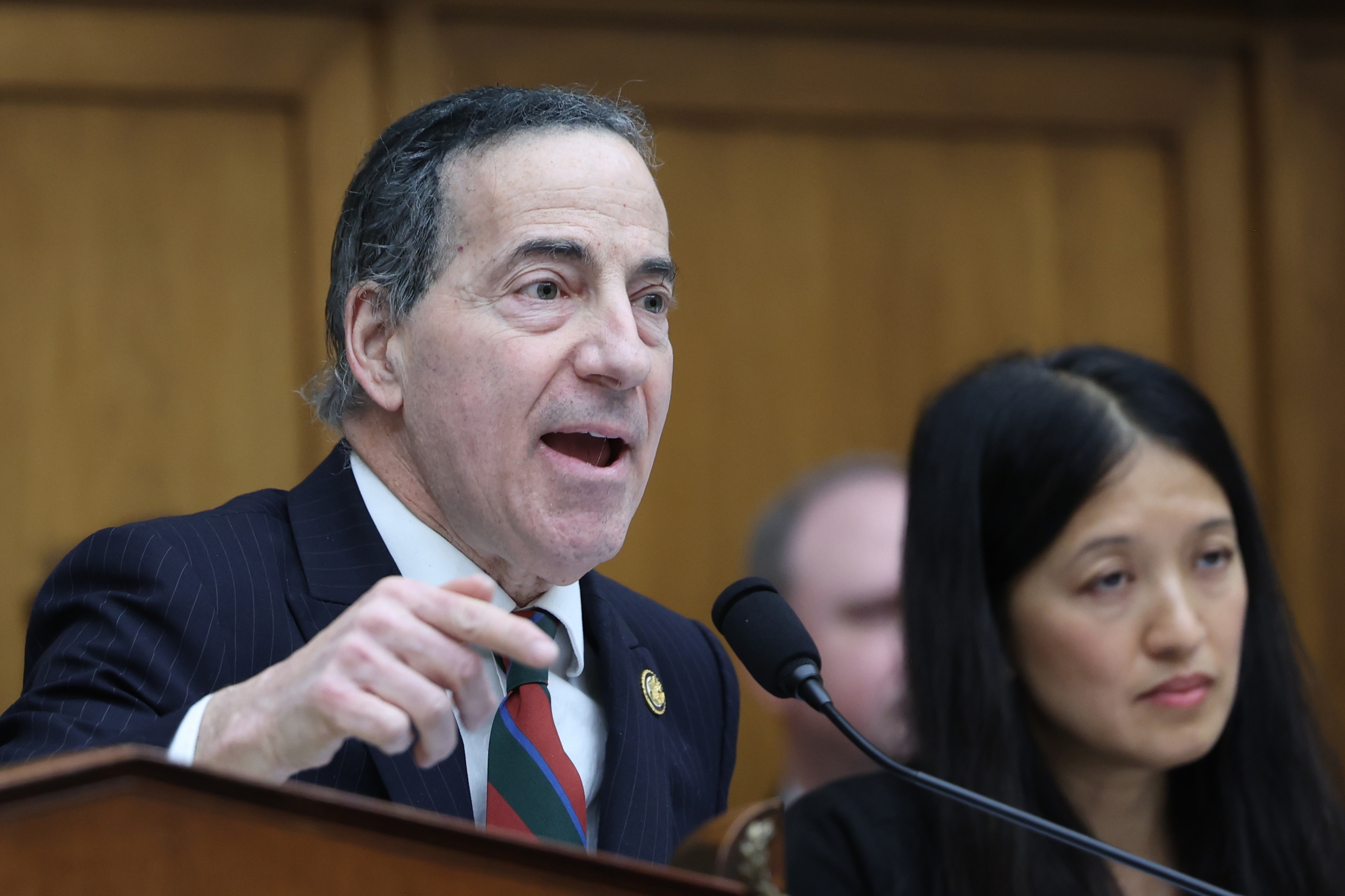
House Democrats are pushing the Trump administration to release records related to the felony prosecution of a former Olympian who had been accused of damaging the Lincoln Memorial Reflecting Pool, questioning whether prosecutors were misled in an attempt to conceal a “botched” renovation.
Democrats on the House Judiciary Committee made the move days after a judge granted federal prosecutors’ request to drop a felony charge against David Hearn, attributing the pool damage to faulty installation.
Rep. Jamie Raskin (D., Md.) sent a letter Tuesday to Interior Secretary Doug Burgum and U.S. Attorney Jeanine Pirro requesting the release of all documents related to the decision to prosecute Hearn and any communications between the agencies and the White House about the case.
The letter called on the departments to answer whether President Donald Trump exerted pressure to “retaliate against and scapegoat an American citizen.”
“How did this debacle happen?” wrote Raskin, the top Democrat on the Judiciary Committee. “The conclusion seems inescapable that at least one, if not both, of you have misled the American public about the evidence and used it to corrupt and weaponize our justice system against an innocent 67-year-old American citizen.”
Pirro’s office maintains it didn’t know about the widespread damage at the Reflecting Pool until after the indictment, accusing the Interior Department of withholding documents indicating the peeling was caused by flawed installation. But Hearn’s attorneys say there’s evidence that they knew of problems before indicting him.
Raskin is also seeking evidence presented to the grand jury, including transcripts of testimonies.
Asked for comment on the letter, the White House referred the Washington Post to Trump’s previous Truth Social posts alleging vandalism.
The Interior Department did not immediately respond to a request for comment.
“The Department of Justice follows the evidence when determining if crimes have been committed,” the federal agency said in a statement. “We always evaluate any case based on the facts and the law.”
Raskin’s letter comes after Hearn’s attorneys alleged that prosecutors may have misled jurors to secure an indictment against him. In a filing last week, the attorneys alleged that a key government witness testified that repairs would have been necessary regardless of Hearn’s actions but that prosecutors recalled the witness and “elicited” them to say that damage “attributable to Mr. Hearn” would be more than $1,000.
The attorneys are asking the judge to ensure federal prosecutors can’t charge Hearn again in the future.
Pirro, a longtime Trump ally, has faced intense public scrutiny over the decision to prosecute Hearn and others alleged to have damaged the pool and again after abruptly dropping the cases.
In the letter, Raskin points to Trump’s repeated comments about renovating the Reflecting Pool. Raskin also questioned the noncompetitive process in awarding a contract and referred to reporting from CNN that another company declined the July 4 deadline.
“President Trump’s ‘highly sophisticated’ and slapdash paint job didn’t even last 100 days, much less a century,” Raskin said.
Atlantic Industrial Coatings, the contractor, did not immediately respond to requests for comment.
A Post analysis of satellite imagery and photos and videos taken during the Reflecting Pool renovation found that the basin’s peeling was probably caused by application errors.
Despite reports of Reflecting Pool renovation failures before June 19, when Hearn touched a piece of the detached liner, Raskin said Trump and Burgum latched on to the claim that vandalism was to blame. Pirro followed with a felony charge against Hearn in July. He was initially charged with a misdemeanor count of destruction of government property.
The case collapsed the same month. Pirro’s office said in a court filing that the Interior Department did not provide sufficient information ahead of the indictment, including an email from an engineer on June 11 detailing the peeling of the liner.
“After DOJ’s filing, President Trump went off the deep end of the Reflecting Pool, you might say,” Raskin said in the letter.
Trump has blasted Pirro for dropping the vandalism charge against Hearn and three others and has continued to blame the former Olympian.
On Sunday, Trump again accused Hearn of “‘violently’ ripping and tugging at the Pool’s somewhat delicate coating” in a social media post. He conceded that there was “some contractor error” due to the rushed job but that it damaged only a small area.
Raskin poked jabs at Trump in the letter, referencing “local vandalism crimes,” including the East Wing demolition and the affixing of Trump’s name to the Kennedy Center. A judge later ordered the removal of the name.
The letter requests that the records in the pool case be shared by Aug. 25.
In a statement Tuesday, attorneys for Hearn said they “welcome any Congressional oversight that seeks the truth.”
“As we have stated from the beginning, the indictment of Davey Hearn was a clear miscarriage of justice and an egregious misuse of government power,” Norm Eisen, Mary Dohrmann, and Steve Levin said in the statement. “Our client and the American public deserve the truth, so it won’t happen again.”
Eagles radio broadcasts will sound a little different this year.
While longtime announcers Merrill Reese and Mike Quick will be back for their 29th season together in the booth, 94.1 WIP won’t have a dedicated sideline reporter during Eagles games for the first time in more than 15 years.
WIP is shifting to a more limited role within the broadcast, with Reese and Quick turning to another WIP personality when needed.
It’s assumed that Eliot Shorr-Parks, the station’s Eagles beat reporter since 2018, will be the broadcast’s go-to voice for updates, but others could jump in as needed. Shorr-Parks will do a pregame hit from the sideline ahead of Saturday’s preseason game against the Baltimore Ravens.
“The rest of the role is still TBD,” said David Helm, a spokesperson for WIP’s parent company, Audacy.
Devan Kaney was laid off by WIP in March and has since landed in Chicago.
Devan Kaney, who served as sideline reporter last season and during the Eagles’ Super Bowl LIX run, was laid off by WIP in March as part of company-wide cutbacks by Audacy. She had been with the station since 2022 and served as an on-air personality, regularly cohosting WIP’s morning show alongside Joe DeCamara and Jon Ritchie.
“I had a blast working at WIP and sincerely enjoyed my time there,” Kaney told The Inquirer in March. “But as the old saying goes, when one door closes, another opens.”
Former WIP host Howard Eskin served as a sideline reporter for more than 15 years. dnphoto
Former WIP host Howard Eskin was the station’s first Eagles sideline reporter, with his fur coats and colorful headphones becoming a sideline staple. Eskin covered the team since 1975, but said his first season as Eagles sideline reporter wasn’t until 2011.
WIP has been broadcasting Eagles games since 1969, with Reese entering his 50th season calling games, by far the longest-tenured announcer in the NFL. The station’s current deal to broadcast Eagles games runs through the 2028 season.