Blog

  • Israel, stunned by Trump’s Iran deal, sees it as a ‘catastrophic capitulation’

    Israel, stunned by Trump’s Iran deal, sees it as a ‘catastrophic capitulation’

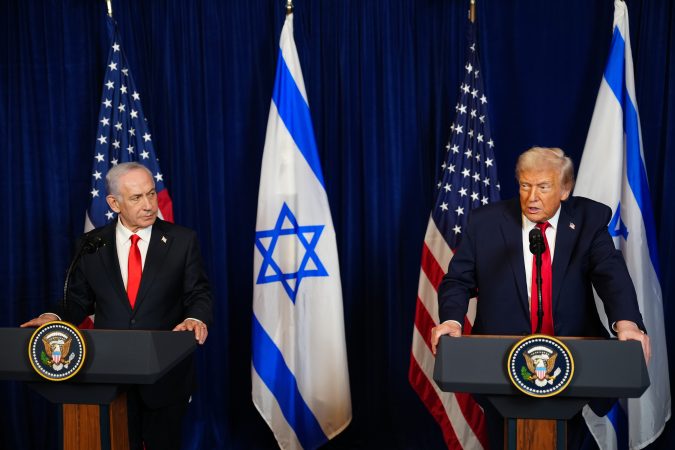
    JERUSALEM — Israel awoke to a frightening new reality Thursday as it absorbed, with disbelief and largely in silence, the terms of President Donald Trump’s preliminary agreement to end the war with Iran.

    It accomplishes none of Israel’s war aims, analysts and officials said, and arguably leaves the country in worse shape on each of them.

    Regime change? The government in Tehran is emerging from the war even more hard-line and emboldened, despite being decapitated at the outset of the conflict in late February. The deal’s requirement that U.S. forces retreat from the “proximity” of Iran within 30 days means that Iran can boast that it has chased the U.S. military out of the region.

    Ballistic missiles and proxy militias? The agreement does nothing to address Iran’s missile arsenal or its support of Israel’s enemies, like Hezbollah in Lebanon and the Houthis in Yemen.

    Worse still for Israel, by constraining its military in Lebanon — indeed, by requiring that Israel withdraw its forces from that country — the agreement seeks to handcuff Israel in a way that it was not limited before the war.

    The hundreds of billions of dollars that Iran may receive in sanctions relief, unfrozen assets, or reconstruction aid could wind up funding more missiles in Iran and aiding Iran’s militia allies around the Middle East.

    And Iran’s nuclear program? The existential threat to Israel that Prime Minister Benjamin Netanyahu of Israel has tried to eliminate throughout his career, and which was Trump’s primary reason for joining the wars on Iran, was left for a later stage of U.S.-Iran negotiations.

    “It’s a bad agreement in which the Americans are paying with cash, and got, at the maximum, a letter of intent,” Yaakov Amidror, a hawkish former national security adviser to Prime Minister Benjamin Netanyahu of Israel, said in an interview.

    David Horovitz, the editor of the Times of Israel, called it “a catastrophic capitulation,” in the headline of a fiery opinion column.

    And Nir Dvori, an analyst for Israel’s Channel 12 News, likened the deal to a “diplomatic Oct. 7” — a cataclysmic disaster for which Israel was wholly unprepared.

    Netanyahu and top officials in his government offered no public comment on the agreement overnight, leaving minor ministers and backbench lawmakers to put the best possible face on it.

    Amichai Chikli, the diaspora affairs minister, speculated in a radio interview that Netanyahu would know how to say no to Trump about pulling out of Lebanon just as he knew how “to bring the United States into this war.”

    But others more soberly grappled with the degree to which Netanyahu’s triumphalist rhetoric from early in the war had proved fantastical. He had repeatedly and confidently assured Israelis that the country and its alliance with the United States were “changing the face of the Middle East” to Israel’s advantage.

    “We are remaking the region,” Chuck Freilich, a former Israeli deputy national security adviser, said on Thursday.

    “Iran came out stronger, and I believe is now the regional hegemon,” he added. “They stood up to the U.S., the global superpower. They can have missiles, and there’s nothing in the agreement about the nuclear issue except we’ll talk about it. This is an Iranian victory over the U.S. and Israel.”

    Even as they reeled from the terms of the agreement, Israelis across the political spectrum seemed also to be reckoning with Trump, the nature of his support for Israel, and the degree to which Netanyahu has tied Israel’s fortunes to the American leader’s goodwill.

    On Wednesday at the Group of 7 summit in France, the president had again spoken of Netanyahu with disdain, suggesting he was excitable and prone to overreacting to Hezbollah’s attacks. He belittled him publicly as the “very small partner” in the relationship and saying that Israel would have been annihilated if it had not been for him.

    Trump suggested that Syria could do a better job than Israel of cracking down on Hezbollah in Lebanon without killing as many civilians. And he minimized the ballistic-missile threat from Iran — which forced millions of Israelis to run in and out of shelters throughout the war. He said it was only fair for Iran to have missiles because other countries in the region did as well.

    The reactions in Israel evoked a bad divorce.

    Hanoch Milwidsky, a lawmaker from Netanyahu’s Likud party, posted a video on social media of himself removing a red MAGA hat and replacing it with a blue one with the Hebrew words for “total victory.”

    Ben-Dror Yemini, a columnist at Yediot Ahronot, Israel’s largest newspaper, wrote that Netanyahu had led Israel into “the most severe collapse in its history.”

    “Trump reneged on every promise, turned Iran into a power, strengthened Hezbollah, and as a final flourish, gave Israel a kick and humiliation,” he wrote.

    Dahlia Scheindlin, an American-born Israeli pollster, said it was “slowly sinking in” for Israelis that Netanyahu had staked the entire U.S.-Israeli relationship on his personal bond with a president prone to “temper tantrums” over “simple slights.”

    “I think he was hoping that he could employ the tools that he has always employed with American presidents,” she said. “You know, tread carefully and strategically, but push the boundaries, and try to run circles around them if you can,” she added.

    “I think that with a bit of a back-and-forth dance, it was largely working for him with Trump,” she said. “But he hit his limit.”

    This article originally appeared in the New York Times.
  • All-American Rejects and Micah Palace are coming to FIFA Fan Festival at Lemon Hill

    All-American Rejects and Micah Palace are coming to FIFA Fan Festival at Lemon Hill

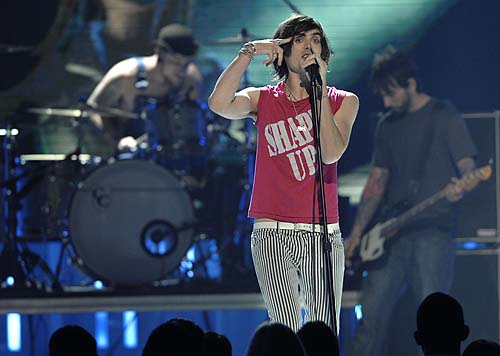
    The 2000s pop-rock sensations the All-American Rejects are taking over the main stage at the FIFA Fan Festival next month.

    Philadelphia Soccer 2026, the organizers of FIFA Fan Festival, announced that Micah Palace, the East Coast Spanglish rapper; and All-American Rejects will be the next major concert series to take place at Lemon Hill this summer.

    Micah Palace, who launched his career with the single “No Sabo” in 2024, is finding even more popularity among soccer fans as he promotes his song “Rodeo” as a World Cup anthem on Instagram and TikTok. Palace will perform at Lemon Hill on Friday, June 26, at 6 p.m.

    All-American Rejects, a band whose songs “Move Along” and “Dirty Little Secret” couldn’t be escaped in 2005, is bringing their catchy earworms to Lemon Hill on Monday, July 13, at 7 p.m.

    Throughout the 39-day World Cup festival, music artists and performers will grace the stage. Already, global pop sensation Luis Fonsi headlined opening night on June 11, and Ecuadorian singer Johann Vera performed before the Ecuador vs. Ivory Coast match on June 14. More performances will continue to be announced as the festival progresses, organizers said.

  • Rocky curse? Brazil supporters aren’t taking any chances ahead of World Cup clash with Haiti.

    Rocky curse? Brazil supporters aren’t taking any chances ahead of World Cup clash with Haiti.

    International soccer supporters, be warned — clothe the Rocky statue at your own risk.

    The fans of the Ecuadorian national team learned Sunday what many NFL fans already know about draping their colors over the statue of Rocky on the steps of the Philadelphia Art Museum.

    Ecuadorian supporters fitted Rocky with a yellow La Tri kit, then saw their team concede a 90th-minute winner in its FIFA World Cup group-stage opener against Ivory Coast on Sunday at Lincoln Financial Field (aka Philadelphia Stadium).

    The effects of the “Rocky curse” are well-documented when it comes to football, but it was relatively untested on the beautiful game. Ecuador lost, 1-0, to the Ivorian side, which entered the tournament ranked 10 spots behind La Tri in the FIFA World Ranking.

    With Brazil coming to Philly for a Group C match against Haiti on Friday (8:30 p.m., Fox29), Movimento Verde Amarelo, Brazil’s main supporters’ group, went to great lengths to ensure the yellow and green of the Canarinho stayed off the Rocky statue.

    The Rocky statue was roped off with a four-post retractable nylon stanchion, with four members of MVA, sunglasses on and earpiece in, standing at attention at each corner as Brazilian fans gathered for a rally in front of the Art Museum.

    The bodyguards discouraged fans from draping any Brazilian garb on the statue, holding signs that read:

    “Operation Rocky Protectors — Attention: it is forbidden to put Brazilian colors on the statue.”

    Matheus Henrique, 30, was one of the MVA members protecting the statue. Henrique, a native of Belém, Brazil, moved to Los Angeles a decade ago for college.

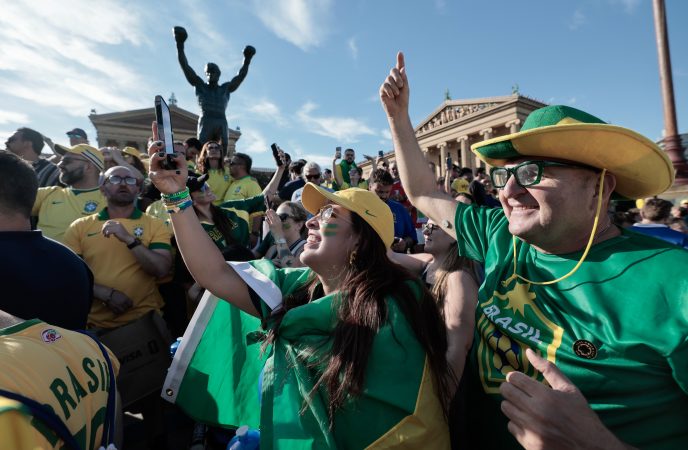
    On the eve of Friday’s FIFA World Cup Group C match between Brazil and Haiti, Brazil fans rally for their team on the Art Museum steps in Philadelphia on Thursday, June 18, 2026.Elizabeth Robertson / Staff Photographer

    Henrique is friends with the person who helped organize Brazil’s takeover of the steps and responded when a call went out for volunteers to guard the statue.

    “It’s a superstition, we heard,” Henrique said. “We’re enjoying the event as well.”

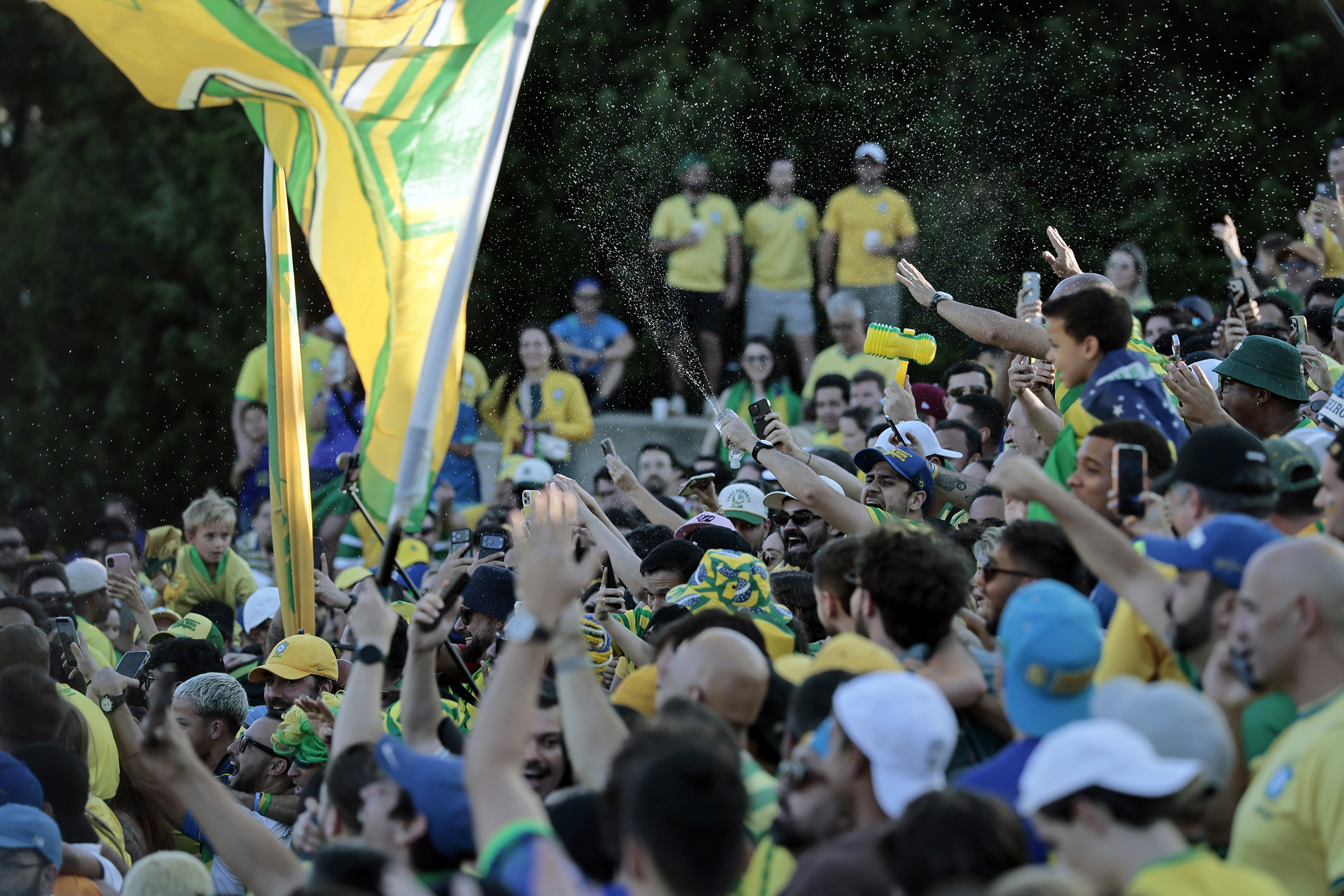
    There was plenty of enjoyment to go around for Brazilian supporters as they scaled the steps in front of the Rocky statue on Thursday evening. Fans danced, sang, set off smoke flares and drummed for hours, making The Oval feel more like Rio de Janeiro than Fairmount.

    And, thanks to the statue guards and forewarnings from MVA and Visit PA, Rocky remained shirtless throughout the evening.

    The MVA Instagram account posted a warning to its members to abstain from clothing the Rocky statue before Brazilian fans gathered at the steps on Thursday.

    “Attention Brazil Fans,” a translated version of the group’s post reads. “It is totally forbidden to put a Brazilian shirt on the Rocky Statue in Philly!!!!!”

    Meanwhile, Visit PA warned international fans about the Rocky curse.

    “Countless football teams (as in American Football, not Fútbol — same curse, different sport) have all dressed the Rocky Statue in their colors and gone on to lose,” its Instagram post read. “Ecuador dressed Rocky last weekend. Coincidence? Sadly, history says no.”

    Henrique was confident about Brazil’s match with Haiti, but he said the team needs all the luck it can get after starting the World Cup with a 1-1 draw against Morocco. Henrique said he had to chide a few people getting too close to the statue.

    “Some people don’t know,” Henrique said. “I didn’t know about the superstition until today. Let’s not play with luck. We need luck.”

    Henrique plans to watch Friday night’s match from the FIFA Fan Festival in Lemon Hill, but he feels as if he’s already done his part to help the Brazilians avoid an upset.

    Gonna Fly Now

    After successfully avoiding Rocky’s wrath, Brazil will enter Friday night’s match as favorites over Haiti, which dropped to No. 85 in the FIFA World Ranking after losing its opener to Scotland.

    Brazil, ranked No. 5 in the FIFA World Ranking, will be without national legend Neymar for the match. The 34-year-old winger, nursing a calf injury, was not among the group of players that arrived at the Sofitel in Center City on Thursday afternoon.

    On the eve of Friday’s World Cup match between Brazil and Haiti, Brazil fans rally for their team on the Art Museum steps in Philadelphia.Elizabeth Robertson / Staff Photographer

    Brazilian supporters welcomed players to the team’s hotel, creating a festive but crowded scene at 17th and Sansom around 4 p.m.

    Brazil’s team bus arrived to the hotel at 5:10 p.m., and a few Brazilian players, including Gabriel and Raphinha, greeted fans as they walked from the bus to the hotel.

    The Seleção will look to secure all three points against the Haitians at Philadelphia Stadium on Friday night. The team and its supporters can rest easy knowing it will not be the next victim of the Rocky curse.

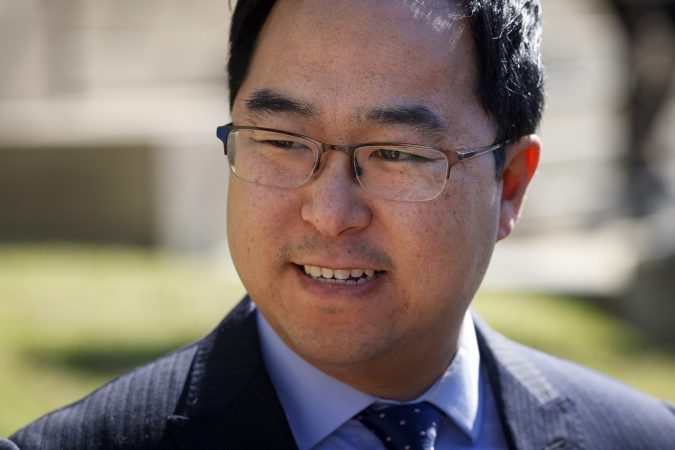
  • Sen. Andy Kim has ‘no confidence in any aspect’ of Trump’s deal to end war in Iran

    Sen. Andy Kim has ‘no confidence in any aspect’ of Trump’s deal to end war in Iran

    WASHINGTON — As lawmakers on Capitol Hill grapple with President Donald Trump’s deal to end the war in Iran, the New Jersey Democrat who spent years weighing national security issues in the Middle East described the agreement as a “mind-boggling” move that will have damaging reverberations across the globe.

    “It’s like setting your own house on fire, a good chunk of it burning. You put it out. And then you start clapping, celebrating yourself. That’s what Trump is like right now,” U.S. Sen. Andy Kim, the only career diplomat in the Senate, said of the memorandum Trump signed Wednesday night.

    Democrats representing the Philadelphia region on Thursday blasted the terms outlining the end of a conflict that many of them repeatedly described as a strategic failure from the start.

    Some prominent Republicans echoed those concerns — criticizing Trump’s removal of U.S. sanctions on Iran and his promise to help pull together a $300 billion fund to rebuild the country’s infrastructure after months of bombings — while Pennsylvania lawmakers who supported the war, like U.S. Sens. Dave McCormick (R., Pa.) and John Fetterman (D., Pa.), remained silent or defended Trump.

    “Reagan is rolling over in his grave,” U.S. Sen. Bill Cassidy, a Louisiana Republican, wrote on social media.

    Kim, who worked at the National Security Council under President Barack Obama and spent time as a civilian adviser in Afghanistan, said it was difficult to imagine what will happen next.

    He said the Trump administration had lost all forms of leverage by agreeing to end hostilities, reopen the Strait of Hormuz, and provide financial benefits to Iran without securing any new or firm commitments around the country’s nuclear program. Though the countries vowed to continue negotiating over the next 60 days, Kim said, Iran will already be in a “position of strength” with the financial relief and thus have little incentive to follow through on its pledge not to pursue a nuclear weapon, which was the primary justification for the war by Trump and his allies.

    “I have no confidence in any aspect of this,” Kim said in an interview.

    Kim said he feared not just prolonged issues between the U.S. and Iran — issues that look almost the same as before the war began — but “reverberations everywhere” as the administration signals how it would handle other foreign conflicts, like Russian President Vladimir Putin’s aggressions in Ukraine or Chinese President Xi Jinping’s moves toward Taiwan.

    “We’re just at such a weak point now. We’re still strong enough that we can muscle other countries, but they see through it now,” Kim said.

    Trump has continued to project strength, including with threats to resume attacks if Iran does not comply with the peace deal.

    “It’s a memorandum of understanding, and if I don’t like it, we’ll go ​back to shooting at them, dropping bombs on ⁠their head,” Trump said Wednesday.

    McCormick, who served in the Army during the Gulf War and has described the war in Iran as one of the most effective military campaigns in history, did not agree to an interview with The Inquirer on Thursday as other Republican senators like Cassidy and U.S. Sen. Ted Cruz of Texas raised concerns. In multiple television interviews, McCormick said he had “a number of questions” about the memorandum.

    “If it has the two things the president’s talked about, I think we’re in good shape,” McCormick said on Newsmax. “One thing is that there can be no path to a nuclear weapon or not giving up the enriched uranium. … That has to happen for this to be successful. And the second thing was the president’s words that you have to pay for performance. You can’t lift the sanctions or give them real economic relief on the sanctions until they take tangible steps toward eliminating that nuclear capability.”

    A spokesperson for U.S. Rep. Brian Fitzpatrick, a Bucks County Republican who has voted for more congressional oversight of the war but has not criticized its mission, referred to a statement from before the terms were announced this week. Fetterman, the only Senate Democrat who has fervently supported the war, did not respond to a request for comment.

    Democrats representing the Philadelphia area, meanwhile, were quick to call the deal a symbol of a conflict that was entirely a failure.

    “Now, after billions of taxpayer dollars spent and 13 American service members’ lives lost, we are no better off in Iran than we were before the war began,” said U.S. Rep. Chrissy Houlahan of Chester County, an Air Force veteran.

    U.S. Rep. Mary Gay Scanlon of Delaware County said she was hopeful that the agreement was a step toward peace while calling the conflict damaging to the U.S. economy and embarrassing on the global stage.

    “The war did not accomplish any of the administration’s alleged goals, and has instead only strengthened Iran’s strategic ambitions,” she said.

    In a post on social media, U.S. Rep. Brendan Boyle of Philadelphia called it “total humiliation.”

    Public surveys showed the war was never popular with the majority of Americans, and at least one new poll released this week showed Pennsylvania voters were continuing to sour on Trump’s handling of foreign policy.

    About 29% of voters in the state agreed with the president’s approach to foreign policy in the June poll released Thursday by Franklin and Marshall College in Lancaster. That figure was down from 37% prior to the war.

    “This was just really a lose-lose everywhere,” said Kim, who helped lead a roundtable on Capitol Hill this week to highlight the economic impact of the war, like increasing fuel and fertilizer costs due to the shipping decline. “We need to move on. But this is going to have such a negative impact on America for so long, and in so many different ways.”

    Staff writer Michelle Baruchman contributed to this article.

  • U.S. lifts blockade of Iran and Iranian supreme leader endorses direct talks with American officials

    WASHINGTON — The U.S. on Thursday lifted its blockade of Iran, and oil tankers began freely moving through the Strait of Hormuz after months of being unable to use the critical channel, as the tentative agreement to end the war took effect.

    Meanwhile, Vice President JD Vance announced that he may postpone a trip to Switzerland that had been planned for Friday and included a ceremonial signing of the deal. The visit might have helped start talks on the next, potentially even more critical, round of negotiations between the two sides.

    Hours later, Iranian Supreme Leader Ayatollah Mojtaba Khamenei endorsed direct negotiations with the U.S. in a statement read by state media.

    “It is obvious that the face-to-face negotiations that will be held in the future will not mean accepting the enemy’s opinion,” he said.

    It was Khamenei’s first reaction to the agreement, and it indicated a shift in Iran’s approach. Hard-liners, especially Khamenei’s father, the previous supreme leader, have long opposed direct talks, especially after the U.S. pulled out of the 2015 nuclear deal between Iran and world powers.

    The supreme leader has not been seen in public since he was wounded in a strike at the start of the war.

    Trump envoy tells lawmakers Iran will invite U.N. inspectors to nuclear sites

    In other developments, Trump envoy Steve Witkoff told U.S. lawmakers Thursday in a private briefing that Iran will invite the U.N.’s nuclear watchdog agency to inspect its nuclear sites and begin work on identifying and uncovering the locations of Tehran’s enriched material.

    The briefing was described by two people familiar with the conversation who spoke to the Associated Press on condition of anonymity to share the closed-door details.

    Witkoff told congressional leadership and members of national security-related committees that the agreement that the U.S. struck with Iran did not include any side deals, but a side letter was drafted between Tehran and the International Atomic Energy Agency extending the invitation.

    Witkoff disclosed the existence of the letter and invitation in the briefing, according to the people.

    Witkoff said the letter to IAEA Director-General Rafael Mariano Grossi would enable him to bring U.S. nuclear inspectors to Tehran.

    Uncertain timeline could make it more difficult to promote deal

    Pakistani Prime Minister Shehbaz Sharif also postponed a planned visit to Switzerland, where Islamabad officials were to host the ceremony, because the agreement had already been signed, said two senior officials who spoke on condition of anonymity because of the sensitivity of the matter.

    The now uncertain timeline could raise new questions and make it even more difficult for the Trump administration to promote a deal that many in the U.S. — including some congressional Republicans — have criticized as too favorable to Tehran.

    “Our plan is to go to Switzerland. I don’t know exactly when,” Vance said during a briefing with reporters at the White House when asked about not flying, as planned, to the signing ceremony.

    “I suspect this weekend, but I’m not sure,” he added.

    That injected new doubt into an agreement that President Donald Trump said he signed to avoid “economic catastrophe” in the U.S.

    Vance’s announcement came a day after Trump signed the pact with Iran while dining with French President Emmanuel Macron at the Palace of Versailles. The deal is slated to take immediate effect and extends a ceasefire while giving each side 60 days to hammer out broader agreements on larger issues.

    Trump said the deal would avoid continued stress on the U.S. economy after the war caused oil prices to skyrocket, made financial markets skittish, and fueled inflation. He repeatedly said he did not want to be compared to Herbert Hoover, whose policies helped exacerbate the Great Depression of the 1930s.

    Vance defends U.S.-Iran deal

    The vice president, who was initially personally skeptical of the U.S. going to war with Iran, has increasingly become the administration’s face of the conflict and has been outspoken in defending the deal. Asked about concerns it concedes too much, the vice president said repeatedly that the accord would force Iran to “change their behavior.”

    Vance defended the agreement and shrugged off accusations that its rollout has been piecemeal and sometimes contradictory, saying, “I don’t think our public messaging has been chaotic.”

    He also offered a surprisingly blunt warning to Israel, which has pushed the U.S. to take a harder stance against Iran and launched attacks on the Iranian-backed Hezbollah militia in Lebanon throughout the war, including just before the deal extending the ceasefire was reached. Those attacks complicated the peace efforts with Iran.

    Trump “is the only head of state in the entire world who is sympathetic to the nation of Israel at this moment in time,” Vance said. “And he happens to be the head of state of the world’s superpower.”

    The vice president said more than 12.5 million barrels of oil went through the Strait of Hormuz on Wednesday night. That could further soothe oil prices that spiked during the war but have been falling since the U.S. and Iran announced a tentative deal to end the conflict.

    He said the U.S. easing its blockade of Iran means “honoring our end of the early part of the agreement on the military side.”

    U.S. Central Command said American warships “will remain in the general area to make sure that all aspects of the agreement are adhered to, obeyed, and in full force and effect.”

    Shipping starts to pick up

    At least two oil tankers left Iran and crossed the U.S. military blockade without being stopped. A merchant shipping tracking website said the ships were carrying a combined total of 3.8 million barrels of Iranian crude oil.

    Iranian state media said shipping had “normalized” at Iran’s southern ports but added that the strait remains supervised and under the control of the Iranian military, and transiting through the vital waterway still requires coordination.

    Major shipowners began moving vessels through the strait after the agreement was signed, according to maritime data company Lloyd’s List Intelligence, though Lloyd’s did not give data on how many ships have passed through the strait as of Thursday.

    In a media briefing, Richard Meade, editor-in-chief of Lloyd’s List, said for the first time in 110 days, ships owned by major companies are transiting the strait after effectively being marooned there since February.

    Tankers controlled by major ship owners Grimaldi Group, Cosco, Knutsen, and NYK have passed through the strait. And two Iranian-flagged, sanctioned crude oil tankers owned by the National Iranian Tanker Company have entered the strait, according to Lloyd’s List.

    Phillip Belcher, marine director of Intertanko, a trade group for global independent tanker owners, said the main central route of the strait is still closed and has an estimated 80 mines that need to be cleared.

    But ships have been passing through the smaller northern route, which goes through Iranian waters, and the southern route, which goes through Omani waters.

    Lloyd’s List estimated that 550 merchant ships will need to exit the Persian Gulf. It could take weeks or months to fully reopen the strait, and the two alternative routes do not have as much capacity as the strait’s central passage.

    Agreement calls for a lasting end to hostilities

    The U.S.-Iran deal calls for a permanent end to hostilities and starts a 60-day negotiating clock to reach a final deal on the future of Iran’s nuclear program, though Trump has left the door open to resume attacks. The agreement appears to offer Iran several benefits up front while extracting little in return.

    It states that Iran’s stockpile of highly enriched uranium, which is believed to be buried under rubble, must at minimum be diluted under international supervision. It also says that Iran shall not procure or develop nuclear weapons — a commitment it has made previously. But beyond stating that the U.S. and Iran will negotiate over Iran’s nuclear program, other commitments still need to be worked out.

    The deal also waives U.S.-backed sanctions on the country, immediately allowing Iran to sell its oil freely in a major concession from Washington.

    Still, Kaja Kallas, the European Union’s foreign policy chief, said Thursday that the 27-nation bloc would leave its sanctions on Iran in place for now. The bloc had slapped a series of separate sanctions on Iran over its nuclear program, human rights violations and the closing of the strait.

  • Philly celebrates Juneteenth | Things to do

    Philly celebrates Juneteenth | Things to do

    Philadelphia is feeling a little more international than usual these days.

    World Cup watch parties are drawing crowds, fans from around the globe are filling bars and public spaces, and another big match arrives at Lincoln Financial Field on Friday when Brazil faces Haiti.

    Beyond the soccer spectacle, Wawa Welcome America gets underway with a Juneteenth celebration at the African American Museum in Philadelphia and free access to dozens of historic attractions. Father’s Day also brings plenty of excuses to get out of the house, from family-friendly festivals to sky-high adventures.

    Keep scrolling to see what’s happening this weekend.

    Also in this week’s edition:

    • A warm welcome: WaWa Welcome America is bringing free concerts, museum entry, and events to the region starting Friday.
    • Come out and float: The 18th annual Chester County Balloon Festival returns at a new location.
    • Meet the women of the colonial age: Learn about the women who shaped the nation at the Betsy Ross House.
    • Grab the wheel: Bordentown City’s 14th Annual Street of Dreams Car Show is back for another lap.

    — Earl Hopkins (@earlhopkins_, Email me at thingstodo@inquirer.com)

    If someone forwarded you this email, sign up for free here.

    The Wawa Welcome America Festival is here

    A crowd of people watch Ludacris’s performance at the Wawa Welcome America Festival on July 4, 2023.Allie Ippolito / Staff Photographer

    The largest Independence Day celebration in the country kicks off this Friday.

    The festivities begin with the Juneteenth Jubilee at the African American Museum, hosted by Philadelphia’s Patty Jackson. Headliners include Slick Rick, Doug E. Fresh, Leah Jenea, and DJ Jazzy Jeff.

    The 16-day celebration will bring dozens of free concerts, six days of firework displays, and other attractions leading up to a commemorative concert on the Benjamin Franklin Parkway on July 4, featuring Christina Aguilera, Jill Scott, Will Smith, Seal, and other big-name artists.

    Read more about the celebration here.

    The best things to do this week

    Hot air balloon pilot Scott Saxton, looks out from the gondola as his ship rises in the morning sky over the New Garden Flying Field in Toughkenamon, PA, as part of the sunrise balloon flight at the 13th Annual Chester County Balloon Festival on June 23, 2019.MICHAEL BRYANT / Staff Photographer

    📽️ Film lovers rejoice: The fifth annual United We Heal Festival takes over Underground Arts to celebrate 11 Black and Brown filmmakers. See and hear from these visionaries at the two-day festival.

    🎶 High times at the Highmark: Grab last-minute tickets for the musical collaboration between the Philadelphia Orchestra and the Grammy Award-winning choir, The Crossing, at the Highmark Mann Center. It’s a celebration of 50 Years of Music, honoring luminaries like Beethoven, Maurice Ravel, and Gustav Holst.

    🪂 A Father’s Day in the air: Surprise your father with something that will make him float. This Saturday the 18th Chester County Hot Air Balloon Festival is offering picturesque rides across the region’s skies.

    🏎️ Rev your engines: Hop in your car and drive down to Bordentown City for the 14th Annual Street of Dreams Car Show. There will be a fleet of classic rides and your favorite childhood Hot Wheels in real life.

    📅 My calendar picks this week: Ambler Arts & Music Festival, TFI Block Party at The Franklin Institute, Midsommarfest! at American Swedish Historical Museum, World Cup Watch Parties on East Passyunk.

    Free museum days and historical site access

    A total of 47 museums and history sites are opening their doors for incoming visitors for free.

    This offering is part of this year’s WaWa Welcome America Festival. Guests can enjoy no-cost admission to at least one site every day during the 16-day celebration. Some days also offer free entry to multiple sites.

    Participating locations include the African American Museum, Fairmount Water Works Interpretive Center, the Ebenezer Maxwell Mansion, Historic Rittenhouse Town, and others.

    For all other locations, visit july4thphilly.com

    Early summer fun this week and beyond

    🎊 Pop up at the Plaza: Stop outside the doors of the Reading Terminal Market for additional seating, games, artisanal shops, and everything else that makes the site such a Philly essential. The Plaza at Reading Terminal Market runs now through Aug. 2.

    🎉 Juneteenth celebrations continue: For the 20th Juneteenth celebration at the Johnson House Historic Site, there will be music, food, re-enactments, and community engagement for all visitors to enjoy.

    💐 Stop and smell the roses: A Delco outdoor tradition is back with the return of the months-long, Rose Tree Summer Festival. Here is where you can freely enjoy a mix of live entertainment, from Motown to Broadway, classical to rock, and everything in between.

    🇺🇸 Women of the 18th century: Meet the women of Colonial Philadelphia at the Betsy Ross House’s courtyard. A new series that highlights the contributions of pioneers such as Susanna Cooke, Sarah Coltman, Hannah Till, Peggy Chew, and Ross herself.

    Staffer picks

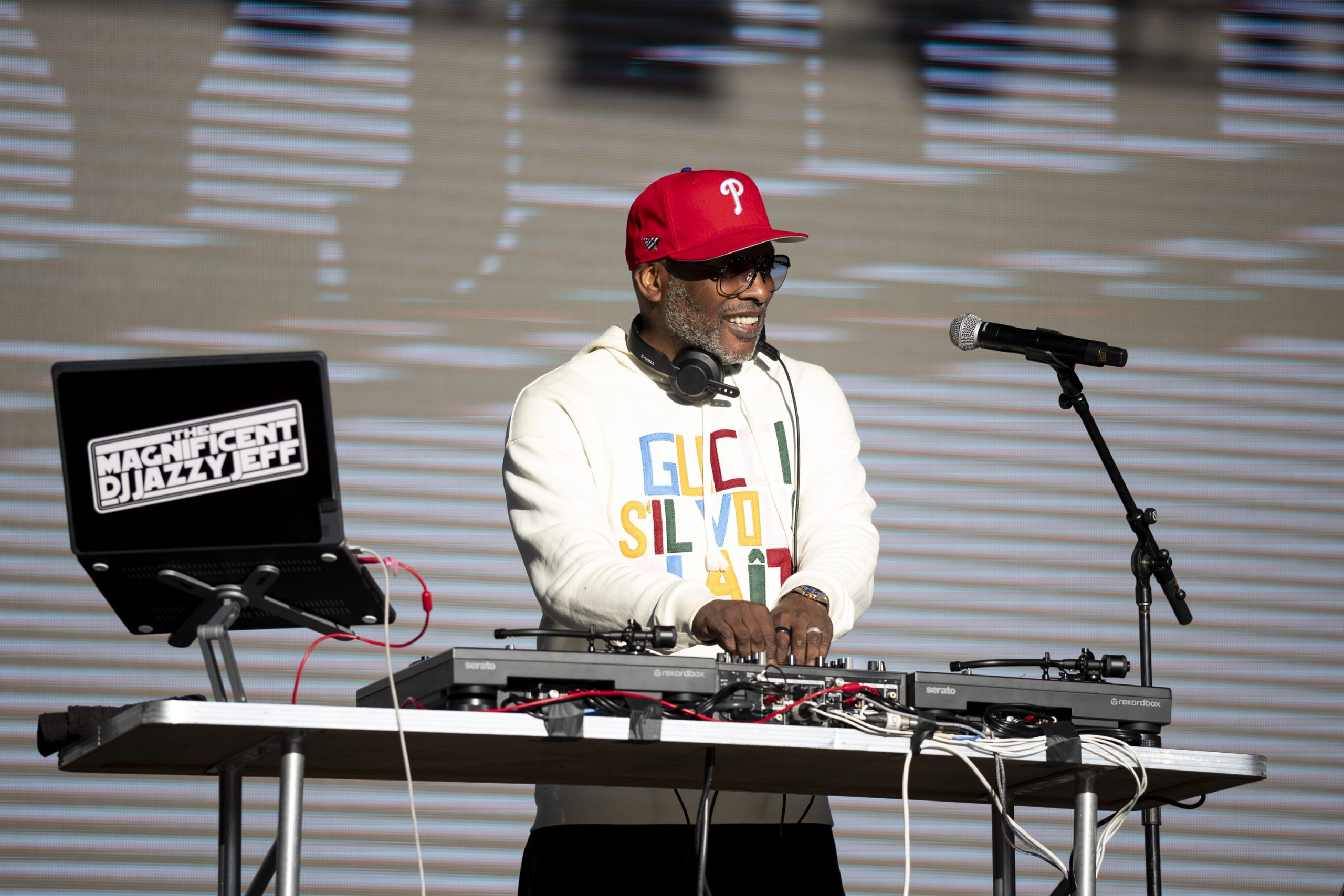
    DJ Jazzy Jeff performing at the Plateau Stage at the Roots Picnic in Philadelphia, Pa., on Saturday, May 30, 2026. Tyger Williams

    Here’s pop music critic Dan Deluca’s list of the top concerts this weekend.

    Thursday: Experimental art-rock sibling band Fiery Furnaces are stopping by the Philadelphia Ethical Society as part of the group’s six-date tour.

    Friday: Hurray for the Riff Raff, fronted by Puerto Rican songwriter Alynda Lee Segarra, is headed to King of Prussia to perform at Concerts Under the Stars.

    Saturday: Father’s Day weekend will be booming at the Shore. North Philly’s own Meek Mill will headline a star-studded lineup, featuring T.I., Eve, Shyne, Havoc of Mob Deep, and Ms. Jade, at the Boardwalk Hall on Saturday.

    Monday: Prolific country artist Charley Crockett, whose released 17 albums since 2015, is headed to Met Philly on Monday for a night of Americana tunes and outlaw ballads.

    ❓Pop quiz

    Where was the nation’s first Father’s Day celebration?

    a) Here in Philly (duh)

    b) Burlington, VT

    c) Abilene, TX

    d) Spokane, WA

    Ask Earl anything

    I’m starting something new for the newsletter, and I want your participation.

    Many of you have questions about each week’s listings, and others about Philly’s arts, culture, and entertainment scene.

    I have you covered. Any questions you have now and in the future, email me for a chance to be featured in an upcoming newsletter.

    World Cup matches and watch parties aren’t the only thing taking over the city this weekend. There’s so much to do and celebrate, and this week’s Things To Do edition is proof.

    – Earl Hopkins

    Courtesy of Giphy.comCourtesy of Giphy.com
  • Hegseth attacks NATO allies and announces a review of U.S. forces in Europe

    BRUSSELS — U.S. Defense Secretary Pete Hegseth lashed out at NATO allies on Thursday as he announced a six-month Pentagon review of American forces in Europe whose outcome will depend on how fast the Europeans take responsibility for their own security.

    The review was yet another surprise for European allies and Canada as they learn to deal with an increasingly unpredictable ally. U.S. officials and senior military officers had promised to coordinate closely with the Europeans as America draws down.

    In recent months, U.S. President Donald Trump and the Pentagon have sent conflicting signals about whether America is reducing or increasing its military footprint in Europe, as well as threatening to annex Greenland, a semiautonomous island that is part of ally Denmark. Just weeks ago, the Trump administration said that it would no longer provide as much military support should any NATO member come under attack.

    “This will be a real review. It will be designed to ensure that NATO is moving fast and irreversibly toward Europe leading, stepping up to take primary responsibility for the defense of Europe,” Hegseth told his NATO counterparts. “It’s a review that some countries will fail and others will pass with flying colors.”

    German Chancellor Friedrich Merz later said the allies have long been aware of U.S. plans to pull troops from Europe at some point and that they must take care of their own security.

    “We know that we must do more and we are doing it,” Merz said.

    Public dressing down over bases, gender, and migration

    In a fiery speech at NATO headquarters in Brussels, Hegseth lambasted European allies for failing to provide U.S. forces access to bases in Europe to launch attacks on Iran, calling it “shameful.”

    “These allies, they put America’s sons and daughters, our sons and daughters, at risk by denying them the predictable access, basing, and overflight that never should have been in question at all,” he said. The review would also assess whether the U.S. has full access and overflight “when we need it.”

    While defense ministers and military officers sat in silence, Hegseth railed against migration and gender equality policies in Europe, in remarks reminiscent to those of Vice President JD Vance in February last year that angered many Europeans.

    “Instead of tanks and fighters and air defenses, the focus has been on gender equity and climate change and defense austerity. Europe’s borders flew wide open, welfare states expanded, defense budgets cratered, along with Europe’s belief in itself and its civilization,” Hegseth said.

    Hegseth’s comments largely mischaracterized European policies today. On defense, European allies and Canada have launched an unprecedented effort to boost defense spending and expand their armed forces. NATO Secretary-General Mark Rutte noted on Thursday that they spent $90 billion more on defense last year, a 20% increase over 2024. And while Europe accepted large numbers of migrants and asylum seekers more than a decade ago, most countries have tightened their borders since.

    It does not augur well for a summit of NATO leaders in Turkey on July 7-8.

    A rare and short visit to NATO

    It was a rare visit to NATO by Hegseth, his first this year after skipping a meeting in February. The Pentagon chief did not stay long, leaving well before the gathering was over and hours before Ukraine’s President Volodymyr Zelensky was due to press allies for more weapons for his country.

    Speaking to reporters at Brussels airport before flying home, Hegseth said, “It was great to hear country after country say, ‘We’re going to meet our target. We’re going to meet our target.’ There are still a few outliers, and we will be clear with them as we do this review.”

    NATO’s supreme allied commander, an American, is working on backup plans to defend Europe after the U.S. signaled on June 3 that it would no longer supply an aircraft carrier and support ships, aerial refueling planes, and dozens of fighter jets, among other military assets, in a crisis.

    The Trump administration insists that it needs to be able to plan for two simultaneous conflicts and wants more military resources at hand should it clash with China in the Indo-Pacific region.

    Under NATO’s collective security guarantee — Article 5 of its founding treaty — the 32 allies pledge that an attack on one of them will be considered an attack on all. It does not oblige them to provide military support, although many likely would.

    In essence, the United States is scaling back how it might help should an ally trigger Article 5.

    U.S. nuclear weapons will stay

    The U.S. has by far NATO’s biggest armed forces. It does not intend to withdraw its nuclear weapons in Europe, which are key to NATO’s deterrence. To underscore that point, NATO’s Nuclear Planning Group issued its first statement in 19 years after Thursday’s meeting.

    In the statement, it “recalled that the strategic nuclear forces of the Alliance remain the supreme guarantee of Allied security and underpin NATO’s extended deterrence architecture.”

    The ministers “agreed to continue enhancing NATO’s nuclear deterrence mission by modernizing NATO’s nuclear capabilities, strengthening its nuclear planning capacity, and adapting to achieve its security interests.”

    Rutte played down the impact of the U.S. decision, saying that the NATO Force Model — the system for organizing what forces member countries will provide commanders in times of peace, crisis, or conflict — is just “a planning tool,” and not a reflection of what would actually happen.

    “If war breaks out, we will all max out what we need to do to make sure we can fight the war,” Rutte told reporters. “In the planning phase, it is important to know what we can count on. What is in theory there.”

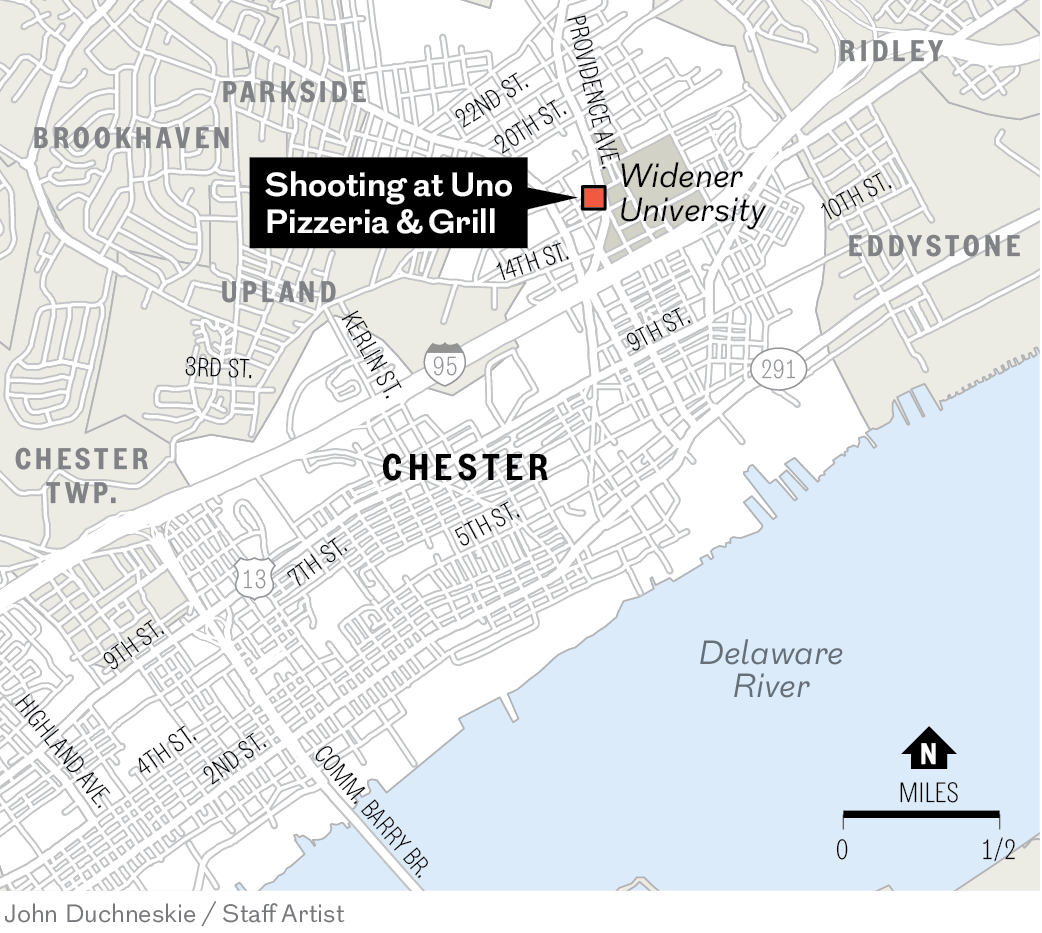
  • Three people were shot at Uno Pizzeria & Grill near Widener University, Chester police say

    Three people were shot outside a pizzeria near Widener University in Chester on Wednesday night, police said.

    The incident happened outside the Uno Pizzeria & Grill on Providence Avenue, a Widener University spokesperson said.

    Chester police and criminal investigators with the Delaware County District Attorney’s Office are investigating the shooting, police said in a statement provided by city spokesperson Adriene Irving. No arrests have been made.

    Map of the Pizzeria Uno on Providence Avenue in Chester where a shooting occurred on Wednesday night.John Duchneskie

    Police arrived around 10:45 p.m. Wednesday night and found a man, a woman, and a boy with gunshot wounds, police said. Emergency responders took them to area hospitals, police said.

    “While we are relieved that none of the victims suffered life-threatening injuries, this senseless violence is unacceptable and has no place in our community,” Chester Mayor Stefan Roots said in a news release.

    Roots said police are reviewing security cameras from nearby businesses to determine who was involved.

    “Because of the density of cameras in the area, we are confident that these assets will significantly aid the investigation, and we expect to identify and apprehend the suspect or suspects quickly,” Roots said.

    The university was in its summer session. A Widener spokesperson said the school is cooperating with law enforcement in the investigation.

    Chester is in the middle of its annual “Safe Summer” program, which provides children and teens with summer camps and other programs that keep them “active, engaged, and on a positive path,” according to a city website. The program has been credited with helping lower crime in the city: In 2025, Chester had no fatal shootings in the summer and saw a decline in overall shootings.

    The city will continue that and other efforts “to help curb gun violence and keep our neighborhoods safe,” Roots said.

  • Federal regulators back Trump’s plan to speed power to energy-hungry AI data centers

    WASHINGTON — Federal regulators on Thursday agreed to let large energy users connect more quickly to the nation’s inefficient and aging electric transmission system to accommodate surging demand from power-hungry artificial intelligence data centers.

    Energy Secretary Chris Wright had urged the Federal Energy Regulatory Commission to act in an effort to help the United States better compete with China for superiority in the fast-growing AI sector.

    Tech companies and data center developers have welcomed the chances for faster connections to the country’s power supply.

    But utilities, states, and regional grid operators worried that the Trump administration’s plan would remove their authority to manage the process. Clean energy advocates want the agency to advance, rather than undermine, state-level efforts to require the use of renewable energies.

    The commission’s actions come as a backlash grows against data centers over fears about rising electricity prices and concerns about the massive amounts of energy and water they use, polluting communities across the country, and straining water resources and the electric grid.

    The five FERC members voted unanimously to direct six regional grid operators to ensure that AI data centers and other large power users are “able to connect to the transmission system in a timely and orderly manner.”

    Laura Swett, an appointee of President Donald Trump who chairs the commission, called the vote historic and said it would push the country’s electricity market into the future while also protecting ratepayers from shouldering the costs of connecting big power users to the grid.

    “I know that Americans across the country are concerned about affordability, and so are we,” Swett said.

    Data centers would pay the full cost of any grid upgrades needed for their connection, under the commission order. But that order can do little to address the tightening energy supplies that are driving up electricity bills in some areas and raising warnings of blackouts as the construction of data centers outpaces the speed of new power plants coming online to serve them.

    The six regional grid operators under the order serve 200 million Americans, or two-thirds of FERC’s jurisdiction. FERC also invited utilities that handle their regional transmission systems to also participate.

    More than 4,000 data centers now operate in the U.S., according to one estimate, with an additional 3,000 planned or under construction, including some that consume more energy than a small city. Such facilities have ballooned in size to accommodate the demands of AI.

    Trump has tried to deflect public concerns about AI, seeing the fast-evolving technology as crucial for the U.S. to attract foreign investment and maintain its economic and military prowess. Trump signed an executive order this month that establishes a framework for the federal government to vet the national security risks of the most advanced AI systems for up to a month before their public release.

    In December, FERC took an earlier step to help data center operators get electricity quickly, voting to allow tech companies to effectively plug a data center directly into a power plant.

    Companies such as xAI, Google, Microsoft, Meta, Oracle, OpenAI, and Amazon have signed Trump’s Ratepayer Protection Pledge, in which they agreed to build or buy new sources of power generation for their data centers and cover the expense of infrastructure upgrades.

    They also committed to making backup generation available to prevent blackouts in times of emergency and to hire locally for their data center build out.

    Rob Gramlich, a Washington-based energy consultant, said the order leaves states in control of retail electric rates, terms, and conditions. But, he said, they should quickly develop rules to accommodate large power users and prevent cost shifts to residential and business customers.

    FERC could assert broader jurisdiction over interconnection of large power users if states do not act quickly, Gramlich said.

    Data from the Electric Power Research Institute shows that data centers now account for about 5% of U.S. electricity demand, but could triple by 2035. In Virginia, data centers account more than 25% of overall demand and could rise to more than 40% by 2030.

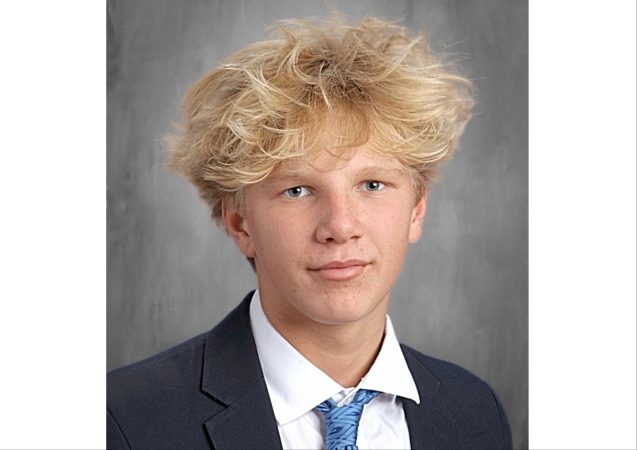
  • Community mourns 16-year-old wrestler Chase Sudano, who died in an e-bike crash in Burlington County

    Community mourns 16-year-old wrestler Chase Sudano, who died in an e-bike crash in Burlington County

    The South Jersey wrestling community is mourning 16-year-old Chase Sudano, who died in an electric bike crash involving a UPS truck in Burlington County on Tuesday morning.

    New Jersey state troopers responded to a crash at 10:45 a.m. near the intersection of Tranquility Court and North Firelane Road near Route 70 in Southampton Township, N.J.

    Sudano was driving a Talaria electric dirt bike east on North Firelane Road and collided with the right rear of the truck, which was traveling south on Tranquility Court and approaching the intersection of North Firelane Road, according to police.

    Sudano was ejected from the bike and sustained fatal injuries from the impact. No other injuries were reported. The case remains under investigation, police say.

    A UPS spokesperson wrote in a statement: “We are heartbroken by the tragic accident in Southampton Township, N.J. Our thoughts and prayers go out to the family and loved ones. We are fully cooperating with authorities to understand what happened. Since this is an active investigation, we must refer any additional questions to the authorities.”

    Sudano, who attended St. Augustine Prep in Atlantic County, was approaching his 17th birthday and lived in Southampton, according to 6abc.

    He was a rising wrestling star and had “exceptional character, integrity, and humility — not only on the wrestling mat, but in every aspect of his life,” St. Augustine Prep Athletics wrote.

    As a sophomore, Sudano was a district champion and third-place finisher at regionals in the 126-pound weight class. He qualified for the NJSIAA state wrestling championship in Atlantic City, where he competed in the preliminary round, and finished his season with a 32-12 record.

    South Jersey schools and wrestling programs, including Rutgers University, shared their condolences to the Sudano family.

    “The St. Augustine Prep community is deeply saddened by the tragic loss of our Hermit Brother,” the school’s athletic department wrote. “… He embodied the values of our brotherhood and left a lasting impact on all who had the privilege of knowing him. As we mourn this tremendous loss, we stand together in support of one another.”

    Chase Sudano was a rising wrestling star. He qualified for states this past season.St. Augustine Preparatory School

    Sudano wrestled in elementary school with the Rancocas Valley youth program and showed promise for a bright future, Rancocas Valley Wrestling said. The program also shared on social media that he’ll be remembered for “his strong work ethic, witty humor, and fierce competitive spirt.”

    A GoFundMe page organized by John Chirico noted that Sudano “was laid back, funny, and genuinely well liked by everyone who knew him. He had a way of making people laugh and bringing a smile to those around him.”

    His club team, River Club, which is based in Fort Washington in Montgomery County, posted on Instagram that Sudano was at more “wrestling practices than anyone in the last 13 years.”

    Pride Wrestling Club in Newfield, Gloucester County, wrote on Facebook that he was “an [integral] part of the South Jersey wrestling community. … We will all miss you dearly as a friend, competitor, opponent and family.”