Blog

  • Zelensky says Starshield restrictions threaten Ukraine’s energy defenses ahead of winter

    Zelensky says Starshield restrictions threaten Ukraine’s energy defenses ahead of winter

    KYIV, Ukraine — Restrictions on Ukraine’s Starshield satellite communications system are hindering its ability to intercept Russian drones, President Volodymyr Zelensky said Sunday.

    He warned that limitations on the system, operated by Elon Musk’s SpaceX, could weaken defenses around Ukraine’s energy infrastructure ahead of the winter months, when Moscow has repeatedly targeted the power grid.

    Ukraine’s interceptor drones continue to lose contact with their operators when flying faster than 100 mph along the front line and over Russian-occupied territory, leaving them unable to catch Russian Shahed drones, Zelensky said.

    “We are counting on these restrictions to be lifted,” he wrote on social media. “The protection of lives and Ukrainian energy infrastructure before winter depends on this. The Ministry of Foreign Affairs, the Ministry of Defense, and the President’s Office have been instructed to work closely with the American side and SpaceX. It is important to be on the right side of history. We need to help Ukraine.”

    Zelensky questioned Saturday whether the problem was technical, saying the restrictions appeared to have been imposed by SpaceX despite earlier assurances from U.S. Secretary of State Marco Rubio that Starshield was more under U.S. government control.

    Outages after Russian strike on power facility

    Meanwhile, a Russian strike on Chornomorsk, a port city in Ukraine’s Odesa region, injured six people and damaged energy infrastructure, regional head Oleh Kiper said Sunday on Telegram.

    The blast and falling debris also damaged a gas pipeline and nearby residential buildings, while two parked cars caught fire.

    The strike hit a facility operated by DTEK Odesa Electric Networks, temporarily leaving about 41,000 customers without power, Kiper said.

    Overnight Russian airstrikes on the southeastern city of Zaporizhzhia injured another six people, including a 2-year-old boy, Ukraine’s State Emergency Service said Sunday.

    Russia launched more than 2,300 drones, 1,590 guided aerial bombs, and 15 missiles of various types against Ukraine over the past week, Zelensky said.

    Ukrainian attack kills 1 in Russia’s Rostov region

    Ukrainian drone strikes damaged two electrical substations in Russia’s Rostov region, killing a chief engineer, Gov. Yuri Slyusar said Sunday.

    Four people were injured when drone debris fell on their cars, Slyusar wrote on social media. A fifth person was wounded when debris struck a “production facility” in the village of Troitskoye, he said.

    Ukrainian forces also targeted Russia’s Tatarstan region, officials said. Radmir Belyaev, mayor of Nizhnekamsk, the region’s third-largest city, said a “large-scale and prolonged attack” damaged its industrial zone.

    Six people were injured, and heating and hot water supplies were disrupted in parts of the city, he said.

    Ukraine’s General Staff said it had hit two sites in Nizhnekamsk: Nizhnekamskneftekhim, one of the largest petrochemical complexes in Europe, and a production site operated by petrochemical company Sibur. An oil refinery in the area was also hit, it said.

    Russia’s Defense Ministry said its forces shot down 533 Ukrainian drones overnight across 13 Russian regions, the Russian-annexed Ukrainian peninsula of Crimea, and the Black and Azov seas.

    Drones damage Black Sea ships, Romania says

    Romanian Prime Minister Luca Niculescu said Sunday that three commercial vessels in the Black Sea were struck by drones overnight, the latest in a string of attacks that have raised fears of the war spilling over into NATO territory.

    “Once again, maritime security in the Black Sea has been threatened,” Niculescu wrote on X.

    Romania’s Ministry of National Defense said a Greek-flagged oil tanker was struck by a drone, sparking a fire that was extinguished by the crew. Two more ships were later struck by drones, and their crews also extinguished fires onboard, the ministry said. No casualties were reported and the ministry did not state the origin of the drones.

    “These incidents are unacceptable and constitute a violation of international law,” Niculescu said, adding that they “reflect the deteriorating security situation caused by Russia’s ongoing war against Ukraine.”

    Last month, a string of cargo ships and tankers were struck by aerial or naval drones near the Bulgarian and Romanian coastlines. At least 30 sailors on commercial ships were confirmed dead or reported missing.

    “We will continue to take all necessary measures, alongside our Allies, to strengthen security in the Black Sea,” Niculescu added. “This remains a key priority for the Government, in close cooperation with our regional partners and NATO.”

    Estonia threatens Russian border closure after sabotage attempt

    Estonia’s government said Sunday it would close all border crossings with Russia from Dec. 1, after the Baltic country’s prime minister accused Moscow of attempting to sabotage an Estonian drone company a day earlier.

    The government said an attempted attack had been carried out early Saturday against Threod Systems in Viimsi, north of the capital, Tallinn, “with the aim of causing an explosion and setting the building on fire.”

    “If Russia continues its hybrid operations in Estonia, and we know that Russian intelligence services exploit border crossings to exert influence over people, we must be prepared to reduce the risks we face,” Prime Minister Kristen Michal said in a statement.

    “Closing the border would reduce the threat to people in Estonia and send a clear message that attacks on Estonia’s defense industry and defense capabilities are unacceptable,” Michal added.

    National broadcaster ERR reported Sunday that eight Latvian nationals have been detained after the attempted break-in.

  • Ebola outbreak remains out of control in Congo 6 months into response

    Ebola outbreak remains out of control in Congo 6 months into response

    BUNIA, Congo — Six months after an Ebola outbreak was declared in Congo, the disease remains out of control and efforts to contain it are faltering.

    More than 11,000 cases have been recorded, and nearly half of those infected have died, according to government data. It is the deadliest of Congo’s 17 outbreaks and is on track to surpass the death toll from the West African outbreak that killed 11,000 people between 2014 and 2016.

    Basic containment measures, including contact tracing and isolation, remain inadequate, raising doubts about authorities’ ability to halt the outbreak. Experts say there is little chance of bringing it under control within the next year.

    By the time the outbreak was announced in mid-May, 43 deaths had already been recorded, suggesting the virus had circulated undetected for an extended period. It has since spread to eight of the country’s 26 provinces, moving at a pace aid groups have likened to wildfire.

    New hot spots continue to emerge, stretching an already strained healthcare system.

    Questions over funding and management

    Community transmission remains high. According to the Africa Centers for Disease Control and Prevention, 80% of new cases are being detected outside health surveillance, meaning most infections have not been tracked by authorities.

    One-third of deaths occur at home or elsewhere in the community, where burials and other procedures are often conducted without specialist supervision, increasing the risk of transmission.

    Health workers have repeatedly gone on strike over pay that is months overdue, sometimes leaving patients with confirmed infections without treatment.

    Aid groups have also questioned how the response is being managed. Last month, the Africa CDC raised concerns about more than $700 million in Ebola aid that remains unaccounted for.

    “A troubling disconnect between the considerable resources mobilized for the response and what is actually reaching patients, front line workers, and communities continues,” said the humanitarian organization Doctors Without Borders, known by its French acronym MSF.

    Children face high death rates

    Children are particularly vulnerable to Ebola, especially those with preexisting conditions such as malnutrition, experts say.

    Most children affected by the disease have not received specialized care, contributing to high death rates.

    According to UNICEF, children accounted for 35% of deaths recorded through Nov. 4. Children under 5 accounted for 21% of all deaths, and nearly 72% of infected children in that age group have died.

    Conflict and attacks hamper response

    Health workers face difficult conditions as Ebola prevention and containment measures clash with social and cultural practices.

    Since the outbreak began, health workers have been attacked, some fatally, adding to the dangers of working in an already volatile region. Health facilities have also come under attack.

    The outbreak has been concentrated in eastern Congo, particularly Ituri and North Kivu, where communities face both the epidemic and armed conflict.

    Fighting between government forces and hundreds of rebel groups, including the Rwanda-backed M23, had already helped create one of the world’s most severe humanitarian crises. The Allied Democratic Forces, an Islamic State-affiliated rebel group, also attacks civilians.

    The virus’ rapid spread has raised fears of wider transmission across Africa. Nigeria, Kenya, and Uganda have confirmed cases, making this the most geographically widespread Ebola outbreak on record.

  • Trump’s handpicked party chair faces a rebellion after midterm losses test president’s grip on GOP

    Trump’s handpicked party chair faces a rebellion after midterm losses test president’s grip on GOP

    NEW YORK — A nascent rebellion is underway against President Donald Trump’s handpicked chairperson at the Republican National Committee, and it’s already getting ugly.

    Some members are calling for a forensic audit of spending decisions, including hair and makeup services for Trump and other officials, as well as the hiring of the daughter of Trump’s former chief of staff. Feuding Republicans are leaking emails and opposition research on rival factions. The White House is threatening to cut off fundraising assistance if the rebels don’t fall in line.

    The emerging fight, which will shape the 2028 presidential nominating contest, represents a rare challenge to Trump’s dominance, even after the party’s worst midterm performance in a generation. Despite the broad losses, Republican leaders across Washington have shown little desire to move past Trump and have largely stood behind his most unpopular policies.

    But inside the Republican National Committee, an organization of 168 members elected from every state who oversee the party’s national political operation, a small and growing collection of concerned Republicans are backing an attempt to depose Joe Gruters. Trump wants to keep him in charge.

    The dissidents are rallying behind Kentucky’s KC Crosbie, the RNC’s second in command. She launched her bid just two days after the Nov. 3 election in a letter that drew the fury of both the White House and Gruters’ allies.

    Crosbie remains a vocal Trump supporter who backs his “Make America Great Again” agenda, but her opponents view her gambit as a direct challenge to the president and his power.

    “Our job is to elect Republicans broadly, not to support one man all the time,” said RNC member Oscar Brock of Tennessee, who is supporting Crosbie’s candidacy. He said that requires a change in leadership because “there’s so much frustration that Chairman Gruters didn’t pull his weight in this election.”

    In her letter, Crosbie described the midterms as “a serious setback” and called for the RNC to provide “an honest account” of what went wrong.

    Crosbie declined to be interviewed.

    The leadership election will be held in January at the RNC’s winter meeting in Arizona.

    Inside the rebellion against Gruters

    Some would-be Crosbie supporters privately acknowledge they’re worried about a backlash from the White House, especially with Stephen Miller taking over as Trump’s chief of staff. Others believe in the committee’s tradition of having presidents pick their own party chiefs.

    Gruters also has vocal backers.

    Lauren LePage, an RNC member from Maine, praised Gruters’ leadership and efforts to help her father, Paul LePage, flip a congressional seat — a rare bright spot for Republicans this cycle.

    “From my perspective, as chairman, he did his job,” she said, adding that Trump’s endorsement is “something that the committee should take very seriously.”

    The Republicans who have lined up behind Crosbie insist a leadership change is needed to send a clear message that the party will do things differently after losses even in Republican strongholds like Texas, South Carolina, and Mississippi.

    Patti Lyman, an RNC member from Virginia, said it would be “catastrophic” and “insulting” to the party’s base “to keep the same leadership and pretend that we don’t need to do anything different, that we don’t need new players and a new plan.”

    Sue Cienki, an RNC committee member from Rhode Island, predicted that Crosbie would have the backing of at least two members from 10 states — a total of 20 — at the committee’s January meeting. That’s the minimum required for a successful nomination.

    Trump is furious with Crosbie

    Trump and senior White House officials were livid about Crosbie’s Nov. 5 letter and the fact that they were given no heads-up. The president soon released a lengthy statement on his Truth Social social media platform hailing Gruters as a “MAGA Warrior” and giving him his “Complete and Total Endorsement.”

    Trump is expected to play a central role in picking the party’s next presidential nominee.

    The party’s future is at stake

    Allies of Gruters say a leadership change now would put the RNC at a severe disadvantage heading into the next presidential cycle because a new team would need time to get up to speed. They say friction between the president and the committee’s leadership would curtail their ability to organize and raise money.

    They also reject Crosbie’s call for a postelection review, which they said would do little more than consume six months rehashing the past and put all their grievances on paper.

    Gruters spent much of this week holding private phone conversations with committee members. Those who participated in the calls said Gruters listened to their grievances, but said little about what he would do differently.

    Spending faces scrutiny

    The opposition to Gruters has focused on the RNC’s spending decisions under him. Republicans had a massive fundraising advantage and still had deep losses.

    “There’s clearly a groundswell of support for a forensic audit,” said Brock, the RNC member from Tennessee.

    In a letter to RNC members sent Thursday night and obtained by the Associated Press, Gruters acknowledged concerns about spending and other issues.

    Gruters defended a $22,500 expenditure for hospitality space at the Presidents Cup, a golf event, saying the space was offered to major donors and “resulted in $2.5 million in renewed contributions to the RNC.”

    He also addressed “a brief contract” between the RNC and Caroline Wiles, a longtime Republican consultant, who is the daughter of Susie Wiles, Trump’s former chief of staff. Gruters said she was hired by his predecessor at the committee, Michael Whatley.

    “While I have no reason to doubt Caroline Wiles’s value to the RNC or Chairman Whatley’s reasons for bringing her on, this was a brief six-month engagement that ended when I was elected Chairman,” he wrote.

    Gruters also defended the RNC’s decision to pay for “hair and makeup services” for senior White House officials, including Trump, Vice President JD Vance, and former press secretary Karoline Leavitt.

    “This was a request made of us so that the expense did not fall to taxpayers,” Gruters wrote, adding that the beneficiaries “generously gave so much of their limited time and energies to help the RNC this cycle” and “did not ask for much of us in return, so we felt this was a request we could accommodate.”

  • Trump heads to Asia with hopes of shifting the momentum after midterm setbacks

    Trump heads to Asia with hopes of shifting the momentum after midterm setbacks

    WASHINGTON — President Donald Trump heads to Asia this week, hoping to make some big attention-grabbing moves on the world stage after his party suffered deep losses in the midterm elections, diminishing his standing at home.

    The Republican president is using the international trip to try to shift momentum, and he is poised to make a splash with a historic three-way meeting with Presidents Xi Jinping of China and Vladimir Putin of Russia to talk about their nuclear stockpiles. Trump has long boasted about leveraging his relationships with the leaders of two of America’s biggest global adversaries, though he has failed so far to achieve major breakthroughs with them.

    He first heads to the Philippines to meet on Tuesday with Southeast Asian leaders who look to the United States for help countering Beijing’s aggression in the region. Trump will then go to China on Wednesday for the Asia-Pacific Economic Cooperation summit. There, he will have his third face-to-face meeting this year with Xi and see Putin, too.

    A year ago, Trump used a similar Asia trip to agree on a trade truce with China and secure investment pledges from Japan and South Korea. This time, Trump is going with his party no longer in control of Congress as of January and with attention beginning to turn to a crop of presidential hopefuls who aim to replace him in 2028.

    “I think he, like other presidents, has figured out that in a moment where things are really hard domestically: Get on an airplane and go international,” said Kurt Campbell, a former deputy secretary of state in Democratic President Joe Biden’s administration and chair of the Asia Group, a consultancy.

    It’s a pattern followed by some of Trump’s predecessors.

    Democratic President Barack Obama flew to Beijing days after his party lost the Senate in 2014 to negotiate carbon emission targets with Xi. Republican President George W. Bush went to APEC in Vietnam after the GOP lost control of Congress in 2006, though the Iraq War hung over his travels.

    The White House said Trump will sign a trade deal with Thailand in Manila as well as a host of commercial deals and will be the guest of honor at a leaders’ dinner. In Shenzhen, he will focus on trade issues before the meeting with Xi and Putin.

    Trump’s troubles are likely to follow him

    Trump is leaving as airlines struggled to get passengers onto flights after a nationwide ground stop on Friday led to thousands of flight cancellations. Trump and his officials have blamed their predecessors, a contractor, and Congress for the problems.

    Trump is about to be bogged down at home in ways that may curb what he can do overseas.

    His tariffs and war with Iran proved to be poisonous with voters. Going forward, Trump’s ability to threaten import taxes or military assaults — two of his major foreign policy tools — will be limited by Democratic majorities on Capitol Hill in the new year.

    Just last week, in a newfound vulnerability, his push to boost artificial intelligence was complicated when Nvidia CEO Jensen Huang resigned after admitting to an affair with an alleged Chinese government agent. Beijing has said it was not involved.

    Huang had traveled with Trump on Air Force One during his May trip to China, and he and his wife were at the head table when Trump hosted Xi in Washington for a state dinner in September.

    Trump has argued that America needs to preserve its leadership on AI and warned of dire consequences if China wins that competition. But Trump does not plan to confront Xi on the issue, said administration officials who insisted on anonymity as a condition for previewing the president’s plans on a call with reporters.

    The officials said they do not think the Nvidia situation will loom over the trip. Even though the administration is discussing ways to close loopholes and further prevent Chinese businesses from using advanced chips made by Nvidia and other U.S. companies, the officials said they do not expect the restrictions to cause retaliation by Beijing.

    Trump will be accompanied by Elon Musk, the head of SpaceX and Tesla, who is the world’s wealthiest man and a frequent adviser to the president. Musk spent at least $445 million to try to help Republicans keep control of Congress, and Democrats are keen to investigate his ties to the administration.

    Trump’s actions abroad face new scrutiny at home

    Trump may find it easier to be in the company of foreign leaders than his own crumbling coalition at home. But his words and actions at the summits are now more likely to draw scrutiny in committee hearings when he returns to Washington.

    “We’re going to have a very close eye on it,” said Rep. Gregory Meeks of New York, the top Democrat on the House Foreign Affairs Committee.

    Meeks and other leading Democrats on the committee have already called on the administration to provide more information about its approval of advanced AI chip exports after the Nvidia disclosures.

    Democrats also will be pushing for a much tougher approach to Putin and Xi, leaders they view as authoritarian strongmen.

    “It seems as though when Xi or Putin comes to America, he rolls out the red carpet for them — but other American allies come, he has not rolled out the red carpet for them,” Meeks said.

    Democrats want the administration to impose tougher sanctions on Russia over the war in Ukraine and have called for the administration to fulfill an arms agreement with Taiwan, which China has sought to block.

    Trump has suggested he wants to talk to Xi and Putin about nuclear weapons, an area that China has been reluctant to engage on in the past. China has a much smaller stockpile than the U.S. and Russia, giving it less incentive to agree to restraints.

    Wars in Iran, Ukraine will also hang over talks

    The visit comes as Trump is at a crossroads over the war with Iran, which is widely blamed for his political support cratering at home. It’s also a source of economic instability in Asia as jet fuel and diesel costs have soared. Trump has tried to play down the chances he will order major strikes against Iran to be resumed, though he also has said he does not see the need for talks.

    Democrats are likely to scrutinize whether the president confronts Xi and Putin over reports that China and Russia have aided Tehran, something Trump has previously dismissed.

    Trump recently has played up chances for a settlement to Russia’s war in Ukraine. President Volodymyr Zelensky has not been invited to the talks in China, drawing outrage from Democrats and some Russia hawks in Trump’s own party. Administration officials said Trump is not expected to talk about Ukraine with Putin at the meeting.

    The sheer number of issues hanging over Trump threatens to overshadow some important issues for the other regional leaders he’ll talk to — namely the strength of U.S. support for countering China’s influence in the Asia Pacific. In Manila, Trump is expected to participate in talks with the leaders of the Quad, a group of nations including the U.S., Australia, India, and Japan. It will be the first meeting of the Quad leaders since Trump returned to the White House last year.

  • No lights, no Dickens. After generations, a beloved Philly Christmas tradition goes dark

    No lights, no Dickens. After generations, a beloved Philly Christmas tradition goes dark

    Can it really still be Christmastime without the Wanamaker Light show?

    For the foreseeable future, Philadelphians are going to have to find out.

    The deeply cherished tradition — the beating heart of the holidays in the city — is on hiatus until the 2028 season, as its namesake building undergoes a multimillion-dollar redevelopment, according to the city’s visitors center.

    This will be the first time in decades that the charmingly low-tech cast of twinkling winter characters, the voice of Julie Andrews (formerly John Facenda), and the adjoining Dickens Village won’t usher in the merriment.

    The fate of the Light Show was in limbo last year, after the sale of its longtime iconic host, the Macy’s store in Center City. But a dramatic grassroots campaign and fundraising push saved the endangered 2025 run.

    Thousands turned out for last year’s Christmas Eve spectacular, bundled against the chill to greet the totemic Wanamaker Eagle, goggle at the magic Christmas tree, and be serenaded by the organ — not knowing when it all could return.

    Marissa Miller, of Fairmount, is holding her child Ivy Jordan, while watching the Wanamaker Light Show with her family on Dec. 24, 2025.Tyger Williams / Staff Photographer

    Now, developers are reimagining the cavernous 12-story building that was once a mecca to American consumers.

    The New York-based group TF Cornerstone wants to convert the upper levels into 600 loft-style apartments, while retaining office space; the lower levels that Macy’s once occupied will be used for retail, hearkening back to the century-old building’s history as a landmark department store.

    Most recently, developers revealed eatery concepts for the Grand Court; a rendering of the proposal featured a bar around the bronze eagle and romantically lit sit-down tables.

    The builders have pledged to bring back the Light Show and committed to “keeping the music of the Wanamaker Organ an important part of our civic life,” Ray Biswanger, executive director of the Friends of the Wanamaker Organ, said in an email.

    While the building gets its makeover, the panels of dazzling candy canes, glitzy Sugar Plum Fairies, and jolly snowmen that make up the show remain set aside in a tiny circuit room, known as “Frosty Central.” Biswanger told Axios, “they’re safely stored.”

    According to Axios, the Dickens Village displays are also being housed on the building’s third floor — stashed away like presents before Christmas morning, waiting to bring joy to revelers.

    Biswanger’s coalition is using the downtime to restore the organ and prepare the century-old masterpiece for another hundred years.

    Asher Perhosky (front left) and his brother Carter Perhosky visit Dickens Village at Macy’s with their father Pat Perhosky and grandmother Mary Eileen Perhosky on Nov. 29, 2024.Jessica Griffin / Staff Photographer

    “Prepare for a tremendous comeback come 2028!”

    But, for now, it’s bah humbug.

  • Pentagon prepares its own prosecution of general accused of leaking

    Pentagon prepares its own prosecution of general accused of leaking

    The Trump administration, in a remarkable escalation of its campaign to crack down on leaks, has directed the U.S. military to explore bringing a criminal case against a top general whom the Pentagon’s political leadership accused of giving sensitive information to journalists, according to people familiar with the matter.

    The development, which has not been previously reported, means that Lt. Gen. Brett Sylvia now faces legal jeopardy on two fronts after the allegations made by Defense Secretary Pete Hegseth’s team at the Pentagon were previously referred to the Justice Department.

    A U.S. official, speaking like some others on the condition of anonymity to discuss the Defense Department’s burgeoning case against Sylvia, confirmed that the matter was delegated “for appropriate disposition” to Adam Telle, the acting Army secretary.

    Attempts to reach Sylvia were unsuccessful and he has not spoken publicly about the allegations. To date, neither the military nor federal law enforcement has charged Sylvia with a crime. Until his firing last month, Sylvia, 54, reported to Gen. Dan Caine, the chair of the Joint Chiefs of Staff, as head of plans and policy for the Joint Staff. A spokesperson for the Joint Staff declined to comment.

    The aggressive pursuit of a criminal case against such a high-ranking military official follows Hegseth’s long-standing vow to find and punish those who have spoken with the news media about his stewardship of the Pentagon, particularly amid the Iran war. It’s part of an expansive effort by the Trump administration to target suspected leakers, a campaign that in the Defense Department has included widespread use of polygraphs and nondisclosure agreements.

    “Our commitment was not an empty promise,” Hegseth’s chief spokesperson, Sean Parnell, wrote on social media Oct. 29, after the news of Sylvia’s firing was reported. “We vowed to find you, and we meant it.”

    The Justice Department has not confirmed that federal authorities are looking into the Pentagon’s claims. In a brief statement, the agency said only that it has “ongoing investigations related to possible leaks of classified information” and that it works closely with “our government partners,” including the Defense Department. A spokesperson declined to address questions about Sylvia’s case specifically.

    Asked for comment, Hegseth’s office referred to Parnell’s statement from last month. A spokesperson for the Army secretary referred questions to Hegseth’s office.

    Whether the Justice Department or the Defense Department can secure a conviction is uncertain. A previous attempt by Hegseth’s team to punish suspected leakers went nowhere after the case was referred to federal law enforcement.

    Veterans of the military justice system said that any prosecution of Sylvia in that venue would face significant legal and logistical hurdles, not the least of which is the involvement of Hegseth’s team in pushing for the general to face disciplinary action. The process, these people said, is designed to be free of interference from senior officials in a service member’s chain of the command.

    Ultimately, the point of Sylvia’s case may not be to secure a conviction, but to send a message, said retired Army officer Franklin Rosenblatt, a lawyer and associate professor at Mississippi Christian University’s School of Law. “In many recent national security controversies in the second Trump administration,” he said, “the process is the punishment, and cases are brought without a realistic view of whether the government can take them to trial and secure a conviction.”

    Parnell’s social media post on Oct. 29 strongly implied that the general had put American service members at risk through the “intentional, unauthorized disclosure of classified information.” An internal investigation, Parnell said, had been “extensive.”

    But precisely what Sylvia is alleged to have done has not been detailed by the government publicly — only in media accounts that have relied on what appear to be selective leaks authorized by the Pentagon.

    For instance, in the hours after news surfaced that Sylvia had been fired, a number of conservative journalists shared a statement attributed to an unidentified “War Department official,” the name that the Trump administration uses for the Defense Department. The statement alleged that “Sylvia is the subject of an investigation for leaking classified information about the Iran war, the war between Russia and Ukraine, and more” and went on to accuse him of “meeting with journalists outside of the Pentagon” to circumvent restrictions that Hegseth’s team put in place curtailing reporters’ access to the building.

    The U.S. official who confirmed that Hegseth had delegated Sylvia’s case to the Army secretary alleged that the general acknowledged to military investigators having taken notes from government material classified as secret and provided information from it to a reporter. Sylvia, this official alleged, also told investigators that he communicated with a reporter through the commercial messaging application Signal but deleted the chat.

    Others familiar with the case have said that Sylvia failed numerous polygraph tests during the Pentagon’s search for potential leakers and that he told colleagues he acknowledged having relationships with reporters but denied disclosing classified information to them.

    Axios, citing an internal military report that it reviewed, reported on Oct. 29 that the general admitted to leaking information to journalists from two media outlets.

    The Post has not independently verified these claims and the Pentagon, when asked, declined to share a copy of its internal investigation.

    It is far from a foregone conclusion that the government can build a strong enough case to prosecute Sylvia, people familiar with the matter said. For instance, it is unclear whether the general, if he did convey information to a reporter, may have generalized the material to avoid disclosing classified information, as senior military officers routinely do when speaking at news briefings. Moreover, deleting a Signal chat, if it occurred, does not prove anything by itself, these people said.

    If the case does move forward within the Defense Department, it could place extraordinary pressure on the military justice system, which rarely tries generals for alleged crimes and even more infrequently has a sitting defense secretary and his political team so directly involved in pushing the allegations.

    Once a general is appointed to oversee the case, he or she is expected to act fairly and impartially. Should the general decide to proceed with a case, an Article 32 hearing serves as a significant early step to decide whether there is a basis for a trial, known as a court-martial. Typically, such hearings are open to the public, with partial exceptions granted if there is a need to discuss classified information, said Eugene R. Fidell, a visiting lecturer at Yale Law School with decades of experience in the military justice system.

    A jury comprising eight of Sylvia’s peers probably would decide his fate if the case were then sent to court-martial. By regulation, the jurors must be higher in rank than the accused – meaning four-star generals, three-star generals with more time at that grade than Sylvia, or retired generals with equivalent experience, Fidell said. They could come from the Army or any other branch of service.

    In addition to possible charges focused on the alleged dissemination of classified information, the military justice system includes a “broad arsenal of potential charges,” said Rosenblatt, the law professor at Mississippi Christian University. That includes a failure to obey a lawful order or regulation, conduct unbecoming an officer, and contemptuous words against senior civilian officials, he added.

    If charges are brought, Sylvia’s defense team “almost certainly” will bring up unlawful command influence, Rosenblatt said. Known as the “mortal enemy of military justice,” UCI occurs when a superior seeks a certain outcome by pressuring personnel who are ultimately subordinate to them.

    The statement from an unidentified “War Department official” that was circulated selectively after Sylvia’s firing alleged that the general had been ousted for “severe misconduct” and that he had failed three polygraph tests. The “extent of his leaking became so critical” that Hegseth had to remove him, the statement said. “Urgent action was needed and could not wait another second,” it said.

    Rosenblatt said the emphasis on polygraphs is “problematic” because the results are inadmissible in court. A judge could determine that the Defense Department’s public claims about Sylvia’s polygraph results could taint a pool of prospective jurors, he added.

    “The jury,” Rosenblatt said, “is charged with determining who is credible and who is lying, not machines.”

  • Two young people from the Philly area awarded 2027 Rhodes scholarships

    Two young people from the Philly area awarded 2027 Rhodes scholarships

    Two young scholars from the Philadelphia area were awarded Rhodes scholarships for 2027, the institution announced Saturday.

    Christopher Y. Shin from Cherry Hill, N.J., and Mary I. Cipperman of Devon, Pa., were among the 32 American students selected from a pool of more than 1,000 nominated by their colleges and universities for the full-ride scholarship to Oxford University.

    Shin is a senior at Harvard University double majoring in chemical and physical biology and government. Cipperman graduated from Harvard in the spring with a bachelor’s in physics and a master’s in applied physics.

    During Shin’s time at Harvard he has researched infectious disease epidemiology with mathematical modeling and viral genomics to understand how to contain disease outbreaks. He also volunteers at Massachusetts General Hospital. Outside of science, math and medicine, he participates in the Harvard Model Congress and plays piano and trumpet. He plays in the Harvard Jazz Orchestra, is the former president of the Harvard Piano Society, and performs in a pop/funk student band.

    Once Shin arrives at Oxford next fall, he’ll pursue a master’s in modeling for global health and a master’s in genomic medicine. He said he hopes to become an administrator at the Centers for Disease Control and Prevention someday and a physician scientist before that. The combination of biology and sociology embedded in the study of infectious disease first piqued his interest while studying at Harvard.

    He’s interested in “in how we as a society can better prepare, mitigate and prevent pandemics from occurring,” said Shin, 21, who attended Cherry Hill High School East.

    “An ideal career trajectory I think for me would be anticipating threats like SARS-CoV-2 and COVID-19 before they actually come to fruition and in the case we discover a COVID outbreak being able to respond with global partnership and governance,” he said.

    Cipperman currently researches applications of AI for clinical trial emulation and patient diagnosis as an Alex G. Booth fellow at the Mahmood Lab at Harvard. She also volunteers with hospice patients in the Cambridge area, was the president of the Harvard-Radcliffe Society of Physics Students, and has conducted research at CERN, the European laboratory for particle physics, to improve collision detection.

    At Oxford, Cipperman will pursue a master’s in applied digital health and a master’s in medical physics with radiobiology. She aspires to ultimately become a physician scientist, she said, possibly specializing in oncology as a cancer survivor herself.

    “I’m hoping to bridge clinical medicine with the advancements in science and technology that we’ve seen, especially in AI, over the past couple of years,” said Cipperman, 23, who attended Episcopal Academy in Newtown Square.

    “A huge part of my academic plan is to actually not just develop AI but to develop also the auditing standards that ensure that it’s implemented in a way that’s ethical, safe and representative of various patients,” she said.

    Shin, Cipperman, and the 30 other Americans chosen for one of the academic world’s most elite awards will begin their studies at Oxford in October alongside scholars from 25 other regions from across the world. They will be part of an international cohort of around 100 scholars.

    More than 3,000 students started the application process and 1,006 of them were formally endorsed by more than 281 schools.

    In addition to Shin and Cipperman from the U.S. cohort, two international University of Pennsylvania fourth-years were also awarded Rhodes scholarships: Lena Alshanafey, from Saudi Arabia, and Elliot Ross-Dick, from Trinidad and Tobago.

    Alshanafey is pursuing a dual degree in economics and political science in the Wharton School and the College of Arts and Sciences, with concentrations in finance and healthcare management. She’s a Joseph Wharton scholar through the Benjamin Franklin scholarship program, which aims to help foster students’ multidisciplinary interests. Her honors thesis uses hospital records to look at access to treatment for menopausal women in Saudi Arabia.

    Alshanafey also conducts research in Penn’s Department of Health Care Management and has led consulting projects for healthcare companies and startups. She has worked at Boston Consulting Group and Sanabil Investments, the venture arm of Saudi Arabia’s Public Investment Fund, founded Novus Digest, a youth-led publication, and written for Arab News.

    At Oxford, Alshanafey will pursue master’s degrees in global health science and epidemiology and in applied digital health. She plans to return to Saudi Arabia to work in health policy and healthcare investing, using population-level evidence to identify gaps in women’s healthcare and guide investments toward models of care that reach women earlier.

    Ross-Dick is pursuing a mathematics degree in the college, with a minor in theatre arts. He is enrolled in the accelerated master’s program in International Educational Development and Research in the Graduate School of Education. He is a Penn World Scholar, a member of the Friars Senior Society, the Kinoki Senior Society, cast director for Mask and Wig, and a board member of Quadramics Theatre Company.

    At Oxford, Ross-Dick plans to pursue master’s degrees in education research design and methodology and comparative and international education. He will research the application of a culturally relevant framework to Caribbean education as a means of decolonizing the region’s education system.

  • America survived Y2K.26, but can we make it through two more years?

    America survived Y2K.26, but can we make it through two more years?

    “Totalitarianism in power invariably replaces all first-rate talents, regardless of their sympathies, with those crackpots and fools whose lack of intelligence and creativity is still the best guarantee of their loyalty.” — Hannah Arendt, The Origins of Totalitarianism, 1951

    When the day finally came, it was exactly like what so many sirens of doom had predicted.

    America’s intricate web of domestic air travel ground to a sudden and chaotic halt due to its overloaded circuits — stranding tens of thousands of dazed and bedraggled passengers. A different communications failure left millions unable to send emails. A large tanker on the mighty Mississippi River apparently lost power and slammed into a cruise ship loading up with tourists. A SpaceX booster rocket blew up in a fireball over the Gulf of Mexico. There were stunning random events — people fled what proved to be a bomb at an ethanol plant in Peoria, Ill. — and the predictable, panicked false rumors that things were even worse, that other systems like weather radar might also be failing.

    Nov. 13, 2026 — a date that will live in bureaucratic infamy — played out uncannily like the high-tech Cassandras had all told us that it would … back in the mid-to-late 1990s.

    The incredible irony as the nation watched a real-life Friday the 13th horror flick unspool on the cable-TV news channels was that the overlap of failing systems had been predicted for Jan. 1, 2000. That was the now legendary Y2K scare in which the limited capacity of early computer coding seemingly threatened to launch a new millennium with a crash that would bring civilization to a halt.

    The feel-good story of the OG Y2K was how a crisis born of one mistake — the programming shortcut that avoided the reality of a 21st century — was overcome by a massive mobilization of professionalism, competence, and foresight, as thousands of unknown soldiers toiled to update our computers just in time.

    Friday’s dark sequel — let’s call it Y2K.26, an update turned horribly wrong — followed the Hollywood formula of what can go astray when the lessons from the original’s happy ending are foolishly tossed down a memory hole.

    When the hero bureaucrats are fired for no reason. When a political movement rises by ridiculing anyone with expertise. When an increasingly lazy and greedy society farms out all the work to robots, and humans have little agency but to hope for the best.

    Cindy Donnelly, of Doylestown, is seen with her fellow retired teachers from Sellersville Elementary, waiting for luggage after they were told 30 minutes before boarding that their flight to Turks and Caicos was canceled at Philadelphia International Airport on Saturday.Tyger Williams / Staff Photographer

    Yes, you can certainly argue that some of the things that went wrong in a jarringly wild week even by U.S. standards — I haven’t even mentioned the deadly building collapse in Brooklyn, the ship hitting a major bridge here in Philly, or two planes bumping on a Miami runway — were random, unconnected events.

    Yet, it felt like all of it shared a kind of 21st-century hubris — that decades of mocking the pointy-head nerds of bureaucratic professionalism and shrinking government (well, except for the Pentagon, and the graft) to the size where it could be drowned in a small bathtub has created a world where things fall apart, and the center is not holding.

    The marquee moment of an American meltdown was the nationwide Federal Aviation Administration (FAA) four-hour ground stop — the longest since the 2001 terror attacks — that canceled more than 15,000 flights this weekend and delayed thousands more, while stranding confused air travelers who scrambled to get surge-overpriced hotel rooms and missed long-planned journeys, or were driven seven hours to a loved one’s 90th birthday party.

    As I write this on the Sunday morning after, with the nation’s air traffic not nearly back to normal, officials at the FAA and the Departments of Transportation and Homeland Security are still struggling to explain — in terms that normal people can understand — exactly why its system for communicating with airborne pilots collapsed.

    The latest version is that the communication breakdown was because of something that went wrong (exactly what has been met so far with the equivalent of a shrug emoji) when a contractor was replacing the FAA’s outdated copper wiring with fiber-optic cable. Although, knowing the Trump regime, it’s possible someone was fencing the valuable copper on the black market.

    I kid, but this is the bigger problem here. People are going to make mistakes, whether it’s the limited two-digit computer programmers of the 1980s or the accidental deletion of a database file that caused a shorter FAA ground stop in 2023, when Joe Biden was president. The public can understand this, but only when there are experienced, competent, caring grown-ups there to fix the problem and reassure the huddled masses.

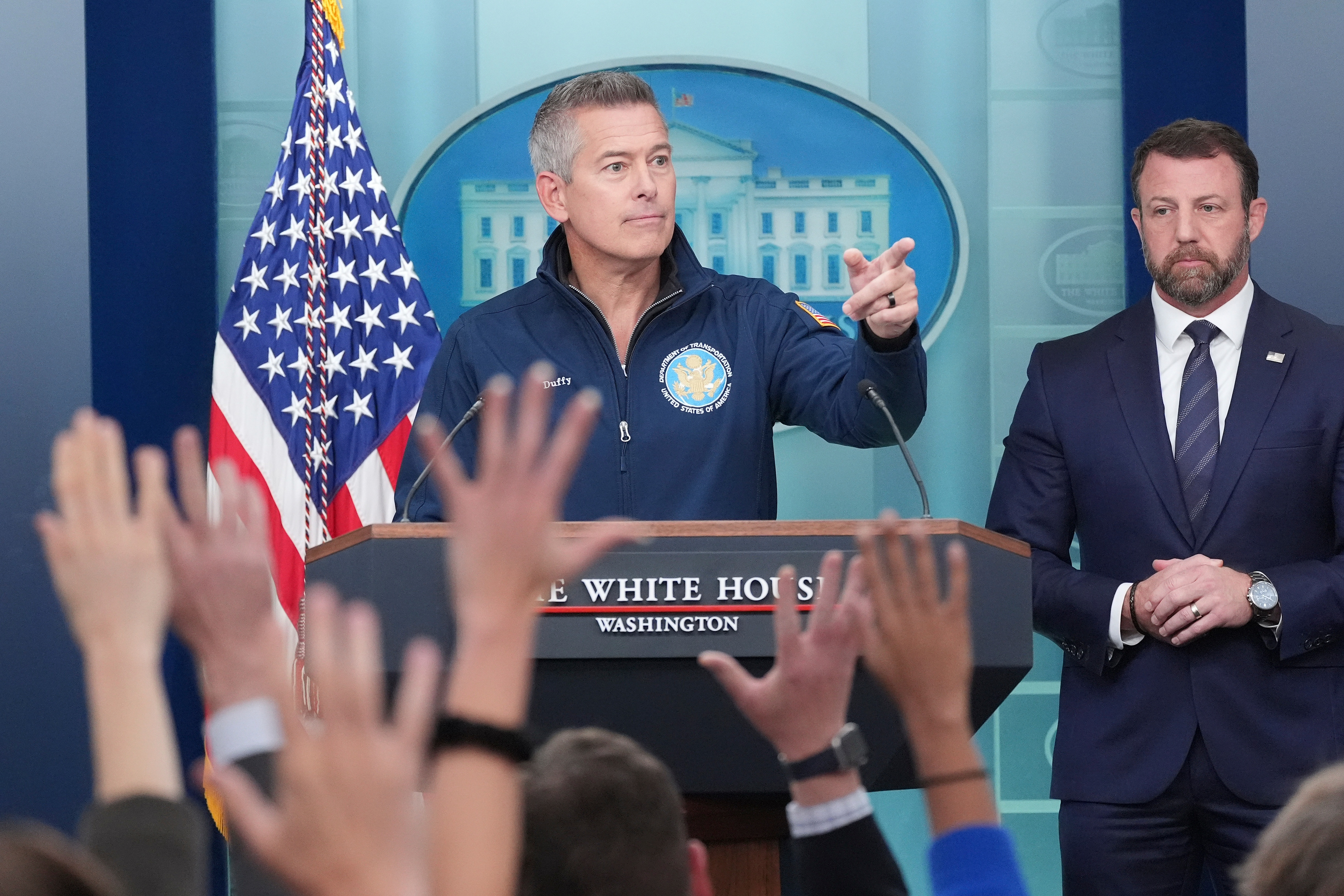
    Transportation Secretary Sean Duffy (left) and Homeland Security Secretary Markwayne Mullin during a news conference in the James Brady Briefing Room of the White House on Friday.Alex Brandon

    On Friday night, America instead got the live-action version of Beavis and Butthead.

    This was the nationally televised news conference that featured Transportation Secretary Sean Duffy — in his suitably autocratic monogrammed windbreaker with no visible shirt underneath, as befitting a reality TV star who started out with a striptease video — and pugnacious Oklahoma plumber Markwayne Mullin, who runs Homeland Security. The event only fanned the flames of panic.

    It wasn’t just that the two cabinet secretaries had no real idea why thousands of jetliners were idling on American tarmacs, which didn’t stop Duffy’s extortionary demands that Congress fork over $50 billion to his department before it even had a chance to determine what happened to the $25 billion appropriated under Biden.

    The real problem was summed up by Mullin when he proclaimed: “This is what the leadership of President Trump looks like … by the organization and the team he’s put together.”

    Bingo.

    Which takes us back to the very root, and the chillingly prescient observations Hannah Arendt — our first and still greatest explainer of modern civilization’s weakness for self-proclaimed strongmen like Trump — published way back in 1951.

    Arendt, in seeking to understand events like Adolf Hitler’s takeover that led her to flee her native Germany in 1933, wrote that free-thinking intellectuals pose a threat to the total domination sought by totalitarians, and so incompetence becomes a feature, not a bug.

    Arendt, in warning us about “crackpots and fools,” did not live to see MTV’s Real World: Boston, yet she essentially predicted there would be a Sean Duffy.

    This is what’s so important for the news media, the new Congress that is promising radical change, and others in leadership to understand in making sense of a moment like this Friday the 13th — that the real problem isn’t the old copper wiring, but the invasive new infrastructure of American authoritarianism that has overgrown and strangled everything.

    The maladministration of the Trump regime wasn’t the only visible rot when last week’s overlapping failures lifted up the rock to reveal the rancid muck underneath.

    The banal evil of their government’s ongoing pogrom against our immigrant neighbors was shockingly revealed when a Colombian-born father and daughter who rarely left home because of fear of Trump’s immigration goon squads were killed in the Brooklyn building collapse, or when painfully shackled detainees were forced to suffer aboard idled aircraft on as many as six tarmacs Friday night.

    Ciahola Lawrence, a resident of the Brooklyn building that partially collapsed, becomes emotional as she speaks during a news conference in New York on Friday.Seth Wenig

    The massive corruption that guides the 47th president and his minions was also never far from the surface. There were understandable questions about whether an obscure contractor named Air Space Intelligence, which nabbed an $875 million contract to develop the FAA’s new AI-powered air traffic management system, was rewarded for its $12,500 in donations to GOP U.S. Rep.-elect Michael Alfonso of Wisconsin.

    Also known as Duffy’s son-in-law.

    The terminal decay under Trump’s cabinet of crackpots and fools is sudden but also gradual — whether that’s the United States falling off the list of nations that have fully eliminated measles under our health and human services secretary, Robert F. Kennedy Jr., or Commerce Secretary Howard Lutnick looking the other way as Trump’s ballroom donor pal Jensen Huang and Nvidia were likely selling their powerful chips to China.

    Incredibly, this insane clown posse was on full display just as the president’s cartoonishly evil new chief of staff, Stephen Miller, outlined a plan to give even more power to Trump’s cabinet secretaries over the final two years as the president himself drifts into oblivion.

    We can’t let that happen.

    Although Trump’s Friday the 13th might have felt like a terrifying full-length feature, it was, in reality, just a preview of coming attractions for a two-year horror show. To be sure, the new Democratic-run Congress will have the ability to do many things: pass popular legislation and dare Trump to veto it, use its newfound powers to force a lame-duck president to the bargaining table, and investigate and even impeach (but probably not convict) the worst of the worst cabinet members.

    But Congress can’t impose smart and competent administrators on an unwilling administration. The beatings will continue until we can find more creative ways to curb the power of a rogue administration. The removal of an increasingly unhinged Trump should be an imperative, but I am terrified that planes will actually have to start falling from the sky before we reach that obvious conclusion.

    This month’s Democratic tsunami has triggered talk of new possibilities, like expanding the U.S. Supreme Court or ditching the Electoral College. Maybe we should add — in an era of fickle voters, so susceptible to demagoguery — reducing the presidency to a two-year term.

    Because I’m not sure how America survives two more years like Friday night.

  • Trump vows appeal of East Potomac ruling as golf operations remain unclear

    Trump vows appeal of East Potomac ruling as golf operations remain unclear

    President Donald Trump said Sunday that his administration would appeal a federal judge’s decision blocking the closure of East Potomac Golf Links, adding more uncertainty to the immediate future of the historic public course.

    In a social media post, Trump called U.S. District Judge Ana C. Reyes’s temporary restraining order “highly destructive and political” and said the Interior Department “has the absolute right” to remake the property. The administration “will immediately appeal, on an expedited basis,” Trump wrote.

    It’s unclear, though, whether the administration can immediately appeal.

    Reyes issued a temporary restraining order Saturday night — one day before the administration planned to close East Potomac Park to the public. The order remains in effect through Nov. 28.

    Parties can generally not immediately appeal temporary restraining orders, because they are meant to be short-term and preserve the status quo. But there have been exceptions, and an appeals court would first have to decide whether Reyes’ order is one it has the authority to review now.

    Spokespeople for the Justice Department, the National Park Service, and the Interior Department did not immediately respond to requests for comment Sunday morning.

    The judge’s decision, which preserved public access to the historic Hains Point property, was a significant setback for Trump’s effort to replace East Potomac’s three public courses with a single championship course. Golfers and preservationists are suing to block his plans.

    The Trump administration said the planned closure was unrelated to those efforts and it needed to close the property because of safety concerns and because National Links Trust, East Potomac’s longtime operator, was set to stop managing the facility.

    Reyes said Saturday that the administration’s stated reasons for closing the property this weekend were “pretextual” and that the administration, “in its haste to meet an arbitrary deadline,” had probably violated federal environmental and administrative laws.

    Her order temporarily bars the administration from closing the park while the court considers the preservation groups’ broader legal challenge.

    The order leaves unclear what will happen at East Potomac Golf Links beginning Monday.

    Reyes ordered that the golf-course property, Ohio Drive, and the surrounding parkland remain “open and accessible to the public.”

    But she stopped short of requiring the Park Service to continue offering golf. “Nothing in this Order requires Defendants to (1) operate East Potomac Golf Course for play, or (2) enter into any contract with any concessioner to operate East Potomac Golf Course for play,” Reyes wrote.

    Whether and how to provide golf is up to the government, she said, but officials “cannot use the absence of golf operations as a reason to exclude the public from the Course.”

    Trump, meanwhile, renewed his criticism of the condition of East Potomac, which he called “one of the worst and most dangerous golf courses anywhere in the U.S.” He said delaying work would cost “golf seasons, jobs, prestige, and much money.”

  • Lutnick pushed to weaken chip rules that overlap with his family business

    Lutnick pushed to weaken chip rules that overlap with his family business

    WASHINGTON — In Malaysia’s lush southern peninsula, a data center known as A201 is set to open next year, packed with hundreds of millions of dollars worth of Nvidia’s most advanced artificial intelligence servers.

    The data center plans to supply this computing power to a Chinese tech giant. The setup is legal and profitable. It will also sidestep U.S. rules that ban sales of the most advanced AI chips directly to Chinese firms.

    The company operating the data center is a client of Cantor Fitzgerald, a financial services firm formerly led by Commerce Secretary Howard Lutnick, who handed off leadership of it to his sons. Lutnick is now writing the rules that would have a substantial effect on the data center’s business.

    Lutnick has been seen as a force slowing rules that would clamp down on the sale of Nvidia chips to data centers like A201, which sit outside China but provide AI computing power to Chinese firms.

    The Trump administration, concerned about ceding the country’s advantage in AI, banned the sale of cutting-edge chips to China. But it has been embroiled in an internal debate for much of the past two years over how far to go in limiting chip sales to data centers in Southeast Asia. On one side of the debate are China hawks, who see the data centers as a way for Beijing to do an end run around the chip sales ban. On the other are officials, most prominently Lutnick, who are pushing against going too far in limiting the ability of U.S. companies like Nvidia to sell their products in Asia.

    Recently, Lutnick has been advocating a less stringent version of those controls under consideration, which could cut back on Nvidia’s business by giving the U.S. government more oversight of chip sales to international data centers. It is the latest example of Lutnick’s soft touch on chip regulation, which has prompted criticism from lawmakers and others in the administration.

    Cantor Fitzgerald has had business dealings with several data center companies in Southeast Asia that cater to Chinese clients, and could be affected by the regulations Lutnick is drafting, a review by the New York Times has found.

    Cantor Fitzgerald served as a designated sales agent for an equity offering of up to $1 billion this year by Bitdeer, the Singaporean firm that will operate A201, in addition to having other financial ties to various global data center businesses. The relationship between the two companies began as early as 2024, when Cantor Fitzgerald helped Bitdeer arrange a stock offering of up to $250 million.

    Lutnick steered Cantor Fitzgerald for decades, before recusing himself when he joined the Trump administration last year. The Commerce Department says Lutnick has complied with all ethics agreements, and his former business is now run by his sons.

    These dealings are just a tiny portion of Cantor’s business, which stretches from investment banking and trading to real estate. Other investment banks have similar partnerships, and there is no evidence that Cantor’s investments influenced Lutnick’s deliberations.

    But the overlapping relationships are the latest indication of the potential conflicts that exist given Lutnick’s role in shaping rules around U.S. technology exports. And they demonstrate how the U.S. ban on selling chips directly to China has led to an explosion of data centers in Southeast Asia aimed at Chinese customers. It is now up to Lutnick to decide whether to tighten the rules in ways that would cut off this avenue.

    In the administration, Lutnick has been seen as one of Nvidia’s strongest champions.

    His department has been increasingly criticized in recent months for giving Nvidia unusual access to rulemaking and investigations, and standing in the way of sanctions on Nvidia’s customers.

    The issue has been thrust into the spotlight in recent weeks with the scandal over Nvidia CEO Jensen Huang’s affair with a woman the U.S. government deemed to be a Chinese intelligence asset.

    The woman, Alice Huang, had led Megaspeed, a firm that set up data centers in Southeast Asia to serve Chinese companies. The U.S. government is also investigating Megaspeed for illegally smuggling chips into China.

    The United States in late 2022 started banning exports of Nvidia’s advanced chips directly to China, out of concern the chips could help Beijing crack U.S. encryption and design new weapons.

    But while Chinese firms cannot buy Nvidia’s most advanced chips outright, nothing stops them from renting those chips in data centers in Malaysia, Indonesia, or Thailand.

    The arrangement is viewed by many in Washington as a harmful loophole. While some argue that the sales help U.S. leadership in technology, many in the administration have argued for clamping down, and Congress is considering a bipartisan bill to do so.

    In its final weeks, the Biden administration issued global rules to restrict the ability of Chinese companies to remotely access U.S. chips. But President Donald Trump revoked those rules when he came into office, arguing that they stifled U.S. business and innovation.

    Trump officials said they would introduce a new rule to replace the Biden-era restrictions. But they have struggled to reconcile competing views in the administration about how aggressive the rules should be.

    Lutnick has been described as delaying or deferring these technology controls at several points in the past year, arguing that they could affect companies like Nvidia, or U.S. trade relations with China and other countries.

    People familiar with the discussions say the Commerce Department has pushed for a more scaled-back version of the rule. The department has proposed applying regulations to a handful of countries — Singapore, Malaysia, Thailand, Indonesia, Brazil, South Africa, and Norway. Others in the administration have wanted global coverage.

    The proposal was first reported by the Information.

    The Commerce Department proposal would also apply only to future shipments of advanced chips, exempting data centers already filled with U.S. technology. Companies would need to notify the government if Chinese customers use their data centers to train AI models. But they would not automatically need to obtain a license.

    The Commerce Department had also argued for the rules to kick in when companies are using a larger amount of computing power, meaning fewer activities by Chinese companies would be regulated.

    Chris McGuire, a senior fellow at the Council on Foreign Relations and a former Biden administration official, predicted that Chinese companies would find ways to sidestep the more narrow controls the Commerce Department is proposing.

    “If you’re only restricting remote access to data centers in certain countries, then China will just rent from the data centers outside those countries,” he said.

    Nvidia had been one of Cantor’s largest stock positions early last year, but last fall, the firm began steadily selling off shares. Cantor holds those shares on behalf of clients, not as part of its proprietary investment portfolio.

    Still, Cantor Fitzgerald continued to help arrange billions of dollars of financing for industries ranging from data centers to cryptocurrency that depend on a steady supply of computing from Nvidia.

    That includes Bitdeer, which is building out the Malaysian data center it expects to generate $1.7 billion in revenue over five years, according to a company statement.

    That data center will likely serve Tencent, a Chinese internet giant that would be able to gain access to Nvidia’s most advanced AI servers, according to a person with knowledge of the arrangement. Bitdeer is part of Nvidia’s partner network, a program for companies that work closely with the chipmaker.

    Bitdeer hosts a Chinese-language website that lets customers rent AI chips and gain access to Chinese open source AI models through data centers in Malaysia, Canada, and elsewhere. The Johor facility is one of five data centers the company plans to open in Malaysia in the coming years, according to filings with the Securities and Exchange Commission.

    Cantor holds a stake in Bitdeer through its investment in Tether, a crypto company. It is far from the only U.S. financial heavyweight investing in overseas data centers. Bain Capital, Citadel, and Blackstone have all poured money into AI computing clusters across the region.

    Cantor also previously provided financial services to Gorilla Technology, which is building data centers in Thailand and Indonesia, and has a contract to provide AI computing to Freyr AI, a Singaporean data center firm that corporate filings and job ads indicate has ties to China.

    Cantor has worked with other Nvidia partners globally, including IREN, an Australian cloud computing company, and Lancium, a Texas data center developer.

    A Commerce Department spokesperson said Lutnick makes policy decisions based on the best interests of the United States. He does not discuss department matters with his sons, nor do they discuss Cantor Fitzgerald business with him, she added.

    Cantor Fitzgerald declined to comment. Bitdeer did not reply to a request for comment.

    Lutnick, as of October 2025, transferred his remaining ownership stake in Cantor to his family. Before that, he had been given what the White House had called a “limited waiver” that allowed him to participate in certain decisions that could have “a direct and predictable effect on Cantor Fitzgerald,” exempting him from a federal criminal law that would otherwise have required him to entirely recuse himself from these discussions.

    Even after Lutnick finished transferring his ownership stake to his sons late last year, he still had to abide by an ethics rule prohibiting federal employees from using their public office for their private gain or the gain of friends and relatives.

    The Times reported last year that Lutnick was promoting data center projects that worked with his family firms. Sen. Elizabeth Warren (D., Mass.) and two dozen other Democratic lawmakers called for an investigation.

    This article originally appeared in the New York Times.