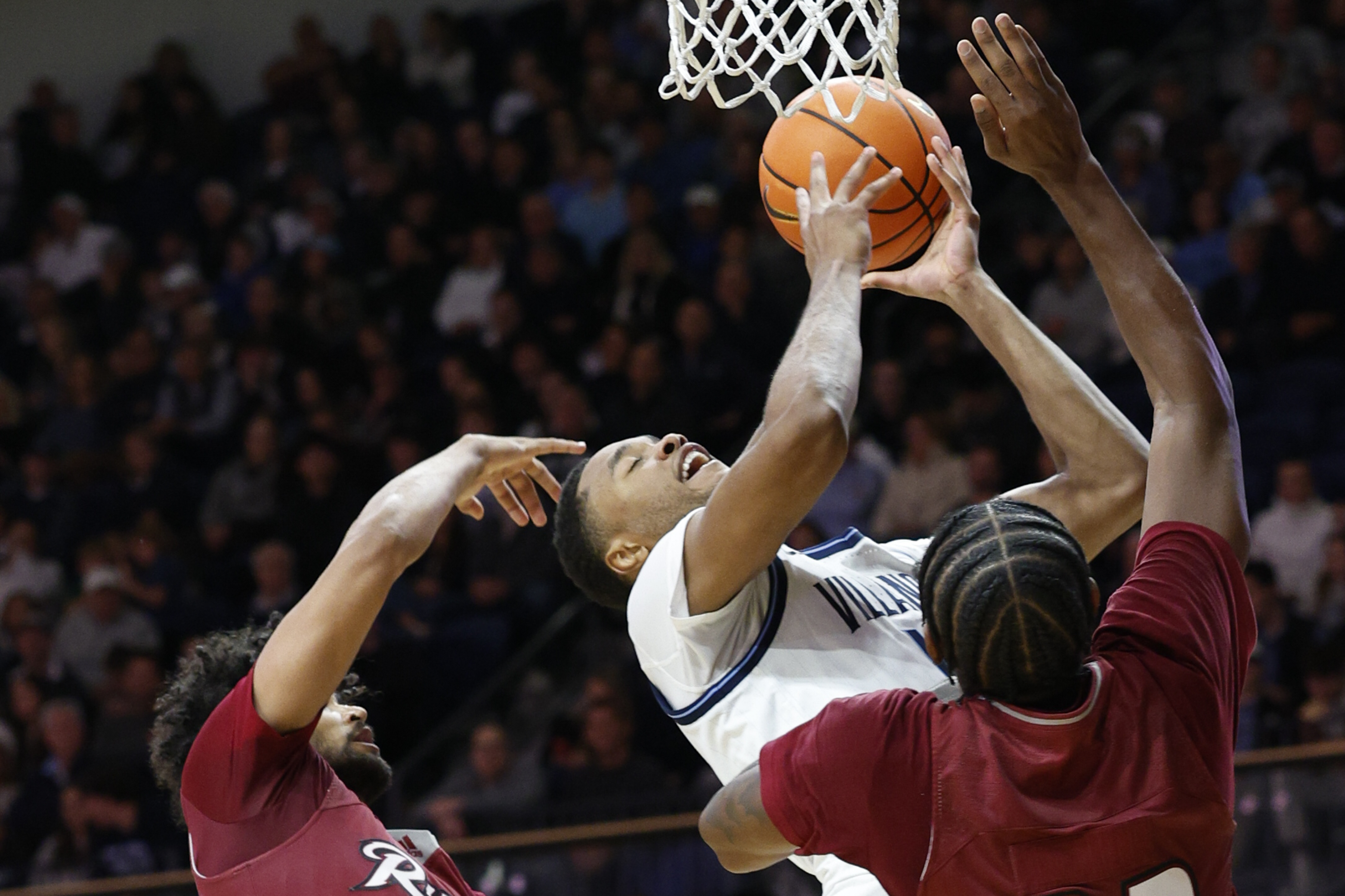
Villanova has yet to lose a game in the United States and has now won three straight.
Villanova (3-1) hosted Rider and earned a 99-62 lopsided win at Finneran Pavilion on Saturday night. Rider (1-4) entered the game ranked No. 359 out of 365 Division I teams in KenPom, a respected analytical ranking system. Devin Royal led Villanova with 21 points. The Wildcats outrebounded the Broncs, 54-33.
“I think we locked in really well with really a big week ahead of us,” Villanova head coach Kevin Willard said. “So I thought the guys paid attention to the game plan and really did a good job of just staying locked in on what we had to do.”
Villanova was without freshman center Luigi Suigo due to right knee soreness, while Darryl “Buddy” Simmons left the game with four minutes left in the first half.
Villanova shot 32-for-70 (45.7%) from the field and 10-for-28 (35.7%) on three-pointers.
Rider entered the game ranked outside the top 300 nationally in both two-point and three-point field goal shooting.
Kwame Evans Jr. looks healthy
Graduate forward Kwame Evans Jr. started and played 21 minutes, in part because of Suigo’s absence. Evans looked healthier than he has all season, finishing with 14 points and 10 rebounds. It was the sixth double-double of his career.
“I mean, I think defensively, he could be the Big East Defensive Player of the Year,” Willard said. “[Because] he’s so talented, he uses his length well, he’s smart. It’s just we just got to get him game minutes. … It’s just he was out for a long time. So for him, he’s just got to get the rhythm back in the game. I think day-to-day, even in practice, we’re seeing him just kind of get back to being comfortable being on the floor again.”
During the offseason, Evans battled a foot injury that kept him sidelined for almost the entire preseason. He then sat in Villanova’s 95-66 win over Holy Cross on Nov. 6 due to “left hip soreness”.
However, he went on to play the following game against La Salle, totaling eight points and three rebounds in 11 minutes.
Evans averaged 13.3 points and 7.4 rebounds last season at Oregon.
“It’s great, man,” Royal said when asked about playing with Evans. “His physicality, his length, I just think, like what coach said, he’s got to get back in motion for a while. But I mean, once you get back in motion, it’s helpful. It’s going to be a great game.”
Injury Report
Villanova was without Suigo, who had been playing some of his best basketball of the season. After a rough season opener, Suigo averaged 17.5 points, 13.5 rebounds, five assists and three blocks over his last two games.
Asked whether Suigo was being held out to rest ahead of upcoming games against undefeated Pittsburgh and No. 20 Michigan, Willard declined to elaborate, saying the injury designation was “all I have to say.”
Suigo’s absence against Rider could have been a precautionary move ahead of next week’s tougher matchups.
Darryl Simmons left Villanova’s game Saturday with an ankle injury before halftime.Steven M. Falk / For The Inquirer
With four minutes left in the first half, Simmons went down with a right ankle injury and left the game. He went to the locker room before returning to Villanova’s bench at the start of the second half wearing a boot on his right foot.
Willard had no comment on Simmons’ status.
Simmons, a St. Bonaventure transfer, started Villanova’s season opener against Notre Dame but has come off the bench in all three games since. He finished with three points and one assist in six minutes before leaving with the injury.
WASHINGTON — In eastern Kentucky, Libby Honeycutt listened upstairs to the sound of glass breaking below as floodwaters tore apart her house. Twenty-six miles to the south, Ronald Conley rescued his dogs from his elevated house with a pontoon boat. Jennifer Campbell heard the screams from across the river of a neighbor desperate for rescue.
They all remember the horrifying speed of that July 2022 flood that also isolated so many by knocking out cell service, leaving people unable to learn the fate of loved ones.
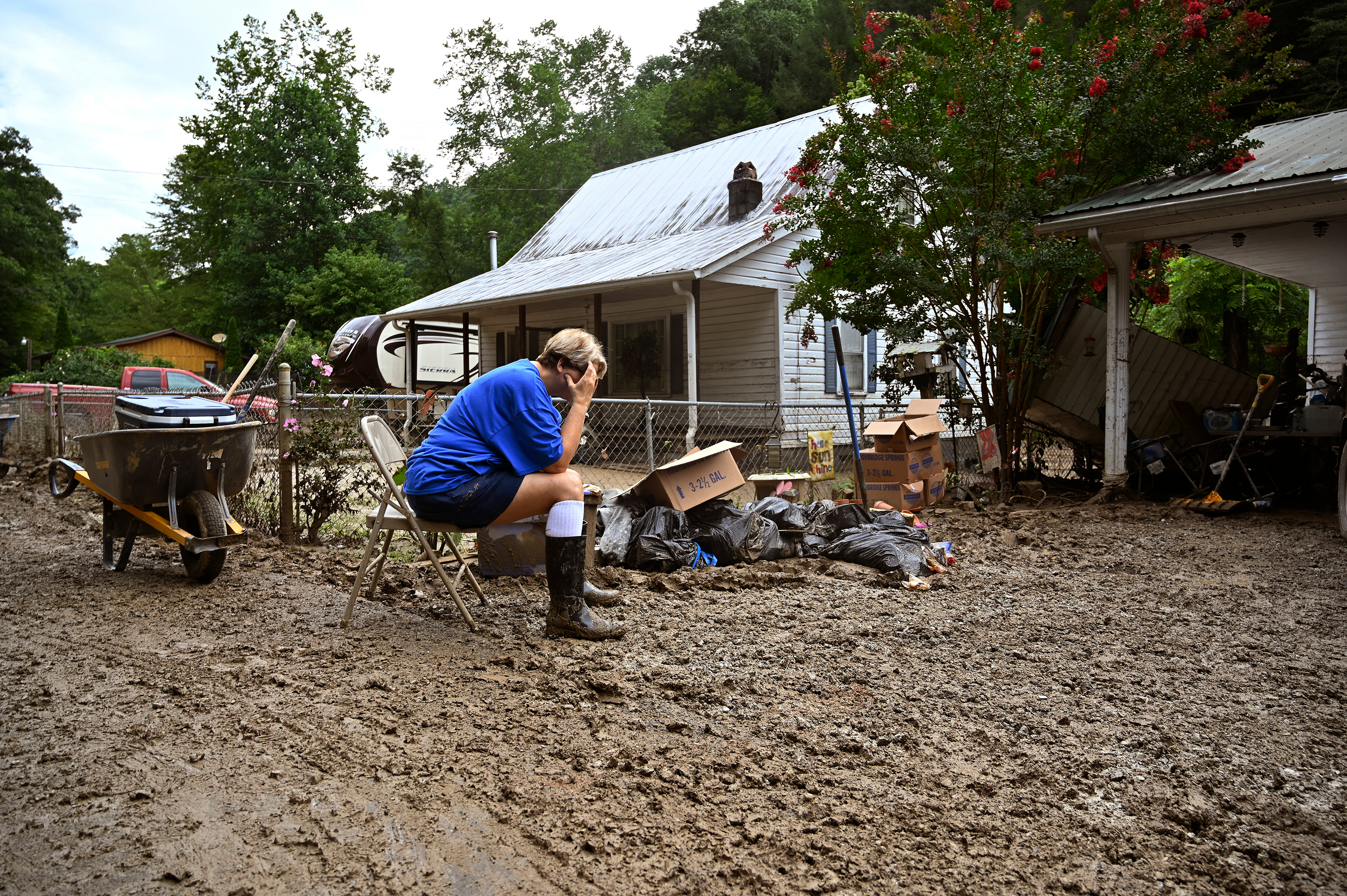
And then the sun rose, the waters receded, and thousands of people had to figure out what to do about their damaged homes and upended lives. That work was made harder for the vast majority hit by the downpours, including these three people, who did not have flood insurance.
Nationwide, just 2.4% of properties are covered by 4.5 million federal flood insurance policies, an Associated Press analysis shows — but 8.4% are at severe or extreme risk of flooding. The gap illustrates the foundational flaws in a program that fails to balance affordability, flood protection, and cost to taxpayers.
It’s getting worse. The count of policies is down roughly 500,000 in five years. Price increases are a big factor. This downward trend collides with the rising risk of flooding across many areas of the United States, driven by climate change that can strengthen hurricanes and worsen downpours far from the coasts.
The problem is especially bad in eastern Kentucky, where in some ZIP codes, no more than 5% of properties are covered by flood insurance, even though hundreds or thousands of buildings are at extreme risk of flooding, according to figures from the federal government and data provided exclusively to the AP by the risk analysis group First Street.
It’s not just Appalachia — coastal areas including parts of southern Louisiana stand out, too. Areas at high risk of flooding and where few people are insured tend to be poorer, experts said, as are areas where FEMA’s flood maps don’t properly convey the severity of the risk or mandate that enough people buy coverage.
Proposals to overhaul the program have stalled, including adding options to make it more affordable to low-income buyers.
“Everybody agrees it’s broken, but no one can agree how to fix it,” said Jeffrey Schlegelmilch, faculty director of the National Center for Disaster Preparedness at Columbia University.
Conley’s double-wide trailer in Kentucky is elevated by stacked cement cinder blocks. In 2022, when he floated his dogs to safety on a pontoon boat, that wasn’t enough. The flood left six inches of “gooey, clay mud” in the house that was so thick it could suck shoes off feet and had to be shoveled out. Without insurance, he’s mostly lived in a small place FEMA provided and relied on generous church groups and donations, he said. With insurance, he is confident the work would have been done much faster.
Instead, after that flood, and another that set his repairs back in 2025, he was only able to move back into his home in September.
Why and how the government provides flood insurance
Congress set up the National Flood Insurance Program in 1968. It offers flood insurance in participating communities that agree to take steps to manage flood risk, such as restricting construction in high-risk areas. Homeowners insurance doesn’t cover floods.
Policies are available to renters and businesses, but most are purchased by homeowners covering up to $250,000 for their property and $100,000 for belongings. FEMA flood maps determine who is in a high-risk area where flood insurance must be attached to a federally backed mortgage.
When it works, it is life changing.
Bryant Matthews was up late with a toothache in Letcher, Ky., when he noticed the water rising fast during the 2022 flood. Being awake, he managed to get his wife, stepkids, and mother to safety.
“I was up. I was aware of what was going on, and I was able to get the family out of the house before it got too bad.”
Friends let them stay in their basement for about three months and they lost a lot. Beloved collections of old Metallica recordings and cheesy ’80s horror movies were damaged.
But they had flood insurance, which paid what was left on their mortgage. That helped them start again, debt free. They found a place in nearby Hazard, which was closer to the kids’ school and their work.
“I am very appreciative, very blessed,” he said.
Experts say flood maps need reform
In many places, FEMA’s flood maps don’t do a good job of capturing the extent of severe flood risk. Millions think their homes are safer than they really are and aren’t forced to buy insurance when they probably should.
That made rebuilding more difficult in 2022 after more than a foot of rain fell over parts of Kentucky, killing more than 40 people. The worst came during the early hours of July 28, when heavy rains fell on already soggy ground, running down steep hills into narrow river valleys — a perfect recipe for fast, devastating flooding. Six hundred people required helicopter rescues.
Where the flood struck, just 2.1% of properties were insured then, a rate that remains about the same today, an AP analysis shows, even though about 47% are at severe or extreme risk of flooding. That’s a gap of 45 percentage points — more than seven times as large as the national average.
FEMA’s flood maps didn’t catch all that risk during the 2022 flood, with only 18% of the buildings struck falling within a high-risk zone.
Flood maps, which are commonly out of date, don’t consider some types of flood risk, such as flooding from inland heavy rains.
The places with the biggest insurance gaps are those where heavy precipitation flooding occurs away from large water bodies, said Jeremy Porter, the chief economist at First Street, a part of finance company MSCI.
“That’s the Appalachian region, further inland, and then in the Midwest and Northeast in particular, extreme precipitation is the way climate change is manifesting itself,” he said.
The system works well in some places — such as the Charleston, S.C., area. Here, flood maps do record the risk from obvious threats like hurricanes, with high-risk zones blanketing the area. People expect to talk about flood insurance when they buy a home, and the booming region’s wealthy buyers can better afford it.
High prices are symptomatic of the flood insurance program’s conflicting goals
High prices are a worsening obstacle.
The typical cost of a flood insurance policy is $1,100 per year, up roughly 90% in the last five years, AP’s estimates show.
Lake Charles, La., resident Dan Charlson said his insurance shot up over time from roughly $900 to $4,000. That’s when he dropped his policy.
“I’m looking at what it costs to fix the house, and the fact that I only flooded once in 50 years. So, it’s a risk analysis,” he said.
The costs have been driven up chiefly by efforts to modernize pricing.
A few years ago, the federal government fully implemented Risk Rating 2.0, a much more accurate way of aligning a property’s flood risk with the price of coverage.
But more accurately priced flood insurance meant much higher prices overall for most buyers. A government watchdog report found that Gulf Coast states had been especially underpriced and required big increases under the new pricing structure.
Louisiana Sen. Bill Cassidy, a Republican, said the rating system implemented by the Biden administration and defended by the Trump White House has put insurance out of reach for too many.
“Recent administrations pushed Risk 2.0 forward without fixing the affordability problems created for Louisiana families,” Cassidy said.
A May review commissioned by the Trump administration found fundamental flaws in the National Flood Insurance Program, which is run by FEMA and is in more than $20 billion of debt.
“Congress has instructed the NFIP to be affordable, financially sound, available to all, and risk informed. These goals often pull in opposite directions, and political pressures have frequently blocked meaningful reform, leading to dozens of short-term program reauthorizations,” the report said.
FEMA said in a statement that stronger building codes, smarter zoning, and competitive private insurance options are needed rather than shifting all flood risk and cost to the federal government. The agency can’t address affordability without action from Congress.
FEMA is also working on a better system to map flood risk called Future of Flood Risk Data that aims to replace flood zones with more nuanced models that will do a better job of mandating who must buy insurance. The timeline for that work isn’t clear.
The economics of eastern Kentucky made recovery harder
Thousands of buildings were damaged in the 2022 flood. The majority of residents in these homes lived on less than $30,000 a year, a nonprofit report found.
A man stands near a pile of debris as residents clean up in Fleming-Neon, Ky., Aug. 5, 2022, after massive flooding the previous week.Brynn Anderson
For those without insurance, FEMA may help if a presidential disaster declaration is issued. But that assistance only provides for basic needs. Its two biggest programs are capped at about $40,000 each: housing assistance and other needs like childcare. Few receive the maximum.
FEMA will pay aid to an uninsured flood victim after their first flood. If that property is in a flood zone and isn’t covered by flood insurance when it gets hit again, FEMA typically won’t pay. That’s a big deal in Kentucky, which has experienced repeat disasters in recent decades.
In the 2022 floods, FEMA provided nearly $90 million in direct assistance, separate from insurance payouts, to help with that damage — roughly one-fifth of the lowest estimated cost to rebuild.
“It was clear that a trend was happening where people were just having to move away. They were living with other people in eastern Kentucky, in the damaged area, or they were having to move to other eastern Kentucky counties, or, you know, out of the region,” said one of the report’s authors, Eric Dixon, a senior researcher at the nonprofit Ohio River Valley Institute.
After Honeycutt and her family escaped the second story of their inundated home during the 2022 Kentucky floods, it cost the family — which lacked flood insurance — a significant amount to fix the immense damage. But because of the anxiety of staying in a neighborhood that absorbed so much destruction, she’s now taking part in a voluntary government buyout program that purchases homes in flood-prone areas.
Others had to live in their damaged homes and fix up what they could, when they could find the money. Charity and neighborliness helped a lot — many victims are still thankful to churches and neighbors that volunteered their labor, according to Whitney Bailey, a disaster response project director at AppalReD Legal Aid.
Troublesome Creek, Ky., overflowed, destroying pictures of the late 13-year-old boy whom Campbell helped raise — and just about everything else in her home. She thought flooding wouldn’t be a problem. She said she asked her insurer about flood coverage and was incorrectly told she was at such low risk it wasn’t available.
When Campbell’s home did flood, it cost her about $100,000. She went from not having a house payment to having to take out a loan and rely on some FEMA assistance.
In 2025, flooding once again nearly reached Campbell’s house and blocked the road.
The experience prompted Campbell to sign up for a buyout program to move.
“I just decided at that moment, I told my husband, ‘I can’t do this anymore,’” she said. “We can’t do this anymore.”
Drexel University and the Academy of Natural Sciences are at a standstill over the Academy’s future — and now it’s a question of who will blink first.
The more-than-monthlong stalemate appears to center on money, power, and control of the 214-year-old Academy.
“There are no talks scheduled,” said David L. Cohen, the former Comcast executive and U.S. ambassador to Canada who has been attempting to broker an agreement.
For the first time in weeks, pulling back the curtain on what have been confidential talks, Cohen and leaders of both Drexel and the Academy shared details of the negotiations and their perceptions of the sticking points.
Cohen said in an interview last week that talks broke off after the Academy said it wanted to pursue disaffiliation from Drexel but the two sides disagreed on terms.
The stalemate continues even as the university and the Academy announced Friday that they would accept a review funded by the William Penn Foundation and other foundations for wide-ranging feasibility studies on the physical and fiscal conditions of the Academy and a sustainable model for its future.
The negotiations on the governance and fiscal structure of the Academy, however, are separate from the review, Drexel president Antonio Merlo said in a Friday interview.
On Monday, City Council will begin the second part of a hearing investigating the shutdown of the Academy’s museum, with Merlo and Deputy Mayor Patricia Wellenbach — who were subpoenaed by Council — scheduled to testify. The museum closed to the public on Sept. 27, drawing outrage and protest by community activists and Academy proponents.
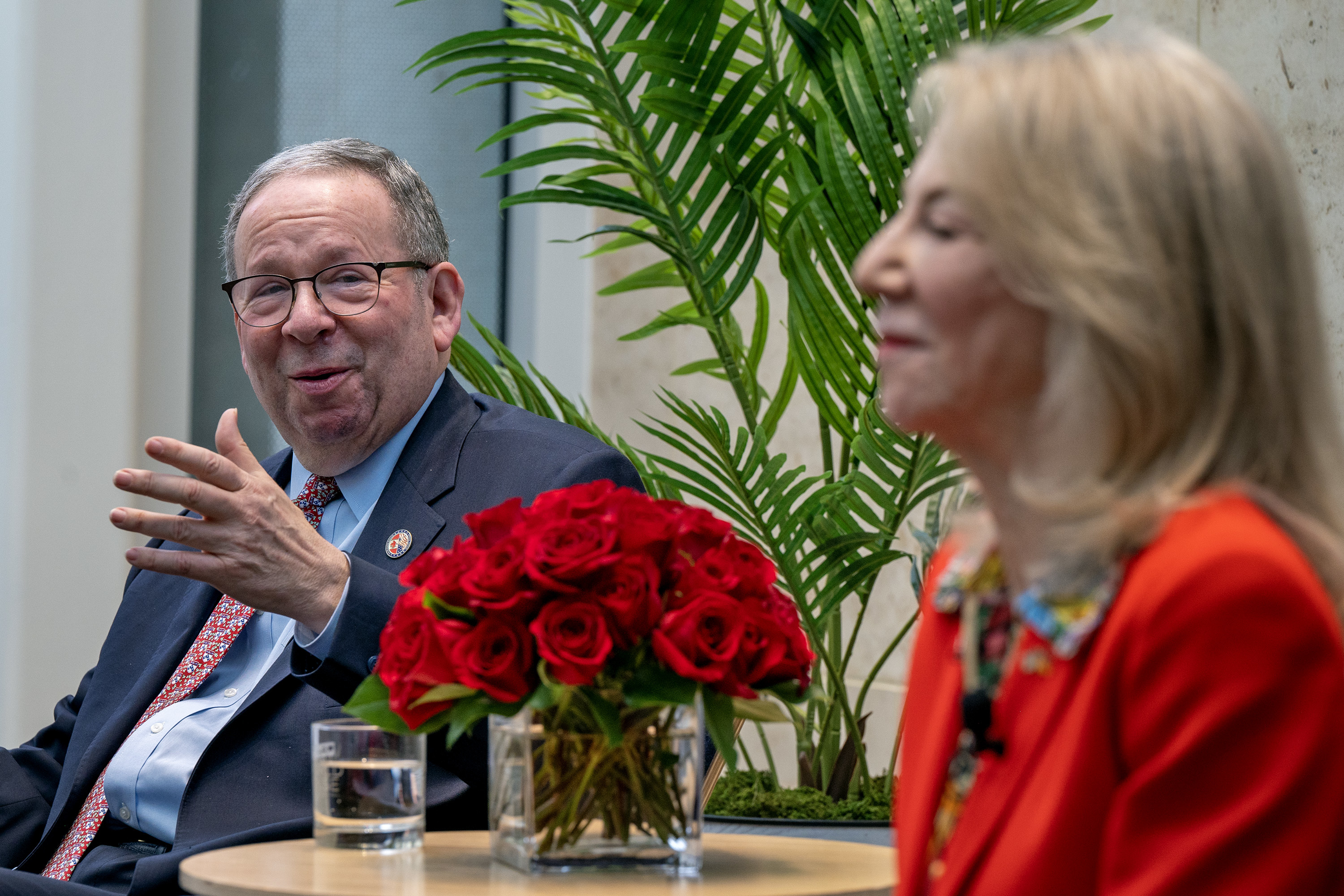
Former U.S. Ambassadors David L. Cohen (left) and Amy Gutmann, former president of the University of Pennsylvania (right) at Penn. Tom Gralish / Staff Photographer
Cohen said Council’s steps have “interfered with” the negotiations between Drexel and the Academy. “The public vilification and witch hunt that we’re engaged in now is not constructive to coming up with a solution,” he said.
Councilmember Isaiah Thomas, who leads the committee running the hearing, declined to address Cohen’s comments. But he said he has been involved in a lot of positive conversations with people who want to step up and save the Academy. There are multiple donors willing to put up “tens of millions of dollars” once the Academy’s path is clear, he said.
“The biggest holdup now is Drexel and the Academy defining their relationship,” he said.
Donors, he said, do not want to commit until they know the status of the Academy and Drexel.
“If I’m a philanthropist and there’s not clarity on what you’re doing moving forward, why would I donate now? Am I donating to the Academy or am I donating to Drexel University? I’ll donate when I get clarity …”
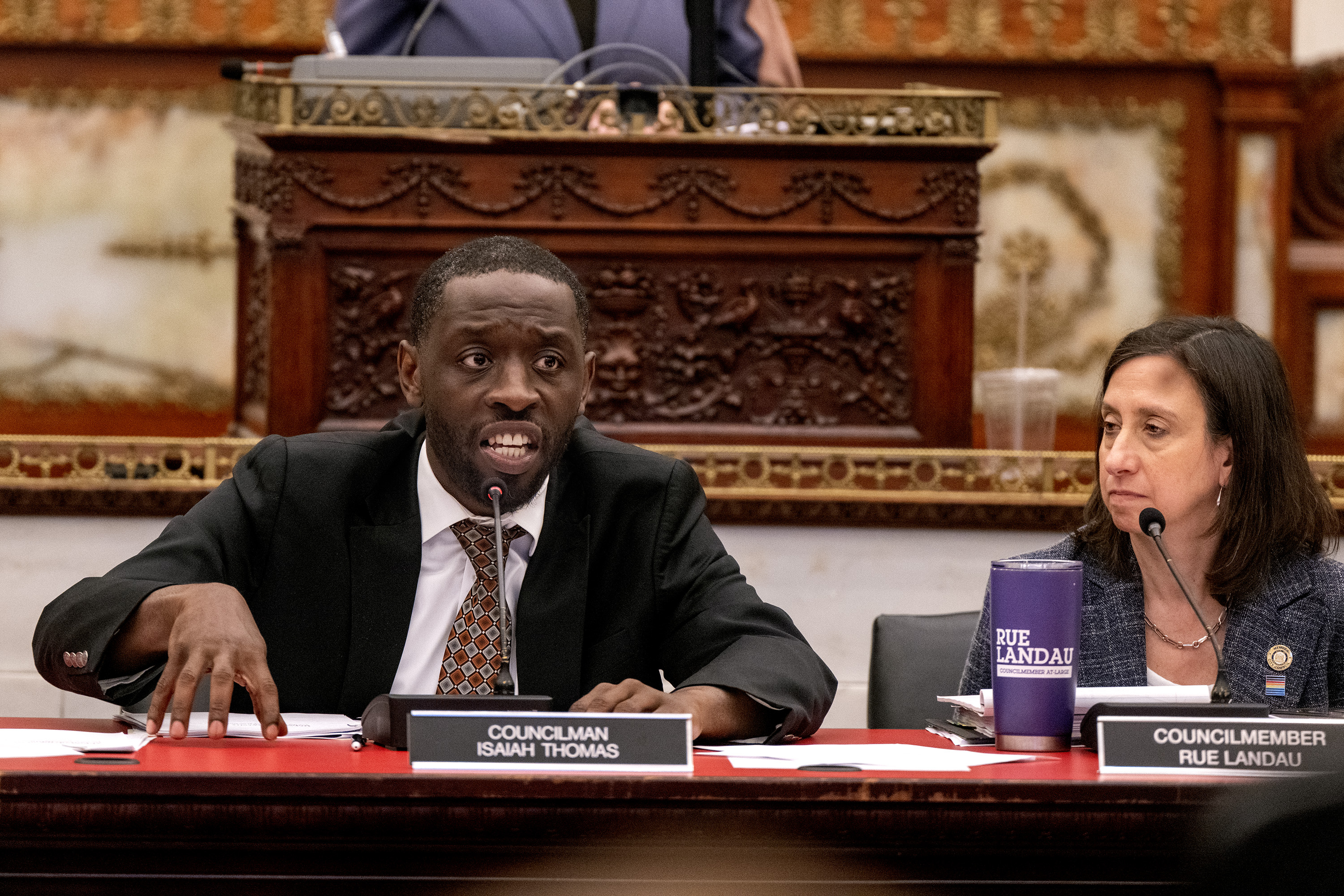
Councilmember Isaiah Thomas questions Drexel University officials Oct. 26 at a City Council hearing on the closure of the museum at the Academy of Natural Sciences of Drexel University. Councilmember Rue Landau is at right.Tom Gralish / Staff Photographer
A disputed ‘term sheet’
Less than a year ago, Gov. Josh Shapiro and Mayor Cherelle L. Parker asked Cohen to help with the negotiations between Drexel and the Academy. Drexel had wanted the Academy, which it felt had become a financial drain, to fully merge into the university or disaffiliate.
When talks lagged in July, Drexel threatened to cut off funding to the Academy, which would have “summarily put the Academy out of business,” according to Academy board chairperson Suzanne Biemiller.
Cohen said he had brokered a “term sheet” that both sides had signed off on in September. It would have allowed for the “survival and healthy existence” of the Academy, he said. When it came time to negotiate “definitive documentation to implement the terms,” the two sides traded “competing proposals,” which Cohen said he did not think were that much at odds.
But after he called a meeting in early October to discuss the proposals, the Academy had changed its position and said it no longer wanted to implement the terms but instead pursue disaffiliation from Drexel, Cohen said.
“They essentially reneged on the agreement that was reached in good faith,” Merlo said.
Biemiller disagreed with that characterization.
“We said that the term sheet did not work economically and that the trustees of the Academy would therefore not approve it,” she said. She added that Drexel’s initial rejection of an offer by the William Penn Foundation to fund operating expenses of the Academy to keep the museum open “signaled to the Academy trustees that Drexel wasn’t working in the best interest of the Academy.”
The Academy, Cohen said, believed it could generate enough support through philanthropy, “new partners,” and government funding to stand on its own.
He, the mayor, and the governor were all “skeptical” of that position. Biemiller countered that trustees have heard from a number of individuals and civic leaders who want to help the Academy.
(Shapiro’s spokesperson did not provide comment; neither did Parker’s.)
Drexel University president Antonio Merlo Jessica Griffin / Staff Photographer
Disaffiliate or fully merge?
Cohen said he had been advising the parties against disaffiliation and toward a full merger. But Merlo, he said, agreed to honor the Academy’s request for disaffiliation. The university offered to provide in-kind services for three months after the date of disaffiliation, Merlo said.
The Academy, Cohen said, rejected that proposal and offered its own, which he characterized as “a bit … inflammatory.”
“It was not really a disaffiliation proposal because it did provide for significant additional financial support and in-kind support and continuation of educational and research support” from Drexel, Cohen said.
The Academy, Merlo said, wanted Drexel’s continued financial support for five years. Neither Cohen nor Merlo would say how much the Academy requested, though Cohen said it was “a lot.”
The financial support from Drexel eventually would have ceased, Cohen said, but some of the in-kind support would have continued in perpetuity.
The Academy’s proposal, he said, also called for the “immediate termination of all of the governance rights and financial controls and budgetary controls that Drexel has under the terms of the 2011 affiliation agreement.”
Cohen said he advised the Academy to modify its proposal and it declined. Drexel, Merlo said, rejected the Academy’s proposal and made a counteroffer.
“We haven’t heard back ever since,” Merlo said.
For him, disaffiliation meant that the Academy would go its separate way on a certain date and from that point on would be financially responsible for itself.
But Biemiller disagrees.
“Drexel’s proposal was an immediate disaffiliation with no Drexel funding,” she said. “An immediate cessation of funding would have essentially put the Academy out of business. Any separation from Drexel which saves the Academy as an institution must be gradual.”
She also objected to the characterization that the Academy’s proposal was inflammatory. Instead, she said, it was a “thoughtful, staged disaffiliation” that would have cost Drexel less than if it had moved forward with the terms for merger.
Inside the dinosaur hall at the Academy of Natural Sciences of Drexel University on Sept. 27 – the last day the museum was open to the public. Tom Gralish / Staff Photographer
Who controls the Academy?
The 2011 affiliation agreement that joined Drexel and the Academy does not address any commitment to fund the Academy if the parties disaffiliate. Drexel therefore would not be required to do so, according to Laura Solomon, founder of Laura Solomon & Associates, a law firm that exclusively represents charitable and other tax-exempt organizations and philanthropists.
“The parties could negotiate a ‘divorce’ in which Drexel had some kind of financial commitment (e.g., alimony) to support the sustainability of the Academy — but that would seem to be a tough ask at a time when educational institutions are facing their own financial challenges,” she said in an email.
“While we understand the economic pressures that colleges and universities are facing today,” Biemiller said, “as a fiduciary board, it is our responsibility to work toward a solution that is in the best interests of the Academy and the people of Philadelphia and the scientists around the world who care about it.”
Drexel currently has a lot of authority over the Academy under the 2011 agreement, with the right to approve its budget, choose its CEO and senior staff, and appoint its board. The Academy board can make recommendations, but the authority ultimately belongs to Drexel.
The Academy is a nonprofit corporation with a single member — Drexel. The Academy retains authority over its endowment, but delegated management of it to Drexel.
But Drexel still was on the hook to cover the Academy’s deficits — as laid out in the affiliation agreement — noting it had provided $49 million in direct cash to the Academy over the last 15 years. A university representative told City Council last month that Drexel, which has been working to erase a deficit in its own budget, can no longer afford the $5 million to $6 million a year in support to the Academy.
Drexel, Merlo said, wanted the Academy to become a “wholly controlled subsidiary” of Drexel, which he said would have given the Drexel board more control over the Academy’s finances, yet maintained it as a separate nonprofit with its own assets and endowment.
That means there would only be one fiduciary board — Drexel’s.
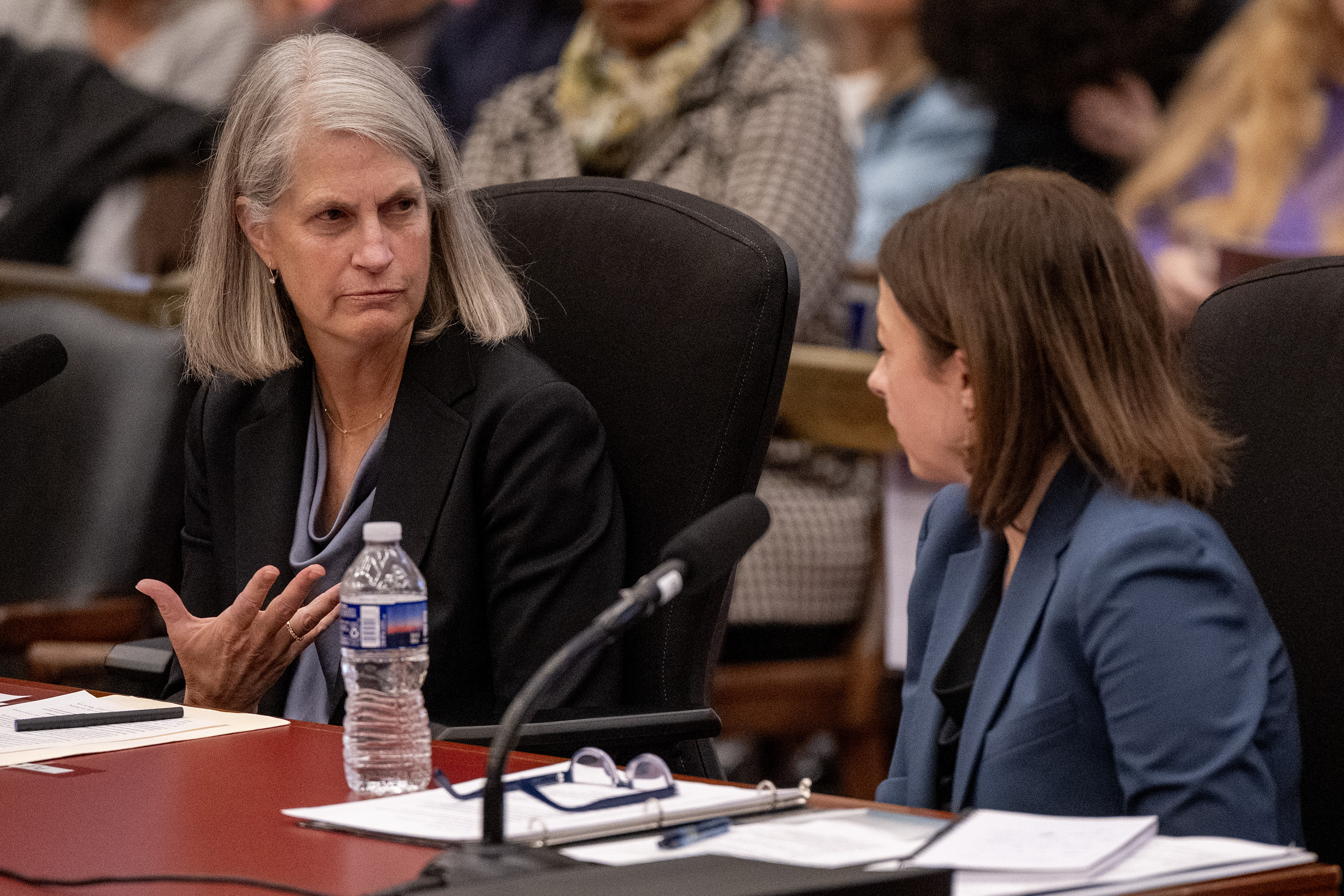
Academy of Natural Sciences of Drexel University board chairperson Suzanne Biemiller (left) and Melissa Richman (right), Drexel University’s executive director of operations, testify as City Council holds a hearing Oct. 26, 2026 on the closure of the museum at the Academy.Tom Gralish / Staff Photographer
It would have enabled Drexel’s board to deal with the Academy’s deficits, Merlo said.
“You cannot have a subsidiary which is part of this bigger company that runs a $5 million deficit a year in perpetuity,” he said. “The new structure would have allowed [Drexel] to do the type of interventions you need.”
But there were “guardrails” built in, Merlo said. Drexel, for example, would not have been able to dispose of assets of the Academy without a vote in favor by two-thirds of the Academy board.
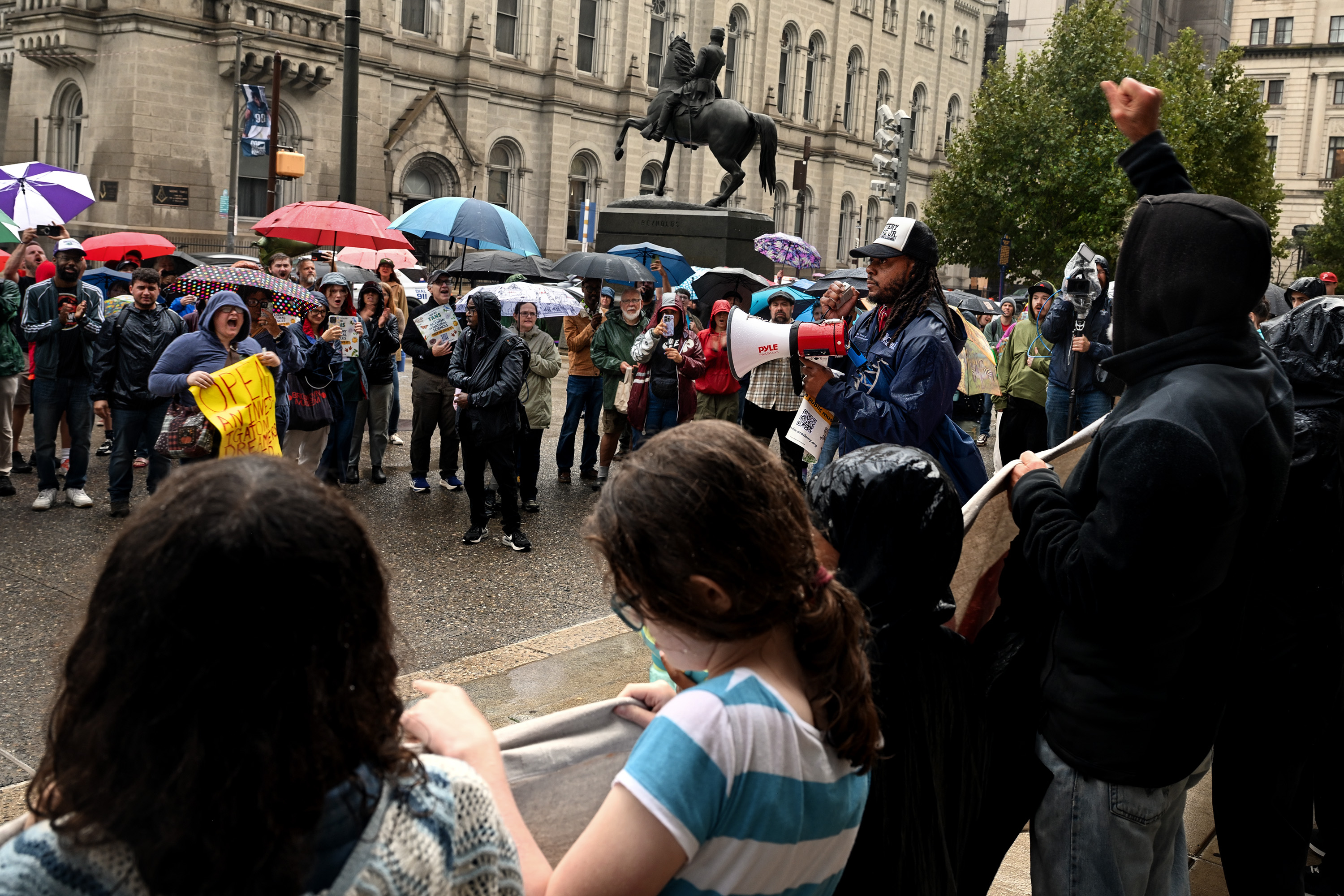
City Council member Jeffery Young Jr. (with megaphone) speaks to protesters outside City Hall, Sept. 27, after the group marched there following a vigil at the Academy of Natural Sciences of Drexel University after it closed to the public.Tom Gralish / Staff Photographer
A solution in New Haven?
Just how long Drexel and the Academy will remain at an impasse is unclear. Academy board members serve three-year terms, which means as the terms of some expire, Drexel could replace them with new, like-minded board members.
Merlo declined to comment on whether the university would take that step.
“I would not like to speculate into the future,” he said.
Cohen said he still thinks an agreement can be struck. Maybe it would take “some push from the governor and the mayor to get people back to the table,” he said.
Merlo said he is hopeful the foundation-funded review will lead to solutions, similar to what happened with Yale University’s Peabody Museum, a natural history museum in New Haven, Conn. A donor gave $160 million, which galvanized others to donate. The museum closed for four years for renovations and reopened in 2024 offering free admission, with its attendance boosted several times over.
On this, Merlo appears to be in complete agreement with a Save the Academy Coalition representative, who also mentioned the Peabody as a potential model for Philadelphia at the City Council hearing last month.
“If they could do it in New Haven,” Merlo said, “I bet we could do it in Philadelphia.”
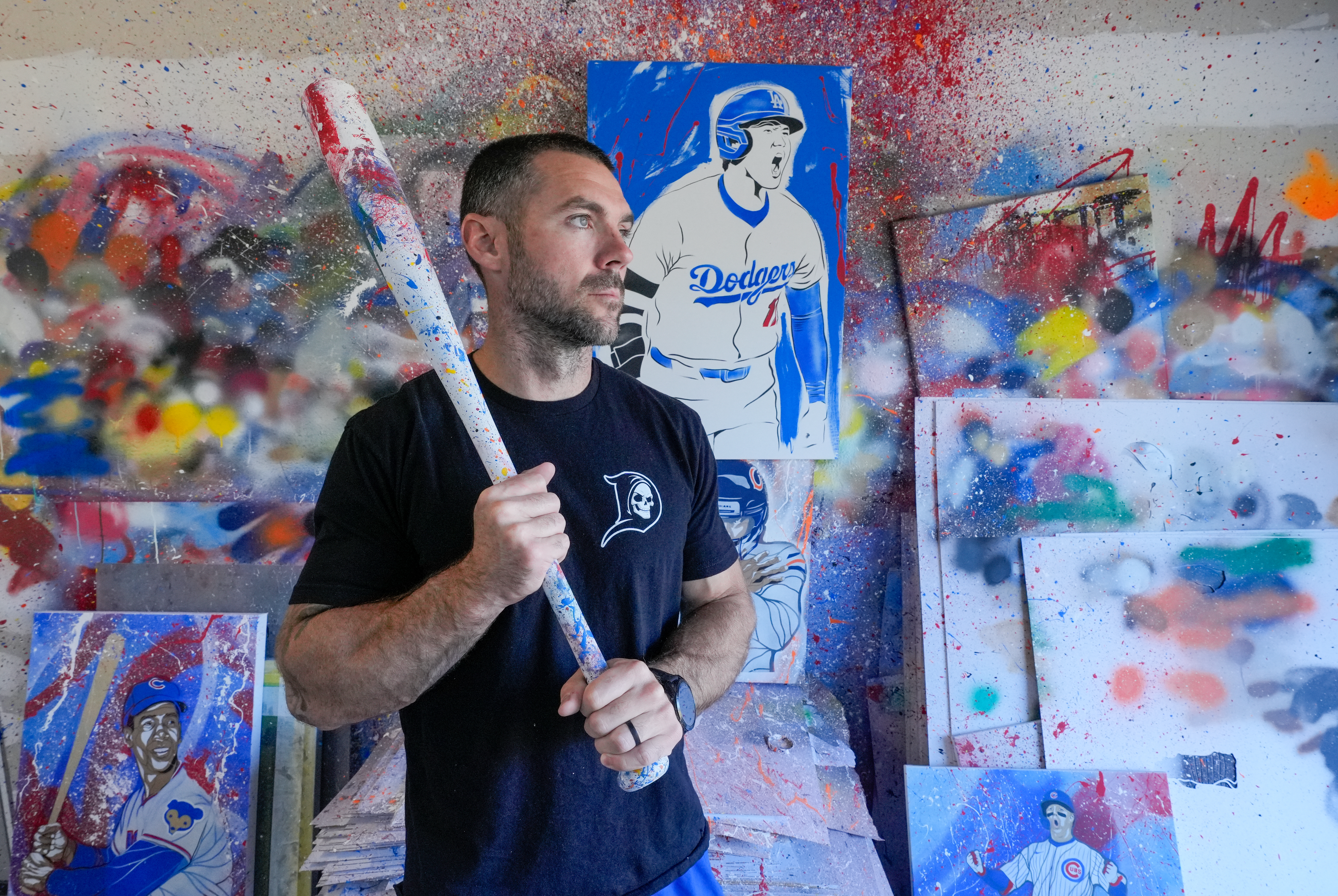
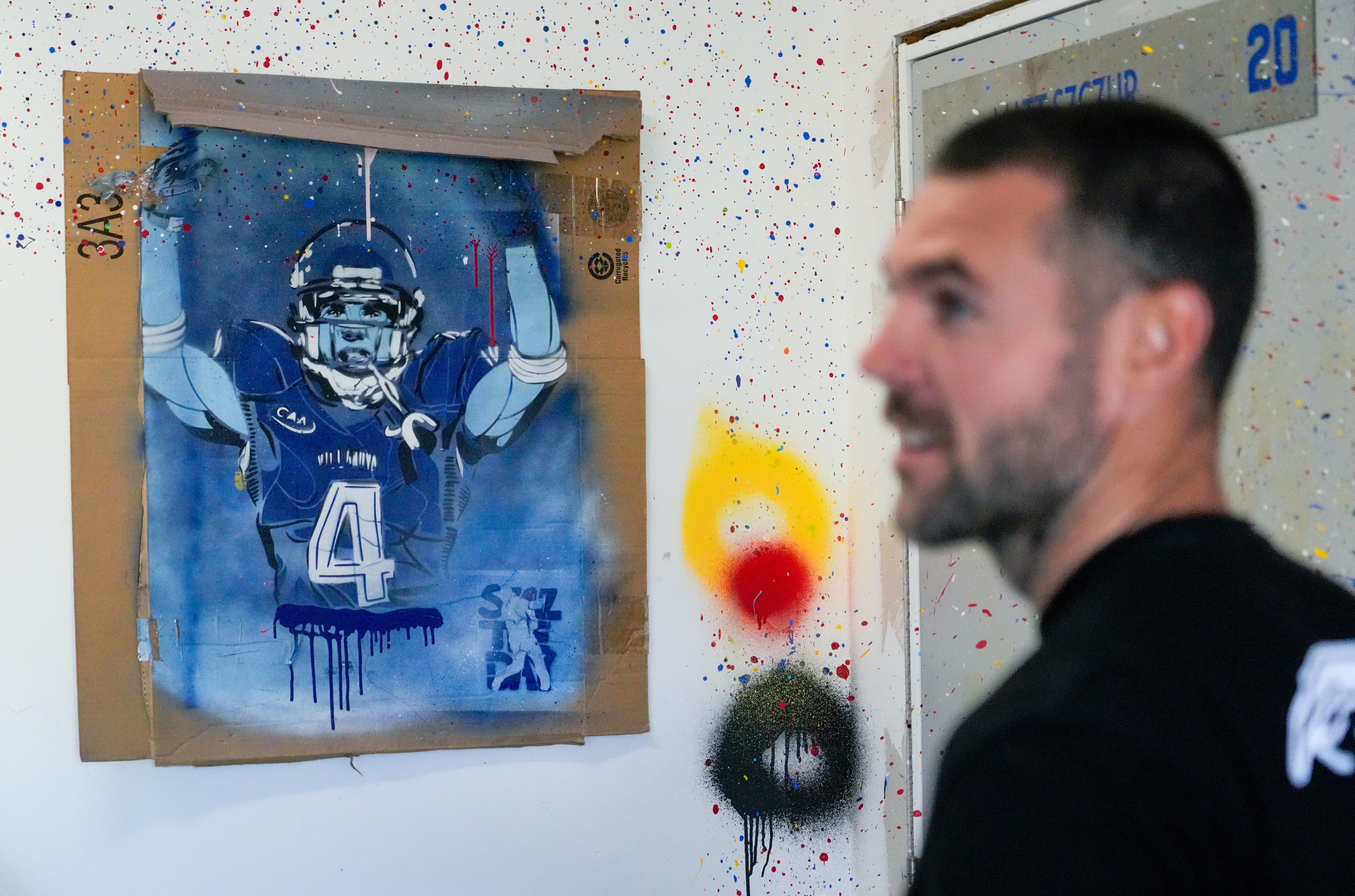
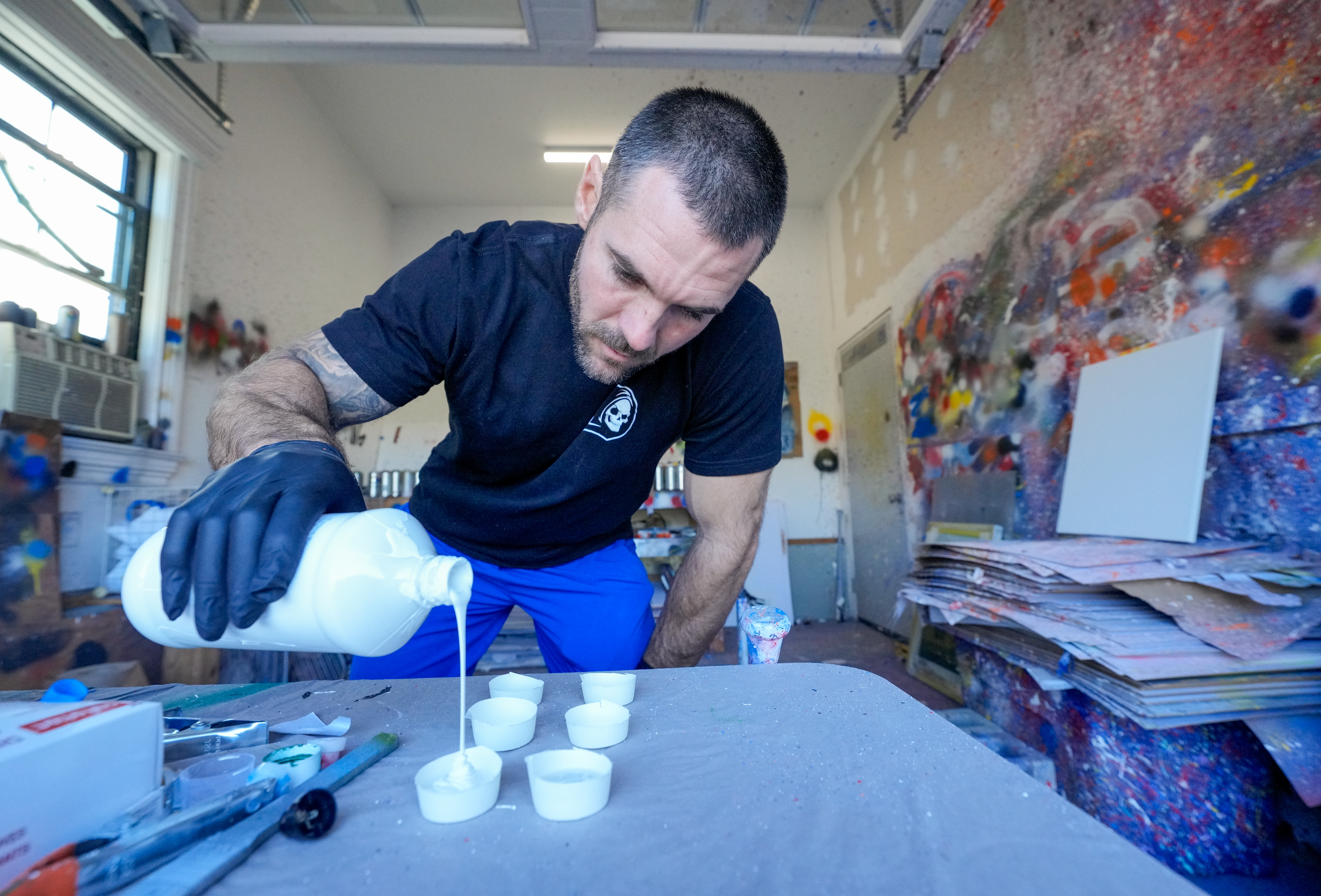
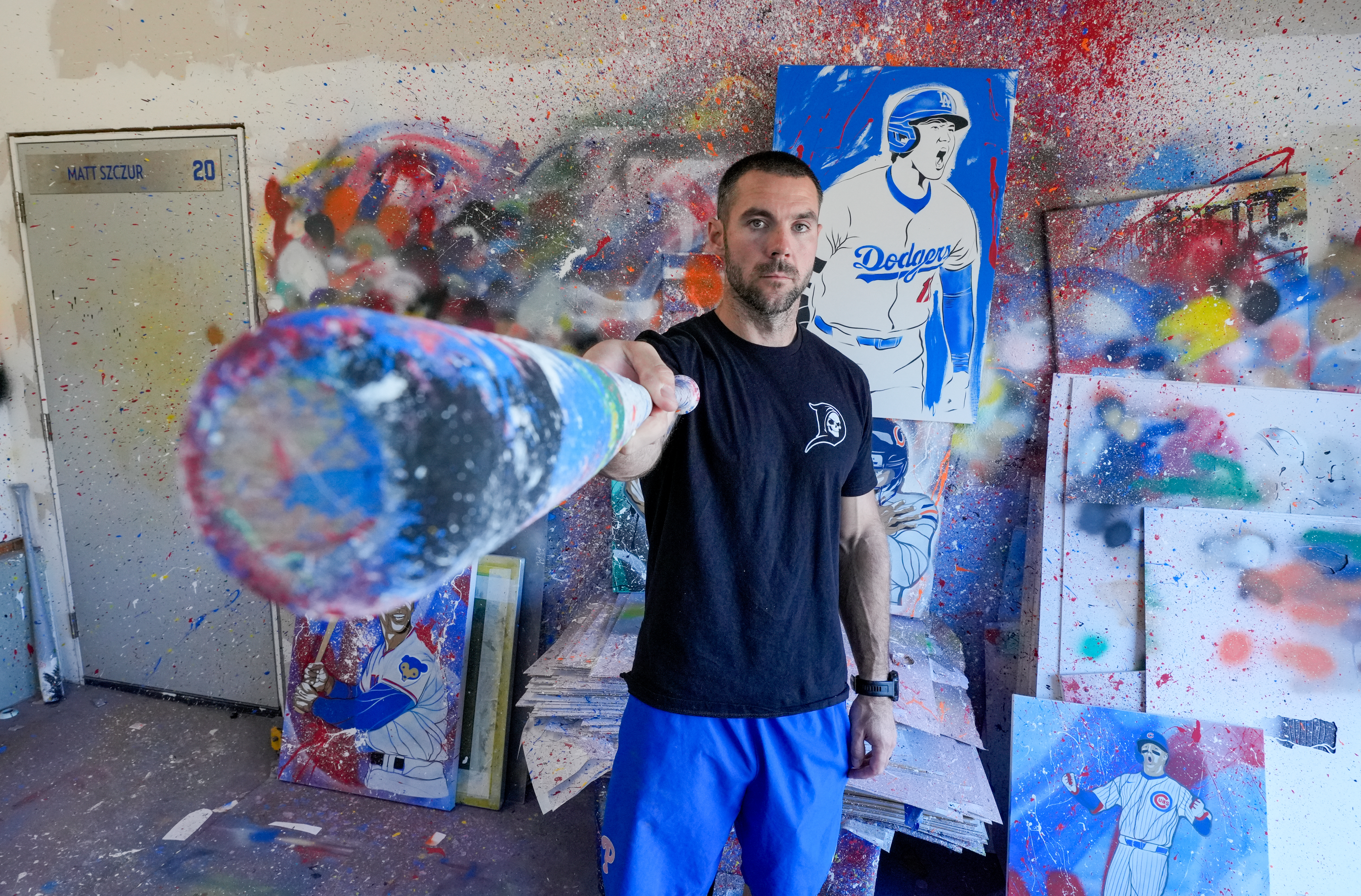
Matt Szczur stood in his garage last month, knees bent with a baseball bat raised in his hands. He played parts of five seasons in the majors and won a World Series in 2016 with the Cubs. But Szczur — a former football and baseball star at Villanova — retired from baseball to do this: hit cups of paint off a batting tee in his Cape May home.
The former big leaguer became an artist. He found a second career, helping to ease a transition that proves difficult for so many professional athletes once they leave the game. He pours paint into cups, places the cups on a tee, and then crushes the cups like they were a grooved fastball. The paint splatters in his garage studio and sprays onto a canvas, which Szczur then uses as the backdrop for his next portrait. He turns batting practice into a masterpiece.
Szczur was briefly a Phillie and was a World Series champion with the Cubs. He still gets in some tee work, but now it involves hitting a paper cup full of paint at canvases to create his art.Tim Hawk / For The InquirerA painting of Mark McGwire and Sammy Sosa, featuring Szczur’s signature paint splatter, hangs in his Cape May studio.Tim Hawk / For The Inquirer
Szczur, 37, knew he had something five years ago when he was making more money selling art than he was playing triple-A baseball. He sells his art on his website, stays busy with commissions, has a partnership with Fanatics, and Topps recently turned his creations — the ones he makes in the garage with a bat — into baseball cards that are prized by collectors and resold for thousands on the internet.
As a kid, Szczur watched his dad come home from his construction job, sit in his recliner with a cup of coffee and sketch. It was how Marc Szczur relieved stress.
Years later, the son found himself doing the same when he reached the majors in 2014 and pressure mounted. Szczur sketched on his iPad, drawing anything that came to mind. Sometimes he just drew his hand in different positions to practice. Art became Szczur’s escape. And now it’s his career.
Pro athletes spend decades obsessively dedicated to their craft, which leaves a void once they walk away. Some say they lose their identity. Szczur found a new one.
“I didn’t want to be the guy who’s 33 years old in triple A trying to fight his way back to the big leagues to come off the bench,” Szczur said. “I’m not interested in that. I didn’t want to be that guy. I’m cool moving on. A lot of those guys have to stay in baseball. They have nothing else afterward. I’m so lucky to be able to do this. Because when guys finish playing, they’re like, ‘What next?’
“If it wasn’t for this, I would’ve kept playing. I would’ve had nothing else. And it could’ve been good. I could’ve made it back to the big leagues and signed a $100 million deal. Maybe? Probably not. But you never know. But I’m happy here. I’m happy working hard every day at my house with my family.”
The wall in Szczur’s studio is covered in paint thanks to the bat that he uses as his paintbrush.Tim Hawk / For The Inquirer
Leaving the game
In 2015, Tommy La Stella, Szczur’s teammate with the Cubs, saw some of the sketches Szczur did and asked him if he could create something for him. It was Szczur’s first commission.
“I had no idea what to charge,” Szczur said. “I just had no idea.”
La Stella wanted a piece featuring Jesus, Buddha, and Lao Tzu. Szczur used spray paint and stencils to create something. He did a first draft of cardboard — “I’m cheap,” Szczur said — and showed La Stella. He liked it. So Szczur went to work, filling a Wildwood Crest apartment with paint fumes.
It was a humble start, but Szczur figured it out. Szczur took art classes in high school and college, as he always loved creating.
“My friends used to make fun of me because they’d be studying and I’d be painting. ‘Well, you could’ve picked my class,’” he said.
Szczur gave the finished painting to La Stella in the Cubs clubhouse, which allowed other teammates to see it. He was soon getting more work, and the Cubs asked Szczur to paint something for their charity event after the 2016 World Series. It sold for $40,000.
“I remember looking at my wife [Natalie] and saying, ‘I have to do more of this in the offseason,’” Szczur said.
Matt Szczur was with the Phillies in Clearwater during 2020 spring training.Carlos Osorio
Szczur signed with the Phillies before the 2020 season, hoping to return to the majors with the team he grew up rooting for after spending the previous year rehabbing an injury in triple A. Then, he tore an oblique muscle in spring training before the pandemic paused the season.
Szczur returned home to Cape May during the shutdown and started painting again. He spent hours in his garage, painting athletes, superheroes, and anything else he thought of. Szczur loved it. He wanted to share his work on social media but felt strange posting about it.
“One of the things I was nervous about was other people’s opinions,” he said. “I asked my wife, ‘Should I post this?’ She said, ‘Yeah, who cares?’”
Szczur smiles in his studio. He made national news in 2009 when he donated bone marrow to save the life of a 15-month old in Ukraine shortly before the MLB draft.Tim Hawk / For The InquirerA self portrait of Szczur during his Villanova football days hangs as he talks about his paintings.Tim Hawk / For The Inquirer
His business took off during the pandemic, and he missed the 2020 season after undergoing surgery to repair his oblique. He signed in 2021 with St. Louis but struggled in triple A after missing the previous year.
The team took a 12-hour bus trip from Memphis, Tenn., to Toledo, Ohio, for a series in June. He was 0-for-4 in the final game of the series when the manager asked him in the eighth inning if he wanted his last at-bat of the game.
“I was like ‘Yeah, I don’t know when it’s going to be my last at-bat so I’m going to take it,’” Szczur said. “I hit a double off the wall.”
The team bused back to Memphis, and the manager told Szczur that the Cardinals were releasing him. Couldn’t that have happened in Toledo? Szczur said. He flew home and told Natalie he was finished. Other teams checked in, but Szczur was content with his career.
He won a national championship in football at Villanova and signed with the Cubs as a fifth-round draft pick in 2010 instead of entering the NFL draft. He played professional baseball for 12 seasons, played with All-Stars, and earned a World Series ring. Szczur was 31 years old and ready to try something new.
“I’ve never been someone who continues to beat a dead horse. I can move on pretty fast,” Szczur said. “There was light at the end of the tunnel.”
Szczur pours paint into paper cups before hitting them off a tee with a baseball bat.Tim Hawk / For The Inquirer
Figuring it out
Szczur was driving to Penn State to watch Villanova play football in September 2021 when Fanatics called. They already commissioned him to do a painting of Tom Brady and wanted to see if he could paint portraits onto jerseys.
“I was like, ‘Yeah, send them to me. I’ll see if I can figure it out,’” Szczur said. “I had no experience.”
He painted onto a Ronald Acuña Jr. jersey, and it looked terrible. Szczur wasn’t sure if he could do it. The representative from Fanatics told Szczur to reach out to some other artists who paint jerseys. Szczur bugged artists he found on Instagram — “usually people don’t respond,” Szczur said — and found someone to help. He told him what paint to use, and Szczur finally had the secret.
“It took like six months to figure things out, which is fine,” Szczur said. “There was a point where I wanted to quit because I couldn’t figure it out, but I was like, ‘These guys have to respond to me.’ I hated trying to figure things out. But I always tell people I leave my ego at the door. I know that I need help. I’m the first guy pulling over at the gas station asking how to get to the next stop. I’m not going to try to figure it out by myself. It just takes so much longer. Find someone who has done it before, who knows where they’re going, and they’re going to tell you. If they don’t, then go to the next person.”
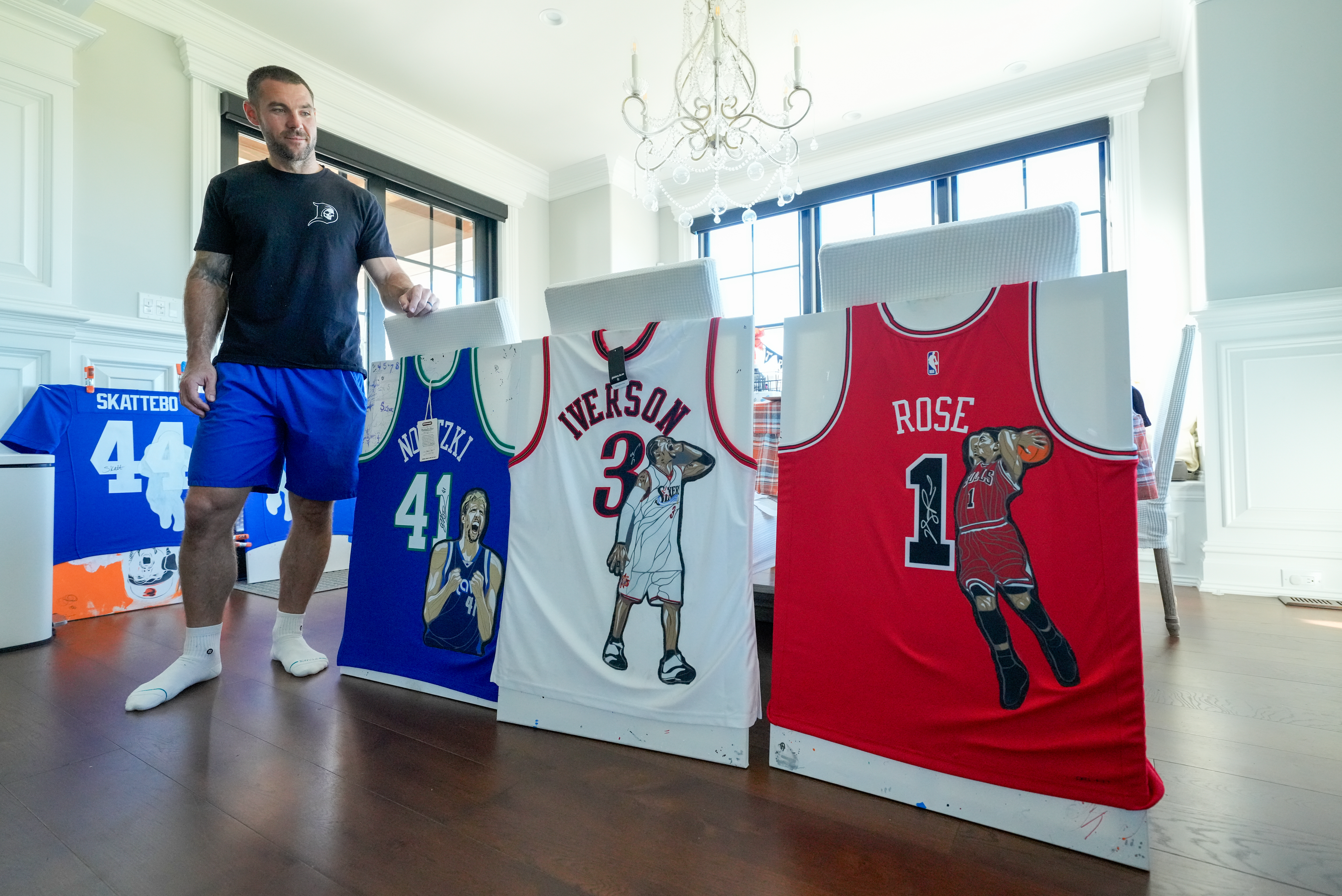
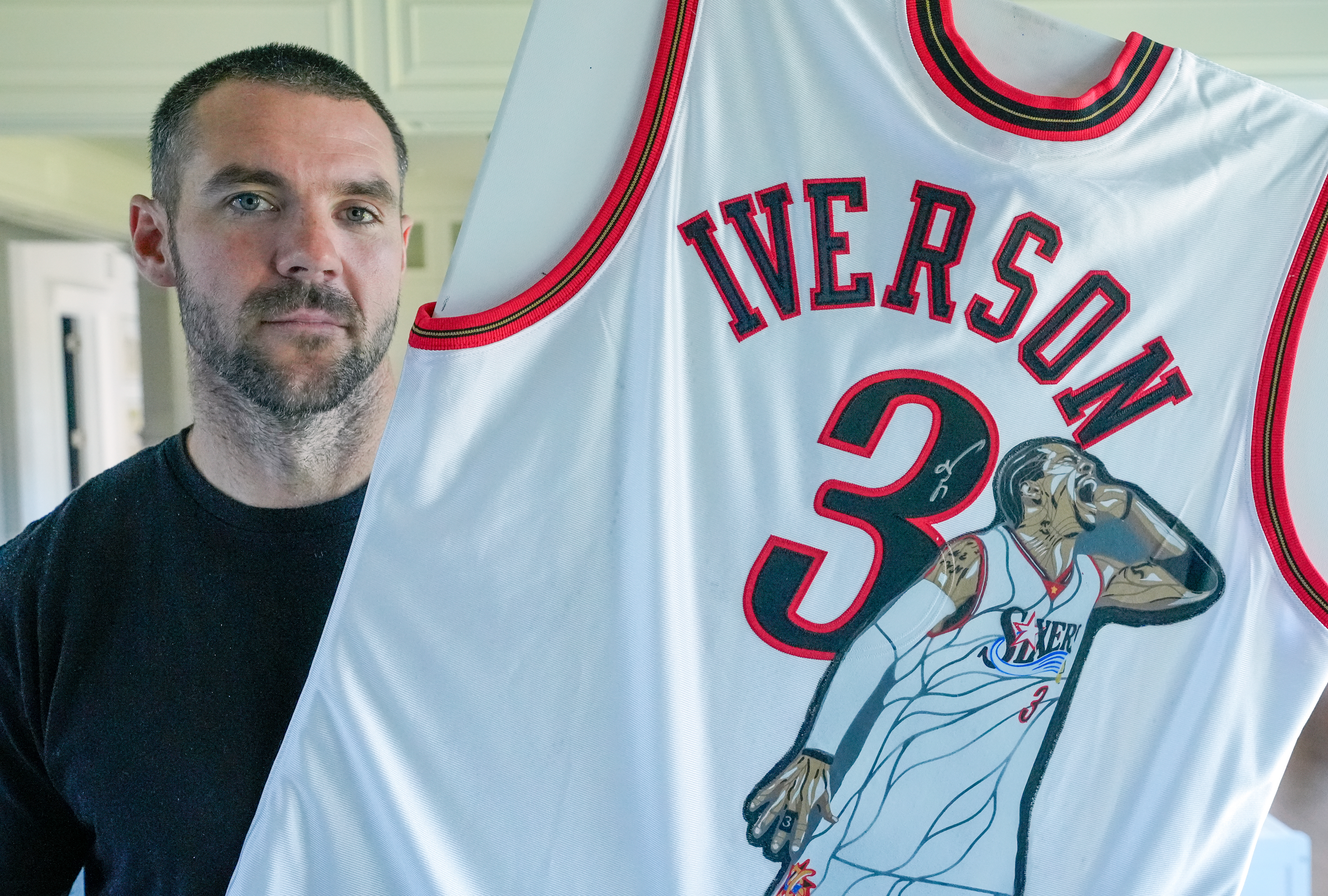
Szczur has created artwork on the jerseys of basketball stars for Fanatics.Tim Hawk / For The InquirerOne of those jerseys belongs to former Sixers star Allen Iverson.Tim Hawk / For The Inquirer
Fanatics sends Szczur signed jerseys of players like Allen Iverson, Emmitt Smith, and Dominique Wilkins. He then paints a portrait of the player onto the jersey and sends it back to Fanatics. Szczur used to spend hours locked in his office or in his basement while he painted the jerseys. But then he realized his second career was taking him away from his two kids. So he paints now in his dining room, turning the table off the kitchen into an art studio. His son, Matthew, builds Legos while Szczur paints another Hall of Famer.
“They get to see dad doing something he enjoys doing,” Szczur said.
Szczur saw someone on social media hitting paint with a golf club, which gave him the idea to use a baseball bat. He figured it out — Szczur shattered plastic cups before trying Dixie cups — and made it his thing.
“Do I need to hit paint with a baseball bat? No. Do I need to throw paint with a glove on? No,” Szczur said. “But it adds to it. And with the stencils and the uniqueness of it, people can tell that’s my art. That’s Andy Warhol, LeRoy Neiman, Banksy, all the top guys. You know that’s a Warhol. That’s a LeRoy Neiman. That’s how my mind thought. When someone sees my art now, they know it’s me. Because no one else does it like me.”
Szczur sold a portrait of Shohei Ohtani at auction for nearly $50,000 and negotiates his own deals and partnerships. He would love to have a manager who could secure him business so he can just paint. For now, Szczur does it all. The former big leaguer moved on. His batter’s box is now in his garage.
“I pinch myself every day,” Szczur said. “I didn’t grow up with a lot of money. And everything I have, I feel like I’ve earned by myself. Yes, I’ve had help along the way. Coaches, parents, family. But it’s weird to say it, but I’m proud of myself. Never in a million years did I think I would have a second profession.”
Szczur’s artwork has sold to former teammates and private collectors, as well as in auctions.Tim Hawk / For The Inquirer
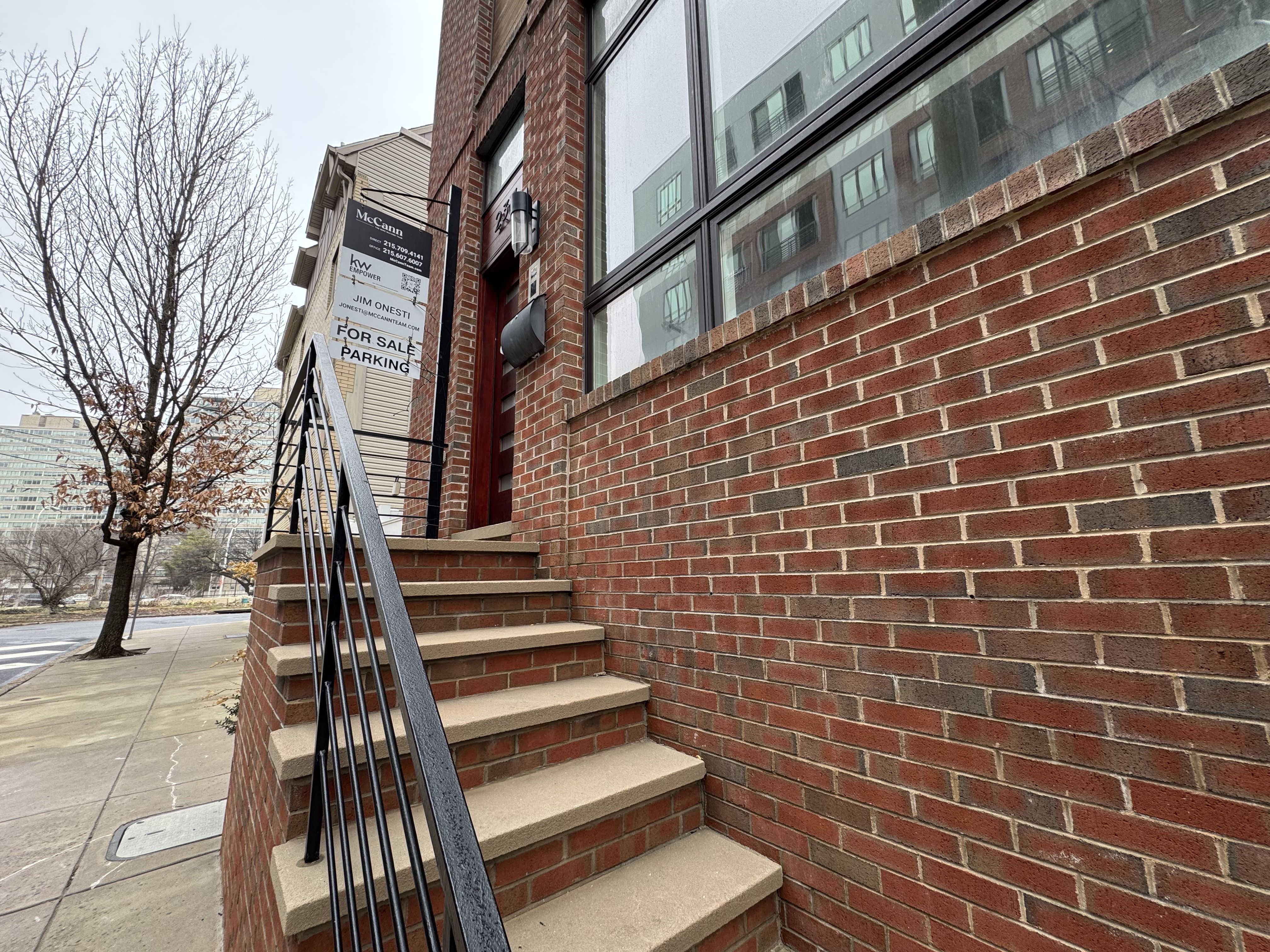
The National Association of Realtors’ annual survey shares insights into the characteristics and behaviors of recent homebuyers and sellers.Michaelle Bond / Staff
High home prices and elevated mortgage interest rates are keeping some aspiring homebuyers on the sidelines of the housing market. But people are still buying and selling homes in the Philadelphia area and across the country.
So who exactly is doing the buying and selling? Each year, the National Association of Realtors surveys recent buyers and sellers to learn about them and get insights into their behavior.
story continues after advertisement
NAR started publishing these reports in 1981. Its latest national survey covers sales that happened between July 2025 and June 2026.
Test how much you know about recent housing market trends.
Question 1 of 10
What was the typical age of a first-time homebuyer?
CorrectIncorrect. XX% of other readers got this question right.
The median age of a first-time buyer remained at an all-time high of 40.
Question 2 of 10
What share of first-time homebuyers paid in all cash?
CorrectIncorrect. XX% of other readers got this question right.
That’s the highest share on record. The median age of an all-cash first-time buyer was 54.
story continues after advertisement
Question 3 of 10
What was the most popular source for first-time buyers’ down payments?
CorrectIncorrect. XX% of other readers got this question right.
First-time buyers were most likely to say they used savings for their down payment. But 10% said they used an inheritance, which is the highest share on record.
Question 4 of 10
From last year’s survey to this one, the share of first-time homebuyers ___________.
CorrectIncorrect. XX% of other readers got this question right.
The share of first-time buyers rose slightly to 22% from last year’s record low of 21%. Repeat buyers are still driving the housing market.
Question 5 of 10
What was the typical age of a repeat homebuyer?
CorrectIncorrect. XX% of other readers got this question right.
The median age remains at an all-time high.
Question 6 of 10
What was the typical down payment for a repeat buyer?
CorrectIncorrect. XX% of other readers got this question right.
Meanwhile, the typical first-time buyer put down 9%.
Question 7 of 10
Homebuyers are most likely to be a married couple. What is the second most common group?
CorrectIncorrect. XX% of other readers got this question right.
20% of homebuyers were single women, 8% were single men, and 6% were unmarried couples. 4% were non-romantic roommates, an all-time high.
Question 8 of 10
How long had the typical home seller lived in their property?
CorrectIncorrect. XX% of other readers got this question right.
That’s an all-time high.
Question 9 of 10
The typical home that buyers purchased was built in what year?
CorrectIncorrect. XX% of other readers got this question right.
16% of buyers purchased a new home, while 84% bought one that was previously owned.
Question 10 of 10
Recent buyers typically purchased a home that had how many bedrooms?
CorrectIncorrect. XX% of other readers got this question right.
The median size of a recently sold home was 1,900 square feet with three bedrooms and two bathrooms.
How and where Americans could wager their money was forever changed in 2018. That spring, the U.S. Supreme Court overturned a federal law that had long limited legal sports betting to four states, and the sports gambling industry subsequently ballooned into a $166 billion behemoth. And 450 miles from Washington, D.C., the seeds of another seismic shift were quietly planted at the Massachusetts Institute of Technology, where Luana Lopes Lara met a fellow student, Tarek Mansour.
Lopes Lara and Mansour had each worked for Wall Street financial firms. The duo discussed creating something new — a platform where investors could trade on the predicted outcomes of specific events.
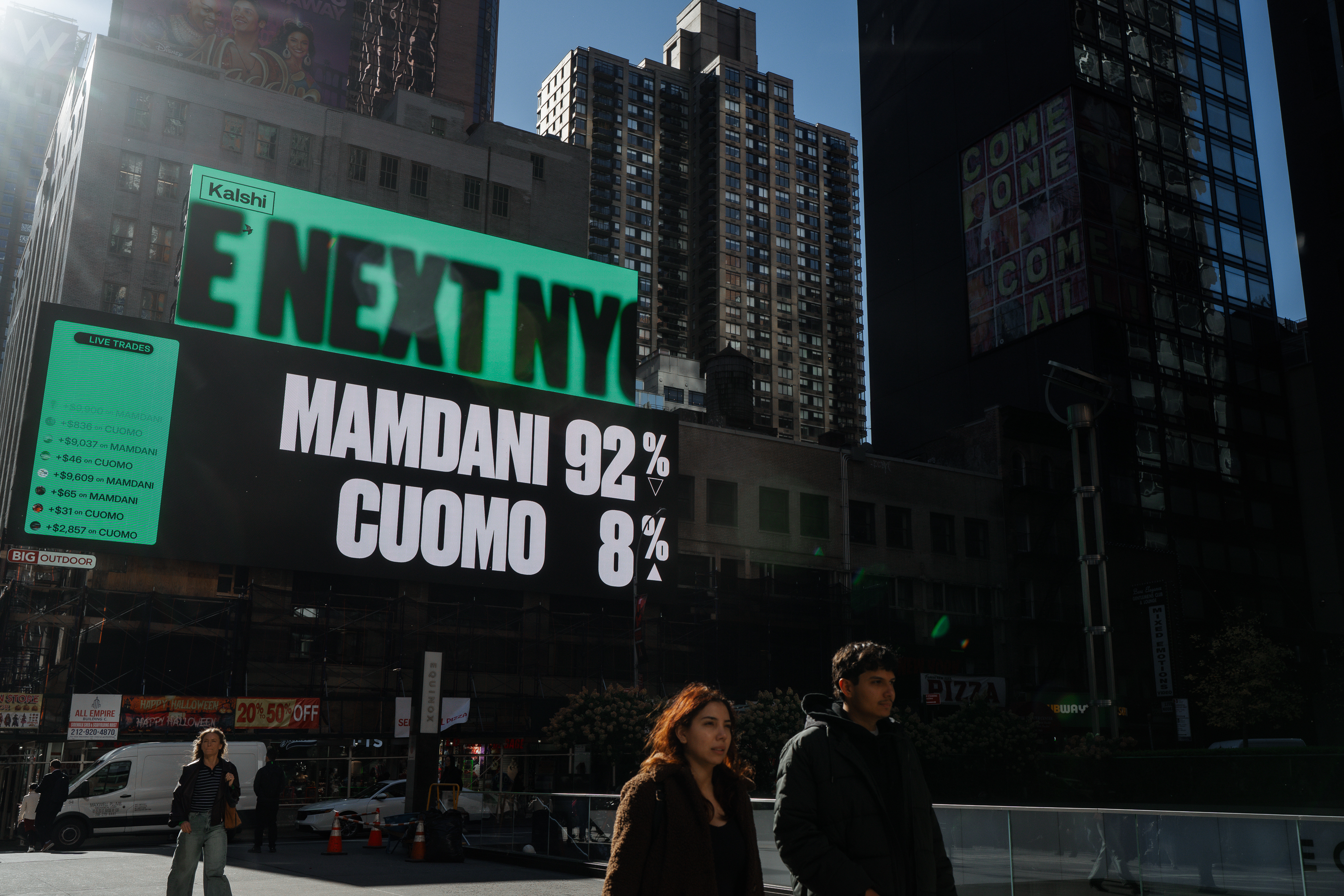
In 2020, the federal Commodity Futures Trading Commission approved their application to operate the prediction market Kalshi, and Lara and Mansour recruited investors to their fledgling enterprise.
“We took four years working with the federal government and figuring out how to launch this legally and in a regulated way,” Lopes Lara, a 30-year-old native of Brazil who holds the distinction of reportedly being the world’s youngest female self-made billionaire, said in a recent interview with The Inquirer.
In 2023, Kalshi sought permission from the CFTC to offer contracts on which political party would control Congress. The agency denied the request, arguing such wagering would be “contrary to the public interest.”
Kalshi cofounder Luana Lopes Lara said election markets are the “holy grail” for prediction markets. Olga Fedorova
Kalshi sued the CFTC and prevailed, clearing a path for the company to accept wagers on political elections. Its customers went on to spend $1.3 billion trying to predict election outcomes in 2024, including the presidential contest between Donald Trump and Kamala Harris. (The recent midterms attracted $3 billion worth of wagers on the prediction market.)
Beyond elections, Kalshi offers a dizzying array of potential outcomes that anyone over 18 can stake their money upon: cryptocurrency values, oil futures, Rotten Tomatoes scores of new movies, words an Airbnb executive might mention during an earnings call, the weather in Philadelphia.
Sports contracts, though, have lifted the company into another stratosphere. During the 2026 FIFA World Cup, Kalshi collected about $27 billion in wagers. The company’s value subsequently soared from $22 billion to $40 billion, CNBC reported.
The NBA recently named Kalshi and its competitor, Polymarket, its preferred prediction markets. And the Philadelphia 76ers in late October became the first NBA team to enter into a separate multiyear partnership deal with Kalshi. The prediction market covered the cost of postgame rides on SEPTA’s Broad Street Subway line for fans who attended an Oct. 30 matchup between the Sixers and New York Knicks at Xfinity Mobile Arena.
Kalshi’s leaders insist that prediction market trading is different than gambling with a sportsbook operator. For example, Kalshi recently contacted Philadelphia restaurant and bakery owners to see if they’d wager on a Nov. 8 Eagles game against the New York Giants to cover the cost of giveaways, like free meals for customers.
Yet there is a growing backlash to each industry’s growing omnipresence in daily life.
In March, Arizona’s attorney general filed criminal charges against the New York-based prediction market, accusing it of running an unlicensed online gambling operation. A federal judge later blocked the case from proceeding, ruling that prediction markets are solely regulated by the CFTC, News From The States reported.
That didn’t deter Utah’s attorney general in October from filing felony charges against Kalshi, Lopes Lara, and Mansour for allegedly violating the state’s gambling prohibition.
The company accused the state of “playing politics” and said it would put “a stop to this in court, just like we did in Arizona.”
Kalshi is also facing litigation in New York and other states over whether its business practices violate local gambling laws. Prediction markets are available in 50 states, but not taxed as steeply as sportsbooks, which have been legalized in 39 states and Washington, D.C. “We comply with all corporate tax laws and believe in responsible state taxation, even as a federally regulated derivatives exchange,” Lopes Lara said.
This interview has been edited and condensed for clarity.
Tell me about Kalshi’s early days.
Tarek and I both worked on Wall Street. We realized that most trading happens when people have some view about the future, some thesis about what’s going to happen.
And what we wanted to do is [create] a financial exchange, where instead of trading all these other assets, you just trade contracts, and buy and sell. Contracts are what’s going to happen in the future. Prediction markets are so much better at forecasting the future because of the wisdom of the crowds, and people putting their money where their mouth is.
When do you feel that this idea was actually viable?
After we won the lawsuit against the CFTC [which allowed Kalshi to offer contracts on the 2024 election], we realized how big it was going to be. Election markets are the holy grail of prediction markets. At the end of the day, it’s the thing that proves to people how important these markets are. You can see our data for 2028 [elections] are being used already on TV.
Luana Lopes Lara said prediction markets Kalshi and Polymarket caught the attention of the Trump family during the 2024 presidential election. While many traditional polls showed that the race between Trump and Democrat Kamala Harris was close, Lopes Lara said, Kalshi and Polymarket showed that a majority of investors believed Trump would prevail.KARSTEN MORAN
Former New Jersey Gov. Chris Christie and other critics have said that prediction markets are just another version of sports betting. Christie also said that companies like Kalshi market themselves to teens.
Chris Christie — who is paying him at the end of the day? He’s doing the work for the casino [industry], so obviously he’s going to say that, because they want to protect their monopolies.
With a sportsbook, the house always wins. The house will give you odds that they want to give you. There’s no transparency, no competition on whatever that odd is. And they make money when people lose. The more they get users to lose money, that’s exactly the amount of money they start making. And also, if you start winning, they cut you off.
Exchanges like Kalshi, we function like the New York Stock Exchange. What we do is we match buyers and sellers of contracts of what’s going to happen in the future.
In terms of advertising to minors, that’s completely false.
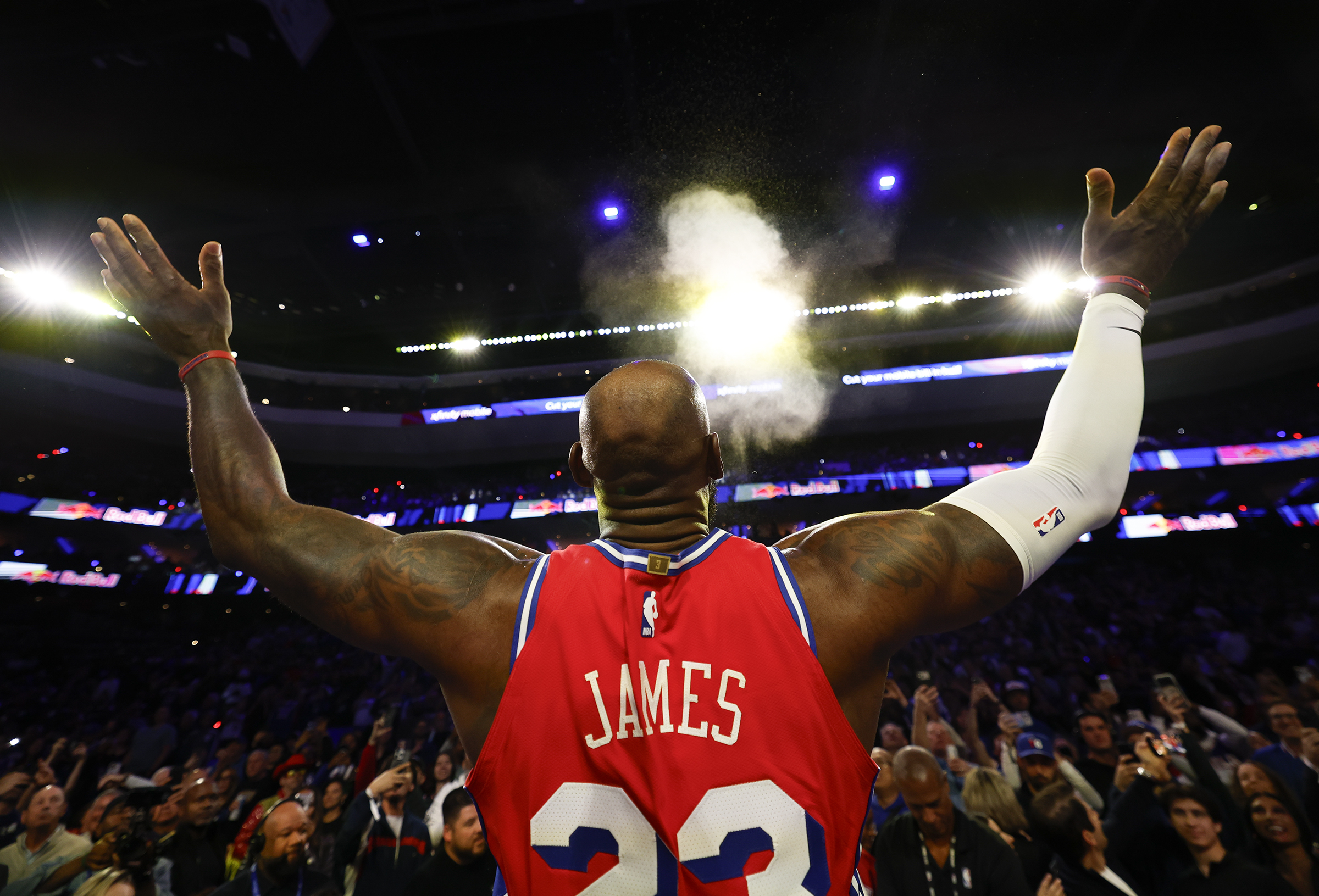
Sixers star LeBron James recently entered into a partnership with the prediction market Polymarket, which will reportedly pay him $15 million a year. Yong Kim / Staff Photographer
Advertising for sportsbooks and prediction markets have become inescapable at professional sports stadiums and during broadcasts of games. Leagues, franchises, and stars like LeBron James have entered into lucrative partnerships with those industries. But many fans — and even some athletes — are unhappy about this overlap. What’s your message to them?
People are entitled to their opinions. We think prediction markets are another way fans can engage with their teams.
(In a follow-up email, Kalshi declined to specify the value of its deal with the Sixers. A Sixers spokesperson also declined to provide those details.)
Donald Trump Jr. is a Kalshi adviser. What is his role?
(Note: Kalshi and Trump Jr. ended their affiliation on Thursday, with Kalshi citing his extensive investments in their rival, Polymarket.)
During the 2024 election [between Trump and Harris], all the polls were saying it was 50/50, who was going to win. Kalshi and Polymarket were saying that there was around a 65% chance that Trump was going to win. And I think with that, Don Jr., and the [Trump] family, and a lot of Republican leadership started seeing the value of these markets. [Trump Jr.] was such a big believer in the industry, and he wanted to get involved.
We always believed we wanted to be a bipartisan kind of company. We didn’t see it as any issue at the time — we’re just getting his help on marketing and all that. We never ask for anything, any favor, regulatory-wise. Nothing like that, whatsoever.
Donald Trump Jr. is an adviser to Kalshi and has shares of the company, and his venture capital firm has invested in Polymarket.Mandel Ngan
A White House teleprompter operator was caught earlier this year wagering about words that President Trump might mention in speeches, and a U.S. soldier was arrested for betting on military action in Venezuela.How do you address insider trading, or people trying to deliberately affect outcomes on prediction markets?
The second example you gave actually did not happen on Kalshi [it took place on Polymarket]. Because we’re federally regulated, we’re also prohibited from offering markets on war, terrorism, or assassination. So that specific incident was on an offshore platform that offer those.
Insider trading is prohibited on Kalshi, the same way that the New York Stock Exchange prohibits insider trading. It’s a hard problem to surveil for. We’re not claiming that this will never happen. What we’re claiming is that we have very, very good systems to detect and deter this.
Congress members have accused sportsbook companies of using VIP rewards — like personalized video greetings from athletes — to encourage customers to continue gambling. What customer loyalty rewards does Kalshi offer, and are they any different from the VIP benefits that sportsbooks offer?
Our VIP benefits are not based in any way on wins or losses. Kalshi has never sent videos from players [to customers].
While sportsbook companies like FanDuel have faced Congressional scrutiny for sending personalized videos of professional athletes to VIP bettors, Lopes Lara said that Kalshi does not send videos to its VIP members.Jeff Chiu
We’ve done extensive reporting this year about sportsbook users who have developed gambling addictions. Don’t prediction markets have the same potential to be addictive or harmful?
I totally hear your concern. It’s something we take very seriously. I think there are a lot of customer protection rules, in the CFTC and SEC, that we apply to us. And we do all of the customer protection mechanisms that the traditional sportsbooks or casinos do, including self-exclusion, even mental health support, deposit limits, screen time limits. We’re actually pro-more regulation.
I think the biggest difference is our incentives are aligned with our users. For us, someone coming and losing — we don’t make more money if people lose more. I think that we as a company don’t have an incentive to have people addicted to Kalshi, where sportsbooks and casinos, they have that incentive.
The Inquirer will continue to report on issues related to the growth of gambling addiction — among teens and adults — across Pennsylvania. If you or someone you know wants to speak with a reporter, please contact David Gambacorta or William Bender at dgambacorta@inquirer.com and wbender@inquirer.com
Malayshia Allford’s parents were arguing in the parking lot of a Springfield Township strip mall when someone called police. Her mother tried to board a SEPTA bus with the girl — but herfather pulled them back to the sidewalk. Then, he struck the mother in the head, police said.
That 2020 incident, and the investigations that followed, prompted a caseworker to remove Malayshia, then just 4 years old, from her mother’s home in Philadelphia.
Over the next six years of her short and tumultuous life, she would be shuffled through at least three homes by Philadelphia’s child-welfare system. On Nov. 5, one of those foster parents, Carprice Williams, was charged with killing the 10-year-old girl and leaving her body in the trunk of a car.
Williams was a Philadelphia fifth-grade teacher whose disciplinary style, including withholding lunch from students, worried colleagues and drew complaints from some children and parents. She had been a foster mother to at least four children dating back to 2019 or earlier. In 2021, another child who was placed in her care was hospitalized with what a doctor deemed near-fatal injuries.
The story of how their paths collided raises serious questions about the systems the city and state have in place to keep children safe, and to vet those who care for them.
Malayshia Allford, 10, was missing for more than a week before her remains were found inside the trunk of a car in South Jersey.Courtesy of Philadelphia police
Years in the system
Some of Malayshia’s relatives had not seen the child since she was a 4-year-old with a heart-melting smile and an affinity for Minnie Mouse. That’s how long she had been in the child-welfare system.
A caseworker had temporarily removed Malayshia from her mother’s home after the domestic incident. In April 2021, a Philadelphia Family Court judge found the home unsafe, noting that drugs had been found in the child’s bedroom and that the mother failed to seek care after she suspected her daughter had been sexually abused.
Malayshia was placed with a relative, and allowed weekly supervised visits with her parents.
The court noted that Malayshia’s parents, Everine Brown-Ward and Nazir Allford, had not cooperated with the child-welfare agency, and had sent threatening messages, including a shooting threat, to the relative who was caring for the child. The father also assaulted a child-welfare caseworker, according to court records. Allford’s brother, Nafis Horne, said the parents were grieving and not ready to comment.
A lawyer, Michael Graves Jr., was appointed to represent Malayshia’s interests, according to court records dating to 2021. Graves did not respond to messages.
Frank Cervone, who for years led the Support Center for Child Advocates, said his office and the city’s public defender both require lawyers to conduct twice-a-year in-home visits. But there are no such standards for private, court-appointed lawyers such as Graves.
“Most of them simply don’t do that,” Cervone said. “They don’t see it as part of their practice.”
In 2022, both parents were arrested after taking Malayshia from a supervised visit at Catholic Community Services in Northeast Philadelphia. Both pleaded guilty to interfering with custody. After that, they no longer were allowed visits, relatives said.
Still, multiple family members said, there were other options for the girl, who had three siblings — two in foster homes, and one living with a maternal aunt, Yolanda Brown.
By last year, Malayshia was in a different foster home. But caseworkers found that she was physically and sexually abused there, according to Nadeem Bezar, a lawyer representing Malayshia’s estate.
That’s why she was removed from that home and placed with Williams, he said.
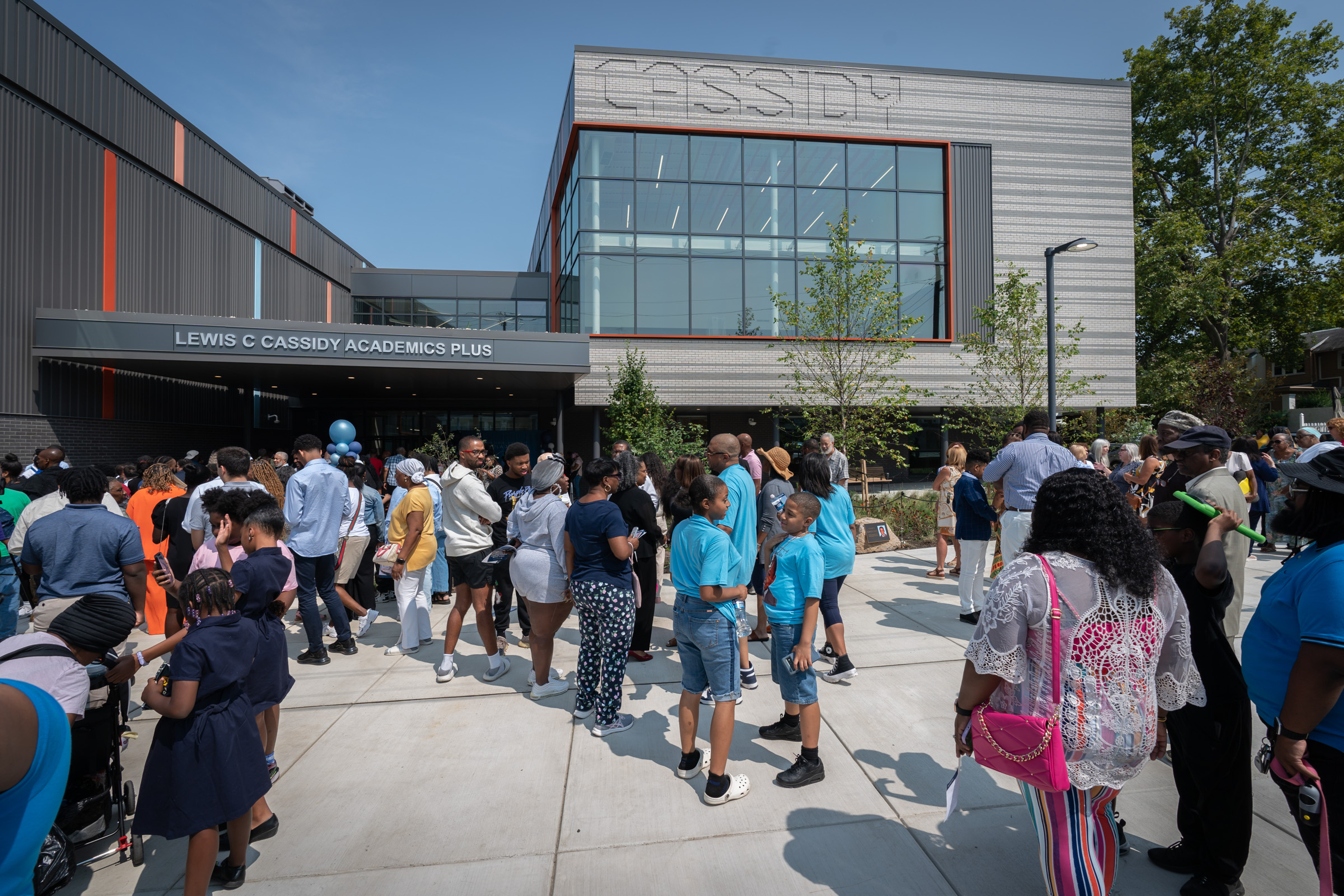
Visitors attend the opening of the Lewis C. Cassidy Academics Plus School in a 2024 file photo.Jessica Griffin / Staff Photographer
‘The care just wasn’t there’
A fifth-grade teacher at Lewis C. Cassidy Academics Plus in Overbrook, Williams, 36, was known as a disciplinarian with what some coworkers described as an imperious attitude.
She demanded to be called Dr. Williams, according to two coworkers and a parent, and touted a doctoral degree from Drexel University on her LinkedIn page. Asked to confirm that, a Drexel spokesperson said only that Williams had earned a master’s degree from the university in 2015.
A parent and a school staffer both said they had complained to the principal about what they viewed as harassment by Williams, and believed others had as well.
Cassidy parent Justin Forte said Williams seemed frazzled by her large class and ill-equipped to manage behavioral issues.
“She wasn’t handling things right,” said Forte, who said Williams had singled his 11-year-old son out for reprimands and repeatedly prevented him from eating lunch, in violation of district policy.
“The first thing a teacher’s supposed to do is care for children,” he said, “and it seems like the care just wasn’t there.”
Stephen Ford, who taught fifth grade alongside Williams, said she was an effective teacher, but stern. While some other teachers try to infuse teaching with humor, he said, “I didn’t hear a lot of laughing in her room.”
A Cassidy gym teacher, Corey Blakey, who also runs after-school and summer programs, said Williams repeatedly punished students in her class by forcing them to spend their lunch period in her classroom. He said the principal ended up warning her against such discipline.
Cassidy principal Herman Douglas did not respond to a request for comment.
“She’s really possessive,” Blakey said, adding that she urged students not to join an enrichment program and told him to remove certain students from after-school programs.
After observing a tense altercation between Williams and another staffer, Blakey urged the other staffer to file a complaint, he said.
Williams attended Lower Merion High School and Rosemont College, and was first licensed as a teacher in Pennsylvania in 2013.
She was hired by the Philadelphia School District as a substitute in 2015, taught at Young Scholars Charter School for the 2015-16 school year, and was a district teacher from 2017 through 2023, including at Thomas Mifflin School in East Falls. Philadelphia School District officials declined to provide further details about her postings or to comment.
A former friend of Williams’, whose daughter was in the teacher’s fifth-grade class at Mifflin, said troubling patterns were apparent back then: Williams was harsh with some children, but overly involved with others, ordering them UberEats to her classroom and hosting them in her home.
The friend, who asked not to be identified because she did not want to be associated with Williams’ alleged criminal conduct, said her daughter and some peers were enthralled with the teacher because she was “was more on their level. If they talked to each other crazy, she did it, too.”
Then, while visiting her home, the woman said, Williams punched her daughter with a closed fist.
“I put Carprice out of my house when she punched her,” the friend said.
In 2019, Williams took in a 14-year-old foster daughter, Maria Campbell, who said Williams punished her for taking snacks — locking her in her room during the pandemic for what seemed like months and forcing her to write out an apology over and over. When she got the chance, Campbell, now 21, said, she ran away and never saw Williams again.
On June 27, 2020, Williams took in two foster children in her rented rowhouse on Simpson Street in West Philadelphia. Six months later, records show, they were removed after one was hospitalized with severe brain bleeds, malnutrition, and vitamin deficiencies that a doctor said indicated that food had been withheld. Because of the apparent abuse and neglect, a state “near fatality” review team recommended that Williams “never be permitted to care for other foster children.”
Police investigated, according to the state review, but made no arrests because the child did not disclose what caused the hemorrhaging. In October, according to a lawsuit that did not name Williams and was later settled out of court, a child protective services report laid out detailed allegations of abuse by Williams — grabbing a child by the braids and slamming her head to the floor, smacking her in the face, forcing her to squat for long stretches.
Yet, the state review team report, finalized more than a year later in November 2022, makes no mention of that information. A state spokesperson said Williams had successfully appealed the finding of child abuse and had her record expunged.
Though the state maintains a registry of foster care providers, it is not clear if the information about that incident made it into the registry. Nor is it clear whether the Family Court judge, the Philadelphia Department of Human Services (DHS), or the foster care agency that certified Williams consulted that database. The agency, Pennsylvania Mentor, did not respond to requests for comment. Philadelphia DHS Commissioner Kimberly Ali said Saturday that she could not comment on any individual case, but that under state law it is the foster agency that is in charge of approving caregivers.
By early 2025, Williams had a young son of her own and was hired at Cassidy. And that summer, she took in another foster child, Malayshia.
She called the little girl May May. And, according to her friend, Williams said she had plans to adopt the child.
State Representative Morgan Cephas hugs Malayshia Allford’s aunt Marketa Brown, at a press conference at Philadelphia District Attorney Larry Krasner’s office on Thursday, Nov. 5. The family had gathered as Krasner announced charges against Carprice Williams.Monica Herndon / Staff Photographer
‘A really good kid’
This spring, according to Blakey, Williams asked to enroll Malayshia in summer programs he runs at the school and with the Tiger Woods Foundation. That is when he got a chance to meet the girl.
Blakey was impressed by the 10-year-old’s enthusiasm and curiosity.
“She was not a perfect student, but near to that. She was happy-go-lucky. She wanted to be in the program. She wanted to do all the activities. She wanted to do everything,” he said. “She was a really good kid.”
But Malayshia did not show up at Robert E. Lamberton School on Friday, Oct. 23.
Over that weekend, two witnesses who visited the home saw the child in bed, not moving, according to a police report. Williams did not report the girl missing until Monday afternoon. And when she did, she told Malayshia’s aunt that the girl’s parents had taken her.
As police, FBI, relatives, and neighbors began a frantic search, according to the report, Williams faked affectionate texts to cover her tracks. One phony text from Malayshia read, “Mommy I know you are waiting for me to come home but my family they don’t want me to be adopted. … I love you.”
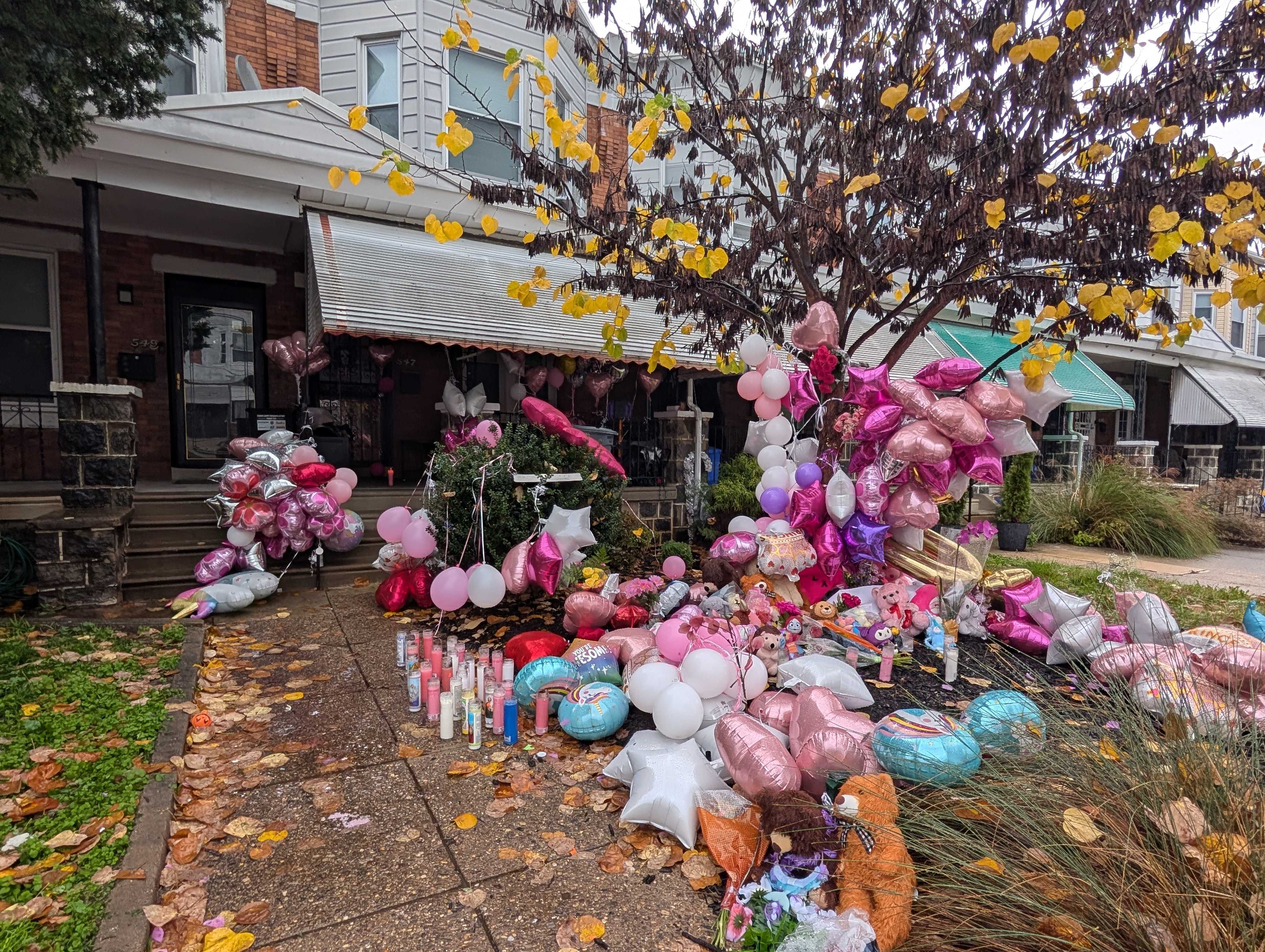
Mourners placed candles, balloons, and stuffed animals outside 547 North Simpson Street, where Malayshia Allford lived with her foster mother Carprice Williams.Jesse Bunch
Days later, investigators identified a man caught on video leaving Williams’ home dragging a cumbersome, oddly shaped bag with a long strand of braided hair trailing from it. The man, a relative of Williams’, eventually led them to a car parked in Lindenwold, South Jersey. Malayshia’s body — bruised and battered, with a fractured rib and whiplike marks on her legs — was in the trunk.
Witnesses later told police that Williams had thrown Malayshia down stairs, beaten her with a phone cord, deprived her of food, and forced her to wear a heavy vest and walk up and down the stairs. Williams denied that, telling police that the vest was only calming, and that Malayshia might have fallen but was not pushed.
But Malayshia’s relatives said they are still trying to understand how a failure this profound was possible.
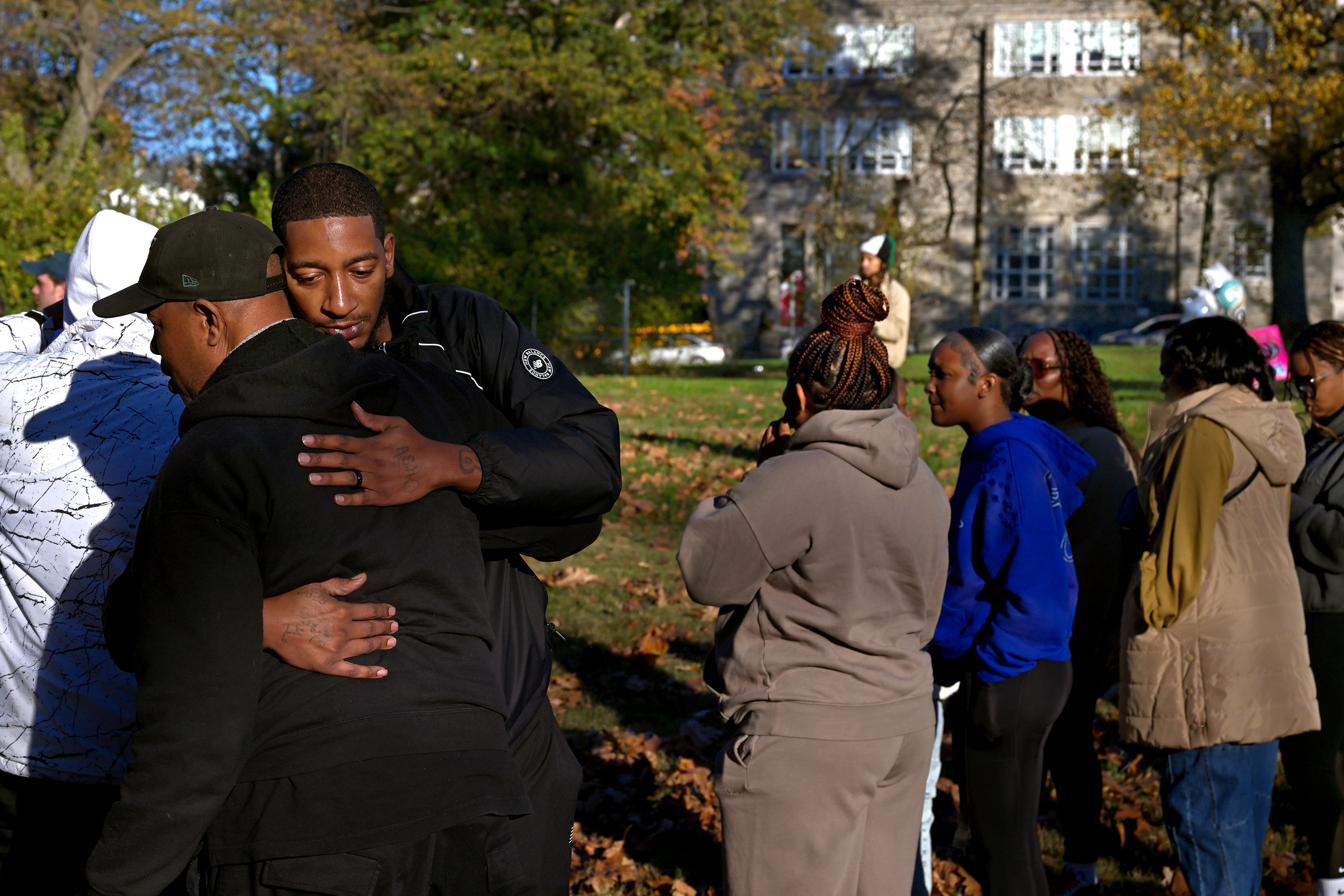
Nafis Horne, Malayshia Allford’s uncle, embraces a family member on Sunday, Nov. 8 in Morris Park in Overbrook as they gathered remember the young girl.Tom Gralish / Staff Photographer
Last weekend, more than 200 people gathered in Morris Park in Overbrook to release balloons in Malayshia’s memory.
Nafis Horne, her paternal uncle, said he would have gladly taken in his niece. But no officials ever reached out, he said.
He said his sister, Nyfisha Allford, had sought custody of the little girl but got nowhere, despite city and state policies prioritizing placements with relatives over foster care.
“My sister tried to get her,” Horne said, “but that fell through the cracks.”
Staff writers Ellie Rushing, Jillian Kramer, and Jesse Bunch contributed to this article.
About two weeks ago, I had the opportunity to speak with German high school students in Korbach, Germany, about the town’s Jewish history and the synagogue where my grandfather once served as rabbi. That synagogue was destroyed during Kristallnacht, Nov. 9 and 10, 1938.
Let me be clear: Criticism of Israel’s government and its policies is entirely legitimate. Advocacy for Palestinian rights is legitimate. But singling out Jewish businesses for exclusion from the community, accompanied by rhetoric declaring that they must go, crosses a profoundly troubling line — particularly on the anniversary of Kristallnacht.
I am not suggesting that a bicycle protest is equivalent to the Nazi violence of Kristallnacht. It is not. But history teaches us to recognize the dangers of making Jewish neighbors and businesses unwelcome, regardless of the political language used to justify it.
For me, this is not abstract history. My grandparents were subjected to the persecution of Jews in Germany and ultimately were murdered in Auschwitz. My family bears its consequences to this day.
Standing before those German students, I was encouraged by their willingness to confront the darkest chapters of their country’s history. It would be tragic if, while a new generation of Germans is working to understand those lessons, we failed to heed them here at home.
We cannot change what happened in Korbach in 1938. But we can decide what we are willing to tolerate in Philadelphia in 2026.
Remembering history is not enough. We have a responsibility to recognize its warnings and speak out when it matters.
Joel Goldwein,Merion Station
. . .
I can’t help but be struck by the irony and hypocrisy of condemning the Philly Boycott Ride by invoking the heinous acts perpetrated by Nazis on Jews during Kristallnacht, when the state of Israel has perpetrated similar crimes on the Palestinian people for decades.
I wish more of the people of Philadelphia, our civic leaders, and The Inquirer Editorial Board could muster as much outrage over the killing and maiming of tens of thousands of defenseless civilians — and the intentional destruction and deprivation of all that supports life in Gaza — as they have over the Philly Boycott Ride.
DEAR ABBY: I dated a man for 16 months. We spent a lot of time together. We traveled, enjoyed many sports events and shared some mutual friends who actually introduced us.
One evening, we were out for dinner with another couple of his friends. During the conversation, the woman asked him if I was going to his daughter’s wedding. His response shocked me. He shook his head, saying, “I don’t think so.” I remained calm, but I felt hurt. It wasn’t because I “had” to go to the wedding, but because he didn’t even discuss it with me.
I was embarrassed, so I excused myself from the table. When I returned, I asked for my jacket. His response was, “This isn’t going to end well.” I asked him if that was a threat, to which he did not respond. I called a ride share and left. The next day, he delivered all my belongings from his apartment. Over — just like that! No explanation. He did scream at me while dropping off my things, about why I thought I should be invited when I had never met his daughter. I couldn’t speak at the time because I was dumbfounded. A few days later, we had a text exchange. I asked him about a golfing buddy of his being invited. He said yes. I said, “He never met your daughter.” Phone silence.
He later invited me to go to lunch but said, “No crying.” I declined and said, “I don’t want to eat, and I don’t want to be friends with someone who treats me so horribly.” A week or two later, I got an email saying, “This is my last communication ever.” I don’t think he had to announce it, but OK. It’s been a year now, but it still bothers me. Am I wrong?
— MAKING NO SENSE IN MINNESOTA
DEAR MAKING NO SENSE: The man you were dating had his reasons for not inviting the woman he had been seeing for 16 months. If I had been sitting in your position, rather than pouting and retreating, I would have asked him why he hadn’t mentioned such an important milestone and let him explain it in front of his friends. That said, the romance is over. Let it go. To say that he was controlling and insensitive would be an understatement. In my opinion, you dodged a nasty bullet.
** ** **
DEAR ABBY: I belong to a group of 10 women who meet once a month. We’re all seniors, and most, but not all, of the women have husbands. I’d like to set up a dinner for couples so we can meet each other’s husbands. Should I invite only those with spouses? Invite everyone, but ask that the singles bring a date? Just let the singles come solo?
— HESITANT HOSTESS
DEAR HOSTESS: Why would you need to exclude the single women as you meet one another’s husbands? I suspect they, too, are curious about their friends’ spouses. Make sure the singles know they are welcome to bring a date if they want to, but they, not you, should decide whether mingling with a roomful of couples will make them uncomfortable.