In the week leading up to the Iranian attack Friday that killed two U.S. soldiers and left one service member missing in Jordan, Iran carried out three other strikes against U.S. forces in the country.
Those attacks injured dozens of U.S. service members and damaged several helicopters, according to several U.S. officials, who spoke on the condition of anonymity to discuss operational matters.
But the Pentagon did not disclose the earlier strikes, nor the casualties and damage they inflicted.
The episode is the latest example during the Iran conflict of the tension between what the Pentagon says is the need for operational security and the government’s obligation to inform the public about the conduct of the war.
In statements after airstrikes against Iranian military sites last week, U.S. Central Command said it was retaliating for Iran’s attacks against commercial ships transiting the Strait of Hormuz, never mentioning Iran’s strikes on bases in the region, including in Jordan.
Central Command is not required to release information about injured service members, especially when they quickly return to duty, a U.S. military official said.
Moreover, another U.S. military official added, why would the Pentagon divulge information that could help Iran zero in on its deadly ballistic missiles and drone attacks in Jordan and other bases in the Middle East where thousands of U.S. troops are stationed?
Central Command has also stopped announcing how many sites in Iran it hits each day for the same reason, U.S. officials say.
In the days since the collapse of a fragile truce, the Pentagon has provided little information about the U.S. military strategy after nearly five months of war. The last major Pentagon briefing on the war was in early May.
In the past several months, the Trump administration has failed to disclose how the Iran war has drained U.S. supplies of critical, costly weapons, and how Iran retained and rebuilt substantial missile capabilities.
The subject of American casualties in the war is similarly sensitive. The deaths of two Army soldiers in Jordan on Friday and another service member in northern Iraq bring to 17 the total number of U.S. military personnel killed since the United States and Israel launched attacks on Iran on Feb. 28.
The Pentagon’s casualty reporting protocols call for publicly identifying deceased service members only after 24 hours have passed since next of kin were notified. The names of troops wounded in action are not typically released.
In a statement on Saturday, Central Command said four U.S. service members wounded in Friday’s attack were taken to Jordanian hospitals and had been discharged. More U.S. troops received minor injuries and had returned to duty, the statement said, but it did not specify how many.
And the statement did not mention service members injured in the three previous attacks in Jordan last week.
In a brief phone call with NewsNation, President Donald Trump said the troops died “in service of our country” and reiterated the war’s primary goal of “never allowing Iran to have a nuclear weapon.”
Defense Secretary Pete Hegseth said on social media on Saturday that the loss of the two U.S. soldiers would stiffen American resolve.
More than 400 U.S. service members have been injured in the Iran conflict, according to Central Command. The Pentagon had periodically reported the total number of service members injured and returned to duty since early in the war, but it has stopped updating the overall figure in recent weeks.
In previous administrations, the Pentagon usually delayed providing any details on injured service members until family notifications were completed. During the Biden administration, the Pentagon typically reported the number of service members injured in attacks by Iran-backed militias on U.S. bases in Syria and Iraq.
More than 1,700 Iranian civilians have died in the war, according to estimates.
Cirque du Soleil‘s popularity is as high as an acrobat’s leap through a suspended hula hoop. And the world’s largest circus company is getting ready to land on its feet in Philadelphia again.
After dazzling Greater Philadelphia Expo Center audiences with Luzia’s elemental wonder earlier this summer, the entertainment group is coming back with a holiday-themed production.
Cirque du Soleil’s “Twas the Night Before…” is coming to the Met Philadelphia in December. The show will feature aerial strap duos, hoop diving, roller skating, and other performances.Courtesy of Benoit Z. Leroux
Inspired by the classic 1823 poem, “A Visit from St. Nicholas,” the acrobatic tale follows a young girl who rediscovers the magic of the holiday season. The poem, largely attributed to Clement Clarke Moore, is believed to have inspired the very concept of Santa Claus.
It’s thought that Moore was struck with inspiration while he rode a sleigh on a shopping trip around 1823, the year the poem was published anonymously. He later claimed authorship in 1837.
Come December, the Met Philadelphia stage will transform into a winter wonderland, filled with high-flying aerial strap duos, hoop diving, roller skating, soaring hair suspension, and high-energy dancers across more than 10 acts.
Twenty-six artists will perform to a soundtrack of reimagined Christmas classics and original songs, composed by musical director Jean-Phi Goncalves.
Cirque du Soleil’s “Twas the Night Before…” is coming to the Met Philadelphia in December.Courtesy of Kyle Flubacker
The 85-minute showis the company’s first Christmas show since its founding in 1984. Twas the Night Before … premiered in Chicago in 2019 and played in Philadelphia in 2024.
Tickets to the productionare available online for Cirque Club members beginning at 10 a.m. Tuesday. Cirque Club membership is free, and benefits include access to advance tickets and other special offers. LiveNation All-Access Presale begins at 10 a.m. Wednesday.
General tickets are available starting at 10 a.m. Friday.
For more information and to purchase tickets, visit themetphilly.com.
After more than a week of strikes that unraveled an ill-fated ceasefire, the conflict between the United States and Iran stands on a knife’s edge. Now is the time, analysts say, to find a way to draw down an exponentially destructive confrontation — or risk provoking a war that cascades beyond what they may be able to contain.
And though the dangers of escalation are growing, analysts say, neither side can really afford it, either economically or politically at home.
Over the past few days, Iran and the U.S. have dealt blows that quickly went beyond battering military targets and have gradually raised the stakes of their renewed war.
Both sides have struck water and desalination plants that risk depriving tens of thousands of power and water supplies during the deadly Gulf summer heat. Traffic through the vital Strait of Hormuz is once again blocked both by officials in Tehran, the Iranian capital, and those in Washington, while the U.S. has reinstated a blockade of Iranian ports.
U.S. strikes have heavily bombarded roads and infrastructure in southern Iran, killing and trapping civilians, while raising anxieties it is preparing the ground for a potential invasion in the area.
Iran’s strikes on U.S. forces in Jordan have now killed two U.S. soldiers and wounded dozens, bringing the human cost of war much closer to home for Americans while puncturing the Trump administration’s projection of complete military dominance.
“This is the wake-up moment for both sides,” said Ellie Geranmayeh, an Iran expert at the European Council on Foreign Relations. “They either take the diplomatic off ramp now or risk allowing the war to spiral beyond managed escalation.”
As both sides’ targets expand, so does the war’s potential geographic reach.
The growing tit-for-tat of infrastructure strikes in Iran and Arab Gulf countries could quickly devastate civilian populations in the region. Iran has already warned that if it is hit badly enough, it will gun for Gulf installations critical to international energy supplies.
U.S.-allied Saudi Arabia struck an airport held by Iran-aligned Houthi rebels in Sanaa, Yemen, last week. That has increased the likelihood, Geranmayeh said, of Tehran calling on its Yemeni allies to block the crucial Red Sea shipping lane, Bab al-Mandab. Such a move would quickly compound risks to the global economy.
The costs of accelerating the conflict are high for both sides.
Both the Trump administration and Iran’s new hard-line leadership face all of the same economic and political risks that compelled their warring governments only a month earlier to sign a vaguely worded “memorandum of understanding,” which aimed to negotiate an end to the conflict.
As then, the havoc the war has wreaked on the global economy since the initial U.S.-Israeli attack on Iran last February has yet to abate. Expanding the unpopular war further risks damaging President Donald Trump’s Republican allies in the upcoming midterm elections.
Iran’s economy was so dire before the war that it sparked nationwide protests that were suppressed in a deadly crackdown. Now, battered by wide-scale destruction, it faces a dangerous economic reckoning that is worsened by the U.S. blockade on its ships.
The very factors that make escalation so dangerous for Washington and Tehran may also be what is pushing them to riskier attacks, as they seek to increase the pressure on each other.
“The conflict has now become a contest against time and a war of endurance,” wrote Hamidreza Azizi, an Iranian security expert at the German Institute for International and Security Affairs, on social media. “The decisive question will be whether Iran’s deteriorating economic and infrastructural conditions outpace the rise in energy prices driven by instability in the Strait of Hormuz, or vice versa.”
Discontent over the human and economic cost of war is starting to be more palpable in Iran. On Saturday, 268 prominent Iranians, including academics, politicians, athletes, clerics and trade unionists, signed a “No to war” petition — a risky move at a time when the government, backed by a fiercely pro-war hard-line base, has continued to crack down fiercely on dissent.
“The government will have a very difficult time convincing people that they should continue fighting this war at the cost of Iran’s destruction,” said Omid Memarian, an Iran analyst at DAWN, a Washington-based Middle East research institute. “So time is ticking for them, too.”
That sense of time slipping away is likely what encouraged Iran to launch the attacks on ships that began the latest spiral, said Farzan Sabet, an Iran analyst at the Geneva Graduate Institute in Switzerland, not with the aim of expanding the war, but to take advantage of strategic gains while they have them.
“They saw their leverage in terms of being able to control the strait quickly decline,” he said, as the United States encouraged ships to navigate the waterway beyond Iranian oversight during the ceasefire.
These attacks should be seen as Iranian efforts to “keep themselves relevant at the likely negotiating table” more than to signal that they aim to win militarily, Memarian said. And they could easily backfire.
The strikes on U.S. targets in Jordan, for example, have not only caused heavy casualties and damage to helicopters and equipment. They have very publicly underlined that Tehran retains the ability to strike back and sometimes outmaneuver a far more powerful U.S. military.
The possibility that such attacks trigger public anger in the United States, or simply enrage the mercurial Trump, Memarian said, has now “clearly put Trump in a position where he is more likely to escalate militarily.”
At the same time, with the economic and political stakes so high, Trump has few palatable options for escalation.
Between now and early to mid-August, Sabet said, the Trump administration is likely to try to weaken Iran’s leaders militarily, or to destroy Iran’s ability to control traffic in the Strait of Hormuz through asymmetric attacks. Yet, he said, there was little sign the United States could succeed in doing that.
“I am skeptical of any one-off U.S. escalation being able to dramatically change Iran’s calculus,” he said. “It would have to be something truly earth-shattering,” he said.
One approach that could achieve that effect would be a U.S. ground invasion, most likely on a southern island near the strait. Many Iranians have viewed the intense U.S. strikes on the country’s south as a potential precursor to such a campaign.
Geranmayeh said the risks that previously made the Trump administration leery of that option — from the potential for heavy casualties to the possibility of prolonged occupation — are even bigger now. U.S. troops would face new disadvantages like intense summer heat, and Iranian forces that by now have spent months preparing for such an offensive.
If Trump was considering such a campaign, it would likely come after the midterm elections, Sabet argued, when the political risk for him is lower.
The coming days remain precarious nonetheless. With Iran eager to project its military power, every strike risks a miscalculation that could deepen the war instead of hastening negotiations, said Memarian of DAWN, the Washington-based research institute.
“I think it’s going to get much worse before it gets better,” he said.
School closures have spiked 35 percent across the country over the past four years, propelled by a shrinking youth population and the end of covid-19 relief funds that had propped up education funding in some places.
For the fourth year in a row, the number of school closures rose nationally last year, according to data from the National Center for Education Statistics released last week. Districts closed more than 1,000 schools in 2025-26, compared with 755 in 2021-22. And more closures are planned, including districts in Houston, Philadelphia, Pittsburgh and Broward County in Florida.
“We call it the big shrink,” said Marguerite Roza, who tracks school funding as director of Georgetown University’s Edunomics Lab. “Enrollment at public schools is declining, partly because there are fewer kids in the U.S.”
Public school closures temporarily slowed during the pandemic as administrators focused on dealing with the fallout from covid and tapped relief funds to balance their budgets. But now that the funds have run out, experts say administrators often must close schools to deal with reduced enrollment, which in turn reduces the amount of money they receive from states.
Nationally, federal projections indicate public school enrollment has already started to decline from its peak in 2019 and will continue to do so in coming years. From 2019 to 2031, schools were projected to lose nearly 4 million students. And those estimates were made before the Trump administration made changes to sharply curb immigration, further reducing the number of kids at some schools.
Some districts are also coping with population shifts, as families move to the suburbs or other parts of the country.
In addition, Roza noted that families in some parts of the country, such as Florida, have enrolled their children in private schools, taking advantage of taxpayer-funded vouchers and scholarship programs offered in a growing number of states, or charter schools, which are publicly funded but generally operate with some degree of autonomy.
All that means more closures, sometimes year after year. School administrators acknowledge that the moves can be hard on students, families and neighborhoods.
“It’s very difficult,” said Philadelphia Superintendent Tony B. Watlington Sr. “Public schools have always been anchors of communities.”
The Philadelphia district said schools have 70,000 more seats than are needed because of enrollment declines, and many of its aging school buildings need repairs.
In May, Philadelphia’s school board voted to close 17 schools, rejecting a recommendation to cut even more. Students, teachers and others rallied before the meeting to try to stop the closures.
To ease the burden on families, Watlington said Philadelphia decided to gradually close campuses over the next decade to give students time to graduate from their current schools. The district also created a transition office to help families affected by the changes.
“We know how hard and how difficult this is for our families,” he said.
Watlington said the district hopes to attract more students from other local schools by improving its academic performance and modernizing 169 remaining buildings.
In Florida, Broward County Public Schools, north of Miami, closed one elementary school last year. The school district voted in January to close six more ahead of the 2026-27 school year and plans to identify additional schools to close or repurpose in the future. In May, the superintendent said he didn’t want to scare the public but thought the district might have to close more than 10 additional schools in 2027-28. The school district said it considered factors including declining enrollment and the operating costs for the buildings when deciding which facilities to shutter.
The Houston Independent School District’s board of managers decided in February to move forward with a plan to close a dozen schools, despite protests from parents and community members. And Pittsburgh Public Schools voted in May to close 12 schools.
Researchers said they expect more school closures in coming years because of declining enrollment.
Sofoklis Goulas, an economist who has studied declining school enrollment and school closures, said it is hard to make precise predictions because of changing immigration patterns and other issues.
One notable factor, he said, is that some students appear to have disappeared from school data in recent years, perhaps due to increases in home schooling or private microschools that are not fully tracked by the government.
“The unaccounted-for student is the most worrisome,” said Goulas, a senior researcher at Foundry10, an education research organization based in Seattle. “We know little about them.”
Meanwhile, many teachers and others have expressed frustration with the closures.
“There is just an overall lack of funding in our public education system,” said Mary Kusler of the National Education Association, the nation’s largest union, representing 3 million educators.
Kusler said efforts to cut taxes in many states have reduced the money available for local schools and made it hard to keep up with inflation.
She also pointed to efforts to expand vouchers and scholarship programs, which help families pay for private schools. Supporters contend those programs create needed competition and provide more options for parents, especially in areas where public schools have struggled. But Kusler argued it also ultimately reduces the pool of money for traditional public schools, which still serve most students.
“There is only so much money to go around,” she said.
NEW YORK — U.S. gas prices jumped to an average of $4 a gallon again Monday as the U.S. and Iran launched more attacks.
According to motor club federation AAA, the national average for a gallon of regular gasoline is now back to $4. The average price a year ago was $3.14 a gallon.
The price is a national average, meaning drivers in some states have been paying well over $4 a gallon for a while now, while others pay less. Prices vary between states due to factors ranging from nearby supply to differing tax rates.
People around the world are also dealing with high gas prices as a result of the war.
Gas prices first went over $4 a gallon on average at the end of March. They dipped below that in mid-June and continued to fall as crude oil prices eased when the U.S. and Iran reached an interim deal. Even then, President Donald Trump expressed frustration that gas prices weren’t falling as quickly as oil prices.
Affordability is likely to be a key issue for voters in the U.S. midterm elections, and higher gas and oil prices can help push up prices for groceries and other goods.
Prediction markets are rewriting the rules of American gambling.
These platforms have taken the country by storm, enabling users to stake money on the outcome of real-world events — everything from who will win a baseball game to the location of Taylor Swift’s wedding.
For users, prediction markets operate almost indistinguishably from online betting platforms. However, they are technically investment sites. As such, they are not constrained by state and tribal gaming law. They are available in all 50 states — even those with no gambling — and the prediction market companies pay no state taxes.
States have been fighting back. Twenty-six states are engaged in active litigation against prediction market companies, and several have passed increasingly creative laws attempting to restrict or remove them. Yet, most of these attempts have been thwarted by the Commodities Futures Trading Commission (CFTC), the federal regulator that oversees prediction markets. The Commission insists that, as investment platforms, companies like Kalshi and Polymarket need not concern themselves with state regulation.
The CFTC position reverses over a century of precedent in terms of how the federal government approached gambling policy. Throughout American history, gambling has generally been treated as a state issue. Where the federal government has intervened, it has been to protect states from gambling — even if doing so meant protecting states from themselves.
But the current CFTC has flipped this equation. A federal agency is doing its utmost to effectively nationalize gambling, leaving states powerless to control what has historically been under their domain.
The first federal foray into national gambling policy came in response to an interstate lottery scheme.
In the 1700s, lottery tickets were almost as easy to find in the U.S. as they are today. “Every part of the United States abounds in lotteries” a Boston newspaper observed in 1791.
Around the turn of the 19th century, however, the public soured on lotteries. A surge of religious fervor brought with it a wave of anti-gambling furor. By the late 1870s, only a single state licensed a lottery: Louisiana.
The Bayou State did not just run any lottery. The state government licensed its operation to an entity known as the Louisiana State Lottery Company, better known as “the Serpent” or “the Golden Octopus.” It came by these monikershonestly.
The LSLC was notoriously corrupt, having slithered its way to political invulnerability through bribes to state officials. The lottery, which nominally existed to raise money for a children’s hospital, actually lined the pockets of its proprietors on the back of $28 million in sales in 1890 alone (modern equivalent: $1.02 billion).
The Golden Octopus nickname was fitting for another reason: the Louisiana lottery’s tentacles reached well beyond the state’s borders. Operating through the U.S. mail, the LSLC sold roughly 90% of its tickets to residents of other states. The Golden Octopus filled the market void for people without other access to legal lottery tickets, becoming a de facto national lottery.
This created an uproar because other states were powerless to do anything to stem the tide of lottery tickets into their states. The Louisiana legislature was beyond their control, and it was impractical to crack down on every dreamer clutching a ticket or every piece of mail with a Louisiana return address.
In late 1890, President Benjamin Harrison condemned how the mail system overflowed with “fraudulent and demoralizing appeals and literature emanating from the lottery companies.”
The only body truly capable of slaying the Golden Octopus was Congress. It did so with bills in 1890 and 1895 that prohibited the mailing and interstate transportation of lottery tickets, advertisements or paraphernalia.
States could decide the question of lotteries for themselves, but other states could not decide the question for them. Congress overrode Louisiana’s state gambling law to protect gambling laws in the 43 other states.
The anti-lottery bills set a clear precedent — one that would be replicated almost exactly a century later, when congressional involvement in gambling even more clearly overrode state authority.
Made By History sponsors. FOR USE ON MADE BY HISTORY STORIES ONLY.Inquirer Staff
In the 1960s, states once again began operating lotteries. By the late 1980s, as states experimented with new lottery games, a few began considering sports pools. These were games in which players could attempt to predict the outcome of between three and 14 football or basketball games, with the payout dependent on the amount put up both by the bettor and by all other players.
The only trouble was that, to the professional sports leagues, these games represented a dangerous wedge that could open the door to legalized sports betting. At the time, the leagues were deeply opposed to all things gambling, viewing any association between it and their product as a threat to the integrity of American sports.
The leagues mobilized in multiple states to attempt to stamp out sports pools. But by going to Congress, they could pull the weeds out by the root. In 1992, Congress obliged, passing the Professional and Amateur Sports Protection Act (PASPA). The bill did not ban gambling. Rather, it banned states from legalizing sports gambling, leaving a few exceptions for states that had already authorized a form of betting, most notably Nevada.
Anyone who has watched a sporting event in the last eight years knows that PASPA did not last. In 2018, the Supreme Court overturned the bill on the grounds that, according to Justice Samuel A. Alito Jr.’s majority opinion, Congress had usurped state authority as enshrined in the Tenth Amendment: “A more direct affront to state sovereignty is not easy to imagine.”
Congress could regulate sports gambling. But in creating a patchwork set of rules that banned states from deciding the issue for themselves, it had gone too far in asserting authority over states’ rights. The decision has led to an explosion in online sports betting, with the major sports leagues now embracing gambling and integrating it into their telecasts.
A few years after legal sports betting took off, prediction markets endeavored to broaden the base of gambling options. Though the Biden administration tried to restrict them, the Trump White House has taken a different approach, authorizing the platforms to expand their offerings from bets on political events like elections to sports, pop culture and seemingly every imaginable topic. It has done so with the direct support of President Donald Trump, whose son, Donald Trump Jr. has financial stakes in both Kalshi and Polymarket.
For some states, the federal government has once again gone too far on gambling, this time in the opposite direction. Instead of prohibiting states from legalizing gambling, the CFTC has created a national system of de facto gambling in contravention of state and tribal gambling law.
One direct result is that while most states set the legal gambling age at 21, investment platforms are available to anyone over the age of 18, meaning the CFTC has effectively lowered the national age to legally bet.
The current CFTC rules are even more vulnerable than PASPA was. Because they’re regulations, not laws, a change in presidential administrations — and by extension, the leadership of the CFTC — could lead to an overhaul of the Commission’s approach to prediction markets. Additionally, passage of any one of the bipartisan bills that have been proposed in Congress to rein in prediction markets could swiftly constrain the experiment in federally-mandated gambling.
As history shows, gambling law is not forever. States have generally been left to decide for themselves how much gambling they want to offer, with the federal government setting a limit as it sees fit. Odds are that arrangement could return.
Jonathan D. Cohen leads gambling policy for the American Institute for Boys and Men. He is the author ofLosing Big: America’s Reckless Bet on Sports Gambling. Made by History takes readers beyond the headlines with articles written and edited by professional historians. Opinions expressed do not necessarily reflect the views of The Inquirer.
WASHINGTON — Two U.S. Army soldiers killed in Jordan while defending against Iranian ballistic missile and drone attacks were identified on Monday — the first U.S. troop deaths from direct Iranian fire since the opening days of the war.
The Defense Department said in a statement that James Feehan, 25, of Ewa Beach, Hawaii, and Isabella Gonzales, 19, of Carrollton, Texas, were killed in Jordan in Friday’s attacks.
Feehan, a first lieutenant, will be posthumously promoted to the rank of captain and awarded the Bronze Star, Purple Heart, and Combat Action Badge medals. The Army did not provide details about his commendations. He was assigned out of Fort Bragg, North Carolina, to the 32nd Army Air Missile Defense Command.
Gonzales was a private with the 10th Army Air Missile Defense Command in Ansbach, Germany. She graduated last year from Hebron High School in Carrollton, near Dallas, school officials said.
“She gave her life in that service, and our district is heartbroken by her loss,” the Lewisville Independent School District said in a statement. “Her decision to serve after graduation speaks volumes of her character.”
The military said Gonzales died on Friday and Feehan died the following day. It did not provide details.
A third service member was reported missing in the attacks that killed Feehan and Gonzales. U.S. Central Command said Sunday that “unidentified remains” have been found and were being examined.
Military says 17 U.S. service members have been killed in the war with Iran
The deaths reflect the complicated reality that American soldiers don’t need to be on the ground in Iran for there to be lethal risks in a conflict that involves drones, missiles, and airplanes. American forces are arrayed across the Middle East, making other nations targets of Iran and its allies as the fighting has escalated after a breakdown in peace talks.
U.S. President Donald Trump has said the war is necessary to stop Iran from developing nuclear weapons. Trump, a Republican, now faces political pressure to bring the war to a close and avoid the kind of prolonged Middle East conflict he had campaigned against.
Drones and missiles claiming lives on both sides
An American service member was also killed in northern Iraq on Saturday during a “controlled detonation” of unexploded ordnance from a downed Iranian drone, U.S. Central Command said Sunday. A second service member was wounded and was receiving medical treatment for a minor injury.
The military said it was withholding additional information until 24 hours after families had been notified.
Iranian authorities said U.S. strikes in just the past three weeks have killed at least 50 people and wounded more than 500 others, including eight killed in a strike on a bridge Friday.
Both sides have targeted civilian infrastructure relied on by millions of people. Workers on ships, as well as foreign workers and others in Gulf nations, Israel, and Lebanon have also died in the conflict.
First U.S. military fatalities came soon after the war started
Shortly after the U.S. and Israel began the war on Feb. 28, an Iranian drone strike at a civilian port in Kuwait killed six American soldiers. The soldiers were part of a supply and logistics unit based in Iowa who were working at a shipping container-style building that had no defenses.
A seventh soldier died more than a week after being wounded during a March 1 attack by Iran on the Prince Sultan Air Base in Saudi Arabia.
Later in March, six service members were killed when a KC-135 refueling aircraft supporting U.S. military operations against Iran crashed in Iraq. The aircraft was in “friendly” airspace when an unspecified incident involving another aircraft took place, according to U.S. Central Command.
Last week, the U.S. military said a Navy pilot died in a helicopter crash in the Arabian Sea. The Navy initially described the July 1 crash as an emergency landing and said there was “no indication the emergency was caused by hostile action.” The remaining three sailors aboard the helicopter were rescued.
Good morning, South Jersey. Breathe easier today: The Canadian wildfire smoke has largely left the region. But poor-air-quality events may become more common.
Kenneth Houseknecht killed his 12-year-old Deptford neighbor, Kim Marie Anderson, in her bedroom in 1988. The gruesome case shocked South Jersey and devastated a community.
Houseknecht apologized publicly for the first time in a recent Gloucester County Superior Court hearing as he sought a reprieve from a life sentence.
The recording of his hearing sheds light on the murder, as well as the Andersons’ ongoing anguish.
“It’s just not fair that not just my family has to live in fear,” Kim’s father said about the possibility of Houseknecht’s release.
How do you honor a century of life and a lifetime of service?
If you’re a multi-war, multi-branch veteran like Stephen Anderson, you get a big party, heaps of praise, and letters from the governor, state legislators, and American Legion leaders.
The longtime Burlington County resident celebrated his 100th birthday last week in Cinnaminson, calling the surprise “amazing.”
Plus: Inspired by Anderson’s celebration, Inquirer photographer Tom Gralish reflects on the changing meaning of birthday parties through the years in his latest Scene Through the Lens column.
What to know today
Sen. Andy Kim on Friday toured anti-hunger nonprofit Cathedral Kitchen in Camden and called President Donald Trump’s cuts to federal food assistance “devastating and cruel.”
A federal appeals court ruled that the state’s bans on assault firearms and magazines holding more than 10 rounds are unconstitutional, according to the Associated Press.
New Jersey Monitor reports that NJ Transit has approved a $3.5 billion budget, raising spending 11% over the prior year’s budget after facing financial headwinds.
Taylor Farms is recalling iceberg lettuce that had been shipped to retailers in New Jersey and 26 other states due to potential contamination of the cyclospora parasite, the New York Times reports.
The community is mourning Lawnside’s Ewart Rouse, who died at age 85 this month in Voorhees. The retired award-winning reporter and editor for The Inquirer previously covered South Jersey news.
A couple quietly collected rotten-smelling extraterrestrial material for scientists after a meteorite crashed into their Somerset County home two years ago. A study says it contains “alien world chemistry.”
Gloucester Township is debuting a new “fitness court,” a free outdoor gym for all ages, at Veterans Park, complete with an app explaining how to use the equipment.
🧠Trivia time
M. Night Shyamalan’s Knock at the Cabin was filmed in The Pine Barrens. What book was the film based off of?
A) The Cabin at the End of the World by Paul Tremblay
What does your community look like? What South Jersey memory would you like to share? Submit a photo and/or a brief description for a chance to be featured in the Monday edition of this newsletter.
Pennsylvania’s new budget has two significant changes for nursing homes.
In a long-sought victory for the nursing-home industry, lawmakers altered how the Medicaid long-term care budget is set, increasing the state’s share of nursing home funding by $162 million next year.
Lawmakers also amended the formula used to calculate whether nursing homes are complying with a 2022 law that required them to devote 70% of their expenses to resident care. The changes will make it easier to comply.
Change to 20-year-old Medicaid funding rule
For two decades, Pennsylvania Medicaid has paid nursing homes less than their audited costs, according to Michael Jacobs, CEO of the Pennsylvania Health Care Association, a trade group for nursing homes and other long-term care providers.
In 2005, when lawmakers decided they could only afford to pay nursing homes 95% of their costs, the measure was supposed to be temporary. But 20 years later, what was called the “budget adjustment factor” remains in place. The gap between funding and audited costs grew to 20% from 5%, Jacobs said.
This year, lawmakers agreed to raise the factor from 80% to 86% of costs and guarantee that it won’t drop below that level for two years.
“It’s a monumental victory for long-term care to get predictability and stability by putting in a floor,” Jacobs said.
That translates to a $162 million increase in state funding next year. (The change takes effect Jan. 1, because that’s when the fiscal years for Medicaid insurers begins.)
The floor on the budget adjustment factor “provides much-needed resources and stability to help nursing homes recruit and retain the experienced caregivers residents depend on,” Matt Yarnell, president of SEIU Healthcare Pennsylvania, said in an email.
“Now it’s critical that nursing home operators put these additional resources where they belong: into the quality of care for residents and into the frontline workforce,” said Yarnell, whose union represents thousands of nursing home workers.
Including a federal match of more than $200 million, nursing homes are expected to see a roughly $20 to $25 per day increase for residents with Medicaid, Jacobs said. He did not provide a percentage for the total state and federal increase.
Current minimum daily Medicaid rates range from $236.56 for Burgh Care Center in Pittsburgh to $573.92 for Fox Subacute in South Philadelphia, which specializes in caring for patients who need ventilators to breathe, according to state data.
A new formula for calculating 70% rule
In 2022, Pennsylvania became the fourth state to require nursing homes to devote a specific percentage of expenditures to resident care. Pennsylvania’s law set the threshold at 70%, with fines for nursing homes that didn’t comply.
When the state Department of Human Services began evaluating nursing homes under the new law, the analysis resulted in what the agency described last year as “distorted” penalties that it considered “inconsistent” with the intent of the law, known as Act 54 of 2022.
The agency found a lack of consistency in how nursing homes were reporting expenses. Some facilities, “mistakenly reported items that would be considered costs for resident care and services as administrative operating costs,” making it seem like they owed big fines, the agency said.
The original formula for overall costs also included things over which the nursing home operators had no control. Examples are property taxes, a nursing-home assessment, and depreciation. These items elevated total costs, making it harder for nursing homes to comply with the 70% rule.
One expense — excess administrative costs — was added to the new formula. That figure frequently topped $1 million per nursing home last year, according the cost report data.
Jacobs welcomed the formula changes, saying the industry was particularly interested in removing nursing home assessments and property taxes from total costs.
“We’re happy to be held accountable for the dollars that are being paid to the facilities and making sure they go where they need to be,” he said.
Vashti DuBois has removed all of the art from the first floor of the Colored Girls Museum. Its forest green and sunshine yellow walls now lay bare.
The living room couches, settees, dining room set, and bookcases are in storage. Hundreds of books have been boxed up and the ceramic vessels tucked away.
DuBois, TCGM’s founder and executive director, hired contractors to paint the Germantown museum’s galleries eggshell black and cover the hardwood floors with black carpet. Black curtains hang over the windows.
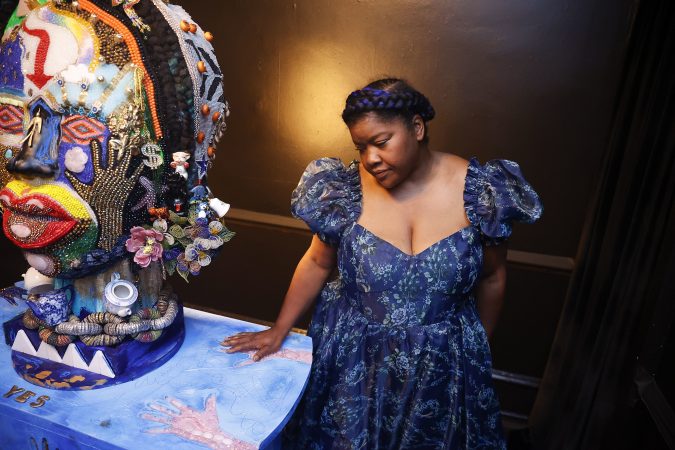
These changes were all made at the behest of renowned artist vanessa german. Her new show, “The House, The Oracle and the Table,” a sparkling three-piece exhibit and theatrical presentation in honor of the Colored Girls Museum’s 10th birthday,was unveiled June 20.
“The House,” the central character in “The House, The Oracle and The Table” by vanessa german, stands in the Colored Girls Museum’s living room gallery. The show runs through Dec. 30. Zamani Feelings
“The House, The Oracle and The Table” is comprised of three pieces. The House, a 7-foot towering talisman; The Oracle, a gem-studded bust; and The Table, an inviting drop-leaf surface with crystal-filled hand carvings. The show is german’s offering to the museum and DuBois.
“She’s one of a few artists I’d even dream of stripping the museum bare for,” DuBois said. “I released the old and I have so much more to show for it.”
‘Here the work is kinfolk’
A poet, spoken word artist, and self-taught sculptor, german is among the country’s most important contemporary artists of the moment.
Her work revels in the dynamism of the Black femme, reminding women that it’s OK to take up space with sequins — and lots of them. She’s best known for her “power figures,“ larger-than-life sculptures of Black women as sparkling, glittering, and magnificent spiritual and magical beings.
Her power figures and altars are in the permanent collections of the Museum of Contemporary Art Chicago and Pittsburgh’s Carnegie Museum of Art. In 2021, the Pennsylvania Academy of the Fine Arts acquired german’s Declaration of Independence altar. The 17-foot-long piece rejects the idea that Black women — specifically Prissy in Gone With the Wind — should be relegated to subservient roles.
German’s iconic Miracles and Glory Abound is presently on display at Doylestown’s Michener Art Museum as the centerpiece of its exhibit celebrating America’s 250th, “The Crossing: Picturing the American Revolution.”Miracles is a recreation of Emanuel Leutze’s famous 1851 oil painting Washington Crossing the Delaware. But in german’s sculpture, which features a life-size boat made from found objects, Washington and his soldiers are Black women.
“The Table” and “The Oracle” are two of the characters in vanessa german’s show, “The House, The Oracle and The Table.”Zamani Feelings
“Her work allows Black women and Black queer women to take up space in a way we just can’t ignore,” said Laura Igoe, Michener’s Gerry and Marguerite Lenfest chief curator. “She’s creating a different awareness, imagining a new future, and creating a new narrative.”
It’s rare that an artist of german’s caliber creates a site-specific installation for a small community museum like TCGM, let alone makes the museum’s founder central to the show. This makes “The House, The Oracle and The Table” a big deal in local and national arts circles. TCGM is also of the community that inspires german’s art. Here, german’s work is not a spectacle or a teaching moment. It’s an understood and welcome family member.
“Here the work is kinfolk,” DuBois said.
Prayer pouches and healing monuments
The House, a 7-foot-tall, three-headed sorceress — the personification of past, present, and future — stands in the center of the living room gallery turned black-box theater, alone under a labyrinth of Edison lights. Each woman has a head of flowing locks and lips of cowrie shells. Each face — carved from plaster, epoxy resin, and wood glue and treated with a metallic finish — is slightly different from the one next to it.
Artist vanessa german stands next to “The House,” one character in her three-piece show, “The House, The Oracle and The Table.” The three-headed sorceress resembles the Colored Girls Museum’s founder and executive director, Vashti DuBois.Zamani Feelings
They all resemble DuBois’ face.
“What’s really tender is that vanessa wasn’t afraid to see me: my past, my present, and my future,” DuBois said. “She didn’t look away. She installed the founder and executive director in this show.”
The House wears an oceanic blue dress fashioned from found objects like bottles, baby shoes, vases, and carafes. DuBois has a few items nestled in including a tea cup of her own, a carafe, and a 19th-century doll. Eventually The House will move on and when it does, it will have DuBois’ energy embedded in it.
Hundreds of quilted prayer pouches are sewn into the floor-length frock. German makes these building blocks of her assemblages by hand.
Making the pouches is monotonous work. She cuts each one out, sews it together, and fills it with beads and intention, before stitching it together. This work she said, redirects her energy from sadness, depression, and suicidal thoughts to purpose, forgiveness, and healing.
“It kept me from myself,” said german, who was born in Los Angeles, the daughter of the late quilter and fiber artist Sandra German. Her adolescence and early adulthood were filled with creative energy, but also melancholy.
The prayer pouches helped kick off her art career in the 2000s while she lived in Pittsburgh’s Homewood neighborhood. She began to build structures made of found objects and prayer bags. They grew so big she began leaving them outside, attracting neighborhood children.
Artist vanessa german, during her theatrical performance.Elizabeth Robertson / Staff Photographer
ArtHouse, her community art space, was born and german began calling herself a citizen artist.
“My body went on autopilot,” said german, who now lives in Asheville, N.C. She spent a few days in June at TCGM building The House’s dress and body from pieces she’d already assembled.
“My hands would just do it and as my body repeated the task,” she said about the pouches, “I was able to make sense of things for myself. I began to heal.”
Kindred spirits
In the TCGM dining room are the exhibit’s two other pieces: The Oracle, a roughly 40-pound bust of a seer whose face is entirely made from crystals: clear quartz, turquoise, and rose quartz. Its ear, a found teapot pouring liquid gold.
Abundance.
“She is the soul of the house,” german said. “Her cup runs over.”
The Oracle sits atop The Table, whose dropped leaf features carved hand prints filled with lapis lazuli and rose quartz. The carvings represent women in the TCGM community.
Founder and executive director of the Colored Girls Museum, Vashti DuBois, watches as vanessa german blesses “The House, The Oracle and The Table” on opening night.Zamani Feelings
“In that moment I knew we were kindred spirits,” DuBois said. “I didn’t ask her to do anything new. I would have been happy to have a loan from her.”
That was out of the question for german, who said she had no intention of “phoning in the project.”
“I wanted to take my time, I did not want to be frivolous with this gift … this opportunity,” german said.
‘This house is holy’
German took the energy of all the things DuBois couldn’t say and infused it in her work.
TCGM’s inception followed the unexpected death of DuBois’ husband, Al Stewart, in 2013. She opened TCGM in 2016 to celebrate the lives of ordinary Black women. Along the way, she healed.
In the last 10 years, DuBois has stewarded the museum through more than a dozen shows and won awards and major grants. A tangle with the city of Philadelphia forced her to move out of her home in order to keep the museum open. So she moved out of the place, where for over 20 years, she raised her children and lived with her late husband.
“There is exquisite pain and exquisite beauty here,” DuBois said.
“The House” is the central character in vanessa german’s “The House, The Oracle and The Table.” German curated the show in honor of the Colored Girls Museum’s 10th birthday as an offering to the museum and its founder and executive director, Vashti DuBois.Zamani Feelings
Hours before the summer solstice on the third Saturday in June, german blessed “The House, The Oracle and The Table” in five separate performances, moving from gallery to gallery like a calm blue wave.
She prayed. she chanted. She sang. And many watched. Some even cried.
“This show will awaken something in people,” german said. “They will start to say things out loud they once held inside and know to be true.”
DuBois can testify to that.
“I turned myself inside out getting ready for the show,” she said. “I’ve always known that I am holy and this house is holy. Now I can say it.”