Blog

  • Pa. is the only state to split fish and wildlife management. Combining could save $34 million a year.

    Pa. is the only state to split fish and wildlife management. Combining could save $34 million a year.

    Pennsylvania is the only state that splits fish and wildlife management across two separate agencies, totaling a combined 1,298 employees — well above the number in similar states.

    Perhaps more dire, the Fish and Boat Commission (PFBC) and Game Commission are expected to see hundreds of millions in reserves drastically reduced within a decade as the number of hunters and anglers continues to decline, according to a new report dated Aug. 31.

    The state could save $34 million annually by combining duplicative operations, the report says.

    The PFBC and Game Commission contracted the Wildlife Management Institute to conduct the independent study in search of efficiencies and collaboration.

    A statement by PFBC said the institute dug into the operations of both commissions, examined finances, looked at physical assets and demographics, and considered employee feedback.

    The institute then compared the data against other state fish and wildlife agencies before making recommendations.

    In a statement, PFBC said this week that the recommendations are only that, and not mandates.

    “The decision on whether to combine the agencies will require detailed analysis of additional factors that are unique to Pennsylvania, as well as potential action by the Pennsylvania General Assembly,” the statement said.

    Pennsylvania Rep. Anita Astorino Kulik, who chairs the House Game and Fisheries Committee, could not be reached for comment.

    The numbers behind the decline

    The report warns that the current way of doing things is unsustainable because the base of both commissions is eroding. Both agencies depend on fees and licenses to hunt, fish, and boat on state game lands and waterways.

    Since 2009, the number of hunters seeking licenses has fallen by 100,000, and it appears little growth is on the horizon. There are significantly fewer license sales to hunters aged 21-37 compared with those aged 49-65.

    The Game Commission projects hunting licenses will decline by 0.8% per year over the next decade.

    Much of the revenue decline stems from the shrinking base of hunters who typically pay full price. Hunters 65 and older pay once for lifetime licenses that require no more payments.

    The loss is similar among anglers. Fishing license sales saw a big spike during the COVID-19 pandemic from 2020 to 2021. But sales have declined steadily since. Many of those buying licenses are also older and transitioning to senior lifetime brackets.

    The report says that nearly one-fifth of active registered anglers held senior lifetime fishing licenses by 2023.

    A senior hunter pays $52 for a lifetime license and an angler pays $85. Seniors also have an option of paying $102 for a lifetime license for both.

    Those licenses return only a small fraction of revenue generated by a standard adult license. Meanwhile, operating costs continue to rise.

    As a result, rising costs at both commissions are projected to outpace revenues within a decade.

    What’s in the report?

    Steve Smith, executive director of the Game Commission, noted in a statement that the report does not call for the two agencies to be completely merged.

    “The Pennsylvania Game Commission takes its fiscal responsibility seriously, and that includes being good stewards of every dollar entrusted to us,” Smith said. “In part, that is why we chose to do this study now, when the commission is in solid financial standing.”

    He also noted that the study does not recommend immediate action.

    The Game Commission has a sizable $504 million cushion, and revenues are expected to grow a bit. However, the report said annual expenditures will soon outstrip that. As a result, the Game Commission is on course to use 95% of those funds by 2034.

    Meanwhile, PFBC is projected to exhaust its $145.8 million in reserves within the same time frame.

    The institute recommends consolidating some operations, which would reduce the number of employees by 17%, saving about $34 million annually.

    How would it save money?

    The study looked at staffing and physical assets at five states comparable in size with similar geographic and ecological profiles: Michigan, Minnesota, New York, Ohio, and Wisconsin.

    The authors say the biggest savings to Pennsylvania would come from unifying the law enforcement branches of each commission. Currently, the combined law enforcement workforce totals 337 sworn officers, surpassing those of comparable states.

    The Fish and Boat Commission’s waterways conservation officers enforce fishing, boating, and environmental laws and regulations by patrolling streams, rivers, and lakes on foot, in vehicles, and on boats.

    The Game Commission’s wardens patrol state game lands. They investigate poaching, illegal shooting, and trapping violations.

    Bringing the number of officers down to 222 would streamline the number of supervisors and enhance field coverage during peak seasons, the report found.

    It also recommends reduction of overlapping administrative positions, including top supervisors, legal counsel, human resources, and engineering.

    The number of buildings could also be reduced. The Game Commission has 74 field offices, compared with an average of 29 in other states. Sharing facilities would cut utility and maintenance costs.

    However, such changes would likely require legislation by the Assembly. There is currently no bill proposed, but combing operations could be tricky given that hunters and anglers have long had their own views of what the state should prioritize.

    Pennsylvania has a sprawling network of state game lands covering 1.55 million acres of public land popular with hunters and anglers. And it has 86,000 miles of flowing waterways popular with anglers and boaters.

  • Mantua’s first day of school is now pushed to next week after storms

    Mantua’s first day of school is now pushed to next week after storms

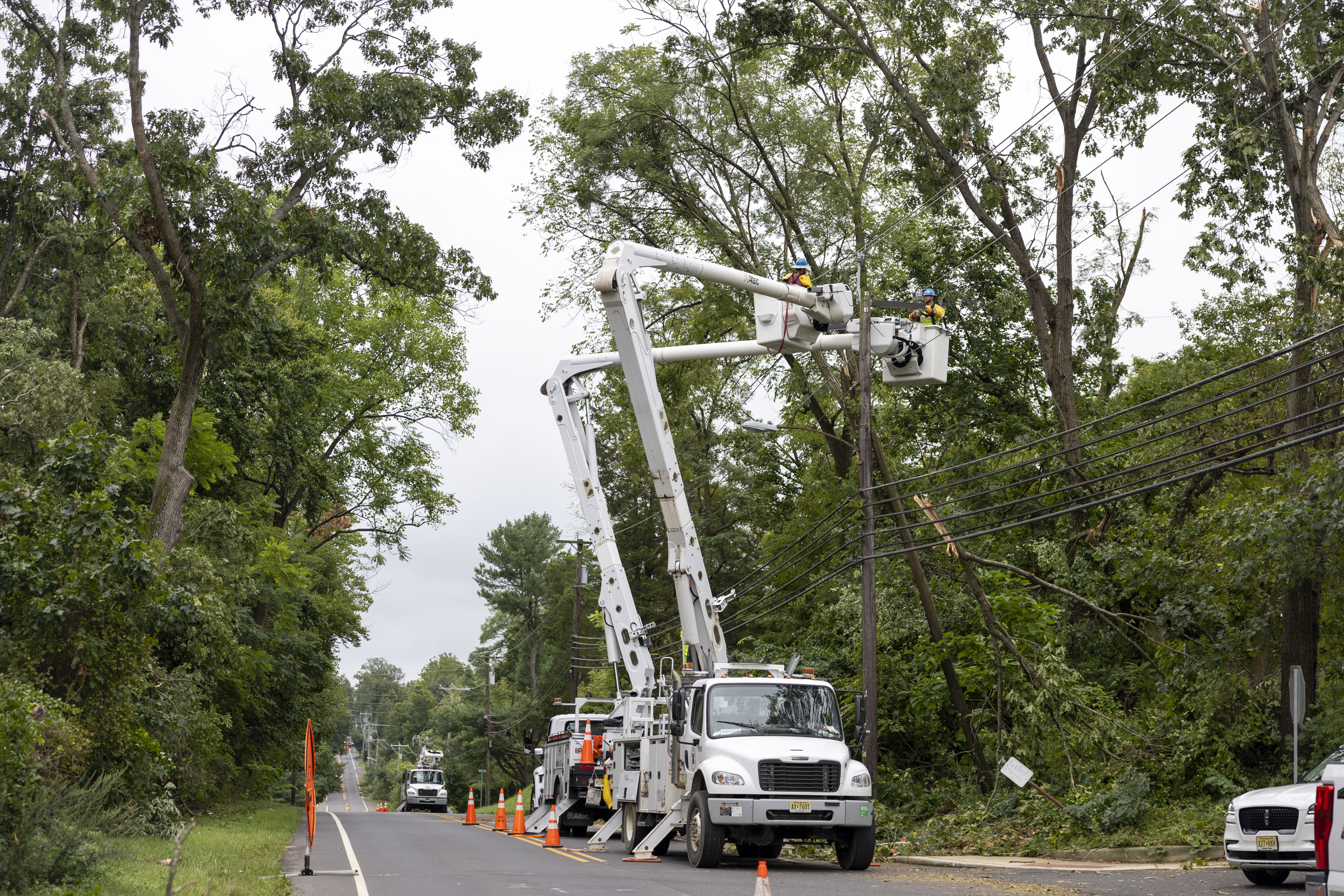
    Students in Mantua Township will have to wait a little longer for their first day of school after storms left thousands without power and roadways blocked this week.

    Christine Trampe, superintendent of Mantua Township School District in Gloucester County, announced Wednesday night that Thursday would be a staff in-service day and that the first day for Mantua schools would now be Tuesday.

    The district’s first day was supposed to be this past Wednesday before downed trees, power lines, and debris meant families couldn’t make it to school safely.

    While storms moved throughout the Philly region during an especially flood-heavy summer, a few municipalities in Gloucester County, including Mantua and West Deptford, were most impacted Tuesday night.

    More than 1,200 Atlantic City Electric customers were without power in Mantua Township Wednesday morning. That number was down to about 50 customers by Thursday morning.

  • Labor Day weekend is the perfect time to break out the boxed wine

    Labor Day weekend is the perfect time to break out the boxed wine

    Bottled wine has its upsides, but sometimes it’s impractical. Heading into the holiday weekend, many people have plans to celebrate outdoors, at the beach, on boats, or poolside — where glass is prohibited or discouraged. And bottles can be too heavy and bulky for ease of use in campgrounds or for picnics in the park. This is where the advantages of a 3-liter bag-in-box wine shine, as with this vibrant California cabernet sauvignon.

    The 3-liter size hits the sweet spot for bargain seekers, since the box contains the equivalent of four standard bottles of wine for the price of two. There’s no need to rush to polish all the liquid off once you’ve opened it thanks to the bag-and-tap system, which can keep the wine tasting fresh for up to 4 weeks. The same volume of wine in a box weighs a lot less and occupies far less space, making it easier to pack for adventures. Added benefits include lowering the wine’s shipping and storage costs and shrinking the carbon footprint, too.

    Stylistically, this wine is dark in color and intense in taste without being too strong in alcohol to be enjoyable on a sunny day behind the grill. Its tannins are also soft enough for this red wine to taste good on ice if it gets hot out, and the concentration of its cherry and raspberry flavors also make an excellent base for sangria. Best of all, this style tastes fantastic with a juicy cheeseburger or grilled chicken.

    Nighthawk by Bota “Bold” Cabernet SauvignonCourtesy of Bota Box Vineyards

    Nighthawk by Bota “Bold” Cabernet Sauvignon

    California

    13.5% ABV

    PLCB Item #2496

    On sale for $22.99 through Oct. 4 (regularly $24.99)

    No alternate retail locations within 50 miles of Philadelphia according to Wine-Searcher.com

  • The Constitution turns 239 this month. It was signed in Philadelphia at Independence Hall.

    The Constitution turns 239 this month. It was signed in Philadelphia at Independence Hall.

    The Continental Army won the Revolutionary War in 1783.

    But, in the four years following that victory, the new country wasn’t very united. In fact, young America was only a loosely organized group of 13 colonies, with governors fighting to control their own fiefdoms.

    That left the states vulnerable to world powers eager to scoop up the fragmented new nation. Add to that, America was broke, with debts owed to France, Spain, and the Netherlands after the Revolutionary War.

    Kat Black’s design emphasizes the dedication and collaboration behind the signing of the U.S. Constitution in 1787.Kat Black for Colibrí Workshop

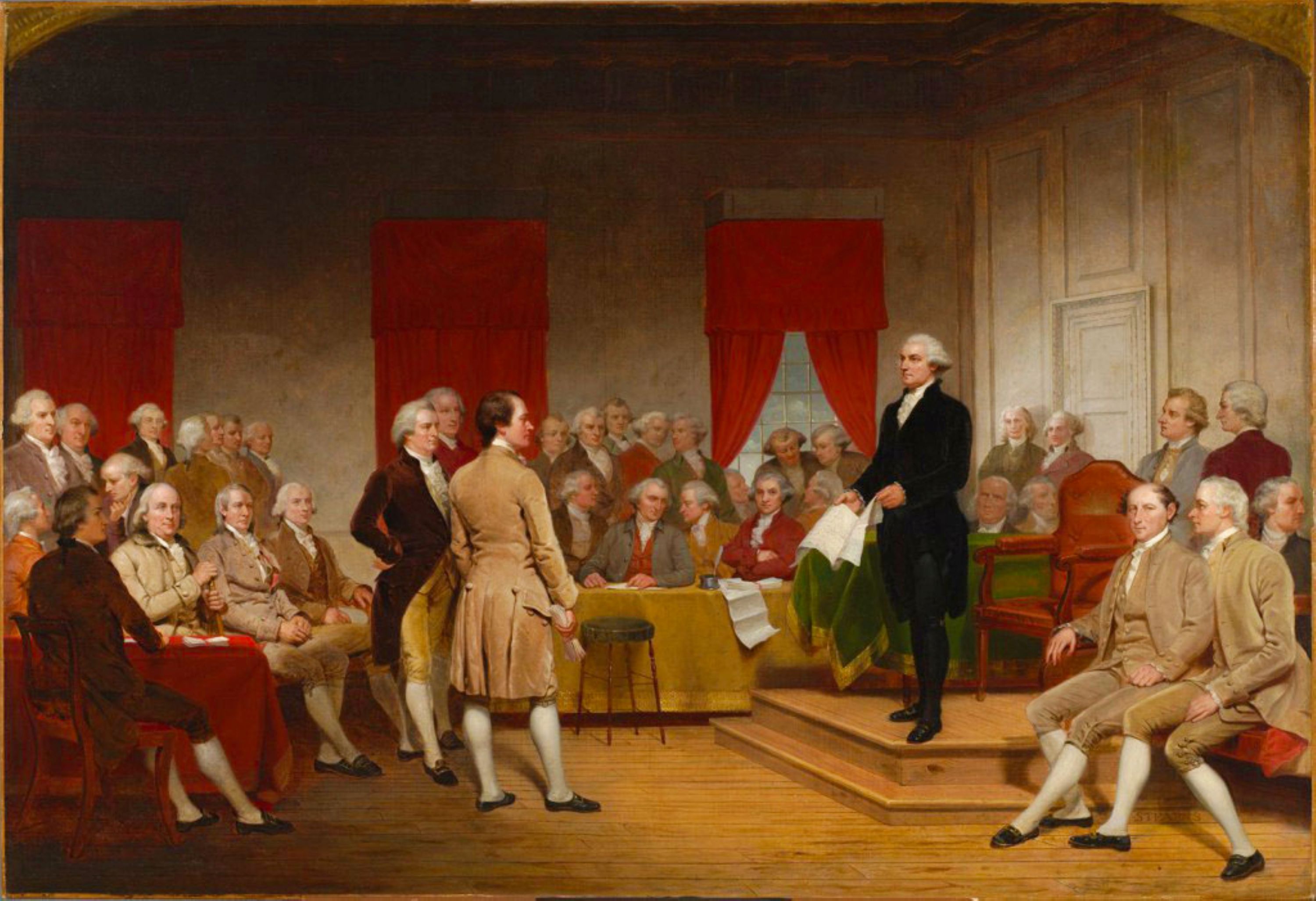
    Petrified their “great experiment” would be short-lived and eight years of a violent revolution fought in vain, James Madison, Alexander Hamilton, and John Jay convinced George Washington to convene a Constitutional Convention at Independence Hall in May 1787.

    By September, the delegates had worked out the brass tacks of the American government and signed the Constitution, establishing the political system that would help America become a world power.

    The signing of the Constitution will be remembered Saturday at the National Constitution Center from 11 a.m. to 1 p.m. as part of the Philadelphia Historic District’s 52 Weeks of Firsts, celebrations affectionately called “firstivals.”

    This firstival will kick off a series of events honoring the Constitution and includes First Amendment Day on Sept. 9 and Constitution Day on Sept. 17.

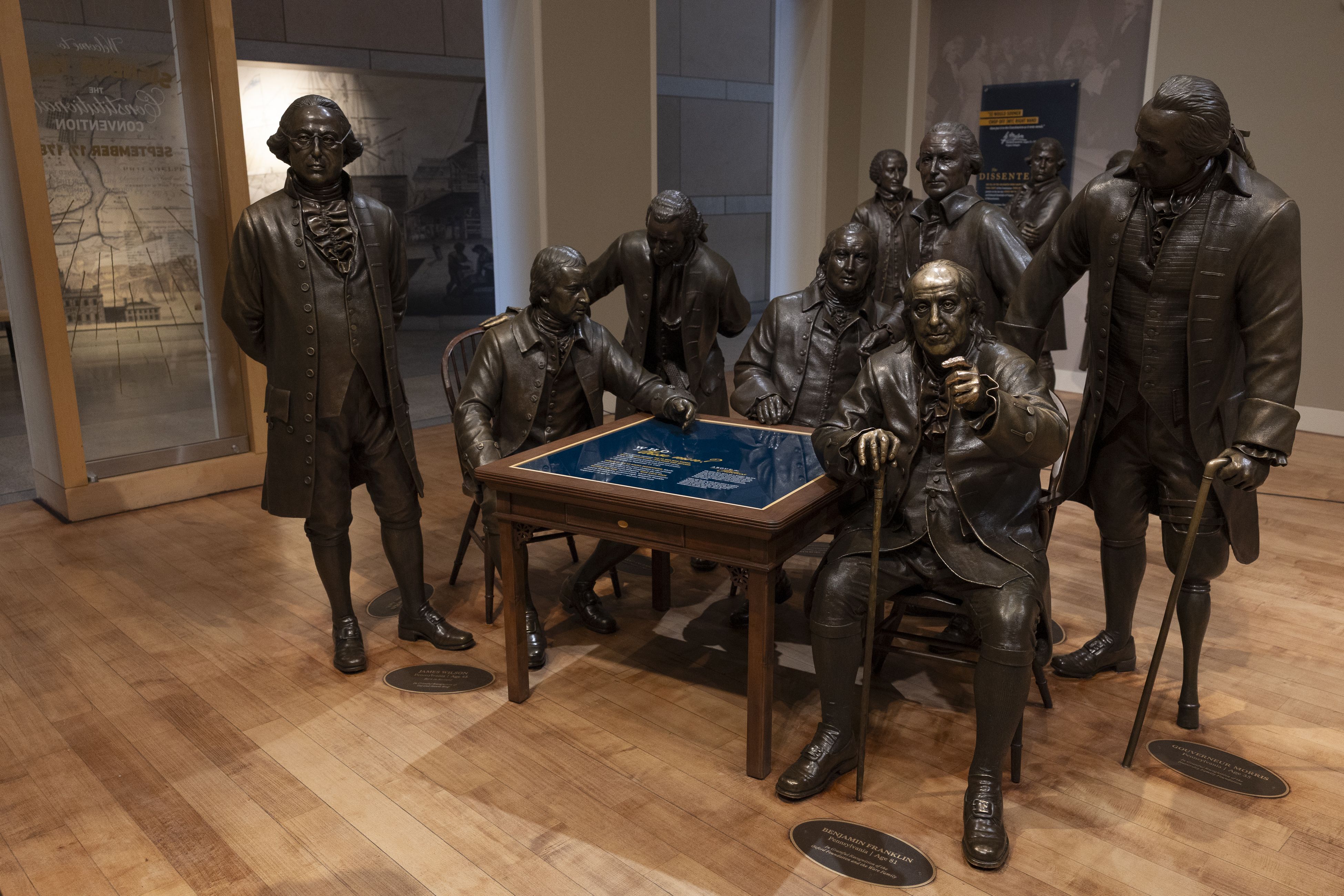
    Statues of the delegates are on display at the National Constitution Center, 525 Arch St.Jason E. Miczek courtesy of the National Constitution Cente

    “I think many of the Founding Fathers would be surprised to know the form of government they created is still going,” said Vince Stango, interim president and CEO at the National Constitution Center. “The Founders knew it was a ‘great experiment’ and … knew it would take work, compromise, and sacrifice.”

    During the summer of 1787, 55 delegates from 12 of the 13 colonies — Rhode Island didn’t send delegates — wheeled and dealed to create a government by the people, controlled by the people, and unable to be corrupted by the people.

    The Founding Fathers didn’t agree on much, but none of them wanted to be ruled by a monarch and insisted on a government with checks and balances.

    Enter James Madison, author of the Virginia Plan that proposed a strong national government with three branches: executive, legislative, and judiciary.

    After the three branches of government were established, a series of compromises were made. Among them, a legislative branch that afforded each state two Senate seats. The number of members of the House of Representatives for each state would be chosen based on population.

    The National Constitution Center, 525 Arch St., is the site of this week’s Firstival, on Saturday, Sept. 5, from 11 a.m.-1 p.m.Tom Gralish / Staff Photographer

    This set up a series of compromises that would institutionalize slavery. Enslaved Black people would be counted as three-fifths of a person to boost the Southern states’ population, giving them more representation in the House. Yet Black men — enslaved or free — would not have the right to vote anywhere until the 15th Amendment was ratified in 1870.

    Compromises also included allowing the Atlantic slave trade to remain legal. Founders also inserted a Fugitive Slave Clause stating that if an enslaved person emancipated themselves, they could not be freed in the new state. These compromises, made to appease the South, instituted slavery as the law of the land, and paved the way for it to become the backbone of commerce that established America as a superpower.

    During the convention, delegates also established the Electoral College. The Founding Fathers didn’t believe the average voter was intelligent enough to choose a president by majority vote.

    Nevertheless, America officially became a constitutional republic.

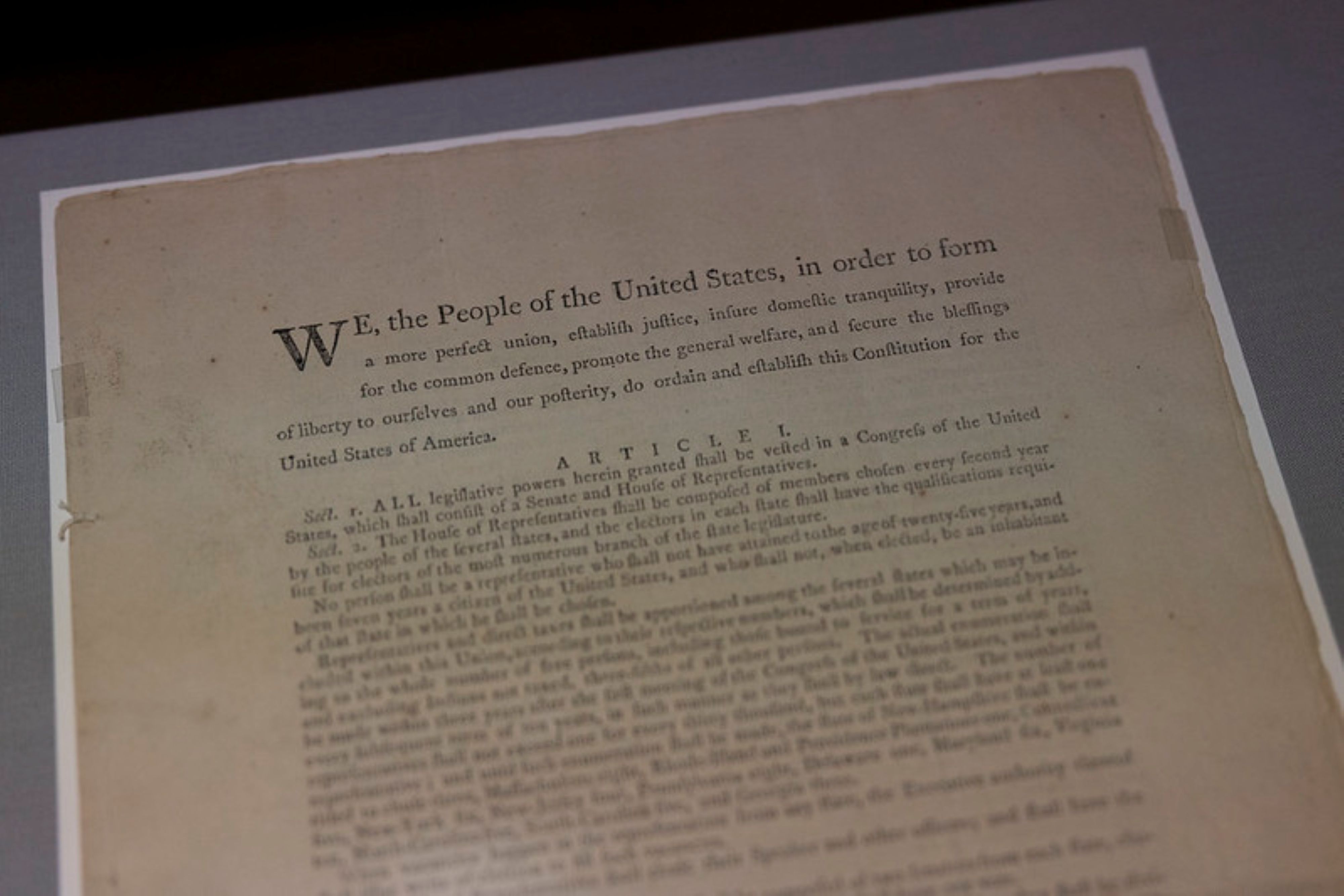
    A copy of the United States Constitution, on exhibit in the National Constitution Center.Jason E. Miczek courtesy of the National Constitution Center.

    Pennsylvania delegate Gouverneur Morris drafted the preamble and the Constitution’s seven articles between Sept. 8 and Sept. 12.

    Although 55 delegates attended the Constitutional Convention, only 39 signed it on Sept. 17. The Constitution still had to be ratified. And there were still some issues.

    The anti-Federalists — which included delegates and dissenters George Mason, Edmund Randolph, and Eldbridge Gerry — thought the power of government rested in the hands of the elite and advocated for a Bill of Rights.

    After yet another of series of compromises, which included the promise of a Bill of Rights, the Constitution was ratified on June 21, 1788.

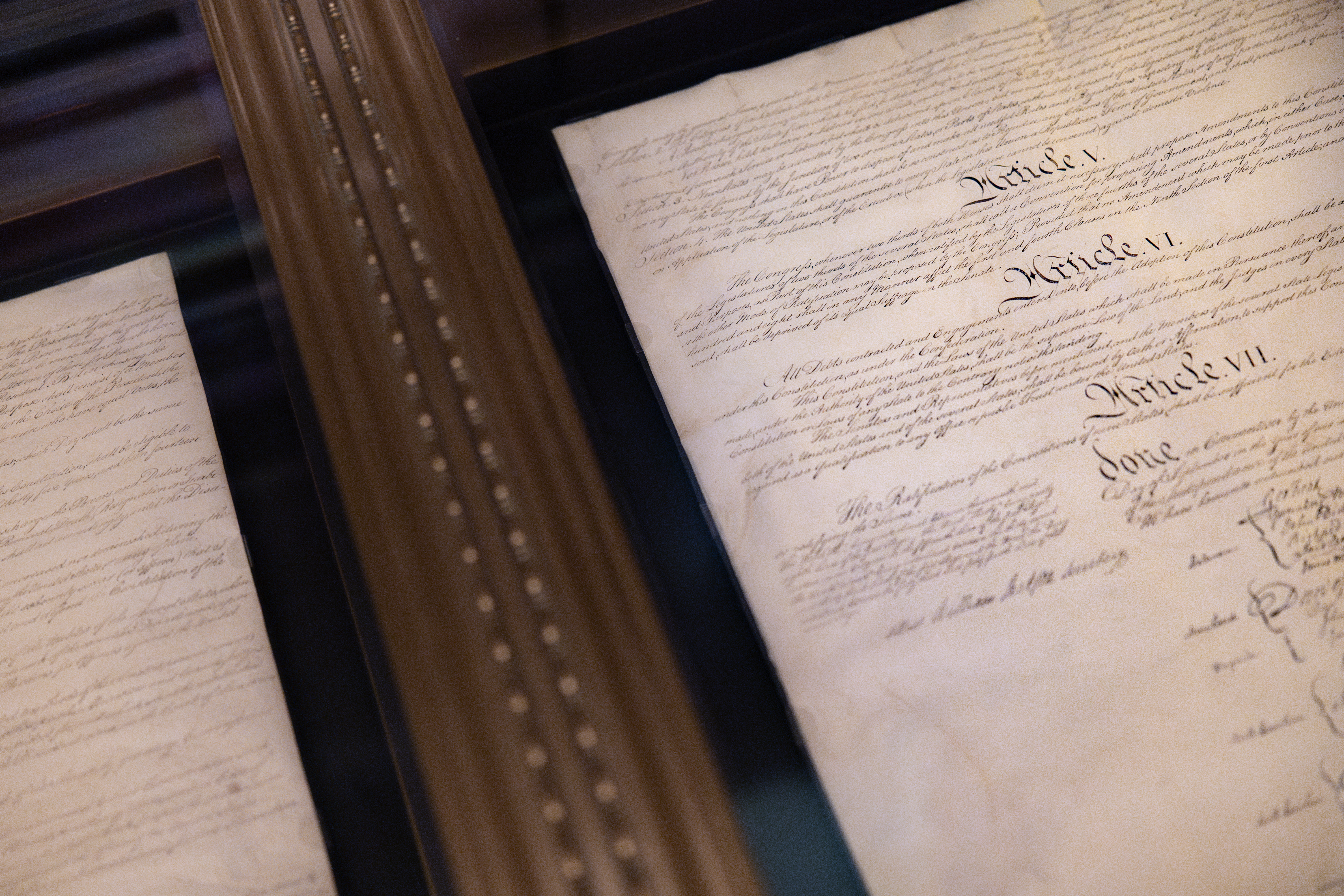
    Article V of the Constitution, and the rarely shown fifth page, when it was on public display at the National Archives in Washington. MUST CREDIT: Tom Brenner / For The Washington PostTom Brenner

    It went into effect on March 4, 1789, and on April 30 in New York, George Washington was sworn in as president of the United States.

    On Dec. 15, 1791, Congress ratified the first 10 amendments of the Constitution, creating the Bill of Rights.

    This week’s Firstival is Saturday, Sept. 5, from 11 a.m.-1 p.m., at the National Constitution Center, 525 Arch St.

    Each week, The Inquirer is highlighting a “first” from the Philadelphia Historic District’s 52 Weeks of Firsts. A “52 Weeks of Firsts” podcast, produced by All That’s Good Productions, drops every Tuesday.

  • Delaware County communities approve ordinance creating EMS authority without Media

    Delaware County communities approve ordinance creating EMS authority without Media

    Five Delaware County communities voted Wednesday to establish a new authority to provide emergency medical services funded by annual fees paid by residents, businesses, and other entities in their municipalities.

    The Municipal Emergency Medical Services Authority of Delaware County will provide advanced life support, or ALS, to Nether Providence, Rose Valley, Rutledge, Swarthmore, and Upper Providence.

    Media was originally part of the working group developing the authority proposal, but announced last week it would not be joining for financial reasons.

    Each community approved an ordinance to join the authority Wednesday night at Strath Haven Middle School and appointed a representative to the authority board.

    Nether Providence, Rose Valley, Rutledge, and Swarthmore voted unanimously to approve the ordinance. Upper Providence voted 3-1 in favor.

    The appointed board members include Nether Providence Township commissioner Max Cooper, former Rose Valley council member David Firn, Rutledge fire marshal Thomas Moleski, former Swarthmore council member Kristen Seymore, and former Upper Providence council member Christen Rexing.

    Creating an EMS authority is essential to provide reliable ALS service by stabilizing funding and staff, Swarthmore Mayor Conlen Booth said. Booth was a member of the authority working group.

    “The authority model, sharing fees across all potential users of the system, is in my opinion the most equitable way to ensure that a reliable EMS service is available to everyone who may need it,” he said.

    Talks kicked off last year shortly after Prospect Medical Holdings closed Crozer-Chester Medical Center and Taylor Hospital, leaving a gap in ALS support throughout the region.

    The authority’s name was originally going to be the Delaware County Emergency Services Authority, but was changed to avoid being confused with other county organizations and make clear that it was only providing medical service and not a police or fire response, Cooper said.

    Nether Providence Township Commissioner Max Cooper speaks after five Delaware County communities approved the creation of a regional EMS authority Wednesday at Strath Haven Middle School in Nether Providence.Torin Sweeney / Staff

    The next steps for the authority

    While the vote established the authority, it won’t immediately go into service. The new board members will be charged with building the authority based on the foundations laid by the working group.

    The recommended fee for residents will be $95 a year, although that is strictly a starting point for discussions, working group members said, and will be subject to future public hearings.

    “Ninety-five dollars is similar to the yearly voluntary subscription models that many of our local firehouses use, and is similar to other recently formed EMS authorities in the state,” Cooper said. “This works out to less than $8 a month and our working group views it as a reasonable cost to ensure stable funding for such a critically important service.”

    Businesses, nonprofit entities, and the municipalities themselves will have to contribute yearly fees as well. Using an authority and fee-based model was important for making sure nonprofits contribute to the costs of an EMS service, Cooper said. Nonprofits would not have to contribute if the system were tax based.

    “We anticipate this will decrease the amount of taxes which will need to be dedicated to this system, and relieve some municipal pressure to raise taxes on residents every year,” Cooper said.

    The board will have to decide the level of staffing and equipment needed. A potential partnership with Main Line Health is being discussed to provide some level of service.

    “The authority could contract just their staff, but the authority could choose to own the ambulances and equipment,” Booth said. “It could also be that the authority contracts them to provide all the services in their entirety and then the board manages the contract. There’s a lot of potential.”

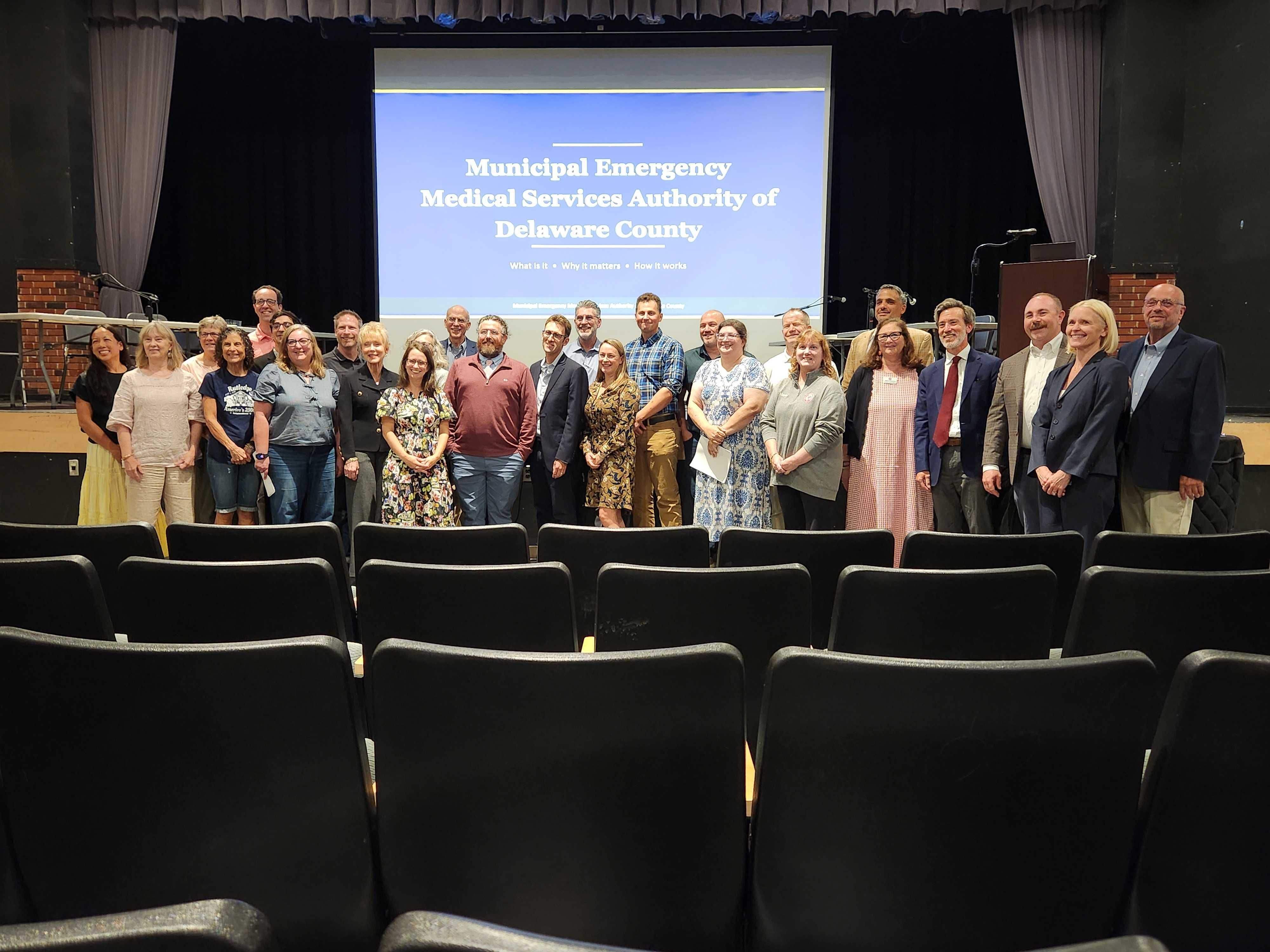
    Representatives from Nether Providence, Rose Valley, Rutledge, Swarthmore, and Upper Providence pose for a picture after approving an ordinance to create a regional EMS authority Wednesday at Strath Haven Middle School in Nether Providence.Torin Sweeney / Staff

    The working group hosted a presentation about the EMS authority and took public comments before each town approved the ordinance. Several attendees who identified themselves as Upper Providence residents spoke against the authority, questioning the logistics and cost.

    “This is a tax increase, like it or not,” Upper Providence resident Justin Perry said to scattered applause.

    Another Upper Providence resident, former longtime Marple Township Ambulance Corps member Vince Delvacchio, spoke in support.

    “I don’t know where you think you’re going to get an ambulance if we don’t do this,” Delvacchio said, to more applause.

    Why Media opted out of the authority proposal

    Media had been part of the working group for the proposed authority, but borough council decided not to proceed for financial reasons, Borough Manager Brittany Forman said.

    The borough has an existing contract with Main Line Health to provide ALS service and had been in discussions with them about projected 2027 costs. The council tasked Forman with comparing how those costs would affect taxpayers vs. the authority’s proposed fees for residents and businesses.

    Ultimately the borough determined it would be less expensive to stay with Main Line Health, Forman said.

    “Our council is interested to see this get implemented and really does want to keep the dialogue open,” Forman said. “Even though we’re not joining this year, I think this is still just a great step for the region.”

  • Evesham signs letter of intent to buy former Barton Run Swim Club and preserve nearly four acres as open space

    Evesham signs letter of intent to buy former Barton Run Swim Club and preserve nearly four acres as open space

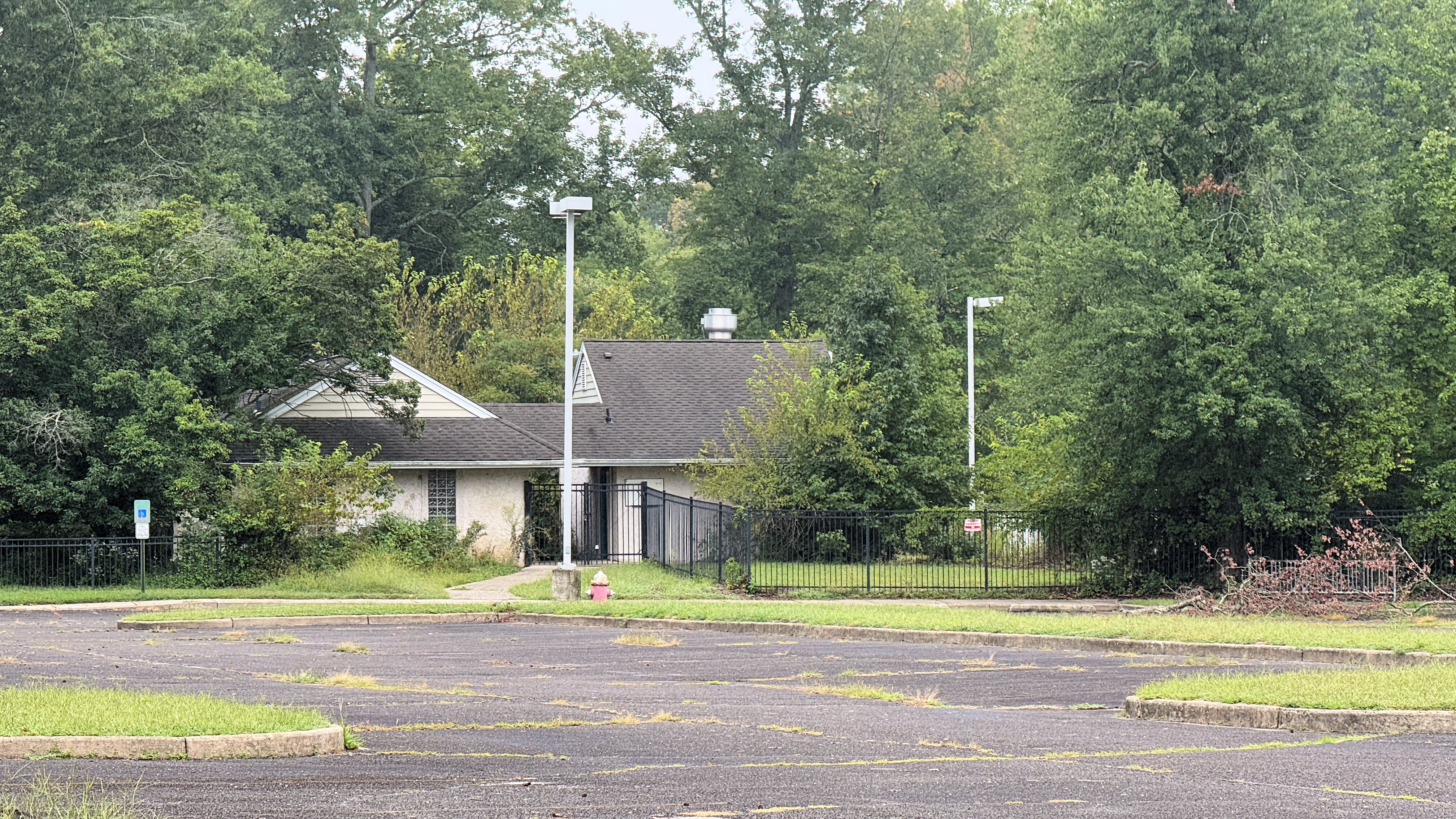
    A developer that planned to build six homes on the site of the closed Barton Run Swim Club in Evesham would sell the property to the township to preserve it as open space, according to a letter of intent from the town.

    The 3.84-acre property on Lakeside Drive would be cleared by developer Orleans Investment Land Associates and Evesham would pay between $670,000 and $810,000 for the land, according to the township, which on Wednesday announced it had secured a $405,000 New Jersey Green Acres Program grant to help fund the purchase.

    Evesham has budgeted from Township Open Space funds the balance of the purchase price, which is a range because it requires a Green Acres appraisal, Zane Clark, Evesham director of public information, said in an email.

    Township council authorized the letter of intent at its meeting earlier this month.

    “Once formal closing proceedings on the property are completed, and the land is restored to open space, the Township will begin engaging the community so residents can help plan for the future uses at the new park,” Clark wrote.

    Orleans would be responsible for demolishing the clubhouse and pool, filling the land and planting grass at the club, which closed about 10 years ago.

    Clark said the township also is seeking grants to finance rain gardens on the site.

    “By securing this Green Acres funding and approving this letter of intent, we are protecting the neighborhood from further development and creating new open space for the public to enjoy,” Mayor Jaclyn Veasy said in a statement. “Once the land is under municipal ownership, the Township will ensure its safe upkeep and long-term care,” she added.

    In recent years, Evesham Township has been aggressive about acquiring land to preserve as open space.

    Projects have included preserving 176 acres of the former Beagle Club property on North Elmwood Road and purchasing 18 acres from the Board of Education off Greenbrook Drive in the Country Farms neighborhood.

    However the town’s landmark preservation project, announced earlier this year, was the $15-million acquisition of 835 acres next to the Black Run Preserve by the New Jersey Conservation Foundation. After the purchase, the township will assume ownership and oversee the preservation of the land. The Black Run Preserve, also owned by Evesham, covers 1,300 acres.

    70and73.com is a hyperlocal news site focused on South Jersey, including the communities of Cherry Hill, Evesham, Mount Laurel, Voorhees, Medford, Medford Lakes, and Moorestown.

  • Lawmakers accuse FanDuel of ‘promoting addiction’ amid battle over VIP promotions

    Lawmakers accuse FanDuel of ‘promoting addiction’ amid battle over VIP promotions

    Three members of Congress renewed their criticism of FanDuel Sportsbook on Thursday, accusing the company’s leaders of providing “misleading and incomplete” responses to a recent inquiry about the VIP services and rewards that it offers to customers.

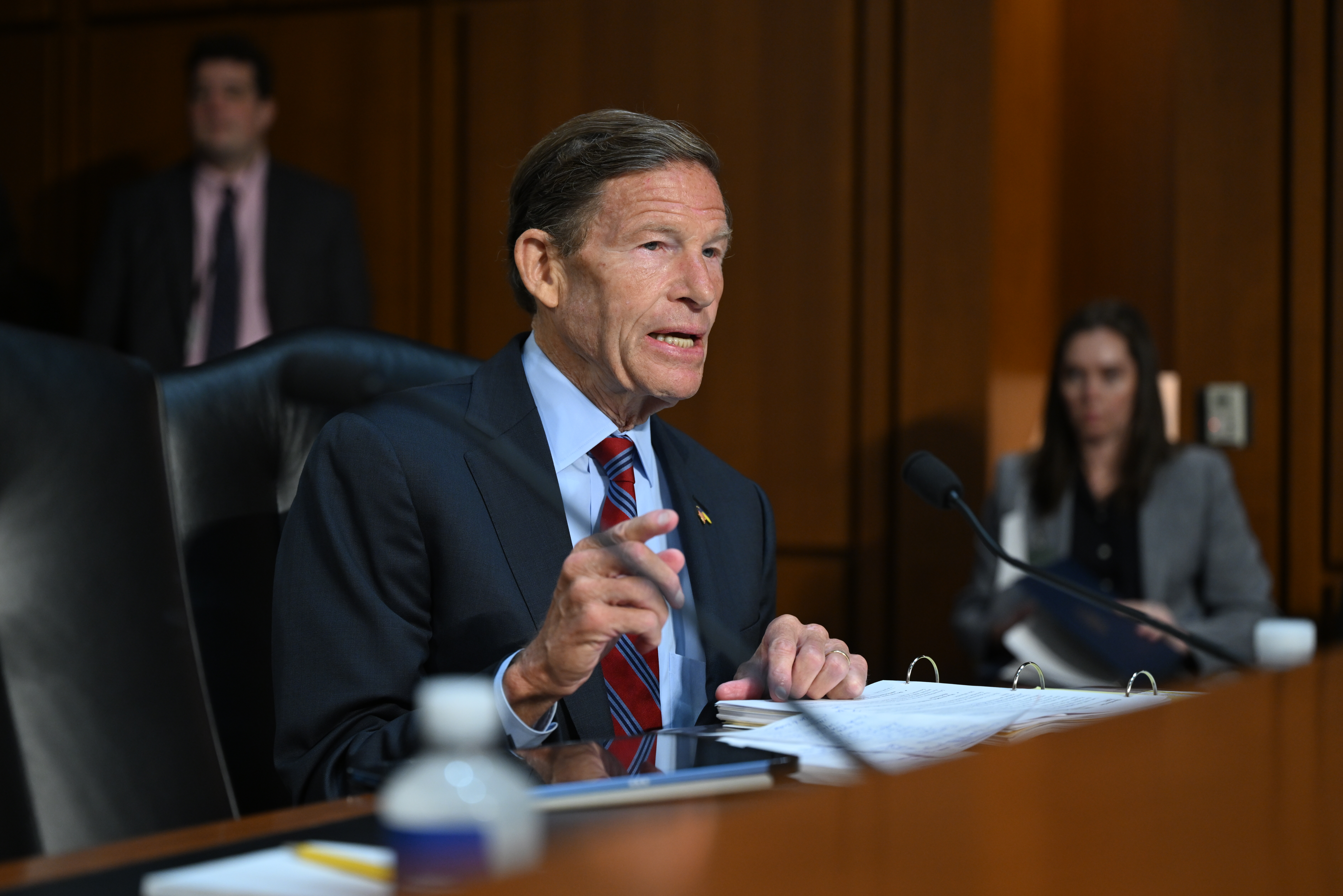
    In a letter to FanDuel chief executive officer Christian Genetski, U.S. Sen. Richard Blumenthal (D., Conn.) and U.S. Reps. Paul D. Tonko (D., N.Y.) and Valerie P. Foushee (D., N.C.) wrote that they “remain unconvinced that FanDuel is making an active effort to protect bettors from harmful gambling and instead appears to be promoting addiction.”

    The lawmakers had initially sent letters on Aug. 10 to FanDuel, Major League Baseball, and the Major League Baseball Players Association, and demanded that each make policy changes following an Inquirer story about a personal video greeting from Phillies star Bryce Harper that a FanDuel VIP manager sent in 2024 to a bettor who had a gambling addiction.

    In response, the MLBPA said last week it would support banning players from doing promotional work for sportsbook VIP programs in the union’s next collective bargaining agreement.

    The lawmakers had called on FanDuel to eliminate its VIP rewards and disclose information about those services, including whether the company had sent videos of other athletes to VIP bettors, or offered promotions to gamblers who experienced losing streaks and attempted to cut back on wagering.

    In an Aug. 14 response, FanDuel wrote that it is “committed to being a transparent and cooperative partner” but did not directly respond to many of the lawmakers’ questions.

    The company said it spent $158 million on responsible gaming in 2025, and that it extensively reviews customers’ betting history before offering them VIP status.

    Though professional sports leagues were once deeply opposed to legalizing sports betting, leagues and many franchises have now entered into lucrative partnerships with gambling entities.Elizabeth Robertson / Staff Photographer

    “Sports wagering is one of the most heavily regulated industries in the United States,” wrote Cory Fox, a FanDuel senior vice president, “and FanDuel operates a licensed online sportsbook in 26 U.S. jurisdictions.”

    The lawmakers seized on this point, writing that FanDuel also has a prediction market, FanDuel Predicts, “which undermines the integrity of — if not bypasses — those very regulations.”

    A FanDuel spokesperson said he was looking into the matter Thursday morning, but did not respond to follow up requests for comment.

    Prediction markets allow customers to wager on a range of subjects: sports, politics, Hollywood award shows, the weather. They’re regulated by the federal Commodity Futures Trading Commission, which thus far has enforced few limitations on companies like Kalshi and Polymarket.

    Critics — including former New Jersey Gov. Chris Christie, who works as a strategic adviser to the American Gaming Association — contend that prediction markets are running illegal sports betting operations. New Jersey Attorney General Jennifer Davenport earlier this week petitioned the U.S. Supreme Court to decide whether states should have the authority to regulate the markets.

    In their latest message to FanDuel, the lawmakers described the company’s “VIP perks, constant push notifications, and personalized promotions” as exploitative, and demanded the company provide a written response to eight questions by Sept. 17.

    Sportsbook VIP rewards and push notifications are a central thread in a lawsuit that the nonprofit Public Health Advocacy Institute filed in March in Common Pleas Court of Philadelphia against FanDuel, DraftKings, the NFL, and the data company Genius Sports on behalf Montgomery County resident Terry Thompson and Delaware County resident Christopher Sage, VIP bettors who each developed ruinous gambling addictions.

    FanDuel, DraftKings, the NFL, and Genius Sports have each sought to have the case dismissed.

    Thompson, who received the 21-second video of Harper, lost more than $1.8 million on sports bets, and planned to die by suicide earlier this year, rather than reveal to his family the scope of his losses.

    Harper has said that he recorded the message through the video service Cameo, but didn’t know that Thompson had an addiction, or that FanDuel intended to use it as a VIP reward.

    The Inquirer will continue to report on issues related to the growth of gambling addiction — among teens and adults — across Pennsylvania. If you, or someone you know, wants to speak with a reporter, please contact David Gambacorta or William Bender at dgambacorta@inquirer.com and wbender@inquirer.com

  • Burlington Stores is moving its headquarters to Philadelphia

    Burlington Stores is moving its headquarters to Philadelphia

    Burlington Stores, the discount retailer named for its longtime South Jersey home, is spending millions on new corporate offices in Philadelphia, marking the first time in decades the city has welcomed the headquarters of a Fortune 500 company.

    The company is buying 3151 Market St., a more than 400,000-square-foot office building in Brandywine Realty Trust’s $3.5 billion Schuylkill Yards development in University City, for an undisclosed sum.

    In all, Burlington plans to spend $370 million on the move, and is set to receive another $30 million in state grants. The city is also providing a $7 million forgivable loan, a job-creation tax credit, and a $1 million investment that will give Burlington workers free SEPTA passes for a year.

    Burlington eventually plans to relocate 1,500 employees from New Jersey to the new Philly headquarters, a spokesperson said, and hire another 500. The company has no plans for layoffs.

    They plan to gradually move employees by team. The moves will begin no earlier than late 2028.

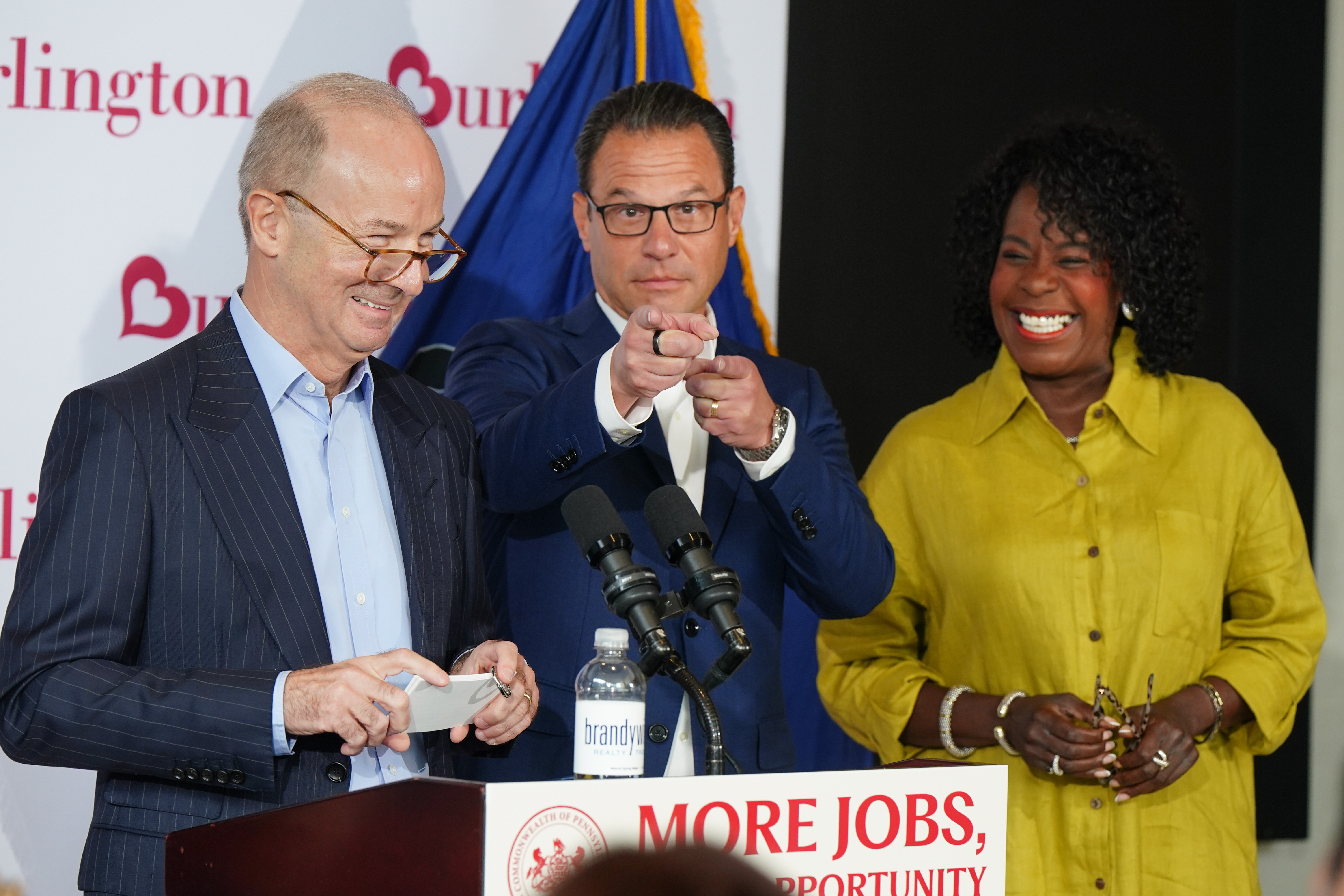
    Pennsylvania Gov. Josh Shapiro called the move “one of the largest corporate relocations ever in the commonwealth,” at an event Thursday in the lobby of Burlington’s new headquarters.

    Burlington CEO Michael O’Sullivan, Gov. Josh Shapiro, and Mayor Cherelle L. Parker announce the retailer’s forthcoming move to Philadelphia.Jessica Griffin / Staff Photographer

    “It’s going to put West Philly and our growing downtown district on the map as a premier spot for some of the largest companies in the world,” said the governor, who announced the news Thursday alongside Mayor Cherelle L. Parker, Burlington CEO Michael O’Sullivan, Brandywine Realty Trust CEO Jerry Sweeney, and other state and local officials.

    Burlington will join Comcast and Aramark, currently the only two Fortune 500 companies headquartered in Philadelphia.

    Philly’s gain comes at a loss for New Jersey: Burlington has been based in its namesake Burlington Township for more than half a century. It opened its first store there in 1972.

    New Jersey Gov. Mikie Sherrill’s office said in a statement that they were “disappointed by Burlington’s decision to relocate its headquarters.” But “the company will continue to maintain a significant presence and thousands of jobs here in New Jersey.”

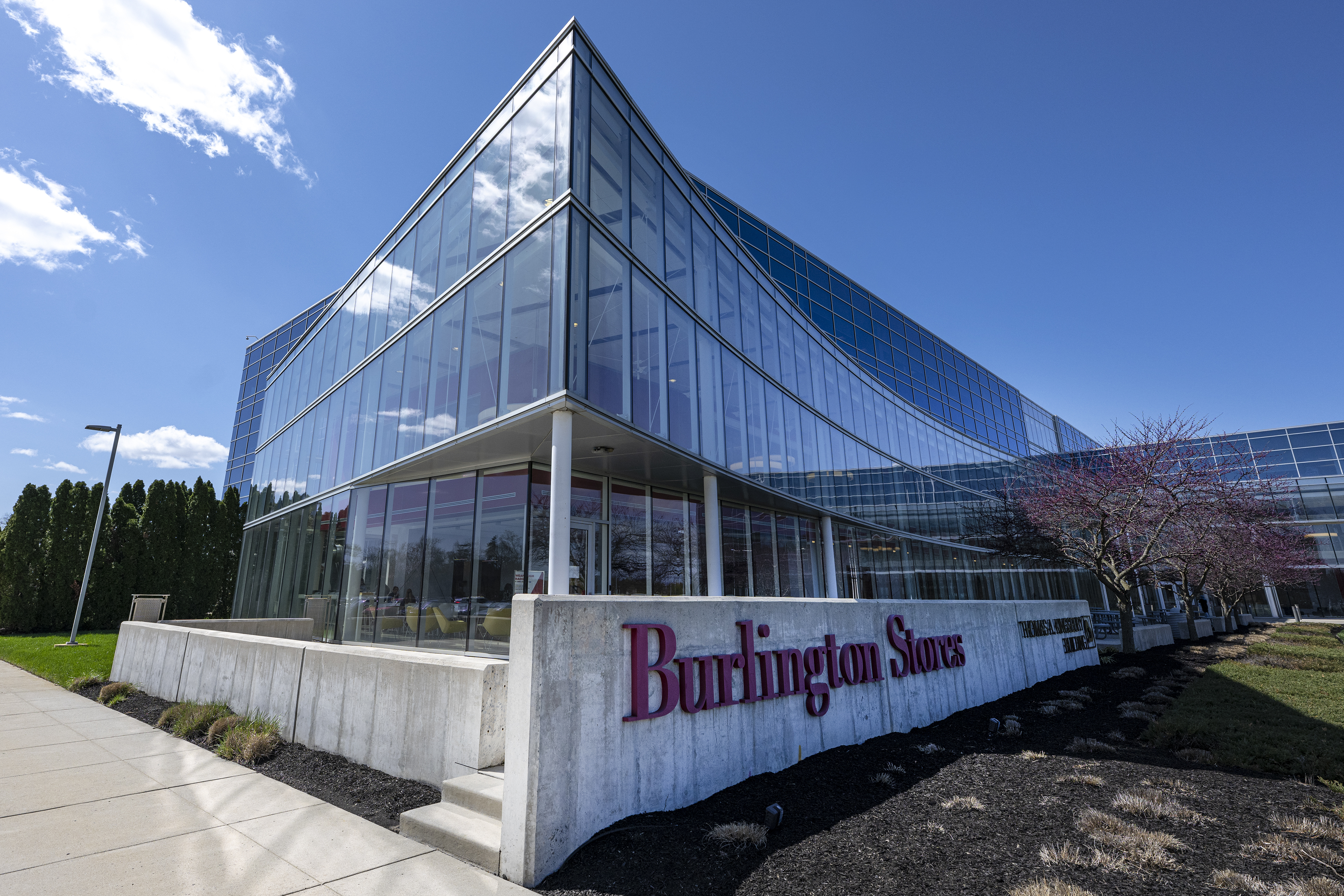
    Burlington Stores headquarters in Burlington, N.J., as seen in 2025.Jose F. Moreno / Staff Photographer

    About 4,700 people worked at Burlington’s corporate campus and warehouses in Burlington County as of last year, with 2,100 people employed in Philly-area stores. A company spokesperson said Thursday that the company employs 8,000 across New Jersey.

    As for its current headquarters on U.S. Route 130 North, Burlington intends to have it rezoned for warehouse space and turn some of the property into farmland. The company plans to keep its New Jersey warehouse and distribution centers in Burlington, Edgewater Park, Florence, and Logan Township.

    Burlington’s move is the latest win for Parker and Shapiro, who is up for reelection in November, as well as the governor’s Department of Community and Economic Development (DCED). Earlier this week, Shapiro’s administration announced $50 million in state grants and loans to help fund the yogurt company Chobani’s expansion into Allentown.

    “This is another day in what’s been just a monster week,” DCED Secretary Rick Siger said. “It’s another proof point of Pennsylvania’s strength as a business destination.”

    Burlington’s new home base will be part of Schuylkill Yards, a 14-acre project that Brandywine has undertaken with Drexel University. Its developers initially planned for the complex to include luxury housing, public space, and offices and labs.

    “What we’ve seen today is what can happen through a public-private partnership when leaders have a shared vision, a dedication to cause, and an unwavering commitment to the exciting future we can create by working together,” said Sweeney, Brandywine’s CEO, on Thursday.

    (function() { var l = function() { new pym.Parent( ‘burlington-move__graphic’, ‘https://media.inquirer.com/storage/inquirer/ai2html/burlington-move/index.html’); }; if(typeof(pym) === ‘undefined’) { var h = document.getElementsByTagName(‘head’)[0], s = document.createElement(‘script’); s.type = ‘text/javascript’; s.src = ‘https://pym.nprapps.org/pym.v1.min.js’; s.onload = l; h.appendChild(s); } else { l(); } })();

    Burlington was initially drawn to Philly because of the city’s history and culture, including its food scene, artistic institutions, and sports fandom, according to O’Sullivan. But the CEO said conversations with Shapiro and Parker “pushed this decision over the line.”

    “We found the vision that they laid out for the city and the state hugely compelling,” he said. “We were very impressed by their clear priorities and their focus on getting stuff done around economic development, education and training, public transportation, public safety, and fiscal responsibility.”

    Burlington has been expanding in recent years as more consumers, including higher-income shoppers, flock to discount retailers.

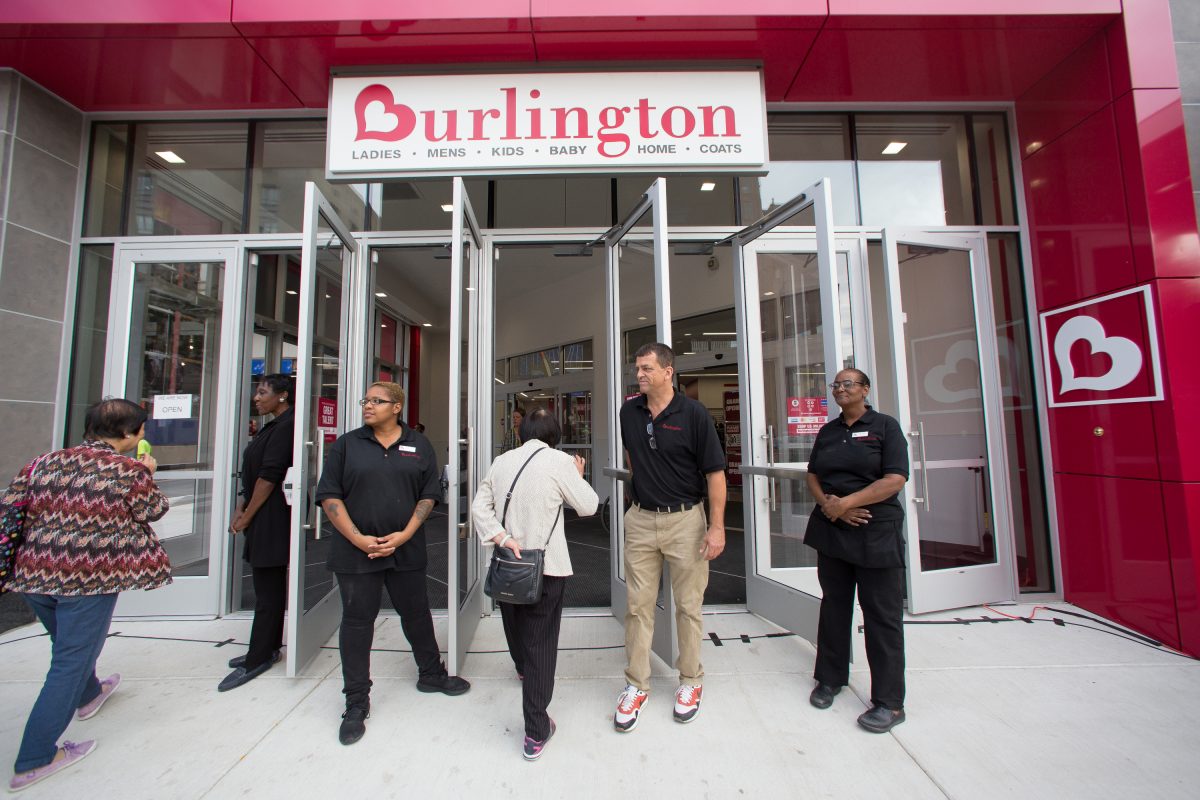
    Shoppers and employees at the Burlington Store at 833 Market St. in Philadelphia in 2018.Jessica Griffin / Staff Photographer

    As of August, the company operated 1,300 stores in 47 states, including eight in Philadelphia and dozens across the region. By the end of the year, the company plans to open another 115 stores and hire 5,000 more employees, O’Sullivan said Thursday.

    The chain’s growth has paid off, with a 21% increase in net income and a 9% jump in sales last year.

    In an earnings call, O’Sullivan attributed those numbers to the company’s tariff response, which included inventory reductions, price increases on certain items, and an aggressive cutting of expenses.

    Burlington has continued to report strong earnings in the first half of 2026, with a boost from $55 million in tariff refunds. O’Sullivan has said the company plans to put that money toward more markdowns for customers.

    Shapiro and Parker both said they had shopped at Burlington, with Shapiro patronizing the Jenkintown store and Parker frequenting the location at the former Cheltenham Mall in Wyncote.

    O’Sullivan said with a laugh: “The mayor and the governor got my full attention when they independently confirmed that they both exclusively wear clothes from Burlington.”

  • ‘Do one outrageous thing in the cause of simple justice’: Gloria Steinem’s campaign for equality at the King of Prussia Mall

    ‘Do one outrageous thing in the cause of simple justice’: Gloria Steinem’s campaign for equality at the King of Prussia Mall

    Gloria Steinem — the author, activist, and feminist icon — died on Wednesday, Sept. 2, 2026, at the age of 92.

    In 1982, Steinem traveled to Philadelphia to receive an award. During her trip, she met with The Inquirer’s Kathy Hacker, who wrote this profile. Hacker died in January of 2021.

    The Equal Rights Amendment was ratified by 38 states well after the original deadline mentioned in this article, and the legal and congressional debate continues. It is not recognized as part of the Constitution.

    For a woman who has so often disavowed the label of “celebrity,” the scene probably was a bit discomfiting. First came the makeup man, intent on penciling her eyebrows and sponging suntan-colored goo over an already classically beautiful face.

    Then came the television cameras, attached by a tangle of electrical wiring to a perspiring crew from NBC’s “Today” show.

    And, finally, there were the fans, a zealous flock of devotees angling for a closer look, perchance a word and — the ultimate coup — an autograph.

    If it didn’t quite qualify as a Hollywood-style welcome, the hoopla yesterday was sufficient nonetheless to jolt the modest sensibilities of that most private of public persons, Gloria Steinem.

    “Sure, you feel a little foolish — you begin wondering what to do with your teeth,” sighed the premier philosopher-scribe of the women’s movement during a rare respite in a daylong visit to Philadelphia.

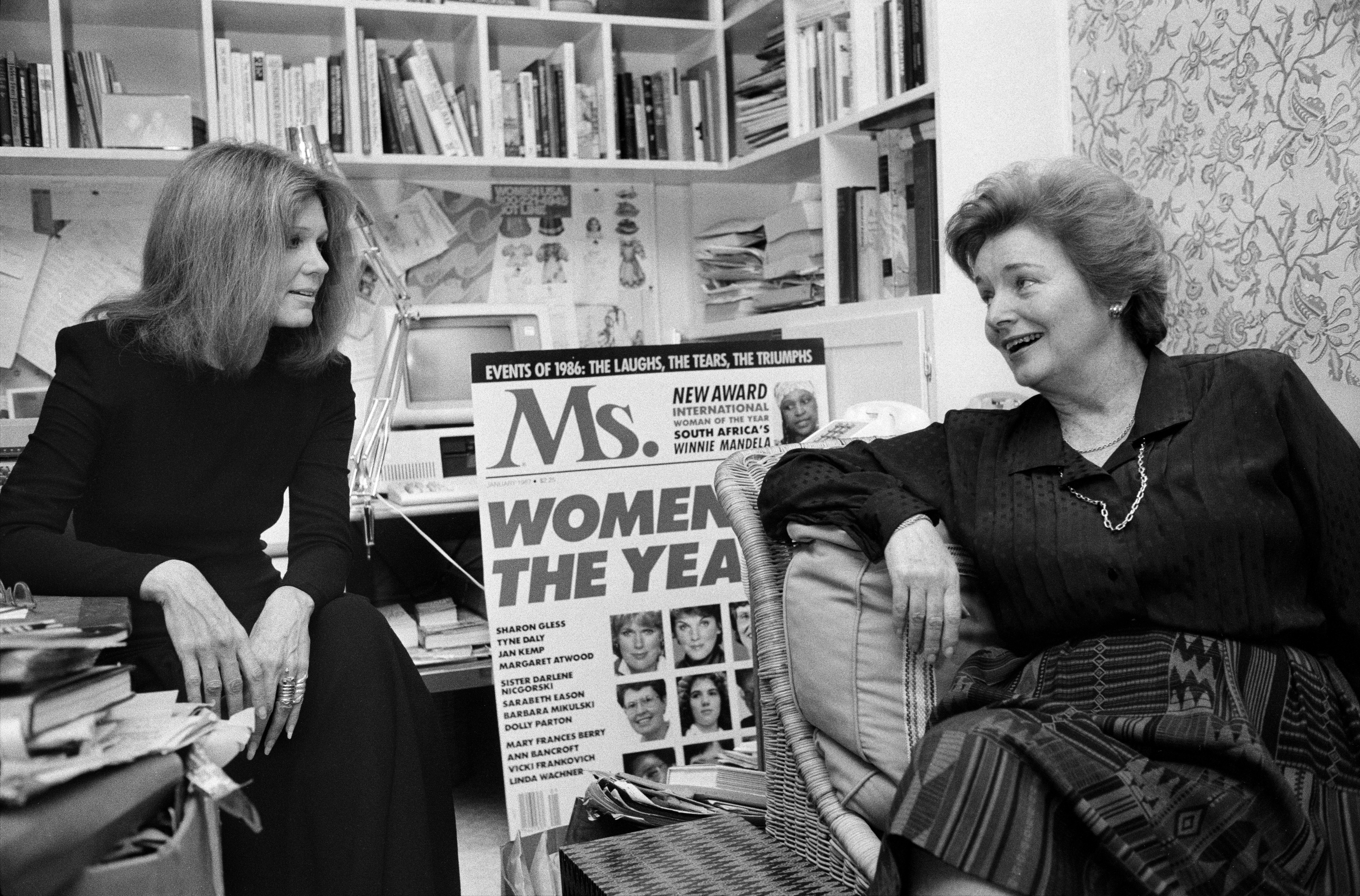
    From left, Gloria Steinem with Patricia Carbine, a fellow founder of Ms. magazine, in New York on May 7, 1987. ANGEL FRANCO

    As she spoke, an entourage pored over her frenetic schedule, which had her popping up in places as disparate as the Women Organized Against Rape offices in Center City and the furniture department in Bloomingdale’s King of Prussia emporium.

    Just as pressing, they debated whether to rush out and buy Steinem a dressier blouse.

    In the midst of the hubbub, with a microphone dangling nearby, she shrugged:

    “It’s difficult. But if there’s one thing I don’t want to do, it’s let anyone down at a time like this.”

    Gloria Steinem in New York on Sept. 23, 2015. CAITLIN OCHS

    The attention did not necessarily take her by surprise. It was, for starters, Lucretia Mott Day, a major feminist observance called by Womens Way in honor of the l9th-century Quaker who devoted her life to the advocacy of women’s rights and the abolition of slavery.

    And so, as the sun was peeking over Manhattan yesterday morning, Steinem climbed out of bed, pulled on a pair of boots, chocolate-brown wool slacks and a matching silk shirt, hopped aboard an Amtrak train and chugged to Philadelphia for the celebration, which culminated last night in the fifth annual Lucretia Mott Award gala at the Bellevue Stratford hotel.

    This year, Womens Way chose none other than Steinem as the recipient of its medal. Like Mott herself, she is a fighter — and for a cause that, while certainly not lost, seems painfully far from being won.

    As summer begins, the 48-year-old Steinem finds herself in a situation that is, at best, bittersweet. Come June, she and her fellow feminists on the staff of Ms. magazine will be marking the 10th anniversary of the publication, which she helped found and has since served dutifully as editor and writer.

    For the occasion, she’ll be throwing a bash at the Armory in New York and then will be jetting off to all corners of the country to appear as a guest on the Merv Griffin, Phil Donahue and “Today” shows (hence, the omnipresent cameras). Another bit of sweetness in Steinem’s life: “She’s Nobody’s Baby,” a documentary on 20th-century women that she and her Ms. colleagues produced for Home Box Office, just received a prestigious Peabody Award.

    Chances are, however, that Steinem will not be raising her glass in a toast on June 30. On that day, the deadline for ratification of the Equal Rights Amendment will come . . . and, by the looks of things, go, with approval by three state legislatures still lacking. She is, understandably enough, angry.

    But beaten? Never.

    “It’s important to say that there’s still a possibility of ratification,” she pointed out. “The odds are slender, I know. But remember, there are only about a dozen aging white men who have to change their minds. It’s still possible.”

    Having said that, Steinem voiced what is virtually inevitable: “OK, let’s say it doesn’t get ratified this time around.” The people who worked before, she guaranteed, will continue working. And furthermore, she vowed, they will fight to reintroduce the amendment in Congress before this fall’s elections.

    “It isn’t as if the country doesn’t support it, since opinion polls have shown just the opposite to be true,” she said, then added vigorously: “We are going to stay. We are not going away.”

    Steinem’s battle cry echoed yesterday afternoon through Bloomingdale’s third-floor furniture department, converted into an auditorium for her lecture and a twin showing of “She’s Nobody’s Baby.” If Bloomie’s seemed at first an odd choice of forums, Steinem assured that suburban department stores are a logical arena.

    “Shopping malls,” she smiled, “are what churches once were to Black women in the South. It’s where everybody goes.”

    To be sure, a record-breaking crowd of 200 suburban women, children and a smattering of men had gathered there to hear her — and to pick up free samples of shampoo and copies of Ms. magazine’s May issue.

    To the assembled throng, Steinem preached organization and demonstrated her caustic “lip.”

    “Some of us are having flashes of revelation,” she noted wryly. “It’s dawned on us that we’re becoming the men we wanted to marry.”

    Before dashing back to Center City, where Mayor [William] Green was waiting with an official proclamation in hand, Steinem exacted a promise from the crowd.

    “You’ve gotta do one thing,” she urged. “Promise me that, within the next 24 hours, you’ll do one outrageous thing in the cause of simple justice. I don’t care what it is. It could be saying, ‘Pick it up yourself.’ If you’re employed outside the home, it could be comparing salaries.”

    Her parting words, delivered with a mischievous grin: “Just one outrageous thing.”

    Lucretia Mott, no doubt, would have approved.

  • 2026 Volkswagen Tiguan turbo: Well, here’s a surprise

    2026 Volkswagen Tiguan turbo: Well, here’s a surprise

    2026 Volkswagen Tiguan SEL R-Line Turbo vs. 2026 Chevrolet Equinox ACTIV AWD: Midsize SUVs flying under the radar.

    This week: Volkswagen Tiguan

    Price: $45,410 as tested. The fancy paint cost $850 and was the only option, but we’re getting within shouting distance of 50 grand.

    What others are saying: “Highs: Rich with features, gutsy turbo engine, interior that punches above its station. Lows: Annoying haptic interfaces, some brake pedal mush, ride could be more compliant,” said Car and Driver.

    What Volkswagen is saying: “Say hello to the good life.”

    Reality: It’s a pretty good life in the Tiguan, but that could be vacation brain talking.

    What’s new: The Tiguan gets a new turbocharged four-cylinder engine that we try for this test; it received updates aplenty when the third generation debuted in 2025.

    A long beach vacation weekend with friends in North Carolina was the scene of our test.

    Competition: Highlights include the Buick Envision, Ford Escape, Honda CR-V, Hyundai Tucson, Kia Sportage, Mazda CX-5 and CX-50, Nissan Rogue, Subaru Forester, and Toyota RAV4.

    Up to speed: Landing on a Saturday morning in Raleigh for a two-hour drive to the beach, we definitely wanted to get there as fast as North Carolina law enforcement would allow.

    The new 2.0-liter turbocharged four-cylinder engine did its darnedest to get us soaking up some rays as quickly as possible. Horsepower is up 67 from the base four-cylinder to 268; 0-60 mph time falls to 6.7 seconds, the leader of its class, according to Car and Driver. The trim level tested is the only way to get the turbo, which seems patently unfair, but read on.

    Shifty: The Tiguan borrows a piece from Volkswagen’s EVs, with a twister stalk for the transmission gear selector. Steering wheel paddles handle shifting if you are inclined to, but I wasn’t; the eight-speed automatic took care of its own needs nicely.

    On the road: The Tiguan definitely handled highways proficiently; nothing upset its composure. It was easy to get used to after leaving RDU. We saw a few curves when we ventured off to Burney’s Sweets & More for glazed, cream-filled croissants (always buy these if you’re within 50 miles), and the Tiguan slid through those turns just like a knife gliding into one of our soft, tasty treats.

    Once we were at the beach and full of sugary goodness, I did get a chance to corner quickly here and there. Picture it: Mr. Driver’s Seat chauffeuring around four women like an aging, designated-driver, U.S. version of James from Derry Girls, and so their sassiness was turned up to 11. There were comments on many a corner, though with fewer f-bombs than the hit Irish series.

    In the weather: On our trip from the airport to the beach, we drove through some heavy downpours, and the Tiguan handled road ponding delightfully. I slow down for bad weather but the sure-footed Tiguan kept us moving faster than almost all the other cars out there. That’s a reassuring feeling from the 20-inch all-season tires.

    Back at the airport, the Tiguan also maintained its composure through some flight-canceling torrential storms that delayed our return to Pennsylvania. These kind of storms seemed more suited to a boat, and while being careful, again I led the pack and the slipping was minimal.

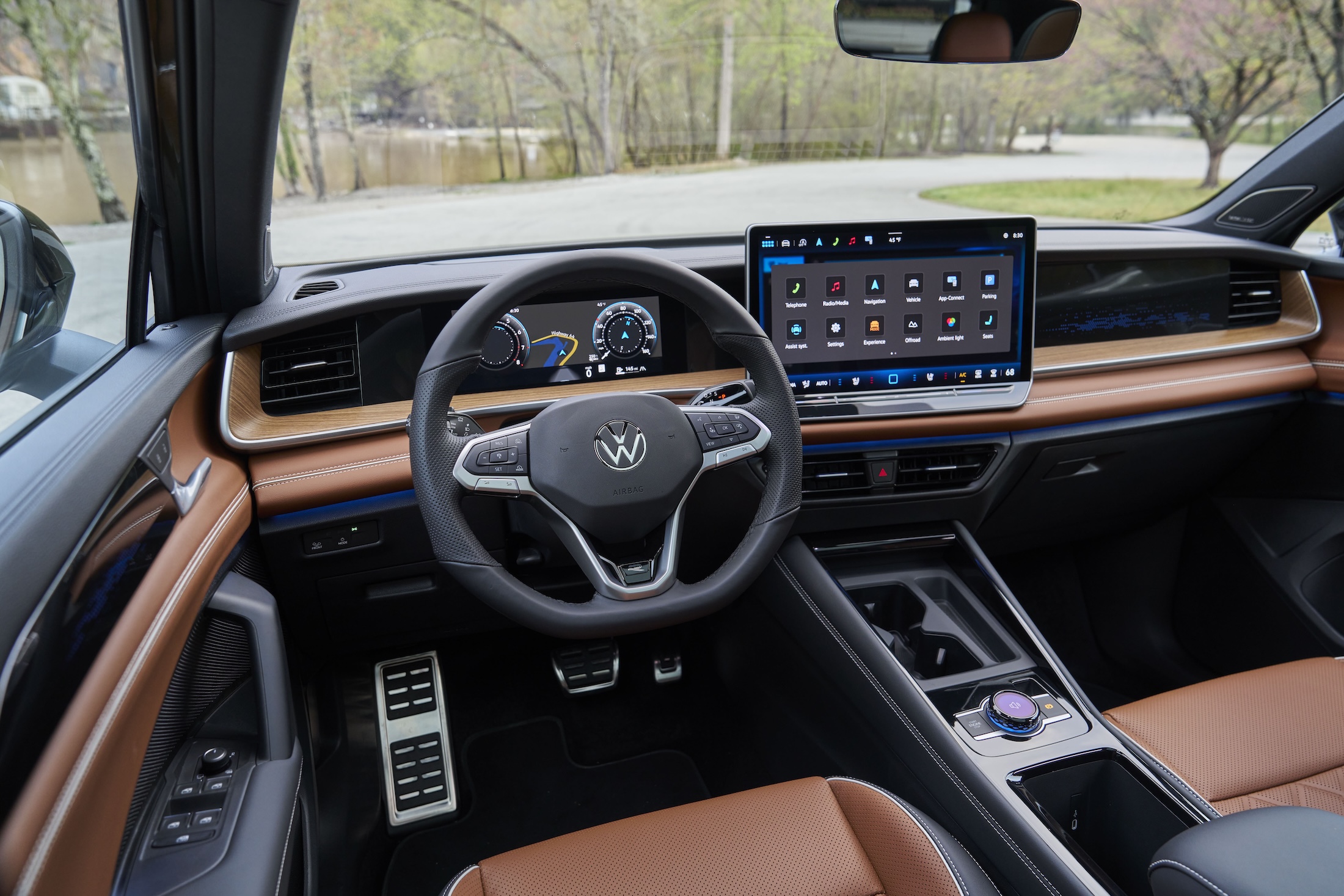
    The interior of the 2026 Volkswagen Tiguan tested also matched this press photo nicely. See how nice?ANDREW TRAHAN PHOTOGRAPHY LLC

    Driver’s Seat: If the horsepower alone isn’t worth the money, the upgraded SEL seating adds a serious bonus for that $5,000 premium. As soon as I sat down my herniated disc felt a great sense of relief, and the massage option helps further subtract the aches and pains. Heating and ventilation were the final piece of the puzzle.

    The seats hold you in place nicely as well.

    Friends and stuff: Those same friends who complained about Mr. Driver’s Seat’s extreme cornering maneuvers changed their tune when it came to the seat comfort — they all found that to be as delightful as the front. Even the middle-seat passenger felt well accommodated.

    Cargo space is 69.8/33.8 cubic feet, depending on the seat position. There is no longer a three-row option as there was in the 2018-2024 model years.

    The wide rear doors that are held over from the previous version drew one friend’s attention, noting it would be easy to get dogs in and out.

    Play some tunes: The Harman Kardon stereo offered great reproduction of long-forgotten songs from the Psychedelic Furs, REM, and Tom Petty for the group, and we took the inspiration to recall stories of high school days. This system gets an A, but doesn’t uncover a lot of new pieces required for an A+ — unlike our stories, where we uncovered all new dimensions of our past lives.

    The system offers only a large volume dial in the console; everything else happens in the huge 15-inch touchscreen, and it works pretty well.

    Keeping warm and cool: Here’s a sad change from the 2018 model reviewed — the beloved VW three-dial system has been co-opted by the touchscreen.

    The temperature settings sit along the bottom of the touchscreen, and a bigger screen opens for blower controls. Some versions of this arrangement actually function well, but not this one. Sigh.

    Fuel economy: The Tiguan averaged 27 mpg in much highway and some beach driving, a great showing, especially for all that oomph.

    Where it’s built: Parts are 37% Mexican, 15% U.S. and Canadian.

    How it’s built: Consumer Reports predicts the Tiguan reliability to be a 3 out of 5.

    Next week: Is the new trim of the Chevrolet Equinox worth a 10% discount over this Tiguan?