Micah Crawford (left) Kerry Crawford (center) and Brooklynn Crawford Brown (right) wave the American flag during the annual Tri-State Labor Day Parade in Philadelphia on Monday, Sept. 1, 2025.David Maialetti / Staff Photographer
One of Philly’s largest and oldest Labor Day parades is rolling through Columbus Boulevard on Monday.
The 39th Tri-State Labor Day Parade honors the thousands of working-class people who keep our country running. Philadelphia Council AFL-CIO, which represents more than 100 unions and nearly 150,000 workers, has organized a full day of family-friendly activities.
The pre-parade kickoff rally begins at 9:15 a.m., followed by the parade down Columbus Boulevard at 10 a.m.
The commemorative march will end at Sheet Metal Workers’ Union Local 19. Paraders will come together for a family celebration from 11 a.m. to 2 p.m.
Russ Lickfield, of Northeast Philly, holds three large beers during 153rd annual Cannstatter Labor Day Weekend Volksfest in Philadelphia on Sunday, Aug. 31, 2025. Lickfield said he was holding the two extra beers for family members using the nearby bathroom.David Maialetti / Staff Photographer
🧵 Afrofuturism in full glam: Visit the African American Museum in Philadelphia for one last chance to see Ruth E. Carter’s “Afrofuturism in Costume Design.” The exhibition features personal sketches and cinematic costumes from Black Panther and Sinners on display through Sunday.
⛸️ Go before it’s gone: The Independence Blue Cross RiverRink Summerfest closes shop for the season on Monday. Bring your family to Penn’s Landing for roller skating, mini golf, boardwalk treats, and other late summer fun.
🥨 Long-running Labor Day tradition: Stop by the 154th annual Cannstatter Volksfest to celebrate German heritage with live music, amusement rides, games, and food and drink.
🇧🇷 Beauty and vibrancy of Brazil: Stop by Spruce Street Harbor to celebrate Brazilian Day on Sunday. The free outdoor festival will be filled with music, dancing, food, and moreto honor the country’s independence.
📅 My calendar picks this week: Polish American Festival & County Fair, Sheer Mag with Gripper and Real Shocks, Workshop of the World Exhibition. Here’s our full list for the week.
The 54th annual Delaware Valley Bluegrass Festival
Asleep at the Wheel at the Delaware Valley Bluegrass Festival.Delware Valley Bluegrass Festival
Founded by bluegrass legends Bill Monroe and Ralph Stanley in 1972, it’s a Labor Day tradition that has endured over the decades, says our pop music critic Dan Deluca.
The three-day festival kicks off Friday in South Jersey’s Salem County with country-bluegrass singer Kathy Mattea as headliner. Friday’s lineup also includes the Price Sisters, Virginia guitarist Junior Sisk, and the Travelin’ McCourys.
On Saturday, Dan Tyminski gets top billing. New Orleans ragtime street band Tuba Skinny also plays Saturday, along with Critten Hollow, Danny Paisley & Southern Grass, and the Gibson Brothers.
The festival wraps up on Sunday with Black Eyed Suzies, Tennessee quintet Blue Highway, Chicago duo Special Consensus, Boone, N.C., roots band Burnett Sisters, and Nashville quintet Appalachian Road Show.
Coach Nik Devore (right) with CityPickle works with student Joan M. P (no last name) on the morning pickle ball courts returned to Dilworth Plaza, Philadelphia City Hall on Monday, September 9, 2024.Alejandro A. Alvarez / Staff Photographer
🐎 Saddle up: Ludwig’s Corner will host the 83rd Horse Show & County Fair this weekend. Along with top-level equestrian competition, food trucks, games, carnival rides, and vendors will fill the 33-acre community space.
🎨 Summertime market at Dilworth: Friday is the start of a sun-soaked celebration of local makers. The Made in Philadelphia Market is coming to Dilworth Park on Friday, with more than 60 makers, artists, and artisans from across the region.
🎾 Pickleball pickup games:CityPickle has turned Dilworth Plaza into a space for pickleball enthusiasts. Two branded courts are now placed near City Hall. Download the CityPickle app to reserve a time or private court to put your skills to the test.
🎭 Fun at the faire!: The Bucks County Renaissance Faire is taking place at the historic TileWorks in Doylestown from Saturday to Monday. Visitors will experience high-level juggling, live music, theater, and even a hint of magic.
Staffer picks
Kacey Musgraves brings her Middle of Nowhere Tour to the Xfinity Mobile Arena in South Philly on Friday.Kelly Christine Sutton
Here’s pop music critic Dan DeLuca’s list of the best concerts this weekend.
🎤 Thursday: After performing at Xfinity Mobile Arena in May, Houston rapper Don Toliver is back in support of his latest album, Octane.
🪕 Friday: Grammy-winning country star Kacey Musgraves is hitting the stage at Xfinity Mobile Arena. Fans can expect this show to turn into a Dolly Parton celebration.
💃🏼 Saturday:Kehlani, off the heels of her biggest career hit, “Folded,” is returning to the region for a headlining show at Camden’s Freedom Mortgage Pavilion.
🎸 Monday: Bassist Peter Hook, cofounder of England’s Joy Division, New Order, and Durutti Column, will perform New Order’s 2001 album, Get Ready, at Union Transfer on Monday.
Question: What year was Labor Day first recognized as a federal holiday?
A) 1900
B) 1893
C) 1894
D) 1905
Here’s the answer to last week’s question: Which athlete won the first Philadelphia Cycling Classic in 1985? Answer: Eric Heiden
Ask Earl anything
Many of you have questions about each week’s listings, and others about Philly’s arts, culture, and entertainment scene.
I have you covered. Have a question? Email me for a chance to have it answered in an upcoming newsletter.
That’s all folks! Don’t let these end-of-summer events (and extended weekend) go to waste. There are plenty of Labor Day traditions and other cultural events worth exploring.
— Earl Hopkins
By submitting your written, visual, and/or audio contributions, you agree to The Inquirer’s Terms of Use, including the grant of rights in Section 10.
The richest man in the world, who was laser-focused on delivering Pennsylvania for President Donald Trump in 2024, is wielding his wallet in the Keystone State once again to support Republicans in three swing congressional districts ahead of the midterms.
America PAC, Musk’s super PAC, has contributed roughly $12,000 apiece in support of U.S. Reps. Ryan Mackenzie, of Lehigh; Rob Bresnahan, of Lackawanna; and Scott Perry, of York — all GOP incumbents facing tough reelection challenges, according to an independent expenditure report filed Wednesday.
The PAC’s contributions for the congressional races went toward printing at Storytellers Group LLC, a Tennessee-based company, according to the report. He also contributed to several other competitive races across the country.
Even though Musk is not yet deeply involved in Pennsylvania, the PAC’s spending signifies that the billionaire likely views these three congressional seats as important as both parties vie for control of the U.S. House.
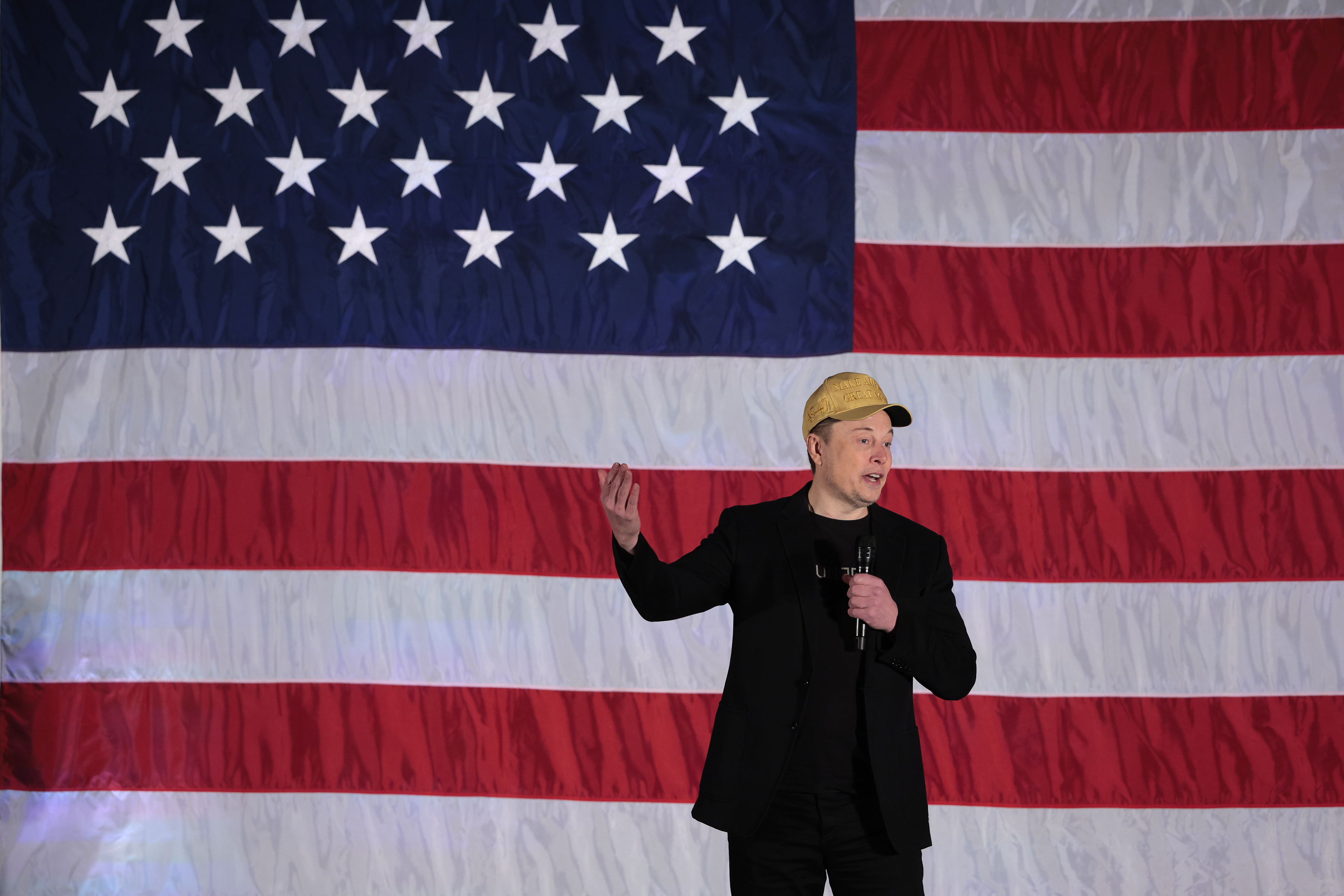
Elon Musk jumps on the stage as President Donald Trump speaks at a campaign rally at the Butler Farm Show, Oct. 5, 2024, in Butler, Pa.Evan Vucci
America PAC and spokespersons for Mackenzie, Bresnahan, and Perry did not immediately return a request for comment.
The PAC also has yet to make a contribution in support of U.S. Rep. Brian Fitzpatrick (R., Bucks) will also be defending his seat against Democratic challenger Bob Harvie in a swing district this November.
“I think Fitzpatrick is fairly well positioned regardless of what Mr. Musk does or does not do,” said Christopher Nicholas, a GOP consultant.
But the three GOP incumbents benefiting from Musk’s latest spending all lagged their Democratic challengers in fundraising during the most recent quarter. And Tesla and SpaceX’s CEO’s support could help close the gap.
Bob Brooks, a retired firefighter and union leader who is challenging Mackenzie, seen as one of the most vulnerable incumbents in the nation, said in a statement that Musk is “spending a fortune to buy this congressional seat” in the Lehigh Valley.
“I have a message for Elon and Ryan: Pennsylvania’s Seventh district is not for sale,” he said.
A spokesperson for former TV news anchor Janelle Stelson, who is running in a rematch against Perry in the 10th District, said that: “Scott Perry lacks the courage to highlight Musk’s efforts to increase corruption in our government, so now Musk is rewarding Perry for his subservience.”
And in the 8th Congressional District, Scranton Mayor Paige Cognetti said: “Unlike Rob, I don’t take a dime of corporate PAC money.”
“In Congress, I’ll answer to the people of NEPA, and no one else,” she said.
The lawyer for a Guinean man who has lived legally in the United States for nearly 20 years asked a federal judge to free him from ICE detention on Thursday, even as government attorneys described plans to proceed with his deportation.
Mamadou Fadel Cherif, 56, was arrested by immigration officers as he left his West Oak Lane home for work on July 13 and remains in custody at the Moshannon Valley Processing Center in Central Pennsylvania.
“There’s a human being underlying these proceedings,” attorney Conor Deane told U.S. District Judge Juan Sanchez, as the lawyers debated complicated immigration regulations and law. “An exceptional human being. … He’s the epitome of who you would want to live in this country.”
Fadel Cherif works in dining services at La Salle College High School, the private Catholic boys school in Montgomery County, and also drives for Uber. He’s the main support for his wife, who has legal permanent residency, and for their four American-born sons, one of whom is a Marines reservist.
Deane sought Fadel Cherif’s immediate release, saying he has been illegally detained and denied due process under the law.
Nearly two decades ago, Fadel Cherif was granted what’s called Withholding of Removal, which allows him to live and work in the United States, and bars his deportation to his West Africa homeland, where the U.S. government agrees he could be harmed or killed over his political beliefs.
That status does not shield him from being sent to a third country, however, if ICE can find a nation willing to accept him. Those kinds of third-country deportations are difficult for the agency to achieve, but the Trump administration has pushed to accomplish them.
The Migration Policy Institute estimates that during its first year back in office, the Trump administration carried out about 15,000 removals to third countries, a fraction of the total 396,000 deportations.
Deportations of those who have Withholding of Removal are even more rare, according to the Amica Center for Immigrant Rights in Washington. The center says it is pointless to detain those people while attempting to deport them. If ICE were to release a foreign national and later identify an appropriate third nation, it could simply detain them again.
In court Thursday, the judge noted that authorities plan to deport Fadel Cherif to Ghana — sparking courtroom debate over the West African land’s assurances to the U.S. government that he would be safe there.
Deane said those assertions are not sufficient to deport someone. He described Ghana’s diplomatic assurances as “very boilerplate,” and not barring that nation from sending his client to another country or even back to Guinea.
Assistant U.S. Attorney Landon Jones told the judge he did not have additional information regarding Ghana’s assurances, but the U.S. State Department has deemed them credible.
Abdoulaye Cherif near his West Oak Lane home in July 2026. His father, Mamadou Fadel Cherif, was arrested by ICE and has been detained while the agency tries to deport him.Yong Kim / Staff Photographer
Fadel Cherif’s wife and two of his sons, who were in court for the proceedings, declined to comment.
Advocacy groups and immigration lawyers say the Trump administration is increasingly arresting and detaining migrants who have been granted withholding, keeping them in custody while it pursues removal to a third country.
One challenge to deportation is even those nations that willingly accept their own citizens can be disinclined to accept other foreign nationals.
Ricky Palladino, another lawyer for Fadel Cherif, said earlier that there’s no reason for ICE to detain him. He has no criminal record, but does have work authorization, a Social Security number, and a driver’s license.
Fadel Cheriff is nearing the end of his eighth week in detention.
In Guinea, a nation of 12 million people that’s roughly twice the size of Pennsylvania, Fadel Cherif was jailed by the government after protesting the results of his country’s 1998 presidential election, which was marred by irregularities. He later fled in fear of being rearrested, using a document that showed a different Guinean identity to enter the United States in New York in November 2003.
Fadel Cherif was denied asylum — which carries a path to citizenship — when he could not prove that he had filed within a year of entering the United States.
To receive Withholding of Removal, applicants must prove they were persecuted in the past or that their lives would be threatened in the future, that the government harmed or will harm them — or failed to control others who might do so. They also must show that moving to a different part of their home country would not provide safety.
When Withholding of Removal is granted, the immigration judge also enters a deportation order, then tells the government it cannot deport the person to their homeland. In that way the removal is “withheld.”
People with that status cannot leave the United States without triggering deportation, have no path to citizenship, and cannot petition to bring family members to this country.
Fadel Cherif’s lawyers filed what’s called a habeas petition, which asks a judge to order the government to prove it has the lawful authority to detain the person. The term “habeas corpus” translates from Latin as “you have the body,” and such filings are considered crucial constitutional safeguards against wrongful imprisonment.
Habeas petitions, once rare, have dominated the docket at Philadelphia federal court since the Trump administration initiated a policy of mandatory detention last year. That provoked an avalanche of lawsuits by immigrants who challenged their incarceration, demanding their freedom or at least a bond hearing in Immigration Court.
Judge Sanchez gave no indication of when he would issue a ruling.
PHOENIX — The last time the Phillies saw the Braves, their season was going in a very different direction.
Their last meeting on April 26 also happened to be Rob Thomson’s final game as the club’s manager. The 6-2 loss dropped the Phillies’ record to 9-19 to start the season and Thomson was fired two days later.
Don Mattingly took the reins as interim manager, and the team that had been on track to miss the playoffs entirely authored a stunning turnaround, and is back in contention for the National League East. As the Braves return to Philadelphia on Friday, their lead on the division — at one point a gargantuan 10½ games — sits at four.
This series could determine the NL East. If the Phillies keep winning at the clip they have been lately, they would close within striking distance. But if they don’t, the race could be all but put to bed by the time the Braves leave Citizens Bank Park on Monday.
“I think we’re all excited for the challenge,” Kyle Schwarber said. “Hopefully that weather starts cooling down and it gets a little bit of a fall weather feel, and it starts feeling playoff-y, and the fan base is going to be rocking and rolling. Looking forward to a rowdy weekend.”
Plenty of ink has already been devoted to what changed for the Phillies since April: better pitching performances. Better hitting. A different outfield mix that works. An unconventional cleanup hitter with a contagious approach. A risky defensive shuffle that paid dividends. Severalrookies coming into their own. And multiple astonishing comeback wins along the way.
Bryce Harper’s monster August helped fuel a 21-7 record in the month.Elizabeth Robertson / Staff Photographer
Before the Phillies headed home from their nine-game West Coast trip on Wednesday afternoon, Mattingly said he felt as good about his club as he has all season.
“I think we’re showing up every day and playing, and it’s not really any different one day to the next, win or loss,” he said. “Yeah, I think we’re in a good spot right now.”
Another key has been the Phillies finding a way to handle what had been their most exploitable weakness: left-handed pitching.
From March to May, the Phillies had a collective .210 batting average and .659 OPS against left-handed pitchers. Their righties were struggling significantly, and their lefties weren’t able to carry the load.
But things have steadily improved. Since June 1, the Phillies have a .265 average against lefties — good for fourth in baseball in that span — and a .739 OPS. August was their best month yet. As the offense has improved its discipline and approach as a whole, they hit .281 vs. left-handers, with just a 15% strikeout rate and a .370 on-base percentage.
On Tuesday, they knocked around Diamondbacks lefty Eduardo Rodriguez for eight hits. Rodriguez is in the midst of a career season, and the Phillies raised his ERA from 2.50 to 2.59.
The addition of right-handed hitters Derek Hill and Bryan De La Cruz has helped. So has the fact that Edmundo Sosa has been heating up, and Bryce Harper has started hitting lefties the way he has in the past. And while the Phillies brought in a left-handed bat at the deadline, Luis Arraez hits above .300 no matter the handedness of the pitcher.
Phillies second baseman Luis Arraez has been an unconventional but consequential cleanup hitter.Yong Kim / Staff Photographer
“I think we’ve done a better job with them,” Mattingly said. “We’ve been able to mix and match the lineup a little bit, where we can put some righties in there that have traditionally hit lefties. I think that’s solidified us a little bit, and Harp’s actually hitting lefties now. He struggled a little bit, but he’s traditionally hit them. Schwarb’s hit them. Luis has hit them.
“I’m not really afraid to stack them, those lefties together up there, because they’ve handled lefties.”
But all of that will be put to the test on Friday in a pivotal moment of the season. Chris Sale is a bit of a different beast, and the Braves ace is set for a duel against Cristopher Sánchez in Friday’s series opener.
Sale happened to be on the mound against the Phillies in that last meeting on April 26. He smothered them, holding them to one hit over six innings.
At 37 years old, the lefty still has high-90s fastball velocity — he touched triple digits in his shutout against the Dodgers last week — and pinpoint command. His 11-degree arm slot is the lowest among qualified left-handers this season, and it adds to the deception of his slider and changeup.
Schwarber and Trea Turner have handled Sale relatively well. Schwarber is 5-for-19 (.263) against him with two homers, while Turner is 6-for-19 (.316). The problem is, both of them are in the midst of ice-cold stretches.
Trea Turner (left) and Kyle Schwarber (right) have had some success against Braves ace lefty Chris Sale.Elizabeth Robertson / Staff Photographer
Turner batted .158 on the road trip and Schwarber hit .171. Schwarber said he has been feeling a tick off in his timing, and has been alternately early and late at the plate over the last nine games.
“It’s frustrating,” Schwarber said. “But I know the things that I need to do, and I’m looking forward to getting the off day, get back home, and then get in there early and get right back to work and feel really confident. … It’s past experience, right? And especially as baseball, where there are going to be times when you’re up, you’re down, and you have keep finding a way to be competitive, and that’s what I try to do on a daily basis, and get right back to work.”
On Friday, the Braves offense will have a left-handed ace of its own to contend with in Sánchez. But to win, the Phillies will need to hit.
And while they’re anticipating a playoff-like environment for what will be the biggest series of the regular season so far, the offense also wants to stick to the routines that helped it win 15 of its last 18 games.
“It’s trying to tame that, and trying to make sure that when you are out there, we’re doing what we always do,” Schwarber said. “Which is taking our at-bats, taking our approach, taking our game plan, executing, and going from there.”
With early voting about to begin in competitive midterm races, President Donald Trump has kept most of his super PAC money on the sidelines, causing Republican leaders to conclude that it’s too late to fully deploy the cash in the midterms and that he intends to hold on to much of it for his own purposes.
Trump’s political advisers have been assuring anxious allies that MAGA Inc., the president’s super PAC that had more than $400 million on hand as of July 31, will come to the rescue during the peak campaign season after Labor Day. But Republicans are increasingly skeptical and suspicious that Trump — who must personally approve the spending — has other ideas.
The president has not revealed his plans, and his political advisers consistently say they will not share them with reporters. Some people around Trump have concluded that he has little interest in spending the bulk of his super PAC funds on this year’s midterm races, according to a person with knowledge of internal conversations.
Theories about what Trump wants to do with the money cover a broad range of possibilities, including protecting his political influence in the next presidential race by passing on the money to his chosen successor, and saving up for legal fees, postpresidential travel, events, and pet projects, such as his library. Trump’s Miami library is projected to cost at least $1 billion, the most expensive presidential library construction to date.
The person with knowledge of internal discussions, who spoke on the condition of anonymity to talk about those conversations, said Trump and his team believe their ability to rake in massive donations will take a hit after the midterm elections, giving the president an incentive to keep hold of the money he has raised so far.
Fundraising accounts associated with the president — such as his super PAC and funds for his inauguration, White House ballroom and Freedom 250 events — have been inundated with donations from companies looking to get in Trump’s good graces, a dynamic that is likely to change as he becomes a lame duck.
Some donors have started holding back on giving more money to the super PAC while it sits on earlier contributions, according to people familiar with the matter who, like others interviewed for this article, spoke on the condition of anonymity because they were not authorized to speak to reporters.
Trump’s reticence surrounding how he will use MAGA Inc. money has caused particular worry for Republicans in this fall’s elections.
GOP candidates and officials still avoid criticizing the president on the record. Privately, however, some operatives have complained that MAGA Inc. has already missed valuable opportunities to lock in airtime at lower advance rates and define candidates before attitudes harden.
Allies have also criticized Trump’s preference for promoting his own record, arguing that super PACs are most effective at attacking opponents, as MAGA Inc. did in 2022.
The nonprofit arm of Trump’s political operation, Securing American Greatness, premiered its first midterm ads on Wednesday, spending just under $1 million, according to the tracking firm AdImpact. The ads, set to air nationwide, feature video clips of Trump talking about tax breaks in his domestic spending legislation and lower prices for eggs and prescription drugs. One spot uses Trump’s friend Dana White, the chief executive of the Ultimate Fighting Championship.
“Like, they think he’s popular or something,” a Republican ad maker scoffed when shown the videos. “He’s not.”
Multiple public and private polls show Trump’s approval rating mired in the mid-30s, at or near historic lows for a president facing a midterm election.
The ads adhere to Trump’s instruction to advisers to promote his record, and the super PAC could take a different approach with future ad buys, people familiar with the discussions said.
A large lead in available cash has been one of the few bright spots for Republicans in this election cycle, because many of the swing constituencies that helped Trump win back the White House have drifted away amid disappointment with persistent inflation and the Iran war. Leaving a large portion of MAGA Inc.’s money on the sidelines threatens to neutralize that advantage, as individual Democratic campaigns outraise their GOP counterparts.
“I worry about that, for sure,” Senate Majority Leader John Thune (R, S.D.) told his home state’s CBS affiliate about the possibility of losing the Republican majority in the upper chamber. “I’m a realist, and I just think you — I don’t ever try and sugarcoat things. I think it’s a competitive environment right now.”
While some Republicans have given up on waiting for the MAGA Inc. cavalry, Democrats continue to warn that they expect Trump’s super PAC and Elon Musk’s political outfit to outgun them.
“All of that takes the advantage that Democrats have in terms of individual small-dollar donors, and it really will just swamp it,” said Rep. Chris Pappas (D, N.H.), who is running for an open Senate seat in a tight race against Republican former senator John E. Sununu.
“We are going to get outspent in this race,” he said.
Musk’s super PAC, which spent more than $260 million to back Trump and other Republicans in 2024, just reported $800,000 in midterm spending on GOP candidates, federal campaign filings show. The PAC also started advertising online in the battleground Senate races in Texas, Michigan, New Hampshire, and Maine, according to Meta’s disclosures of political ads on Facebook and Instagram. A spokesman declined to comment.
With the availability of broadcast airtime dwindling, MAGA Inc. may spend more heavily on ads placed on digital streaming services, according to three people familiar with the plans. Those people said streaming services can be more cost-effective for targeting younger and less-frequent voters, like those who helped Trump in 2024, a constituency that Republicans will need to mobilize again this fall.
The PAC is also likely to pay for events and get-out-the-vote operations, one of the people said.
Skeptics of MAGA Inc.’s promises point to Trump’s history of viewing money that he raised as his own and resisting using it to help others. So far this year, the super PAC has spent less than $900,000 supporting Sen. Darline Graham (R, S.C.) in her primary and less than $20,000 sending text messages for Rep. Clay Fuller (R, Ga.), according to federal campaign finance disclosures.
“I’m not affected by the election,” Trump told reporters in the Oval Office on Wednesday while discussing the Iran war. “I’m not running. But my party is running, and I’m going to help my party.”
At an event in the Rose Garden with congressional Republicans, Trump on Wednesday night previewed what he described as nonstop travel in the last 30 days before the elections, including a trip to Alaska to stump for Sen. Dan Sullivan (R), but he made no mention of super PAC spending.
“We’re going to be helping you, and I’ll be going around and doing a lot of speeches,” he said. “We’re going to take that little, that final 30 days. You don’t want to go too much before then because people forget.”
In their findings, the NBA said the Clippers, in violation of league rules, facilitated payments and deals for Leonard with four different companies. The Clippers denied any wrongdoing in a strongly worded statement, saying they “vehemently reject” the league’s findings.
The league handed down a number of punishments for individuals in the Clippers organization and for the team itself. Owners Steve Ballmer was suspended for a year and fined $30 million in part for “knowingly seeking to help Mr. Leonard obtain off-court income opportunities.” President of basketball operations Lawrence Frank received a six-month suspension and president of business operations Gillian Zucker was suspended a year. Leonard was not suspended and received a $700,000 fine.
The league is also taking away five first-round draft picks from the Clippers in 2029, 2030, 2031, 2032 and 2033. The 76ers still have some Clippers draft capital from the trade that sent James Harden to Los Angeles in 2023, but that will be unaffected by the league’s punishments, a source confirmed.
Reviewing the Harden trade
When the Sixers traded Harden in October 2023, they received, as part of a three-team trade with the Oklahoma City Thunder, a 2026 protected first-rounder from Oklahoma City (which they eventually traded), the Clippers’ 2028 first-round pick and a 2029 top-three protected pick swap from the Clippers (along with 2024 and 2029 second-rounders from the Clippers).
Sixers guard Tyrese Maxey played a little under two seasons alongside James Harden. Yong Kim / Staff Photographer
The Clippers dealt that 2028 first-rounder in a convoluted pick swap to the Celtics in the Jaylen Brown trade, but they still owned that valuable 2029 pick swap.
How Wednesday’s news relates to the Sixers
On paper, it could appear as though the league was taking away the 2029 Clippers pick the Sixers had the right to swap.
But a league source confirmed a report from PhillyVoice that said the NBA was taking away a first-round pick the Pacers owe the Clippers from the Ivica Zubac trade and was not touching the Clippers’ own pick, meaning the Sixers’ right to swap that pick remains intact.
The value of that pick swap
Wednesday’s news would seem to bolster the immediate value of that swap. Even while the pick is top-three protected, the Clippers could be in a tough spot as a franchise for the next few years as they attempt to rebuild in the post-Leonard era. It will still be a valuable trade chip they can dangle this season and beyond to make more roster moves. There’s also the fact that the NBA has moved to address tanking by flattening lottery odds for teams that miss the playoffs and play-in tournament.
One effect of the league’s ruling is how it shapes a pending trade the Clippers had with the Toronto Raptors to send Leonard back there, where he won a championship in 2019. By giving Leonard a comparative slap on the wrist with the fine, and by not suspending him or voiding his contract, the league seemingly has preserved the Clippers’ ability to deal Leonard eastward.
An ESPN report said the trade is on track to go through in the next few days. This will add to an already deep Eastern Conference that has plenty of potential contenders.
The revised outlook “reflects SEPTA’s better-than-expected financial performance” in fiscal 2026 that leaves it with enough liquidity to pay the bills while continuing to try to solve a structural budget gap, Moody’s said in an Aug. 28 statement.
“Our hope is that this external validation supports the message we want to send to our stakeholders in Harrisburg that SEPTA is a sound investment and that we are good stewards of taxpayer dollars,” assistant treasurer Michael Kendall said in an interview.
SEPTA managers pivoted to an increased focus on controlling costs, finding new revenue from advertising, parking, and real estate, and service improvements, Kendall said.
The transit agency says it has found about $30 million in annual savings, as well as increased income from advertising, parking, and real estate. Ridership remained steady and spiked during the summer’s World Cup games, celebrations of America’s 250th birthday, and the Major League Baseball All-Star Game.
Overall, SEPTA says its structural budget deficit dropped from $213 million a year to $192 million.
The credit rating for authority bonds remains good, as they are backed by reliable federal and state income streams, not passenger revenue, which can fluctuate.
SEPTA has a $501 million bond for asset improvement and a $42 million bond in the Public Transportation Assistance Fund. Moody’s gave both one of its highest ratings, Aa3. Moody’s also affirmed the A3 ratings on the authority’s $138 million in bonds issued against federal capital grants it has been awarded.
Still, Moody’s warned, “over the long-term, SEPTA’s sizable structural budget gap will be difficult to resolve without further financial support from the commonwealth or significant adjustments to operations.”
In the wake of a hiring surge last summer, an official in charge of evaluating new recruits to U.S. Immigration and Customs Enforcement issued a dire warning.
The Trump administration, he wrote in a memo, was cutting corners, violating the law, and fast-tracking unqualified, “improperly vetted” candidates into ICE’s ranks, part of a dangerous move that exposed the agency — and its law enforcement operations — to “grave national security risks.”
Citing an “unprecedented lowering of standards,” the career ICE official said that “systemic breakdowns” had allowed applicants to receive job offers before they had passed basic fingerprint, identity, or credit checks in a preliminary vetting process. Political appointees had unjustly skirted background investigations and received national security eligibility.
The official, a unit chief who directly oversaw more than 100 employees who evaluated thousands of ICE applicants, was so troubled by what he saw that he outlined these concerns not to his superiors, but in a formal whistleblower complaint to the Office of Inspector General in the Department of Homeland Security.
In the complaint, he asked for an independent, outside investigation into the matter. He was later interviewed twice by officials with the inspector general’s office and his concerns have become part of an ongoing audit into vetting practices.
The complaint, which has not been previously reported, underscores the rising worries about the suitability — as well as the tactics — of scores of agents who have been rapidly deployed across the country within the past year. It also outlines the extent to which ICE weakened its standards, and points to dissension among the upper reaches of the agency as it was pressed last year to carry out President Donald Trump’s immigration crackdown.
The whistleblower, a 17-year ICE veteran who spoke to The New York Times on the condition of anonymity because of the sensitive nature of his claims, said the agency had cut corners in its rush to fill the ranks.
“We chose as an agency to be more convenient rather than thorough,” he said, describing the agency’s decision to reduce scrutiny of recruits in order to expedite hires. “By doing so, there was a potential to put lives at risk and to jeopardize national security.”
The whistleblower complaint was obtained via a public records request. The concerns within it broadly mirror those made by other current and former ICE employees who said that the agency had abandoned best practices as it rapidly scaled up. An ICE lawyer who worked at the agency’s training center resigned earlier this year and went public as a whistleblower, citing concerns about a “deficient, defective, and broken” training program.
In response to questions, an ICE spokesperson said in a statement that the agency “diligently applies the proper personnel vetting regulations, including guidelines for national security, and evaluates all available information for every applicant based on these factors.”
The agency declined to comment about the whistleblower, who retired from the agency in July, or his complaint.
The scrutiny of ICE’s hiring practices has intensified in recent weeks, spurred in part by the fatal shooting of Johan Sebastián Durán Guerrero, a Colombian immigrant, in Biddeford, Maine, on July 13.
The two ex-wives of ICE agent David Brouillette, one of whom identified him as the person who fired the fatal shots, have accused him in interviews and court records of being abusive. In a filing for a protection order in December 2019, one ex-wife wrote that he had broken her door down, destroyed her belongings, and dumped her clothes over a bridge.
The women also have said Brouillette, a former military serviceman and Veterans Affairs police officer who was hired amid the recruiting surge last year, had post-traumatic stress disorder related to his deployment in Afghanistan. A local official in Maine told The Portland Press Herald that Brouillette sought jobs with the Hallowell Police Department in 2024 but was denied because there were “too many red flags.” Brouillette could not be reached for comment.
After the shooting, Tom Homan, the White House border czar, said the DHS investigation into the episode will include whether the agent was properly vetted before being hired.
A White House spokesperson referred questions to DHS.
A rush to recruit
The concerns in the August 2025 whistleblower complaint exposed shortcuts in the agency’s preliminary vetting process. No credit checks. Fingerprints unconfirmed. Final job offers absent preliminary vetting.
Before the surge, a recruitment team made documents available to a unit within ICE’s Office of Professional Responsibility for each new hire, including fingerprints and a security form with extensive questions. The vetting team would then initiate a preliminary check, running each applicant’s name through law enforcement databases and searching for criminal violations or other major red flags. Some recruits would be sent for a polygraph test if concerns arose.
These recruits then underwent a full background check, conducted by outside contractors, to determine whether the candidate was trustworthy enough to have access to sensitive computer systems, federal facilities, and classified information. It wasn’t unusual for this to occur while recruits were in training.
The preliminary vetting process, which took seven to 10 days, was upended last summer. The vetters were told to make determinations on recruits without having the full security form, fingerprints or any polygraph testing, according to the former unit chief and a former federal official familiar with the process who was granted anonymity to speak freely about it.
That meant new hires were heading to training without having their identities, criminal histories, and other basic information checked and verified, the unit chief said.
The agency also sped up its training program, cutting it from roughly 10 weeks to six. This resulted in agents reporting to their full-time positions while their full background checks were pending.
Meanwhile, recruits with prior law enforcement experience were able to take online courses rather than complete on-site training. They faced even less scrutiny in their background checks.
In July, the agency said, it increased the length of its training program for academy classes, and it instructed past graduates to attend additional training.
Ryan Schwank, the former ICE lawyer who worked at the agency’s training center, testified before Congress this year that new recruits appeared unfit for service.
“We were concerned about ICE recruiting a loose cannon or somebody who was just mentally unfit for the role,” Schwank said in a recent interview. “We knew that kind of person would get through. But the thing that I think kept some of the other instructors up at night was the possibility of organized crime getting access to the agency or penetrating the agency.”
Schwank, who taught recruits during the surge, said that’s exactly what happened. Last fall, several students were removed from the academy in Georgia in the middle of training because officials determined that they were all linked to a criminal gang. Schwank began work at the training academy last September and left the agency in February.
In a statement, an ICE spokesperson said, “ICE has received NO credible evidence that any of its trainees were linked to a common criminal gang.”
In the interview, Schwank said it was rare for students to fail out of the academy before the surge, but that about half of his students flunked out after the hiring push. This was after the academy made its tests open book and no longer failed students who made fatal errors during enforcement simulations.
By this spring, hundreds of new recruits hired amid the surge had already been removed from the force, according to the former federal official who was granted anonymity.
The hiring surge was set in motion in part by the passage of Trump’s domestic policy bill last summer. Congress allocated $30 billion in new money for ICE to hire 10,000 new ICE agents, more than doubling the number of deportation officers.
Concerns about political appointees
The unit chief who filed the whistleblower complaint said he chose to alert the DHS Office of Inspector General because ICE leadership had created these issues and he thought an outside, independent investigation was necessary.
In addition to the vetting concerns, he also mentioned in the complaint that Trump administration political allies had received favorable treatment and obtained security clearances even though troubling information about them had surfaced in background checks. He cited Corey Lewandowski, a former top adviser to DHS.
The concerns about Lewandowski had been outlined in a memo written last year by the DHS head of security and was viewed by the whistleblower, who told the Times that a higher-up had asked him to vet Lewandowski for an ICE credential. The red flags in the memo included allegations that Lewandowski had been paid years earlier for work by a Chinese government agency, according to the whistleblower and a report last year in the Daily Mail. That allegation has not been substantiated outside of that memo.
In a statement, Lewandowski denied he was ever vetted by ICE. He said he had “never worked for the Chinese Communist Party – Full Stop.”
In a follow-up statement, a spokesperson for Lewandowski said any suggestion that he “received favorable treatment in connection with his security clearance is categorically false.”
Ten days after the unit chief filed his whistleblower complaint — and a few days after the Daily Mail article published — a lawyer from the department’s Office of General Counsel reached out to him. This lawyer, who was not from the inspector general’s office, asked to meet the whistleblower at an agency field office in Texas, separate from where he typically worked.
The whistleblower believed he was being interviewed about his security worries, but a different focus of the inquiry became apparent: Had the unit chief talked to the news media about his concerns?
The lawyer grilled him over four hours and seized his laptop, according to the former unit chief and his lawyer. The full contents of the meeting, they said, are protected under a nondisclosure agreement, a common practice for internal investigations.
“My client was of the belief this investigation by the agency’s attorneys was in good faith to vet his disclosure,” said Kevin Owen, a lawyer for the whistleblower. “Instead they threatened him and put him on leave.”
It remains unclear how DHS officials came to target the unit chief.
The agency said it couldn’t comment on personnel matters with people no longer there.
The former unit chief said the inspector general’s office first reached out to interview him in February, about six months after the complaint was filed. Investigators interviewed him again in April for an audit into vetting, he said.
In a statement, the office said it had to delay some of its work due to government furloughs. The office in April opened an audit into the process for giving out security clearances to political appointees.
The inspector general’s office said it couldn’t comment on its investigations, but the agency noted that it did not reveal the name of the whistleblower to anyone outside of its office.
Meanwhile, the whistleblower remained on leave for 10 months for what DHS said were “allegations of serious misconduct,” the unit chief and Owen said.
The alleged misconduct went unspecified, they said, and he was eventually reinstated with no punishment or finding of wrongdoing. He retired immediately after, in July.
He said DHS officials had never told him specifics for why he was on leave for such a long time.
In an effort to learn more, he submitted a records request to ICE for documents related to his case.
The former unit chief said the stress of the investigation weighed heavily on his mental health. He checked himself into a treatment program that lasted several months.
The man, a longtime Republican who voted for Trump in 2020 and 2024, said he grew disillusioned with the agency as it acted in haste to fulfill the president’s immigration enforcement mandate. He said he has always supported ICE’s mission, but was troubled by the way the agency was taking shortcuts in vetting recruits.
“It’s a betrayal of the public trust and everybody’s trust,” he said.
FILE — Immigration and Customs Enforcement agents on patrol at O’Hare International Airport in Chicago on March 23, 2026. Amid pressure to hire people quickly, ICE leaders sped up the process, eliminating some of the more thorough checks in place. (Jamie Kelter Davis/The New York Times)JAMIE KELTER DAVISFILE — Ryan Schwank, a former ICE lawyer who worked at the agency’s training center, in Washington on Feb. 23, 2026. In an interview, Schwank said about half of his students flunked out of the academy after the ICE hiring surge. (Kenny Holston/The New York Times)KENNY HOLSTONFILE — An impromptu memorial to Johan Sebastián Durán Guerrero, who was fatally shot by a federal immigration agent, in Biddeford, Maine, on July 14, 2026. The scrutiny of ICE’s hiring practices has intensified in recent weeks, spurred in part by the fatal shooting of Durán Guerrero. (Christopher Capozziello/The New York Times)CHRISTOPHER CAPOZZIELLO
BOSTON — The Trump administration on Thursday asked the Supreme Court to reject an order by a federal judge that halts it from implementing a new rule regulating mail ballots, hours after being unable to tell that judge whether the computer system that would govern the entire project was operational yet.
The administration filed its appeal the afternoon before mail ballots were scheduled to be sent out by North Carolina, which on Friday kicks off a wave of states shipping ballots out for the rapidly approaching midterm election. Its appeal was part of a flurry of last-minute litigation as the federal government struggles to implement President Donald Trump’s restrictions on mail ballots before the midterm elections in November, and came even as legal wrangling over President Donald Trump’s executive order continued in lower courts.
Under Trump’s executive order, the U.S. Postal Service could refuse to deliver ballots from states that do not follow a uniform envelope style and submit lists of eligible voters to an online portal that was apparently still inactive Thursday.
During a hearing in Boston, U.S. District Court Judge Indira Talwani repeatedly questioned Department of Justice attorney Michael Velchik about whether the Postal Service could actually implement Trump’s plan from an executive order he issued last spring. The key piece is the online portal, which would track tens of millions of mail ballots. States would be required to upload their list of mail voters to the portal to have ballots delivered, and if the data there didn’t match what was on the envelopes, the ballots would not be sent.
Unclear if key system has been set up
“I don’t even have a declaration from the Postal Service: ‘This is how it will work.’ I don’t have it. I have nothing,” Talwani said, adding later that it felt like the government was running an “experiment” to see if the system would work in the upcoming election.
“As you sit here today, you can’t tell me the government has a program ready to go?” Talwani asked.
Velchik repeated that the Postal Service would “fully implement the rule” that it published last month, triggering the latest round of litigation. He argued the main issue is whether Talwani has the legal power to stop it.
“The $64,000 question is, is this authorized by the statute?” Velchik said.
Talwani is considering whether to extend her temporary order barring the Postal Service from requiring use of the system through Sept. 10. The first state to send out all its mail ballots, North Carolina, is scheduled to begin shipping them out Friday, with other states quickly following.
Talwani has been here before. In June, she prohibited the administration from implementing Trump’s executive order for the November election, ruling the changes came too close to voting for the federal government to embark on such a project.
But the Supreme Court late last month ruled that Talwani’s order was premature because the Postal Service had not yet published regulations governing how it would apply Trump’s order. The agency did so just before the high court ruling came down, prompting Democrats and voting rights groups to swiftly re-file their lawsuits.
They counter that the president has no authority to set election rules, which is a power designated by the Constitution to the states and, in some cases, to Congress.
Tangled legal fight goes up to election deadlines
They won an initial victory with Talwani’s 14-day restraining order. In a sign of the pressures on the administration, its lawyers already appealed that order to the 1st Circuit Court of Appeals in Boston, but they added the Supreme Court appeal Thursday and urged the top justices to act quickly.
Election officials say there’s simply no way they can comply with the Postal Service directives, which could require a complete overhaul of their operations. Before it delivers mail ballots for any state, the Postal Service would have to approve the design of the envelopes that contain them and have the state upload a list of voters receiving them to an online portal.
Some ballots have already gone out. A few municipalities in Wisconsin opted to send mail ballots to voters earlier this week, but Friday marks the full kickoff of voting as North Carolina starts shipping its mail ballots to all voters who requested them.
The administration has contended the changes are relatively minor and legal.
“While the States have primary authority to regulate the manner of elections, they cannot choose to use the federal mails to carry out their elections but then insist that their election-related mail is somehow exempt from the Postal Service’s rulemaking authority, conferred by Congress, to regulate envelope design and addressee information,” Trump’s solicitor general, John Sauer, wrote in the appeal.
No red states have said they’ll use system
Still, the hearing before Talwani focused more on practicalities — especially that the portal was still not active, while most election offices have already printed their envelopes and ballots.
Velchik told the judge that the federal government is offering states the choice to opt into the system, but the Postal Service has yet to identify a single state that has done so. None of the 12 states that intervened in the lawsuit to argue the Trump administration has the right to require the program have announced that they have voluntarily opted into it.
Talwani scolded Missouri Solicitor General Lou Capozzi for arguing on behalf of the project.
“You want the voters in your states to be disenfranchised,” Talwani said. “I don’t understand the interest.”
Capozzi said that was misinformation: “There is no risk that people would be disenfranchised.”
A whistleblower report made public this week warns that the postal system’s requirements could lead to millions of mail ballots never being sent. The new rule requires all ballots to be physically brought to post offices before being mailed to voters. But if a single one’s bar code registers an error, the whole batch gets thrown out, even if it contains tens of thousands of legitimate ballots.
The Campbell’s Co. has cut 13% of its salaried workforce, roughly 515 employees, amid declining sales.
The Camden-headquartered soup, snack, and sauce business has suffered from inflation among other challenges, president and CEO Mick Beekhuizen said in an earnings call Thursday, highlighting multiple cost-cutting efforts. He did not provide information on where the workforce reductions took place, and a company spokesperson declined to offer more details on how many were impacted in Camden.
The company reported $9.7 billion in net sales for its most recent fiscal year, which ended Aug. 2, a decrease of 5% from 2025.
“Our results remain unacceptable,” Beekhuizen said. “But instead of waiting for the environment to improve around us, we are addressing reality head-on.”
Beekhuizen said inflation is expected to continue being an issue in the coming year amid an “external environment that we expect will remain volatile.”
The company is embarking on a $500 million cost-cutting initiative over four years to get back to “profitable growth,” Beekhuizen said. He said the company is making “difficult but necessary” decisions.
Some of that work is already underway. The company has recently cut costs in part by reducing its salaried workforce by 13% through voluntary early retirements and layoffs. The company had 13,700 full-time and part-time employees as of September 2025.
Campbell’s also recently closed two snack facilities and plans to increase prices on roughly 60% of its products.
The company’s snack division, which includes Goldfish, Pepperidge Farm, and Cape Cod, saw a 12% decrease in net sales last quarter. The meals and beverages segment, which includes Rao’s Homemade, Swanson, and Prego, saw a 4% decrease.
“Our performance is not where it needs to be, and we are taking decisive action to improve it,” Beekhuizen said.
Since Beekhuizen became CEO last year, the company’s leadership team has been “strengthened” through internal promotions and some external hiring, he said.
“Looking ahead, our top priority is to get closer to the consumer in everything we do,” he said. “This is not new, but it’s a philosophy we must follow with greater speed and discipline.”