HARRISBURG — For more than two decades, Gov. Josh Shapiro has worn it almost every day.
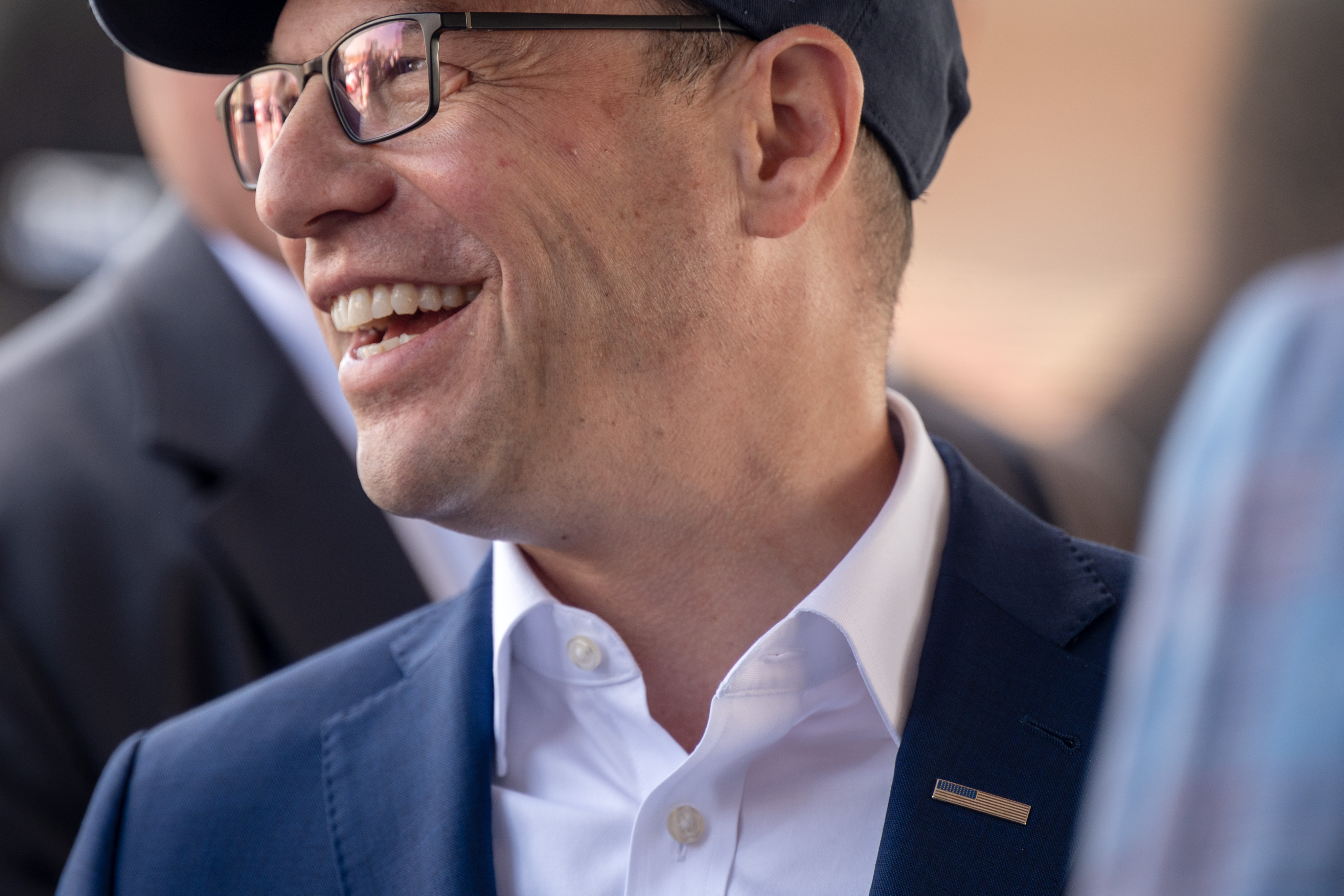
The small, thin accessory affixed to his lapel — a compressed version of the 50 stars and 13 stripes — may require one to squint to see. But it carries significant meaning to the Democratic governor, with an origin story that began on Sept. 11, 2001, when Shapiro was a young staffer on Capitol Hill.
Shapiro was working in Washington when he experienced the pain and confusion of the deadliest terrorist attack in the nation’s history, he said in a June interview.
He was just steps away from the U.S. Capitol building in then-U.S. Rep. Joe Hoeffel’s office, where he served as chief of staff, when he watched as the Today show anchors announced a plane had hit the World Trade Center. And then another.
He realized, like thousands of Americans, that the nation was under attack — with Washington as a potential target. Less than an hour later, Shapiro said, he saw the smoke coming from the Pentagon. Staff were given mixed signals on whether to evacuate before ultimately being told to hunker down in legislative buildings until the situation was clear, he said.
When Shapiro arrived on Capitol Hill the next day, a woman who worked in the Capitol gift shop was giving out American flag pins to anyone who passed by — the “typical gift shop” pin depicting a waving flag that President George W. Bush and other politicians began to wear in the aftermath of the 9/11 attacks, he said.
The pin became a part of Shapiro’s daily business uniform. He wore it every day, even after he left D.C. and began working at a law firm in Montgomery County while preparing to run for state representative — his first foray into elected office and the start of a decades-long career.
When Shapiro was knocking on doors for his 2004 run for the state House, a veteran in Glenside told him his gift shop pin wasn’t cutting it. The veteran gave Shapiro a nicer one: an image of the American flag in a thin, metal bar.
“And I’ve worn it basically every day since,” Shapiro said in June ahead of his appearance at a special session of the U.S. House at Independence Hall to commemorate America’s founding 250 years ago. Widely rumored to be a future presidential contender, Shapiro often talks about his pride in America and its ideals, and his fears that the country is becoming too divided and straying from the founders’ aspirations.
“I am a proud, patriotic American,” he said, referencing his pin. “I don’t think patriotism belongs to one party. I don’t think it should ever be partisan.”
Over the years, Shapiro has made slight changes to the flag accessory; he shaved down the pin stem and made it into a magnet.
“It was destroying my suits,” he added.
He said he once lost the pin when it fell off a jacket that he had hung up on a plane.
“I freaked out. I literally freaked out,” he said.
He said he and the flight attendant were on their hands and knees trying to find it in the plane’s closet. They found the pin, but never found the backing, which was replaced much more easily.
“I found the most important thing, and I just got another magnet,” he said.
Shapiro will appear at the Flight 93 Memorial near Shanksville, Pa., alongside members of President Donald Trump’s administration, includingU.S. Interior Secretary Doug Burgum, for a service on Friday to commemorate the 25th anniversary of the attacks, in which more than 2,900 people were killed.
United Airlines Flight 93, a San Francisco-bound passenger plane flying out of Newark, was hijacked on Sept. 11, 2001. It was believed to be headed to the White House or U.S. Capitol, near where Shapiro was working at the time — before its 40 passengers attempted to retake control and crashed the aircraft in a field near Shanksville.
It was Sept. 17, 2001, and the Phillies were back at Veterans Stadium as one of the first MLB games since the terrorist attacks on Sept. 11.
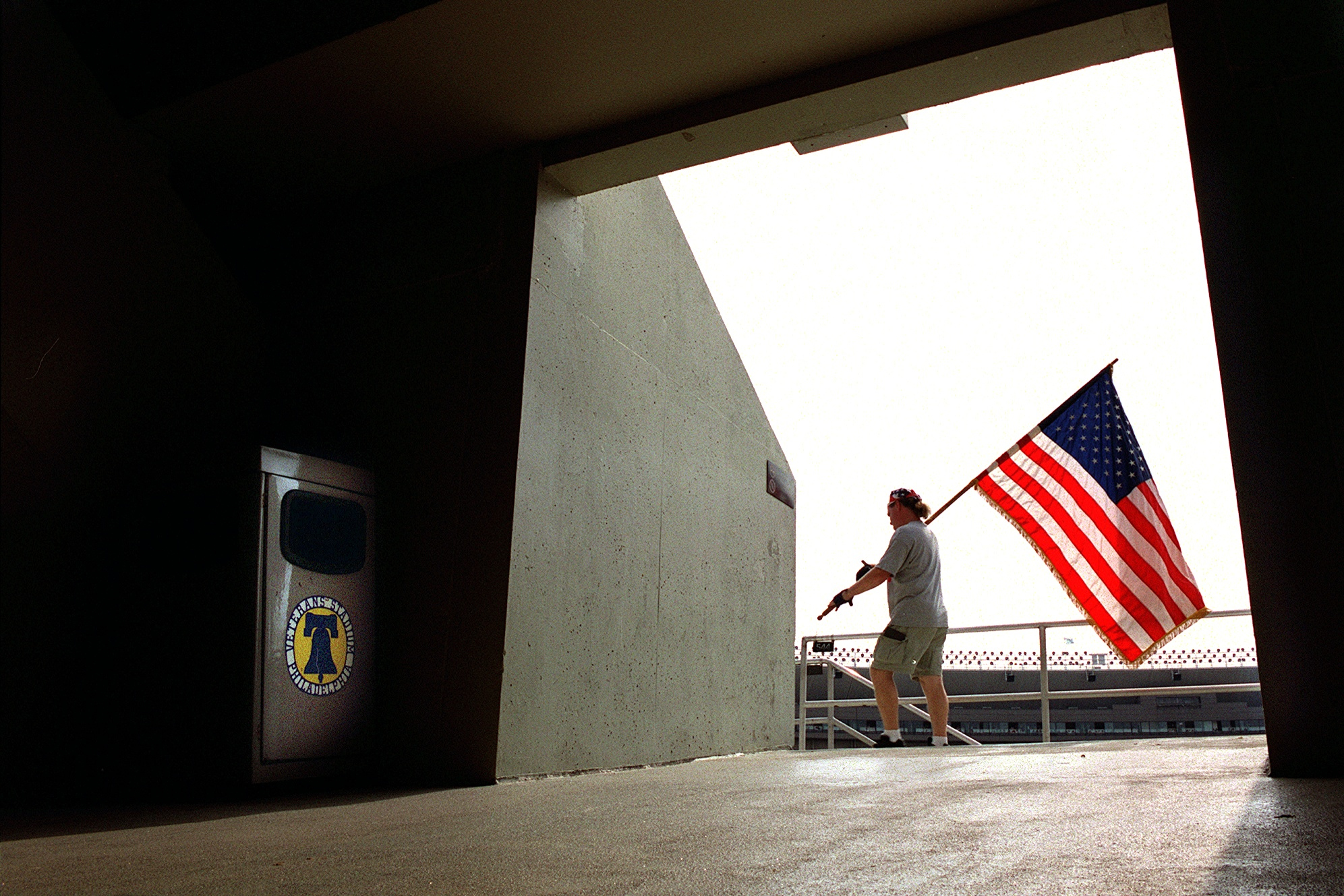
Dillon Minacci, then in fourth grade, was set to go with his dad, Jim, who grabbed a big American flag on a wooden pole and brought it with him.
“It was embarrassing, right?” said Dillon, who was just old enough to roll his eyes at his parents. “I was like, ‘What are you doing? Why are you bringing a flag to the park? What are we doing?’”
No one questioned it. The elder Minacci began his march around the stadium as fans chanted. He became known as Flag Man. Twenty-five years later, Dillon reflects on his dad’s “unifying visual.”
Hugh Douglas and Doug Glanville played for the Eagles and Phillies in 2001, and Larry Bowa was the Phils manager. They reflect on their memories from 9/11.
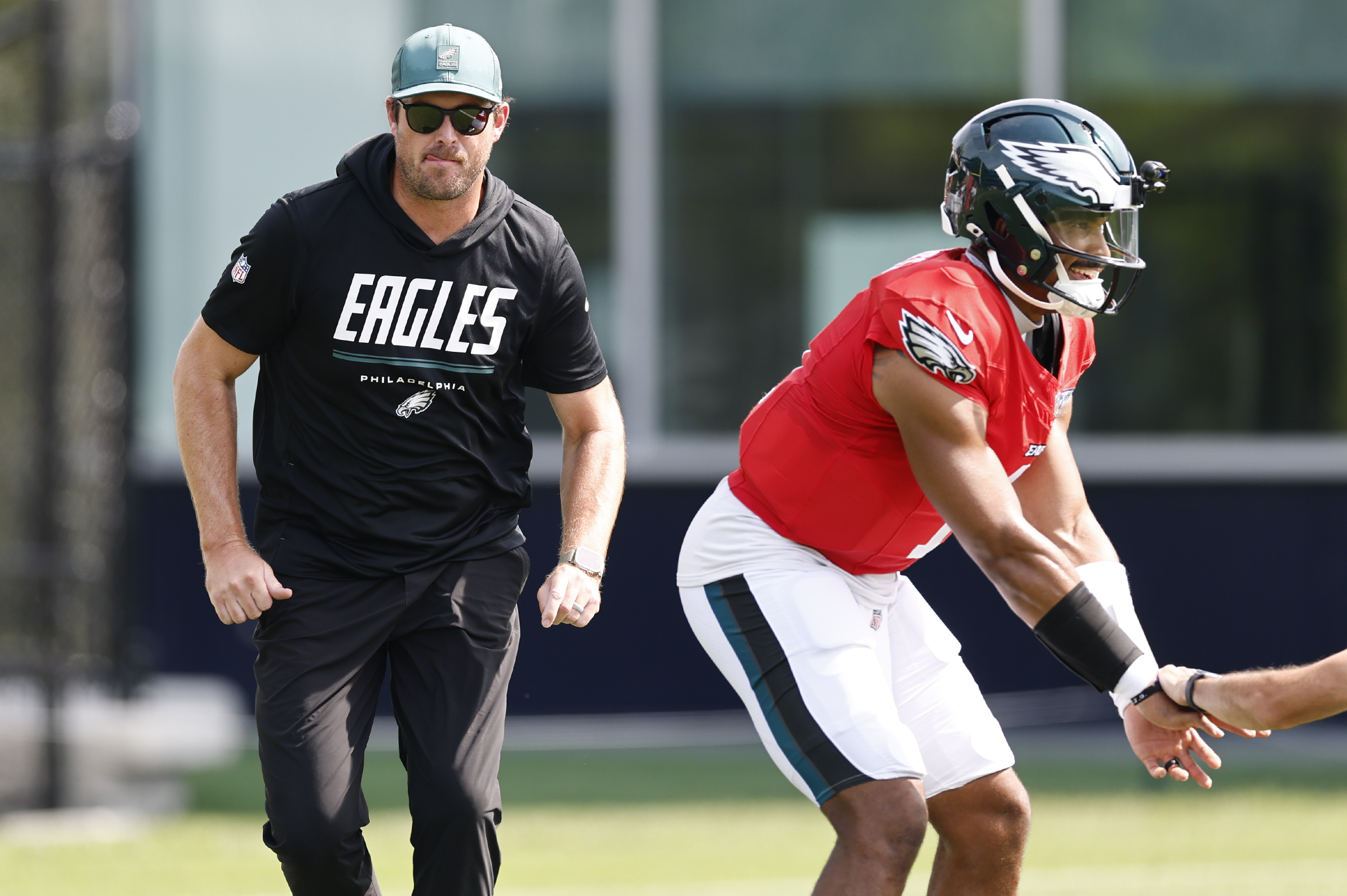
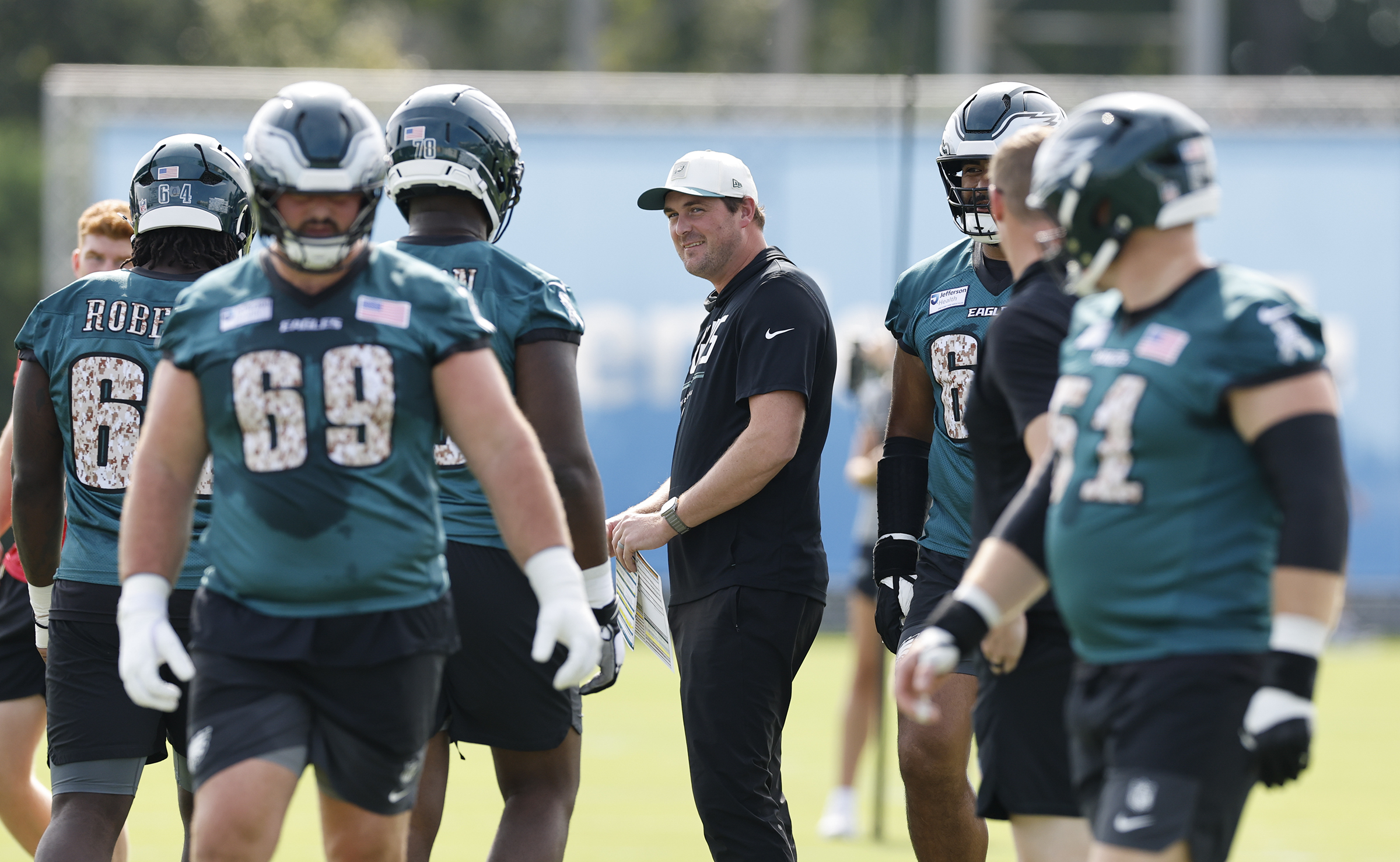
Eagles offensive coordinator Sean Mannion runs in motion with Eagles quarterback Jalen Hurts during team drills before a joint practice with the New England Patriots on Aug. 20. Yong Kim / Staff Photographer
On Sunday, Sean Mannion will make have his close up in a new role. Mannion is just 34 years old and only three years removed from his playing career. He has never called plays in the NFL before and now is tasked with turning around an Eagles offense that was too stagnant in 2025.
In many ways, Mannion, the son and grandson of football coaches, has been preparing for this job for most of his life.
“His thing was, he wanted to play as long as he could,” his father said. “The unsaid part was that when those days were done that he would turn his attention to coaching.”
Jonathan Greenard, who practiced in a limited capacity on Thursday, is unsure but hopeful that he’ll be ready for Week 1 after missing all of training camp with a pectoral strain.
“I feel good, though. I will say, I feel I’m in a good spot,” Greenard said. “Just know that. I know that I’m working every day to continue to try to get this thing stronger. We’re close, I know that.”
Next: It’s almost here — the Eagles kick off the 2026 season vs. Washington on Sunday (4:25 p.m., Fox29).
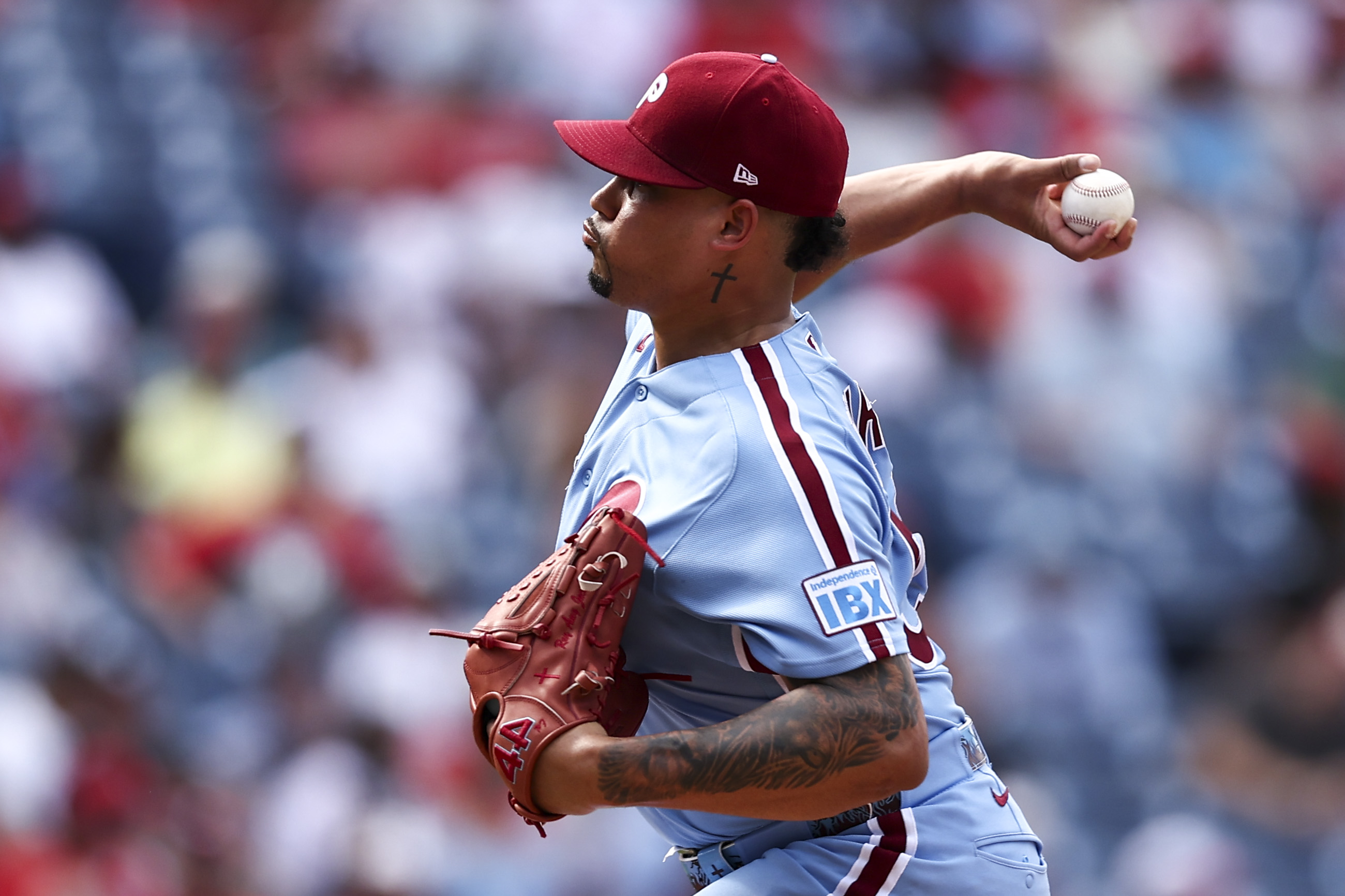
Phillies pitcher Jhoan Duran gave up a tiebreaking home run on Wednesday.Monica Herndon / Staff Photographer
When Zack Wheeler started to run into trouble Wednesday, it would’ve made sense for interim manager Don Mattingly to go to his bullpen, maybe a leverage arm like Alex McFarlane.
It seemingly would’ve been an easy call in the postseason — assuming the Phillies make it — but Mattingly opted to stick with the veteran starter this time. And Wheeler got out of it, only to watch Jhoan Duran give up a tiebreaking homer in a 2-1 Phillies loss.
The Phillies still hold a one-game lead for the top wild-card spot, but they slid to four games behind the Braves in the NL East. And if they do make the playoffs, Mattingly has a simple strategy for catcher J.T. Realmuto, since he’s so good at challenges.
Next: The Phillies are gearing up for another huge series vs. the Atlanta Braves, this time at Truist Park. Aaron Nola (6-10, 4.76 ERA) is scheduled to face Chris Sale (14-9, 2.10) on Friday (7:15 p.m., NBCSP).
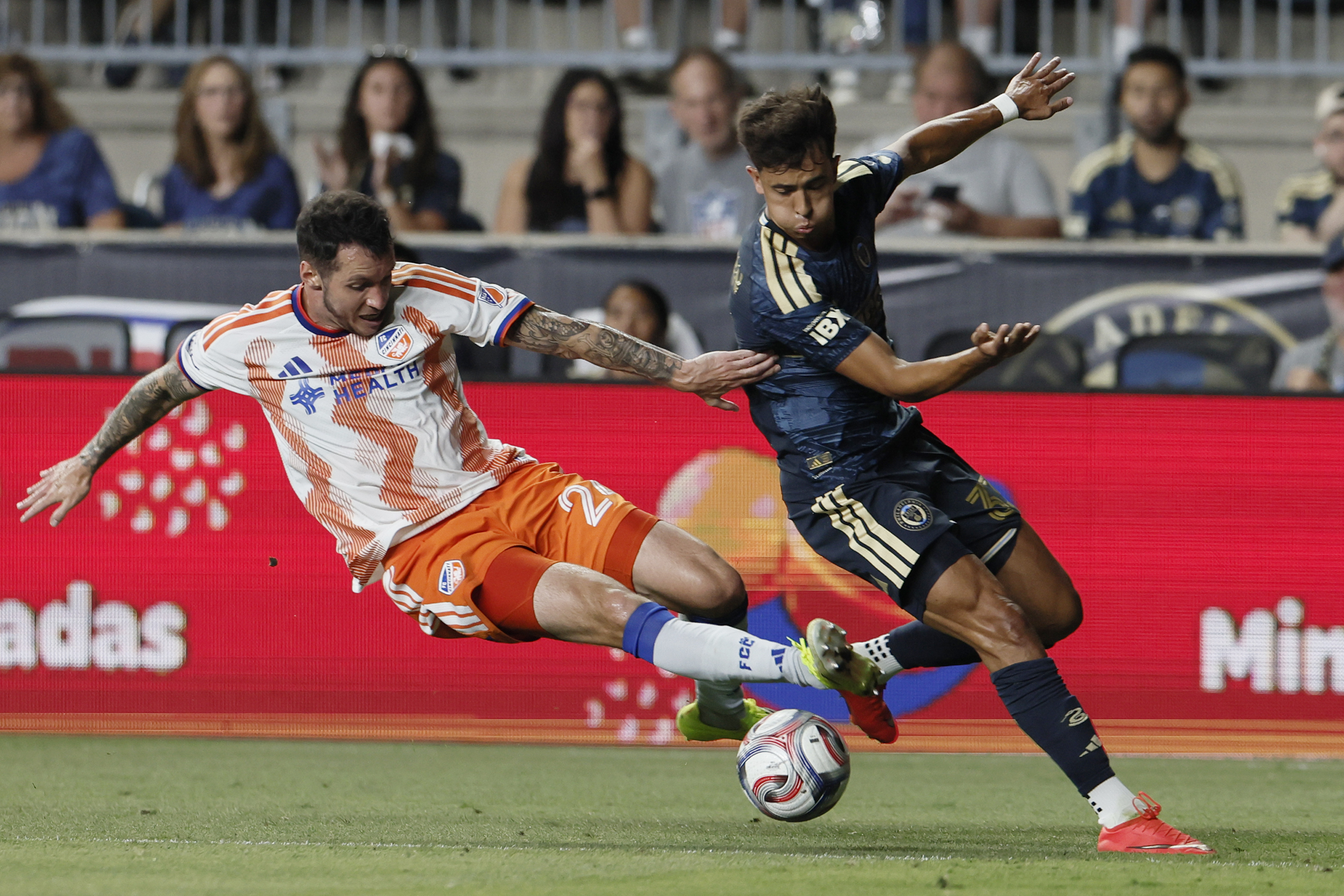
Quinn Sullivan (right) battles Cincinnati’s Kyle Smith for the ball. Sullivan and his younger brother, Cavan, were big factors in Wednesday’s win. Elizabeth Robertson / Staff Photographer
Union teen phenom Cavan Sullivan continues to dominate the spotlight. On Wednesday, he and his older brother, Quinn, shared it as they started a regular-season game together for the first time.
The Sullivans became the Union’s playmaking engine when interim manager decided to start Ezekiel Alladoh at striker with Bruno Damiani amid a three-game week.
And, with his mother and brother in the stands, Damiani delivered a hat trick as part of a 5-0 rout of Eastern Conference foe FC Cincinnati. Jonathan Tannenwald offers his insight into the big midweek win.
Next: It’s a quick turnaround for the Union, who head across the country to face San Diego on Sunday (9 p.m., Apple TV).
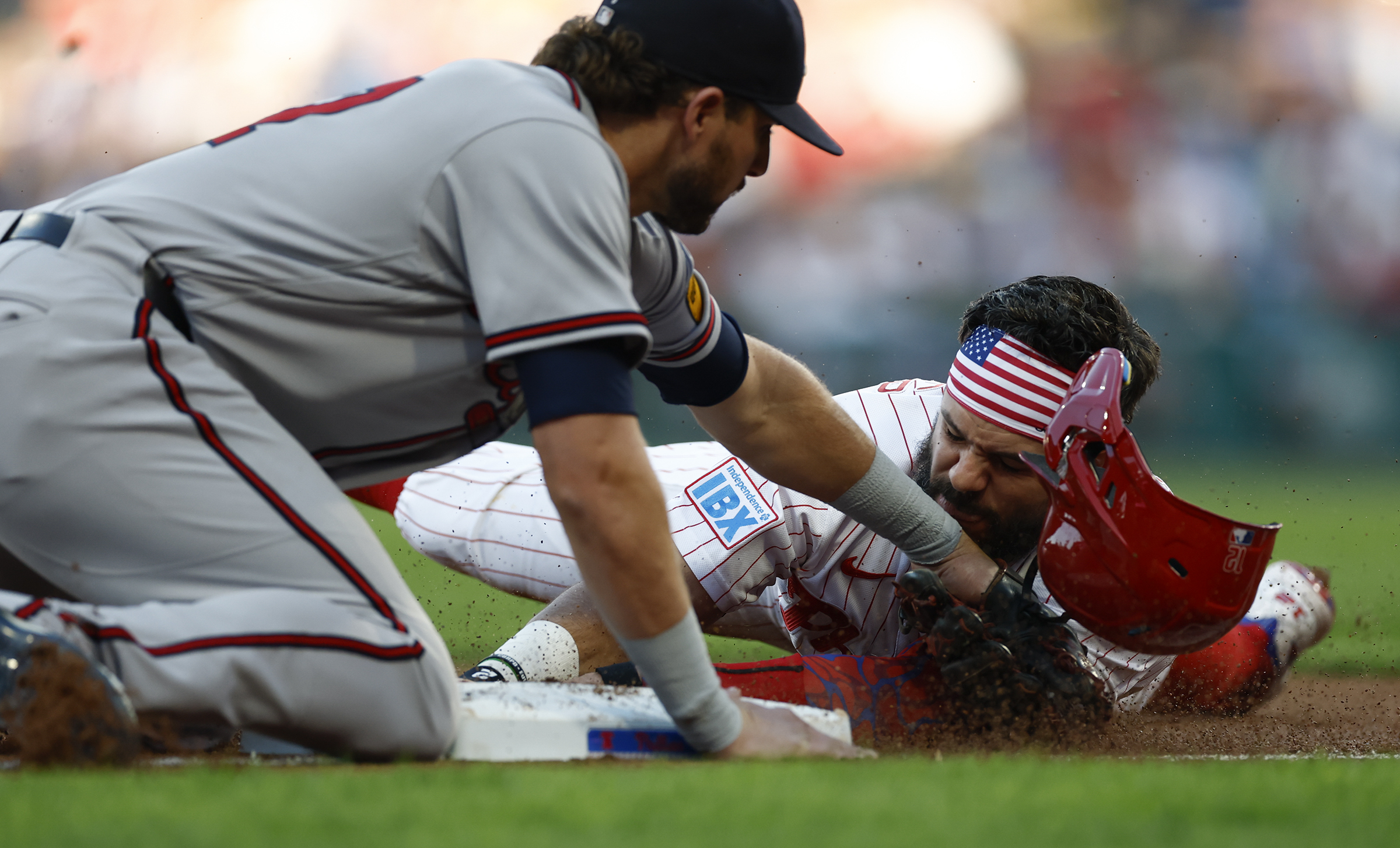
Phillies designated hitter Kyle Schwarber avoids a tag by Atlanta Braves third baseman Austin Riley on Saturday.Yong Kim / Staff Photographer
We’re days from the start of Eagles season, but Philly’s summer sports teams — the Phillies and Union — are still going strong as they head down the stretch. As they do each Friday, Inquirer photo editors picked the best sports images from the last seven days to bring you this week’s Big Picture.
What you’re saying about titles
We asked: If you could win any major sports title, what would you pick and why?
Even though I’m a huge fan of the major sports I would be most proud to win either Wimbledon or the Tour de France. Both of these sports require tremendous personal sacrifice and training and winning at the ultimate challenge against the best in the world would be an accomplishment I would be extremely proud of. —Bob A.
Even though I am in no way a boxer or fighter I would wish to be the the welterweight and middleweight champion of the world like my boyhood boxing idol Sugar Ray Robinson. In truth though today I don’t like boxing at all, but as a kid I was a big fan. —Everett S.
No doubt it is World Series. The organized baseball season begins in February and those fortunate enough concludes with a championship in late October (or even early November). It is a grind for the players and coaching staff. Playing in cold conditions in April, the scorching heat in summer and cold (and sometimes) snowy fall. It is a marathon and only the focused and durable few will survive. — Nick S.
Winning any sports title in Philly is an exhilarating prospect — whether it’s the Phillies World Series, a Flyers Stanley Cup, or a Sixers NBA Championship. But Philly is football. Whether talking about the 1926 Frankford Yellow Jackets or the University of Penn Football dynasty of the late 1800s — we live for the autumn season.
When the Eagles won a Super Bowl in 2018 — it didn’t just feel like their first. It felt like the culmination of excitement that we had waited nearly a century to savior. When it comes to a which title that I’d like most to experience on a sideline as a player — whether in 2018, 2025 (and possibly 2027) — it’s all Eagles. — Michael L.
World Series Champion! The culmination of a long 162 game season and 4 rounds of playoffs. Starting in late March, ending in early November, baseball is the ultimate grind. — Bob C.
We compiled today’s newsletter using reporting from Matt Breen, Marcus Hayes, Jeff Neiburg, Ryan Novozinsky, Olivia Reiner, Scott Lauber, Gabriela Carroll, Jonathan Tannenwald, Mia Messina, Mike Livingston, and Jackie Spiegel.
By submitting your written, visual, and/or audio contributions, you agree to The Inquirer’s Terms of Use, including the grant of rights in Section 10.
Thanks for reading along! We’ll have a special edition of Sports Daily in your inboxes tomorrow to get you ready for the Eagles’ season opener. Jeff Neiburg will take you through everything you need to know, from odds to the injury report and how to watch. — Maria
The 76ers are just over two weeks away from opening training camp on the most anticipated season for perhaps any team in the league this season. Usually, the NBA takes a pause in August and September, but with the excitement from Jaylen Brown and LeBron James coming to Philadelphia, there’s been plenty to talk and write about to fill the space while everyone waits for the games to get going opening night, Oct. 20 at Madison Square Garden against the New York Knicks.
As for me, I’m Chris Hine, the Inquirer’s new Sixers beat writer who will be covering the team in tandem with my good friend Gina Mizell. I spent the last eight seasons covering the Minnesota Timberwolves for the Minnesota Star Tribune, and I wrote a biography of their franchise player, Anthony Edwards.
I’m a Pennsylvania native who grew up in West Pittston, which is close to Scranton. So I’m really excited to be moving back closer to home and excited to cover what promises to be an entertaining and potentially historic Sixers season. Let’s get to your questions!
Q: What’s the Sixers’ single biggest issue heading into the season?” — (Bryan, @btoporek on BlueSky)
A: To me, it’s having the combination of health and availability with this roster to play enough minutes together to develop the necessary chemistry to become a championship contender. That talent is there. That’s step one in building a title winner. But I’ve learned, in covering the Timberwolves up close through two conference finals runs, that identity, reps and chemistry matter a lot during the regular season. The habits and characteristics a team develops, or doesn’t, show up in April. It’s one reason why the Knicks won the title last year. That team knew each other, it played together, it had an identity it could lean on when things got tough deep into the playoffs. That came after playing together through multiple playoff runs.
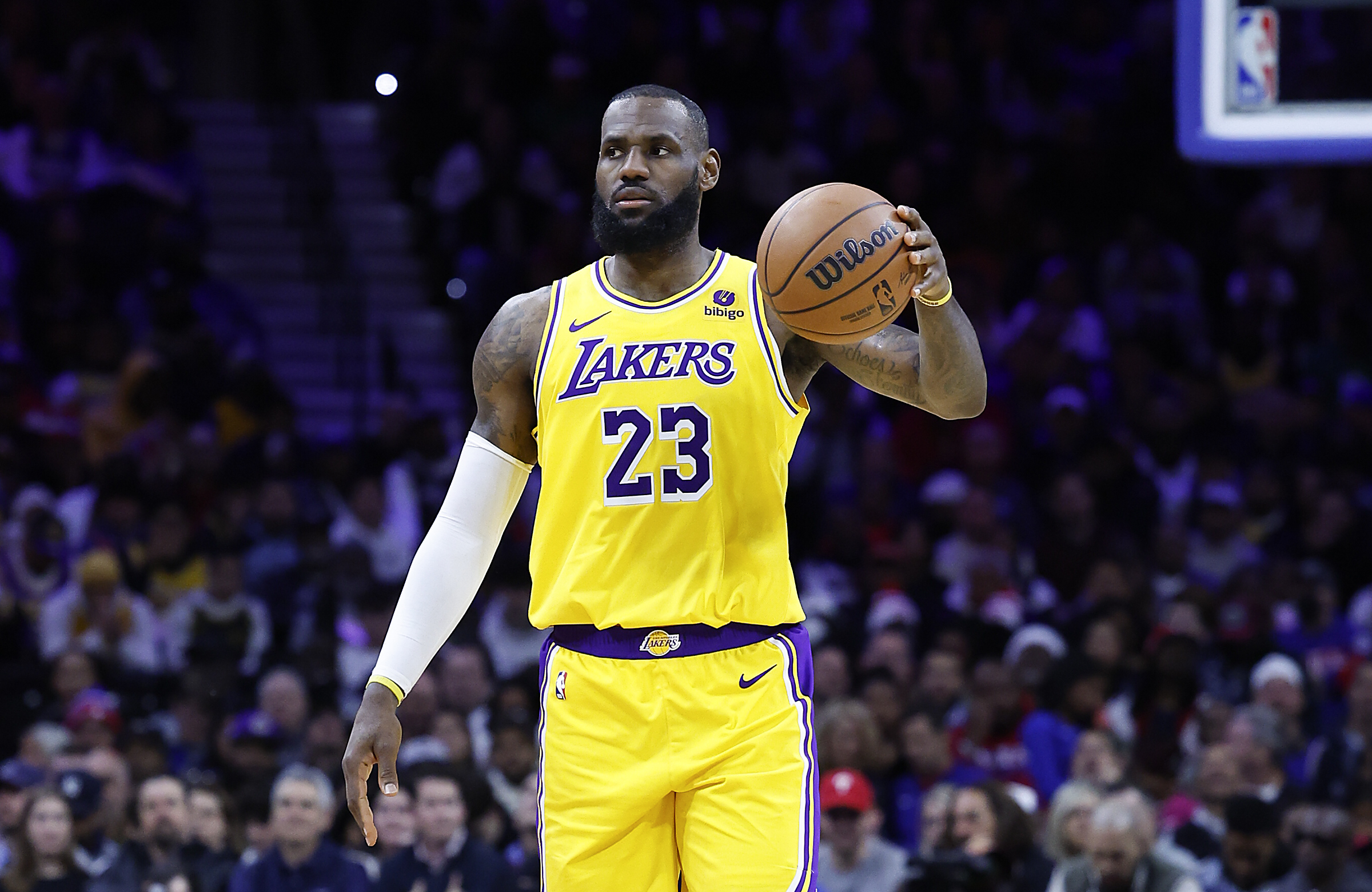
Getting LeBron James and his teammates enough regular season reps will be key come playoff time. Yong Kim / Staff Photographer
The Sixers will have to figure things out in one season, which is doable, but they’ll need their projected starting five to play together as much as possible. Of course, in back-to-back games, nobody is expecting James or Joel Embiid to play many, if any, of those. But I really feel that getting enough repetition as a five-man unit is paramount to what this team will or won’t accomplish in April, especially against some Eastern Conference opponents who have had the benefit of continuity year over year, like the Knicks, Detroit Pistons and Cleveland Cavaliers.
Q: What will the bench minutes look like? Will Nick [Nurse] go more than six deep in the playoffs? (@frantheman200 on BlueSky) and “Is there a role for Justin Edwards on this team?” — (@joephelan13 on Bluesky)
A: I’ll take these two together since they’re related in my eyes. Let’s start with Edwards. One of the butterfly effects of James deciding to sign with the Sixers is more than a few people on the team’s pecking order, in terms of minutes and role, went down a tick. Dean Wade, who I think could be a huge part of this team’s success, went from projected starter to the bench. And now with the other newcomers, including Anfernee Simons, Kentavious Caldwell-Pope and Labaron Philon Jr., the numbers just aren’t adding up in Edwards’ favor. That’s already nine potential players in the rotation — and those names don’t include any backup centers. It seems like he’ll be swimming upstream for rotation minutes as of now. With anyone looking to crack NBA rotations, defense is the way to the floor. Defend well, and coaches will usually find a way to get you out there.
As for the first part of this question, it’s hard to say as of now, and I imagine that’s something we’ll piece together as we get to speak with Nurse in training camp and hear his vision for some of the blended lineups he may have in mind with the starters. Wade should and will likely play a big role, Simons can provide microwave scoring, Caldwell-Pope has the championship pedigree and familiarity with James from their time in Los Angeles, along with the motivation that he still has something left in the tank at 33 years old.
In the playoffs, it’s going to be tempting for Nurse to stick with a tightened rotation, though, especially if the starting five can defend at a higher level than some analysts anticipate. Even coaches with supposedly deep teams sometimes get a little tense in going multiple guys into their bench when everything is on the line.
Q: In 1986, the Celtics made the always injured center Bill Walton the sixth man. He helped win a title and he won the sixth man award. Instead of wondering what nights Embiid can play, why not move him to sixth man? This way your starting five knows their roles, and he gives you instant offense off the bench. — (@tomg18 on Bluesky)
A: This is the kind of outside-the-box thinking we like in mailbag questions! Well, let’s start off by saying that this is an unrealistic scenario for someone like Embiid. Another thing I’ve learned in eight seasons covering the NBA, starting matters to players. It’s a source of pride and a sign of status, essentially, to say you’re a starter. Suggesting someone move to the bench can be a massive blow to that player’s ego, and a coach has to handle any such move with care.
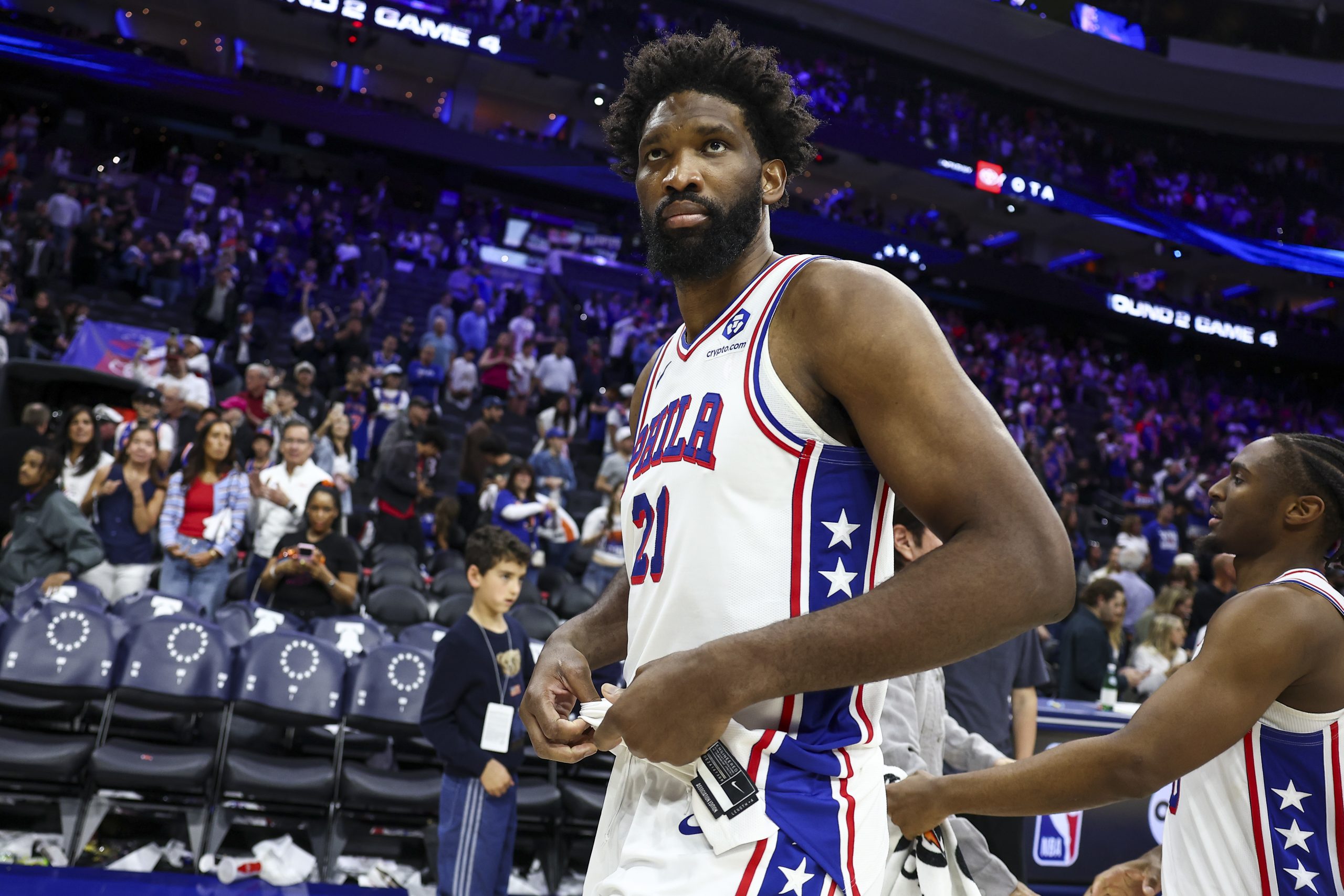
Sixers center Joel Embiid could be asked to make major changes to his game to make room for LeBron James and Jaylen Brown. Monica Herndon / Staff Photographer
If this ever happened with Embiid and the Sixers, it’d be the top story on all the ESPN talk shows for two weeks. But I think what you’re getting at here is Embiid taking on a reduced role, while not coming off the bench. That’s something that could make sense given the roster construction and efforts to preserve Embiid for the long haul. Having him play 25-30 minutes per night — especially if those minutes are with the other starters — and having him available for more games, is better than playing him a usual complement of minutes that risks wearing him out or injuring him. Better to cut back his minutes a bit first before ever considering asking him to come off the bench.
Q: Who are the best candidates for low usage glue guys with the new roster? Someone like KCP or one of the younger guys? — (@bremerdangorst on BlueSky)
A: Wade fits this. He hasn’t had a usage rate above 12.9% in his career, according to Basketball Reference. He can be a defensive contributor who cedes usage to those main scorers on the floor with him at the same time. As you said, KCP can also be this model of player (career-high usage rate of 19.5%). They seem to fit the profile of the exact kind of bench contributors a team like this needs.
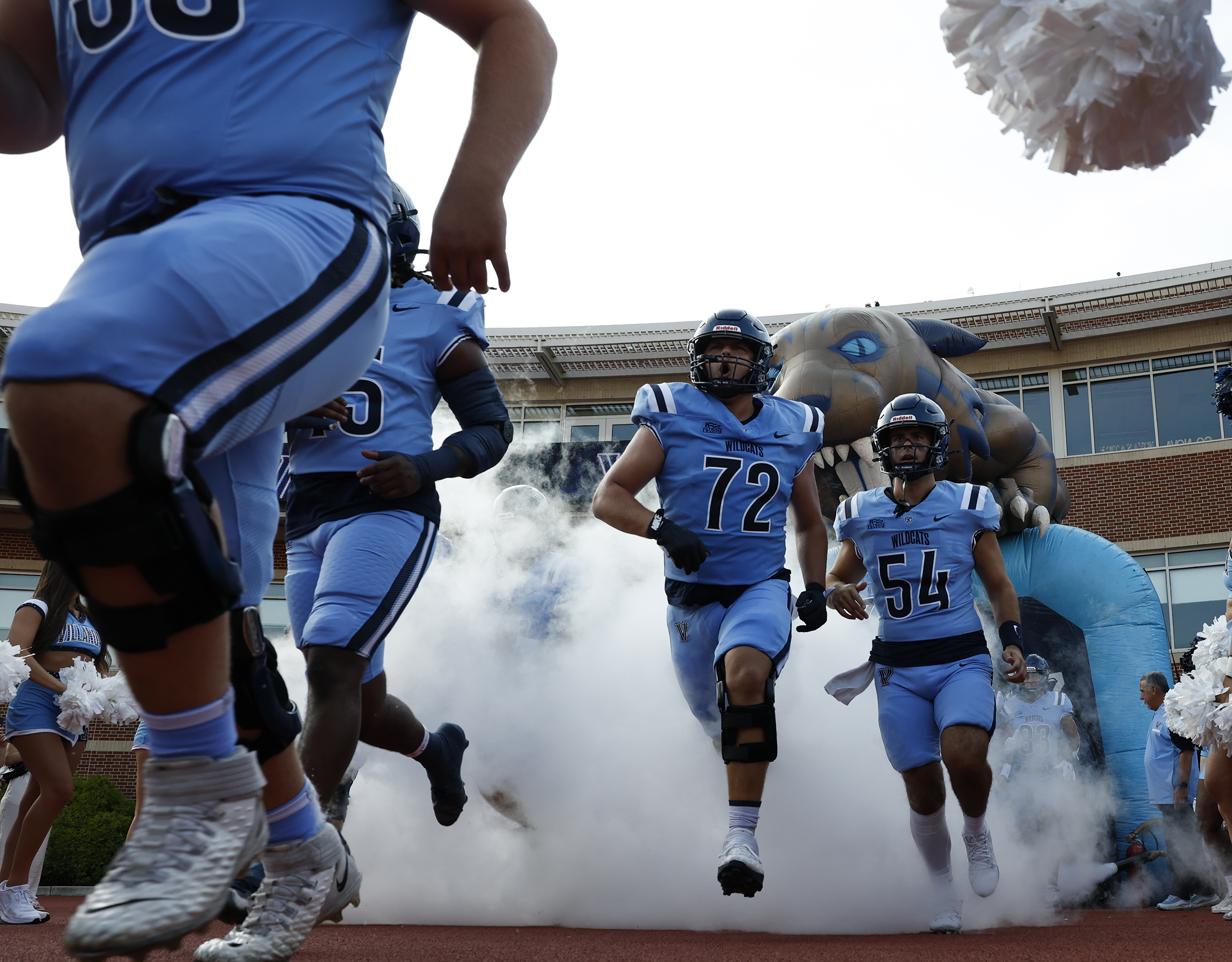
Villanova football is facing off against its annual FBS opponent tonight in a road matchup against Louisville.
After beginning the season ranked No. 7 in the FCS preseason coaches’ poll, the Wildcats have slipped to No. 18 over the last two weeks. And their FBS matchup at Louisville comes during a time when Villanova is trying to clean up all three phases of its game.
However, the Wildcats are looking to carry the momentum from their 17-16 win over Bucknell last week, which marked the team’s first victory in the Patriot League, to try to take down a Louisville program (7 p.m., ESPN/ACCN) that is ranked No. 24 in the Associated Press Top 25 Poll and lost, 41-38, to No. 9 Ole Miss on Sunday.
“We don’t talk a whole lot about it, to be honest,” said head coach Mark Ferrante when asked about playing an FBS opponent. “Nameless, faceless opponent. It’s not who we’re playing, it’s how we’re playing.”
Since the season-opening loss to William & Mary, Ferrante and his staff believe both sides of the ball cleaned up their penalties. The Wildcats had five penalties for 45 yards last week, compared to 15 for 107 yards in Week 1. They also didn’t turn the ball over.
As graduate quarterback Pat McQuaide becomes more comfortable with his receivers, Villanova’s offense is starting to show glimpses of what it was projected to be this offseason.
“Pat wasn’t here in the spring, wasn’t here in the summer, missed the first couple days of preseason practice, and then was able to rejoin the team based on all the stuff that transpired behind that,” Ferrante said. “I’m hoping that, again, Week 1 to Week 2, Week 2 to Week 3, and just keep progressing through the season, it’ll just be sharper, there’ll be better timing, there’ll be more understanding of each other.”
Against Bucknell, McQuaide had a couple of open looks that could have resulted in large plays or deep touchdowns, but he either overthrew or missed his receiver in stride.
Villanova football slides down to No. 18 in the AFCA FCS Coaches Poll.
“There were a few near misses last week where if he hits that one in stride, that might have been a touchdown,” Ferrante said. “ … Hopefully, with added reps, added practice, and more games on our belt, will tie them up better down the road.”
Villanova held on to its win against Bucknell thanks to linebacker Garrett Rogan’s blocked field goal at the end of the game, which would have put Bucknell up by two points. The fifth-year defensive back was one of Villanova’s preferred walk-ons at safety in 2022 and made the transition to linebacker this offseason.
Ferrante emphasized how important special teams is due to how many games are decided by a field goal. Villanova’s season opener was, and so was Louisville’s.
“Our two games, plus Louisville’s first game, plus SMU and Florida State’s first game all came down to field goals or field-goal attempts,” Ferrante said. “That goes to show you how important special teams can be.”
Villanova knows there is always room for improvement, even when it’s playing at its highest potential. That starts with Ferrante, then his staff, and finally the players.
Sophomore linebacker Omari Bursey is one of Villanova’s players who has grasped that concept early in his collegiate career. This offseason, Bursey was given the green dot on the back of his helmet, signifying that he communicates with the coaching staff and the defense while on the field.
Last week, he was named the FCS National Defensive Player of the Week after recording 14 total tackles against Bucknell.
Villanova LB Omari Bursey was named the FCS National Defensive Player of the Week. https://t.co/jBUiYG5LFK
“It’s honestly just a testament to this unit as a whole,” Bursey said of receiving the honor. “One of the biggest things I didn’t get to talk about last week is playing off of my nose guard, and we were able to show that this past week against Bucknell. [We] play so well off each other. It just allowed me to have a few more tackles than the rest of the guys.”
Ferrante said he has shepherd a team-effort mindset during his nine seasons as head coach. It’s an approach that’ll remain against Louisville, he said.
“From my perspective, from the head coach’s perspective, and that hopefully trickles down through their assistants, I approach every week the same,” Ferrante said. “I approach every season the same. People ask me that all the time, ‘So what do you think about this year?’ Well, one year to the next is never going to be the same.
“I enter every season, every game the same way, cautiously optimistic. I always feel if we play our brand of football and we play clean and we don’t shoot ourselves in the foot, and we’re not our worst enemy, we’re not the opponent, then I don’t care who we’re playing. I think we can go out there and compete with anybody.”
It’s starting to feel like the Flyers are forever young, which is not a bad thing in a league that is continuously showing “youth’s like a diamond in the sun, and diamonds are forever.”
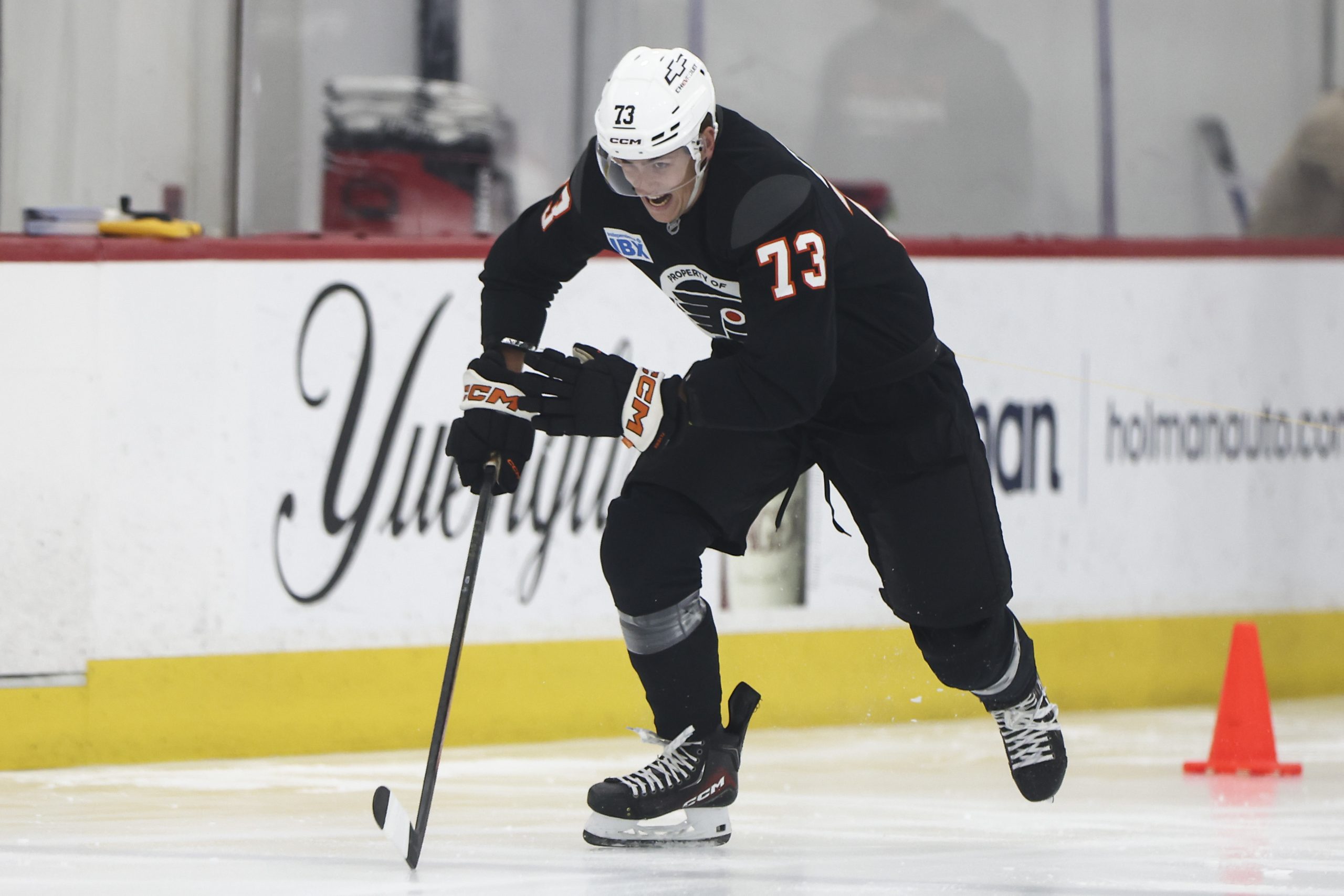
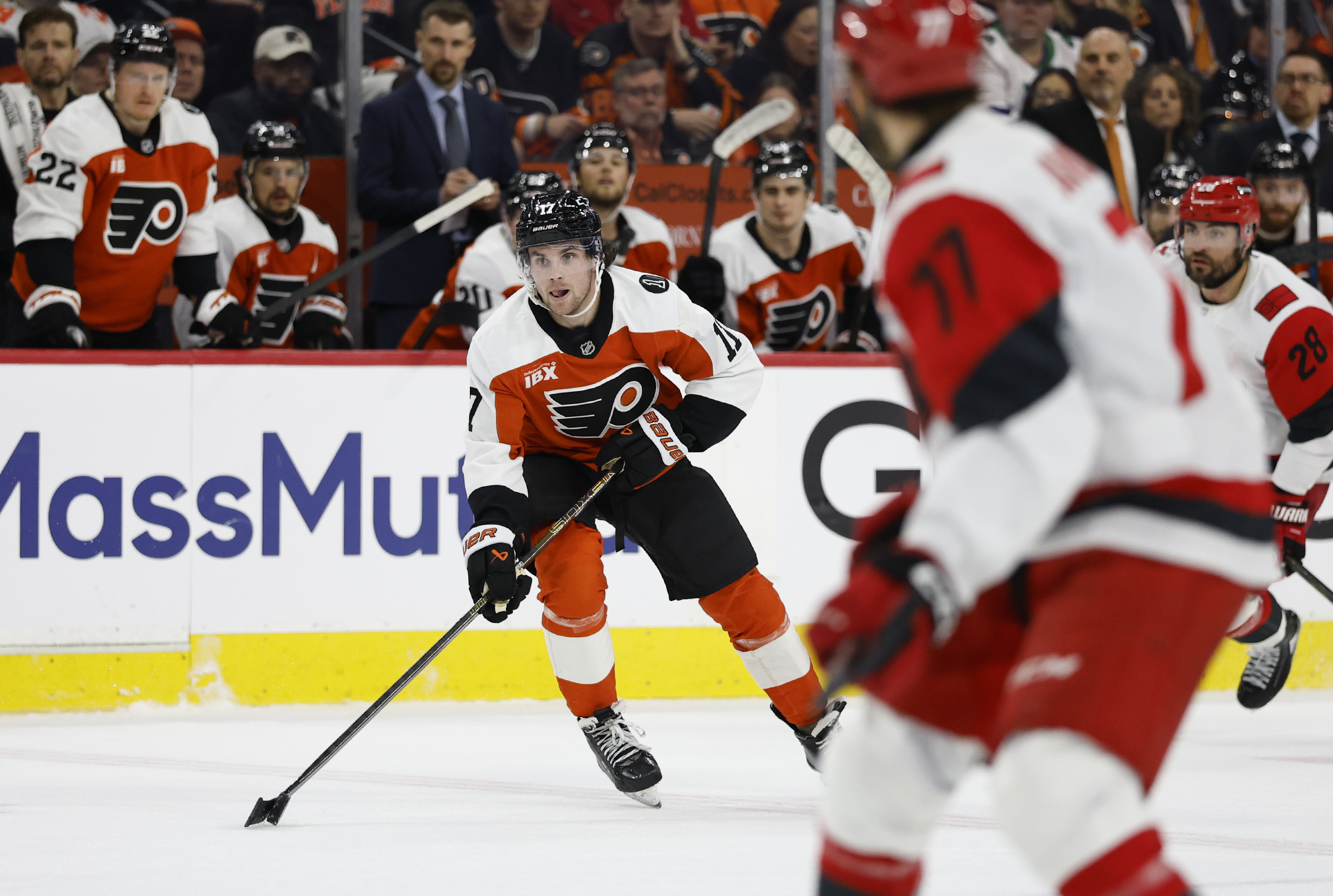
After years marred by a limited prospect pool, the Orange and Black have restocked the cupboard with promising youngsters who are either looking to make their mark in the NHL this season or take the next step in their development.
Compared to a year ago, the list has seen movement, with some players graduating, some moving up, and others falling. Three notable absences from this year’s list include Hunter McDonald and Helge Grans, who have aged out at 24, and Karsen Dorwart, who did not re-sign. Matvei Michkov has played too many games to qualify, as we are using 100 NHL contests as our cutoff.
With several Flyers prospects converging on Allentown and Voorhees this week for rookie camp, here’s our updated top 20 prospect rankings.
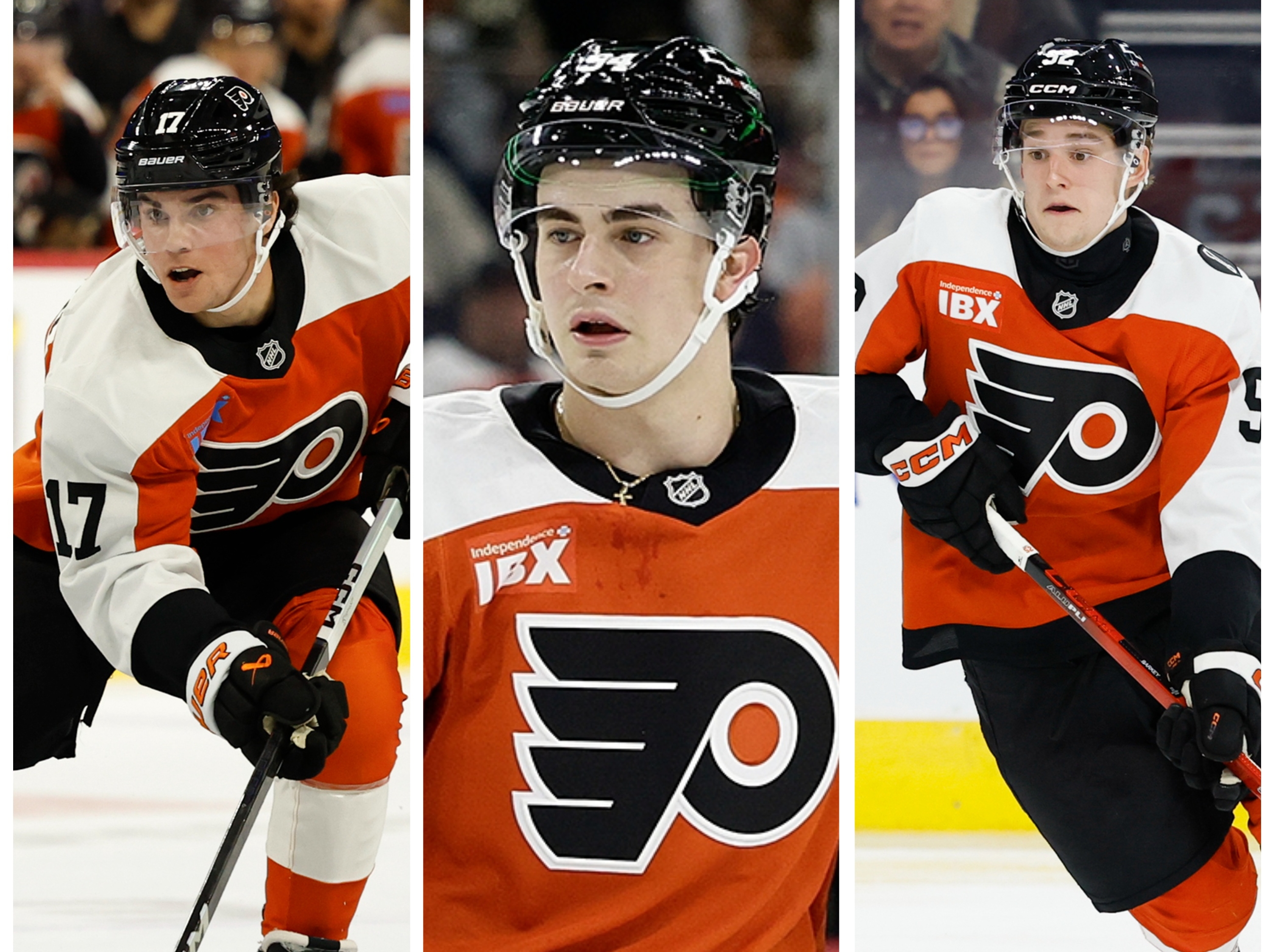
1. Porter Martone, RW, Flyers (NHL)
2025 rank: No. 1
There was some huffing and puffing when the Flyers did not take a center with the No. 6 pick in the 2025 NHL draft, but Martone, who will turn 20 at the end of October, quickly quieted the naysayers. The Calder Trophy betting favorite this year, Martone put together a dominant freshman campaign at Michigan State and made a scintillating NHL start last season. He tallied 10 points in nine regular-season games before adding five points, including two game-winning goals, in 10 playoff contests. A 6-foot-3, 208-pound winger, Martone brings size, strength, a big-time shot, playmaking ability, and an edge. He’ll play a significant role this season for the Flyers in the top six and on the power play.
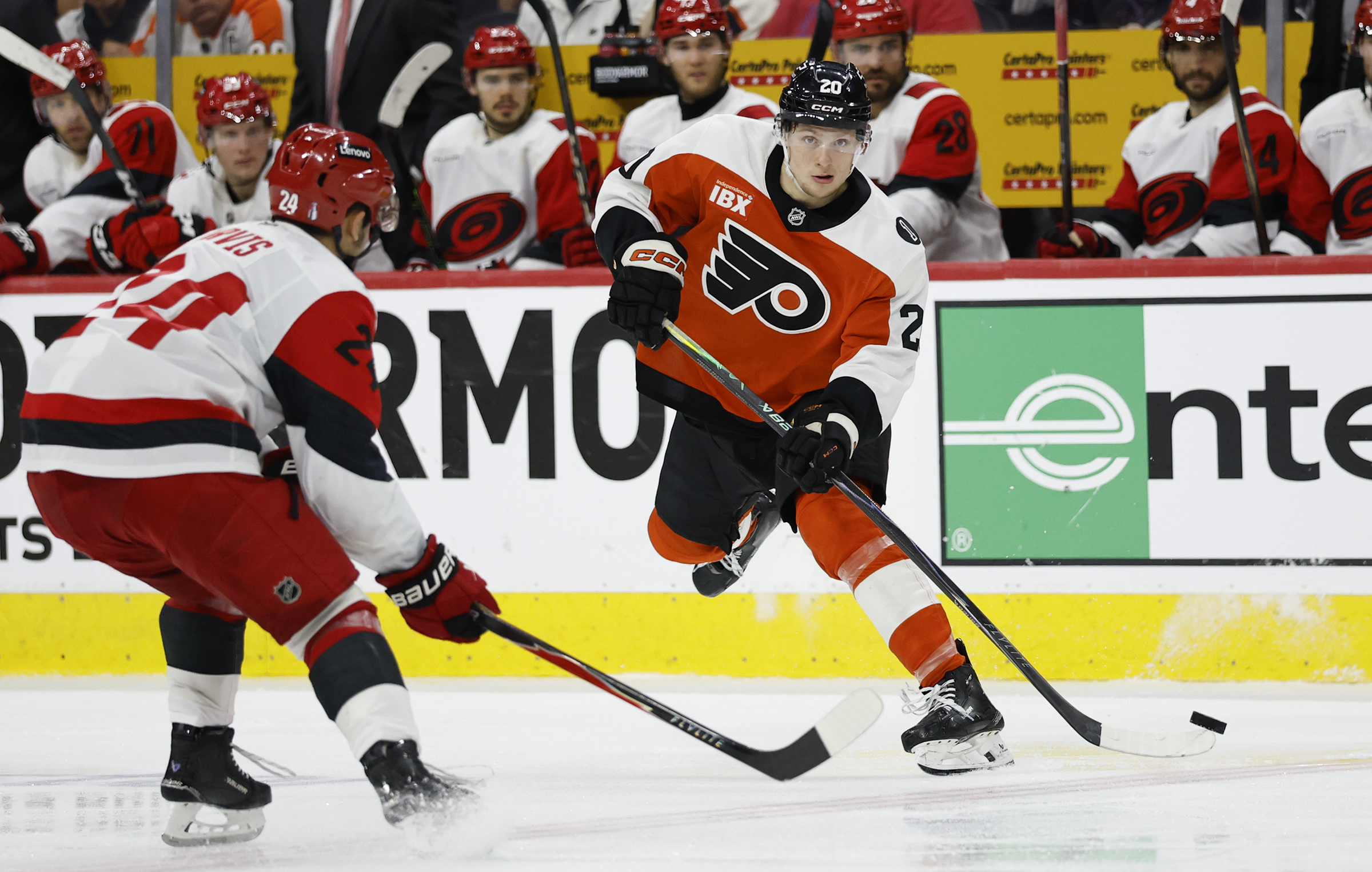
2. Denver Barkey, C/LW, Flyers (NHL)
2025 rank: 8
What a start to Barkey’s pro career. After just 26 games with Lehigh Valley of the American Hockey League, he found himself in the NHL and never looked back. The 21-year-old used his high-end motor and responsible 200-foot game to stake a spot in the lineup, and posted 17 points in 43 regular-season games. Although he only put up two points in 10 playoff games, the 5-9 winger stepped up in the postseason, showing his relentless play style and willingness to be aggressive on pucks despite his small frame, especially when called upon by coach Rick Tocchet in the second round of the playoffs to play center. Barkey played so well as a pivot that some are penciling him as a bottom-six centerman instead of a winger.
3. Alex Bump, LW, Flyers (NHL)
2025 rank: 2
Where Martone and Barkey go, so goes Bump, and the 22-year-old will round out the trio of expected NHLers at rookie camp. This was the consensus belief last year, but the winger fell short and started the year with the Phantoms. The difference now? Bump has learned what happens if he doesn’t showcase his innate high-end offensive attributes and goal-scoring prowess at camp, and now has a full year of pro hockey — and a taste of the NHL — under his belt. After being recalled following the trade deadline, the Minnesotan played 23 games between the regular season and playoffs, racking up seven goals, 11 points, and a team-best shooting percentage of 21.2%.
Flyers winger Alex Bump, 22, has one of the best releases in the system.Yong Kim / Staff Photographer
4. Oliver Bonk, RHD, Flyers/Lehigh Valley Phantoms (NHL/AHL)
2025 rank: 5
The top blueline prospect in the organization, Bonk showed why during his NHL debut in the Flyers’ regular-season finale and his lone postseason appearance. A well-rounded defenseman, Bonk notched his first career goal and assist in April and has the tools to be an everyday top-four blueliner in the NHL. “I think you just have to be confident and believe that you’re good enough to be there, because you are there, and that’s pretty much it for me,” he said of the experience. “Just kind of working on that and realizing that I’m a good player and I should be there.” Last season he sustained an injury early in rookie camp and didn’t suit up until December; this year, a healthy Bonk, despite a short September, should strongly push for a spot with the main club.
5. Jack Berglund, C, Färjestad BK (Swedish Hockey League)
2025 rank: 11
The Swede skyrocketed up the Flyers’ prospect depth chart this season with his impressive play in Europe, Allentown, and for his country at World Juniors, where he captained Sweden to its first gold since 2012 and was one of the tournament’s standout players. Berglund linked up with the Phantoms for five games at the end of the season, and while he will return to the SHL this season on loan, he left quite an impression. “He drove play, he was around the puck, and his ability to play below the dots with the puck is exceptionally good,” Phantoms coach John Snowden told The Inquirer in May about the 6-4, 217-pound center. “He understands how to use his body and his frame to get guys on his back and get out of situations.”
6. Jack Nesbitt, C, University of Michigan (NCAA)
2025 rank: 6
After a strong season with Windsor of the Ontario Hockey League in which he scored at a 1.05-point-per-game clip, Nesbitt is off to the University of Michigan this fall. Tall and lanky, Nesbitt said at development camp he gained 10-15 pounds after the season by hitting the gym, and the 6-5, 193-pound centerman should only get stronger with the college hockey schedule. He’ll need that extra muscle to play his game of driving to the net and creating time and space with his body. Nesbitt has nifty hands for someone his size and is a player the organization believes has a long runway to develop as he grows into his frame.
The Flyers have high hopes for towering center Jack Nesbitt.Monica Herndon / Staff Photographer
7. David Jiříček, RHD, Flyers (NHL)
2025 rank: NA
The upcoming season will be a big one for the 6-4 blueliner who is on his third team despite being drafted just four years ago. A coveted right-shot defenseman with size, puck skills, and a booming shot, Jiříček is a bit of a project but will likely get a chance right away this season at the NHL level since he is no longer waiver-exempt. He impressed with the Phantoms after being acquired at the trade deadline — getting a chance to play at all strengths — and made his Flyers debut in the season finale. The Czech defender is someone Snowden says has “all the tools” to transition to the NHL, and the expectation is his “absolute missile” of a shot will get a chance to bolster the Flyers’ dismal power play.
8. Maksim Sokolovskii, LHD, London (Ontario Hockey League)
2025 rank: NA
When the Flyers selected Sokolovskii 27th overall in June, it turned a few heads. But watching the 6-7 defenseman play the body and skate like someone a foot shorter at development camp, it showed why he may prove to be a steal. Sokolovskii is still growing into his game as a mean shutdown blueliner, but the upside is tantalizing. Now that he’s no longer constrained to focusing only on his defensive game, he’s already shown in preseason action for London that he has an untapped offensive side. The 18-year-old, who will be at rookie camp this week, also showed that his confidence has skyrocketed evidenced by his heads-up plays through the neutral zone and in the offensive end for the Knights.
Here is another view of Maksim Solokovskii’s 1st Assist Yesterday against Erie. What a skater he is. @Flyers_Clips
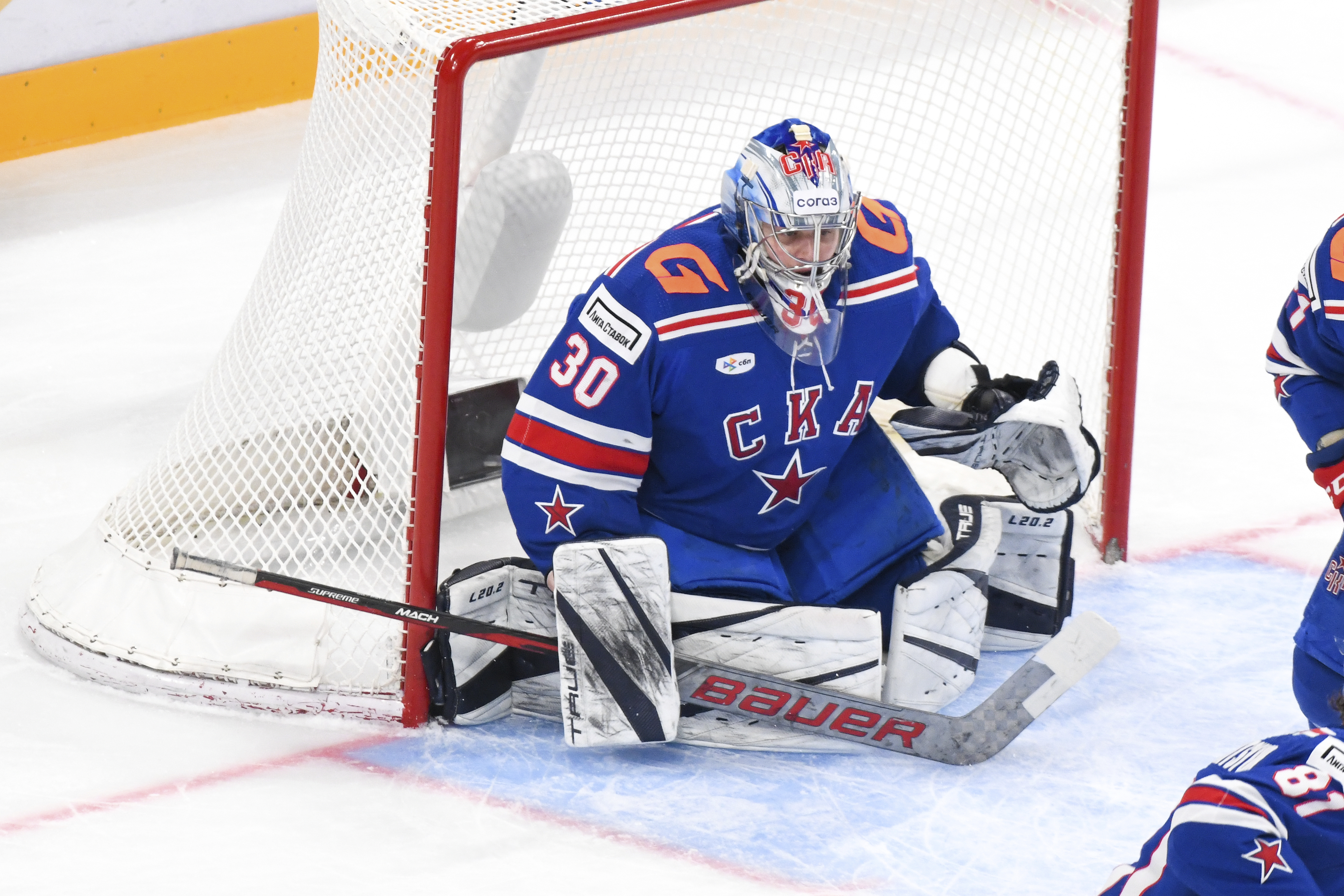
9. Yegor Zavragin, G, Metallurg Magnitogorsk (Kontinental Hockey League)
2025 rank: 4
When will Zavragin come to the U.S.? It likely won’t be any time soon, as the goalie’s contract was extended by a year when he was traded to Metallurg of the Kontinental Hockey League in June. Last season the netminder split time between the KHL and the VHL, Russia’s second-highest league, but this season he should stick in the top flight. Zavragin, 21, has posted a .918 save percentage in 56 career KHL games, and in his first start of this season with his new team, he stopped 16 of 17 shots in a 2-1 win.
Russian netminder Egor Zavragin is the Flyers’ No. 1 goaltending prospect.Sipa USA via AP
10. Carter Amico, RHD, Boston University (NCAA)
2025 rank: 13
If anyone on this list has made the biggest transformation in the past year, it is Amico. This time last year, the 6-5 defenseman was still rebuilding his game after suffering a broken kneecap that sidelined him for most of his draft year. This past season, he left Boston University halfway through to get more playing time with Muskegon of the United States Hockey League. After a productive spell with the Lumberjacks, the Maine native will rejoin the Terriers this season, and if what he showed at development camp this past summer with his smooth skating and ability to close is any indication, it’ll be a good year. “He looks like a different player; he really does,” BU coach Jay Pandolfo told The Inquirer in June. “It was great for him to go there [to Muskegon] and just find his game again.”
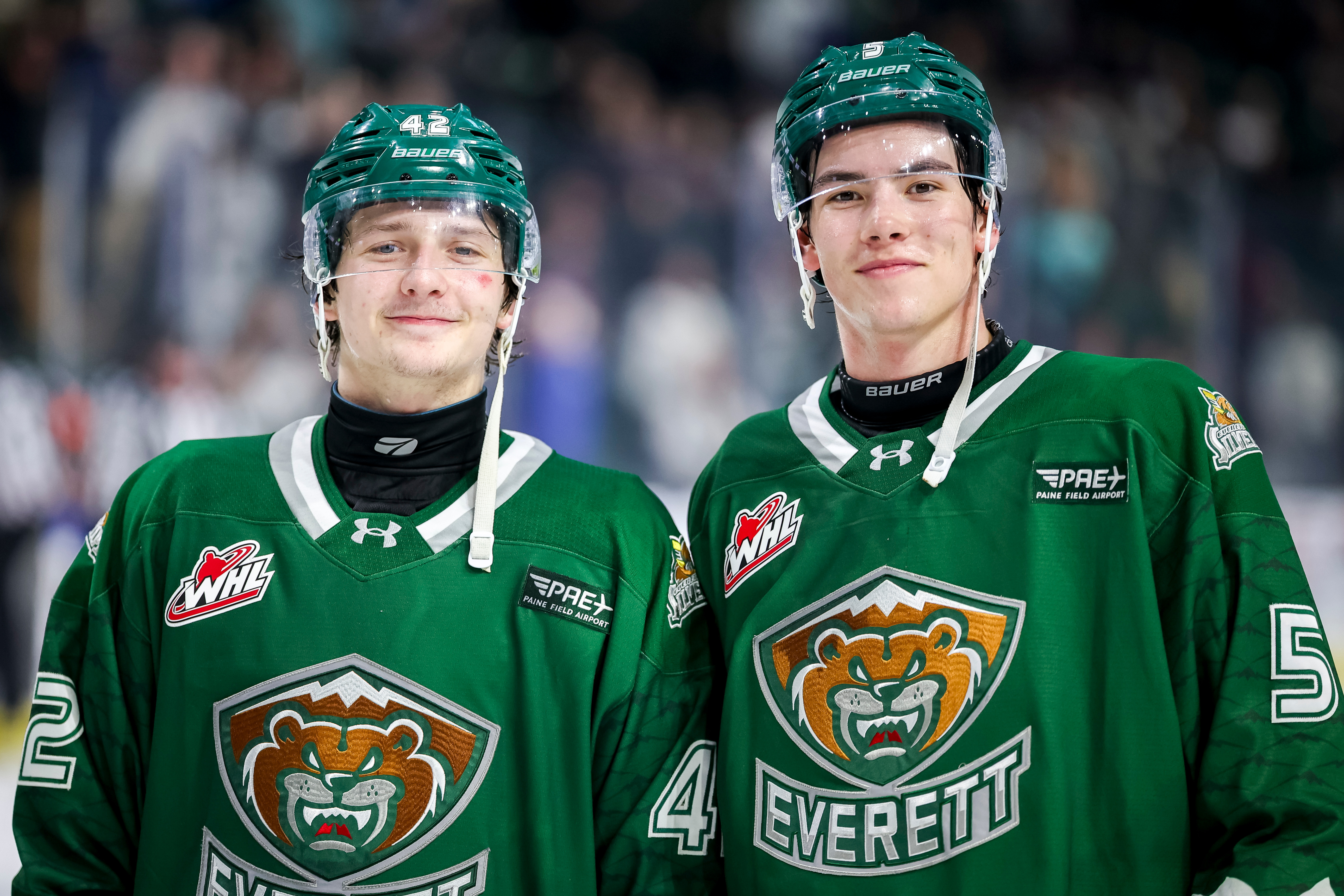
11. Brek Liske, RHD, Everett (Western Hockey League)
2025 rank:NA
Taken in the second round in June by the Flyers, Liske is a versatile, well-rounded defenseman who needs to keep building his game, and he will do so this year alongside fellow Flyers prospect Luke Vlooswyk with Everett of the Western Hockey League. The son of a diehard Flyers fan from Manitoba, Liske is a strong skater and plays with confidence and smarts in his own end while adding some offensive punch. According to Flyers assistant general manager Brent Flahr, “he’s got some swagger,” and it has shown on and off the ice, notably when he was elevated to the top pair alongside projected 2027 No. 1 pick Landon Dupont amid the Silvertips’ run to the Memorial Cup final.
Brek Liske (left) will team up with fellow Flyers prospect Luke Vlooswyk this season with the Everett Silvertips.Courtesy of Luke Vlooswyk
While Amico and Berglund may have risen several spots, Luchanko fell considerably after a disappointing year in junior in which he scored just seven goals. There’s no denying there is talent within Luchanko, notably his speed and hockey IQ, but it was a tough slog for the center who was traded from Guelph to Brantford in the OHL and played sparingly for Canada at World Juniors. Luchanko has played in nine NHL games (including playoffs) but has yet to notch his first point. Expected to be a full participant at the rookie and main camps after undergoing core muscle surgery in June, this will represent a big year for the 20-year-old as he looks to get back on the trajectory that made him a lottery pick in 2024.
After two disappointing seasons at the junior level, Jett Luchanko, 20, is entering a massive season for his development.Yong Kim / Staff Photographer
13. Spencer Gill, RHD, Phantoms (AHL)
2025 rank:7
Since getting drafted in 2024, the 6-4 Gill has dealt with several major injuries — a broken ankle two years ago with Rimouski of the Quebec Maritimes Junior Hockey League and a wrist ailment that required surgery last year with Blainville-Boisbriand — that limited his playing time. But now the 20-year-old will turn pro and is projected to spend this season with Lehigh Valley, where he can expand his 200-foot game and get acclimated to the speed of pro hockey. “I really love the way he was able to kill the play effectively in the D zone along the boards. Once he put his hands on someone, that player was not going anywhere,” Armada coach Alexandre Jacques told The Inquirer in June, noting the blueliner is good offensively at the blue line and [at] getting shots on goal “ … I think where he needs to improve to play at the pro level, and he knows it, is explosion of his first few steps backward and forward. So, if he’s able to improve that, which I know the Flyers have been working really hard with him … I think you can become a good player for the team.”
Projected to be a bottom-six forward, Ruohonen had a solid freshman season at Harvard, chipping in 19 points in 28 games while also playing for Finland — wearing an “A” — at World Juniors. A shutdown forward and pass-first center, he is hard on the puck and has started to sprout his wings offensively. It’ll be interesting to see how he does this upcoming season under a new coaching staff for the Crimson
15. Nikita Grebenkin, LW/RW, Flyers (NHL)
2025 rank: 10
The 23-year-old Russian spent his first full season in the NHL in 2025-26, serving as a pest and a powder keg regardless of where he slotted in the lineup. He scored his first NHL goal in an early-season nail-biter the Flyers won in overtime, finished with 14 points in 55 games, and dropped the gloves a few times in defense of his teammates. Grebenkin has an infectious personality, and it translates to the ice, making him invaluable on and off the ice. The winger suffered an upper-body injury in late March that kept him out of the lineup for the rest of the regular season and playoffs, but if he can bring some pop and energy this season, he could become a mainstay in the bottom-six.
16. Cole Knuble, C/RW, Phantoms (AHL)
2025 rank: NR
Despite being one of Flahr’s favorites in the system, the son of former Flyers forward Mike Knuble may not have drawn eyes in the past. But at this year’s development camp, the 22-year-old looked like a man on a mission to stand out. The forward, who has been playing more center, showed off his improved skating, a good motor, aggressiveness, high hockey IQ, and vision as he followed the advice from his dad: “He used to say, ‘If you have 12 eggs in your pockets, they should all be broken.’”
Cole Knuble is a prospect that the Flyers have long been higher on internally compared to the consensus rankings.Elizabeth Robertson / Staff Photographer
17. Carson Bjarnason, G, Phantoms (AHL)
2025 rank: 9
As Snowden put it, it was a roller coaster season for the goalie who made the jump to the pros and suited up for the Phantoms for most of the season — he had a short stint in Reading of the ECHL — and posted 14-11-3 with a 3.43 goals-against average and .877 save percentage. A confident kid who should hit the ground running in Year 2, he will split this net in Allentown with Aleksei Kolosov. “It’s a good league, and you can’t guess; you have to understand the situations, and I thought he had a little bit of a stretch where it became pretty hard for him,“ Snowden said. ”But Brady [Robinson, Lehigh Valley’s goaltender development coach] did an incredible job with him, continuing to push him and teach the moments of where we’ve got to clean up.”
Another player who has snuck up the rankings is Quinn, who is coming off a 73-point season with the Remparts. He had 25 points on the power play and was tied for 10th in goals (34) and 17th in points in the QMJHL. Former Flyers forward Simon Gagné, who is now the general manager for Québec, expects a big year from the 5-11, 184-pound center he calls a force before he heads off to Northeastern University for 2027-28. “Quinners, more, maybe I’m going to say more passer … [but] he could surprise you,” Gagné told The Inquirer in June. “He’s got a really, really good wrist shot. He knows how to score a goal as well. He’s really a skilled player, really good high IQ, and is flying on the ice.”
19. Ty Murchison, LHD, Phantoms (AHL)
2025 rank: NR
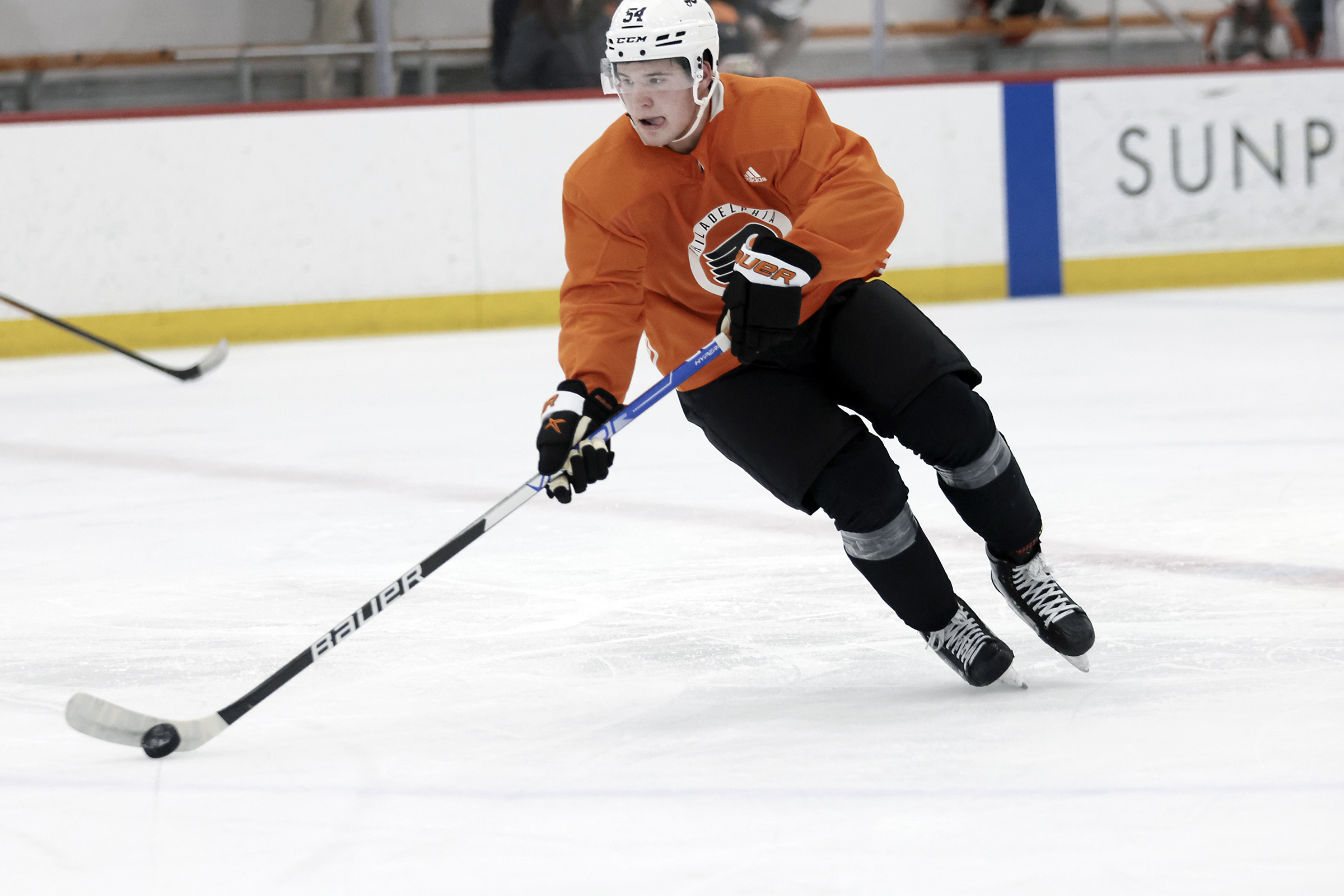
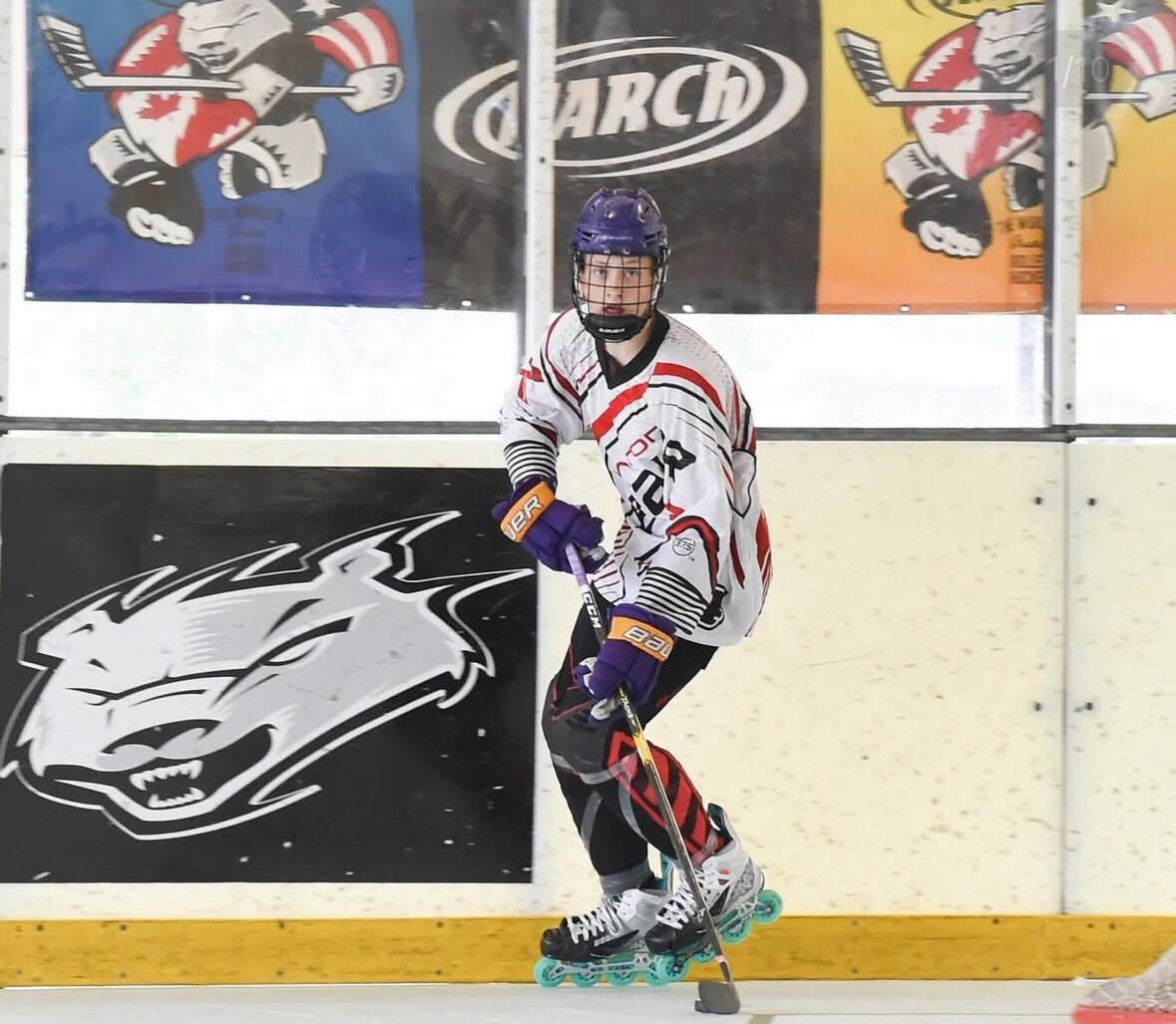
Murchison hasn’t been quiet about his growth this past year. In his first full season in the pros — it lasted only 32 games due to an upper-body injury — he left impressions across the organization. So much so that in December he made his NHL debut and stuck around for three games, skating an average of 15 minutes a night. At 6-2, he plays a big, physical game while also being efficient with the puck, and is a strong skater despite a late start on the ice because he was a roller hockey player in his youth. “I think Ty Murchison is a guy you should keep on the radar,” Snowden said. “Obviously, an injury shortened his season, but he was trending in an incredibly good direction.”
Before transitioning to the ice, Ty Murchison got his start on rollerblades.Courtesy of Murchison family
20. Jack Murtagh, C/LW, Boston University (NCAA)
2025 rank: 12
Like most true freshmen, Murtagh struggled to find his footing in college hockey going up against bigger, stronger players. The Upstate New Yorker called his season at BU “a little bit inconsistent” and a “little bit rocky.” He learned he cannot take a single shift off, and the expectation is that the 6-1, 198-pound forward will put up more than the 11 points in 35 games he managed last season. “He needs to be consistent, shift after shift, game after game, like those are the big things for younger players, just learning to be consistent in everything you do,” Pandolfo said. “ … That’s the one thing that he’s gotten better at over the course of the season, and we expect him to have a really big jump in his play coming into his sophomore year.”
10 more to watch (alphabetical order)
Alex Čiernik, LW, Phantoms (AHL), Matthew Gard, C, Seattle (WHL), Max Laatikainen, RHD, Sport (Finnish Liiga), Ilya Pautov, LW, TBD, Noah Powell, RW, Phantoms (AHL), Martin Psohlavec, G, Saskatoon (WHL), KJ Sauer, C, Edmonton (WHL), Max Westergård, LW, Frölunda (SHL), Shane Vansaghi, RW, Michigan State (NCAA), and Luke Vlooswyk, RHD, Everett (WHL)
As he commuted from South Jersey into Philadelphia on the afternoon of Sept. 11, 2001, Hugh Douglas kept glancing at the skies.
“I remember driving across the Ben Franklin Bridge, I was looking in the air for those planes. You know, the next planes,” Douglas said. “Because that bridge is the biggest way into Philly, and I thought they would attack that next.”
Douglas, then a star defensive end for the Eagles, was driving to the practice facility, summoned for a team meeting to address an emergency. By then, of course, the skies were empty. The FAA had closed U.S. airspace at 9:42 that morning, and by 12:15, only birds flew over America.
Terrorists had hijacked four commercial flights that brilliant Tuesday morning and turned them into missiles.
At 8:46 a.m., American Airlines Flight 11 crashed into the 92nd floor of the World Trade Center’s north tower. At 9:03 a.m., United Airlines Flight 175 crashed into the south tower. At 9:37 a.m., American Airlines Flight 77 crashed into the Pentagon. At 10:02 a.m., after a struggle between heroic passengers and hijackers, United Airlines Flight 93 crashed into an empty field in Shanksville, Pa., 200 miles west of Philadelphia.
Nearly 3,000 people died as a result of the attacks, still the largest death toll of any terrorist attack on U.S. soil. It stunned the world, and it left the nation shocked and terrorized, and it left the sporting world in turmoil.
Douglas had just turned 30. In his lifetime America had seemed invincible. Impenetrable. It was, by far, the most traumatic event he’d known.
“I thought it was the end of days,” Douglas said.
He was not alone.
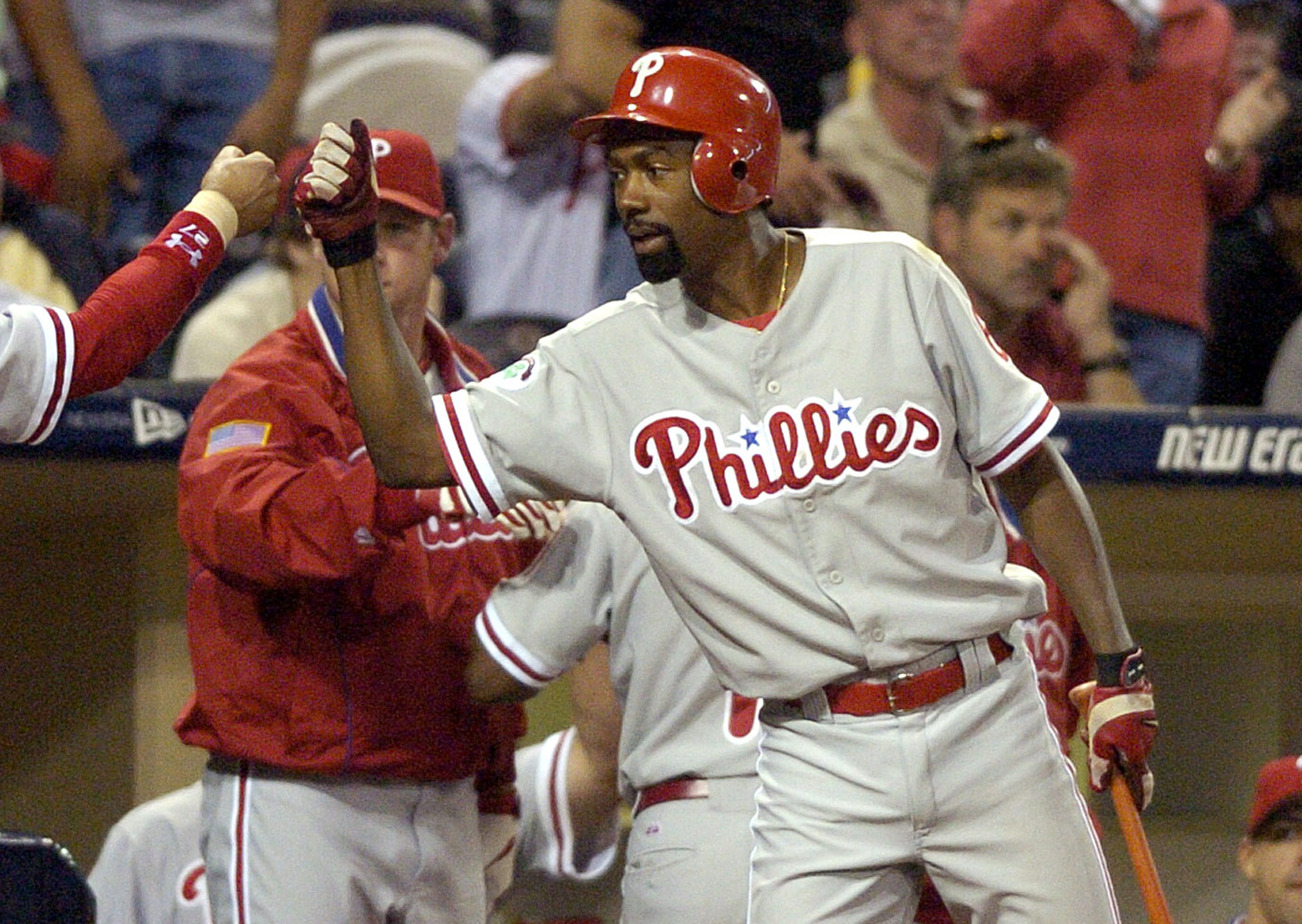
Phillies center fielder Doug Glanville is a year older than Douglas. He grew up in Teaneck, N.J., less than 20 miles from what became to be known as Ground Zero, where the towers collapsed. He’d visited the towers frequently as a boy.
On 9/11, Glanville was with the Phillies in Atlanta, preparing for an important series against the Braves. When he heard that the terrorists targeted sites beyond New York, he worried about what might come next, and whether ballparks and stadiums were vulnerable.
Doug Glanville, here in a 2004 game in San Diego, played six seasons with the Phillies.DENIS POROY
“We didn’t know what imminent threats were still there. We heard that they might attack Atlanta,” Glanville said.
That worry persisted even when games resumed six days later, and beyond.
“You felt like, if you were in a stadium, you were a target.”
‘I thought it was a movie’
Douglas learned of the attacks from the movers helping him settle him and his wife at the time, Simona, into their town house in Marlton, N.J.
“They blew up the tower,” one mover told Douglas. He wasn’t quite sure what the guy meant. The cable company hadn’t arrived yet, so the mover began to jerry-rig an antenna onto a television. Before he finished, another mover, still listening, announced, “They hit the other tower.”
Finally, a fuzzy image appeared on the screen, the towers burning. A few minutes later, at 10:28, the north tower collapsed.
Glanville had much better reception.
Baseball players are a nocturnal breed, but Glanville is one of the few who relishes a hearty breakfast. Also, he’s a reader — he has an engineering degree from the University of Pennsylvania — so he rarely turns on his hotel TV.
“There aren’t a lot of players who get up that early, except Kevin Jordan. So I go out of my room, get in the elevator, and Nina Jordan’s there, Kevin Jordan’s wife,” Glanville said. “I’m, like, ‘Good morning,’ with a smile. She’s like, ‘They hit the towers.’ ”
Glanville flashed back to Feb. 26, 1993, when terrorists attempted to take down the north tower with a car bomb. They failed. Seven people died. Glanville assumed this was similar.
“The first thing I thought is, ‘Oh, again?’ ”
Not exactly.
“We were in CNN country, so I came out of the elevator, I saw banks and banks of TVs,” Glanville said. “And then, of course, we were just, like, locked in.”
Phillies manager Larry Bowa wasn’t watching TV in his room, either, but, with a teenage daughter, he always kept his phone close. When it buzzed that morning and he saw her number he was concerned, of course, but not as concerned as he soon would be.
“She said, ‘Did you see the TV?’ And I said, ‘No.’ She says, ‘Turn it on,’ ” Bowa said. “And when I turned it on, I thought it was a movie.”
‘We took a vote’
What happened in the next couple of days is a blur for most of us who lived through 9/11, and most of us weren’t star entertainers and their bosses walking the thin line of propriety.
Would baseball be played Tuesday night? Would baseball or football, either college or pro, be played on the weekend?
Flights resumed sporadically just two days after the attacks, but it was about a week before air travel resumed full throat. The Eagles and the rest of the NFL hunkered down.
“We knew pretty quick we weren’t going to Tampa that weekend,” Douglas said. “So we just practiced. And it was weird, right? You get planes flying over South Philly all the time, because the airport is so close. There were, like, no planes that week.”
It was as if everyone held their breath, just as they’d done after President John F. Kennedy was assassinated in November 1963, which paused most of college football and briefly paused the NBA and NHL.
“Nobody knew what was the right time,” Bowa said. “Some people were saying they might cancel the whole season.”
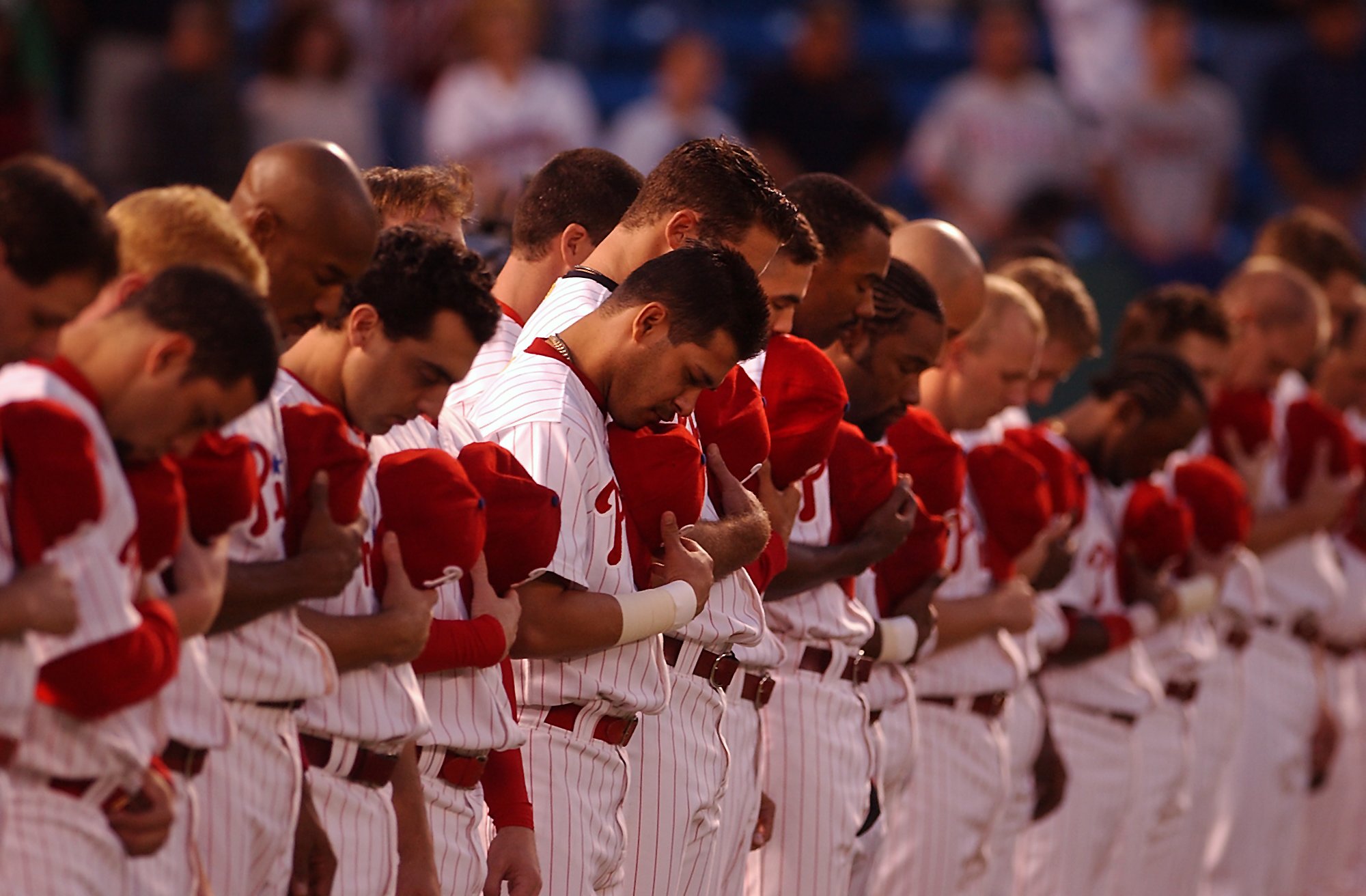
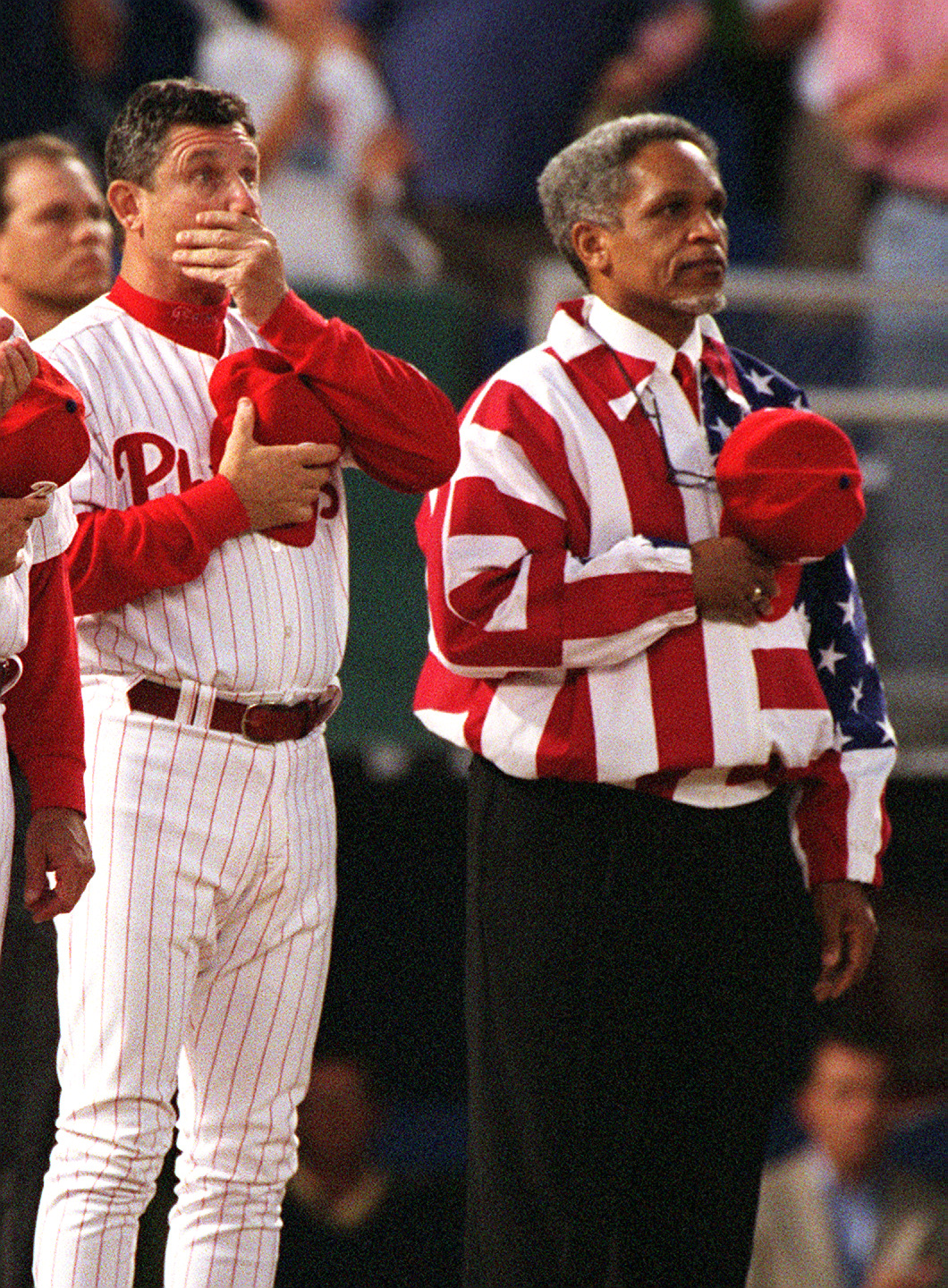
Phillies manager Larry Bowa wipes his face standing next to Philadelphia Mayor John Street during a moment of silence before the Phillies-Braves game on Sept. 17, 2001 at the Vet.D
As it turned out, baseball games resumed Sept. 17. The Expos hosted the Marlins with the first pitch thrown at 7:10 p.m., so baseball officially resumed first in Canada. But the Braves visited the Phillies and the Mets visited the Pirates, and both games went off at 7:19 p.m., so Pennsylvania co-hosted the return of America’s game in America.
‘We took a vote’
Getting from 9/11 to 9/17 was quite a journey for the Phillies.
Games were suspended immediately, but MLB dithered regarding when they would resume. The Phillies spent three days in Atlanta, then decided to bus to Cincinnati, where they were scheduled to play over the weekend. They were outside of Knoxville, Tenn., when they heard that those games might not happen, either.
What now?
They pulled the two buses into a rest stop. Players disembarked to try and get cellphone reception, which was poor on the buses, and check in with their families. At that point, mild chaos ensued.
Should they reroute to Philadelphia? Should they return to Atlanta, where flights would be easier to arrange? Should they just continue to Cincinnati and maybe ride out the weekend?
They couldn’t take the buses to Philadelphia because the bus driver had logged too many hours.
“We took a vote,” Glanville said. “It was everybody, 40 or whatever, to 2. And the two were Bowa and (reliever) Dennis Cook, and Cook lived in Atlanta.”
So, on to Cincinnati, where they discovered those games were, in fact, postponed. Inimitable traveling secretary Frank Coppenbarger, now retired, wheedled a chartered plane for the next day. The Phillies were home for supper on Sept. 15.
MLB delayed the playoffs for a week. The Phillies made up the postponed games in Atlanta and Cincinnati after the regular season ended. Like their NFL counterparts, they played the rest of the season in a daze of heightened security and heightened anxiety.
‘A sense of pride’
NFL players were used to being treated like royalty on their charter flights to games. A week and a half after 9/11, they found out what it was like on tarmacs in countries where terrorism is a constant threat.
“We used to just park our cars at the facility, get on a bus, ride to the airport, get off, and walk right on the plane,” Douglas said. “Now, you went to the airport, man, and everybody was on high alert. There’s guys with machine guns or whatever, there’s tons of security. Even on the plane. And you had to watch your mouth.
“I went to the bathroom and came back and told the fellas I blew it up,” he recalled, and was quickly admonished by security. “Yeah, you couldn’t say you ‘blew up the bathroom’ anymore.”
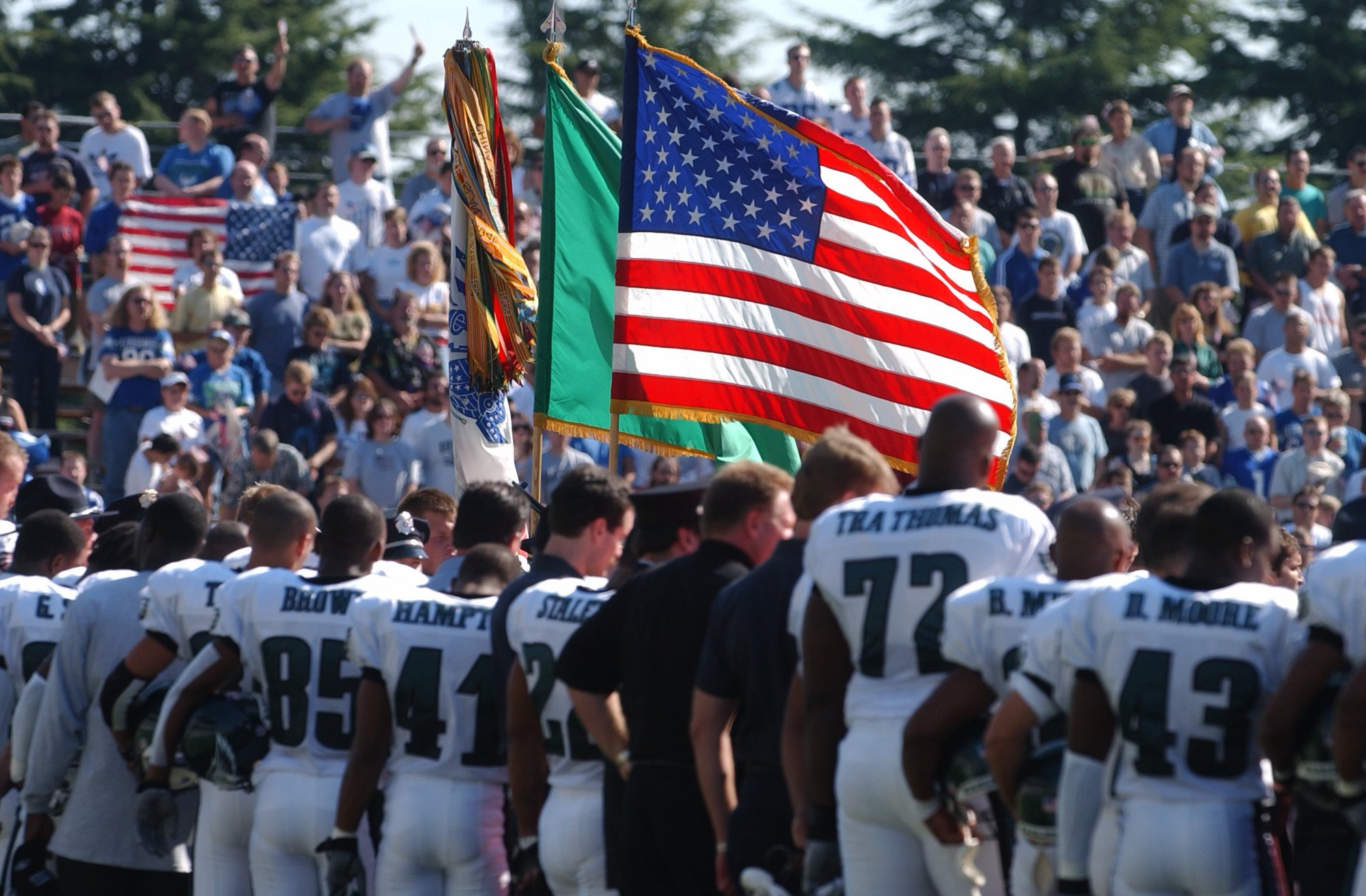
Eagles players line up during pregame ceremonies before the Eagles-Seahawks game on Sept. 23, 2001, the teams’ first game after the attacks.Ron Cortes / Staff Photographer
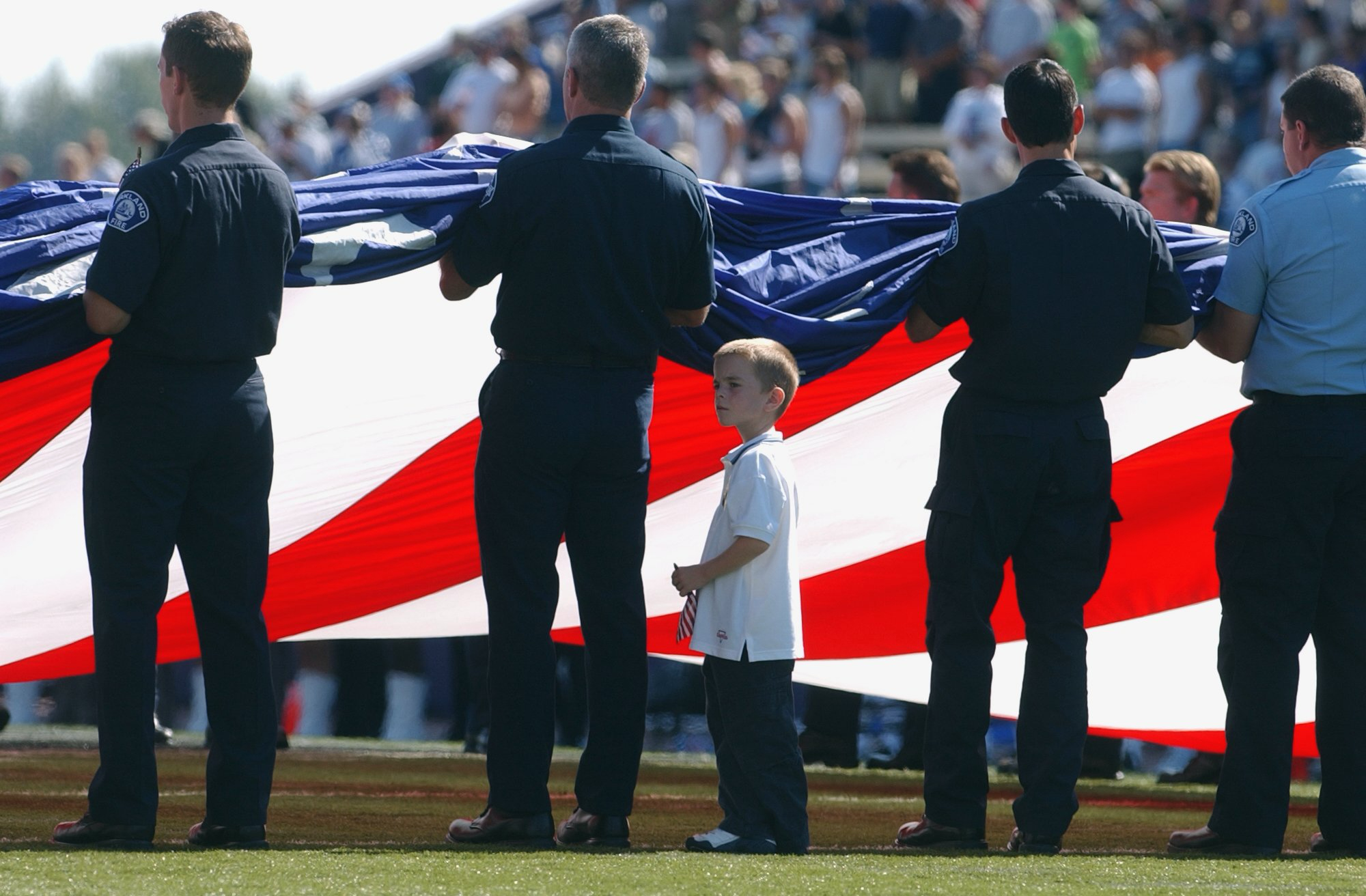
As with MLB, NFL playoffs were delayed by a week, so the Eagles made up their postponed game at Tampa in January after their final scheduled game of the regular season. Their first game after the attacks was in Seattle, where they played the Seahawks at the University of Washington stadium while their new stadium was being built. As in many stadiums that day, the pregame national anthem was performed as a giant flag that covered the entire field.
Who held it? Douglas, his teammates, and his coaches joined their counterparts from the Seahawks and dozens of first responders. Douglas had a hand on that flag, and he remains moved by that ceremony to this day.
“Just, I don’t know,” Douglas said. “Just a sense of pride.”
A giant American flag covers the field before the Eagles-Seahawks game at the University of Washington stadium during pregame ceremonies on Sept. 23, 2001.Ron Cortes / Staff Photographer
‘Tip your cap’
Pride: That’s what Bowa felt on Sept. 17. He’s proud that Philadelphia, the cradle of American democracy, was part of the return to sport. He’s proud that the franchise he played for and managed was, with the Pirates, the first team in the U.S. to resume, and he’s proud that baseball, America’s game, was the first front-line sport to restart.
Bowa is a hard man, but he understood the situation. He held a team meeting before the game and told the players that anyone who didn’t feel like playing didn’t have to; he understood. No takers.
The pregame left Bowa and Glanville shaken. As late Phillies broadcaster Harry Kalas delivered a moving pregame address to viewers, a montage compiled by “Video” Dan Stephenson helped settle the 27,910 fans at Veterans Stadium into their seats.
“People were in tears over that,” Glanville said.
It was the music that got to Bowa. He’d served in the U.S. Army Reserve as a young man, and his patriotism runs deep.
First, he recalled, there was Lee Greenwood’s “God Bless the USA” Then, right before the first pitch, with the teams lined up on the baselines, came “God Bless America” and the national anthem, performed back-to-back by — who else? — the star-spangled Valley Forge Chorus.
Phillies ace Robert Person went eight innings, gave up two runs, Jose Mesa got the save, and the Phillies won, 5-2, and drew to within two games of the Braves in the National League East.
Who’d they beat?
Braves legend Greg Maddux.
Glanville got a hit, Pat Burrell got two, rookie All-Star Jimmy Rollins scored a run, and MVP candidate Bobby Abreu tripled. But all of them — Person, Mesa, Glanville, Rollins, Abreu — they were just co-stars.
Nobody in baseball met the moment like Scott Bruce Rolen.
Chipper Jones’ homer gave the Braves a 1-0 lead in the first inning, but Rolen tied it with a leadoff homer in the second. He drove in Abreu from third base in the fourth for a 2-1 lead.
Then, with two out in the bottom of the sixth inning, Rolen homered again. The Phillies led, 3-2. The Vet rocked and rolled as Rolen returned to the dugout and, as ever, humbly took off his helmet. The crowd was nearly tearing the old stadium down, begging for a curtain call, but that just wasn’t the sort of thing Rolen did. Ever.
Bowa called Rolen over.
“Scotty,” he said, “you got to go out and tip your cap.”
Rolen replied, “Well, you know I don’t do that.”
“Scotty,” Bowa said, “this is something different.”
If it weren’t for Abbott Elementary, longtime TV director Randall Einhorn thinks he probably would’ve retired by now.
After decades working behind the camera on essential sitcoms like The Office, It’s Always Sunny in Philadelphia, and Parks and Recreation, Einhorn could’ve stepped back from the industry — but then he met Quinta Brunson. The West Philly comedian approached him for the Abbott Elementary pilot in 2021 because she was such a big fan of his Scranton-set hit. Einhorn quickly realized Brunson and her show were special, so it was easy for him to say yes.
“From the day we started filming the pilot, it just felt right. It always felt right,” said Einhorn, 62, who also serves as an executive producer on Abbott.
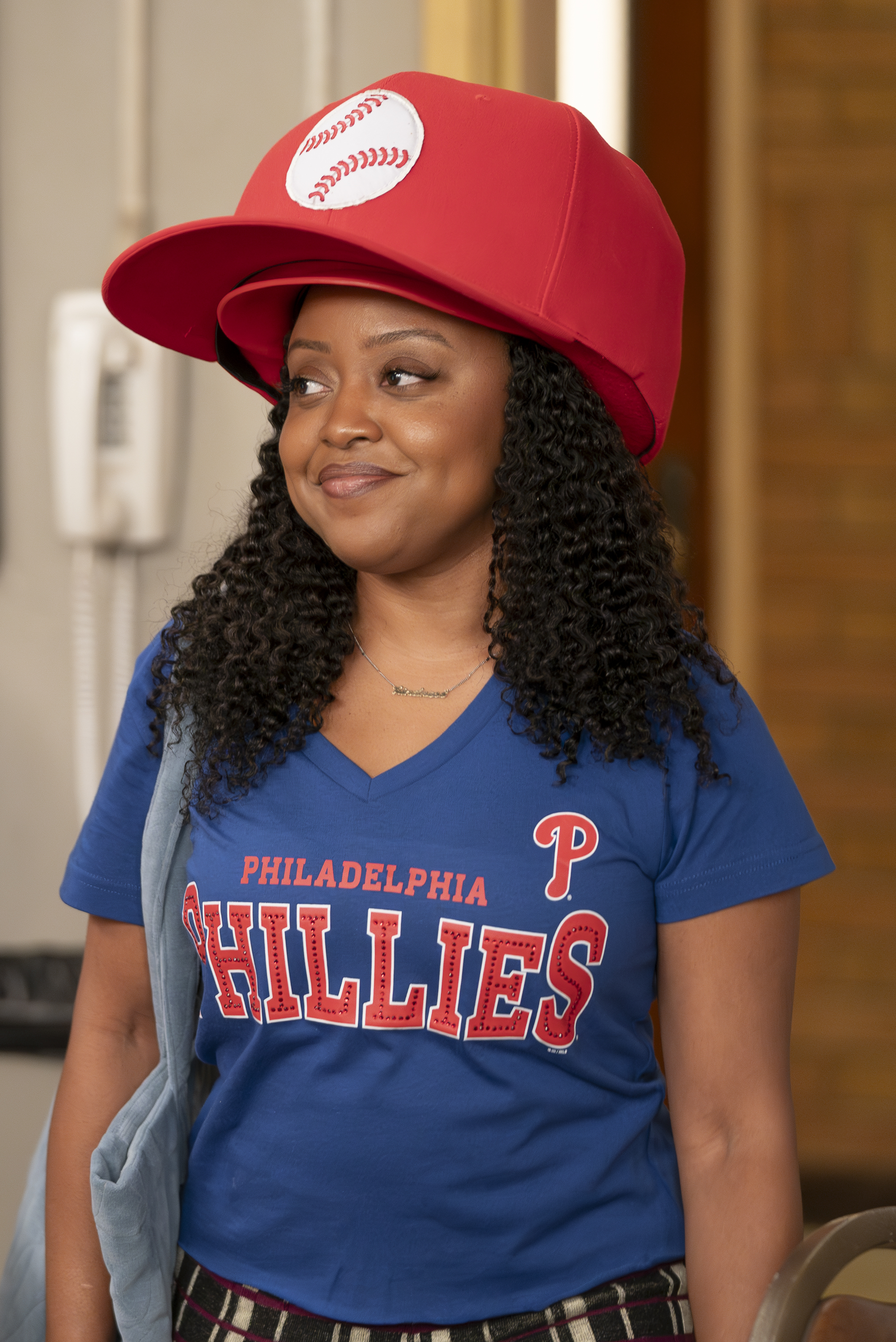
Janine (Quinta Brunson) gets ready for a Phillies game in “Abbott Elementary.”Disney/Gilles Mingasson
Now the beloved comedy has become an Emmy Awards darling and is about to premiere its sixth season this fall. Its fifth season alone is up for seven Emmys at the ceremony on Sept. 14. Einhorn is a nominee for outstanding directing for a comedy series, marking his second nod in that category for Abbott Elementary (he was also previously nominated for cinematography on Survivor).
Einhorn received the recognition specifically for his ambitious work filming the “Ballgame” episode during a Phillies game at Citizens Bank Park in August 2025.
Phillies fans remember it as the night Kyle Schwarber hit four home runs, making baseball history and leading the team to a 19-4 victory over the Atlanta Braves. After the field cleared, Schwarber joined the Abbott Elementary cast to film his guest appearance.
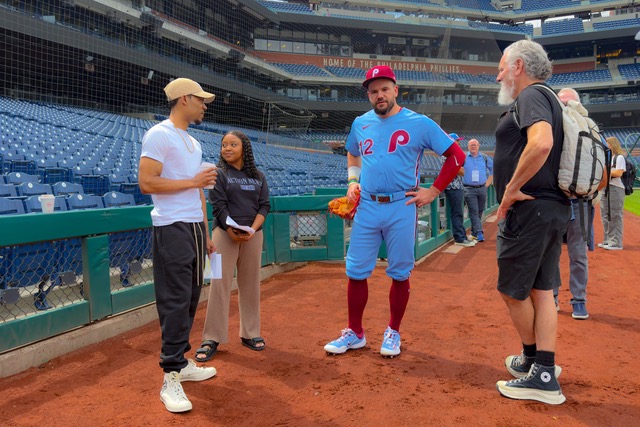
“Abbott Elementary” actors Tyler James Williams (Gregory Eddie) and Quinta Brunson (Janine Teagues) chat with Phillies star Kyle Schwarber and director Randall Einhorn at Citizens Bank Park in August 2025.Louie Escobar
“What a great dude! He had all the time in the world for us, and he was tremendous,” said Einhorn. “Nobody expected Kyle Schwarber to hit four home runs … there’s no type of energy like that. You can act that energy, but also you can’t. We fed off of that energy, which I think was really, really fun.”
As exciting as the game was, the Abbott cast and crew had already been at Citizens Bank Park for days leading up to the live event so they could capture the scenes with dialogue. That meant bringing in some 400 local background actors to play Phillies fans as well as roughly 200 workers from the Phillies and Aramark to staff the ballpark.
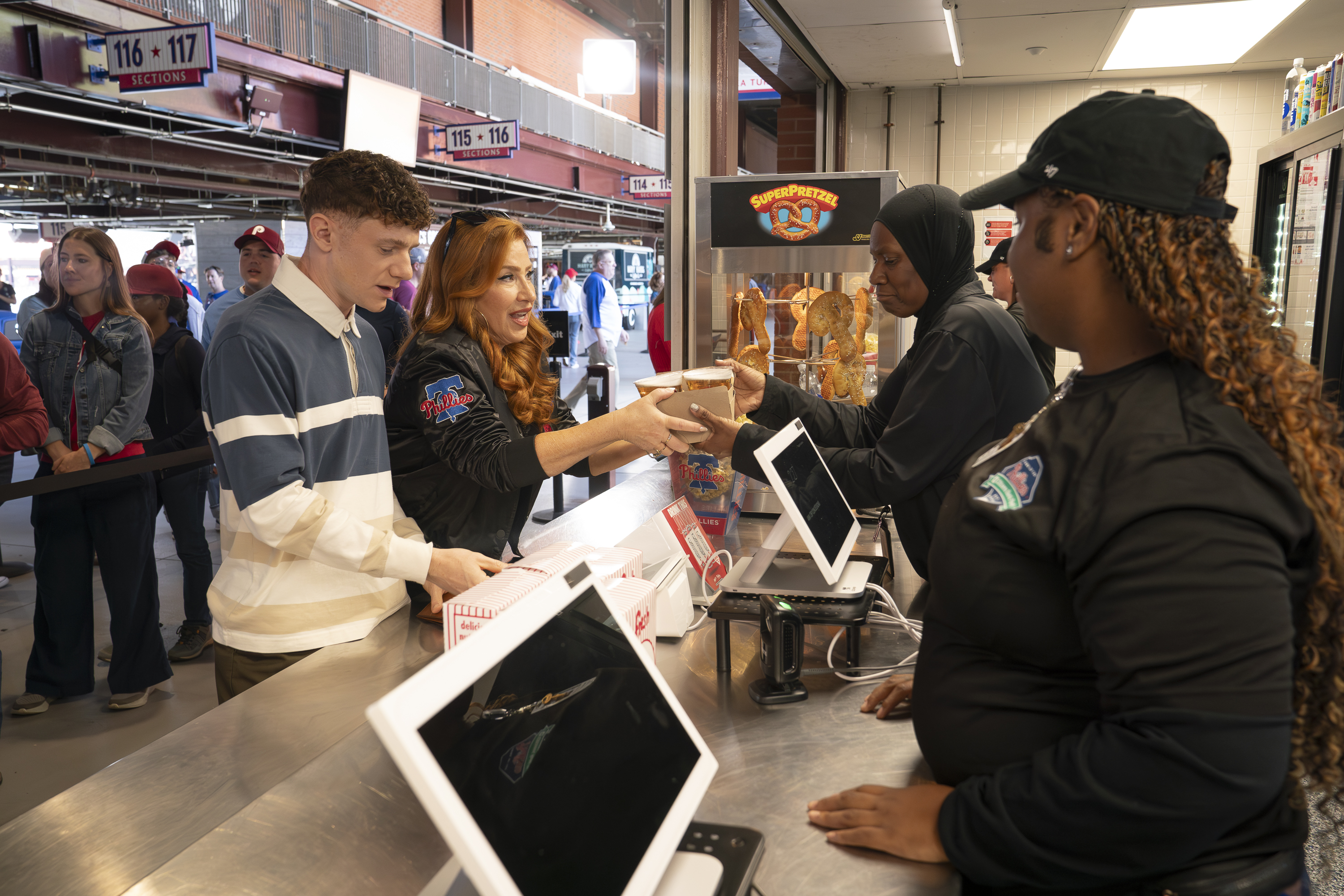
Jacob (Chris Perfetti) and Melissa (Lisa Ann Walter) at a concessions stand at Citizens Bank Park in the “Ballgame” episode of “Abbott Elementary.”Disney/Gilles Mingasson
The complicated logistics required precise coordination between the Abbott crew and cast, the Phillies staff (especially those behind PhanaVision), and Major League Baseball. Einhorn’s biggest challenge was ensuring that the dialogue scenes matched up with the baseball action and vice versa. That meant carefully plotting the camera’s focus to whip between the actors, the field, and the PhanaVision screen. The 14-page script had more than 70 instances of “whip offs and whip ons,” according to Einhorn.
“I had to have this really meticulous plan to connect the game day to dialogue day, which were two separate days. That was quite complex, I mean, I’ve never had so many notes to myself in the margins of, ‘Don’t mess this up, Randall,’” the director said. “I really enjoy something with a high degree of difficulty because once you stick the landing, it’s just so rewarding.”
The teachers from “Abbott Elementary” captured on PhanaVision at Citizens Bank Park.Disney/Gilles Mingasson
Serendipitously, Brunson and her fellow writers had already planned to feature Schwarber as a guest star before he made baseball history as the 21st player in MLB history to hit four home runs in one game. (A diehard Phillies fan, Brunson was thrilled to meet Schwarber — and the Phanatic, of course — for the special opportunity to spotlight Philly’s robust sports culture; she called the episode a “complete fan service.”)
The Abbott team developed contingency plans to ensure that they’d capture at least one Schwarbomb for the show — even if they had to cheat it by filming a Schwarber hit and panning to another ball soaring in the sky — but that night, those plans were totally unnecessary. The episode, which aired on Oct. 15, wound up including multiple Schwarbombs.
“The camera operators did just spectacular work … the more times [he hit], the better we got at filming it,” said Einhorn. “It’s amazing how much of the show was from game day footage and our cast reacting to it.”
As Einhorn and the Abbott team prepare for the Emmy’s red carpet, Schwarber has continued to deliver wow-worthy performances on the field. If Einhorn’s “Ballgame” episode wins the Emmy, Schwarber will have one more thing to celebrate.
The 78th annual Primetime Emmy Awards will air 8 p.m. Monday, Sept. 14, on NBC.
Jonathan Altshul started this week as the new manager of Cheltenham, an ethnically and economically diverse township of about 38,000 people divided into historic neighborhoods like Elkins Park, Wyncote, and Laverock.
As he gets down to work on the township’s biggest priorities, including revamping facilities and boosting the tax base, Altshul wants to hear from them all, he said in an interview.
“That’s what we sign up for as municipal managers,” said Altshul, who will receive an annual salary of $225,000. “How do you get people with different viewpoints, different walks of life, to come to the table?”
It is a skill he mastered growing up as one of seven kids, Altshul said — “trying to make sure your voice is heard while respecting there’s also six others of you in the house.”
One of his first priorities is improving Cheltenham’s facilities — some of which are century-old relics of the township’s past as a playground for the wealthy.
“We are facing aging facilities and aging infrastructure,” Altshul said, and part of his job will be addressing that to attract new residents and businesses.
He hopes to do so while “holding the line on tax increases as much as possible,” Altshul said. Cheltenham residents — who are the most property tax-burdened in Montgomery County — “have high expectations about the services that they receive, so there’s not, generally speaking, a whole lot of fat to cut.”
In tackling the building challenges, Altshul’s penchant for hard conversations may be crucial. Township officials in recent years have discussed the possibility of closing facilities, raising worries from some residents in neighborhoods that stand to lose amenities.
Two community centers — La Mott and Rowland — have been largely closed to the public for several years, and renovation plans have been confirmed only for La Mott.
Adding to Cheltenham’s infrastructure challenges is the tax base itself. The township has less commercial space than nearby towns, but a larger proportion of institutional land, according to its recent comprehensive plan. Institutional land typically includes churches, universities, and hospitals that may not pay property taxes.
Encouraging those entities to pay fees in lieu of property taxes may be part of the solution, Altshul said. He plans to take a pragmatic approach.
“There are no silver bullets with public finances,” Altshul said. “It’s just listening and rolling up sleeves, getting your hands dirty, and thinking through problems.”
It is the kind of work that led Altshul to public administration in the first place: He got a graduate degree in public policy and finance, taking federal and county-level government jobs in the Washington area before moving to Chester County to work in local government.
His last job stint — two years as a suburban township manager — took him back to his native Connecticut while he helped his widowed father with a life transition, but his “heart is in the Delaware Valley,” Altshul said. “I raised my kids here.”
That is why he takes seriously the emotional and financial investments Cheltenham residents have also made, Altshul said:
“We’re talking about home.”
This suburban content is produced with support from the Leslie Miller and Richard Worley Foundation and The Lenfest Institute for Journalism. Editorial content is created independently of the project donors. Gifts to support The Inquirer’s high-impact journalism can be made at inquirer.com/donate. A list of Lenfest Institute donors can be found at lenfestinstitute.org/supporters.
Chiles en nogada, no matter who makes them, are visually arresting dishes. They’re distinctive for their colors: a base of a deep green poblano pepper, a blanket of creamy white walnut sauce (the titular nogada), traditional pops of red from fresh pomegranate seeds, and a sprinkling of more green from parsley. These components represent the colors of the Mexican flag. The poblano is stuffed with picadillo, a mix of ground meats and fruits that marry savory and sweet flavors and can often be time-consuming to prepare.
Chiles en nogada season is fleeting, lasting just two to six weeks in late August and early September, when the dish’s main ingredients — poblanos and walnuts — are aligned and in season, along with the apples and peaches that are also at peak ripeness in Puebla, where the dish originated.
In Mexico, chiles en nogada has become a national dish, treated with great reverence and ceremony. At fine-dining establishments in Mexico City, diners can select which poblano they’d like stuffed, just as one might select a fish from a tank to be cooked. But you don’t have to go to Mexico to eat it — there are several excellent versions found in Philadelphia.
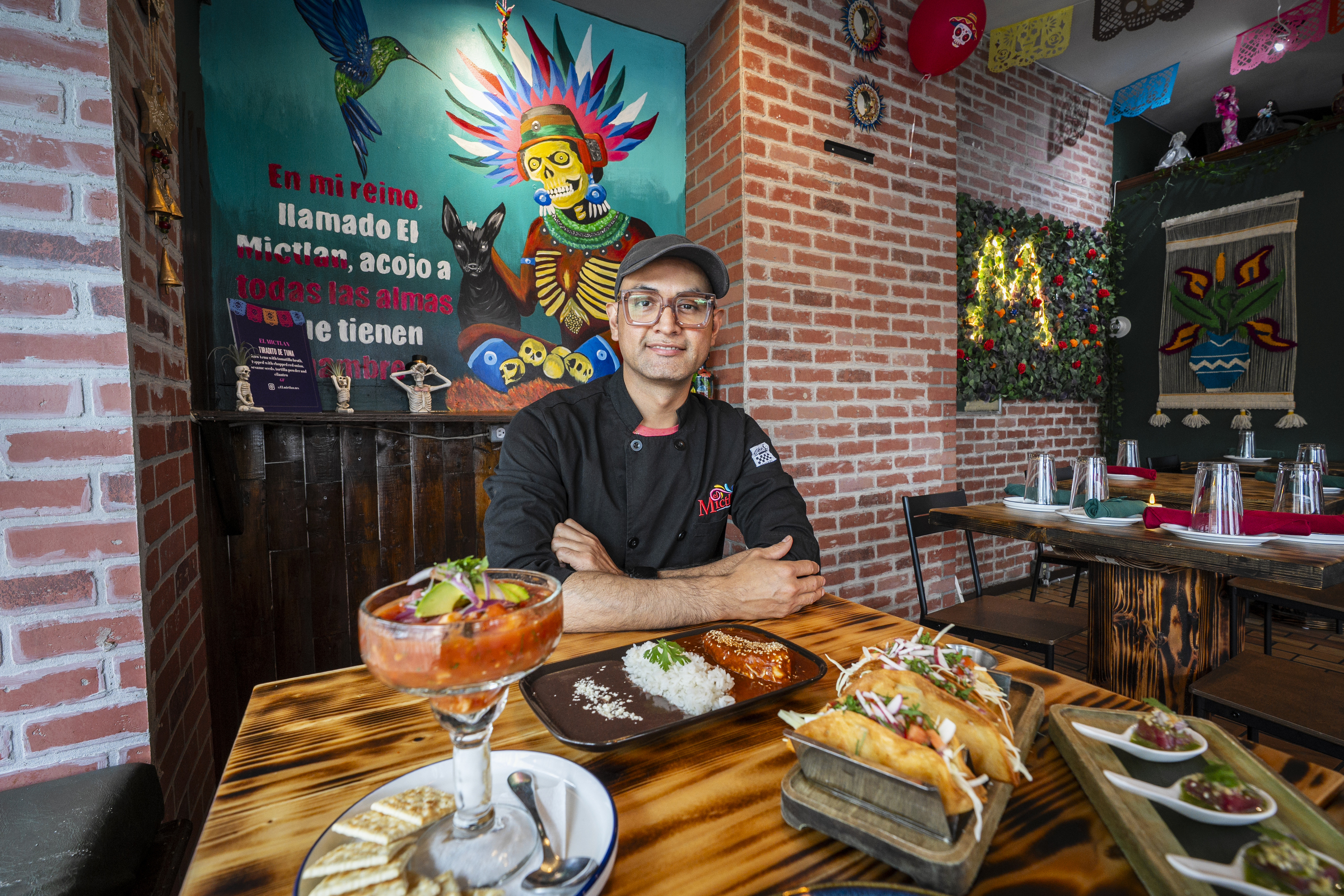
Chelo Manzanarez, chef and owner at El Mictlan, where the menu brings a taste of Guerrero and Acapulco to South Philly.Jessica Griffin / Staff Photographer
Chelo Manzanarez, the chef and owner of El Mictlan, which generally focuses on the food of Guerrero (the Mexican state located southwest of Puebla), has worked to make this fundamental Mexican dish his own.
“It’s usually a sweet and heavy dish, but I’ve tried to make it more flavorful and more personal,” Manzanarez said of the chile en nogada at his South Philly BYOB at Beechwood and Snyder Streets.
Manzanarez switched out beef in favor of a mix of pork and chicken, and he swapped raisins for dried dates. He seasons the picadillo with cinnamon, clove, and anise. He uses both green and red apples, “to get that contrast between sweet and sour.” He adds plantains and pineapples “for their tropical flavor.”
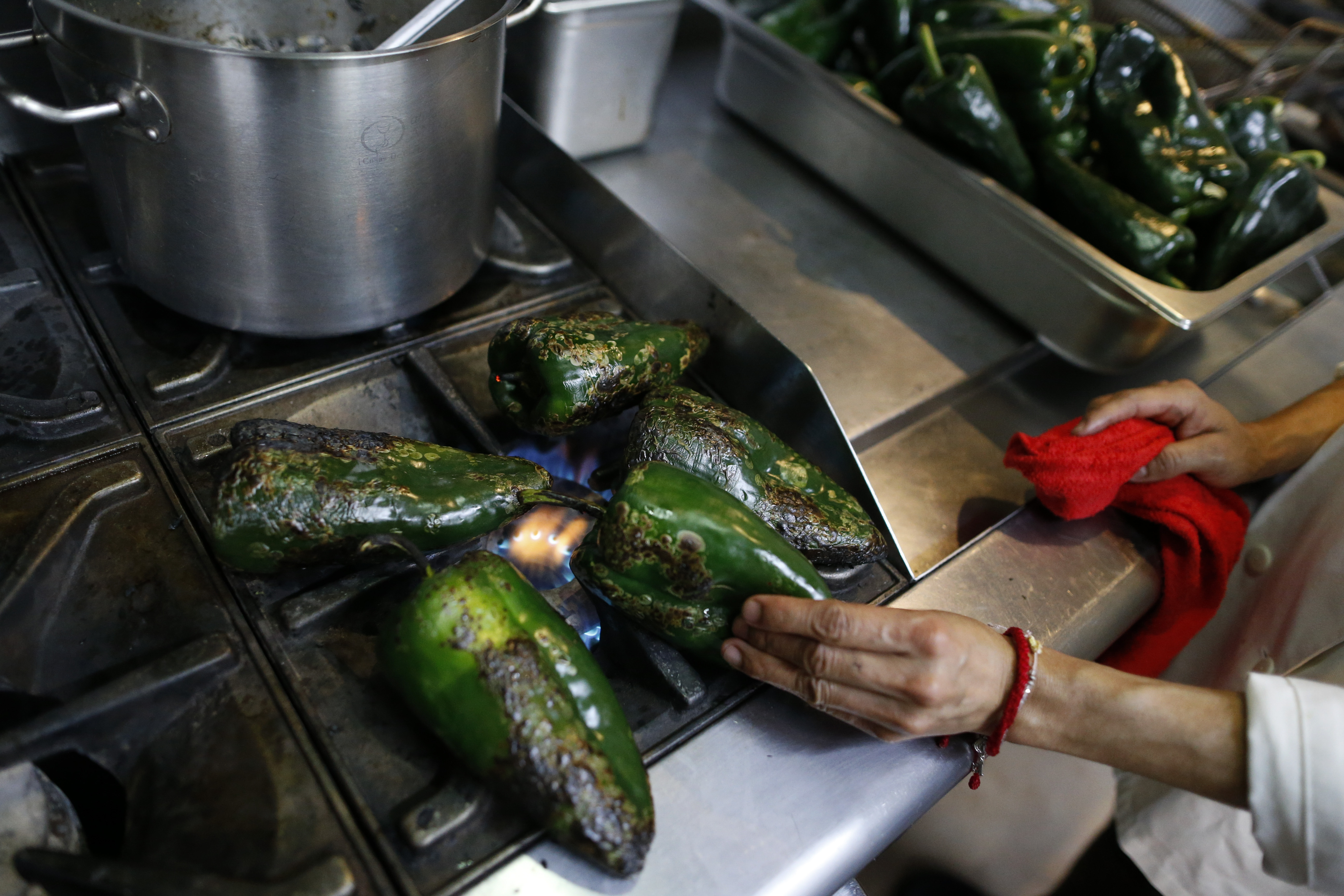
Making his chile en nogada is truly a labor of love for Manzanarez. “I cook each fruit and vegetable individually and caramelize them separately. Most of the work comes from dicing everything very small.” After mixing all cooked components together for the filling, he still has to roast the peppers, which he does for three to four minutes on each side before letting them sweat in a plastic bag, making it easier to remove their skins. “It’s complicated — getting the poblanos to the right consistency so that they don’t lose their shape,” he said.
For thewhite of the Mexican flag, Manzanarez eschews the traditional goat cheese, instead mixing cream cheese with queso fresco, walnuts, almonds, and a touch of milk. The result is creamy, luxurious, and not too rich.
A plate of chiles en nogada at Testal restaurant in downtown Mexico City.Rebecca Blackwell
Manzanarez finishes his chile en nogada with bright cilantro oil and red chili oil, doubling down on the colors as a deeper tribute to the Mexican flag.
He first came up with his recipe while working at La Llorona, also in South Philly. It’s a dish customers ask for every year.
A cook roasts poblano peppers on the stovetop in preparation for removing the skin, as kitchen staff make chiles en nogada at the Testal restaurant in downtown Mexico City in 2019. Rebecca Blackwell
Restaurants traditionally stop serving chiles en nogada after Mexican Independence Day, on Sept. 16. “But now we celebrate Independence Day for the whole of September,” said Manzanarez, which is how long he plans on serving it at El Mictlan.
More traditional iterations of the dish can also be found at La Llorona and El Chingon (usually only available at dinner).
La Llorona serves a richer but very classic version with the roasted poblano battered in egg whites and gently sautéed before being blanketed in an especially rich and dense nogada. The pepper is stuffed with ground beef and pork, peaches, and apples. Its parsley, sliced almond, and pomegranate seed garnishes replicate the stripes of the Mexican flag precisely.
The chile en nogada at La Llorona is stuffed with beef and pork and lightly battered in egg whites before being blanketed in nogada sauce.Kiki Aranita / Staff /
The availability of chef Carlos Aparicio of El Chingon’s chile en nogada ($30) is entirely dependent on the fresh walnuts he flies in, one kilogram weekly, from his hometown of San Mateo Ozolco, located in the Calpan municipality of Puebla — the same municipality where, according to legend, chiles en nogada were first invented by Augustinian nuns. They created the dish in 1821 in honor of General Agustín de Iturbide, after he signed the treaty that recognized Mexico’s independence from Spain. He became the first emperor of Mexico, and the dish represents the colors of what was then the Mexican Army’s flag.
The chile en nogada at El Chingon uses fresh walnuts flown in weekly from Puebla when they are in season.NaylaPolohovich
“This year, [Puebla] had a lot of rain so the walnuts fell off the trees too soon,” said Aparicio. “They really have to be fresh, and we can’t preserve them. As soon as they get here, we wash and clean them and put them in milk immediately.” After their milk bath, the walnuts get mixed with goat cheese, cream cheese, cinnamon, and sugar.
Aparicio’s chile en nogada is stuffed with beef, pork, and fruits, and garnished sparingly. Hewing to tradition, Aparicio’s serves it at room temperature.
Aparicio is hoping that this year he will receive at least one or two more shipments of walnuts, which means he can serve chiles en nogada for one or two more weeks. (El Chingon sells about 12 to 15 per day when it is available.)
Chiles en nogada season brings out the competitive nature in chefs and customers. “People will try to get every different chile en nogada in Philadelphia, make comparisons and [argue] about which one is the best,” said Manzanarez.
You have one, maybe two weeks left to decide for yourself.
Mike Riley and Sean Mannion were having one of their catch-up calls when Mannion, who played quarterback at Oregon State under Riley, told his former coach the latest project he was working on during the nascent days of his own coaching career.
Mannion, the most prolific passer in Oregon State history, told Riley that he was putting together and digitizing all of the passing concepts he could find dating back to the 1960s.
“This is what he does in his spare time,” Riley explained recently.
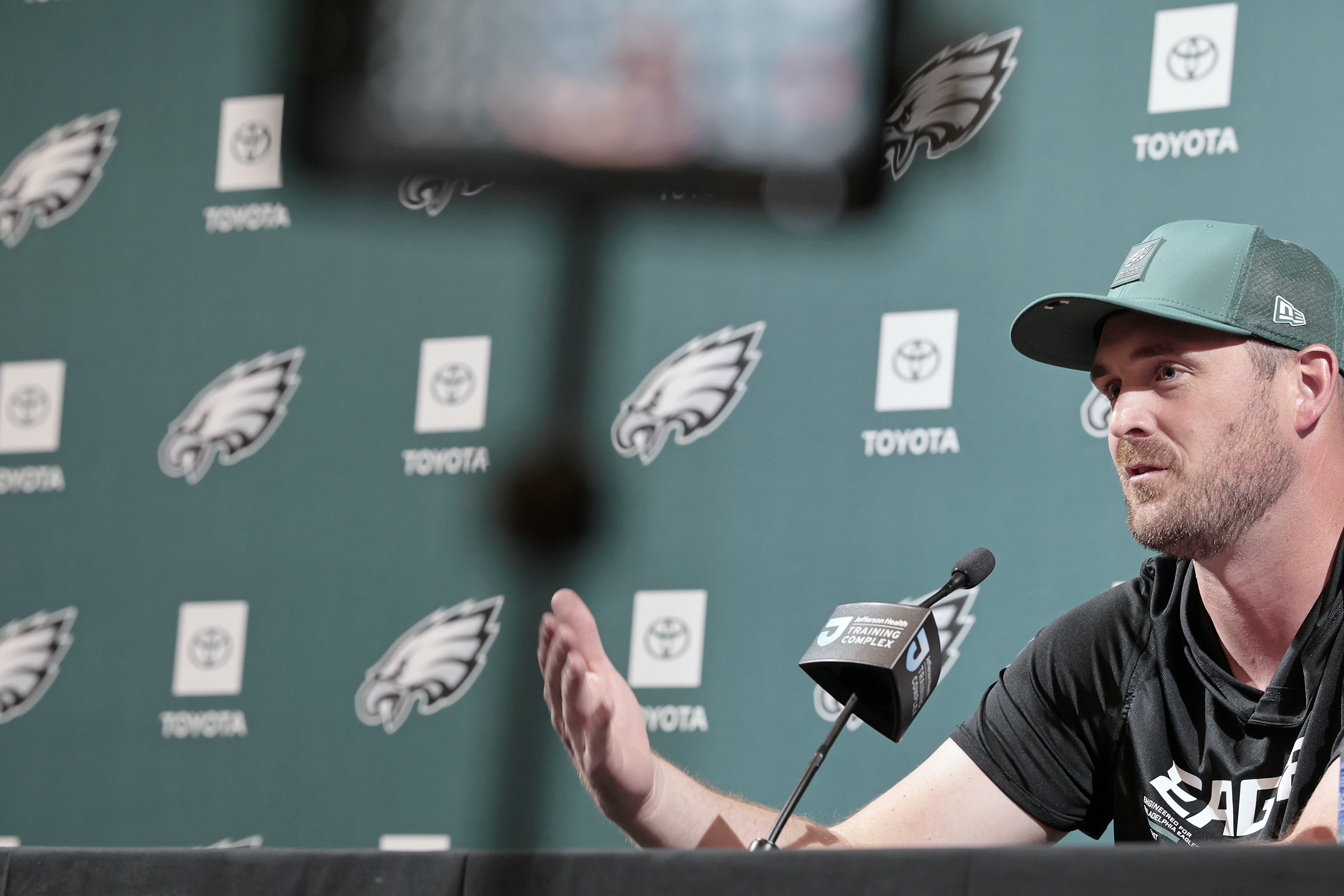
Mannion is just 34 years old and only three years removed from his playing career. He has never called plays in the NFL before and now is tasked with turning around an Eagles offense that was too stagnant in 2025 under another first-year coordinator and first-time play caller Kevin Patullo. Nick Sirianni said in February that he was looking for someone who was detailed and had “conviction in what they believed and why they believed in it, and the vision and conviction of how they went about it.”
Those traits seem to describe Mannion, whose father, John, called him “a saver” who took and saved detailed notes at every stop along his football path and even has comprehensive notes on concepts that pre-date his own life by some 30 years. Eagles quarterbacks coach Parks Frazier raved recently about Mannion’s attention to detail and his ability to recall and reference something he has learned along the way.
“He remembers every detail about all of those things and he’s constantly applying it to what he’s doing moving forward,” Frazier said. “He has extreme, detailed, categorized notes and film of everything he’s been through.”
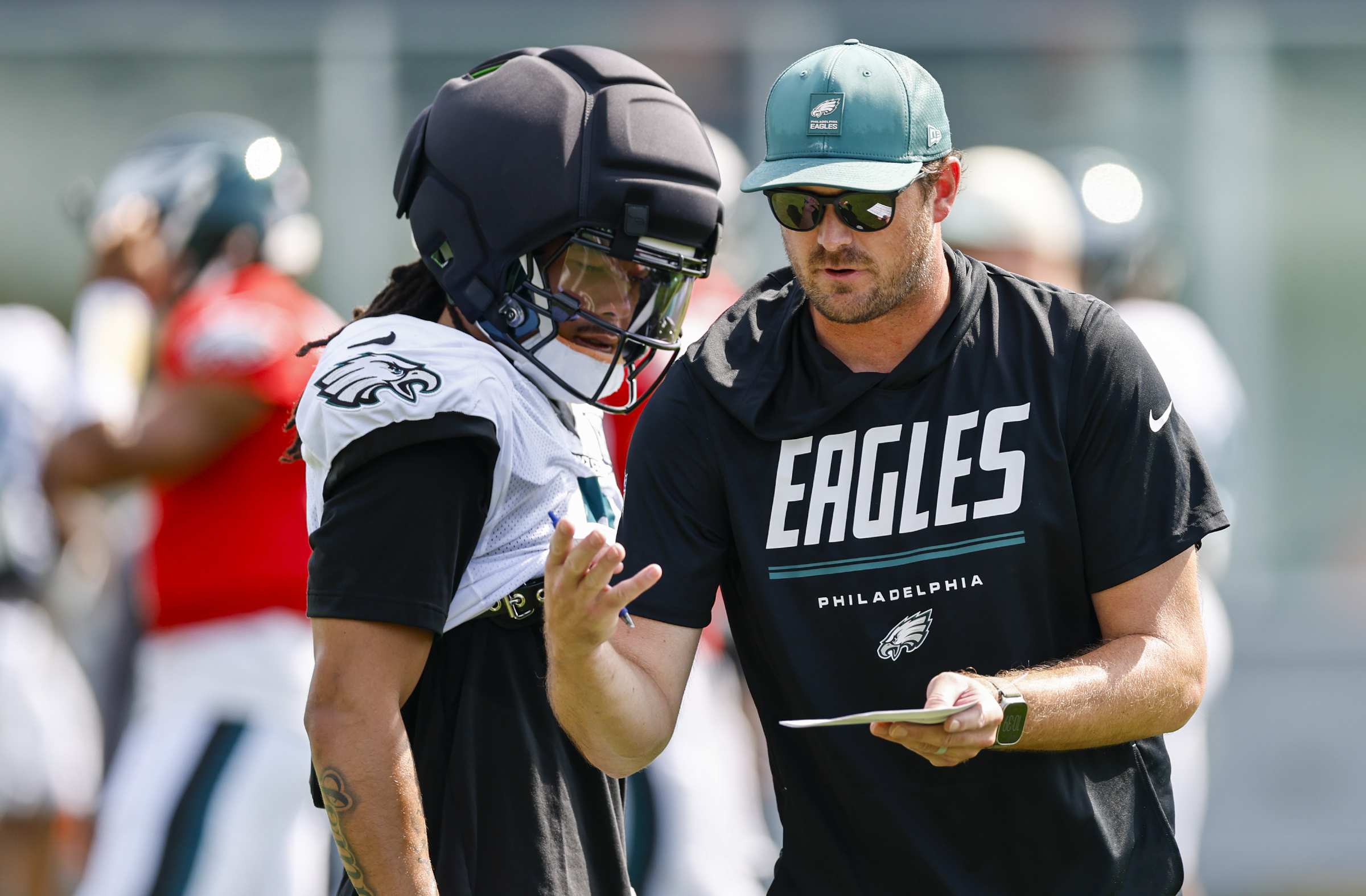
Eagles offensive coordinator Sean Mannion talks with wide receiver Makai Lemon during team drills last month. Yong Kim / Staff Photographer
Mannion is installing a new offense for Jalen Hurts and the Eagles, one rooted in the flavors of the trendy Kyle Shanahan-Sean McVay scheme. But Mannion’s history and influences suggest a style that ultimately will pull from every resource imaginable as he guides the Eagles offense into the future.
Sirianni and Howie Roseman took a calculated risk on a young and fast-rising offensive coach when they landed on Mannion, who spent two years on the staff in Green Bay, most recently as quarterbacks coach, before his big promotion. But a lack of experience doesn’t necessarily mean Mannion is any less equipped to succeed than a more experienced candidate. In many ways, Mannion, the son and grandson of football coaches, has been preparing for this job for most of his life.
“His thing was, he wanted to play as long as he could,” his father said. “The unsaid part was that when those days were done that he would turn his attention to coaching.”
Like father, like son
At its roots, coaching is teaching. In that sense, Sean isn’t just the son of a football coach; he is the son of two teachers, and his earliest influences can be traced to the classroom. He’d mess around in a playpen while his mother, Inga, an elementary school teacher, finished work in her classroom after school.
He was around his father’s football teams as much as he could be, too. One Saturday, John, who also has been a teacher for 36 years, was going to scout an upcoming opponent with a coaching friend and Sean wanted to tag along. He was around 7 years old and an inquisitive kid at the time, so he brought with him a yellow legal pad. While he watched the game next to the two adults, he doodled and drew notes and observations from the field.
“He spent a lot of time doing what we were doing,” John said of his son’s early days. “That notepad probably was a byproduct of all that time spent.”
Sean grew up in Pleasanton, Calif., Alameda County, about 20 miles east of the San Francisco Bay in a household that valued education. He was a good student who also excelled in sports. Football was his main sport, but he also played baseball and basketball.
When Sean was a rising sophomore at Foothill High School, John, a former assistant, was given the job as the school’s head football coach. He was nervous, though, about any appearance of nepotism, so from the outset of that season he had Sean playing on the JV team. Foothill was 12-1 the previous season and had two upperclassmen ahead of Sean on the depth chart. A week before the season, the senior quarterback hurt his ankle and was on crutches. Later that week, after throwing at least four touchdowns in a scrimmage, the junior quarterback showed up on Labor Day, the first practice of the first game week of the season, and complained about a back injury that eventually forced him to miss the season.
John called home right away. Sean had to get to the field and get to practice.
Sean’s freshman coach at Foothill was Mike Madden, the son of Hall of Fame coach John Madden. Mike approached John Mannion that first week and asked him if he was nervous for Sean.
“Gosh, I hadn’t thought about it,” John said. “I’m nervous for myself at this point.”
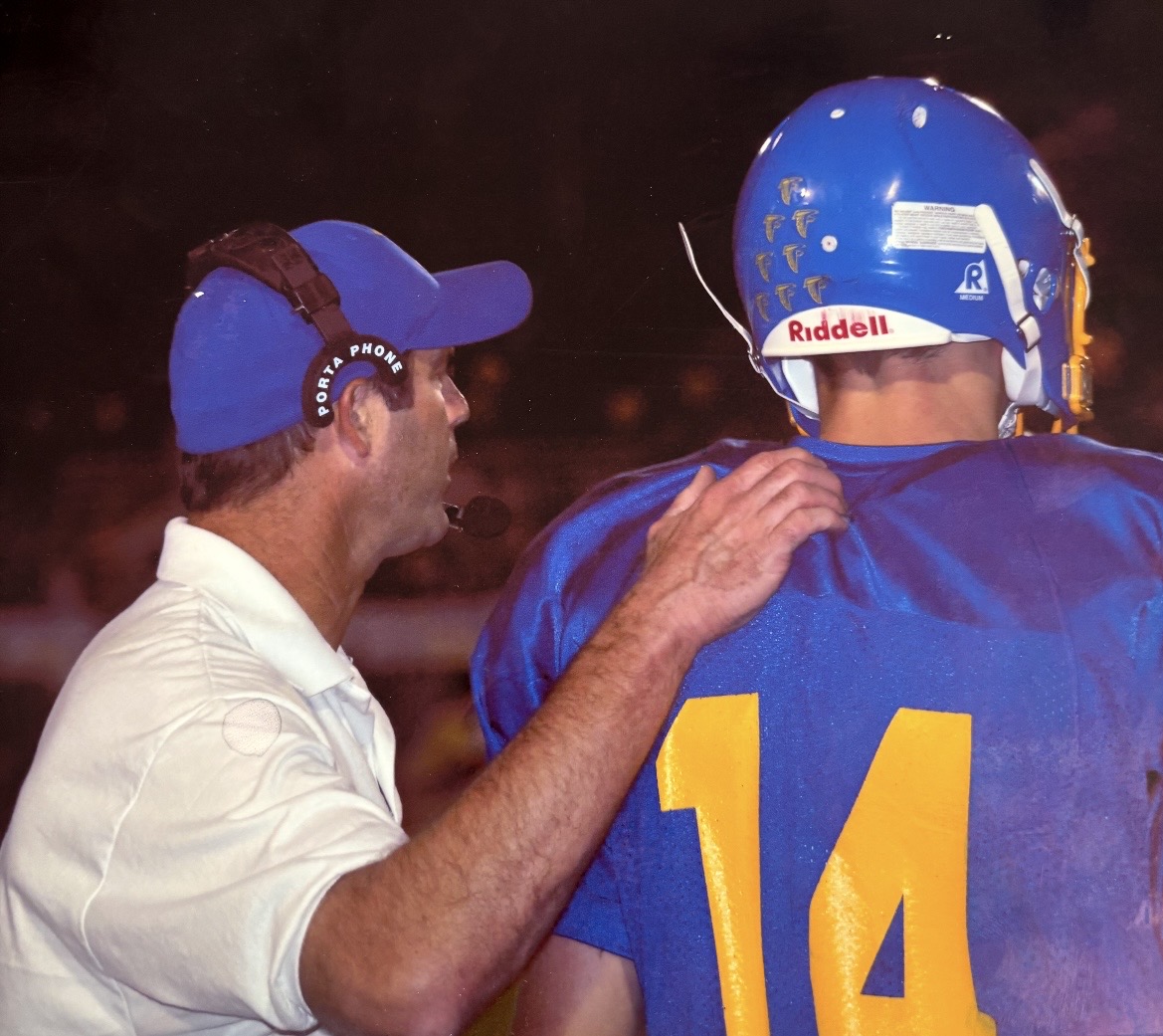
John Mannion (left) coached Sean (right) in high school.Photo courtesy of John Mannion
John’s first game as varsity head coach was also Sean’s first game as varsity starting quarterback. Asked if he remembered it well, John responded the way many coaches would, and the way the father of a detailed note-taker would: “Oh yeah,” he said. “Of course I do, yeah. We lost, 26-21, and Sean did really well. It was a really hot day and there was a lot learned by me.”
The team they lost to went to the state playoffs, but so did Foothill. Sean “knew the offense from all those years growing up around it” and “really absorbed a lot of things along the way,” John said.
“We kind of went through it together,” John said. “There was no plan of him ever being on the team that first year, but sure enough there he was. There’s challenges in there but I think it was a great experience for us to be able to do that.”
Sean finished his high school career as Foothill’s all-time leading passer and, after throwing for 3,521 yards and 27 touchdowns as a senior, was off to Oregon State.
That yellow legal pad Sean doodled on during that football scouting trip was part of a full-circle moment some 25 years later.
“When I got my first coaching job with the Packers, as a gift, he framed it for me,” Sean said. “So I still have it in my house. It’s pretty cool. The scheme has evolved since then, I will say, but it was a really cool, special gift that he kept.”
Riley’s favorite word to describe Sean is “diligent.” How many coaches born in the 1990s are digitizing passing concepts from the 60s?
Sean was the top quarterback Oregon State pursued in the class of 2010, and Riley and his staff were thrilled when he committed and later signed. The program had produced top quarterbacks like Derek Anderson and Matt Moore, and Riley thought Sean would be the next great one to come through Corvallis.
The diligence showed up right away. Sean was supposed to redshirt during his first season on campus, but the summer before his first camp with the Beavers, Sean got the keys to the facility from the graduate assistants to go in early and watch film.
“That was him the whole time,” Riley said. “He could really throw the football and he was a very hard worker physically, and then he was a very hard worker off the field. He wanted to know and learn and he’s one of the most diligent people that I’ve ever been around.”
That part of Sean made it easier when, during the second half of the first game the following season, Riley put Sean in the game over a junior who started. He was just a redshirt freshman, but he was Oregon State’s starter from that point until graduation.
“That was one of the first times probably in my career that I actually had the faith in a redshirt freshman to insert him sometime early in the year as a starter,” Riley said. “I think that said a lot about what we felt about his early development and what we thought he could do on the field.”
Eagles offensive coordinator Sean Mannion has worked diligently on offensive concepts dating back to his career as a player. Elizabeth Robertson / Staff Photographer
Sean became a captain the following season. He is soft-spoken by nature, those closest to him say, but his leadership showed up in the way he carried himself and how he approached the game. By senior year, he had a nickname: “The Machine.” That year’s offensive coordinator, John Garrett, referred to Sean by that moniker during a film session one day and it stuck, much to Sean’s chagrin. Oregon State’s offensive linemen sometimes walked robotically around Sean.
“That is a pretty appropriate nickname because he was just like that,” Riley said. “He just went to work and put in the work and everybody knew that about him. I think he’s one of the most probably respected teammates that I saw through all my years of coaching.”
Sean exited college as Oregon State’s all-time leader in passing yards and ranked in the top 10 in college football history. He’s still 19th.
The quarterback and coach have stayed in touch over the years. Riley, who left Oregon State for Nebraska after Sean’s senior year, is now retired, though he’s still on the College Football Playoff selection committee. Sean isn’t the most recent Mannion whom Riley had talked to as of a few weeks ago, though. John, who no longer coaches, now writes a newsletter on Substack called “John Mannion’s Coaching Playbook,” and recently interviewed Riley.
Sean’s most recent catch-up call with his college coach came after OTAs this season and just before camp.
“He sounded excited and he sounded like he would be because he’s always prepared — he sounded confident,” Riley said. “And I could also tell he was having a lot of fun.”
‘A 30,000-foot view’
Sean has described his father and Riley as his two biggest influences along the way. But his most relevant football influences when it comes to his current job came into his life in 2017, when Sean was backing up Jared Goff with the Los Angeles Rams and the team brought in a new coach, McVay, who hired a new offensive coordinator, Matt LaFleur. Both had been schooled under Shanahan and brought to the Rams a new style of offense that Sean took to.
“I just felt like I was learning so, so much,” Sean said. “It was such an exciting way to match the run and pass. They had such a way about teaching the game where we could feel ourselves challenging a defense, but it felt simple to us.
“Those are the things that really stood out to me going through that experience that really resonated with me as a player and certainly resonate with me as a coach. That was a very exciting point in my football life, just the exposure to that type of teaching, that type of scheme. I know Matt, obviously a mentor of mine, getting to play for [McVay]. I learned so much from those people. It’s certainly a big part of molding me into the type of coach I am now.”
Eagles offensive coordinator Sean Mannion with members of the offensive line during training camp last month. Yong Kim / Staff Photographer
How the Eagles offense will look come Sunday still remains a sort of mystery. There certainly will be more motion, more snaps from under center, and more play-action. But the Eagles ran a bland offense during the preseason in an effort to hide most of their playbook, and the first-team offense was rarely fully healthy during training camp and also had to go against one of the best defenses in the league.
The Eagles have a new style of running the ball, which will be a key to unlocking the passing game and play-action. The base of the Shanahan-McVay offense is outside, wide-zone runs that stretch the defense horizontally. The Eagles and longtime offensive line coach Jeff Stoutland parted ways this offseason, and new offensive line coach Chris Kuper has been in charge of implementing the new blocking scheme.
Kuper was the offensive line coach in Minnesota when Sean spent part of the 2023 season with the Vikings.
“He sees the game from a 30,000-foot view as well as being on the sideline and being into it with the players,” Kuper said. “I think it speaks volumes, his experience as a quarterback in this league and being able to connect people and become a glue guy has been incredible.”
There may be a misconception that Sean, a quarterback by trade, just focuses on the quarterbacking. But Kuper described a coach who is involved in every facet of the offense.
“What I love about Sean is how much he loves the run game,” Kuper said.
Kuper said part of Sean’s responsibilities in Green Bay when he was an offensive assistant in 2024 was to draw some runs. The Eagles do have a run-game coordinator in tight ends coach Ryan Mahaffey, but Kuper is confident Sean could handle it all.
“Sean could game plan and call a game all on his own, I think, if he wanted to,” Kuper said.
First-time play caller
The Mannions relocated to Oregon when Sean was in college, and one spring after John had taken over as the head coach at Mountainside High, he needed help.
The 2021 football season came together rather late in the midst of the COVID-19 pandemic, and a shortened spring season was on the table. Sean was home in Oregon doing remote OTAs with the Vikings when John asked him to be the offensive coordinator that season.
Sean’s younger brother, Brian, was the starting quarterback. It was a family affair.
On the day of the first practice, John walked out on the field and handed Sean his handwritten practice plan.
“You know there’s software for this, right?” Sean quipped.
John was calling plays, but after Mountainside was shut out in the second of their six games, John made a change.
“I handed the torch to him. It was fun,” John said.
Minnesota Vikings quarterback Sean Mannion (4) kisses his daughter Sawyer after pregame warmups before a game against the Chicago Bears on Sunday, Dec. 29, 2019.Carlos Gonzalez / MCT
John has watched the oldest of his four children become a loving husband to his wife, Megan, and the proud father of three children. He always knew Sean could and probably would eventually become a successful coach, but that spring offered his first real chance to witness Sean’s future in person.
“I could see clearly he had a real knack for it,” John said.
Sean was still in the process of talking to the Eagles when he was tapped to call plays in January’s East-West Shrine Bowl. He called John during his father’s lunch break.
“You haven’t called a game since Mountainside vs. Grant High School back in March of 2021,” John joked.
The two shared a laugh. A few days later, Sean was hired to call plays for the Eagles.
All roads lead to Delco
Margaret Mannion was around 20 years old when she moved to California, but John’s mother spent her early days in Delaware County. She lived in Drexel Hill, graduated from Archbishop Prendergast High School, and worked at Villanova before moving west, where she met Jim Mannion, John’s late father.
Margaret, 84, has dementia now and still lives in California in an elder care facility, but John is pretty confident there will be at least one “proud Philadelphian” and Eagles fan watching the games this year from the elder care facility.
As for John, he’s a self-described “worrier.” When Sean redshirted at Oregon State, John loved the ease of watching the games with no pressure in the family section. After Sean was inserted as starter the next season, John called the box office. He wanted to sit in the far corner of the stadium in the last row. Tickets in the family section were free and required no work on his end, but every year he’d call the ticket office to secure his seats at the top of the stadium.
Sean rarely played in the NFL — he threw just 110 passes over nine seasons in the league — so Sunday Ticket usually sufficed. When Sean was hired by the Packers, they were on national television frequently enough, and for the games they weren’t, John would drive to his local Buffalo Wild Wings, where he’d watch quietly and hope the quarterback play was up to snuff.
Last year, while watching a game at the restaurant, a few Green Bay fans in their 20s complained to John about Packers quarterback Jordan Love. The group had a laugh when John told them, no, he wasn’t from Green Bay, his son coached the quarterbacks.
“I’m going to call him tonight and tell him there’s some guys in Oregon who say he’s got a lot of work to do,” John joked.
This year, it’s back to Sunday Ticket. John, who was in town for a few days in August observing the Eagles and Sean during camp, said he’ll build a fire at home, watch the game in peace, and “keep our fingers crossed.”
His son’s new job comes with a lot of pressure. Patullo was the most criticized person in the building last year and eventually took the fall after the team’s first-round exit, so all eyes will be on Sean as the season gets underway.
Margaret’s older sister, John’s aunt, still lives in New Jersey and called John after Sean got the job.
She was excited Sean was in a new, high-profile job back where his family has roots. But her excitement also had a tinge of nervousness: “Hopefully everybody is nice to him,” she said.