Chiles en nogada, no matter who makes them, are visually arresting dishes. They’re distinctive for their colors: a base of a deep green poblano pepper, a blanket of creamy white walnut sauce (the titular nogada), traditional pops of red from fresh pomegranate seeds, and a sprinkling of more green from parsley. These components represent the colors of the Mexican flag. The poblano is stuffed with picadillo, a mix of ground meats and fruits that marry savory and sweet flavors and can often be time-consuming to prepare.
Chiles en nogada season is fleeting, lasting just two to six weeks in late August and early September, when the dish’s main ingredients — poblanos and walnuts — are aligned and in season, along with the apples and peaches that are also at peak ripeness in Puebla, where the dish originated.
In Mexico, chiles en nogada has become a national dish, treated with great reverence and ceremony. At fine-dining establishments in Mexico City, diners can select which poblano they’d like stuffed, just as one might select a fish from a tank to be cooked. But you don’t have to go to Mexico to eat it — there are several excellent versions found in Philadelphia.
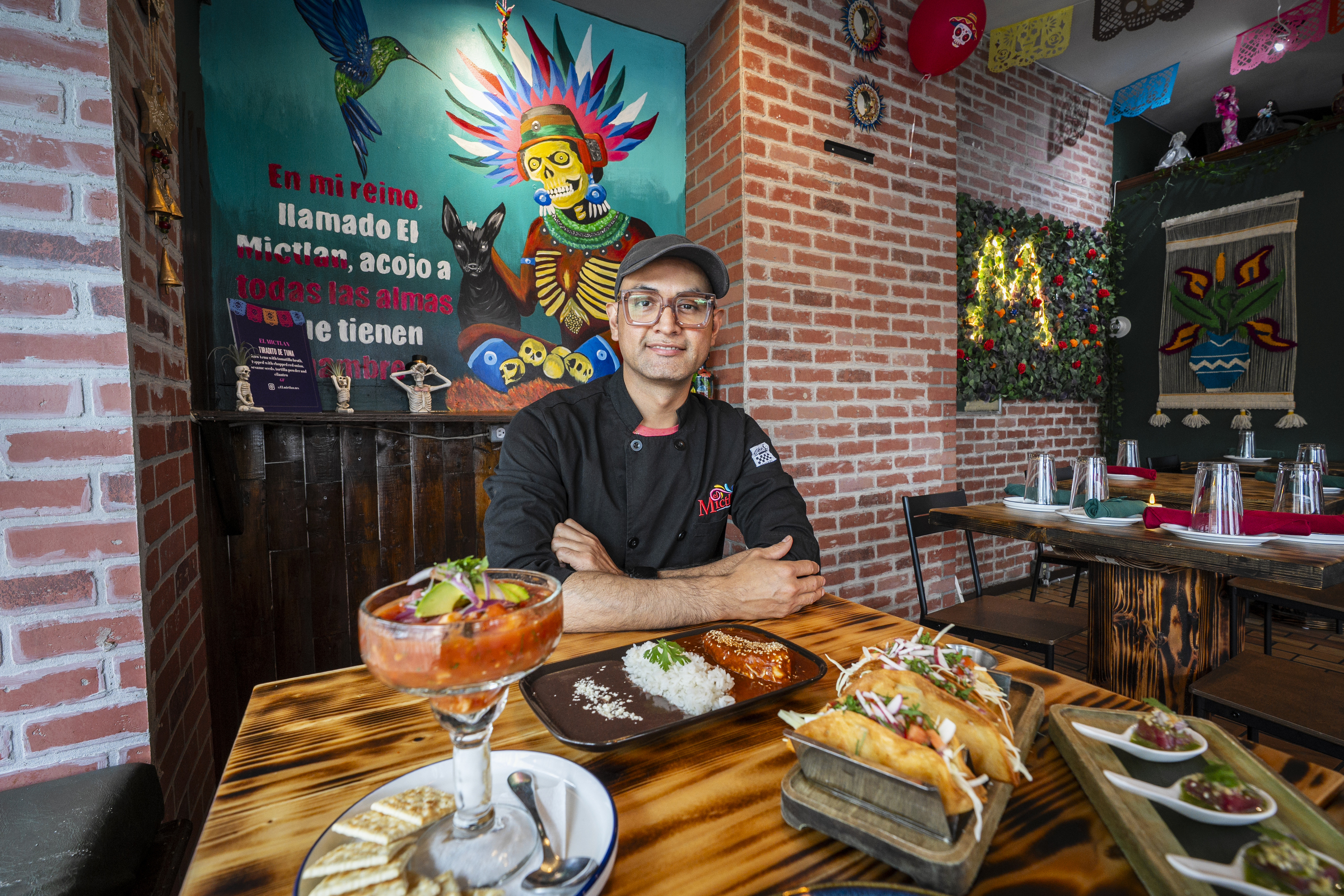
Chelo Manzanarez, chef and owner at El Mictlan, where the menu brings a taste of Guerrero and Acapulco to South Philly.Jessica Griffin / Staff Photographer
Chelo Manzanarez, the chef and owner of El Mictlan, which generally focuses on the food of Guerrero (the Mexican state located southwest of Puebla), has worked to make this fundamental Mexican dish his own.
“It’s usually a sweet and heavy dish, but I’ve tried to make it more flavorful and more personal,” Manzanarez said of the chile en nogada at his South Philly BYOB at Beechwood and Snyder Streets.
Manzanarez switched out beef in favor of a mix of pork and chicken, and he swapped raisins for dried dates. He seasons the picadillo with cinnamon, clove, and anise. He uses both green and red apples, “to get that contrast between sweet and sour.” He adds plantains and pineapples “for their tropical flavor.”
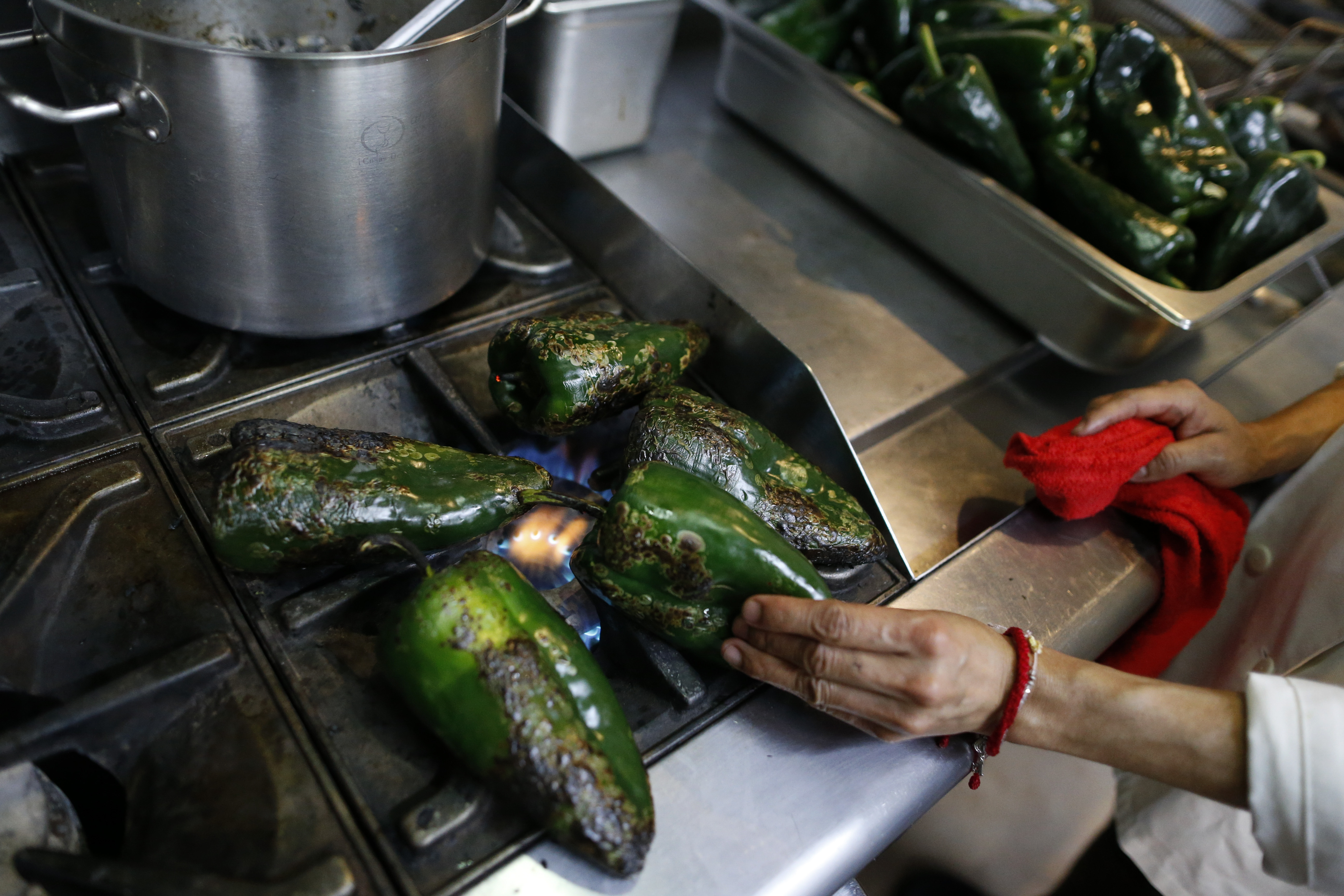
Making his chile en nogada is truly a labor of love for Manzanarez. “I cook each fruit and vegetable individually and caramelize them separately. Most of the work comes from dicing everything very small.” After mixing all cooked components together for the filling, he still has to roast the peppers, which he does for three to four minutes on each side before letting them sweat in a plastic bag, making it easier to remove their skins. “It’s complicated — getting the poblanos to the right consistency so that they don’t lose their shape,” he said.
For thewhite of the Mexican flag, Manzanarez eschews the traditional goat cheese, instead mixing cream cheese with queso fresco, walnuts, almonds, and a touch of milk. The result is creamy, luxurious, and not too rich.
A plate of chiles en nogada at Testal restaurant in downtown Mexico City.Rebecca Blackwell
Manzanarez finishes his chile en nogada with bright cilantro oil and red chili oil, doubling down on the colors as a deeper tribute to the Mexican flag.
He first came up with his recipe while working at La Llorona, also in South Philly. It’s a dish customers ask for every year.
A cook roasts poblano peppers on the stovetop in preparation for removing the skin, as kitchen staff make chiles en nogada at the Testal restaurant in downtown Mexico City in 2019. Rebecca Blackwell
Restaurants traditionally stop serving chiles en nogada after Mexican Independence Day, on Sept. 16. “But now we celebrate Independence Day for the whole of September,” said Manzanarez, which is how long he plans on serving it at El Mictlan.
More traditional iterations of the dish can also be found at La Llorona and El Chingon (usually only available at dinner).
La Llorona serves a richer but very classic version with the roasted poblano battered in egg whites and gently sautéed before being blanketed in an especially rich and dense nogada. The pepper is stuffed with ground beef and pork, peaches, and apples. Its parsley, sliced almond, and pomegranate seed garnishes replicate the stripes of the Mexican flag precisely.
The chile en nogada at La Llorona is stuffed with beef and pork and lightly battered in egg whites before being blanketed in nogada sauce.Kiki Aranita / Staff /
The availability of chef Carlos Aparicio of El Chingon’s chile en nogada ($30) is entirely dependent on the fresh walnuts he flies in, one kilogram weekly, from his hometown of San Mateo Ozolco, located in the Calpan municipality of Puebla — the same municipality where, according to legend, chiles en nogada were first invented by Augustinian nuns. They created the dish in 1821 in honor of General Agustín de Iturbide, after he signed the treaty that recognized Mexico’s independence from Spain. He became the first emperor of Mexico, and the dish represents the colors of what was then the Mexican Army’s flag.
The chile en nogada at El Chingon uses fresh walnuts flown in weekly from Puebla when they are in season.NaylaPolohovich
“This year, [Puebla] had a lot of rain so the walnuts fell off the trees too soon,” said Aparicio. “They really have to be fresh, and we can’t preserve them. As soon as they get here, we wash and clean them and put them in milk immediately.” After their milk bath, the walnuts get mixed with goat cheese, cream cheese, cinnamon, and sugar.
Aparicio’s chile en nogada is stuffed with beef, pork, and fruits, and garnished sparingly. Hewing to tradition, Aparicio’s serves it at room temperature.
Aparicio is hoping that this year he will receive at least one or two more shipments of walnuts, which means he can serve chiles en nogada for one or two more weeks. (El Chingon sells about 12 to 15 per day when it is available.)
Chiles en nogada season brings out the competitive nature in chefs and customers. “People will try to get every different chile en nogada in Philadelphia, make comparisons and [argue] about which one is the best,” said Manzanarez.
You have one, maybe two weeks left to decide for yourself.
Mike Riley and Sean Mannion were having one of their catch-up calls when Mannion, who played quarterback at Oregon State under Riley, told his former coach the latest project he was working on during the nascent days of his own coaching career.
Mannion, the most prolific passer in Oregon State history, told Riley that he was putting together and digitizing all of the passing concepts he could find dating back to the 1960s.
“This is what he does in his spare time,” Riley explained recently.
Mannion is just 34 years old and only three years removed from his playing career. He has never called plays in the NFL before and now is tasked with turning around an Eagles offense that was too stagnant in 2025 under another first-year coordinator and first-time play caller Kevin Patullo. Nick Sirianni said in February that he was looking for someone who was detailed and had “conviction in what they believed and why they believed in it, and the vision and conviction of how they went about it.”
Those traits seem to describe Mannion, whose father, John, called him “a saver” who took and saved detailed notes at every stop along his football path and even has comprehensive notes on concepts that pre-date his own life by some 30 years. Eagles quarterbacks coach Parks Frazier raved recently about Mannion’s attention to detail and his ability to recall and reference something he has learned along the way.
“He remembers every detail about all of those things and he’s constantly applying it to what he’s doing moving forward,” Frazier said. “He has extreme, detailed, categorized notes and film of everything he’s been through.”
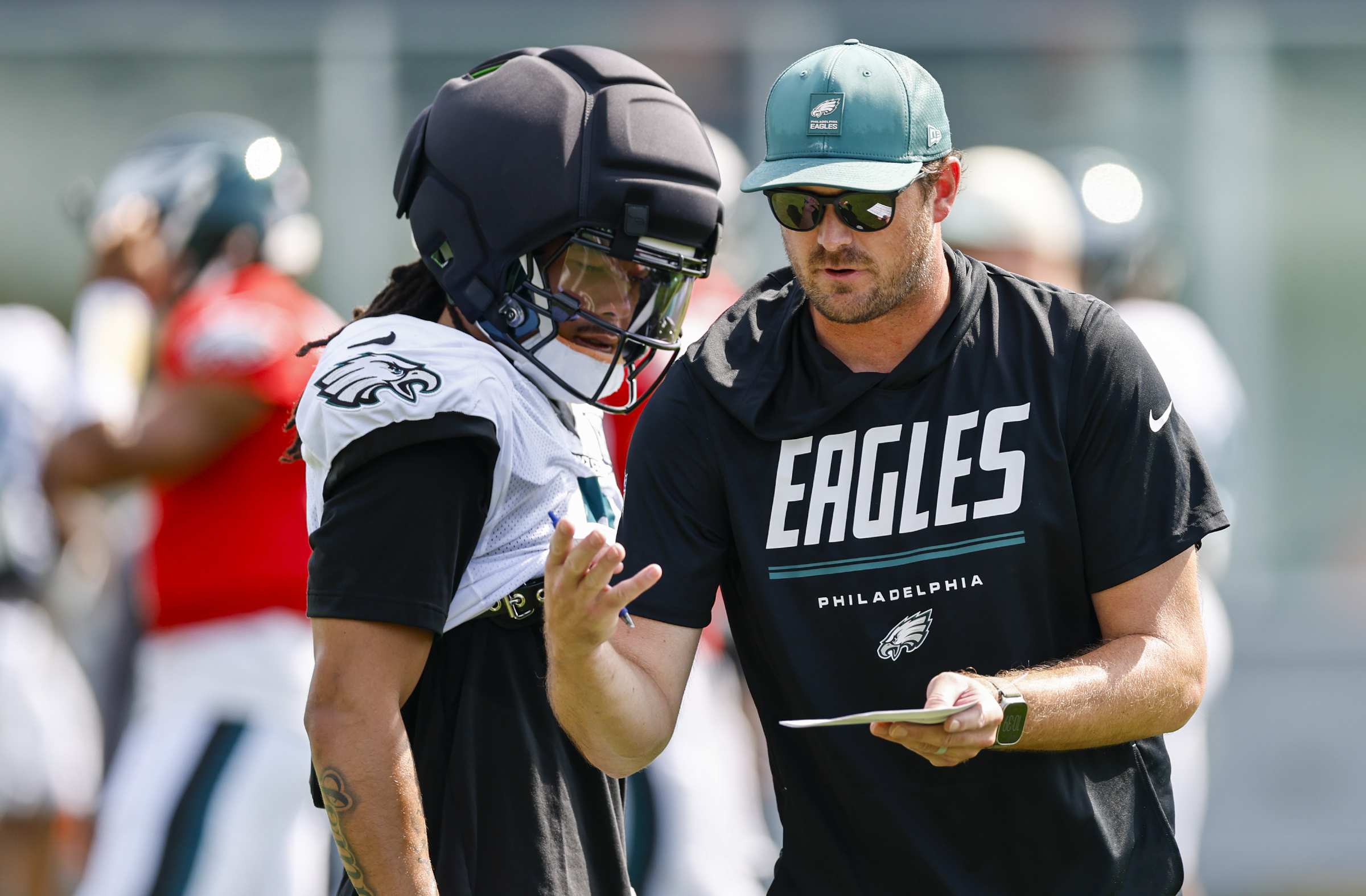
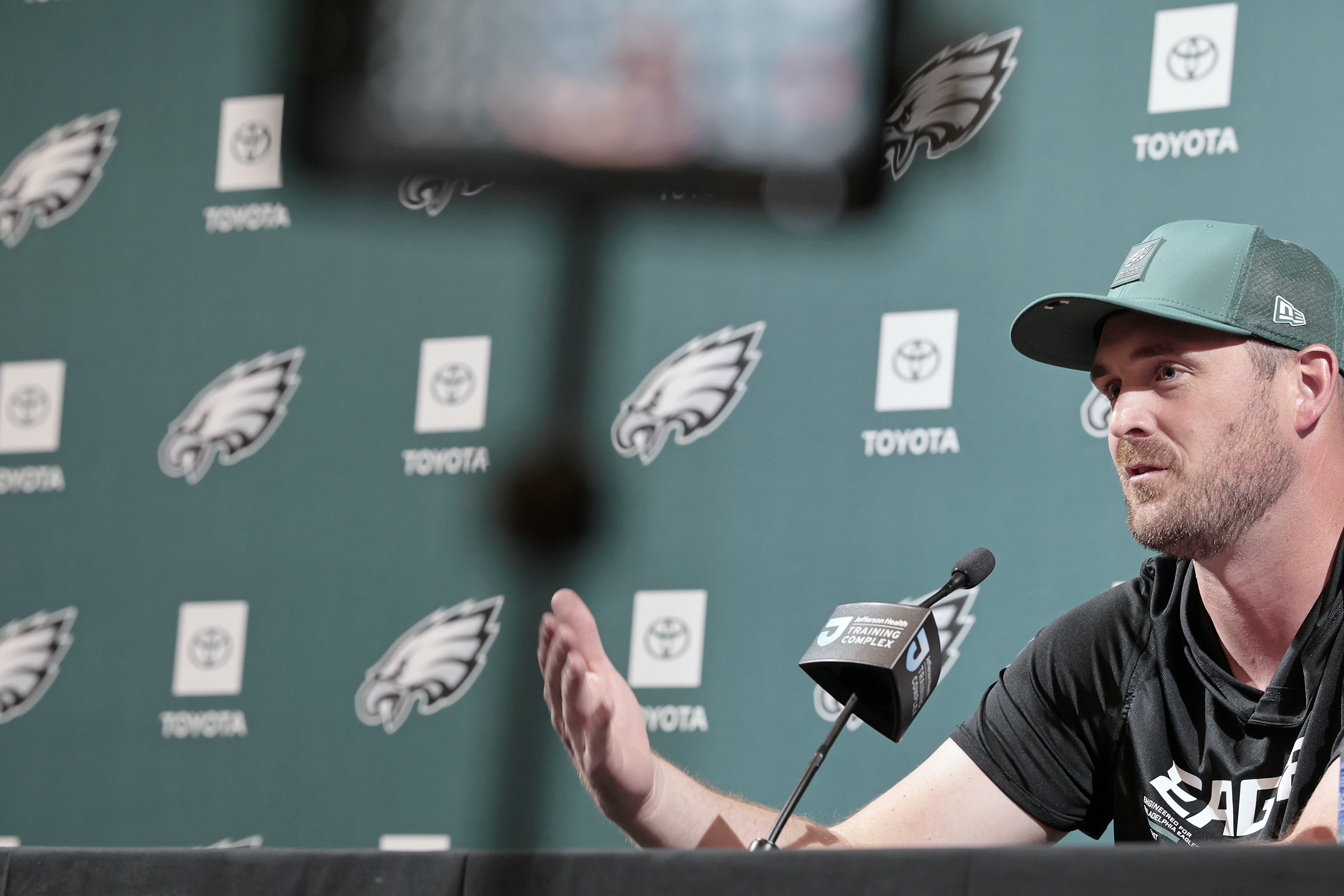
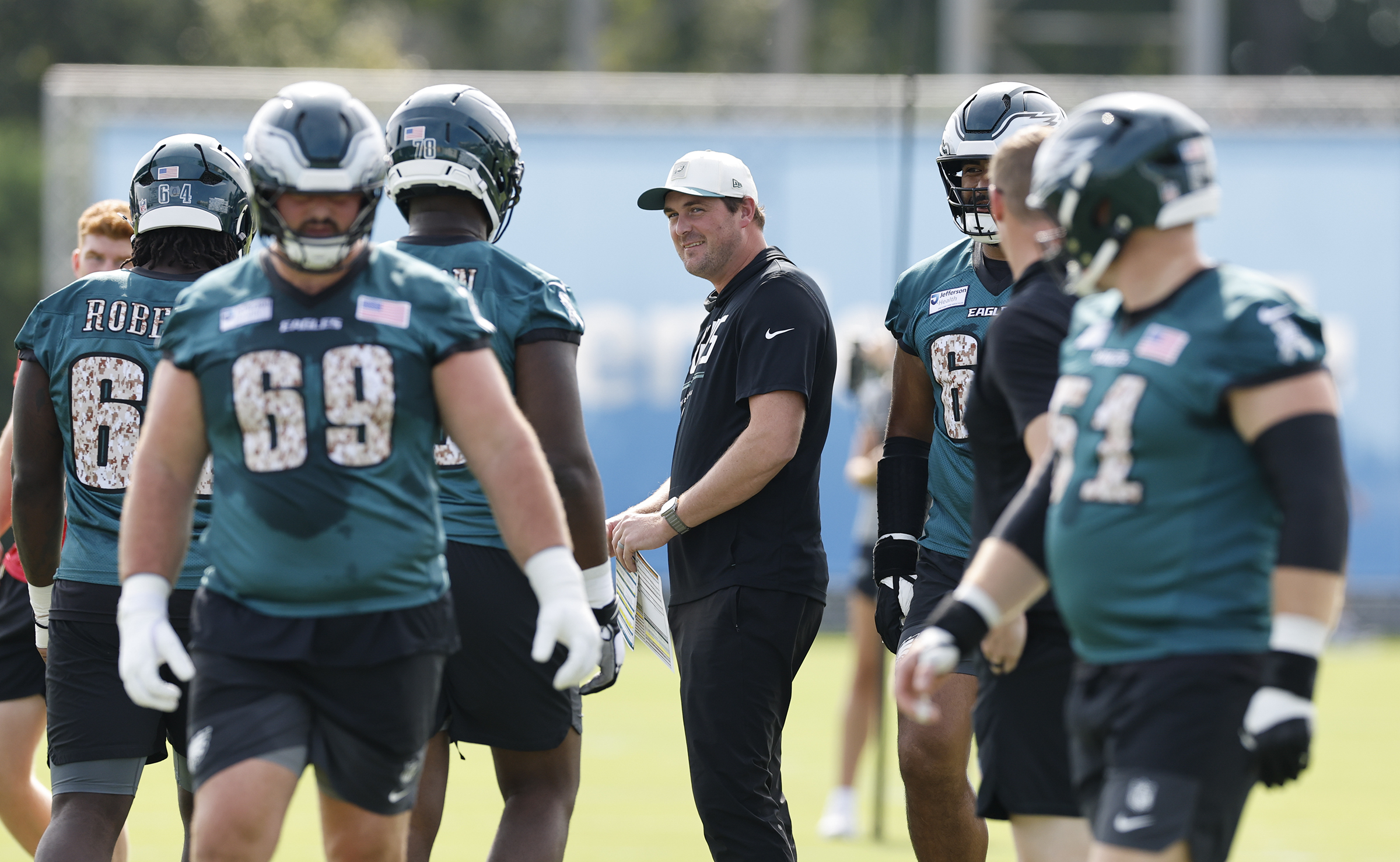
Eagles offensive coordinator Sean Mannion talks with wide receiver Makai Lemon during team drills last month. Yong Kim / Staff Photographer
Mannion is installing a new offense for Jalen Hurts and the Eagles, one rooted in the flavors of the trendy Kyle Shanahan-Sean McVay scheme. But Mannion’s history and influences suggest a style that ultimately will pull from every resource imaginable as he guides the Eagles offense into the future.
Sirianni and Howie Roseman took a calculated risk on a young and fast-rising offensive coach when they landed on Mannion, who spent two years on the staff in Green Bay, most recently as quarterbacks coach, before his big promotion. But a lack of experience doesn’t necessarily mean Mannion is any less equipped to succeed than a more experienced candidate. In many ways, Mannion, the son and grandson of football coaches, has been preparing for this job for most of his life.
“His thing was, he wanted to play as long as he could,” his father said. “The unsaid part was that when those days were done that he would turn his attention to coaching.”
Like father, like son
At its roots, coaching is teaching. In that sense, Sean isn’t just the son of a football coach; he is the son of two teachers, and his earliest influences can be traced to the classroom. He’d mess around in a playpen while his mother, Inga, an elementary school teacher, finished work in her classroom after school.
He was around his father’s football teams as much as he could be, too. One Saturday, John, who also has been a teacher for 36 years, was going to scout an upcoming opponent with a coaching friend and Sean wanted to tag along. He was around 7 years old and an inquisitive kid at the time, so he brought with him a yellow legal pad. While he watched the game next to the two adults, he doodled and drew notes and observations from the field.
“He spent a lot of time doing what we were doing,” John said of his son’s early days. “That notepad probably was a byproduct of all that time spent.”
Sean grew up in Pleasanton, Calif., Alameda County, about 20 miles east of the San Francisco Bay in a household that valued education. He was a good student who also excelled in sports. Football was his main sport, but he also played baseball and basketball.
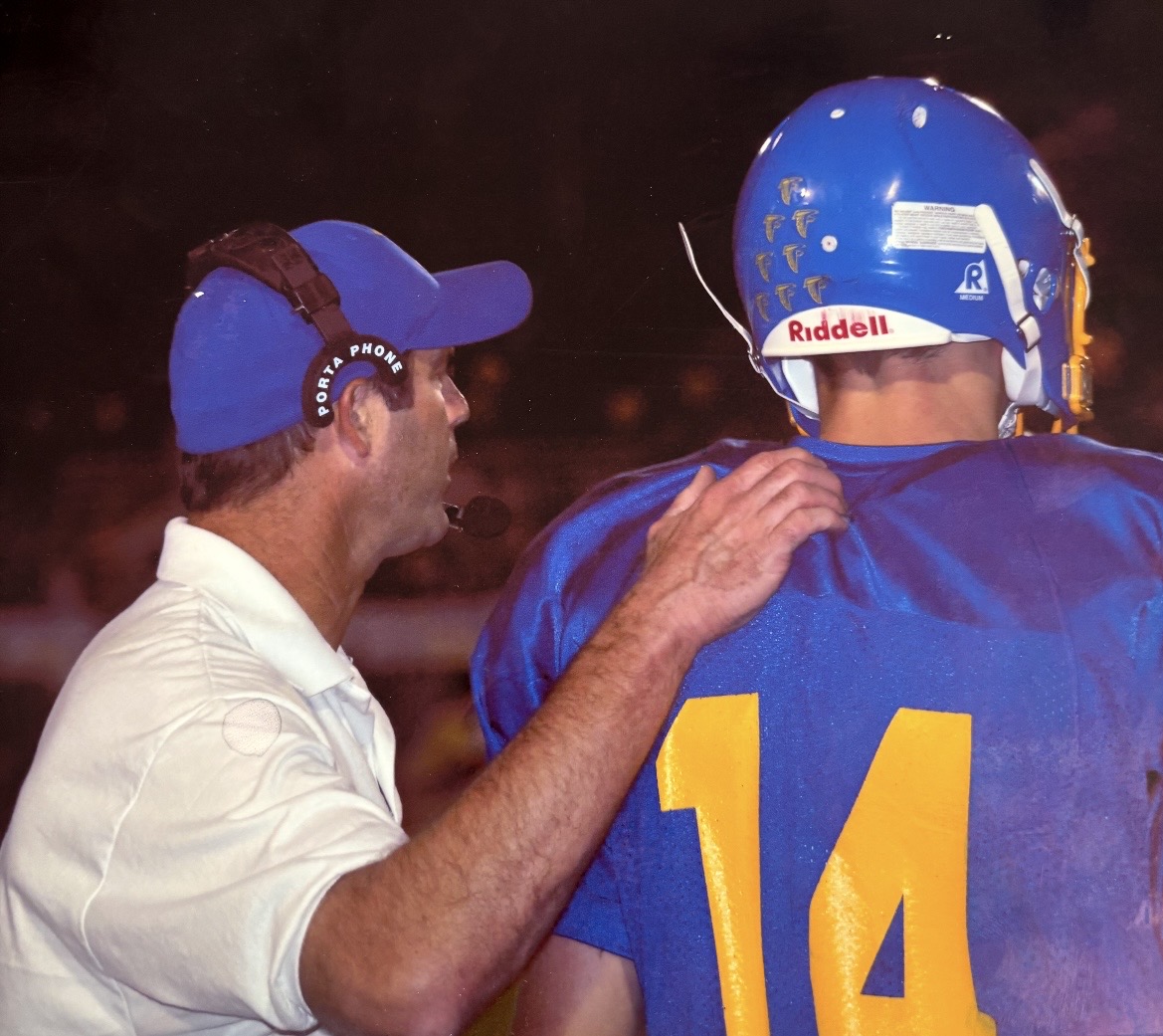
When Sean was a rising sophomore at Foothill High School, John, a former assistant, was given the job as the school’s head football coach. He was nervous, though, about any appearance of nepotism, so from the outset of that season he had Sean playing on the JV team. Foothill was 12-1 the previous season and had two upperclassmen ahead of Sean on the depth chart. A week before the season, the senior quarterback hurt his ankle and was on crutches. Later that week, after throwing at least four touchdowns in a scrimmage, the junior quarterback showed up on Labor Day, the first practice of the first game week of the season, and complained about a back injury that eventually forced him to miss the season.
John called home right away. Sean had to get to the field and get to practice.
Sean’s freshman coach at Foothill was Mike Madden, the son of Hall of Fame coach John Madden. Mike approached John Mannion that first week and asked him if he was nervous for Sean.
“Gosh, I hadn’t thought about it,” John said. “I’m nervous for myself at this point.”
John Mannion (left) coached Sean (right) in high school.Photo courtesy of John Mannion
John’s first game as varsity head coach was also Sean’s first game as varsity starting quarterback. Asked if he remembered it well, John responded the way many coaches would, and the way the father of a detailed note-taker would: “Oh yeah,” he said. “Of course I do, yeah. We lost, 26-21, and Sean did really well. It was a really hot day and there was a lot learned by me.”
The team they lost to went to the state playoffs, but so did Foothill. Sean “knew the offense from all those years growing up around it” and “really absorbed a lot of things along the way,” John said.
“We kind of went through it together,” John said. “There was no plan of him ever being on the team that first year, but sure enough there he was. There’s challenges in there but I think it was a great experience for us to be able to do that.”
Sean finished his high school career as Foothill’s all-time leading passer and, after throwing for 3,521 yards and 27 touchdowns as a senior, was off to Oregon State.
That yellow legal pad Sean doodled on during that football scouting trip was part of a full-circle moment some 25 years later.
“When I got my first coaching job with the Packers, as a gift, he framed it for me,” Sean said. “So I still have it in my house. It’s pretty cool. The scheme has evolved since then, I will say, but it was a really cool, special gift that he kept.”
Riley’s favorite word to describe Sean is “diligent.” How many coaches born in the 1990s are digitizing passing concepts from the 60s?
Sean was the top quarterback Oregon State pursued in the class of 2010, and Riley and his staff were thrilled when he committed and later signed. The program had produced top quarterbacks like Derek Anderson and Matt Moore, and Riley thought Sean would be the next great one to come through Corvallis.
The diligence showed up right away. Sean was supposed to redshirt during his first season on campus, but the summer before his first camp with the Beavers, Sean got the keys to the facility from the graduate assistants to go in early and watch film.
“That was him the whole time,” Riley said. “He could really throw the football and he was a very hard worker physically, and then he was a very hard worker off the field. He wanted to know and learn and he’s one of the most diligent people that I’ve ever been around.”
That part of Sean made it easier when, during the second half of the first game the following season, Riley put Sean in the game over a junior who started. He was just a redshirt freshman, but he was Oregon State’s starter from that point until graduation.
“That was one of the first times probably in my career that I actually had the faith in a redshirt freshman to insert him sometime early in the year as a starter,” Riley said. “I think that said a lot about what we felt about his early development and what we thought he could do on the field.”
Eagles offensive coordinator Sean Mannion has worked diligently on offensive concepts dating back to his career as a player. Elizabeth Robertson / Staff Photographer
Sean became a captain the following season. He is soft-spoken by nature, those closest to him say, but his leadership showed up in the way he carried himself and how he approached the game. By senior year, he had a nickname: “The Machine.” That year’s offensive coordinator, John Garrett, referred to Sean by that moniker during a film session one day and it stuck, much to Sean’s chagrin. Oregon State’s offensive linemen sometimes walked robotically around Sean.
“That is a pretty appropriate nickname because he was just like that,” Riley said. “He just went to work and put in the work and everybody knew that about him. I think he’s one of the most probably respected teammates that I saw through all my years of coaching.”
Sean exited college as Oregon State’s all-time leader in passing yards and ranked in the top 10 in college football history. He’s still 19th.
The quarterback and coach have stayed in touch over the years. Riley, who left Oregon State for Nebraska after Sean’s senior year, is now retired, though he’s still on the College Football Playoff selection committee. Sean isn’t the most recent Mannion whom Riley had talked to as of a few weeks ago, though. John, who no longer coaches, now writes a newsletter on Substack called “John Mannion’s Coaching Playbook,” and recently interviewed Riley.
Sean’s most recent catch-up call with his college coach came after OTAs this season and just before camp.
“He sounded excited and he sounded like he would be because he’s always prepared — he sounded confident,” Riley said. “And I could also tell he was having a lot of fun.”
‘A 30,000-foot view’
Sean has described his father and Riley as his two biggest influences along the way. But his most relevant football influences when it comes to his current job came into his life in 2017, when Sean was backing up Jared Goff with the Los Angeles Rams and the team brought in a new coach, McVay, who hired a new offensive coordinator, Matt LaFleur. Both had been schooled under Shanahan and brought to the Rams a new style of offense that Sean took to.
“I just felt like I was learning so, so much,” Sean said. “It was such an exciting way to match the run and pass. They had such a way about teaching the game where we could feel ourselves challenging a defense, but it felt simple to us.
“Those are the things that really stood out to me going through that experience that really resonated with me as a player and certainly resonate with me as a coach. That was a very exciting point in my football life, just the exposure to that type of teaching, that type of scheme. I know Matt, obviously a mentor of mine, getting to play for [McVay]. I learned so much from those people. It’s certainly a big part of molding me into the type of coach I am now.”
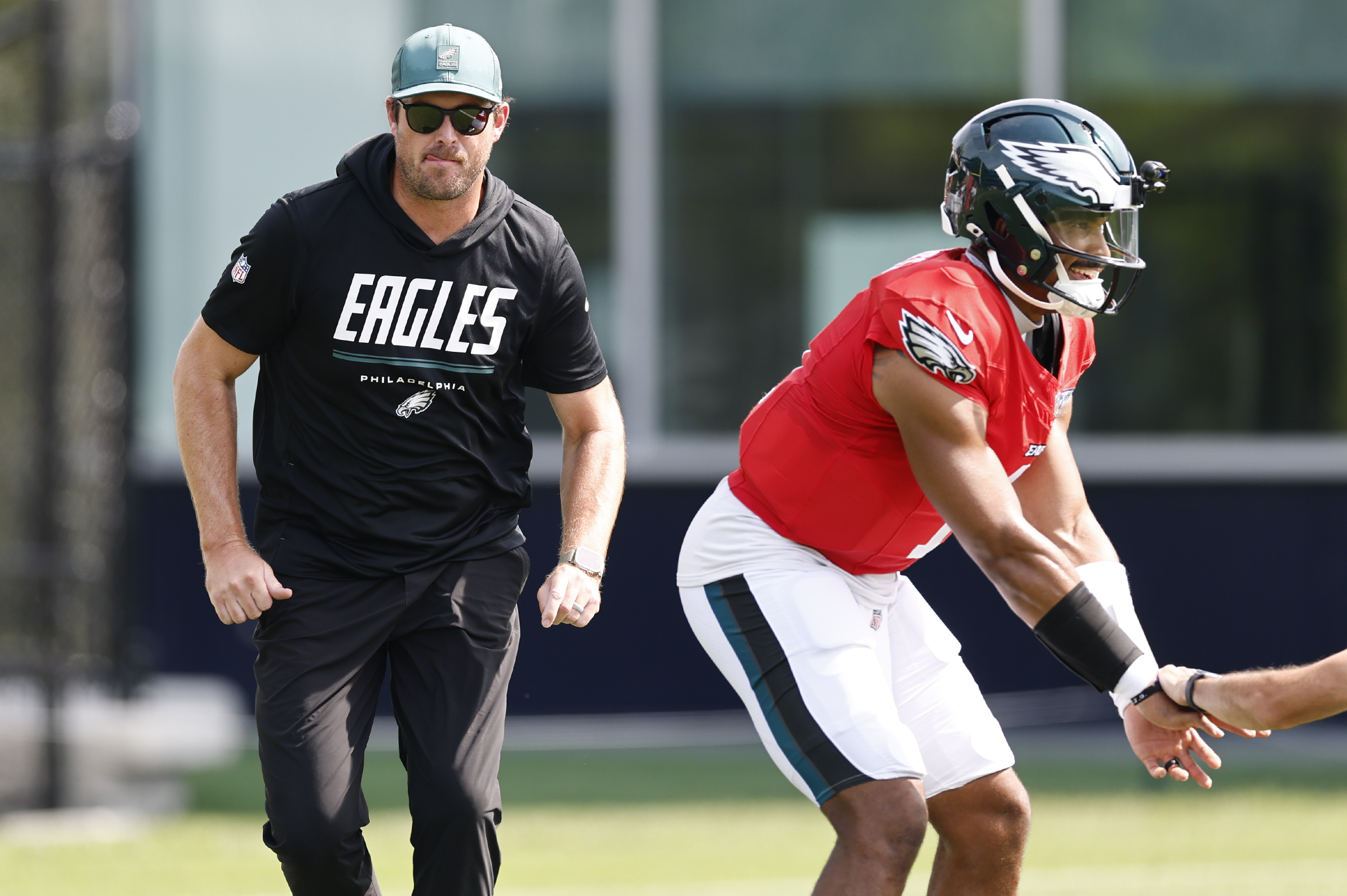
Eagles offensive coordinator Sean Mannion with members of the offensive line during training camp last month. Yong Kim / Staff Photographer
How the Eagles offense will look come Sunday still remains a sort of mystery. There certainly will be more motion, more snaps from under center, and more play-action. But the Eagles ran a bland offense during the preseason in an effort to hide most of their playbook, and the first-team offense was rarely fully healthy during training camp and also had to go against one of the best defenses in the league.
The Eagles have a new style of running the ball, which will be a key to unlocking the passing game and play-action. The base of the Shanahan-McVay offense is outside, wide-zone runs that stretch the defense horizontally. The Eagles and longtime offensive line coach Jeff Stoutland parted ways this offseason, and new offensive line coach Chris Kuper has been in charge of implementing the new blocking scheme.
Kuper was the offensive line coach in Minnesota when Sean spent part of the 2023 season with the Vikings.
“He sees the game from a 30,000-foot view as well as being on the sideline and being into it with the players,” Kuper said. “I think it speaks volumes, his experience as a quarterback in this league and being able to connect people and become a glue guy has been incredible.”
There may be a misconception that Sean, a quarterback by trade, just focuses on the quarterbacking. But Kuper described a coach who is involved in every facet of the offense.
“What I love about Sean is how much he loves the run game,” Kuper said.
Kuper said part of Sean’s responsibilities in Green Bay when he was an offensive assistant in 2024 was to draw some runs. The Eagles do have a run-game coordinator in tight ends coach Ryan Mahaffey, but Kuper is confident Sean could handle it all.
“Sean could game plan and call a game all on his own, I think, if he wanted to,” Kuper said.
First-time play caller
The Mannions relocated to Oregon when Sean was in college, and one spring after John had taken over as the head coach at Mountainside High, he needed help.
The 2021 football season came together rather late in the midst of the COVID-19 pandemic, and a shortened spring season was on the table. Sean was home in Oregon doing remote OTAs with the Vikings when John asked him to be the offensive coordinator that season.
Sean’s younger brother, Brian, was the starting quarterback. It was a family affair.
On the day of the first practice, John walked out on the field and handed Sean his handwritten practice plan.
“You know there’s software for this, right?” Sean quipped.
John was calling plays, but after Mountainside was shut out in the second of their six games, John made a change.
“I handed the torch to him. It was fun,” John said.
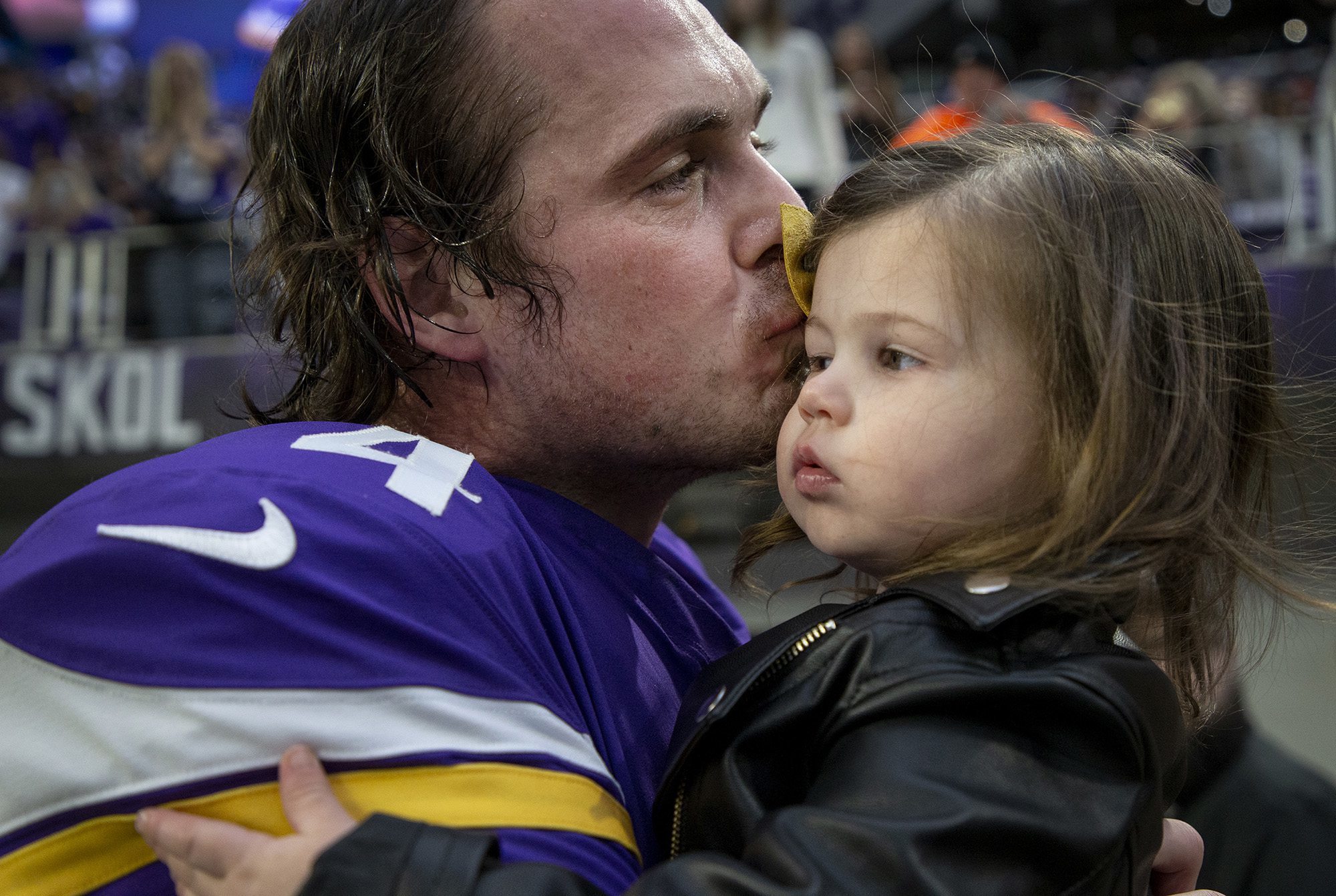
Minnesota Vikings quarterback Sean Mannion (4) kisses his daughter Sawyer after pregame warmups before a game against the Chicago Bears on Sunday, Dec. 29, 2019.Carlos Gonzalez / MCT
John has watched the oldest of his four children become a loving husband to his wife, Megan, and the proud father of three children. He always knew Sean could and probably would eventually become a successful coach, but that spring offered his first real chance to witness Sean’s future in person.
“I could see clearly he had a real knack for it,” John said.
Sean was still in the process of talking to the Eagles when he was tapped to call plays in January’s East-West Shrine Bowl. He called John during his father’s lunch break.
“You haven’t called a game since Mountainside vs. Grant High School back in March of 2021,” John joked.
The two shared a laugh. A few days later, Sean was hired to call plays for the Eagles.
All roads lead to Delco
Margaret Mannion was around 20 years old when she moved to California, but John’s mother spent her early days in Delaware County. She lived in Drexel Hill, graduated from Archbishop Prendergast High School, and worked at Villanova before moving west, where she met Jim Mannion, John’s late father.
Margaret, 84, has dementia now and still lives in California in an elder care facility, but John is pretty confident there will be at least one “proud Philadelphian” and Eagles fan watching the games this year from the elder care facility.
As for John, he’s a self-described “worrier.” When Sean redshirted at Oregon State, John loved the ease of watching the games with no pressure in the family section. After Sean was inserted as starter the next season, John called the box office. He wanted to sit in the far corner of the stadium in the last row. Tickets in the family section were free and required no work on his end, but every year he’d call the ticket office to secure his seats at the top of the stadium.
Sean rarely played in the NFL — he threw just 110 passes over nine seasons in the league — so Sunday Ticket usually sufficed. When Sean was hired by the Packers, they were on national television frequently enough, and for the games they weren’t, John would drive to his local Buffalo Wild Wings, where he’d watch quietly and hope the quarterback play was up to snuff.
Last year, while watching a game at the restaurant, a few Green Bay fans in their 20s complained to John about Packers quarterback Jordan Love. The group had a laugh when John told them, no, he wasn’t from Green Bay, his son coached the quarterbacks.
“I’m going to call him tonight and tell him there’s some guys in Oregon who say he’s got a lot of work to do,” John joked.
This year, it’s back to Sunday Ticket. John, who was in town for a few days in August observing the Eagles and Sean during camp, said he’ll build a fire at home, watch the game in peace, and “keep our fingers crossed.”
His son’s new job comes with a lot of pressure. Patullo was the most criticized person in the building last year and eventually took the fall after the team’s first-round exit, so all eyes will be on Sean as the season gets underway.
Margaret’s older sister, John’s aunt, still lives in New Jersey and called John after Sean got the job.
She was excited Sean was in a new, high-profile job back where his family has roots. But her excitement also had a tinge of nervousness: “Hopefully everybody is nice to him,” she said.
Retired Philadelphia Police Capt. Mark Fisher gets winded and lightheaded while emptying the dishwasher or pushing his gas-powered lawnmower, his lungs forever scarred by the ankle-deep ash that he trudged through at ground zero.
WhenFisherarrived at the nation’s worst crime scene, two days after the Sept. 11, 2001, terrorist attacks, each step he took kicked up a powdery plume, coating his tan work boots. Dense smoke from fires burning beneath the rubble of the World Trade Center site stung his eyes and clogged his lungs.
Then a lieutenant in charge of the Philadelphia department’s crime scene unit, Fisher scoured the wreckage for nearly two weeks. He helped recover the lifeless body of a firefighter crushed under concrete. A torso. The severed arm of a businessman.
The coughing fits started about a year later. Then, about six years after 9/11, a chest X-ray revealed a thick, hardened fluid around his lungs, makingit difficult to breathe. He developedsevere pulmonary disease linked to exposure to toxins.
Fisher, 69, needs a double lung transplant soon, his doctors say, that at best will extend his life by five to seven years. His deteriorating health shows how grossly federal and local health officials underestimated the environmental hazards.
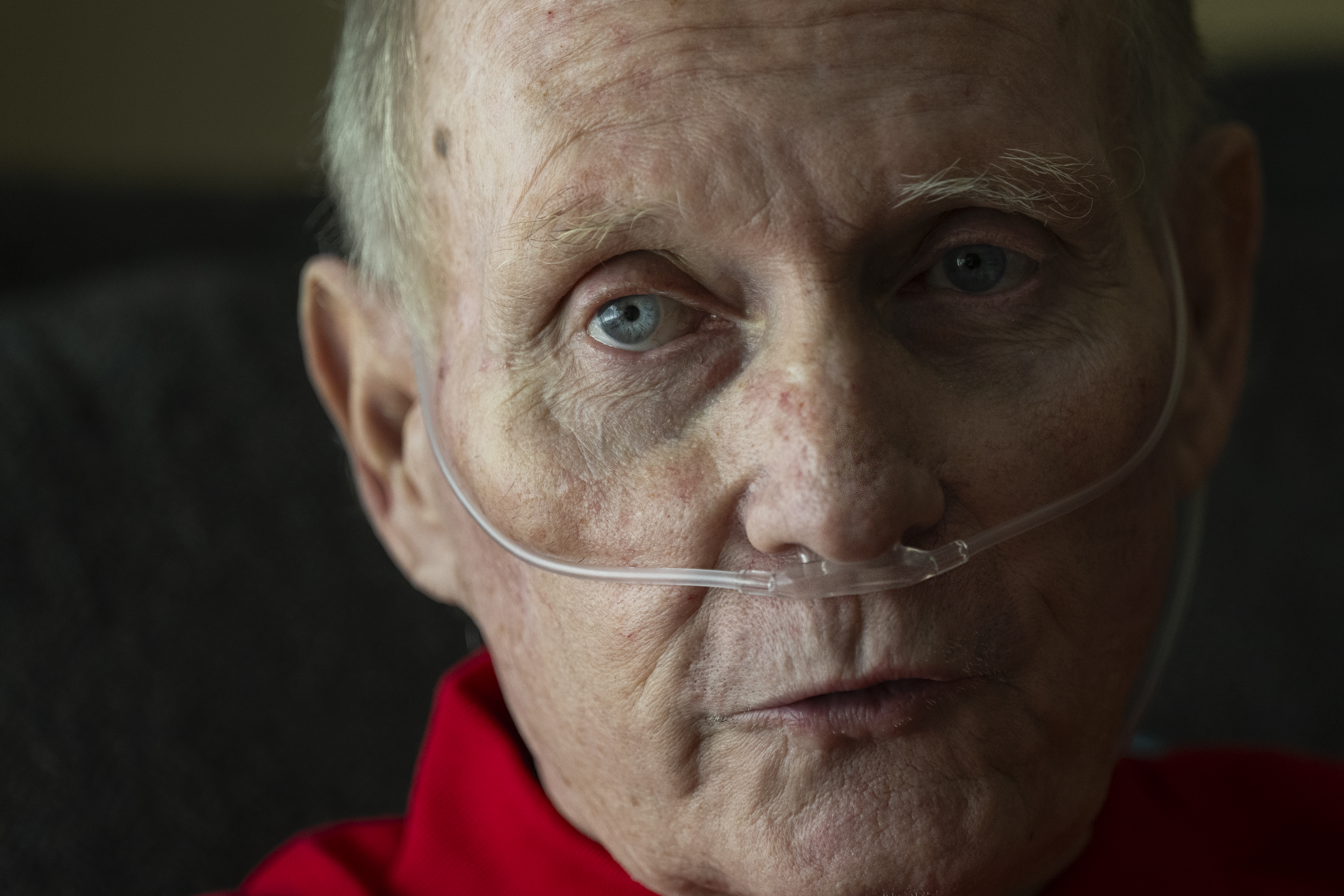
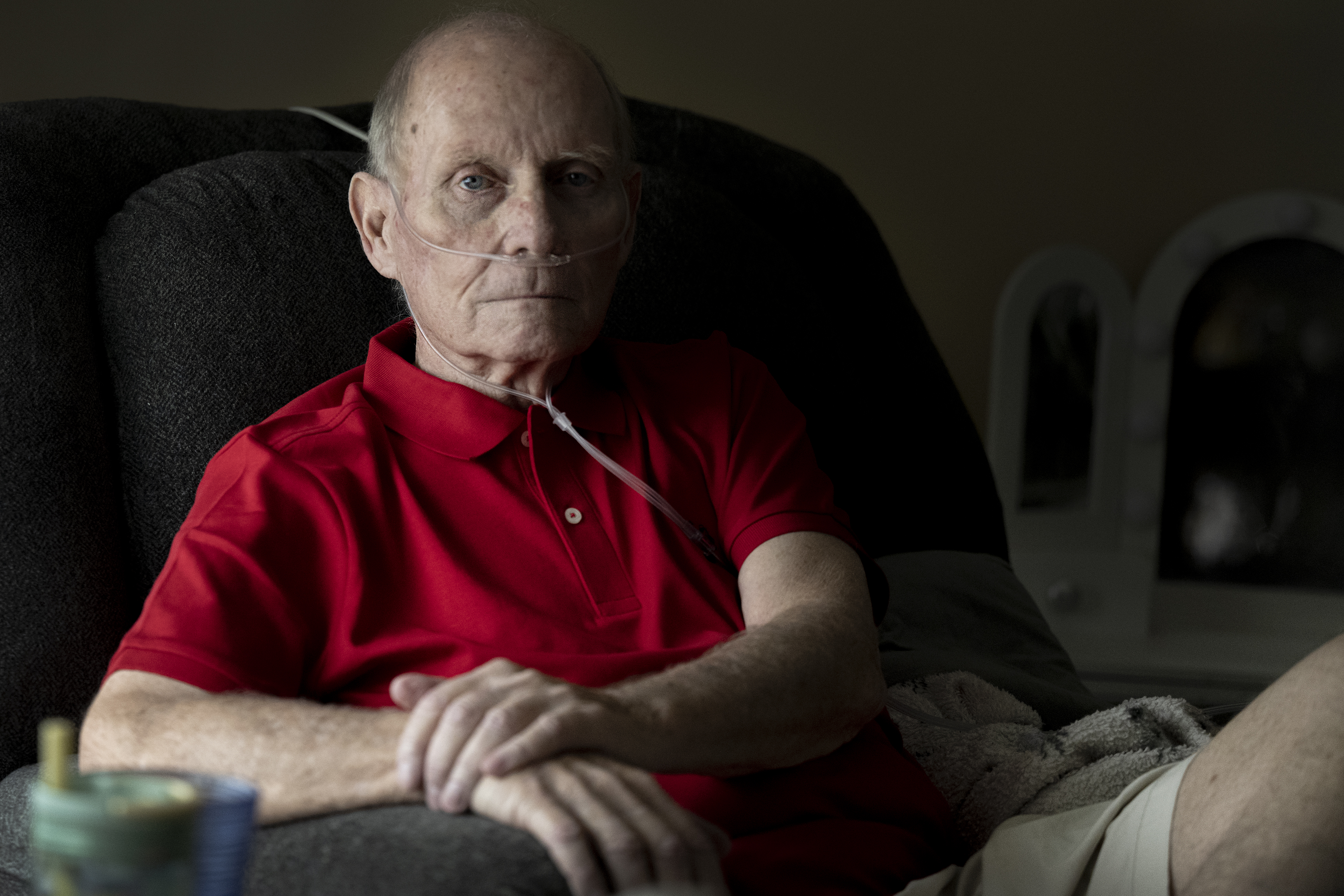
“I can’t breathe worth a darn. My lungs just aren’t going to last,” Fisher said, as he sat in his Northeast Philadelphia home with oxygen prongs in his nostrils and a heating pad against his back.
“Everything aches,” he rasped, coughing relentlessly.
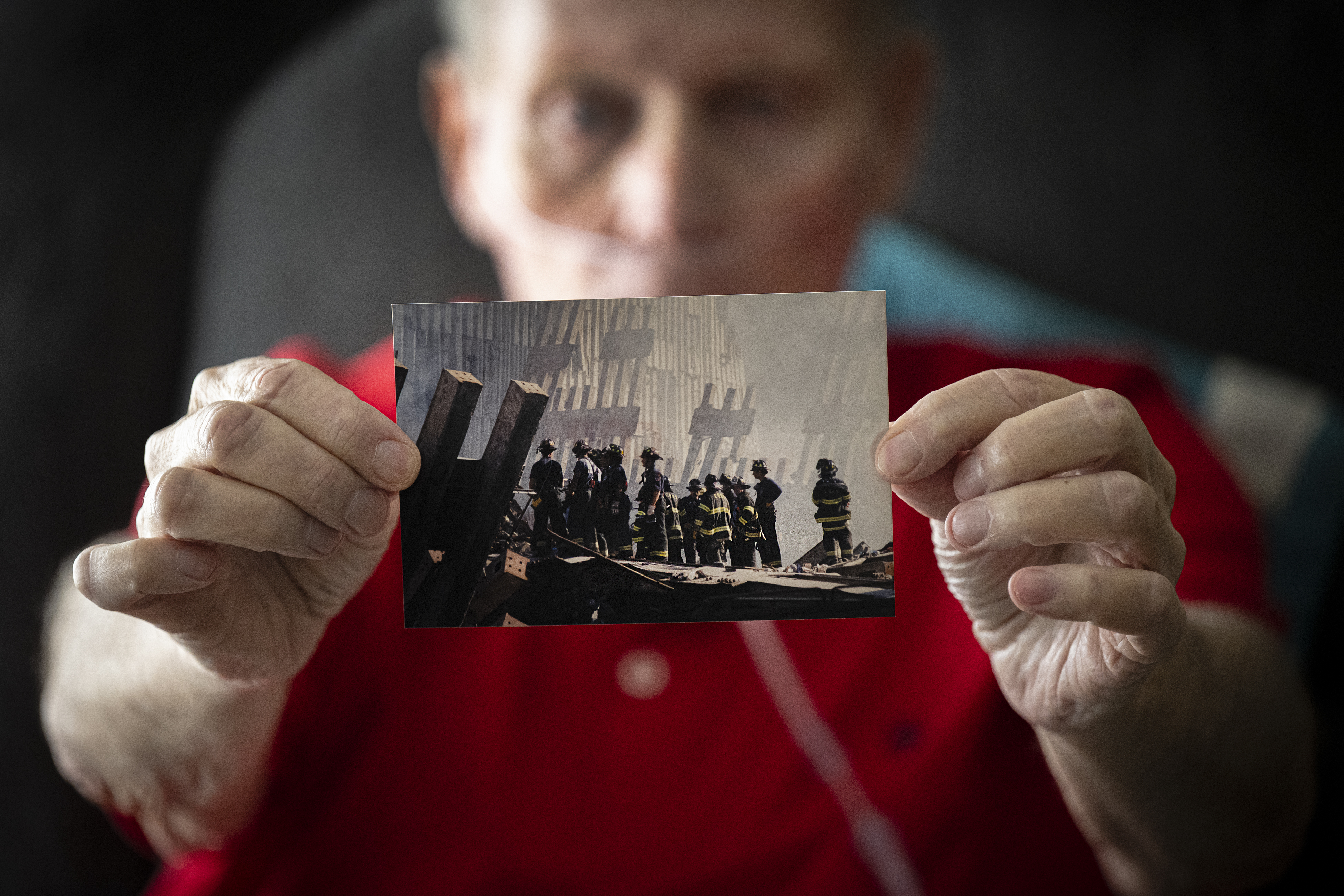
Retired Philadelphia Police Captain Mark Fisher, 69, shows a photograph he took while working as a crime scene investigator at ground zero.Jose F. Moreno / Staff Photographer
Cancer is the fastest-growing diagnosis, now that enough years have passed for tumors and other abnormalities to emerge, soaring from about 3,200 cases to more than 57,000 within the last 11 years.
Most of the toxic dust — as deep as snow drifts in spots — formed when the concrete floor slabs of the 110-story towers collapsed on top of one another in quick succession. The wreckage, known as “The Pile,” contained more than 350 chemicals andmineral agents:potassium hydroxide in concrete, calcium sulfate in wallboard, jet fuel, asbestos, glass insulation fibers, heavy metals — all finely groundand aerosolized.
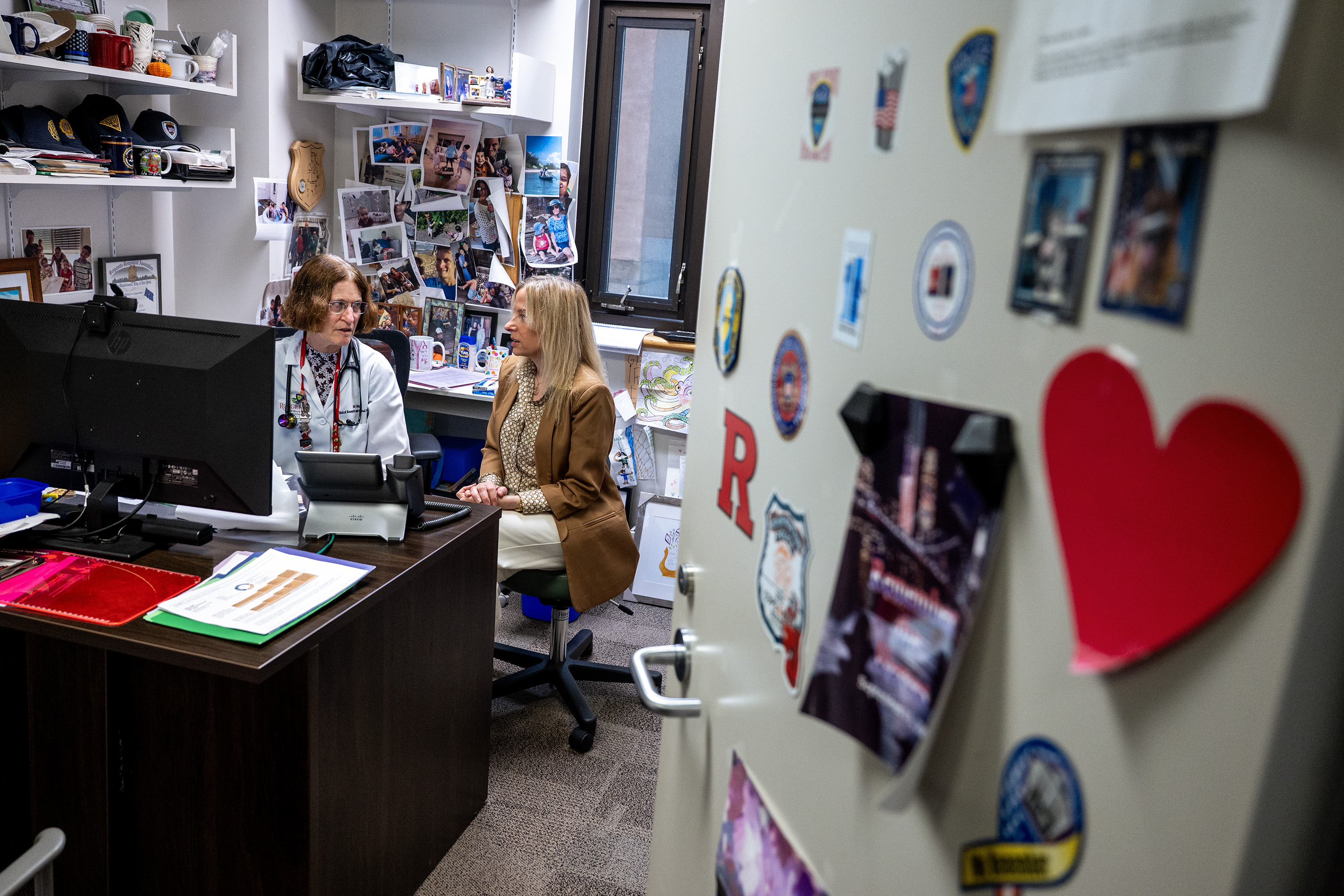
“It was such a mixture of stuff, like a witch’s brew,” said Iris Udasin, a Rutgers Health doctor who treats 9/11 responders and studies the long-term health effects of the attack.
The alkaline alone in “the cement from all these buildings was toxic in and of itself,” she said. “It basically burned holes in people’s noses and made them more likely to absorb other chemicals and gases that were in the air.”
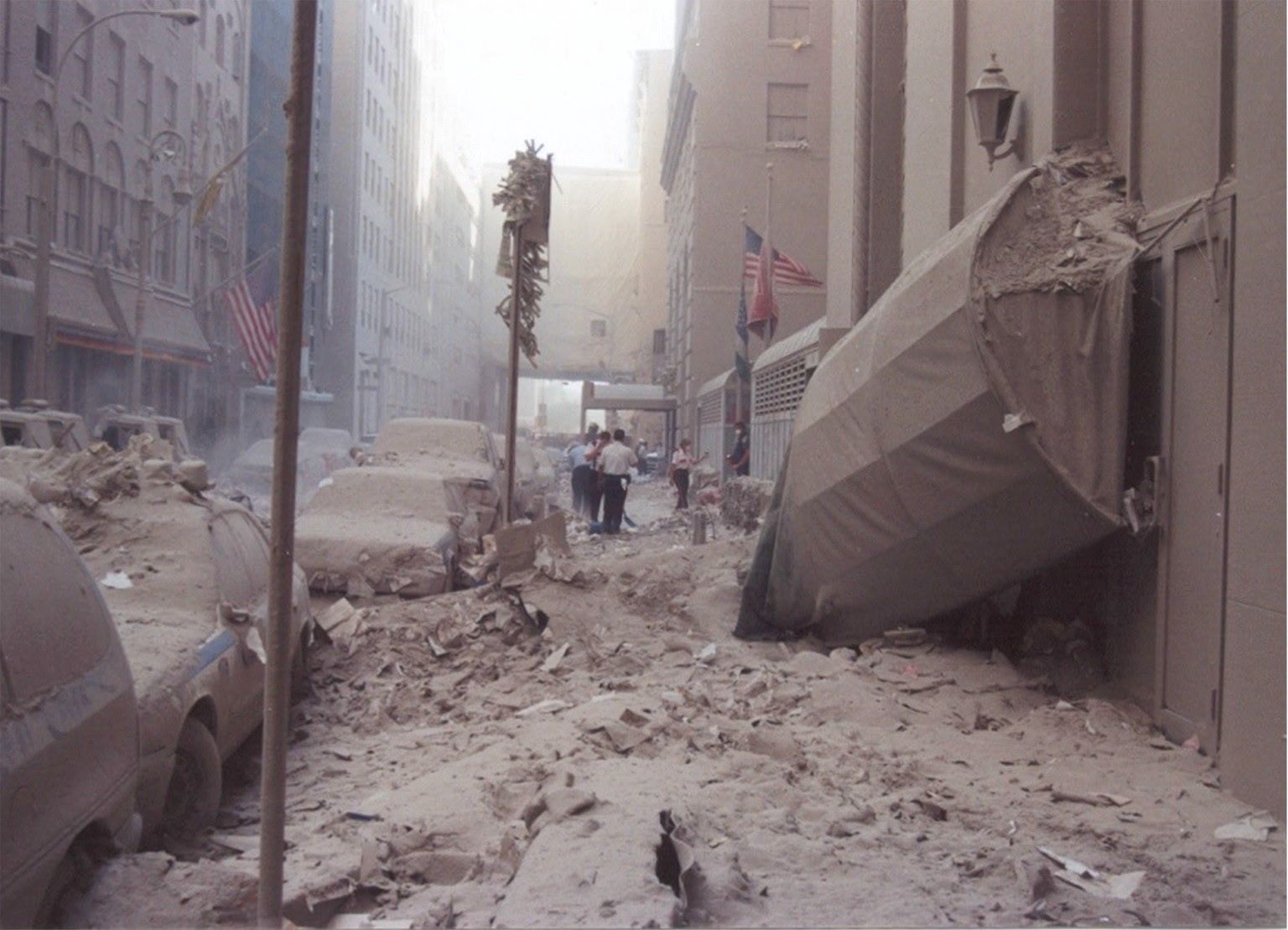
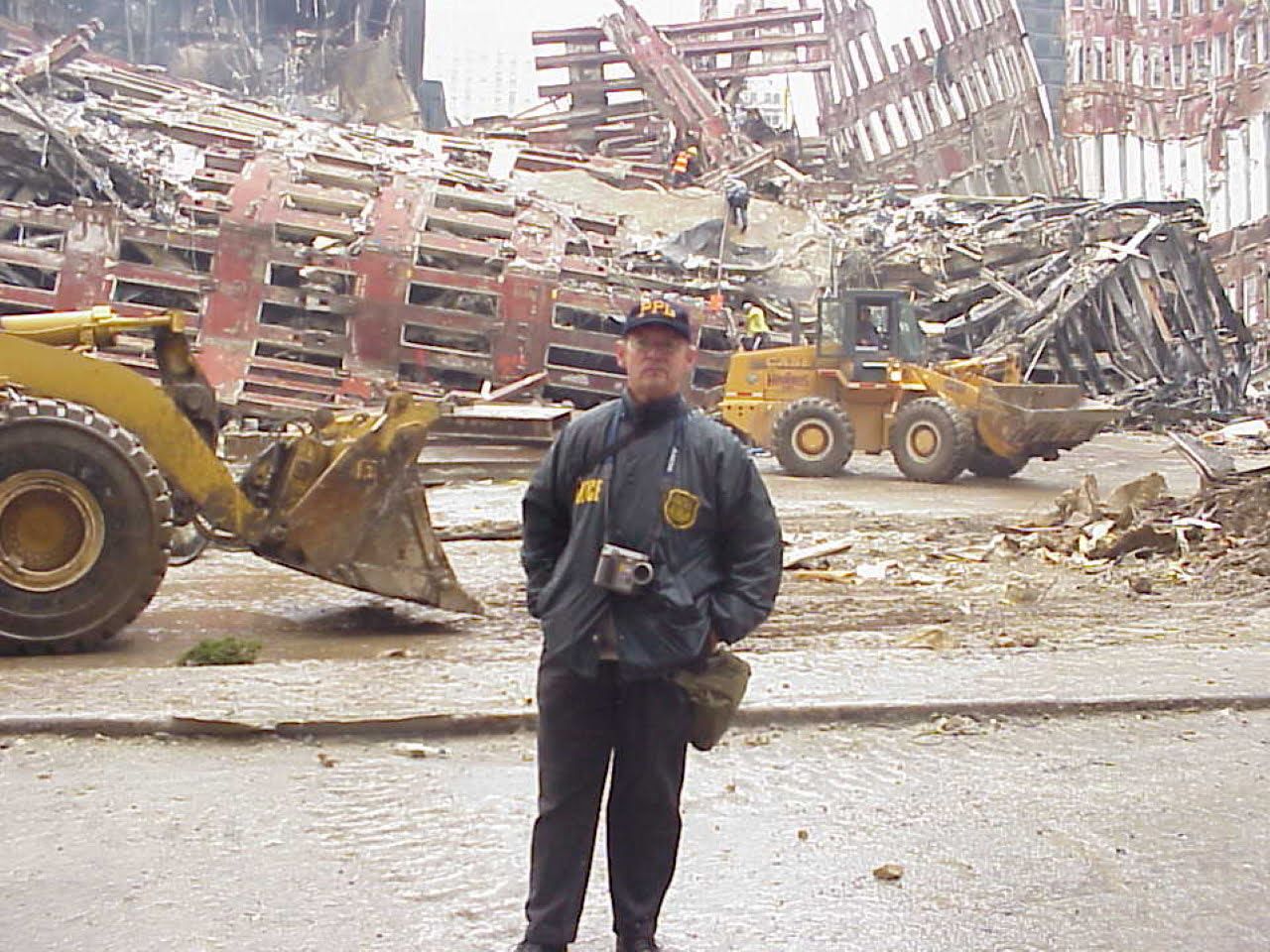
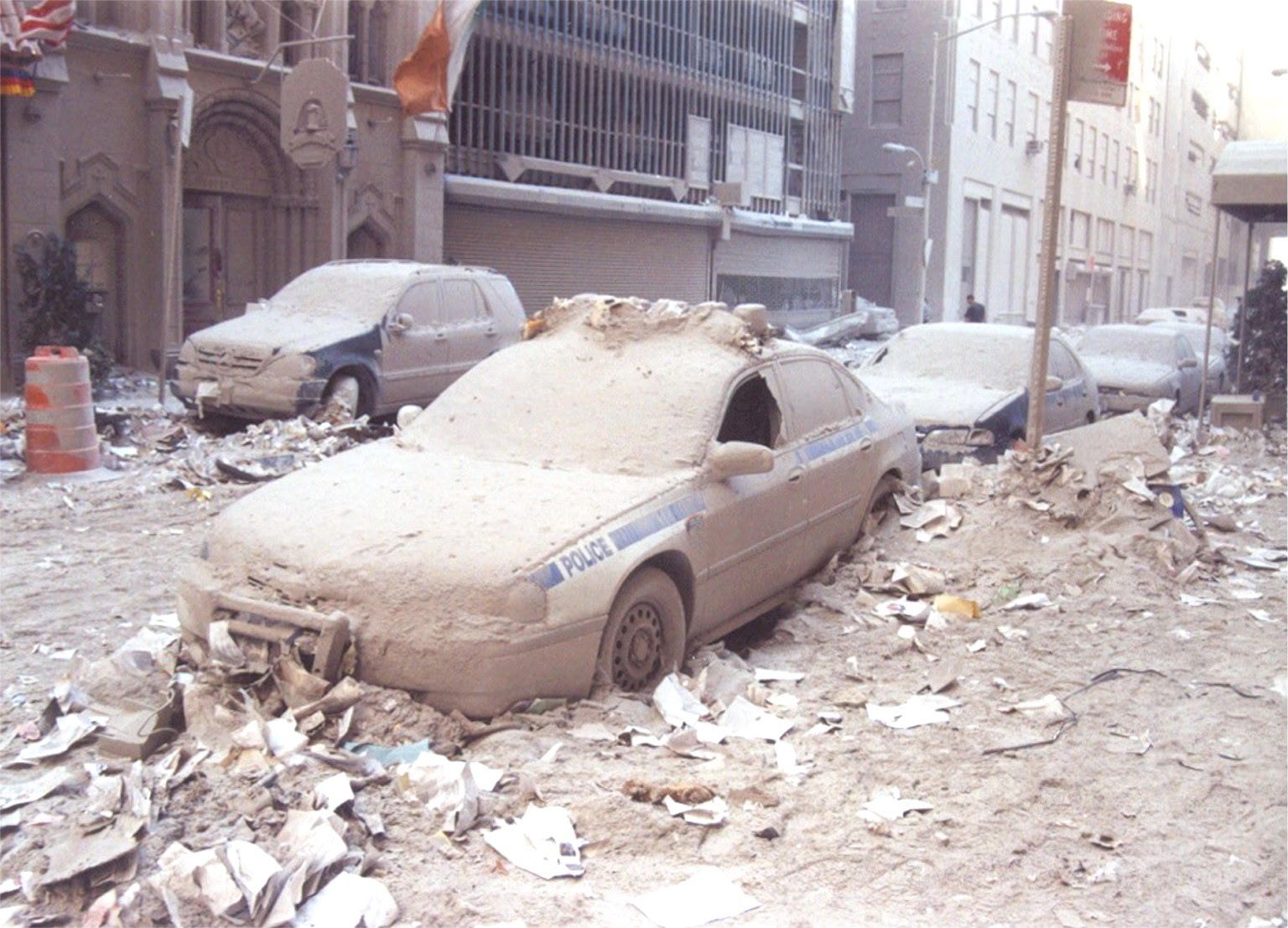
While at ground zero, then-Philadelphia Police Sgt. Greg Masi took photos of the dust and debris. When Masi started wheezing and coughing a few years later, he thought, “I’m just getting old. I didn’t want to believe that the days I was there affected me,” he said. He’s since been diagnosed with asthma, lung nodules, and a type of blood cancer linked to breathing toxic dust. Courtesy of Greg Masi
From WTC cough to lifelong disease
Udasin directs the WTC Health Program at Rutgers University in Piscataway, N.J. — one of six clinics created nationally to treat 9/11 responders.
When it opened in 2003, Udasin mostly treated responders for what she calls “World Trade Center cough,” a dry and persistent hacking that improved with asthma medication.
Now their cases are far more complicated and life-threatening, often requiring referrals to medical specialists, from pulmonologists to oncologists.
Udasin can name many of the roughly 3,000 responders she treats annually by their faces alone. She prefers to relay test results, both good and bad, to patients herself, rather than delegate.
On a recent morning,she escorted an older man from an exam room to the clinic’s lobby and asked: “Do you want me to call you with the results? If you are going to be scared, I can have somebody else call you with the results.”
Her patients, hailed as heroes after 9/11, could not have anticipated how working at ground zero would impact their long-term health.
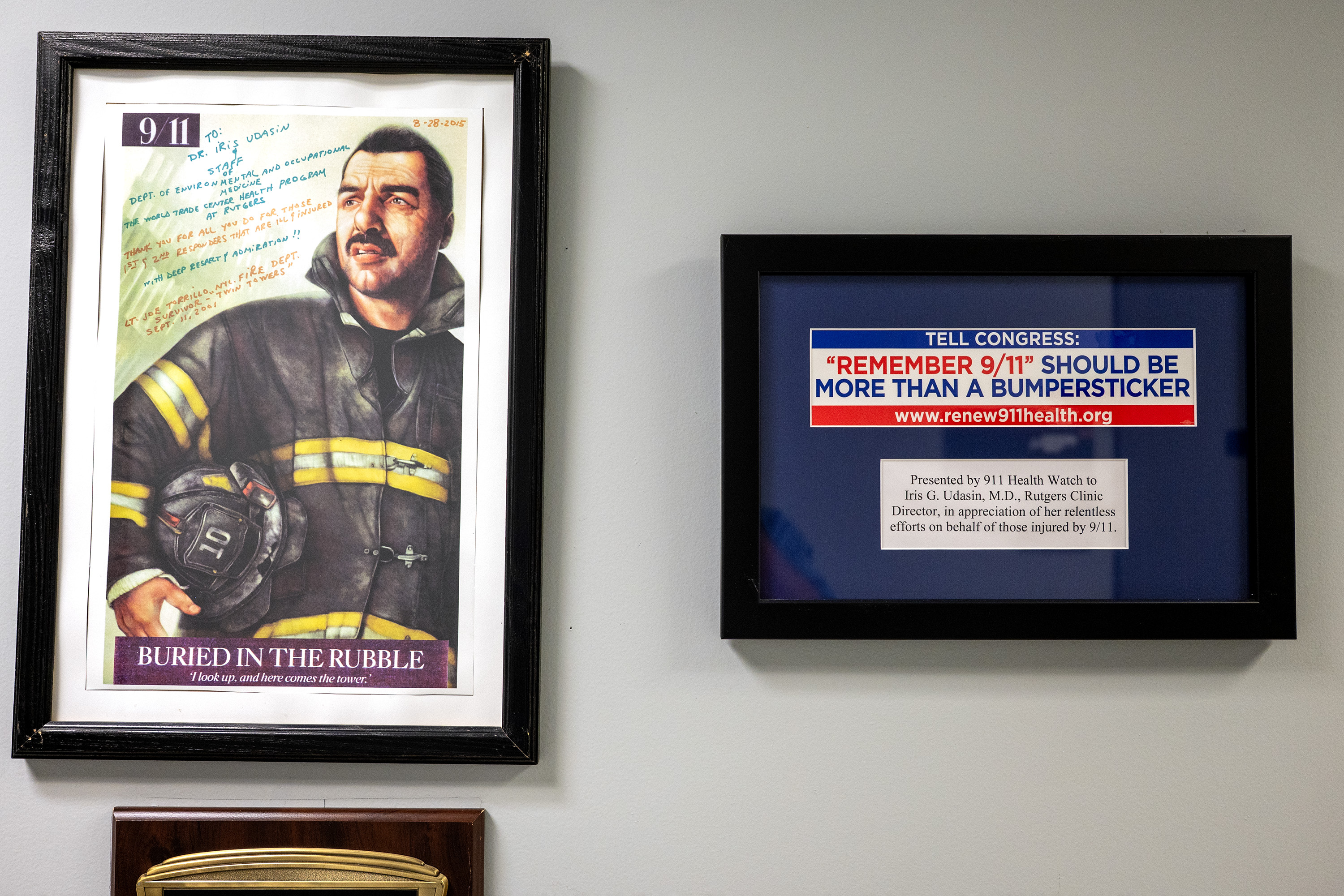
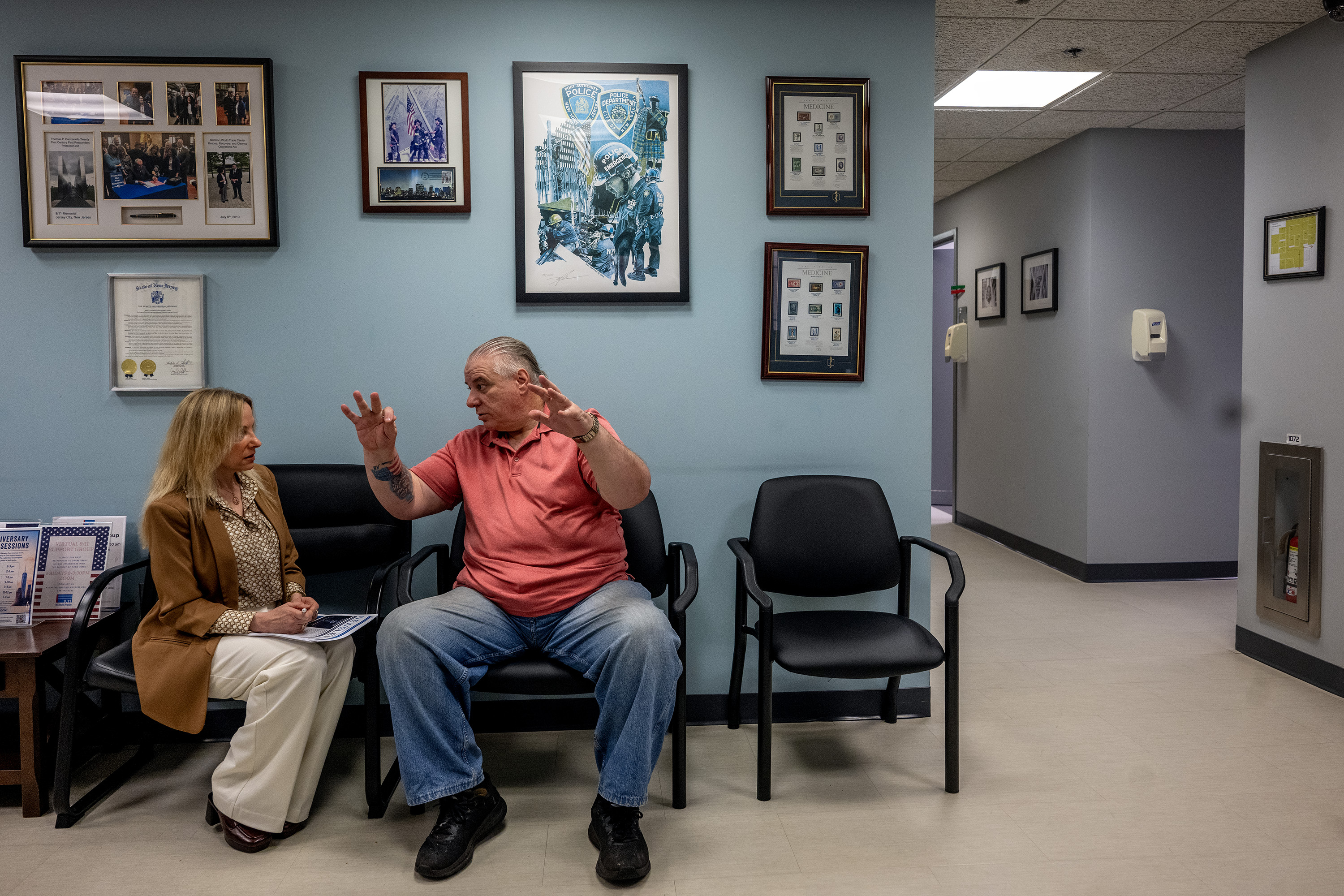
A plaque (right) presented to Iris Udasin, medical director of the World Trade Center Health Program at Rutgers University, hangs on the wall of the patient waiting room. Udasin’s federally funded clinic provides medical monitoring and free treatment to 9/11 responders. Tom Gralish / Staff Photographer
Local and federal officials initially minimized the environmental health hazards. Christine Todd Whitman, who was the head of the Environmental Protection Agency under President George W. Bush, infamously assured the public within days of the attack that the air around the WTC was “safe to breathe.”
“The [EPA] scientists did the best they could with the data that they had and with the knowledge they had at the time,” said Whitman, who had previously served as New Jersey governor.
“It’s a case of you don’t know what you don’t know,” Whitman added in an interview with The Inquirer late last month.
Whitman said her agency did urge responders on “The Pile” to wear protective gear, preferably respirators. The EPA distributed masks, but many refused to wear them, she said.
In hindsight, she said, the masks were not protective enough. Responders are now paying “the price” of breathing toxic air: “It sickens me to say it,” Whitman said.
The Rutgers program grew out of early alarms about air quality hazards, of which details are still emerging. On Tuesday, New York City officials publicly released a trove of documents revealing that toxins lingered in the air for months after the attacks.
Medical monitoring and free healthcare forresponders continue to evolve as the responder population ages.
Researchers evaluated more than 5,000 WTC responders, with an average age of 53 at the start of the eight-year study.
“As this population ages, we are seeing increasing concerns related to memory, attention, and executive functioning, sometimes at ages when the responders themselves are surprised to be experiencing them,” said Jodi Streich, mental health director at Rutgers’ WTC Health Program.
Iris Udasin, medical director, and Jodi Streich (right) mental health director, of the World Trade Center Health Program at Rutgers University sit together in Udasin’s office. They treat responders with WTC-related illnesses at the medical clinic, which is funded by the National Institute for Occupational Safety and Health (NIOSH) within the Centers for Disease Control (CDC). Tom Gralish / Staff Photographer
A stubborn and spreading blood cancer
Udasin’s clinic currently treats 1,177 cancer patients. Research shows that 9/11 responders suffer from thyroid, prostate, lung, and blood cancers at higher rates than the general population.
“The question is: Are certain cancers higher because we looked for them, or are they higher because they’re really higher?” Udasin said. “We really don’t know the answer to that, but my job is to treat everybody.”
In 2023, Udasin successfully lobbiedto have gynecologic cancers, including uterine, included on the list of WTC-related conditions.
Philadelphia Police Department Sgt. Greg Masi at ground zero just days after the twin towers fell. Then-Police Commissioner John Timoney dispatched Masi to New York City because of his expertise in radio communications. He’s developed asthma, lung nodules and T-cell lymphoma from breathing in toxic fumes and dust.Courtesy of Greg Masi
Greg Masi, 71, a retired Philadelphia police sergeant from the Northeast, was diagnosed with a form of blood cancer known as T-cell lymphoma in 2019.
First, red bumps appeared on his left arm. A scaly rash hassince spread over much of his body, killing hair follicles. His oncologists worry the cancer will find “a road map” into his organs.
Light therapy and topical medications did not work. Chemo and radiation would be a last resort. Since there is no cure, the goal is to slow it down.
Masi, an expert in radio communications, can still hear the horns that blared each time responders thought they found someone still alive beneath the rubble at ground zero, or to signal an imminent structural collapse.
The dust that caked cars and blanketed fire escapes struck himas a mere nuisance.
“We figured it was just dust, like dirt,” Masi said. “We had no idea it had harmful toxins in it.”
An avid runner and marathoner, Masi developed bad chest colds with wheezing about five years after Sept. 11. He was later diagnosed with asthma and nodules on his lungs, both common afflictions among responders.
He recently learned that one nodule has doubled in size, and doctors plan to monitor it for signs of cancer.
Then-Philadelphia Police Department Sgt. Greg Masi captured photos of the dust during his time at ground zero. Masi and three other department staffers have been diagnosed with WTC-related illnesses from breathing in deadly dust.Courtesy of Greg Masi
Mental health toll still mounting
Multiple diagnoses are commonly seen in 9/11 responders. Frank Geffre Jr., a retired firefighter from Central Jersey, has asthma, two types of cancer, and post-traumatic stress disorder.
In 2013, surgeons removed a “grapefruit-sized tumor” and parts of his colon and stomach to treat his stage-four colon cancer. Two years later, he learned the cancer had spread to his rectum.
After more than a decade of chemotherapy and radiation, his cancer is in remission. He credits Udasin, his primary care doctor, with saving his life.
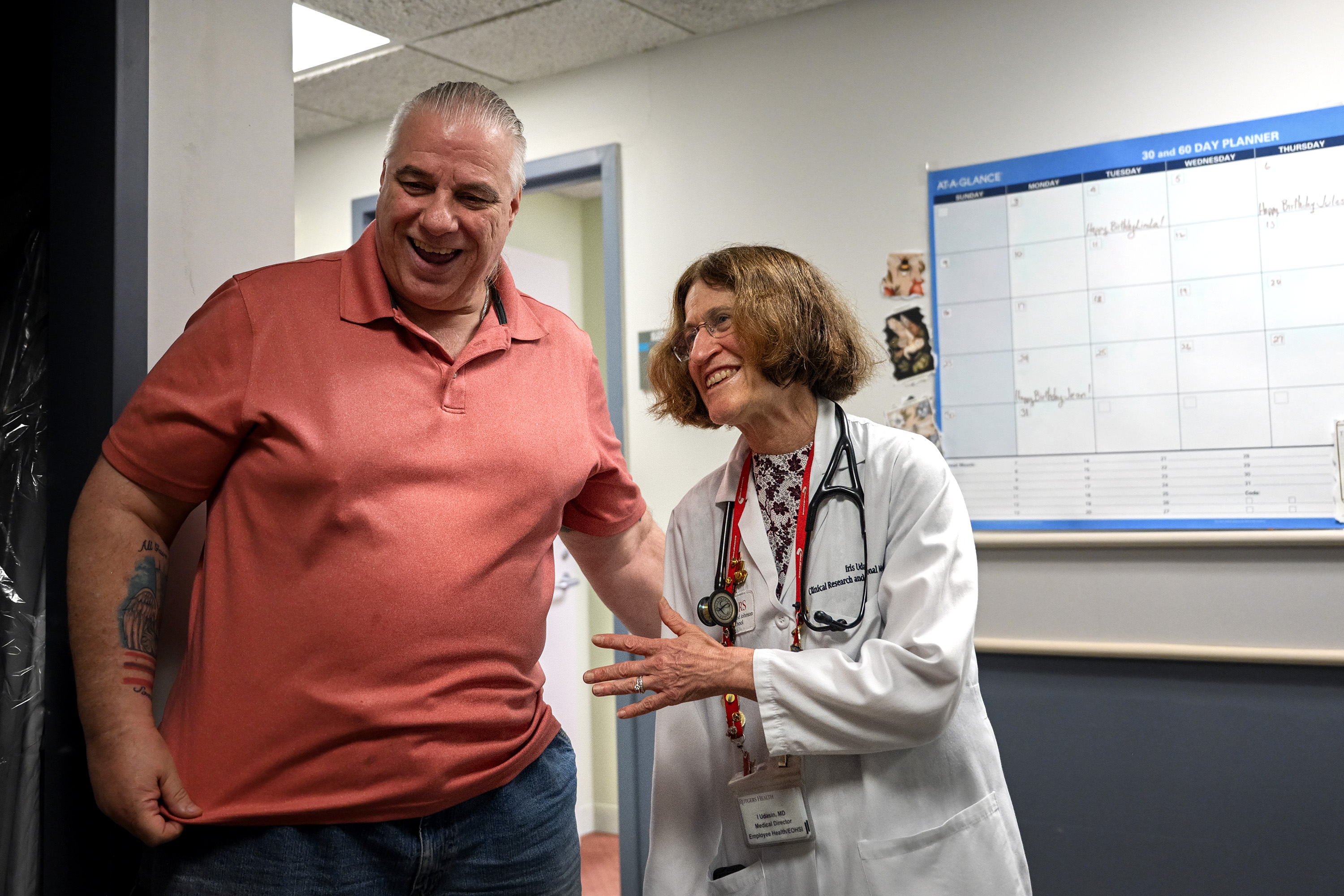
Retired Piscataway firefighter Frank Geffre Jr. shares a laugh with Iris Udasin, medical director at the World Trade Center Health Program at Rutgers University. Geffre credits Udasin and her team at Rutgers with saving his life after he was diagnosed with colon and rectal cancer. “Dr. Udasin is like the quarterback of the team,” he said.Tom Gralish / Staff Photographer
He sees a psychiatrist and a therapist for PTSD, which he finds especially hard to manage as Sept. 11 approaches each year. He lies awake after a recurring nightmare in which he is trapped in Manhattan with his family amid a terrorist attack, and he can’t get them out.
After the first plane struck on 9/11, Geffre and five other firefighters from Fire District No. 3 in Piscataway were immediately dispatched. His team got to ground zero shortly after the second tower violently pancaked.
“It was dark as can be, even though it was daylight. You had smoke clouds so thick you couldn’t even see your hand in front of your face,” Geffre said. “The dust was so thick it was like you had two foot of snow the night before.”
He initially wore respiratory gear, but the oxygen tank ran out as he worked nonstop over the first 30 hours. He saved roughly a dozen people after putting out fires that were blocking their exit from the burning buildings within the World Trade Center complex.
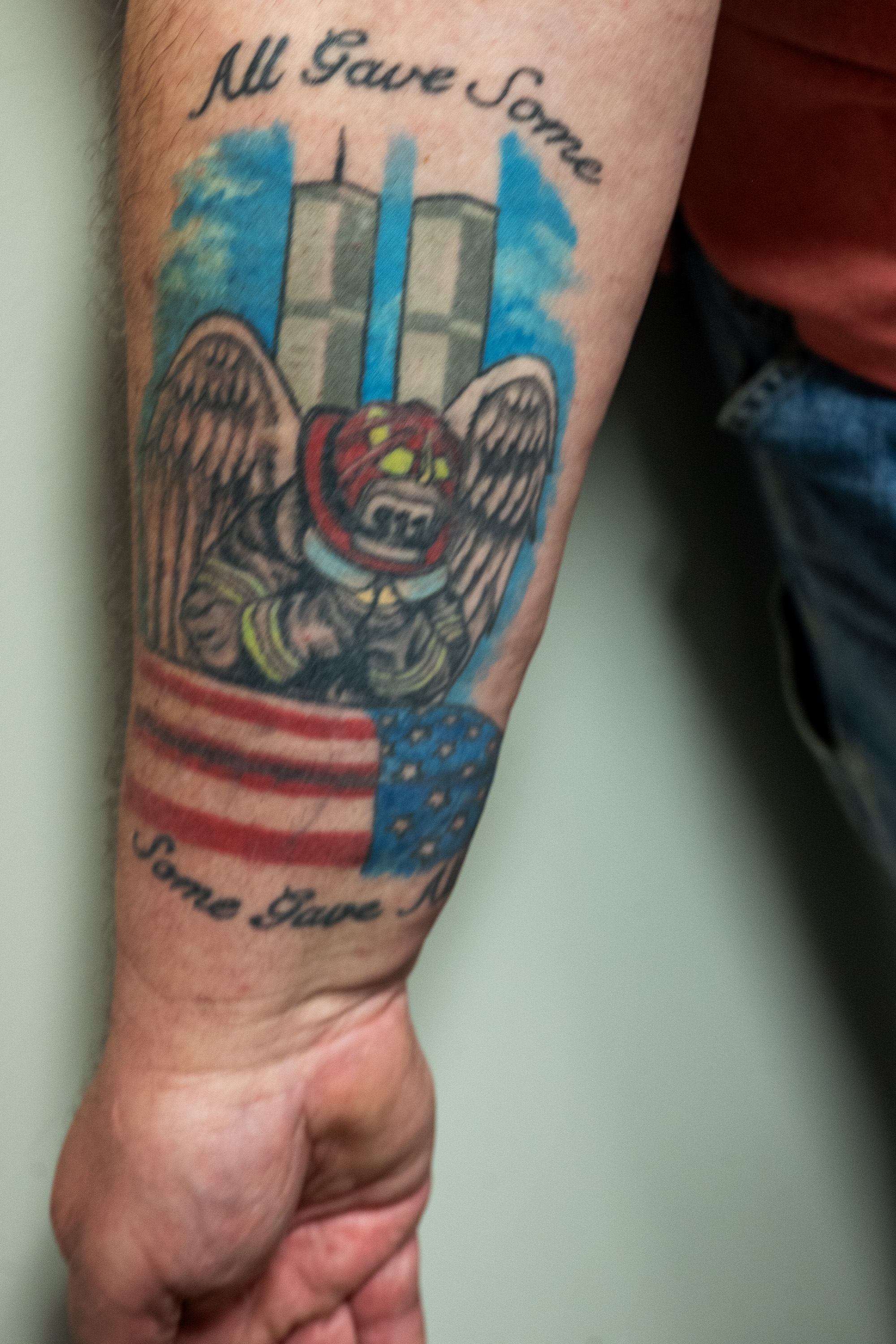
Retired firefighter Frank Geffre Jr. displays his 9-11 tattoo – “All Gave Some – Some Gave All” – during an appointment at the World Trade Center Health Program at Rutgers University. He designed the tattoo from a photo of himself splashing water on his face to rinse off dust and debris from ground zero. His wife said he looked like he was praying in the photo.Tom Gralish / Staff Photographer
He vividly recalls findinga brown dress shoe with a foot still in it. A blue polyester suit jacket with a torso seared to its lining. A wristwatch. A ring.
In all, he worked The Pile for 20 days, smearing Vicks VapoRub under his nose to cope with the“unforgettable, unbearably horrid smell of burning human flesh,” he said.
Now he can’t use the menthol and eucalyptus goo for his bouts of sinusitis, because the scent stirs bad memories.
“It feels like it was yesterday and a lifetime ago,” Geffre said. “The ‘Never Forget’ vow is not for first responders. We won’t ever forget. It’s embedded in us.”
He is ever-vigilant, prone to panic attacks. He avoids movie theaters and other places with crowds. “Too many variables,” he said.
He has a second home in Florida but drives back and forth. He won’t get on a plane. “I get paranoid that somebody on the plane is going to hijack it,” he said.
Two of the five firefighters with him on Sept. 11 have since died of cancer. He keeps in touch with four of the people he helped out of burning buildings. One committed suicide in recent years.
Retired firefighter Frank Geffre Jr. talks with Jodi Streich (left), mental health director of the World Trade Center Health Program at Rutgers University. Rutgers is one of six federally funded health clinics that monitors and treats 9/11 responders, as the health impacts continue 25 years later. The patient waiting room at the Rutgers clinic is adorned with photos of responders. Tom Gralish / Staff Photographer
Geffre, enrolled in the Rutgers program since its start, gets his mental healthcare through the clinic, which has seen a significant increase in demand for these services.
As more responders become ill or die from 9/11-related diseases, some have developed “heightened anxiety and vigilance about their own health,” Streich said.
Having more unstructured time in retirement, along with the loss of job identity and camaraderie, can be detrimental for mental health, she said.
“Things that we once buried — they come fully alive during retirement,” Streich said, adding that the support group she runs for retirees is now the most widely attended after the cancer support group.
Emergency responders who had felt too embarrassed or ashamed to seek help while working — because they feared being seen as weak — are coming in for the first time. Many are unable to eat or sleep, Streich said.
“We see them when they are at rock bottom,” Streich said. “They’ll come in and say, ‘I’m ready to talk about what I’ve been holding in for 25 years.’”
‘Exhaustion, desperation and heartache’
When asked if he regrets being dispatched to ground zero, Mark Fisher is emphatic: “Absolutely not.”
But he is tormented by images of people standing outside makeshift morgues with photos of their missing loved ones.
Fisher recalls becoming so distraught that a Red Cross volunteer pulled apart two tables piled with fresh clothes for responders to reach and embrace him.
“She hugged me for the longest time,” Fisher recalled, blowing air through his lips to steady his breathing and control tears. “I’m an Irish Catholic, so I wear my heart on my sleeve and face. I just had that look of exhaustion, desperation, and heartache.”
These days, he feels exhausted both emotionally and physicallyas his lung disease progresses. Fisher spent most of this summer in the hospital with a kidney infection that required two surgeries.
Five days after he got out of the hospital, his gall bladder became infected. “If I die, I want to die in a Catholic hospital,” he told his wife. Doctors removed his gall bladder in July.
The once-burly cop is rail-thin. He’s lost 35 pounds.
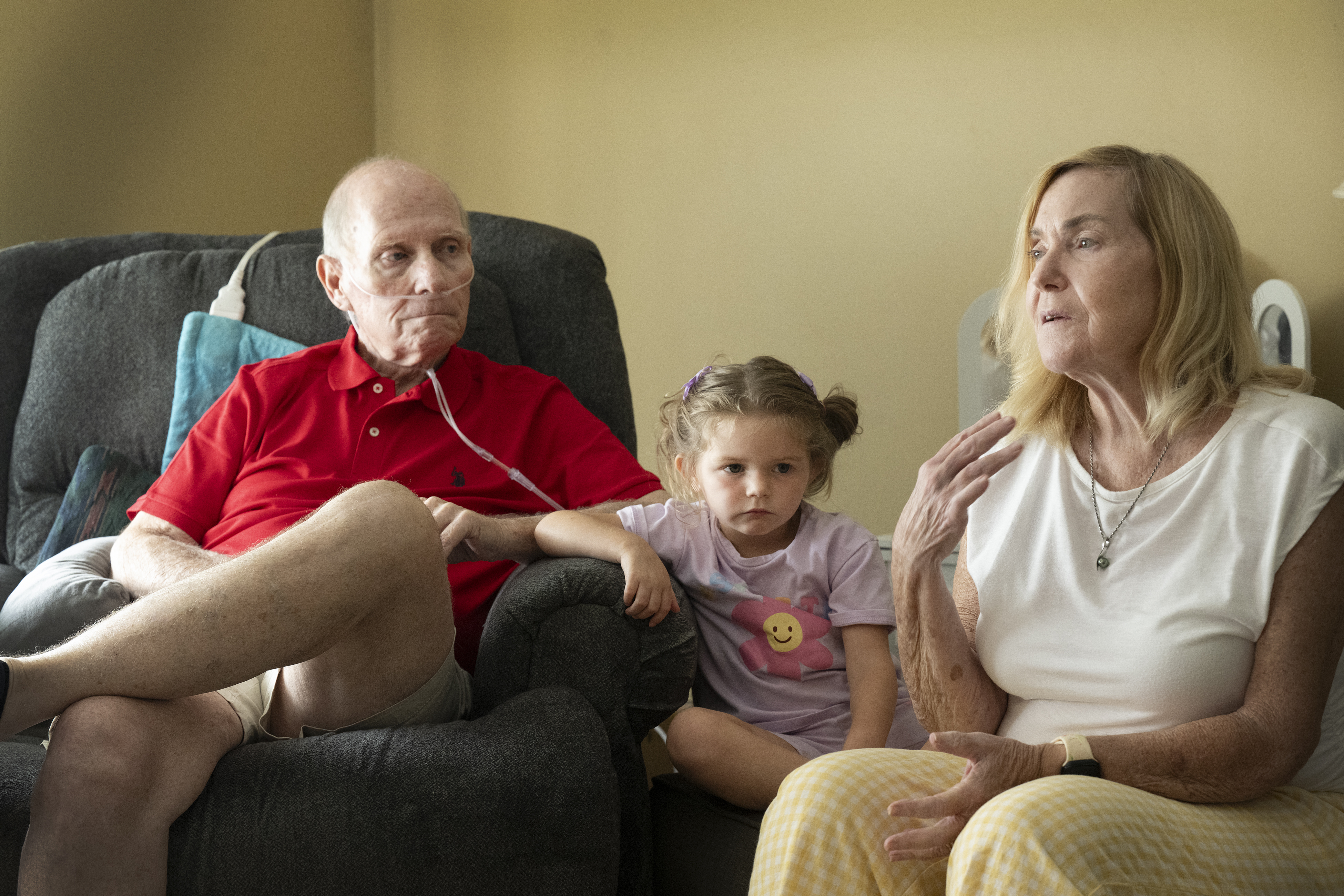
Inside their Northeast Philadelphia home, Sue Fisher (right) talks about the day she learned her husband, Mark Fisher, would need a double lung transplant. The couple’s 3-year-old granddaughter, Morgan Elizabeth Fisher, sits between them. Mark Fisher needs to use a portable oxygen tank to take walks with Morgan. Jose F. Moreno / Staff Photographer
Fisher’s priority right now is spending time with his wife and former sweetheart at Archbishop Ryan High School, and making sure she will be in decent financial shape when he dies.
Fisher, Masi, and two other responders from the Philadelphia Police Department are seeking written assurances from the city that if they die from their World Trade Center-related illnesses, their families will receive line-of-duty death benefits.
The status would enable their spouses to collect their full pensions, rather than half.
City officials said their families can apply to the Philadelphia Board of Pensions and Retirement, which would review each case individually after death.
Sue Fisher tries not to cry in front of her husband of 42 years;she’ll do it behind the shed in their backyard or on a walk with their golden retriever, Bentley.
He wants to delay as long as possible a double lung transplant, for which the survival rate is about five to seven years. “If they say that’s all he’s got, I’ll take it,” SueFisher said. “It’s better than him suffering the way he is.”
At night, she lies awake listening for the sound of Fisher’s breathing. Sometimes, she fears he has stopped. Then she nudges him with her toe until he stirs.
Retired Philadelphia Police Captain Mark Fisher wants the city’s word that if he dies of lung disease from his time at ground zero, his wife will get line-of-duty death benefits. City officials have said that his wife can apply to the pension board after he dies. Jose F. Moreno / Staff Photographer
As we remember the tragedy of the 9/11 attacks 25 years ago, standing united on the principles of justice remains as vital today as it has been for the past 25 years. With the spread of misinformation, fearmongering, and political polarization, it has unfortunately become far too easy to focus on our differences and forget the struggles shared by all our fellow Americans. We are witnessing countless innocent lives lost around the world — each one reminding us of the devastating consequences of war.
As an Ahmadi Muslim American, it is my duty not only to condemn those who twist religion for their own political gain, but to stand up for all those whose rights are being usurped and attacked, be it a Muslim or non-Muslim alike. In his Farewell Sermon, the Holy Prophet Muhammad (may the peace and blessings of God be upon him) said, “Hurt no one so that no one may hurt you,” reaffirming the importance of all human life. In this crucial time when the most vulnerable among us are under attack, let us reaffirm our nation’s commitment to justice for all.
Ataul Wadood Bhatti, Philadelphia
. . .
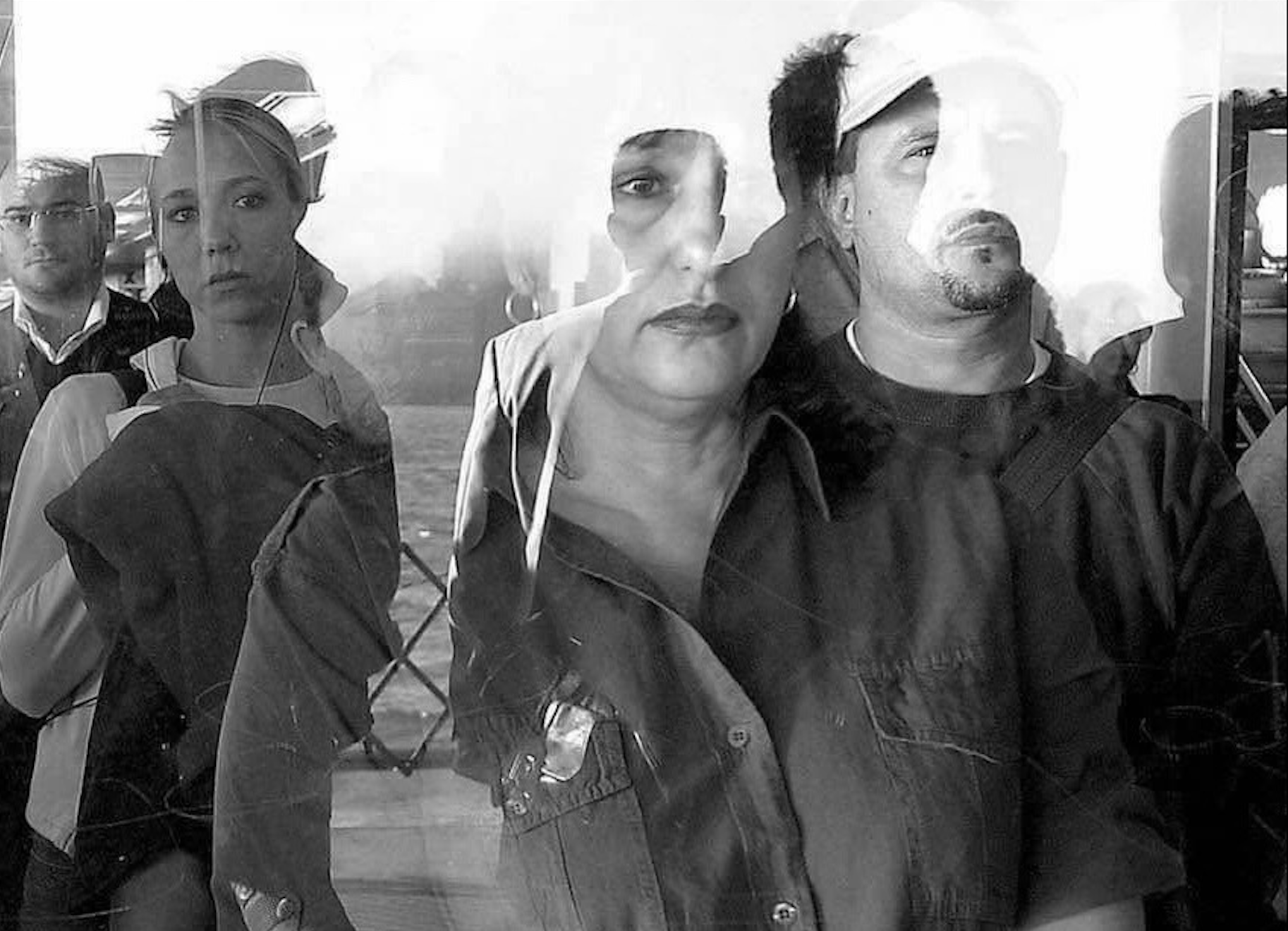
I was getting ready to head to Northeast Philadelphia to photograph a story for The Inquirer, where I had been a staff photojournalist since 1993. With a cup of coffee in hand, I remember being somewhere between the kitchen and the living room when the phone rang.
The calm, distinct voice of Berford Gammon, assignment editor at the newspaper, came through at 8:55 that morning.
“I want you to head to New York,” he said.
“What’s going on?” I asked.
“Turn on your TV.”
I clicked on the remote, and a picture of smoke billowing from a tower of the World Trade Center framed against the background of a deep blue, cloudless New York skyline filled the screen. My eyes locked onto the grainy image as my wife stood close.
I remember saying, “What a tragic accident,” thinking a small plane probably had navigated off course. That thought vanished as quickly as it arrived at 9:03 a.m., when United Airlines Flight 175 slammed into the World Trade Center’s south tower. The morning talk shows quickly abandoned their banter as the unsettling words of terrorism, attacks, and deliberate filled the airwaves.
I grabbed my cameras and stepped out into the cool 60-degree morning.
I stopped briefly in the newsroom to pick up extra equipment. Small groups of people were gathered around television sets as American Airlines Flight 11 was identified as the first plane to hit the north tower.
I heard reports that hijackers had crashed American Airlines Flight 77 into the western facade of the Pentagon in Washington, D.C., at 9:37 a.m. Stunned, I instantly thought of Pearl Harbor and my father, who had told me what it was like on the morning of Dec. 7, 1941.
As I headed to New York, a report of a fourth plane, United Airlines Flight 93, had crashed at 10:07 a.m. into a field in Shanksville, Pa., with 40 passengers and crew on board.
As I pulled off the New Jersey Turnpike to take photographs, a changed New York skyline missing its twin vertical icons filled the viewfinder. It was hard to imagine the lives lost and the damage done.
The north tower burned for about 102 minutes and then collapsed. The south tower burned for almost an hour and then imploded. In the attacks on Sept. 11, nearly 3,000 lives were lost, and 10,000 people were treated for injuries.
I stayed in New York for the next seven days working with reporters from the paper and photographing what followed an unthinkable event.
On Sept. 17, I caught a ferry from Staten Island with people heading back to the southern tip of Manhattan for the first time since the attacks. The mood was somber. Two men spoke a couple of sentences. Most passengers were silent for the 25-minute ride.
The world was a different place.
Peter Tobia,Philadelphia
The writer is a former visual journalist at The Inquirer.
. . .
Twenty-five years after 9/11, America needs to remember what once held us together.
For two weeks after the attacks, we opened the doors of our church in New York City every night. People came to pray, share their stories, search for information about friends and family members, and grieve. Some simply needed somewhere to sit with other people who understood what they were experiencing. The church was packed.
Those who did not live through those days in New York may not fully understand how quiet the city became. Manhattan was virtually cut off. Cell service was extremely limited. The normal machinery of everyday life simply stopped; fighter jets flew overhead. Smoke continued to rise from Lower Manhattan, and everywhere there were reminders that our city and our nation had been attacked.
Yet, amid the fear and devastation, something remarkable happened. We came together.
New Yorkers, famous for their impatience, became more patient. Strangers talked, and people helped each other. Churches filled. First responders ran toward danger while thousands of ordinary citizens searched for ways to serve. Political labels suddenly seemed less important. Race, class, neighborhood, and status became secondary to something larger. We knew we were together. We were New Yorkers, but more importantly, we were Americans.
As we mark the 25th anniversary of Sept. 11, I find myself wondering what happened to that spirit, not the fear or grief of that terrible day, but the unity that followed it. We don’t need another attack to remind us that there are things more important than our political parties, ideological tribes, and personal ambitions. But somehow that spirit must be recovered. America needs a new breed of patriotism — a mature patriotism that rises above personalities and political parties, allows honest disagreement, and acknowledges America’s failures while remaining committed to its promise and founding ideals.
Differences and debate are not the problem; they are essential to a free society. Americans will disagree about taxes and spending, immigration, education, the size and role of government, and a host of other issues. What concerns me is that disagreement has increasingly been replaced by distrust, contempt, and even hatred.
We no longer simply believe the other side is wrong. Too often we assume they are evil, stupid, un-American, or determined to destroy the country. Once we reach that point, compromise becomes impossible, friendships across political lines become suspect, and winning becomes more important than the principles we supposedly want our politicians to defend.
Michel J. Faulkner, Philadelphia
. . .
In the autumn of my mother’s sixth grade school year, an enemy of this country attacked Pearl Harbor and sent the world she knew into a spiral.
In the autumn of my sixth grade year, an enemy of democracy assassinated President John F. Kennedy and filled the world of my generation with sadness, anger, anxiety, and apprehension.
In the autumn of my daughter’s sixth grade year, an enemy of freedom used planes as missiles on Sept. 11, and the shockwaves from their attacks rippled across her small world — spilling into Girl Scout meetings and coursing over sidewalk playdates.
In each of those instances, the message being sent to each child was that the normal, the dependable, and the safe could be shaken — because there “were no innocent people.”
My mother got through it, I got through it, and my children have, too — with each of us carrying our own “I remember what it felt like when it happened” moment.
I have a 5-year-old grandson. Can’t help but wonder what will happen when he hits sixth grade. Or, in this accelerated world, sooner.
Keith Mason, Cinnaminson
Join the conversation: Send letters to letters@inquirer.com. Limit length to 150 words and include home address and day and evening phone number. Letters run in The Inquirer six days a week on the editorial pages and online.
DEAR ABBY: My friend “Ben” and I had many ups and downs in our 30-year friendship. Three years ago, we had one of our periodic blowouts and stopped speaking. I found out recently that he passed away a year later, and I was never informed. The obituary I found online does not mention a cause of death.
I wrote a letter of condolence to his wife, but it was returned, and I found out that she moved away from the house where she and Ben had been living. I would like to know what happened to my friend, as he was only in his early 50s. Although we were not speaking at the time of his death, we had many years of friendship under our belts, and I cared about him. I found a Facebook page for his wife, but this seems an impersonal way of reaching out on such a sober topic. Any suggestions?
— CARED FOR HIM IN THE SOUTH
DEAR CARED: If you and Ben had mutual friends, a way to find out the information you’re looking for, including his widow’s address, might be through them. Do it privately. To approach her online asking for the details of his death would be off-putting, insensitive and possibly hurtful in light of the fact that you were estranged at the time of his death.
** ** **
DEAR ABBY: My 63rd birthday is coming up. I do not like celebrating my birthday and never have. I would prefer that the day be ignored. I know my wife of almost 38 years, our two boys and their significant others are planning something. I would prefer they spend the money on themselves or at least donate it to some worthy charity rather than spend it on me. Given that birthdays are important to them, must I just grin and bear it, or should I say something and risk causing ill will?
— OLDER IN ISRAEL
DEAR OLDER: Surely your wife, who has been with you for nearly four decades, knows your feelings on this subject. Tell her you know something is afoot, and gently mention that you would prefer that the celebration be kept small. Name the charity of your choice, and tell her you hope the birthday budget will be sent there rather than spent on you.
If your wife ignores your plea and a massive fete does materialize, do your best to endure it with grace and a smile. Remember that these people are celebrating you because they love you.
** ** **
DEAR ABBY: I’m married, and I’ve recently started developing a crush on my co-worker. We have worked together for four years. I’m not going to pursue anything, because cheating is against my morals. I just feel bad for having these feelings. What can I do to get my feelings toward my co-worker in check?
— CRUSHING IN ILLINOIS
DEAR CRUSHING: The guilt you are experiencing is a good thing; it has kept you from making a terrible mistake. If it’s any comfort, bear in mind that crushes like this usually lessen in time, even if they make the present somewhat uncomfortable.
** ** **
TO MY READERS: Happy New Year to my friends of the Jewish faith! During this time of repentance, observant Jews reflect on their lives and make amends, seeking a closer relationship with God. Happy Rosh Hashanah!
ARIES (March 21-April 19). When you trust that all things are connected, you will find that every path eventually leads to the desired destination. And yet… if there’s a map — and there is — it’s more efficient to get it and use it to figure out the most direct route.
TAURUS (April 20-May 20). It’s easier to love who you are when you’re not constantly bombarded by other options. Options are only useful at the intersections of life. You don’t need them when you’re content on the correct road. Prevent distractions.
GEMINI (May 21-June 21). Today points out once again your supertalent for versatility. You’ll blend when you need to, stand out when it’s advantageous and make your group proud the whole way. Your value to them is undeniable.
CANCER (June 22-July 22). It falls on you to make a sale by closing a deal in the traditional sense, selling yourself as an option for a role, or selling an idea. Whatever the goal, your influence will work best when it’s practically undetectable.
LEO (July 23-Aug. 22). Just when you think you know how you’ll feel when certain events come to pass, you discover that your emotions will not be predicted or controlled. But they will submit to being sorted, tolerated, managed and above all, felt.
VIRGO (Aug. 23-Sept. 22). As for the thing you weren’t able to accomplish back there, it just wasn’t time yet. Keep at it in whatever small way is currently possible, and more will be possible in the future. The key is simply knowing that this isn’t over.
LIBRA (Sept. 23-Oct. 23). You’ll be reminded how much easier it is to give good advice than to live by it. You know what the right thing for you is; the trick is getting your whole self to agree, because you do contain multitudes. Following your own wisdom will be so satisfying today.
SCORPIO (Oct. 24-Nov. 21). The world measures success by various metrics. You find yourself valuing contribution more than recognition. It feels good to know your time and energy have made someone else’s path a little smoother.
SAGITTARIUS (Nov. 22-Dec. 21). You got this long ago, but some around you are still learning: To accept that there are things in life you can’t change is to accept adulthood. You’ll watch immature notions of power give way to reality.
CAPRICORN (Dec. 22-Jan. 19). Favors get passed around, and not always fairly. They may not go to the ones who worked hardest, but rather to the ones who have pleased the boss. “Whoever obeys the gods, to him they particularly listen.” — Homer
AQUARIUS (Jan. 20-Feb. 18). There’s a time for transformation, and that time is when the cycle you’re in comes to a close. To transform all the time is a waste of the great amount of energy, and the considerable risk that transformation demands.
PISCES (Feb. 19-March 20). Do you wish you could sidle up to the person in your dream role, just to get a feel for what that experience is really like? Today you’ll realize that you can have a version of that, if you actively seek it out.
TODAY’S BIRTHDAY (Sept. 11). It’s your Year of Three Crossroads where you’ll learn you can absolutely trust your inner guidance. Your conscience will braid with your passions and preferences, steering you to a dream destination. Others may have resources, but your own improvisational skills are all you need. More highlights: Freedom from an obligation and the funds to invest in your ideas. Holding hands with a soulmate. Sagittarius and Taurus adore you. Your lucky numbers are: 5, 38, 4, 11 and 29.
DALLAS, Texas — As Republicans look to keep their narrow control of Congress by defending the seats they flipped in 2024, there aren’t many places where they can afford to lose fewer votes than in U.S. Rep. Ryan Mackenzie’s district covering the Lehigh Valley and Poconos.
Mackenzie’s takedown of a three-term Democrat by a mere 4,000 votes two years agowas the narrowest congressional race in Pennsylvania — his 1% margin of victory was the seventh smallest out of 435 House districts across the country.
Standing Thursday on the Republican Party’s biggest stage of the year — and likely staring down another razor-thin result this fall — Mackenzie didn’t hold back when laying out the potential stakes.
“I’m running in one of the top races again, and it will determine the future direction for our nation,” Mackenzie said on the second day of the first-ever Republican midterm convention. “Now we must get to work, we must go out and win in November, and we must save America.”
In an interview after a brief speech that focused on the president’s signature tax cuts, Mackenzie said Democrats’ threats to repeal those cuts and other Trump policies meant the president is, in a sense, on the ballot — so it makes sense to campaign in that way.
“We know the history of American politics is the party who has the White House, their voters end up being less energized in midterm elections, and so I think it was a smart idea to try something like this, a midterm convention, to energize our voters,” Mackenzie said.
Generating enthusiasm for the Republican ticket could be a tough task for Mackenzie and other incumbents, with polling in Pennsylvania showing widespread frustration with Trump’s handling of key issues, including the cost of living.
“Everybody is getting gouged,” said Ron Jones, 79, an Allentown Democratic voter and Navy veteran who said he feels stretched relying on his Social Security and pension checks. “You just can’t afford to live. Period.”
Jones said he hasn’t been following the congressional race closely, but said he plans to help “get rid of all incumbents.”
President Donald Trump onstage during the Republican Party’s unusual midterm convention in Dallas on Wednesday, Sept. 9, 2026. (Haiyun Jiang/The New York Times)HAIYUN JIANG
Going after Brooks on a national stage
Mackenzie told The Inquirer his phone started blowing up with text messages immediately after his speech. The lawmaker said he welcomed the opportunity to have a national audience to talk about his work, and his opponent.
Mackenzie didn’t just applaud Trump’s policies during his speech, he also imitated the president’s ferocious style of politics by blasting his Democratic challenger Bob Brooks as a scandal-ridden, “far-left nutjob.”
Brooks, he contended, was “handpicked by the Democratic establishment,” and has spoken critically about nonunion firefighters. He also accused Brooks of stealing money from his own family, a claim based on a lawsuit brought by Brooks’ former mother-in-law and involving a decades-old debt she says that he owes.
“That’s what crazy looks like,” Mackenzie said.
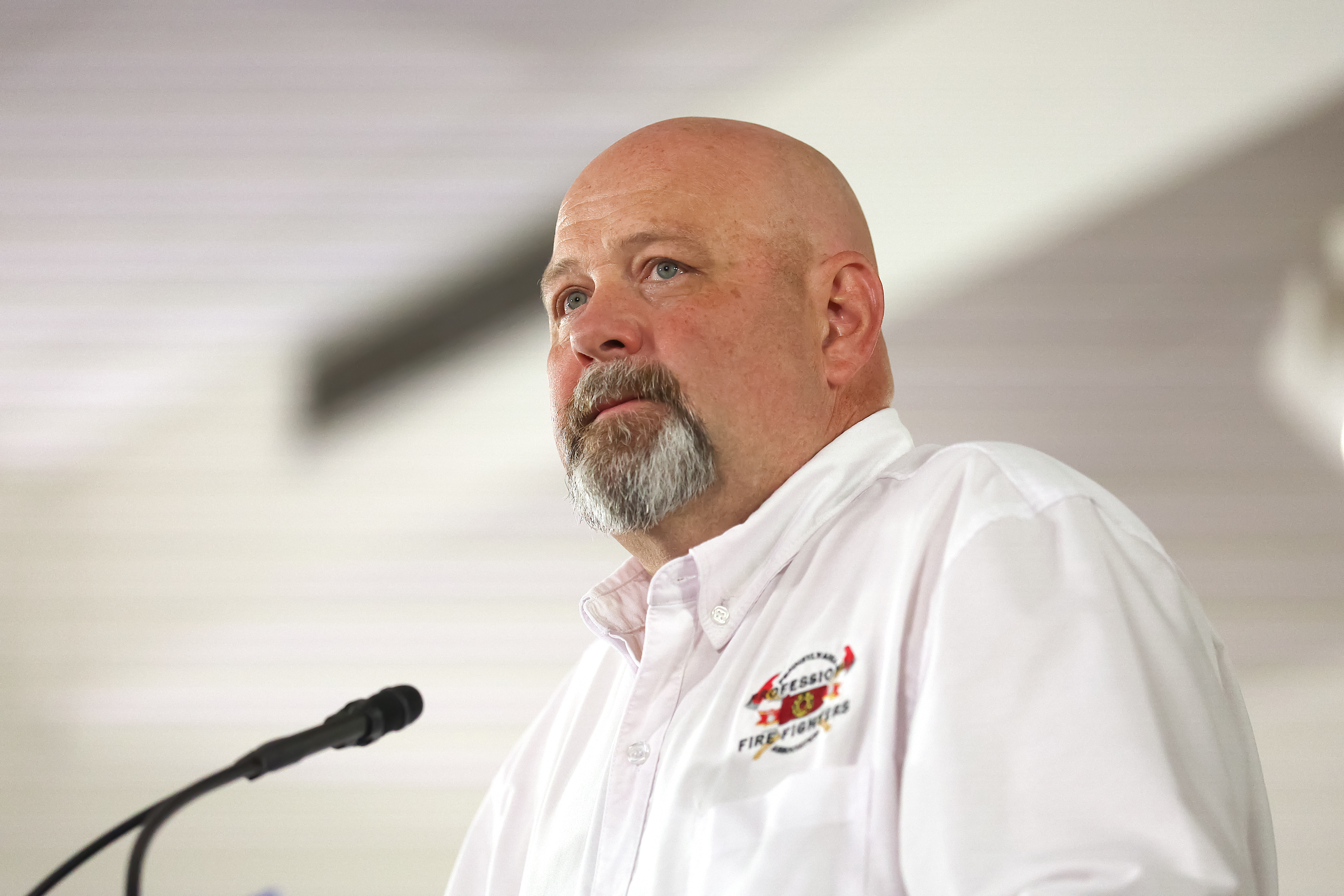
Brooks, a retired firefighter in Bethlehem and the Pennsylvania Professional Fire Fighters Association president, was recruited last year by prominent Democrats, including Gov. Josh Shapiro and U.S. Rep. Chris Deluzio. He quickly got a groundswell of support from moderates and progressives alike, including U.S. Sen. Bernie Sanders and former Transportation Secretary Pete Buttigieg.
Those high-profile supporters, and Brooks himself, leaned into his working-class image — highlighting his history of working multiple jobs and his insistence, even as he ran for Congress, on continuing to drive a snowplow and coach high school baseball.
Mackenzie and national Republicans who’ve invested resources into his campaign have repeatedly targeted Brooks for the lawsuit involving his family and for old social media comments.
In one post, Brooks lambasted volunteer firefighters working in areas where other union firefighters operate as “scabs” and other pejoratives.
Brooks has dismissed those and other attacks on his old posts, saying he never thought he would be a candidate for office when he made them.
The Democrat did not directly address those issues in a comment after Mackenzie broadcast them to a national audience.
“Ryan Mackenzie got his wish today: a big boy speaking slot on stage at Trump’s party in Dallas,” Brooks said in a statement that blamed Mackenzie for rising costs and voting against restricting Trump’s attacks in Iran, the two areas that polls show Trump performing the worst among both Republicans and Democrats.
“Mackenzie’s trip to Dallas is a reminder of who he is: a lap dog for Donald Trump, for his party bosses, and for anyone with power and money,” Brooks said.
Bob Brooks, who is running for Pennsylvania’s 7th Congressional District, addresses the audience during a rally at the United Steelworkers Union Hall in Bethlehem, Pa., on Sunday, July 26, 2026.David Maialetti / Staff Photographer
Just steps from the convention location earlier in the day, a small group of House Democrats that included U.S. Rep. Madeleine Dean (D., Montgomery) protested by, mainly, hitting Republicans on affordability.
“If you listen to what’s being said across the street, you might feel like you’re living in some separate reality. Here’s the reality check,” Dean said as she rattled off the higher cost of groceries, electricity and gasoline since Trump took office.
Dean targeted Mackenzie as well as U.S. Rep. Rob Bresnahan (R., Luzerne) and U.S. Sen. Dave McCormick (R., Pa.) — who each spoke at the convention on Wednesday — specifically, saying they were among the Republicans “happy to coddle a president who is unfit and unwell.”
“Here at the heel of Donald Trump, I don’t know what they think they’re doing,” Dean said behind a podium with a sign reading, “Fighting for an affordable America.”
Both Bresnahan, who is running in a competitive race against Democratic Scranton Mayor Paige Cognetti, and Mackenzie focused on an economic message during their speeches.
They did not directly address concerns about inflation, or the Iran war’s effects on the rising cost of gas.
U.S. Rep. Jason Smith, a Missouri Republican who joined Mackenzie onstage, contended the GOP majority had focused its agenda on the working class. He pointed to the tax exemptions for tips and overtime pay.
“If you don’t believe me, just ask yourself, how many billionaires do you know that are tipped employees?” said Smith, the House Ways and Means Commitee chair.
But neither he nor Mackenzie addressed the cuts to Medicaid and food assistance that were included in the same legislation to help pay for the tax cuts they repeatedly touted.
“We delivered tax relief for every American by locking in lower rates and expanding the standard deduction,” Mackenzie said.
Staff writer Alfred Lubrano contributed reporting.
At the outset of the offseason program in April, Sean Mannion began to install the foundation of the Eagles offense, a brand new scheme from a first-time coordinator.
Those early days, Mannion said Thursday, feel like “ancient history” compared to where the team is now.
He said it jokingly, but acknowledged what has felt like eons between now — just four days before his first regular-season game as a play-caller — and then is a reflection of the work that Eagles staff and players have put into learning the scheme.
The group started with the foundation of the offense in the spring, then added one layer after the other, gradually incorporating different wrinkles and adjustments. Mannion said he is satisfied with the progression, leaving him feeling like the team is in a “great position” heading into Week 1 against the Washington Commanders.
“There’s been so much work, and we’re working relentlessly, and ultimately that builds your confidence, knowing that I’ve spent hours and hours and hours thinking about the plan, preparing the plan, preparing the players,” Mannion said. “I feel confident and excited for Week 1.”
After installing the broader offense throughout the offseason program and training camp, Mannion will narrow the game plan to a more select menu. The Eagles offensive coordinator’s desire to put the players in the best position to succeed helps inform how to pare down the offense.
He has spent the last five months evaluating the strengths and weaknesses of his personnel. Mannion has built what he calls a “library” of plays since April, which includes new plays and familiar ones from past Eagles offenses.
As he game plans, he’s pulling different books from the shelves, so to speak, of the Eagles’ vast play library. Part of his consideration in selecting plays also includes a study of the Eagles’ opponent to determine how to best attack them.
Sean Mannion’s time with the Vikings crossed over with that of current Commanders defensive coordinator Daronte Jones. Jack Dempsey / AP
That aspect of the preparation is shrouded in mystery, as the Commanders have a new defensive coordinator in Daronte Jones, who spent the last four years with the Minnesota Vikings as defensive backs coach and pass game coordinator. Mannion is familiar with the Brian Flores-led Vikings defense, as he played in Minnesota briefly in 2023 (Flores’ first season as defensive coordinator) and coached against him twice a year with the Green Bay Packers for the last two seasons.
Whether or not the Commanders take on more of a Vikings flavor, Mannion said he will be prepared for anything the defense throws at them.
“We’ve really used this extra practice time, kind of the bonus week, to our advantage,” Mannion said. “We want to be ready for everything. … And like any opponent, whether it’s a new coordinator into Week 1 with new wrinkles, or if it’s a first-time coordinator at a place, you’re always ready to adjust in-game, and we have contingencies laid out for different things we might be anticipating.”
Mannion will make those hypothetical adjustments from the coaching box. He experienced calling plays from both the box and the sideline during the preseason and the public practice at Lincoln Financial Field during training camp. He ultimately decided it was the “best decision” for the team to call the game upstairs.
While there are pros and cons to either location, Mannion acknowledged he has more space in the box to operate. Plus, he called the point of view “unique” given the higher vantage point up top.
He even went through the long list of play-callers he had as a player, or worked with as a coach, and tallied up their in-game location. Mannion said it was almost 50-50.
“If there was one thing as I was thinking it through, I realized, you know what?” Mannion said. “There’s plenty of great play callers who have done it from either spot.”
Jalen Hurts said on Wednesday that he hasn’t had a play-caller sit in the box since he was in college. Still, he emphasized that he would support Mannion in his decision, even if his communication with his offensive coordinator between drives might be altered given his location.
Jalen Hurts said earlier this week that he’s OK with not having Sean Mannion on the sideline during games. David Maialetti / Staff Photographer
Mannion noted that one of the advantages of calling plays from the box is his ability to talk to each of his staff members at any time, instead of being fixed in one place and speaking to them individually. Then, his staff members can quickly disseminate information to their respective position groups.
“I think really more than anything, it speaks to [quarterbacks coach] Parks [Frazier], he does a great job with Jalen every day,” Mannion said. “I’m in constant communication with him and all of our position coaches, and then it allows for, I think, everybody to coach their units, and I can kind of survey from up top and distribute information from there, and they take it the rest of the way.”
Mannion has praised the work of the staff and the players as they have learned a new offense. Come Sunday, the details that defined the last five months — from designing the offense, to planning meetings and practice schedules, to teaching the offense, to executing in practice — will come to fruition on the field.
Is there an aspect of the job that keeps Mannion up at night? As he reflected on his work over the last five months, he showed he looks at his myriad responsibilities from a perspective of gratitude.
“Those are the things that you love about coaching,” Mannion said. “There’s so many different elements to it, but football’s a beautiful game because they all come together. I stay awake thinking about that, but I wouldn’t say it keeps me awake. It’s the enjoyable part for me. That’s what I love about it.”
Two men have been charged in the sexual assault of a student at Eastern University inside a dorm room earlier this year, Delaware County District Attorney Tanner Rouse announced Thursday.
Dontae Williams, who turns 20 on Friday, and Chase Thompson, 19, surrendered to Radnor Township police on Thursday to face charges of rape of unconscious person and related offenses. Bail was set at $150,000 unsecured for both men.
The assaults allegedly occurred in the Kea Hall residence of Naeem Turner, a friend of the victim, Rouse said. Turner was issued a summons to appear in court on three counts of invasion of privacy for allegedly recording video of the victim.
Robert C. Keller, a lawyer representing Williams, said his client “has been cooperating since the beginning.”
Keller said he will review the criminal case against Williams and pursue an appropriate defense.
No lawyers could be identified Thursday evening for the other two men.
Eastern University, a private Christian institution located in St. Davids, said in an emailed statement Thursday evening:
“Student safety remains our highest priority. Sexual assault is not tolerated at Eastern University. The university took this incident very seriously, acting swiftly and fully cooperating with the Radnor Police Department throughout their investigation.”
Eastern University continued: “We are grieved by this situation and the impact it has had on those involved. As a Christian university, we are committed to the safety and well-being of our students.”
The university said Naeem Turner was no longer enrolled at Eastern.
On Feb. 1, Radnor Township police responded to Eastern University for a report of a rape, Rouse said. The officers met with the student, who said that after a night out drinking, she reached out to Turner, her friend.
Turner said he had cousins visiting his dorm room, but she could come over, the police criminal complaint said.
The student, who already was intoxicated, arrived at Turner’s residence and was given tequila to drink, the complaint said. The student then said she fell asleep.
She was then allegedly sexually assaulted by Williams and Thompson, the complaint said.
Investigators collected DNA evidence that matched both men, the complaint said.
Turner had recorded video of himself engaged in sexual activity with the student, and twice the victim is seen pushing the phone camera away and indicating that she did not want to be recorded, the complaint said.
Turner, who was not charged with rape or any other assaults, said he had consensual sex with the victim, the complaint said.
The student said she did not remember having consensual sex with Turner and that she did not consent to being recorded, the complaint said.
Turner later allegedly sent two video clips to a contact on his phone, the complaint said.
“This incident is an appalling violation of a person’s safety, dignity, and trust,” Rouse said in statement.
“No one should ever have to fear being sexually assaulted by someone they know, and especially not by someone they consider a friend. It can be frightening to come forward after an experience like this, and we commend the victim for having the courage to report what happened,” Rouse said.
“Sexual violence is never acceptable, and my heart goes out to a young woman that will live with this trauma for the rest of her life. No one should have to fear that someone they trust will violate their safety or boundaries. There will be accountability,” Rouse said.
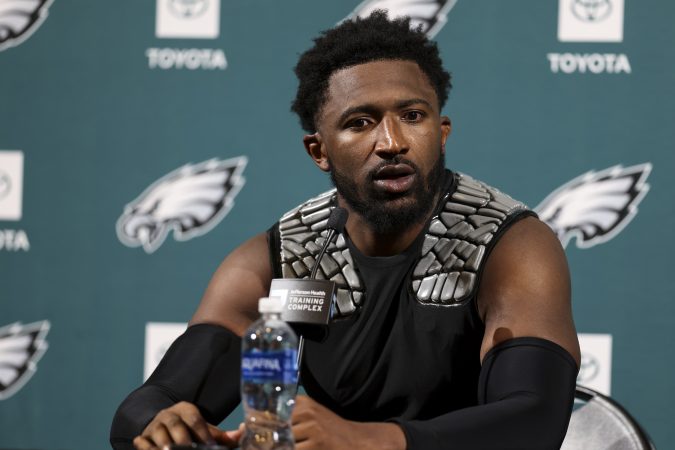
Edge rusher Jonathan Greenard said he “feels good” after missing all of training camp with an injury, though he’s still unsure if he’ll be ready for Sunday’s Week 1 game vs. the Washington Commanders.
Greenard, who practiced in a limited capacity on Wednesday and Thursday, confirmed that he did not need surgery after suffering the pectoral strain while lifting ahead of camp.
“It’s one of those freak things,” Greenard said from his locker room stall Thursday. “Stuff happens and thank God I didn’t need surgery. Just a matter of just trying to work back in there, get it back to full strength.”
Greenard wouldn’t tip his hand about his availability for Sunday, instead repeating “that’s up for [the Eagles coaching staff] to decide.” He emphasized that he’s improving after the injury.
“I feel good, though. I will say, I feel I’m in a good spot,” Greenard said. “Just know that. I know that I’m working every day to continue to try to get this thing stronger. We’re close, I know that.”
Greenard echoed the earlier words of defensive coordinator Vic Fangio, who noted the importance of the edge rusher getting up to game speed ahead of Thursday’s practice,
“It’s day by day,” Fangio said. “He hasn’t practiced a whole lot yet, so we’ll be careful with that. There’s a minimal amount of real practice that you have to go through, especially for a guy coming off an injury. It’s like the guy [Aaron] Donald with the Rams. He’s just coming off rustiness, no injury, and he wasn’t ready this week. We’ll see.”
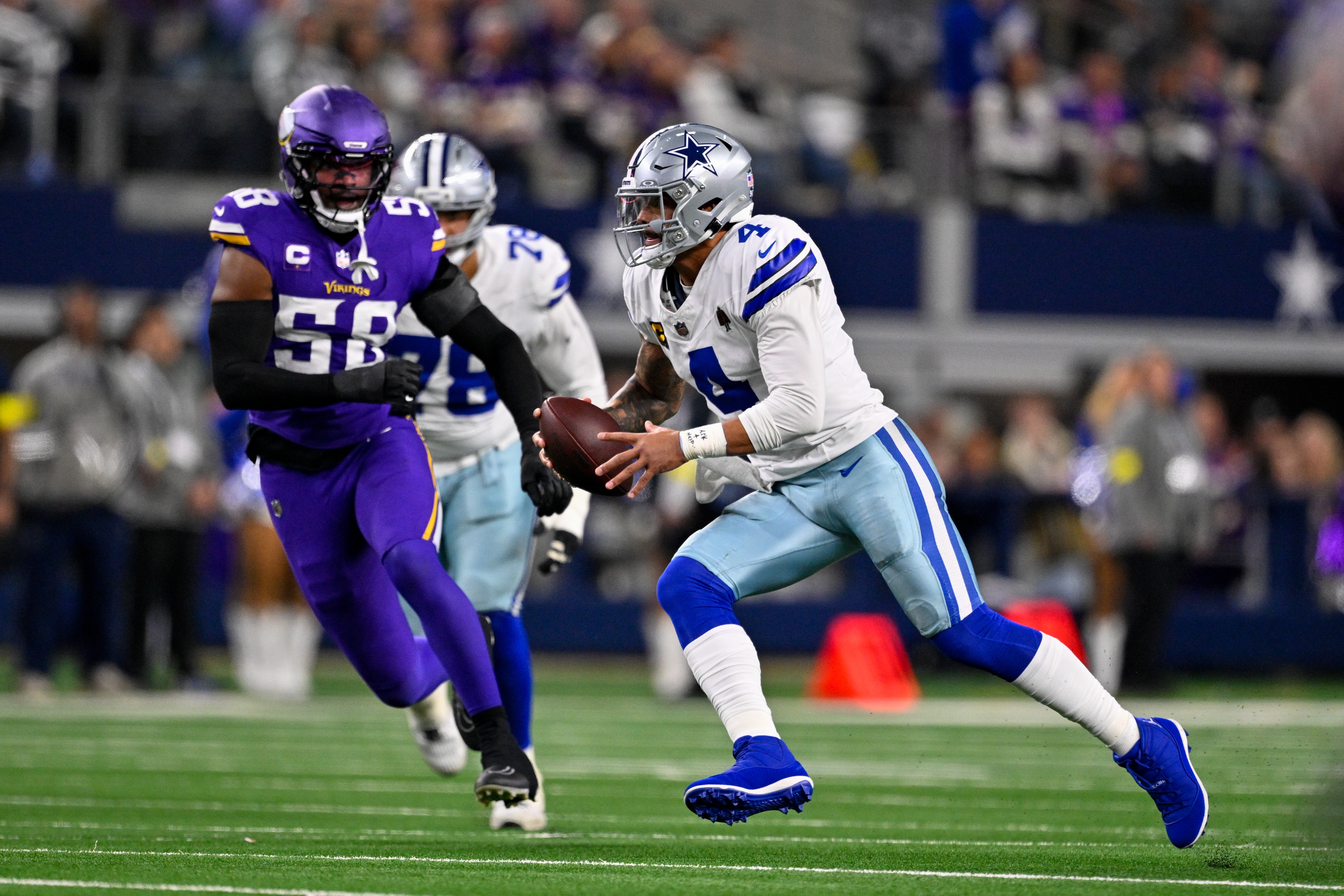
Jonathan Greenard (58) last played in a game of any kind on Dec. 14, 2025 against the Cowboys. Jerome Miron / AP
Greenard, 29, is a major piece for the Eagles’ defense. General manager Howie Roseman traded third-round picks in 2026 and 2027 for the star edge rusher on April 24. He then signed a four-year, $100 million contract that included $50 million guaranteed. They acquired him to fill the void left by Jaelan Phillips, who signed with the Carolina Panthers in free agency.
Does Greenard feel like he’s comfortable with Fangio’s playbook, even if he might not be in game shape?
“Yeah, it’s kind of similar to Flo [Vikings defensive coordinator Brian Flores] when I was in Minnesota,” said Greenard, who spent the last two seasons with the Vikings. “Just learning different terminology. You know, it’s English and Spanish, pretty much… I’ve dropped before, I’ve covered people before, I’ve rushed. It’s still football, just a different terminology. I didn’t feel like it wasn’t that difficult to grasp the playbook.”