Blog

  • Sixers’ Jabari Walker promotes reading at South Philly elementary school: ‘It is powerful to read’

    Sixers’ Jabari Walker promotes reading at South Philly elementary school: ‘It is powerful to read’

    Students filled Stephen Girard Elementary school’s auditorium in South Philly for a pep rally presented by the 76ers and Morgan & Morgan Law Firm on Thursday afternoon to promote reading among the youth.

    After a dance party with students to start the assembly, 200 children were treated to a surprise when Sixers forward Jabari Walker showed up as a guest reader to read Dog Breath: The Horrible Trouble with Hally Tosis.

    Walker and Sixers in-arena host, Lee Farrell, hosted a Q&A to discuss the importance of reading for the students.

    “I’m an athlete, and I lift every day to get stronger,” Walker told the students. “The brain is a muscle, so you have to train it every day. You have to get smarter.”

    Morgan & Morgan and the Sixers partnered last season and will do so again for the 2026-27 season for the Books & Basketball program, which included the Boards for Books. Morgan & Morgan donates $7.60 for every rebound the Sixers had during the season.

    A $15,000 donation was presented to the school for its library and reading program, while a $12,192 donation was made to BookSmiles, an organization that collects and distributes books to promote childhood literacy. The $27,000 total donation for the over 3,500 rebounds the Sixers had during the 2025-26 season is expected to equate over 20,000 books for students in the Philadelphia area.

    Hannah Molitoris, an attorney with Morgan & Morgan, said it’s especially important to get the next generation excited about reading because of the access they have to technology and social media.

    Jabari Walker shows the ending illustration of the children’s book ‘Dog Breath’ alongside Sixers in-game host Lee Farrell at Stephen Girard Elementary School on Thursday.Aidan T. Gallo / Staff Photographer

    “Whereas many people grew up with books in their hands, we see a lot of younger people these days growing up with cellphones and iPads in their hand,” Molitoris said. “So, to get a younger generation excited about reading and the benefits of reading will only serve all of us in the future.”

    Having an athlete like Walker there to further the message only helped.

    “I think that there is a misconception that if you like to read and you’re an avid reader, then that means that you’re a loser or a nerd,” Molitoris said. “I think hearing someone like Mr. Walker tell these children that it is OK and it is strong and it is powerful to read and to like to read, it’s like your hero telling you that it’s OK to be yourself.”

    Through BookSmiles, each child left the assembly with a free book and bookmark, which Walker helped hand out as they exited the auditorium. The students also received Basketball & Books T-shirts before the pep rally.

    Although Walker said he’s unsure if he would have shared the same excitement as the students over reading when he was their age, he’s become “super passionate about” as an adult and appreciates how the program translates results on the court to a positive outcome for kids in the area, giving him “extra motivation.” Walker said he currently prefers the self-help genre and books that teach financial literacy, but he related to the students over his love for the Diary of a Wimpy Kid books.

    Jabari Walker waves goodbye to an elementary school students after Thursday’s pep rally.Aidan T. Gallo / Staff Photographer

    Being able to see the students’ excitement in person and make this connection face-to-face is something that Walker said made the experience “even more special.”

    “They could watch a video or this could be over Zoom, but I don’t think it hits the same,” Walker said. “For me to take my time and come here, I think it rubs off, and they understand that. So now they all have a personal connection with me, and I’m glad.”

  • Members of Congress tour EMR in Camden, push for oversight of fire-causing lithium-ion batteries

    Members of Congress tour EMR in Camden, push for oversight of fire-causing lithium-ion batteries

    Two New Jersey Congress members appeared alongside EMR’s CEO on Thursday to call for more oversight on lithium-ion batteries, which the company blames for causing fires at its Camden scrap metal site.

    U.S. Rep. Donald Norcross, a Camden Democrat, introduced the Battery Fire Prevention Act nearly a year ago, inspired by fires at the Camden facility. But it hasn’t made progress in the Republican-dominated Congress. He toured the EMR site Thursday with U.S. Rep. Frank Pallone Jr., of Monmouth County, the top Democrat on the House Energy and Commerce Committee.

    “Today it’s Camden. Yesterday was North Carolina and Minnesota. It’s literally all 50 states and quite frankly, a global problem,” Norcross said of lithium-ion battery fires.

    “The United States Congress has failed in this,” he added. “When we understand that China is more progressive in finding batteries in their waste streams, you know we have a big problem.”

    Standing in front of gigantic piles of old household appliances, damaged cars, and other kinds of scrap metal with a view of the Philadelphia skyline, Norcross said his bill will advance once Pallone becomes committee chair in the coming months — if Democrats win back the House in this year’s midterm elections.

    The bill would create a 30% tax credit for waste and recycling companies to purchase technology to help identify lithium-ion batteries and a 5% tax on the sale of lithium-ion batteries. It would also direct the Department of Energy and the Environmental Protection Agency to develop a battery buyback program. Using money from the battery tax, the program would award grants to facilities — like schools, local governments, or recycling plants — to collect batteries from consumers, who would get paid for returning their batteries. Those batteries would then be properly disposed of or recycled.

    EMR’s machinery separates and shreds large pieces of metal and spits them out into new piles of knuckle-sized scrap. Lithium-ion batteries, which are found in everyday technology like phones, watches, and e-bikes, aren’t supposed to land at the site but end up in the waste streams anyway.

    A crane at the EMR scrap metal shredding site in Camden on Thursday.Aliya Schneider / Staff

    Joe Balzano, the CEO of EMR Metal Recycling USA, said that the company has mechanisms to detect batteries that are about to burst, but the technology that identifies the batteries in the first place that he could apply at his site hasn’t been invented yet. Instead, employees sort through objects and set aside items that could have the batteries, which are prone to catching on fire if they become damaged or overheated. Those fires can spew out of control when hidden in a giant pile of metal.

    Norcross said research to solve this problem is currently underway.

    “Necessity is the mother of invention, so I’m hoping that invention comes quick,” Balzano said in an interview.

    While suppliers and workers have gotten better at detecting items with the batteries, “things that didn’t have a battery yesterday have a battery today,” he said.

    Part of the issue is there isn’t an obvious way for consumers to easily dispose of these batteries, so they end up in the trash or on the curbs, he said.

    “They get picked up by peddler scrappers, or they enter into the municipality waste streams, and then they make themselves through the recycling process, and they come here,” Balzano said.

    Frustrated residents who have suffered the impacts of repeated fires at the site have called for the closing of EMR in Camden. The facility temporarily shuttered earlier this summer and the company entered a legal battle with the city before a judge allowed the site to reopen.

    Norcross, who appeared alongside Balzano on Thursday, said shutting down EMR in Camden won’t solve the core problem.

    “If this disappears tomorrow, it goes to the next community, and then they’ll be fighting the same thing,” Norcross said in an interview. “So we want to fix the problem before it turns into a fire.”

    Pallone said another bill in his committee that would create federal waste rules for recycling lithium-ion batteries has bipartisan support. He said seeing the site firsthand helped him understand the issue.

    “The batteries come here, they’re essentially coming in secret,” he said.

    Norcross pointed a finger at the corporations that manufacture the batteries for not taking a proactive role in preventing improper disposal.

    “The manufacturers of batteries can’t walk away from the problem of just selling their product, and it ends up wherever it does, causing fires,” the lawmaker said.

  • Commanders brewing ‘a recipe for disaster’ against Eagles, and what else the national media is saying about Week 1

    Commanders brewing ‘a recipe for disaster’ against Eagles, and what else the national media is saying about Week 1

    On Wednesday night, Week 1 of the NFL season kicked off. With it, so did “predictions season” — in which media members rush to their keyboards to forecast every week’s matchups.

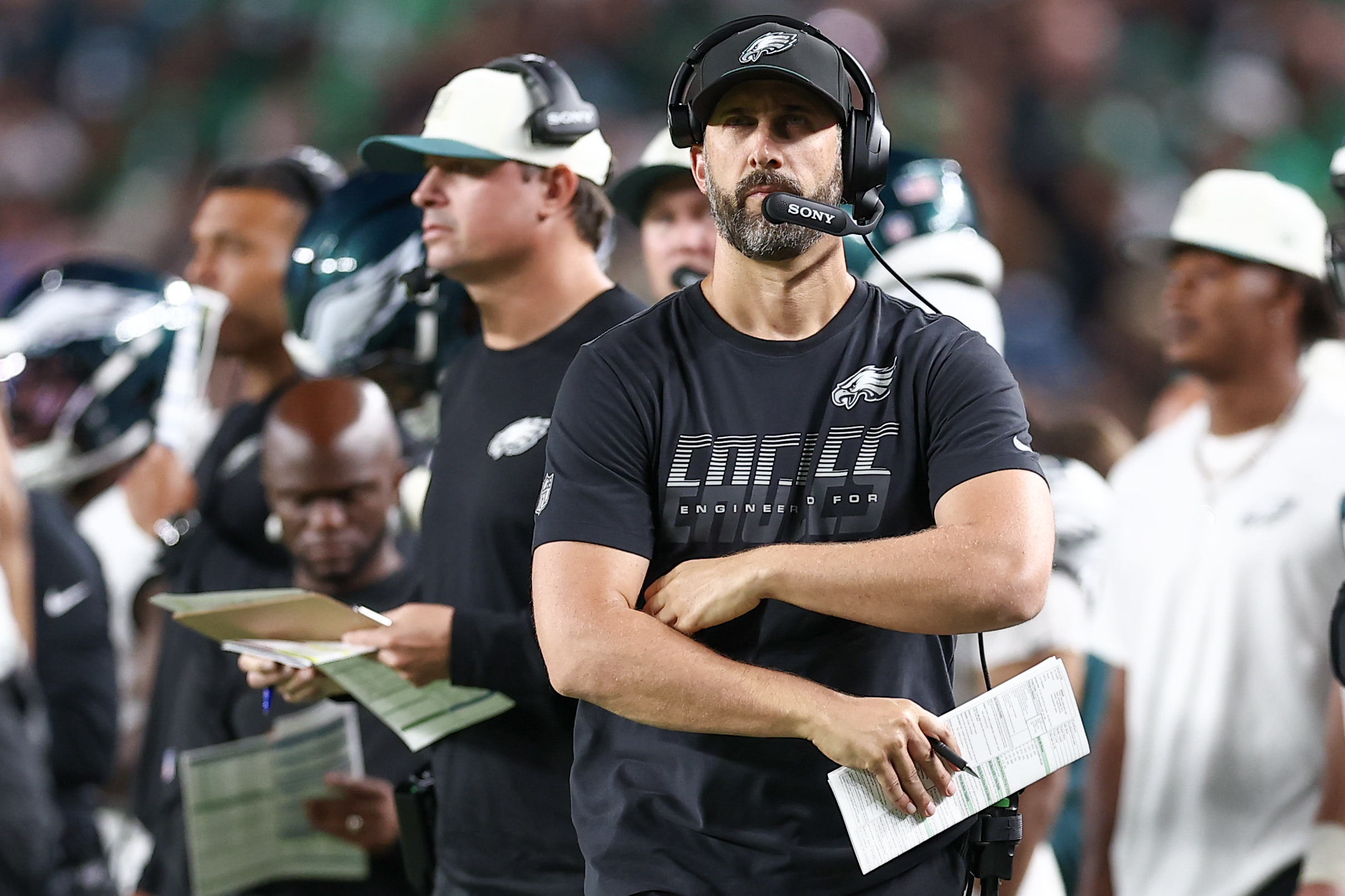
    The Eagles open up their season on Sunday at home against the Washington Commanders (4:25 p.m. Fox29). Like many around the country, The Inquirer’s four beat writers picked the Birds to come out on top.

    Here’s what NFL analysts are saying about the Eagles’ chances this weekend and the team’s overall outlook on the season:

    NFL.com: Lots to like about the Birds’ defense

    NFL.com polled five of its analysts on all 16 Week 1 matchups, and the Eagles were one of six teams it unanimously picked to win their opener. For NFL.com editor Gennaro Filice, who authored the website’s majority opinion, a major factor was the Birds’ defense.

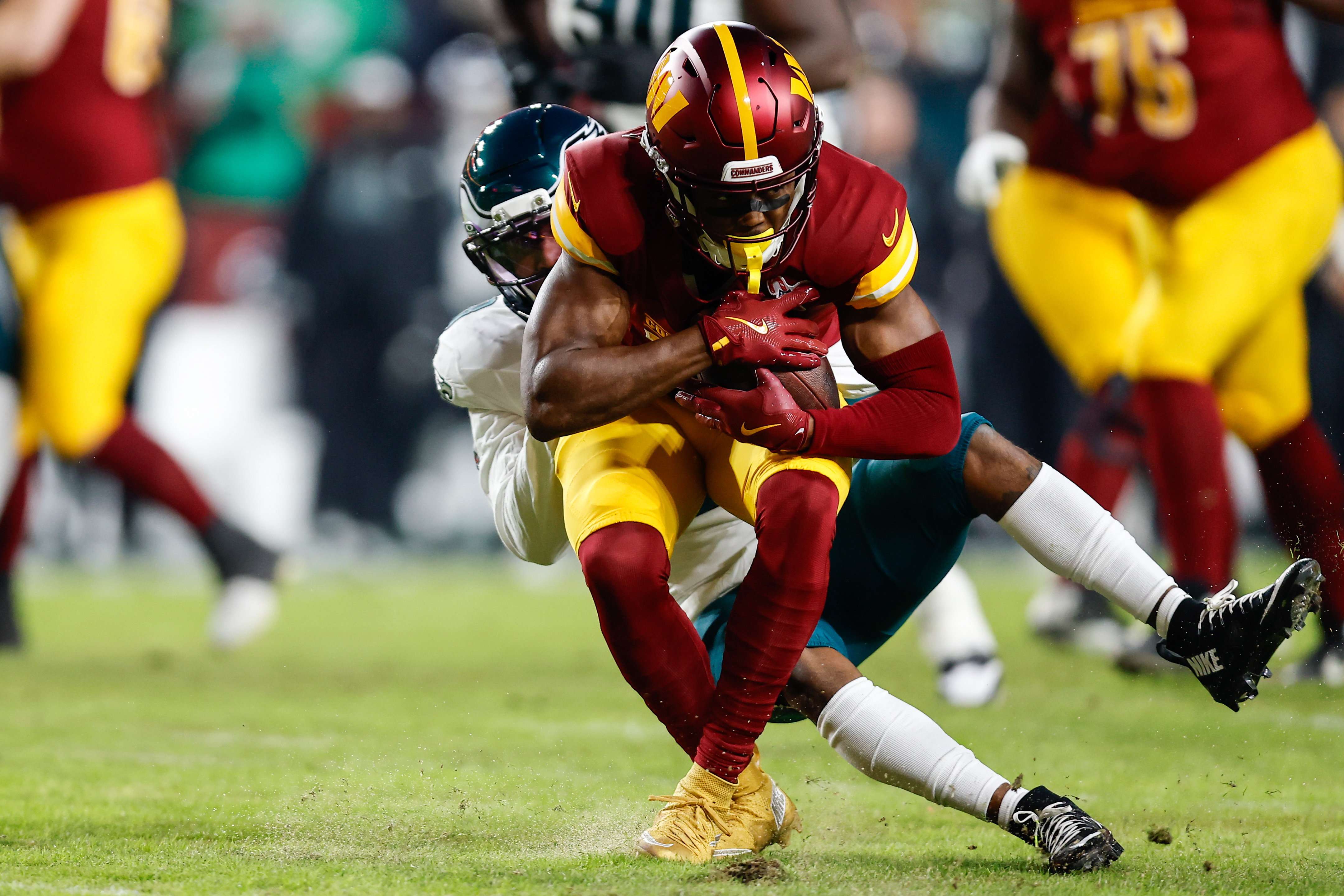
    “I have serious doubts about [Jayden] Daniels’ supporting cast, especially the Laremy Tunsil-less offensive line,” Filice wrote. “That’s a recipe for disaster against Vic Fangio’s defense. Sure, the Eagles’ edge group has question marks, but the front is spearheaded by the devastating DT duo of Jalen Carter and Jordan Davis. Even if Jayden can avoid those 650 pounds of PAIN, Philly has two athletic linebackers (Zack Baun and Jihaad Campbell) to track the fleet-footed quarterback and a pair of first-team All-Pro cover men (Quinyon Mitchell and Cooper DeJean) to close his passing lanes.”

    Tunsil, the Commanders’ five-time Pro Bowl left tackle, could miss “a significant portion of the regular season” after tearing his triceps in an August practice. Last season, Tunsil let up just two sacks and 15 pressures in 14 starts. The Commanders offensive line ranked 15th overall in pass blocking last year.

    Terry McLaurin and the Commanders will be without their top offensive lineman against the Eagles’ defense on Sunday.Monica Herndon / Staff Photographer

    Athletic writer feels ‘bad’ for Jayden Daniels

    Nick Kostos, a writer for The Athletic, selected the Eagles to win on Sunday — but he has some love for Washington Commanders quarterback Jayden Daniels.

    “I feel bad for Jayden Daniels. Less than two years ago, he had the Commanders in the NFC Championship Game as a rookie (coincidentally in Philly against the Eagles),” Kostos wrote. “And it feels like the Commanders are wasting the years on his rookie deal. I love Daniels, but the Eagles might have the best defense in the NFL — and I’m a Jalen Hurts believer. It’s the Eagles or nothing for me here.”

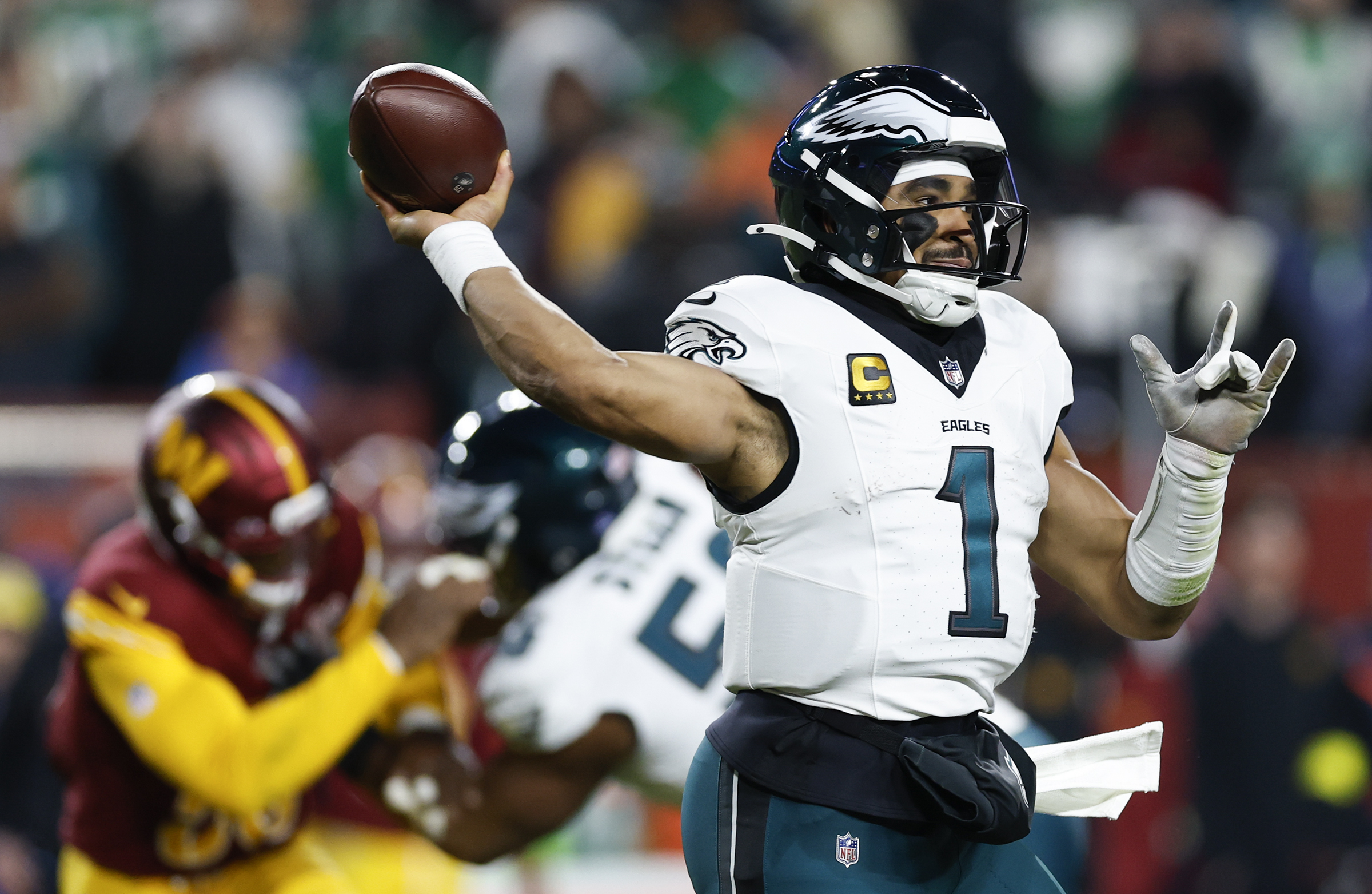
    Hurts has won seven of his 10 matchups against the Commanders. In those games, the Eagles captain has passed for 2,152 yards, 14 touchdowns, and three interceptions. He’s rushed for another six touchdowns against Washington.

    Eagles quarterback Jalen Hurts has been stellar against the Commanders in his career.Yong Kim / Staff Photographer

    ESPN likes the Eagles on Sunday, not for Super Bowl

    ESPN picked the Birds on Sunday and also recently asked 65 experts to predict how the NFL season would shake out. Of that group, just four predicted the Eagles to come out of the NFC. The most common answer was the Los Angeles Rams, as 43 analysts predicted LA as the NFC representative in Super Bowl LXI. Of the four who predicted the Eagles to make the Super Bowl, two chose Philadelphia to win: longtime NFL analyst Kevin Clark and NFL Network’s Cameron Wolfe.

    The 65 experts also predicted the league’s MVP, and Cincinnati Bengals quarterback Joe Burrow received the most votes (16). No Eagles received votes.

    Forbes ranks Eagles as ninth most valuable franchise

    In 2022, the Eagles were valued at $4.9 billion, per Forbes. Four years and one Lombardi Trophy later, the franchise has more than doubled that evaluation.

    The Eagles ranked No. 9 on Forbes’ annual list of most valuable franchises, coming in at a valuation of $10.25 billion. Eagles owner Jeffrey Lurie purchased the team in 1994 for $185 million.

    Lincoln Financial Field made up 13.1% of Forbes’ evaluation. With the stadium’s contract ending in 2032, the franchise is in an “exploratory research” phase on a new or renovated stadium.

  • The push to remove lead pipes is on. Thousands of water systems still don’t know where theirs are

    The push to remove lead pipes is on. Thousands of water systems still don’t know where theirs are

    Kathryn Pilgrim knew the century-old Victorian she bought in Dunkirk, New York, came with old plumbing. She replaced pipes she suspected of containing lead and later installed a kitchen filter designed to remove heavy metals.

    But six years after buying the house, she still can’t be sure that her tap water is lead-free because she doesn’t know what material was used for the pipe that runs under her front yard and connects to the city water supply. Dunkirk is nearly two years behind schedule on an inventory that would give Pilgrim and other residents that information.

    Dunkirk, which supplies water to about 5,000 homes and businesses, is one of more than 1,300 public water systems cited by the U.S. Environmental Protection Agency for failing to meet an October 2024 deadline to hand in an inventory of the water lines that could be leaching the heavy metal into Americans’ drinking water, an Associated Press analysis of the agency’s enforcement data shows.

    Roughly 6,300 water systems serving 3.8 million Americans have still not submitted a required list of how many lead service lines remain in use.

    Those inventories are critical for cities to replace all lead pipes by an upcoming 10-year deadline. Failing to document the lines also means residents won’t know if their homes have a potential source of lead exposure.

    Pilgrim, a special education teacher who has fostered teenagers, had been educated on the dangers of lead, especially in paint. The colon cancer survivor’s concerns extended to her drinking water.

    “I just thought there was some stuff in the water that might not be great,” she said.

    Officials with the city of Dunkirk did not respond to requests for comment.

    Lead pipes are abundant across New York and many communities around the country with older infrastructure. The city of Buffalo’s data shows 45% of its service lines — which connect homes and businesses to the water supply — are made of lead, the third-highest rate of any major city. The city of Fredonia, which neighbors Dunkirk, reported 28%.

    Lead is a priority under Trump administration

    Lead is a neurotoxin that can stunt children’s development, lower IQ scores, and increase blood pressure in adults. Roughly 4 million homes and businesses are still connected to water utilities via lead pipes, according to the EPA’s latest estimate.

    How much lead is entering the building depends on factors like the water chemistry and the pipe’s condition, but lead service lines remain the most significant source of the heavy metal, according to the EPA.

    The EPA has touted its work on lead lines as a key environmental win. About three-quarters of the drinking water enforcement orders issued by the EPA since President Donald Trump’s return to office were related to missing inventories.

    Most water systems with missing inventories are small — 84% provide drinking water to fewer than 500 people, the AP analysis shows. Many are small housing developments, mobile home parks, or schools.

    The EPA said it turned to enforcement only after efforts to help water systems comply were unsuccessful. Utilities need the inventories to prepare for a 2027 deadline requiring most drinking water providers to replace their lead lines within 10 years, the agency said. The Trump administration has also defended that aggressive deadline, enacted under Biden, in court.

    Rob Hayes, a senior director with Environmental Advocates of New York, said it is a rare environmental regulation the Trump administration has not sought to scrap.

    “It speaks to the universal popularity of getting lead out of drinking water,” he said.

    Inventories are not easy

    About 3,500 water systems reported they don’t know what their service lines are made of. One in five service lines nationwide were reported as having unknown materials.

    Many utilities are racing to identify unknown pipes by next year, when they must begin replacing them.

    In Chicago, home to the most lead lines of any city in the country, crews are working block-by-block, digging up the pipes that branch off from the utility’s main line. The city still doesn’t know the material of close to one in 10 service lines. So in those cases, crews may have to excavate them to check the material, said Patrick Schwer, the city’s water quality director.

    “We are digging through every single piece of information that we have associated with every single service line trying to find any indications of the material,” he said. “We’re scouring millions of work orders, trying to pull at little threads of information.”

    Lead pipes for public water date as far back as the late 1800s and were prevalent all the way to the 1950s. Lead was a preferred material at the time because it was resistant to corrosion, and as a result, the original lines remain in use decades later.

    Chicago advises residents with unknown lines to assume they are made of lead if their building predates 1986, when it was banned under the U.S. Safe Drinking Water Act.

    Records of the installations were often lost, incomplete, or illegible. Lapses in recordkeeping have made it difficult for some utilities to complete their inventories, said Joshua Klainberg, senior vice president with the New York League of Conservation Voters.

    Still, Klainberg said, leaving residents in the dark about whether they should take precautions by not submitting an inventory at all is “unforgivable.” Even an incomplete inventory can alert people they may have a lead service line, allowing them to take precautions such as running the tap, using filters — the highest-quality of which can remove most lead — and cooking only with cold water, he said.

    Limited funds for replacements

    For utilities, not knowing what is in the ground will carry an even stiffer consequence beginning in 2027. Starting then, they are required to replace 10% of lead water pipes each year, usually with copper or plastic pipes. But lines made of unidentified materials will be included in that target, said Erica Galante-Johnson, a lead policy analyst with the Environmental Policy Innovation Center.

    “The more unknowns, the more lines a system needs to replace every year,” Galante-Johnson said.

    And each replacement is expensive, usually costing between $8,000 and $15,000, according to EPIC.

    In Chicago’s case, “the city is actively going after every single dollar that we can,” from the federal and state governments, Schwer said. The city still needs to replace about 393,000 lead service lines.

    Most funding for identifying and replacing lead pipes comes from the 2021 bipartisan infrastructure law, with states distributing it. This is the final year of dedicated federal funding for lead projects, though previously allocated money will continue flowing to communities.

    Water systems without an inventory will fall even further behind as national efforts shift toward replacements, Hayes said.

    “If they can’t even get an inventory together, how the heck are they going to get the resources and the manpower and the kind of coordination between governments together to actually get workers out on the street and dig these pipes out of the ground?” he said.


  • Flyers update arena rendering after fans say women were left out of the first version

    Flyers update arena rendering after fans say women were left out of the first version

    The Sixers and Flyers released the first public renderings of their new arena, which is scheduled to open in 2030, earlier this week.

    Two images, which were created by Populous, the global design firm responsible for the arena’s conception, showed fans attending basketball and hockey games in the new state-of-the-art digs. But some fans say the Flyers’ rendering was missing one key detail: female fans. What ensued was a Where’s Waldo? level of analysis by people on the internet. The Flyers have since updated the rendering.

    The original Sixers rendering had a handful of what appeared to be female-presenting fans, wearing crossbody purses over their jerseys, with long hairstyles and ponytails. The Flyers version was more ambiguous. There appeared to be some women sitting toward the top of the image, in clusters across the stairs, but none wearing Flyers gear.

    A Populous spokesperson said the company accepted responsibility for the oversight and worked quickly to update the rendering as soon as it became aware of the issue.

    “The website now reflects the updated image,” the spokesperson said.

    Camille Barrière was one of the initial critics who pointed out the apparent lack of women via an X post. Barrière, who lives in Paris, studied architecture and is pursuing her master’s degree in media design at the School of Design Nantes Atlantique, with a focus on the delegitimization of women and non-male sports fans.

    When the renderings came out, Barrière said online that it was “new source material” for her thesis. Her post has been viewed nearly 200,000 times on X and has since spread to other social media platforms, particularly Reddit and Instagram among women’s sports pages.

    Some fans worry the lack of visibly female fans in the original rendering was more than an innocent mistake and is actually indicative of the male-centric way sports fandoms are still stereotypically viewed. Others say it’s not that serious and this much intense dialogue based off a rendering is laughable.

    “As a woman, I’m hyper aware of the amount of men in public spaces, and it’s for that reason that the image struck me. I continued searching and couldn’t find a single woman in Flyers gear in that picture,” Barrière told The Inquirer.

    Creating architectural renderings is not one size fits all and the process can vary considerably, but the final product can help represent the future of a space and who it belongs to, says Rashida Ng, an architecture professor at the University of Pennsylvania’s Stuart Weitzman School of Design.

    “I wouldn’t presume to know how or why the particular Flyers image was produced, or suggest that the omission was intentional,” she said. “But something can be unintentional and still be meaningful. If an image of a major public venue inadvertently leaves out a substantial part of the public, I think it’s worth asking how that happened.”

    The Gist and Togethxr, two popular women-founded sports media brands, called out the original renderings on Instagram. Reports show women are one of the fastest-growing audiences in sports.

    “They’re buying season tickets, filling arenas, creating fan communities, and shaping sports culture across every major league. The future of sports already includes women,” the Gist wrote in its post. “The renderings should too.”

    Ng says she sees the rendering debacle as a “teachable moment.”

    “Design is not neutral. The spaces we create — and the images we use to imagine and communicate them — both reflect and shape ideas about who belongs, who is welcome, and whose experiences matter,” she said. “That doesn’t mean every design decision or omission is intentional, but it does mean that designers have a responsibility to think critically about the worlds their work helps to envision.”

    Thursday morning, the Flyers updated the rendering on its website with a new version, one that added many new visibly female fans.

    As for Barrière, she’s shocked that a non-fan’s observation from across the world sparked discussion.

    “If my silly tweet that was just meant for my 40 followers can initiate a discussion on the issue, then I’m all for it,” she said. “I think inclusivity in hockey spaces, whether online or in real life, still has a long way to go, and calling out the teams directly is one of the ways we can help move the conversation forward in a positive direction.”

    And thinking about those women fans is particularly pertinent for the new arena — it’s also the future home of Philadelphia’s new WNBA franchise.

  • It’s been a decade since Temple and Penn State met. Their lopsided rivalry has had its moments.

    It’s been a decade since Temple and Penn State met. Their lopsided rivalry has had its moments.

    When Temple and Penn State kick off at Lincoln Financial Field on Saturday, the programs will renew a 95-year-old rivalry for the first time in a decade.

    Penn State holds a 40-4-1 all-time record and has won 32 of the last 33 meetings. However, the history of this series extends beyond wins and losses.

    Before the Nittany Lions return to Philadelphia for the first time since 2015, here are some of the top moments from their rivalry.

    Temple strikes first

    Temple and Penn State matched up for the first time on Oct. 10, 1931, when the Owls shut out the Nittany Lions, 12-0, in front of a capacity crowd of 20,000 at Temple Stadium.

    Head coach Heine Miller led Temple an 8-1-1 season, which stood as a program record for 42 years until Wayne Hardin’s 1973 team eclipsed it with nine.

    The Owls went on to claim three of the first four matchups in the all-time series.

    The victory that lasted 74 years

    Temple’s third win in four meetings with Penn State, on Oct. 18, 1941,became a frequently cited date.

    On a wet, muddy, and slippery day, Temple claimed what would be its final victory against the Nittany Lions for the next 74 years in a 14-0 win at Temple Stadium.

    Temple picked off star Penn State quarterback Johnny “Pepper” Petrella four times. Also, four players, two from each team, were taken off the field on stretchers in a game former Inquirer reporter Stan Baumgartner characterized as “bruising and bitterly contested” and both teams “appeared to have their boxing and wrestling squads competing.”

    It took another 39 games for the Owls to beat the Nittany Lions.

    Within inches

    Following Temple’s 1941 victory, an era of struggle ensued.

    In 1950 at New Beaver Field, Temple came close to beating Penn State when the two teams tied 7 apiece. Fun fact: Temple running back Gene Caterina scored the Owls’ first touchdown in University Park.

    The series entered a 22-year hiatus after 1952, and it wasn’t until 1975 when Temple made things interesting again. In front of a crowd of 57,112 at Franklin Field, Penn State snuck past the Owls, 26-25.

    Just a year later, in 1976, it was an even more painful finish, this time at Veterans Stadium. Temple trailed by two touchdowns before mounting a late comeback. The Owls drove downfield during the final two minutes but appeared in danger of running out of time near Penn State’s goal line.

    Then an unusual interruption occurred: a spectator ran onto the field and officials stopped the clock. Temple scored a touchdown on the next play, making it 31-30. The NCAA did not introduce overtime until 1996, so Hardin faced a straightforward decision: Kick the extra point and accept a tie or attempt a two-point conversion to win. Hardin went for two. The pass went just beyond the intended receiver, preserving Penn State’s one-point victory.

    Other notable games were in 1978 when No. 3-ranked Penn State survived Temple on a last-second Matt Bahr field goal to claim a 10-7 win. Then in 1985, a 206-yard, two-touchdown day from Temple running back Paul Palmer wasn’t enough in a 27-25 loss. Palmer was inducted into the College Football Hall of Fame in 2018.

    Paul Palmer finished with 206 yards and two touchdowns against Penn State in 1985.Inquirer Archives

    Penn State’s 31-game winning streak

    Between 1952 to 2014, the Nittany Lions won 31 consecutive matchups against the Owls, with former Penn State coach Joe Paterno leading them to 28 of those wins between 1975 to 2011.

    During that time, Penn State outscored Temple 1,068-331 and held an average game score of 34.5-10.7, a 23.8-point average margin.

    The Nittany Lions shut out the Owls four times. The most lopsided matchup came in 1995 in Penn State’s 66-14 victory. Its streak survived nine Temple head coaches, and was played at five different venues.

    From Penn State to Temple

    Despite the quarrels between the programs, two Penn State products became the most important figures in the revival and progression of Temple football.

    Former Temple head coach Al Golden lettered with the Nittany Lions from 1989-1991 and started at tight end for two seasons. He guided Temple to a 20-12 conference record between 2006 and 2010, a tenure that started a golden era of Owls football.

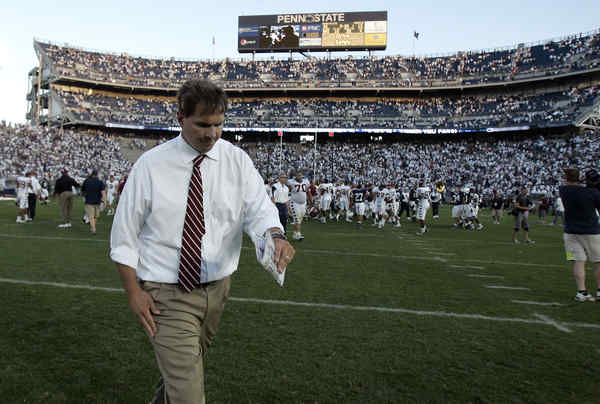
    Before becoming Temple’s head coach, Al Golden started at tight end for two seasons at Penn State.DAVID SWANSON / Staff Photographer

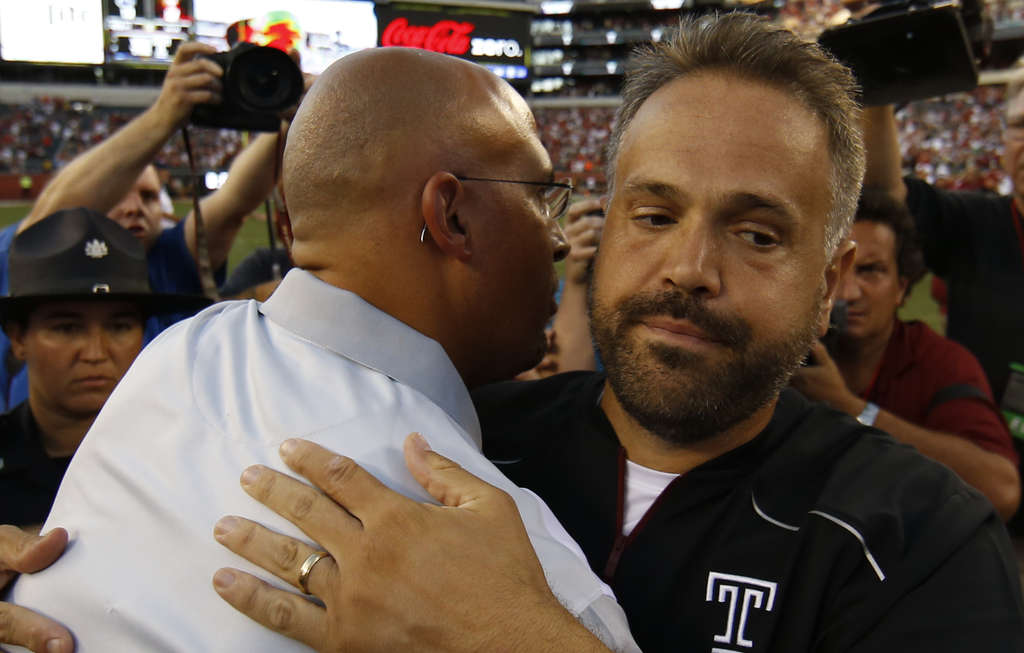
    Matt Rhule was also a walk-on linebacker at Penn State from 1994-1997 and got his start as a graduate assistant under Paterno. He eventually found his way onto Golden’s staff at Temple and was named defensive line coach in 2006, before moving to offensive coordinator.

    Rhule remained at Temple following Golden’s departure and worked under Steve Addazio before being hired as head coach in 2012. Rhule coached the Owls for four years, taking them to two consecutive bowl games and an American Conference championship in 2016.

    The Owls broke through

    In 2015, Temple took down Penn State, 27-10, in its season opener at Lincoln Financial Field in front of a then record-breaking crowd of 69,176.

    Coming off a 6-6 season under Rhule, Temple entered as a seven-point underdog.

    Penn State jumped out to a 10-0 lead before a 12-play, 93-yard drive ended with a Temple touchdown. The Owls tied the game with a 40-yard field goal before PJ Walker ran in a touchdown to give the Owls a 17-10.

    They added another score, but the real exclamation came from Temple’s defense, which sacked Penn State quarterback Christian Hackenberg 10 times, three coming from All-American linebacker Tyler Matakevich.

    In 2016, Temple visited Beaver Stadium and suffered a 34-27 loss. It was the last matchup between these two programs.

  • America lost its way after 9/11. We don’t have to stay on the wrong path.

    America lost its way after 9/11. We don’t have to stay on the wrong path.

    On Sept. 11, 1990, President George H.W. Bush gave a speech to a joint session of Congress with his vision for a “New World Order.” He promised that instead of the spheres of influence and deadly competition that had dominated international politics, there would now be a future where “the rule of law supplants the rule of the jungle.”

    For a while, it seemed like this could be true. War and conflict did not end in the 1990s, but peace seemed plausible.

    A United Nations-sanctioned coalition pushed Saddam Hussein out of Kuwait. Israeli and Palestinian leaders signed the Oslo Accords, which promised a shared future of two states for two peoples. Genocidal leaders in Rwanda and Serbia were removed from power. Even the Irish conflict, famously “800 years” old, was ended with the Good Friday Agreement.

    The United States reigned as the world’s sole superpower, and the next strongest militaries and economies mostly belonged to our allies. The Pax Americana seemed to have reached an unassailable zenith.

    Then it all came crashing down.

    When the planes hit the World Trade Center towers on Sept. 11, 2001, most of us did not realize it was the first step in the dismantling of the world we knew. I certainly did not. After all, I was only 12 years old.

    My seventh-grade classmates and I initially had no idea what had happened. We knew that our teachers were upset, and we caught a glimpse of maneuvering warships on the faculty lounge TV. The next thing we knew, we were being told to head home. For me, that meant hopping on SEPTA’s 67 bus. My younger brother and I watched news coverage of the devastation from our living room couch.

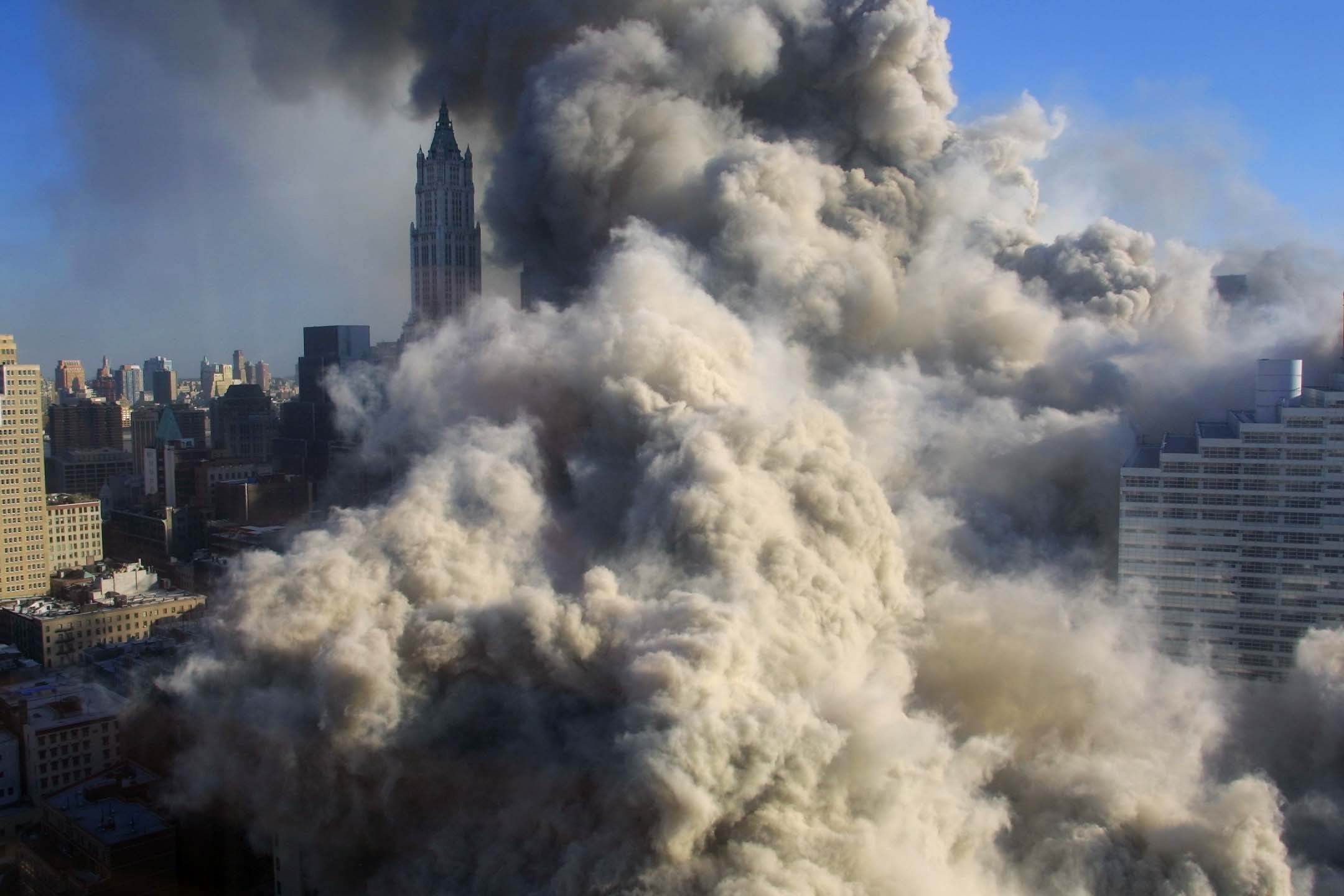
    Smoke rises from the collapse of the World Trade Center buildings, seen from the west and framing the Woolworth Building in the distance, in Manhattan on Sept. 11, 2001.TING-LI WANG

    At first, the attacks seemed to make the country stronger. We heard the inspiring story of the passengers who fought back on United 93, their plane crashing into a Pennsylvania field instead of its intended Washington target. When President George W. Bush threw out the first pitch at Yankee Stadium on Oct. 30 during the World Series, it felt like everyone was cheering him on, Republican or Democrat, Yankees fan or not. When he delivered a strike despite wearing a bulletproof vest under his pullover, it seemed like a promise that everything would get back to normal.

    It never did. Now, 25 years later, Americans overwhelmingly believe the country is on the wrong track, that we’ve strayed from our founding principles, that there is corruption in the federal government, and that the lives of our children may be worse than our own.

    Much of what went wrong can be traced to our initial efforts to avenge the dead.

    When the U.S.-led international coalition invaded Afghanistan in October 2001 to destroy al-Qaeda and bring its leader, Osama bin Laden, to justice, it seemed like a moral and strategic necessity. In March 2003, the Bush administration expanded the war on terror to Iraq under dubious claims of the existence of weapons of mass destruction. A year later, as the justification for the war was falling apart, revelations of brutal torture at Abu Ghraib prison in Iraq destroyed what little credibility and international goodwill Bush had left.

    The reaction to 9/11 itself also presaged what was to come. While most Americans rallied to the flag after the attacks, a persistent subculture insisted they were faked in some way. The so-called 9/11 Truth Movement may have been a collection of cranky conspiracy theorists, but they represented a model for where America was heading — a time when people increasingly cannot agree on basic facts and no longer inhabit a shared reality.

    President George W. Bush speaks aboard the aircraft carrier USS Abraham Lincoln off the California coast on May 1, 2003.J. Scott Applewhite

    It isn’t just failures abroad that have fostered this sense of cynicism. In the ’90s, there was a great spirit of optimism about new technologies. The internet was heralded as a way to break down barriers and foster international cooperation. Initially, this also seemed to be true.

    On message boards, once-lonely hobbyists found one another, sharing knowledge about topics as disparate as model trains, hiking, or fashion. Even fierce political opponents like Bill Clinton and Newt Gingrich could agree on letting the internet mostly regulate itself.

    Today, 41% of Americans report having little to no confidence in tech companies. Instead of democratizing access to information, social media has flooded the zone with nonsense. Online ad revenue is reaped by tech companies while content providers fight over the scraps. Many local newspapers, their economic model upended, have either disappeared or been hollowed out. More and more, people are getting their news from short-form video apps like TikTok or Instagram, or from influencers who rarely cite their sources or explore the nuance behind any issue. The public’s distrust of Big Tech has somehow not spread to the figures the companies’ algorithms have pushed to the forefront.

    The 2008 financial crisis also took a toll. Americans have disagreed over just about everything in our history, but the wave of foreclosures, stagnation in wages, and continued affluence for the country’s wealthiest sapped the public’s faith in the American dream. During the Great Depression, some wealthy figures like Charles Schwab and the Vanderbilts saw their fortunes shrink. During the Great Recession, the big banks received a $700 billion bailout, while 10 million ordinary Americans lost their homes.

    Republican senators explain their opposition to President Barack Obama’s financial stimulus package during a news conference at the Capitol in January 2009.

    In the 2000 election, both Democratic candidate Al Gore and Republican George W. Bush were viewed favorably by most of the American electorate. These days, a more divisive politics rules. Supporters of Donald Trump, convinced by the president that the 2020 election was stolen, stormed the U.S. Capitol. While it is true the 2000 election was itself controversial, with lawsuits about recounts in Florida ultimately reaching the U.S. Supreme Court, Gore conceded “for the sake of our unity as a people and the strength of our democracy.” Both Gore and President Bill Clinton attended Bush’s inauguration.

    Today, roughly 60% of Americans disapprove of President Trump, and just as many disapproved of President Joe Biden at the end of his term. Both major political parties are also unpopular, and railing against the party establishment has become a popular tactic in primaries.

    Of course, given the failures of the last 25 years, that establishment deserves to be questioned. The mainstream leaders of both parties share responsibility for the erosion in public confidence. Not only have they failed to anticipate the challenges of the 21st century, but their relentless partisanship has also made crafting sustainable solutions impossible. Nor have they offered new ideas that can compete with pledges to put every American on Medicare or claims that all our problems will disappear if we simply deport enough people.

    That doesn’t mean the next 25 years can’t be better.

    The beautiful thing about government of the people, for the people, and by the people is that we are in control. Just as our predecessors freed themselves from British rule, destroyed the power of slave holders that was corrupting our republic, reined in Gilded Age trusts, defeated fascism, and marched to finally make good on our nation’s stated belief that all men are created equal, those of us charged with the rights and responsibilities of citizenship today can also change our nation for the better. We must.

    Even as the Russian invasion of Ukraine drags toward year five, radical Israeli settlers seize land meant for a Palestinian state, and our nation divides itself over every ginned-up bit of culture war ephemera, we retain the same qualities that made us the world’s hegemon in the first place — ingenuity, openness to risk, and drive.

    Like the brave passengers on United Airlines Flight 93, we must recognize our predicament, find our resolve, and fight to ensure terror doesn’t win.

  • Police in Montgomery County are searching for a hit-and-run driver who killed a pedestrian

    Police in Montgomery County are searching for a hit-and-run driver who killed a pedestrian

    East Norriton police are searching for the driver of a vehicle who fatally struck a pedestrian on Labor Day weekend, then fled.

    Ricardo Baptiste, 29, was struck Sunday just after 9 p.m. as he walked along West Germantown Pike near Whitehall Road, police said Thursday.

    The initial vehicle that hit Baptiste, a Lansdowne resident, pushed him into the opposite lane of traffic, where he was struck by a tractor trailer, police said. Medics transported him to nearby Jefferson Einstein Montgomery Hospital, where he was pronounced dead.

    Police say the driver of that first vehicle did not remain at the scene, and they believe the person behind the wheel may have been driving drunk.

    Baptiste’s family told investigators he had just left Jefferson Einstein, which is a few hundred yards away. He was being treated for an unrelated issue.

    He leaves behind a 3-year-old daughter, and worked for a time as a kindergarten teacher, according to his family.

    Anyone with information on the crash is asked to contact the Montgomery County Detective Bureau at 610-278-3368.

  • In a shift, Bob Harvie calls for data center moratorium in new TV ad in race against Brian Fitzpatrick

    In a shift, Bob Harvie calls for data center moratorium in new TV ad in race against Brian Fitzpatrick

    Democrat Bob Harvie released his first general election TV ad Thursday morning, calling for a moratorium on artificial intelligence data center development and attacking U.S. Rep. Brian Fitzpatrick (R., Bucks) for his stance on the issue.

    “I don’t want any more data centers. I want a moratorium. Big tech owns enough; they shouldn’t own our congressman, too,” Harvie says in the 30-second ad.

    The ad marks the first time the congressional candidate and Bucks County commissioner has called for a moratorium and signifies a shift in his position.

    Previously, in an interview with The Inquirer last week and on his website, Harvie had called only for strict regulations on development. To focus his first major television ad on the topic shows how the projects are becoming a top issue for voters in Bucks County’s swingy 1st Congressional District amid a national backlash against data centers.

    As residents across the state protest proposed data centers in their communities, political candidates and elected officials have been taking — and sometimes changing — their positions. In August, Gov. Josh Shapiro shifted from his original stance and signed a sweeping executive order to increase restrictions on data center development.

    In Bucks County, both Harvie and Fitzpatrick have to grapple with the development of an Amazon data center in Falls Township, which is nearing completion.

    Harvie, who lives just miles from the project, voted in December 2020 to approve a county tax break for NorthPoint Development, the property owner of the Falls Township site.

    Last year, Harvie celebrated Amazon’s investment in the data center and Fitzpatrick called it “one of the most transformative investments Bucks County has seen in decades.” More recently, they both supported Shapiro’s executive order.

    In Harvie’s television ad, images of Elon Musk and Mark Zuckerberg flash on the screen. “Big tech is taking over our lives,” the candidate says in the ad. “And they want more. Grabbing our land, water, electricity, and sticking us with the bill.”

    Harvie also targeted Fitzpatrick’s initial vote for the One Big Beautiful Bill Act in the House last year, which included a provision that would ban state or local governments from enacting limiting or regulating AI systems and models. (Fitzpatrick voted against the final version of President Donald Trump’s bill, citing changes in the U.S. Senate that increased cuts to Medicaid. The final version did not include the controversial AI provision.)

    Heather Roberts, a spokesperson for Fitzpatrick’s campaign, said in a statement that the Bucks County Republican has always been supportive of “uniform federal regulations” and “100% control by local residents who could be impacted.”

    She also pointed to his cosponsorship of two bills aimed at regulating the effects of data centers: the Ratepayer Protection Act and the Data Center Transparency Act.

    “Bob Harvie literally created this problem in our community — and he is now well aware of the massive albatross that this is around his neck. Hence, his latest lie in this ad,” Roberts said.

    Fitzpatrick has also released a digital ad targeting Harvie on data centers.

    In an interview about data centers last week, Harvie did not call for a moratorium on the projects, but rather for strict regulations — as is also reflected on his campaign website. He also touted tasking the county planning commission with developing guidelines for municipalities facing potential data center proposals.

    When asked last week why he had not called for a moratorium, Harvie said: “I think there’s probably areas in the country where data centers can make sense, where the energy grid can handle it, where there’s limits to it on the impact it could have on other people who might live in the area.”

    “But I do think certainly we need to have a lot of cause for concern about how rapidly this is happening and making sure we can put some kind of handle on it,” he added.

    He also echoed residents’ environmental concerns related to data centers and said that the developments need the increased oversight outlined in Shapiro’s executive order and that projects should not continue if the local community opposes.

    Nine days later, Harvie said Thursday in another interview with The Inquirer that the decision for a moratorium did not come “out of left field for me” but was the product of many conversations amid what he says is a “complete failure of leadership” by Trump and Republicans, including Fitzpatrick, on the issue.

    Of his 2020 vote to give NorthPoint a tax break, he said there was not an indication that the property was going to be used for data centers, but rather for e-commerce distribution.

    He said that he is not set on one particular time frame for the moratorium but that “setting up guardrails” is most important, and he hopes a Democratic-controlled Congress would further hold hearings on imposing a moratorium.

    “As we’ve seen more and more of what’s going on around the country with data centers just trying to gobble up space and build, build, build without any regulation, I’ve come to the point now where we have to do something to slow down this genie getting out of the bottle,” Harvie said.

  • J.T. Realmuto’s extreme success with the ABS system has the Phillies hoping he will challenge more calls

    J.T. Realmuto’s extreme success with the ABS system has the Phillies hoping he will challenge more calls

    Nearing the end of the first season with the automated ball-strike system, the Phillies’ analytics department has a challenge for catcher J.T. Realmuto.

    Challenge more often.

    “That’s one of the things that we see on the reports,” interim manager Don Mattingly said Thursday, a rare day off for Realmuto with Zack Wheeler on the mound. “He’s really good at it. Probably there’s more chances for him to do it. I like to see him do it. When he thinks it’s a strike, it pretty much is, right?”

    Indeed, Realmuto has a 79% success rate, best among all catchers with at least 15 challenges. But despite being behind the plate for the second-most innings (940), he was tied for only 32nd with 70 challenges.

    By comparison, the Brewers’ William Contreras leads all catchers with 993⅔ innings behind the plate and 167 challenges. Yankees catcher Austin Wells is fourth with 858⅓ innings and tied for fourth with 113 challenges.

    There are several factors at play for Realmuto. He has said he likes ABS for “the big misses,” in terms of both the obviousness and timing of an umpire’s call. He won’t hesitate to challenge a close call at a pivotal point in the game.

    But Realmuto is more conservative than most catchers about challenging a pitch that doesn’t flip an at-bat or impact a potential rally. Teams begin a game with only two challenges and retain them as long as they keep getting them right.

    “It still goes back to leverage,” Mattingly said. “First pitch, unless he’s 100% [sure] — or first pitch of the game, right? — it could be a strike and he knows it’s a strike, but [do you] challenge?”

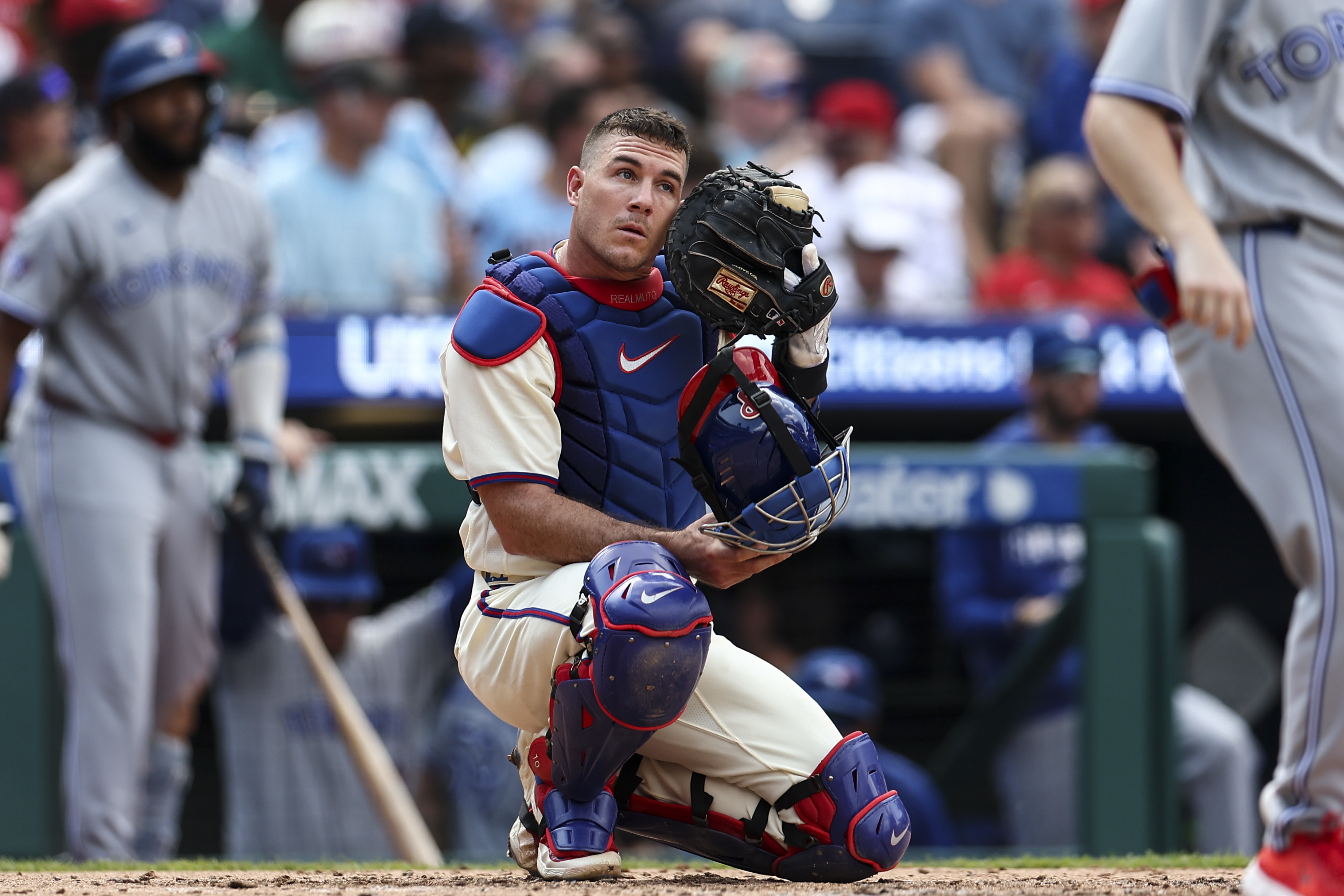
    J.T. Realmuto is among the league leaders in innings caught, but middle of the pack in pitches challenged.Yong Kim / Staff Photographer

    After every game, the Phillies coaches receive data on everything, from defense to pitcher and hitter metrics. A review of ABS is part of the report.

    Lately, Realmuto has challenged more frequently. In August, he contested 14 pitches and got 10 correct. He has already challenged nine this month … and gone 7-2.

    In Wheeler’s previous start, last Saturday night against the Braves, Realmuto challenged a 2-2 pitch with the bases loaded and one out in the first inning. The call was overturned for a strikeout of Mauricio Dubón.

    Wheeler called it a “gutsy” challenge given that it was only the first inning. But it also might have prevented the Braves from having a big inning in what turned out to be a 4-2 Phillies victory.

    Two days later, Realmuto successfully challenged two pitches in the second inning of a scoreless game for Jesús Luzardo, who went on to pitch a complete-game shutout.

    It’s all part of finding an effective ABS strategy.

    If anything, Realmuto is so effective at getting close pitches overturned that the Phillies may prefer their hitters to be less aggressive. For instance, four of Bryce Harper’s last five challenges came in the first inning. He lost three of them, leaving only one for the rest of the game.

    “Every time [Realmuto] challenges, you feel like he’s going to be right, so I think we should encourage him to challenge when he sees it,” Mattingly said. “And that’s kind of sometimes the frustration when you challenge early in non-leverage situations offensively. It kind of makes him go, ‘I can’t,’ because you don’t like being out of them.

    “There’s not been real encouragement [for Realmuto to challenge more] other than he’s really good at it. If he thinks it’s a strike, challenge it.”

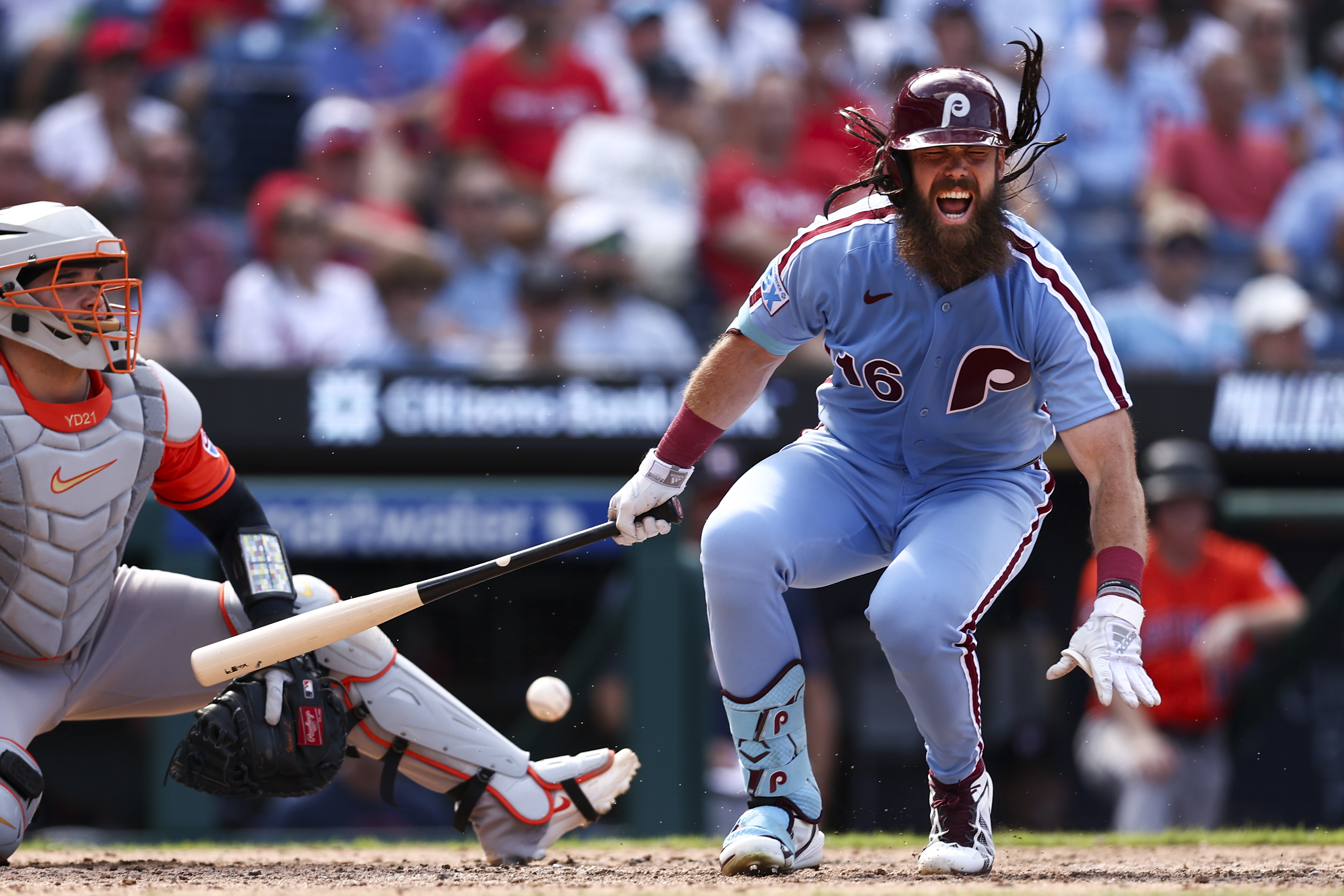
    Phillies left fielder Brandon Marsh fouled a ball off his right foot and left Thursday’s game with a bruise.Monica Herndon / Staff Photographer

    Marsh bruised

    Brandon Marsh fouled a ball off his right foot and left the game in the eighth inning. X-rays were negative, according to Mattingly. The Phillies were calling it a bruise.

    “It’ll be sore,” Mattingly said, “but yeah, I think it’s going to be fine.”

    Marsh, a left-handed hitter, was unlikely to be in the lineup anyway Friday night against Braves ace lefty Chris Sale. The Phillies were expected to stack the lineup with right-handed hitters, including outfielders Derek Hill and either Bryan De La Cruz and/or Edmundo Sosa.

    Extra bases

    Veteran pitcher Nestor Cortes’ next appearance will be in triple A, according to Mattingly, after he allowed one run in one inning Tuesday night for low-A Clearwater. The Phillies took a flier last month by signing the 31-year-old lefty, who had surgery after last season on a torn biceps tendon. … Reliever Caleb Kilian, sidelined by a strained oblique muscle in his left side, traveled with the team to continue his throwing progression, though he’s still weeks away from returning. … Flyers winger Porter Martone threw the ceremonial first pitch. … Aaron Nola (6-10, 4.76 ERA) is scheduled to start Friday night in Atlanta against Sale (14-9, 2.10). The matchups for the rest of the series: Saturday— Jesús Luzardo (14-5, 2.87) vs. Braves righty Tyler Mahle (5-10, 4.05); Sunday— Andrew Painter (3-9, 5.71) vs. righty Grant Holmes (9-5, 3.46).