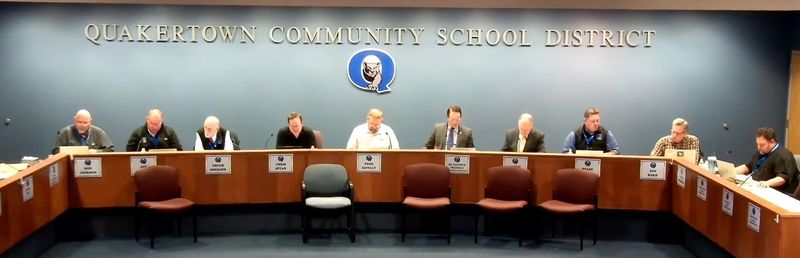
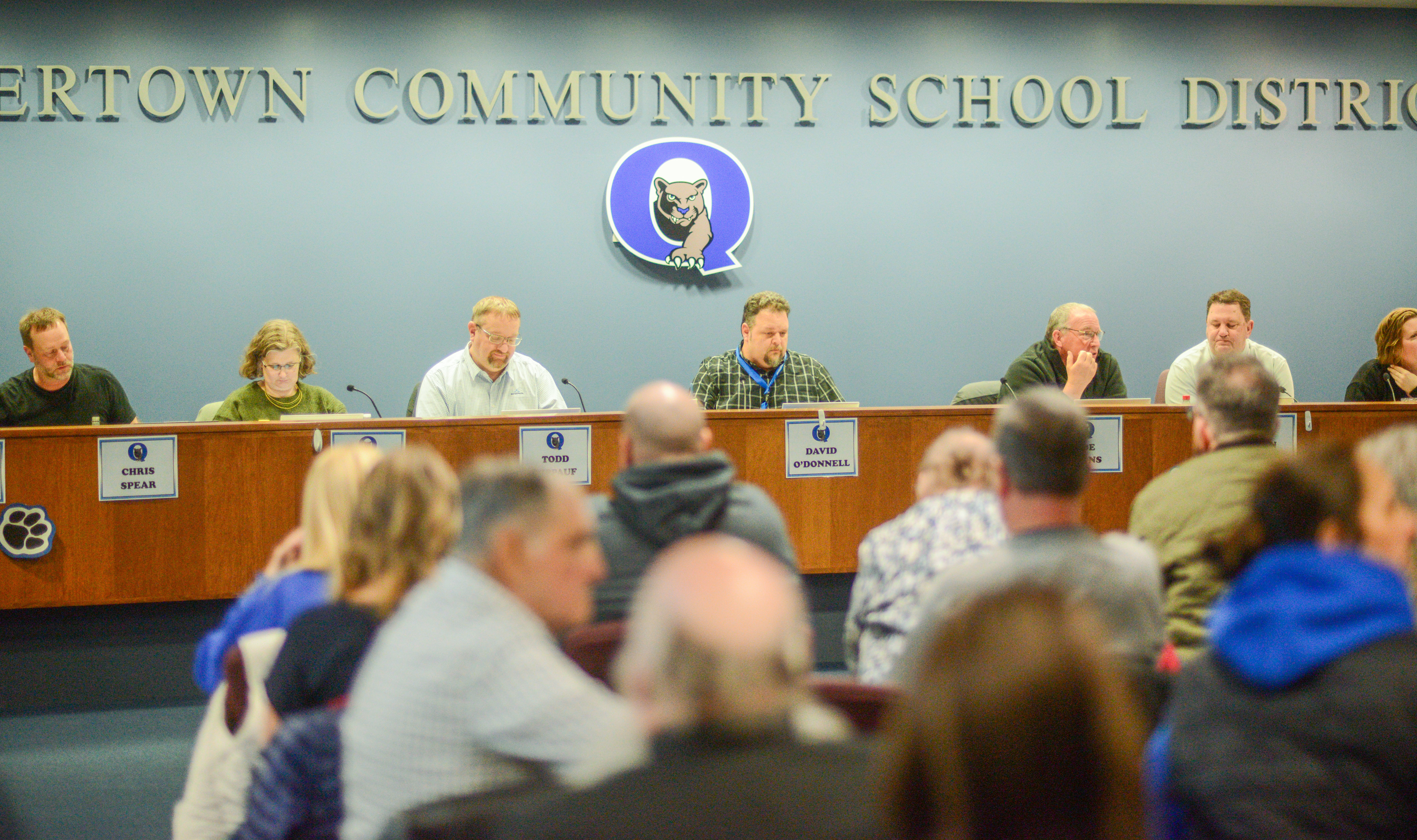
Quakertown Community School District Superintendent Matthew Friedman is on leave effective immediately, a district spokesperson said Friday.
The spokesperson, Melissa Hartney, said the district’s school board could not comment further.
“Because this is a personnel matter, the board is limited in the amount of information it can share at this time,” Hartney said in a statement.
Friedman did not return a request for comment.
Friedman took over the 4,600-student district in Upper Bucks County in 2023, after serving as superintendent of the Ocean City School District in New Jersey.
The Quakertown school board in November granted him a $10,000 raise, bringing his salary to $233,000, and extended his contract until June 30, 2028.
Assistant Superintendent Lisa Hoffman is taking over day-to-day operations of the district, Hartney said.
“The board is confident that district operations, instructional programs, and student services will continue without interruption,” Hartney said, adding that it “remains committed to transparency, accountability, and maintaining the trust of our students, staff, families, and community.”
Editor’s Note: Following the publication of this article, Quakertown Community School District Solicitor Jeffery P. Garton said in writing that Friedman was never placed on “administrative leave” and that his departure was amicable.
Addressing the board before the vote, Ryan Wieand, the president of Quakertown’s teachers union, said that selecting the next superintendent “is not simply about filling a position at this point. It’s about restoring trust.”
Wieand said the superintendent’s job “demands presence, visibility, and leadership that requires showing up, and not just for social media photo ops.”
The district “can’t be led effectively by someone who is absent more often than not,” Wieand said. “Our next superintendent needs to be 100% invested in Quakertown every single day,” and not view the job as “a stepping stone to another destination.”
He called Hoffman the best candidate for the job, praising her loyalty to the district and “true accountability.”
Friedman could not immediately be reached for comment Wednesday.
Editor’s Note: Following the publication of this article, Quakertown Community School District Solicitor Jeffery P. Garton said in writing that Friedman was never placed on “administrative leave” and that his departure was amicable.
But the same lawmakers who batted down that plan are now poised to consider another $1-per-ride tax. This time, it would be only for rides in cars without human drivers.
Councilmember Jim Harrity, a Democrat who represents the city at-large and opposed the rideshare tax in the spring, on Thursday introduced legislation in Council to tax services performed by autonomous vehicles, such as driverless rideshare cars and sidewalk delivery robots.
Harrity, an ally of organized labor, said that the measure is aimed at protecting jobs, and that he hopes it will deter Philadelphians from relying on autonomous vehicles entirely.
“Now my neighbors are going to lose their second jobs to robots,” Harrity said Thursday. “It’s not fair.”
Also on Thursday, Council members expressed public skepticism about one of Parker’s signature initiatives. Lawmakers approved legislation authorizing the body to investigate whether the administration has delayed spending money that Council authorized to fund the mayor’s massive Housing Opportunities Made Easy, or H.O.M.E., program.
What was today’s highlight?
Tax the robots?: Harrity framed his proposal as something of an opening salvo in what he hopes becomes a broader fight against the proliferation of autonomous vehicles in the city.
He said that he is open to other solutions to preserve jobs as members consider his legislation, and that he could not estimate how much revenue his tax proposal would generate.
“In a perfect world,” he said, “no one will pay the tax because they’ll just ban the robots.”
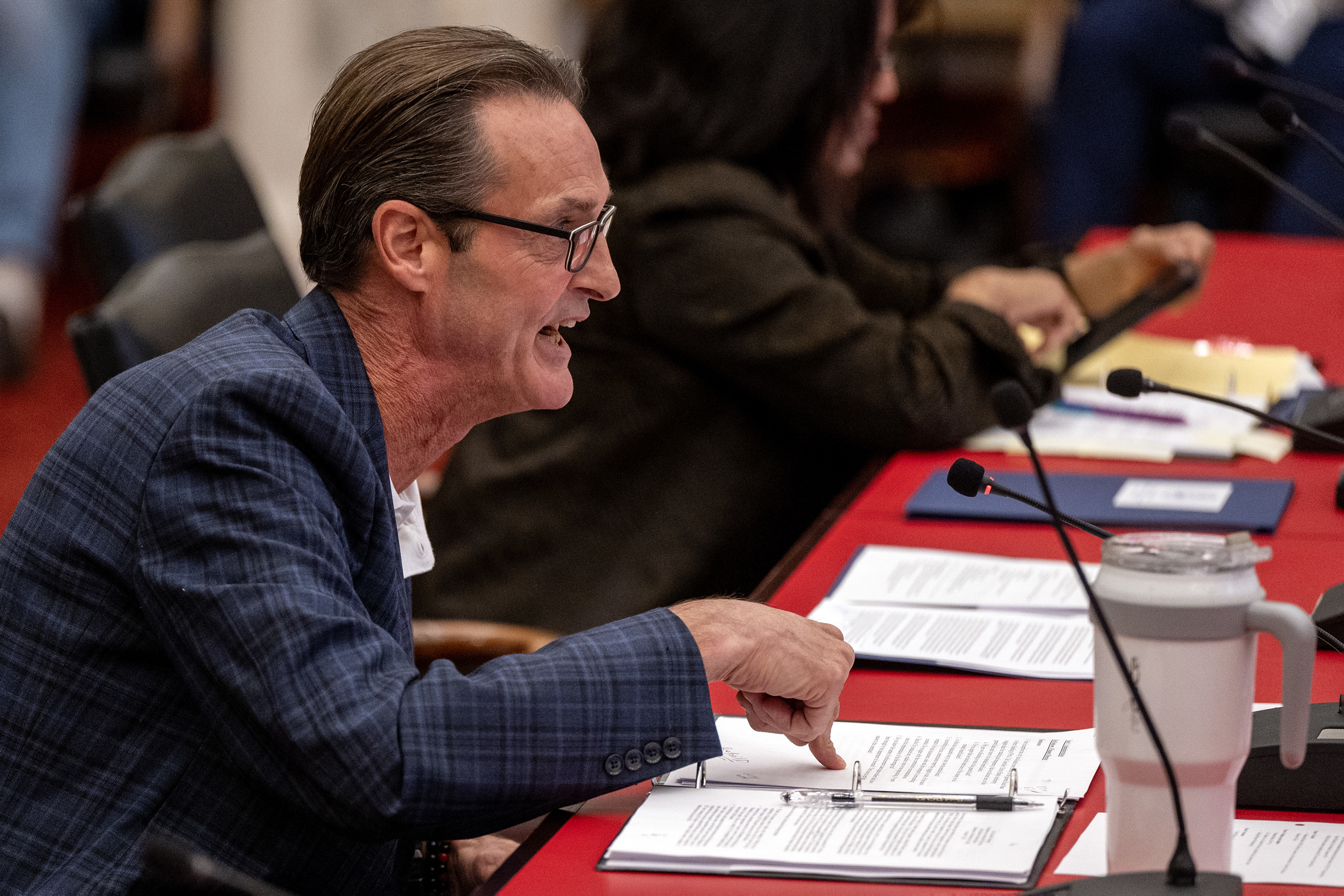
Councilmember Jim Harrity questions a Parker administration official about the city budget in October 2025.Tom Gralish / Staff Photographer
Harrity’s legislation would levy a $1-per-ride fee — or 5% of the cost of the trip, whichever sum is greater — on companies that operate driverless taxi services. The most prominent is Waymo, which is currently testing driverless cars in Philadelphia.
The bill would also impose a fee of either 50 cents per delivery or 5% of the total cost on deliveries done by sidewalk robots, as well as a 3% tax on driverless freight vehicles that drive on city streets.
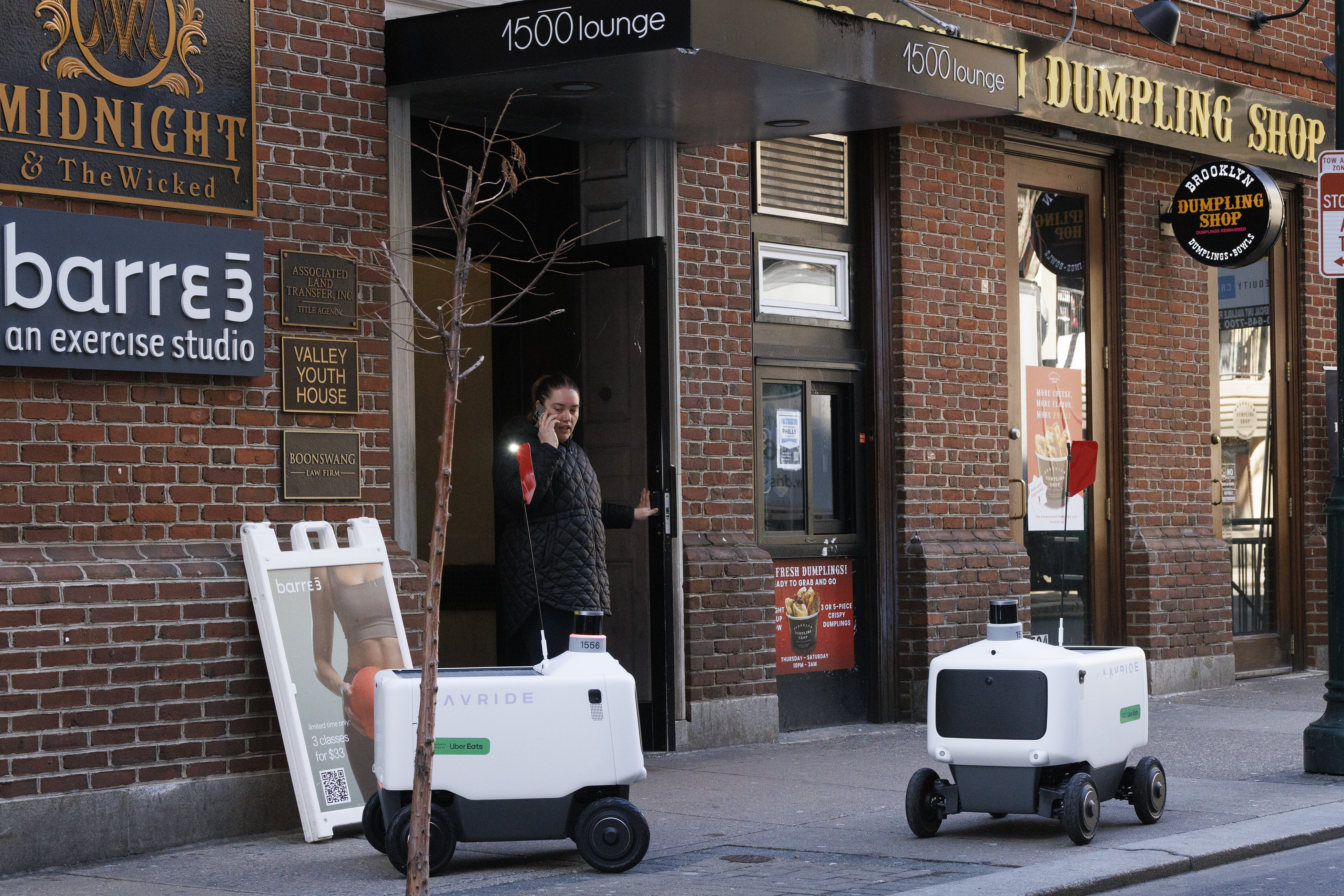
The tax would also apply to orders of food and other goods that are delivered by robots. Customers who order deliveries through platforms such as Uber Eats may have at times received their food from a sidewalk robot; however, those machines are operated by the third-party company Avride, not Uber itself.
Uber Eats robot food delivery pods on sidewalk along 1500 Sansom Street on Tuesday morning March 17, 2026. One robot was present (right) when a second arrived.Alejandro A. Alvarez / Staff Photographer
Under the proposed legislation, which would take effect in January 2028, companies that operate autonomous vehicles in Philadelphia would be required to register with the city and file quarterly reports on services performed.
The tax would not apply to businesses that use automation for internal purposes.
Waymo did not respond to a request for comment. An Uber representative declined to comment.
What else happened this week?
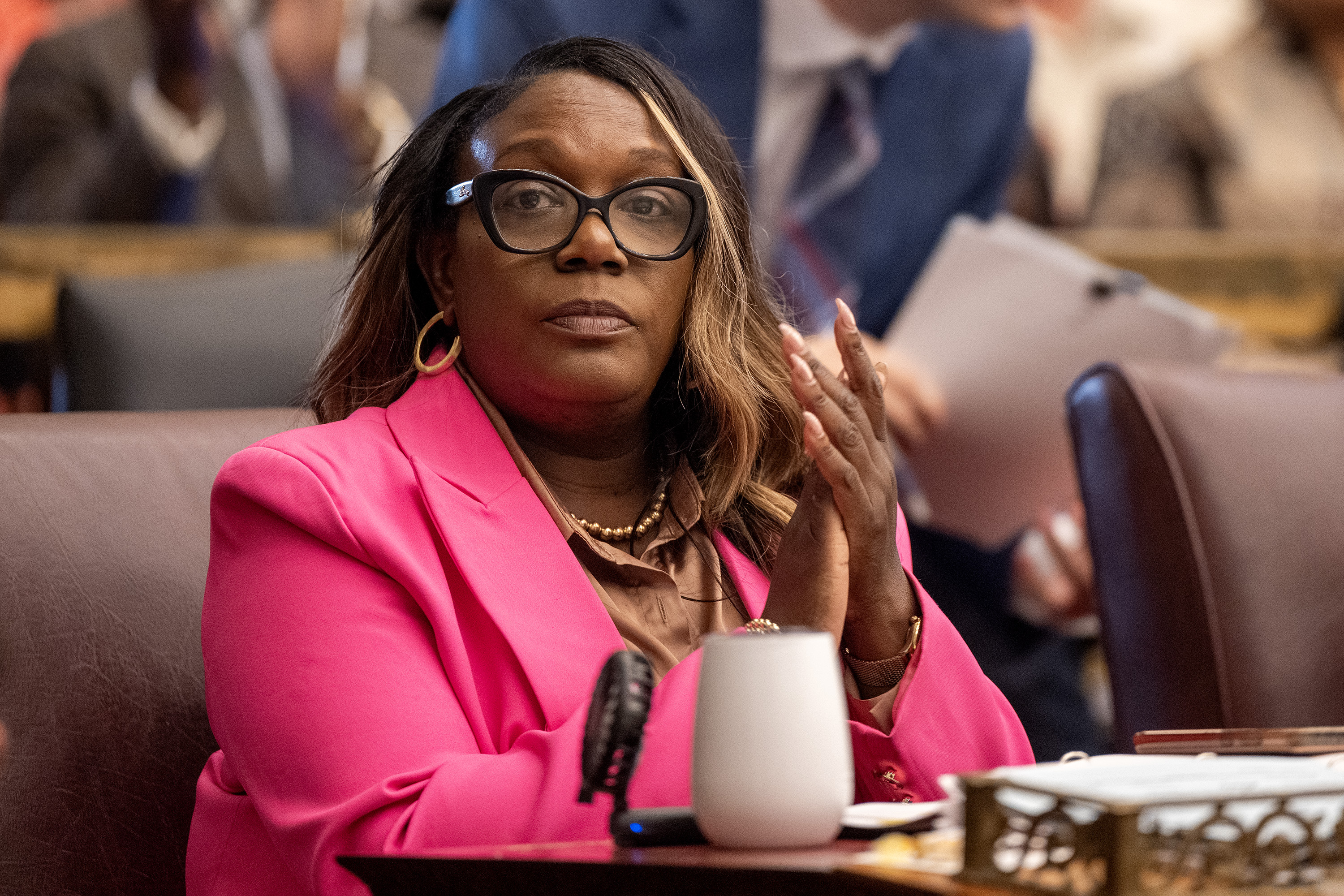
Investigating H.O.M.E. finances: City Councilmember Kendra Brooks, a member of the progressive Working Families Party who has not been quiet about her policy differences with Parker, introduced the legislation Thursday to probe the mayor’s massive housing plan.
But she did so with the support of several more establishment-aligned members. And the hearing will be held in Council’s powerful Finance Committee, which is led by Democratic Majority Leader Katherine Gilmore Richardson.
That suggests that Council’s leadership is aligned with Brooks. She said Thursday that she was dismayed by a report released this week by the city’s fiscal watchdog, which said that the Parker administration had spent only $38 million of the $278 million it was budgeted for the first phase of the H.O.M.E. initiative.
Brooks’ resolution cites “delays in spending [that] impact Philadelphians who would benefit from housing programs and support, as well as erode the value of money authorized by City Council.”
“We’re talking about getting the program right that will spend nearly a billion dollars, and that all of the Council was told was urgent to approve,” Brooks said in remarks during Thursday’s meeting.
City Councilmember Kendra Brooks in City Council chambers on Thursday, Sept. 17, 2026.Tom Gralish / Staff Photographer
A Parker administration official said Monday that the H.O.M.E. programs are on pace to use their full budgets.
A hearing has not yet been scheduled.
Putting a stop to automatic renewals: Council will consider legislation that would make it illegal for any company doing business in Philadelphia from automatically renewing subscription services and memberships without the customer’s explicit OK.
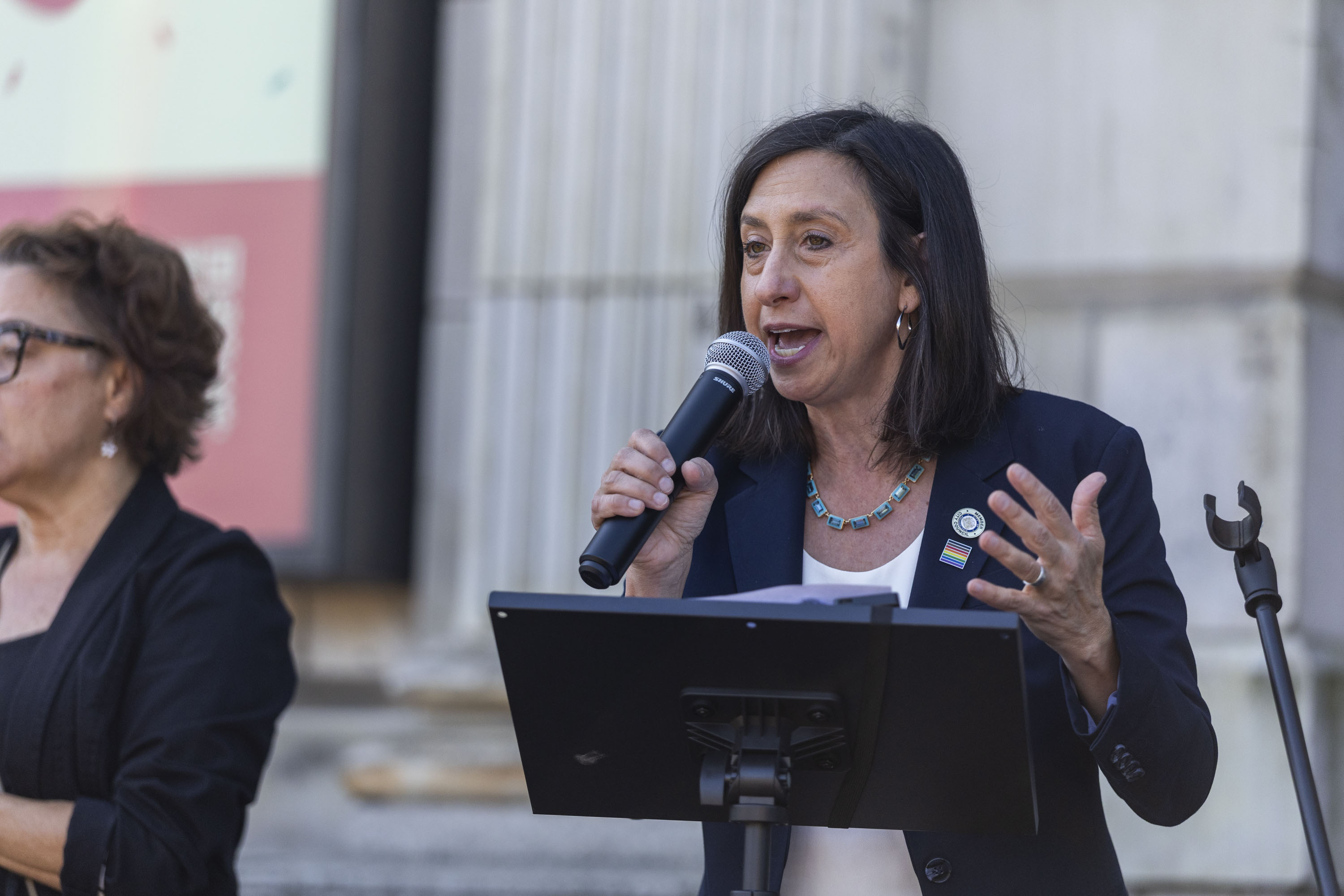
The bill, introduced Thursday by Councilmember Rue Landau, is part of the Democratic at-large member’s broader agenda to crack down on so-called junk fees and implement new consumer protection measures. This effort would aim to prevent businesses from charging customers for services they don’t want simply because they did not take action to cancel.
City Council member Rue Landau, speaks at a rally outside the Academy of Natural Sciences of Drexel University on Tuesday, Sept. 8, 2026, in Philadelphia, Pa.Tyger Williams / Staff Photographer
Under the ordinance, known as the “Click-to-Cancel” legislation, businesses would be required to remind customers who are enrolled in services that automatically renew, and they would have to give notice if a free trial converts to a paid plan.
“At a time when so many Philadelphia families are watching every dollar, we should be protecting people’s hard-earned money,” Landau said, “not allowing bad actors to take advantage of them.”
Quote of the week
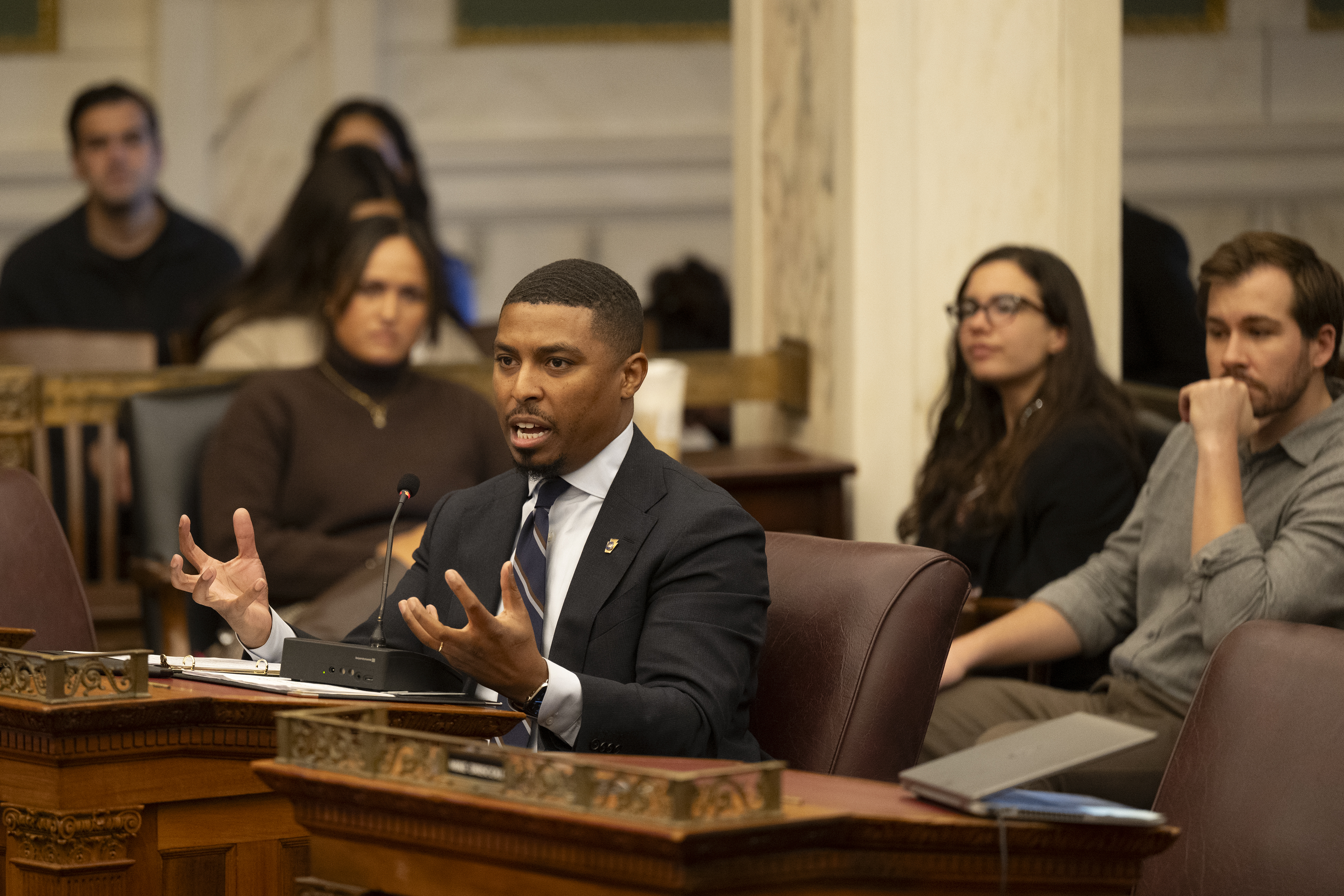
Councilmember Nicolas O’Rourke, speaks during a City Council hearing on Wednesday, Oct. 28, 2026.Jose F. Moreno / Staff Photographer
That was Councilmember Nicolas O’Rourke, who delivered remarks in support of Harrity’s legislation to tax services that rely on autonomous vehicles.
Next on Council’s agenda: subsidizing the milkman?
If you peruse the shelves of a Mexican bakery or grocery store this weekend, you may happen upon rounds of brioche-like bread covered with white sesame seeds, coated in sugar (maybe dyed pink or red), decorated with strips of dough that form a knobby X pattern, and often scented with orange blossom water.
It’s pan de muerto, or bread of the dead, a traditional sweet bread to celebrate Día de los Muertos, the Mexican holiday observed every year on Nov. 1 and 2.
Traditional pan de muerto — round loaves with rolled strips of dough pressed onto their glossy tops in a cross pattern —are meant to evokeskeletons. (The central knob of dough symbolizes a skull, while the pink or red sugar scattered over the bread’s surface represents the heart and blood of those sacrificed in pre-Hispanic rituals.) The bread can come in individual-sized buns or large, wheel-size loaves.
You can, of course, eat pan de muerto right away, but it is also placed first on ofrendas, or altars, decorated with marigolds, candles, and pictures of the deceased, before being eaten.
Amigos Bakery makes pan de muertoat its two South Philly locations (1155 S. Ninth St., in the Italian Market, and 2327 S. 12th St., just south of Wolf Street). It’s part of the 12-year-old bakery’s traditional repertoire — they’re a neighborhood go-to for tres leches cakes and fruit-studded rosca de reyes bread.
At Amigos, the small, palm-sized loaves are shiny and sprinkled with sesame seeds. You’ll find them in the bakery case, along with happy face-decorated cookies and small cakes. A sugar-coated variety in larger loaves is available via preorder.
In Mexico City, pan de muerto is scented with orange blossom water, though many different flavors and ingredients can be found in regional variations across Mexico. Pan de muerto also can often incorporate cempasúchil, or marigolds, which are central to Día de los Muertos. The flowers are believed to guide the souls of departed loved ones back from the spirit world to the living, to visit their family members. The flower petals are also used as culinary ingredients.
Juan Carlos Aparicio, chef-owner of El Chingón, is baking cempasúchil-flavored conchas this weekend only, then switching to pan de muerto on Monday, Nov. 2. The bread will be available every weekend in November at the original El Chingón in South Philly, at 1524 S. 10th St.
Frankie Ramirez, the executive chef and co-owner of Amá, goes all out for Día de los Muertos, baking loaves of pan de muertos in various sizes, both as a menu special and as adornment for the ofrenda that takes over Amá’s lounge area. (Ramirez and his staff will start to build the altar on Saturday night; it will be complete by 5 p.m. on Sunday.)
Last year, Ramirez baked 30 large loaves that sat on the ofrenda — then went home at the close of the holiday with very pleased staff members — and 30 smaller ones stuffed with chocolaty champurrado cream as part of a tasting menu.
This year, he will be serving pan de muerto as an a la carte special. “We do a traditional brioche with flour, sugar, butter, milk, yeast, and eggs, and infuse the dough with agua de azahar — or orange blossom water — and orange zest,” said Ramirez, who proofs the dough overnight. “Then we brush them with clarified butter and coat them with totomoxtle ash, which we make from burnt corn husks, tortillas, or canela [cinnamon].”
Ramirez plans on playing around with other flavors like butter-pecan this year, too.
Ramirez’s first job, at age 12, was at the erstwhile San Carlos bakery in Mexico City. “I started out by cleaning the floors, then the sheet pans, and then little by little, they let me help shape the masa,” he remembers. “And then on holidays, the huge days, everyone would work overnight to make pan de muerto for Los Pinos [the historic official residence of the president of Mexico].”
Pan de muerto, or “bread of the dead,” traditional for Mexico’s Day of the Dead, sits for sale at a bakery in the San Rafael neighborhood of Mexico City, Thursday, Oct. 17, 2024. (AP Photo/Fernando Llano)Fernando Llano
Ramirez took what he learned about baking pan de muerto at San Carlos and has brought it to all the kitchens he has worked in, including Parc, LMNO, and finally, his own at Amá, baking the breads for his fellow staff every year for Día de los Muertos.
It’s a joyful, delicious way to remember those who have passed. “I’m not a baker,” said Ramirez. “But I absolutely love making pan de muerto.”
Three news outlets have beefed up their legal complaint against the White House over access, saying it is continuing to defy a judge’s orders by refusing to let them return to covering President Donald Trump in the Oval Office and on Air Force One — thus violating their free speech rights by continuing to keep them out of the rotating press “pool.”
CNN, MSNOW, and Politico said Wednesday that the president is retaliating against them for reports he does not like, which violates U.S. District Judge Timothy Kelly’s previous orders for the administration to allow reporters for the outlets to fully return to the pool of journalists covering the president.
Even after those orders, the White House was continuing to block reporters for those outlets from covering Trump in “the very locations that the president most frequently engages with the press,” Theodore J. Boutrous Jr., the outlets’ attorney, said in a statement.
The most recent filing asks the court to make those previous orders permanent.
At issue is whether the president, or anyone, can punish news outlets for the content of their reports. The news organizations say that doing so is “viewpoint discrimination” forbidden by the First Amendment’s free-speech protections.
Trump insists that he doesn’t have to let news outlets whose reports he dislikes onto White House grounds, on Air Force One, or other areas. The White House had not responded to the amended lawsuit as of Thursday morning.
“Every news organization now faces the risk of similar punishment for coverage the President deems insufficiently favorable,” the outlets wrote in their filing, ”and the public is deprived of current and complete information about its government.”
The filing comes about two weeks after Kelly ruled that CNN, MS NOW, and Politico are likely to succeed in the extraordinary case pitting the president against the news outlets that cover him.
In a victory for the journalists, Kelly expanded a previous, temporary ruling that the administration had violated the news outlets’ Fifth Amendment right to due process. On Oct. 13, Kelly also sided with a second argument by the outlets: that Trump’s ban breached their First Amendment right to free speech.
Kelly rejected Trump’s reasoning that the ban was driven by policy goals, such as protecting national security. He argued the ban was the result of Trump’s stated belief that the outlets’ reporting was inaccurate and biased.
“Simply put,” Kelly wrote in the opinion, “That is unlawful viewpoint discrimination” — the government taking action against types of speech or coverage it does not like.
I am irrationally angry at Dolores Huerta for dying right now.
Not before the midterms, I want to say to her. Not before we know whether this democracy can survive the machinations of an administration so besotted by power, entitlement, and malice that it is willing to tear down the very edifice of our communal home. Not yet, I want to say, not before the young people you always encouraged to get out to vote take their turn at the polls.
I am angry because my grief at her passing is so deep. For U.S. Latinas of my generation — raised on handmade tortillas, Catholic social justice, and compadrazgo — there is no cultural hero comparable to Huerta. No one else so often raised the concerns of ordinary, working-class Mexican Americans and other Latinos, or more generously shared her platform to advocate for change.
No one else so celebrated the possibilities of what we could bring into being if we just got off the sidewalk and walked into history together.
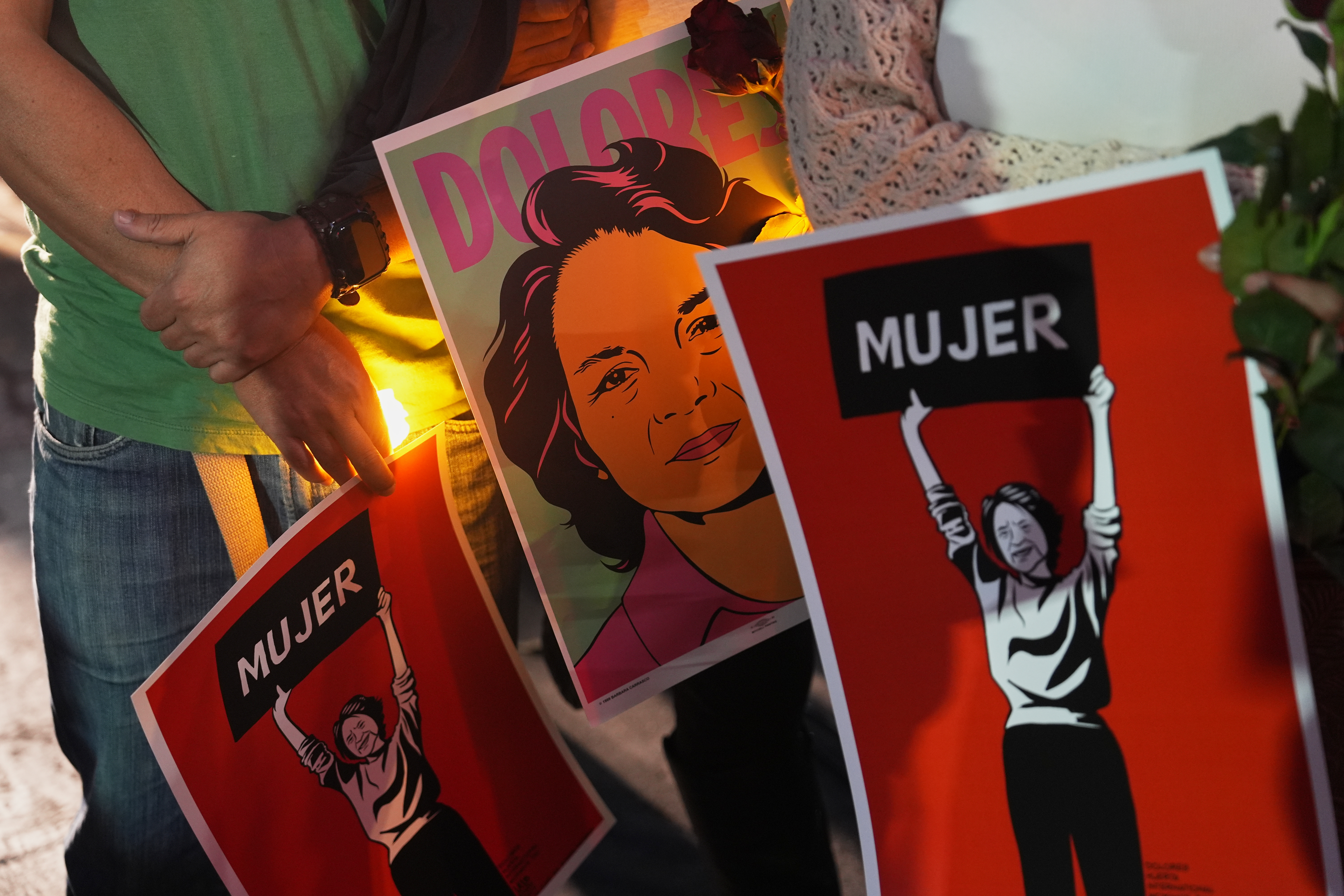
At a vigil after her death, people hold posters riffing off the iconic Dolores Huerta photo of her holding a strike sign during the Delano grape strike in 1965.Jae C. Hong
I first encountered Huerta in a photograph — the iconic one in which she’s standing tall during the Delano grape strike in California in 1965, holding up a Huelga (Strike) sign — when I was a teenager recently come to the United States from Central America. I could lay no cultural claim to her — she was a Mexican American, born in New Mexico and shaped as an activist in California — or her fierce fight for farmworker justice, but I knew I wanted someday to be as cool and strong as that photo told me she was.
I committed to memory the story of how the union she cofounded, which later became the United Farm Workers, was first discussed with César Chávez at her kitchen table, as her family milled about. All struggles for justice worth their salt should have family and food mixed into them, am I right?
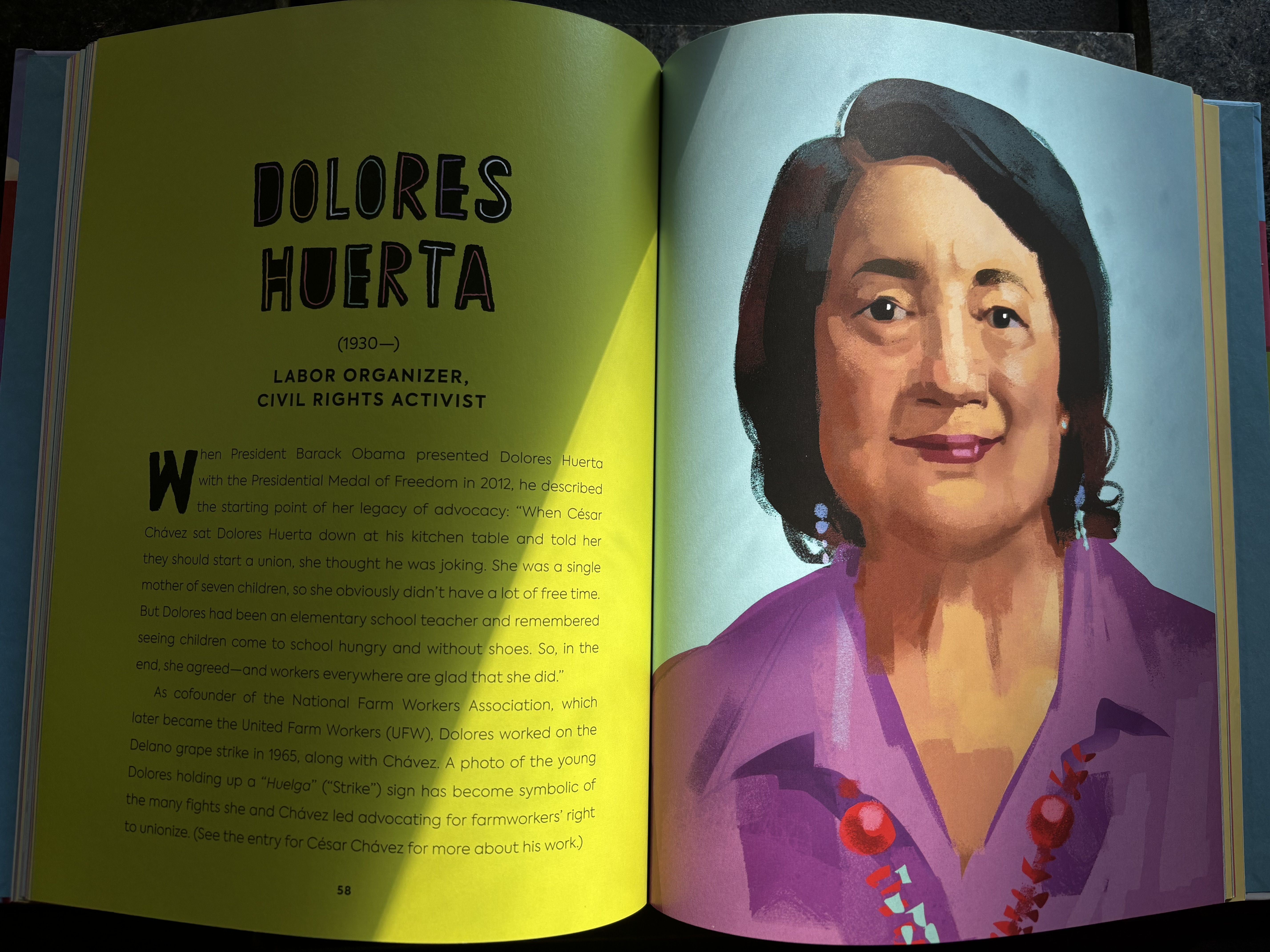
The opening pages of Dolores Huerta’s write-up in the Smithsonian’s “Nuestra America: 30 Inspiring Latinas/Latinos Who Have Shaped the United States,” written by Sabrina Vourvoulias, illustrated by Gloria Felix, and published by Running Press Kids in Philadelphia in 2020.Morgan Vourvoulias-Saunders
But it wasn’t until I was doing research for her entry in the Smithsonian’s Nuestra América book I was writing in 2019 that I realized there were seven children (of the 14 she’d eventually have) at hand during that kitchen table deliberation — and that she knew she had enough strength and energy in reserve to be a mother to them and create a union from scratch. 🤯
It is almost as mind-boggling to realize Huerta would keep organizing and protesting for workers’ rights — and being arrested for it — until she was well into her 80s. “Lolita Siete Lenguas,” as she was reportedly nicknamed as a child given her loquacious nature, didn’t stop advocating then, either. Through the Dolores Huerta Foundation, she kept working to the last to protect the human rightsof migrants and unaccompanied minors, and as recently as last July met with Pope Leo XIV at the Vatican to discuss their overlapping concerns.
It is well worth your while to read a fuller biography of her life and her many accomplishments, but it is important not to sanitize the fact that she also paid a steep price for her extraordinary commitment to her causes over the years.
In 1988, at the age of 58, she was brutally beaten by police in San Francisco while protesting the danger to farmworkers in the use of pesticides to grow table grapes. The severity of the injuries incapacitated her, and she had to undergo physical therapy to be able to walk again.
And earlier this year, Huerta revealed that Chávez had raped her twice during their years building the farmworkers movement together. She kept silent about those violations, she said, because she didn’t want to jeopardize the movement. Two children were born from Chávez’s assaults, and Huerta made the decision not to raise them herself — though they were raised alongside her family.
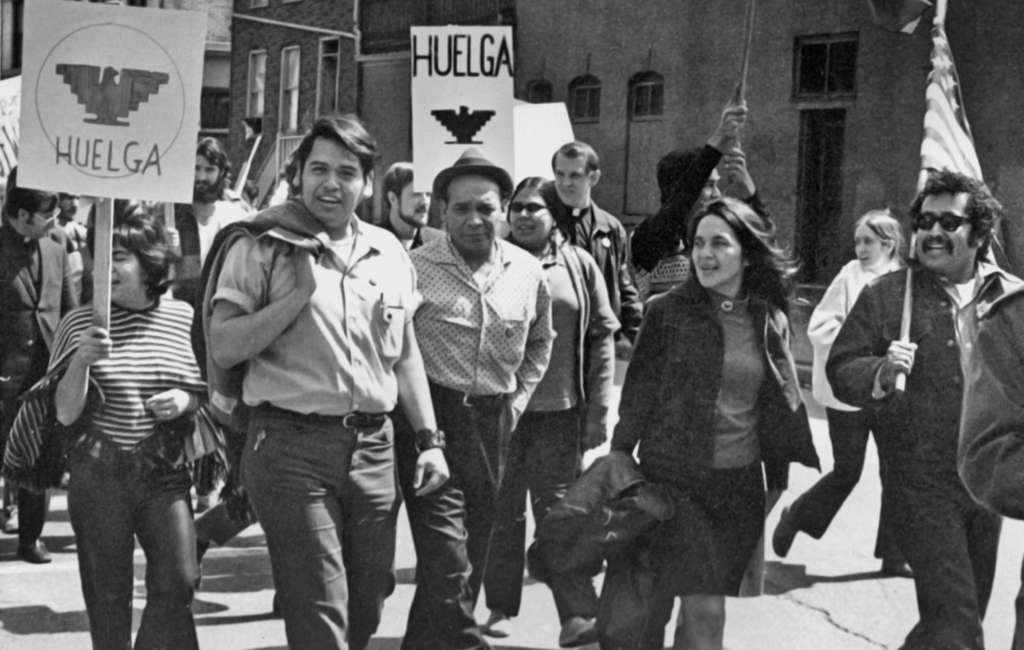
Dolores Huerta at a 1971 United Farm Workers strike march in Chicago. From "Latino Americans"
It stingsa bit to realize that Huerta’s refrain — Sí, se puede — whichPresident Barack Obama readily admitted inspired his catchphrase “Yes, we can” is these days, at least on the East Coast, better known than the woman who coined it.
Her long history of transformative organizing and civil rights work didn’t prevent Bernie Sanders supporters from shouting “English only!” to shut her up when she — who was a Hillary Clinton supporter — offered to translate into Spanish during a Las Vegas caucus in 2016. Rosario Dawson (who played Huerta in the 2014 movie Cesar Chavez) subsequently wrote a dismissive op-ed about the incident in HuffPost, in which she accused Huerta of being an establishment shill.
Nor did Huerta’s bona fides or years of support for the Democratic Party earn her a speaking spot at the 2024 Democratic National Convention. I felt disgruntled about that slight all the way through Alexandria Ocasio-Cortez’s prime-time convention speech, even though I knew she had nothing to do with setting the programming for the event.
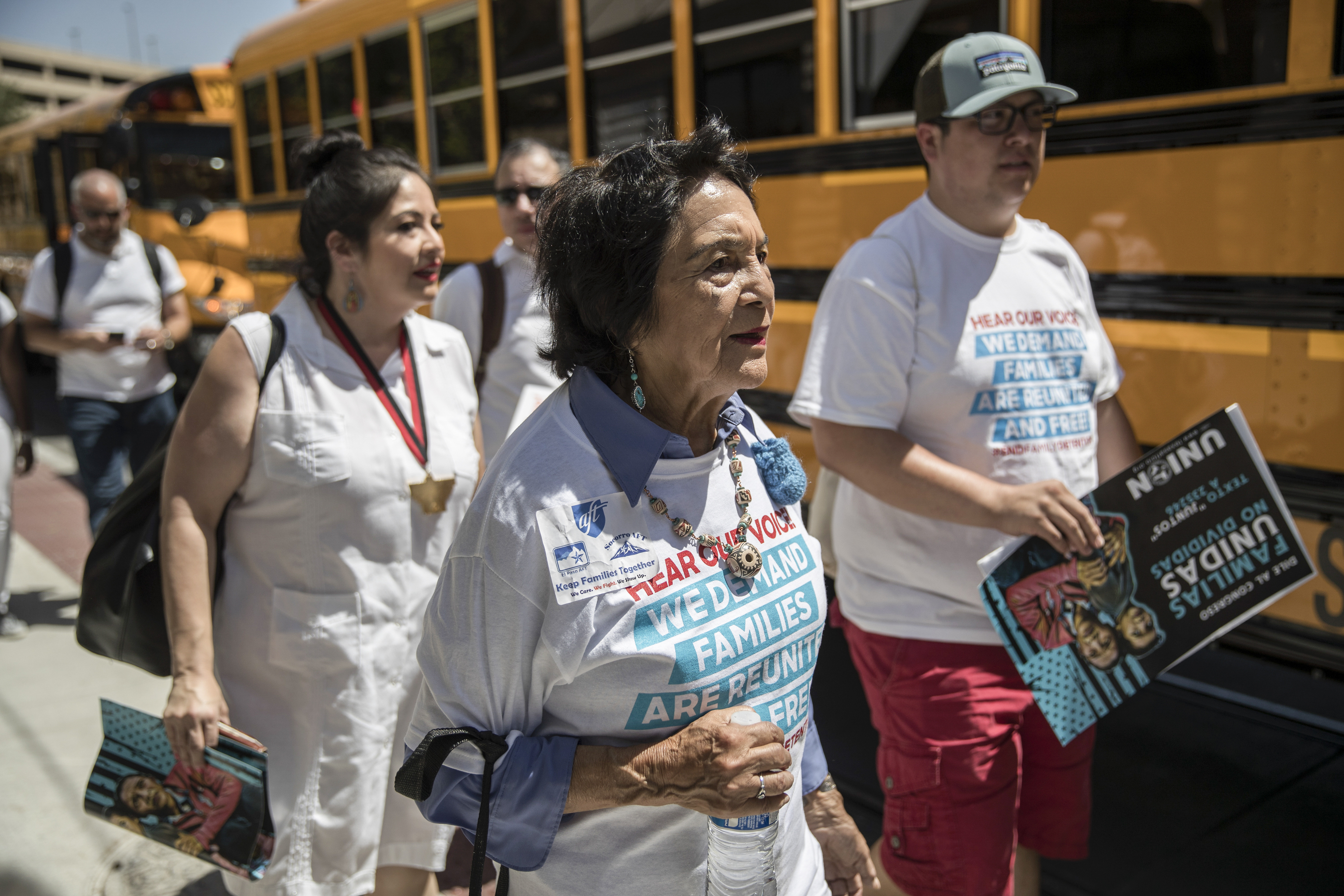
Activist Dolores Huerta boards a bus to attend a protest of educators and religious leaders opposed to family separations and detentions in Tornillo, Texas, in June 2018.VICTOR J. BLUE
But maybe the young standing where the old had stood just one electoral cycle before is how Huerta would have wanted it, scripted it even. Because each of the four times I had the opportunity to meet and talk to her in person, her sí, se puede was focused on young Latinos.
The last time was June 28, 2016, at a People for the American Way event outside of City Hall in Philadelphia. “It’s our challenge to get to them [young people] and make them understand how important they are and how important their vote is,” she told me and my fellow journalist Emma Restrepo. “And that they can control their future with their vote.”
But if there is a single lesson I take away from Huerta’s life, it is that we never have to accept a no se puede. That itis, actually, incumbent upon us not to.
ROME — Kevin Willard finished his six-minute interview session and gave way to the guy most of the cameras and microphones were there to see.
In came Luigi Suigo to a media scrum outside of the multisport PalaFonte facility where Villanova practiced Thursday in the southeast portion of the city. It was his turn to answer questions, but first, the camera operators had to readjust their shots for the freshman Villanova center, who at 7-foot-3 is more than a foot taller than his coach.
Suigo is home, back in Italy for the first time since he moved to Villanova late in the summer as a potential one-and-done high-priced center. Home? Sort of. Suigo wanted to provide a clarification.
“It’s not my home home, but still my country,” he said.
It’s an important correction. Suigo’s hometown of Tradate, northwest of Milan in the Lombardy region, is nearly 400 miles from where Villanova begins its 2026-27 season — and Suigo makes his collegiate debut — Sunday vs. Notre Dame (9:30 a.m. Philadelphia time, Fox 29). It’s like asking someone from Rochester how it feels to be back home in Villanova.
OK, maybe not quite, and Suigo certainly felt at home alternating between answering questions in Italian and English.
“The best feeling is understanding what people are saying without my teammates knowing,” Suigo said.
And while most of them, he said, aren’t interested in learning much Italian during this four-day trip to Rome, he made sure to share some of the important things only hours after the team arrived at its hotel.
“At the hotel he was instructing us not to put meatballs with our pasta,” senior guard Jake Fiegen said. “Just American things that probably aren’t custom here.”
Thousands of Villanovans have or will make the trek to Rome this weekend to see the men’s and women’s teams open the 2026-27 season, but also for the celebrations over the weekend involving Pope Leo XIV, the first American-born pope and Villanova graduate who is expected to host an audience with a few thousand people on Saturday.
“Me, personally, I’m not a religious guy, so it’s not something crazy, but still he’s a Villanova alumni and, I mean, he’s the pope,” Suigo said. “He’s pretty important either if you’re religious or not.”
The audience Suigo is likely more excited by is the one he’ll have Sunday playing in front of his father, Massimo, and other family and friends.
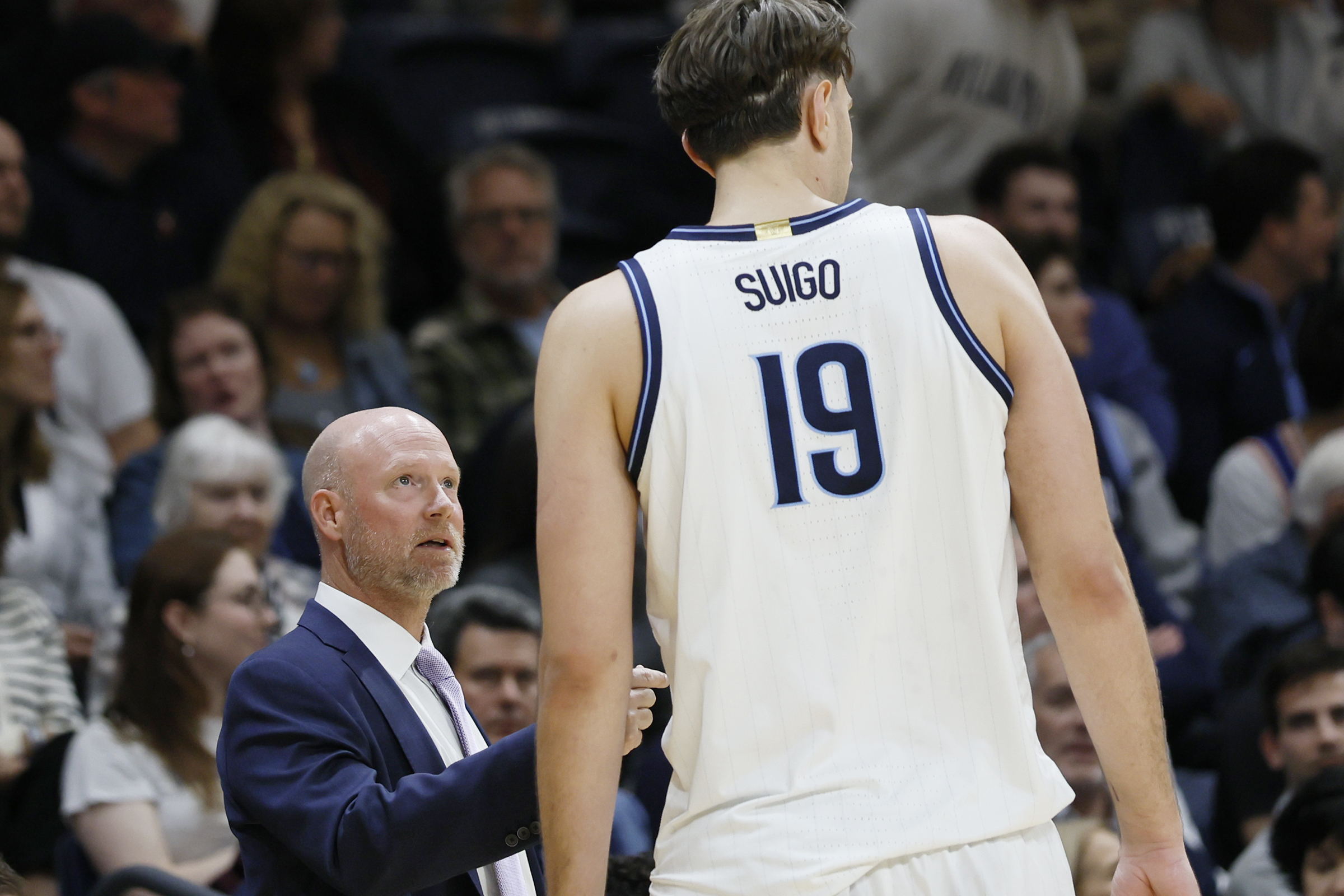
Kevin Willard speaks with Luigi Suigo during Villanova’s exhibition game against Virginia on Oct. 22.Elizabeth Robertson / Staff Photographer
It’s Suigo’s collegiate debut and it doesn’t come without fanfare, making the location for Sunday’s opener fitting. Few recent recruits have come to Villanova with the level of interest Suigo has. Even Jalen Brunson and the likes. Suigo played professionally last year in Serbia and was a potential late-first-round pick in the most recent NBA draft. He brought with him the nickname “The Italian Wemby” because of his perimeter skill set reminding some of NBA superstar Victor Wembanyama.
But Suigo is, at this point, much more Italian than he is Wemby. Willard used the phrase “growing pains” a few weeks ago after an exhibition game that Suigo struggled to make a major impact in.
He reiterated on Thursday the work-in-progress nature of where Suigo is at this point, just a few days away from the season starting.
“He’s getting there,” Willard said. “Every day he’s getting better. He’s watching film. It’s a big difference and big adjustment from playing where he played last year to now, the speed of the American game. He’s starting to understand the defensive concepts, the offensive concepts, but for a 19-year-old freshman he’s doing fantastic.”
What’s the biggest area Suigo needs to show improvement in right now? Willard said the big man needs to know when to be physical.
“He has great hands, can shoot the basketball, is a very smart basketball player, but just understanding he’s still 7-3, 280 pounds and how to use his body to the best of his ability,” Willard said.
Kevin Willard prior to the start of Villanova’s practice session in Rome.Gregorio Borgia
Fiegen, a transfer from Cornell with a lot of Division I basketball under his belt, said he thought Suigo was handling the transition to the American game and all of the attention that came with his arrival “with a lot of poise.”
Earlier, Willard was asked about the challenge of getting his team ready for an important nonconference game a day after having an audience with the pope. He pointed to his team’s experience in saying that wouldn’t be an issue, but there’s one freshman starter who is the wild card of sorts.
“I think the biggest thing is making sure Luigi is comfortable,” Willard said. “I think more than anything, being back home in Italy, having his family and friends here, this is a big moment for him. So making sure he’s comfortable and he’s ready to play is the biggest thing.”
Tip-ins
Villanova backup center Nico Onyekwere did not travel with the team to Rome. The Nigerian-born redshirt freshman was unable to travel due to a visa issue, according to a school spokesperson. … Power forward Kwame Evans Jr., who missed the three-game exhibition slate while working his way back from an offseason leg injury, is expected to play Sunday. … The men’s team practices again on Friday, but the session is closed to media.
Whatever else may happen during the peak trick-or-treat hours Saturday, nothing frightful will be unfolding in the skies over the Philly region during what should be a peak foliage weekend.
In fact, it will look and feel a lot like the weather since Oct. 18: Save for some minor coastal flooding agitated by the moon, the atmosphere has been a sea of tranquility.
What has become an impressive rainless spell — the longest in two years — is forecast to persist at least through Election Day. And on Halloween, don’t worry about airborne witches’ hats; winds should be negligible throughout the day and night.
Temperatures on Saturday around the time of the last sunset (5:59 p.m.) in the 2026 edition of daylight saving time are expected to be in the tolerable low 60s, and precipitation probabilities are at absolute zero.
A storm threat for early next week has “fizzled out,” said Joe DeSilva, meteorologist with the National Weather Service in Mount Holly, and in all likelihood it will remain dry at least through Election Day, with daytime highs Tuesday near 70 degrees.
“At some point this has to break down,” said Tom Kines, senior meteorologist with AccuWeather Inc. “It can’t stay like this forever.”
It won’t. The federal Climate Prediction Center suggests the dryness will go the way of campaign promises after Election Day, with above-normal precipitation accompanying above-normal temperatures through Nov. 11.
The rains would end a notable dry spell and conclude what has been a cut-and-paste forecast interlude for meteorologists.
The atmospheric tranquilizing agent for the region and much of the rest of the eastern United States has been consistently high pressure, DeSilva said. The descending currents of high pressure, or heavier air, suppress clouds and rain.
Virtually no rain fell last week in the Northeast, the interagency U.S. Drought Monitor noted Thursday in its weekly update. Save for extreme eastern Burlington County, Philadelphia and the seven neighboring counties remained drought-free, despite the flip in the region’s rain fortunes.
The rainless streak entered day 12 Thursday and is all but certain to reach at least 16. That would make it the longest run of days without even an immeasurable “trace” (technically, a single raindrop detected by an observing machine or a government contractor at Philadelphia International Airport would qualify) since the 24-day streak that ended on Oct. 23, 2024.
Computer models on Thursday were suggesting this dry run may come to an emphatic conclusion by the end of next week with what the weather service is calling a potentially “prolific” rainfall.
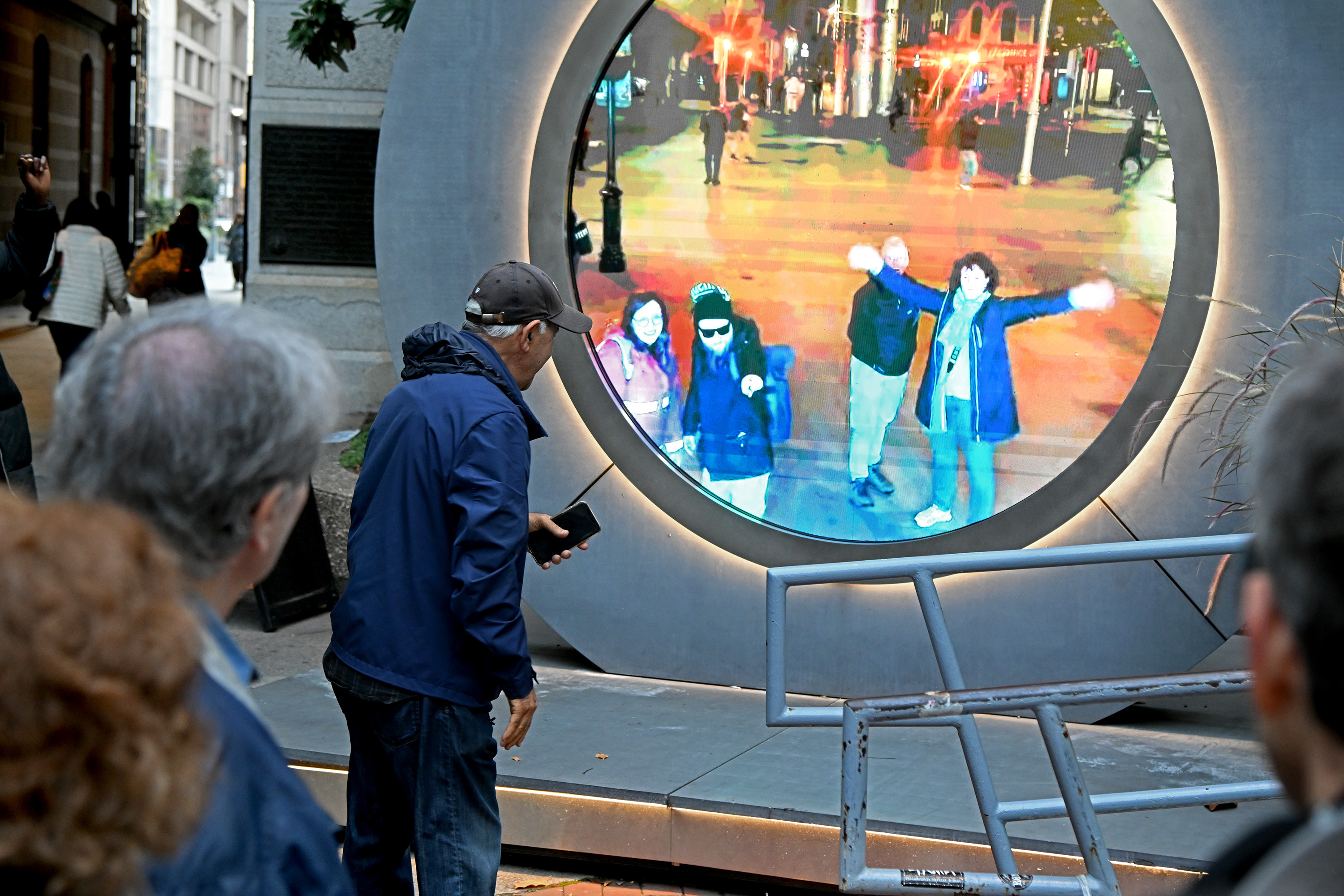
Just like the Portal itself, the fate of the device has come full circle this week.
The livestream video sculpture that connects strangers around the world was supposed to vacate the courtyard of City Hall by Saturday, but Portals.org CEO Nicolas Klaus said via email Thursday that there had been “a last-minute intervention by the City.”
“We’re now in discussions to potentially preserve the Portal at Philadelphia City Hall long-term,” he said.
In a statement Thursday afternoon, Mayor Cherelle L. Parker said the Portal is staying at City Hall for the foreseeable future “with support from a generous patron, as efforts continue to secure long-term funding to keep the Portal in Philadelphia.” Parker did not identify the “generous patron.”
“Philadelphia hosted the Portal as a guest for America’s 250th birthday, and Philadelphia turned a guest into family,” Parker said in the statement.
In August, Klaus said that the city was not going to renew the Portal’s permit, which expires Oct. 31, because of the forthcoming Christmas Village in the courtyard. Portals.org sought other potential sponsors to keep the device in Philly, but Klaus said the group was unable to secure the funding needed for the relocation and upkeep.
On Monday, Klaus told The Inquirer the 3.5-ton circular screen would be placed in storage until a new location, potentially in another city, was found. He said the last day to interact with it would be Friday. As recently as Wednesday, Portals.org was still posting on social media about the device leaving Philadelphia this week.
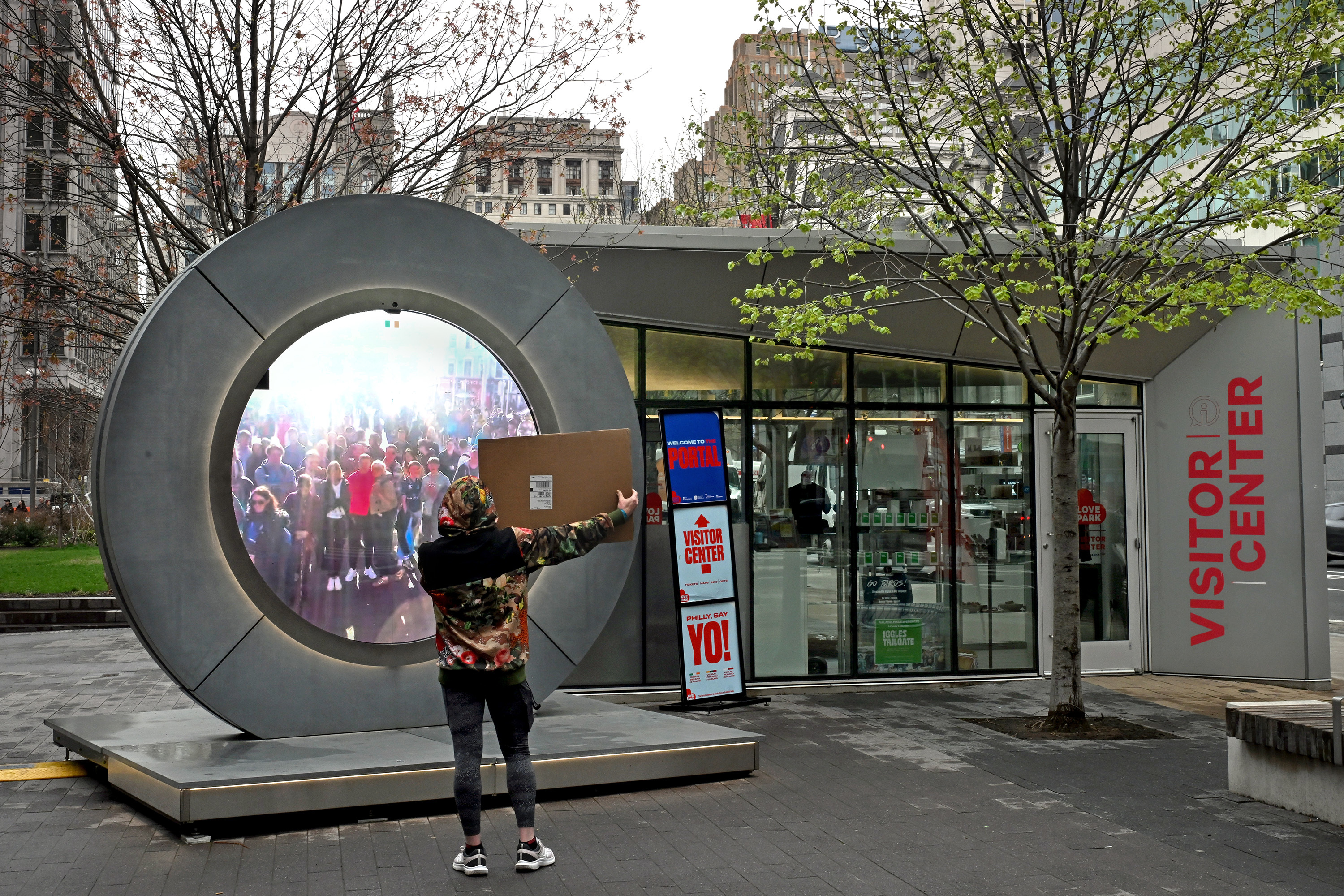
A Philadelphian on their way to a protest shares their sign with Dubliners at the Portal in 2025, when the device was still at its original location in LOVE Park. Tom Gralish / Staff Photographer
The Portal was first installed in LOVE Park in October 2024, but after repeated incidents of vandalism, it was moved to the City Hall courtyard in April 2025, where it has remained ever since. Organizers had said it would stay in Philadelphia at least through the nation’s 250th anniversary, with the hope it would become a permanent fixture in the city.
In her statement, Parker said “there are no plans for it to leave anytime soon.”
“I said from the beginning that the Portal belongs here, and here it stays. This little window in our courtyard has done something big: it brought the world a little bit closer to Philadelphia — and Philadelphians a little bit closer to each other. The Portal is our front porch to the world, and our welcome never closes,” the statement said.
Those who visit the device are connected via a soundless livestream with people on the streets of other cities that have a Portal. Those cities are Vilnius, Lithuania; Lublin, Poland; Dublin, Ireland; Ipswich, England; Manila, Philippines; and Piauí, Brazil.
Charles Thompson and his fraternal twin brother, Noble, lived less than 20 minutes away from Lincoln Financial Field growing up in Chester. Charles is an hour and 22 minutes older than Noble, and they played every sport together growing up.
“Every day was about competition,” Noble Thompson said.
They once held a flag inside the stadium before an Eagles game with their youth football program nine years ago. For the first time in their football lives, the Lincoln University senior football captains will be playing at the Linc when the Division II football program faces Virginia Union on Friday (7 p.m., ESPN+). Lincoln, based in Oxford Township, Chester County, is the nation’s oldest degree-granting historically Black college. The football team will return to Philadelphia for the first time in 16 years.
“It’s a huge honor,” said Noble Thompson, a utility player on Lincoln’s offense who plays tight end, fullback, and slot receiver. “[We] got a lot of [our] family members coming up. … Just to have [our] family out here to come see me play [our] second to last game, just a [great] honor.”
Added Charles Thompson, who plays linebacker: “Playing at the Linc is like a dream come true. … [Our] family get to see me play in the NFL stadium. It’s awesome.”
That sentiment was shared similarly throughout the Lincoln football team, with a large portion of the roster hailing from Philadelphia and its surrounding areas. For many, the game will represent a homecoming and an opportunity to play in front of family, friends, former teammates, and Lincoln graduates who last saw their university play at Northeast High School in 2010 as part of the Lincoln-Cheyney HBCU football rivalry.
Noble Thompson, who grew up in Chester, plays multiple positions on offense for Lincoln University.Elizabeth Robertson / Staff Photographer
That also extends to its coaches. Khalil Steward, who played his high school ball at Imhotep, went on to play at Delaware Valley University, then started his coaching career at Martin Luther King Jr. High School in Germantown under fellow Lincoln assistant Malik Jones, who coaches receivers on Frank Turner’s staff. Steward’s mom went to Virginia State, whom Lincoln played earlier this season, and his family had long wanted him to play and attend an HBCU.
Now, he’s getting an opportunity to coach on the sideline of the Linc Friday night as “a diehard Eagles fan.”
“It’s going to feel like a great moment. A lot of us always dreamed about this,” said Steward, who also remembers attending the Lincoln-Cheyney games in Philadelphia growing up. “It’s a special moment, especially for the guys to get that experience, be where the professional guys be. … We get to be home and play at the Linc and what’s more special than that? We got a lot of South Jersey kids, some Philly kids that are Eagles fans, so they all [are] hype and excited about it as well.”
Take two for Davis
Mikal Davis Jr. had no idea when he decided to transfer to Lincoln last offseason that he would get another chance to play at the Linc.
“Just being able to have that experience that I always dreamed about as a kid. Getting drafted, going to the NFL, and [that game] just happened to be in my hometown with the Philadelphia Eagles,” said Davis, an Imhotep graduate. “I had a Hall of Famer as my coach [DeSean Jackson]. He [had] us in the Linc … I was just taking it all in.”
This time around, though, will be different. Davis began the season as the backup quarterback to Jayden Triplett, the team’s starter. Triplett suffered an injury during Lincoln’s loss to Elizabeth City State on Oct. 10, which forced Davis into action.
Quarterback Mikal Davis Jr. during a Lincoln University football practice on Wednesday.Elizabeth Robertson / Staff Photographer
The left-handed quarterback, who took the majority of the starting reps during Wednesday’s practice as Triplett works his way back into the lineup, is ready to seize the moment, should he have to take the field Friday night.
“Having an opportunity to play in [the Linc], so [my mentality] is like, ‘Why not? Why not win?’” Davis said. “I feel like it’s just different knowing when you’re going to get in, or having that opportunity to play at the Linc. So, with that being said, you just have to be ready, ready, ready, have that mindset that it’s just another game, but it’s still a big atmosphere, a big stage. A lot of eyes are going to be there.”
Friday’s game will be the second opportunity for Lincoln to play at an NFL stadium. Earlier this season, the program traveled to Chicago to play at Soldier Field in the Chicago Football Classic against Mississippi Valley State, a Football Championship Subdivision HBCU school. Turner and his staff are taking the lessons learned from that 35-21 loss into Friday’s game.
Lincoln planned to have a walk-through at the Linc on Thursday, then stay in Philadelphia overnight leading into Friday night’s game.
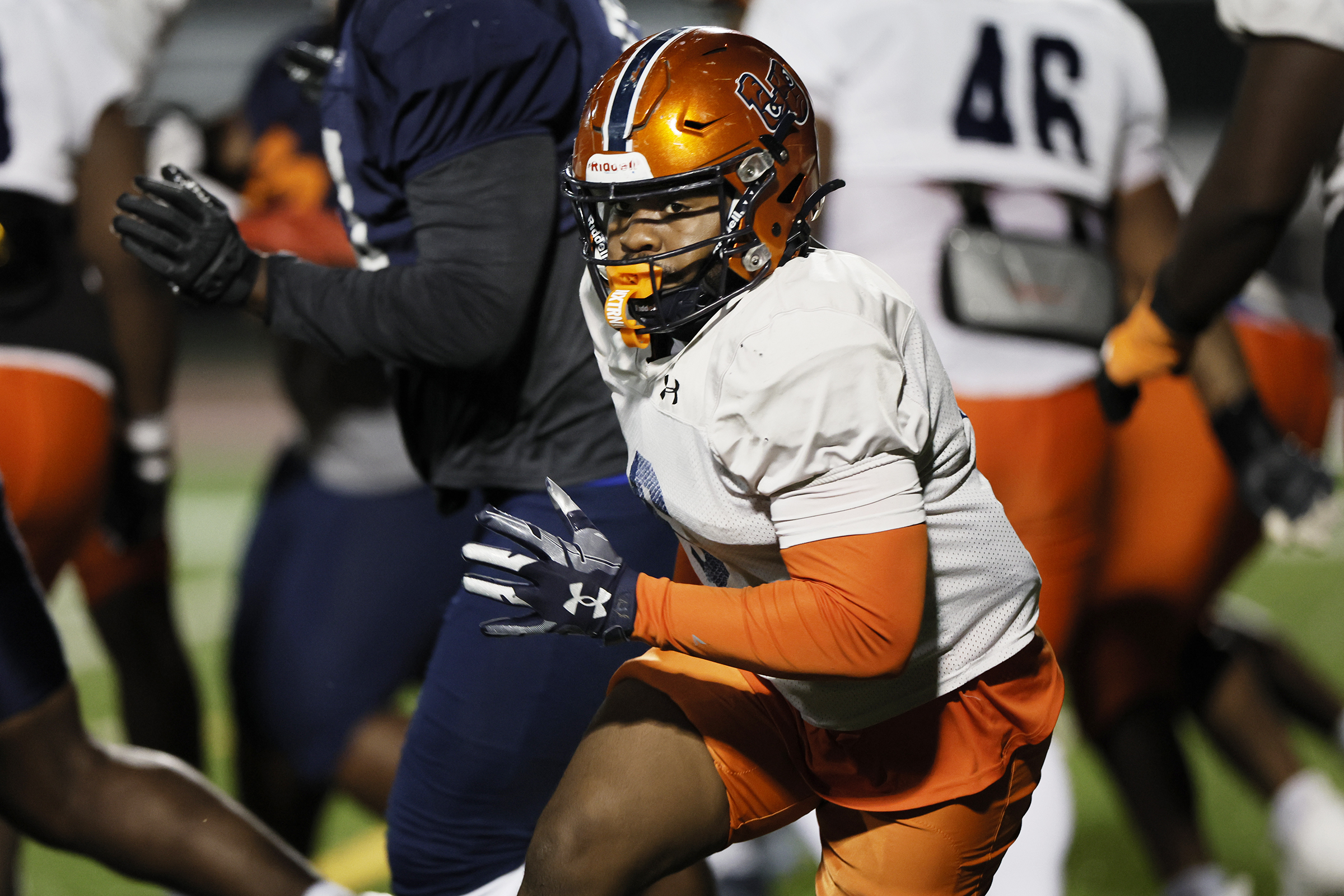
Linebacker Charles Thompson during a Lincoln University football practice on Wednesday.Elizabeth Robertson / Staff Photographer
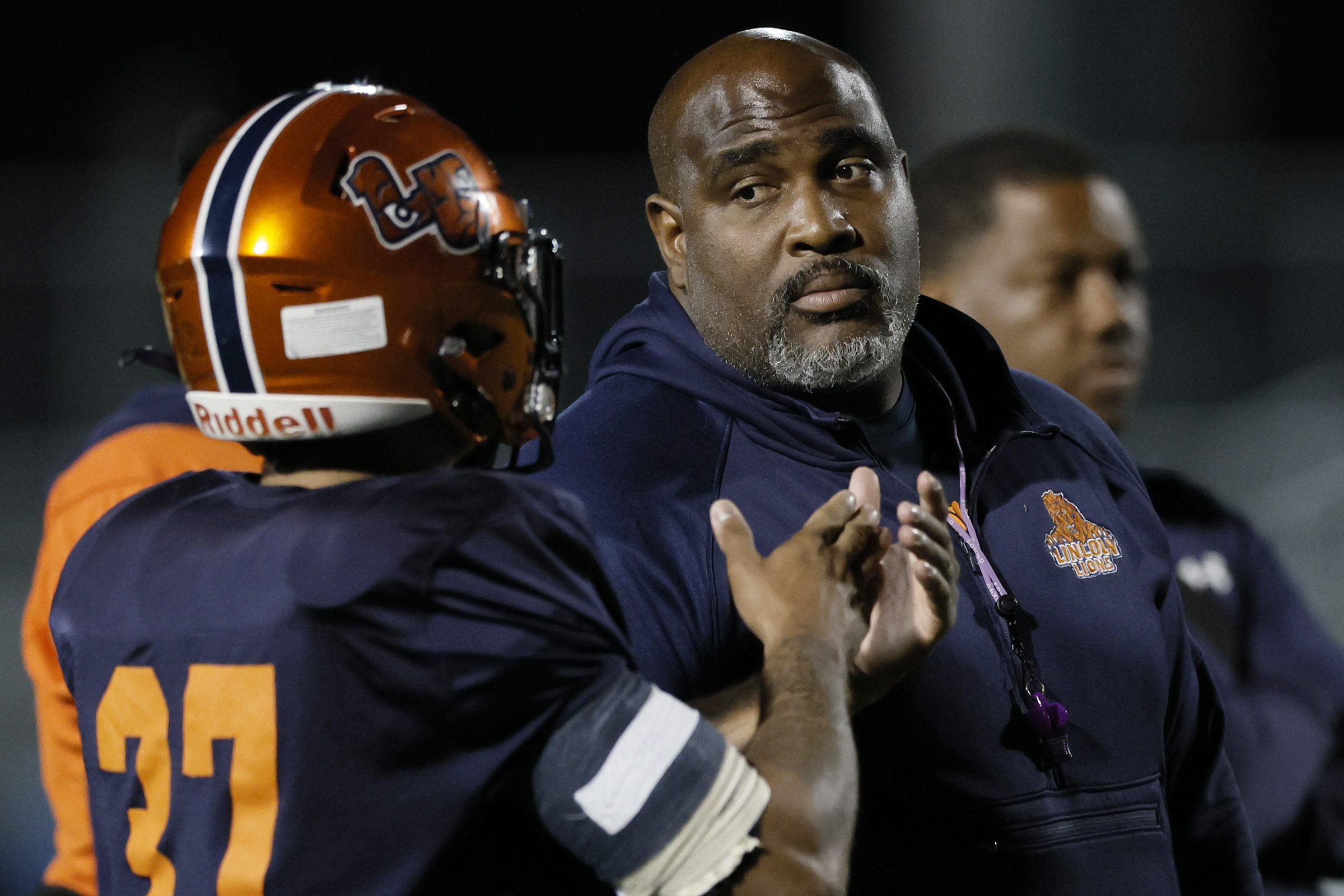
Turner, in his fourth season as the program’s head coach, has been trying to keep his team focused on the game with the buzz palpable for many players’ families planning to attend. He is looking forward to the “great exposure” the program will gain from the opportunity.
“It’s one of those things where the stage shouldn’t be too big for us. It’s just more so keeping these guys focused,” Turner said. “The distractions is a little bit more on this end now, so it’s just keeping them grounded.”