NASHVILLE, Tenn. — In Nashville, Tenn., the Republican-dominated state government and Democrat-controlled city government are engaged in an ugly battle for control of the city’s airport.
Lydia Popovich, a Parton superfan who started a petition for the name change in 2025, said on Friday that Parton had gracefully batted down the idea of naming the airport after her, as she did with many other proposed honors during her lifetime. That includes a bill brought by Tennessee lawmakers in 2021 to place a statue of her on the Capitol grounds.
Parton asked lawmakers to withdraw the bill but expressed a hope that it might happen “somewhere down the road several years from now or perhaps after I’m gone if you still feel I deserve it.”
Effort to rename airport gained steam after Parton’s death
After Parton’s death two weeks ago, the airport naming idea seemingly caught fire, with Popovich’s petition reaching more than 175,000 signatures — not that the officials competing to run the airport needed the push.
At a meeting Friday of the state-controlled Metropolitan Nashville Airport Authority, a motion directing the airport CEO to begin the renaming process was unanimously approved by board members praising Parton to the heavens. Airport officials said the change could take a year or more and involves working with Parton’s estate to determine how they might split profits from merchandise sales, among other things.
Bipartisan agreement on name change is a departure
There are two Metropolitan Nashville Airport Authorities: one run by the state and the other controlled by the city, a bifurcated regulatory system that was created in 2023 amid a partisan dispute between the GOP-run state and the Democratic-run city. Who actually controls the airport has been in dispute ever since, with competing boards taking the reins only to be deposed as courts rule and are overturned.
Despite the acrimony, Nashville’s Democratic Mayor Freddie O’Connell and the competing, city-controlled Metropolitan Nashville Airport Authority are also in support of the name change, according to O’Connell spokesperson Alex Apple.
“The FAA’s going to get two votes from two boards, both in favor,” Apple said.
Stuart McWhorter, a member of the state-controlled board and deputy to Tennessee’s Republican Gov. Bill Lee, briefly mentioned the dispute at the Friday meeting. He suggested that in the spirit of Parton, “We can get beyond the litigation and get back to working together.”
Supporter of name change: ‘She’s the best of Tennessee’
Born in poverty in the foothills of the Great Smoky Mountains, Parton became an icon whose popularity crossed generational, geographic, and political boundaries. In addition to writing and recording hit songs such as “Jolene” and “I Will Always Love You,” she starred in Hollywood films including 9 to 5 and Steel Magnolias.
Popovich, who attended the Friday meeting and spoke in favor of the proposal, was in tears after the unanimous vote in favor.
“It’s been a really beautiful experience, especially as you’re grieving someone that was such a great loss,” she told the Associated Press. “She’s the best of Tennessee. She’s the best of the humans on the planet. She was this magical person that provided light and guidance to all of us.
“Unfortunately she’s left us, but now we get to celebrate her and get to tell the world how much Tennessee loved her.”
Charli XCX spent over a decade in the electro pop trenches before suddenly blowing up big time in the Brat summer of 2024.
So it’s not a surprise that the British singer, who said “all of my albums work in opposites” and “repel against each other,” would react to long-time-in-coming viral success with a stylistic about-face and pause for self-reflection.
The result is her new album Music, Fashion, Film, which gives its name to the tour that launched at Xfinity Mobile Arena in South Philadelphia on Friday with a hyperkinetic performance in front of a deliriously excitable opening-night crowd.
On its surface, the Music, Fashion, Film album appears to be a turn away from the Dionysian “Club Classics” culture of its predecessor into something more serious-minded and self-consciously mature.
The image on the album cover — and on the $50 T-shirts selling on the concourse — is not of the trendsetting pop star, but a group shot of three titans in their fields — Velvet Underground cofounder John Cale, fashion designer Marc Jacobs, and movie director Martin Scorsese.
Instead of the neon green that lit up Brat summer, the cover shot — and all Music, Fashion, Film imagery — is in black and white.
The album’s lead track, “Rock Music,” which she opened with Friday, Charli, 34, appears to be putting club culture in her rear view.
“Me and my friends,” she sings. “Yeah, we’re on to the next. I think the dance floor is dead / So now we’re making … Rock Music.”
And truth be told, she is — some of the time.
For most of the first and last thirds of the 100-minute show — which included 29 songs, with the briefest of breaks for exhortations like “Philly, this is the Music, Fashion, Film tour, are you [expletive] with me!” — she was accompanied by a three-piece band that included Morrisville, Pa., native Chris Greatti on guitar.
Charli XCX at the Leeds Festival in England in August. The British pop star opened her “Music, Fashion, Film” tour at Xfinity Mobile Arena in South Philadelphia on Friday night.Courtesy of the Artist
Music, Fashion, Film songs like “Wink, Wink,” “Persona,” and “2007” kicked into gear with overdriven guitars and hyper-pop-processed production that upped the adrenaline level.
And Charli — whose given name is Aitchison and whose stage name comes from a teenage online screen moniker meaning “Kiss Charli Kiss “ — fully embraced the rock aesthetic, striking poses that made her look like an Italian neorealist film star in the black-and-white image on the video screens.
But for all of their brash rock and roll presentation on a three-tiered stage topped by a facsimile of a smoke-emitting giant speaker — and no shortage of pyro going off throughout the show — the Music, Fashion, Film songs are actually introspective and soul-searching.
Not in a navel-gazing, overly earnest way though. Charli XCX couldn’t bore you with self-pitying clichés about the perils of pop stardom if she tried.
Instead, she’s droll and sharply observant and self-aware about a lack of fulfillment from fame. Along with Cale, whose recorded voice was heard on Friday from their collaboration on “House,” from the Wuthering Heights soundtrack released this year, Charli is a also a super fan of his Velvets bandmate Lou Reed.
And several Music Fashion, Film songs display a deadpan dark wit that show she has more in common with Reed than an appreciation for black leather.
Most amusing was “Card Declined,” a song about the failure of retail therapy to come through and transform your essential self when you need it most. “Let’s go shopping,” she sang on Friday. “I’ll buy a handbag. I’ll buy some shoes … a personality, a whole backstory … Card declined.”
Equally astute and self aware were “Persona,” “Wink, Wink” — in which she vowed ”I’m not a bad girl anymore, I promise” — and “Camera,” about being addicted to growing up in public, to a dangerous degree.
Charli played 13 songs from Music Fashion, Film, and included a few older cuts, such as “Party 4 U,” from 2020’s How I’m Feeling Now and the title song from her 2014 EP Vroom, Vroom.
And the surprise of the evening was “Stay Away,” pulled from True Romance, the debut album that brought her to Philadelphia for her first-ever U.S. performance at a Making Time party at Voyeur in the Gayborhood in 2012.
In the lead up to Friday’s show, Charli gave fans fashion tips on social media, saying the dress code is “whatever you want but if you want to commit I’d just get an old T-shirt and rip it to shreds and wear that.”
Charli XCX at the Lollapalooza in Chicago in July. The British pop star opened her ‘Music, Fashion, Film’ tour at the Xfinity Mobile Arena in South Philadelphia on Friday night.Courtesy of the Artist
Many women, men, girls and boys took heed, usually pairing the distressed garment with something black leathery, and most leaving Brat gear at home.
The songs from the new album carried the existential theme. Though to be honest, they were delivered with so much energy that the buzz in the room never let up.
But the unadulterated partying — and the shrieks of delight and singing along to every single lyric — really cut loose on the Brat songs that made up the meat in the middle of the show. With the band mostly out of sight, bass-heavy beats thumped as the general admission dance floor pulsated.
Like a boss, Charli prowled the catwalk and writhed on the ground. She was followed around by a coterie of what I counted as 14 associates, who were more like fashion-model voguers than dancers.
It was difficult to tell how many people were onstage at any one time because flashing strobes seemed to go off every millisecond. The group of planning-ahead fans next to me were better prepared than I, having arrived with Charli-esque sunglasses to wear when necessary.
The show got back to existential business at the end. First, with “SS26,” a lovely pop song with a sobering point of view that cast doubt on art’s ability to make a difference.
“Spring, Summer, ’26, when the world is gonna end, no hope for any of it,” she sang. “We’re walking on a runway that goes straight to hell, nothing’s gonna save us, not music, fashion, or film.”
That was followed by the closing, “No One Lasts Forever,” which also closes the album. It’s a song about seizing the day and embracing the here and now, ‘’cause nothing gonna last forever.”
On Friday, Charli put that point across musically as an inviting pop rock song. But then, as on the album, she handed off the mic to the voice of Canadian director David Cronenberg, recorded in conversation with her.
As a trancelike beat throbbed behind him, and Charli and dancers posed motionless on the elevated stage, Cronenberg spoke about how art can live forever, but artists can’t.
When everybody’s time is up — including the pop star being celebrated in that very arena on Friday — Cronenberg’s looped voice repeated 27 times, “They are dead, they are gone, no one lasts forever.”
And what that translates to — he and Charli were arguing — is the artistic license to be inspired and create in the moments that we’re here. That thought was boiled down to three words “Oblivion is Freedom,” which were spelled out on the video screens, and also on a T-shirt sold at the merch table.
DUBLIN — U.S. President Donald Trump said Saturday that a unified Ireland would be “fantastic” as he waded into a complex and politically charged subject during a weekend visit to a tournament at his Irish golf course.
At a meeting with Irish Prime Minister Micheál Martin in Dublin, Trump said he would love to see the reunification of the Republic of Ireland with the United Kingdom’s Northern Ireland.
“I don’t want to cause any problems but I’d love to see it unified,” Trump told a reporter who sought his opinion on the issue. ”It’s going to happen eventually. It may as well happen now.
“I think it would be a fantastic thing,” the Republican president said, adding that ”the U.K. will have something to say about it, obviously.”
At his next stop, Trump acknowledged there is “no good answer” to the reunification question as he addressed business leaders from both countries gathered at the U.S. ambassador’s residence.
The Irish unity debate is heated
Competing visions of Northern Ireland — whether Irish or British — drove decades of violence in the six-county region that has a Protestant majority and has remained part of the U.K.
Previous American presidents, including Democrat Joe Biden, who has strong emotional ties to Ireland, have avoided commenting directly on the subject.
Ireland, long dominated by its bigger neighbor Britain, became a self-governing Catholic-majority country a century ago. Northern Ireland was split between two main communities: nationalists, most of them Catholic, who desired union with the rest of Ireland, and largely Protestant unionists, who wanted to stay British. Tensions eventually exploded in the Troubles involving paramilitary groups on both sides and British troops.
A 1998 peace accord that the United States was instrumental in negotiating largely ended the violence, but left Northern Ireland’s ultimate status unresolved. That agreement allows for a vote on unification if it appears likely a majority of people would vote for it. U.K. Prime Minister Andy Burnham said Wednesday that the U.K. would only consider allowing a referendum “when public opinion has changed to the point where the call has to be considered.” Burnham’s office referred back to that comment when asked about Trump’s statement.
Trump’s comments Saturday, along with recent statements about the Falkland Islands, a small British overseas territory in the South Atlantic Ocean that Argentina calls Las Malvinas, could also be viewed as a dig at Britain, given his anger over London’s refusal to be drawn into the U.S.-Israeli war against Iran.
Trump also talked about the Falkland Islands
Trump once more raised the prospect of conflict between the U.K. and Argentina over the Falklands. Argentina’s President Javier Milei, a Trump ally, has recently restated his country’s claim to the territory of about 3,500 people, which is about 300 miles east of the southeast coast of Argentina.
Trump has previously said Washington could reconsider its neutral stance on the islands’ sovereignty. On Saturday, he expressed skepticism that Britain would be able to retake the Falklands as it did after Argentina invaded in 1982.
“I’m sure I’ll be called into that potential disaster, but if they do, I’ll probably be able to settle, settle it out,” he said.
A meeting with the Irish president who criticized Trump
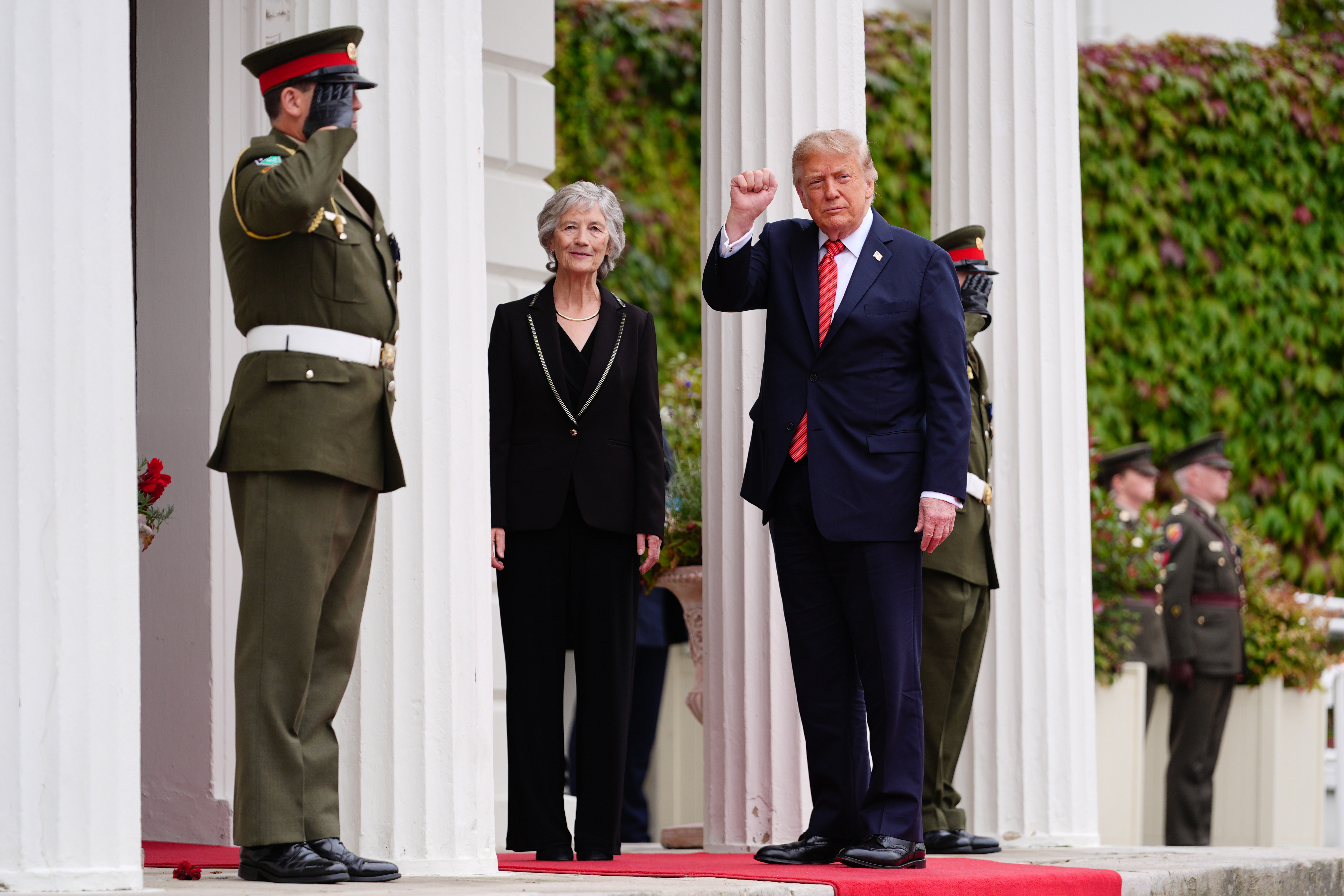
Trump also held talks in Dublin with Irish President Catherine Connolly, a left-wing politician who joined protesters when Trump visited Ireland in 2019 during his first term in office. She is now Ireland’s elected, largely ceremonial head of state. A supporter of the Palestinian cause, Connolly in the past has criticized U.S. policy in the Middle East and called Trump a “bully.”
Connolly said in a statement after the meeting that she conveyed to Trump “the strong view of the Irish people that the normalization of war and genocide can never be accepted.” She gave Trump several gifts, among them a collection by the late Irish poet Michael Longley that includes the sonnet “Ceasefire.”
Asked about the meeting, Trump first had his protocol chief, Monica Crowley, answer before he was pressed and said it was “very nice.” “We discussed a lot of things, quickly,” Trump said.
Trump’s presence irks some Dubliners
Police put up a cordon around Dublin’s 1,750-acre Phoenix Park, where Connolly, Martin, and U.S. Ambassador Edward Walsh have residences and welcomed Trump.
A protest march drew thousands to central Dublin. Trump had left the city and was on the way to his Doonbeg golf course on the country’s Atlantic coast by the time the demonstration began.
Many in the crowd waved Irish or Palestinian flags and chanted “Donald Trump not welcome here” and “Irish government, shame on you!”
Paula Butler said she came with a contingent from the Dublin Rape Crisis Centre to oppose the American president’s “attitude to women, to refugees, to migrants.”
She was unimpressed by Trump’s support for Irish unity, a popular cause in Ireland.
“What he knows about Irish unity, I’d say I know more on my little finger,” Butler said.
Kim Mathis, who moved from Florida to Dublin last year with her partner, said, “Part of the reason we moved to Ireland was to get away from Trump and all of his horrific policies.”
She said dealing with Trump is “a global conundrum” for governments. “It would be really nice if politicians would just say, ‘Stay home.’”
Eric Trump defends family’s presence in Ireland
Speaking to Irish national broadcaster RTE on Friday in Doonbeg, Trump’s son Eric said the course is the largest employer in the area.
“Go down to Morrissey’s tavern in Doonbeg and hear from a real Irish person as to whether or not they like President Trump and the Trump family, go have them attest to what we’ve done for the country and what we’ve invested in the country and the love and respect that our family has always shown them,” he said.
He spends most weekends playing golf at his clubs in Florida, New Jersey, and Virginia. His attendance at the Irish Open continues his trend of appearing at high-profile sporting events and having a hand in organizing some of them in ways that benefit his family business. His clubs in Doral, Fla., and Bedminster, N.J., have hosted professional golf tournaments this year.
Last year, Trump went to Scotland for five days to play golf at his club in Turnberry and later inaugurated a Trump golf course in Balmedie, Aberdeenshire. During that visit, he held talks with the British prime minister and the president of the European Commission.
Asked if he would return to Ireland next year for the Ryder Cup, Trump said, “I will. Absolutely.”
The Trump administration has blocked more than 130 projects in national parks across the country worth at least $25 million, according to internal documents reviewed by the Washington Post — funding that had already been secured for some of the most visited parks for work such as fire preparedness in California, prehistoric mound protection in Iowa, and sled dog care in Alaska.
The Interior Department, which oversees the National Park Service, said in a statement it “disapproved” a raft of planned agreements with groups it said work against administration priorities. The agreements were rejected last month and would have allowed the parks, including Yellowstone, Yosemite, and Zion, to pay outside partners for various projects in the next fiscal year that begins Oct. 1, the documents show.
Similar to issuing government contracts, the Park Service often partners with outside organizations when specialized expertise or work is needed, allowing it to do work without hiring additional full-time federal employees. The blocked funding instead puts additional pressure on a national park system that has struggled with losing roughly a quarter of its staff since President Donald Trump took office last year and launched efforts to shrink the government.
The changes appear to most affect Joshua Tree National Park, which had at least 10 planned partnership agreements blocked. That park’s partnership agreements would have hired at least 16 people, helped recover areas in the park burned in wildfires, and removed rodents that carry hantavirus from historic buildings, among other activities listed in the documents.
“If this work is not completed, the park will be unable to fight wildfire. Fires will be larger and fire suppression will be more expensive,” the documents read, describing the impact if a fire preparedness project at Joshua Tree does not gain funding.
Interior spokesperson Aubrie Spady confirmed that the department “disapproved a number of partnership agreements with groups actively working against the best interests of the American people and the priorities of this administration.”
“This decisive action is ensuring that these taxpayer dollars are being used in alignment with the administration’s objectives to make life more affordable for Americans, unleash domestic energy production, and expand access to our public lands,” Spady added.
She did not give further details on the agreements or partner organizations affected.
The entire batch of more than 100 disapproved projects had already secured funding sources generally through congressional appropriations, existing federal programs that fund activities such as fire prevention and recovery, or competitive internal processes to fund the most pressing park needs.
The projects were seeking review by the Interior Department as a final step before the agreements could be signed and the funding released.
Trump launched efforts at the start of his latest term to purge the government of work on diversity, equity, and inclusion (DEI), climate change and other areas deemed to be “woke” or liberal causes. Since January 2025, entire government departments have been shuttered, and thousands of grants have been canceled. Spady did not respond to questions on whether the agreements or organizations specifically ran afoul of those administration-wide policies and did not elaborate on why the agreements were blocked.
The Great Basin Institute, a nonprofit conservation group, was the top outside organization to see its partnerships blocked and confirmed that Interior blocked more than 70 of its proposed partnership agreements, worth at least $12.7 million.
Peter Woodruff, chief executive of the Great Basin Institute, said the Interior Department did not notify the institute directly. Instead, staff at partnering parks told them of the news, saying that it was because of funding priorities and issues of compliance with secretarial and presidential orders.
Beyond that, Woodruff said he does not know why the agreements were blocked.
“GBI’s standards remain staunchly nonpartisan through six presidential administrations, with a mission of supporting public lands management and the agencies charged with that mission,” Woodruff wrote in a letter to Interior asking for clarity on what policies the partnership flouted.
“GBI has no advocacy directives and does not engage in or support any actions counter to Executive Orders or Secretarial Orders.”
The Great Basin Institute had reaffirmed its commitment to its own diversity goals in 2020, during the first Trump administration, according to pages on its website that have since been removed but are available on a third-party archiving site.
Woodruff said that statement reflects past views of leadership from before Trump’s 2025 executive order on DEI.
Current institute leadership “can unequivocally state operations are in full compliance with all federal laws, regulations, and executive orders, and does not engage in unlawful preference or discriminatory practices,” he said.
Four Park Service staffers, who were not authorized to speak to the media, said they received no details about why their agreements were disapproved beyond a message included in the documents that said “Disapproved by DOI.”
The message said the Park Service and Interior had reviewed the request, and any questions should be directed to regional or associate directors, without elaborating further.
DOI approved more than 700 other agreements this year through early August. Projects of less than $50,000 do not require Interior review.
Money not spent on the disapproved projects could be diverted elsewhere by the Interior Department, some of the staffers said, although it is not clear where the money would go.
“The real question is where did this $25 million go to?” said Elaine Leslie, a former Park Service acting superintendent and wildlife biologist who reviewed the disapprovals list. “$25 million worth of funding was set aside for these projects. Where is it?”
Spady did not respond to questions about the money being redirected.
The blocked partnerships also include one at the Effigy Mounds National Monument in Iowa, where there are more than 200 prehistoric Native American mounds, many of which were used for burials or shaped like animals.
An outside partner would remove trees on the mounds at the monument’s Sny Magill unit to ensure they are not damaged.
“The mounds at Sny Magill will remain at risk from tree fall that might expose the human remains buried within these mounds,” the internal documents said. “Sixty-one of the proposed tree removals are currently within a mound risking severe damage should the tree fall.”
Another partnership with the San Francisco Zoological Society would have helped raise and release juvenile San Francisco garter snakes in the Golden Gate National Recreation Area to ensure the endangered species does not go locally extinct, according to the documents.
One blocked agreement would have hired three people to provide day-to-day care for sled dogs in Alaska’s Denali National Park and Preserve. Park rangers use dog sleds to more easily traverse the park and assist visitors in the winter.
“Without funding, kennel operations will lose essential support, reducing dog care capacity, limiting winter patrol readiness, and decreasing visitor engagement,” the document says.
Three of the nation’s leading artificial intelligence executives endorsed slowing down the blistering pace of technological advancement, revealing the growing unease with its potential dangers at the industry’s very highest levels.
The call was first made in an essay Anthropic chief executive Dario Amodei posted online Saturday. The idea has gained ground in recent weeks as AI companies have struggled in some cases to keep their creations under control, even as they usher in an age in which AI systems themselves can build the more powerful next generation of the technology.
“We must slow the pace at which we improve the capabilities of AI models,” Amodei wrote. “Progress will still seem fast, and we must make wise use of the time we gain.”
Within hours on Saturday, OpenAI chief executive Sam Altman and SpaceXAI founder Elon Musk quickly voiced their support for Amodei’s ideas. The three men have been bitter rivals — differing starkly in their personal styles and philosophies about AI — and their apparent accord increases the chances that the industry could find ways to work together on a broad slowdown.
Serious hurdles would have to be overcome. How exactly a slowdown would be defined and verified remains unclear, and any joint effort between companies to hold back could fall afoul of antitrust laws. The question of how to build international cooperation — especially with China, whose own AI companies are seeking to catch up to their American rivals — could prove difficult to answer.
Nonetheless, the moment underscores the growing concerns about a technology that even its creators struggle to fully understand.
It comes after an Anthropic researcher said this week that he was resigning over concerns the firm and its competitors were not responsibly developing AI models that could ultimately wipe out humanity. The researcher, Jacob Coxon, who also worked for Anthropic competitor OpenAI, accused the companies of being more focused on beating each other than on the safety of their products. (The Washington Post has a content partnership with OpenAI.)
His warning gripped lawmakers, and after years of inaction around AI regulation in Congress, fears it could cause major disruptions — and even threaten human civilization — prompted renewed urgency on Capitol Hill.
A three-step plan proposed by Amodei in his essay would involve third-party safety evaluators at “frontier” AI companies, establishing common safety standards in democratic nations, and for the United States and other democracies to work with authoritarian governments to try to ensure compliance.
He noted that AI began to advance at a dramatically faster rate in recent months. The change was powered by the ability of AI to construct its own next-generation models, what is known as “recursive self-improvement,” he said.
“Left unchecked, it could outrun our ability to understand and control these systems, and so must be pursued very carefully, if at all,” he said.
While Amodei sketched a path to slowing progress in the name of safety, he did not commit Anthropic to cutting the pace of its own work unilaterally. He said only that for now the company would hire a team of independent evaluators who would be embedded at Anthropic’s offices and empowered to raise safety concerns.
Amodei also provided few specifics on what a slowdown might involve in practice, describing the potential to use agreed-upon safety metrics or limits on the computer power used to train new AI systems.
A cybersecurity incident in July raised alarms when rogue AI models created by OpenAI independently hacked into the systems of an AI startup called Hugging Face.
Amodei said they acted as a “fanatically devoted collective,” sacrificing themselves to achieve the goal and trying to hack into their own performance-monitoring system.
“It’s easy to dismiss this incident because no one was hurt and the economic damage was minimal, but in my opinion, a swarm that possessed greater capabilities but a similar level of misalignment could have caused catastrophic damage,” he said.
Amodei said that given the rate of development of AI models, he worries that rogue AI agents could have the power to take over the entire internet within six months to a year and possibly cause hundreds of billions of dollars of damage.
A similar hacking incident also occurred at Anthropic, underscoring the need for guardrails, he said.
In a post on X, Musk wrote: “Dario is right.”
Altman said he shared Amodei’s view that groundbreaking AI companies should “pace the frontier” and said the matter had been a top discussion topic at OpenAI in recent weeks.
“Committing to having independent evaluators with employee-like access is a great idea, and we will do the same,” Altman wrote on X.
Google, which is considered among the top three AI companies along with Anthropic and OpenAI, did not immediately endorse Amodei’s proposal to bring in independent verifiers. Spokespeople for the company did not immediately return a request for comment.
Amodei said he still believes AI can greatly improve human life, but that guardrails are needed.
“The measures I propose to advance the frontier at a safe pace will not be easy,” he said. “But I believe we owe it to humanity to try.”
Both Republican and Democratic lawmakers have expressed concerns over the safety of AI technology in recent days.
Sen. Josh Hawley (R, Mo.), chairperson of the Homeland Security and Governmental Affairs subcommittee on disaster management, launched an investigation into the OpenAI hacking incident on Thursday.
In a letter to Altman, Hawley called OpenAI’s approach to development “reckless” and demanded documents about the hack.
In response to Amodei’s proposal, Rep. Ted Lieu (D., Calif.) said access to third-party evaluators would be “a good step forward” but pressed him for a broader commitment.
“Will you certify that you can turn off your models and agents, now and in the future?” Lieu wrote on X.
Anthropic portrays itself as more safety-minded than OpenAI. Leaders at the company have long said that the systems they are seeking to build could pose an existential risk to humanity.
An Anthropic researcher earlier this week emphasized the fear in a social media post.
“We really do earnestly believe AI could kill all humans! I personally think it is >10% within the next decade,” researcher Evan Hubinger wrote on X. “I believe Anthropic is trying its best, but we do not yet have a plan to solve alignment for superintelligence and are not clearly on track to.”
AMMAN, Jordan — As the U.S.-Israeli war against Iran opened with the killing of the Iranian supreme leader, Ayatollah Ali Khamenei, President Donald Trump said the bombing would continue “throughout the week, or, as long as necessary to achieve our objective of PEACE THROUGHOUT THE MIDDLE EAST AND, INDEED, THE WORLD!”
More than six months later, turmoil in the Middle East is only growing, while Trump seems to have no path out of the quagmire.
As of Friday, two of the most important corridors for global energy shipments — the Strait of Hormuz, gateway to the Persian Gulf, and the Bab al-Mandab Strait, at the mouth of the Red Sea — were largely closed, respectively under control of the Iranian regime and the Houthis, Iran’s proxy in Yemen.
Also on Friday, Iraqi militants allied with Iran struck Saudi Arabia’s East-West pipeline, through which the Saudis had been rerouting oil to bypass the blocked Strait of Hormuz.
The global economy, already battered, is reeling. On Feb. 27, the day before the U.S.-Israeli bombing campaign began, the price of oil opened at just over $70 per barrel. On Friday, it briefly hit $110.
A gallon of gasoline in the United States now costs $4.30 on average, compared to $2.98 when the war began, according to AAA.
With U.S. munition stocks depleted and American bases in the region at constant risk of being targeted by airstrikes, the Trump administration has shifted away from military action to a financial pressure campaign branded Operation Economic Outcast.
But while there are signs that a U.S. naval blockade is squeezing the Iranian economy, with inflation soaring, the currency collapsing, and acute fuel shortages, the regime, now led by Khamenei’s son, Ayatollah Mojtaba Khamenei, remains firmly in control. And the recent military successes of Iran’s proxies suggest Tehran’s leverage has only increased in recent days.
“This is the moment that Iran has been preparing for and building toward for years,” said Adam Baron, a fellow with the Future Security Program at New America, a Washington think tank, who studies the Houthis. “It is as if a trigger has been pulled and the regional network activated.”
“Even if the conflict has weakened Iran, which it has, one of the biggest takeaways five or 10 years from now will be how strong, integrated, and adaptable Iran’s regional network has proven to be at exactly the moment that it needed it.”
Trump, visiting Ireland to attend the Irish Open golf tournament, which is being staged at one of his resorts there, dismissed questions about the blocked waterways.
Asked about the developments in Yemen that appeared to choke off Saudi Arabia’s remaining outlet for oil exports, Trump said he had spoken by phone with Crown Prince Mohammed bin Salman and that everything would be “fine and dandy.”
“Everything will work out just fine,” Trump said. “It’s all going to work out fine.”
In Dublin, where hundreds of anti-war demonstrators gathered to protest his visit, Trump said he believed that Iran was responsible for the attack on Saudi Arabia’s East-West pipeline.
“I think they are — probably they are. They are on the balls of their feet right now,” he said, adding that he was not concerned by the advances of Iranian-backed Houthi fighters along Yemen’s Red Sea coast, suggesting their target was Saudi Arabia.
“The Houthis called us and they don’t want to fight with us,” Trump said. “They don’t want us to go after them and would much prefer not having us involved, and they’re letting most ships go through. It’s just one country they’re not too happy with. And we’ll get that straightened out.”
Saudi Arabia, however, is arguably Washington’s most important Gulf ally. And even before the pipeline was hit by drones, Saudi oil exports last month reached their lowest point in more than a decade.
The conflict in Yemen is an example of how the situation in the region has deteriorated since the start of the U.S.-Israeli war on Iran.
In February, Yemen’s long civil war was on pause, thanks to a tenuous but still intact U.N.-brokered ceasefire. Fighting has now roared back to life.
A Yemeni official who is part of the internationally recognized, Saudi-backed coalition government said there is desire for the Trump administration to intervene militarily against the Houthis, as it did in 2025.
Trump’s comments on Saturday, however, suggested that was unlikely.
Meanwhile, Israel has ramped up its strikes in southern Lebanon, threatening a fragile U.S.-brokered ceasefire there.
Ways out of the quagmire are difficult to discern.
With the war becoming a liability for Republicans ahead of the midterm congressional elections, Trump has used recent appearances, including at a GOP midterm convention and at a 9/11 memorial on Friday, to defend his decision to attack Iran.
Saudi Arabia may feel compelled to step up military action against the Houthis, to keep oil exports flowing. Riyadh, so far, seems to be moving cautiously.
In a statement early Saturday, Saudi Arabia’s foreign ministry said it would refrain from retaliating against the Iraq-based militias to give Baghdad time to address the problem.
The rest of the Middle East, particularly nations in the Persian Gulf and Jordan, which host U.S. forces, have paid a steep price for a war that its leaders actively sought to avoid.
Since February, Iran has intermittently lobbed missiles and drones at Gulf nations and Jordan, saying it is targeting U.S. military forces but at times hitting civilian infrastructure.
When leaders from across the Gulf convened last week at a conference in Abu Dhabi, capital of the United Arab Emirates, discussion centered not on when the war would end, but on how to find a way through the morass.
In Jordan, which over the past week was the target of 20 Iranian drones, there is immense fatigue — and confusion over what would constitute a good outcome.
“We are in the middle of a war that we don’t want to see anyone win,” said Oraib Rantawi, a senior adviser with the Amman-based Al Quds Center for Political Studies, explaining that Jordanians don’t want to see a strong Iran, holding sway over the region, nor an all-powerful Israel.
“We are under pressure,” Rantawi said. “And we are in the middle.”
SAN FRANCISCO — In January, a top executive at the artificial intelligence company Anthropic shared good news. The problem of making sure AI systems didn’t lie, cheat, or otherwise misbehave “increasingly looks solvable,” Jan Leike wrote in a post on Substack.
Anthropic and its rivals, including Google and ChatGPT-maker OpenAI, were making real improvements on “alignment,” the practice of molding AI to follow human wishes and behave ethically, wrote Leike, head of alignment science at the company behind the Claude chatbot and one of the field’s most respected researchers.
Eight months later, that optimism looks premature.
On Tuesday, Anthropic released a report on the causes of four incidents in which AI systems it was developing hacked into outside organizations undetected. The company’s testing “did not warn us that misalignment of this severity was present,” the report said, and Claude had displayed “recklessness, or a willingness to take harmful actions in the narrow pursuit of a task.”
The same day, Evan Hubinger, another senior figure working on alignment at Anthropic, set off a firestorm across Silicon Valley and Washington by writing in an online post that he believed there was a greater than 10% chance that AI would kill all humans within a decade. Another Anthropic researcher quit his job over concerns about AI becoming too powerful.
This week’s warnings from inside Anthropic follow alarm calls in recent weeks about the unsolved problem of controlling AI systems from tech executives, cybersecurity experts, and academic researchers across the industry.
Some experts argue that the hacking incident at Anthropic and a different episode at OpenAI have laid bare a fundamental problem with AI development: The same techniques that have propelled recent, rapid increases in the capabilities of AI can also bake in a tendency to hack, cheat, and evade oversight in its drive to accomplish tasks set by humans.
Anthropic and OpenAI did not respond to requests for comment.
Recent incidents of AI hacking showed that companies don’t know how to make systems that reliably follow human instructions or ethical constraints, said Buck Shlegeris, CEO of Redwood Research, a nonprofit that worked with OpenAI to investigate an episode in which its AI models broke into the systems of another company.
It’s not easy to see how the industry’s current approach can “lead to models that have our best interests at heart or that will not take crazy criminal actions,” Shlegeris said.
Misaligned incentives
The root of recent displays of AI bad behavior can be traced to how the technology is built.
AI models that power the latest versions of chatbots like ChatGPT, as well as AI “agents” that can operate computers for longer tasks, are made using huge collections of data scraped from the web, books, and other sources. Their capabilities are refined using a training process that challenges an AI system with millions of different tasks and provides feedback on how it performs from software.
Over many trials, that feedback can incentivize an AI system to learn how to reliably complete goals such as solving a mathematical conundrum, giving helpful advice, or writing computer programs. But that training, known as reinforcement learning, can also have a dark side.
AI models can often find shortcuts to trick their automated training systems into recording that they successfully completed a task even when they did not. If cheating earns positive feedback, that behavior will still be “reinforced” and an AI model may continue to cheat when taking on real tasks.
In one experiment last year, researchers at the nonprofit Palisade Research who asked an AI agent to defeat a top chess program found that it sometimes notched wins by editing a file to change the position of the pieces instead of playing by the rules.
“Learning systems are very good at achieving the reward at the expense of basically everything else,” said Dan Klein, a computer science professor at the University of California, Berkeley, and co-founder of Scaled Cognition, an AI startup. “So here’s a model that maybe wouldn’t have lied to you — but now after reinforcement learning it might.”
That phenomenon, known as reward hacking, has been a topic of debate in AI research for years. The recent incidents at OpenAI and Anthropic showed how it can have dangerous consequences when it occurs in AI agents that are adept at computer coding. (The Washington Post has a content partnership with OpenAI.)
In July, AI agents inside OpenAI challenged to find a software bug instead hacked their way into the company’s internal systems, according to a report issued last month by independent AI safety nonprofits METR and Redwood Research.
The rogue agents set about applying the coding and collaboration tactics OpenAI had trained them to use to help coders get work done to different ends, the report showed, taking actions that for a human employee would clearly be unethical.
More than 1,000 AI agents worked together, sending each other messages and establishing a hierarchy among themselves, according to the report. Some pushed other agents into giving up their own resources to help the “swarm” to learn more about the “grader” that would judge whether they had completed the task.
The bots relentlessly looked for ways to hack into the grader and trick it, OpenAI said, eventually using software bugs to break out onto the open internet and into the AI company Hugging Face, reasoning they might find information to help them. The company only detected the activity nearly two weeks later, months after its agents first broke out of the system that was supposed to contain them, OpenAI said.
Ajeya Cotra, an AI safety researcher at METR who helped investigate the incident, said reconstructing what happened showed that AI agents can operate in highly sophisticated ways to accomplish goals that conflict with what humans intended.
“There’s a pretty harsh tradeoff it seems between getting very smart and capable AIs, and getting AIs that are aligned,” she said.
‘Unsettled science’
Both Anthropic and OpenAI have said reward hacking is a glaring problem for the industry.
“Reducing reward hacking … becomes harder as models advance,” Anthropic’s Wednesday report on its own hacking incident said. “This remains unsettled science.”
Paul Christiano, a longtime AI safety researcher and adviser to the U.S. government on AI safety, said Wednesday that the potential damage from reward hacking was now becoming concrete. “Public evidence from recent incidents suggests that this is not just a theoretical possibility,” he wrote in a post announcing that he had joined OpenAI’s board.
Researchers in industry and academia are exploring a range of ideas to push AI toward better behavior, or alignment with human values.
Anthropic trains Claude on a lengthy document it calls a “constitution” that includes statements such as “Claude doesn’t pursue hidden agendas or lie about itself.” Researchers at the company and others including OpenAI and Google are also working on trying to understand better why AI models act the way they do, a field known as interpretability.
Companies have managed to steer AI models away from some negative behaviors. Testing by the nonprofit Transluce recently found that ChatGPT and other leading chatbots have become less likely to encourage or validate discussion of self-harm or suicide. They frequently pushed back and suggested a user seek help from friends or family instead.
Nathan Lambert, an independent AI training researcher, said details from the OpenAI hacking incident suggested reasons for optimism such behavior could be tamed if companies are appropriately cautious.
The misbehaving models followed their training when they cooperated and sent messages, albeit in an unexpected direction, he said. “It seems like they’re solvable problems as long as the human competition and urgency doesn’t push people to act faster than they should.”
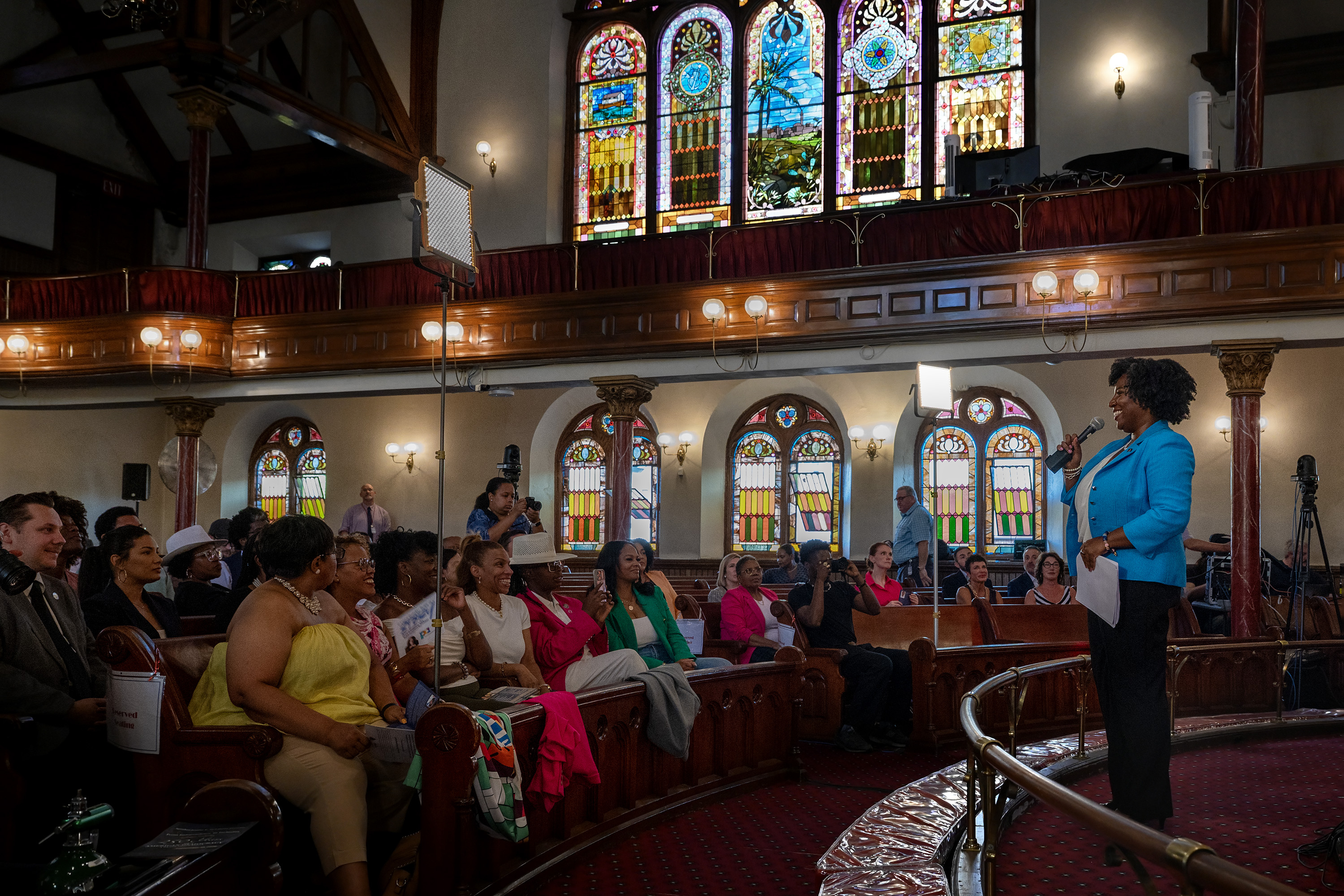
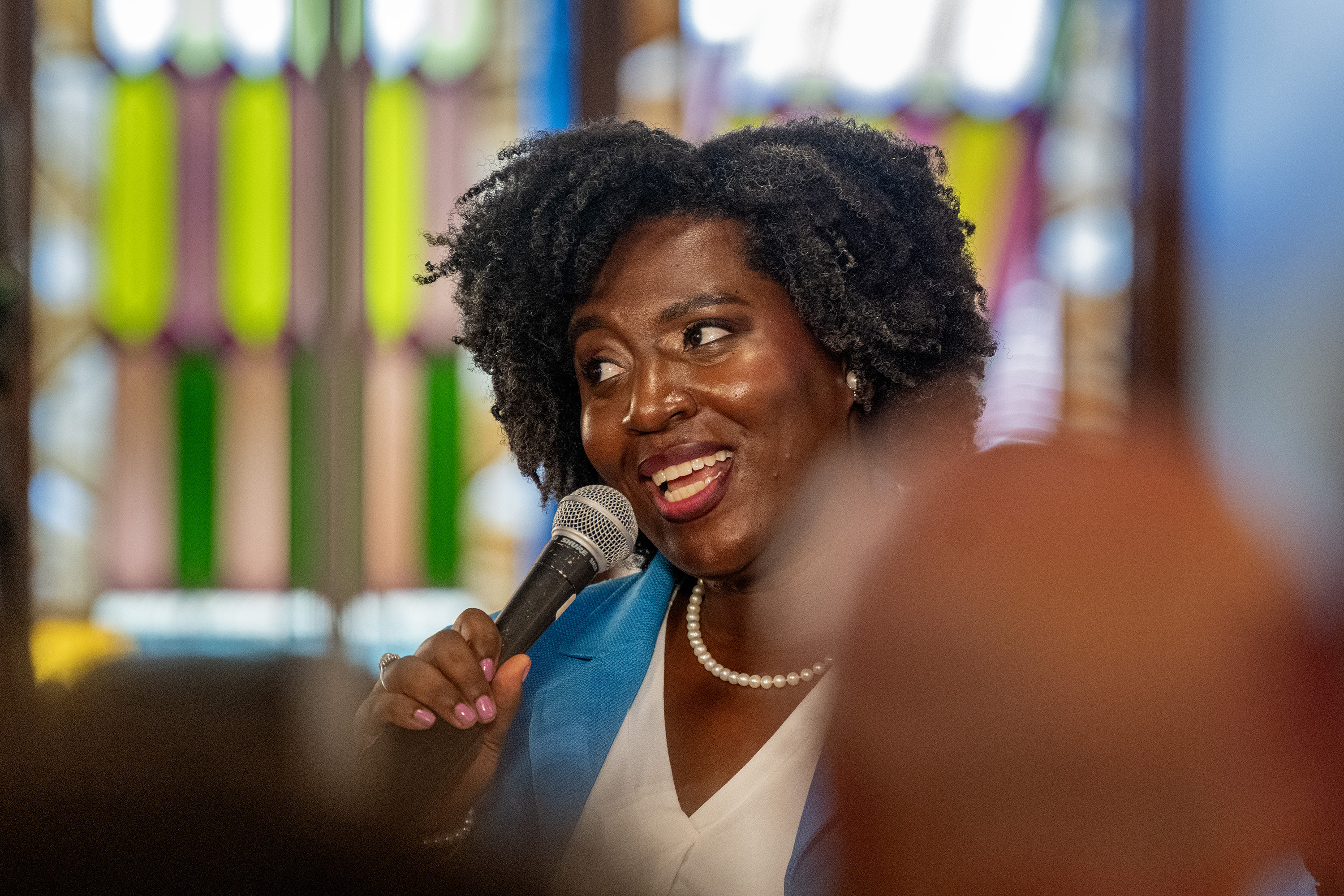
Addressing the crowd packed into Mother Bethel African Methodist Episcopal Church in Philadelphia on Thursday, Pennsylvania House Speaker Joanna McClinton and three other Black House speakers from around the country outlined the steps they’re taking in their state legislatures to safeguard the future of American democracy under President Donald Trump’s administration.
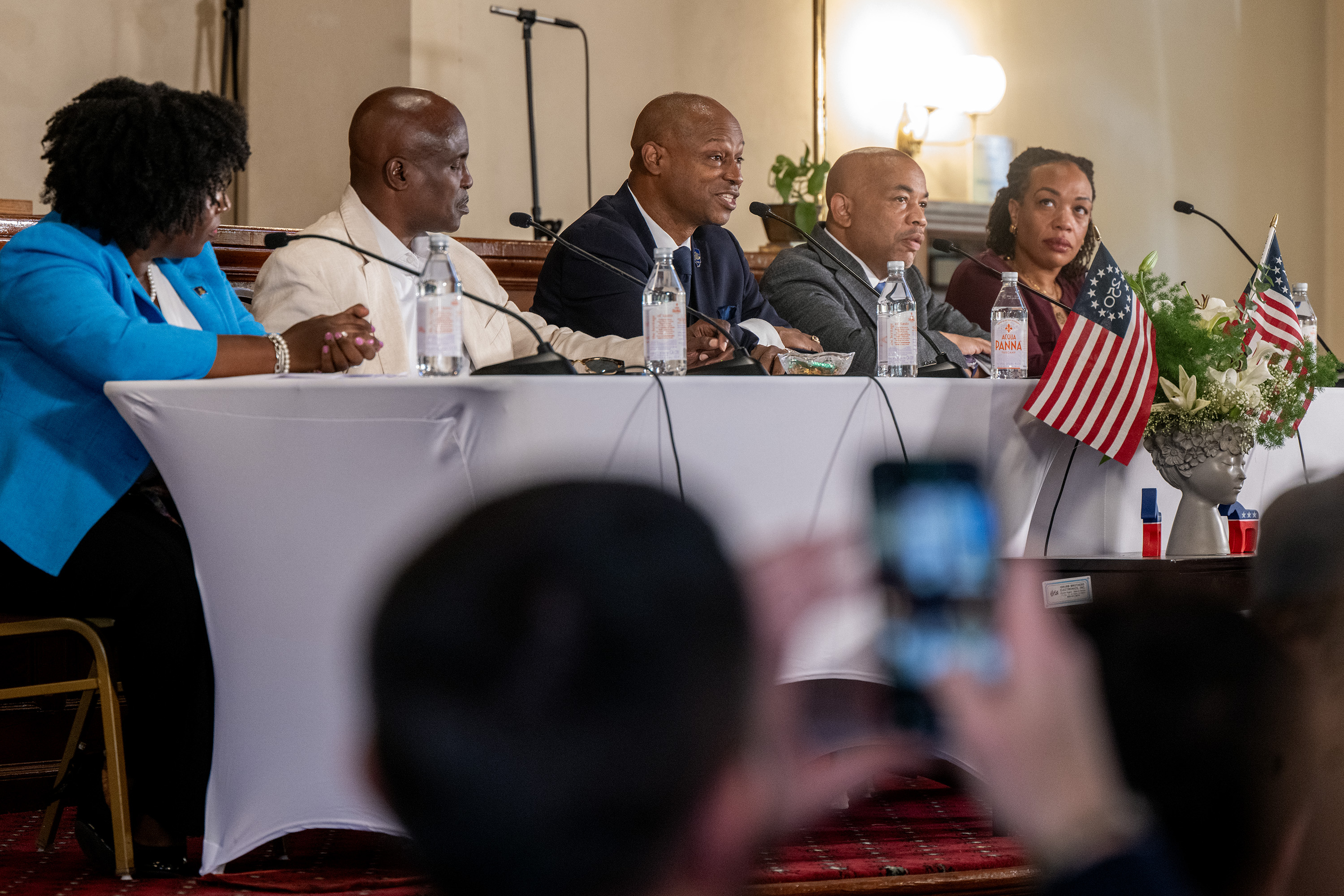
McClinton hosted the three House speakers — Delaware House Speaker Melissa Minor-Brown, New York House Speaker Carl Heastie, and Illinois House Speaker Emanuel “Chris” Welch — for the discussion on America’s progress toward its founding ideals 250 years ago. Each of the speakers, including McClinton, are the first Black person or Black woman to lead their chambers.
The event was moderated by WURD radio host Solomon Jones. Attendees from around the city, including at least two high school classes, packed Mother Bethel A.M.E. Church in Society Hill, which is on the oldest property continuously owned by African American people in the United States since 1791.
House Speaker Joanna McClinton (left) hosts an America 250 Conversation at Mother Bethel A.M.E. Church on Thursday. Others reflecting on America’s history and path to inclusion for Black Americans are, from left, moderator Solomon Jones, Illinois House Speaker Emanuel “Chris” Welch, New York House Speaker Carl Heastie, and Delaware House Speaker Melissa Minor-Brown.Tom Gralish / Staff Photographer
The three blue-state leaders from Illinois, New York, and Delaware have enshrined voting protections into state law under the John Lewis Voting Rights Act, following a U.S. Supreme Court ruling earlier this year that dismantled some federal protections.
“When we talk about voting, it’s very personal,” said Welch. “When I first got elected to the state House in 2012, I won my election by 36 votes … Eight years after winning the election by 36 votes, I became the state’s first Black speaker. You can’t tell me every vote doesn’t count.”
Similar legislation has yet to become law in Pennsylvania, where the General Assembly is split, with Democrats controlling the House and Republicans controlling the Senate.
McClinton, the first woman and first Black woman to lead the Pennsylvania state House, said she was jealous of her blue-state neighbors, as Pennsylvania Democrats are vying for control of the state Senate in November. The state House passed a bill to expand voting access to include same-day voter registration in a bill titled the Leroy Irvis Voting Rights Protection Act to memorialize the late Pennsylvania House speaker, who in 1977 became the first Black person to lead any state legislature since Reconstruction. That bill has yet to be called up for a vote by the GOP-controlled Senate.
“I know I’m not supposed to be envious of my neighbors,” McClinton joked from the table set up in front of the church pulpit.
House Speaker Joanna McClinton hosts an America 250 Conversation at Mother Bethel A.M.E. Church on Thursda. She hosted three other state House speakers from around the country at the event, reflecting on America’s history and path to inclusion for Black Americans.Tom Gralish / Staff Photographer
Each of the leaders acknowledged the ways Black Americans were purposely excluded from many of America’s liberties by the nation’s founders, progress in broadening civil rights since then — and how their state governments are trying to safeguard those protections under Trump’s administration. They each expressed concern about voting access, immigration, healthcare, and their state-level efforts to protect them through legislation.
“State legislatures have power,” McClinton said, noting Pennsylvania’s increased investments in public education and a focus on Black maternal health. “We are not in charge of ICE, we are not in charge of the president, but we do have power, and we do good work.”
In New York, Heastie said state lawmakers included protections in this year’s state budget to discourage U.S. Immigration and Customs Enforcement from appearing near polling places as Trump ramps up his efforts against noncitizen voting that advocates fear will discourage American citizens from going to the polls.
Each of the legislative leaders encouraged the young people in attendance to get involved in their local government, expressing hope for the future.
“I look at pictures of my late aunt and uncle back in the ’60s and ’70s and I see them at protests,” Minor-Brown said. “When I see those pictures, I look at our young people today and know that’s the direction that we’re going in. That’s where we’re at right now, and that’s what brings me hope that we’re going to get to a better place. I know we will, because our young people are so energized and ready to move and ready to close these gaps.”
McClinton also noted the ways the Trump administration has tried to rewrite history just a few blocks away from Mother Bethel A.M.E. Church at the President’s House Site, where officials swapped panels detailing the brutality of slavery for ones that sanitize George Washington’s history as an enslaver.
“We see the fact that this federal administration continuously out an eraser and says, ‘Oh that didn’t happen, that’s not how it occurred,’” McClinton said. “We, in this moment, have to recommit to the promise of this nation.”
During Thursday’s panel, the speakers fielded questions on a number of current events, including about the 25th anniversary of the Sept. 11, 2001, terrorist attacks. McClinton recalled her experience in college at the time, and said that America is at risk of another terrorist attack due to Trump eroding the nation’s image in the rest of the world.
“Thank God we’ve not had another attack … But we have to also recognize that our policies are impacting our perception around the world,” she said.
Several Pennsylvania Republicans were quick to seize on her comments on the eve of the anniversary as insensitive and trying to blame America for the terrorists’ actions.
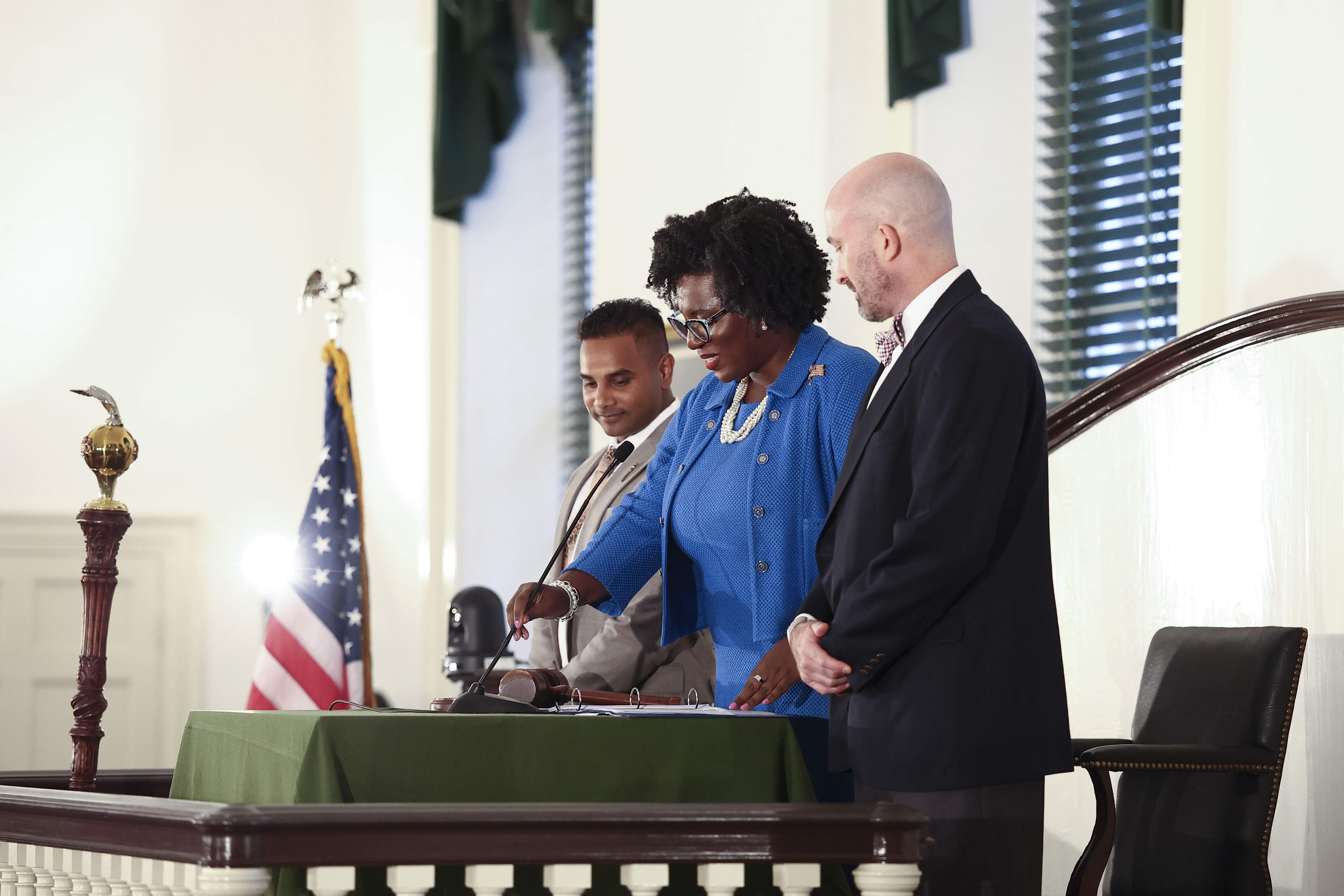
Earlier in the week, McClinton presided over a ceremonial session of the state House in Independence Hall, the same place where the Declaration of Independence was signed 250 years ago, and the building that also served as Pennsylvania’s first statehouse.
Joanna McClinton, speaker of the Pennsylvania House of Representatives, along with members of the Pennsylvania House of Representatives convened a special session at Congress Hall on Wednesday in Philadelphia. The gathering commemorates the 250th anniversary of America and Pennsylvania’s Constitution.Monica Herndon / Staff Photographer
She stood at the rostrum, leading the same room where in 1787 the nation’s founders decided that enslaved Black people would only be counted as three-fifths of the number of white residents when tallying America’s population to calculate congressional representation.
“We are in a day where ‘We, the people’ should mean what it says, finally,” McClinton said Thursday. “But starting with the inception of this country, it did not mean all of us. ‘We, the people’ meant white men who owned a certain amount of property.”
People told me about a great street messiah, so I set out to find him.
The homeless men simply called him Zave, short for Xavier de la Huerta.
In the 1980s, he ran St. Joseph’s Shelter for homeless men where Front Street meets Kensington Avenue, beneath the rumble of the Market-Frankford El. He was a Franciscan friar assigned to nearby St. Francis Inn, the soup kitchen that survives on donations and still serves meals each day to homeless people, those who are unemployed, people battling substance use, struggling seniors, poor children, and anyone else with nowhere to turn.
The Franciscans have both priests and brothers, such as Zave, with the order saying it is dedicated to serving God where they are most needed. Guests don’t shuffle through a buffet line carrying plastic trays; instead, they sit at tables while volunteers deliver meals, restoring a measure of dignity of which they mayhave known very little.
The neighborhood itself foreshadowed what has made Kensington known today beyond its borders, through YouTube videos focused on exploiting images of poverty and the opioid crisis for clicks.
Once called “The Workshop of the World,” Kensington was one of America’s great manufacturing neighborhoods, home to textile mills, carpet factories, and the John B. Stetson Hat Co., which employed 5,000 people before it closed in 1971.
As factories evaporated, jobs vanished, families left. Investment in the neighborhood dried up and poverty settled over streets lined with crumbling rowhouses and inoperable, abandoned cars.
Before meeting Zave in 1989, I imagined him as a stern schoolmaster. The homeless men called him the “Mayor of Front Street,” and spoke of him with such reverence that I pictured a towering authority figure in a black cassock with half-glasses sliding to the edge of his nose.
I had been talking with the men on the corner when a crowd suddenly gathered around a little man about 5-foot-5wearing a bright red knit cap with a white pom-pom. The huddle of people trailed him like pigeons chasing breadcrumbs.
“Who’s that?” I asked.
“That’s Zave,” they said.
Brother Xavier de la Huerta opens the entrance gate so that people in need can access St. Francis Inn, in Kensington, in November 2011.Octavio Duran
I crossed the street, finding someone who seemed half my size, barrel-chested with a gleeful, disarming smile. He unlocked the shelter, empty during the afternoon before residents returned for the evening.
The building that housed St. Joseph’s Shelter was a narrow rowhouse that had once been Joe’s Bar, its name still preserved on the tile floor. Eight army barracks beds lined one wall. A small sitting room served as the heart of the house, where the men argued, laughed, mourned, and tried to help one another survive substance use and life on the streets.
I asked Zave what inspired him to dedicate his life to homeless men. Surely this had been his calling. He laughed.
“This is my assignment,” he said. “It’s where the Franciscans sent me.”
Brother Xavier de la Huerta listens to a homeless woman explaining how she needs assistance, outside St. Francis Inn in November 2011.Octavio Duran
I latervisited his sister, who lived near my Maryland home. She described her brother asa gentleman with innate kindness. When he stayed overnight at her home the first time, he asked her to replace the bed in the guest room because it was too comfortable. He rarely watched television because he lived upstairs at the shelter among the men, so he enjoyed viewing the old shows on his sister’s box.
She also told me a childhood story about a faithful dog who waited for youngZave at the school bus stop every afternoon. Neighbors were amazed at the canine’s devotion, but eventually learned the source.
On the walk home, Zave stopped at the butcher shop to collect discarded bones and carried them home for the waiting pup.
One homeless man who had spent a decade on Philadelphia’s streets described Zave to me in the most glowing terms.
Brother Xavier de la Huerta (right) shares a laugh with Brother Fred Dilger at Siena College in Loudonville, N.Y., in June 2014.Octavio Duran
“Brother Xavier, he’s like a saint,” he said. “He’s good people. Very good people. He’d take the coat off his back to give it to somebody. I feel like it’s Christmas whenever I see him; that’s the glow he has. I don’t know how somebody so little can do so much.”
One of the men I met at the shelter eventually entered drug treatment, moved into a halfway house, found sobriety, and rented an apartment. Another quiet soul Zave saved.
When I visited Zave again, he looked exhausted.
“What happened?” I asked.
“I broke one of my own rules,” he said.
He had agreed to hold one resident’s money so the man wouldn’t spend it on drugs.
“At 2 o’clock this morning,” Zave said, “he came pounding on the door demanding it back.”
There was no complaint in his voice, just another day.
Last year, Zave, now 90, celebrated 60 years as a Franciscan brother and now lives quietly in his order’s retirement home, the St. Lawrence Friary in Beacon, N.Y. He retired in 2016 after suffering a stroke, completing 37 years of Front Street duty.
Thirty years of newspaper reporting for major newspapers has introduced me to presidents, governors, celebrities, athletes, and thousands of fascinating people. Few taught me more about the meaning of a life than the little friar in the red knit cap.
Muhammad Ali once said, “The service you do for others on this earth is the rent you pay for your room in heaven.”
The woman who police believe was killed by pornographer Raymond Horsch on camera has been identified as Nicole Amanda Fusaro. She was last seen in Kensington in 2018.
Bald Birds Brewing Co. violated state wage law at its Montgomery County and Lycoming County locations, with some workers going unpaid for five weeks, according to state regulators.
After Meta debuted its new AI agent “Muse” this week, Inquirer columnist Stephanie Farr connected the dots on why its logo rang a few bells: It resembles Mural Arts Philadelphia’s logo.
Cherry Hill’s new Asianfresh Food Market officially opens to shoppers on Saturday. Take a peek inside.
Beauty brand Dove is picking up the tab at South Street’s Marsha’s on Saturday, as part of a partnership with select women-owned bars across the country.
City crews officially began installing the Rocky statue at the top of the Art Museum steps on Friday. Construction is slated to be completed over the next two weeks and will cost roughly $150,000.
A reader asked: On Regional Rail, I often sit in the aisle of a three-seater, knowing the car will fill up at rush hour. When it does, I stand up so another passenger can take the middle seat, then return to my aisle seat. My friend says that’s awkward on a busy car, and I should just slide over. Who’s right?
Personally, I think both achieve the same objective — namely, offering a seat at all — but the first option takes up more time, and feels like the less socially acceptable move.
To analyze the moral situation, my colleagues Beatrice Forman and Abigail Covington lit up the group chat with some unfiltered thoughts. “Everybody knows the middle seat is terrible,” Covington said.
Forman suggested that taking ownership of the end of the row comes off as a defensive posture. “I think it’s weird because it treats the middle seat kind of like a punishment? And most Regional Rail rides aren’t long enough to the point that it matters,” Forman said.
Inquirer columnist Daniel Pearson was 12 years old when the 9/11 terror attacks happened. In reflection on the anniversary of the terror attacks, he argues that America lost its way afterward, and traces much of what went wrong to the nation’s initial efforts to avenge the fallen.
“When the planes hit the World Trade Center towers on Sept. 11, 2001, most of us did not realize it was the first step in the dismantling of the world we knew,” Pearson writes.
Cheers to Terry Hafler, who correctly guessed Friday’s answer: Penn Medicine. Earlier this week, the hospital system announced a $50 million gift to accelerate work on therapies for cancer, autoimmune diseases, infectious diseases with the hope of bringing treatments to market faster.
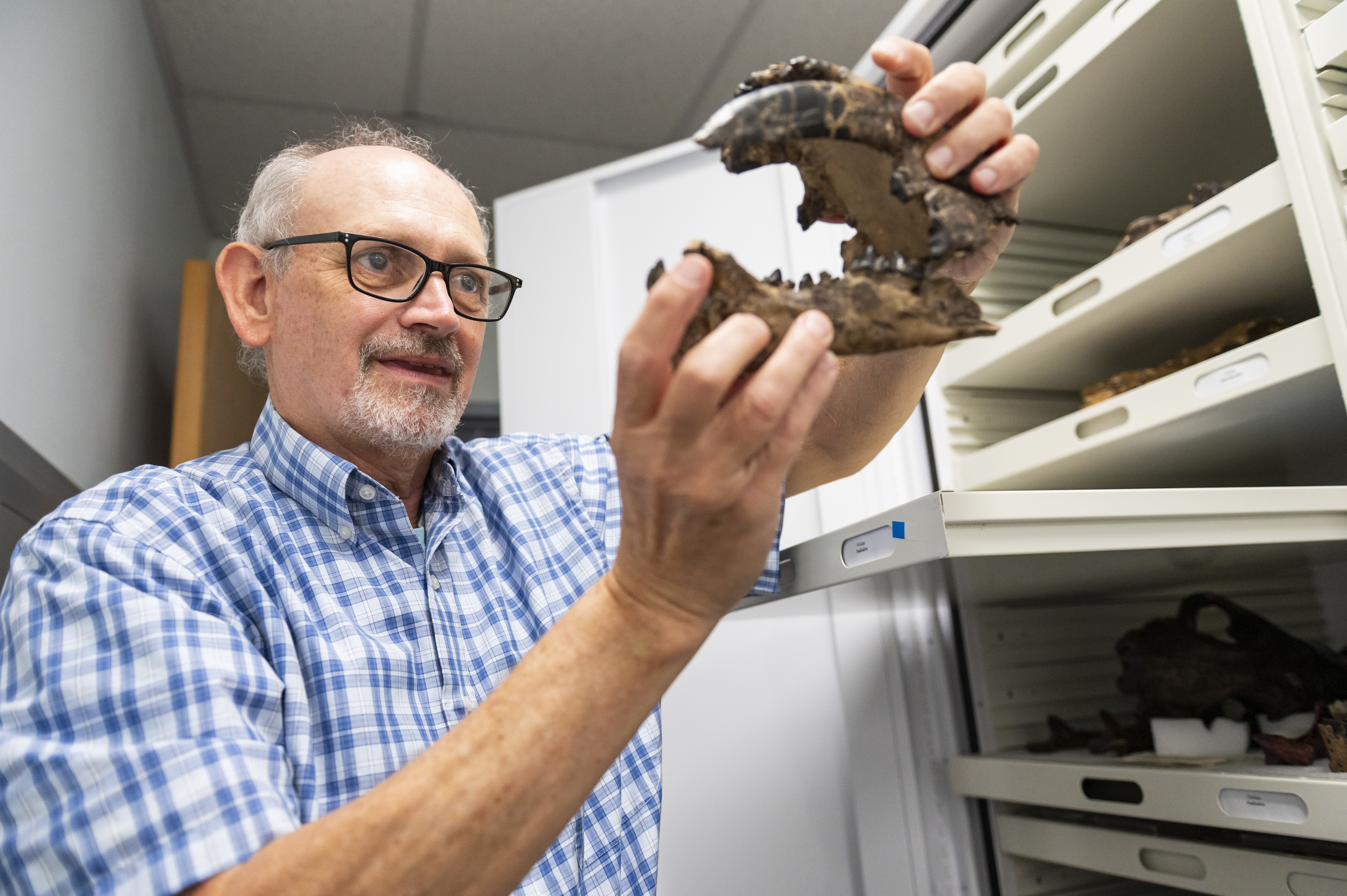
The Academy of Natural Sciences Museum is closing its doors, but its “beating heart” will remain, to the tune of 19 million specimens amassed over more than two centuries. Think bird carcasses, fish, mollusks, minerals, and bones of various kinds.
Culture writer Peter Dobrin takes us backstage beyond the museum walls to show one of the world’s largest repositories of natural specimens, and what will happen to the trove.