Eli Stowers won’t be making his regular-season debut any time soon.
The rookie tight end, a second-round pick out of Vanderbilt, was ruled out for Sunday’s season opener against the Washington Commanders with quadriceps and hamstring injuries. He has been placed on injured reserve, requiring him to miss at least the next four games.
Stowers had been dealing with a hamstring issue since the last week of training camp, but the quadriceps injury is a new development. After he reported discomfort in his leg, digital imaging showed that he had sustained a quadriceps strain that will sideline him for the next several weeks as he undergoes treatment and rehabilitation.
We have downgraded TE Eli Stowers to out for tomorrow’s game with quadriceps and hamstring injuries. He has been placed on the Injured Reserve List. We have also elevated WR Britain Covey for the game. pic.twitter.com/4hGlWIiBY6
On Friday, Stowers had been optimistic about his availability for Week 1. He said after practice that it was “the plan” for him to play against the Commanders. However, he was listed as questionable to play on the final injury report released later that afternoon.
Stowers had a relatively quiet training camp and preseason performances. He finished with three receptions for 12 yards in two games, as he was sidelined for the final preseason game. Still, the rookie tight end was pleased with his development in various areas throughout the summer.
“With the playbook, the route tree, the schemes, the blocking schemes, pass blocking, really every single aspect,” Stowers said Friday. “Special teams. I think training camp was a really good learning experience for me, and I was really encouraged to see me get better in every single aspect, because that’s really what my goal was.”
With Stowers sidelined, Makai Lemon could be the only Eagles rookie to contribute in a non-special-teams role on Sunday.
Eagles first-round draft pick Makai Lemon could become the only Eagles rookie to contribute in a non-special-teams role on Sunday.
Yong Kim / Staff Photographer
The Eagles will have three tight ends at their disposal on game day — Dallas Goedert, Johnny Mundt, and EJ Jenkins. They do not currently have a tight end on the practice squad. Stowers joins fellow tight end Grant Calcaterra on injured reserve.
Additionally, the Eagles elevated Britain Covey from the practice squad to the game-day roster. The Eagles communications department listed Lemon as their first-string punt returner on the depth chart that was released Tuesday, but could turn to Covey, 29, as he has returned punts over the last four seasons.
Last year, Covey had 11.3 yards per punt return, which was above the league average of 10.2.
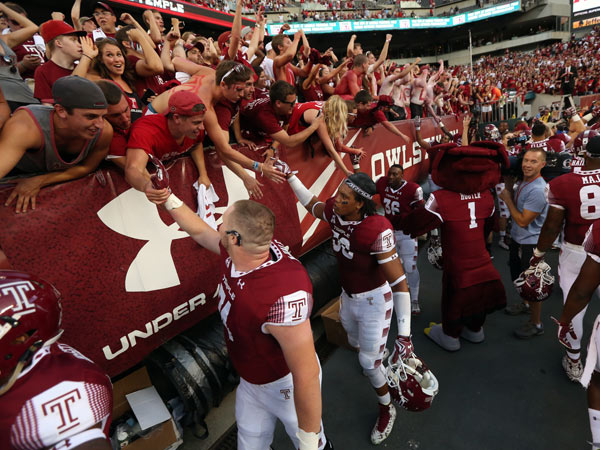
“We are” chants rang throughout Lincoln Financial Field, replacing the Eagles’ chants that would take over in less than 24 hours, and the stadium that typically would be engulfed in midnight green was temporarily blanketed in white as No. 16 Penn State made the trip to Philadelphia to face Temple.
Saturday’s game was the first time the teams faced off in a decade, renewing a 95-year-old rivalry. In their last meeting in 2016, the Owls lost by seven at Beaver Stadium.
This time around, Temple suffered a similar fate — losing, 27-9, as Penn State improved its all-time record against the Owls to 41-4-1.
From a Penn State takeover to a Meek Mill appearance, here’s everything you might’ve missed on Saturday at the Linc:
Meek Mill leads Temple out of the tunnel
The familiar sounds of Meek Mill’s “Dreams and Nightmares” track was heard throughout the Linc as Temple made its way onto the field. From the Jumbotron, fans could see the Philadelphia rapper front and center, leading the Owls out of the tunnel as red smoke and pyrotechnics covered one side of the field.
This came just a few days after the North Philly native partnered with the university to welcome high school seniors and Temple students to the Dream Chasers Summit, at the Liacouras Center.
Although the record against the Owls leans heavily in Penn State’s favor, Temple did shock the world in 2015 — the teams’ last matchup at the Linc. Temple’s defense dominated a game in which Penn State quarterback Christian Hackenberg was sacked 10 times.
The Owls entered that game as a seven-point underdog and beat the Nittany Lions, 27-10, in front of a crowd of mostly blue and white. Temple alumnus Ron Fries attended the game, and after the upset, Fries, 55, knew he had to become a season-ticket holder.
Temple players celebrate the last time they beat Penn State, a 27-10 victory in 2015 at Lincoln Financial Field.DAVID SWANSON / Staff Photographer
“I went to that game and a couple other games that year, but being at that game and just the energy — the Penn State energy left and the Temple energy that was there, which was outnumbered a lot,” Fries said. “But the folks that stayed, it was tremendous, and that’s why I became a season-ticket holder.”
An upset wasn’t in the cards this time around, but a lot of fans were optimistic beforehand.
”I’m hopeful that they’re able to produce something positive,” Fries said. “I would be ecstatic if they won like they did 11 years ago, but if they don’t, I just want to see something positive come out of them against a big program like Penn State.”
Penn State linebacker Tony Rojas (left) reacts after a first-quarter interception against Temple on Saturday.Isaiah Vazquez / For The Inquirer
Beaver Stadium East
Like the Penn State-Temple game in 2015, Temple fans were outnumbered at home.
”It looks like it’s been a pretty big whiteout here in the parking lots,” Penn State alum Joe McGoldrick, 26, said before the game.
Penn State flags were plentiful at tailgates in the sports complex parking lots, and fans in blue and white jerseys were out in droves through Lots D to M as students from State College were being bussed in. Shrines to the Nittany Lion could be seen at every turn — including at “Ernie’s Tailgate,” a tradition dating to 1977, when Tim Ernst was a freshman at Penn State.
Ernst, who graduated in 1981 and got his master’s in 1993, started the tradition from his dorm room. Since then, he said he’s attended every Penn State home game, and he isn’t thinking of stopping anytime soon.
“We’re excited for the new coach; we’re excited for our new team,” Ernst said. “Rocco Becht, our quarterback, we’re very excited to have him on board. College football is challenging with all the transfers taking place and all that, but we’re going to have a very good year this year.
“I think we’re going to make the playoffs, and we’ll see where it goes from there. And I don’t want to say any bad words about [James] Franklin but it was time to make a change. [Penn State coach Matt] Campbell has been saying all the right things. He believes in the [Joe] Paterno way where education is important, making these young boys into men is important. And that’s what Joe Paterno always emphasized.”
The Penn State takeover continued inside the stadium, as thousands of fans traveled to see Campbell improve his record to 2-0 as Penn State’s coach after a 45-0 win over Marshall in Week 1.
”Penn State isn’t coached by James Franklin anymore, thank God,” McGoldrick said. “I was there at the game last week, they looked very good against Marshall. I think they’re just going to do the same thing they did last week. I think they’ll have a home-crowd environment. So, that’ll help too.”
A neighborhood rivalry
As the ocean of blue and white jerseys swarmed the tailgating lots, one Temple fan, Michael Kiedaisch, wasn’t worried.
“The sea of red is on the way,” Kiedaisch said.
Kiedaisch, whose 18-year-old son, Brian, attends Temple, made the trip down from Newtown, Bucks County, with his family to watch the game and cheer on the Owls — but there was one issue. Kiedaisch’s neighbor, Art Krysko, also made the trip. And his family — including his 19-year-old daughter, Madelyn, and 21-year-old son, Joey, who attend Penn State — were cheering for the rival team.
“We had kids,” Krysko said. “And they went to different schools. And we’re a little [ticked] about it.”
Temple Owls quarterback Jaxon Smolik (14) runs upfield during the second quarter in Saturday’s game against Penn State at the Linc. Isaiah Vazquez / For The Inquirer
The competition between the two started as soon as they left their neighborhood.
“When we left the neighborhood, he blew the stop sign and tried to lose me on the drive down because I’m supporting Temple and he’s supporting Penn State,” Kiedaisch said. “So that’s how the day started. But we’re set up and ready to go now.”
However, if Penn State took an early lead, Michael’s brother, Carl Kiedaisch, had a backup plan.
“We have Penn State shirts at halftime to put on in case it gets ugly,” Carl said.
Penn State led, 10-3, at halftime but vibes still were high on the main concourse for Temple fans as the band performed near the student section. Fans bobbed their heads, talked to friends, and cheered along as they prepared for the second half.
And as soon as the third quarter started, “[Expletive] Penn State,” chants erupted from the crowd.
The band put on a show at halftime.Isaiah Vazquez / For The Inquirer
However, it was short-lived after Penn State scored another touchdown, putting them up, 17-3. From then on, Penn State ran away with the 27-9 win — leaving many Nittany Lions fans happy.
“I thought the stat line was pretty good all around,” said 22-year-old Penn State alumnus Colin Crissey. “It didn’t look pretty on the field, necessarily, but the numbers don’t lie, and they look pretty good. I thought Penn State somewhat sleepwalked in the first half. I don’t know if that’s the travel. I don’t know if that’s your first away game with a new coach or whatnot. Scoring right there at the end of the half really changed the mood.”
Meanwhile, Temple fans started to leave the stadium in the third quarter — leaving the student section fairly empty by the end of the game.
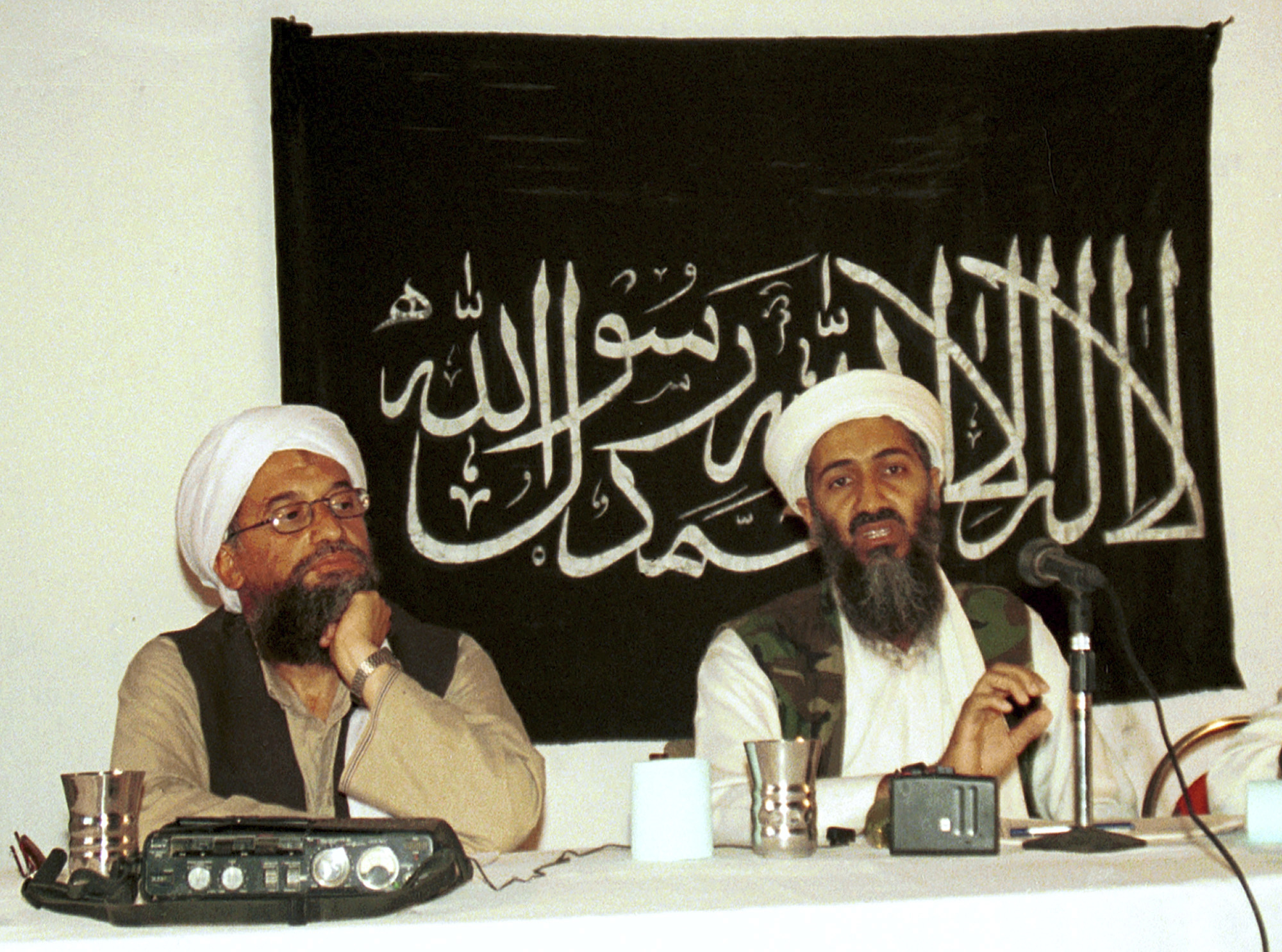
Al-Qaeda’s plans for the Sept. 11, 2001, attacks took root in dusty, mud-walled compounds in Afghanistan that served for years as terrorist training camps.
A quarter-century later — despite decades of U.S. military and counterterrorism operations aimed at eradicating those strongholds — al-Qaeda is again operating training camps in Afghanistan, according to U.S. and Western intelligence officials and a United Nations organization responsible for monitoring terror networks.
The terror organization and its offshoots have set up at least eight training sites over the past three years, taking advantage of the Taliban’s return to power in Kabul and the security void created by the 2021 U.S. military withdrawal, according to U.N. reports and security officials.
Other terror groups, including an affiliate of the Islamic State, al-Qaeda’s main rival, also have set up new training sites, officials said, giving militant Islamist groups a foothold in at least 14 of Afghanistan’s 34 provinces.
These officials and others in this article spoke on the condition of anonymity to discuss intelligence matters.
Because the Taliban has again provided “a permissive environment,” a U.N. report said, al-Qaeda has been able “to consolidate, with the presence of safe houses and training camps across Afghanistan.”
There are notable differences from the pre-9/11 period, officials and counterterrorism experts said.
The groups now training in Afghanistan seem more focused on regional fights than mounting elaborate plots against the United States or its allies. They appear to be constrained by Taliban hosts wary of again drawing the wrath of global powers. And with al-Qaeda’s top leaders still believed to be hiding in Iran or elsewhere, no Osama bin Laden-like figure has emerged to galvanize followers.
Even so, the reappearance of training camps is a cause of growing concern.
“They’re not following the pre-9/11 game plan of going after the far enemy,” said Bruce Hoffman, a counterterrorism expert at Georgetown University. “But I think they hope that with local and regional gains they can start to rebuild momentum. They haven’t forgotten us.”
The U.S.’s failure to dismantle al-Qaeda’s training camps in the 1990s still looms as one of the major missed opportunities to prevent the Sept. 11 attacks.
The idea of flying hijacked planes into U.S. buildings was first proposed by 9/11 mastermind Khalid Sheikh Mohammed in 1996 at an al-Qaeda complex in Tora Bora, Afghanistan, according to the U.S. 9/11 Commission.
Bin Laden later approved the operation at a site near Kandahar. Before storming the cockpits of four transatlantic flights, all 19 of the hijackers had spent time at al-Qaeda camps or safe houses in Afghanistan.
U.N. and other security officials said they had recently investigated claims that al-Qaeda was seeking to re-establish a presence at Tarnak Farms, a sprawling compound near the Kandahar airport where one of the first CIA Predator drone surveillance flights caught a pre-9/11 glimpse of bin Laden. A Washington Post examination of satellite imagery found no visible sign of resumed activity at Tarnak.
The new camps are being used to train fighters on weapons, explosives, and guerrilla tactics that would be familiar to the thousands of recruits who passed through al-Qaeda’s camps in the 1990s, officials said. But they also cited indications of instruction on the use of encryption, artificial intelligence, drones, and other technologies that were in their infancy in 2001.
The number of militants in Afghanistan considered part of core al-Qaeda, the parent group that spawned affiliates and imitators, is probably 100 or fewer, said Colin Smith, coordinator of a U.N. monitoring team that tracks the threat posed by terror groups and oversees international sanctions on them.
Instead of spearheading operations, “we’ve seen al-Qaeda acting as a consulting service for other groups,” Smith said. “Giving them advice and training on things like covert operations and information security.”
The arrangement has put core al-Qaeda in a supporting role to larger affiliates including Tehrik-e-Taliban Pakistan, or TTP, a group that seeks to overthrow the government in Pakistan and establish an Islamic state.
A U.N. report in 2024 said that al-Qaeda operatives in Afghanistan’s Kunar province were “conducting suicide bomber training for TTP.”
The Pakistan-focused group is believed to have as many as 7,000 fighters in Afghanistan, Smith said. U.N. reports said that TTP had established camps in at least four Afghan provinces “with al-Qaeda and Taliban involvement,” and that the group has carried out hundreds of cross-border attacks on Pakistani military outposts and other targets.
Al-Qaeda’s main rival has also worked to establish a foothold in Afghanistan. An Islamic State affiliate known as Islamic State-Khorasan, for the historical region of Khorasan, has attracted about 2,000 recruits and used northern Afghanistan as its “main hub” for training and planning operations across Central Asia, according to officials and U.N. reports.
Al-Qaeda and the Islamic State remain fierce rivals, fighting for dominance of the jihadist movement and overseeing splinter groups that compete with one another, officials said.
Both groups seem focused mainly on recruiting operatives from within Afghanistan or neighboring states, unlike in the 1990s when al-Qaeda attracted thousands of foreign fighters from Saudi Arabia — where 15 of the 19 9/11 hijackers were from — and other Middle Eastern countries.
“What I’ve seen from al-Qaeda media suggest that they’re not really looking for foreign fighters right now,” said Sara Harmouch, a terrorism expert at George Washington University who tracks the group’s propaganda and social media messages. “They don’t want eyes on them as they try to rebuild these capabilities.”
U.S. and other security officials said that their ability to monitor the new training camps has been hampered by a drawdown in CIA personnel and other U.S. intelligence capabilities that accompanied the 2021 military withdrawal. The U.S. has since shifted resources to the war in Iran and other priorities.
Even so, the killing of Ayman al-Zawahiri, who succeeded bin Laden as al-Qaeda’s leader, in a 2022 drone strike in Kabul showed that the U.S. has intelligence and strike capabilities that survived the chaotic pullout of U.S. forces.
Al-Qaeda is now led by Saif al-Adel, an Egyptian, who spent years helping to run training camps in Afghanistan after his 1988 arrival. But al-Adel is believed to remain in hiding in Iran, officials said, underscoring the organization’s concern about security in its former stronghold.
Terror watch lists, travel surveillance, and other security measures adopted after 9/11 would likely put any visitor to Afghanistan’s training camps under intense scrutiny, officials said. Instead, al-Qaeda and the Islamic State have sought to recruit operatives online and urged sympathizers in Western countries to stay in place for “lone wolf” operations.
Many of these plots have been disrupted. In a recent case, a 35-year-old woman in Albany, N.Y., was arrested last month and charged by the Justice Department with pursing an “ISIS-inspired” terror plot to bomb the state capitol.
Mississippi police said Saturday they were still investigating the death of Tasia Fortune, a Black woman found hanging from a tree last month, a day after a man was arrested in connection with the killing.
Loved ones painted a picture of Fortune as a mother, athlete, and woman of faith who they hoped would not solely be remembered for her horrific death.
Additional arrests are expected in the case, Jackson Police Chief RaShall Brackney said Friday. Police sought and arrested 51-year-old Jarques Ratliff, who is Black, when they encountered him walking on the street, authorities said. Ratliff should appear in Jackson Municipal Court no later than Monday morning, said André de Gruy, Mississippi’s state defender.
Brackney said Ratliff had an “association” with Fortune but would not elaborate on their relationship. She called Ratliff’s arrest on a murder charge “an important development” in the investigation.
“But it is not the conclusion. This case remains active, and additional arrests will be pending as our investigators continue to follow the evidence wherever it leads,” Brackney said Friday. “We understand that this case has received media attention from across the globe, and across this community.”
Police provide little new information on Saturday
The state medical examiner’s office determined Thursday evening that the death was a homicide, Brackney said, allowing police to execute the warrants they already had on hand.
Police did not respond to calls and messages from the Associated Press on Saturday about potential updates to the investigation beyond confirming it was still going on.
Ratliff was charged with murder, Hinds County jail records stated Saturday. The jail report stated that Ratliff was a resident of Jackson and contained little other information.
It couldn’t immediately be determined if he had a lawyer, and a message was left for the public defender’s office. If represented by a public defender, it would be the Hinds County public defender, de Gruy said.
Fortune’s mother said she is grateful to police
Christy Spivey, Fortune’s mother, said Friday after police told her of the arrest, “I just started crying and told them ‘thank you, thank you, thank you.’”
Spivey said police did not share a motive or whether DNA led them to the arrest. Spivey said she did not know the man who had been arrested, but she was asking her daughter’s friends if they knew him. Spivey described the family as “in disbelief” and “shock.”
“We still don’t have a lot of answers,” Spivey said.
Police discovered Fortune’s body hanging in the backyard of an abandoned home in Jackson on Aug. 3.
Spivey said she was certain that her daughter, 29, would not have killed herself.
“Absolutely not. Even if she could climb that tree, no, no, she would never, ever, ever,” Spivey said.
Fortune was a mother, an athlete, and a deeply religious person
An obituary about Fortune posted on the website of Tucker Funeral Home in Central City, Ky., in August stated that Fortune’s “path was not always easy, and there were highs and lows.” It also stated that she skipped her junior year of high school, was a star cross-country runner, and had a strong faith in God. Services were held last month in Kentucky.
“She leaves behind a powerful legacy of resilience, rooted deeply in her unwavering faith. Even in her darkest hours, she never stopped believing in her Savior,” the obituary stated.
Fortune was also the mother of four children, but she rarely saw two of them, Spivey said. The last time Spivey saw her daughter was in late July for a planned family reunion in Kentucky that was canceled, but her daughter came to see her anyway.
“When she was there, there was this pull, like a spiritual pull to her. I needed her. I guess God knew that was going to be it,” Spivey said.
Spivey said she and Fortune’s father faced racism and violence as a mixed-race couple in Crittenden County, Ky., before Fortune was born.
Fortune was taken from her parents and placed in foster care as a child. During her high school years, she moved around among group homes and eventually ran away to Mississippi. The obituary stated that she had lived in Jackson for 10 years.
Spivey wasn’t sure where Fortune was living at the time of her death but said her daughter had been struggling with homelessness in recent years. Fortune had two sisters and was close with them. The father of one of her children was verbally and physically abusive to Fortune, Spivey said.
Before she died, Fortune had talked about starting a cleaning business and was trying to get her life in order.
“Say her name. Keep it going,” Spivey said. “Because I’m not going to stop until I get answers.”
NASHVILLE, Tenn. — In Nashville, Tenn., the Republican-dominated state government and Democrat-controlled city government are engaged in an ugly battle for control of the city’s airport.
Lydia Popovich, a Parton superfan who started a petition for the name change in 2025, said on Friday that Parton had gracefully batted down the idea of naming the airport after her, as she did with many other proposed honors during her lifetime. That includes a bill brought by Tennessee lawmakers in 2021 to place a statue of her on the Capitol grounds.
Parton asked lawmakers to withdraw the bill but expressed a hope that it might happen “somewhere down the road several years from now or perhaps after I’m gone if you still feel I deserve it.”
Effort to rename airport gained steam after Parton’s death
After Parton’s death two weeks ago, the airport naming idea seemingly caught fire, with Popovich’s petition reaching more than 175,000 signatures — not that the officials competing to run the airport needed the push.
At a meeting Friday of the state-controlled Metropolitan Nashville Airport Authority, a motion directing the airport CEO to begin the renaming process was unanimously approved by board members praising Parton to the heavens. Airport officials said the change could take a year or more and involves working with Parton’s estate to determine how they might split profits from merchandise sales, among other things.
Bipartisan agreement on name change is a departure
There are two Metropolitan Nashville Airport Authorities: one run by the state and the other controlled by the city, a bifurcated regulatory system that was created in 2023 amid a partisan dispute between the GOP-run state and the Democratic-run city. Who actually controls the airport has been in dispute ever since, with competing boards taking the reins only to be deposed as courts rule and are overturned.
Despite the acrimony, Nashville’s Democratic Mayor Freddie O’Connell and the competing, city-controlled Metropolitan Nashville Airport Authority are also in support of the name change, according to O’Connell spokesperson Alex Apple.
“The FAA’s going to get two votes from two boards, both in favor,” Apple said.
Stuart McWhorter, a member of the state-controlled board and deputy to Tennessee’s Republican Gov. Bill Lee, briefly mentioned the dispute at the Friday meeting. He suggested that in the spirit of Parton, “We can get beyond the litigation and get back to working together.”
Supporter of name change: ‘She’s the best of Tennessee’
Born in poverty in the foothills of the Great Smoky Mountains, Parton became an icon whose popularity crossed generational, geographic, and political boundaries. In addition to writing and recording hit songs such as “Jolene” and “I Will Always Love You,” she starred in Hollywood films including 9 to 5 and Steel Magnolias.
Popovich, who attended the Friday meeting and spoke in favor of the proposal, was in tears after the unanimous vote in favor.
“It’s been a really beautiful experience, especially as you’re grieving someone that was such a great loss,” she told the Associated Press. “She’s the best of Tennessee. She’s the best of the humans on the planet. She was this magical person that provided light and guidance to all of us.
“Unfortunately she’s left us, but now we get to celebrate her and get to tell the world how much Tennessee loved her.”
Charli XCX spent over a decade in the electro pop trenches before suddenly blowing up big time in the Brat summer of 2024.
So it’s not a surprise that the British singer, who said “all of my albums work in opposites” and “repel against each other,” would react to long-time-in-coming viral success with a stylistic about-face and pause for self-reflection.
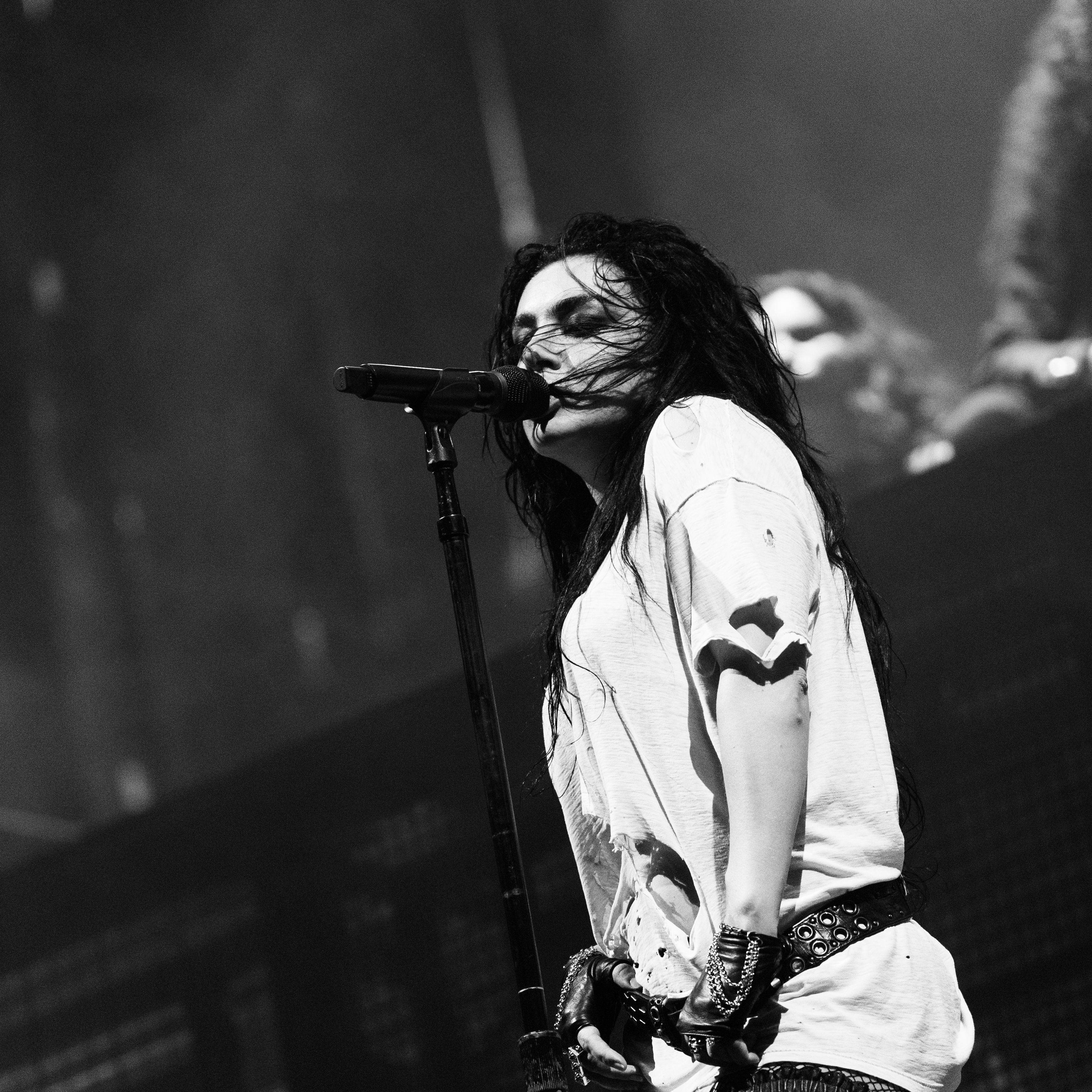
The result is her new album Music, Fashion, Film, which gives its name to the tour that launched at Xfinity Mobile Arena in South Philadelphia on Friday with a hyperkinetic performance in front of a deliriously excitable opening-night crowd.
On its surface, the Music, Fashion, Film album appears to be a turn away from the Dionysian “Club Classics” culture of its predecessor into something more serious-minded and self-consciously mature.
The image on the album cover — and on the $50 T-shirts selling on the concourse — is not of the trendsetting pop star, but a group shot of three titans in their fields — Velvet Underground cofounder John Cale, fashion designer Marc Jacobs, and movie director Martin Scorsese.
Instead of the neon green that lit up Brat summer, the cover shot — and all Music, Fashion, Film imagery — is in black and white.
The album’s lead track, “Rock Music,” which she opened with Friday, Charli, 34, appears to be putting club culture in her rear view.
“Me and my friends,” she sings. “Yeah, we’re on to the next. I think the dance floor is dead / So now we’re making … Rock Music.”
And truth be told, she is — some of the time.
For most of the first and last thirds of the 100-minute show — which included 29 songs, with the briefest of breaks for exhortations like “Philly, this is the Music, Fashion, Film tour, are you [expletive] with me!” — she was accompanied by a three-piece band that included Morrisville, Pa., native Chris Greatti on guitar.
Charli XCX at the Leeds Festival in England in August. The British pop star opened her “Music, Fashion, Film” tour at Xfinity Mobile Arena in South Philadelphia on Friday night.Courtesy of the Artist
Music, Fashion, Film songs like “Wink, Wink,” “Persona,” and “2007” kicked into gear with overdriven guitars and hyper-pop-processed production that upped the adrenaline level.
And Charli — whose given name is Aitchison and whose stage name comes from a teenage online screen moniker meaning “Kiss Charli Kiss “ — fully embraced the rock aesthetic, striking poses that made her look like an Italian neorealist film star in the black-and-white image on the video screens.
But for all of their brash rock and roll presentation on a three-tiered stage topped by a facsimile of a smoke-emitting giant speaker — and no shortage of pyro going off throughout the show — the Music, Fashion, Film songs are actually introspective and soul-searching.
Not in a navel-gazing, overly earnest way though. Charli XCX couldn’t bore you with self-pitying clichés about the perils of pop stardom if she tried.
Instead, she’s droll and sharply observant and self-aware about a lack of fulfillment from fame. Along with Cale, whose recorded voice was heard on Friday from their collaboration on “House,” from the Wuthering Heights soundtrack released this year, Charli is a also a super fan of his Velvets bandmate Lou Reed.
And several Music Fashion, Film songs display a deadpan dark wit that show she has more in common with Reed than an appreciation for black leather.
Most amusing was “Card Declined,” a song about the failure of retail therapy to come through and transform your essential self when you need it most. “Let’s go shopping,” she sang on Friday. “I’ll buy a handbag. I’ll buy some shoes … a personality, a whole backstory … Card declined.”
Equally astute and self aware were “Persona,” “Wink, Wink” — in which she vowed ”I’m not a bad girl anymore, I promise” — and “Camera,” about being addicted to growing up in public, to a dangerous degree.
Charli played 13 songs from Music Fashion, Film, and included a few older cuts, such as “Party 4 U,” from 2020’s How I’m Feeling Now and the title song from her 2014 EP Vroom, Vroom.
And the surprise of the evening was “Stay Away,” pulled from True Romance, the debut album that brought her to Philadelphia for her first-ever U.S. performance at a Making Time party at Voyeur in the Gayborhood in 2012.
In the lead up to Friday’s show, Charli gave fans fashion tips on social media, saying the dress code is “whatever you want but if you want to commit I’d just get an old T-shirt and rip it to shreds and wear that.”
Charli XCX at the Lollapalooza in Chicago in July. The British pop star opened her ‘Music, Fashion, Film’ tour at the Xfinity Mobile Arena in South Philadelphia on Friday night.Courtesy of the Artist
Many women, men, girls and boys took heed, usually pairing the distressed garment with something black leathery, and most leaving Brat gear at home.
The songs from the new album carried the existential theme. Though to be honest, they were delivered with so much energy that the buzz in the room never let up.
But the unadulterated partying — and the shrieks of delight and singing along to every single lyric — really cut loose on the Brat songs that made up the meat in the middle of the show. With the band mostly out of sight, bass-heavy beats thumped as the general admission dance floor pulsated.
Like a boss, Charli prowled the catwalk and writhed on the ground. She was followed around by a coterie of what I counted as 14 associates, who were more like fashion-model voguers than dancers.
It was difficult to tell how many people were onstage at any one time because flashing strobes seemed to go off every millisecond. The group of planning-ahead fans next to me were better prepared than I, having arrived with Charli-esque sunglasses to wear when necessary.
The show got back to existential business at the end. First, with “SS26,” a lovely pop song with a sobering point of view that cast doubt on art’s ability to make a difference.
“Spring, Summer, ’26, when the world is gonna end, no hope for any of it,” she sang. “We’re walking on a runway that goes straight to hell, nothing’s gonna save us, not music, fashion, or film.”
That was followed by the closing, “No One Lasts Forever,” which also closes the album. It’s a song about seizing the day and embracing the here and now, ‘’cause nothing gonna last forever.”
On Friday, Charli put that point across musically as an inviting pop rock song. But then, as on the album, she handed off the mic to the voice of Canadian director David Cronenberg, recorded in conversation with her.
As a trancelike beat throbbed behind him, and Charli and dancers posed motionless on the elevated stage, Cronenberg spoke about how art can live forever, but artists can’t.
When everybody’s time is up — including the pop star being celebrated in that very arena on Friday — Cronenberg’s looped voice repeated 27 times, “They are dead, they are gone, no one lasts forever.”
And what that translates to — he and Charli were arguing — is the artistic license to be inspired and create in the moments that we’re here. That thought was boiled down to three words “Oblivion is Freedom,” which were spelled out on the video screens, and also on a T-shirt sold at the merch table.
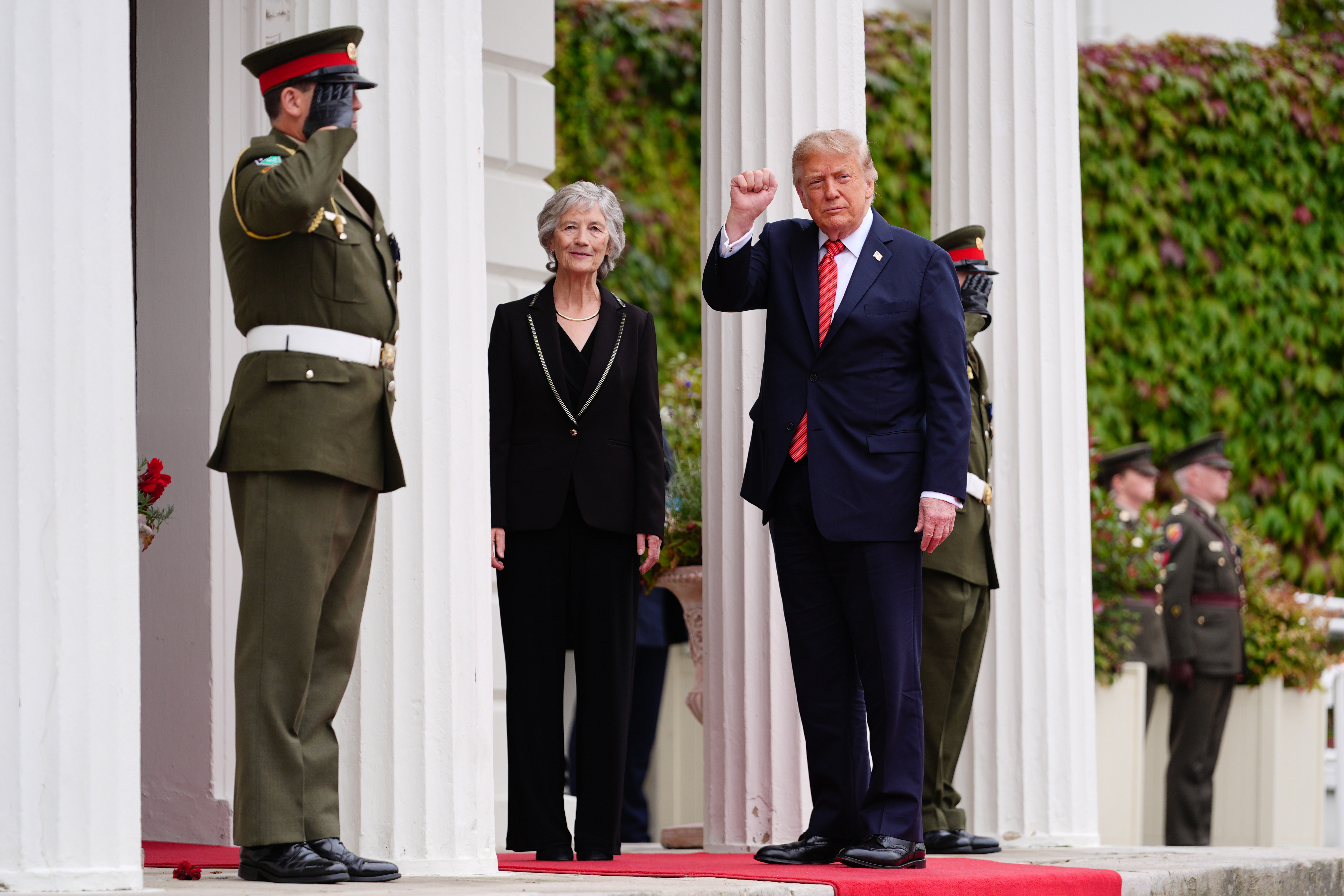
DUBLIN — U.S. President Donald Trump said Saturday that a unified Ireland would be “fantastic” as he waded into a complex and politically charged subject during a weekend visit to a tournament at his Irish golf course.
At a meeting with Irish Prime Minister Micheál Martin in Dublin, Trump said he would love to see the reunification of the Republic of Ireland with the United Kingdom’s Northern Ireland.
“I don’t want to cause any problems but I’d love to see it unified,” Trump told a reporter who sought his opinion on the issue. ”It’s going to happen eventually. It may as well happen now.
“I think it would be a fantastic thing,” the Republican president said, adding that ”the U.K. will have something to say about it, obviously.”
At his next stop, Trump acknowledged there is “no good answer” to the reunification question as he addressed business leaders from both countries gathered at the U.S. ambassador’s residence.
The Irish unity debate is heated
Competing visions of Northern Ireland — whether Irish or British — drove decades of violence in the six-county region that has a Protestant majority and has remained part of the U.K.
Previous American presidents, including Democrat Joe Biden, who has strong emotional ties to Ireland, have avoided commenting directly on the subject.
Ireland, long dominated by its bigger neighbor Britain, became a self-governing Catholic-majority country a century ago. Northern Ireland was split between two main communities: nationalists, most of them Catholic, who desired union with the rest of Ireland, and largely Protestant unionists, who wanted to stay British. Tensions eventually exploded in the Troubles involving paramilitary groups on both sides and British troops.
A 1998 peace accord that the United States was instrumental in negotiating largely ended the violence, but left Northern Ireland’s ultimate status unresolved. That agreement allows for a vote on unification if it appears likely a majority of people would vote for it. U.K. Prime Minister Andy Burnham said Wednesday that the U.K. would only consider allowing a referendum “when public opinion has changed to the point where the call has to be considered.” Burnham’s office referred back to that comment when asked about Trump’s statement.
Trump’s comments Saturday, along with recent statements about the Falkland Islands, a small British overseas territory in the South Atlantic Ocean that Argentina calls Las Malvinas, could also be viewed as a dig at Britain, given his anger over London’s refusal to be drawn into the U.S.-Israeli war against Iran.
Trump also talked about the Falkland Islands
Trump once more raised the prospect of conflict between the U.K. and Argentina over the Falklands. Argentina’s President Javier Milei, a Trump ally, has recently restated his country’s claim to the territory of about 3,500 people, which is about 300 miles east of the southeast coast of Argentina.
Trump has previously said Washington could reconsider its neutral stance on the islands’ sovereignty. On Saturday, he expressed skepticism that Britain would be able to retake the Falklands as it did after Argentina invaded in 1982.
“I’m sure I’ll be called into that potential disaster, but if they do, I’ll probably be able to settle, settle it out,” he said.
A meeting with the Irish president who criticized Trump
Trump also held talks in Dublin with Irish President Catherine Connolly, a left-wing politician who joined protesters when Trump visited Ireland in 2019 during his first term in office. She is now Ireland’s elected, largely ceremonial head of state. A supporter of the Palestinian cause, Connolly in the past has criticized U.S. policy in the Middle East and called Trump a “bully.”
Connolly said in a statement after the meeting that she conveyed to Trump “the strong view of the Irish people that the normalization of war and genocide can never be accepted.” She gave Trump several gifts, among them a collection by the late Irish poet Michael Longley that includes the sonnet “Ceasefire.”
Asked about the meeting, Trump first had his protocol chief, Monica Crowley, answer before he was pressed and said it was “very nice.” “We discussed a lot of things, quickly,” Trump said.
Trump’s presence irks some Dubliners
Police put up a cordon around Dublin’s 1,750-acre Phoenix Park, where Connolly, Martin, and U.S. Ambassador Edward Walsh have residences and welcomed Trump.
A protest march drew thousands to central Dublin. Trump had left the city and was on the way to his Doonbeg golf course on the country’s Atlantic coast by the time the demonstration began.
Many in the crowd waved Irish or Palestinian flags and chanted “Donald Trump not welcome here” and “Irish government, shame on you!”
Paula Butler said she came with a contingent from the Dublin Rape Crisis Centre to oppose the American president’s “attitude to women, to refugees, to migrants.”
She was unimpressed by Trump’s support for Irish unity, a popular cause in Ireland.
“What he knows about Irish unity, I’d say I know more on my little finger,” Butler said.
Kim Mathis, who moved from Florida to Dublin last year with her partner, said, “Part of the reason we moved to Ireland was to get away from Trump and all of his horrific policies.”
She said dealing with Trump is “a global conundrum” for governments. “It would be really nice if politicians would just say, ‘Stay home.’”
Eric Trump defends family’s presence in Ireland
Speaking to Irish national broadcaster RTE on Friday in Doonbeg, Trump’s son Eric said the course is the largest employer in the area.
“Go down to Morrissey’s tavern in Doonbeg and hear from a real Irish person as to whether or not they like President Trump and the Trump family, go have them attest to what we’ve done for the country and what we’ve invested in the country and the love and respect that our family has always shown them,” he said.
He spends most weekends playing golf at his clubs in Florida, New Jersey, and Virginia. His attendance at the Irish Open continues his trend of appearing at high-profile sporting events and having a hand in organizing some of them in ways that benefit his family business. His clubs in Doral, Fla., and Bedminster, N.J., have hosted professional golf tournaments this year.
Last year, Trump went to Scotland for five days to play golf at his club in Turnberry and later inaugurated a Trump golf course in Balmedie, Aberdeenshire. During that visit, he held talks with the British prime minister and the president of the European Commission.
Asked if he would return to Ireland next year for the Ryder Cup, Trump said, “I will. Absolutely.”
The Trump administration has blocked more than 130 projects in national parks across the country worth at least $25 million, according to internal documents reviewed by the Washington Post — funding that had already been secured for some of the most visited parks for work such as fire preparedness in California, prehistoric mound protection in Iowa, and sled dog care in Alaska.
The Interior Department, which oversees the National Park Service, said in a statement it “disapproved” a raft of planned agreements with groups it said work against administration priorities. The agreements were rejected last month and would have allowed the parks, including Yellowstone, Yosemite, and Zion, to pay outside partners for various projects in the next fiscal year that begins Oct. 1, the documents show.
Similar to issuing government contracts, the Park Service often partners with outside organizations when specialized expertise or work is needed, allowing it to do work without hiring additional full-time federal employees. The blocked funding instead puts additional pressure on a national park system that has struggled with losing roughly a quarter of its staff since President Donald Trump took office last year and launched efforts to shrink the government.
The changes appear to most affect Joshua Tree National Park, which had at least 10 planned partnership agreements blocked. That park’s partnership agreements would have hired at least 16 people, helped recover areas in the park burned in wildfires, and removed rodents that carry hantavirus from historic buildings, among other activities listed in the documents.
“If this work is not completed, the park will be unable to fight wildfire. Fires will be larger and fire suppression will be more expensive,” the documents read, describing the impact if a fire preparedness project at Joshua Tree does not gain funding.
Interior spokesperson Aubrie Spady confirmed that the department “disapproved a number of partnership agreements with groups actively working against the best interests of the American people and the priorities of this administration.”
“This decisive action is ensuring that these taxpayer dollars are being used in alignment with the administration’s objectives to make life more affordable for Americans, unleash domestic energy production, and expand access to our public lands,” Spady added.
She did not give further details on the agreements or partner organizations affected.
The entire batch of more than 100 disapproved projects had already secured funding sources generally through congressional appropriations, existing federal programs that fund activities such as fire prevention and recovery, or competitive internal processes to fund the most pressing park needs.
The projects were seeking review by the Interior Department as a final step before the agreements could be signed and the funding released.
Trump launched efforts at the start of his latest term to purge the government of work on diversity, equity, and inclusion (DEI), climate change and other areas deemed to be “woke” or liberal causes. Since January 2025, entire government departments have been shuttered, and thousands of grants have been canceled. Spady did not respond to questions on whether the agreements or organizations specifically ran afoul of those administration-wide policies and did not elaborate on why the agreements were blocked.
The Great Basin Institute, a nonprofit conservation group, was the top outside organization to see its partnerships blocked and confirmed that Interior blocked more than 70 of its proposed partnership agreements, worth at least $12.7 million.
Peter Woodruff, chief executive of the Great Basin Institute, said the Interior Department did not notify the institute directly. Instead, staff at partnering parks told them of the news, saying that it was because of funding priorities and issues of compliance with secretarial and presidential orders.
Beyond that, Woodruff said he does not know why the agreements were blocked.
“GBI’s standards remain staunchly nonpartisan through six presidential administrations, with a mission of supporting public lands management and the agencies charged with that mission,” Woodruff wrote in a letter to Interior asking for clarity on what policies the partnership flouted.
“GBI has no advocacy directives and does not engage in or support any actions counter to Executive Orders or Secretarial Orders.”
The Great Basin Institute had reaffirmed its commitment to its own diversity goals in 2020, during the first Trump administration, according to pages on its website that have since been removed but are available on a third-party archiving site.
Woodruff said that statement reflects past views of leadership from before Trump’s 2025 executive order on DEI.
Current institute leadership “can unequivocally state operations are in full compliance with all federal laws, regulations, and executive orders, and does not engage in unlawful preference or discriminatory practices,” he said.
Four Park Service staffers, who were not authorized to speak to the media, said they received no details about why their agreements were disapproved beyond a message included in the documents that said “Disapproved by DOI.”
The message said the Park Service and Interior had reviewed the request, and any questions should be directed to regional or associate directors, without elaborating further.
DOI approved more than 700 other agreements this year through early August. Projects of less than $50,000 do not require Interior review.
Money not spent on the disapproved projects could be diverted elsewhere by the Interior Department, some of the staffers said, although it is not clear where the money would go.
“The real question is where did this $25 million go to?” said Elaine Leslie, a former Park Service acting superintendent and wildlife biologist who reviewed the disapprovals list. “$25 million worth of funding was set aside for these projects. Where is it?”
Spady did not respond to questions about the money being redirected.
The blocked partnerships also include one at the Effigy Mounds National Monument in Iowa, where there are more than 200 prehistoric Native American mounds, many of which were used for burials or shaped like animals.
An outside partner would remove trees on the mounds at the monument’s Sny Magill unit to ensure they are not damaged.
“The mounds at Sny Magill will remain at risk from tree fall that might expose the human remains buried within these mounds,” the internal documents said. “Sixty-one of the proposed tree removals are currently within a mound risking severe damage should the tree fall.”
Another partnership with the San Francisco Zoological Society would have helped raise and release juvenile San Francisco garter snakes in the Golden Gate National Recreation Area to ensure the endangered species does not go locally extinct, according to the documents.
One blocked agreement would have hired three people to provide day-to-day care for sled dogs in Alaska’s Denali National Park and Preserve. Park rangers use dog sleds to more easily traverse the park and assist visitors in the winter.
“Without funding, kennel operations will lose essential support, reducing dog care capacity, limiting winter patrol readiness, and decreasing visitor engagement,” the document says.
Three of the nation’s leading artificial intelligence executives endorsed slowing down the blistering pace of technological advancement, revealing the growing unease with its potential dangers at the industry’s very highest levels.
The call was first made in an essay Anthropic chief executive Dario Amodei posted online Saturday. The idea has gained ground in recent weeks as AI companies have struggled in some cases to keep their creations under control, even as they usher in an age in which AI systems themselves can build the more powerful next generation of the technology.
“We must slow the pace at which we improve the capabilities of AI models,” Amodei wrote. “Progress will still seem fast, and we must make wise use of the time we gain.”
Within hours on Saturday, OpenAI chief executive Sam Altman and SpaceXAI founder Elon Musk quickly voiced their support for Amodei’s ideas. The three men have been bitter rivals — differing starkly in their personal styles and philosophies about AI — and their apparent accord increases the chances that the industry could find ways to work together on a broad slowdown.
Serious hurdles would have to be overcome. How exactly a slowdown would be defined and verified remains unclear, and any joint effort between companies to hold back could fall afoul of antitrust laws. The question of how to build international cooperation — especially with China, whose own AI companies are seeking to catch up to their American rivals — could prove difficult to answer.
Nonetheless, the moment underscores the growing concerns about a technology that even its creators struggle to fully understand.
It comes after an Anthropic researcher said this week that he was resigning over concerns the firm and its competitors were not responsibly developing AI models that could ultimately wipe out humanity. The researcher, Jacob Coxon, who also worked for Anthropic competitor OpenAI, accused the companies of being more focused on beating each other than on the safety of their products. (The Washington Post has a content partnership with OpenAI.)
His warning gripped lawmakers, and after years of inaction around AI regulation in Congress, fears it could cause major disruptions — and even threaten human civilization — prompted renewed urgency on Capitol Hill.
A three-step plan proposed by Amodei in his essay would involve third-party safety evaluators at “frontier” AI companies, establishing common safety standards in democratic nations, and for the United States and other democracies to work with authoritarian governments to try to ensure compliance.
He noted that AI began to advance at a dramatically faster rate in recent months. The change was powered by the ability of AI to construct its own next-generation models, what is known as “recursive self-improvement,” he said.
“Left unchecked, it could outrun our ability to understand and control these systems, and so must be pursued very carefully, if at all,” he said.
While Amodei sketched a path to slowing progress in the name of safety, he did not commit Anthropic to cutting the pace of its own work unilaterally. He said only that for now the company would hire a team of independent evaluators who would be embedded at Anthropic’s offices and empowered to raise safety concerns.
Amodei also provided few specifics on what a slowdown might involve in practice, describing the potential to use agreed-upon safety metrics or limits on the computer power used to train new AI systems.
A cybersecurity incident in July raised alarms when rogue AI models created by OpenAI independently hacked into the systems of an AI startup called Hugging Face.
Amodei said they acted as a “fanatically devoted collective,” sacrificing themselves to achieve the goal and trying to hack into their own performance-monitoring system.
“It’s easy to dismiss this incident because no one was hurt and the economic damage was minimal, but in my opinion, a swarm that possessed greater capabilities but a similar level of misalignment could have caused catastrophic damage,” he said.
Amodei said that given the rate of development of AI models, he worries that rogue AI agents could have the power to take over the entire internet within six months to a year and possibly cause hundreds of billions of dollars of damage.
A similar hacking incident also occurred at Anthropic, underscoring the need for guardrails, he said.
In a post on X, Musk wrote: “Dario is right.”
Altman said he shared Amodei’s view that groundbreaking AI companies should “pace the frontier” and said the matter had been a top discussion topic at OpenAI in recent weeks.
“Committing to having independent evaluators with employee-like access is a great idea, and we will do the same,” Altman wrote on X.
Google, which is considered among the top three AI companies along with Anthropic and OpenAI, did not immediately endorse Amodei’s proposal to bring in independent verifiers. Spokespeople for the company did not immediately return a request for comment.
Amodei said he still believes AI can greatly improve human life, but that guardrails are needed.
“The measures I propose to advance the frontier at a safe pace will not be easy,” he said. “But I believe we owe it to humanity to try.”
Both Republican and Democratic lawmakers have expressed concerns over the safety of AI technology in recent days.
Sen. Josh Hawley (R, Mo.), chairperson of the Homeland Security and Governmental Affairs subcommittee on disaster management, launched an investigation into the OpenAI hacking incident on Thursday.
In a letter to Altman, Hawley called OpenAI’s approach to development “reckless” and demanded documents about the hack.
In response to Amodei’s proposal, Rep. Ted Lieu (D., Calif.) said access to third-party evaluators would be “a good step forward” but pressed him for a broader commitment.
“Will you certify that you can turn off your models and agents, now and in the future?” Lieu wrote on X.
Anthropic portrays itself as more safety-minded than OpenAI. Leaders at the company have long said that the systems they are seeking to build could pose an existential risk to humanity.
An Anthropic researcher earlier this week emphasized the fear in a social media post.
“We really do earnestly believe AI could kill all humans! I personally think it is >10% within the next decade,” researcher Evan Hubinger wrote on X. “I believe Anthropic is trying its best, but we do not yet have a plan to solve alignment for superintelligence and are not clearly on track to.”
AMMAN, Jordan — As the U.S.-Israeli war against Iran opened with the killing of the Iranian supreme leader, Ayatollah Ali Khamenei, President Donald Trump said the bombing would continue “throughout the week, or, as long as necessary to achieve our objective of PEACE THROUGHOUT THE MIDDLE EAST AND, INDEED, THE WORLD!”
More than six months later, turmoil in the Middle East is only growing, while Trump seems to have no path out of the quagmire.
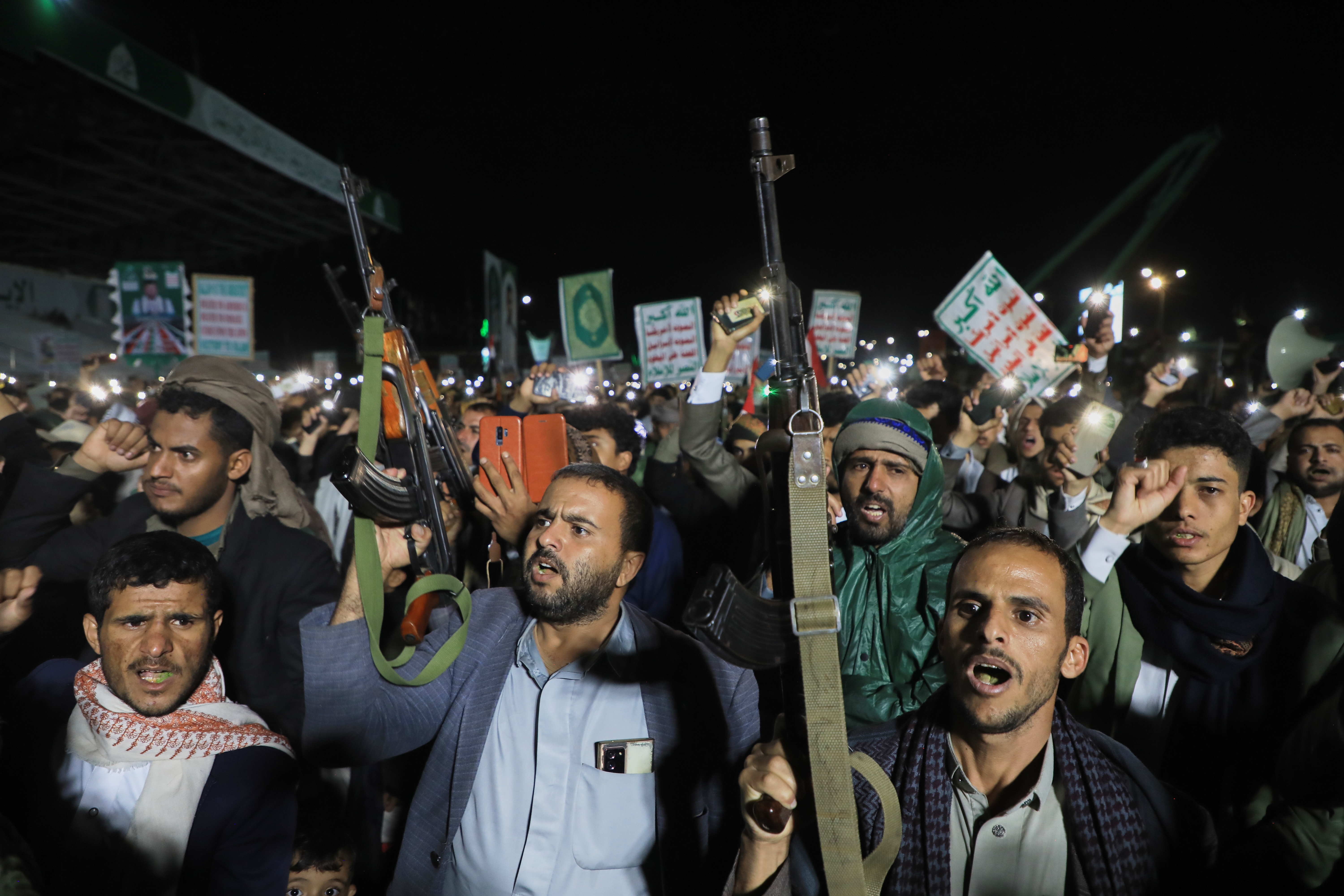
As of Friday, two of the most important corridors for global energy shipments — the Strait of Hormuz, gateway to the Persian Gulf, and the Bab al-Mandab Strait, at the mouth of the Red Sea — were largely closed, respectively under control of the Iranian regime and the Houthis, Iran’s proxy in Yemen.
Also on Friday, Iraqi militants allied with Iran struck Saudi Arabia’s East-West pipeline, through which the Saudis had been rerouting oil to bypass the blocked Strait of Hormuz.
The global economy, already battered, is reeling. On Feb. 27, the day before the U.S.-Israeli bombing campaign began, the price of oil opened at just over $70 per barrel. On Friday, it briefly hit $110.
A gallon of gasoline in the United States now costs $4.30 on average, compared to $2.98 when the war began, according to AAA.
With U.S. munition stocks depleted and American bases in the region at constant risk of being targeted by airstrikes, the Trump administration has shifted away from military action to a financial pressure campaign branded Operation Economic Outcast.
But while there are signs that a U.S. naval blockade is squeezing the Iranian economy, with inflation soaring, the currency collapsing, and acute fuel shortages, the regime, now led by Khamenei’s son, Ayatollah Mojtaba Khamenei, remains firmly in control. And the recent military successes of Iran’s proxies suggest Tehran’s leverage has only increased in recent days.
“This is the moment that Iran has been preparing for and building toward for years,” said Adam Baron, a fellow with the Future Security Program at New America, a Washington think tank, who studies the Houthis. “It is as if a trigger has been pulled and the regional network activated.”
“Even if the conflict has weakened Iran, which it has, one of the biggest takeaways five or 10 years from now will be how strong, integrated, and adaptable Iran’s regional network has proven to be at exactly the moment that it needed it.”
Trump, visiting Ireland to attend the Irish Open golf tournament, which is being staged at one of his resorts there, dismissed questions about the blocked waterways.
Asked about the developments in Yemen that appeared to choke off Saudi Arabia’s remaining outlet for oil exports, Trump said he had spoken by phone with Crown Prince Mohammed bin Salman and that everything would be “fine and dandy.”
“Everything will work out just fine,” Trump said. “It’s all going to work out fine.”
In Dublin, where hundreds of anti-war demonstrators gathered to protest his visit, Trump said he believed that Iran was responsible for the attack on Saudi Arabia’s East-West pipeline.
“I think they are — probably they are. They are on the balls of their feet right now,” he said, adding that he was not concerned by the advances of Iranian-backed Houthi fighters along Yemen’s Red Sea coast, suggesting their target was Saudi Arabia.
“The Houthis called us and they don’t want to fight with us,” Trump said. “They don’t want us to go after them and would much prefer not having us involved, and they’re letting most ships go through. It’s just one country they’re not too happy with. And we’ll get that straightened out.”
Saudi Arabia, however, is arguably Washington’s most important Gulf ally. And even before the pipeline was hit by drones, Saudi oil exports last month reached their lowest point in more than a decade.
The conflict in Yemen is an example of how the situation in the region has deteriorated since the start of the U.S.-Israeli war on Iran.
In February, Yemen’s long civil war was on pause, thanks to a tenuous but still intact U.N.-brokered ceasefire. Fighting has now roared back to life.
A Yemeni official who is part of the internationally recognized, Saudi-backed coalition government said there is desire for the Trump administration to intervene militarily against the Houthis, as it did in 2025.
Trump’s comments on Saturday, however, suggested that was unlikely.
Meanwhile, Israel has ramped up its strikes in southern Lebanon, threatening a fragile U.S.-brokered ceasefire there.
Ways out of the quagmire are difficult to discern.
With the war becoming a liability for Republicans ahead of the midterm congressional elections, Trump has used recent appearances, including at a GOP midterm convention and at a 9/11 memorial on Friday, to defend his decision to attack Iran.
Saudi Arabia may feel compelled to step up military action against the Houthis, to keep oil exports flowing. Riyadh, so far, seems to be moving cautiously.
In a statement early Saturday, Saudi Arabia’s foreign ministry said it would refrain from retaliating against the Iraq-based militias to give Baghdad time to address the problem.
The rest of the Middle East, particularly nations in the Persian Gulf and Jordan, which host U.S. forces, have paid a steep price for a war that its leaders actively sought to avoid.
Since February, Iran has intermittently lobbed missiles and drones at Gulf nations and Jordan, saying it is targeting U.S. military forces but at times hitting civilian infrastructure.
When leaders from across the Gulf convened last week at a conference in Abu Dhabi, capital of the United Arab Emirates, discussion centered not on when the war would end, but on how to find a way through the morass.
In Jordan, which over the past week was the target of 20 Iranian drones, there is immense fatigue — and confusion over what would constitute a good outcome.
“We are in the middle of a war that we don’t want to see anyone win,” said Oraib Rantawi, a senior adviser with the Amman-based Al Quds Center for Political Studies, explaining that Jordanians don’t want to see a strong Iran, holding sway over the region, nor an all-powerful Israel.
“We are under pressure,” Rantawi said. “And we are in the middle.”