Jalen Hurts was watching morning TV three years ago when he saw something that stopped him in his tracks.
“I was very blown away by school not being canceled for snow, not for a hurricane or tropical storm, but for lack of AC,” the Eagles star quarterback said Tuesday.
So Hurts went about doing something to fix that.
On Tuesday, he stood on Northeast High’s stage to announce his foundation was putting up $600,000 to air-condition the school’s auditorium.
Mayor Cherelle L. Parker and Eagles quarterback Jalen Hurts are greeted by selected students at they arrive at Northeast High School Tuesday, Sept. 15, 2026 where Hurts announced he was giving the school $600k for an air conditioning system.Tom Gralish / Staff PhotographerTiffany W. Thurman, the mayor’s chief of staff, takes a surreptitious selfie as Eagles quarterback Jalen Hurts (rear) waits in the office before the rally.Tom Gralish / Staff PhotographerNortheast Viking cheerleaders warm up their classmates appearance before the Eagles quarterback arrives onstage.Tom Gralish / Staff PhotographerStudents and staff react as Hurts appears at the pep rally.Tom Gralish / Staff PhotographerWhen asked why he was turning his attention to city schools, Hurts said, “it’s about service and showing up for those around you.” Tom Gralish / Staff PhotographerSchool Superintendent Tony B. Watlington, Sr. greets Jalen Hurts at a pep rally at Northeast High School Tuesday, Sept. 15, 2026. At left is Kathryn Epps, president & CEO of the Fund for the School District of Philadelphia.Tom Gralish / Staff PhotographerCity Councilmember Isaiah Thomas wipes perspiration from his face, onstage in the sweltering auditorium. Northeast senior Mekhriyona Ilkhomova (right) spoke during the event to thank Hurts and his foundation.Tom Gralish / Staff PhotographerHurts onstage with principal Andrew Lukov (from left) School Superintendent Tony B. Watlington, Sr. and Mayor Cherelle L. Parker.Tom Gralish / Staff PhotographerHurts signs jerseys and meets with Northeast staff as he leaves the school.Tom Gralish / Staff PhotographerNortheast High School students watch from their classroom – with a window air conditioning unit – as Eagles quarterback Jalen Hurts leaves the school Tuesday, Sept. 15, 2026 following his donation of $600k for an a new cooling system.Tom Gralish / Staff Photographer
The timing was good: Although temperatures were in the high 60s when Hurts made his announcement, it was sweltering in the auditorium, with more than 1,000 students, teachers, and dignitaries in the room. Sweat ran down the faces of members of the marching band toting heavy instruments and cheerleaders in long-sleeved uniforms. Mayor Cherelle L. Parker cooled herself with a small personal fan.
When Hurts watched that TV spot, about half of the district’s schools were not air-conditioned. Hurts’ largesse has helped get the number down, but 52 schools — about a quarter of district buildings — still lack air-conditioning.
Hurts, on Tuesday, said he wanted to move the needle more for Philadelphia schools.
“Let’s get it to zero,” Hurts said of the number of schools without air-conditioning. “I want to get it to zero.”
Northeast High School watch from their classroom – with a window air conditioning unit – as Eagles quarterback Jalen Hurts leaves Tuesday, Sept. 15, 2026 following his appearance there to give the school $600k for an a new cooling system.Tom Gralish / Staff Photographer
Asked why he was turning his attention to city schools, Hurts said he was influenced by his educator parents and the people who made a way for him.
“It’s about service and showing up for those around you,” the quarterback said.
Northeast High had window units cooling classrooms prior to Hurts’ announcement, but the auditorium, a hub of the school and the community, was tough to use in the spring and summer months, said Andrew Lukov, the school’s principal.
“This changes everything for us,” Lukov said.
A beaming Parker, who made sure to lead the adoring Northeast crowd in an E-A-G-L-E-S chant, spelled correctly, led the crowd in giving Hurts a standing ovation.
“Jalen, on behalf of the entire city of Philadelphia, we say thank you for your gift,” Parker said. “You will have an impact on more than the 3,400 students who attend this school on a daily basis. You’ve also done something even more important: You’ve used your time, your treasure, and your celebrity to assist a constituency who will never be able to walk in your shoes.”
Eagles quarterback Jalen Hurts as he appears at a rally in the auditorium at Northeast High School Tuesday, Sept. 15, 2026 to give the school $600k for an air conditioning system. With him onstage in the auditorium Northeast principal Andrew Lukov, School Superintendent Tony B. Watlington, Sr. and Mayor Cherelle L. Parker.Tom Gralish / Staff Photographer
It feels a little surreal that a major space in an important school lacks adequate climate control in the United States, said Mekhriyona Ilkhomova, a Northeast senior whose speech earned a broad smile and a hands-over-heart gesture from Hurts.
Hurts’ donation matters, not just because of the money but because of who he is, said Ilkhomova, a standout student and athlete.
“It reminds us students of what we can become,” she said, “and what we can give back after becoming.”
The state of the cool
District officials had promised the entire system would be air-conditioned by 2027; the system appears off track to reach that goal.
While Northeast is getting an upgrade, 52 schools lack air-conditioning.
When temperatures are forecast to hit 85 degrees or higher by noon, those 52 schools are dismissed early. If the weather forecast calls for temperatures of 85 or higher before 9 a.m., those schools are closed for in-person instruction and remote learning days are called.
That means unequal experiences, with students in some schools not missing instructional time when it’s hot, and those in a quarter of schools subject to interrupted schedules.
School Superintendent Tony B. Watlington, Sr. (right) greets Eagles quarterback Jalen Hurts as he appears at a rally in the auditorium at Northeast High School Tuesday, Sept. 15, 2026 to give the school $600k for an air conditioning system. At left is Kathryn Epps, president & CEO, The Fund for the School District of PhiladelphiaTom Gralish / Staff Photographer
Four weeks into a new school year, Philadelphia has had two heat-interrupted days at the 52 schools.
Cooling the remainder of the 52 schools is not as simple as buying air-conditioning units: Many old buildings lack adequate electrical systems to support whole-school cooling.
One of the many things we won’t forget about the Trump era is how much the family of POTUS 47 has enriched itself — not only the president but his children, including Donald Trump Jr., who is said to be now worth at least $500 million and growing. So it was no surprise when his second marriage to Palm Beach, Fla.’s Bettina Anderson in May was a lavish affair on two private islands in the Bahamas. What is a surprise — as we now know from some stunning work by a team of reporters from ProPublica — is who paid: a very close associate of Russian dictator Vladimir Putin. So maybe the “Russia, Russia, Russia” folks were onto something?
Pa. Democrats are alarmed at the rapid growth of ICE-police deals. But can they stop them?
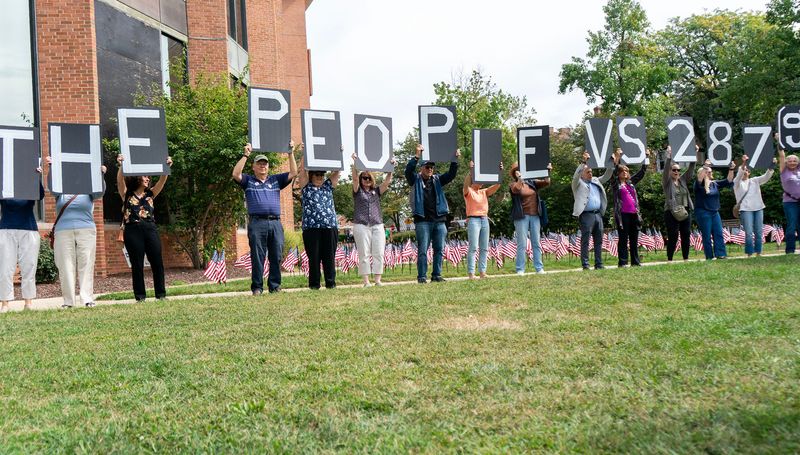
Immigrants’ rights advocacy group members and their supporters hold up letters that read “The people vs 287(g)” during a rally last September in Doylestown against the Bucks County sheriff’s efforts to implement a 287(g) program.Daniella Heminghaus | Bucks Coun
The big, mostly under-the-radar story around the Donald Trump regime’s relentless push to arrest and remove immigrants from the United States has been this year’s explosion of so-called 287(g) agreements. These allow local cops to act as immigration agents, working collaboratively with U.S. Immigration and Customs Enforcement, or ICE.
But if you look at a national map to understand how these 287(g) agreements have spiked from just 135 when Trump retook office in January 2025 to more than 2,500 such pacts today, you’ll notice that one state sticks out like a sore thumb.
In Pennsylvania, amped-up promises of federal cash incentives have meant a soaring number of localities where local beat cops are now working with ICE to make arrests — up from just a handful at the start of the year to some 130 now. Most 287(g) collaborators are in Trump-voting pockets of the Keystone State — northeast and south-central Pennsylvania, or out west near the Ohio border.
But when you look at the rest of the Northeastern United States, the 287(g) map is very sparse. That’s partly because most local pols across the region agree with their constituents about opposing Trump’s mass deportation policies, and in several states it’s also the result of legislation that aims to ban the program altogether.
In late August, New York enacted the Local Cops, Local Crimes Act — backed and signed by its Democratic Gov. Kathy Hochul — which calls on police departments and county sheriffs to terminate their 287(g) agreements, although several counties are still challenging the measure in court. Maryland has a similar law on the books, while New Jersey, which had long prevented such pacts under an attorney general’s directive, also passed a law this spring to codify the ban.
There’s a growing number of Pennsylvania lawmakers who want to pass a similar law here, but there’s one big problem: Republicans. They control the state Senate in Harrisburg — currently by a 27-23 margin — and GOP lawmakers have no interest in rebuking the president on immigration policy.
“The reason we exist alone is because of our split legislature,” State Rep. Heather Boyd, a Democrat who represents heavily immigrant Upper Darby and adjacent parts of Delaware County, told me. Last year, Boyd circulated proposed legislation to ban 287(g) deals in Pennsylvania, and while dozens of Democrats in Harrisburg are supportive, any move is on hold until a November election that could shift the balance of power. Boyd said lawmakers are wary of “starting any culture wars” ahead of the vote.
I pressed the office of Gov. Josh Shapiro, who’s running for a second term and who is seen as a possible top contender for the 2028 Democratic presidential nomination, for his position on reining in the 287(g) program here.
“Governor Shapiro has been clear that law enforcement should be focused on keeping Pennsylvanians safe — not sowing fear in communities or targeting people who are working hard, raising families, and contributing to our Commonwealth,” his press secretary, Rosie Lapowsky, said. She noted that the governor has barred Pennsylvania State Police from any formal ICE collaboration, and he would urge local police to take a similar stance.
She added: “Ultimately, however, these decisions rest with local law enforcement agencies. The governor does not have the unilateral authority to dictate whether individual sheriffs or police departments enter into these agreements.”
Many of those local law enforcement agencies have instead rushed to join 287(g), with ICE promising small-town departments an initial $100,000 cash windfall and additional incentives for training officers to make arrests and to cover the cost ofworking overtime on the program.
Last week, I reported from Schuylkill County in east-central Pennsylvania, where some 14 law enforcement agencies have raced to adopt 287(g), more than any other county in the state. Since the spring, local cops there have arrested about 100 immigrants at highway stops or by assisting ICE in job site raids. The blitz has prompted rising complaints about alleged racial profiling, the handcuffing of U.S. citizens, and a sense of fear that permeates a growing Latino community in Pennsylvania coal country.
Statistics obtained from the U.S. Department of Homeland Security by advocates show that local police in Pennsylvania have arrested and turned over to ICE more than 1,200 immigrants this year — ranking the state fourth in the nation on a list in which the other leading states are all south of the Mason-Dixon Line.
In Washington, some of the state’s Democratic House members say they’re fed up with a lack of transparency over who is being detained and how the 287(g) program is working here. Last week, four of them — Reps. Mary Gay Scanlon and Madeleine Dean from the Philadelphia suburbs and Reps. Chris Deluzio and Summer Lee from Western Pennsylvania — sent a letter to ICE’s acting director David Venturella demanding information on why the agency’s data lack any specific details about which departments are making arrests, which is required by law.
“It is unacceptable to me that ICE is hiding information from Pennsylvanians about who ICE is working with in their mass deportation regime,” Deluzio — viewed as a potential 2028 primary challenger to embattled Sen. John Fetterman — told me in an emailed statement.
Deluzio also summed up the growing unease by many over the speedy growth of 287(g) in the state. “Let’s keep local law enforcement focused on local public safety, rather than enlisting them in extreme federal immigration enforcement that has ripped away American liberties and targeted so many law-abiding families,” he said. Indeed, 287(g) data guru Andrew Thrasher has reported that a whopping 70% of the immigrants arrested in Pennsylvania under the program have no criminal record or pending charges.
“People in my community are getting smashed off the streets,” said Boyd, the Upper Darby lawmaker. That Delco township is about to vote on a local ordinance to restrict its cops from collaborating or sharing data with ICE.
Statewide, Boyd says she’s one of about 50 House Democrats in a Welcoming Pennsylvania Caucus with an extensive list of proposed bills that would not only bar 287(g), but look to expand opportunities for noncitizens to do things like obtaining driver’s licenses or gain professional certification. But any serious action hinges on November, when Democrats are hoping a blue wave at the ballot box will flip at least three more Senate seats and create a trifecta for their party in Harrisburg.
“Even if we can’t stop ICE from picking them up on the streets, we have to protect their rights,” Boyd said. “And right now, there are barriers to that in the state of Pennsylvania.”
Yo, do this!
The issue of wrongful convictions is back in the news here in Philadelphia — but for all the wrong reasons. Some reckless and seemingly wrongheaded moves by Philadelphia District Attorney Larry Krasner and his underlings have the vultures who’ve always opposed criminal justice reform circling. The shame is that the real crisis around wrongful conviction is the thousands of mostly Black and brown folks who remain behind bars for crimes they did not commit. I cannot say enough about a book that came out earlier this year from Brown University (yay!) sociologist Nicole Gonzalez Van Cleve called Crime Fictions: How Racist Lies Built a System of Mass Wrongful Conviction. She mines the most outrageous prosecutions — often of young Black teens and boys — to make a compelling argument that wrongful convictions aren’t a flaw in the criminal justice system. They are the system.
If timing is everything, then you’ve got to hand it to my freshman dorm pal at Brown who became Washington bureau chief for Mother Jones, David Corn. On the heels of ProPublica’s bombshell reporting on ties between the Trump family and Vladimir Putin, Corn is out Tuesday with his newest book: How Russia Won — Donald Trump, Vladimir Putin, and the Fight for America. It promises a raft of new information about Russia’s efforts to meddle in U.S. elections in 2020 and 2024, the ongoing close links between Team Trump and Team Putin, and how the current president’s pro-Russian slant has changed the world.
Ask me anything
Question: What happens when [House Speaker Mike] Johnson refuses to seat newly elected Dems in January? — David Minckler (@audivita.bsky.social) via Bluesky
Answer: Suddenly, Jan. 3 — the date the 120th U.S. Congress begins, and new members who won their November elections are to be sworn in — has become the new Jan. 6. Summer vacations are over, and the body politic is focused on the looming midterms, and — more importantly — with polls showing the Democrats on track to retake one and possibly both chambers. So there’s been a surge of speculation that the Trump-allied Johnson will do what former Vice President Mike Pence would not do on Jan. 6, 2021, and somehow fail to certify Democratic winners. That’s based on an assumption that Trump’s election-meddling tactics like stopping mail voting — blocked on Monday by the U.S. Supreme Court — won’t work, yet Team MAGA will attempt to undo the election after the fact, as was tried unsuccessfully in 2020-2021. Lawfare has published the most detailed analysis of a so-called rogue clerk theory in which Johnson appoints a MAGA loyalist to serve as House clerk with the understanding that some Democratic wins won’t be certified. Its article notes that such a gimmick is unlikely to pass muster in the courts, but that won’t necessarily stop Trump and the GOP from trying. My only guidance is: Fasten your seat belts.
What you’re saying about …
It turns out readers of the newsletter aren’t eager to join the punditocracy. Only a few of you responded to last week’s question about the chances of a Democratic-led Senate in 2027, and one of them was to give me a verbal tongue-lashing for even asking this. (Frequent writer Daniel Fleisher called it “a pointless exercise in predicting the unpredictable.”) That said, Cathy King has her eye on Abdul El-Sayed in Michigan, her home state, writing that “he seems to be following [Zohran] Mamdani’s playbook.” Meanwhile, in Iowa, Mary Chilton thinks the Dems’ Josh Turek has a real shot in a state won three times by Donald Trump, noting that farmers are up in arms “over the data center issue, imported beef, water pollution and the soaring cancer rates …”
📮 This week’s question: Suddenly, everyone is talking about one thing: the Silicon Valley whistleblowers saying there’s not a trivial chance that a swarm of angry artificial intelligence agents could wipe out humankind by the end of the decade. Are you worried by this, or do you think Big AI is deflecting here to draw attention away from other issues like data center opposition or the stock market bubble? Please email me your answer and put the exact phrase “the AI threat” in the subject line.
Backstory on that other thing that could kill humanity
A barge on the Ohio River moves past the Mountaineer Power Plant, a coal-fired power plant near New Haven, W.Va., in March.Carolyn Kaster
This weekend, a Bluesky post went super viral almost the second its author, a scientist named David Ho, hit the button to post it. “I resigned from ExxonMobil today,” he wrote. “I spent the last three years doing fossil fuel extraction research at both BP and ExxonMobil. Neither company is acting responsibly. They are racing to maximize extraction while the window to act closes, and gambling with our lives.”
It’s a safe bet that many of the 13,000 people who liked Ho’s post truly believed they were sharing the words of a brave whistleblower — but instead the post was satire from a leading climate scientist based at the University of Hawaiʻi at Mānoa. Ho would never work for a Big Oil giant. He was trying instead to mimic — and thus make a point about — the recent posts from Silicon Valley whistleblowers that triggered the new freakout over whether AI robots are a threat to human existence.
Climate change is a threat to society, and it’s even closer to reality. Maybe we should freak out about that?
Ho absolutely has a point. Just before his post, it was announced that August had been tied for the hottest month ever recorded in the history of the planet. That doesn’t come without consequences. In the Himalayas between Nepal and Tibet, a glacier and the adjacent bedrock of mountains at 17,000 feet abruptly collapsed in a region plagued by higher-than-normal temperatures, sending a 150-foot-high cocktail of floodwater and debris down a populated valley at 100 mph. At least 1,386 were killed, and thousands more remain missing. Here in the U.S., a summer of record heat triggered wildfires across the Pacific Northwest.
Robots didn’t do this. Humans did. Maybe that’s why humans — at least the ones that are running Donald Trump’s America — are reacting so differently to the danger of AI than the way they’re dealing, or not dealing, with the lethal pollution from burning fossil fuels. In the case of artificial intelligence, even tech leaders like Anthropic’s Dario Amodei, whose firm makes the Claude program, have urged a slowdown until we better understand the risk from rogue AI agents.
But in the case of climate change, willful ignorance rules the day. The latest outrage from a Trump regime that’s expensively killing off wind farms while racing to extract as much fossil fuel as possible? The now ironically named Environmental Protection Agency is repealing the rule that limits greenhouse-gas emissions from power plants that burn coal or natural gas. A president who spent his summer sweltering on the golf course continues to insist climate science is “the greatest con job ever perpetrated on the world.”
There’s one last irony here. Increasingly, the biggest new sources of climate-altering pollution are the massive data centers that power AI. An Amazon data center proposed for Pecos County, Texas, would likely become the world’s largest source of carbon dioxide if it opens, spewing out 33 tons from natural gas generators every year. Slowing down the AI arms race would also help the planet. Artificial or not, that would be intelligence.
What I wrote on this date in 2019
Joe Biden performing badly in a presidential debate? Say it ain’t so, Joe. We all remember what happened on that 2024 stage in Atlanta (“The night the lights went out in Georgia,” I called that one), but I was almost as unimpressed with the future 46th president during a Democratic primary debate on this date seven years ago. That put me at odds with the punditocracy. I wrote, “The cable TV news show that both channels and is most revered by Washington’s elites — MSNBC’s Morning Joe — is at times so over the top in its bias toward Barack Obama’s former wingman that it could be renamed Morning Joe Biden.”
Summertime is over, and the living is no longer easy. I published my monthlong investigation into local cops collaborating with ICE under the controversial 287(g) program in semirural Schuylkill County, northwest of Philly. I found U.S. citizens handcuffed, families hiding behind blanket-covered windows, and a community wrestling with what it means for neighbors to be treated as suspects. Over the weekend, I delved into the astonishing $850 million or so Trump World has raised in campaign contributions since his reelection — despite the fact that he’s barred from seeking office again. You don’t think he has a scheme to pocket the excess cash, do you?
Dante only had Nine Circles of Hell, but the downward spiral of Pennsylvania Sen. John Fetterman seems to be never-ending. It’s one thing to profoundly disagree on a political and moral issue such as the war crimes of Israel’s right-wing government in Gaza, but recent reporting suggests things are far, far worse in Fettermanland. No senator — regardless of how much their ideology has flip-flopped — should be blowing off their home-state constituents, or clocking out of committee hearings after five minutes. The Democratic senator’s surprise video appearance at the midterm miniconvention of Donald Trump’s GOP, introducing his new best buddy, Republican Sen. Dave McCormick, did nothing to dispel the sense of utter betrayal among liberal voters who now see his winning 2022 campaign as a big lie. The next two years will be crazy as Democrats line up to primary Fetterman, amid rumors the hoodie-clad politico might run as an independent or even change parties. The only sure thing is that The Inquirer will be there for every move. Join us. Subscribe!
By submitting your written, visual, and/or audio contributions, you agree to The Inquirer’s Terms of Use, including the grant of rights in Section 10.
As the risks posed by artificial intelligence have exploded into the national consciousness during the past few days, I’ve seen people everywhere grasp the danger, and then sink into bewilderment and fear, or a resigned fatalism over how now we’re all gonna die. Versions of this mindset: “This threat from AI is so new and so overpowering; how do we wrap our brains around it? What do we do?”
The answer? We lean into some of the nation’s most basic — and most demonstrably effective — legal principles.
I’ve been practicing law for more than 30 years, and American jurisprudence has dealt with new situations involving humans and their inventions for centuries. It provides a guide now on how to respond to AI.
Here are a few things it’s come up with: We require people to not create unreasonably dangerous products. This is the field of product liability, which keeps a company from putting out inherently dangerous products.
I know someone who lost a finger in the 1970s when he tried to unclog a grass chute inside an electric lawnmower. The risk of that happening has plummeted in the years since because safety guidelines were changed to ensure that when you take your hand off the handle, the motor stops.
This is how product liability makes products safer. Does it cost more? Yes. Does it result in safer products the company is putting out into the stream of commerce? Yes. We can apply the same requirements to AI: It can’t be so dangerous that there’s a risk of destroying humanity.
We require people to keep potentially dangerous pets in their care on a leash. Think of walking your dog. Your dog can’t just run free, terrorize other people, and poop on their lawn. AI is the dog of Big Tech companies, and shouldn’t be allowed to do those things, either. It should be on a leash. That’s called government regulation.
Dario Amodei, co-founder and chief executive of the artificial intelligence company Anthropic, has called on industry leaders to slow AI development for fear of losing control of the technology. KARSTEN MORAN
U.S. Rep. Ro Khanna (D., Calif.) issued some very good, specific suggestions for regulation that should be implemented immediately, starting with creating a federal agency to oversee safety like we have for airlines and nuclear power, and requiring specific technological safeguards before a product can go to market.
Finally, we punish people criminally for recklessly endangering other people.
It is literally the crime of REAP, “reckless endangerment of another person,” and examples would be dropping a heavy object off an overpass or carrying a loaded weapon in a backpack with the safety off. I was an appellate law clerk for several years handling criminal cases, and in my opinion, the risk posed by AI, and the recently demonstrated failures of rules that have been put in place (e.g., instructions to AI “not“ to do something, which it then promptly does, and putting AI agents in “sandboxes” that are supposed to isolate them, which they immediately get out of and find other places to communicate secretly, as in the July hack of the AI company Hugging Face), may meet the requirements of reckless endangerment.
I think we’re getting there. Executives at OpenAI, Anthropic, and other AI companies should be warned that they are being evaluated for potential criminal punishment under this statute.
I get that AI tech bros want that “monster IPO” when they go public, and want to become instant billionaires or trillionaires. The prospect of making a humongous amount of money clouds one’s judgment. They’re underestimating the risk because they want the money.
It’s our role to give them a more accurate assessment of the risk, and to put limits in place.
The AI is a problem. But the bigger underlying problem is the arrogance and recklessness of its human creators that got us to this point in the first place.
The danger exists; it is real. We don’t have the luxury of remaining frozen in fear. We do have tools to start mobilizing to meet the threat and reduce it. We have to start now.
Linda Falcão is a civil rights attorney, former appellate law clerk, U.S. Presidential Scholar, and the creator of America Serves, a teen service program.
Nearly 6 million Reading Terminal Market visitors, a mix of locals and tourists, spent $1.2 billion in Philadelphia last year, according to a new study on the economic impact of the historic Center City market.
It’s the first time the nonprofit Reading Terminal Market Corp. has commissioned such a report, and the stats solidify the market’s status as “a beloved civic institution, and a powerful and vital economic engine for Philadelphia and Pennsylvania,” said Annie Allman, CEO and general manager. With the report, Allman said she is encouraging “continued investment in the market, its merchants, and its infrastructure.”
It highlighted the market’s importance to lower-income residents, with 18 Reading Terminal merchants accepting SNAP and EBT benefits. This accounts for about 55% of the Center City merchants who accept food-assistance programs, according to the report. Reading Terminal Market is considered the largest EBT- and SNAP- redemption location in Pennsylvania.
“Every dollar spent here is a dollar invested in Philadelphia — in our merchants, our hospitality industry, our neighbors, and our future,” Allman said in a statement.
The “Feeding the City, Fueling the Economy” report — released Tuesday and conducted by the Philadelphia firm Econsult Solutions at Reading Terminal Market Corp.’s request — found that the market has contributed about $126 million worth of annual economic activity to the city of Philadelphia and $146 million to the Commonwealth of Pennsylvania. These figures include direct spending at the market’s more than 75 vendors, as well as the subsequent spending by those vendors and the employees they pay.
Diners at the Reading Terminal Market in June.Alejandro A. Alvarez / Staff Photographer
The new report found just over half of the market’s visitors last year, 3.1 million customers, were visitors staying overnight in the region, while the rest were Philly-area residents.
Some Reading Terminal customers may have first heard of the market online, on a podcast, or on TV and streaming programs: The report found that Reading Terminal reached 10.8 billion people through these kinds of media mentions, equaling $81 million in “publicity value.”
People enjoy the pop-up outdoor area on Filbert Street at Reading Terminal Market in July. Tom Gralish / Staff Photographer
Between the market’s merchants and the corporation that runs it, Reading Terminal pays nearly 700 full-time-equivalent employees a combined $39 million a year, according to the report.
And market partners spend about $6.1 million a year on capital improvements, which include mechanical, plumbing, and electrical upgrades, as well as larger undertakings like the 2022 Filbert Street Project that added 15,000 square feet of pedestrian-friendly outdoor space.
Founded in 1893, Reading Terminal is one of the country’s oldest continuously operating markets. Spanning nearly 80,000 square feet along 12th Street, between Arch and Filbert Streets, the market sells everything from fresh produce and seafood to meats and homemade baked goods.
At its quick-service restaurants, customers can find Caribbean cuisine, Asian street food, Filipino-fusion eats, Thai food, falafel, cheesesteaks, and vegan bites.
Allman, CEO and general manager, said 2026 “brought unprecedented global attention” to Philadelphia. This summer, the city hosted the World Cup, America’s 250th birthday celebrations, and the MLB All-Star Game. Any economic impact those events had on Reading Terminal Market, however, would be reflected in next year’s report.
Correction: This story has been updated to reflect that $1.2 billion is the estimated total spend by Reading Terminal Market visitors in Philadelphia, not in the market alone. It also reflects how much market partners spent on capital improvements.
“Donald Trump’s illegal attempt to undermine our Constitution and prevent eligible voters from making their voices heard in this election by voting by mail has failed,” Shapiro said in a statement posted to X on Monday night in the wake of the ruling.
In March, the president issued an executive order that directed the U.S. Postal Service to help decide which voters should receive mail ballots. Shapiro, a first-term Democrat running for reelection this fall, had used his power as governor to join Pennsylvania as a plaintiff in a multistate lawsuit against the Trump administration, arguing the limits would unfairly prevent thousands of voters from being able to cast a ballot and would unconstitutionally violate states’ rights to administer elections.
Since 2019, under a state measure known as Act 77, any voter in Pennsylvania may request to vote by mail ballot. The ruling Monday means nothing will change for those who were planning to vote by mail, whether by submitting their ballot through the mail or over the counter at their county’s election office. Eligible residents may also vote in person at their polling place on Election Day.
“Counties will continue to administer free, fair, safe, and secure elections. And I’ll stand ready to continue protecting your right to vote — no matter what the Trump Administration tries next,” Shapiro, a likely contender in the 2028 presidential race, wrote on X.
The deadline to register to vote in Pennsylvania’s contests, which include the governor’s race and four competitive congressional seats that could help determine control of the U.S. House, is Oct. 19. The last day to apply to vote by mail is Oct. 27. Ballots must be received by Nov. 3 at 8 p.m. to be counted.
Trump’s directive stemmed from his long-running grievance against mail voting, despite repeatedly utilizing the method himself. He had instructed states to develop an approved list of voters, to prevent noncitizens from voting, and ordered the Postal Service to withhold mail ballots from individuals not on the approved list.
On Tuesday, he called America’s mail voting system a “disaster” and said the justices who voted to block his order, some of whom he had appointed, “are merely a shell of their original selves” in a post on Truth Social, his social media platform.
At the Republican Party’s midterm convention in Dallas last week, Trump asked attendees to pledge that they would vote whether they are “registered or not” and to “try to cheat like hell like they do,” despite no evidence of systematic voter fraud by either party.
Pennsylvania Democrats and election officials in the state had doubted the viability of Trump’s order throughout the court proceedings — but said the renewed debate could still instill concern among voters that their ballots might not be tabulated.
Secretary of State Al Schmidt, a Republican appointed by Shapiro, called the effort an “unprecedented federal overreach” into Pennsylvania elections during a news conference Tuesday, and cheered the announcement.
“This ruling is a major victory for Pennsylvania voters and, importantly, provides much needed finality for voters and counties ahead of this year’s election,” he said.
In New Jersey, Democratic Gov. Mikie Sherrill also applauded the Supreme Court’s decision.
“This is another win for New Jersey voters and another loss for Donald Trump’s attempt to rig elections.”
The number of cancer deaths estimated to be attributable to alcohol in the United States doubled from 1990 to 2023, particularly among men and people aged 55 years and older, according to a University of Miami study published this month, adding to the body of recent research underscoring the health risks of alcohol consumption.
Around 23,126 people died of alcohol-attributable cancer in 2023, up from 11,361 in 1990, according to the study, which estimated the deaths using a global database of disease mortality and population-level estimates of alcohol exposure.
The impact of alcohol, a known carcinogen, increased over the past decades as cancer mortality decreased overall, according to the study.
“Even though overall the cancer mortality was going down for some of these cancers … alcohol-associated mortality was going up,” said Chinmay Jani, a hematology-oncology fellow at the University of Miami’s Sylvester Comprehensive Cancer Center and one of the authors of the study. “Which means that alcohol as a risk factor was impacting more cancer deaths in 2023 than it was in 1990.”
What cancers have been linked with alcohol consumption?
The breakdown of alcohol in the body produces chemicals that can damage DNA and cause cancer. Alcohol can also affect hormone levels, including estrogen, which can lead to breast cancer.
The leading causes of alcohol-attributable cancer deaths in 2023 were liver, esophageal, and colorectal cancer, according to the study. The incidence of colorectal cancer in particular has increased among younger people in recent years, other studies have found.
For many cancers, the proportion of deaths attributed to alcohol increased over time, even as overall cancer mortality declined. The increases were more pronounced in people 55 or older.
While alcohol has been closely linked to several types of cancer, including mouth, throat, liver and breast cancer, its connections to other types of cancer like stomach and pancreatic cancer are still being investigated, researchers said. The study also found links between deaths from those cancers and alcohol use, which could warrant further research, Jani said.
The study also found large disparities in alcohol-related cancer deaths across states. Washington, D.C., had the highest alcohol-attributable cancer mortality rate in 2023, while Utah had the lowest, according to the study. Previous studies have found links between states with less restrictive alcohol policies and higher shares of alcohol-related cancer deaths, the authors wrote.
Is there any ‘safe’ amount of alcohol?
Jani said that the study did not analyze individual-level data on alcohol consumption or confirm a reason for why alcohol-attributable cancer deaths increased.
Gilberto Lopes, chief of the division of medical oncology at Sylvester and another author of the study, added that the data did not establish a safe threshold for alcohol consumption.
“It is difficult to ascertain exactly what the safe level of alcohol is,” Lopes said. But “it is quite clear that we do know the mechanisms through which alcohol causes cancer. So that there’s no dispute about.”
Other researchers have urged the tightening of U.S. drinking guidelines, a push that has drawn political controversy. A June study initially commissioned by the federal government found that having more than one drink a day can raise the risks of cancer and other illnesses, though the Department of Agriculture loosened its drinking guidelines in January.
Priscilla Martinez-Matyszczyk, a researcher at the Public Health Institute and a co-author of the June study, said that the University of Miami study did not examine the risks of people’s average daily alcohol intake but that its findings on alcohol-associated deaths supported previous research.
“These findings reinforce the growing literature that alcohol plays an important role in the cancer landscape,” she said.
Lopes said that people should make their own decisions on alcohol consumption but that everyone should be aware of its health risks.
“Our job as cancer doctors is not to tell adults how to live. It is to make sure they are making that decision with accurate information,” he said. “If someone wants to minimize their cancer risk from alcohol, less is better, and none is best.”
A coed bathhouse is opening in Philly. Its business model involves choreographed sauna rituals and Bitcoin-heated pools.
Bathhouse opens on Friday, Sept. 25, at 1418 Walnut St., transforming the Bellevue Hotel’s defunct basement food court into a sprawling facility with three saunas, three pools, a steam room, and appointment-only massages. The 36,000-square-footspace is the largest standalone wellness complex in Philly. It’s also the latest in a gambit to rebrand sweating as an activity that is simultaneously sexy and productive.
“Our business is technically a 7,000-year-old business,” said Travis Talmadge, a certified sauna master and Bathhouse’s cofounder. “People have been building hot rooms to sweat in forever, and pools aren’t a new concept … All we’re doing is bringing the best-in-class” versions of both.
The cold plunge inside Bathhouse’s 36,000-square-foot location in the basement of the Bellevue Hotel.Tyger Williams / Staff Photographer
After opening another New York City location in 2024, Bathhouse received a $35 million investment from Imaginary Ventures, the investment firm that previously backed beauty brands such as Glossier, Kosas, and Alix Earle’s Reale Actives.
Now, Bathhouse is on an expansion tear. Philly’s location will be the first outside of NYC, with other outposts planned for Chicago, Nashville, Los Angeles, Minneapolis, North Jersey, and Connecticut.
Roughly 1,000 people pass through each of the company’s now three NYC locations per day, Talmadge estimated. Most, he said, are focused on decompressing before or after work. Others, he said, use it in place of happy hour with friends. Some are even on dates. None, Talmadge stressed, want a spa.
Bathhouse cofounder Travis Talmadge is a certified sauna master who also hosts aufgusses, a traditional German sauna ritual.Tyger Williams / Staff Photographer
“Spas really focus a lot more on relaxation and pampering,” he said. “There’s really no pampering [here]. There’s nothing relaxing about sitting in a 200-degree room or a 45-degree pool.”
The amenities
Bathhouse draws on Russian, Turkish, and German bathing rituals to create a distinct wellness experience.
The Philly location is launching with a steam room and three saunas: a 140-degree infrared one; a 190-degree traditional Russian banya heated by a wood stove; and a large dry room warmed to 180 degrees that Talmadge repeatedly referred to as the “event sauna.” Its lights have “the capabilities of a nightclub,” Talmadge said, and can change color to match the beat of the music during Bathhouse’s regularly scheduled sauna rituals.
The space also has hot and neutral pools alongside a traditional cold plunge, plus private rooms for full body massages and an on-site cafe for smoothies, beer, natural wine, and light bites. (A rooftop pool and sauna will open in May, Talmadge said.)
The dry “event” sauna room at Bathhouse heats to 180 degrees Farenheit. It’s also where sauna masters perform aufgusses — German sauna rituals — for guests.Tyger Williams / Staff Photographer
Zach Seidman, head of marketing for the Bellevue, called Bathhouse “a complement” to the Sporting Club’s fitness-first offerings. “There’s nothing like it in Philadelphia,” he said.
The infrared sauna at Bathhouse is the gentlest of the Philadelphia location’s three saunas.Tyger Williams / Staff Photographer
In theory, Bathhouse is the cheapest of them all. Day passes at the Philly location start at $29 but are subject to change based on demand and time of day.
Talmadge said Bathhouse tries to avoid trends. Instead, they are singularly focused on hosting aufgusses, a theatrical German ritual wherein a sauna master melts essential oil-doused snowballs on a bed of hot stones. To circulate the scents, the sauna master then whips towels around the room like helicopter blades.
The hot pool at Bathhouse Philadelphia. Located at 1418 Walnut St., it is the brand’s first location beyond New York City.Tyger Williams / Staff Photographer
In Philly, Bathhouse will likely host aufgusses every 90 minutes in — naturally — the event sauna, lead by certified sauna masters. Talmadge, who earned the title in 2021, said each sauna master has their own playbook of tricks meant to evoke a smile, if not some sort of spiritual experience. (His is a double-towel spin mixed with a bit of catch-and-release.)
“Some people really love the aromatherapy and want to see how the scents hit their nervous system,” Talmadge said. “Other people love watching the show and are in it for the tricks … Everyone has their own experience.”
The Bitcoin
What, exactly, is powering your Bathhouse experience? Bitcoin, in part.
Since its 2019 founding, Bathhouse has used small on-site data centers of Bitcoin miners to warm its pools and heated seats, extracting excess energy from the machines via pipes. The practice, Talmadge said, has helped significantly cut Bathhouses’ electricity bills while allowing them to make back some money, even as returns from the cryptocurrency have slowed.
“It’s like a rebate,” said Talmadge with a shrug.
The entrance area at Bathhouse Philadelphia, 1418 Walnut St.Tyger Williams / Staff Photographer
If Philadelphians can get past the Bitcoin miners lurking in the background, Talmadge recommends first-timers start with 15 minutes in the gentler infrared sauna. They should also hydrate constantly.
Those looking to maximize their sweat should lay on the top row of the Russian banya, which becomes the hottest point in the bathhouse as the heat rises.
“That’s your belly of the whale,” Talmadge said. “The goal with the saunas is to eventually try to push yourself.”
The Trump administration is accelerating efforts to make artificial intelligence an integral part of medical care in the United States, throwing the resources and support of the federal government into projects that deploy AI agents to diagnose and prescribe treatments to patients.
The multifront effort at the Department of Health and Human Services (HHS) has raised concerns among some officials over the last few months that change is moving too quickly, with inadequate evidence of the technology’s safety and effectiveness, according to people who have been involved the discussions. They also worry about outsized influence of Silicon Valley investors that have previously played little role in federal health policy.
Vinod Khosla, a billionaire Silicon Valley venture capitalist whose son has a healthcare AI company, has been particularly influential in conversations with top health department officials, according to people close to the matter. Those officials include Mehmet Oz, head of Medicare and Medicaid. Chris Klomp, who faces a confirmation hearing this week to be the second-in-command at the health department, said on a podcast in May that the use of AI in patient care was the “holy grail” in the agency’s quest to improve the nation’s health and reduce costs.
Khosla has predicted for more than a decade that AI would largely replace doctors. “It’s over for doctors, human doctors,” he said at a July AI startup event. “AI is just going to be better.”
In an interview, Khosla trumpeted Curai Health, his son’s company, which he has backed financially, saying it could offer an AI primary care provider that could give underserved people rapid access to care. “CMS seems to be very excited,” Khosla said, referring to the Centers for Medicare and Medicaid Services.
Concerns about the dangers of AI, and calls to regulate it, have erupted in recent days as some top executives of AI labs have called for slowing the pace of development. In medicine, doctors are increasingly relying on AI for help with administrative tasks, but the prospect of AI taking over physician roles in assessing and treating patients is unnerving to some.
Models meant to render care independently to patients “are not ready for primetime,” said John Whyte, CEO of the American Medical Association, the nation’s largest physicians organization.
He said the evidence that Khosla and others have cited as showing AI’s superiority to doctors — including in a recent essay in an American Medical Association publication whose authors included Khosla and his son, Neal — was not convincing and largely based on simulations.
“AI in health should not be driven by the tech industry,” Whyte said. “It should be driven by the clinical community. And right now, what we have going on is that tech is the tail wagging the dog.”
Grace Davis Jamison, a health department spokesperson, said the department was taking a “responsible, evidence-based approach” to AI deployment and “expanding its use as the evidence demonstrates value.”
“HHS is embracing cutting-edge American innovation, including AI as a practical tool, to better serve patients, families, and clinicians as we work to Make America Healthy Again,” she said in a statement.
As part of the effort, federal health officials are working on developing a new payment category for Medicare, the federal health program that covers more than 60 million older Americans, to reimburse companies for AI software that supports medical care or diagnosis. Medicare officials have urged private insurers covering about 165 million Americans to reimburse for “technology-supported care,” including some AI projects, if they improve care and cut costs.
The Food and Drug Administration has approved more than 1,500 medical devices that include AI to perform discrete tasks, such as spotting a tumor or a blood clot. But the agency does not have rules built to address newer models, such as chatbots or so-called agentic AI that perform tasks that a doctor would do, such as prescribing a drug. Jamison said the FDA was examining how its rules should change to keep up with AI systems “that operate with greater autonomy.”
Still, Medicare officials are moving an array of pilot programs forward without FDA approval. Medicare has allowed more than 200 companies to try out pilots that can include AI.
Through a program aligned with the Medicare effort, the FDA has rejected many of those applicants but has allowed the use of four otherwise-unapproved AI models that meet safety criteria and appear likely to benefit patients. They include a project that offers talk therapy with an AI chatbot to Medicare beneficiaries with depression or anxiety.
The FDA is still discussing how it should regulate complex AI models that change over time and perform actions like prescribing. The task is daunting. The agency would have to manage the risks of large-language models; one was already accused of giving “dangerous” medical advice to a man who delayed care for a life-threatening blood clot.
It would also have to contemplate whether AI doctors could go rogue in a manner akin to the OpenAI agents that coordinated a hacking campaign on a company called Hugging Face. Robert F. Kennedy Jr., the health secretary, has publicly acknowledged the risks, but said during a congressional hearing in April that AI was “going to revolutionize medicine.”
“AI is very dangerous potentially,” he said at the hearing. “But it also has the capacity to bring really great things to humanity, particularly in the realm of human health.”
One of his sons, Finn, started a venture capital fund this year that says it “builds and invests in generational health companies” and was reported to have solicited funds to invest in healthcare AI.
Last year, Finn Kennedy worked for 8VC, a venture capital firm run by Joe Lonsdale, a billionaire ally of President Donald Trump’s; the younger Kennedy coauthored articles at the firm, saying that AI doctors “won’t work for free,” suggesting that the companies that create the technology should be paid. He laid out the federal overhaul needed to deploy them, which included appointing a person at the FDA to focus specifically on artificial intelligence.
Jared Seehafer, an FDA official with Silicon Valley ties, proposed a plan to centralize artificial intelligence oversight at the health department or in the FDA commissioner’s office. U.S. FOOD AND DRUG ADMINISTRATION
Last week, the health department did just that, announcing that it had elevated Jared Seehafer, a former tech entrepreneur, to a newly created post of deputy commissioner for technology and artificial intelligence. Seehafer, a political appointee who has been at the agency about a year, has been described by people who worked with him as wanting to pare back the agency’s oversight of medical AI.
Seehafer’s appointment drew notice in Silicon Valley investment circles. “Great choice from the HHS team,” Sebastian Caliri of 8VC, who cowrote the AI articles with the younger Kennedy, posted on the social platform X. Lonsdale, his boss, whose venture capital firm has invested in medical AI, wrote: “Excited to see the right talent going in.”
Seehafer began working at the FDA after he sold his startup that provided software to help companies comply with FDA rules. Soon he began to clash with Marty Makary, then the agency’s commissioner, and with the director of medical devices, whose division oversees software that directs patient care.
Seehafer proposed a plan to centralize AI oversight at the health department or in the FDA commissioner’s office, raising concerns that decisions would be more influenced by the tech sector than by medical considerations, according to people familiar with the plan who were not authorized to discuss it publicly.
The plan met with resistance from Michelle Tarver, the top medical devices official overseeing AI software, favoring leadership from expert scientists with a focus on patient safety.
Makary, who had been outspoken about the influence of Silicon Valley investors, then got word that health department officials wanted him to fire Tarver, according to people with knowledge of the matter. He refused.
The FDA said in a statement, “The work, expertise and involvement of career staff is a vital component of FDA successfully delivering public health for the American people.”
The statement added that Seehafer “has nothing but respect for Dr. Tarver” and her division’s “long history of facilitating innovation while ensuring the safety and effectiveness of medical devices.”
Within the administration, conversations about AI in medicine have continued, including on whether to pay AI doctors operated by tech companies and startups as much as 60% to 80% of what human doctors earn for the same service, according to a person involved.
A demonstration of a Limbic AI mental health app in London on Sept. 10, 2026. Jeremie Souteyrat
Other projects offer payment based on whether they demonstrate benefits to patients and cost savings to Medicare. One of them is from the company Limbic, offering cognitive behavioral therapy to Medicare beneficiaries who were diagnosed with depression or anxiety.
The company, which was backed by the elder Khosla, was selected by the FDA to participate in a Medicare AI pilot.
In it, an AI counselor, which has a female voice and uses the name “Hope,” offers an hourlong session each week with check-ins as needed. A study by company scientists and engineers that was published in the journal Nature Medicine found that clinicians who were unaware if they were reviewing a therapy transcript led by a human or a chatbot concluded that the Limbic AI outperformed humans and a general chatbot.
Ross Harper, Limbic’s CEO, said that one clinician would supervise thousands of AI therapists.
“It is a moral issue to get this out into the hands of people who can’t access care,” said Harper, who holds a doctorate in computational neuroscience. He added: “We have to remind ourselves: What are we comparing this against? We’re comparing it against no treatment, a long wait list.”
Another medical AI pilot with about $60 million in funding is moving forward at the health department’s Advanced Research Projects Agency. Haider Warraich, a former FDA official and cardiologist, said the Advocate project is meant to ultimately deploy autonomous AI to manage care for heart failure patients, giving them access to a chatbot that can prescribe and manage medications.
Warraich said the project was inspired by his experience as a cardiologist managing heart failure patients during the COVID-19 pandemic. He said his team had routine phone contact with patients, many of whom were afraid to enter the hospital and catch the virus, and found that patients improved with the regular check-ins.
He said the AI effort, put into practice by teams at Stanford University and Duke University, among other groups, would include remote monitoring or wearable sensors linked to the AI, which could adjust medications if a patient’s condition began to deteriorate. (Given current laws and rules, a doctor will oversee the AI.)
The goal, he said, “is to really bring safe and effective clinical AI to the bedside, and build a regulatory pathway for this technology, so that we can really help unlock the potential of this technology — not just for heart failure, which is our main focus, but really for all conditions.”
Dr. Haider Warraich, a former FDA official and cardiologist, says his health department pilot project is meant to ultimately deploy autonomous artificial intelligence to manage care for heart failure patients, giving them access to a chatbot that can prescribe and manage medications.Sophie Park
Other companies accepted into Medicare’s pilot programs include Slingshot AI and Devoted Health, organizations backed by Andreessen Horowitz, a venture capital firm that has heavily supported Trump.
Neal Khosla’s company, Curai Health, was selected by Medicare and has an application pending with the FDA to deploy its autonomous AI primary care doctors. In a prepublished study by company scientists and engineers, his team found that clinicians concurred with the AI doctor’s diagnosis about 91% of the time across about 2,300 cases. However, in three cases, the AI suggested a telehealth visit in situations where a human doctor advised an urgent or emergency evaluation.
Given the promise to vastly expand affordable care, the younger Khosla said he was surprised by the vitriol generated by the recent editorial that he and his father and Ezekiel Emanuel, vice provost for global initiatives at the University of Pennsylvania and a health policy official in the Obama administration, wrote with Abe Baker-Butler in a JAMA journal. The article argued that autonomous AI outperformed human doctors in several areas and would be in widespread use by 2030.
Emanuel said that he got feedback from peers reminding him of the role doctors play in consoling patients. Overall, he said the response has been about “40% supportive.”
“The Great One” is coming to Philadelphia to kick off the NHL season, and he’s bringing a few friends with him.
TNT is renting out Stateside Live! and bringing it’s full NHL studio crew — including Hall of Famer Wayne Gretzky — for the Flyers’ opening night matchup against the Pittsburgh Penguins (Sept. 30, 7:30 p.m.), the latest edition of their Battle of Pennsylvania rivalry.
Liam McHugh will host the festivities beginning at 6 p.m. He’ll be joined by TNT analysts Henrik Lundqvist, Anson Carter, Paul Bissonnette, and Gretzky, who signed a multi-year extension with Turner Sports last year.
Gretzky joined TNT as a hockey analyst in the 2021-22 season after it secured its media rights deal with the NHL. He appears on TNT’s coverage infrequently, but is there for all the major events, including the Winter Classic and the Stanley Cup playoffs.
TNT’s NHL studio crew (from left) Wayne Gretzky, Paul Bissonnette, Liam McHugh, Anson Carter, and Henrik Lundqvist.Turner Sports
“This city lives and breathes sports, and the passion of Flyers fans creates an incredible atmosphere that you can feel the moment you arrive,” said McHugh. “We’re excited to bring NHL on TNT back on the road, celebrate the start of another season, and give fans a front-row seat to all the energy, intensity, and personalities that make this sport so special.”
It could be a busy night in South Philly. In addition to the Flyers’ opening-night game, it’s possible the Phillies could be hosting a wild-card game.
TNT is scheduled to get nine of those, including two matchups against the Washington Capitals in what could be Alexander Ovechkin’s final NHL season.
Ross Tucker shines amid Tony Romo CBS drama
Eagles preseason announcer Ross Tucker will call Sunday’s Eagles-Commanders game on CBS.CBS
Ross Tucker shined in his debut in CBS’s No. 2 booth Sunday, which he’ll remain a part of for at least the next few weeks.
CBS announced its broadcast schedule for Weeks 2 and 3, and the Wyomissing native and former NFL offensive lineman will continued to be paired with veteran play-by-player Ian Eagle.
On Sunday, Eagle and Tucker will call a Week 2 matchup between the Jacksonville Jaguars and Denver Broncos. In Week 3, the pair will broadcast an AFC North battle between the Cincinnati Bengals and Pittsburgh Steelers.
Tucker, who also serves as the Eagles preseason announcer, impressed fans and critics Sunday during CBS’s broadcast of the Buffalo Bills’ narrow win against the Houston Texans.
Early on, during a failed fourth-down run by Josh Allen, Tucker was quick to note offensive lineman Dion Dawkins “took too big of an angle” on Texans cornerback Kamari Lassiter, allowing him to undercut the block and make the play.
“The Bills would have had it if Dawkins could have sealed that block,” Tucker said.
Later in the game, when a pass went right through the fingertips of Texans receiver Xavier Hutchinson, Tucker pointed out the often-overlooked difficulty in making that type of catch.
“That’s a tough spot to catch a football, right above your helmet, because your arms are restricted a little bit by the shoulder pads,” Tucker said. “It’s one of the tougher places to catch than you would think.”
Going unmentioned in CBS’s announcement of its upcoming schedule was Romo, the former Dallas Cowboys quarterback who remains suspended after pleading no contest to operating a vehicle while intoxicated. J.J. Watt will remain in the No. 1 booth alongside Jim Nantz for at least the next two weeks.
The network has yet to respond to Romo’s statement tjat he plans to return to CBS “in time,” leading to speculation the network might be looking to part ways with its highly paid top NFL analyst.
“What feels on the horizon is the use of the morals clause and other language in Romo’s contract to try to reach a settlement on the final $72 million on his contract,” wrote The Athletic’s Andrew Marchand. “It could end up in a legal fight to determine how much Romo will receive to leave.”
Quick hits
Hall of Famer Drew Brees is in his second season with Fox as a color analyst. Tyler Kaufman
Hall of Fame quarterback Drew Brees will call his first Eagles game Sunday when the Birds take on the Tennessee Titans on Fox. Brees was run out of NBC in 2022 after a bad performance calling his first NFL game — a wild-card game — but has since rebounded in his second year with Fox.
Former Penn State football coach James Franklin is coaching Virginia Tech this season, and after Monday’s win against Old Dominion, he really wanted to know how Baltimore Sun reporter Michael Howes was doing.
James Franklin really wanted to know how my day was this morning.
Couldn’t see him on Zoom and thought the audio was glitching. My apologies, James. pic.twitter.com/tIAOGa4dzm
97.5 The Fanatic program director Scott Masteller is retiring following a 45-year career, the last three spent in Philly. Masteller’s last day will be Dec. 31, and it’s unclear where the station will turn after that. The last few years have seen a number of notable departures, including John Kincade, Anthony Gargano, and Mike Missanelli, who was unceremoniously dumped last year.
WASHINGTON — President Donald Trump on Tuesday went after the Supreme Court after it rejected his push to restrict mail-in voting in this year’s midterms, saying justices who opposed him were “not the people I interviewed.”
His social media missive was just the latest in a long history of Trump assailing justices, particularly those he had nominated, who ruled against him on his administration’s most prominent initiatives. The president has been publicly furious with the Supreme Court over its decisions against restricting birthright citizenship and his ability to issue tariffs unilaterally.
On mail-in voting, the Trump administration had made a last-minute push to have the U.S. Postal Service play a central role in deciding who would be able to receive a ballot. But state election officials argued there was not enough time to make the changes for the Nov. 3 midterm elections — and said their systems were already secure and accurate.
The court ruled late Monday in an emergency order that the restrictions would most likely lose in court, at least for this year’s election.
“The Court’s inability and unwillingness to do the right thing for our Country will go down, in a very negative way, in the annals of History,” Trump wrote in a lengthy social media post Tuesday. “This Supreme Court is bullied and cajoled by the Radical Left into making decisions that have set America back at least a hundred years.”
Justices Sam Alito and Clarence Thomas publicly dissented from the order, and Trump on Tuesday called them “legends both.” Trump has nominated three of the justices on the Supreme Court — Neil Gorsuch, Amy Coney Barrett and Brett Kavanaugh.
“These are not the people I interviewed to serve on the United States Supreme Court, they are merely a shell of their original selves,” Trump said. He asserted that the court “is costing the United States Trillions of Dollars with shockingly bad rulings that are of such magnitude that it won’t be easily possible for our Country to recover or heal.”
The president has a lengthy track record of attacking judges, often very personally, who issue decisions that go against his wishes, and Trump has long viewed his legal appointments as owing loyalty to the person who nominated them to the bench.
So as Barrett, Kavanaugh and Gorsuch ruled against Trump at varying points over the years, the president has not hesitated to go after them publicly, while praising them if they sided with him in a case.
Yet this court, led by Chief Justice John Roberts, has ruled in favor of Trump on several of his priorities, most notably the 2024 decision from the court’s conservative majority that said former presidents are presumptively entitled to immunity for all official acts. That paved the way for Trump to run for reelection without threat of a criminal trial that year.
Trump has opposed mail voting and falsely blamed it for his 2020 election loss. A report by the Brookings Institution published in 2025 found that mail voting fraud occurred in only about four cases out of every 10 million mail ballots cast.
Roughly a third of voters use mail ballots, and mail voting has already begun in some states. The decision allows states to continue sending out mail ballots under the same processes they’ve used for years.
On Tuesday, Trump also complained that the decision took too long to issue.
“It is not easy for me to write this criticism of the United States Supreme Court – it will likely cost me dearly for years to come – but I feel it my obligation and duty, as President, to do so for the America we love!” Trump said.