NASA’s Nancy Grace Roman telescope blasted off from near Cape Canaveral, Fla., on Sunday, sending a $4.3 billion project into space with the hope of answering some of the most profound questions in the universe.
It was NASA’s most ambitious telescope launch since the James Webb Space Telescope, which took off from Earth in 2021 after years of delays.
But in contrast to its predecessor, Roman ran relatively on budget and ahead of schedule, even after funding pressures and the pandemic threatened to throw a wrench in the project.
Named for NASA’s first chief astronomer, the Roman is a survey telescope, designed to look far and wide into cosmic time and the universe. Its field of view is big — about 100 times that of the Hubble Space Telescope. Among other observations, scientists hope it will help shed light on the unexplained force called dark energy that is responsible for the universe’s accelerating expansion and its ultimate fate.
At the launch, the major stages were all “nominal,” as NASA’s announcers put it — agency-speak for going as planned.
Down at the Kennedy Space Center, scientists, engineers, and other space enthusiasts gathered on a partly sunny morning to watch a SpaceX rocket rumble off the launchpad, carrying the telescope. It’ll take about three months to reach its distant orbit, 1 million miles out from Earth in the direction of Mars. (Hubble lives in a low Earth orbit about 350 miles up.) NASA hopes the first images could come at the beginning of 2027.
Roman will look for a phenomenon called cosmological redshift. As the universe expands, light wavelengths are stretched out as they travel long distances. (The same does not happen to objects with mass, like galaxies, because they’re being held together by gravity.) The longer the distance, the greater the stretching, which corresponds to the red and infrared end of the light spectrum.
Redshift carries important information when looking at distant cosmic objects. Light isn’t instantaneous; it has a finite speed, so the rays from a star in the sky visible today from Earth might have been emitted millions of years ago. When looking at the redshift of a galaxy or an exploding star even farther from Earth, Roman’s crisp infrared view should help scientists discern how far away it is — in effect dating how far back the telescope is peering in time.
“We will expect exquisite dark-energy measurements from Roman,” said Yun Wang, a researcher at the Infrared Processing and Analysis Center from the California Institute of Technology who worked on Roman and two of its predecessor projects. “It’s very exciting.”
The telescope will also hunt for traces of exoplanets, distant worlds that live outside our solar system. There are only about 6,500 known exoplanets, according to NASA’s data. But Roman could help spot as many as 100,000 new ones by picking up on faint signals, like a blip in a star’s brightness as a planet passes in front of it.
Scientists hope its wide field of view will also pick up on a rare event called microlensing that they hope will indicate the existence of small planets like Earth — maybe even ones that are potentially habitable.
Roman the astronomer was one of the agency’s first female executives and played a key role in securing funding for space projects such as Hubble — which made the observations that led to the discovery of dark energy in the first place.
Over the course of and after construction of the Roman telescope, engineers put it through a battery of tests to make sure it would survive various challenges of the launch and space. They shook it, simulating the vibrations of the launch, and blasted it with loud noise. They stuck it in a cold vacuum chamber for more than 60 days. And on Sunday, they counted down and let it go, to scan the skies for at least five years.
“In some ways, I could never believe that this moment would actually happen,” said Dominic Benford, the telescope’s program scientist, on the launch live stream. “And it is here, and far more beautiful than I could’ve anticipated.”
REYKJAVIK, Iceland — Iceland’s voters rejected restarting negotiations to join the European Union in a referendum that pitted concerns about geopolitical stability against keeping national control of Iceland’s prized fisheries, officials said Sunday.
Opponents defeated the measure by a margin of 52.8% to 47.2%, the National Electoral Commission said. The result puts the divisive issue to rest for now — more than a decade after a euroskeptic government ended EU talks that had begun after the 2008 financial crisis.
The vote Saturday was held in the shadow of repeated threats by U.S. President Donald Trump to take control of nearby Greenland. Although Iceland is a NATO member, supporters said European solidarity would provide greater protection if Trump ever made similar threats toward the volcanic island.
Iceland’s left-leaning coalition government, elected in 2024, moved up the EU referendum it had planned for next year after Trump mistakenly named Iceland four times while speaking about his designs on Greenland.
Voters faced a simple question
Prime Minister Kristrún Frostadóttir said she did not see the loss as a setback for her coalition government but as a win for democracy as more than 82% of the eligible 270,000 voters cast ballots. She said she would respect the result but would not rule out a future attempt to reopen the issue.
“Things happened in the past couple of years, though, that I could not have predicted,” she said. “But this government will not go forward with it. And something big has to change in the next 24 months for this to be at the top of the agenda.”
Guðrún Hafsteinsdóttir, leader of the opposition Independence Party who opposed the measure, said the result is a blow to the government but not European relations.
“The best way to heal the wounds is for the government to listen to the conclusion and put this path aside,” she told RUV, the national broadcaster. “Because we want to remain in close contact with the European Union, Europe, and as many other countries as possible, the nation is sending a clear message that we intend to steer that course ourselves.”
Voters faced a simple yes-or-no question: Should Iceland resume accession negotiations with the European Union?
The capital of Reykjavik was the only area in the island nation of 400,000 people where a majority supported the referendum.
The influential fishing industry led opposition to the referendum over fears the bloc’s common fisheries policy would open its waters to Spanish, Dutch, and other trawlers.
Iceland is already in the EU single market
Descendants of Vikings, Icelanders, who won their independence from Denmark in 1944, have lived off the sea for centuries, and fishing is central to their national identity. Iceland has a proud history of refusing to be pushed around by bigger and richer European nations, winning the so-called Cod Wars with Britain in the 1970s over the right to control its waters.
Opponents also rallied around the fact that Iceland already reaps benefits from being in the EU’s frictionless single market and the Schengen free-travel zone without the sovereignty compromises that come with full membership. They argued that Iceland’s voice would be muted in the large European Parliament and that it would be better off cutting its own trade deals, such as one with China.
Backers said EU membership would lower inflation and interest rates, and the euro would bring more stability than Iceland’s volatile króna currency. They said it was also in the nation’s interest to get closer to its European neighbors to tackle issues that don’t respect borders, such as climate change.
Other countries face a more difficult path to EU membership
If the proposal had been approved, it would have been a preliminary step to revive the lengthy negotiating process with the EU’s executive branch, the European Commission, to discuss areas from the economy to human rights. Voters would have needed to approve any negotiated deal.
The result is sure to disappoint many in the European Union. As a wealthy, stable, and democratic country with vast fishing grounds, Iceland could have joined the bloc relatively quickly. Croatia was the last country to join, in 2013.
Most of the other candidates waiting — including several countries in the Balkans, plus Moldova and conflict-torn Ukraine — must still undertake time-consuming reforms to bring their laws and standards into line with those of the EU.
Getting Iceland into Europe’s rich club, perhaps along with Montenegro and possibly Moldova, over the next two years could have helped to lay to rest the damage to the EU caused by the departure of Britain in 2020, even though London now appears willing to mend ties.
Voter Daniel Bjarkason, who opposed the measure, said Iceland should wait a decade or two before trying again to join the EU.
“For now we’re too divided and that’s not a good look,” he said. “It should be 70-30 Yes if we’re going to do it.”
Iran’s supreme leader called on Muslim countries to stand together against Israel and the United States, imploring them to “know your real enemy.”
U.S. broadcaster NBC said Israeli settlers attacked a team of its journalists in the occupied West Bank. A British activist faced deportation after Israeli settlers seized him and turned him over to police. And an Israeli airstrike in central Gaza killed at least two Palestinians, including a 3-year-old boy, hospital authorities said.
Here’s a look at the latest developments Sunday in the Iran war and the wider Middle East. Full coverage can be found here.
Iran’s supreme leader urges regional unity
Iran’s new supreme leader, Ayatollah Mojtaba Khamenei, urged Muslim cooperation and unity in a letter to religious leaders from Islamic countries attending a conference in Tehran, Iran’s official IRNA news agency reported.
Khamenei called the U.S. and Israel enemies of all Islamic nations. “My enduring and repeating advice to rulers of Islamic nations is to know your real enemy, understand its plans and confront it,” he wrote.
Six months after the U.S. and Israel attacked Iran, killing Khamenei’s father and other senior leaders, Khamenei has not been seen publicly.
The war has exposed deep divisions in the Muslim world after Iran struck targets in neighboring Gulf Arab countries and restricted movement through the Strait of Hormuz. Tehran has opposed the U.S. military presence in neighboring nations.
NBC says settlers attack journalists in West Bank
Settlers attacked an NBC crew in the central West Bank on Saturday as they were interviewing a Palestinian woman who said she’d been driven out of her house, the network said.
Correspondent Matt Bradley, two other crew members, and the woman were treated for injuries, NBC said, giving no details about them.
NBC shared footage showing masked settlers approaching the crew with sticks and beating their vehicles.
Israel’s military said it was “aware of reports of Palestinian injuries, including a Palestinian woman who sustained non-life-threatening injuries and was evacuated by the Red Crescent for medical treatment.” It did not comment on the attack on the NBC crew.
Prime Minister Benjamin Netanyahu issued a rare condemnation of the violence on Saturday, after a growing wave of violence by settlers in the West Bank. The Israeli leader has come under U.S. criticism for the attacks.
Settlers seized a British activist, lawyer says
Israeli settlers seized a British activist from a Palestinian village in the West Bank on Saturday and locked him in a shed before turning him over to police, his lawyer said Sunday.
Inbar Shaked Vardi said settlers held Finn Joughin for half an hour. Video showed two settlers, one armed, restraining Joughin and marching him away.
It was not clear what led to his capture. Settlers alleged he assaulted a child, which Vardi denied. Settlers pointed to a video where the activist uses his body in an apparent attempt to block a settler boy from passing through a fence. Vardi said the video shows he was trying to protect the village.
“Without any hearing, the police has decided to move him to deportation, which just shows that this entire case has been political in the first place,” Vardi said later, adding that Joughin would likely be deported Sunday night.
A spokesperson with the U.K. government’s Foreign, Commonwealth, and Development Office said embassy officials have raised the case with Israeli authorities and were seeking information.
Israeli strike kills 2 Palestinians in Gaza, including a child
An Israeli strike hit a group of people in the western part of Deir al-Balah, killing a 3-year-old and a man who Israel’s military called a Hamas operative.
The military in a statement identified the man as Hassam Osama Hussein Nasir. It said he had “posed an immediate threat,” without providing evidence.
Another Palestinian was wounded, according to Al-Aqsa Martyrs Hospital, which received the casualties.
The deaths were the latest in Gaza since a fragile October ceasefire deal attempted to halt more than two years of war between Israel and Hamas. Gaza’s Health Ministry says Israeli fire has killed at least 1,318 Palestinians since that truce.
On a cloudless afternoon in July, Nicole Sweeney was on a charter boat off the southeastern corner of Massachusetts’ Cape Cod, cruising through blue-green water as smooth as sea glass. Conditions were perfect for a dunk in the ocean, but swimming was resoundingly off the table.
That’s because if all went to plan, Sweeney would soon come face to face — or at least face to fin — with a great white shark.
“When I was a kid, sharks were not something we ever thought much about,” said Sweeney, 55, who has visited Cape Cod every summer since she was born. “Now you can’t go anywhere on the Cape without finding a coaster or a keychain or a mug with a shark fin on it.”
The onslaught of great white merch is more than mere leftovers from last summer’s 50th anniversary of Jaws.
Over the last several years, a resurgent seal population has turned Cape Cod into one of the world’s top seasonal hot spots for great white sharks. In summer and autumn, the stretch of ocean from the northern tip of the Outer Cape down past Chatham, on the Cape’s elbow, is now the best place on Earth to see great whites swimming — and hunting — close to shore.
Back on land, the specter of sharks is inescapable. Beyond the shark-bite ball caps and the “Respect the Locals” shark bumper stickers, ominous shark flags and menacing warning signs, along with “Stop the Bleed” kits, have become summer fixtures on the Outer Cape’s beaches.
Even so, the seasonal shark surges have seemingly done little to dampen overall enthusiasm for Cape Cod, where the median single-home sale price nearly doubled from 2019 to 2025 and hotel prices can top $2,000 a night during high season.
The sharks have, however, changed people’s behavior. Demand for swimming pools has spiked. Beachgoers now keep a close eye on the shark-tracking app Sharktivity. And shark-spotting tours regularly operate within striking distance of some of the Cape’s most popular beaches.
Greg Skomal, a marine biologist with the Massachusetts Division of Marine Fisheries and New England’s leading authority on white sharks (as scientists typically call great whites), has seen the shift in beachgoers’ habits from his shark-tagging trips up and down the coastline.
“We observe it from the research vessel,” Skomal said. “We don’t see the same number of people in the water at great distances from shorelines.”
From a conservation perspective, the sharks’ return to these waters is a success story, the result of the Marine Mammal Protection Act of 1972, which rescued the region’s gray seal population from the brink of extinction. (A 2017 study estimated Cape Cod’s gray seal count to be between 30,000 and 50,000, up from about 2,000 in 1994.)
The sharks soon followed, leading to increasingly frequent beach closures and, inevitably, run-ins with humans. In 2012, a bodysurfer was bitten by a white shark off a Truro beach. He survived, as did a swimmer who was bitten at a neighboring beach in 2018. But a month later, a 26-year-old boogie boarder was killed by a white shark at Newcomb Hollow Beach, in the town of Wellfleet — the first fatal shark attack in Massachusetts waters since 1936. Two years later, a white shark killed a swimmer off the coast of Maine.
Yet in recent years, Cape Cod’s tourist economy has grown to nearly $2.8 billion (up from nearly $2 billion in 2019 per the Cape Cod Chamber of Commerce), even as the U.S. National Park Service has recorded a drop in recreational visits to the Cape Cod National Seashore, a 40-mile stretch of coastline that includes six beaches frequented by white sharks.
Although the sharks may have pushed some beachgoers away, one thing is certain: They’re also luring people in.
Ten years ago, the world capital of white shark tourism was that other Cape at the bottom end of the Atlantic: Cape Town, South Africa, whose resident great white population had long supported an enormous cage-diving industry. But those sharks have since disappeared, possibly driven away by commercial overfishing or perhaps shark-liver-hungry orcas, the subject of an unsettled scientific debate. Guadalupe Island in Mexico, another white shark hot spot, had its shark tourism and cage-diving operations shut down in 2023 by the Mexican government, which cited practices in the industry that were putting sharks and humans at risk.
At the same time, Cape Cod’s star began to rise as a white shark ecotourism destination, specifically the town of Chatham, where shark seekers can choose from a growing number of private shark charters — generally costing north of $2,000 — that employ spotter planes to locate the animals, which passengers can then observe from the boat. (Cage diving, which typically involves chumming the water to attract sharks, is illegal in Massachusetts, though at least one Cape Cod outfitter runs shark cage-diving tours offshore in federal waters.)
And while you can still cage-dive with great whites off the remote Neptune Islands in South Australia and off the southern edge of New Zealand, those experiences require all-day or even multiday tours. Only on Cape Cod can you spend a morning observing white sharks in the wild and be back on the beach by lunchtime.
“The fact that we can go out and see them in a 2½-hour charter is incredibly unique,” said Hannah Leary, ecotourism coordinator for the Atlantic White Shark Conservancy, a research and education nonprofit in Chatham that operates the Sharktivity app. “We can just come out of the inlet and they’re all right there.”
Its “open boat” shark charters, which offer “a shared adventure with Cape Cod’s apex predator,” run several times a week and regularly sell out (at a slightly more accessible $530 per person, with up to six people sharing a boat). Lately, Leary said, she has noticed an uptick in international guests and travelers who’ve come to Cape Cod specifically to see great whites.
At Cape Cod’s surf shops, though, the sharks are old news.
On a recent Sunday morning, Pump House Surf Shop in Eastham, which sells $20 miniature lifeguard-spec shark flags and last month shared a winking social media post about sharks, was packed with shoppers. Across the street at the equally crowded Nauset Surf Shop, the oldest surf shop on the Cape, longtime owner Phil Clark said shark-deterrent products started flying off his shelves after 2018, but they’re not selling much anymore.
“Everybody is kind of used to it,” Clark said of the sharks’ presence. “They’re buying surfboards. The kids are taking surf lessons.” Indeed, Sugar Surf, an all-female surf school, is still holding classes at Marconi Beach in Wellfleet, where a white shark took a bite out of a stand-up paddleboard in 2017.
“It’s not the same business it was 30 years ago, but there’s still tons of business,” said Clark, who noted that boogie boards and skimboards have become his bestsellers. “People are still here, and they’re having fun and enjoying themselves.”
For Suzy Blake, co-head lifeguard of Wellfleet’s beaches, the shark risk is “part of our lives now as lifeguards and residents of the Outer Cape.” She and her team are now armed with an arsenal of shark-specific equipment and protocols, including tourniquets and “Stop the Bleed” training, as well as a direct linkup to real-time shark detector buoys, which send push alerts to the lifeguards when tagged sharks are in the area.
Later that afternoon, at Newcomb Hollow Beach, Lisa DonDiego sat on a beach blanket with a friend a few yards away from the lifeguard stand, looking out at the ocean.
“I understand the fear,” said DonDiego, 37, up from Philadelphia for her family’s annual summer pilgrimage to the Outer Cape. “And at the end of the day, I recognize that the ocean belongs to them. But I still want to come to Cape Cod.”
She said she consulted the town of Wellfleet’s shark updates and the Sharktivity app, which logs crowdsourced shark sighting data and any buoy pings by tagged sharks, to help make an informed decision about getting into the water. Quitting the Cape’s beaches altogether, though, is out of the question. “Basically nothing could keep us off the beach,” she said.
The next morning, the sun was shining, and Paul Bordé, a local real estate agent, was out for a joyride out of Chatham Harbor on his Boston Whaler, keeping his eyes peeled for “one of the big boys.”
“Sharks have changed behaviors and conversations more than they’ve changed demand,” Bordé said. A noticeable trend has been an increasing appetite for swimming pools; one Cape Cod pool builder even advertises “shark free swimming” on its trucks.
That said, nothing has shaped the Cape’s real estate market in recent years as much as the pandemic. And while the COVID-19-era buying frenzy has cooled a bit, Cape Cod is still a seller’s market. Even the swimming pool surge is part of a broader pandemic-era trend toward creating “backyard oases,” Bordé said, adding that heated pools in particular were allowing families to extend the outdoor season by several months.
As for the sharks, Bordé called them “magnificent,” though he said the closest he came to a sighting that morning was a tagged white shark named Tarly pinging a nearby detector buoy.
On the charter boat, Sweeney had better luck. Less than half an hour into her shark tour, she found herself tearing up. Five decades after watching her first Jacques Cousteau film with her father, kick-starting her enduring fascination with great whites, Sweeney was gazing down through clear, shallow water at a 10-to-12-foot male white shark.
This time, there was no need for a bigger boat.
“Just to be in that small boat, looking over the sides at this massive, powerful, beautiful animal,” she said. “It was awe-inspiring.”
Many aspects of retirement planning are the subject of hot debate, even among experts. Here are three tricky decisions that confront people planning retirement today.
How much to withdraw each year in retirement
It’s impossible to say at the outset of retirement what the “right” withdrawal rate is. You don’t know what the major asset classes will return or how high (or low) inflation will run during your retirement. Nor do you know how long you’ll live.
But you have to use something, and this is where the disagreements come in. A 4% starting withdrawal rate, with annual inflation adjustments to that initial dollar amount thereafter, is often cited as a “safe” withdrawal system for new retirees. Research we conducted at the end of 2021 suggested that a 3.3% withdrawal rate was a safe starting point for new retirees with balanced portfolios over a 30-year horizon. When we revisited the research in late 2022, our safe starting withdrawal percentage was 3.8%. By late 2023, that number had popped up to the classic 4%, thanks to rising fixed-income yields and moderating inflation. At the end of 2024, it was 3.7%, and 3.9% at the end of 2025. Further complicating matters is that retirees don’t spend the same amount, adjusted for inflation, year after year.
There’s a comforting consensus in a few key areas.
Whether to buy long-term-care insurance
According to a 2019 study, about half of people turning 65 will need some type of paid long-term care. But paying for it can be financially devastating. What’s up for debate is whether and how to protect yourself.
That’s why purchasing pure long-term-care insurance is by no means a no-brainer. Hybrid products offer a long-term-care rider bolted onto a life insurance policy or annuity, but they’re complicated and often purchased with a lump sum.
Take a hard look at your retirement portfolio to decide whether your assets are sufficient to self-fund, you’re likely to qualify for Medicaid, or you fall somewhere in between. From there, you can create a long-term-care action plan.
Whether to buy an annuity
Academic researchers have long championed simple income annuities for retirement, arguing they provide longevity risk protection and a higher payout than would be available from fixed-rate investment products like bond funds. Annuities have been getting even more attention as payouts tend to get better during a period of rising interest rates.
But annuity types vary widely, from single-premium immediate annuities to more complicated products that provide equity exposure, guaranteed minimum living benefits, and death benefits.
Research has demonstrated that the peace of mind that accompanies the purchase of a basic annuity is greater than would be associated with holding the same amount in investment assets. Yet the annuity products that retirement researchers generally like best — the plain-vanilla immediate and deferred-income annuities — have struggled in the sales department. Investors may be reluctant to part with the capital to purchase them, and advisers may not have a strong motive to recommend them.
While there’s no consensus on whether annuities are a must-have or which types to buy, there’s little doubt that the lifetime income they offer is in short supply. That’s especially true given that only about a fourth of baby boomers retiring today have pensions, and that number trends down for the generations behind them.
The starting point when thinking about lifetime income isn’t an annuity. It’s Social Security, which is basically an annuity backed by the U.S. government. Only after maximizing lifetime income through Social Security should an annuity come into play.
This article was provided to the Associated Press by Morningstar. For more retirement content, go to morningstar.com/retirement.
Josh Greene is a rising left-wing social media star with his own podcast, nearly 800,000 followers, and access to politicians like Sen. Bernie Sanders of Vermont and Mayor Zohran Mamdani of New York.
He has used that platform to support dozens of progressive candidates in the midterm elections, ranging from low-profile, down-ballot contests to some of the nation’s marquee Democratic primaries. In camera-facing videos, Greene informs his followers of his preferences, calling some candidates “the most viable” and, in other cases, declaring that “this is the candidate for you.”
He does not always tell his viewers that he is being compensated for his support.
But records show that Greene, 26, has received money from at least seven politicians, or outside groups supporting them, in the current campaign cycle, including several congressional candidates in New York and a super political action committee linked to Abdul El-Sayed, the Senate nominee in Michigan. Tom Steyer, a former candidate for governor in California, paid him $21,500.
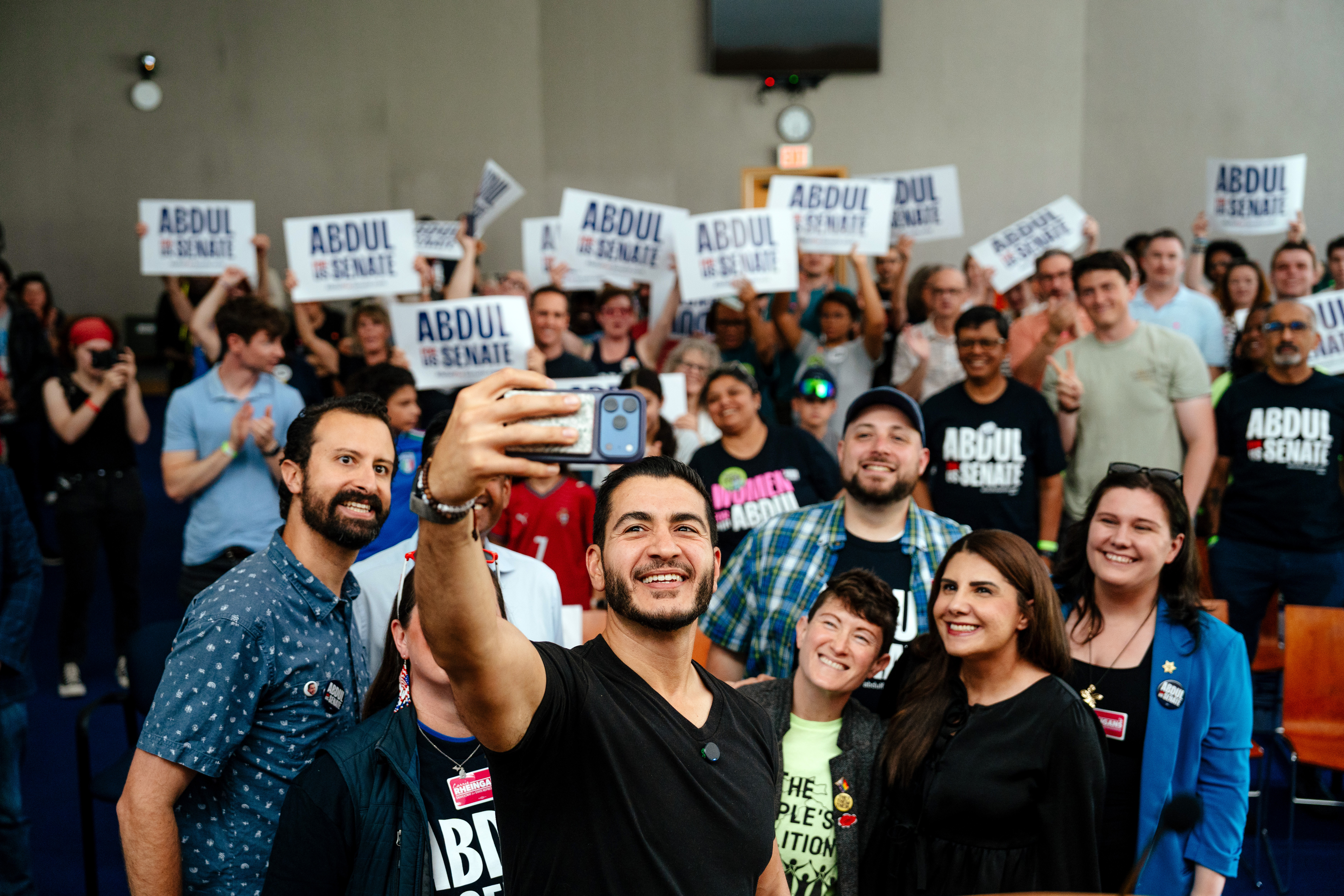
Abdul El-Sayed, the Democratic candidate for U.S. Senate in Michigan, who is trying to bring his party together after a divisive primary, at a June 28 campaign event in Ann Arbor, Mich.NICK HAGEN
Greene, who lives in Southern California and is best known by his handle @joshtheprogressive, is among a growing number of influencers who, at a moment when campaigns are increasingly willing to pay for online attention, appear willing to put their mouth where the money is.
As more people spend time scrolling on their phones, campaigns view these shows of support from influencers as a vital way to reach voters. They are also significantly less expensive than traditional advertising.
But unlike campaign mailers, billboards, and television spots, these messages fall into a legal gray area.
There are no federal regulations requiring disclosure of payments for political support on social media, and only a few states have such rules. That allows influencers, in most instances, to endorse candidates for a fee without ever disclosing those payments in their posts. Creators say some campaigns have even asked them to actively conceal the fact that they’re being compensated, making it impossible to know what’s genuine support — and what is pay-for-play.
In most cases, the only way a viewer would know an influencer is being paid would be to search a candidate’s campaign finance reports, as the New York Times did to discover the payments. Even then, such compensation is regularly obscured by funneling the payments through middlemen.
“It’s completely out of control,” said Suzanne Lambert, a progressive influencer and comedian with more than 1.3 million followers between TikTok and Instagram. She said that while she happily promotes candidates she likes, she has “never taken a cent” in exchange for an endorsement and worries that the practice distorts the democratic process. “People don’t know what’s real anymore,” she said.
Greene defended the idea of influencers getting paid for their work and noted that he accepts money only from candidates and campaigns that he would support anyway. “I turn down offers every single day because I’m not going to take money from anyplace if I don’t agree with it,” he said. (In the case of the Steyer campaign, Greene said he was initially critical but came to see him as the most viable candidate.)
Still, he suggested there was a need for straightforward and consistent rules on disclosure. “If anything, we do need more clear transparency laws so that creators like myself aren’t confused,” he said.
Coordinated networks
The phenomenon is bipartisan.
In June, Rep. Barry Moore of Alabama filed a complaint with the Federal Election Commission, alleging that at least eight social media accounts were being paid to attack his military record during the Republican primary. In April, a newspaper in Kentucky revealed what appeared to be a coordinated network of influencers boosting Nate Morris — at the time running in a Republican Senate primary — even though none acknowledged being paid for their efforts. Ken Paxton, the attorney general of Texas and the Republican nominee for Senate, benefited from a paid campaign on the social platform X when he was facing impeachment in the state several years ago.
But the question of paid influence has gained particular attention in recent months thanks to aggressive efforts by a handful of Democratic candidates to secure support from well-known influencers.
During California’s hard-fought primary this spring, Steyer’s campaign paid 17 influencers at least $5,000 apiece, including one, Carlos Eduardo Espina, who has over 14 million followers on TikTok and received a total of $400,000, campaign finance filings show.
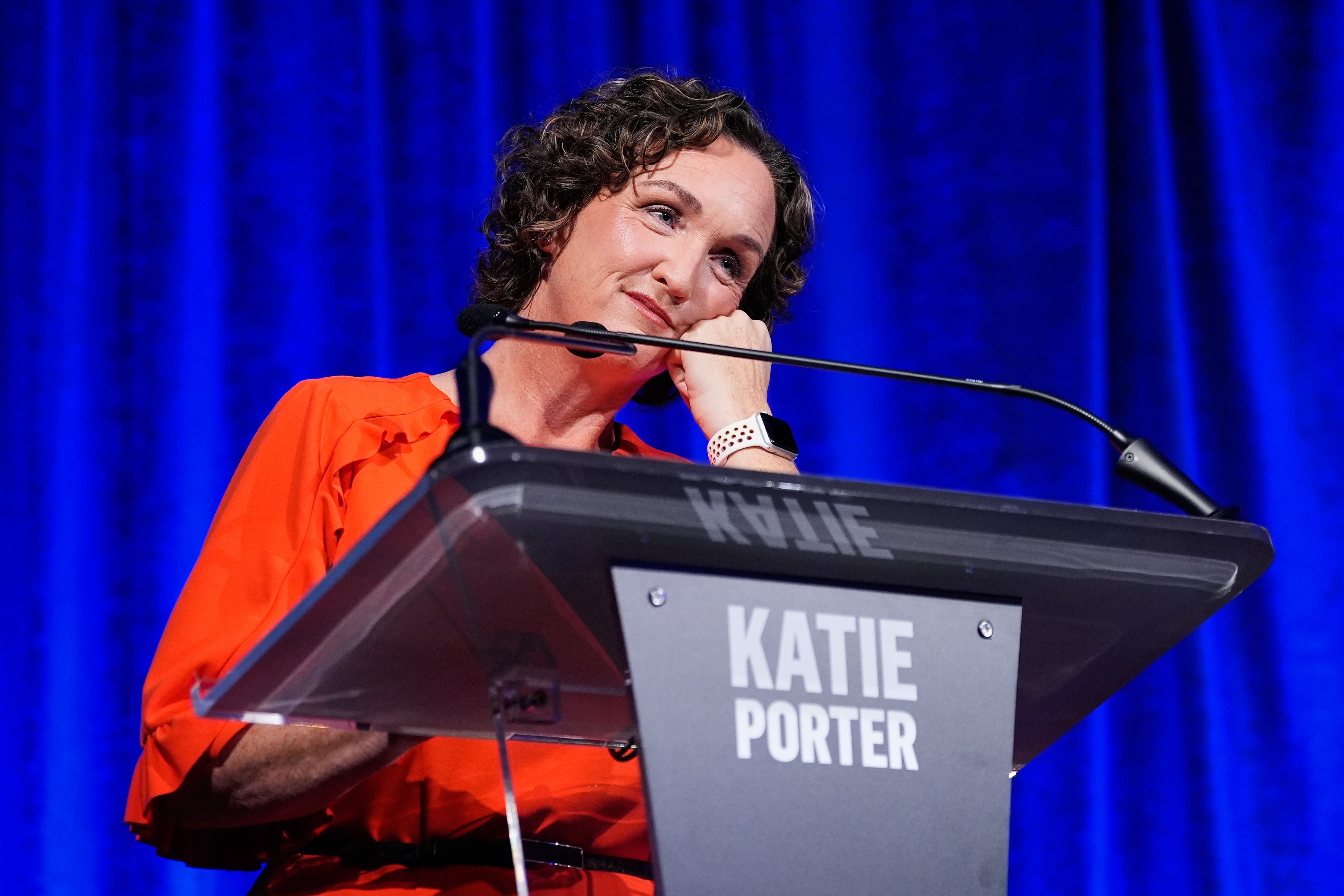
Katie Porter was one of several candidates to deploy paid influencers during the California gubernatorial primary in 2026.Godofredo A. Vásquez
Former Rep. Katie Porter, who also ran unsuccessfully for California governor, paid 12 influencers a total of $139,500. One of them, a lifestyle creator named Avery Cyrus with 9.5 million followers on TikTok, received $25,000 for what appeared to be a single post claiming “Katie Porter’s thing works.”
Cyrus’ post was deleted after the Times inquired about it. She did not respond to a request for comment made through the social media agency that represents her, UnderCurrent Media, but the firm’s CEO, Eric Bogard, said in an email that it “was not asked to oversee disclosure compliance, nor were we provided instructions concerning any required disclosures.”
Under California law, paid political posts on social media must be disclosed. A Times review found three posts supporting Porter on TikTok from influencers who were paid by her campaign that did not include any disclosures. In seven other instances, the disclosures could be found only after clicking through to a hidden section of TikTok for comments flagged “as potentially offensive or disturbing.”
Sander Jennings, an influencer based in Florida who was paid $22,000, said “the Porter campaign and I agreed to disclose the payment” in TikTok’s comments section in order to get around the site’s practice of removing paid political posts. He said he did not know why the disclosures ended up in the hidden section of the comments.
TikTok’s terms of service bar all paid political advertising, including “creators being compensated for making branded political content.” In an email, Porter said that “nothing was paid for and posted without review and coordination and compliance with all law.”
Other political efforts have employed a different strategy, contracting private firms that pay little-known content creators smaller sums to put out a large volume of posts. Those companies, known as user-generated content platforms, or UGCs, operate on the principle that carpet-bombing the internet with hundreds of nearly identical posts is more likely to generate viral content than paying one large influencer the same amount of money to make a single post.
This spring, a woman posted dozens of videos promoting Steyer in the California primary. Weeks later, she appeared in videos from a different account complaining about the cost of living “here in Michigan” and encouraging people to vote for Rep. Haley Stevens, El-Sayed’s primary opponent in the Senate race. Then she pivoted to a third account talking about affordability in Wisconsin.
Corporate records show that the woman, Paige Dunmeyer, actually lives in Kansas City, Mo., and is registered to work with a UGC company called SideShift. It’s not clear how much she was paid for her Michigan and Wisconsin videos, but she has earned more than $30,000 on SideShift for a variety of political and commercial campaigns, according to company records reviewed by the Times. Filings from Steyer’s campaign showed she received $1,320 for her efforts in that race. Dunmeyer did not respond to requests for comment.
A Times analysis found that at least 87 people registered to work with SideShift had made posts backing Steyer or Stevens, or participated in a third campaign to post video clips on TikTok supporting Rep. James Talarico, the Democratic Senate nominee from Texas. Most of the posts by those creators included no acknowledgment that money changed hands.
In a statement, SideShift said that it advised creators to follow applicable disclosure requirements, and called for more explicit laws governing how paid content is disclosed on social media.
“SideShift believes anyone can be a creator and that creators should get paid fairly for work they choose to do,” the company said.
In June, Kendall Boyle, a TikToker in Michigan with over 21,000 followers, was contacted by a social media marketing agency called Activate HQ offering her a paid opportunity to post videos about “how rising costs are affecting Michigan residents in real life.”
When she asked who was footing the bill, she was told it was Majority Forward, a dark money group linked to the Senate Majority PAC, a Democratic super PAC, email correspondence reviewed by the Times shows. Boyle said she was turned off by warnings in those emails from Activate HQ that “disclosure is not required and the paid partnership label will not be included in any posts” and also that Majority Forward “will not be mentioned” in her content.
“It was one of those things where something isn’t fitting right,” Boyle said.
In a statement, Majority Forward said the language in the email “explains disclosure requirements necessary under FEC rules, which were fully followed.”
Little regulation
Just four states have laws or regulations requiring influencers to disclose paid political messaging, but they apply only to state and local races, not federal contests. Although regulations for social media have been proposed multiple times to the FEC, it has never taken action. The Federal Trade Commission, which requires disclosure of paid commercial content on social media, makes an exception for political messaging.
Rep. Mark Takano (D., Calif.) introduced a bill in June that would require anyone paid by a candidate or political committee to clearly disclose that fact in the same way that traditional campaign materials are required to note such payments.
In an interview, Takano said he was inspired to draft the legislation after online sleuths revealed that numerous influencers had been making paid endorsements in the California governor’s race without proper disclosure, as required in that state.
“It’s unfair when an influencer is allowed to be silent or not transparent about money they’re taking from a candidate, making it seem like what they’re saying is authentic and not influenced by money,” he said.
Takano acknowledges that there are some potential loopholes in the bill. For instance: Campaigns often obscure payments to influencers by hiding them under layers of vendors and subvendors.
Porter, for example, hired Activate HQ for “influencer marketing services,” and it in turn paid 13 creators to bolster her campaign for governor. One of them, a political influencer in Los Angeles named Dash Dobrofsky, who also posted in support of Stevens in Michigan, received $15,500 from Porter’s campaign. Dobrofsky did not respond to a request for comment.
Steyer’s campaign, for its part, hired multiple digital strategy firms to manage social media, including one called Group Project, which hired a Los Angeles company, Gutsy Media, which paid Greene through UnderCurrent, which represents him.
Those payment chains are visible because California is one of a handful of states that require campaigns to report payments to subvendors. There is no such obligation for campaigns for federal office. “Every dollar spent by this campaign is publicly disclosed and available for anyone to see,” the Steyer campaign said in a statement.
‘Social media consulting’
State Rep. Chris Rabb at a July 28 event with U.S. Rep. Ro Khanna.Tom Gralish / Staff Photographer
Occasionally, campaigns or independent expenditure groups will reveal direct payments to influencers, such as the super PAC Freedom PA, which supported socialist candidate Chris Rabb’s successful bid to win a Pennsylvania House primary in May. It has disclosed payments to nearly 50 influencers for “social media consulting,” among them Greene, who received $750 and posted a video celebrating the candidate’s victory.
Other committees listing payments to Greene in federal filings employed less illuminating descriptions. Chuck Park, who unsuccessfully ran for Congress in New York’s Queens borough this year, listed a $300 disbursement to Greene as “staff salary.” Greene posted at least five videos promoting Park, none of which state that he had received payment.
Park, in an interview, said that Greene was in fact not employed by the campaign, but said that “our campaign absolutely leaned into new media” and that he spent time with Greene in Queens filming a series of videos.
Greene disclosed being paid on three of his posts about Steyer and told the Times that those videos were the only ones that he was specifically contracted by the Steyer campaign to produce. He said he didn’t receive compensation for prior posts about the candidate.
Greene has also supported Sen. Ed Markey (D., Mass.) in a competitive primary against Rep. Seth Moulton, and last month, he posted a video accusing Moulton of “posturing to be someone they really aren’t.” He posted a second video this month critiquing Moulton, this time for taking corporate political money.
Neither video includes disclosures, and FEC filings don’t show any payments to Greene related to Markey’s reelection bid. But a spokesperson for Commonwealth Together, a super PAC that is supporting Markey, said it had paid Greene $3,500 for “digital communications consulting” through his agency, UnderCurrent.
Greene, in a text message, acknowledged the payment to support Markey, saying he took it “because I believe he is by far the more progressive candidate in the race.”
The murkiness has left some in the political world uneasy. Last month Rynn Reed, the founder of Creator Congress, an organizing hub for influencers interested in politics, introduced a code of conduct for the group that would require creators to make clear when they’re paid, whether required by law or not.
“With no standards,” Reed said, “there’s going to be a race to the bottom.”
SALINAS, Calif. — At a Church Brothers Farms production facility, where conveyor belts rumble with giant heaps of chopped romaine and red cabbage, the company has slashed workers’ hours and laid off employees this summer. Some assembly lines in the plant in San Juan Bautista, Calif., near the agricultural heartland of the Salinas Valley, weren’t operating at all this past week.
Fresh produce sales fell nationwide after a major outbreak of cyclosporiasis, an illness that causes severe diarrhea. More than 17,000 people have been sickened so far, and two have died, according to federal health officials.
The largest cluster of cases was linked to iceberg lettuce grown in Mexico, and greens from the Salinas Valley haven’t been implicated by federal officials. Yet demand for the valley’s lettuce has plummeted all the same, said Raymond Gonzales, vice president of processing plant operations at Church Brothers.
“Even though all this product is from the U.S.,” Gonzales said, waving a gloved hand at pale green leaves churning through cold water, “the consumer just sees it as lettuce.”
Like many American farmers, Church Brothers made a tough decision in recent weeks to abandon healthy crops. If there isn’t a market for the produce, it often makes more financial sense to use the greens to re-fertilize the land than to shell out for the labor costs for harvesting.
Jeff Church, the company’s chief operating officer, said Church Brothers had lost hundreds of thousands of dollars in discarded greens. He estimated that the company had returned an extra 3.9 million heads of lettuce to the soil over the past six weeks as demand dropped.
“We just couldn’t use it,” said Church, 54.
The amount of romaine and iceberg lettuce produced for sale this summer in the United States has been the lowest in a quarter century, according to shipping data from the U.S. Department of Agriculture. And wholesale prices for lettuce remain at break-even costs, even though so little is available for sale, the data show.
Nowhere has the economic impact been felt more than in the Salinas Valley, an agricultural region about 100 miles south of San Francisco that marketers have long called the Salad Bowl of the World.
The area is perhaps best known nationally for the John Steinbeck novels set here, such as Of Mice and Men and East of Eden. But the Salinas Valley has also been prized for generations for its temperate weather and fertile soil, which allow it to grow strawberries, broccoli, and, in the summer, 70% of the nation’s lettuce.
So produce scares are nothing new. It took years for spinach sales to recover after a deadly E. coli outbreak in 2006. But questions about the origins of the largest-ever U.S. outbreak of cyclospora, a parasite in human feces, seems to have made customers particularly cautious, avoiding berries and several types of fresh vegetables that were never linked to the outbreak.
The Centers for Disease Control and Prevention has confirmed only one source — iceberg grown in Mexico by produce behemoth Taylor Farms. But health officials say they’re investigating at least six other clusters for which sources have not yet been publicly identified.
“I even had one reporter tell me they were not going to have a Caesar salad,” said Norm Groot, executive director of the Monterey County Farm Bureau, who pointed out that romaine lettuce, the kind typically used in a Caesar, had never been connected to the parasite.
At Church Brothers, a large, family-owned business that has been growing produce in the Salinas Valley since 1999, lettuce sales began to drop in July, around the time the CDC announced a link between cyclospora and Taco Bell lettuce. It didn’t help that Taylor Farms, whose Mexican-grown lettuce was implicated, is based in Salinas, linking the outbreak to the valley in customers’ minds.
Sales have begun to pick up as the outbreak starts to subside, Church said. Yet he is now struggling to determine how much to plant in the coming months.
Church, wearing a vest in the Salinas morning fog this past week, contemplated the math as he watched workers harvesting iceberg lettuce strip off outer leaves with knives before wrapping the heads in plastic to sell to Walmart.
If local farmers plant too little, fearing more losses, there will be a lettuce shortage in the winter. But if Church plants a typical amount, he could be forced again to do what farmers call discing, in which they dispatch a tractor with steel blades, or discs, to chop up healthy produce and plow it back into the soil.
Daniel Sumner, an agricultural economics professor at the University of California, Davis, said it was unclear how long customers would avoid leafy greens, given how fast information travels on social media and a larger lack of trust in institutions.
Just this past week, farmers were upset about a meme of the scariest Halloween costume: Taylor Farms shredded iceberg lettuce. The Washington Post published an opinion column arguing that Americans should permanently stop eating lettuce.
“It’s a really tough moment,” said Dave Puglia, president and CEO of Western Growers, an agricultural trade association representing produce farmers in California and other Western states. “There’s a lot of very good, fresh produce that’s being plowed back into the ground.”
Puglia said the drop in sales linked to this outbreak — close to 30% — had been higher than for other recent disease outbreaks.
And while America has a very safe food supply system, there are risks inherent to lettuce, he said, since it’s largely grown outside and is eaten raw. Leafy greens are among the leading sources of foodborne illness in the United States.
In Salinas, a city of 159,000 residents where Main Street is lined with brick buildings featuring art deco entryways, hand-painted tomatoes and heads of lettuce grace the public trash cans. Looming as one of the tallest buildings in downtown, across from the National Steinbeck Center, is the headquarters of Taylor Farms, a major employer.
The mayor of Salinas, Dennis Donohue, said he was keeping an eye on local economic indicators, such as sales tax revenue, to see how the produce sales slump could ultimately affect the city’s finances. But ups and downs are the nature of the agriculture business, said Donohue, who previously ran a small specialty vegetable company.
“Things tend to bounce back,” he said.
As far as eating lettuce, even customers in Salinas remain wary.
Melanie Waltrip, who co-owns Smalley’s Roundup Restaurant, a 50-year-old steakhouse with deep red booths, said her servers were still fielding questions about the safety of consuming their green salads, typically served as a side with ribs or pork chops.
But Jeff Birkemeier, 46, who co-owns Amapola Kitchen in downtown Salinas, said his most popular menu item, a Chinese chicken salad made with romaine, remains a bestseller. He said that employees of Taylor Farms, who work across the street from his cafe, often stop by for lunch.
“My customers in general are people that have grown up in this type of agricultural hotbed for their whole lives, and they just kind of take it all in stride,” he said.
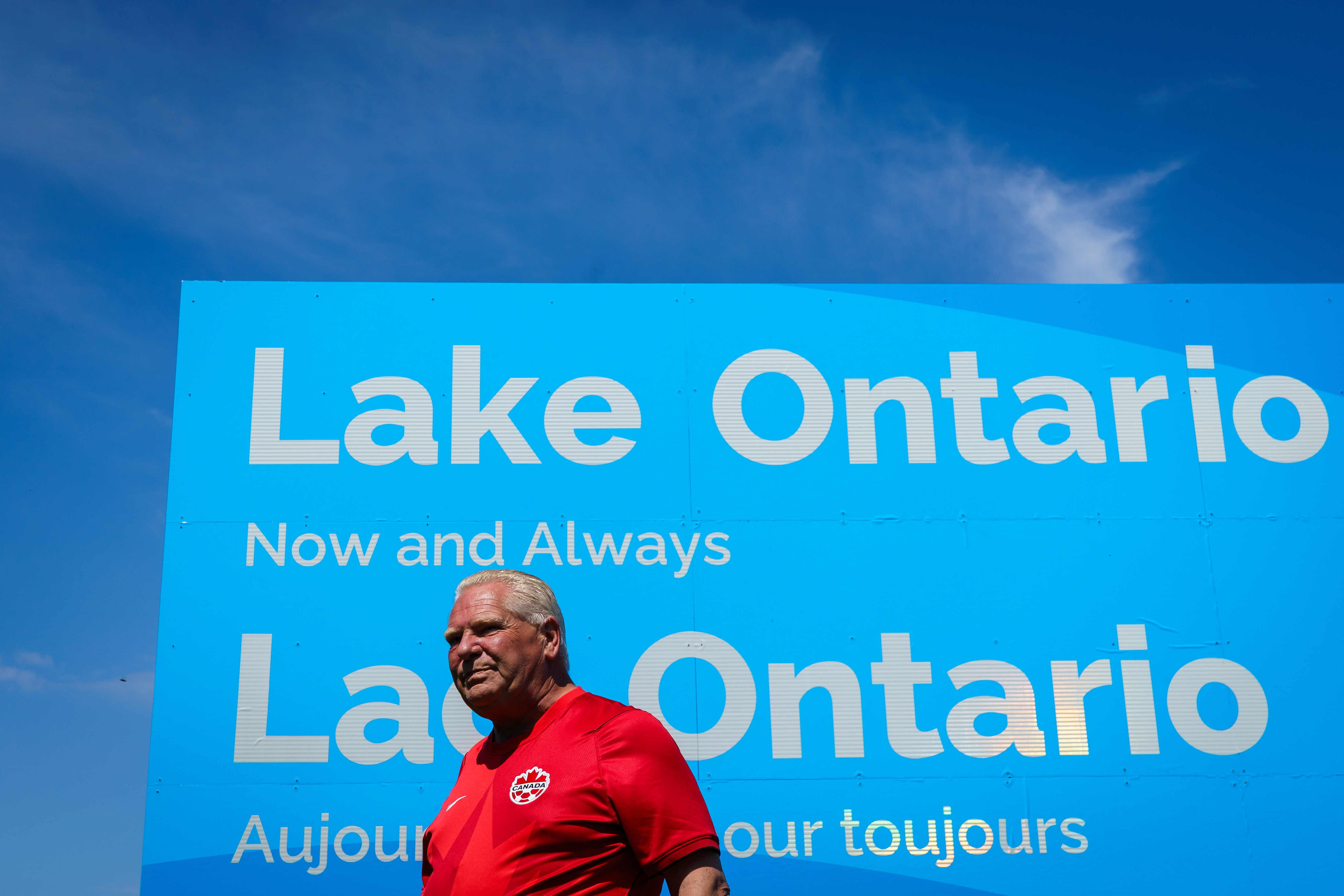
TORONTO — Ontario Premier Doug Ford answered President Donald Trump’s “Lake America” decree Saturday with a billboard-sized message on the Canadian shoreline: “Lake Ontario. Now and Always.”
Wearing a Team Canada soccer jersey, Ford unveiled the sign near Grimsby, Ontario, and posed for photographs. The 24-by-12-foot sign stands on 6-foot legs, putting its top about 18 feet above the ground — roughly two stories high. The message is repeated in French.
It was the latest show of defiance after Trump signed an executive order directing U.S. federal agencies to call Lake Ontario “Lake America.” After months of tariffs, threats to make Canada the 51st U.S. state, and personal attacks on its leaders, the move has been met in Canada largely with ridicule.
Ford said Trump was trying to rename the lake because Ontario and Canada were “standing up for ourselves” and argued the name would outlast the president.
“Long after President Trump is gone, it will still be called Lake Ontario,” Ford said in a video posted on social media.
Manitoba Premier Wab Kinew compared Trump to an aging rock band trying to revive an old hit.
“You know when a rock band is really over the hill and you see them like in a casino playing some song from like 50 years ago. I think that’s the part of Donald Trump’s presidency we’re at now, Like he thought they had a real hit, a real golden oldie, with the Gulf of Mexico,” Kinew said, referring to Trump’s executive order renaming the Gulf of Mexico the Gulf of America. “And he’s trying to bring back that, and he’s trying to play the hits for his base. But I think everybody here thinks it’s a little sad and it’s not his best work.”
The mockery was not limited to politicians. Canadian historian Robert Bothwell was even more scathing.
“The greatest country on earth takes this moron seriously?” Bothwell said.
But Bothwell said the dispute was more serious than the jokes, arguing Trump’s broader aim was “to subordinate Canada and at best make it a colony, at worst absorb it into the United States.”
Nelson Wiseman, professor emeritus at the University of Toronto, said Trump “would like Canada to act like a vassal state, but it refuses to do so. That irritates him.”
The dispute comes as relations between the longtime allies worsen over trade. Negotiations collapsed last week, both governments accused the other of making late demands, and Canada announced retaliatory tariffs set to take effect next month.
Trump’s order also came amid an escalating war of words with Ford. In an interview with the Associated Press earlier this week, Ford said Ronald Reagan would be “throwing up” over Trump’s tariff policies and “disgusted with President Trump.”
Trump fired back by dismissing Ford’s comments as “bluster,” calling him Prime Minister Mark Carney’s “flunky” and mocking him as the “less charismatic, intelligent, and overall unimpressive brother” of the late Toronto Mayor Rob Ford.
Trump continued promoting the new name Saturday, reposting a meme showing Canada geese with Trump-like blond hair firing rifles as they “protected” Lake America.
Trump has repeatedly used maps to make political points. A “Gulf of America” map was displayed for a time beside the Resolute Desk in the Oval Office, and Trump has posted images depicting Canada as part of the United States or as the 51st state.
The name Lake Ontario comes from the Huron Indigenous people’s word “oniatarí:io,” which means “lake of shining waters.” The Canadian province of Ontario, founded in 1867, took its name from the lake.
Wendat Nation Grand Chief Pierre Picard, whose people historically lived from the St. Lawrence Valley to the Great Lakes and whose language gave Lake Ontario its name, called Trump’s move an attempt to erase Indigenous history.
“I want to tell him that it is unacceptable for us, as a nation, to have a president who can eradicate our history, our culture, and our identity,” Picard said.
Canadian Prime Minister Mark Carney rejected the move, noting the lake’s Indigenous roots and that the name predates both Canadian Confederation and the U.S. Declaration of Independence. Trump cannot require Canada to adopt the new name.
CLIFTON FORGE, Va. — Veterans flock to a law office in this old railroad town for help wrestling with the feds over healthcare. Across the mountains in Waynesboro, families who can’t afford groceries spend hours waiting outside the food pantry. Up in Monterey, the town economic development director works for free because budgets are thin.
Beth Macy writes it all down, still chasing stories across Appalachia after 40 years as a newspaper reporter and author of books including Dopesick, an exposé about Big Pharma’s contributions to the opioid crisis that became an Emmy-winning Hulu miniseries.
After the memoir Hillbilly Elegy catapulted JD Vance to prominence as an authentic child of the Rust Belt and Appalachia, Macy is leaning on her own roots and her writing about the region to jump into politics. But her long-shot bid for a House seat as a Democrat in a bright red Virginia district positions her as a kind of anti-Vance.
In an essay in the New York Times shortly before Vance was elected vice president, Macy faulted him for fearmongering about immigrants and turning his back on the public institutions that helped him escape poverty.
“I’m coming at it from the perspective of an old-school mountain Democrat,” Macy said in a recent interview. “Let’s make it safe, let’s protect working people.”
The two writers hail from Ohio hometowns only 60 miles apart: Middletown for Vance and Urbana for Macy. Both are the product of dysfunctional families and economic hardship. But Vance went on to the Ivy League and venture capital, urging the downtrodden to take personal responsibility for their prospects in life.
Macy, 62, published her own life story last year in Paper Girl, which examines the same terrain as Hillbilly Elegy but comes to very different conclusions.
Macy, who put down roots in Appalachia and spent decades writing about the region’s struggles for Virginia’s Roanoke Times newspaper, believes Vance blames poor people for their own plight. She sees outside forces working against the region going back generations, including the opioid makers who falsely claimed that their drugs were not addictive, and government policies driving the offshoring of manufacturing jobs.
Campaigning with pad and pen in hand, Macy says she aims to “connect pain to policy,” and she criticizes both major parties for a system that fails those in need. The message was warmly received on a recent campaign swing, and many voters were thrilled to meet Macy, who made sure the Dopesick show was filmed partly in the district.
But after years of division stoked by culture wars, folks who came out to see Macy the celebrity are not sold on casting a ballot for someone with a D after her name.
“Exactly the issue she has to overcome here — and I’m not sure how — is that an awful lot of people vote by just the R or the D, as simple as that,” said Robin Sullenberger, who spent two decades as a supervisor in Highland County and stopped by a recent Macy campaign appearance in Monterey. The supervisor jobs are nonpartisan, but Highland County — Virginia’s least populous county — has picked a Republican for president in every election since Alf Landon in 1936.
Macy is running against Republican incumbent Ben Cline in Virginia’s bright-red 6th District, a New Jersey-sized stretch of mountains and valleys that stretches from Winchester in the north to Roanoke in the south.
The nonpartisan election handicapper Cook Political Report rates the district as “Solid Republican.” Cline, seeking his fifth term, beat his 2024 Democratic challenger by 28 percentage points and outperformed Donald Trump, who won by 24 points.
“I know that her liberal positions on the issues appeal to some sections of the Democrat base, but to compare her to JD is to suggest that her message may sell here,” Cline said in an interview. “It’s not selling here in the Shenandoah Valley, in the Roanoke Valley. There are common-sense conservative values here.”
Macy is navigating a tricky path within her party. She repudiates the recent rise of democratic socialists and also blames establishment lions such as President Bill Clinton for the NAFTA trade deal that she says wrecked the region’s economy.
She depicts her campaign as focused on practical solutions: addressing the “immigration disaster” through humane treatment and clear paths to citizenship; providing affordable healthcare through Medicare-for-all; aiding farmers by ending tariffs; taxing billionaires.
Macy has raised more money than Cline as of July 15, at $1.7 million compared with his $1.4 million, according to analysis by the nonpartisan campaign finance site Virginia Public Access Project. Almost all of her donations have come from individuals, while Cline has received more than $400,000 from GOP political action committees, according to VPAP.
Macy didn’t get involved in politics until last year, when friends in Roanoke — the blue-leaning city in Southwest Virginia where she lives with her husband — convinced her she had the name recognition to challenge Cline.
At the time, Macy was fine-tuning the manuscript of Paper Girl, which is part memoir and part hard-eyed examination of what’s become of her hometown. Macy grew up poor with an alcoholic father and a mother who took any job to provide for the family. Community support helped them get by, and federal Pell grants enabled Macy to go to college and pursue a career in journalism.
Returning to Urbana, Macy wrote about finding a town hollowed out by poverty and drug addiction. The sense of community, she says, has been replaced by a divisive strain of Christian nationalism and MAGA-fueled anger toward anyone seen as an outsider. A place once proud of its heritage helping enslaved African Americans seek freedom on the Underground Railroad is now peppered with Confederate flags.
A central figure in the book is a transgender young man struggling to get by in the community. Macy is deeply sympathetic to LGBTQ+ people because one of her two grown children is in a same-sex marriage and the other is nonbinary.
An editor pushed her to end the book with a strong statement about political solutions. “Basically, elect better people to office, people who will do the most good for the most people,” Macy said. “I didn’t think it would be me.”
Campaigning still feels odd to a journalist who spent years striving to be nonpartisan. She habitually takes notes, asking everyone she meets for their phone number and the spelling of their name. If she fills up a notebook, she’ll bum another from anyone nearby.
Macy says stories are the heart of her campaign: her own family member who died young after refusing two organ transplants because the donors had received the coronavirus vaccine. The farmer who can’t afford diesel fuel for his tractor because of the war in Iran. The sheriff who can’t get emergency calls because his mountainous county has only one cell tower.
And, everywhere, the families who have lost loved ones to painkillers that were promoted as safe.
“I don’t care if you’re Republican or Democrat or moderate. We’re people. We’re Americans,” Macy told a group of Democrats at a fundraiser outside Harrisonburg — like other college towns, a blue island in the district. Her message was simultaneously that President Donald Trump’s policies are making problems worse and that people can fix them by overcoming political divisions.
“We’re not going to win this thing,” she said, “without meeting people in the middle.” She claimed incremental success, but for offbeat reasons. One business owner told Macy he’d vote for her because he didn’t like the way Trump disrespected Rob Reiner after his tragic death, she said; another Republican was going to switch after seeing Trump post an image of himself as Jesus that appeared to be AI-generated.
“I’ll take it,” Macy said.
In Clifton Forge, where the exteriors were shot for Dopesick several years ago and where actor Michael Keaton was seen in local restaurants, the economy has struggled for decades since the Chesapeake & Ohio Railroad shifted jobs elsewhere.
Kristen McConnell sees desperation every day in her law practice focusing on veteran healthcare and disability issues. Solving problems is harder, she said, because of politics.
“Everybody wants healthcare, everybody wants childcare, everybody wants a livable wage,” McConnell said, but if a Democrat talks about those subjects, it is viewed as socialism.
“People don’t understand that these things they use every day are the things that they’re railing against,” she said.
On a sizzling Friday at the end of July, Macy greeted people at a monthly downtown festival, as booths along the closed-off streets sold baked goods, homemade jewelry, hot dogs, and barbecue.
John and Charlotte Waugh from nearby Covington set up folding chairs with a good view of the Bart Chucker Band, a local favorite alt-country group. John Waugh, 65, retired from a manufacturing job, is a big fan of Trump. Charlotte, 64, a retired educator, is not.
John has read some of Macy’s work, he said, and thinks she’s right on the money in diagnosing the region’s problems. But while his wife plans to vote for her, he will not.
“It’s more not just her — it’s the whole Democratic Party,” he said, saying that Democrats want boys to play girls’ sports. “I got granddaughters.”
Up the street at her consignment shop, Jennifer Oeltjen, 75, stayed open late to take advantage of the happy festival crowd. She was thrilled when Dopesick was filming there. The crew bought clothes from her for costumes, she said, and she remembers watching a night shoot when black-clad production assistants scurried around like ninjas.
A longtime Republican, Oeltjen worries that people nowadays expect too much help from the government. While she does not approve of the way Trump talks, she said the Democrats she sees on Fox News spend too much time battling him. She also cannot square pro-transgender policies with her religion.
Oeltjen has read Macy’s work and watched her speak to local groups. “She’s a good person,” Oeltjen said. “If I were going to vote for a Democrat, it would be Beth.”
But that’s not likely, she said, even though she knows very little about Cline. She intends to vote Republican this fall.
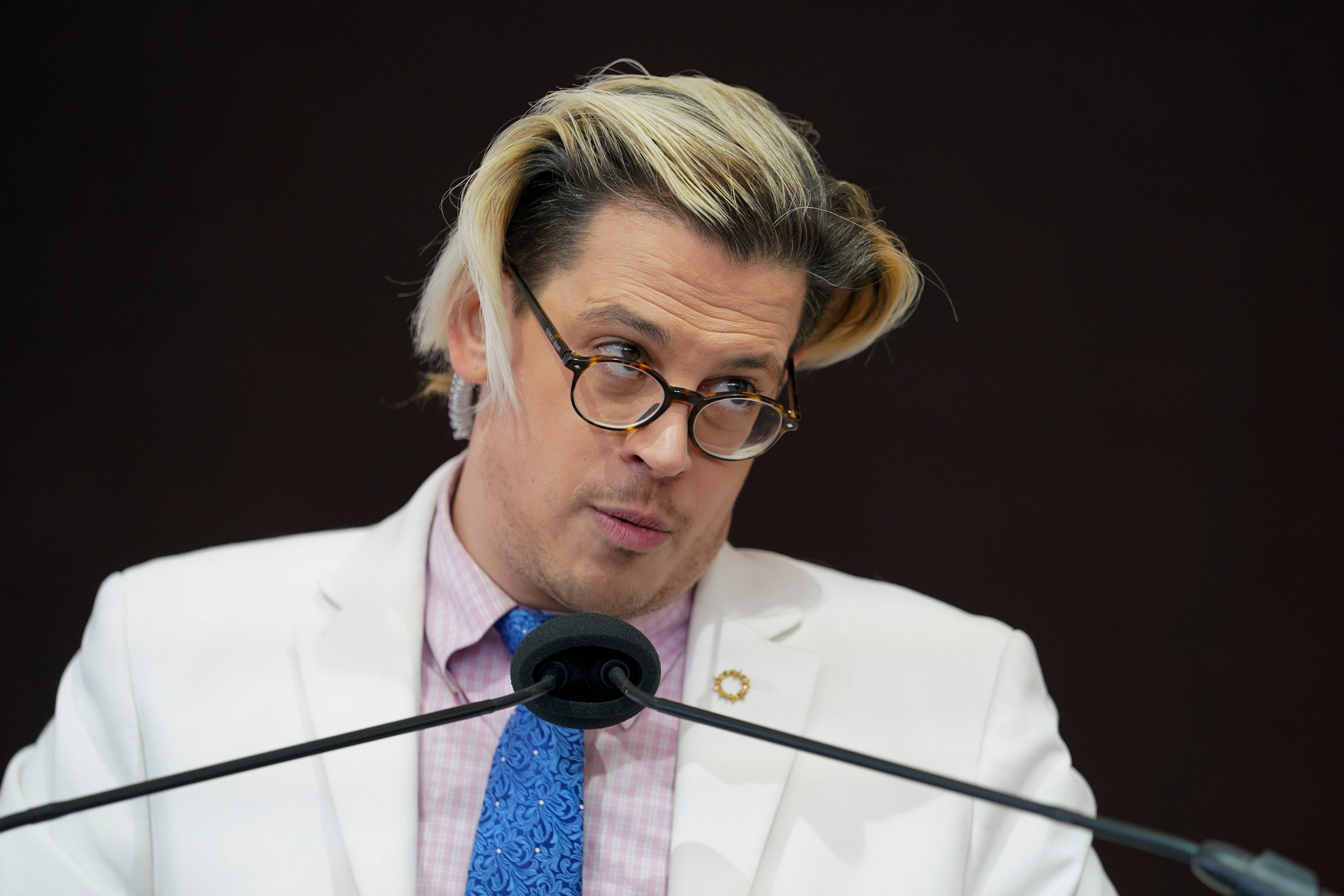
British far-right commentator Milo Yiannopoulos has been deported back to the United Kingdom after his arrest by American immigration authorities, U.S. officials said Saturday.
The U.S. Department of Homeland Security said Yiannopoulos was returned to his home country on Friday after being accused of overstaying after entering the U.S. legally in May 2019. An immigration judge had issued a final order of removal on July 22 after he failed to show up for an immigration hearing, a Homeland Security spokesperson said.
Yiannopoulos was arrested Thursday at Louis Armstrong New Orleans International Airport in Louisiana and detained by Immigration and Customs Enforcement.
“He chose to overstay his welcome in violation of our nation’s laws,” a Homeland Security spokesperson said in a statement.
Yiannopoulos and his representatives did not respond to requests for comment. He has not posted on his X social media account since Thursday.
Yiannopoulos is a well-known champion of conservative causes and has frequently taken provocative public positions criticizing feminism, Islam, and immigrants. He has been especially supportive of President Donald Trump’s immigration crackdown.
“Zero immigration for the next 20 years. No ifs, no buts,” Yiannopoulos wrote on X last year.
The British national has most recently worked for the rapper Ye, formerly known as Kanye West, who performed in New Orleans on Friday evening.
Yiannopoulos rose to fame in the early 2010s as an incendiary writer for the conservative website Breitbart News. He resigned from the company in 2017 after a video of him endorsing pedophilia resurfaced online. He later apologized for the remarks and said he himself was a victim of sexual assault as a minor.
Yiannopoulos’ arrest on Thursday comes amid a nationwide uptick in detentions as part of Trump’s immigration crackdown.
Far-right conservative activist Laura Loomer swiftly took to social media to applaud Yiannopoulos’ arrest after years of public feuding between the two personalities.
“I was the first person to report on the fact that Milo was in the U.S. illegally where he incited violence against President Trump and worked for Marjorie Traitor Greene,” Loomer wrote on X.
Controversy around Yiannopoulos ballooned in 2017 when he carried out what he called his “Troll Academy Tour” across college campuses nationwide. Fights broke out when some students protested Yiannopoulos’ appearances and accused him of hate speech, while others celebrated him as a champion of free speech. Around that time, Buzzfeed reported on Yiannopoulos’ cozy relationships with self-proclaimed white nationalists.
In recent years, Yiannopoulos continued to work in the orbit of conservative activism. In 2022, he was an intern for former U.S. Rep. Marjorie Taylor Greene, according to the Washington Post. He subsequently ran the short-lived 2024 presidential campaign for Ye.
Most recently, Yiannopoulos has worked as a spokesperson for Ye, who has been beset by controversy of his own following antisemitic comments that the rapper has since apologized for. The Washington Post reported Saturday that two sold-out Ye concerts in St. Petersburg, Russia, were canceled in part because of his history of such remarks.