Category: Wires

  • In historic first, voters in five states will decide transgender youth rights

    In historic first, voters in five states will decide transgender youth rights

    CAMAS, Wash. — Under heavy security, a transgender girl stretched for a high school race as supporters of a new anti-trans ballot measure chanted “enough is enough,” and others in rainbow garb cheered her on.

    In an election cycle where Republicans have leaned heavily into anti-transgender advertising, deep blue Washington state has become ground zero in the debate over transgender rights.

    Two ballot initiatives, heavily funded by a conservative private equity mogul, would ban participation of trans athletes in girls’ school sports and bolster parents’ access to curriculum and confidential mental health and medical records at school.

    Similar questions are on the ballot in four other states — Colorado, Nebraska, Arizona, and Missouri — making this the first general election where such a wide pool of voters, almost 20 million, will be asked to weigh in directly on issues affecting transgender youth.

    Polls show that a majority of Americans oppose transgender athletes competing in girls’ sports — with a Gallup poll last year finding that 69% of U.S. adults continue to think transgender athletes should be allowed to play only on teams that match their birth sex.

    More than two dozen Republican-led states have adopted bans on female transgender athletes, which were upheld by the Supreme Court in June.

    LGBTQ advocates say conservative groups have turned to ballot questions in blue states after failing to persuade Democratic-controlled legislatures to pass similar laws.

    “They’re trying to do an end run around legislators that voters elected,” said Vivian Topping, the senior director for advocacy at the Equality Federation, a national advocacy group that supports a network of state-based LGBTQ rights groups.

    Washington’s ballot question 638 is particularly troubling to opponents because they say it would require all girls participating in sports to undergo a genital exam to verify their biological sex. Supporters brush this off as a routine physical exam while detractors say it would be far more intrusive and discourage many girls from participating in sports.

    “I am concerned we are villainizing transgender children, creating a bogeyman out of them when there are far greater issues we should face to keep our children safe,” said Kelsey Gellner, a pediatric nurse and board member of the state’s nurses association, which opposes the measure. “It’s a small minority who just want to belong.”

    Supporters of the sports-related ballot initiative say transgender athletes have an unfair physical advantage when they compete on girls’ teams. And they also say it’s unfair that young people who oppose allowing trans athletes to compete have been accused of bigotry.

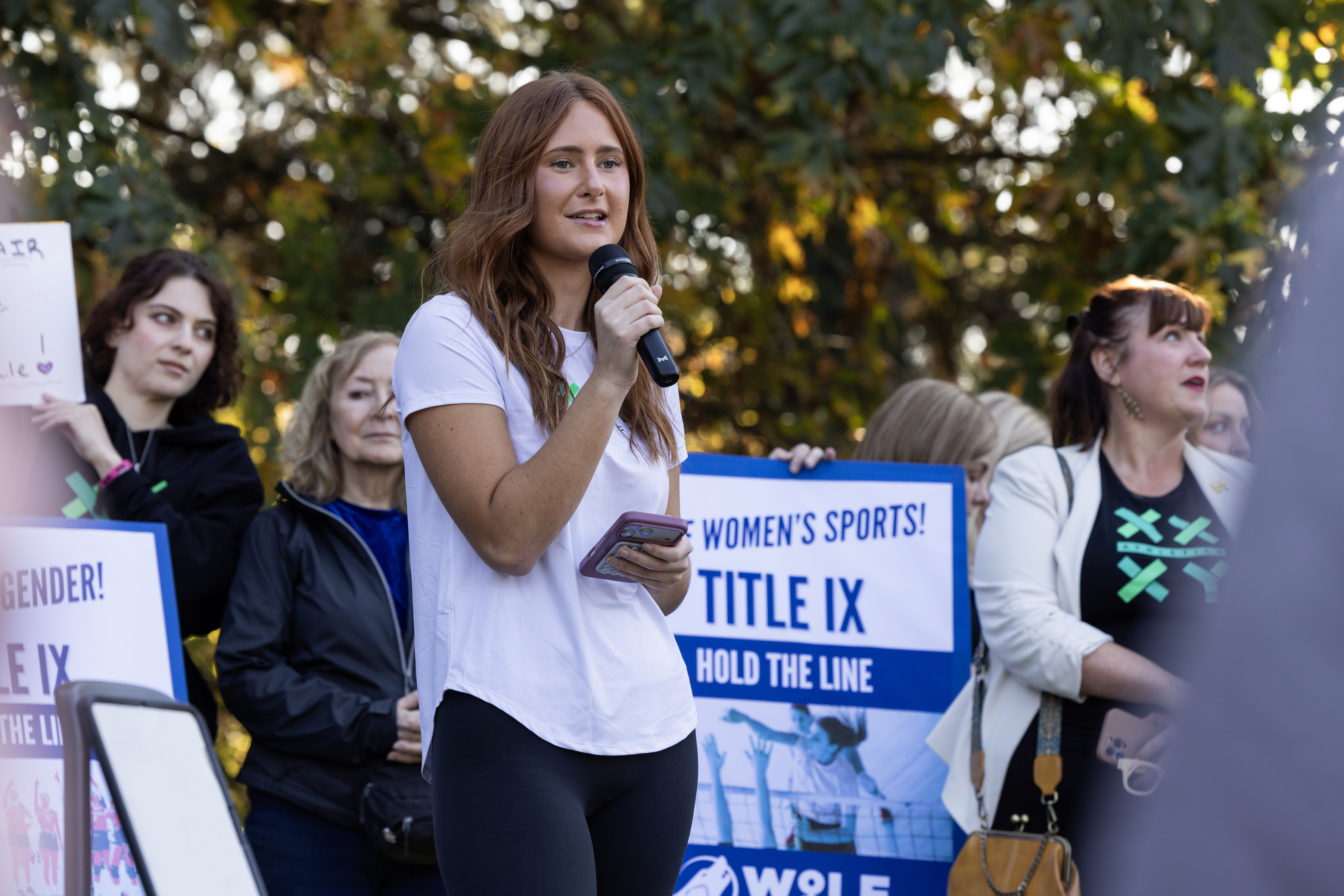
    At a pro-638 rally before the district championship track meet on Wednesday, Frances Staudt, a senior at an Oregon high school about two hours away, told the crowd she was vilified and accused of harassment when she spoke out about a transgender player at a basketball game her sophomore year.

    “This has never been about hate,” Staudt said. “It’s about fairness, it’s about privacy and making sure the next generation of girls don’t have to fight the battles we’re fighting today.”

    After the protest, attendees walked to the course to watch the meet. Guards lined the route and teams gathered behind a cordon along the course littered with fall leaves.

    For the varsity girls race, elite runners from four high schools lined up at the starting line. The transgender runner shook out leg muscles and ignored the protesters on the sidelines. The runner has been a focus of controversy since switching from the boys team to the girls’ team midseason; on Oct. 13, about a dozen girls walked off the course rather than compete against her.

    A spokesperson for the family of the runner said at the meet they were not interested in being interviewed.

    The starting gun sounded, and the runners were off.

    “Let’s go girls,” called out Claudia Opri, a parent and former professional distance runner. “And shame on the boy.”

    Brian Heywood, 59, a Trump inaugural donor and wealthy investor from the Seattle suburbs, is chief backer of Washington state’s anti-trans efforts, spending $2.2 million of his own money as of this month on the two initiatives as well as a third, a repeal of the state’s “millionaire tax.”

    Heywood has pushed conservative ballot initiatives in the blue state since he founded his political action committee, Let’s Go Washington, in 2022, spending more than $11 million of his own money on a range of issues with mixed success.

    Let’s Go Washington has raised a total of $12 million for the three initiatives on this year’s ballot, while the opposition group, No Hate in Washington State, has raised $4.5 million, records show.

    Supporters of the initiative requiring parents to know about medical treatments at school say parents deserve to know what’s going on with their child, particularly one who might be struggling with gender issues. Opponents worry it will have a negative effect on LGBTQ youth and survivors of abuse who might feel safer confiding in a teacher or a counselor than a parent.

    Heywood said at the rally he was inspired to take on transgender participation in sports after hearing the stories of Staudt and other female athletes.

    “The girls have all been told, ‘If you say anything, you’re a bigot,’” he said in an interview. “They were making excuses for it, saying it’s OK because they didn’t want to get canceled.”

    He ended up hiring paid signature gatherers for more than half of the 308,911 signatures required to get the initiative on the ballot.

    “I’m not buying anything,” he said. “I’m getting people out there who can put it in front of people who can sign it or not sign it. That’s all I’m doing.”

    A smaller grass roots movement supported by evangelical churches is behind two anti-trans ballot questions in blue-state Colorado, one which prohibits sex reassignment surgeries for minors and another that also limits sports participation to biological sex identified at birth.

    Led by President Donald Trump, Republicans have embraced the anti-trans message with fervor this campaign season, spending at least $196 million on ads highlighting transgender issues in competitive races, according to a Washington Post analysis of data from the ad tracking firm AdImpact. Democrats spent far less, about $14 million, on ads about transgender issues, and candidates who did run ads appeared to be distancing themselves from their party.

    Conservatives are moving forward with court challenges in the remaining states that allow transgender participation in sports. A female high school wrestler from Washington state filed an emergency petition to the Supreme Court on the matter this month.

    “I can definitely see how it’s unfair,” Holly Burns, 16, one of the runners who joined the walk-off on Oct. 13, said about competing against a transgender runner. “We shouldn’t have to deal with this, honestly, we’re all just still kids. We should be able to run and have fun and hang out with our girls.”

    There is no official tally of how many transgender athletes compete in sports in Washington state, which has allowed students to compete on teams matching the gender with which they identify since 2007. The state’s interscholastic sports association estimates the number is about 10 out of 101,000 female athletes.

    Verónica Garcia, a transgender runner from Spokane, won the 400-meter dash at the state championships in 2024 and 2025, becoming a major flash point in the debate over transgender athletes.

    This year the prospect of a ballot question that could mandate a genital exam for teens has caused the most uproar — although it is a matter of debate.

    Sports physicals are usually conducted while the athlete is in street clothes, where doctors do a routine check of lung capacity and bone structure.

    The ballot initiative requires verification of an athlete’s sex by a healthcare provider based on “reproductive anatomy, genetic makeup, or normal endogenously produced testosterone levels.”

    Gellner said that the measure’s wording — and the potential that a physical inspection of anatomy might be required — makes it the most restrictive, and potentially invasive, in the country.

    Heywood dismisses that idea.

    “There’s nowhere in the bill that says they have to get unclothed,” he said. “That’s a ridiculous interpretation of what this is.”

    At the district finals, Karen Wood, 56, a local small-business owner, said she was inspired to come out after reading coverage that called the female runners who walked off the field “brave,” when she felt the reverse was true.

    “It’s the trans athlete who decided to be who they are, they’re the brave one,” Wood said.

    Her older children had run cross-country at Camas, she said, and there have always been inequities between athletes. Some have bodies that develop faster than others, some have parents that pay for elite coaches.

    “At this stage, it doesn’t really matter,” she said. She said she was disappointed in the Oct. 13 protesters, who could have chosen to embrace the runner as she transitioned, but instead walked off the field and refused to participate.

    At the championship meet last week, the trans runner eventually placed second, helping her team win the district trophy.
  • Supreme Court allows Texas deal with Justice Department on deportation proceedings

    Supreme Court allows Texas deal with Justice Department on deportation proceedings

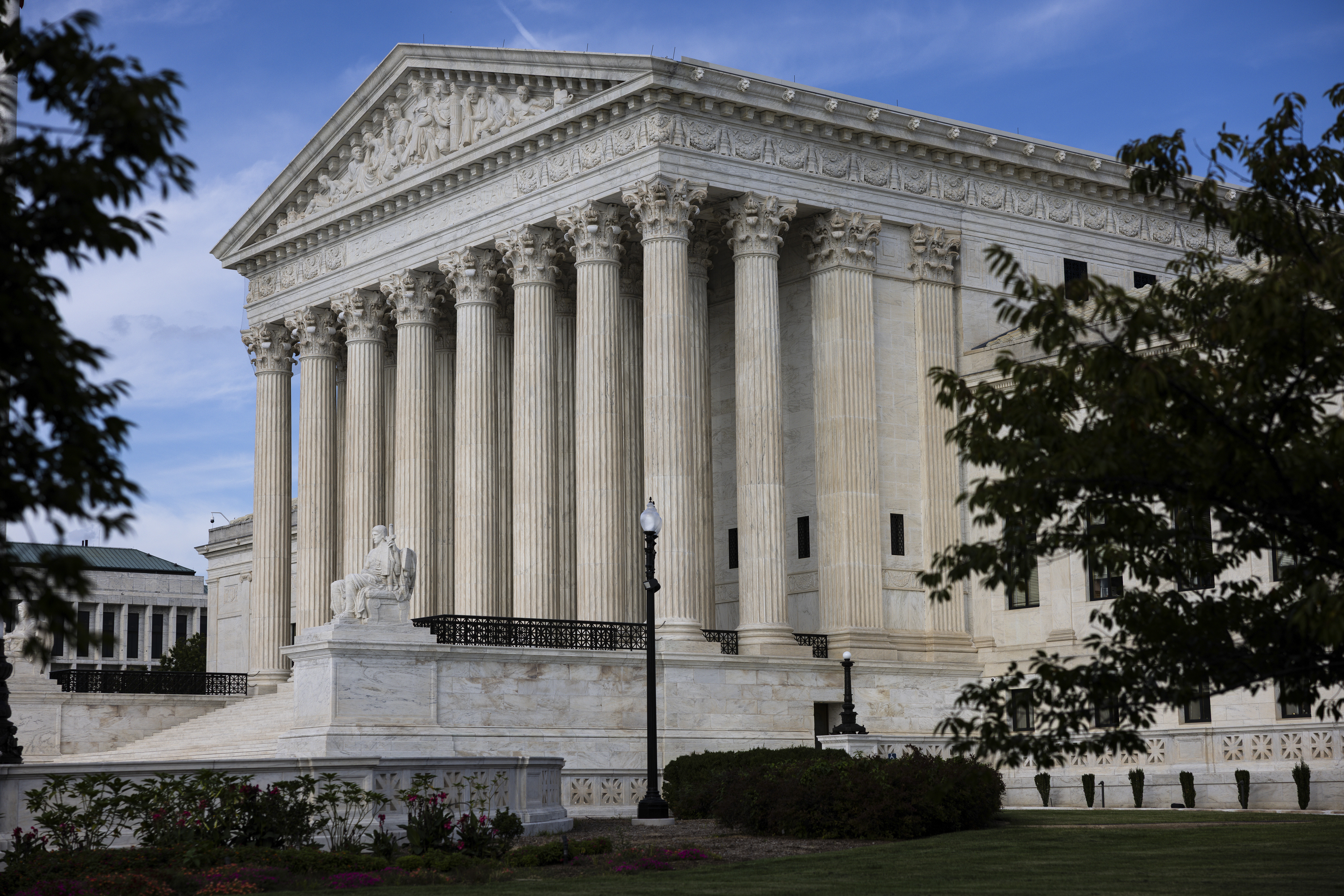
    WASHINGTON — The Supreme Court refused Tuesday to immediately block an immigration-related agreement between the Justice Department and the state of Texas affecting the rules for deportation proceedings that opponents have described as “egregious collusion” between the Republican-led state and the Trump administration.

    Three cities and an immigrant advocacy group had asked the justices to halt the deal and clear a path to reinstate a Biden administration policy that had given immigration judges discretion to postpone deportation proceedings in certain cases.

    The cities — Baltimore; New Haven, Conn.; and Columbus, Ohio — have significant immigrant communities and back the Biden-era policy, saying it was an important procedure that has existed in some form for decades and has implications for hundreds of thousands of cases.

    The Supreme Court’s one-sentence order did not include any reasoning, which is often the case when the justices respond to emergency requests. There were no noted dissents.

    At issue was the rule known as “administrative closure,” which gives immigration judges discretion to suspend deportation proceedings in some situations, such as when an individual is seeking humanitarian protections or other legal status to remain in the country. The cities told the court that the administrative closure process was intended to “promote efficiency or protect due process rights.”

    Between 2013 and 2017, the number of removal cases closed using the rule increased from nearly 172,000 to more than 268,000, according to the Trump administration.

    During the first Trump administration, the attorney general found that immigration judges lacked the authority “to indefinitely suspend immigration proceedings through administrative closure.” In 2024, the Justice Department issued a new rule that once again gave immigration judges the discretion to halt some deportation proceedings.

    As part of President Donald Trump’s mass-deportation agenda, the administration has overhauled immigration courts and pressured judges to deport more people. Unlike the independent federal judiciary, immigration courts are part of the Justice Department.

    In April 2025, the acting director of the Executive Office for Immigration Review, the unit at the Justice Department that runs the immigration courts, issued a memo saying it “could not — and will not — defend” the 2024 rule reinstating the administrative closure process. But the office said immigration judges should continue to follow it “unless they have a legal basis for not doing so.”

    Ken Paxton, the Republican attorney general in Texas and an ally of Trump, sued the federal government in June over the 2024 rule, which he argued operated as de facto amnesty because it allowed immigration judges to delay deportation proceedings, in some cases for years. The continued presence of immigrants lacking permanent legal status, the state said, caused “fiscal, public safety, and sovereign harms.”

    The two sides were ideologically aligned but formally on opposite sides in a lawsuit. On the same day the lawsuit was filed, the two sides told a judge they had agreed to settle it, ending the matter with a binding agreement removing the immigration judges’ discretion. America First Legal, a group co-founded by Stephen Miller, a senior White House adviser and the architect of much of Trump’s immigration policy, has helped represent Texas.

    The lawsuit was filed in Wichita Falls, Texas, a go-to destination for the Justice Department. At the time, Judge Reed O’Connor, who was nominated by President George W. Bush, heard every case brought in that division.

    O’Connor quickly signed off on the settlement with a brief order and later ruled that the cities and advocates did not have legal grounds, known as standing, to sue. The 5th U.S. Circuit Court of Appeals refused to block the agreement, and opponents then asked the Supreme Court to intervene.

    In court filings, city officials and Centro Legal, which provides legal services to immigrants, said the proposed agreement was an abuse of the court system because the federal government and the state of Texas were on the same side. The move, they said, allowed the administration to undo an agency action without going through the proper process.

    Paxton’s office told the justices in a filing that there had been a live, legitimate controversy between the state and the administration because the rule was still in effect when Texas sued.

    The cities said they would be harmed by the settlement in part because of the potential loss of tax revenue from residents who might be deported and because crime victims living in the country illegally might be discouraged from cooperating with law enforcement in the face of reopened deportation hearings.

    In response, D. John Sauer, the solicitor general, said the challengers did not have legal grounds to intervene because they were not regulated by the rule, which applies to immigrants in removal proceedings and not to the cities. He pushed back on the assertion that the deal struck with Texas would be immune from a legal challenge. Undocumented immigrations, he said, could potentially bring lawsuits targeting the elimination of the rule.

    This article originally appeared in the New York Times.

  • Trump defends White House redecorating — and Cheesecake Factory — from Obama’s mocking

    Trump defends White House redecorating — and Cheesecake Factory — from Obama’s mocking

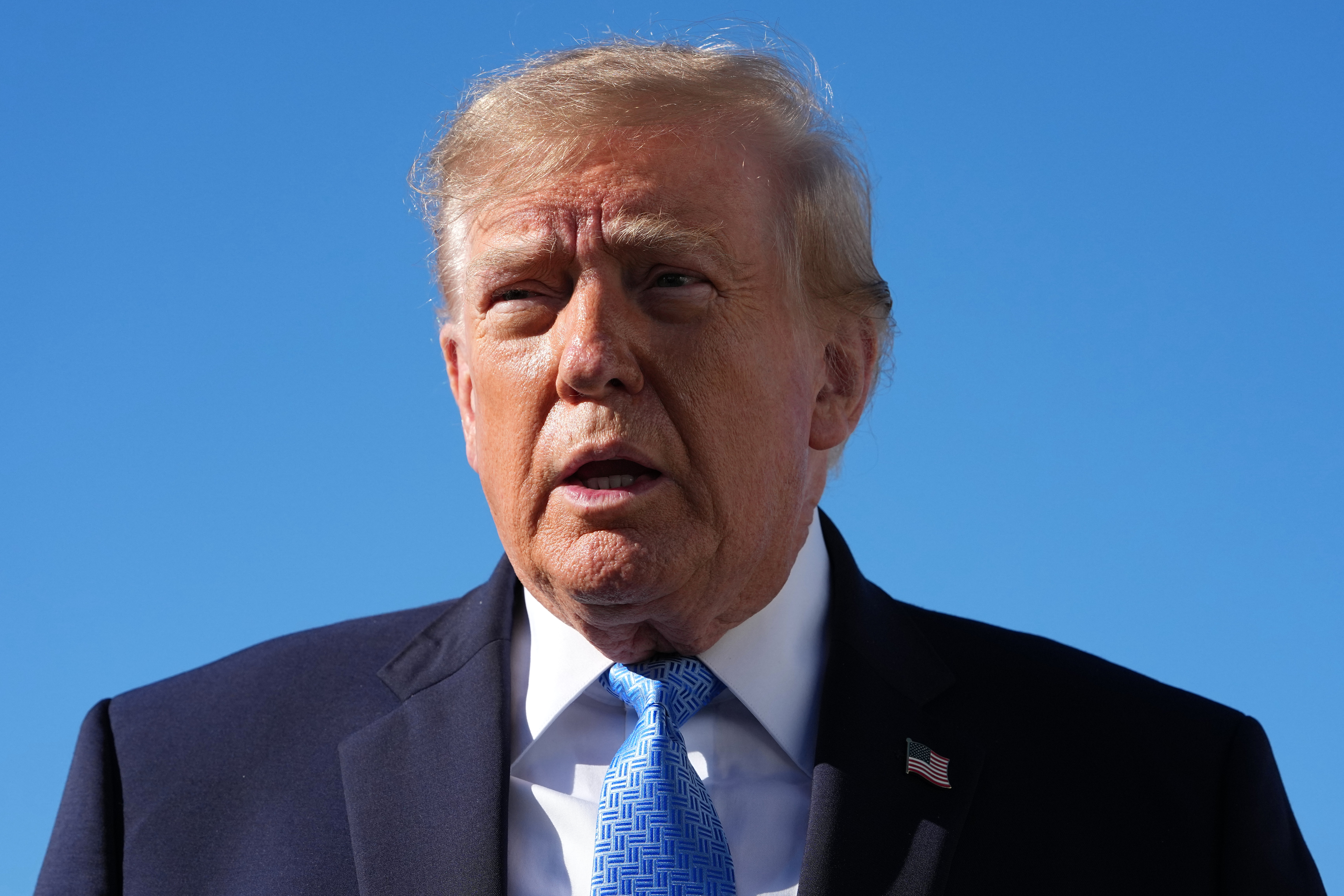
    President Donald Trump took seven minutes out of his Monday night rally in Corinth, Miss., to defend his focus on White House renovation projects after one of his predecessors, Barack Obama, compared the redecorated Oval Office to an over-the-top Cheesecake Factory.

    Trump denied spending excessive time on the projects, then went on to detail repairs to exterior plaster, as well as construction of a heliport and ballroom. He described the executive mansion’s previous condition in dire terms, including a cracked column, missing ornamentation, and broken tile.

    “I fix things very good, very beautifully,” he said. “It’s a natural thing. It actually relaxes me.”

    Obama, campaigning for Democrats in Ohio on Saturday, joked that the proliferation of gold-colored appliqués in Trump’s Oval Office looked “like Saddam Hussein opened a Cheesecake Factory.” With his focus on home renovations, Obama added, Trump “should be on HGTV.”

    The slight played on a broader vulnerability for Trump, a real estate developer by profession, who has devoted considerable attention to remaking the White House and Washington even as most Americans disapprove of the projects. Fifty-nine percent of respondents to a Washington Post-ABC News-Ipsos poll conducted this month said Trump was spending “too much” time on the projects, compared with 27% of adults who said he is spending the right amount of time on the projects and 11% who said not enough.

    Obama’s criticism appeared to particularly rankle Trump, who has feuded with him for decades.

    Trump on Monday praised the Cheesecake Factory as “a very successful company” and defended the importance of tending to the White House’s physical condition.

    “The White House represents our country, and that has to be pristine,” he said. “And I would try and explain that to a guy like Obama, but he wouldn’t understand.”

    Trump said he noticed the building in disrepair during a visit 20 years ago. There is no record of Trump visiting the White House between 1987, at a reception with President Ronald Reagan, and 2016, after he won the November presidential election.

    Trump said he would have done the renovations in his first term but didn’t have the time. He then again denied spending time on them.

    “I didn’t take any time,” he said. “It’s been my honor to do it. I have fun doing it.”

  • Judge temporarily blocks further alterations at D.C.’s East Potomac Park

    Judge temporarily blocks further alterations at D.C.’s East Potomac Park

    A federal judge temporarily barred the Interior Department on Monday from carrying out a variety of major alterations at East Potomac Park, finding that the government had been taking steps to initiate President Donald Trump’s vision for a championship level golf course on the property while passing off the work in court as routine maintenance.

    The ruling followed an extraordinary confrontation between the Justice Department and Judge Ana C. Reyes, who throughout October called several Trump administration officials and government lawyers to account for what she described as misrepresentations about the plan.

    The clash put a spotlight on what had been one of the president’s less visible plans for transforming the capital, compared to his efforts to seize control of the John F. Kennedy Center for the Performing Arts, build a 250-foot triumphal arch at the entrance to Arlington National Cemetery, and add a gilded ballroom to the White House. This, instead, was the overhaul of a municipal golf course and public park.

    It culminated in a searing 70-page opinion issued on Monday, in which Reyes wrote that much of what she had been told in court stood at odds with Trump’s public pronouncements about the golf course, which came even as officials were insisting that no long-term plan was settled.

    “Rarely, if ever, has the United States Department of Justice urged a federal court not to believe the sitting President,” she wrote. “Not to believe him that a cabinet secretary has ‘developed’ a federal land project. Not to believe him that the secretary’s agency will destroy a historic golf course already on the land.”

    “And yet, here we are,” she added.

    A group that included two Washington residents and a preservation society that sued to block an overhaul of the existing site had asked the court to prevent the administration from cutting down more trees after 400 were felled in one morning earlier this month.

    Reyes granted the request and went further, barring other actions that could indirectly destroy trees, including staging heavy machinery. She went to great lengths to impart her instructions in detail, an apparent attempt to prevent the administration from citing confusion or ambiguity to act without her involvement.

    She required the government to notify the court at least 10 days before closing the course or making any “irreversible modification to any forms or features” to East Potomac Park, where the current course is, including changes to “the Park’s landforms, vegetation, course design, hydrology, pathways, and structures.”

    “This is a big win that will rightly protect East Potomac Park from further irreparable harm,” said Skye Perryman, the president of the nonprofit Democracy Forward, which is representing the group behind the lawsuit.

    The dramatic changes that Trump has made to Washington loomed over the lawsuit from the beginning.

    Throughout early interactions with Justice Department attorneys on the case, Reyes stressed that she wanted to avoid surprises, after the president acted without warning last year to demolish the East Wing of the White House before courts could review the legality of the project.

    At the same time, she said, the lawsuit placed her in a difficult spot, because she did not view it as the role of federal courts to police minor decisions about management of federal lands. While Trump had mused since last year about transforming plans for East Potomac Park, earlier this year she repeatedly told the group behind the lawsuit that it was not yet clear that the federal government was actively implementing his vision, making court action premature.

    Hesitant to issue any order that would prevent rank-and-file government workers from carrying out everyday maintenance on the course, she prevailed on the Justice Department to provide early warning before workers started major work at the golf course.

    During hearings in May and July, she told government lawyers she expected professionalism and that she would trust them to let her know when plans firmed up and if government was preparing to begin work on the course Trump had described.

    She stressed she would give the Justice Department “the benefit of the doubt” and that she was confident that workers would not “act first and ask forgiveness later.”

    But in October, that calculus changed.

    “The government then did precisely what plaintiffs feared,” she wrote in an opinion earlier this month.

    On a Friday evening, headed into the Columbus Day weekend, the Justice Department filed an update advising that the Interior Department had crafted a plan to clear hundreds of trees across the course. The next morning, just hours later, the crews arrived and cut down hundreds of trees.

    At that point, Reyes lambasted the Justice Department, vowing to get answers about who authorized the cutting, whether it was in preparation for Trump’s renovation, and how much time had passed between the decision to cut down the trees and the Justice Department’s filing alerting the court.

    In two hearings, she ordered four Interior Department officials to recount how the decision was made. She sparred with Stanley Woodward Jr., the third most senior official at the Justice Department, who stepped in to represent the government.

    In the meantime, Trump announced in several social media posts in October that work would begin “immediately” and the course would close in November to complete the project.

    This article originally appeared in the New York Times.

  • Flávio Bolsonaro leaves Brazil for U.S. after election defeat

    Flávio Bolsonaro leaves Brazil for U.S. after election defeat

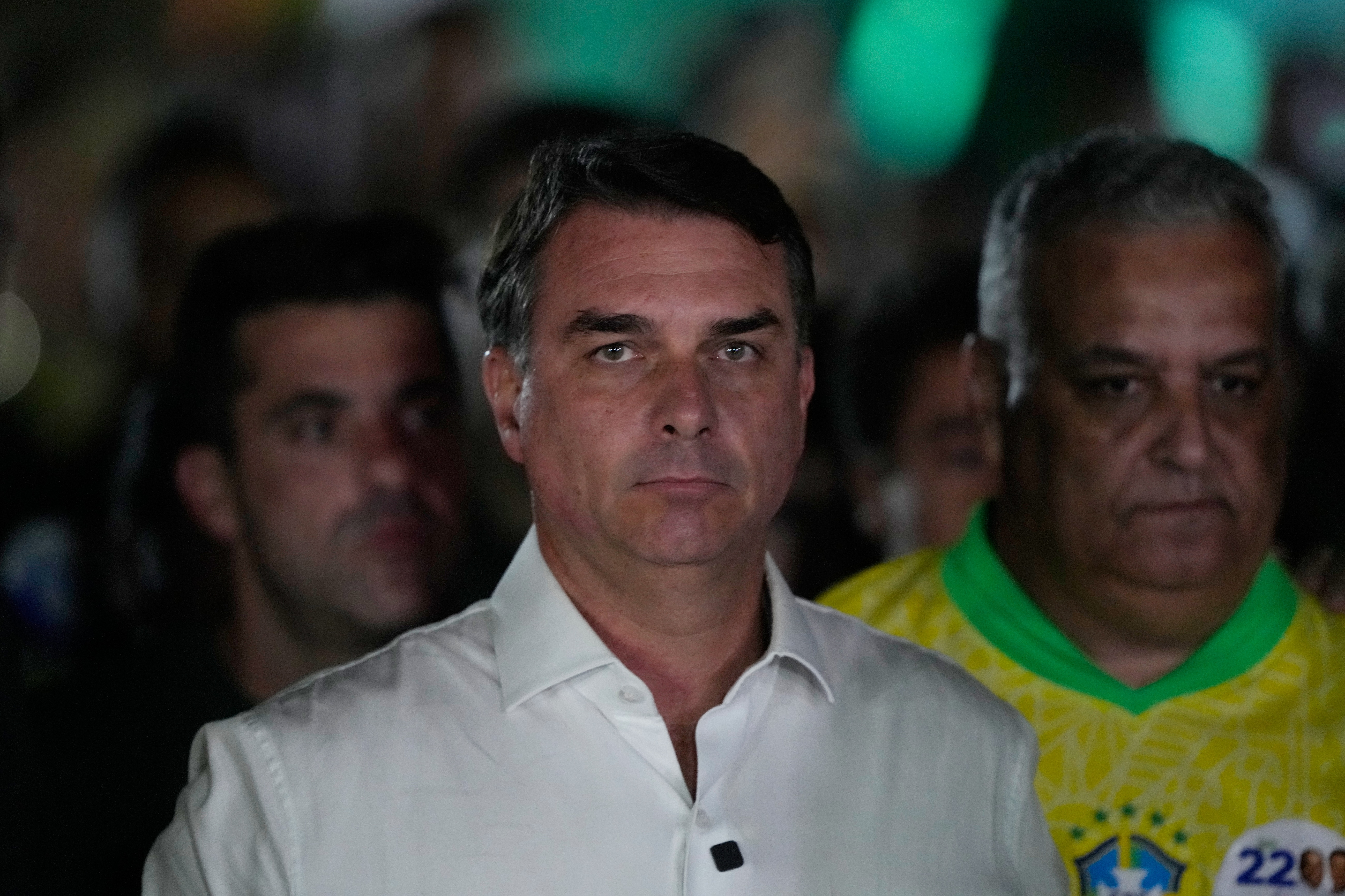
    BRASÍLIA, Brazil — Flávio Bolsonaro, the presidential candidate defeated in Sunday’s election in Brazil, left for the United States on Tuesday, according to two U.S. officials, a day after the Brazilian police asked him to hand over his passports because he was being investigated in a money-laundering case.

    The officials spoke on the condition of anonymity to discuss sensitive diplomatic matters.

    Bolsonaro is being investigated over his links to a Brazilian lawyer who is accused of laundering more than $1 billion through a vast fraud scheme, according to a court document reviewed by the New York Times.

    Separately, he is also the subject of an inquiry over the millions of dollars he raised from a disgraced banker at the center of a huge corruption scheme to finance a biopic of his father, Jair Bolsonaro. The elder Bolsonaro was convicted of attempting a coup after losing the presidential election in 2022.

    Flávio Bolsonaro, who has not been charged, has denied wrongdoing and has cast the investigations as political persecution.

    After initially rejecting the election results, he accepted his defeat Monday but claimed his opponent, President Luiz Inácio Lula da Silva, had used unfair tactics to win. Bolsonaro said he planned to file a legal challenge over the election outcome.

    President Donald Trump also criticized Brazil’s election Monday, saying, “It looked like another rigged election.”

    The White House and State Department did not reply to requests for comment on Bolsonaro’s travels.

    Bolsonaro’s brother, Eduardo Bolsonaro, lives in the United States and maintains close ties to the Trump administration. The U.S. government granted him permanent resident status, known as a green card, in July. He had been living in the United States since 2025.

    This article originally appeared in the New York Times.

  • Congo’s Ebola outbreak tops 10,000 cases as authorities race to slow the spread in African countries

    Congo’s Ebola outbreak tops 10,000 cases as authorities race to slow the spread in African countries

    BUNIA, Congo — The fast-moving Ebola outbreak in Congo has reached 10,000 confirmed cases, government data showed Tuesday, as health authorities race to slow the spread of the disease in multiple African countries.

    It is the fastest-growing Ebola outbreak in history and nearly half of the 10,060 confirmed to have the virus have died, according to data from Congo’s Ministry of Health. That also makes it the deadliest outbreak of the disease in the country’s history.

    The outbreak declared in May is caused by the rare Bundibugyo virus, for which there is no approved vaccine or treatment. Response teams are battling armed conflict, poor roads, and violence from residents fueled by mistrust and misinformation. Those obstacles compound the challenge of persuading people to report symptoms and accept care in communities that have endured years of violence and repeated epidemics.

    Compared to the West Africa Ebola outbreak of 2014-2016 — history’s largest and deadliest with more than 28,000 cases, including over 11,000 deaths — this has had at least three times the number of cases and number of deaths in the time since it was declared.

    It has spread farther across Africa than any previous Ebola outbreak, reaching three regions with cases recorded in Kenya and Nigeria as well. It’s so far been recorded in five countries including Uganda and France, both of which have no active cases at the moment.

    A recurring problem in the spread in Africa is what appears to be lax surveillance efforts, as most of the first cases were confirmed long after people started showing symptoms or after traveling.

    African health ministers are to hold a virtual summit on Wednesday to strengthen the continent’s collective response. “Ebola is crossing borders. Our response must move faster, with stronger coordination, greater solidarity and decisive political leadership,” Jean Kaseya, head of Africa CDC, has said.

    At least 2,600 patients have recovered from the disease in Congo, bringing rare moments of joy to affected communities. A viral video this week showed health workers in full protective gear dancing as the last two patients were discharged from a treatment center in Mongbwalu, Ituri province.

    “The outbreak is far from over, but every life saved is worth celebrating,” World Health Organization Director-General Tedros Adhanom Ghebreyesus said of the video.

    80% of new cases in Congo are outside of monitored contacts

    In Congo, the disease has spread to 66 health zones across eight provinces, from three zones when it was first declared in May. Responders have told the Associated Press that they’re seeing treatment centers in some of those health zones getting overwhelmed, people still skeptical and violent toward them, and health workers are regularly going on strike to protest delayed or unpaid wages.

    “Some people still don’t seem to understand the seriousness of the situation even though they are directly exposed to the risk,” said Sephora Bgosi with the Ebola burial team in Ituri province, the epicenter. “Ebola disease is extremely dangerous and can be deadly,” said Bgosi.

    About 80% of recorded cases are still coming from outside of monitored contacts, showing there are ongoing chains of transmission that health authorities are not aware of. At least 95% of recorded cases are supposed to be coming from known contacts for officials to say the outbreak has largely been brought under control, the Africa CDC has said.

    At least half of deaths recorded are among people who have not been admitted to treatment centers, a sign that people are still not reporting symptoms at all in many areas.

    In many zones, health workers are battling challenges ranging from basic needs such as adequate vehicles to complex ones like persuading families to release their relatives who are sick with the disease or who have died from it and need to be buried safely.

    Last week at the Nia Nia health zone in Ituri province, some Ebola responders, including surveillance and community engagement officers, went on strike over unpaid bonuses owed since late August, a common trend across many affected localities.

    More than five months since the outbreak was declared, health workers are still being attacked by angry villagers, including an attack on Saturday when a nurse was killed and another health worker severely injured while responding to an Ebola alert in Bafwasende, Tshopo province.

    The outbreak is impacting Congo’s healthcare services

    The outbreak has disrupted essential health services that are already underfunded and overstretched and has shifted attention away from other disease outbreaks the country is battling, such as cholera.

    More pregnant women are dying as they avoid hospitals over fear of infection and isolation, causing maternal mortality to double in some provinces soon after the outbreak was declared.

    It has also disrupted routine healthcare services such as childhood vaccinations, interrupted schooling for children where millions are already out of school, caused trauma and stigma for affected families, and further stretched the livelihoods of many already struggling with hardship.

  • Justice Department charges James Comey, ex-FBI director, for a third time

    Justice Department charges James Comey, ex-FBI director, for a third time

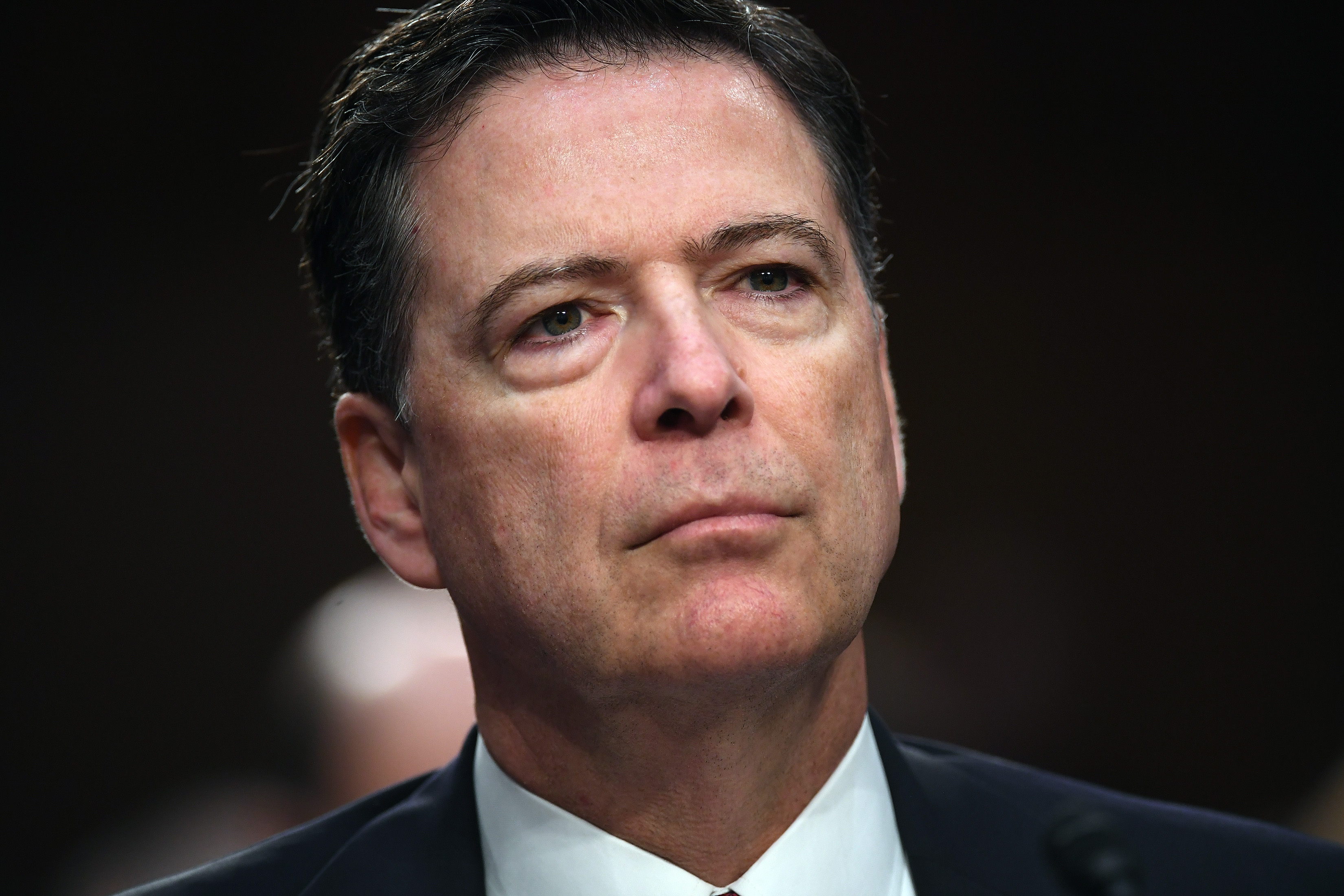
    The Justice Department has again charged James B. Comey, the third time the Trump administration has mounted a criminal case against the former FBI director — a prominent political foe of the president — since last year.

    This time, federal prosecutors charged Comey with two counts alleging that he leaked sensitive government material to the media in 2016 when he was FBI director. Comey was fired by President Donald Trump the following year. He has since become a staunch critic of Trump and the Justice Department’s actions during his second term.

    In court papers earlier this month, Justice Department officials said that Comey directed his staff to speak to a New York Times reporter about U.S. email surveillance in October 2016, “and thereby illegally transferred classified information.”

    According to court documents, prosecutors allege that Comey wanted his staff to talk to the reporter to address what they viewed as misinformation in an article published by another news outlet the previous day.

    The resulting Times article contained information that was “significantly similar” to details contained in an internal government email sent to about 30 people in the U.S. intelligence community hours before the story was published, prosecutors alleged. They said this information is what Comey directed his staff to leak to the reporter.

    Comey has denied the allegations and vowed to fight the case, which has been playing out in secret for weeks under seal.

    Prosecutors did not obtain an indictment through a grand jury to charge Comey, but rather charged him in D.C. with a criminal information. This means that the document charging Comey is solely based on allegations from a prosecutor rather than a grand jury.

    Because prosecutors are charging Comey with two felonies, they will ultimately have to try to secure an indictment through a grand jury since Comey did not waive his grand jury rights.

    The charges were originally filed under seal earlier this month, but a federal judge in D.C. sided with Comey’s request to unseal the allegations against him. The judge said federal prosecutors did not object to his request.

    “Criminal charges against a former FBI director for his conduct while in office are of significant public interest,” U.S. District Judge Trevor McFadden, a Trump appointee, wrote in his order Monday. “That is because both Comey’s alleged conduct while director and the government’s prosecution of this case are properly subject to the public’s ‘watchful eye.‘”

    The indictment and other government filings in the case were signed by a group of specially appointed assistant U.S. attorneys, rather than any of the hundreds of career attorneys hired in D.C.

    The filings also bear the names of two of Attorney General Todd Blanche’s closest deputies: acting deputy attorney general R. Trent McCotter, the second-most powerful official in the agency, and Aakash Singh, a top aide to Blanche.

    Comey’s lawyers, in court filings unsealed Monday, had described the decision not to take the case before a grand jury first as an improper way to get around the 10-year statute of limitations for the alleged crimes, which was set to expire the day prosecutors filed the case in early October.

    They asked the federal judge overseeing the matter to dismiss the charges. McFadden has not ruled on that request yet.

    Comey’s lawyers contend that the leak in question had twice been investigated by prosecutors during the first Trump administration and that they did not recommend charges.

    The Justice Department said in a statement that it filed the criminal information due to the statute of limitations and defended that maneuver.

    The agency filed “a criminal information to toll the statute of limitations as it relates to allegations concerning former FBI Director Comey,” a Justice Department spokesperson said in a statement. “Filing a criminal information to toll the statute of limitations is a widely recognized practice in federal court and has been approved by multiple Circuit Courts of Appeals.”

    Comey, who is also facing an unrelated criminal case in North Carolina, denied the latest allegations on Monday and said he would keep fighting in court.

    “It would almost be funny if it weren’t such an appalling abuse of the Department of Justice — one that we cannot become numb to,” Comey said in a video statement posted online. “Nothing’s changed with me. I’m still innocent.”

    During Trump’s second term, the Justice Department has frequently taken aim at his perceived adversaries, including bringing multiple cases against Comey.

    In North Carolina, prosecutors indicted Comey in April on allegations that a photo he posted on social media in 2025 constituted a dangerous threat to the president.

    Comey has urged the judge overseeing his case in North Carolina to dismiss the charges as an improper, vindictive attempt by the Justice Department to charge him with a federal crime. If the judge allows that case to move forward, Comey is expected to face trial sometime next year.

    In a separate case, the Justice Department in September 2025 indicted Comey in the Eastern District of Virginia on two counts alleging that he lied to Congress during 2020 testimony about whether the former FBI director ever authorized leaks to the media. The grand jury in Virginia rejected a third count sought by government prosecutors involving another alleged false statement.

    A federal judge dismissed that case after concluding that the prosecutor overseeing it, former interim U.S. attorney Lindsey Halligan, had been illegally appointed. The Justice Department is seeking to revive that case. The U.S. Court of Appeals for the Fourth Circuit is expected to rule on the Justice Department’s appeal soon.

    The latest case against Comey in D.C. was made public hours after a federal judge in New York ruled that the Justice Department had unlawfully fired his daughter, Maurene Comey, a former federal prosecutor.

    After being fired, she sued the Justice Department, arguing that the Trump administration fired her because of her father and her perceived political beliefs.

  • CDC deputy director resigns after 4 months in the job

    Jennifer Shuford, a former state health commissioner whom President Donald Trump appointed to a top post at the Centers for Disease Control and Prevention to help steady the agency, is leaving after just four months in the job.

    Shuford’s last day is planned for Nov. 12, the CDC said in a statement Tuesday. Her departure was reported Monday night by the Washington Post. Erica Schwartz, the CDC director, announced the news to staff in an email Tuesday morning.

    News of Shuford’s exit comes as the CDC faces criticism over its response to unrelenting measles outbreaks in the country. The agency is embroiled in a dispute over its refusal to acknowledge several measles-related deaths reported by the Pennsylvania Health Department.

    Shuford, who was the agency’s deputy director and chief medical officer, did not respond to a request for comment. She said in the statement released by the CDC that she was leaving “to spend more time with my family.”

    “I am so thankful to President Trump and Secretary Kennedy for giving me the opportunity to help lead CDC,” she said, referring to Health Secretary Robert F. Kennedy Jr. “It has been an amazing experience, and I will be forever grateful for it.”

    Shuford previously served as health commissioner for Texas and earned respect from public health officials as she oversaw the state’s response to its measles outbreak last year. She gained a reputation as a data-driven epidemiologist who understood the importance of childhood vaccines. She joined the CDC in June.

    “It is highly concerning that the most qualified person in the office of the director is departing the agency,” said Demetre Daskalakis, who resigned from the agency in August 2025 in protest of the administration’s policies.

    “These decisions are hard, but based on my experience of Dr. Shuford during the West Texas measles outbreak, I trust her judgment that this is the time to depart,” Daskalakis said.

    News of her planned departure came as a disappointment to people inside and outside the CDC who had hoped for more stability and sparked speculation that she must have disagreed with an upcoming policy from the administration.

    Anne Zink, a former president of the Association of State and Territorial Health Officials and Alaska’s chief medical officer until 2024, has known Shuford for years. Zink said she did not know why Shuford had decided to leave the agency so abruptly, but “taking these jobs, we all have to know our red line and when it is important to walk away,” she said.

    “It is different for every person and a balance between if you can do more good inside or outside the structure,” she added.

    Trump announced Shuford’s appointment in April, along with his nomination of Schwartz as the agency’s director, and Sean Slovenski, an executive in the healthcare industry, as its chief operating officer.

    The CDC plans to start a search for her replacement soon. Capt. Satish Pillai will serve as acting deputy director and chief medical officer in the interim, the agency said.

    “I am deeply grateful for Dr. Shuford’s outstanding leadership, and commitment to CDC and public health, especially as she has navigated an exceptionally demanding, high-profile, and constantly evolving environment over the past several months,” Schwartz said in a statement.

    This article originally appeared in the New York Times.

  • U.S. offers Constellation $5 billion financing to spur nuclear

    U.S. offers Constellation $5 billion financing to spur nuclear

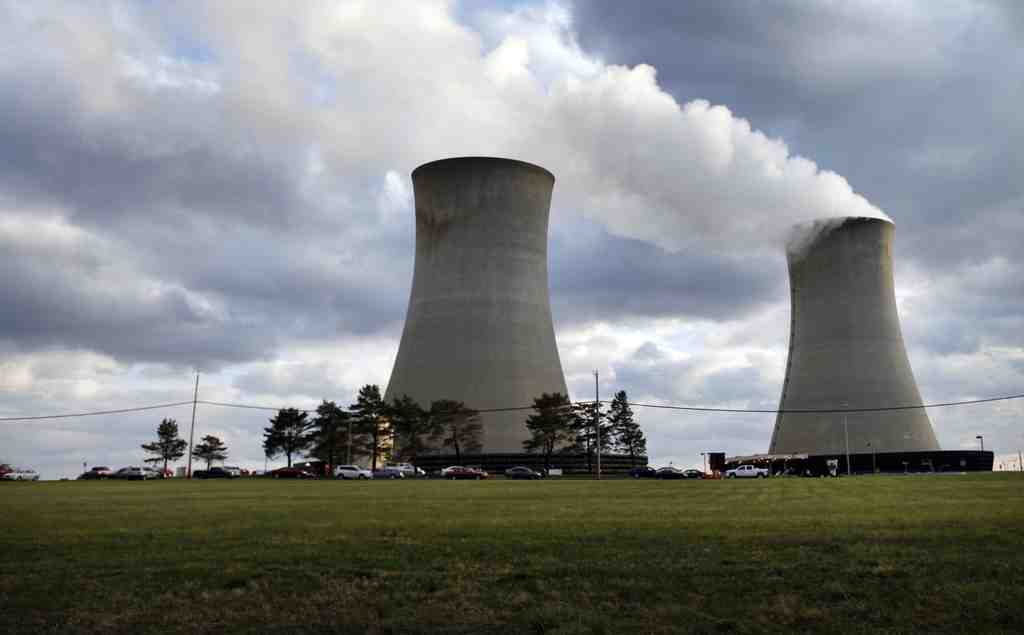
    The Trump administration is offering as much as $5 billion in financing to Constellation Energy Corp. to upgrade and modernize the nuclear operator’s fleet of reactors in Pennsylvania, Illinois, and Maryland.

    The projects backed by the conditional loan commitment are expected to add nearly 1.1 gigawatts of electricity and help strengthen the grid and lower costs, according to the Energy Department. Constellation shares surged on the news.

    Energy Secretary Chris Wright plans to announce the funding later Tuesday at an Illinois nuclear plant that will supply power to Alphabet Inc.’s Google.

    “The Energy Department is accelerating President Trump’s American nuclear renaissance and unlocking the full potential of our nation’s nuclear fleet,” Wright said in a statement. He said upgrades that increase output from existing nuclear facilities can expand electricity supply while supporting grid reliability and affordability for consumers and businesses.

    Technology companies are driving interest in nuclear projects to power artificial intelligence. But new reactors can take a decade or more to permit and build. Upgrading components such as turbines can increase the output from existing plants, and is seen as a faster and cheaper way to deliver carbon-free fission electricity.

    Constellation shares gained as much as 5.3% before closing up 2.6% on Tuesday.

    The Energy Department financing is part of President Donald Trump’s push to expand nuclear power to meet growing electricity demand from data centers and support domestic manufacturing. The funding follows an executive order that set a goal of adding 5 gigawatts of capacity through upgrades at existing nuclear plants, 96% of which has been achieved, the department said.

    Constellation is planning investments at six Illinois plants — Braidwood, Byron, Clinton, Dresden, LaSalle and Quad Cities — as well as Calvert Cliffs in Maryland and Limerick in Pennsylvania to increase output from existing nuclear plants, the Energy Department said. The financing, through the department’s Office of Energy Dominance Financing, also includes an option to fund future uprates at other Constellation facilities.

    The company has signed several similar deals this year, though it has now announced upgrade projects across much of its fleet and may have few opportunities for additional transactions.

    At Byron, about 100 miles west of Chicago, Constellation this month announced a separate deal with Google. The biggest U.S. nuclear operator plans to invest $4.3 billion to upgrade 11 reactors, boosting total output by 890 megawatts, and supply the power to Google data centers under a 20-year power-purchase agreement.

  • Rays put on the brink of World Series flop by Brewers’ historic 8-run, 2-out surge

    Rays put on the brink of World Series flop by Brewers’ historic 8-run, 2-out surge

    ST. PETERSBURG, Fla. — Taylor Walls stabbed at Brice Turang’s sharp grounder and felt it glance off his glove.

    “Knife in the chest,” the Tampa Bay Rays shortstop said.

    Tampa Bay’s first World Series game at Tropicana Field in 18 years turned into a record-setter for Brewers batters.

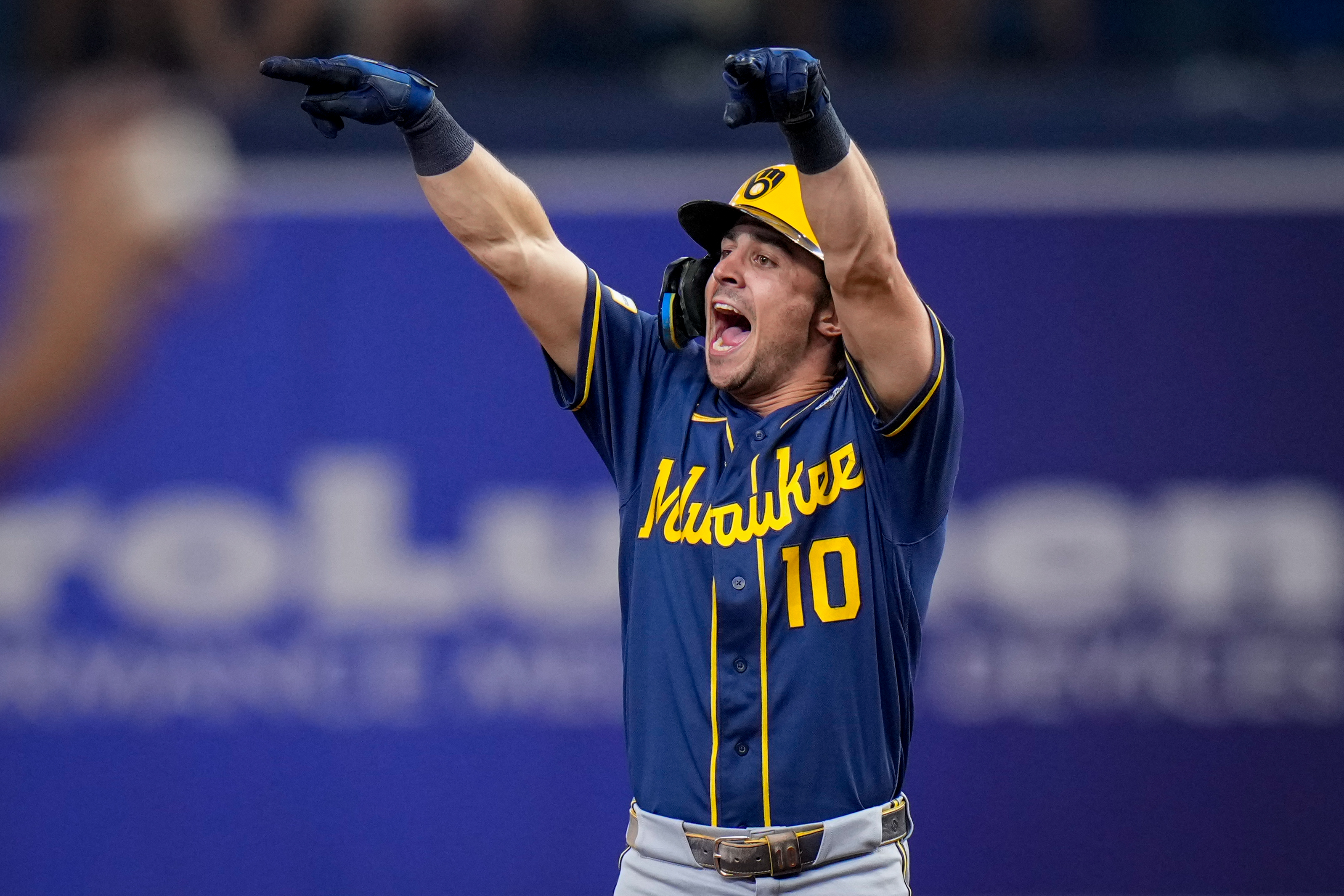
    Milwaukee became the first team to score eight runs with two outs in a World Series inning, routing the Rays 10-1 on Monday night to take a 3-0 lead in the best-of-seven series.

    Turang’s two-run single was the second of a postseason-record seven straight two-out hits against starter Freddy Peralta and relievers Cam Booser and Cole Sulser.

    Milwaukee turned a 2-0 lead into a 7-0 advantage with hits on three straight pitches by Turang, Garrett Mitchell and Cooper Pratt. The Brewers went on to score eight runs in a 17-pitch span to open a 10-run advantage. Jackson Chourio had a single and a double in the inning, part of his four-hit night.

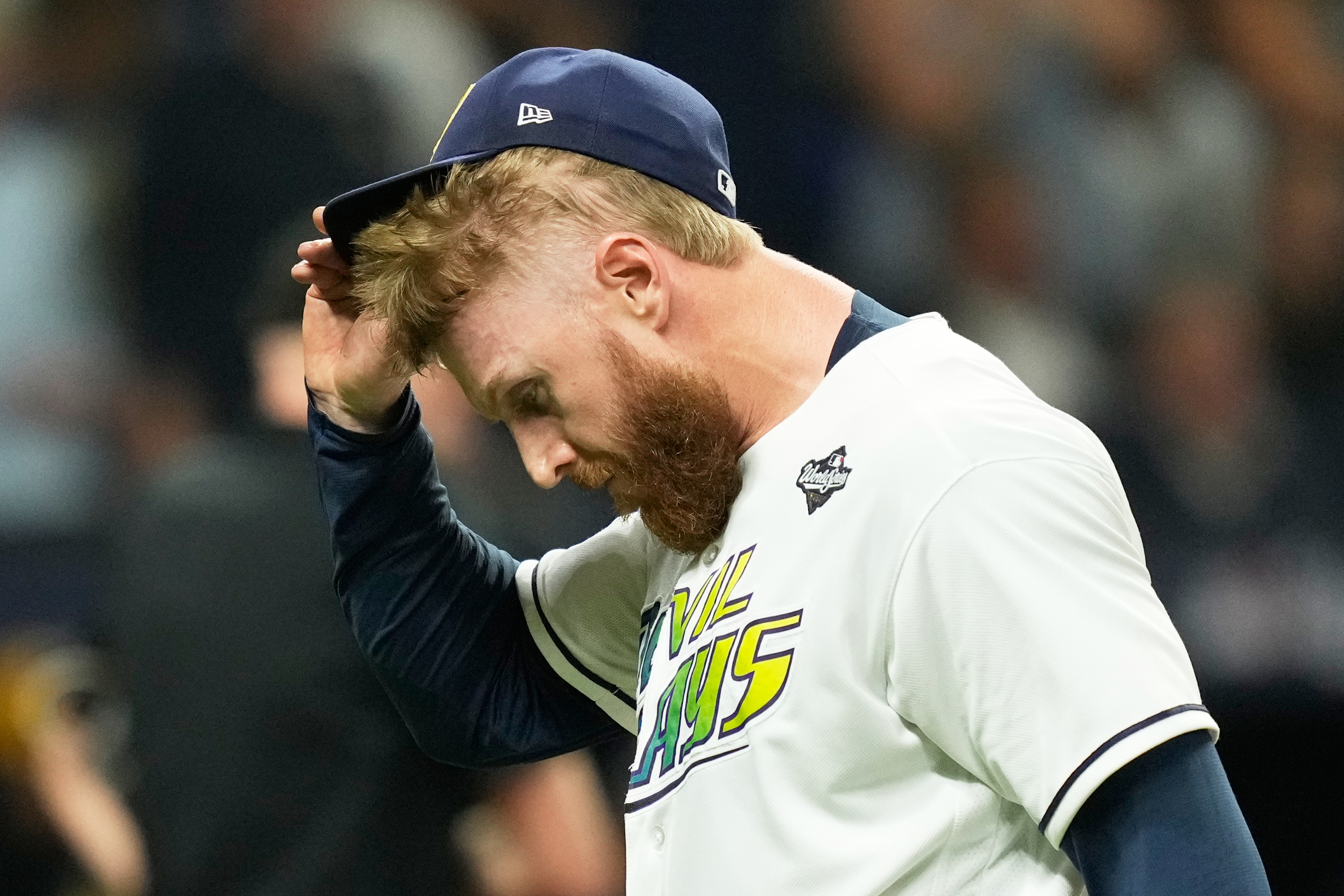
    “Worst feeling in the world, feeling like you let your team down,” a downcast Booser said in the quiet Tampa Bay clubhouse.

    Among 25 previous teams that fell behind 3-0 in a World Series, 21 were swept and four lost in five games. Of 43 teams to trail 3-0 in any best-of-seven postseason matchup, only the Boston Red Sox against the New York Yankees in the 2004 American League Championship Series rebounded to win.

    “It’s kind of that chip and a chair mentality,” Rays manager Kevin Cash said. “We’ve got a seat at the table. We’ve got to do something with the chip. Obviously the only thing we can do is win tomorrow.”

    The Brewers’ Sal Frelick celebrates his RBI double during the fifth inning.Chris O'Meara

    Coming off a pair of one-run wins at American Family Field, the Brewers took a 2-0 lead in the third when Christian Yelich and William Contreras hit opposite-field, one-out RBI singles on consecutive pitches.

    “They were very disciplined at the plate,” Peralta said. “Just tried to hit the ball the other way.”

    Chourio singled with one out in the fifth and Christian Yelich walked with two outs. Contreras grounded to third and Junior Caminero threw to second as umpire Dan Bellino signaled a force out. But the call was reversed in the New York replay operations center by umpire Alfonso Márquez, giving Contreras an infield single that loaded the bases.

    Caminero may have had a better chance of throwing out Contreras at first base.

    “I knew the speed at first base wasn’t necessarily the best in that situation,” Caminero said through a translator. “So going into the moment, once I got the ground ball I was going to second base all the way.”

    Booser relieved and Turang’s 106 mph one-hopper hit the dirt just past the infield grass, bounced off Walls’ glove and into short center field.

    “I’d like to have that one back. Those are plays that you’d like to make, that you expect to make even though they may be on the tougher end,” Walls said. “That was pretty much the turning point in the game there.”

    Walls dropped to a knee and held out his glove at shoulder level trying to make what would have been an excellent stop, then tumbled as the ball bounced past him.

    “You just try to get your eyes as close to where the ball is going to be, the height of the hop,” he said. “Ideally, I guess if you want to talk about fractions, if you can get your glove behind the ball and work more backwards you have a better chance to make the play than if you’re slightly above it having to kind of work down a little bit, which is where I kind of felt I was.”

    Phillies Extra: How much change is needed for the Phillies entering 2027?
    Video: Phillies Extra: How much change is needed for the Phillies entering 2027?

    Mitchell grounded an opposite-field RBI single through the shortstop hole vacated with Walls shifted toward second for the left-handed batter. Pratt followed with a smash off the glove of a diving Caminero that rolled into the left-field corner for a two-run double.

    Sal Frelick sliced an opposite-field double that hit the wall on a hop in the left-field corner, scoring Pratt and chasing Booser.

    David Hamilton greeted Sulser by lining a shoulder-high fastball into center for a run-scoring single and a 9-0 lead. Chourio then lofted an opposite-field RBI double that hit just in front of the warning track.

    Boston set the previous Series high of seven runs with two outs in the fifth inning of the 2007 opener against Colorado, a feat matched three years later by San Francisco in the eighth inning of Game 2 against Texas, according to the Elias Sports Bureau. The Los Angeles Dodgers were the only prior team with eight two-out runs in any postseason inning, scoring 10 with two outs in the first inning of Game 3 against Atlanta in the 2020 NL Championship Series.

    Griffin Jax said he’ll put the Series deficit out of his mind when he starts Game 4 on Tuesday.

    “We just got our butts kicked tonight. I don’t think there’s really much else to say,” Jax said. “We’ll just kind of forget it and try to sleep it off and come back tomorrow ready to fight.”