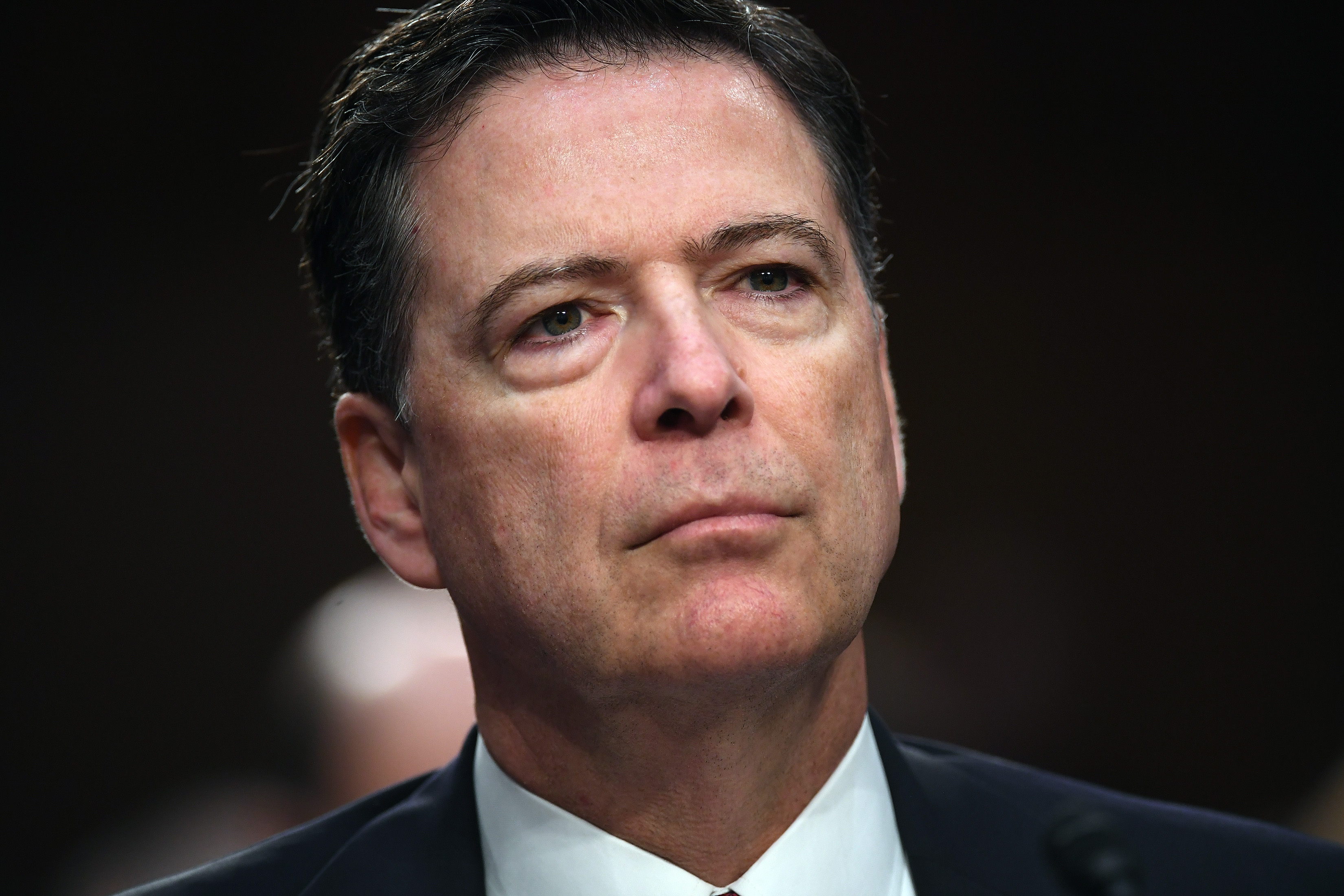
The Justice Department has again charged James B. Comey, the third time the Trump administration has mounted a criminal case against the former FBI director — a prominent political foe of the president — since last year.
This time, federal prosecutors charged Comey with two counts alleging that he leaked sensitive government material to the media in 2016 when he was FBI director. Comey was fired by President Donald Trump the following year. He has since become a staunch critic of Trump and the Justice Department’s actions during his second term.
According to federal prosecutors, Comey directed his staff to talk to a New York Times reporter about U.S. email surveillance in October 2016. The information relayed to the reporter was sensitive government material that should not have been disclosed, prosecutors allege.
Prosecutors did not obtain an indictment through a grand jury to charge Comey, but rather charged him in D.C. with a criminal information. This means that the document charging Comey is solely based on allegations from a prosecutor rather than a grand jury.
The charges were originally filed under seal earlier this month, but a federal judge in D.C. sided with Comey’s request to unseal the allegations against him.
Comey, who is also facing an unrelated criminal case in North Carolina, denied the latest allegations on Monday and said he would keep fighting in court.
“It would almost be funny if it weren’t such an appalling abuse of the Department of Justice — one that we cannot become numb to,” Comey said in a video statement posted online. “Nothing’s changed with me. I’m still innocent.”
Judge rules Comey’s daughter fired illegally by DOJ
A federal judge in New York ruled Monday that the Justice Department unlawfully fired Maurene Comey, daughter of the former FBI director, from her job as a federal prosecutor.
Comey had argued in her federal lawsuit that she was fired because of her father, whom President Donald Trump fired as head of the FBI during his first term, and because of her perceived political beliefs. The Trump administration has brought federal charges against her father, who became a prominent critic of the president after he was fired.
The Justice Department countered that Maurene Comey, as a federal prosecutor in New York, was an executive branch employee whom the president has the broad authority to terminate.
But on Monday, U.S. District Judge Jesse M. Furman in the Southern District of New York ruled that the Justice Department was wrong and wrote that the government’s defense of her firing “flies in the face of nearly two centuries of Supreme Court precedent.”
“Indeed, to accept Defendants’ argument would be to unsettle the very equilibrium established by this Nation’s constitutional system,” Furman, who was appointed by President Barack Obama, wrote in his 55-page opinion.
Comey is one of the scores of career employees whom the Justice Department has fired during Trump’s second term, often with no explanation beyond citing the president’s powers under the Constitution. She had worked as a federal prosecutor handling high-profile cases, including those brought against sex offender Jeffrey Epstein and Sean “Diddy” Combs, the music mogul.
Career government employees are generally afforded broad protections to ensure that they are not fired for political reasons and that their employment can span Republican and Democratic presidential administrations.
Many of the employees dismissed during the Trump administration have challenged their firings either in federal or administrative courts.
Comey’s lawsuit is widely viewed as a litmus test to see whether similar cases survive in federal court, or whether they may be sent to the Merit Systems Protection Board, the administrative body that deals with federal government firings and demotions.
Furman ordered that the Justice Department retroactively reinstate Comey and provide her back pay from when she was fired in July 2025 until she took another job at a private law firm in December of the same year.
“The Department disagrees with this decision and will appeal in due course,” a Justice Department spokesperson said in a statement.
Furman noted in his opinion that Comey was assigned some of the Justice Department’s most prominent cases and consistently received high accolades from her supervisors and peers.
But she was fired on July 16, 2025, shortly after the conclusion of Combs’ trial in U.S. District Court in Manhattan.
According to her lawsuit, she was not provided a reason for her termination. When Comey asked why she was fired, her lawsuit states, Jay Clayton, then the interim U.S. attorney in Manhattan, said: “All I can say is it came from Washington. I can’t tell you anything else.”
Clayton has since left that office and was confirmed this summer as the director of national intelligence.
The firing of Comey came as the Trump administration was frequently targeting her father through the president’s public statements and Justice Department investigations.
Federal prosecutors in April indicted the elder Comey on allegations that a photo he posted on social media in 2025 constituted a dangerous threat to the president.
In a separate case, the Justice Department in September 2025 indicted Comey in the Eastern District of Virginia on two counts alleging that he lied to Congress. The grand jury in Virginia rejected a third count sought by government prosecutors involving another alleged false statement.
That case had been thrown out by a judge who concluded that the U.S. attorney who secured the indictment, along with another against New York Attorney General Letitia James (D), was unlawfully serving in the role. The Justice Department has sought to revive both cases.