Category: Wires

  • U.S. hiring slows and unemployment ticks higher with a month remaining before Americans head to polls

    U.S. hiring slows and unemployment ticks higher with a month remaining before Americans head to polls

    WASHINGTON — U.S. employers added a disappointing 29,000 jobs and the unemployment rate ticked up last month, the government reported Friday, a month before voters go to the polls in pivotal midterm elections at a time of discontent over the high cost of living and the state of the economy.

    Hiring dropped from a revised 133,000 in August, the Labor Department said. The unemployment rate rose to a still-low 4.2% from 4.1% in August.

    Economists had expected September payrolls to come in around 90,000.

    Labor Department revisions also shaved 60,000 jobs off combined July and August payrolls.

    The new hiring data could draw the Federal Reserve’s attention back to hiring and jobs, given that one of the central bank’s two mandates is to seek maximum employment. Many Fed officials have said in recent weeks that they are primarily focused on their other mission, which is combating inflation. With the job market looking a bit weaker, the Fed may be more inclined to keep its key rate unchanged when it meets next month, rather than raise it.

    Average hourly wages were up just 3% last month from a year earlier, the smallest year-over-year gain since May 2021. “In this data, there is no sign that the labor market is stoking inflation,” said Luke Tilley, chief economist at Wilmington Trust.

    Still, the unemployment rate remains low and inflation has been above the central bank’s 2% target for more than five years, so the Fed’s concern about elevated prices is still front and center.

    Federal, state, and local governments cut 17,000 jobs last month. Professional and business services companies, which provide administrative and technical expertise, trimmed 9,000 jobs.

    Healthcare companies created 17,000 jobs in September, but that was barely half the 33,000 they’ve added, on average, each month for the past year. Bradley Saunders, an economist at Capital Economics, wrote that the slowdown in healthcare hiring might reflect the Trump administration’s revocation of work authorizations for 350,000 Haitians.

    Construction companies added 11,000 jobs and manufacturers 9,000.

    Unemployment rose partly because 485,000 people entered the workforce and not all of them found jobs right away.

    The U.S. job market has proven resilient in the face of a series of shocks — trade wars, persistent inflation, high interest rates, and a conflict with Iran that has driven energy prices higher. Friday’s jobs report is the last one that will come out before the Nov. 3 elections that will determine whether President Donald Trump’s Republicans maintain full control of Congress.

    Futures for the S&P 500 and Nasdaq composite added to their gains after the data was released on growing hopes that the Fed will hold off on a rate hike. Treasury yields moved lower.

    Yet what makes Wall Street happy differs starkly with what brings joy on Main Street.

    The U.S. job market has recovered from a dismal 2025, but most Americans are still unsettled about the state of the economy and the high cost of living.

    A Thursday poll from the Associated Press-NORC Center for Public Affairs Research finds that only 17% of U.S. adults approve of Trump’s handling of the cost of living. Just 26% approve of his handling of the economy overall, marking a new low.

    U.S. consumer confidence dropped this month to the lowest level in more than a decade, according to an index published by the Conference Board. One reason: More than 28% of respondents told the business think tank that they expect fewer jobs to be available in six months, double the 14% who expect more.

    The online jobs site Glassdoor reports that its employee confidence index, based on how workers view prospects for their own companies, dropped last month to the lowest level in records going back to the beginning of 2016, a period that includes a pandemic. It was the index’s third record low this year.

    “Employee confidence has been continuously grinding downward over the last year as workers grow increasingly anxious about everything from layoffs to AI,’’ said Glassdoor chief economist Daniel Zhao.

    The public’s misgivings about jobs partly reflect an odd feature of the current labor market: Employers aren’t laying off many workers, but they aren’t hiring many either. A Labor Department measure of gross hiring — before subtracting those who quit or lose their jobs — has been stuck in a rut for more than two years.

    So economists describe a “low-hire, low-fire” job market in which those who have jobs are mostly secure, but jobseekers struggle to find work.

    “People know that being laid off is unusually costly right now,” said Glassdoor’s Zhao. “They hear from their friends how long they’ve been out of work and had such a difficult time finding a job. That does make layoffs even more scary than usual.”

    In that chilly environment, fewer workers are willing to quit their jobs. “They often feel stuck,” Zhao said. “Workers aren’t finding there’s opportunity on the open market to find a better job — one that pays more or offers better work-life balance.’’

    Employers — businesses, government agencies, and nonprofits — have added an average 68,000 jobs a month so far this year. That’s a big improvement on the 9,700 average new jobs created every month in 2025, the weakest hiring outside a recession since 2002.

    At one time, 68,000 jobs a month would have been mediocre at best. But the United States doesn’t need as many jobs as it once did to keep unemployment from rising. Because of baby boomer retirements and Trump’s immigration crackdown, there are fewer people competing for work, and the break-even point could now be as low as zero jobs a month, down from 150,000 a year or two ago.

    “I think this is roughly where we’re going to stay,” said Tilley at Wilmington Trust. ”I expect job growth to remain in this 25,000 to 75,000 band as we go along.”

    Anne D’Innocenzio and Christopher Rugaber contributed to this article.
  • Kennedy Center Honors will move to Capital One Arena as closure drags on

    Kennedy Center Honors will move to Capital One Arena as closure drags on

    The Kennedy Center Honors will take place Dec. 7 at the Capital One Arena, the center announced Friday, breaking tradition by holding the tribute ceremony off-campus as a battle rages over its closure.

    Most other details about the honors — namely, who will receive the awards and who will broadcast the show — remain a mystery, months after they would ordinarily be public.

    A Kennedy Center spokesperson said these will be announced at a later date.

    The annual black-tie gala and television broadcast is the center’s flagship program and usually its largest fundraising event. It generally takes place on a weekend in December, during which five honorees are recognized by the American government for their contributions to the arts. They traditionally received medallions, met the president at the White House and gave speeches during a dinner at the State Department before attending a star-studded Sunday ceremony in the Kennedy Center’s Opera House.

    The honorees — which have included Leonard Bernstein, Queen Latifah, George Clooney, Led Zeppelin, Gladys Knight, Billy Crystal, and the Grateful Dead, to name a few of the almost 270 honorees since its inception in 1978 — are usually announced in midsummer.

    Last year, amid turmoil from President Donald Trump’s takeover of the center and remake of its board, the announcement came late, in mid-August. The year before, it arrived in July along with both the broadcast and ceremony date.

    It is October, and there’s no other word on the details.

    We don’t know who is in the 49th class of honorees or what kind of crowd will greet them: The program’s venue, Capital One Arena, which can hold roughly 20,000 people at max capacity, dwarfs the 2,347 seats of the center’s Opera House.

    We don’t know who will broadcast it. During a board meeting last year, Trump floated the idea of having networks bid to air the show, which has been broadcast on CBS since its debut. (Last year’s remained on CBS.)

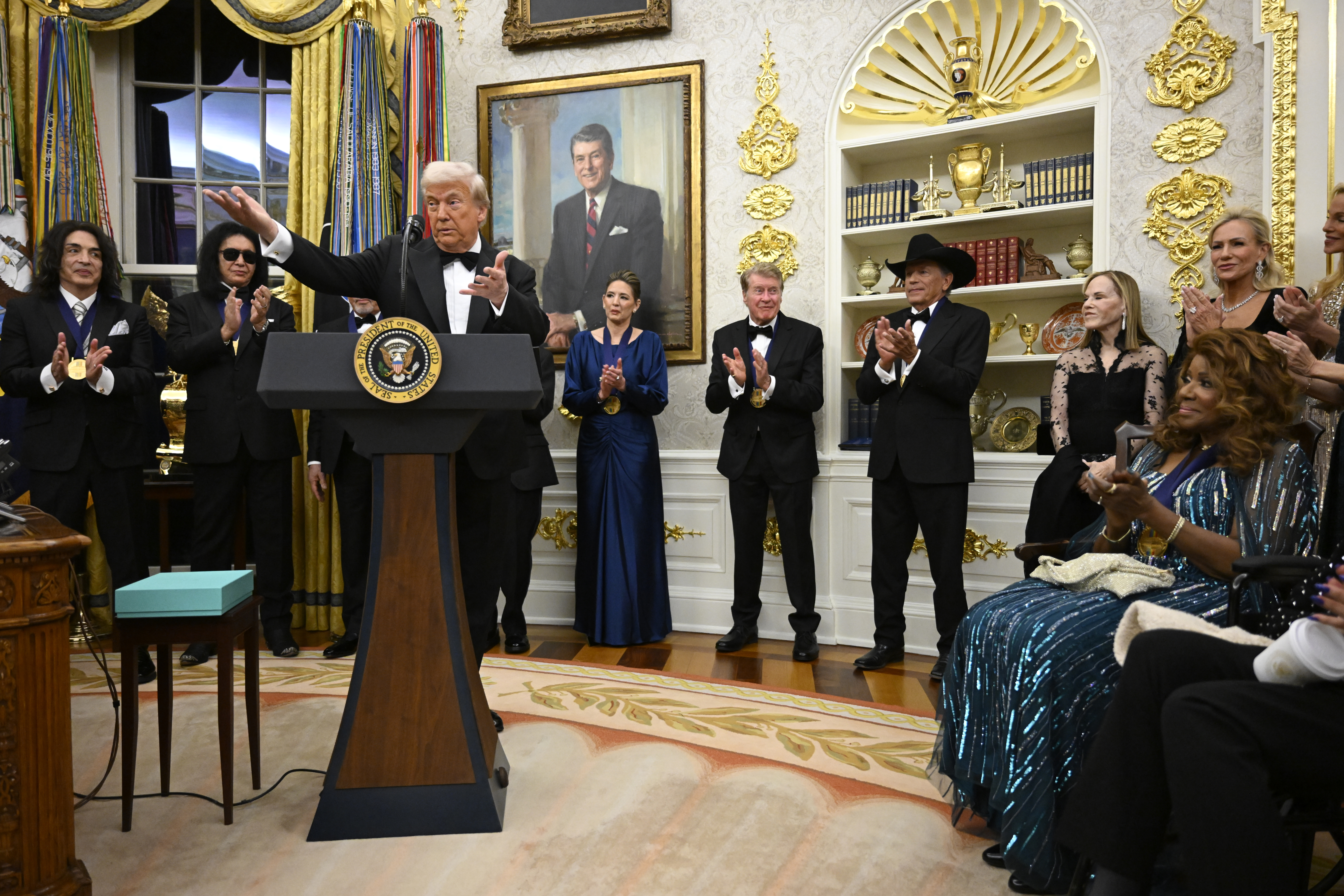
    Finally, we don’t know who would host it. Trump, who avoided the honors in his first term, famously played the role himself at last year’s ceremony, something a president had never before done. He also said he was “about 98 percent involved” in picking the honorees — Michael Crawford, Gloria Gaynor, Kiss, Sylvester Stallone, and George Strait — which are generally chosen by committee.

    Asked for details this week, the White House referred us to the Kennedy Center, which provided the announcement.

    The center had maintained that the honors, along with the Mark Twain Prize, would continue somewhere off-site during the building’s two-year closure for repairs.

    “It will definitely go forward,” Richard Grenell told WTOP in February, before he departed as president of the Kennedy Center. At the time, he predicted “it will probably just be in a smaller venue, which just means ticket demand will be even higher.”

    That full closure hasn’t started yet, according to the center. Instead, the main building is closed temporarily, leaders say, while they check on the building’s safety. Those checks could take another week or two, according to a Wednesday staff email reviewed by the Washington Post.

    But “this is an assessment timeline,” the email read, “not a reopening date.”

  • Russian aerial strikes snarl traffic on 3 Kyiv bridges in a new disruption tactic

    Russian aerial strikes snarl traffic on 3 Kyiv bridges in a new disruption tactic

    KYIV, Ukraine — Russian aerial attacks forced the partial closure Friday of three bridges over the Dnipro River in Kyiv, the Ukrainian capital’s mayor said, in Moscow’s latest effort to disrupt life in the city.

    Meanwhile, Ukraine’s top diplomat said officials have received separate proposals for a partial truce with Russia from the United States, India, Turkey, and Egypt. The proposals envision halting attacks on energy infrastructure, which have caused fuel shortages in Russia and power outages in Ukraine, and on Black Sea shipping needed to get vital grain exports to world markets.

    The Russian strikes forcing the full or partial closure of three of Kyiv’s six road bridges caused traffic logjams and appeared to be a new tactic in its campaign to torment the city’s residents. Previously, Russia has hit apartment blocks, supermarket warehouses, gas stations, and data centers, among other targets, in an escalation of attacks.

    Oleksandr Pihalo, a Kyiv resident, said traffic was “jammed solid” and it took him 45 minutes to cover 2 ½ miles. “It’s a total mess on the road today,” he told the Associated Press.

    One of the three bridges was hit again on Friday afternoon, Mayor Vitalii Klitschko said.

    Civilians “are bearing the brunt of this war,” the U.N. High Commissioner for Human Rights, Volker Türk, said in Geneva on Friday.

    “The war in Ukraine is a human rights catastrophe that is growing and intensifying by the week, causing unfathomable pain to civilians,” he said. “Across Ukraine, people are living in constant dread.”

    While the aerial war has intensified in recent months, fighting along the roughly 770-mile front line snaking through northern, eastern, and southern Ukraine has been virtually deadlocked. Russia invaded its neighbor more than 4 ½ years ago, and there are no concrete signs that a peace settlement might be possible.

    However, Ukraine has this year made some progress against Russia’s bigger army, according to the Institute for the Study of War.

    Russian forces lost control over almost 116 square miles of Ukraine between March and September, the Washington-based think tank said in a report late Thursday. Also, it said that the Russian military suffered over 46,000 casualties in September, the highest monthly number this year. It did not say how many Ukrainian troops were killed or wounded.

    Zelensky says sanctions can stop Russian drones and missiles

    Russia fired more than 100 drones at Ukraine overnight, striking Kyiv and eight other regions, Ukrainian President Volodymyr Zelensky said. Almost half of the drones were the jet-powered type that are especially hard to stop, he said.

    A drone hit a high-rise apartment block in Kyiv, killing one person, he said. At least four people were reported wounded elsewhere.

    Zelensky repeated his appeal for foreign countries to close loopholes in international sanctions on Russia and to add more restrictions on its trade. He said Russia’s drones and missiles are “critically dependent” on foreign components.

    “Every Russian drone can actually be stopped right at the production line,” Zelensky said in a post on X.

    Ukraine has also bombarded Russia with the long-range drones and missiles it now produces, aiming at military manufacturing plants and oil refineries.

    The Russian Defense Ministry said Friday that its air defenses overnight downed 646 Ukrainian drones over Russian regions, occupied Crimea, the Sea of Azov and the Black Sea.

    One person was wounded in Russia’s southwestern Volgograd region, Gov. Andrei Bocharov said. The attack targeted “industrial infrastructure,” he said, without providing details.

    Ukraine is ready for a truce on energy strikes and the Black Sea

    Ukraine’s Foreign Minister Andrii Sybiha said the partial truce proposals presented to Kyiv by four countries were the first time India has offered to play a role.

    India is trying to balance its ties with Russia against its growing partnerships with the United States and other Western powers. A new U.S. sanctions package on Russia could impose up to 100% tariffs on New Delhi as a major importer of Russian oil.

    Sybiha said Kyiv is ready to accept a ceasefire if it stops Russian attacks on Ukraine’s power grid — as well as Ukrainian strikes on Russian oil refineries — and on cargo vessels exporting grain and other farm products through the Black Sea.

    “We are ready for an energy and Black Sea ceasefire, but only in that combination. Energy and a ceasefire in the Black Sea,” Sybiha told reporters Thursday, in comments embargoed until Friday.

    He repeated Ukraine’s offer of an unconditional ceasefire on the front line. But Moscow has rejected a ceasefire, saying a comprehensive peace deal must be agreed rather than a temporary truce.

    Russia’s Deputy Prime Minister Alexander Novak said Friday that Ukraine attacked four Russian oil refineries overnight, but air defenses fended off the attacks and key equipment wasn’t damaged.

    The government and companies have worked hard to improve protection of refineries, he said. Russian President Vladimir Putin decreed in August that the state can temporarily seize control of critical infrastructure facilities if private owners fail to protect them or rebuild them after Ukrainian strikes.

    It wasn’t possible to verify either side’s claims.

    Russia is stockpiling ballistic missiles, Ukraine says

    Sybiha said Ukraine is requesting some 300 Patriot missiles from partner countries because intelligence services estimate that Russia is holding 600 ballistic missiles in reserve and can produce up to 140 ballistic missiles per month.

    The U.S.-made Patriot air defense systems can effectively defend against ballistic missiles, which fly fast and drop steeply, but they are in short supply due to the Iran war.

    Ukraine needs more funding and quickly, foreign minister says

    Ukraine urgently needs funding in order to contract future drone production, so there are no gaps in supply at the beginning of next year, Sybiha said.

    Kyiv faces a projected budget deficit of roughly $27 billion this year, although the European Union has promised to help meet its financial requirements.

    The European Commission announced Friday it had disbursed €2.9 billion ($3.3 billion) to Ukraine in its latest batch of financing. Zelensky said the amount would help Ukraine’s financial stability and strengthen its defense.

    Russia is also facing economic and financial challenges because of high military spending and debt.

  • G7 nations will release 100 million barrels of oil and diesel fuel after prices soar

    G7 nations will release 100 million barrels of oil and diesel fuel after prices soar

    WASHINGTON — The Group of Seven wealthy democracies said Friday that they plan to release 100 million barrels of oil and fuel products in the coming weeks, starting with “substantial” amounts of diesel after the fuel recently hit record high prices in the United States.

    President Donald Trump said the diesel release would happen “immediately,” echoing a G7 promise to start “immediately” with a “frontloaded substantial release” of diesel within the next 20 days and the rest over four months.

    Trump and his Republican Party face pressure to address surging prices ahead of the Nov. 3 midterm elections, and Trump announced the action Friday on social media. The president’s approval ratings on the economy hit a new low, according to an AP-NORC poll, as the Iran war and his trade battles have increased U.S. prices for oil and other goods.

    Gas prices in the U.S. and abroad have soared during the eight-month-long war, a cost Trump has repeatedly said is worth it for making sure Iran does not obtain nuclear weapons. The national average for a gallon of diesel in the U.S. was $6.37 on Friday, according to AAA, after hitting a record $6.52 on Sept. 22. Diesel prices have hit records in Europe, too.

    The release of diesel in Europe might mean less exports of diesel from the U.S., which could lower prices by 25-50 cents per gallon after a few weeks, said Michael Lynch, distinguished fellow at Energy Policy Research Foundation, a non-partisan research institution focused on energy and economics.

    Macron says the decision should bring down prices

    France holds the rotating presidency of the G7 group and made the announcement in a statement released after videoconference talks that Macron presided over. The G7 countries are Canada, France, Germany, Italy, Japan, the U.K., and the U.S., plus EU representation.

    The release follows on from a March announcement that International Energy Agency member countries would release 426 million barrels of oil and products to stabilize the oil market. European Union countries committed about 92 million barrels, a promise weighted toward refined products made from crude such as diesel.

    “This common decision and this unity should bring down prices,” Macron said. “The volumes we’re releasing should also add liquidity to the market and bring down prices.”

    In addition to the rise in the price of the crude oil from which diesel is made, other factors include the decision by Russia to ban exports due to Ukrainian drone strikes on its refineries. Europe does not import Russian diesel, but other buyers of Russian diesel such as Turkey and Latin American countries must now compete with Europe for available barrels.

    Meanwhile, refined product shipments from the Persian Gulf producers have fallen due to war damage and blocked export routes.

    The statement pushed U.S. oil prices down 2% but “the impact was lessened by lack of clarity on an important question,” said Pavel Molchanov, investment strategy analyst at Raymond James. Is the 100 million barrels in addition to the amount already agreed in March, or “is this the final portion of the existing pledge?” he said.

    The G7 says export bans are off the table

    Some Republicans in the U.S. had called for Trump to ban U.S. exports of diesel to try to bring domestic prices down. But the G7 statement said the group agreed not to limit energy exports to each other. Oil market analysts warn a U.S. export ban could lower prices in the short term but eventually backfire by reducing supplies of gasoline since diesel output can’t be lowered without also cutting overall refinery production.

    Asked about a potential U.S. export ban on Friday, Trump said “we were never going to do it.”

    “We’re not going to be doing the export ban,” Trump told reporters at the White House. “We’re going to be doing what we’re supposed to do.” He added that Europe is making “a major world contribution, and so are we.”

    Experts say there are risks in the strategy

    The emergency release could also be a short-term fix with the potential to do long-term harm, said Jim Krane, energy research fellow at Rice University’s Baker Institute.

    “Draining stocks will reduce retail fuel prices for a while, at the cost of leaving Europe with less emergency cover,” Krane said. “At some point in the future Europe and the rest of the G7 will have to refill their strategic reserves. Normally they try to do this when prices are low. Nobody knows when that will happen. It’s a risk.”

    With two wars raging that involve attacks on refineries and exports, “it’s not the best time to be frittering away your emergency stocks — especially when there is no visibility on future prices or peace agreements,” Krane said.

    Trump had a conversation overnight with Macron about the need to address rising fuel prices and the availability of petroleum products, according to the French Embassy in the U.S. Macron on Friday then chaired the videoconference of G7 leaders to discuss the issue.

    Besides his call with Macron, Trump on Friday called in to the meeting with the G7 leaders to negotiate the release of the European diesel stockpiles, according to a White House official who was not authorized to speak publicly and spoke on the condition of anonymity.

    Trump on Thursday embarked on what he said would be a 32-day marathon of rallies to try to bolster his party’s chances for keeping control of the U.S. House and Senate in the November elections. The president has grown increasingly frustrated with what he sees as a disconnect between his achievements and the public’s view of his work. This week he gave himself an A-plus for his work on the economy but said “we’re doing an extremely poor job of promotion.”

  • ‘I couldn’t let all of them die’: Pilot on FlyDubai flight recalls sudden attack

    ‘I couldn’t let all of them die’: Pilot on FlyDubai flight recalls sudden attack

    NEW DELHI — The Indian pilot who was attacked during a FlyDubai flight this week said Friday that he opened the cockpit door despite grievous injuries, allowing passengers and crew members to overpower the copilot who had assailed him.

    “I was fighting for my life,” Capt. Smit Machchhar said on a video call from his hospital bed with Prime Minister Narendra Modi of India, in his first public remarks since the attack. Video of their conversation was released by the Indian government.

    “I was so badly hurt that I had fallen to the ground,” Machchhar said. “But I knew I had to act,” he added. “I could feel the aircraft was going down.”

    The attack, on a flight from Dubai, United Arab Emirates, to Tel Aviv, Israel, carrying about 170 passengers, sent the aircraft into a terrifying plunge. Israeli officials have said the copilot appeared to have tried to crash the plane after stabbing Machchhar, although investigators are still trying to understand the assailant’s motives and how the attack unfolded. Prime Minister Benjamin Netanyahu of Israel said the copilot had undergone “Islamist radical indoctrination” but did not elaborate.

    Passengers were able to overpower the attacker, while two people aboard with flying experience helped land the plane in Saudi Arabia.

    Machchhar, who said he had 17 years of flying experience, including 11 as a captain, said he knew instinctively what was happening to the aircraft, even as he lay injured on the cockpit floor. The Boeing 737 Max 8 he was flying plummeted more than 16,000 feet in 30 seconds during the attack.

    Machchhar told Modi that he recalled telling himself: “Smit, this is the last push, just do it. The door is right there.”

    “I was doing it to save myself,” he said, “but I also knew I couldn’t let all of them die.”

    Machchhar, who was hospitalized in Saudi Arabia then transferred to the UAE, told Modi that he was receiving good medical care.

    The episode has made him a hero in India.

    “Your courage and presence of mind — you made a decision within a fraction of a second, and saved so many lives,” Modi told the captain during their conversation. “You have made the entire country proud.”

    Modi’s office put out the video of the split-screen conversation on a day of nationwide protests in India, including in the capital, New Delhi. Protesters are demanding the resignation of the country’s chief election officer for trying to rig voter rolls in the favor of Modi’s party.

    Machchhar grew up in Mumbai and entered aviation almost by accident after attending a seminar on flying. He later became a captain and a trainer of aspiring pilots. In a podcast interview last year, he described flying as something he felt “blessed” to do and emphasized the importance of pilots being rested and prepared to perform under pressure.

    This article originally appeared in The New York Times.

  • What if ADHD isn’t about attention at all? | Expert Opinion

    What if ADHD isn’t about attention at all? | Expert Opinion

    As a psychiatrist, I increasingly see people seeking help for a familiar constellation of troubles. They have a hard time staying focused. They often forget things. They suffer from disorganization, restlessness, and impulsivity. They struggle with spreadsheets and memos, with laundry and food preparation, with showing up at appointments and meeting deadlines — with tackling, in other words, the necessities of daily life.

    Increasingly, these patients view their problems as ones of “attention,” as more people identify with the diagnosis of attention-deficit/hyperactivity disorder, or ADHD.

    The rise in ADHD diagnoses — along with the use of prescribed stimulants like Ritalin or Adderall — has led to great debate among the public and within my field of psychiatry. Has the medical establishment finally recognized a long-overlooked disorder? Or has the diagnosis become too capacious, overmedicalizing ordinary difficulties?

    But this debate runs up against a fundamental scientific uncertainty. The condition’s name notwithstanding, “attention deficit” may be the wrong conceptual framing for ADHD. Scientists have been exploring a more basic quandary: What is the condition in the first place?

    A major study published last year in the journal Cell spoke directly to this question. It looked at how stimulant medications influence the functioning of brain circuits in children. The researchers found that the drugs seemed to affect brain networks involved in salience, reward, and arousal. But they found no detectable changes in the brain’s attention networks, whether or not the child had been diagnosed with ADHD.

    It’s a clear signal that the most popular mental model for ADHD — as a deficit of attention that stimulants remedy — might not be entirely accurate.

    What would a better mental model look like? Part of the answer is understanding that “attention” means different things in the clinic and in the neuroscience lab. For scientists studying brain functions, attention means something narrow: the selective amplification of relevant information. It can be measured by laboratory tasks that assess, for example, how well someone ignores irrelevant or conflicting information or finds a target hidden among distractions.

    But that’s generally not what people mean when they are talking about attention problems in ADHD.

    The classic features of ADHD include things like not staying on task, losing the thread of a conversation, and forgetting instructions. They are failures of “sustained engagement.” If attention is about the mind homing in on what’s relevant in a given moment, engagement is about keeping that spotlight pointed at the same target over time. Doing so may be less a matter of filtering out distractions and more a matter of whether the task registers in the brain as worth doing in the first place.

    Once this distinction is appreciated, the results of the Cell study stop being contradictory. Stimulants create what looks like improved attention and focus, but they really do so by enhancing the salience of mundane activities — tricking the brain into assigning greater worth and significance to things like math homework and laundry.

    This also helps explain why stimulants like amphetamines calm down hyperactive children. People without ADHD who use amphetamines often find themselves jittery and revved up, so the calming effect may seem counterintuitive. However, if a child is restless and fidgeting because the task at hand isn’t rewarding enough, then it makes sense that stimulants would help that child sit still and stay engaged rather than seek stimulation elsewhere.

    The Cell study’s results focused mostly on what stimulants do, but scientists have been challenging the idea that ADHD is a deficit of attention since the 1990s.

    In a 1992 experiment, developmental psychologist Edmund Sonuga-Barke and his colleagues gave hyperactive children repeated choices between a small but immediate reward and a larger, delayed one. The children preferred the immediate reward only when that choice allowed them to end the experiment sooner. The problem was not necessarily an inability to wait, but an aversion to waiting itself.

    Sonuga-Barke later argued that ADHD could arise from several underlying causes, including difficulty stopping an action once it’s underway, intense dislike of waiting, and disruptions in the brain’s ability to track events over time. Psychologists can measure capacities such as working memory, impulse control, and the ability to wait for a reward with standardized tasks. This is called neuropsychological testing. But no single abnormality turns up in all people with ADHD on these tests, and no deficit is unique to them. This is why neuropsychological testing is not considered a gold standard for diagnosis.

    Clinical neuropsychologist Russell Barkley proposed that the basic problem in ADHD is with a person’s ability to inhibit behaviors and regulate emotions, and with motivation and working memory. People with ADHD can live in a shrunken present moment, in which future consequences carry little significance and weight. Barkley’s shorthand for this, time blindness, has become a popular characterization. His later work showed emotional self-regulation as a core feature of ADHD, manifesting as emotional impulsiveness and low frustration tolerance.

    While names for medical conditions denoting outdated hypotheses can be harmless etymological curiosities — malaria means “bad air,” for example — incorrect names like “attention deficit” can invite confusion. The focus on attention as the central problem for ADHD means those who struggle with lateness, boredom, emotional volatility, and the inability to start anything without the pressure of a deadline might remain undiagnosed because these issues don’t sound like a problem of “attention.”

    On the other hand, recognition of these aspects of ADHD has not only made the boundaries of the disorder harder to specify, but it has also raised uncomfortable questions about whether some of these problems make sense as a diagnosable medical disorder. The prospect of using medications to help children sit still in class and focus on tedious coursework, or using medications to allow adults to tolerate periods of intense boredom and dreary housework, makes many people uncomfortable.

    It’s also the case that some people reach for medications in an effort to maintain lifestyles that are unsustainable for them. Modern work environments heavily emphasize the ability to handle multiple tasks and tedious work, and that has been compounded by other aspects of 21st-century living, such as cellphones and social media, that have arguably made us distractible and impatient. The result of all this is that modern life becomes more disabling for those with ADHD.

    ADHD may be poorly named, but the consensus in psychiatry is that it’s a genuine problem for which there are effective treatments. In observational studies, treating ADHD with medication is associated with reductions in death, self-harm, transport accidents, criminal convictions, and substance misuse.

    As a society, we are struggling to answer these complicated questions that the science and treatment of ADHD throw at us. A recent Channel 4 documentary in Britain, “The Great ADHD Myth?” characterized ADHD as a “social construct” rather than a disorder of the brain. This binary tendency to locate the problem either in the brain or in the environment can overlook how impairment arises from an interaction of mental capacities and situational demands. When disadvantages in mental abilities become disabling under the demands of modern life, those who struggle will desire and even need treatment. But it’s also worth understanding that the problem is not entirely with the individual.

    There are many pathways in the brain that probably influence the difficulties in focus that characterize ADHD, but scientific investigations into causes and treatments point toward problems with impulse control and motivation more than a defective capacity for attention. This accumulating data underscores how even psychiatrists and scientists can change their thinking about what a diagnosis means based on more research into how the brain works. What’s perhaps most important for understanding ADHD is to not allow its name to confuse us; it’s a poor guide to how the human mind works.

  • Central Park was her home and her studio. She was killed there.

    Central Park was her home and her studio. She was killed there.

    NEW YORK — Francis Lee Rogers was a fixture in Central Park’s Ramble, a wooded area that is popular with birders.

    She spent her days painting the Ramble’s birds and kept her homemade network of feeders filled with seed, as legions of bird lovers walked by hoping to catch a glimpse of warblers and sparrows.

    For years, Rogers, who was homeless, brushed off concerns about the perils of a woman in her 60s — or anyone, for that matter — spending nights in and around the Ramble as she largely had for decades.

    Last Sunday morning, Rogers, 63, was found dead, beaten and stabbed in the rustic wooden gazebo where she spent her nights, a short walk from the Central Park Boathouse, an upscale restaurant known for leisurely lunches and weddings.

    She was found barefoot and covered in dirt, her body stabbed repeatedly and her head severely beaten, according to two law enforcement officials with knowledge of the matter.

    Chillingly, her long graying hair, which she wore in signature tight braids, had been shaved off.

    Shortly after the attack, Jonathan Robles, 36, walked into the Central Park police precinct and told officers that a woman in the park had threatened him, one of the officials said. Robles later told investigators that he killed Rogers.

    The police charged him with murder and possession of a weapon. Robles, who was living in transitional housing in a midtown hotel, had been arrested twice in New York City, both times for nonviolent crimes, including leaving an IHOP without paying the bill, the official said.

    Murders are rare in Central Park, a haven for tourists and New Yorkers alike. There were none this year through Sept. 20, and none last year during the same period, according to police data.

    In a city where people largely go about their lives in anonymity, especially the homeless population, Rogers stood out as a familiar figure in the park.

    Known as Lee, she chatted with rich and poor, native New Yorkers and foreigners and tourists. She had hardy mountain-woman looks, with her long braids spilling out from her wide-brimmed birder’s hat, running down over layers of wool sweaters.

    She carried a large rucksack filled with her watercolors, oils and paintings and sketches in progress. And she was never without her crooked walking stick or her sketchbook of pencil drawings of birds and notes about their colors.

    She was devoted to the network of bird feeders she had rigged in the Ramble by hanging them with lines looped over high branches.

    “For years, she was the only person maintaining those bird feeders in the Ramble,” said Lincoln Karim, a wildlife photographer who knew Rogers for about 25 years. “She would spend hundreds of dollars on birdseed and suet.”

    In the perhaps three decades that Rogers had been living largely in and around the park, she sold hundreds of paintings, her friends said.

    Most of the sales came by word of mouth among local birders. But she also gained a following among those who saw her working on her small, nearly pointillist renderings at her regular table in the Boathouse restaurant at the Ramble’s eastern edge.

    In this affordable cafe section, Rogers could nurse a cup of coffee for hours, often using the cup’s plastic lid as a palette. It was her atelier, surrounded by large windows overlooking the Ramble and the lake.

    “She was a fixture — she came by the same time every day, carrying a big backpack, and she was always welcome,” said Dean Poll, who operated the restaurant from 2000 until 2022. “I gave her her space and she never bothered anybody.”

    “She was like family,” he said. “She made us Christmas cards that were beautiful. We still have them.”

    Rogers, who also went by the name Elise Bainbridge Hill, told the New York Times in 2012 that her sleeping spots varied from the steps of local churches to a women’s shelter near Park Avenue in cold weather. She told a documentarian in a film released in 2016 that she ran away from her abusive childhood home in New Jersey and initially became a prostitute in New York.

    Painting was her escape from life on the streets, she said, with Central Park as her oasis from Manhattan’s bustle.

    In conversation, Rogers would often slip seamlessly from detailed discussions about bird species to digressions about conspiracy theories.

    “She knew a lot about a lot of things but then she would just slip into outrageous stuff, like her flying in spaceships,” Karim said. “But she was a damn good painter, I have to say.”

    Karim said he helped Rogers sell several works, with smaller ones fetching $300 and a large oil painting going for $1,200. “She had enough money to get off the street,” he said.

    Joe Lopez, 64, of Manhattan, a caterer who knew Rogers for 15 years, said he bought several of her illustrations for as much as $400, including one of Pale Male, the celebrity red-tailed hawk that captivated the city’s bird-watching community from his nest on a Fifth Avenue luxury building.

    Rogers, who used a public bathroom in the park to wash up, took pride in keeping a neat appearance. But more recently she would go barefoot, Karim said, or sometimes wrap her feet in cardboard.

    The gazebo had become her regular sleeping spot. Just before her death, she weathered the nor’easter that buffeted the region by sleeping on a bench beneath a green tarp, with her belongings and painting supplies around her.

    On Monday, some of her friends trudged through the rain to pay their respects. One of them, Moises Diaz, 71, of the Upper East Side, lit a candle for Rogers, whom he had seen for years on his daily walks.

    Diaz, who is also an artist, played a recording of a conversation he had with Rogers about six months ago. She had asked him about his recent work, a wall hanging he had made out of foam.

    “She had a beautiful voice,” he said as he listened to the recording. “There’s a lot of mean people that come to this place — a lot, but not her.”

    Lopez came by, too. He brought along a satchel of drawings by Rogers, including the one of Pale Male. He called it “a masterpiece.”

    “To me, I was buying something beautiful, but it was also money I knew she needed,” Lopez said. “She wasn’t a homeless person to me, she was a genuine special character. The birders really respected her.”

    This article originally appeared in the New York Times.

  • New ICE guidance bans high-speed car chases and sets tighter rules for traffic stops, a memo shows

    New ICE guidance bans high-speed car chases and sets tighter rules for traffic stops, a memo shows

    U.S. Immigration and Customs Enforcement officers have been ordered not to engage in high-speed car chases and to make vehicle stops only if they have completed specific training, under new internal guidance issued after several drivers were shot in encounters with ICE.

    A memo sent to officers in ICE’s Enforcement and Removal Operations division and obtained by The Associated Press warned they are not authorized to chase vehicles that fail to pull over under any circumstances. Instead, officers should take down the vehicles’ information for further investigation, according to the memo signed by ICE’s executive associate director Marcos D. Charles and dated Wednesday.

    The new guidance comes after ICE-initiated vehicle stops have repeatedly escalated when drivers have refused to cooperate or tried to flee. ICE agents have fired their guns during more than a dozen such encounters since last year, killing at least four people and wounding several others.

    President Donald Trump’s administration has faced internal tension over how to handle traffic stops, which are seen as particularly high-risk encounters.

    After fatal shootings of drivers in Maine and Texas in July, ICE officers were directed to temporarily pause most vehicle stops. But the next day, Trump went on social media to direct the agency to continue traffic stops, calling them “one of ICE’s most important and effective Crime Fighting tools.”

    ICE has faced intense pressure from the White House to deport more people who are in the country illegally, and its arrests have reached record numbers. At the same time, the agency’s rapid hiring spree last year resulted in some poorly vetted and trained officers hitting the streets.

    ICE and the Department of Homeland Security had no immediate comment on the policy guidance.

    The new memo outlines steps intended to improve the safety of vehicle stops for ICE officers, drivers they are targeting, their passengers, and the public.

    The memo told ICE’s field office directors that they must ensure vehicles used for traffic stops have lights and sirens that let the public know they are law enforcement vehicles when activated. All officers on the scenes of vehicle stops must wear and activate their body cameras, under the guidance.

    In addition, only officers who have completed one of five specific agency training courses can conduct vehicle stops. Officers who have not completed the training courses can only participate in vehicle stops “in a support capacity” as passengers and cannot be the drivers of any of the vehicles involved.

    The guidance says ICE officers can continue to use a controversial technique known as pinning, which is defined as “using a vehicle or physical barrier to trap or stop a car,” but only if they have received special training. Similarly, only trained officers can use spike strips that deflate tires to prevent drivers from fleeing.

    The memo came the day that courtroom testimony highlighted ways in which two ICE officers involved in a vehicle stop, pursuit, and shooting that wounded a delivery driver in Austin last month would not have complied with the new guidance.

    During a bond hearing for Wilber Rafael Garces Perez, testimony showed that the officer who shot him wasn’t wearing a body-worn camera. The ICE officer who did have a camera was driving in a separate car and turned it off during the pursuit.

    Prosecutors presented surveillance video that showed an ICE agent chasing Garces Perez at high speeds through residential streets after he fled an initial traffic stop.

    Garces Perez faces federal assault charges after investigators say he struck an ICE officer with his driver’s side mirror. That officer then shot into Perez’s vehicle, lodging a bullet in his back, officials say.

    Attorneys for Garces Perez have called the charges against him “retaliation” and have argued that the camera footage was inconclusive because it didn’t fully capture the moment when he allegedly tried to flee.

  • Trump says Secret Service wants him to ‘take down’ Oval Office

    Trump says Secret Service wants him to ‘take down’ Oval Office

    President Donald Trump said that Secret Service officials have encouraged him to replace the current Oval Office, according to a new interview with Time magazine.

    “‘Sir, we think the Oval Office should be taken down, and we’ll build a new one, sir,’” said Trump, quoting a Secret Service official. “I said, ‘My ass, you can’t build a new one. This is a special place.’”

    The Secret Service has encouraged prior administrations to take steps to fortify the Oval Office, said four former officials, who spoke on the condition of anonymity to detail sensitive security matters. Past presidents have declined to do so because it would require them to relocate.

    A White House spokesman declined to offer further comment. A spokesman for the Secret Service did not immediately respond to questions about Trump’s remarks.

    The current Oval Office was constructed by President Franklin D. Roosevelt and become synonymous with high-profile events and speeches. Trump, who has redecorated it with gold as part of his sweeping changes to the White House, has called it the most intimidating office in the nation.

    Trump has listened to the Secret Service on other projects to fortify the presidential grounds, such as plans to build a permanent fence around Lafayette Square, the public park across the street from the mansion. The president also has invoked national security reasons to defend his most controversial construction projects, including a new White House ballroom and his planned triumphal arch.

    In the Time interview, the president said he was exploring the possibility of a new federal designation for the Oval Office, which he suggested could protect the office from being torn down and preserve his changes to it.

    “I’ve been asking Susie for six months to give me a statement. Will we save this room? Will we make it a federal landmark?” Trump said, invoking his chief of staff, Susie Wiles.

    The White House is already designated a National Historic Landmark, a federally conferred status that is intended to offer protections against sudden changes. But Congress exempted the White House from the National Historic Preservation Act, which has allowed presidents – including Trump – to swiftly remake parts of the building when they assume office.

    “The discussion of making it a landmark is legally meaningless,” said Greg Werkheiser, founding partner of Cultural Heritage Partners, a law firm focused on historical preservation. He also questioned why Trump was invoking historical preservation after disregarding it to tear down the White House’s East Wing, pave over the Rose Garden and make other changes.

    “There’s some irony of the president suggesting that he might use historic designation to protect the property after ignoring it so far,” Werkheiser said.

  • U.S. is moving thousands of troops aboard ships to the Mideast as Trump weighs new strikes on Iran

    U.S. is moving thousands of troops aboard ships to the Mideast as Trump weighs new strikes on Iran

    WASHINGTON — The U.S. military is dispatching roughly 9,000 troops aboard a group of ships to the Middle East, a U.S. official said Thursday. The bolstering of the American military presence comes as President Donald Trump warned anew that new strikes against Iran could be on the horizon.

    He also said early indications suggest that Iran is linked to the co-pilot who stabbed his captain and tried to crash an Israel-bound flight on Wednesday.

    In an exchange with reporters at the White House, Trump raised the connection when asked by a reporter if there were any links between the pilot behind the attack and Tehran.

    “I would say the answer, based on what I’m hearing, is ‘yes,’ but we’re working on it right now,” Trump said, without offering details.

    Trump also warned that if the link is established to Iran, the United States would retaliate.

    “Oh they’ll be hit, very hard, don’t worry,” Trump said. “You just ask them. They know what happened. They’ll be hit very hard.”

    Meanwhile, the group of ships now en route to the Middle East together carry over 7,000 sailors and 2,000 Marines.

    It includes the USS Theodore Roosevelt carrier strike group, which recently deployed with the cruiser USS Chosin, and the USS Makin Island amphibious readiness group, which includes the USS John P. Murtha and USS Anchorage amphibious landing ships.

    It could mean that three carriers are in the region as early as the end of October, according to the U.S. official who spoke to The Associated Press on condition of anonymity to discuss sensitive military operations.

    Given the personnel already in place in the Middle East, the move would bring the U.S. naval presence to an unusually high number of more than 20,000 sailors and Marines and hundreds of aircraft. The Navy previously had three carrier strike groups in the Middle East in April for the first time since 2003.

    The carriers USS George H.W. Bush and the USS George Washington are in the region now, along with the USS Boxer amphibious readiness group. The Washington is typically deployed to Pacific Ocean but it was moved to the Middle East to relieve the USS Abraham Lincoln, whose arduous deployment resulted in the crew being at sea for more than 260 days straight.

    Trump, in a Time magazine interview published Thursday, also raised the prospects of new strikes, saying it is “possible” that he will ramp up bombing in Iran after the Nov. 3 elections in the United States.

    When pressed, Trump said he could not go further in detailing his strategy.

    “I can’t tell you that because look, you know, you’re asking, where are you going to bomb?” Trump said.

    He said in the interview, conducted Monday, that he rejected the latest ceasefire proposal from Iran because “things that I wouldn’t have approved a year ago I wouldn’t have today.”

    Trump cited as an example an offer from Iran to “open up” the Strait of Hormuz, the key energy shipping corridor, but said the overall proposal was “not good enough.”

    Asked if the increasingly unpopular war would threaten Republican Party chances in November, Trump at first responded, “It’s possible.” But then he added, “It should help, because Iran will not have a nuclear weapon.”

    The president said “100% of the people” oppose Iran having nuclear attack capabilities “including worldwide.”

    “So, when you say it that way, It would help,” Trump added. “If you don’t say that, it could hurt.”