Category: Wires

  • What China sees in ‘Jane Eyre,’ now required reading for ninth graders

    What China sees in ‘Jane Eyre,’ now required reading for ninth graders

    Nearly two centuries after Jane Eyre first defied the conventions of Victorian England, China is requiring a new generation of teenagers to read her story.

    The British classic has long been popular in China and was already recommended reading for schoolchildren. But this fall, ninth-grade students across the country are being required to read the novel in full, according to Chinese state media. One report in an official newspaper held it up as an antimaterialistic love story that young people could learn from.

    The book, in which the young orphan Jane Eyre works as a governess in the household of the wealthy but elusive Mr. Rochester, is widely celebrated in China for its themes of independence and equality between women and men.

    A Chinese translation appeared as early as 1925, and there have since been numerous translations and adaptations for stage and screen. A British film adaptation was shown in Chinese theaters in 1979, just a few years after the end of the Cultural Revolution, as China was reopening to foreign culture.

    Ping Zhu, a literature professor at the University of California, San Diego, who researches Chinese feminism and literature, said the novel is compatible with the Chinese government’s vision of women’s equality — one that can coexist with traditional gender roles and the heterosexual nuclear family. Its inclusion in the ninth grade textbook comes as China struggles with population decline and the government encourages young people to marry and have children, she said.

    “Jane Eyre is about an independent woman, but she’s not too outrageous in her challenge of patriarchal power,” Zhu said. By the end of the novel, Jane has married Mr. Rochester and had a child. “All these things are what the Chinese government wants the younger generation to do,” Zhu said.

    Published by Charlotte Brontë in Britain in 1847, Jane Eyre was striking for its depiction of a poor young woman insisting on her independence, dignity, and equality in a society in which women — particularly married women — had severely limited legal and economic autonomy.

    The novel has long been celebrated in China for its feminist themes, with state media often quoting Jane’s declaration to Mr. Rochester: “Do you think, because I am poor, obscure, plain, and little, I am soulless and heartless? You think wrong! I have as much soul as you — and full as much heart!”

    Jane Eyre was progressive in its 19th century context, but some contemporary feminists would view its idea of liberation as limited, Zhu said.

    The kind of feminism depicted in the novel has long been supported by the Chinese Communist Party, Zhu said. It is at odds with how the party sees more modern kinds of feminism, like the #MeToo movement, she added, “or the kind of feminism that teaches women to not marry and not have children — that is a feminism they cannot accept at all.”

    In recent years, the Chinese government has restricted some other portrayals of romance and relationships.

    Authorities have detained dozens of writers of Boys’ Love, a genre of gay romance novels written largely by and for straight women, that state media said could shape young readers’ ideas about sexuality.

    Regulators have also sought to rein in a popular genre of micro-dramas about wealthy executives falling in love with less privileged people, urging creators to avoid glorifying marriages to powerful and wealthy people.

    State media has suggested that novels like Jane Eyre offer young readers an alternative to what they call superficial love stories. An article in Beijing Daily, an official Chinese Communist Party publication, argued that teaching literary classics like Jane Eyre could help children “establish a more balanced value system.”

    Chinese readers have long found their own meanings in Jane’s story.

    Vicky Li, 46, read Jane Eyre when she was young and saw something of herself in its hero. Years later, she said, she shared the novel with her daughters, now 13 and 15, because she wanted them to become independent and courageous.

    Li said she was happy to see the novel included in the textbook, even if some might think Jane did not embody the modern idea of a strong woman. “Given the historical context in which she lived, the choices she made were truly groundbreaking — a profound act of defiance,” she said.

    The novel itself complicates the idea that Jane ultimately submits to convention. She leaves Mr. Rochester rather than become his mistress and returns only after inheriting a fortune. Mr. Rochester has lost his estate and his sight, dramatically altering the balance of power.

    Wang Sirui, 30, pointed to Jane’s refusal to become a mistress — even if it meant starving to death — as a key moment that showed the character’s commitment to independence.

    “The core of the work lies in the message that a woman must make choices based on her own will and values, rather than succumbing to various temptations,” said Wang, who first read the book when she was 13.

    Zhu said Chinese authorities may ultimately have limited control over what messages young people take from Jane Eyre.

    “Literary works, especially these great literary works, they’re always very rich, and they’re open to millions of ways of interpretation,” she said.

    This article originally appeared in the New York Times.

  • Two horses named in memory of Johnny Gaudreau are running Saturday at Belmont

    Two horses named in memory of Johnny Gaudreau are running Saturday at Belmont

    Because he grew up playing hockey with and against Johnny Gaudreau in their teenage years, Vincent Conanan talks about the late NHL star plenty. He gets chills when old text messages from Gaudreau show up when he’s searching his phone.

    Conanan buys thoroughbred yearlings annually for his Next Level Stables, and after his young son kept asking about the player known as “Johnny Hockey,” he pledged to name a racehorse after Gaudreau. After going to school in the Columbus, Ohio, area where Gaudreau played his final two seasons with the Blue Jackets, Devon Bradley of Bradley Thoroughbreds had the same idea.

    On Saturday, the horses — Johnny Hockey and Gaudreau — will run in the same race at Belmont Park.

    “Is that not bananas?” Bradley said.

    The winner out of the field of six in the Grade 1 Champagne qualifies for the Breeders’ Cup Juvenile for 2-year-olds, the championship race that sometimes provides a sneak peek at the Kentucky Derby contenders the following spring.

    “Hopefully we can run 1-2 this weekend, either way,” Conanan said. “I know Johnny’s looking down and he sees it.”

    Johnny Gaudreau becomes a namesake twice

    These two colts were born roughly a month apart in the winter of 2024. Gaudreau and his brother, Matthew, died the night of Aug. 29, 2024, when they were struck riding their bicycles near their hometown in Salem County on the eve of their sister Katie’s wedding in a tragedy that transcended sports.

    Bradley was moved by all the great things that people said about Johnny and registered the names Johnny Hockey and Gaudreau with the Jockey Club.

    Watching U.S. players at the Olympics bring Gaudreau’s children onto the ice and skate around with his No. 13 jersey after winning gold in Milan was even more inspiration to use one of them. When she forgot to pay to re-up after a year and went to name the son of Nyquist — also a hockey connection for Swedish player Gustav Nyquist — and Free Cover, she saw that Johnny Hockey was already taken.

    Salem County’s Johnny Gaudreau was a seven-time NHL All-Star before his tragic passing.Aaron Doster

    So, she went with Gaudreau for the strapping horse Bradley Thoroughbreds owns along with Tanglewood Thoroughbreds, Thirty Year Racing, Rodeo Creek Racing, Laura Leigh Stable and Swift Thoroughbreds.

    “We needed a strong name: We needed a name that has some meaning, something to kind of give your horse just an extra oomph,” Bradley said. “We just felt like it fit, and I guess the rest is history.”

    Conanan asked the trainer at his farm in Ocala, Florida, which horse he liked best. The answer made it an easy call.

    “He goes, ‘Vin, this horse always tries hard and has a big heart,’” Conanan recalled. “I was like, ‘You know what, I’ll name this one after Johnny.’ Because Johnny as a kid, he wasn’t the biggest player, but he had the biggest heart. So, I was, like, ‘This horse, I think he’s going to be the one.’”

    Johnny Hockey and Gaudreau face off

    Gaudreau won his debut Aug. 8 at Saratoga Race Course. The very next day at Monmouth Park on the Jersey Shore, Johnny Hockey picked up his first victory in his fifth try.

    “My hopes are very high on the horse,” Conanan said. “[Trainer] Antonio Arriaga tells me, he goes: ‘The horse trains unbelievable. He just wants to keep going. He doesn’t stop. He wants to keep going around the track.’”

    Gaudreau has Chad Brown, a five-time Eclipse Award-winning trainer, overseeing his career, with acclaimed jockey Flavien Prat riding. Based on pedigree and performance, the expectations are lofty after just one race.

    “I’m thankful that this horse looks like he’s the real deal,” Bradley said. “Hopefully, it’ll bring light to, and kind of continue on, Johnny Gaudreau and Matthew Gaudreau’s legacies.”

    Gaudreau opened as the second choice on the morning line for the Champagne at odds of 8-5, behind 3-5 favorite U.S.S. Valor. Johnny Hockey is a 30-1 long shot.

    Conanan wants to invite Johnny and Matthew’s parents, Guy and Jane Gaudreau, to the Breeders’ Cup at Keeneland in Lexington, Kentucky, later this fall if his horse pulls off the upset.

    “This horse is something special,” Conanan said. “I know he’ll go out there and do his best, the same way Johnny would.”

  • Federal court temporarily blocks Trump administration border wall in Texas’ Big Bend region

    Federal court temporarily blocks Trump administration border wall in Texas’ Big Bend region

    WASHINGTON — A federal court in Texas on Friday temporarily blocked the Trump administration from building a border wall and other infrastructure across the state’s Big Bend region, in a victory for opponents who have pushed back against a key campaign promise by President Donald Trump.

    Landowners, businesses, and environmentalists in the region have united to oppose the planned projects, which are part of a $46 billion effort by the Trump administration to line the southern border with a mix of 30-foot-tall steel walls, vehicle barriers, roads, and surveillance technology.

    Judge Kathleen Cardone said in her ruling that the plaintiffs were “likely to succeed on the merits of at least one of the claims in suit, that there is a likelihood that they will suffer serious, irreparable harm without an injunction, and that the balance of the equities and the public interest weigh in their favor.”

    U.S. Customs and Border Protection defended the project in a statement Friday.

    “We stand by our assessment and remain confident in our legal authorities to secure the border while preserving the unique landscape of the Big Bend region,” the agency said. “We are working with the Department of Justice on next steps.”

    The Department of Homeland Security did not immediately respond to a request for comment.

    The judge’s ruling includes Big Bend National Park, where opposition to the wall prompted the administration to briefly pause construction.

    Opponents of the border wall project have argued that the Big Bend region of Texas is so remote and the landscape so rugged that it serves as its own deterrent to illegal immigration and that the administration violated the law when it issued a swath of waivers allowing it to bypass numerous regulations in order to speed up border wall infrastructure projects.

    The lawsuit brought by an environmental organization, advocates for a historic church in Ruidosa and a river guide argued that the Department of Homeland Security was wrong to bypass regulations meant to protect the environment, culture, and archeology of regions like the Big Bend area.

    Laiken Jordahl, with the Center of Biological Diversity that brought the suit, called Cardone’s ruling a “total victory.”

    “The bulldozers are going to be sent packing until she rules on the merits,” Jordahl said. “This is such a historic day for Big Bend and for Texas and the Constitution.”

    The court’s decision comes just weeks after the administration erected the first border wall panels in the Big Bend sector in mid-September.

    The border wall project through the Big Bend sector has sparked bipartisan opposition.

    Much of the opposition has been geared around Customs and Border Protection’s plans for inside the Big Bend National Park, which is prized for its beautiful landscapes, limestone cliffs, and crystal clear night sky views.

    When bulldozers were spotted clearing land in the park in August, it sparked widespread opposition with both Republicans and Democrats calling for the administration to stop. Customs and Border Protection paused all activity there, but that pause expired on Sept. 30. The administration has said it’s reevaluating plans for the National Park but has not yet said what it will do there.

    Advocates for the park on Friday said they were happy with the judge’s ruling but called on the administration to fix the damage already done to Big Bend National Park, come to the table to meet with local residents and develop alternative plans.

    “Big Bend is no place for border barriers. It’s time for the administration to come to the table with the border communities that know Big Bend best, repair the damage from this ill-conceived project, and find new solutions,” said Tiernan Sittenfeld, National Parks Conservation Association President and CEO in a statement.

    The judge’s ruling extends to areas up and downriver from the National Park, where Customs and Border Protection has planned a range of border infrastructure projects that would largely require building across privately owned land.

    In those areas, the government has been working to obtain permission from local landowners to survey and build on their land, but in a recent court filing, it said it was prepared to refer some cases to the Justice Department where it hadn’t been able to secure permission from landowners.

  • Former GOP Rep. David Rivera sentenced to 10 years for secret Venezuela lobbying

    Former GOP Rep. David Rivera sentenced to 10 years for secret Venezuela lobbying

    MIAMI — A former Republican congressman and longtime friend of Secretary of State Marco Rubio received a 10-year prison sentence on Friday for concealing a $50 million lobbying campaign on Venezuela’s behalf during the first Trump administration.

    David Rivera of Miami has been jailed since his conviction in May for conspiracy to commit money laundering and failing to register as a foreign agent for the government of Nicolás Maduro.

    Rivera, 61, appeared stone-faced as Judge Melissa Damian denounced him for betraying his life’s mission. His many friends in Miami would surely judge him harshly had the millions of dollars come from Cuba’s communist regime instead of its allies in Caracas, she said.

    “Nobody would accept that’s OK and I don’t think this is different,” the judge said. “There’s no dispute this money came from the Maduro regime.”

    The case offered a rare glimpse into foreign influence campaigns aimed at shaping U.S. policy toward Latin America, highlighting Miami’s reputation as a magnet for both anti-communist crusaders and corruption among its sizable exile population.

    President Donald Trump’s secretary of state, Rep. Pete Sessions of Texas and a top Washington lobbyist all testified, saying Rivera had never mentioned his mammoth consulting contract with a U.S.-based affiliate of Venezuela’s state oil company, PDVSA.

    Rivera was charged in 2022, during President Joe Biden’s administration. Charges of illegal foreign lobbying have plunged since Trump returned to the White House. Rivera’s lawyers have applied for a presidential pardon, and plan to appeal while also defending him against a related foreign lobbying case in Washington, D.C. Still pending is Damian’s ruling on the government’s request that Rivera forfeit $20 million in criminal proceeds.

    Prosecutors described how Rivera worked GOP connections for Delcy Rodríguez

    Rivera was tapped by Maduro’s Foreign Minister Delcy Rodríguez — now Venezuela’s acting president — to get the first Trump administration to normalize relations.

    As part of the charm offensive, Rivera and a co-defendant, political consultant Esther Nuhfer, sought to manipulate influential friends, including Rubio and Sessions. But they didn’t disclose the lobbying as required, fearing it would ruin Rivera’s reputation as an anti-communist stalwart, prosecutors argued at trial. Nuhfer received a five-year sentence.

    “The United States and the public were the true victims of this fraud,” Assistant U.S. Attorney Roger Cruz said. “He used his position of trust — and betrayed it consistently and repeatedly.”

    Rivera denied being a two-faced grifter. In an emotional 20-minute address, he traced his life’s journey from a childhood without a father in an immigrant Miami neighborhood to the halls of Congress — always “fighting the good cause,” he said. Holding back tears, he begged for leniency, telling the judge that it was tantamount to a “death sentence” due to his age and lingering effects from a battle with prostate cancer.

    Prosecutors said betrayal featured coded figures — ‘Sombrero’ and ‘Miss Clairol’

    Trial evidence showed how Rivera set up an encrypted chat group called MIA — for Miami — with his main conduit to the Maduro government: Venezuelan media tycoon Raúl Gorrín, who was subsequently charged in the U.S. with bribing top Venezuelan officials.

    Group members used playful code words: Maduro was the “bus driver,” Sessions “Sombrero,” Rodríguez “The Lady in Red,” and their windfall payments “La Luz,” Spanish for “The Light,” according to copies of text messages presented to the jury. Rubio was known as “Miss Clairol,” because rubio means blond in Spanish.

    Rivera’s attorneys argued again Friday that the former congressman believed he was under no disclosure requirement. They said the three-month, $50 million contract with Rivera’s one-man consulting firm was focused on luring oil giant ExxonMobil back to Venezuela — commercial work that is generally exempt from the Foreign Agents Registration Act.

    “David Rivera does not deserve to die in prison because he failed to file a FARA registration,” defense attorney Ed Shohat said.

    The judge strenuously disagreed. “This is a serious offense. It’s not about not filing a piece of paper.”

    Wholly distinct from that consulting work, defense attorneys said, were Rivera’s meetings with Rubio and Sessions, which were focused on ushering in less hostile leadership in Venezuela, not unlike the Rodríguez government that took power after the U.S. ouster of Maduro in January.

    Where did the money go? A luxury yacht, among other things

    Prosecutors said Rivera used the contract with the Venezuelan oil giant’s affiliate, New York-based PDV USA, as cover for illegal lobbying, and tried to hide it by backdating documents and creating sham agreements, like one to justify a $3.75 million wire transfer to a South Florida company maintaining Gorrín’s luxury yacht.

    While setting up meetings for Rodríguez in New York, Caracas, Washington and Dallas, Rivera roped in Sessions, who later tried to broker a meeting for Rodríguez with the ExxonMobil executive who took over as CEO when Rex Tillerson became Trump’s first-term secretary of state.

    The outreach quickly unraveled, however. Within six months of taking office, Trump sanctioned Maduro and labeled him a “dictator,” launching a “maximum pressure” campaign to unseat the president.

    Rubio’s former housemate faced scandal before, but Cuban Americans support him

    Before serving in Congress from 2011-2013, Rivera was a high-ranking Florida legislator and shared a Tallahassee home with Rubio, who eventually became the Florida House speaker.

    Rivera faced earlier controversy, including allegations that he secretly funded a Democratic spoiler candidate in a 2012 congressional race — a case federal prosecutors eventually dropped after a sizable fine was thrown out on appeal. Rivera was also investigated — but never charged — for alleged campaign finance violations and a $1 million contract with a gambling company while serving in the Florida Legislature.

    Despite all that, Rivera continues to have support among Miami’s Cuban American establishment and in circles of power beyond.

    Friends of the former congressman, including the former president of Florida International University and Miami-Dade County’s supervisor of elections, packed the courtroom to show their support. Sessions also sent a letter seeking leniency, referring to his former congressional colleague as a devoted defender of democracy.

    Jason Reding Quiñones, the U.S. attorney for the Southern District of Florida, is also a Cuban American and said he can’t explain why some in Miami still stand by Rivera.

    “He sold his anti-communism to communists to fill his greed,” said Reding Quiñones in a news conference following the sentencing.

  • Christa Pike was unconscious and on ventilator after execution attempt

    Christa Pike was unconscious and on ventilator after execution attempt

    NASHVILLE — Christa Pike was unconscious, intubated, and on a ventilator in a Nashville hospital as of Thursday evening, a day after surviving a botched execution attempt, her lawyers said in a court filing.

    Ms. Pike, 50, was critically ill, they wrote in the Friday filing in Davidson County Chancery Court, and both of her arms were swollen, burned and blistered when she arrived at the hospital.

    Her condition, some legal experts said, raises questions about whether the state could try to execute her again if she is not fully cognizant or capable of understanding what is happening. Pike, convicted of the 1995 murder of a classmate, is believed to be the first person to have survived after receiving drugs during a lethal injection attempt in the modern era of capital punishment.

    The disclosure is the most detailed update on Pike’s health since she survived two rounds of pentobarbital, the drug used as part of Tennessee’s lethal injection protocol, on Wednesday evening.

    “Hospital staff are working to save Ms. Pike’s life and to clear the pentobarbital from her system,” the lawyers wrote. In a separate statement, they said she was also receiving treatment for “significant injuries to both arms.”

    In a statement, Luke Ihnen, who represents Pike through the Federal Defender Services of Eastern Tennessee, said that “we are working closely with those closest to Christa to respect her wishes, safeguard her privacy and protect her rights as a patient during this extraordinarily difficult time.”

    The disclosure about Pike’s condition was part of an emergency filing in which her lawyers asked a Nashville judge to order the preservation of state prison records related to her attempted execution. The records were, they wrote, evidence of “incompetent and reckless actions.”

    The Tennessee Department of Correction declined to comment, citing the pending litigation. A spokeswoman for the Tennessee Attorney General, Jonathan Skrmetti, did not immediately respond to a request for comment.

    Gov. Bill Lee, a Republican, paused all executions through the end of the year and ordered an investigation into what went wrong Wednesday. But Lee is in the final months of his term.

    The front-runner to replace him, Sen. Marsha Blackburn, a Republican, said in a statement she would try to execute Pike again.

    “This process has only extended the pain for the family of Colleen Slemmer,” she said. “Their family and the families of other victims deserve swift justice.”

    Pike’s lawyers have asked Mr. Lee to grant her clemency and allow her to serve the rest of her life in prison, condemning what they have called a cruel and torturous execution attempt.

    Two decades ago, the U.S. Supreme Court barred the execution of people with mental disabilities as a violation of the Constitution’s Eighth Amendment ban on cruel and unusual punishment. The court has also barred the execution of people who lack a “rational understanding” of the reason they are to be put to death.

    “If you don’t understand you’re about to die, and do not understand you’re about to die because the state believes you have committed murder, then you may not be executed,” said Christopher Slobogin, the director of the Criminal Justice Program at Vanderbilt University.

    Pike’s medical condition also presents a difficult scenario for the medical staff working to save her life: If she recovers, Tennessee might try to kill her again.

    “Professionals in healthcare are faced with difficult moral situations all the time — this is a particularly challenging one,” said Jeff Khan, the director of the Johns Hopkins Berman Institute of Bioethics. “I also think that they know that their job is to do the best they can for the patient in front of them and not to think about that.”

    This article originally appeared in The New York Times.

  • Russia is planning its most powerful blow yet to try to freeze Ukraine

    Russia is planning its most powerful blow yet to try to freeze Ukraine

    KYIV, Ukraine — For months, Ukrainian officials have warned people to brace for what could be their hardest winter at war. Russia, they said, would use its ever more powerful weapons to try to cripple the country’s power grid. The first big strike was expected later this fall, with the first bite of cold.

    Russia did not wait that long. Before dawn on Wednesday, missiles and drones slammed into a large thermal power plant and other energy facilities, shaking the Ukrainian capital, Kyiv, with explosions. By morning, several neighborhoods were without power and water.

    The attack, Ukrainian officials said, marked the opening salvo of a new campaign to plunge Ukrainian cities into cold and darkness, with the ultimate goal of breaking people’s morale and crippling the war effort. Russia has waged similar campaigns each year, with mixed results, but it is approaching this winter armed with stocks of ballistic missiles and jet-powered drones that Ukraine has struggled to intercept.

    The scale of Russia’s ambition to freeze Ukrainians into submission is evident in a document that the Ukrainian energy minister, Denys Shmyhal, showed to European partners in Paris two weeks ago, according to two people familiar with his presentation.

    Shmyhal, the people said, described the document as an intercepted Russian plan to cause the energy system to collapse through methodical attacks. The plan, a copy of which the New York Times obtained, describes a campaign of strikes using up to 1,000 missiles, drones, and bombs. They would target a wide range of facilities, including electrical substations, hydroelectric and thermal power plants, and boiler houses.

    Most alarming, the document says that Russia intends to force Ukraine’s three operating nuclear plants — the backbone of its power infrastructure — to shut down by firing missiles at the electrical switchyards that connect them to the grid. The switchyards sit less than a mile from the reactors.

    The plan also says that Moscow will target Ukraine’s water system, including pumping stations and wastewater treatment facilities, with dozens of ballistic missiles and glide bombs. Russia has never attacked such sites on a large scale before. Ukrainian officials have privately expressed concern that the country has limited backup plans should it face severe water disruptions.

    Residents on Volodymyrska Hill in Kyiv, Ukraine. As winter nears, Ukrainian officials warn Russia may target key infrastructure to deprive cities of heat, power, and water.Jedrzej Nowicki

    The ultimate goal is to cut off major Ukrainian cities from power, heat and water, which could set off a humanitarian crisis. Kyiv, Kharkiv, and Odesa are highlighted as top targets, with plans to cut electricity supplies in those cities by 90%, reduce heating supplies by up to 90% and severely disrupt the sewage system.

    The New York Times had no way to independently authenticate the document, which is dated from August and written in Russian. But President Vladimir Putin of Russia has publicly stated that his forces will wage an extensive campaign this winter to knock out Ukraine’s energy infrastructure, framing it as retaliation for Ukrainian strikes on Russian oil refineries.

    Shmyhal spoke in vague terms about the document to the Ukrainian media a week ago, saying, “Our partners, like us, were struck by its cynicism, by this cold, terrorist calculation of how to destroy our energy sector.”

    Whether Russia will follow through on the strategy laid out in the document — and whether it will succeed if it does so — remains to be seen.

    Ukraine has spent the past several months preparing for the winter, building protective structures above critical facilities, such as substations that carry electricity across the country. Civilians, most of whom endured severe power and heating cuts last winter, have stocked up on batteries and small gas-powered heaters.

    Ukrainian authorities have spent hundreds of millions of dollars to repair power plants and substations, as well as to install smaller energy facilities like gas-powered turbines that are harder to strike. Ukraine has also invested in strengthening the grid to withstand cold-weather demand and reroute power when attacks knock out transmission lines.

    Energy experts caution that these measures can at best cushion the expected blow, not stop it. Olena Pavlenko, head of DiXi Group, a Ukrainian energy think tank, said that four winters of war had left the country’s power grid so weakened that getting through another would be like “running a marathon with only one lung.”

    Memories of last winter, by far the hardest of the war so far, in part because of particularly bitter temperatures, still loom large for Ukrainians and explain their dread of another Russian strike campaign.

    As Russia repeatedly hit power and heating plants, Kyiv residents regularly endured a dozen hours or more without electricity each day, according to data shared by DTEK, the country’s largest private energy company and the capital’s electricity distributor.

    Olha Skorokhod, 41, a resident of central Kyiv, said that last January she had to bathe her daughter Zoriana, 3, in cold water after losing heat for two weeks.Jedrzej Nowicki

    Olha Skorokhod, a resident of central Kyiv, said she lost heat for two weeks last January as temperatures outside fell well below freezing. She had to wash her 3-year-old daughter, Zoriana, in cold water, and worried that she might get sick as a result. Changing the child’s clothes was an ordeal as the cold nipped at her bare skin. At one point, Skorokhod tried to warm the apartment by heating bricks on a small gas stove. It barely made a difference.

    In high-rises across the capital, residents on the top floors often had no water because the pumps lost power. To get to their apartments, they had to climb flight after flight of stairs because the elevators were out of service. Even when the power returned for a few hours, some avoided the elevators, afraid of getting trapped during a sudden outage.

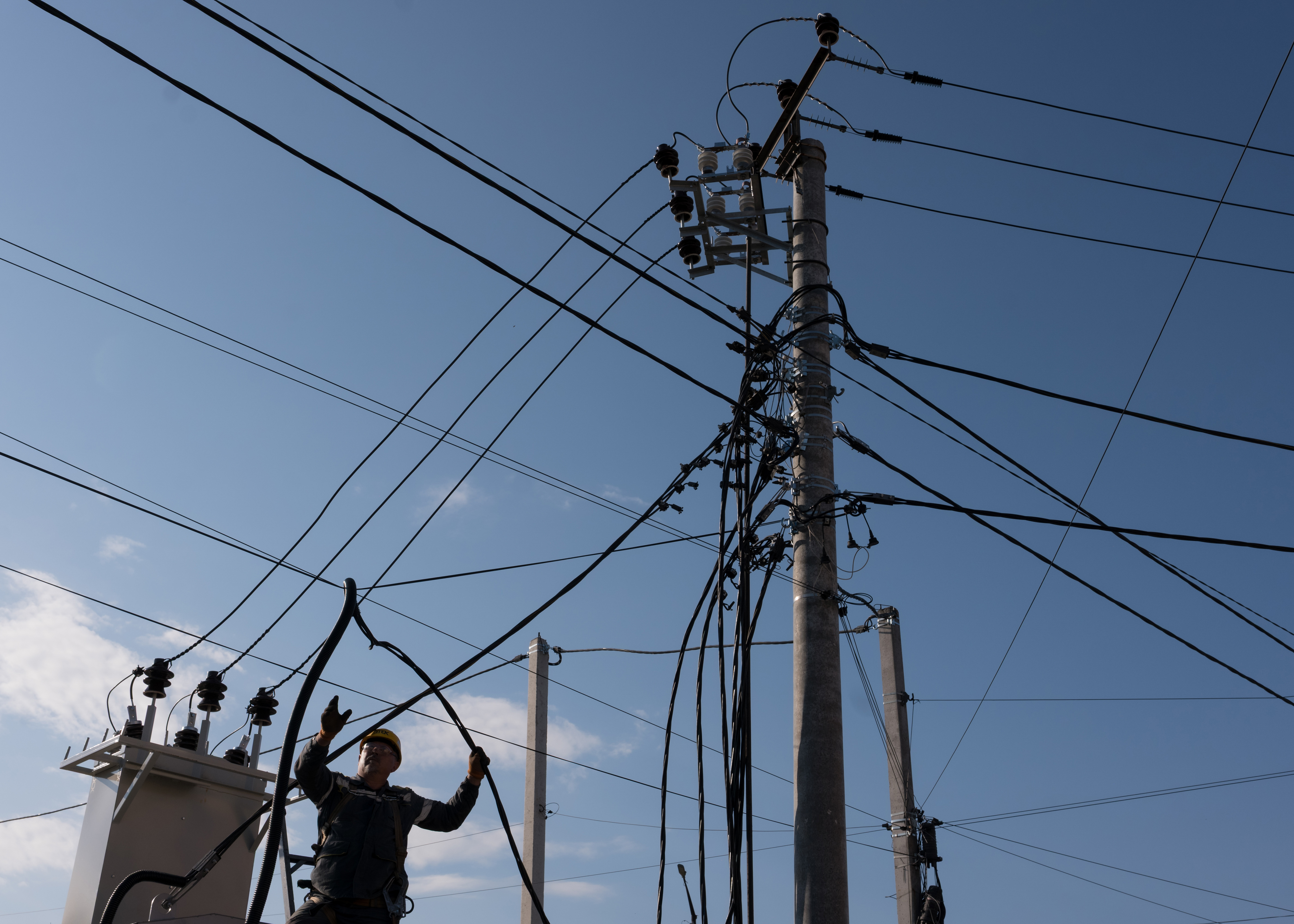
    To avoid a repeat this winter, power crews have been hard at work. On Monday, a repair team from DTEK was busy replacing an old transformer with a new one near Kyiv. They lifted the old unit off a pole and replaced it with a new transformer in a protective casing.

    “There’s old equipment that simply can’t handle the load anymore,” said the crew leader, Eduard Kashkov, 57. “Some of the equipment is as old as I am.”

    Last winter showed that local equipment can fail when power returns after an outage and large numbers of people plug in at once to charge batteries, Kashkov said. The new transformer, he added, was built to handle the surge in consumption.

    Speaking to parliament in August, Shmyhal expressed confidence that Ukraine would enter the winter well prepared. The country had about 15 gigawatts of available capacity, he said, and he expected it to grow to more than 21 gigawatts by year end. That would be enough to cover peak demand, which reached about 18 gigawatts last winter.

    But his projections did not account for attacks like Wednesday’s, which can undo months of repairs. Maria Tsaturian, an energy analyst at the research group Ukraine Facility Platform, said it could take only a few attacks to knock out the five gigawatts that Ukraine had restored in recent months. She pointed to the power outages after Wednesday’s strike as evidence of the grid’s fragility.

    Russia’s intercepted plan appears designed to collapse Ukraine’s already weakened grid.

    It lays out three stages of attacks. The first would knock out substations near Ukraine’s western borders, which import electricity from Europe. The second would take out hydroelectric power plants. The third would force Ukraine’s three operating nuclear plants offline. (A fourth nuclear plant, near the southern city of Zaporizhzhia, was captured by Russian forces early in the war and is not operating.)

    The goal of the attacks, the document says, is to eliminate nearly 15 gigawatts of generating capacity — as much as Ukraine had at the end of the summer.

    This article originally appeared in The New York Times.

  • Rams star Aaron Donald out for Eagles game, Puka Nacua set to return

    Rams star Aaron Donald out for Eagles game, Puka Nacua set to return

    LOS ANGELES — Aaron Donald will miss the Rams’ game against the Philadelphia Eagles on Sunday because of a sore back, while Puka Nacua will return after missing two games because of hip and groin injuries.

    Donald did not practice all week and coach Sean McVay officially ruled him out Friday. A three-time AP Defensive Player of the Year, Donald has four tackles, one tackle for loss and one quarterback hit in two games after ending his two-season retirement.

    McVay said the Rams (1-2) were erring on the side of caution with Donald and that the 35-year-old defensive tackle probably could have played through the injury if needed.

    “We have to protect him from him,” McVay said. “This guy will do everything (to play) and that much more.”

    Nacua had five receptions for 74 yards in the season opener against the 49ers but missed games versus the Giants and Broncos after hurting himself in practice on Sept. 17.

    “Just in some of the change of direction stuff, some of the stuff in my hip area just was not feeling great,” Nacua said. “It was causing me some pain and some restriction in some of my movements.”

    The Rams also ruled out tight end Terrance Ferguson (ankle) and cornerback Jaylen Watson (shoulder), while tight end Colby Parkinson (knee/shoulder) and linebacker Grant Stuard (groin), a key special teams contributor, are questionable.

    McVay also said wide receiver Alex Bachman will likely be called up off the practice squad to contribute on special teams after return specialist Xavier Smith was waived on Friday.

    The decision to move on from Smith came one day after special teams coordinator Bubba Ventrone was critical of Smith’s performance while also ruling out replacing the third-year wide receiver from Florida A&M. Smith’s status had been in question since he muffed a punt leading to a Seattle touchdown in the Seahawks’ 31-27 win over the Rams in the NFC championship last season.

    “We just need better production out of that position,” McVay said. “That’s exclusively what it was.”

    “We weren’t thinking about it when (Ventrone) talked to you guys yesterday. And as you get a chance to kind of take a step back, evaluate the totality of our group — what’s the best way to try to be able to put together all three phases? Did feel like that was in the best interest of the group, and that was kind of what went into it.”

  • CBS announces Tony Romo’s permanent exit following arrest for operating a vehicle while intoxicated

    CBS announces Tony Romo’s permanent exit following arrest for operating a vehicle while intoxicated

    CBS Sports and Tony Romo have officially parted ways, one month after the former Dallas Cowboys quarterback pleaded no contest to charges of operating a vehicle while intoxicated.

    Romo had been on leave since his July 23 arrest in Wisconsin. He had been the lead game analyst for CBS’ NFL coverage since 2017.

    “CBS Sports and Tony Romo have mutually agreed to part ways,” CBS Sports said Friday in a statement. “We thank Tony for his contributions over the past nine years and wish him the best moving forward.”

    Analyst JJ Watt had joined play-by-play announcer Jim Nantz and sideline reporter Tracy Wolfson on CBS Sports’ lead NFL team during Romo’s absence. Watt will continue in that role now and all other CBS teams will remain the same.

    Romo was arrested following a traffic stop as he was driving south on Interstate 43 in Wisconsin. He pleaded no contest to a charge of operating while intoxicated on Sept. 1 and issued a statement apologizing for the actions that led to his arrest.

    According to Milwaukee County court records, Romo lost his driving privileges for six months and was ordered to complete an alcohol assessment program.

    “The past month has been difficult, but it has also been personally significant,” Romo said Sept. 1 in a statement on Instagram. “It has required me to confront and own my mistakes fully — to the Lord, to myself, to my family and now to the public.”

    Romo said the multiple back surgeries that led to his retirement as a player “left me with constant, debilitating pain.” He noted that the pain “led to a dependence on pain medication, and my efforts to get off those medications led to an over-reliance on alcohol.”

    “None of this is an excuse,” Romo said. “These are my failures and I take responsibility for them.”

    Romo said he is working with a team of doctors to address his health and “make the necessary changes.”

    The 46-year-old Romo made four Pro Bowl appearances during a playing career that ran from 2004-16 and was spent entirely with Dallas.

  • Amazon to invest $1B into data center communities amid backlash against data center rollouts

    Amazon to invest $1B into data center communities amid backlash against data center rollouts

    NEW YORK — Amazon is investing more than $1 billion over the next five years into communities where it operates data centers for education, job training, water and energy preservation projects, and other local priorities as it reacts to a growing backlash from politicians and consumers to the tech industry’s rollout of the massive buildings.

    According to a blog post on Friday by Matt Garman, Amazon’s CEO of its cloud computing arm, Amazon has already spent more than $1 billion in communities with a large data center presence over the past three years, including a 2-million-square-foot data center campus in Falls Township, Bucks County, that is nearing completion.

    Garman also said that Amazon is no longer using nondisclosure agreements with government agencies it works with on its projects, and it said it hosts open houses in communities where it operates to share information about what it’s doing. He also warned against the spread of what he believes is misinformation about data centers’ impact on the environment and energy rates — and he cited the dangers of over 100 moratoriums against these centers being considered across the country.

    “If these measures are enacted, the U.S. could be writing its own losing ticket to this race, and the consequences would last generations,” he wrote. “As a country, we can’t afford to find ourselves in that position. There is urgency to this data center build out because we aren’t the only country that sees the benefits of AI for the economy and national security.”

    Garman’s pledge comes as data centers, which power artificial intelligence and cloud computing, have become a hot political issue heading into the midterms as tech giants race to invest more money in expanding these infrastructures.

    Small, under-the-radar data centers have been around for decades. But the explosion of artificial intelligence chatbots has resulted in data centers that are bigger than anything just about any town has ever seen. Some of them dwarf football stadiums and factories and consume more energy than small cities.

    By 2030, data centers will account for nearly 3% of the world’s projected electricity use, with 935 trillion watt-hours, according to a United Nations University report released in June on these buildings’ environmental footprint.

    Amazon said in July that it now expects to spend $220 billion in capital expenditures in 2026, including on data centers and other technology investments. That’s up from its prior estimate of $200 billion.

    President Donald Trump has embraced the building of more data centers, but there is growing wariness from voters. About 6 in 10 Americans support limiting the number of new data centers that can be built, including most Democrats and Republicans.

    And a majority of Americans are “extremely” or “very” concerned about the impact of data centers on electricity prices or the water supply in the communities where they are built.

  • Trump expected to name intelligence chief Jay Clayton as new AI czar

    Trump expected to name intelligence chief Jay Clayton as new AI czar

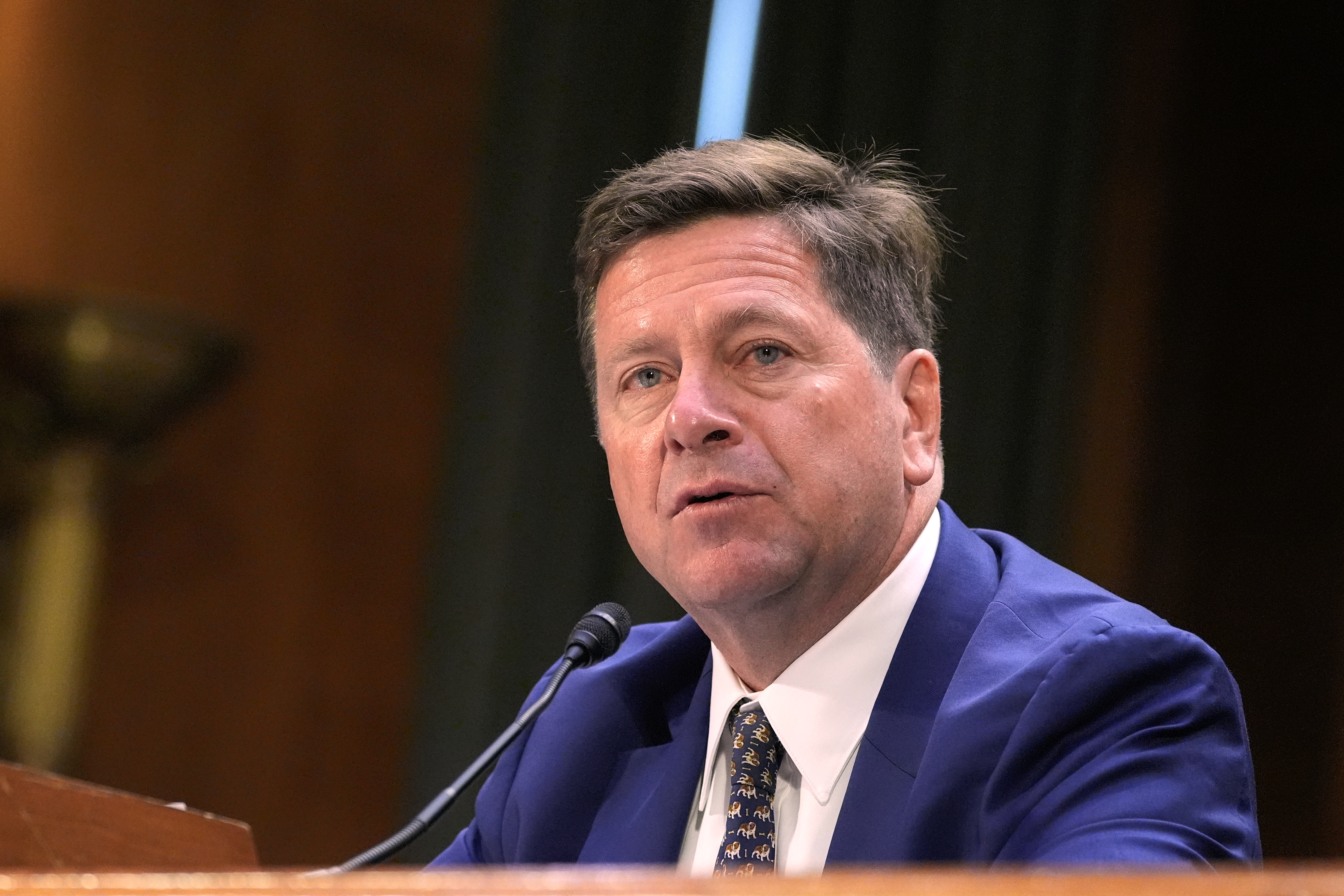
    President Donald Trump is expected to name spy chief Jay Clayton as his new top adviser on artificial intelligence, according to three people familiar with the decision, a move that cements the administration’s handling of the new technology as a matter of national security.

    Clayton, a former U.S. attorney and Securities and Exchange Commission chairman, was confirmed as the leader the Office of the Director of National Intelligence in July. He is expected to continue to hold that role, one of the people said. All three individuals spoke on the condition of anonymity to describe a personnel move that has yet to be publicly announced.

    CBS News first reported that Trump was expected to choose Clayton for the position.

    The appointment comes as the Trump administration recalibrates its approach to AI. The previous czar, the investor David Sacks, promoted a policy aimed at allowing the technology to develop as fast as possible. But in the months since Sacks left his post in March, officials have increasingly been grappling with cybersecurity threats posed by the latest generation of models and the danger posed by AI agents going rogue online. Sacks has continued to influence thinking within the administration as an informal adviser outside of the government and as co-chair of the President’s Council of Advisors on Science and Technology. Sacks and Clayton have a close relationship, according to one of the people briefed on the upcoming announcement.

    A White House official said any personnel moves would be announced by the president. “Any reporting until then is baseless speculation,” the official said.

    The administration has resisted calls in recent weeks by some in the industry and on Capitol Hill to slow down the pace of development and adopt new regulations. But on Tuesday it convened tech executives for a White House lunch that culminated in the leading AI companies signing a promise to develop new systems safely and bring in outside oversight firms. The following day, a Federal Trade Commission official said the panel had opened an investigation into AI companies Anthropic and OpenAI. (The Washington Post has a content partnership with OpenAI.)

    Joel Thayer, a senior adviser for technology at the America First Policy Institute, a Trump-aligned think tank, said the developments showed how the administration’s handling of AI companies was “maturing.”

    “These guys are under watch,” Thayer said. “The government has a spotlight on them.”

    The industry executives’ pledge is voluntary and amounts to what Trump called “self-policing.” But it won the backing of figures who have bitterly clashed over how serious of a risk AI poses. Sacks, who attended the lunch, endorsed it. So did Jacob Coxon, a former Anthropic researcher who resigned last month, saying the technology could wipe out humanity and triggering a wave of panic in Washington.

    The agreement means Clayton will step into his new role at a time of relative calm.

    “Super intelligence is a national security issue,” Clayton said in a CNBC interview the day after the lunch, using Trump’s preferred name for AI. “That was something that was recognized yesterday by not just the industry leaders, but everybody in the room. The commitment there to the American people, and the safety and security of the American people was palpable throughout the meeting.”

    Trump nominated Clayton, a loyal ally and regular golf partner of the president’s, to lead the intelligence office in June. Many Senate Democrats initially said they supported the choice. But he refused in his confirmation hearing to say definitively that Joe Biden had won the 2020 election, and the final vote fell along party lines.

    The AI role will not require Senate confirmation.

    The shifting thinking that led to Clayton’s appointment began months ago, when Anthropic said it had developed a new model called Mythos that it deemed too dangerous to publicly release. The company said it had new abilities to find vulnerabilities in computer code and help hackers exploit them.

    Officials scrambled to understand the risks to government systems and critical sectors of the economy. Driven by alarm among banking industry leaders, Treasury Secretary Scott Bessent played a key role in shaping the administration’s response. Last week, Trump batted down reports that Bessent was in line to be the new AI czar.

    In May, the White House settled on issuing an executive order calling on leading AI companies to voluntarily share their latest systems with the government ahead of their release, giving federal experts a chance to weigh security risks. Despite no longer holding an official government position, Sacks continued to wield influence and made a last-minute call to Trump that caused the order to be delayed and revised.

    But even after the order was signed in June, new dangers continued to emerge. The following month, ChatGPT maker OpenAI disclosed that a swarm of agents created by its systems had broken free and breached another AI company. Other firms said they had suffered similar breakouts.

    Then came Coxon’s resignation in September, which reignited a long-simmering debate in AI circles about whether a sufficiently powerful version of the technology would bring about humanity’s downfall.

    Trump dismissed the fears a “hoax” in fiery social media posts. But he later said he would name a new czar and create an “AI Force.” The White House has not detailed what the force will do, but in an interview with Time magazine published this week, Trump described it as “a group of very smart people that understand it, who will be advising me.”