
Category: Wires

  • As war reshaped the World Cup, Iran’s team found an unlikely home in Mexico

    As war reshaped the World Cup, Iran’s team found an unlikely home in Mexico

    TIJUANA, Mexico — The three SUVs pulled into the gas station parking lot, one after the other, Iranian flags taped onto the hoods and fluttering from the windows.

    It was barely 4 a.m. The city’s nightclubs were closing, and the streets were dark. But this caravan had hatched a plan to stake out a national soccer team they never imagined they would see in person, and especially not here. So 4 a.m. at the gas station it was.

    Like so many in Tijuana, the Iranian national soccer team was never supposed to end up here. They originally had planned to spend the month across the border, in Tucson, preparing to play their World Cup matches in Los Angeles and Seattle.

    But for the first time in World Cup history, a host country is at war with one of the tournament’s contenders. FIFA, global soccer’s governing body, with tensions high and uncertainty about whether the team would even be allowed into the U.S., sought an alternative.

    Co-host Mexico agreed to house them, with President Claudia Sheinbaum telling reporters that FIFA had asked for help because the “United States does not want the Iranian team staying overnight in the country.” Organizers opted for Tijuana, a border city close enough to the U.S. matches, with a stadium where the team could practice and a local government eager to welcome them.

    The fans meet outside a convenience store at 4 a.m. in Tijuana. Stuart Palley

    Now Sadegh Galavi and his relatives were piled into these SUVs, hoping to welcome their national team to the city that adopted his family. They knew what the world thinks of Tijuana, the dangerous, gritty border city from the movies, a hub for drug smugglers, and a cheap destination for Americans seeking parties and sex.

    But they knew Tijuana as something different: a transient, multicultural city that embraces migrants and misfits, offering creole schools for Haitian children whose families are stranded there, and welcoming Sadegh and his wife four years ago when they knew no Spanish and not much more English.

    It was just the place for a global soccer tournament, they thought, an unlikely but ideal refuge for their home team.

    Sadegh and his friends spent the past two weeks working to convince the Iranian Embassy and team that Tijuana is safe. Now the team was minutes away from landing at Tijuana International Airport.

    He had slept barely an hour, anxiously tracking the team’s flight, worried he might miss his chance to greet them. The jerseys ordered on Amazon hadn’t arrived on time, but the Iranian Embassy sent replacements at the last minute. The ambassador asked Sadegh’s wife, Maryam Asidi, to take photos and videos of the fans at the airport, to show Iranians back home that Tijuana isn’t as dangerous as they might fear.

    “Hi brother, yes, please,” Sadegh said, answering his phone as he pulled into the airport. Military and police forces surrounded the airport’s entrances. The players must be landing soon, he thought.

    He pulled over, hopped out of the car and power-walked toward the flight arrivals, waving his small Iranian flag.

    Maryam and Sadegh Galavi pose at Tijuana International Airport on Sunday, while waiting for the arrival of the Iranian men’s soccer team. Stuart Palley

    A divisive team

    Known affectionately as Team Melli, Iran’s national team was near-universally loved in Iran for decades.

    “There was absolute mania around Team Melli,” said Arash Azizi, an Iranian author and historian who recalled celebrations breaking out in the streets in Iran after the team qualified for the 1998 World Cup. “It was one of the most trusted, beloved institutions in Iran across political differences,” he said.

    But after years of government mismanagement and repeated, brutal crackdowns on civilian protesters, many Iranians began to see even their national soccer team as an extension of the country’s leadership.

    During the 2022 World Cup, in Qatar, Iran was engulfed by nationwide “Women, Life, Freedom” protests, and its men’s national team faced criticism for not vocally supporting the protesters. The team stood silently during Iran’s national anthem, but some fans were unsatisfied. Social media videos showed Iranians honking horns and setting off fireworks after their team’s 1-0 loss to the United States, which they viewed as a symbolic defeat for the regime.

    Then, this March, the Iranian women’s team came under criticism from pro-government media outlets for standing silently during the national anthem, after reports that Iranian security forces had killed thousands of people in a violent January crackdown on protests.

    Australia granted six players and a staff member humanitarian visas, citing concerns they would be persecuted for failing to sing along. Eventually, five of the team members withdrew their claims and were welcomed back to Iran with an elaborate ceremony.

    Then came the war, which threw the men’s team’s season into chaos. Most play in domestic Iranian leagues whose games were suspended Feb. 28. A friendly, scheduled to be played in Arizona, was canceled. President Donald Trump, in a Truth Social post, said the Iranian team was “welcome” to play in the World Cup but advised them against it “for their own life and safety.”

    Just days before the team was scheduled to travel to Mexico, it still hadn’t received its U.S. visas. Earlier this month, the players learned their visas had been approved, but visa applications for 15 members of the team’s support staff had been rejected.

    In an interview with the Washington Post in Tijuana, Iran’s ambassador to Mexico said the 15 people included trainers, managers, a media director, a security leader and a delegate from the Foreign Ministry. He accused the United States of failing to follow FIFA rules.

    On Tuesday, Iran’s soccer federation said the ticket allocation for Iranian fans had been revoked, in an “unexpected move.” FIFA requires that participating federations be allocated 8% of ticket capacity, so fans can purchase entry to their team’s games.

    “From my perspective, politics needs to be separate from sports,” Abolfazl Pasandideh, the Iranian ambassador, said through his translator in Tijuana. “And if in this case they want to mix the two, it has to be the other way around. Politics must be at the service of sports.”

    But to some in Tijuana’s small Iranian community — the ambassador puts it at 20 or so, in a city of over 2 million people — politics are inherent to Iranian soccer.
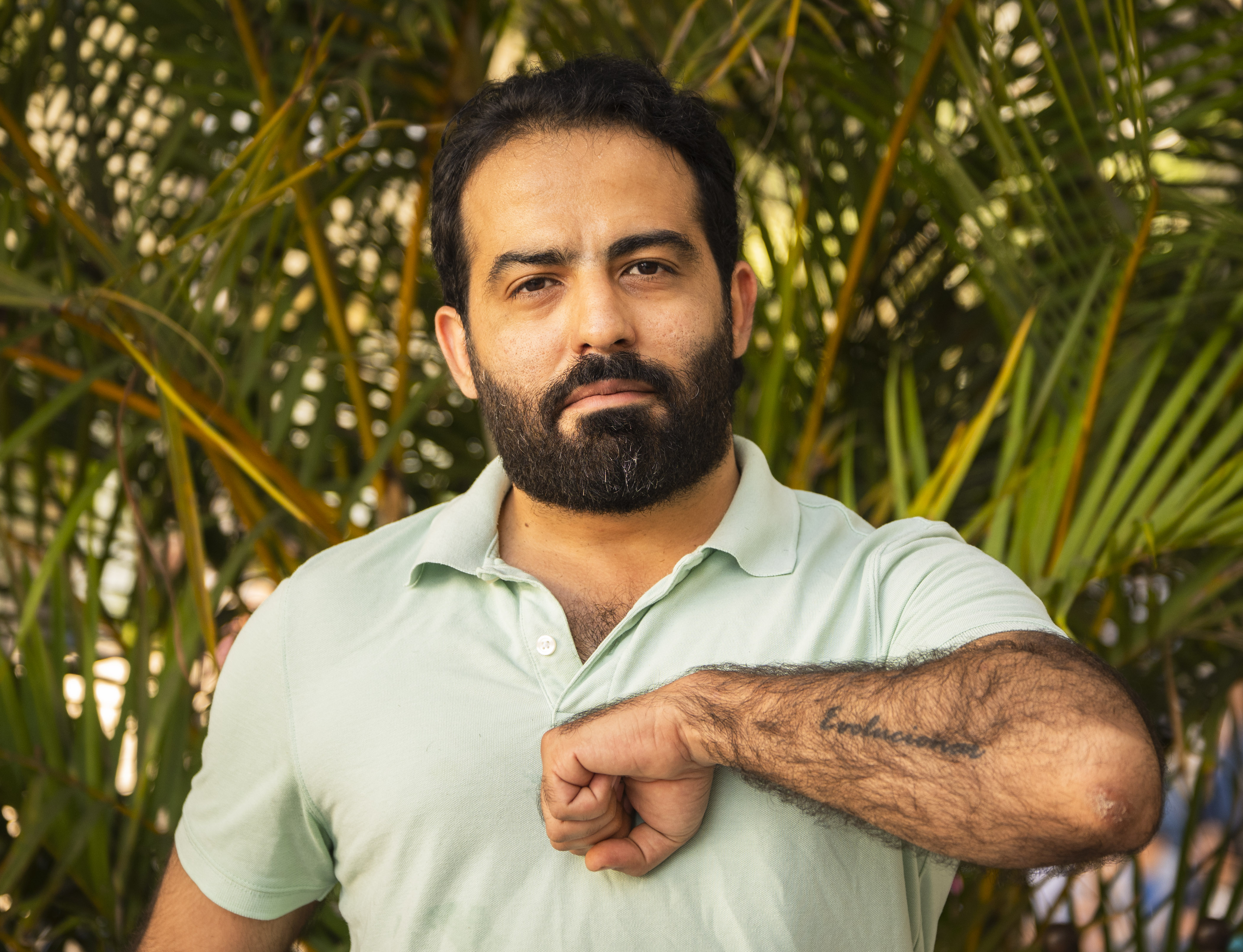
    Iranian Pedram Maymand, a Tijuana resident, in the city’s center on Sunday.Stuart Palley

    “For the team to come here while the country is grieving … I don’t think that celebrating the football team right now is appropriate,” said Pedram Maymand, 31, who moved to Tijuana from Fresno, Calif., when his student visa expired after graduation about five years ago. “They’re representing the government that is killing our people.”

    If he could meet the players, he would want to send them a message, he said: “Have you any shame?”

    Sadegh understands the complex feelings. But to him, Team Melli is still a symbol of national pride, of a country he chose to leave but that remains a core part of who he is.

    People walk near the Tijuana Friendship Arch. Stuart Palley

    How Tijuana became home

    Sadegh’s family’s path to Tijuana, like the stories of many in this city, began with a romance across borders and cultures.

    About 50 years ago, Maryam said, her father visited San Diego as part of the Iranian military. He fell in love with a Mexican woman, who eventually gave birth to their son.

    Maryam grew up hearing about the half brother she had never met, who lived in the faraway city of Tijuana. But she didn’t believe the story until her half brother came to visit Iran for the first time when he was in his 20s, and she was 13.

    Many years later, after marrying Sadegh, Maryam decided to visit her brother’s city, not knowing anything about Tijuana’s reputation. Within two weeks, they had decided to stay.

    “Here, you never feel you are from another country,” Maryam said. “This country makes you feel good. … And as a woman, you are more free.”

    She shed her hijab, a head covering that is mandatory for women in Iran. Within weeks of leaving the Islamic republic, where drinking is banned, Sadegh tried mezcal for the first time. The music coursing through Tijuana’s streets on Friday and Saturday nights made Maryam feel alive.

    Maryam and Sedagh Galavi at their home in Tijuana. Stuart Palley

    They longed for their family and for home, but they soon began finding the other Iranians. One day Sadegh saw a car parked on the side of a road with vanity plates: “Tehran.” He left a note on the windshield with his phone number; the car‘s owner is now his friend and boss, at a car-restoration business in town.

    Sadegh and Maryam gave birth to a Mexican son, Sepehr, whose middle name, Mayahuel, was a reference to an Aztec god. “We want him to feel he’s from here,” Maryam said.

    When her mother died unexpectedly of a heart attack last year, Maryam fell into a deep depression and returned to Iran for a long visit with her 9-month-old son. The trip coincided with the U.S.-backed Israeli attacks on Iran, and she had to flee the country by land. As soon as she landed back in Mexico, she was moved by the strangers who offered to help carry her suitcase.

    She worried her grief would taint the city for her. Instead, Tijuana pulled her out of it. This was the place where she wanted to raise her son, she decided. The couple bought a house in Tijuana and began applying for Mexican citizenship.

    Then, with the World Cup on the horizon and the war raging, rumors started circulating: Their country’s team needed a home.

    People exit the Tijuana Cultural Center this week. Stuart Palley

    ‘I am in my country’

    Late last month, FIFA announced the team was heading to Tijuana.

    Sadegh could hardly believe it. When Iranian news outlets raised concerns about security, he began messaging the players directly on Instagram to tell them about the city he loves and assure them they would be safe. He knew he would never get a response but kept typing anyway.

    His boss and friend, Dara Makoipour, met with the Iranian ambassador and showed him around the city — to the stadium, to the restaurant known as the origin of the Caesar salad. Local tourism and Chamber of Commerce officials were eager to use this as a chance to change Tijuana’s reputation and put it on a global stage.

    Sadegh started a WhatsApp group with his small circle of Iranian and Iranian Mexican family and friends in Tijuana, and they came up with a plan to welcome them at the airport for their 1:30 a.m. arrival. When the flight was delayed to 5 a.m., some in the group pulled out.

    But his small family caravan had powered through, and now they were gathered in international arrivals, surrounded by heavily armed Mexican national guard troops, trying to scope out where they might be able to catch the team.

    They walked around a security roadblock to a group of reporters and a handful of other fans from across the San Diego area.

    Suddenly the team bus approached with a military escort. The small crowd cheered, raising their flags and chanting the name of one of the players. A team representative briefly rolled down the window and waved straight toward Sadegh.

    “Merci,” the Iranian representative said with a smile.

    The Iranian team’s bus departs a secure area of the Tijuana airport.Stuart Palley

    Sadegh, his heart racing, accidentally spoke to them in English, calling out, “welcome!” He had forgotten he could speak to them in Farsi.

    “Bienvenidos!” his Mexican relatives shouted.

    Reporters surrounded the couple to ask them how they felt. Maryam beamed.

    “I think now I am in my country,” she said.

    The team later circulated a photo, taken from the bus on their arrival that morning, of Sadegh waving his flag. He proudly shared it on Instagram, writing in English and Farsi that “the Iranian national team belongs to all Iranians,” regardless of their beliefs, religion or political stance.

    “Welcome to Tijuana,” he wrote.

  • New York’s busiest train station to get $8 billion remodel with columns, sunlight, and Trump’s name

    NEW YORK — When Manhattan’s original Pennsylvania Station was demolished in 1963, it marked the undignified end to one of America’s great public works, a monolithic Beaux Arts train terminal with Roman-style columns and a spacious central waiting area that was at the time the city’s largest indoor space.

    In its place rose Madison Square Garden — home of NBA’s New York Knicks and NHL’s New York Rangers — while train commuters were forced underground into gloomy, claustrophobic, low-ceilinged corridors when the redesign was completed in 1968.

    “Through Pennsylvania Station one entered the city like a god,” the architectural historian Vincent Scully famously lamented. “One scuttles in now like a rat.”

    But a dramatic new vision for the busiest transit hub in the Western Hemisphere calls for a return to the original station’s grandeur from 1910.

    Renderings released Monday feature a rectangular stone facade lined with imposing columns along a grand entryway. Inside, a sunlight-drenched concourse boasts soaring ceilings more than 50 feet high in places. There are bronze finishes and other ornamental details, like a bas-relief of the city’s famous skyline and a large station clock.

    Inside one entryway, an inside wall bears the seal and name of President Donald Trump, who had Amtrak assume control of the project last year after decades of political infighting among transit agencies and opposition to moving MSG from billionaire owner James Dolan.

    Trump has floated renaming his hometown station in his honor as he’s sought to burnish his legacy through public works projects, from a massive new White House ballroom to a triumphal arch.

    For now, though, the name etched across the proposed grand facade would still read “Pennsylvania Station,” according to the renderings. They were released by Amtrak, which owns the terminal, and Penn Transformation Partners, the design and development consortium picked for the project.

    Proposal aims to make Penn Station an icon again

    The proposed design draws from the ornate, Beaux-Arts design of Grand Central Terminal, the city’s other major rail hub, as well as Art Deco landmarks like the Empire State Building and Rockefeller Center, according to lead design architect Vishaan Chakrabarti.

    The vision, he said, is to restore Penn Station’s place among the pantheon of the city’s greatest landmarks.

    “There was this fearless embrace of ornament and decoration that in some ways we’ve lost,” Chakrabarti said. “We want to bring some of that sense of craftsmanship back.”

    The redesign is projected to cost roughly $8 billion, and construction is targeted to begin before the end of 2027, officials said Monday. Penn Station would remain in operation throughout as the project progresses in phases over about six years.

    More than 600,000 commuters traverse the rail hub on any given workday, or more than the three major international airports that serve greater New York City — John F. Kennedy, LaGuardia, and Newark Liberty — combined.

    Knicks and Rangers home arena would remain at the site

    Plans floated over the decades have called for relocating MSG, but the plan is for the “World’s Most Famous Arena” to remain in place. A theater owned by MSG and built directly above the tracks, however, would have to be razed.

    The developers and MSG’s owner have reached an agreement on this critical point, but the final terms — including payment — are still being negotiated. That’s according to Andy Byford, a former New York City subway chief who Amtrak named as a special adviser to oversee the redevelopment.

    Transit advocates complain the process has been shrouded in secrecy.

    “It’s really important that there be public input and involvement,” said Lisa Daglian, who heads a group that advises the Metropolitan Transportation Authority, which operates New York’s subway and two commuter rail systems.

    “We don’t need another megamall or monument and certainly not at the cost of billions in local revenue or by putting existing services at risk,” said Danny Pearlstein of the transit advocacy group Riders Alliance.

    Byford said more details will be revealed in the months ahead, including a more detailed breakdown of costs, as the developers refine the preliminary designs and the project goes through the extensive federal environmental review process.

    But he vowed no fare hikes to cover project costs and no plans for the government to condemn and take surrounding properties to expand the station, as some have suggested.

    At Penn Station on Tuesday, John Schoen was among the regular riders who welcomed the prospect of a more inviting commute.

    “The city needs new looks. This is old,” the 55-year-old Long Island resident said. “Let’s do it. Move forward.”

    Others, though, wondered how construction might worsen their commutes. James Culhane, another Long Island rider, noted parts of the station received a significant face-lift in recent years that brought in new eateries, more natural light, and other improvements.

    “Things are operating as well as they can be,” said the 24-year-old opera stagehand. “Just use the money elsewhere.”

  • The science around GLP-1 drugs and cancer is suddenly getting a lot more interesting

    The science around GLP-1 drugs and cancer is suddenly getting a lot more interesting

    The story of GLP-1 drugs keeps getting bigger.

    First they transformed the treatment of diabetes. Then they upended the science — and culture — of weight loss. Now a growing body of research is raising another possibility: that these drugs may help protect against cancer.

    At this year’s American Society of Clinical Oncology (ASCO) meeting in Chicago, more than 40 studies, abstracts, oral presentations, and poster presentations examined the relationship between GLP-1-based drugs and cancer. The results were strikingly consistent. Taken together, they suggest that people taking medications such as Ozempic, Wegovy, and Mounjaro may develop certain cancers at lower rates than comparable patients who are not taking the drugs — and that those already diagnosed may experience a slower decline and better outcomes.

    For oncologists, the accumulation of evidence is hard to dismiss. The findings are “super promising,” said Mark Orland, a cancer researcher at the Cleveland Clinic. “We’re really excited to be on the forefront of looking at the effects of these drugs.”

    The studies spanned many of the 13 cancers associated with obesity. Among the most prominent is an analysis from the University of Pennsylvania. It looked at data from more than 100,000 women and found lower rates of breast cancer among those taking the drugs. Another followed more than 10,000 patients and found that those taking the medications were significantly less likely to progress to metastatic disease across four solid tumors.

    Also drawing attention were findings related to lung cancer — because it is not generally associated with weight — as well as a few studies hinting that GLP-1s could enhance the effectiveness of cancer treatments. Those findings have fueled a particularly intriguing possibility: that GLP-1s may be acting independently of weight loss — by reducing inflammation, altering metabolic pathways involved in cancer development, or perhaps even slowing tumor growth itself.

    None of this proves that GLP-1s prevent cancer, and doctors said the evidence is not yet strong enough to recommend prescribing the drugs for that purpose. Most of the findings come from observational studies, which can identify associations but cannot establish cause and effect. That distinction matters. Patients who take GLP-1s may differ from those who do not in ways researchers cannot fully measure, even after statistical adjustments. Many treatments that appear effective in observational data fail in randomized clinical trials, where patients are assigned to receive a drug or a comparison treatment.

    Scientists point to metformin as a cautionary example. During the 2010s, the diabetes drug was repeatedly linked to lower cancer risk in observational studies, but those benefits largely disappeared when tested in clinical trials.

    For now, the GLP-1 findings remain a hypothesis rather than a conclusion. Yet the growing volume of evidence has turned the question into a serious area of investigation.

    The larger question raised by the findings is whether medicine has underestimated how many diseases share the same underlying biology. GLP-1s keep forcing medicine to redraw the boundaries between diseases that once seemed separate. Diabetes, obesity, heart disease, kidney disease, addiction, dementia, cancer — the emerging theory is that many of these conditions may share more than researchers appreciated.

    To Gilberto de Lima Lopes, chief of medical oncology at the Sylvester Comprehensive Cancer Center at the University of Miami, the cancer findings fit into a broader pattern. GLP-1s increasingly resemble “a really interesting longevity drug,” he said — one that may influence enough biological processes to extend life in ways researchers are only beginning to understand.

    “The potential benefit is real,” he said, “and it makes biological sense.”

    Preventing cancer

    The connection between obesity and cancer is one of the most established findings in cancer epidemiology. Excess body fat does more than add weight to the body. The tissue is biologically active, producing hormones and inflammatory molecules that can influence how cells — including tumors — grow, divide, and repair themselves.

    “We know obesity is a risk factor, but we don’t understand how,” said Elizabeth McDonald, a physician and radiology professor at the Hospital of the University of Pennsylvania.

    McDonald was among the researchers behind one of the conference’s most talked-about findings. Like much of the new GLP-1 research presented, her study relied on analyzing existing medical records rather than a randomized clinical trial. She examined records from about 100,000 women ages 45 to 80 undergoing breast imaging and found that after accounting for differences in age, obesity, diabetes, and other risk factors, GLP-1 users remained roughly 30% less likely to develop breast cancer.

    McDonald said the findings build on years of studies in lab-grown cells and animals that have suggested GLP-1 drugs can slow cancer cell growth, enhance the effects of chemotherapy and influence other pathways linked to cancer development.

    A separate breast cancer study, led by Jasmine Sukumar of MD Anderson Cancer Center and also presented at the ASCO meeting, analyzed records from more than 137,000 breast cancer patients between 2014 and 2023. In a matched analysis, women taking GLP-1 drugs had markedly better survival: Nearly 96% were alive five years after surgery, compared with about 90% of similar patients who were not taking the medications.

    For McDonald and Sukumar, the question is no longer whether the signal is interesting. Given the growing number of large studies finding similar results, they said, the next step is to test the hypothesis in randomized clinical trials.

    “We are nearing the ends of years of research leading up to this,” McDonald said.

    Sukumar said the consistency of the findings across multiple studies was particularly encouraging.

    “All the studies have slightly different designs, and yet we are still seeing some absolute benefit with GLP-1s,” she said.

    The prevention signal extended beyond breast cancer. Studies of pancreatic cancer, acute myeloid leukemia, and several other malignancies also found lower cancer rates among patients taking GLP-1 drugs.

    A researcher at University Hospitals Seidman Cancer Center and Case Western Reserve University, Sarina Ailawadi, reported that among patients with chronic pancreatitis — a major risk factor for pancreatic cancer — those taking GLP-1 drugs were more than 50% less likely to develop the disease, one of the deadliest malignancies.

    Another study pointed to a possible benefit in acute myeloid leukemia. Colton Jones, a fellow at the Mays Cancer Center at the University of Texas, found that GLP-1 use was associated with a 63% reduction in risk. Jones calculated what such an effect might mean at a population level. If roughly 20 million Americans are now taking GLP-1 drugs, he estimated, the association could translate into approximately 1,500 fewer leukemia cases.

    “That is a good number,” Jones said. If the findings hold up, he added, “this could revolutionize how we prevent cancer on the whole.”

    Slowing progression

    Orland’s work began with a single patient. More than a year ago, he noticed something unusual in a patient with clonal hematopoiesis of indeterminate potential, or CHIP, a blood disorder associated with an elevated risk of leukemia and other diseases. After the patient began taking a GLP-1 drug, the number of mutant blood cells associated with the condition declined.

    The case was hardly proof of anything. But it was enough to make Orland wonder whether the drugs were affecting cancer biology in ways researchers had not appreciated. He and his colleagues began combing through hundreds of thousands of medical records to test the idea that GLP-1s, when started after a cancer diagnosis, might slow disease progression. To isolate the effect of the drugs, they compared patients taking GLP-1s with similar patients receiving other diabetes medications.

    The results, published in the Journal of Clinical Oncology, showed that patients taking GLP-1 drugs were 38 to 50% less likely to progress to metastatic disease in four cancers: lung, breast, colorectal, and liver. One possible explanation, Orland said, is that the drugs’ anti-inflammatory and immune-modulating effects make it harder for cancer cells to thrive and spread.

    Boosting existing treatments

    Two studies presented at the ASCO meeting raised a possibility that goes beyond cancer prevention: that GLP-1 drugs may improve outcomes for patients who already have advanced cancer.

    In one abstract, Shalin Rawal of NYMC at St. Mary’s General Hospital and Saint Clare’s Health examined patients with metastatic colorectal cancer receiving immune checkpoint inhibitors, a class of drugs that helps the immune system recognize and attack tumors. Patients taking GLP-1 drugs had consistently lower mortality rates than comparable patients who were not taking the drugs at three years, five years, and beyond.

    Researchers said the findings suggest that GLP-1s may enhance the effectiveness of immunotherapy, potentially through their anti-inflammatory and immune-modulating effects. Another possibility, said Michael Maroules, a New Jersey-based oncologist who helped with the study, is that GLP-1s make it easier for immune system cells to recognize and target cancer cells.

    Khvaramze Shaverdashvili of Thomas Jefferson University led a separate analysis of more than 25,000 patients with metastatic non-small cell lung cancer treated with targeted therapies known as tyrosine kinase inhibitors, or TKIs. Patients taking GLP-1 drugs had substantially better outcomes, with five-year survival of 63% compared with 40% among nonusers.

    Although the studies involved different cancers and different treatments, they pointed to the same underlying hypothesis: that GLP-1s may alter the body’s inflammatory and metabolic environment in ways that make cancer therapies more effective.

  • Iran soccer body claims fans’ tickets for World Cup games in the U.S. have been revoked

    Adding more turmoil to a chaotic World Cup buildup for Iran, the national soccer federation claimed Tuesday that FIFA revoked the ticket allocation for fans at the team’s three group-stage games in the United States.

    Each federation for the 48 World Cup teams taking part is entitled to receive and distribute 8% of stadium capacity for each of its games, adding up to several thousands of tickets per game.

    Those allocations typically went on sale to each team’s most loyal fans soon after the tournament draw in December, when Iranians for five months already had been subject to a travel ban by the U.S. government.

    Now, just days before Iran opens its World Cup in Inglewood, Calif. — on June 15 vs. New Zealand at the 70,000-seat stadium used by the Los Angeles Rams and Los Angeles Chargers — the federation claimed in a statement reported by semiofficial state media that it now was unable to provide tickets to its supporters.

    The claim adds to the tensions among Iranian soccer, FIFA, and tournament cohost the United States, which began military attacks on Iran on Feb. 28. Some federation officials have been denied visas to enter the U.S.

    FIFA has total authority over ticketing operations at the World Cup, yet the Iranian soccer body suggested “the United States has now taken steps to obstruct the presence of Iranian supporters at the stadiums.”

    “This incident raises serious questions about the influence of non-sporting and political considerations on the organization of the world’s biggest football event,” the Iranian soccer federation said.

    Iran, appearing in its seventh World Cup, also plays games June 21 in Inglewood and June 26 in Seattle.

    FIFA said in a statement Tuesday it is “working closely with the IR Iran Football Federation to identify compliant solutions that maximize opportunities for Iranian supporters to attend matches.”

    FIFA President Gianni Infantino and secretary-general Mattias Grafström promised logistical support in face-to-face meetings with Iranian soccer officials in Turkey in recent weeks.

    Most of Iran’s 26-member squad has not had a competitive game since February because they play for clubs in the domestic league that was shut down by the war.

    The team is based in the Mexican border city of Tijuana near San Diego instead of the original plan to train in Tucson, Ariz.

    Denied admissions

    Omar Artan, a referee from Somalia who was denied entry to the U.S. at Miami International Airport on Saturday is not the only person connected to World Cup teams stopped by U.S. Customs and Border Protection.

    The Iraqi team’s official photographer, Talal Salah, was detained and denied entry after arriving at Chicago O’Hare International Airport on Friday as part of the country’s 53-member delegation.

    “U.S. authorities asked for his phone; he gave it to them. After 12 hours’ detention, they decided to ban his entry,” said a member of the Iraqi soccer federation, who spoke on the condition of anonymity because he was not authorized to speak to the media.

    Iraqi striker Aymen Hussein also was detained by U.S. immigration authorities for seven hours upon arrival before being released, another Iraqi soccer federation member said.

    CBP confirmed in a statement that two people with the Iraqi national team were subject to “additional inspection” to verify their information or “determine admissibility.”

    Iraq’s Aymen Hussein (left) is congratulated after scoring his side’s second goal against Bolivia in March.Fernando Llano

    Artan, one of Africa’s top referees, was denied over “vetting concerns,” CBP said in a statement without giving details of those concerns. Artan was issued a visa to travel to the U.S. last week, according to the Somalia Embassy in Kenya that processed it.

    The move to deny a FIFA-appointed match official permission to enter a World Cup host country is highly unusual. Artan was due to meet up with other World Cup referees at their training base in Miami.

    Andrew Giuliani, the executive director of the White House FIFA Task Force, said Tuesday the referee was denied admittance for “very good reason” but also declined to go into details.

    Contract deal in LA

    Southern California stadium workers who threatened to strike for the U.S. men’s soccer team’s opening World Cup match on Thursday against Paraguay said Tuesday that they expect to stay on the job after reaching a tentative contract deal with higher wages and more labor protections.

    Workers will vote Wednesday on whether to ratify the deal.

    The union represents 2,000 bartenders, servers, cooks, and dishwashers at SoFi Stadium. The deal came after workers last week voted to authorize a strike as contract talks had stalled with the stadium’s food service provider, Legends Global.

  • NASA unveils Artemis III astronauts to test technology for a future moon landing

    NEW YORK — NASA on Tuesday revealed the crew for its Artemis III mission, the next step in the space agency’s plan to eventually land astronauts on the moon.

    The announcement came two months after Artemis II’s record-breaking trip around the moon that surpassed the distance record of Apollo 13.

    NASA’s Randy Bresnik, Frank Rubio, and Andre Douglas and the European Space Agency’s Luca Parmitano won’t fly to the moon or land on the surface. Instead, they’ll orbit Earth while practicing docking their Orion capsule with two lunar landers.

    “To the Artemis III crew, we wish you Godspeed on the journey ahead,” said NASA administrator Jared Isaacman.

    Elon Musk’s SpaceX and Jeff Bezos’ Blue Origin are racing to deliver the lunar landers. The two-week demo is targeted for 2027. Blue Origin suffered a recent setback when its massive rocket exploded during an engine-firing test on the launch pad in Florida, shaking nearby homes and illuminating the sky with an orange fireball.

    NASA’s Jeremy Parsons said the setback is a learning opportunity and that the space agency is confident Blue Origin’s rocket will be ready in time.

    NASA’s Artemis program aims to return astronauts to the moon’s surface for the first time since the 1970s. A recent revamp of the program announced by Isaacman aims to fast-track it similarly to the Apollo era, adding the upcoming spaceflight around Earth before eyeing a lunar landing in 2028.

    “We are certainly humbled as a crew to be able to be your crew that executes this Artemis III mission in space,” said Bresnik, Artemis III commander.

    Added Douglas, mission specialist: “My brain — it is going a mile a minute right now. But my heart, it is so warm. It is so full.”

    In May, NASA awarded hundreds of millions of dollars in contracts to four companies, including Blue Origin, to build landers, rovers and drones for a future moon base. Isaacman said the goal of the moon base is to lay the foundation for a Mars expedition.

  • House passes $70B bill to fund Trump’s immigration actions for the rest of his term

    WASHINGTON — A bill to provide nearly $70 billion for immigration enforcement narrowly passed the House on Tuesday and now goes to President Donald Trump for his signature, fueling the administration’s deportation agenda for the remainder of his time in the White House.

    Republicans used their majority to get the bill over the finish line, funding a pair of Homeland Security agencies through the next three years. The bill passed by a vote of 214-212, over the objections of Democrats.

    The White House says the bill will provide $38 billion for Immigration and Customs Enforcement, $26 billion for the Border Patrol, and another $5 billion to cover unforeseen costs. It frontloads routine annual funding, ensuring a virtually uninterrupted flow of money as the Trump administration seeks to deport some 1 million people per year.

    Speaker Mike Johnson needed near-perfect attendance and unity on his side to complete weeks of action. The legislation got sidetracked over $1 billion for White House security, including for Trump’s new ballroom, and a $1.8 billion fund to compensate his allies who claim they have been unjustly investigated and prosecuted. Those proposals proved politically toxic and were scrapped.

    Now, the bill is focused entirely on immigration enforcement, a topic that Republicans have treated as a defining issue between the two major political parties and one they hope will carry them to victory in this year’s midterm elections.

    “It’s long overdue,” said Johnson (R., La.) of the bill. “We have to fund border security and immigration enforcement, and it’s sad that Republicans have to do it on our own.”

    But Democratic Rep. Lloyd Doggett of Texas called it a “slush fund for ICE.”

    Funding accelerates Trump’s deportation agenda

    The funding comes on top of the nearly $140 billion that the Republican-controlled Congress gave ICE and Customs and Border Protection last year as part of Trump’s tax and spending cuts bill.

    Democrats objected to giving the agencies more money without significant changes in the way they operate after the deaths of Alex Pretti and Renee Good in Minneapolis. For example, Democrats insisted that agents remove masks and be required to display their ID badges during enforcement operations and that they get a judicial warrant before entering private property. Instead, the funding will come with virtually no strings attached.

    Democratic leader Hakeem Jeffries of New York said Republicans weren’t focused on the top priorities of the American people and have cut access to Medicaid and nutrition assistance through Trump’s earlier tax and spending cut bill.

    “Republicans have now come back for more, to give ICE and Donald Trump’s violent mass deportation machine another $70 billion blank check, with no oversight, no accountability and no guardrails,” Jeffries said.

    House Majority Leader Steve Scalise countered that Democrats were not adequately supportive of law enforcement.

    “Make no mistake, if you’re voting yes, you’re not only voting to secure America’s border, you’re voting to fund law enforcement,” Scalise said. “And if you vote no, you are voting to defund the police.”

    Homeland Security faced longest shutdown in history

    The package is the result of a monthslong standoff in Congress after Democrats refused to fund the Department of Homeland Security in the wake of the immigration enforcement actions in Minneapolis and other American cities, leading to the longest shutdown in agency history.

    Negotiations had been underway with the White House to alter ICE operations as Democrats were demanding. When those negotiations failed, Republicans turned to a complicated procedural maneuver to get around the filibuster and pass the immigration funding with no Democratic votes.

    Rep. Jodey Arrington (R., Texas), the chairperson of the Budget Committee, said the money would provide “regular, normal funding” that ICE and the Border Patrol would get through the annual budgeting process.

    “And we’re going to do it, not for one year, but for three years, so we don’t end up here again.”

    The Senate completed its work on the legislation last week during an overnight session. The final 52-47 vote on the bill was nearly party line, with Sen. Lisa Murkowski of Alaska the only Republican to oppose it.

    Money comes at pivotal time for Trump’s immigration agenda

    The money will come at a pivotal time for the Department of Homeland Security, which is under new leadership after Trump replaced Kristi Noem with new Secretary Markwayne Mullin in March.

    While Mullin has vowed to keep the department out of the headlines, the administration is under pressure from anti-immigration advocates to deliver on Trump’s campaign promise of the largest deportation operation in American history.

    So far, the administration has not hit its goal of 1 million deportations a year, but Trump’s border czar, Tom Homan, has promised more to come, including hinting at immigration enforcement actions in New York, the nation’s biggest city, which is heavily Democratic.

    At the same time, the administration is making it more difficult for legal immigrants to remain in the U.S. by working to end Temporary Protective Status, changing the processes for obtaining green cards, and leaving some Dreamers — the young people who were brought illegally to the U.S. as children — reporting delays in renewing their status, which allows them to stay and work.

    Lawmakers clash over DHS priorities

    On the House side, Johnson had little margin for error. GOP leadership opted to avoid any hiccups and sent lawmakers home last week rather than take up the bill early Friday once the Senate had completed its all-nighter.

    Leading up to the vote, Democrats portrayed DHS as an agency that has used its new resources to buy private jets for its leadership, warehouse immigrants in deplorable conditions, and attack U.S. citizens.

    “Republican leadership likes to talk a lot about common sense, but where is the common sense in giving this federal agency essentially unlimited funds without a single reform in place?” asked California Rep. Pete Aguilar, chairperson of the House Democratic Caucus.

    Republicans countered that they were fulfilling their duty to safeguard the nation and support the men and women charged with enforcing the law.

    “Democrats can say whatever they want, but what it’s about is public safety. What’s it about is keeping Americans safe,” said Rep. Michelle Fischbach (R., Minn.).

  • Ukraine is ready to share drone technology with Nordic and Baltic countries, Zelensky says

    TALLINN, Estonia — Ukrainian President Volodymyr Zelensky met with Nordic and Baltic leaders who were in Estonia for a regional summit Tuesday, a visit that comes amid friction over Ukrainian drones straying into the region in recent months.

    The drones have crashed into the chimney of a power plant in Estonia, hit empty fuel tanks in Latvia, and been shot down by Romanian fighter jets stationed in Lithuania. Ukrainian officials apologized, saying the drones had been aimed at military targets in Russia but were sent off course by Russian electronic interference.

    Estonia hosted the summit in its capital of Tallinn amid Russia’s 4-year-old, full-scale invasion of Ukraine. Estonia holds the rotating presidency of the NB8, a regional grouping of the five Nordic and three Baltic countries, and brought together the bloc’s prime ministers, along with Zelensky.

    Sharing Ukraine’s drone expertise

    Zelensky and Estonian President Alar Karis agreed to work on cheaper ways to shoot down drones that have flown over Estonia, including one that a NATO fighter jet shot down over the south of the country in May.

    “We have shown that we can shoot the drones down with the planes,” Karis said at a news conference. Using fighter jets to shoot down the drones is expensive, he added, so he hopes to partner with Ukraine for its technology and expertise to do it more cheaply.

    Zelensky said Ukraine was ready to do so, drawing on its experience with helping countries in the Middle East, where it had sent experts to train local forces, shoot down drones. “We did this in the Middle East, and it worked,” he said.

    He said Ukraine could offer the low-cost interceptor drones it has deployed at home to build an inexpensive shield against Russian drone attacks, and that Kyiv could send experts to its European partners “at any moment.”

    Karis said he expects drones to cross into Baltic airspace as the war continues and urged the public to remain calm. Estonia and the other Baltic nations are among Ukraine’s staunchest supporters in its war against Russia.

    Ukraine’s bid for EU membership

    Zelensky said his talks with the leaders had focused on advancing diplomacy, strengthening air defenses, and Ukraine’s path to European Union membership. He said Kyiv had met the conditions to open its accession negotiations and urged the bloc to approve them this summer.

    European Commission President Ursula von der Leyen said in Brussels that Ukraine is “making extraordinary progress” on reforms to allow it to join the EU and that “it’s high time for us also now to deliver.”

    Prospective members must complete negotiations in 35 policy areas, or chapters, ranging from agriculture to trade in a process that can take years.

    Zelensky also said Ukraine and Latvian Prime Minister Andris Kulbergs signed a drone deal to deepen joint defense and coproduction.

    Russia’s deadly strikes on Ukraine

    Russia, meanwhile, kept up its strikes across Ukraine. In the northeastern Kharkiv region, three people were killed and 25 others, including three children, were wounded in attacks in the past 24 hours, said Oleh Syniehubov, head of the regional administration.

    In the Dnipropetrovsk region, three people were wounded when several districts came under attack overnight, said regional administration head Oleksandr Hanzha.

    Russia launched 166 long-range strike drones and two guided missiles at Ukraine overnight, Ukraine’s air force said, with air defenses shooting down 146 of the drones.

    Russia’s Defense Ministry said its defenses downed 140 drones overnight. A woman was killed when a Ukrainian drone hit an apartment building in the Belgorod region neighboring Ukraine, regional emergency officials said.

    Seeking more sanctions on Russia

    Zelensky said he had pressed for tougher sanctions on Russia, including its shadow fleet. He also held talks with Finnish President Alexander Stubb and Norwegian Prime Minister Jonas Gahr Støre on bolstering Ukraine’s air defenses.

    “All of our partners now note that Ukraine’s positions on the front are significantly stronger, and so our diplomacy, which we are working to step up, must proceed from that,” Zelensky said. “Unfortunately, Russia is trying to make up for its enormous battlefield losses with strikes on our cities and communities, and on civilian infrastructure.”

    In Brussels, Von der Leyen announced proposals for new sanctions against Russia targeting its energy, financial, and trade sectors, including fisheries for the first time with a ban on cod, among other measures.

    She also proposed banning EU entry for “anyone who has served in the Russian armed forces since the beginning of the war” to ensure that Europe stays off-limits “for anyone who has participated in the invasion of Ukraine.”

    The sanctions must be endorsed by the 27 EU member countries before they can come into force.

    On Monday, Zelensky said he had held positive talks with U.S. representatives Steve Witkoff and Jared Kushner during a stopover at an airport in Moldova’s capital, describing them as focused on ending the war. In a social media post, he said the two sides discussed diplomatic prospects ahead of this month’s Group of Seven summit, and that he had briefed the U.S. side on Ukraine’s assessment of Russia’s intentions.

  • Gates said to have hired ex-Oversight chief to advise on Epstein testimony

    Gates said to have hired ex-Oversight chief to advise on Epstein testimony

    WASHINGTON — The former chief investigations counsel for the House Oversight Committee has been helping to prepare Bill Gates, the billionaire co-founder of Microsoft, to testify privately in the panel’s Jeffrey Epstein investigation today, according to two people affiliated with the Gates Foundation who are familiar with the arrangement.

    Rep. James Comer of Kentucky, the Republican chair of the committee, formally requested in March that Gates appear before the committee for a transcribed interview. His request came after files released by the Justice Department showed that Gates met with Epstein, the convicted sex offender, multiple times and that his closest advisers were in frequent contact with the disgraced financier until 2019, the year of his death in prison.

    In preparing for the deposition, Gates has turned to Jake Greenberg, who until December was spearheading the oversight panel’s Epstein inquiry in his role as the committee’s top investigative official. The people who disclosed his involvement insisted on anonymity to discuss Greenberg’s previously undisclosed function.

    The arrangement, while not uncommon, raised eyebrows among government ethics experts who said it could create questionable optics for the deposition in a high-profile investigation.

    A spokesperson for Gates Ventures did not respond to multiple requests for comment about Greenberg’s role advising Gates. Greenberg also did not respond to multiple requests for comment.

    Gates’ close relationship with Epstein has roiled his foundation, which has authorized an outside review of its ties to Epstein. Gates apologized to foundation staff members in an all-hands meeting this year for his associations with Epstein.

    House Democrats say they want to grill Gates behind closed doors today about the nature of his relationship with Epstein.

    “We need accountability for those in power and answers for survivors,” said Rep. Yassamin Ansari (D., Ariz.). “No one — regardless of power, political party, or wealth — is above justice.”

    Rep. Suhas Subramanyam (D., Va.), said in an interview that he wanted to know what Gates “knew of Epstein’s crimes, and the nature and extent of their relationship.” He added, “Epstein was known for befriending and even blackmailing rich and powerful men, and I want to know if Gates was one of them.”

    Gates has sought out powerful inside players to help him weather the scrutiny. He hired John Moran, a former lawyer for the Justice Department, who helped him secure an agreement with the committee for him to appear off camera, the Wall Street Journal reported.

    A spokesperson said the committee was not filming voluntary transcribed interviews for witnesses who agreed to come in quickly. The committee released filmed interviews with other witnesses whom it had subpoenaed, including Bill and Hillary Clinton and Les Wexner.

    Government watchdog experts said it was not unusual for a former top committee official to be hired by a person under scrutiny by the panel and that it would not necessarily violate ethics rules — as long as Greenberg was not dealing directly with the committee he had previously worked for.

    Former members of Congress and top aides have a one-year “cooling-off” period after leaving those jobs, during which they are barred from lobbying or communicating directly with lawmakers or committees. Greenberg would not be allowed, for instance, to negotiate with the oversight panel about the terms of Gates’ appearance. But there is no rule prohibiting him from privately sharing with a client what he knows about how the committee operates, or his knowledge of how it is approaching a particular investigation.

    Still, the ethics experts said it could give the appearance of an unseemly revolving door.

    Donald Sherman, the chief counsel for Citizens for Responsibility and Ethics in Washington, a nonpartisan government watchdog group, said Greenberg’s role could potentially raise questions, including whether he had been a part of any discussions when he was still working for the committee about potentially inviting Gates to testify.

    “Certainly someone with Bill Gates’ money can afford to hire the people who he believes are going to set him up for navigating the congressional oversight process — and it is a unique process,” Sherman said.

    But, he added, “optics matters a great deal in congressional investigation. Certainly it raises questions that the public and the minority might ask about whether the investigation is independent or arm’s length, separate and apart from whether he is technically complying with the rules.”

    Dylan Hedtler-Gaudette, the interim vice president of policy and government affairs at the Project on Government Oversight, also said the arrangement raised concerns.

    “Hearings are supposed to be serious attempts at fact-finding,” he said. “You would want a process that is free of any sort of conflicts of interest or influence peddling. There’s a lot of using the position you used to have, the leverage and the juice you bring, using that to benefit whoever you’re working for and tilt the playing field.”

    Until December, Greenberg served as general counsel and chief investigations counsel for the House Oversight Committee. In that role, he led the investigation into former President Joe Biden’s mental acuity, taking the lead in the transcribed depositions of top Biden administration officials like Annie Tomasini and Karine Jean-Pierre, the former White House press secretary.

    Greenberg was working on the committee last year when it deposed William Barr, the former attorney general, in the Epstein investigation.

    After leaving Capitol Hill, Greenberg joined the law firm DLA Piper.

    The firm now highlights his expertise in congressional oversight with glowing accolades from Comer on its website.

    “Jake Greenberg proved to be one of Washington’s most capable oversight investigators,” Comer says in a testimonial prominently displayed.

    DLA Piper did not respond to a request for comment. A spokesperson for the committee, Jessica Collins, said the committee had not worked with Greenberg in any capacity since he left and that the panel has worked only with Moran regarding Gates’ appearance.

    Greenberg is not expected to be with Gates at the deposition Wednesday, according to a person familiar with the proceedings who insisted on anonymity to discuss them in advance.

    Gates is not the only witness to turn to a former staff member for the committee before his appearance before Congress. When the Clintons were fighting the subpoenas in the Epstein investigation, they brought on Ashley Callen, a co-chair of the congressional investigations practice at Jenner & Block, to deal with GOP members of the Oversight Committee. Callen had previously worked as general counsel for Speaker Mike Johnson and other top Republicans. She also had worked as a deputy staff director on the House Oversight Committee under Comer.

    But Callen had never worked on the Epstein issue, and her departure from Capitol Hill exceeded any cooling-off period, so she was able to interact directly with the committee in her official role as a lawyer for the Clintons. She also appeared at the April deposition of Ted Waitt, the co-founder of Gateway computers who for years dated Ghislaine Maxwell and was called to testify before the committee, acting as his counsel.

    This article originally appeared in the New York Times.

  • Largest ICE detention facility wasted millions and put detainees at risk, report finds

    WASHINGTON — Mismanagement at a massive Immigration and Customs Enforcement facility in Texas created unsafe conditions that contributed to detainee deaths and suffering even as millions of wasted tax dollars enriched contractors, according to a federal report released Tuesday.

    The Government Accountability Office report documents serious problems at Camp East Montana, a sprawling tent facility at Fort Bliss in El Paso where three detainees have died in little more than six months. Evidence in one of those deaths, of a 55-year-old Cuban migrant who died in January after being held down by guards, was “missing or destroyed,” the report found.

    ICE rushed to open the camp in August before construction was complete and failed to conduct required oversight to ensure detainees were held in sanitary conditions and receiving adequate medical care, according to the report.

    The Department of Homeland Security noted that ICE has replaced the contractor running the facility. “This new contractor will allow Camp East Montana to continue abiding by the highest detention standards with the ability to provide more medical care on-site,” said DHS spokesperson Lauren Bis.

    The GAO’s findings echo past reporting by the Associated Press and other news outlets about dangerous conditions at Camp East Montana, which quickly became the nation’s largest immigration detention facility.

    But the government report also details previously undisclosed incidents, including that a detainee escaped in October due to what ICE called the contractor’s oversight failure. In January, a security guard lost a loaded firearm inside the facility that was never recovered.

    The contractor failed to administer skin tests to screen detainees for tuberculosis, relying on a questionnaire instead, the report said. The inadequate screening allowed a detainee with tuberculosis to be housed with the general population, which later suffered an outbreak.

    GAO is an independent, nonpartisan agency in Congress that investigates how federal funds are spent and evaluates whether programs and policies are operating effectively. The office opened its review into Camp East Montana at the request of Democrats in the House and Senate.

    Sen. Dick Durbin of Illinois called the report’s findings “damning.”

    “We now know even more details of how dangerous and irresponsible the Trump administration’s mass deportation campaign truly is,” said Durbin, the ranking Democrat on the Senate Judiciary Committee, adding that “those detained are experiencing conditions that shock the conscience.”

    A rush to build led to an inexperienced contractor

    Facing pressure to increase its detention capacity, the Trump administration routed the contract to build Camp East Montana through the Army to speed construction after ICE twice failed to successfully award one. That resulted in selecting a small, little-known contractor, Acquisition Logistics, for the $1.3 billion deal despite it having no prior experience operating detention facilities and facing what ICE called a “significant learning curve.”

    The Army — and later ICE after the camp was transferred to the agency — wasted millions of dollars paying for services it did not need because the contract did not account for fluctuations in the detainee population, the report said.

    The Army blew up to $11.5 million paying for guards, medical services, transportation, and meals in the weeks before the camp held detainees. The agencies wasted millions more because it was contracted to pay the cost of meals for the camp’s maximum population of 5,000, even when the number of detainees there dropped to around 1,600, the report said.

    Facility didn’t initially meet detention standards

    The facility did not meet ICE detention standards or the contract’s requirements in several ways when it opened, in part because it had not been inspected as required by ICE policy, the report said. The camp lacked security cameras on the perimeter and had other surveillance blind spots that raised the risk of sexual assaults or escapes.

    The camp could not accommodate detainees using wheelchairs and had no showers compliant with the Americans with Disabilities Act, resulting in the disabled being held in medical care rooms.

    The recreation area wasn’t available for several days, and after one yard was opened, it wasn’t enough space to provide required time for detainees. The law library, space to meet with attorneys, and a visitation area did not open for weeks, resulting in detainees being deprived of legal resources and contact with family and friends, the report found.

    The problems persisted as ICE began transporting more detainees there from across the country, the GAO found. While it was built to house up to 5,000 immigrants for short-term stays, its population has averaged about half of that from October until April, according to ICE’s most recent data.

    Missing evidence and other problems

    Detainees held at the facility didn’t receive comprehensive health assessments, which meant that those with chronic conditions received substandard care, the report said.

    The contractor cleaned the dormitories weekly rather than daily as required, resulting in unsanitary conditions. Some guards offered detainees cookies if they would clean their own rooms. Acquisition Logistics didn’t reply to messages seeking comment.

    The GAO report says investigations into the January death of Geraldo Lunas Campos were undermined after “evidence associated with the incident was missing or destroyed.” It did not elaborate. Campos died after he was restrained by guards and an outside autopsy report ruled the death a homicide due to asphyxia. The contractor at the facility did not provide use-of-force and death reports to ICE as required, according to the new report.

    An investigation by ICE’s Office of Professional Responsibility into the death is on hold pending a criminal investigation by the FBI.

    On Jan. 14, Nicaraguan detainee Victor Manuel Diaz, 36, died of suicide after staff put him in a medical holding room instead of a suicide-resistant cell and left him unattended for intervals longer than 15 minutes, the report said. Staff could not see into the room because the contractor had failed to install vision panels that had been requested months earlier, it found.

    “These are huge discrepancies in their failure to prevent suicides,” said Diaz family attorney Randall Kallinen, noting that the report strengthens a potential wrongful death claim he’s considering. “They are part of an entire laundry list of problems at Camp East Montana.”

  • Vance demands Justice Department probe of Minnesota officials as White House presses ‘war on fraud’

    WASHINGTON — Vice President JD Vance is pressing federal prosecutors to investigate Minnesota Gov. Tim Walz and state Attorney General Keith Ellison over allegations they failed to stop widespread social services fraud, amplifying concerns the White House will use a new Justice Department division to target political rivals.

    Vance, who has been tapped to lead the Trump administration’s anti-fraud efforts as he seeks to raise his political profile as a potential 2028 presidential candidate, cited in a letter to the Justice Department a report from the Republican-led House Oversight Committee that alleges Walz and Ellison were aware of pervasive abuse of government programs for years and let it flourish.

    The Justice Department didn’t immediately respond to questions Tuesday about whether it would open an investigation. It was unclear what, if any, potential violations of federal law could support a probe into the Democratic Minnesota officials, who have defended their efforts to combat fraud and have characterized a separate Justice Department investigation involving state leaders as politically motivated.

    Minnesota has long been under a microscope for staggering amounts of fraud in programs for children and other social services, with dozens of defendants charged under the administrations of President Joe Biden, a Democrat, and President Donald Trump, a Republican. Vance’s referral for an investigation into state leaders, however, marks an escalation in the Trump administration’s stated “war on fraud” that officials have said would not be political or partisan.

    Vance is seeking an investigation by a new Justice Department division that has drawn intense scrutiny over the potential for political influence given its close relationship with Trump’s White House. The White House announced the division’s formation in January and initially said its leader would answer directly to the president instead of the typical Justice Department command.

    Walz spokesperson Teddy Tschann derided the House committee as “nothing more than a joke” that continues to “rehash COVID-era fraud.”

    “Governor Walz is glad to see fraudsters are going to prison,” Tschann said in an email. “If the committee is concerned about corruption, they should investigate why President Trump continues to let fraudsters out of prison.” Trump has granted clemency to numerous defendants convicted of financial crimes, including a man sentenced to 50 years in prison for orchestrating a more than $200 million Medicare fraud scheme.

    Ellison called the allegations unfounded and dismissed Vance’s referral as “a political stunt from an administration that uses the machinery of government to target its perceived opponents while extending leniency to those aligned with its interests.”

    “It is deeply troubling to see official powers and public resources diverted away from serving the people and instead aimed at pursuing political adversaries,” Ellison said in a statement. “That is not what government is for, and it diminishes public trust in our institutions.”

    The House committee alleges that “fraud warnings were elevated to the most senior levels of the Minnesota state government” and payments continued “long after credible signs of fraud emerged.” In his referral, Vance wrote that officials in Minnesota or anywhere else in the country “must be held accountable” if they facilitated fraud, prevented officials from stopping it, or retaliated against whistleblowers who tried to report it.

    “Minnesota state officials are not above the law,” Vance wrote in a post on X.

    The Trump administration has clashed repeatedly with Minnesota officials not only about fraud but also the massive federal immigration crackdown that swept across the Minneapolis-St. Paul area and other communities and led to widespread protests.

    The Justice Department in January served grand jury subpoenas to Minnesota officials as part of an investigation into whether they obstructed or impeded federal law enforcement through public statements they made. The status of that investigation is unclear.

    The Trump administration has touted the creation of the National Fraud Enforcement Division as a crucial step in its efforts to prevent the misuse of taxpayer dollars. The division’s leader, Assistant Attorney General Colin McDonald, is a veteran prosecutor who has vowed to pursue cases “without fear or favor.”

    Critics, however, have questioned the administration’s motives behind the new division given that fraud was already prosecuted by the agency’s Criminal Division, which last year announced the largest coordinated takedown of healthcare fraud schemes in Justice Department history.