Category: Wires

  • U.S. home sales surge to the fastest pace this year despite rising mortgage rates and prices

    Sales of previously occupied U.S. homes accelerated last month to their fastest pace since December, a sharp turnaround in demand after a lackluster start to the spring homebuying season.

    Existing home sales rose 3.2% in May from the previous month to a seasonally adjusted annual rate of 4.17 million units, the National Association of Realtors said Tuesday. Sales also rose 3.2% compared with May last year.

    Home sales increased from a year earlier in the Midwest, South, and West, but fell in the Northeast, NAR said.

    The latest sales figure topped the roughly 4.07 million pace economists were expecting, according to FactSet.

    Home sales have been mostly hovering close to a 4-million annual pace going back to 2023, far short of the historic norm that is closer to 5.2-million.

    Sales rose last month even as mortgage rates have continued to mostly trend higher this spring, although they remain below where they were a year ago.

    Home prices continued to rise nationally last month. The U.S. median sales price increased 1.3% in May from a year earlier to $429,300, an all-time high for any May on data going back to 1999, NAR said. Home prices have risen on an annual basis for 35 months in a row.

    Even so, home price growth is now lagging income growth in many areas. That, plus mortgage rates holding below where they were this time last year, is helping to improve affordability, giving the housing market momentum, said Lawrence Yun, NAR’s chief economist.

    “I cannot definitively say if home sales are truly coming out of the slump, because we know that there’s still uncertainty related to the oil prices or how the mortgage rates will move,” Yun said, adding that he expects home sales will emerge from their multiyear slump if the average rate on a 30-year mortgage drops back closer to 6%.

    The U.S. housing market has been in a slump since 2022, when mortgage rates began to climb from pandemic-era lows. Sales of previously occupied U.S. homes were essentially flat last year, stuck at a 30-year low. They have remained sluggish so far this year. They were flat in April after declining from a year earlier through the first three months of this year.

    Years of soaring home prices, especially in the early part of this decade when rock-bottom mortgage rates fueled a buying frenzy, have left many would-be homebuyers frozen out of the market. And a chronic shortage of homes for sale nationally, due partly to years of below-average new home construction, has helped prop up home prices even in a multiyear sales slump.

    Homes purchased last month likely went under contract in March and April, when the average rate on a 30-year mortgage ranged from 6% — close to its lowest level in three and a half years — to 6.46%, according to mortgage buyer Freddie Mac. The average rate was at 6.48% last week, down from 6.85% a year earlier.

    While the average rate has remained below where it was a year ago, it has been mostly trending higher since the war with Iran began, disrupting the passage of tankers ferrying crude oil from the Persian Gulf to customers worldwide and driving oil prices sharply higher. Expectations of high oil prices as the war continues have pushed up the long-term bond yields that lenders use as a guide to pricing home loans, causing mortgage rates to climb.

    “If not for the war-related spike in inflation, the average 30-year fixed mortgage rate could well be in the mid-to-upper 5’s,” said Ted Rossman, principal analyst at Bankrate.

    Despite the uncertainty over mortgage rates, first-time buyers accounted for 35% of home purchases last month, the highest share going back to June 2020, Yun said. Historically, they made up 40% of home sales.

    Those who can afford to buy at current rates are likely benefiting from buyer-friendly trends in many markets. In May, median list prices were down 2.4% from a year earlier, the steepest drop on data going back to 2017, according to Realtor.com.

    They also have more homes on the market to choose from, although home inventory levels remain well below historical norms.

    There were 1.55 million unsold homes at the end of May, up 3.3% from April and up 0.6% from May last year, NAR said. That’s still short of the roughly 2 million homes for sale that was typical before the COVID-19 pandemic.

    May’s month-end inventory translates to a 4.5-month supply at the current sales pace. Traditionally, a 5- to 6-month supply is considered a balanced market between buyers and sellers.
  • Social Security’s retirement trust fund faces funding shortfall one year earlier than expected

    WASHINGTON — Social Security‘s retirement trust fund is projected to face a funding shortfall in 2032, a year earlier than last year’s projections, according to an annual report released Tuesday, while Medicare‘s hospital insurance trust fund will be unable to pay full benefits in 2033, which is unchanged from last year’s estimate.

    Rising healthcare costs and government spending have contributed to a projected depletion date that is less than 10 years from now.

    The looming challenge for the programs is a partial funding gap, not a collapse. Even after trust fund depletion, the system will continue issuing benefits, albeit at reduced amounts.

    Last year, Medicare’s hospital insurance trust fund go-broke date was pushed to 2033 from 2036, according to the report from the programs’ trustees.

    Meanwhile, Social Security’s combined trust funds — which cover old age and disability recipients — will be unable to pay full benefits beginning in 2034, unchanged from the 2025 report. After that, incoming revenue would cover about 83% of scheduled benefits.

    Social Security Commissioner Frank Bisignano said the Trump administration is “committed to protecting and strengthening Social Security” and “eliminating waste, fraud, abuse and ensuring program integrity.”

    The report states that the new funding shortfall is mainly the result of lower projected birth rates, reduced immigration, and reduced trust fund revenue due to the costs of Republicans’ massive tax and spending bill that was signed into law by President Donald Trump last summer.

    Nancy Altman, president of the Social Security Works advocacy group, said the latest report takes “Donald Trump’s second term policies into account: A tax bill that largely benefited the wealthy, economy-wrecking tariffs, a needless war with Iran, and hostility to immigrants. All of these have reduced the amount of money going into Social Security, weakening the system’s finances.”

    The trustees, who include the treasury secretary, labor secretary, health and human services secretary, and the Social Security commissioner, say the latest findings show the urgency of needed changes to the programs, which have faced dire financial projections for decades. But making changes to the programs has long been politically unpopular, and lawmakers have repeatedly kicked Social Security and Medicare’s troubling math to the next generation.

    AARP’s CEO Myechia Minter-Jordan said in a statement that the latest numbers “should be a wake-up call. Congress needs to act.”

    “Americans have worked hard and paid into Social Security their entire lives, and they deserve to count on it when they retire,” she said. “No family should see any cuts to what they’ve earned in Social Security. ”

    About 70.1 million people are enrolled in Medicare, the federal government’s health insurance that covers those 65 and older, as well as people with severe disabilities or illnesses.

    Social Security benefits were last reformed roughly 40 years ago, when the federal government raised the eligibility age for the program from 65 to 67. The eligibility age of 65 has never changed for Medicare.

  • Rob Reiner’s son Nick seeks money from trust parents left him for his defense in their killings

    LOS ANGELES — Rob Reiner’s son Nick Reiner is seeking unpaid money from a trust his parents established for him, saying he needs it to help in his defense against charges that he killed them.

    A petition filed by the 32-year-old Nick Reiner’s civil attorneys in a Los Angeles County court on Monday says that trustees overseeing the funds have denied them to him without legal justification, and he needs and should get them now.

    “Nick loved his parents, and he is devastated by their deaths. But the facts about what did and did not happen to them are not at issue in this Trust litigation,” the petition says. “Like anyone accused of a crime, Nick is presumed innocent, and he is entitled to mount his defense with the resources that are lawfully his own.”

    The director and Hollywood luminary Rob Reiner and his wife, photographer and producer Michele Singer Reiner, were stabbed to death in their home in the upscale Brentwood section of Los Angeles on Dec. 14. Nick Reiner was arrested hours later and has since pleaded not guilty to two counts of murder.

    Reiner retained high-profile private lawyer Alan Jackson to represent him, but less than a month later Jackson left the case for reasons he said he couldn’t share. The new filing reveals that Reiner’s siblings, Jake and Romy Reiner, had initially agreed to pay for Jackson, but reversed course.

    In a declaration included with the petition, Jackson said “my firm stands ready, willing, and able to resume representation of Mr. Reiner” if the funds become available.

    The filing says that apart from the larger Reiner family trust, which is not at issue, Rob and Michele Reiner established smaller individual trusts for Nick Reiner and his siblings. It says they left “unambiguous instructions” in Nick Reiner’s trust, established in 1993, that he was to receive half its money when he turned 30 and the rest at 35.

    But, the filing says, Reiner never received the funds he was entitled to at 30, and that the trustee overseeing them since February — attorney Paul R. Kanin — has given “a shifting series of excuses and justifications” to deny Reiner the money, including concerns about Reiner’s competence that have no bearing on a payout that is mandatory.

    Reiner says he should also get the money he was to receive at 35 immediately because his defense and his need for basic necessities in jail require it.

    The petition says the trust has at least $1.5 million in assets, but that Kanin will not share the exact amount of its value.

    Kanin did not immediately respond to an after-hours email seeking comment.

    Proceedings in Reiner’s murder case are moving slowly. He is scheduled to return to court for a pretrial hearing in September. He is eligible for the death penalty, but District Attorney Nathan Hochman has said his office has not yet decided whether to seek it.

    Authorities have said nothing about possible motives, and leaks in the case have been virtually nonexistent on both sides. A court order has kept most details of the autopsies secret. Many of the most basic questions about the killings remain unanswered publicly.

    On the day he left the case, Jackson, speaking outside court, declared adamantly that “pursuant to the laws of California, Nick Reiner is not guilty of murder.”

    In April, Jake Reiner gave his first detailed account of the experience of losing his parents and having his brother at the center of it, calling it “a living nightmare” that is “too devastating to comprehend.”

    Rob Reiner was a prolific director whose work included some of the most memorable and endlessly watchable movies of the 1980s and ’90s. His credits included This Is Spinal Tap, Stand By Me, A Few Good Men, and When Harry Met Sally… , during the production of which he met photographer Michele Singer. They wed soon after and were married for 36 years.

  • A government-commissioned study found drinking risks. U.S. guidelines didn’t feature its findings

    A study commissioned by President Joe Biden’s administration to investigate alcohol-related health harms was released independently on Tuesday, after President Donald Trump’s administration decided not to feature the researchers’ findings in new dietary guidelines as it faced pushback from the alcohol industry and a congressional committee.

    The findings of the study, in the Journal of Studies on Alcohol and Drugs, were in line with years of research, saying that health risks go up with just one drink a day and no level of alcohol has a protective effect on mortality. Even levels considered “moderate” raise the risk of premature death and more than 200 diseases, including heart disease and cancer, researchers found.

    The new study was one of two government reviews meant to help inform the new dietary guidelines. Released earlier this year, the guidelines advised consuming “less alcohol for better overall health.” The authors of the independently released study say that didn’t provide detailed practical advice about the risks of drinking.

    One of the officials involved in the study commissioned by Biden’s Democratic administration accused Trump’s Republican administration of “sidelining” the research — an allegation the Trump administration denies.

    Robert Vincent, a former Substance Abuse and Mental Health Services Administration alcohol policy official who led the yearslong effort, made the accusations in an editorial published alongside the study. Vincent was laid off last year as part of a government reduction in force.

    “The challenges confronting alcohol policy today are not rooted in scientific uncertainty,” Vincent wrote. “What remains contested is whether evidence will meaningfully inform policy when it conflicts with commercial interests.”

    The dispute over the study underscored the increasingly tense relations between the medical and scientific community and the Trump administration, which has questioned or ignored longstanding science in its policymaking, fired a slew of veteran scientists from the federal workforce, and cut scientific grants that proponents say help keep the U.S. at the forefront of medical innovation.

    Industry and congressional Republicans pushed back

    After the study’s researchers released a draft report last year, the alcohol industry mobilized against it, launching campaigns to discredit its work. The House oversight committee also criticized the study, releasing a report earlier this year that called it “fraught with bias” and accused the study authors of having predetermined conclusions based on their past research and affiliations.

    Emily Hilliard, a spokesperson for the U.S. Department of Health and Human Services, denied any notion that the study wasn’t considered.

    HHS and the U.S. Department of Agriculture “reviewed the study alongside the broader body of available scientific evidence and followed the established process for developing the 2025–2030 Dietary Guidelines for Americans,” she said. “The Guidelines are informed by the totality of the scientific record, not any single report or analysis.”

    Vincent told the Associated Press in an interview that the researchers were thoroughly vetted for conflicts and the findings were scientifically sound. He said that while he was in the Trump administration, he was “asked to kill the study” but did not. HHS didn’t immediately respond to that claim. The department said the Substance Abuse and Mental Health Services Administration wasn’t involved in the review or the clearance of the study for publication.

    Amanda Berger, senior vice president of science and research for the alcohol trade association the Distilled Spirits Council of the United States, said in an email to the AP that the congressional committee’s findings showed the study was “irretrievably flawed.”

    Findings support more forceful alcohol intake recommendation

    The Trump administration earlier this year released new dietary guidelines that advised consuming “less alcohol for better overall health.” The researchers said that they don’t dispute that advice but that their findings support a more detailed and forceful recommendation that current adult drinkers consume one drink or fewer a day.

    “I’m glad that they had a message that corresponds with our science, and that is that less is best,” said Timothy Naimi, director of the University of Victoria’s Canadian Institute for Substance Use Research and one of the study’s authors. “But giving people quantity information is necessary to make a truly informative guideline.”

    The study differed from the other research commissioned by the government to help inform the dietary guidelines on the issue, which said moderate alcohol use was associated with a decreased risk of mortality from all causes but also an increased risk of some diseases.

    Priscilla Martinez-Matyszczyk, one of the authors of the new study and a deputy scientific director at the Public Health Institute’s Alcohol Research Group, said their study didn’t look at mortality from all causes but instead examined mortality specifically attributed to alcohol to avoid confounding factors.

    Martinez-Matyszczyk also addressed an issue raised by Centers for Medicare and Medicaid Services Administrator Mehmet Oz in his explanations of the new guidelines: that drinking is “a social lubricant that brings people together” and that even though not drinking is preferred, being social has health benefits.

    “I don’t know of any studies that have teased out the social effect from the health effect,” she said.

    Research aligns with other recent findings

    The new findings are “in line with the latest science that basically shows less is better when it comes to health,” Naimi said.

    For example, a 2019 study in Lancet found that moderate drinking slightly raised the risk of stroke and high blood pressure and offered no protective effects on health.

    Moderate drinking was once thought to have benefits for the heart, but better research methods have thrown cold water on that idea. Older studies compared groups of people by how much they drink instead of randomly assigning people to drink or not, so they couldn’t prove cause and effect. When researchers adjusted for things like education levels, income, and healthcare access, the benefits tended to disappear.

    About half of Americans age 12 or older had a drink in the past month, researchers said, making it the most commonly used addictive substance in the U.S. One drink is the equivalent of about one 12-ounce can of beer, a 5-ounce glass of wine or a shot of liquor.

  • Trump previews fall strategy with baseless claims of California vote fraud

    Trump previews fall strategy with baseless claims of California vote fraud

    WASHINGTON — For President Donald Trump, any Democratic election victory is suspicious on its face. Even, apparently, in one of the most liberal cities in America.

    “Not possible for Spencer Pratt to have lost the L.A. runoffs after the big lead he had,” Trump wrote on social media on Monday. “3rd World Nation.”

    On election night last Tuesday, Pratt — the reality-television personality and Trump-endorsed Republican — led progressive City Council member Nithya Raman for second place to advance to November’s mayoral runoff, behind the incumbent, Mayor Karen Bass, who is also a Democrat.

    But as election officials spent the following week counting late-arriving mail ballots, which were disproportionately from Democrats, Raman edged ahead of Pratt. On Monday evening, the Associated Press said she had indeed prevailed.

    Such fleeting Republican leads are common enough to have a name — the “red mirage” — yet Trump, as he did in his own 2020 loss, cast the slow count as proof of theft. By baselessly framing Raman’s rise as a Democratic scam, Trump extended his long-running project to erode public faith in elections — and gave an unusually clear preview of how he could greet any disappointing results for his party in November, when control of Congress is at stake.

    He has been anything but subtle about his desire to limit the ability of Democrats to vote by mail, implying, with no evidence, that simply choosing that widely used means of casting a ballot is inherently suspect. Addressing a gathering of Republican lawmakers in March, he said the way to hold their majority was to pass a strict voter identification law cracking down on mail ballots.

    “It’ll guarantee the midterms,” he told them, warning that failure would bring “big trouble.”

    Privately, according to one senior adviser, he has pressed aides to find ways to “stop them stealing it from us.”

    What is striking so far is how little of this has survived contact with reality. Voting legislation he has championed, the SAVE Act, cleared the House but stalled in the Senate, where Republicans lack the votes to break a Democratic filibuster. Among other things, the bill would require proof of U.S. citizenship to register to vote and would compel states to share voter rolls with the federal government.

    An executive order he signed in March directing the Department of Homeland Security to assemble a federal list of eligible voters and barring the Postal Service from delivering mail ballots to anyone left off it was condemned by election experts as illegal and drew multiple lawsuits.

    Still, even if Trump fails to change election laws or processes, he can sow substantial chaos simply by trying to convince voters that the results were fraudulent.

    More than five years after his supporters, fueled by lies about a stolen election, stormed the Capitol to stop the transfer of power, Trump has tried to recast Jan. 6, 2021, as a day of “peace,” claiming his supporters were led astray by FBI officers in a false-flag operation. He has produced no credible evidence, yet he has pardoned rioters who breached the Capitol and has entertained paying restitution to some of them, over the objections of even some in his own party.

    His fraud claims about California could matter especially in November. The House majority rests on a thin margin, with Republicans holding 218 seats to Democrats’ 213. After California voters approved Proposition 50 in November — a constitutional amendment pushed by Gov. Gavin Newsom to permit a redrawing of the state’s congressional map — Democrats have a chance to flip as many as five Republican-held seats, potentially enough to take the chamber.

    Many of those seats lie in the same Central Valley and Orange County districts whose ballots take days or weeks to tally. In other words, the races that may decide control of Congress could be counted in precisely the slow way Trump reflexively calls fraud. Elon Musk has amplified the message, arguing that the combination of no voter ID and mail-in ballots amounts to legalized fraud.

    Trump has leveled the same accusation at California’s governor’s race, in which Republican Steve Hilton is fighting for the second spot that would set up a November runoff against Democrat Xavier Becerra.

    After complaining about “rigged elections” in his Monday social media post, the president added: “Now they’ll be working on great guy Steve Hilton. Won’t have results for, possibly, TWO WEEKS, according to officials.”

    This year, California had an unusually competitive primary election for governor, driving up turnout and raising the stakes of the statewide count. To add to the issue, many Democrats waited to return their mail ballots as the field shifted and as some were concerned that Democrats could get locked out of the top two spots.

    Asked whether Trump had any evidence to support his claims that the California elections were being rigged, Abigail Jackson, a White House spokesperson, said he was “committed to ensuring that Americans have full confidence in the administration of our elections.” That pledge, she added, is “why millions of Americans sent him back to the White House,” adding that Trump would implement measures to “secure our elections for generations to come.”

    During his losing 2020 campaign, Trump repeatedly made baseless claims that mail-in voting was rife with fraud. In that election, Democrats, many of whom were strictly adhering to pandemic protocols, were much more likely to vote by mail than Republicans, who tended to prefer to vote in person on Election Day — a partisan divide that persists today. Yet Trump’s crusade against mail-in votes that year alarmed Republican legislative leaders, who privately tried explaining to him that many of the party’s own voters were older and cast ballots that way.

    Several states took days to finish counting mail-in ballots in 2020. In Pennsylvania, Joe Biden’s share of the vote grew each day, eventually allowing him to overtake Trump in the state and win the election.

    Since 2020, many states have made significant investments to speed up their abilities to count mail-in votes quickly. In California, however, it is still common for it to take days or even weeks before enough votes have been counted for news organizations to declare a winner.

    This year’s election in California was primed to create even more of a red mirage effect than normal. Facing late upheaval in the governor’s contest after the departure from the race of Eric Swalwell, a member of Congress at the time, many Democrats waited until the last minute to return their ballots. That meant that the first ballots to be counted and reported were more Republican than normal, and the ballots reported after Election Day have been even more Democratic than is typical.

    Paul Mitchell, vice president of Political Data Inc. in Sacramento and an expert in California voter turnout, said his firm’s data showed that the share of Democratic voters’ ballots being processed has far outpaced the share of Republican ballots in recent days, and that the distance had widened.

    California sends every regular voter a mail ballot that can be returned at their convenience. It gives a weeklong grace period for ballots to arrive as long as they are postmarked by Election Day. The state allows voters registered at old addresses or those not registered at all to fill out provisional ballots that become valid if election officials verify their information and deem them eligible. And it allows voters with mismatched signatures on file to resolve discrepancies once they are detected.

    All of those provisions make voting easier for residents in California than in many other states, but they add various checkpoints in the system to ensure security, each of which costs time.

    “In California and Los Angeles, we have our election laws written in a way that maximizes participation,” said Mike Sanchez, a spokesperson for the Los Angeles County registrar of voters.

    Mitchell, who is a Democratic consultant, said that, paradoxically, the most effective way to speed up California’s count would be to eliminate security protocols, like cutting ballot signature verification or checks on voter registration for provisional voters.

    “I don’t think Republicans would want that,” he said.

    Other election experts said California suffered from logistical problems. Each of California’s 58 counties is responsible for running its own election, and many lack sufficient resources to verify mail ballots and count votes quickly. They may not have enough workers, space, or machines to process ballots in quick order.

    State lawmakers passed at least three bills last year designed to speed up the count, but the changes seemed to have marginal effect, given where things stood on Monday, with only about three-quarters of the ballots counted six days after the election.

    The bills shortened the deadline to finish counting most ballots, to 13 days from 30 days. They also allowed election officials to begin processing ballots earlier than before and required slightly more frequent updates of results.

    But elections are largely county-funded, and most of California’s counties lack the resources to keep staff on constant rotation, said Kim Alexander, who runs the nonpartisan California Voter Foundation.

    “We expect our counties to provide all these services to facilitate elections, and the state and federal governments aren’t paying their fair share of the cost,” she said.

    This article originally appeared in the New York Times.

  • Trump nominates Todd Blanche for attorney general

    Trump nominates Todd Blanche for attorney general

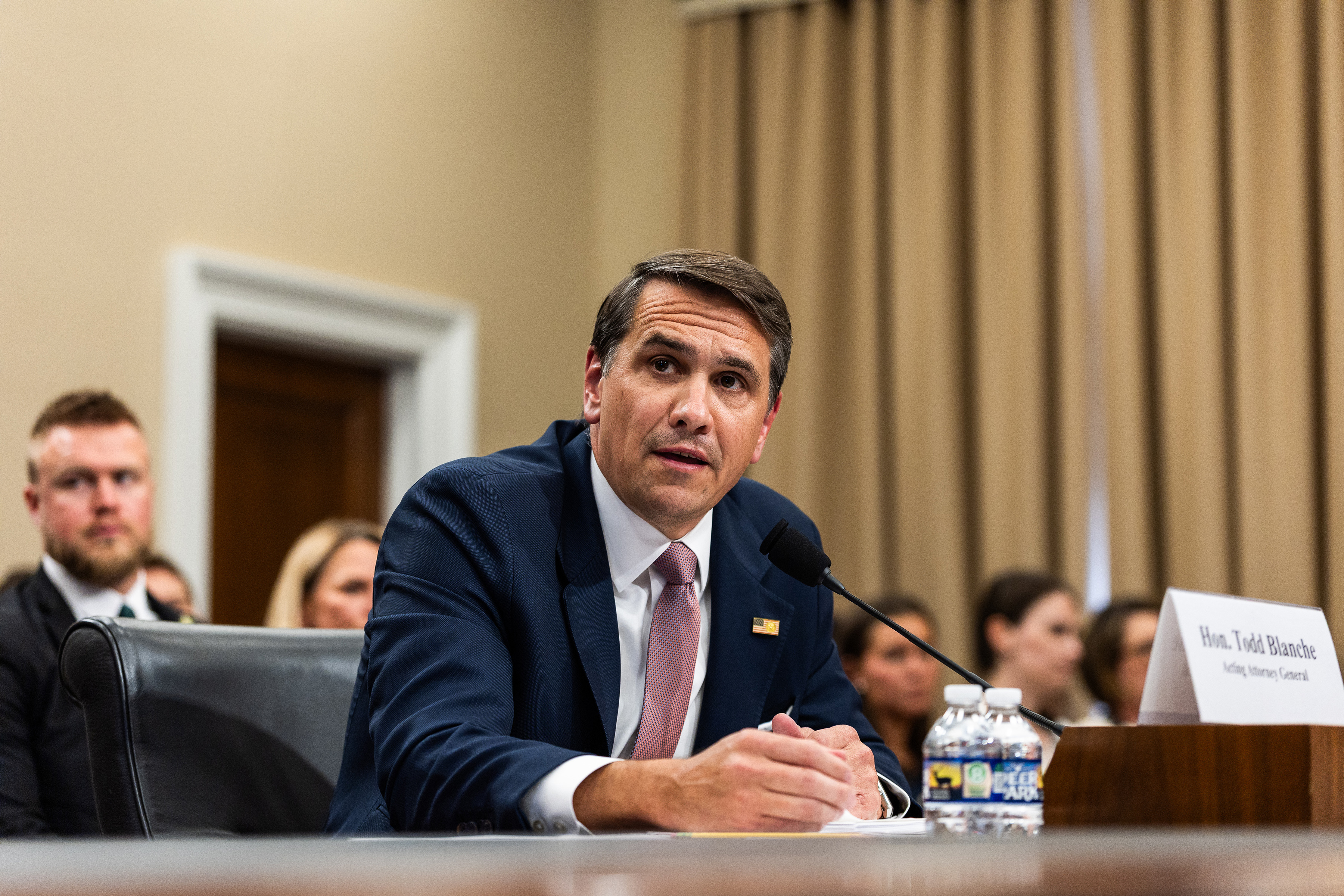
    WASHINGTON — President Donald Trump on Monday nominated his former personal lawyer Todd Blanche to serve as attorney general, elevating a loyal and trusted ally who as acting attorney general has shown a willingness to execute Trump’s maximalist demands.

    The announcement, teased by White House officials last week, comes as public scrutiny of Blanche intensifies over his role in an administration push for a $1.8 billion fund with taxpayer money to pay those claiming they were victims of government mistreatment, most likely including rioters who attacked the Capitol on Jan. 6, 2021.

    The nomination was disclosed in a notice Monday on the White House’s website, saying that Trump had sent Blanche’s name to the Senate.

    It remains unclear if Blanche, who promoted an expansive view of executive power at the expense of the legislative branch both as Trump’s defense lawyer and as the Justice Department’s second in command, will have sufficient support in the Senate to be confirmed as tensions grow between the White House and congressional Republicans.

    A confirmation hearing for Blanche could pose a tricky political test for Republicans as the party prepares for midterm elections this year. A recent closed-door meeting between Blanche and Senate Republicans was described as blistering, with dozens of lawmakers sharply criticizing Blanche over the $1.8 billion fund.

    Senators, however, failed to pass restrictions on any such payouts, suggesting their unhappiness with the White House may have ebbed.

    His path to the permanent appointment he has long coveted will also be complicated by lingering anger — and unanswered questions — related to his handling of the release of millions of pages of investigative files related to convicted sex offender Jeffrey Epstein.

    In recent weeks, his predecessor, Pam Bondi, who was fired in April after Trump privately vented over her failed efforts to prosecute his political enemies, placed primary responsibility for the release of the Epstein files on Blanche during an interview with a House committee.

    Blanche, a former federal prosecutor in Manhattan, has shed his reputation as a mildly moderating voice within the department as he has energetically pursued a job whose main prerequisite, in the view of current and former officials, is never saying no to the boss.

    A wide range of former law enforcement officials have sharply criticized Blanche’s brand of justice, saying he has deployed prosecutorial power to punish Trump’s perceived foes, and in the process badly damaged the department’s reputation with the courts and the public.

    As acting attorney general, Blanche has taken a series of actions against Trump targets, including green-lighting the indictment of former FBI Director James Comey for posting to social media an image of seashells arrayed to read “86-47,” which Blanche has described as a credible threat of violence against a sitting president. (The phrase “86” is a slang term evolved from restaurant parlance for throwing something out, and “47” refers to Trump, the nation’s 47th president.)

    Blanche expressed internal reservations about the highly unusual plan to establish the fund, which also included a broad shelter from tax investigations for Trump, his family, and his businesses that could be worth more than $100 million.

    But Blanche and one of his top aides, Stanley Woodward Jr., signed off on the plan, unlike some first-term Trump appointees who resigned or offered fierce resistance when confronted with demands they considered questionable. It was immediately assailed as a political slush fund by Democrats and Republicans alike.

    Testifying before lawmakers last week, Blanche said the Justice Department was giving up the plan for the fund but would keep Trump’s shelter from tax investigations in place. Trump later cast doubt on the abandoning of the fund, saying, “I love it.”

    “Todd Blanche has never stopped acting as Donald Trump’s personal lawyer,” said Stacey Young, the founder of Justice Connection, an organization of former department employees that includes many career prosecutors forced out by Blanche as he has sought to reshape the department to Trump’s liking.

    “He has used his high position at the department to enter into a corrupt deal with the president and his family, advance vindictive prosecutions, illegally fire career employees, smear whistleblowers, and attack the judiciary,” she added.

    The fund was the result of secret talks between Trump’s private lawyers and officials working for Blanche, as a means of settling a $10 billion lawsuit Trump had filed against the government over the leak of his tax returns, and unrelated claims for about $230 million that Trump had filed against the Justice Department and the FBI over past investigations and prosecutions.

    Blanche and his team sought to create a settlement that would prevent the government from paying taxpayer money to Trump, which they saw as a potential ethical, legal, and political catastrophe.

    In his testimony to lawmakers last Tuesday, Blanche insisted the protection of Trump and his family from tax audits or investigations would not be affected by the withdrawal of the fund proposal, and would remain in place.

    “So the blanket immunity is not something that you’re going to move back on?” asked Rep. Rosa DeLauro (D., Conn.), who accused Blanche of prioritizing the president’s financial interests over the public good.

    “You do not belong in this job,” she added.

    But Trump, who has said he owes his freedom to Blanche’s hard-nosed legal efforts on his behalf in the criminal cases against him, appears to believe otherwise.

    Blanche first gained the confidence of Trump while he was out of office, battling multiple investigations and indictments. Blanche became Trump’s defense lawyer in 2023, and represented him when he went on trial a year later in New York City; Trump was convicted on charges of falsifying business records.

    Since becoming the deputy attorney general in early 2025, Blanche has executed sweeping changes at the Justice Department, where he has proudly described firing more than 200 agents and prosecutors who worked on cases involving Trump or his allies. He has also talked of being at war with federal judges.

    This article originally appeared in the New York Times.

  • Robert Coles, Pulitzer-winning child psychiatrist, is dead at 97

    Robert Coles, a child psychiatrist by training and a storyteller by inclination whose scores of books and articles transported readers into the minds of children, opening new vistas on issues as varied as race relations and moral reasoning, died Thursday in Lincoln, Mass. He was 97.

    The death, at a hospice facility, was confirmed by his son Robert.

    A longtime professor at Harvard University, Dr. Coles eschewed ideologies and psychiatric orthodoxies, visiting the homes of children — first in the American South and then around the world — to listen intently to what they, their parents, and others had to say. He returned again and again, sometimes for months or even years, building the trust that underpinned his work.

    He told searing accounts illustrating illusive truths of a fast-changing society, beginning with the tale of Ruby Bridges, who as a 6-year-old walked through a screaming mob in 1960 as part of an effort to integrate a public school in New Orleans. From the households of poor Black families to those of rich white ones, from Appalachia to the Arctic, Dr. Coles visited children whose voices were not often heard. He once rode a bus for a whole year with Black youngsters being transported to schools in white neighborhoods.

    Dr. Coles then wrote it all down, distilling the tape recordings of conversations, the children’s crayon drawings ,and his voluminous notes into compelling verbal snapshots of how children grapple with challenge. His five-volume book series Children of Crisis was published between 1967 and 1977; Volumes 2 and 3 won him a Pulitzer Prize in 1973.

    Some criticized his approach as scattershot and unscientific, and Dr. Coles readily admitted he veered from exact transcriptions to tell what he considered greater truths.

    But eminent sociologist David Riesman said in an interview with Time magazine in 1972 that the effect of Dr. Cole’s work was to obliterate stereotypes, to demonstrate that “policemen are not pigs, white Southerners are not rednecks, and Blacks are not all suffering in exotic misery.”

    “What he is saying is ‘People are more complicated, more varied, more interesting, have more resiliency and more survivability than you might think,’” Reisman said. “‘I listen to them! You listen to them! Please listen! Again and again!’”

    Dr. Coles offered proof “that hope is alive,” Kenneth Clark, a psychologist whose insights contributed to the Supreme Court outlawing the racial segregation of schools in 1954, said in an interview with the New York Times Magazine in 1978. “I don’t know if he’s one of the 10 just men required to keep this world spinning around,” Clark said, adding: “You can’t judge him by normal standards any more than you could Martin Luther King; they are men possessed.”

    Dr. Coles acknowledged a sense of “moral anxiety” as a white man writing about those with a less privileged existence.

    “I work with very vulnerable people, and yet I’m not very vulnerable myself,” he said in an interview with the New York Times in 1997. “It makes me uncomfortable, seeing the disparities between the world I document and the world I inhabit.”

    Dr. Coles was an exceedingly popular professor at Harvard, using great literature to stimulate debate in courses in its undergraduate college, as well as its schools of medicine, law, business, and government. He wrote books on personalities as diverse as Bruce Springsteen and the novelist Walker Percy, and also found time to write novels, children’s books, and poetry.

    He was awarded a MacArthur Fellowship in 1981, the Presidential Medal of Freedom in 1998, and the National Humanities Medal in 2001.

    So what was he? Dr. Coles variously described himself as a doctor, child psychiatrist, wanderer, oral historian, social anthropologist, teacher, friend, storyteller, busybody, nuisance, and “idiosyncratic oddball.”

    His friend Percy, himself a physician, once judged that the doctor designation, if broadly applied, might be most apt.

    “He treads a narrow path between theorizing and novelizing and emerges as what in fact he is: physician, and a wise and gentle one,” Percy said. “He is doctor to the worst of our life.”

    Robert Martin Coles was born Oct. 12, 1928, in Boston, to Philip Coles, an engineer who immigrated from England, and Sandra (Young) Coles, the daughter of an Iowa Episcopal minister. A deeply affecting memory of his youth in the suburb of Milton was how his parents read Charles Dickens, George Eliot, and other novelists aloud to each other.

    He went to Boston Latin School and graduated from Harvard in 1950. An essay he wrote on William Carlos Williams, the poet and pediatrician, led to him meeting Williams. After reading the essay, Williams replied on a prescription slip: “Not bad — for a Harvard student.”

    Dr. Coles was inspired to become a doctor himself, and earned a medical degree from Columbia University and interned at University of Chicago clinics.

    He said in an interview with the journal Christianity and Literature in 2005 that he worked with polio patients as a resident at Massachusetts General Hospital, and became interested in addressing the psychological impacts of the disease. This, as well as a reluctance to inflict pain on children by giving them shots, persuaded him to switch his specialty from pediatrics to child psychiatry.

    In 1958, he was drafted into the Air Force, given the rank of captain and sent to a psychiatric hospital in Biloxi, Miss. He became angered over the treatment of Black Southerners after he saw a “vicious” fight erupt when Black people tried to integrate a beach.

    He began his study of children with Bridges, whose poise in the face of racism moved him deeply. The girl was threatened daily on her way to class. She was told her food was poisoned and was kept isolated in a classroom without other students for a year.

    Dr. Coles noticed that she seemed to be talking to the hostile white people, and asked her why. She said she was praying for them.

    But why? “They need praying for,” the little girl said.

    Bridges would be a central theme running through Dr. Coles’ career. She inspired him to write about children’s moral and spiritual lives, and the two wrote a children’s book together.

    And when Bridges grew up, she told him that it was time for him to write Women of Crisis to accompany his earlier series.

    Dr. Coles teamed up with his wife, Jane, to write that two-volume women’s study, which was published in 1978 and 1980. But that was hardly the greatest of her contributions to his work: It was she who had urged him to stop asking questions during an interview with children in New Orleans when they were responding with a long series of monosyllabic replies.

    “Why don’t you just shut up and watch television with them?” she said, according to an oral history interview with Dr. Coles by the Southern Oral History Program in 1974.

    In Volume 4 of Children of Crisis, Dr. Cole described the approach he finally developed. No questions — or at least, not many.

    “I would tell the children I wasn’t interested in finding out anything in particular,” he said, “merely knowing, to a degree, how they lived and what they thought about — insofar as it was their inclination to tell me.”

    One thing Dr. Coles learned about children was that they were absorbed in their daily environment, not focused on concerns like nuclear war. Even when they did talk about such issues, they grounded them in their daily lives. A Black child in Mississippi once told him that, “If the Ku Klux Klan ever get that bomb, it would be real bad for us.”

    He noted that children of migrant workers saw everything as temporary. Or, rather, he let a migrant child make the point for himself: “I love the yo-yo, because it keeps going, up and down, and that’s what I do.”

    Pictures often told more than words. A deprived child of a migrant worker depicted himself without arms and gave the boss an ogre’s ugly teeth.

    As Dr. Coles moved around the country to study groups as diverse as Alaska Natives, wealthy suburbanites, and Hopi Indians, his wife and three sons moved with him.

    Jane Hallowell, whom Dr. Coles married in 1960, died in 1993. In addition to Robert, he is survived by two more sons, Daniel and Michael, and four grandsons. He lived in Concord, Massachusetts.

  • Progressive challenger overtakes Spencer Pratt in race for LA mayor

    Progressive challenger overtakes Spencer Pratt in race for LA mayor

    Nithya Raman, a progressive member of the Los Angeles City Council, pulled ahead of reality TV star Spencer Pratt in the Los Angeles mayoral primary Sunday, as a surge in the vote count signaled a potential shift in the race for second place.

    Five days after the election deadline, it remained officially undetermined who will face Mayor Karen Bass, the incumbent, in the November contest to decide who will lead the nation’s second most populous city. The primary race has yet to be called by the Associated Press, which estimates that about 80% of the vote has been counted.

    But late returns have trended heavily in favor of the liberals who make up an overwhelming majority of the city’s electorate.

    Bass, 72, a former Democratic member of Congress who has already advanced to the November runoff, remained in the lead with 34.68% of the vote, according to the updated tally released by the Los Angeles County Registrar-Recorder/County Clerk’s office.

    Raman, 44, who has steadily gained ground as the count has progressed, had 27.12%, enough to overtake Pratt by a little more than 3,000 votes. He had been running in second place since election night.

    A resident of Pacific Palisades who lost his home in the fire and channeled the fury of his neighbors, Pratt, 42, a Republican, dropped to third place with 26.69% of the vote.

    A Los Angeles mayoral candidate can win outright by receiving a majority of votes in the primary. Otherwise, the top two finishers regardless of party advance to the general election. But Los Angeles residents vote by mail in large numbers, and ballot counting is a slow process, with leads often shifting as the tally drags on for days or even weeks. Mail-in ballots with an Election Day postmark are accepted by county election officials through Tuesday.

    On Sunday, Raman said in a statement that “we are encouraged by the latest vote count and remain grateful to the thousands of Angelenos who have powered this campaign.”

    Pratt did not immediately respond to a request for comment.

    Alex Stack, a campaign spokesperson for Bass, signaled the likely points of contention between the two if Raman ultimately takes the second slot on the ballot. Though her support has been eroded by the wildfires and general voter angst in the city, Bass has largely maintained the support of the center-left establishment in the city while Raman has been backed by a younger and more progressive base.

    “We look forward to winning a contest against an opponent who allows encampments near schools and fights against hiring more cops,” Stack said in a statement, “yet is MIA on saving Hollywood jobs and fighting back when ICE invades LA.”

    This article originally appeared in the New York Times.

  • European leaders voice ‘urgent need’ to bolster Ukraine’s defenses against ballistic missiles

    LONDON — The leaders of the U.K., Ukraine, France, and Germany discussed the “urgent need” to ramp up production of weapons to combat Russia’s powerful hypersonic Oreshnik ballistic missiles in a meeting in London on Sunday.

    British Prime Minister Keir Starmer hosted Ukrainian leader Volodymyr Zelensky, French President Emmanuel Macron, and German Chancellor Friedrich Merz at 10 Downing Street.

    In a statement released by Starmer’s office following their evening meeting, the leaders condemned Russia’s “large-scale missile and drone attacks — including the repeated use of the Oreshnik missiles — on Ukrainian cities with a tragic toll on civilians.” They also condemned Russia’s “irresponsible and dangerous Russian drone incursions” into NATO territory, including last month’s in Romania.

    Russia has stepped up its aerial campaign against Ukraine recently, most notably with the launch of the Oreshnik missiles.

    “The leaders underlined the urgent need to scale up the production of interceptors and co-develop anti-ballistic missile and deep strike capabilities,” the leaders said.

    No details, financial or otherwise, on how this would be done were provided.

    Ukraine’s shortage of air defense systems, in part because of the depletion of U.S. stocks during the Iran war, has left civilians especially vulnerable to ballistic missiles, even as Kyiv’s defenses stop most of Moscow’s drones and its forces have made advances elsewhere on the battlefield.

    The worry for Ukrainians is that the Iran war, which has been in abeyance for weeks, may now reignite after Iran launched missiles on Sunday at Israel in the first such bombardment since a fragile ceasefire took effect in early April, complicating mediation efforts for a deal to end the war.

    Following their meeting in London, the European leaders called on Russian President Vladimir Putin to agree to “an immediate and complete ceasefire” with the current line of contact as a starting point for any negotiations.

    The U.K., France, and Germany, the so-called E3 group of European nations, have been prominent backers of Ukraine following Russia’s full-scale invasion in February 2022. The U.K. and France lead the “coalition of the willing” initiative to provide security guarantees for Ukraine as part of a peace process.

    The meeting comes in the wake of a Russian drone strike that killed three people waiting at a bus stop in southeastern Ukraine. A separate drone strike damaged a storage center for spent nuclear fuel in the Kyiv region, just 9 miles from the Chernobyl nuclear power plant, Ukraine’s General Staff said. The attack sparked a fire that was extinguished within an hour. Radiation remains within safe levels, officials said.

    The International Atomic Energy Agency chief Rafael Grossi said the incident was “deeply concerning” due to the large amounts of nuclear material held at the facility. He said in a statement that the agency would visit the site of the attack soon.

    The Russian attacks follow a large-scale Ukrainian drone attack on Saturday that targeted Saint Petersburg, Russia’s second-largest city, underscoring Kyiv’s growing ability to hit deep inside Russia.

    With the front line barely moving as swarms of drones hinder advances, both sides have sought an edge by launching long-range strikes.

  • Trump allies wanted to ‘delete’ this consumer watchdog. Now it’s a political weapon.

    Trump allies wanted to ‘delete’ this consumer watchdog. Now it’s a political weapon.

    The Trump administration came to Washington last year seeking to shutter the Consumer Financial Protection Bureau, the watchdog agency that had survived industry anger, Republican opposition, and years of legal challenges.

    A year in, a much smaller bureau is still standing and has been remade to advance the president’s political goals.

    The bureau has begun to probe a class of smaller, mostly nonprofit lenders that Russell Vought, the acting director of the bureau, has characterized as unduly “woke.”

    On Friday, the bureau issued guidance that could make it harder for immigrants in the country illegally to obtain mortgages and credit cards. Meanwhile, the bureau’s public website invites consumers to complain if they have been refused service — or “de-banked” — for political or religious reasons, reflecting a priority of the administration and its allies in the conservative movement and the crypto industry.

    The moves represent a reorientation of an agency that had previously focused on aggressively policing larger financial institutions on behalf of ordinary consumers. Republicans and much of the financial services industry had long accused the bureau of its own brand of politicization under Democratic leadership, charging that it targeted industries and practices liberals hated.

    The Trump administration says it is correcting overreach during the Biden administration. They say the CFPB, under former director Rohit Chopra, bullied businesses and individuals it viewed as political enemies, pursued questionable legal theories, and imposed costs that ultimately fell on ordinary Americans.

    “We are fixing that, bringing the agency back to operating within statute and away from breaking the law, and making cases right to help small businesses and Americans who were victims of this thuggery,” a spokesperson for Vought said in a statement.

    Critics say the result is a bureau that has gone easy on the powerful while training its firepower on smaller targets.

    “Their first attempt was to kill the agency,” said Aaron Klein, a senior fellow at the Brookings Institution, a centrist think tank. But courts blocked the administration’s attempts to lay off almost all of its staff. Now, Klein and other critics say, Vought has found a different use for the agency.

    “Rather than hold themselves to a higher standard, they seem to be committing the same political persecutions they allege happened to them,” said Klein, who served in the Obama Treasury Department.

    The pivot is visible in the bureau’s recent scrutiny of community lenders — smaller banks and firms that operate in low-income rural and urban communities that are typically underserved by large Wall Street banks. In late April, the bureau’s chief legal officer, Mark Paoletta, sent questionnaires to at least four such lenders, according to people familiar with the probe. One of the questionnaires, reviewed by the Washington Post, demanded a broad swath of financial records, compliance documents, and business details.

    The bureau has legal authority to send such requests for market-monitoring purposes, but the lenders are typically far too small to be subject to CFPB supervision, falling beneath a $10 billion asset threshold.

    Among those targeted was Self-Help Ventures Fund, an arm of a Durham, N.C., lender with roughly $5 billion in assets. Self-Help, which traces its origins to a $77 bake sale in the early 1980s, is affiliated with the Center for Responsible Lending, a consumer advocacy group that has been a vocal opponent of the administration’s efforts to dismantle the CFPB.

    Self-Help and CRL declined to comment for this article. The bureau’s interest in Self-Help has not been previously reported.

    Vought — who simultaneously runs the CFPB and the White House budget office — has made no secret that he holds negative views of the community lenders in question. At a House Budget Committee hearing in April, he said they “continue to be pushing an ideology that is very harmful.”

    The Trump administration has repeatedly sought to eliminate or drastically cut a federal program that funds and certifies community lenders. Bipartisan congressional majorities have rejected those efforts, but Vought has nevertheless withheld hundreds of millions of dollars Congress directed toward the program.

    When asked about the community lenders probe, administration officials sought to minimize the review, saying it represents only a tiny fraction of the bureau’s overall work, and declined to discuss any of the individual targets. A spokesperson for Vought attacked the lenders, saying they had directed money to LGBTQ health clinics, a transgender-themed fashion show, and a group that, she said, had threatened violence against federal immigration officials.

    The scrutiny of smaller community lenders contrasts with what the bureau has done, or stopped doing, elsewhere. Since taking office, the administration has dropped litigation and unwound settlements against some of the largest financial institutions in the country. In some cases, it halted checks that were set to go out to consumers. In other cases, it permanently gave up the right to reopen the claims against some companies in the future.

    In one such case, the watchdog dropped a lawsuit, filed in the waning days of the Biden administration, against the operator of the Zelle payment-transfer network and three of its owner banks — Wells Fargo, Bank of America, and JPMorgan Chase — over allegations that customers lost nearly $1 billion to fraud on the platform.

    The banks called the suit politically motivated, arguing the CFPB was stretching existing law to hold them responsible for payments customers had authorized themselves.

    The Consumer Bankers Association, which represents large retail banks, said it is encouraged by the bureau’s new direction, praising its focus on “identifiable victims, measurable harm, and clear legal standards” over what it called novel legal theories.

    Even if the community lenders currently under investigation had engaged in misconduct, the scale of the wrongdoing would look like a rounding error in comparison with potential misconduct by the largest financial institutions that are currently getting a pass, said Mike Pierce, who worked at the CFPB from 2011 to 2018 and is now the executive director of Protect Borrowers, a nonprofit advocacy group.

    “Some of the biggest corporate bad actors in America have gotten a pass from this agency,” Pierce said. “And now it’s focused on little guys that are doing things the Trump administration finds politically unpalatable.”

    Sen. Elizabeth Warren of Massachusetts, who conceived of the bureau, called the bureau’s pivot a betrayal of Trump’s own promises. “Donald Trump promised to lower costs ‘on day one,’” she said in a statement. “Instead, he’s co-opting the financial cop on the beat to rip away billions in relief for Americans scammed by giant banks and corporations and execute his extreme agenda.”

    Solveig Singleton, a policy analyst at the Cato Institute, a libertarian think tank, said the administration appeared to have discovered that the bureau could be “retargeted against its political opponents,” with broad discretion that makes it easy to frame such targeting as legitimate “policy spin.”

    She also warned that cutting staff could backfire because career employees facing performance pressure might well gravitate toward investigating smaller, easier targets that lack the resources to fight back.

    The longer-term solution, she said, requires Congress to curb the bureau’s unchecked discretion and ensure greater accountability over federal programs.