WASHINGTON — The government wants to be certain it determines the “root cause” of the problems that led to the grounding of planes across the United States before making broad fixes to air traffic control, the nation’s transportation chief said Sunday. President Donald Trump broke his silence about the extraordinary disruption that snarled airline travel and raised troubling questions about how a system so integral to the country could be so vulnerable.
Officials are analyzing two routers installed in recent weeks at Federal Aviation Administration facilities in Arkansas and Texas, according to Transportation Secretary Sean Duffy, who during appearances on five television news shows stepped up his push for Congress to provide billions more to upgrade a system he said had been neglected for decades.
He was the administration’s public face in seeking to assure travelers that it was safe to fly as airports and airlines worked to restore normal operations after Friday’s nationwide ground stop.
“We’re going to figure out what was the root cause and then move forward from there,” he said.
Trump was conspicuously quiet for 2 days
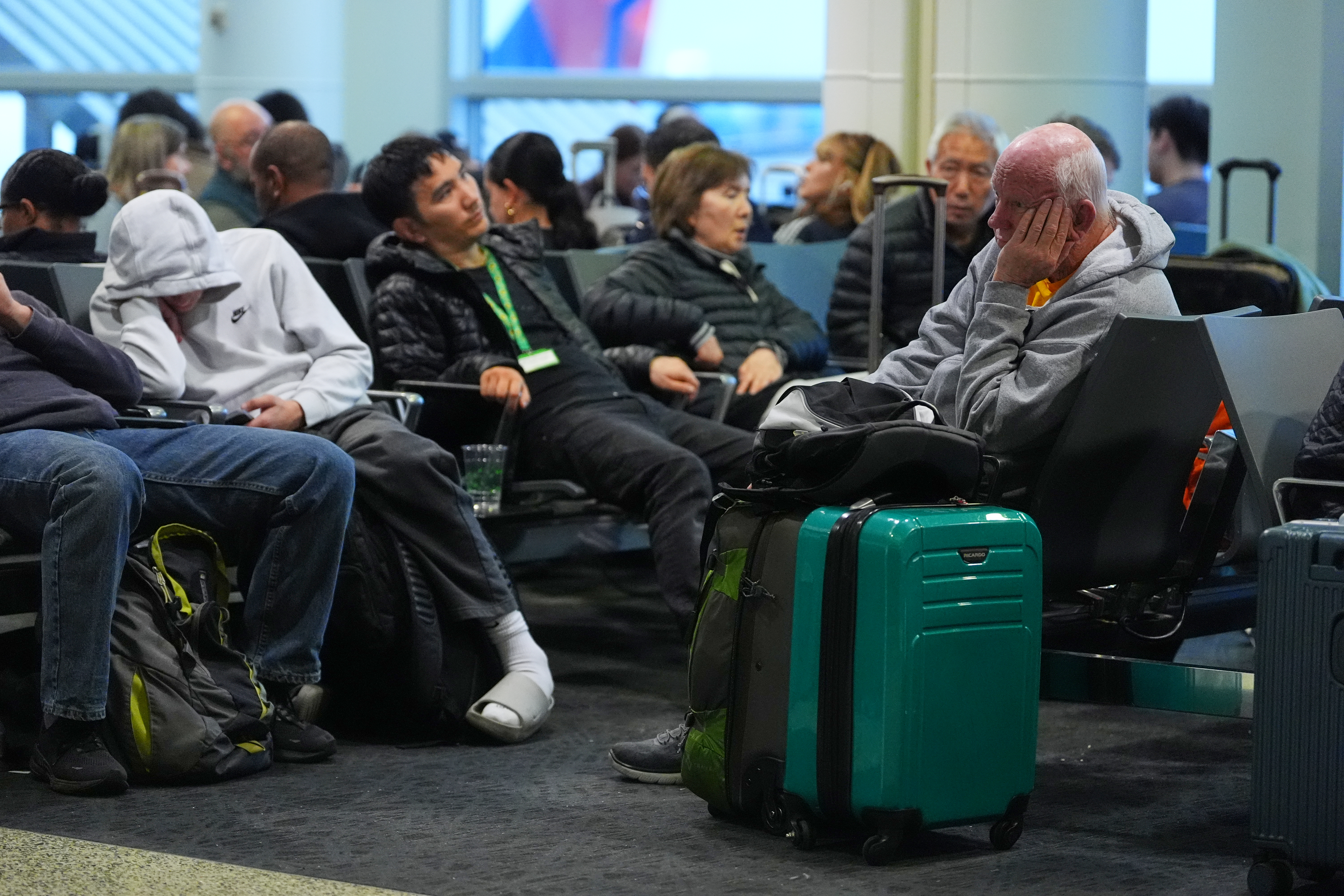
Trump had not commented publicly or on social media about the ground stop ordered Friday afternoon. He had issued statements on social media about unrelated matters while frustrated passengers were left stranded and his team and airlines scrambled for a return to normal travel operations.
Trump weighed in Sunday morning in a post on Truth Social, saying that his administration has begun upgrading the air traffic control system, but that task should not be done in “drips and drabs.” The Republican-controlled Congress approved $12.5 billion for the FAA as part of the party’s sweeping tax cut package last year, but Duffy has characterized that money as a down payment on a broader overhaul of the aging system.
“If Congress approves the desperately needed money for Air Traffic Control, we can get it built quickly and efficiently,” Trump wrote. “It will be the BEST SYSTEM anywhere in the World. Much of our current air control system is 50 years old — RIDICULOUS!”
In another post, he accused Democratic President Joe Biden’s administration of making an “old and broken system worse than when they began.”
Biden signed a massive infrastructure bill into law in the first year of his presidency, setting aside $25 billion for the FAA to improve airports and its traffic control towers, redevelop airport terminals and “upgrade the foundation” of the air traffic control system, according to the agency.
At PHL, airlines try to connect travelers, bags
Flight disruptions continued at Philadelphia International Airport Sunday, two days after the nationwideground stop — the longest in 25 years.
By 4 p.m. Sunday, 153 flights were delayed and 58 were canceled, according to FlightAware, a digital aviation company that operates a flight tracking and data platform.
“Yesterday at the airport — the lines for airline customer support were very long for customers needing assistance rebooking flights. They tapered down toward the end of the day,” airport spokesperson Christine Ottow said in a statement. “Airlines are now faced with trying to reconnect travelers with their bags — travelers are asked to continue being patient as the airlines work through reconnecting bags with their owners.”
Duffy said that “as we look to the end of the day and into tomorrow, we should be running at full capacity.”
He added: “We’re well on our way.”
Duffy said the administration feels “pretty good” that the breakdown did not result from a hacking event. He said various intelligence agencies have said they were not finding the “chatter or the footprints that we would normally see if this was a cyberattack.”
Duffy says upgrades ready to roll out ‘tomorrow’ if he gets the money
“I can’t apologize for what was passed on to us. And I can’t blame Republicans or Democrats, because it’s all of them. It goes back, 20, 25, 30 years of a lack of investment,” Duffy said in one of his interviews.
In a post on X, Duffy said contractor L3Harris Technologies Inc. had secured routers from the two FAA sites and was conducting “deep diagnostics” on the equipment; other engineers were involved, too. He has said the problem began when the federal contractor was replacing a section of old copper wire with new fiber wire, somehow causing the system to overload.
After the wire was replaced at the site in El Dorado, Ark., and the router was turned on, a problem then cropped up at a facility in Amarillo, Texas, cascading into the ground stop. “We didn’t think that should or would happen,” he said.
Billions are needed, he said, to build a “brand new architecture” for the network, and he said companies including AT&T, Verizon, and Lumen are ready to deploy it “tomorrow” if the money is there.
Duffy says Trump was engaged
Trump, despite making no public comments on the ground stop until Sunday, has been “fully engaged,” Duffy said.
“I was in constant contact. He was fully engaged because this is important to him and it’s important to America,” the Cabinet member said.
Duffy appeared on CBS’ Face the Nation, CNN’s State of the Union, Fox News Sunday, NBC’s Meet the Press, and ABC’s This Week.
Maggie Prosser and Dana Munro contributed to this article.
Perched 676 feet above sea level, wooden planks and metal pipes line a deck atop Washington National Cathedral, giving those on it a unique view of the swath of green below.
This is where crews will spend the next three years repairing the central tower, named the Gloria in Excelsis Deo tower — the final phase of more than a decade of work to restore the cathedral after an earthquake rocked the East Coast in 2011. They’ll fix pinnacles, the Gothic spires on the corners of the tower, and finials, the ornaments that cap them, made of stone that twisted, cracked, or came loose in the quake.
Joe Alonso, the cathedral’s head stonemason, said teams have worked their way around the building in sections over the years. But working high in the sky, amid environmental pressures such as high winds and lightning, is the toughest job yet.
Still, the stonemason of more than 40 years said he is determined to restore the landmark in the D.C. skyline “back to the way it was,” and even stronger. The work is expected to conclude by the end of 2029.
“I look at the tower as my, what’s the word, magnum opus,” said Alonso, 65.
A Post reporter and photographer were given exclusive access on the tower in late October to see the work being done.
Donors have contributed $60 million to fund the repairs and restoration, work that has included structural enhancements to withstand any future natural hazards.
“It’s a national landmark, and it’s worth being put back together. It’s worth being made whole,” said Washington National Cathedral Dean Randy Hollerith. “Whatever we needed to do to make it whole, however long it took us to make it whole, we were going to do it, and we’re glad we’re almost there.”
‘Masonry triage’
On Aug. 23, 2011, a rare 5.8-magnitude earthquake shook the D.C. region.
While there were no deaths and few injuries, historical stone monuments took a hit. The Washington Monument closed for nearly three years after the quake left cracks and loosened parts of the structure.
At the cathedral, Alonso and stone carver Sean Callahan toured the building to assess the damage.
The cathedral itself had largely withstood the earthquake. But large pieces of stone had fallen off, and other sections had rotated and shifted as energy from the quake shot through the walls, Alonso said, describing it as like the “cracking of a whip.”
The worst damage was at the top of the central tower, which has been standing 301 feet tall since it was completed and dedicated in 1964.
Alonso said when he and Callahan got up to the roof, they saw “devastation” — broken stones and an angel, still intact, that had fallen.
The work of stabilizing the cathedral began immediately, Alonso said. Workers had to pull some pieces off of pinnacles and remove any dangers. The central tower pinnacles had been structurally compromised and needed scaffolding.
“We were doing masonry triage,” Alonso said. “We’re like, ‘OK, this one can wait. OK, no, but no, no, that one can’t.’”
Alonso said teams repaired the lower parts of the building first, in part because the central tower would be the most complex and expensive spot to access. Once they divvied it up into manageable sections, the first major phase of repairs started in 2014 on the east end.
The work atop the central tower began in January. Crews built a hoist system that can hold up to 6,000 pounds to let workers bring stone pieces — many weighing a couple of hundred pounds — back to the top of the central tower.
They’ve also constructed the deck lining the tower to serve as a work platform. A fully enclosed workshop will be added, too.
So far this year, crews have mainly been erecting scaffolding to prepare for the stone work to begin in March, Alonso said.
Stonemasons will restore the pinnacles, for example, which are missing their finials. Carvers are working to re-create those.
Alonso is more than familiar with how to piece the cathedral back together. Hired out of a local union hall in 1985, he laid the final stone for the cathedral’s west towers in 1990. It occurred 83 years to the day from when the first stone was laid for the structure on Sept. 29, 1907.
“The cathedral has always been this, you know, ‘the cathedral,’” Alonso said. “It was the ultimate, the ultimate expression — it always is — of masonry.”
Scaffolding surrounds a pinnacle on the central tower. Al Drago
Still, while the masonry work is familiar, the height of the central tower presents the real trouble, Alonso said.
When the pinnacles twisted and fell from the earthquake, they took the lightning rods with them. So the cathedral has enlisted the help of a “lightning guy” for the next phase of work. “We have to be constantly weather aware, more than we ever were down low,” Alonso said.
Even dropping something from above becomes a concern. Crews have built tunnels over the south side of the cathedral to catch any debris, Alonso said.
Work will also pause around December for the winter.
While the structure may look the same on the outside, crews are working to make it much safer and stronger, Alonso said. Each pinnacle across the cathedral will be or has already been reinforced with steel rods and cementlike grout.
Continuing tradition
As masons build and construct above, carvers Cameron Hawkins and Brianna Castelli, both 27, spend their days on the ground in a workshop to re-create stone finials for the top of the tower’s pinnacles, among other repairs.
Their work centers on historical restoration, meaning the pair must get the new finials as close to the original style as they can. Using a finial that survived the earthquake as a pattern, the carvers said they have to preserve the ornate and high Gothic work of the past and resist any temptation to go with their personal style.
“It’s one of the oldest professions, so there are times where I’m carving, I’ll be facing a challenge or an issue and thinking about it, and realize that people hundreds or even thousands of years ago might have faced that same issue using the same tools, more or less,” Hawkins said.
Callahan, a master stone carver who has worked at the cathedral for more than 20 years over two stints, said he didn’t think he’d see his work come back around in his lifetime. The cathedral had only been completed for 21 years when the earthquake hit.
“It’s kind of weird, being in the ’80s, thinking this is going to last a thousand years, and in my own career time, I’m resetting my own work,” said Callahan, 61. “So that was a surreal experience.”
As they planned the restoration, Callahan said officials weren’t sure how the cathedral could afford to build everything back to its earlier look.
Hollerith, the cathedral’s dean, said they worked hard to raise the money to restore the building, which he called “such a beautiful piece of art.”
“Whenever you find beauty, I think you find God, quite frankly,” he said. Hollerith said that while at its heart, the cathedral is an Episcopal Church and a Christian community, his dream is “that everyone would think of that cathedral as their cathedral, because it is their cathedral.”
Long a spot for important interfaith events, the cathedral in recent years has become more intentionally inclusive. Cathedral leadership have created more community events, such as yoga and art shows, and become more outspoken in protection of immigrants and LGBTQ people.
“We think it’s really important to take the values of our faith, dignity, justice, the inherent worth of every human being, truth-telling, and to lift up those values,” Hollerith said. He said uplifting those values is central to democracy.
Reaching this final phase of renovations feels “fantastic,” said Hollerith. Whether flying into the city, traveling on the parkway or coming over the Memorial Bridge, the legendary pinnacles will be restored for all to see, he said.
An angel statue that was damaged in the earthquake now sits in the cathedral dean’s office. Al Drago
Inside his office, he has the fallen angel from the central tower that Alonso and Callahan spotted that day on the roof after the quake 15 years ago.
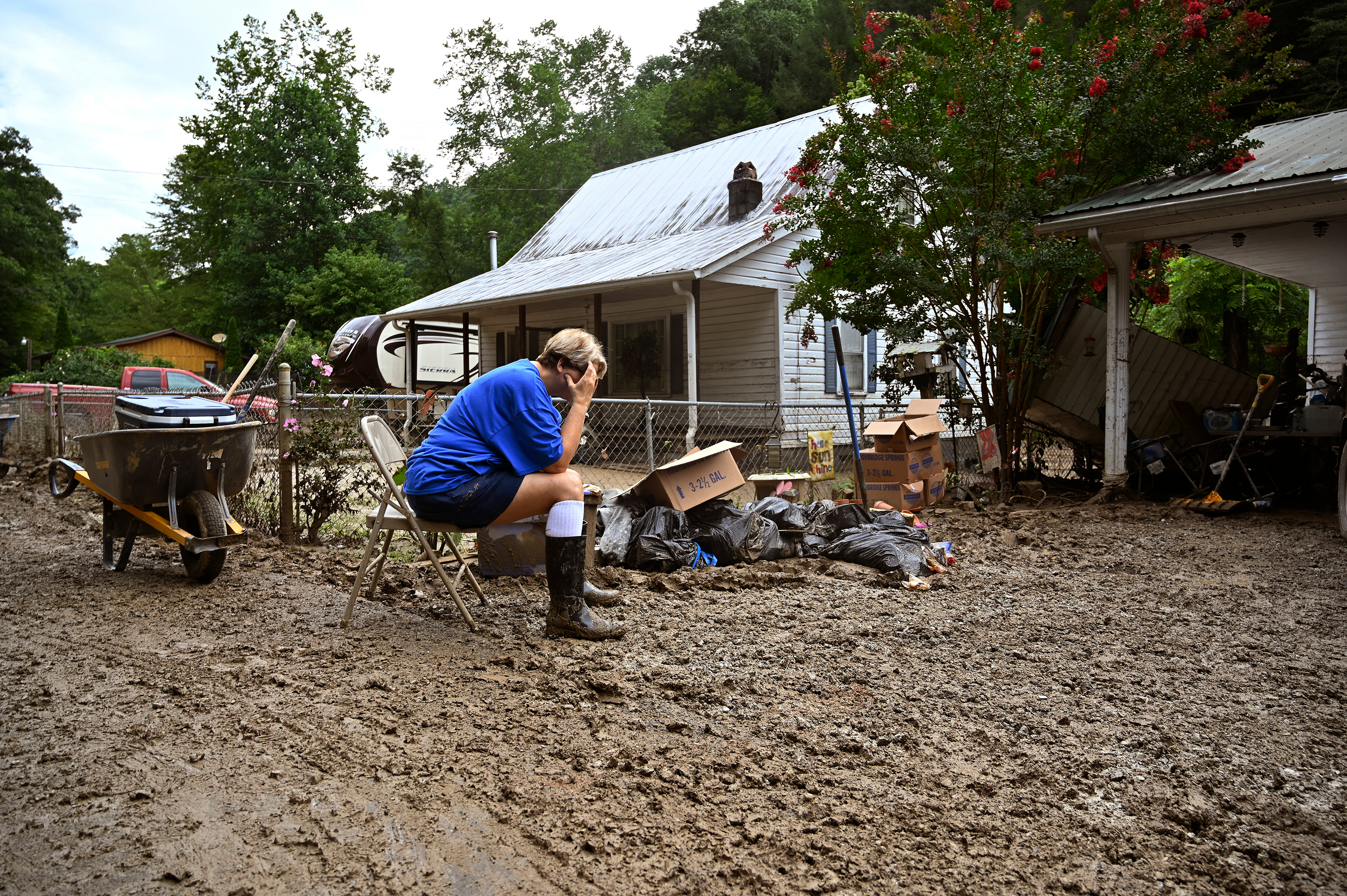
WASHINGTON — In eastern Kentucky, Libby Honeycutt listened upstairs to the sound of glass breaking below as floodwaters tore apart her house. Twenty-six miles to the south, Ronald Conley rescued his dogs from his elevated house with a pontoon boat. Jennifer Campbell heard the screams from across the river of a neighbor desperate for rescue.
They all remember the horrifying speed of that July 2022 flood that also isolated so many by knocking out cell service, leaving people unable to learn the fate of loved ones.
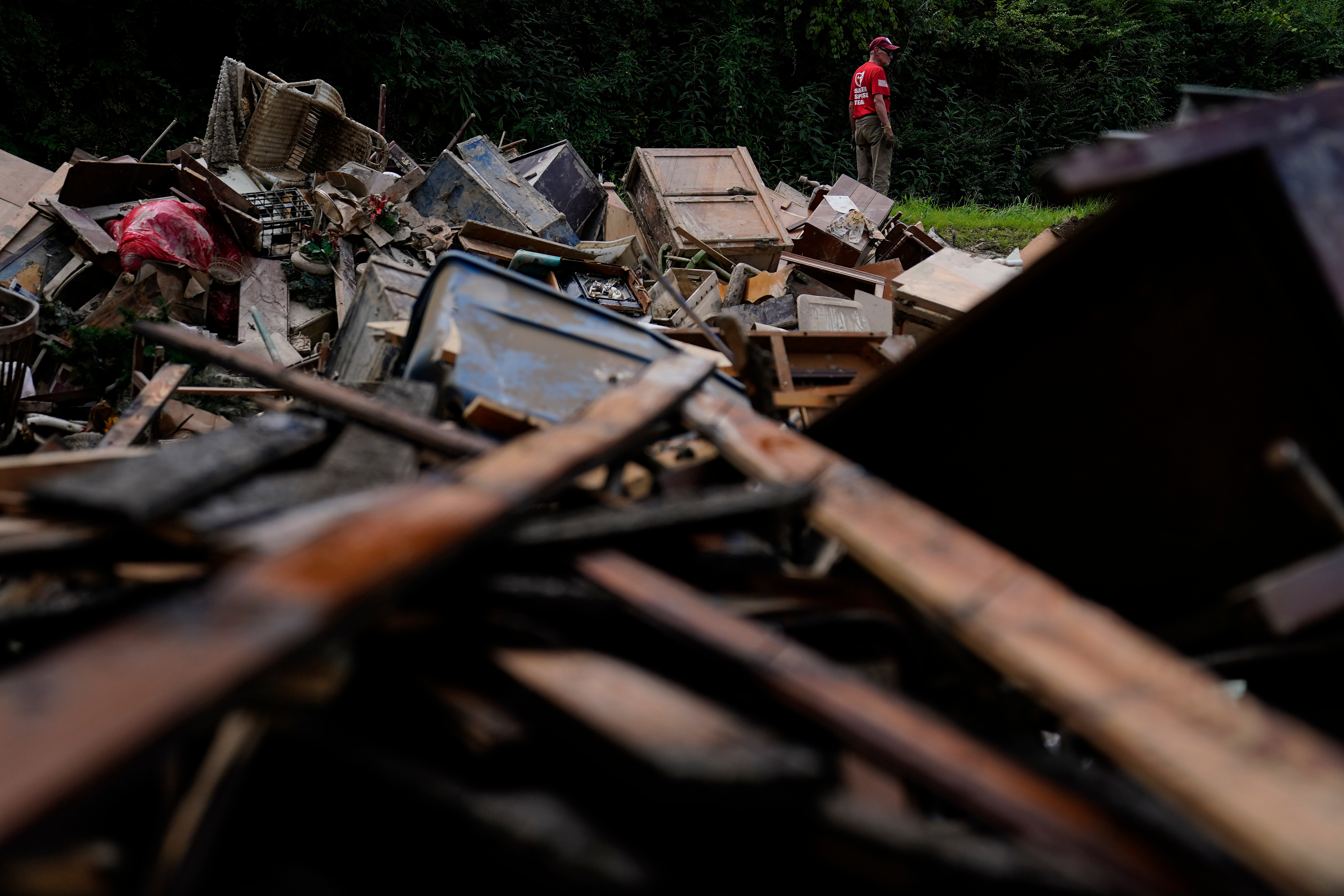
And then the sun rose, the waters receded, and thousands of people had to figure out what to do about their damaged homes and upended lives. That work was made harder for the vast majority hit by the downpours, including these three people, who did not have flood insurance.
Nationwide, just 2.4% of properties are covered by 4.5 million federal flood insurance policies, an Associated Press analysis shows — but 8.4% are at severe or extreme risk of flooding. The gap illustrates the foundational flaws in a program that fails to balance affordability, flood protection, and cost to taxpayers.
It’s getting worse. The count of policies is down roughly 500,000 in five years. Price increases are a big factor. This downward trend collides with the rising risk of flooding across many areas of the United States, driven by climate change that can strengthen hurricanes and worsen downpours far from the coasts.
The problem is especially bad in eastern Kentucky, where in some ZIP codes, no more than 5% of properties are covered by flood insurance, even though hundreds or thousands of buildings are at extreme risk of flooding, according to figures from the federal government and data provided exclusively to the AP by the risk analysis group First Street.
It’s not just Appalachia — coastal areas including parts of southern Louisiana stand out, too. Areas at high risk of flooding and where few people are insured tend to be poorer, experts said, as are areas where FEMA’s flood maps don’t properly convey the severity of the risk or mandate that enough people buy coverage.
Proposals to overhaul the program have stalled, including adding options to make it more affordable to low-income buyers.
“Everybody agrees it’s broken, but no one can agree how to fix it,” said Jeffrey Schlegelmilch, faculty director of the National Center for Disaster Preparedness at Columbia University.
Conley’s double-wide trailer in Kentucky is elevated by stacked cement cinder blocks. In 2022, when he floated his dogs to safety on a pontoon boat, that wasn’t enough. The flood left six inches of “gooey, clay mud” in the house that was so thick it could suck shoes off feet and had to be shoveled out. Without insurance, he’s mostly lived in a small place FEMA provided and relied on generous church groups and donations, he said. With insurance, he is confident the work would have been done much faster.
Instead, after that flood, and another that set his repairs back in 2025, he was only able to move back into his home in September.
Why and how the government provides flood insurance
Congress set up the National Flood Insurance Program in 1968. It offers flood insurance in participating communities that agree to take steps to manage flood risk, such as restricting construction in high-risk areas. Homeowners insurance doesn’t cover floods.
Policies are available to renters and businesses, but most are purchased by homeowners covering up to $250,000 for their property and $100,000 for belongings. FEMA flood maps determine who is in a high-risk area where flood insurance must be attached to a federally backed mortgage.
When it works, it is life changing.
Bryant Matthews was up late with a toothache in Letcher, Ky., when he noticed the water rising fast during the 2022 flood. Being awake, he managed to get his wife, stepkids, and mother to safety.
“I was up. I was aware of what was going on, and I was able to get the family out of the house before it got too bad.”
Friends let them stay in their basement for about three months and they lost a lot. Beloved collections of old Metallica recordings and cheesy ’80s horror movies were damaged.
But they had flood insurance, which paid what was left on their mortgage. That helped them start again, debt free. They found a place in nearby Hazard, which was closer to the kids’ school and their work.
“I am very appreciative, very blessed,” he said.
Experts say flood maps need reform
In many places, FEMA’s flood maps don’t do a good job of capturing the extent of severe flood risk. Millions think their homes are safer than they really are and aren’t forced to buy insurance when they probably should.
That made rebuilding more difficult in 2022 after more than a foot of rain fell over parts of Kentucky, killing more than 40 people. The worst came during the early hours of July 28, when heavy rains fell on already soggy ground, running down steep hills into narrow river valleys — a perfect recipe for fast, devastating flooding. Six hundred people required helicopter rescues.
Where the flood struck, just 2.1% of properties were insured then, a rate that remains about the same today, an AP analysis shows, even though about 47% are at severe or extreme risk of flooding. That’s a gap of 45 percentage points — more than seven times as large as the national average.
FEMA’s flood maps didn’t catch all that risk during the 2022 flood, with only 18% of the buildings struck falling within a high-risk zone.
Flood maps, which are commonly out of date, don’t consider some types of flood risk, such as flooding from inland heavy rains.
The places with the biggest insurance gaps are those where heavy precipitation flooding occurs away from large water bodies, said Jeremy Porter, the chief economist at First Street, a part of finance company MSCI.
“That’s the Appalachian region, further inland, and then in the Midwest and Northeast in particular, extreme precipitation is the way climate change is manifesting itself,” he said.
The system works well in some places — such as the Charleston, S.C., area. Here, flood maps do record the risk from obvious threats like hurricanes, with high-risk zones blanketing the area. People expect to talk about flood insurance when they buy a home, and the booming region’s wealthy buyers can better afford it.
High prices are symptomatic of the flood insurance program’s conflicting goals
High prices are a worsening obstacle.
The typical cost of a flood insurance policy is $1,100 per year, up roughly 90% in the last five years, AP’s estimates show.
Lake Charles, La., resident Dan Charlson said his insurance shot up over time from roughly $900 to $4,000. That’s when he dropped his policy.
“I’m looking at what it costs to fix the house, and the fact that I only flooded once in 50 years. So, it’s a risk analysis,” he said.
The costs have been driven up chiefly by efforts to modernize pricing.
A few years ago, the federal government fully implemented Risk Rating 2.0, a much more accurate way of aligning a property’s flood risk with the price of coverage.
But more accurately priced flood insurance meant much higher prices overall for most buyers. A government watchdog report found that Gulf Coast states had been especially underpriced and required big increases under the new pricing structure.
Louisiana Sen. Bill Cassidy, a Republican, said the rating system implemented by the Biden administration and defended by the Trump White House has put insurance out of reach for too many.
“Recent administrations pushed Risk 2.0 forward without fixing the affordability problems created for Louisiana families,” Cassidy said.
A May review commissioned by the Trump administration found fundamental flaws in the National Flood Insurance Program, which is run by FEMA and is in more than $20 billion of debt.
“Congress has instructed the NFIP to be affordable, financially sound, available to all, and risk informed. These goals often pull in opposite directions, and political pressures have frequently blocked meaningful reform, leading to dozens of short-term program reauthorizations,” the report said.
FEMA said in a statement that stronger building codes, smarter zoning, and competitive private insurance options are needed rather than shifting all flood risk and cost to the federal government. The agency can’t address affordability without action from Congress.
FEMA is also working on a better system to map flood risk called Future of Flood Risk Data that aims to replace flood zones with more nuanced models that will do a better job of mandating who must buy insurance. The timeline for that work isn’t clear.
The economics of eastern Kentucky made recovery harder
Thousands of buildings were damaged in the 2022 flood. The majority of residents in these homes lived on less than $30,000 a year, a nonprofit report found.
A man stands near a pile of debris as residents clean up in Fleming-Neon, Ky., Aug. 5, 2022, after massive flooding the previous week.Brynn Anderson
For those without insurance, FEMA may help if a presidential disaster declaration is issued. But that assistance only provides for basic needs. Its two biggest programs are capped at about $40,000 each: housing assistance and other needs like childcare. Few receive the maximum.
FEMA will pay aid to an uninsured flood victim after their first flood. If that property is in a flood zone and isn’t covered by flood insurance when it gets hit again, FEMA typically won’t pay. That’s a big deal in Kentucky, which has experienced repeat disasters in recent decades.
In the 2022 floods, FEMA provided nearly $90 million in direct assistance, separate from insurance payouts, to help with that damage — roughly one-fifth of the lowest estimated cost to rebuild.
“It was clear that a trend was happening where people were just having to move away. They were living with other people in eastern Kentucky, in the damaged area, or they were having to move to other eastern Kentucky counties, or, you know, out of the region,” said one of the report’s authors, Eric Dixon, a senior researcher at the nonprofit Ohio River Valley Institute.
After Honeycutt and her family escaped the second story of their inundated home during the 2022 Kentucky floods, it cost the family — which lacked flood insurance — a significant amount to fix the immense damage. But because of the anxiety of staying in a neighborhood that absorbed so much destruction, she’s now taking part in a voluntary government buyout program that purchases homes in flood-prone areas.
Others had to live in their damaged homes and fix up what they could, when they could find the money. Charity and neighborliness helped a lot — many victims are still thankful to churches and neighbors that volunteered their labor, according to Whitney Bailey, a disaster response project director at AppalReD Legal Aid.
Troublesome Creek, Ky., overflowed, destroying pictures of the late 13-year-old boy whom Campbell helped raise — and just about everything else in her home. She thought flooding wouldn’t be a problem. She said she asked her insurer about flood coverage and was incorrectly told she was at such low risk it wasn’t available.
When Campbell’s home did flood, it cost her about $100,000. She went from not having a house payment to having to take out a loan and rely on some FEMA assistance.
In 2025, flooding once again nearly reached Campbell’s house and blocked the road.
The experience prompted Campbell to sign up for a buyout program to move.
“I just decided at that moment, I told my husband, ‘I can’t do this anymore,’” she said. “We can’t do this anymore.”
For a lot of people, a one-size-fits-all retirement plan just doesn’t fit. Their family circumstances call for a more custom-made approach. That’s the case with couples who have one income. Christine Benz and Valentina Djeljosevic recently discussed the retirement planning needs of these couples, including emergency funding and Social Security filing decisions.
Valentina Djeljosevic: For couples who get to make this choice, to forgo having two earners, I’m sure they’re wondering, “Can we make it on one income?” But what might they be missing?
Christine Benz: They’re usually focused mainly on the household budget in the here and now, but I would recommend peering a bit into the future if you possibly can, and think about a couple of things. Take a look at how you are doing with respect to retirement funding, and how you will be able to contribute to your retirement fund on that single income. Also think about if the spouse who is going to step out of the workforce, if he or she wants to get back in later, that can sometimes be a challenge. Maybe they keep working part-time or on a contract basis to keep their skills fresh.
How single-earner couples can plan for retirement
Djeljosevic: How can these families make sure they don’t fall behind when it comes to retirement planning?
Benz: Make sure that you are continuing to fund the retirement plans at a very minimum, that you’re at least meeting any matching contributions in the 401(k) plan that are coming in through the employer. If you can make additional contributions and/or continue to fund IRAs, that’s even better. Another lever is that you can fund an IRA for the nonearning spouse, as long as the earning partner has enough earned income to cover it. That’s a really nice way for couples to continue to have retirement assets compound.
And then I also love the idea of using reverse budgeting in your household where you’re setting your savings targets, and then you are able to spend anything that’s left over. I think that’s a wonderful strategy for people with tight household budgets, as is often the case for people living on a single income.
Why single-income families need a year of emergency savings
Djeljosevic: I imagine that emergency funding has to be part of their planning. Why is it especially important for people who are on a single income?
Benz: If all of your family’s financial fortunes are riding on that one earner, you are more financially fragile. Think about setting aside a year’s worth of anticipated spending in liquid reserves. And then also look to what might be your next-line reserves, if you had exhausted that dedicated emergency fund but still needed to find cash flow somewhere.
So, if you have permanent life insurance, that often has a cash value attached to it. If you have a home and you have home equity built up, it might be worth lining up a home equity line of credit.
Where to invest emergency funds
Djeljosevic: What are some of those sources of liquid reserves?
Benz: Look at money market funds, anything that you could readily tap into. You don’t want it inside of your retirement accounts, where you’ll typically pay taxes and penalties if you need to crack into those accounts before retirement age. So, you need funds in a taxable brokerage account. The good news is that yields are up appreciably vs. where they were a couple of years ago. The bad news is taxes; you’re taxed at ordinary income tax rates on the income from those liquid reserves. So, it’s going to take a bite out of the interest that you’re able to earn.
How single-income couples should approach Social Security
Djeljosevic: Can you talk about Social Security filing decisions for these single-income households?
Benz: The name of the game is to enlarge your benefits over both partners’ lifetimes. A common configuration for single-earner couples is that the main earner in the household is also a bit older. And it can often be advantageous for that partner to delay the filing date in order to enlarge the eventual benefit if you predecease your spouse, that the benefit that he or she takes on after your death will be larger. If you’re not conversant in the ins and outs of Social Security, get some help, but definitely approach your filing decisions as a couple.
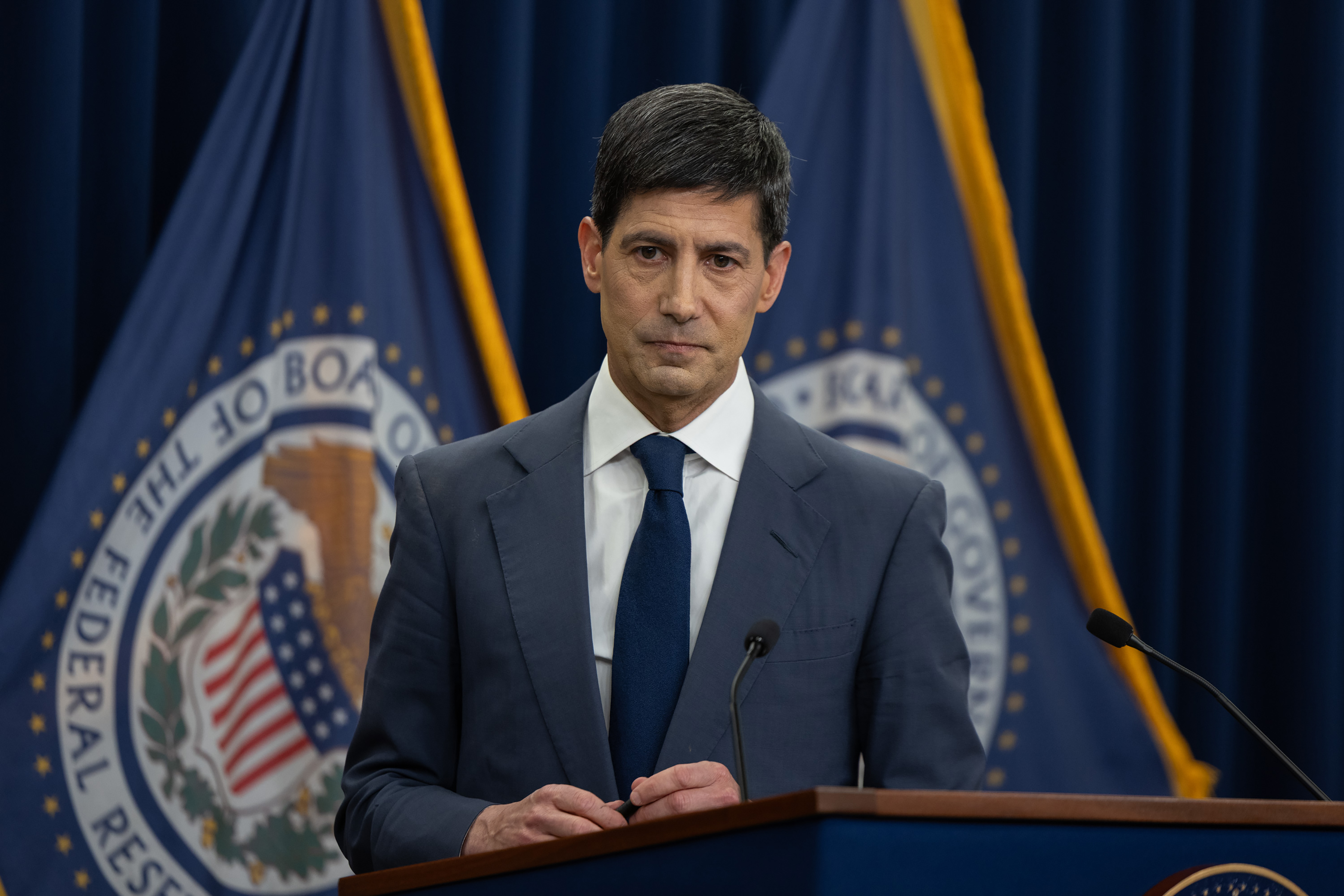
Federal Reserve Chair Kevin Warsh during his first six months in office seems to have done the impossible: He’s kept President Donald Trump happy.
Now, Warsh might need to defang one of his harshest critics, Sen. Elizabeth Warren (D., Mass.), who is set to chair the Senate Banking Committee in the next Congress.
Warren derides Warsh as Trump’s “sock puppet,” a jibe that irks him and is contradicted by his raising interest rates despite the president’s insistence that they go lower. She has also lambasted Warsh for allegedly favoring Wall Street over consumers as a Fed governor during the 2008 financial crisis.
Any Warsh charm offensive would be an uphill fight. When the Senate confirmed him in May, he received only one Democratic vote, from Sen. John Fetterman of Pennsylvania. Warsh’s 54-45 margin was the narrowest since the Senate began formal votes on Fed chairs almost 50 years ago.
His official calendar for September listed meetings or phone calls with six lawmakers, all Republicans, including House Speaker Mike Johnson of Louisiana. Warsh’s last recorded appointment with a Democrat was a July 14 phone call with Sen. Mark Warner of Virginia.
“He does not have the same working relationships on the Democratic side. In a way, this is the consequence of the Fed having become so politicized,” said Michael Pedroni, chief executive of Highland Global Advisors, a Washington consultancy.
Inflation delivered Congress to the Democrats in the Nov. 3 midterms. But the real success or failure of the battle to curb the cost of living depends on the central bank, which controls the price of credit.
As Warsh often notes, the Fed has missed its 2% price stability target for nearly six years. The latest consumer price data, released on Tuesday, shows it is making little headway. Thanks to a data gap caused by last year’s government shutdown, no official annual figure is available. But economists say prices are now rising at around a 4% rate.
That means more interest rate hikes are coming, probably as soon as the Fed’s next policymaking meeting on Dec. 8-9, which will drive up the cost of consumer borrowing.
The good news for Warsh is that Warren, along with other Democrats, has been an ardent backer of central bank independence. So Trump’s habit of testing the limits of presidential authority over the Fed will be neutered. A Democratic Senate also is unlikely to confirm any new Fed appointees, meaning the president’s push to oust Fed governor Lisa Cook over disputed allegations of mortgage fraud will probably stall.
A new Congress will not directly affect monetary policy. But Democrats could grill Warsh about his interest in using alternative measures of inflation, some of which show consumer prices rising less than the Fed’s standard metric.
Democrats might also challenge the Fed’s view that the 4.1% jobless rate means the economy is at or near full employment. Nearly 2 million Americans have been without work for more than half a year, up more than one-third since Trump took office, according to the Bureau of Labor Statistics.
Warren, who declined an interview, already has clashed with Warsh at public hearings, including this summer when she accused him of seeming “to invite corruption” by declining to criticize Fed Vice Chair Michelle Bowman’s appearance at a private Wall Street dinner on June 17.
“Congress can do things that would make the Fed’s life very, very difficult if they’re not pleased,” said Pedroni, who served in the Treasury Department under President Barack Obama and Trump. “They are going to be using the next two years to audition for retaking the executive branch.”
The 2008 crisis and the pandemic showed that top lawmakers and the Fed leadership need a relationship of mutual trust. When the global financial system is at stake, the people’s representatives need to see the Fed chair as an independent voice on the economy, not just as the president’s man.
“The Fed needs political support from Congress in order to do its job. With a new Democratic Congress, he has to maintain those lines of communication. He needs to be talking to them, on both sides of the aisle,” said Sarah Binder, a political scientist at the Brookings Institution who studies the relationships between the Fed and Congress.
Warsh is not without political acumen. In his 2015 memoir, former Fed chairman Ben Bernanke praised Warsh, one of his closest advisers, for his “political and markets savvy.” During Warsh’s 2006 confirmation hearing to become a Fed governor, Sen. Tom Carper (D., Del.) read aloud an email from a former Democratic congressional aide praising Warsh as “remarkably balanced, evenhanded, thoughtful, and astute.”
Two decades later, in a more politicized age, Warsh prides himself on having the courage to tackle problems his predecessors shied away from or overlooked. He has big ambitions to remake the Fed.
Warsh started by cutting back on communications, believing that since 2008 the Fed has simply talked too much. He’s on solid ground when he says that much of the Fed’s customary public commentary represents habits developed during an economic emergency that are no longer appropriate.
But his less-is-more strategy risks leaving lawmakers in the dark.
The Federal Reserve ultimately answers to Congress, which since the late 1970s has required it to aim for full employment and price stability. Twice each year, the Fed chair is called before Senate and House committees to discuss the management of monetary policy.
Previous Fed chairs have recognized the need for good relations with Congress. In 2013, when Bernanke was leaving the Fed and was asked whether he had any advice for his successor, he replied: “The first thing to agree to is that Congress is our boss.”
Warsh’s predecessor, Jerome H. Powell, was known for courting lawmakers, once vowing “to wear the carpets of Capitol Hill out by walking those halls and meeting with members.” Powell, who received at least 80 votes for both of his nominations, said during his first term as chairman that he sought to be “responsive” to lawmakers’ concerns.
“He really spent a lot of time talking to the relevant folks and making sure that they understood what the Fed was trying to do and how the Fed was thinking about things,” said Jon Faust, who was an adviser to Powell and is now a fellow at Johns Hopkins University’s Center for Financial Economics.
Powell’s efforts paid off. When Trump tried to push him out of office by ginning up an exaggerated controversy over cost overruns on a new Fed headquarters, key lawmakers balked. Sen. Thom Tillis (R., N.C.), a member of the Senate Banking Committee, refused to allow a vote on any Trump nominations — including Warsh’s — until the Department of Justice dropped a criminal investigation of Powell.
Now the Democrats’ return to power will test Warsh’s political skills. It’s hard to imagine Warsh and Warren ever bonding. Both are whip-smart and supremely confident. And while Trump has spared him so far, instead training his ire on Warsh’s colleagues, that could change.
“Could he be squeezed to a certain point between the president and the Congress? Yes, he could be,” said Clay Lowery, executive vice president of the Institute of International Finance. “But that’s kind of the nature of the job.”
CHICLAYO, Peru — Pope Leo XIV prayed Saturday for an end to the violence ravaging Peru, addressing one of his adopted homeland’s most pressing concerns during visits to his former cathedral and a remote community in his former diocese.
At Chiclayo’s cathedral, Leo entrusted his pontificate to the Virgin Mary in a special ceremony before traveling to Santa Cruz de Succhabamba, nestled in lush green mountains near the diocese’s outer reaches.
He traveled by helicopter to the city, 93 miles from central Chiclayo and 6,675 feet above sea level. The journey reflected his belief that shepherds must reach the peripheries to minister to their flocks.
Leo, formerly Robert Prevost, is beloved in the region for venturing beyond the sacristy to serve poor, outlying communities. As bishop, he would make the difficult drive to Santa Cruz de Succhabamba himself in his pickup truck.
“We all know the pope’s love of cars,” the Rev. Kevin Noriega, who oversees pastoral services, said before Mass. “He would drive everywhere.”
Rising crime a top concern for Peruvians
Before leaving, Leo led a special prayer at the Cathedral of St. Mary in Chiclayo, where he served as bishop from 2014 to 2023. He spoke of the “darkness” enveloping Peru, referring to rising crime amid political instability.
The homicide rate has nearly doubled over the past five years, from 5.8 to 10.7 per 100,000 people. Reports of extortion increased from 2,421 in 2019 to 26,734 in 2025, according to official data.
“We feel threatened by the uncertainty of widespread violence and by the unspeakable suffering that continues to afflict so many of our brothers and sisters,” Leo said in the cathedral. “Yet, despite this darkness, which so often dims our hope and weakens our trust, God’s gift continues to shine before our eyes.”
Crime has disrupted daily life, making security Peruvians’ top concern and helping shape the outcome of the last presidential election.
Conservative Keiko Fujimori took office in July after pledging to tackle crime. She has since declared states of emergency, including in Lima in August and in prisons holding inmates linked to criminal organizations in September.
Fujimori has also moved to strengthen ties with Washington by bringing Peru into the Shield of the Americas, a U.S.-led regional coalition formed to conduct joint military operations against drug cartels.
In Santa Cruz de Succhabamba, Leo returned to the impact of violence on the faithful. He acknowledged the temptation to respond to injustice with violence but urged a different response.
“Selfishness, injustice, and evil are not overcome by brutality, but by prayer, patience, and perseverance in denouncing what is wrong, by making our pleas with determination and working diligently to bring about the necessary changes,” he said.
A final Mass in Lima
During one of his first engagements in Lima, Leo condemned violence against women, denouncing “machismo” in Peruvian culture and calling for women to be respected and protected as gender-motivated homicides rise.
Peru recorded 1,261 femicide victims between 2016 and 2024, according to the National Institute of Statistics and Informatics. The annual number of women killed because of their gender rose 44% during that period.
The country also faces widespread illegal gold mining and is the world’s second-largest producer of coca leaves, the raw material for cocaine, after Colombia, according to the United Nations Office on Drugs and Crime.
Leo, who received a joyous welcome in Chiclayo on Friday, is expected to address those issues when he meets with Amazonian and Indigenous peoples on Sunday. He will celebrate a final Mass in Lima on Monday before returning to the Vatican.
KYIV, Ukraine — Ukrainian President Volodymyr Zelensky said the United States had raised the possibility of a new security framework for Europe as part of efforts to end Russia’s war in Ukraine, warning that Moscow could use such discussions to weaken NATO and reshape the continent’s borders.
Separately, Ukrainian forces struck a major Russian oil facility supporting Moscow’s war effort, Ukraine’s General Staff said in a statement Saturday.
“In my view, this can be dangerous,” Zelensky told reporters Friday, referring to the new security framework. “This should not be the main agenda.” His comments were embargoed until Saturday.
He said he believed Moscow was interested in reopening broader questions about European security rather than focusing exclusively on ending the 4½-year war.
“(Russian President Vladimir) Putin’s desire to change borders in Europe is a fact. I am sure this is part of his concept of revising security guarantees in Europe,” he said. “This is dangerous because, in my view, it is precisely things like this that lead to wars or escalations.”
European leaders have stressed that decisions about the continent’s security must be made by Europeans themselves, warning against allowing Russia to dictate the terms of a new security order or negotiate NATO’s future.
U.S. raised Donbas withdrawal in exchange for Ukraine NATO membership
Zelensky said the U.S. had asked for the first time whether Ukraine would withdraw from parts of the Donbas region in eastern Ukraine that Russia does not control if Kyiv were admitted to NATO. He reiterated that Kyiv would not surrender its territory.
Ukraine is discussing a comprehensive security package with its partners that could include specific guarantees from NATO and the European Union, a strong Ukrainian military and financial support, for a specified period, he said. It would also include a recovery plan, he said.
“If the American side confirms precisely this to us, together with other NATO partners, then I will ask our Ukrainian society what it thinks: Do we accept it or not?” Zelensky said.
He stressed that any arrangement would not involve recognizing occupied territories as Russian.
Zelensky also rejected the possibility of Ukraine committing to neutrality, saying that would require changing the country’s constitution.
“If Putin expects Ukraine’s neutrality to be enshrined, that’s not going to happen,” he said. “We’re not in NATO right now anyway.”
Ukraine hits another major oil facility in Russia
Ukrainian strikes on the Samara oil pipeline station near the village of Prosvet in Russia’s Samara region Friday set several oil storage tanks on fire, Ukraine’s General Staff said.
Moscow has not commented on the strike.
The facility is a key part of the network exporting Russian oil to global markets, the General Staff said. The military also said it struck the Lipetsk-2 airfield in Russia’s Lipetsk region.
Separately, 22 people, including three children, were injured in a Russian attack on the southeastern Ukrainian city of Zaporizhzhia on Friday, Ukraine’s Emergency Service said. The injured include a 6-month-old baby, a 2-year-old girl, and a 12-year-old boy.
Zelensky says Europe must decide its own future
Zelensky warned that broader discussions about Europe’s security could allow Putin to seek changes to NATO’s military presence, including the withdrawal of American troops.
He said Putin had raised similar ideas with then-President Joe Biden in 2021, seeking a redistribution of power in Europe and the world.
“I think Putin will bring up Finland and Sweden. I’m sure he will raise the issue of Hungary and the presence of American troops in the Baltic countries,” Zelensky said.
He said any changes to Europe’s security arrangements must be decided by European NATO members only after the war ends.
“The sequence should be as follows: a ceasefire, an end to the war in Ukraine, and security guarantees for Ukraine,” he said. “There can be no security guarantees in Europe, or for Europe, without Ukraine.”
Energy ceasefire and prisoner exchanges are priorities
Zelensky said Ukraine’s priorities in Abu Dhabi included an energy ceasefire, reopening the Black Sea, prisoner releases, and preparations for a leaders’ meeting to end the war.
He said Russian negotiators lacked authority to decide on several issues and Moscow was unwilling to accept an energy ceasefire.
“At the meeting in Abu Dhabi, the Russian delegation said they didn’t have a mandate to decide this issue, but we can also see that they are unwilling,” he said. Negotiators were told to resolve ceasefire questions directly with Putin.
Zelensky said talks in Moscow with U.S. negotiators resulted in an agreement to exchange more than 1,000 POWs on each side. The exact number was still being determined, he said, estimating 1,200 to 1,300.
He said Washington supported Ukraine’s demand for European countries to participate directly in future negotiations, rather than remain outside the main negotiating room.
Britain, France, Germany, and Italy attended the Abu Dhabi meetings, Zelensky said. He expected three to five European representatives at future discussions.
Kremlin spokesperson Dmitry Peskov said Moscow was open to European participation, adding that it would “help us understand how their stand could help the peace process.” He said Russia would accept any representatives European countries chose to send.
Zelensky questions Starshield restrictions
Zelensky accused SpaceX of imposing restrictions on its Starshield satellite system in Russian-occupied Ukrainian territory, saying the limitations were hampering efforts to intercept Russian drones.
He said the system’s speed had been restricted to a maximum of 100 mph in occupied areas and that the limitations had been in place for five days.
Zelensky questioned the explanation that the problem was technical, saying the restrictions appeared to have been imposed by SpaceX despite previous assurances from U.S. Secretary of State Marco Rubio that Starshield was more under the control of the U.S. government.
“The current Starshield restrictions suggest that SpaceX imposed them,” Zelensky said. “That’s what our team is telling me. So this doesn’t quite line up with what we heard earlier. That’s why we need to get to the bottom of all this.”
He said the restrictions prevented Ukrainian forces from intercepting Russian jet-powered Shahed drones over occupied territory as they approached from the east, forcing them to wait until the drones reached areas where the limitations did not apply.
WASHINGTON — The Trump administration will allow states to delay enforcement of new rules requiring low-income adults to work in order to receive Medicaid coverage, according to a letter it sent Friday to state Medicaid directors.
The announcement, which followed a recent loss in court over a key element of the work requirement, represents a major setback for a long-sought Republican reform. It comes less than two months before the work requirements were set to begin, on Jan. 1. States can now wait until July before ending coverage for people who do not meet the work requirement, the letter said.
In the letter, Dan Brillman, who oversees Medicaid at the Centers for Medicare and Medicaid Services, acknowledged the significant burden states faced in building out new, expensive software systems to track the employment of enrollees. Hospitals have prepared massive education campaigns to help patients navigate the additional paperwork.
“We have heard directly from states about their implementation timelines, impediments to successful launches at scale,” Brillman wrote in the letter.
He added that the federal government still expected states in January to begin checking whether Medicaid enrollees are working. But for six months, they will not be required to cancel coverage for people who fail to comply, Brillman said.
The work requirement was enacted in the summer of 2025 as part of Republicans’ major tax and domestic policy legislation. It requires Medicaid enrollees without disabilities or young children to prove they worked, volunteered, or attended school at least 80 hours a month in order to qualify for the program or continue enrollment in it.
The new requirement was expected to lead to substantial reductions in Medicaid coverage, disqualifying not only beneficiaries without jobs but also many who worked but were tripped up by documentation challenges. The Congressional Budget Office estimated that the policy would result in 5 million more Americans becoming uninsured over the next few years.
Democratic lawmakers fought the policy last year. Rep. Hakeem Jeffries of New York, the minority leader who is poised to become speaker when Democrats take over control of the House in January, has announced plans to vote on reversing the work requirement and other Medicaid cuts within the first 100 hours of the next Congress.
In court, 25 states and the District of Columbia had already won a six-month reprieve from some aspects of enforcing the work requirement. A federal judge in Massachusetts found that the Trump administration’s rules for defining who is too “medically frail” to comply with work requirements were stricter than the law allowed.
The January start date is specified in the text of the 2025 tax law. At a conference with state Medicaid officials last summer, where many expressed concerns about the timetable, Trump administration officials warned that no extensions would be coming.
“We know it’s going to be really hard for you to meet the deadline,” said Sara Vitolo, the deputy director for Medicaid. “It’s going to be hard for us. The expectation is going to be that we hit it. And that’s coming from the White House.”
The law also allows states to begin enforcing a work requirement early, and Nebraska and Montana have already begun their programs. In Nebraska, state officials estimate that more than 1,700 people have already been denied or lost Medicaid coverage due to the policy.
WASHINGTON — The nationwide ground stop that brought air travel across the country to a halt Friday evening has highlighted persistent weaknesses in the Federal Aviation Administration’s aging air traffic control infrastructure that has had several disruptive failures in recent months.
Officials called the rare ground stop after outdated communications lines became overloaded and began to fail, interrupting communication lines between air traffic controllers and pilots, according to Transportation Secretary Sean Duffy and Homeland Security Secretary Markwayne Mullin.
The breakdown occurred less than two months after a circuit failure and severed fiber optic cable caused crippling ground stops and delays at airports along the East Coast. Smaller outages unfolded in October at Raleigh-Durham International Airport in North Carolina and George Bush International Airport in Houston, when contractors accidentally cut into fiber line.
The Friday ground stop, which was only the third the FAA has issued this century, eclipsed the fallout of previous air traffic communications equipment failures. The FAA has yet to identify precisely what caused communication lines to falter.
The Associated Press reported that Bryan Bedford, administrator of the Federal Aviation Administration, said Saturday that the U.S. air travel schedule should be back to normal by the end of today. He said airlines “will still have delays and cancellations” Saturday but promised that the “worst is behind us.”
New technology being added to the nation’s air traffic control system overloaded antiquated equipment and caused “intermittent” communications and radar gaps, leading to the ground stop that lasted more than four hours Friday, Trump administration officials said.
Duffy said a contractor had been working on replacing a section of the system’s old copper wire with new fiber wire, and that work somehow caused the system overload. Duffy said officials were investigating whether contractor “incompetence” or a faulty router was the cause.
“Our contractor didn’t meet the moment,” Duffy said.
But the successive episodes of such problems have underscored the structural vulnerabilities that continue to hamper air traffic controllers’ ability to safely manage flight traffic, even after concerted efforts to make improvements. And they raised questions about whether the federal authorities have done enough to create backup systems and redundancies to prevent disruptive or even catastrophic failures.
For decades, air traffic communications have relied on a system that runs on analog copper wire, floppy disks, and alphabetical keyboards so old that the FAA has difficulty sourcing spare parts. Last year, Congress approved $12.5 billion in funding to help pay for upgrades, after a series of outages in air traffic control facilities, including the one serving Newark Liberty International Airport in New Jersey, caused alarming losses of radar and other communications capabilities.
Earlier this month, L3 Harris, the primary telecoms contractor tasked to manage the system upgrades, boasted on its website that it had converted about 70% of the copper line to fiber optic cable; last week, the FAA announced it would begin to phase out floppy disks.
But the disruptions in recent weeks showed that those upgrades had serious vulnerabilities themselves.
In September, when a circuit at a regional air traffic facility failed, operators had no backup options beyond the fiber line, 600 feet of which they discovered — to their surprise — had been severed by a construction crew in New Jersey working on Amtrak project. More than 430 flights were canceled before the system was fixed several hours later.
A similar incident occurred in October at the Raleigh-Durham International Airport in North Carolina, when a contractor working on plumbing accidentally severed a fiber line. The airport was forced to issue a ground stop for several hours. Just one day after that, officials were forced to issue a ground stop at George Bush International Airport, when yet another contractor inadvertently severed a fiber line.
The fiber line upgrades themselves, Bedford, the FAA administrator, told reporters at the time, were not enough to save the system from failure.
Ideally, the FAA wanted to put data into cloud services, he told reporters then, so that “when you have a fiber cut, you have multiple pathways of backup.”
“Today we have physical fiber and when it’s cut, there’s one redundancy, and when we lose that, there’s no more redundancy,” he added.
Friday’s national ground stop revealed that the lack of redundancies in the FAA’s system could trigger catastrophic failures in other ways and touched off a blame game in Washington.
Duffy seized on the chaos to hammer Congress, saying it had failed to pony up enough funding to pay for systemwide upgrades.
“How many more times does this have to happen for Congress to give the money to fix it?” he told reporters at the White House Friday night, asking that lawmakers approve $50 billion in emergency funds for the project. Their lack of action, he said, had forced his department to pursue patchwork upgrades that were insufficient. It was a dramatic increase in his demand for additional money, which for the past several months has hovered at $30 billion.
But lawmakers in both parties are raising questions about how efficiently Duffy and the FAA have been spending the money they have already been given.
“Today’s unprecedented breakdown is the latest in a series of unacceptable air travel incidents under the Trump administration’s failed leadership,” Rep. Hakeem Jeffries, the minority leader, said in a statement issued shortly after Duffy’s news conference, accusing the administration of failing to take responsibility for its failures in “the latest in a series of unacceptable air travel incidents.”
The first time Jarell Carter entered a Pilates studio, he was expecting an easy workout.
A fitness influencer and a former NFL athlete, Carter is able to squat more than 500 pounds. He bench-presses more than 400. But less than 20 minutes into his first Pilates session, his “legs were shaking uncontrollably,” he said.
“I was struggling and sweating profusely,” he added. “Making noises that I just couldn’t control. I was just trying to hold it together.”
His first coherent thought? “Whoever created Pilates hates men.”
Around the country, men have burst into the Pilates studio. Tom Brady has done it. So have LeBron James and Cristiano Ronaldo. The fitness app ClassPass said the number of men taking classes has nearly tripled since 2023. At Equinox gyms, male participation is up over 50% in both group classes and private sessions in the last 18 months.
Nationally, 4.1 million men took Pilates last year, up from 2 million in 2021, said the Health and Fitness Association, a trade association. Overall this year, about 1 of every 3 Pilates participants is a man, the organization added.
It’s a shake-up for the popular exercise method, which is closely associated with the “Pilates princess” aesthetic that has come to define the space — matching athleisure sets, slicked-back ponytails, and post-class matcha lattes all but required.
“I thought it was just for women,” Carter, 31, said.
Now, some men are finding Pilates is making it easier to pick up their grandchildren and swing a golf club. They feel younger, more mobile, and unashamed that Pilates is one reason.
The shift is in line with the less gendered approach to exercise more broadly, said Greta Wagner, president and CEO of the Health and Fitness Association. “You see women in the weight room now, and you see men in Pilates.”
The low-impact, full-body workout emphasizes core strength, stability, and slow, controlled movements — a far cry from the weight lifting “bro splits” of the gym. It comes in many forms, but the two best known are mat Pilates (which takes place on the floor) and reformer Pilates (taught on sliding-carriage machines called reformers, with spring-based resistance).
Some men are taking men-only, pop-up classes or joining men-only workshops. But mostly, they are showing up at coed classes. Carter’s first time in a group Pilates session, he felt at ease. “Everyone was smiling,” he said. “Everyone was happy.”
The insertion of masculine energy has left a few people in a huff. “They’re sweating all over everything and not wiping down their machines,” said Eve Tilley-Coulson, a lawyer in Los Angeles, who added with disdain that some even wear basketball shorts. “They’re incapable of even doing the move because they aren’t in the right clothing to be able to do it.”
But many women are welcoming. Some are even leading the charge. Patricia Stevenson, president of the Pilates Method Alliance and an instructor in Florida, said a number of her regular male students were originally dragged along by spouses or female friends. She estimates about half of her clientele is now male, up from less than one in 10 about 25 years ago.
Thiago Castanho works out at KZ Pilates on the Upper East Side of Manhattan, Oct. 30, 2026. Around the country, men have burst into the Pilates studio, an exercise regimen long seen as a women’s workout. (Dave Sanders/The New York Times)DAVE SANDERS
Pilates was never meant to be a gendered workout. “The matching sets and the matcha all came later,” said Naimah Jackman, 34, a certified Pilates instructor in New York. Joseph Pilates developed what he called Contrology around World War I. A German circus performer and boxer, Pilates was interned in Britain during the war and began teaching his methods to his fellow inmates.
Soon enough, though, Pilates had moved to New York City, where dancers — many of them female — started booking sessions in his studio. From there, the number of female fans grew until Pilates became seen as a feminine workout.
“I made fun of guys that took Pilates,” said Gary Reisman, 63, who now attends classes regularly at KZ Pilates+ in New York. His first time trying it out, he booked a personal trainer, “so I didn’t have the issue of being embarrassed in a class full of women,” he said.
Hoping to make Pilates more welcoming to men, Jackman founded Men’s Pilates NYC, her monthly all-male Pilates club, in 2024. On an open-air rooftop in Times Square, she tries to mirror the energy of a gym, including by blasting trap music.
Krisi Frazee, owner of Better Body in Virginia, designed her studio to be more gender-neutral. “Pilates can be intimidating for everyone, but especially for men,” Frazee said. Her goal is to make the class more welcoming to all. “We don’t have music. We don’t have microphones. It’s not pink and purple and beige. I just have equipment.”
But Carter doesn’t need the Pilates studio to change in order for him to feel comfortable. He likes it just the way it is.
“At the end of the class, when she offers the aromatherapy, I put my hand out right away,” Carter said. “That stuff smells good, and it’s relaxing. I love the vibes.”
Jarell Carter, a fitness influencer and former NFL cornerback, exercises in a pilates class he attends regularly at The Wave, a studio in Gilbert, Ariz., Oct. 30, 2026. Around the country, men have burst into the Pilates studio, an exercise regimen long seen as a women’s workout. (Adriana Zehbrauskas/The New York Times)ADRIANA ZEHBRAUSKAS