Category: Wires

  • At 91, he’s hiking the Appalachian Trail. Again.

    At 91, he’s hiking the Appalachian Trail. Again.

    On the first day of summer, just after dawn, Dale Sanders, 91, prepared to start the steep, rocky hike up to Franconia Ridge in New Hampshire’s White Mountains.

    Sanders’ mantra might resonate with anyone in their 10th decade: “It’s a ‘don’t fall’ day today,” he said, slinging a small backpack onto his compact, wiry frame.

    The roughly 2,190-mile Appalachian Trail runs from Georgia to Maine. Sanders had been chipping away at it since September, in a bid to reclaim his record as the oldest person to hike the full length. (His goal is to complete a thru-hike, by walking the entire trail in a 12-month period.)

    If Dale “Grey Beard” Sanders continues at his current pace, the age record will be his again before a 365-day deadline. Sanders said he will soon have to look for a new record: “I’m not going to stop unless physically I simply cannot do it anymore.” Luke Piotrowski

    He was roughly 70% finished, but some of the toughest miles were ahead. I joined him for two especially challenging days.

    The White Mountains are known for extreme weather, and Sanders said he had been turned away by a concerned trail steward during a heavy storm the previous week: “He said, ‘You know, you’re going to die if you keep going.’”

    The weather had calmed somewhat, but soon after he emerged above the tree line and began his traverse of the ridge, roaring gusts of wind brought dense fog and sharp, sideways rain.

    The route frequently requires hikers to scramble. As he reached the bottom of a rock slab, he realized he had no memory of this obstacle from the last time he had hiked the trail. That was in 2017, when, at 82, he first set the record. After carefully climbing the ledge, he estimated the hike was twice as hard this time.

    Thru-hikers typically use trail names; Sanders is better known as “Grey Beard.” That morning, he had set out with an experienced 28-year-old hiker from Georgia, Garrison Gandy, or “Doublewide,” who had been crashing at the same hostel.

    Despite the conditions, the pair made steady progress toward the day’s goal, an off-grid shelter 8 miles down the trail where a hot meal and a bunk were waiting.

    The next morning, the first hour of hiking was strenuous — a steep mile to the summit of Mount Lafayette. Sanders lamented that despite hard training, his fitness hit a ceiling that hadn’t existed in earlier decades. “I wanted it to be pretty close to where I was in 2017, and I’ve never reached that,” he said.

    As he caught his breath on the summit, the clouds had cleared, revealing a sparkling view of the Pemigewasset Wilderness.

    12 miles a day

    It was the allure of setting a record that first drew Sanders to the trail.

    Sanders, who lives with his wife near Memphis, retired in 2002 after a career working in parks and recreation for the Navy. He marked his 80th birthday by becoming the oldest person to paddle the full length of the Mississippi River, and soon began searching for other age records.

    He learned he could set a record by completing the Appalachian Trail. Though he had never spent extended time hiking, his competitive streak was activated.

    Sanders credits this part of his personality to being bullied in school while growing up on a Kentucky tobacco farm, and the escape he found through sports.

    “I wasn’t good in the books,” he said. Physical activity, on the other hand, “gave me something real.”

    His first Appalachian Trail age record was broken in 2021 by a hiker named M.J. Eberhart, trail name “Nimblewill Nomad.” Sanders befriended Eberhart that year and encouraged him to set a new mark.

    “He was going to quit several times,” Sanders said. “I actually went up and hiked with him the last few days so that he wouldn’t quit. We’re really close friends.”

    Still, Sanders wanted the record back. For the current attempt, he planned to hike 12 miles a day, with one day off a week.

    Most thru-hikers tackle the trail from the south to north, starting in Georgia and ending in Maine. But as long as Sanders walks every section of the trail, he can do it in any order and direction he chooses.

    To maximize the year’s hiking weather, he began his hike headed south from Harpers Ferry, West Virginia, then returned to that spot to complete the northern half.

    The White Mountains are home to a system of backcountry huts, where dinner and breakfast are served to overnight guests.Luke Piotrowski

    While most thru-hikers sleep in a tent or in lean-to shelters, Sanders prefers his truck camper, a simple shelter, labeled “Base Camp on Wheels,” that sits in the bed of a pickup truck. It’s driven by a rotating cast of volunteers, who also cook his dinner and help plan the next day’s mileage. For the first 800 miles, one driver was Eberhart, now 87, who’s helping to break his own record.

    Two friends from his Mississippi River descent, Craig and Katie Heaton, a married couple in their mid-60s, are also among Sanders’ crew.

    “He won’t tell you how to live your life,” Heaton said, “but he shows by example, and I think that’s what touches me the most.”

    Selfies and high fives

    Sanders’ appetite for continuing to push his limits in old age has earned him many fans along the trail.

    Emma Bartlett — also known as Comfy — had been hiking since March when she paused for a picture as she passed Sanders on the climb up to Franconia Ridge. “Everyone has been talking about you since Georgia,” she told him.

    “If I’m even walking at 91, I will be jumping for joy,” said Bartlett, who is 23.

    Sanders is comfortable hiking alone, but he would always prefer company. As we parted ways, he found an impromptu hiking partner to accompany him for the next leg.

    Nicholas Loukides, 29, who has hiked in the White Mountains since he was in grade school, said the chance to tackle a few miles with Grey Beard was a highlight of his trip. “Every mountain I climb,” he said, “I’m like, ‘Dude, you did this?’”

    Dale “Grey Beard” Sanders, who once held the record as the oldest person to complete the 2,190-mile Appalachian Trail and, in the summer of 2026 was months into a bid to complete it again at age 91.Luke Piotrowski

    There are formidable obstacles remaining, like Maine’s 100 Mile Wilderness, the trail’s most remote stretch, where there will be very few opportunities for supplies or crew assistance for days. And Sanders still has to finish a section of the Smoky Mountains in North Carolina. But if he continues at his current pace, the age record will be his again before his 365-day deadline.

    Sanders said he plans to finish, even if he runs out of time for it to count officially. Either way, he said he will soon have to look for a new record: “I’m not going to stop unless physically I simply cannot do it anymore.”

    This article originally appeared in The New York Times.

  • The World Cup has ended for France’s Kylian Mbappé, but not his race for the tournament’s Golden Boot

    The World Cup has ended for France’s Kylian Mbappé, but not his race for the tournament’s Golden Boot

    ARLINGTON, Texas — Kylian Mbappé won’t get a third consecutive trip to the World Cup final, but he remains tied for first with Argentina legend Lionel Messi in the race for the Golden Boot four years after he won it.

    Mbappé was unable to generate many chances in France’s 2-0 loss to Spain in the World Cup semifinals on Tuesday.

    Mbappé and Messi have eight goals each. Messi and defending champion Argentina will play in the other semifinal match against England on Wednesday (3 p.m., Fox29).

    France will play the loser of that match in the third-place game on Saturday in Miami (5 p.m., Fox29). Spain will take on the winner at MetLife Stadium on Sunday (3 p.m., Fox29).

    Mbappé had the fewest touches of any forward in the first half with 15. Perhaps his most prominent moment was trying to persuade referee Ivan Barton that the penalty resulting in Spain’s first goal shouldn’t have been called.

    Mbappé’s best chance came in the 67th minute when his shot deflected off Spain defender Marc Cucurella and went just wide. France was already trailing by two goals at that point.

    The 27-year-old Mbappé was issued a yellow card in the 86th minute when he rushed toward Unai Simón just as the Spain goalkeeper was bending over to pick up the ball. The two collided, sending Simón to the grass.

    Mbappé started the match against Spain after exiting in the 77th minute of his team’s 2-0 quarterfinal win over Morocco, when he scored his eighth goal of the tournament.

    Mbappé also scored eight goals four years ago in Qatar, where France lost to Messi and Argentina in a penalty shootout in the final. France beat Croatia to win the World Cup eight years ago in Russia.

  • Senate Democrats block $1 trillion defense bill in protest over Iran war

    Senate Democrats block $1 trillion defense bill in protest over Iran war

    WASHINGTON — Senate Democrats blocked a $1 trillion annual defense bill Tuesday, refusing to advance the bipartisan package that would substantially increase Pentagon spending, including a pay raise for the troops, in protest of President Donald Trump’s war against Iran.

    Senate Democratic Leader Chuck Schumer announced his opposition and other key Democrats said they could not support the annual bill, known as the National Defense Authorization Act, as the war drags into a fifth month with no clear endgame in sight. The tally was 50-46, failing largely along party lines to reach the threshold needed.

    “The NDAA cannot become a permission slip for that recklessness that we see occurring in Iran,” Schumer, of New York, said ahead of voting.

    “Donald Trump does not get to drag the American people deeper into a war he cannot explain and does not know how to end — and then demand that Congress look the other way.”

    The Senate vote comes a day after the White House formally notified Congress that it had resumed bombing strikes against Iran, effectively undoing the fragile ceasefire in the U.S.-Israel led conflict that has resulted in economic disruptions, including volatile gas prices, ahead of the midterm elections.

    Congress has tried repeatedly to slap guardrails on the administration, voting more than 10 times on various war powers resolutions that would halt hostilities. But those efforts have not succeeded, and most Republicans in the House and Senate majorities back Trump.

    Senate Majority Leader John Thune called the defense package a good bill and implored his colleagues to provide the resources to ensure the U.S. is kept safe.

    “We have an obligation here in Congress to ensure that they have everything they need for whatever the mission may be,” he said.

    After the bill failed to advance, Thune switched his vote in a procedural move that will allow the leader to bring it back up for consideration again later.

    For decades, Congress had made sure to approve the annual defense bill each year, setting the policy and direction for the department and authorizing the funds that would later be allocated to carry out its investments in systems, supplies, and missions.

    This year, the 66th annual NDAA is running into a double whammy of opposition. Lawmakers are fuming over Trump’s military action against Iran and resisting the White House request to substantially increase Pentagon spending to $1.5 trillion, up from about $900 billion last year.

    The sizable boost of funds aligns with the White House’s 2027 budget request as the Trump administration seeks a generational investment to modernize the Defense Department, which it refers to as the Department of War under Secretary Pete Hegseth.

    Hegseth was scheduled to meet later Tuesday evening with House Republicans as Congress considers providing additional money through a separate budget reconciliation bill the party can pass on its own, overpowering the opposition from Democrats.

    The White House has requested $350 billion from Congress under the budget reconciliation process, but House GOP leaders have indicated it is likely to be a much smaller amount, more in line with $87 billion the White House requested last month as supplemental funding for Iran.

    But Republican deficit hawks are skeptical of the big budget numbers, despite support for the war within their ranks.

    The extra defense funding comes on top of the additional $150 billion Republicans already provided the Pentagon last year under Trump’s big tax breaks bill that some say has not been spent or fully accounted for.

    At the same time, senators want to impose restraints on Hegseth if he fails to comply with their demands for more information about department procedures and accounts.

    The Senate bill would block the secretary’s travel funds unless he provides reports they have requested, including one on a deadly Iran school strike at the start of the war.

    Democrats, however, are pushing for further limits in line with a war powers resolution that would force the cessation of military actions.

    Sen. Tammy Duckworth (D.,Ill.), a veteran who flew helicopter combat missions in Iraq, said she would oppose the bill unless it included her amendment to end the war.

    “Simply throwing more money at an out-of-control military operation is not strategy. It’s a recipe for a forever war.”

  • Pat Oliphant, prizewinning giant of political cartooning, dies at 90

    Pat Oliphant, prizewinning giant of political cartooning, dies at 90

    When Pat Oliphant assembled his entry for the 1967 Pulitzer Prize for editorial cartooning, he included a dozen cartoons he had drawn for the Denver Post: 11 he was proud of, and one he didn’t think was any good but was targeted to appeal to the jury’s politics.

    He won the prize — for the one cartoon he didn’t like, an image of North Vietnamese leader Ho Chi Minh holding a dead body, captioned, “They won’t get us to the conference table … will they?”

    Mr. Oliphant was enraged. For years afterward, he condemned the Pulitzers, never again submitting his work for a prize that was awarded, in his view, more on the basis of politics than skill. “It’s a fraudulent award,” he said.

    The Pulitzers were just one of many targets for Mr. Oliphant, a self-described “equal-opportunity cartoonist” who took on powerful people, and institutions, with glee.

    Across his six-decade career, he was just as likely to go after D.C. Mayor Marion Barry — whom Mr. Oliphant depicted as an Idi Amin-like ruler, the tea-addicted “King of Kolumbia” — as he was President George H.W. Bush, whom he skewered as a purse-carrying wimp and as a would-be Lawrence of Arabia.

    “If Pat Oliphant couldn’t draw,” a critic once said, “he’d be an assassin.”

    Mr. Oliphant, who helped revolutionize political cartooning in the United States with his slashing humor and sophisticated artistry, died Monday at his home in Santa Fe, N.M., at age 90, according to his son, Grant Oliphant.

    By the time he won the Pulitzer, Mr. Oliphant’s comics were reaching an international readership through syndication. His audience only grew after he moved to the Washington Star in 1975 and, six years later, struck out on his own, working independently without being tied to a single paper.

    At the height of his popularity, his work appeared in more than 500 newspapers, influencing fellow Pulitzer winners including Tom Toles, Tony Auth, Ann Telnaes, and Jeff MacNelly.

    “He saw himself as participating in the long tradition of political caricature, going back especially to Delacroix, to Daumier, these major figures of the 19th century,” said Molly Schwartzburg, a Harvard University curator of printing and graphic arts who helped organize a 2020 exhibition of Mr. Oliphant’s work. “His work has a sort of intellectual history that brought an aesthetic seriousness to political cartooning in the 20th century. He’s a trenchant critic of the hypocrisy of politics, and he’s always seeing exactly what the politicians are up to.”

    At a time when other political cartoonists were using a vertical or strip format for their work, Mr. Oliphant helped popularize the use of a horizontal panel. He also proved influential in the way he shaded all his cartoons by hand. Twice he was awarded the National Cartoonists Society’s Reuben Award, for cartoonist of the year.

    Mr. Oliphant’s work was not without its critics. The Catholic League denounced him as “one of the most viciously anti-Catholic editorial cartoonists ever to have disgraced the pages of American newspapers,” taking particular issue with cartoons he drew about sexual abuse within the clergy. (One memorable example was captioned, “Celebration of Spring at St. Paedophilia’s — the Annual Running of the Altar Boys.”) Other cartoons sparked criticism from the American-Arab Anti-Discrimination Committee, which accused him of racism, and the Simon Wiesenthal Center, which said he demonized Israel.

    If there was somebody who could be offended, Mr. Oliphant probably did so. As he saw it, political cartooning was a “confrontational art,” one that thrived on provocation. “We are drowning in political correctness and somebody’s got to kill it,” he told the New York Times in 1997. “It’s the ruination of my business.”

    Finding a calling, and a penguin

    Patrick Bruce Oliphant was born in Adelaide, Australia, on July 24, 1935. As a child, he sought to emulate the work of his father, Donald, a government draftsman. He also took inspiration from his uncle Mark Oliphant, a physicist who worked on the Manhattan Project, was knighted, and became governor of South Australia.

    “People knew Sir Mark — his reputation was known throughout Australia,” Grant Oliphant said in the 2025 documentary A Savage Art: The Life & Cartoons of Pat Oliphant. “And I think part of what motivated my father to become great in his own right was he got tired of always being asked if he was related to Sir Mark, and he wanted to be his own guy.”

    At 18, Mr. Oliphant landed a job as a copy boy at the News, an Adelaide newspaper owned by Rupert Murdoch’s father, Keith Murdoch. He had aspired to work as a reporter, but in 1955 he left the News for its rival, the Advertiser, and began doing minor illustration work, drawing maps and retouching photos. Soon, he said, “drawing won out,” and he left writing behind to be the Advertiser’s editorial cartoonist.

    When editors disagreed with some of his cartoons, Mr. Oliphant began adding a tiny character at the margins, Punk the penguin, to voice his forbidden political views.

    Inspired by a real-life penguin that had washed ashore in Adelaide, the character remained a staple of his cartoons for decades. It was through Punk that Mr. Oliphant called President Ronald Reagan a “soldier of importune” during the Iran-Contra scandal, suggested Ted Kennedy should run away rather than run for president, and quipped that a $10 million book deal President Bill Clinton secured for his memoir was “not bad bucks for fooling all of the people all of the time.”

    Mr. Oliphant was eager to leave Australia, which he dismissed as “a country where nothing happens.” He moved to the United States to join the Denver Post in 1964, and within a year his cartoons were syndicated internationally.

    After moving to Washington to work for the Star, an afternoon paper that folded in 1981, Mr. Oliphant continued to refine his technique. For years, he attended a twice-weekly figure-drawing class that William Christenberry taught at the Corcoran School of the Arts and Design, developing what his colleague Telnaes once described as “a great sense of composition.”

    In addition to his political cartoons, Mr. Oliphant made paintings and sculptures, which he exhibited at a Georgetown art gallery owned by Susan Corn Conway. She and Mr. Oliphant married in 1996 and moved to Santa Fe in 2004.

    His wife died in December. His previous marriages, to Hendrika de Vries and Mary Ann Kuhn, ended in divorce. In addition to his son, Grant, survivors include two daughters, Laura and Susanne Oliphant; two stepchildren, Pauline and Daniel Conway; a brother; four grandchildren; and two great-grandchildren.

    Mr. Oliphant retired from cartooning in 2015, as his eyesight began to fail. But two years later, he made a brief reappearance with two editorial cartoons that were published online by the Nib, mocking President Donald Trump — depicted in a Nazi uniform — and White House strategist Stephen K. Bannon.

    “We thought that Watergate was a unique condition. But it sort of pales in comparison to what we’ve got now,” Mr. Oliphant told the Santa Fe Reporter that year.

    He had found a dream subject in Trump, he said, but his eyes made it all but impossible to draw. “I’ve been in this business 60 years. And I’ve waited 60 years for this [guy] to come along. And I can’t do anything about it because of my eyes.”

  • RFK Jr. faces Hatch Act complaint after intervening in congressional races

    A top Senate Democrat has requested an investigation into whether Health Secretary Robert F. Kennedy Jr. broke a federal law intended to prevent political appointees from interfering in elections, citing Washington Post reporting.

    Sen. Ron Wyden (D., Ore.), the top Democrat on the Senate Finance Committee, filed a complaint Monday with the Office of Special Counsel, a quasi-judicial independent agency that administers the Hatch Act and other civil service rules.

    The Hatch Act bars federal employees from engaging in political activity in the course of their work. Several Trump appointees in the first administration were found to have broken the law.

    President Donald Trump has previously derided the Hatch Act and declined to enforce the special counsel’s recommendations.

    In his complaint and accompanying letter to Jamieson Greer, the acting head of the special counsel’s office, Wyden cited examples of Kennedy encouraging a pair of third-party candidates in Iowa to drop out of contested House races so Republicans could keep control of Congress.

    The Post obtained audio of Kennedy’s call with one of the candidates, Rick Stewart, in which the health secretary suggested he would serve as a liaison with the White House and could help Stewart if he left the race. A second candidate has said he received a similar call from Kennedy.

    Wyden, whose committee helps oversee some of the agencies led by Kennedy, said that the cabinet secretary’s offers to the candidates were “brazenly corrupt” and violated the Hatch Act and other laws.

    “The quid pro quo offer of federal employment or other personal gain that Kennedy extended to Stewart on the June 11 phone call is conduct expressly prohibited by the Hatch Act,” Wyden wrote in his letter to Greer, which was shared with the Post.

    The White House and the Department of Health and Human Services, which Kennedy leads, did not respond Monday to questions about Kennedy’s conversations with the candidates and whether he faced any internal repercussions once the calls came to light.

    Trump mocked the Hatch Act in his first term, including after the Office of Special Counsel in 2019 recommended that Kellyanne Conway, a top Trump adviser, be removed from her post for violating the law. Conway had criticized Democratic presidential candidates while she was being interviewed by media outlets in her official capacity and tweeted about the candidates from her official account, the office concluded.

    Trump ignored the office’s recommendation and kept Conway in her post.

    The Hatch Act, which has been law since 1939, does not apply to the president — a fact that Trump has acknowledged in the past, including when he decided to accept the Republican nomination for president in 2020 by giving a speech at the White House.

    “There is no Hatch Act because it doesn’t pertain to the president,” Trump said in August 2020.

  • Supreme Court justices tell Congress their safety is at risk and more must be spent on security

    Supreme Court justices tell Congress their safety is at risk and more must be spent on security

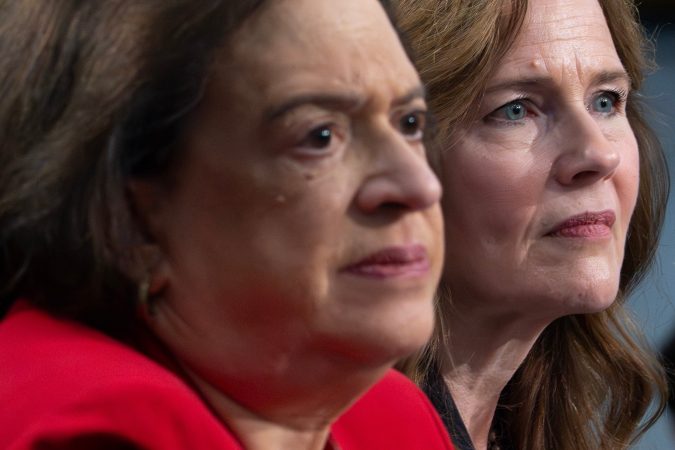
    WASHINGTON — Supreme Court Justice Amy Coney Barrett told lawmakers Tuesday that a sharp increase in threats targeting her and other justices is increasingly encroaching on their personal and family lives.

    During a rare appearance by justices before Congress, Barrett said she had to wear a bulletproof vest home a few years ago, something she struggled to explain to her 12-year-old son.

    “I didn’t expect that performing this service would put me in the position of explaining to my children what a bulletproof vest was, why I had to wear one,” she said.

    She and Justice Elena Kagan testified before a House appropriations panel in support of a request to increase security funding for members of the nation’s highest court.

    Judges around the country have seen a rise in threats of violence and intimidation. Barrett’s home was also targeted by a fake swatting call to police in May.

    The hearing comes two weeks after the conservative-majority court finished handing down a series of major opinions, including a decision that increased President Donald Trump’s power over federal regulatory agencies and another that rejected his wide-ranging tariffs, sparking harsh personal criticism.

    It’s the first time justices have testified before Congress since 2019, and the two justices faced wide-ranging questions about the court’s work.

    Security is central to budget request

    The Supreme Court requested a total of $228 million for next fiscal year, a roughly 10% increase over the year before. About $18 million of that is for maintaining the building and grounds.

    Much of the requested increase, $14.6 million, would go to expanding personal protection for justices, with six more agents for each.

    An additional $2 million would fund an off-site residential security post aimed at making emergency responses faster, as well as increasing the number of Supreme Court police officers.

    The U.S. Marshals Service, responsible for protecting judges, reported 564 threats in the government fiscal year that ended in September, an increase from the year before.

    That total includes threats to the hundreds of federal judges around the country, though the nine-member Supreme Court has not been immune.

    In May, Barrett’s security detail worked with police to quickly deal with the call determined to be swatting, or a fake 911 call designed to provoke a police response. Last year, her sister was the victim of a bomb threat in Charleston, S.C., police said. No bomb was found.

    In 2022, shortly after the leak of a draft opinion overturning the Roe v. Wade abortion decision, a would-be assassin was arrested near the home of Justice Brett Kavanaugh with weapons and zip ties. Threats to the Supreme Court increased after that leak, and have continued to grow, Kagan said.

    Chief Justice John Roberts has condemned the threats to all U.S. judges, saying during a speech in March that criticism of judicial opinions is understandable, but personally directed hostility is “dangerous, and it’s got to stop.”

  • Trump plans primetime speech on 2020 election allegations

    Trump plans primetime speech on 2020 election allegations

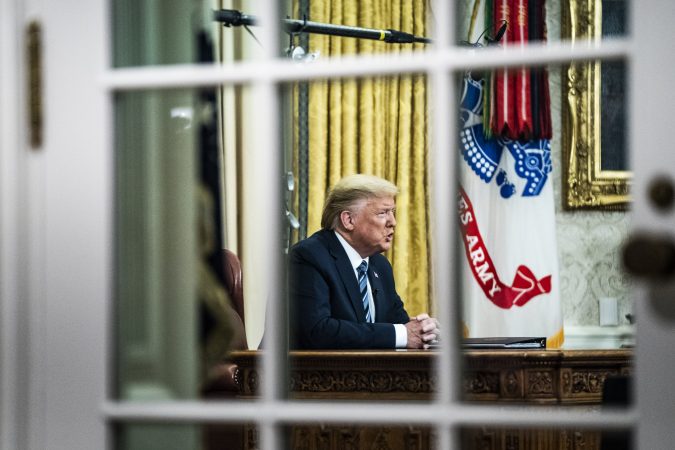
    President Donald Trump is planning a primetime address Thursday that will use findings from reexamined government files to argue that the country’s election infrastructure has vulnerabilities, according to two people briefed on the plan.

    Trump told reporters in the Oval Office on Tuesday that the speech would concern voting machines but declined to elaborate. “It will concern that subject, and we’ll have a couple of other things to say, also,” he said. “But I’d rather save it. But it’s really big news.”

    The president could use the address to press his long-standing allegations of foreign interference in the 2020 election, the results of which he has never accepted. The speech, in part, will highlight claims that China accessed U.S. voter data, said the people, who spoke on the condition of anonymity to discuss a plan that has not been made public. Trump is also expected to discuss findings related to Venezuela, they said.

    It was not clear Tuesday whether the major broadcast networks would provide airtime for the speech. As of late morning Tuesday, the White House had not made a request for air time.

    The plans are fluid and could change. “Anonymous sources are speculating about what President Trump will say during his speech on Thursday evening,” White House press secretary Karoline Leavitt said. “The truth is, nobody knows yet what President Trump will ultimately say, which is why everyone should tune in.”

    The plan came after a confidential White House briefing on Monday to review findings from the Trump administration’s broad reexamination of old FBI records, including from the 2020 election, one of the people said. Trump then announced the speech on social media, without specifying the subject.

    In recent weeks, FBI Director Kash Patel has dispatched hundreds of agents to help the bureau’s Atlanta field office review 700 files by July 17, according to an internal FBI obtained by the Washington Post. Trump has long argued that he unfairly lost the 2020 presidential election in Fulton County, Ga., which includes Atlanta, and, despite a lack of evidence, the FBI field office has been investigating those claims.

    Trump is making the primetime announcement at the urging of advisers including Bill Pulte, the acting director of national intelligence, and John Solomon, a former conservative journalist who temporarily joined the White House to help review government records for release. Solomon has long questioned investigations surrounding Trump and has pushed for the release of FBI investigatory files related to alleged election interference.

    Since Trump returned to office, multiple federal agencies have pursued allegations of tampering with the 2020 vote that had previously been investigated and rejected.

    U.S. intelligence agencies concluded in March 2021 that there was no foreign interference that altered votes or manipulated machines in the presidential election. The agencies said Russian and Iranian spies did try to influence Americans. They also said China considered but did not go through with efforts to try to affect the outcome of the election, a finding that was the subject of internal dispute at the time.

    In Trump’s second term, the Office of the Director of National Intelligence, under Tulsi Gabbard until last month, has taken steps including examining voting machines used in Puerto Rico looking for cybersecurity vulnerabilities.

    In September, the contract firm Mojave Research completed a report for the national intelligence director’s office based on forensic analysis of digital voting software obtained from Puerto Rico. The report concluded that software vulnerabilities made the machines highly vulnerable to hacking, according to two people familiar with the report, who spoke on the condition of anonymity to discuss findings that have not been made public. The Mojave analysts found no evidence that exploitation took place, they said.

    The report’s release had been delayed by the White House, the people said, but it could come this week.

    In January, the FBI and Justice Department seized 2020 ballots that were preserved by a court order in Fulton County. Investigators also obtained records including ballot images from the Republican-led Arizona Senate’s review of the 2020 results in that state’s largest county. And the FBI in recent months interviewed current and former election officials about the 2020 election in Milwaukee.

    Trump lost all three of those swing states in 2020. Recounts and court reviews have upheld those results, even as Trump has spent years falsely claiming the election was rigged.

    The Arizona and Georgia investigations came at the instigation of Kurt Olsen, a lawyer who worked on Trump’s efforts to overturn the 2020 results at the time and advised him in the White House in 2025.

    Trump has taken a series of actions in recent months aimed at influencing how elections are carried out. Most have been blocked in court or otherwise stymied.

    Last week, Trump disbanded a bipartisan commission that helps states and localities administer elections. He also recently signed executive orders designed to limit mail ballots and to require states to verify voters’ citizenship with federal data. Those orders have been halted in court. Judges noted the Constitution gives the power to run elections to the states and Congress, not the president.

    The Justice Department has sued to get copies of state voter rolls but so far has lost those cases. And the administration’s efforts to allow states to check voter eligibility in a massive federal database has been severely hampered in a separate case.

    Trump has demanded that Congress pass a law to require proof of citizenship and ID to vote in this year’s midterms, but Senate Republicans say they lack enough votes. To escalate the pressure, Trump refused to sign a bipartisan bill aimed at making housing more affordable, allowing the legislation to become law without his signature.

    Election officials and voting rights advocates have been bracing for months for the administration to release information that purports to cast doubt on how elections are conducted.

    “Few things can be more predictable than this coming,” said Lawrence Norden, vice president of elections and government at the Brennan Center for Justice at New York University, a voting rights organization that has sued the administration over some of its election policies.

    Any electronic system has vulnerabilities, but states are vigilant about making sure their outcomes are correct using “layered defenses,” Norden said. States conduct audits and recounts to ensure accuracy, and 98% of votes in the midterm elections will be on paper ballots that can be reviewed, he said.

    “Unless you have that context of the security that’s already in place, I think some of the kind of things that they’re throwing against the wall can be very confusing to the public,” he said.

    Some Trump White House officials in 2020 believed China favored Joe Biden in that year’s election and doubted the intelligence assessment that the country would not seek to interfere and had no preference, according to a former official who spoke on the condition of anonymity because of the matter’s sensitivity.

    That view was shared by then-Director of National Intelligence John Ratcliffe, who is currently serving as CIA director.

    Ratcliffe “disagreed with the established analytic line on China, insisting ‘we are missing China’s influence in the US and that Chinese actions ARE intended to affect the election.,’” according to a January 2021 report to Congress from an analytic ombudsman for the intelligence community.

  • As cyclospora illnesses surge to a record, Michigan officials eye lettuce as a possible link

    As cyclospora illnesses surge to a record, Michigan officials eye lettuce as a possible link

    NEW YORK — Infections from the diarrhea-causing parasite cyclospora are surging, with state-level data suggesting that 2026 is already the nation’s worst year for reported cases.

    More than 30 states have reported infections this year, and current data from them shows the number of infections surpassing the record U.S. mark of about 4,700 set in 2019. The illness is not usually life threatening and is typically treated with antibiotics.

    Health officials have not yet definitively identified what is causing the infections. But in Michigan — where more than 3,300 cases have been reported — officials say early information points to lettuce or salad greens as a possible culprit.

    After conducting more than 1,000 interviews with patients, “early information has shown lettuce as a common product that regularly comes up during the investigation,” said Natasha Bagdasarian, the Michigan health department’s chief medical executive.

    Because of that commonality and because produce has been behind some past cyclospora outbreaks, Michigan officials advised consumers to buy whole heads of lettuce, discard the outer layers and thoroughly wash what’s left. They also suggested people avoid bagged lettuce and pre-mixed salad kits.

    On Tuesday, the Taco Bell restaurant chain issued a statement saying it had “voluntarily and temporarily removed limited ingredients at select restaurants as a precautionary measure. We will continue to closely monitor the situation and follow the guidance of public health authorities.”

    Cyclospora is a microscopic, spherical parasite that commonly causes watery diarrhea “with frequent and sometimes explosive bowel movements,” according to the U.S. Centers for Disease Control and Prevention. Outbreaks tend to occur most often in the late spring and summer.

    The heat-loving parasite infects the bowels and spreads through feces. In the past, people have been infected by consuming fruits or vegetables that were exposed to feces-contaminated irrigation water.

    The illness, called cyclosporiasis, is less common than foodborne illnesses caused by other germs, including salmonella and E. coli. Many cases are never linked to a specific food or other source and, for years, few U.S. cyclospora outbreaks were reported. But the number started rising about a decade ago, with a particularly notable spike in 2018 and 2019.

    Experts say it’s likely that cyclospora cases historically were underreported, in part because some common tests used to check for food poisoning have not been geared to detect cyclospora. They attribute the increasing trend in cases to climate change and better detection.

    The worst year in the U.S. for infections was 2019, when about 4,700 illnesses were reported, according to federal data on confirmed and suspected cases.

    The Centers for Disease Control and Prevention keeps those numbers, but they traditionally lag what’s posted by individual city and state health departments dealing with local outbreaks in real time. On Tuesday, CDC officials issued a health alert that said that since May 1, the agency is aware of 1,645 confirmed domestic cases and more than 5,100 that require further analysis to confirm whether the infections were acquired in the U.S. The reports come from 34 states, the CDC said.

    The federal alert did not detail how many reports came from each state. But Michigan officials have reported more than 3,300 cases, officials in northwest Ohio said they have seen more than 1,100, New York City officials counted more than 400, and Illinois reported more than 200.

    Officials do not think all can be tied to a common source. In Illinois, for example, more than half the people with infections said they had travel outside the United States, and at least some may have been infected elsewhere.

    But Michigan officials believe a large share of their total is likely due to a linked domestic outbreak.

  • ICE halts vehicle stops after 2 deadly shootings

    ICE halts vehicle stops after 2 deadly shootings

    BIDDEFORD, Maine — Trump administration officials told Immigration and Customs Enforcement officers to suspend most vehicle stops after two deadly shootings within a week, people familiar with the decision said Tuesday.

    The order came after an ICE officer shot and killed a Colombian driver Monday in Maine and a week after an officer shot and killed a Mexican motorist in Houston, renewing criticism of the agency’s tactics during enforcement operations.

    The suspension is not absolute and there’s room for exceptions when executing a criminal warrant or working with partner agencies, according to a person who spoke Tuesday on condition of anonymity to discuss sensitive law enforcement operations. Matthew Felling, a spokesperson for Maine Sen. Angus King, said the senator’s office was also told by the Department of Homeland Security that ICE was suspending vehicle stops.

    Hundreds of people in Maine protested Tuesday over the fatal shooting Monday of Johan Sebastián Durán Guerrero, a 26-year-old Colombian national.

    DHS said Monday that the officer, “fearing for public safety,” shot and killed Durán Guerrero while officers were watching the home of someone they believed was in the U.S. illegally and had a final order of removal from the country. It said in a post on X that when ICE tried to stop a car driven by someone who came from the home, the vehicle attempted to flee and the officer fired his weapon.

    That was a shift from how King described the encounter hours earlier, when he said Homeland Security Secretary Markwayne Mullin told him the officer opened fire after the man tried to use his vehicle as a weapon. King said Mullin told him the officers were trying to serve an arrest warrant, but not for the man who was shot.

    DHS, which oversees ICE, didn’t immediately respond to an email seeking clarity on what led to the shooting.

    In a scathing post on X, outgoing Colombian President Gustavo Petro called the shooting a targeted killing “at the hands of the U.S. government.”

    Petro, who has openly quarreled with U.S. President Donald Trump, urged Trump to provide an explanation and accused ICE officers of treating Durán Guerrero as “an inferior being without rights.”

    The shooting sparked outrage among hundreds of protesters who gathered Tuesday outside of ICE detention center in Scarborough, just up the coast between Biddeford and Portland.

    “These people are killers and they must leave our state now,” organizer Todd Chretien told the crowd, including some who held signs reading “Stop the murder” and “End this terror.”

    Maine’s congressional delegation on Tuesday demanded a “comprehensive, transparent, and expedited investigation.”

    Questions surround the shooting

    Durán Guerrero’s shooting marked at least the ninth time ICE has used deadly force since Trump began his immigration crackdown.

    Photos showed bullet holes in the Maine car’s windshield, but the officers involved in the shooting didn’t have body cameras, leaving many questions. Among them are how close the officer was to the vehicle when they fired, whether officers told Durán Guerrero to stop, and why ICE believes he had put the public in danger.

    “We are always evaluating our procedures to keep our officers safe and criminals off our streets. We will not disclose or discuss law enforcement tactics,” an ICE spokesperson said in a statement.

    Maine’s other senator, Republican Susan Collins, said Mullin told her that DHS’ Office of Inspector General is investigating in cooperation with the FBI.

    The state attorney general’s office, which noted that it’s working cooperatively with federal agencies to investigate, said initial statements suggest the driver was trying to flee in the direction of the officer, whose name hasn’t been released and who was placed on leave.

    Video shows the shooting’s aftermath

    According to neighbors and public records, Guerrero lived in an apartment about 150 feet from where his car came to a rest outside an apartment building, across the street from a pawnshop and laundromat.

    Video from a nearby business’ security camera obtained by the AP shows a white car slowly approaching an intersection before making several circles. A law enforcement SUV blocks its path and two officers open the driver’s door and drag out a limp body.

    It isn’t clear from the video when the shots were fired.

    Daniel Boucher, who lives nearby, said he heard a “pop, pop, pop” and ran to the intersection.

    “His face was bloody. His head was bloody,” Boucher said. “I clearly heard the victim say, ‘I tried to stop.’”

    At one point, Boucher said, the officer who shot Durán Guerrero walked close to him.

    “He looked at me and said, ‘He tried to run me over,’ or something to that effect,” Boucher said. “I don’t remember his exact words.”

    Durán Guerrero is survived by his wife and young daughter

    Two advocacy groups — the Maine Immigrants’ Rights Coalition and Presente! — said Durán Guerrero was authorized to work in the U.S.

    Neighbors say Durán Guerrero was a friendly and familiar face even though they rarely chatted because he didn’t appear to speak English.

    Sadie Dilboy and Cory Poulin, who own a laundromat near the intersection where the car came to a stop, said they saw Durán Guerrero all the time.

    “Everyone knows him,” said Dilboy, who remembered that he often came to their store with his daughter and gave her quarters to buy candy.

    Claudia Morton, who lives near Durán Guerrero and his family and often waved to him, was distraught over the shooting. “The whole world should be crying,” she said Tuesday.

    Last week in Houston, an ICE officer fatally shot 52-year-old Lorenzo Salgado Araujo after federal authorities driving unmarked vehicles pursued him while he was driving to a construction job site.

    The Trump administration’s enforcement efforts were widely condemned last winter after the killings by ICE officers of Alex Pretti and Renee Good in Minnesota.

    Another deadly ICE encounter Tuesday

    A man running from an encounter with immigration and other federal agents in St. Augustine, Fla., was struck and killed by a tractor trailer on Tuesday, authorities said.

    The 28-year-old was among four occupants of a vehicle that stopped in the parking lot of a gas station and convenience store in St. Augustine before 7 a.m.

    During an encounter with agents from U.S. Immigration and Customs Enforcement as well as Homeland Security Investigations, the four fled on foot, with one darting across a busy road into the path of the semi, Florida Highway Patrol Sgt. Dylan Bryan said in an emailed statement.

    It was the third death in about a week involving encounters with ICE agents, following shootings in Texas and Maine.

    Neither ICE nor the Department of Homeland Security immediately returned emails from the Associated Press seeking comment.

  • E. Jean Carroll is paid $5.6M in Trump sex abuse and defamation case

    NEW YORK — The writer E. Jean Carroll has collected over $5.6 million that a jury awarded in her sexual abuse and defamation lawsuit against President Donald Trump, court records and her lawyers said.

    The payment — representing the $5 million jury award, plus interest — was made Monday from an account where it had been held in escrow since the 2023 verdict, according to court records. Carroll’s lawyer, Roberta Kaplan, confirmed the payment Tuesday.

    “We are pleased to report that she has received the damages payment,” Kaplan said in a statement.

    Trump’s lawyers have vowed to continue appealing.

    Trump deposited the money in an escrow account shortly after the jury ruled against him. The U.S. Supreme Court recently let the civil verdict stand, clearing the way for Judge Lewis A. Kaplan to release the money.

    Trump’s lawyers then sought but were denied an emergency order to block the payment. The one-sentence denial set no conditions on how Carroll may use the money. Her lawyers have said in court papers that she plans to put it in a retirement account.

    Trump’s attorneys have since filed another appeal seeking to stop or reverse the payment.

    The jury found Trump attacked Carroll in 1996 in a New York luxury department store dressing room and defamed her after she told the story publicly in a memoir in 2019, during his first term as president.

    Trump insisted nothing sexual happened between him and Carroll, now 82, a former advice columnist. Trump claimed she was “totally lying” and “not my type” in a 2019 interview. He said he didn’t know her, dismissing a 1987 photo of them and their then-spouses at a party as inconsequential, and he accused her of harboring political motives and trying to sell books at his expense.

    Trump didn’t attend the trial, where Carroll testified that their flirtatious and friendly chance encounter at the department store turned violent.

    Carroll sued Trump after New York changed its laws to give sexual abuse survivors a fresh chance to sue over attacks that happened in the distant past.

    Trump is also appealing $83 million in defamation compensation granted to Carroll by a separate Manhattan jury after a 2024 trial where Trump briefly testified.

    The Associated Press generally does not identify people who say they have been sexually abused. Carroll has agreed to be named.