WASHINGTON — The Supreme Court lifted limits Tuesday on how much political parties can spend on advertising and other expenses in coordination with candidates.
The 6-3 decision, divided along ideological lines, is a major victory for Republicans and could undercut one of the Democrats’ financial advantages going into the midterms.
The question before the justices was whether current federal limits on such spending — called coordinated party expenditures — violate the First Amendment. During oral arguments, Noel J. Francisco, a lawyer for the National Republican Senatorial Committee, which brought the legal challenge, told the justices that such limits were “at war” with previous decisions by the court that have found that restricting how money can be spent in politics amounts to limiting speech.
The Republican groups had argued that such spending is necessary to allow political parties to spread their message.
The Trump administration had supported the Republican groups, asserting in court filings that the federal law “abridges the freedom of speech” under the court’s “recent First Amendment and campaign finance precedents.”
The coordinated spending case is the latest in a series of efforts to chip away at campaign finance regulations that were enacted after Watergate to lessen the influence of money in elections. In 2010, the Supreme Court struck down limits on independent spending by corporations and unions in Citizens United v. Federal Election Commission. That decision cleared the way for a flood of new money to enter politics and set the stage for further challenges to spending limits.
The coordinated spending case had been closely watched as the midterm elections approached.
Experts said the decision would immediately cut into one of the Democratic Party’s critical financial advantages in television advertising. That’s because federal law requires that television broadcasters give political candidates low advertising rates, but extends no such requirement to super political action committees, which are often charged double, triple, and even four times as much for the same television time.
Republicans in recent election cycles have been more reliant on super PACs and national party committees than Democrats, whose candidates have tended to outraise Republicans and who therefore often have been able to take advantage of the lower television ad rates.
Allowing unlimited coordinated spending between candidates and parties would essentially permit both to take advantage of the lower rates.
The case began in 2022, when JD Vance, then a candidate for the Senate in Ohio, sued to challenge the campaign coordination limits. He was joined by several Republican groups. The Biden administration defended the limits, and a panel of federal judges agreed they were legal.
After President Donald Trump returned to office, the federal government flipped sides in the case and backed the Republicans challenging the spending caps.
With the government no longer defending the spending limits, the justices appointed veteran Supreme Court litigator Roman Martinez to argue on their behalf. He argued the justices should dismiss the case as moot because Vance is no longer running for office.
Democratic groups intervened in the case, urging the court to uphold the spending limits. They warned that overturning the law would create a system in which political parties would pay candidates’ expenses for everything from flower arrangements to electric bills.
The war in Ukraine is a “Special Military Operation,” even though it’s the biggest conflict in Europe since World War II.
Across Russia, officials blame fuel shortages on “unscheduled maintenance at refineries” without noting a cause, as Ukrainian drones attack fuel refining facilities in the country.
And Russia’s central bank governor has talked of the “structural transformation of the economy,” as code for military spending that has spiraled and reoriented the economy around the military-industrial complex.
For years, President Vladimir Putin has insulated Russian society from the consequences of his war in Ukraine, using euphemisms as a psychological shield. But as the war increasingly comes home, the mismatch between rhetoric and reality is becoming a source of frustration for ordinary Russians.
For days, Putin didn’t mention the June 18 long-range strikes on Moscow, when Ukraine attacked with nearly 200 drones. He didn’t comment as Ukrainians promised to turn Crimea, the peninsula Russia illegally annexed in 2014, into an island by pounding it with drones and missiles.
When he appeared June 23 for the first time since the June 18 strikes, which were the largest in the war, he used the moment to blame the West.
“These drones, strikes on civilian infrastructure — what are they for? To destabilize society, to create uncertainty about the actions of the Russian armed forces,” Putin said. At that time, he did not address the fuel shortages in at least 56 regions, according to Mediazona, an independent Russian news outlet.
On Sunday, Putin did acknowledge fuel shortages. At a meeting of top executives and officials, he said that “systemic measures that match the scale of current challenges” must be put in place, adding that a task force was working around the clock to ensure supplies, especially for agriculture.
But Putin has not publicly delegated officials to prepare shelters or early warning systems in case of future strikes.
In the Moscow suburbs of Kotelniki and Lyubertsy, both of which came under drone attack in mid-June, authorities said they would not disclose the locations of bomb shelters or use sirens because the country was not technically on a war footing. They would make this information public only in case of a “period of mobilization and in wartime.”
Lyubertsy’s administrator suggested that people consult a PDF that appeared on a government website with practical instructions on what to do in case of a drone attack.
The head of the Republic of Bashkortostan, a region with 4 million people between the Volga River and the Ural Mountains where Ukraine has attacked refineries, said his administration had decided to not always activate sirens to not stress people out, mentioning a rise in antidepressant use in Russia.
Downplaying danger and resorting to euphemisms to discuss drone attacks and economic pain is a “performance of obedience” to Putin and his regime, said Aleksandra Arkhipova, a teaching and research fellow in social sciences at the École Normale Supérieure in Paris.
She has compiled a list of new war-related terms and euphemisms such as “clap” instead of “explosion,” “deprived of life” instead of “killed,” and “air target” instead of “drone.”
“Russian political authorities right now are all about pictures in the news,” Arkhipova said. They do not want “to create a huge panic which can be shown by local TV and then on the federal news with a lot of crowds crying and running through the streets.”
On the news, the recent attacks on Moscow barely figured, in keeping with the state’s stance. Channel One, the Kremlin’s primary cultural and political megaphone, ran a short segment the morning of the June 18 attacks and then stayed quiet until Putin commented several days later. During the evening news broadcasts on June 18 on Channel One as well as on Rossiya 1, or NTV, “not a single word” about the attacks was uttered, according to Telegram channel Agentstvo News.
Officials and state outlets use confusing and sometimes misleading linguistic formulations to describe certain war-related events, Arkhipova said. In the early days of the war, stores that closed as a result of Western sanctions bore signs for months and in some cases years saying they were “closed for technical reasons.”
Russia’s Federal Air Transport Agency recently announced a “schedule adjustment” at the Krasnodar airport, which is about 150 miles from the front line and in the path of Ukrainian drones. At Sochi airport, authorities don’t write that flights are delayed by incoming drones but instead that the airport is operating according to the “actual schedule” — a confusing term that is meant to distinguish between the two columns on the planned departures and arrivals, “scheduled time” and “actual time.”
When Moscow’s airports are temporarily closed because of Ukrainian drone attacks, the term used refers to accepting flights “by agreement.” Travelers are told that their flight is delayed because of delays to the incoming flight, rather than because the city is under drone attack.
Arkhipova calls this linguistic technique “neutralization.” It is about intentional ambiguity, she said, explaining, “People can understand that something is happening, but what exactly is happening is not that clear.”
A dangerous and prolonged heat wave is expected to build across central and eastern parts of the United States this week, with forecasters warning that temperatures could soar into the triple digits and reach record-breaking levels in some areas into the Fourth of July holiday weekend.
From the Midwest to the East Coast, temperatures are forecast to reach the 90s to low 100s, said Marc Chenard, a meteorologist at the Weather Prediction Center.
Parts of the East, particularly across the mid-Atlantic and the Northeast, could see temperatures climb above 100 degrees.
“Washington, D.C., will almost certainly exceed 100 on at least one or two days,” Chenard said. “And Philadelphia and New York City are also currently forecast to go over 100.”
He said daily records could be broken on Thursday and Friday in Washington, New York City, and Philadelphia.
Philadelphia could tie its record high of 104 degrees for the month of June.
The heat wave was expected to begin to take hold starting on Sunday across portions of the Plains, where temperatures were expected to rise into the 90s. The heat was expected to reach into the Great Lakes region, including Chicago, and toward the Gulf Coast on Tuesday.
By Wednesday, much of the East Coast is expected to be experiencing the extreme heat.
The high temperatures will be accompanied by high humidity, making conditions feel even more oppressive.
The National Weather Service said that heat index values — a measure of what the temperature feels like to the human body, when humidity is considered with the air temperature — could reach 110 degrees, and locally up to 115.
Little relief is expected during the nights, with temperatures remaining unusually high after sunset.
Chenard said minimum temperatures were forecast to stay in the 70s, while some cities in the East could remain even warmer, particularly during the middle of the week, which could lead to numerous record-high low temperatures.
“Areas like New York City, Philadelphia, and Washington, D.C., could have a low for one or two nights that doesn’t get below 80,” he said. “Chicago could be close to 80 on Tuesday or Wednesday morning, too.”
The hot and humid conditions are expected to last through much of the Fourth of July weekend.
Chenard said the longevity of the heat was being driven by a “pretty persistent” sprawling area of high pressure, often referred to as a heat dome.
Toward the end of the holiday weekend, the heat dome was expected to shift west, back toward the Plains, allowing for cooler conditions in the East but also for the chance of thunderstorms.
It was early June, and the Trump administration was planning an event at the Lincoln Memorial on June 12 to promote President Donald Trump’s Ultimate Fighting Championship birthday celebration at the White House.
Dotted around the perimeter of the memorial’s Reflecting Pool were the nanobubblers, the temporary water-purification machines meant to keep the pool clear of algae. Encased in black fencing and powered by large generators, the machines were something of an eyesore.
Before the event, the National Park Service asked Greenwater Services, which won a $1.7 million no-bid contract to install the nanobubblers, to remove them, according to two people briefed on the decision. The people asked for anonymity because they feared retaliation from the administration. The Park Service did not provide a reason for the removal, but it coincided exactly with the promotional event, which drew crowds to the Reflecting Pool.
Photos from that evening showed the pool without the hoses or enormous machines working to keep the water clean. The water looked dark blue.
But by the time the purification systems were reinstalled 36 hours later, enormous algae blooms were starting to spread unchecked, turning the water green.
Once the algae started growing, it proved difficult to eliminate. Even with the nanobubblers back online, Park Service workers tried dumping jugs of hydrogen peroxide into the water to clear the algae more quickly. But the peroxide largely dissolved before it could reach the large clumps in the middle of the basin.
The result was a reflecting pool that stayed green and murky for about a week while nanobubblers cleared out the pea-colored residual chlorophyll — a highly visible symbol of one of Trump’s pet projects gone very wrong.
The decision to remove the water-treatment systems, which has not previously been reported, was one of several missteps that have plagued Trump’s $16.4 million renovation of the reflecting pool. There have been no-bid contracts, peeling strips of waterproof coating in Trump’s handpicked shade of “American flag blue,” and even a dead duck floating in the water (though it is not clear if the renovation had anything to do with the duck’s demise).
In recent days, the water has become clear again, reflecting the sky and the surrounding monuments. The temporary nanobubblers have been replaced with more discreet, permanent purification systems.
Still, the Park Service plans to drain the pool again soon to fix the peeling coating.
Taylor Rogers, a White House spokesperson, did not answer specific questions, but said in an email that “thanks to President Trump, the Lincoln Memorial Reflecting Pool is fixed, crystal clear and currently reflecting beautifully ahead of America’s 250th birthday celebration.”
Trump has blamed vandals for the deteriorating conditions of the reflecting pool, saying they dumped fertilizer to feed the algae and slashed its blue coating with a “sharp knife or razors.” The administration has asserted in court that there were cuts made to the caulk and “surface material” of the pool.
Interviews with people involved in the project and a New York Times analysis — including a review of images taken by news photographers — suggest that actions taken by the Trump administration and the companies involved caused disruptions at every turn.
A construction spree
Trump has embarked on a construction spree in Washington unlike any undertaken by a modern president. He has rolled out jobs quickly, bypassing traditional contracting requirements and review panels. And costs have mounted as Trump’s vision for his most prized projects has doubled or tripled in size.
But it is the renovation of the Reflecting Pool that perhaps best serves as an emblem of how Trump operates. Instead of seeking competitive bids for the project, the administration awarded no-bid contracts, hoping to expedite the process. Trump never submitted the project to a review board so that experts could weigh in.
A crucial decision came in early April, when the administration awarded a no-bid contract to a Virginia-based company called Atlantic Industrial Coatings to spread the waterproofing blue coating on the pool’s concrete slabs. That coating, known as Rhino Pipeliner 5000, may be peeling off because it is not stretchy or flexible enough, said Anthony Flett, the CEO of U.S. Coating Specialists, a Florida-based company that specializes in waterproofing substances.
“They used a hybrid polyurea, and they really should have picked a pure poly,” Flett said, adding, “There’s people in the pool industry whose whole life is polyurea, and they should have been called in.”
Tim Auerhahn, the chairperson of the Aquatic Council LLC, a consulting firm for the pool and hot-tub industry, said in an email that Rhino Pipeliner 5000 is usually used to line the inside of pipes.
“The manufacturer’s technical literature indicates it may be suitable for certain waterproofing and protective coating applications beyond pipe rehabilitation,” he said, “but it does not specifically identify large ornamental water features, swimming pools, or granite-lined basins like the Reflecting Pool as primary use cases.”
Rhino Pipeliner 5000 is made by a California-based company called Rhino Linings. Pierre Gagnon, the company’s CEO, said in an email that the peeling “is limited to isolated areas of the finish layer and does not affect the underlying waterproofing membrane.”
Representatives for Atlantic Industrial Coatings did not immediately respond to a request for comment.
As for the nanobubblers, problems with the generators caused issues with one or two of the four purification systems on June 15, according to government documents reviewed by the Times. But since then, the technology appears to have been working as intended, infusing the water with tiny bubbles of ozone gas to kill algae and bacteria.
Chas Antinone, the president of Greenwater Services, said in an interview Friday that “we want people to understand that this is a cool technology. It’s clean and green. The only byproduct of this whole technology is oxygen.”
The ultimate owner of Greenwater Services is an investment trust led by John J. Cafaro, a donor to Trump and a neighbor to Mar-a-Lago, the president’s private club in Florida, the Times previously reported.
Antinone declined to comment on Cafaro’s role or the removal of the nanobubblers before the UFC event. “I’m not the political guy,” he said. “I’m the science guy.”
Katie Martin, a spokesperson for the Interior Department, the parent agency of the Park Service, said in an email that the nanobubbler technology “actively kills algae, pathogens (e.g., E. coli), and contaminants that have long plagued the reflecting pool since 1922.”
She added: “The current state of the crystal clear blue water is proof.”
In the late 1970s, comic artist Art Spiegelman and his wife, the editor Françoise Mouly, began dreaming up a new magazine, one they hoped would elevate cartooning into the realm of high art.
A colleague suggested that they talk to Jerry Moriarty, a painter who lived in Manhattan, a little uptown from their SoHo loft.
Arriving at Mr. Moriarty’s studio, Spiegelman was stunned by what he encountered: comics that were painted.
“It was totally mind-blowing,” Spiegelman, whose graphic memoir Maus won a Pulitzer Prize in 1992, said in an interview. “It was exactly what we were groping for, which was a place that wasn’t underground comics anymore, nor was it art underground.”
Raw, their magazine, debuted in 1980 with Jack Survives, the first in a series of painted comics by Mr. Moriarty about a stoic Everyman who muddles through the indignities of life in a hat and tie, refusing to capitulate.
“It’s as if Edward Hopper had taken up songwriting,” comic artist Chris Ware wrote in the Believer magazine in 2009. “For lack of a better word, it’s poetry — I believe the first that comics has ever seen — and poetry as fresh and affecting now as when first drawn.”
Mr. Moriarty died on March 25 at his home in Binghamton, N.Y., where his nephew Kevin Moriarty had been caring for him in his final years. He was 88. His death, which was not widely reported, was confirmed by his brother Fred Moriarty, who survives him.
A self-described loner, Mr. Moriarty refused to sell his paintings, and supported himself by teaching at the School of Visual Arts in Manhattan. In many ways, he had the sort of average life embodied by his Everyman character, Jack, who resembled Mr. Moriarty’s father in appearance (and only in appearance).
“Jack is an average man wanting to be average,” he wrote in The Complete Jack Survives, a 2009 collection of his Jack comics. “I am an average man who doesn’t want to be average, and art allows me to express that frustration.”
Jack’s spare dialogue — often spoken aloud to himself — reminded Mr. Moriarty’s admirers of Samuel Beckett’s minimalist, existentialist plays.
In another panel, Jack is in his office. He opens his lunch and discovers that his wife has packed him a cat-shaped cookie.
“I can’t eat a cat cookie,” he says out loud, seemingly to nobody, before taking a bite. “You have to start with the head or it looks at you to the end.”
To describe his craft, Mr. Moriarty created a portmanteau: paintoonist, a fusion of painter and cartoonist. The word hasn’t yet appeared in the Oxford English Dictionary, but it certainly defined him.
“There’s a kind of stillness in his work,” Hillary Chute, a professor at Northeastern University and a scholar of graphic narratives, said in an interview. “So you enter it as a story, and it has psychological depth, but also the kinds of composition that you would see in paintings.”
Jerome Brien Moriarty was born on Jan. 15, 1938, in Binghamton, the third of four children. His father, John Moriarty, was an expert in Morse code who telegraphed play-by-play accounts of sporting events for the Associated Press. His mother, Esther (Turner) Moriarty, sold magazine subscriptions and worked as a sales clerk at a department store.
Growing up, Jerry loved cowboy movies and radio shows. He also read and collected comics.
“At age 8, I crossed the ‘fantasy barrier’ and became an ‘art kid’ because I could copy Superman or Bugs Bunny better than my classmates,” he wrote in the catalog for “Uninked: Paintings, Sculpture and Graphic Works by Five Cartoonists,” a 2007 exhibition at the Phoenix Art Museum.
His father bought him a drafting table and encouraged him to pursue a career in art, setting up a studio in the cellar.
“It was dank, low and funky, but I loved the cellar because no one came down there unless they had to,” Mr. Moriarty said in the Believer. “Sometimes my dad came down after supper and watched me paint, still in his shirt and tie from work.”
After graduating from high school, he moved to Brooklyn to study at the Pratt Institute, earning a bachelor of fine arts degree in 1960.
He remained in New York City, working as a freelance illustrator and contributing drawings to Esquire, GQ, Seventeen, the New Yorker, and pinup magazines. In 1963, he began teaching at the School of Visual Arts, painting in his studio at night.
Jack came along in the late 1970s after a student gave Moriarty a copy of the war comic Frontline Combat, which he had read as a teenager.
“I took it home and I fell on the floor,” he said in a 2009 interview with the Daily Cross Hatch, an online comics journal. “Not only was it better than I remembered, it was inspiring. I thought, ‘How many other things since that period have I not seen?’ So I started going to comic cons, and that’s where the collector in me started to awaken.”
To Moriarty, Jack wasn’t just a character on canvas; he was a way to reconnect with his father, who had died when he was 14.
“Jack Survives is a whimsical, one-sided conversation with my father where I am 99% of it,” he told the Believer. “Dad is in Jack as a quiet presence who survives Jack’s frustrations far better than I do.”
Mr. Moriarty moved on from Jack in the late 1980s and continued to paint, though in an entirely new way — in panel form, much like a comic book artist. In one painting, Moriarty peers down from the ceiling at his father, who is reading the newspaper. In another, he is an old man painting in his cellar.
“There was no conscious attempt to be poetic or subtle,” he said. “I am not a fan of bigness or theatricality. I prefer string quartets to symphonies, jazz trios to big bands.”
He also savored solitude.
“Loner and loneliness are not the same,” he said. “Everybody has been lonely, but not everybody is a loner. Jack is alone, but he is not a loner. I am a loner, and I fully understand why that makes me strange to society. I am not lonely. Being alone is total freedom for me.”
He usually started painting after midnight, finished by 3 a.m., ate dinner, watched movies, went to bed at 7 a.m., woke up at 2 p.m., had breakfast and watched Jeopardy! He had no use for the hoity-toity art world.
“It was about as pure an experience of being an artist as I’ve ever witnessed,” Spiegelman said. “It was, in some ways, without ambition and without a thought about posterity.”
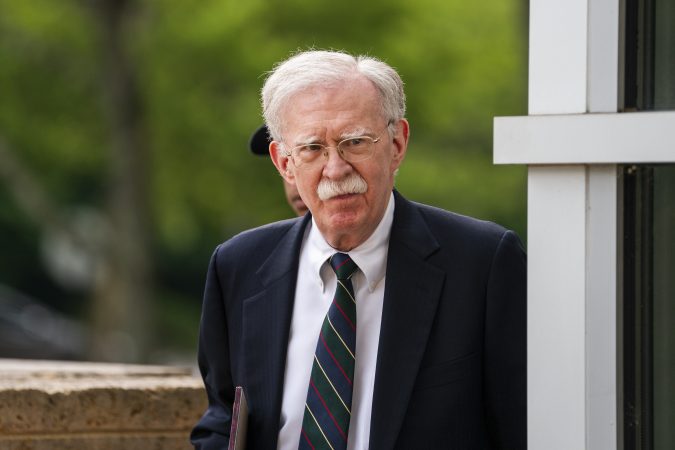
WASHINGTON — John Bolton, a former top adviser to President Donald Trump who became one of his most outspoken critics, pleaded guilty Friday morning to mishandling classified information in a case that could send him to prison.
Bolton appeared in U.S. District Court in Greenbelt, Md., and admitted to a single charge of illegal retention of classified information over notes he compiled for a book that excoriated Trump.
“I’m sorry for it,” he told Judge Theodore Chuang, who said he would sentence Bolton in October.
Under the plea deal, Bolton could be incarcerated for up to five years, according to the terms of the plea deal described in court. The deal also includes a fine of $2.25 million. If Bolton had gone to trial and lost, he could have faced decades in prison.
When he was first indicted, Bolton sought to frame the case against him as part of a push by the president to misuse the Justice Department to punish his perceived political enemies. The case against Bolton, however, began in the first Trump administration and gained momentum during the Biden administration, as investigators gathered additional evidence.
The original 18-count indictment against Bolton accused him of using personal email and a messaging app to share more than 1,000 pages of notes, which included national defense information, with two family members who did not have security clearances.
The accusations against Bolton center on his notes for The Room Where It Happened, his 2020 memoir about his time as Trump’s national security adviser. Those relatives were Bolton’s wife and daughter, according to people with knowledge of the matter, who spoke on the condition of anonymity to describe details of the case that were not in court filings.
According to the indictment, Bolton’s notes revealed that he understood that he was documenting intelligence secrets. One entry began, “The intel briefer said,” while another read, “While in the Situation Room, I learned.”
The first Trump administration fought unsuccessfully to prevent the publication of Bolton’s book, but the criminal investigation ultimately focused not on what was in the published manuscript, but instead on what Bolton wrote in private notes and correspondence.
Unlike some other investigations involving classified information, including charges filed in 2023 against Trump, Bolton was not accused of retaining the secret documents themselves, but rather of keeping diaries and sending emails that mentioned details of his daily work in national security.
Bolton’s emails, however, were later hacked by someone associated with the government of Iran, the indictment said.
“A representative for Bolton notified the U.S. government of the hack in or about July 2021,” according to the filing, “but did not tell the U.S. government that the account contained national defense information, including classified information, that Bolton had placed in the account from his time as national security adviser.”
One section of the indictment described Bolton apparently being taunted by his hacker. A message on July 25, 2021, warned, “I do not think you would be interested in the FBI being aware of the leaked content of John’s email (some of which have been attached).”
The email went on to declare: “This could be the biggest scandal since Hillary’s emails were leaked, but this time on the GOP side! Contact me before it’s too late.”
A representative for Bolton forwarded the email to the FBI.
YANKTON, S.D. — Charl Kleinhaus did not like the direction his country was taking.
A white South African, Kleinhaus said the laws meant to empower Black people after the demise of the racist apartheid system had hurt his mining business. Violence in the country — a scourge affecting everyone, regardless of race — had become too much.
So Kleinhaus considered his options.
Some of his fellow Afrikaners, the ethnic minority that ruled during apartheid, had moved to Germany, but the language barrier was not ideal. He thought about Australia, but decided that moving his family thousands of miles from home would be too hard.
Then, in February of last year, Kleinhaus received what he described as “a message from above.” President Donald Trump had suspended refugee admissions to the United States, but he made an exception for people like Kleinhaus: white Afrikaners who claim they are victims of racial persecution in South Africa.
“It’s now a reverse apartheid,” Kleinhaus said, summing up his grievances about his homeland. “That’s what we are fighting about now.”
In a matter of months, Kleinhaus secured refugee status and moved with his family to the United States, completing a process that can take years under normal circumstances. Now, after a year in the country, he has settled in South Dakota, where he has found part-time work at a car dealership, a farm, and a brickyard while planning his next business.
Kleinhaus is among more than 6,000 South Africans — the vast majority of them white — who have benefited from Trump’s decision to upend America’s refugee program, which for decades had made the United States a sanctuary for people fleeing disaster and persecution.
Charl Kleinhaus secured refugee status and moved with his family to the United States in a matter of months. Terry Ratzlaff
Under Trump, the program has effectively become a whites-only path to life in the United States, a culmination of the president’s long-standing antipathy toward immigrants and his embrace of the concept of “reverse racism” as a guiding principle in his administration.
The president has fought to limit immigration for more than a decade, imposing travel bans on mostly African and Muslim-majority nations and making it much more difficult for people from those nations to obtain green cards. He has railed against affirmative action, and in an interview with the New York Times earlier this year said he believed civil rights-era protections had resulted in white people being “very badly treated.”
But few of Trump’s efforts are as striking as his efforts to turn the refugee program on its head, leaving thousands of people across the world sitting in refugee camps with no chance of entry into the United States, even as he created a workaround for Afrikaners.
The Trump administration has argued that the overhaul of its refugee program is necessary to prioritize refugees who can better assimilate into the United States.
“President Trump has provided a lifeline for Afrikaners, who are being raped, maimed, killed, and driven off their property across South Africa,” Anna Kelly, a White House spokesperson, said in a statement. “While the South African government and many in the media have brushed off the horrific lived experiences of this community, the Trump administration continues to process applications for refugee status because the president has a humanitarian heart.”
But critics of the policy who are involved in refugee resettlement say the Trump administration’s priorities have made it impossible to help people who have nowhere else to turn.
“It’s the moral and legal inversion of what this work is about,” said Jason Marks, a senior refugee officer who resigned from the Department of Homeland Security last year when Trump announced the effort to fast-track Afrikaners to the United States. “They are rolling out the red carpet for this group with a clear racial and political agenda at the expense of everyone else.”
‘Too many people’
Kleinhaus acknowledges that moving to the United States from South Africa’s Mpumalanga province was not his “last option.” He left behind resources: a Jaguar sports car, a Range Rover, and what he estimates is property worth at least $300,000. He plans to sell them all to bring in extra money.
But he also says many of his white relatives and friends were no longer safe in South Africa.
White farmers — a population that Trump has spotlighted in public remarks — have indeed been killed in vicious acts of violence in a country that suffers from a high murder rate. But so have Black South Africans and others, and police data does not support the idea that white South Africans are more likely to be targeted than any other group.
Kleinhaus also said his profits were suffering because of racial equity laws.
“You’re not going to get a big contract from a mining company if you’re not Black,” he said. “There’s too many people. How do you divide a small cake between such a big population? Yeah, you cannot.”
He said he felt no guilt about bringing his children and grandson to America to pursue a new life, even as families fleeing conflict in Afghanistan, Sudan, and Ukraine remained walled off.
“You can’t take in those hard-core war people,” said Kleinhaus, whose news feed is full of social media videos and memes promoting the idea that white people are targeted in South Africa. “You can’t put them in a first-world country, you’ll be mad.”
After allowing refugees from around the globe to enter the country for decades, the United States was now trying to “have some type of balance,” he said.
Secretary of State Marco Rubio said this month that U.S. refugee policy must benefit Americans.
“Everything we do has to be geared by the national interest,” Rubio told lawmakers. He said, “It is in our national interest” to allow in people who can “quickly assimilate into society and be successful.”
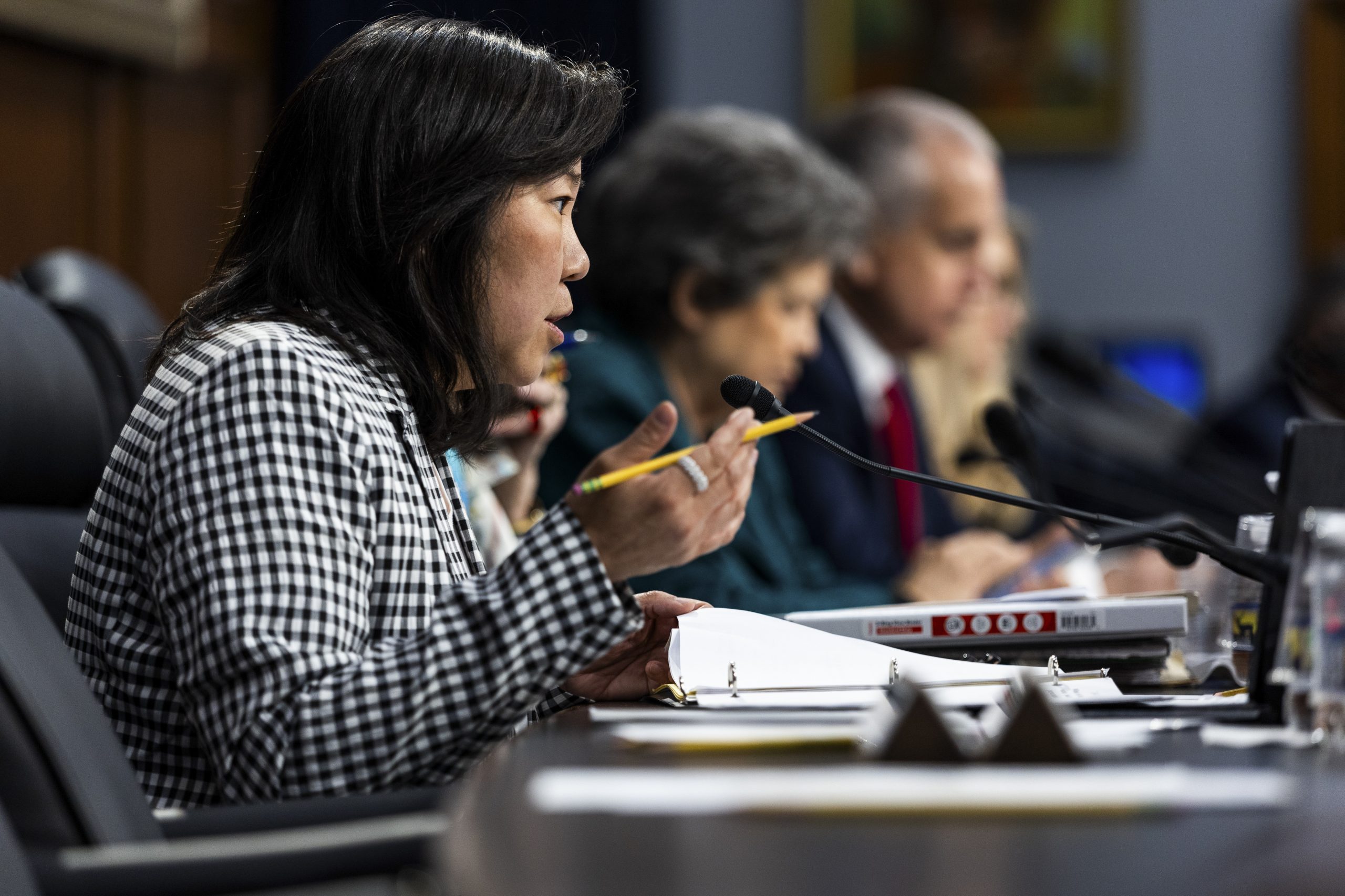
Rep. Grace Meng (D., N.Y.) questions Secretary of State Marco Rubio during a House Appropriations subcommittee hearing this month.Demetrius Freeman
Rep. Grace Meng (D., N.Y.) asked why the administration thought other refugees could not assimilate, including Afghans who had helped U.S. soldiers during the war, cleared vetting, and were now stuck in limbo.
“They have assimilated and contribute and pay taxes,” Meng said of Afghan refugees who had moved to her district in Queens, New York. “I think it’s important for America to keep our promise as well,” she added.
Some of the Afrikaners, who are the descendants of Dutch and other European settlers, have not acclimated as smoothly as the administration expected.
During their initial months in the United States, refugees typically can receive some money for housing and food from resettlement organizations who receive federal funding. Those organizations can also help them find work.
But refugees are expected to eventually be self-sufficient. The process is often a difficult one.
Multiple Afrikaners reported delays in receiving financial support from their local resettlement agency, according to complaints obtained by the New York Times. (The names of many of the refugees were omitted from the documents.) One of the families complained about needing to complete Medicaid and Social Security applications on their own. That same family griped about needing to use public transportation, according to the documents.
Another South African relocated to Texas said he felt staffers from the local resettlement agency, which has a Muslim affiliation, had “discriminated” against him as a Christian. The staff members who picked up his parents from the airport were candid about their views of Trump’s changes to the refugee program.
“They told my mother they cannot wait for next election when Trump can leave office as they had a problem with his decision to give South Africans refugee status and how angry they are that only South African refugees are now allowed,” according to the correspondence.
The newly arrived South African also said his family was placed in an apartment that was “dirty, contained mold, and is located in an unsafe area in Fort Worth.”
The complaints by the Afrikaners about their level of assistance also came after the Trump administration made cuts to funding for resettlement agencies and benefits that in the past were made available to new refugees, including food stamps.
At least three Afrikaners made the return after being settled in states including Minnesota, Idaho, and Illinois, according to government documents. Some had sick relatives back home. One Afrikaner said the process had “occurred quickly” and “she had not thoroughly thought through the process.”
“I think some of them are finding that actually it’s not an easy life to be a refugee,” said Bryony Fox, a lecturer at South Africa’s Stellenbosch University, who researches forced displacement.
Claims of genocide
South African officials strongly dispute claims by Trump that Afrikaners are being targeted in a “genocide.”
During apartheid, which ended in 1994, the government denied Black South Africans the right to own prime agricultural land. That meant that almost all of the country’s large-scale commercial farmers were white, and that remains so to this day.
South Africa’s Commission for Employment Equity found that white people made up 61% of top management posts in 2024, while they are only 7.5% of the population. Black South Africans are also unemployed at far higher rates than their white peers, a disparity that has not improved over time.
To address the disparities, the African National Congress government has instituted racial equity laws that incentivize companies to have Black ownership and leadership. That Black Economic Empowerment initiative has prompted intense scrutiny from the Trump administration, as well as from Afrikaners fleeing to the United States who say it has harmed their businesses.
Kleinhaus said such policies make him as a white man feel targeted by the South African government. He said that he had struggled to keep thieves off his property and that his relatives had been the victims of violence, although he said getting into the specifics made him too emotional.
In his experience, white people are portrayed as “the problems in the economy” and “the privileged ones.”
“There’s no such thing as that,” Kleinhaus said. “Most whites have lost a lot.”
Fox said there was no denying the violence in South Africa.
“That is our biggest problem,” she said. “But it is not targeted. It is not systematic targeting.”
She said criminals had attacked farms because they “have resources that communities are seeking.”
Trump has echoed fringe claims about a white genocide in South Africa for years, going back to his first term. Last year, in a stunning confrontation in the Oval Office, Trump lectured the South African president, Cyril Ramaphosa, about his own country. Ramaphosa implored Trump to listen to “the voices of South Africans.”
The State Department does not break down its refugee data by race, but it has allowed in more than 6,600 refugees this fiscal year. All but three were from South Africa.
Trump’s aides have defended the program by saying that other racial minorities in majority-Black South Africa are welcome to apply for the refugee program.
South Africa also has minority populations of people of Indian descent, white people of British heritage, and mixed-race people — and a few individuals from those communities have been processed through Trump’s refugee program. But refugee resettlement officials say nearly all of those who have been accepted are white, and government documents confirm that the administration has prioritized resettling white Afrikaners.
Why white South Africans?
Long before Trump created the refugee program, many white South Africans traveled to the United States — from the Midwest to the Mississippi Delta — on temporary visas to work as seasonal farmers.
Since 2019, Kobus Van Den Berg has been traveling to and from the United States to plant soybeans and fertilize fields in North Dakota to save money for his family back home in South Africa. He agrees that crime is an issue in South Africa, but he pushed back on the notion that white South Africans are being singled out.
“They’ll attack anybody,” he said. “It doesn’t matter what color or race you are.”
He has watched as Afrikaners have come into the United States in recent months with refugee status and a pathway to citizenship, even as he has spent years navigating a complicated immigration system with the hopes of obtaining a green card.
“Why is it so easy for this other Afrikaner from South Africa to come over here?” Van Den Berg said. “The thing that blows everyone’s mind today is, why is it specifically white South Africans?”
Critics of the Trump administration say the answer lies not just in Trump’s long-standing embrace of the Afrikaners’ cause, or the administration’s desire for “assimilation,” but in his stance toward refugees more broadly.
Sharif Aly, the president of the International Refugee Assistance Project, said the policy shows an “indifference to the plight of nonwhite refugees.”
It is difficult to ascertain how rigorously the administration is vetting the South Africans. In the past, the process has been time-consuming, with agents demanding criminal records, medical records, and even social media posts.
The Trump administration has said it would deny immigration requests for those with antisemitic or “anti-American” posts on their social media accounts, but Kleinhaus was welcomed even though he had made antisemitic comments on social media. In April 2023, the X user @charlkleinhaus wrote in a now-deleted post that Jews were “untrustworthy” and “a dangerous group” and that “they are not Gods chosen.”
Kleinhaus said his grandmother was Jewish, he was not an antisemitic person and he had written the post in error while he was taking medication for a kidney stone. He also shared other posts that had been written by others.
During his processing, he said, he signed off on administration vetting of his social media accounts and no one brought up any problems.
‘Leaving everything behind’
Over breakfast at a local diner, the Fryn’ Pan Family Restaurant, Kleinhaus said he missed some aspects of his life in South Africa, including “the people, my workers, my friends, and family.”
But he also appreciates “these advantages that I’ve got here to do things I can do just as a white person” and not needing to worry about laws requiring him to sell a percentage of equity of his mining company to Black shareholders in South Africa “because they were here first or whatever the story can be.”
He said he was focused on working and contributing to the United States.
He said he did not complain when he, his son, daughter, and grandson were initially placed in one hotel room in Buffalo, N.Y. He soon identified a farmer in Yankton, S.D., who had hired seasonal workers from South Africa for years and was looking for more help.
Now, his daughter works at a flower shop in the small town of Yankton. His son works at another farm and his grandson has learned English quickly after knowing only Afrikaans.
And he has found part-time work at a car dealership and at a brickyard while he plans how to start his next business. He occasionally takes his grandson fishing in this area known for the Lewis and Clark trail on the weekends.
“I just want my kids to be successful,” he said.
Kleinhaus hopes he can convince other relatives to join him soon in America. He said he knows he cannot simply go back and visit, because that would undermine his claims of persecution.
“I’m leaving everything behind,” he said. “When you accept the refugee thing, it’s not a thing like, ‘I’ll be back in two weeks; I’m going on holiday.’ It’s nothing like that. You’re saying, ‘It’s done. I’m not going back.’”
Apple on Thursday raised the prices of its Macs and iPads, citing the soaring costs of memory and storage chips as the artificial intelligence boom has created a frenzy for the components.
Apple increased prices on some laptop and tablet models $200 or more. A base model of the MacBook Pro, for example, now costs $1,999, up from $1,699. Apple’s entry-level laptop, the MacBook Neo, now costs $699, $100 higher than when it was unveiled in March.
The price of an iPad Air increased $150 to $749, while the price of an iPad Pro jumped $200 to $1,199.
The increases show that even Apple, with its sprawling supply chain, is not immune to a global shortage in memory and storage chips. AI chipmakers like Nvidia and Advanced Micro Devices have demanded more of the components for their own chips, which are then used in data centers for developing and running AI systems.
The surge in demand has led memory chip manufacturers like Micron to focus on producing for data centers, which tend to use more expensive chips than consumer electronics. As a result, those companies are making more money but shipping fewer consumer-grade chips, which have become more expensive.
Memory and storage chip prices have quadrupled over the past year, according to analyst estimates, and the cost of those components are expected to continue to rise.
Those costs are now being passed on to consumers. Microsoft also raised prices for its Surface laptops in April.
“We have never seen a component price increase this much, this quickly,” a spokesperson for Apple said in a statement. “We have now reached a point where we need to begin raising prices.”
Apple CEO Tim Cook said during an investor call in April that the company expected “significantly higher memory costs” for the quarter, which runs through June.
“Beyond the June quarter, we believe memory costs will drive an increasing impact on our business,” Cook said on the call.
The company also said it expected its profit margins to decline slightly for the quarter.
Apple on Thursday also raised the prices of its HomePod speaker and its Vision Pro mixed-reality headset.
The timing for the price increases was unusual. Apple typically raises prices when it releases new or refreshed products. In September, Apple released new iPhones and raised the prices for some models $100.
NEW YORK — Three Democrats who made criticism of Israel central to their political identities swept to victory in House primary races in New York City on Tuesday, signaling a new era of skepticism in their party toward the Jewish state and its actions.
The striking results reflected a fast-moving shift in liberal politics. Democratic voters are now more likely to be critical of Israel and its government than they are to be supportive, according to several recent polls, a monumental change in American sentiment.
And while many Democratic officials remain supportive of Israel, next year’s class of congressional Democrats is on track to be more wary about the United States’ relationship with Israel than at any other moment since the Jewish state was established after World War II.
The primary triumphs in deep-blue districts of Brad Lander, Claire Valdez, and Darializa Avila Chevalier came after each was endorsed by Mayor Zohran Mamdani of New York, whose advocacy for the Palestinian cause has been integral to his rapid political rise. At a rally for the candidates last week, he called the nation’s leading pro-Israel organization part of a group of “monsters” that he said were too powerful in American politics.
At Avila Chevalier’s victory party Tuesday night in Harlem, supporters chanted “free Palestine” while she pushed her campaign’s “babies, not bombs” slogan. She suggested in her victory speech that her win represented a shift in how Democrats in New York would operate.
“Today, we make it clear: The politics of the past ends today,” she said.
Super political action committees allied with the American Israel Public Affairs Committee, the pro-Israel group, have spent huge amounts of money on this year’s midterm elections to try to turn the tide in voter opinion. The organization has had some victories, saying in a statement Tuesday night that 180 Democrats and Republicans it had endorsed had advanced to the November election. The group congratulated a Maryland House candidate its allied super PAC spent millions backing and said this would “ensure this seat remains represented by pro-Israel leadership.”
But despite those successes, AIPAC has largely been on the defensive.
Polls show that support for Israel among Democrats has sharply and steadily eroded since the Hamas-led terrorist attacks on Oct. 7, 2023, and Israel’s subsequent destruction of most of the Gaza Strip. A New York Times/Siena survey this spring found that 60% of Democratic supporters said they were more sympathetic to Palestinians than Israelis, compared with 15% who were more supportive of Israel.
“You’re seeing more and more Democrats making it clear that we should provide no U.S. taxpayer support to the government of Israel,” Sen. Chris Van Hollen (D., Md.) said in an interview Tuesday. Next year, he added, “I hope we will see a Congress that doesn’t provide reflexive unconditional support to the government of Israel.”
Perhaps the most significant of the New York races pitted Rep. Dan Goldman, a two-term Democrat from Brooklyn, against Lander, the former New York City comptroller, who staked his campaign on opposing Goldman for being insufficiently critical of Israel.
The race between the two men, Jews who both describe themselves as liberal Zionists, symbolized how Democratic voters, especially younger ones, have shifted away from support for Israel.
But perhaps the most outspoken anti-Israel Democratic candidate who won in New York City, Avila Chevalier, defeated Rep. Adriano Espaillat, who has been a steadfast supporter of Israel in his decade in Congress. Avila Chevalier spoke often of having lived in the West Bank and attended a rally on Oct. 8, 2023, that was widely criticized for featuring speakers who appeared to justify the attacks a day earlier.
Like Lander and Valdez, Avila Chevalier is now the Democratic nominee in a solidly blue House district and is a heavy favorite to wind up in Congress come January.
New York Mayor Zohran Mamdani (left) congratulates Brad Lander after his victory in the Democratic primary election for the seat held by Rep. Daniel Goldman (D., N.Y.) in Brooklyn on Tuesday night.Todd Heisler
The fights in New York became increasingly nasty in the final days of the campaign. A local coffee shop chain wrote on social media that Goldman, who is critical of Israel’s government but has opposed banning aid to the country, was not welcome because it did not serve “genocide enablers.”
Pitched midterm battles over Israel
The main super PAC tied to AIPAC, the United Democracy Project, has spent more than $25 million so far this year, in addition to at least $5 million it has funneled to create new super PACs.
That sum may be just a fraction of what is to come. The group started the year with more than $96 million, making it one of the best-funded PACs in the country.
Its most prominent spending battles so far have been in New Jersey and Illinois. But Israel also became a driving issue in several House primaries in California.
The results have been mixed. In the Chicago suburbs, Daniel Biss, the mayor of Evanston, Ill., won a House primary after explicitly attacking AIPAC. The group spent $7 million in the race, mostly aimed at defeating Biss, who is Jewish. But in the final days of the primary, when it became clearer that a candidate even more critical of Israel than Biss could win, the super PAC dialed back its attacks on him.
In New Jersey, the AIPAC-tied super PAC targeted Tom Malinowski, a popular former member of Congress who supported more restrictions on aid to Israel. But in an embarrassing turn for AIPAC, Analilia Mejia, a progressive organizer who was loudly critical of Israel, beat him in the special election and then won a later primary.
AIPAC has won victories, too. Two of its preferred candidates in Illinois won crowded primaries, even as another anti-AIPAC Democrat won in a Chicago district.
In Washington, defending Israel has fallen out of favor among many congressional Democrats, with a large majority of senators who caucus with the party voting this year to block some U.S. arms sales to Israel.
“Do I think the Overton window on Israel has shifted more in the last six months than my entire career?” said Amy Rutkin, the longtime chief of staff to Rep. Jerry Nadler of New York, the longest-serving Jewish Democrat in the House, who is retiring. “It surely, absolutely has.”
The shift is part of a generational change after the retirements of longtime Democratic leaders such as former House Speaker Nancy Pelosi of California and Rep. Steny Hoyer of Maryland, the longest-serving Democrat in the House, both of whom are stalwart supporters of Israel. Rep. Hakeem Jeffries of New York, the minority leader, is also a backer of Israel.
But among Democratic voters, support for Israel has crumbled. And even House Democrats who are broadly supportive of Israel are highly critical of Benjamin Netanyahu, the country’s prime minister. Few enthusiastically support the right-wing Israeli government, and many are openly counting down until elections there, which are scheduled for October.
Shifting winds in New York
The Democratic shift on Israel has been particularly notable in New York, home to the country’s largest Jewish population and a mayor who has frequently focused on the plight of Palestinians.
“The monsters that we are up against, they take many different forms,” Mamdani said at a recent rally for his endorsed candidates, before adding that AIPAC believed “the only thing more frightening than democracy being allowed to run its course is an end to genocide and Netanyahu’s wars.”
Many Jewish leaders and groups criticized the remarks, arguing that they echoed antisemitic tropes at a time of increased hate crimes targeting Jews.
One of the candidates the mayor backed, Avila Chevalier, defeated Espaillat, the chair of the Congressional Hispanic Caucus. He was the only candidate in New York who was explicitly backed by AIPAC’s super PAC, which transferred money to a separate group that supported him.
In the 10th Congressional District, which includes lower Manhattan and a large area of Brooklyn and is one of the most Jewish districts in the country, Goldman frequently argued that a focus on foreign policy was misplaced given voters’ domestic priorities. Those arguments fell flat: He lost badly, trailing late Tuesday by more than 30 percentage points.
Several Jewish Democrats who are most likely heading to the House, including Lander and Biss, have taken a more antagonistic tone toward the current Israeli government. But whether they will take radically different approaches to policy remains to be seen.
AIPAC as a litmus test
For decades, AIPAC was the leading voice of a bipartisan congressional consensus on the importance of the U.S.-Israel alliance. Now, many Democrats in contested primaries want nothing to do with it.
The organization has become a symbol of dark money, alongside organizations backing the cryptocurrency and artificial intelligence industries. And all three interest groups are spending money on many of the same races.
None of the advertisements paid for by the AIPAC super PAC even mention Israel, focusing instead on top-polling issues in each area.
In Maryland, the super PAC spent more than $5 million to back Adrian Boafo, a state legislator, in the primary to replace Hoyer. The ads focused on Boafo’s biography and his accomplishments in Annapolis. Cryptocurrency interests spent an additional $3.4 million to back Boafo, according to AdImpact, a media tracking firm. He ended up finishing well ahead of a crowded Democratic field.
The next Democratic primaries to revolve around Israel will come in August, when Minnesota, Michigan and other states are holding competitive intraparty contests.
At a Democratic primary debate for Senate last week in Minnesota, Lt. Gov. Peggy Flanagan declared that “I don’t take AIPAC money because my values don’t align with AIPAC.” Her opponent, Rep. Angie Craig, who has been endorsed by AIPAC in the past, replied that she had taken “not one penny” from the group and called for Netanyahu to lose his reelection bid in October.
The most divisive race, however, will be in Michigan, which has large Jewish and Muslim populations.
The Democratic Senate primary there includes Rep. Haley Stevens, a staunch backer of Israel, and Abdul El-Sayed, a progressive public health official who has called Israel’s actions a genocide and opposes any military aid to the country. A third candidate, State Sen. Mallory McMorrow, has tried to take a middle path on Israel, but is struggling in the polls.
When news organizations around the world have faced criticism, they have historically turned to specialists: ombudsmen, in-house critics empowered to investigate their employers’ coverage and report their findings to the public.
But when CBS News appointed one last year, under an agreement with the Federal Communications Commission, it took a different tack. It tapped Kenneth Weinstein to flag complaints privately to its executives, pitching him in the hiring announcement as “an independent, internal advocate for journalistic integrity and transparency.”
As CBS News has been shaken by infighting between management and its star correspondents this year, Weinstein’s silence is being criticized by media experts. They say Paramount, the parent company of CBS News, has essentially hired a watchdog who doesn’t bark.
In the nine months since he was hired, Weinstein has issued no public statements about CBS News’ coverage or its controversies. He has not issued any guidance or feedback in staffwide emails or memos, three employees said. He has told some employees that he is scheduled to work only one day per month, two people said, though one said he responded to queries outside his monthly workday.
Most ombudsmen are much more public facing, said Jeffrey Dvorkin, a former NPR ombudsman who wrote the handbook for the Organization of News Ombuds and Standards Editors. That handbook says ombudsmen should report to the public, usually in a weekly column or mutually agreeable time slot.
Part of “stewarding public trust,” as Weinstein promised to do in his hiring announcement, is addressing the public, Dvorkin said.
“What’s the point then?” he said of CBS News’ decision not to require Weinstein to publish anything. “How is an ombudsman going to convey the public’s concerns, both internally and externally?”
Paramount said in a statement that Weinstein had been doing his job.
“He’s there to review concerns about CBS News’ reporting and coverage through a process that has been clear from the beginning,” the statement said. “Since September, he’s independently assessed the issues brought to him and, when appropriate, discussed them with CBS News and Paramount Skydance leadership.”
After Weinstein flags potential problems to Paramount’s executives, they decide whether to raise them with CBS News.
Since Weinstein was hired, Bari Weiss, the new editor-in-chief of the network, has been accused of injecting political bias into stories by three high-profile journalists for CBS’s 60 Minutes. She fired them all as part of a broader shake-up of the show. The remaining three correspondents said they would stay only because they didn’t want the show to die. (CBS News has denied the allegations of editorial meddling.)
Many newsrooms have done away with their ombudsmen. Some, like the New York Times, which dropped the position in 2017, argued that they were anachronisms in an era of instant online criticism. Others have cited dwindling resources. In addition to the Times, the Washington Post, ESPN, and the Boston Globe did away with their in-house critics in the last quarter-century; NPR and PBS are among the last remaining U.S. news organizations that employ a full-time public editor.
The FCC announced the creation of the CBS News ombudsman when it approved Skydance’s acquisition of Paramount in July. The agency’s chair, Brendan Carr, had been investigating a complaint about a 60 Minutes interview with Vice President Kamala Harris from the previous fall, but allowed the deal after the company agreed to employ, for two years, an ombudsman who would evaluate claims of bias. (President Donald Trump sued Paramount over the interview. Press freedom advocates said the controversy was baseless.)
Carr said the move would “promote transparency and increased accountability.”
In September, Paramount announced that it had found its pick: Weinstein, a veteran of the Hudson Institute, a right-leaning Washington think tank. Though he had no experience overseeing news coverage, Weinstein had served on the board of the U.S. Agency for Global Media, an independent federal agency that oversees U.S. government-supported civilian media such as Voice of America. There, he worked alongside Jeff Shell, who would become Paramount’s president.
Though Weinstein does not respond to complaints publicly, he is easy to reach. CBS News set up a website where viewers can submit their concerns, anonymously or by name. One of the people said that many of the notes Weinstein received focused on the network’s coverage of the war in the Gaza Strip.
At least one inquiry to Weinstein has been made public. Rep. Jamie Raskin (D., Md.) sent him a letter in December to ask for a full accounting of the network’s decision-making around a November interview with Trump.
But Weinstein did not reply. Instead, Paramount’s general counsel sent a letter to Raskin explaining that the interview had been edited for length.
In December, after a 60 Minutes correspondent, Sharyn Alfonsi, accused Weiss of meddling in one of her stories, media critics mused publicly about whether Weinstein would weigh in.
“I wonder if the CBS News ombudsman will have anything to say about this,” Brian Stelter, CNN’s chief media analyst, wrote on social media. Eric Deggans, the Knight professor of journalism and media ethics at Washington & Lee University, posted: “Wonder if Weiss will ever say exactly why she pulled the story? Or if CBS News new ombudsman will somehow surface?”
Carr, at least, does not seem concerned by the public silence from Weinstein.
This month, after Weiss fired the three 60 Minutes correspondents, Carr was asked directly whether Weinstein would look into their complaints of editorial interference.
Jake Tapper, an anchor on CNN, sat down with Carr and pointed out that the FCC had pushed for an ombudsman to evaluate claims of bias, and asked whether Weinstein should investigate.